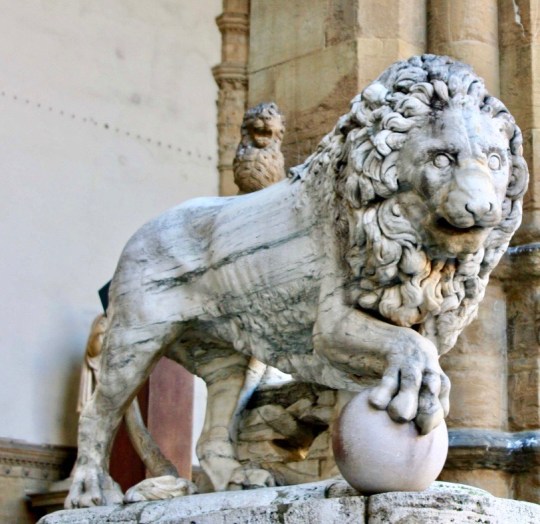
This nice kitty with his finger like paws greeted us on the Piazza della Signoria… along with several other sculptures. (Photo by Peggy Mekemson)
The two-hour trip to Florence from the Port of Livorno and the two-hour trip back seriously sucked up what little time we had to enjoy the legendary Renaissance city. Our first act upon arrival was to plot out our plan of attack, which we did over café lattes and scrumptious Italian pastries. Why suffer? I really, really hate to eliminate treasures, however. Florence is where the birth of the Renaissance took place and is chock full of art.
The latte was delicious and the pastries scrumptious.
The Uffizi Gallery alone, with its world-class art including masterpieces by Sandro Botticelli and Leonardo da Vinci, would take up half out time. Beyond that we plotted out a walk that would take us to the Duomo Basilica and then back to Santo Croce Basilica, where we were to catch our bus. Sadly, I crossed off the Accademia Gallery, which includes Michelangelo’s original David.
But not to worry… there was a magnificent copy of David in front of the Uffizi Gallery in Piazza della Signoria. It was in this square, BTW, that the infamous priest Savonarola (1452-98) held his ‘Bonfire of Vanities’ and encouraged the good citizens of Florence to bring their art treasures and books to be burned. Somewhat ironically, Savonarola, who was quite vain in his own way, was also burned in the square.
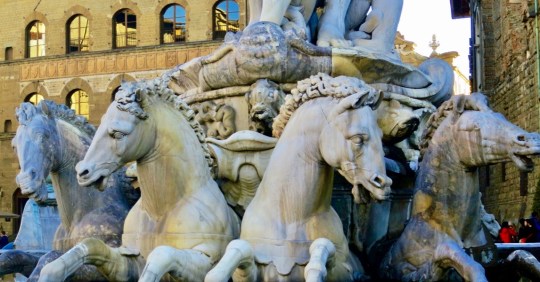
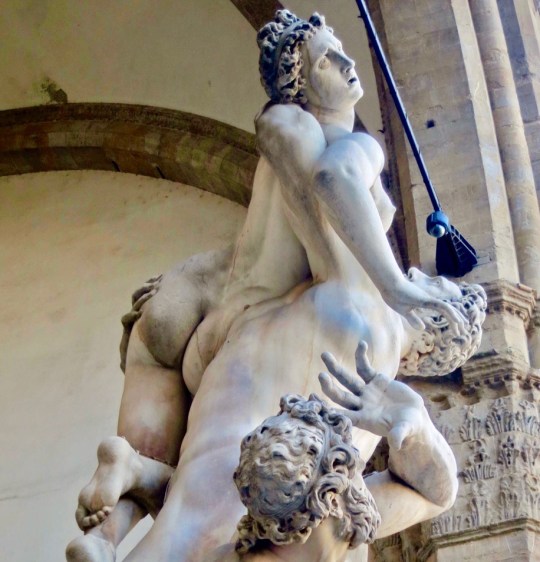
Michelangelo’s David has always been one of Peggy’s favorite sculptures. I wonder why…These charging horses pulling Neptune’s chariot on Piazza della Signoria in Florence seemed to be pulling in different directions. The horses were carved by the Sculpture Ammannati.This sculpture by Benvenuto Cellini shows Perseus holding up the head of Medusa, which he had just lopped off. Hopefully her eyes are closed. Otherwise you would be turned to stone.The most dynamic sculpture on the Piazza della Signoria is the Rape of the Sabine Women by the sculpture Giambologna. The story goes that Romulus needed more women for his new city of Rome, so he went to the nearby town of Sabine and kidnapped them. But enough on violence. They didn’t allow photos to be taken in the Uffizi Gallery, but when we came out, a short walk took us to Florence’s most famous bridge, the Ponte Vecchio.For my final picture today, I selected this view looking down the Arno River from Pont Vecchio.
NEXT POST: A fascinating pig that people can’t keep their hands off of.
After visiting St. Peter’s Basilica in Rome, Peggy and I travelled on to Florence where we were awed by the Duomo and Santa Croce churches, which we found even more beautiful than the Basilica. These two churches are the focus of my re-post today from our 2015 trip to Europe and are part of my armchair travel in the age of Coronavirus series.
Note: Peggy and I are off on another adventure. This time we will be exploring the back roads of America. Carefully. Covid-19 continues to rage across the country. We have our face masks along and enough sanitizer to bathe in. Even Bone and Eeyore are wearing their face masks! I apologize for not reading posts and comments the past few days but will catch up. One challenge of remote America is the lack of good Internet service. Yesterday, for example, I was in the middle of the Nevada desert on “America’s Loneliest Road” following the route of the Pony Express. I have several more posts in my Adventure Travel series and will then start my Backroad series. Peggy, Eeyore and Bone say hi and urge you to be safe! –Curt
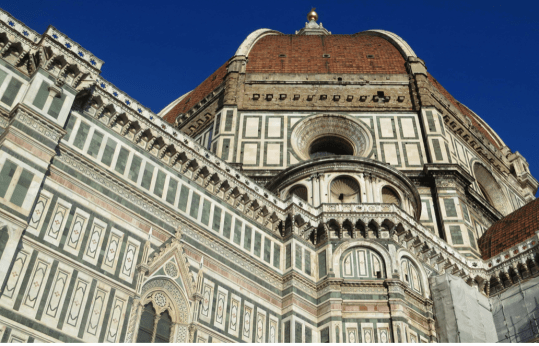
Looking up at the magnificent dome on Florence’s Duomo Cathedral.
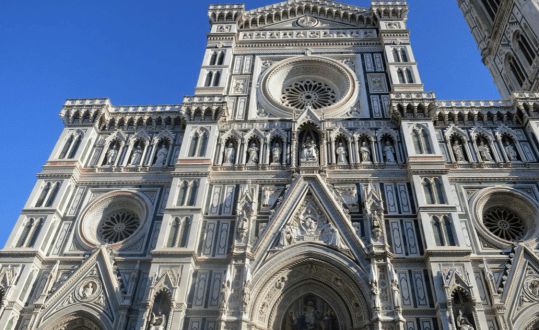
There are at least three reasons for visiting Florence’s Cathedral, commonly known as the Duomo. First is the Church itself, second is the magnificent bell tower, which stands next to the church, and third is the octagonal-shaped Baptistery, which stands in front.
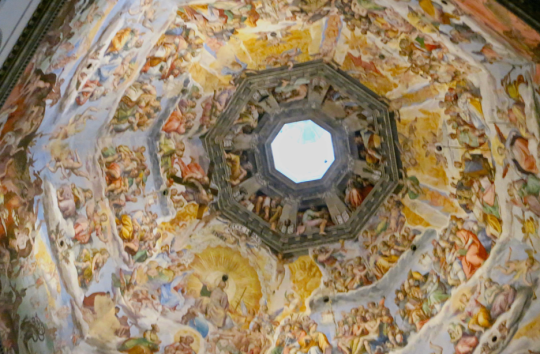
The dome of Duomo was one of the great works of the Renaissance. (The church had been waiting since the Middle Ages for its top.) Filippo Brunelleschi, who built the dome, first studied the ancient Pantheon in Rome. Like so much of the Renaissance, the dome represented a return to, or a rebirth of, the Greek and Roman cultures that had thrived 1000 years earlier before the Dark Ages had arrived along with the Barbarian hordes.
A view of the Baptistery on the left, the front of the Duomo in the center, and the dome on the right.A front view of the Duomo. The bell tower is looming on the right.Looking up at the Duomo’s intricately painted dome from inside the church.
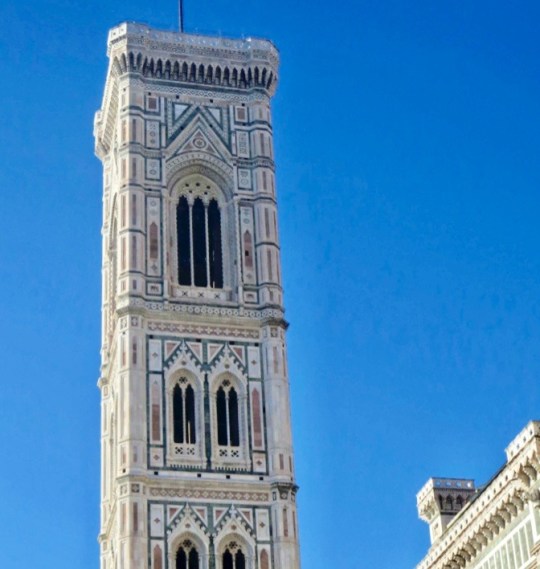
The 270-foot tall Campanile or Giotto’s Tower, which is located next to the Duomo, was actually completed 100 years before Brunelleschi put his finishing touches on the church. Many consider the bell tower to be among the most beautiful in Europe.
Giotto’s bell tower.A close up of the top of Giotto’s bell tower. (Photo by Peggy Mekemson.)Looking up at Giotto’s bell tower.
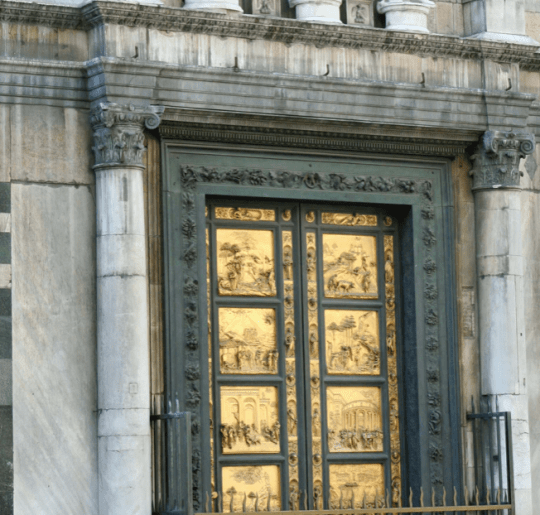
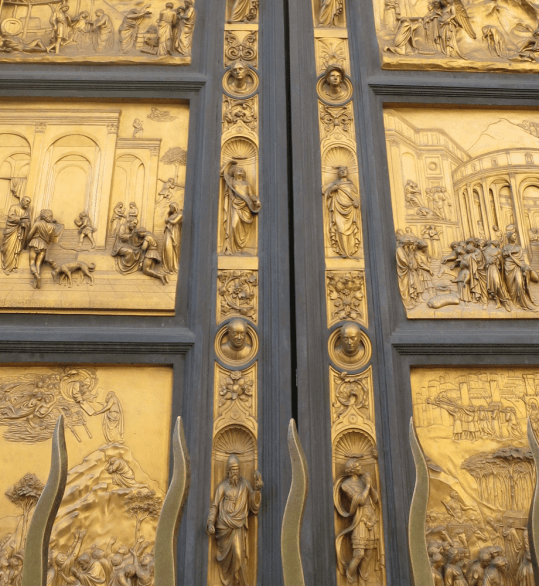
The Baptistery features Ghiberti’s bronze doors. Michelangelo believed these gates were so beautiful they could have served as “the Gates of Paradise.”
The top of Ghiberti’s Bronze Doors on the Baptistery in Florence. Tourists blocked a lower view. (Photo by Peggy Mekemson)A closer look.And a detailed look at one of the panels.
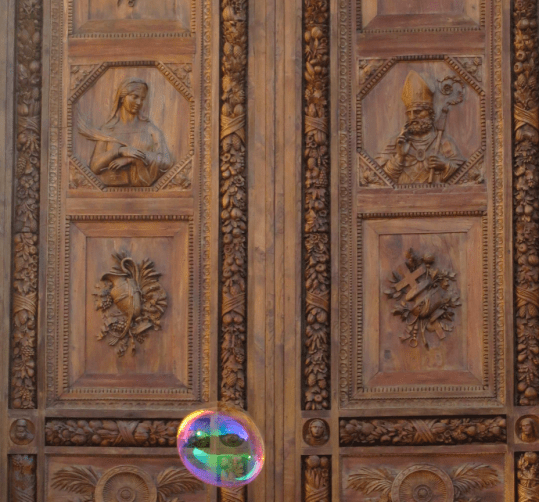
The Basilica of Santa Croce, a 14th Century Franciscan church, also had some great doors but is better known for the people buried inside including Michelangelo, Machiavelli, Rossini and Galileo. As we stood in front of the church admiring its doors, a man sent bubbles floating into the sky.
A bulb floated up past the carved wooden doors of the Basilica of Santa Croce.I’ll wrap-up today’s post with a view of the the Basilica of Santa Croce in Florence caught in the glow of the afternoon sun.
NEXT POST: Exploring a tiny bit of Florence’s art.
We added Rome’s ancient Forum to our walk-about where we visited the Trevi Fountain and the Pantheon. I’m still tired! Today concludes the Rome section of my adventure travel series from posts I did in 2015. Next up will be Florence.
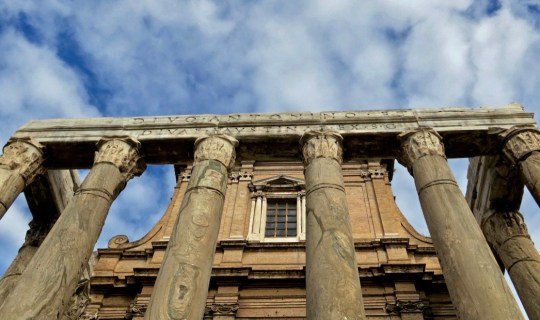
While much of the Roman Forum is in rubble, the temple of Antonius and Faustina still stands proudly… fortunately. The striations around the columns were caused by someone trying to cut them down.
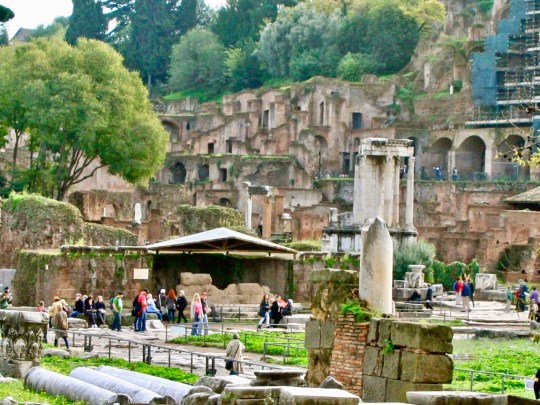
At the height of the Roman Empire, around 100 CE, Rome ruled from England to the Persian Gulf. The Mediterranean Sea was considered a Roman pond. The Forum, located next to the Colosseum, was the site of Rome’s government. Julius Caesar was killed here on the Ides of March, after which Mark Anthony gave his famous speech: “Friends, Romans and Countrymen, lend me your ears.” The following photos are from the Forum.
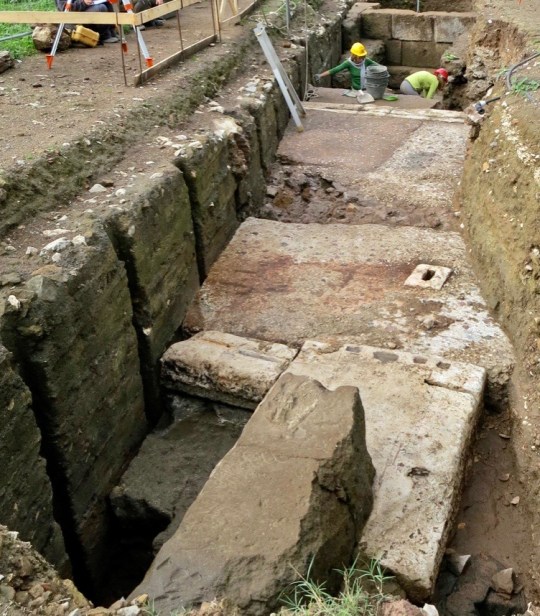
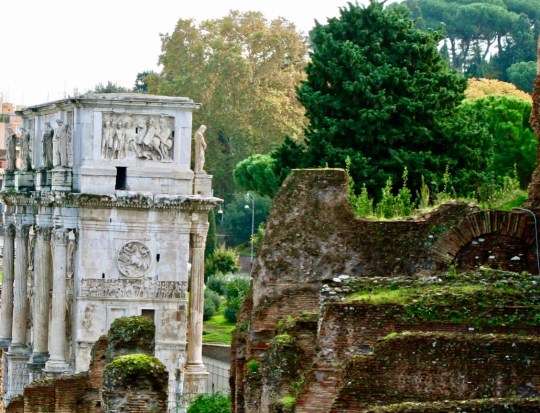
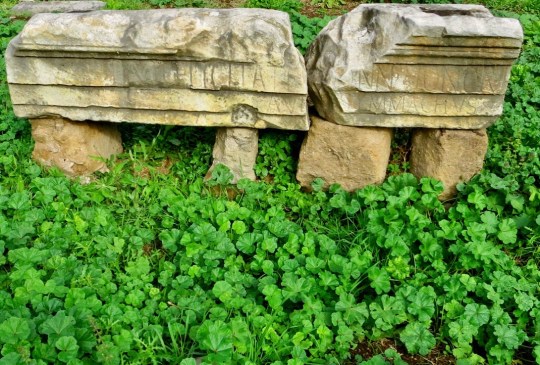
Excavating the Roman Forum is still very much a work in progress, as this photo shows.I found the simple elegance of this single column outlined against a cloudy sky to be quite beautiful.These columns were once part of Caligula’s Palace. Caligula, who enjoyed torturing people, built his horse a house and planned to appoint him as a Consul. It was around that time that Romans decided to assassinate the infamous emperor.The building on the lower left covers the site where the body of Julius Caesar was burned. Above it, to the right, was the Temple of Vesta, attended by the Vestal Virgins. Their job was to stay chaste for 30 years and attend the eternal flame. Being bad got you buried alive. Flings were few and far between. Palatine Hill, where the wealthy lived and cavorted, is in the background. (Photo by Peggy Mekemson)The Arch of Titus commemorated the Roman victory over Judaea in 70 AD. (Photo by Peggy Mekemson)While Peggy was capturing photos of important historical sites, I was busy with the local cat.What remains of the massive Temple of Constantine, the Emperor who made Christianity the official religion of Rome. (Photo by Peggy Mekemson)This impressive six-story arch commemorated the victory of the African born emperor Septimius Severus in far off Mesopotamia. BTW, it was the booty from these Roman victories that helped build the arches.Speaking of aches, I like the perspective of their photo taken by Peggy.Do you think the Latin says park bench? I was tempted.For my last picture on my Forum post, I chose this magnificent boar. (Photo by Peggy Mekemson)
In my last post we stood in St. Peter’s Square and looked at St. Peter’s Basilica. This time we go inside plus visit the Vatican Museum as part of my armchair travel series. This post is based on a 2015 post.
One of the world’s best-loved works of art, Michelangelo’s Pieta, is located in St. Peter’s Basilica.
St. Peter’s Basilica in Rome is one of the world’s great churches. It is simply breathtaking. Walk inside and you are ready to join the Faith… whether you are faithful or not. The church was built during the Renaissance utilizing the greatest artists of Italy when Italy had the greatest artists in the world.
Visiting, you might say, is an indulgence of the highest order. In fact the church was built on indulgence… or, more correctly, indulgences: lots of them. Let’s say you committed a very, very BIG sin. No problem, if you were very, very wealthy. The church was willing to sell you forgiveness, an indulgence if you will. It was a guarantee you’d make it through the Pearly Gates.
The practice was so widespread, and so profitable, and so corrupt in fact, that it led a relatively unknown monk by the name of Martin Luther to tack up a list of 95 demands on the doors of a German church and kick off the Protestant Reformation.
But that is all far behind us in the very distant past. I, for one, am glad that the Pope found a way to pay for his splendid monument. And, I suspect, given a few minutes alone with Michelangelo’s Pieta, the most protesting of Protestants would agree.
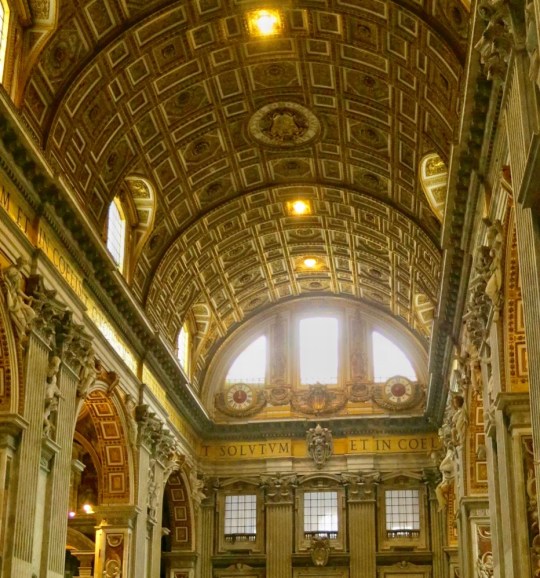
Bernini’s ornate seven story high bronze canopy oversees the simple altar where the Pope holds Communion.Looking up past Bernini’s Canopy at Michelangelo’s dome, which towers 448 feet from the floor.This photo of the nave of St. Peter’s Basilica gives an idea of just how big the church is. 60,000 people standing shoulder to shoulder could stand inside.
If St. Peter’s isn’t enough to pull you into the Vatican, its magnificent museum with over four miles of art should. The tour ends with the Sistine Chapel where Michelangelo spent four years on his back filling 5900 square feet with art.
Our tour of St. Peter’s Basilica and the Vatican Museum was far too short. Even cutting out half of the museum, I felt like an Olympic sprinter. Give yourself a couple of days to explore these outstanding treasures.
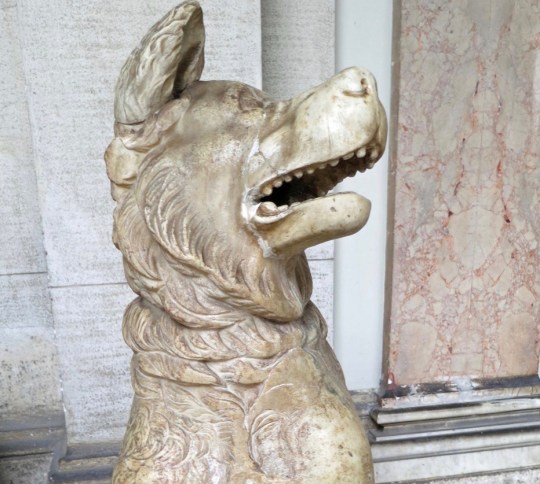
The collection of the Vatican Museum ranges from ancient Egypt to modern times. This is a statue, I believe, of the Egyptian God Anubis who had the body of a man and the head of a jackal.I was quite taken with this lion in the Vatican museum. Note the eyes. Man’s best friend! Woof!Finally, I wanted to emphasize how incredibly ornate portions of the Vatican are. This was the ceiling of the map room. (Photo by Peggy Mekemson)
Today we will visit St. Peter’s Square as part of my armchair travel series for the Age of Coronavirus. This is based on a post I did in 2015 after a visit to Rome.
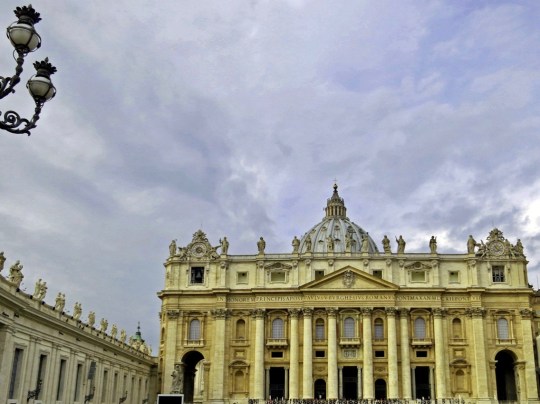
Cloudy skies provide a colorful backdrop for St. Peter’s Basilica with its magnificent dome designed by Michelangelo. This photo is taken while standing in St. Peters Square. Look closely, and you will see ant-like people waiting to enter. Our turn would come.
Our hotel in Rome, the Giulio Cesare, was within a mile of the Vatican. We walked over twice, getting mildly lost both times. It didn’t matter. Rome is chock-full of fascinating architecture and tantalizing history.
The first time we went via the Tiber River, passing by the Castle St. Angelo and its neighboring bridge, the Pont St. Angelo. Eventually this brought us to the broad avenue leading up to St. Peter’s Square and Basilica. Mussolini built the avenue to provide visitors with a better view of the church. He also gave the 100-acre Vatican its independent nation status. Today the Vatican serves as the religious center for some one billion Catholics.
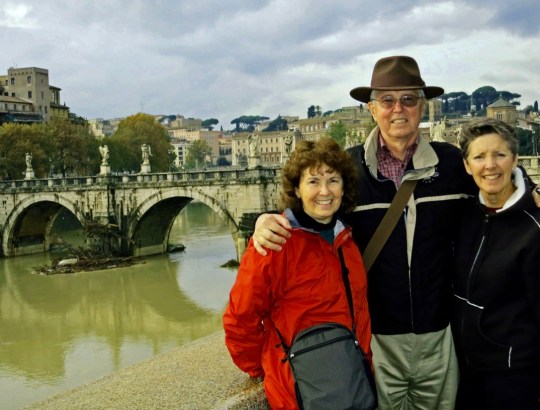
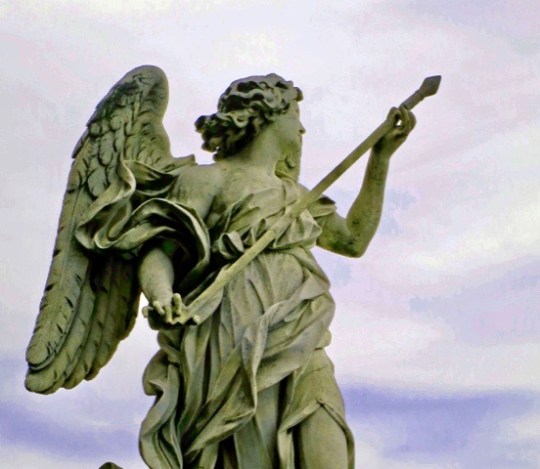
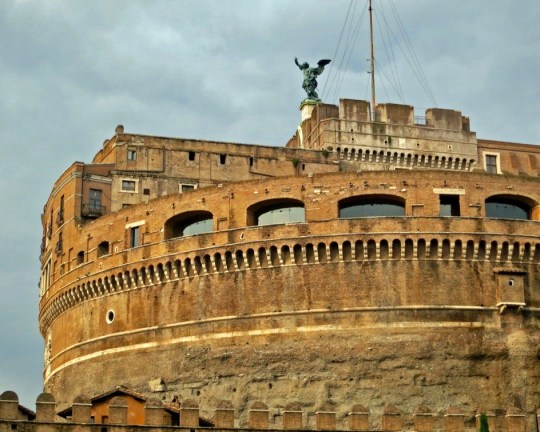
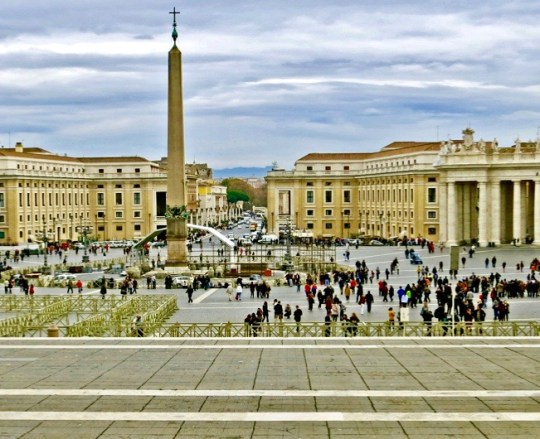
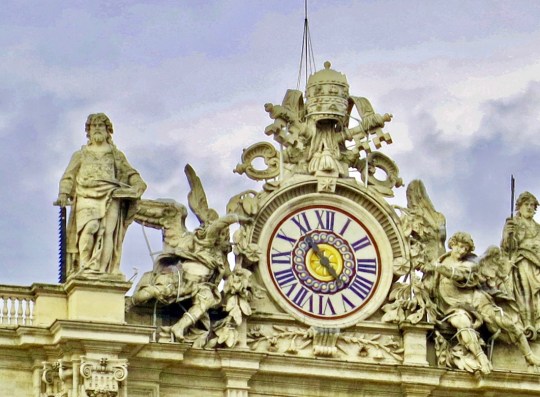
The Victor Immanuel Bridge reflected in the Tiber River of Rome.Peggy, her brother John and his wife Frances stand in front of the Tiber River and the Pont St. Angelo (the Bridge of Angels). The bridge was once the Bridge of Emperor Hadrian and dates from the Roman Empire.Pont St. Angelo received its name during the Renaissance when Bernini oversaw a project to line the bridge with angels reminding the faithful of Christ’s crucifixion. This one carries a lance representing the spear used by a Roman soldier to jab Christ in the side. The rounded Castle St. Angelo stands next to the bridge. Built originally as a mausoleum for Emperor Hadrian, it would later become a prison and then fort. Today it serves as a museum. St. Michael stands on top of the castle with sword drawn to fight off the plague.Hmmm, I wonder if he would take on Covid-19? (Photo by Peggy Mekemson.)A view of St. Peter’s Square featuring a portion of Bernini’s Colonnade. Statues of 10 foot tall saints line the top.Another perspective of St. Peter’s Square. This is taken from the Basilica looking back. The boulevard built by Mussolini is in the distance. Bernini’s Colonnade opens out, welcoming the faithful.This obelisk, seen in the previous picture, dominates St. Peter’s Square. Once upon a time it resided in Egypt, but its home in Rome predates that of the Vatican when it stood over Nero’s race track where Christians were persecuted and Peter was crucified upside down.The top of St. Peter’s Basilica, like Bellini’s Colonnade, features saints. The saint on the left is Simon the Zealot. You can tell your saints by the tools they carry. Simon was a carpenter and is shown with his saw. Simon was called the Zealot because he left his wife and kids to follow Jesus. (Photo by Peggy Mekemson)This lamp from St. Peter’s Square is here because I like it. You’ll see it peeking out on the left hand corner of St. Peter’s Basilica at the beginning of this blog.I took this photo of the massive columns in front of St. Peter’s Basilica because I felt they provided an interesting perspective on the size of the church. We will be visiting the Basilica in my next post.No blog on the Vatican would be complete without showing the changing of the Swiss Guard carrying pikes. (Photo by Peggy Mekemson.)
Today, I am continuing to dip into my archives as part of my armchair travel series in the age of Covid-19. On Wednesday we visited Rome’s impressive colosseum. Today, Peggy and I go on a walk-about visiting various historic sites and dodging pickpockets. In terms of coronavirus, I had an amusing thought: It must be much harder for pickpockets to work when 6-foot social distancing is being practiced!
One of the joys of walk-about is you come on treasures you might not see otherwise. This delightful elephant carved by Bernini is located near the Pantheon. It serves as the base for an obelisk.
If you’ve been following this blog, you know we like to walk extensively when visiting a new city. It’s a good way to become acquainted with the region and its people. Plus it’s great exercise. While Rome is huge, the historic section is confined to a relatively small section. It was large enough, however, that we used mass transit for longer distances.
There were two challenges. The first was figuring out the where and when of catching a train in a language we didn’t speak. The second was that the subway is a great place for pickpockets, especially during rush hour. Rick Steves, in his book on Mediterranean Ports, was constantly admonishing us to be on theft alert.
Peggy, who is more paranoid than I, is always urging me to transfer my wallet to my front pocket when we are in a crowd. Sometimes I even comply. Once, she didn’t even have to ask. We were in Amsterdam and the city had put up huge banners across the streets warning people about thieves. Neither did I require urging in Rome. Folks in Southern Europe were suffering from serious Euro Deficit Dysfunction. Times were tough. We both wore money belts.
The stories are legendary about various scams. Travelers love to share tales. One of my favorites is a woman will ask you to hold her baby while her compatriots grab your wallet. No way was I going to hold a stranger’s baby. Heck, I’ll hardly hold the baby of a woman I know. Babies are known to burp and pee on you. Can you imagine the insult added to injury if a baby was burping and peeing on you while someone was stealing your wallet?
While the stories are fun, the problems are real. A man staying at our hotel lost 2000 euros. A woman told us she was waiting at the airport when a nicely dressed couple told her something was sprayed all over the back of her jacket. The woman took it off. Sure enough, the jacket was covered with green goop. While her husband took the jacket to the restroom to wash, the couple kept her company. They left when her husband returned. Only later did she realize that her purse left with them.
We were at the Termini, a major transfer point on Rome’s transit system, when our turn came. It was at the peak of rush hour and the train was crammed full. John, Peggy’s brother, and his wife Frances had climbed on first. Four little kids, maybe eight years old, jumped on in front of us. Peggy and I were squeezing in when John shouted. He had felt someone reaching in his back pocket. Meanwhile, the four little kids were trying to jump off the train. Peggy, being the ex-elementary school principal she is, thought the kids were confused and tried to shove them back on. The little pickpockets, of course, thought she was trying to collar them. They managed to escape just as the doors were closing. Fortunately, John was also wearing a money belt. He kept his euros and we had a story to tell.
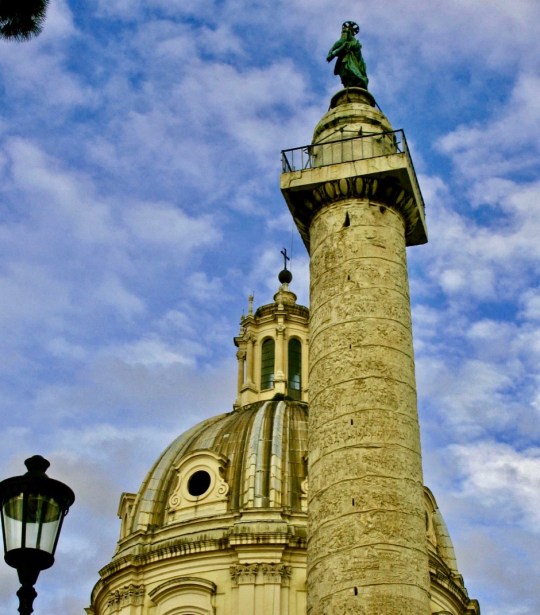
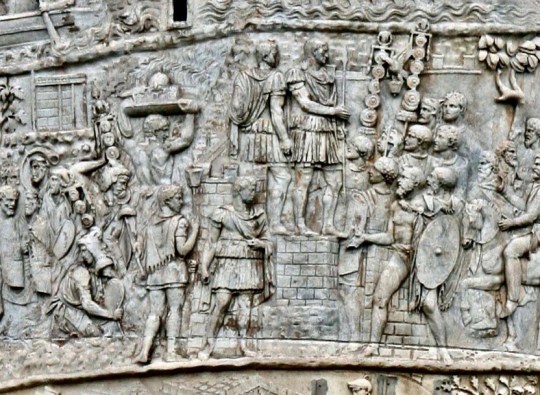
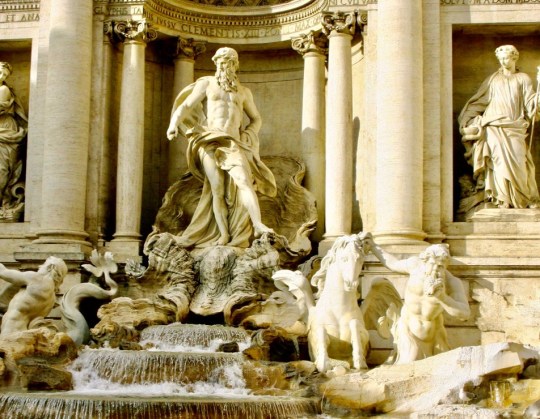
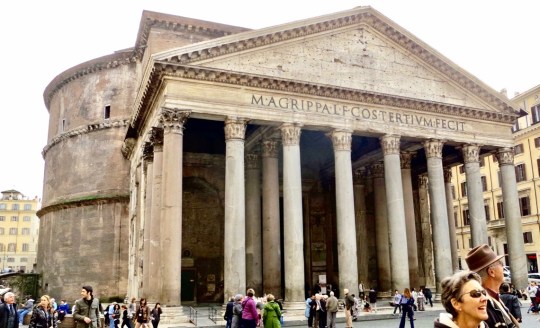
Besides our experience with the pickpockets, we had managed to visit Trajan’s Column, the Trevi Fountains and the Pantheon on our day’s walk-about.
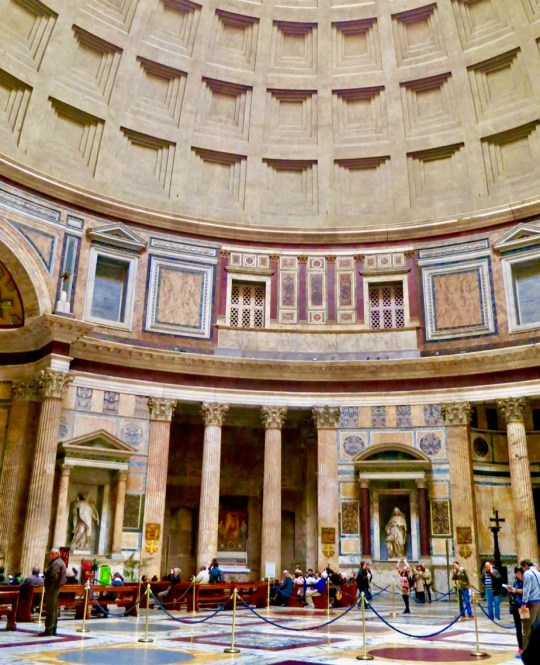
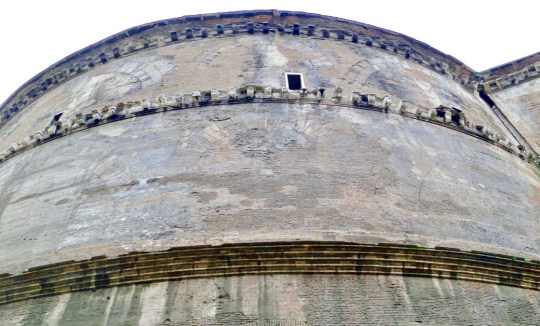
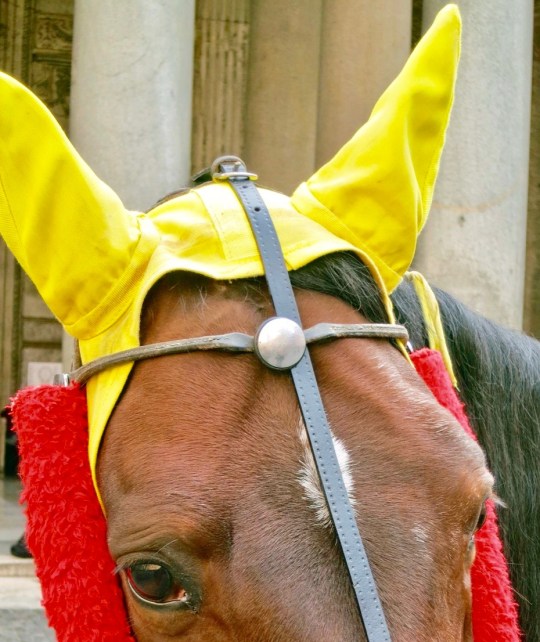
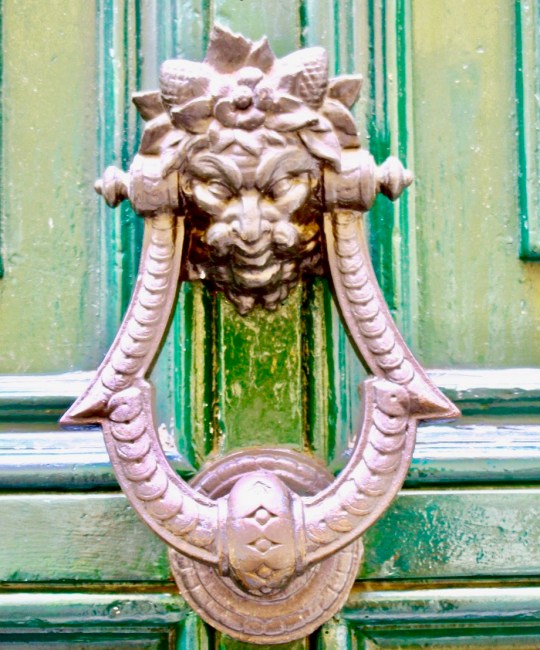
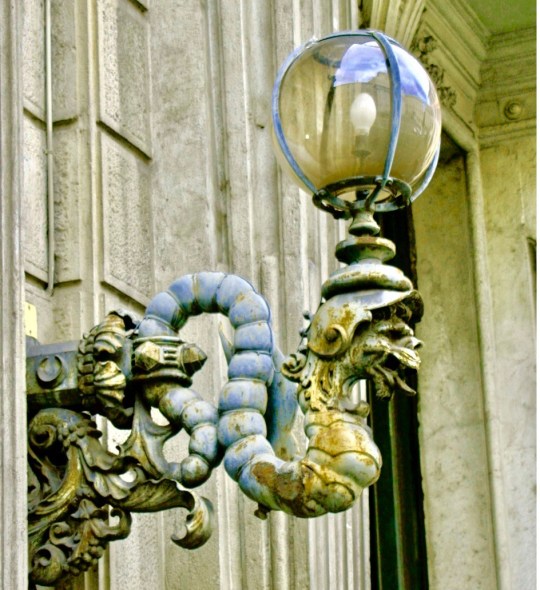
The emperor Trajan apparently had lots to say about his victorious Dacian campaign circa 103 AD. He told it on the bas-relief making its way up the 140-foot column— in a cork-screw fashion. See below for details. (Photo by Peggy Mekemson)This photo shows how much detail is included on Trajan’s Column. (Photo by Peggy Mekemson)The Trevi Fountain has always been worth visiting on its own but its popularity got a significant boost by the 1950’s movie and theme song, “Three Coins in a Fountain.” Sinatra sang the song. The coins are for wishes. The first gets you back to Rome, the second helps you find true love, the third sees you happily married. Or so they say. The Pantheon is one of the world’s most famous structures. It was built to honor Rome’s numerous gods. Its dome has served as a model for domes ranging from St. Peter’s Basilica to the US Capitol building. Peggy’s brother John and his wife Frances made it into the right corner of the photo.The interior of the Pantheon is quite striking.It was common practice for the Catholic Church to take over sites that had been used to worship Roman gods. It was a clever ploy that the church also used for other local gods as well.A final view of the Pantheon’s dome from outside.This fellow was attached to a carriage out side the Pantheon. I liked its ear covers. A horse approach to ear muffs! Or maybe just decorations.Peggy found this door knocker intriguing. (Photo by Peggy Mekemson.)And this dragon lamp. (Photo by Peggy Mekemson.)A final street scene from our walk about through Rome.
NEXT POST: No trip to Rome is complete without a trip to the Vatican.
I’ve been reading Mary Beard’s history of early Rome, “SPQR,” so I had fun going back and revisiting Rome with my posts from 2015. In fact, I had so much fun, I’ve decided to share them with you as part of my armchair travel series. We will go on a walk-about where Peggy and I barely avoid pickpockets, visit the ancient Forum, stop off at the Vatican, and take a trip to Rome’s grand Colosseum where I met a ghost of the great cats that once fought gladiators.
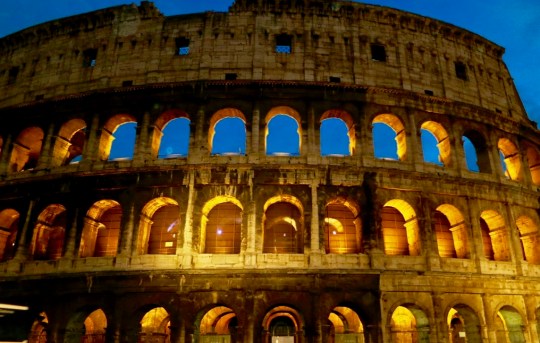
Rome’s Colosseum is lit up in the evening.
I first viewed Rome’s grand memorial to gladiators in 1967 on my way home from serving as a Peace Corps Volunteer in West Africa. I was as impressed with the number of feral cats living in the ruins as I was with the structure. Massive renovations have taken place since then. Today’s Colosseum is crowded with tourists instead of cats. We joined the throngs.
This is the one cat I found in the Colosseum. I am sure it had aunts, uncles, cousins, parents, kids somewhere. But check out the stance— ears back, paw posed to strike. He was ready to take on a gladiator, or at least a camera toting traveler.
Originally the Colosseum was known as the Flavian Amphitheater, after the family of emperors who built it. Nero, who had a bad case of self-adulation, built a huge statue of himself nearby. It was known as the Colossus. At some point, the name was applied to the Colosseum. A later emperor removed the head from Nero’s statue and affixed his own stone likeness on top. Why pay for a whole statue? It became the custom with each succeeding emperor. So much for everlasting fame…
When completed in 80 AD, the Colosseum could seat 50,000 screaming people. During its 100-day inauguration, some 2000 gladiators killed each other and 9000 animals.
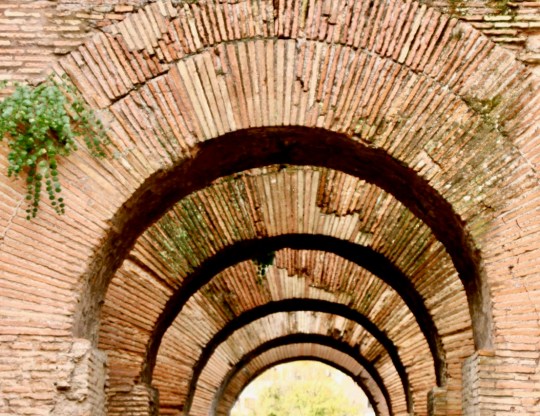
While their taste in entertainment left much to be desired, the Romans’ engineering abilities were superb. The Colosseum is high testament to this. Modern stadiums are still built on a similar model, designed to move large numbers of people in and out quickly. I was amused to learn that the Romans called the entrance/exit passages vomitoria– hence our word, vomit.
Spectators were issued tickets on pottery shards that listed their entrance gate, section, row and seat numbers. The higher your rank, the better your seat. The top rows were saved for slaves, foreigners and women. Some people, such as actors and gravediggers, weren’t allowed in the Colosseum at all. Now actors are idolized and even elected as presidents and governors. Gravediggers still dig graves.
A number of illustrations are found in the Colosseum that reflect what it was like at the Colosseum in Ancient Rome. This one of the nose-bleed section reminded me of a tailgate party. Cooking, eating, drinking, fighting and betting were all part of a typical day. As was carving graffiti on the benches.
The top could be covered for bad weather by a large canvas awning that was put up and taken down by sailors from Rome’s navy. The true gem of engineering was the floor, however, which covered a network of tunnels and cages where wild animals and props were stored. Eighty different elevators operated by pulleys served to bring scenery and wild animals to the surface. You might be in the middle of an African jungle for one scene and a Greek city the next. Imagine the job of being prop master! The floor could even be flooded for sea battles.
Here’s an illustration of what the cover looked like.This illustration from the Colosseum shows a cutaway of the floor with its elevators, wild animals and gladiators.
You never knew when or where the next wild animal might pop up, which could be bad news for gladiators. Cats at the Colosseum then meant lions and tigers with long claws and sharp teeth. There were also elephants, rhinos, hippos, crocodiles and even giraffes— although I can’t imagine why or how you would fight a giraffe. I once chased a herd across the Serengeti Plains in a Volkswagen beetle, however.
Gladiators came from the ranks of slaves, poor people, and criminals. (Contrary to legend, there were very few Christians.) The most successful earned fame, fortune and freedom. Rick Steves, in his book, Mediterranean Ports, reports they even gave endorsements. I can see it in neon lights, “Barbarian Bob eats at Papa’s Pizzeria.”
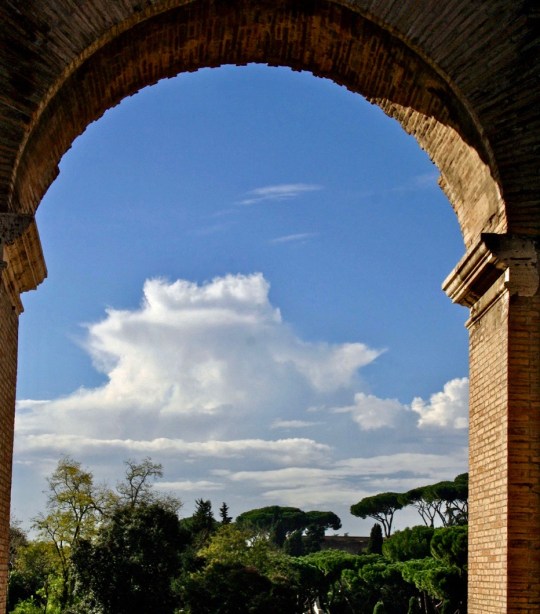
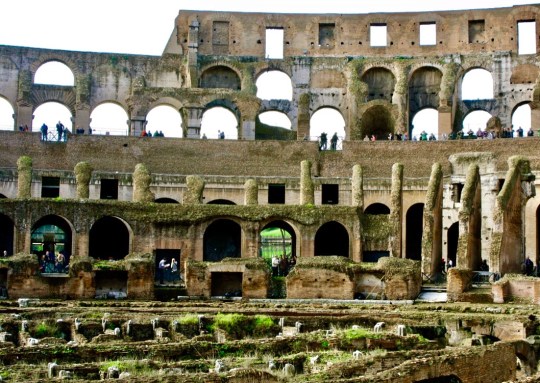
Looking down into the basement of the Colosseum where wild animals, props and scenery were stored.I took this photo from the opposite end of the Colosseum. It provides a perspective on what the floor might have looked like. Only about a third of the original Colosseum remains. While earthquakes have done their share of damage, much more was done by Romans taking building blocks and iron supports for use in other construction throughout Rome.We started our tour on the upper level of the Colosseum. In addition to providing views into the arena, the walkway provided views of the surrounding city and Rome’s ancient Forum area, now covered with trees. (Photo by Peggy Mekemson)Peggy took this photo from the lower level looking up at the upper level. (Photo by Peggy Mekemson)A closeup view of the basement. Imagine it filled with lions, hippos and giraffes.A final view of Rome’s Colosseum in the evening. I took this photo when we were seated outside a small restaurant eating the most expensive gelato I have ever eaten. Sock it to the tourists! But it was worth every euro.
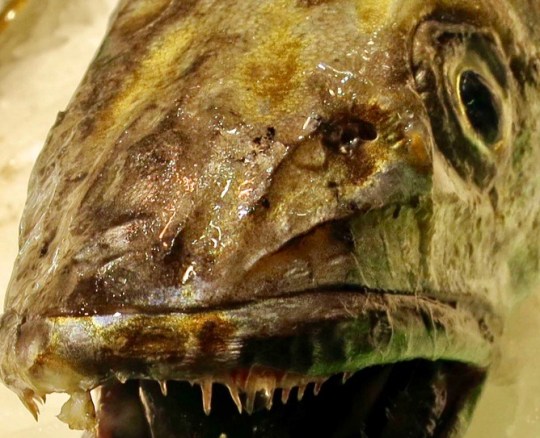
Meet Jaws. I met him at Barcelona’s public market.
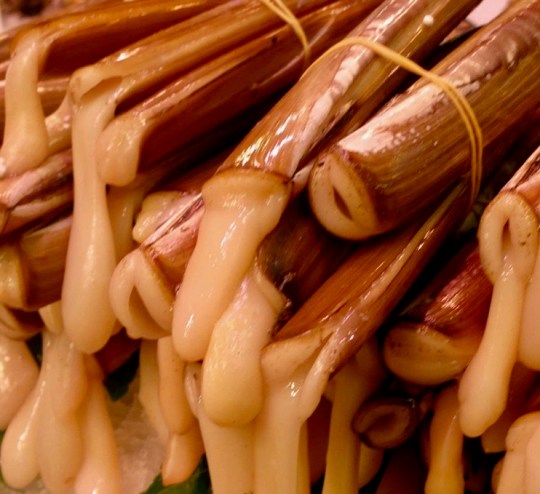
Barcelona’s public market, La Boqueria, was on our must-see list when we visited the city in 2015. It’s rightfully famous for its size, variety of food, tapa bars and number of tourists. Not surprisingly, Catalans have become a bit grouchy about the latter. “Buy fish, don’t take photos!” one yelled at me. Little did he know that I was helping him out. If more people featured ugly seafood in their photos of La Boqueria instead of chocolate and oranges and mushrooms, and peppers, and corn, and garlic and strawberries, and cheese, and delightful tapa bars, fewer people would visit. Heck, fewer tourists would likely come to Barcelona. Problem solved.
So think of this as my campaign to help the Catalans who are hoping that the tourist numbers don’t climb into the stratosphere again when the coronavirus ends. The slogan for the campaign is, “Barcelona: Stop and Smell the Fish— but Don’t Let Them Bite You!”
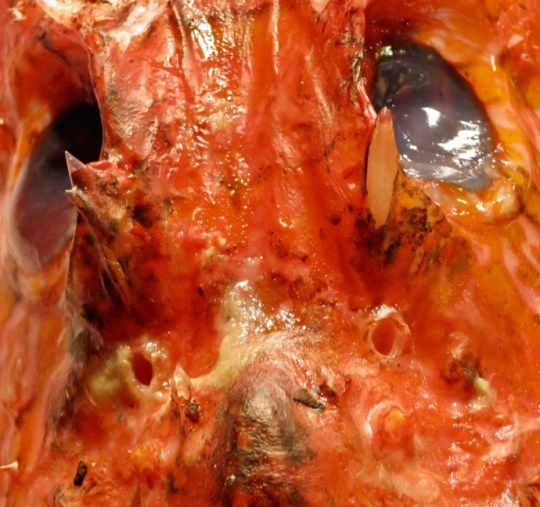
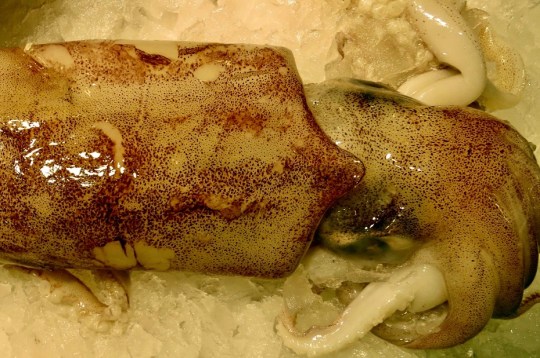
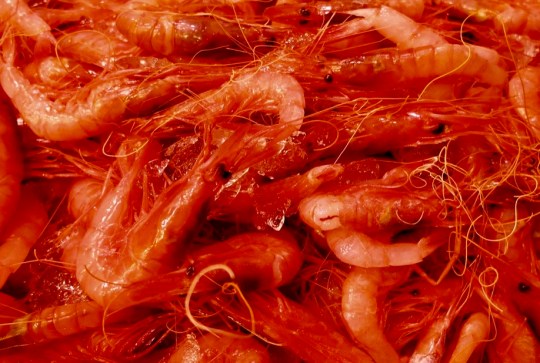
While Jaws won the contest as poster child for the campaign, Ugly was a close second.I don’t want to discriminate against other forms of seafood. This squid was hardly cute.It’s hard to qualify shrimp for the campaign, but…I’ll conclude with this photo, also a serious contender for poster child. I don’t have a clue what it is but I would be hard pressed to identify it as edible! Maybe some of the folks who follow my blog can identify it. Maybe they will even declare it is absolutely delicious!
My blogging friend Kelly at Compass and Camera posted photos a week or so ago that showed stained glass windows and reminded me of Gaudi’s masterpiece cathedral, Sagrada Familia. The soaring faith required to imagine and build this beautiful sanctuary in Barcelona is a reminder that faith and hope together have tremendous power, enough to build a soaring cathedral— and enough to get through the darkest night, which is a comforting thought given the troubling times we have experienced the past few years and are especially experiencing now. (These photos were taken on a visit that Peggy and I made to the Cathedral in 2015.)
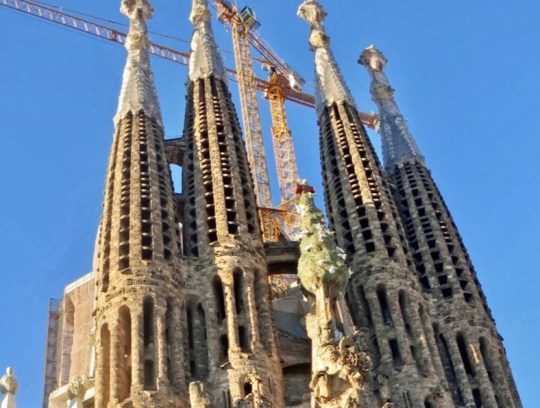
The front of Sagrada Familia reflects Antoni Gaudi’s love of nature and is sometimes described as looking like a melting cake. My thoughts are more like melting ice cream cake. The church is a work in progress. The towers are the first of 14.
Barcelona arrived in the Twentieth Century with its own brand of Art Nouveau, Modernisme. Combining whimsical and practical with a healthy dollop of nature, Barcelona’s Catalan artists and architects did a makeover of their city. Antoni Gaudi (1852-1926), the best known among the Modernistas, added strong religious belief to his work and became the architect of Sagrada Familia, the Church of the Holy Family.
Started in 1883, the church continues to be a work in progress today. Like the great cathedrals of the Gothic and Renaissance periods, it is a work of generations, and like the great cathedrals of Europe, is a masterpiece of art and architecture. Peggy, our traveling companions, and I walked inside and could only stare in awe at the beauty. I’ve selected the photos for this blog to provide a sense of why.
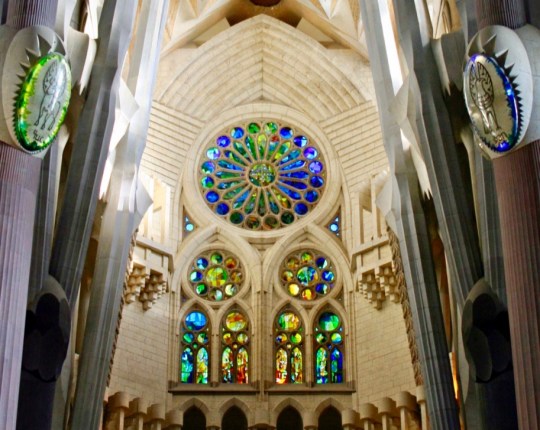
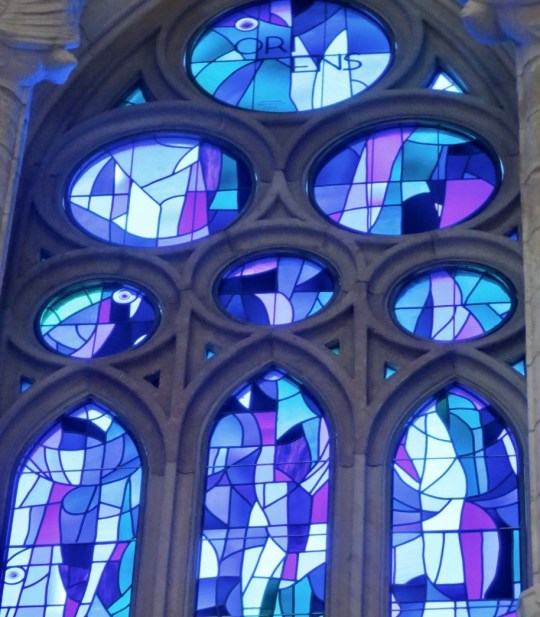
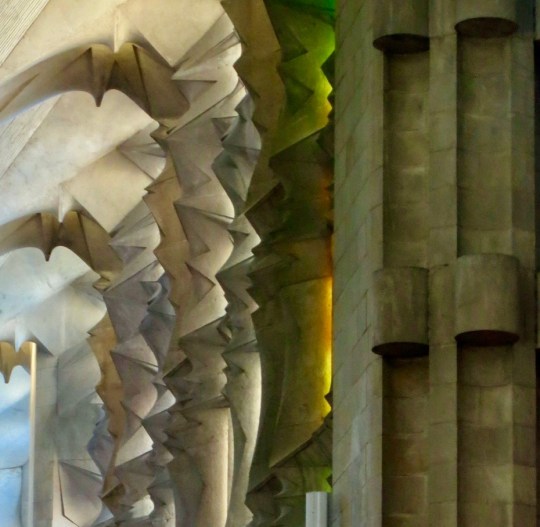
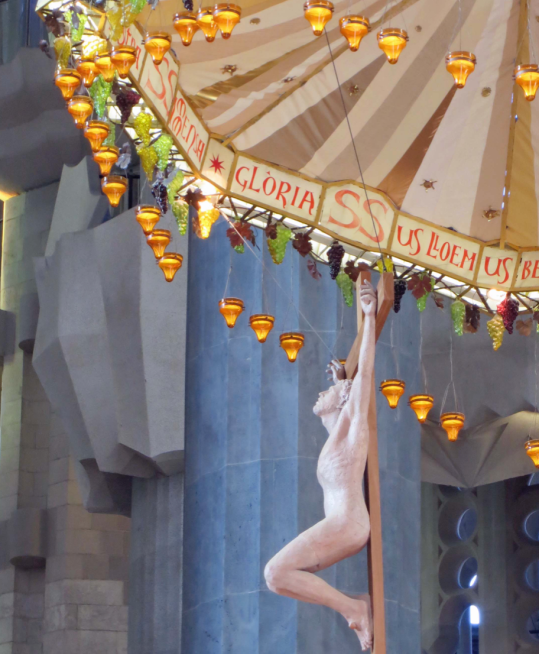
Just walking around the church is inspiring. This sculpture found outside is one of many included in Joseph Marin Subirach’s story of Christ’s death. I found the modern sculptures both powerful and moving. You can feel the grief here.To get a true feeling for Sagrada Familia, you have to go inside, however. The columns in the church range from 36 to 72 feet tall. The ceiling vault reaches a height of 200 feet. The final tower, which will rest on the beams and ceiling, will soar 560 feet into the air, making it the tallest church steeple in the world.Another view looking up. I had a sense of a white bird soaring over and looking down.This picture provide a sense of the soaring columns. (Photo by Peggy Mekemson.)Stained glass windows adorn the great cathedrals of Europe and Sagrada Familia has its share of beauties as this photo and the following three show.Photo by Peggy Mekemson.Photo by Peggy Mekemson.Photo by Peggy Mekemson.Every inch of the cathedral shows close attention to detail and creativity, like this wall.I really like this photo by Peggy that combines the pipes of an organ with the stained glass windows. (Photo by Peggy Mekemson.)The crucifix hanging above the altar serves as a symbol that brings Christians together from throughout the world, but the Cathedral speaks to me of more than religious faith. It speaks to a faith in humanity that goes beyond religious creed, race, nationality, sex, or any of the other differences that tear us apart and are exploited by self-serving, unscrupulous demagogues to a belief/hope that working together we can build— have to build— a better world for our children, grandchildren, and future generations. And for ourselves. Let’s make the world great.I’ll close today with a final photo of Sagrada Familia.
Every couple of years I update Bone’s travel history because he continues to wander the world. This time, I’ve added his 750 mile trek down the Pacific Crest Trail. As you read this post, he is preparing for another 7,000 mile journey in Quivera the RV to some of the remote corners of the contiguous United States in honor of Peggy’s 70th Birthday. He’ll be wearing his face mask and reporting along the way!
Bone has travelled twice to the base of Mt. Everest. Twice.
Sometime in the 1900s Bone started his life as part of a horse wandering through the Sierra Nevada Mountains. The horse was allegedly eaten by a bear. Bone ended up in a high mountain meadow practicing Zen and being nibbled on by a miscreant rodent.
1977: He was ‘discovered’ by two lost backpackers (Curt Mekemson and Tom Lovering) on the Tahoe Yosemite Trail south of Lake Tahoe and launched his career of wandering the world.
Normally, Bone likes to hang out in Curt and Peggy’ library in Virginia. His favorite section is travel.
He also has a fondness for George, the Bush Devil, who is on the cover of Curt’s book, “The Bush Devil Ate Sam.” Here, the two of them share a laugh.
1980-81: Bone commenced his first World Tour with Tom. He visited Asia including Japan, Hong Kong, Bombay, Delhi and Katmandu where he trekked to the base of Mt. Everest. He then wandered on to spend spring and summer in Europe stopping off in Greece, Spain, Portugal, France, Italy, Austria, Liechtenstein, Luxembourg, Germany, Belgium, England and Ireland. Getting cold, Bone headed south and hitched a ride in the back of a truck through Algeria, Niger, Chad, Nigeria, Cameroon, Central African Republic, Zaire, Sudan, Kenya (where he crossed the Equator), Tanzania, Zambia, Zimbabwe, Botswana and South Africa. He signed on with Tom as crew of a sailboat in Cape Town and headed north to Mallorca, stopping off on the islands of St. Helena, Ascension, Cape Verde and Madeira. Back in Europe he explored his possible Viking roots in Sweden, Norway and Finland.
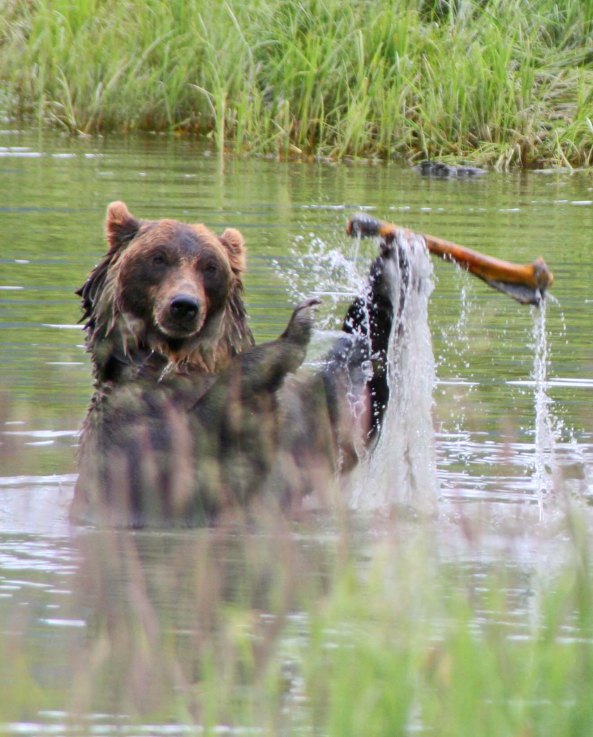
1983-86: Bone assumed Cheechako status and moved to Alaska with Curt where he was stalked by a grizzly bear on the Kenai Peninsula, explored Prince William Sound by kayak, learned to winter camp in 30 degree below zero weather while listening to wolves howl, backpacked in the Brooks Range north of the Arctic Circle, and discussed the finer points of eating salmon with Great Brown Bears in Katmai National Park. He escaped briefly to the warmer climate of Hawaii and participated in the New Orleans Mardi Gras.
One look at this fellow and Bone decided that he wanted to be elsewhere.
The big guy was playing with a distant cousin of his.
1986: He backpacked the Western US for five months with Curt exploring the Grand Canyon, the Gila Wilderness of New Mexico, the Rockies, and the Wind River Mountains of Wyoming before returning to his beloved Sierras.
1989: Bone joined Curt on a six month 10,000-mile solo bike tour around North America visiting 18 states and 4 Canadian provinces. He ended his journey by meeting Peggy in Sacramento.
1990: The International Society of the BONE was formed at Senior Frogs in Mazatlan, Mexico, where Bone spent the afternoon being pickled in a pitcher of margaritas and being kissed by lovely senoritas.
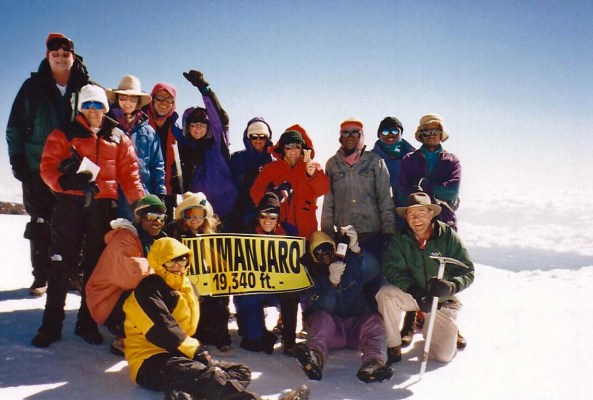
1991-97: Various members of International Society accompanied Bone on numerous adventures. Highlights included a White House Press Conference with Bill Clinton, being blessed by the Pope in St. Peter’s Square, visiting with Michelangelo’s David, going deep-sea diving in the South Pacific and Caribbean, doing a Jane Austin tour of England, and exploring the Yucatan Peninsula. A group adopted him as a good luck charm and took him back to visit the base of Mt. Everest one year and to climb Mt. Kilimanjaro another.
Bone loves high places. Here he is on top of Mt. Kilimanjaro in East Africa. (He’s with MJ, fourth from right, standing.)
Bone went diving in the Pacific in 1997 with Jose and Barbara Kirchner, visiting a Japanese ship sunk during World War II and receiving his diving certificate.
1998-99: Bone embarked on 40,000-mile journey in the van, Xanadu, through the US, Canada and Mexico with Peggy and Curt, visiting over 30 National Parks, driving the Alaska and Baja Highways, checking out Smokey the Bear’s and Calamity Jane’s graves, kayaking in the Sea of Cortez, leaf peeping in Vermont, jetting to the Bahamas, pursuing flying saucers in Roswell, New Mexico, and completing his visits to all 50 states.
Bone was quite impressed with the size of his ancient relatives. Here he rests on dinosaur toes at the Dinosaur National Monument Visitor Center.
2000-02: Bone journeys up the Amazon, returns to Europe, cruises to Belize, Cancun and the Cayman’s, and goes to New Zealand where a misguided customs agent tries to arrest and jail him as animal matter.
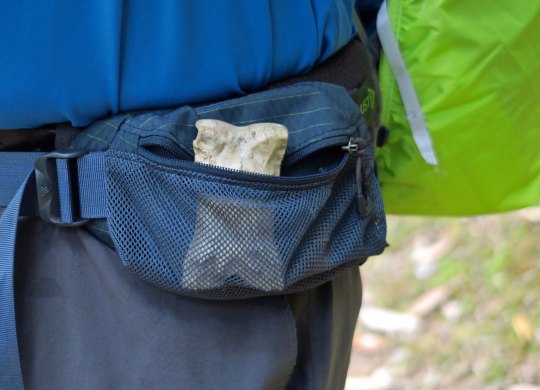
Bone, who likes strange things, insisted on having his photo taken with a mudstone concretion in New Zealand.
2003: Bone undertakes a 360-mile backpack trip in celebration of his discovery and Curt’s 60th birthday. They begin at Squaw Valley near Lake Tahoe and end by climbing Mt. Whitney. Various friends join them along the way.
Bone got a little high when he helped Curt celebrate his 60th birthday, which isn’t surprising considering he is a California bone.
2004: Bone visits Hemingway’s grave in Idaho, goes horseback riding with Australians and Bahamians in Montana, and makes his first pilgrimage to Burning Man in Nevada, a very Bone like type of place. He also jets off to Costa Rica.
Bone has a love for anything ancient. Here, he perches on a Mayan sculpture in Costa Rica.
2005-2007: Bone returns to Burning Man twice and revisits Europe twice including special stopovers in Portugal, France, Holland, Germany, and Belgium. He also revisits Mexico.
2008 – 2011: Bone commences another exploration of North America. This time he travels in the van, Quivera, along with Curt, Peggy, and Eeyore the Jackass. His journey takes him over 75,000 miles of American Roads. Along the way, he barely escapes the hangman’s noose in Tombstone, Arizona. In May of 2010 he helps Curt initiate his blog, and rafts 280 miles down the Colorado River with Tom, Curt and friends through the Grand Canyon.
Bone barely escaped the hangman’s noose after being a Bad Bone in Tombstone, Arizona.Bone, wearing his PFD, scouts a major rapid on the Colorado River before rafting though it.
2012-2017: Bone goes into semi-retirement in Southern Oregon. Please note the semi, however. He continues the exploration of the West Coast ranging from Big Sur to Vancouver Island, where he kayaks for a week in search of Killer Whales. He wanders through England and Scotland helping Curt find his roots and spends a week traveling by Canal Boat. Later, he returns to Europe again, traveling through the Mediterranean visiting Turkey, Santorini and other Greek Islands, Dubrovnik, Venice, Rome, Pompeii, Florence, and Barcelona. He returns to Burning Man several times. On one trip, he is married to the lovely Bonetta, who he met while exploring a swamp in Florida. Rumor has it that it was a shotgun wedding. This past year he traveled with Peggy and me on our 10,000 mile trip around North America retracing Curt’s bike route. He made a very special trip with fellow blogger Crystal Truelove to visit with Native Americans of the Cherokee Nation in Oklahoma.
Burning Man is one of Bone’s all-time favorite activities.
Bone and Big Nose Bonetta are married in a temple at Burning Man in 2013. Bone’s kilt was made for him by an 80-plus year old woman from Kansas. Bonetta is wearing a designer wedding dress with very expensive plastic jewelry to match.
Bone got a wee bit jealous when I snuggled up to this mammoth of a bone when Peggy and I were re-visiting by van my 1999 10,000-mile bike trip.
2018: Bone joins Curtis in celebrating Curt’s 75th Birthday by backpacking 750 miles in Oregon and California. Highlights include the Rogue River Trail, Three Sisters Wilderness and the Siskiyou Mountains in Oregon. In California, Curt and Bone more or less follow the Pacific Crest Trail through the Klamath Mountains, Marble Mountains, Trinity Alps, Cascade Mountains and Sierra Nevada Mountains— taking detours whenever the mood strikes, including revisiting where Tom and Curt found him in 1977! Along the way, Bone meets and chats with numerous through-hikers on the Pacific Crest Trail who are hiking from Mexico to Canada. He also spends a lot of time dodging horrendous forest fires. Peggy joins Curt and Bone for three sections of the journey and provides welcome backup for the rest of the journey.
Bone had a privileged position on the front of Curt’s Backpack during the 750 mile journey down the Pacific Crest Trail.Bone met many through-hikers making their way from Mexico to Canada including a hiker whose trail name was Bone! Here we have Bone and Bone.As we arrived at Bone’s home south of Lake Tahoe, he entertained Peggy with tales from his childhood.
2019-2020: He joins Curt for a trip down California’s beautiful Highway 395 among the Eastern Sierras and visits the Alabama Hills where cowboy movies of yore were made with the likes of John Wayne, Hopalong Cassidy, the Lone Ranger and a host of others— voices from the past that have echoed down through time. “Hi-yo Silver away.”
Bone and his traveling companion Eeyore donned covid masks for 2020 RV trip to the Outer Banks of North Carolina to celebrate Peggy’s 70th Birthday.
2022-2026 “Is that a bone in your suitcase? Hand it over.” Worried about being confiscated by the TSA or some similar organization overseas, Bone decides to limit his travel to the US with a 10,000 mile road trip each year. Highlights include 3-month trips where he explores the Pacific Coast, the Southwest, the Northwest, and New England. Taking different routes to get to these locations, he also spends time in the South, Midwest, East and West in general. Along the way, he manages to visit most of the National Parks, travels Route 66, and goes to Burning Man again. He also goes backpacking and kayaking. He now lives in Virginia with Curt and Peggy.