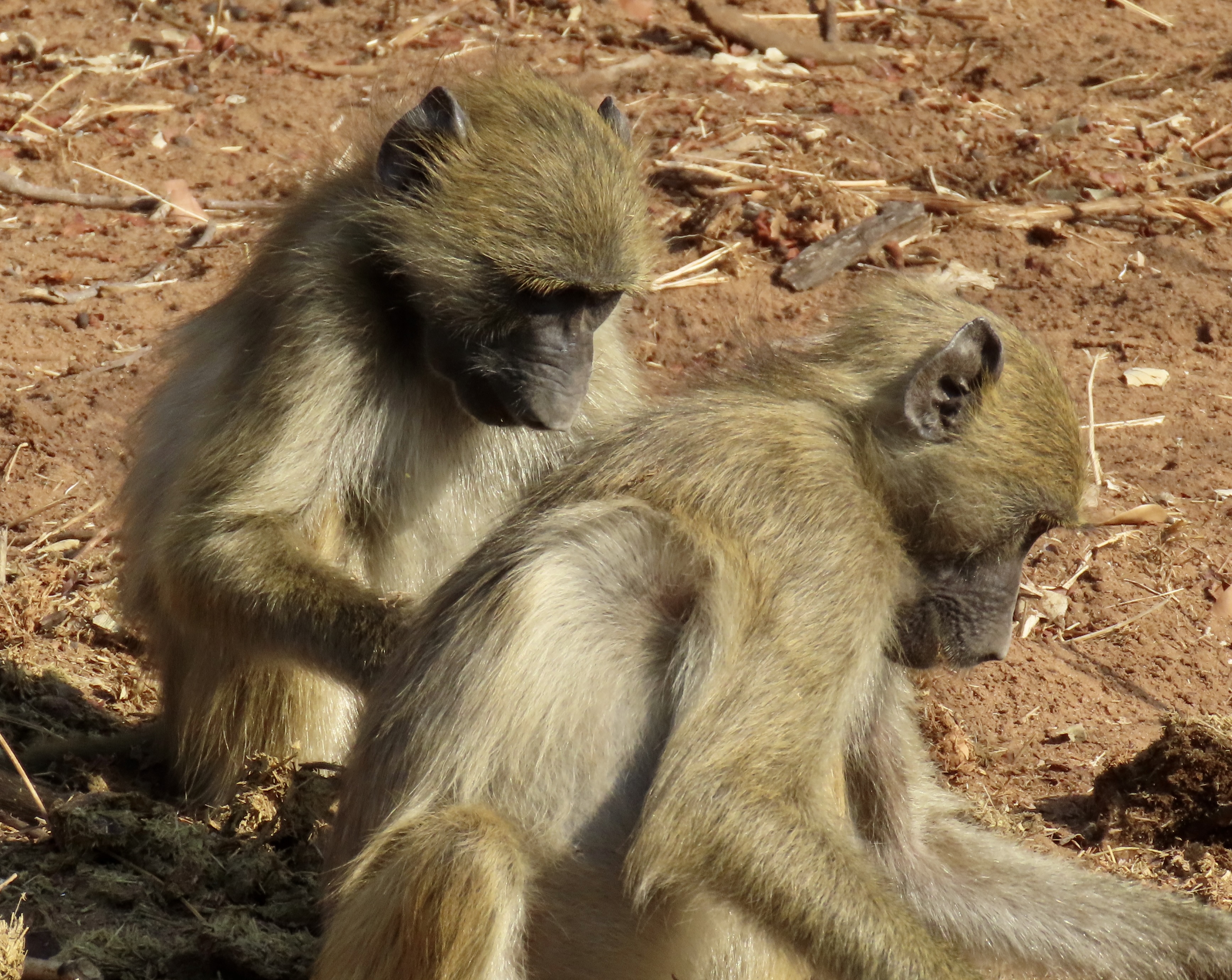
Mom checks us out. Given the ‘look,’ I don’t think I would mess with the baby. We were at a water hole in Hwange National Park, Zimbabwe when we came on this mother and her baby.
In the animal kingdom, baboons are close relatives of ours, sharing 94% of our DNA. While others are closer (chimpanzees at 99% for example), 94% is close enough to feel a sense of identity, or at least imagine one. This mom’s interactions with her baby were about as ‘human’ as they get.
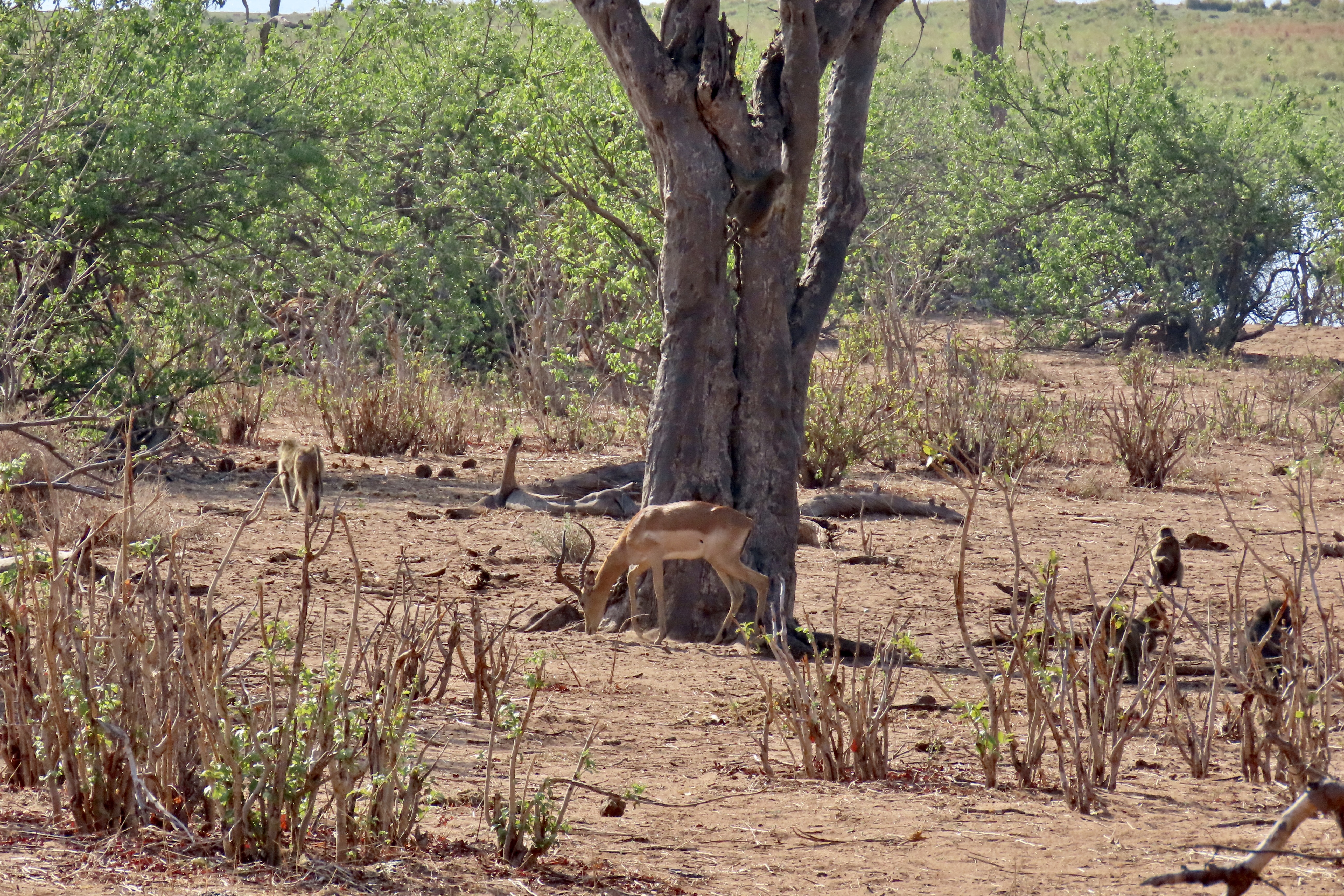
Assuming we were harmless, junior trotted out for a closer look…And received a lecture from Mom for his boldness. At least that’s the way it looks!Like us, baboons are omnivorous. This one has found a tasty stick to chew on….While carrying on a conversation with another baboon. He may be talking, in a way. Baboons have 10 or more vocalizations they use to communicate.His communication with us seemed clear.The baboons here were harvesting the fruit in this tree. Our guide told us they chewed off the outer rind, which was spicy, and ate the sweeter fruit in the middle. Impalas, apparently liking spicy, waited under the tree to gulp down the rinds.Here’s a closer look.An impala feasting on the rinds is at the base of the tree. Several more baboons can be seen on the ground. Groups of baboons are called troops.I’ve already featured baboons sifting through elephant dung to find ‘tasty’ tidbits. Two of them were hard at work with the chore.We saw lots of baboons going about their business in Chobe National Park. This little fellow seemed to be in a hurry. Maybe mom was calling.A distant photo caught a mother carrying its baby that was hanging on underneath. We saw another baby riding on its mother’s back like a cowboy rides a horse.Mom and a teenage baboon make their way through the grounds of the Safari Lodge where we stayed next to the Chobe River.This handsome dude seemed to be focused on something other than food. (Warning: Now’s the time for the R-rated part of this post.)And found her. Females have patches on their rear that turn bright red when they are ready to mate. If males are a little slow on the uptake, the females ‘flirt’ by backing up to them. No flirting was required here. That’s it for today. And no more R-rated posts until we get to the mongoose. Monday’s post will feature a number of birds we saw on the safari that I haven’t covered yet: They range from sublime to ugly.
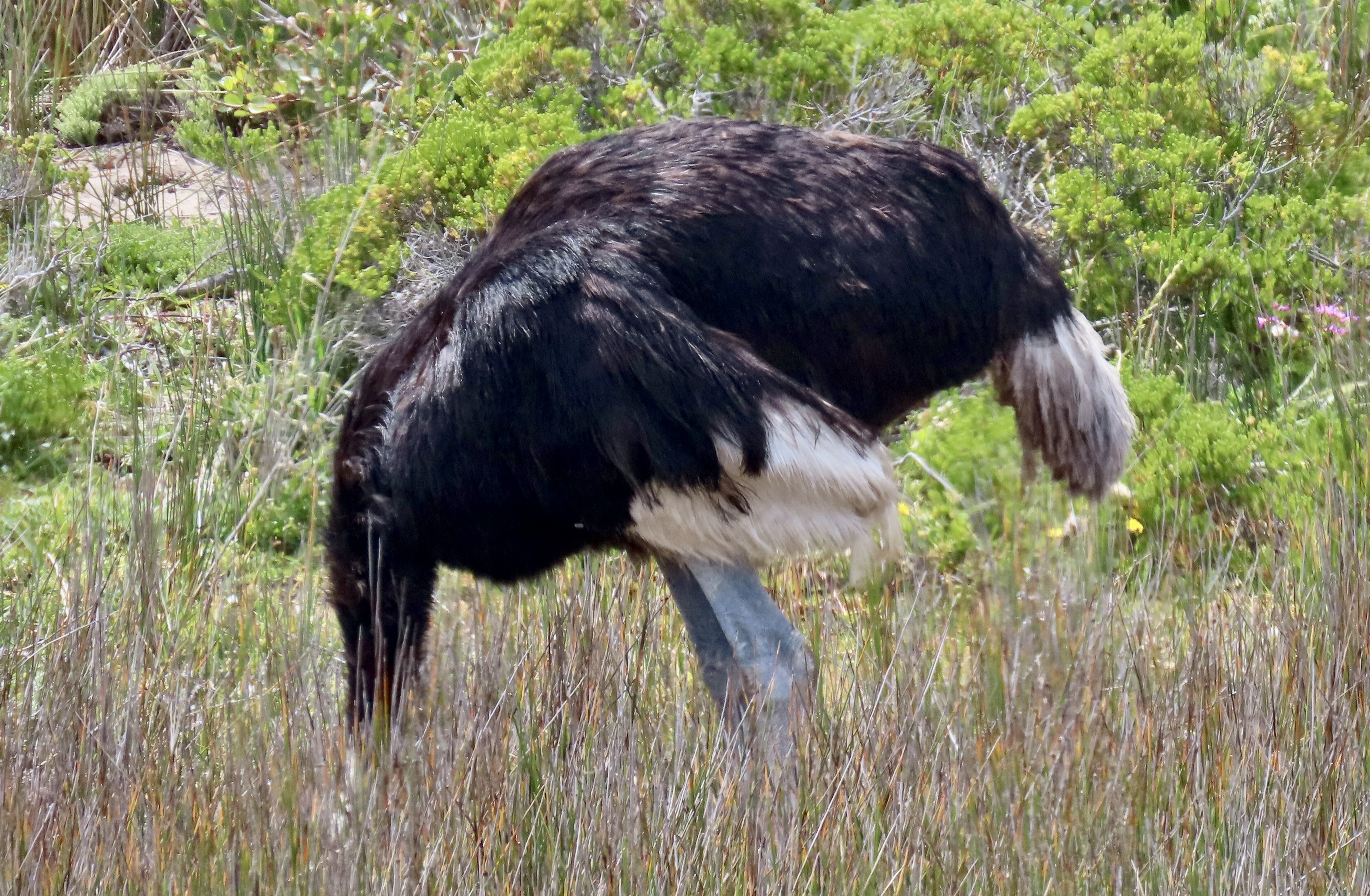
They say that ostriches burying their heads is a myth. But given today’s world??? We found this large male a mile or so away from the Cape of Good Hope, not looking particularly hopeful. (Actually, he was grazing, but burying his head makes a better story.)
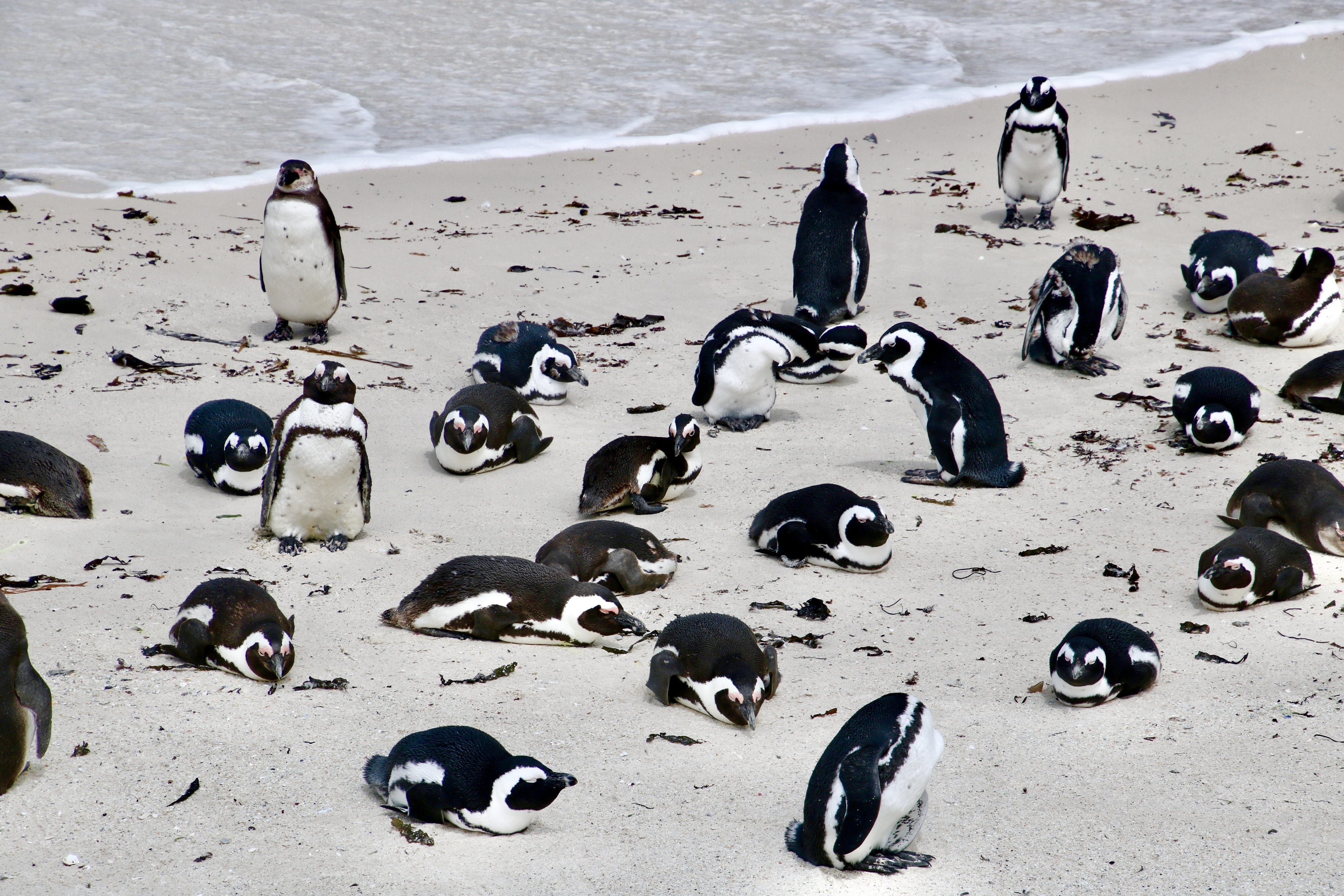
Peggy and I are dropping into South Africa for today’s On Safari post where I will feature the world’s largest bird and one of its smallest penguins. We found both of these ‘superlative’ birds on a road trip to the Cape of Good Hope. As mentioned above, the ostrich was a mile or so away from the Cape. The penguins were 20 minutes away on South Africa’s False Bay.
The problem with ‘burying your head’ is that you never know where it might pop up. On the end of a long neck is a good bet. Check out the toothy grin and the big eyes. The teeth serve the ostrich in biting off its main diet of grass, leaves, and roots. The eyes provide excellent vision for spotting major predators such as lions, leopards and cheetahs. I read in a National Geographic article that the ostrich’s eyes are bigger than its brains! I not sure whether that says more about an ostrich’s eyes or brain.Just about everyone knows that the ostrich is a large, flightless bird. Large means upward to 350 pounds (150 kg) and 8 feet (2.7 m) tall. The beautiful feathers on this male also suggest why ostrich feathers have been so popular for centuries. Their collection during the Victorian Era came close to threatening the species with extinction. Today’s feathers are obtained from ostrich farms where the birds are raised for them plus meat and eggs.On our way back from the Cape, our friend was next to the ocean. The question we had was ‘why did the ostrich cross the road?’The answer may be that with legs like this, he can go where he wants.He was busy chomping down the brown grass and filling his gullet.He then had to raise his head so he could swallow it.Ostriches prefer not to fight. In fact they will lie down in the grass to lower their profile and camouflage themselves. Their long legs provide two other defenses. One, they can run very fast, up to 40 miles per hour (70k) with giant strides that can cover 16 feet (5 meters) in a single stride. They also have a powerful kick, if cornered, using their big feet and 4 inch (10 centimeter) sharp claws.
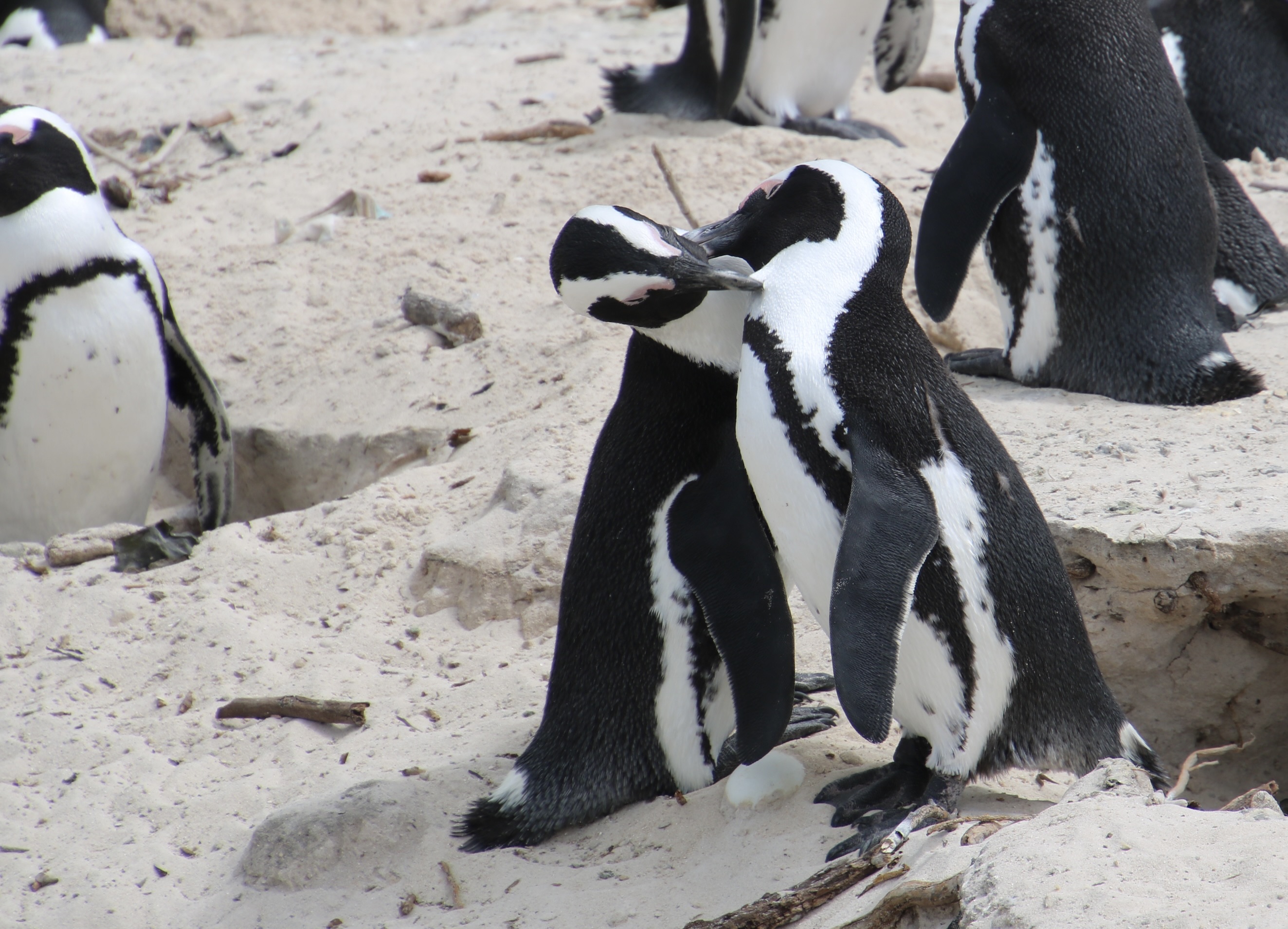
We left the large ostrich behind in search of one of the world’s smaller penguins near Simon’s Town, the appropriately named African penguin. If you live in the town, it’s not unusual to find them walking down the sidewalks, crossing the streets, or digging large holes in gardens to build nests. They pretty much rule the town. Before heading down to the beach where most of them hang out, we stopped in town for lunch. We were eating when Peggy spotted one of the two-foot-fellows walking up to the door. She jumped up and snapped a photo of the penguin. I think it wanted to know if we were eating fish.
It was looking in the door with high hopes. I left lunch to photograph it from the inside of the door. Note the pink above its eyes. It actually serves a cooling function like the elephant’s ears, running blood through the pink area so it will be cooled down. The hotter it is the darker the pink, as more blood is forced through.I noticed that the feet looked like they belonged to a much bigger bird. It’s these large feet that enable the penguin to swim 12 miles per hour pursuing fish.Down at the beach, we watched a penguin walking. It was getting nowhere fast.Another penguin had said the ‘heck with it’ and was using its swimming mode! In water, BTW, they normally dive to around 100 feet. They have actually been found at over 400 feet.We saw a number of pairs. Penguins stick with their partners for years and seem quite affectionate.“If you scratch my neck, I’ll give you a stick.”True love.“Sorry I’m late, honey,”“Really sorry…”This is the type of nest you might find in your garden if you live in Simon’s Town. The penguins put guano (bird poop) on the bottom as a nesting material. There were several such holes on the beach as the penguins prepared to lay eggs and raise their chicks.A number of penguins were hanging out at the base of a huge granite boulder…While others preferred to sunbathe on the beach.While this fellow decided that scratching an itch was the best use of his time. He was using his non-flyable wings for balance. Note the spots on its chest. They are different on every penguin. A recent study has suggested that one way a penguin recognizes his/her mate when hundreds of are together is by the spots. “Excuse me but you look familiar. Can I check your spots?” That’s it for today.Peggy and I were driving out of the Everglades on Thursday when we saw a lake packed with over 200 white pelicans herding and harvesting fish. It was an amazing sight and will be the subject of our next post.
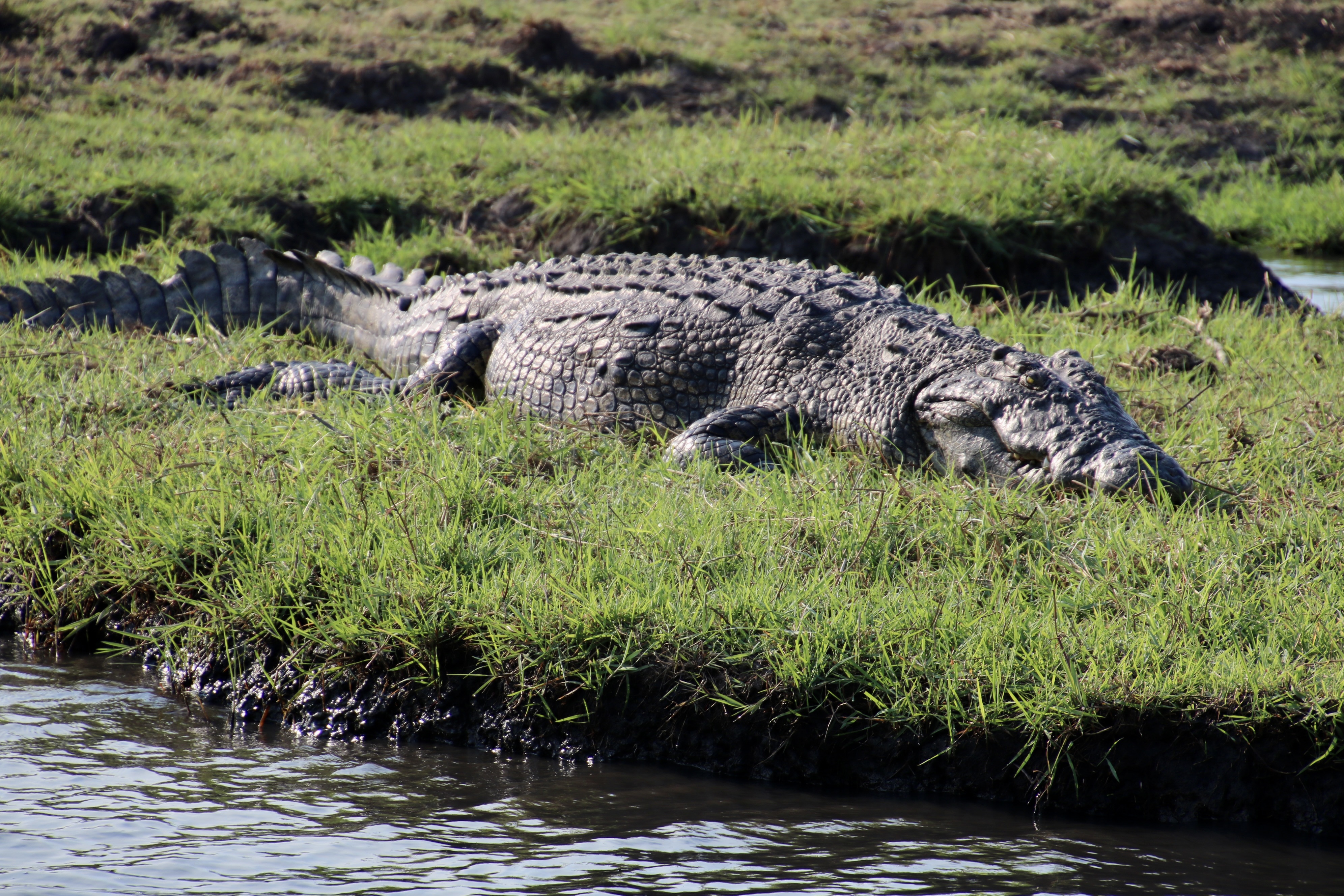
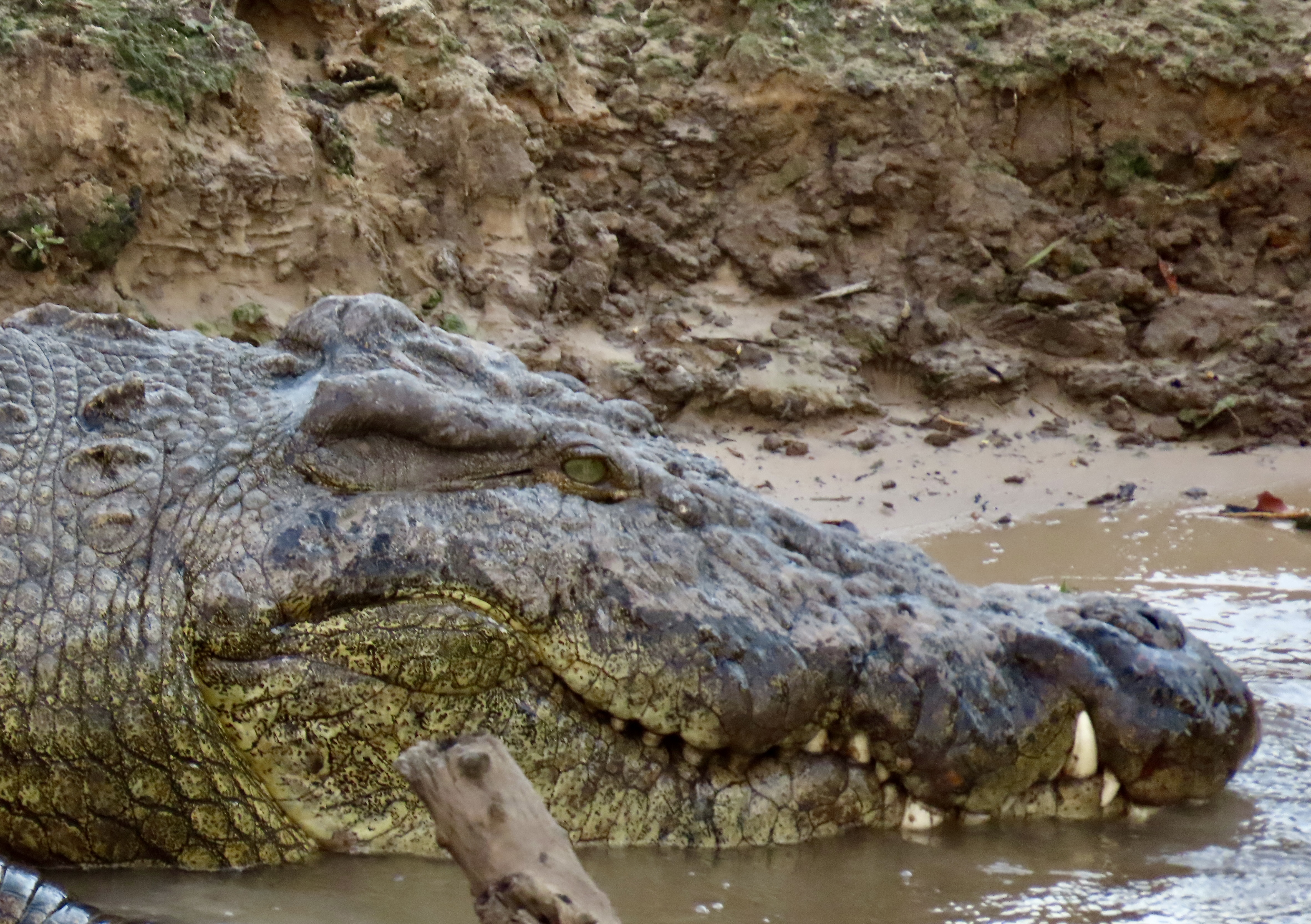
It would have been glad to have one of us for dinner. Crocodiles eat hundreds of people in Africa every year. But we were safely ensconced on our boat. This was the first of several crocodiles we would see on our African safari through Botswana and Zimbabwe, including a monster.
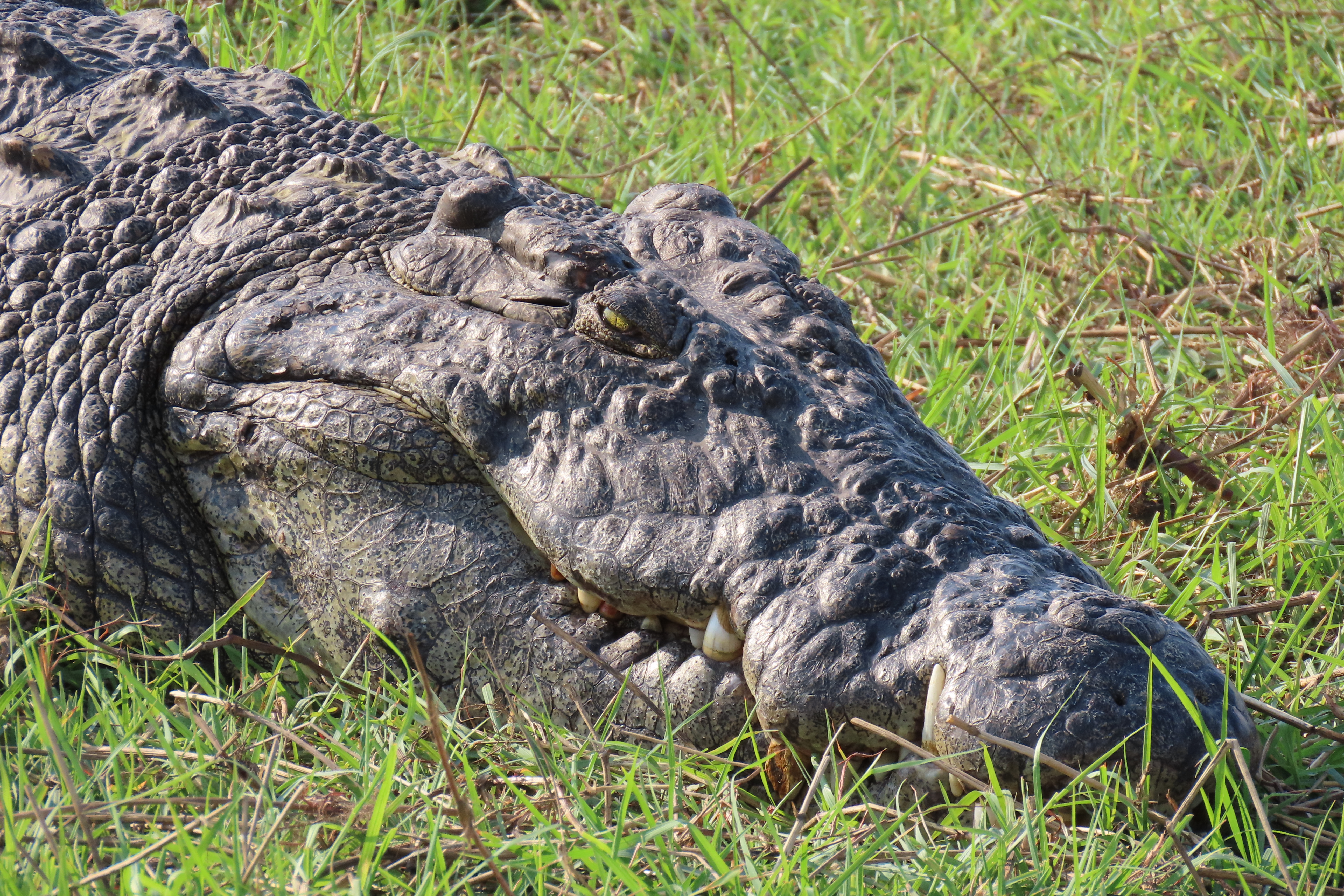
Nile Crocodiles are fascinating, fierce predators. You don’t want to mess with them. We were able to see them lying on the shores of rivers, lakes and ponds, slipping through the water, and even fighting. There is nothing endangered about them; they are quite common throughout sub-Saharan Africa. Large males can reach a length of 14 feet and weigh up to 1700 pounds. Females up to 12 feet and 550 pounds.
By the way, have you ever used or heard the expression ‘shedding crocodile tears?’ It means you are being insincere. The derivative? Crocodiles shed tears when they are eating whatever they have captured for dinner.
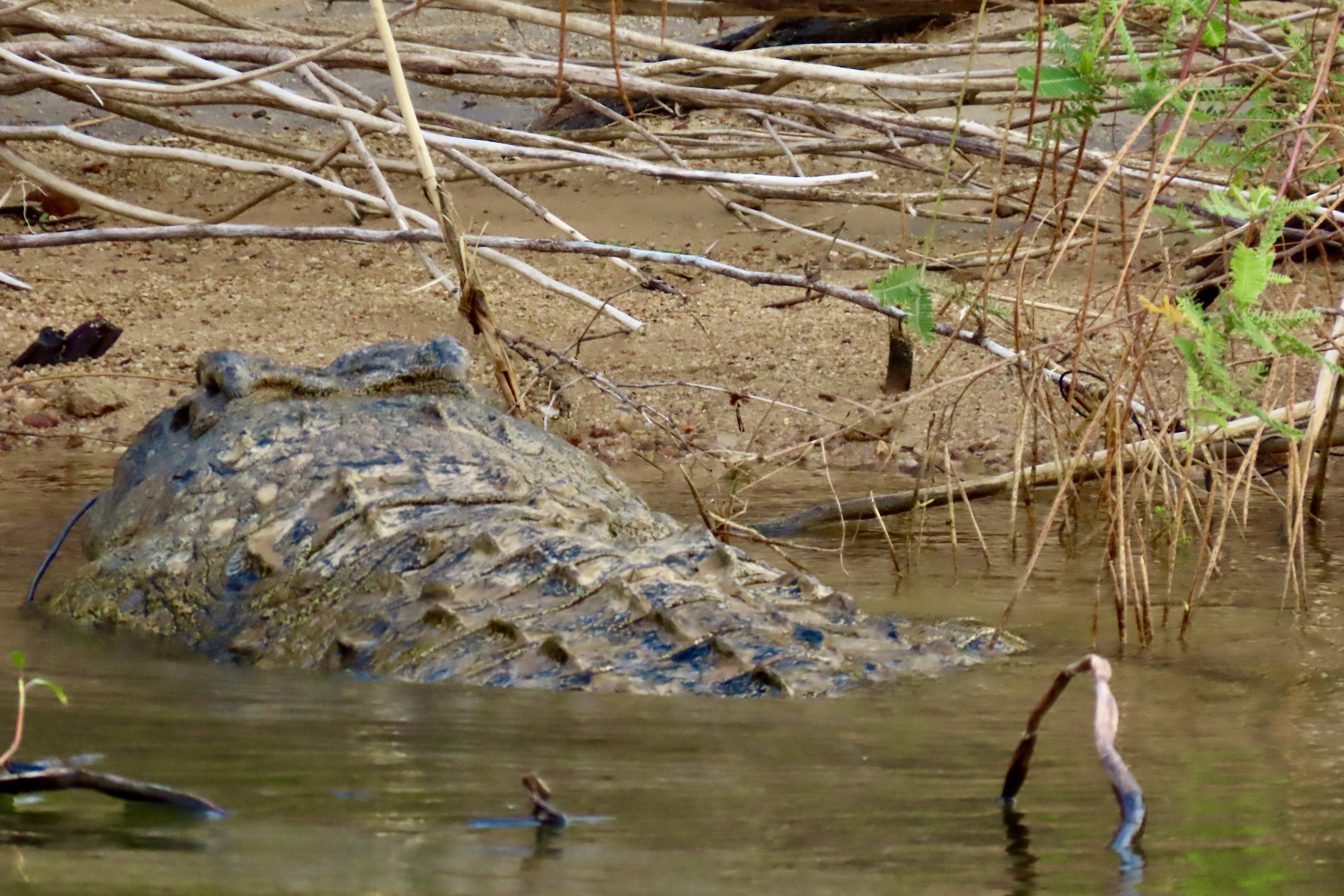
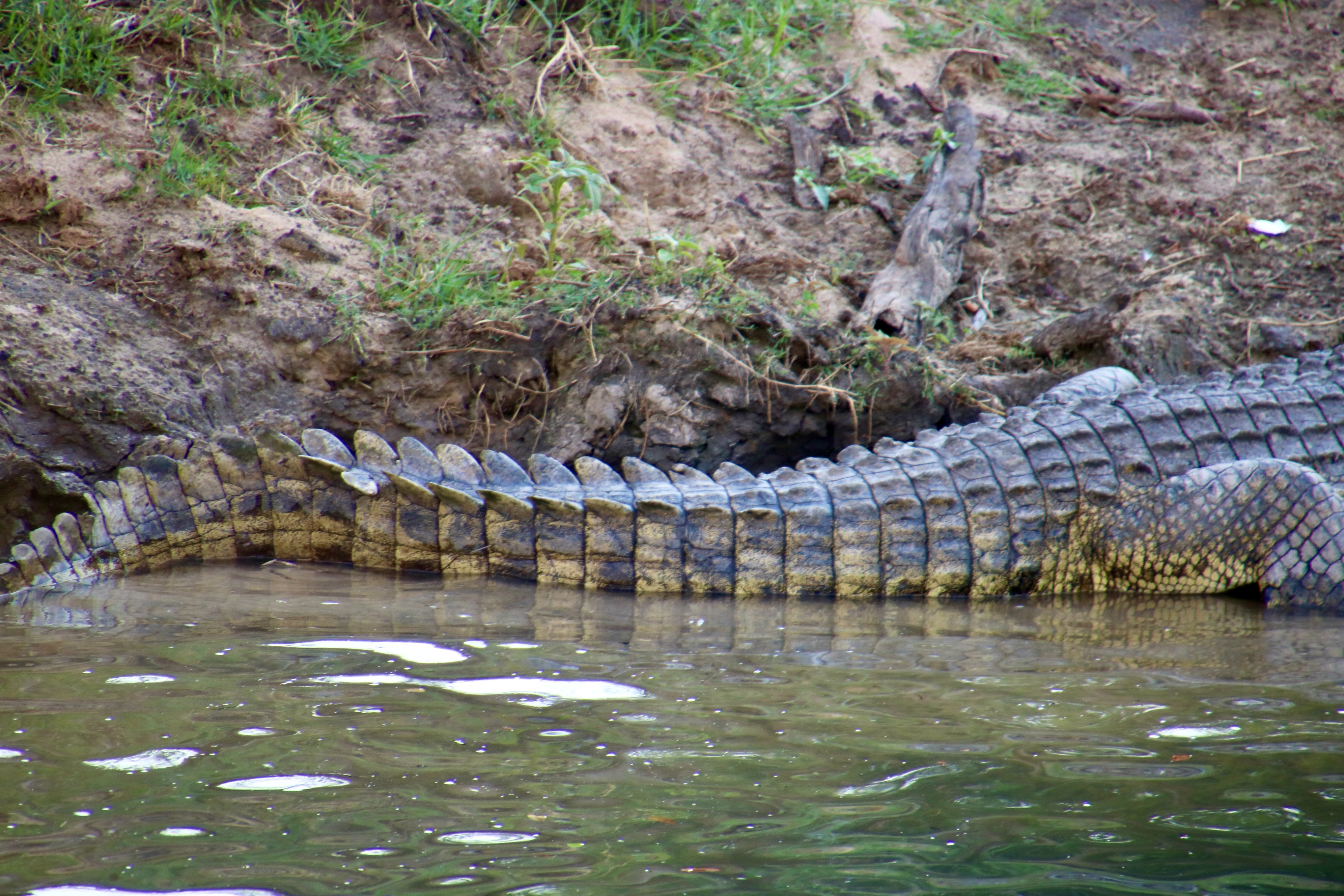
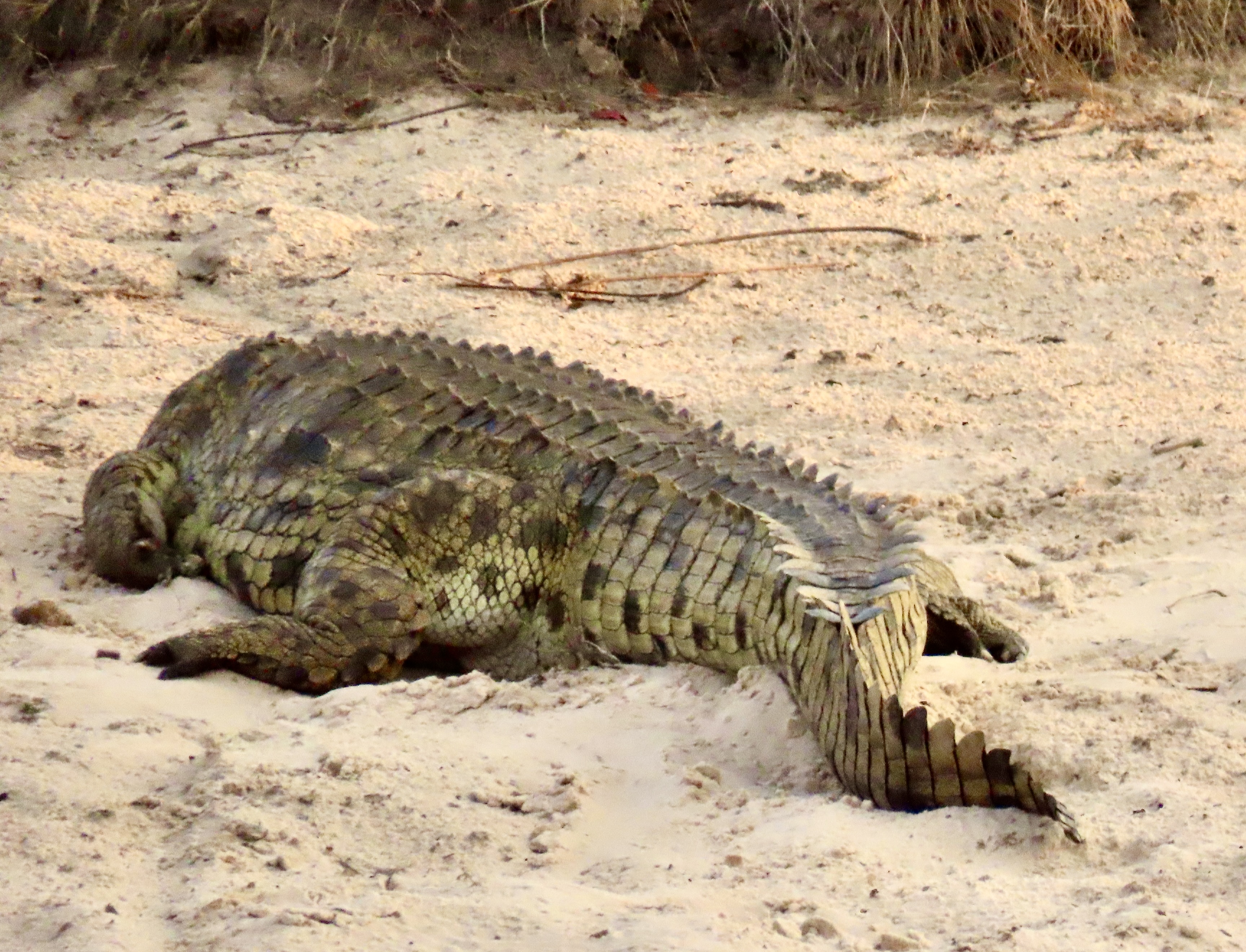
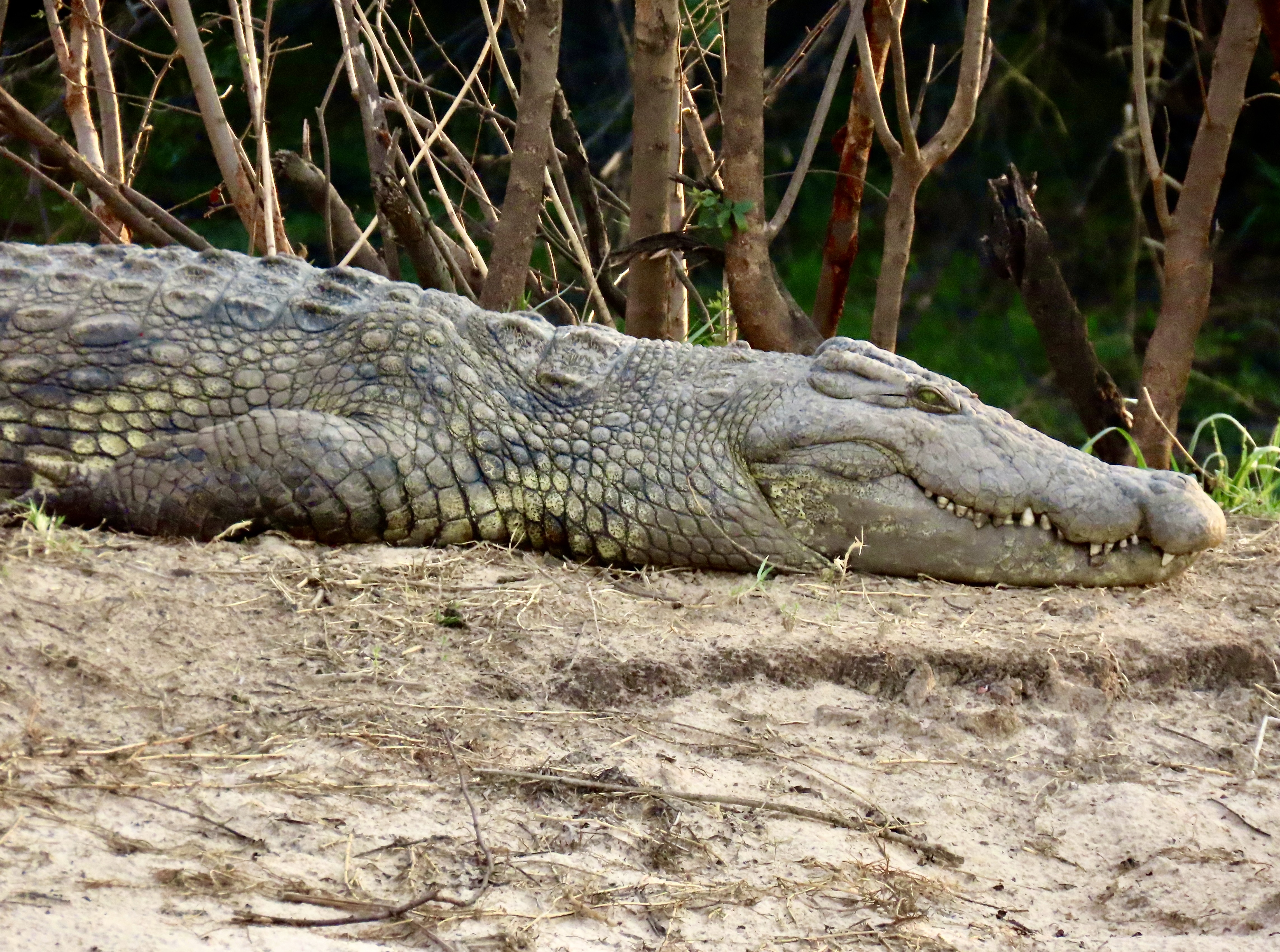
This is the crocodile I featured above, enjoying the sun on the banks of the Chobe River. A dead Cape buffalo that it may have been helping devour was behind it. (Not in the photo.)Not quite what I would classify as a toothy grin. Here’s an interesting fact. Crocodiles can go through 4000 teeth in a lifetime. They are able to replace each of their 80 teeth up to 50 times.This youngster from Chobe National Park that I featured before shows just how many teeth a crocodile has in its mouth. The purpose wasn’t to show us its teeth, however, its mouth was open to help it cool down. It’s called mouth gaping.We found this monster in Lake Kariba in Zimbabwe. It was probably guarding a clutch of 25-80 eggs. The female digs a hole in the sand and buries the eggs where they will incubate for 80-90 days. She can actually hear them peep when they are ready to hatch. She then digs them up and rolls them around in her mouth to help them hatch. The male may help in this process. They then carry them down to the water where they continue to guard them, ferociously, if necessary.Swimming in Lake Kariba is highly discouraged. A possible confrontation was about to take place here in the lake. Males are very territorial. I thought the water level perspective on the two crocodiles was interesting.We were at a small watering hole in Hwange National Park admiring giraffes when the water in the pond suddenly erupted. It was impossible to tell what was making all of the ruckus.And then it became obvious. Two crocodiles were biting it out! “One of the crocodiles took down a Kudu earlier today,” our guide explained to us. “It is protecting its kill.”We saw a number of crocodiles on an evening trip up the Zambezi River near Victoria Falls, including this one. Peggy thought it was quite colorful. And toothy. Another interesting fact about crocodiles is they have very weak jaw muscles for opening their mouths. You could hold this fellow’s mouth closed with one hand. Closing is something else. A crocodile has one of the strongest bites of any creature in the world and is capable of exerting up to 5000 pounds of pressure per square inch! I’m thinking that this is something one might want to consider when deciding to experiment with holding its mouth closed.The colorful tail of the crocodile above. A crocodile uses its tail to propel itself through the water at up to 22 miles per hour. The feet serve as rudders.Another tail shot of a different crocodile on the Zambezi River.We thought this was a fun shot of a crocodile sleeping on the banks of the river.I’ll conclude with this final head shot. You won’t want to miss Monday’s post on the ostriches and penguins of South Africa.
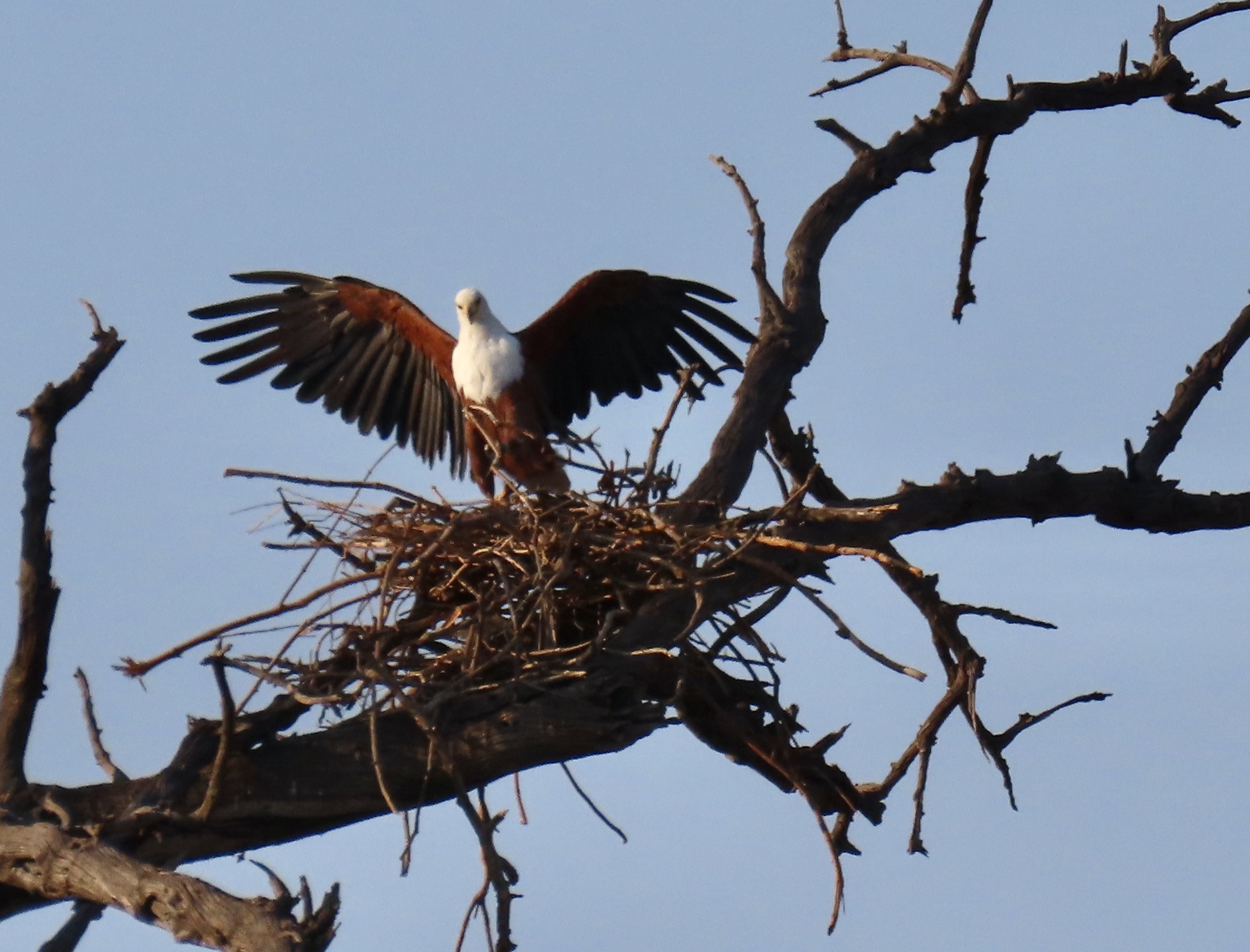
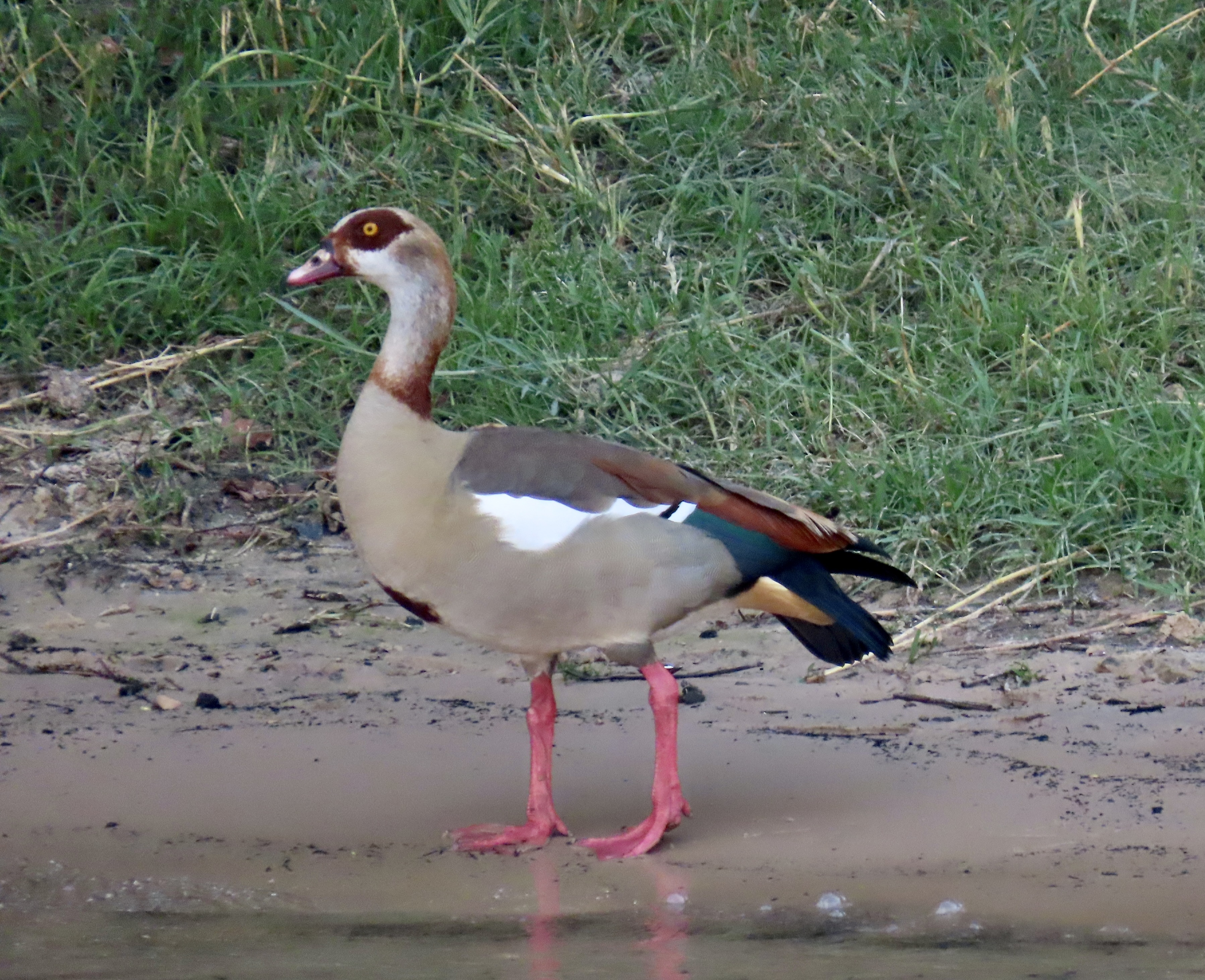
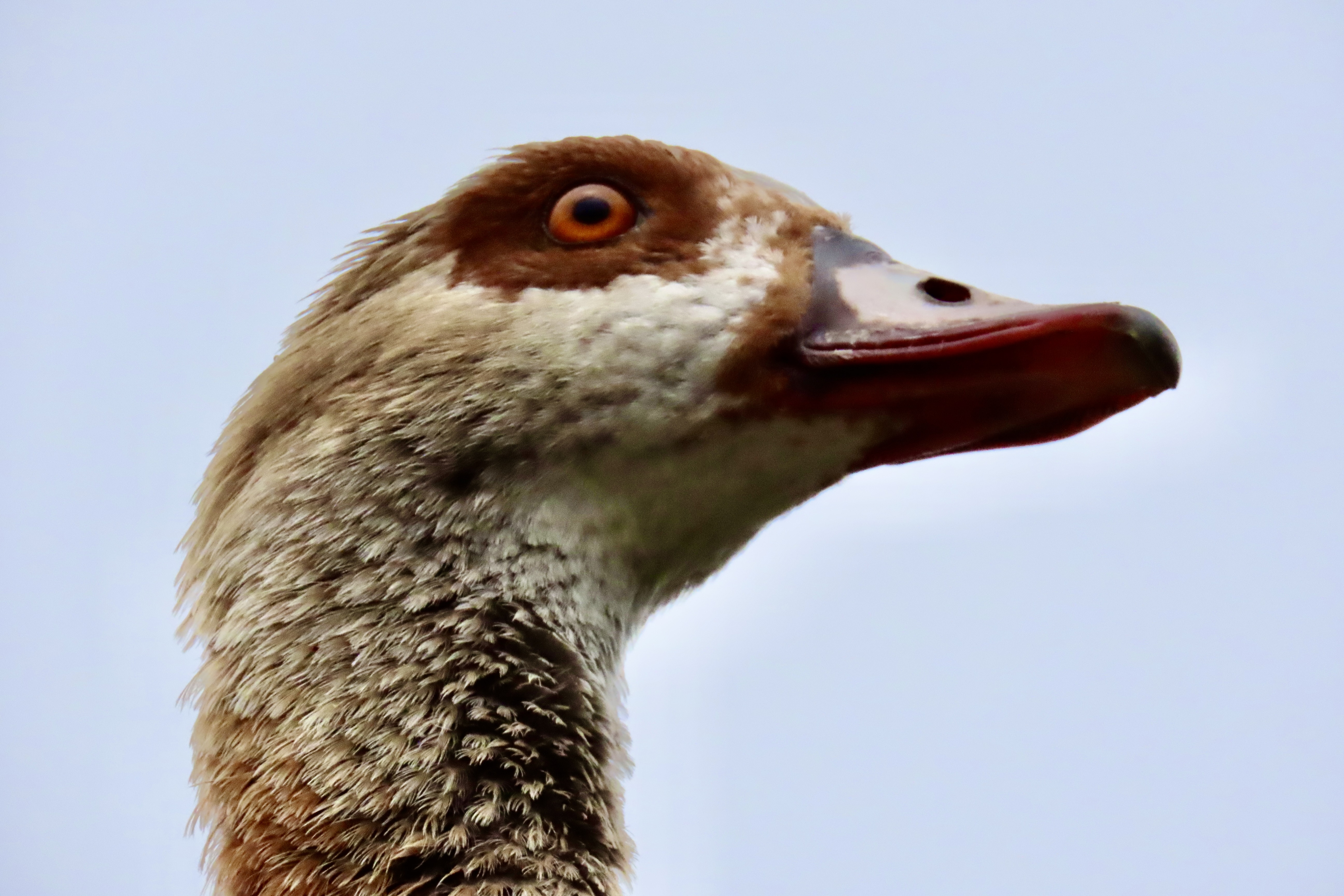
This stunning bird is an African sea eagle. Not surprisingly, it is the national bird of Malawi, Namibia, Zimbabwe and Zambia. Its national status, white head, and diet of fish immediately reminded us of America’s bald eagle. We had one that lived near our home in Oregon that flew by on occasion, looking for breakfast along the Applegate River. We watched it vary its diet one day, dive, and take a snake out of our yard, a very unhappy snake. The African fish eagle goes for reptiles on occasion as well. It has a taste for baby crocodiles. It also eats carrion like the bald eagle, but not with the same passion. When I lived in Alaska, I watched bald eagles tear into dead (very smelly) salmon with delight. I found it amusing that Ben Franklin felt that the eagle’s dining behavior gave it ‘bad character,’ and argued that the turkey should be the national bird of the fledgling nation.Another perspective on the African fish eagle. The chestnut color on its wings adds to its beauty.Sea eagles are thought to mate for life. We watched one in the distance as it added sticks to its nest. They tend to use the same nest year after year, adding on to it each time creating bigger and bigger homes that can reach over 6 feet in diameter.It then provided us with an opportunity for an iconic photo. We thanked it.We caught this photo of a juvenile fish eagle perched on a rock next to Lake Kariba in Zimbabwe.We have a copy of an Egyptian Goose painting on our wall that I brought back from our trip up the Nile a year ago. The original is in the Egyptian National Museum and came from a temple where it was painted over 4000 years ago. It was considered a sacred bird. I doubt this goose (which is actually a duck) is aware of its ancient history, but it does seem to be aware that it is a ‘pretty bird.’While the Egyptian Goose’s natural home is on the Nile and throughout sub-Saharan Africa, its striking good looks have led it to be imported into England and a number of other nations where it is now found in the wild.Egyptian Geese form strong bonds and mate for life. We saw a number of couples. These two on the edge of Lake Kariba seem to be marching in unison.We were in a park in Cape Town, South Africa when we came upon a gaggle Egyptian Geese.A lone goose was perched above the gaggle, possibly on guard duty.I snapped his photo. That’s it for today. On Wednesday we are going to feature the Naples’ Florida Botanical Gardens. On Friday, it will be all about crocodiles! We will be deep in the Everglades for the next few days and without an internet connection. I should be back online Thursday.
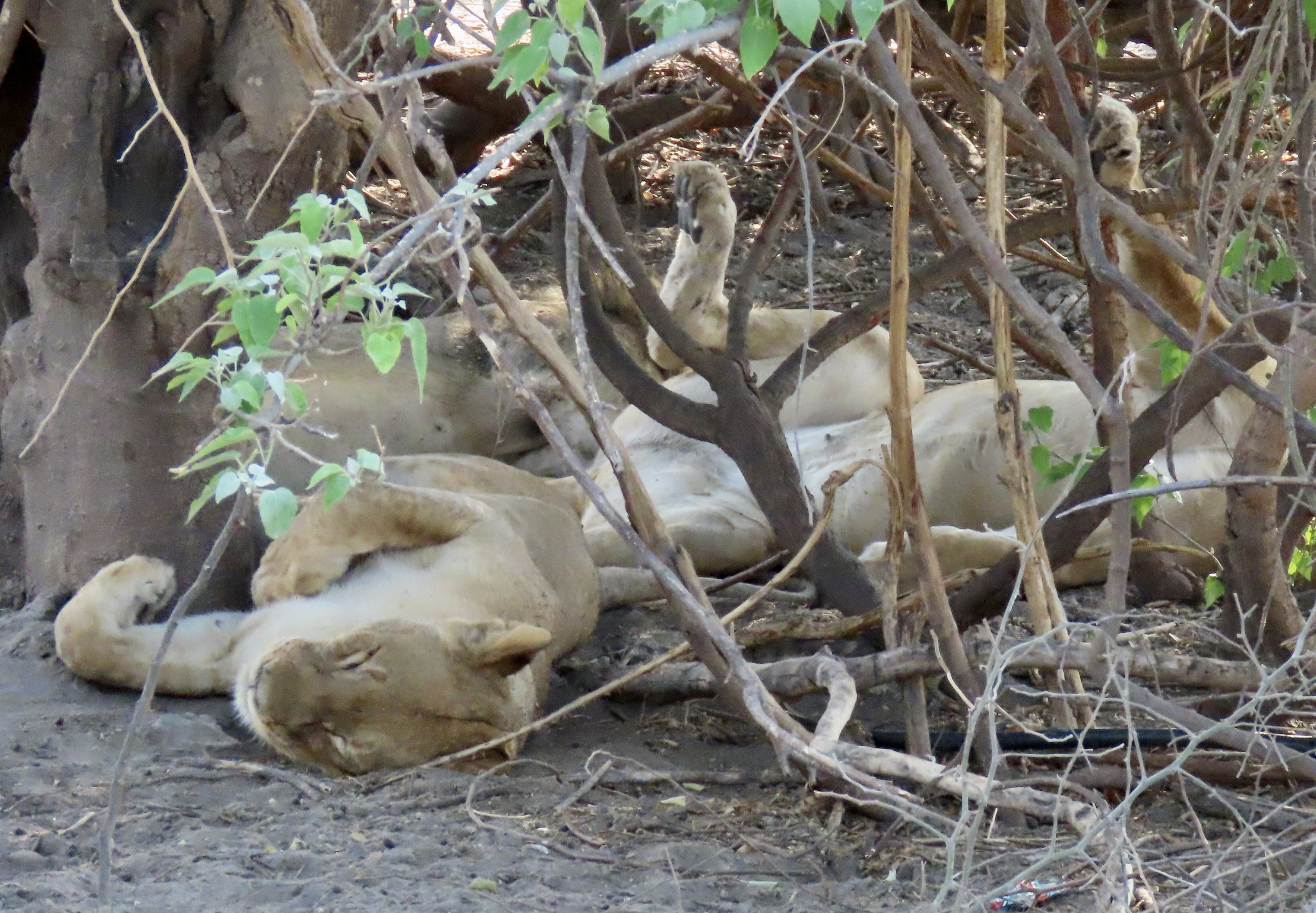
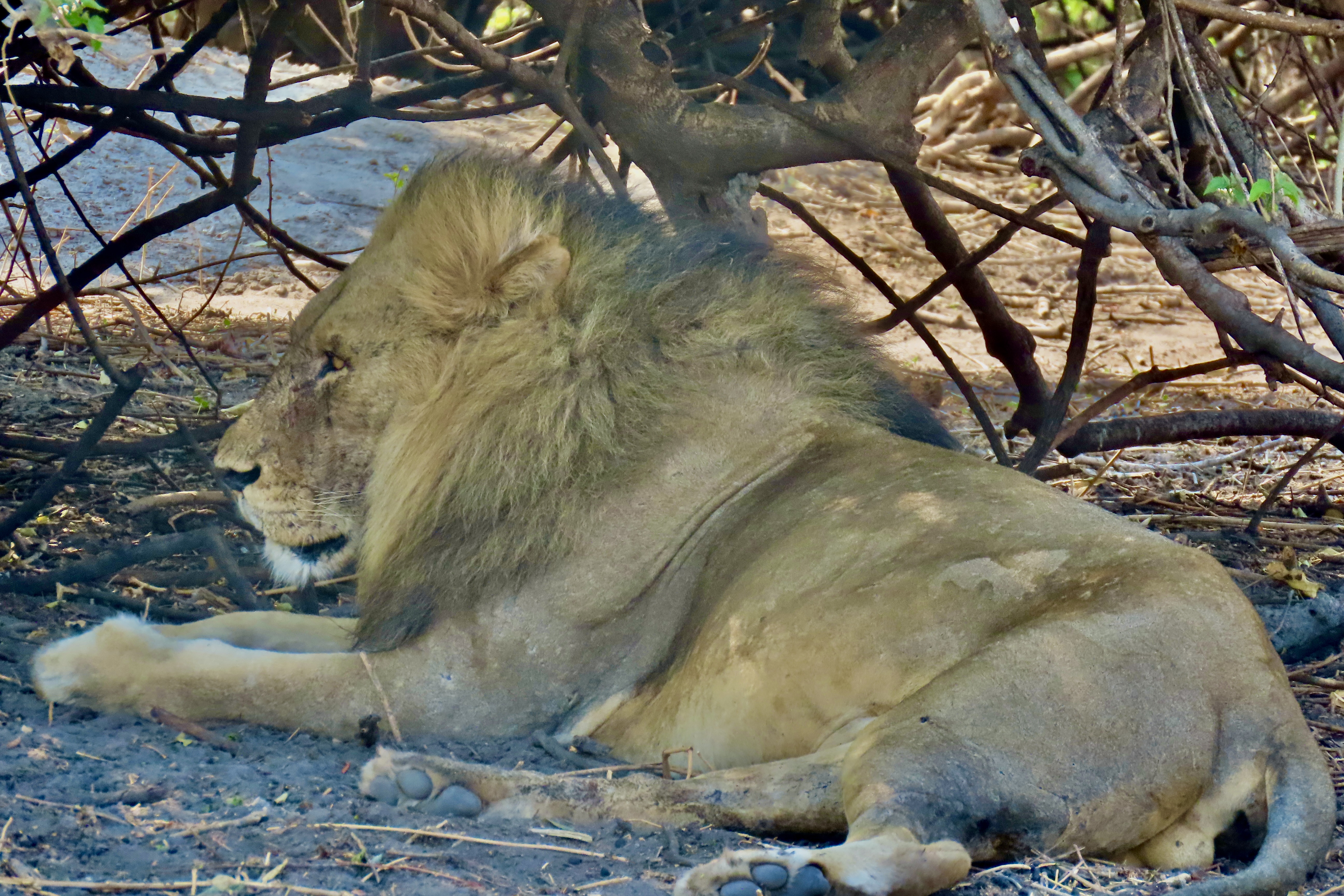
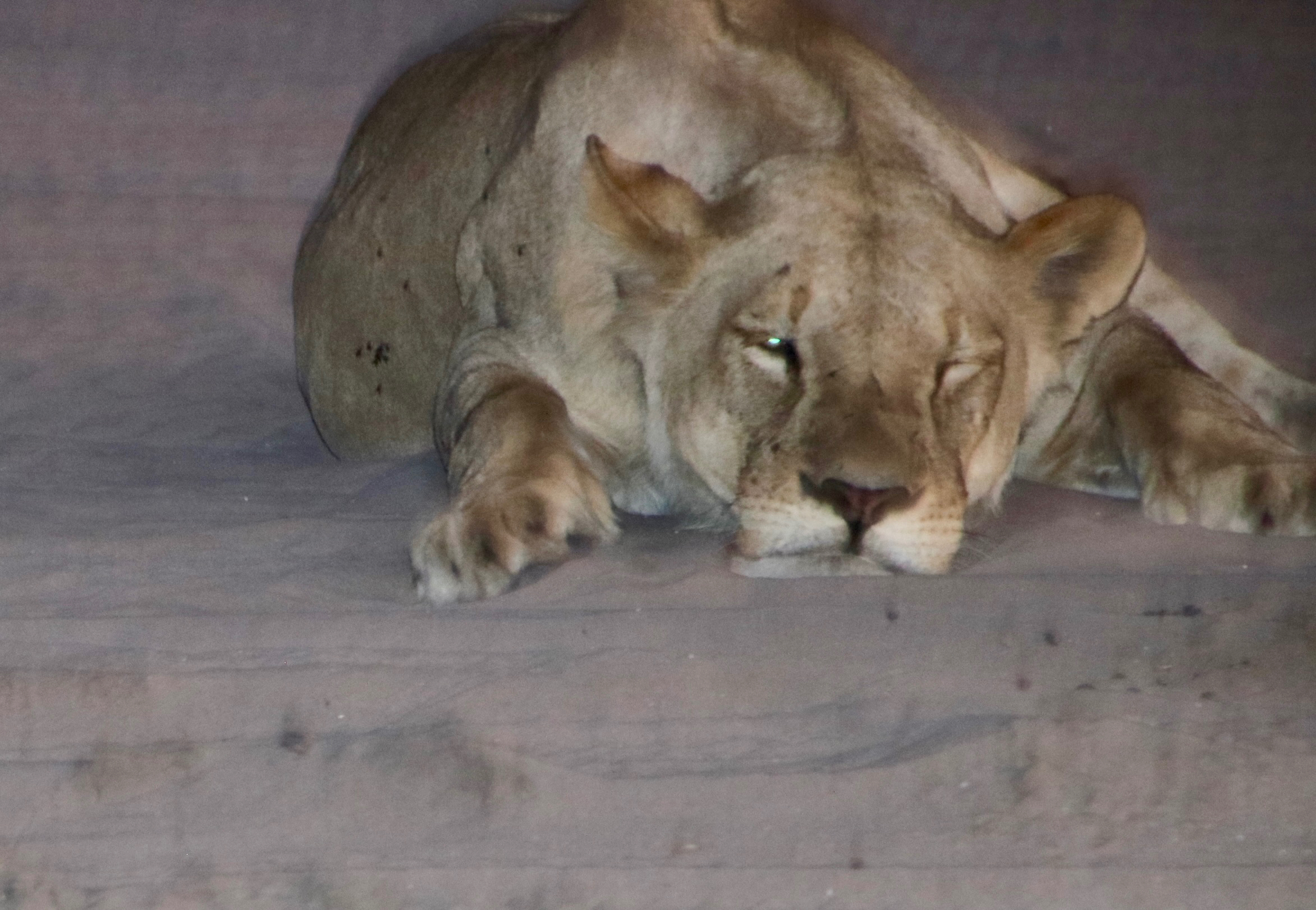
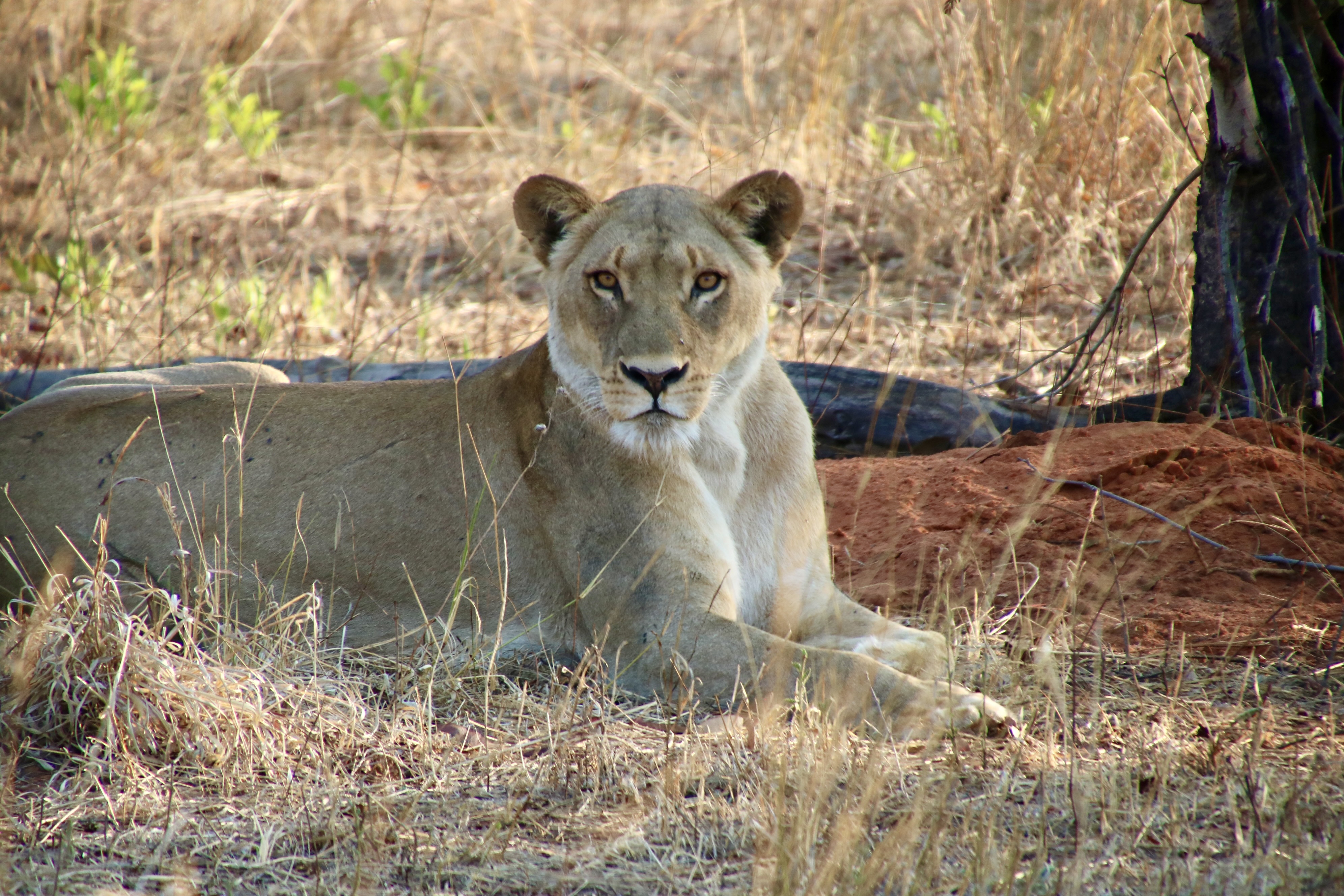
Nap time. Just like the cats that hang out in our homes, lions like to sleep: A lot, up to 20 hours a day. We came upon these females snoozing away in their amusing poses in Chobe National Park, Botswana. The whole pride was scattered out underneath the trees, including a large male.
My first interest in lions was brought about by a song whose opening lyrics are included in my heading. I was 10 and my 17 year-old sister had fallen in love with a navy man whose deployment had taken him off to the coast of Africa. I must have heard the song 50 times, or at least enough to burn it forever into my memory banks. I was a little young to fact-check Nancy, but that was okay, I loved the song. Actually lions do most of their hunting at night or during storms when their prey are more vulnerable. Also, not many live in the jungle. They prefer the more open savanna lands of eastern and southern Africa.
This was one of the males that was responsible for protecting the pride. We often hear how lionesses do most of the hunting and ‘bring home the bacon’ (warthog), to the king of the jungle. This is true, but one look at this male persuaded us that his life as protector was far from easy. Check out the large scar running down his side! He earned his food.The sun was going down when we came on the pride sleeping in the sand, obviously taking advantage of its warmth. There were at least 10 lions enjoying the last rays.There were two males with the pride. This one seemed to be saying, “Mind if I join you?” Note the female’s swishing tail. More cat language.Apparently the answer was yes.The setting sun lit up the lions’ eyes. Peggy and I were thinking, “These are kitties we do not want to disturb.”
Would you?
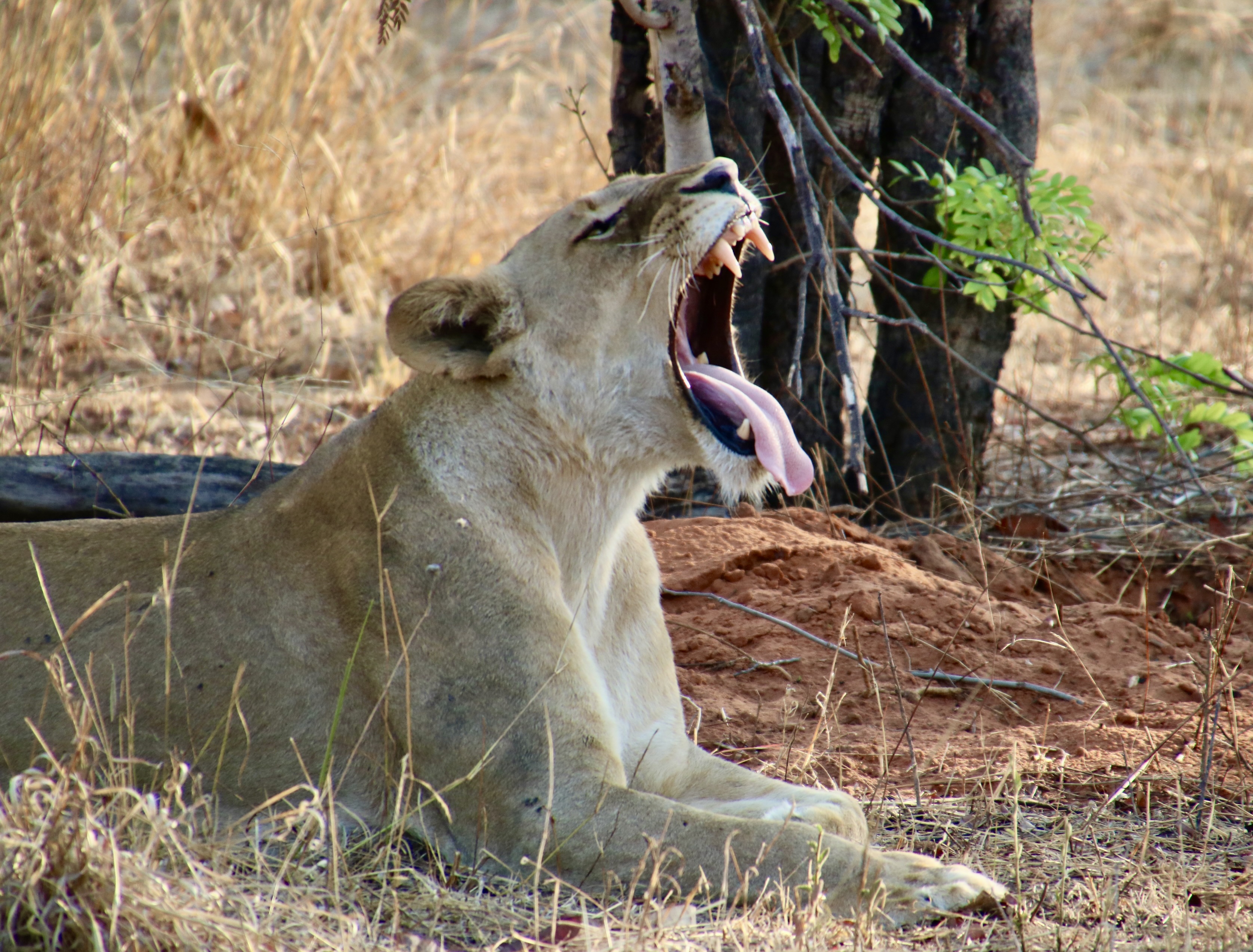
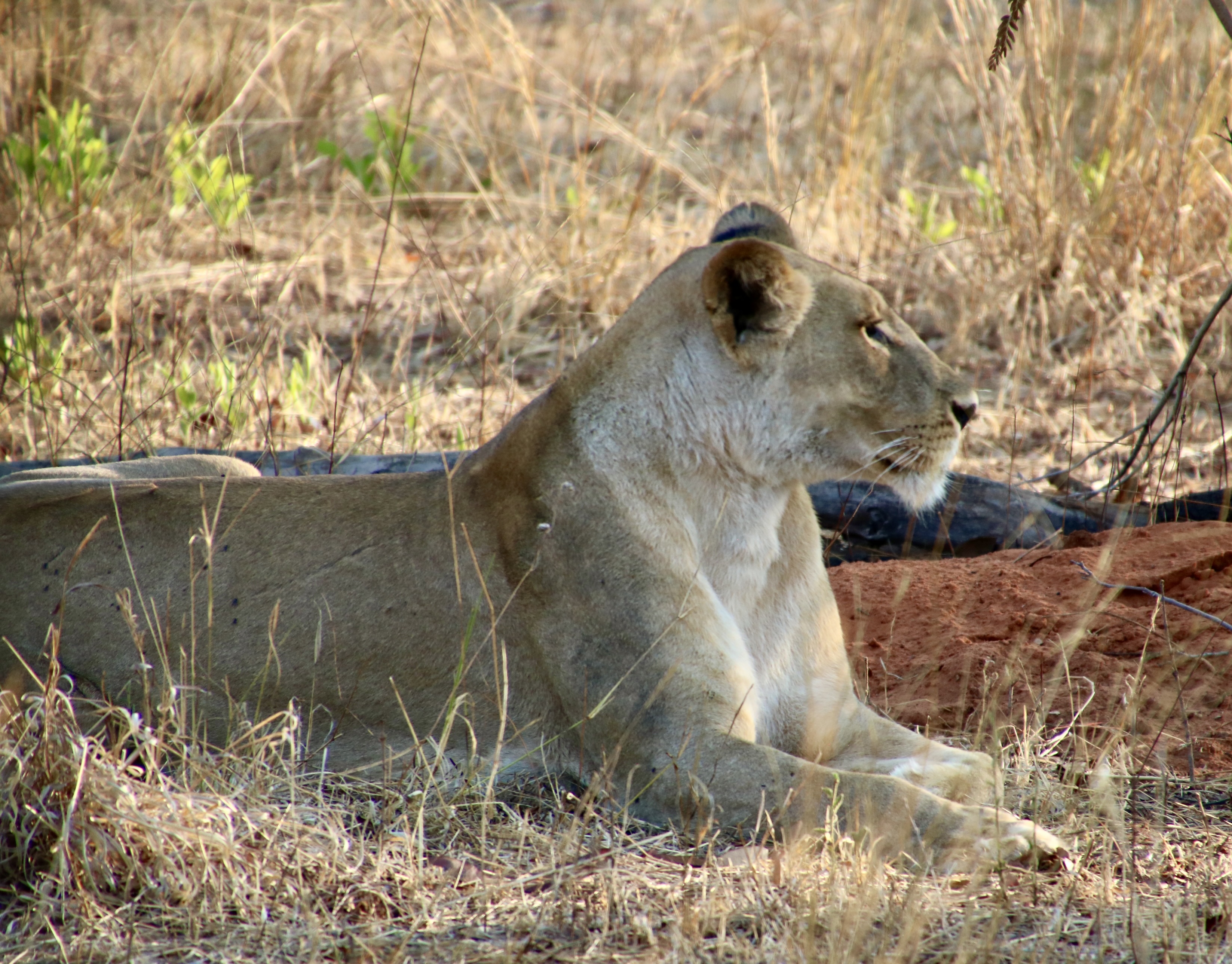
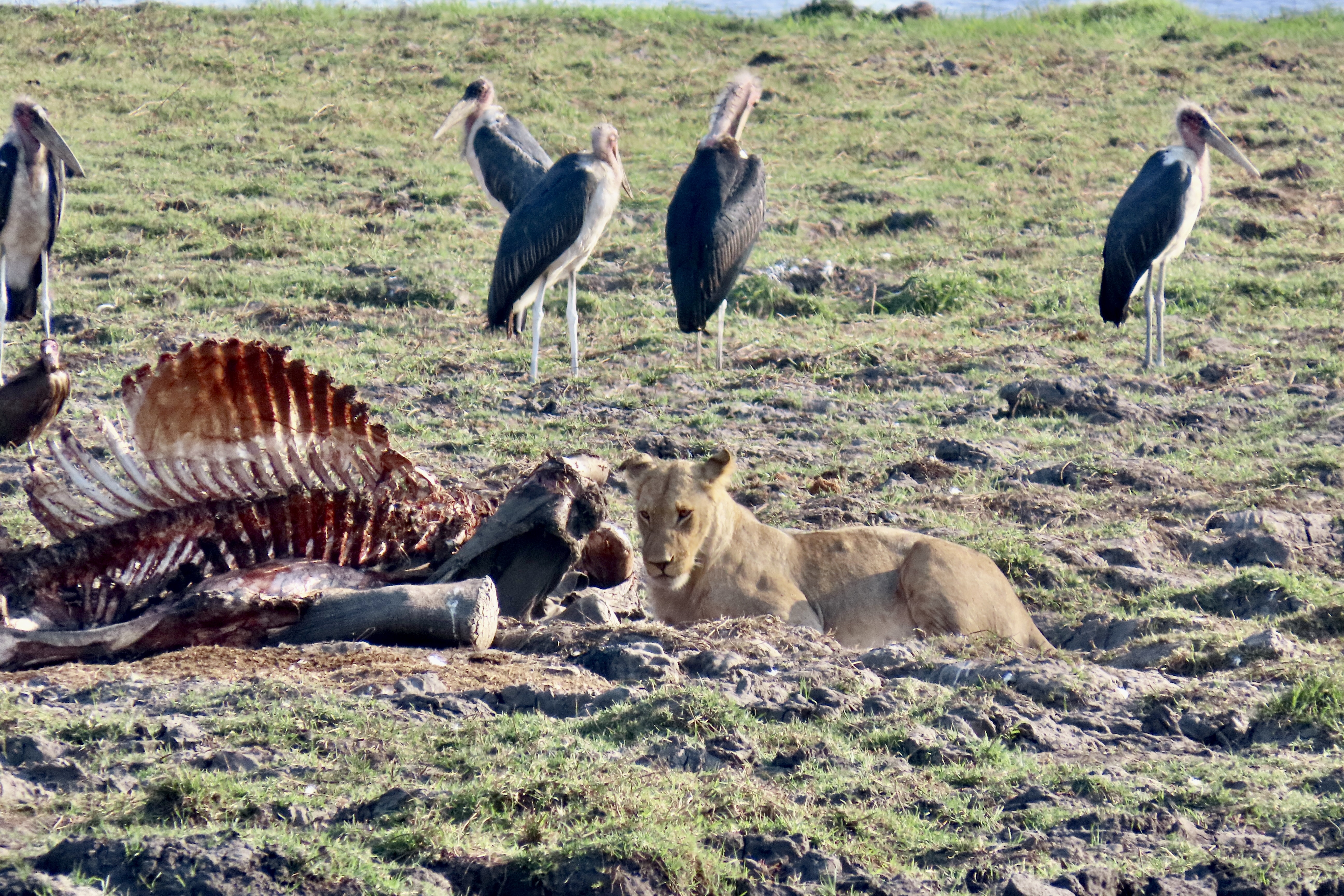
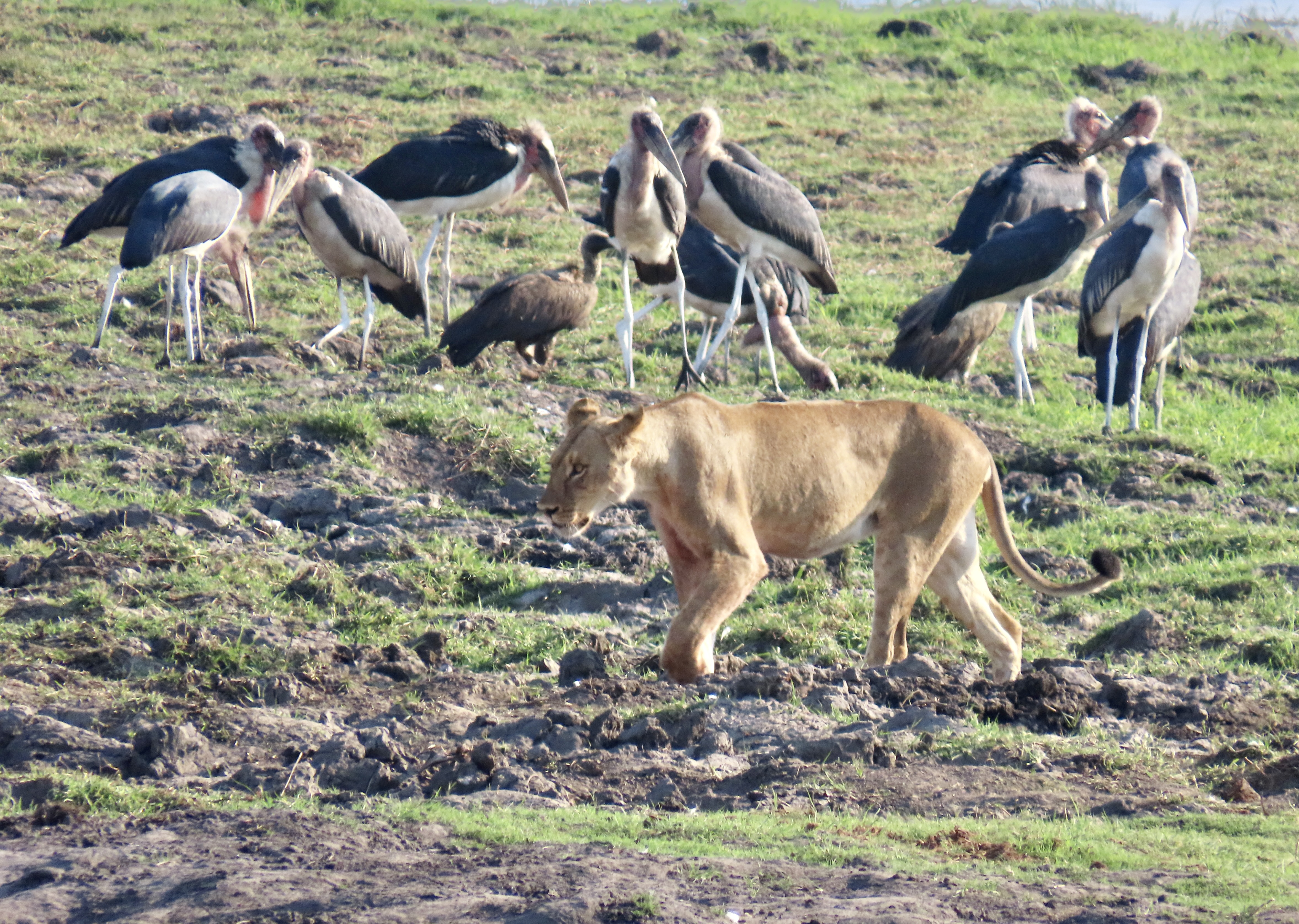
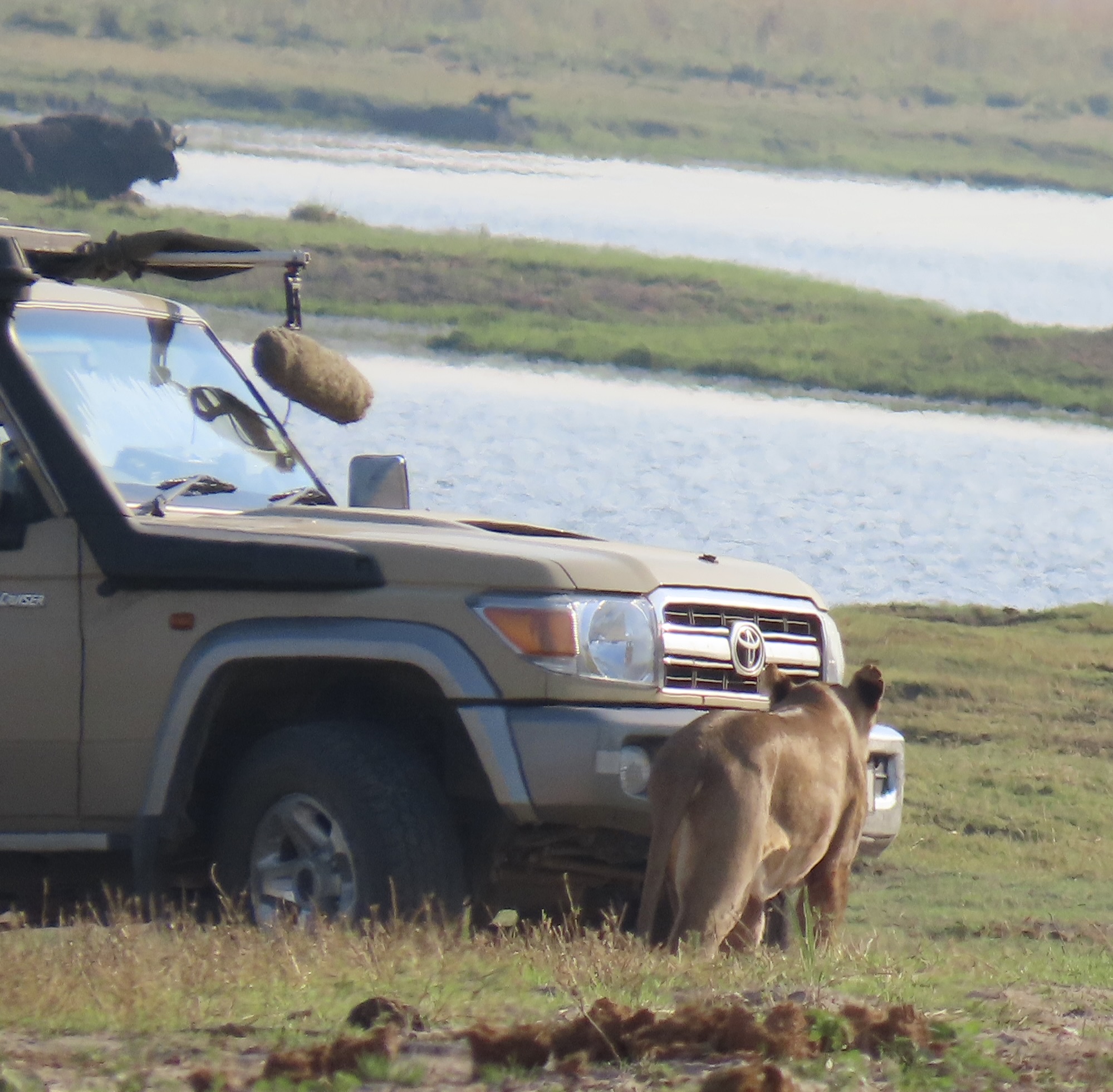
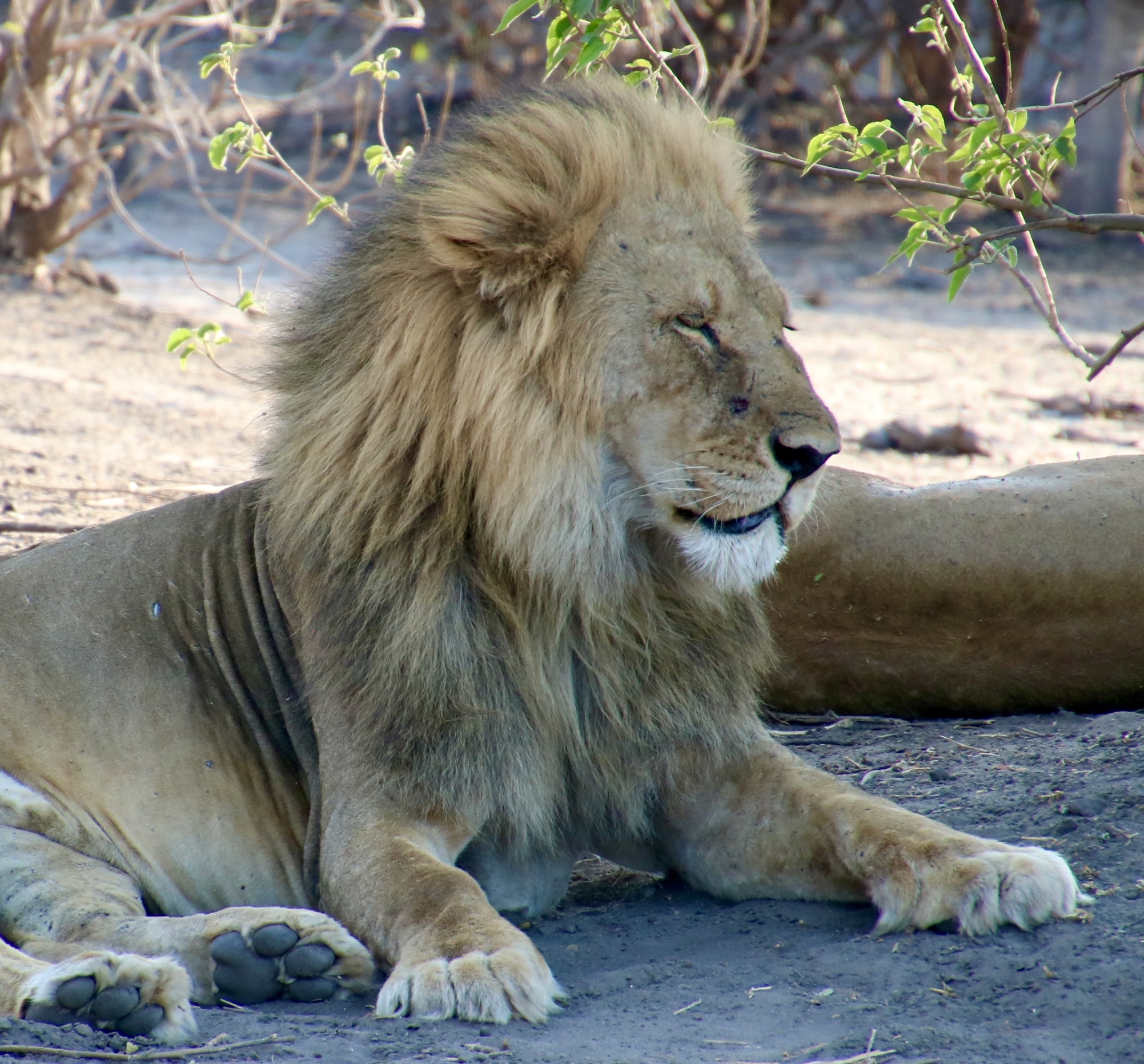
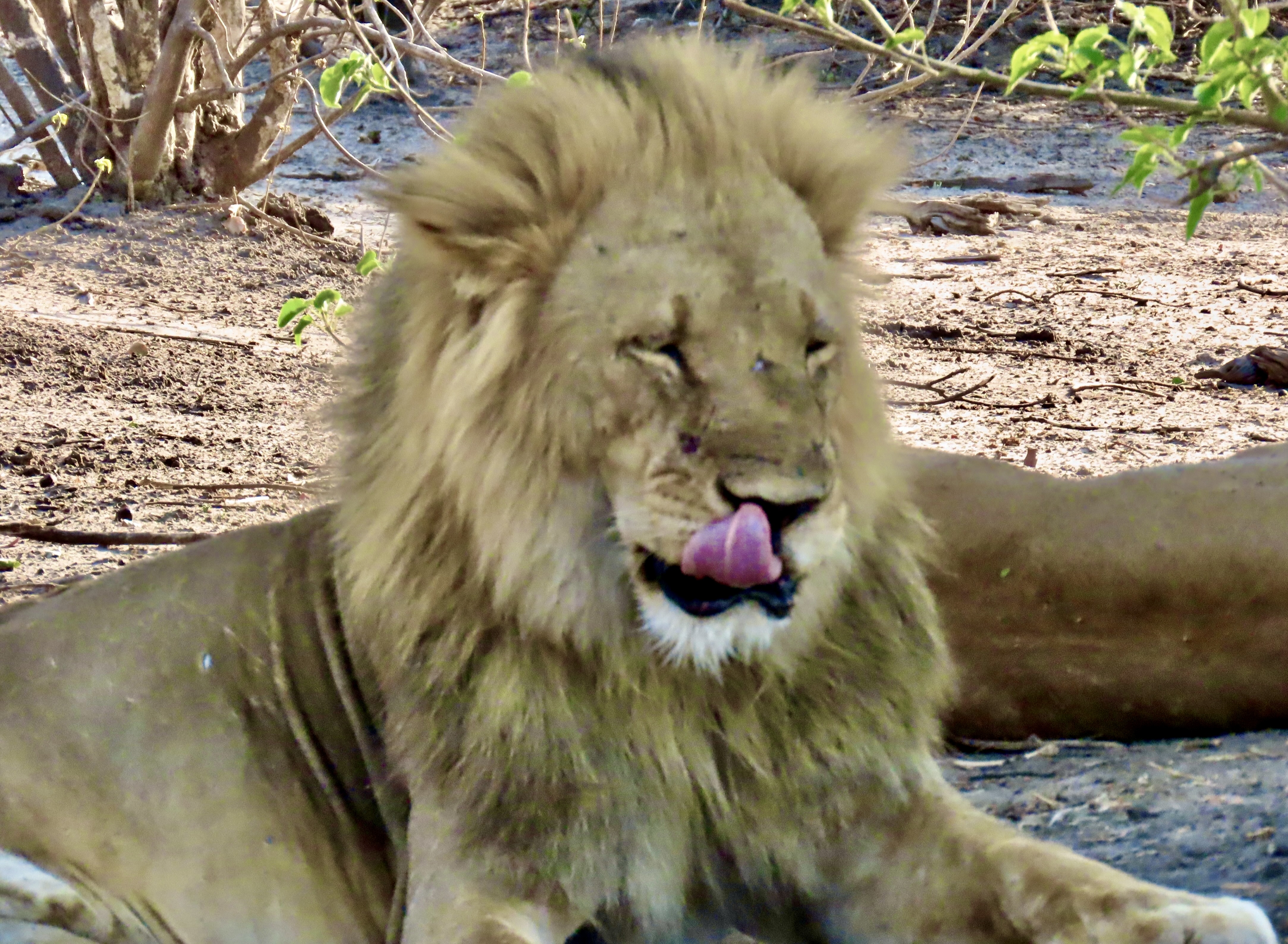
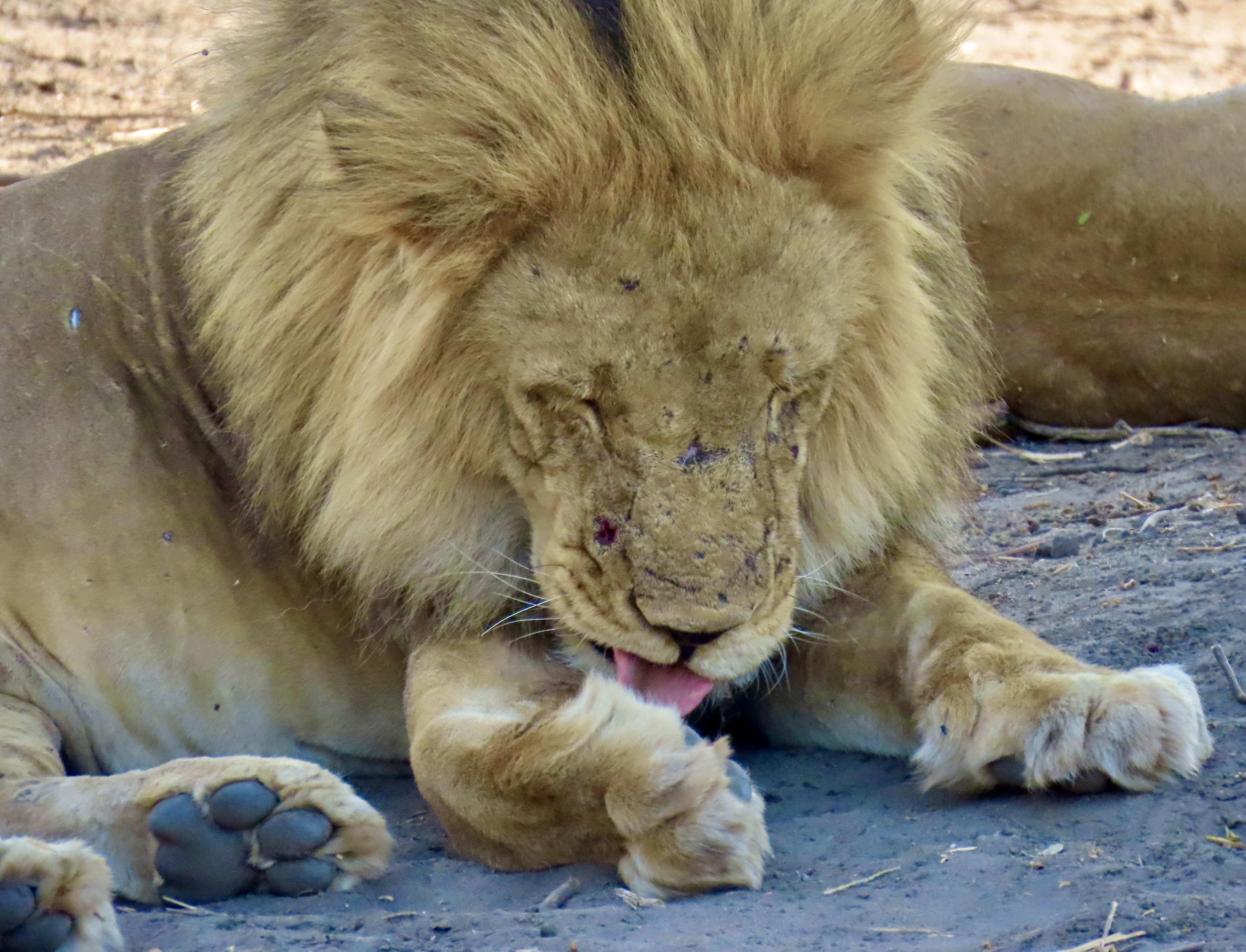
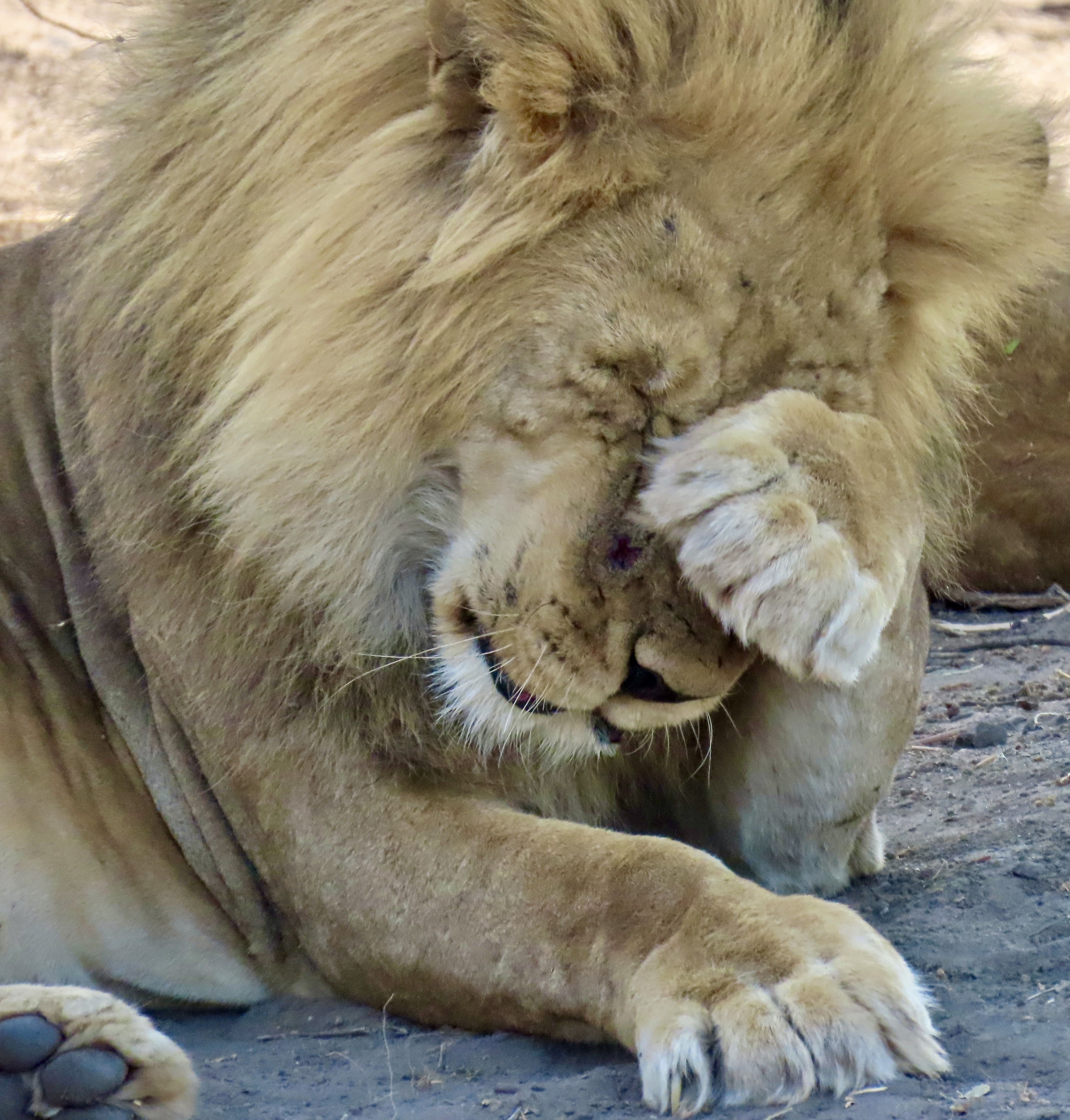
Female lions are excellent hunters. This photo suggests one of the reasons why. In addition to impressive teeth, they can run up to 50 miles per hour and weigh upwards to 350 pounds. We had just watched this lioness hunting. Her yawn suggested that perhaps it was nap time.Shortly after we took this photo, she made a brief dash after something we couldn’t see and she didn’t catch.Settling down (before the yawn), she was still on high alert.Checking in various directions…Which included eyeing us!We came across a lion that was working its way through a young elephant in Chobe. Malibu storks waited patiently for the lion to leave.Another lion invited herself to the meal…Check out the ears on the lion that had been enjoying its meal. If you have a cat, you know that means “I don’t think so.” A lightning fast paw may follow.So she stalked off past another safari vehicle that had also stopped to watch the action. Is that a hungry look she is focusing on the occupants?Which brings us to this magnificent fellow that I have already introduced in another post. He was about to give himself a bath. Note the size of his paws.Like any cat, it started with his tongue!First, he had to get his washcloth wet, i.e. lick his paws.He was quite thorough. And washed each side of his face. I thought this could have been titled: “Oh no, not another blog about me!” A close up…And then he washed the other side…Finally, he was ready for his portrait.
While we are on the post featuring big cats, I have one more:
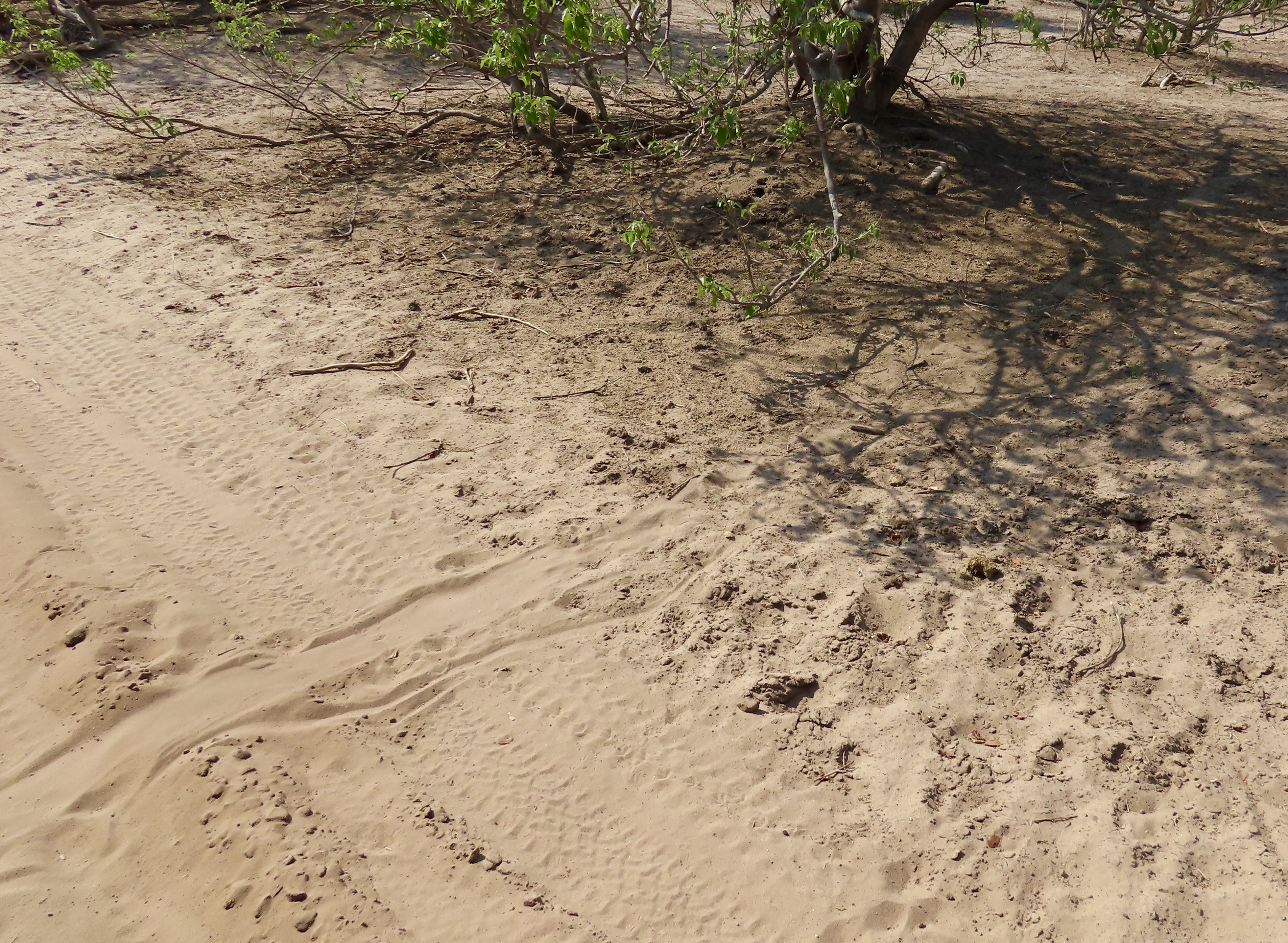
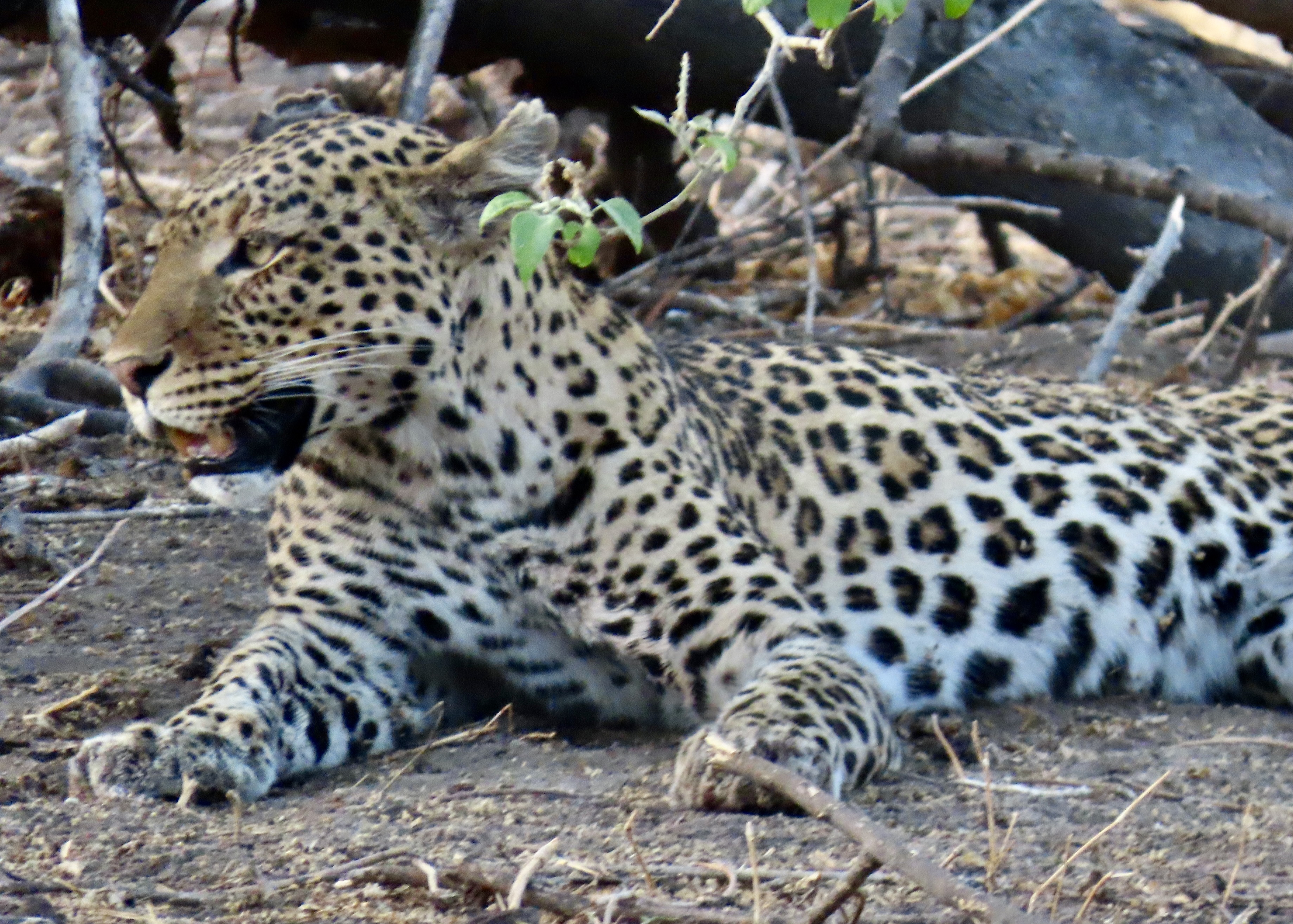
We were driving down one of the roads through Chobe National Park when we came across these interesting tracks. Our guide explained that a leopard had killed an antelope (probably an impala) and dragged it across the road. The fact that there were no tire tracks over the trail suggested it was very recent. We stared into the bush to see if we could spot the leopard and its meal. No luck. In fact, we would be lucky to see a leopard on our trip at all, the guide noted.The next evening as we were heading out of the park, he got a call and told us he had a treat, not explaining what. It turned out that a leopard had been spotted. We found it quite striking.It didn’t seem particularly bothered by our presence, but it did roll over and face away from us…A final shot. Next post: The striking fish eagle and a visitor from our trip up the Nile a year ago, the Egyptian goose.
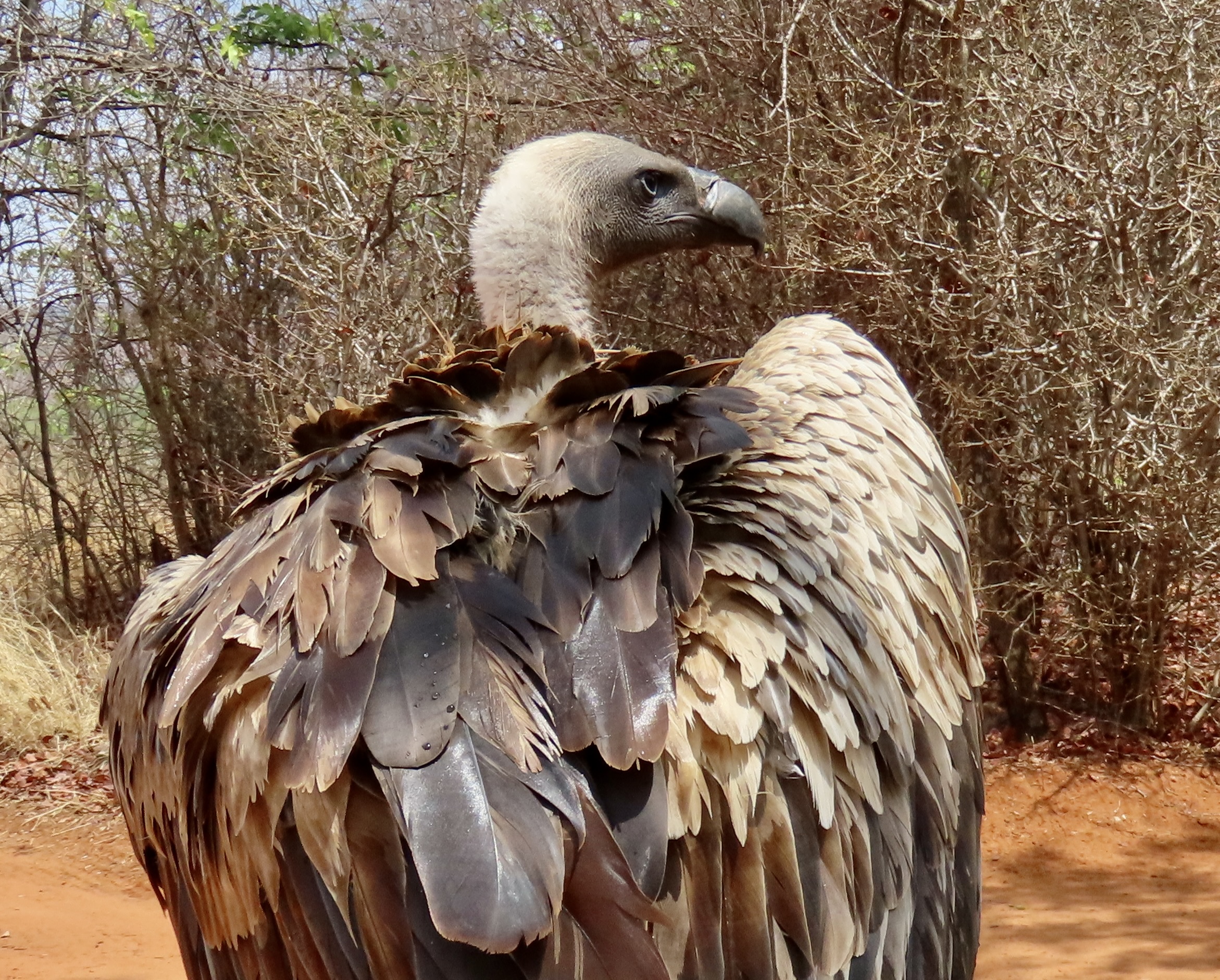
In 2013, an injured white backed vulture baby was discovered in the Zambezi National Park and brought to the Wildlife Trust facilities near Victoria Falls. Its injuries meant it would never be able to fly so it became a permanent resident. The Trust named the vulture, Judge. I was taking his photo when he suddenly started flapping his wings and coming toward me. The meme made famous by Sammy Davis Jr. on Rowen and Martin’s “Laugh In” popped into my mind. “Here comes the judge.” I had the feeling that ‘the Judge’ might be weighing my food value instead of my misdeeds, however.Judge has earned the title ‘Ambassador for Vultures’ by educating thousands of children and making appearances at various events such as agricultural shows, thus becoming the ambassador for vulture conservation in Zimbabwe. Peggy and I were totally taken in by the beauty, and the seeming dignity of the large vulture. We took lots of photos…Judge is one of the 4 species of vultures found in Zimbabwe. White backed vultures have a lifespan that stretches up to 50 years, mate for life and have one chick per year. The low breeding rates mean that the species is particularly vulnerable to outside threats. it is now listed as Critically Endangered on the IUCN Red List.We thought Judge looked like he was contemplating the future of white backed vultures in this photo. The single largest threat is poisoning. Once again, poaching is a major factor. When poachers kill an elephant for its ivory or a rhinoceros for its horn, vultures will circle the kill, which allows wildlife rangers to hone in on the poachers. To reduce the possibility, poachers poison the carcasses and kill the vultures. Judge seen from behind in his legal robe/feathers.Here, several white backed vultures are resting after a feast. As many as 100 vultures may descend on a single carcass such as a zebra and pick it clean in a matter of minutes. They often gorge themselves to the degree that they can’t fly! A pair of Malibu storks are on the left.I’ll conclude today with this white backed vulture, wings spread wide, outlined on it’s perch in a tree. On Friday, we get up close with lions!
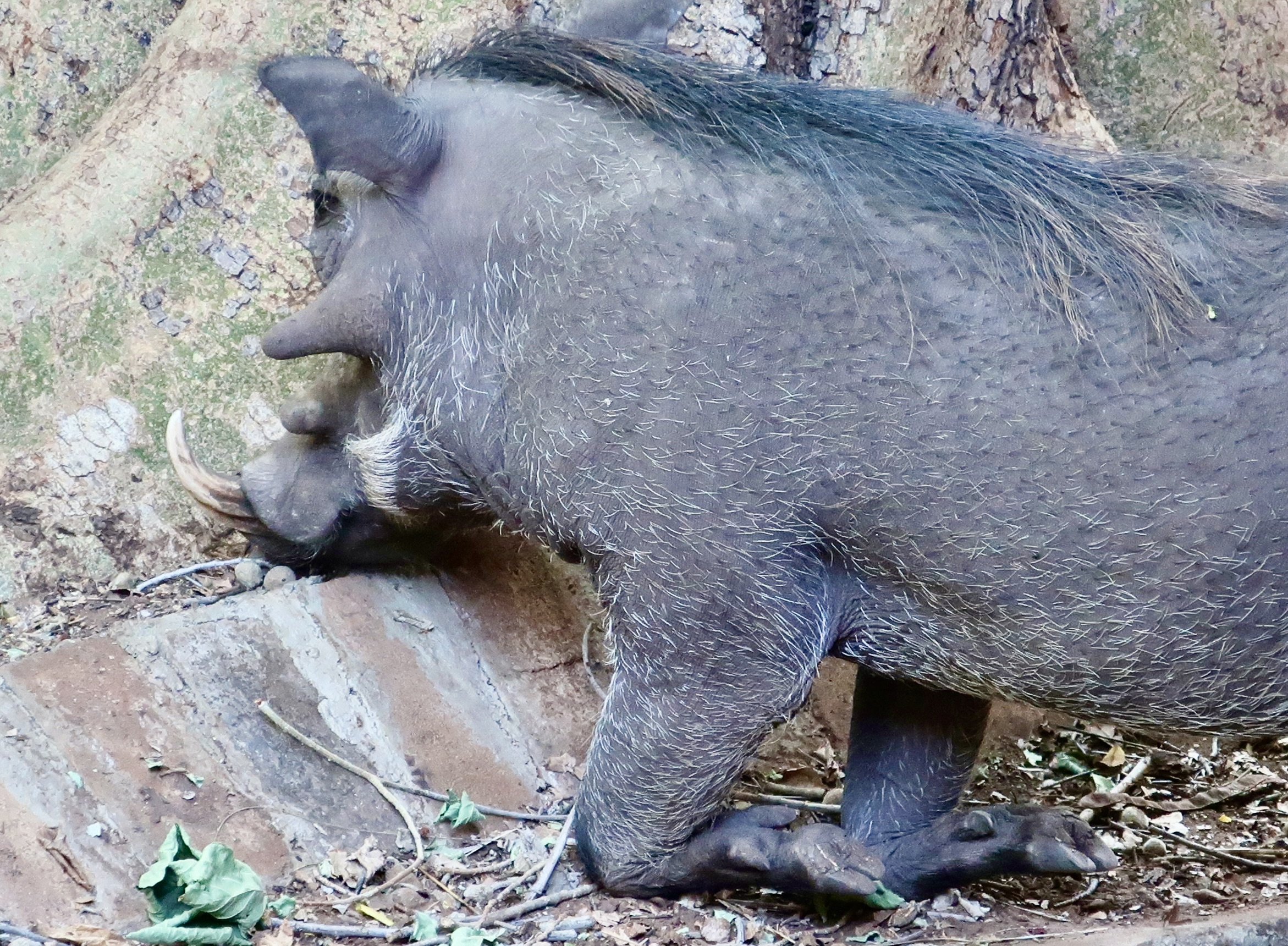
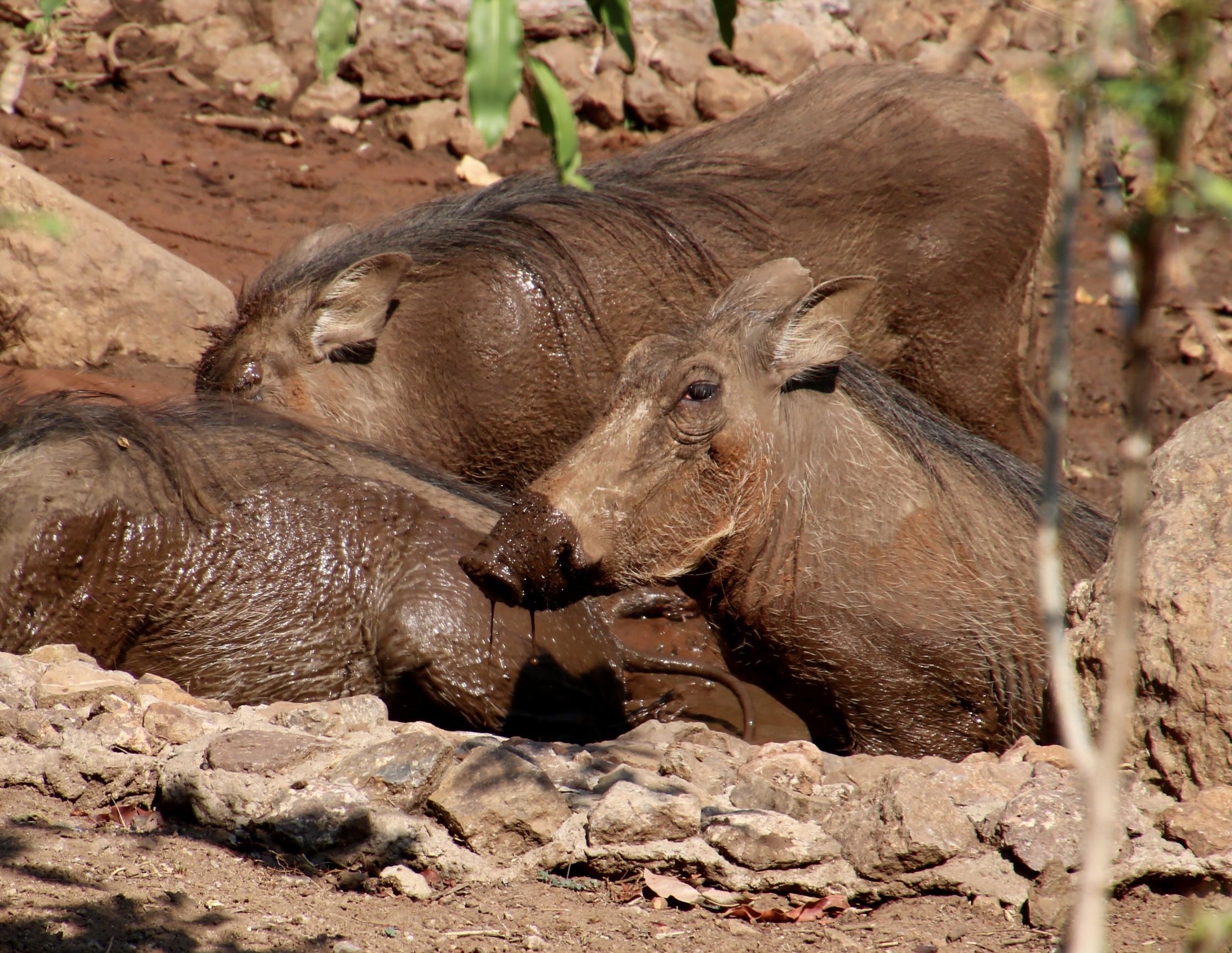
The Chobe Safari Lodge in Kasane, Botswana was the first place we stayed on our African Safari. In addition to being on the Chobe River and a short driving distance from Chobe National Park, it was the home of several warthogs. I called this one Old Dude, for obvious reasons.The name warthog derives from the ‘warts’ on their faces, which actually aren’t warts but are made from a combination of bone and cartilage. They protect the face of the warthog in battle and I’m pretty sure that girl warthogs consider them quite attractive. Old Dude was searching for dinner here, which I think was small nuts from the tree. He wasn’t praying to the tree god, it’s just how warthogs eat— on their knees— so much so that they grow callouses on their knees, i.e. kneepads.Here’s another perspective on Old Dude. I’d say the white hair sprouting out of his ears, the pouches under his eyes , and his broken upper tusk all speak to his age. (Or at least they would in a human.) Warthogs have four tusks (two upper and two lower) that are based on their canine teeth. While the warthogs at Chobe Lodge weren’t tame, they certainly weren’t concerned with people photographing them. We were about 10 feet away.Warthogs seem to love their mud baths as much as elephants, if not more. It’s for some of the same reasons: Cooling off, protecting against sunburn, and killing parasites. Our balcony at the Chobe Safari Lodge looked out on a mud hole where these warthogs were frolicking.One of them was giving new meaning to “down and dirty.” And possibly “joy.”We had just finished feeding the elephants at the Wild Horizons Elephant Sanctuary near Victoria Falls when this fellow came slipping in. I think he had assigned himself clean-up duty. Their usual diet is grass but they will use their tusks to dig for roots and bulbs, and, as we have seen, apparently, nuts. Being omnivorous, they will also scavenge meat occasionally.A group of warthogs, consisting of moms and kids, is called a sounder. Why, I don’t have a clue, but it is the name applied to other feral pig groups as well. We found this group at Matusadona National Park next to Lake Kariba in Zimbabwe. We surprised them so they were on the run with their tails up: Danger! Danger! Danger! While warthogs will fight if cornered, they prefer to escape, which is probably wise since lions find them quite tasty. Being able to run 30 mph (48 k) helps. As does having burrows to escape to. Moms send the kids in first and then back in with tusks pointed out. Warthogs don’t dig their own burrows, they steal them from other animals with aardvarks being their preferred target.This pretty lady warthog had found a mud hole in Hwange National Park and was eager to check it out.Ahhhhh….Ooooh…Aren’t I beautiful? That does it for today. Next up, you will meet, the Judge, who is known as the ambassador of white backed vultures, and is one impressive bird. I’m serious.
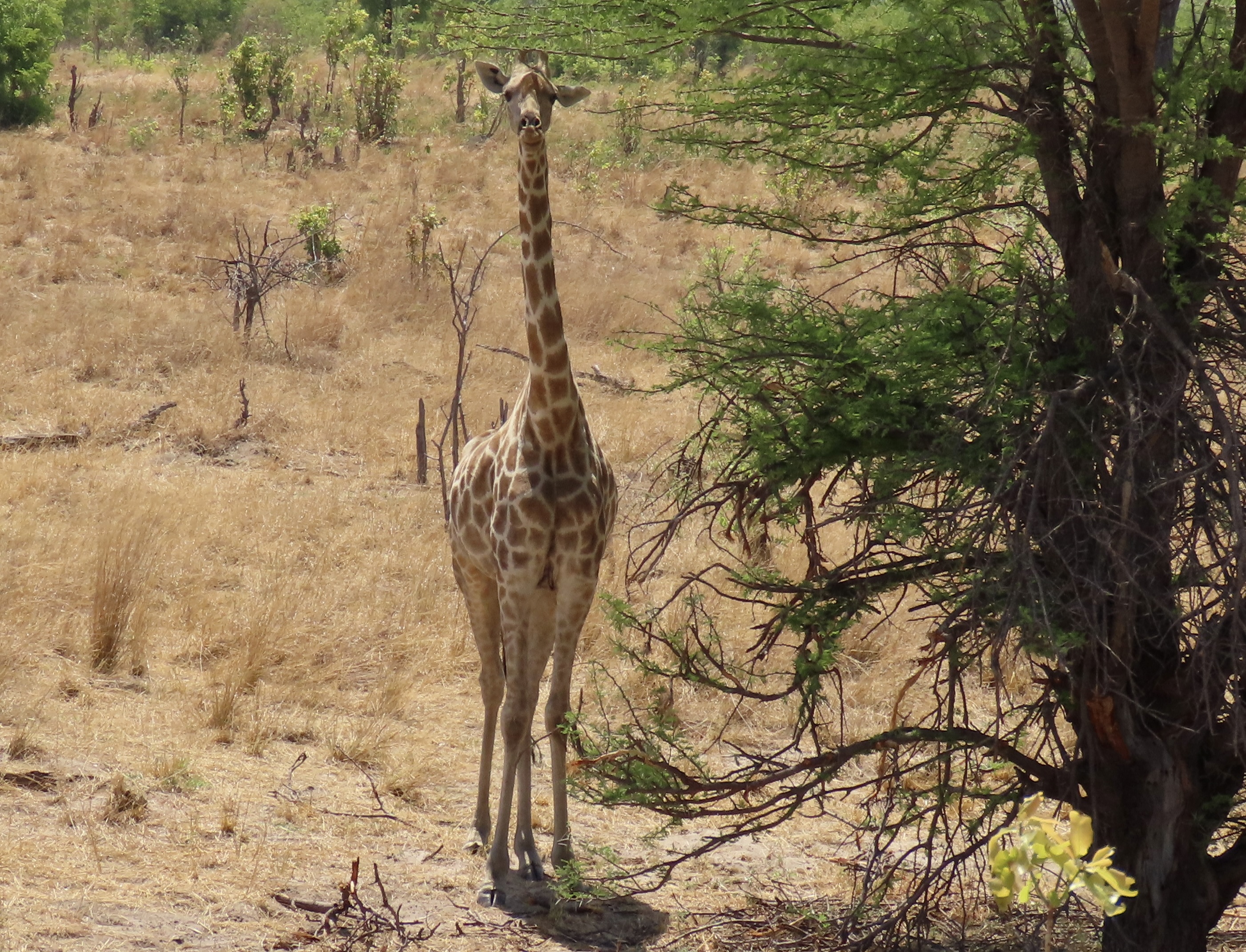
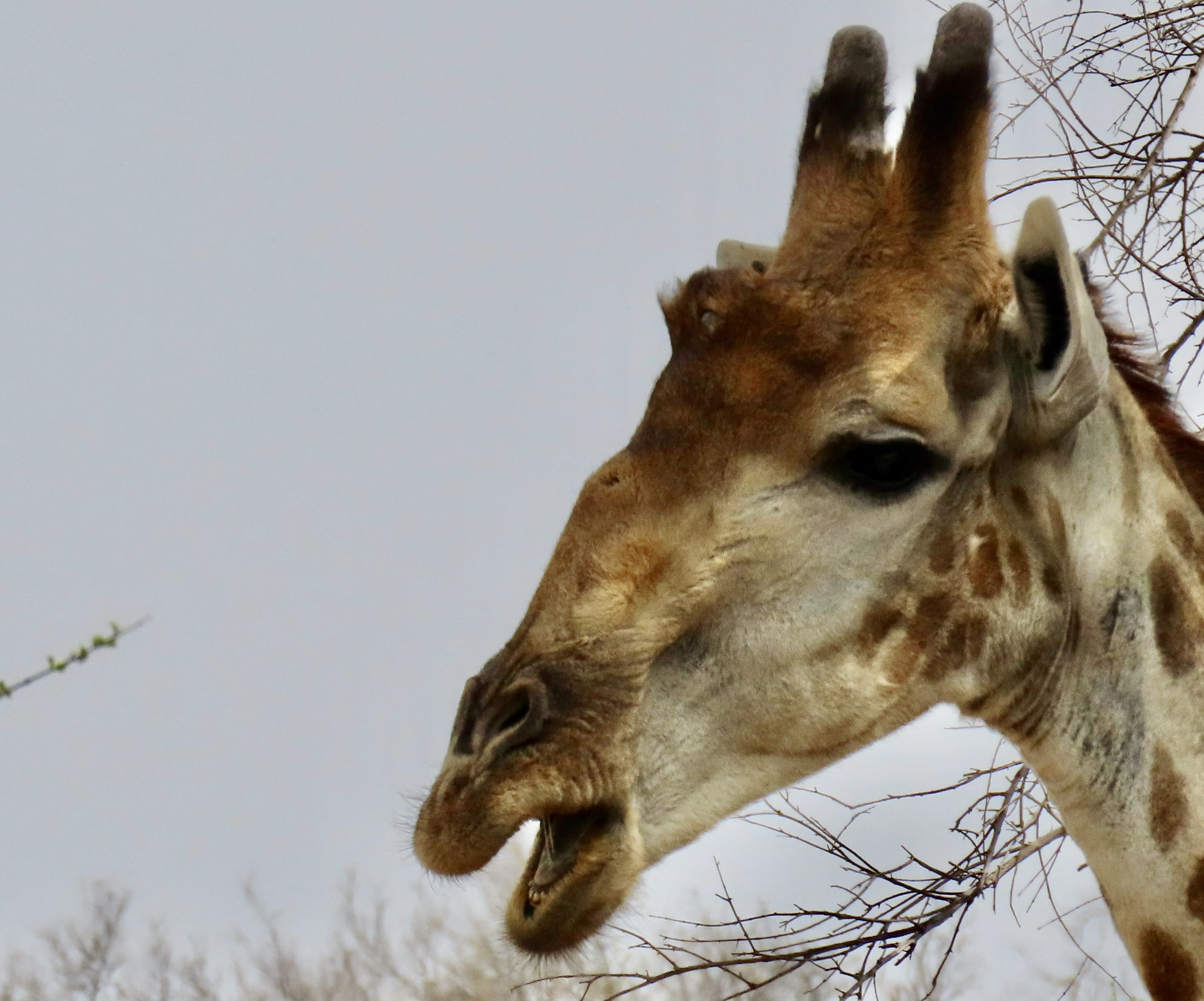
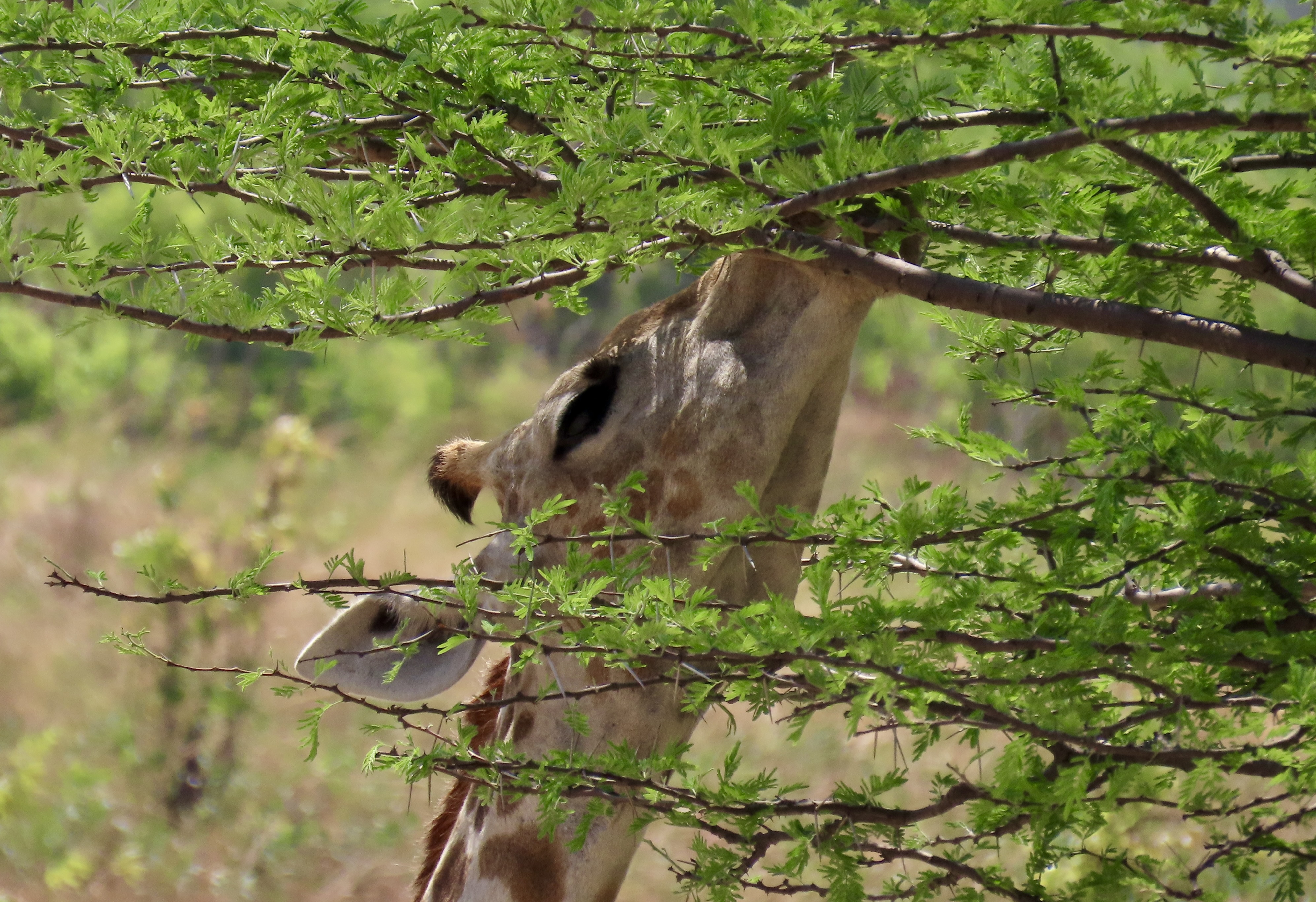
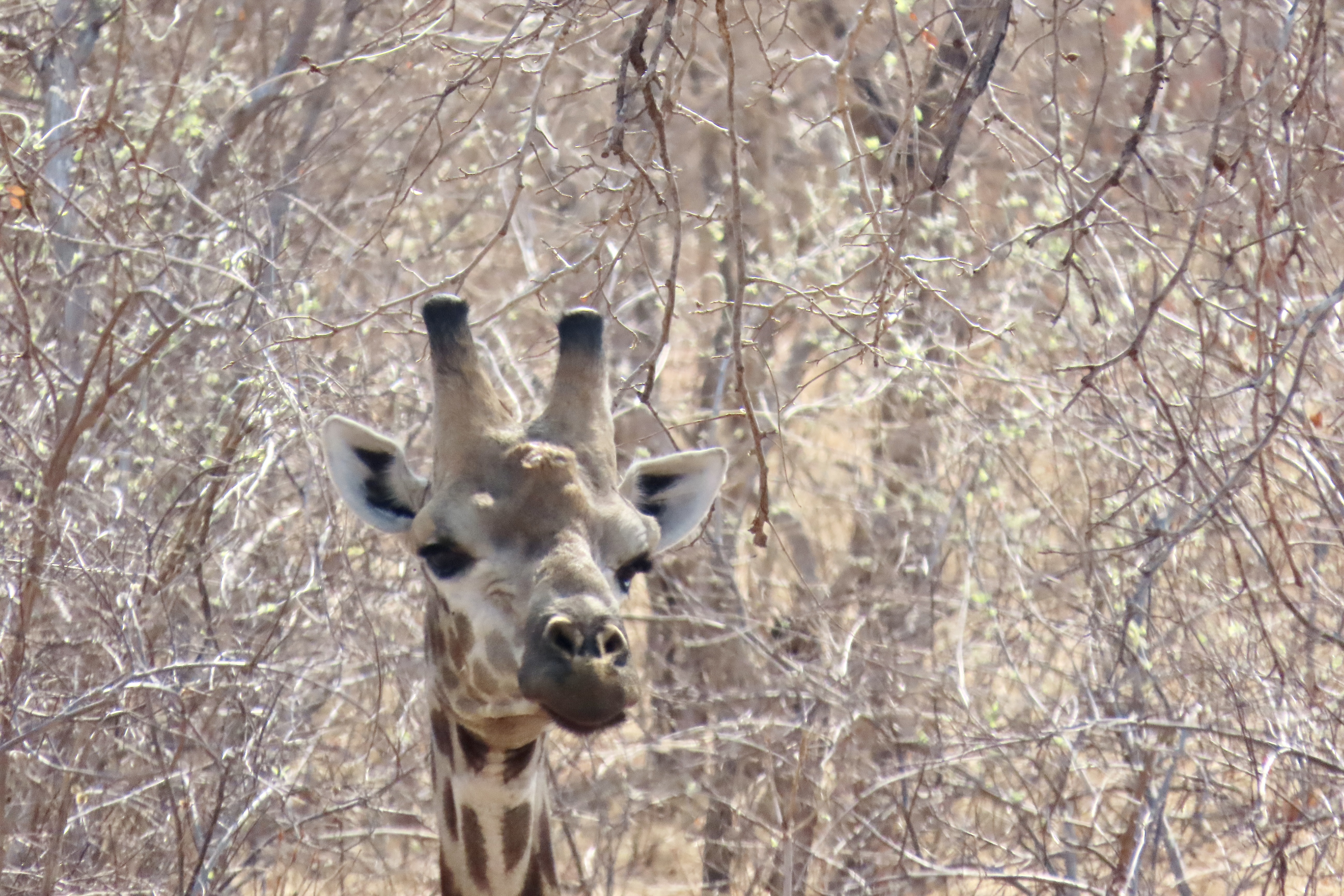
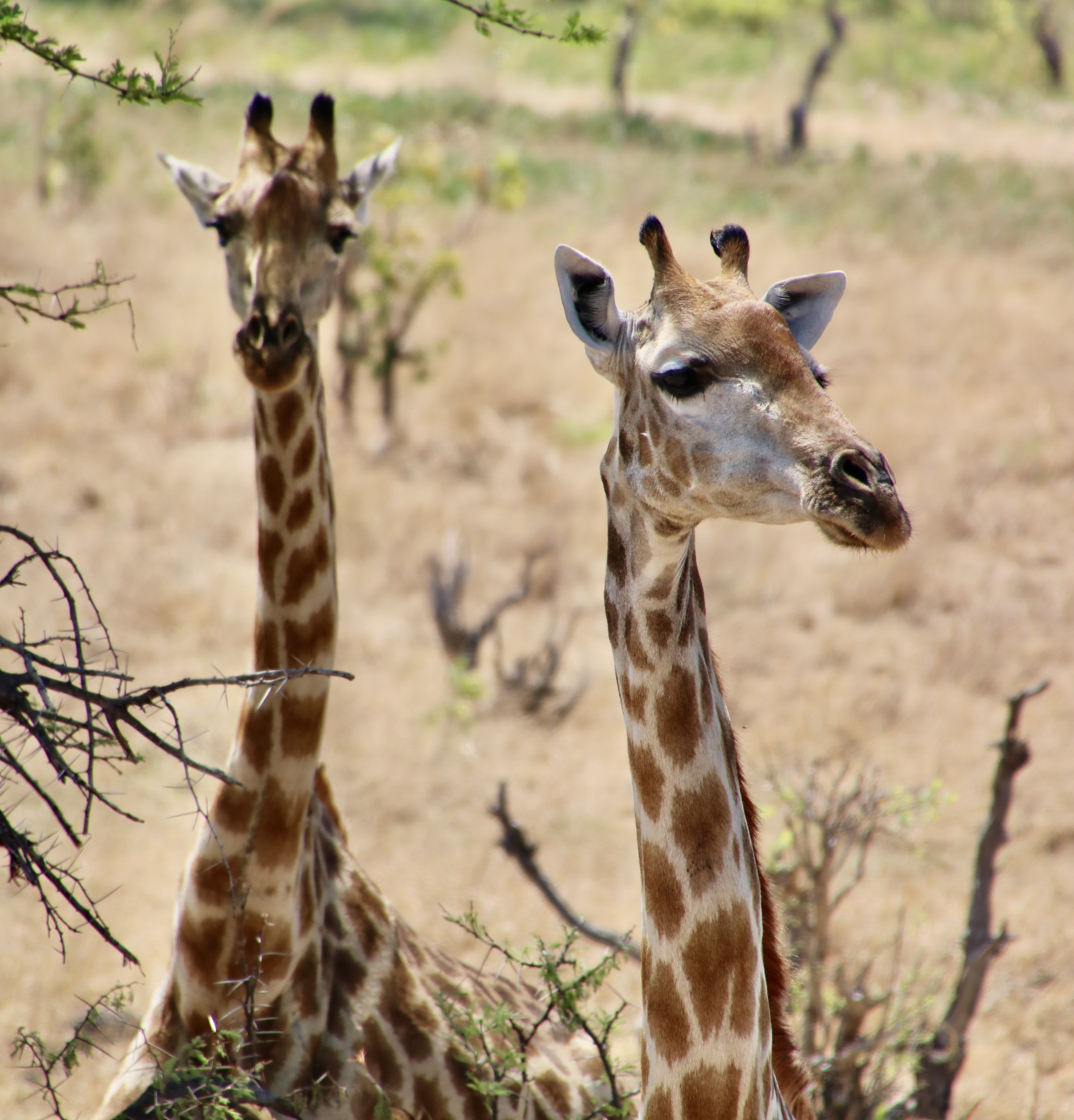
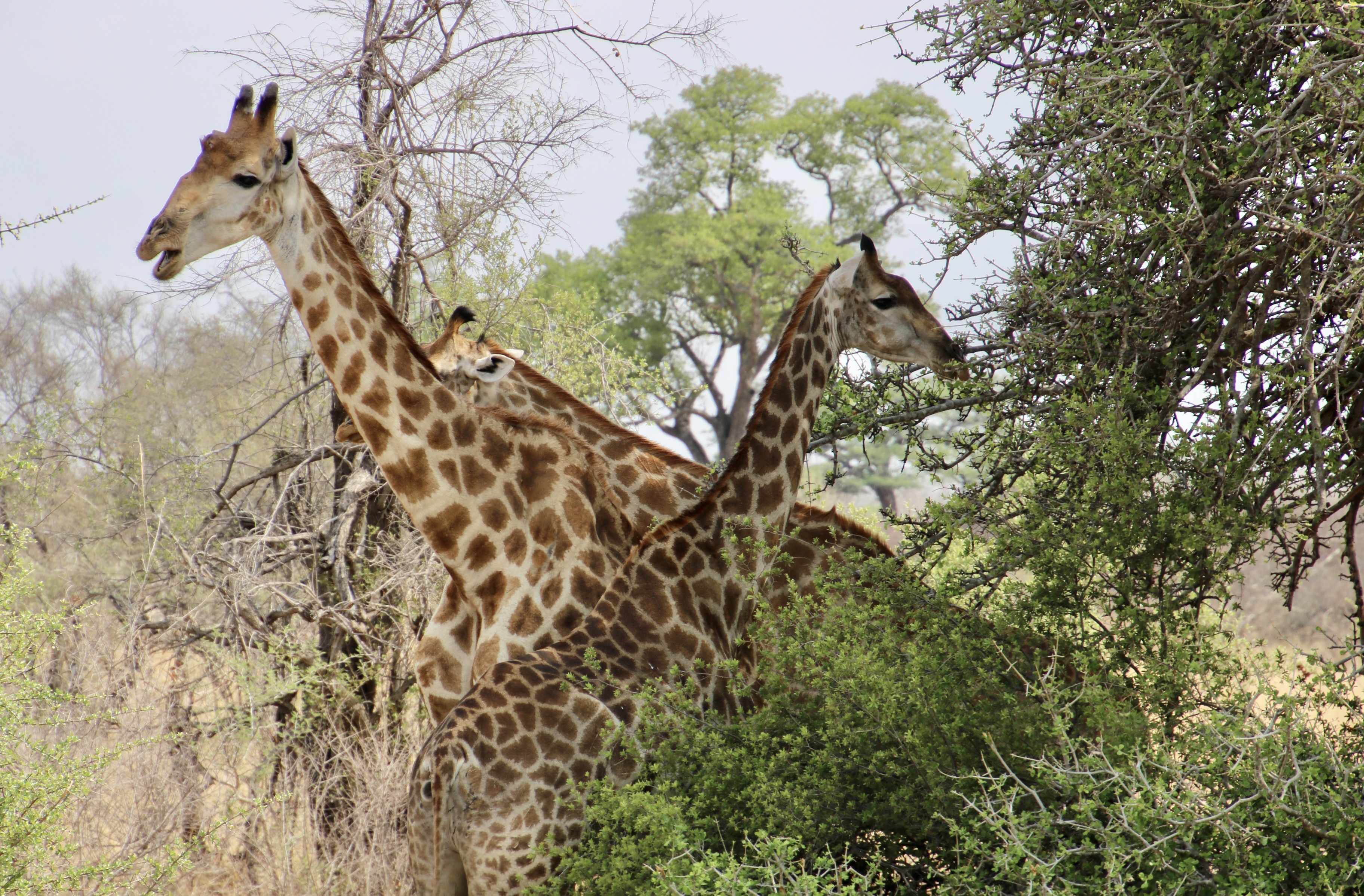
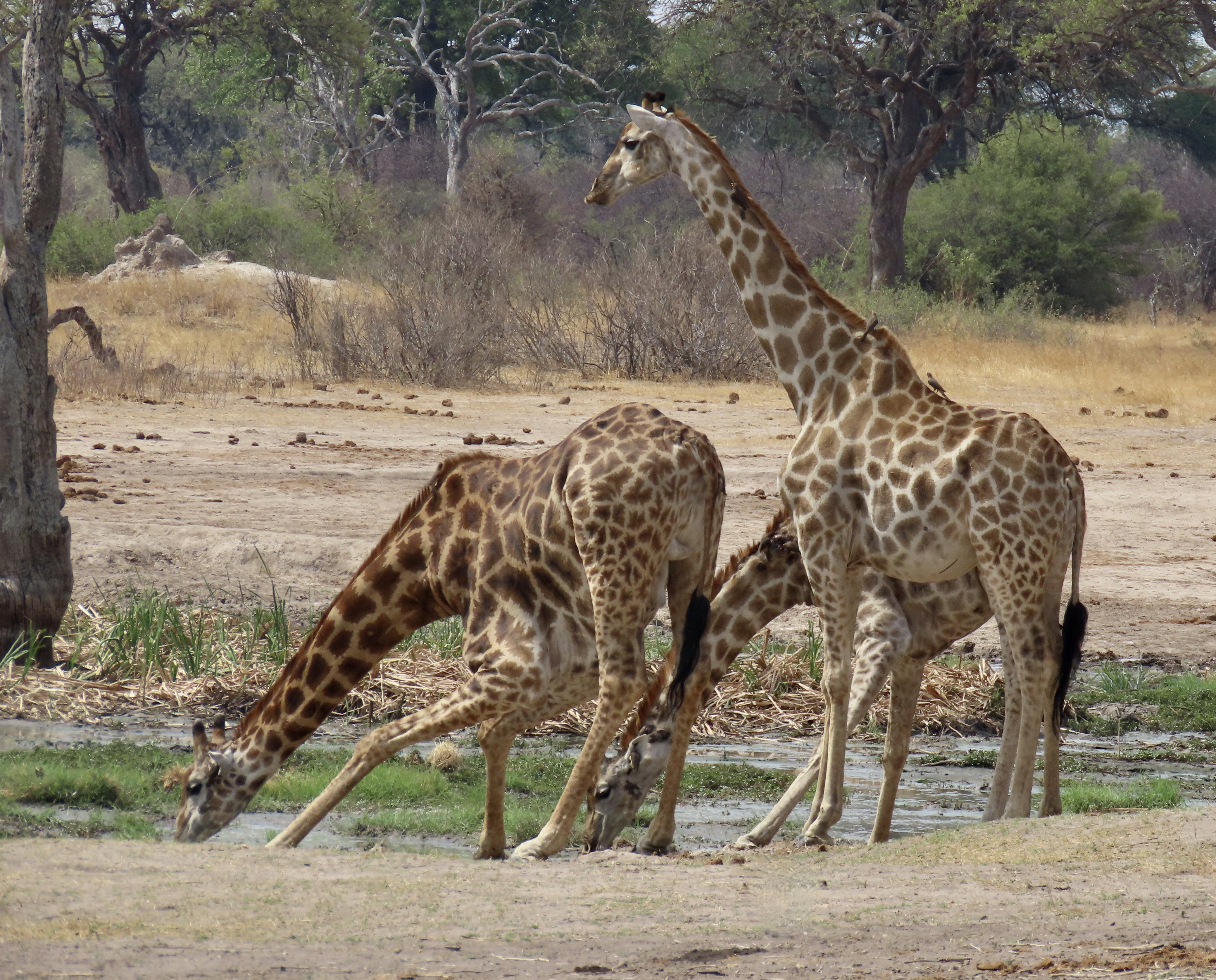
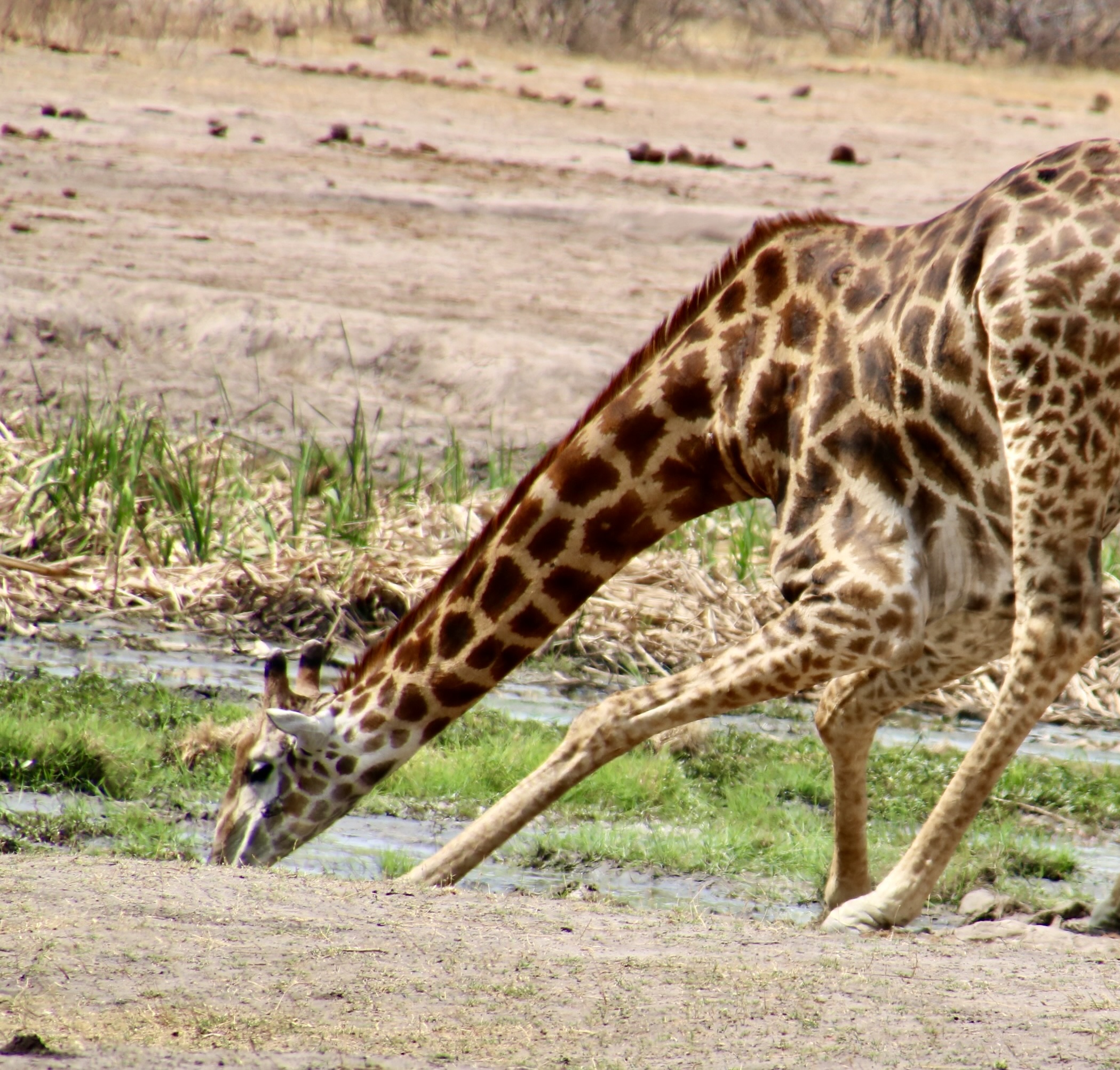
Did you know that giraffes have bluish purple tongues? This female in Hwange National Park, Zimbabwe willingly showed us hers. If it appears to be a mouthful, it is…A giraffe’s tongue is 17-19 inches long (45 and 50 cm). “The better to reach delectable acacia leaves,” it would tell you if it could talk. Giraffes and elephants favor acacia trees for their nutritious leaves.Its tongue is not a giraffe’s most notable adaptation for harvesting leaves, however. That would be its height. Females can be up to 14 feet tall and weigh 1500 pounds. Males can reach a height of 18 feet and weigh up to 3000 pounds. Say you lived in a two story apartment. A giraffe walking by could look in the window at you! This is one of my favorite photos of giraffes. Graceful. Another shot of the same giraffe— standing tall. Its neck and legs are close to six feet long each. Its feet are the size of a dinner plate. The giraffe uses its prehensile lips (moveable) in coordination with its tongue in chowing down on acacia leaves while avoiding the trees sharp thorns. The eyes, ‘btw,’ are the size of golf balls. I’d say this fellow has seen more than a few years. I can identify. You can see where the thorns might be a bit ouchy. Check out their length. The acacia tree has other defenses as well. One is that when the giraffes begin nibbling, the trees increase their tannin production, thus making the leaves less palatable. In one of the ‘miracles’ of nature, other acacias in the area also increase their tannin— even though the giraffes have yet to touch them. The trees have also formed an alliance with biting ants by providing shelter and a sugary nectar. When the giraffe, elephant or other animals go to eat the leaves, the ants swarm and bite them.We were amused when the giraffe stopped browsing on the easily reachable leaves and stretched to reach some higher in the tree. Was this a case of the ‘grass is always greener on the other side of the fence?’ It may be true in this case, since the higher you go, the younger, more tender, and more nutritious the leaves are. The height of the giraffe is an obvious advantage when it comes to reaching them. Elephants with their massive appetites are forced to satisfy their hunger on lower leaves. (They aren’t above shoving the tree over to get at the higher leaves, however.)A couple of headshots are in order here. Note the eyes and lashes. Pretty, huh. The upper lip? Not so much. I thought it looked like a whiskery peach. Pucker up.Check out the ‘horns’ here. Both males and females are born with them. They aren’t attached at birth but lie flat against the head. Might lead to a tough birth, otherwise. They attach later. If one wants to be technical, they are known as ossicones and are composed of ossified cartilage covered with skin and hair.Giraffes a deux. Giraffes are social animals and live in herds although their bonding is mainly between moms and kids. The gestation period is 14 months. The mom gives birth standing up, dropping the baby over five feet to the ground. Could this be the reason the baby is born feet first? Grin. One interesting fact I came across is that when the babies get older, moms leave them together in a ‘nursery’ and go off to eat, leaving one mom in charge of the kids.This trio of giraffes was one of Peggy’s favorite photos. A herd of giraffes is appropriately named a tower!While a giraffe’s neck is long, it isn’t long enough to compensate for its long legs when drinking water. A combination of bending its legs while maintaining balance is the solution. One giraffe has been left on guard duty while two drink here. The vulnerability is obvious, especially when dealing with lions. Crocodiles can also be a challenge.Another problem the giraffe faces while drinking is blood rushing to its head. The expandable jugular veins have one-way valves that allow the veins to expand and prevent the blood from flowing back to the brain. Because giraffes get much of the liquid they need from the 75 pounds of leaves they eat daily, they only drink every few days.A large male heads off into the bush.Giraffes can run over 30 miles per hour enabling them to get away from predators— or Volkswagen beetles. (I once chased a herd across the Serengeti Plains for a short distance, during the 60’s in a ‘bug,’ clocking them at over 20 mph). It’s said that their long legs can also deliver one heck of a karate kick, which I possibly deserved for chasing them, but didn’t experience.I’ll wrap up here with the giraffe heading off across the savanna. Monday is for the birds, or, more specifically, guinea fowls and southern red hornbills. I’ll also tell the story of how a guinea fowl led to a soldier pounding on my door at 4 a.m. with the butt of his rifle trying to arrest me when I was a Peace Corps Volunteer in West Africa.Did I tell you the the giraffe is Peggy’s favorite African animal?
We were boating up the Chobe River in Botswana when the captain pulled over to the shore so we could watch this yellow billed stork on a fishing expedition.
Peggy and I joined her brother John and his wife Frances on an African safari to see elephants and lions, and giraffes, and hippos, and crocodiles, and zebras, and baboons, and… the list goes on. And we did, in glorious profusion. What we weren’t expecting was the bird life. A serious birder would be in heaven. In fact, there are specific African bird safaris one can sign up for. While our passion doesn’t run that deep, we do enjoy bird watching and always have. Time and again on our trip, we found ourselves stopping to admire their beauty, character and antics in Botswana, Zimbabwe, and South Africa. We have the photos to prove it.
Altogether, we photographed over 20 species. You will be meeting up with many of them in my bird posts, including ostriches and penguins, but today, we are going on a fishing expedition with a yellow billed stork and an African Darter we met along the Chobe River in Chobe National Park, Botswana.
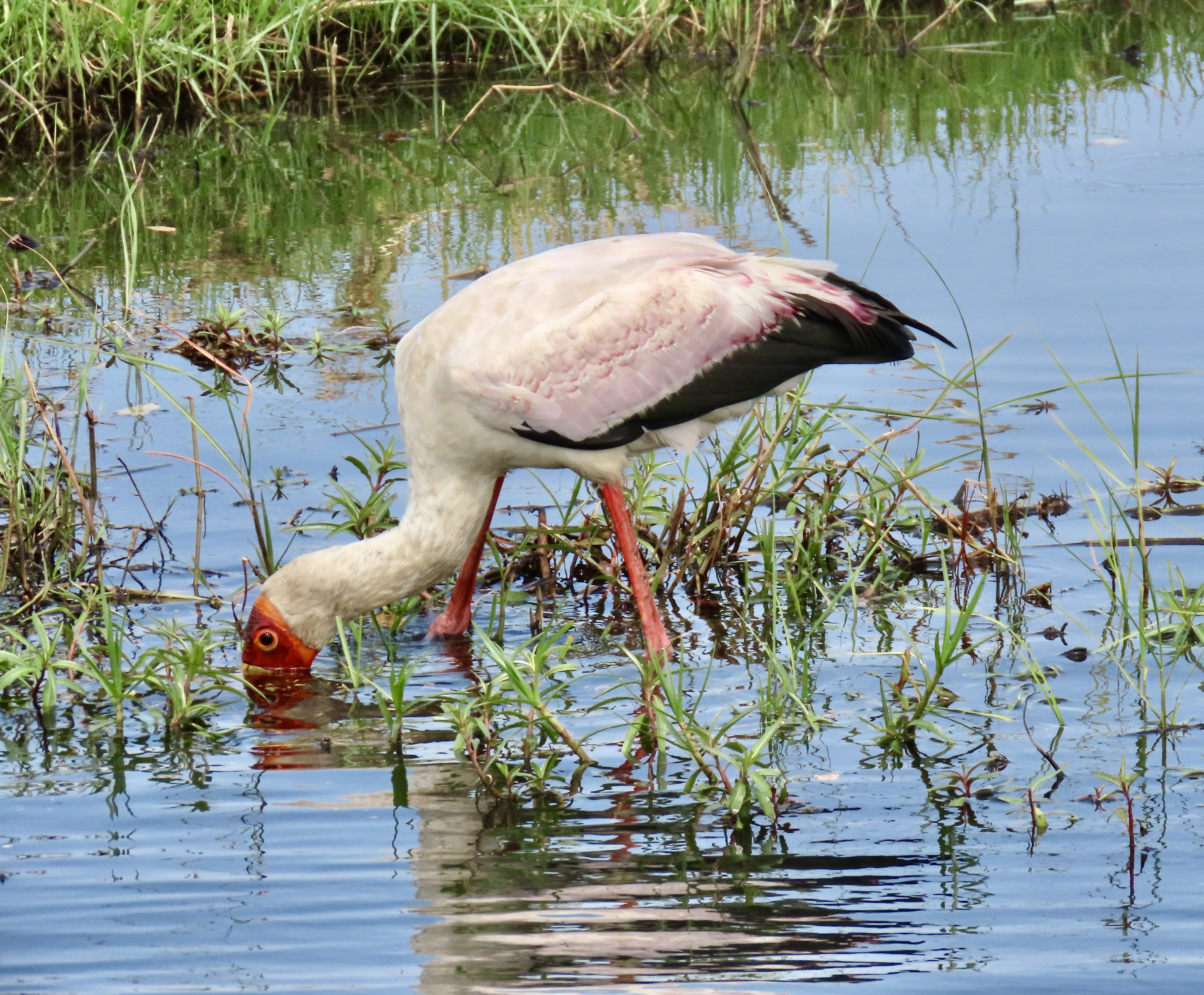
The yellow billed stork stands around three feet tall. It prefers fishing in shallow water where it shoves its large bill into the water and then stirs the water plants and mud with one of its feet to herd dinner toward its waiting bill. Small fish, frogs, and water insects are all welcome. It’s an open bill policy. It fishes by feel. When a suitable meal hits its bill, the stork captures it with a lightning fast reflex snap. But I’ll let the stork tell you the story.
Hi, my name is Big Bill. Today I am taking you on a fishing expedition where I am going to catch a monster. This is one of my favorite fishing holes. All sorts of delectable treats like to hide out in the grass. I’m drooling in anticipation.My fishing technique involves me dunking my bill into a likely spot. I’m using my left leg for balance while stirring the pot, so to speak, with my right foot to herd tasty morsels toward it. One never knows what might be hiding in the grass. I call it pot luck.Here’s a head on view of me, up to my eyeballs in work. The waves you see are from my stirring efforts.And here’s a rear view shot that I did not approve. Curt and Peggy will be held accountable. What are you looking at…Wait! Something just hit my bill! A monster!I caught it! Woohoo! Woohoo!
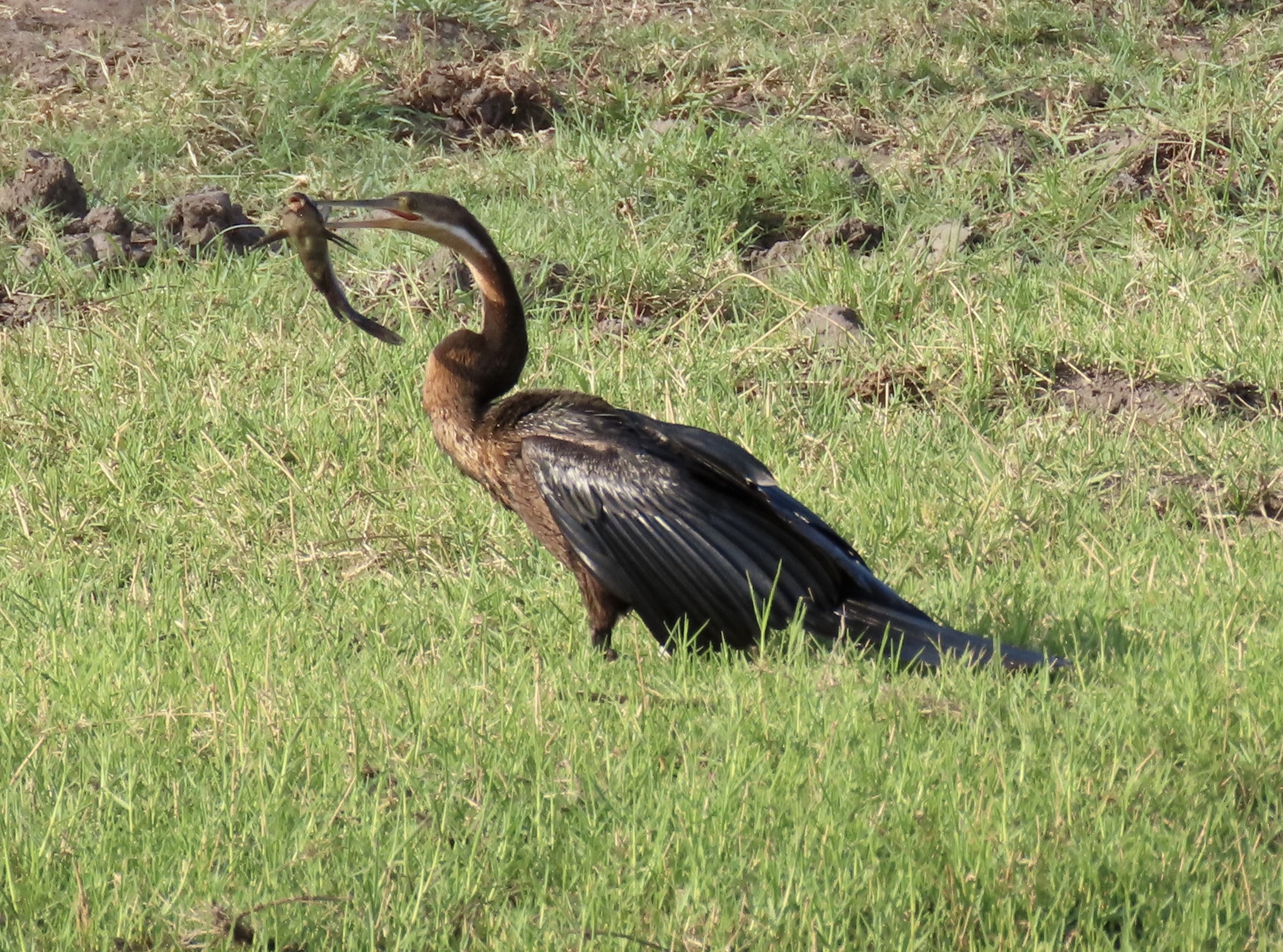
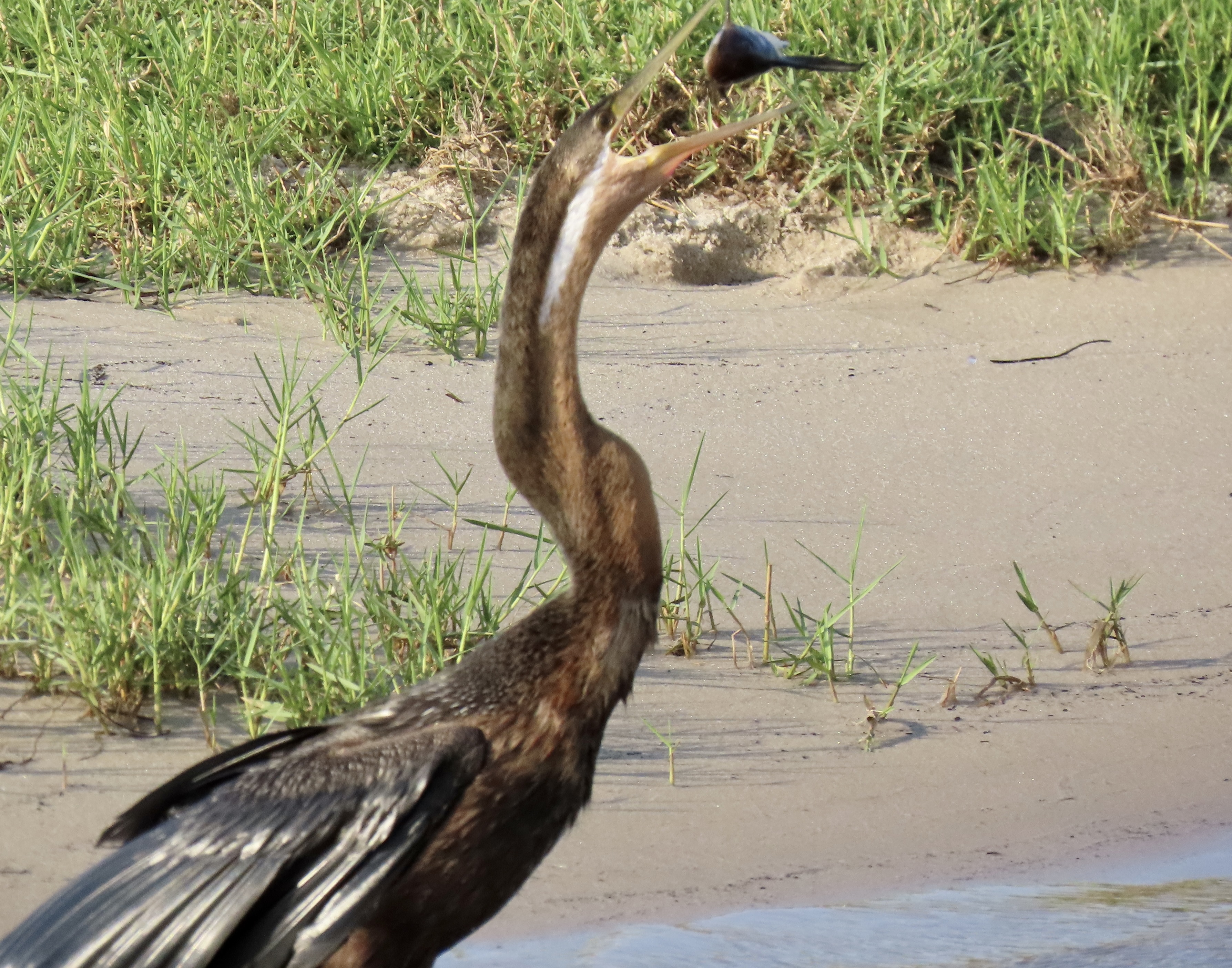
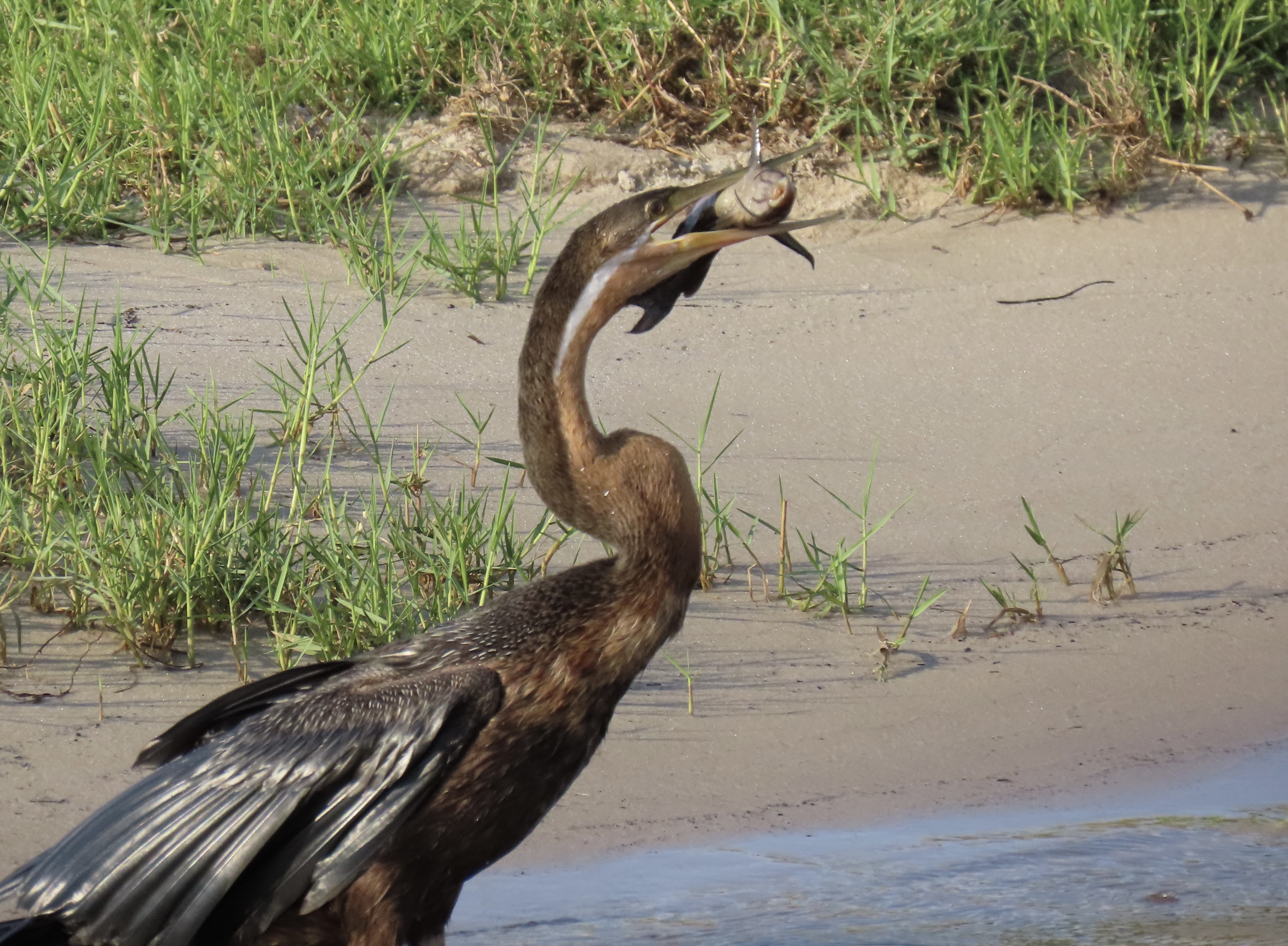
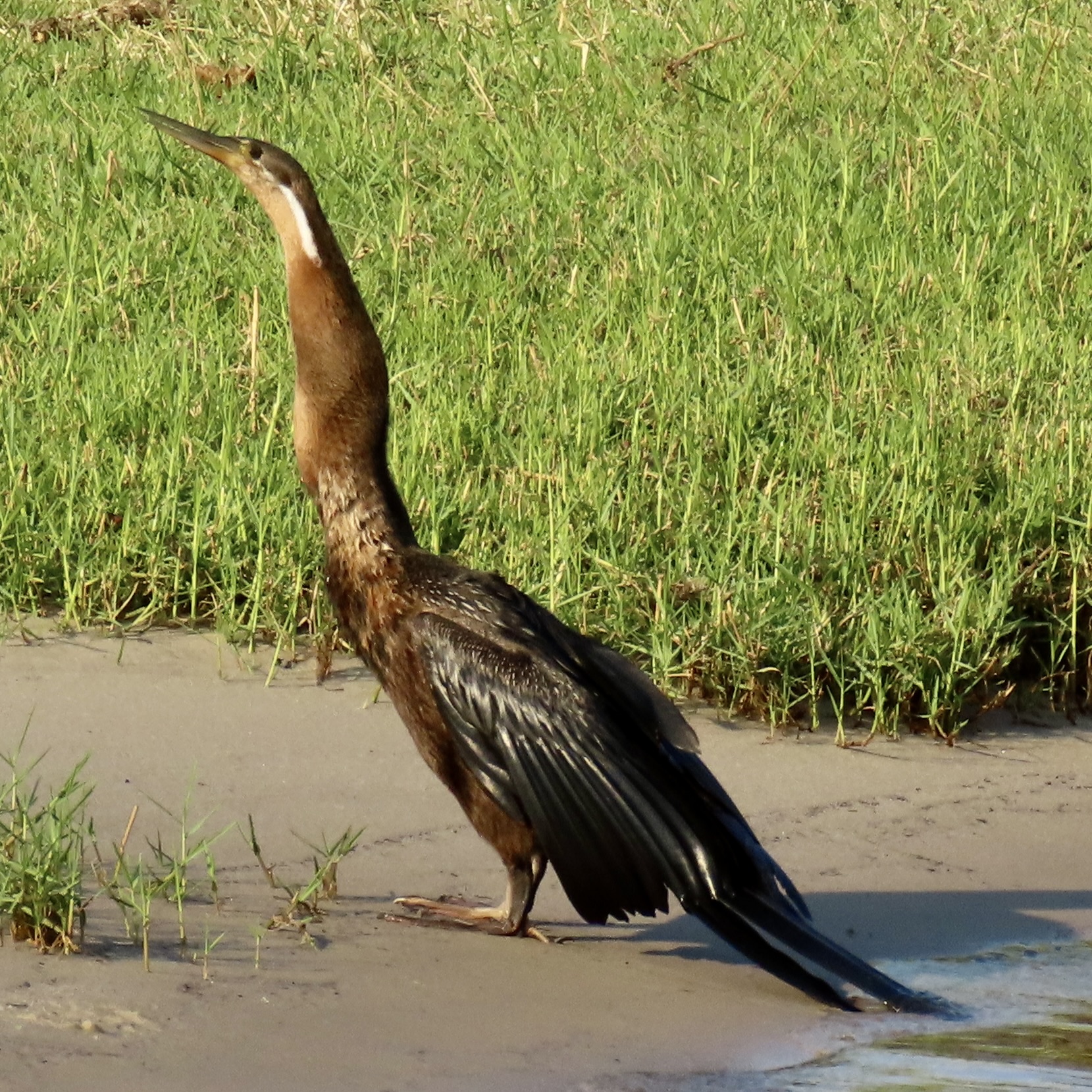
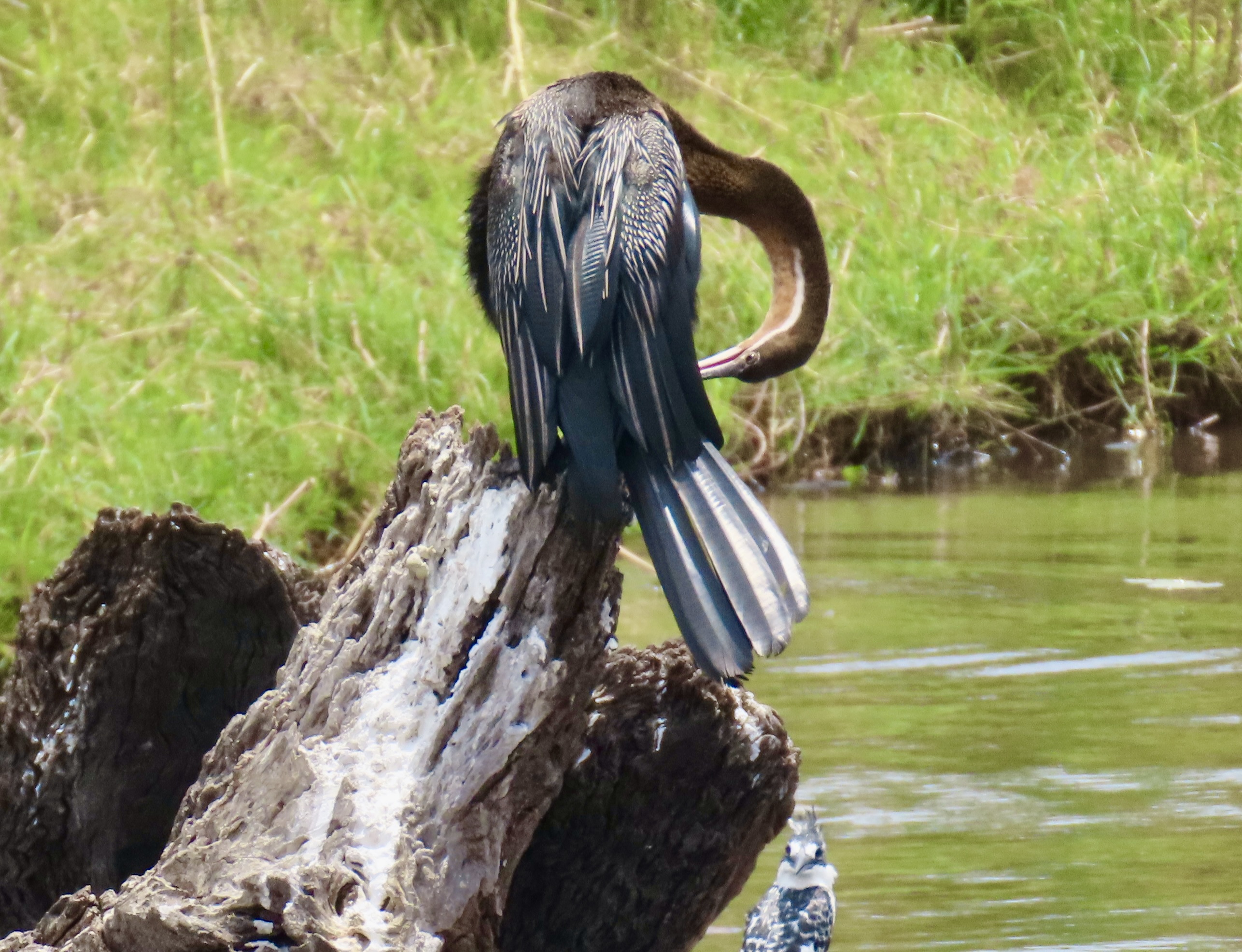
And now on to the African Darter or anhinga, also known as a snake bird. These birds are closely related to cormorants. The 36 species of cormorants and four of anhingas make up the family Phalacrocoracidae. The African Darter swims through the water in search of its prey, often with only its head showing. When it finds a fish, it literally spears it. ‘Darter’ refers to how fast. The alternative name, snake bird, derives from its sinuous neck. Now, in its own words:
Hello, I’m Handsome, or, if you prefer, Pretty. Either way, I am much better looking than Big Bill. You might think I am posing for you. Well maybe, I am preening. But mainly I am drying off my wings. Unlike most water birds, we, and our cousin cormorants, don’t have oil in our feathers to repel the water.This is me with a freshly speared fish. Catching it was easy…It’s swallowing it that creates the challenge.It has to go down head first. Check out the wicked fins on this catfish. If I swallow it tail first, they get caught in my throat. Then it’s not just bye-bye fish, it’s bye-bye Handsome as well. That’s not a good ending.I have to position the fish just right. So I take it back to the water and spear it again. Some fun. I wonder how many holes I can poke in it?This seems about right.Upsy-Daisy. Whoops, I mean upsy-fishy. Now don’t blink…Did you catch that? Did you catch my great flip? I’m very good at flipping.Hmmm. I don’t think I’ll be swallowing this.Maybe if I use the sand this time. More holes. Think of it as tenderizing. Note my big feet! I’m surprised they didn’t name me Big-foot as opposed to Snake-bird. Oh, you say Bigfoot is already taken.Wow, I think I’ve got it! Thereby hangs a tail. Heh. heh.Down the hatch!Gulp.Ah, happy tummy, happy bird. Now I can go back to preening and being beautiful. (Don’t pay any attention to that skeptical pied kingfisher on the lower right. He’s just jealous.)
That’s it for today. Hope you enjoyed our talking birds. On Friday, we will be reaching for the sky and featuring giraffes.
I think this may be the definition of bliss, an emotion one wouldn’t normally associate with a hippo. We took this photo on Lake Kariba in Zimbabwe.
I didn’t expect hippos to be photogenic, but they kept Peggy and me busy with our cameras. Today’s post will mainly be made up of pictures. Folks who read my long elephant blogs deserve it. LOL. But still, a few facts are in order. I’ll work them into the photos.
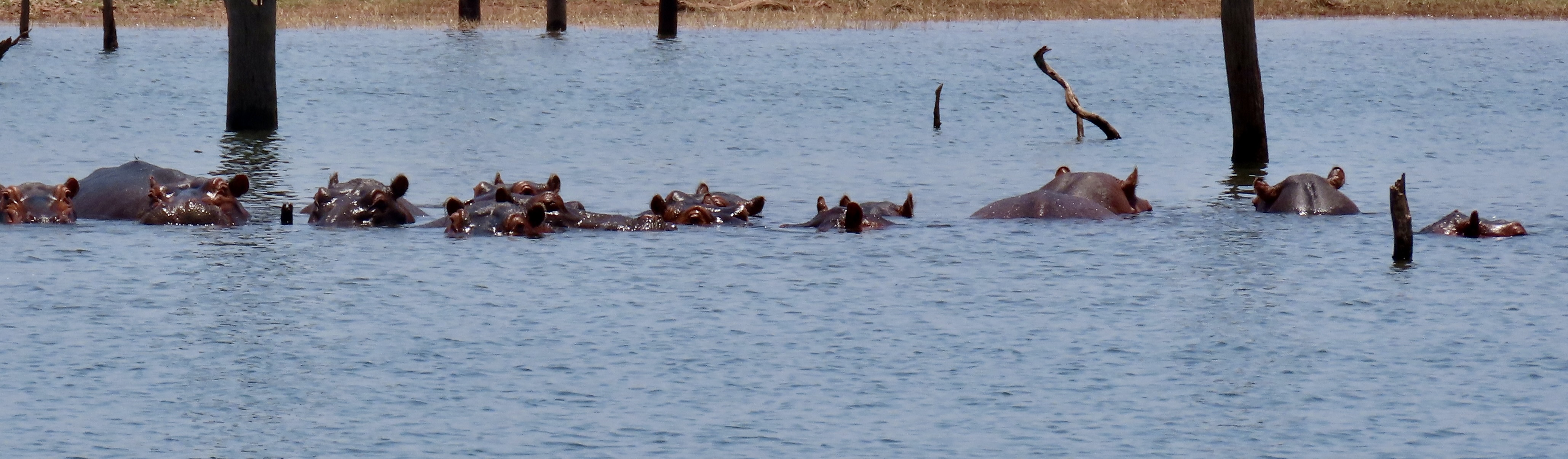
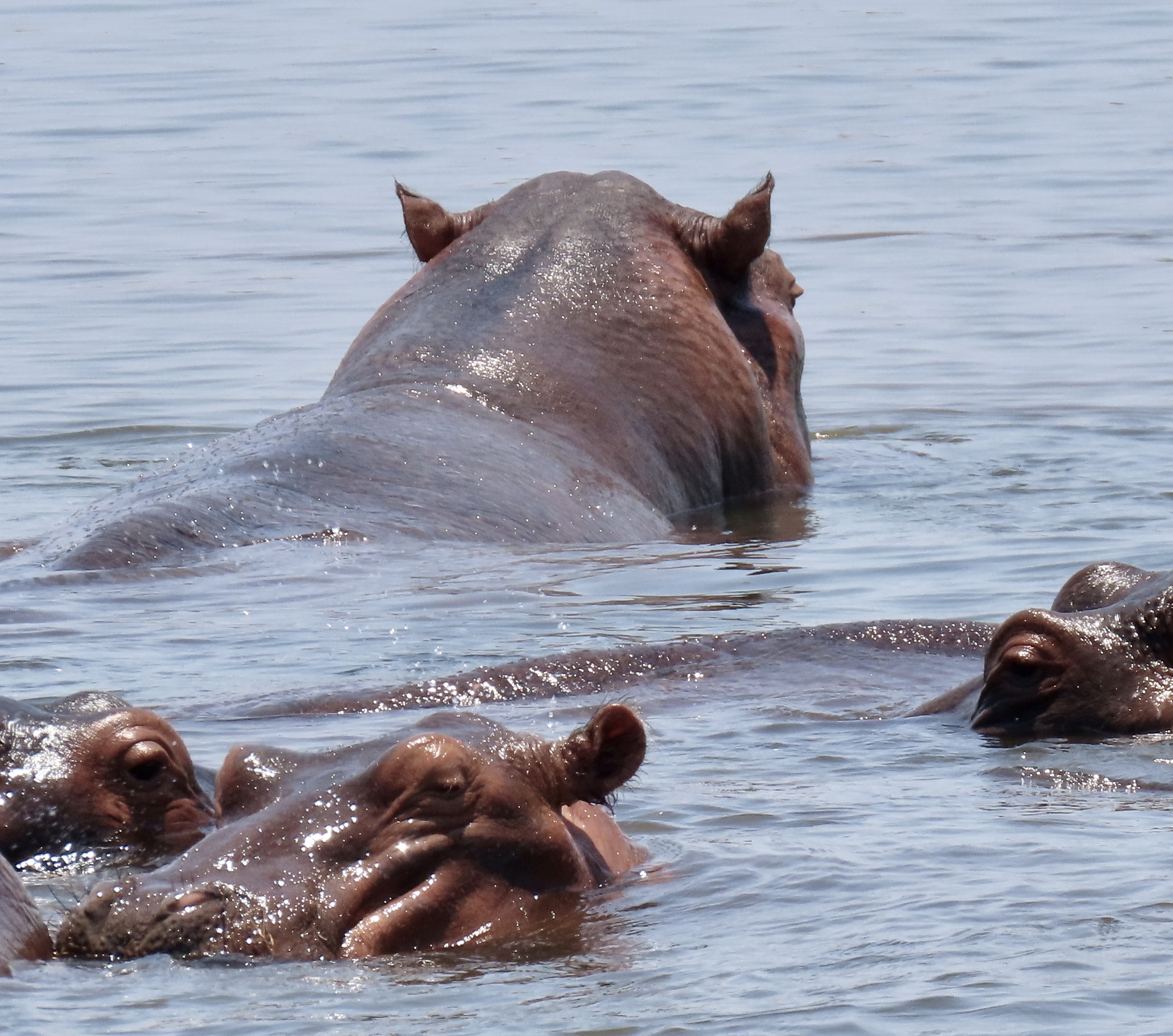
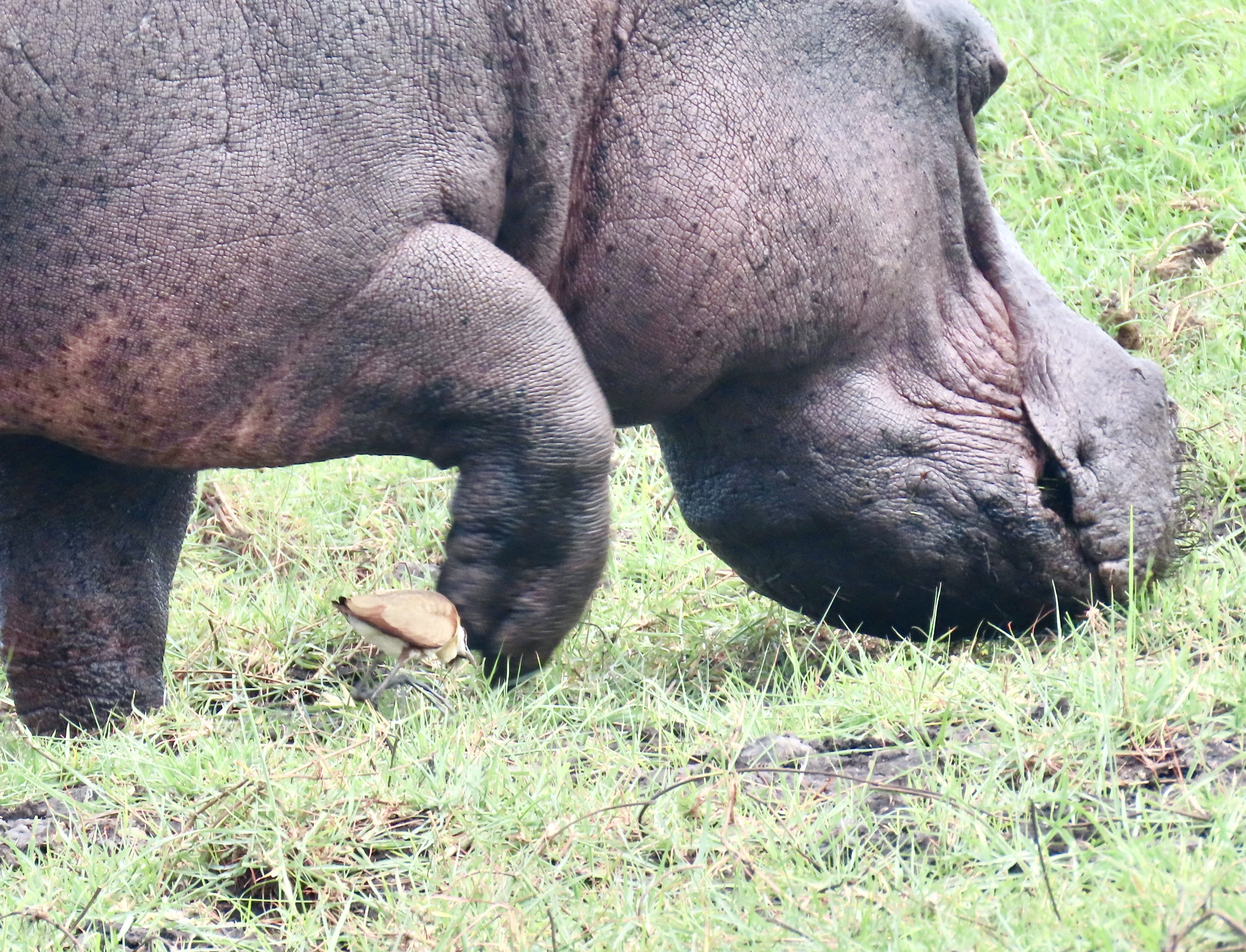
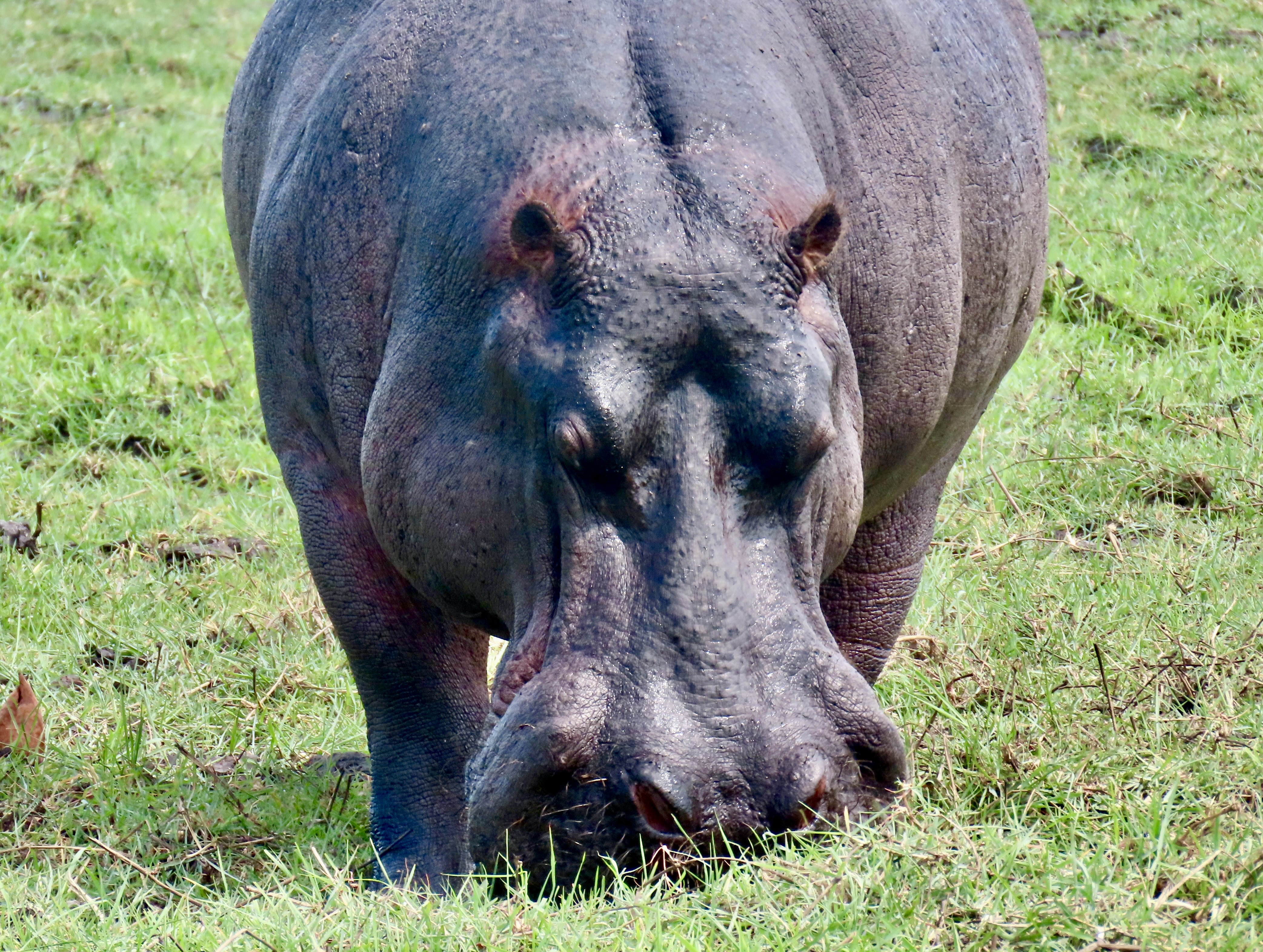
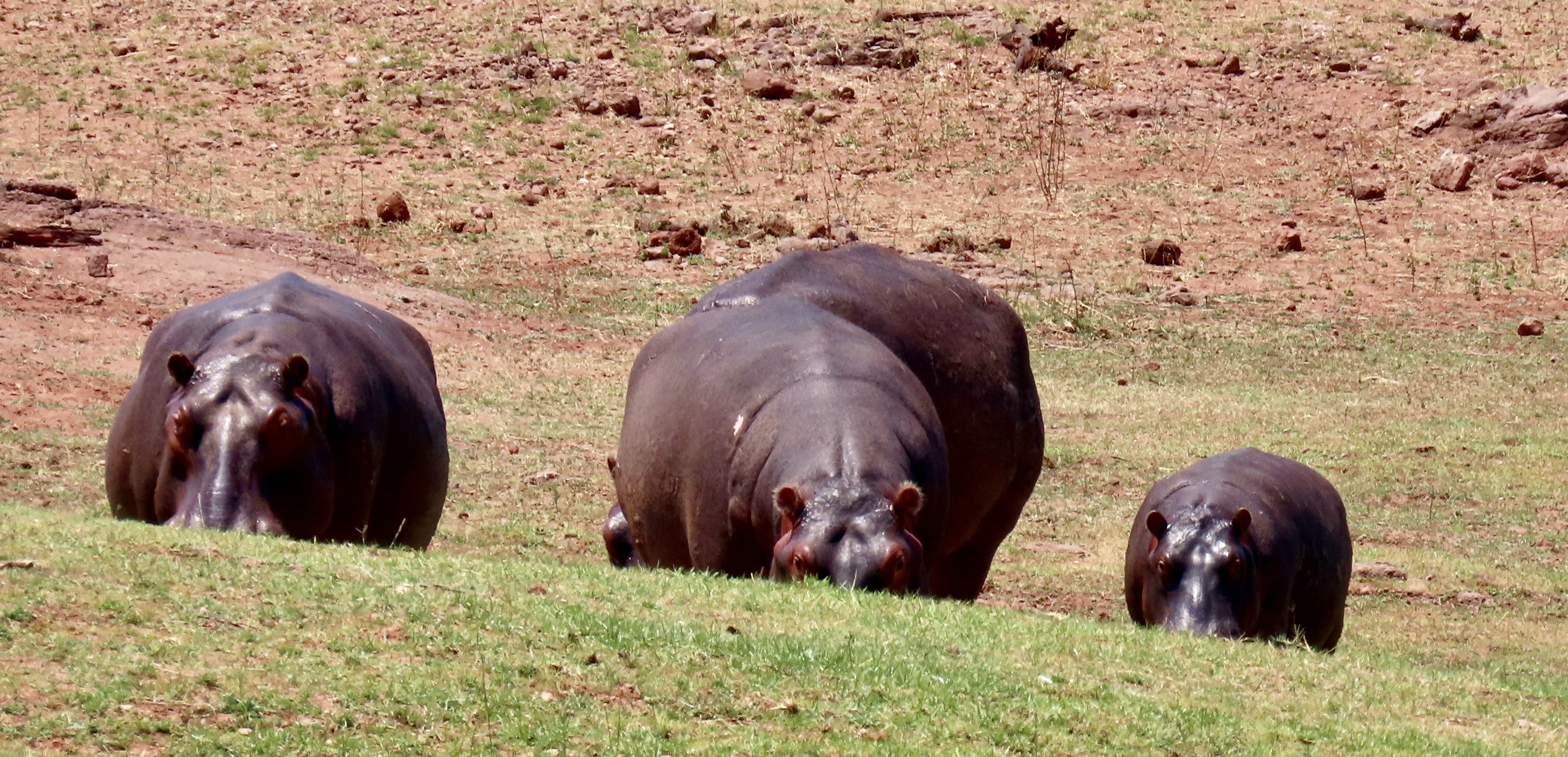
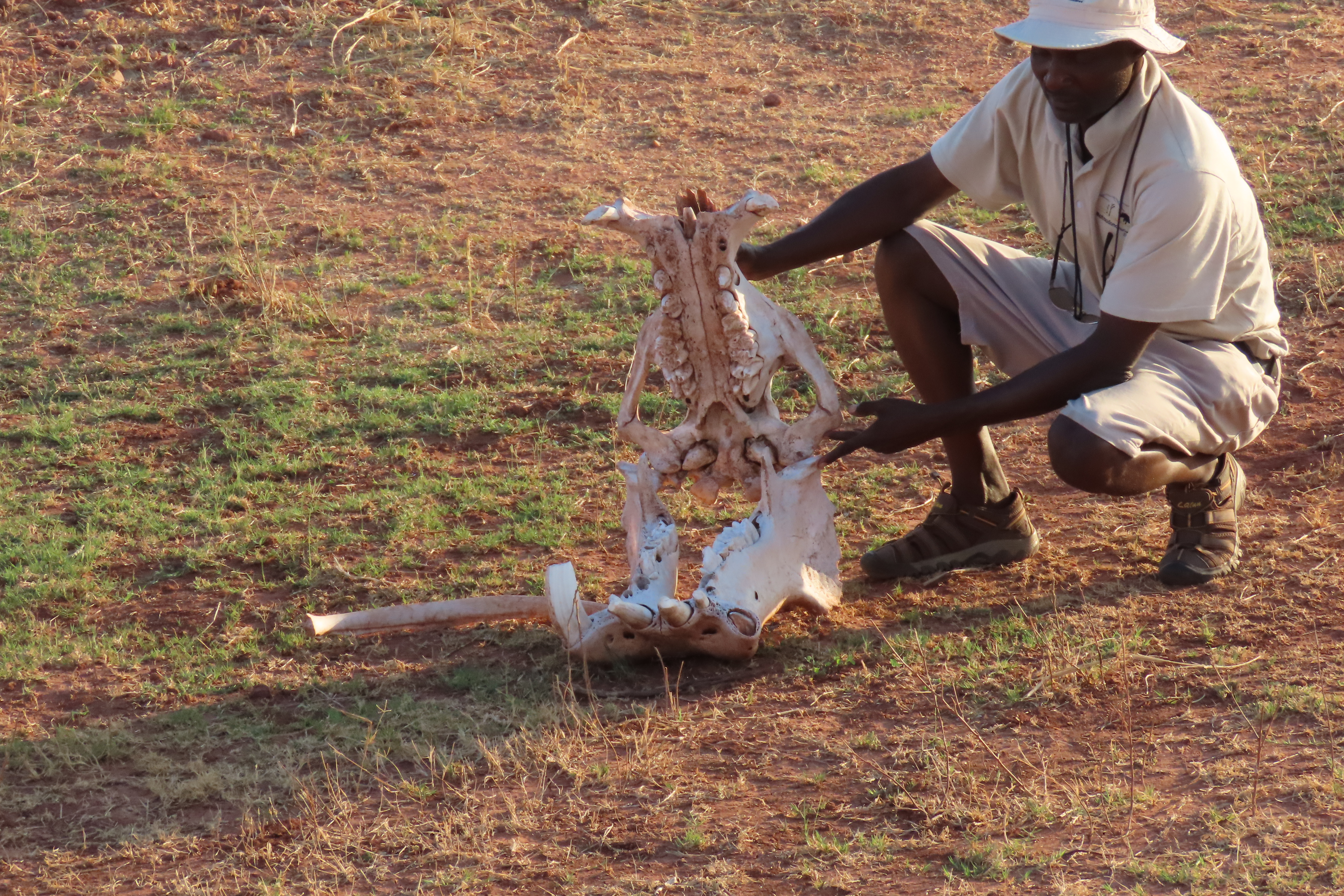
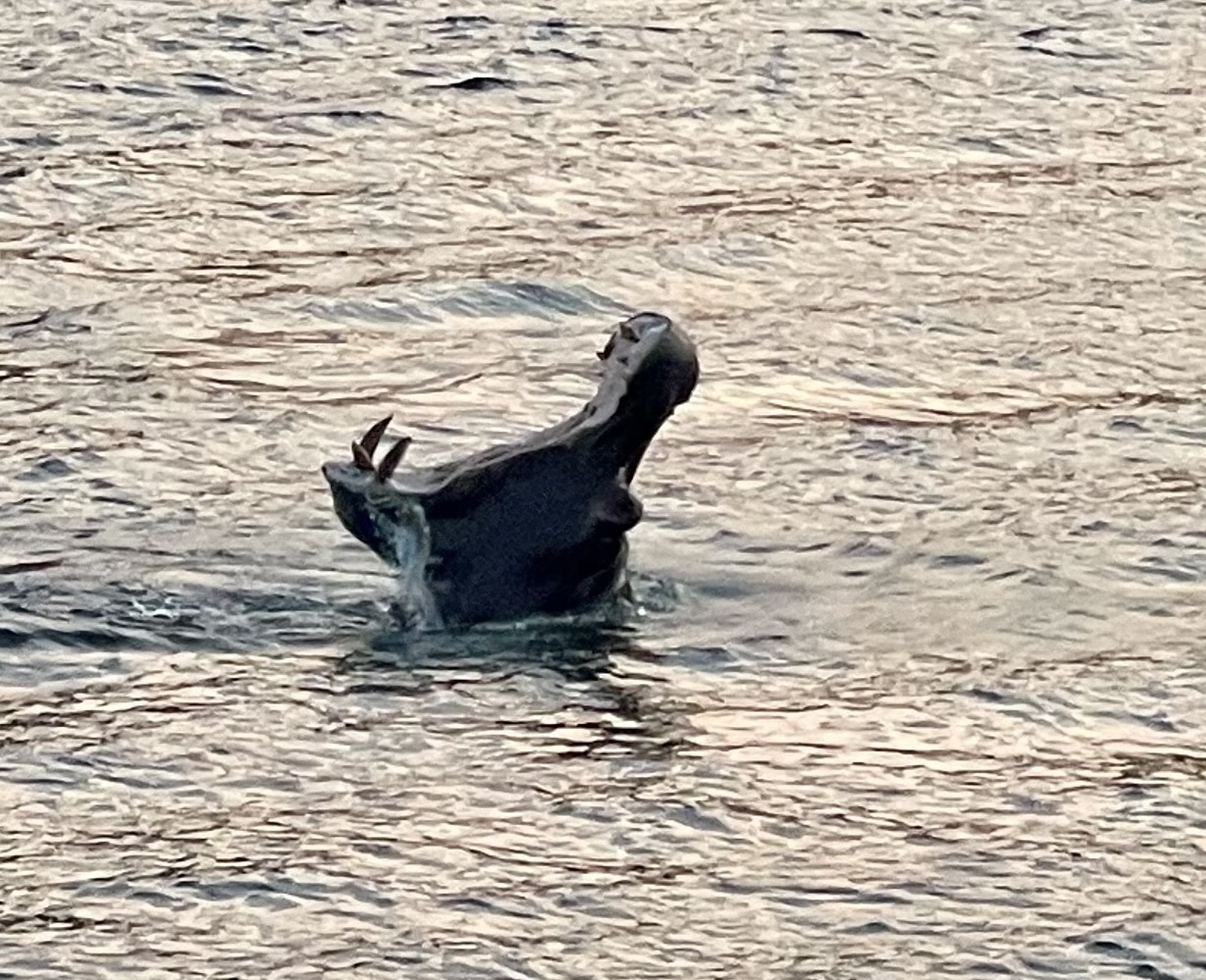
My new camera with its super long lens provided plenty of opportunity to get up close and personal with hippos. You could count the whiskers on this guy’s snout. Hippos spend around 16 hours a day in water. Their nose, eyes and ears are all on top of their heads. This allows them to be able to see, hear and breath while being close to submerged— keeping cool and protecting their skin.This is a common photo of hippos in water including males, females, and babies. They like to hang out together in groups of 10-30 known by such names as schools, pods, sieges or bloats. My favorites are the last two. If you were surround by these guys you would definitely feel like you were under siege. As our boat on Lake Kariba in Zambia approached this group of hippos, they were sinking under the water, a normal tactic.These hippos at Lake Kariba provided a photo op. “Okay, everyone, line up. And stop mooning the camera!”The sun was setting on this big fellow when we took our first boat trip on the Chobe River in Botswana. I’d say ‘bloat’ works here. An average female tips the scales at 3000 pounds while a big male can weigh up to 9000.Groups are normally dominated by a large male who is in charge of protection— and mating, which is mainly carried out in the water due to the weight factor. The gestation period is eight months. Moms give birth to one baby weighing 30-50 pounds. The babies can actually nurse under water.Hippopotamus is derived from ‘water horse’ in ancient Greek. Can you imagine trying to ride one? You would probably drown. They can’t swim. Their size and density makes them sink. But they are ideally suited for travel under water and can stay down for five minutes at a time. They actually walk or run along the bottom. Flaps over their noses and ears close automatically when they go under. A special lid covers their eyes. This fellow, BTW, is probably asleep. Hippos can sleep under the water for up to ten hours, automatically rising every five minutes or and so and sucking in air while continuing to snooze. Great whiskers.This was my favorite shot of hippos in the water. Is it a two headed four eared hippo? Grin. Huge odds are not… But I sure couldn’t imagine how they managed to arrange themselves this way. Going for a ride? Breeding? Maybe.The literature emphasizes that hippos stay in the water during the day and come out to graze at night. Fortunately, everywhere we went that included hippos, a few were out happily stuffing themselves on grass. They average around 80 pounds a night/day, traveling some 6 miles (10K) to get their fill. When out in the day, their skin exudes a protective layer that serves as sunblock. A pair of hippos grazing along with oxpeckers. (The birds peck off insects but they also peck holes in the hippos and drink blood. Hmmm, friend or foe?) I’m assuming this is a pair. Males tend to mate for life but are polygamous.Peggy and I took lots of close-ups of the hippos grazing along the river in Chobe National Park, Botswana. Check out the big tusks. They are used for fighting, not grazing.Any large African animal, be it hippo, elephant, Cape buffalo or giraffe, has a coterie of birds that follow along and catch insects the animals stir up.The little guys seem fearless. Is it grabbing an insect from under the hippo’s foot?We liked this head shot.Males are very territorial. It’s one of the things that make them so dangerous. And they have a unique way of marking their territory. They use their tails to fling poop. That’s what is happening here. The tail is moving so fast, it’s a blur. Remember the old statement, “When shit hits the fan.” You don’t want to be around. Hippos can actually fling their stuff for 10 meters, almost 33 feet. Be you man or beast, you might become toast (or possibly a pancake) if the hippo decides you are invading its territory. And they can run up to 30 miles per hour for a short distance, i.e. probably far enough.Imagine being on top of this small hill at Lake Kariba photographing a few tons of hippos as they come charging over. Fortunately, my telephoto lens allowed me to be a long way off.This hippo skull was beside a small road we were following into Matusadona National Park at Lake Kariba. Note the tusks.The park ranger who was taking us on the tour into the park, got out of our safari vehicle to demonstrate how far a hippo can open its jaw.Peggy captured the phenomena on the Chobe River. From a humorous perspective, it appears junior is getting a lecture on his behavior. “Next time you go near that crocodile, I’ll let him eat you!” And look how long the hippo is! A large male can grow up to 16 feet.This is the ultimate picture of a hippo opening its jaws and declaring a territorial challenge, or yawning. Everyone who goes on safari wants to capture one. Believe me, we tried. Our last opportunity was when we were on the Zambezi River outside of Victoria Falls. Unfortunately, we were on the wrong side of the boat. One of our tour group was glad to share.
I’m going to try something now in concluding this post that I rarely do: Share a video. We normally take several for ourselves but not for the blog. Too many oops. Handheld videography has its challenges! But this two minute video shows an excellent example of an elephant-hippo confrontation. It’s worth checking out, even with its occasional shakes. It’s almost funny as the hippo maneuvers his way through the elephants trying to show itself as harmless and submissive as possible— and only raises its head when the elephants are left far behind. You can almost hear its sigh of relief. Enjoy. Click twice on the photo to start the video. On our next post, we will feature giraffes, Peggy’s favorite animal.