Imagination Plus Peyote… The Huichol of Puerto Vallarta

The shaman is a central figure in the Huichol culture. Capable of traveling between worlds with the aid of peyote, he brings important messages back to the members of his tribe.

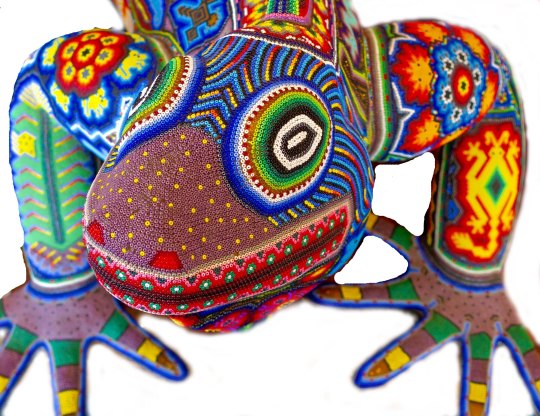
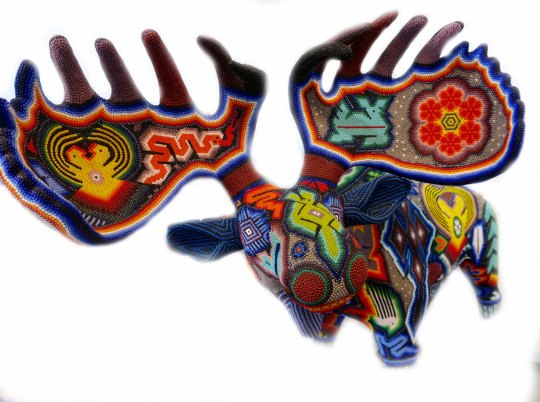
Since Peggy and I first came to Puerto Vallarta years ago I have been fascinated with Huichol art and the Huichol people. Living in the Sierra Madre Mountains of the Occidental range, they have been able to combine their belief in numerous gods with art that is highly popular among tourists. For example, it’s unlikely that many Huichol have ever seen a moose, but when Peggy and I were going through shops along the Malecon, we came across this beauty featured below.

The moose is for the tourists, the designs found on the moose’s antlers and body reflect the Huichol gods. (This artwork was crammed in among hundreds of pieces so I used Photoshop to white out everything except the piece.)
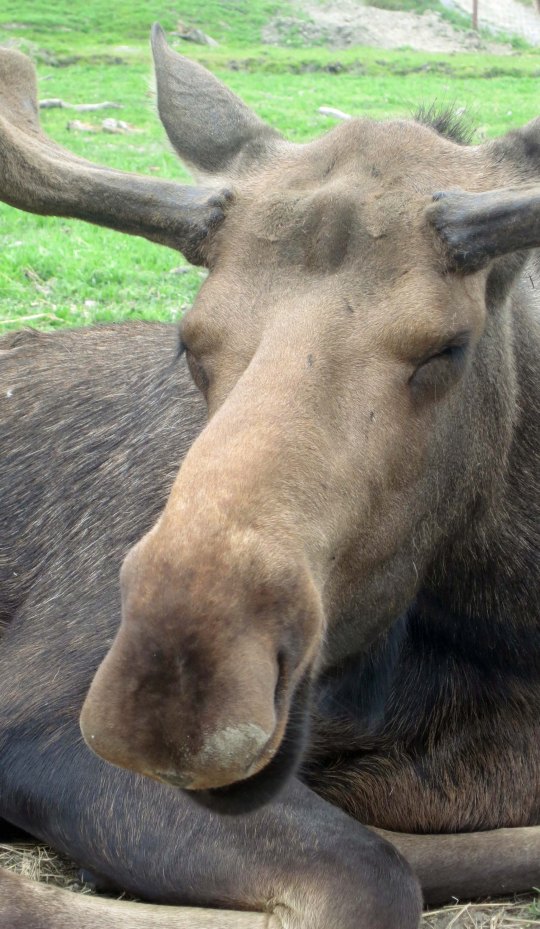
A moose that Peggy and I found in Alaska.

The design on the right side of the Huichol antler is peyote, which is central to the Huichol religion. Each year, the members of the tribe undertake a 300 mile journey (usually on foot) to their sacred homeland to gather a year’s supply of the potent drug. The gatherer is expected to take a bite of the first plant he or she encounters. Maybe as a result, one of them saw a moose like the one I featured above. (grin)

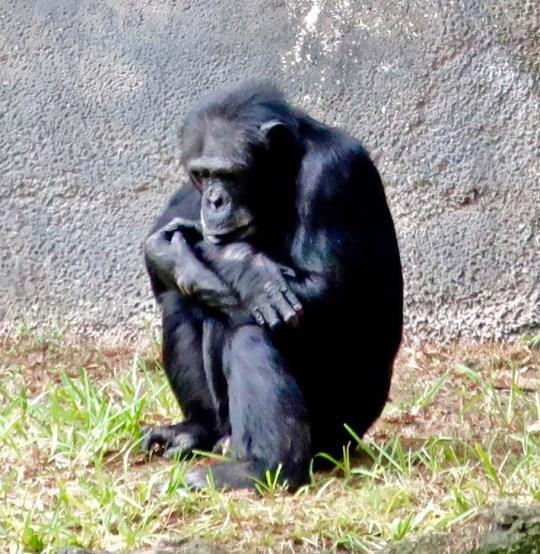
Another example of an animal unlikely to be encountered by the Huichol. It looks a lot like the fellow I encountered at Busch Gardens.


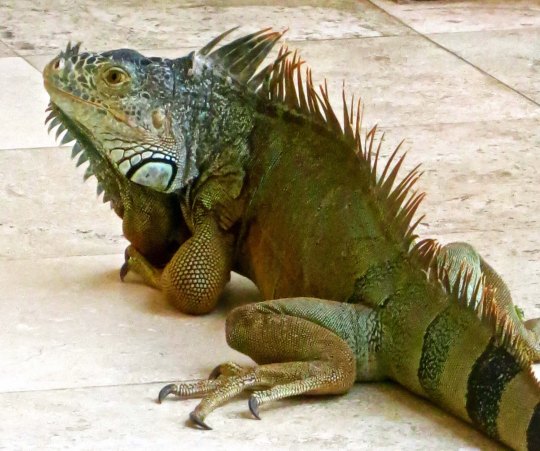
The Huichol are quite familiar with the iguana…
One of the iguanas we photographed in Puerto Vallarta..
I am just as glad we didn’t encounter a jaguar. They still roam the mountains surrounding Puerto Vallarta.
The horse continues to be an important form of transportation for the Huichol, but with the coming of roads, trucks are becoming more common.
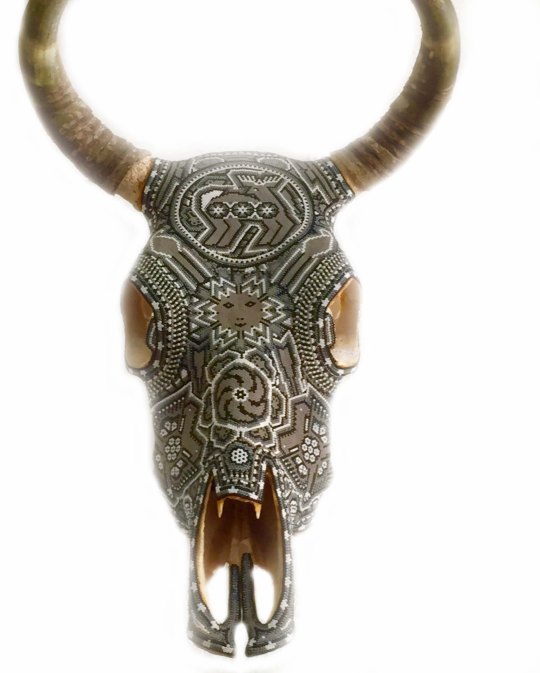
Cattle are raised by the Huichol. Here they have covered a skull with their beadwork.
Not quite sure what this animal is, I thought it was more dog-like than cat-like.
I am thinking a bit of acid-rock here, although peyote would probably work.
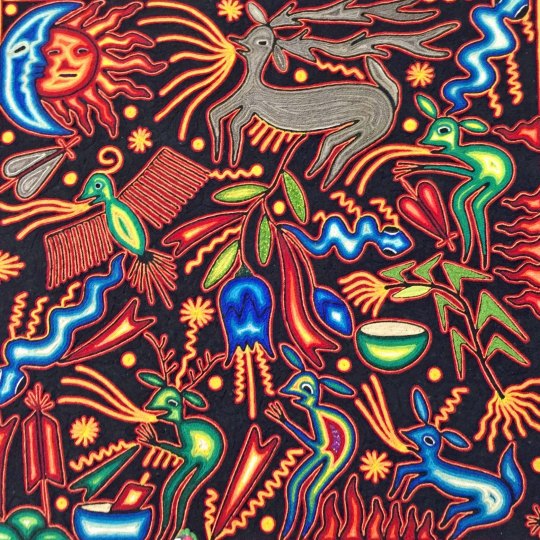
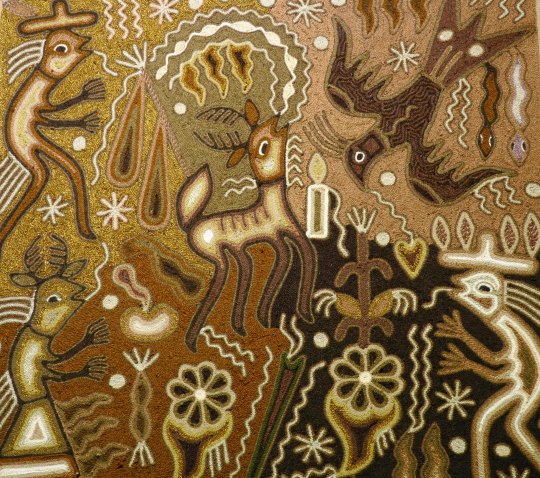
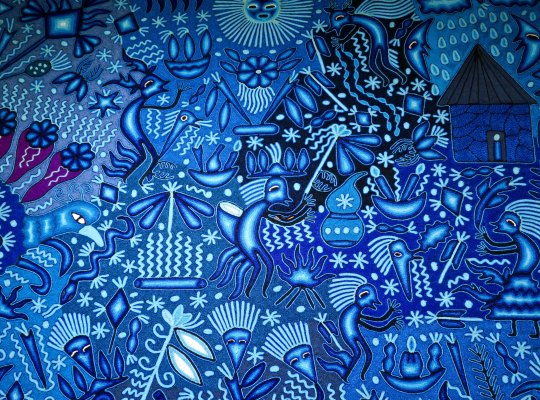
String paintings reflecting the gods are also quite popular among the Huichol.
A brown painting…
And a blue painting to wrap up today’s post.

NEXT POST: I’ll be back to featuring rock sculptures found on the PCT in Mokelumne Wilderness.

Stunning Rocks and Gorgeous Junipers… The PCT through the Mokelumne Wilderness

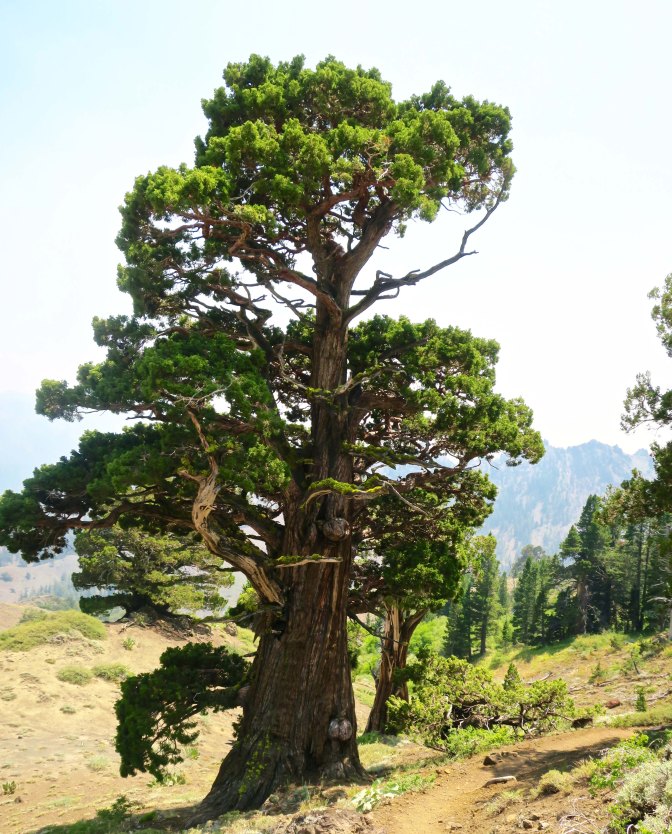
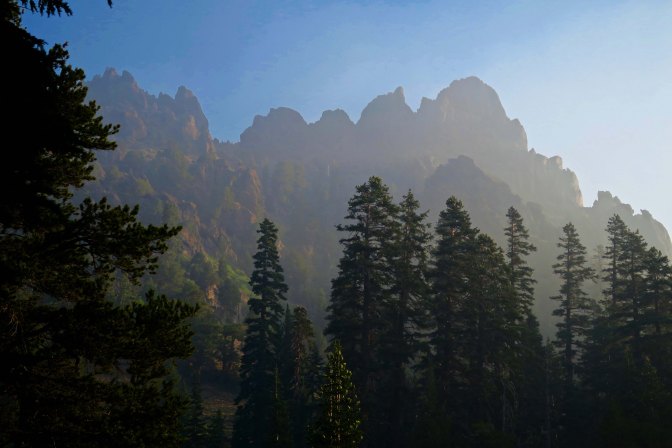
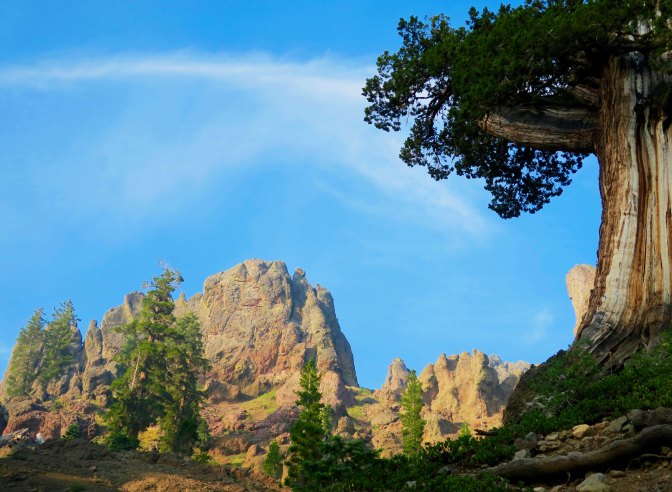
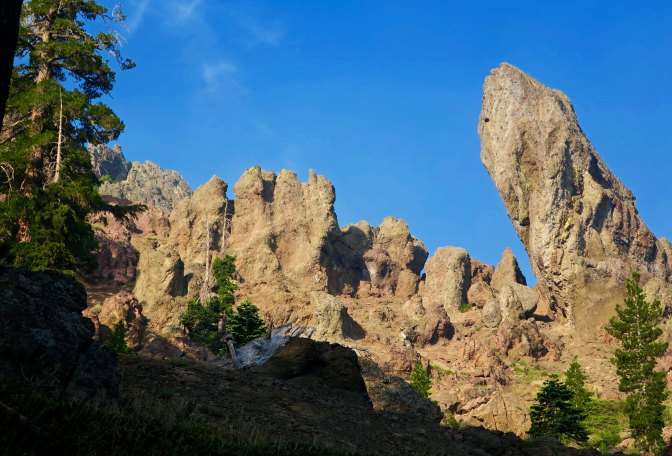
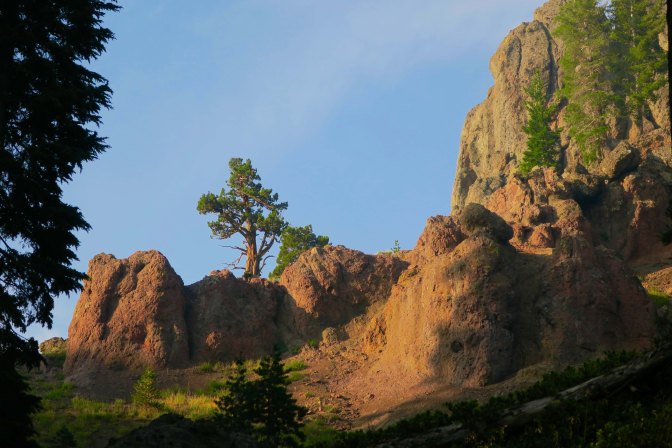
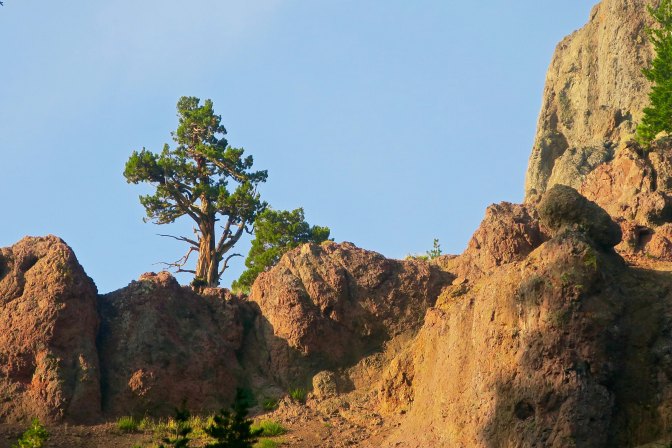
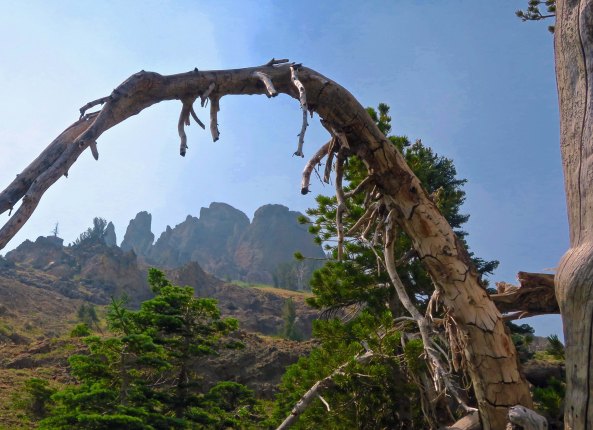
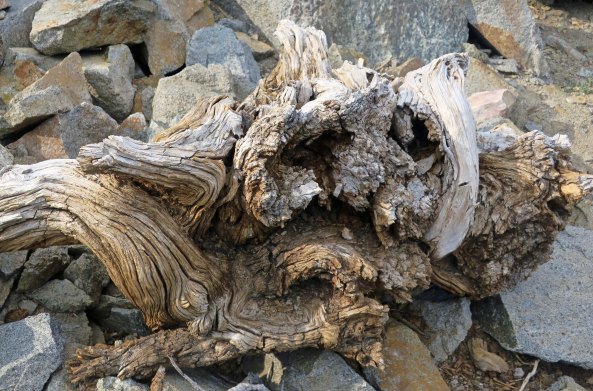
There is no hurrying through land like this. The combination of junipers and rock sculptures called to both me and my camera.

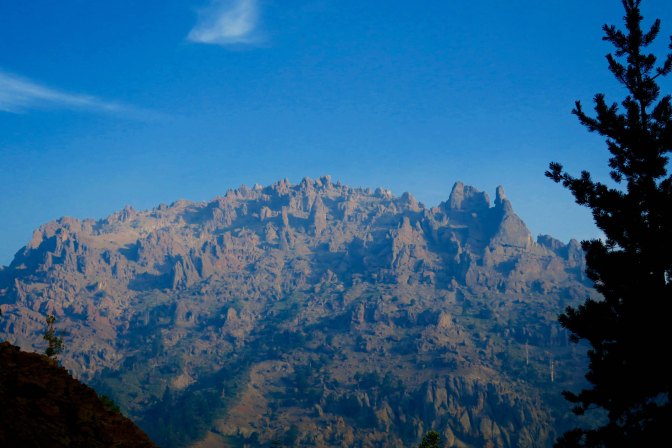
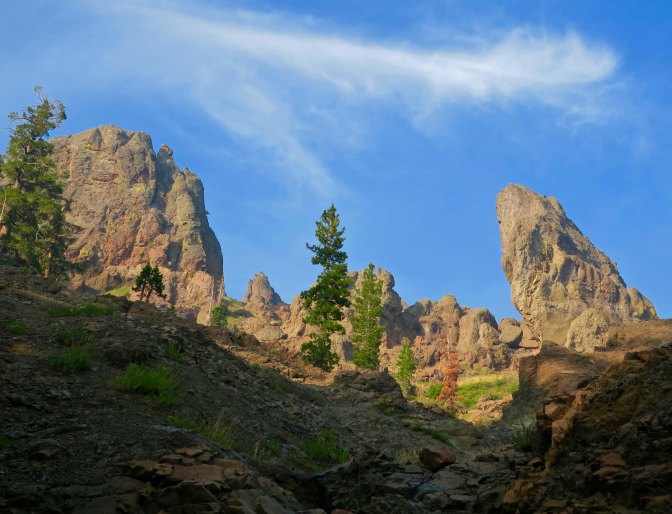
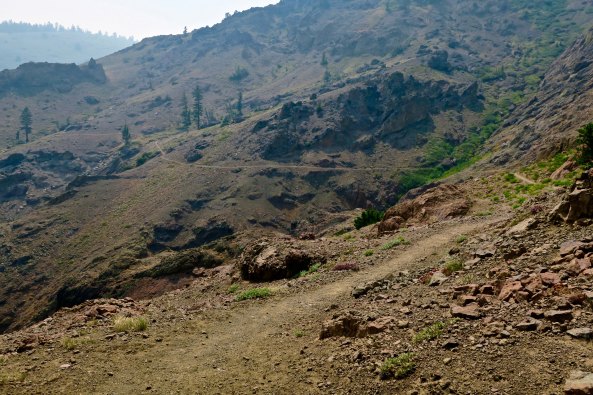
I was surprised by the sheer beauty along the PCT south of Carson Pass. I had hiked through the region several times over the years, but my trail had always been slightly to the west. Somehow I had missed the incredible rock sculptures. That, and the junipers. If you have ever wandered the West, you are familiar with this gnarly, photogenic tree. Most of todays photos were taken near Pennsylvania Creek in the Mokelumne Wilderness, maybe 15 miles north of State Highway 4 and Ebbetts Pass. I’ll let the photos speak for the area.

Hiking down into Pennsylvania Creek, I found this juniper.
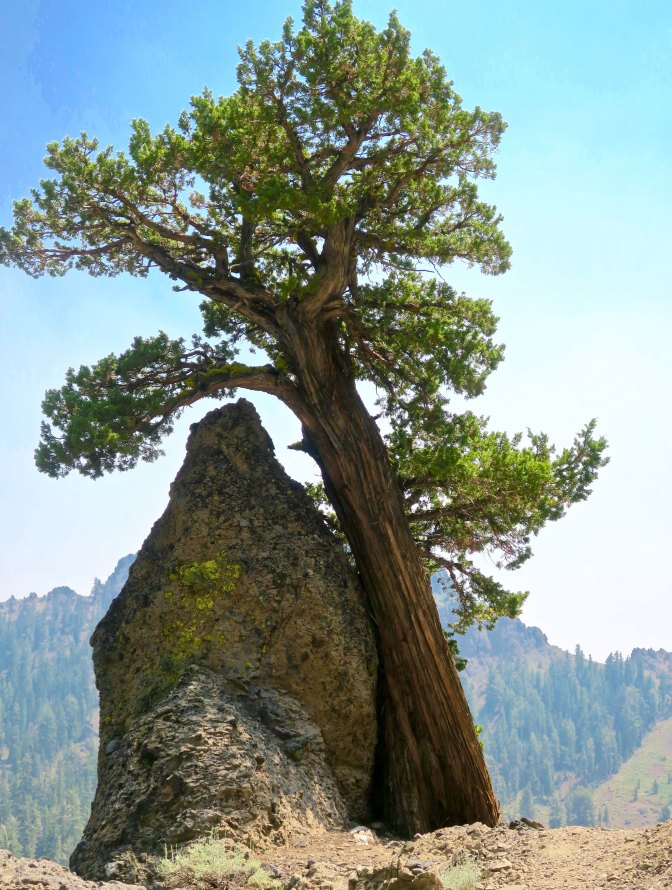
And then this one, wedded to a rock.
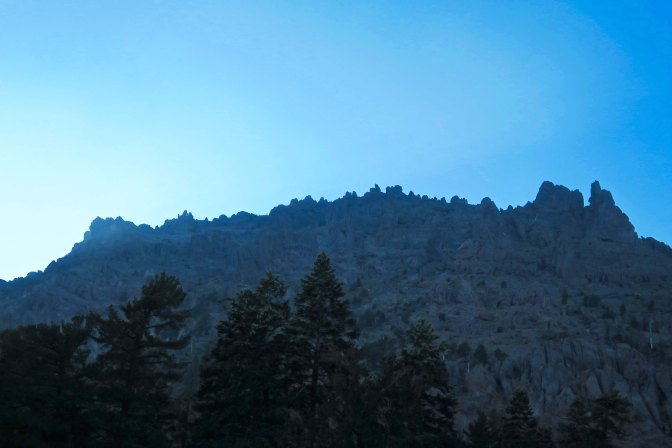
That night, I camped on the south side of Pennsylvania Creek. This was the view !
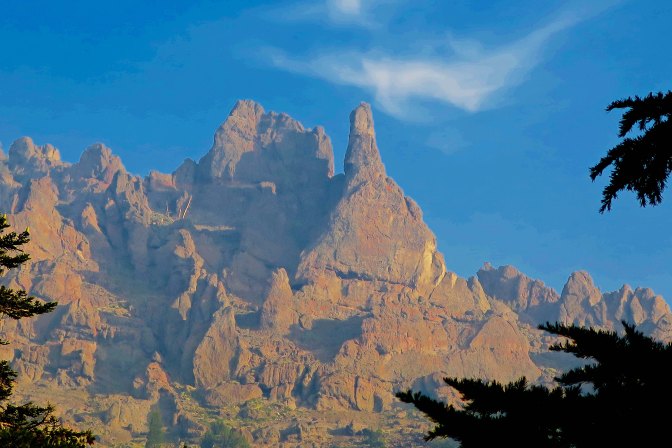
Later, at sunset, the whole ridge.
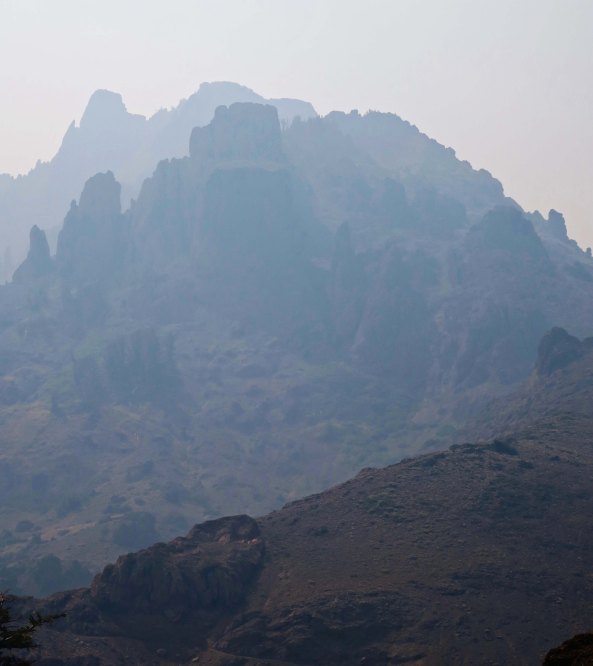
The next morning, smoky skies and the sun provided a red cast to the view.
Farther along, I was treated to this view.
Near the crest of the canyon, I found the juniper tree and rocks I featured at the top pf the post.
The view included this leaning rock, which could be seen just behind the juniper.
Another perspective.
I considered this a real treat.
And photographed it several times. This is it for today. But I’ll have several more views of the rock sculptures on my next PCT post.

NEXT POST: Back to Puerto Vallarta. P.S. I will be playing with various themes over the next few weeks, so don’t be surprised by the changing looks of my blog. ALSO: For those of you who haven’t read “The Bush Devil Ate Sam,” I will be posting a chapter once a month on the top ‘pages’ to give you a feel for the book and encourage you to buy it. Many thanks! This chapter reflects our first night in our Gbarnga home, appropriately titled: Armies of the Night!

Happy 2019… Said with Flowers— from the PCT

There are lots of wild roses growing along the PCT, but it is rare that you find one so perfect.

Today, I just want to wish each and everyone of you who follow this blog a very happy and healthy New Year. And I want to thank you for joining Peggy and me on our journey as we wander through time and place. We are privileged to have you along.

What better way is there than to say it than with flowers. It works for Valentine’s Day, it works for Mother’s Day, and it works for numerous other special occasions, so why not New Years! I’m sure the floral industry would love this, but I am not talking about the flowers you buy from a florist. I am talking about the beautiful, wild, and free flowers you find growing along the trail, or the roadside, or on a vacant city lot, or in a park— the list goes on. Here, I am talking specifically about the flowers I found along the Pacific Crest Trail on my 700 mile backpack trek this last summer. You’ve already seen some of these. I have bunches. I suspect you will see more on Valentine’s Day. Enjoy!

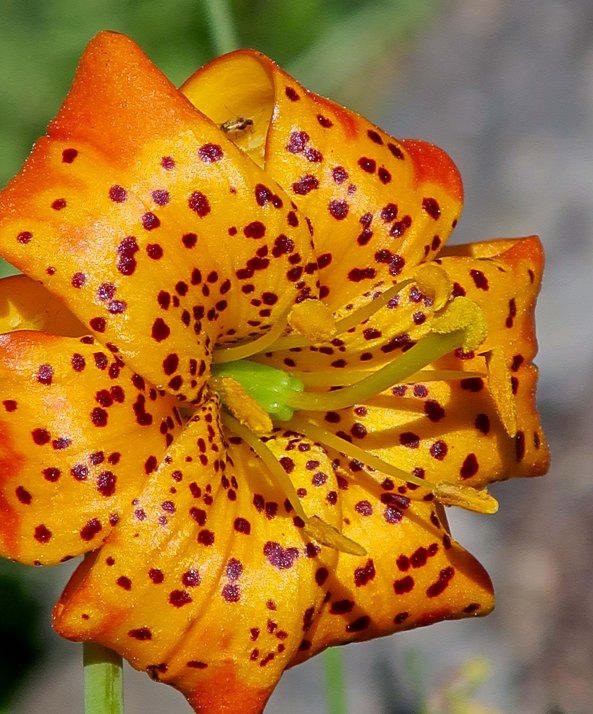
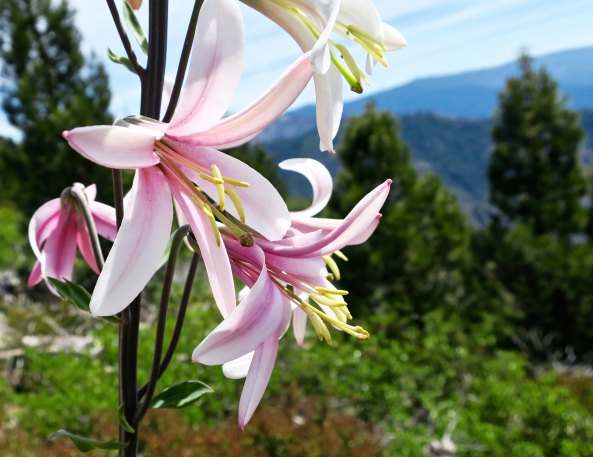
A cheerful tiger lily!
Dramatic scarlet gilia.
Azalea.
Pretty face is an appropriate name for this flower.
Prickly poppies, I think.
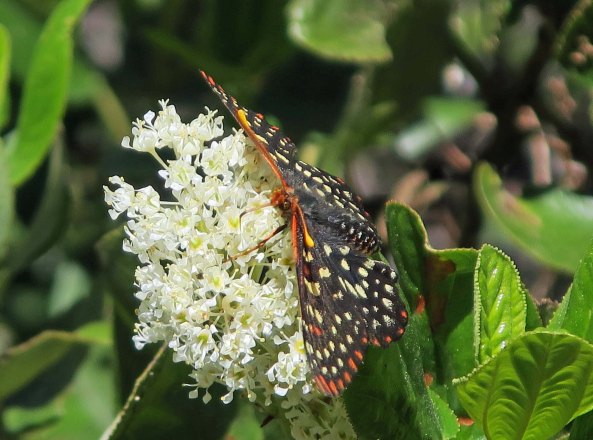
Not sure what this flower is, but the butterfly obviously liked it.
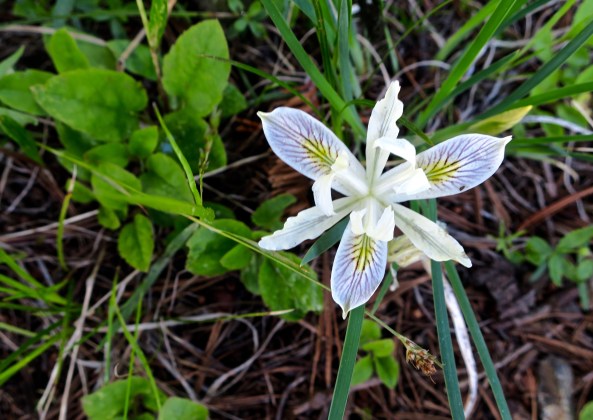
There were several types of irises, a flower noted for variety. I believe this is a Siskiyou iris.
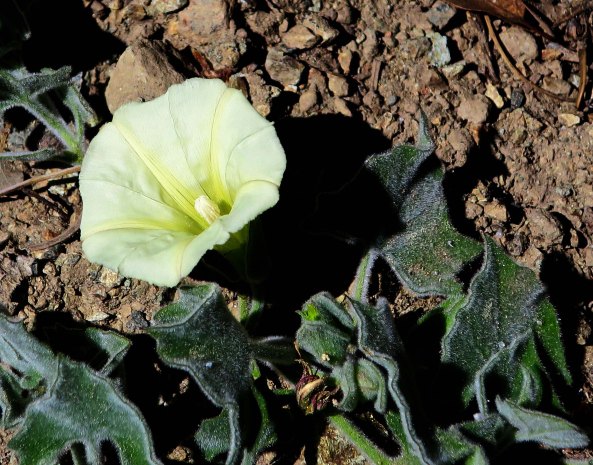
A wild morning glory.
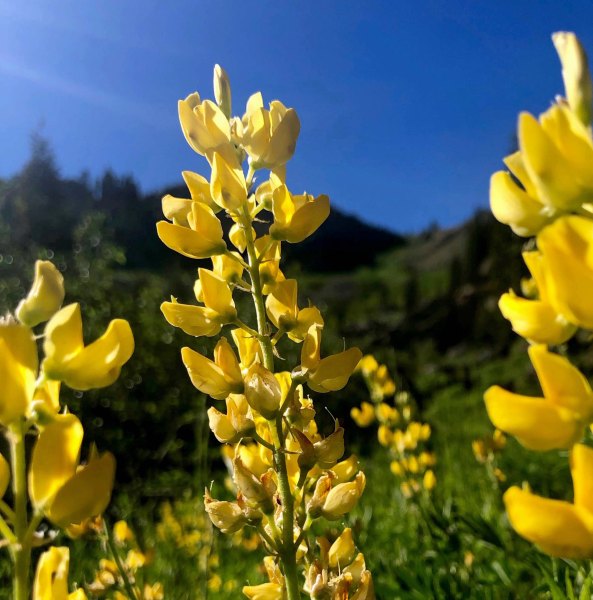
Stunning yellow lupine.
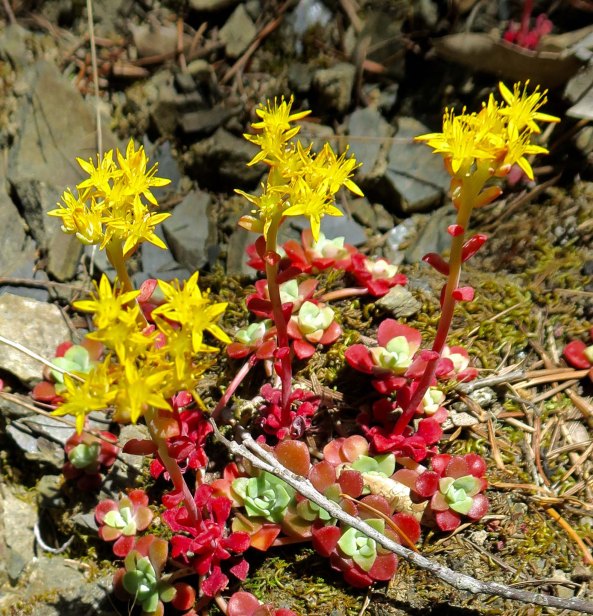
Stonecrop.
And concluding with a Washington lily.

AGAIN— WISHING YOU THE BEST. We look forward to seeing you in 2019. Curtis and Peggy

Hiking on the PCT at 75… Carson Pass to Sonora Pass: Part 3

As a year filled with seemingly insurmountable national and international problems draws to a close, my mind turns to the beauty and the peace of my 700 mile journey down the PCT this past year. The issues of the everyday world fade as you are hiking up a mountain, providing a different perspective on what is important. As the renowned naturalist John Muir noted, “The clearest way into the Universe is through a forest wilderness.” 

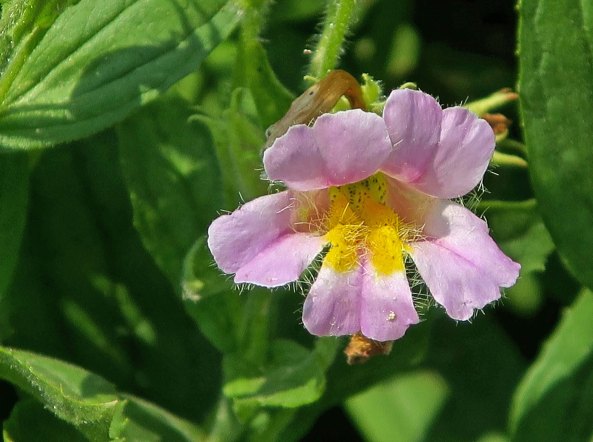
There were tough days out there— as tough as any I have ever faced— but even the most difficult were countered by the beauty of the areas I hiked through. It was a beauty that ranged from towering mountains down to the cheerful monkey flower above. Today, I will continue to share that beauty in my third post about the Pacific Crest Trail between Carson Pass and Sonora Pass in the central section of California’s Sierra Nevada Mountain Range.

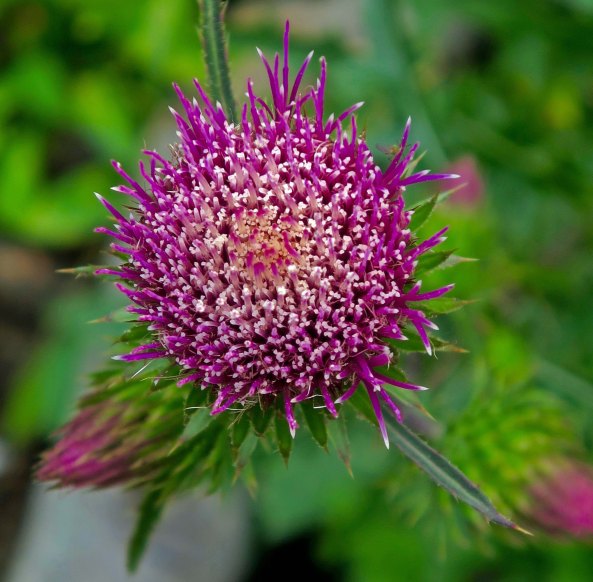
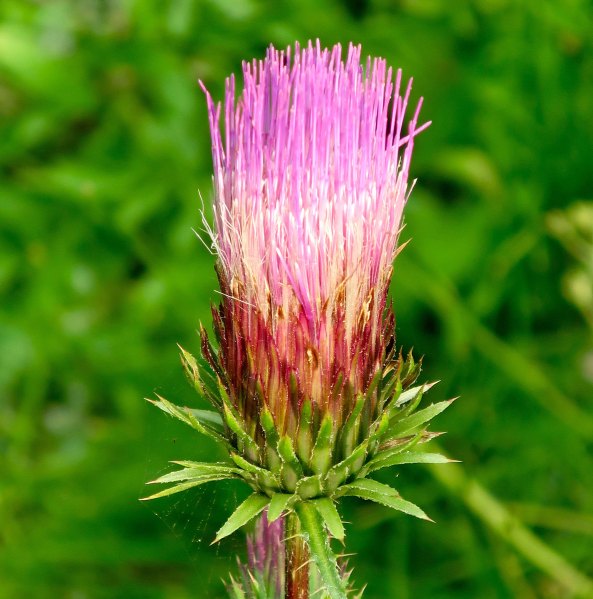
Thistles are often thought of as invasive weeds, something to be chopped down or poisoned out. It is hard to think of this fellow as anything other than a beautiful wild flower.
I caught this Sierra thistle in full bloom.
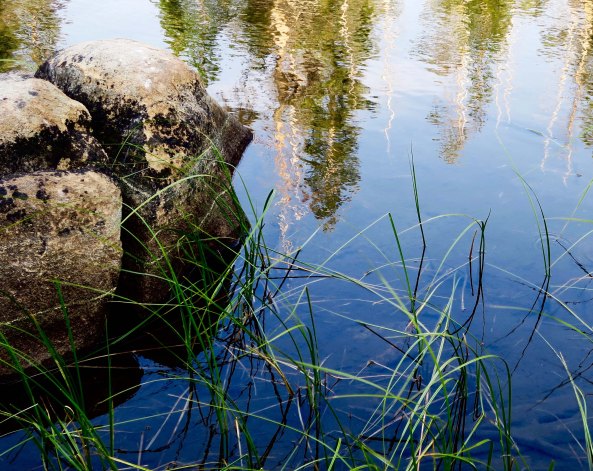
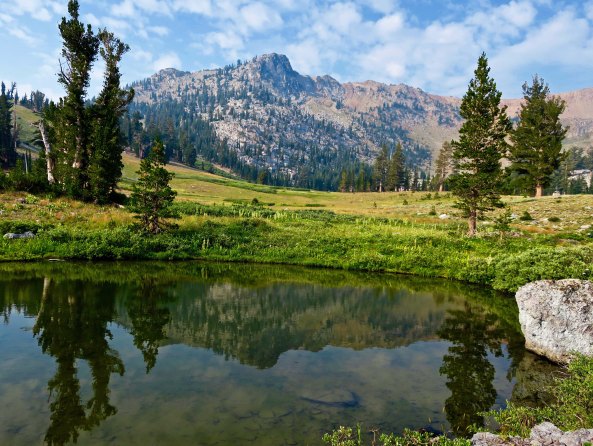
When I backpack by myself, as I was on this section of the trail, I try to find secluded campsites. To me, it is much more of a wilderness experience. I lucked out with this little no-name lake. I had it to myself and there was no sign of people recently camping in the area. It was a bit of a challenge to climb out on these rocks and dip up my water, however. (grin)
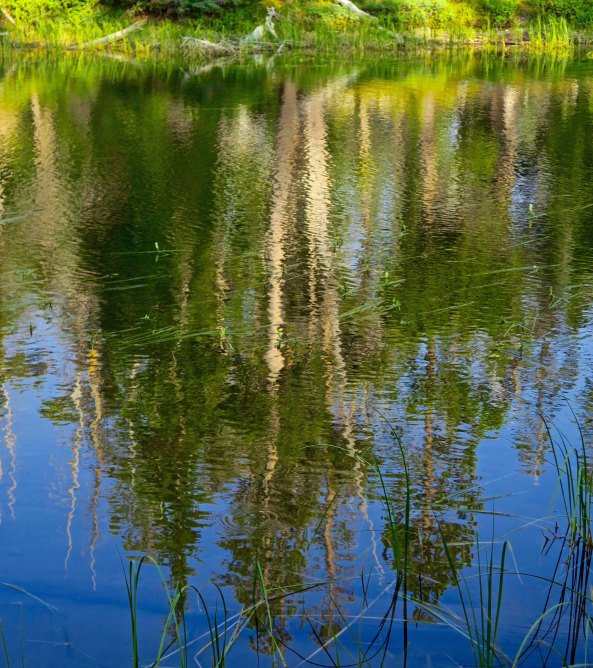
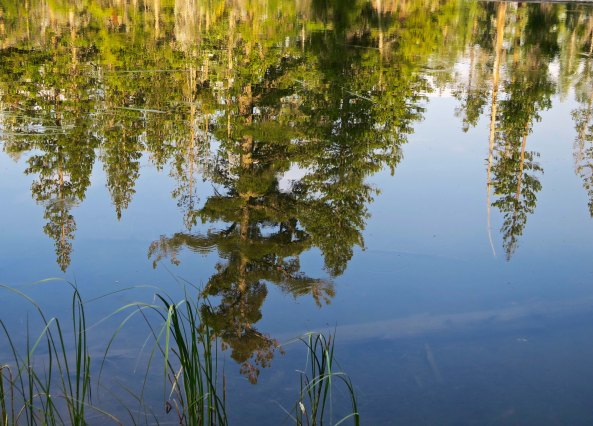
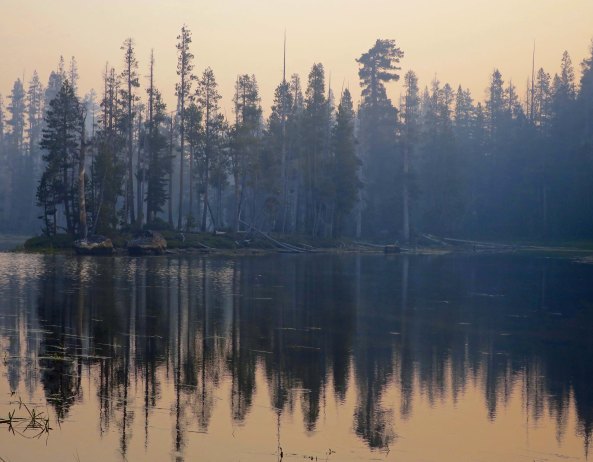
The lake provided some great reflection shots, capturing the surrounding forest. They ranged from this impressionistic view…
To clearer views.
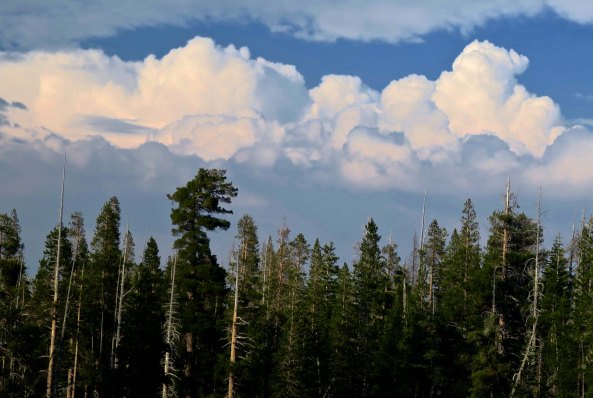
As evening approached, thunderheads suggested I might be in for a rip-roaring thunder and lightning storm. I put on my rainfly.
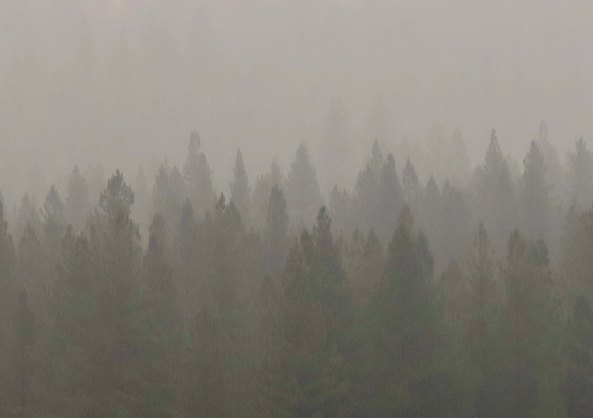
I would have much preferred that to what I got. I woke up in the middle of the night to the strong smell of smoke creeping into my tent. I climbed out to make sure that there were no flames about! As it turned out, smoke from the Redding fire to the north and the Yosemite fire to the south had caught up with me. Above is how my little lake looked in the morning.
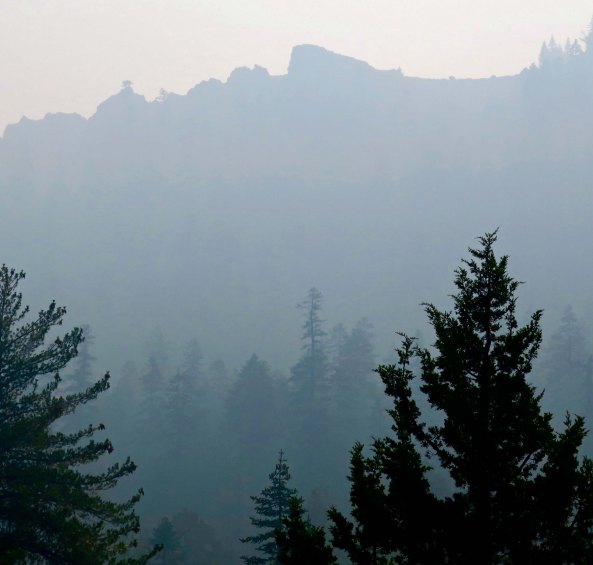
And as I hiked down the trail through the Mokelumne Wilderness.
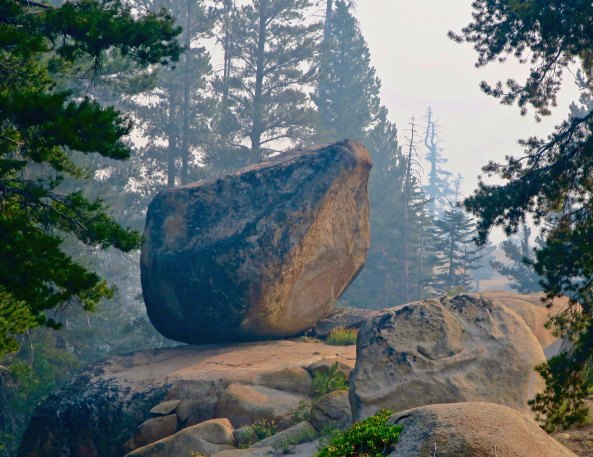
Whenever smoke blocked views of the surrounding mountains during my hike down the PCT, I focused on closer views, like this massive granite boulder that was likely left behind by a glacier.
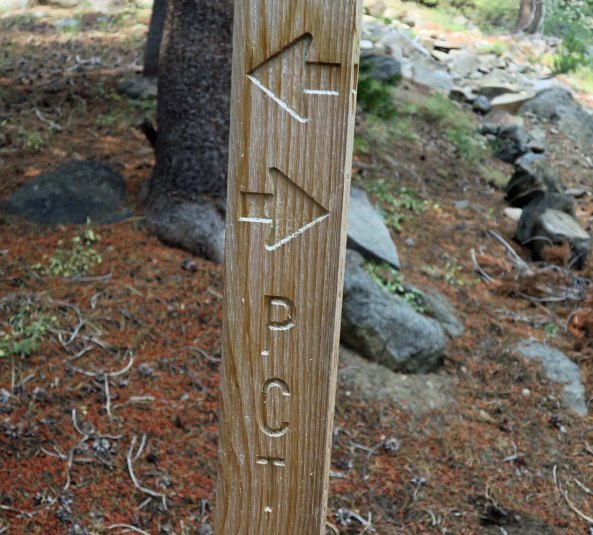
This sign made me smile. It was a good thing that I knew which direction I was traveling.
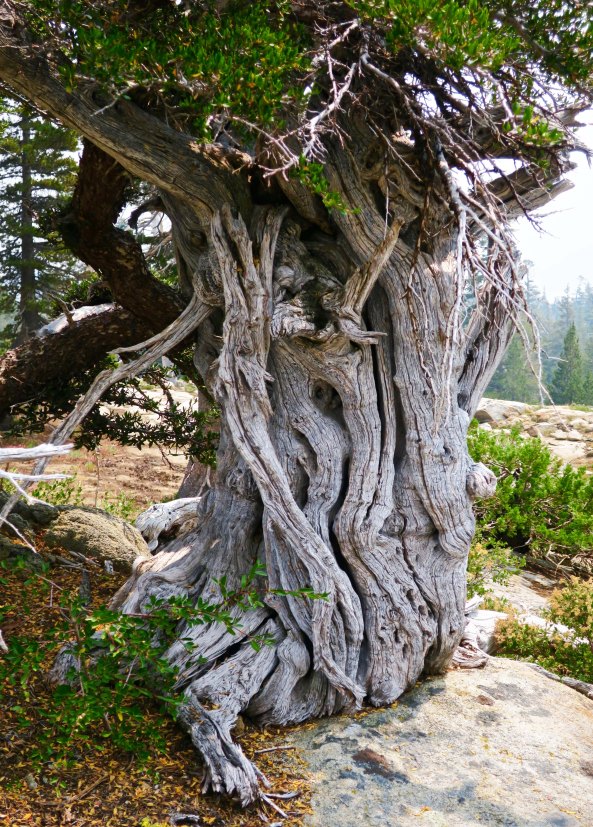
A gnarled tree caught my attention. I can’t help but think of hobbits and elves when I find such trunks.
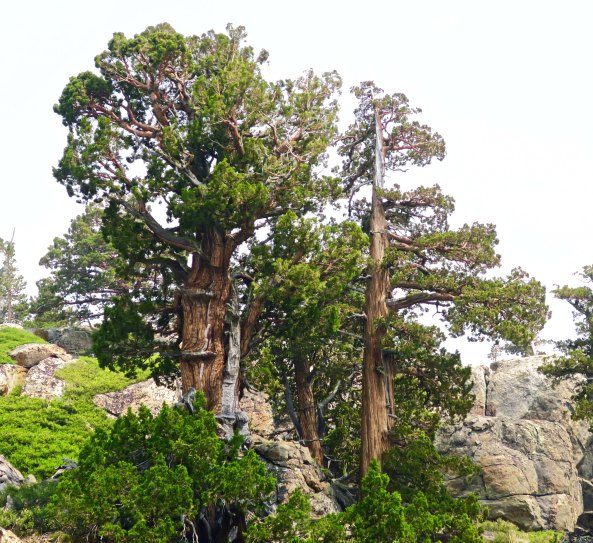
Junipers can almost always be depended on to have unique personalities.
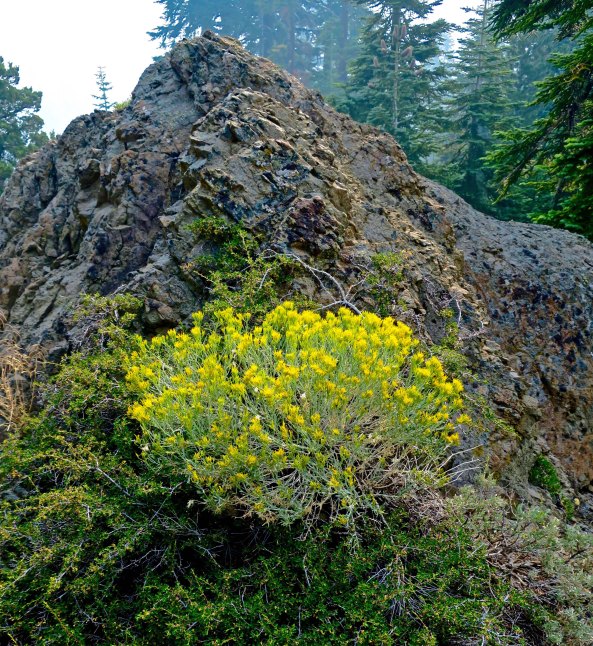
Rabbit brush provided a burst of color.
As I made my way south, some impressive mountains came into view. Checking my map, I found I would soon be climbing them, naturally.
And up I went, through the still smokey air. My 75 year-old lungs were not happy.
As through-hikers say, it is what it is, however, so I hiked on—and on— into some fascinating rock country, that I will feature on my next PCT post.

NEXT POST: Some thoughts on the New Year.

HOB-nobbing on the PCT in the Mokelumne Wilderness

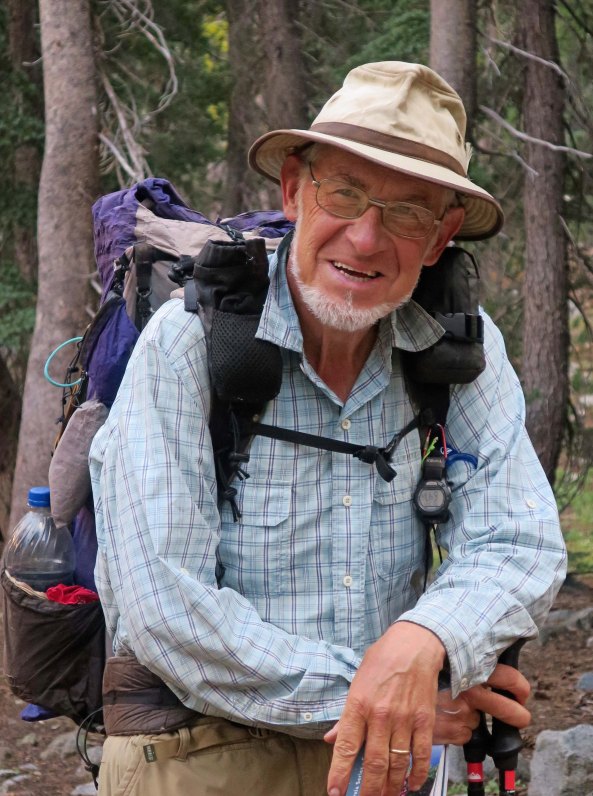
I was looking for the perfect camp location on Forestdale Creek when I noticed another man putting up a tent nearby. I went over to chat, or hobnob, so to speak.

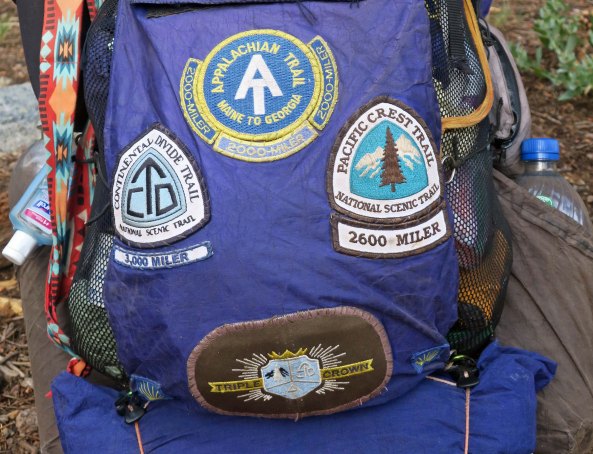
The 65-year-old Hob McConville was on a mission: finish his second trip over the PCT. (His first trip had been back in 1976 when I was hiking on the Appalachian Trail in Maine.) He had already hiked the Appalachian Trail twice, and the Continental Divide Trail once. He and his wife had walked across Europe three times. In other words, hiking long distances is pretty much what Hob does. He didn’t know whether he would do the Continental Divide again. Large bears, i.e. grizzlies, worry him. 

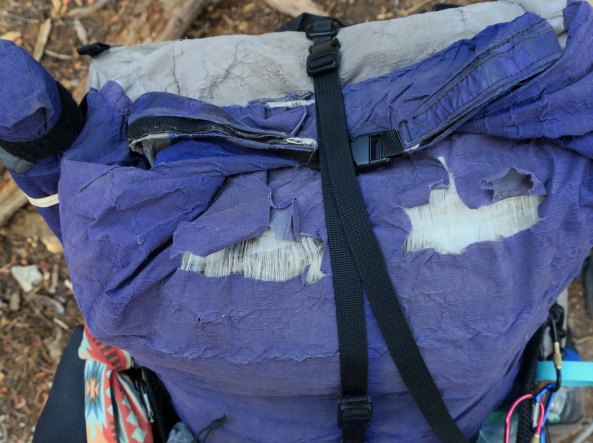
“I’ve camped under this beautiful sugar pine,” he informed me, “because it is my tent’s last night and I want to give it a good experience.” Obviously he liked his tent. In fact, it was well-loved, like a child’s teddy bear after five years of hard loving. The tent was literally falling apart at the seams and Hob had been repairing it with Post Office packaging tape. “My wife is meeting me at Echo Summit with a new tent,” he sighed, more sad than excited. Hob deeply believes that anything you purchase should be used until it is beyond use, and then a little longer.

I hated to tell him that his beautiful sugar pine was a white pine. I’m not sure why I did, except older mountain men like the two of us enjoy knowing our trees. He wanted to debate until I pointed out the cones. And the tree was a beauty, regardless of the type of cones it produced. I am sure that his tent felt well-honored. I wondered if Hob would take it home and bury it in his Connecticut backyard, like a favorite pet. Hob’s pack was in similar condition, but apparently it had a lot of miles left.

This gorgeous white pine with limbs askew sheltered Hob’s tent on its last night.
Hob’s backpack looked a bit threadbare, as well. But it hadn’t quite reached the status of being retired.

The next morning, our discussion turned to the PCT and Hob’s philosophy on long-distance hiking. “It shouldn’t be a race,” he proclaimed fervently. His feeling was that it was becoming more and more like one. He could foresee the day when companies like Nike might sponsor races to see who could finish the trail in the shortest amount of time. I agreed. Just completing the trail in a season leaves little time to appreciate the beauty of the region. Jumping from the already long 20-25 mile days to 30 or 40-mile days would make such appreciation much more difficult. I see nothing wrong with the pride through-hikers feel in finishing the trail; it is a pride well earned. And Hob was quite proud of his accomplishments. But the ultimate value of the hiking the PCT— beyond personal satisfaction and growth— is in experiencing nature and developing a commitment to protecting wilderness areas. The PCT is not a race track.

While the conversation had been stimulating, Hob had miles to go to meet up with his new tent (and wife), and I had more nature to go appreciate. We parted company with Hob heading north and me heading south. Here are some of the things I saw along the way.

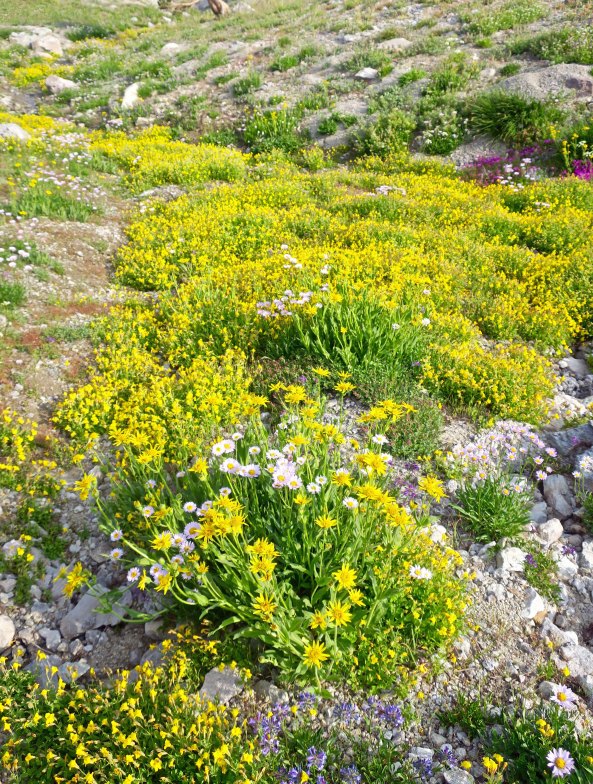
No more than a quarter of a mile up the trail, I came on a beautiful flower garden that would make an English lord lust over having it on his estate. I promptly took a half hour off to admire it, which is time that few through-hikers could spare.
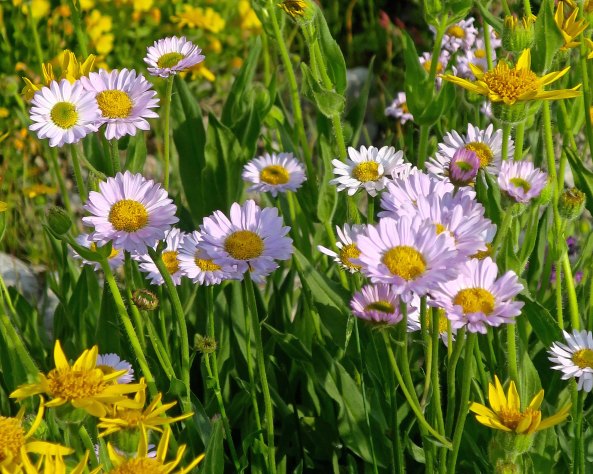
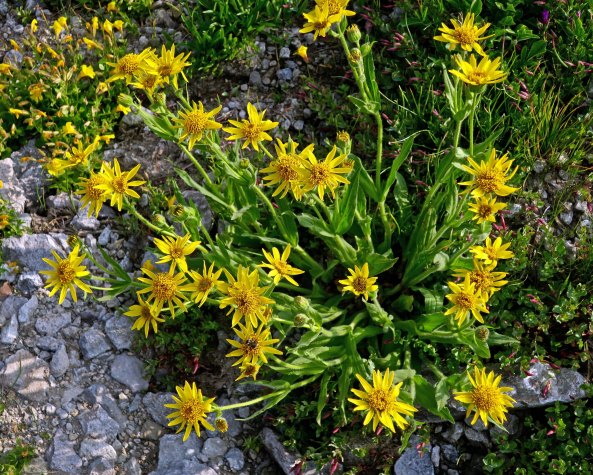
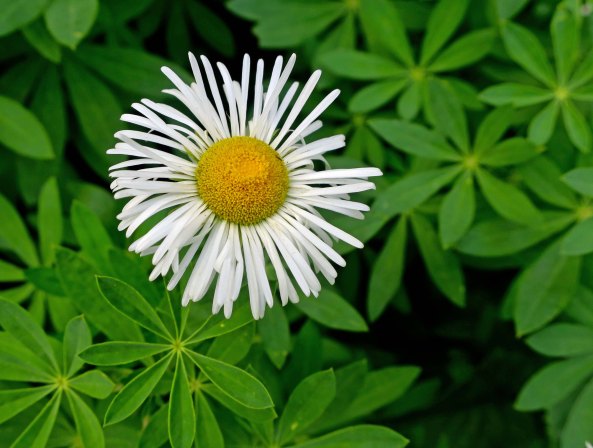
The garden was filled with a variety of flowers. I think that the daisy like flowers are asters. The yellow flowers are groundsel.
The aster-like flowers up close.
And the groundsel.
More groundsel.
Rock fringe.
And monkey flowers.
Not much farther along, I came on this small lake that demanded another 15 minutes of my time.

I passed a few more lakes and then the PCT did what the PCT always does. 

It headed up a mountain.

I met a young woman who was talking on her cell-phone with her brother. “I just saw a bear up the trail,” she told me breathlessly. I didn’t see the bear, but I did see…

Red elderberries…
Rabbit bush with an iridescent blue butterfly… 
A caterpillar chomping down on a leaf. When I tried for a closeup, it saw my shadow, assumed I was something wanting to eat it, and dropped to the ground.
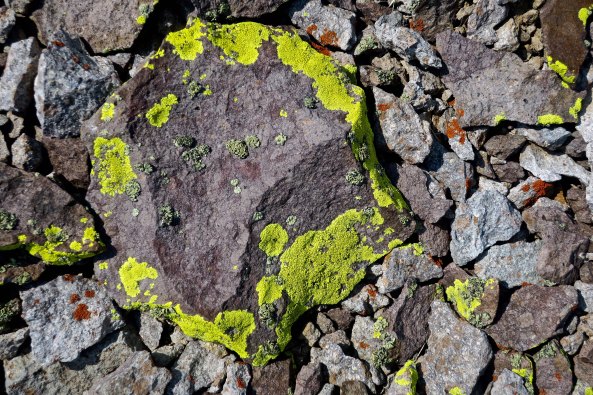
Charteuse green on the rocks. This may not be Facebook, but I am lichen it!
A closeup of the lichen. A pretty rust-colored lichen is also found in the area.
I don’t have a clue what this plant is, but I am pretty sure it was left behind by a UFO-alien. I kept my distance.
Looking way down from the mountain I could see the Blue Lakes. The tiny dot on the road is a car.

The last time I had hiked through this area, we had walked around the lakes. The night before, one of my long time trekkers, Nancy Pape, had choked on pills. My friend Ken Lake had jumped in with the Heimlich Maneuver and saved her life. The time before, we had hiked out from the lakes to the small town of Markleeville, California and happened upon the Clampers holding their sacred initiation rites. Men were walking around with toilet seats over their necks shouting obscenities. They were quite upset that we had women along who witnessed the ceremony. The women were amused.

As I started down from the mountain, I came on this bunch of dead flowers that were reflecting the coming fall. I thought of it as a dried floral arrangement.
I also had a view of this Mokelumne Wilderness landmark that has been known from the days of the early pioneers up to today as the Nipple. Once again, smoke filled the skies.
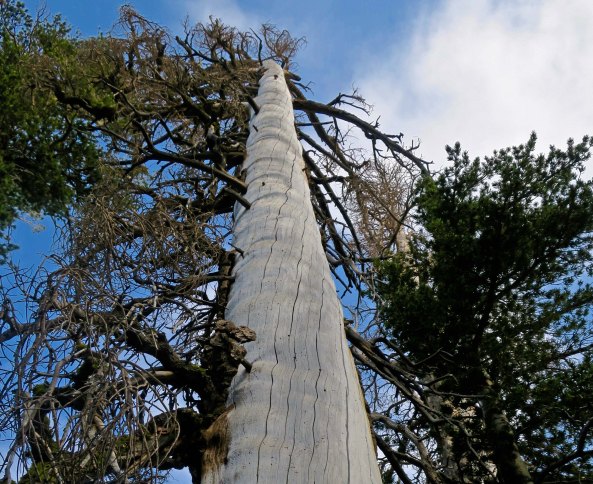
I found a snag…
That pointed toward the Nipple.
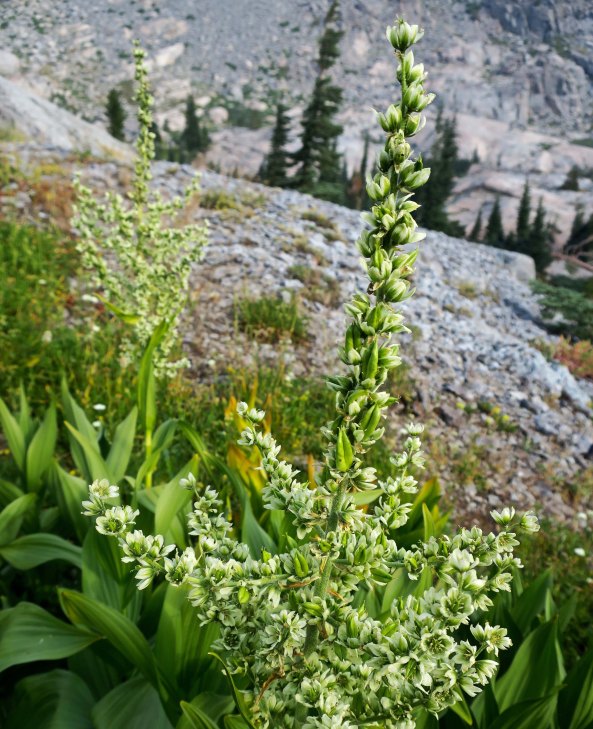
And a tall, weird, flowering plant that is known as deer’s tongue. Why? I don’t know.
A close up of its greenish flowers.
Corn lilies are another plant with greenish flowers. These were backlit by the sun.
These are corn lily flowers.
I’ll close today’s post with this shot of hemlock trees silhouetted against the sky and forest. You can tell that they are hemlocks by the way their tops are bent.

NEXT POST: A walk down Puerto Vallarta’s Malecon and an exploration of the public art along the way. After that, I will do a post on Huichol art in PV and then another post on the PCT.

Into the Mokelumne Wilderness… South from Carson Pass on the PCT

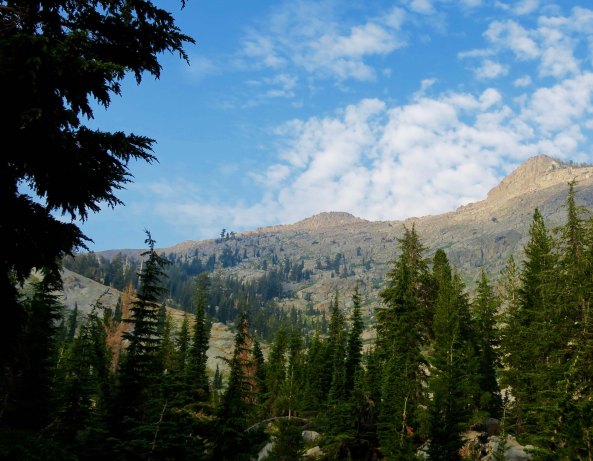
Lakes, mountains, and meadows, oh my. The Mokelumne Wilderness south of Carson Pass has it all, plus streams and rivers. I took this photo of Round Top Mountain from along the Pacific Crest Trail.

I’ve backpacked south from Carson Pass several times over the years, usually leading backpack treks following the old Tahoe Yosemite Trail. Those were the days before the present PCT route was built. I was excited to explore the new trail.

I arrived at the trailhead a few weeks earlier than I had planned. When I came out at Chester after hiking through Lassen National Park, smoke from the massive Carr Fire near Redding was so thick that it was difficult to see a couple of hundred yards into the trees. Having empathy for my 75-year-old lungs, I decided to skip south in hopes of finding clean air to breathe. 

Smoke from the Carr Fire on the PCT near Chester, CA

The pass was named after the mountain man, explorer, military leader and rancher, Kit Carson. During California’s gold rush era, it had served as one of the main entrance points to California. The trail worked its way down the mountain eventually delivering its gold seeking 49ers to the small town of Diamond Springs where I was raised. The town was established when some miners from Missouri found a 20 pound nugget of gold lying on the ground and decided to stay. Which I get. As a youth wandering far and wide through the woods surrounding Diamond, I’d always dreamed of finding my own large nugget. It wasn’t to be. But I did develop a love for the outdoors, which is worth a lot more.

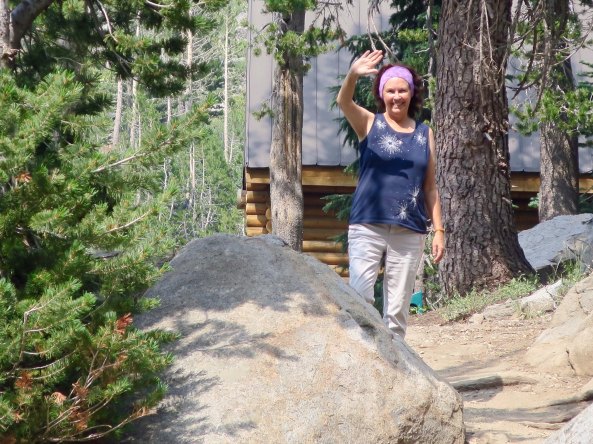
Peggy dropped me off at the trailhead and waved goodbye. She had seen me off several times by now, and was more confidant that she would see me at the other end. But my lovely friend was always a bit nervous…

Peggy waves goodbye with sincere hopes that she will greet me at Sonora Pass when and where I predicted I would come out.
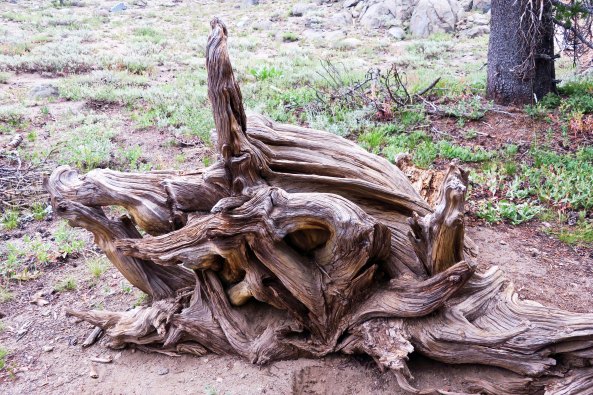
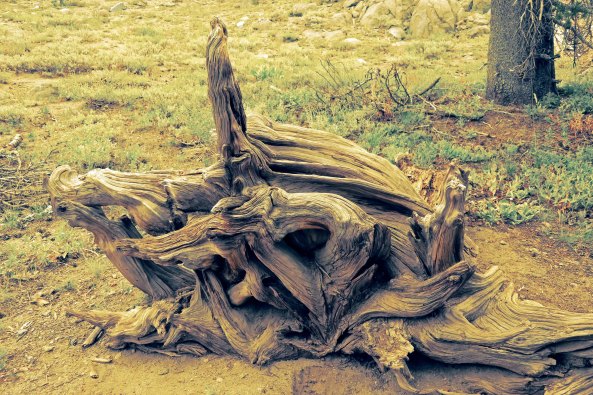
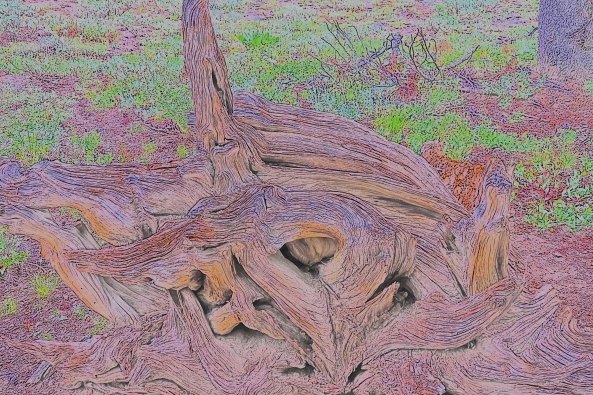
Being a sucker for roots and wood sculptures, this was the first photo I took along the trail. I hit the wrong button and my camera took several more photos, rendering each one differently. Normally, I like to stick with realistic portrayals, but I was amused with the results…
In yellow…
And in strange, impressionistic colors, like a Van Gough haystack.
I took a short detour up to Frog Pond. In the past, I had always hiked by it and wanted to see what it looked like. I thought it might connect to the PCT. It didn’t, but I enjoy detours. They added lots of miles to my journey. There weren’t any  obvious croakers.
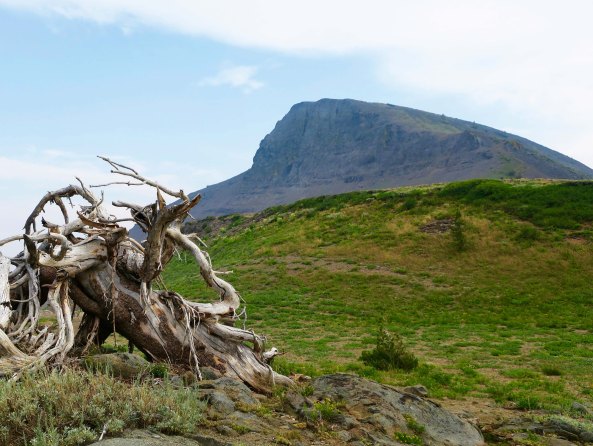
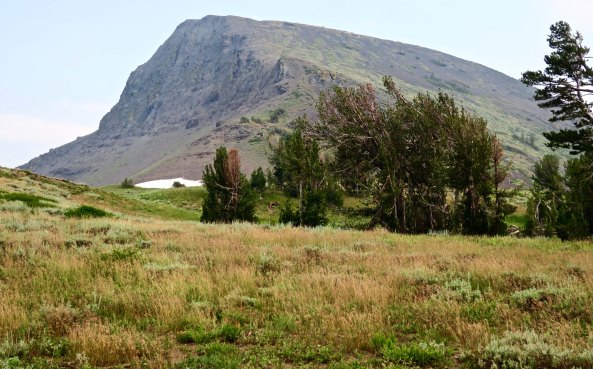
The correct trail provided this view of Elephant Back, one of the primary landmarks of Mokelumne Wilderness.
Another view of Elephant Back from the PCT.
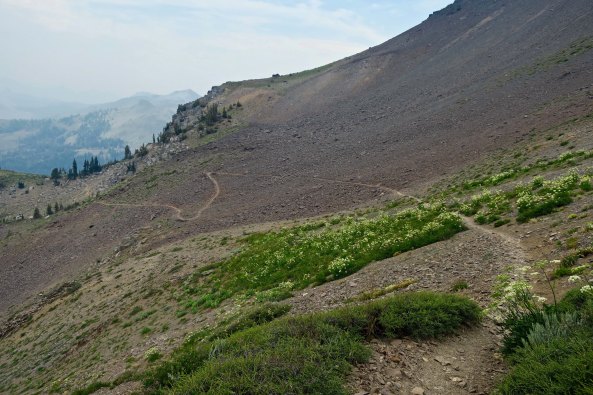
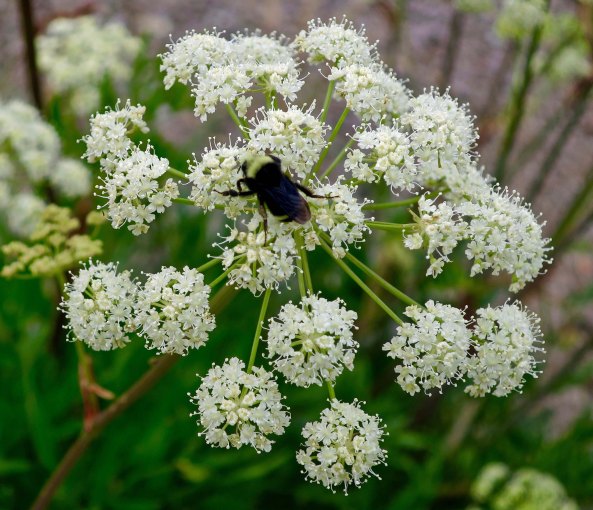
I had always hiked around the front of Elephant Back. The ‘new’ PCT took me behind it. The trail starts off making its way through Queen Anne’s Lace, a member of the parsley/wild carrot family.
A close up of the flower with a bee providing perspective.
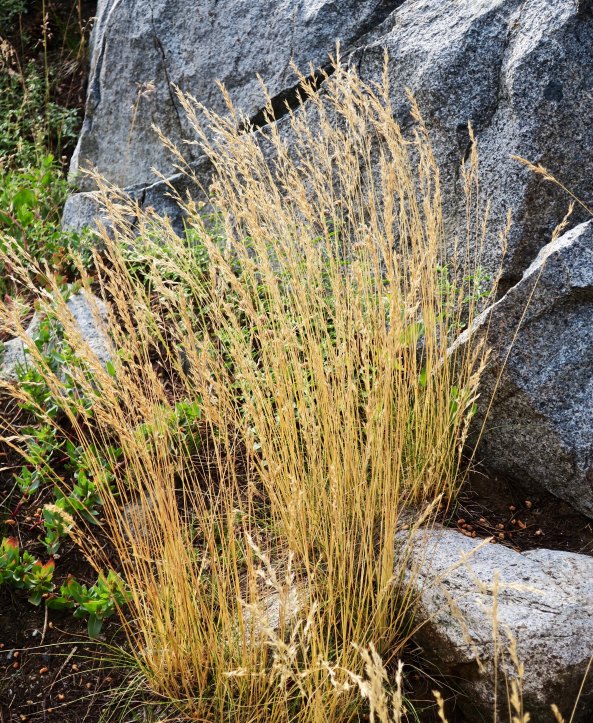
Hiking on, I was reminded that I was well into summer. A granite rock provided the backdrop for this colorful grass.
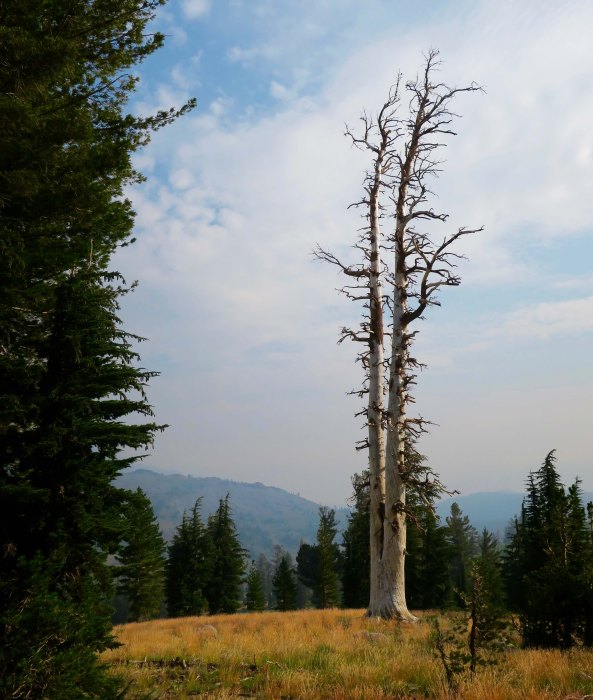
The brown grass here, which Californians insist on calling golden, provided a foreground for this photo of two snags.
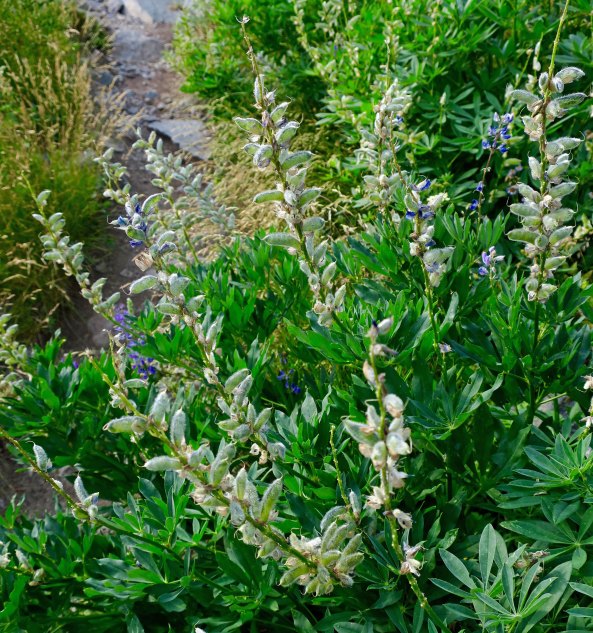
These pods on a lupine bush were also reminders of the fact that summer was winding down. They also show that lupine is a member of the pea family.
There was still plenty of water along the trail, however, which was a fact that I appreciated given how often water was scarce along the PCT.
And there were lots of flowers where I found water! This is rock fringe.
And what I know as ranger’s buttons, another member of the carrot/parsley family.
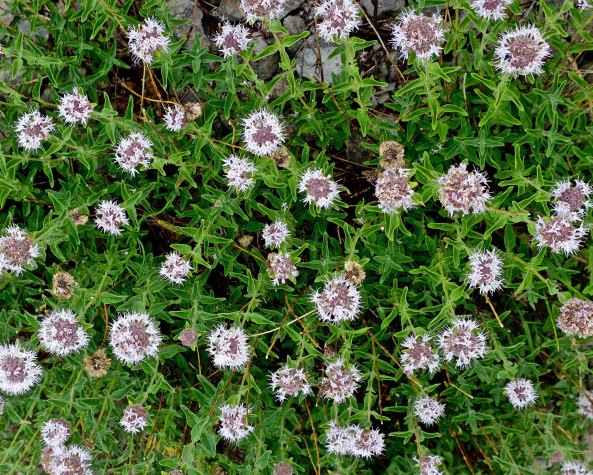
You can smell this one as you pass by. It is western pennyroyal, a member of the mint family. I always break off a leaf (it has lots) and urge people I am hiking with to sniff it and take a bite. It can also be used in making mint tea.
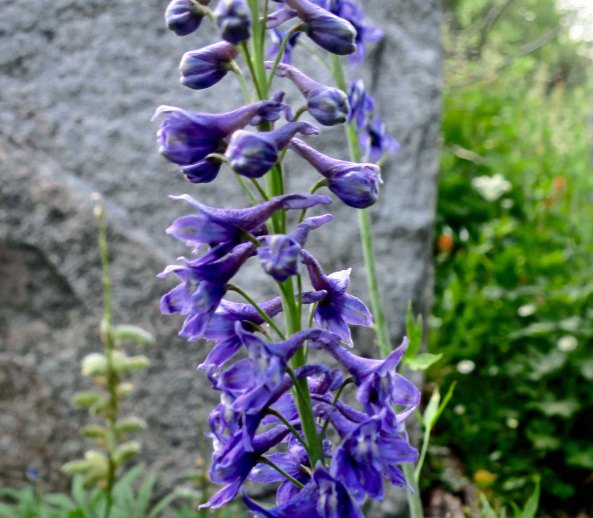
Larkspur is always a challenge to photograph, but I wanted to emphasize the ‘spurs’ here, from which it gets its name.
This daisy is known as fleabane. Pioneers believed that the bundled flowers would chase fleas out of their homes.
And here we have greenish corn lily flowers.
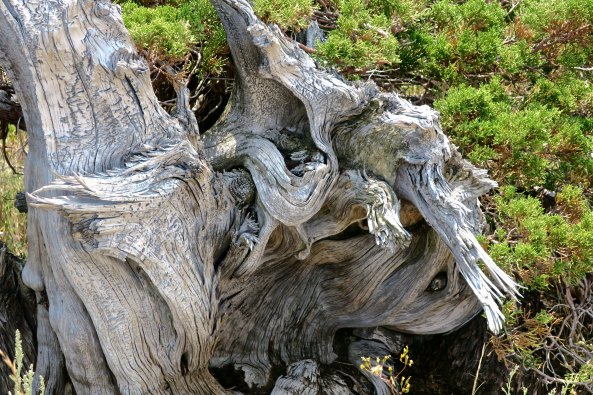
I found this half dead tree dramatic.
Another grass, rock, and tree photo. The haze in the distance suggests that my hopes for escaping smoke were about to be thwarted. Smoke from the Carr Fire had followed me south!
I almost tripped over this wood sculpture. Can you spot the sad owl-like face?
My next PCT post will take us up this flower covered ridge and far beyond.
I will also introduce you to a 65-year-old trekker who has hiked the PCT, the Appalachian Trail, and the Continental Divide Trail, giving him the right to wear a Triple Crown patch.

NEXT POST: For my next post, however, I will take you back to Puerto Vallarta again and some really neat art!

A Beautiful Lake, Fires and Trees… The PCT though Mt. Lassen National Park

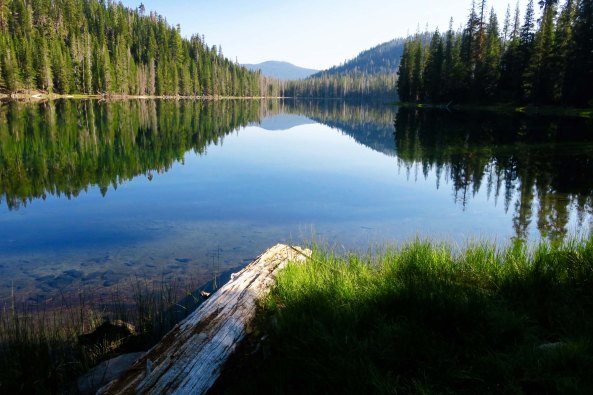
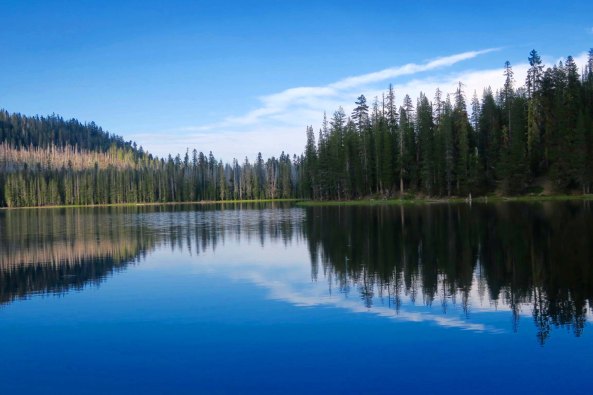
Hiking the PCT is tough, no question about it. But the rewards are numerous. Lower Twin Lake was one such reward. I camped beside it on my hike through Mt. Lassen National Park.

Today, I continue my ramble along the PCT. This time I will finish off my hike through Mt. Lassen National Park. I’ve been posting on our recent trip to Puerto Vallarta. There’s plenty more there, and lots left on the PCT. I intend to continue to mix my posts to provide a variety. And, of course, I am hard at work on my book about this past summer’s adventures and other tales from my 50 years of backpacking. My goal is to have something in hand when I attend the San Francisco Writer’s Conference in mid-February. 

Lower Twin Lake was one of those places you don’t want to leave. I was fortunate to arrive in the afternoon and experience its evening and morning beauty before having to hike on. 

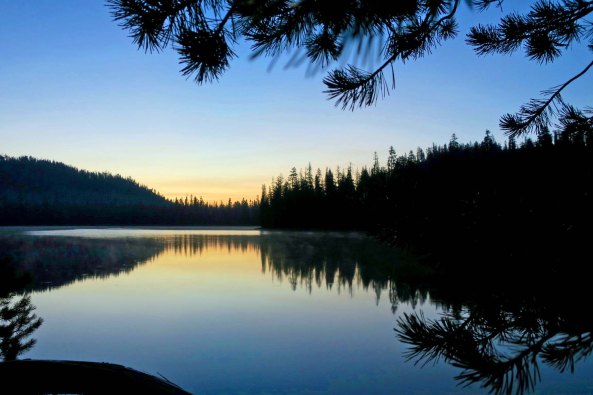
Late afternoon. I came back to camp after this photo and found a chickaree sitting on my journal. I suspect he was more interested in my food than in reading what I had to say. He scurried up a tree and proceeded to scold me for interfering with his search.
Early morning.
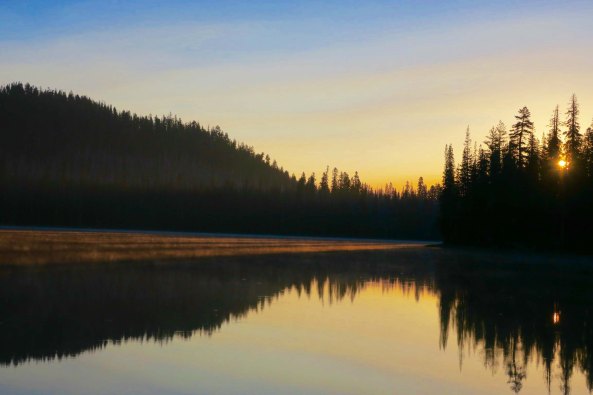
The sun comes up. Note the mist rising off the lake where the sun was hitting it. I felt it was almost magical.

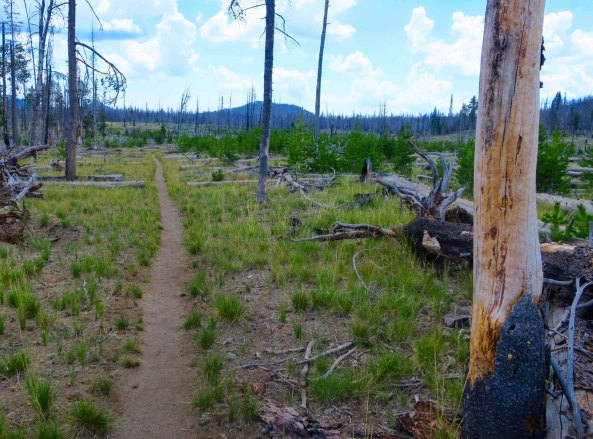
Forest fires had devastated the east side of the park and I hiked for miles through the burned out area, which isn’t unusual for the PCT in these times. Global warming and draught has taken its toll on the west from California, through Oregon and on into Washington, making forests vulnerable. The horrendous Campfire that just caused so much loss of life and property in Paradise, California is one more example. 

Mile after mile of land looked like this on the east side of the park. Not all is bad news, however. Nature is powerful and new growth is beginning to cover the area. This growth supports a substantial wildlife population.
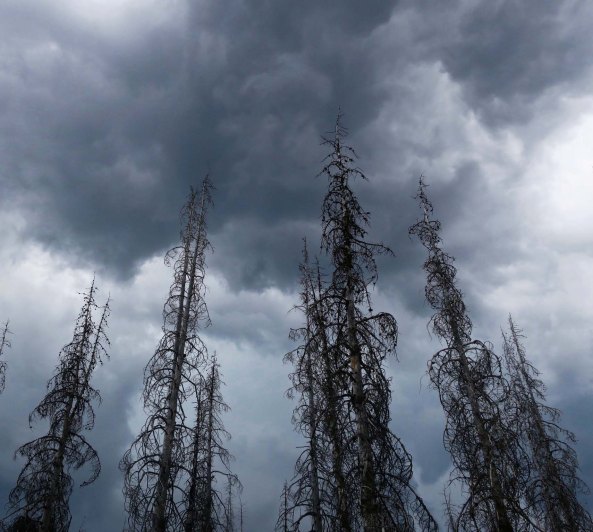
I found this scene beautiful in a threatening sort of way. Dark thunder clouds hovered above drought killed trees. Thunder was rolling across the sky and lightning was striking a nearby mountain. I counted, 1001, 1002…Reaching 1007 means the lightning is a mile away. Once I barely made it through 1001. There is good reason to fear being hit by lightning. There is even more reason to fear that it may cause a fire. These trees would light up like kindling.
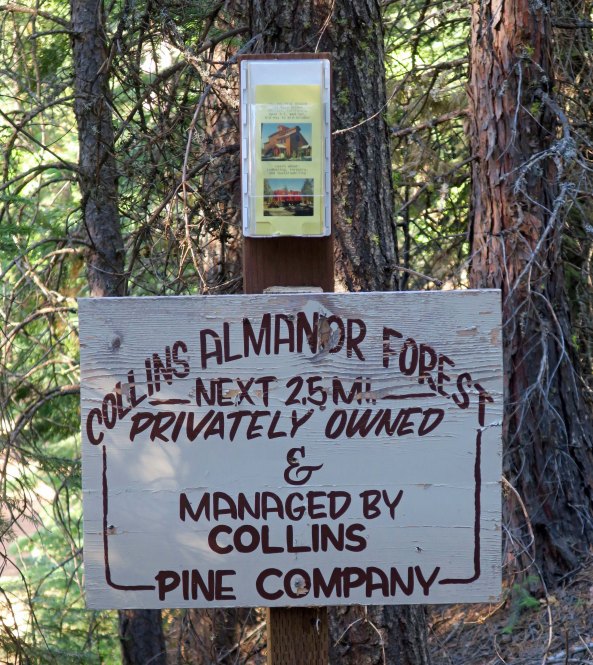
I often here the argument that thinning the trees, i.e. logging, is the solution to forest fires. Mainly it is used as an excuse for more logging. But the Collins Pine Company may actually have a solution. For one, it is committed to selective cutting, leaving a  healthy forest filled with a variety of trees. It also cleans out dead debris lying on the ground and uses the wood to create energy. The debris under the trees is one of the major reasons for devastating forest fires. A group of 50 or so forestry students from the University of California was in the area studying the company’s forest management practices when I hiked through.

I love trees. Who doesn’t. Here are some of the beauties I found on my backpack trip through Lassen.

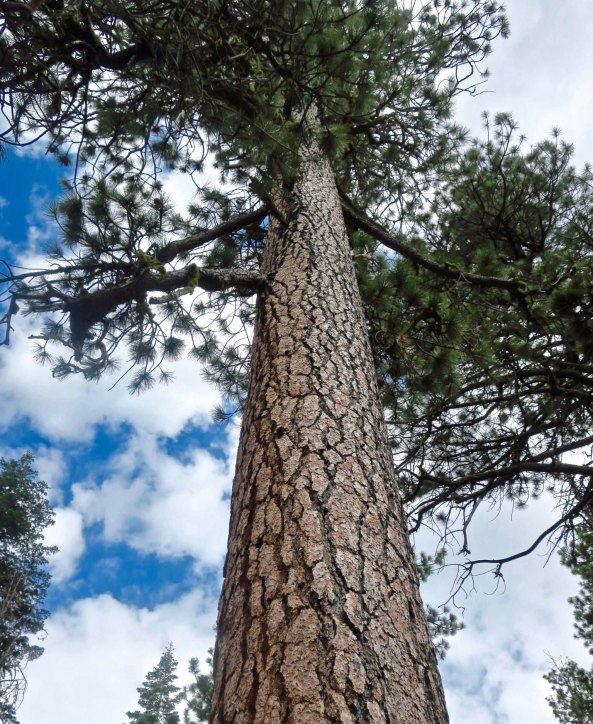
I had lunch under this magnificent Jeffrey Pine.
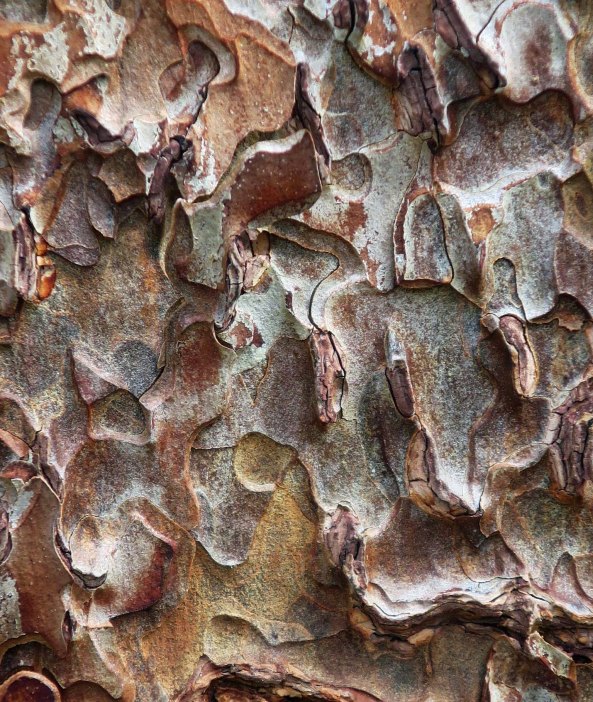
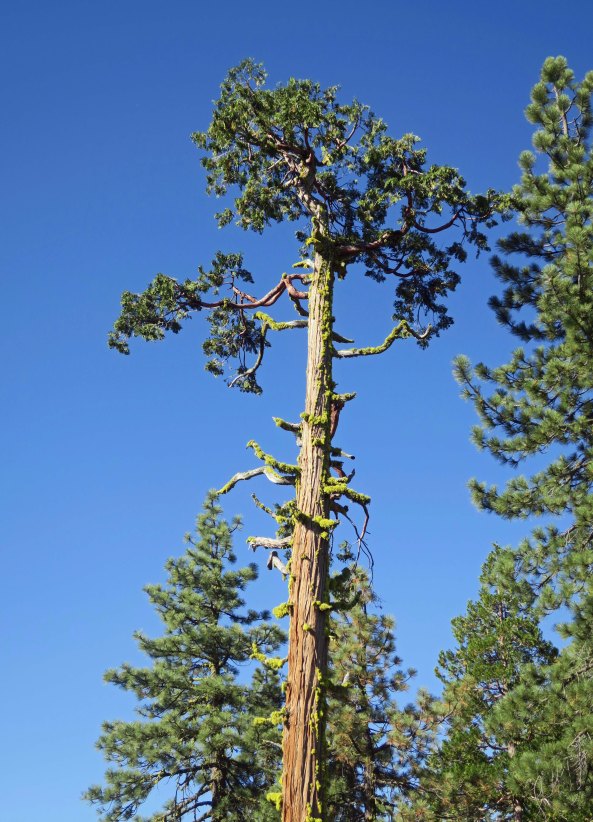
It’s bark resembles puzzle pieces. If you put your nose next to the bark on a warm day, you will be rewarded with a delightful smell of vanilla, or possibly pineapple.
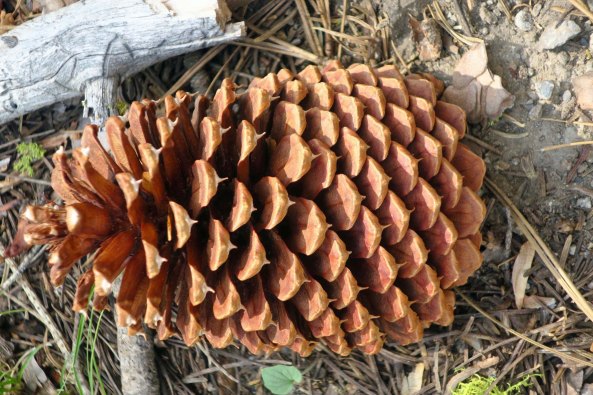
This is one of its gorgeous cones. An easy way to tell the difference between a Jeffrey Pine and a Ponderosa pine is you can pick up a Jeffrey pinecone without pricking you hand. Not so with a Ponderosa pinecone.
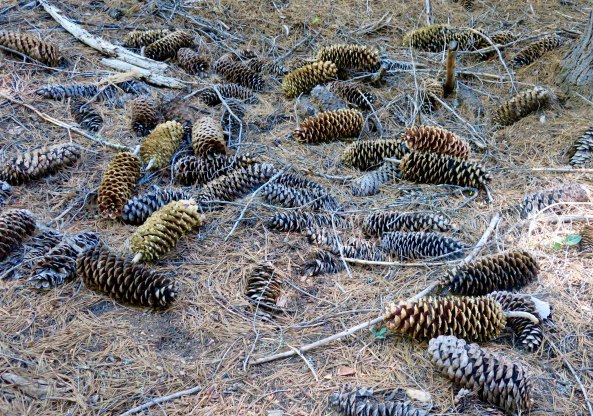
The king of pinecones grows on the the sugar pine. Some of these giants were approaching 20 inches in length. You don’t want to be standing under a sugar pine when a squirrel is harvesting its cones! Pine nuts from a sugar pine are delicious, however, and easily cracked. Ask the squirrel.
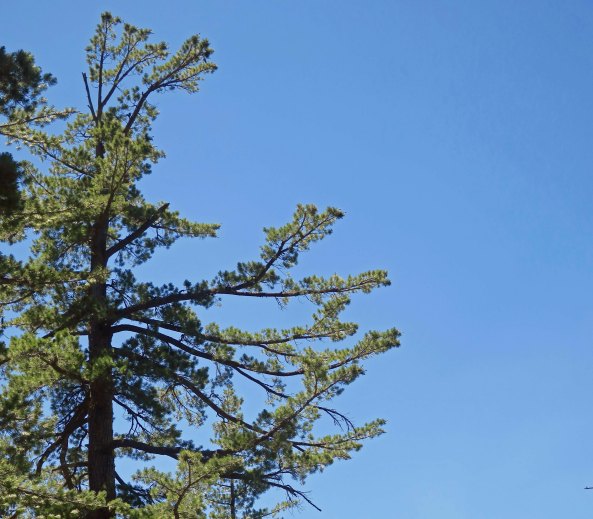
Sugar pines reach high into the sky and have wonderfully wild limbs.
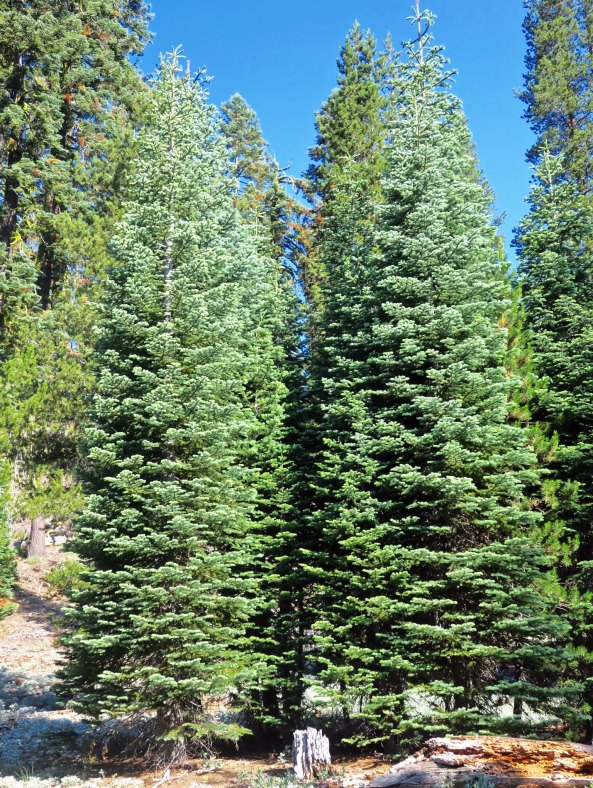
Unlike these two fir trees that were practicing close to perfect symmetry.
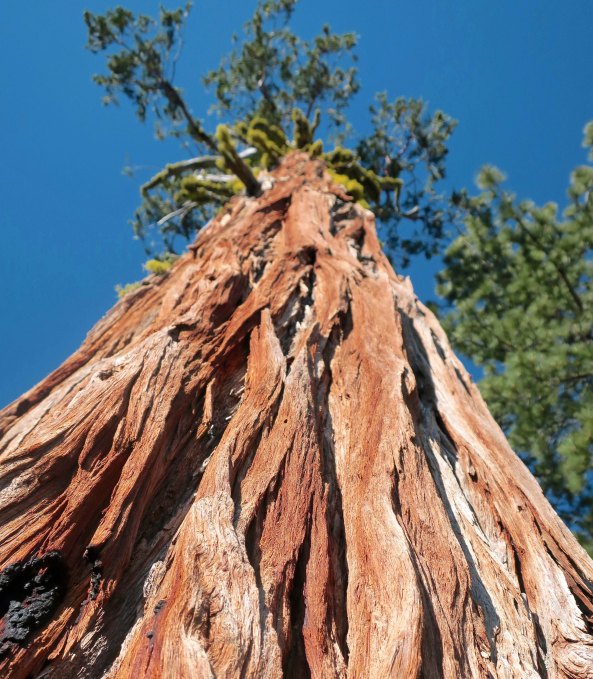
Cedars also provide forest giants.
Here’s a view looking up at the same tree. 

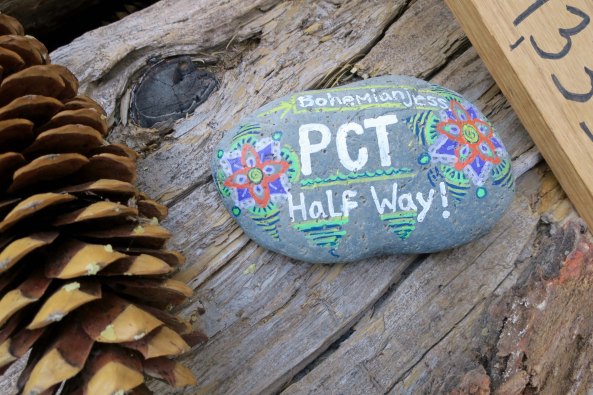
I met lots of through hikers in Lassen Park. The halfway point between Mexico and Canada is just south of the park. Hikers needed to be in the area or through it when I was there if they hoped to complete their hike during the 2018 season.

A stone left behind by Bohemian Jess near the town of Chester marked the halfway point on the PCT.
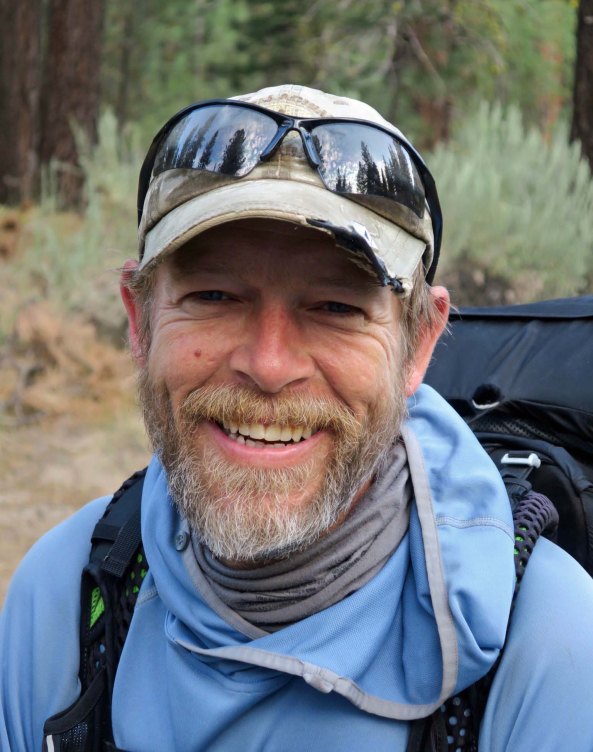
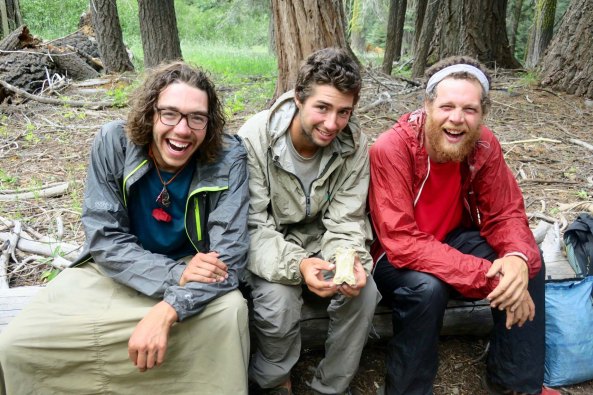
I met Hillbilly when Peggy dropped me off at the trailhead. She enticed him over with an apple. He lived in North Carolina near the Appalachian Mountains that gave birth to the hillbilly name, but he was far from being one. His name was Bill and he lived in Chapel Hill. Thus the name. He owned a company that installed solar farms. Bill had already hiked the Appalachian and Colorado Mountain Trails. Like me, he preferred to camp alone, away from the noise and partying of younger hikers.
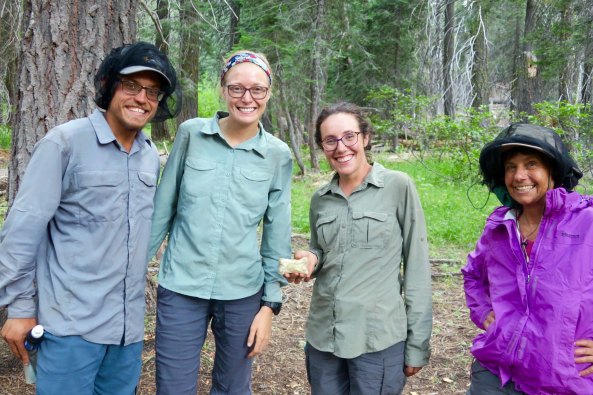
There was no chance of escaping from trekkers at Boundary Springs. (So named because it is located on the southern boundary of the Park.) It was a major source of water. These three camped next to me, so Bone came out to visit with them. They were quite amused. From left to right their trail names were Too Slippery, Bottomless, and Bodhi. Slippery and Bottomless were friends from Truckee, CA. Bodhi was a meditating type of fellow.
Shrek, Pepper, Bessie (the cow) and Chewy were also camped within about 30 feet. So, Bone had to visit them as well. I’d found Chewy looking for a lake where there wasn’t one, even though her map and a ranger had said there was. She had followed me down to the spring to get water.

Here are a few other photos to wrap up my trip through this section of the PCT.

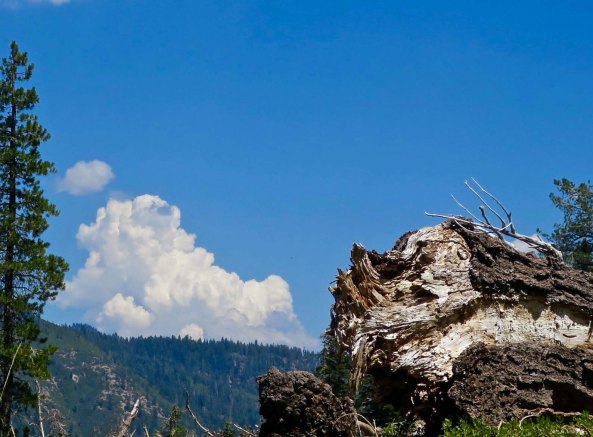
A snag and a thunderhead.
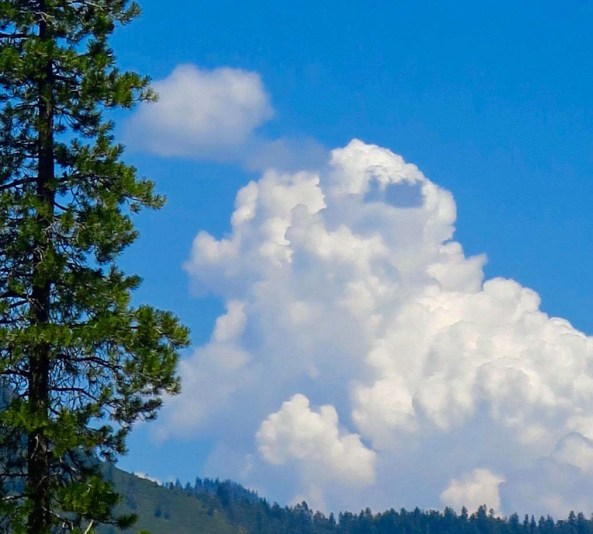
A closer look at the thunderhead.
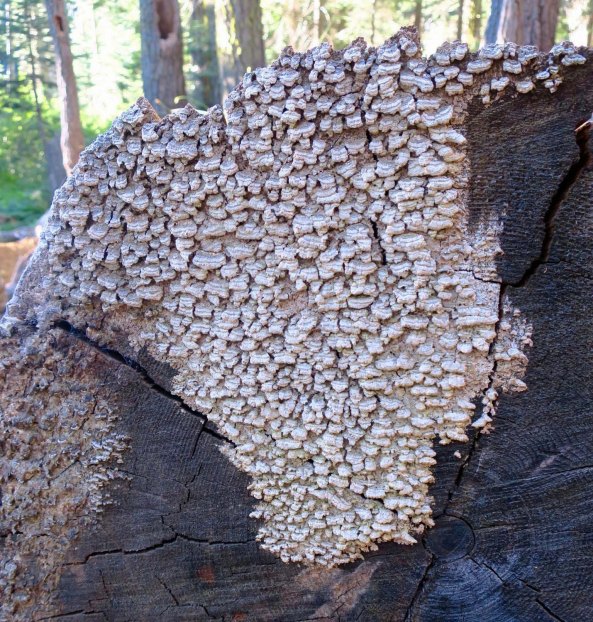
I found this fungus growing on a sawed log interesting.
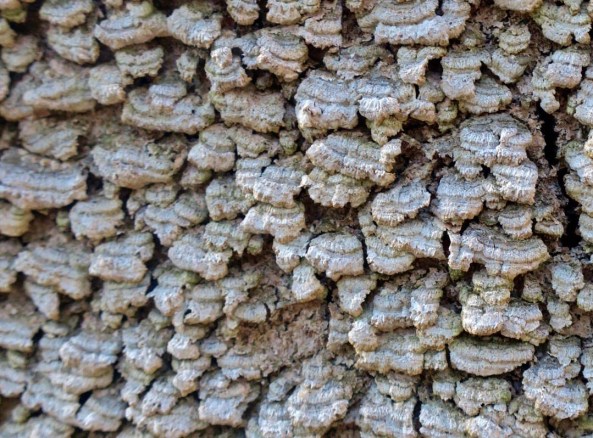
What the fungus looked like up close.
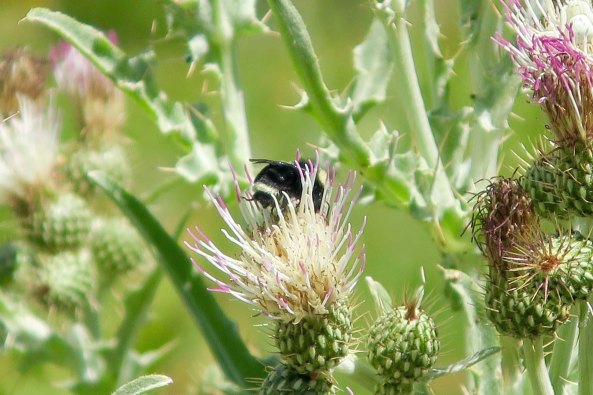
A bee hung out among some thistles.
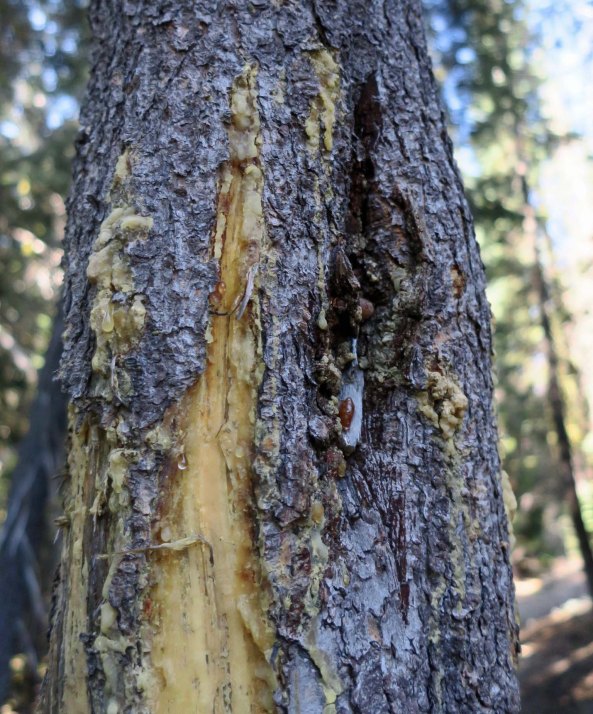
A bear left his claw sign for me to see…
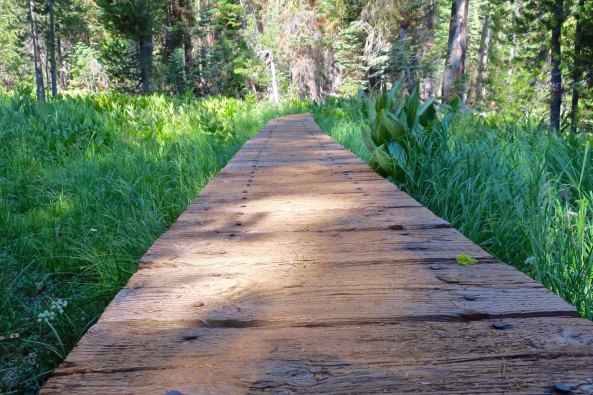
You know you are in a National or State Park when walkways are built across swampy areas.
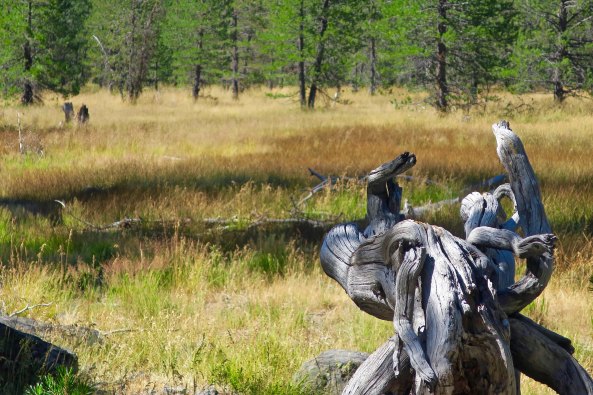
This meadow reminded me that summer was nearing its end. So I will stop here for the day.

NEXT POST: A very strange pelican. And some iguanas.

Life on the Trent and Mersey Canal… A Narrow Boat Tour in England

A pilot’s perspective on a 65 foot long, 6 feet wide, 16 ton narrow boat.

This is my final post introducing new readers to they type of stories they can find on my blog. This tale takes you off to England and a journey on a narrow boat tour of the Trent and Mersey Canal. As I note below, this was my first experience at piloting a 65-foot long, 6-foot wide, 16-ton vehicle. If you would like to learn more about this adventure, go here:  https://wandering-through-time-and-place.com/2018/01/02/  I hope you’ve enjoyed this trip back through history. I guarantee that it is just a small taste of what you can expect to find on these pages. Next week, I will continue my PCT series and likely start working in a few Mexico posts. 


I never imagined (even in my wildest dreams) that I would someday pilot a 65-foot long, 6-foot wide, 16-ton vehicle. But that’s what I ended up doing last week.

Peggy and I, along with her sister Jane Hagedorn and her husband Jim, did a seven-day narrow boat tour on the Trent and Mersey Canal out of Long Eaton, England. If Long Eaton doesn’t ring a bell, think Robin Hood. Nottingham is nearby.

The prince of thieves was one of my all time childhood heroes. I knew the location of Sherwood Forest long before I knew the location of London.

Jane and Jim stand in front of the Sawley Marina office. Note Robin Hood on the right!

Jim and I had pilot duty. Our job was to stand in the back with tiller in hand hoping that the boat would go where we wanted. This included not running into other canal boats, avoiding overhanging trees and mudflats, navigating under watch-your-head, boat-wide bridges, surviving locks and learning the delicate art of mooring our not so delicate craft.

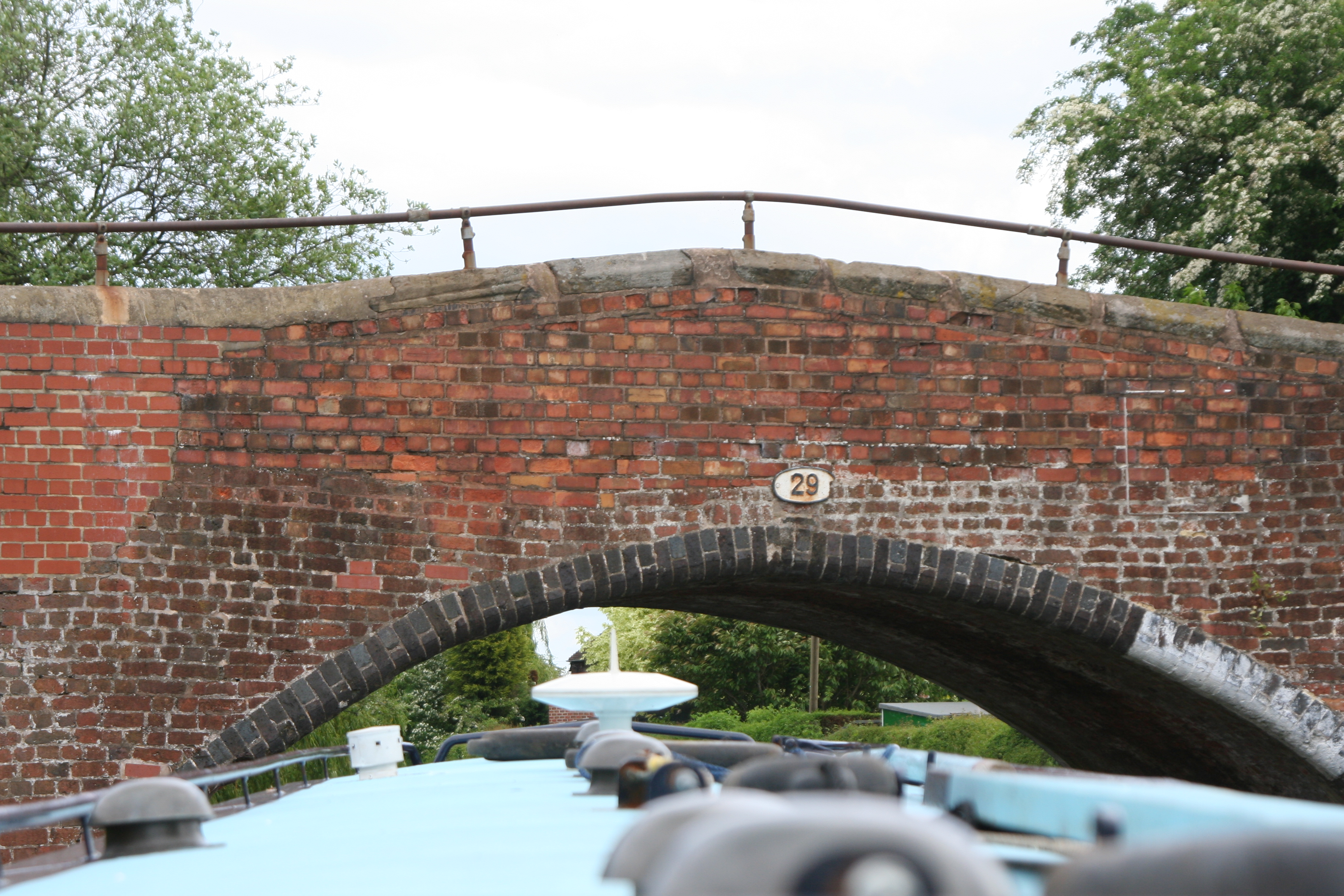
Is our narrow boat narrow enough and low enough… is the question.

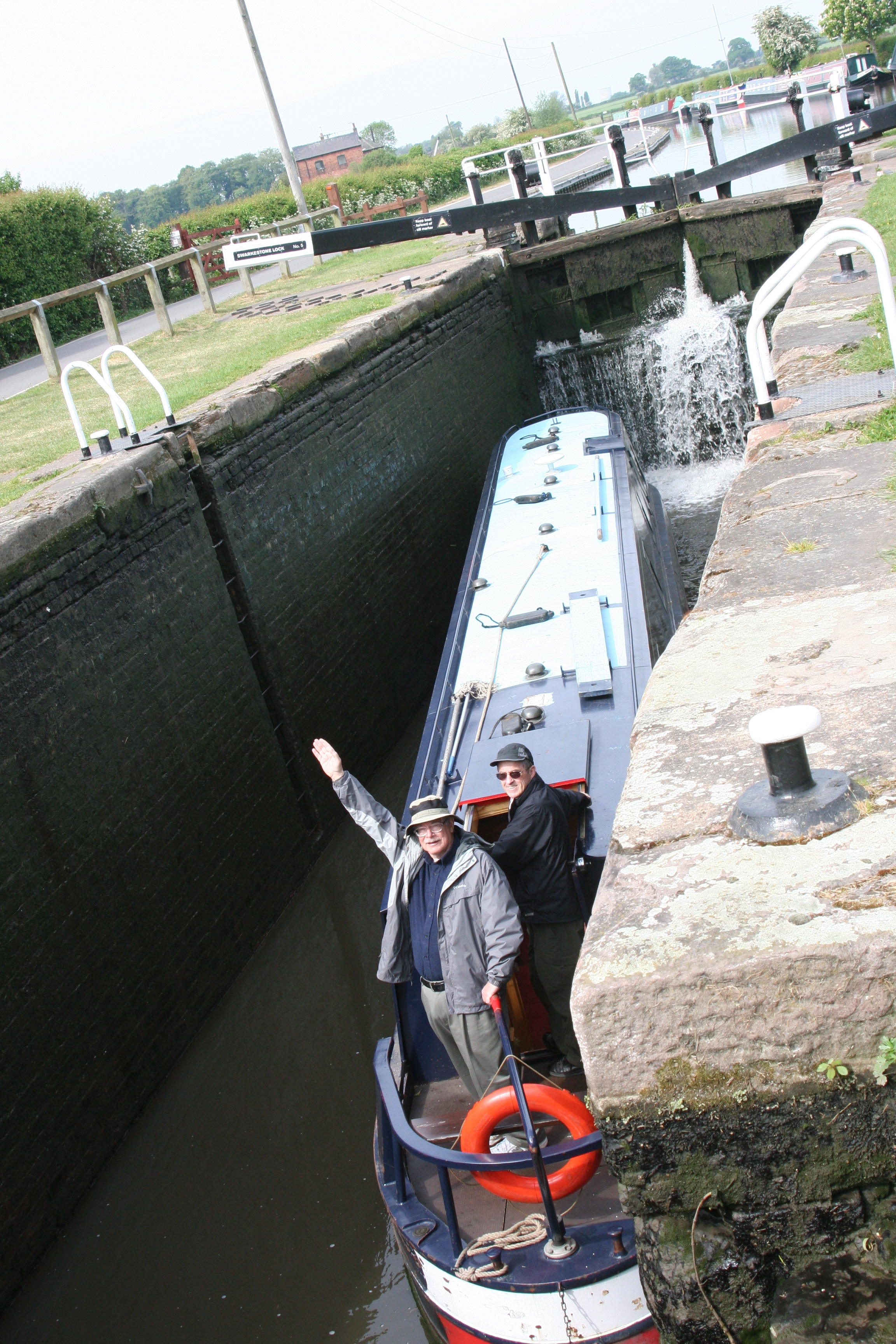
I park the boat kitty corner in a lock. Maneuvering back and forth is necessary to keep the boat positioned.

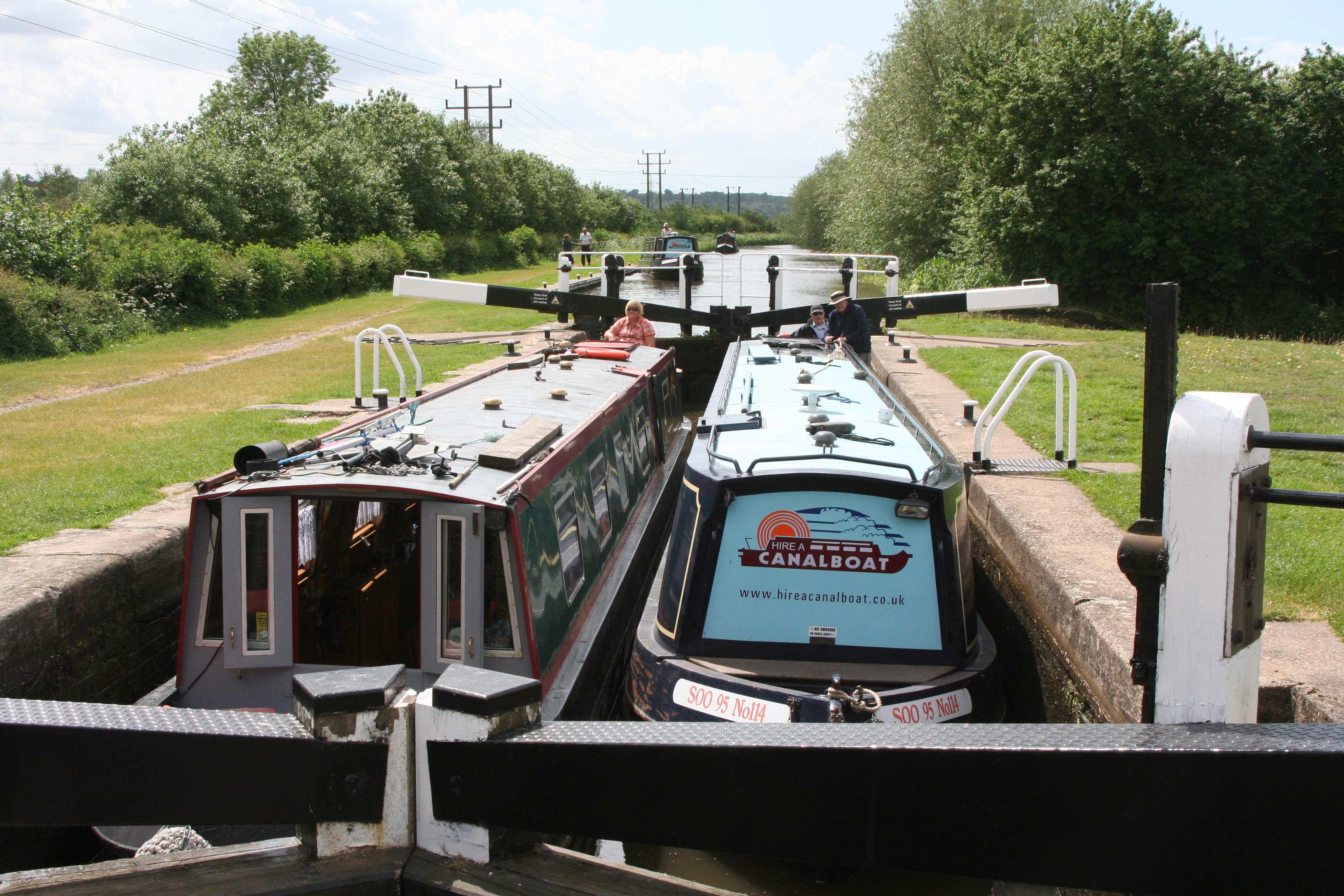
Two boats in a lock at once. Jim is up to the challenge.

Peggy and Jane were in charge of locks plus a certain amount of backseat driving. For example, they would point out boats coming toward us that we had been worrying about for five minutes.

Lock duty was not easy. Heavy cranking was involved in opening and closing the paddles that let water into or out of the lock. Full body strength was required to open and close the gates. The women quickly became lockmasters and I am sure wowed the English males with their prowess. (Honey, can I have one of those?)

Jane cranks open a paddle to let water out of the lock.

Peggy demonstrates the importance of ‘butt’ power in opening a gate.

Other chores included muscling the 16-ton boat into shore and filling the craft with water. Getting from the aft to the bow of the boat for work or pleasure involved maneuvering along a narrow gunnel.

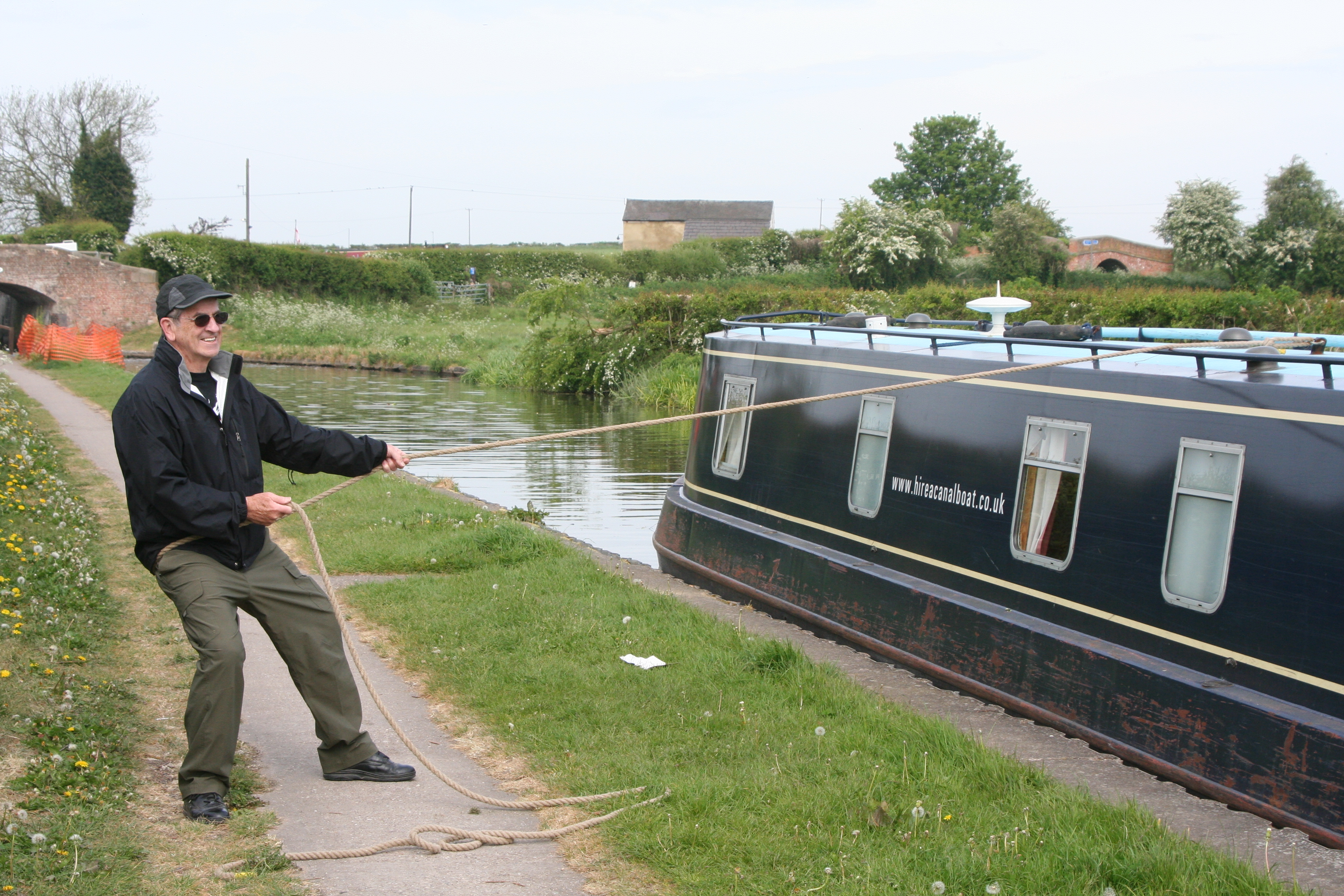
Jim muscles the boat into shore.

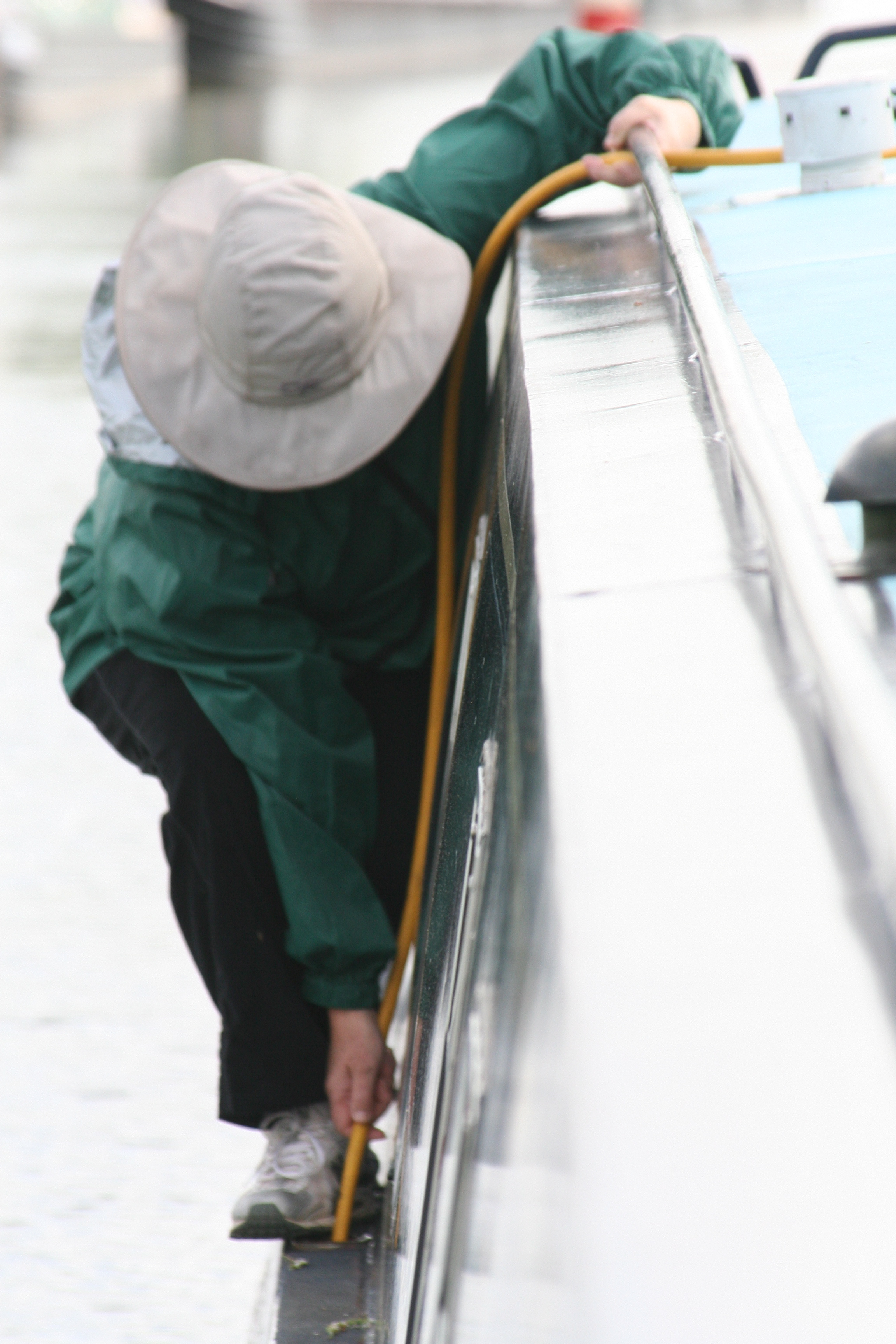
Peggy hangs over the edge while filling the boat with water.

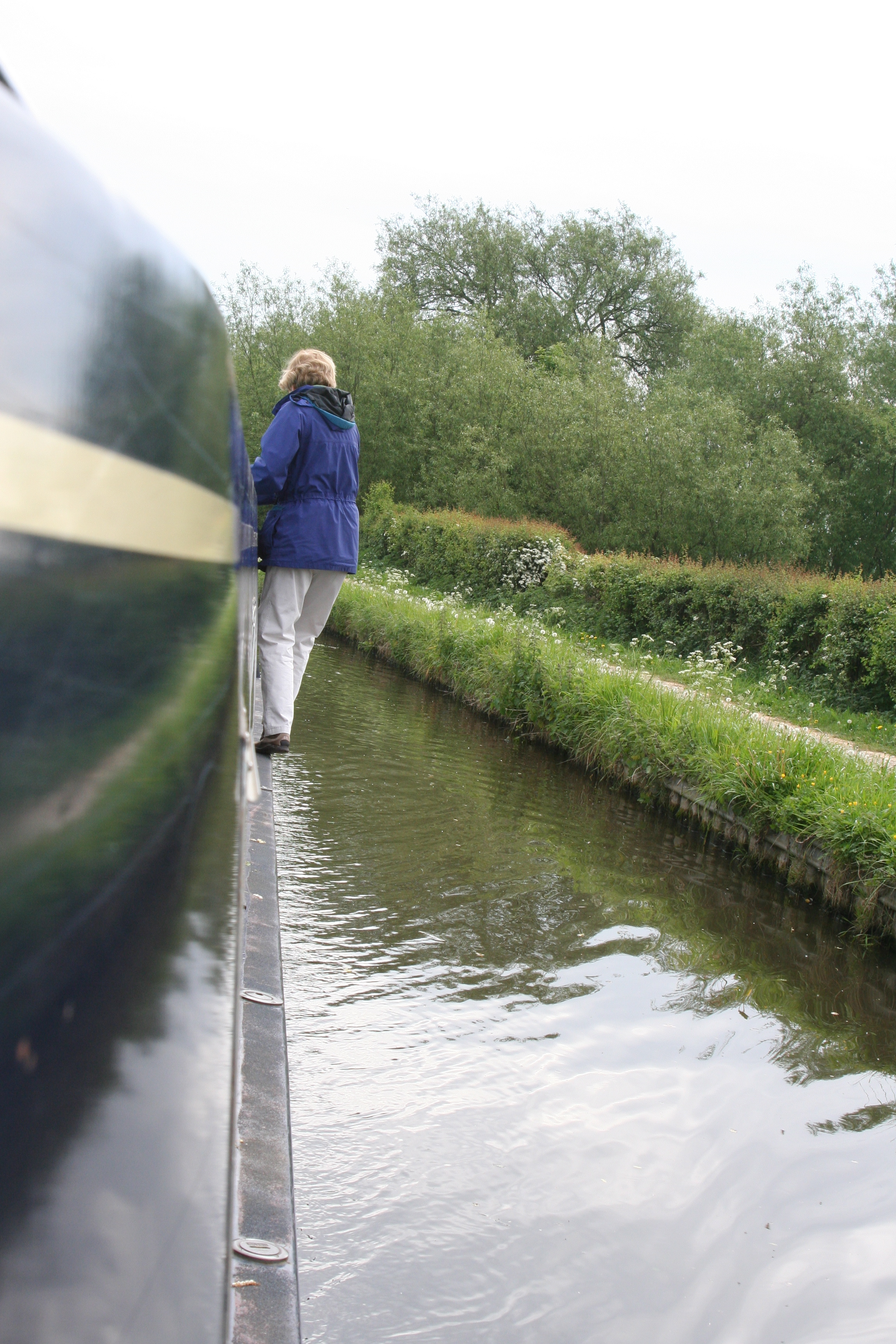
Jane walks the gunnel.

Upon arrival at Sawley Marina we were provided with two hours of training for our adventure. That was it. Afterwards we were turned loose with the 16-ton barge for on-the-job training.

Canals are found throughout England. Once upon a time they were vital to the nation’s economy as transportation corridors. Reflecting the good taste of the Brits, beer was one of the major items transported over the Trent and Mersey.

Now the canals are mainly used for recreational boating… primarily by brightly colored, cleverly named, narrow boats. We also talked with a number of people who live on their boats year around.

Owners work hard to give their boats individual personalities as is demonstrated here by the Molly Rose. Bright colors, flowers and names such as Belly Button and Simmerdown add to the character.

Boats were found wherever mooring was good. (And a pub convenient.)

Although we came uncomfortably close to hitting a couple of boats (give or take five inches), banged into the shore several times during mooring (as expected) and grounded the boat three times (Jim won 2 to 1), the adventure was quite enjoyable.

“Mudflat” Jim grounded the boat. I work hard to pole it off.

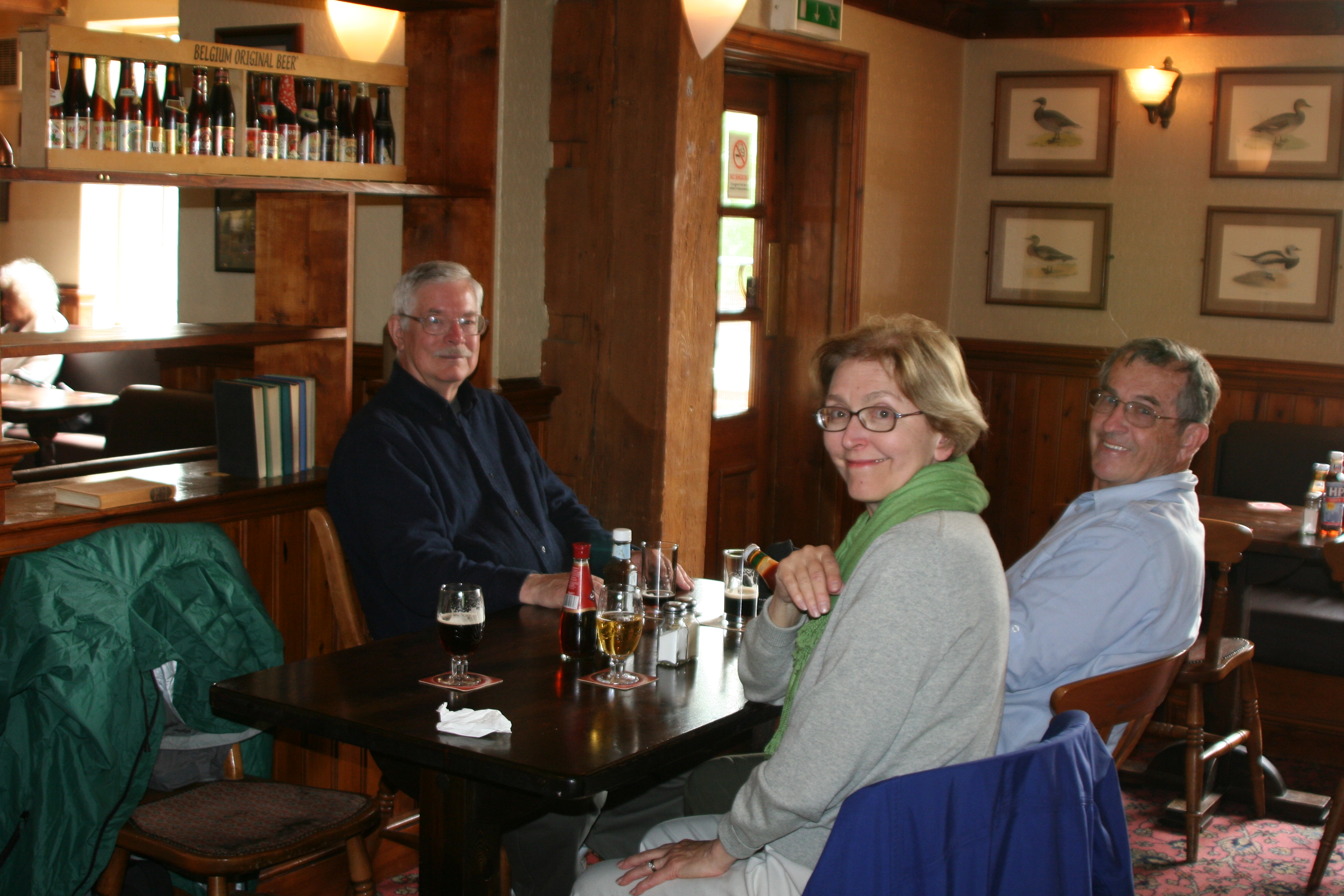
Picturesque countryside, abundant bird life, and attractive villages entertained us along the way.  Pubs served surprisingly good food and even better ale. I worked hard to sample all of the local brews. Even Peggy developed a taste for dark beer.

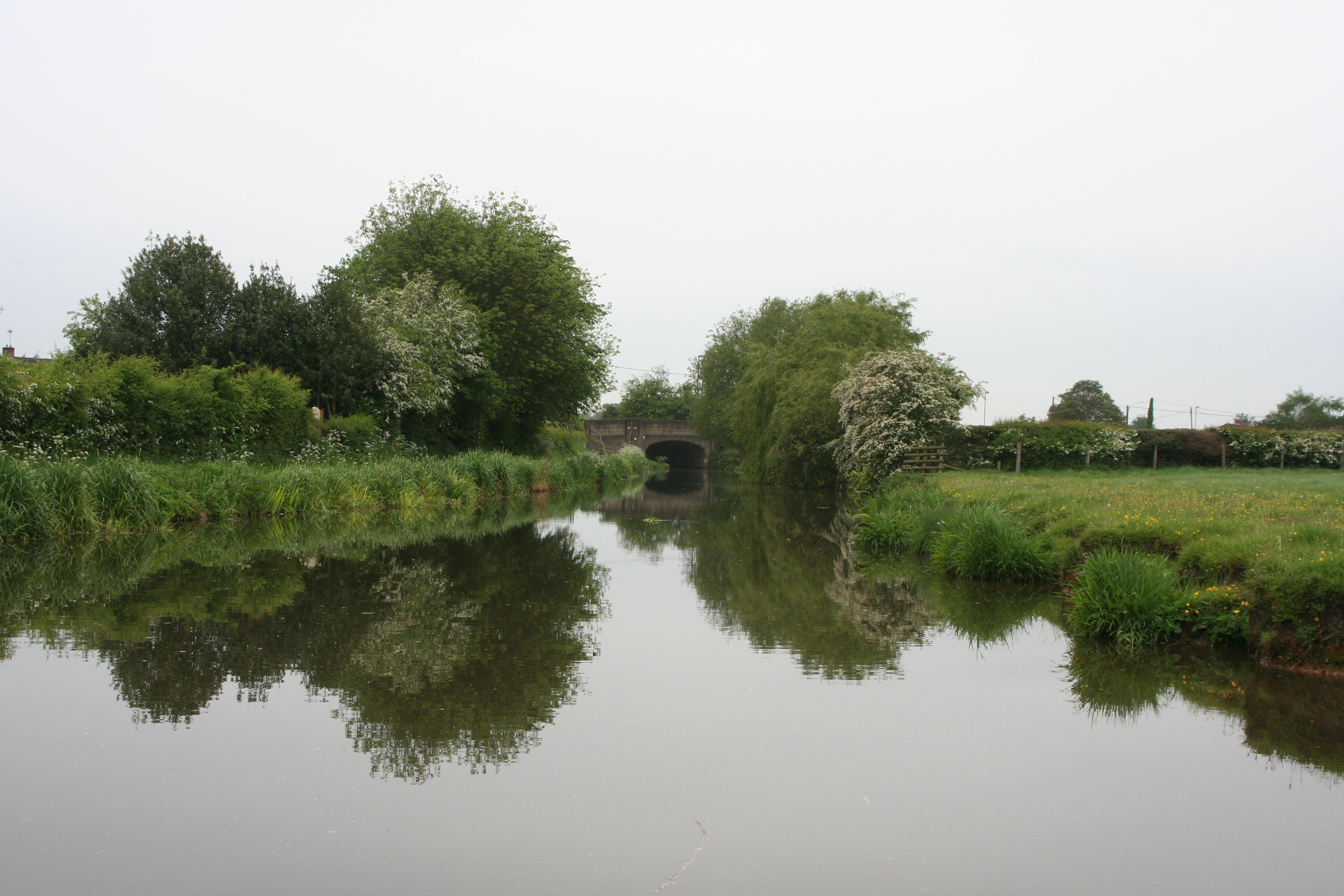
There was much beauty along the way as this tranquil scene shows.

Peggy loved the brightly colored flowers that were found in both fields and towns.

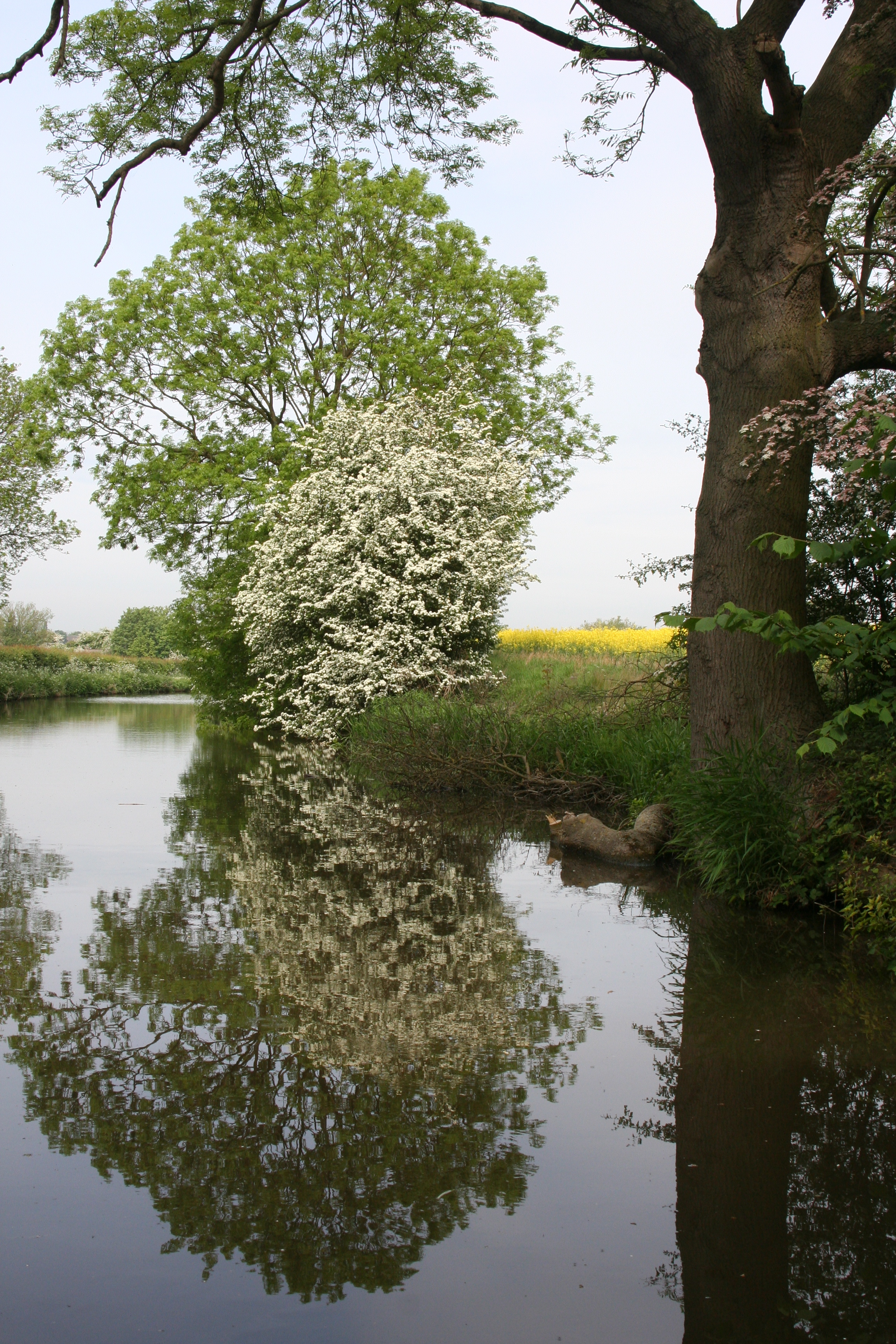
And I have always had a weakness for reflection shots…

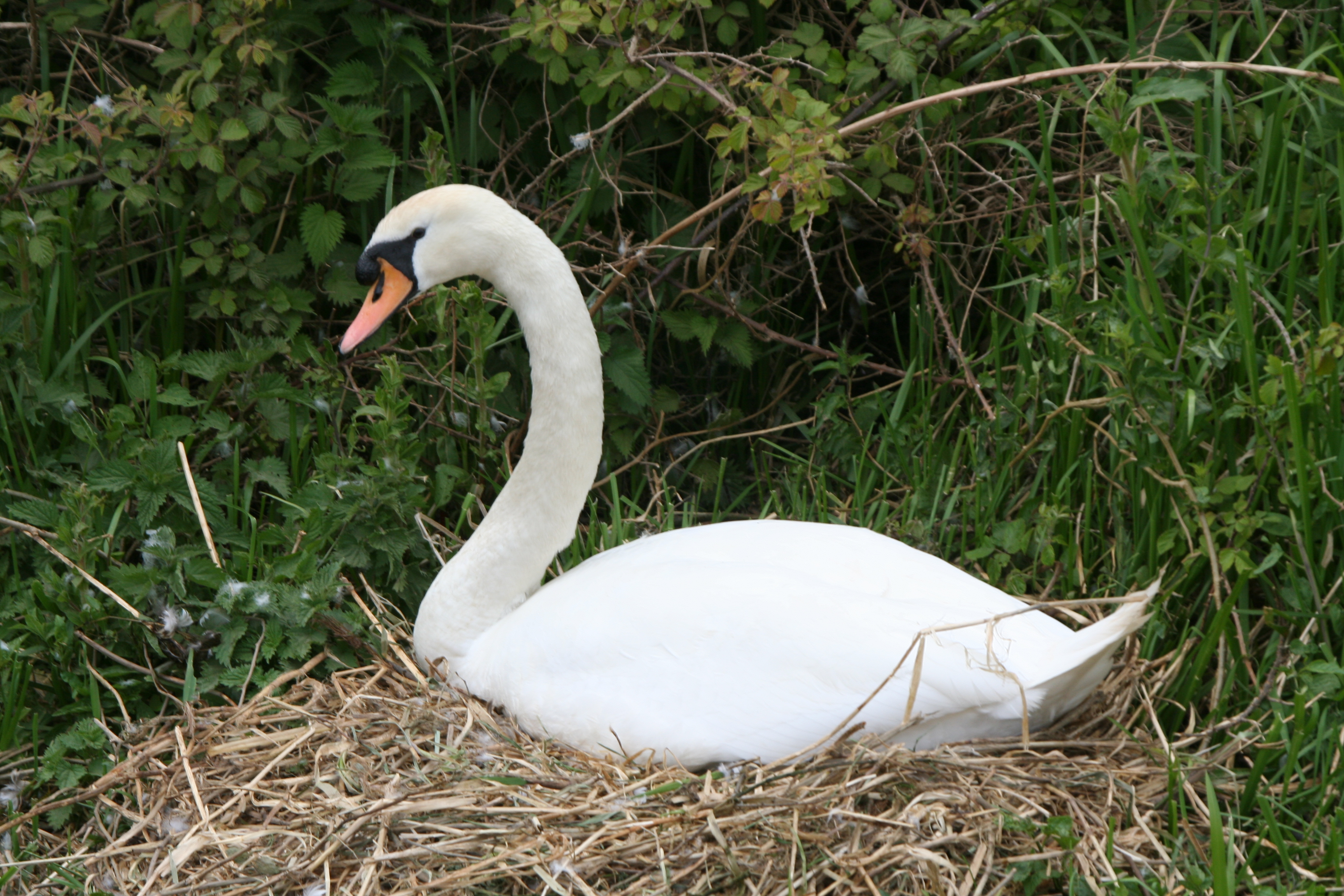
Bird life was abundant along the canal. We took photos of this nesting swan coming and going.

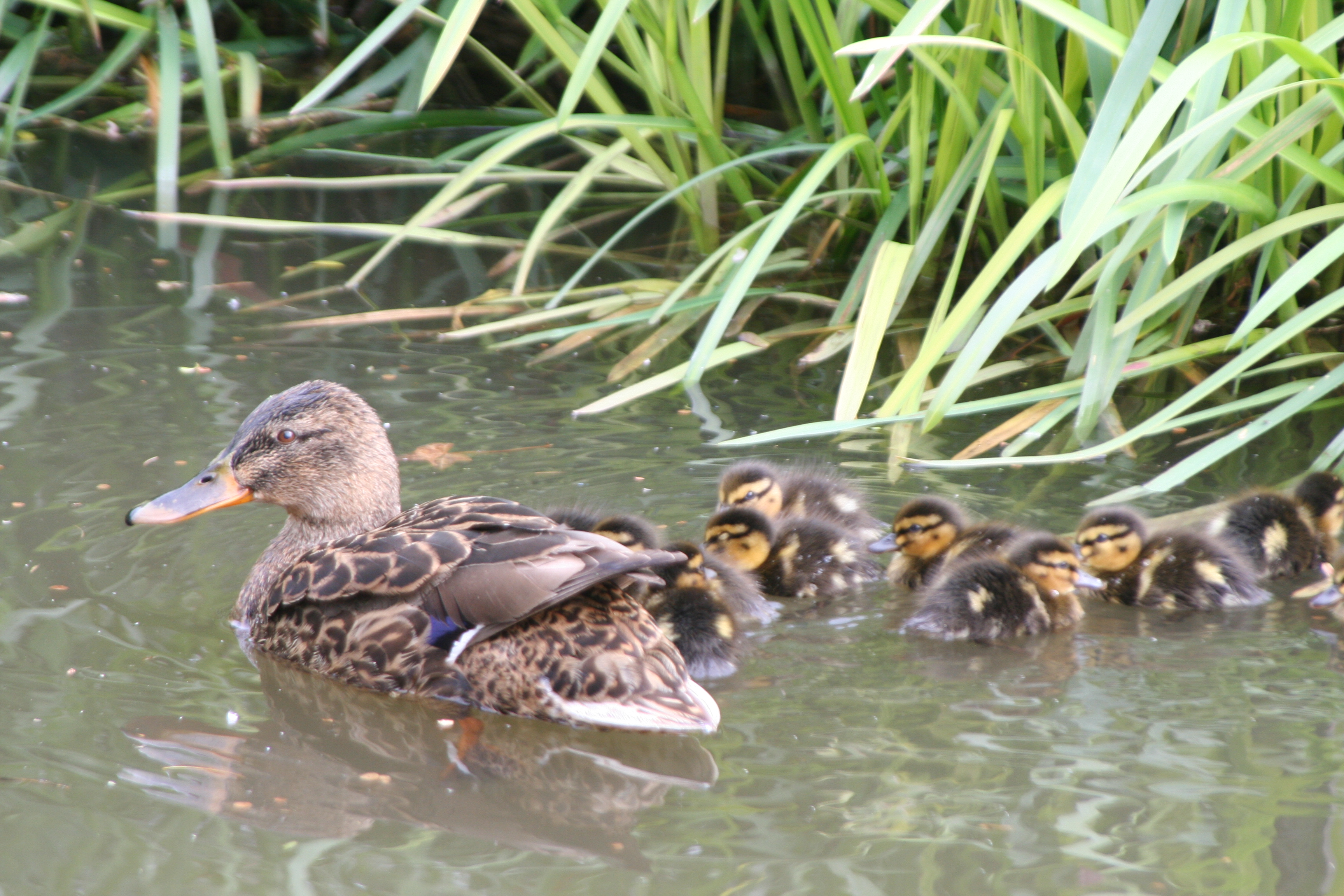
This Mallard Hen was one of many with babies. They would wait for our boat to pass and then swim along behind us. I wasn’t sure whether they were taking advantage of food we stirred up or drafting, like bicyclists do.

We always found colorful pubs with excellent English beer and good food.

Several small towns along the way provided an interesting contrast to the rural areas.

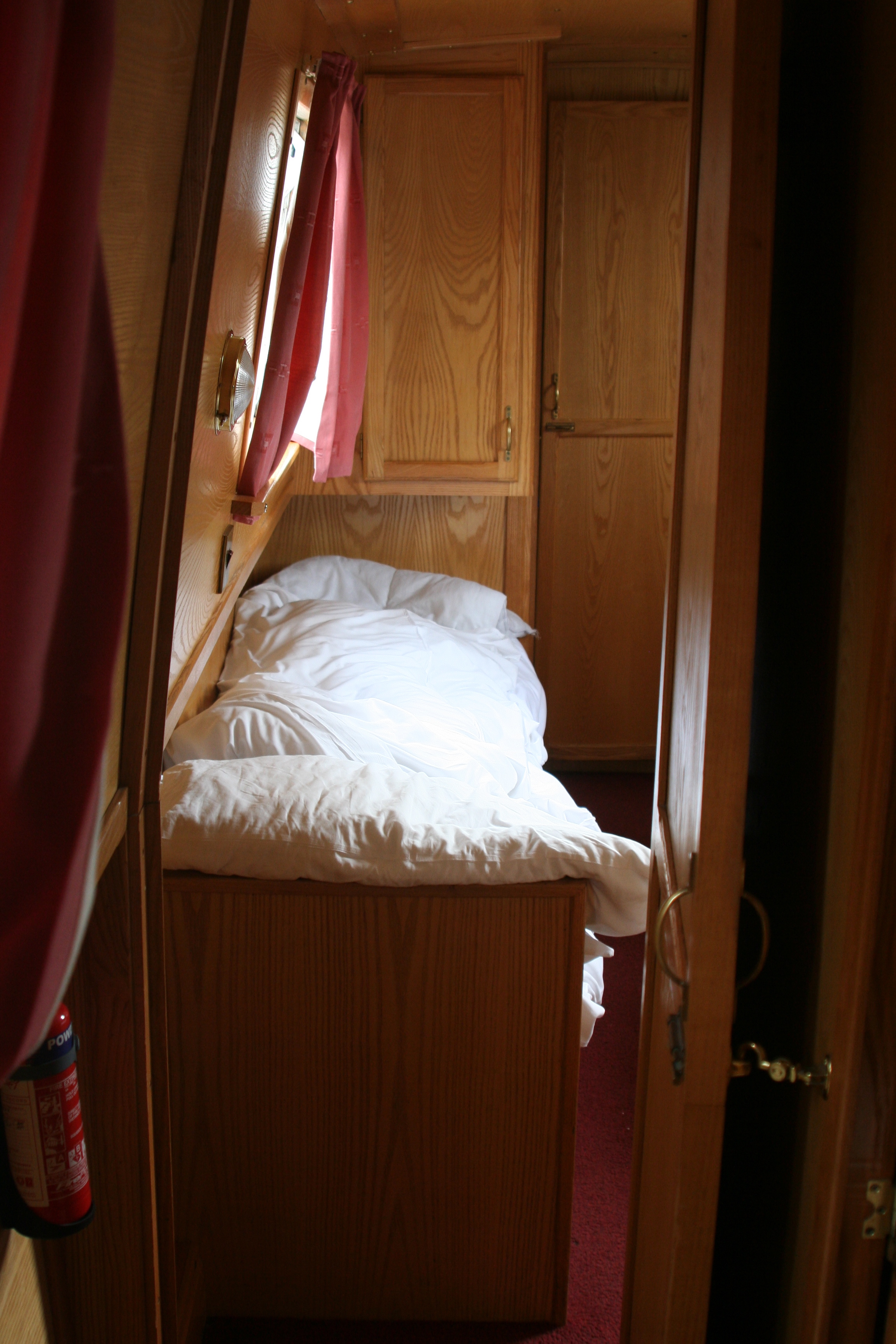
Accommodations on the boat were quite comfortable. There was sleeping for six, a gallery and two bathrooms.  Jane and Jim’s beds were a wee bit narrow, however… make that body wide, and one of the bathrooms required a shoehorn for entry.

Jane’s narrow bed…

You learn a lot about each other on a small boat. For example, Jim likes coke and peanut butter toast for breakfast. The only exception was when he substituted a mixture of orange juice and beer for his coke.

Jane believes it is totally uncivilized to use paper towels at meals, period. Those who know Jane will understand this. She began to ‘borrow’ napkins from the pubs. Peggy, in order to keep her sister from a life of crime, started neatly folding our paper towels to look like napkins.

I didn’t ask Jane and Jim what they learned about us…

Time slowed down on the boat. It had to considering out top speed was three miles per hour. We arrived at Burton on the Trent and turned around to return to Sawley Marina. Scotland and dead ancestors were waiting.

A final view of life on the Trent and Mersey Canal.

The Beaver’s Revenge… Backpacking the Wind River Mountains of Wyoming.

This is number 5 in my series of posts introducing new readers to the wide variety of topics they will find on my posts. Here, I relate a solo backpacking trip I took into the Wind River Mountains of Wyoming. It is one of the few posts I have done without photos, but it was a fun/funny trip that I think is worth featuring. There are a number of backpacking adventures scattered throughout my blog, including my trip down the PCT that has been providing material for the past several months.

Having educated myself on the misbehavior mountain men (last blog), I returned to Pinedale and prepared for my own expedition. A week of backpacking alone is good for the soul.

I intended to drive up into the Wind River Mountains, go past Fremont Lake and then backpack south through the Bridger Wilderness. A series of small mountain lakes were calling to me.

Where I ended up is open to debate.

To start with, I was traveling with a United States Forest Service map instead of my usual detailed topographic maps. Contour lines on topographic maps provide a preview of the route ahead and help identify prominent landmarks. You can then use the landmarks to make compass sightings and determine your location.

Forest service maps are more oriented toward road travel. Still, my map would have been adequate except for the snow.

Whatever trail I was following quickly disappeared. Normally, I would have searched around and found it. Tree blazes, rock cairns, and patches of clear ground all help.

This time I didn’t care.

I was a Make Believe Mountain Man exploring unchartered territory in search of beaver. My route would be the one of least resistance. I did use my compass to maintain a general direction. There is a significant difference between being sort of lost and hopelessly lost.

Several hours later I discovered a lovely small lake free of ice and snow. I set up camp and went for a quick dip to rinse off the day’s grime. I can guarantee it was quick because the lake’s water had been snow a few hours earlier.

Warm sun and my Thermarest air mattress enticed me into taking advantage of my splendid isolation for a tad of nude sunbathing. I had drifted into a nap when the young couple walked into camp.

The woman’s surprised “Oh!” woke me up.

“Hi, how are you doing,” I said to their disappearing backs as they quickly made their way around to the opposite shore to set up camp out of sight. So much for splendid isolation…

I decided to go exploring. My camp was nestled up against the south side of a peninsula and my first action was to hike across it. Much to my delight, a beaver hut was located on the small inlet. Even more intriguing, Mother Nature had provided a tempting bridge of rocks out to the well-built stick house.

Never having stood on top of a beaver’s home, I decided why not.

The inhabitant was not pleased. The beaver shot out of his underwater door and surfaced about ten feet out, whipping around to glare at the strange intruder roosting on top of his house. Appearing disgruntled, he paddled off around the peninsula toward my camp.

“Aha,” I fantasized, “he is going to go stand on top of my tent to show me what it is like to have someone perch on your house.” I quietly made my way over the peninsula to check out my theory.

The beaver was indeed near my tent but he was busily munching away on tender young willow shoots. A mid-afternoon snack, it seems, was more important than revenge. I strolled back to camp, retrieved a book and settled in so I could read and keep a watchful eye on my gnawing neighbor.

Thirty minutes later he had made his way 20 yards down the edge of the lake and embarked on a strange project.

I watched him dive under the water and resurface with his front paws full of mud he had scooped up from the bottom of the lake. He made his way on to shore and carefully sculpted the mud into a mound.

That’s when things got really weird. He peed on his pile.

As I watched him dive into the water for more mud, it suddenly dawned on me he was creating a scent pile, a personal want ad of the woods: “Strong young beaver with prominent buck teeth and great smelling pee seeks beaverette for long-term relationship.” (This is like the bear rubbing it’s back against a tree I described in my Mt. Lassen post a couple of weeks ago.)

Either that or his mound served as a no trespassing sign for the competition.

“This,” I thought, “I have to see up close.” Using the young willows for cover, I got down on my hands and knees and carefully worked my way toward the beaver over the cold, soggy ground. Kit Carson would have been proud of me. I was proud of me.

Naturally, right at this time, the young couple chose to reappear.

They couldn’t see the beaver. All they could see was the guy who had been nude an hour earlier down on his hands and knees crawling through the willows in the general direction of their camp. I waved and pointed at the beaver but they had already disappeared.

Fifteen minutes later they had packed up their gear and were hightailing it home. It was the fasted job of breaking camp I’ve ever witnessed.  It would have been interesting to hear the story they told their friends about the wild, and possibly deranged, man in the mountains.

I suspect they spent their next vacation on the crowded beaches of Hawaii. I admit to feeling a tinge of guilt. One of my goals in life is to encourage folks to enjoy the wilderness, not frighten them off.

None of this stopped the beaver and I from enjoying our solitude. I continued my wandering, lost ways for another week.

Next Blog: Out of the wilderness and back to Burning Man. A city of 45,000 is built and dismantled in the remote Black Rock Desert of Nevada… in one week.


HAPPY THANKSGIVING!

The Natchez Trace: A Bicyclist’s Paradise… The 10,000 Mile North American Bicycle Tour

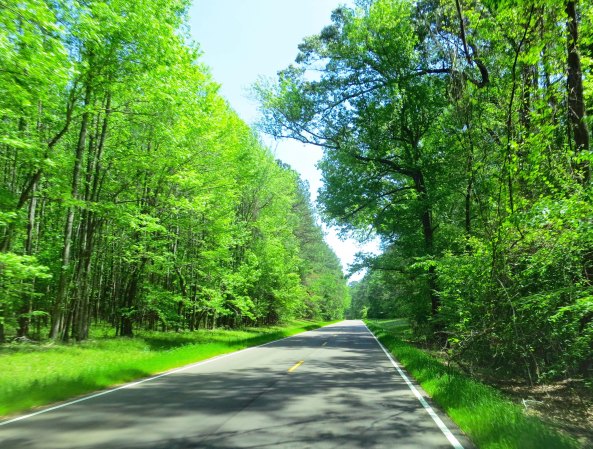
The Natchez Trace between Natchez and Jackson Mississippi.

I don’t think there is a place along the Natchez Trace that isn’t beautiful. I traveled on it for 370 miles of its 450 mile length.

This is my fourth post introducing new followers to the type of tales they can find in my blog. Way back in 1989, I did a solo 10,000 mile bicycle tour of North America. While the journey predated blogging, Peggy and I retraced my route three years ago. Traveling out of California, we crossed the US following a southern route, went up the east coast into Canada, headed back west through Canada to Minnesota, and then finished our tour following a northern route back to California. This is a chance to visit much of North America and hear tales about my bike trek. Want more: Here’s a post from Canada. Scroll forward or backward for the rest of the story:  https://wandering-through-time-and-place.com/2016/09/28/

A large, yellow mutt came wagging his way into my camp. I’d unpacked my gear, set up my tent, and taken off my shoes and socks. My toes were celebrating their freedom.

“Well hello big fellow,” I said to the dog, glad for the company. He sat down beside me and worked his head under my hand, demanding that I scratch behind his ears. Then I was required to pet the rest of him. I had just worked my way down to his tail when he rolled over and insisted on equal treatment for his tummy.

I provided an initial scratch but my coffee water had started boiling. “Priorities,” I told him, “the petting zoo is closed.” Apparently this meant it was play time. He leapt up, grabbed one of my socks, and bounced off about 15 feet.  “Hey! Bring that back,” I urged. Fat chance. He put the sock down, backed off a couple of feet, and started barking.

I finished pouring the hot water into my coffee filter and got up, tiredly, to retrieve my sock. It had been an 80-mile day and I really didn’t want to play ‘chase the dog around the yard.’ I pretended that I didn’t care, that I wasn’t going for the sock, and that I was terribly interested in a large bullfrog that had taken up residence in the swimming pool. The pool hadn’t been cleaned since the previous summer. It made a great pond.

The dog didn’t buy it. He dashed in, grabbed the sock and ran off across the yard. “Okay, you win,” I declared while picking up a stick. “How about a game of chase the stick?” The dog cocked his head and increased his wags per second. I tossed the stick and off he dashed, leaving my sock behind. I quickly bare-footed it across the lawn and grabbed my sock.

“Ha, ha, Mr. Dog,” I called after him while waving the sock about enticingly. To compensate my new friend for his loss, I played tug-of-war with the stick. We growled at each other appropriately, all in good fun.

It was early to bed. I had completed my trip from Alexandria by biking through the city of Natchez and was now camped about a mile from the beginning of the Natchez Trace.  I was eager to get up the next morning and start my 370-mile journey up the fabled Parkway through Mississippi and Alabama into Tennessee. As I zipped up my tent, the big yellow mutt did three dog turns outside the door and plopped down, making me wonder where his home was. I was hardly in a position to adopt a pet. Besides, he was well fed and wearing a dog tag.

My last memory before going to sleep was of the bullfrog singing to his lady-love. “Chug-a-rum, chug-a-rum, chug-a-rum.”
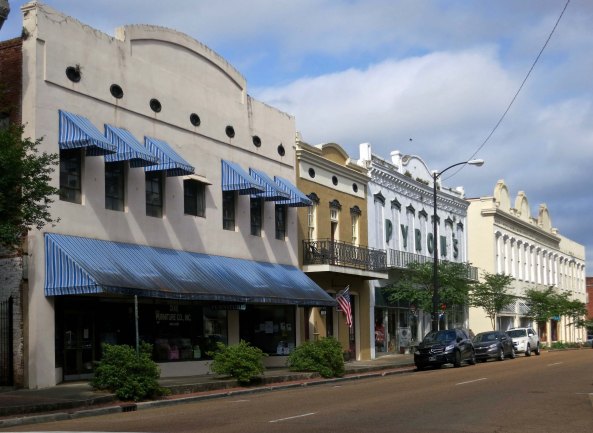
Downtown Natchez, Mississippi.

Peggy and I drove through Natchez on a Sunday morning and pretty much had the historic section of the downtown to ourselves.
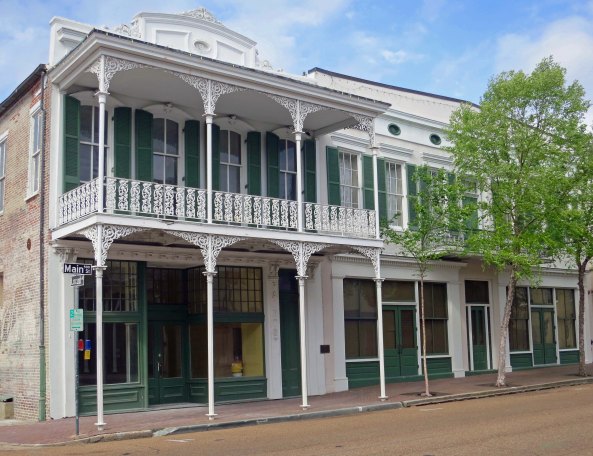
Historic building with balcony in Natchez, Mississippi.

This historic building in Natchez came with an attractive balcony.
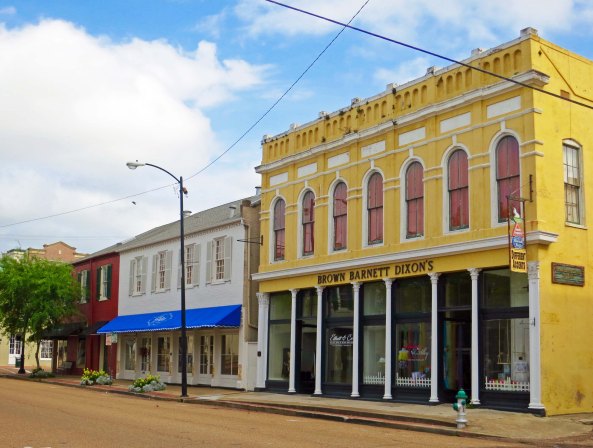
Downtown Natchez, Mississippi on a quiet Sunday.

The colors captured my attention here.
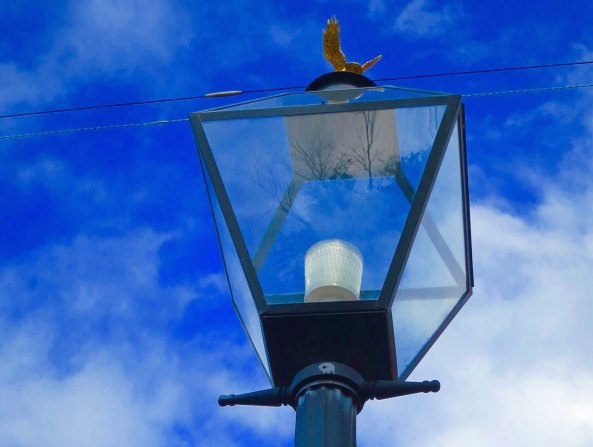
Old lamp posts adorn the historic part of Natchez.
Old lamp posts adorn the historic part of Natchez.

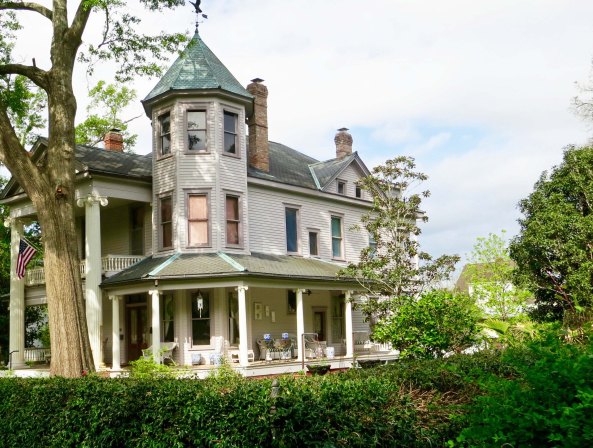
The city is known for its antebellum mansions.
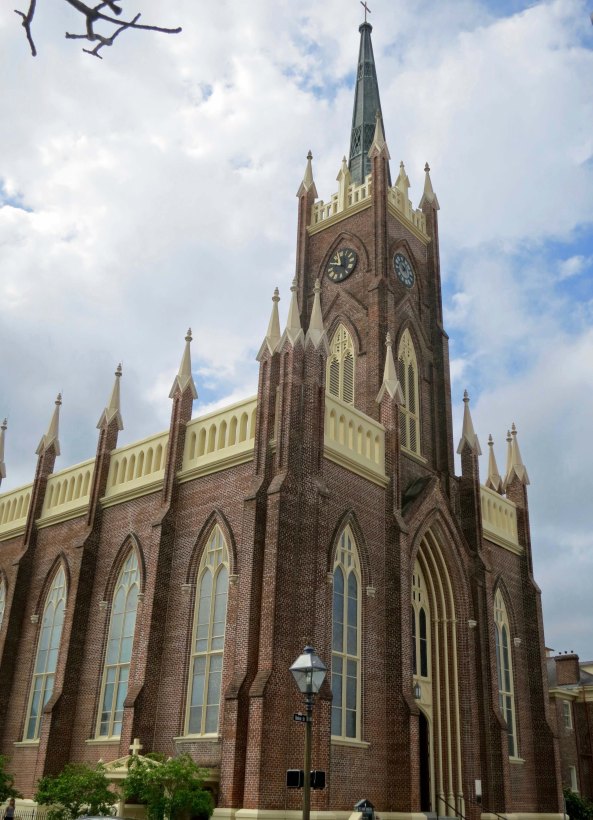
The city is known for its antebellum mansions.

St. Mary's Catholic Church in downtown Natchez, Mississippi.

St. Mary’s Catholic Church was busy with its Sunday service so I didn’t go inside.

St. Mary's Catholic Church is located in downtown Natchez, Mississippi.

It was quite impressive from the outside, however.

Natchez has an interesting history. Once the site of a major Native American village, its initial contact with Europeans goes all the way back to Hernando de Soto in the mid 1500s. He wandered through the area searching for gold to steal, the primary occupation of Spanish Conquistadores. By the 1700s the French had entered the area followed by the British, the Spanish again, and finally, in 1795, the Americans. Native groups in the region included the Natchez, Chickasaw, Yazoo, Cherokee, and Creek, as well as the Choctaw further to the north.

As for the Natchez Trace, its beginning goes back 10,000 years and was probably tied to buffalo travelling along ridges doing buffalo things. Since these broad, heavy animals make good trails (think of them as early day bulldozers), Native Americans were soon using the routes for trade and travel between large communities.

The next stage in the Trace’s evolution was brought about by river trade in the late 1700s and early 1800s. Kaintucks, boatmen from the Ohio and Mississippi River Valleys, loaded flatboats with merchandise and paddled downstream to Natchez or New Orleans where they made handsome profits for their goods. The challenge was that you don’t row a boat up the mighty Mississippi. The boatmen had to hike or ride horses home. They sold their boats as lumber and made their way back to Nashville via the Natchez Trace

It was an adventure. There is a reason why the Trace became known as The Devil’s Backbone. It was crawling with highway men eager to separate the Kaintucks from their newly earned wealth. And that assumes that they could even get their money out of Natchez where cheap whiskey cost a fortune, hot love was based on cold cash, and cut-throats came by the bushel.

The development of steamboats in the 1820s changed things dramatically. These boats with their large, steam-driven paddle wheels could travel upriver. Boatman no longer had to hike or ride horses back to Nashville while fighting off thieves.  Gradually, people stopped using the Trace and it faded from memory.  But not totally.

In 1903, the Mississippi chapter of the Daughters of the American Revolution took on a project of placing markers along the original route. In 1918 the precursor to the Natchez Trace Association was created with the rallying cry of “Pave the Trace!” Work on the Parkway was started in 1937 and in 1938 it became a unit of the National Park system.

When I rode my bike out of Natchez in the spring of 1989, the Trace was mainly complete and had become something of a bicyclists’ paradise. (Today it is considered one of the top ten bike rides in America.)   To start with, there was no commercial traffic. No 18 wheelers would be whizzing by me. Nor were there any commercial properties or billboards, just lots of beautiful woods and small farms. Campgrounds and restrooms were located conveniently along the way.  Frequent rest stops featured local history. I was free to ride along and enjoy the scenery.

But I did have two responsibilities. The first was to persuade the large, yellow mutt that he wasn’t going with me. It started with a discussion in camp that I thought he had understood. Where I was going was dangerous for doggies. It was dangerous enough for me. About a mile from camp I chanced to look back, there he was, about 50 yards back. I stopped and waited for him to catch up, all a waggle. “No!” I said forcefully. “You cannot go. Go Home!” The tail stopped wagging. Two sad brown eyes accused me of horrendous deeds. Ever so slowly, he turned around and started back, tail between his legs. I felt terrible.

The second chore was more pleasant— rescuing baby turtles. Bunches were migrating across the Trace outside of Natchez. Each time I came on a crowd, I would stop, climb off my bike, and give the little tykes a lift across the pavement. I knew that there would be more coming along behind but I must have transported at least a hundred,undoubtedly saving them from being run over.

Following are several photos of the Trace from Natchez to Jackson, Mississippi that I took during the route review Peggy and I did this past spring.  In my next blog we will make a slight detour to the town of Philadelphia, Mississippi where a good friend lives and then head up the Trace to Tupelo and visit with Elvis.
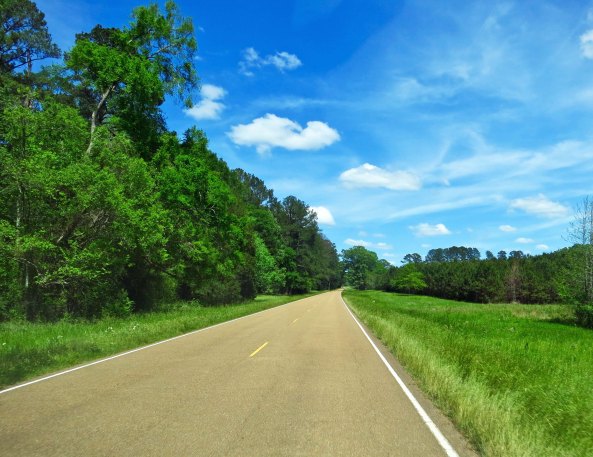
Views along the Trace were constantly changing from being forested to open.
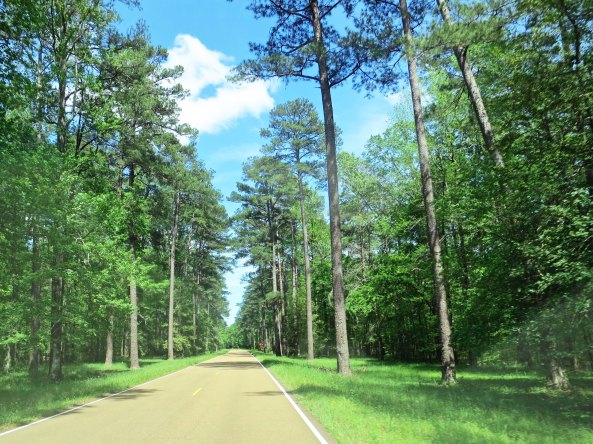
Views along the Trace were constantly changing from being forested to open.

Pine trees became common around Jackson, Mississippi.
Pine trees became common around Jackson, Mississippi.

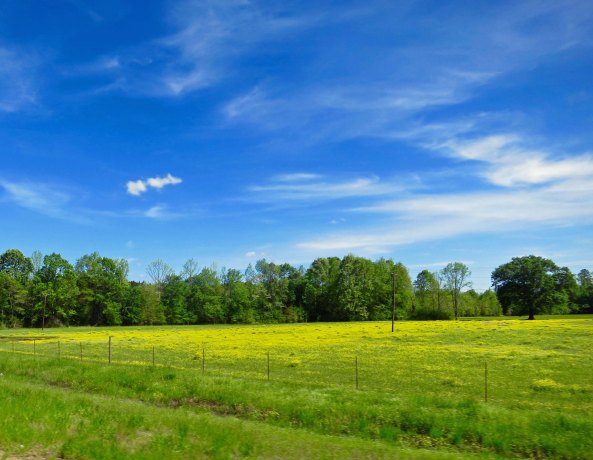
Rich farmlands border some of the Trace.
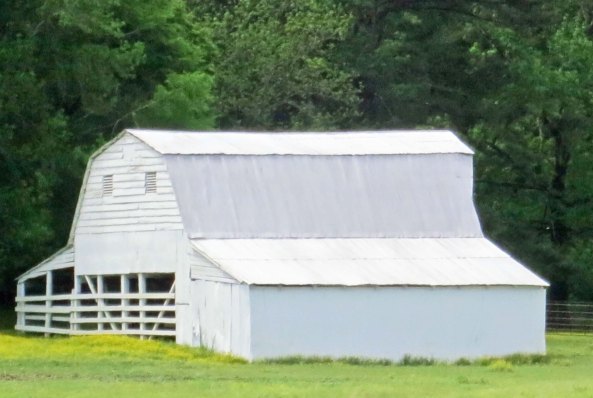
Rich farmlands border some of the Trace.

There are a number of barns.
There are a number of barns.

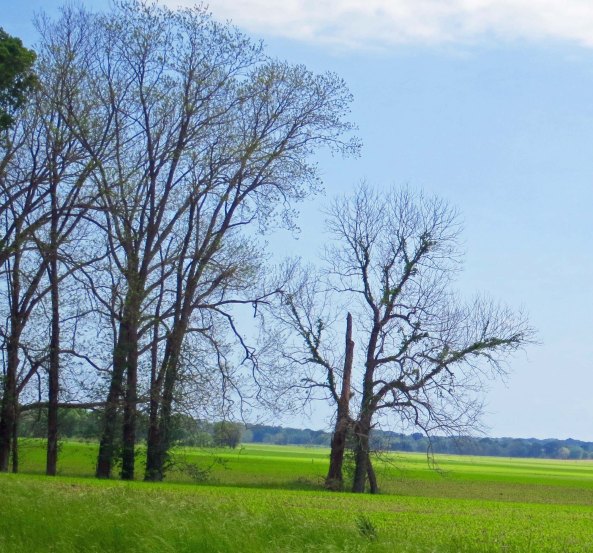
These trees had yet to leaf out.

These trees were just beginning to leaf out. I enjoyed the silhouettes they created.
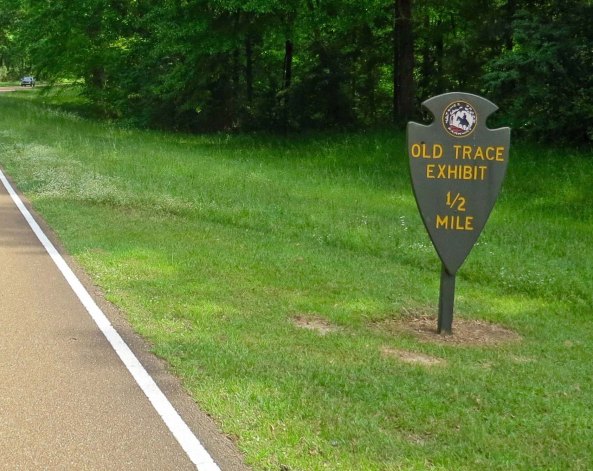
Numerous exhibits featuring the history of the Trace provide interesting breaks along the way.
Numerous exhibits featuring the history of the Trace provide interesting breaks along the way.

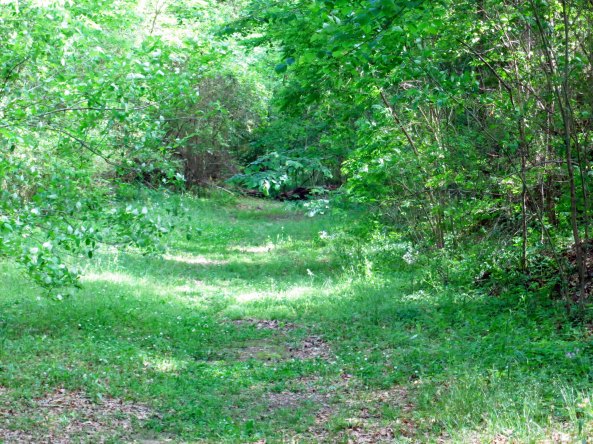
A number of the stops, like this one, include original sections of the trail.
A number of the stops, like this one, include original sections of the trail.

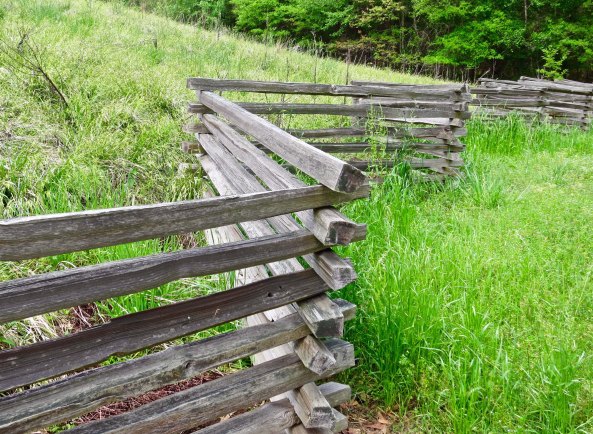
The Park has also rebuilt traditional fences that the pioneers who lived along the Trace would have built.

The Park has also rebuilt traditional fences similar to ones that the pioneers who lived along the Trace would have built.
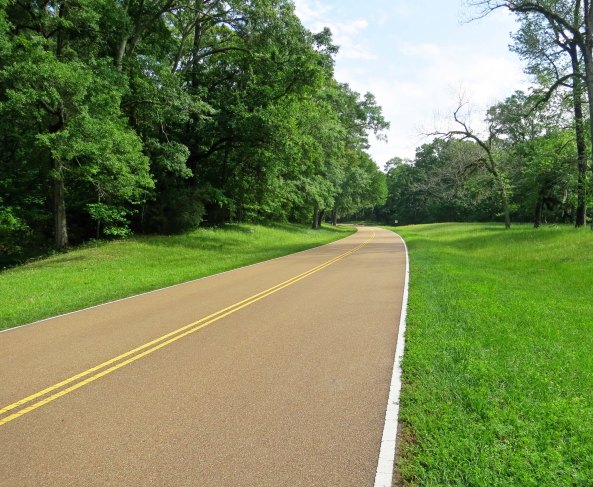
A final view of the Trace for today. Many more will be included in my next three blogs.

A final view of the Trace for today. Many more will be included in my next three blogs.