A Pot Smoking Orgy in the Mountains? No Way… The First Sierra Trek: Part 4

The high Sierras are chockfull of beautiful alpine lakes. Except for very dry years, water is rarely a problem. Often the opposite is true, especially when it comes to crossing creeks and rivers filled with rushing snowmelt.

The high Sierras are chockfull of beautiful alpine lakes. Except for very dry years, water is rarely a problem. Often the opposite is true, especially when it comes to crossing creeks and rivers filled with rushing snowmelt. Obviously, that wasn’t a problem here.


In my last blog about the Sierra Trek, I wrote about how we had survived the first day. Often, as I have learned from over 30 years of experience, that’s the toughest part. But on the first Sierra Trek, it was only the beginning of my problems…

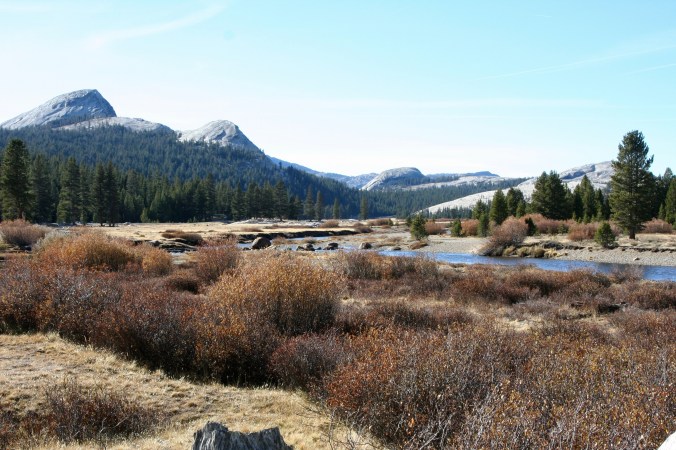
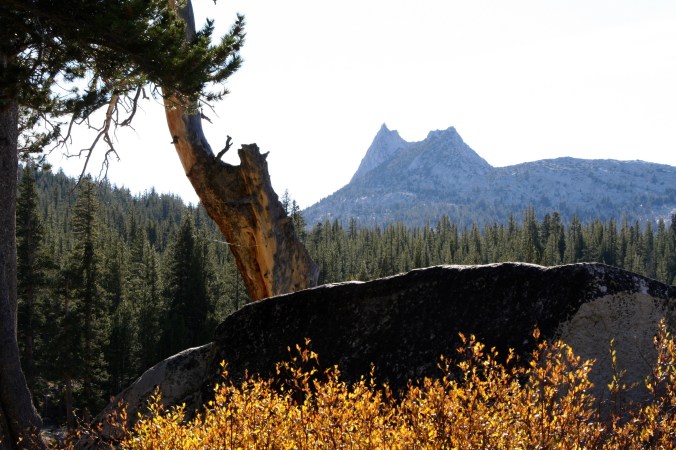
A reminder, the photos I am using are from other Treks I have led over the years. I am sticking with my water theme today, given all of the water problems I had on days one and two of Sierra Trek I. 

Steve, Lisa and I set up camp on the opposite side of a small stream from our Trekkers. I am not sure why. Maybe Steve and I were subconsciously escaping from what we had created, but I suspect we just wanted a good night’s sleep. The Trekkers were noisy and the burbling brook served as nature’s sound maker.

I made my evening rounds before turning in. We had divided the Trekkers into food groups of four and I went from group to group checking for problems. Overall, people seemed in good spirits. There were a few sore ankles and knees, but blisters were the problem that elicited the most complaints. I dispensed sympathy and mole skin. I also gave everyone a preview of the next day and warned that it was going to be tough. My last words were to remind people that 9:00 PM was quiet hour. I wanted everyone fresh for the next challenge.

If there was noise, we didn’t hear it. We were zonked out from exhaustion. Early the next morning we were up in the dark, wolfing down our quick breakfast of instant oatmeal, and throwing our gear together when Charlie arrived. He looked serious.

“We have a problem Curt,” he started without preamble. God, I hate those words. My vivid imagination had a stove blowing up, or a Trekker cutting herself, or one of Steve’s migrating rattlesnakes finding a warm sleeping bag. Or maybe the IRS had arrived to grab Charlie and we were to be held as accomplices.

“What’s up?” Steve threw in, cutting short my growing list of possible disasters.

“We had a doctor from Sacramento come in and camp next to us last night,” Charlie reported. “He says he is going back to Sacramento and tell the press that the Lung Association is running a pot-smoking-orgy in the mountains.”

“Oh hell,” Steve said. I seconded his thought and added a few of my own with much more colorful words. A blown-up stove I could deal with. A cut I could bandage. A rattlesnake I could chase off and frequently have. But what do you do with a physician who has infected his butt with his head. Beg? It took absolutely zero imagination to figure out what the Trek’s future and my career with Lungland would look like one day after ‘pot-smoking-orgy’ made the headlines.

“I tried to reason with him but it was impossible,” Charlie threw in as if he were reading my mind and wanted to dash any hope I had. Just then Orvis came tramping into our camp. Uh-oh I wondered, is the other shoe about to drop? Orvis could backpack at 70 because he had never consumed alcohol or smoked in his life. He was almost as pure as his white beard that decorated his chest. I couldn’t imagine him being very tolerant of misbehavior.

“The man is lying,” Orvis said angrily and forever earned my undying love. “I was there the whole night and no such thing happened. If he goes back to Sacramento and talks to the press, I’ll go back to Sacramento and talk to the press and we’ll see who they believe!”

I wasn’t quite as sure about Trekker behavior as Orvis. It was the seventies after all and we had recruited some interesting characters. I had heard the teenagers giving each other a hard time the night before during my rounds.

“Hey Suzy, why don’t you come over here check out my sleeping bag?” But the response had been, “Why don’t you take your sleeping bag and stuff it?” I had also had a discussion with our younger kids about the Trek not being an appropriate place for tobacco. Who knows what the doctor had seen or had thought he had seen?

“Look, I have an idea,” I said to the small crowd that had gathered around our cook stove.  “I want you to go back to the camp and tell everyone to gather near the rock which is about ten yards away from the Doctor’s camp. Tell them I am going to read them the riot act and I want them to look dejected and apologetic whether they feel that way or not. It’s show time.”

My helpers dispersed to do their job and I carefully thought through what I was going to say. At the appropriate time, I marched over to the rock looking like my dog had just been killed and climbed up on the rock. It was Sunday morning and ever after my lecture was known as the ‘sermon on the mount.’ Sixty expectant but properly humble faces looked up at me. I could see that the doctor had also stopped his activities and glued his attention on what we were up to.

“Last night we made a serious mistake.” I started, making sure the doctor could hear me. “It has come to my attention that there was misbehavior in camp which may have included the use of marijuana. I want to apologize to all of you for not being in camp myself and to let you know I will be from now on. I also want you to know that such activity jeopardizes not only this Trek but the possibility of any events like it in the future. I know that you have all worked hard to be here and that you have worked hard to raise money to fight lung disease and support medical research. I want your word that no such further activities will take place on this Trek.”

Charlie, Steve and company had done their work well. “We’re sorry.” “It won’t happen again.” “You have our word on it,” and similar statements were heard from all sides with everyone looking more serious than I have seen any Trekkers look since. I then dismissed the group to break camp.

As I walked away the doctor made a beeline for me and held out his hand.

“I am Doctor so and so,” he announced. “Although things were out of control last night, it appears you have them under control now and probably won’t have any more problems. Good luck on your trip.”

I thanked him for his concern and breathed an audible sigh of relief. He wandered back to his campsite, undoubtedly pleased with his power and influence while I moved away to avoid expressing my thoughts about his ancestry. The next challenge was how we were going to get our Trekkers through the day. It promised to be a doozy— sixteen miles with very limited water. It left little time to contemplate what might have happened had the misplaced medic carried out his threat.
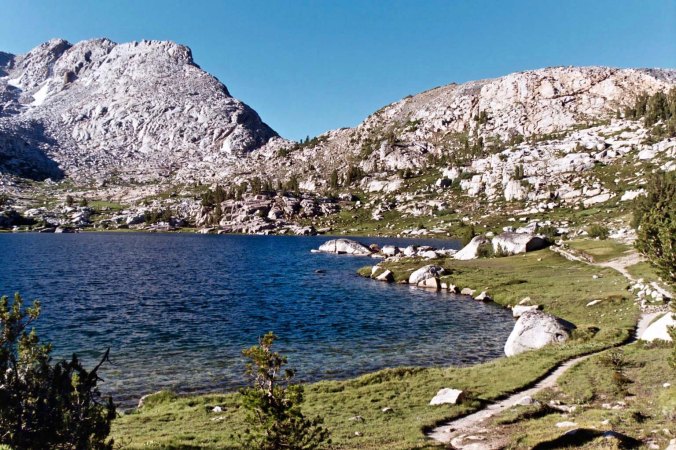
Continuing on with my theme of alpine Sierra lakes, trials like these that wander along the edge are a delight to hike.

Continuing on with my theme of alpine Sierra lakes, trails like these that wander along the edge are a delight to hike.

Alpine lake along the John Muir Trail.

The views aren’t bad either.

Usually, crossing outlets can provide a bit of a challenge, as Ann Nash demonstrates.

Usually, crossing outlets can provide a bit of a challenge, as Ann Nash demonstrates. We spend a lot of time on logs over water. Often it is much scarier than this! Imagine a roaring river below you.

Ann had a nice view of logs...

Ann had a nice view of water soaked tree trunks under the water.

Reflections are also common and can detract from your concentration.
Reflections are also common and can detract from your concentration.

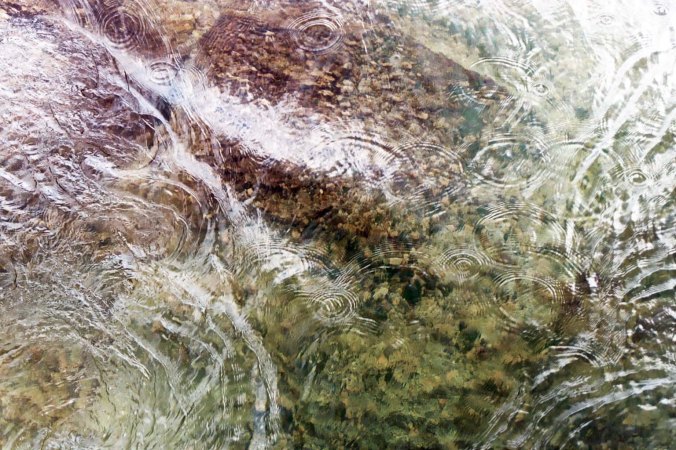
How about rain drops falling on the water...

How about rain drops falling on the water…

Small ponds like this are always a favorite of mine. Mosquitoes can be a problem, though.

Small ponds like this are always a favorite of mine. So, I will conclude with this photo.

NEXT BLOGS: On Friday I will feature more of Burning Man’s colorful mutant vehicles. Next Monday, we will look at the actual airplane that crash landed on the Hudson River. On Wednesday, I’ll return to the Sierra Trek where we cover 16 miles without water, a person is lost, a giant rattlesnake forces me off the trail, and I face a mini-rebellion. Some fun!
From Dawdling Ducks to a Bodacious Baboon… More of Boston

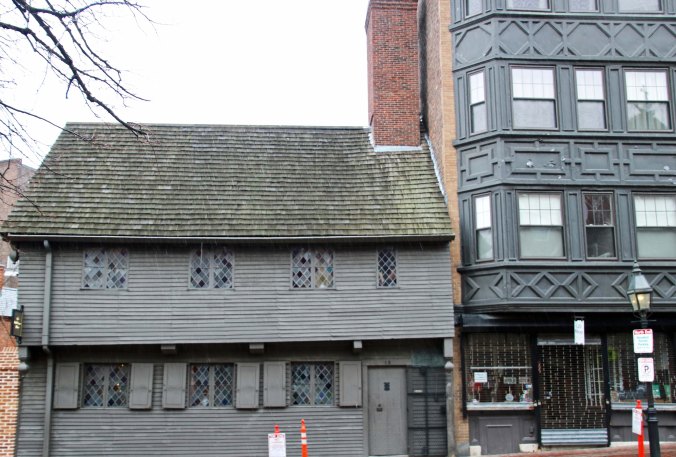
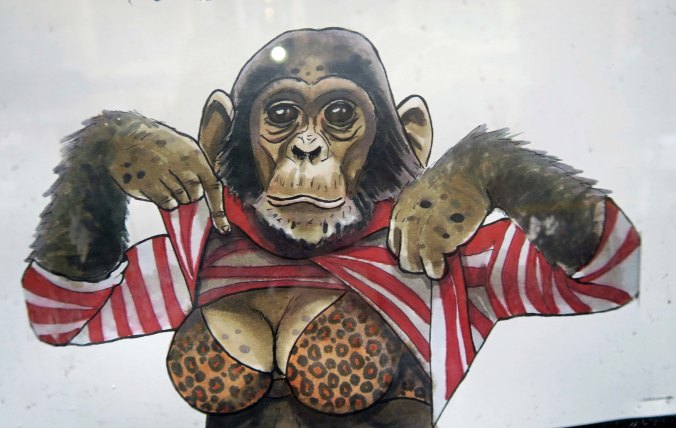
Had I not been walking in Boston, I would have missed this bodacious baboon who was advertising a play near Paul Revere's house in North Boston.

Had I not been walking in Boston, I would have missed this bodacious baboon who was advertising a play near Paul Revere’s house in North Boston.

My favorite way to see a city is to walk. Actually, it is my favorite way to see anything. You miss a great deal in a car, or on a tour bus, or by using public transit. Even a bicycle has its limits, especially in a city where you are busy dodging cars and trucks. But with walking you can lollygag, stop when you want, or put on a burst of speed if you have to be somewhere. You may laugh at the latter, but you have never been with Peggy when she decides to take off. It’s zippity-doo-dah time. Strong hikers have been known to whine about keeping up.

I’ve shown you a fair amount of historical Boston in my last three Boston blogs. Today I am going to wrap up the series and feature some of the photos Peggy and I captured that didn’t fit into the first three blogs. Enjoy.

Ma was all dressed up in her Christmas cap, as were her ducklings.

Ma Duck was all dressed up in her Christmas cap, as were her ducklings.

Quincy Market backs up to Faneuil Hall. The trees in its plaza were beautifully lit for the season.

Quincy Market backs up to Faneuil Hall. The trees in its plaza were beautifully lit for the season.

Built in the early 1800s, Quincy Market is now crammed full of market-stall type restaurants filled with tempting goodies.

Built in the early 1800s, Quincy Market is now crammed full of market-stall type restaurants filled with tempting goodies. The people were waiting for performances by a high school band and a high school chorus.

The goodies inside included these candy apples. There is something for everyone!

The goodies inside included these candy apples. There is something for everyone, including M&M covered apples. Hmmm.

Peggy and I visited the Market twice since it was close to our hotel: once at night when it was packed and then early in the morning when this photo was taken.

Peggy and I visited the Market twice since it was close to our hotel: once at night when it was packed and then early in the morning when this photo was taken.

Some kids came by to play this piano while we were sitting in the market drinking coffee.

Some kids came by to play this piano while we were sitting in the market drinking coffee. I really like the idea of having a “Play Me, I’m Yours,” piano available. The kids were really good. It turned out they were from the band playing outside.

This is what we saw looking up from our seats.

This is what we saw looking up from our seats.

The band outside warms up. Literally. Soon afterwards it started to snow.

The band outside warms up. Literally. Soon afterwards it started to snow.

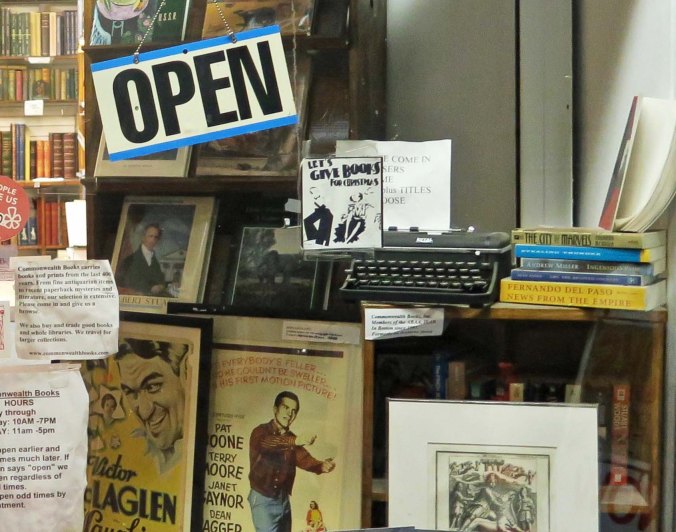
The Commonwealth Bookstore pulled us in with this display.

The nearby Commonwealth Bookstore pulled us in with this display.

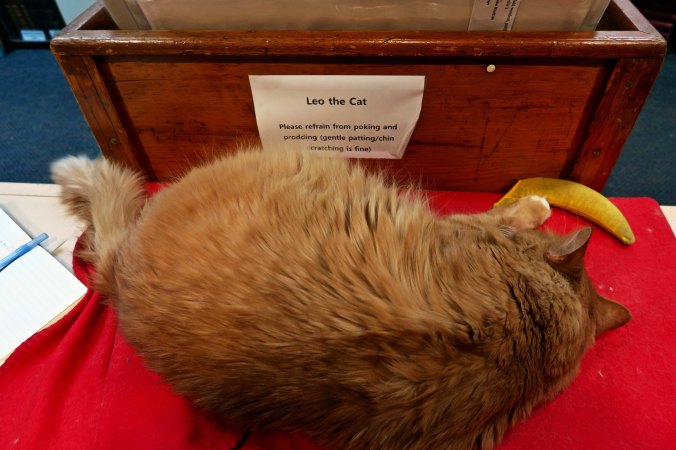
I knew it was a good bookstore when I found Leo.

I knew it was a good bookstore when I found Leo. I am convinced that any bookstore with a cat is a good bookstore. The sign requested that customers please refrain from poking or prodding Leo. “Gentle patting and chin scratching” were fine.

The Boston Public Market was just a few blocks away from the Quincy Market.

The Boston Public Market was just a few blocks away from the Quincy Market.

Winter squash and turnips were among the vegetables it featured.

Winter squash and turnips were among the vegetables featured.

The turnips...

The turnips…

We found this sculpture in front of the John F. Kennedy Federal Building and I confess it had me scratching my head.

We found this sculpture by American Sculpture Dimitri Hadzi in front of the John F. Kennedy Federal Building and I confess it had me scratching my head. Research told me that it represented the last man standing at Thermopylae where the Spartans fought the Persians until there was only one Spartan left. I am still scratching my head.

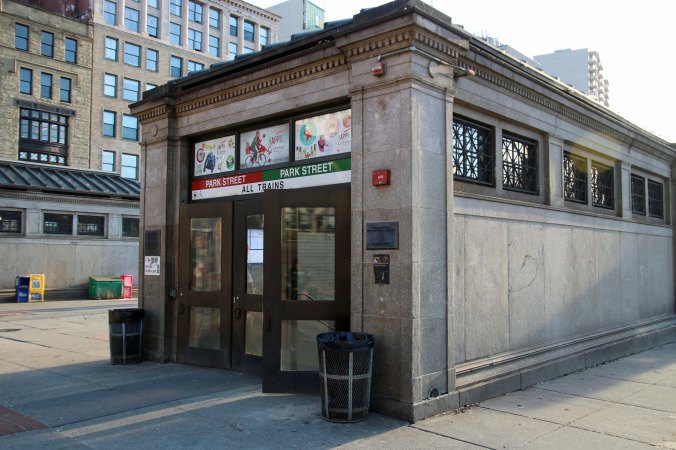
Down on the edge of the Commons we checked out the Park Street Subway System. We had been told that Boston provided excellent mass transit. I found myself wondering whether Charile was still stuck on the MTA.(Kingston Trio song).

Down on the edge of the Commons we checked out the Park Street Subway System. We had been told that Boston provides excellent mass transit. I found myself wondering whether Charlie was still stuck on the MTA.(Kingston Trio song). “But did he ever return? No he never returned. And his fate is still unlearned.” Sing it if you know it!

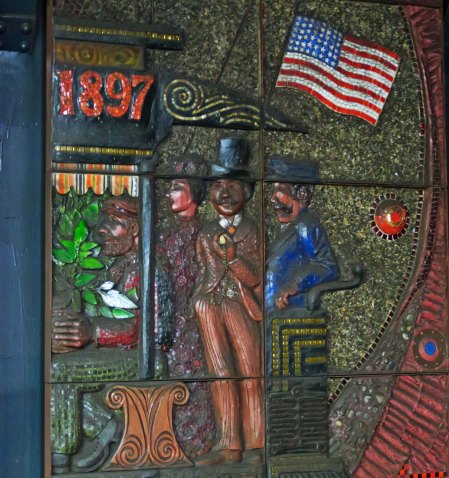
We didn't find Charlie but we did find this ceramic mosaic commemorating the opening of the line in 1897.

We didn’t find Charlie but we did find this ceramic mosaic commemorating the opening of the line. The artist, Lili Ann Rosenberg lived in the Applegate Valley of Oregon where I presently live later in her life. The Ruch Library where Peggy serves as president of the Friends of the Ruch Library features one of her ceramic works.

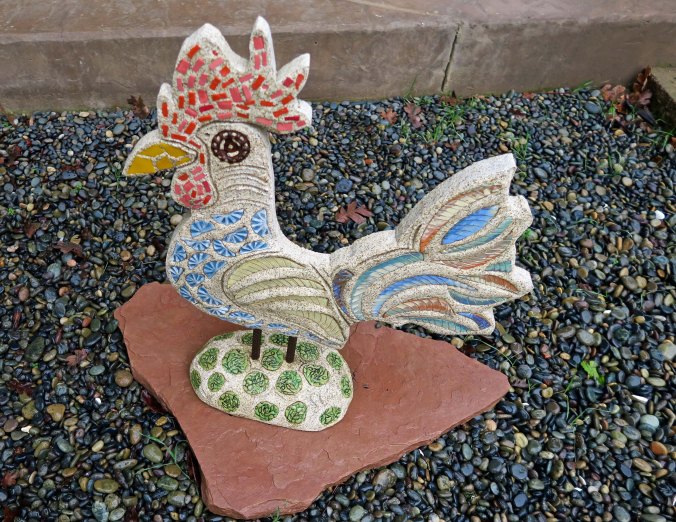
Meet Doodle (as in cock-o-doodle-do). Doodle resides in our front yard and was created by Jeremy Crisswell who worked as an apprentice under

Meet Doodle (as in cock-o-doodle-do). Doodle resides in our front yard and was created by Jeremy Crisswell, a well-known ceramic artist in our area who worked as an apprentice under Lili Ann.

The back side of Doodle.

The back side of Doodle.

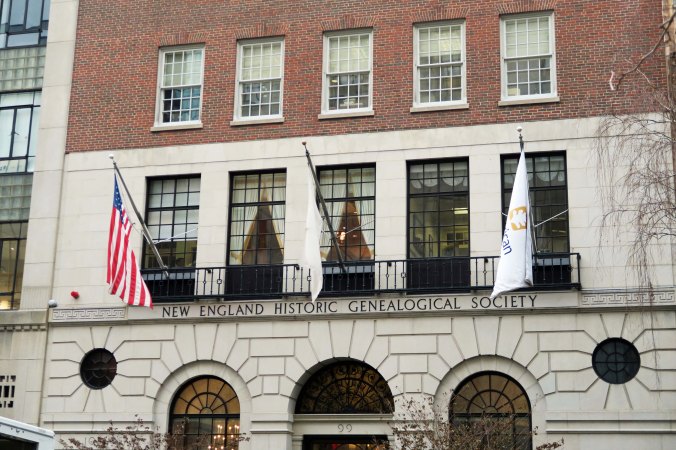
Peggy and I hiked down to the New England Genealogical Society on Newbury street to renew my membership and do a little research.

Peggy and I hiked down to the New England Genealogical Society on Newbury Street to renew my membership and do a little research.

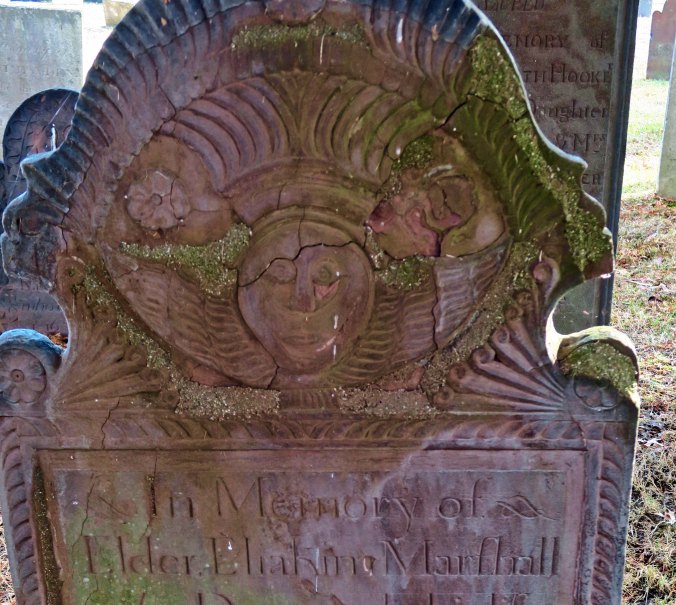
The New England Genealogical Society has been a good source of information about the Marshall's of Windsor, Connecticut. This is Eliakim who was a Deacon in the church. I am hoping that the Society may have information on the Mekemsons as well.

The Society has been a good source of information about my mother’s ancestors in Windsor, Connecticut (the Marshalls).  This is Eliakim who was born in the early 1700s and was an Elder in the Windsor church. I am hoping that the Society will have information on the Mekemsons as well. Interesting headstone, eh?

Newbury is filled with exclusive shops, including for those who have 'a pea in pod.'

Newbury is filled with exclusive shops, such as this one for women who have ‘a pea in the pod.’ Looks like more than a pea to me.

The area is known as Back Bay because it was reclaimed from the Bay. It became a center for very expensive homes competing with Beacon Hill for the wealthy of Boston.

This area was once part of the bay but was filled in by chopping off the tops of Boston’s higher hills. Once filled in, it became a location for very expensive homes competing with Beacon Hill for the wealthy of Boston. This one has been converted to shops.

There are more photos, always, but I will conclude my Boston series with this picture of the old Custom's Building. The hands on the clock are made of copper covered California redwood.

There are more photos, always, but I will conclude my Boston series with this picture of the old Custom’s Building. The hands on the clock are made of copper covered California redwood.

NEXT BLOGS:

Wednesday: It’s time for the next post in the Sierra Trek series where I am accused of running a pot-smoking-orgy in the mountains. Woohoo!

Friday: More of the fantastic mutant vehicles/art cars of Burning Man.

Monday: Remember Sully, the pilot who saved the lives of his passengers by landing on the Hudson River in New York City? We are going to check out his plane. It now resides in a museum in Charlotte, North Carolina. It’s amazing that it floated.

HAPPY VALENTINES DAY!


A 60-foot Fire-Breathing Dragon Roars into Washington— 3 Days after the Election… The Mutant Vehicles of Burning Man: Part 1

If Trump had stared out his window and seen this fellow staring back at him, do you think it would have changed history?

If Donald Trump had stared out his window and seen this fellow staring back, do you think it would have changed history?

Today I am kicking off my Friday photo-essay series on Burning Man. Last week I went through the thousands of photos I have taken since I first went in 2004 and winnowed them down to a mere 4,000. (grin) I suspect you will see a few hundred of them on Fridays over the next six months leading up to the event. 

I had a long discussion with myself over what to start this series with. “What are you talking to yourself about?” Peggy had asked worriedly. Mutant Vehicles won out. I love the variety: from dragons to bugs to ships to rhinos to cats to Mad Max wannabes— Burning Man has them all! 

Peggy and I share photo taking responsibilities at Burning Man but we also have help from fellow members of the Horse Bone Tribe: Don Green, Tom Lovering and Ken Lake. I’ll try to credit Don, Tom and Ken, but if I miss a few, my apologies. 

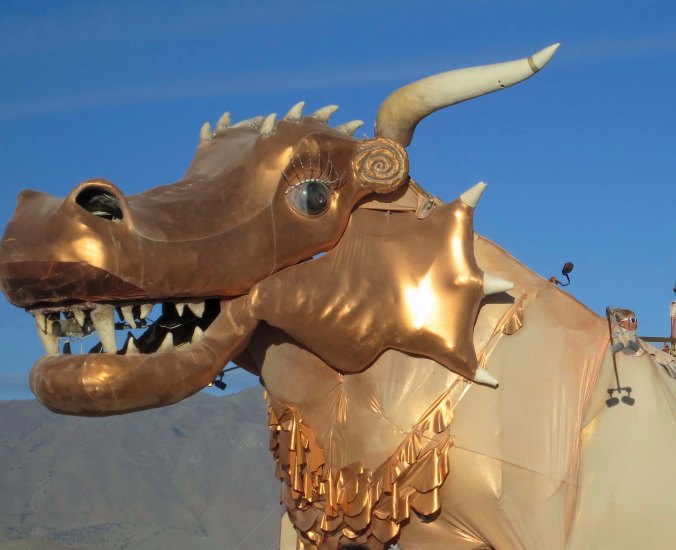
Let’s start with Abraxas,  a 60-foot dragon equipped with a 10,000-watt sound system. Normally, Abraxas hangs out at Burning Man, but on November 11 (right after the election) he was in Washington DC on the Mall. I wonder if the new president looked out his window and saw him. Probably not. There weren’t any tweets.

He seemed quite proud of his offspring who followed him everywhere.

What would Trump have tweeted about Abraxas? Any ideas?

Abraxas has been going to Burning Man for a number of years. In 2016, he showed up with a baby.

Abraxas has been going to Burning Man for a number of years. In 2016, he showed up with a baby.

Early in the morning before sunrise, Abraxas likes to hang out at the Temple, you can see him lurking out on the Playa. When the sun comes up, it is time to dance and he fires up his 10,000 watt speakers as Burners gather around.

Early in the morning before sunrise, Abraxas likes to hang out at the Temple, you can see him lurking out on the Playa. When the sun comes up, it is time to dance, however, and he fires up his 10,000 watt speakers as Burners gather around.

Another close-up of Abraxas.

Another close-up of Abraxas. The tube coming out of his mouth spits out fire at night.

Abraxas the mutant Vehicle at Burning Man.

Check out the claws!

Most mutant vehicles at Burning Man take on a different look/personality at night. Here, Abraxas was getting ready to go out and party the night away.

Mutant vehicles at Burning Man take on a different look/personality at night. Here, Abraxas was getting ready to go out and party the night away. You may have noted the different faces. Most years,  Abraxas comes back to Burning Man with a new look.

The golden dragon is one of hundreds of mutant vehicles/art cars found at Burning Man each year. While you are required to park your car, truck, RV, etc. at your camp and leave it parked, mutant vehicles are free to roam the playa and Black Rock City, assuming they have a permit. Today I am going to also feature a warthog, a lion, an angler fish, a lizard dragon, a mammoth and traveling bar. There will be more next Friday!

Warthog mutant vehicle at Burning Man.

This warthog is a favorite of mine.

Warthog art car at Burning Man.

Head on! Check out the tusks.

Burning Man warthog mutant vehicle.

And a side view. I think he is kind of cute. I once followed a warthog and her kids across the Serengeti Plains in Africa. Mom and kids all had their tails sticking straight up in the air.

Burning Man is okay, huh. Are you ready for some reggae?

Burning Man is okay, huh. Are you ready for some reggae? The M.O.J.P. is taken from Bob Marley’s song, Exodus, and stands for “Movement of jah People.”

M.O.J.P. mutant vehicle at Burning Man.

A side view of M.O.J.P., which I assume is a lion. Note the big mouth.

M.O.J.P. art car at Burning Man.

My friend Tom Lovering found it quite comfortable. M.O.J.P., BTW, was once an RV.

Lizard dragon mutant vehicle at Burning Man.

Peggy found this small but ferocious looking dragon out on the Playa and climbed aboard. Fortunately it was missing keys. Otherwise I still might be searching for her.

Small dragon art car at Burning Man.

The dragon’s snout.

Head on view of mammoth art car at Burning Man.

Somebody had a twisted sense of humor when it came to creating this Mammoth art car.

Head and tusks of mammoth at Burning Man.

A side view of the mammoth’s head and tusks. I wonder if the wire around the head is supposed to be a halo?

Mammoth art car in Black Rock City at Burning Man.

A full view of the mammoth.

Angler Fish art car on Playa at Burning Man.

Whoa! If I didn’t have a clue about what was happening and saw this creature drifting by in a dust storm, I would be looking for the nearest exit.

Angler fish mutant vehicle at Burning Man.

Here’s the angler fish up close and personal. In nature, angler fish use the nose dangly as bait for attracting prey. Great teeth.

Front view of angler fish at Burning Man.

How the fish might look just before it chomped down on you.

I'll conclude today with the Playa's wandering bar complete with outhouse. (Photo by Tom Lovering.)

I’ll conclude today with four photos of  the Playa’s wandering bar complete with outhouse. Wandering around through the desert can give a person quite a thirst! (Photo by Tom Lovering.)

This tractor pulls the bar around.

This tractor pulls the bar around.

Burning Man's traveling bar.

Action at the bar! Tom and I stopped for a taste of moonshine. It was potent stuff!

Kitchen of wandering bar at Burning Man.

Peggy walked through the bar’s door and came out in this kitchen!
NEXT BLOGS:

Monday: I’ll conclude my Boston series.

Wednesday: It’s back to the Sierra Trek and the “pot smoking orgy.”

Friday: My next post on the mutant vehicles of Burning Man.

It Takes a Worried Man… The First Sierra Trek: Part 3

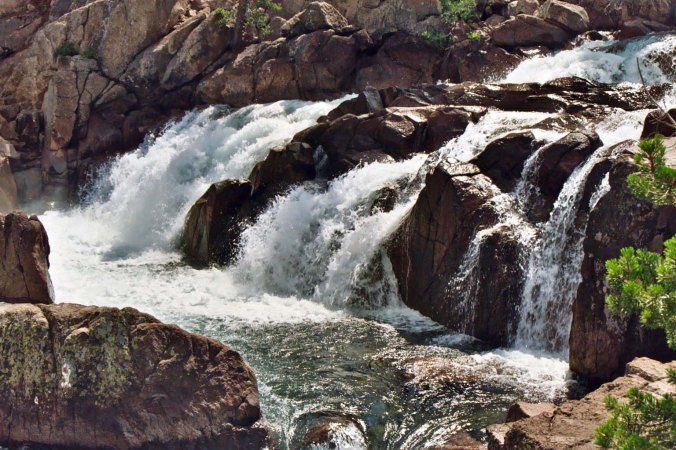
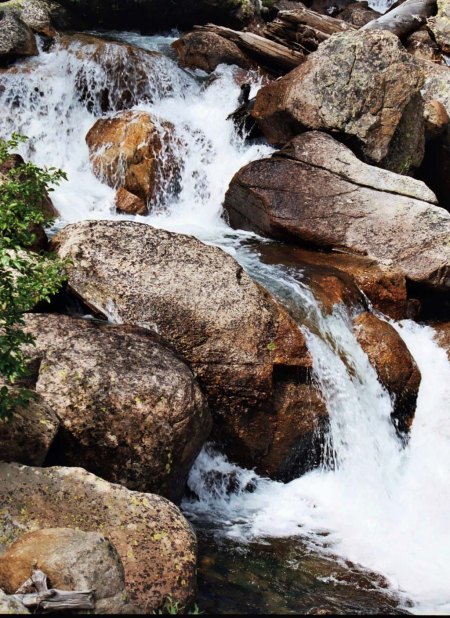
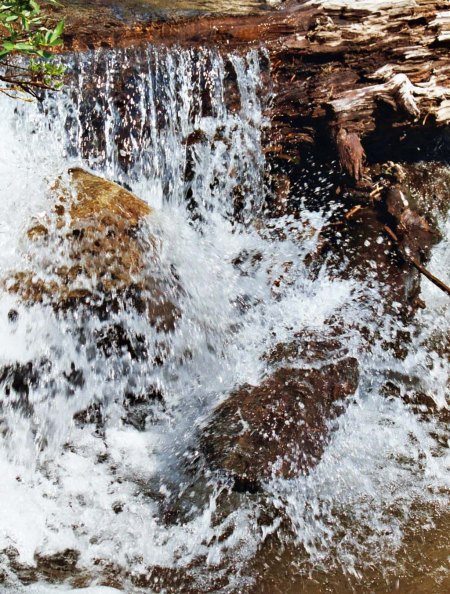
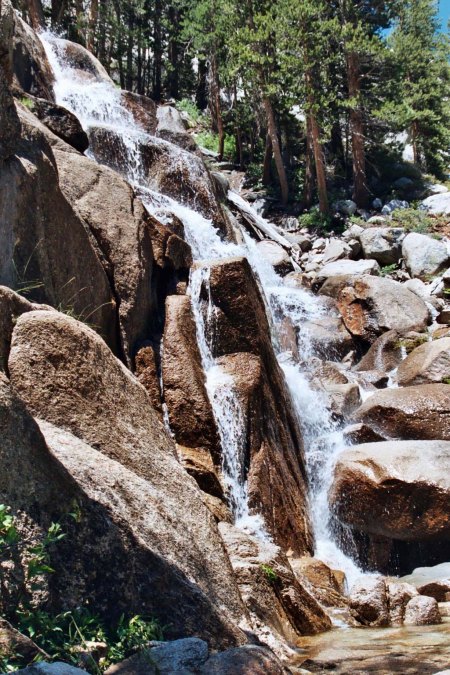
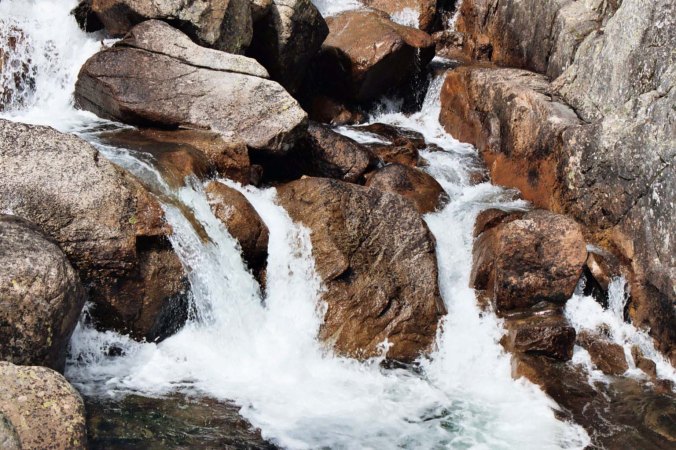
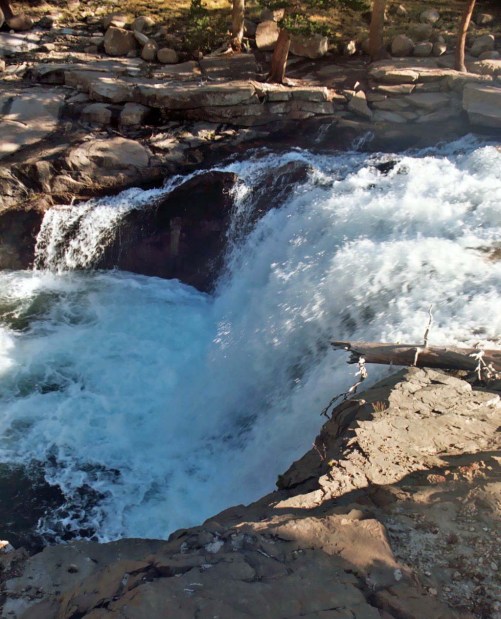
Water became a major problem on our first two days of the Sierra Trek. It was one of the reasons I decided to hike down the Sierras instead of across them on all future treks. Today I am featuring waterfalls.

Water became a major problem on our first two days of the Sierra Trek. It was one of the reasons I decided to hike down the Sierras instead of across them on all future treks. Today I am featuring a few waterfalls you find along the range. All of these are along the Pacific Crest Trail.


When I last wrote about the first Sierra Trek, the morning of the event had arrived. I was a worried man. I found myself singing Woodie Guthrie’s fateful words as I drove up into the mountains:

“It takes a worried man to sing a worried song/I’m worried now, but I won’t be worried long/I went across the river and I laid down to sleep/When I woke up, I had shackles on my feet.”

Note: As I’ve mentioned before, the photos in this blog are from other Treks. I didn’t carry a camera on the first year. 


I met my support crew at a small restaurant just outside of Squaw Valley at 7:00 AM. Steve had recruited two friends to help out. One was Steve Locke, whose family owned large sections of Delta farm land and had a town named after them. The other was Bob with no last name, strong quiet Bob who was an excellent man to have along in an emergency, who loaned us valuable equipment such as walkie-talkies and a jeep, and who, I learned years later when he was in prison, made his living flying pot out of South America. Steve Crowle was to be my assistant leader, Steve Locke was going to drive a back-up jeep, and Bob was to be there just in case— in case of what I wasn’t sure.

We drove the last three miles into Squaw Valley to meet our fate. The Trekkers were arriving in droves and milling around like lost sheep. There was fat Charlie, skinny Orvis, beautiful Lisa, and 57 other people ready to follow us across the mountains. I felt a little like Moses must have felt in leading folks off into the wilderness, except I didn’t have his guidance system. I also wondered how Moses might have fared feeding the Israelites Ham Cheddarton instead of manna. We might have a different religion today.

Steve called the Trekkers together and I gave my first ever Trek orientation. I started by pointing out the tram. The first part of their day was to be spent saving 2000 feet and two miles of climbing. Steve had finagled free rides for all of us. This put the participants in a good mood. I then made a serious mistake. I told the Trekkers they should have an easy day.

Rule number one of Trekking is never, never, never tell people they will have an easy day backpacking. Each day is grueling and people may just survive. Period.

All too soon we were on our way, crammed like so many cattle onto the Squaw Valley trams dangling high above the ground as we bounced our way to the top. One of our Trekkers with a fear of heights had wanted to walk. She hid herself in the crowd and refused to look out, frightened that we were going to go careening down the cliffs. Her instincts were good. A few years later, the world watched as a rescue operation pulled people off of one of the very same trams as it dangled 100 feet off of the ground. We made it without any problems.

They started when we got off of the tram.

Steve’s job for the first three days was leading since we were going over the route he previewed. Mine was to be trail sweep or rear guard, as we called it. Our rules were very simple: don’t get ahead of Steve, follow the yellow ribbons left behind by the horse people, and don’t get behind Curt. We also required that Trekkers hike with at least one other person and that they let someone know if they had to leave the trail to ‘serve nature,’ as my students in Africa had called potty breaks.

I was not going to march people through the woods like an army. By allowing them to travel at their own pace, they could move at a speed their bodies and minds were comfortable with. It also allowed for something of a wilderness experience even though we were hiking with a large group. Sixty people would be spread out over 2-3 miles of trail.

Rear guard duty is always the toughest job on a Trek since it’s where the problems accumulate. That first day we made it exactly 50 yards before the first one popped up. The witch had shown up with an old boy scout pack with a rope tied on for a belt. (Remember she was the one who was going to come over in the middle of the night, bite me on the ear, and turn me into something. I think she had a sex-crazed maniac in mind.)

We were still in a transition stage where a few belt-less backpacks were wandering around in the mountains with people attached. Following the dictates of my Bible, “The Complete Walker,” by Colin Fletcher, I had insisted that all of our Trekkers have the belted kind. Not surprisingly, the witch’s ‘belt’ broke immediately. I was tempted to suggest she use her occult powers to fix it but Charlie Colin, the ex-ice hockey player, cheerfully took care of the problem. I loaned her some sun tan lotion and insisted she use it. In addition to having lily-white skin, she was wearing a tiny mini-halter, no bra, and short shorts with close to total exposure.

“But Curt,” she objected, “I want to go home with a complete tan.” Right. I told her she would be one roasted chickadee at the end of the first hour and I didn’t want to be accused of burning witches.

By the time we had taken care of her problems (or at least the ones we were qualified to take care of)— and those of several other Trekkers, Steve had covered a mile plus and was about to disappear over Emigrant Pass into the Granite Chief Wilderness. All the way up the mountainside, I could see our charges struggling with thin air, a steep trail and heavy backpacks. Some, having traveled for 10 minutes and 200 yards, were taking their first 20-minute break of the day. I resigned myself to a long, slow hike.

An hour or so later, Charlie and I crested the pass. Up ahead there may have been people having the easy day I had promised, but they certainly weren’t the 20 or so Trekkers I was now herding along the trail. I looked back at the now distant floor of Squaw Valley and sent a small thank you wafting upward that the first 2000 feet and two miles had been by tram.

I also sent up thanks for the fact that we truly did have a short day. Having cut off two miles from the beginning and hiked another, we only had four to go. Steve had carefully described our first campsite and I had reviewed my topographical map. We were going to drop down into the small valley behind Squaw Valley where the American River begins its journey to the Pacific as soggy ground, and then climb up the ridge that forms the side of Granite Chief Mountain and Needle Peak. Eventually the ridge trail crossed a small, glacier-caused hanging valley perched several hundred feet above the now creek size American River. A spring was running into the valley with ‘ample’ water for our Trekkers.

Apparently, I had used up all of my credit with thanks, though. When we arrived at the proposed campsite, there was only one Trekker present, Bob. I was about to learn what the ‘just in case’ part of his job description meant. This particular just in case was my arriving in camp and finding no one there.

“Everyone has gone on, Curt,” Bob reported. “There is no water. Steve has taken the Trekkers another two miles to Hodgkin’s Cabin.”

Ah that I would have come across a small stream. Even this would have provided enough water for our Trekkers.

Ah that I would have come across a small stream. Even this would have easily provided enough water for our Trekkers.

I am not sure this would have worked but many times I've made do with less when hiking alone.

I am not sure this would have worked but many times I’ve made do with less when hiking alone.

I wanted to whine. People had been whining at me all day. Certainly, it was my turn. The possibility of the small stream running dry must have been apparent two weeks before, I complained to myself, and wearily began rounding up my charges. They had scattered out and plopped down on the ground, like rocks.

There were two bright spots to my day. One was Charlie.  What a character and what a help; he told me his life story as we placed one foot in front of the other. Every once in a while, he would break out chanting: “cold beer, cold beer, cold beer.” It was pure fantasy but the thought kept us going.

The other was the fact that Lisa had joined us and was playing sheep dog with Charlie and me. We kept everyone moving forward with at least a semblance of humor. By this time, Charlie and I had set up a pole between us and were carrying two broken down packs in addition to our own. Somewhere along the trail I offered Lisa my hand to get over a rough spot and we had continued to hold hands. I felt guilty— a little. The rawness of Jo Ann’s confession was still burning a hole in my soul.

Eventually, we arrived at Hodgkin’s Cabin. We had survived day one. Tune in next Wednesday when I am accused of running a pot smoking orgy in the mountains— not true.

Here are a few more tantalizing waterfalls. BTW, I took most of these when I did a 360 mile backpack trip down the Sierras to celebrate my 60th birthday.

Tuolumne River Falls in Yosemite just outside of Tuolumne Meadows.

Tuolumne River Falls in Yosemite just outside of Tuolumne Meadows.

I enjoyed this cascading falls...

I enjoyed this cascading falls…

This split falls...

This split falls…

This narrow falls...

This narrow falls…

And this humdinger filled with snow melt.

And this humdinger filled with snow melt.

Friday and Saturday’s posts: I am excited. I have my ticket to Burning Man! So I spent my past week using an old, limping laptop to peruse my thousands of photos I have taken at the event since 2004, eliminate a bunch, and divide the rest up into categories. I actually got my number of pictures down to around 4,000. (grin) Don’t worry, I am not going to throw them all at you. But I will share select photos. On Friday and Saturday I will kick off my Burning Man posts with some of the wonderful— and weirdly wonderful, mutant vehicles that prowl the Playa and Black Rock City. I’ll move on from there to other categories such as sculpture, tribes, temples, the Man, etc.. This is a series you won’t want to miss!

Did Bessie Eat Grandma’s Ear? The Boston Series

An estimated 5000 people are buried in the two acre Granary Graveyard. A few of them even have tombstones. It helps to be a Revolutionary War hero.

An estimated 5000 people are buried in the two acre Granary Graveyard. A few of them even have tombstones. It helps to be a Revolutionary War hero.

My laptop has finally returned from the doctor! So I can return to the world of blogging. It’s back to Boston and the Revolutionary War today.

Call it yellow journalism, if you will, or a post with a National Enquirer flair. Except this story isn’t filled with the ‘alternative facts’ of modern tabloids, tweets, and Facebook. Bodies did actually float to the surface in the Granary Graveyard found along Boston’s Freedom Trail. Back in the early 1700s, families occasionally discovered their loved ones surfing and needed to replant them.

It was a swampy area, overcrowded with dead bodies. An estimated 5,000 people were buried in the two acres. Digging a new grave inevitably meant running into the previously departed. Plus, there were the cow pies. Grass grew quickly in the graveyard (was it because of the wet conditions or the enriched soil) and the city fathers determined there was money to be made by renting the land out to a grave-digger as a pasture for his cattle. On a positive note, he was required to repair any damage his herd caused.

I imagine his report to Boston’s Selectmen went something like this: “Yes sir, Old Bessie did eat Grandma’s ear. She thought it was a mushroom. But I reburied Grandma along with the appropriate cow pile.” (Definitely an alternative fact.)

Today the Granary Graveyard is considered to be one of America’s most hallowed grounds. Benjamin Franklin’s parents are buried here. As are several Revolutionary War heroes including Paul Revere, John Hancock, Samuel Adams, James Otis, and Robert Treat Paine. Hancock, Adams and Paine were all signers of the Declaration of Independence. There is also a grave marker for the five men who died in the Boston Massacre— Crispus Attucks, Samuel Gray, Samuel Maverick, James Caldwell, and Patrick Carr.

Samuel Adams is one of the Revolutionary War Heroes buried in the Granary. One of America's most ardent revolutionaries, he was an early proponent of independence from England.

Samuel Adams is one of the Revolutionary War Heroes buried in the Granary. One of America’s most ardent revolutionaries, he was an early proponent of independence from England.

The graveyard backs up the stately Park Street Church, which in turn, sits on the edge of the Boston Commons. The leading Abolitionist, William Lloyd Garrison, gave his first fiery sermon against slavery in the church on July 4, 1829, and the anthem, America (“My country tis of thee, sweet land of liberty…”) was first sung from its doorstep. Liberty wasn’t so sweet for black people.

Park Street Church was built in the early 1800s and became a center of opposition to slavery.

Park Street Church was built in the early 1800s and became a center of opposition to slavery.

As for the Commons, it was a true cow pasture. Communities in early New England often set aside a common area where all of the town’s cattle and other livestock could graze and be jointly tended. In 1775 the British turned it into a campground for its Redcoats. That would be the common soldiers, of course; the officers stayed in much more amenable accommodations, held parties and danced the night away. Today the Commons is an attractive public park and has served as a rallying point for the likes of Martin Luther King, Pope John Paul II and the recent Women’s March. Massachusetts’ attractive gold-dome statehouse overlooks the area.

The Massachusetts' State House overalls the bucolic Boston Commons.

The Massachusetts’ State House overalls the bucolic Boston Commons. (Photo by Peggy Mekemson.)

One of the really attractive things about the Freedom Trail, besides its historical significance, is the fact that it can easily be walked in a few hours, or a day if you prefer to dawdle and take time at each of the sites. Or, if walking isn’t your thing, a number of popular bus tours will take you to all of the locations minus the exercise.

Peggy and I did most of the Trail but didn’t cross the Charles River to Bunker Hill. That will have to wait for another time. We did, however, reach Copp’s Hill Burying Ground, a site I found equally interesting to the Granary Graveyard, not because of the people buried there, but because of the tombstones.

The crooked tombstones on Cobb's Hill remind me of someone having a really bad tooth day.

The crooked tombstones on Cobb’s Hill remind me of someone having a really bad tooth day.

Another view of the tombstones on Cobb's Hill.

Another view of the crooked tombstones on Cobb’s Hill.

The Puritans were sensitive about elaborate headstones, wanting to keep things simple. This death's head with its crossed bones was allowed, however, and is found on many early tombstones in the New England region.

The Puritans/Congregationalists were sensitive about elaborate headstones, wanting to keep things simple. This death’s-head with its crossed bones was allowed, however, and is found on many early tombstones in the New England region, including those of my ancestors.

Later, a slightly more friendly cherub was allowed, including this one found in the Cobb's Hill Burial Ground.

Later, a slightly more friendly cherub was allowed, including this one found in the Cobb’s Hill Burial Ground. I think it may be smiling.

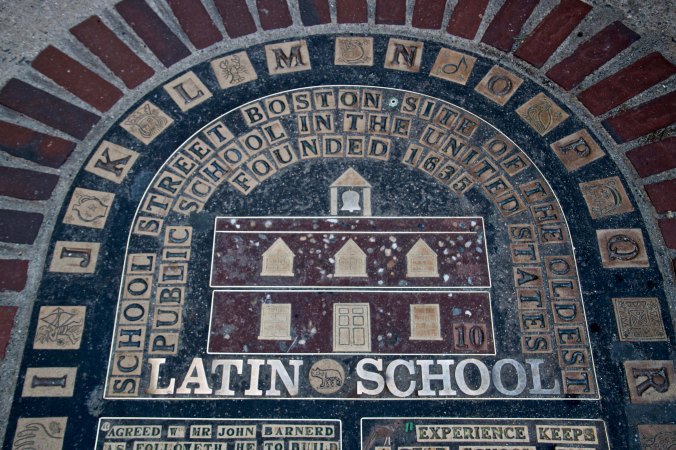
I’ve already introduced you to a number of sites along the Freedom Trail including Paul Revere’s home, the Old North Church, the Old State House, the Old Corner Bookstore (there are a lot of old things in Boston), Faneuil Hall, and the Latin School. I’ll finish my posts on Boston today with a few other sites and some additional photos of Faneuil Hall and the Old Statehouse.

This is a modern version of the Green Dragon Tavern that served as a secret gathering place for hatching many of the early protests against England's efforts to tax the colonies, including the Boston Tea Party.

This is a modern version of the Green Dragon Tavern that served as a secret gathering place for hatching many of the early protests against England’s efforts to tax the colonies, including the Boston Tea Party.

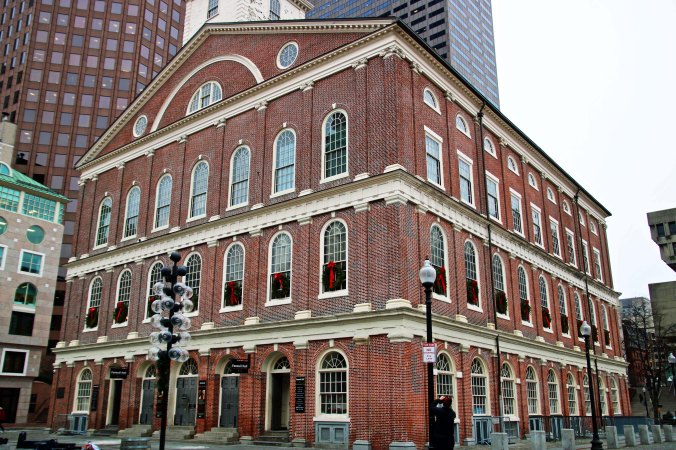
Faneuil Hall served as a more public venue for discussing the tax on tea. It wasn't big enough to accommodate everyone who wanted to protest however...

Faneuil Hall served as a more public venue for discussing the tax on tea. It wasn’t big enough to accommodate everyone who wanted to protest however…

So the meeting was switched to the Old South Meeting House, which was apparently big enough to accommodate the 5,000 people who wanted to participate. Samuel Adam's final words to the gathering, "This meeting can do nothing more to save the country," were apparently the secret rallying cry that sent the Sons of Liberty dressed as Mohawk Indians off to the Boston Harbor for their Tea Party.

So the meeting was switched to the Old South Meeting House, the largest building in Boston at the time. Samuel Adam’s final statement to the gathering, “This meeting can do nothing more to save the country,” was apparently the secret rallying cry that sent the Sons of Liberty dressed as Mohawk Indians off to Boston Harbor for their Tea Party. 

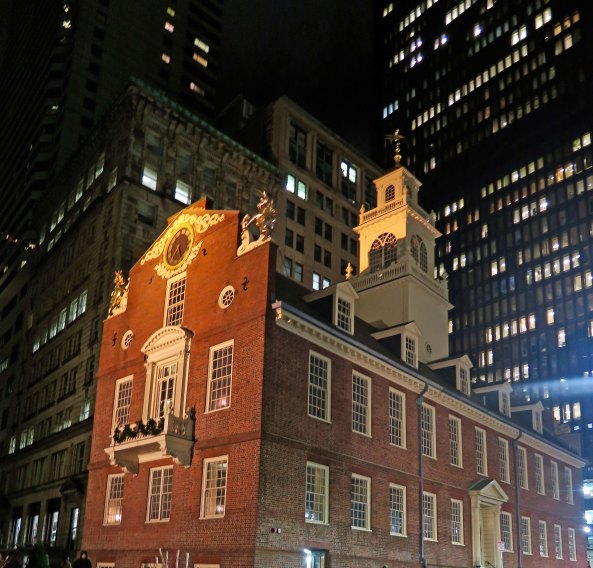
Boston's Old State House sits just across the road from Faneuil Hall. The Boston Massacre took place between the tow buildings. Check out the weather vane... (Photo by Peggy Mekemson.)

Boston’s Old State House sits just across the road from Faneuil Hall. The Boston Massacre took place between the two buildings. Check out the weather vane… (Photo by Peggy Mekemson.)

Grasshopper weathervane on top of the Old State House in Boston.

It’s a grasshopper. (Photo by Peggy Mekemson.)

You may have noticed the lion and the unicorn on the Statehouse as well. This symbols of British power were torn down after the Declaration of Independence and were later restored.

The lion and the unicorn on the Statehouse are symbols of British power. They were torn down after the Declaration of Independence but later restored.

NEXT BLOGS:

Wednesday: Back to the Sierra Trek. Our first night out, a conservative doctor out of Sacramento camps next to us and claims he is going back to Sacramento and tell the media that the Lung Association is running a “pot smoking orgy” in the mountains. Not true, but worrisome, none-the-less.

Friday and Saturday: The wonderfully weird world of mutant vehicles at Burning Man.

It’s 4 AM and a Bear Is Standing on Top of Me… A Sierra Trek Tale

Oregon Black Bear

Black Bears are much smaller than either brown or grizzly bears, but this doesn’t mean they aren’t scary. This one was cruising our neighborhood in Oregon and  tipped over the heavy Webber Grill on our porch. Our daughter, Tasha, was sleeping in the bedroom next to the grill. “Curtis!” she screamed. Later, our neighbor captured the bear’s photo on a surveillance camera.


I’ve been re-blogging older posts while my laptop is at the doctors with memory problems. Today it’s time for another Sierra Trek Tale. Next week, I’ll get back to the first Sierra Trek but today we are jumping ahead five years to the first trek I led into the back country of Yosemite where bears rule.


Bears like me, or at least they haven’t eaten me. They’ve had numerous opportunities over the years. It goes with the territory of backpacking throughout North America for over four decades. My scariest encounters, as it turns out, were also my first.

By the fifth year of the Sierra Trek, I had worked my way southward from Lake Tahoe into Yosemite National Park. Since we were utilizing a new route from Yosemite to Kennedy Meadows, I had to preview it. (Plus it was another excuse to head out into the wilderness and be paid for it.)

My friends Ken Lake and Tom Lovering joined me on the first three days from the Yosemite Valley floor to Tuolumne Meadows. Day one found us climbing several thousand feet out of the Valley and camping above the Little Yosemite Valley. The bears dropped by for a visit on our first night in the Park.

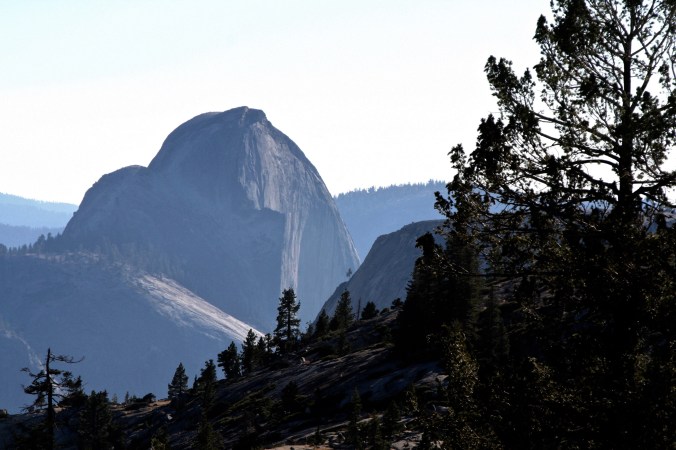
Half Dome, Yosemite. Little Yosemite Valley is on the other side.

Half Dome, Yosemite. Little Yosemite Valley is on the other side.

After carefully hanging our food bags from a cable provided by the park service and burying the left over fake freeze-dried raspberry cobbler (it was made from apples), we trundled ourselves off to our sleeping bags. The problem was we buried the food a little too close to Lake. I think Tom may have been up to his usual mischief.

The next morning, a very excited Ken asked if we had seen the bears in our camp the previous night. Neither of us had and we attributed his sighting to an overactive imagination. Believe me, if a bear had been digging up food next to my head, my two companions would have known about it, immediately.

Day two was tough. What I hadn’t counted on was the amount of snow still left on the ground. We spent most of out time slipping, sliding and slogging through it. By three in the afternoon, Tom was ready to set up camp right in the middle of a snowfield. Ken and I threatened to leave him with the bears and he committed to another hour. Fortunately, that night was bear free. They would have found little resistance from the three of us.

Eventually, we made it into Tuolumne Meadows where I was faced with another challenge: hiking over 70 miles of snow-covered trails by myself while Ken and Tom returned to Sacramento and work. The journey was fraught with opportunities for breaking a leg, or losing the trail, or being washed away when crossing streams raging with water from melting snow. None of the above was a desirable outcome for someone hiking alone.

Tuolumne Meadows in the summer.

Tuolumne Meadows in the summer.

My other option was to return to Sacramento with Ken and Tom, which was not acceptable. I had a week off to wander in the woods and I was going to wander in the woods for a week. I compromised by heading back over the mountains toward Yosemite Valley. My fractured logic concluded that it was better to break a leg and get lost where I had been than where I was going. I also promised myself to be really careful. This included keeping my food from bears.

Hiking out of Tuolumne Meadows took me back around Cathedral Peaks shown here.

Hiking out of Tuolumne Meadows took me back around Cathedral Peaks shown here.

The first day was non eventful and the second idyllic. I was exploring new country, doing what I most love to do. As evening approached, I found a delightful campsite on the Cathedral Fork of Echo Creek. Amenities included a babbling brook to put me to sleep, a flat space for my sleeping bag and a great food-hanging tree with the perfectly placed limb. A hot dinner topped off by tea spiced up with a shot of 151-proof rum and I was ready for sleep.

I carefully hung my food bags at the recommended 12 feet off the ground and 9 feet away from the tree trunk and then snuggled down in my sleeping bag. As was my habit at the time, I slept out in the open, only using my tent when rain threatened.

It was somewhere around 4 am and very dark when I awoke with a pressure on my chest. I couldn’t see very far but I didn’t have to. Approximately five inches away from my face was a long black snout sniffing at me. It was filled with grinning teeth and topped off by a pair of beady eyes that were staring at me with a hungry look.

I let out a blood-curdling scream and vacated the premises.

As I flew in one direction, the equally surprised young bear that had been standing on me flew in the other. I don’t even remember getting out of the bag. The next thing I knew I was standing up, yelling and shining my flashlight into the woods where not one, but two pairs of orange eyes were staring back at me. I lost it. Never have so many rocks been hurled with so much vigor in such a short period of time. The bears wisely decided to head off over the mountain.

But the damage was already done. My camp was a disaster area. My carefully hung food was scattered all over the ground with literally every meal torn open and sampled. All I had left was a chunk of cheese and it had one large bear bite out of it. I hid the cheese under a heavy rock.

As a further insult, one of the bears had chomped down on my plastic rum bottle and all of the rum was gone. I couldn’t even drink. With that option eliminated, I policed the area, crawled back in my bag and went back to sleep. When I awoke in the morning it was obvious that the bears had come back into camp to clean up anything they had missed. Once again the previous night’s trash decorated my campsite. At least the bears let me sleep this time. And they had missed my cheese.

So I ate it for breakfast, cleaned the area again, packed up my gear and hiked 18 miles into the Yosemite Valley to resupply. But my week wasn’t over; neither were my bear experiences. And the summer had only begun. (I’ll get back to these stories in the future after I am finished with my series on the first Sierra Trek. You won’t want to miss the time a bear grabbed me by the head.)

NEXT BLOG: A return to my photo series on Burning Man.


Fort Mifflin: A Tale of Death, Heroism and a Flag…

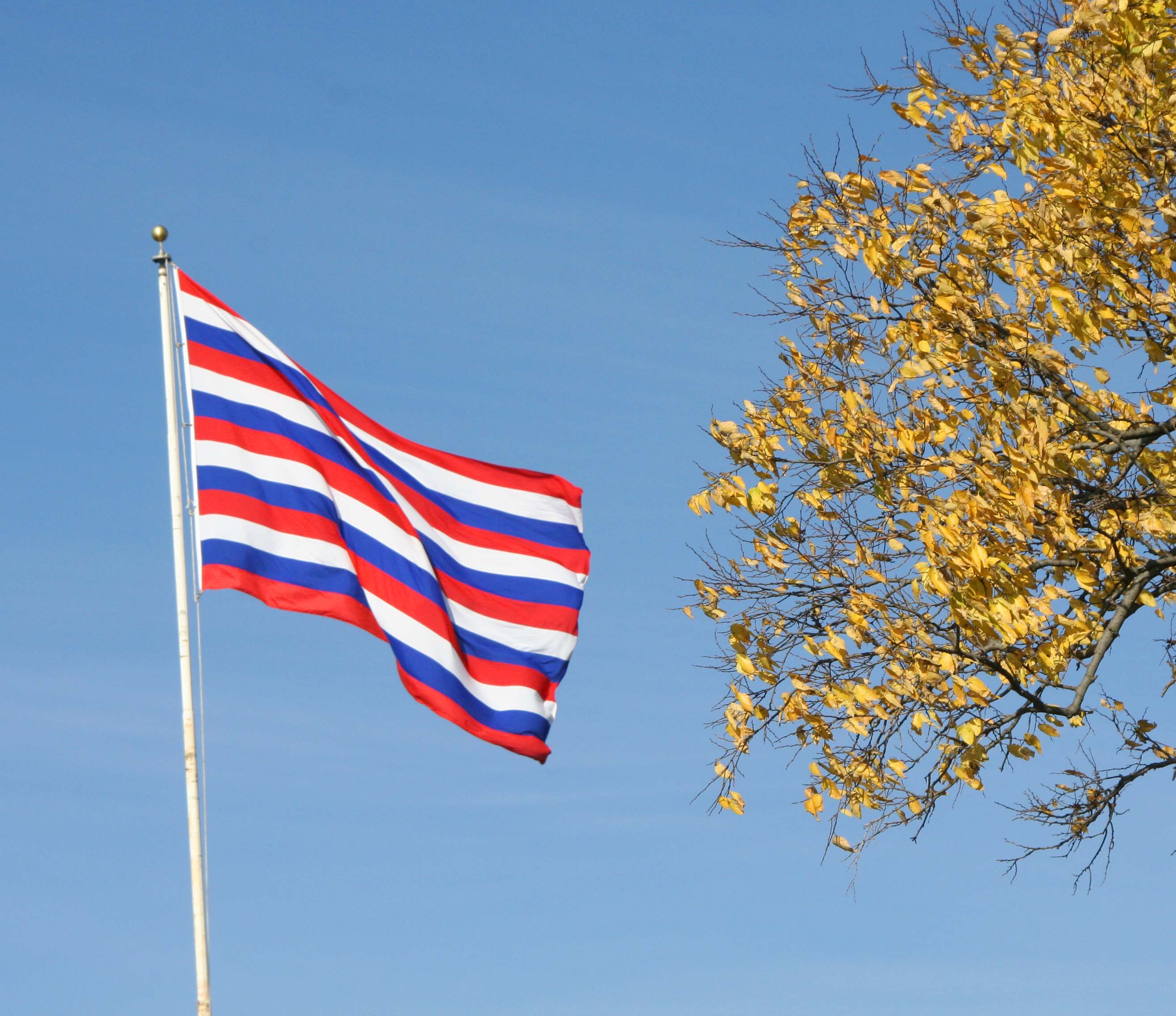
Fort Mifflin Flag.

The flag that flew over Ft. Mifflin during the Revolutionary War. The Stars and Stripes had yet to be designed.

Every so often I like to repost this blog I did on America’s Revolutionary War. Since I have been writing about Revolutionary Boston and my laptop is off at the doctors, I thought I would return to Revolutionary Philadelphia today. 

In the fall of 1777, 240 years ago, all that stood between the British and the likely defeat of the American Revolution was a small fort on the Delaware River. It is a chapter in American History that is little known and rarely told.

General Howe had overcome Washington’s troops at Brandywine and then occupied Philadelphia, sending America’s young government fleeing. An effort by Washington to counter-attack the British in early October and drive them out of the city failed. If the British Navy could resupply General Howe before winter set in, there was a very good chance he would catch the ever-illusive Washington and end the Revolution. There would be no United States of America.

Ft. Mifflin Pa.

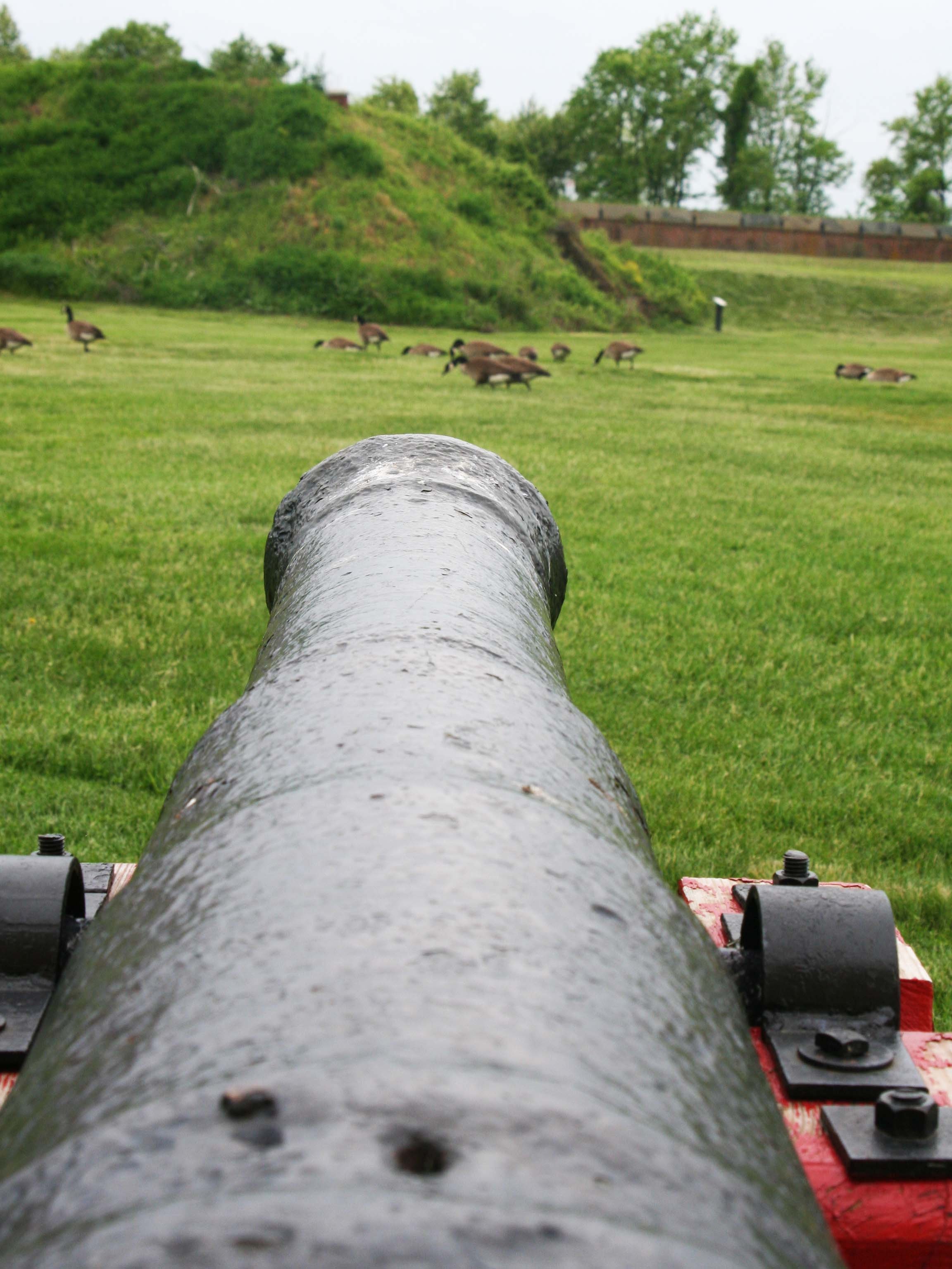
A canon’s view across the tiny Ft. Mifflin focusing in on Canadian Geese. The mound was a bunker for storing munitions.

But Howe had a problem. The tiny Fort Mifflin with a circumference of 3600 feet and a contingent of 250 men was blocking the Navy’s 250 ships and 2000 troops from entering Philadelphia. It had been for six weeks. A concerted strike by British land batteries was initiated on November 10 and a massive bombardment by land and sea was planned for November 15.

The Fort, being blasted apart by the land batteries, did what little it could to prepare.  Under Washington’s orders, 286 fresh troops from Connecticut and 20 artillerymen from the Second Continental Artillery under Captain James Lees were slipped into the Fort on the 13th.  The night of the 14th was spent desperately making repairs to the shattered walls.

On the morning of fifteenth, five British Warships including the sixty-four-gun Flagship Somerset appeared out of the mist below the fort. Of equal, if not more concern, the British had taken advantage of a high flood tide and pulled the converted and armed East Indian merchant ship Vigilant and the gun-sloop Fury within pistol range of Mifflin’s northwest corner.

As the sun rose, the ships and land batteries opened fire in a bombardment that sent over 1000 cannonballs per hour crashing into the fort. It was the heaviest naval bombardment of the Revolutionary War.

Joseph Plumb Martin, a young private from Massachusetts, was there during the battle and captured the sheer terror of the experience some years later in his book Ordinary Courage. “They mowed us down like corn stalks,” he reported.

“I saw five artillerists belonging to one gun cut down by a single shot, and I saw men who were stooping to be protected by the works, but not stooping low enough, split like fish to be broiled.”

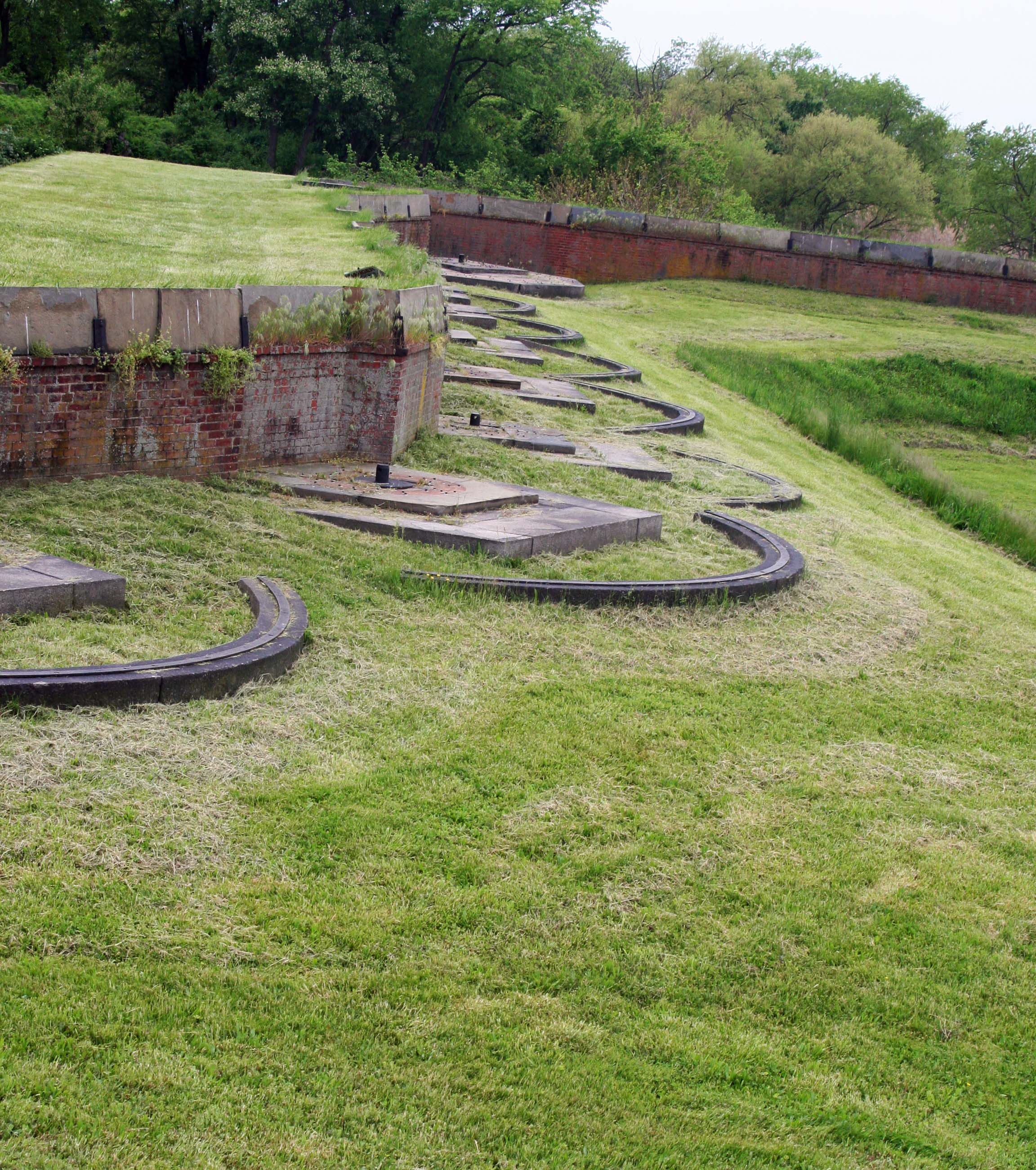
Gun emplacements at Ft. Mifflin.

Gun emplacements along the walls at Ft. Mifflin.

While protection from the onslaught was nonexistent, one section of the fort was more exposed than any other according to Jeffery Dowart in his book, Fort Mifflin of Philadelphia, an Illustrated History. The northwest corner was directly under the guns of the Vigilant and Fury. Time and again these ships sent broadsides smashing into the ramparts manned by Captain Lees’ Company while British Marines posted in the masts of the ships fired down on the exposed artillerists.

“Every man who tried to serve the cannon on the battery’s angle was either killed or wounded,” Dowart reported.

At the height of the bombardment a decision was made to hoist a signal and request help from the galleys and floating batteries above the fort. A volunteer was requested to climb up the flagpole with the signal flag as the cannonballs hurtled in from all directions.

Joseph Plumb Martin had a vivid memory of the event. “…a sergeant of the artillery offered himself; he accordingly ascended to the round top and pulled down the (fort’s) flag to affix the signal flag to the halyard. The enemy, thinking we had struck (surrendered), ceased firing in every direction and cheered.”

“Up with the Flag!” was the cry from our officers in every part of the fort. The flag was accordingly hoisted and the firing was immediately renewed. The sergeant then came down and had not gone a half-rod from the foot of the staff when he was cut in two by a cannon-shot.”

Several galleys, floating batteries, and a frigate did come down river to aid the beleaguered fort but heavy fire from the British Warships drove them back.

At some point in early afternoon the fort ran out of ammunition and was totally at the mercy of the British guns. The end was only hours away. Under cover of darkness, the fort was evacuated. As the final group left around midnight, the flag was still flying.

Howe received his much-needed supplies in Philadelphia but time was running out. After two failed efforts at penning Washington down, he returned to Philadelphia while Washington moved on to Valley Forge for his winter encampment. Other battles would determine the future of the Revolution.

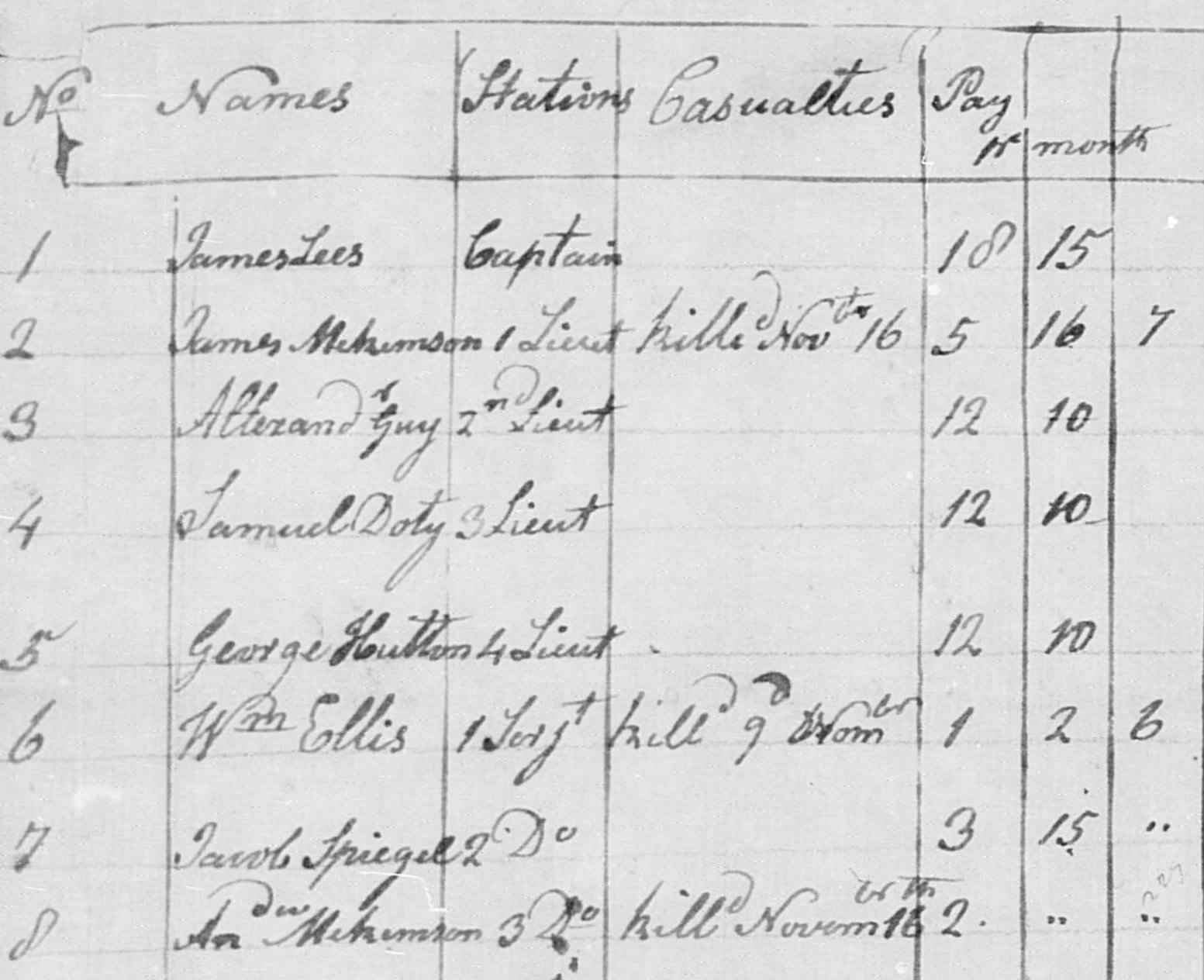
The November 1777 payroll for Captain Lees’ Company. Note #2 and 8.

When I became involved in genealogy nine years ago, I discovered that my Great, Great, Great, Great, Great Grandfather, Andrew Mekemson had arrived in America from Ireland in the 1750s with six sons and one daughter. All six sons ended up fighting in the Revolutionary War. Four were involved in the battle over Fort Mifflin. My sixth cousin, Bill Makemson, shared a flyer researched and distributed by Fort Mifflin that presented a different perspective on the flag incident described by Joseph Plumb Martin. Following is a direct quote:

“During the siege and battle of Fort Mifflin, November 10-15, 1777, the flag was kept flying despite the British bombardment, one of the most stupendous in US History. Although at one point the British cannonballs were falling into the fort at the rate of 1,000 per hour, the American garrison heroically rose to the challenge and kept the flag flying. Two brothers from Pennsylvania, Sergeant Andrew Mackemson and Lieutenant James Mackemson, were both killed in re-raising the shot torn flag. The fort was finally evacuated by the remnants of the defenders, but was never surrendered to the British. The Fort Mifflin Flag was still flying at the end.”

Andrew and James were brothers of my Great, Great, Great, Great Grandfather Joseph Mekemson. They were both part of Captain Lees’ Second Continental Artillery Company that entered the fort on November 13. James was second in command. Andrew was the Sergeant of Joseph Martin’s memory. Both brothers would have also been involved in the devastating battle with the Vigilant and the Fury.

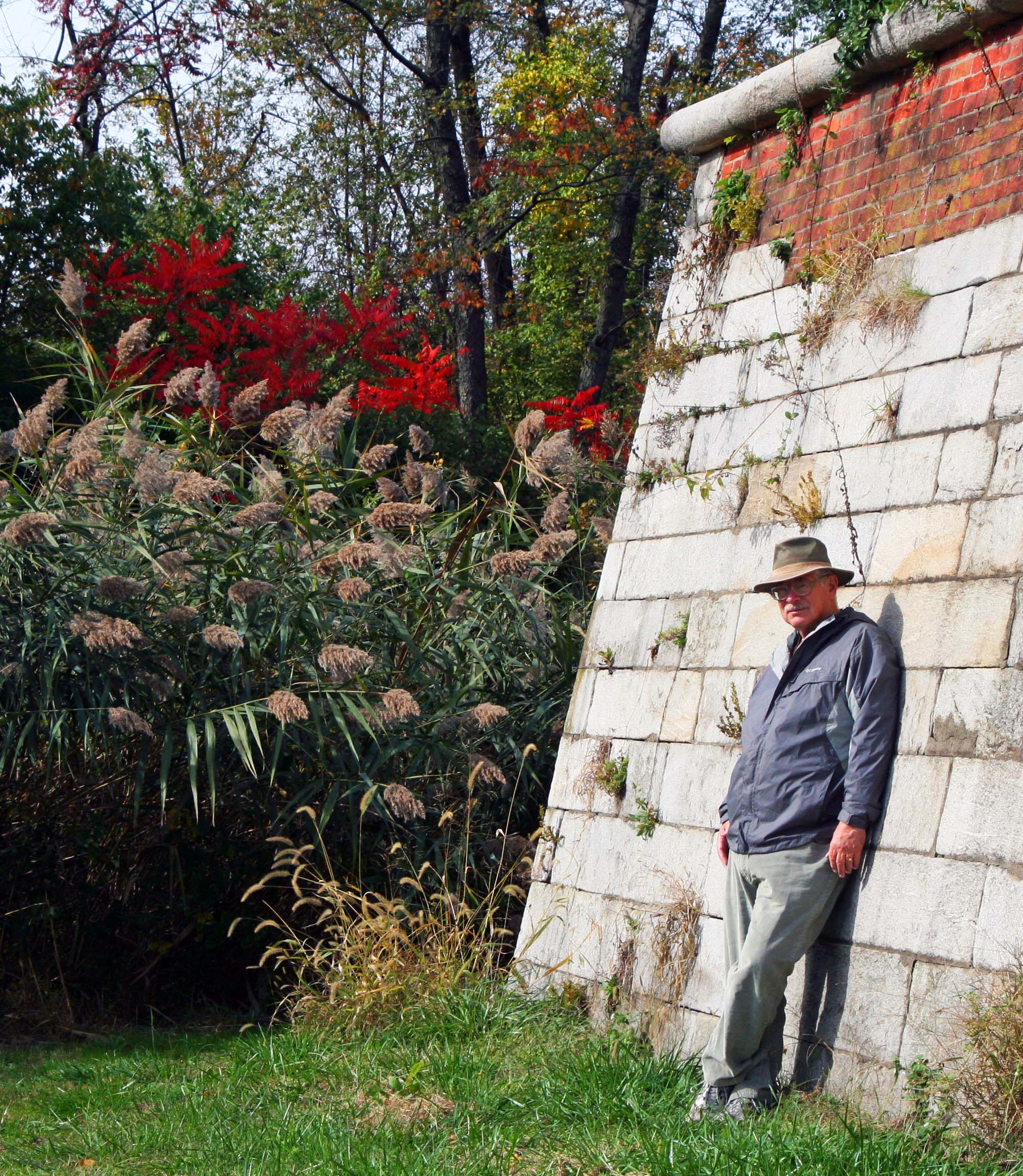
I am standing below the walls of Ft. Mifflin feet away from where the British ships

I am standing below the walls of Ft. Mifflin feet away from where the British ships Vigilant and Fury poured cannon fire onto the position defended by Andrew and James Mekemson.

Two other brothers, Thomas and William, joined the fight as well. Each served on the Floating Battery Putnam under Captain William Brown. The Putnam was one of the floating batteries to respond to Fort Mifflin’s signal for help.

Captain Brown had been appointed as the first Marine Captain in the Pennsylvania Navy and sent out to recruit more marines. He was in charge of the marines on the PA Navy’s Flagship Montgomery and then helped organize Washington’s crossing of the Delaware on Christmas Day 1776. He and his marines then went on to participate in the battles of Trenton and Princeton. It was the first joint marine/army operation in the nation’s history.

Documents from the Pennsylvania archives show that all four Mekemson or Makemson brothers (James, Andrew, Thomas and William) had joined Captain Brown by the time of Washington’s battle at Trenton and night march to Princeton. They may have been with him even earlier at the Delaware crossing. By September the brothers had split with James and Andrew moving on to their destiny with Captain Lees and Fort Mifflin.

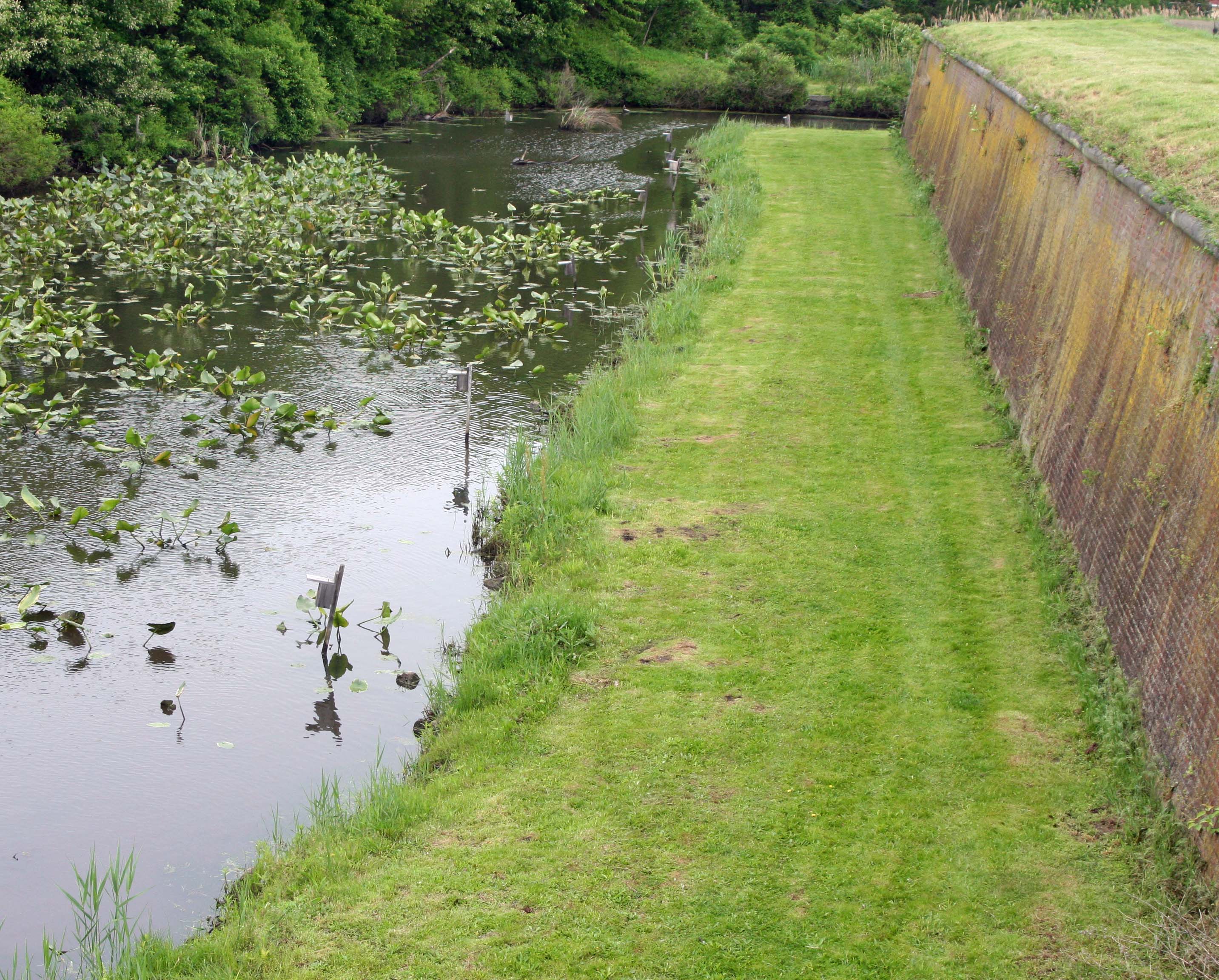
Today, a beautiful moat filled with plants and wildlife surrounds Ft. Mifflin. I like to think of it as a fitting memorial to James, Andrew and the other men who fought against overwhelming odds and gave their lives so the young republic could live.

Today, a beautiful moat filled with plants and wildlife surrounds Ft. Mifflin. I like to think of it as a fitting memorial to James, Andrew and the other men who fought so bravely against overwhelming odds and gave their lives so the young republic could live.

Ten Favorite Burning Man Activities… Updated!

The classic female nude has always been a favorite subject of artists. This beautiful woman was over 50 feet tall and was one of a series of three at Burning Man.

The classic female nude has always been a favorite subject of artists. This beautiful woman was over 50 feet tall and was one of a series of three at Burning Man. Art, more than anything else, has been pulling me back to Burning Man since 2004.

With two laptops down and this one heading for the doctor, I have to revise my publishing schedule for the next week. I’m reaching back into my archives and pulling out three former posts that are at least in the spirit of what I have promised. Today is on Burning Man. I’ll follow up with an historical blog on Philadelphia’s Fort Mifflin and then a backpacking tale that includes bears, lots of them.

I may be totally off the Internet for the next week. If I don’t respond immediately, that’s the case. 

It’s time to buy tickets for Burning Man again, which is always a harrowing experience. At least it has been for the past several years. I made my first trip to Burning Man in 2004 and have been back numerous times since. I can’t resist. It is one of the most unique events I have ever attended. Following are some of the reasons why. Today kicks off a Friday series on Burning Man I will be running over the next couple of months during the ticket sale time that feature favorite photos from my archive of thousands. Enjoy!

I should probably name this blog Curt Mekemson’s Ten Favorite Burning Man Activities. When it comes to Burning Man, things get personal. One person’s preferences might very well be another person’s boring, with just the right teen-age emphasis followed by, “Was that guy actually there?”

For example, I don’t like loud music but there are camps at Burning Man with humongous speakers that blast out ear shattering decibels 24/7. Fine, it’s their thing and they have lots of fans, not to mention some of the best DJs in the world. Many Burners list these venues among their top choices. They joyfully dance the night away, literally. I like stopping by but my ears soon send me scooting for quieter locations— like the opposite side of the Playa.

Dancing and music are an integral part of Burning Man. The event attracts some of the top DJs in the world who spin their tunes for free at Burning Man.

Dancing and music are an integral part of Burning Man. The event attracts some of the top DJs in the world who spin their tunes for free at Burning Man. The hanging speakers give an idea of the volume that can be generated.

I don’t run around naked at Burning Man, either. That would be scary— for both me and anybody looking in my direction. But I have no objection to other people being nude. Some Burners are quite attractive while others are at least, uh, colorful. I assume all are enjoying some form of liberation, or at least a bit of exhibitionism.

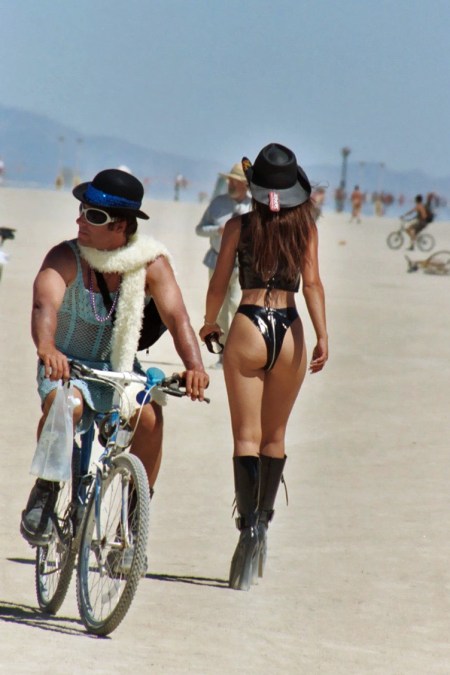
Outrageous costumes make people watching at Burning Man a number one activity. The guy 'looking the wrong way' helped make this photo. Note the platform shoes on the woman. She wears them well.

Outrageous costumes make people watching at Burning Man a number one activity. The guy ‘looking the wrong way’ helped make this photo. What was he thinking? Note the platform shoes on the woman. She wears them well.

The thing about the Burning Man experience is that it depends on the individual. My recommendation for new participants is to come with an open mind and explore. If you want to get naked, go ahead; but you don’t have to and most don’t. Your experience can be as radical or conservative as you wish to make it.

So, having established my parameters, here is my top-ten list of things to do at Burning Man (assuming one can finagle a ticket). They aren’t in order of preference.

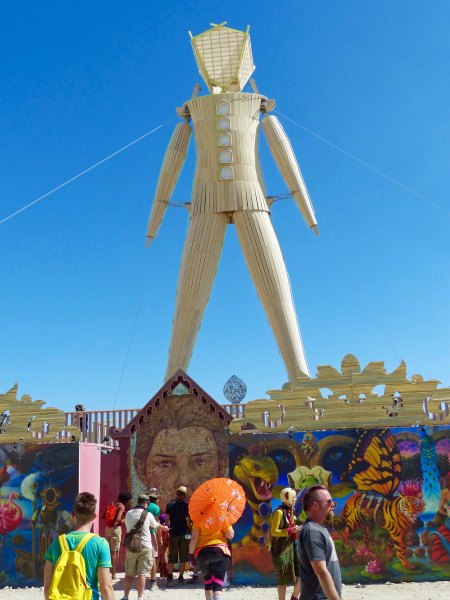
1. Attend the Burn: First, you will want to visit the Man during the week. There are usually a number of activities taking place that reflect the year’s theme. Plus you can often climb up into the base and enjoy some of the best views available of Black Rock City! The burning of the Man on Saturday night is the climax of the week where everything and everyone comes together. Hundreds of fire dancers and drummers kick off the event and are followed by an elaborate ceremony where the Man is set on fire.  Things start with a bang, literally, as rockets explode and light up the sky. The Man then moves toward his ultimate demise, slowly. His last seconds are met by silence from 70,000 people, possibly the only time when Burning Man is quiet, followed by oohs and ahs building to a crescendo as he comes crashing down, completing his annual sacrifice. Don’t worry, like Frosty the Snowman and the Phoenix Bird, he’ll be back. The burn is only part of the show, however. Elaborate costumes, giant mutant vehicles, and total  bedlam compete for attention.


For six days the Man serves as a gathering point on the Playa and as a landmark for lost Burners. On Saturday night he burns in what has become one of the world’s best known New Age rituals.

Burning Man's roots go back 27 years to the burning of an 8 foot tall statue on Baker Beach in San Francisco. Today's man stands some 40 feet tall and rests on a 60 foot pedestal. The wooden man and his fiery demise symbolizes the annual event that takes place in the remote Black Rock Desert of Nevada.

Burning Man’s roots go back 31 years to the burning of an 8 foot tall statue on Baker Beach in San Francisco. Today’s man stands some 40 feet tall and rests on a 60 foot pedestal.

My friend Don Green took this photo of the Fun House entrance that was built around the Man in 2015.

My friend Don Green took this photo of the Fun House entrance that was built around the Man in 2015.

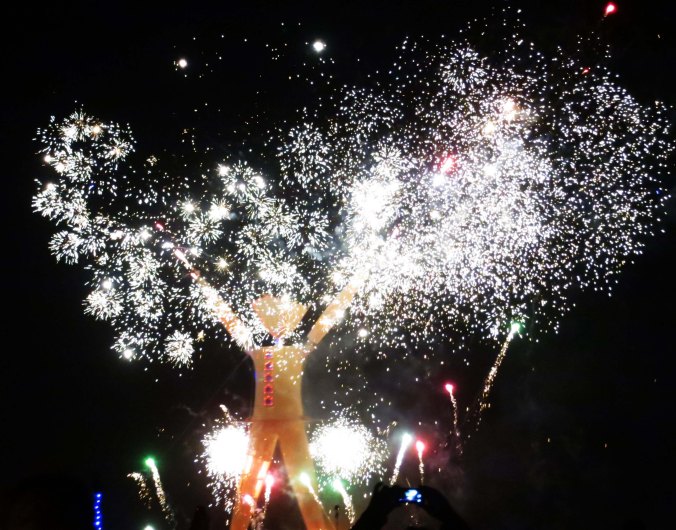
The night sky is lit up by fireworks during the burning of the Man at Burning Man 2014.

Suddenly the night sky and the Man are lit up by fireworks. The burn is about to begin.

A close up of the Man burning at Burning Man 2014.

Don Green captured this photo of the Man Burning.

The Burning of the Man on Saturday night gives the event its name.

Huge flames light up the night.

People perch on El Pulpo Mechanico at Burning Man and watch as the Man burns.

People perched on El Pulpo Mechanico at Burning Man and watched as the Man burned. Even the mutant vehicle, El Pulpo Mechanico, seemed entranced.

2. Enjoy the People: I don’t know where one could find a more interesting cast of characters than Burning Man. But then again, there aren’t many places where you are encouraged to be yourself and pursue ‘radical self-expression’ in a region where temperatures top 100 and 60 mph windstorms kick up massive dust storms that create zero visibility. Tribes, events and volunteering create numerous situations where it is easy to meet people and make friends. While Burning Man preaches involvement, you are also totally free to wander around and simply observe.

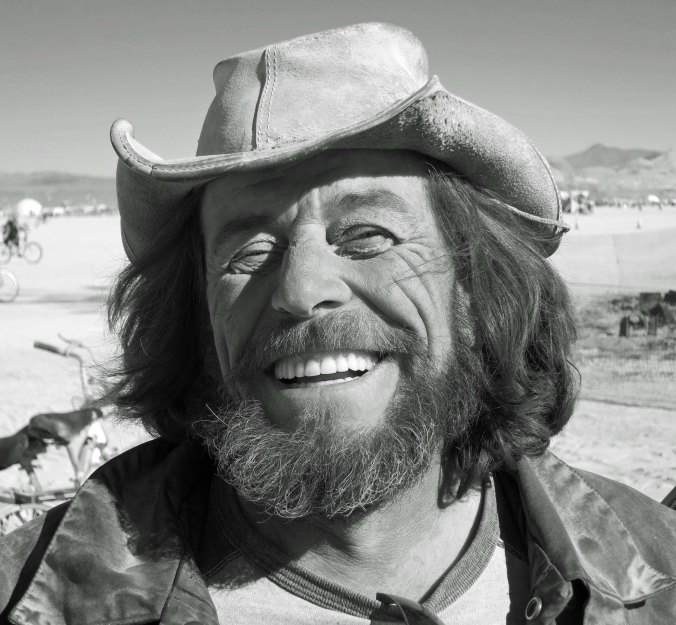
The folks who come to Burning Man represent a broad spectrum of people representing all ages and occupations— from broke college students to billionaires. this fellow is a veteran Burner who works with the Department of Public Works that helps build Black Rock City.

The folks who come to Burning Man represent a broad spectrum of people from all ages and occupations— from broke college students to billionaires. This fellow is a veteran Burner who works with the Department of Public Works that helps build Black Rock City.

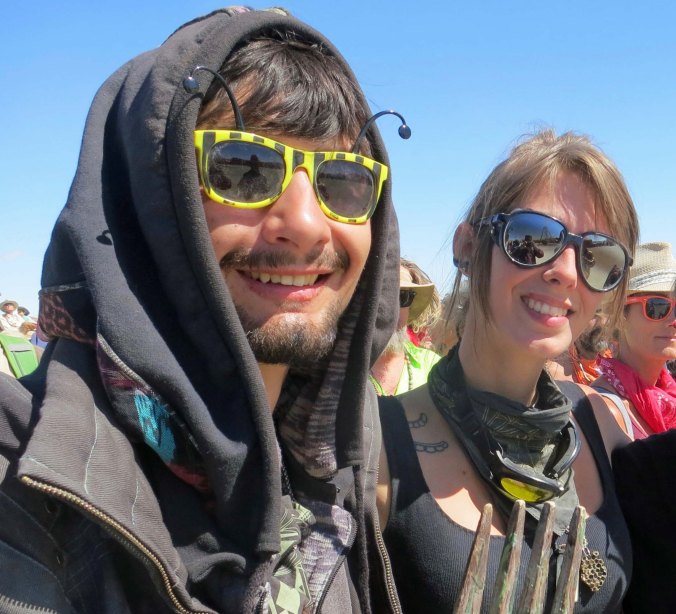
This young couple stood next to me as we watched a burning piano be tossed 50 or so yards up the Playa. Glasses form an important part of Burner's costumes.

This young couple stood next to me as we watched a burning piano be tossed 50 or so yards up the Playa.

Costumes are an integral part of Burning Man and some people such as my friend Ken (aka Scotty) Love to dress up.

Costumes are an integral part of Burning Man and some people such as my friend Ken (aka Scotty) love to dress up. Scotty, BTW, is Ken’s Burning Man name. Almost everyone has one. Mine is Outlaw.

3. Appreciate the Art: Burning Man art comes in all forms, from monumental to small, from sculpture to painting to performance. Most of the major pieces and performances take place on the Playa or along the Esplanade. But there are many smaller pieces (and performances) found throughout the camp and at the Center Camp Cafe. Much of the art is interactive. Be sure to check out the playa sculptures at different times of the day. Many of the pieces are schizophrenic with radically different day and night personalities. And many are making there way into communities around the world.

Burning Man has become a major center for what is happening in today’s art world. Selecting a piece to represent what is happening in the Nevada desert is close to impossible. These two oil tankers welded together and stacked on top of each other, meld environmental concern with art, two of Burning Man’s major themes.

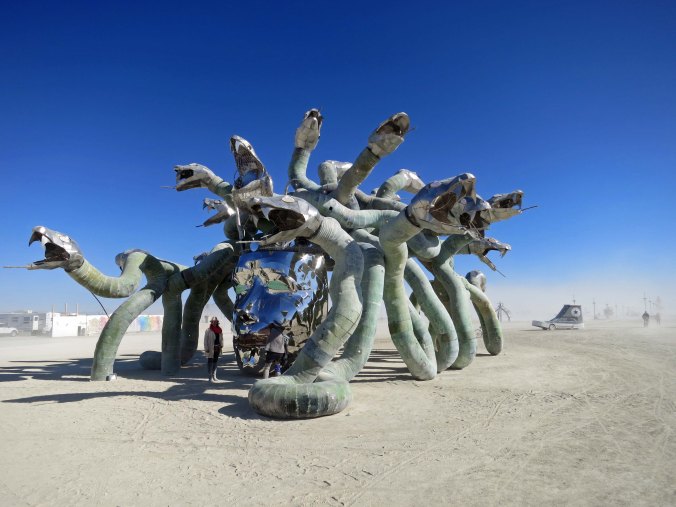
Medusa with her snake hair was one of my favorite sculptures in 2015.

Medusa, with her writhing snake hair, was one of my favorite sculptures in 2015.

Burning Man Fantasy sculpture

Monumental sculptures, many you can climb on, are among the most popular art works at Burning Man.

4. Save Time for the Desert: The Black Rock Desert and surrounding mountains are beautiful. Look around. Once the Playa was part of the huge Lake Lahontan, which was over 500 hundred feet deep. Mammoths wandered the lake’s shore. Early morning and late evening provide the best times for desert viewing. An early morning walk, while Burning Man more or less sleeps, is the best time to appreciate what the desert has to offer. Embrace rather than dread the weather. When else in your life will you experience a massive dust storm or see a desert rainbow?

The evening sun bathes the surrounding mountains at Burning Man in soft light.

The evening sun bathes the surrounding mountains at Burning Man in soft light.

I think Burning Man  fails to emphasize (or assigns to footnote status) one of the event’s most spectacular assets… the beauty of the Black Rock Desert.

A massive dust storm crosses the Playa and hides the camp.

4. Visit the Temple: The folks who build the Temple deserve a huge vote of thanks from all of us. Visiting is both an aesthetic and spiritual experience. To start with, the temples are gorgeous, with each year’s building a unique creation. Thousands of written messages are left on the walls to honor loved ones who have died or to give thanks for blessings. The messages are both sincere and touching. Take along a pen or a marker if you wish to honor or thank someone who has had a significant impact on your life. On Sunday night the temple burns, sending messages skyward in what I can only describe as a sacred experience.

The Temple of Promise at Burning Man 2012.

The Temple of Promise at Burning Man 2015.

The Temple of Grace at Burning Man 2014.

The Temple of Grace at Burning Man 2014.

The Temple burns on Sunday Night. Unlike the Burning of the Man which is a bit on the rowdy side, Burners watch silently and respectfully as the Temple Burns.

The Temple burns on Sunday Night. Unlike the Burning of the Man which is a bit on the rowdy side, Burners watch silently and respectfully as the Temple is consumed by flame.

5. Check out Camp Center Cafe, Often: Whether you want to perform, show off your costume, pick up the latest news, attend a show, enjoy art, have a cup of coffee, meet friends, have your fortune told, apply pasties, watch people or just hang, Camp Center Cafe is the place to go. It’s open 24 hours a day. Something is always going on. I visit two to three times daily. Be sure to watch the costume contest and the talent show.

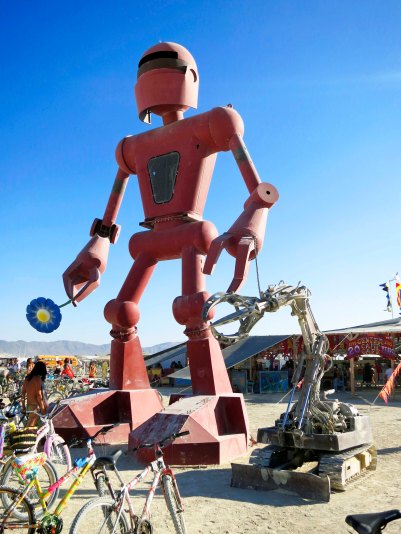
This robot with his dog and a flower was in front of the Center Camp Cafe. He would raise the flower up to his nose and sniff it.

This robot with his dog and a flower was in front of the Center Camp Cafe. He would raise the flower up to his nose and sniff it. Each year Center Camp Cafe features a major sculpture.

“Yes Master.” Camp Center is a great place to watch people, show off your costume, and live out your fantasies… and it is always entertaining.

A show of some kind of the other is pretty much guaranteed when you visit the Center Camp Cafe. Here couples practice partner yoga. Are the two guys center-right twins?

A show of some kind of the other is pretty much guaranteed when you visit the Center Camp Cafe. Here couples practice partner yoga. Are the two guys on the floor center-right twins?

Center Camp is also a prime location for Burning Man art.

Center Camp is also a prime location for Burning Man art.

6. Stroll or Bike The Esplanade: This is Burning Man’s other major center of action. It provides the border between the Camp and the Playa. It is a theater, circus and walkway all in one. Stop by and watch people pummel each other with foam sticks in the Thunder Dome, enjoy a troop of fire dancers, go roller-skating, play games, try out a balloon ride, hear how loud music can actually get, dance, watch a movie, become lost in a maze, meditate… etc.

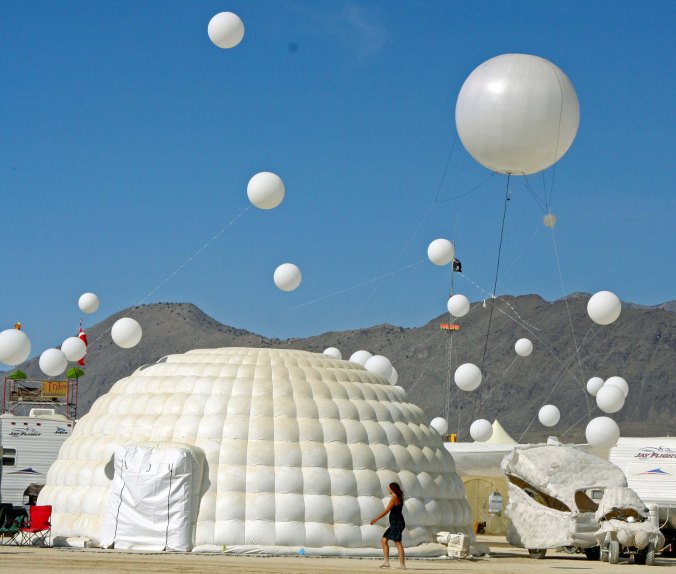
Hundreds of people lined up for an opportunity climb into the sky on this balloon ride that was offered on the Esplanade. Entertainment along the Esplanade varies from dancing, to roller skating, to circuses. Once there was even a booth that would spank you, assuming you needed it.

Major tribes with hundreds of members build elaborate camps along the Esplanade.

Major tribes , some with hundreds of members, build elaborate camps along the Esplanade.

A number of impressive buildings including the Sacred Spaces building are found along the Esplanade at Burning Man.

Another example.

7. Check out and/or Ride on Mutant Vehicles: Undecorated vehicles are restricted to camp. If you are going to drive you have to decorate. What’s not to love about a giant, wooly mammoth or a cat car with fur? Mutant Vehicles at Burning Man come in all shapes, forms and sizes. Some people spend weeks/months creating their fantasy transportation systems and even bicycles are elaborately decorated.  Various vehicles become dance floors, spout fire, look ferocious and even appear friendly. A polite request may land you a ride.

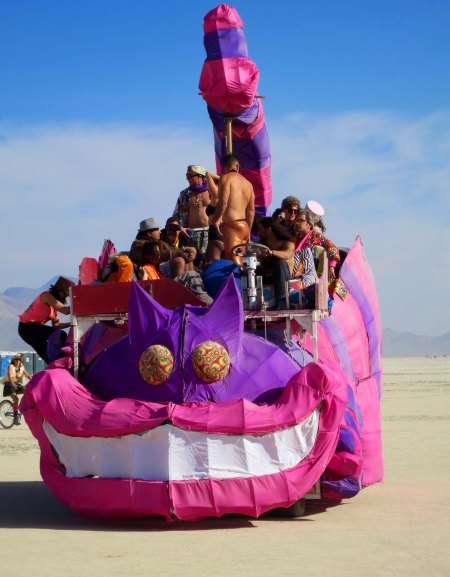
The Cat Car is a perennial favorite at Burning Man. This year she had a makeover and was looking quite snazzy.

The Cat Car is a perennial favorite at Burning Man. This year she had a makeover and was looking quite snazzy.

The tusks on they mammoth are what make this art car one of my favorite mutant vehicles at Burning Man. People sit inside the rib cage. The driver climbs into the head.

The tusks on they mammoth are what make this art car one of my favorite mutant vehicles. People sit inside the rib cage. The driver climbs into the head.

Where's Alice?

Where’s Alice?

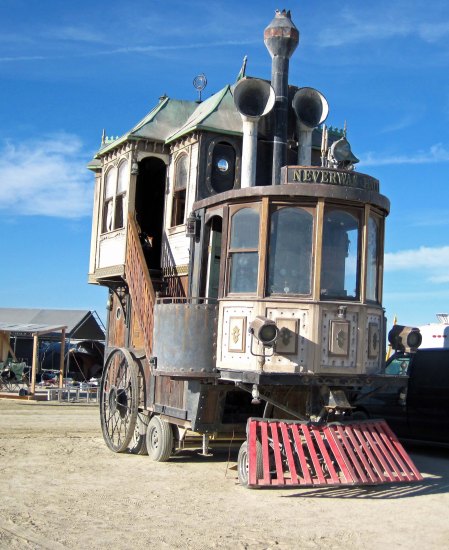
Never Was Haul resembles a Victorian House that has been converted to a steam engine train.

Never Was Haul resembles a Victorian House that has been converted to a steam engine train.

A rhino even more massive than its counterpart in East Africa.

A rhino even more massive than its counterpart in East Africa.

8. Join a Tribe, or not: Tribes are the major social units at Burning Man and there is a tribe for almost any inclination. Many feature theme camps based on the year’s theme and welcome visitors. You can also form your own. Let’s say you are a purple alien from outer space and can’t find a tribe. Create the Purple Alien from Outer Space Tribe. Odds are there are other purple aliens who will want to join. It’s doubtful that anyone will even recognize that you are an alien. They will just think, “Oh, he’s got a neat costume,” and want to take your picture.

The Peripatetic Bone, held here by Boots and featuring his leather vest, has his own tribe… the Horse-Bone Tribe. He has been visiting Burning Man for years and was even married there to Bonette, a few years ago.

9. Go out into the Night: The Burning Man night is magical. Everyone and thing includes some kind of lighting system including art, people, bikes and mutant vehicles. Most blocks provide entertainment. Is it going to be pole dancing, jazz or vodka creations that capture your imagination? You will think you have entered a different universe.

The front of the Temple at night.

The Temple of Promise at night.

A large group attended an evening discussion on the issue of violence against women.

R-evolutuion lit up at night. Here, a large group attended an evening discussion on the issue of violence against women.

Burning Man dragon created by Flaming Lotus Girls for Burning Man.

A fiery dragon.

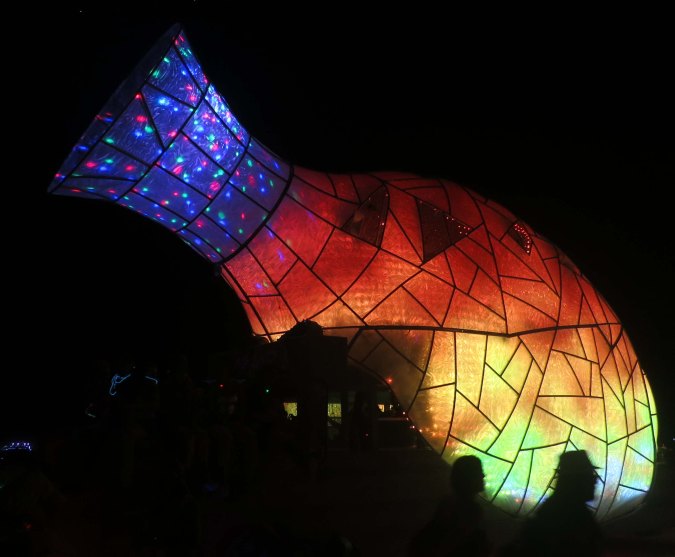
Burning Man mutant vehicle. Photo by Curtis Mekemson.

And a mutant vehicle vase.

10. Peruse the Catalogue: You are given a catalogue when you arrive that includes literally hundreds of things you can do at Burning Man ranging from attending a lecture on solar power to having your breasts painted. The various tribes sponsor these events for free as part of Burning Man’s gift-giving culture. You can practice yoga, learn the samba, improve your fire twirling skills, watch a show, and even improve your sex life, regardless of which way you lean. You can also drink. The catalogue lists dozens of bars featuring everything from Bloody Marys to craft beers. One year I found a casket that featured beer spouts.  Drinks are free; bring your own cup. One of the first things I do after setting up camp is to go through the catalogue and check off things I might want to do. Hmmm, I wonder what bondage is like? (Just kidding… but there are opportunities to learn about it, and practice.)

Burning Man may be the greatest show on Earth. Bring along your imagination, sense of humor, and willingness to experience new things.

If you’ve enjoyed this post, are planning on going to Burning Man for your first time, want to learn more about the event, or want to reminisce about past events, I invite you to join me on Fridays for the next couple of months.

Paul Revere Still Rides… Boston Part 2

This sculpture of Paul Revere

This sculpture of Paul Revere outside of the Old North Church in Boston commemorates Revere’s ride on April 18, 1875 to warn Colonials that General Thomas Gage’s troops were on their way to Lexington and Concord.


Listen my children and you shall hear /Of the midnight ride of Paul Revere, /It was on the 18th of April, in Seventy five, /Hardly a man is now alive/ Who remembers that famous day and year. —Henry Wadsworth Longfellow

By 1860, when these lines were penned, very few people indeed would have remembered the ride, so Longfellow was free to report the facts as he saw them, even though they were a bit “alternative.” As a dedicated abolitionist, he wanted to use his poem to alert the citizens to prepare for the impending struggles ahead in holding the nation together and in freeing the slaves, as well as recognize Revere’s heroism.  The last lines of the poem urged:

In the hour of darkness and peril and need, /The people will waken and listen to hear /The hurrying hoof-beats of that steed, /And the midnight message of Paul Revere.

 I can’t help but wonder if the 150,000 people who gathered on Boston Commons Saturday as part of the Women’s March to protest Donald Trump’s treatment of women and policies on healthcare, the environment and education hadn’t heard echoes of the hurrying hoof-beats. 

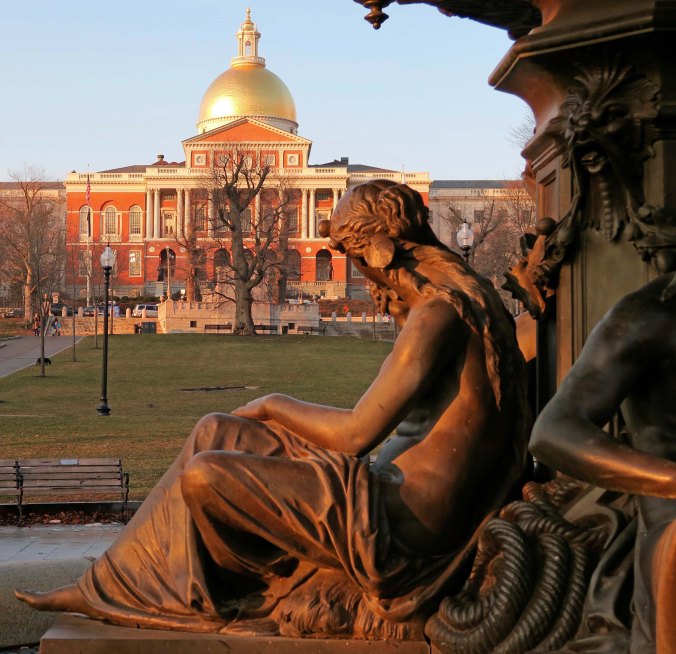
When Peggy and I walked across the Boston Commons three weeks ago, it was a quiet day except for fat squirrels wanting to become fatter. Back in 1775 when Paul Revere made his mad dash, British troops were camped out here. On Saturday, an estimated 150,000 gathered between here and the Massachusetts Statehouse for the Women's March. I thought the woman's statue was appropriate for this photo.

When Peggy and I walked across the Boston Commons a few weeks ago (shown above with the Massachusetts Statehouse), it was a quiet day except for fat squirrels wanting to become fatter. Back in 1775, British troops were camped out on the Commons. On Saturday, an estimated 150,000 people gathered here for the Women’s March.

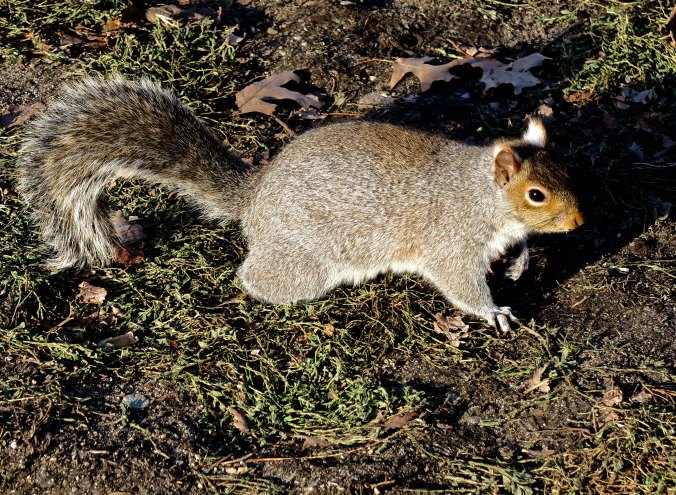
A fat squirrel.

A fat squirrel occupies the Commons much more successfully than the British soldiers who suffered from a lack of food.

Longfellow was inspired to write the poem the day after climbing the steeple of the Old North Church where lanterns were hung to warn that British soldiers were moving toward Lexington and Concord.

Steeple of the Old North Church in Boston, Massachusetts that played an important role in the beginning of the Revolutionary War.

The Old North Church steeple where two lanterns were hung to warn that General Gage’s Redcoats were on the move by sea. (Photo by Peggy Mekemson.)

The Old North Church in Boston, Massachusetts.

A view of the back of the Old North Church. Peggy and I visited on a grey day when we experienced both rain and snow. And it was even colder than it looks!

Front view of Old North Church in Boston, Massachusetts.

A front view of the Old North Church.

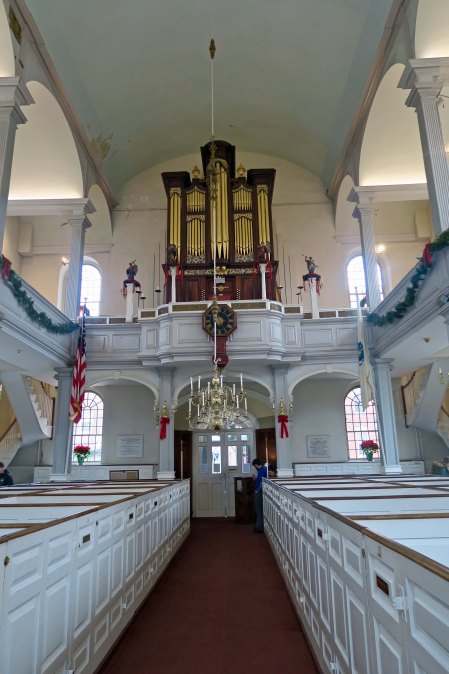
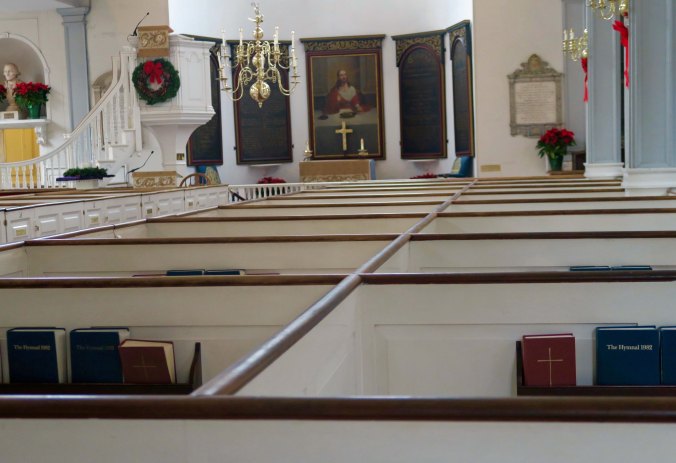
Looking toward the back of the Old North Church.

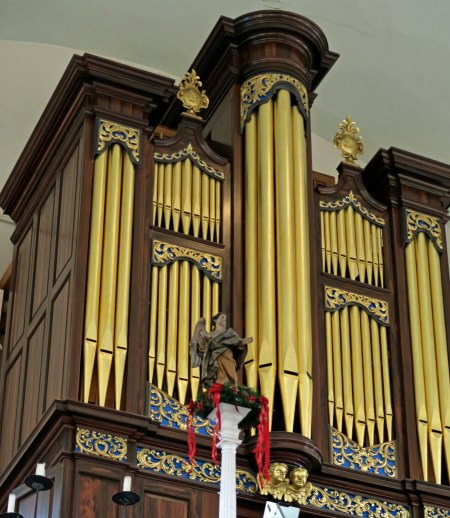
Looking toward the back of the Old North Church. The stairs leading up to the steeple where the lanterns were displayed is behind the organ pipes.

Organ pipes at Old North Church in Boston.

A close up of the organ pipes. I am assuming the angel is Gabriel.

Looking across box pews toward the altar at the Old North Church in Boston.

Looking toward the front of the church. In 1775 the church was Anglican. Today it is Episcopalian, the American equivalent. Note the interesting box pews.

Peggy sits in one of the pews holding a hymnal. Today, the pews are based on first come-first serve. But in 1775, the pews were 'owned' by their occupants and passed down through families. One of the guides told us that the cost for one the pews was the equivalent of what a middle class family might earn in a year today. Not cheap.

Peggy sits in one of the pews holding a hymnal. Today, the pews are based on first come-first serve. But in 1775, the pews were ‘owned’ by their occupants and passed down through families. One of the guides told us that the cost for a pew was the equivalent of what a middle class family might earn in a year today. Not cheap.

On the 200th anniversary of Paul Revere's ride, President Gerald Ford hung a third lantern in the Old North Church to inspire hope, peace and prosperity.

On the 200th anniversary of Paul Revere’s ride, President Gerald Ford hung a third lantern in the Old North Church to inspire hope, peace and prosperity.

The British had two objectives: one to arrest the Colonial leaders, John Hancock and John Adams, who were in Lexington at the time— and two, to go on to Concord and seize gunpowder that the Colonialists were storing in case the disagreement with Britain came down to war. Thomas Gage, the commanding general of the British forces in Boston, had been very secretive about his plans, but not secretive enough.

The plans were discovered, two lanterns were hung in the Old North Church, and Revere along with two other riders set out on their midnight rides. Hancock and Adams escaped and hundreds of militia from surrounding towns, known as Minute Men for their readiness to fight on a moment’s notice, grabbed their muskets and streamed toward Lexington and Concord. A shot was fired in Lexington and a battle ensued. It is still debated whether the British or the Colonialists fired first.

While the British won the first round, they marched on to Concord where they were met by a much larger group of Minute Men. Another battle started and the British decided it was time to return to Boston. Somewhat in disarray, the British troops hurried along the road as the ‘rebels’ took potshots at them in their hasty retreat. The Minute Men had proven that they could effectively fight against the much better trained British troops.

While the Declaration of Independence was still a year off, the Revolutionary War was underway.

Another view of Paul Revere on his ride to warn that the Redcoats were coming.

Another view of Paul Revere on his ride to warn that the Redcoats were coming.

Paul Revere's home on the Freedom Trail in Boston, Massachusetts.

Paul Revere’s home, snuggled up to a taller building, is a few blocks away from the Old North Church. (Photo by Peggy Mekemson.)

Another view of Revere's home.

Another view of Revere’s home. Revere was a noted silversmith of his time and a successful businessman.

The poem that made Revere a household name for generations of Americans following its publishing date in 1861.

The poem that made Revere a household name for generations of Americans.

Paul Revere's tombstone in the Granary Graveyard, a place where will visit in our blog next week.

Paul Revere’s tombstone in the Granary Graveyard, a place we will visit in our blog next week.

NEXT BLOGS:

Wednesday: Back to the Sierra Trek for the route preview, heart-break, a trip to Canada, and 20 cases of Ham Cheddarton.

Friday: The first 2017 post on Burning Man. Part one of a series of photographic essays selected from several thousand photos Peggy, I and several friends have taken at the event since 2004.

Boston: A Cradle of Liberty Where Freedom Still Rings Out

Boston's Old State House has been a symbol of American liberty for over 300 years.

The Declaration of Independence was first read to Bostonians in 1776 from the balcony of the Old State House (shown at night above). John Adam’s bright and articulate wife, Abigail, wrote to her husband that as soon as the Declaration was read… “three cheers rended the air.” She went on to report, “Thus ends the royal authority in this state.”

A fierce desire for independence and freedom has existed in Boston dating back to its very beginning in 1630 when the city was granted a charter to self-govern. Britain’s decision to limit the city’s freedom and tax its citizens starting in the 1760s led to protests that ended in the Revolutionary War and American independence. Beginning in the early 1800s, a strong abolitionist movement opposing slavery grew up in the Boston that would play a key role in leading to the Civil War and the emancipation of slaves. When Peggy and I visited the city in December, we were able to visit a number of sites that reflected Boston’s historical contributions to liberty in America, but we also found ample evidence that the call to freedom still rings out in the city.

My experience in Boston combined with the fact that Donald Trump will be inaugurated as President this week led me to ponder some the most powerful statements that underlie our nation’s commitment to freedom and equality. Here are my favorites:

We hold these truths to be self-evident, that all men are created equal, that they are endowed by their Creator with certain unalienable Rights, that among these are Life, Liberty and the pursuit of Happiness. —US Declaration of Independence

Four score and seven years ago our fathers brought forth on this continent, a new nation, conceived in Liberty, and dedicated to the proposition that all men are created equal. —Abraham Lincoln’s Gettysburg Address.

Congress shall make no law respecting an establishment of religion, or prohibiting the free exercise thereof; or abridging the freedom of speech, or of the press; or the right of the people peaceably to assemble, and to petition the Government for a redress of grievances. —The First Amendment of the US Constitution

Slightly different but reflecting America’s original openness to immigration, and I might note, recognizing that we are a nation built by and with immigrants…

Give me your tired, your poor, your huddled masses yearning to breathe free, the wretched refuse of your teeming shore. Send these, the homeless, tempest-tossed to me, I lift my lamp beside the golden door! —Quote on America’s Statue of Liberty

These are words of wisdom from the folks who “made America great,” and have inspired generations of people in the U.S. and around the world. It is my hope that our new president will take these words to heart  in his efforts to “make America great again.”


Neither Peggy nor I had been to Boston before, which is a bit surprising considering the importance of Boston to the nation’s history— and to my own. My Great Grandfather to the umpteenth on my mother’s side arrived there in early 1630s from England, when the city was founded. Ultimately, we are all immigrants.

Boston Commons plaque that commemorates the founding of Boston, Massachusetts in 1630.

This plaque located on Boston Commons commemorates the founding of Boston in 1630. My Great Grandfather to the umpteenth is helping pull the boat in. (Just kidding.)

It was ‘love at first sight’ when we arrived. I had managed to find us an affordable hotel in the center of the city. Most of Revolutionary Boston was within walking distance and I am a big fan of Revolutionary War history. The red brick Freedom Trail was a short 10 minutes away. “Just follow the yellow brick road” was bouncing around in my mind. Instead of skipping off to Oz on yellow bricks with encouragement from Munchkins, however, the red bricks of the Freedom Trail connected us with many historical sites central to America’s struggles for freedom and equality.

Today, I want to share some of the things we saw in Boston that seem particularly relevant to this week in American history. Next Monday, I’ll be more focused on Boston’s Revolutionary history.

The Tremont Temple in Boston, Massachusetts.

I photographed the Tremont Temple because I thought it was a unique building…

Tremont Baptist Church was the first integrated church in America.

Not having a clue that it was a Baptist Church, or that it was the first integrated church in the U.S. It is a fitting photo to commemorate the week of Martin Luther King’s birthday.

I normally wouldn't take a photo of a Chipotle Restaurant, but this one happens to locate in the Old North Bookstore Building where Harriet Beecher Stowe's novel "Uncle Tom's Cabin" was published, which was both a classic of the Abolition Movement and a key factor in leading to the Civil War and the emancipation of slaves.

I normally wouldn’t take a photo of a Chipotle Restaurant, but this one happens to be located in the Old North Bookstore Building where Harriet Beecher Stowe’s novel “Uncle Tom’s Cabin” was published. The book was both a classic of the Abolition Movement and a key factor in leading to the Civil War and the emancipation of slaves.

Historic Faneuil Hall located in Boston, Massachusetts

Faneuil Hall is located just across the street from the Old State House. It was from this building that the fateful words were uttered, “No Taxation without representation.”  Maybe today’s declaration would be focused on the ultra-wealthy and declare “No representation without paying your fair share of taxes.” (Photo by Peggy Mekemson.)

We found this Gatling Gun in the military museum on the third floor of Faneuil Hall. While it may seem strange to include it here, it's inventor, Richard Gatling, believed that by employing increasingly deadly weapons that the size of armies could be reduced and that deaths due to combat and disease could be reduced as well. History has taught us a much different lesson, one that should be considered in any discussion of renewing the nuclear arms race.

We found this Gatling Gun in the military museum on the third floor of Faneuil Hall. While it may seem strange to include it here, the inventor, Richard Gatling, believed that by employing increasingly deadly weapons, the size of armies could be reduced and deaths due to combat and disease could be lowered. He also believed it would show us the futility of war. History has taught us a much different lesson. Millions upon millions have died because of the ever-increasing sophistication of weapons. And now our new president is talking about renewing the nuclear arms race…

This plaque on School Street notes where the Latin School stood. Founded on April 23, 1635, it is the oldest public school house in America. People such as Benjamin Franklin, Samuel Adams and John Hancock attend the school. Public education in America may become a thing of the past under Betsy DeVos, his new Secretary of Education, who will gut public schools in favor of private schools whose motivation is either profit or the promotion of a particular belief system,.

This plaque on School Street notes where the Latin School stood. Founded on April 23, 1635, it was the first public school in America. People such as Benjamin Franklin, Samuel Adams and John Hancock attended the school. Public education in America may become a thing of the past under Betsy DeVos, Trump’s new Secretary of Education, who’s proposed voucher system will gut public schools in favor of private schools whose primary motivation is profit or promoting a particular belief system. (Photo by Peggy Mekemson.)

Peggy and I wondered what the significance of theses rocks were when we were on our walk. The we come on the plaque featured below.

Peggy and I wondered what the significance of theses rocks were we found on our walk. Then we came upon the plaque featured below.

The Boston Peace Garden.

The Boston Peace Garden.

Peggy and I walked over to Newbury Street where the New England Genealogical Society is located. Along the way we came across the very impressive First Church of the Covenant that has long been a leader in promoting social justice.

We walked over to Newbury Street where the New England Genealogical Society is located. Along the way we came across the very impressive First Church of the Covenant that has long been a leader in promoting social justice.

This banner was stretched above its door...

This banner was stretched above its door…

Peggy and I found these T-shirts featured in Boston's Old State House where freedom still rings.

Peggy and I found these T-shirts featured in Boston’s Old State House.We decided that they would serve as an appropriate conclusion to this blog.

NEXT BLOG: Back to the Sierra Trek