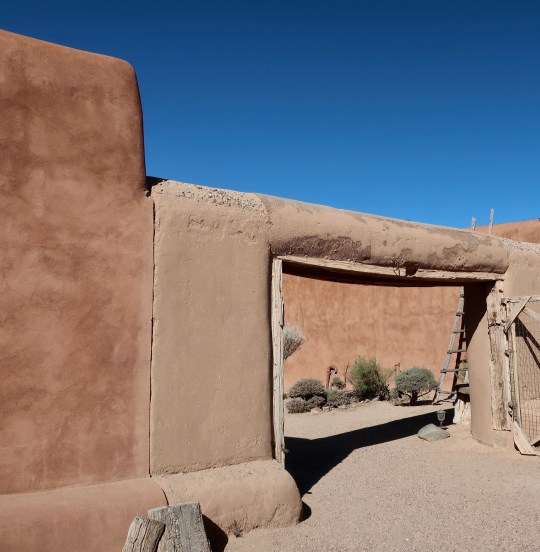
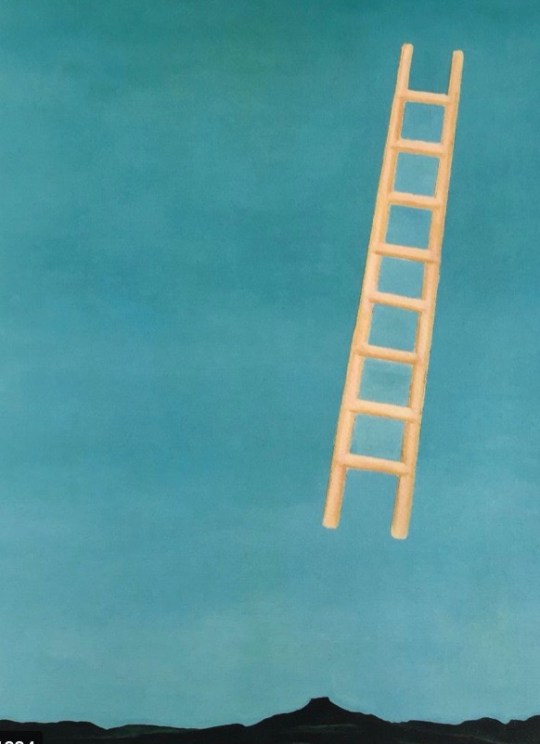
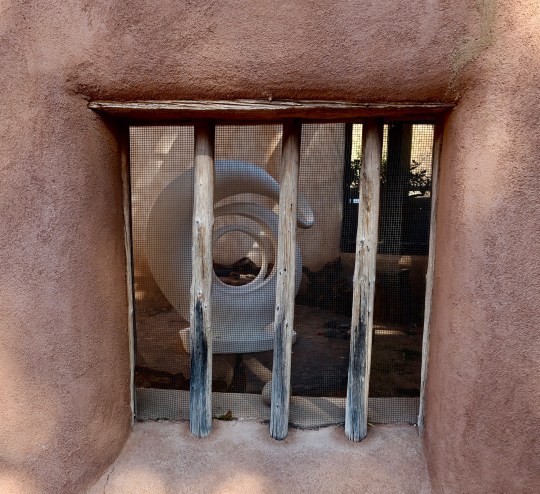
Everything about Georgia O’Keeffe’s home in Abiquiu seems to reflect the artist. A view of the surrounding scenery from the entrance to Georgia O’Keeffe’s home.Looking in. Note the ladder against the wall.Looking up. O’Keeffe would paint many things around her house…Including the ladder which she loved to climb up to the roof. Here, it is reaching farther up to the moon. The mesa top below it is where Georgia’s ashes are scattered.
Last summer when I was traveling down Highway 395 through Nevada and California, I discovered an excellent exhibit on Georgia O’Keeffe at the Nevada Museum of Art in Reno. It encouraged me to visit the places she had lived in New Mexico as one of the focuses of our Southwest trip last fall. Peggy, who likes O’Keeffe’s art as much as I do, readily agreed. In November, before Peggy and I climbed on Amtrak and made our way east to Virginia, I did two posts on Georgia and her time in Taos. In the first (go here), I featured relevant photos I had taken at the exhibit in Reno and then photos that Peggy and I had taken of the Church of St. Francisco of Asis church in Taos, a church that O’Keeffe had painted and her friend Ansel Adams had photographed. In the second (go here), I featured Mable Dodge Luhan, the famous art patron who persuaded Georgia to visit Taos, and the 1000-year-old Taos Pueblo, which O’Keeffe also painted and Adams photographed.
Today, we are going to visit O’Keeffe’s home in Abiquiu, New Mexico. When she first visited her the place in the mid 30’s, it was an old Spanish-Colonial compound that was basically in ruins. But she fell in love with it, and according to Georgia, a particular door. She had to have it. Acquiring it took ten years, which she did in 1945. It was up to her friend, Maria Chabot, working as the general contractor for four years, to turn it into a home. ”It took six months just to get the pigs out of the house,” Chabot would claim. O’Keeffe lived in the house up until 1984 when ill health forced her to move to Santa Fe where she died in 1986 at the age of 98.
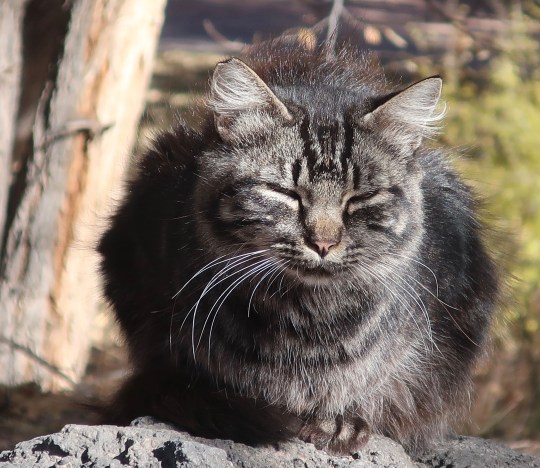
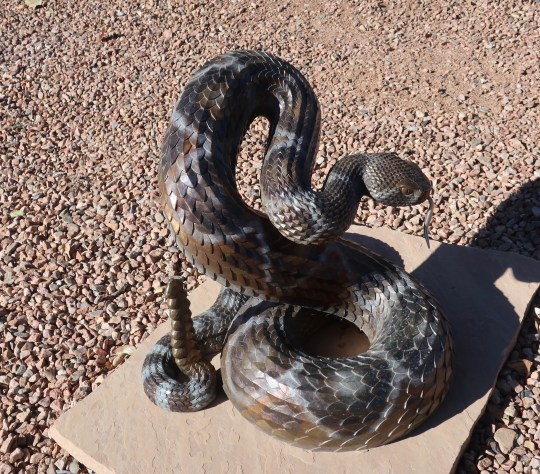
This cat welcomed us to the Georgia O’Keeffe Welcome Center in Abiquiu.Not so welcoming was this sculpture of a rattlesnake by Joe Spear on loan from the rattlesnake museum in Albuquerque. (I really wanted to go to the museum but we ran out of time.)
Peggy and I signed up for a tour of the home and studio with Georgia O’Keeffe Museum in Santa Fe. It started at the O’Keeffe Welcome Center in Abiquiu and then progressed up to the house. We were allowed to take photos outside but not inside. (I suspect that’s to encourage people to buy the tour instead of just going on-line.) One of the more interesting items inside was a piano that Georgia bought so Ansel Adams could play when he came to visit her. We learned that he had trained as a classical pianist instead of a photographer. The house and surroundings inspired a number of her paintings including the door that had originally attracted her, which she painted some 20 times. Another focus, the cottonwoods growing in the Chama River Valley that her house overlooked, she painted 24 times
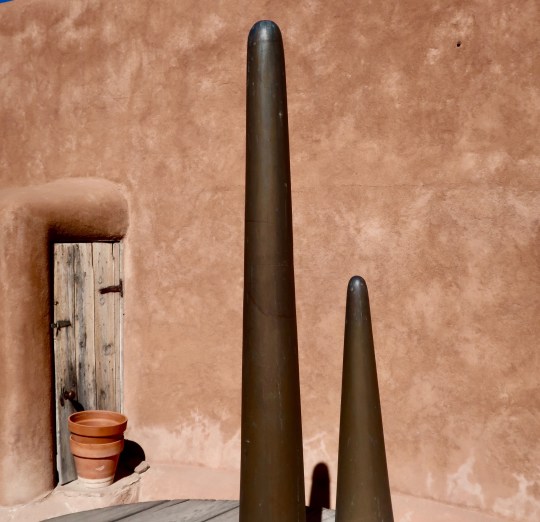
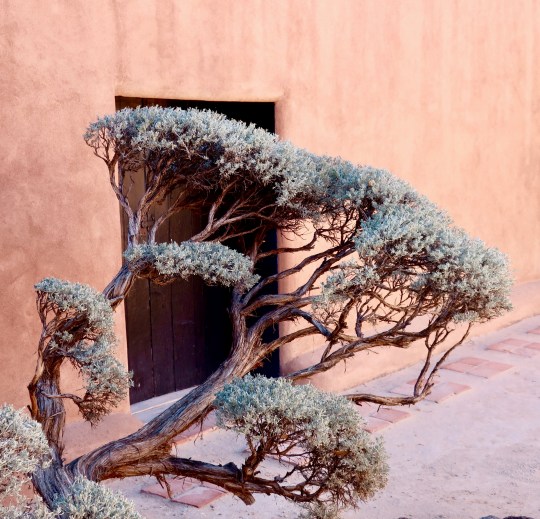
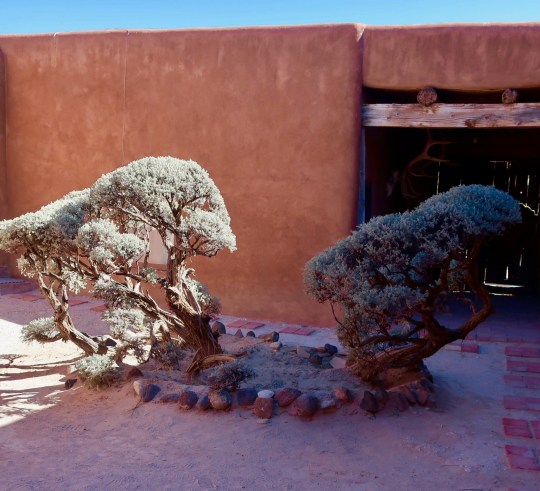
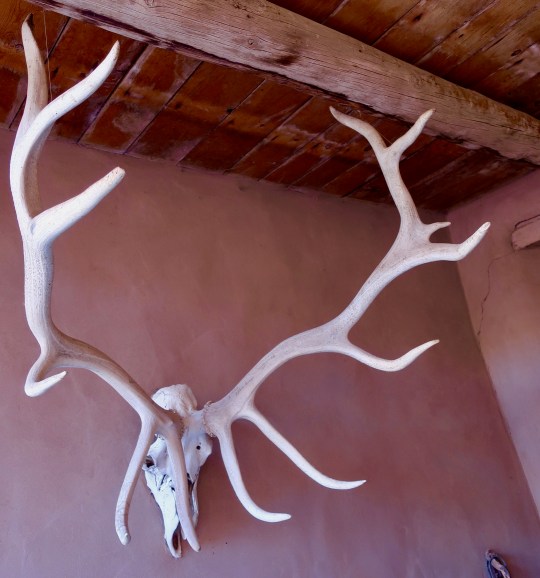
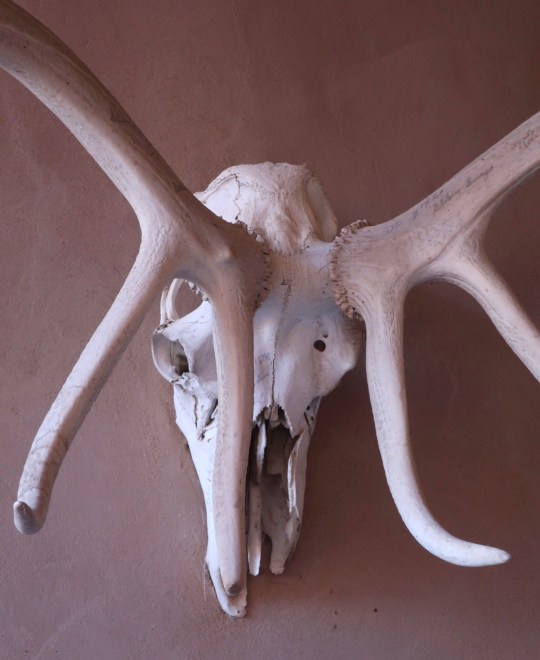
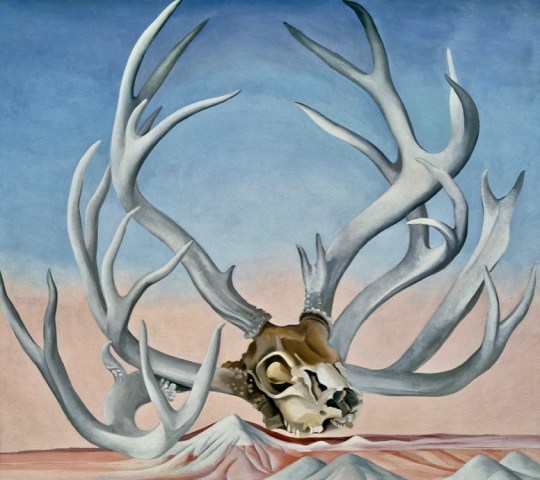
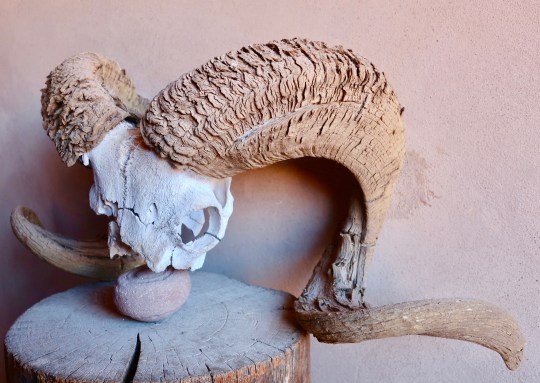
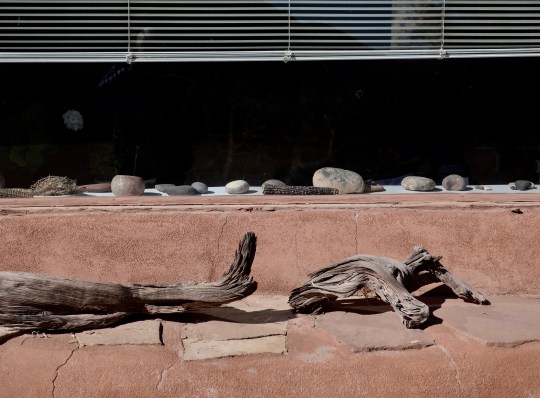
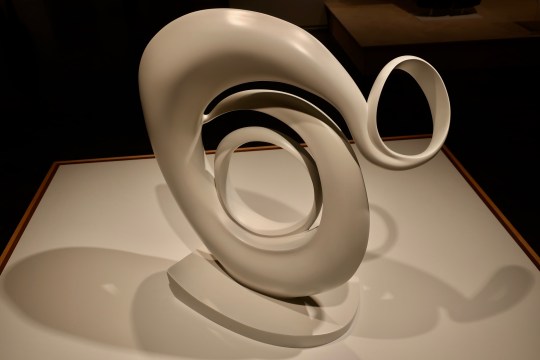
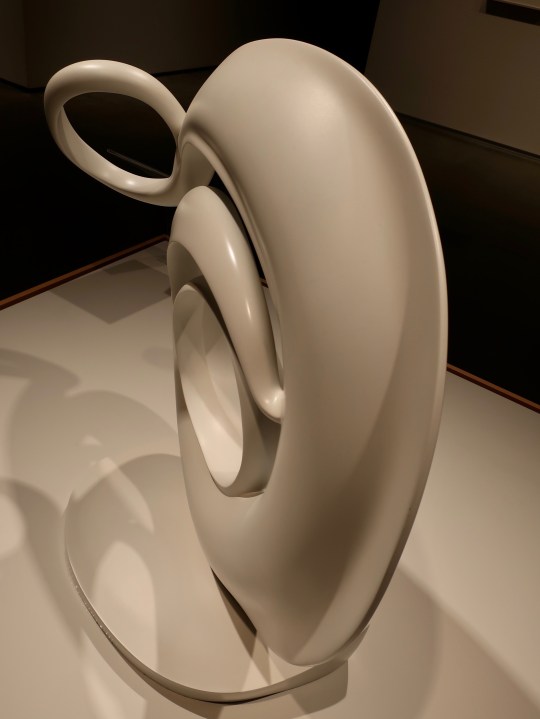
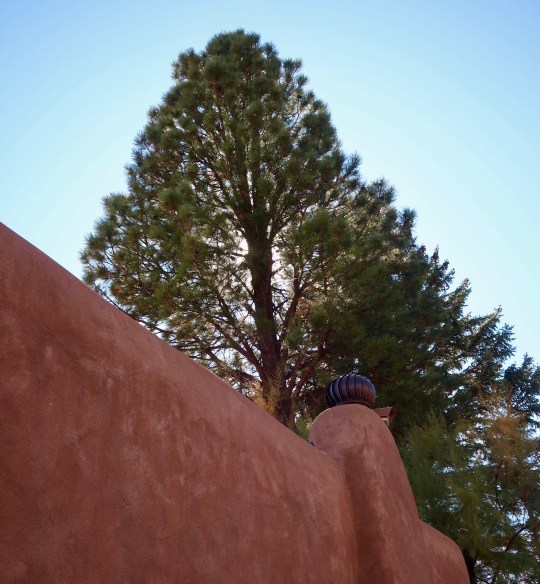
One of her 20 paintings of the doors in her patio.One of the doors she liked to paint.Looking in toward the door.I took a photo of the other door along with one of the picturesque bushes growing in the patio.Here I found one of the bushes in the sun and the other in the shadow. Peer into the dark and you will see antlers that O’Keeffe loved.It’s an impressive rack of a bull elk.Close up. O’Keeffe was known for her paintings of antlers and other bones she found out in the desert. At first her husband and agent, Alfred Stieglitz, objected to her sending bones back to New York to paint. When the paintings started to sell like crazy, he told her to send all the bones she wanted. She sent a barrel full. I also found this partial mountain sheep skull at Georgia’s.She also liked to collect rocks and sea shells. They are found throughout her house.Including on the sill of her living room window. She also found dead wood worthy of painting. I think the piece on the right may have served as a model.As Georgia O’Keeffe grew older her eye sight started to go and she took up sculpture. Her young handy man had been trained as a potter and taught Georgia how. It was quite the scandal of the time that Juan, who was 58 years younger than Georgia, was also handy in other ways. Georgia left him her two houses and $17 million, which he didn’t keep.While we could only photograph the sculpture at Georgia’s house from the outside, there was one of her sculptures at the exhibit in Reno that I was able to photograph.Another perspective.One of the things that O’Keeffe treasured about her home was its garden. Fruits and vegetables are still harvested from it today. These apples are ready to pick! I might have had one had the guide not been watching me. (Grin)I find the adobe look of southwestern homes like O’Keeffe’s very attractive. Had Peggy and I retired to New Mexico instead of Oregon, we would have had one. The contrasting trees here are a plus. The surrounding countryside provided inspiration for many of Georgia’s paintings. As I noted earlier these included over two dozen paintings of the cottonwoods that grew along the Chama River below her house. This one of them.. It is quite close to being abstract.I’ll conclude my post today with a photo a cottonwood near her home.
NEXT POSTS: On Wednesday it’s time for another photographic essay. This time I will post photos of some quite humorous elephant seals Peggy and I found on the beach near Hearst Castle in Southern California. On Friday, I will conclude my Georgia O’Keeffe series with a trip to Ghost Ranch, about 15 miles north of Abiquiu where Georgia also lived and painted.
The tools of the trade. Each competitor at the BP 2016 World Ice Carving Championships in Fairbanks, Alaska carried a wide variety of tools ranging from chisels to chainsaws.
On Wednesday, I took you for a ride on the Alaska Railroad from Anchorage to Fairbanks. We were on our way to attend the 2016 World Ice Carving Championships.
We were lucky to arrive in Fairbanks to see the carvers at work and then see their finished works of art. They were impressive, to say the least.
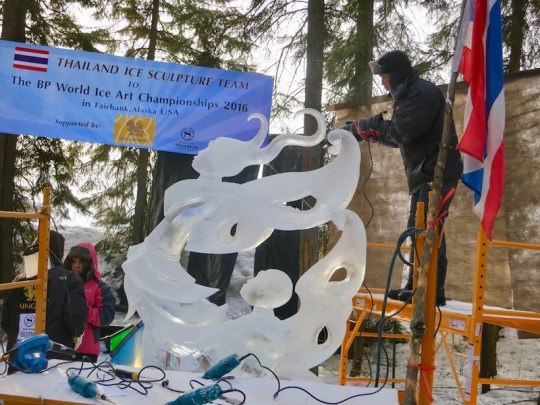
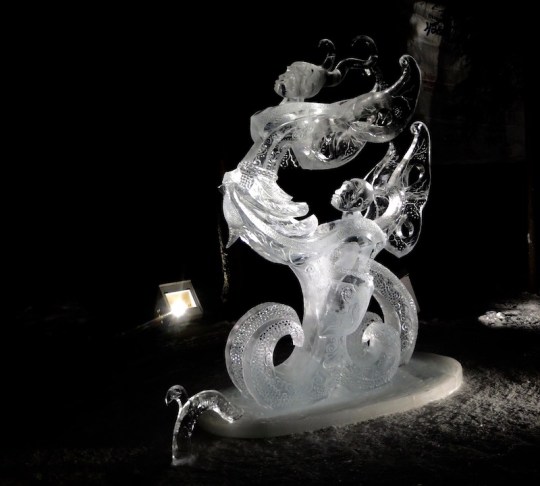
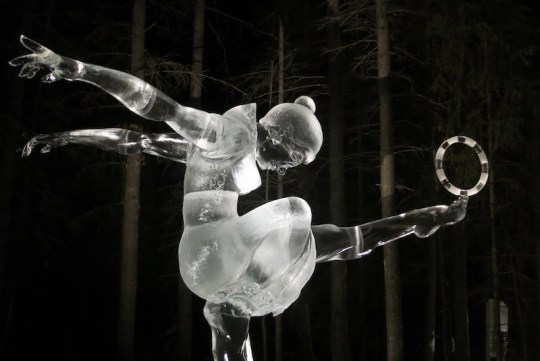
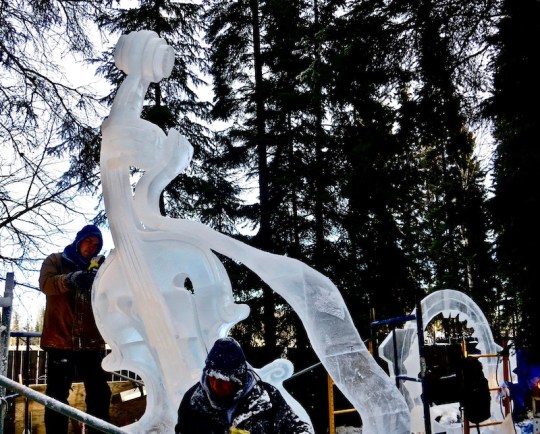
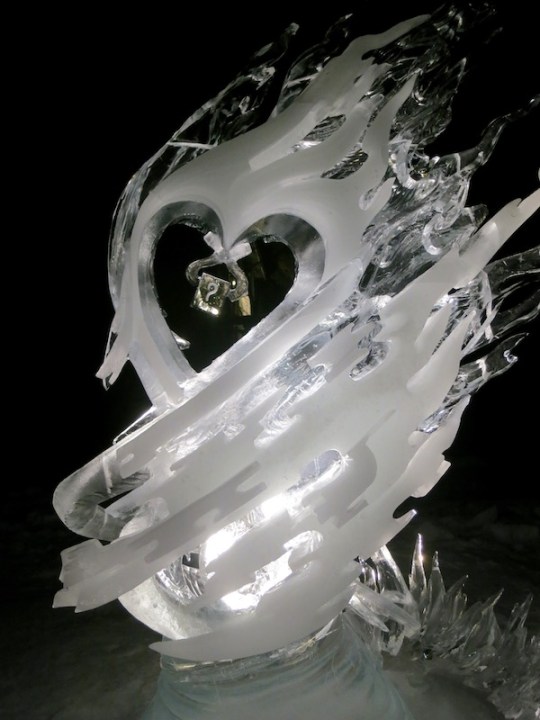
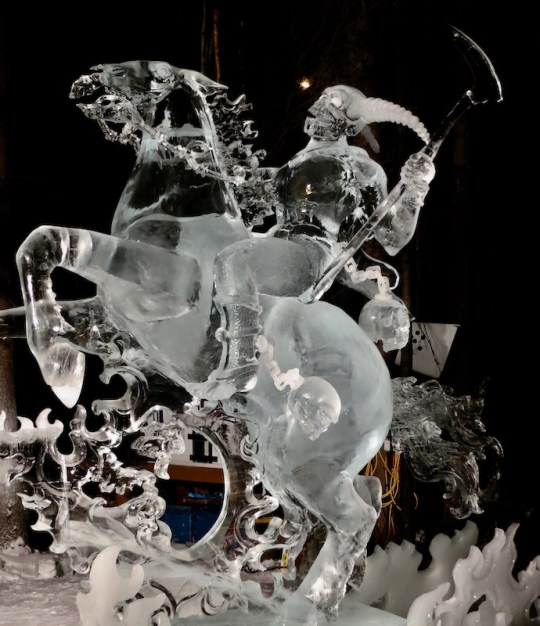
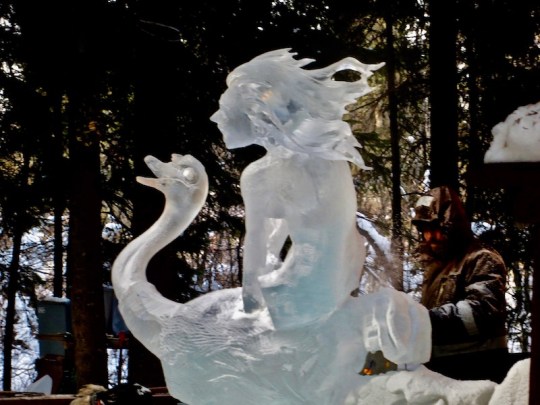
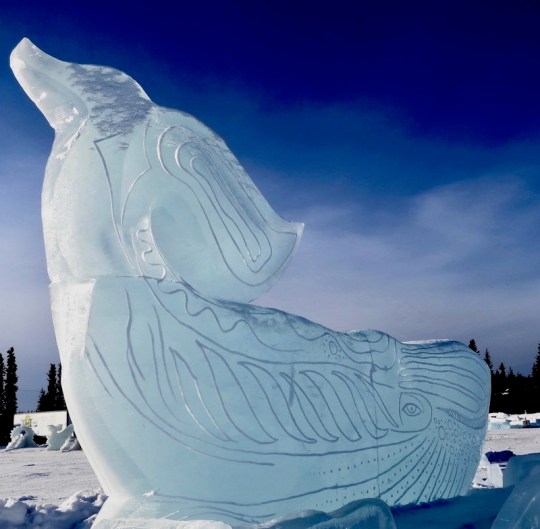
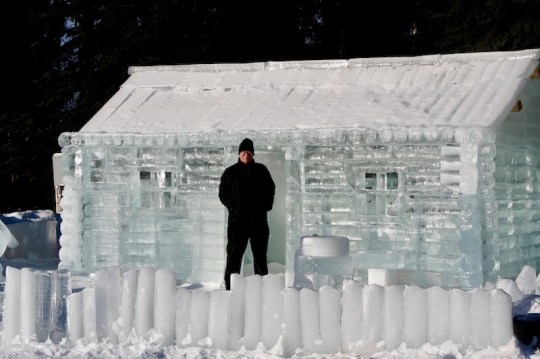
The Thailand Team puts the finishing touches on their sculpture for the night’s competition.And here is the finished sculpture.The round ball seemed almost magical to me, like I should be able to look into it and see the future. Note the thin, wire-like tool the artist on the left is using to add texture.This acrobat was lifting her leg high.As I recall, she won the competition.This piece was interesting…It turned out to be a self-playing base fiddle!I thought the young girl running with a dandelion head was fun. Did you blow on these as a kid to watch the seeds go flying off?She loves me, she loves me not. Note the question mark held by ice tongs in the center of the heart. Hold that tiger! Lots of teeth and claws.Speaking of teeth, the tiger wasn’t alone.Woof, woof.This was one of my favorites because of the detail.An unfortunate jellyfish has become dinner.Here’s a figure you don’t want to run into at night. Or during the day.Here kitty, kitty, kitty. Maybe.So, is it a cat? And what is with the chain?This woman is riding a bucking ostrich. Yeehaw!My heart goes where the wild goose goes. Indeed.In addition to the sculptures included in the ice carving contest, the park featured a number of other figures such as the helicopter I showed you on Wednesday and this giant whale.I also found this sea serpent rather impressive.I’ll close today with my new log cabin. It’s a bit cold inside. But don’t you think my all black outfit contrasts nicely with the ice? That’s me, a true paragon of fashion. (grin)
NEXT POST: On Monday I will have Georgia on my mind again as I return to O’Keeffe’s home in New Mexico and finish up the series I started before Peggy and I took off across the country on Amtrak.
Our train trip from Anchorage to Fairbanks took place on a clear day, allowing us to enjoy the beauty of the passing countryside. Even the reflection was stunning. They had an open window between two of the cars that I leaned out of to catch this photo.
There is great beauty in Alaska. I worked there from 1983 to 1986 as the Executive Director of the Alaska Lung Association. One of my jobs had been to lead 100-mile backpack trips as fundraisers to support the organization’s activities. (Not many executive director do that.) In addition to raising money, the treks provided me with an opportunity to explore some of the state’s more remote corners and vast wilderness areas.
In March of 2016, Peggy and I returned to ride the Alaska Railroad from Anchorage with our son Tony and his family to attend the world championship ice carving contest in Fairbanks. Tony was flying helicopters for the Coast Guard out of Kodiak at the time. The train trip reminded me of just how beautiful and wild Alaska is. We were fortunate to travel on a clear day that provided great views, including Mt. Denali. In Fairbanks, it was exciting to watch some of the world’s greatest ice carvers at work and see their completed sculptures. Today’s photo essay will reflect the train trip. On Friday, I will show you the ice carving contest.
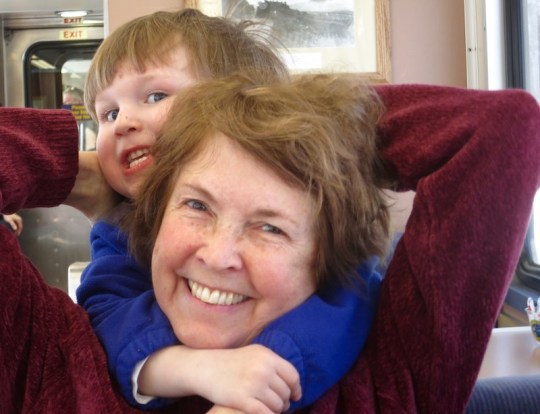
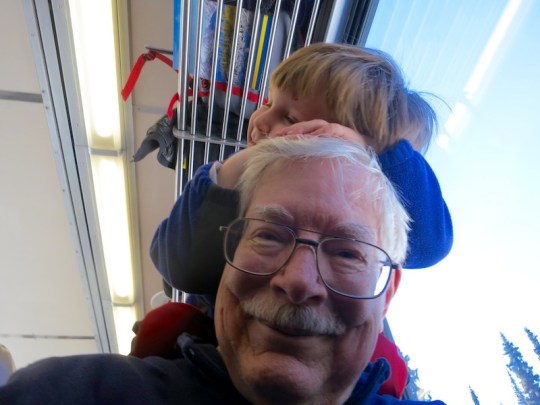
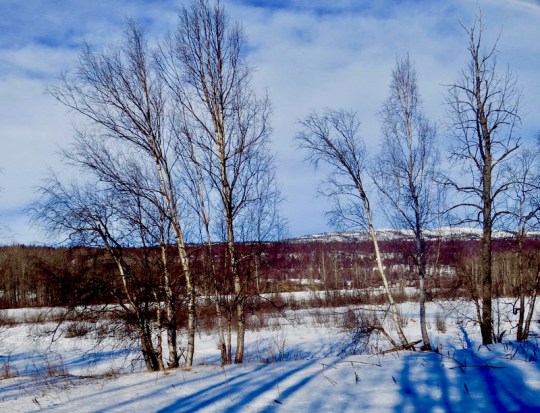
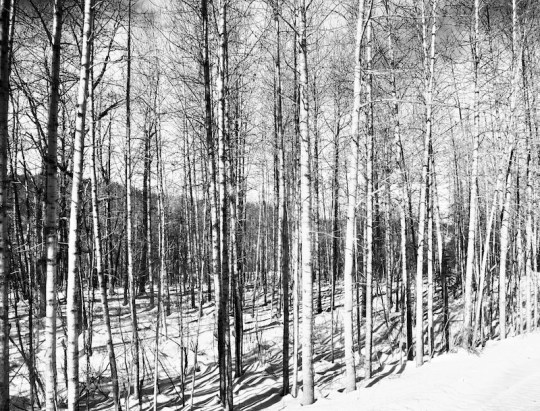
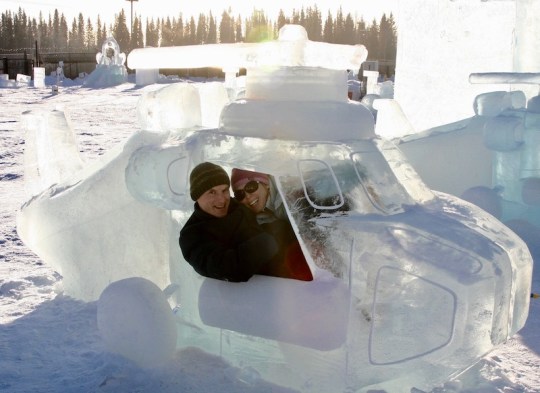
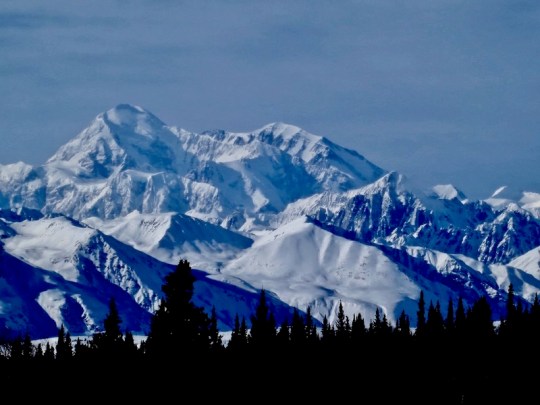
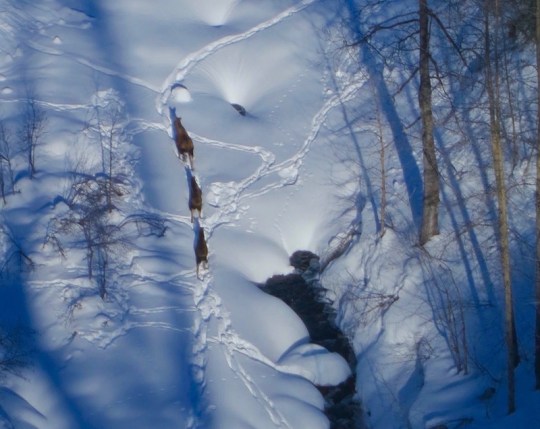
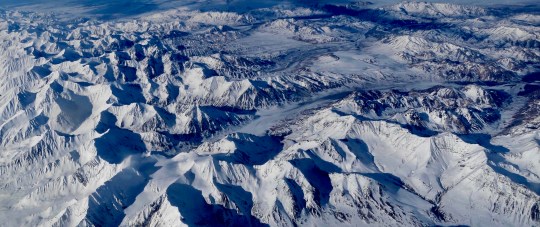
Of course not all of our time was spent looking out the window enjoying the scenery. Our grandson Cooper made sure of that as he climbed onto Peggy’s back.And decided to take a snooze on my head. That can give you a neck cramp! (Photo by Peggy Mekemson.) Folks live along the railroad and use it for transportation. They can flag the train down whenever they need to go to town. It’s Alaska!This stream made me long for my kayak. Note how crystal clear the water is.The snow enhanced the look of trees along the railroad. Or maybe it was the other way around.Another example.I rendered these skinny birch trees in black and white.Time for another family photo. This is Tony and his boys.I mentioned that Tony flies helicopters for the Coast Guard. I had to include this photo of him giving his wife, Cammie, a ride in an ice copter. They had a hard time getting off the ground. (Grin)One thing Alaska has is impressive mountains. Lots of them. And there were dozens of great views on our trip.Another example.And another!The grand-daddy of them all is Mt. Denali, the highest mountain in North America. (Photo by Peggy Mekemson.)We also saw some impressive canyons along the way. This one had a family of moose making its way through the snow. During heavy snow years, the moose use the railway as a path. Encounters with trains don’t go well, at least for the moose. One of the years I was in Alaska was a particularly bad snow year and a number of moose had been killed. I awoke one morning and discovered that the top headline in the Anchorage Daily News proclaimed “Railroad 50, Moose 1.” Apparently, the train had hit a moose and been derailed.We thought this canyon was gorgeous with its ice-covered, meandering river making its way around the trees in the top center of the photo.We flew back to Anchorage after our trip and I snapped this photo of the Alaska Range. I thought it would be an appropriate picture to end today’s blog.
NEXT POST: On Friday I will show you photos of the world championship ice carving contest in Fairbanks. The sculptures were amazing. You won’t want to miss them.
I didn’t have a clue what I would find the old boy brewing up at the Devil’s Kitchen in Bandon. But I was expecting something like the Devil’s Churn, which is found farther north up the Oregon Coast.
I figured the Devil had to cook with ghost peppers, and that got me excited. I like my food spicy hot and it doesn’t get much hotter. A tiny bit goes a long, long way, even for me. Lacking that, I thought I might at least find a churning, boiling sea like you find at the Devil’s Churn. Instead, I found a quiet, bucolic scene. Crooked Creek flowed peacefully out to the ocean.
Crooked Creek flowing out to the Pacific Ocean.
But wait a minute, I thought. The Devil is sneaky, right. Maybe Crooked Creek was indeed crooked. Maybe it tricked people into crossing and then sucked them under with quicksand. With this in mind, I went seeking other subtle reminders of the Devil’s presence.
And found this. If ever there was an example of the Devil’s handiwork… Note the smiley, evil face on the left. And then, Gonzo. Next comes an inebriated Santa, followed by a busty Old Mother Hubbard. And finally there is Tex Ritter. You can tell by the cowboy hat. But just who is Tex Ritter? What? Maybe you can’t see any of the above and you’re thinking Mekemson has gone over the edge. Maybe he is possessed. Backing up, I realized the truth. I was looking at a sand castle made by a kid who obviously needed some counseling. He didn’t even know that the moat was supposed to go on the outside.And then I saw it, as clear as the day. A hell hound. Look at those flaring nostrils and bulging eyes. I looked again and saw Goofy needing a haircut. Was this yet another example of the Devil being sneaky?Something had been eating rock! I looked up and saw an evil turtle glaring at me. I was becoming a believer.Even the driftwood took on a scary countenance. Look at the snout on this fellow and his hollow, haunting eye. I didn’t want to be around when the sun went down.At first I thought I saw a face here, maybe George Washington in his dotage. Then I realized that something very big had eaten a chunk out of the rock.People sometimes fall off cliffs. That seems a devilish thing to do. Usually they are standing on the edge taking a selfie of themselves. Don’t they know that selfies are the creation of the Devil? While I feel sorry for these folks who give their all for a fleeting moment of fame, I can’t help but wonder if something Darwinian isn’t involved. Given that this particular cliff was three inches high and the water was two inches deep, there wasn’t much danger, however.And finally the ultimate proof. Most people think of this as kelp, but actually, it is the Devil’s bull whip!In the end, even though I had discovered several hints of the Devil’s presence, I decided that the area was just too pretty to be associated with Hell.Even the rock with the chunk missing looked harmless from the distance.And this sea stack caught in the afternoon sun was close to beautiful.I walked back toward my van through the trees…And found this sign. Turns out there was nothing devilish about Devil’s Kitchen at all.No longer fearing for my soul, I hung out on the beach to see a final sunset before I left Bandon heading south. I’ll be back.
NEXT POST: The Wednesday Photo Essay. Four years ago in February, Peggy and I went for a ride on the Alaska Railway from Anchorage to Fairbanks with our son Tony and his family. Join us as we check out Mt. Denali and attend a world championship ice carving contest.
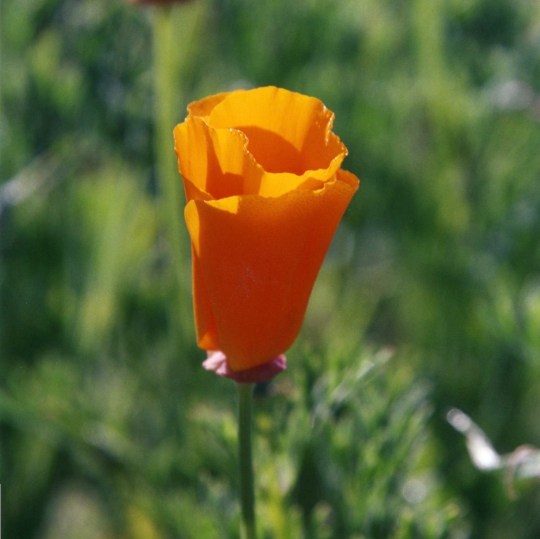
A California poppy. Always beautiful. This was early morning before it had opened up.
The American River flows right through the heart of Sacramento, California and is one of the community’s greatest assets. I spent a lot of time there when I lived and worked in the city. It was where I escaped to when I needed a touch of the wild, which was often. It was a rare week when I didn’t hike of bike there at least once. And there were times when I was there almost every day. Later, when I became interested in photography, I often carried a camera. There were birds and ducks and geese and jackrabbits and cottontails and turkeys and deer and foxes and coyotes and skunks and raccoons and otters and squirrels, and rattlesnakes (on my) to photograph.
And there were flowers. Fields and fields of them. Enjoy. Happy Valentine’s Day!
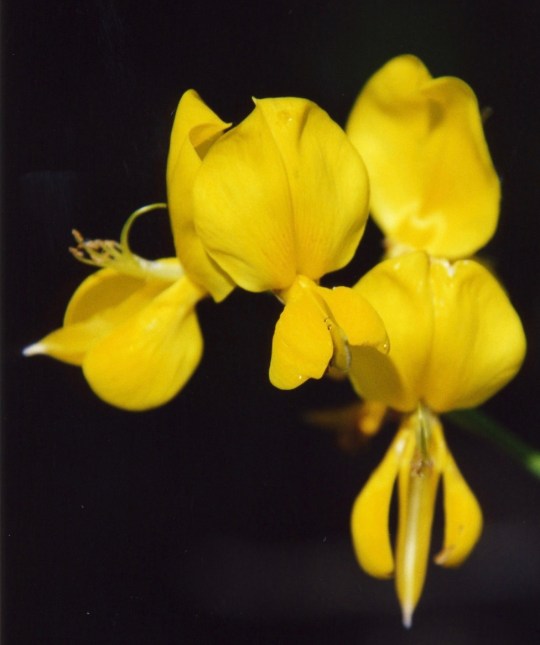
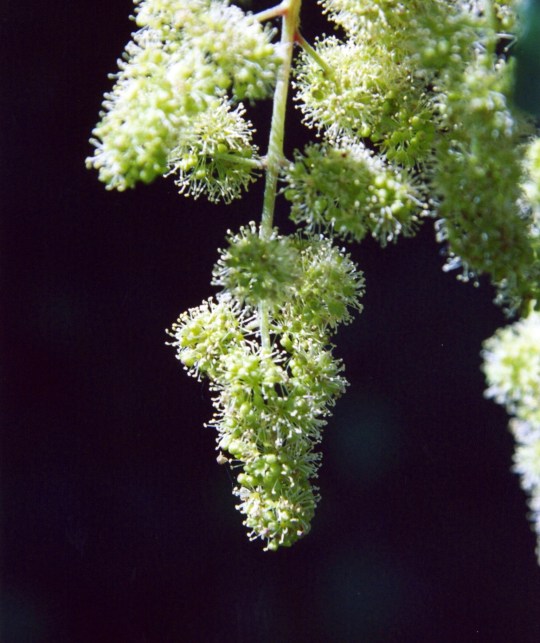
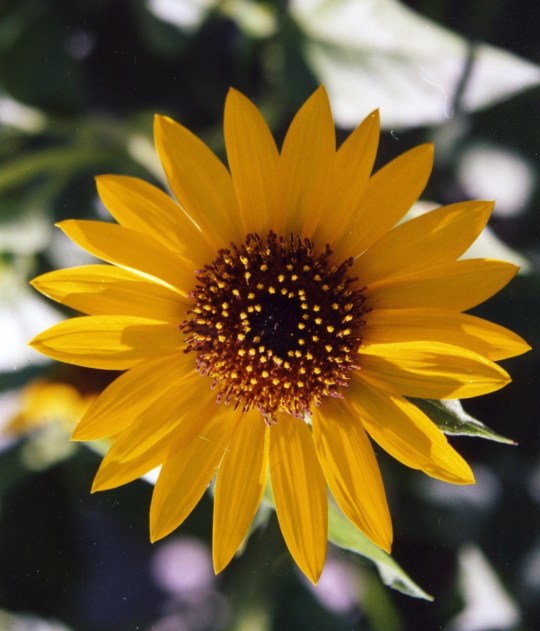
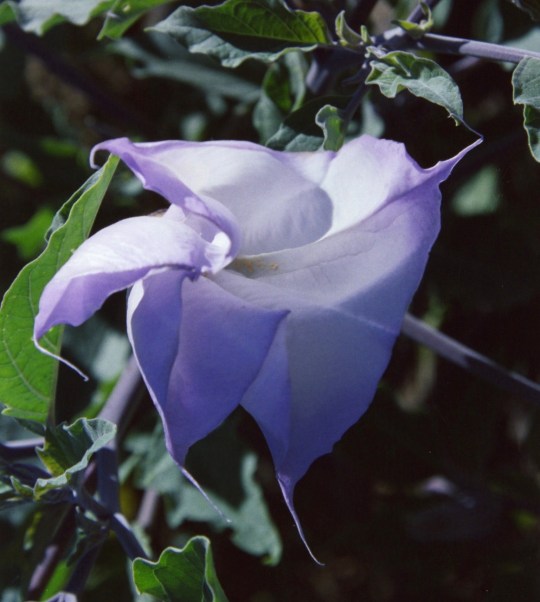
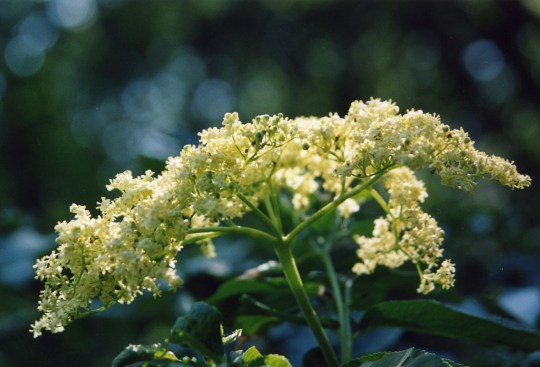
Scottish broom. It’s a weed plant, so they say. Crowds out the more sensitive natives. But I can sure understand why people wanted to plant it.Some early pioneer had planted Iris here. He’s long forgotten but his flowers live on. A fitting tribute.Pioneers left behind fruit trees that still bloom on the parkway as well.More fruit tree blossoms.Here’s a native. Do you know what it is? it’s a buckeye. Eventually these flowers will turn into a beautiful brown, nutlike fruit.This little jewel is a wild grape.Not a clue here, but I like it’s whirly petals. Any ideas?While I’m on clueless, here’s another example. But wow!More poppies!A member of the sunflower family for sure.Bull thistles would make a pretty bouquet, but your sweetie best have a sense of humor.I am thinking evening primrose here, but I could be wrong.One of my all-time favorites but you definitely don’t want to give it to your sweetheart. Jimson weed is poisonous…But it sure is pretty, This one is just opening up.Be it ever so humble— the common blackberry. Great fruit!A blue elderberry.Flowers on a black locust tree.And for fun, I’ll close today with this strange fellow, Dutchman’s pipe!
MONDAY’S POST: We are going to visit the Devil’s Kitchen. Are you ready?
I was admiring this puffin on Coquille Point in Bandon when I heard about the missing dog.
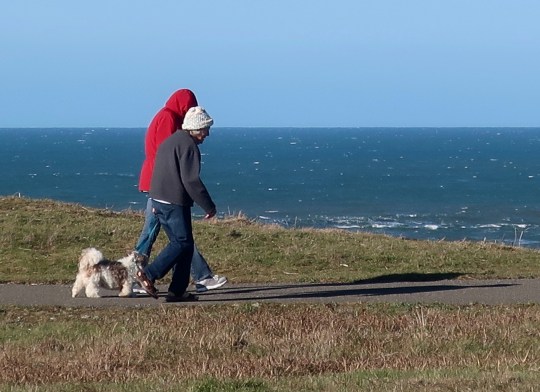
I was up on a cliff studying one of Washed Ashore’s sculptures made out of ocean trash when I heard the statement. It was a classic. The perfect senior moment! “Excuse me ma’am,” the young woman called, “do you know there is no dog on your leash?” I turned quickly. At 76 going on 77, I take notes on such incidents for future reference. Yes indeed, a bent, elderly woman was walking down the pathway holding a leash that was strung out behind her— without the dog. She turned, glared at the leash, muttered something, and stared back down the trail like Clint Eastwood on steroids. There came Fido (the name has been changed to protect the innocent), who was equally old in dog years, about 30 feet down the path, tottering along with no obvious desire to catch up. I could almost hear him chanting “Free at last, free at last,” as he stopped to smell the dog pee and dream of his puppyhood days.
Once Fido was captured and leashed again, he dutifully walked off with his mistress and the young woman, waiting patiently for the moment when he would once again slip his leash.
With the help of the young woman, Fido was soon recollared and the three went on their way. As did I. But I wanted to write down the story down before it wandered off like Fido. And since I was still hanging around Bandon, I decided to show you more rocks today instead of the American River flowers I promised. I am sure you are excited. Plus, Friday is Valentine’s Day, the perfect day for flowers.
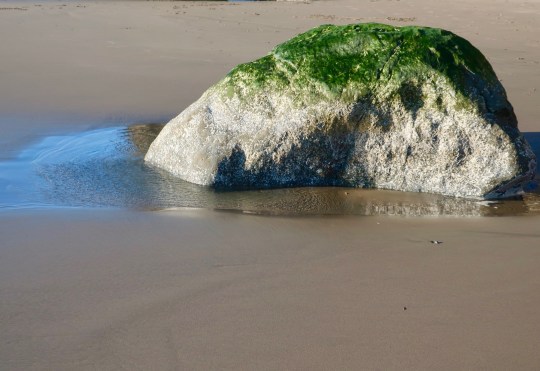
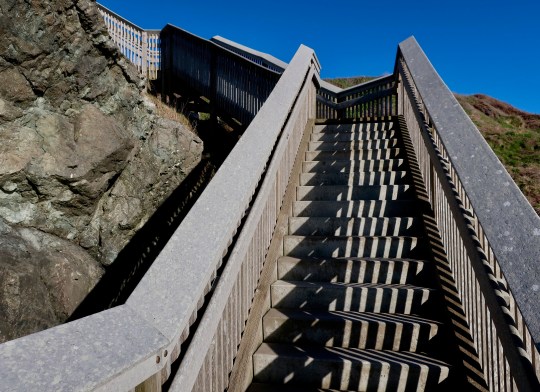
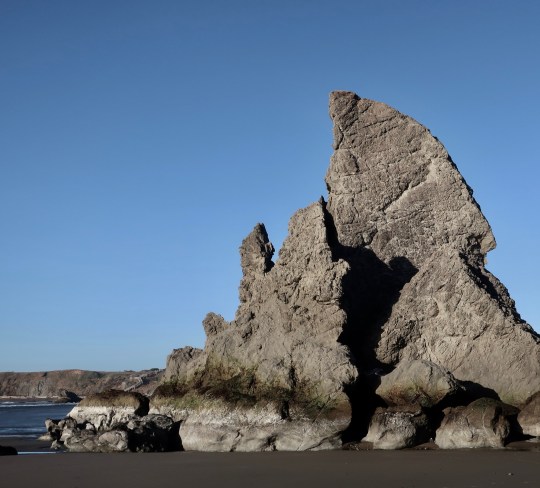
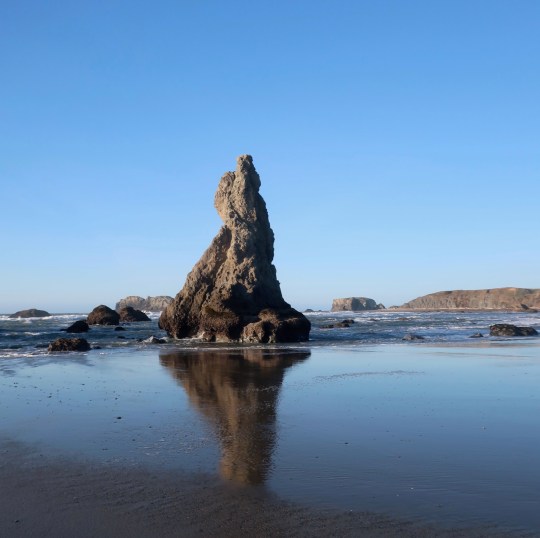
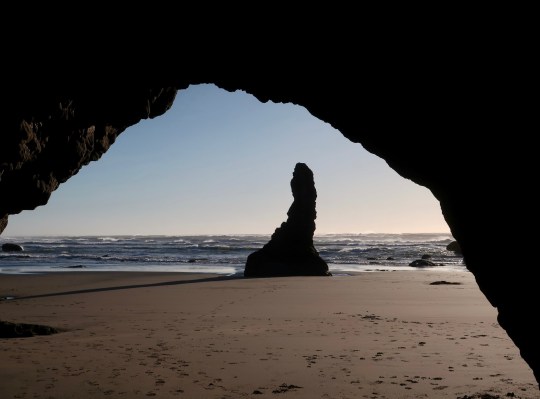
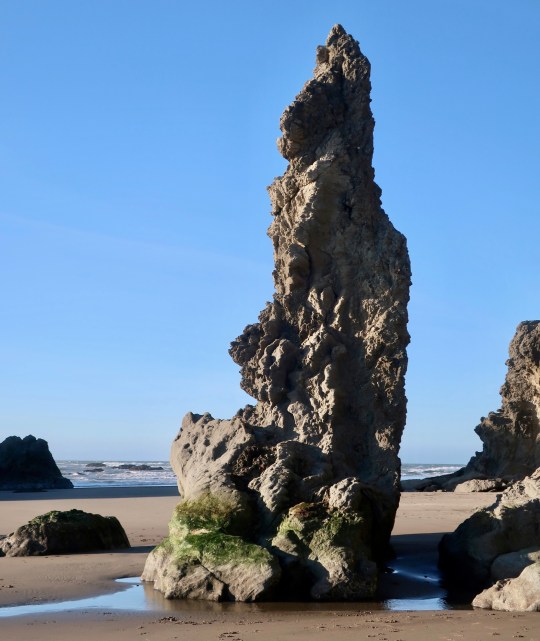
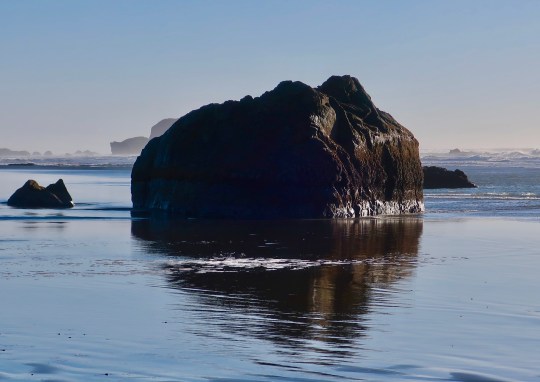
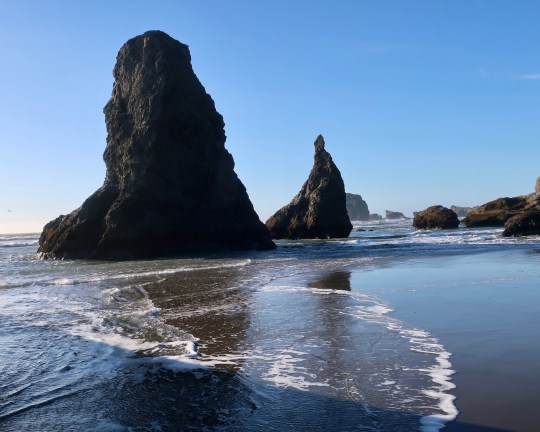
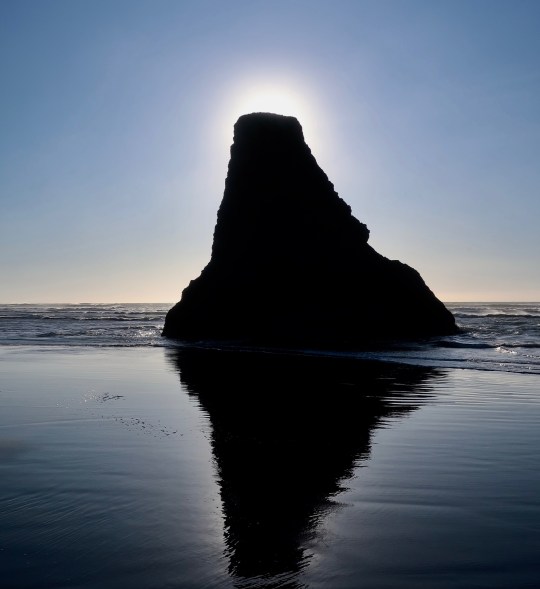
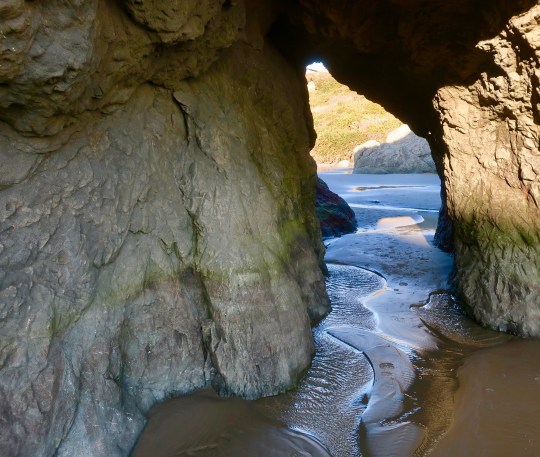
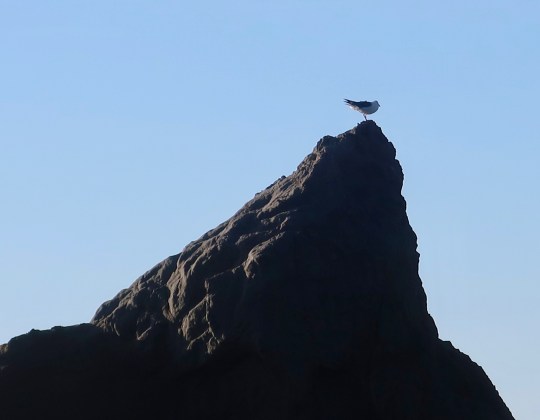
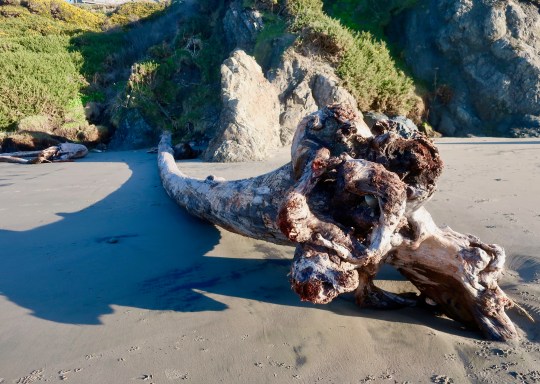
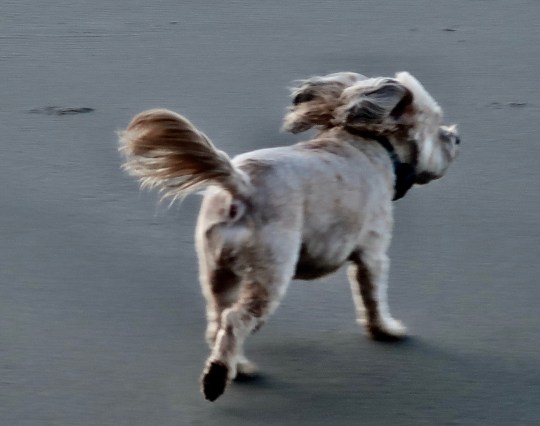
A rock.A bigger rock.A really big rock. There, are you satisfied. No? Well how about a rock with a hole in it?I think the hole was supposed to represent an elephant’s eye. I had an uncontrollable urge to go down and photograph waves crashing through it.The stairs to the beach. I’ve included this photo for my WP friends who are into perspective.The hole showed great promise.The spume, blown by a hard, cold wind, was gorgeous. But it wasn’t what I came for. I wanted big waves crashing through the hole. I quickly leaned that there was a problem…Yes there were big waves, but they blocked the light, making photography difficult. But you get the point. I headed on…And found some chubby seals sunning themselves on a rock. Fat is beautiful from a seal’s perspective. A layer of blubber keeps them warm when they dive up to 500 feet in search of food. It’s so dark, they use their whiskers to check out lunch. The whiskers operate independently and are apparently quite sensitive. “Ah, I feel lobster is on the menu today.”After checking out the elephants eye and the fat seals, I moved on to the Face Rock Wayside. Can you spot the face?Here’s a clue. BTW, I did a post on Bandon a couple of years ago, so some of these photos may be familiar.There are many other impressive rocks on the beach at the Face Rock Wayside. You are free to name them whatever you want. I thought of these as a pointy headed mom with her pointy headed kids.The sea stacks, as they are called, were once part of a massive cliff stretching out into the ocean. The forces of erosion— wind, rain, sun, ice, and waves— had worn them away to their present status. Existing cliffs are sea stacks in waiting.I hiked along the beach merrily naming rocks. Behold the turtle who only makes progress when it sticks its neck out.I thought this sea stack seen from a cave might be up for the ‘Fickle Finger of Fate’ award Rowan and Martin used to give out on their TV program. Boy could we use that today. I’m not sure that there are enough fingers to go around, however. Before your time? Google it.What does this sea stack resemble to you? Inquiring minds want to know.I decided this rock was decidedly frog-like with its bulging eyes and shiny white teeth. It was grinning like the Cheshire Cat.A seal, perhaps, with its head up barking.I’m thinking naked Hindu goddess, here. But it takes a stretch of the imagination.Of course there were lots of sea stacks that I was happy to admire for their beauty alone.This one had a halo and a reflectionA sea stack bathes in the late afternoon sun.Certainly, there were other things to admire down on the beach, like this cave.And this lone seagull with its massive perch.And water flowing across the beach leaving behind unusual tracks.This was one long piece of driftwood!In line with my theme, I’ll close with this dog that ran across the beach in front of me. Remember when I mentioned the wind? The dog pretty much says it all!
NEXT POSTS: I promise flowers for Valentine’s Day. On Monday we will visit the Devil’s Kitchen. Scary? We’ll see.
Actually, I am in Bandon, Oregon, one of my favorite towns on the Oregon Coast. I would like you to meet Natasha, the sea trash turtle. The Washed Ashore Organization is dedicated to cleaning up our oceans and creates whimsical creatures out of trash its volunteers clean up along the shoreline.
I dropped Peggy at the airport in Medford on Friday. She’s off to spend a couple of weeks in Virginia on grandkid duty while their parents make a quick escape to Mexico. “Please come Mom,” Tasha had requested while Clay had sent her first-class tickets. Hard to ignore that appeal. I was invited as well, but having just spent Christmas and New Year’s back east, I opted for a solo trip in Quivera the RV over to the Oregon Coast with plans for making my way south to Redwood National Park in Northern California.
That’s what I am up to now as I put this post together. I decided what better time to write about our coming travel/blogging plans for the year than when I am out traveling. I’ve just spent the past three days in the small coastal town of Bandon, which has some of the most impressive rock formations on the Oregon Coast. They make up several of the photos for today’s blog.
Travel-wise, we have a full year planned. 2020 started with our trip home on Amtrak from Washington DC, which I’ve already blogged about. This is trip number two. (Although it’s sans-Peggy, I’m counting it.) In late March, we are taking off for a 16-day cruise focusing on the Panama Canal. Peggy lived down there in 70’s for a while in her life before Curt. It is where Tasha was born. She has been wanting to get back there for a very long time. When I mentioned the possibility of the cruise, she jumped on it. Peggy’s sister Jane and her husband Jim are going along. In addition to Panama, we’ll be making stops in Costa Rica, Columbia, Nicaragua and Mexico.
We plan to kick off our backpacking season with a 40-mile trip down the Rogue River trail. It is beautiful in spring and makes an ideal beginning of the season hike. Peggy turns 70 this year and wants to make sure she celebrates properly. She also wants to explore more of the Pacific Crest trail through Oregon this summer as well. I’ll plan a 70-mile trip to go along with her years and my 77. We also have a 7-day kayak trip planned.
The biggie in celebrating her 70th, however, is a 7-day Rhine River Cruise from Amsterdam to Bern. We’ve invited our children and grandchildren along and, needless to say, they are excited. We will be in the middle of our trip when Peggy has her birthday on July 5th. Afterward, we will pop over to France to spend several days with Peg’s brother John and his wife, Frances.
We have tentative plans to return to Burning Man this fall. That, of course, depends on our ability to get tickets in the BM lottery, never a sure thing. Throw in the fact that we will be in the middle of the Panama Canal with iffy internet connections when the lottery takes place, I am not optimistic.
Peggy is off on another cruise in September, this time with her sister Jane from San Francisco up to Victoria, BC, a girls’ trip. I’ll take advantage of it to drive Quivera south down through Santa Cruz, Monterrey, Carmel and Big Sur. I love that area and have been escaping down there since the 60s and 70s, when I used to camp out along the road in my VW van. It’s as close as I ever got to being a hippie.
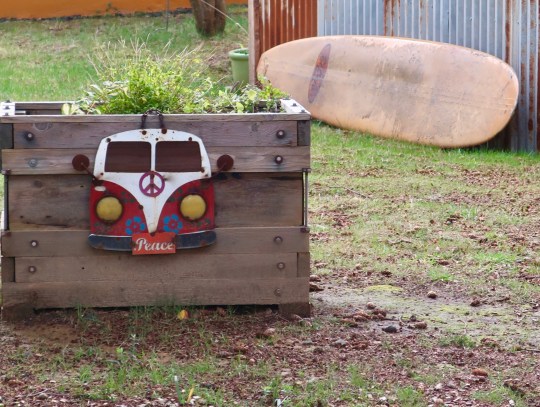
Quivera and I are staying at the Bandon Wayside Motel plus RV Campground in Bandon. It’s a small but charming, beautifully kept up property that dates back to 1949. If you look to the left, you will see a small sign featuring a 60s-type VW Van.A close up. Made me feel right at home. I was never a surfer, but I sure identified with the peace concept! Still do, as hard as it is in this era of nation-states rattling nuclear weapons.A photo of the motel.And this is Nicole, the co-owner of motel and RV campground along with her partner David. She’s an absolute bundle of energy and friendliness. If it weren’t for the all of the hard work she puts into the place, I’d be a little bit suspicious that she has some modern-day hippie in her. She told me “David and I decided to marry the motel instead of each other.”
October will be time to jump in Quivera and do another month-long exploration of the Southwest. This time we want to include Death Valley NP, the North Rim of the Grand Canyon, Zion NP, Bryce NP, Capitol Reef NP, Canyonlands NP, and Arches NP. (This may be news to Peggy, grin.) After that we will be traveling east to spend the holidays with our kids. We are contemplating using Amtrak again, following different routes. Does that sound like enough for the year? Do you think I will have adequate material to blog about? Heck, I still have lots from last year? I never seem to catch up. Do you? And then there is the book I am writing…
I’ll conclude with a note of parental pride, if I may. Our son Tony just received the Coast Guard’s second highest award for coordinating the massive rescue effort the Coast Guard undertook in the Bahamas during Hurricane Dorian. The storm was a devastating category five hurricane with record-setting winds of up 175 mph. He and his fellow Coast Guard helicopter pilots spent 5-days more or less without sleep on the ground and up in the very dangerous air. The Commander of the Coast Guard and the Secretary of Homeland Security awarded Tony with the medal.
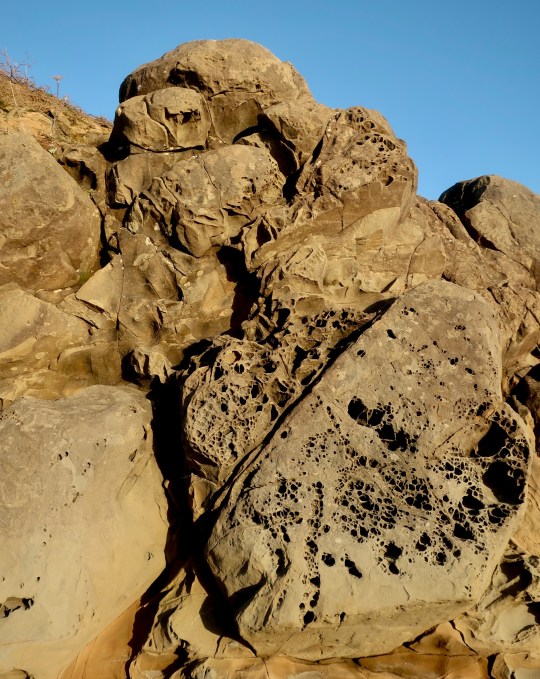
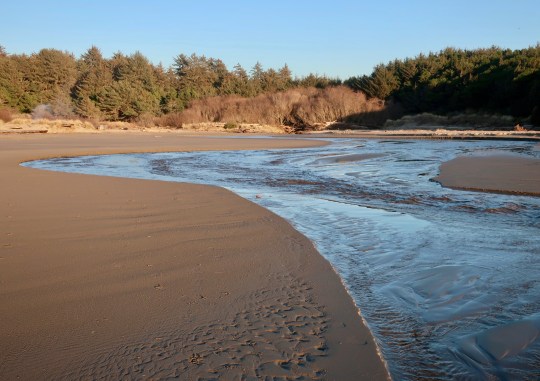
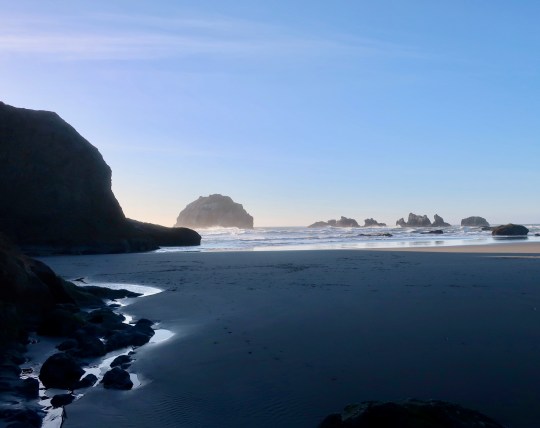
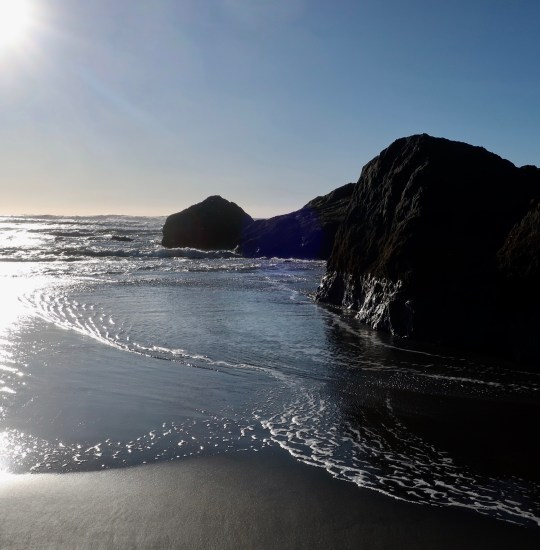
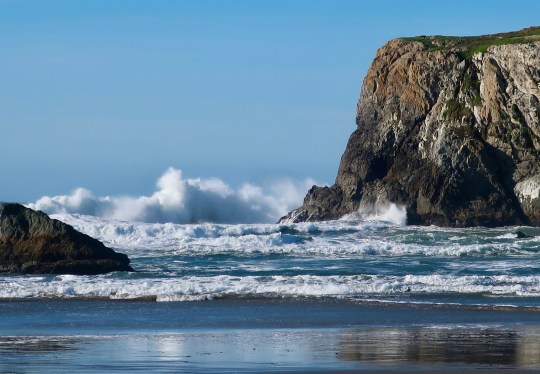
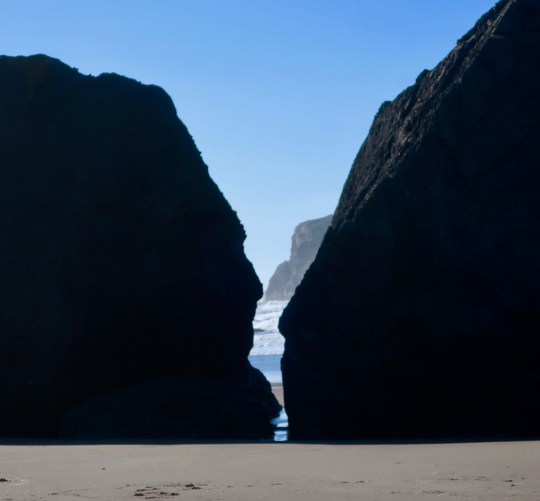
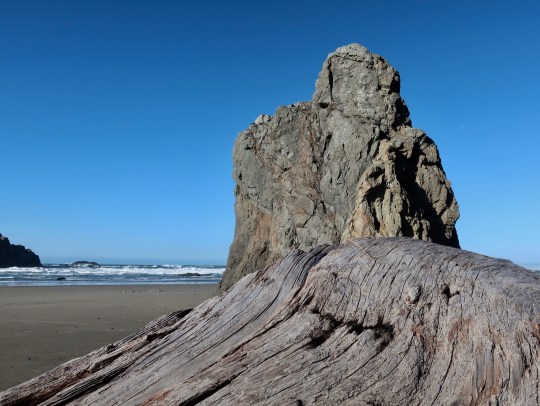
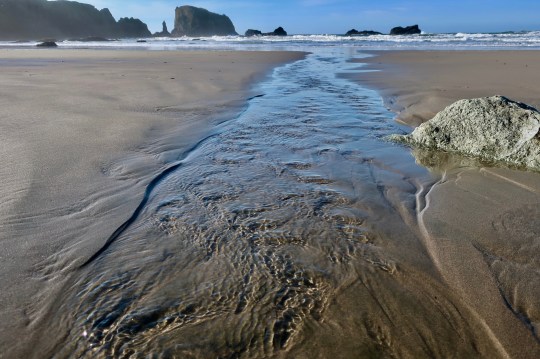
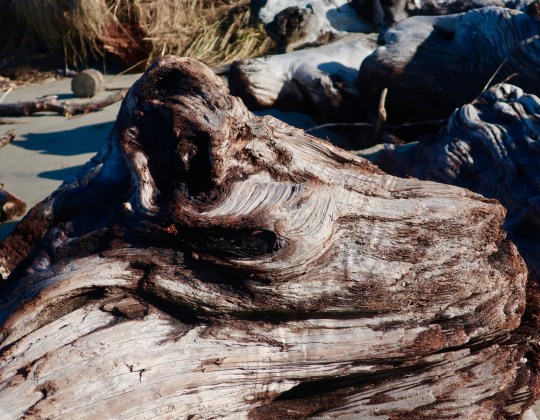
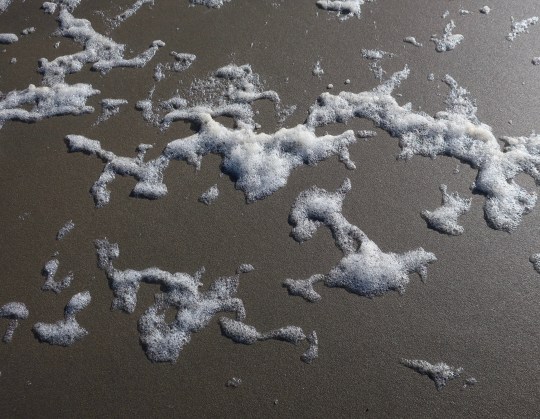
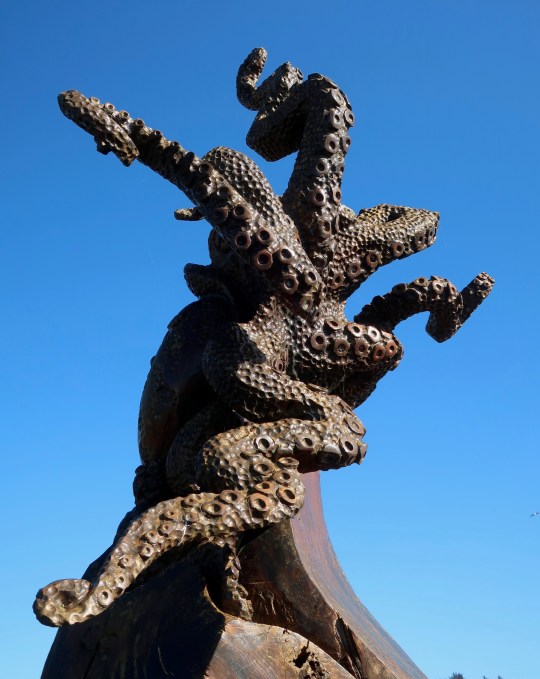
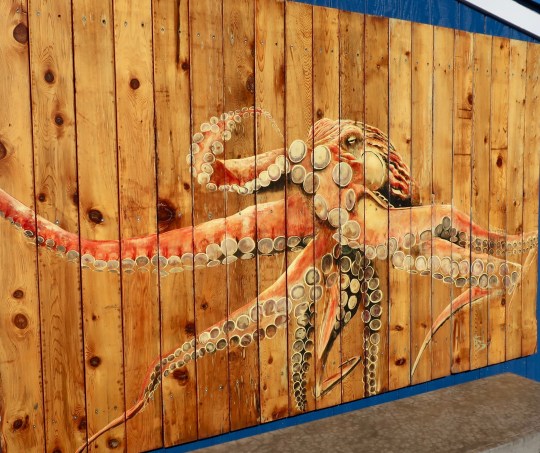
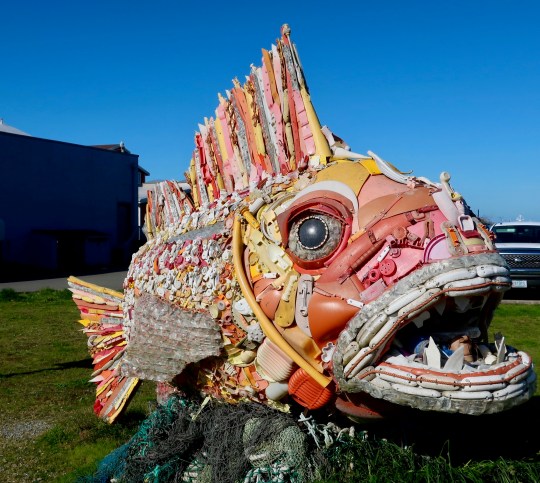
As I mentioned, Bandon has some very impressive rocks or sea stacks. It was low tide and I did a long beach walk. The day was beautifully clear but cold! The ocean was showing off with some very impressive waves.I was hiking toward the mid afternoon sun, which can be challenging for photos. So I decided to go with it rather than fight it. From here, it looked like the two rocks might be holding a conversation.Up closer, the rocks revealed colorful turquoise water left behind by the receding tide and rippled by the cold breeze.Speaking of backlit, the sun absolutely robbed this photo of all color. That’s driftwood on the beach, left behind by recent storms. I quickly named the piece on the left Bugs Bunny to give the strange scene a sense of familiarity. The gate-like structure on the left suggests a portal into some mysterious realm. Or maybe I was already there. Did you just see the driftwood moving? Turning around toward the end of my hike, the sun was more cooperative. I may have found Big Foot. Check out the toes!Another perspective of the Big Foot.I liked the way this driftwood seem to flow into the sea stack.I didn’t capture this two inch deep, two foot wide stream flowing into the ocean quite the way I wanted to, but still I found it interesting.If you hang out with me much on this blog, you know I have a thing for dead trees, and that includes driftwood. The beach at Bandon was full of it.This fellow, looking out to sea was also licking his lips. I know, I know; it’s a stretch. BTW, does the orange hairdo seem a bit familiar.Now here is a hunk of wood. Many of the pieces of driftwood on the beach were old stumps left behind by logging operations and eventually washed out to sea.Here’s another one with its logging history on display for the world to see, or at least for anyone walking the beach in Bandon.When you are surrounded by scenic vistas, it’s hard to look down sometimes. Still beauty is everywhere, including in this small rock. And check out the patters in the sand.And here’s another.I thought his rock was the most interesting, given the sun, shadows, and hole.And one should never ignore the blown spume. I watched a little girl gleefully chase a large piece across the sand. She caught it and grabbed it. Of course in crushed into nothing. “Grandpa!” she yelled.I’ll close today with a few photos I took while wandering around Bandon’s Old Town. I loved this magnificent octopus.It had one of those faces that only its mother could love.I found this beautiful octopus mural nearby.This seahorse sculpture with its stern face also caught my attention.I’ll close the post the way I started with a photo of one of Washed Ashore’s marvelous creations made out of beach trash. Meet Henry. I wouldn’t suggest sticking your hand in his mouth. Henry seems like he has an attitude.
NEXT POST: It will be time for my Wednesday Photograph Essay. This time it will be mainly flowers I photographed along the American River Parkway in Sacramento, California.
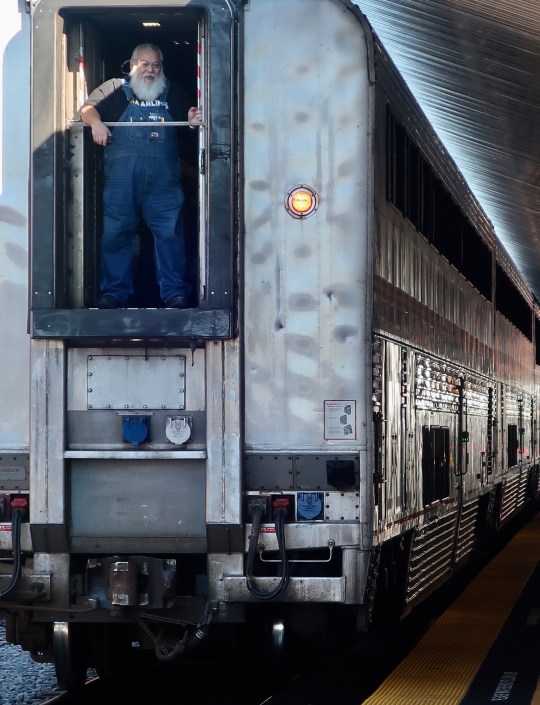
Amtrak Train backing into LA station under the watchful eyes of an engineer.
He was a large man in his 50s with a tattoo covered body, an ex-con who had found the Lord, a smoke jumper with a serious twitch who seemed to have made a few too many jumps. She was a petite, attractive, college graduate going for her PhD in economics with a desire to work for the federal government. It would have been hard to find two more opposite people. They were our dinner companions on Amtrak one evening. Amtrak’s policy is to seat four people to a table. If there are four of you traveling together, fine. If not, you are seated with strangers based on when you arrive. The smoke jumper had arrived first, and then us. The student last.
She had been seated next to the smoke jumper and eyed him nervously every time he made a serious twitch in her direction. With reason. He told us one of his twitches had caused him to dump a pint of beer on the man sitting next to him at dinner the night before. He liked to talk and we were a captive audience. Not that I objected, he had interesting stories to tell, but Peggy and I did what we could to involve the student in our conversation. She’d manage a few words before he jumped back in. She was just returning from an economic conference in Washington and was on her way home. Turns out she lives in Medford and works during the summer at an up-scale restaurant in Jacksonville, one we like to go to.
Given Amtrak’s policy, we never knew who our meal companions would be. Dinners were more formal and we had to sign up for specific times. There was even a real table cloth! It was paper for breakfast and lunch and you could show up any time during meal hours. The seating policy remained the same, however. Usually, we ended up seated with couples. Once we spent a delightful meal with a lesbian couple. Another time it was with a Russian who owned shoe stores in New York City and was on his way to set one up in LA. “I have too many brothers, sisters, cousins, aunts, uncles and other relatives in New York,” he told us. He was looking to escape. To keep the conversation going during another meal, I started telling stories about my encounters with bears. Soon, all of the surrounding tables and two of the waiters were listening in.
I have to say the food was quite good. One of the items on the evening menu was a small, tender steak, cooked to perfection. It became my go-to meal. I had steak for every dinner! Since all meals were included for those of us who had sleepers, why not? Had I been paying the $35 Amtrak was charging for the steak, I’d have been down in the less formal café car eating hamburgers and hot dogs along with most of the coach passengers.
While meals took care of our social life, going up to the observation car and staring out the windows at the passing scenery (or sitting in our rooms watching the passing scenery) was our major entertainment. We also read and I got some writing done. I had a horrendous cold on the way back and isolated myself most of the time. I’m glad we were traveling pre-coronavirus; Amtrak might have kicked me off the train or my fellow passengers stoned me.
The windows on the observation car. (Photo by Peggy Mekemson.)
As for the future of Amtrak; it seems bright. They had their best year ever last year in terms of passengers and revenues. Train travels seems to be on the upswing. No surprise there, given how much fun air travel is. One of the folks I follow in Europe told me that some European trains were going to add sleepers, which they had dropped a couple of decades ago.
A disturbing trend on Amtrak is that the company may be taking lessons from the airlines. We were served prepackaged airline food on our trip between Chicago and Washington DC. It had the same bland, inedible quality of something you eat to avoid starvation.
I had a disconcerting conversation with our car attendant on the Coastal Starlight. The train was famous for a club car that came straight out of the glory days of rail travel. People would take the train just to experience it. Amtrak still has the car, but they no longer include it on the Starlight. The attendant told me that Amtrak was trying to standardize the service on its various trains. Apparently, the car was too special. With the airline food in mind, I had replied, “Ah, you mean increasing profits by reducing service.” Were narrower seats and added costs for everything in the future? He hadn’t commented but did get a strange look in his eyes.
Regardless of what Amtrak might do to its service, the relaxing feel of train travel combined with its unique view of the world as it passes by and the fun conversations with strangers will bring me back to experience the clickety-clack of the rails again and again.
Today I will feature photos Peggy and I took on our return trip across the country. The trip took us from Washington DC to Chicago, Chicago the LA, and then LA to Sacramento.
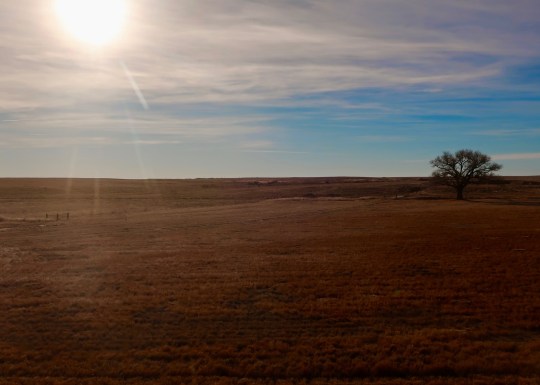
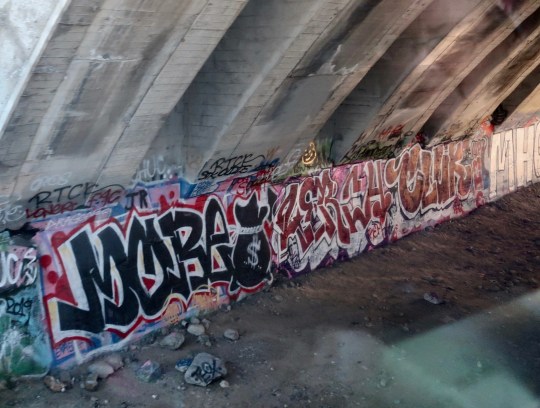
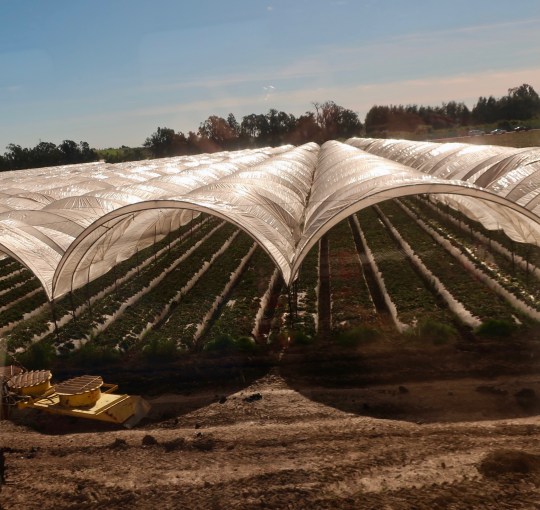
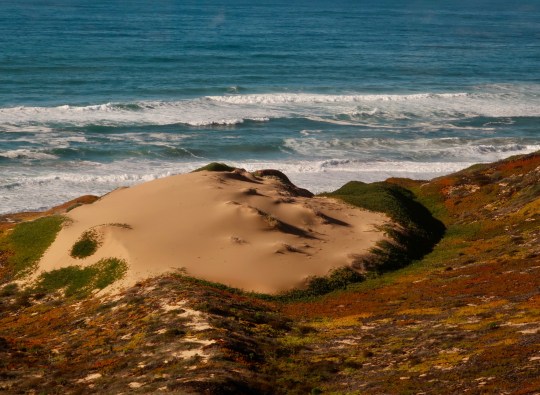
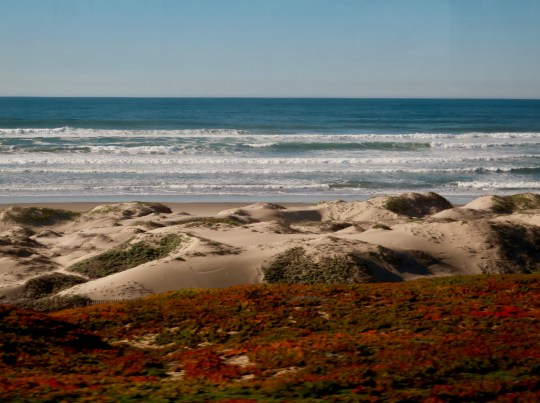
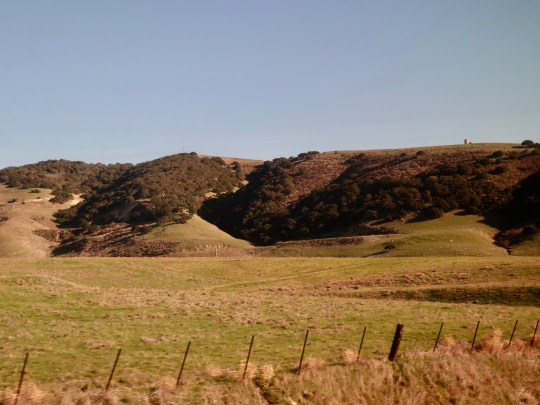
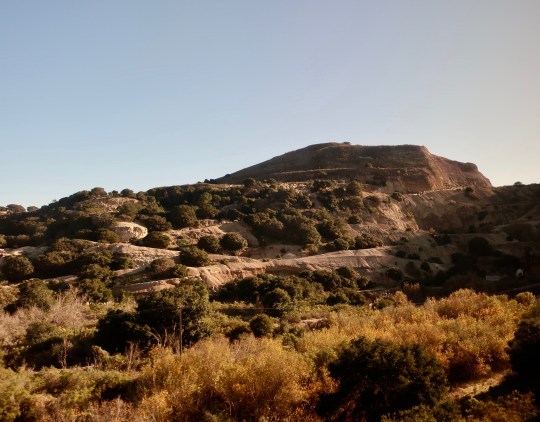
My cold discouraged photography and programmed a coughing fit each time I wanted to take a picture. We were well past Chicago when this silo caught my attention. The middle of our country features vast flatlands where a single tree can add interest.Being the western boy I am, I confess that the mountains of New Mexico put my cold on hold.Trains require lots of switchbacks when crossing over mountains to maintain a relatively flat grade. It’s one of the few times you get to see the train engines.Having returned to the Southwest, we were once again treated to colorful rocks. It got dark after we passed through Albuquerque. We went to sleep…And woke up making our way across the San Gabriel Mountains approaching the LA basin.And then dropped into the LA basin.This photo taken at the LA train station went along with the photo at the top of the post. It provides a perspective on the height of Amtrak’s double decker trains. The added height gave us great views from our roomette.As you might well imagine, there was no lack of graffiti along the tracks as we left LA.The Coastal Starlight soon had us passing by rich farm lands and nurseries as we cut toward the coast.And we were soon looking out on the Pacific Ocean. (Photo by Peggy Mekemson.)Views of the Pacific Coast near Santa Barbara are one of the highlights of traveling the Coastal Starlight. (Photo by Peggy Mekemson.)We were impressed during our journey by the photos you can now take with an iPhone. (Photo by Peggy Mekemson.)A final coastal shot by Peggy. (Photo by Peggy Mekemson.)As we left Santa Barbara, the Coastal Starlight began to make its way inland through the Coastal foothills.Eventually bringing us to the incredibly rich farmlands of the Salinas Valley, the land of John Steinbeck. The sun would soon sink into the West. Peggy and I arrived back in Sacramento around midnight, having completed our 5000 mile journey, tired but excited to share our tales of train travel. We hope that you have enjoyed this series.
NEXT POSTS: On Monday I am going to write about our travel plans for this year, which translates into what I will be blogging about. There are fun things like cruising up the Rhine River and going through the Panama Canal. Wednesday’s photo essay will be on the beauty of the American River as it flows through Sacramento. Hiking and biking its many trails are what kept me sane the years I lived in the city.
This shows the width of our roomette. My suitcase is perched next to me and against the wall. It had picked up a hitch-hiker: Peggy’s purse. The suitcase had to come down when Peggy climbed up to her bunk bed. Our window is on the other side. (Photo by Peggy Mekemson.)
The last time I slept in a bunk bed I was sharing a one bedroom apartment with two classmates, Cliff and Jerry, at Berkeley in 1964/65. I was on the bottom bunk then, as well. My memory includes one particularly wild night. It was our first weekend back at UC. Cliff had brought home a small wooden barrel of tequila from Mexico where he had spent the summer in a Spanish language immersion program. For some insane reason, the three of us decided we had a solemn responsibility to drain the barrel to kick off our senior year. It was not our best decision.
Jerry promptly fell asleep and started snoring. Loudly, if I remember correctly. He had the regular bed. I spent 30-minutes staring at myself in the bathroom mirror in a semi-hallucinatory state fascinated by the fact I couldn’t stop drooling. When I returned to bed, Cliff, who had the top bunk, talked unceasingly. He wouldn’t shut up. Since neither Jerry nor I was listening, I assume he was talking to himself. I’d grunt on occasion. Finally, I lifted up my leg and kicked his mattress. Down came Cliff, mattress and all on top of me. After we had untangled ourselves, we laughed until we were hoarse and then put Cliff’s mattress on the floor for the rest of the night. I think he was still talking when I fell asleep. Damn, did we have headaches the next morning!
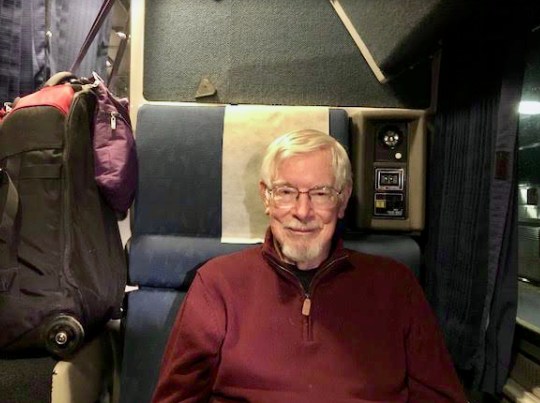
Fast forward 56 years to now for my second bunk bed experience. This time on Amtrak. Peggy had top honors. Our tiny sleeper was about five feet wide and seven feet long. It started as two comfortable chairs facing each other. Large windows provided great views from our double decker roomette. There was barely, and I do mean barely, room for our two day packs and two small suitcases. When we were ready for bed, the car attendant came to our room and set it up. Our two chairs became the lower bunk and the top bunk was released from its attachment to the ceiling. The whole process took about three minutes.
Peggy shows off our windows. Reflecting sunlight distorted the view in this case.Our roomette bunk beds are set up for us and waiting for us to crawl in. (Photo by Peggy Mekemson.)
The bottom line of all this, of course, is how did we sleep. There were three factors. The first was the comfort of the beds. No problem there. The second was their width. Given all of the times that Peggy and I have slept in small backpacking tents, they felt roomy. The real challenge was adapting to the moving train. First there was the clickety-clack of the wheels passing over the joints in the rails. It was repetitive, however, and soon disappeared into the background. I thought of it as noisemaker to lure me sleep.
The train’s swaying was another issue altogether. We didn’t have a problem coming across the Sierras. Trains go slowly when they climb and go down mountains. It’s on the flats that the engineers put the pedal to the metal. It’s where they make up for lost time. I can imagine one engineer boasting to another, “I made it across there in an hour!” with the other responding, “Ha, it only took me 59 minutes.” For the most part, the swaying is like the clickety-clack. You get used to it. But there were instances when I was reminded of being on a ship during a really bad storm or hitting heavy turbulence in a jet. There were three particularly bad situations: when the train was traveling over rough tracks, when it went over a poorly maintained road crossing, and when it went around a corner faster than it should.
During the day, it wasn’t much of a problem, assuming you had something to grab onto if you were out and about. Sleeping was a different issue, as we learned our first night. The attendant had worked his three-minute magic and we had settled down for a long winter’s sleep across Nevada when the train hit some rough track, traveled over a poorly maintained road crossing, and went around a sharp curve— all at the same time— fast. Wham! Peggy was thrown into the netting designed to keep her from rolling off the bed and I was thrown into the side of the train. “That does it!” I head Peggy mumble loudly as she scooted across the bed, climbed down from her bunk, and slipped into mine. Remember how I said the bunk was roomy. That’s for one person. There was simply no room for the two of us. We had to sleep head to toe. I slept with Peggy’s feet and she slept with mine. I’m not sure which of us got the better deal.
Traveling between Chicago and Washington DC we were upgraded to a bedroom. It came with a double-sized bed that was comfortable for the two of us, a sink, and its own bathroom! We didn’t have to use the communal facility. While our bedroom wasn’t large by any stretch of the imagination, it felt palatial in comparison to our roomette. A small shower even provided a bath assuming you didn’t mind washing off the toilet at the same time. Recommendation: Choose a time to bathe when the train isn’t swaying.
Our bedroom even came with an extra chair. The wide couch became our double bed. (Photo by Peggy Mekemson.)
We had one other configuration. Amtrak had supposedly upgraded its roomettes with a restroom. We had one returning home on our route between Chicago and LA. The toilet that snuggled up to the bottom bunk, sort of like you might see in a prison cell. It was inches away from my head when I was is bed. That was not okay. To add insult to injury, Amtrak had removed the communal restrooms from the car. We had to go on a three-car hike to find a real bathroom. Our attendant told us that the company had realized the error of its ways and was no longer building the roomette restrooms. What a surprise.
All in all, while I’ve had a bit of fun with this post, we slept in relative comfort, especially if you compare it with trying to sleep on an airplane. Even the coach seats on Amtrak are wide, comfortable, and fold back far enough to create a half-way decent night’s sleep.
My photos of the trip today include our journey from Sacramento to Washington DC, minus, of course, the pictures we took while crossing the Rocky Mountains that I shared in my last post. Enjoy.
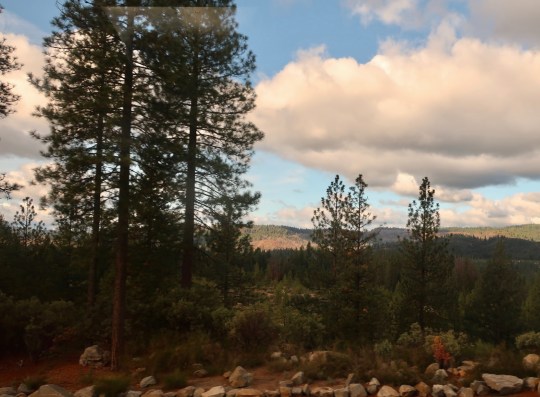
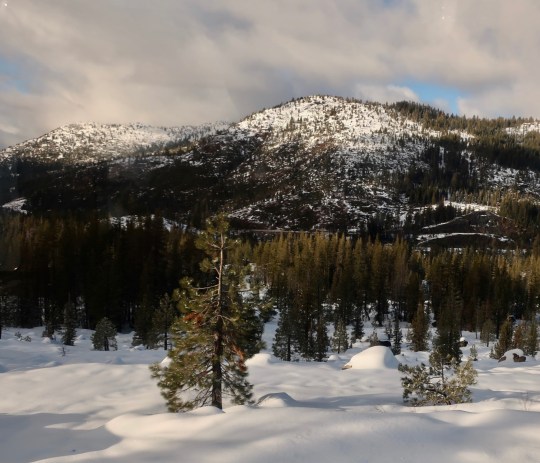
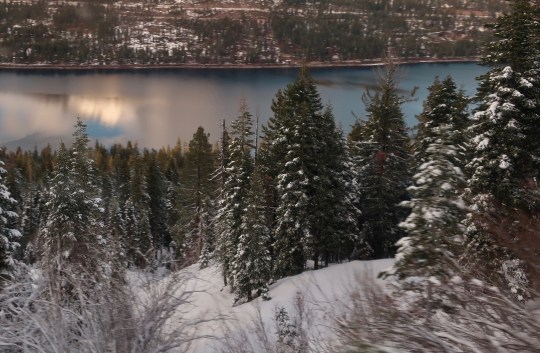
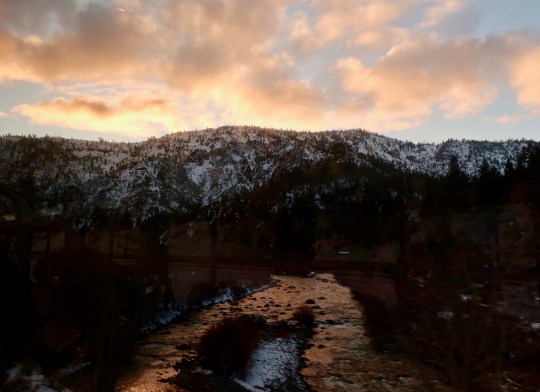
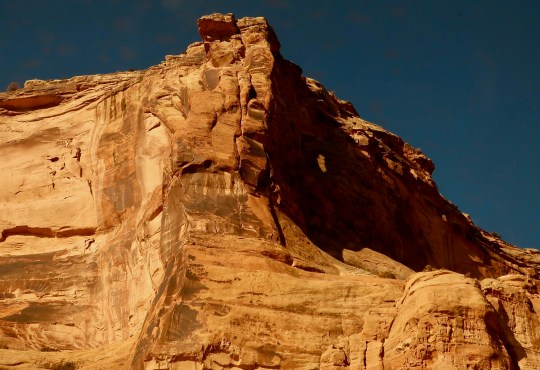
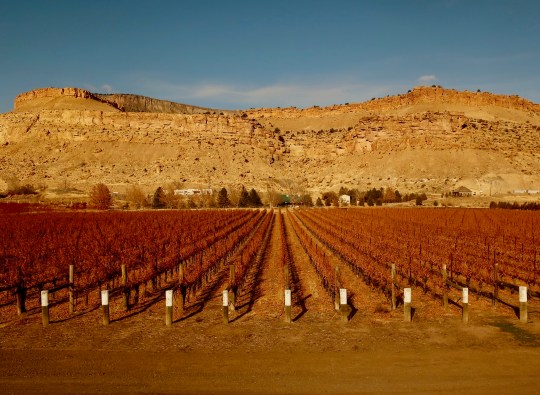
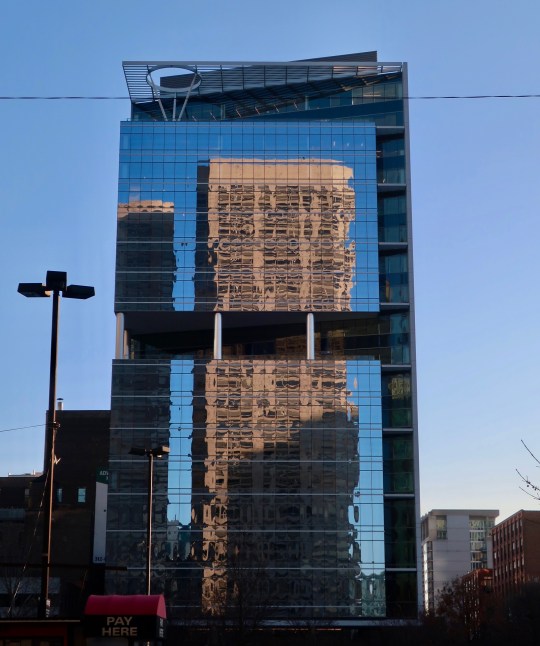
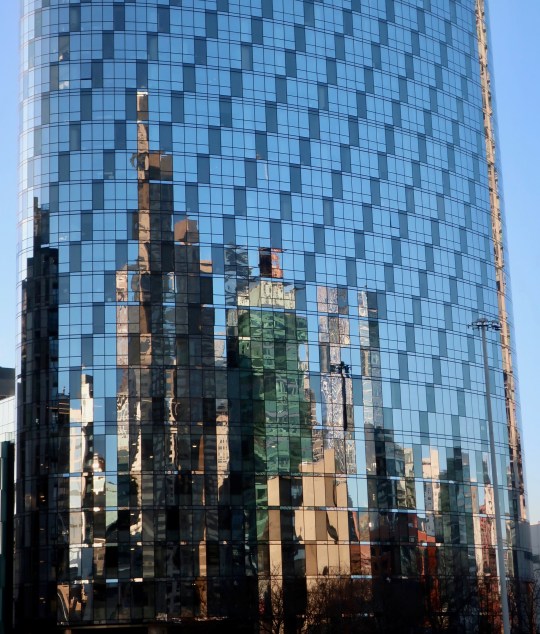
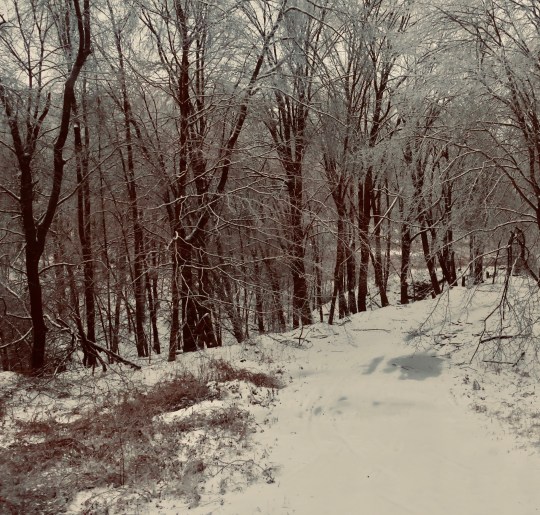
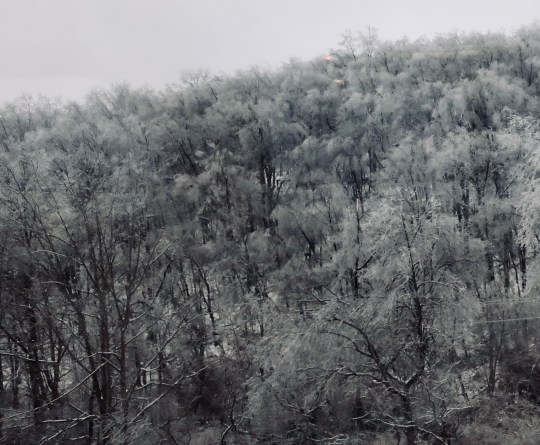
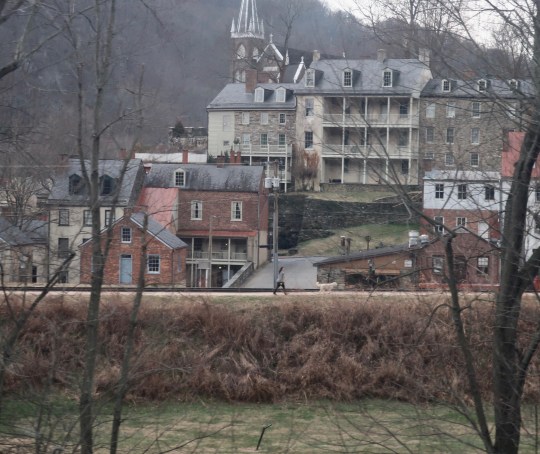
It seemed appropriate for our journey to start in Sacramento since it served as the terminus for America’s first Transcontinental Railroad, as shown in this mural in the train stationLeaving Sacramento, we began to work our way up and over the Sierra Nevada Mountain Range. These are the foothills near Colfax, about 30 miles away from where I was raised and a thousand feet higher.Crossing the Sierras provided numerous views of the mountains. The track parallels Interstate 80, our usual route across the mountains. You can see it edging around the side of Red Mountain.We were also treated to closer looks at the snow. Here it quite beautifully covers rocks. I had been hoping for and expecting more snow. I’d spent several winters sharing a cabin about ten miles from where this photo was taken where the snow was often 10-20 feet deep.The train comes out of the Sierras at Donner Lake. The Donner Party spent its tragic winter down near the end of the lake. Thus the lake’s name.After passing though the small town of Truckee, the tracks follow the Truckee River down to Reno. I took this photo shooting up from the river as the sun was setting.And this one.The sun sets on the Truckee River, ending our first day of train travel.We woke up the next morning to some impressive eastern Utah scenery.It was the type of country that Peggy and I have come to associate with the southern part of the state.Crossing into Colorado, I snapped a picture of a farm with its long rows of grapes.I will feature one photo of our Rocky Mountain crossing taken with our iPhone and not included in my last post. (Photo by Peggy Mekemson.)Having gone to sleep for our second night after crossing the Rocky Mountains, this was more typical of the views we had when we woke up. My great, great, great grandfather James Mekemson and his wife, Mary, plus lots and lots and lots of Mekemsons are buried in eastern Illinois, a few miles away from this tree.Chicago’s Union Train Station is truly grand. And since Christmas was coming, it had a grand Christmas tree.Peggy stands in front of the tree for perspective. In addition to the large Christmas balls and small lights, the tree was appropriately decorated with signs from America’s different railways.We went for a short walk which was supposed to be longer except for the 8 degree F weather. We entertained ourselves by taking shots of skyscrapers reflected in skyscrapers.Having gone to sleep again outside of Chicago, we woke up in the Appalachian Mountains.And were treated to views of snow covered trees. We weren’t in the Sierras or Rockies anymore, Dorothy. Grin.When we passed through Harper’s Ferry we were an hour or so out of Washington. So I’ll end my photos here today.
For my next post, I am going to experiment with a photo essay. (It’s called what do you do with your 80,000 plus photos.) The post after that I’ll feature our Amtrak trip back to the West plus eating on the train, which is all about meeting strangers.
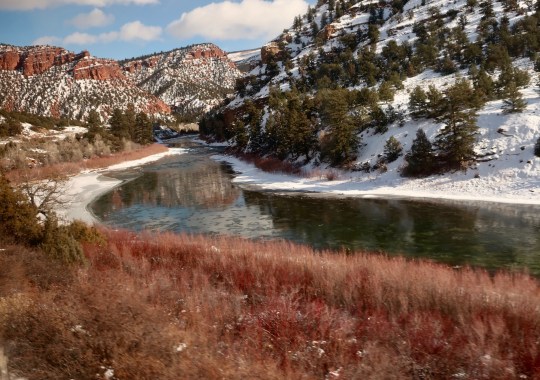
Our journey through the Rocky Mountains followed the Colorado River up toward its source.
Peggy was making travel arrangements to fly back east to spend Christmas and New Year’s with our kids in Virginia and Florida when she emerged from her woman cave like a grumpy bear saying not-nice things about the airlines. Unlike her husband, she never curses (well close to never), but her tone of voice says it all. The industry was practicing its usual Christmas spirit by doubling prices and eliminating perks like earned miles and companion fares. Joy to the world. Isn’t capitalism grand.
I suggested that she check Amtrak. We quickly discovered that we could travel across America by train with our own bedroom and three meals a day for less than the airplane tickets would cost. And the meals would actually be edible. When was the last time you had a delicious, freshly-cooked steak dinner and crab cakes for dinner on an airplane? Since we are retired, time wasn’t a factor. We would see and experience America in a way we never had before! It was a no-brainer.
Our plans were to drive down to Sacramento from our home in Southern Oregon in mid-December, visit with family and friends, and catch the California Zephyr heading for Chicago. (All Amtrak trains are named.) From there, we would take the Capitol Limited to Washington DC. Returning, we would reverse our journey on the Capitol Limited to Chicago and then take the Southwest Chief to LA. Our final leg would be to ride the Coastal Starlight back to Sacramento. The total trip would take nine days and 8 nights. In between, we would celebrate Christmas and New Year’s with the kids.
We quickly found that there were three aspects to train travel. The first was the actual experience of riding the train ranging from sleeping arrangements to shared meals. The second was admiring the country the train traveled through. (That’s what got me the most excited.) The third was meeting your fellow travelers. Given Amtrak’s policy of seating you with other people at meals, you meet a lot of strangers. And most of them really seem to enjoy train travel.
That’s a major difference with modern airplane travel. While first class might still be tolerable, traveling coach is a trial to get through. Narrow seats where leaning back is severely limited (there’s no room), cramped leg room where you pay premium for a few more inches, minimal food service, and the policy of charging you big bucks for anything extra are all factors. Not to mention kids kicking the back of your chair and people sneezing out who knows what diseases at a 100 miles per hour mere-inches away from your head. There is no ‘it’s the journey that counts’ in air travel. It’s all about destination.
People who travel by train have destinations in mind as well, but the journey can also be an important part of the experience— one to be repeated over and over. Take Paul, for example. We had first met him in the passageway of our car on the trip back from Washington DC to Chicago. He sat down opposite us in the first-class lounge of Chicago’s imposing Union Train Station and struck up a conversation. (You obtain first class status by having a sleeper.) He was a tall, slightly overweight man with a ready smile who was close to our age.
We soon learned that he was a graduate of Oberlin College who had spent his life working for one of America’s intelligence agencies, a career that had begun with his service in Vietnam. He had enjoyed the work, but his true passion was playing in an informal blues band for fun. The group had been together for over 30 years. Paul and Peggy were soon into a deep discussion over whether her guitar playing and singing should include the blues. He suggested she start with Kate Wolf. I am a fan of Kate’s. In fact, my friend Tom Lovering once hosted a birthday party for her at his outdoor/wilderness store in Sacramento. When she passed away, he had taken her daughter on a river trip.
As usual, the conversation turned to where we were going and what our Amtrak experience had been like. Paul had traveled on Amtrak a number of times, including traveling with his blues band. This time he was heading for Portland by himself, but here’s the fun part. He would arrive in Portland, spend one day at Powell’s Bookstore, and then climb back on the train for his return trip to Washington DC!
Peggy and I understood Paul’s desire to spend a day at Powell’s. It’s the largest independent bookstore in the world and one of America’s premier bookstores. Whenever we are in Portland, we make a point of going there. You can spend hours perusing its shelves. I doubt we have ever left with less than a hundred dollars-worth of books. Traveling four days by train to get there and then turn around and travel four days back to Washington was a tad more difficult to comprehend. You would really have to love train travel. Still, we were really enjoying our trip. We could drive over to Klamath Falls, climb on the Coastal Starlight and be there in a day. Hmmm…
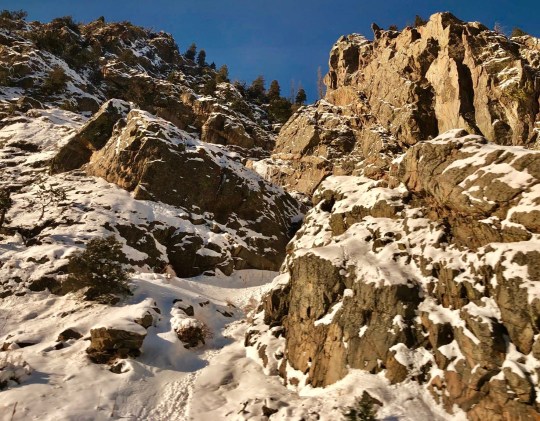
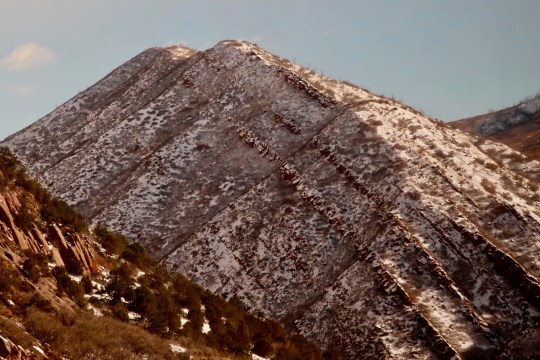
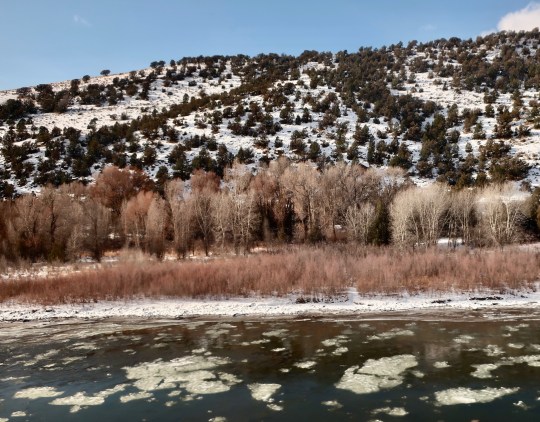
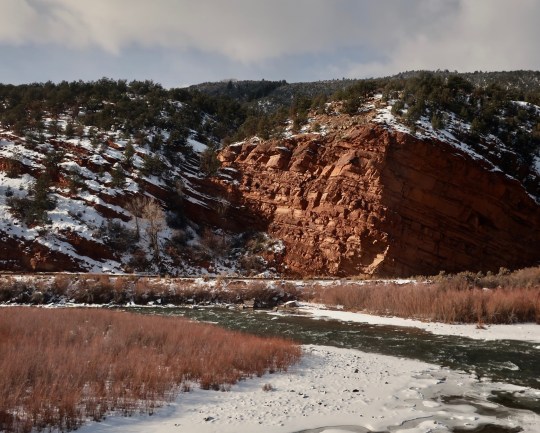
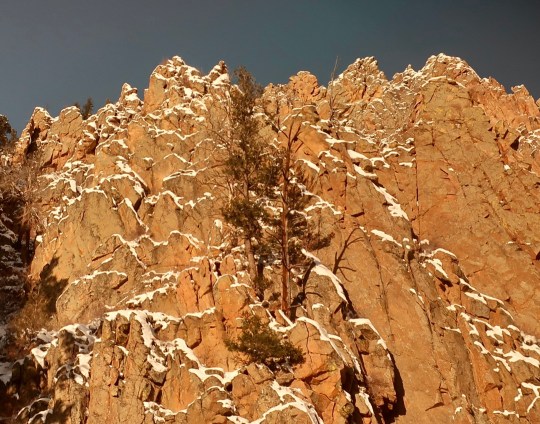
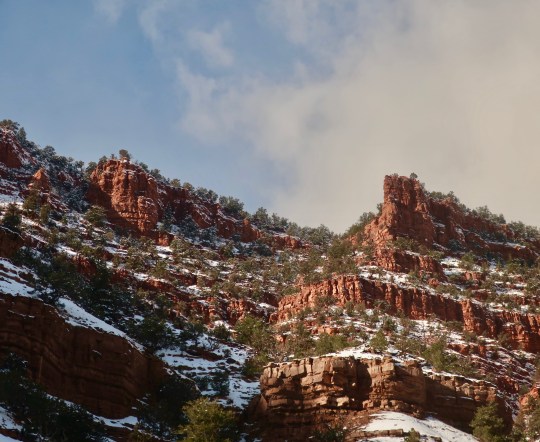
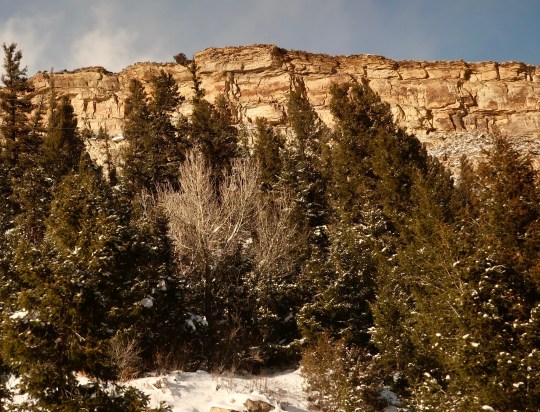
As for my photos today, I want to share one segment of the journey with you: our trip across the Rocky Mountains. It was spectacular including snow, beautiful views of the river and gorgeous red rocks. Starting at Glenwood Springs we followed the Colorado River up toward its source and then dropped down into Denver. The photos speak for themselves. Enjoy.
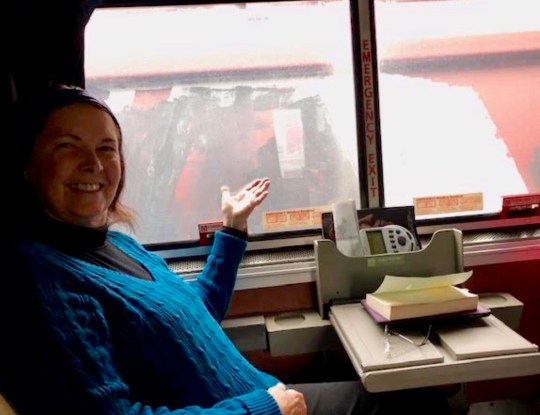
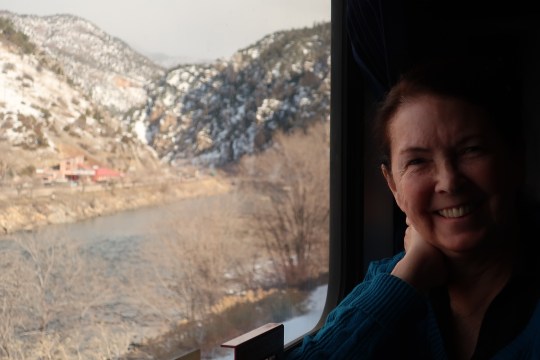
I’ll wrap up our Journey across the Rocky Mountains with a photo of Peggy enjoying the trip.
NEXT POST: I’ll cover what train travel was like for us, introduce you to more passengers and and show more photos of our journey.