Is Occupy Wall Street an Anarchic Plot to Destroy America? Peter King Thinks So.

“If you are not rich, blame yourself.”                                                                                                                                                                    Herman Cain

I’ve been watching the Occupy Wall Street (OWS) movement with fascination. Like another recent phenomenon of American politics, the Tea Party, it has a strong grass-roots element and is concerned with the direction America is traveling.

Similarities stop there.

The right leaning Tea Party is concerned with excesses in the public sector and wishes to limit government and taxes. OWS is tilted the other direction and is primarily concerned with the private sector. Its message: Excessive greed is bad for America.

Not surprisingly, many of America’s most wealthy people find the OWS movement disturbing. The above quote from Herman Cain is his response to the protestors. While the quote might slip by in Cain’s former role as CEO of Godfather Pizza, it seems inappropriate and unintelligent coming from a leading contender for the Republican nomination for President.

Whether you agree with Cain or not, one thing is certain, you won’t get rich by working for Godfather Pizza. I checked the Pizza giant’s online job application at http://www.myjobapps.com/godfathers-pizza-job-applications-online. As a ‘team’ member you can expect to be paid between $7-9 per hour. A cook can earn an extra buck. And the Assistant Manager, who’s job it is to supervise the whole shift, can earn a whopping $8 plus.

I found the statements on Occupy Wall Street by Peter King, chair of Congressional Committee on Home Land Security, to be even more disturbing, particularly the last quote:

“The fact is that these people are anarchists. They have no idea of what they are doing out there.”

“(They are) a bunch of 1960 do overs trying to create chaos.”

“They have no sense of purpose other than a basic anti-American tone and anti-capitalist.”

“We have to be careful not to allow this (movement) to get legitimacy. I am taking this seriously in that I am old enough to remember what happened in the 1960s when the left wing took to the streets and somehow the media glorified them and it ended up setting policy. We can’t allow that to happen.”

I, too, am old enough to remember the 60s. Just what policies that received their impetus from the 60’s would King eliminate? How about Civil Rights? Does King believe that black people should be forced to sit in the back of the bus? Or what about the equality of women? Is it wrong for women to earn equal pay for equal work or be allowed into higher levels of corporate management or the White House? Or what about the environmental movement? Does King believe our water and air should be clogged with deadly pollutants or that the last of the ancient redwoods should be cut down?

And the list goes on and on. The majority of people protesting in the 60s and 70s were patriotic Americans concerned about the future of the nation, just like the majority of people protesting in the Occupy Wall Street Movement.

It’s the Peter Kings that I worry about.

In my next blog I will travel back in time to UC Berkeley in 1965 where I participated in the beginnings of the 60’s struggle for human rights.

A (not so) Funny Thing Happened on the Way to Burning Man

“I want you to drink and pee, drink and pee, and drink and pee,” Doctor V prescribed. It was a unique prescription. I pictured myself happily downing Oregon beer. Then he specified water.

My wife Peggy and I were on our way to Burning Man. I wasn’t feeling well and decided to drop by the Medford Medical Clinic before jumping off into the remote Nevada desert. My lower abdomen had developed the personality of a watermelon.

The Doctor ordered all the tests. I was to give blood, donate urine and expose my innards to x-rays. I dutifully ran around to be poked, prodded and pinched while Peggy waited patiently. (Don’t you just love alliteration?)

Anyway, before I knew it, I was back in Dr. V’s office sitting on a hard chair and memorizing a wall chart on intestines. I was approaching anal when the doctor appeared and pulled up my results. “Looks good, looks good, looks good,” he murmured as visions of Burning Man danced in my head.

That was just before he uttered “Uh-oh.” These are two of the worst words in a doctor’s vocabulary. They should be banned. My blood pressure shot up, sphincter clamped down and big toe developed gout.

Turns out my kidneys had joined a union and gone on strike. They were refusing to process the toxins out of my system. My body was becoming a hazardous waste site reportable to the EPA. “Drink and pee,” the Doc ordered. I was to come back on Monday.

The clock was ticking. I would miss the first and second day of Burning Man.

The Rogue Valley Medical Center was on my agenda Monday. My kidneys and bladder were to be scanned by an ultra-sound machine, a sonar-type device similar to what my brother-in-law Jim Hockett uses for finding fish and the Navy used for finding U-boats in WWII.

But first I had to prove myself worthy. A series of small cubicles lined the hallway leading into the hospital proper. I was to report to one. Before the magical machine scanned one centimeter of my body, I had to show I could pay. Hospitals, drug companies, lawyers, health insurers, doctors, nurses, therapists, technicians, clinicians, secretaries, janitors, business managers and at least a hundred other health care affiliates were depending on me. I was at the bottom of a very large and hungry food chain. “FEED ME,” they yelled in unison.

I boldly moved forward and whipped out my Oregon Driver’s license, Medicare Card, AARP Card, and United Health Care Insurance Parts B and D cards. I was a card-carrying member of the Baby Boomer Generation. Plus I had excellent credit. I was prime, well-aged beef. The gatekeeper smiled and gave her stamp of approval. “You are good for a year,” she told me.

The young technician in charge of ultra-sounds led me through a labyrinth of hallways to her inner sanctum, laid me out on the sacrificial table and begin lathering me with warm oil. I liked it. But I didn’t like what the scans showed, a vast ocean of pee and a small growth on the side of my bladder. She returned to it again and again. “I like to take lots of pictures,” she told me. Her diligence made me late.

“You missed your appointment,” the scowling receptionist at the Medford Clinic told me shortly afterwards. “You will have to reschedule.” I had apparently committed a grievous sin. But I was not properly repentant. I scowled back.

“Your office made the appointments,” I pointed out. “The hospital made me late and the technician told me she was in contact with Doctor V. I am leaving town tomorrow.”

The room temperature dropped several degrees. “I’ll check with the Doctor,” she said. Each word was coated with ice.

She came back all smiles. “You are going to Burning Man,” she exclaimed. I was no longer just a crotchety old guy whining about his afflictions. I was a crotchety old guy going to Burning Man. I was ‘cool.’ “The Doctor says he needs you to take another blood test. He will call you later with the results.”

It was his nurse who called.

“You have Acute Kidney Failure. The Doctor recommends that you skip Burning Man.” I was to be handed off to a specialist.

I didn’t have a clue what Acute Kidney Failure meant but it definitely didn’t sound like something I wanted to be caught with in the Black Rock Desert of Northern Nevada. We cancelled our adventure.

Next up: Dr. M. draws a picture. The kidneys are connected to the bladder and the bladder’s connected to the prostate and the prostate’s connected to the well, um… you get the idea.

The Tragedy of Liberia

Bob and Gerry Branch invited us to stay at their apartment in Monrovia while JoAnn and I were ‘trained.’ In this photo, Bob watches a funeral parade outside his window while Jo looks at the camera.

(At the end of the last blog, my ex-wife and I found ourselves stranded in New York City because we had mistakenly flown to JFK one day late and missed our flight to Africa. In this blog, we reach our destination.)

We made it to the right terminal on the right day and at the right time. In fact, absolute paranoia insisted we be three hours early. We watched lots of planes take off and land.

Finally, we found ourselves flying across a rough Atlantic. To quote Snoopy, “it was a dark and stormy night.” Lighting danced between the clouds as we struggled to deplete the airplane’s complimentary booze supply. We toasted the fact we had made it, we toasted Liberia, we toasted Jo’s mom for her hundred dollars and we toasted toasting.

I finally managed to fall asleep and only awakened when the pilot announced good morning. Jo and I scrambled to look down and were met by a vast sea of green broken occasionally by small clearings filled with round huts. Tropical Africa!

There was brief stopover in Dakar where French-speaking Senegalese served warm coke and ginger snaps for breakfast. It’s the type of meal you really should forget but never do.

An hour later we were dropping in to Robert’s Field, Liberia’s International Airport. A stewardess wrenched open the door admitting a sudden blast of heat and humidity. Luckily, roaming the streets of New York City in August had prepared us. What we weren’t prepared for was the view.

Striding across the tarmac to greet us was my old friend Morris Carpenter from community college days in California. He had joined the Peace Corps the year before and been assigned to Liberia. By some quirk of fate we had been assigned to the same country and would end up living closer together than we had in California.

All grins, we tumbled into each other. I couldn’t resist saying, “Dr. Livingston, I presume.”

Morris, as he put it, had been camped out on the Peace Corp’s Director’s desk in Monrovia for a month seeking a change in assignment when our arrival was announced. He quickly volunteered to pick us up. The Director, recognizing the opportunity for Morris-free time, had agreed even faster.

On our way into Monrovia, Morris filled us in on life in the Peace Corps as ‘it really was.’ One year of living in Liberia had coated his youthful idealism with a thin veneer of cynicism. There were good reasons.

Liberia was a country that had been born and nurtured in paranoia. Its origins dated back to the early 1800’s when slaves were being freed in the New England and there was a growing concern about the expanding population of free black people. While most Northerners accepted that slavery was wrong, few were willing to accept their freed slaves as equals.

In the South, where slaves outnumbered their owners, fear replaced concern. Insurrection was a real possibility. Henry Clay, Andrew Jackson, Daniel Webster and a number of other prominent Americans proposed a solution: ship freed African-Americans back to Africa. The American Colonization Society was founded and a portion of the west coast of Africa purchased. Approximately 11,000 freed slaves eventually shipped out.

Life was bleak and dangerous at first. The natives weren’t overly happy at seeing their long-lost cousins appropriate tribal lands and the Americo-Liberians (ALs) constituted a very small percentage of the total population.

The ALs had learned their US lessons well though and soon established themselves as the ruling elite. They took control of the government, education, and military. The natives were regarded as second-class citizens.

Power and privilege were the results but it was power and privilege accompanied by an underlying fear that the majority native population would rise up in revolt. This in turn led to a siege mentality and paranoia somewhat similar in nature to that felt by the white minorities in the Southern United States prior to the Civil War. I would see and experience several examples of this paranoia during my stay.

Close economic and political ties were maintained with the US over the years. Starting in 1926 Firestone entered the country and eventually cut down vast swathes of rainforest to plant rubber trees. As we drove by a rubber tree plantation on our way to Monrovia, Morris explained that the industry was now suffering from labor problems that the military had been called in to quash. Apparently workers were striking to earn twenty-five cents an hour.

On an outward level, there were a number of similarities between the United States and Liberia. English was the national language, the currency of the country was well-used American Dollars, and the flag was red white and blue complete with eleven stripes and one star. Upon arrival we even learned that the commanding general of the Liberian army was named George Washington. Not surprisingly, the government and the judiciary system were patterned after the American system.

In reality the government was a one party state controlled by the Americo-Liberians and whatever justice existed was heavily weighted toward keeping them in power. While change was underway when we arrived, it was too little and too late.

The failure to educate and bring large numbers of tribal Liberians into the economic and political system from the beginning was one of the major factors leading to the tragedy that Liberia would suffer over the next three decades. Americo-Liberians, tribal Liberians and the country would suffer terribly due to this negligence.

Morris dutifully dropped us of at Peace Corps headquarters to begin our orientation and take care of miscellaneous bureaucratic chores. While we had been playing at the World’s Fair, our fellow volunteers had been sweltering through hours of meetings. Now it was our turn.

Another married couple from Group VI, Bob and Gerry Branch, generously agreed to host our stay. They lived in a second floor apartment that overlooked one of Monrovia’s main streets. It provided a birds-eye view of life in the city.

Monrovia was overflowing with impoverished young people living in crowded tin shacks.

Monrovia was bursting at the seams with impoverished young people escaping from rural areas. Tin shacks fought for space as extended families struggled to find shelter from tropical downpours. Taxi and money-bus drivers, using their horns for brakes, filled the air with unceasing noise while the barking and growling of mangy dogs filled in around the edges. Evening air was tainted with the unique smell of cooked palm oil, smoke and moldering garbage.

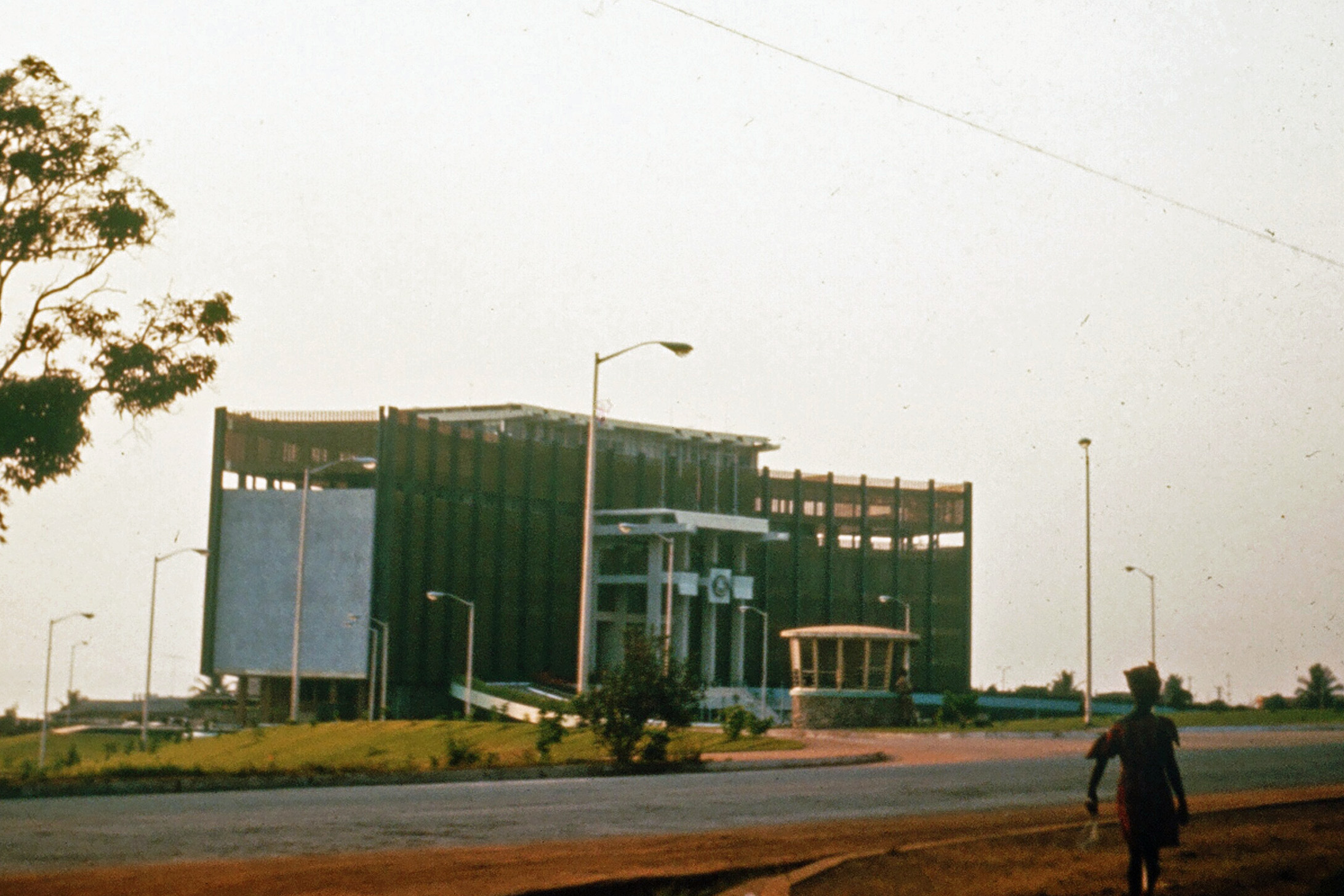
Of course it wasn’t all bleak, assuming one had money. Monrovia had several good restaurants, a modern movie theater, an air-conditioned supermarket and a large paperback bookstore, all of which we came to appreciate over the next two years. Most Americo-Liberians did quite well. President Tubman lived in an impressive mansion on the outskirts of the city.

President Tubmans Mansion in 1966.

For our part, we were quite relieved to learn that our assignment wasn’t in Monrovia. Originally, we had been assigned to an elementary school down the coast in Buchanan. It was supposed to be a plum assignment so naturally another couple grabbed it when we failed to turn up.

We were left with their jobs; Jo would teach first grade and I would teach second in the upcountry town of Gbarnga. (Upcountry was anywhere inland.) Apparently this was our punishment for partying too long in Auburn. So be it…

(Note… in my March 3 blog I reported on how Phil Weisberg was arrested for holding up a sign criticizing Mrs. Tubman. Phil has since responded that he wasn’t arrested but was seized by security agents and later released.)

The Peace Corps Leaves us Behind in New York City…

There's an old saying: "When treed by a lion, you might as well enjoy the scenery." My trip to the 1965 World's Fair in New York City resembled that. In this photo, Jo Ann poses with Rex.

Having successfully completed Peace Corps Training, our next task was to fly to Liberia, Africa. The thought was both exciting and scary. We didn’t need was another major adventure on the way…

Our reward for completing Peace Corps training was one week at home.

We were supposed to complete whatever business we had before disappearing into the jungles of West Africa for two years. Since there wasn’t much to do, Jo and I relaxed and recovered from our tumultuous year that had begun with the Free Speech Movement at Berkeley.

We wrapped up our brief visit with a going away party in Jo Ann’s back yard.

Surrounded by friends and family we talked into the night. It was one of those perfect summer evenings that California is famous for, complete with a cool breeze tainted with a hint of honeysuckle flowers.

Jo Ann’s parents drove us down to the San Francisco Airport the next morning for our flight to JFK where we would meet up with our group. Her mom slipped us a hundred-dollar bill just before we climbed on the plane. “Just in case.”


Now we were disembarking at JFK, two country kids who had traveled a long way from Diamond Springs and Auburn, California. All we had to do was check in at the Pan Am desk, grab a bite to eat, and catch our trans-Atlantic flight to Africa.

Ah that life should be so simple. Oh we managed to find the Pan Am desk all right, but no one was there.

“Excuse me, could you tell me where the Peace Corps group is?” I asked a harried attendant.

“I don’t have any idea,” was the brusque reply.

Have you ever had the sinking feeling that you have blown something critically important in a very big way? It starts with the hair follicles on your head and works its way downward to your toes. Every part of your body jumps in to let you know you aren’t nearly as smart as you imagined you were.

It’s the stomach that serves as the real messenger, however, and mine was rolling like the Atlantic in a hurricane.

“Check the instructions again, Curt,” the voice of reason standing beside me directed. Good idea.

“Well, it says right here we are supposed to be at the Pan Am desk no later than 5 PM.” It was only 4. My stomach calmed down to a respectable jet engine rumble. “Let’s have a bite and check back.” I suggested, working hard to be the man

Five PM came and no one, nothing, nada. It was serious panic time. “Wait here Jo in case anyone comes. I’ll go check the instructions one more time.”

We had stuffed our bags in one of those drop-a-quarter-in-the-slot storage lockers while we ate. I freed my shoulder bag from captivity and reread the instructions. Yes, we were in the right place at the right time. Then there it was, the answer, staring at me in black and white. “You will fly to JFK on August 7th.”

It was the 8th.

Uttering swear words on each step, I slowly climbed back up the stairs.

“I’ve found them Jo Ann.” A look of relief and the beginning of a smile crossed her face.

“Where are they?”

“They’re in Liberia.” Waaaaaaaaaa!

Let me say this about the two of us; we were both stubborn as mules when we thought we were right. This could create problems when we disagreed but the potential for disaster was miniscule in comparison to when we both agreed we were right and we weren’t. Reality didn’t matter and certainly a little date on a piece of paper we had each read a dozen times wasn’t going to deter us.

The 7th was our going away party and that was that, period. While we were kicking up our heels in Auburn, our compatriots were crossing the Atlantic. Now we were stuck in New York City.

“What are we going to do?” Jo asked in a shaky voice. The only thing that came to my mind was a double vodka gimlet

It was probably a good thing United Airlines let us on the airplane in San Francisco without noticing our tickets were one day out of date. Had we called Washington from home, the Peace Corps may have been tempted to say, “Why don’t you just stay there.”

As it turned out, the Peace Corps representative sounded amused when we called the emergency number after our visit to the bar. “Did we have enough money to get through until tomorrow?” Yes, thanks to Jo Ann’s mom.

“OK, call this number in the morning.” We decided to sleep in the airport to save our scant resources. It was a resolution with a short lifespan. I had one extremely unhappy young wife on my hands and my sleeping habits were unwilling to accommodate a deserted airport lounge.

Somewhere around midnight I said, “Look, Jo, I am going to see if a cab driver will help us find a hotel we can afford.”

The first guy in line was a grizzled old character in a taxi of similar vintage. I told him our story. He studied me for a moment and then said, “Go get your wife and I’ll find somewhere for you.

A more cynical observer might note we were lambs waiting to be fleeced but what followed was one of those minor events that speak so loudly for the positive side of human nature. The taxi driver took care of us. He reached across the cab, turned off his meter and then drove to three different hotels. At each one he would get out, go inside and talk to the manager. At the third one he came out and announced he had found our lodging.

“This place isn’t fancy,” he reported, “but it is clean, safe and affordable.” Affordable turned out to be dirt-cheap. To this day I am sure the cab driver finessed a deal for us. Two very exhausted puppies fell into bed and deep sleep.

The Peace Corps representative we talked to the next morning wasn’t nearly as friendly as the one the night before but at least he didn’t tell us we had to go home. A commercial flight to Liberia would be leaving in three days. “Could we hang out in New York? Did they need to send us some money? Could we follow directions?”

A very skinny Curt and the US Pavilion at the World's Fair

Yes we could hang out; no, they didn’t need to send money, and yes we could probably find our way to the proper airline at the correct time on the right day.

Jo and I visited the World’s Fair, checked out the City and considered the three days as an extension of our all too short honeymoon. As the old saying goes, all’s well that ends well.

Next up: Warm coke and cookies for breakfast in Dakar, Senegal

Peace Corps Training and the Dead Chicken Dance

In my last blog I relayed how I was accepted into the Peace Corps even though my roommate at UC Berkeley told a FBI Agent I was running a communist cell block out of our apartment. In this blog, I report on how chopping the head off a chicken was central to Peace Corps training.

Jo Ann was crying and I was struggling to be sympathetic.

It wasn’t easy. We had just left her parents in San Francisco and boarded a United Airlines jet bound for New York City. Other than the time I had surrendered five hard-earned dollars for a helicopter ride at the El Dorado County Fair, it was my first flight ever.

The jet taxied out on to the runway, climbed above the bay and banked toward the east. We were leaving family, friends and life in the US behind. While Jo struggled with the past, my thoughts were on the future. Africa, teaching and adventure beckoned. It was August 1965.

As the plane flew over the Sierra Nevada Mountains and we waved goodbye to California, my mind turned to our new role as Peace Corps Volunteers. Two months earlier we were wondering whether this day would ever arrive. Graduation, marriage, honeymoon and reporting for Liberia VI Peace Corps at San Francisco State College training had all transpired in one whirlwind week.

Upon arrival at SF State, the married couples were crammed into one wing of Merced Hall, a student dormitory. Tiny rooms, paper-thin walls and a communal bathroom became our new home. We soon knew a lot about each other.

Peace Corps staff wanted to know even more; Beebo the psychologist was assigned to follow us around and take notes. First, however, they pumped us full of gamma globulin and explained deselection. Our job was to decide whether Peace Corps was something we really wanted to do. Staff’s job was to provide stress to help make the decision

Initially this came in the form of SF State football coaches hired to shape us up.

“Okay you guys, let’s see how fast you can run up and down the stadium steps five times!”

I hadn’t liked that particular sport during my brief football career in high school and still didn’t. Beyond mini-boot camp, our time was filled with attending classes designed to teach us about Liberia and elementary school education. We were even given a stint at practice teaching in South San Francisco. There wasn’t much for Beebo to write about.

The true stress test was supposed to be a camping trip up in the Sierra Nevada Mountains. This may have been true for the kids straight out of the Bronx who had rarely seen stars much less slept out in the woods but Jo and I considered it a vacation. We had been raised in the foothills of the Sierras and were going home.

The ante on our stress level was upped considerably when the camp leader arrived the first night.

“Here’s dinner,” he casually announced as he unloaded a crate of live chickens from the back of his pickup.

Fortunately, I had chopped off a few chicken heads in my youth and knew about such things as chicken plucking and gutting. I couldn’t appear too eager in the chopping department, though. Beebo might write something like “displays obvious psychopathic tendencies.”

“Close the door, lock and latch it, here comes Curt with a brand new hatchet!”

My chicken spurted blood from its neck and performed a jerky little death dance, turning the city boys and girls a chalky white. Their appetites made a quick exit in pursuit of their color when I reached inside Henny Penny to yank out her innards. It seemed that my fellow trainees were lacking in intestinal fortitude. If so, it was fine with me; I got more chicken.

Beebo’s biggest day came when we faced the wilderness obstacle course. Our first challenge was to cross a bouncy rope bridge over a twenty-foot gorge. Beebo stood nearby scratching away on his pad. We then rappelled down a rock… scratch, scratch, scratch. Our every move was to be scrutinized and subjected to psychological analysis.

We rebelled.

“Beebo, you’ve been following us around and taking notes for two months. Now it’s your turn. See that rock. Climb down it.”

“Uh, no.”

“Beebo, you don’t understand,” we were laughing, “you have to take your turn.

Reluctantly, very reluctantly, Beebo agreed. About half way down he froze and became glued to rock with all of the tenacity of a tick on a hound. We tried to talk him down and we tried to talk him up. We even tried talking him sideways. Nothing worked. Finally we climbed up and hauled him down. Note taking was finished.

We wrapped up our wilderness week and our training was complete. Jo Ann and I took the oath and became official Peace Corps Volunteers.

In my next blog, I describe how we are left stranded in New York City while all of the other Peace Corps Volunteers fly on to Liberia.

I sign up for the Peace Corps, but there’s this problem…

It was 1965 and I was faced with a dilemma. Uncle Sam was looking for warm bodies to ship off to the jungles of Southeast Asia to fight in a colonial war the French couldn’t win. Being a 22-year-old male about to graduate from college, I was a prime candidate.

If drafted, I would go. But fighting in a war I didn’t believe in, killing people I didn’t want to kill, and possibly being killed or crippled myself was at the very bottom of my list of things I was excited about doing.

A temporary solution presented itself. Peace Corps Recruiters were coming to campus.

Ever since Kennedy had created this idealistic organization three years earlier, I had been fascinated with the idea of joining. Two years of Peace Corps would not eliminate my military obligations but it might buy time for the war in Vietnam to work itself out.

Of more importance to me, it sounded like an incredible experience. My fiancé and I sat down and talked it out. She was willing to sign up with me and we would go together as a husband and wife team.

When the Peace Corps recruiters opened their booth in front of the UC Berkeley Student Union, we were there to greet them, all dewy eyed and innocent.

“Sign us up,” we urged.

Of course there were a few formalities; small things like filling out the umpteen page blue application and taking a language aptitude test, which featured Kurdish. We also needed letters of recommendation.

Apparently we looked good on paper. In a few weeks, Peace Corps informed us that we had been tentatively selected to serve as teachers in Liberia, West Africa. We were thrilled. That age old question of what do you do when you graduate from college and have to enter the real world had been answered for us, at least temporarily.

Uncle Sam with his growing hunger for bodies to ship to Vietnam would have wait.

There were still two hurdles, though, and both were tied to the illusive if. We could go if we could pass the background security check and if we could get through training. Training wasn’t a worry. We had enough confidence in ourselves to assume we would float through. How hard could it be after Berkeley?

The Security Check was something else. Jo Ann, of course, was squeaky clean. But Curt had been up to a little mischief at Berkeley, hung out with the wrong people, been seen in a few places where law abiding people weren’t supposed to be and had his name on a number of petitions.

“And where were you Mr. Mekemson the night the students took over the Administration Building?”

Maybe there was even a file somewhere…

Soon I started hearing from friends at home. The man with the badge had been by to see them. The background security check was underway. One day I came home to the apartment and my roommate Jerry was there, looking very nervous.

“I have to talk to you Curtis,” he blurted out. “The FBI was by today doing your Peace Corps background check and I told them you had been holding communist cell block meetings in our apartment.

Jerry was not kidding; Jerry was deadly serious; Jerry was dead.

“What in the hell are you talking about?” I had yelled, seeing all of my hopes dashed. I knew that Jerry disagreed with me over my involvement in Berkeley’s Free Speech Movement and probably disagreed with me over the Vietnam War, but I hadn’t a clue on how deep that disagreement had gone. Or what he based his information on.

My degree in International Relations had included a close look at Communism. I found nothing attractive about the system.

The closest I had personally come to any truly radical students had been the Free Student Union. Yes I had held a committee meeting at our apartment but I had also severed my relationship with the organization as soon as I figured out the folks behind the Union were primarily interested in fomenting conflict.

It was not a happy time at the apartment that night or for many weeks. I assumed the Peace Corps option was out and begin thinking of alternatives. They were bleak.

As it turned out, a few weeks later we received final notification from the Peace Corps. We were accepted. The people who said good things about me must have outweighed the people who said bad things. Either that or Jo looked so good they didn’t want to throw the babe out with the bath water.

Or maybe most of the other students signing up for the Peace Corps from Berkeley in 1965 had rap sheets similar to mine. I suspect they did.

There was one final hitch. We had our Peace Corps physicals at the Army Induction Center in Oakland. That was an experience. I quickly recognized that the physical was designed as the first step in making soldiers, a part of the de-individualization process. Lining up with a bunch of other naked men to be poked and prodded isn’t my definition of fun.

“Turn your head and cough.”

I took it like a man and escaped as soon as the opportunity presented itself. A couple of days later I came back from class and there was a note from my other roommate, Cliff.

“The Induction Center called,” he wrote, “and there was a problem with the urinalysis.” I was to call them.

“Damn,” I thought. “Why is this so difficult?” So I called the Induction Center and resigned myself to having to pee in another jar. With really good luck I might avoid the naked-man-line but I wasn’t counting on it.

I got a very cooperative secretary who quickly bounced me to a very cooperative nurse who quickly bounced me to a very cooperative technician who quickly bounced me to a very cooperative doctor… none of whom could find any record of my errant urinalysis.

They didn’t see any problems and they didn’t know who had called. They suggested I call back later and be bounced around again. More than a little worried, I rushed off to my next class.

That evening I reported my lack of success to Cliff. He got this strange little smile on his face and asked me what day it was.

“April 1st,” I replied as recognition of having been seriously screwed dawned in my mind. “You little twerp!” I screamed, as Cliff shot for the door with me in fast pursuit. It took me four blocks to catch him. The damage wasn’t all that bad, considering.

Next up: What do Peace Corps training and a dead chicken’s dance have in common?

Crazy Flumo and Captain Die: Two African Characters

The Peace Corps provided us with a house but first we had to win it back from the occupying forces: cockroaches and bug-a-bugs (termites).

All Peace Corps Volunteers have stories to tell about their first days on assignment: some funny, some sad and some even scary.

In Armies of the Night under Bone Stories I described how my new wife of three months, Jo Ann, and I survived our first night in Gbarnga, Liberia without water, light or food while being besieged by cockroaches, termites, crab size spiders and pounding drums.

Bug-a-bug tunnels snaked their way up all of our walls when we opened the door to our new house. This photo of a nearby 12-foot high termite mound testifies to how serious these bugs were.

A new day did manage to happen, however. Jo and I promised we would make it a good one. Her job was to mount a ferocious counter offensive on the bug-a-bugs (termites) and cockroaches that had seized our house.  Sam, the young man who hoped to work for us, arrived early to help.

My job was to walk the quarter-mile to town, buy five gallons of kerosene, find the most toxic bug spray known to humankind, scavenge anything available that resembled food and stock up on booze in case my other efforts failed.

Since this was my first trip into Gbarnga, I was on display and more than a little nervous. It seemed like half of the town was out and their primary purpose was to stare at me. I smiled and waved a lot, like a princess on parade. They smiled and waved back.

Things were going well.

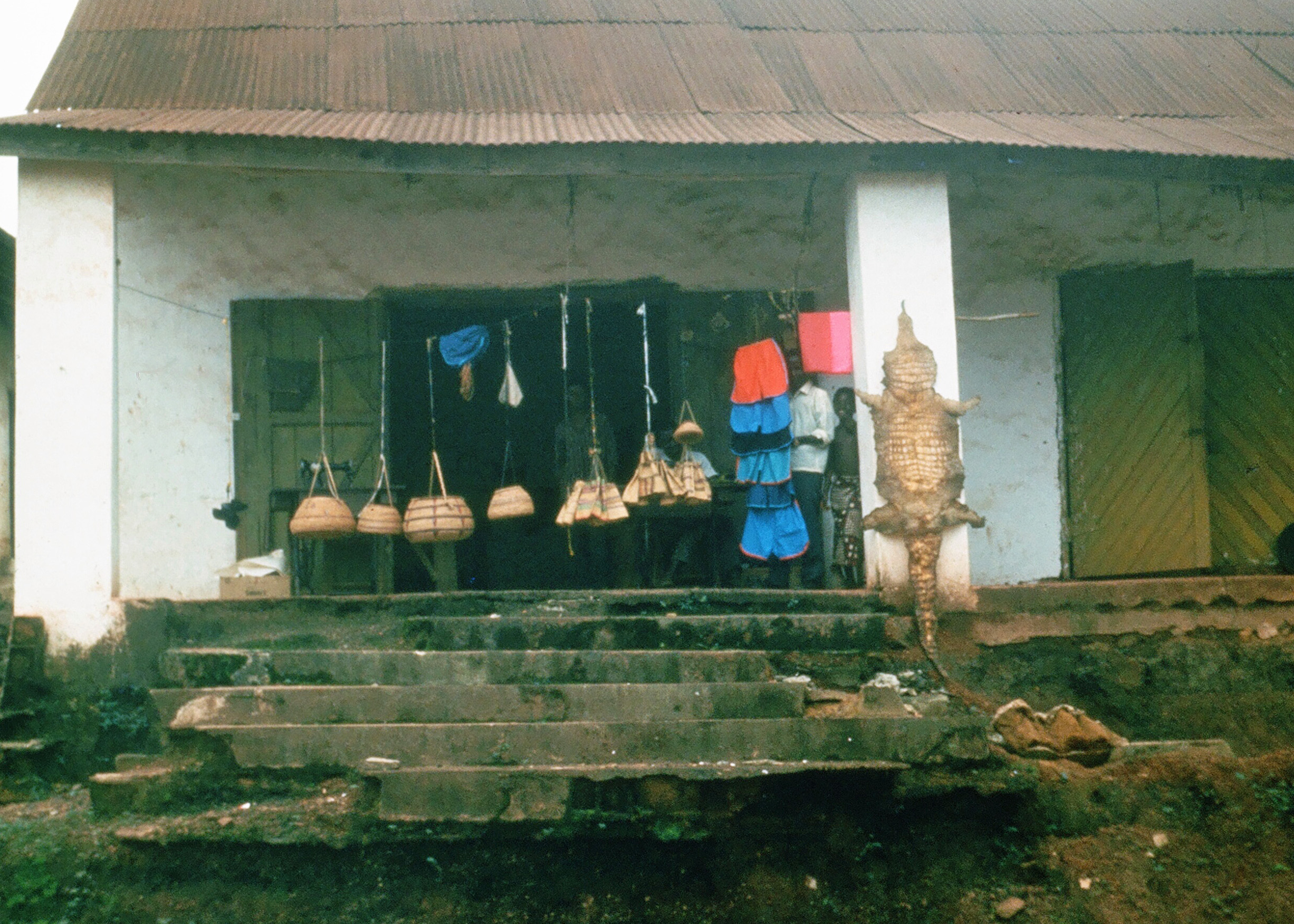
I quickly reached the main street. Open-air shops lined the dirt road on both sides. At first, they looked the same: white washed walls, red tin roofs, dark interiors, and faces staring out from inside.

A typical Liberian shop on Gbarnga's main street. The croc's tail was dragging in the dirt.

Then I begin noticing differences. Several were fronted with crumbling cement steps that had long since given up any hope of connecting to the eroded street. One featured a crocodile skin nailed to the front post, its tail dragging in the dirt. Another had brightly colored shirts and shorts strung up like Christmas ornaments.

Two or three were obviously makeshift bars, no more than holes in the wall. An ancient Liberian ‘Ma’ came staggering out of one with a half-pint gin bottle clutched in her hand. She noticed me, hoisted her bottle in a toast and took a swig.

A few shops were larger and resembled country stores filled with the minutia of daily life. Most were owned by Lebanese. At the time, they made up a substantial part of Liberia’s middle class. I was headed for one that Sam told me sold kerosene.

A group of men stood idly in front of the store. Had folks known I was coming, I would have sworn it was a reception committee. It’s show time went reverberating around my skull. I smiled my best Peace Corps smile. One of the men stepped forward to greet me. He was barefoot and wore a tattered shirt, tattered shorts and a big grin. His hand shot out

This is it I thought, my first official Liberian handshake. We had started practicing at SF State. The shake begins as a normal handshake but ends with you snapping each other’s fingers. An audible snap signifies success. It isn’t easy at first. If the person is really happy to see you he may go through the process two or three times.

(About the time the snap becomes second nature, it’s time to go home. Then you have to unlearn the process. Your American friends look at you strangely when you snap their fingers. At least my conservative Republican father-in-law did. But back to Africa.)

We shook. Our hands parted. Snap! It worked. All of the men beamed and I beamed back. Their official greeter grabbed my hand again. Snap! Another success and more beaming. And again. And again

Nobody had mentioned four snaps to me and this time the guy wouldn’t let go. The men were laughing out loud now. My hundred-watt smile became a forty-watt grimace as I politely tried to retrieve my hand. No luck. I steeled myself, gave up any pretense of being polite and yanked. My hand pulled free and I breathed a huge sigh of relief.

The sigh lasted as long as it took the guy to drop to the ground and wrap his arms around my knees. By now the audience were all but rolling the street. I had become prime time entertainment and was beginning to understand what George Custer must have felt like.

I might still be there if the cavalry hadn’t arrived. It came in the form of a handsome Liberian man in a well-tailored suit who appeared on the scene and gave Flumo a healthy kick in the butt. Flumo let go.

“Hi, I am Daniel Goe, Vice Principal at Gboveh High School. Welcome to Gbarnga.” he introduced himself.

We shook hands in the old-fashioned way as Daniel explained that the man who had his arms wrapped around me was known throughout the Country as Crazy Flumo. I wasn’t the only person to receive his attention.

Once, Daniel told me, Flumo had thrown himself down in front of Vice President Tolbert’s car and wouldn’t move until the VP climbed out and gave him five dollars. New PCVs were a special target. I later learned that a tall Texan Volunteer had actually walked several yards down the main street of Gbarnga with Flumo tenaciously attached to one leg. I’d gotten off easy.

Fortunately, my adventures for the day were over. I bought my kerosene, found a bug poison so potent it was outlawed it in the US and discovered such fine culinary treats as canned beef from Argentina.

Jo Ann and Sam beat back the bug-a-bug and managed to arrive at an uneasy truce with the cockroaches. The nasty beasts would limit their forays until after we had gone to bed and stay out of our bedroom. In return we would only kill those we could reasonably stomp without tearing our house down.

Anyway there we were, one happy little family, cockroaches and all. That’s when Captain Die arrived on our doorstep.

Captain Die was a well digger rumored to have spent far too much time in dark holes. He had dug the well at our house for the original occupants, two female Volunteers. Afterwards, he began stopping by to visit the women and bum cigarettes. He had a rather unique way of introducing himself.

“Hello, my name is Captain Die. My name is Captain Die because I am going to die someday. This is my dog, Rover. Roll over Rover. Give me a cigarette.” Rover, who was a big ugly dog of indeterminate parenthood, dutifully rolled over

It made quite an impression. We explained to Captain Die that neither of us smoked but invited him in to share some ice tea we had just brewed. We gave the Captain a glass and he took a huge swallow.

I have no idea what he thought he was getting but it wasn’t Lipton’s. He must have thought we were trying to poison him. A look of terror crossed his face and he spit the ice tea out in a forceful spray that covered half the kitchen and us. Dripping wet, we found ourselves caught between concern, laughter and dismay. The Captain, in disgust, marched out of our house in military fashion with Rover close behind.

In addition to having found our predecessors an excellent supply of tobacco, Captain Die was quite taken with one of them.  The story was told to us how he appeared at the door when Maryanne’s parents were visiting from the States. Captain Die was a man on a mission.  He was going to request Maryanne’s hand in marriage.

I’ve always imagined the scene as follows.

Maryanne’s parents are sitting in the living room on the Salvation Army chairs and making a game attempt at hiding the culture shock they are undoubtedly feeling when this big black man and his ugly dog appear at the screen door.

Marianne jumps up and says, “Oh Mom and Dad, I would like you to meet my friend, Captain Die.” Mom and Dad, brainwashed by Emily Post and wishing to appear nonchalant, quickly stand up with strained smiles on their faces.

Captain Die grabs Dad’s hand and tries to snap his finger at the same time proclaiming, “Hello, my name is Captain Die. My name is Captain Die because I am going to die some day. This is my dog Rover. Roll over Rover. Give me your daughter.”

No one told me how Marianne’s parents responded to the good Captain’s offer so I will leave the ending up to the reader’s imagination. I can report that Maryanne was not whisked out of the country by her mom and dad.

(Today completes my daily tales of my life as a Peace Corps Volunteer in Gbarnga, Liberia. This week I have been utilizing my travel blog to honor the 50th Anniversary of the Peace Corps. There are more stories of Africa, however, and I will continue to work them in as the year goes by.)


Main street Gbarnga in 1965.

Treason

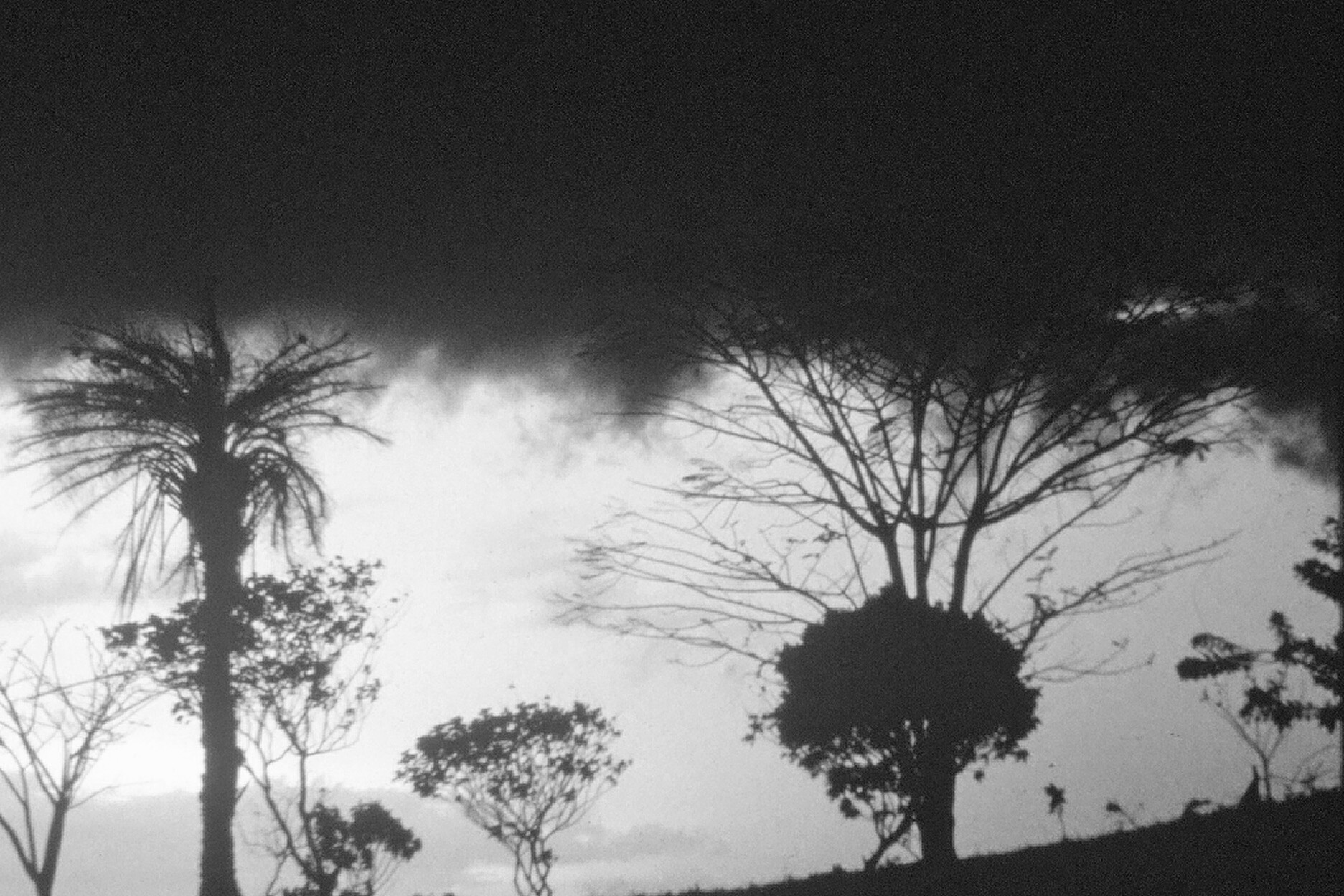
Gathering storm clouds over Liberia. I took this photo from my front porch in 1967. Looking back, it symbolizes for me the gathering political storm that would tear Liberia apart in the 70s, 80s and 90s.

Our job as teachers was to help bring Liberia’s tribal population into the twentieth century.

It was something of a first for the Country considering Americo-Liberians had worked hard for over a century to keep the tribal population in the darkest of the Dark Continent. Americo-Liberians were the descendents of freed slaves who had returned to Africa in the 1800s. They had promptly established themselves as the ruling elite.

It was a position they wished to maintain.

The times ‘they were a changing’ though. Independence was sweeping through Africa as one country after another threw off its colonial chains. Liberia’s tribal peoples were aware of what was happening in the world around them and the natives were getting restless.

The challenge to William Shadrach Tubman, who had been President since 1943, was to convince the tribal people they were getting a good deal, hold together a disparate people, make a show of it internationally, and still protect the privileges of the Americo-Liberians. Achieving the latter while moving forward on the first three was close to impossible.

It required an incredible balancing act at which Tubman was a master. The recipe for success involved one part substance, five parts fancy footwork and ten parts paranoia. The paranoia evolved from the fear that the tribal Liberians would take the process seriously and demand an equivalent portion or, God forbid, all of the goodies. Or possibly the nation would shatter apart.

As long as we behaved ourselves, we were part of the substance. The Liberian government made it quite clear that there would be grave consequences for anyone caught challenging the supremacy of the True Whig Party. For Liberians, the grave consequences could literally mean a hole in the ground. For us, it was a one-way ticket out of the country.

Don’t bother with stopping at Go or collecting $120 (our monthly salary).

Phil Weisberg in our back yard. Virgin tropical rainforest provides the backdrop.

One of our fellow Peace Corps Volunteers in Gbarnga, Phil Weisberg, actually tested the government’s resolve just prior to our arrival. Phil was a tall, gangly PCV who always looked like he had recently lost something of profound value.

He became upset whenever President Tubman or Vice President Tolbert came to Gbarnga and all of the school children in town were required to stand beside the road and cheer.

It didn’t matter if the luminary was one or two hours late, which he often was, or if it was pouring down rain, which it did half of the time, or if the sun was boiling hot, which it did the other half; the kids were expected to be there.

Teachers were required to go along. While most of the Volunteers managed to find something else to do, Phil’s personality was such that if his kids had to suffer he was going to be right out there suffering with them.

One day he found himself waiting an hour in the hot sun for the President’s wife and decided to protest. He did so by penning a sign that said in the best Liberian English, “MRS. TUBMAN, YOU ARE TOO LATE!”

Two hours later when her motorcade came tooling in to Gbarnga, Phil held up his sign and waved it about. Minutes later he found himself arrested and thrown into jail. This was not a piddling little kick your ass out of the country offense. One didn’t mess with the President’s wife.

Luckily Phil had the power of the American government behind him. Diplomatic maneuvering plus a personally written apology earned him a get out of jail free card. He was even allowed to stay in the country and finish up his term, provided of course he behaved.

I understood why Phil got in trouble. Waving a sign around criticizing the Presidents wife was not how to win friends and influence people among the Americo-Liberians. We all knew that the government was paranoid. Just how paranoid, I was to soon find out.

Peace Corps teachers were required to undertake a project during their first school vacation in Liberia. Given my experience at the elementary school, I decided do away with Dick, Jane and Spot and write a second grade reader. Why shouldn’t Liberian children have their own readers that reflected their own culture? Peace Corps agreed.

I jumped in. There were teaching guides to review, people to interview, folk tales to gather, and stories to write, rewrite and finish in one syllable English.

Eventually I finished the reader and shipped it off to Monrovia. Peace Corps was excited about the book and assigned an editor and illustrator to work with me. I would soon be a published author. Not. WAWA (a term coined by experienced African hands that stood for West Africa Wins Again) struck.

The book wouldn’t be published at all.

I had made the mistake of assuming the government would support a reader that featured Liberian children and African Folk Tales instead of Dick, Jane and Spot. What I had failed to understand was just how paranoid the Americo-Liberians were about maintaining power.

Apparently the book was a highly subversive tract and I was a dangerous radical. Liberian children would learn about their native heritage and rebel. Another misstep and I would be booted out of the country… or worse.

My next criminal activity was to organize a student government at Gboveh High School where I was taught African and World History. I decided the exercise would help our students prepare for the future and give them skills they would need in helping to govern their country.

Everyone, including students, teachers and Mr. Bonal, agreed. We pulled together interested students, worked through developing by-laws and set up elections.

Then the kids decided they would organize and run for office on party tickets. Why not? It sounded like fun. To provide identification for each ticket, they adopted names. It never entered my mind that this gesture would strike terror in the hearts of Americo-Liberians.

Within 24 hours we had been accused by the Superintendent (governor) of Bong County of setting up competing political parties to the Government’s True Whig Party. Student leaders were told to cease and desist or they would be arrested and thrown in jail.

I was told indirectly that I should start packing my bags.

So we eliminated the tickets and names. We were then allowed to proceed but I have no doubt we were closely monitored. I couldn’t help but wonder which of my students or fellow faculty members reported regularly to the Superintendent on my treasonable behavior.

The senior class. Yes, there were only five students in the class! Mamadee Wattee, standing on my right with a brown shirt and tie, was the student body president. He is also featured in my blog about the Lightning Man. Later he would move to the US and become an elementary school principal.

Reading and Writing and Arithmetic Taught to the Tune of an Ebony Stick

The elementary school was made from cement blocks. Windows without glass or screens provided air conditioning. Jo Ann and her first grade class provide perspective on the size of the school.

(Peace Corps turned 50 on Tuesday and I am not discussing what I turn on Thursday. But each day this week I am honoring Peace Corp’s birthday by sharing tales on my travel blog of my own experience as a PC Volunteer in Gbarnga, Liberia, West Africa from 1965 to 1967. Yesterday I wrote about my introduction to teaching second grade and about contacting a mysterious illness. Today I return to my unruly class of second graders and try to bring them under control.)

When I returned to school from being sick, my second graders had become rambunctious from their time off. After five days I had worked my way through every classroom management skill I had picked up during Peace Corps’ training and several I made up. Nothing worked.

“They need to be whipped,” my fellow Liberian teachers suggested. “That’s what we do.”

I patiently explained that Peace Corps teachers weren’t supposed to whip their students. Somewhere it was chiseled in stone. Eternal damnation and banishment to North Dakota would result.

“Then pretend you are going to whip them. Just don’t do it,” was the next helpful suggestion.

Being desperate and up for a little corruption, I thought about it. Where did it say in the Peace Corps rules that positive threatening was out of line? After all, hadn’t Teddy Roosevelt said, “Speak softly and carry a big stick?” Wasn’t the American government accumulating enough nuclear weapons to kill everyone in the world several times over using the same philosophy?

So I went out in the jungle and cut myself a big stick. Next I introduced it to my students.

“Oh, Mr. Mekemson, what a big stick you have,” they said. I could see the respect shining in their eyes. I explained its purpose. They could behave and earn positive points or they could misbehave and earn negative points. If they earned enough negative points, THE BIG STICK WOULD BE WAITING.

I didn’t tell my students I put the point total for the stick so high it would take a combination of Al Capone and Count Dracula to reach it.

The system worked. Whenever the class bordered on chaos, I would head for the blackboard, chalk in hand. Instant silence resulted. It was ‘Reading and writing and arithmetic taught to the tune of an ebony stick.’ We started making up for lost time.

A part of John Bonal's extended family. Mary is on the left.

Of course there was an exception. Isn’t there always? It came in the form of Mary, an 11-year old going on 13. Her uncle was principal of the high school and a Big Man in town so this meant she was important. Mere mortals such as Peace Corps Volunteers didn’t count. No Liberian teacher would dare touch a stick to her ornery hide, so certainly a Peace Corps teacher wouldn’t.

She called my bluff and pushed her points right up to the rim. I urgently sought reasons to give her positive points but the opportunities were few and far between. She went over the top and smugly whispered to her girlfriends to watch what would happen.

Now I had a real problem. Obviously I couldn’t beat her. I am really not the beating kind. But neither could I ignore her. The end of the day came and I dismissed the class but asked her to stay. The students walked out the door and stopped just on the other side. They weren’t leaving. Nobody at the school was, including all of the teachers. They were all waiting to see what Mr. Mekemson would do.

Mr. Mekemson was worrying. That’s what he was doing. I got out my big stick. Little Miss Mary was no longer so nonchalant.

“Don’t beat me Teacha, I beg you, don’t beat me,” she screamed and screamed and screamed. I gently touched her with my stick. You would have thought I was pulling all of her fingernails and half of her toenails out, slowly. I knew everyone in the school was listening in on this little drama and I imagined that half of Gbarnga was as well.


Oh boy, I thought, you have royally screwed up this time, Curtis.

I mumbled something about the importance of changing her ways and sent her off. And then I waited. How long would it be before the Peace Corps jeep came by to carry Jo Ann and me away? The next day at school was quiet.  Mary stayed home and I had a class of angels. Even other classes were quiet.

At noon, one of the Liberian teachers stopped by. She had a student she wanted me to beat. I declined… less than graciously.

Two days later I received the message; John Bonal, Mary’s Uncle, wanted to see me. This was it. I prepared my case carefully. I didn’t want to leave. A lovely war was waiting for me at home and I had developed a considerable fondness for Liberia and its people.

I went to see Mr. Bonal with all of the enthusiasm of an African hippopotamus crossing the Sahara. John was smiling when I greeted him. I even managed to get a decent snap out of the handshake.

“I’ve heard about your reputation,” he started and paused. Many words went roaring through my mind; words like child beater, monster, and hater of kids to name a few. “And I would like you and your wife to come and teach at the high school. We think you would make a great addition to our faculty. We would like you to teach history and geography and Jo Ann to teach French and science.”

Talk about surprise. Here I was prepared to be booted out of the country, ready to beg as the Liberians liked to say, ready to humble myself and crawl across the floor if need be, and I was being offered the opportunity to teach two of my all time favorite subjects.

“Sir, your niece…” I managed to stumble out.

Mr. Bonal’s smile widened, “Ah yes,” he said, “that was a good job. Now she will be a much better student.” Suddenly I had the suspicion that Mr. Bonal wanted me for a reason other than my ‘great’ teaching ability. I pictured myself practicing with a bullwhip out behind the high school as students lined up for their daily punishment. “Mr. Mekemson will see you now. Do you have any final words?”

(Tomorrow I write a second grade reader but the government labels me as a radical and refuses to publish the book because I focus on tribal children and African Tales. At high school I encourage the creation of a student government. The Liberian Government accuses me of creating political parties to oppose the True Whig Party and threatens to kick me out of the country.)

Good Mornin Teacha

Main street Gbarnga circa 1965. Our main shopping district.

“Good Morning Teacha” thirty bright and shiny faces shouted in unison as I walked into the classroom on my first day of teaching in Gbarnga.

“Good morning,” I responded in my best new Peace Corps Teacher voice. And then reality struck. I was expected to entertain and actually teach these kids something over the next several months.

Unless you are a teacher, you might be saying, “Hey, how hard can it be to teach a group of second graders?” My only response is “Try it some time.”

Plus there were handicaps.

My students ranged in age from seven to twenty-two and spoke several different tribal languages. While Kpelle was the predominant language used in our area, several others were represented. English was supposedly the common language but its reach into tribal areas was minimal.

Pidgin English Liberian style provided the bridge. For example, I might say to you, “I have to go down town for about twenty minutes. I promise I won’t be gone long. Please wait for me.” The Pidgin English equivalent would be, “Wait small, I go come.”

One idiom I learned quickly was, “Teacha, I have to serve nature.”  That meant, “May I have your permission to use the restroom?” Actually it was permission to use the outhouse or just as likely the ‘bush’ or even the side of the building. Some of my male students would listen to me through the open window as they did their thing on the wall. I admired their dedication but discouraged the practice.

Books created another problem; for the most part, there weren’t any. What we did have for reading were vintage 1950 California readers complete with Dick, Jane and Spot. I suspect we should have been grateful for anything but it was difficult for the Liberian kids to identify with big white houses, white picket fences and little white kids.

As for Spot, he bore a striking resemblance to food. Later, when I had a cat, my students would tease me by coming by, pinching him and saying, “Oh, Mr. Mekemson, what fine meat.”

Getting sick didn’t help the education process. I had been teaching for two months when I met an obnoxious tropical bug that knocked me out for several weeks. It announced its presence with a low temperature of 100 degrees that soon climbed to 103. Normally it hovered around 101.

As for its pedigree, who knows? Les Cohen, the Peace Corps doctor, would come by and shrug his shoulders a lot. He used the lottery approach to medicine. We must have explored his whole medicine chest.

The sad thing about being sick was that there were no substitute teachers. Whenever a teacher was absent, the class was left to fend for itself.  Often, my students would come by to check on how “Teacha” was doing.

“How are you feeling Mr. Mekemson? When are you coming back to teach? Can’t you teach us while you are sick?” There’s nothing like thirty kids standing around your house and looking mournful to create guilt.

At least I was able to plow through a number of the 100 books the Peace Corps generously provided for Volunteers. There was also entertainment of another sort. Each day around 10 AM a woman would stop in the dirt road opposite our house, squat down and pee.

I didn’t have a clue to her motivation but I found myself looking forward to her visits. Maybe she was practicing Ju Ju (African medicine). Or maybe she just had to go or was marking her territory. Who knows? I tried to pry out of Sam what she was up to but he would just shake his head and mutter in Kpelle.

Evening entertainment was supplied by Miranda Hall. This popular bar/dance hall added substantially to my already splitting headache. Loudspeakers perched on top of the establishment blasted African High Life music for miles around. Since it was located one hundred yards from our house, we received the full benefit of its marketing campaign.

One song I remember from hearing at least ten times a night had a country-western theme: “Woe is me, shame and scandal in the family.”

Later, I actually witnessed a little shame and scandal in the house next to the bar. I was walking by when the ‘man of the house’ came down the street, nodded to me and went inside. It seems he was early. I heard a loud shout at the same time a well-endowed naked man burst through the screen window and hit the ground running. Right behind was the jilted husband. The two streaked by me and disappeared downtown.

The naked guy was really fast.

Les was out of town when my illness finally decided to peak.  As my temperature passed the 103 mark and headed for 104 I began to worry about hallucinating and becoming irrational. I asked Jo to contact an Indian doctor who served the local community. Dr Swami (yes that was his name) came right over.

“Here, drink this,” he said.

Dr. Swami gave me a sweet, syrupy liquid that tasted great, knocked me out and cured me. The next morning I woke up feeling much better. I was even able to participate in helping consume a Thanksgiving turkey that Bob Cohen’s wife had prepared. The turkey tasted a little like sawdust due to the lingering remnants of my bug but hey, who was complaining. There was a bottle of scotch to wash it down.

(Tomorrow… Reading, writing and arithmetic taught to the tune of an ebony stick.)