The Tragedy and Glory of Ancient Pompeii… The Wednesday Photo Essay


Pompeii body

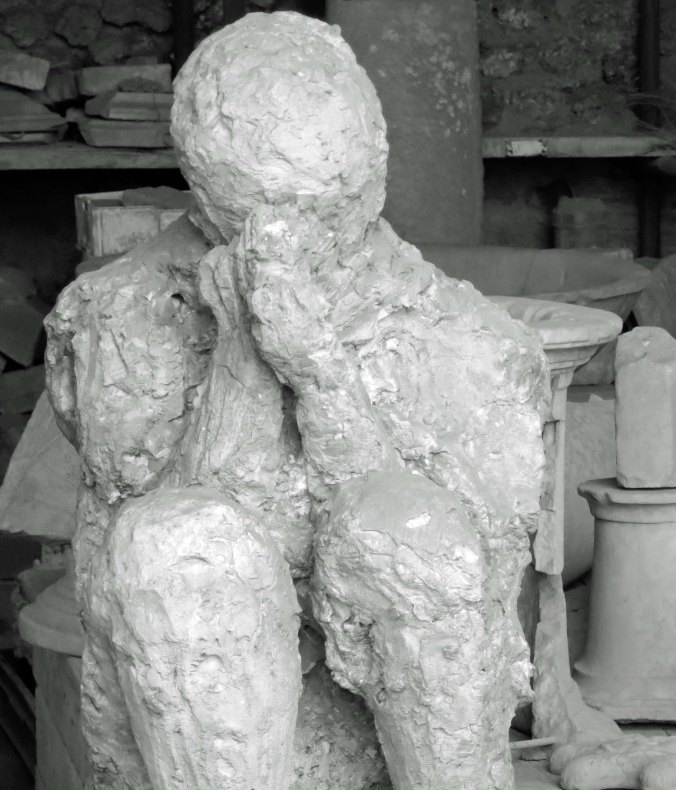
A blanket of ash rushed down from Mt. Vesuvius on Pompeii in 79 CE, suffocating many of the city’s residents. Those who could escape, did. Those who didn’t were covered by a flow of molten rock the next day, preserving their bodies as they died in poses that can still be seen today.


It’s time for another Wednesday photo essay where I scroll through the 75,000+ photos that Peggy and I have taken from around the world and find something that catches my attention. Today it is Ancient Pompeii. Next Wednesday it will be Costa Rica.


Their lives would have been interrupted by a series of small tremors. It had to be worrisome; seventeen years earlier Pompeii had come close to being destroyed in a massive earthquake. The city was still being rebuilt. Possibly the residents woke on the morning of August 24, 79 CE and looked fearfully at the restless mountain that loomed over them— and then went on about their business.

Temple of Jupiter and Mt. Vesuvius

Mt. Vesuvius still looms above Pompeii today. This is what it looks like from the Temple of Jupiter.

Ruins at Pompeii and Mt. Vesuvius

Another perspective.

Everything ended at 1:00 PM.

Mt. Vesuvius exploded in a massive eruption sending tons of ash, gas and rocks spewing 20 miles into the sky and forming a dense mushroom cloud. Winds quickly carried the ash into Pompeii, turning day into night and dreams into nightmares. The majority fled, escaping by whatever means available. Those who stayed behind died— suffocating at first under the blanket of thick ash and ultimately, the next morning, by being buried alive under a pyroclastic flow of molten rock and gas that flew down the mountain at speeds close to 100 miles per hour.

Buried alive in Pompeii

It must have been incredibly fast, and frightening.

Pompeii's dead

You have to wonder if this person was simply asleep when it happened.

Viewed from an archeological perspective, history’s tragedy has become today’s blessing. The molten rock and ash that covered Pompeii, also preserved it, providing historians with their most complete view of what life was like in the ancient Roman Empire.

Pompeii street with raised crossing

Buildings and streets in Pompeii are well-preserved. Ruts from vehicles using the roads can still be seen, as can road crossings.

Street crossing in Pompeii

Streets were cleaned by flooding them with water. People kept their feet dry by using these crossing stones.

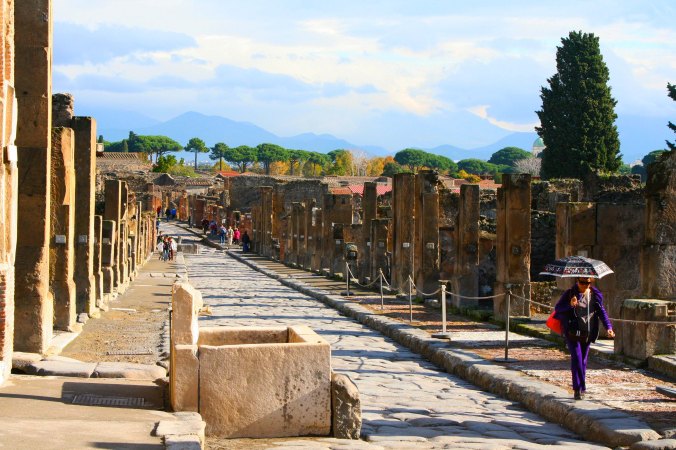
Street in Pompeii

Another street scene. Note how carefully the buildings had been aligned. The square box might have been a community water cistern.


Water faucet in Pompeii

Peggy and I were amused by its modern day equivalent where a faucet was added to the mouth of an early sculpture.

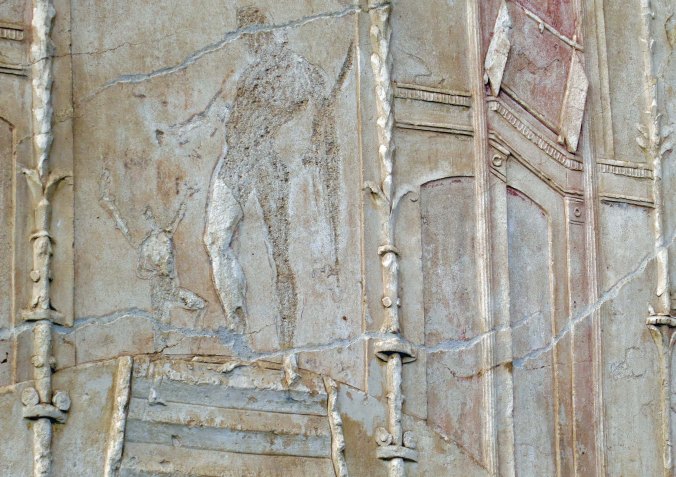
Side of bathhouse in Pompeii

Public baths were a part of most Roman towns and cities. This one was decorated with a detailed relief…

Father and child, Pompeii

Which included a father and child walking down stairs.

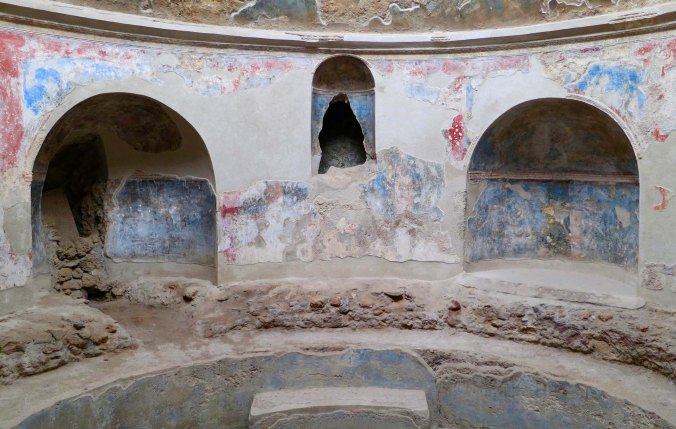
Pompeii bathhouse

An inside view of the baths provides an idea of how luxurious the baths would have been. Remnants of murals that once covered the walls still remain.

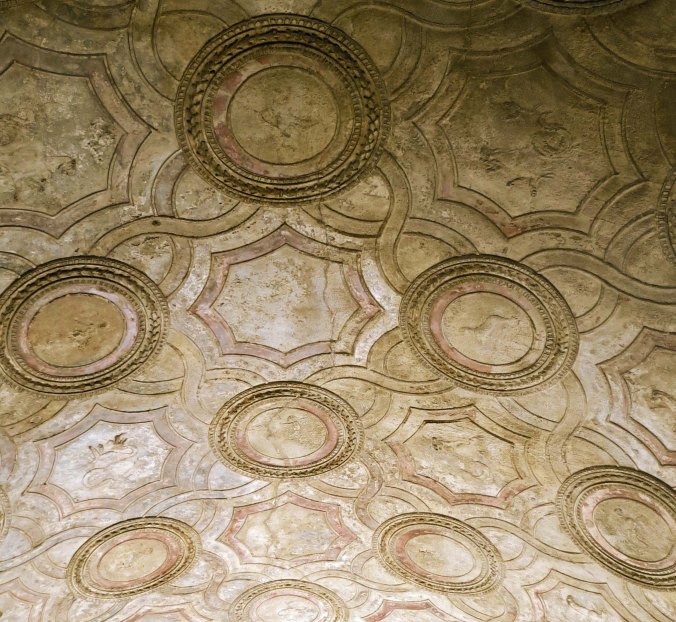
Ceiling of bathhouse in Pompeii

Ceilings were decorated as well. This one shows bas-reliefs of people and animals.

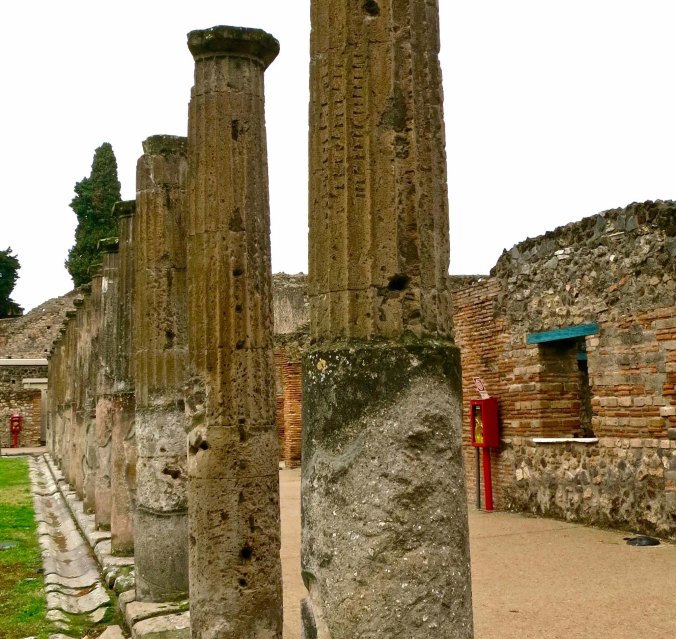
Columns in a row at Pompeii

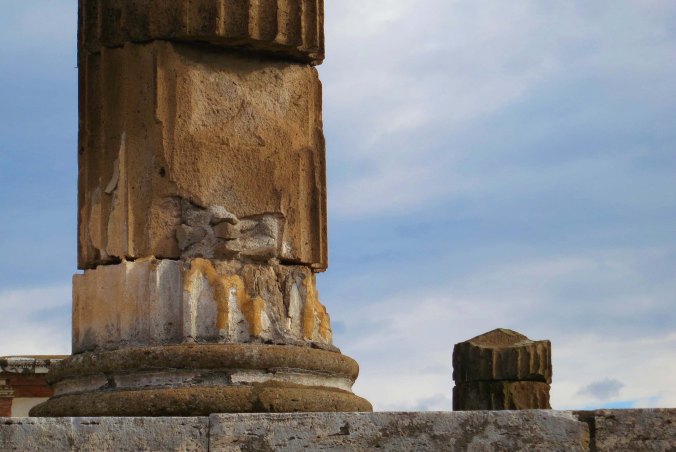
Columns are another thing that most Roman towns shared. These set off a training school of gladiators, who were expected to go out and die for the greater glory of Rome, or to fight and possibly die to entertain Roman citizens. When I closed my eyes, I could almost hear the clashing of swords.

Pompeii Column

Looking up at one of the columns.

Column in Pompeii

Close-up.

Apollo at Pompeii with his temple

Peggy did a clever job of catching Jupiter with his hand seemingly wrapped around a column in his temple. The god was apparently traveling light that day.

Pompeii building

Many of the buildings were remarkably preserved.

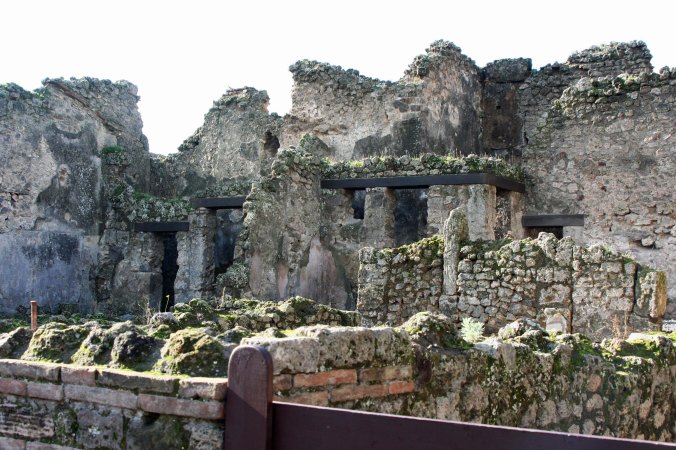
Ruins at Pompeii

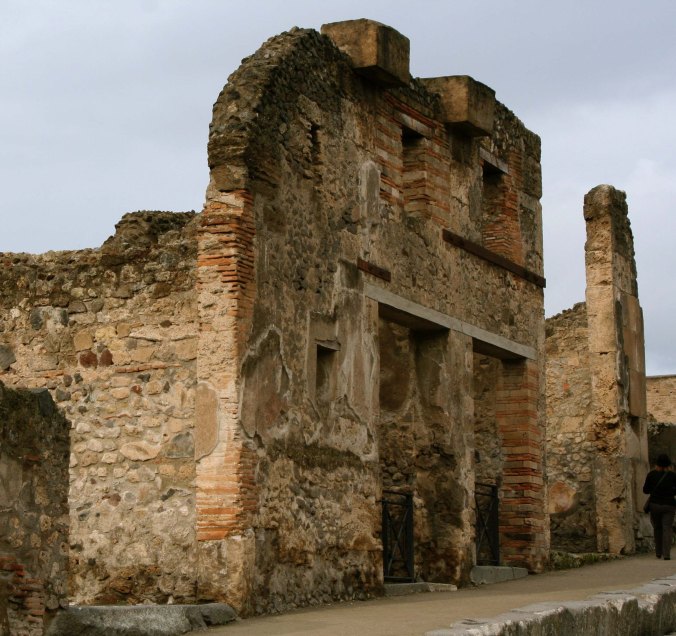
Others more closely resembled other Roman ruins found throughout the Mediterranean.

Pompeii House of Pleasure

The Lupanar House of Pleasure or brothel is one of Pompeii’s best preserved buildings and our guide gave us a tour…

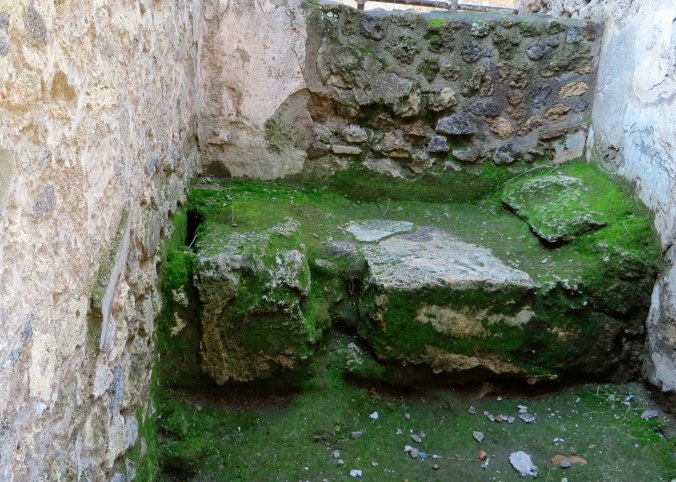
House of Lupenare bed in Pompeii

This was one of the beds. It would have been covered with a mattress, but still… The walls of the brothel included paintings that showed the various services available.

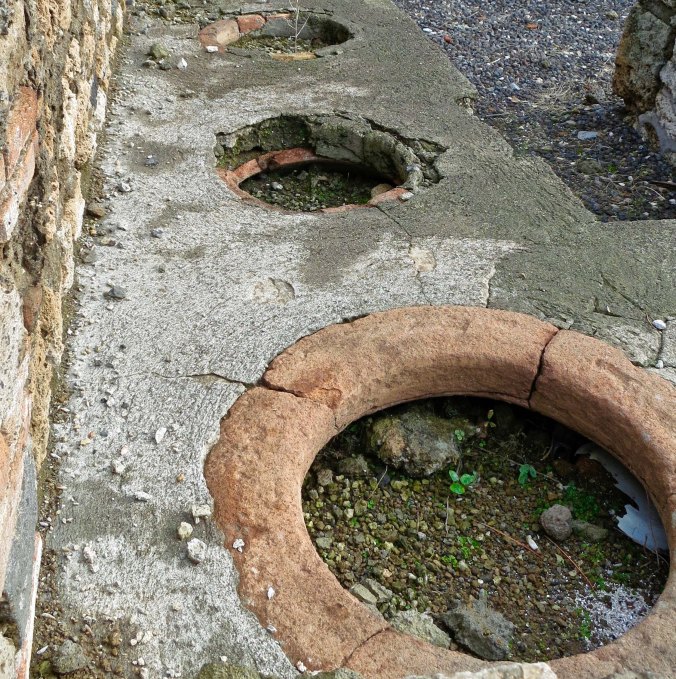
Fastfood holders at Pompeii

A meal out may have included stopping by this place. These were designed to hold prepared food and keep it hot. It strikes me as a fast food/takeout restaurant.

Bread oven in Pompeii

Bread was baked in this oven.

Jars at Pompeii

A large number of storage jars, such as these, were found in the city.

Amphitheater at Pompeii

The large amphitheater would have accommodated most of Pompeii’s residents. The rich folks got the lower seats. Those not so fortunate, the upper ‘nosebleed’ seats.

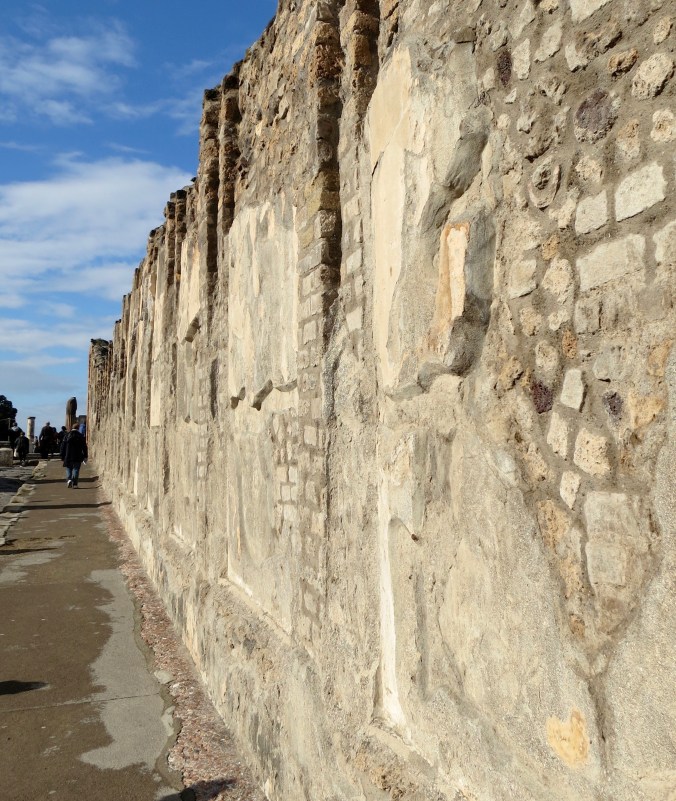
Street scene in Pompeii

Another street scene in Pompeii. Murals were  included on the walls. There must have been a great deal of civic pride in the city.

Child with dog at Pompeii

A little girl and her dog…

Dog at Pompeii

And a modern resident of Pompeii.

Edge of Pompeii

I’ll conclude with this photo from the Mediterranean side of Pompeii. In 79 CE, the sea was only a couple of hundred yards away. Today it is a couple of miles. Those who had boats or access to boats would have been fleeing from here on that fateful August day, escaping the death that was raining down on their fair city.


FRIDAY’S POST: I determine it’s my job to rule the first grade but no one else seems to agree. Mrs. Young gives me a spanking for my effort.

MONDAY’S POST: It’s all about food on our river trip. And why did Homeland Security determine it was necessary to check our food boxes for a bomb?

WEDNESDAY’S POST: We leave Italy and the Mediterranean to venture off to the Amazon..


SaveSaveSaveSave

SaveSave

SaveSave

SaveSave

SaveSave

SaveSave

SaveSave

SaveSave

SaveSave

The Great Tree Race… Blogging My Book on “MisAdventures”

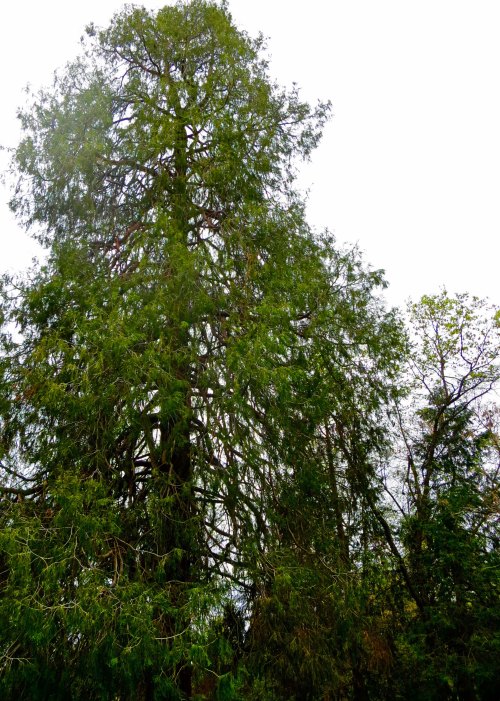
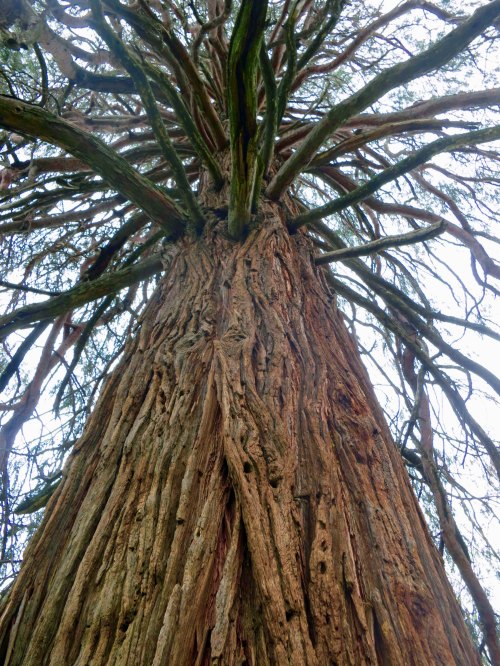
Incense cedar tree in Diamond Springs graveyard

A view of the tall incense cedar in the Graveyard today.


Two incense cedars dominated the Graveyard. From an under five-foot perspective, they were gigantic, stretching some 75-feet skyward. The limbs of the largest tree started 20 feet up and provided scant hope for climbing. As usual, my brother Marshall found a risky way around the problem.

Several of the lower limbs came tantalizingly close to the ground at their tips. One could be reached by standing on a convenient flat tombstone. But only Marshall could reach it; I was frustratingly short by several inches. Marsh would make a leap, grasp the limb and shimmy up it hanging butt down until it became large enough for him to work his way around to the top. Then he would crawl up to the tree trunk, five Curtis lengths off the ground. After that, he would climb to wonderfully mysterious heights I could only dream about.

Eventually I grew tall enough to make my first triumphant journey up the limb. Then, very carefully, I climbed to the heart-stopping top, limb by limb. All of Diamond Springs spread out before me. I could see our school, and Caldor (the lumber mill where my father worked), and the woods, and the hill with a Cross where I had shivered my way through an Easter Sunrise Service. I could see my whole world. Except for a slight wind that made the tree top sway and stirred my imagination about the far away ground, I figured I was as close to Heaven as I would ever get.

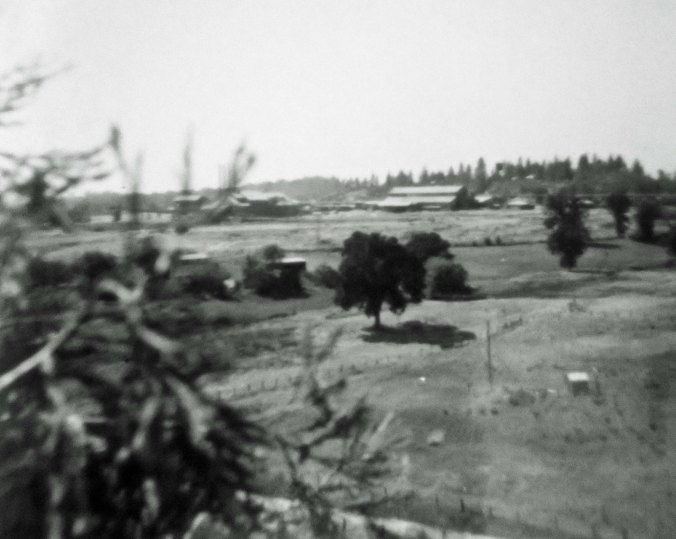
View of Caldor Lumber company circa 1958

The view from the top of the incense cedar tree in the Graveyard looking toward Caldor Lumber Company circa 1958. The mill had already closed down by this time.

By the time I finally made it to the top, Marshall had more grandiose plans for the tree. We would build a tree house in the upper branches. Off we went to Caldor to liberate some two by fours. Then we raided Pop’s tool shed for a hammer, nails, and rope. My job was to be the ground man while Marshall climbed up to the top. He would then lower the rope and I would tie on a board that he would hoist up and nail in. It was a good plan, or so we thought.

Along about the third board, Pop showed up. It wasn’t so much that we wanted to build a tree fort in the Graveyard that bothered him, or that we had borrowed his tools without asking. He even seemed to ignore the liberated lumber. His concern was that we were building our fort too close to the top of the tree on thin limbs that would easily break with nails that barely reached through the boards. After he graphically described the potential results, even Marshall had second thoughts. Pop had a solution though. He would build us a proper tree house on the large limbs that were only 20 feet off the ground. He would also add a ladder so we could avoid our tombstone-shimmy-up-the-limb route.

And he did. It was a magnificent open tree house of Swiss Family Robinson proportions that easily accommodated our buddies and us with room to spare. Hidden in the tree and hidden in the middle of the Graveyard, it became our special hangout where we could escape everything except the call to dinner. It became my center for daydreaming and Marshall’s center for mischief planning. He, along with our friends Allen and Lee, would plan our forays into Diamond designed to terrorize the local populace.

Cedar tree in Great Tree Race, Diamond Springs, CA

Looking up from the base of the tree today. The aging fellow is 65 years older from the days when I mastered climbing it. Pop’s tree house was built on the lower left limbs.

It also became the starting point for the Great Tree Race. We would scramble to the top and back down in one on one competition as quickly as we could. Slips were a common hazard. Unfortunately, the other boys always beat me; they were two to three years older and I was the one most susceptible to slipping. My steady diet of Tarzan comic books sustained me though and I refused to give up.  Eventually, several years later, I would triumph.

Marshall was taking a teenage time-out with Mother’s parents who had moved to Watsonville, down on the Central Coast of California. Each day I went to the Graveyard and took several practice-runs up the tree. I became half monkey. Each limb was memorized and an optimum route chosen. Tree climbing muscles bulged; my grip became iron and my nerves steel. Finally, the big day arrived and Marshall came home. He was every bit the big brother who had had been away at high school while little brother stayed at home and finished grade school. He talked of cars and girls and wild parties and of his friend Dwight who could knock people out with one punch. I casually mentioned the possibility of a race to the top of the Tree. What a set up. Two pack-a-day, sixteen-year old, cigarette smokers aren’t into tree climbing, but how can you resist a challenge from your little brother.

Off we went. Marsh didn’t stand a chance. It was payback time for years of big brother hassles. I flew up and down the tree. I hardly touched the limbs. Slip? So what, I would catch the next limb. Marsh was about half way up the tree when I passed him on my way down. I showed no mercy and greeted him with a grin when he arrived, huffing and puffing, back at the tree house. His sense of humor was minimal. He challenged me to a wrestling match and I pinned him to the ground. It was the end of the Great Tree Race, the end of big brother domination, and a fitting end to my years of associating with dead people.

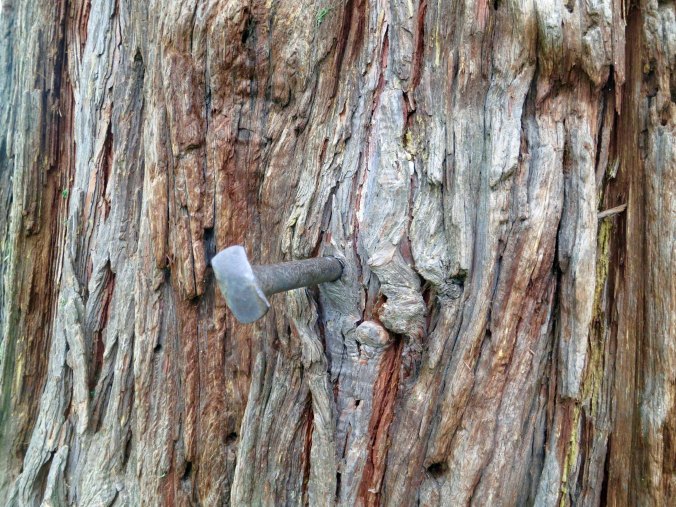
Cedar tree spike in Diamond Springs Ca

This spike is all that remains of our treehouse dreams. As I recall, Marshall drove it into the tree with thoughts of several more to provide a way up the tree.

Cut down incense cedar tree in Diamond Springs graveyard

The jungle of Heavenly Trees that once covered the Graveyard has long since been tamed. Imagine my dismay during my last visit to Diamond Springs when I found that the cedar tree’s twin in the Graveyard had been cut down.  Could our tree be far behind?


MONDAY’S Travel Blog POST: A continuation of the trip through the Grand Canyon. How did we end up there? It’s an interesting tale.

WEDNESDAY’S Photo Essay POST: We’ll visit the ancient city of Pompeii in Italy that was buried by Mt. Vesuvius in 79 CE.

FRIDAY’S Blog-a-Book POST: There’s some catching up on the education front. I’m allowed back in school and try to take over the first grade.

SaveSave

SaveSave

Hopi Gods and Squirrelly Squirrels… Rafting the Grand Canyon: Part 1

Rowing on the Colorado through the Grand Canyon

While a veteran crew of boatmen handled the more dangerous parts of our 18 day journey through the Grand Canyon, I was allowed near oars on some of the tamer sections.


Since Peggy and I will actually be hanging out at our home in Southern Oregon for a couple of months and not generating new material for my travel blog, I thought I would dip back in time to the very beginning of my posts.  I had attended a writer’s conference in San Francisco during the winter of 2010 and been told that writers need an Internet presence. I felt doing a series on an 18-day trip we had just completed rafting on the Colorado River through the Grand Canyon would make an excellent start. It was an epic-adventure, one that was burned into my memory banks.  Part of the experience was that Peggy and I would be traversing some of the earth’s most challenging rapids with a true cast of characters. That alone was enough to make it an epic adventure, but even more important, at least for me, was that we would be traveling through the heart of the Grand Canyon, one of the seven natural wonders of the world. Please join us on this adventure. By the end, I think you will see why the Grand Canyon has earned its world-class status. I will start with Peggy and me in Flagstaff, Arizona getting ready for our adventure…


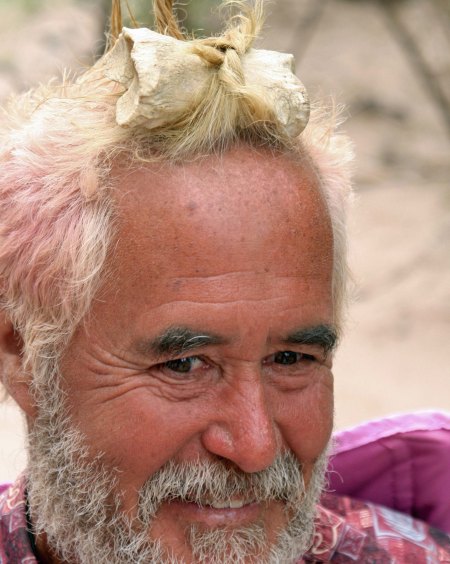
Tom and Bone

One of the ‘cast of characters’ and our group leader, Tom Lovering with Bone in his hair. Tom and I had found Bone when we were backpacking in the Sierra Nevada Mountains in 1977 and he has traveled the world ever since.

Five squirrels with long tufted ears just went charging past our van— in a row. I think it must be love and Peggy agrees. We speculate that a female is leading the boys on a glorious romp. “Catch me if you can!” she giggles. It’s that time of the year when the Albert Squirrels are excited to make babies and perpetuate the species. Lust is in their hearts. Or maybe it’s just the guys working out territorial differences.

Someone they won’t be mating with are their northern cousins, the Kaibab Squirrels. It isn’t that they couldn’t or wouldn’t if they could, it’s just that the giant hole in the ground known as the Grand Canyon is too deep and too wide for them to cross. As a result, a new species has been created. Scientists and natural history folks call this process allopatric speciation— a pair of two-bit words for sure.

We are located at a KOA in Flagstaff, Arizona as we prepare for our raft trip down the Colorado River. It’s a big campground. Everywhere we look men and women wearing yellow shirts are busily preparing for the onslaught of summer tourists. It feels like a beehive, or squirrel’s nest. The camp cook tells us 28 people work here. Jobs are highly specialized. The man who straightens misplaced rocks stopped by to chat with us this morning.

Yesterday we watched two employees struggle for an hour on laying out the base of Teepee. It had all the flavor of an old Laurel and Hardy film. They kept measuring and re-measuring the angles. I expected one to leap up and start chasing the other around camp with a 2×4.

We wonder what the Kachina deities who live in the San Francisco Mountains overlooking our campground think about the squirrelly activity taking place beneath them. There are bunches of them up there, over 300 according to Hopi lore, and each one has a lesson to teach, wisdom to disperse. They come down from their perch in the winter to share their knowledge. I’m sure that they would have made quick work of the Teepee project.

Peggy and I hike up the mountain following Fat Man’s trail. Of course, there is no irony here as we desperately try to beat our bodies into shape for the Canyon trip. We’ve been out travelling in our van for months and the pounds have accumulated. The trail’s name suggests this is a gentle start. Instead it takes us straight up into a snowstorm. The Kachinas are rumored to mislead people under such circumstances. I once spent a week up on the mountain by myself and restricted my wandering to fair weather.

Grand Canyon rock formation

I’ve sometimes wondered what, if any, role that rock formations in the Grand Canyon influenced how the Hopi Indians pictured their Kachina gods.

Once they had the mountain to themselves but now they have competition. Technology has arrived— modern gods. Tower after tower bristling with arrays of tracking, listening and sending devices look out over the sacred lands of the Hopi, Navaho and other Native Americans.

It’s hard not to think Big Brother is watching or not be disturbed by the towers’ visual intrusion. But their presence means we can get cell phone coverage and climb on the Internet. We are addicted to these modern forms of communication so it is hypocritical to whine, at least too much.

But back to the squirrel theme, Peggy and I are a little squirrelly ourselves as we go through our gear and get ready for our grand adventure. I am nervous. This is my first multi-day river trip. What have we gotten ourselves into? Do we have the equipment we need? Will we survive the rapids? What will the people who are joining us be like? What challenges will we face that we are ill prepared for? There are many questions and few answers.

Would people who should not be let near knives suddenly be wielding them?

Would Canyon spirits stalk us?

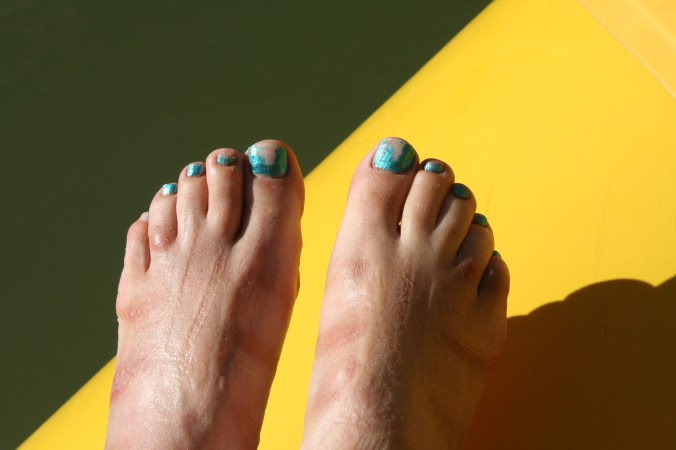
Would we be required to paint our toenails so our rafts wouldn’t flip.


A note on photos: Peggy and I took most of the pictures that will be included in these posts on the Grand Canyon trip. Our friend Don Green was also along, however, and has generously shared his photos with us. I will note which photos are his.

WEDNESDAY’s Photo Essay POST: It’s back to the featuring the beautiful red rocks of Sedona, Arizona.

FRIDAY’S Blog a Book POST: The next chapter in MisAdventures sees my brother and I in a death-defying race to the top of the 75-foot tall Incense Cedar in the Graveyard.

MONDAY’S Travel Blog POST: It’s all about food, seemingly tons of it, as we make our final preparations for the Colorado River trip. Homeland Security puts a crimp in our efforts as it checks our supply for bombs.

SaveSave

SaveSave

SaveSave

SaveSave

SaveSave

SaveSave

SaveSave

SaveSave

SaveSave

SaveSave

SaveSave

SaveSave

How Not to Neuter Your Cat… A Quickie from MisAdventures

Curt and pets

It was rare that a photo of me in my childhood didn’t include one or several of our family pets. MC the Cat wasn’t in any of them, however…


This story is a bit short to include in my Friday Blog a Book series, but I still find it amusing enough to share. Remember how I reported on my efforts to hire the family pets to sleep on my bed and scare the ghosts away? MC was not one of the pets willing to join the effort. Here’s why.


While Demon had been an enthusiastic supporter of the ghost protection racket, MC never was, with good reason. He was a tom cat’s Tom Cat— as white as Demon was black, somewhat diminutive in size, and totally dedicated to scattering his sperm. Unfortunately, his small size meant that he often came out on the losing end in his battles with larger toms over fair kitty’s love. He would arrive home beat up and battered. One time a chunk of his ear was missing. Another time it was the tip of his tail. Pop decided that drastic measures were called for. M.C. would have to have to lose his offending appendages. Unfortunately, there wasn’t a lot of money in our family for veterinary bills. Our Italian neighbor, Papa, suggested an Old Country solution, a cheap way to castrate a cat.

“All you need is a pair of tin snips, a burlap bag, gloves, a pocket knife and a rope,” he suggested. Alarm bells should have gone off all over, but they didn’t. We moved ahead with the medical procedure.

While M.C. had never been a paragon of feline domesticity, he was at least partially tame.  He even managed a brief purr when I picked him up the morning of his ‘operation.’  Any previous pretensions of tolerating people ceased instantly, however, when his legs were tied up and he was dumped into the dark gunny sack.  When Pop cut a slit in the burlap with his pocket knife and reached a gloved hand through, he was met by claws of fury. M.C. had shed his ropes faster than Houdini.

No one, but no one, was going to grab him by the testicles and snip them off with a pair of tin snips. He clawed his way out of the bag and became a white blur as he disappeared into the Graveyard. After that we would only see him at dinner time and then only after we had put his food down and walked several feet away. Who could blame him.

Nancy Jo and the Graveyard Ghost… Blogging a Book

A photo of Nancy, Marshall and me somewhere around the time of the Graveyard Ghost. I’m on the left and my dog Tickle is next to me.


This is one of my Halloween favorites that I post every few years. Since it fits here in my blogged book on “MisAdventures,” I’m posting it again. 

My sister was seven years older than I and lived on a different planet, the mysterious world of teenage girls. Her concern about ghosts makes this story a powerful testimony to teenage hormones. If Marshall and I had a healthy respect for the Graveyard at night, Nancy’s fear bordered on monumental.

This story begins with Nancy falling in ‘love’ with the ‘boy’ next door, Johnny. His parents were good folks from a kid’s perspective. Marshall and I raided their apple trees with impunity, and Mama, a big Italian lady, made great spaghetti that included wild mushrooms. I was fascinated with the way she yelled “Bullll Sheeeet” in a community-wide voice when she was whipping Papa into line. He was a skinny, Old Country type of guy who thought he should be in charge.

I use the terms love and boy somewhat loosely since Nancy at 16 was a little young for love and Johnny, a 22-year-old Korean War Veteran, was a little old for the boy designation, not to mention Nancy. Our parents were not happy, a fact that only seemed to encourage my sister.

Her teenage hormones aided by a healthy dose of rebellion overcame her good sense and she pursued the budding relationship. Johnny didn’t make it easy. His idea of a special date was to drive down the alley and honk. Otherwise, he avoided our place. If Nancy wanted to see him, she had to visit his home. It should have been easy; his house was right behind ours.

But there was a major obstacle, the dreaded Graveyard. To avoid it, Nancy had to climb over the fence that separated our houses or walk up the alley past the Graveyard. Given her feelings about dead people, the solution seemed easy— climb the fence. Marsh and I had been over it many times in search of apples. Something about teenage girl dignity I didn’t understand eliminated fence climbing, however. Nancy was left up the alley without an escort.

While she wasn’t above sneaking out her window, Nancy asked permission to see Johnny the night of the Graveyard Ghost attack. She approached Mother around seven. It was one of those warm summer evenings where the sun is reluctant to go down and boys are granted special permission to stay up. Marshall and I listened intently.

“Mother, I think I’ll go visit Johnny,” Nancy stated and asked in the same sentence. Careful maneuvering was required. An outright statement would have triggered a parental prerogative no and an outright question may have solicited a parental concern no.

Silence. This communicated disapproval, a possible no, and a tad of punishment for raising the issue.

“Mother?” We were on the edge of an impending teenage tantrum. Nancy could throw a good one.

“Okay” with weary resignation followed by, “but you have to be home by ten.”

What we heard was TEN. Translate after dark. Nancy would be coming down the alley past the Graveyard in the dark and she would be scared. Knowing Johnny’s desire to avoid my parents, we figured she would also be alone. A fiendish plot was hatched.

At 9:45 Marsh and I slipped outside and made our way up the alley to a point half way between our house and Johnny’s. Next we took a few steps into Graveyard where weed-like Heavenly Trees and deep Myrtle provided perfect cover. Hiding there at night was scary, but Marshall and I were operating under inspiration. Marsh stripped the limbs off of one of the young trees, bent it over like a catapult, and draped his white T-shirt on the trunk. We then scrunched down and waited.

At exactly 10:00, Nancy opened the back door and stepped outside with Johnny. Our hearts skipped a beat. Would he walk her home? No. After a perfunctory goodnight, Johnny dutifully went back inside and one very alone sister began her hesitant but fateful walk down the alley.

She approached slowly, desperately looking the other direction to avoid seeing tombstones and keeping as far from the Graveyard as the alley and fence allowed. At exactly the right moment, we struck. Marshall let go of the T-shirt and the supple Heavenly Tree whipped it into the air. It arched up over the alley and floated down in front of our already frightened sister. We started woooooing wildly like the eight and eleven-year-old ghosts we were supposed to be.

Did Nancy streak down the alley to the safety of the House? No. Did she figure out her two little brothers were playing a trick and commit murder? No. Absolute hysteria ensued. She stood still and screamed. She was feet stuck to the ground petrified except for her lungs and mouth; they worked fine.

As her voice hit opera pitch, we realized that our prank was not going as planned. Nancy was not having fun. We leapt out to remedy the problem.

Bad idea.

Two bodies hurtling at you out of a graveyard in the dark of night is not a recommended solution for frayed nerves and an intense fear of dead people. The three of us, Nancy bawling and Marshall and I worrying about consequences, proceeded to the house. As I recall, our parents were not impressed with our concept of evening entertainment. I suspect they laughed after we went to bed. Sixty years later, Nancy, Marshall and I still are.

MONDAY’S POST: Join Peggy and me as we begin a raft trip down the Colorado River through the Grand Canyon.

WEDNESDAY’S POST: Back to Sedona’s red rock country for another Wednesday photo essay…

FRIDAY’S POST: The Great Tree Race… My brother and I face off in a race up the Graveyard’s 70-foot tall cedar tree.

SaveSave

SaveSave

A Ghostly Playground… Blogging My Book on MisAdventures: Part 2

My mother and I sitting on the edge of the Graveyard with my Cocker Spaniel, Tickle. I am slightly older here than I would have been in the Graveyard story below. But check out those pants cuffs. Was my mother planning for my future growth or what?


Today marks my second entry in blogging my book on “MisAdventures.” In my last subchapter, I was prepared to begin my wandering ways by leaving our backyard and venturing into the graveyard next door, which I normally capitalize as Graveyard since it was a special place during my growing up years. If you have been reading my blog for a while, it’s likely you have read today’s tale.  I like to include it in my Halloween stories. 

The Graveyard was out the backdoor and across the alley. We lived with its ghostly white reminders of our mortality day and night. Ancient tombstones with fading epitaphs whispered of those who had come to seek their fortune in California’s Gold Rush and stayed for eternity. Time had given their resting place a sense of permanence and even peace. But not all of the graves were old. Occasionally a fresh body was planted on the opposite side of the cemetery. I stayed far away; the newly dead are restless.

At some time in the past, Heavenly Trees, an import from China, had been planted to shade aging bones. They behaved like weeds. Chop them down and they sprang back up twice as thick. Since clearing the trees provided Diamond Springs Boy Scout Troop 95 with a community project every few years, they retaliated by forming a visually impenetrable mass of green in summer and an army of sticks in winter. Trailing Myrtle, a cover plant with Jurassic aspirations, hid the ground in deep, leafy foliage.

During the day, it took little imagination to change this lush growth into a jungle playground populated with ferocious tigers, bone crushing boas, and half-starved cannibals. My brother Marshall and I considered the Graveyard an extension of our backyard. Since it was within easy calling distance of the house, our parents apparently had a similar perspective. Or maybe, it was out of sight out of mind. The skinny Heavenly Trees made great spears for fending off the beasts and for throwing at each other, at least they did until we put one through Lee Kinser’s hand. Neither Lee nor his parents were happy. Spear throwing was crossed off our play schedule. We turned to hurling black walnuts at each other instead. They grew in abundance on the trees in our front yard. Plus, we could toss them at passing cars on Highway 49. The first set of screeching brakes brought that activity to a halt.

Night was different in the Graveyard; it became a place of mystery and danger. Dead people abandoned their underground chambers and slithered up through the ground. A local test of boyhood bravery was to go into the Graveyard after dark and walk over myrtle-hidden graves, taunting the inhabitants. Slight depressions announced where they lived. Marshall persuaded me to accompany him there on a moonless night. I entered with foreboding: fearing the dark, fearing the tombstones and fearing the ghosts. Half way through I heard a muzzled sound. Someone, or thing, was stalking us.

“Hey Marsh, what was that?” I whispered urgently.

“Your imagination, Curt,” was the disdainful reply.

Crunch!  Something was behind a tombstone and it was not my imagination. Marshall heard it too. We went crashing out of the Graveyard with the creature of the night in swift pursuit, wagging his tail.

“I knew it was Tickle all of the time,” Marsh claimed. Yeah, sure you did.

By the time I was six, I was venturing into the Graveyard on my own. One of my first memories was spying on Mr. Fitzgerald, a neighbor who lived across the alley. He’s dead now— and has been for decades— but at the time he was a bent old man who liked to putter around outside. A Black Locust tree, perched on the edge of the Graveyard, provided an excellent lookout to watch him while he worked. One particular incident stands out in my mind. I had climbed into the Black Locust tree and was staring down into his yard. It was a fall day and dark clouds heavy with rain were marching in from the Pacific while distant thunder announced their approach. A stiff, cool breeze had sent yellow leaves dancing across the ground.

Mr. Fitzgerald wore a heavy coat to fight off the chill. I watched him shuffle around in his backyard as he sharpened his axe on a foot operated grinding wheel and then chopped kindling on an old oak stump.  When he had painfully bent down to pick up the pieces and carry them into his woodshed, I had scrambled down from the tree so I could continue to spy on him though a knothole. I must have made some noise, or maybe I blocked the sunlight from streaming into the shed. He stopped stacking wood and stared intently at where I was, as though he could see through the weathered boards. It frightened me.

I took off like a spooked rabbit and disappeared into the safety of our house. Mr. Fitzgerald was intriguing, but his age and frailty spoke of death.

MONDAY’S POST: I visit the land of vampires and werewolves on the Washington coast.

WEDNESDAY’S POST: It’s back to the beautiful Island of Santorini on another photographic essay.
FRIDAY’S POST: Happy Holidays

SaveSave

SaveSave

SaveSave

SaveSave

SaveSave

First Grade Flunkee… Blogging the MisAdventures Book


After being kicked out of the first grade for a year, I was given a second chance. This is my class photo. I am fourth from the left in the top row with my hands in my pocket. Don’t I look sweet and innocent?


This begins a series of tales that may or may not make it into my book on MisAdventures. My goal is to post one tale on each Friday until the book is concluded. For the most part, these stories stand alone. They are in the early stages of editing. Several of these tales will have been included in earlier posts. I apologize in advance for the language, but I had an extensive vocabulary of swear words as a youth.


I can still hear the clanking treads and feel the bite of the blade as my D-8 dug into the side of the steep hill. Dirt and rocks tumbled over the edge, crashing into the canyon below. I was working alone, cutting a logging road across mountainous terrain. The hot September summer sun was beating down; my body was drenched in sweat and covered in dirt. And then it happened. A portion of the cliff gave away— and the bulldozer went tumbling off the edge.

“Oh, fuck!” I had yelled.

It was a wonderful word, one that I had learned from my seven-year old brother. I didn’t have a clue what it meant, but it was deliciously bad and had an amazing effect on adults. At five years of age, I was too young to be operating a bulldozer by myself out in our backyard, even if it was only five-inches long and the road I was cutting was along the edge of our compost pit. But my mother wasn’t the hovering type; she drank a lot. Empty wine bottles had a way of mysteriously appearing under her bed and in the clothes’ hamper that hid out in the closet.

I wasn’t totally alone. Coaly, our black Cocker Spaniel, was assigned babysitting duty.  At “fuck!” she wagged her tail and barked into our compost pit where the toy had fallen.
“Go get the bulldozer, girl” I urged. She gave me a ‘go get it yourself’ look. She wasn’t the ideal little-boy companion. The gray hair around her nose and aching joints spoke to her advanced years.  She had little tolerance for my youthful pranks. Healing scars on my foot reflected how little. It was my job to feed the pets. I’d open a can of Bonnie dog food on both ends, push it out with one of the lids, and then use the lid to divide it up. The smell still lingers in my brain. Coaly got half, and each of our cats— the black Demon and the white MC— got a quarter.

That summer I had discovered that Coaly growled ferociously if I messed with her share. I fed the animals outside on paper towel plates.  I always went barefoot in the summer and it was easy to reach over with my big toe and slide their food away. I quickly learned to leave the cats with their lightning fast claws alone. But Coaly was all growls and no bite. At least she was until she sank her teeth into my foot. I ended up in the ER with a tetanus shot, stitches and zero sympathy. Coaly ended up gobbling her dinners in peace.

At the time of the bulldozer incident, I had been granted a reprieve from school, or, to put it bluntly, I had been kicked out of the first grade— for a year. My mother was not happy. She had been eager to get me out of the house. Make that desperate. The evidence is irrefutable. California had a rule then that five-year-olds could go to the first grade if they turned six on or before March 1 of the following year. There was no such thing as kindergarten, at least in Diamond Springs. Since my birthday was on March 3, I missed the deadline by two days. Darn. Mother’s reaction was more colorful. She made a command decision. Forty-eight hours were not going to stand in the way of her little boy’s education, or her freedom. So, she changed my birth certificate.  March 3 was erased and March 1 entered. I was bathed, dressed and shipped out, not the least bit aware that I had matured by two days. I think I recall hearing music and dancing as I left for school.

Things weren’t so rosy at school. The other kids were all older, bigger, and more coordinated. For example, one of the boys could draw a great horse. It came with four legs, a tail, a head and a flowing mane. Mine came with unrecognizable squiggles. It was hard to tell whether my objective was to draw a tarantula or a snake with legs, but the world’s wildest imagination on the world’s most potent drug wouldn’t have classified the picture as a horse. It was not refrigerator art. The whole exercise created big-time trauma.

This negative experience was compounded by the exercise of learning to print within lines. Forget that. If my letter came anywhere close to resembling a letter, any letter, I was happy. The teacher was more critical.

“Curtis, I asked you to make Bs, and here you are printing Zs.”

“So what’s your point?” was not an acceptable response. Mrs. Young was suspicious and that suspicion increased each day I was in school. She was a tough old coot who had been teaching first grade for decades. She knew first graders and I wasn’t one. As for the birth certificate, Mother’s forgery was in no danger of winning a blue ribbon at the county fair. I still have the original for proof. After a few weeks, Mrs. Young sent off to Oregon for a copy. I remember her calling me up to her desk on the day it arrived. (You don’t forget things like this, or at least I don’t.)

“Curtis” she explained, “you have a choice. You can either go home now or you can go home after lunch. But either way, you are going home and can’t come back until next year.”

Just like that I was a reject, a first grade flunkee.

Mrs. Young couldn’t have made it any clearer; Mother was going to get her little boomerang back. This was okay by me, if not by her. Playing out in the backyard was infinitely more fun than competing in ‘Scribble the Horse.’ I did decide to stay the day. Mrs. Young was reading about Goldilocks to us after lunch and I wanted to learn if the bears ate her.

It would have been interesting to listen in on the conversation that took place between Mother and Mrs. Young, or even more so between my mother and father, or Pop, as he was known to us. I’ve often wondered if he participated in the forgery or even knew about the March 1 rule. I doubt it. He was not the parent frantic to get me out of the house during the day.  (Had it been in the evening, the jury might still be out.) But I wasn’t privy to those high-level discussions. My job, which I took quite seriously, was to enjoy the reprieve. I was about to begin my wandering ways. Mother’s alcoholism was my freedom. The Graveyard was waiting.

SaveSave

SaveSave

SaveSave

SaveSave

Buried Alive Under Three Feet of Snow… The Adventure Trek Series

The snow at Donner Summit this year hearkened back to earlier years when I spent a lot of time in the winter at Serene Lakes near the summit. California’s drought had gone, at least for this year, and deep snow had blanketed the mountains. Given that a fair amount had already melted, this late spring photo from Serene Lakes provides an idea of just how deep it had been.


I am trying to slip blogging in between my summer of backpacking adventures. It isn’t easy. Right now our guest bed is covered in gear as Peggy and I prepare to head out again. REI is beckoning: new hiking boots for Curt and walking poles for Peggy. I’ll post, catch up on blogs I follow, and respond to your comments between trips. Many thanks.

Today I will provide a break from my petroglyph series with another adventure trek tale, this time a cross-country ski trek. I took the photos I am featuring this May right after my trip to Carmel/Big Sur. All were taken in the area where we did a training trip for the trek.


This post takes us back in time to the early 1980s. A friend of mine and her family owned a cabin near Soda Springs on the crest of the Sierra Nevada Mountains near Donner Pass off of Interstate 80. The cabin was located close to a pair of small scenic lakes that Mark Twain had named Serena and Dulzura. Together, they were known as Ice Lakes. Between 1870 and 1927 they were harvested during the winter for their ice, which was then shipped to San Francisco via the nearby Central Pacific Railroad to keep things cool in an era before refrigeration.

Serene Lakes looking serene in mid-May. Much of the lake is still covered.

The development of the lakes as a resort area led real estate moguls to change the name to Serene Lakes, which isn’t surprising. Would you pay more for a home located on an ice lake or a serene lake?

I spent considerable time there in the winters. Some of the world’s deepest snow has been recorded in the region. In the winter of 1982, the cabin literally disappeared beneath a blanket of white. Getting into it involved climbing over a 20-foot embankment of snow and entering through the second story. Sometimes it would snow so hard that our vehicles would disappear overnight. We would stake them out with bamboo poles. This wasn’t so we could find them, however. It was to keep the huge snowplow with corkscrew blades from eating them for breakfast.

Imagine this Serene Lakes cabin buried under snow and you have an idea of just how deep the snow can get at Donner Summit.

Before John Slober created the Royal Gorge Cross Country Ski Area with its hundred plus miles of groomed trails next door, it was a great place for back-country wilderness skiing. We would strap on our skis at the cabin and disappear into the pristine wilderness, an absolute winter wonderland. We even tried winter camping. It’s an incredible experience but you have to be prepared for some unique challenges. The Sierras, which are friendly and forgiving in the summer, have minimal tolerance in the winter. Storms can sweep in with high winds and zero visibility. Hypothermia is always a lurking danger. Avalanches are a real possibility. There were no trails to follow, and no people. Naturally I loved it.

One of our favorite ski trips was following the Soda Springs Road, shown here, down to the American River. It was this wonderful downhill ski for several miles. The bad part came when we reached the bottom. We had to turn around and walk back up on our skis. Ski tracks can be seen in the snow.

I hiked down the road for a ways in May, remembering spring skiing in shorts and a T-shirt.

This is Red Fir country.

And Jeffrey Pine, as this pine cone attested to.

Serena Creek, still bearing Mark Twain’s name, flowed down the canyon beside Soda Springs road and cut a path through the still deep snow.

The rushing water reminded me why early season backpacking can be dangerous. This isn’t something you would cross. The metal looks like someone’s roof that had escaped.

Water from a small dam on Serena Creek was flowing over the spillway.

The lake behind the dam provided a reflection shot.

Serene Lakes provided another opportunity.

My enjoyable experience with backcountry skiing and winter camping meant that I had to create a 60-mile Cross-Country Ski Trek through the Desolation Wilderness so I could do more. If you have been following my blog, you will know that I had created the Trekking program as a fund-raiser for the American Lung Association so I could spend more time in the woods. I’d filled my summers with backpacking and bicycling but didn’t have an excuse for escaping in the winter.

My knowledge of winter camping was somewhat limited, unfortunately. I went out and bought lots of books. I also had the good sense to recruit two experts in winter camping from the National Nordic Ski Patrol, Paul and Diana Osterhues. It would be their job to provide us with training and leadership. They were very serious people. Smiling was not allowed until after we were aware of the dangers that faced us.

As part of our training we had to do an overnight trip. I volunteered the cabin as a starting point. Our group skied out about three miles through a thick fir forest with steep terrain to reach camp. We learned a lot. My first lesson was that when you fall over backwards in soft snow with a 60-pound pack on your back and long, skinny skis on your feet, it is difficult to get up. You develop instant empathy for turtles. As a kid, I had turned over a few and watched them struggle to roll over. Now it was my turn, a little Karma in action.

I also learned that heavy packs have minds of their own when it comes to negotiating downhill turns— especially if they are external frame packs, which is what I had at the time. I would zig and it would zag. Not good.  On one particularly steep, curvy hill, Paul and Diana planted themselves at the bottom to see which of us would crash. It was quite entertaining. I made it, but just barely and without grace.

Our problems were minimal in comparison to a woman on a later Alaska Ski Trek, however. She had to pee and went searching for the perfect hiding place. After selecting what she believed was a secure bush, she lowered her pants, squatted, and initiated the process. The only problem was that her skis were aimed downhill and decided to do a little skiing on their own, right down to where her friends were waiting. It was a very unique and cold way to get caught with your pants down.

Paul and Diana eventually got us to where we were supposed to camp and gave us assignments; we had to build emergency shelters to sleep in that night. Several Trekkers decided on building elaborate snow caves and a couple of guys with construction experience opted to create an igloo. I went for a trench on the theory that in a storm my objective would be to get out of the weather as quickly as possible. Although I don’t care for the analogy, my new home looked a lot like a grave. The snow shelter was seven feet long, three feet wide and four feet deep. It took me 15-minutes to complete. I topped it off with my ski poles, skis, and a ground cloth— and then got out my stove. Within 45 minutes of the time I arrived in camp, I was enjoying a hot cup of soup and hassling the folks who were making more elaborate shelters.

With the arrival of evening, we all disappeared into our various homes. Being outside in the dark and cold makes a warm down sleeping bag more attractive than an ice-cold spring in the desert. I blocked my entrance way with my backpack and shimmied into my mummy bag which was resting on an ensolite pad. After reading for about twenty minutes, I drifted off to sleep in my cozy little tomb. And it was cozy. Snow provides great insulation. Ask a Husky.

I didn’t wake up until the sun was providing a dim grey light the next morning. The first thing I noticed, besides being warm and cozy, was that my skis and ski poles were bent under what could only be a considerable amount of fresh snow. It didn’t take much imagination to picture the whole shebang falling in on top of me. It reminded me of my grave analogy. How do you put on clothes and shoes in such conditions? Carefully. Once dressed, I tentatively pushed on my door/backpack. Tentative didn’t work. So, I shoved with some of the emphasis one might use if he awakened to find himself buried alive. The pack and I emerged from under three feet of new snow. I felt like a reprieved ground-hog as I looked around and saw the bright sun beating down without a cloud in the sky.

There was no sign of anyone else. All 15 people had disappeared under the snow!

“Um, leaders,” I announced hopefully in a loud voice, “we may have a slight problem out here.” I wasn’t going to budge out of fear of falling in on top of someone.

“Mmmph, mmmph,” I heard in a muffled under-the-snow response. Then a head came bursting out of the snow about twenty feet away from my hole. Then another and another. If I’d had a foam rubber bat, I could have played whack-a-mole. Soon, everyone was accounted for and no one was hurt. We had all slept happily through the night. It was a great testimony for emergency snow shelters and great training for our ski trek.

Since I was in the area this past May, I decided to spend some more time wandering around with my camera. Following are some of the results.

Lake Van Norden, which is right next to Soda Springs, is no longer a lake. It was drained. But this year it looked like a lake to me! The mountains on the left are home to the Sugar Bowl Ski Resort.

Another photo. I liked the way the icy bank was reflected.

For those of you who like perspective shots, the Southern Pacific Railroad next to Soda Springs, provides one.

Historic Donner Summit is just a couple of miles up the road on old Highway 40— the Lincoln Highway, the first road to stretch all the way across America.

This historic photo on display at an overlook just below Donner Pass shows a car making its way over the pass circa 1929/30.

I don’t think Quivera, our small RV, would have liked the road, or fit. The backdrop is a peak bordering Donner Pass.

The Transcontinental Railroad, completed in 1869, crossed over Donner Summit before Highway 40. Snow sheds, the dark line you see, protect the railway from the heavy Sierra snows.

A historic photo of the Central Pacific Railroad, later to become the Southern Pacific.

The scenic overlook below Donner Pass, provides this view of Donner Lake. It was down at the far end that the Donner Party was caught in heavy snow in the winter of 1846-47 and resorted to cannibalism for survival. I started a couple of three-day bike treks from the park and told the Trekkers that their dinner on the first night was mystery meat stew.

Another photo taken from the same location in 1942. I wasn’t born yet but I may be in the photo. Can you spot me? The photo is my mother. She and my father were on their way back to Oregon after a quickie wedding in Reno. I’ve sometimes wondered if I was the reason for the hurried trip.

I found this plaque amusing, or make that a bit shocking. Read it through if you can and then let me know your thoughts on the last paragraph.

Not very clear, but definitely worth looking at, this photo shows wagons making their way over Donner Summit. The early pioneers were a hardy bunch!

And finally, this gorgeous bridge built in 1925 and located next to the scenic overlook, which is just off to the right.

Another view.

NEXT BLOG: I’ll return to the Three Rivers Petroglyph site and some rather slithery rock art.


What to Do When Attacked by a Herd of Elk… Play Ape

Peggy photographed this herd of elk near the Redwoods last year.

Since I am off backpacking by myself in the wilderness, I thought I would repost a blog from when I was off on another solo adventure. This time I was heading into the Gila Wilderness next to Cliff Dwellings National Monument in southern New Mexico. I had just returned from Alaska and was taking six months off to backpack in the West.

Where I was going backpacking in the Gila Wilderness was something of a mystery to me. I didn’t have a clue.

My pack was loaded with a week’s worth of food and six topographic maps, more than enough to let me wander wherever I wanted and hopefully avoid getting lost. I had started off up the West Fork of the Gila River in the Cliff Dwellings National Monument but soon came across a trail jogging out of the canyon to the right.

Looks good to me, I thought to myself and started climbing. I was determined that wherever I went for the week would be based on random decisions. So much of my wilderness experience had involved leading groups or scouting out potential routes for organized trips that the sense of abandon felt delicious.

Consequently, years later, it isn’t exactly clear to me where I went. I was more than happy to hike 4 to 5 miles in one direction and then 6 or 7 in another. The only thing I tried to avoid was backtracking. I do remember wandering through Woodland Park and Lilly Park as well as climbing in and out of several canyons.

I had brought along two science fiction books for evening and early morning entertainment. Southern New Mexico is UFO Country. I was also carrying my usual field ID book and one serious read, Aldo Leopold’s “Sand Country Almanac.” Leopold had been responsible for the creation of the Gila Wilderness in 1924, making it the first specifically designated wilderness area in the United States, and, I might add, the world. People who love wild country and understand its intrinsic value owe a great debt to the man for his vision. I had read the book before but reading it again in the Gila Wilderness added a special significance.

I declared a layover day so I could savor it all at once. I was camped on a small stream located in a minor canyon and hadn’t seen a soul for four days. It was the perfect setting for getting lost in a book.

At some time in the early afternoon, a loud “Woooeee” shattered the silence.

Big Bird, I thought to myself. Big Bird on steroids. Aldo Leopold would have been up in a flash to discover the source. Of course, he would have had his rifle with him. He was quite the hunter. As usual, my only weapon was a dull three-inch pocketknife. Still, the mountain man in me demanded I get off my lazy tail and go exploring. I grabbed my binoculars and climbed out of the canyon. I was greeted by a broad, flat expanse of Ponderosa Pines but no Big Bird. “Woooeee,” I heard receding into the distance.  I put on my stalking cap and begin to sneak through the forest.

“Woooeee!” Big Bird shouted behind me. I whirled around only to catch a glimpse of something disappearing behind a bush. Big Bird it wasn’t. Nor was it the ghost of Geronimo, whose territory I was wandering through. It looked suspiciously like a cow elk that had morphed from stalkee to stalker. I wasn’t sure that I liked my new role but decided to play along.

“Woooeee,” I called out and jumped behind a Ponderosa.

“Woooeee,” I heard a delayed three minutes later. I stepped into the open to discover that my female companion had come out from behind her bush and was staring intently at my tree.

“Woooeee,” I shouted at her as she once again disappeared. We had a game. A cow elk was wooing me.

Years earlier I had discovered that much of the higher animal kingdom is quite curious about humans that don’t act like humans. I once had a similar experience to my elk chat with a coyote on the American River Parkway in Sacramento. First I would hide and then he would hide. Finally, out of frustration, the coyote plopped down in the middle of the trail, raised its head, and began howling. I plopped down in the trail as well, raised my head and joined him. We had quite the discussion.

The elk and I continued our game for about 15 minutes when I changed the rules. I sat down in plain sight with my back against the tree. Instead of hiding, she stood watching me for several minutes. I could tell the wheels were grinding away in her mind.

Suddenly she charged. I didn’t move from my seat but my adrenalin cranked up several notches. She was all of 10 feet away when she slammed on her brakes, lowered her head, stared me in the eye, and woooeeed again. Half fascinated and half frightened, I didn’t budge. Several hundred pounds of frustrated female were looming over me. I had zero doubt that she could kick the stuffing out of me. She held my gaze, snorted in disgust, shook her head, and trotted off.

While smaller than the bull elk, there is nothing puny about the females. (Photo by Peggy Mekemson.)

Whatever conversation we had been having was over. I breathed a sigh of relief and returned to camp. My first chore was to get out my guidebook. Female elks, it noted, can become rather aggressive and dangerous in the spring when they have calves. I’d been both ignorant and lucky.

After dinner, I went for my evening walk following an animal path that ambled along beside the creek. I heard a snort and looked up. Five elk were standing on the canyon rim staring down at me. The old girl had recruited some buddies to check out the weird human.  Unfortunately, this time I knew enough to be worried. I was an intruder in their territory, a possible threat to their precious babies.

My worry level turned to panic when all five came charging down the canyon wall. One moose had been scary; now I had the whole damn thundering herd! Running was out of the question. Think, Curtis, went dashing through my brain. The only thing I could dredge up was something I had fantasized I might do if charged by a grizzly bear in the wilds of Alaska. I started jumping up and down, scratching my armpits, pounding on my chest, and screaming ooh, ooh, ooh! It worked for great apes, why not me.

For the second time that day, I heard the screeching of elk brakes. This time there was no standing and staring, however. The herd turned as one and charged back over the canyon rim, disappearing into the night. Somewhat satisfied with myself, I returned to camp and the security of my tent.

I wandered around for another two days, keeping an eye out for UFO’s, steering clear of cow elk, and visiting sites where this or that pioneer had been killed by Apaches. The pioneers also did a pretty good job of killing off each other, not to mention the Indians. With my food running low, I finally ceased my wandering ways and hiked back to the National Monument.

NEXT BLOG: A beaver comes to visit in the Wind River Mountains of Wyoming.

Note: I am still out backpacking and will respond to comments when I return.

SaveSave

SaveSave

Stuck in the Snow with Tania… On Meeting a Terrorist Group in the Sierras

Patty Hearst, holding an automatic weapon, proudly posed for a photo in front of the seven headed cobra symbol of the Symbionese Liberation Army.


I’ve now written about two of three adventures from my 20s when I was hunting and fishing: one about escaping from a lightning storm and the other about searching for a lost friend in a snow storm. Both of them were on the scary side. This tale fits the category of being scary, but it was also strange.

“Death to the fascist insect that preys on the life of the people.” —Motto of the Symbionese Liberation Army


The final of our three adventures was more in the nature of a scouting trip. We had driven up into the mountains early in the spring to look for likely fishing holes. Trout season was only a few weeks away. The mountains were still coated with snow. We drove up an ever-narrowing road until a snow bank suggested that further progress was best left up to animals with big furry feet. Stopping fifty feet before the end, we parked and got out to stretch our legs.

We had wandered no more than a few feet when a white van came roaring up behind us and tried to slip by the right side of our car without slowing down. Normally it wouldn’t have been more than an irritation but the narrowness of the road combined with the snow left just enough room for one and one half cars, not two.  We watched in slow motion disbelief as the van barely missed our vehicle, slid into the snow, and became seriously stuck.

“Yes!” we said in unison, there is justice in this world. Right about then the side door of the van opened and disgorged a polyglot group of rough-looking characters. “Whoa,” I mumbled more quietly, “we had better keep our opinions to ourselves.” While two or three of the men bent down to look under the van, a not so rough, in fact an attractive young woman, disentangled herself from the group and came strolling over to where we were standing.

“I am in love,” Hunt mumbled. Bob and I joined the admiration society while an elusive thought began tugging at the back of my mind.

“Hi, guys,” she smiled at us, becoming even lovelier. “Do you have any guns in your car?”

My tiny elusive thought suddenly became a very large insistent nag. Pretty girls don’t normally start conversations by asking whether you are carrying weapons. Hunt, on the other hand, was beaming. He liked guns and girls that liked guns.

“I have a twenty-two along,” he announced proudly.

“Oh,” she replied, apparently a little disappointed at the size of Hunt’s gun. “My friends taught me how to shoot automatic weapons in the Bay Area. We are up here to practice.” It was stated with the same type of pride a new mother might talk about her child’s first steps or words. My large, insistent nag turned in to a three-stage fire alert. What was a pretty girl doing in the mountains hanging out with a scruffy looking group blithely talking about shooting automatic weapons?

Meanwhile Hunt had suggested that he and his new friend take the twenty-two out for a little practice since it was obvious that the van wasn’t going anywhere quickly. I don’t remember how I managed it, but I pulled Hunt and Bob aside sans beauty for a very quick and quiet conversation.

“I am not one hundred percent sure,” I began, “but I think the young woman who likes big guns is Patty Hearst, aka Tania, and that her friends over at the van are members of the SLA. If I am right, we are in a very dangerous situation.”

The SLA, or Symbionese Liberation Army, was one of the more bizarre and misled of the radical groups to be born out of the ferment of the late 60s and early 70s. Viewing itself as an urban guerrilla movement, SLA’s first action of note had been to gun down Dr. Marcus Foster, the black Superintendent of Oakland Schools, and seriously wound his deputy, Robert Blackburn. Blackburn had earlier served as Peace Corps Director of Somalia and then gone on to work for the Philadelphia School System. He had been responsible for recruiting my first wife, Jo Ann, and I as teachers when we left the Peace Corps. It would have been hard to find two people more committed to helping disadvantaged inner city kids in America than Foster and Blackburn.

SLA’s next major public statement was to kidnap Patty Hearst, heiress to the newspaper tycoon William Randolph Hearse, while she was a student at UC Berkeley. At some point, Patty switched from being an unwilling kidnap victim to willing participant in SLA and adopted the name of Tania, who had been a girlfriend of Che Guevara. The common assumptions were that Hearst was brainwashed or a victim of the Stockholm syndrome, a psychological response through which a kidnap victim comes to associate with his or her captors. Certainly, the young woman we talked with was proud of her skill with automatic weapons and had the freedom to come over and chat with us. She hardly seemed like an unwilling prisoner.

In 1974 Patty participated in a San Francisco bank robbery and then moved to Los Angeles with the SLA where several members of the group met their death in a fiery confrontation with LA police. Some 400 LAPD officers had surrounded a house occupied by SLA and emptied over 5,000 rounds into the structure. Patty, who wasn’t there, watched the whole confrontation on television. She, along with William and Emily Harris, then fled to Pennsylvania for several months before making their way to Sacramento and another bank robbery.

There was enough connection with Hearst and the SLA that I suggested we go over to the van, smile a lot, and help the nice folks get unstuck— which we did. They drove up to the end of the road, turned around, carefully edged by our car and headed off down the mountain. We waved and smiled vigorously as they disappeared.

Was it Patty Hearst and the SLA? The timing was right, the young woman looked like Patty, and the group could have fit a description of the SLA. I have often pondered the question.  In May of 1975, the SLA robbed a bank in Sacramento (Carmichael) and a young mother, Myrna Opsahl, was shot and killed. Patty Hearst drove the get-a-way vehicle. It was one more sad and sordid event in the history of the SLA. In most ways this group of want-to-be revolutionaries was a group of losers. Their murder of Marcus Foster was regarded with disgust by most members of the radical community. It was their kidnapping of Patty Hearst and, even more so, the fiery shootout in LA that gave the organization status.

As for Hearst, I have no doubt that the Stockholm syndrome played a role in her behavior. But I am also convinced there was more. The atmosphere of the time encouraged radical thinking and Patty, who was something of a rebel, was living in a cauldron of dissent at Berkeley. I suspect it wasn’t all that hard to slip into a role of radical chic.

NEXT BLOG: What to do when an elk attacks: Play ape.

NOTE: I am away backpacking and kayaking. I’ll respond to comments when I return.


SaveSave

SaveSave