Plans to protect air and water, wilderness and wildlife are in fact plans to protect man. -Stewart Udall
Most folks know what a Saguaro looks like. With its giant arms reaching up to the sky, it’s an icon of the Southwest. And this isn’t one, right? Except it is. It’s called a crested saguaro. It develops when a cactus’s growing point elongates into a line instead of a point. They can grow six feet across and look something like a brain. On this one, the first thing I saw was what appeared to be a clawed hand reaching out from the center. Weird. I like weird. But in moderation…
The Washington Post reported on Monday that it had obtained an internal email from the Trump Administration stating that it was suspending air-quality monitoring programs at all national parks across the country. I could only wonder, why? It was weird in a big way.
A record breaking 331.9 million people visited our national parks, monuments and recreation areas last year. Among them were children, elderly people and numerous others with underlying heath issues, all of whom are affected by air pollution. Air quality information is valuable to them. As a former Executive Director of American Lung Associations in California and Alaska, I can attest to how important it is. On days our air is polluted to a dangerous level, sensitive populations should limit their outdoor activities. Period. But first, they have to know there’s a problem. I couldn’t help but think ‘Let’s Make America Humane Again.’
After the Post broke the story, the Administration apparently backed down. I suspect health groups joined with organizations focused on national parks and educated the administration on the negative consequences of its action. This speaks to how important it is for the public to be informed of edicts that impact their lives and unite in letting political leaders and other decision makers know of their concerns. It makes a significant difference— and it gives us a role in determining our future.
People protesting Administration decisions related to National Parks stood outside the Saguaro NP Visitor Center.
Today, Peggy and I are continuing our series on national parks, monuments, and wilderness areas with an emphasis on their unique beauty, geology, flora, fauna and history that make them so important to us and future generations. As with each of our previous posts in this series, we will present 25 photos that focus on the particular area we are blogging about. Today it is Saguaro National Park just outside of Tucson, Arizona where we were two weeks ago. All photos have been taken by either Peggy or me unless otherwise noted.
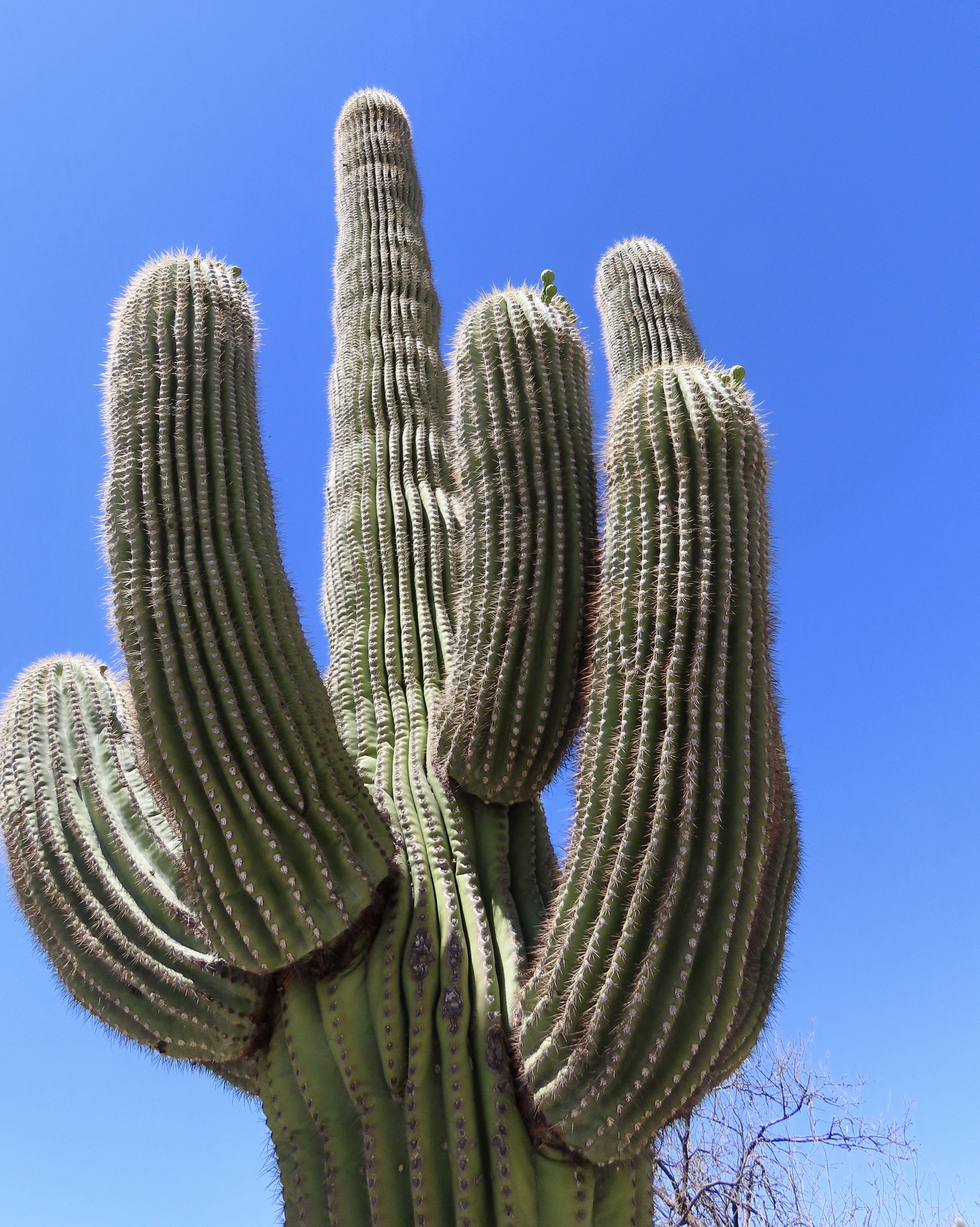
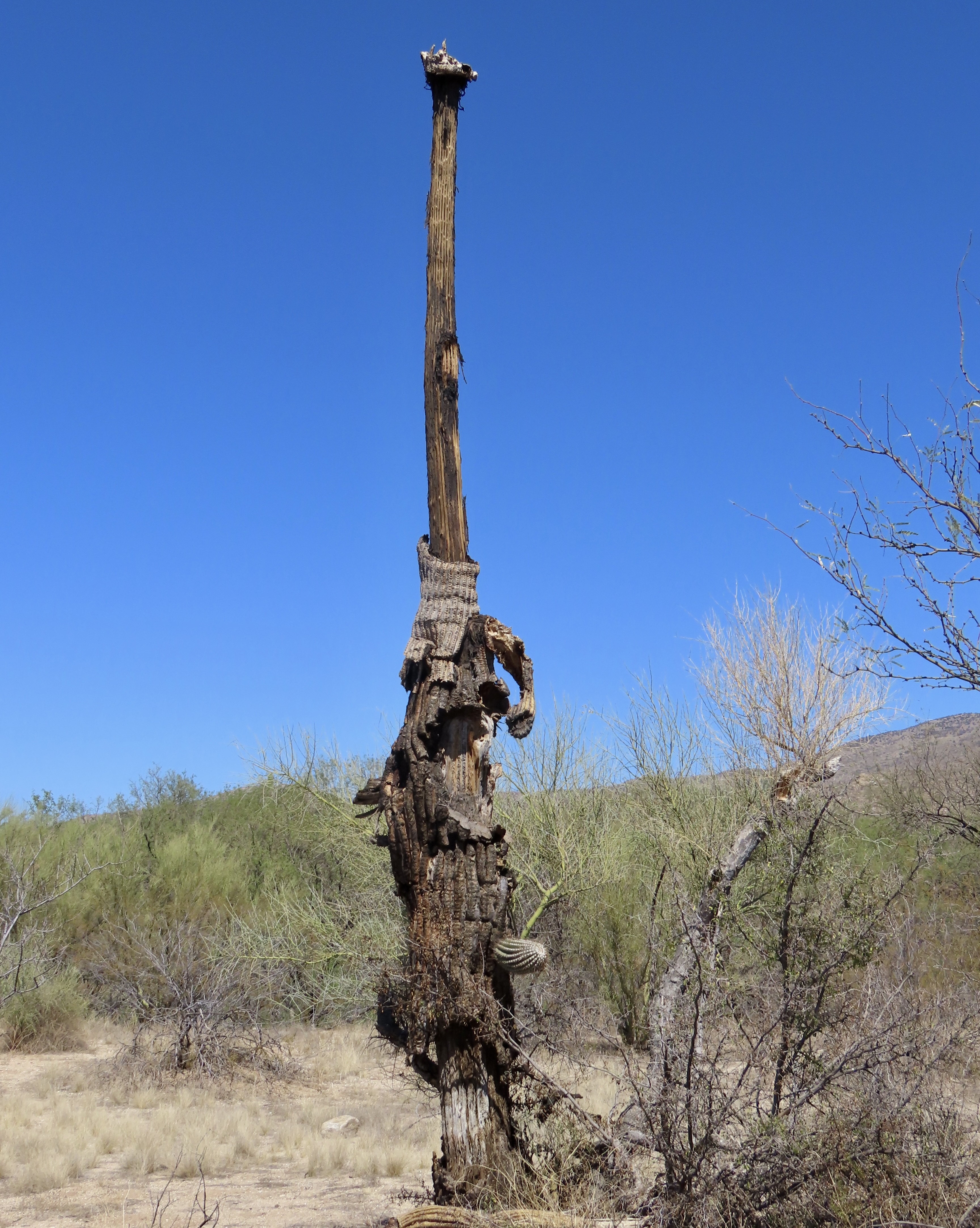
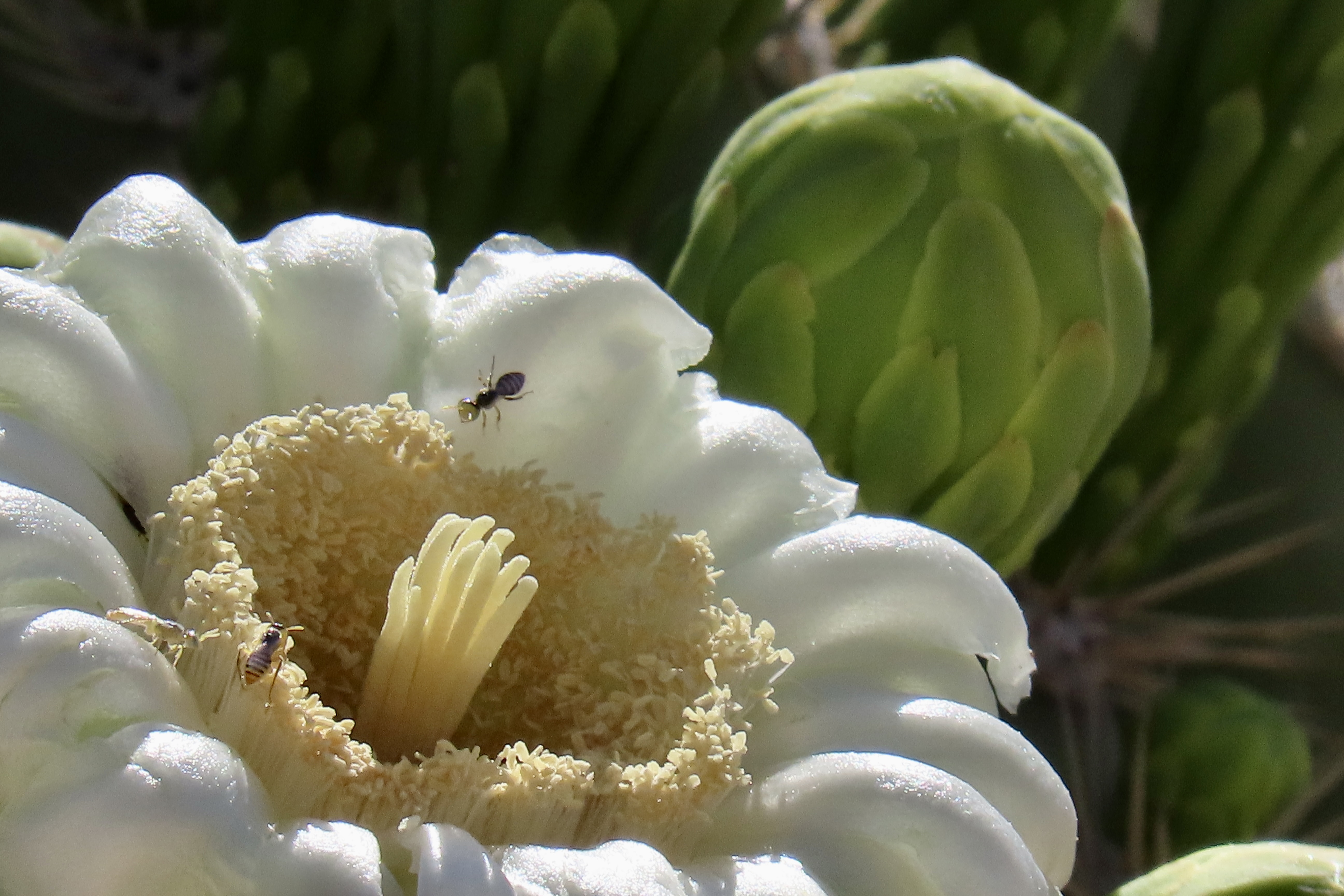
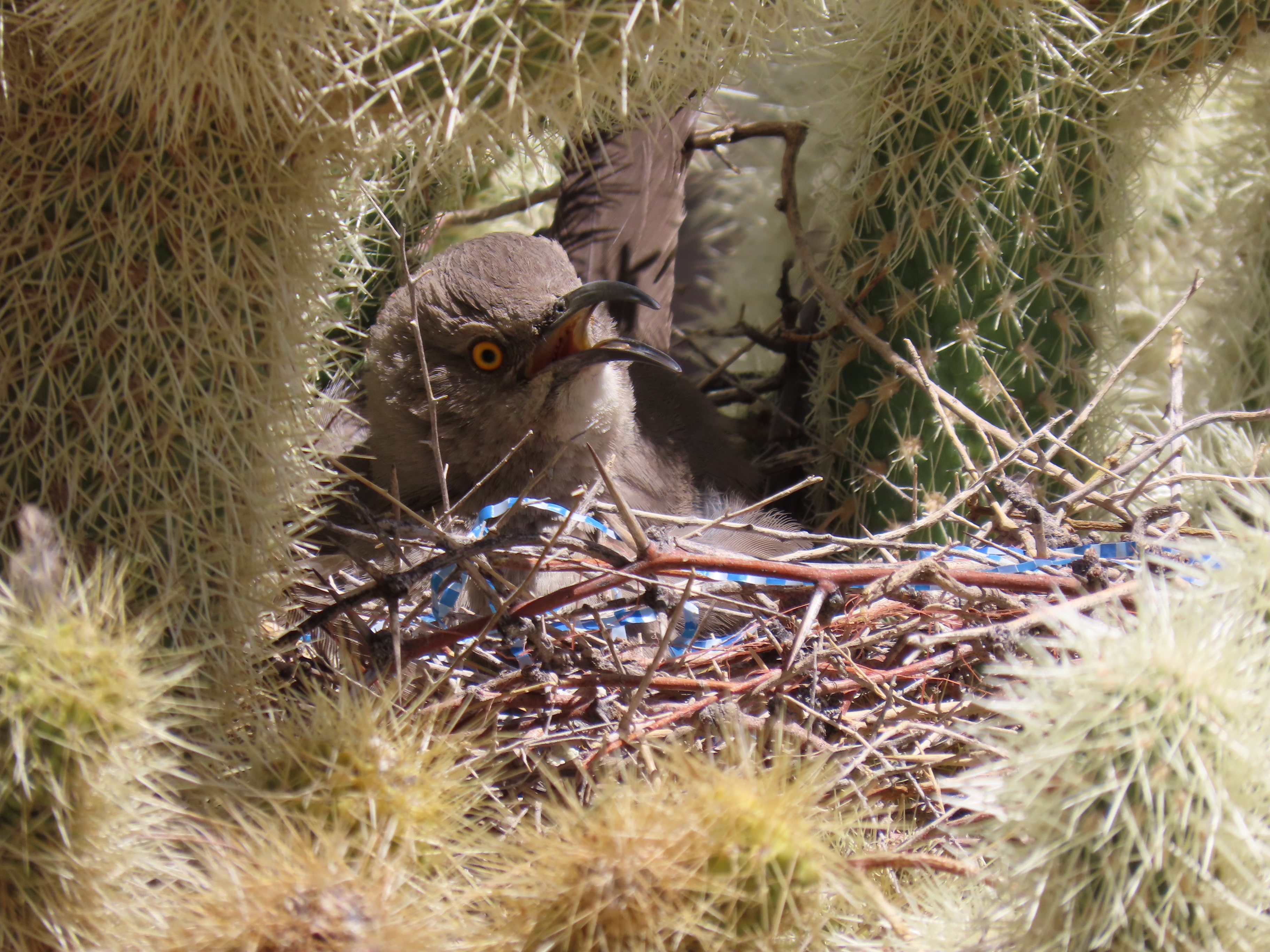
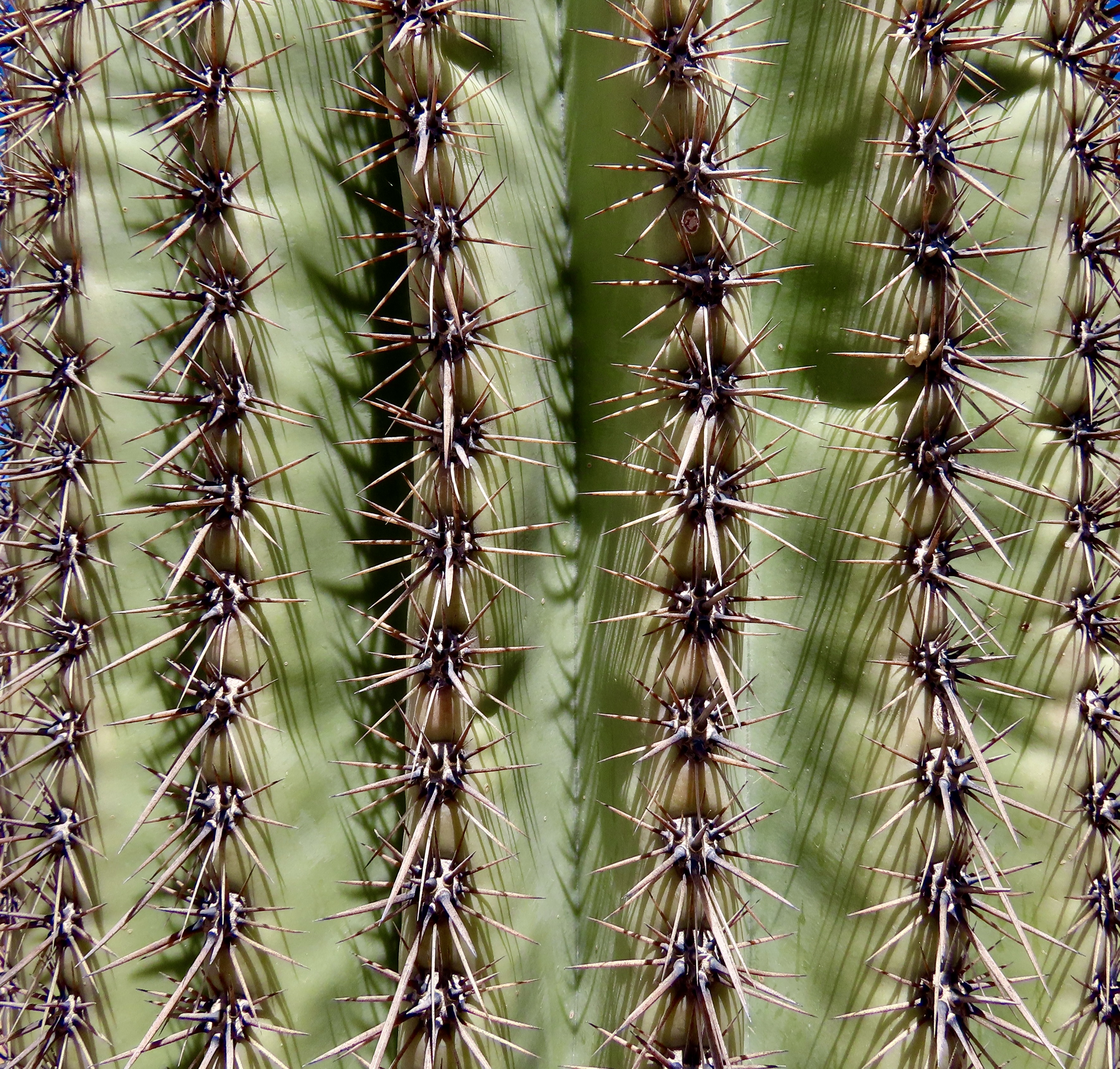
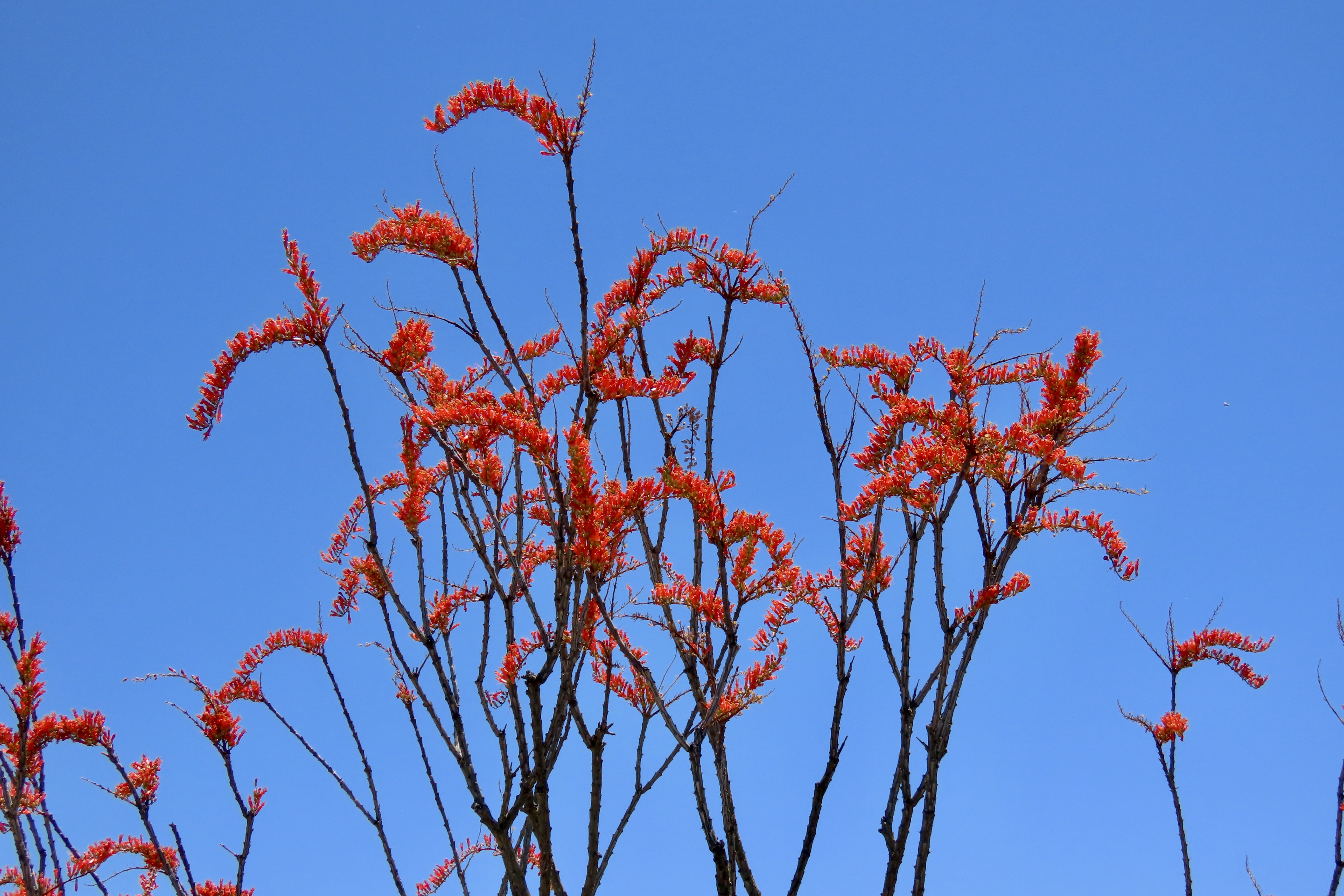
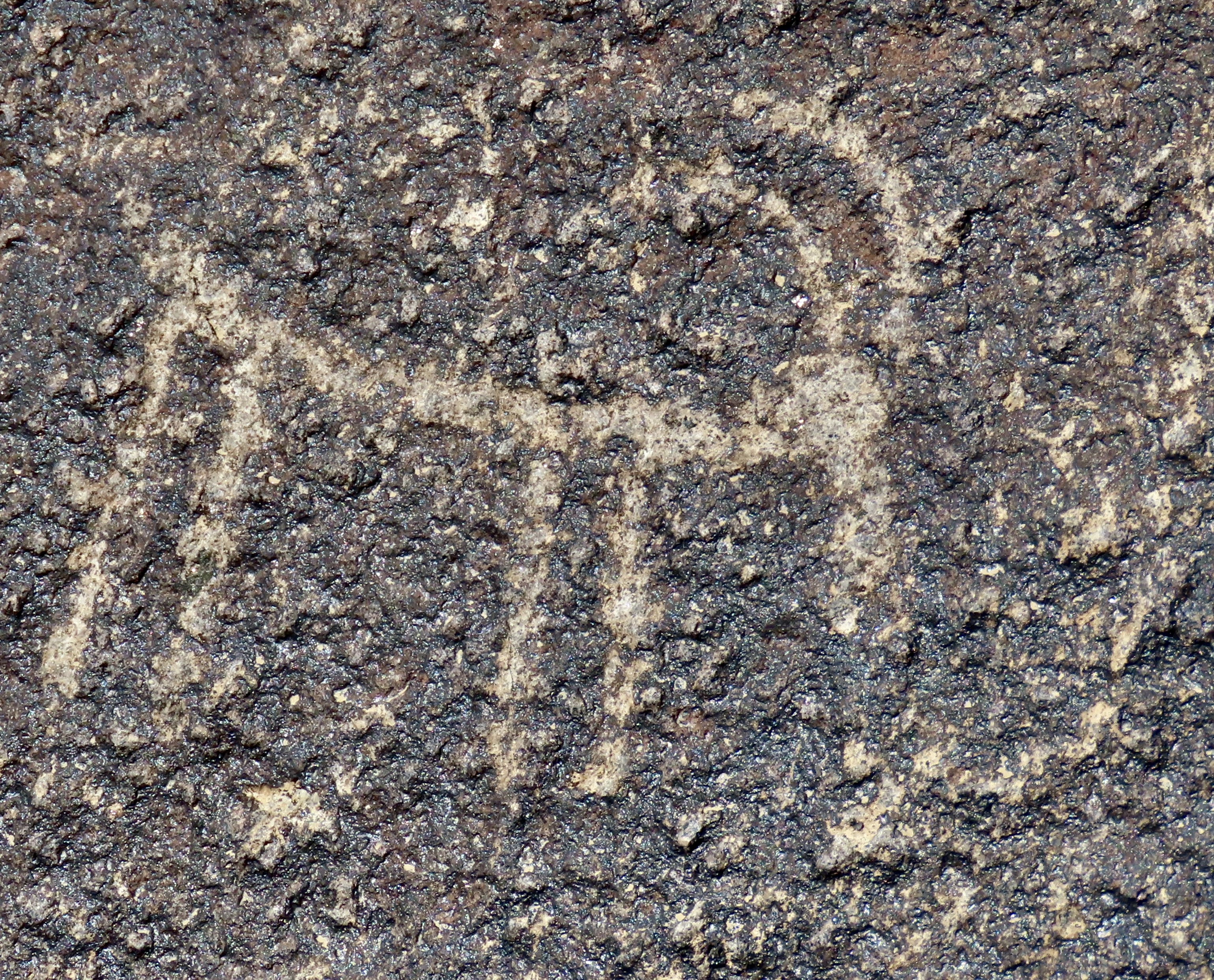
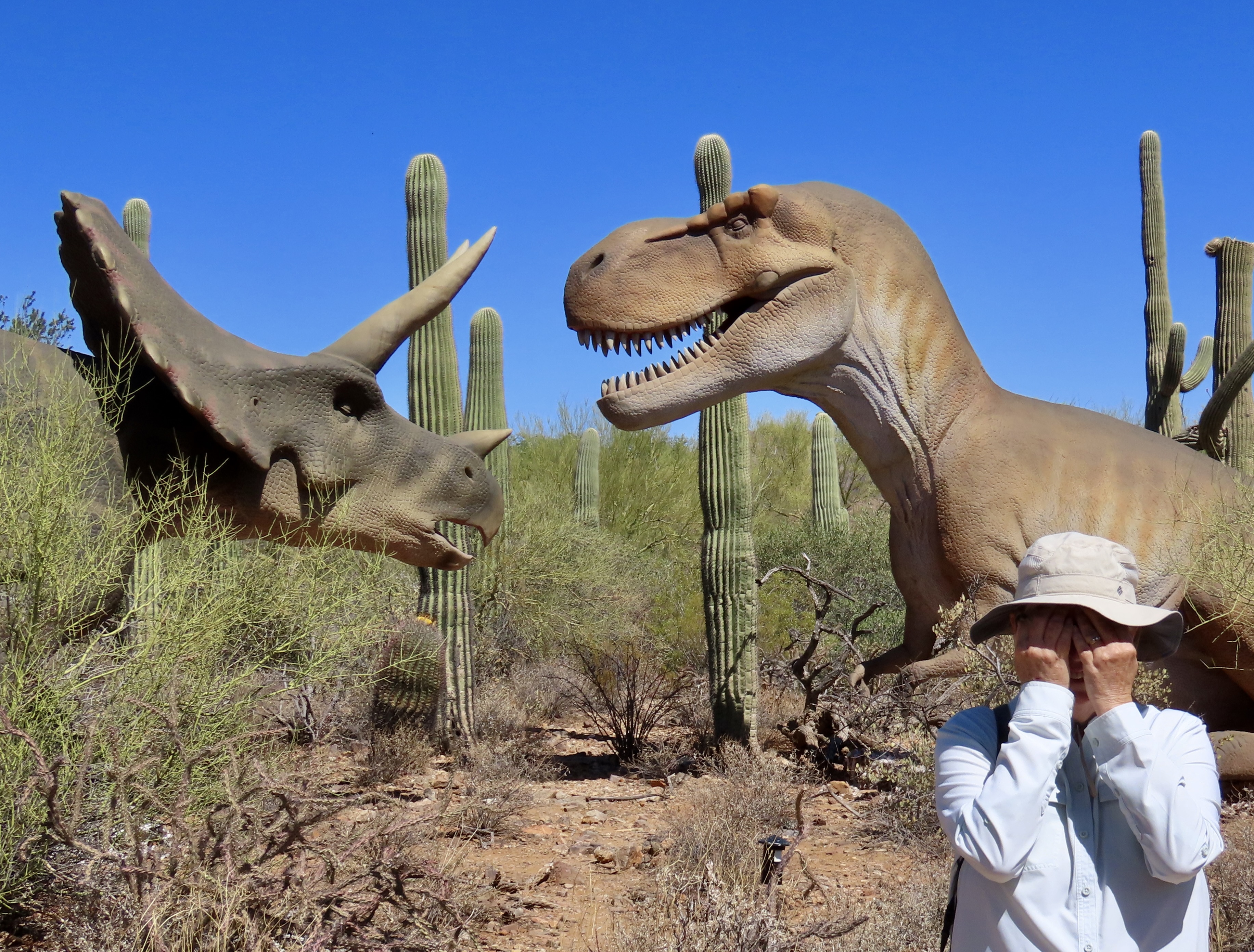
As the headline suggests, Saguaros are big. The giants can grow up to 50 feet tall with a circumference of 8 feet and a root system reaching out 100 feet from the base. This makes them the largest cactus in the US.Peggy provides perspective on the size of a large ( not giant) saguaro. Here’s your math problem for the day. Peggy is 5’7”. Approximately, how tall is the cactus?Saguaros can have up to 24 arms. A lot. I counted 18 on this one, carefully avoiding the small cactus behind that photobombed our picture.This old fellow provides a look at the structure of a saguaro, plus an element of humor. Not sure of the message. “Don’t count me out?” “You are only as old as you think you are?” We were lucky that the saguaros were just beginning to bloom. The buds looked like alien pods and the flowers were gorgeous.A wide range of insects during the day and bats at night are eager to feast on the flowers. The bats and flying insects aid in the fertilization process by carrying pollen to other saguaros.A cactus wren took advantage of the insects visiting the Saguaro for its own feast. The cactus wrens sometimes makes their homes in Saguaros, as do other birds including Gila Woodpeckers and Gilded Flickers.Home sweet home. The holes you see in these cacti are nesting sites.The cactus wren also nests in cholla cactus and may even prefer it. Can you imagine flying in and out of this mass of spines and raising your babies here? Other birds see the cholla as a good place to raise a family as well. Besides the obvious challenge, it’s a great way to discourage predators.Peggy was taking a photo of what appeared to be a nest in a cholla cactus at Roper State Park in southeastern Arizona a few weeks ago when suddenly a curved bill thrasher popped her head up and begin scolding. We speculated that what she was saying to Peggy was R-Rated.There are 35 species of Cholla. This is another one we found at the park.While I am on the thorny subject of spines, I wanted to make one last observation on the saguaro before moving on to other cacti. Each of these clusters, spaced about an inch apart, contains up to 30 spines. They can grow as long as two inches. I estimated that there would be roughly 1,700,000 thousands spines on a giant saguaro. There’s a message here: No matter how much you love saguaros, save your plant hugs for trees.Barrel cactus is another favorite of ours. We called these the “Three Amigos.”Like the saguaros, barrel cactus can be a bit weird. Peggy and I were surprised by this one with waves.We missed the blooms on the barrel cactus. What you are looking at here is the fruit. It’s edible when ripe. It is described as slightly tart. BTW: Another name for barrel cactus is fishhook cactus because of how their spines are curved. While the barrel cactus may have finished blooming, there were plenty of blooms for us to admire at Saguaro. This is an Ocotillo.A close up of the ocotillo flowers. And check out the spines here!Prickly pears were both prickly and blooming. Can you spot the honey bee in this photo with its head popping up? It’s totally covered in pollen that it will carry on its rounds to other prickly pear flowers, aiding in the pollination process.The primary small trees/shrubs of Saguaro NP were also in bloom. This is a mesquite.And here we have palo verde trees. Both the mesquite and palo verde are important to Saguaro, providing shade for their first few years of growth.As we wander through the Southwest, we are always on the look out for ancient petroglyphs. Saguaro had over 200 next to the Signal Hill Picnic site. This small stick-figure big horned sheep was among my favorites. Peggy is now in the process of seeking new ones for a second word search book on petroglyphs. Her first book— Artistic Word Searches, Unique and Magical, Discovering Petroglyphs from the Southwest— is available on Amazon. Peggy was impressed with this spiral petroglyph which is thought to represent a journey or migration.We wrapped up our visit to Saguaro National Park next door at the Arizona-Sonora Desert Museum. The museum was featuring an exhibit titled Dinos in the Desert and we found a number of these grunting and growling beasts as we wandered through the outdoor museum. Peggy couldn’t bare to watch this battle that was taking place between two jurassic giants. Or maybe they were discussing eating us. Grin. While the ‘Dino’ exhibit was very well done, it was only the beginning of what the museum has to offer. Go there if you get a chance.
Our next post will be on the El Morro National Monument, which we just visited and are going back to.This impressive promontory is reason enough to visit El Morro National Monument, but over 2000 inscriptions on the rock make it even more special. A water hole at the base made it a stopping point for a continuing parade of people ranging from ancient peoples, to early Spanish explorers, to pioneers. The earliest Spanish signature is dated 1605, 15 years before the Pilgrims arrived at Plymouth Rock!
20 thoughts on “Standing 30-50 Feet Tall, Weighing 3-6 Tons, and a Being a Bit Weird… The Saguaros of Saguaro NP, Plus”
Great pictures as always!! Hope people contact their representatives to give them their viewpoint. People post on social media and think they are done.
Such fabulous plants! The desert has so much to offer and I love that creatures build their nests in the cactus! I am truly alarmed almost every day by a move that Donald decided to make a big decision in an unhealthy way. As a person with asthma and knowing others with it, what a terrible decision to make for this world. I have attended protests and a big one coming up in June but I have cut back on FB because I am just tired of so much. On a lighter note…I think Pope Leo will be excellent.
Thanks, Wendy. Appreciated. The only possible reason I can think of for Trump’s action was that he hopes to build non-regulated pollution causing industries in the neighborhood of the parks and doesn’t want the pollution monitored. Our fingers are crossed for Pop Leo. The world needs all the help it can get.
I guess that’s what happens when you have millions of years to do it, G. Grin.
Which is as good as my guess. Using the old Boy Scout method, I came closer to 35.
In a report to congress in May 2024: “We have the highest levels of indebtedness in our nation’s history, an inflationary and anemic economy, and the two most important senior safety net programs facing insolvency… If lawmakers and the President do nothing, the trust funds for Social Security and Medicare will be depleted by 2033 and 2036, respectively. Imagine how the public will howl if that happens!
I did see that the administration is proposing $1 trillion for defense while slashing education, foreign aid, environment, health and public assistance. But I don’t think that is relevant to my posts on National Parks. The point of my posts is how valuable the parks are to us now and in the future.
One more thought, Margery. Much of the public opposition is based on irrational rather than rational actions. There is nothing rational about removing air quality monitoring from national parks. It’s right up there with wanting to annex Canada.
Actually, I already read it. I wasn’t commenting on that, I was commenting on the purpose for my posts. I didn’t understand the relevancy of your comment.
I love saguaros! We haven’t made it to Saguaro National Park yet but we didn’t see them around Phoenix. They were not flowering though, which was clearly a bummer, because the flowers look so cool!
The blooming really was special, Diana. Although I’ve seen lots of cacti in bloom over the years, this was my first with saguaros as well. This really was our first time to really check out Saguaro NP as well.
What a marvelous post. I’ve never seen a saguaro, even in a botanical garden, and I’m not sure I’ve ever seen a photo of their blooms. I’m sure the images are out there, but it never occurred to me that they’d produce flowers, just like other cacti. It crossed my mind that it might more than usually satisfying to drop one of these on the head of anyone intent on destroying our various national/natural sites. Perhaps it would knock some sense into them.
They are definitely one of natures wonders, Linda. It was my first time for seeing them bloom. Quite impressive.
We can only hope that people will come to their senses. But I am not holding my breath in anticipation. Still, it would be satisfying to see a few (or a lot) of spines applied, whether they work or not.















 Wandering through Time and Place
Great pictures as always!! Hope people contact their representatives to give them their viewpoint. People post on social media and think they are done.
Enjoy your trip!’
Thanks, Steve. Poly sci 1. Plus vote. Still, any protest has value. Trips going great.
Such fabulous plants! The desert has so much to offer and I love that creatures build their nests in the cactus! I am truly alarmed almost every day by a move that Donald decided to make a big decision in an unhealthy way. As a person with asthma and knowing others with it, what a terrible decision to make for this world. I have attended protests and a big one coming up in June but I have cut back on FB because I am just tired of so much. On a lighter note…I think Pope Leo will be excellent.
Love to you both!
Thanks, Wendy. Appreciated. The only possible reason I can think of for Trump’s action was that he hopes to build non-regulated pollution causing industries in the neighborhood of the parks and doesn’t want the pollution monitored. Our fingers are crossed for Pop Leo. The world needs all the help it can get.
Love back to you.
Nature sure does make each one of her creations an original!!
I’m guessing the saguaro to be approx. 28.5 feet.
I guess that’s what happens when you have millions of years to do it, G. Grin.
Which is as good as my guess. Using the old Boy Scout method, I came closer to 35.
Such amazing, resilient plants / creatures that inhabit the desert!
Indeed they are, Arati. And they live to be 150-200 years old. Some as long as 250.
WOW!!!!
In a report to congress in May 2024: “We have the highest levels of indebtedness in our nation’s history, an inflationary and anemic economy, and the two most important senior safety net programs facing insolvency… If lawmakers and the President do nothing, the trust funds for Social Security and Medicare will be depleted by 2033 and 2036, respectively. Imagine how the public will howl if that happens!
I did see that the administration is proposing $1 trillion for defense while slashing education, foreign aid, environment, health and public assistance. But I don’t think that is relevant to my posts on National Parks. The point of my posts is how valuable the parks are to us now and in the future.
One more thought, Margery. Much of the public opposition is based on irrational rather than rational actions. There is nothing rational about removing air quality monitoring from national parks. It’s right up there with wanting to annex Canada.
Much of the public opposition is based on whether the media decides if it is rational or irrational. This site provides the recommendations on funding levels for 2026. While you may not agree with the reasoning, at least this gives you the opportunity to decide without media bias. https://www.whitehouse.gov/wp-content/uploads/2025/05/Fiscal-Year-2026-Discretionary-Budget-Request.pdf
Actually, I already read it. I wasn’t commenting on that, I was commenting on the purpose for my posts. I didn’t understand the relevancy of your comment.
An excellent article on the Canada as the 51st state discussion: https://macleans.ca/politics/why-canada-stays-out-of-americas-clutches/
It was very good. Thanks.
I love saguaros! We haven’t made it to Saguaro National Park yet but we didn’t see them around Phoenix. They were not flowering though, which was clearly a bummer, because the flowers look so cool!
The blooming really was special, Diana. Although I’ve seen lots of cacti in bloom over the years, this was my first with saguaros as well. This really was our first time to really check out Saguaro NP as well.
What a marvelous post. I’ve never seen a saguaro, even in a botanical garden, and I’m not sure I’ve ever seen a photo of their blooms. I’m sure the images are out there, but it never occurred to me that they’d produce flowers, just like other cacti. It crossed my mind that it might more than usually satisfying to drop one of these on the head of anyone intent on destroying our various national/natural sites. Perhaps it would knock some sense into them.
They are definitely one of natures wonders, Linda. It was my first time for seeing them bloom. Quite impressive.
We can only hope that people will come to their senses. But I am not holding my breath in anticipation. Still, it would be satisfying to see a few (or a lot) of spines applied, whether they work or not.