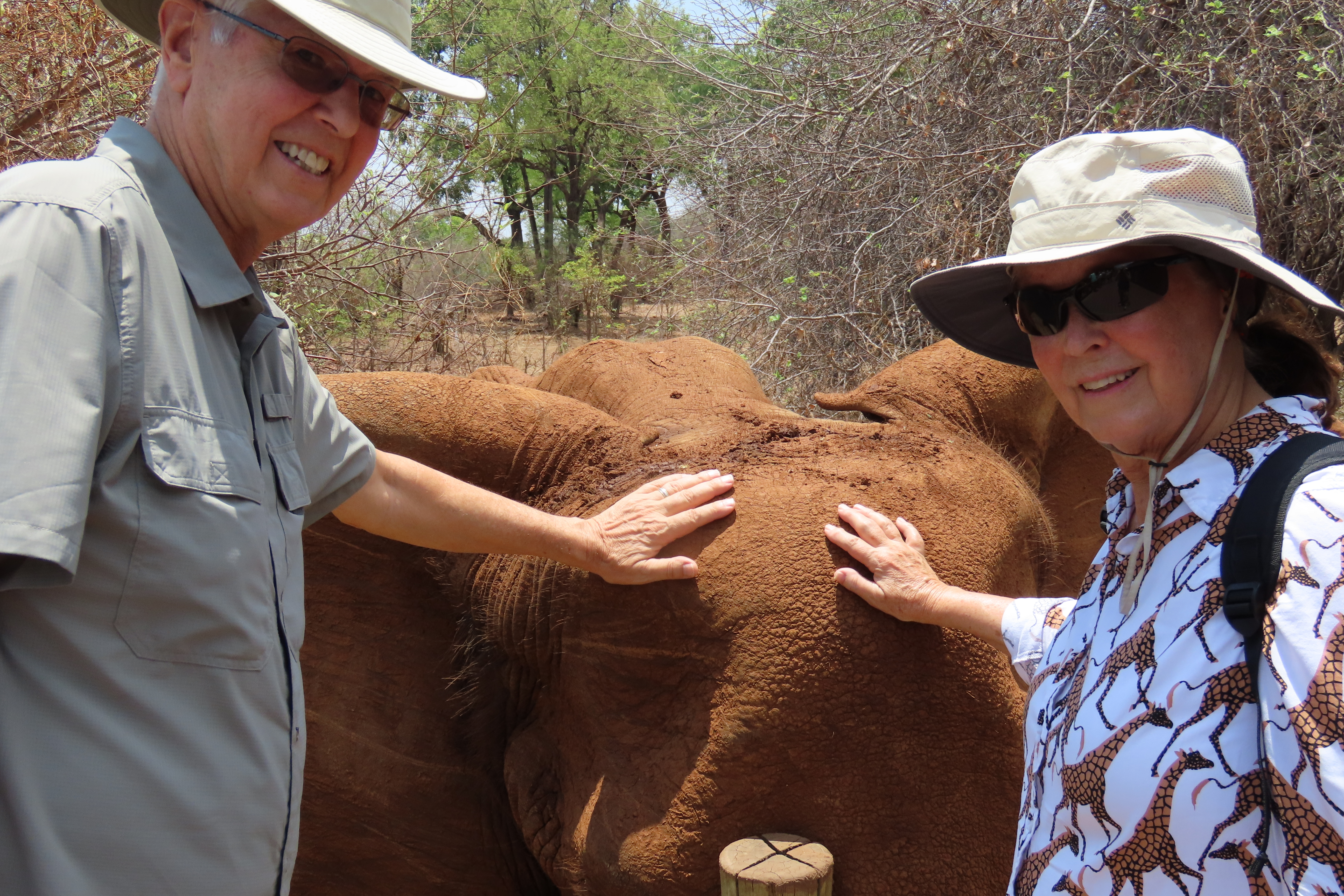
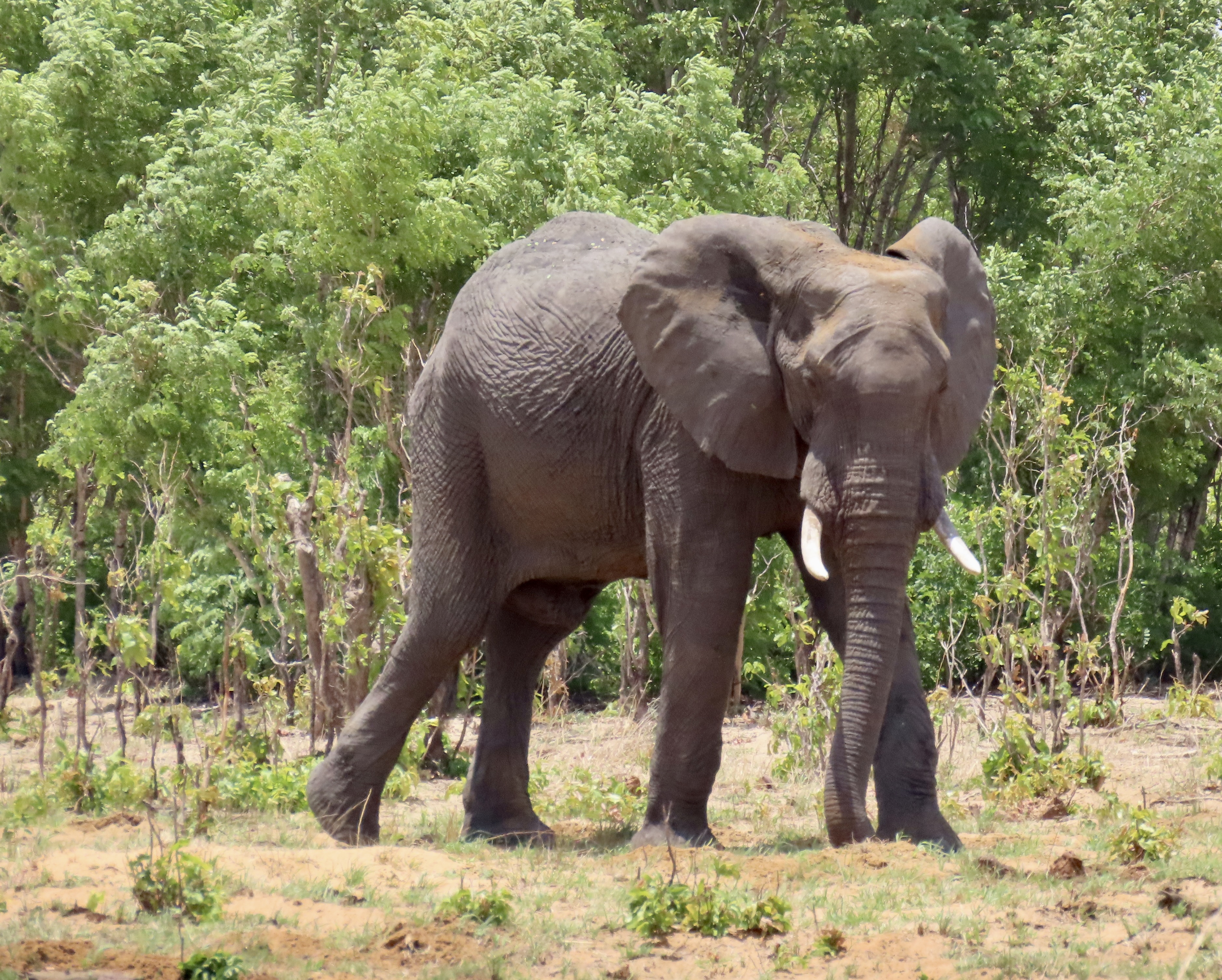
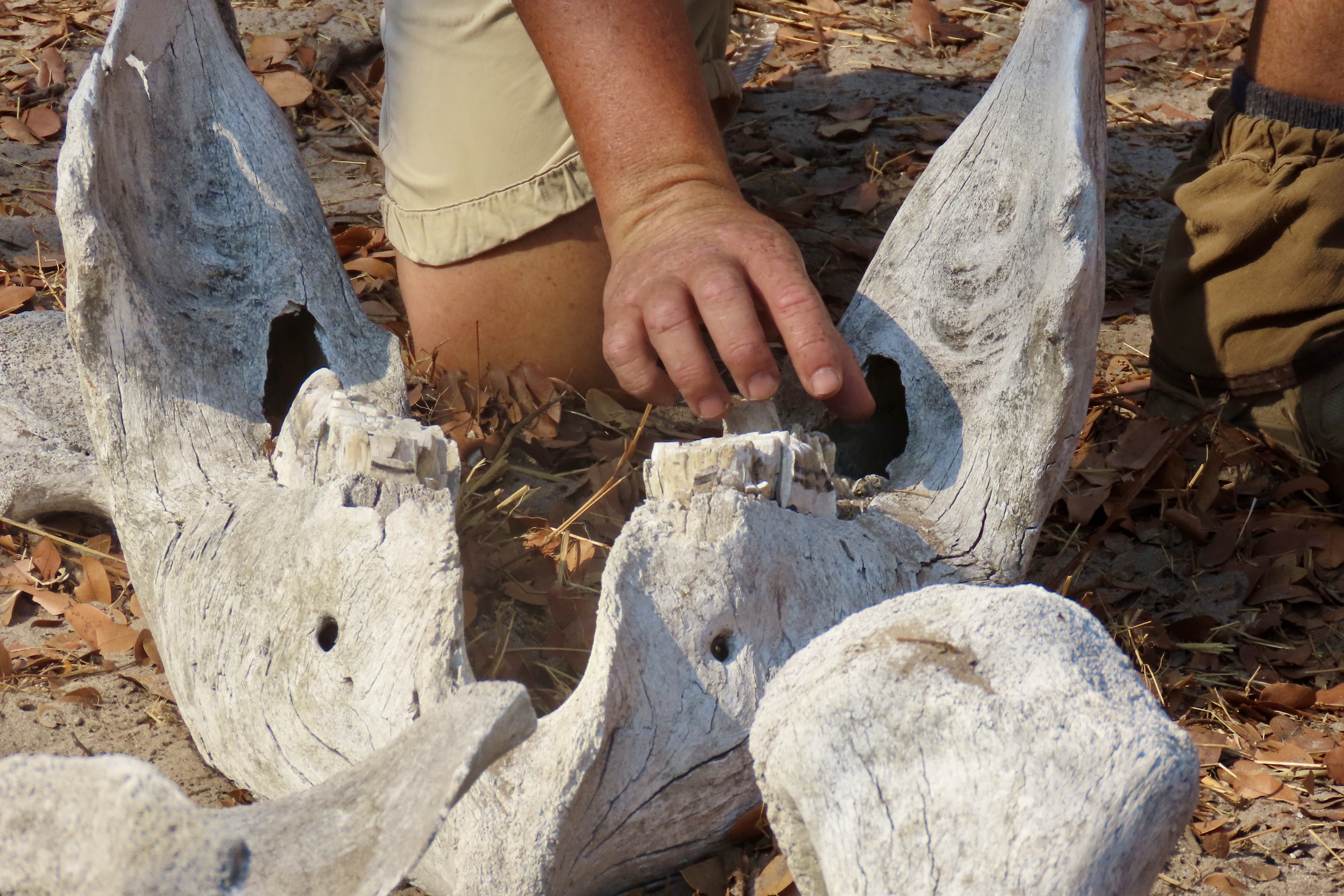
Peggy and her brother John, gently touch an elephant on its head at the Wild Horizons Elephant Sanctuary and Orphanage near Victoria Falls, Zimbabwe. Note the size! And it’s only a youngster. Adult heads can weigh over 100 pounds, and that’s without their trunks, ears and tusks.While we are looking at the head, here are a few things about the eyes. For one, an elephant has incredibly long eye lashes. They can grow to over five inches long, the longest in the animal kingdom. The eyes also have an extra eyelid that provides protection when bathing, swimming, and I assume, rolling in the mud. You can see it caked on the skin around the elephant’s eye. Vision-wise, an elephant has poor eyesight, depending heavily on its sense of smell and hearing.Now let’s talk about teeth. This elephant has his incisor teeth, which have grown into tusks, on prime display here. Elephants use their tusks in a variety of ways including defense and offense, digging, gathering food, stripping the bark off trees and lifting. The record length of an elephant’s tusk in over 10 feet. The record for weight is 226 pounds. Given today’s value of $3300 for a pound of ivory, the record tusk would be valued at close to $745,000. That provides some perspective on why it is so hard to wipe out poaching. Tusks have been growing dramtically smaller because the elephants with larger tusks are being eliminated from the gene pool by poaching. But even a 10 pound tusk would bring in $33,000.This calf’s tusks will grow as it ages, but the odds are they won’t be nearly as long as its ancestors. While you can’t see other teeth on this youngster, it has very prominent tongue. Elephants use their tongues to transfer food back to their large molars where it is ground up for consumption. This calf is saying, “Feed me Peggy!” She did.The guide on our safari hike, Terry Anders, owner of the Iganyana Tent Camp on the edge of the Hwange National Park, points out the large molar teeth in an elephants jaw. Unlike our teeth that have specific sockets, an elephant’s new molars develop in the back of the jaw and push the older, worn ones out of the mouth, like a conveyer belt. An elephant changes out its teeth up to six times in its life. Who needs dentists?The site of the elephant’s jaw also included numerous other bones of the dead elephant. This is an inside view of the back of the elephants skull. You can see the upper molars on the bottom. The dark hole in the middle is where the brain goes. It is encased in honey-comb like bones that provide light but strong protection. It’s a magnificent brain, 3-4 times the size of a human’s. It’s well used. Just moving and maintaining the massive body of the elephant takes significant brain power. And, as we have already seen, the elephant also uses it for a rich emotional life of empathy, care, and friendship for one another. What the elephant’s brain is really noted for is its memory, however. You’ve undoubtably heard the phrase ‘an elephant never forgets.’ It can meet up with an elephant it hasn’t seen in decades and have a joyful reunion, find a water hole it used once and hasn’t been at for years, or, what I find particularly touching, go by the bones of a family member who had died long before, pause, and appear to mourn.
It wasn’t just a pile of old bones we were looking at.Here, Terry is reconstructing the elephant’s leg bones and hip. The leg bones come straight down and are designed to support the elephant’s massive body weight. I already noted in an earlier post that an elephant can use them to run very fast. What I didn’t note was that elephants can’t jump— they are the only mammal that can’t. Scroll back up to elephant that I used an an example when talking about tusks and note how straight his legs are. They were not made for jumping!Elephants are constantly eating grass and leaves, as much as 16 hours a day. Their challenge is how to provide nourishment for their massive bodies. It doesn’t help that their digestive system is less than 50% efficient, or that leaves and grass aren’t high in nutritional value. That means an elephant has to eat a lot— normally between 250-300 pounds of grass and leaves a day. And that means, huge scat.
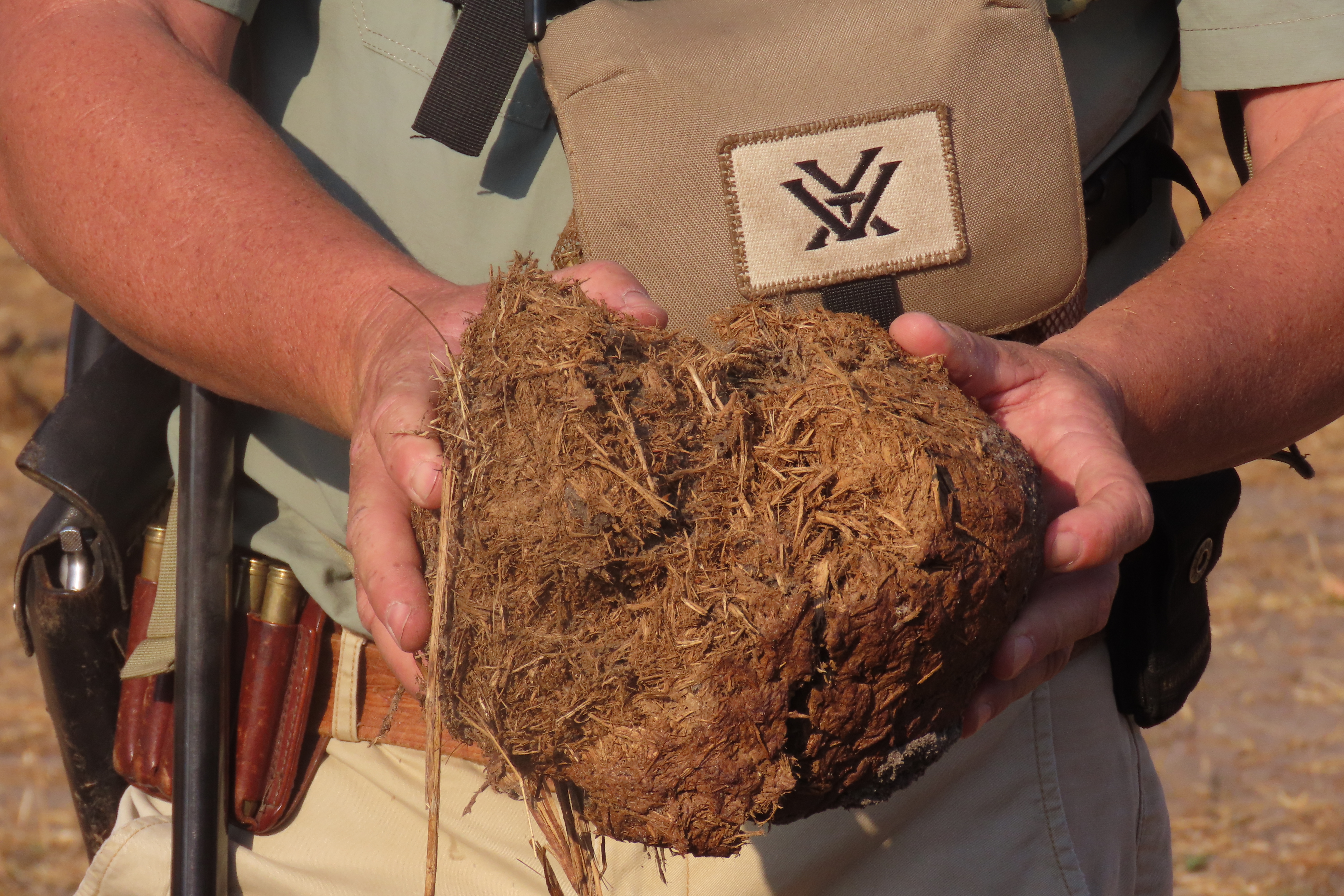
Terry picked up a large dropping and broke it in half to continue our education. The first thing that came to our minds was size. This puppy was big! The second was how much of the grass hadn’t been digested.
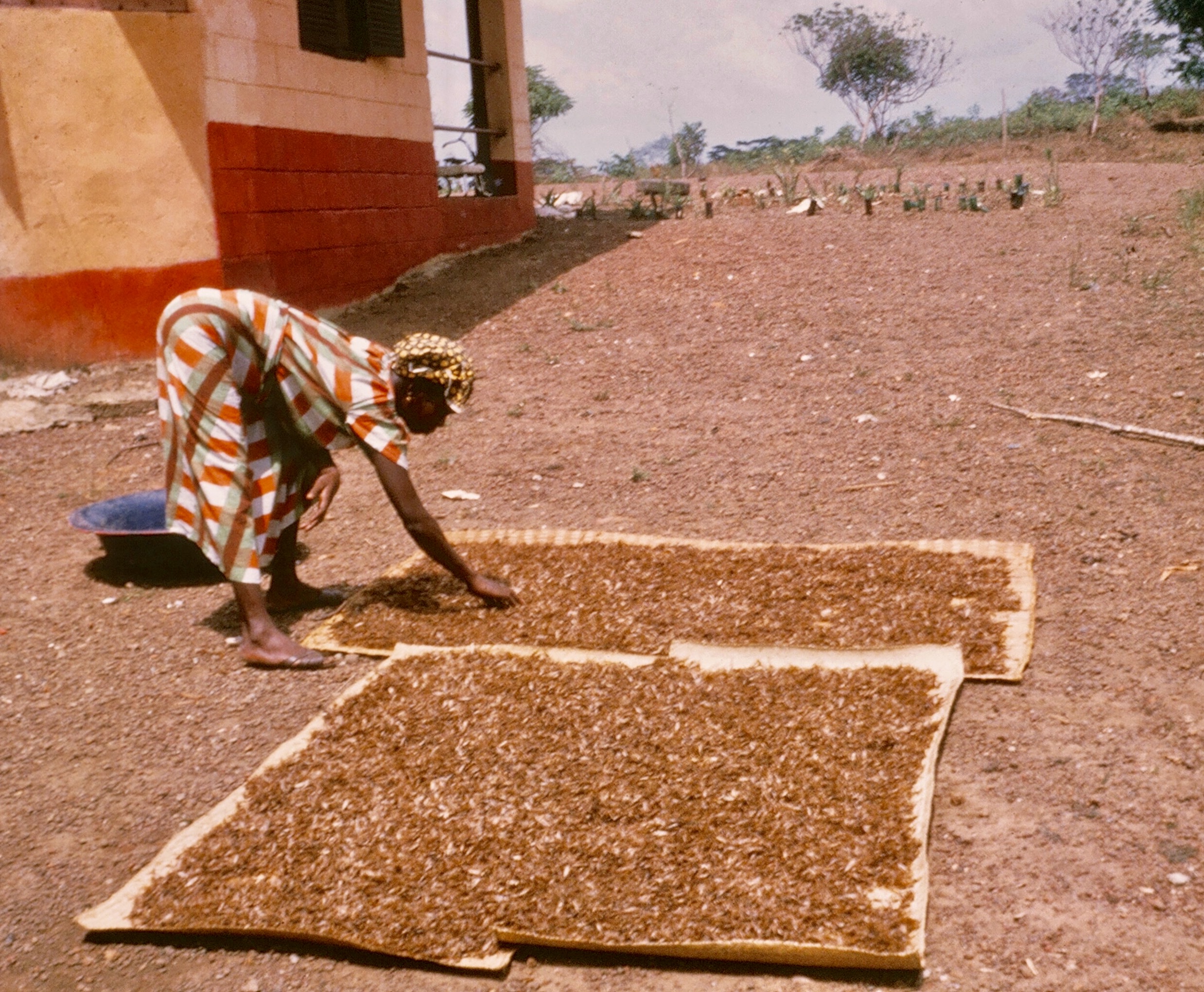
As Terry continued to break open the dropping, he found the third thing he wanted to show us: Termites chowing down on the undigested grass. Numerous insects view the poop as food and an equal number of birds and mammals view the insects as food. To make his point, Terry picked up a termite, popped it in his mouth, and asked if anyone else would like a sample. John volunteered. Admittedly he’s strange. I just didn’t realize how strange. (Sorry John. Grin.) Like, okay, I had occasion to eat termites myself in Liberia as a Peace Corp Volunteer back in the 60s. But I prefer mine dead, cooked, and not having a poop diet.Termite queens fly in vast numbers after the first rains of the year. Here, a Liberian woman who lived next to me, dries out the termites she gathered, or as Liberians call them, bug-a-bug, for use in chop, a primary Liberian dish. At a school feast, my students took extra pleasure in making sure my chop was filled with far more than my share of bug-a-bugs and watched me eat it, every bite.As a result of all the food they eat, elephants poop between 12 and 15 times a day, which adds up to between 200 and 250 pounds— close to a ton a week. (How would you like to have ‘counting the times elephants poop daily and then weighing it’ on your resume?) While I’m on the subject of scatology, I might as well take it a step further. Elephants also fart a lot. I read that a ‘properly equipped car could travel 20 miles on the amount of methane produced by one elephant in a single day.’ I speculated that the poor baby elephant walking along behind its mom holding her tail might have a different perspective: “Mother!”
I chose a section of ground where the elephants had been particularly active for the photo above, but their droppings were everywhere, particularly along the Chobe River where they were hanging out for the dry season. Given its quantity, elephant manure is an important soil fertilizer throughout subtropical Africa.
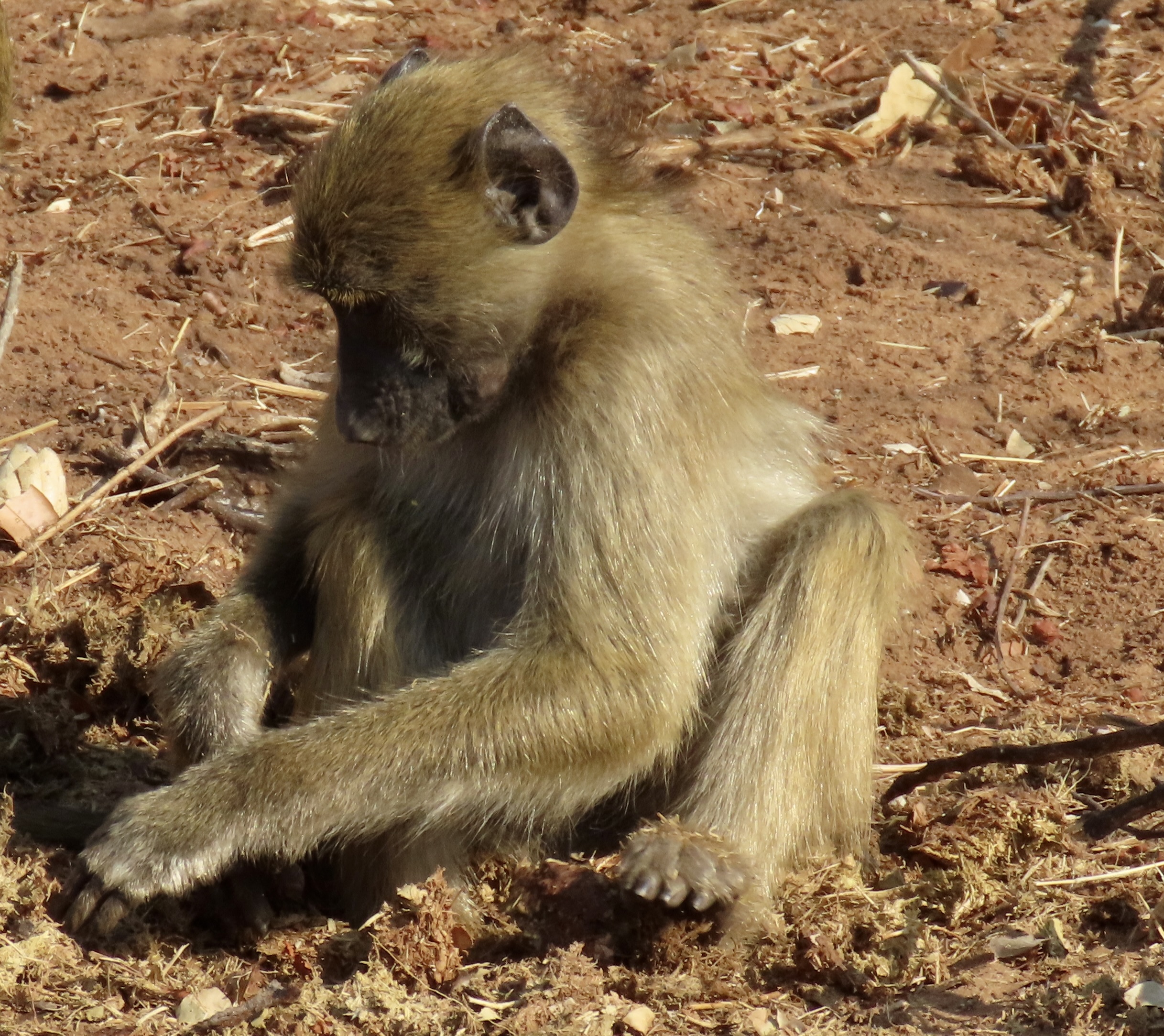
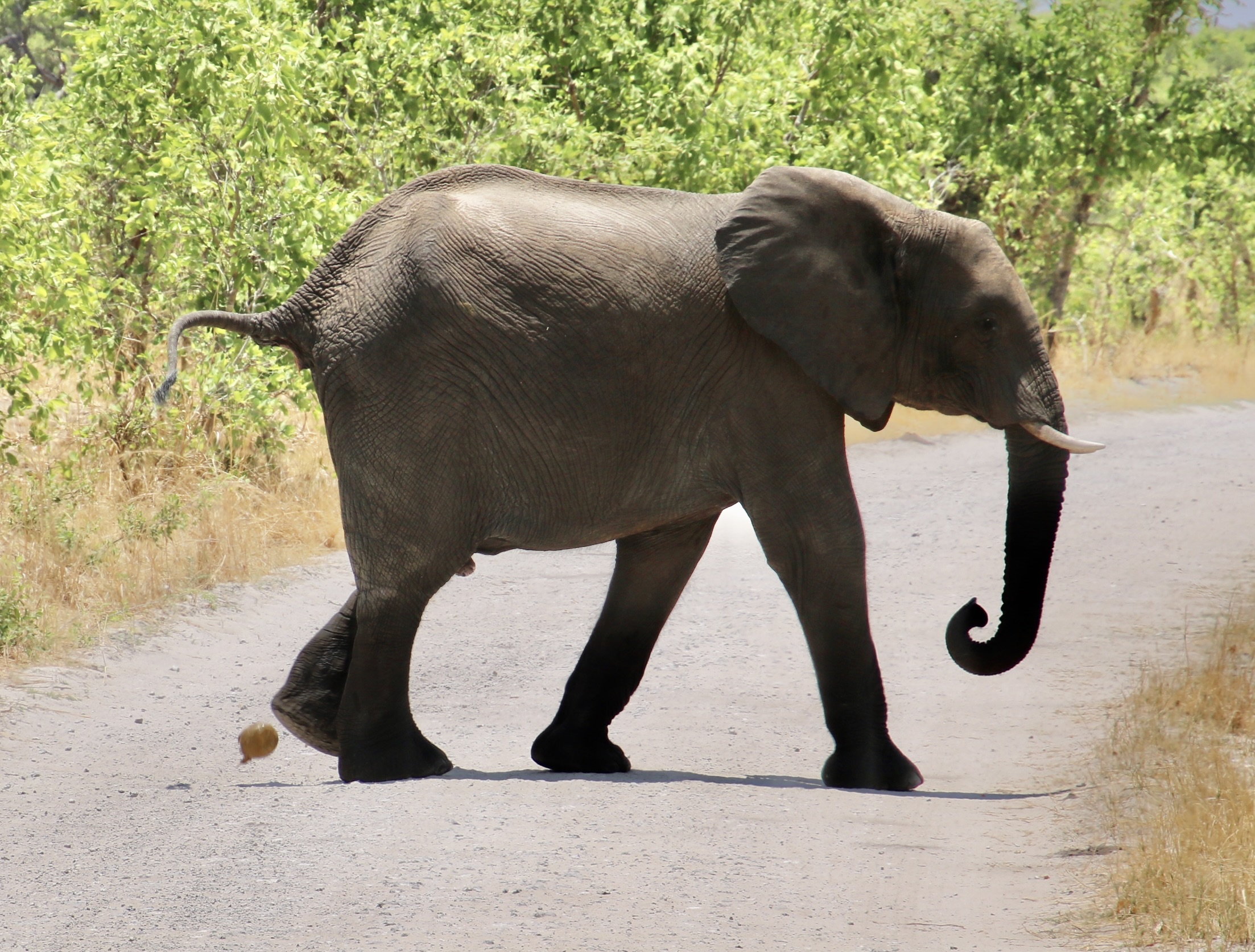
Sometimes we found the droppings torn apart and scattered. We wondered who the prime suspects were…Turns out, they were baboons. Our guide told us they were looking for acacia seeds. I wonder if they’d pass on termites. I’m betting not. You can see the remains of the Baboon’s work scattered on the ground.When I was looking over our photos of the baboon feast, I was struck by another idea: Have you ever wondered where the creators of elves and Spock got their ear ideas?And, in conclusion: Bombs away!
That’s a wrap on elephants, folks. My congratulations and thanks to all of you who have hung in here with my multi-blog presentation on elephants. I found them so fascinating, I couldn’t help myself. Next up is hippopotamuses (or is that hippopotami). Tune in Friday for Hip, hip, hippo!
28 thoughts on “Big Brains, Long Eyelashes, Migrating Teeth and a Ton of Poop: Elephant Wrap Up… On Safari Part 5”
Were you to participate in a trivia contest on a cruise, the one question’s answer you are guaranteed to know is “what mammal can’t jump?” It comes up frequently.
Curt, I see I have some catching up to do! How wonderful to be so close to these magnificent animals and I feel you are now quite the expert! It is sad to think of those incredible tusks in terms of money and I’d also heard that some elephants are even not growing any tusks at all in a genetic form of survival which is amazing! A wonderful array of facts for us and love the photos. Off to read your other elephant posts!
You are right on the fact that some elephants no longer grow tusks, Annika. It sure cuts down on poaching, but it means the elephants no longer have the tusks for all of the things that they used them for. I enjoyed putting together the elephant posts. It was a nice wrap up for me. Magnificent animals. Next up are hippos. Also fun and interesting. I’ve managed to cover them in one blog, however. It goes up on Friday. Thanks. Appreciated. –Curt
Another great post packed with facts. I wonder if I would have been brave enough to munch a termite like John? I am not really eager to add bugs to my diet, but particularly not live ones. I just imagine little pinchy buggy feet crawling on my tongue and that’s it. I loved all your elephant posts and I’m looking forward to the hippottami, heh heh.
I suspect your ancestors had no problems eating bugs when hunger was an issue, Crystal. 🙂 You’d adjust. We’d adjust. But admittedly John was gutsy. I wonder what the termite thought. More on termites coming up. Their mounds are incredible.
I’ve found these posts fascinating, Curt. I admire your willingness to eat bug-a-bugs, but I just can’t imagine making the cultural leap, but who knows. I’m amazed that John ate one right out of the elephant poop. He’s brave! I’m looking forward to learning about hippos next. 🙂
Finished up the hippos yesterday and scheduled the post for Friday. Be sure to check out the video for what happens when a small hippo does a face off with elephants! And thanks, D. I suspect you could handle the cultural leap, D. 🙂
Many of our water birds have those extra eyelids, too–some have three sets. The purpose is slightly different, but an irritant is an irritant, no matter its nature.
Even though I tried the bug-a-bugs in Liberia, it was only once, and they were fried in palm oil. Straight from scat? No thank you! What did come to mind was going downtown in Houston once the circus (Ringling Brothers, I believe) to gather up an allotment of ‘fertilizer.’ Gardeners of every stripe gathered around the poo, delighted to have such an amendment for their roses!
Just think, Linda, one elephant in your yard for one day and you’d be good for years.
What bugged me more about the bug-a-bug was when my students all showed up in class after the first rain with their cans of live termites for snacks. It can be a bit disconcerting to the educational process. But then again, so can a hungry student.
Another interesting one. I would think the diet of those baboons would be a bit ugh, but then considered a common, friendly, slobbery, neighborhood dog – one sharing a house with a cat box in it.
A bit late to the party, Curt, but it’s just as exciting and fascinating! That is a lot of elephant poop, but look at those lashes! The value of a tusk isn’t surprising and no wonder there is poaching, but it makes me sick that humans can do that to a living creature. Great post, as always!






 Wandering through Time and Place
Were you to participate in a trivia contest on a cruise, the one question’s answer you are guaranteed to know is “what mammal can’t jump?” It comes up frequently.
I’ll keep that in mind, Ray. Grin.
I fail to understand how people can kill such magnificent beats!
I am loving your book!!
We can be a pretty sorry lot at times, G.
And thanks. I’m so glad!
I can’t resist—poop, poop, a-doop!
Curt, I see I have some catching up to do! How wonderful to be so close to these magnificent animals and I feel you are now quite the expert! It is sad to think of those incredible tusks in terms of money and I’d also heard that some elephants are even not growing any tusks at all in a genetic form of survival which is amazing! A wonderful array of facts for us and love the photos. Off to read your other elephant posts!
You are right on the fact that some elephants no longer grow tusks, Annika. It sure cuts down on poaching, but it means the elephants no longer have the tusks for all of the things that they used them for. I enjoyed putting together the elephant posts. It was a nice wrap up for me. Magnificent animals. Next up are hippos. Also fun and interesting. I’ve managed to cover them in one blog, however. It goes up on Friday. Thanks. Appreciated. –Curt
Wow, those are some awesome close up photos of the elephant’s features!
The advantage of a great telephoto, Diana! Wait till you get to the Hippos on Friday! Thanks. –Curt
Another great post packed with facts. I wonder if I would have been brave enough to munch a termite like John? I am not really eager to add bugs to my diet, but particularly not live ones. I just imagine little pinchy buggy feet crawling on my tongue and that’s it. I loved all your elephant posts and I’m looking forward to the hippottami, heh heh.
I suspect your ancestors had no problems eating bugs when hunger was an issue, Crystal. 🙂 You’d adjust. We’d adjust. But admittedly John was gutsy. I wonder what the termite thought. More on termites coming up. Their mounds are incredible.
Love them! Enjoy.
Thanks, Cindy!
I’ve found these posts fascinating, Curt. I admire your willingness to eat bug-a-bugs, but I just can’t imagine making the cultural leap, but who knows. I’m amazed that John ate one right out of the elephant poop. He’s brave! I’m looking forward to learning about hippos next. 🙂
Finished up the hippos yesterday and scheduled the post for Friday. Be sure to check out the video for what happens when a small hippo does a face off with elephants! And thanks, D. I suspect you could handle the cultural leap, D. 🙂
🙂 I’ll be over!
The hippos will be glad to see you!
Many of our water birds have those extra eyelids, too–some have three sets. The purpose is slightly different, but an irritant is an irritant, no matter its nature.
Even though I tried the bug-a-bugs in Liberia, it was only once, and they were fried in palm oil. Straight from scat? No thank you! What did come to mind was going downtown in Houston once the circus (Ringling Brothers, I believe) to gather up an allotment of ‘fertilizer.’ Gardeners of every stripe gathered around the poo, delighted to have such an amendment for their roses!
Just think, Linda, one elephant in your yard for one day and you’d be good for years.
What bugged me more about the bug-a-bug was when my students all showed up in class after the first rain with their cans of live termites for snacks. It can be a bit disconcerting to the educational process. But then again, so can a hungry student.
I enjoyed all your elephant stories and appreciate all the effort you put into researching the facts and taking the photos!
Thanks. Appreciated. It was fun. But I may have gotten a bit compulsive. Grin.
Another interesting one. I would think the diet of those baboons would be a bit ugh, but then considered a common, friendly, slobbery, neighborhood dog – one sharing a house with a cat box in it.
Wonder why this made me think of you?
Fun, Gunta! Thanks.
A bit late to the party, Curt, but it’s just as exciting and fascinating! That is a lot of elephant poop, but look at those lashes! The value of a tusk isn’t surprising and no wonder there is poaching, but it makes me sick that humans can do that to a living creature. Great post, as always!
The elephants are glad you checked in. They will remember. Grin. Thanks, Lauren. As for the poachers, they are a horrendous problem.
😁 for the elephants but 😢 about poaching.
A nasty business…