
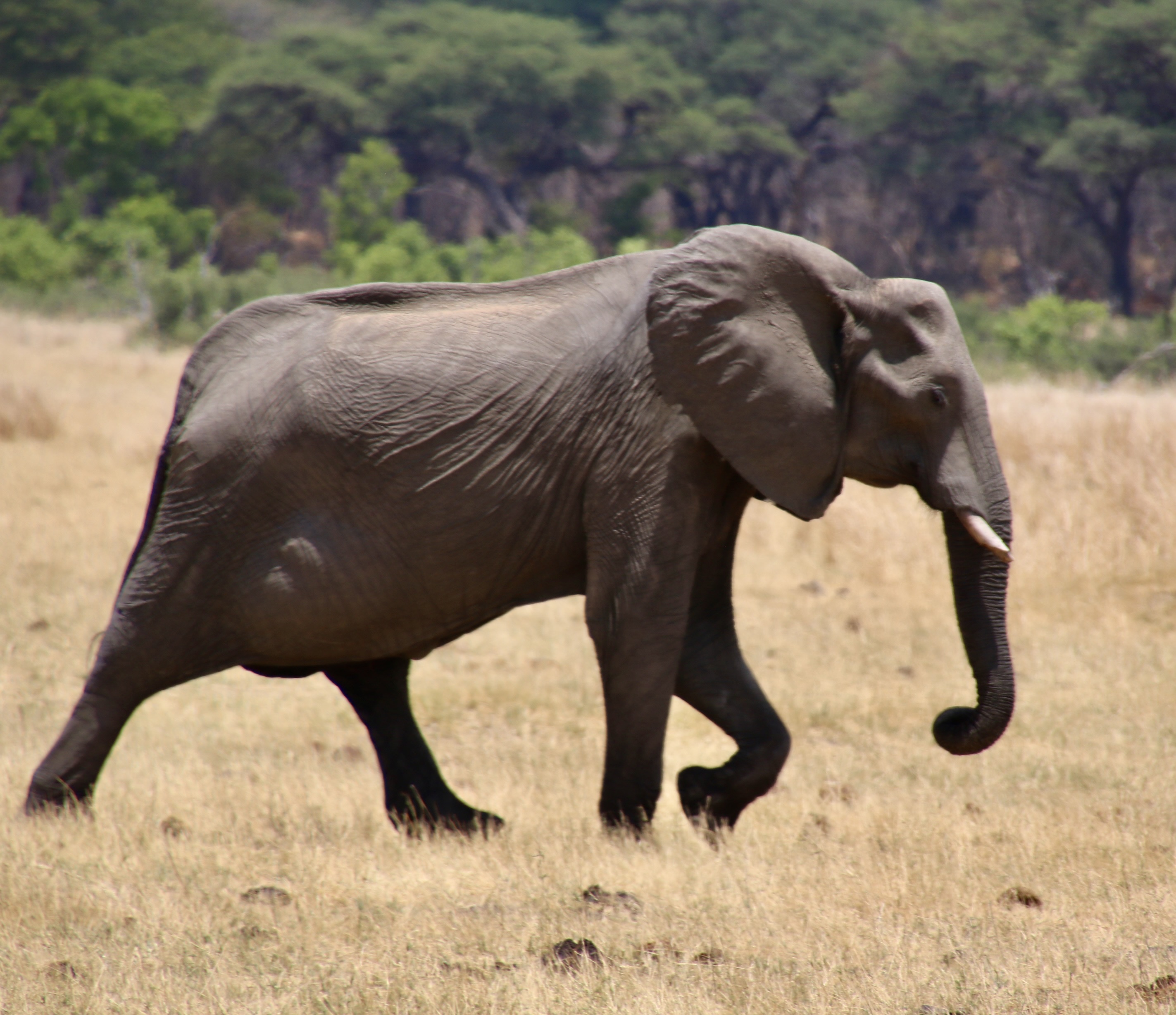
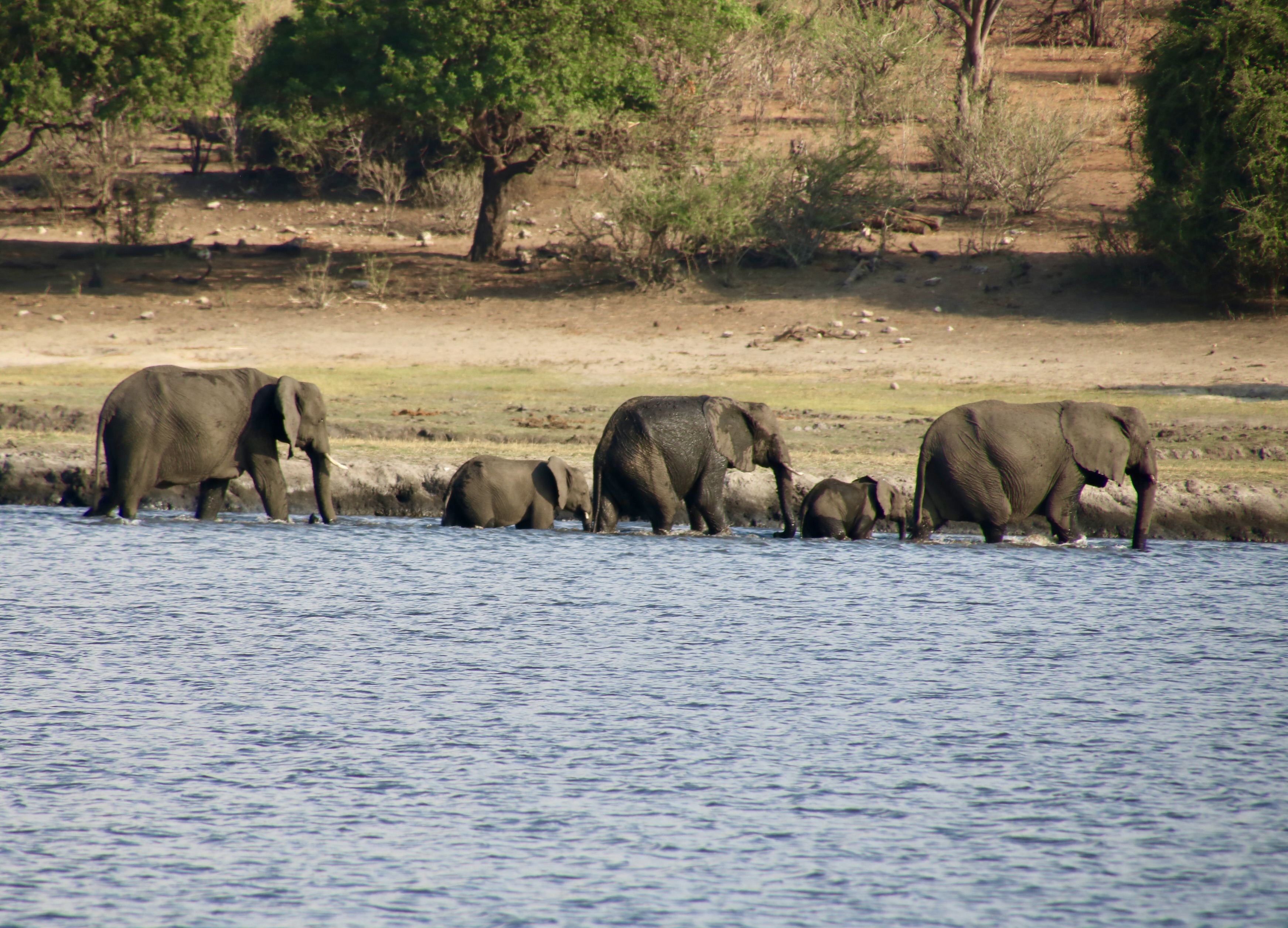
Among elephants, family is everything— at least among the females. A herd normally consists of the matriarch, chosen for her leadership and knowledge, plus her sisters, kids, and grandkids. Females born into the herd almost always stay with it. The family can exist together for decades and beyond. The matriarch is expected to find water and food when they are scarce and provide protection when necessary. Her nurturing abilities are also quite important. The size of the group normally ranges between 6 and 20 elephants depending on available resources. New families are created when resources are limited, but they remain bonded to their original families. A celebration with much trumpeting of trunks, touching and general joy is shown whenever the groups meet up. The longer they have been apart, the bigger the party
Males leave when they are 12-15 years old to go off and live on their own, or to join a loose knit group of other males where an older bull provides leadership, protection, discipline and education. This dispersal guards against inner-breeding within the family and assures genetic diversity among herds.
The young male is normally around 30 before he is large enough and strong enough to get his first chance at breeding. His adventure is encouraged by what is known as musth, a period when his testosterone goes wild and he feels the drive to go in search of female companionship. Teenage boys will recognize this. (The hormonal imbalance of musth has an added characteristic of leading the males to be moody and dangerous. Guides recognize the condition and steer clear.) Off on his search for true love and romance, or at least sex, the young bull rumbles his rumble and— if he gets lucky— finds females with similar intentions who rumble back, often from several miles away. He makes a beeline for them, proving once again an elephant’s uncanny ability to communicate and find its way over substantial distances. Once he has done his job, he heads back to his group or solitary wandering, leaving the female to raise the kid. She’s not alone, however.
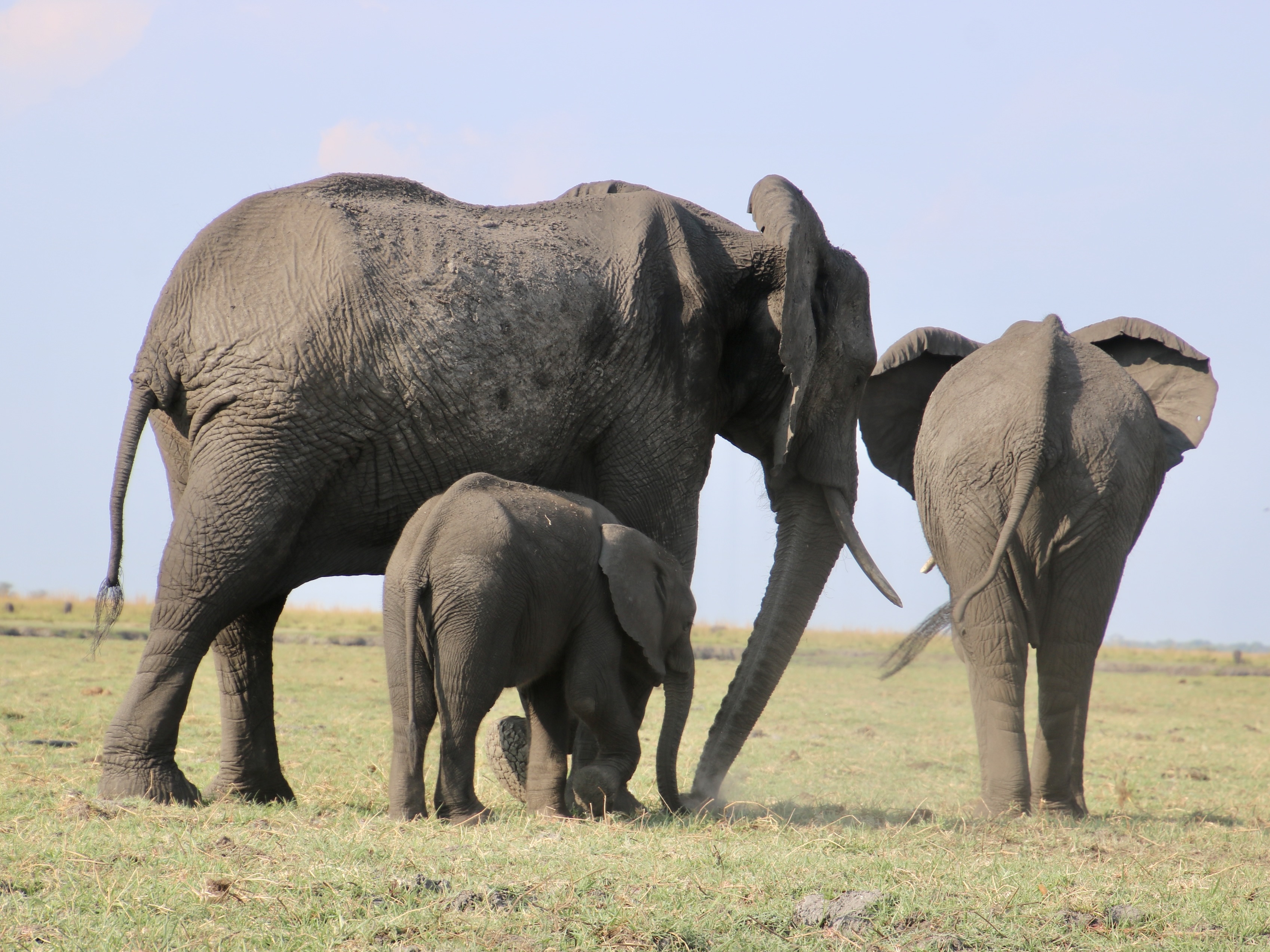
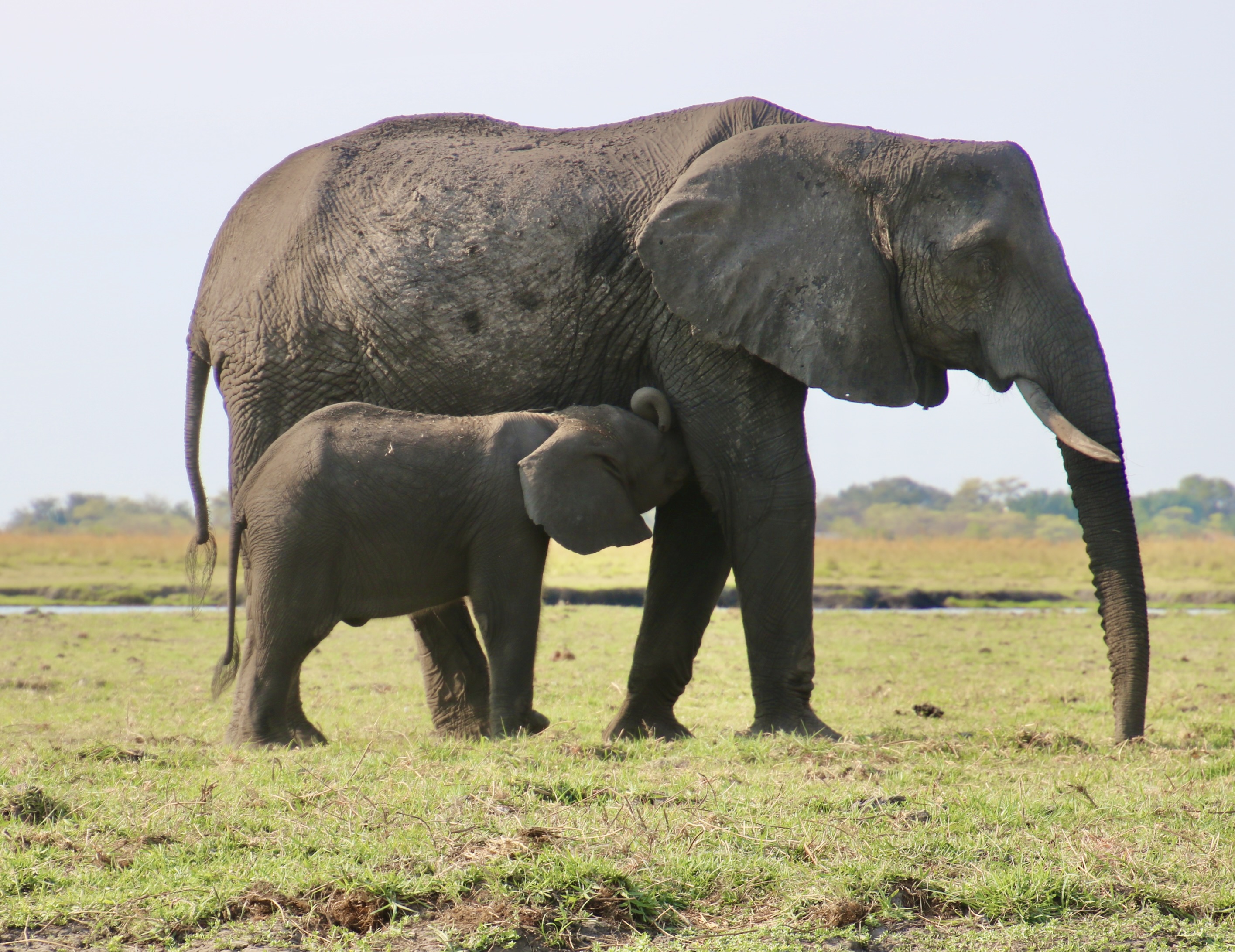
Gestation is a long, drawn out process. At 22 months, it is the longest among mammals. Baby is something of a relative term, given that the calf weighs in at somewhere between 200-300 pounds or more when born. The aunts and older female cousins stand in a circle around the newborn, trumpet in celebration, and kick dirt on it. At first I thought that maybe the dirt was an initiation ritual: “Welcome to the world, kid. It’s tough out there.” But actually the dirt helps protect the baby’s delicate skin from sunburn, a potentially serious problem. (As I write this, Peggy is sitting on a beach in the Caribbean soaking in the rays. She’s on a mother/daughter cruise with our daughter Tasha. I hope she remembered her sunblock. It beats the heck out of the dirt option.)
Raising a baby is a family effort with all of the females pitching in. Even the teenage females are given babysitting chores, a kind of on-the-job training. Education is big among elephants. It takes several years before a calf has reached the point where it can strike out on its own.


This post was twice as long. I had every intention of wrapping up elephants today so I could head on to hippos. They are getting impatient— and no one wants an impatient hippopotamus on their hands. Believe me. A nagging voice in my head suggested this post was too long, however. So I’ve scheduled the last half to go up on Monday where I will talk about such things as big brains, migrating teeth, 5 inch eyebrows, the fact that elephants can’t jump, and why they poop so much. Hint: It’s not rocket science. If you eat 350 pounds of food a day and have a poor digestive system, guess what…
 Wandering through Time and Place
Good info on elephants. Great pics, too.
Thanks, David. I was going to do one post on elephants and ended up doing four. They are fascinating creatures.
This was really fascinating, and a good length. I am sure you made the right choice to break it into two parts. I learned so much this time, and your photos were so helpful in understanding the facts that you explained. Wonderful, Curt. Thank you. I’m sure Peggy is taking good care of herself; she is a capable woman. ❤
Thanks, Crystal. One more post on Elephants! As for Peggy, she’s having a ball. Yes, she is very capable, and Tasha is along, another strong, independent woman in a long family line of them, dating back to ancient history, I’m convinced. Grin. Peggy reports in daily on their progress. –Curt
Elephants deserve four posts. Thanks for giving them their due. Happy travels to Peggy and Tasha.
Back to shorter posts now, Peggy!
Some of the information was new, some was old and all of it was interesting Curt. I frequently get bored with long posts, but not yours and not this one in particular.
Laughing, I couldn’t help myself, Ray. But I’ll be back to my shorter posts now. More like picture books. Grin. Thanks for hanging in there with me. –Curt
I can never get enough of elephants! Love the post, Curt. Not too many animals on this Caribbean adventure so far other than turtles. Looking forward to the next post!!!
I finished this morning, Peg. Whew. It was a fun series. Elephants certainly provided us with lots of entertainment on our safari, and things to ponder. Nothing wrong with turtles, of course, but I’m surprised that the islands aren’t crawling with iguanas. ❤️
Well…..there are lots of t-shirts featuring them but I have yet to see one!
Good to know they are around, however. Still hard to imagine one of them coming in our PV place and wandering around like he owned it. 🙂
I enjoy these posts, Curt. They’re just fascinating and I learn a lot that I didn’t know, in this case about elephants. What amazing creatures. I’m looking forward to part 2!
I never imagined I would write as much about elephants, D. But fascinating is the best way to describe them. I put up my last post on them this morning. Now it is on to hippos. 🙂
🙂 Lol
Fascinating! The thing I loved most? That they have a party when reconnecting with rellies! Love.
Alison
I’d love to be there to witness it Alison. Wouldn’t want to get in the way, however. 😳 Thanks. –Curt
What a great post, Curt, and so informational. And what a baby bump! Your photos are incredible, so thanks for taking us along while also educating us on these amazing creatures. Looking forward to the next post! 🐘🐘🐘
Thanks, Lauren! I had a really hard time imagining that baby bump being born. 🙂
Me too! 😂
This morning, I was listening to a couple of south Texas hunters talking about white tailed deer and this year’s late rut; I couldn’t help but be struck by the similarities in behavior between elephants and deer, particularly the separation of the sexes outside the mating season, the kinds of communication that take place, and the need for the ‘young bucks’ to have a period of learning the tricks of the trade, so to speak. Somehow I’d missed knowing that female elephants keep to themselves, and likewise the males, particularly when it comes to learning how to fit into elephant society. Poro and Sande, anyone?
Lots of parallels, Linda. We had a whole lab of deer behavior in our back yard in Oregon that I got to watch on a daily basis. The deer almost thought of us as family.
There is a book that I am reading now that you might like. It’s called “The Elephant Whisperer.” Peggy raves about it. As for the Poro and Sande Societies, at least the elephants don’t have to deal with the Bush Devil.
On animal behavior, I took a video of a small hippo maneuvering its way through a herd of elephants which I am including on Friday’s blog about Hippos. I think you will find it interesting. I sure did.
Lots of interesting family stories here. I’m not sure how you can keep track of it all. You must have a memory like an…
Sieve… Is that the word you were looking for, Dave. 🙂