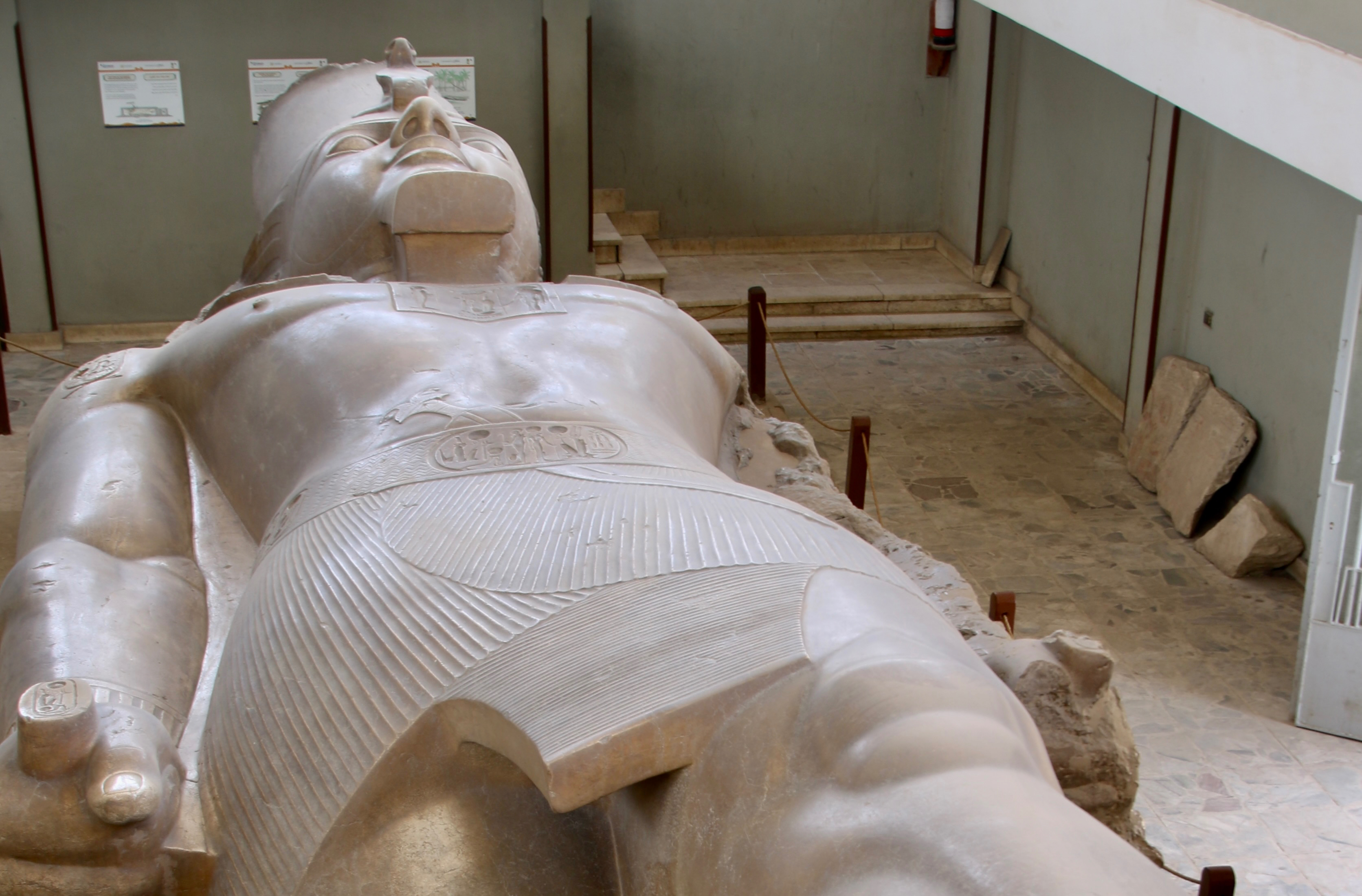
Ramses II is one of the world’s giants in terms of ancient Egyptian history, the monuments he left behind and ego. This elegant 42 foot statue (from the knees up) is located in the Open Air Museum of Memphis. It speaks to his power.
The Open Air Museum of Memphis, near the modern town of Mit Rahina south of Cairo, is relatively small considering Memphis was established as the first capital of Egypt 4000 years ago by the pharaoh Narmer when he united Upper and Lower Egypt. It continued to serve as the capitol for over a thousand years. As such, Memphis would have been a bustling city filled with temples, palaces and tombs. Now it is mainly scattered ruins with most of its remains buried beneath villages and farms. The museum is well worth a visit however. First and foremost because of its huge statue of Ramses II, which was found lying in a swamp in 1820 missing its lower legs.
Ruling between 1279 and 1213 BCE, Ramses II is recognized as Egypt’s greatest pharaoh. He’s best known for ruling 66 years, expanding Egypt’s territory by fighting in multiple wars, and for building monuments, cities and temples throughout his realm. More ancient statues of him have been found than any other pharaoh. Peggy and I saw several as we made our way up the Nile. Then there is also the matter of the 90 children he was said to have fathered! As I noted in my heading, he was big— and he was bad.
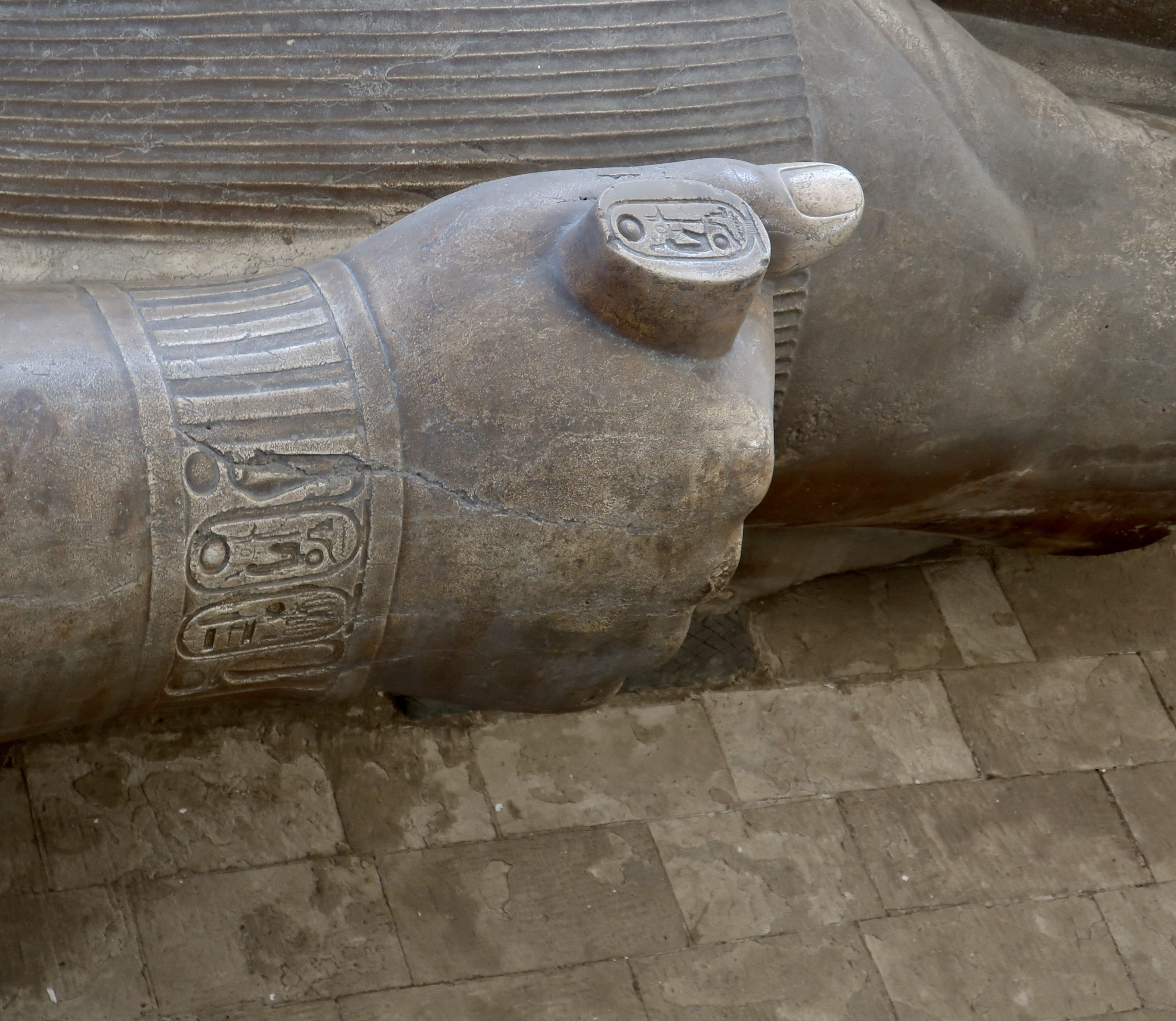
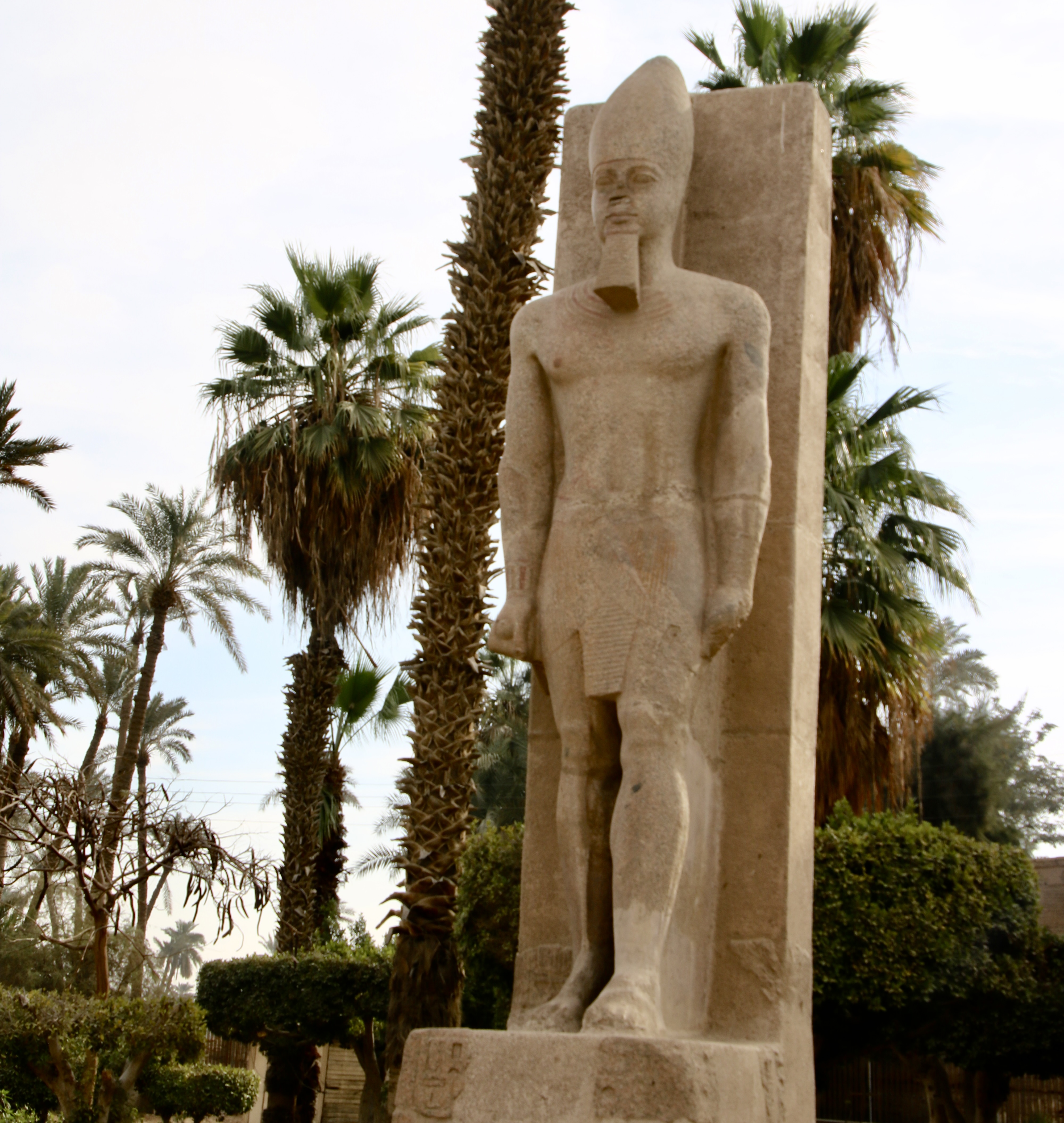
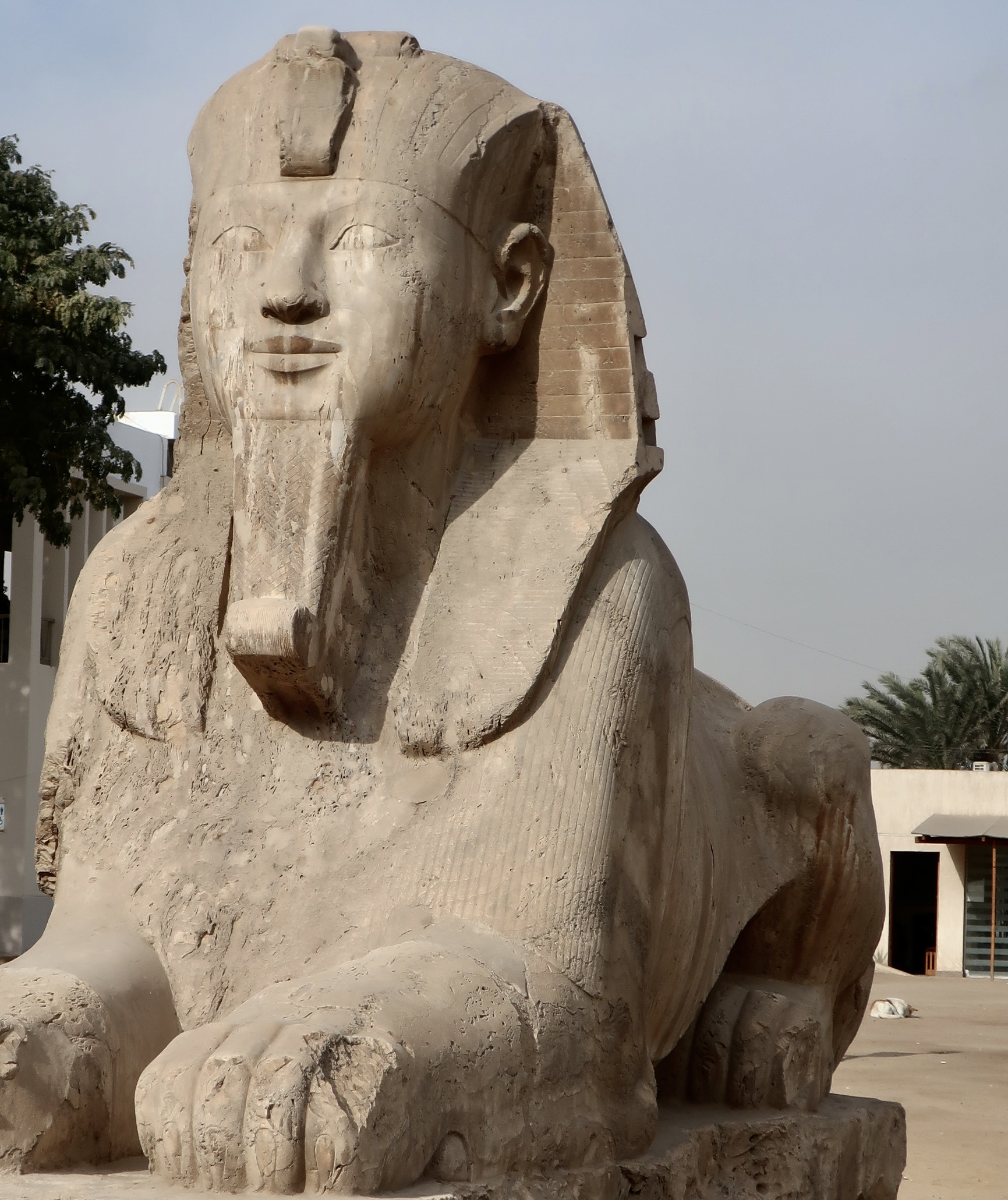
Here, Peggy provides perspective on the size of the Ramses II statue at the Open Air Museum in Memphis. Visitors can both walk around the statue on the ground floor and observe it from the balcony above.A view of Ramsey II as seen from head to toe. He’s wearing the crown of Upper Egypt.This view of his face provides an idea of how beautifully he was carved out of granite with close attention to detail. Note the ear. The figure on his forehead is Wadjet, the female cobra god of Lower Egypt who provided protection for pharaohs.Ramses II was also protected by the dagger he wore in his belt. Most pharaohs are shown wearing one as a symbol of power. A cartouche, spelling out one of his names in hieroglyphics, is on his belt over his dagger. Another, spelling out a different name is lower on his belt. Pharaohs had several names, one, to stress their various positions and accomplishments, but two, also important so they wouldn’t be forgotten, a critical factor in achieving immortality. A cylindrical object in his hand also has a cartouche with one of his names as do two more on his wrist band. I searched for what the object he is holding represented but couldn’t find an explanation. It is obviously another symbol of power that several other pharaohs carry as well. My assumption is that it represents the chisel of Narmer that he used to smash into enemies’ heads, as I showed in my last Egypt post.Narmer doing his thing. The chisel is shown in his name between the two images of Hathor, the cow goddess.Could it be if one chisel was good, two were better? This statue of Ramses II is at the entrance of the Egyptian museum. Note he also has cartouches on his belt, shoulders and chest. Some of them were not his…His son and successor had one of Ramses II’s cartouches removed and his own added— a quick, easy and cheap way to gain recognition and entrance to the afterlife. The practice was not unusual. “Oops, sorry Pop, my chisel slipped.”Speaking of which, another large statue of Ramses II stands outside at the Museum of Open Air. It may actually be of the pharaoh Senusret I, taken over by Ramses with his names removed and Ramses added. When most people think of Egypt and sphinxes, they think of the Great Sphinx of Giza. Actually, there are hundreds if not thousands of Sphinxes. Consisting of the body of a lion and the head of a pharaoh, this one is located at the Open Air Museum. It likely represents the head of Amenhotep II or III with the carving estimated to have taken place between 1700 and 1400 BCE.A back view of the sphinx. It is 26 feet long (8 M) and 13 feet (4M) high, weighs in at over 80 tons, and is carved out of alabaster.
Memphis was an important religious center for the triad of Ptah, the creator god who gave shape to all things, his consort Sekhmet, the lion goddess, and their son, Nefertem, the god of blossoms and perfume. It was common for the Egyptians to create triads for their gods, not unlike that of the Christian triad of the Father, the Son and the Holy Ghost.
I’ll conclude today with a statue of the triad that is located in the Open Air Museum. Ptah with his long, skinny beard is shown in the center. Sekhmet is on the right, and Nefertem on the left. (At least, I assume that is the arrangement.) Their arms around each other demonstrate their common bond.
Next Post: We will return to South Dakota where we will visit a museum that is crammed full of dinosaur bones in a chaotic but wonderful arrangement.
Laughing. Indeed Frances. There was a whole industry devoted to putting your name on objects that had been created by someone else. Obvious copyright laws were yet to be invented!
I love the history and these amazing statues Curt. It must be surreal to see them up close and personal. The intricacies of the carving are incredible. If you stay to long you might get mummified.. hee.. See you on your next stop in South Dakota . 💞
It is special, Cindy. Almost unbelievable at times. And the talent it took to carve the Ramses figure must have been formidable.
I don’t know about being mummified, but at my age, Nethbek, the Egyptian vulture goddess might have been regarding me as a potential dinner. 🙂 Thanks, Cindy.
It really much be Curt and I’m thrilled for you and Peggy. Now you stay out of the line of trouble my friend.. I don’t want you mummified before we finally meet.. It would be nice if you were embodied in the now. 😂💞
Ha, embodied in the now is always one of my lifetime goals, Cindy. I think that’s what you preach. Grin.
You got that right Curt.. (😉)I follow the the traveling guru 😃
Laughing, Cindy. You are much more the guru than me! But travel I do…
travel far or close gurus meet thru the ethers.. like us..(grin)! ❣️
I like It! ❤️
I couldn’t stop thinking about whoever it was who found the statue of Ramses II lying in that swamp. It turns out it wasn’t some poor schlub from the suburbs; it was Giovanni Battista Caviglia, a merchant sailor who left his ship in Alexandria and hired out to the Brits. His Wiki page says:
“During excavations carried out in 1820 on behalf of the British in the ancient capital of Memphis, about 20 km south of Cairo, he made another “sensational” discovery: the Colossus of Ramses II. This huge statue of limestone was found near the south gate of the Temple of Ptah, near the village of Mit Rahina. Despite missing its feet, the statue measured over 10 meters tall. The statue was offered, through the Egyptologist Ippolito Rosellini, to Grand Duke Leopold II of Tuscany who refused the offer due to the difficulties and cost involved in transportation.
Following this, the pasha of Egypt Mehmet Ali gave it to the British Museum in London, which in turn declined the offer for the same reasons. A museum was then built over the statue where you can still find it today.”
There’s a link on the Wiki page to a stonemason who commented on the techniques used, and the enormous difficulty of such work. His basic point was that slaves could have hewn the inital blocks and such, but only a master could have worked the cartouches and such.
I can guarantee that he would have wanted them to add his names. It was pretty much all about Ramses. Grin.
Thanks for your inclusion of the extra information, Linda. It always adds to the post. I’d read about the British Museum turning it down, a decision I’m pretty sure it regretted later. On the other hand, it isn’t that they don’t umpteen tons of Egyptian treasures. Have you ever been to the museum? Of course the British weren’t alone. Most major museums in the world have their share!
A great post and brings me back to a trip decades aga when part of it was a tour of Egypt.
In those early days we were allowed to clamber inside the pyramid right up to the inside of the queen’s chamber.
I even took a little pebble amongst the rubble that was strewn around the place as a memory.
Such a fascinating civilization, and so long ago. Thanks for another great post taking me back to ancient Egypt. I can’t imagine living in a country with that much recorded history.
Alison
It’s amazing that the giant statue of Ramses was found in a swamp. And not for thousands of years. It’s all wonderfully fascinating. Thanks for sharing your adventure and photos!
The history is fascinating, Curt, but to see those statues ‘in person’ I’m sure is truly awe-inspiring. The photos are amazing! Thanks for another great adventure, and I’m excited to see some dinosaur bones. 🙂
Curt, RII wins my vote for Most Self-Absorbed Pharaoh. But more probably, he was just rich enough to showcase himself more often and more spectacularly. As you clearly found out while there, each pharaoh’s goal was to convince the gods that he was amazing, so he could have good standing in the afterlife. To that end, the things in his hands are scrolls! At least that’s what my guide told me when I was there. These scrolls apparently list all the additional things that the gods should take into account when considering the deeds of the pharaoh. Apparently, the gods are able to unroll and read stone scrolls…. I remember seeing one panel of hieroglyphs in a tomb that was a similar thing: a list of all the stuff dedicated to the gods upon the death of a pharaoh. “I, pharaoh, dedicate 30 bottles of perfume, 30 bottles of olive oil, 100 bushels of wheat, 75 goats, 10 cows,…” It filled a whole wall! The dude was just hedging his bets at the last possible moment to make a good impression before the final judgement was made.
Interesting on the scrolls, Crystal. I spent a fair amount of time trying to find out. More time than anything else. Grin. There was only one source on Quora that mentioned scrolls, and it went on to say that actually, nobody knows for sure. Nobody mentioned chisels. There was lots of discussion on all of the other things that pharaohs hold. If you find anything else, let me know. I’d love to learn more. Given all of the effort that pharaohs spent trying to get into the afterlife, it wouldn’t be surprising. But some type of power object makes sense, which that was their other great use of symbolism.Anyway, thanks for your contribution. As always.
No doubt, all of the pharaohs had great egos. You don’t believe you are related to the gods, if not. 🙂
I was taken by the carving of his face in that big statue. All the other details are fantastic also, but his nose and lips are just so smooth and beautiful. I really hope I can go to Egypt someday to see this stuff myself. As for the chisels, which seem to intrigue you (I get it!), what a gruesome weapon! I noted the first mention and photo in the last Egypt post, but I had no idea they were such a thing in Ancient Egypt – ugh!
Crystal suggested that they might have been papyrus rolls to help get them into the afterlife. That would be a less gruesome alternative, Lexie.
As for the carving, I totally agree. Forever, we have admired the work of the early Greeks, but it seems like the Egyptians were carrying out similar projects a couple of thousand years earlier!






 Wandering through Time and Place
I did not know that the Egyptians replaced others cartouches with their own – an early form of photoshopping. We don’t change much do we.
Laughing. Indeed Frances. There was a whole industry devoted to putting your name on objects that had been created by someone else. Obvious copyright laws were yet to be invented!
I love the history and these amazing statues Curt. It must be surreal to see them up close and personal. The intricacies of the carving are incredible. If you stay to long you might get mummified.. hee.. See you on your next stop in South Dakota . 💞
It is special, Cindy. Almost unbelievable at times. And the talent it took to carve the Ramses figure must have been formidable.
I don’t know about being mummified, but at my age, Nethbek, the Egyptian vulture goddess might have been regarding me as a potential dinner. 🙂 Thanks, Cindy.
It really much be Curt and I’m thrilled for you and Peggy. Now you stay out of the line of trouble my friend.. I don’t want you mummified before we finally meet.. It would be nice if you were embodied in the now. 😂💞
Ha, embodied in the now is always one of my lifetime goals, Cindy. I think that’s what you preach. Grin.
You got that right Curt.. (😉)I follow the the traveling guru 😃
Laughing, Cindy. You are much more the guru than me! But travel I do…
travel far or close gurus meet thru the ethers.. like us..(grin)! ❣️
I like It! ❤️
I couldn’t stop thinking about whoever it was who found the statue of Ramses II lying in that swamp. It turns out it wasn’t some poor schlub from the suburbs; it was Giovanni Battista Caviglia, a merchant sailor who left his ship in Alexandria and hired out to the Brits. His Wiki page says:
“During excavations carried out in 1820 on behalf of the British in the ancient capital of Memphis, about 20 km south of Cairo, he made another “sensational” discovery: the Colossus of Ramses II. This huge statue of limestone was found near the south gate of the Temple of Ptah, near the village of Mit Rahina. Despite missing its feet, the statue measured over 10 meters tall. The statue was offered, through the Egyptologist Ippolito Rosellini, to Grand Duke Leopold II of Tuscany who refused the offer due to the difficulties and cost involved in transportation.
Following this, the pasha of Egypt Mehmet Ali gave it to the British Museum in London, which in turn declined the offer for the same reasons. A museum was then built over the statue where you can still find it today.”
There’s a link on the Wiki page to a stonemason who commented on the techniques used, and the enormous difficulty of such work. His basic point was that slaves could have hewn the inital blocks and such, but only a master could have worked the cartouches and such.
As usual, there’s a song. You surely have guessed it already!
Now I’m wondering this: what in the world would Ramses II have thought of the Bangles, or the popularity of their song?
I can guarantee that he would have wanted them to add his names. It was pretty much all about Ramses. Grin.
Thanks for your inclusion of the extra information, Linda. It always adds to the post. I’d read about the British Museum turning it down, a decision I’m pretty sure it regretted later. On the other hand, it isn’t that they don’t umpteen tons of Egyptian treasures. Have you ever been to the museum? Of course the British weren’t alone. Most major museums in the world have their share!
This is fascinating and worthwhile. I can’t find when this museum was brought together, but it wasn’t there in the 1970s.
It’s really small, Peggy, but it’s treasures were impressive.
These photos are fascinating. Learned lots. thank you.
Thank you. Appreciated!
A great post and brings me back to a trip decades aga when part of it was a tour of Egypt.
In those early days we were allowed to clamber inside the pyramid right up to the inside of the queen’s chamber.
I even took a little pebble amongst the rubble that was strewn around the place as a memory.
Clambering about, Gerard, is certainly more limited than it was! But we did manage to make it inside of one of the pyramids.
Such a fascinating civilization, and so long ago. Thanks for another great post taking me back to ancient Egypt. I can’t imagine living in a country with that much recorded history.
Alison
It might be a bit overwhelming. I’d be out there wanting to uncover even more of it, Alison. 🙂
Yes, me too!
🙂
It’s amazing that the giant statue of Ramses was found in a swamp. And not for thousands of years. It’s all wonderfully fascinating. Thanks for sharing your adventure and photos!
Magical and mythical… Like Egypt, D. 🙂
The history is fascinating, Curt, but to see those statues ‘in person’ I’m sure is truly awe-inspiring. The photos are amazing! Thanks for another great adventure, and I’m excited to see some dinosaur bones. 🙂
Awe is the correct word for it, Lauren. And lots and lots of bones coming up on Monday!
Curt, RII wins my vote for Most Self-Absorbed Pharaoh. But more probably, he was just rich enough to showcase himself more often and more spectacularly. As you clearly found out while there, each pharaoh’s goal was to convince the gods that he was amazing, so he could have good standing in the afterlife. To that end, the things in his hands are scrolls! At least that’s what my guide told me when I was there. These scrolls apparently list all the additional things that the gods should take into account when considering the deeds of the pharaoh. Apparently, the gods are able to unroll and read stone scrolls…. I remember seeing one panel of hieroglyphs in a tomb that was a similar thing: a list of all the stuff dedicated to the gods upon the death of a pharaoh. “I, pharaoh, dedicate 30 bottles of perfume, 30 bottles of olive oil, 100 bushels of wheat, 75 goats, 10 cows,…” It filled a whole wall! The dude was just hedging his bets at the last possible moment to make a good impression before the final judgement was made.
Interesting on the scrolls, Crystal. I spent a fair amount of time trying to find out. More time than anything else. Grin. There was only one source on Quora that mentioned scrolls, and it went on to say that actually, nobody knows for sure. Nobody mentioned chisels. There was lots of discussion on all of the other things that pharaohs hold. If you find anything else, let me know. I’d love to learn more. Given all of the effort that pharaohs spent trying to get into the afterlife, it wouldn’t be surprising. But some type of power object makes sense, which that was their other great use of symbolism.Anyway, thanks for your contribution. As always.
No doubt, all of the pharaohs had great egos. You don’t believe you are related to the gods, if not. 🙂
I was taken by the carving of his face in that big statue. All the other details are fantastic also, but his nose and lips are just so smooth and beautiful. I really hope I can go to Egypt someday to see this stuff myself. As for the chisels, which seem to intrigue you (I get it!), what a gruesome weapon! I noted the first mention and photo in the last Egypt post, but I had no idea they were such a thing in Ancient Egypt – ugh!
Crystal suggested that they might have been papyrus rolls to help get them into the afterlife. That would be a less gruesome alternative, Lexie.
As for the carving, I totally agree. Forever, we have admired the work of the early Greeks, but it seems like the Egyptians were carrying out similar projects a couple of thousand years earlier!