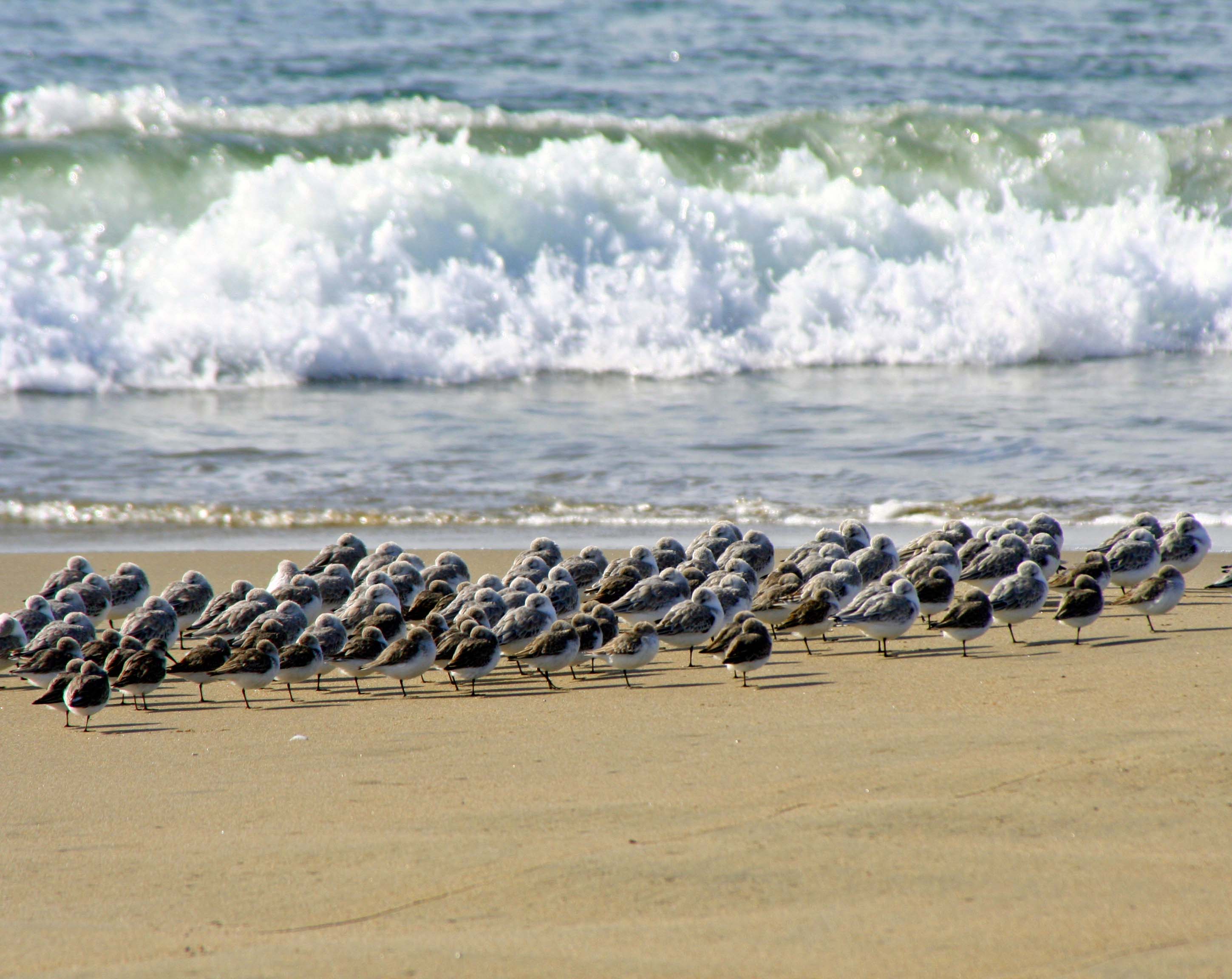
Shore, sea and Sanderlings meet on Limantour Beach at Pt. Reyes National Seashore. (Photo by Peggy Mekemson.)
A steep ridge runs most of the length of Pt. Reyes National Seashore. The road to Limantour Beach is all business as it climbs up and over. Who needs switchbacks? A sign tells trailers to stay off. Our van Quivera has made the journey several times but always complains. Our friend Ken Lake’s truck laughed at the challenge.
The journey across provides an introduction to most of Pt. Reyes’ ecological zones. Seeing a Kodak moment, I asked Ken to stop up on top. Fog and sun were battling with each over who would rule the day. Grass, brush, trees and canyons joined the drama. I searched the canyon for wildlife to add to my photo. Tule Elk and Black Tail Deer are commonly seen during the day, as are hawks and omnipresent buzzards. Nothing presented itself. All I found was some aging, hair-filled bobcat scat (poop) with a pile of fresh raccoon scat on top. I figured the raccoon was making a statement. I also figured that the scat didn’t need to be part of my photo. (“Good decision,” Peggy adds.)

Sun and fog were part of the landscape in this photo I took from Limantour Road.

Looking south from Limantour Road at where the deer and elk roam.
The road down to Limantour Beach is almost as steep as the road up and one section would scare a roller-coaster. Topping the last hill provides a broad view of Drake’s Bay, Limantour Beach and the Limantour Estero. A long narrow spit separates the Bay from the Estero. I suspect the view isn’t tremendously different from what Sir Francis Drake would have found when he sailed into the Bay in 1579, the first European to visit the area. Miwok Indians, who had called the region home for thousands of years, greeted the British explorer/noble/naval hero/pirate.
We parked the truck, crossed a walking bridge over the Limantour Estero, hiked down to the beach and walked north along the shore. Sea gulls, Sanderlings, crab shells, driftwood, animal tracks, sunning buzzards, gentle waves and distant vistas entertained us.
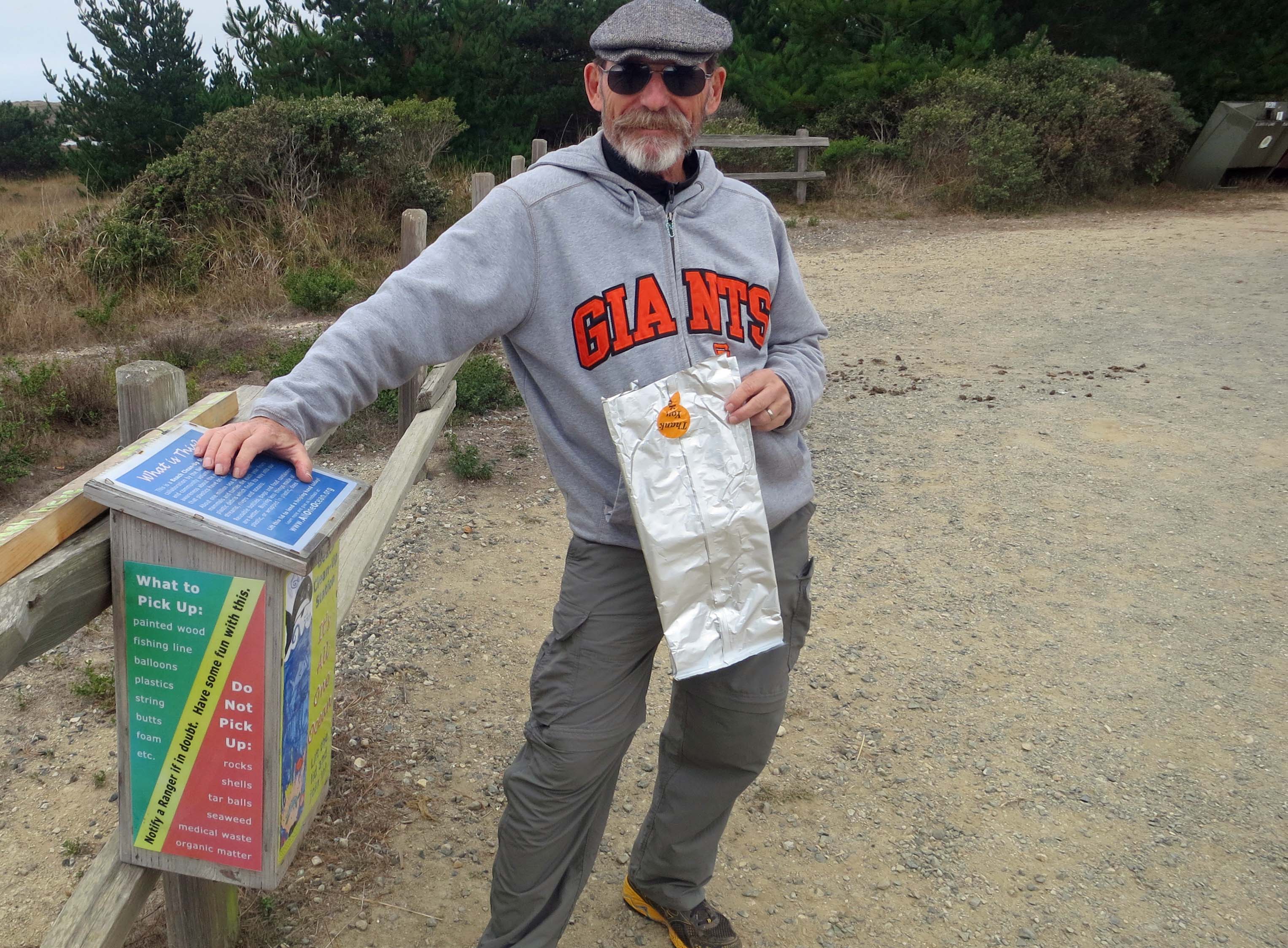
A great idea: The National Park Service provided bags so people could pick up trash as they walked along the beach. Ken immediately grabbed one and we all helped fill it. Note: Ken never lets anyone doubt his team loyalty.
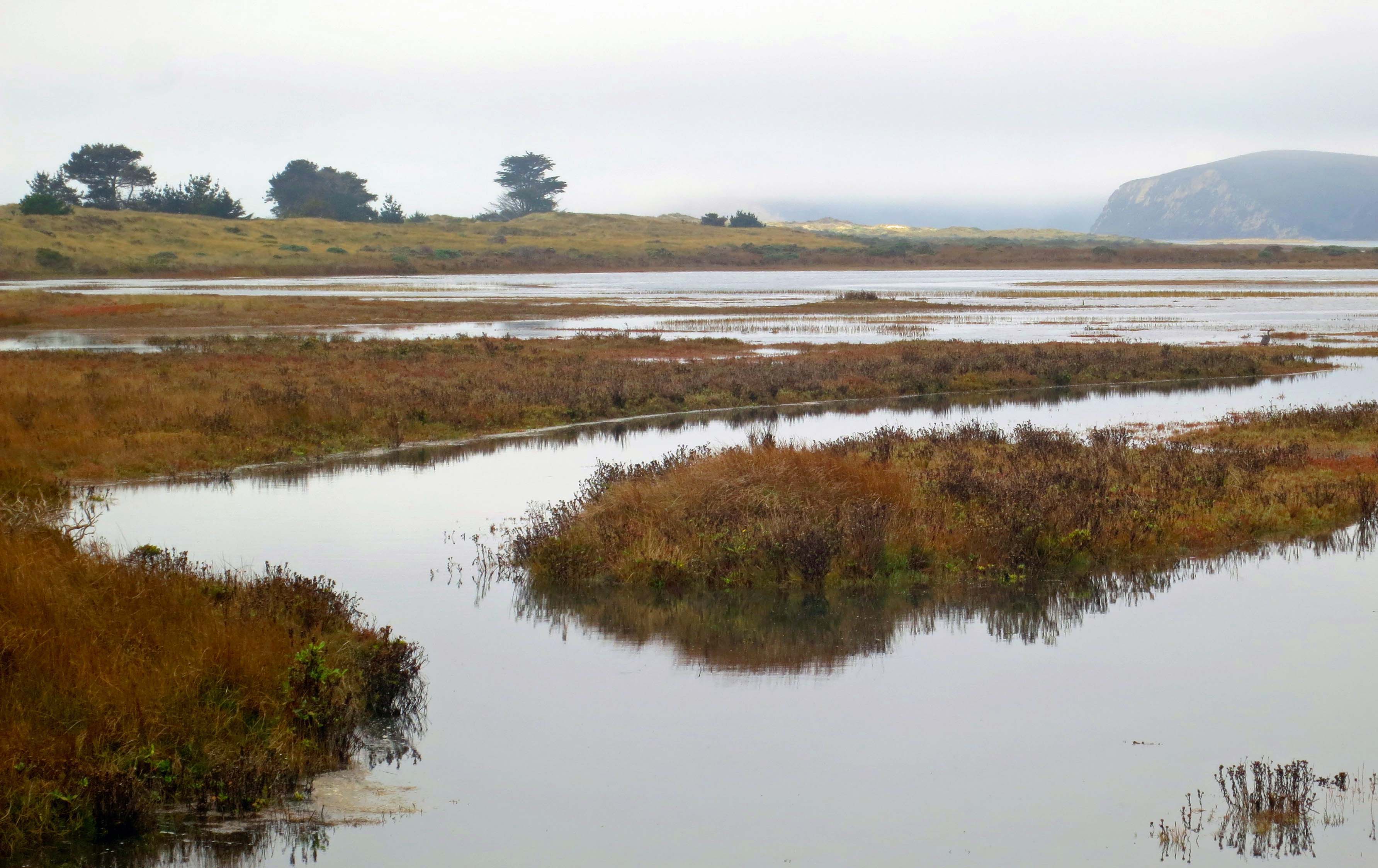
A bridge provided a view up the Limantour Estero or estuary. Estuaries are where fresh and ocean water mix, creating a rich environment for fish and birds. The Pt. Reyes headlands in the distance offers a great vantage point for whale watching. It is also home to Pt. Reyes’ Elephant Seal population.
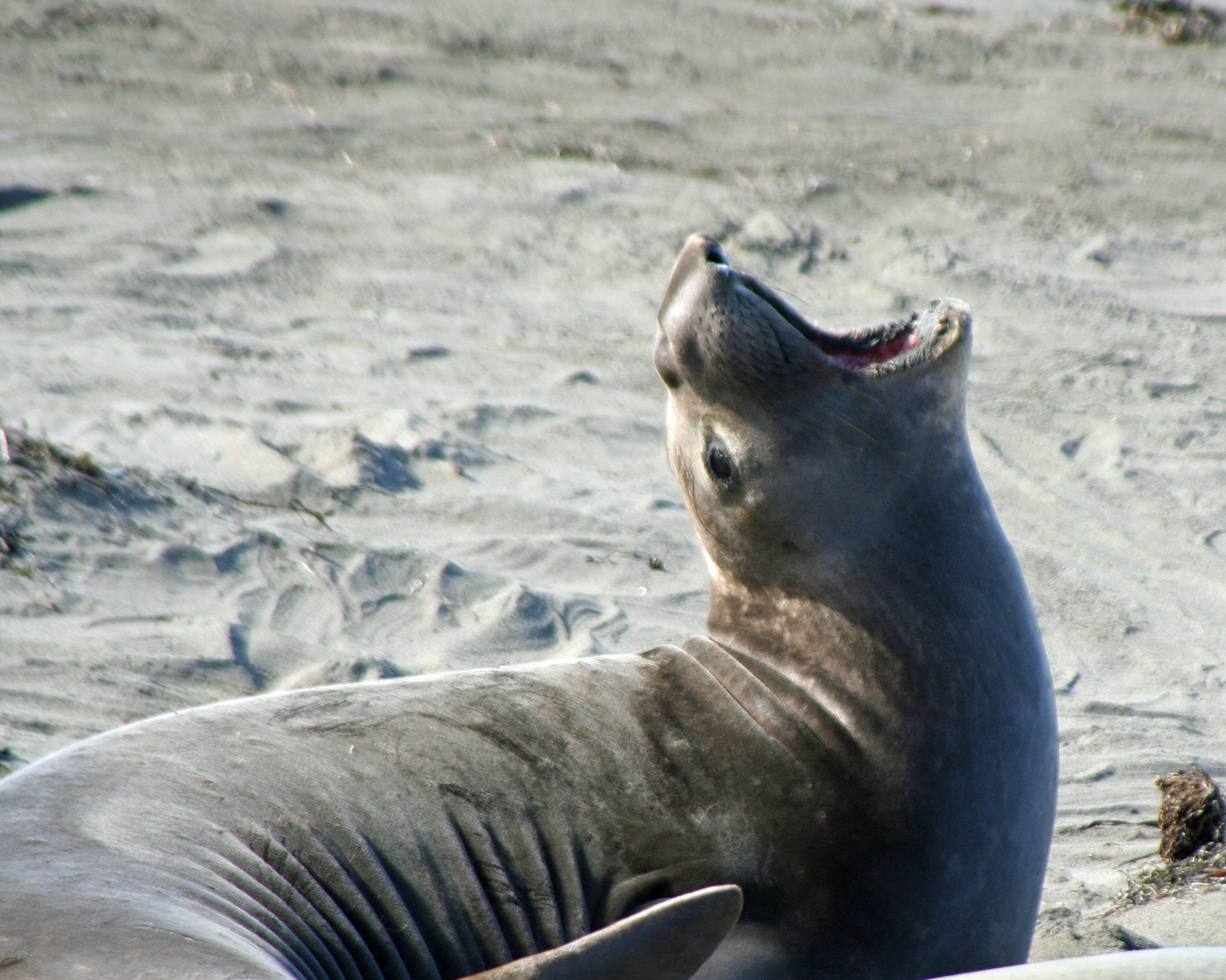
I love elephant seals. These magnificent creatures spend the majority of their lives at sea and 90% of that time under water. They travel thousands of miles annually and can dive up to 2000 feet deep. This photo came from a blog I did about the Elephant Seals of Piedras Blancas.

Another view of the Limantour Estero, this one from the spit that separates the Estero from Drake’s Bay.

Looking north up Limantour Beach across Drakes Bay. Sir Francis Drake named the area Nova Albion, New England, probably because the sandstone cliffs reminded him of the Cliffs of Dover. (Photo by Peggy Mekemson.) The small mounds or sand dunes are created by plant matter.
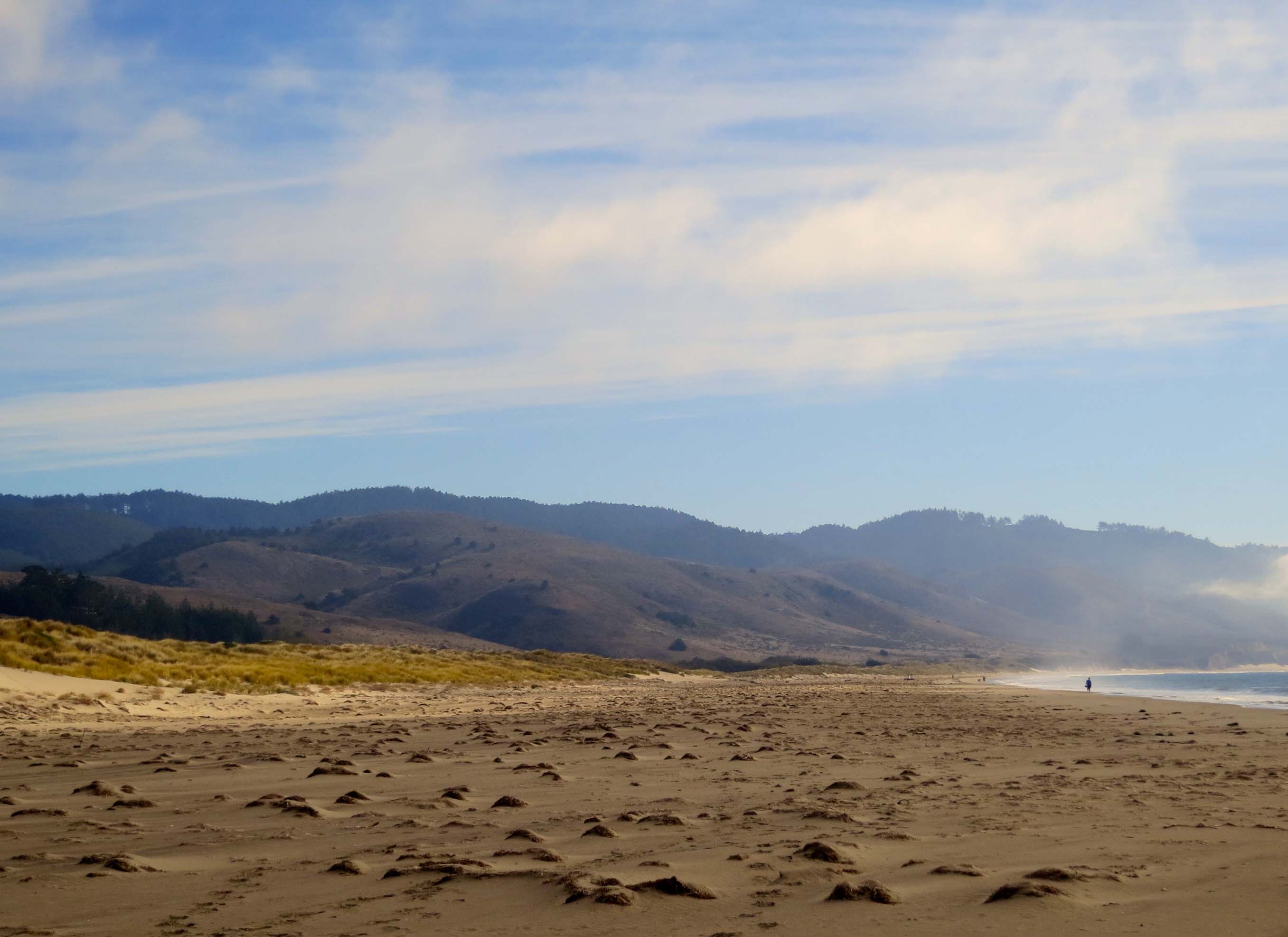
A lone person walks south on Limantour Beach.

Sea gulls tend to walk away when you get near them. I was encouraging these guys to fly. The one nearest appeared ready to leap into action.

I finally succeeded. I like the way this photo captures the different wing action of gulls in flight.
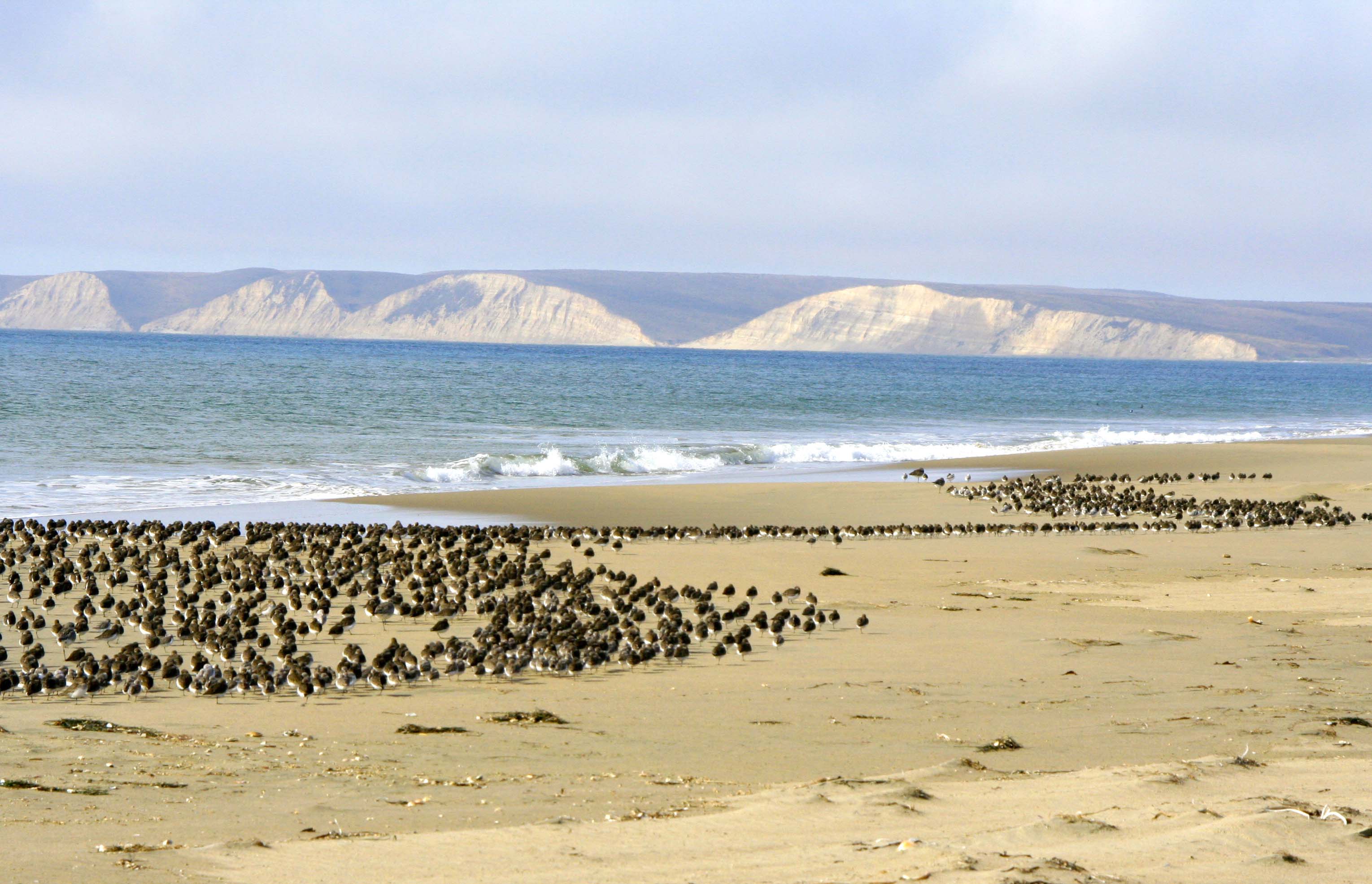
Meanwhile, Peggy was off checking out the seemingly endless flock of Sanderlings. (Photo by Peggy Mekemson.)

Who also decided to fly. How do they avoid winging each other? (Photo by Peggy Mekemson.)
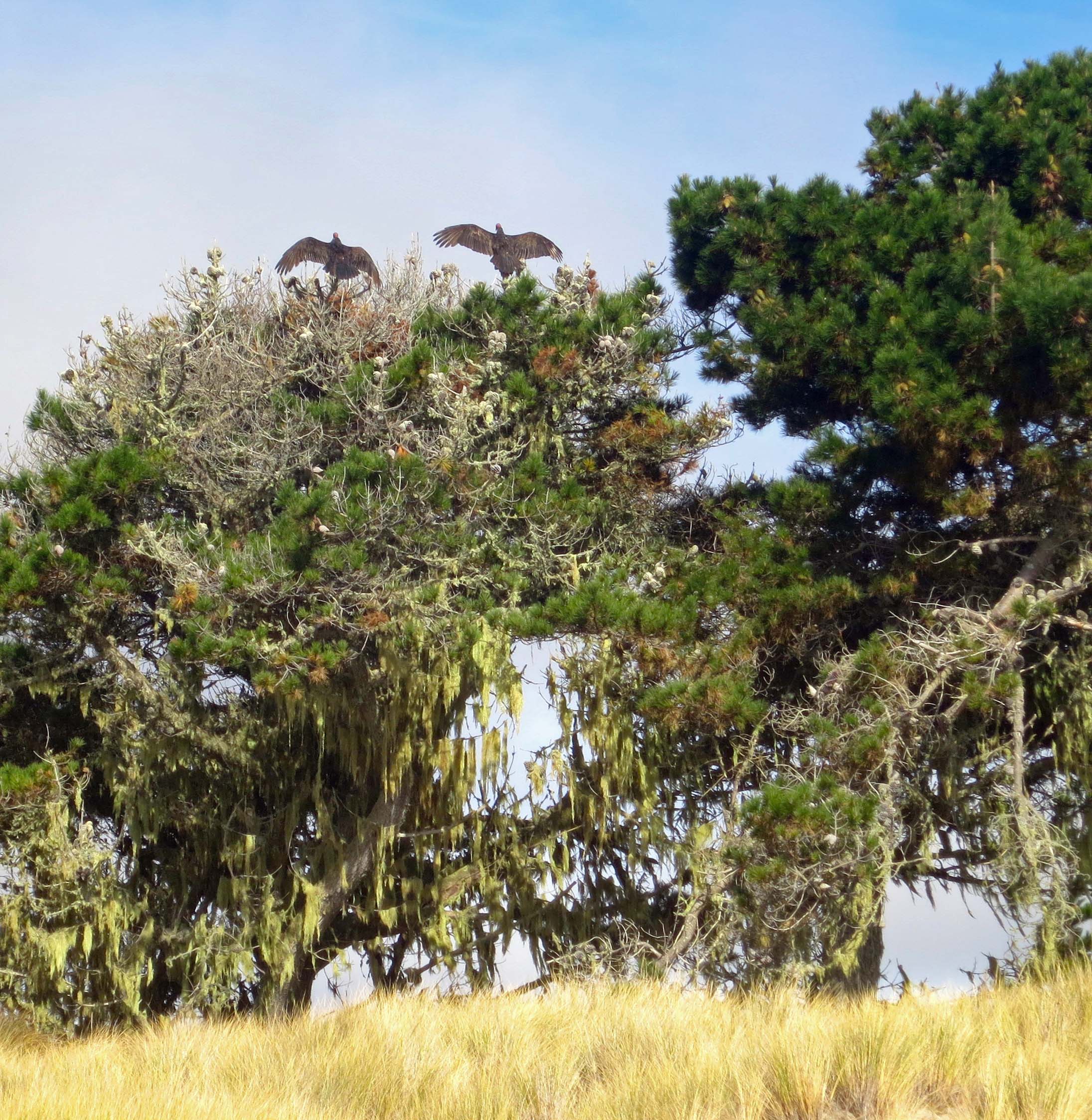
“Check out the buzzards,” Ken urged. A pair were perched on top of a pine tree drying out their wings from the morning’s fog in preparation for flight.
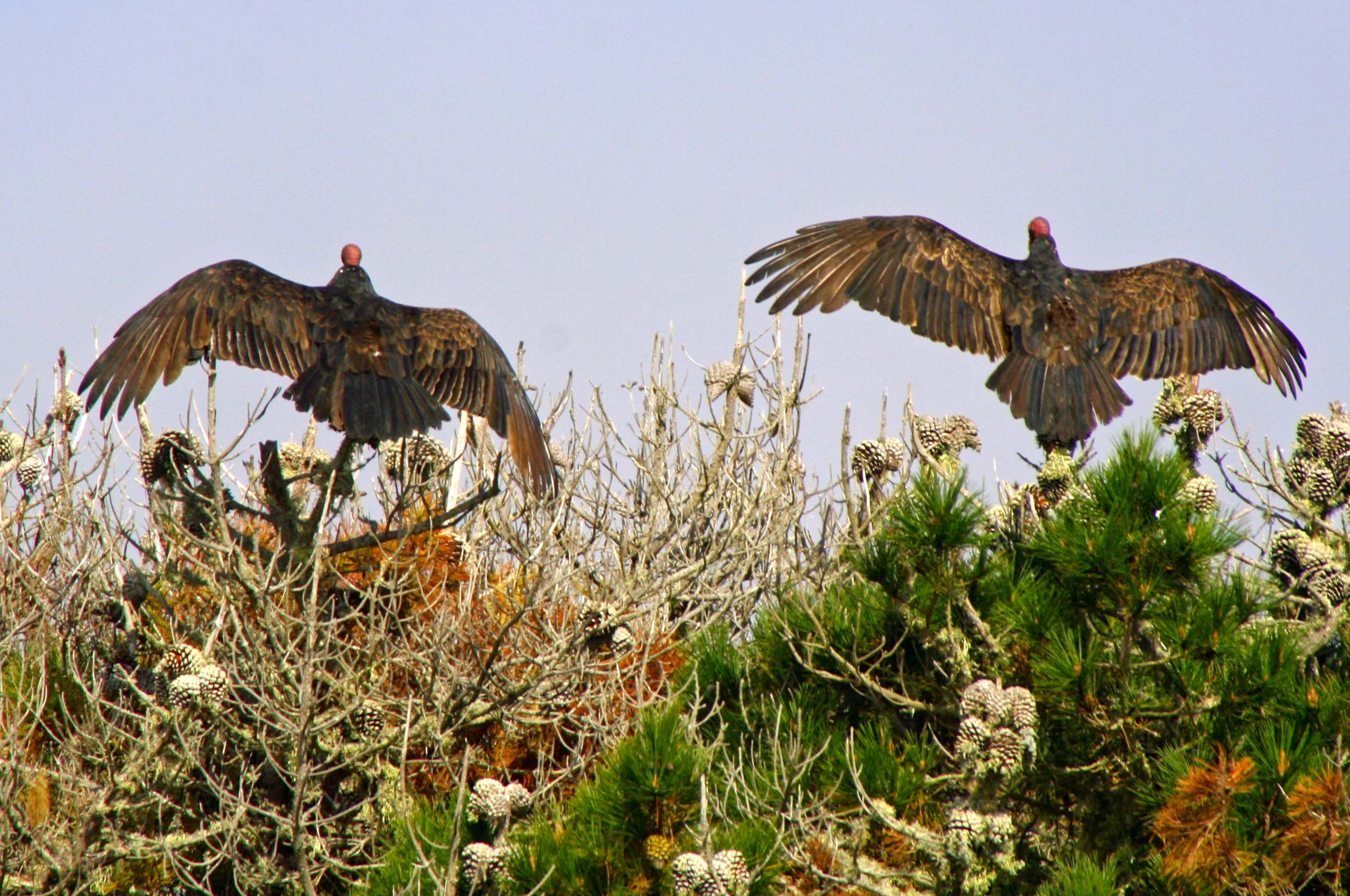
Using her telephoto lens Peggy got up close. Note their heads. They are naked so buzzards can dip into dead treats without getting their feathers involved. Isn’t evolution grand? (Photo by Peggy Mekemson.)

As we approached one got excitable. I think you might say he was having a bad feather day. (Photo by Peggy Mekemson.)

While animals were hiding out for the day, their tracks were abundant. Here, a family of raccoons made their way back to their home on the spit. Peggy and Leslie followed the tracks to what they decided was their home hidden in the brush.
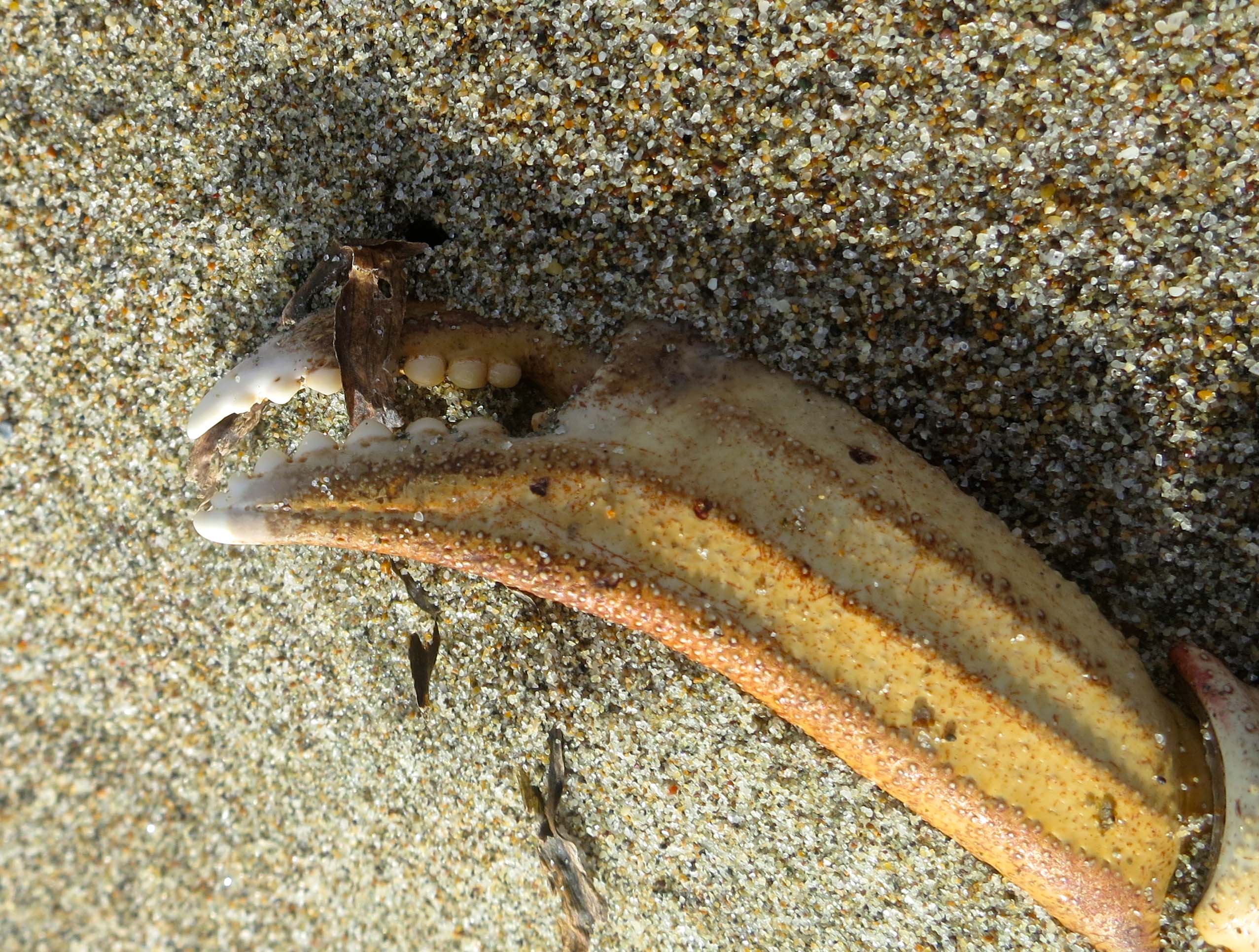
It’s possible that crab was on the menu that night for the raccoons. We found numerous empty shells along the beach. I liked the teeth in this claw.
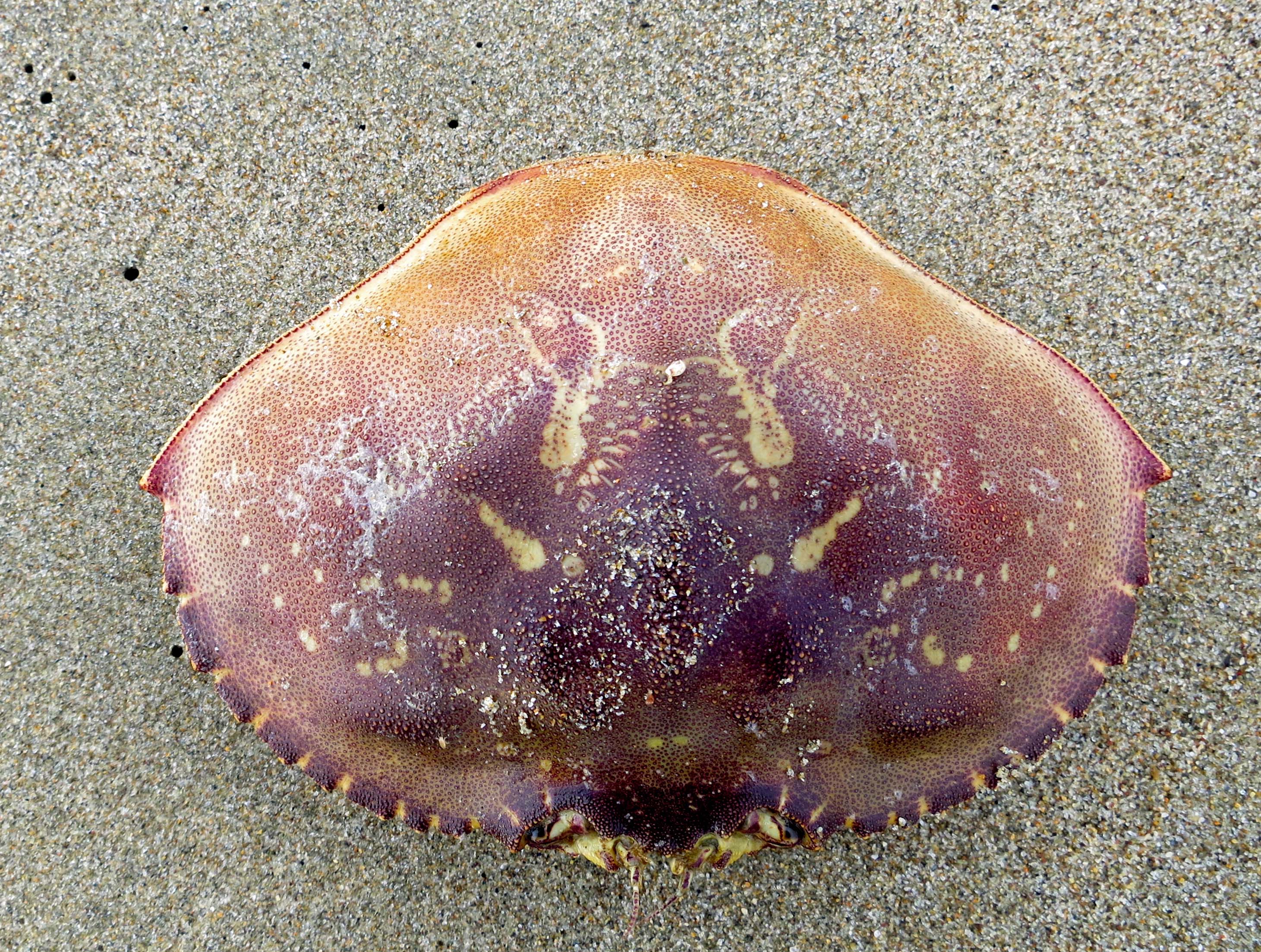
Empty crab shell. Many other birds and animals join raccoons in feasting on the oceans offerings. I also found a set of fox tracks leading down to the beach.

These tracks represent a virtual animal freeway between the sand of the shore and the protective grass and brush of the spit.

The grain of the wood exposed by the relentless pounding of the ocean is what attracts me to driftwood. We found a prime example on the upper beach at Limantour. A tree had been driven upside-down into the ground and was showing off its roots. I was curious about whether man or nature had been responsible for the upending.

A close up of the driftwood with its marvelous twists and turns plus two peek-a-boo holes.
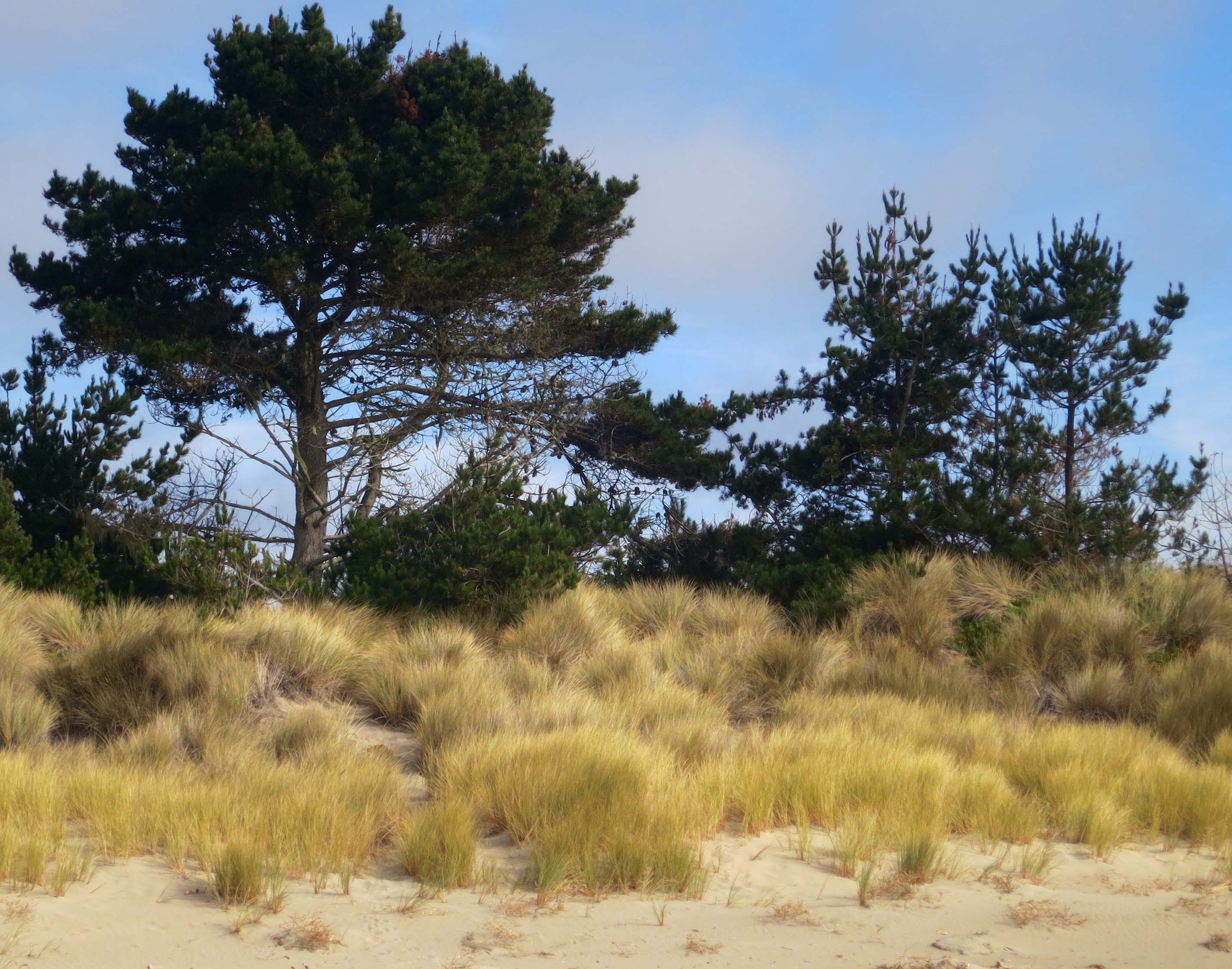
We walked back to the parking lot following a trail along the spit.

Much of the trail made its way through the thick golden grass that dominates the spit and provides a home for Limantour Beach’s wild world.
NEXT BLOG: It’s off to the historic Pierce Ranch and a search for Pt. Reyes’ magnificent Tule Elk. I’ll conclude today’s blog with a black and white photo of gentle waves lapping up on the Limantour Beach.

 Wandering through Time and Place
A little bit of everything here and you make each of them engaging. Very nice.
Thanks Bruce.
Beautiful photos you two! I felt like I was there.
Thanks Alison. Glad you enjoyed it. Pt. Reyes and I go back a long time. –Curt
What beautiful photos you have. You should free lance for National Geographic.
🙂 Thanks. –Curt
Love the idea of Racoons having a crab supper. The Sanderling shots are beautiful.
We found one place covered with crab parts. It made me think of my son and daughter whenever they get near a crab feast. 🙂
Love all the interesting information the post contains. I wonder what happened to that upended tree! It would have taken a team of humans, with extremely powerful machinery to pull that off. My guess is that it was the product of a hurricane!
Probably right. We don’t get hurricanes but major winter storms can really whip up the waves. Thanks for stopping by. –Curt
It’s hard to pick a favorite here, but I think the last photo of the grasses in motion has to be the one. I like the driftwood, too. I have a strange fascination with anything natural with holes in it. Up at the place outside Kerrville, every time I found a limestone rock with a sufficiently large hole, I’d hang it on a tree branch. Someday, someone’s going to wander through there and think, “What?”
The wing angles on those seagulls is interesting. Until I started looking at good bird photography, I’d had a kind of assumption that birds’ wings “work” from their “shoulders”, kind of like our arms. Not so, as those angles prove.
I suspect when they come on your limestone hanging from the trees they are going to wonder what kind of cult they’ve discovered. Could Druids be about working their magic? 🙂
How right you are about bird wings. They seem to include upper arms, forearms and hands. –Curt
Gorgeous scenery. Wonderful photos. Thanks for sharing!
And thank you. Hopefully I captured how much I love the area. –Curt
My kind of place.. such a variety of plants and animals and cute seagulls too!Great pictures Curt (& Peggy)
Thanks Lynn. My kind of place too. 🙂