Held at Gunpoint: Training for Berkeley, and the Peace Corps… Part 1

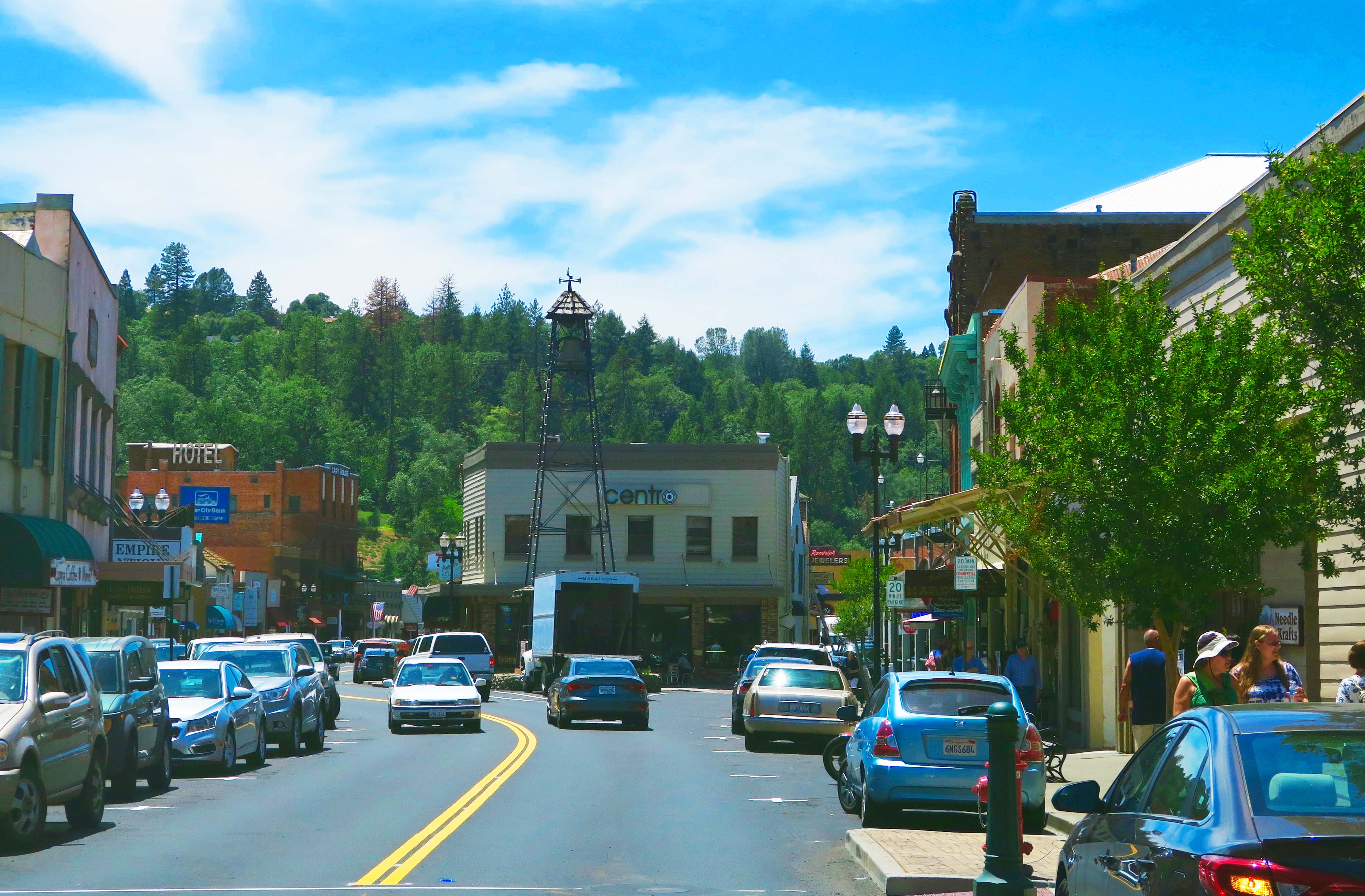
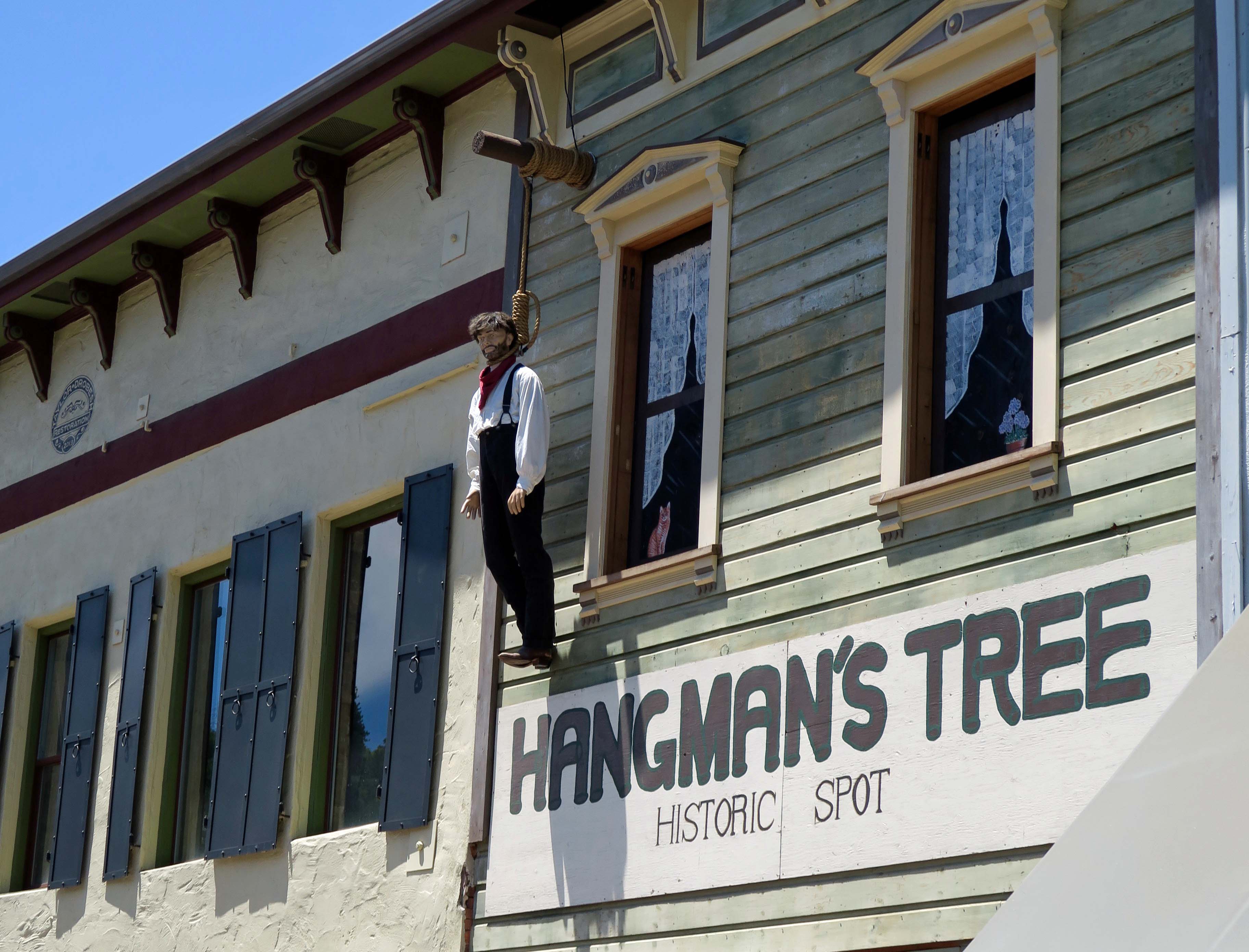
In 1963, I landed a summer job driving a laundry truck between Placerville, California and South Lake Tahoe, a 60 mile drive. I’d pick up dry cleaning and motel linens in Placerville and make deliveries along the way. My day started at 1 p.m. and ended around 10 p.m. six days a week. This is a more recent photo of Placerville, but it doesn’t look all that different. The Bell Tower has been a symbol of the town seemingly forever. As has the hanging man…
Founded during the 1849 Gold Rush, Placerville was known as Hangtown for how it treated outlaws. It’s a heritage the town has strangely— but proudly— maintained ever since. This guy was hanging out on Main Street in the 50s and 60s when I lived three miles away and still hangs out there today. If Guinness had a record on the longest hanging man in the world, he would be it! He must have one heck of a strong neck.

The man leaned on the front of my 56 Chevy and rested his rifle on the hood. The message was clear. I wasn’t going anywhere.  Ten minutes earlier I had been happily sleeping in my trailer next to the Lake Tahoe laundry where I was working for the summer. I woke up and jumped out of bed at the sound of trucks warming up. Oversleeping was no excuse for being late. I looked accusingly at my alarm clock. It said 6 a.m., an hour before I was supposed to go to work. Glancing out the window, I spotted an armed man standing in front of my door. Several others were wandering around the property. The laundry truck drivers were people I didn’t recognize. Lacking a phone to call my boss, I decided it was time to vacate the premises…

The summer between my freshman and sophomore year at Sierra College I graduated from working on pear ranches to being a laundryman. Every afternoon at one o’clock I would zip over to Placerville, pick up clean laundry and dry cleaning and head over the Sierra Nevada Mountain Range to Lake Tahoe via Echo Summit on Highway 50. It was a great job for a college kid. I was provided with a new VW van and was totally on my own except for loading up in Placerville and making my stops on 50 and at the Lake. In between was a beautiful drive through the Sierra Nevada Mountains. There was even a touch of glamour to the work. 

Sugarloaf Mountain located next to Kyburz Resort on Highway 50 in El Dorado County, CA.
This wonderful chunk of granite is known as Sugarloaf and is a favorite view along Highway 50. It’s quite popular among rock climbers, which, like jumping off of high cliffs into water, is another sport I see no reason to pursue.

One of my regular stops at the Lake was Bill Harrah’s home. He was incredibly rich from his gambling empire, and his home seemed palatial to me. Never having mastered the servant concept, I always made my deliveries to the front door and was occasionally greeted by his headline performers who stayed there. This came to a screeching halt one day when a young Liza Minnelli opened the door in her baby doll pajamas. She didn’t seem to mind my admiration, but the major domo directed me to make all future deliveries to the service entry in the back. I had little appreciation for my new backdoor status.
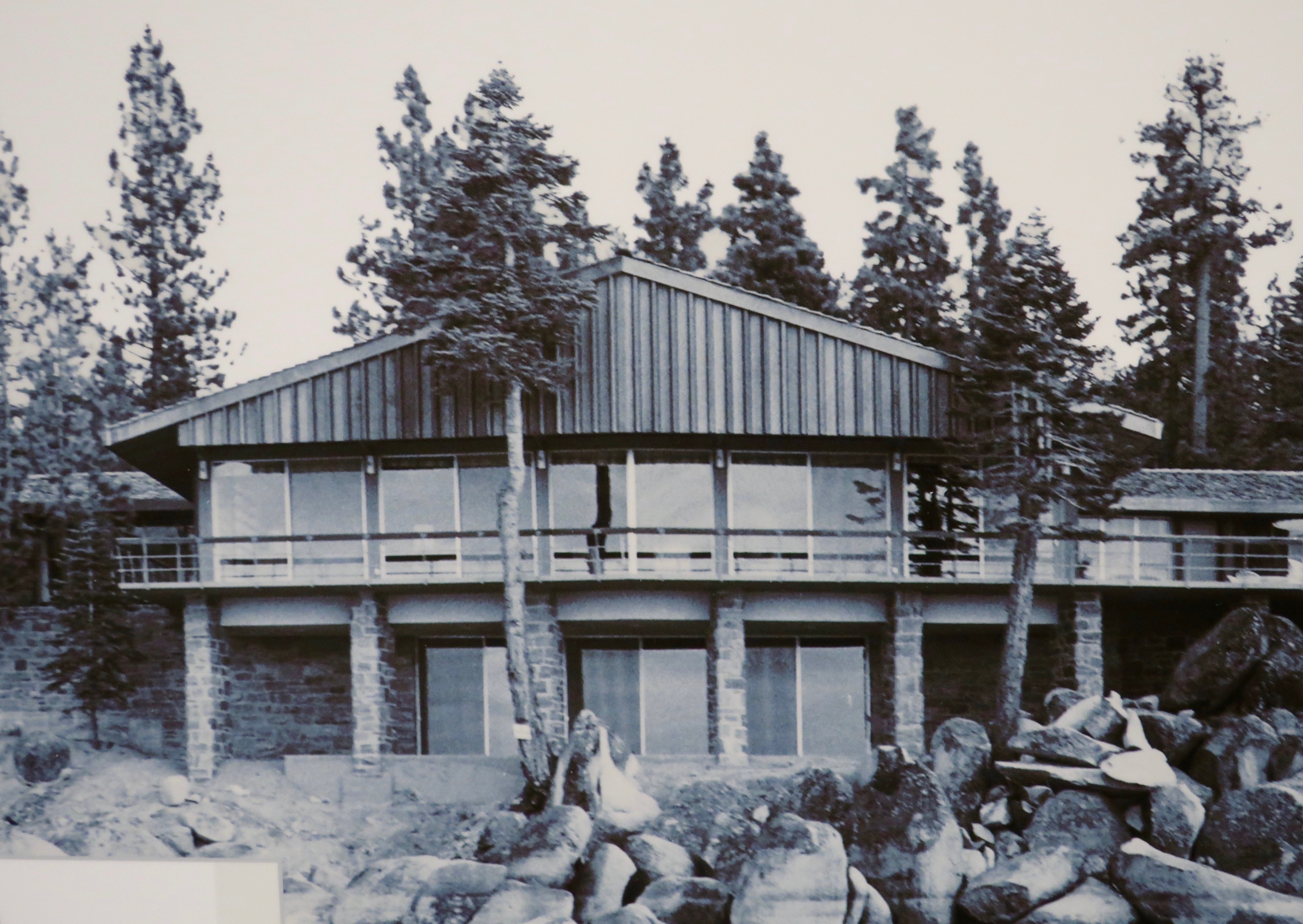
Roger Douvres, my boss, had a contract to handle the dry cleaning for the stars that performed at Bill Harrah’s lakeside casino. They often stayed at his home, where I would make weekly deliveries. The picture windows provide a beautiful view of Lake Tahoe.

The best aspect of the laundry business was that the pay was four times what I had earned working in fruit orchards. Since I lived at home, I was able to stash most of my income away for college needs. Eventually, this would pay my expenses at Berkeley. Those were the enlightened years in California when tuition was free.

In the summer of 1963, Roger asked if I would move up to Lake Tahoe and work for his son-in-law, John Cefalu. John had taken over a laundry that Douvers had owned, sold, and then reclaimed because of back payments. There was an old trailer sitting next to the laundry ‘in need of a little work’ that I would be welcome to use. I jumped at the chance. What twenty-year-old male given a chance to work in one of the world’s top resort areas wouldn’t? The only disadvantage, from my perspective, was the distance from my girlfriend. At least, I consoled myself, there was a beach three blocks away that was normally filled with scantily clad young women. I’d get by.

Things, of course, are rarely as rosy as they seem. To start with, the trailer was a mess. It was probably twenty years old and, as far as I could tell, hadn’t been cleaned it in nineteen. My first weekend was devoted to twenty hours of scrubbing. There were no scantily clad women for Curt. Monday brought work, and it was work. I no longer had my leisurely trip back and forth across the mountains. It was stuff the truck with a mountain of clean linen, dash out to the motels and make deliveries, cram the truck up with dirty linen, and rush back to the laundry— over and over and over.

Fatigue, by the end of the day, usually meant I would crawl in bed and go to sleep. It was not the romantic lifestyle I had imagined. The second weekend, I did manage an obligatory trip to the beach for Female Body Appreciation 101.  But I had no desire for any other relationship and most of what my excursion did was to remind me of what I was missing. I did say mostly, didn’t I? The age of the ‘itsy bitsy, teeny weenie, yellow polka dot bikini’ was dawning, and it was a sight to inspire bad poetry. Not even true love can totally deaden 20-year-old hormones.

My daily routine was about to end, however. I was soon to learn what it was like to be held by gunpoint. I’ll tell the story in my post next Wednesday from The Bush Devil Ate Sam.

NEXT POSTS:

Friday’s Travel Blog: I’m going to leave Oregon’s Harris State Beach for a week and jaunt 360 miles south to Pt. Reyes National Seashore in California to visit the Elephant Seals that hang out at Drake’s Beach.

Monday’s Blog-A-Book… “It’s 4 AM and a Bear Is Standing on Top of Me” : My love of the outdoors (plus a desire to escape from sharing a bedroom with Marshall) led me to move into my backyard the summer between second and third grade. It was perfect except for the tombstones…
Riding Pine Trees, Habanero, a Crowded Bed, and a 1st Grader’s Solo Hike— at 5 AM

In my last blog-a-book post from “It’s 4 AM and a Bear Is Standing on Top of Me,” I returned to the first grade, got spanked, and went on a play date/sleep over with my young Hispanic friends Rudy and Robert. A train locomotive engineer tossed us candy from his cab. The adventure continues today and includes tree riding and my first ever solo hike…

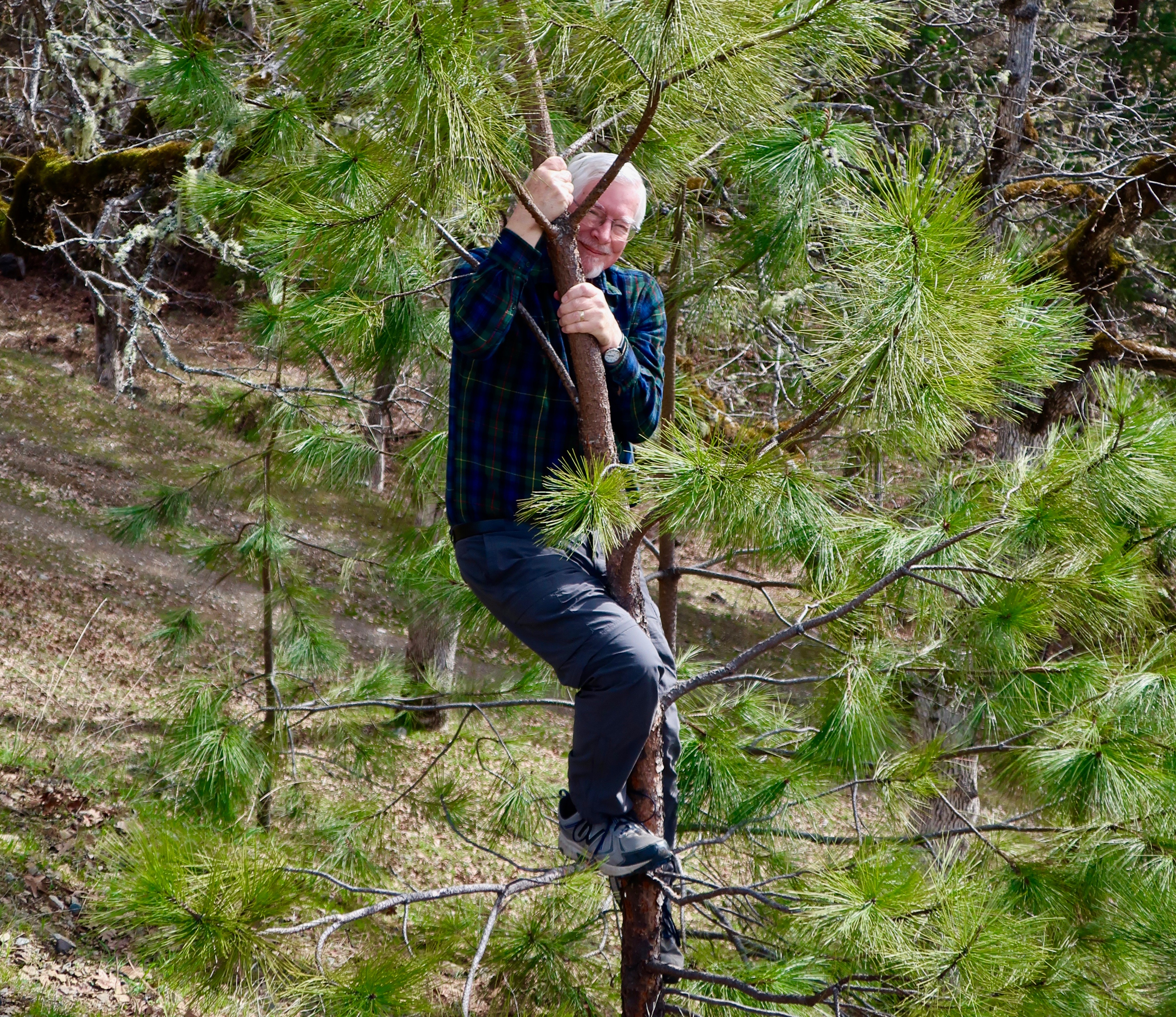
The perfect size pine tree for a first-grader to climb and ride. Peggy suggested I might be a little big— and, at 78, possibly a tad old… Nah.

If one is fortunate enough to live next to the woods as a child, it’s easy to find ways to amuse yourself. After we had collected our candy from the train, dinner was a long hour off. I suggested to Robert and Rudy that we head out to the woods behind their house and ride trees. Who needs horses? My brother and I had learned that we could climb up to the top of young, skinny pines and make them sway back and forth by leaning out. The farther we leaned, the more they swayed. It offered a free carnival-like experience 10-15 feet up in the air. Even more could be accomplished by throwing our feet out in the direction the tree was swaying and hanging on for dear life. If the tree was skinny enough, we could make it bend all of the way down to the ground, where we would drop off and allow it to snap back up. It took a while for me to persuade Rudy and Robert that the sport wasn’t going to kill them.

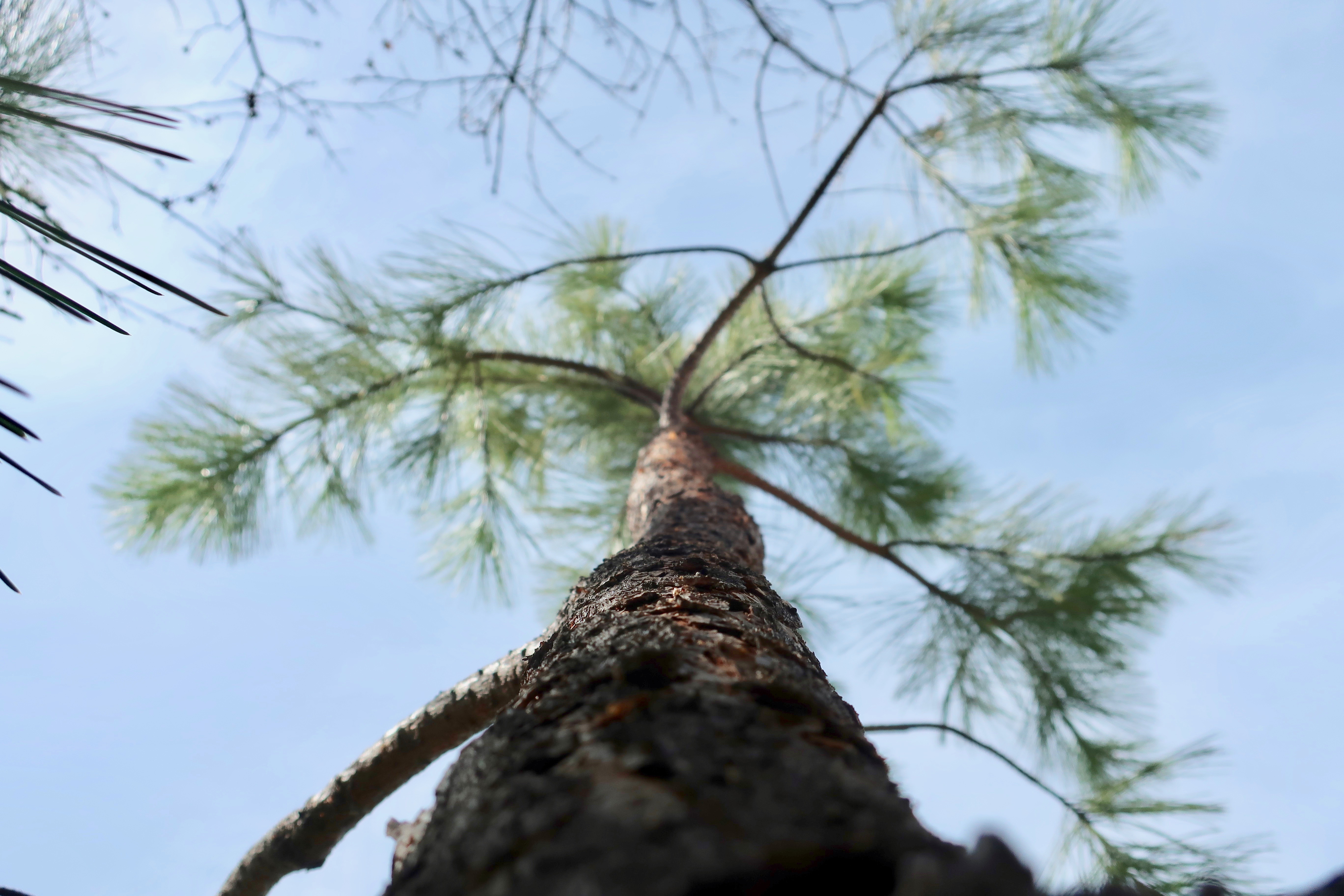
The same tree seen above as a first grader might see it.

I suspect the trees didn’t enjoy the experience nearly as much as we did. When I later read Robert Frost’s poem about children bending birches, I fondly recalled our pine tree horses— or bucking broncs if you prefer.

“It’s dinner time!” came the call so we rushed back to the house and made use of an outside water faucet to wash the pine pitch off our hands. Sort of. Pitch has a way of sticking like super glue. It’s the pine tree’s revenge. Mother had a box of Boraxo at home for the the task. Hand inspections were held afterward.

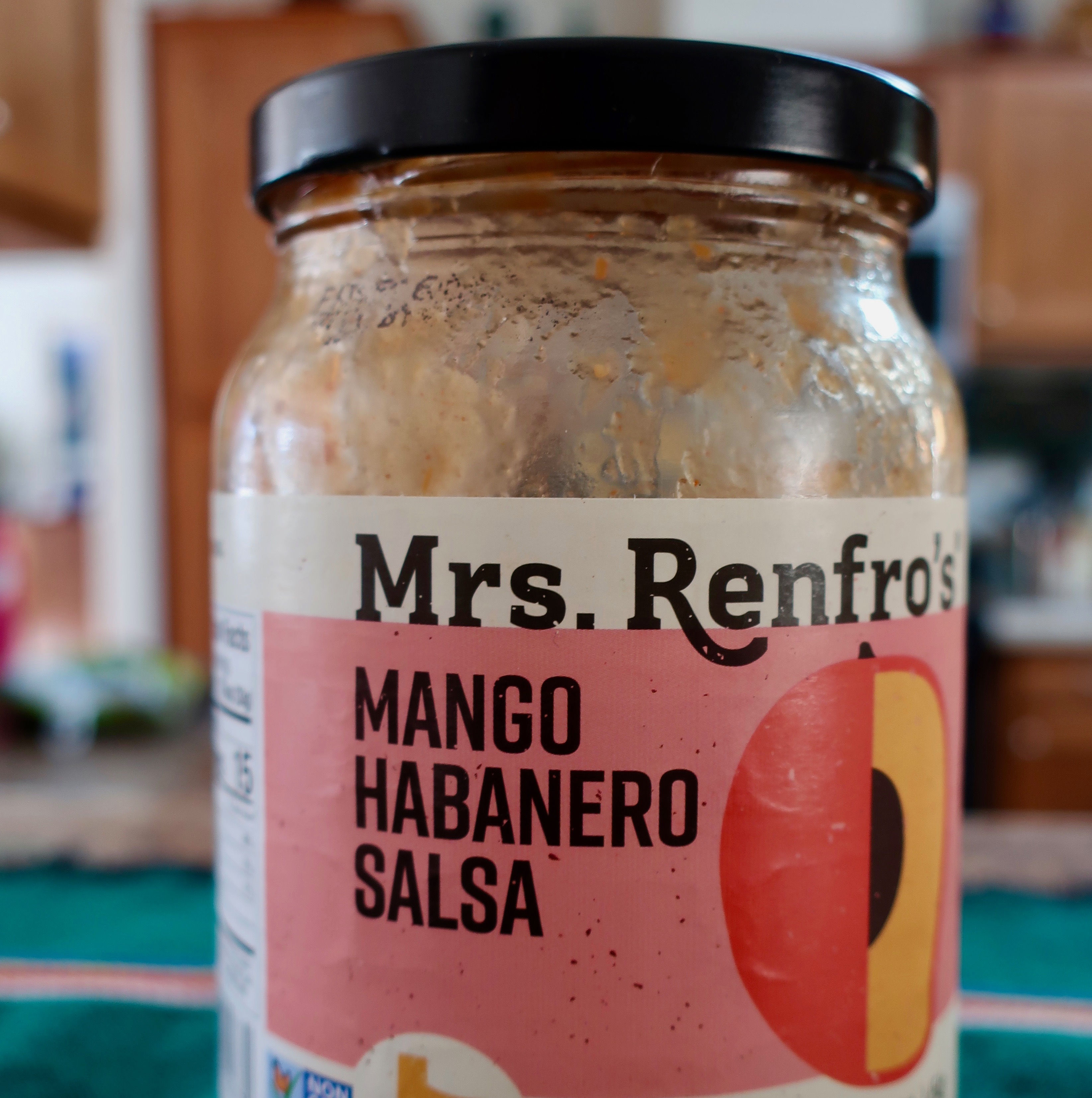
“You have to try this,” Rudy enthused, dashing into the house and coming out with a red pepper. I should have been suspicious when the rest of the family followed him outside. But what does a first grader know? I gamely bit into the pepper and was introduced to habanero-hot. The whole family roared as I made a mad sprint for the faucet and drank a gallon of water, becoming a major part of the evening’s entertainment. It would had served them right later had I peed in their bed. I forgave them when I had my first Mexican dinner, however. I still love Mexican food. And I’ve come to enjoy habanero-hot on foods ranging from burritos to spaghetti.

One of many choices I have on hand for habanero-hot food.

As the night progressed, it soon became time for bed. I was about to flunk sleep-over etiquette.

The boys slept on the same bed. Admittedly it was bigger than my small single at home, but I had never slept in a bed with another person, much less 2 or 3, or maybe it was 10. That’s what it felt like. They put me in the middle. I was mortified, but I tried. I really did. Ten o’clock came and there I was, eyes wide open, staring at the ceiling, body frozen in place— and midnight, and two, and four. At five, I gently nudged Robert.

“I can’t sleep. I haven’t slept all night,” I confessed. “I have to go home.”

“Ummm,” the half-awake Robert had moaned.

I got up, dressed, and slipped out of the house, careful not to wake anyone else. It was close to dark, with only a dim light announcing the morning. Home wasn’t that far away, maybe a mile. But I still remember the journey from a first-grader’s perspective: long and spooky. It was my first great adventure. I followed the dirt road over the railroad tracks out to the Pleasant Valley highway. Not one car zipped by. Fortunately. They probably would have stopped and driven me home. Everyone knew everybody else in Diamond. “Sorry to wake you up Marge, but I found Curt out wandering in East Diamond.” By noon, everyone in town would have heard the story.

I walked past the hill with the cross on it and picked up Highway 49. Halfway home, I came to Tom Murphy’s grocery store. Sodas were stacked in wood boxes in front, waiting to be moved inside. I looked around furtively; I was totally alone. So, I helped myself to a coke; I deserved it. I continued on my journey, walking by the post office, Dub Walker’s store, the barber shop, hardware store, the historic Pony Express stop, firehouse and Gust Brother’s Garage, eventually reaching the dreaded Graveyard. I clutched my coke and crossed the road, preferring Pagoni’s mean dogs to the ghosts. Arriving home, I carefully hid the soda outside. It wouldn’t do to have overly inquisitive parents discover the purloined drink and ask questions. I happily enjoyed it later in the day, feeling much less guilty about stealing than I did about abandoning my friends. I suspect there was a bit of consternation when Rudy and Robert’s parents woke to find me missing. Imagine what would happen today.

Next Monday, it’s back to the Graveyard as I move outside for the summer to commune with nature. And, escape from my brother. It was the best decision of my young life except for one thing: The ghosts. I had to hire protection.

NEXT POSTS:

Wednesday’s Blog-a-Book… “The Bush Devil Ate Sam”: Driving a laundry truck pays for my college education, but it was being held at gunpoint that prepared me for Berkeley and the Peace Corps.

Friday’s Travel Blog: Once again, it’s back to the ocean. Before moving on with my series on Oregon’s Harris Beach, however, I am going to take a brief detour to Pt. Reyes National Seashore, from which Peggy and I just returned. There are some elephant seals we want to introduce you to…

The Starfish of Harris Beach State Park, Oregon

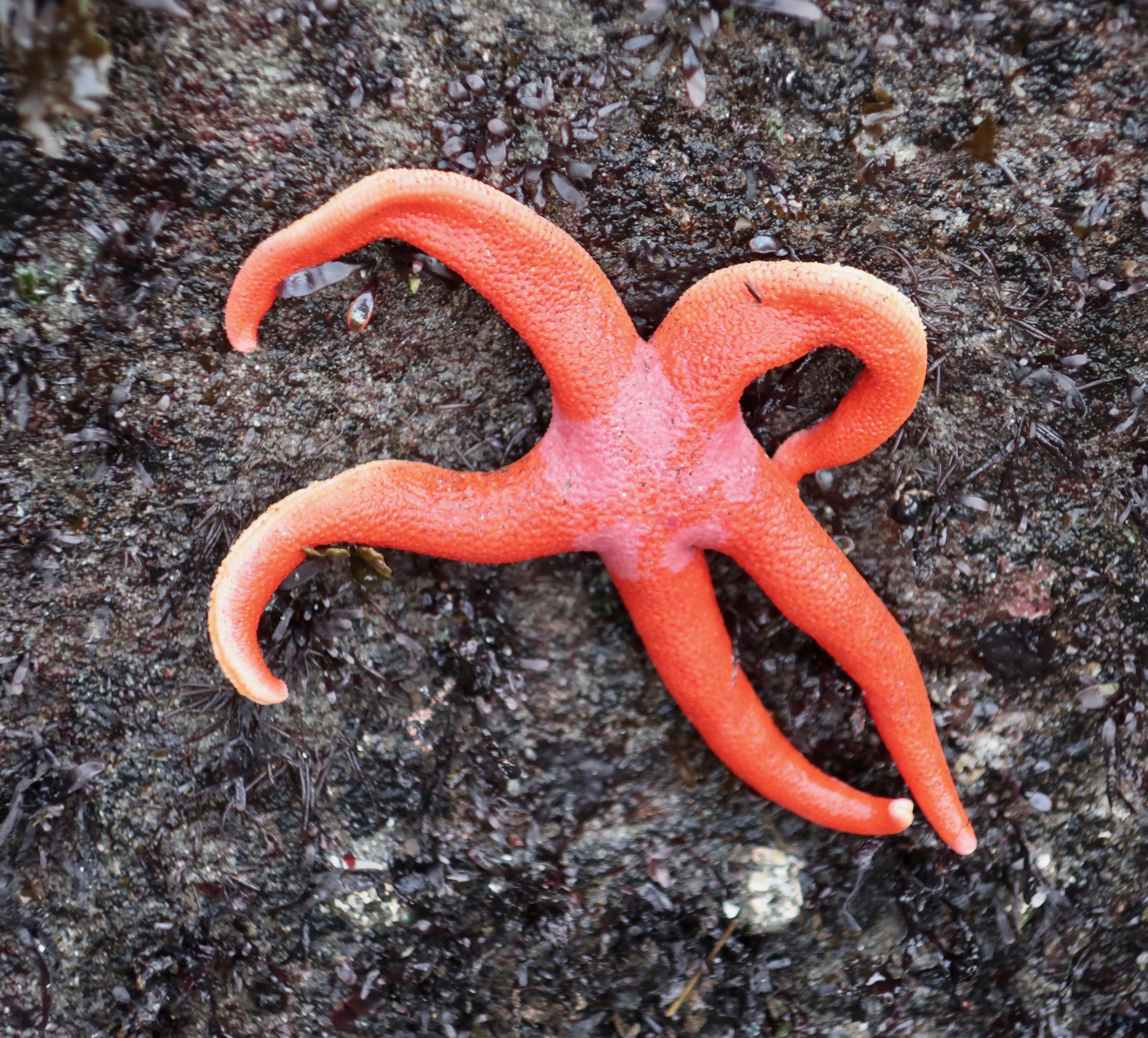
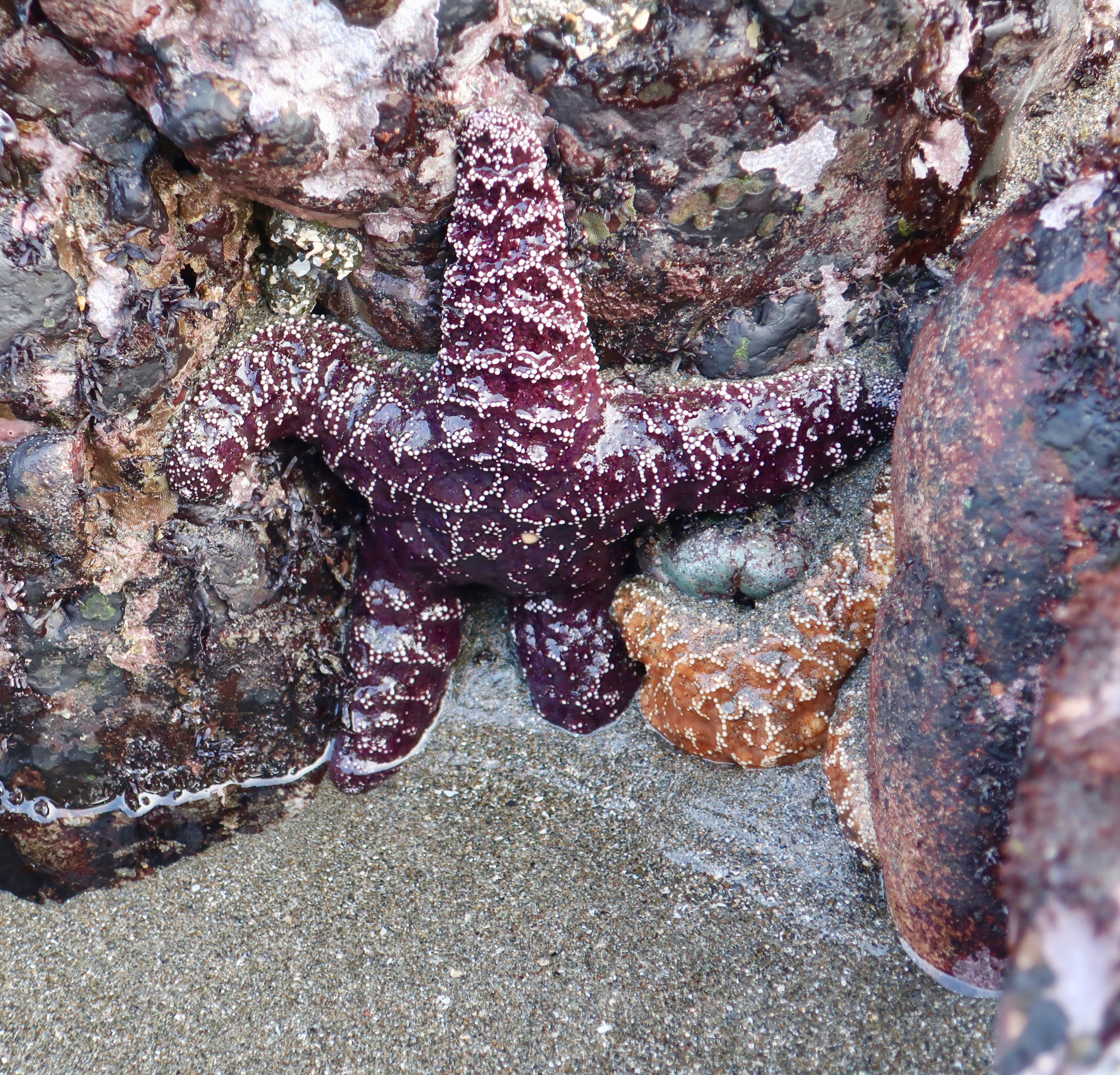
We saw this colorful starfish from a distance and came over for a closer look. It’s scientific name is Henricia leviuscula. It common name is Pacific blood star.
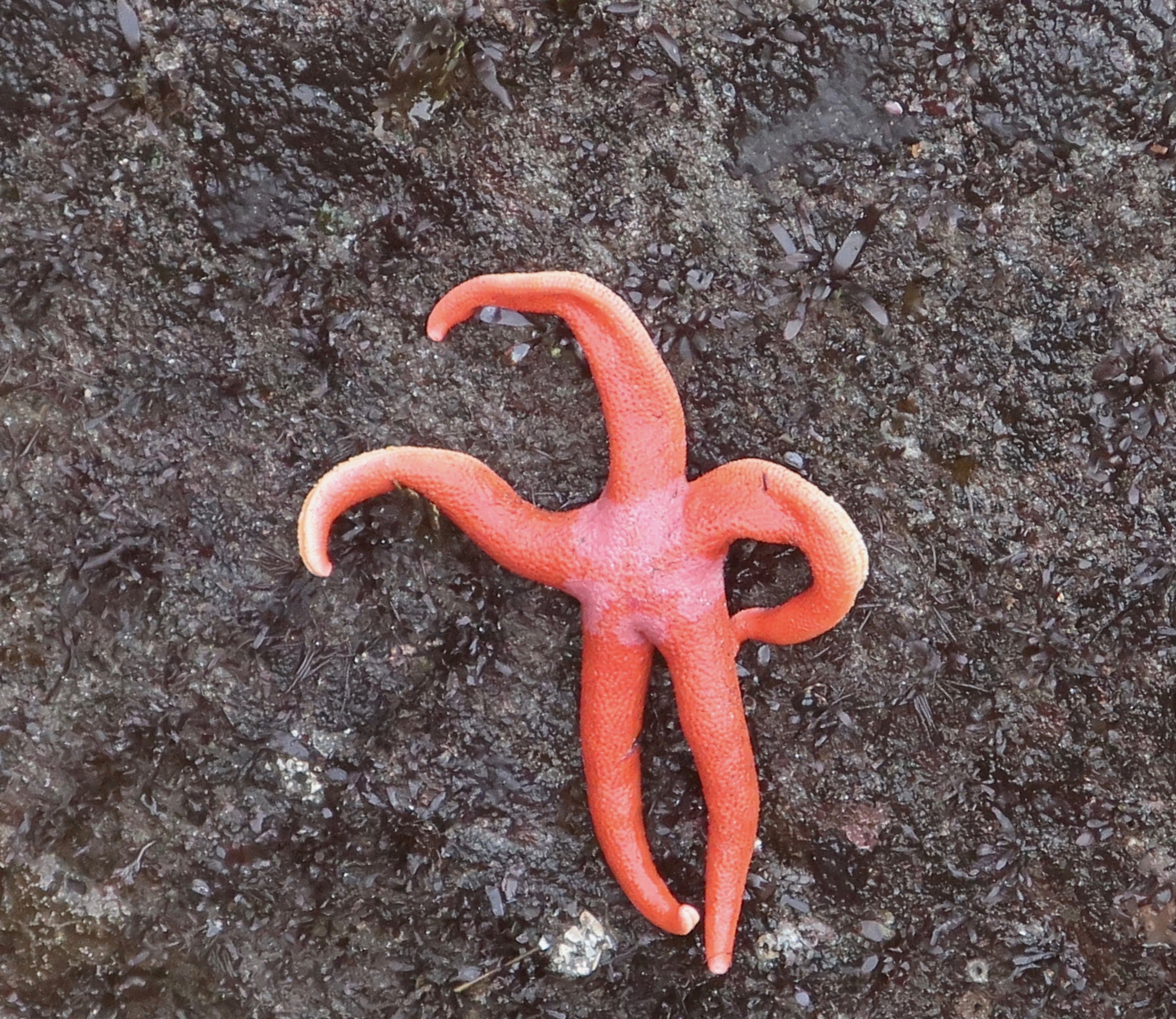
I decided a slight shift in perspective would create a twirling ballet dancer! Or is it a whirling dervish?

We were lucky to find any starfish at all. The population up and down the Pacific coast came close to being wiped out in 2013. A rather nasty virus that melted these attractive creatures from the inside killed millions. Legs would fall off and go crawling away. It sounded like the plot to a Grade B horror flick. Fortunately, evolution came to the rescue. A small portion of the population seemed immune to the virus. Maybe some of the legs got lucky. They came back with a vengeance. We did find a few that were obviously dead. I touched one. It was mushy. Melting.

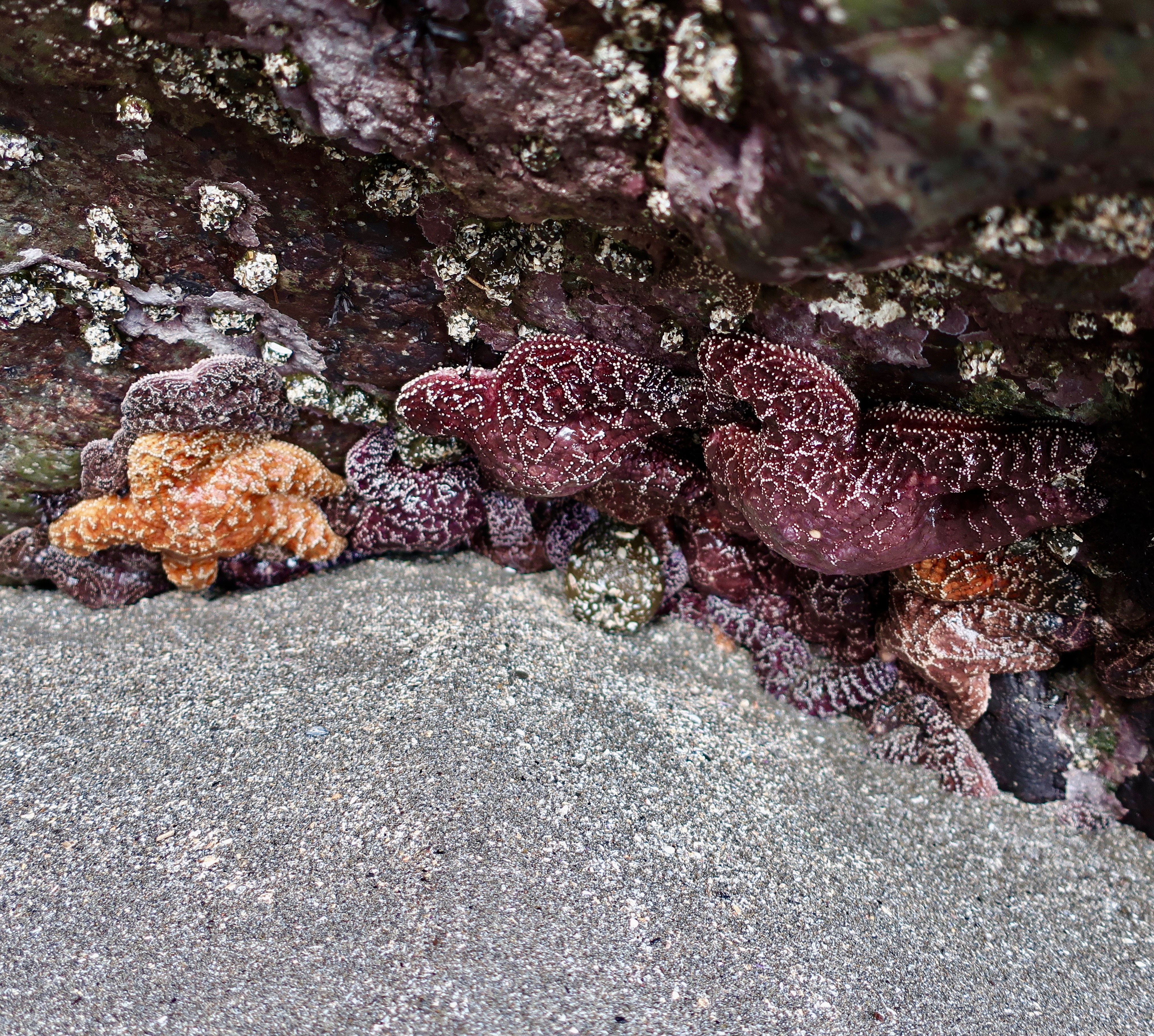
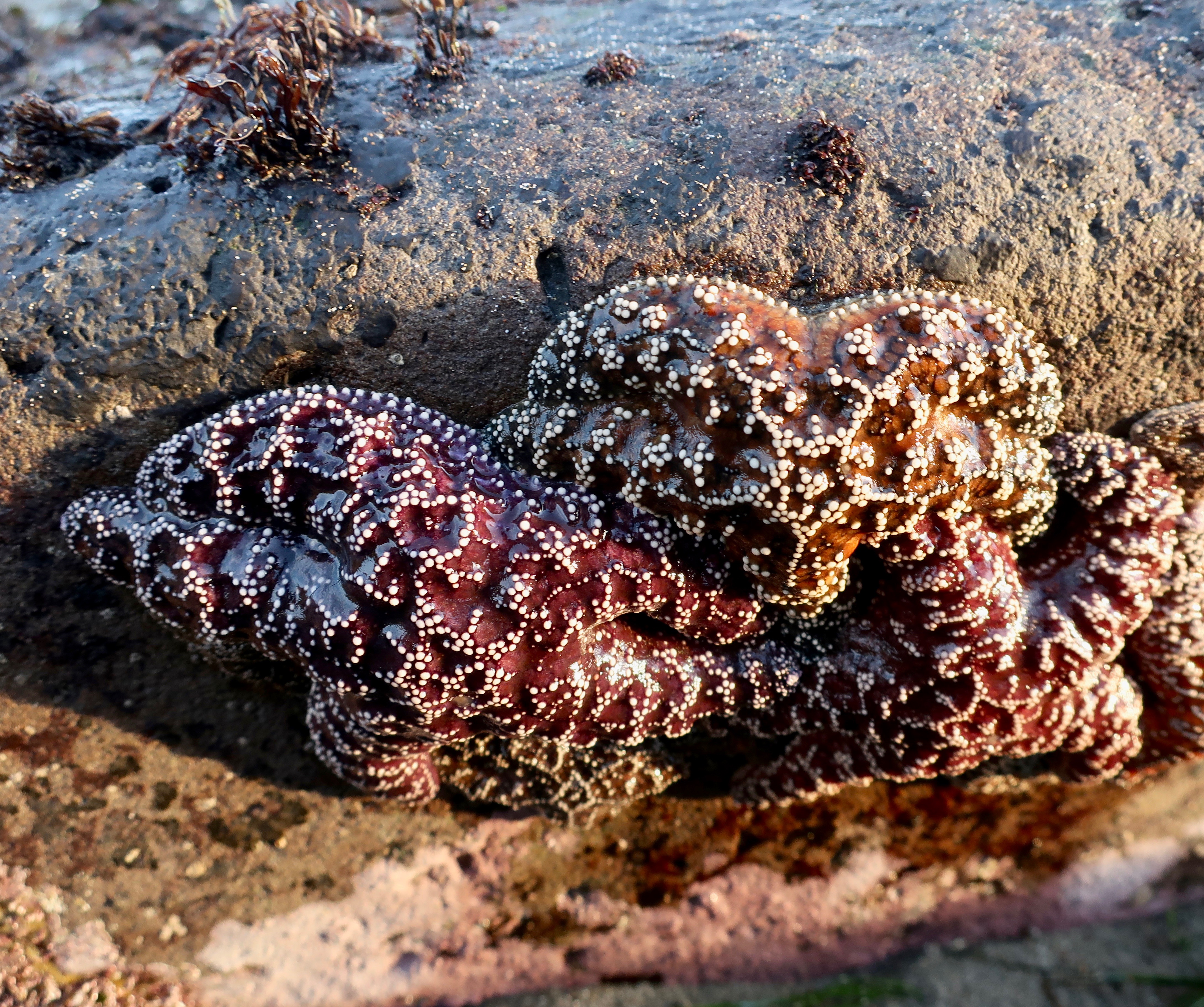
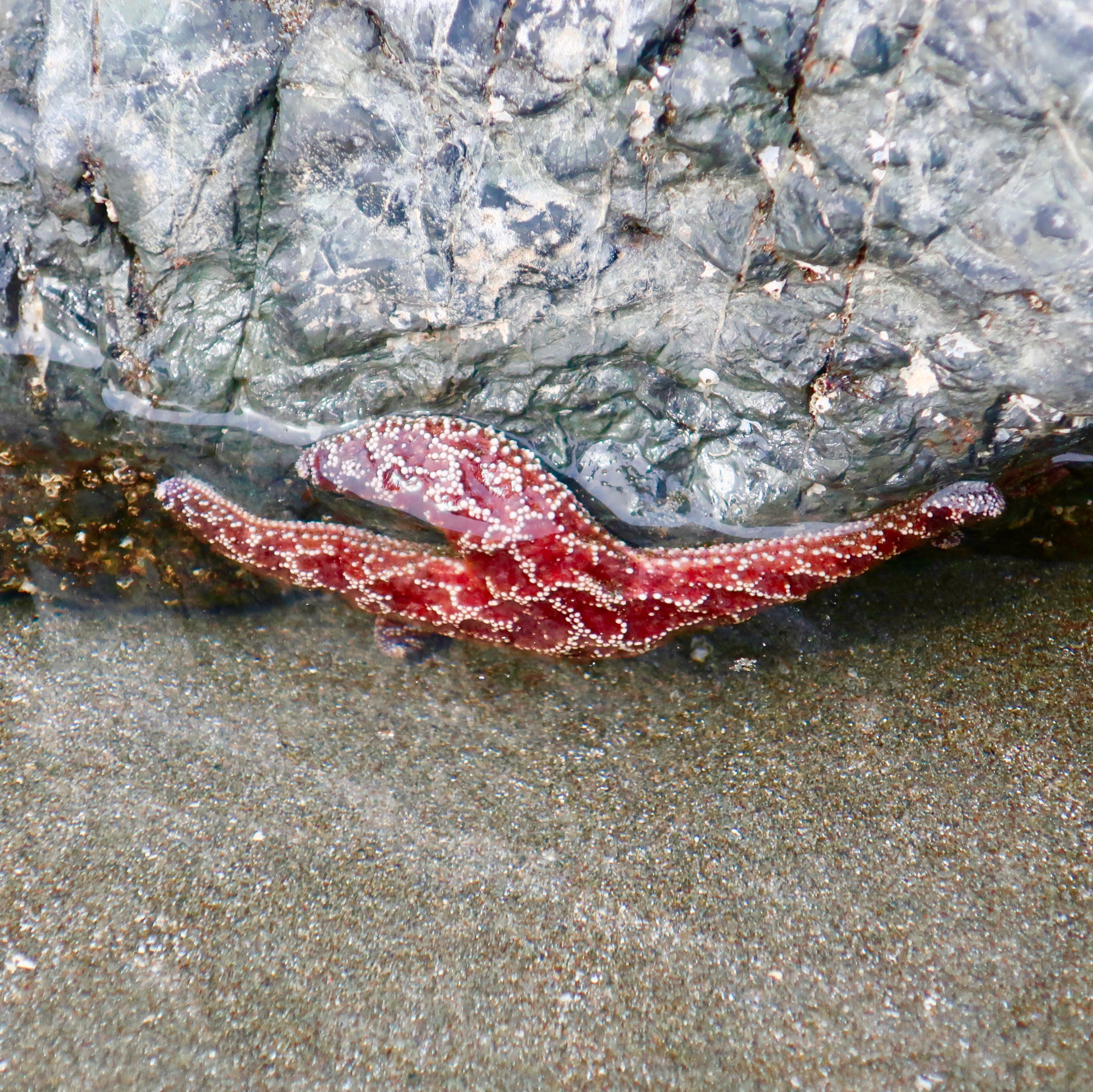
Everywhere we looked we saw starfish. Sometime in bunches. These purple and orange star fish belong to the same family, Pisaster ochraceus. Scientists don’t know why they come in two colors.

Here are some fun facts:

  • These rather amazing five-legged creatures have seawater for blood. It serves the same purpose, delivering nutrients to cells. 
  • Starfish can regenerate an arm lost to a predator. But what if the arm loses its starfish? It can regenerate a new starfish, an exact replica. Pretty cool, huh.
  • They have very small mouths but like large, tasty morsels, like mussels. Not a problem. They have big stomachs. They send them out through their mouths and wrap them around what they want to eat. They digest their dinner and then suck the nutrients back into their mouths, along with the wandering stomachs. 
  • They move around on tiny little feet that are found on their arms. They fill these little feet with water and mimic walking. They travel slowly, at least I have never seen one move quickly. 
  • The feet also serve another purpose; they work as suction cups. The starfish will wrap itself around a closed mussel, attach their little feet, and pull the shells apart. Not an easy task.
  • One more thing about their arms, each one comes with eyes. Not eyes like you and I have but photo receptors that allow them to distinguish between light and dark and move around in search of food, or to avoid becoming food. 

Following are more of our photos:

At first, I thought that the ugly guy above the starfish was seaweed. But looking at it more closely, I decided that it wasn’t something I wanted to meet up with on a dark night.
I’ll conclude with this edgy fellow.

NEXT POSTS:

As you read this post, Peggy and I are on our way to Pt. Reyes National Seashore north of San Francisco. When she asked what I wanted to do for my birthday week, it popped up. The National Sea Shore is one of my all-time favorite places and I have been escaping there for 50 years. So, beyond responding to comments, I will be taking a break from blogging and reading blogs this coming week. Translate: Vacation! I’ll be back to work on March 8. See you then. –Curt

Harris Beach State Park… Another Gem on the Oregon Coast: Part 1

Harris Beach State Park is located just north of Brookings, Oregon, which, in turn, is located north of the California border. It is one of a number of beautiful state parks located along the coast.

Peggy and I just returned from visiting another of the scenic state parks along the Oregon Coast. This time we followed the Redwood Highway from Grants Pass to Crescent City, which, in itself, is worth the trip. Highlights included following the plunging Smith River as it tumbles down to the Pacific Ocean and winding through the giant trees of Jedidiah Smith Redwood Park. (Smith, BTW, was an early mountain man, explorer, pioneer and author in the western US. His name is on lots of places. Had I been in his boots, those places would be named Mekemson. Grin.)

Harris Beach State Park is a short 26 miles from Crescent City following Highway 101. It’s about three hours from our home. We lucked out and got a campsite overlooking the Pacific that is normally booked months in advance. We don’t do months in advance.

The park is named for George Scott Harris, a native of Scotland. According to the Park website, he obtained the property in 1871 after a lifetime of wandering, which included serving in the British Army in India and spending time in Africa and New Zealand.  In 1860, he made it to San Francisco where he worked in railway construction and mining, finally migrating to what would become the park, settling down, and raising sheep and cattle.

We’ve visited the park before. This photo is from one of our trips. You can see why we would want to return.

While we are always fans of reflection shots, Peggy and I found something else to amuse ourselves with this time: Tide pools. Half of our beach time was spent ferreting out sea life. I plan to feature what we found in this five part series including starfish, anemones, hermit crabs, snails, limpets, chitons and seaweed. Oh my! Plus. Naturally, there will also be sea stacks, driftwood, unique rocks, and sunsets— the types of things one expects when visiting the Oregon coast. Today, I will post a few introductory photos to the park.

Looking down on the beach. We timed our visits for low tide so we could visit the tide pools. People walking on the beach provide perspective.
Looking out to sea.
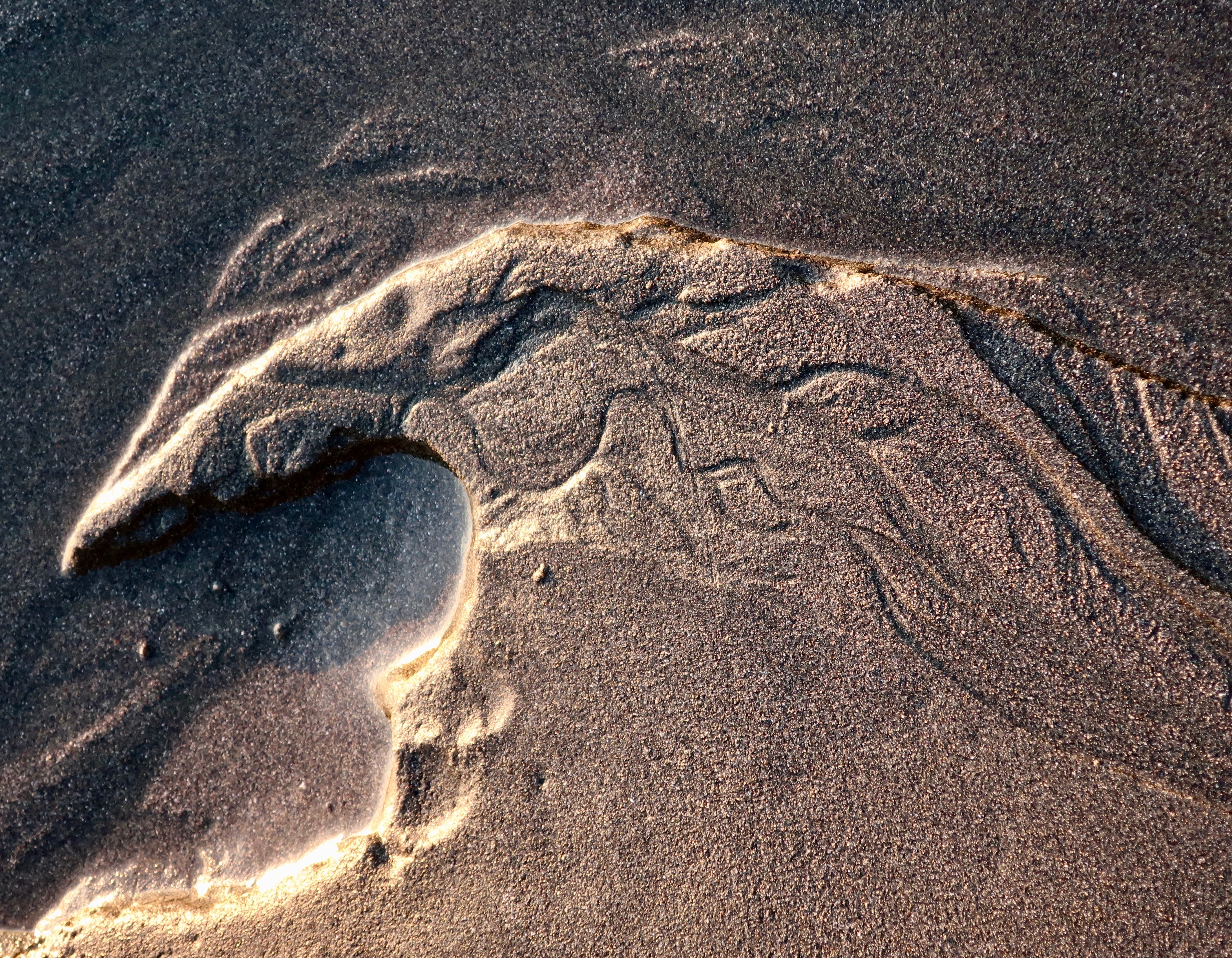
It pays to look down, as well. Interesting patterns can be found in the sand. Temporary art, soon to be washed away. This reminded me of a ferocious ocean bird. Travel back from the long, pointed beak to the fierce eye.
Looking up provided a view of a dead tree, yellow flowers and rock. The yellow flowers are bourse, another visitor from Scotland that came to Oregon and decided to stay.
A whole different world exists on top of the rocks. Seabirds find the seat stacks at Harris Beach an ideal place for raising families.
Speaking of nesting, the largest island on the Oregon Coast is just off of Harris Beach. Known as Goat Island, it is also known as Bird Island since over 100,000 birds nest here in spring, including tufted puffins.
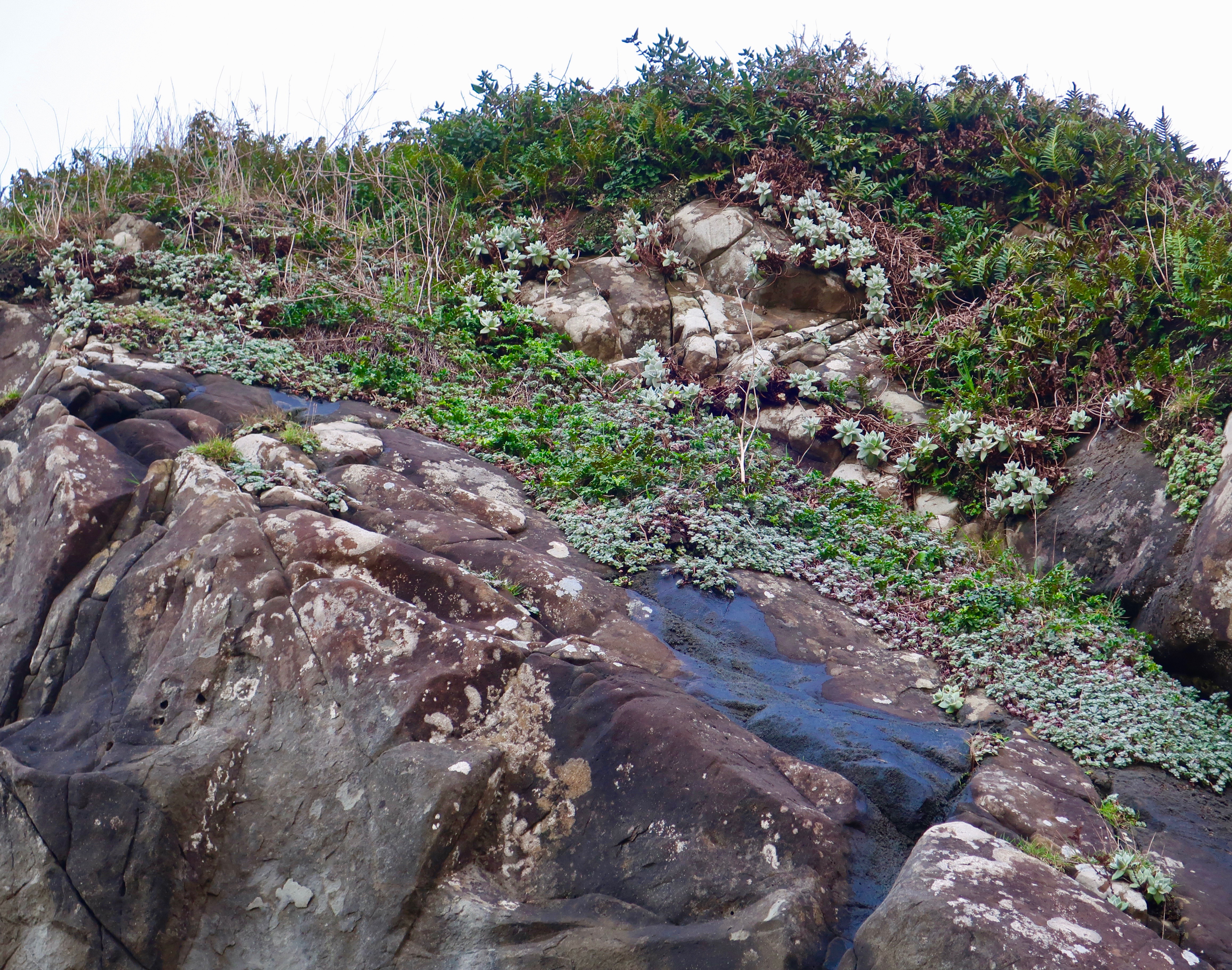
The rocks also have unique stories to tell.
While I like drift wood because of the character it develops bouncing around in the ocean, many people find other uses for it. One person’s photo op is another person’s fort! Or possibly, a beach campfire.
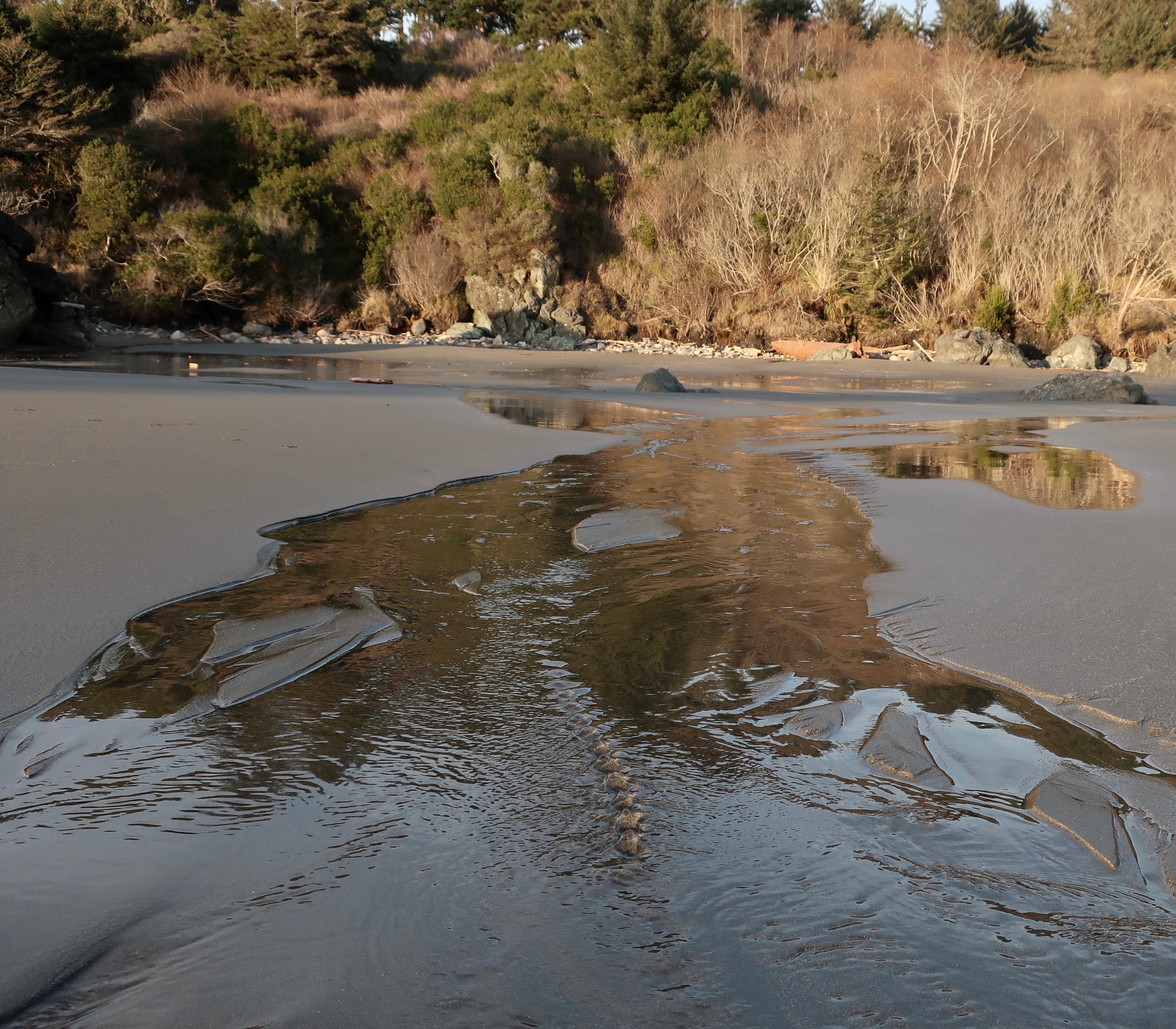
If you need a change of scenery, look back toward shore. My focus here was on the shallow stream spreading out over the sand.
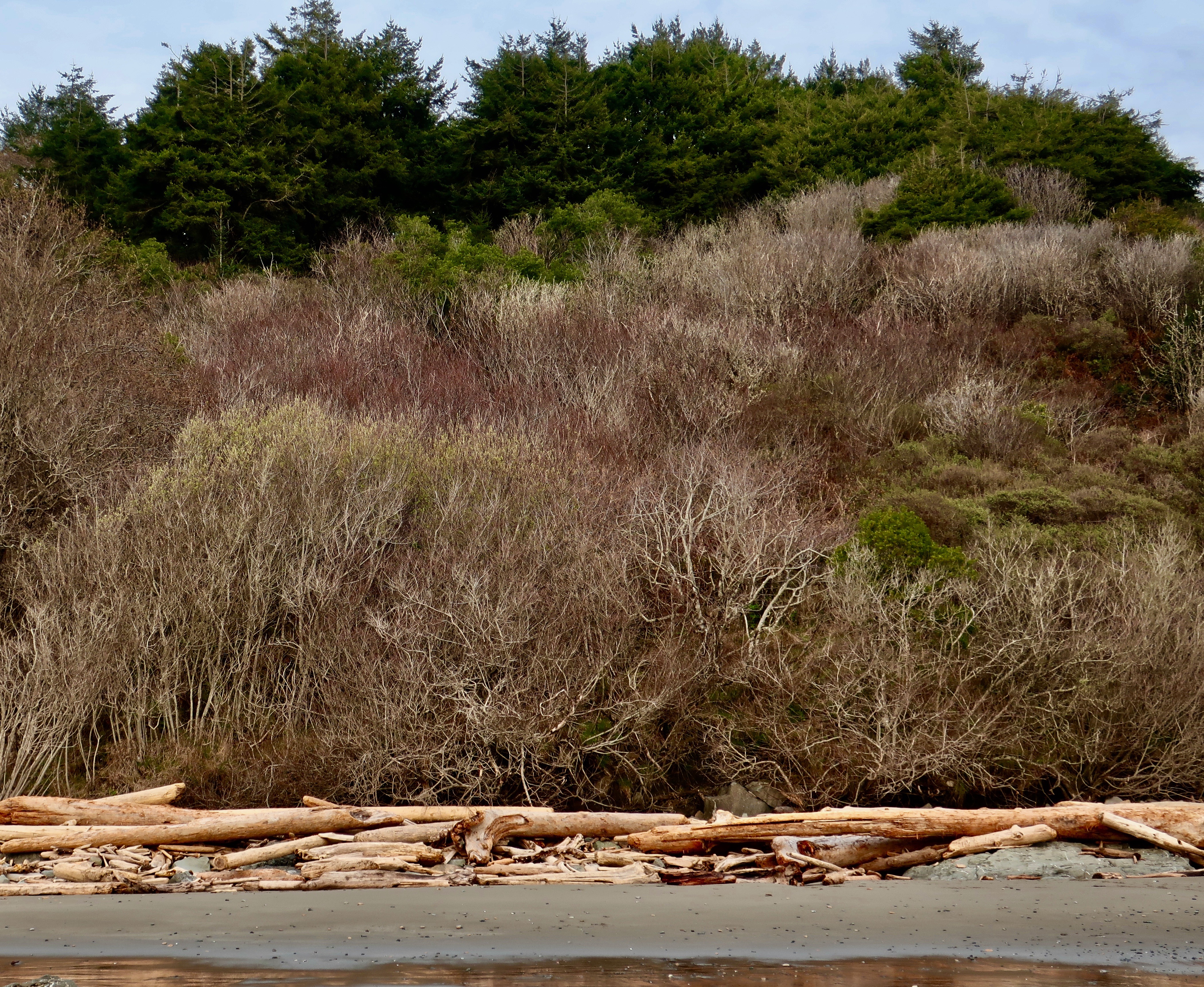
Here, I liked the distinctive layers starting with the sand and working upward. Note the size of the driftwood logs.
A closer perspective.
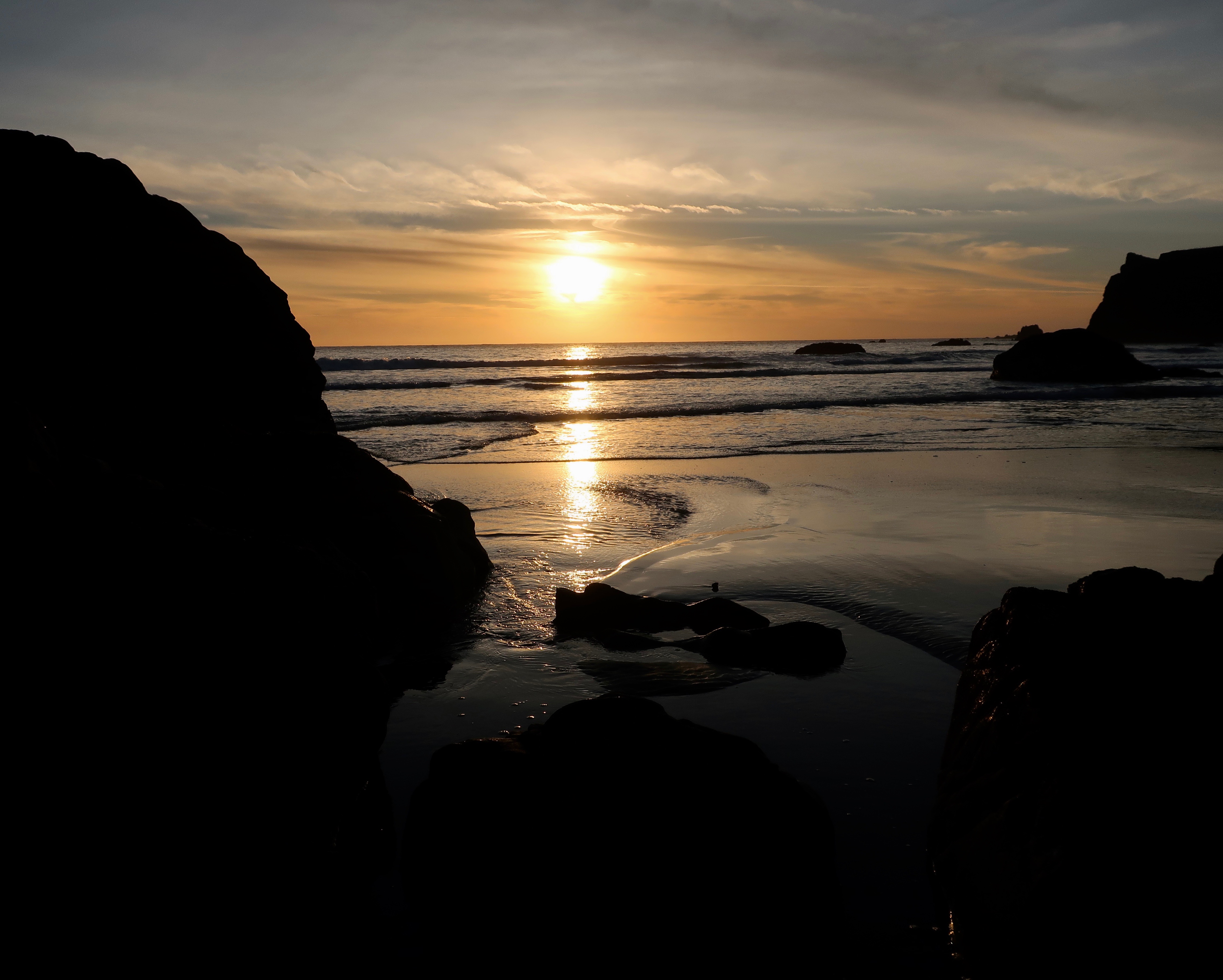
I’ll conclude todays’ post with a sunset. Next Friday I am going to focus in on star fish, also known as sea stars. They were almost wiped out in the past few years by a virus but have made a miraculous recovery.

NEXT POSTS:

Monday’s Blog-A-Book…It’s 4 AM and a Bear Is Standing on Top of Me: I discover that the overgrown, jungle-like graveyard next to our house is a great place to play during the day but becomes very scary at night when the ghosts come out.

Tuesday’s Blog-A-Book… “The Bush Devil Ate Sam”: While driving a laundry truck to earn money for college, I meet a young Liza Minnelli in her babydoll pajamas at casino magnate Bill Harrah’s home, and am held at gun point during a laundry takeover at Lake Tahoe. Later on, I was amused by the thought that it was good training for me as a student at Berkeley and as a Peace Corps Volunteer.

First Grade Flunkee… Growing Up in a Graveyard

Today, I am starting Section 2 of my book, “It’s 4 AM and a Bear Is Standing on Top of Me.” This section is titled, “Growing Up in a Graveyard,” which reflects that my first wilderness came with tombstones and ghosts. In Section 1, I took you along on the first backpacking trek I ever led. I quickly learned that leading 61 people aged 11-70 on a 100-mile trip across the Sierra Nevada Range came with challenges, to say the least. I spent a lot of time asking myself what in the world led me to do it. I begin to answer those questions in this section by taking you back further in time to the events in my childhood that led me to my love of the outdoors. Admittedly, the 1940s and 50s were a while ago. I’ve picked out the stories that are clearest in my mind and most relevant. Some, I’ve thrown in just for fun.

The question here is why should such an innocent looking child be kicked out of the first grade for a year…

I can still hear the clanking treads and feel the bite of the blade as my D-8 dug into the side of the steep hill. Dirt and rocks tumbled into the canyon below. I was working alone, cutting a logging road across mountainous terrain. The hot September summer sun was beating down; my body was drenched in sweat and covered in dirt. And then it happened. A portion of the cliff gave away— and the bulldozer went tumbling off the edge. 

“Oh, fuck!” I had yelled. 

It was a wonderful word, one that I had learned from my seven-year old brother. I didn’t have a clue what it meant, but it was deliciously bad. At five years of age, I was too young to be operating a bulldozer by myself in our backyard, even if it was only four-inches long, and the road I was cutting was along the edge of our compost pit. But my mother wasn’t the hovering type; she drank a lot. Empty wine bottles had a way of mysteriously appearing under her bed and in the clothes’ hamper that hid out in the closet. Being outside was better than being inside. My mother’s alcoholism was my introduction to being alone with nature.

I wasn’t totally alone. Coaly, our black Cocker Spaniel, was assigned babysitting duty.  At “fuck!” she wagged her tail and barked into our compost pit where the toy had fallen. 

“Go get the bulldozer, girl,” I urged. She gave me a ‘go get it yourself’ look. She wasn’t the ideal faithful-dog. The gray hair around her nose and aching joints spoke to her advanced years.  She had little tolerance for my youthful pranks. Healing scars on my foot reflected how little. My first-ever job was to feed the pets. I’d open a can of Bonnie dog food on both ends, push it out with one of the lids, and then use the lid to divide it up. The earthy horse-meat smell still lingers in my brain. Coaly got half, and each of our cats— the black Demon and the white MC— got a quarter. She’d wolf down her food down and then go after the cats’ portion. 

That summer I had discovered that Coaly growled ferociously if I messed with her share. I fed the animals outside on paper towel plates, the finest of china.  I always went barefoot in the summer and it was easy to reach over with my big toe and slide their food away. I quickly learned to leave the cats with their lightning fast claws alone. But Coaly was all growls and no bite. At least she was until she sunk her teeth into my foot. I ended up in the ER with a tetanus shot, stitches and zero sympathy. Coaly ended up gobbling her dinners and hassling the cats in peace.

At the time of the bulldozer incident, I had been granted a reprieve from school, or, to put it bluntly, I had been kicked out of the first grade— for a year. My mother was not happy. She had good reason to drink.

As her last child to enter school, she had been eager to get me out of the house. Make that desperate. The evidence is irrefutable. California had a rule then that five-year olds could go to the first grade if they turned six on or before March 1 of the following year. There was no such thing as kindergarten, at least in Diamond Springs in 1948. Since my birthday was on March 3, I missed the deadline by two days. Darn. Mother’s reaction was more colorful. She made a command decision. Forty-eight hours were not going to stand in the way of her little boy’s education, or her freedom. So, she changed my birth certificate.  March 3 was carefully erased and March 1 entered. I was bathed, dressed and shipped out, not the least bit aware that I had matured by two days. I think I recall hearing music and dancing as my sister took me off to school, a block away.

Things weren’t so rosy at school. The other kids were all older, bigger, and more coordinated. For example, Alan Green could draw a great horse. It came with four legs, a tail, a head and a flowing mane. Mine came with unrecognizable squiggles. It was hard to tell whether my objective was to draw a tarantula or a snake with legs, but the world’s wildest imagination on the world’s most potent drug wouldn’t have classified the picture as a horse. It was not refrigerator art. The whole exercise created big-time trauma. 

This negative experience was compounded by the exercise of learning to print within lines. Forget that. If my letter came anywhere close to resembling a letter, any letter, I was happy. The teacher was more critical. 

“Curtis, I asked you to make Bs, and here you are printing Zs.”

“So what’s your point?” was not an acceptable response. Mrs. Young was suspicious and that suspicion increased each day I was in school. She was a tough old gal who had been teaching first grade for decades. She knew first graders and I wasn’t one. As for the birth certificate, Mother’s forgery was in no danger of winning a blue ribbon at the county fair. I still have the original for proof. After a few weeks, Mrs. Young sent off to Oregon for a copy. I remember her calling me up to her desk on the day it arrived.

“Curtis” she explained, “you have a choice. You can either go home now or you can go home after school. But either way, you are going home and can’t come back until next year.” 

Mrs. Young was a tough old gal who had been teaching the first grade for decades. The kids, BTW, are Clifford Drake and Bob Bray. Bob is still a close friend today. You will hear more about him in these tales.

Just like that, I was a reject, a first grade flunkee. 

Mrs. Young couldn’t have made it any clearer; Mother was going to get her little boomerang back. This was okay by me, if not by her. Playing out in the backyard was infinitely more fun than competing in ‘Scribble the Horse.’ I did decide to stay for the day. Mrs. Young was reading about Goldilocks to us after lunch and I wanted to learn if the bears ate her.

It would have been interesting to listen in on the conversation that took place between Mother and Mrs. Young, or even more so between my mother and father, or Pop, as he was known to us. I’ve often wondered if he participated in the forgery or even knew about the March 1 rule. I doubt it. He was not the parent frantic to get me out of the house during the day.  (Had it been in the evening, the jury might still be out, as my father reported to me later.) But I wasn’t privy to those high-level discussions. My job, which I took quite seriously, was to enjoy the reprieve. I was about to begin my wandering ways. The Graveyard was waiting.

NEXT POSTS:

Blog-A-Book Wednesday… “The Bush Devil Ate Sam”: I move from being hit by a baseball bat and put in the hospital because of my Republican leanings as a fourth grader to developing a more liberal perspective in community college that would lay the groundwork for my joining the Peace Corps.

Travel Blog Friday… It’s off to the coast again with a Covid-19 escape to Harris Beach State Park just outside of Brookings, Oregon.

Born to Wander: Part 2… Great Uncle William Gets His Head Chopped Off

Edison Marshall, my great uncle, grew up in the town of Medford, living for a while with his extended family that included my mother as a child. His writing brought him fame and fortune, including this mansion near Augusta, Georgia.

I was born to wander; I’m convinced of this. Whatever lies over the next horizon calls to me and pulls me onward. Eventually this need to roam would be a factor in my decision to join the Peace Corps. It may be genetic. I come from a long line of pioneers and adventurers. Before Mother went trolling and landed Pop, he had lived in Nebraska, Washington, Iowa, Oklahoma, Colorado and Oregon. I’ve no doubt that lacking an anchor of three kids and a wife, he would have kept on going and going, just like the Energizer Bunny. Happily so. And so it has been with most of my ancestors.

Restless urges sent members of both my mother and father’s families on their way to the New World in the 17th and 18th centuries, and kept them moving west in the 19th and 20th. Puritan Marshalls packed their bags and sailed off for the New World from England in the 1630s. The Scotch-Irish Mekemsons arrived in Pennsylvania from Ireland in the 1750s, spent the Revolutionary War years in upper Maryland, and had moved on to Kentucky by the 1790s. My dad’s family tree shows that my Great, Great, Great uncle was a companion to Daniel Boone.

The cry of gold sent both Marshalls and Mekemsons scurrying to California in the 1840s and 50s. 

George Marshall left his wife Margaret pregnant with my Great Grandfather on his trip to the goldfields. It was a good thing; no pregnant wife would have meant no me. George struck it rich, but his new found wealth didn’t make it back to Illinois. He was killed, stripped of his gold, and thrown into the Pacific Ocean on his way home, or so the legend goes. It was tough and often deadly on the frontier. Not that this cured any of my family from their wandering ways. The drive to roam far outweighed whatever the risks might be. One of my favorite family stories illustrates just how deadly frontier life could be. 

William Brown Mekemson, my great, great uncle, ended up on the wrong end of a tomahawk (or several) during the Black Hawk Indian War of 1832. A 1903 book by Frank Stevens describes the event. The Indians had attacked the night before, stealing a horse. Captain Snyder decided to pursue the Indians the next morning and caught up with them “firmly entrenched in a deep gulch, where, in a sharp hand to hand encounter, all four were killed with the loss of only one man, Private William B. Mekemson, who received two balls in the abdomen, inflicting a mortal wound.” 

Except it wasn’t immediately mortal. Mekemson was placed on a litter and transported back toward camp. Along the way he pleaded for a drink. A squad was assigned to climb down to the creek and fetch water. At that point the Indians struck again. Some 50 or so “hideously yelling, rushed poor Mekemson and chopped off his head with tomahawks…” and then rolled it down the hill. That was mortal.

The greatest wanderer among my modern-day relatives was my Grandfather’s brother, Edison Marshall, or Uncle Eddie as my mother called him. He was an accomplished writer quite popular in the 20s, 30s, 40s and 50s. His short stories even made it into the high school literature books of the day and nine of his books were converted into movies. The first to obtain silver screen status was “Strength of the Pines” in 1922 and the last was “The Vikings” starring Kirk Douglas, Tony Curtis, Ernest Borgnine and Janet Leigh in 1958. He had a long and profitable career.

I never met the man; his Augusta, Georgia mansion was a long way from our converted World War II army barracks house in Diamond Springs. But we did have a collection of his autographed books. They were swashbuckling historical novels that had his heroes such as Marco Polo wandering the world. Edison wandered along with them, doing research for the books and pursuing his passion for big game hunting.

We had a hand-me-down 1920’s Encyclopedia Britannica atlas of his where he had outlined his personal journeys in the map section. I spent hours staring at ink-drawn lines snaking off into East Africa and other exotic locales trying to imagine his adventures. (Years later I would learn that a brand new Encyclopedia Brittanica that I got as a Christmas present when I was 10, had anonymously been given to me by Edison and his wife.)

By then, I had the reading skills to handle his books but not the maturity, at least according to my parents. His books were restricted for sexual content and I was supposedly banned from reading them until I was thirteen, when I really didn’t need anything else to stir up my sexual fantasies.

Uncle Eddie was not noted for humility. “I went after fame and fortune, and I got them both,” he reported. That made his lifestyle all the more attractive to me. If he could gain fame and fortune through travel and writing, possibly I could as well. The combination of Edison’s books and his atlas gave me an early lust for travel, an appreciation of history, and a desire to someday write. So what if they didn’t come with fame and fortune.

In 1963 I had my first opportunity to wander away from home. I was accepted as a junior at the University of California in Berkeley, which, at the time, was about to become the center of a worldwide student revolution. My experience at the University, in turn, would lead to an even greater chance to travel, the Peace Corps.

So it’s off to Berkley I go next where I leave my conservative heritage behind, sit on the floor singing “We Shall Overcome” with Joan Baez, and stand on the Dean’s desk in my socks to give a speech on why students should have the right to participate in local Civil Rights demonstrations.

NEXT POSTS:

Friday’s Travel Blog: Since I am still taking photos of the ocean, I will share some photos on why I love the desert taken along Nevada’s Highway 95 between Reno and Las Vegas.

Monday’s Blog-a-Book from “It’s 4 AM and a Bear Is Standing on Top of Me”: I am kicked out of the First Grade for a year because of forgery and begin my wandering ways by heading across the alley to the jungle-like graveyard where I can let my imagination run wild.

The Sierra Trek Ends with Its Biggest Surprise Yet!

In my last post on the Sierra Trek, our trip had come to a sudden halt because the Army Corps of Engineers was dynamiting in the American River Canyon in preparation for building a new dam. Not being able to move on, we had done the next best thing— had a party. We were lucky that the Corps was knocking off for the weekend. Our adventure continued…

Wanting to spend more time in the woods, I created the American Lung Association’s Trek Program. For several years, it would become one of the top special event fundraisers for the national organization and provide an opportunity for thousands of people to experience the outdoors while backpacking and bicycling. I was leading a Trek into Yosemite when the above photo was taken.

Early the next morning I had an important decision to make: whether to wade across the American River in water up to our belly buttons and then follow the river or climb up the steep canyon following alternative trails. I let the Trekkers vote and they voted to cross the river. No surprise; beyond getting wet, it was easier.

One woman was deathly afraid, however— and broke down in hysterics. It was the same person who had initially refused to ride the Squaw Valley tram. We offered to carry all of her gear. We even offered to carry her. All to no avail. Finally, I decided we would all hike the canyon route. I was not about to split our group again. (It was the only time in my years of leading Treks that I ever allowed participants to vote while on the trail. Treks, I decided, were not a democracy.)

Our last night was fifty-fifty on the plus and minus scale. On the plus side, I knew that we had succeeded. Our Trekkers, except for the two or three who were now riding in the jeep, had made it— survived if you will. We had managed to solve each of the crises we had faced along the trail. I could say goodbye to the Trekkers the next day knowing that I had put everything I had into getting them through the nine days. On the minus side, Steve had taken a few of the ‘cool’ Trekkers to camp away from the main group. I hated seeing this, it was a really bad decision, but it was already a done deal by the time I came into camp as rear guard. I could have hiked up the canyon and insisted the group rejoin us, but I just didn’t have the energy to do it.

Sunday, we hiked into Auburn Fairgrounds as a group. The Trekkers were in high spirits and sang the Ham Cheddarton song. In cadence. They had a bar-b-que chicken feast to look forward to and then they were going home— home to hot showers, clean clothes and loved ones. They had enough tales to fill the next week and possibly their lifetime. As we approached the fairgrounds, our Auburn volunteers, several Board members and Jo Ann were there to cheer our arrival.

I didn’t know how things would end. At best, I hoped our Trekkers would recognize that even though we had made enough mistakes to fill a book (or at least a long chapter), we had tried as hard as we humanly could to rectify them. And I had learned, boy had I learned. Mainly, I felt relief. I was going back to focus on our mail fundraising campaigns with a vengeance. What took me by surprise, however, were the responses as Trekkers started to leave.

“Thanks, Curt, for the most incredible experience in my life. Where are we going next year?”

“You and Steve were great, Curt. I would like to help with next year’s planning.”

And on and on. People were excited about their experience. It was one of the most difficult things that they had ever done, and they had succeeded. They left feeling better about themselves, and that feeling translated over to us and the Lung Association. Instead of the negative comments I expected, and in some ways deserved, we were getting rave reviews. While not everyone was eager for next year’s adventure, most were asking, even demanding that we repeat it.

I left that day not quite convinced but leaning toward doing another Trek. One thing was for sure. My experience had matched that of the Trekkers. The event had been one of the most difficult things I had done in my life from both a physical and mental perspective. I came out of the Trek with a new confidence in myself and a new understanding of what I was capable of accomplishing— and an increased love of the wilderness.

That night as I took my first shower in nine days. It was everything that I had dreamed it would be, but when I reached around behind me to wash my fanny, something was wrong. It wasn’t there. It had disappeared. I felt like I had lost a limb. Between the trail review work, my trauma with Jo, and the Trek, I had lost 20 pounds in two weeks! It was a fitting end to the experience.

EPILOGUE

We would go on to hold our Trek the next year and many, many years afterwards. In 1977, I added a 500-mile bike trek to complement the Sierra Trek, and later a three-day bike trek. By 1980, I had gone national with the program and Lung Associations were holding treks across the nation. Millions of dollars would be raised for our organizations and thousands of people would experience backpacking and bicycling adventures. Of equal importance, the Trek program recruited a whole new set of dedicated volunteers to the organization. And— from a purely personal perspective— it provided me with a 30-year excuse to play in the woods!

Now that I’ve told the story of the first Trek, it’s time to head back farther in time and relate how I first fell in love with wandering the woods. It all started when I was kicked out of the first grade for a year and started escaping to the jungle-like graveyard that was just across the alley from our house with only a grumpy dog for company. It was a long, long time ago in another world. Please join me next Monday as I kick off Section 2 of “It’s 4 AM and a Bear Is Standing on Top of Me.”

NEXT POSTS:

Wednesday’s Blog-a-Book post from “The Bush Devil Ate Sam”: Ever stop to think about what role your DNA would play in determining who you would grow up to be? I came from a long line of wanderers. Heading off to Africa seemed like a natural thing to do. I’ll introduce some of my ‘wilder’ ancestors including Great Great Grandfather George who struck it rich in the California gold rush and was then thrown off a ship into the Pacific Ocean and Uncle William who had his head chopped off by tomahawks.

Friday’s travel blog: Peggy and I are over on the Oregon Coast, this time in Brookings. So… there may be more ocean photos. Or… I may break out some more desert photos.

A Sheriff and Dynamite… The Sierra Trek

A photo of Leland Stanford and his store in Michigan Bluff from the Stanford Museum. This photo was likely taken in the summer. Can you feel the heat sizzling off the ground? 120-years later our Trekkers hiked by here on a similarly hot day.

On day seven of the Sierra Trek, we hiked into Foresthill, a small community 20 miles above Auburn. It was a long, hot, dusty 15-mile hike in and out of steep river canyons with temperatures soaring over 100°F. Along the way we passed through Michigan Bluff, which had once been an important gold rush community. Leland Stanford got his start here in the 1850s, running a grocery store for miners. It was a much surer way of striking it rich than gold panning. For example, eggs cost $3 each. Expensive huh? Taking inflation into consideration, the price would shoot up to $100 today.

Stanford continued to prove his smarts. His future included becoming one of the Big Four in building the Transcontinental Railroad, serving as the Governor of California, becoming a US Senator, and giving Stanford University its name.

In Foresthill, we had arranged to stay in the little city park that came with a swimming pool. Given the excessive heat of the day, I looked forward to diving into the cool, refreshing water. But my plunge was not to be.

First, I had to make sure we could find our way out of town and back onto the trail the next morning. We were now into the territory that Steve and I hadn’t reviewed— me because I was off on Vancouver Island deciding on my future, and Steve because who knows why. I hiked out of town for a mile or so down the road until I found the trail and then followed it for another half mile. It seemed well-marked, so I said headed back toward camp. It would be Steve’s job to lead the next day. He would have to deal with any surprises.

Back in camp, the situation quickly made me wish I had just kept hiking. Charlie came charging over. My always dependable backup, ex- ice hockey player, ex-bomb de-fuser and IRS dodger looked like he was about to break down and cry.

“Someone stole my grandfather’s watch at the swimming pool,” he blurted out.

It was a valuable family heirloom, precious to him. I did what I could to console Charlie and headed over to the pool to ask around. None of my Trekkers had seen anything suspicious, or Charlie’s watch. I had a hard time imagining any of them stealing it. He had done everything possible to help them down the trail. There were other folks at the pool, however. Fortunately, Charlie found the watch at his campsite, where he had left it.

My next challenge was Lose-Yourself-Dick, the forty something school teacher who had wandered off on his own. He had tackled his ample supply of snake bite medicine and was feeling no pain. In fact, he was challenging the teenage boys to wrestle him or at least jump on his stomach. I was sorely tempted to join the latter activity. He had also discovered a flagpole he insisted on climbing. I reasoned with him as best I could, but even when he was sober, persuading Dick not to do something was close to impossible. I had just completed my highly ineffective effort when a Sheriff’s car came cruising in to camp. I walked over. One of our Trekkers was sitting in the back seat.

“Can I help you?” I asked politely.

“Yes,” the Deputy Sheriff had responded, “I need to talk with the person in charge.”

I had another of those gut-wrenching feelings. Just three more days, I thought. Just get me through three more days. I desperately wanted to tell the deputy that the man in charge had checked out and gone home or was still on the trail.

“You’ve found him,” I said, putting on a brave smile.

“We just caught this young woman shoplifting,” the deputy reported in his official lawman voice.

“Damn!” I thought. But I said, “Okay, what do I need to do about it?” My unhappiness and resignation must have shown.

“Nothing this time,” he replied. “Because she is raising money for the American Lung Association, we are going to let her off with a warning.” And me as well, I read into his statement. “I am sorry, Curt,” she apologized and I just sighed.

Could anything else go wrong? Of course it could and likely would. I escaped by leaving camp when Steve came in and wandered off to a restaurant in town where I wasn’t likely to find any Trekkers. I drowned my sorrows in a large steak and a couple of well-earned beers. I seriously considered drinking more but I let my adult over-rule the temporarily insane me. He was demanding a six-pack.

We rolled our Trekkers out of Foresthill early the next morning. I breathed a sigh of relief as I followed the last one past the city limits. Once again, Steve was leading and I was playing rear guard. Fortunately, we had a short day. I was quickly reminded that being trail leader was a lot more fun than being rear guard. For one thing, you tended to get into camp a couple of hours earlier. For another, you weren’t constantly being bombarded by the question, “How much farther?” I had begun to respond with a stock answer, “Oh, it’s about twenty miles,” and had found that Trekkers stopped asking. If they persisted, my next response was, “It’s all up hill.”

Steve told me he had been moving some of the slowest Trekkers down the trail by telling them rattlesnake and bear stories and then walking on ahead. He said people made a real effort to keep up. Years later I would use the same technique in Alaska with grizzlies. I suspect that neither of us would have qualified for the Boy Scout Leader’s Seal of Approval. Or even the Sierra Club’s.

Around three, I came on Steve and our Trekkers milling about a closed gate. A vehicle was parked behind the gate and two official looking people were leaning against the vehicle. I was about to learn what price we were paying for not reviewing the final section of the trail.

“What’s up Steve?” I asked, wondering if we had managed to do something else to bring officialdom down on our heads.

“No problem,” Steve said, “they are just blasting with dynamite in the canyon.” Steve’s idea of what constituted a problem and mine were lightyears apart.

His words were punctuated by a rumbling sound. The guards were blocking the road so big rocks wouldn’t come rolling down on people using the canyon trails. It sounded like a good idea. In 1974, plans were underway for building the Auburn Dam and flooding another section of the beautiful American River canyon. Land speculators were greedily selling ‘lake front’ property along the future edge of the lake. Later, building the dam— or not building it— became one of the most contentious environmental issues in Northern California. The dam still isn’t built, and will likely never be. It had been planned on an earthquake fault.

“Um, how long do they plan on continuing to blast?” I asked as I pictured our Trek coming to an abrupt end. It wasn’t a totally unpleasant thought.

“We are in luck,” Steve reported. “They are just closing down their operations and won’t resume until Monday.”

Since it was Friday afternoon and we would be out of the canyon by Sunday, I had to agree. Luck was leaning our way for a change. It made me nervous. That night we celebrated the winding down of our adventure by feeding our Trekkers steak and fresh salad. The feast went off without a hitch, except it was amusing to see people gnawing the meat off the bones. Even vegetarian Bob! I was surprised that they weren’t growling. It wasn’t pretty, but no one seemed to mind. Civilization had definitely taken several steps backward. Everyone went to bed happy, including me.

NEXT POSTs:

Blog-a-Book Wednesday: The Bush Devil Ate Sam… I speculate how my DNA and my family’s wandering ways led me to join the Peace Corps

Travel Blog Friday: America’s backroads… Peggy and I discover interesting Native American rock art at Lyman State Park in Arizona along Highway 191.

Highway 191: National Parks and Navajos… The Backroad Series

Our first stop on Highway 191 was only a few miles south of I-70; Arches National Park. I’ve already posted on our visit, but here’s a photo from the park.

There are some backroads in America that we immediately recognize. Route 66 is one. Highway 1 along the California coast is another.  Last summer, Peggy and I went on a road trip in our van exploring several other America’s backroads which aren’t quite so familiar, at least to me. 

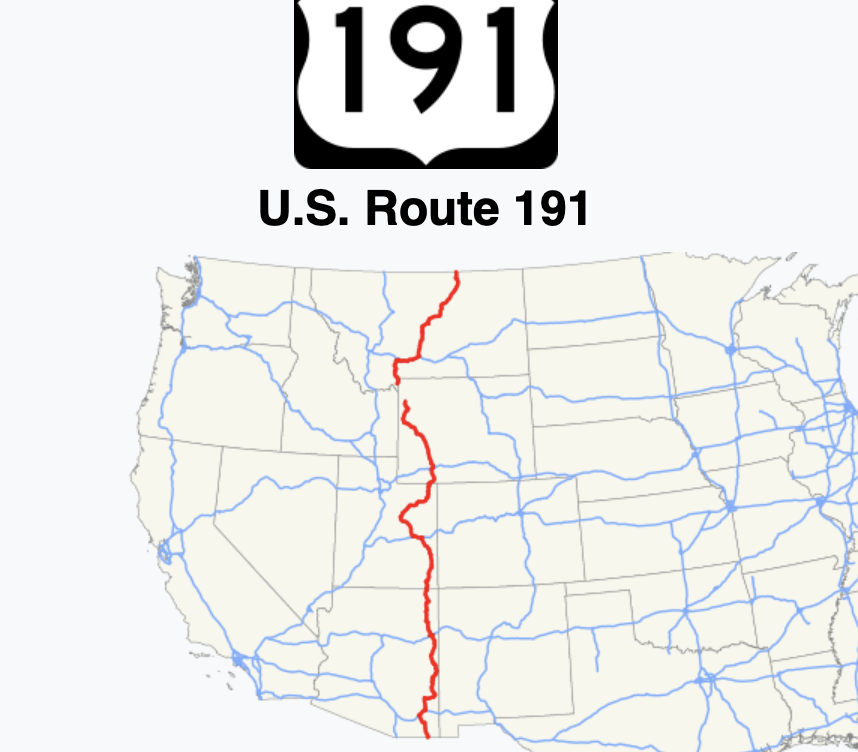
Highway 191 was one. This highway starts at the Canadian Border in Montana and ends in Arizona on the Mexican Border. I’ve driven much of it over the years. I’ve even bicycled several hundred miles on the highway. But I confess that if someone had asked me what I knew about Highway 191 before our trip last summer, I would have asked where it was. 

Highway 191 travels from the border of Canada to the border of Mexico.

Peggy and I picked it up off of I-70 in Utah and followed it south into Arizona where we cut off on Highway 180 crossing the southern Rockies toward Silver City in New Mexico. Along the way we visited Arches National Park, made our way through Navajo country, passed by Canyon de Chelly and spent a delightful night at Lyman State Park in Arizona. I’ll feature some pictures that Peggy and I took along the road but will save Lyman Lake for next week’s post.

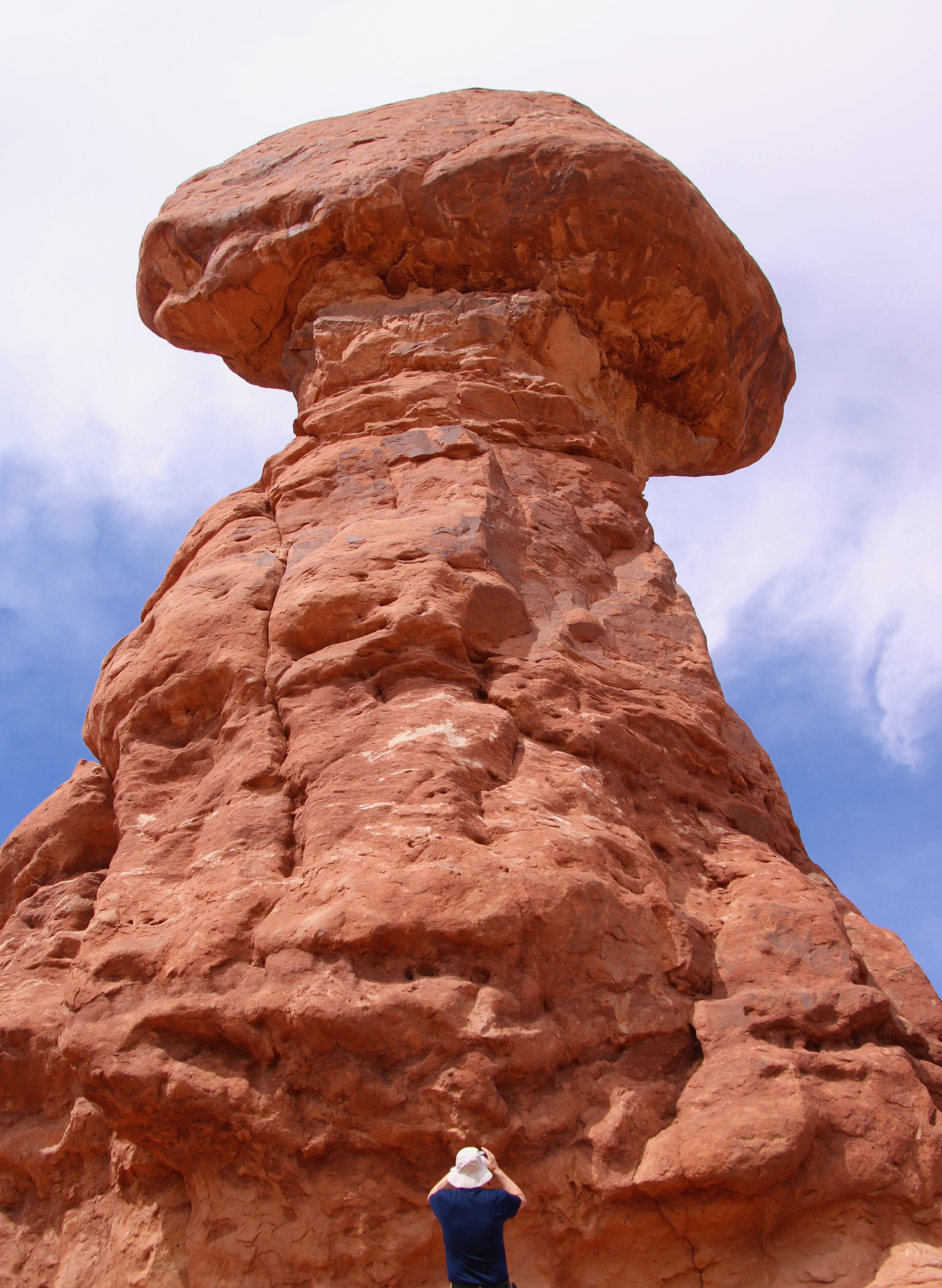
One more Arches photo. Peggy caught this photo of me checking out Balanced Rock.
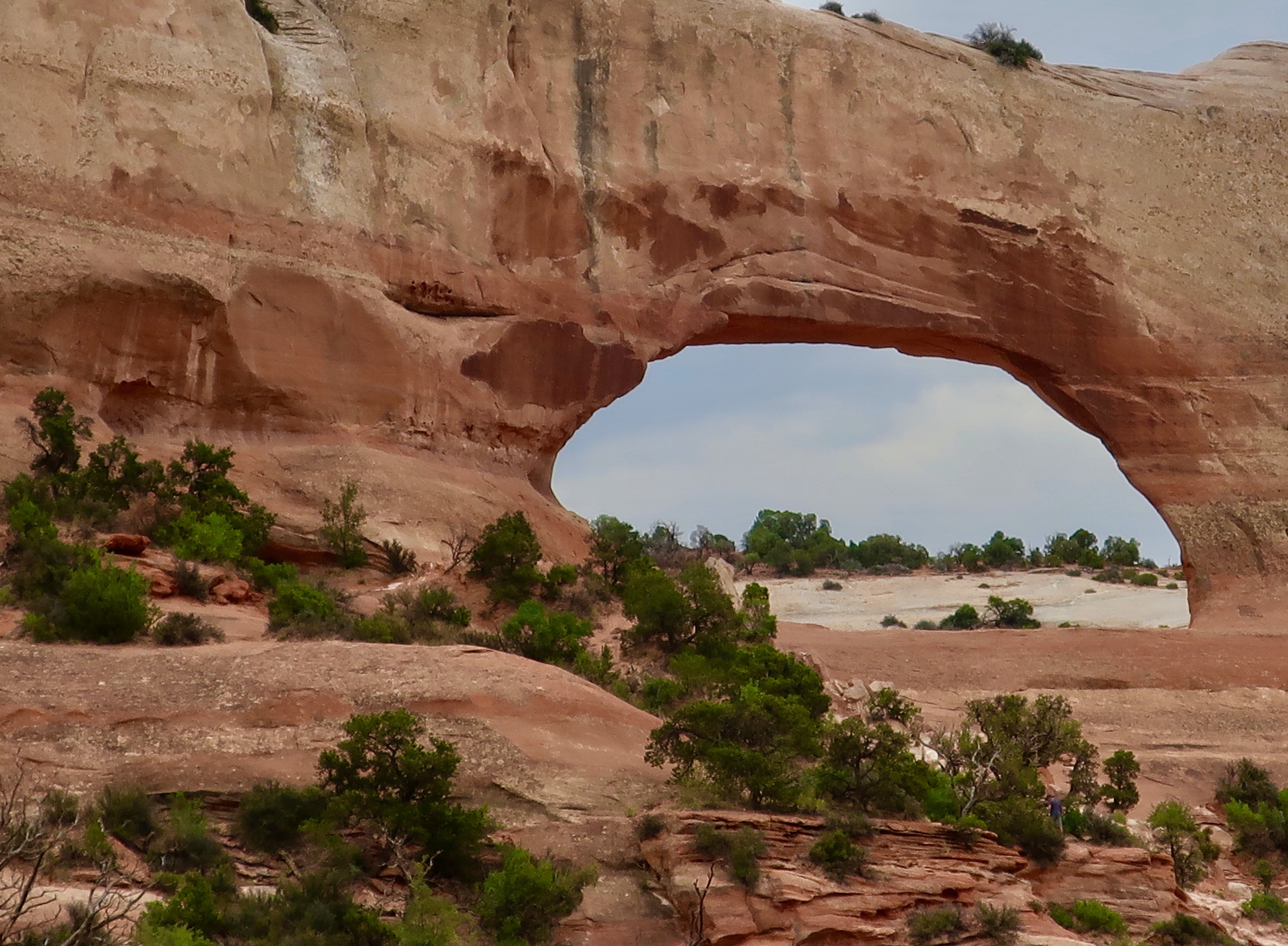
There are, of course, impressive arches outside of Arches National Park. Wilson Arch is found along Highway 191 south of the National Park.
Further south along Highway 191, Peggy and I came on this interesting sandstone monument known as Church Rock. BTW, the road into Canyonlands National Park is near here.
Views along 191 included badlands…
These trees…
And the San Juan River.
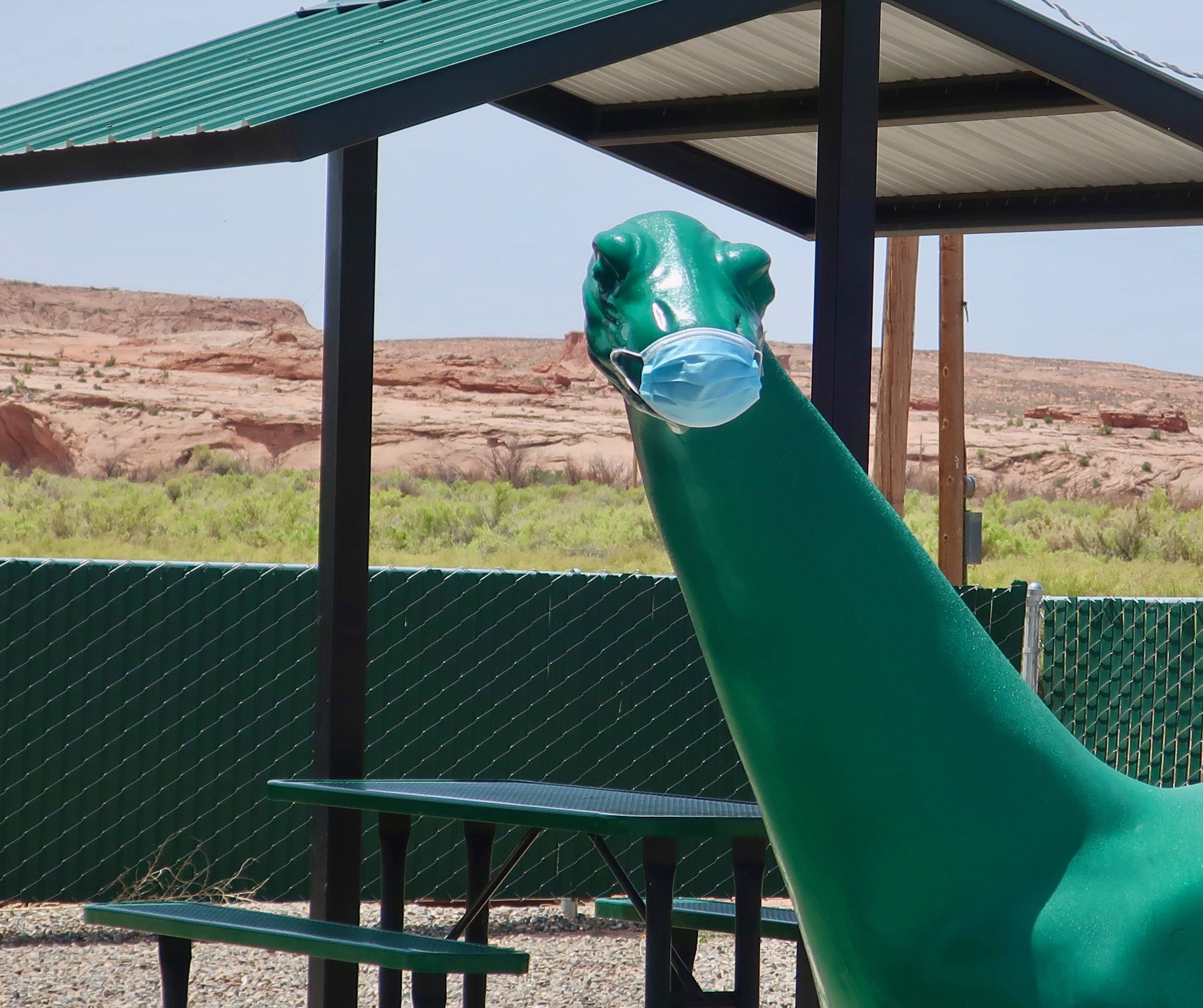
As we entered the Navajo nation, the concern over Covid 19 was immediately apparent. This dinosaur was wearing a mask at a service station.
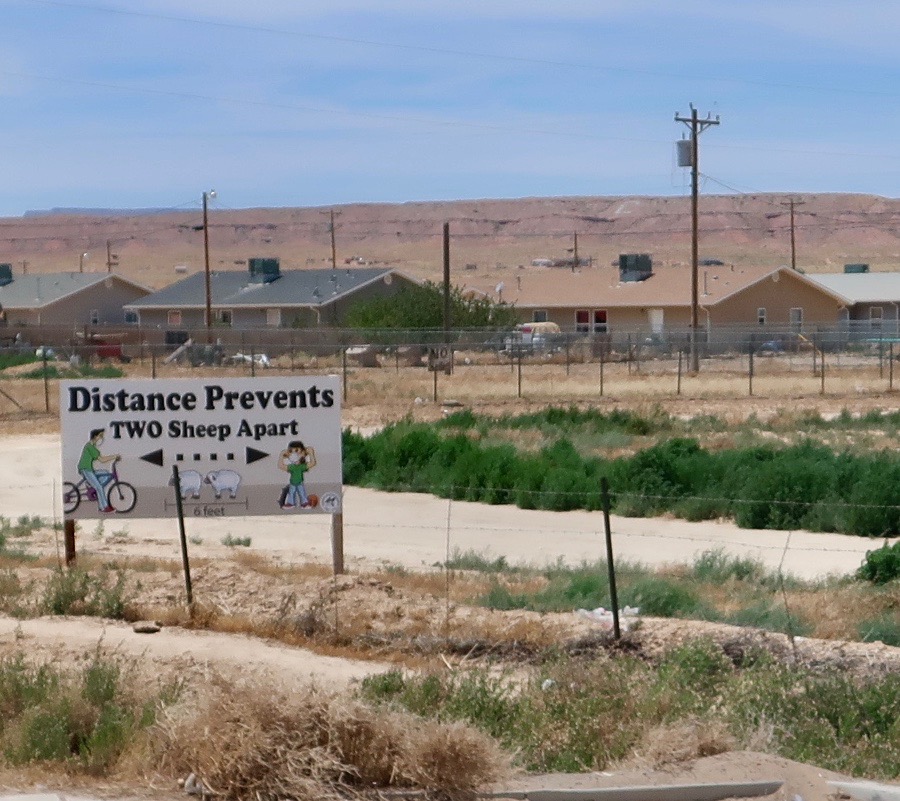
I love this sign that shows a sense of humor in the Navajo Nation about social distancing. Very few people were out and about in comparison to 9 months earlier when we had visited Canyon de Chelly. We saw perhaps a half dozen outside of Chinle, gateway to the National Monument.
Two Navajo Sheep. (Photo by Peggy Mekemson.)
A view looking down into Canyon de Chelly from our previous visit. Tourism and tourist dollars came to a dramatic halt with Covid-19 ravaging the Navajo Nation.
People like Alan Ba, from whom we bought this artwork, would have an important source of income eliminated.
As we neared I-40 on Highway 191, there was one more grim reminder of the problems facing the world, a massive forest fire brought on partially by global warming.
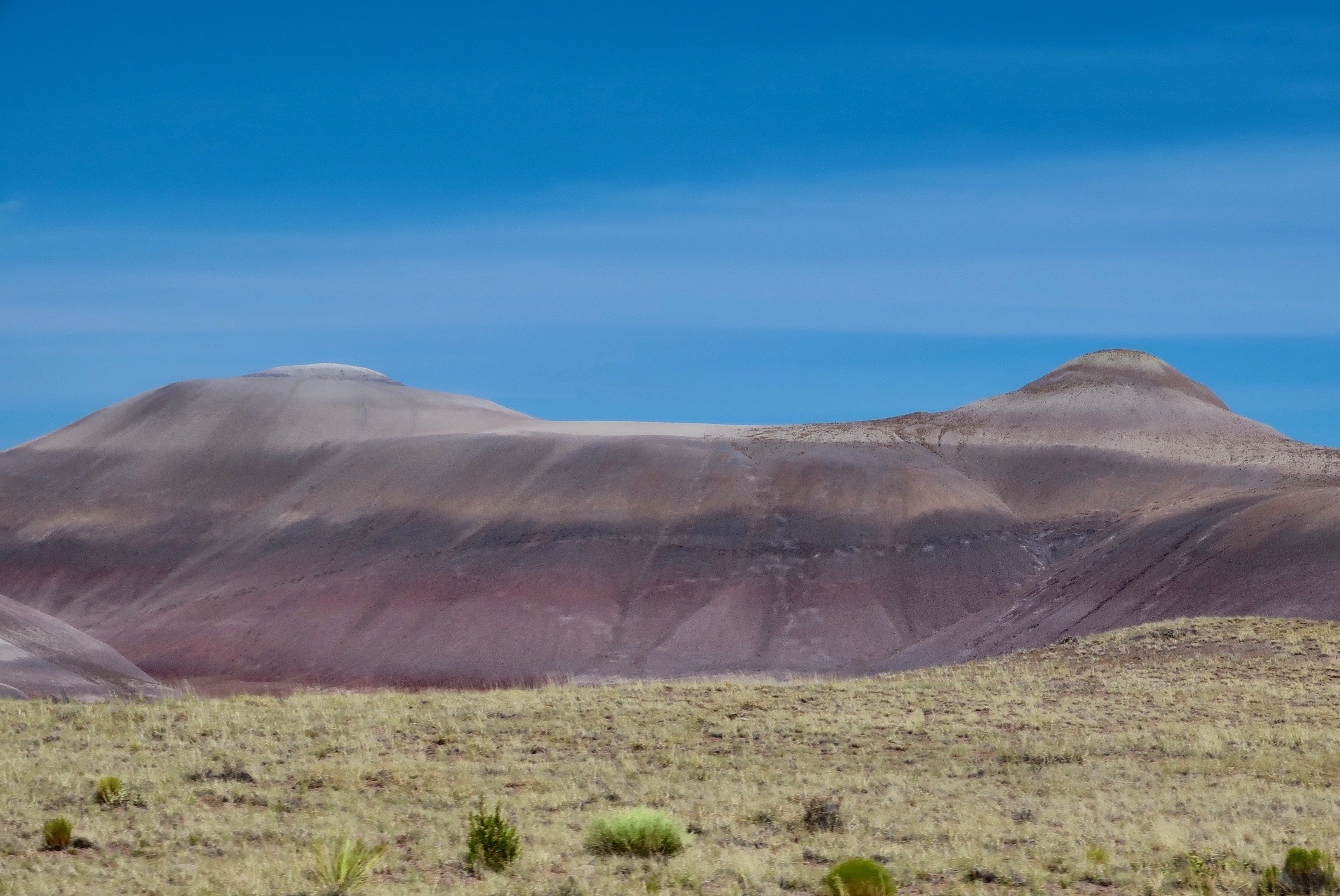
Traveling south of I-40 we found more badlands, not all that far from the Painted Desert.
Shortly after arriving at Arizona’s Lyman State Park, we were treated to a sunset over the lake. It had been a long day.

NEXT POSTS:

Blog-a-book Monday: Just when I thought we were out of trouble, the Sheriff pays the Sierra Trek a visit and dynamite threatens to rain rocks down on us.

Blog-a-book Wednesday: I start the book on my African Peace Corps adventure with asking the question: Why?

Travel Blog Friday: We explore the unique early American rock art of Lyman Lake, discover some birds that are more mouth than body, and appreciate the beauty of the area.

We Rub the Nose of a Pig in Florence… Armchair Travel

Peggy eagerly rubs Little Pig’s Nose in Florence.
Kathy and I quickly join in the nose rubbing exercise.

So, here’s a serious question: With all of the beautiful art in Florence, why in the world would we spend our time rubbing the nose of a pig?

I’ll be brief. We were told if we rubbed the nose of the pig, or the snout of the boar if you prefer, we would come back to Florence.  Considering we had six hours to explore everything Florence had to offer, we looked on our nose polishing efforts as a guarantee of a return trip.

Il Porcellino, or Little Pig, as he is known, was sculpted way back in 1612 and was based on an original marble pig of Greek origin dating back to who knows when. The present pig is a copy of the copy. You can tell by his shiny nose that lots of people share our desire to come back to Florence. Apparently rubbing his snout for a return trip dates back to the 1700s.

Little Pig is housed in an attractive marketplace that was built by Cosimo de’ Medici between 1547-1551. Bad merchants, who had the misfortune of going bankrupt, were spanked here before being sent off to prison. I couldn’t find a description on what the spanking entailed.

The overflowing Mercato Nuovo or the Straw Market where bad merchants were once spanked. I doubt that they were ever spanked for cheating a customer.
It’s only right that I should close this post with a photo of Little Pig’s shiny snout.

NEXT POST: A teaser from our present journey around North America in Quivera, our 22-foot RV.