Peggy, our grandson Cody, and I visited the main Orkney Island in June as part of our CIE tour of the Scottish Highlands. Seeing ginger haired coos (cows) and Neolithic standing stones and villages were the highlights of our visit to the island. The photos in this post were taken by Peggy, Cody, or me. The maps are from Apple Maps.
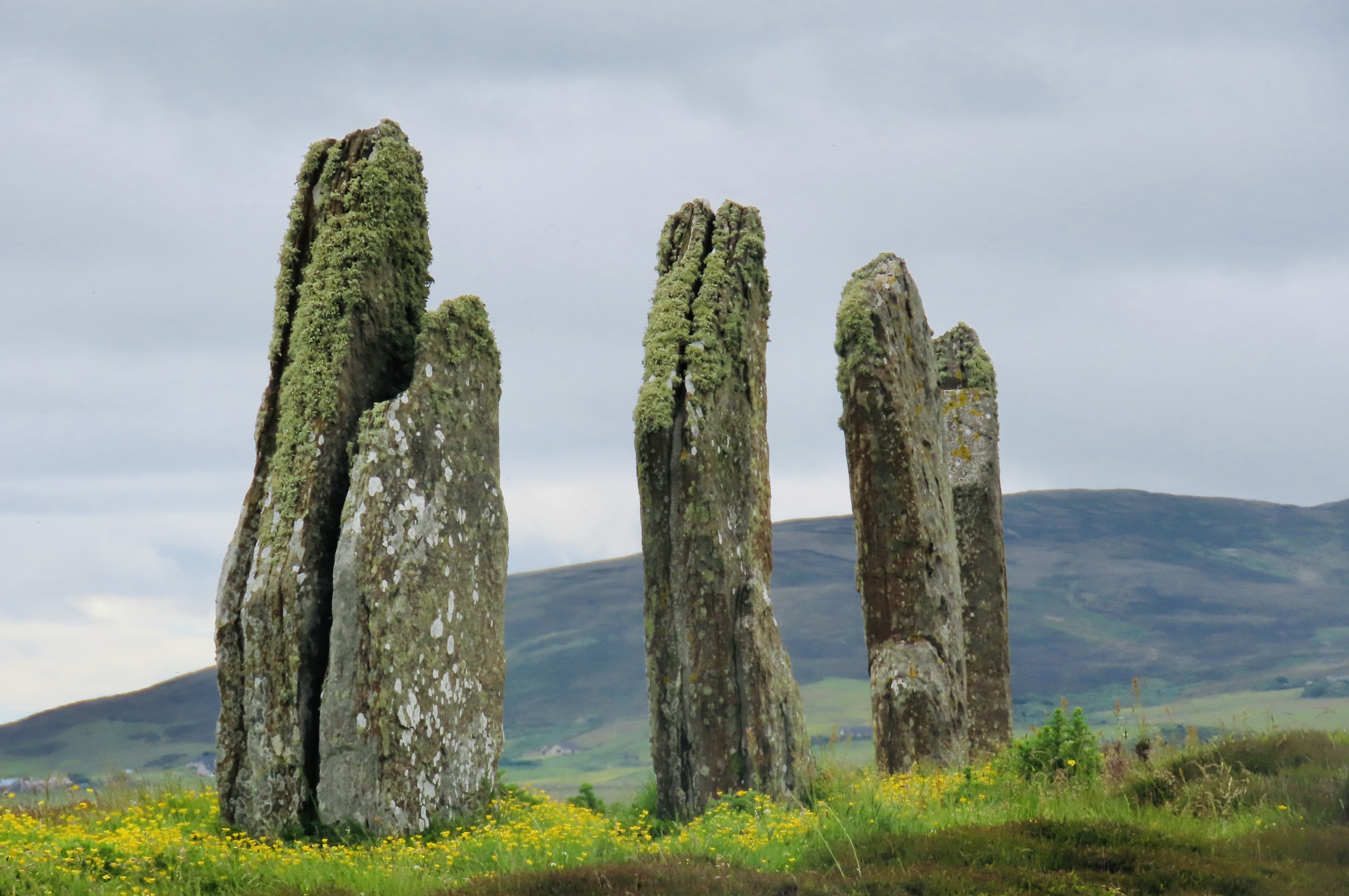
You’ve heard of Stonehenge and likely seen photos and even documentaries featuring these ancient and mysterious standing stones in southern England. But have you ever heard of the Ring of Brodgar on the Island of Orkney in the far north of Scotland? Erected in 2500 BCE, at approximately the same time Stonehenge was being built, 60 stones formed a circle that stretched for 340 feet (104 meters) across. 36 of these stones remain standing today in an impressive array. The clouds provided a dramatic backdrop.We took a ferry from the town of Thurso on mainland Scotland up to Stromness and then crossed the main island of Orkney to Kirkwall where we stayed. The road distance between Stromness to Kirkwall is 15 miles, which provides a perspective on the size of the island. The Ring of Brodgar was one of four neolithic sites we visited on Orkney, which also included the Standing Stones of Stenness plus the villages of Barnhouse Settlement and Skara Brae. All four are part of the UNESCO World Heritage Site: The Heart of Neolithic Orkney. The red pin on the bay above Stromness to the left is the location of Skara Brae. The one to the right between the two lochs/lakes is the Ring of Brodgar.This provides a closer view. The upper red dot between the two lochs/lakes is the Ring of Brodgar. The lower red dot is the location of the Stones of Stenness and the Barnhouse Settlement, which is next to it. The distance between the two red dots is approximately 1 mile. Skara Brae is located on the lower side of Skaill Bay at the top left corner, about 5 1/2 miles from the Ring of Brodgar.The stones of the Ring of Brodgar are impressive— either as a whole or looked at singularly— standing up to 15 feet tall, each with a unique personality. Visitors are invited to follow a path that leads around the complete 1,250 foot circle. A nine foot deep ditch surrounds the pillars. Known as a henge— think Stonehenge, it was carved out of sandstone by the original inhabitants.A view of 8 of the stones.The unique looks add to the mystery of what purpose the stones served.Opposites attract?The chief?A number of stones had triangular tops. Which provided great perches. Cody took this photo. In fact Cody took a lot of photos that included birds! “They just show up,” he claimed. We are glad they did. The numerous lichens on the rocks added to their photogenic quality. Lichens, BTW, are among the oldest living organisms on earth, the oldest reaching over 8000 years. They have been hanging out in Scotland for some 400 million years!The walk around the Ring of Brodgar also includes a burial mound as shown on the left of this photo. A number of burial mounds are found within the Heart of Neolithic Orkney UNESCO World Heritage Site. Another one can be seen in the distance. The most famous is Maeshowe, which we didn’t visit. Traveling one mile south from the Ring of Brodgar over a stream that connects the sea water Loch of Stenness with the fresh water Loch of Harray, you come to the Stones of Stenness. Once consisting of 12 stones, it now has 4. It is thought to be the oldest henge site in the British Isles, dating back to 3100 BCE, some 500 years before Stonehenge and the Ring of Brodgar.An ancient hearth that is believed to have been utilized for ceremonial purposes (such as burning the bones of the dead and sacrificed animals) is located in the center of the stones.The ceremonies carried out at the hearth would have been connected to the Neolithic Barnhouse Settlement found a short walk away. Excavated between 1986-1991, the bases of at least 15 houses were discovered, each containing a central hearth, beds built against the walls, stone storage areas and internal drains. We felt they were quite sophisticated, especially considering that they dated back some 5,000 years. Another structure at the Barnhouse Settlement.Out trip north to Skara Brae on the Atlantic Coast of Orkney showed houses with a similar structure to the houses at the Barnhouse Settlement. Beds are in the lower right and upper left. A hearth is in the center and a storage area on the upper wall. People lived at the site from approximately 3180 BCE to around 2500 BCE. It is recognized as Europe’s most complete Neolithic village. The furniture is similar in several of the houses.The village looks out on Skaill Bay which opens up to the Atlantic Ocean.Skaill Bay.Paths and tunnels connected the various houses.Cody found his obligatory bird at Skara Brae, displaying a fat, juicy bug and a wild feather look.He also found these two rabbits snuggling up. Were baby rabbits in their future?
Peggy and I have long been fascinated with ancient cultures and found the standing stones and villages of Orkney of considerable interest. In many ways, we were reminded of our trips through the Southwestern United States searching petroglyphs left behind by the Anasazi and other ancient peoples.
This is a good time to remind my readers of Peggy’s word search book on petroglyphs: Artistic Word Searches Unique and Magical Discovering Petroglyphs from the South West. As puzzle solvers work their way through the puzzles, petroglyphs will emerge. This makes an excellent gift for retired seniors (and others) who love word games (and helps keep senior minds sharp—grin). The book can be obtained through Amazon.
The solution to the Kokopelli puzzle is an example of how the images appear as the puzzle is solved.
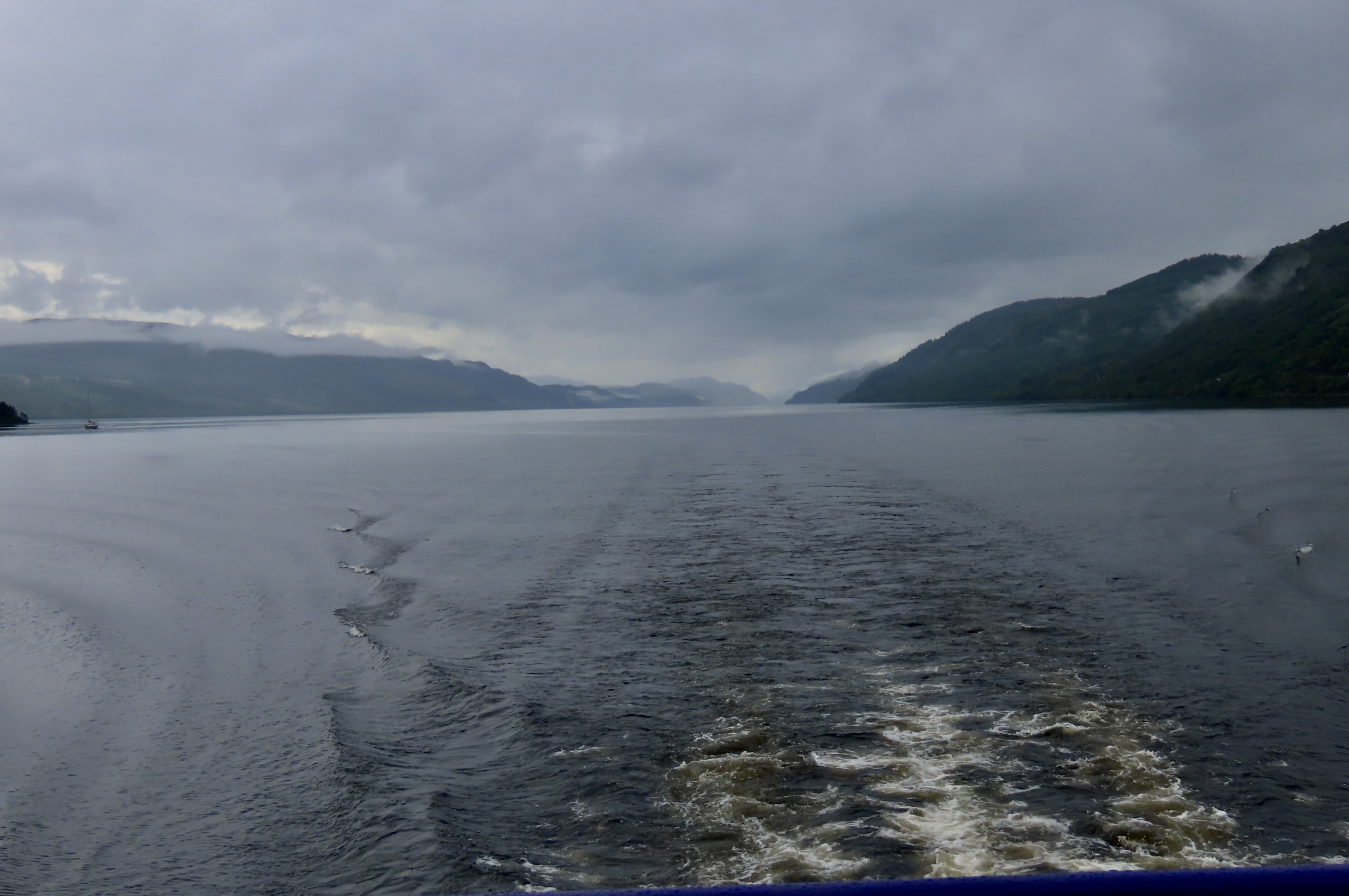
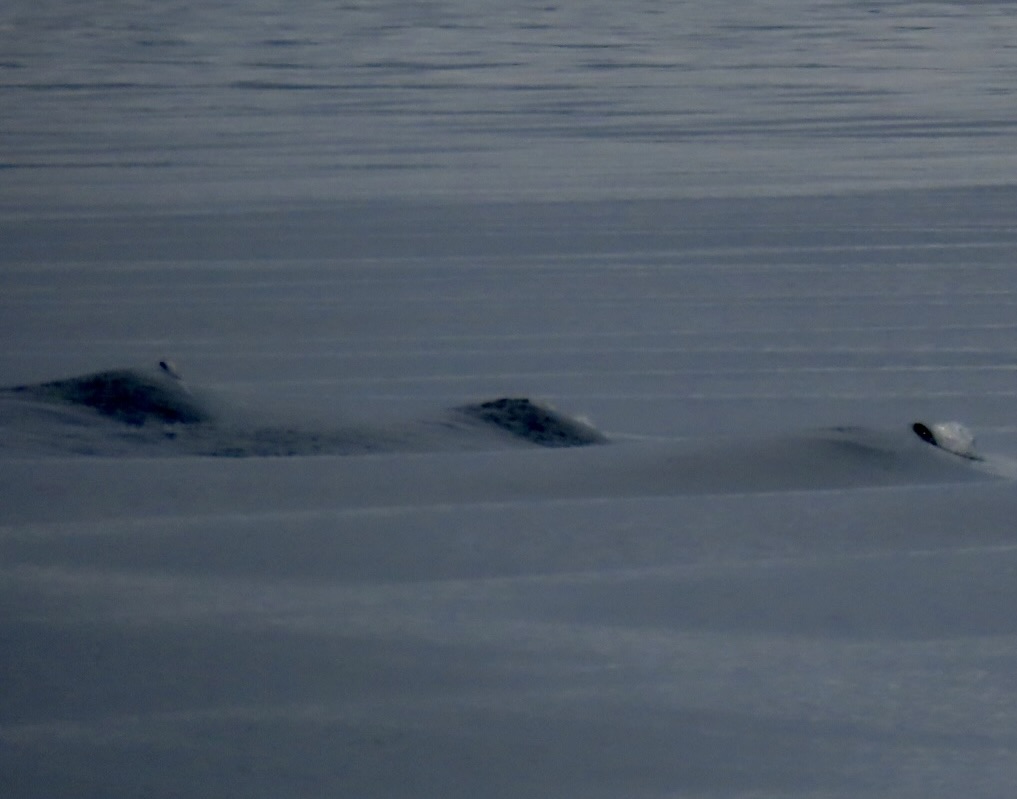
It was a dark and stormy day with sprinkles when we went on a search for Nessie on Loch Ness with CIE Tours. We were ready to make history by spotting the illusive, legendary monster. And possibly Big Bucks$$$. Any object on the lake was fraught with possibilities. Wait. Is that Nessie poking her head out of the water ahead of us!?
I’m continuing our series on our recent bus trip through the Scottish Highlands that Peggy, our grandson Cody, and I did with the CIE Tours. Today we are traveling by boat onto Loch Ness in search of Nessie. Our imaginations did a great job of finding her. Sigh. My super telephoto lens soon showed the Nessie featured above to be a boat. But there would be more opportunities. Plus there was a beautiful lake to enjoy, monster or not. The photos in this post are all taken by either Peggy, Cody or me.
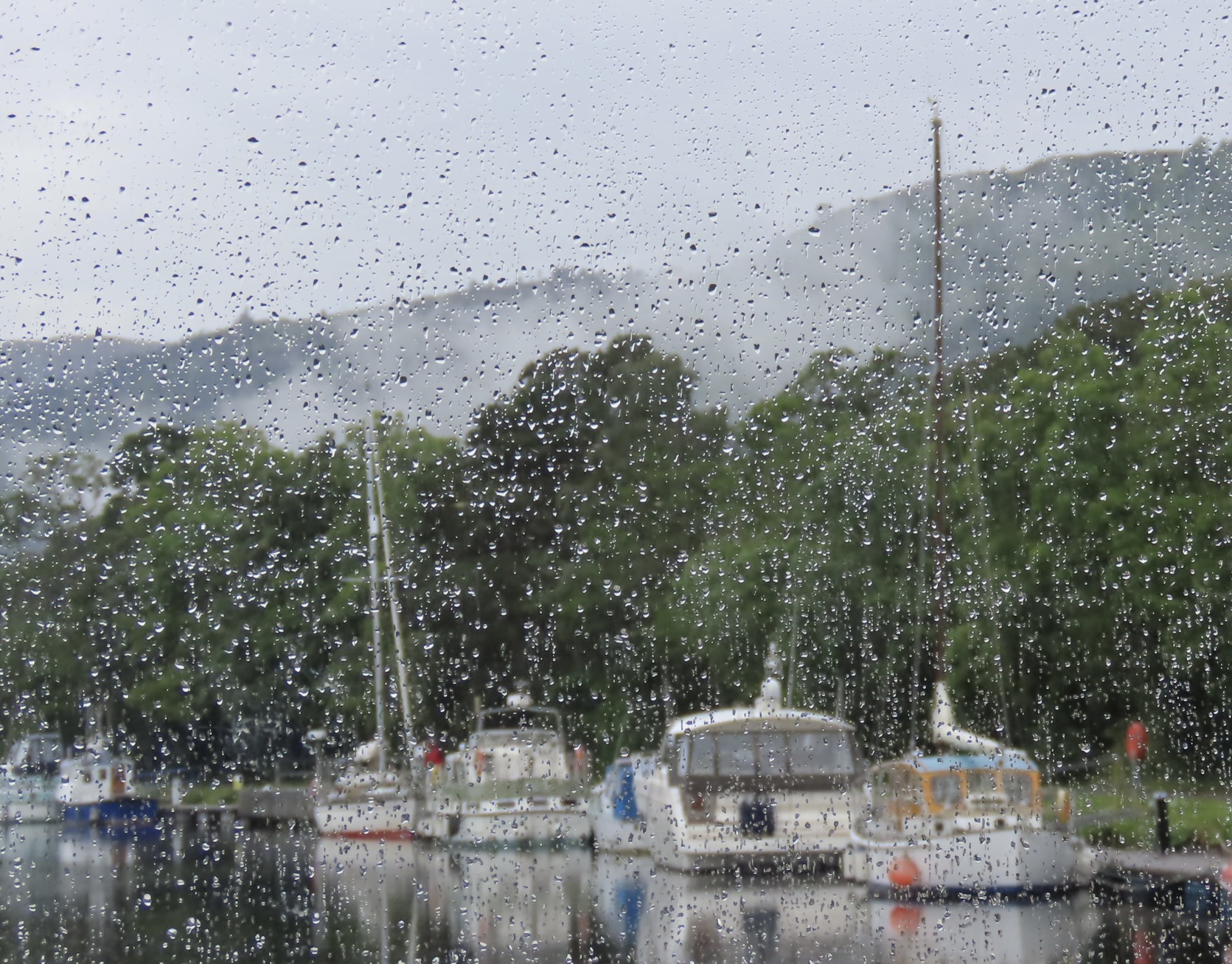
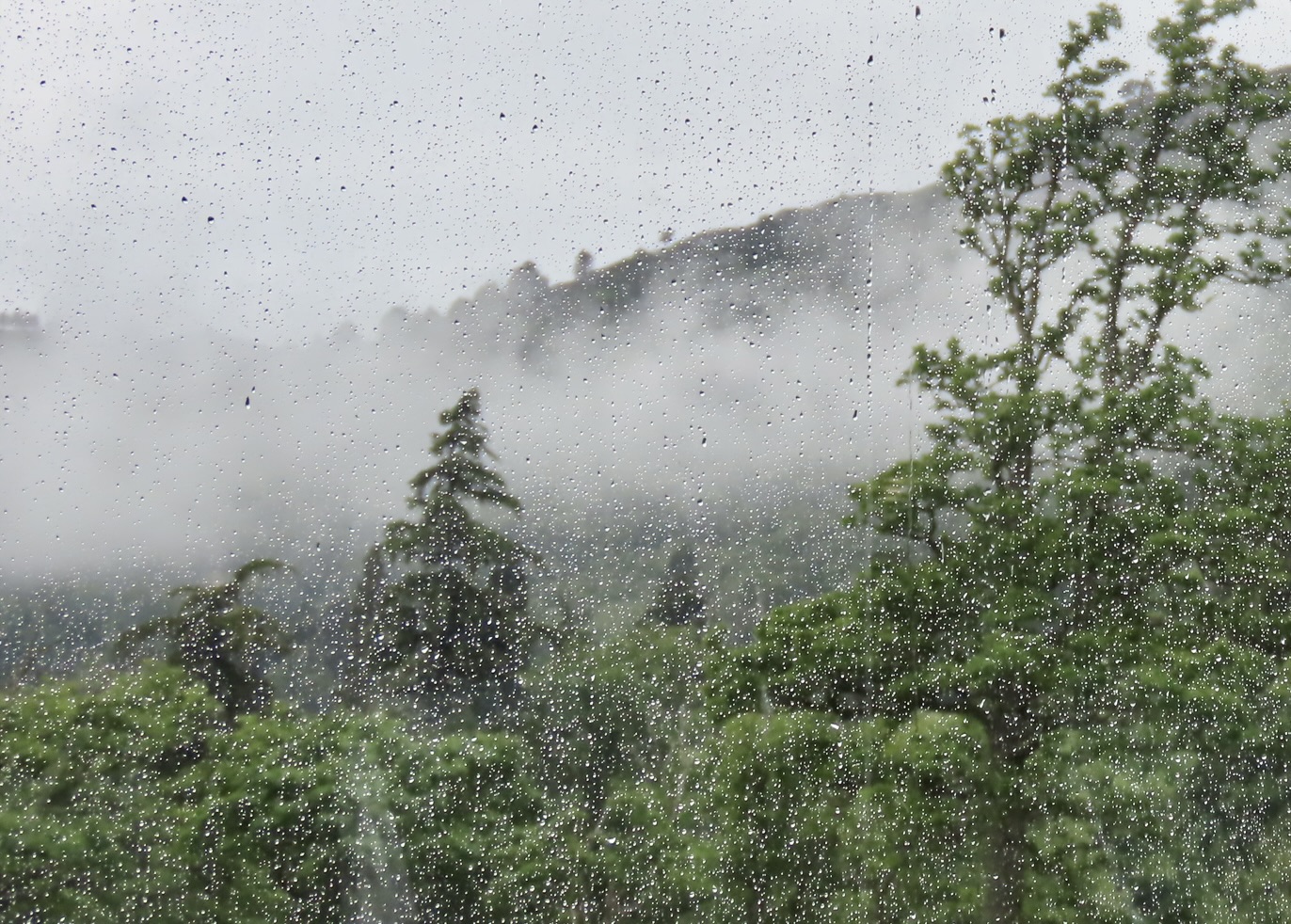
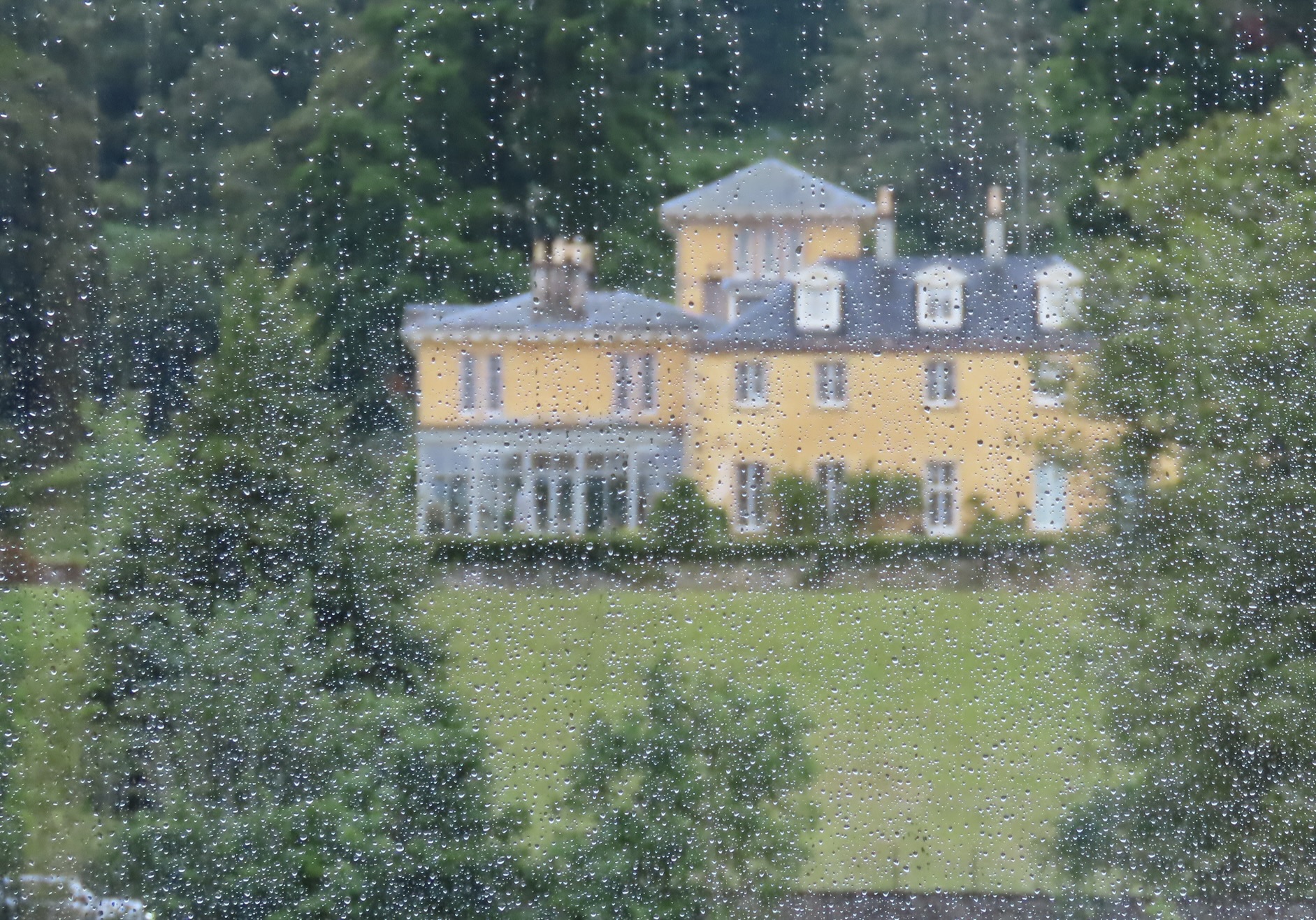
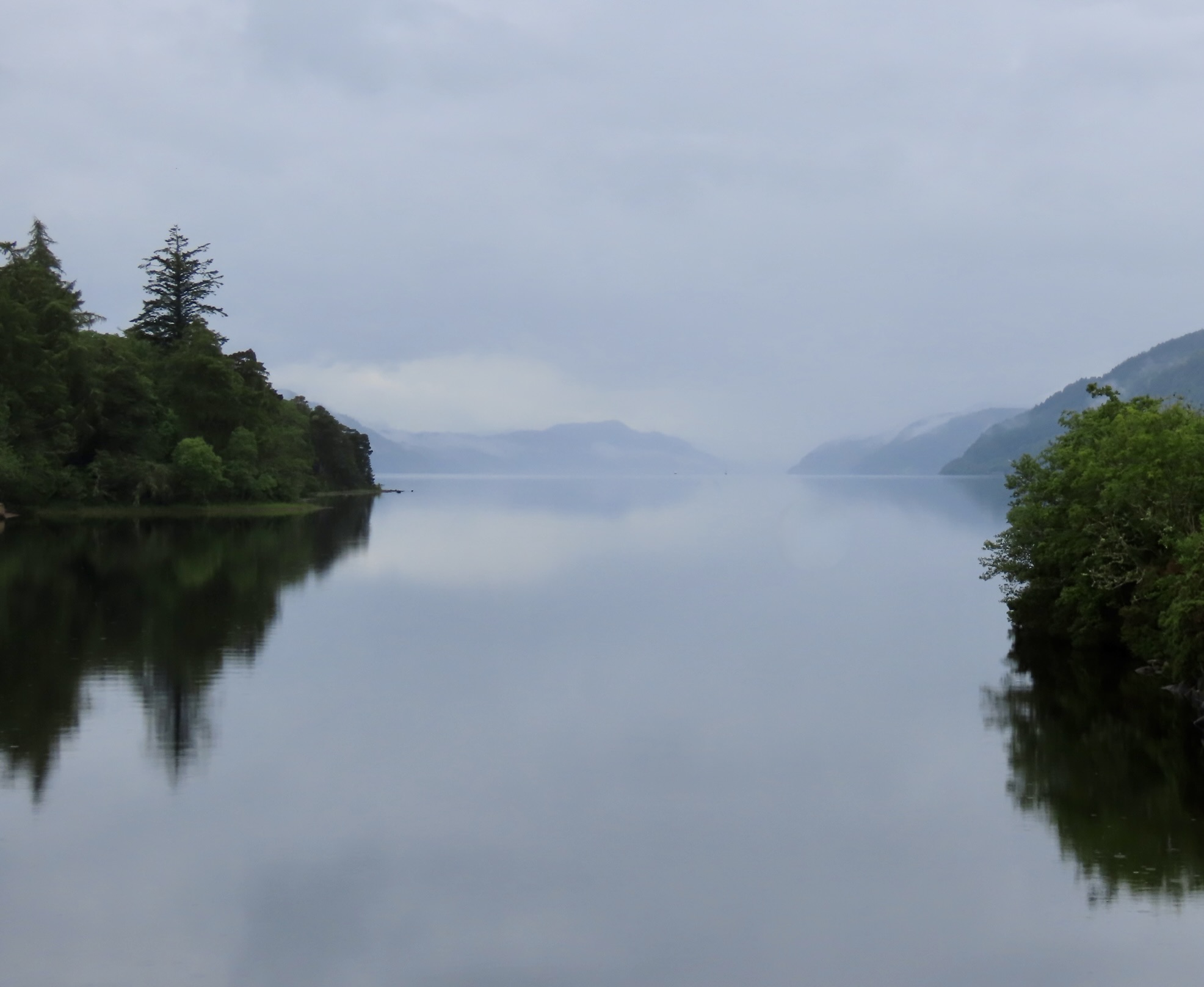
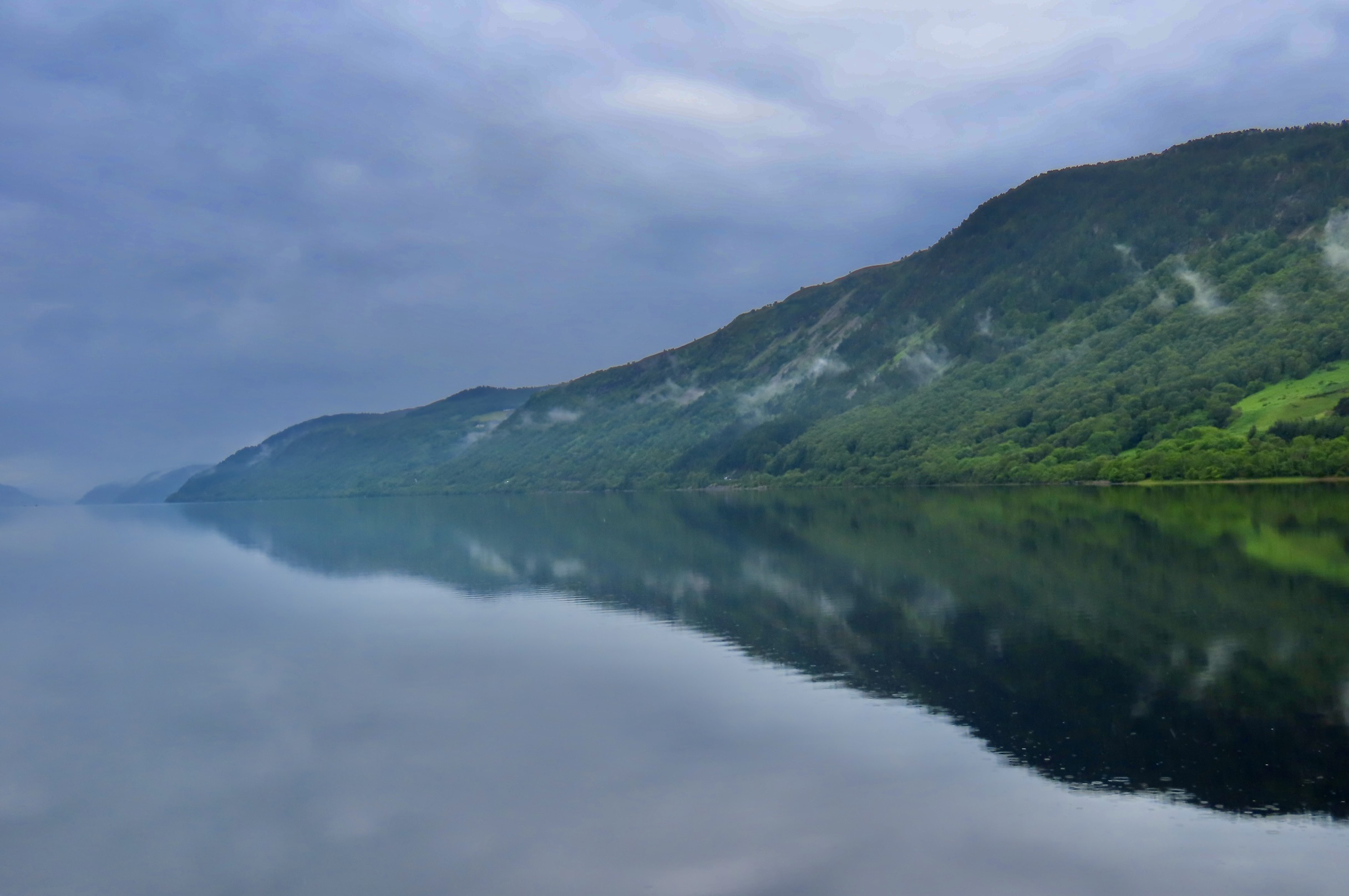
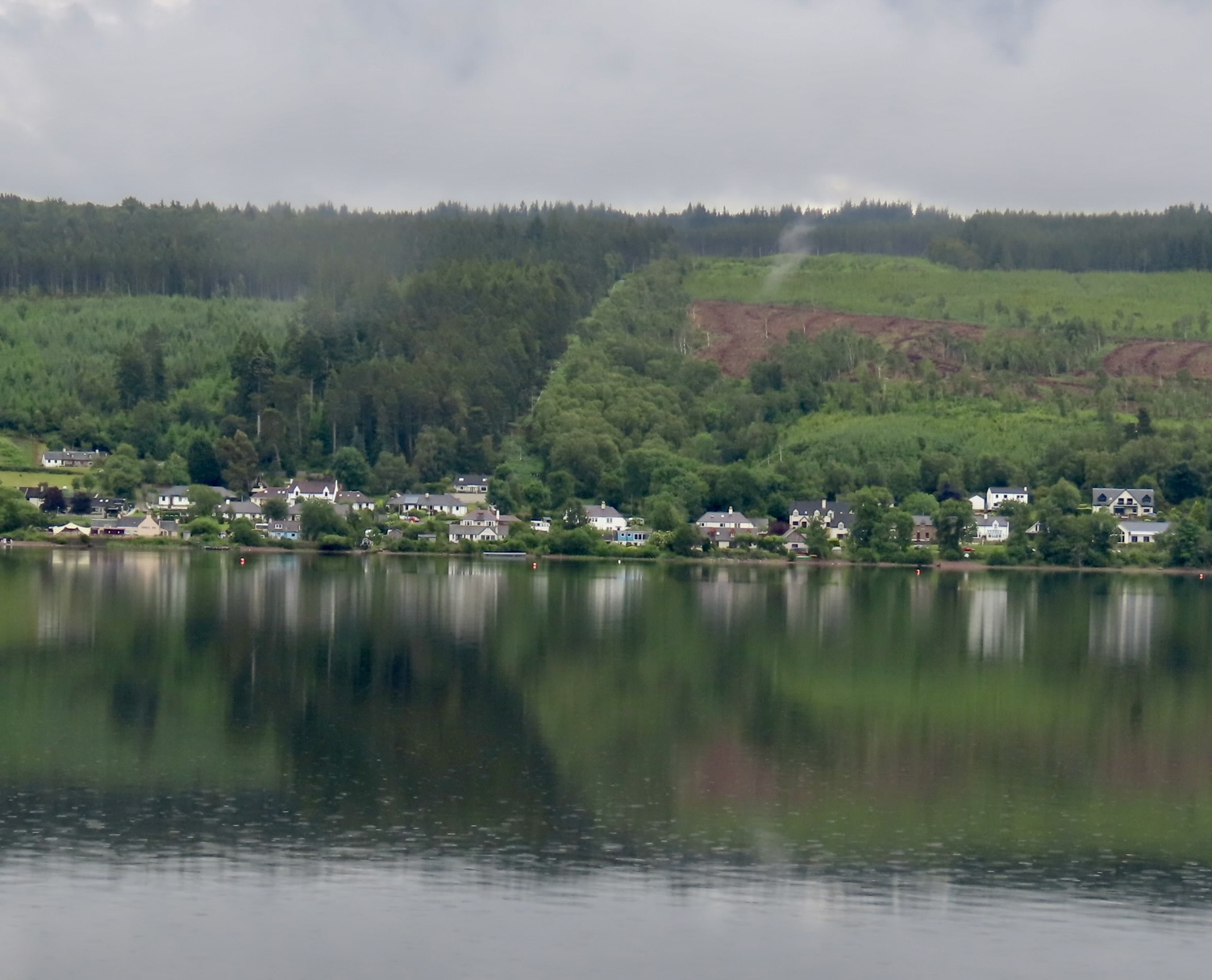
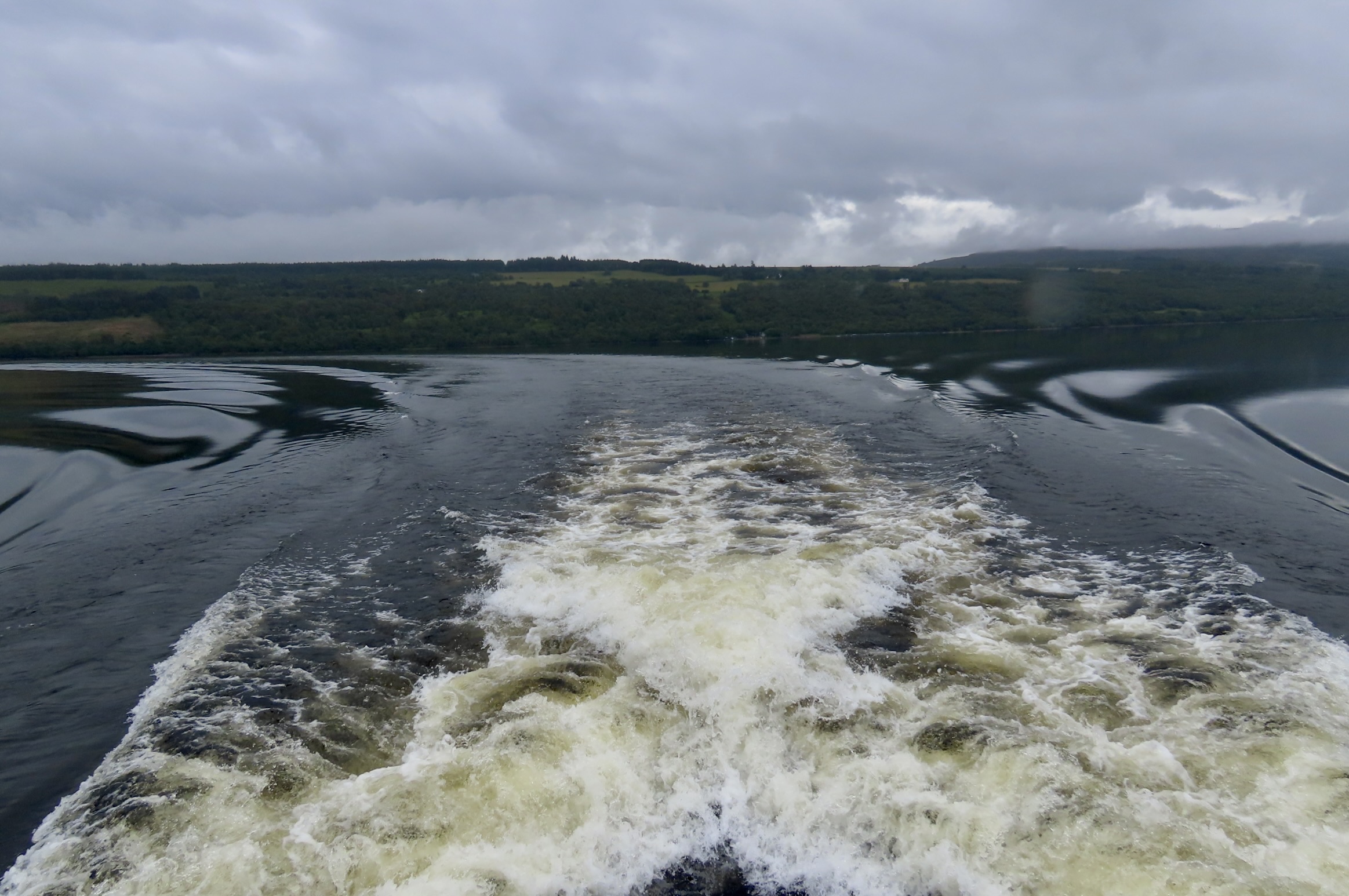
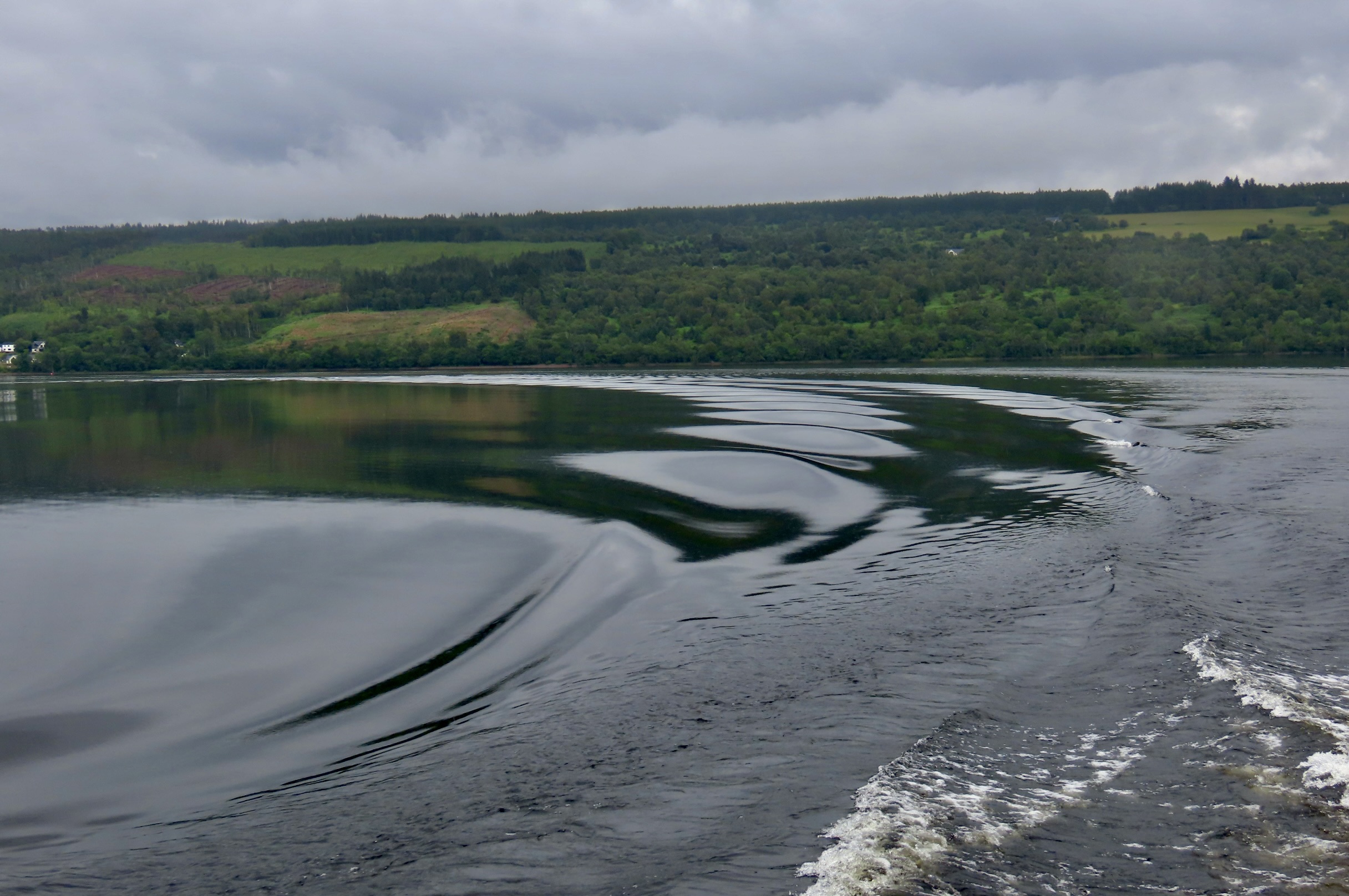
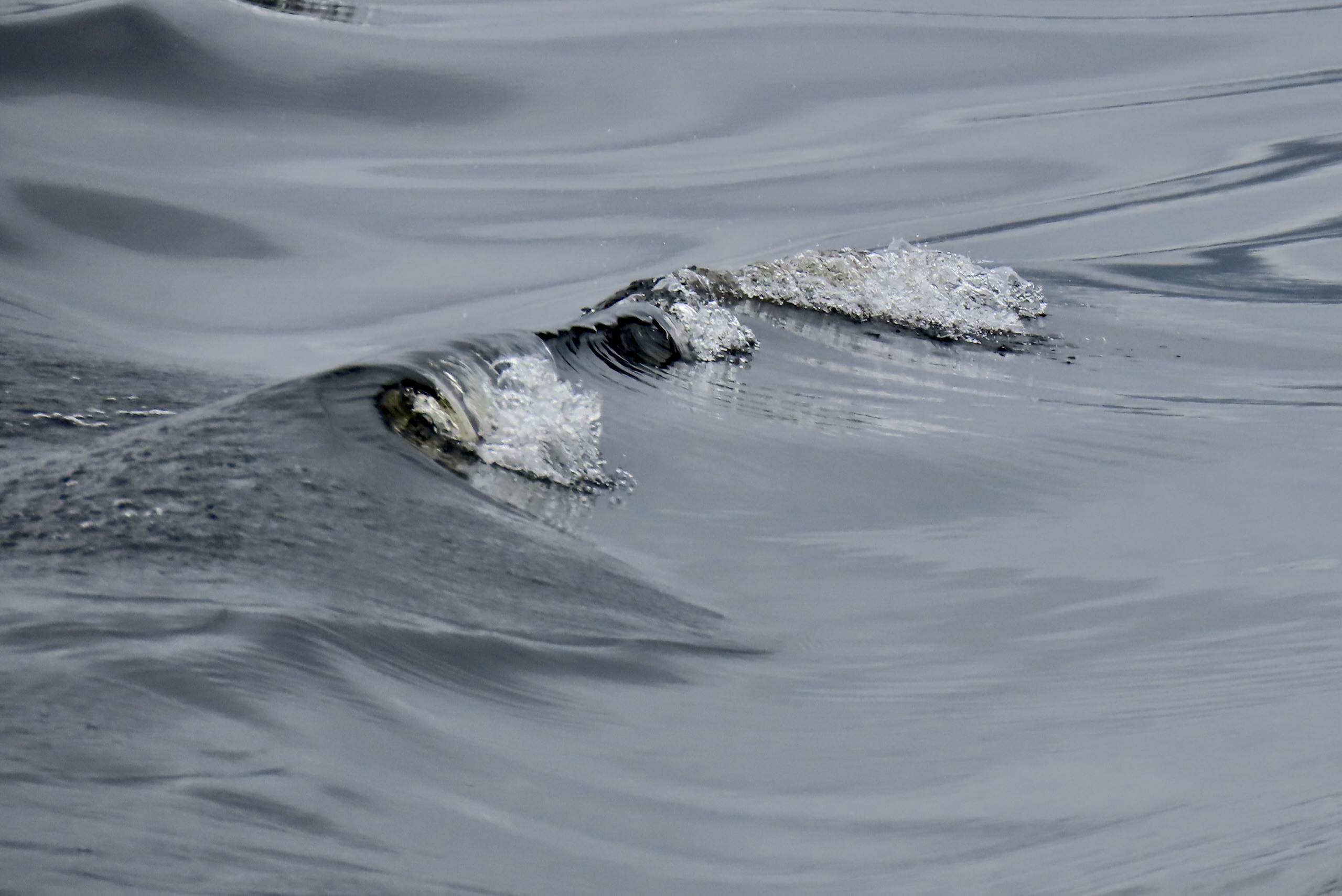
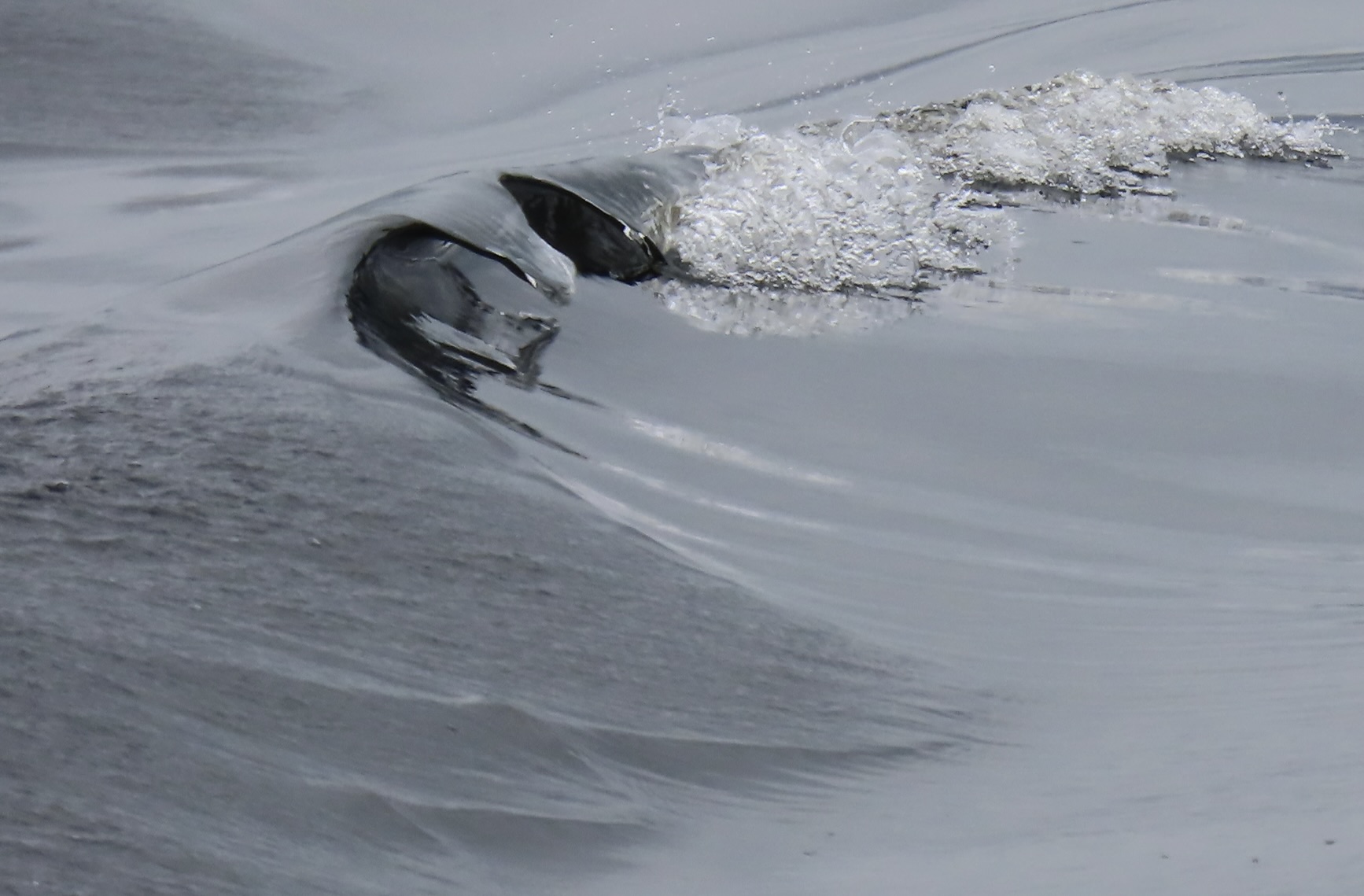
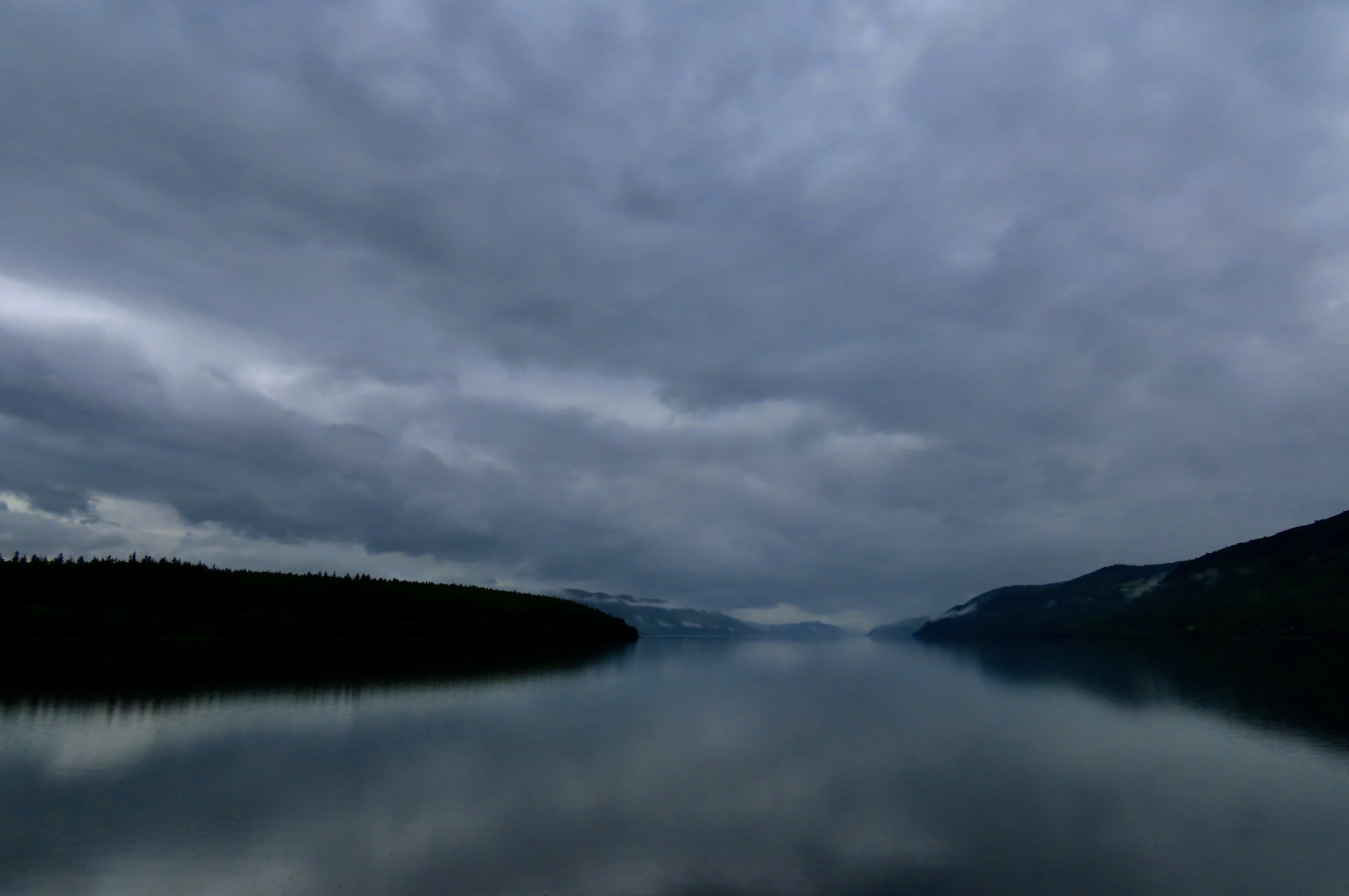
It was sprinkling when we left the small harbor and followed the channel that would take us out to Loch Ness. Many of the boats in the harbor were devoted to also providing Nessie spotting tours on the lake. She does a monster of a job when it comes to attracting tourist dollars.The rain gave a preview of the beauty to come.And history. This is the Dochfour Estate, owned by the same family since the mid 1400s. A bit of sunshine illuminated the waves made by our boat, shore, and warped reflections, like a mirror in a carnival. We soon came to the opening of the lake. So much for stormy. The lake was as unruffled as a marine made bed. The Aldourie Castle could be seen on the shore. It actually has rooms for rent but only rents to groups. So gather 26 of your best friends and prepare to party. It can be yours for only $32,000-42,000 (US dollars) per night! And meals are included!The shoreline stretched off into the distance. If Nessie were around, we would see her for sure!Looking up the right side.And to the left. “Not a creature was stirring, not even a mouse.”A village along the shore.In addition to keeping a sharp eye out for Nessie and enjoying the scenery, we entertained ourselves by watching the wake and waves made by the boat. Some people note that we are easily entertained, and yes, we resemble that. It’s a good thing.Smooth…Checkered.And straight. But what is that escaping off to the right beyond the waves? Could it be? Is it possible? Don’t know. Didn’t see it until I just uploaded this photo. We will have to go with between highly unlikely and overactive imagination. Eventually, the captain announced it was time to head back toward the harbor. We were ‘making tracks’ but still keeping our eyes peeled.Dark skies continued to hover over us with the boat wake and waves providing interesting views.A wave close up. Surf’s up. Have you ever water skied behind a fast boat crossing back and forth over the wake? Some fun.I was pleased that our cameras could catch the action!It was not hard to turn this wave action into the long, sinuous body of Nessie right down to the tip of her tail! Many a tourist has. Why shouldn’t we? Most eyewitness and folklore accounts put her at around 20 feet long. Does she exist? Most tour operators answer with a resounding yes! Quite happy with our tour even though we came back with no earthshaking photos; we returned to our harbor. We were most of the way back when I glanced off to the edge of the shore and saw this:Had we discovered where Nessie hangs out when she is off duty!? Your imagination is in charge here!On our next post, we will venture to the far north of Scotland to Orkney Island where another Ancient mystery exists, a massive Neolithic stone circle built between 2500 and 2000 BC. Unlike Nessie, however, there is no question of its existence. Its purpose? That’s the mystery.
Last month, Peggy and I went on a CIE bus tour of the Scottish Highlands, along with our grandson Cody. Photos in this series were taken by Cody, Peggy and me.
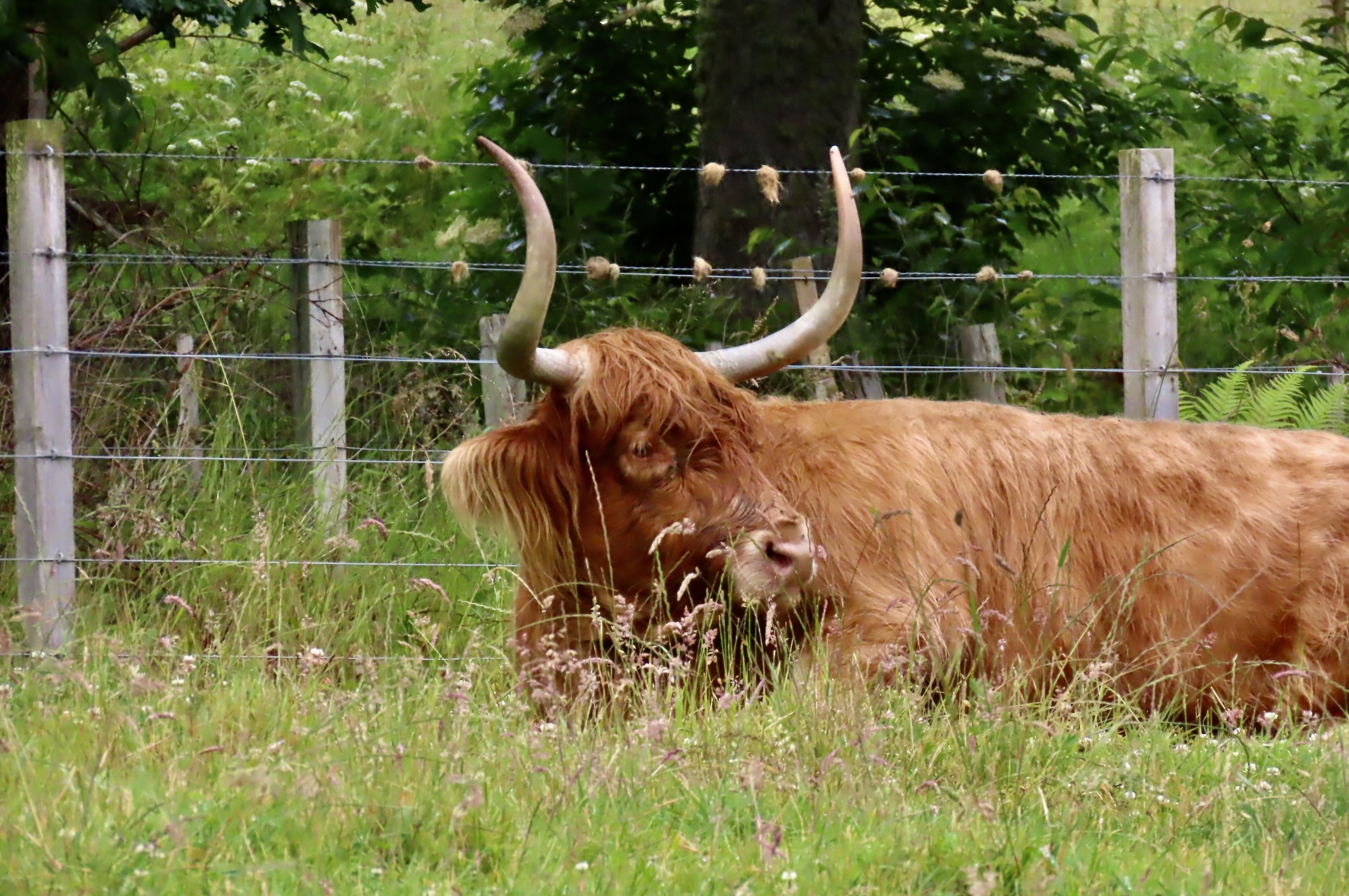
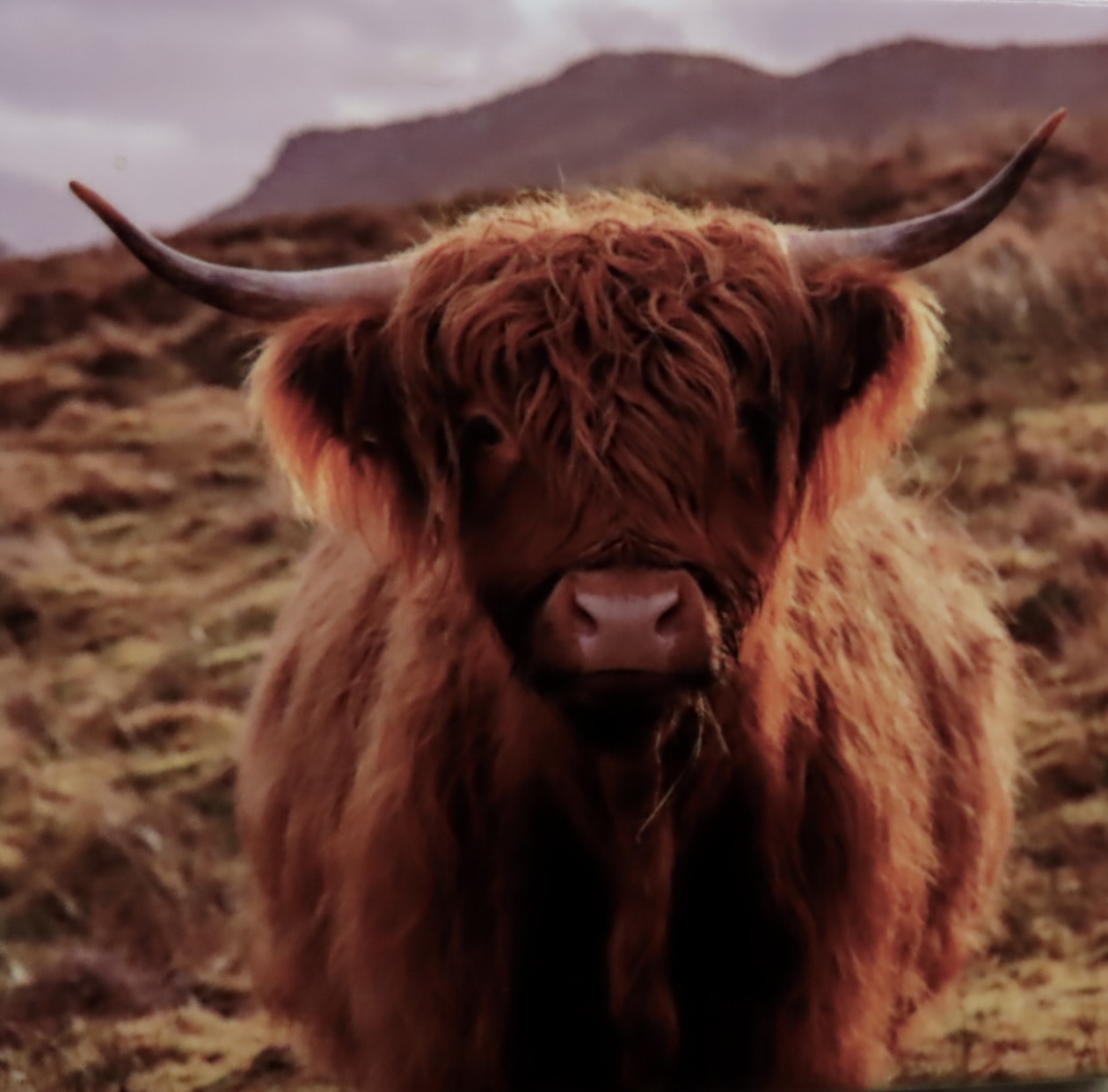
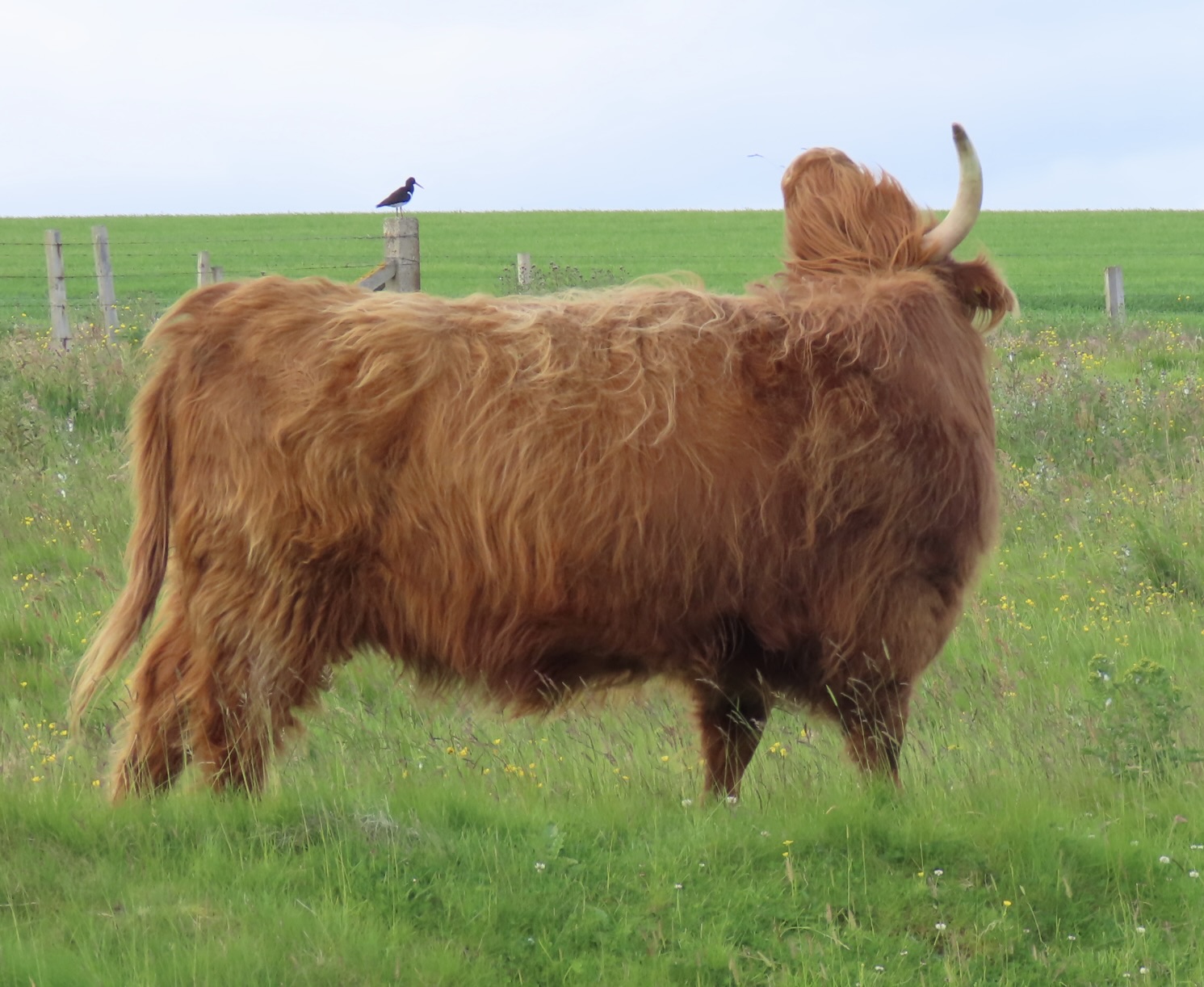
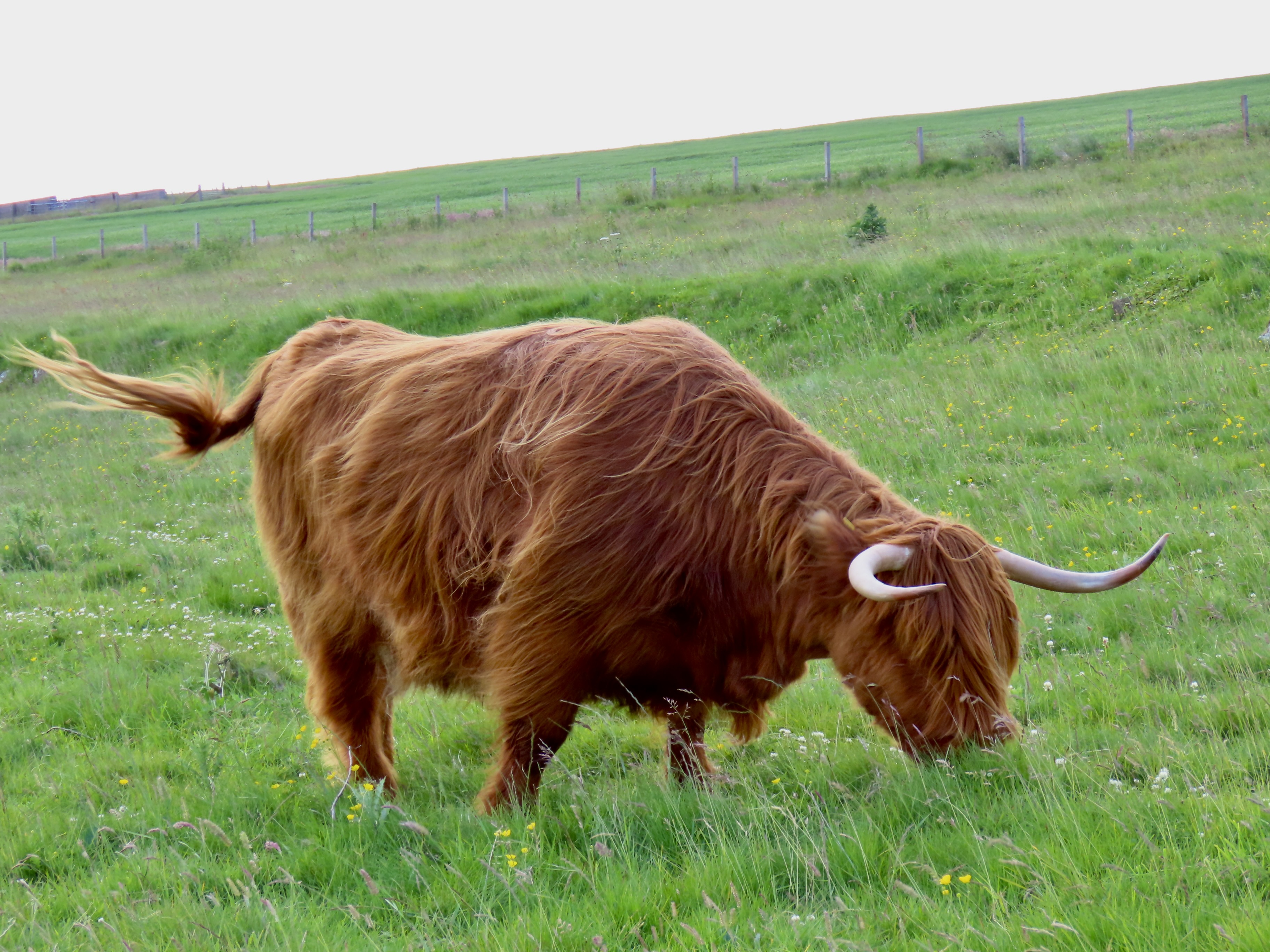
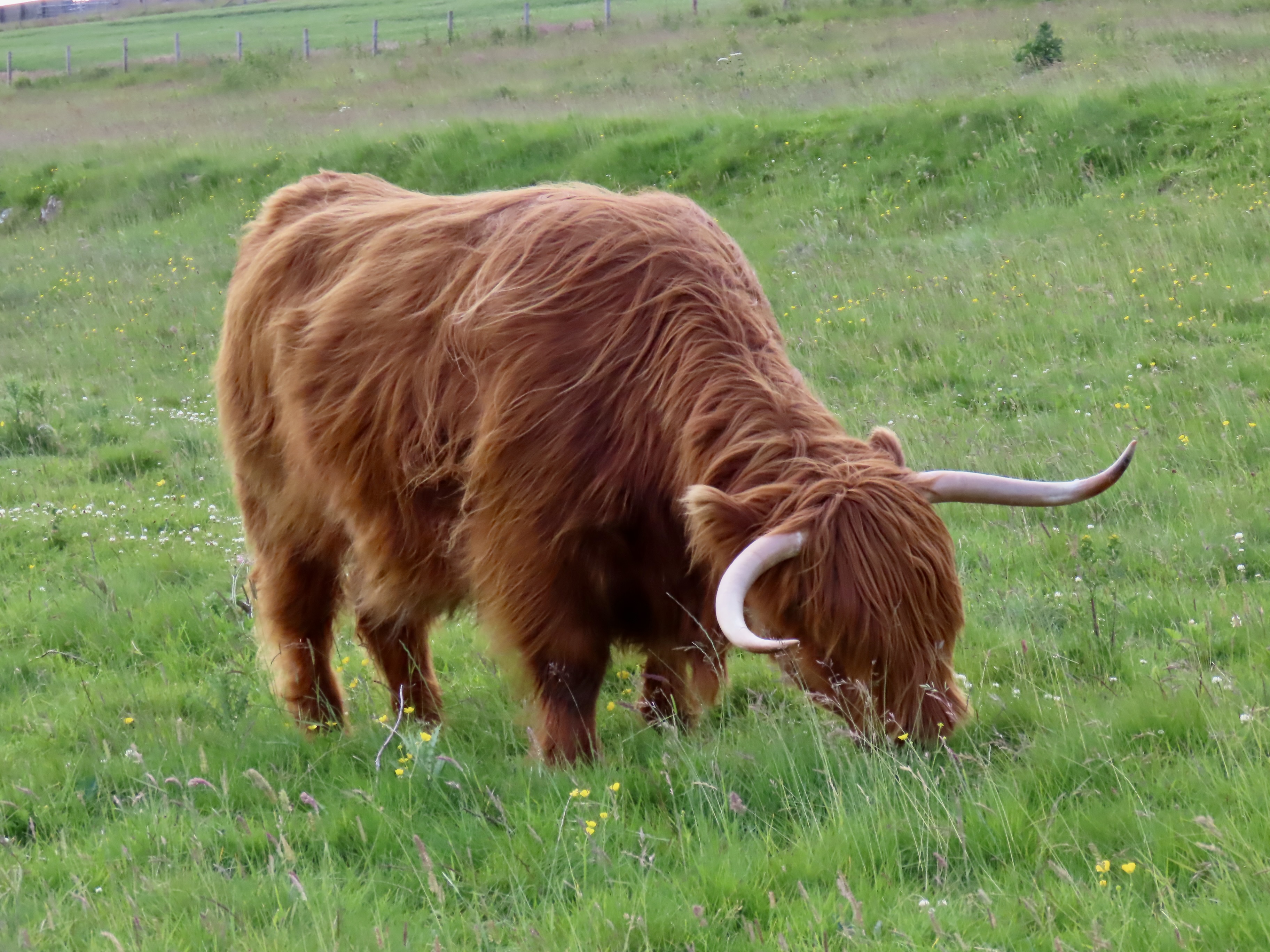
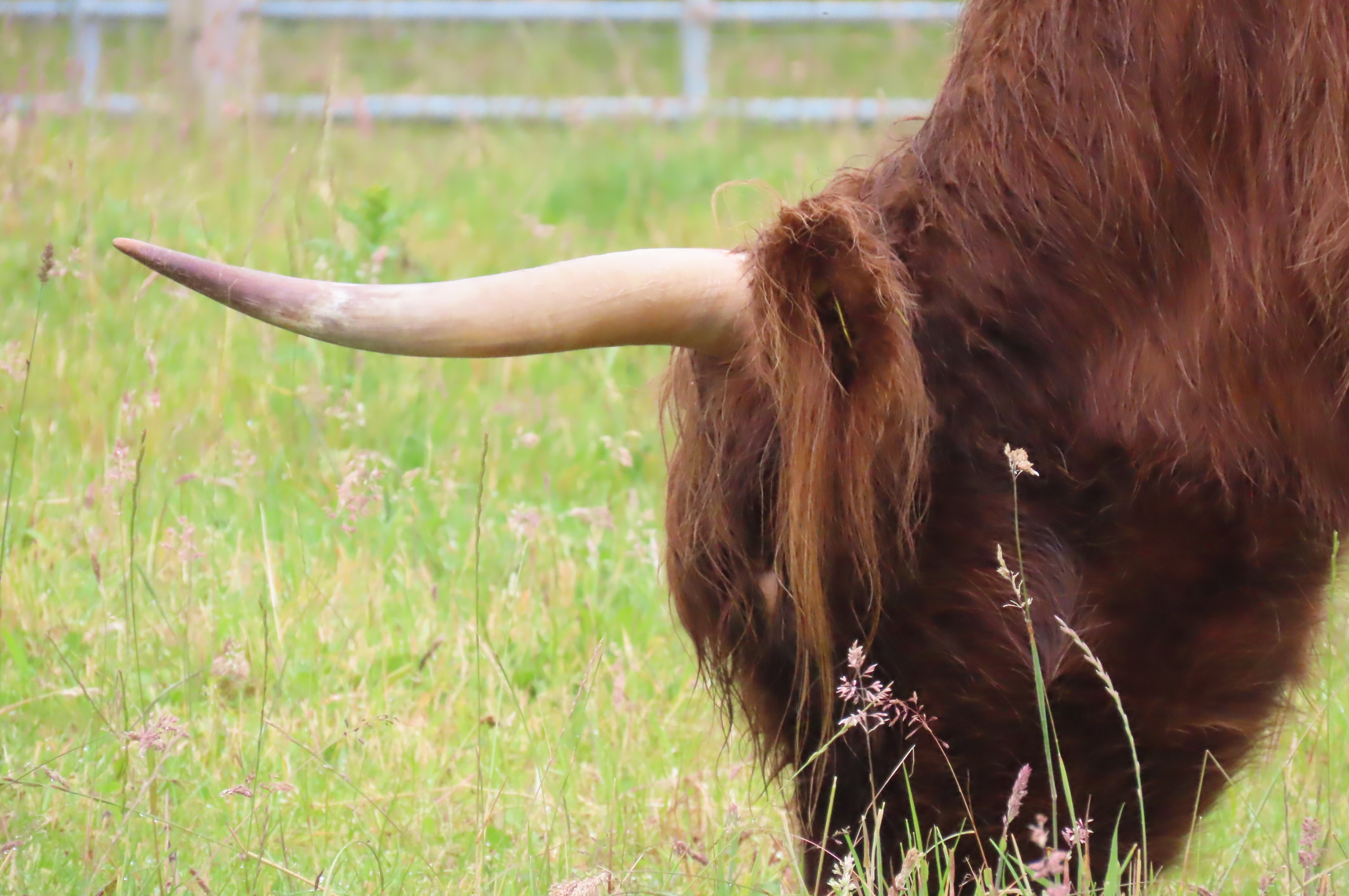
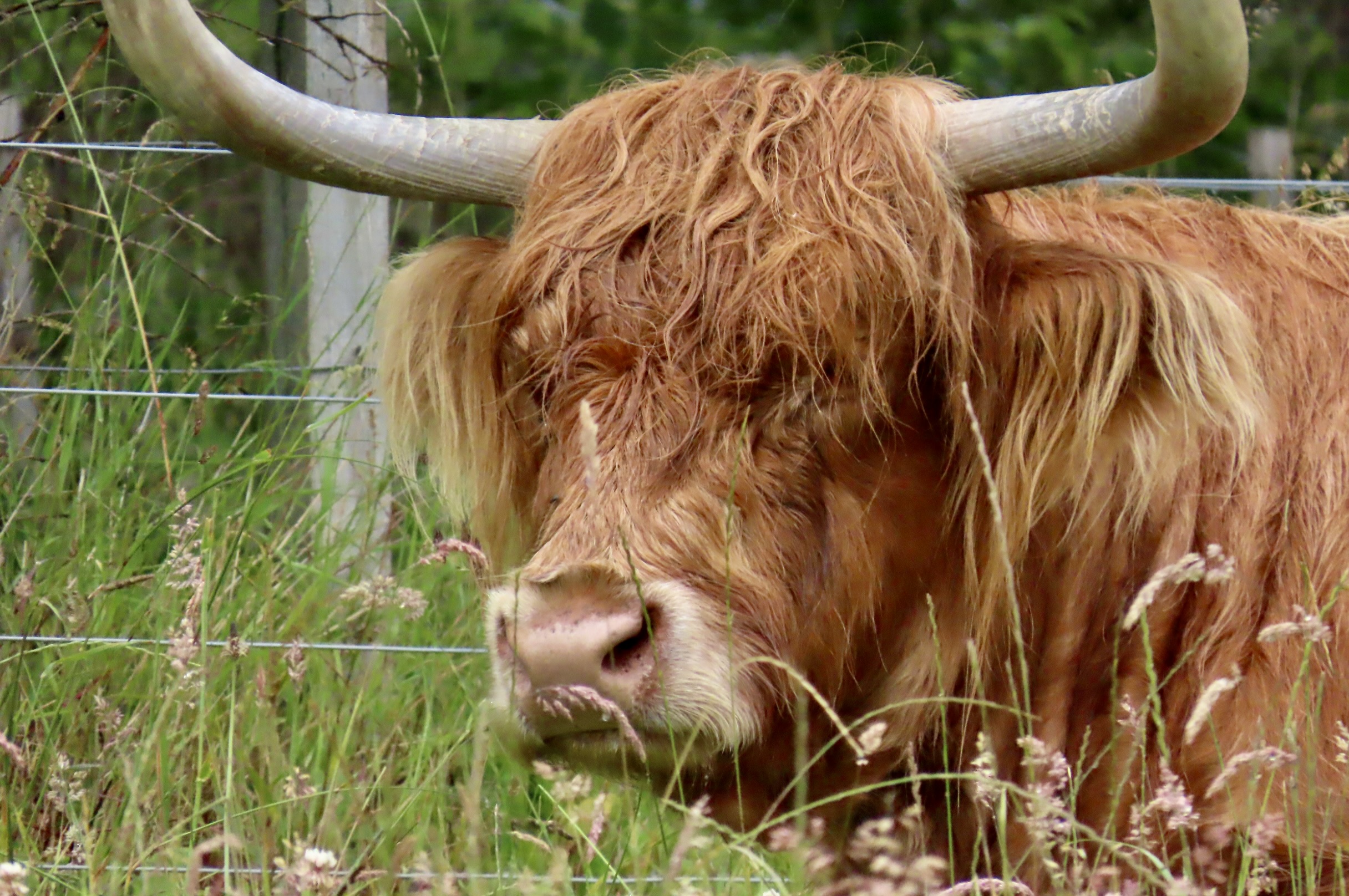
Harry Coos are just about on everyone’s to-see-list for visitors to the Scottish Highlands. Their thick ginger fur and impressive horns are the two chacterisitcs that most people note. The slender, curvy horns suggest that this coo is a female. Check out the ears as well.
Given the popularity of coos, we were surprised they weren’t everywhere. We only spotted them a half-dozen or so times during our recent bus tour exploration of the Highlands! And only had two opportunities to stop and check them out. One was on the northern island of Orkney, the other next to the Culloden Battlefield. While there are over a million cattle in Scotland, coos number only in the thousands. The fact that their milk involves an acquired taste and that their meat is very expensive are important reasons. Besides, one coo might attract 10,000 visitors (or more), but how many people could it feed.“Why is it that people always look at me as an object and only think meat and milk. Why can’t they think of me as handsome or beautiful?’
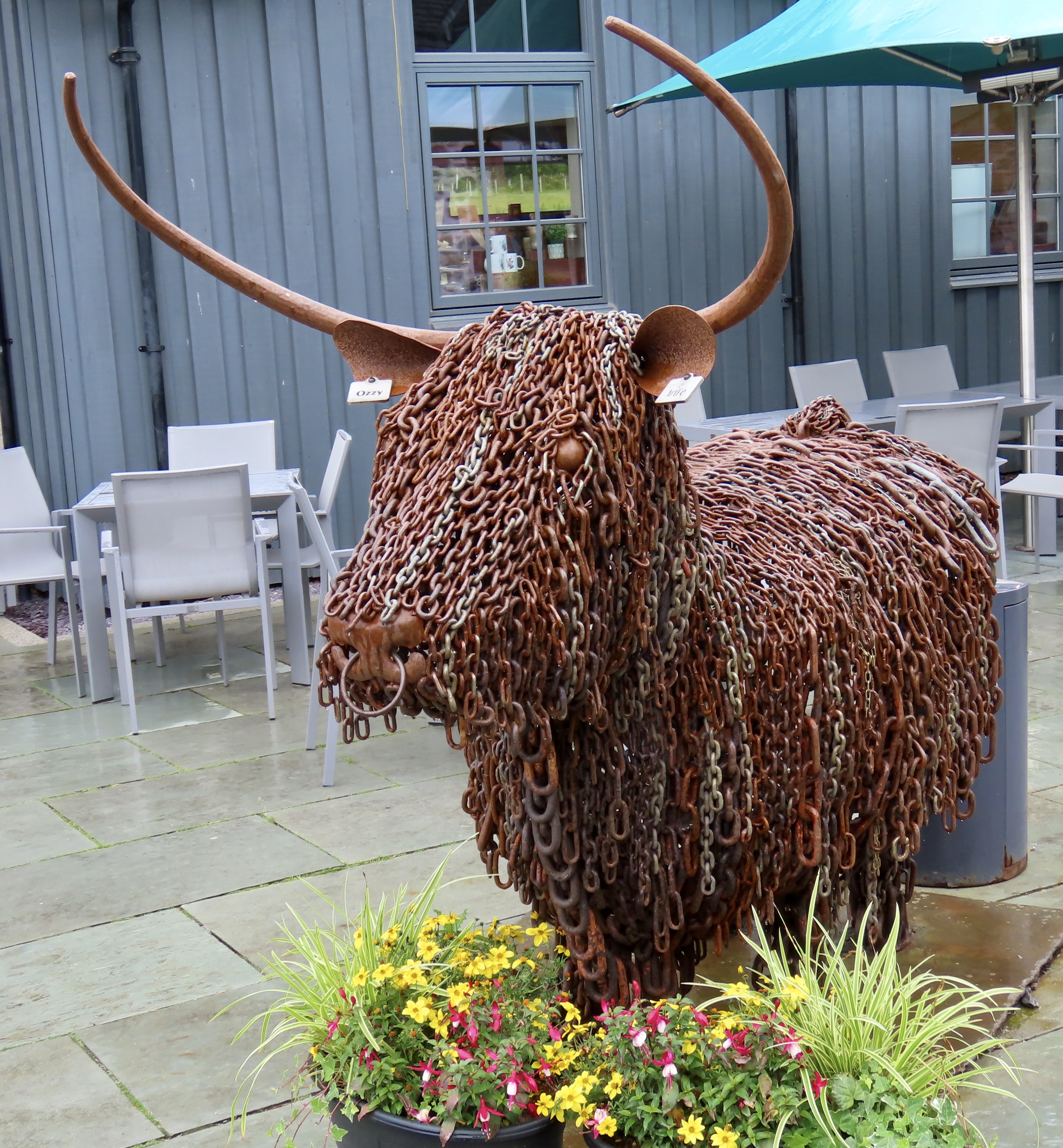
So while coos are much harder to find than normal cows, I doubt that there is a tourist shop in Scotland that doesn’t promote them. Paintings, key chains, coffee cups, shot glasses, scarves, coasters, t-shirts… you name it, you will likely find one with a coo on it. We brought home two.
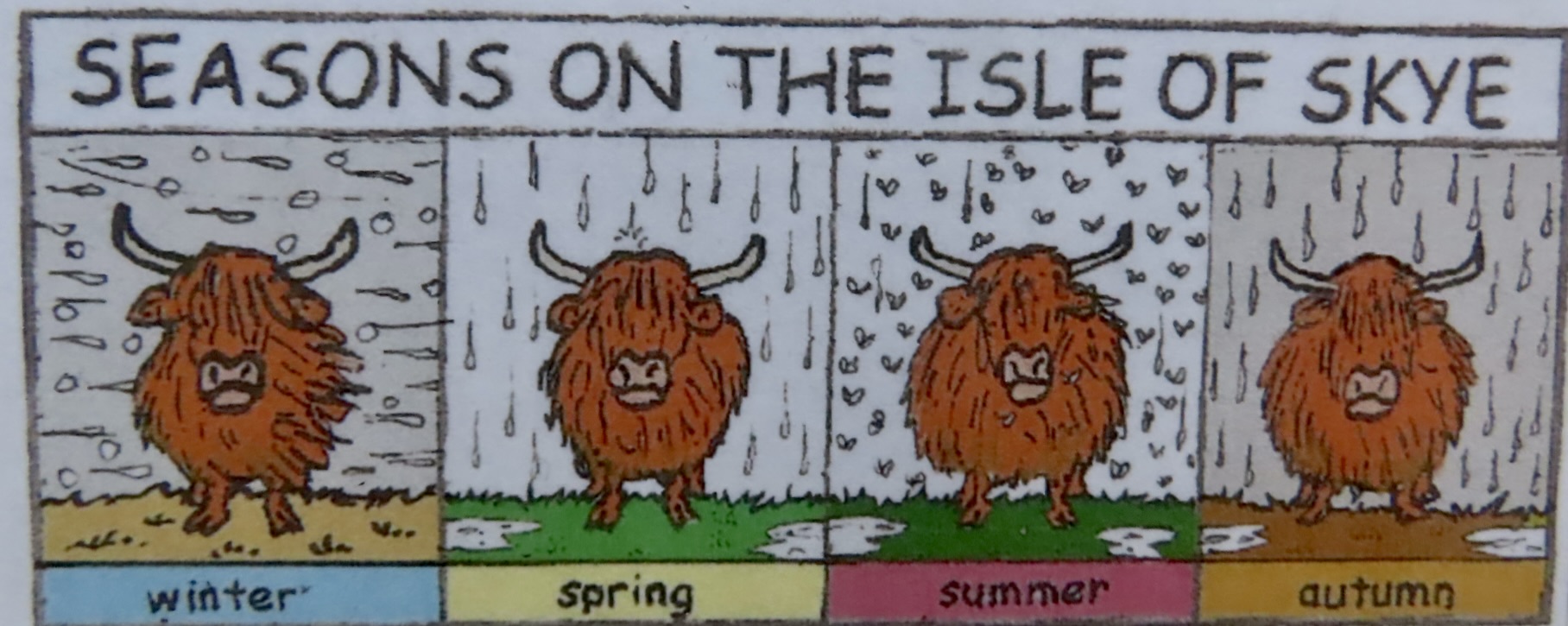
A coaster for me…And a seasonal weather gauge for Peggy.
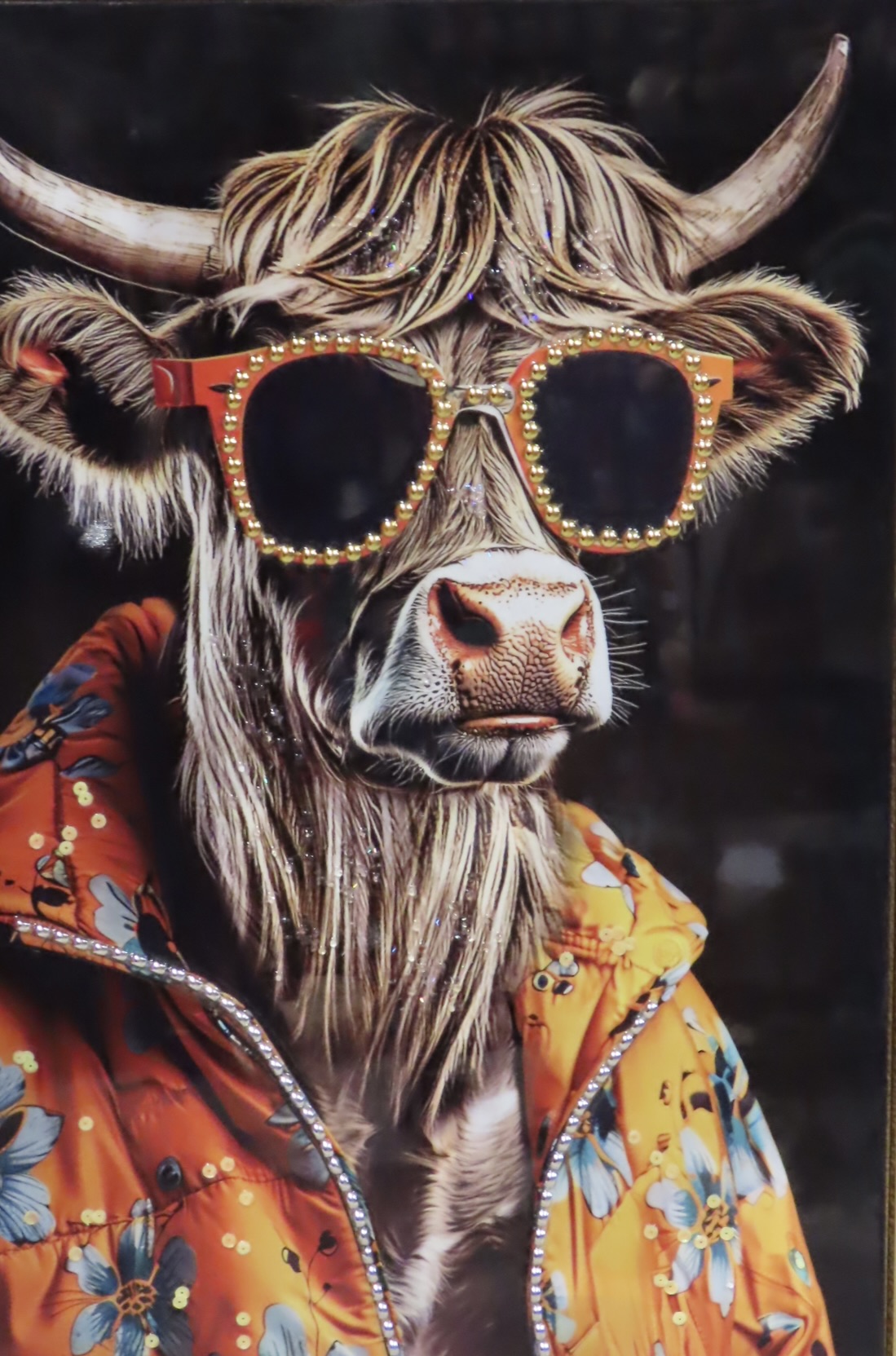
We found this fellow hanging out in a tourist shop. And no, we didn’t bring him home. Judging from the glasses going through his ears, it’s probably AI generated.
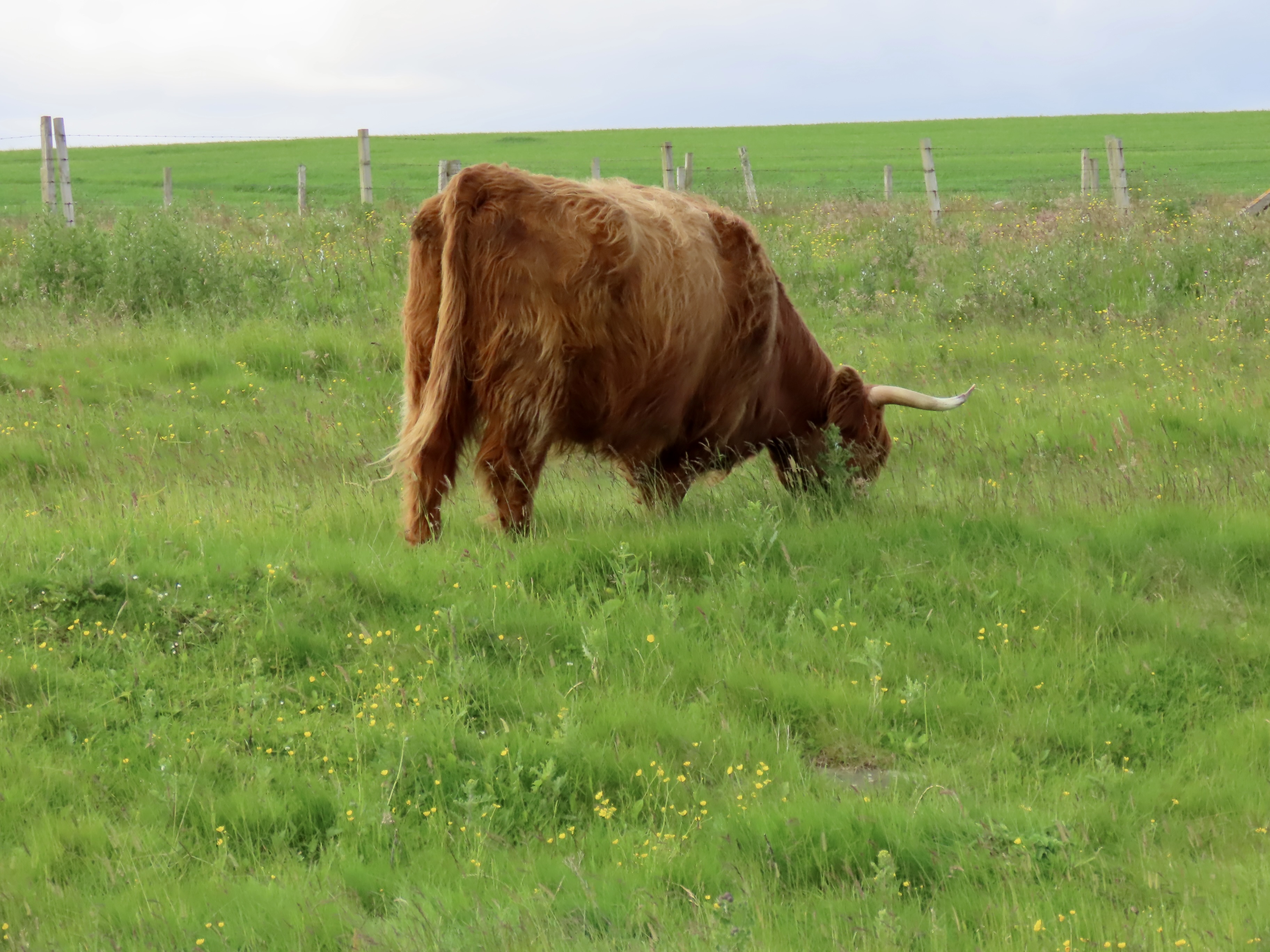
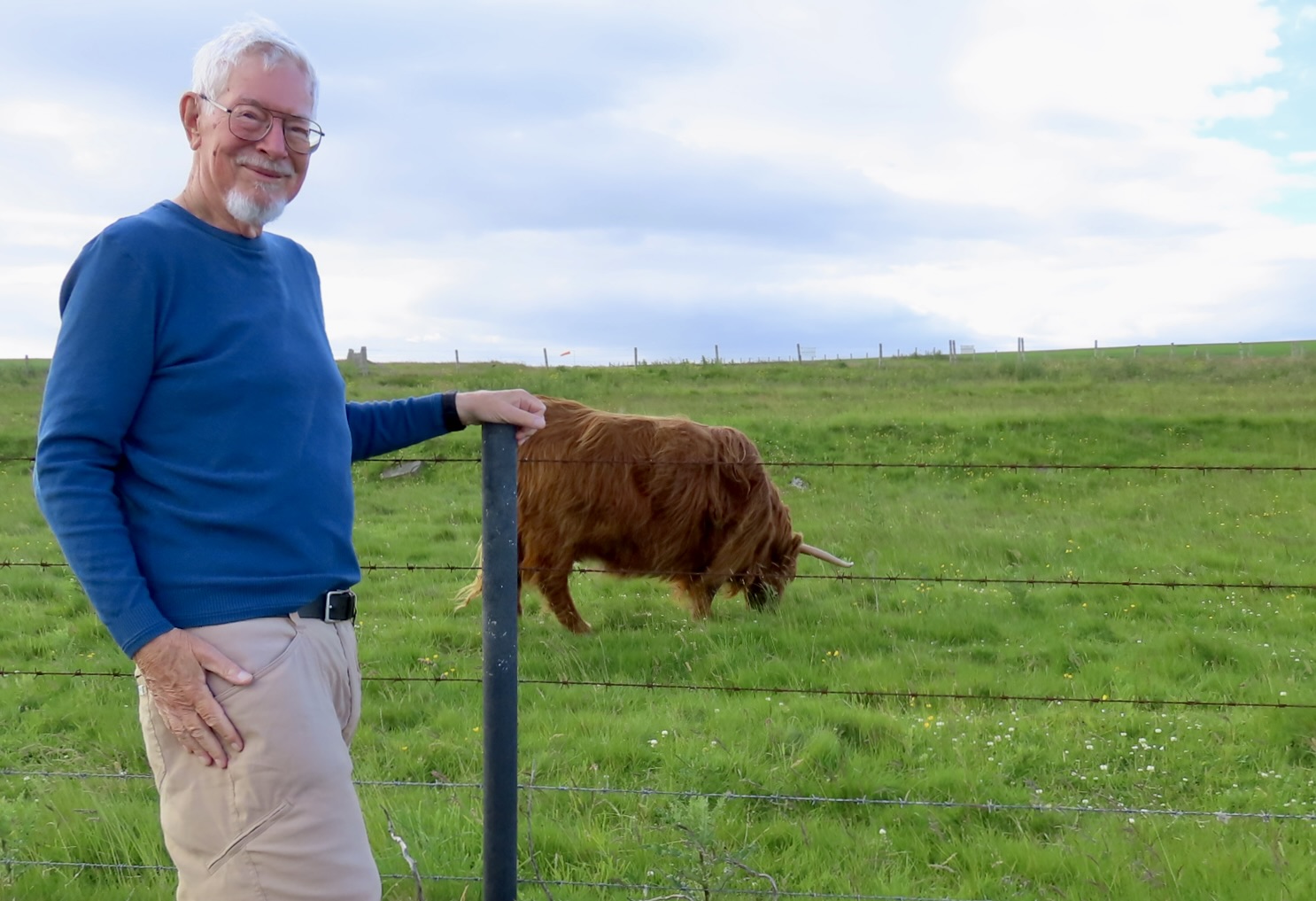
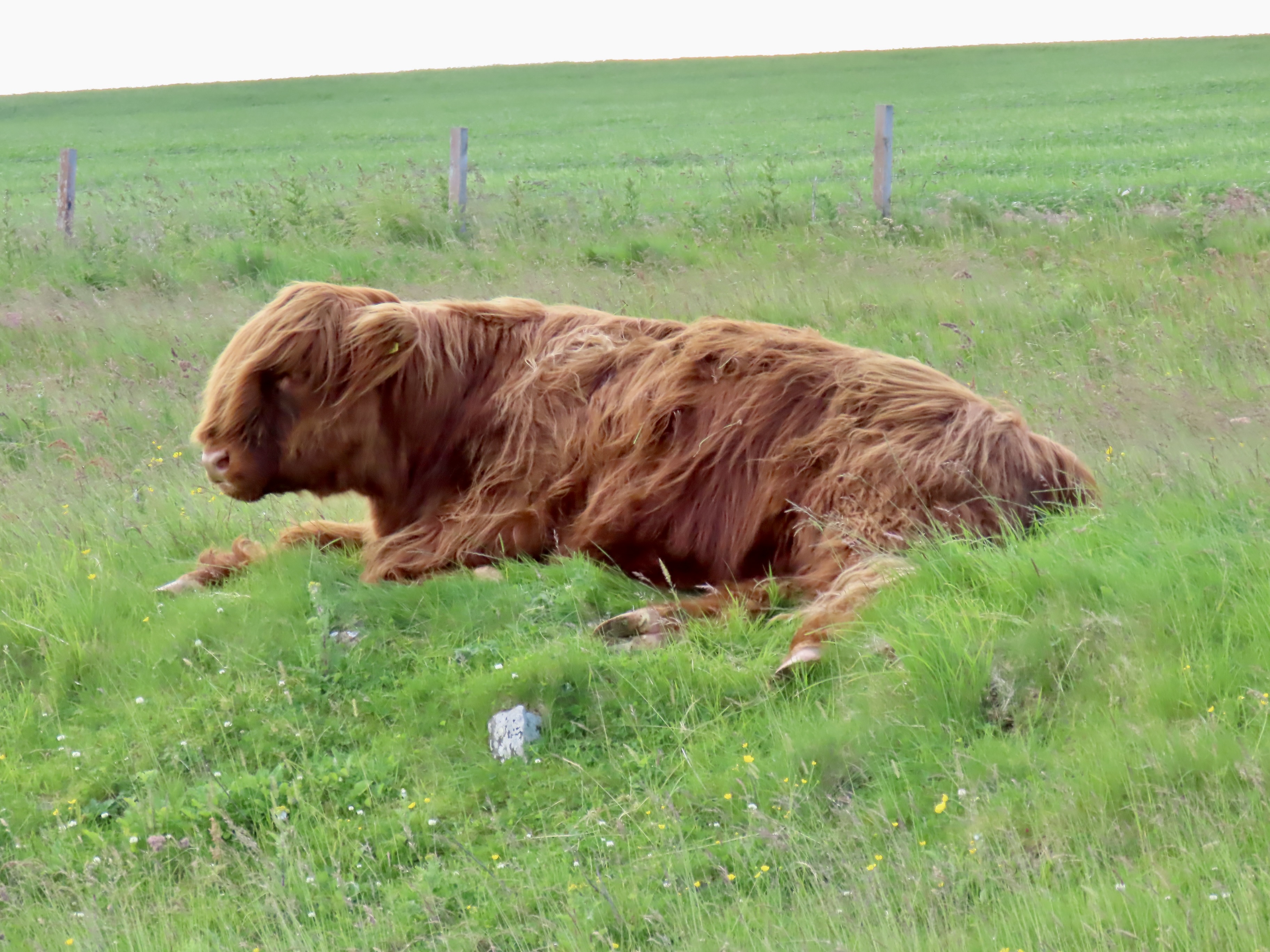
Roadside attraction.The horns are more than weapons. For example, a good scratch. They are also used to break through the snow in winter to get to grass. These guys can eat up to 140 pounds of it per day. I think that’s an oyster catcher looking on. We saw lots of them on Orkney.Harry coos is an apt description for these cows— from their head right down to their tails! They actually have two layers of fur, the shaggy looking outer layer which is oily and somewhat rain repellent and a softer warm, inner coat. Both come in handy for the long, cold highland winters. They’ve had a long time to adjust to the weather. They were first domesticated in 6th century CE in the Outer Hebrides off Scotland.Head shot.Tail shot.Ear shot.Me shot.Don’t know where the horns went on this harry coo lying down. Will assume they were cut off. Had it been a bad coo? Peggy caught a video on her iPhone of it chewing its cud. Just click on the photo/video below.
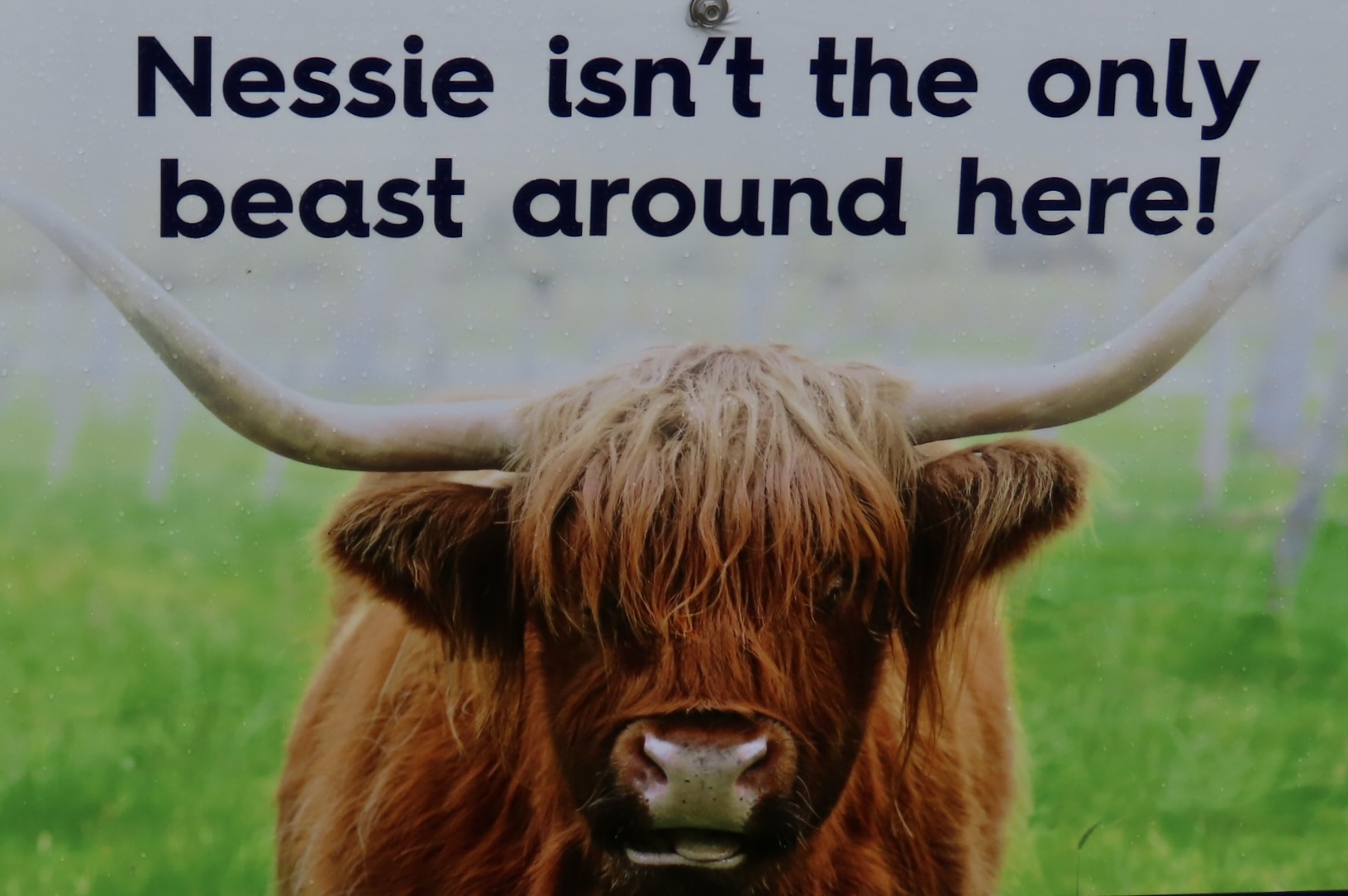
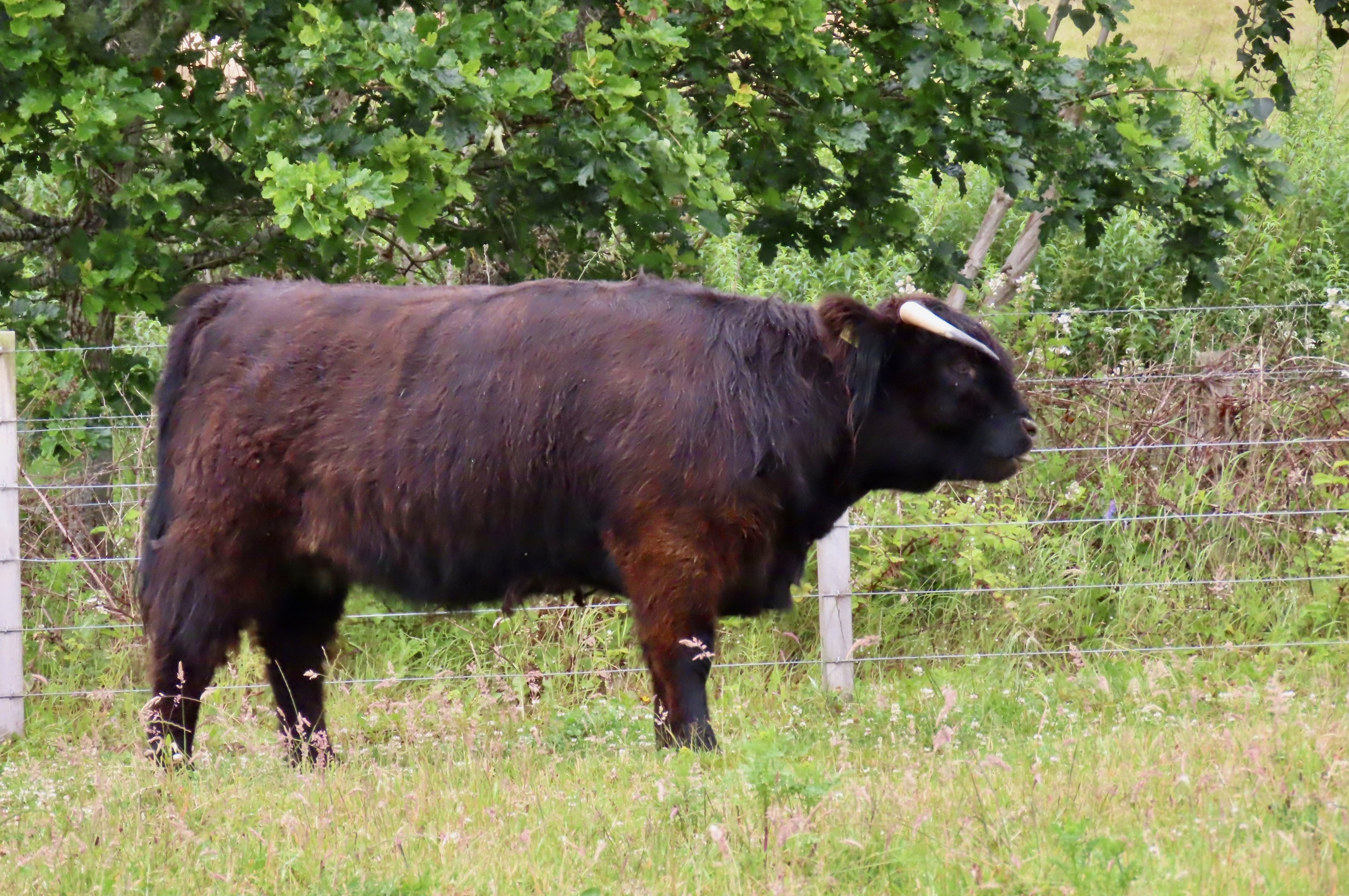
When we were finished touring the Culloden Battlefield, I ran over to capture a few photos of the Coos next to the battlefield. This is where I found this sign.One thing that stood out was a black coo. There was a time when the coos came in several colors. Then Queen Victoria visited the Highlands and stated she was quite taken by the ginger colored coos. That’s when the farmers started focusing on breeding coos with ginger coats. This is a boy, BTW. Horns are straighter and more stout.It’s just possible this lady coo was having a bad day. A cold perhaps with a runny nose? Or a chapped nose. Click the photo/video below and you can decide for yourself. (I don’t know why WP decided to put in The?)
She was licking her nose.Since we brought up Nessie above, that’s where we will go next: To Loch Ness, fabled home to the ancient monster. It was a dark cloudy day, perfect for our search.
Burning Man is many things, and different things to different people. One of its qualities that I have always loved about it is its weirdness, wonderful weirdness. And I like weird.
My friend Tom called a couple of days ago. “Are you ready to go to Burning Man, Curt.” There was silence on my end. Tom and I had discussed the possibility in the spring and I had tentatively agreed. Going back to Burning Man always sounds like a good idea to me. It would be my 14th time. His purpose was test a new battery driven blender he has invented under extreme conditions. It is small, powerful, quiet, and tough. The plan was to set up a booth on the Playa and give away slushies and margaritas. It would be an ideal test: Extreme temperatures, dust storms, and the legendary thirst of Burners would guarantee it. Then, as it turned out, Labor Day Weekend was an excellent time to begin a kick-starter campaign. Burning Man was removed from the equation.
Unfortunately, the first shipment of blenders necessary for the campaign won’t get here on time. They are coming via a slow-boat from China. The Burning Man trip was back on the table. “I’ll pay for your ticket and a rented vehicle,” Tom offered, sweetening the pot. He really wanted me to go. But here’s the thing. The event is a little over 3 weeks away and Peggy and I have just returned from two months of wandering around in Europe. I’m still in recovery. Two, we are planning a leisurely trip down the Blue Ridge Parkway starting immediately after Labor Day, which is when Burning Man ends. Three, I checked the weather forecast. Another heat dome is predicted to be over Nevada for the whole week. Daytime temperatures are predicted to be in the triple digits— every day. Somehow, having a booth with zero air-conditioning in the middle of the desert in 100° plus weather with likely wind and black-out dust storms didn’t sound all that appealing. On top of that, we would have to set up and take down the operation each day, not to mention schlepping hundreds of pounds of ice by bicycle. Some fun, huh. Especially for an 83-year-old. I reluctantly told Tom no.
Okay, no Burning Man for me this year. Sigh. I went back and looked at the photos that Peggy and I have taken over the years to cheer myself up— and was struck by an idea. I should do a post to encourage newbies to go looking for weird when they arrive at Black Rock City. It’s found everywhere: In sculptures, paintings, mutant vehicles, camps, and costumes. Following are examples from my 13 years of journeying to Black Rock City.
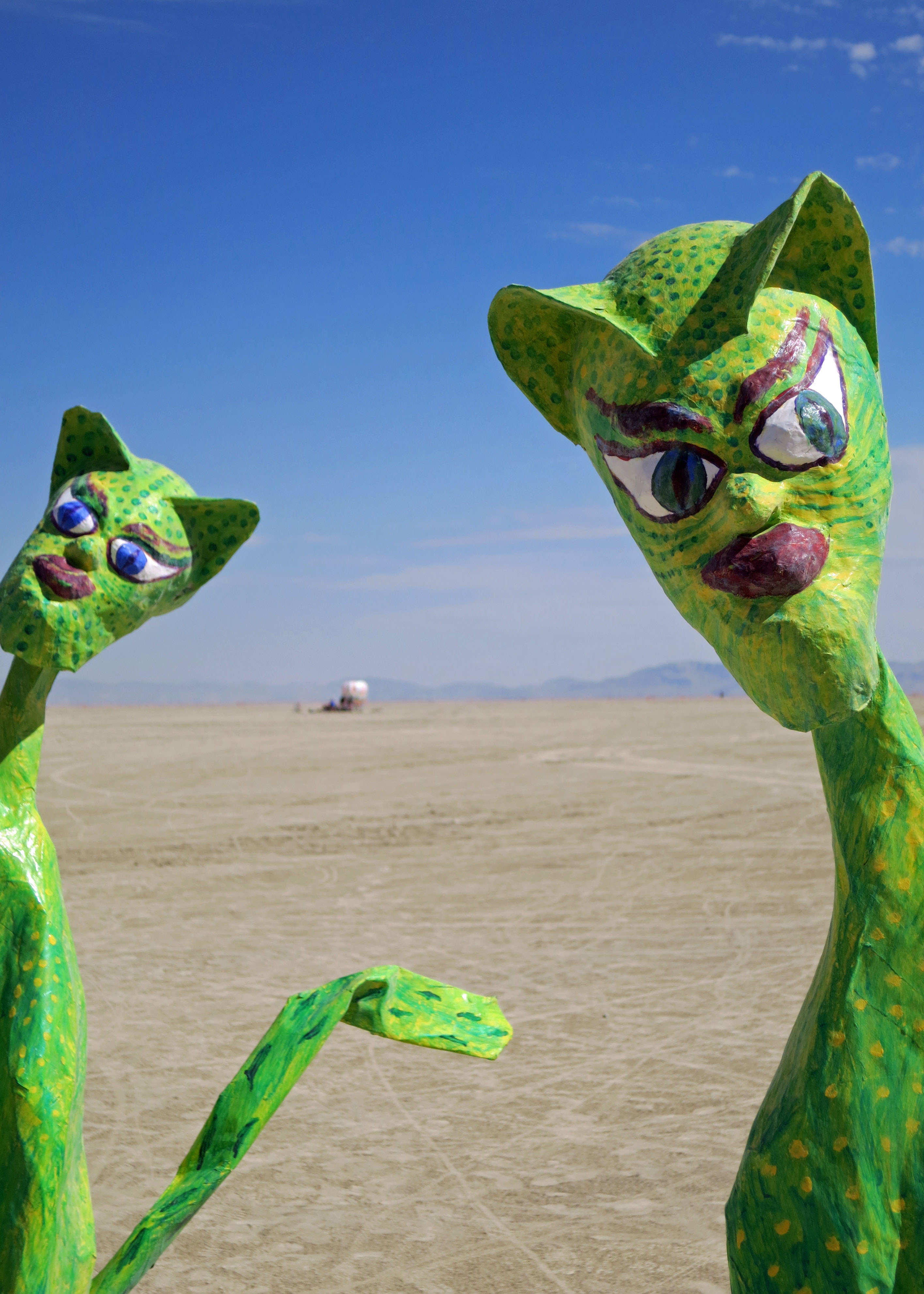
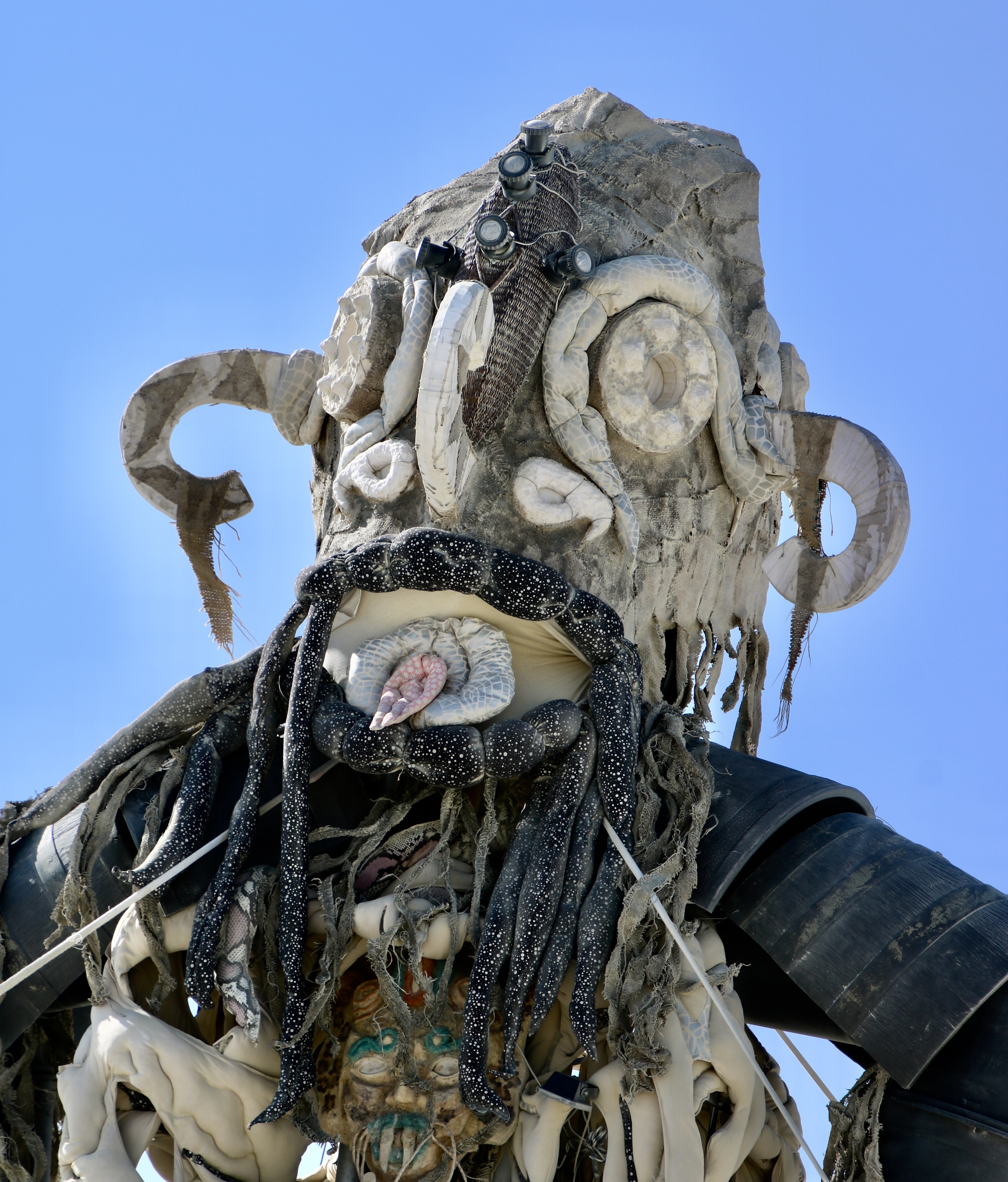
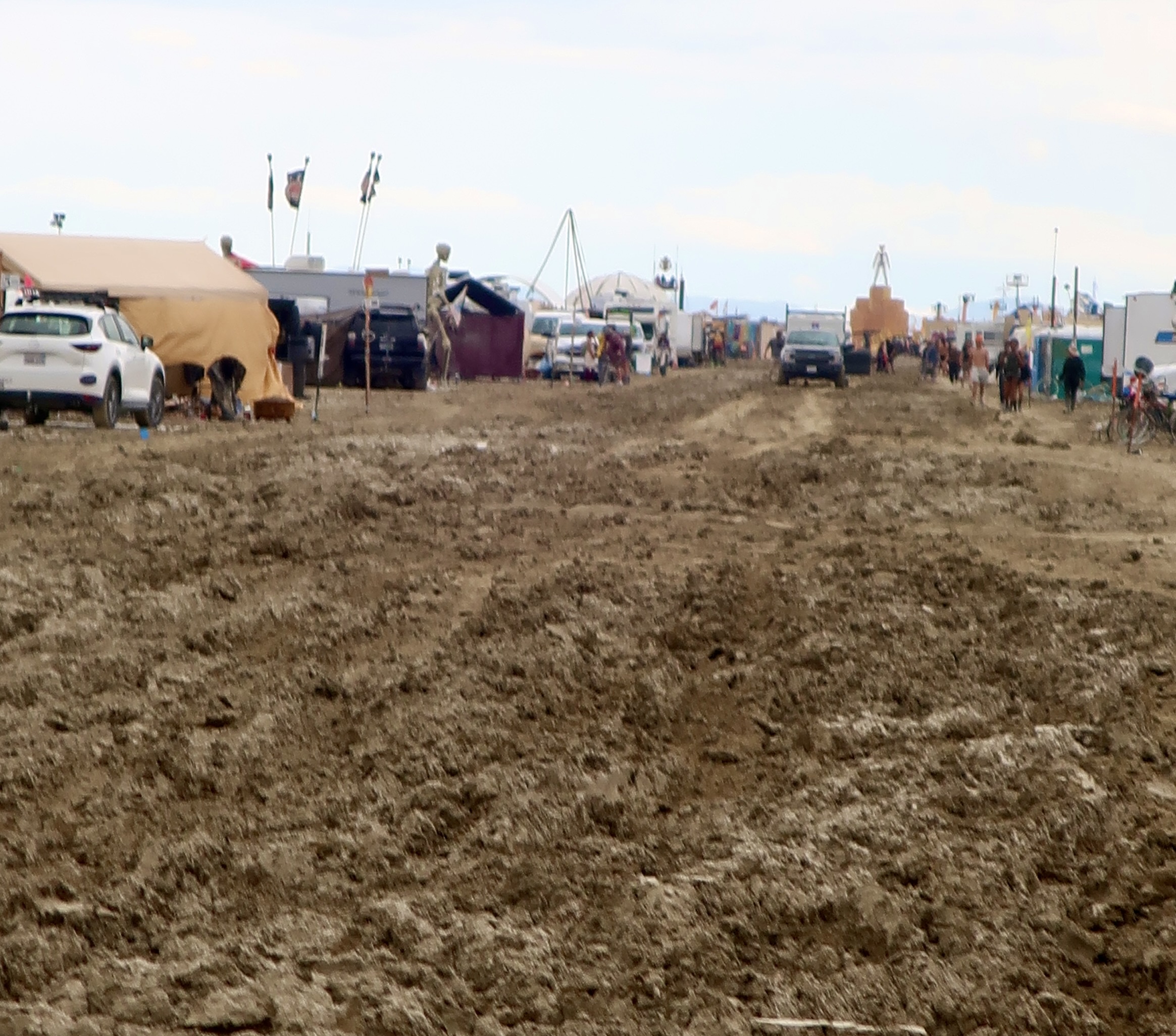
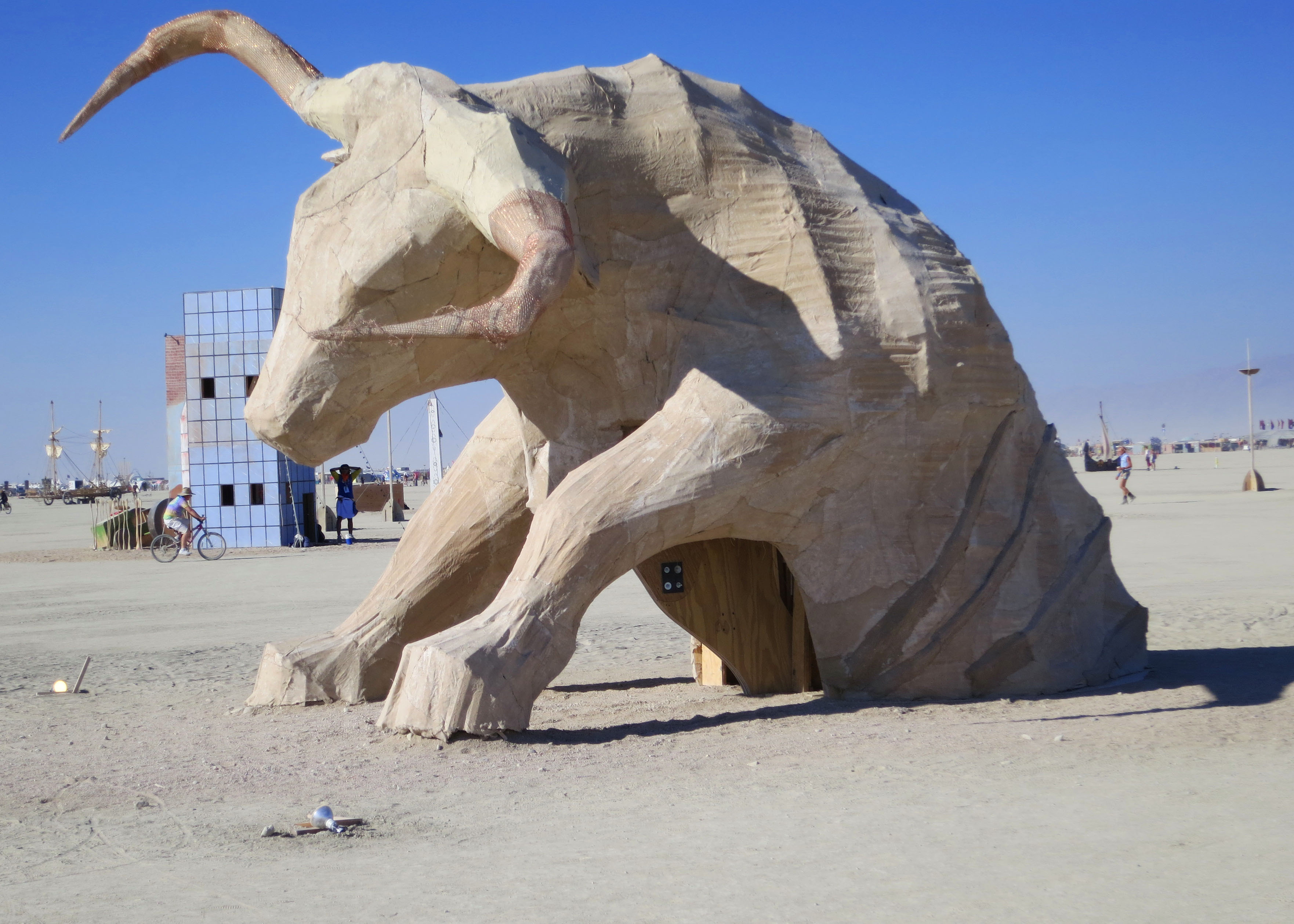
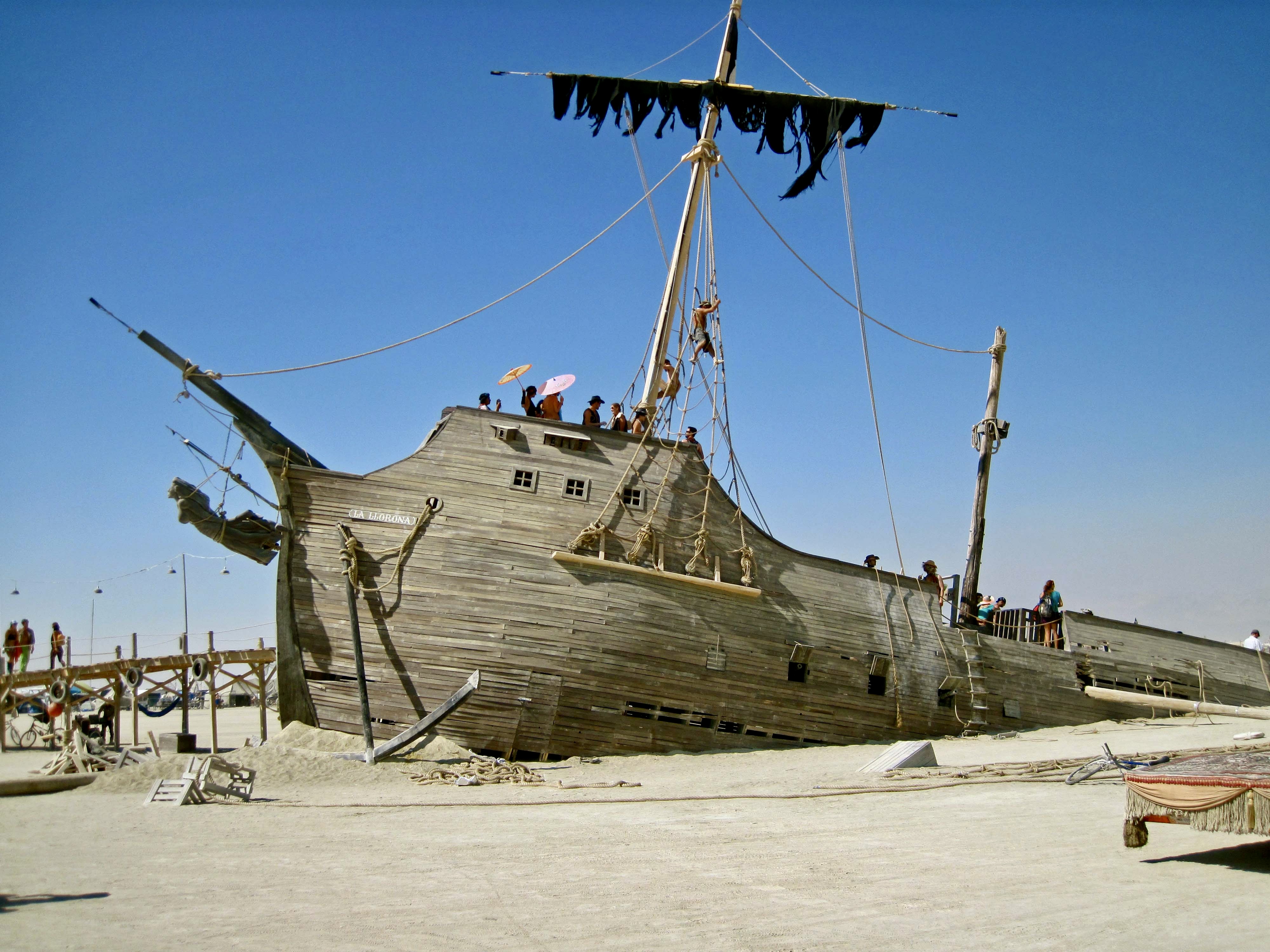
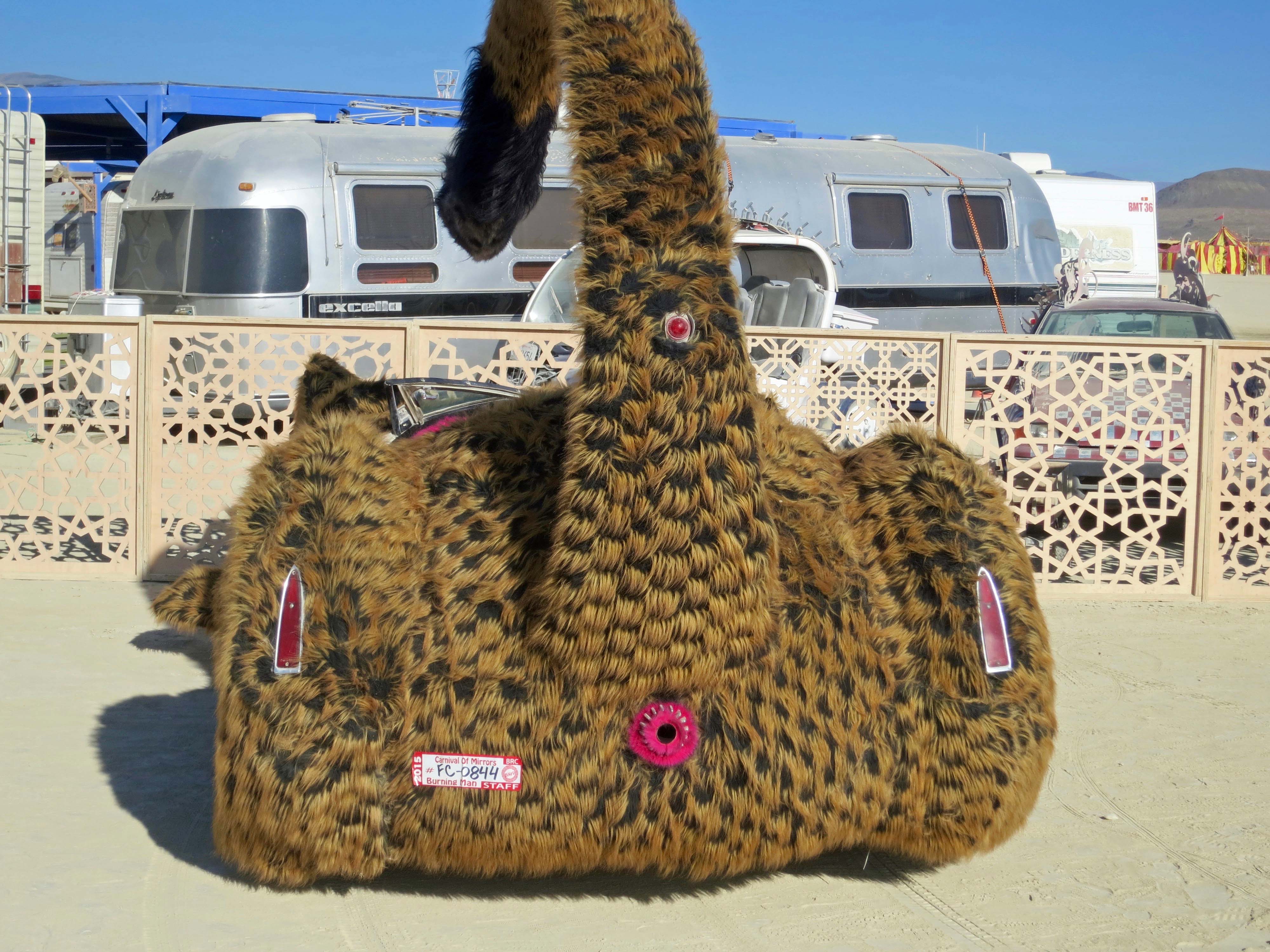
How’s this for weird? I think that this was an ancient rain god, ugly but powerful. He was there in 2023.Bone, being Bone, challenged him, saying ‘Show me what you got!’ (Bone has been traveling the world with Tom and me ever since we discovered him in a snow bank south of Lake Tahoe in 1977.)Watch what you ask for, Bone. I didn’t tell any of my fellow Burners what Bone had done, given that all 70,000 of us were stuck in the mud from a massive rainstorm.This house/beast with legs would have been ideal for hoofing it out.Speaking of hooves, it’s rather weird that creatures are always crawling up out of the desert floor: Fish, people, a large ship. One year it was a giant Texas long horn, a lot of bull.An octopus slithers up through the desert floor. The sunken ship La Llorona rises again. Or maybe it was sinking.Not that there is any lack of strange sculptures resting on the surface. The imagination of artists that bring their work to Burning man knows no bounds.I’m not sure what this was but it was something I didn’t want to catch. I kept my distance.Brainy child or pregnant woman? Hmmm.No question what this is. A skull tree. Just what you need growing in your backyard. Note: There might be some objections if you live in an HOA. Or anywhere.A sign and Calvin informed me that this was Hobbes.Blue Dog at Burning Man.A skyscraper next to King Kong wearing a pink tutu.Medusa! I could go on and on with sculptures, but there is so much more that is weird.Take murals, for example.Bad kitty!Some murals and paintings are in much greater detail. Odds are we found this fellow at Camp Mystic.Look closely at this painting. The details are as amazing as they were varied.Always been one of my favorites.The only way one can drive on the Playa at Black Rock City is in a mutant vehicle. There are two rules: the vehicle can in no way resemble the original vehicle and two, it has to be safe. Imagination runs rampant. I wonder how many of today’s Burners will have actually used one of these?!In the swamps of Louisiana. This was a NOLA creation!Way up north. (Tom took this photo.)Chicken pox at Burning Man.Clever use of tail pipe on cat car.This scary creature is called Rabid Transit. Many mutant vehicles are designed to operate at night as well as during the day, and many of them shoot out flames. Burning Man at night is totally different at night, and in many ways, an even more magical world.Cleverly done. The Eye.Cheshire Cat.Costumes are big at Burning Man. Burners are strongly encouraged to wear one. This long legged fellow enhanced his costume by pulling a piano that was being played! Note the Burning Man symbol on his chest.This dude stopped by our camp each day demanding a beer… The best we had.Almost everyone uses a bike at Burning Man. There are thousands of them. Many of them are decorated!A lioness. Have you ever seen a ‘do’ like this one? Our friend Don Green took this photo.Real but surreal. The ‘barbie’ look above reminded me that you can walk down any street in Burning Man and see elaborate decorations that are created by the camps. A camp is a group of people who share some commonality. This camp featured Barbies. Hundreds of them. They were marching to their final destination.The bigger the camp, the larger the decoration. How do you feel about clowns? Campground decorations are often related to the theme for Burning Man. This year it was Carnival.BM’s media tent also featured a clown. The tent was appropriately named Media Circus.These guys were out in front of the Silicon Valley Camp one year. Many of the Valley’s billionaires make their way to Burning Man. Musk has been there several times. I think he looks a bit like the guy on the left.I have to wrap this up so a few last photos. It is rumored that aliens have made their way to Black Rock City where they can wander around without fear of being recognized.Age apparently isn’t an issue. (I may know that better than anyone who attends the event.) I think I would recognize the red breasted woman as an alien, however. It’s possible the ‘cats’ at the top of this post were aliens as well. I think this guy is reminding Burners to look for the weird. You are guaranteed to find dirt. Monday’s Post will feature the Hairy Coos (cows) of the Scottish Highlands!
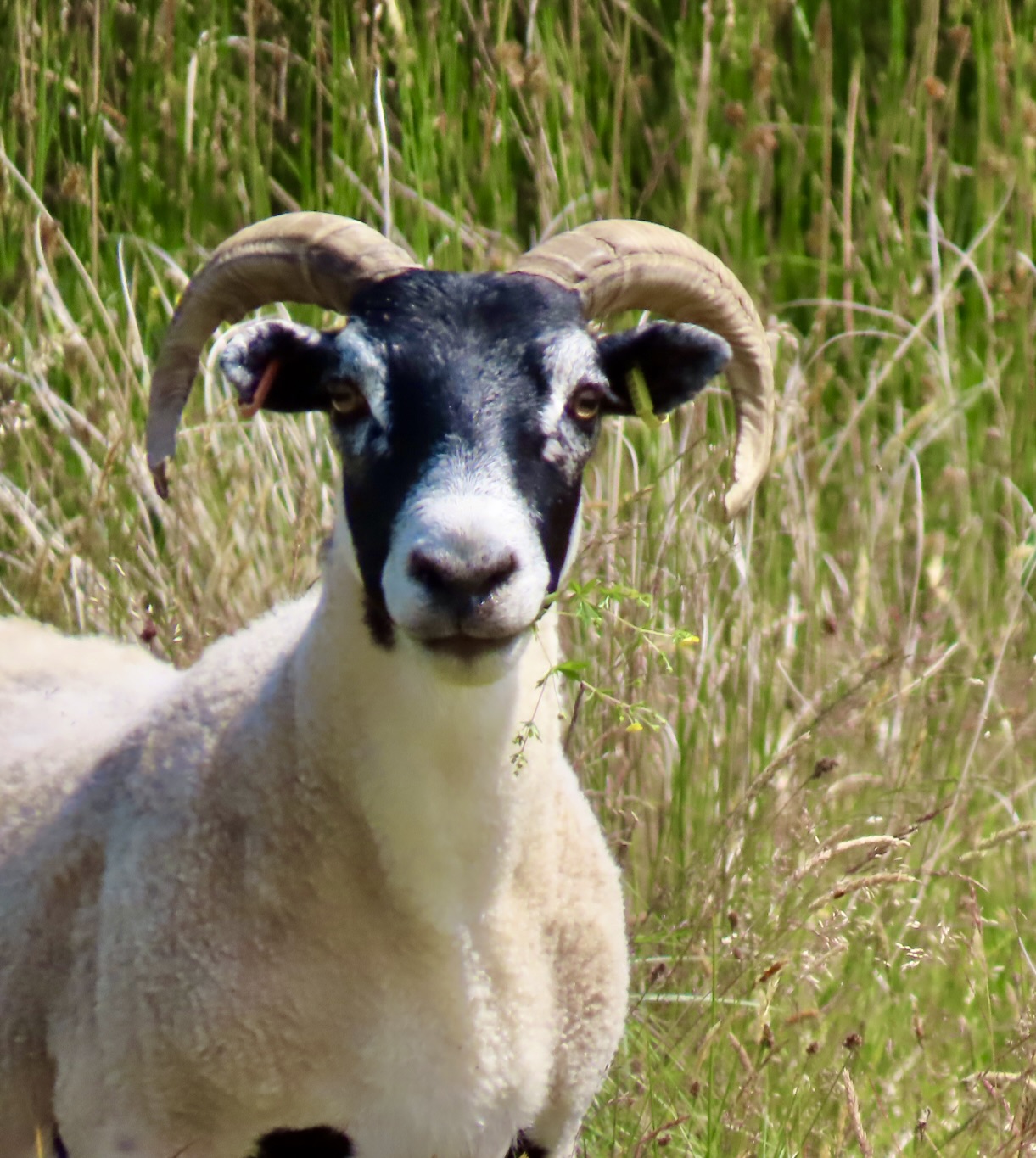
It looked like this black-faced sheep in the Scottish Highlands had learned how to fly when escaping from a border collie. Maybe not, but it was a one heck of a leap!
Peggy and I have now returned from our two month exploration of Greece, the Scottish Highlands and Ireland. I’ll be blogging about the experience over the next couple of months, focusing on highlights.
One of the highlights of our CIE Travel Company bus tour of the Scottish Highlands with our grandson Cody was stopping at Neil Ross’s 11,000 acre Leault sheep farm in Kincraig, Scotland. (It’s not far from Loch Ness where we went in search of the legendary Nessie.) Neal and his border collies put on a sheep dog demonstration for us that was incredible.
The first border collies were bred on the border between Scotland and England, thus the name. Their ancient ancestors were Viking and Roman herding dogs. Their specific ancestor traces back to a dog know as Old Hemp born in 1893. His herding instincts were so highly developed that sheep herders the world over wanted pups from him. It’s said that he produced over 200— and I assume that he was quite happy to do so. Among the qualities that Old Hemp showed were high intelligence and the ability to manage large flocks over long distances using independent judgement. Plus a real love for his master and a strong desire to please. The latter made him easy to train and eager to carry out his responsibilities.
Sheep herders were also impressed with the fact that Old Hemp was less physical and more mental in his herding technique: Instead of biting the sheep, he gave them ‘the look,’ translated ‘do it or else.’ The bite was implied. I understand the look. Peggy was the principal of an elementary school with over 1000 students from 18 different countries and was a master of the look. She didn’t have to use it often, but when she did, the kids were instantly on their best behavior. So am I.
Possibly the most important factor is the herding instinct, which is the result of hundreds, if not thousands, of years of herding. Sheep and cattle dogs love to herd. It is not a chore; it’s a way of life. When Ross brought his dogs out for the demonstration, they were almost shaking in their eagerness to be turned loose. When Cody was young, his dad had bought a pair of Austrailian cattle dogs. They were constantly trying to herd him and his brother Ethan. They even tried to herd me, but we had a discussion about it. In addition to sheep and cattle, border collies have also been used in herding poultry, pigs and even ostriches!
Neil uses both voice commands and whistles to let his dogs know what he wants them to do. If you ever watched the movie Babe where the pig ends up herding the sheep, Neil provided the whistle commands used with the sheep dogs in the movie. It’s fascinating to watch how Neil and the sheep dogs work together. His first command was to go out into the woods and bring the sheep into the field where the demonstration was to take place. At one point he directed his sheep dogs to separate out some sheep that belonged to a neighbor from his herd, and they did it.
Following are photos that Peggy and I took to give you something of a feel for the sheepdog demonstration. We will apply our own interpretation as to what the border collies were up to…
The collies began their work by gathering the sheep together out in the woods on Neil’s ranch. The video at the end shows the effort. The dogs then brought the sheep into the open area in front of Neil’s house where they demonstrated their ability to control them. Our interpretation here was that the collie that you see in the foreground was staring at the sheep and informing them, ‘You are going in the wrong direction.”“That’s better.” “Now run. It is okay to wag your tails.” We watched as the border collies worked the sheep back and forth across the field at Neil’s commands.“Now, line up in groups of 2-4 and trot across the yard for a group photo.” One dog, seen next to the sheep here, is herding. Another dog stands off in the distance, ready to run in and help if needed. The dogs worked in tandem with two other collies on the field. “Good sheep.” We dutifully took photos. (All of the wool on the ground suggested to Peggy and me that the sheep were shedding. Either that or it was left over from sheep shearing and had been blown across the field.)This photo provides an idea of the number of sheep the dogs were working at the time. It’s just a small portion of the 2500 sheep on the farm.The whole time the dogs worked, Neil was giving them voice and whistle instructions.He also demonstrated the fine art of sheep shearing while three of his dogs looked on. Maybe they were there to assure the sheep’s good behavior.Neil also introduced us to a pair of lambs.And a calf. One of the lambs stuck its nose out through the fence, asking to be let out. Neil let all three out where members of our tour group fed them milk with baby bottles.The absolute stars of the show were the three border collie puppies that were brought over to meet the tour group.Cody fell in love— and was threatening to steal one.I could hardly blame him.Peggy joined Cody for a photo op.A large yawn announced that the puppy had decided that taking a nap in Cody’s arms seemed like a nice thing to do. Or was it saying, “Ah want tae learn hoo tae mak sheep flee, jist like mammy and daddy.” With a proper Scottish accent, of course.Nope, it was sleep.
This video below shows the dogs bringing in the sheep from the forest to the open field under Neil’s directions. One of other dogs wants to join the fun but is limping. Neil directs it down to the open field to hold the sheep when they arrive. You can see the dogs working in the background. Note how fast they run. A few of the sheep slide off to the side. You can hear Neil telling the dogs “Say goodby, say goodby. Clicking on the photo will start it running.
My next post on Tuesday will take you back to the book I am blogging, UT-OH, and the beginning of my time at UC Berkeley where I was a student when a nation-wide effort was underway to involve students in the civil-rights movement. I ended up giving speeches from the Dean’s desk and sitting on the floor of the Administration building singing We Shall Overcome with Joan Baez.
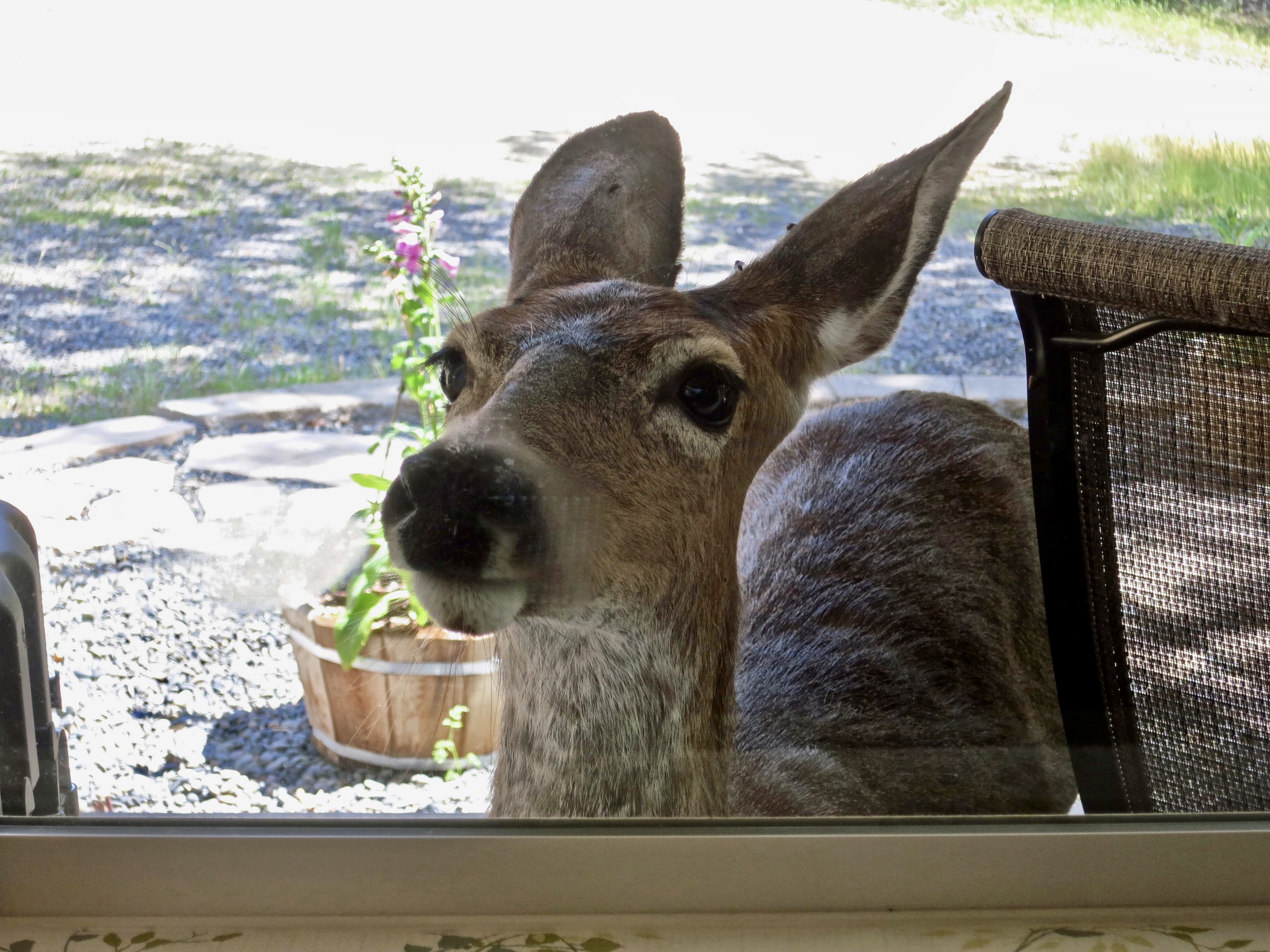
Our wildlife viewing in Oregon was a two way street. The deer were as likely to be staring in the window at us as we would be staring out the window at them.
Our five acre home in Oregon backed up to a million acres of national forest lands. The Applegate River flowed by the front. It was an ideal location for wildlife viewing. Almost magical. We had front row seats. Usually, our wild visitors were a joy, but when cougars and bears stopped by, we rolled up the welcome mat.
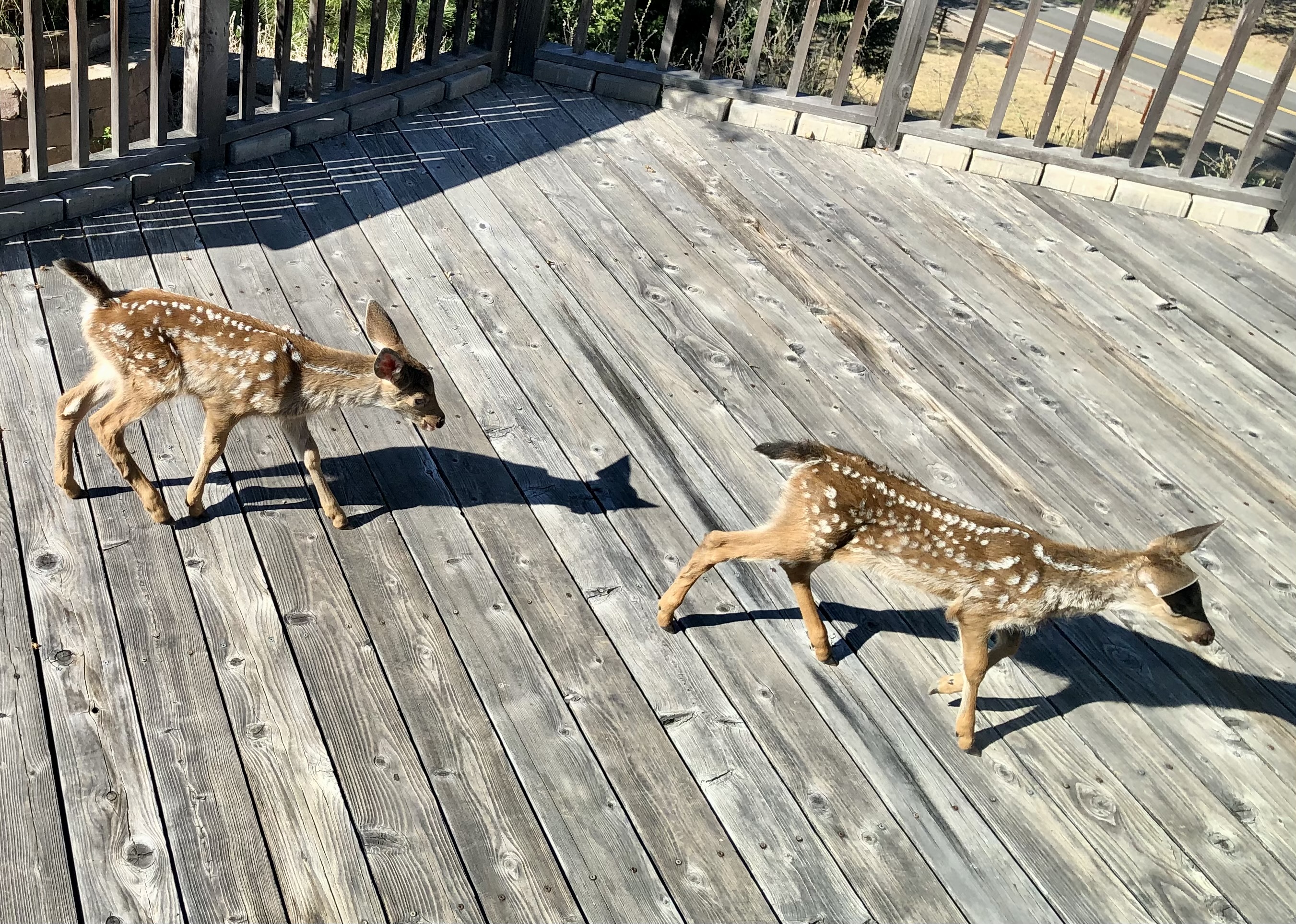
Two fawns crossing our deck.
One night Peggy and I woke up with a start as a deer leapt onto the deck next to our bedroom. They frequently crossed the deck, but rarely at night and never at full speed. It got our attention— but nothing like the loud thump that followed. I imagined something big and thought of getting up to look. But it was a moonless, pitch black night. I wouldn’t be able to see anything and the intruder would be long gone. Or not. I decided to go back to sleep.
Our neighbor, Bryan, called the next night. “I’m shaking, Curt,” he told me. A hawk had taken out a chicken of his during the day and he had gone out after dark to check on the welfare of the flock. What he found was a pair of eyes staring out at him from one side of a large tree. A long tail stretched out from the other side. Twitching. It was a cougar! Around 7 feet long. Bryan kept his bright flashlight focused on the eyes and slowly backed away to the safety of his house. And then called me.
Suddenly, the loud thump from the night before made sense. The cougar had been in hot pursuit of the deer and jumped onto our deck. About five feet away from where we were sleeping.
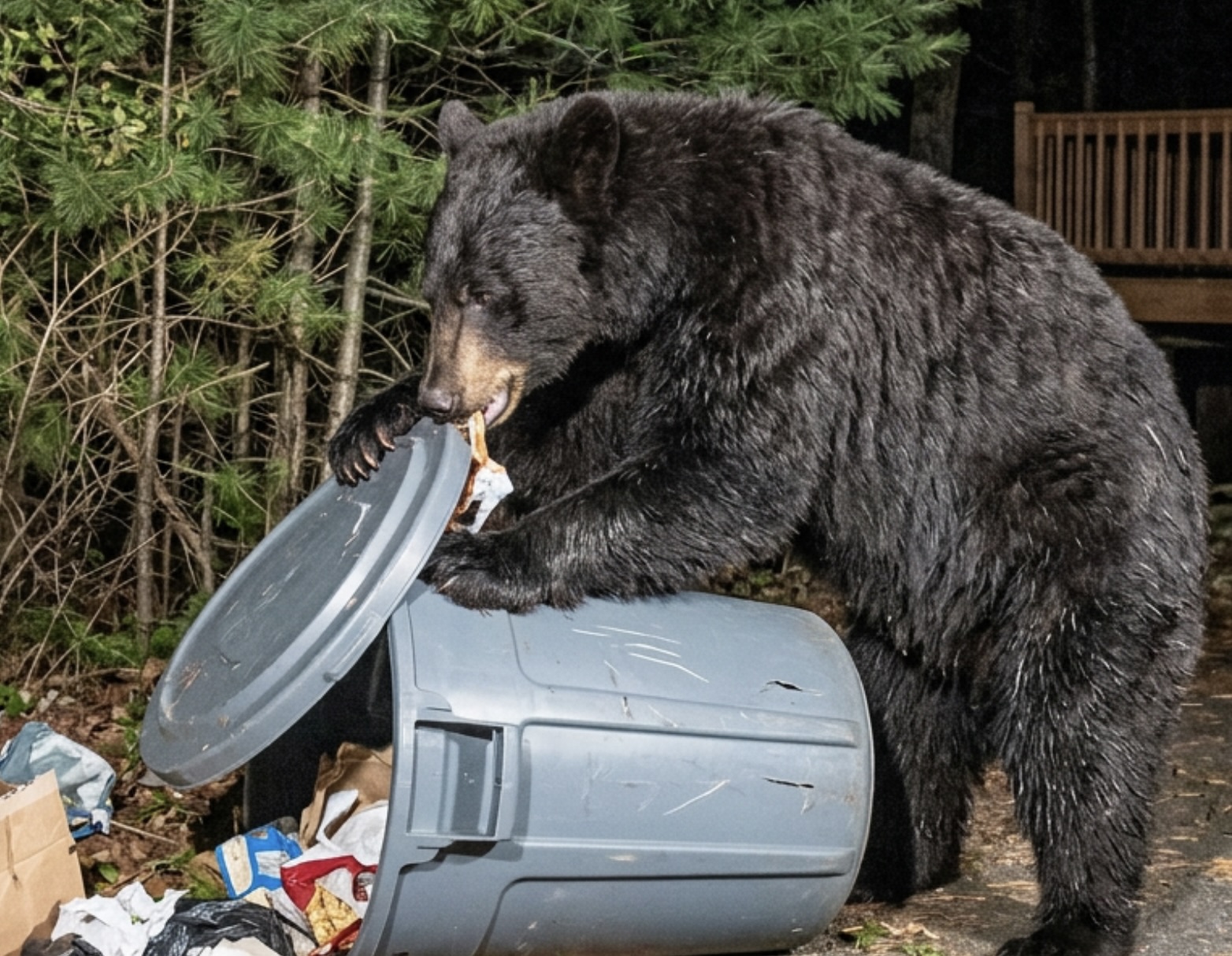
I didn’t have any photos of the black bears raiding our garbage can. I was always too busy trying to run them off. So I asked AI to produce one for me. It’s perfect. The bear looks just like the one that was a frequent visitor in our neighborhood. The garbage can is an exact match to ours. And it even comes with the claw marks! Garbage is garbage.
Bears came by much more frequently than cougars. They thought of our garbage can as a gourmet restaurant. They refused to make reservations— just show up, lift off the lid, and settle in for an a multi course meal. They were messy eaters (kind of like taking a two-year-old out to dinner), and never left a tip. It was a hassle, but it went with the territory. A quick 15 minutes afterwards would clean things up. Unless they ordered take out. Then their mess would be strewn out for 50 yards up the trail.
Another neighbor, Tom, suggested fastening the lid down with a bungie cord. I had my doubts— given my experience with Yosemite bears—but tried it and was pleasantly surprised. It actually worked (most of the time). It didn’t stop them from knocking the large plastic cans over and leaving claw marks behind.
Two bear encounters stood out.
Tasha and her two sons
The first one took place when our daughter, Tasha, visited with her two boys. The day of their arrival, I’d whipped up hamburgers on my Weber Grill that lived on our porch. Afterwards, we’d had a pleasant evening entertaining the boys and chatting. Finally, we had all drifted off to bed. Tasha had the guest room that was next to the porch, the boys occupied our office next to her (it converted to a bedroom on demand), and Peggy and I were in our bedroom at the other end of the house. Everyone was tired. Sleep came immediately. Until the crash…
The smell of the cooking hamburgers had wafted up into the forest that evening and got the attention of a hungry bear. I’m pretty sure that it was sitting up on the edge of the national forest thinking, “Damn, why don’t they go to bed.” We were all sleeping happily when he came down to find the source of the enticing smell, sniffed the grill, and discovered the smell was coming from inside. Being logical, he decided to open it. Bear style. BANG! A large Weber Grill tipped over on a cement floor makes a loud noise. The bear took off at full speed. And Tasha yelled…
“Curtis!!!” Once again, bear duty called. I threw on clothes, charged out to the porch, discovered that the grill was tipped over, and the bear long gone. I assured Tasha that everything was okay. It wasn’t easy. I understood. The loud crash had me jumping out of bed at the other end of the house. Tasha was one wall away. All’s well that ends well, right. The grill disagreed. It took a fair amount of work to repair. And our hopes of having the boys experience sleeping outside at our home in the future were squelched by mom.
The next memorable bear encounter started with our patio furniture moving around in the middle of the night. Have you noticed that most of my bear encounters start with ‘middle of the night?’ It’s the nature of bears. Not mine. But who would assume patio furniture would have anything to do with a bear? Not me. Crashing grills and garbage cans, of course. I hopped out of bed to explore the phenomena, carefully opening the door and peeking outside. Nothing….
Then I heard the crash. “Garbage can!” was my immediate thought. So I dashed across the house and peeked out the backdoor. The garbage can innocently stared back at me, standing tall, with no new claw marks. “Oh no, not our grill again,” I cursed, bee-lining it for the porch. But the grill was fine. Nothing, nada, zero, zilch. I opened the door and stepped out on the porch, looking up our roadway. Again, nothing. And then I noticed that our bird feeder was swinging back and forth, bent out of shape. Mentally, as well as physically, I was pretty sure.
It’a a strange fact bears like sunflower seeds. Earlier in the day I had spilled a few seeds around our patio chairs when I was refilling one of our bird feeders. The bear had been moving the furniture to get at the seeds! And then come around the house to tackle the bird feeder. Why such a big animal would like such a small seed was beyond me. But then again, bears are quite democratic when it comes to food.
Suddenly, however, I was very nervous. The still swinging bird feeder the bear had been playing tether ball with set off an alarm bell in my mind. In response, I swung my flashlight to the left. Not there. And then to the right. There he was, a big fellow like the photo above, about 20 feet away. He wasn’t running away; he wasn’t charging. He was just staring. And staring. Disconcerting to say the least. So I yelled at him— loudly— and prepared to dash inside. He continued to stare, and finally, as if he had made up his mind about something, slowly turned around and made his way up the road back to the forest. WTF, I wondered. And then I figured it out.
He had never seen a naked man before.
So we come to the end of my bear stories. I hope you’ve enjoyed them.
Peggy and I have now returned from our two months of exploring Greece, the Scottish Highlands, Northern Ireland and the Irish Republic. It was a great trip and we are eager to share the highlights with you. My tentative blogging schedule will be to feature our present travel tales on Fridays and use Tuesdays for blogging my new book, UT-OH!
And now for Friday’s first travel post from our recent journey: Teaching Sheep to Fly
Yosemite National Park is world renowned for its beauty. For backpackers, it is also renowned for its bears.
At the end of my last blog, I had backpacked 18 miles into Yosemite Valley to resupply the food the bears had consumed— and alcohol. (I would have loved to witness the reaction of the bear that bit into my plastic bottle of 151 proof rum.)
My intention was to stay in the Valley that night, but it was a zoo, absolutely crawling with tourists. So I shouldered my pack and hiked back into Little Yosemite Valley. My body was not happy. The hike added a 2000 foot climb plus another five miles to an already-long day.
The area’s proximity to the Valley means that it is a popular camping area for backpackers, either as a first-night stop or destination. I found a small, one-person site with a convenient log in the middle for sitting against and used my pack and Thermarest mattress to make a comfy chair. I whipped up a quick dinner, topped it off with a cup of wine, and prepared for bed. (My 151 proof rum was not available in the Valley.)
The popularity of the area for backpackers also means it is a popular area for bears— a dine in or take out restaurant. Given my experience of the night before, I was a tad paranoid. I carefully stuffed my food, and anything the bear might find tasty (wine, toothpaste, etc.) into my food bag and used a cable the park provided to hang food beyond a bear’s imagination.
I also made sure that every pocket in my pack was open, including the top. Although the food was out of the pack, there might have been lingering smells to attract a bear. Closed pockets can lead to bears opening them. It’s rather hard on backpacks. And even if the bear doesn’t stop by for a snack, lots of other woodland creatures, mice for example, are happy to chew holes to get at food— especially in popular camping areas. I’ve had that happen several times over the years.
It should be noted here that several bear/rodent-proof containers are available for today’s backpackers. They weren’t in the 70s. I nodded off that night listening to backpackers yelling and beating on pans as bears worked their campsites, wondering when my turn would come.
I woke up around 11 when I heard a noise on the other side of the log where I had placed my pack, about five feet away. Heart pounding, I sat up to look. A bear was methodically emptying the pack, checking to see if there was any food. I watched with clinical interest as it shoved his head into the pack, pulled out an item, dropped it on the ground and then stuck his head back in the pack. By then I had enough, and suggested rather loudly that the bear go elsewhere. After one more foray, it did. The only damage I suffered was bear slobber, all over everything. My old Basset Hound, Socrates, the world champion of slobberers, would have been jealous.
The next night I was leaving my camp for an evening walk when I met a bear coming to visit. I bent over and picked up a rock. He took off like a dog: It was my kind of bear. And thus my summer went. By the time I had led two back-to-back hundred-mile trips into Yosemite, I had my fill of bears. Each time a bear visited in the night, I’d hear a scream, “Curtis!” I considered myself an expert bear chaser.
It was almost my demise.
At the end of the second Trek, my friend Jean, her sister Mary and her husband Tim joined me at Tuolumne Meadows to hike the John Muir Trail. We spent the night at the Tuolumne RV/car campground. I had eaten backpacking meals for 18 days. It was time to celebrate. We grilled up steaks, broke out a fifth of Jack Daniels, and threw in several cans of beer.
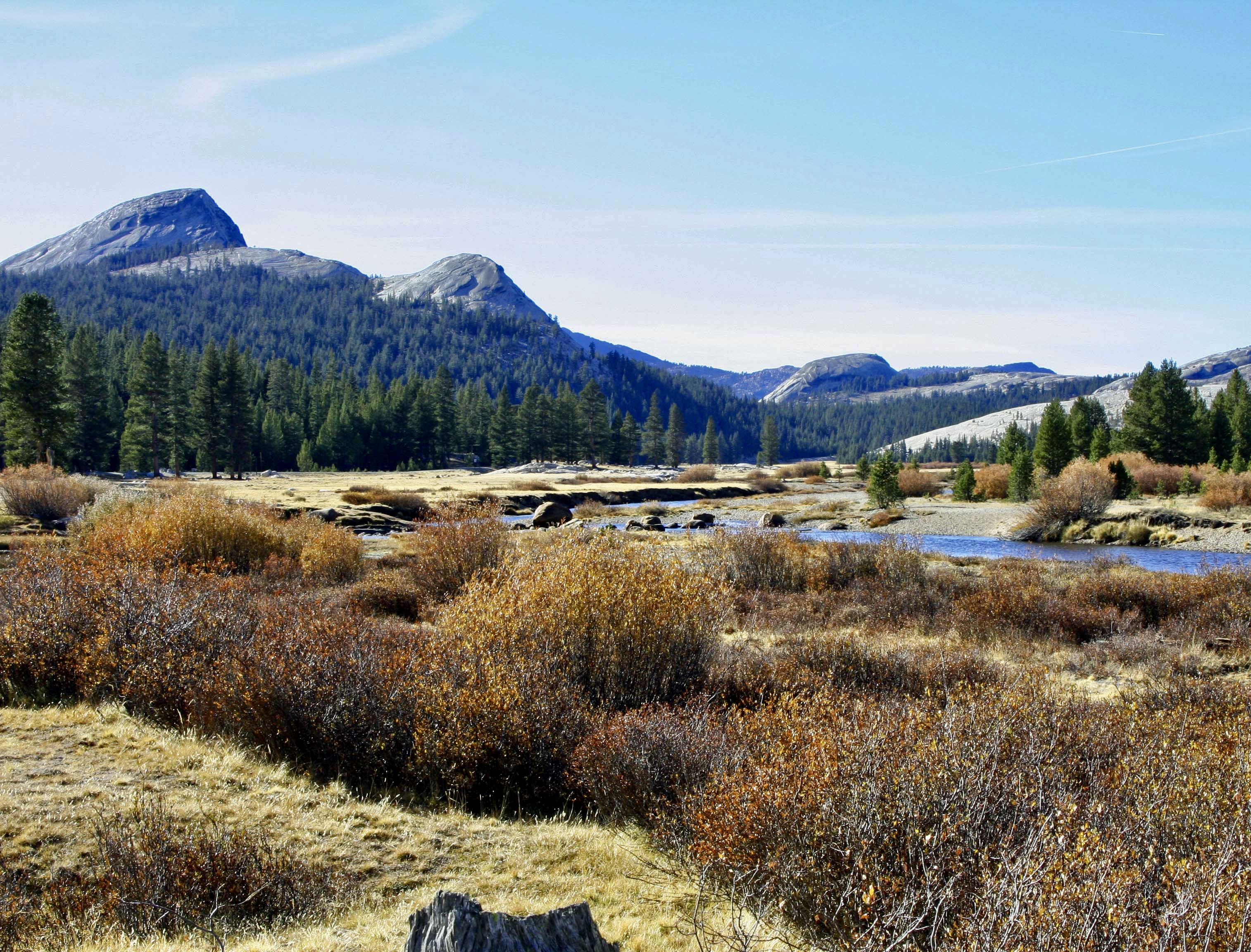
Tuolumne Meadows, Yosemite National Park
As the night progressed, I was feeling no pain. So it wasn’t surprising when a bear came to visit our neighbors from Iowa, I was prepared to do battle. They had left their cooler out on the picnic table and the bear was leisurely opening it. The Iowans were hiding out in their camper, making nary a peep.
“Hey bear,” I yelled as I strode across the road, “Get out of here!”
Well, Mr. Bear had found himself a cache of fresh food and wasn’t about to leave. He turned around, stood up on his hind legs, raised his front legs over his head and said “GRRRROWL!” He was one big fellow, towering above me. Stone cold sobriety was instantaneous.
It looked like this stuffed bear at the Tonopah Motel in Nevada.
“OK bear, it’s all yours,” I mumbled as I scurried back across the road to my own camp and safety. “Eat all of the Iowan food you want. Heck, eat the Iowans.”
By this time though, 20 flashlights were shining down on the bear. Campers are packed into Tuolumne Meadows like tenement housing in a barrio, and all of the neighbors were checking out the action, worrying. Thus disturbed, Mr. Bear went grumbling off over the hill, more than a little pissed to have his fine feast disturbed. You could almost make out in his growling, “I’ll be back.”
Of course the Iowans left their cooler out on the table. No way were they budging from their camper. I pictured them driving nonstop back to Des Moines the next day.
Finally things settled down. After another beer, or two, we crawled into our sleeping bags. Tim and Mary disappeared into the security of their truck while Jean and I crashed on the ground.
Not surprising, there came a time when Jean had to visit the restroom. Beer will do that. Equally unsurprising, the bourbon helped me sleep right through her getting up. But I did hear her come back. Except it wasn’t Jean I heard through my alcohol-induced grogginess. It was the bear— coming back for revenge.
“GET OUT OF HERE!” I screamed with all of the passion I had used when I had awakened with the bear standing on me. Jean, not knowing what to do, grabbed me by the head and said, “Curt, it’s all right, it’s only me!” This was undoubtedly the right thing for her to do, except now the bear had me by the head. As you might imagine, my yells increased in volume. By 10.
Picture 20 flashlights shining down on this happy little domestic scene.
That was my last bear encounter of the season. There would be many more in the Sierras, but my next post will discuss encounters with grizzlies and the giant, brown bears of Alaska. If you find encounters with black bears scary…
Consider this fellow. I was stalked by a grizzly bear when I was leading a backpack trek across Alaska’s Kenai Peninsula.
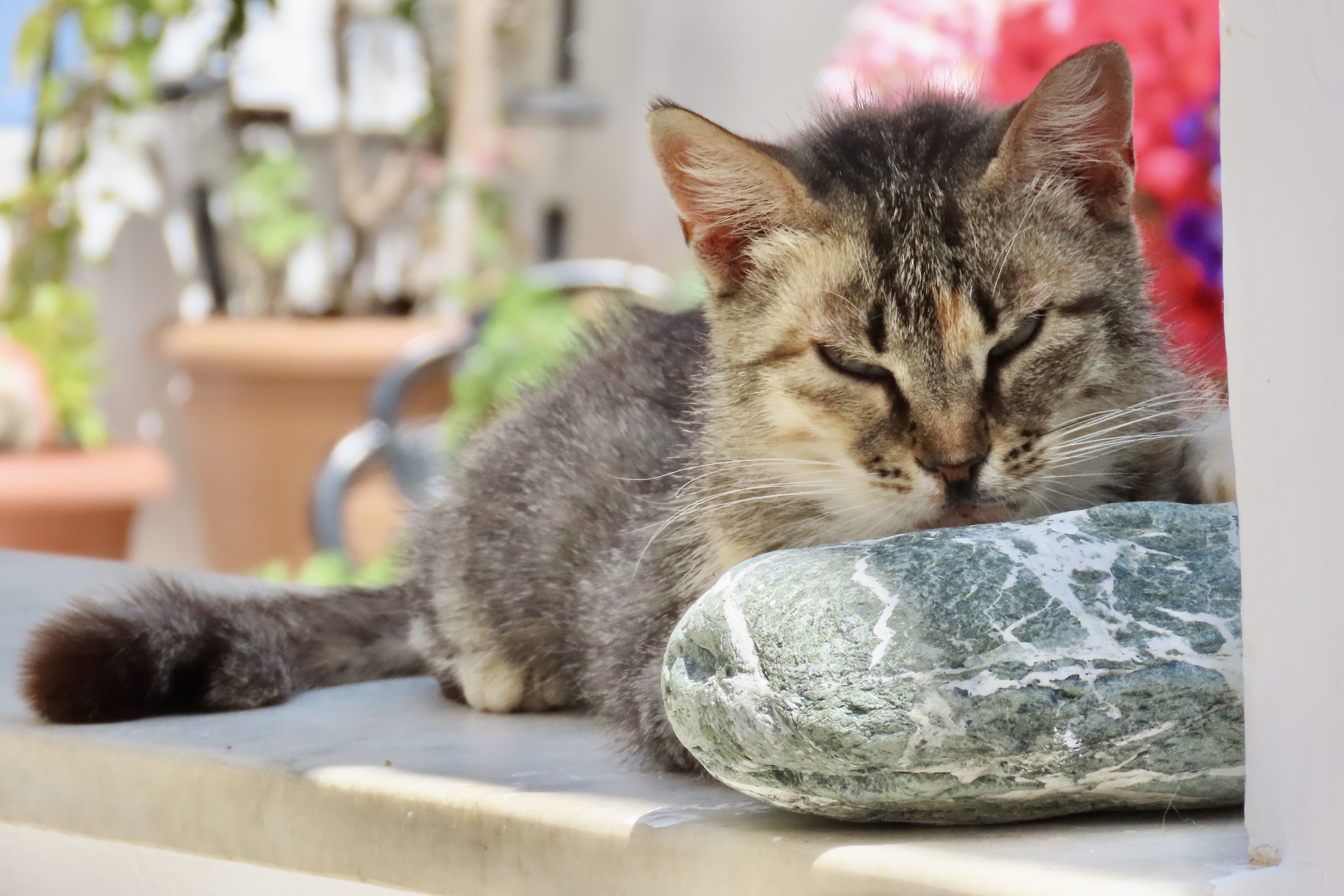
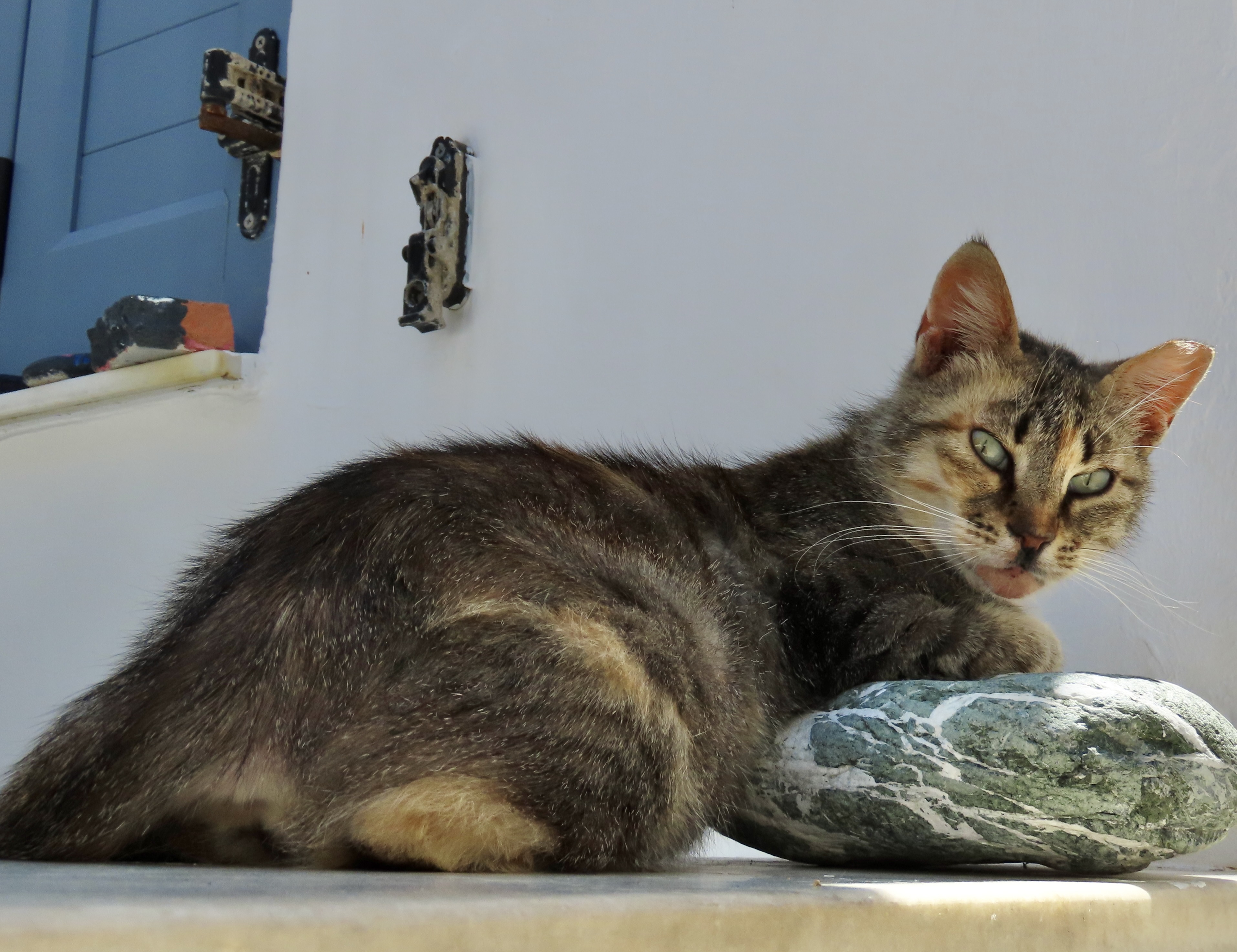
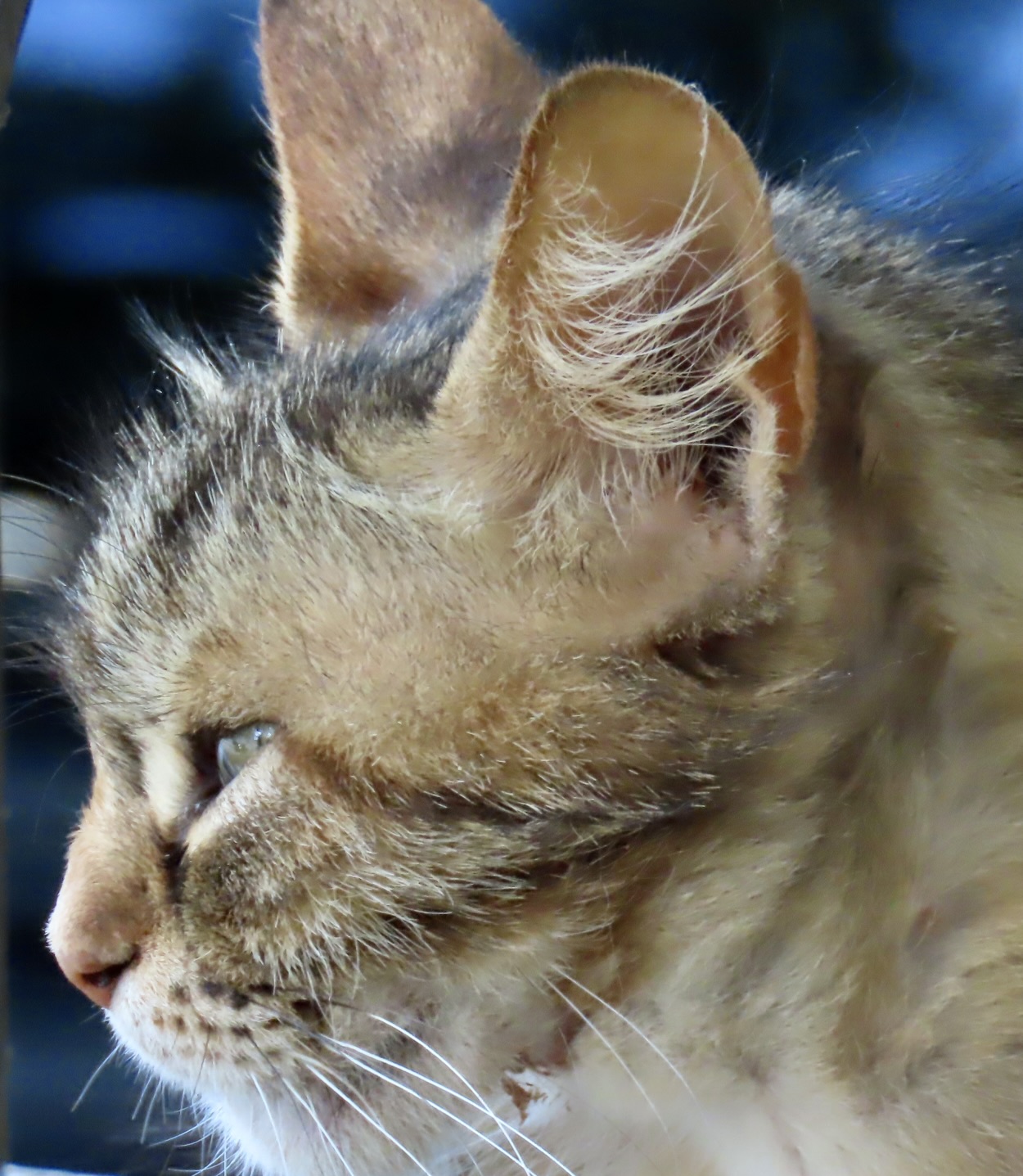
We found this fellow in Pyrgos on the Greek island of Tinos. It was giving us the look. “Why are you interrupting my nap time?” Cats, as everyone knows, enjoy their naps— 12-16 hours a day, or even up to 20.
Unlike Ancient Egypt, where people had a cat god and mummified their pets, domestic cats weren’t around in Ancient Greece. Now it’s different. We found them everywhere we travelled this past month: Athens, the island of Tinos, Nafplio, Olympia, and Delphi. We even had temps, cats that volunteered to be our pets, to hang around and meow at us— assuming that we kept the food coming.
This skinny female didn’t mind us waking her up. She had adopted us at our Vrbo on Tinos and persuaded me to feed her while we were there for a few days. Our appearance meant the it was time to jump down and start rubbing against my leg.
From research on past posts I’ve done that included cats, I learned that the leg rubbing business is the way a cat marks you with its scent to claim ownership. Other cats need not apply. I also learned about the kneading business where the cat sinks its claws into your leg or stomach while purring. That apparently comes from when they were kittens and kneaded their mother’s teats to encourage milk flow. Even grouchy old toms seem to take comfort from this activity.
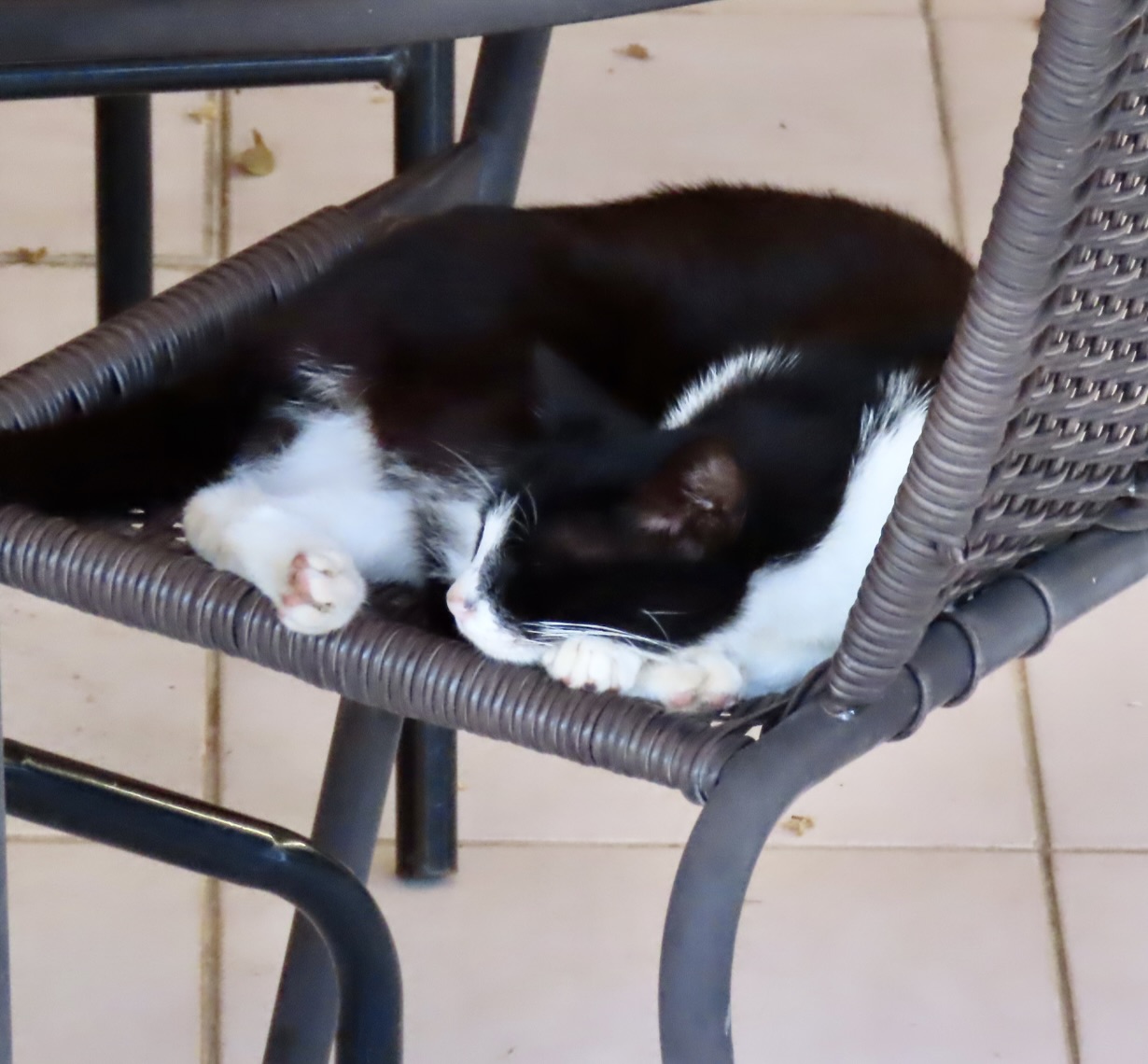
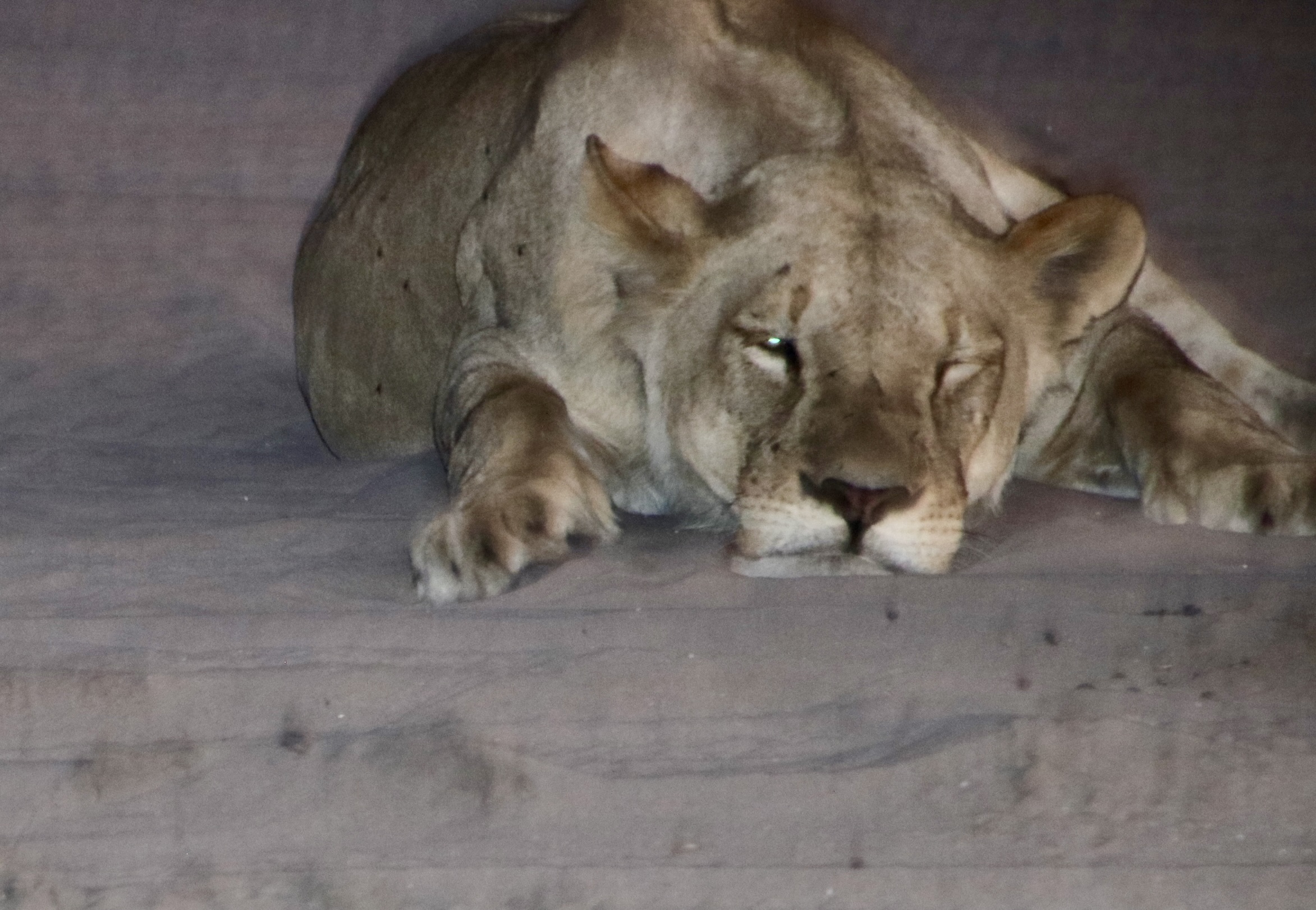
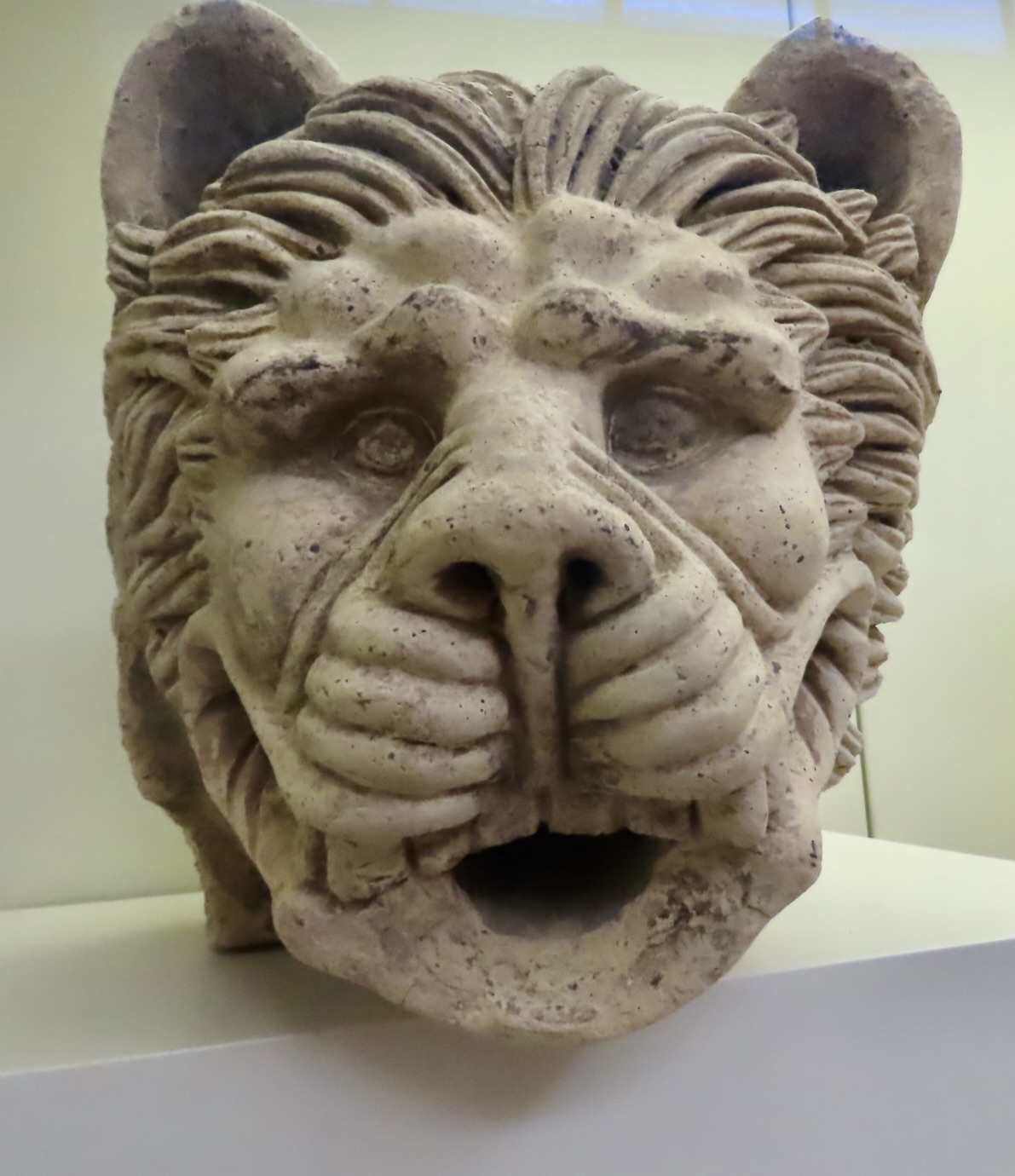
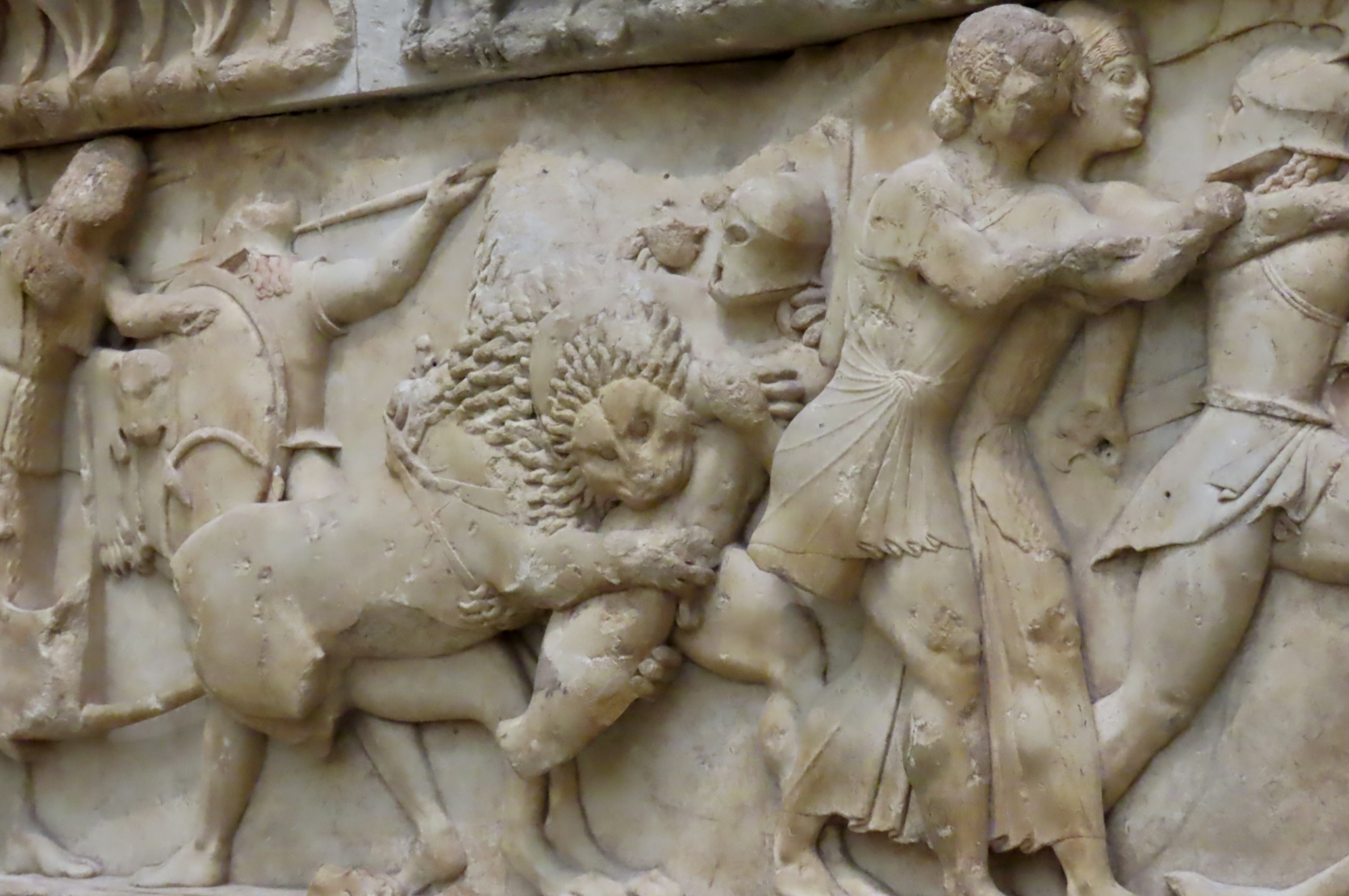
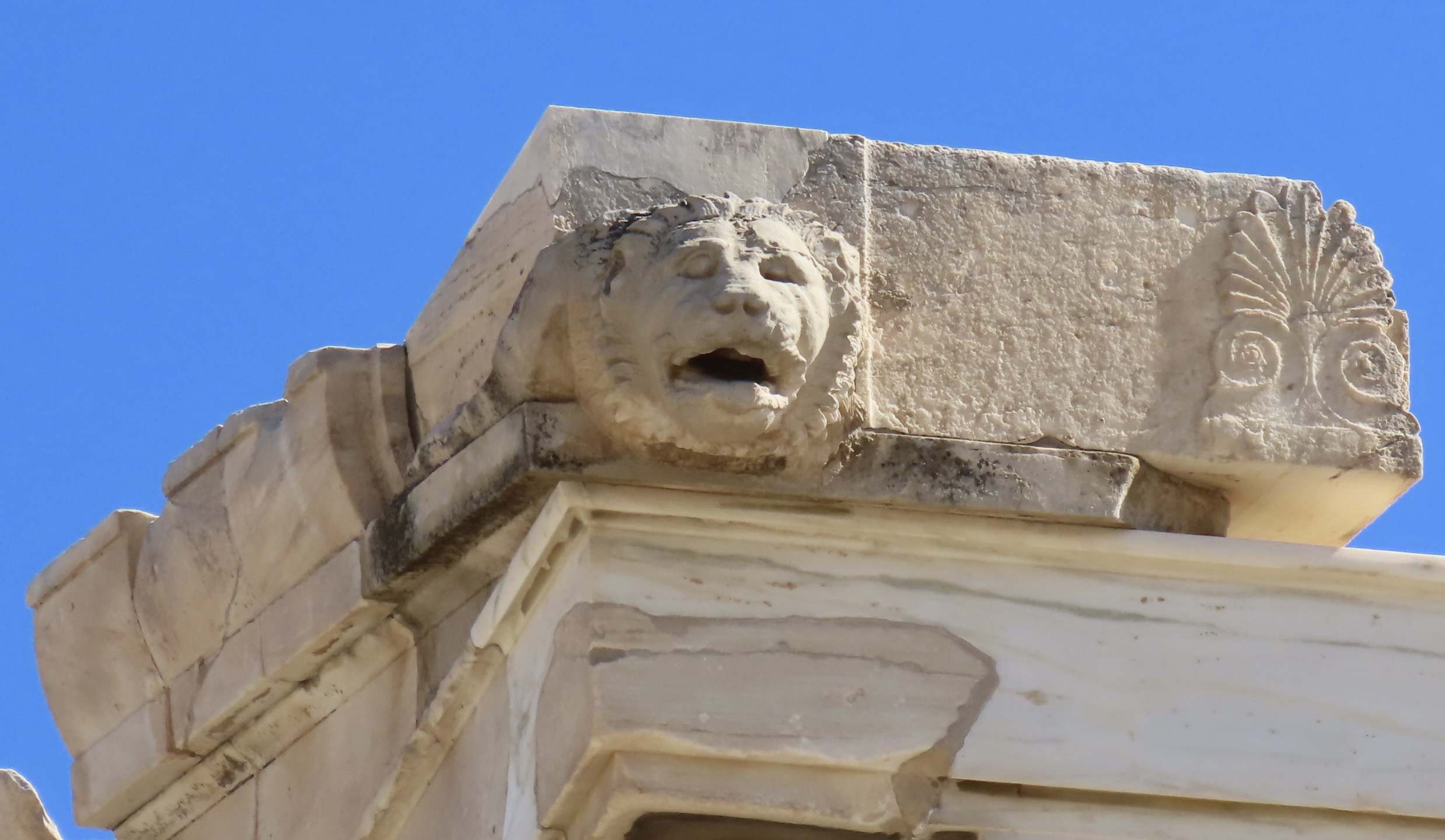
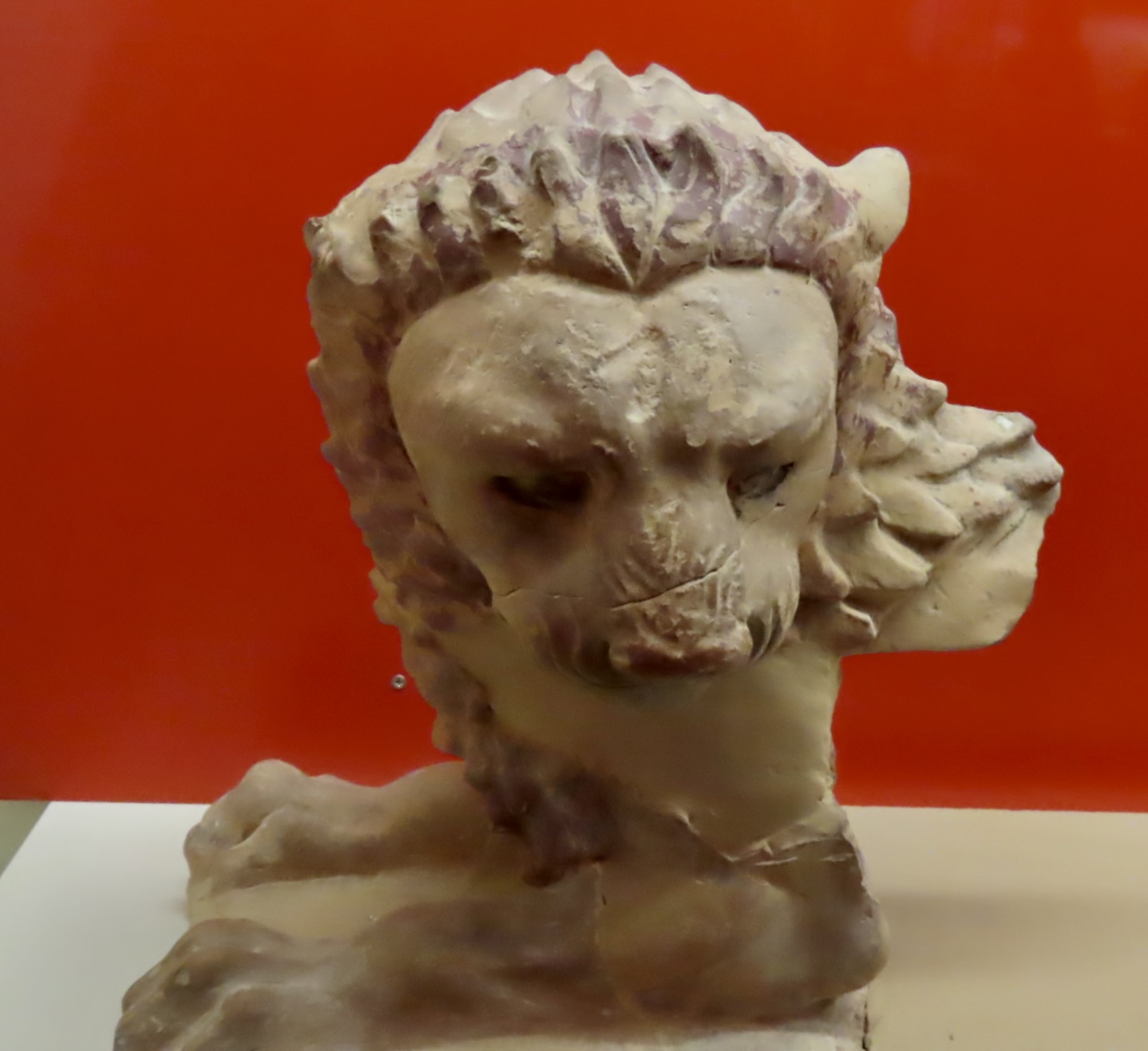
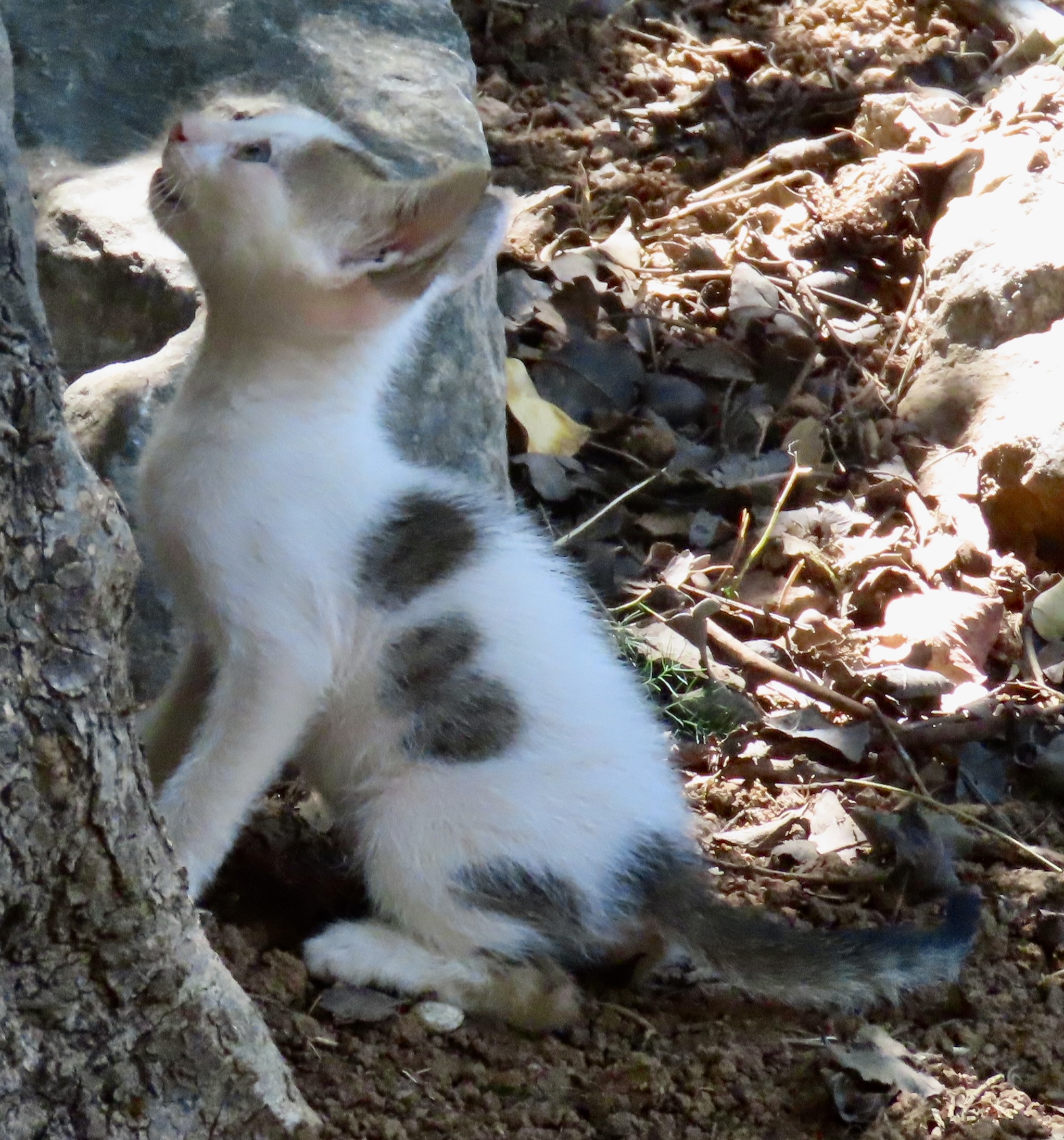
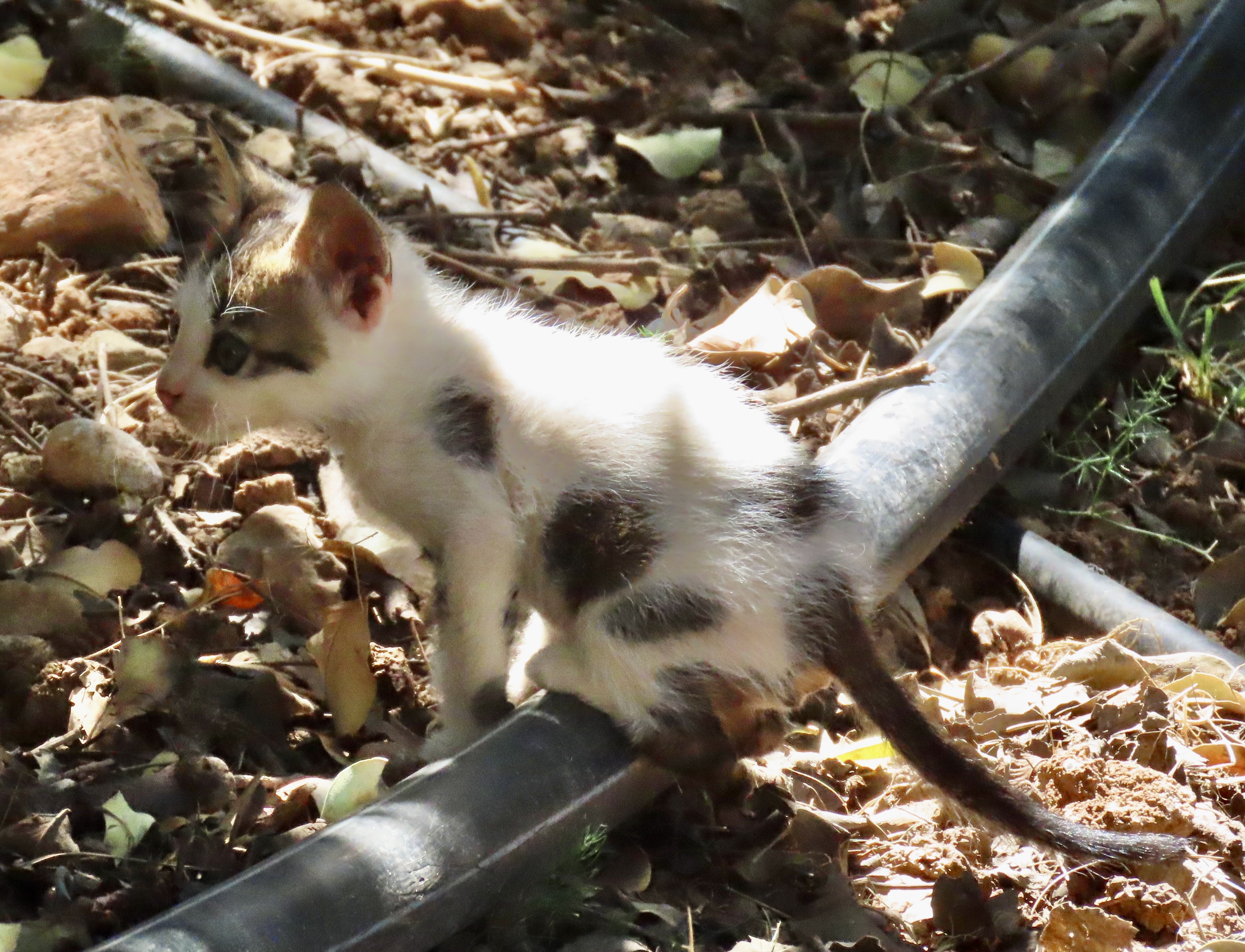
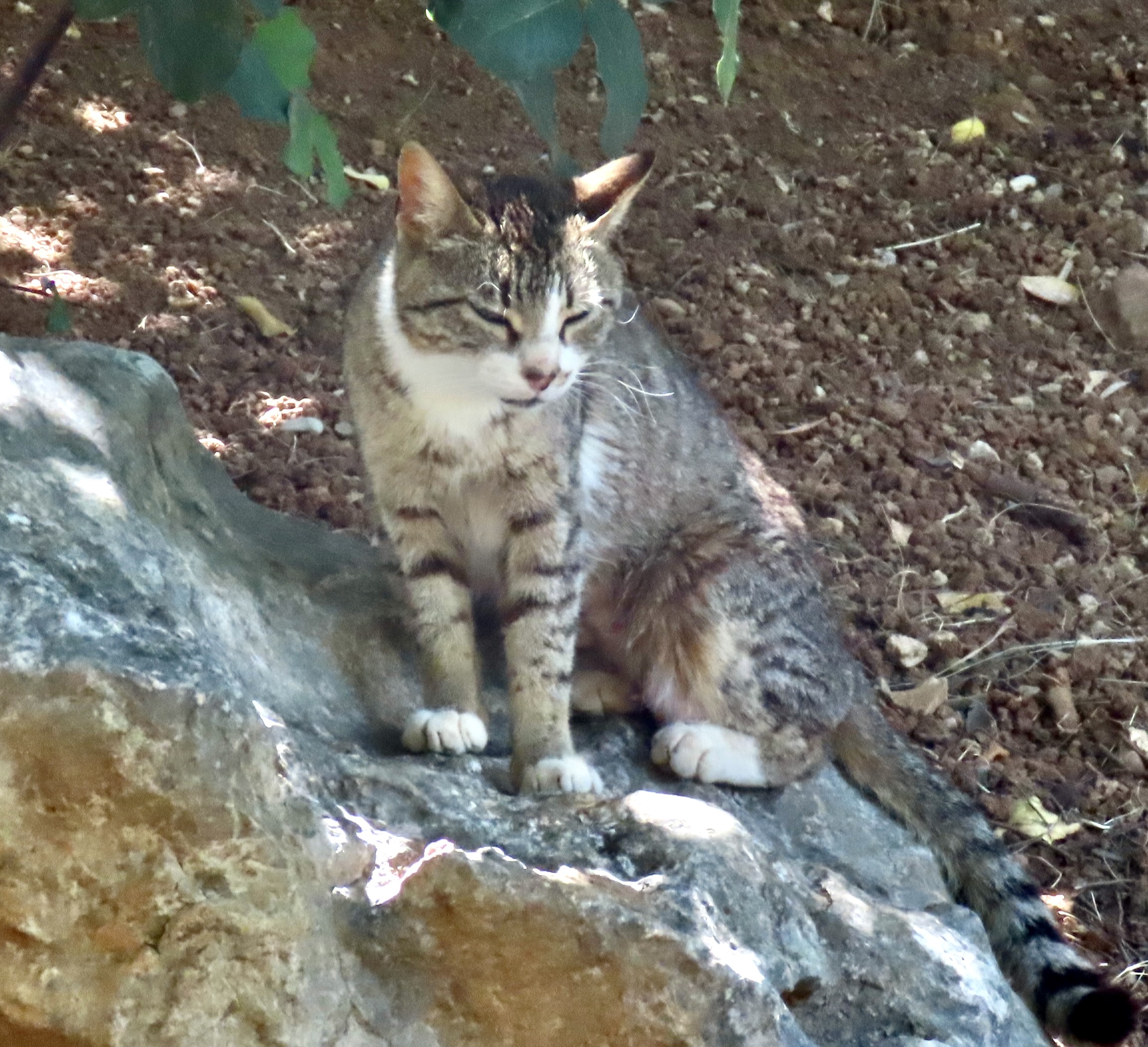
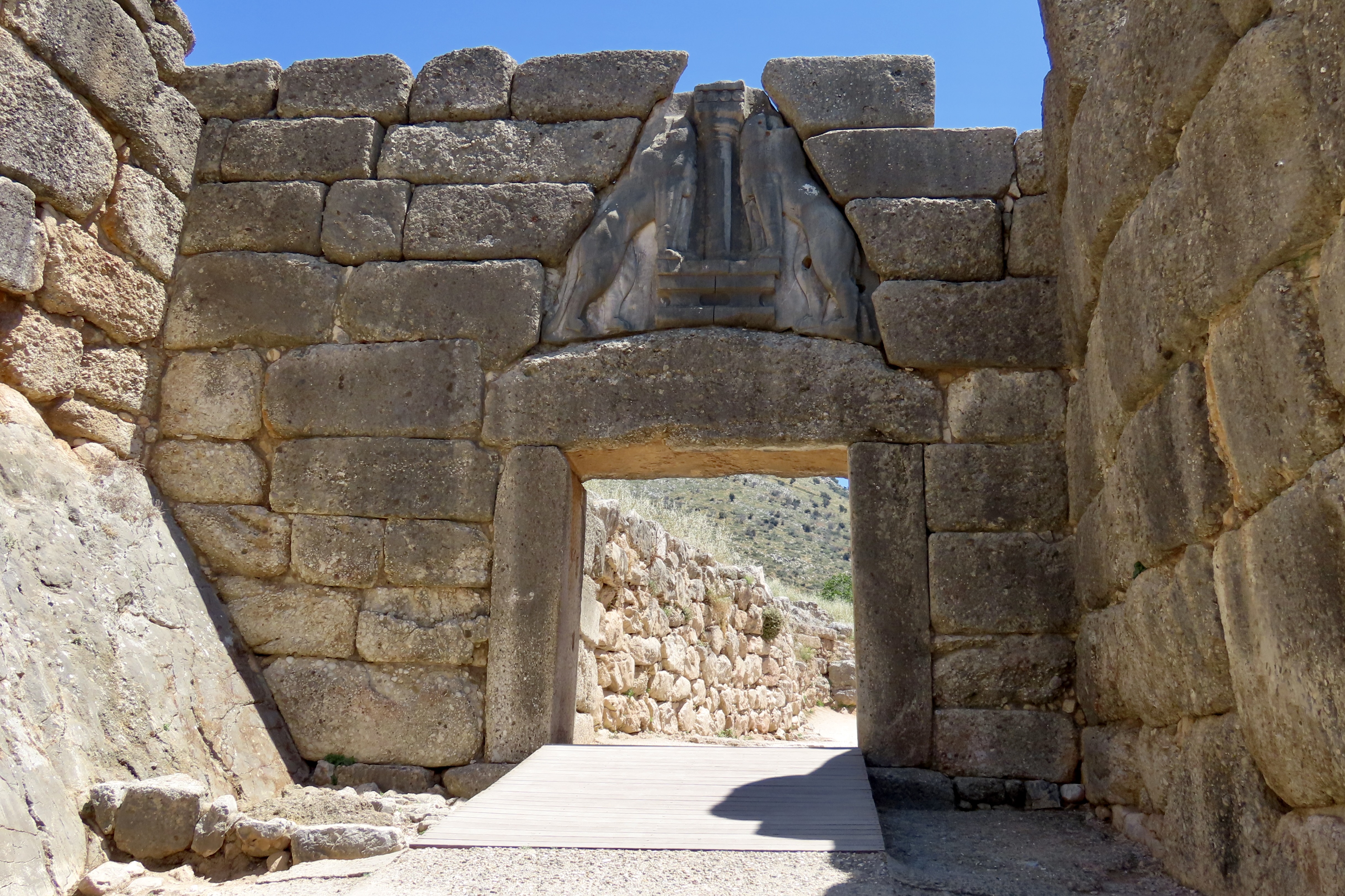
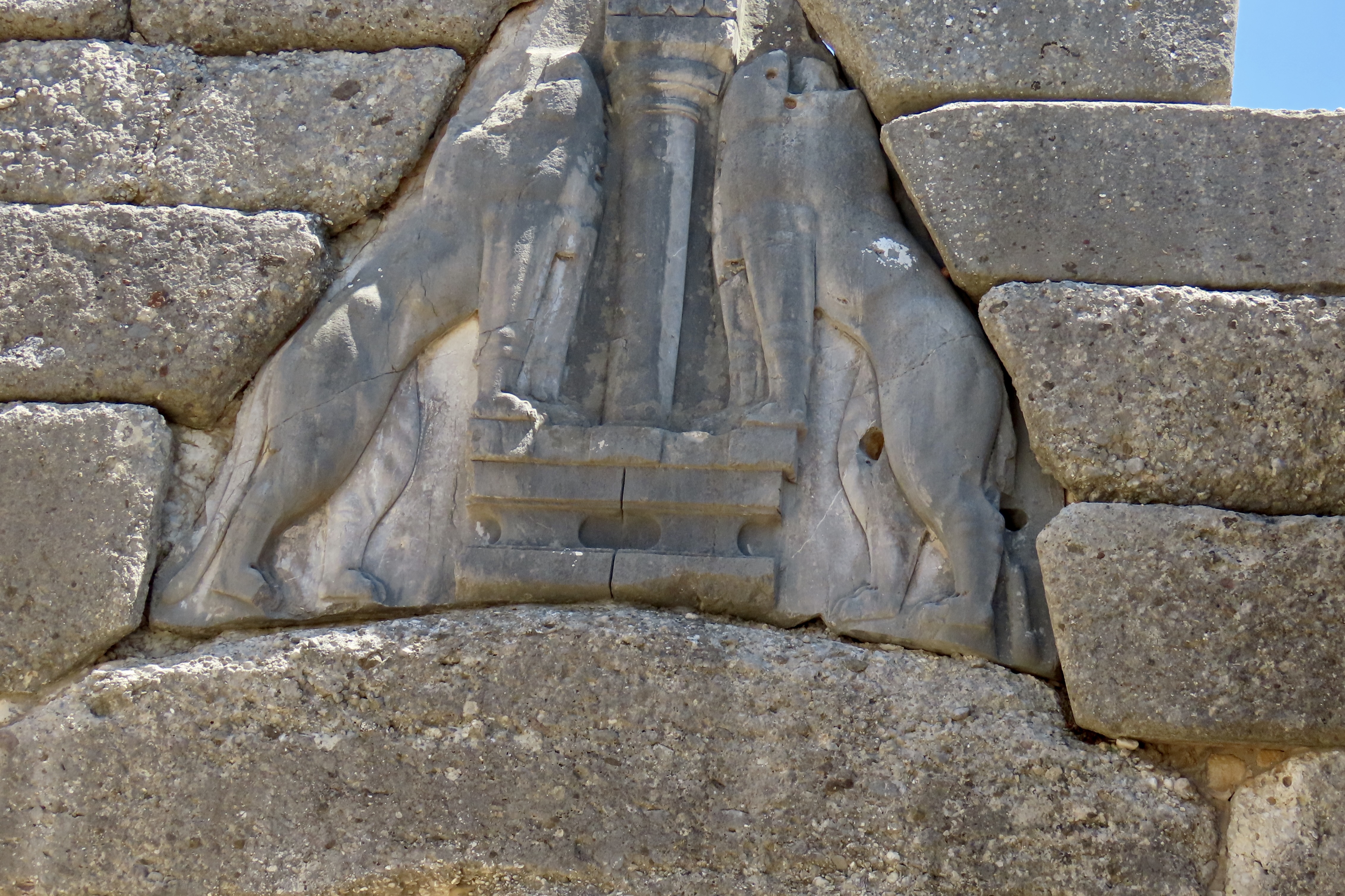
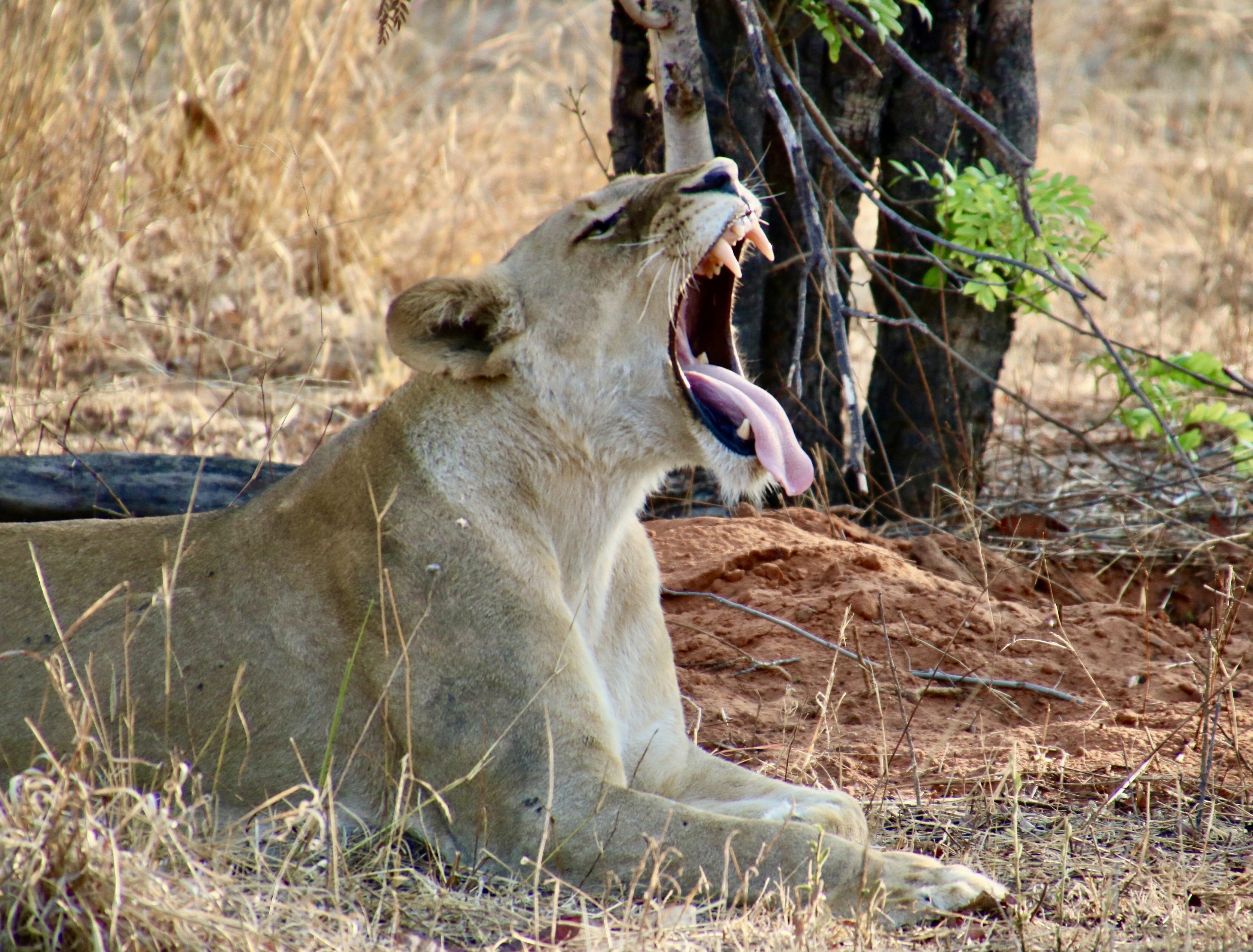
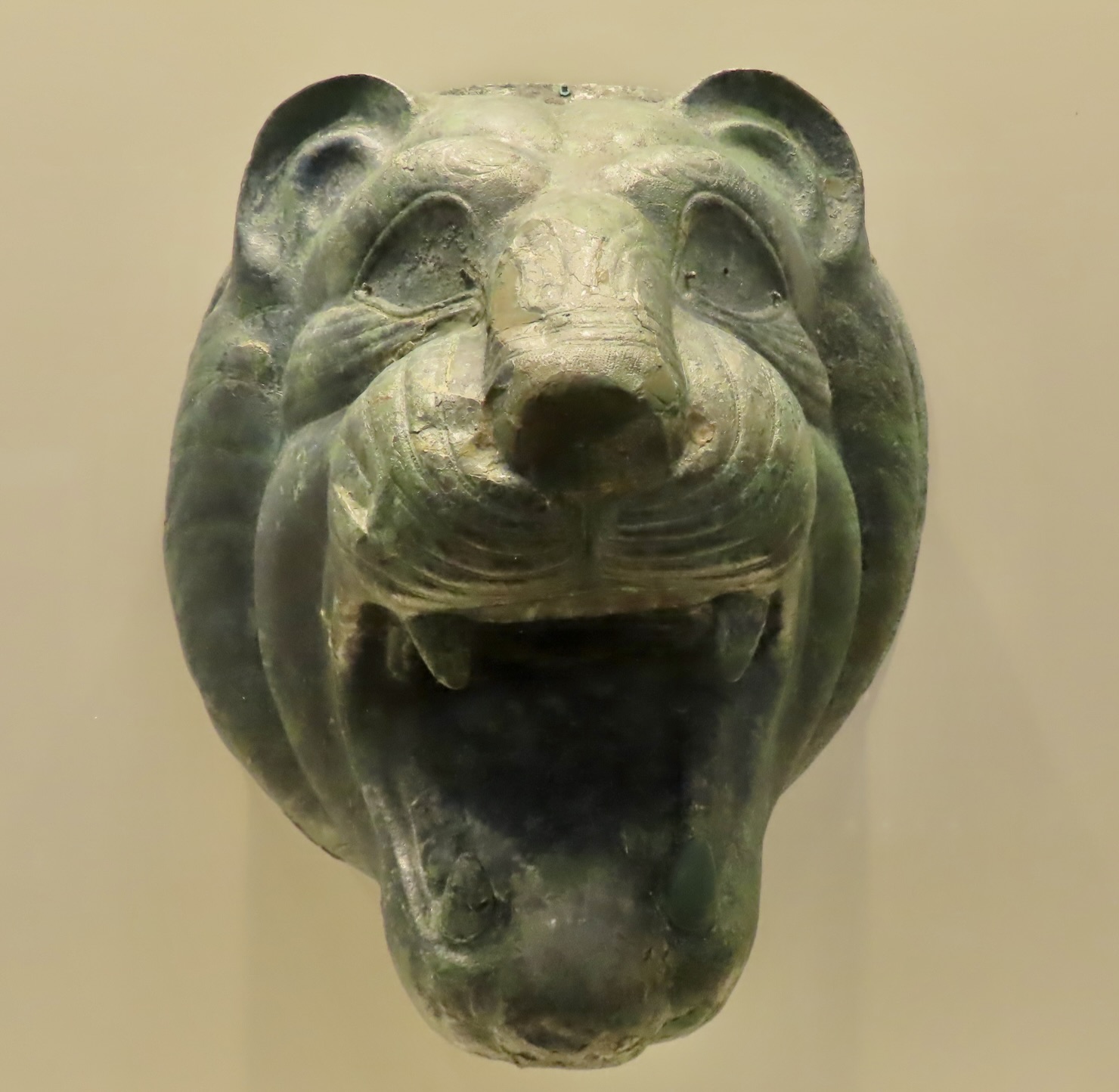
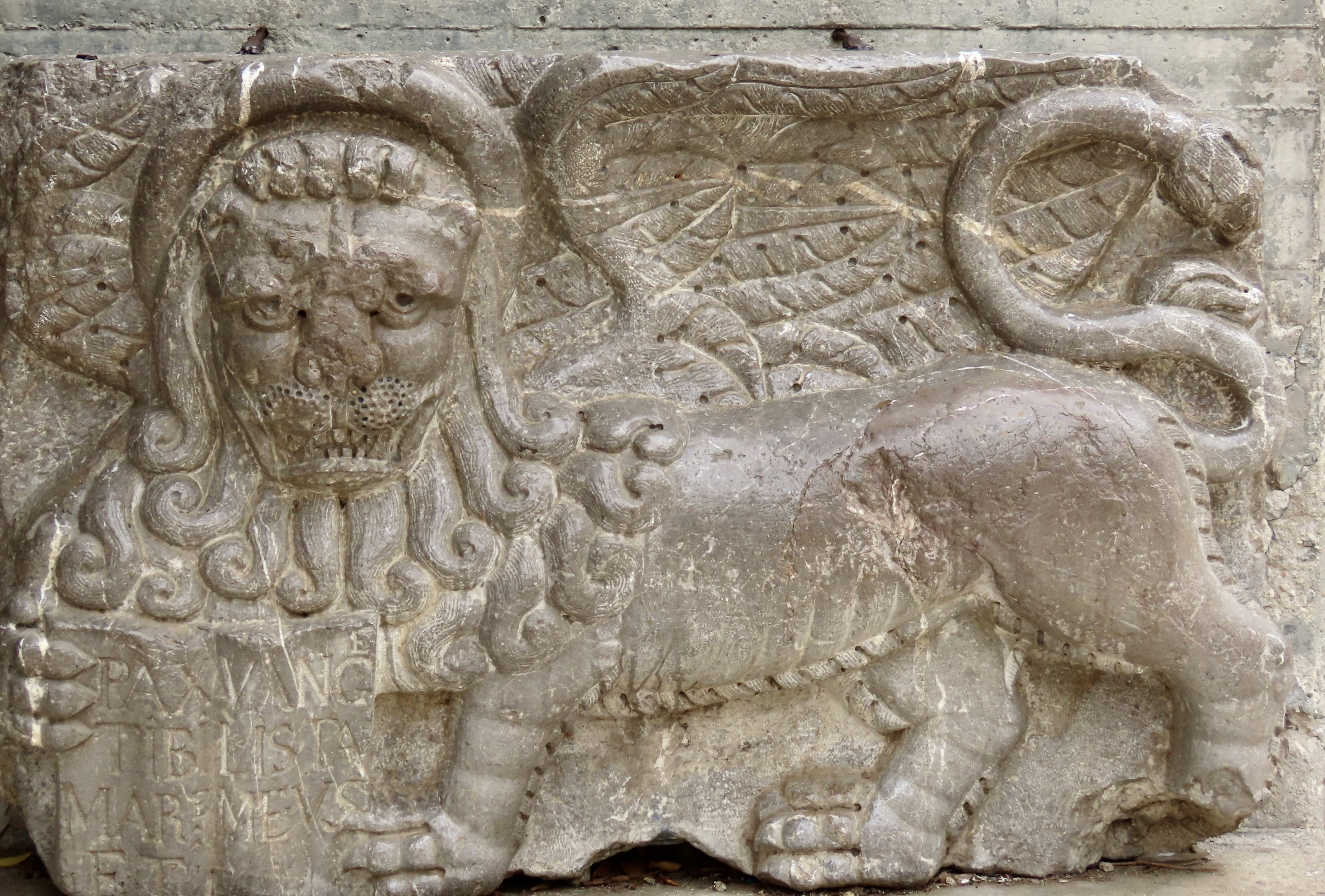
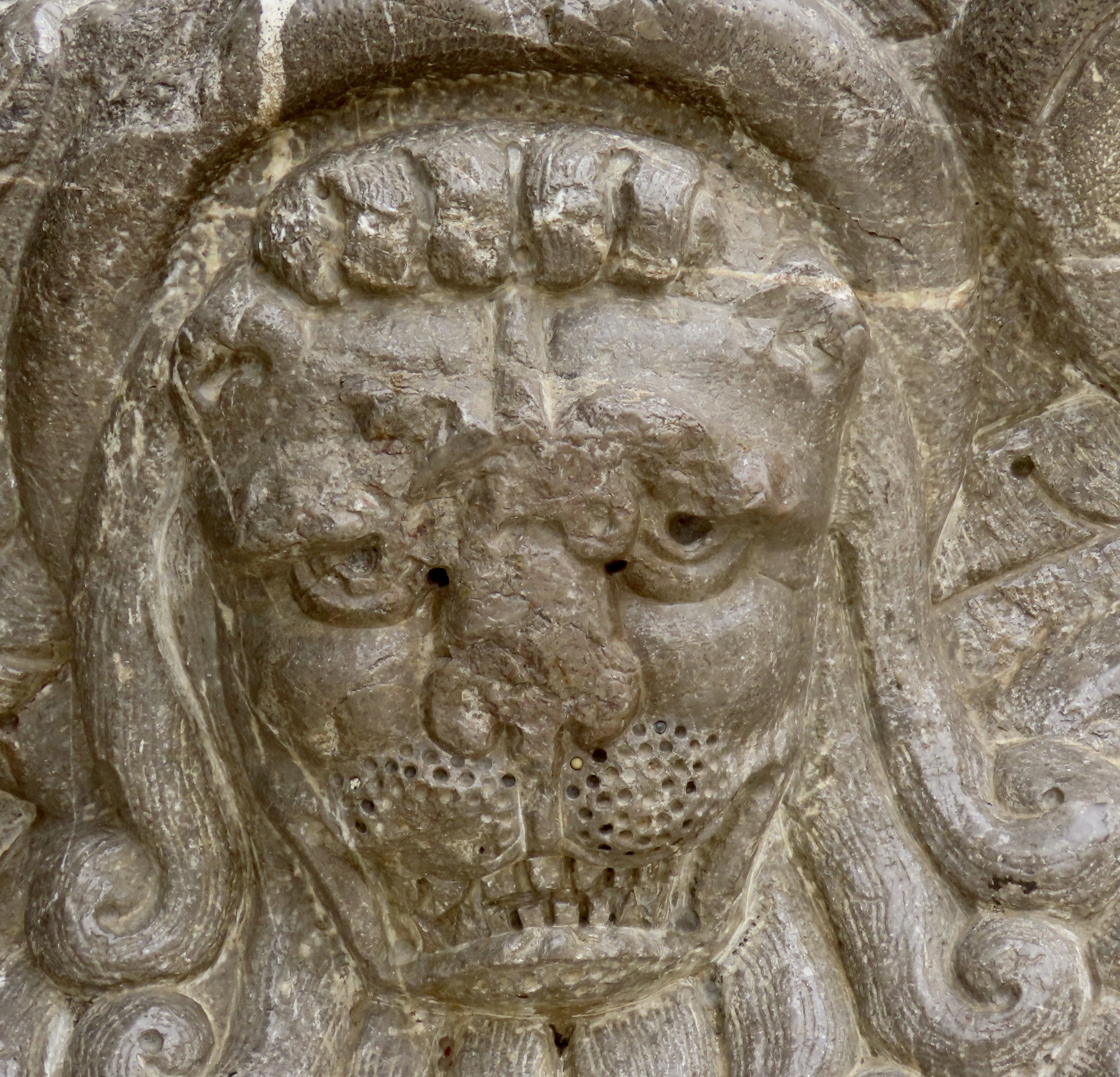
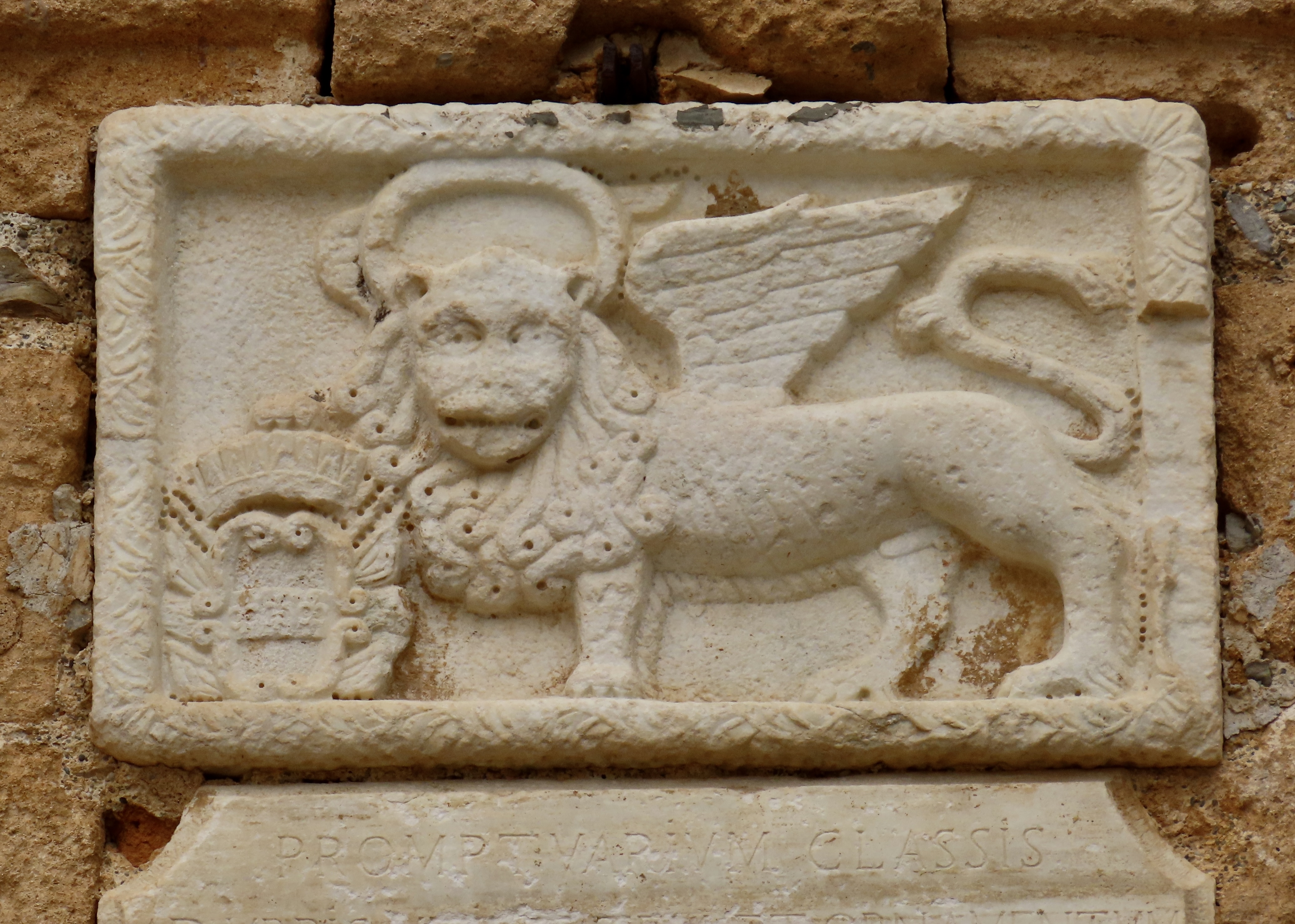
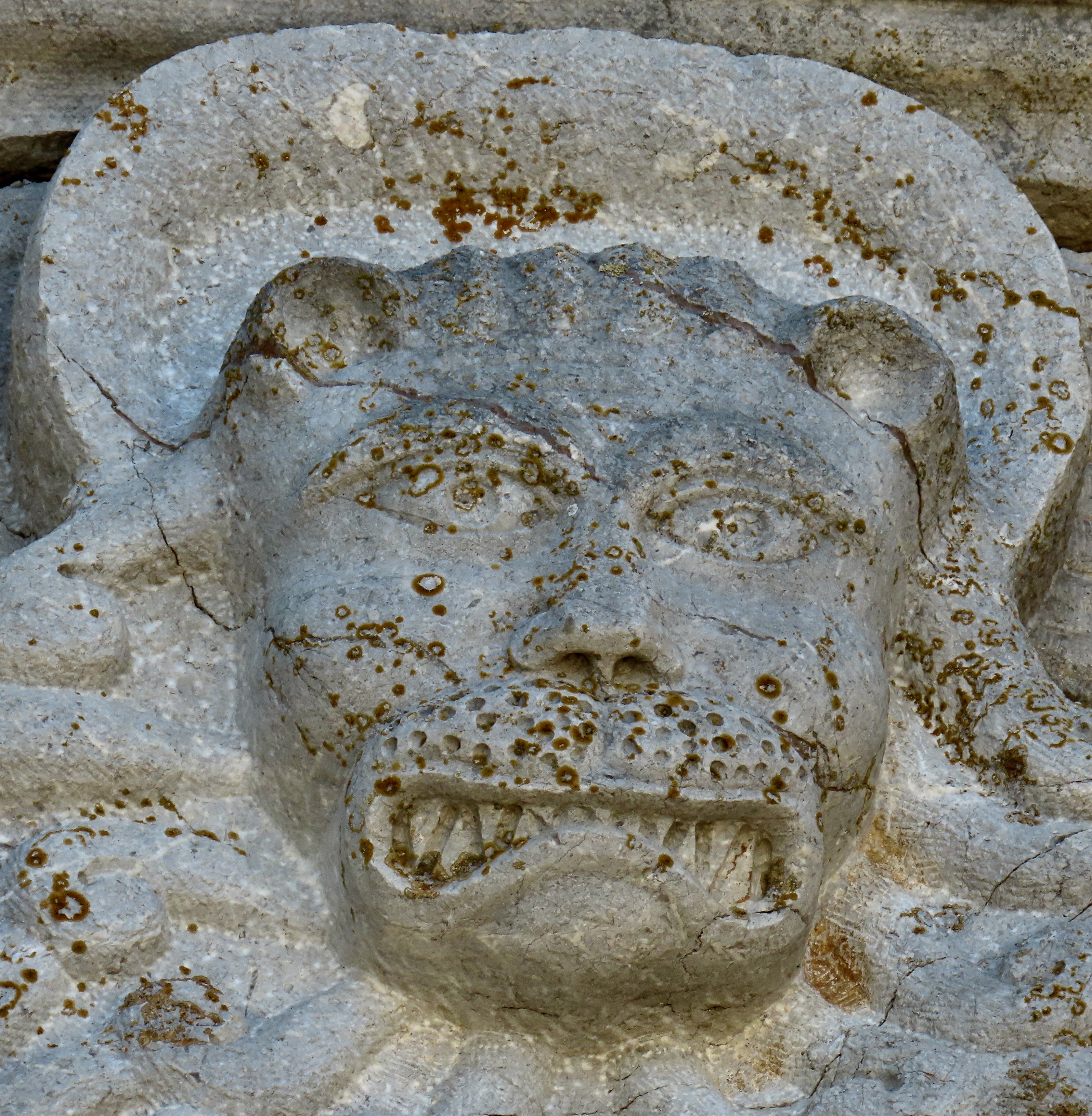
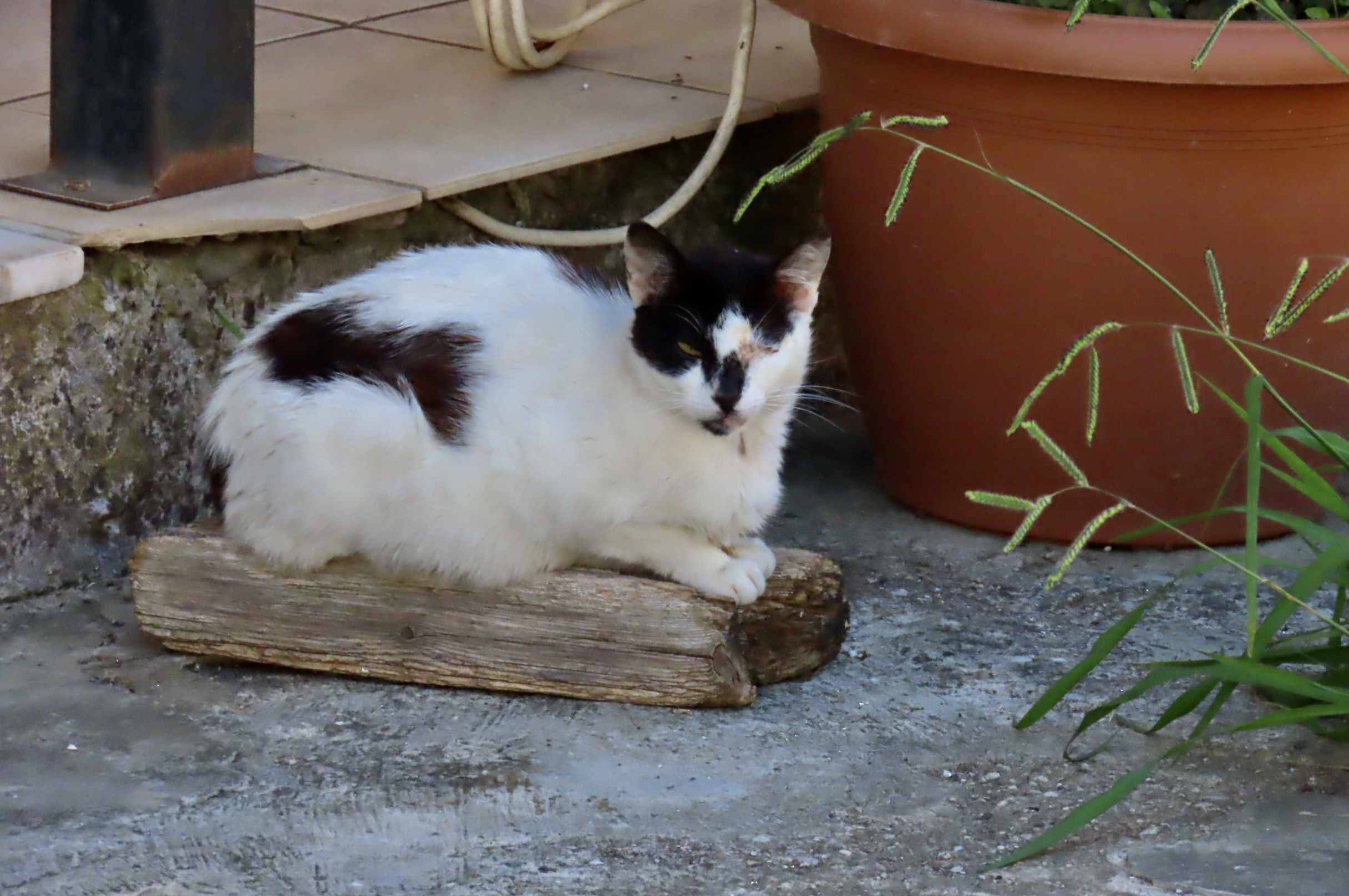
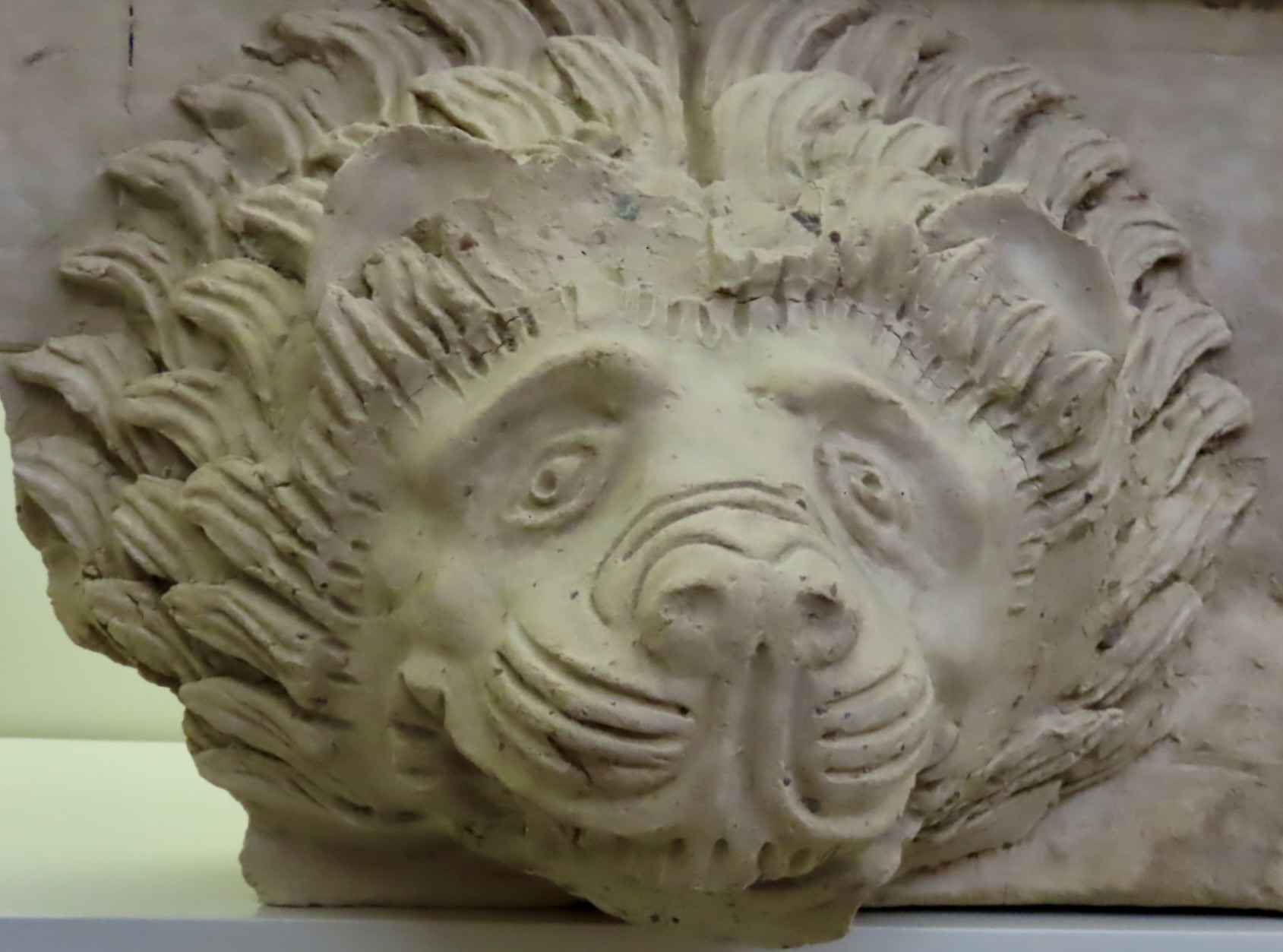
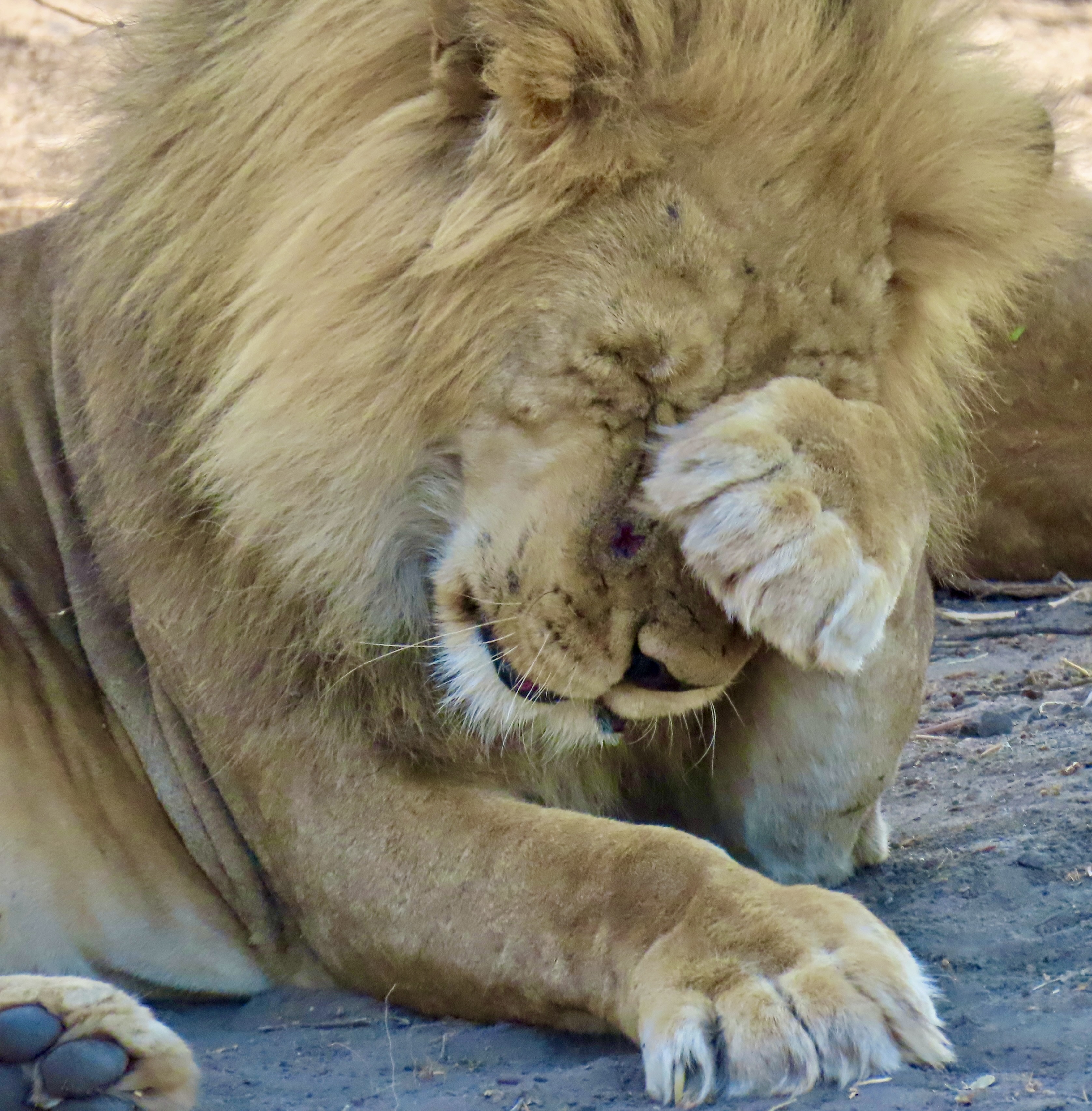
There was no leg rubbing from the cat in Pyros however. The message was “Go bother another cat. Preferably a big one.”Uh, I think we’ll let that kitty sleep. (Photo from our Southern Africa safari.)Actually, lions once roamed throughout Greece and the surrounding area with the last being recorded in Macedonia in the first century CE. I think every Greek ruin we visited had at least one sculpture of the large, scary animals. A few were chomping down on something… or someone.Ouch. Scary didn’t involve chomping in most of the sculptures, however. Looks were enough.This lion was having a hard time keeping it together. No wonder it was angry. “Where did my body go?”I introduced this kitten in my last post. She was fascinated with a bird up in the tree. We were down on the Peloponnesian Peninsula at Mycenae, which includes one the world’s most famous lion carvings. Her brother appeared to be off on an adventure. I imagined it saying, “Can I see the Lion Gate again, Mom? Please, please, please.”“If you are a good kitty,” Mom admonished.Kitty wasn’t alone in his desire to see the Lion Gate. I also promised to be good. Mycenae had been the center of Greek civilization between 1600 and 1100 BCE. I had been waiting to see it ever since I took World History in High School. While that wasn’t 3000 years ago, it was awhile. The Gate features two lionesses flanking a central pillar.A close up. The lionesses are missing their heads. It is thought that they may have been made out of metal and been facing outward to warn any potential invaders.This lioness that Peggy and I took photos of in Southern Africa would have served as a great model for the missing heads. Invaders wouldn’t have to had known that the lion was simply yawning.This lioness would have worked.Shortly after leaving Mycenae, we came to the town of Nafplio where we stayed for a week. The lion sculptures there had wings! We had seen them before. In Venice. Their presence in Nafplio was due to the fact that Venice had once occupied the city. The winged lion is the symbol for Saint Mark the Evangelist, who was the patron saint of Venice. A close up.Another example of a Venetian winged lion in Nafplio. In case you are wondering about the round things around the lions’ heads, they represent halos, a required accouterment of saints. (“Don’t forget to put on your halo, honey.”)The halo is solid here. Judging from the looks on the lion’s face, he was not having a good day. Is pissed a good word here? Sort of how one might look if you had spent your day being dragged through the streets of Alexandria, which is how St. Mark met his maker and gained his wings. But, now, back to kitties.We found this cat ensconced on its chunk of wood in Ancient Pisa, a small community about two miles away from Olympia, Greece where the Olympics were founded. To us it symbolized the fact that cats can sleep almost anywhere. Chairs are quite common in Europe but we have also found cats on the backs of motorcycles, tombstones, all sorts of stone ruins and even on the ground, if nothing else is available.The ground seemed okay to this cat outside our Vrbo in Delphi, Greece…The challenge was getting comfortable…Here’s a hint if you are looking for a little kitty companionship in Greece. Sit down at any of the innumerable outdoor tables you find throughout the country. The odds are a cat will be by to visit in minutes, if not immediately. It’s how they make their living and seems to be universally acceptable to restaurant owners. A bite of whatever you are eating, followed up by another and another will guarantee you have a companion for the whole meal. Unless someone makes a better offer. This pretty little calico had just issued an inquiring meow. It was joined by two other cats while we all had lunch.Including this handsome fellow.I’ll conclude today with one final lion sculpture. My question is does having a bad hair day make you look scary? Or does it just make you look silly?That’s embarrassing. (Photo from Peggy’s and my trip through southern Africa.)
Peggy and I have been back in Virginia for a few days, but tomorrow we head out again, this time for the Scottish Highlands and Northern Ireland. Once again, I be choosing tales from UT-OH to fill in while we are traveling.
First up: I’m going to start with bear tales from the years I lived in Alaska. This is large grizzly that was self-entertaining with the bone of a moose that it kept throwing up into the air. “Come a little closer, you will get a much better look.” Yeah, right.
Peggy and I are continuing our journey through Greece, the Scottish Highlands and Northern Ireland. Today’s tale from my WordPress blog-a-book, UT-OH!, is about the time my friend Bob Bray, got lost in a snowstorm…
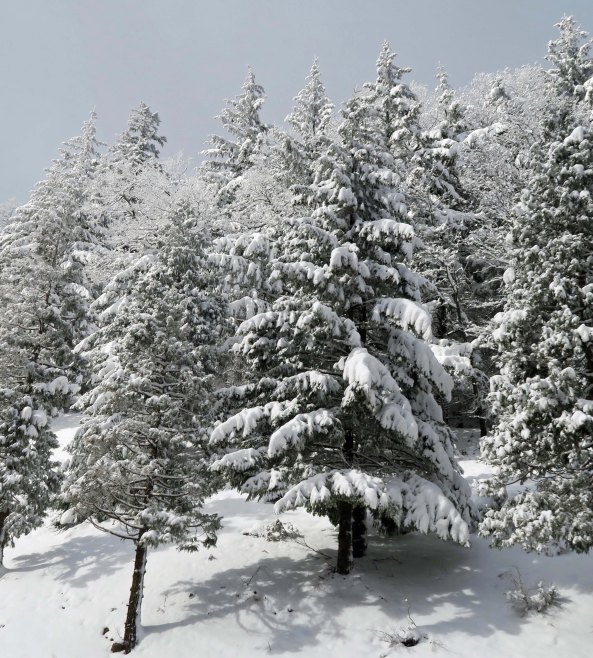
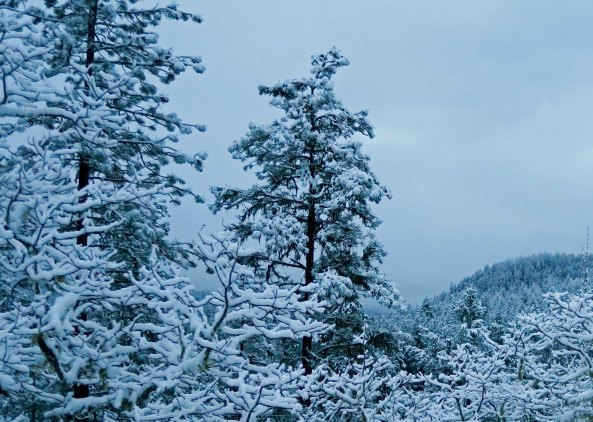
There is beauty in freshly fallen snow, but there can also be danger. Avalanches, hypothermia, and getting lost are three frightening possibilities. (Photo by Peggy Mekemson.)
Over the years I’ve had a number of challenging experiences in the snow. They have ranged from being buried under three feet fresh snow in an emergency snow shelter to camping out in 30° F below zero weather in the Alaska wilderness. I know what it is like to be on the edge of hypothermia and to cross country ski through avalanche country.
Only once, however, have I been involved in a search and rescue effort during a snowstorm.
I was out hunting with my friends Bob Bray, Hunt Warner, and Phil Dunlop in the early 70s. As usual, I regarded hunting as an excuse to be out in the woods with friends, not a reason to shoot a deer.
Deer season had come down to its last weekend. Pushing the season to its limit meant risking bad weather. We were hunting north of Highway 50 in El Dorado National Forest one Saturday afternoon in late October when the snowflakes started drifting lazily out of the sky.
It wasn’t much to worry about. We zipped up our coats and continued hunting. If anything, the gently falling snow added an enjoyable element to the trip. But it kept snowing and the flakes became more serious. After a couple of hours there were six inches of the white stuff on the ground and my tracks were beginning to disappear. I decided it was time to make a judicious retreat to the T-bone steaks that were waiting for us back at the jeep. I soon ran into Hunt who was walking with Phil.
“Have you seen Bob?” I asked. He and I had parted an hour earlier at the edge of a large thicket of brush where Bob had been convinced he would jump an evasive buck.
“I haven’t seen him since it started to snow,” was Hunt’s reply. Phil hadn’t see him since lunch. Normally we wouldn’t have been overly concerned. We were used to traipsing around through the woods on our own. But evening was coming, the temperature was dropping, and the snow was continuing to accumulate.
“Maybe Bob has more sense than we do and has already returned to the jeep,” Phil suggested. That seemed logical so we made the short 15-minute walk back to it. No Bob.
“This is getting worrisome guys,” I said in a definitely worried tone. It wasn’t like Bob to be late for dinner. “Let’s go back to where I saw him last and see if we can find his tracks.” The advantage of snow is that it leaves a trail even a city slicker can follow, assuming that it hasn’t already covered the tracks. Even then, there are usually dimples in the snow.
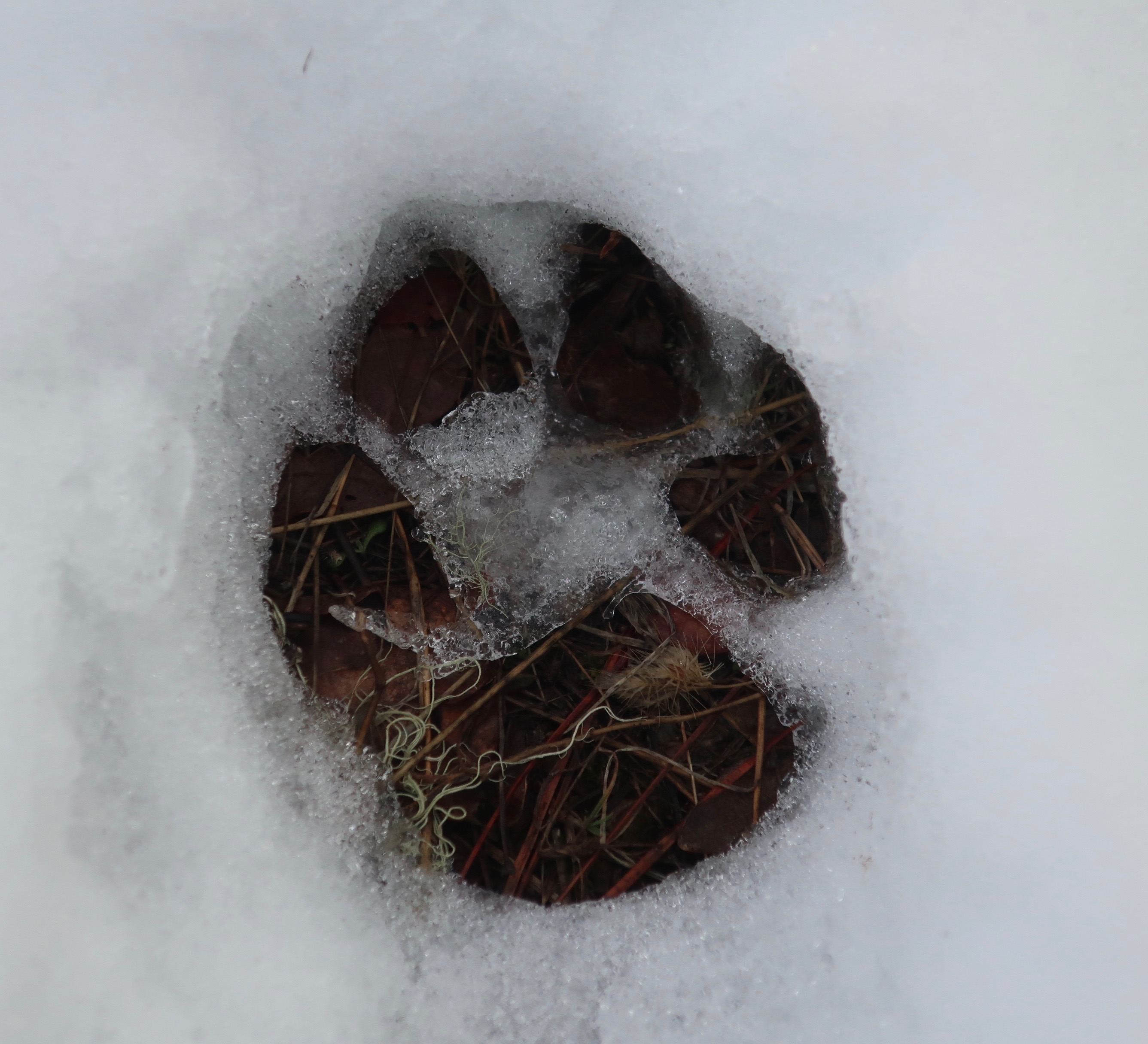
This cougar track from our backyard when we were living in Oregon shows how clear tracks can be in fresh snow.
Unfortunately, no tracks or convincing trail-like dimples were to be found. I did spot the tracks of a very large deer, but they disappeared at the edge of the thicket.
“It looks like the buck stops here,” I said to Phil and elicited a weak groan. I suggested we split up and look around.
“We need to meet back here in 30 minutes,” I urged. “Don’t go far, and pay attention to where you are going. It is getting close to dark and the last thing we need is a second person missing. If you come across Bob’s tracks, fire your rifle and we will join you.” My degree of concern was reflected in my bossiness. Normally we were a very democratic, almost anarchical group.
Ten minutes later I had made my way to the other side of the thicket and found nothing. Neither had I heard any rifle shots announcing that either Hunt nor Phil had success. Discouraged, I turned around to rejoin my fellow searchers. It was then I spotted tracks leading out of the thicket. Up went my Winchester and I fired off a shot.
“Bang!” the sound of another rifle being fired resounded from the direction Bob’s track had headed. I quickly levered in another bullet and fired again. There was no response. I did hear Phil and Hunt making their way through the brush toward me, though. They sounded like a pair of large bears. We held another council. Once again, we decided to split up.
Phil would return to the road where the jeep was parked and flag down a car. His job was to get a message through to the El Dorado County Sheriff’s Department that Bob was missing. Hunt would cut back through the thicket and wait on the jeep trail where the thicket began in case Bob made his way back there. He’d fire his rifle if Bob appeared. I was going to follow Bob’s tracks until dark to see if I couldn’t catch up with him. There were only about 30 minutes of daylight left so the odds were slim. My concern was that Bob had somehow injured himself and was stranded, or that he had become disoriented and become lost.
Following the tracks was a challenge. They would be clear for a few yards and then disappear under the snow. It was continuing to fall and beginning to drift, whipped on by a strong breeze. Each time I lost the tracks, I would work forward in a zigzag pattern until I found them again. It didn’t help that Bob was tending to wander or that I was tired from a full day of tramping over mountains. Dusk was rapidly approaching when I came across another set of tracks that crossed the trail I was following. They were fresher, and they were Bob’s! I yelled but the only response was the silence of the snow filled woods. It seemed to me that Bob was beginning to follow the classic lost person syndrome of wandering in circles.
I wanted to go on, needed to go on, but knew that the decision would be the wrong one. Dark had arrived to reduce an already limited visibility. I was tired, close to exhaustion, and cold. Hypothermia was a real threat. Ever so reluctantly I turned around and begin to make my way back toward Hunt, leaving Bob behind to face whatever fate the dark and snow and cold had in store for him.
The realization of how tired I was really hit me when I came to a downed tree and couldn’t persuade my leg to step over. We had quite the discussion. I reached down, grabbed my pants cuff and gave the reluctant appendage a boost. Hunt was waiting where we agreed and I filled him in on my findings as we made way back to the jeep through the ever-deepening snow.
Phil had had more luck. The vehicle he flagged down had a CB Radio and the driver was able to contact the Sheriff’s office. A team with snowmobiles would be at our jeep at first light, prepared for a full search and rescue operation. Bob, who was manager of Placerville’s newspaper, The Mountain Democrat, was well-known and liked in the community. We knew we would have lots of support in our search.
There wasn’t anything else we could do. We were too tired to set up the tent so we climbed in the jeep, grabbed a bite to eat, downed a Bud, and prepared for a long night. Hunt got the front seat—it was his jeep. Phil and I shared the back. It was beyond uncomfortable and even exhaustion couldn’t drive me to sleep. Somewhere around two I finally managed to doze off only to be awakened at 5:30 by Hunt’s cussing about how damn cold it was. And it was. Our sleeping bags hadn’t kept us warm and the doors had frozen shut. We had to kick them open.
We soon had our Coleman lantern blasting out light and our Coleman stove cooking up a mass of bacon, eggs and potatoes. We were expecting a long day and knew we would need whatever energy the food could supply. The storm had passed, leaving an absolutely clear sky filled with a million twinkling stars.
The Sheriff’s team arrived just as the sun was climbing above the Crystal Range of the Sierra Nevada Mountains, exactly on time. Introductions were made and snowmobiles unloaded. We filled the team in on our efforts of the previous day. The deputy sheriff in charge asked me to climb onto the back of his snowmobile and take them to the point where I had left Bob’s tracks the night before. It was to be my first ever snowmobile ride. Except it wasn’t.
Just as the search team was firing up their engines, a wraithlike figure wearing a plastic poncho came slowly hiking up the hill toward the jeep. He looked like a bad guy out of an early Clint Eastwood western. It was Bob. As soon as the sun provided a hint of dawn, he had managed to orient himself and start walking back toward the jeep. Yes, he was freezing, but he was alive. We knew just how alive he was when he demanded his share of breakfast. As we cooked up another mass of bacon and eggs (fortunately we hadn’t eaten everything), Bob told us his story.
He had become disoriented after coming out of the thicket and headed off in the direction he thought would take him back to the jeep. It didn’t. He fired his rifle several times to get our attention but the sound of shots is fairly common in the forest during hunting season. We just assumed a deer hunter had gotten lucky. Bob continued wandering and eventually came across his own tracks. That was when he seriously began to worry.
Knowing he was lost and knowing night was coming on, he gathered wood for a fire. The wood was wet and refused to start burning. Bob’s lighter ran out of fuel but he still had a few matches. He took his lighter apart, placing the innards under the wet wood and used his last matches to light it. The good news was that the fire started. The bad news was that the wind and snow put it out almost immediately. It was some time during this process that I had fired my rifle and Bob had used his last shot to respond. Out of options, he had dug out a packrat’s nest to provide shelter and prepared for the longest night in his life. He had survived in lodging that made Hunt’s ancient jeep seem like a five-star hotel.
“I even fell asleep once or twice,” Bob managed to get out around a mouthful of eggs.
Of course, the Mountain Democrat ran a major story on Bob and he had to take considerable ribbing in Placerville over the next several months. It was a small price to pay considering the alternatives. That Christmas, Bob received several compasses for gifts. It was years before he had tolerance for any temperature below 70.
I took this photo out my front door of our home in Oregon. And then went back inside…
Next Post: You will get to meet both ancient and modern cats of Greece. They were everywhere.
A bird had caught this kitten’s attention. It was laughing at it.
Peggy and I are presently traveling through Greece, Scotland and Northern Ireland. While we travel, I am posting stories that will be in my WordPress blog-a-book: UT-OH! Today’s tale is about a 1965 confrontation with a terrorist group on a remote road in the Sierra Nevada Mountains of California.Few things get much more Ut-Oh-ish.
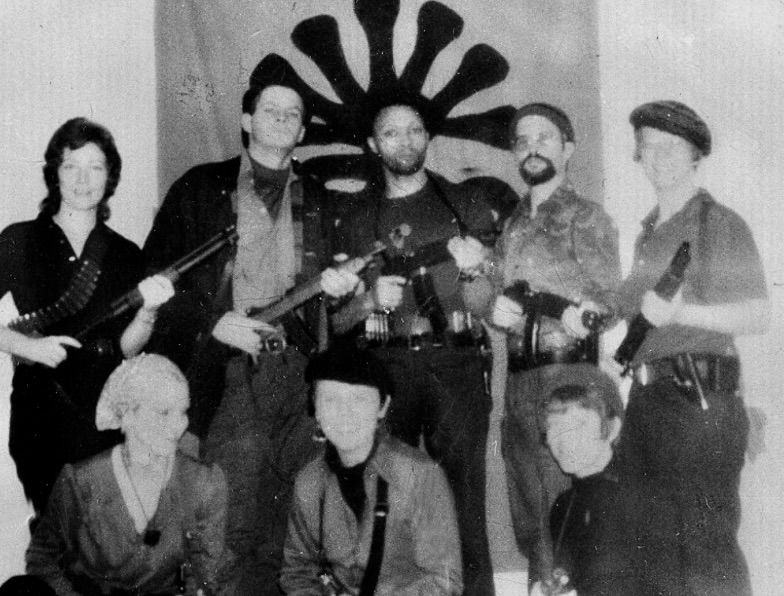
The Symbionese Liberation Army released this photo with its star recruit.
“Death to the fascist insect that preys on the life of the people.” —Motto of the Symbionese Liberation Army
In the spring of 1975, two friends and I went on a scouting trip. We had driven up into the Sierra Nevada Mountains early in the spring to look for likely fishing holes. Trout season was only a few weeks away. The mountains were still coated with snow. Following Highway 50 up from Sacramento toward Lake Tahoe for 60 plus miles, we took Ice House Road into the ElDorado National Forest. We carefully made our way along the ever-narrowing road until a snow bank suggested that further progress was best left up to animals with big furry feet. We stopped and got out to stretch our legs.
We had wandered a few feet when a white van came roaring up from behind and tried to slip by the right side of our car without slowing down. Normally it wouldn’t have been more than an irritation, but the narrowness of the road combined with the snow left just enough room for one and one half cars. Not two. We watched in slow motion disbelief as the van barely missed our vehicle, slid into the snow, and became seriously stuck.
“Yes!” we said in unison, “There is justice in this world!” Right about then the side door of the van opened and disgorged a polyglot group of rough-looking characters. “Whoa,” I mumbled more quietly, “we had better keep our opinions to ourselves.” While two or three of the men bent down to look under the van, a not so rough, in fact an attractive young woman, disentangled herself from the group and came strolling over to where we were standing.
“I am in love,” Hunt mumbled. Phil and I joined the admiration society while an elusive thought began tugging at the back of my mind.
“Hi, guys,” she smiled at us, becoming even lovelier. “Do you have any guns in your car?”
My tiny elusive thought suddenly became a very large insistent nag. Attractive young women don’t normally start conversations by asking whether you are carrying weapons. Hunt, on the other hand, was beaming. He liked guns and— even more— he liked women that liked guns.
“I have a twenty-two along,” he announced proudly.
“Oh,” she replied, apparently a little disappointed at the size of Hunt’s gun. “My friends taught me how to shoot automatic weapons in the Bay Area. We are up here to practice.” It was stated with the same type of pride a new mother might talk about her child’s first steps or words. My large, insistent nag turned into a five-stage fire alert.
Meanwhile Hunt had suggested that he and his new friend take the twenty-two out for a little target practice since it was obvious that the van wasn’t going anywhere quickly. I don’t remember how I managed it, but I pulled my friends aside sans beauty for a very quick and quiet conversation.
“I am not one hundred percent sure,” I began, “but I think the young woman who likes big guns is Patty Hearst, aka Tania, and that her friends over at the van are members of the SLA. If I am right, we are in a very dangerous situation.”
The SLA, or Symbionese Liberation Army, was one of the more bizarre and misled of the radical groups to be born out of the ferment of the late 60s and early 70s. Viewing itself as an urban guerrilla movement, SLA’s first action of note had been to gun down Dr. Marcus Foster, the black Superintendent of Oakland Schools, and seriously wound his deputy, Robert Blackburn. Blackburn had earlier served as Peace Corps Director of Somalia and then gone on to work for the Philadelphia School System. He had recruited my first wife, Jo Ann, and me as teachers in Philadelphia when we left the Peace Corps. It would have been hard to find two people more committed to helping disadvantaged inner city kids in America than Foster and Blackburn.
SLA’s next major public statement was to kidnap Patty Hearst, heiress to the newspaper tycoon William Randolph Hearse, while she was a student at UC Berkeley. At some point, Patty switched from being an unwilling kidnap victim to willing participant in SLA and adopted the name of Tania (the name of Che Guevara’s girlfriend). The common assumptions were that Hearst was brainwashed or a victim of the Stockholm syndrome, a psychological response through which a kidnap victim comes to associate with his or her captors. Certainly, the young woman we talked with, was proud of her skill with automatic weapons and had the freedom to come over and chat with us. She was not an unwilling prisoner.
In 1974 Patty participated in a San Francisco bank robbery and then moved to Los Angeles with the SLA where several members of the group met their death in a fiery confrontation with LA police. Some 400 LAPD officers had surrounded a house occupied by SLA and emptied over 5,000 rounds into the structure. (Over kill?) Patty, who wasn’t there, watched the whole confrontation on television. She, along with William and Emily Harris, then fled to Pennsylvania for several months before making their way to Sacramento and another bank robbery.
There was enough similarity with Hearst and the SLA that I suggested we go over to the van and help the nice folks get unstuck— which we did. They drove up to the end of the road, turned around, carefully edged by our car and headed off down the mountain. We waved and smiled vigorously as they disappeared.
Was it Patty Hearst and the SLA? The timing was right, the young woman looked like Patty, and the group could have fit a description of the SLA. Patty reported later that the group had taken their van into the mountains for weapons practice. In May of 1975, the SLA robbed a bank in Sacramento (Carmichael) and a young mother, Myrna Opsahl, was shot and killed. Patty Hearst drove the get-a-way vehicle. It was one more sad and sordid event in the history of the SLA. In most ways this group of want-to-be revolutionaries was a group of losers. Their murder of Marcus Foster was regarded with disgust by most members of the radical community. It was their kidnapping of Patty Hearst and, even more so, the fiery shootout in LA that gave their organization legendary status.
As for Hearst, I have no doubt that the Stockholm syndrome played a role in her behavior. But I am also convinced there was more. The atmosphere of the time encouraged radical thinking and Patty, who was something of a rebel, was living in a cauldron of dissent at Berkeley. I suspect it wasn’t all that hard to slip into a role of radical chic.
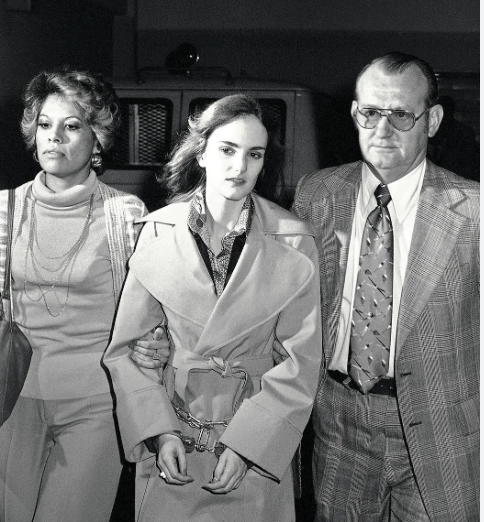
Patty’s crime spree came to an end in the fall of 1965 when the FBI tracked her down in South San Francisco. Here she is shown with agents and in hand cuffs. (AP photo)
Wednesday’s Post: My friend Bob Bray gets lost in a snowstorm when we are out hunting. Night falls before we can find him…