Back to the Rabbit, er Hare: It’s a Wrap on Vienna… The Great River Series— Danube #4

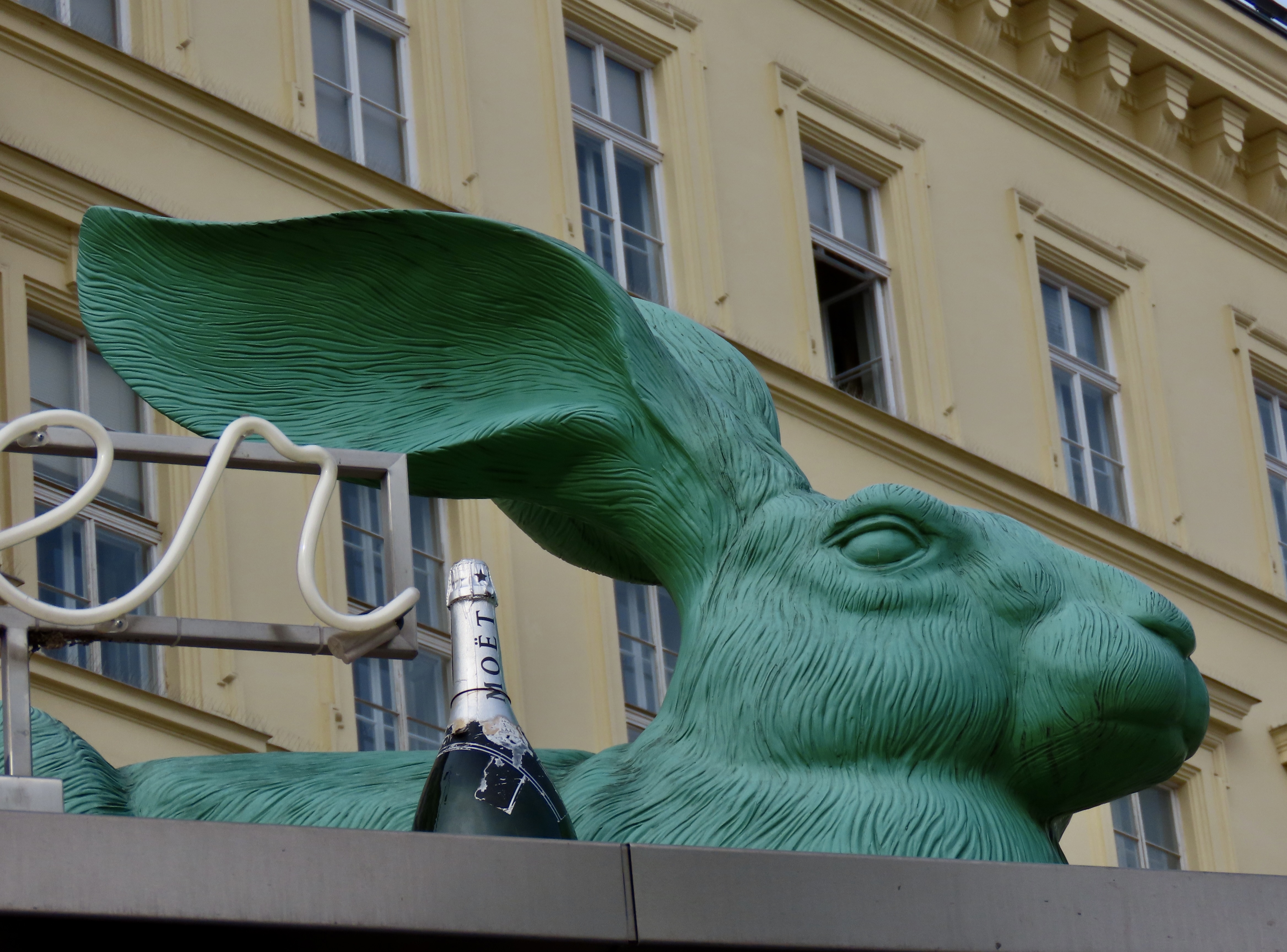
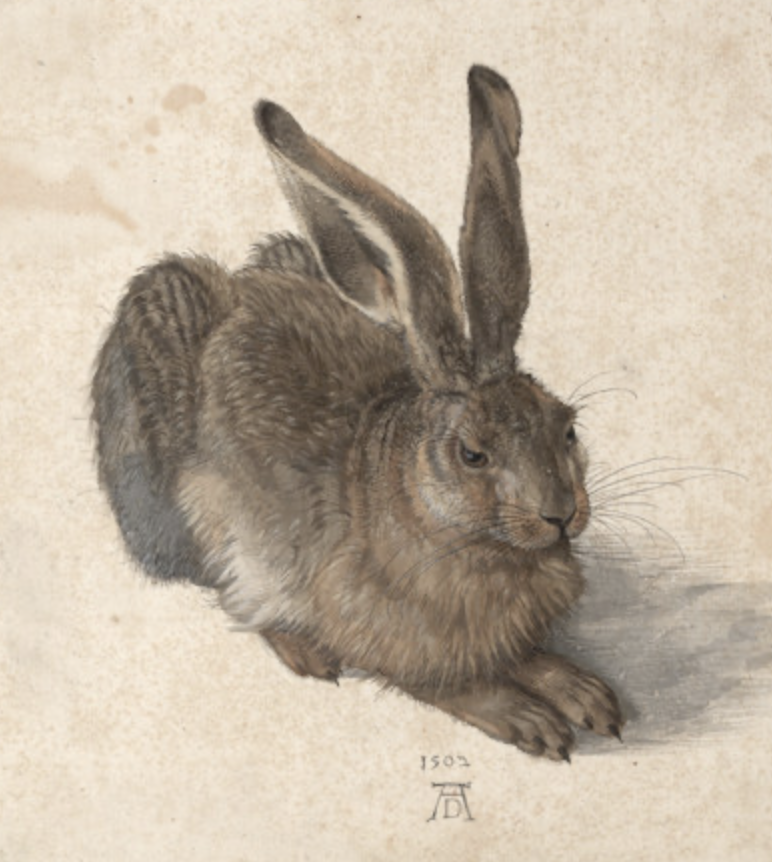
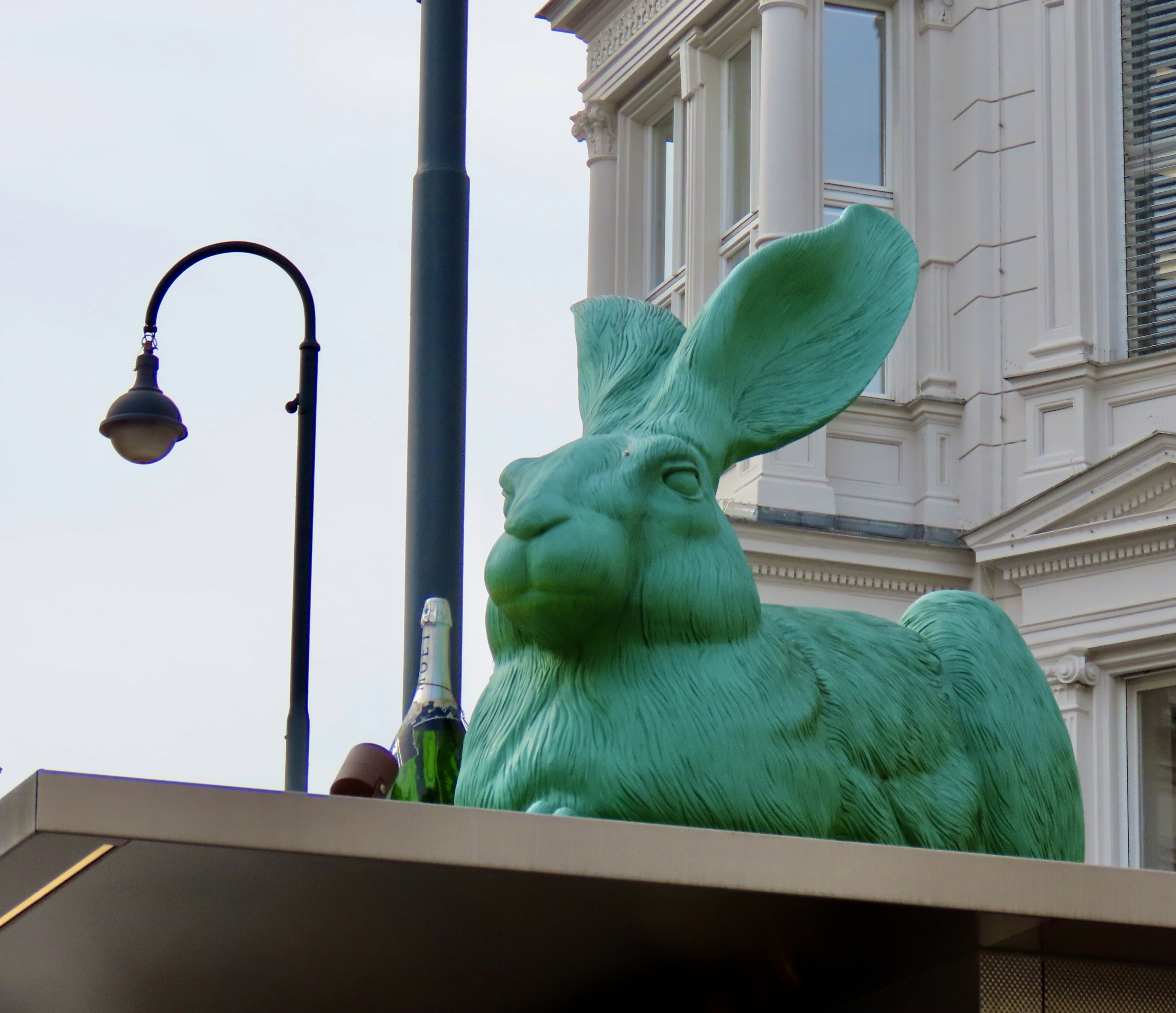
I ended my last post on Vienna by jumping down a rabbit hole to learn more about this fantastic beast that hangs out on top of the Bitzinger Sausage Stand with his bottle of champaign. I’m not talking about an Alice in Wonderland hole; I’m talking about its modern equivalent: the internet. I discovered he is modeled after one of the world’s most famous hares. And no, it isn’t Bugs Bunny. Clue: Art. Raise your hand if you know. And it’s okay to brag in your comment.
“Waiter, waiter!” Old Tom called. “There’s a hare in my soup.” Neither is it from one of the cards I create.
It’s Albrecht Dürer’s 1505 water color of a young hare that is located at the nearby Albertina Museum. As for the champaign, think of it as product placement. My guess is that the French Moet and Chandon Champaign giant would pay a generous bucket of euros for the exposure.  First, there are the thousands of tourists and locals who pass by daily. Even more impressive are the millions of people who probably see it in travel photos people take home. Who can resist a bunny? It’s marketing at its best. BTW, Moet puts out 28,000,000 bottles of champaign per year. You can buy a bottle for $51, or, if you prefer, $6,161.
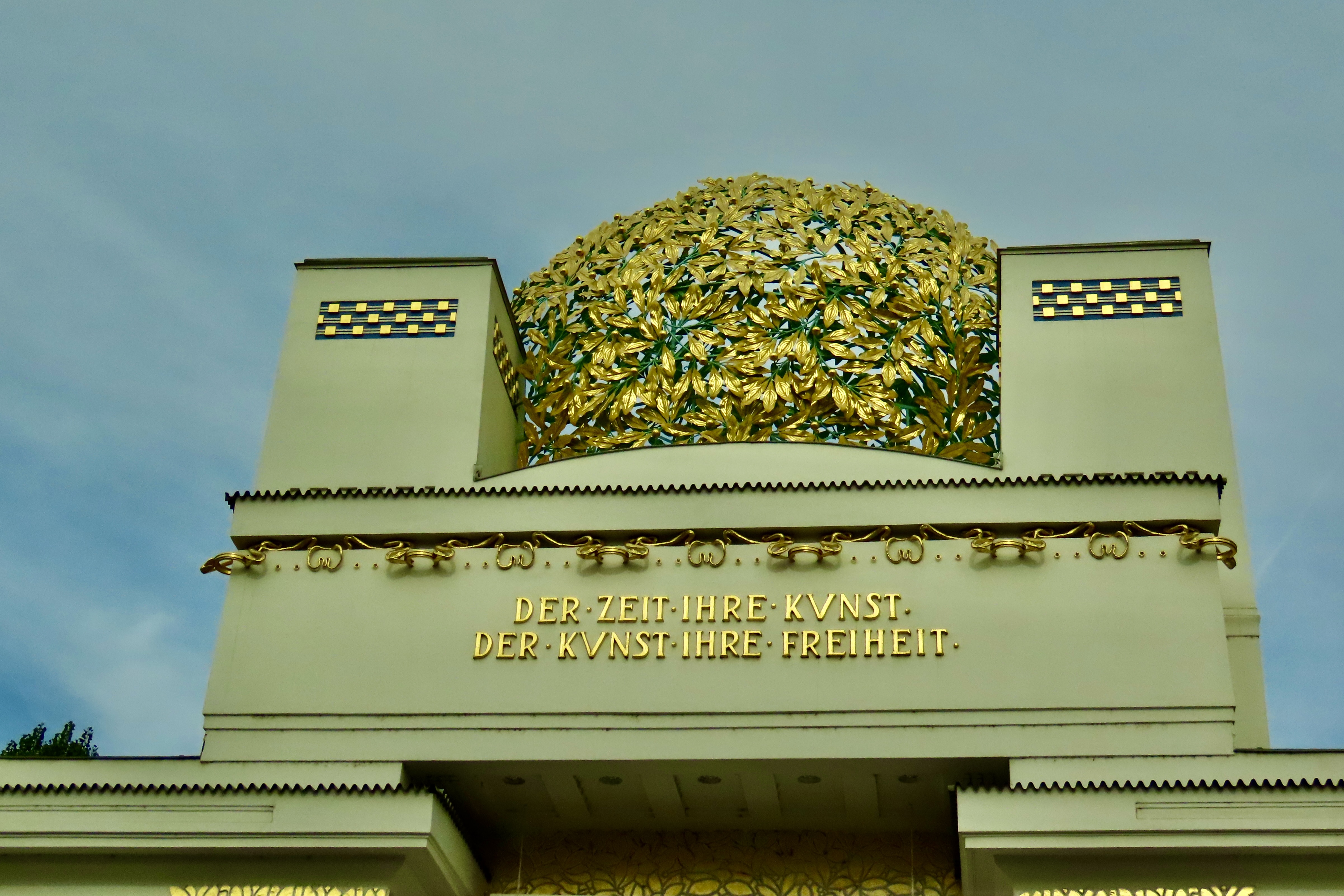
While we are on art, our guide for the day told us that locals call this the ‘Grapefruit Building.’ I wonder why? Artists call it the Secession Building. It was built in 1898 to represent a group of artists who broke away from Vienna’s established art institution to participate in a trend of modern art that was sweeping Europe at the time: Art Nouveau. The statement below translates to “To every age it’s art, to every art it’s freedom.”
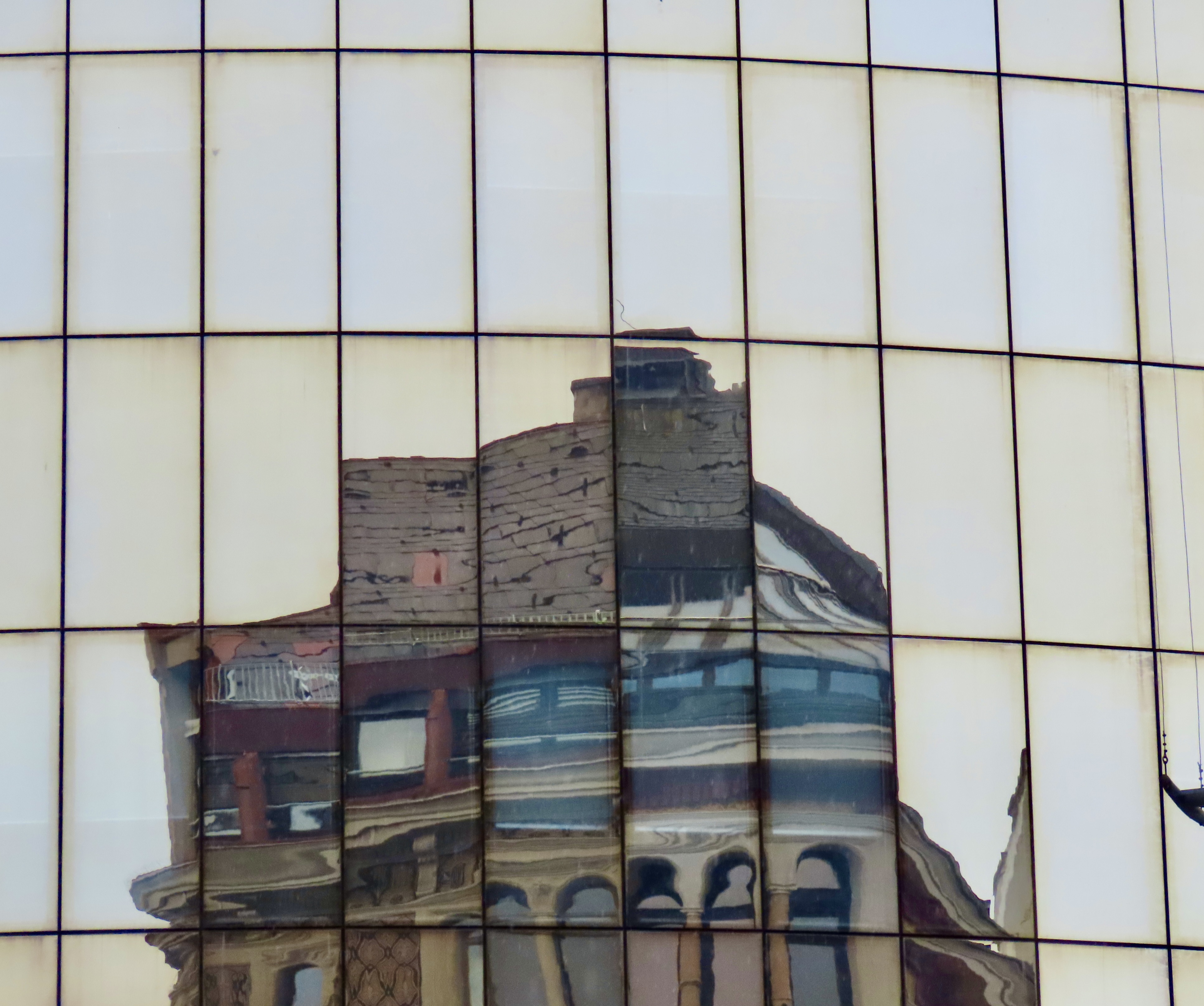
Turning to a little ‘Art Nouveau’ (or Cubism) on my own, I thought this building’s refection might qualify. There was a McD’s just below. It would have made an interesting addition.
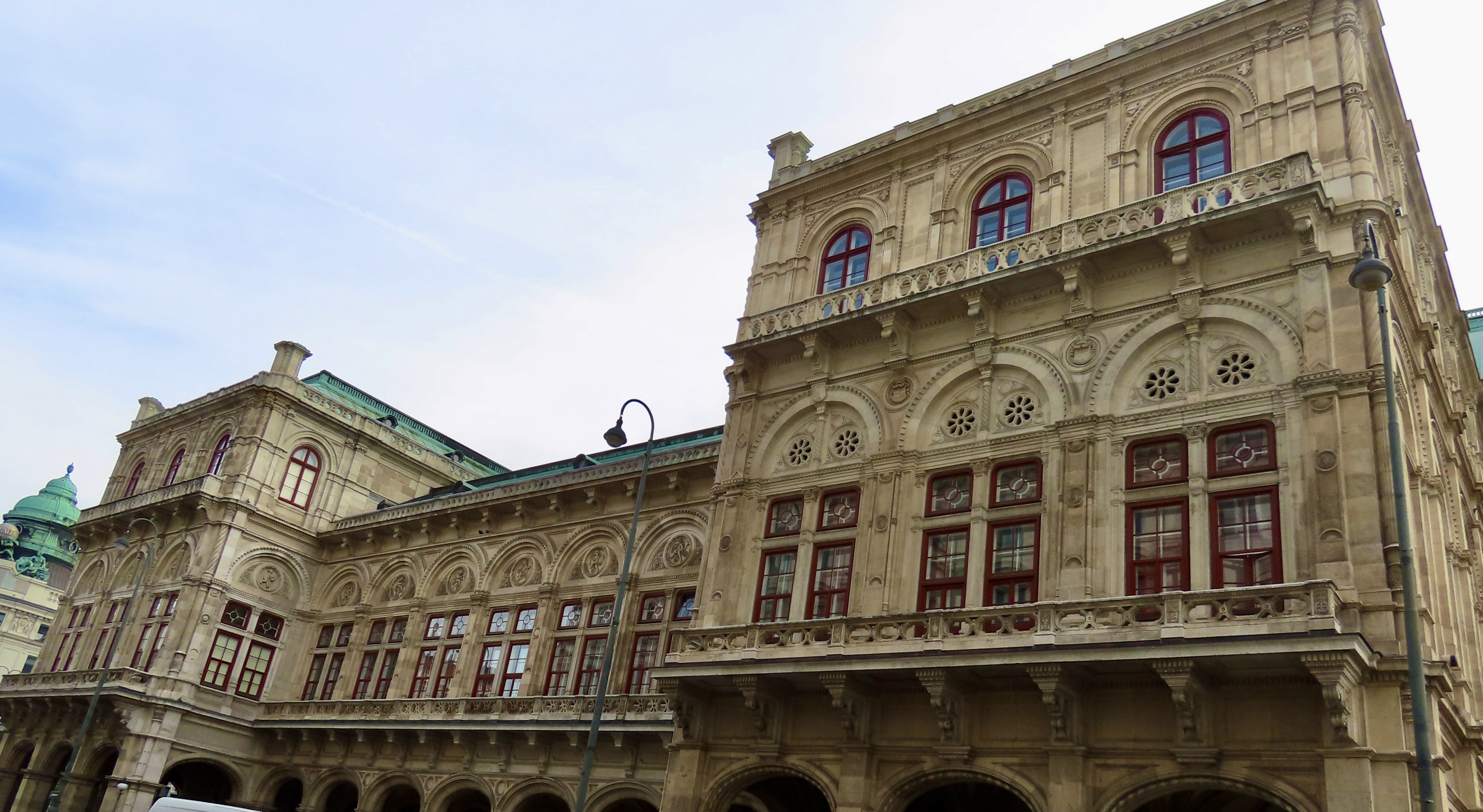
Peggy is a great fan of architecture. Vienna is full of classy buildings like this. I recall the guide told us that Beethoven lived here as the bus zipped by. It wouldn’t be surprising since he lived in more than 60 locations in Vienna during his 35 year stay in the city. Note the green building on the far end.
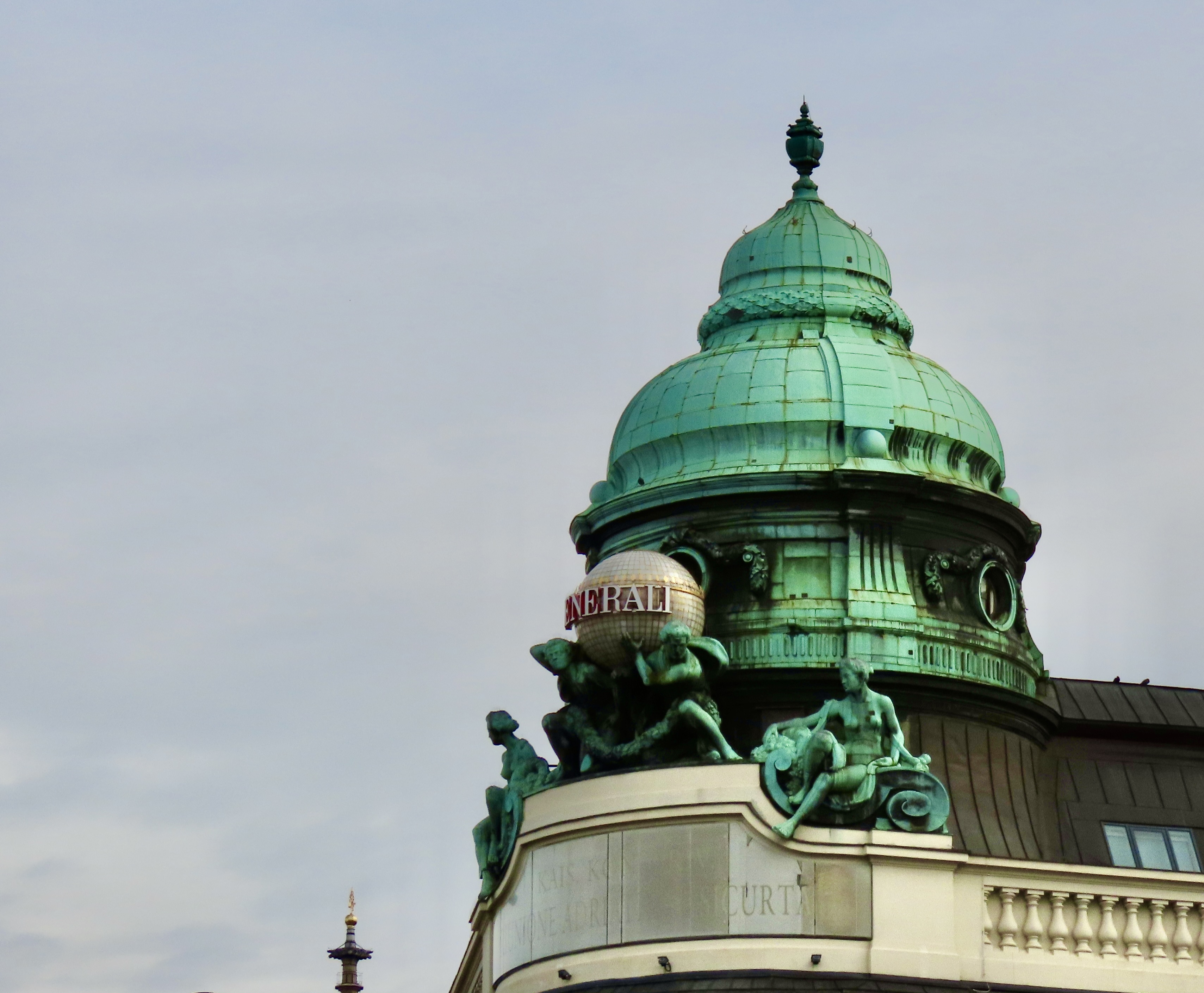
Several buildings in Vienna had striking green tops. This one belonged to the Generali Insurance Company. I think the globe was meant to imply that the company is worldwide. Apparently it required at least two of Atlas to hold it up. Which brings me to Zeus and Minerva in Albertina Square.
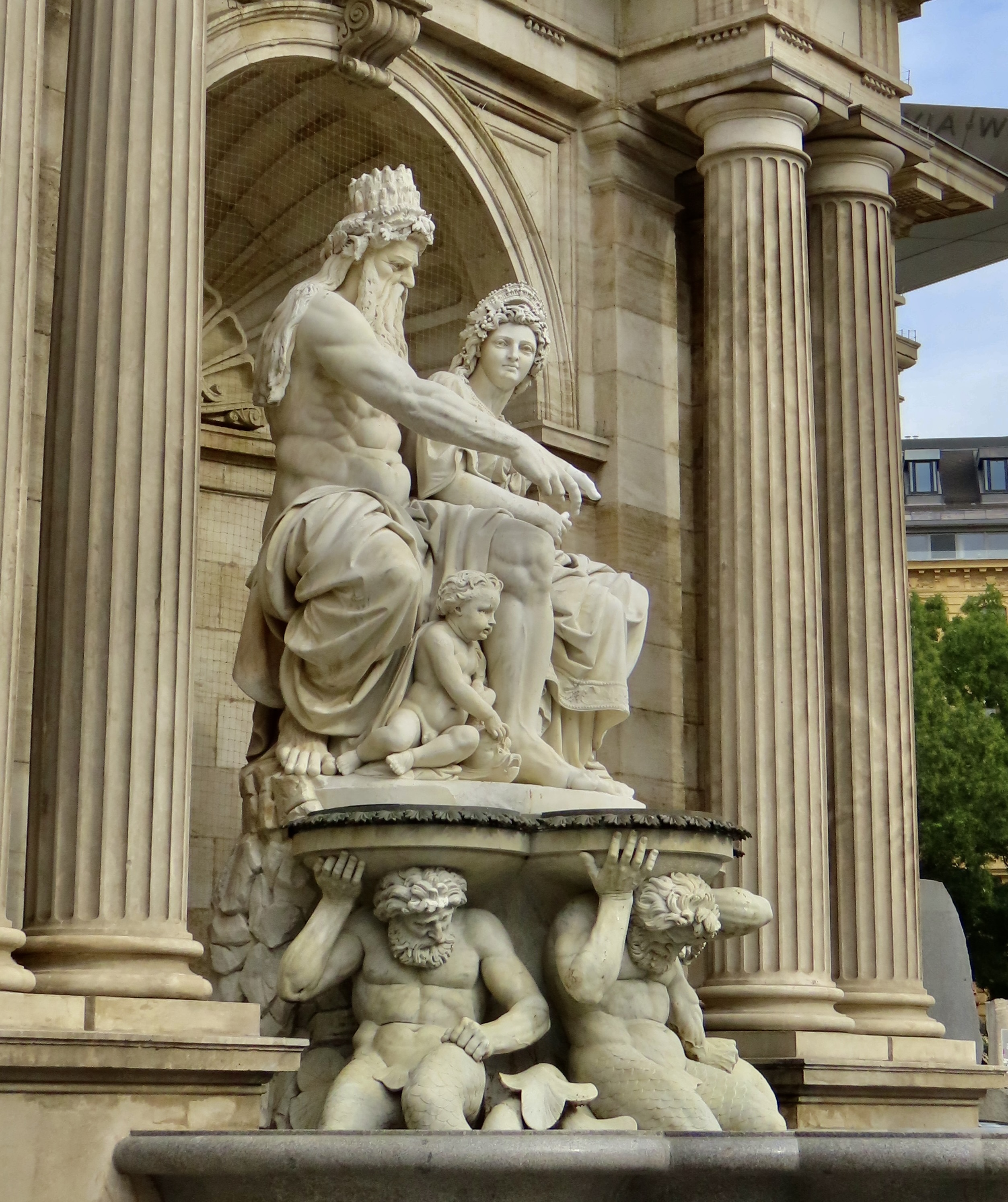
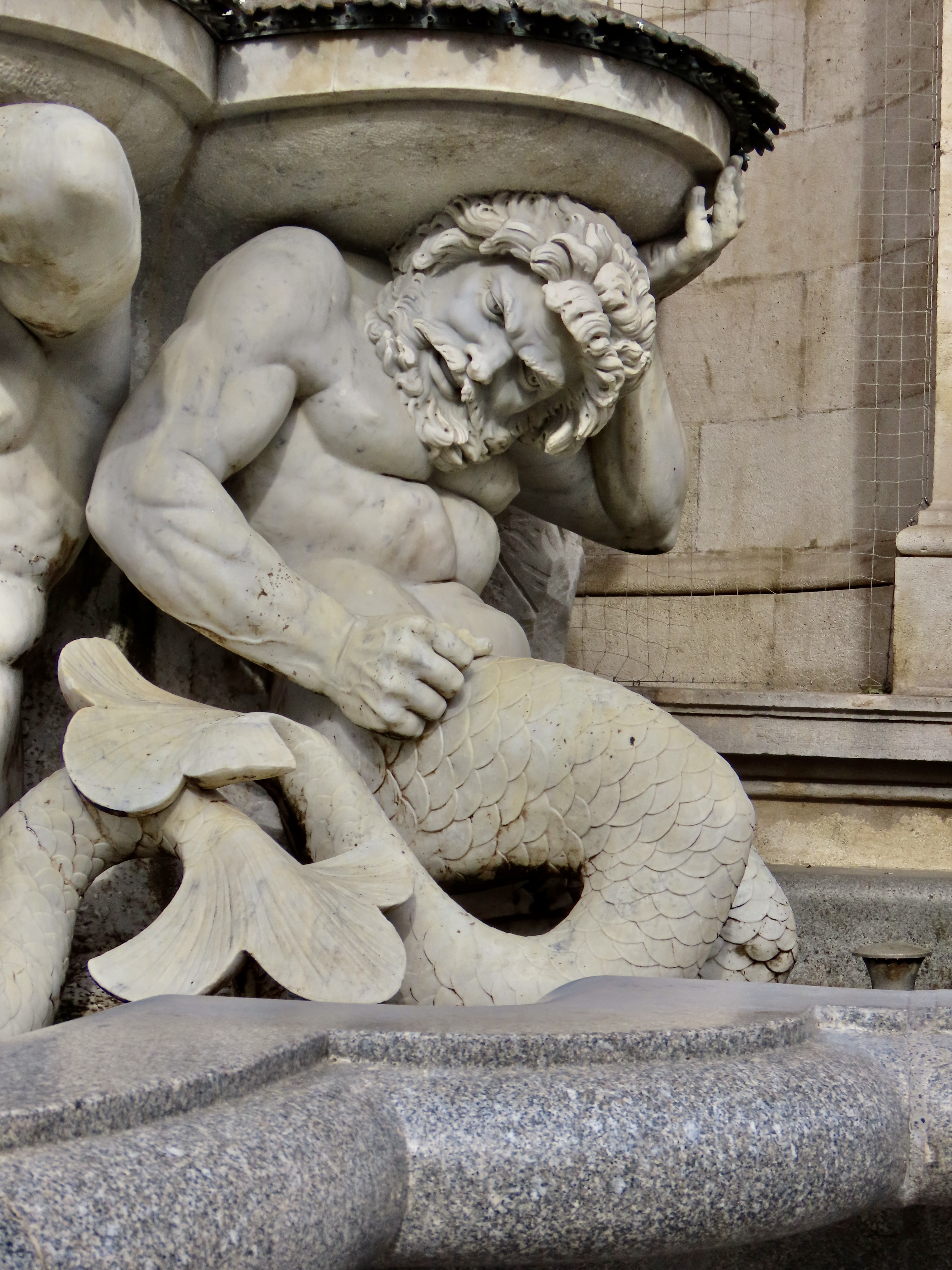
A man, a merman and some other creature share the heavy responsibility of holding up the statue of Zeus and Minerva. Minerva is Zeus’s wife (and sister). She had the difficult task of taming Zeus’s wandering ways.
I felt sorry for the squished merman. But check out the muscles. Even Arnold Schwarzenegger might be jealous.
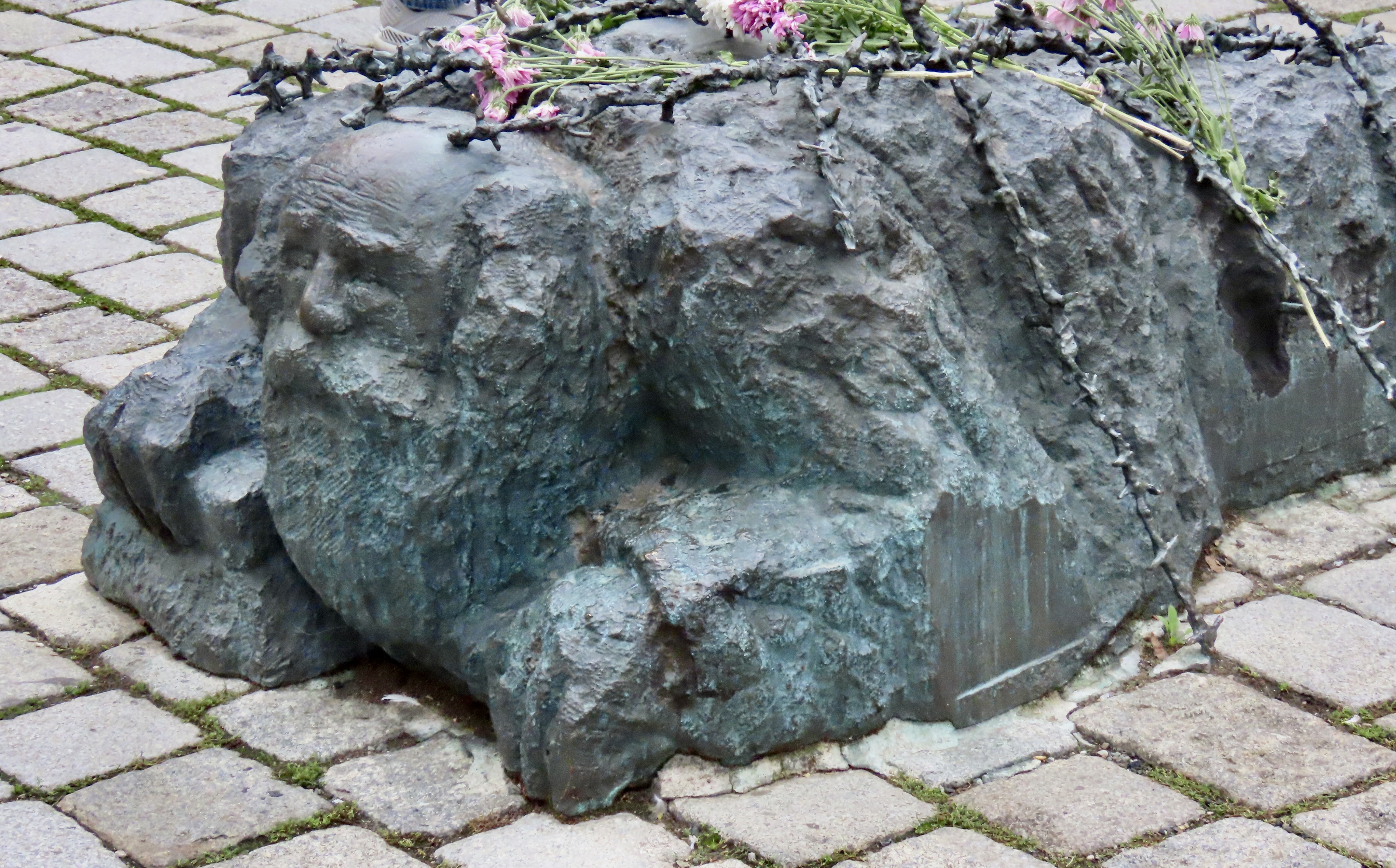
A much more solemn memorial against war and fascism is also located on Albertina Square. This is one of several statues. After the annexation of Austria to the German Reich on March 12, 1938, Jews were forced to clean the streets of pro-Austrian and anti-Nazi slogans by working on their knees with brushes. The bronze sculpture recalls this humiliation that preceded the merciless persecution and murder of some 65,000 Jewish citizens in Austria during WW II.
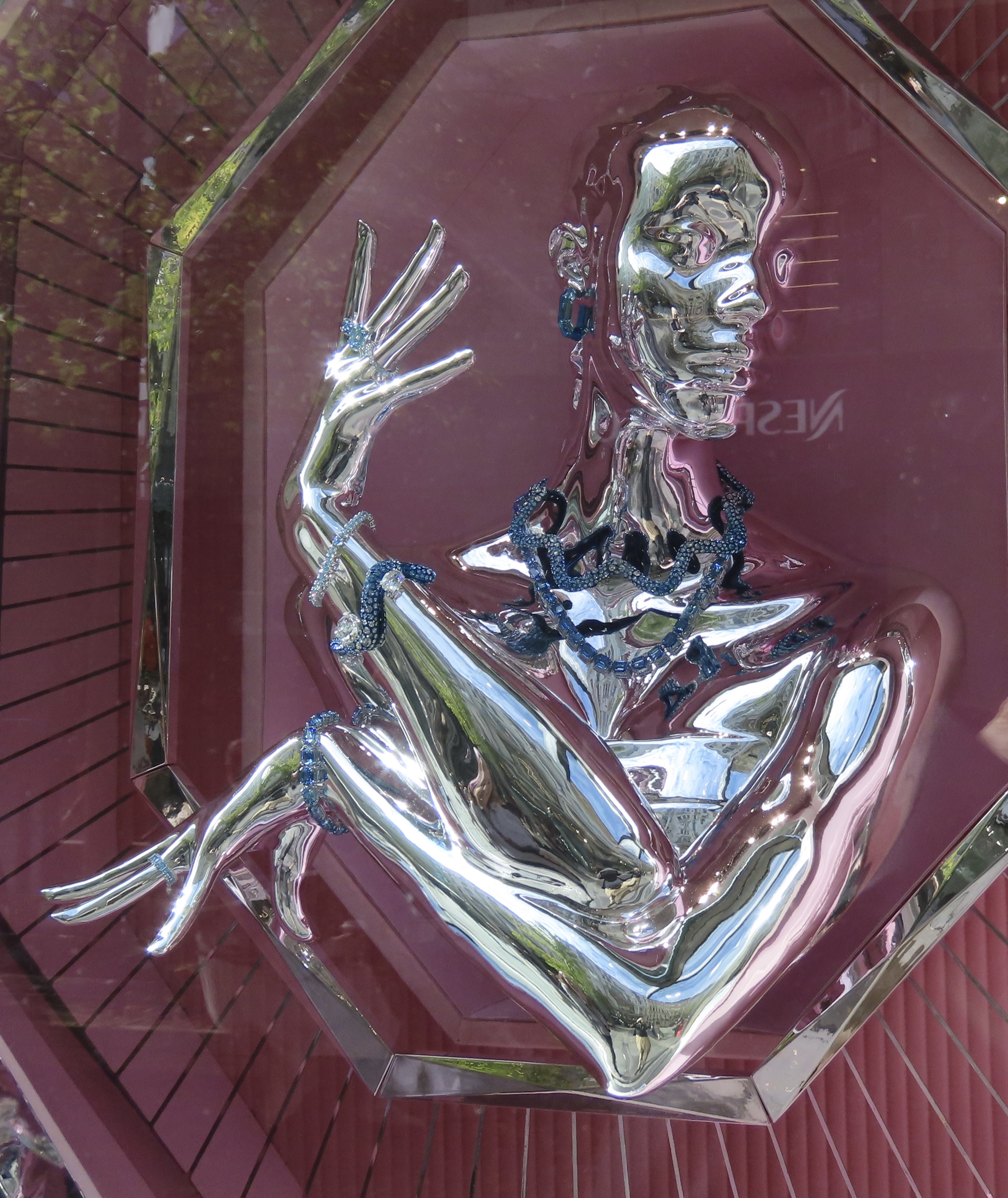
We had time to walk around in the historic area on our own. Here are a few things we noted. A number of exclusive and expensive shops…
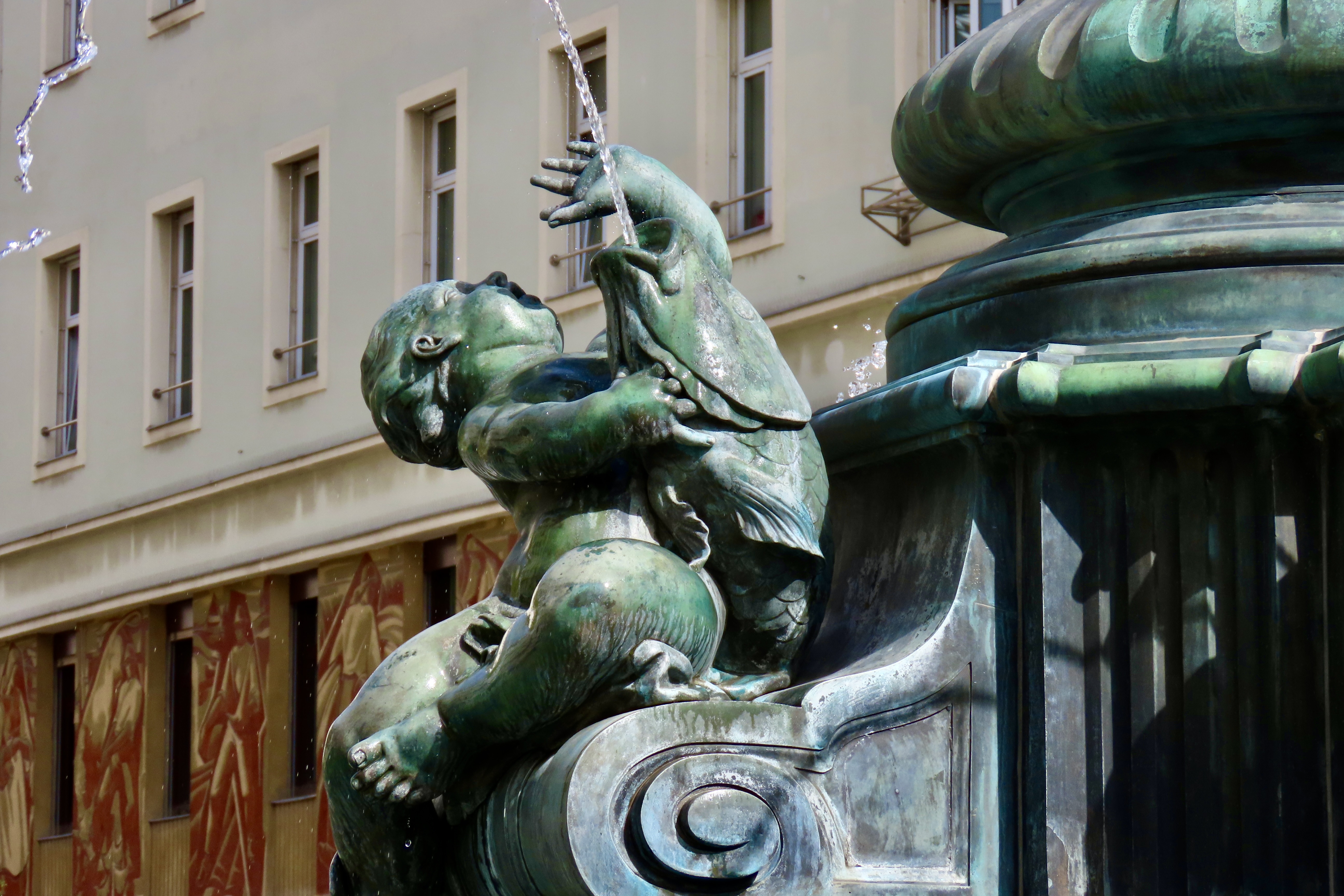
A boy squeezing the water out of a fish…
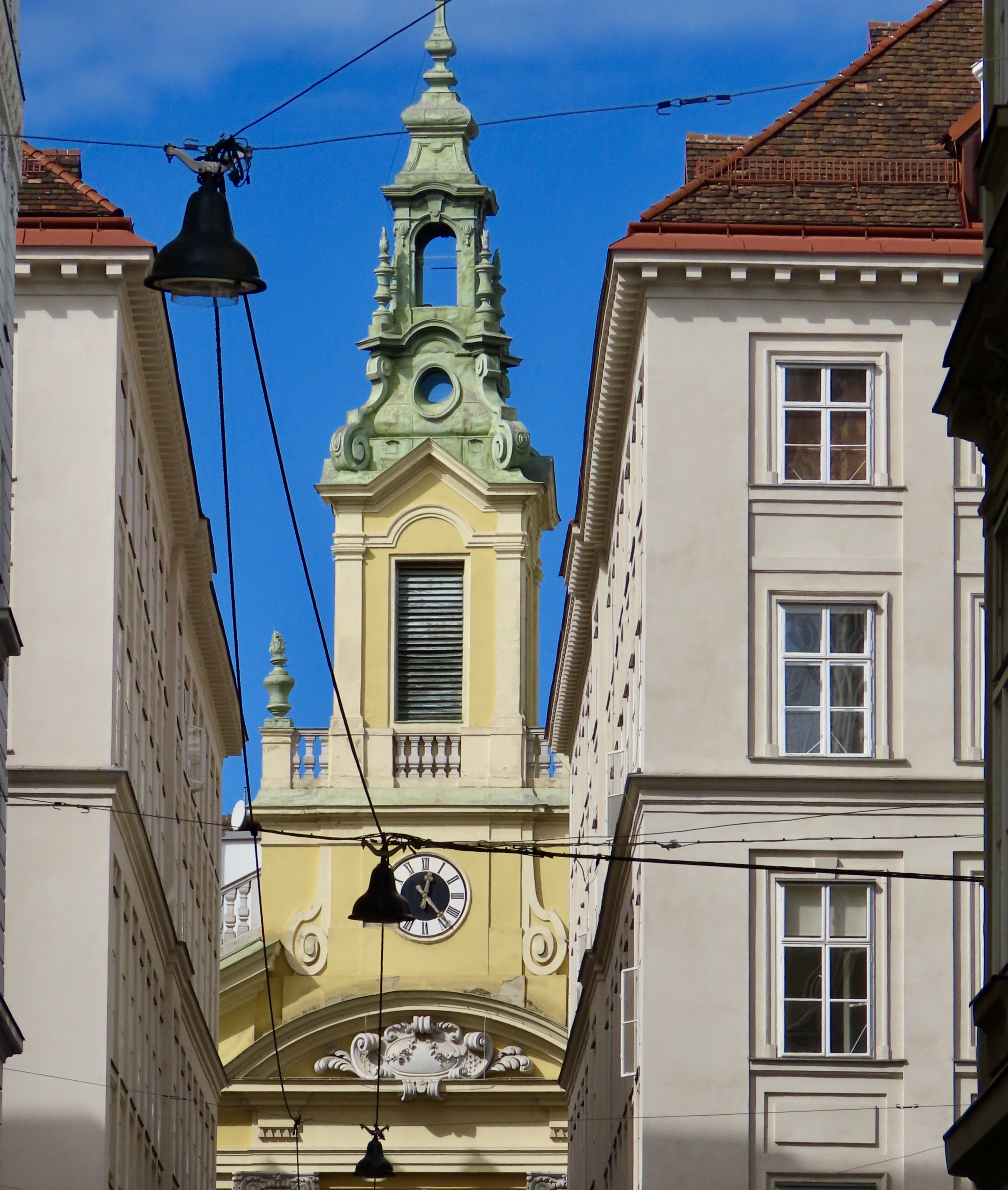
This attractive church— The Reformed City Church of Vienna.
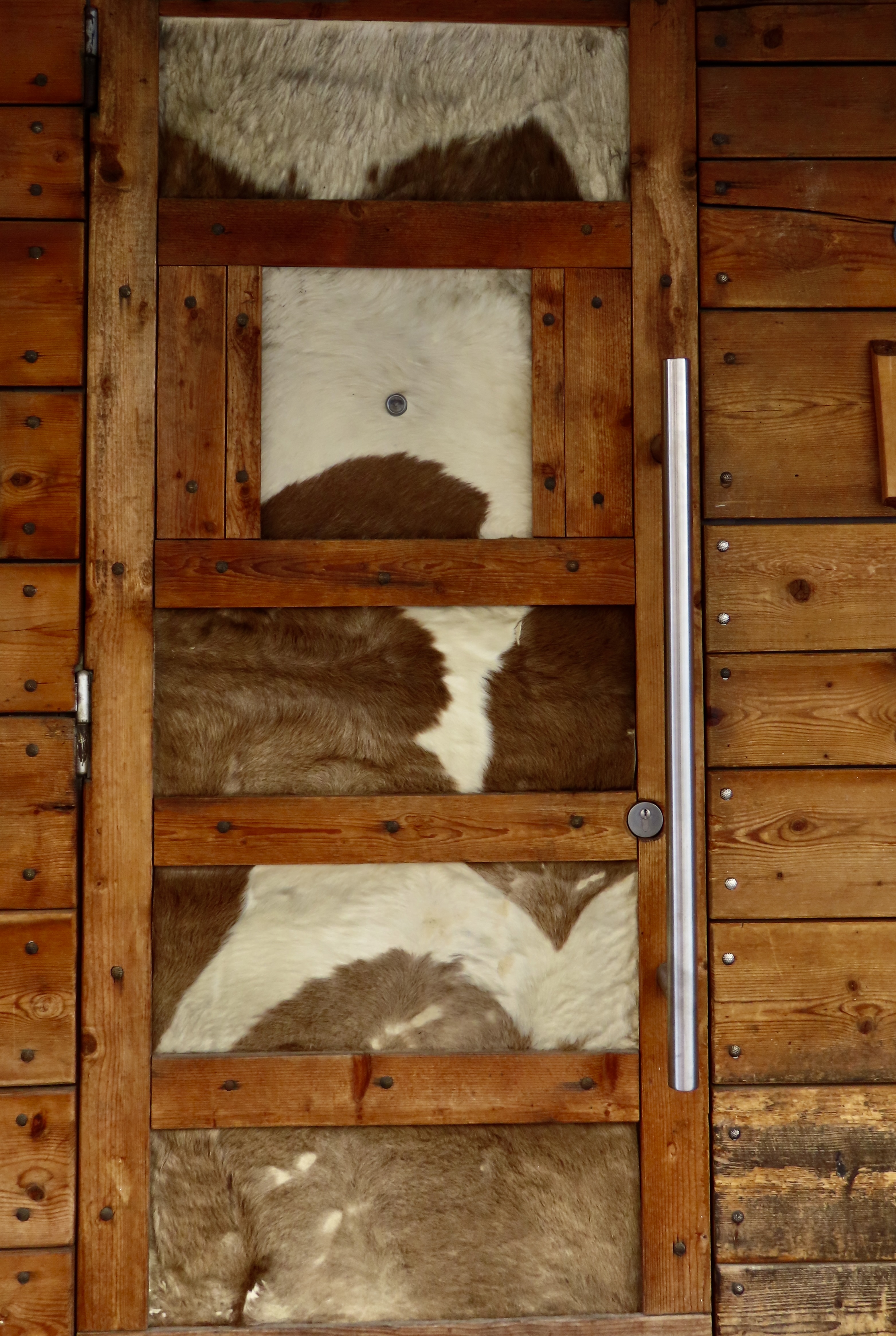
And for those of you who enjoy finding and photographing unusual doors, we found one covered with cowhide that included a peep hole. I discovered it’s an exclusive night club open from 10 pm to 3 AM, a time when Peggy and I, with any luck at all, are sound asleep.
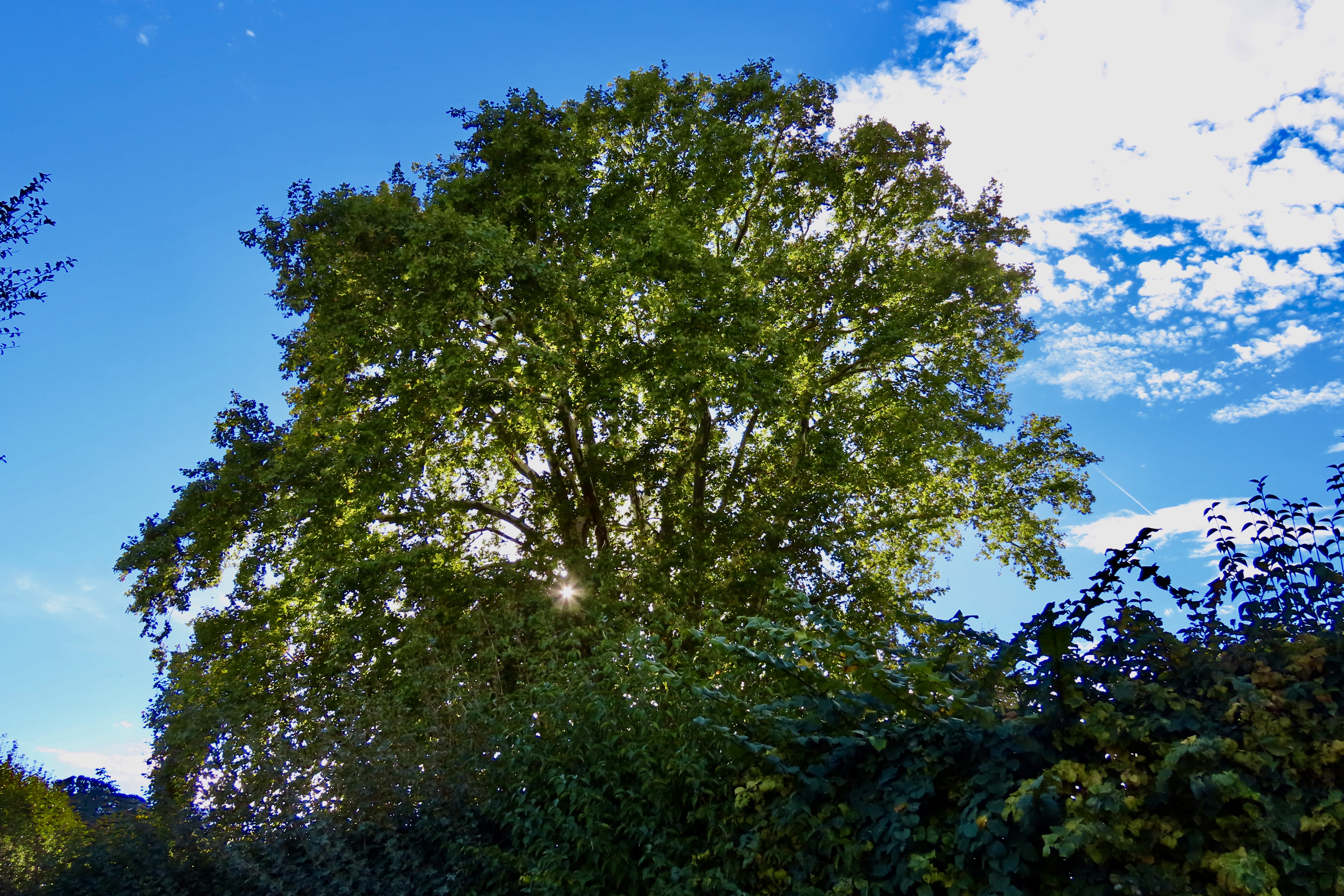
Stadt Park was situated just across the street from our hotel. In fact, our room looked out on it. Given that much of the park is dedicated to Vienna’s great composers, it’s a fitting place to wrap up this post. Haydn, Mozart, Beethoven, and Schubert were among the luminaries of classical music that called Vienna Home.
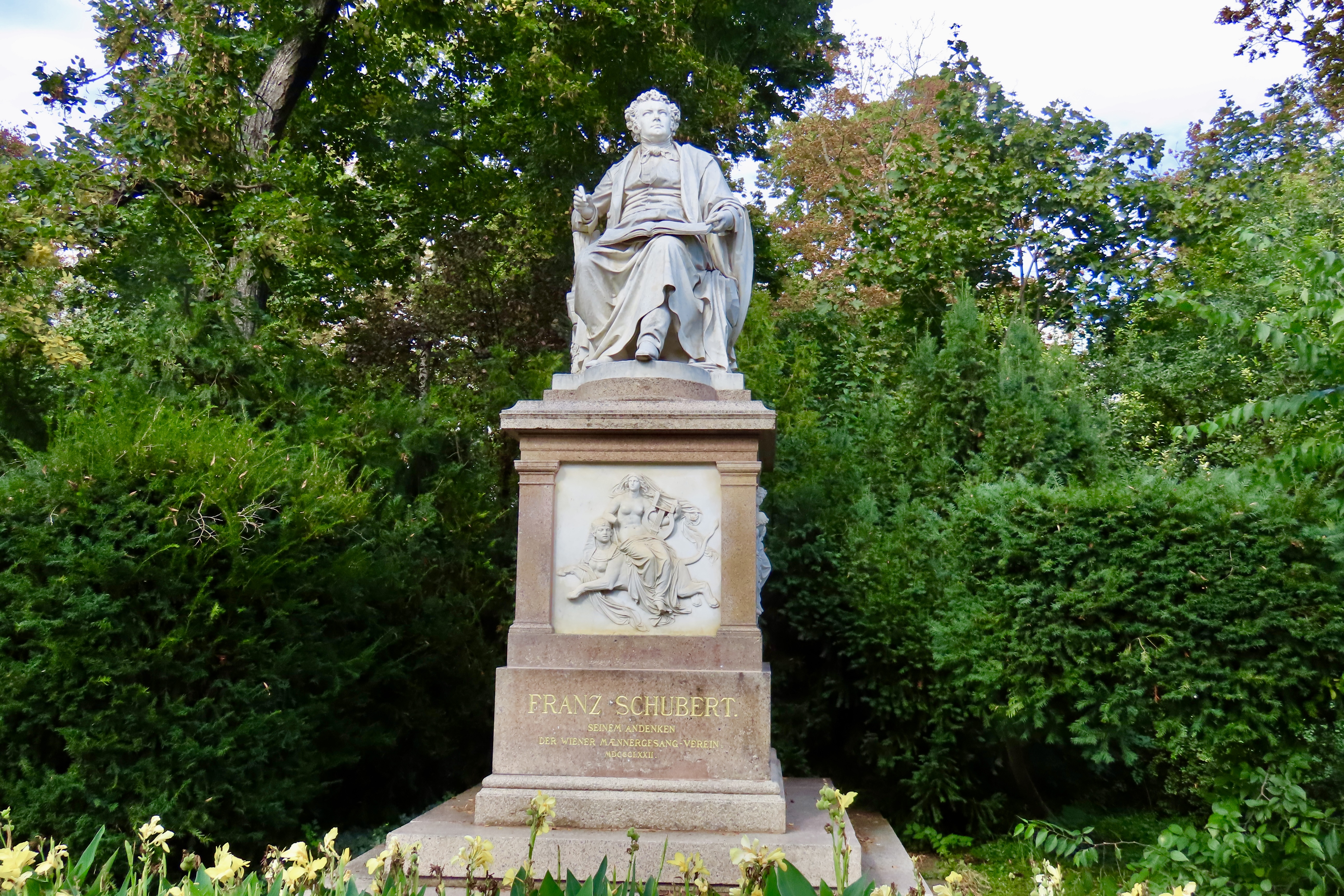
Franz Schubert was among the composers who had statues scattered throughout the park.
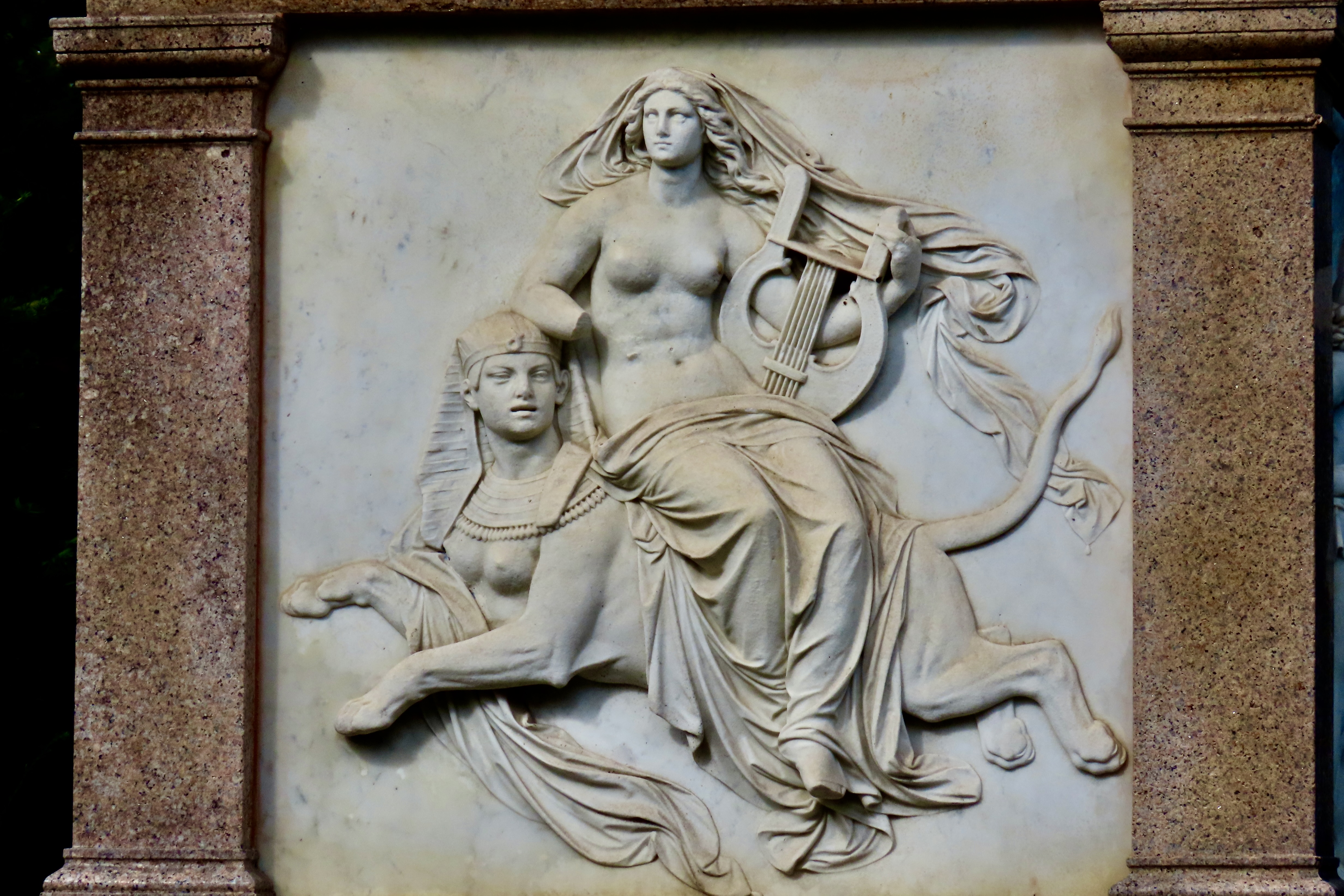
This properly weird scene of a scantily clad musician riding on a scantily clad sphinx was prominently located on the front of Schubert’s statue. I’m assuming that the woman with the lyre is a Greek or Roman goddess of music, possibly Minerva, who was goddess of lots of things.
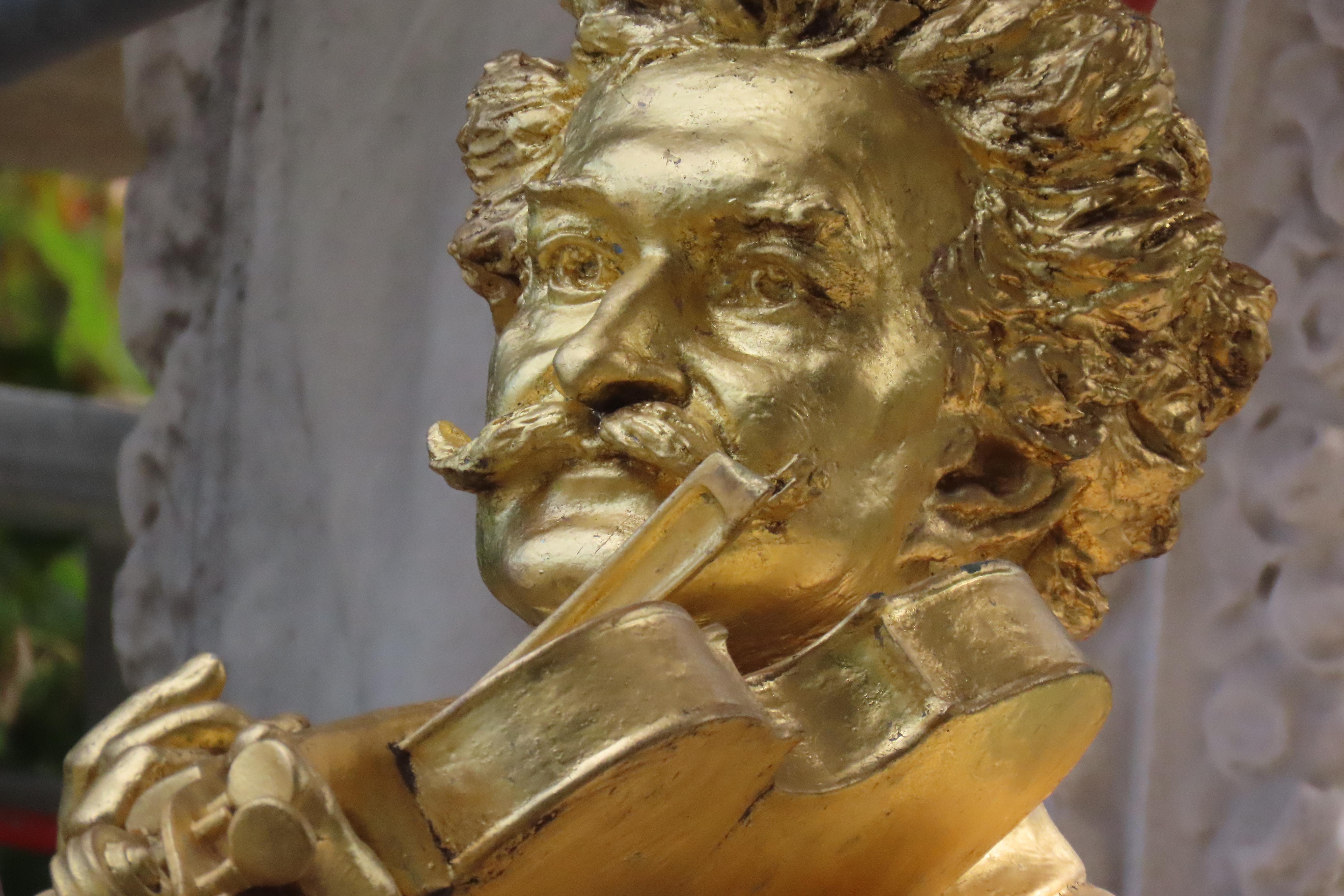
And last, but not least, Johann Strauss. We read that his statue is the most photographed statue in Vienna. Unfortunately most of it was covered in scaffolding as he got a makeover. We were lucky to capture this photo of him (through the boards) playing his violin. And that’s a wrap for Vienna.
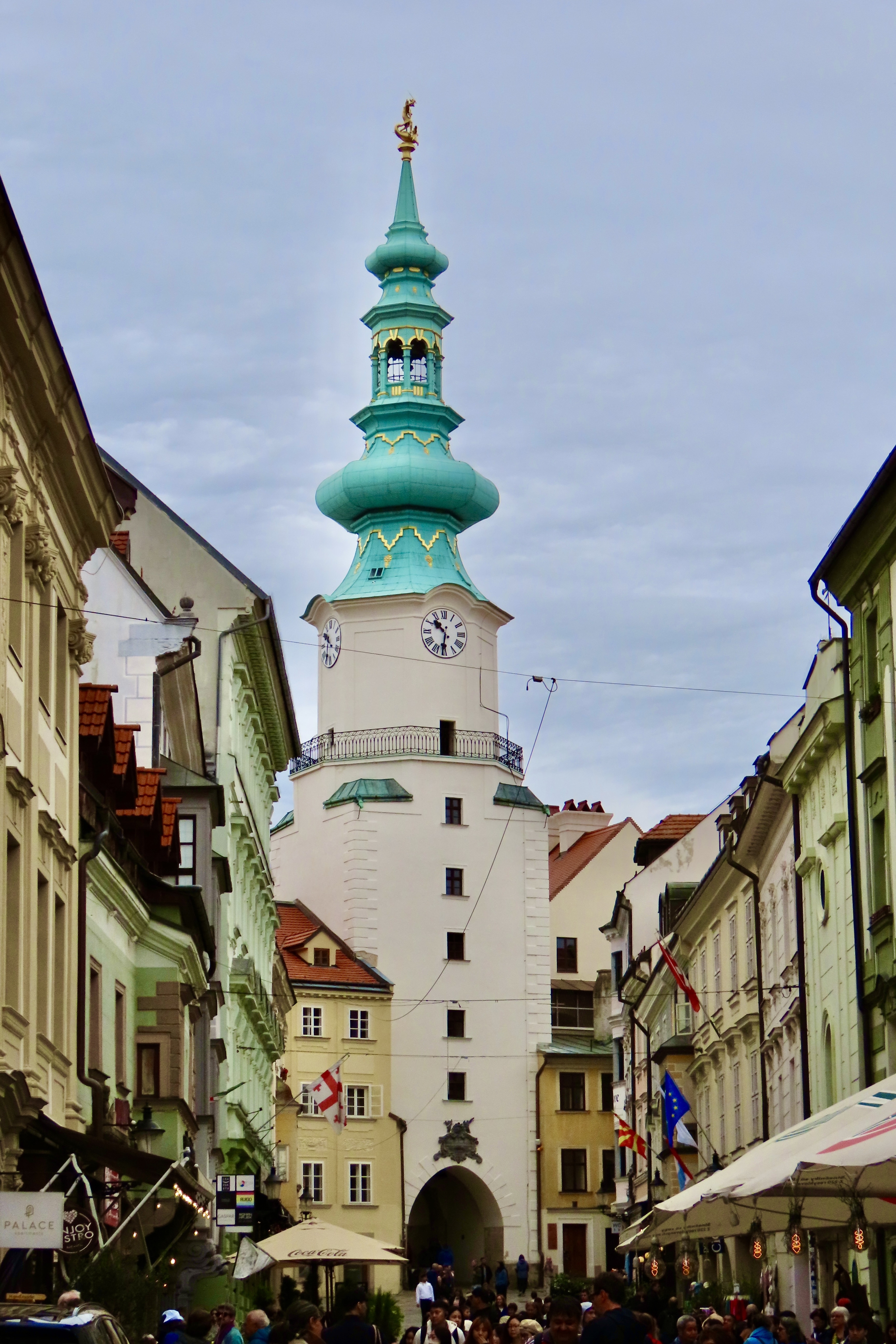
Next up, we hop on our riverboat and sail down the Danube to Bratislava, the Capital of Slovakia. This is one of Bratislava’s prominent landmarks, Michael’s Gate.

“Sisi, Sisi, Let Down Your Hair:” Apologies to Rapunzel—The Hofburg Palace…Danube #3

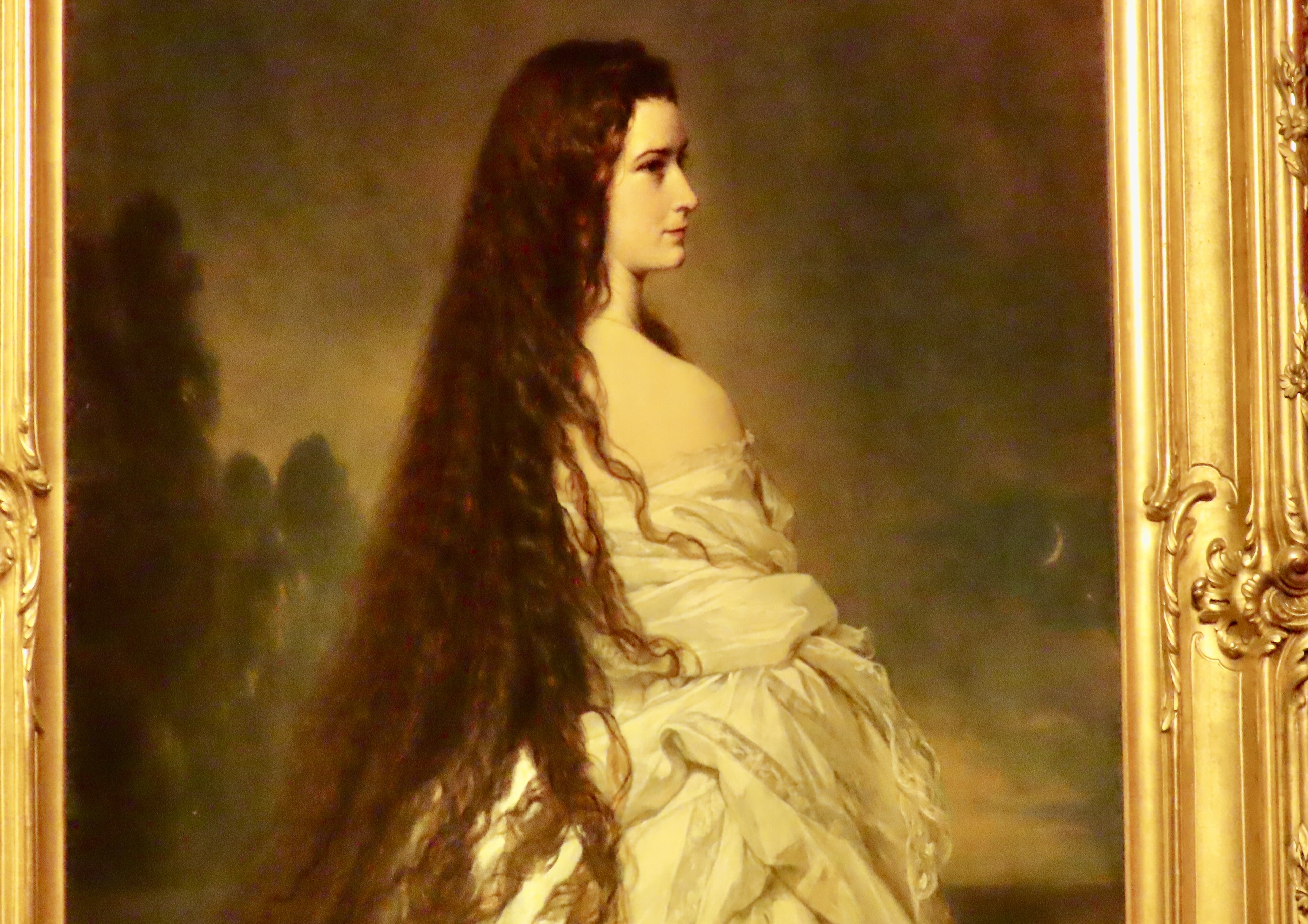
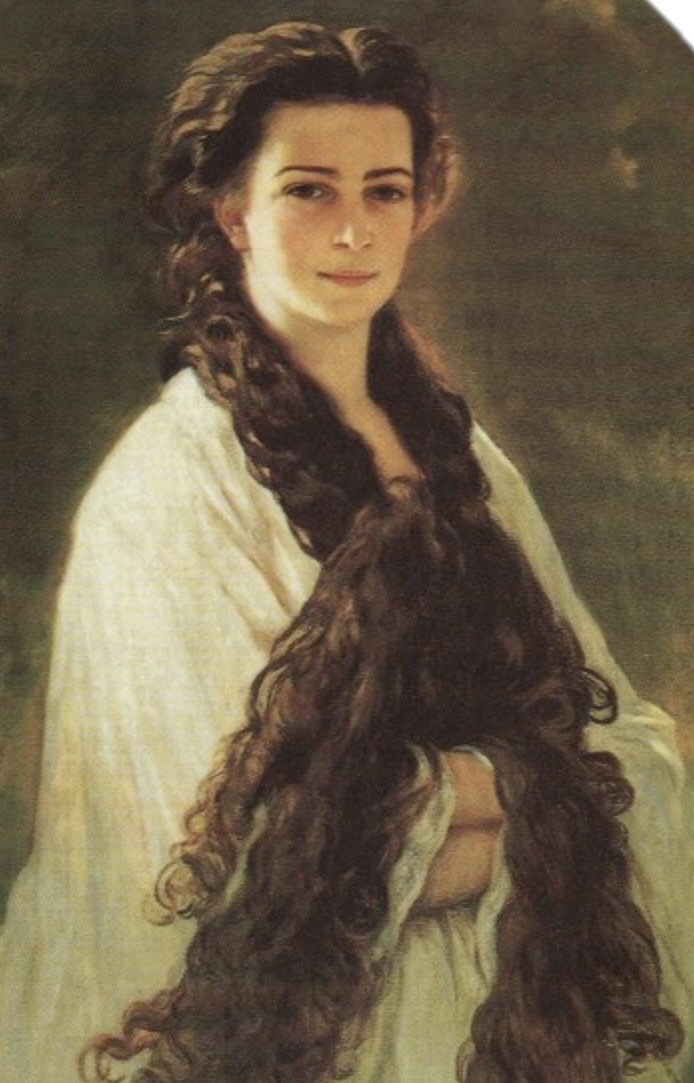
A German Duchess, Elisabeth (Sisi) Amalie Eugenie became the Empress of Austria at 16 in 1854 when she married the Habsburg Emperor Franz Joseph. He was supposed to marry her older sister. While Sisi loved Franz, she never did adjust to the limits placed on her as an empress. But, boy, could she grow hair! She’s a legend in Austria. (Painting in the Sisi Museum.)
Sisi was considered one of the great beauties of Europe and thought of her hair as her greatest asset. It actually reached all the way to her feet when let down. Its care and maintenance required three hours per day. Sisi spent the time studying Greek and Hungarian, reading and writing. Every three weeks she had her hair washed with raw eggs and brandy. The process took a whole day, including drying. (Painting in the Sisi Museum.)
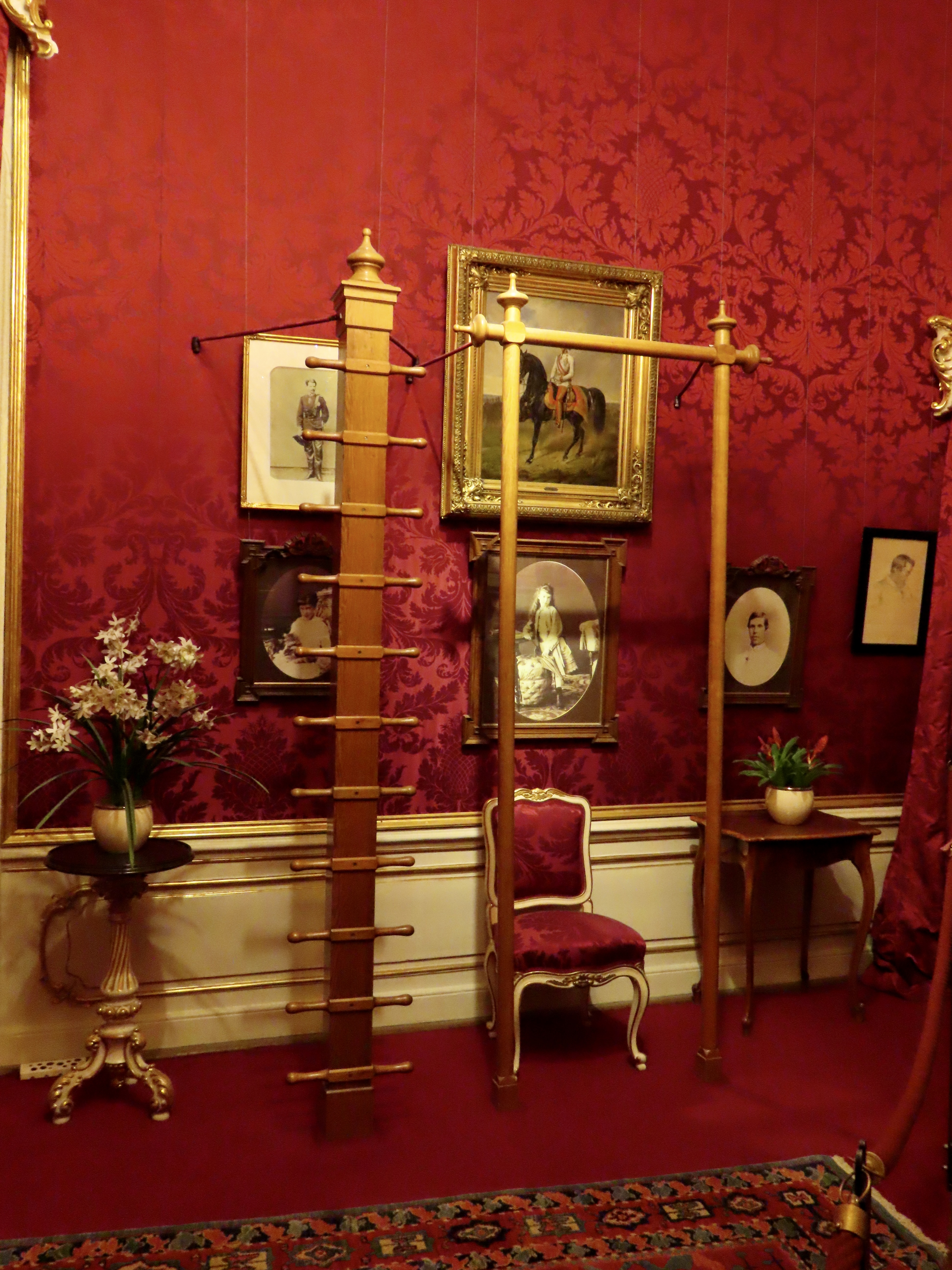
The Sisi Museum is in the Hofburg Palace, the winter home of the Habsburgs. Peggy and I visited it as part of our tour of the historical center of Vienna. This was Sisi’s exercise room. She was as fanatical about exercise as she was her hair. Long workouts and multi-hour fast hikes were all part of her daily regimen. Her passion, however, was horseback riding. She was one of the premier horsewomen of her era.
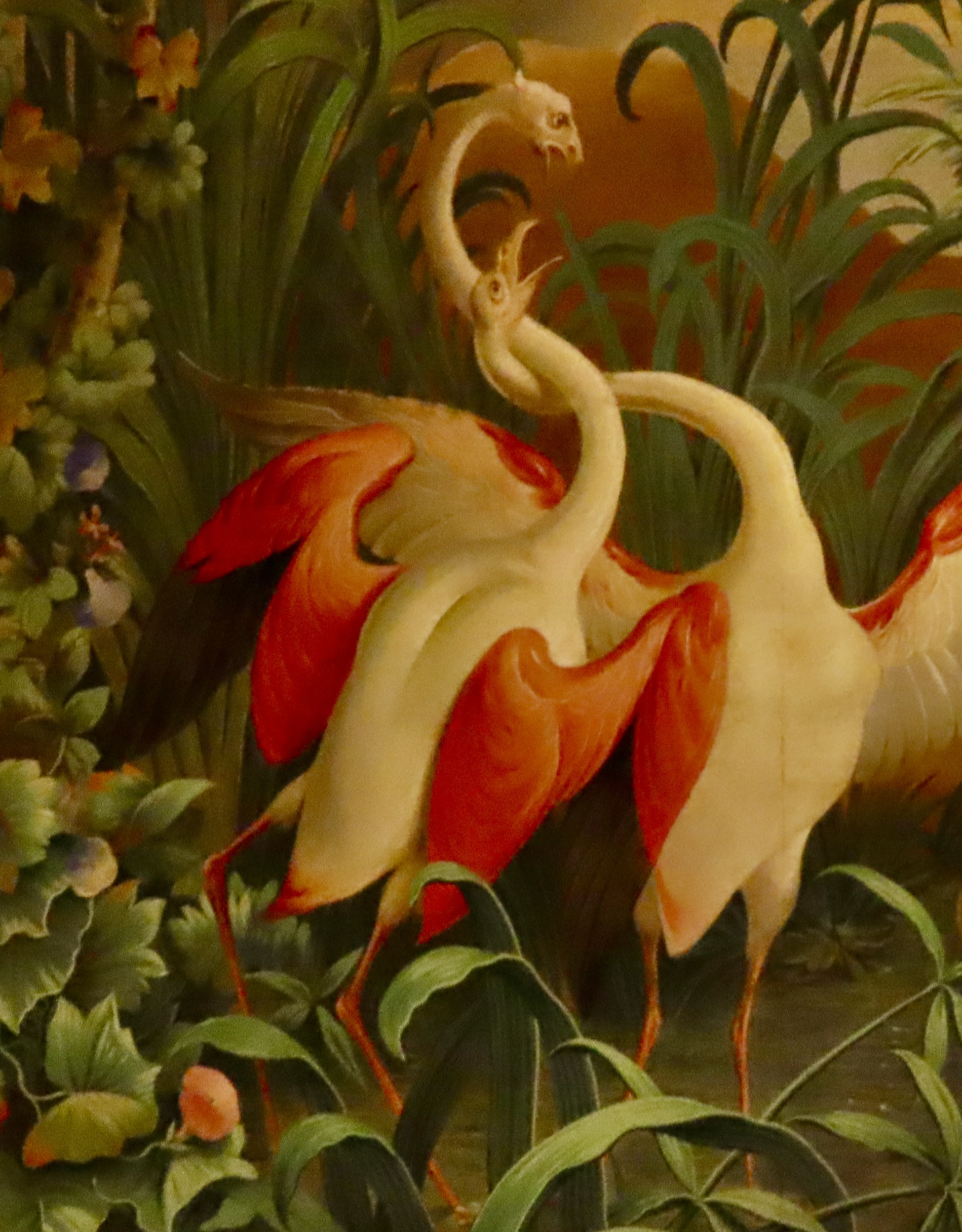
Sisi loved the out-of-doors and dreamed of exploring the world. A number of paintings in her rooms reflected her desires to travel and visit exotic lands, which she wasn’t allowed to do.
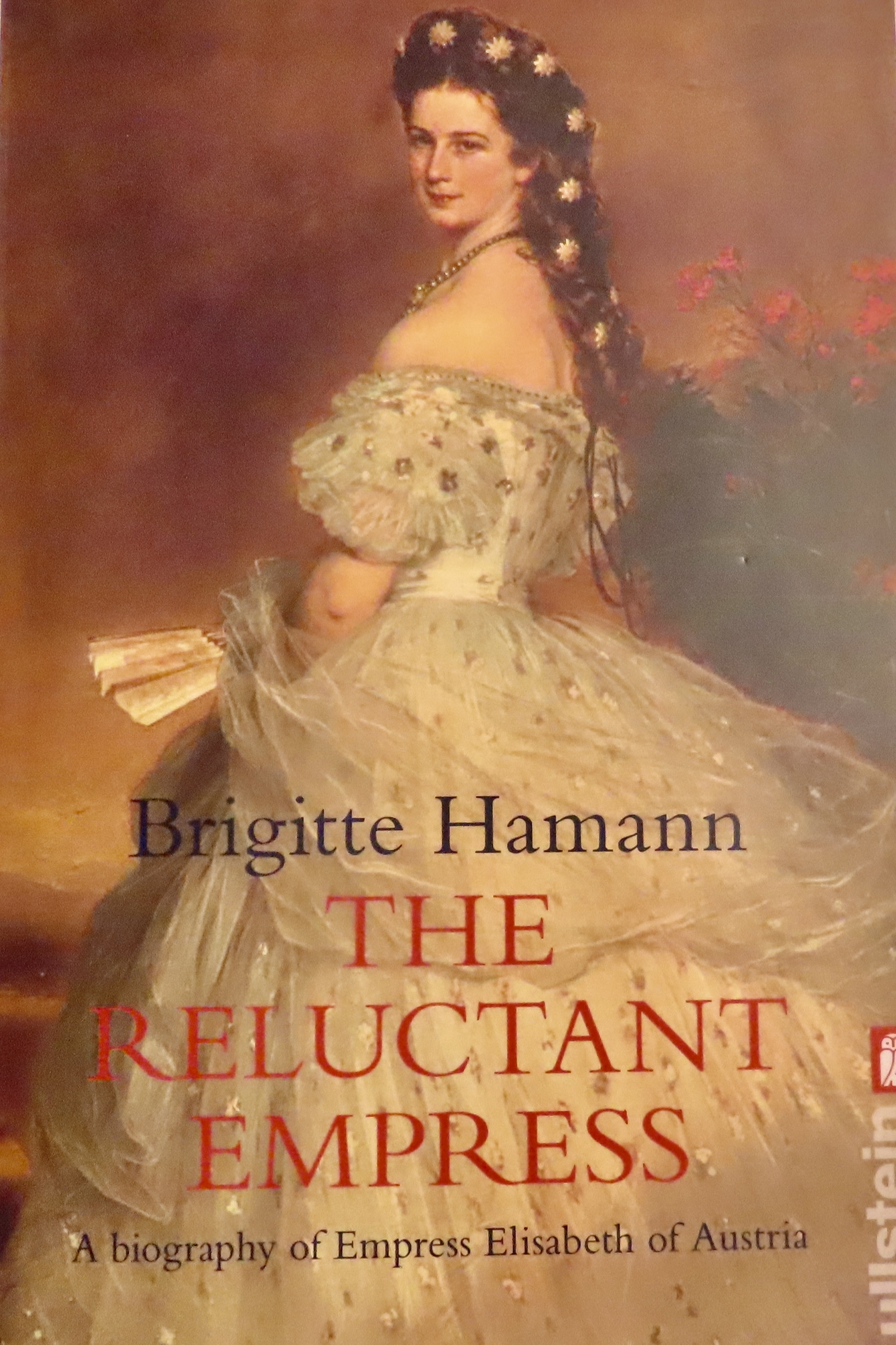
Peggy was so fascinated by Sisi, she bought a biography on her. At 410 pages it was hardly light reading. Nor was it light carrying, or easy to fit in an already packed suitcase!

Peggy noted that the main reasons for Sisi’s unhappiness were the close-to-total control her mother-in-law had over her, and the fact that she was a very private person. The latter was a poor fit for being an empress of a vast empire expected to be constantly involved in public events and private meetings. She expressed her unhappiness in poetry. A particularly telling poem was included in the museum:

“I am a seagull of no land,
I call no shore my home,
I am bound to no place,
I fly from wave to wave.”

She was assassinated at age 60 by an Italian anarchist.
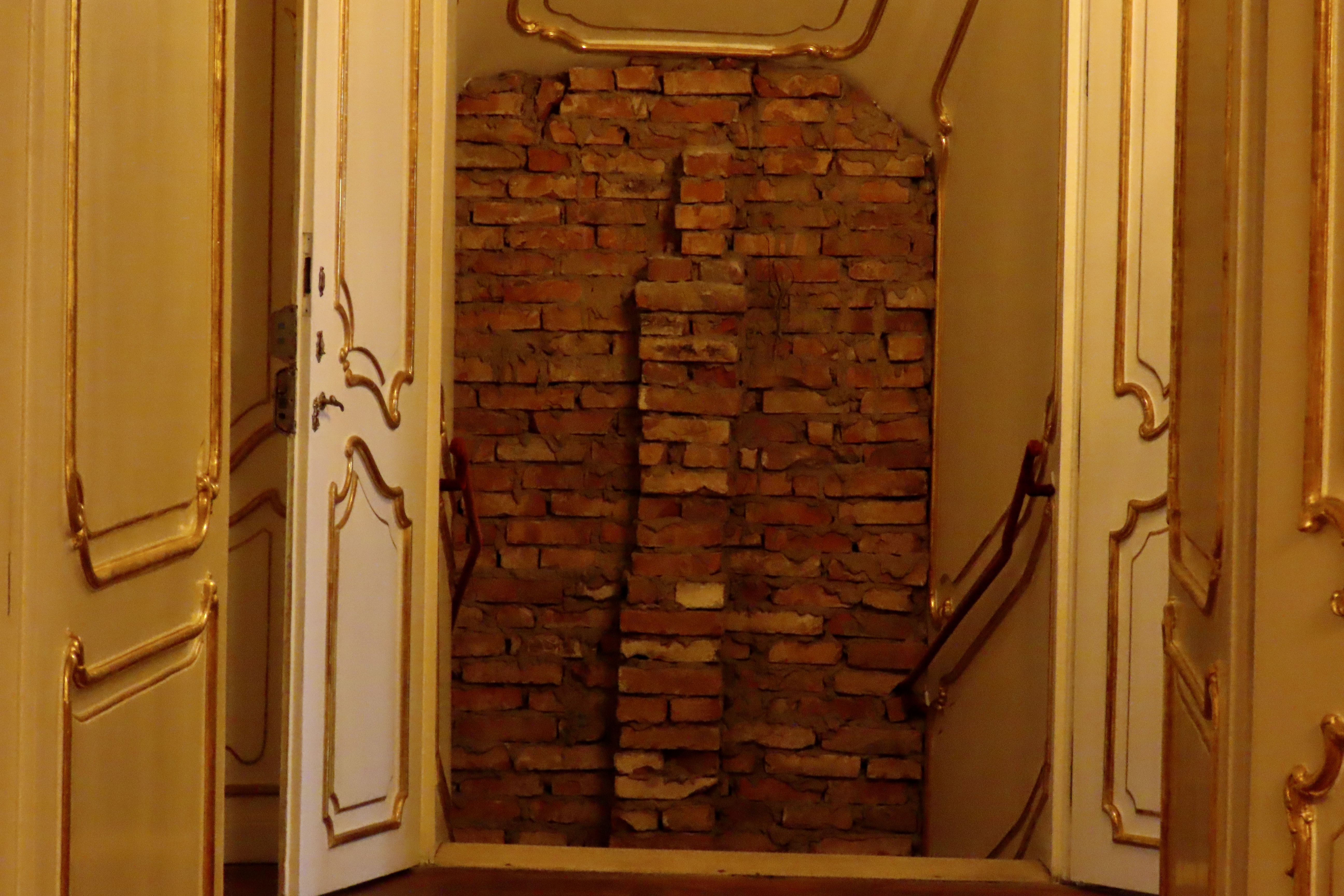
This bricked up wall we found as we exited the museum was not designed to keep Sisi home. It’s designed to keep visitors out of the official residence and workplace of the President of Austria, which is located on the other side.
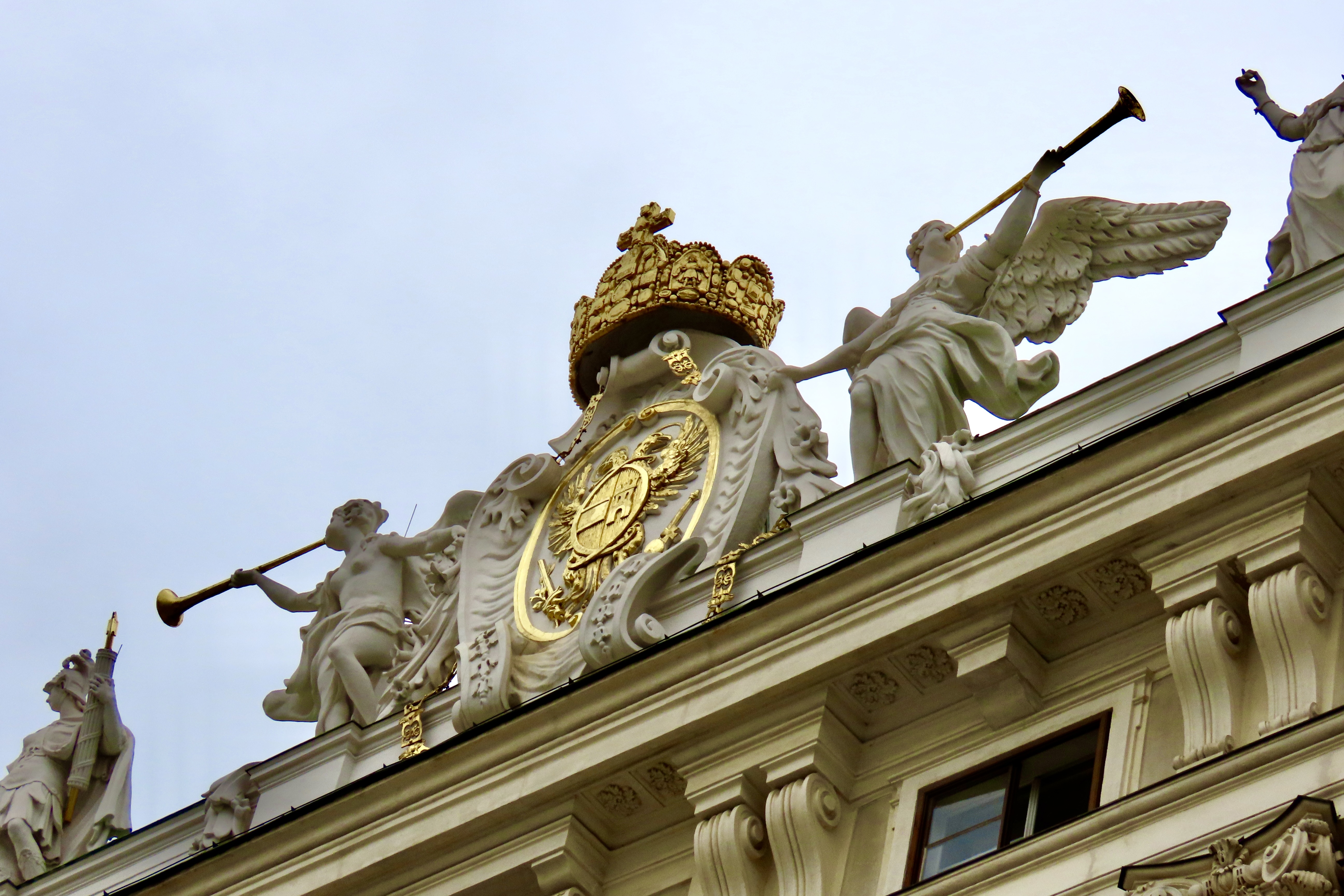
The Hofburg Palace and its connected buildings could take several days to explore but Peggy and I only had two hours. This duplicate of the Habsburg Coat of Arms and Crown is located on top of the Palace. Angels trumpet the glories of the empire.
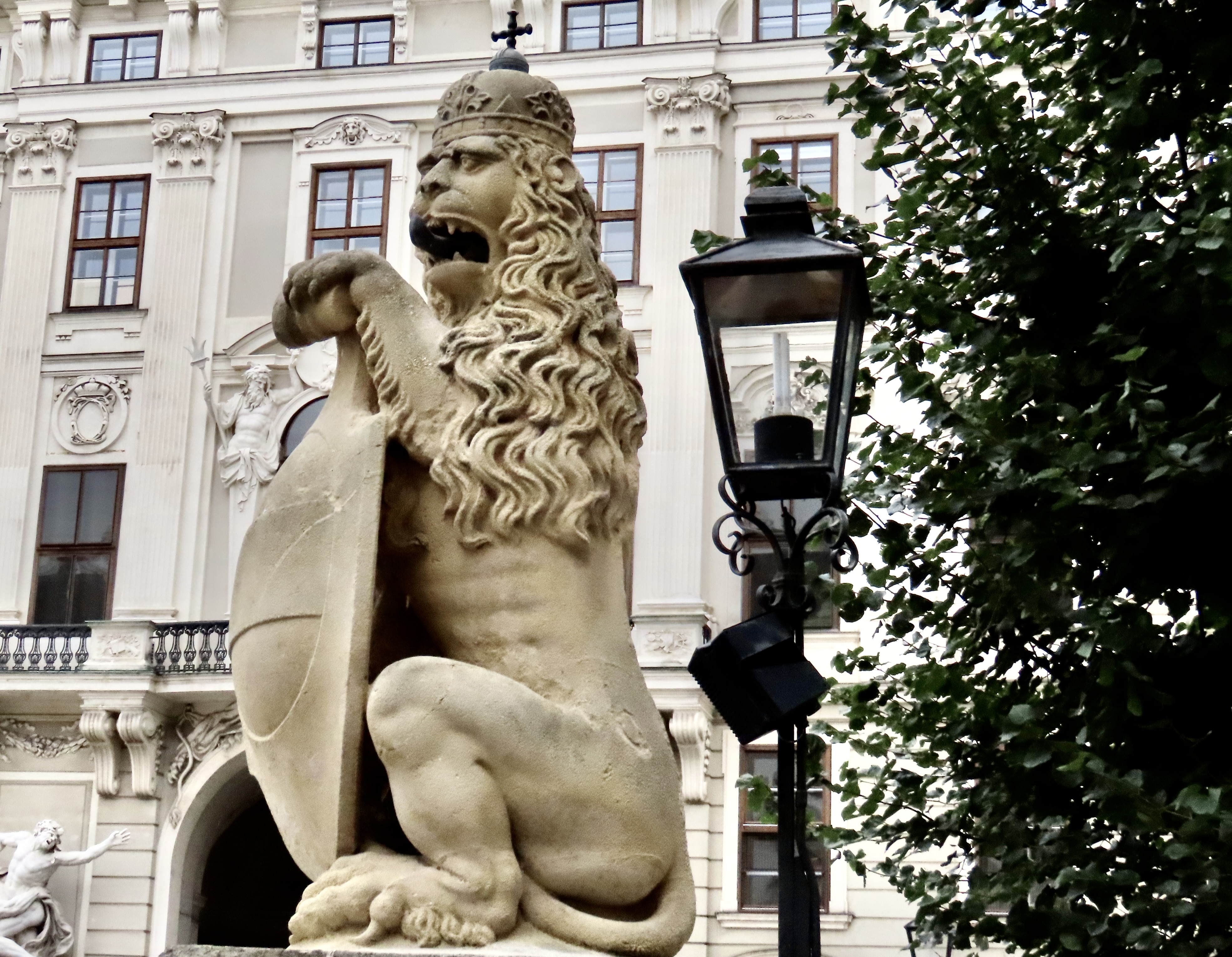
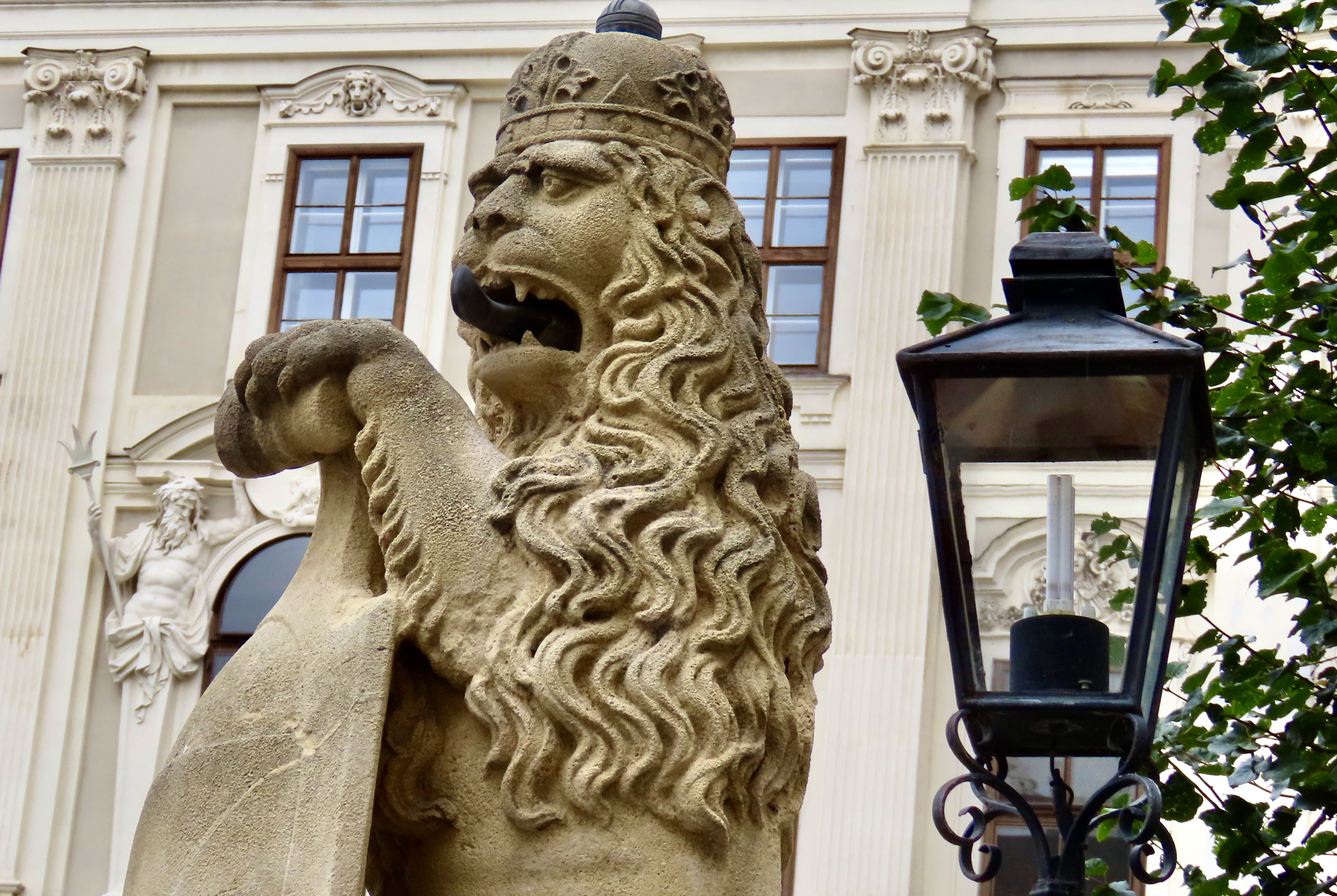
We liked this royal lion seated outside what’s known as the Swiss Gate of Hoffburg Palace.
He was a handsome beast that looked quite regal.
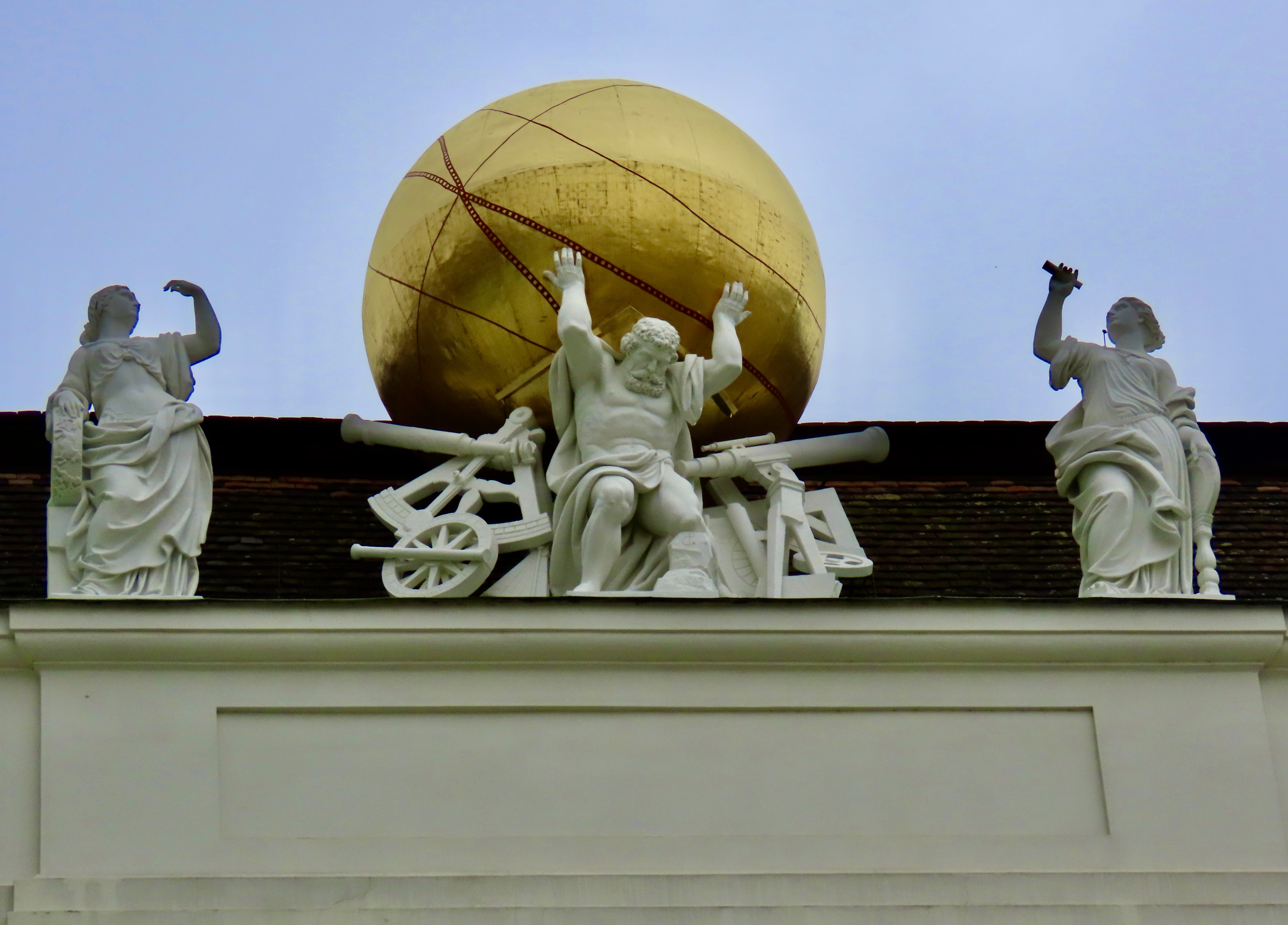
Atlas was holding up the universe on top of the 2.5 million book Austrian National Library in the Palace complex. It was punishment. Atlas was forced to carry the heavens on his shoulders by Zeus for leading the Titans in a rebellion against the Olympian gods. The gods were quite creative when dishing out sentences. Remember Sisyphus who was forced to push a heavy boulder up a mountain for his transgressions. It would then immediately roll back down for Sisyphus to push up again. Poor Prometheus, whose crime was giving humanity fire, was sentenced to having an eagle peck open his body every day and eat his liver. It conveniently grew back overnight to feed the eagle the next day.
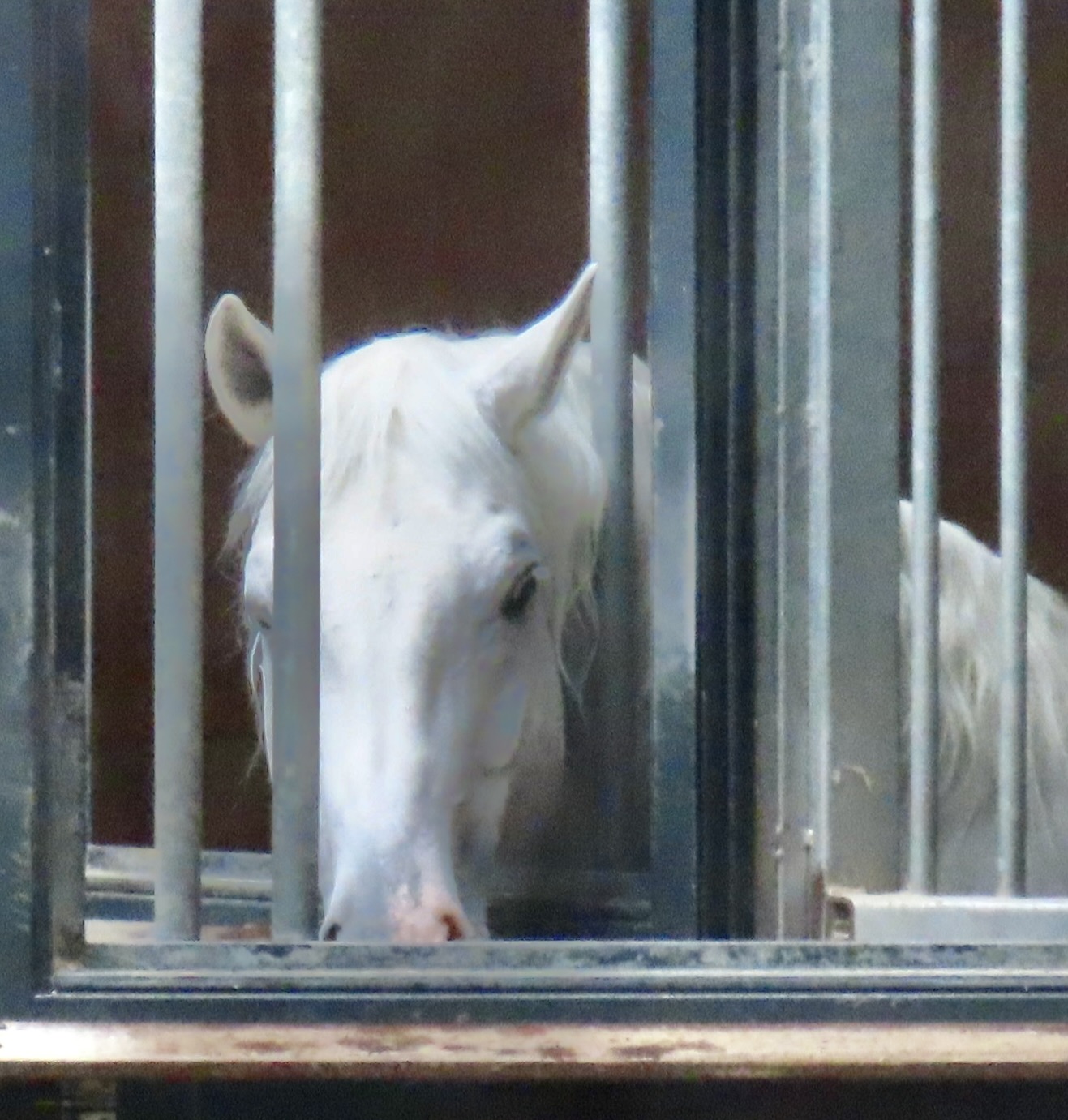
One of the most popular places to visit at the Palace complex is the Spanish Riding School of Vienna, which features the white Lippizaner horses known for their superb training. Once bred for war, the horses now earn their living by corralling tourist dollars.
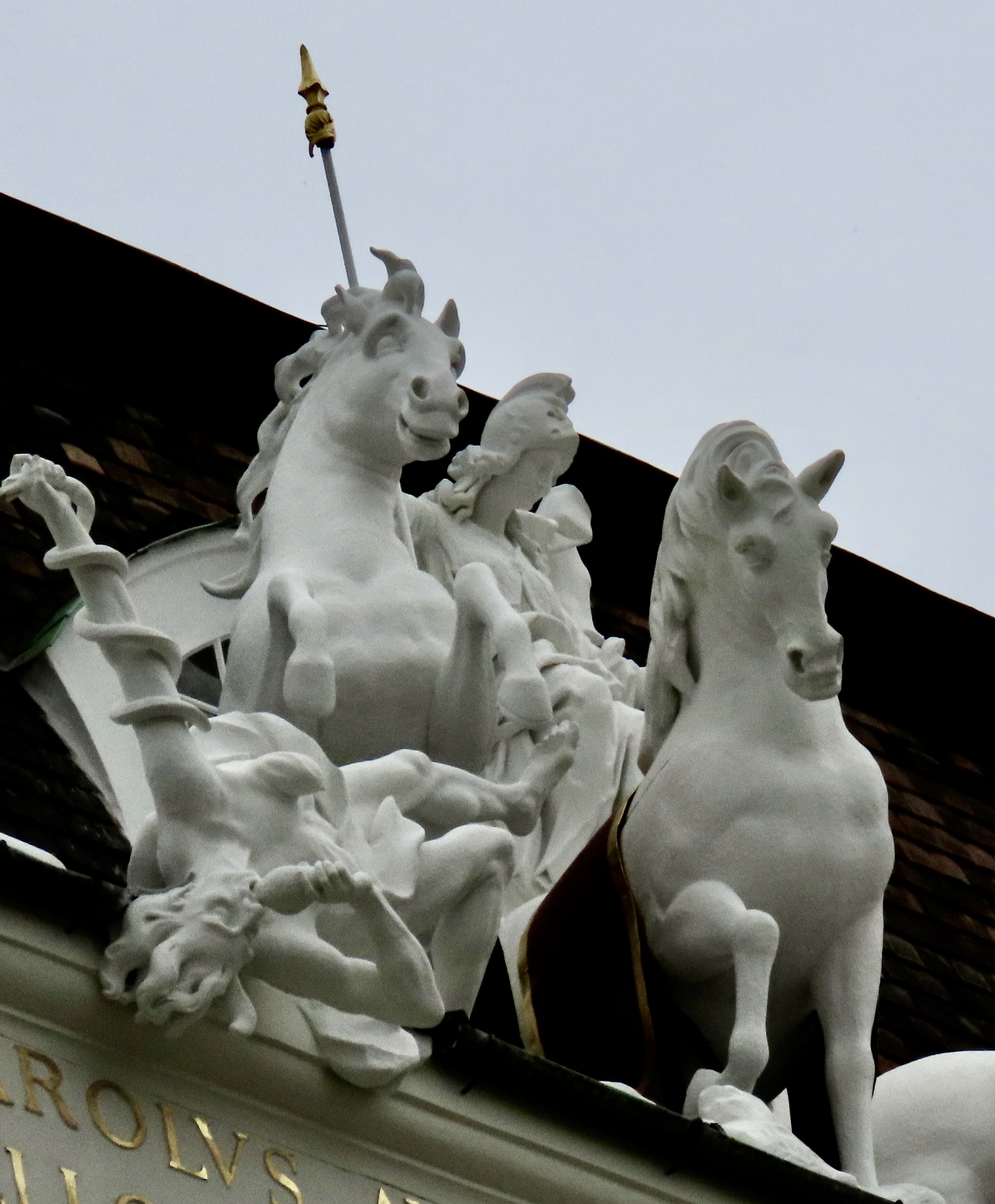
While we are on the subject of white war horses, we photographed these guys running rampant over a person near Atlas. My only question is how can you eat an ice-cream cone (or anything) while being trampled by a horse and strangling a snake? Given Peggy’s love of ice cream, she might be able to answer the question, especially if it was coated with Heath Bar bits and hot chocolate fudge.
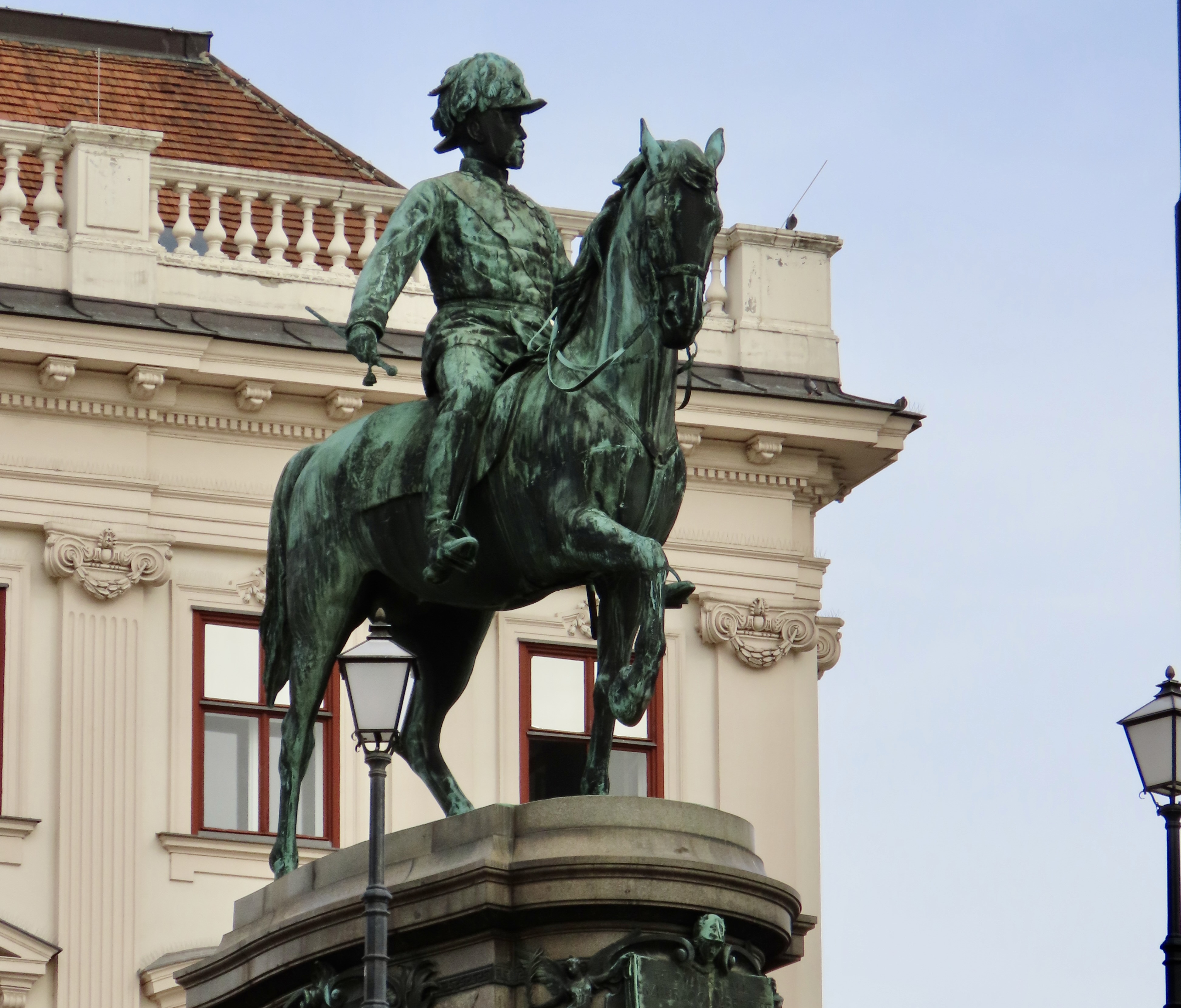
One more horsey thought. I can’t remember what great military hero/emperor/etc. this is, but I do remember our guide told us you could tell how he died by the position of the horse’s hoof. One hoof up meant he died from injuries suffered in battle. All four hooves on the ground meant he died of natural causes. Both hooves off the ground with the horse rearing would tell us he died in battle. Other guides told us this as well. Validity? I don’t know.
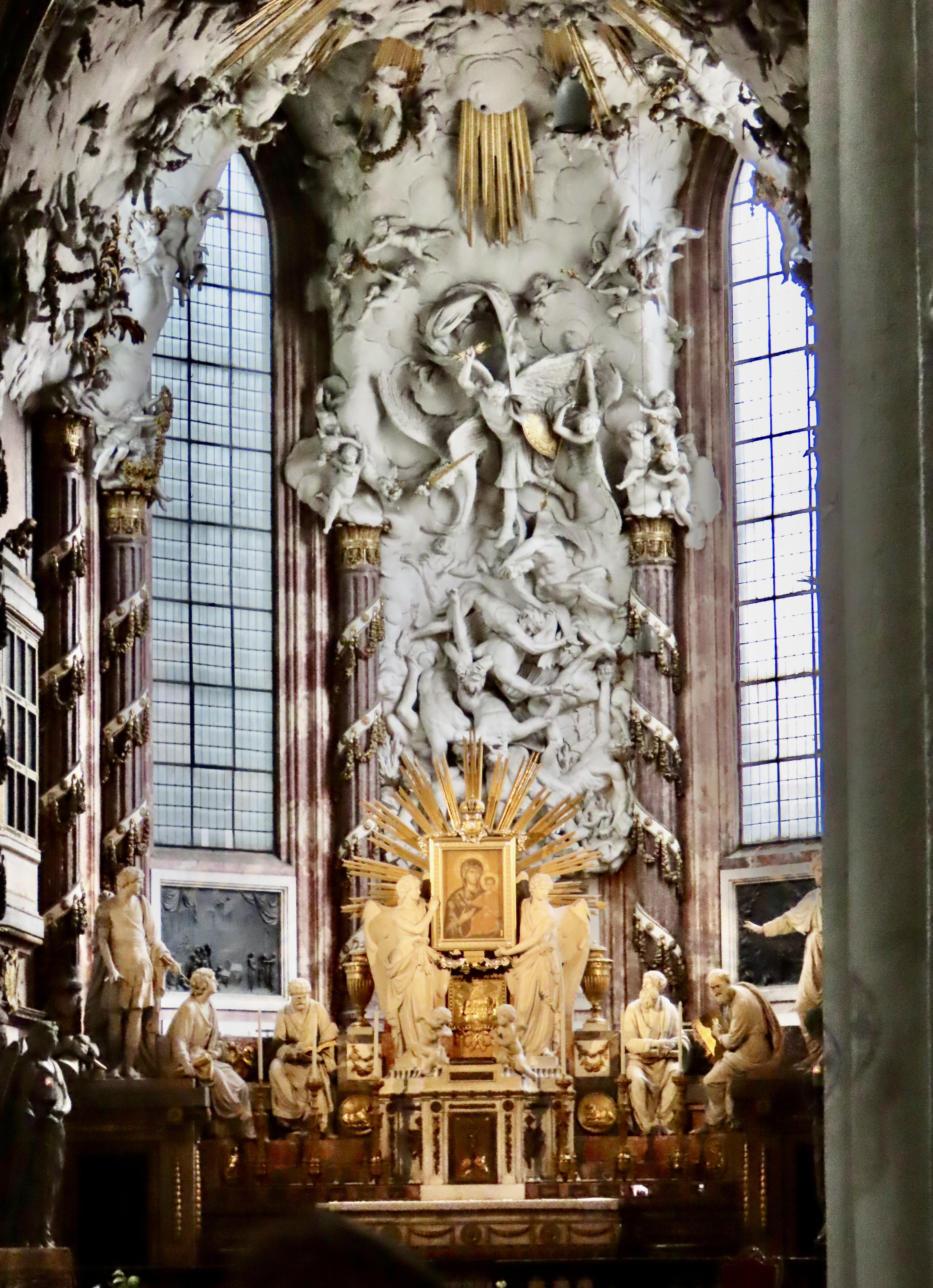
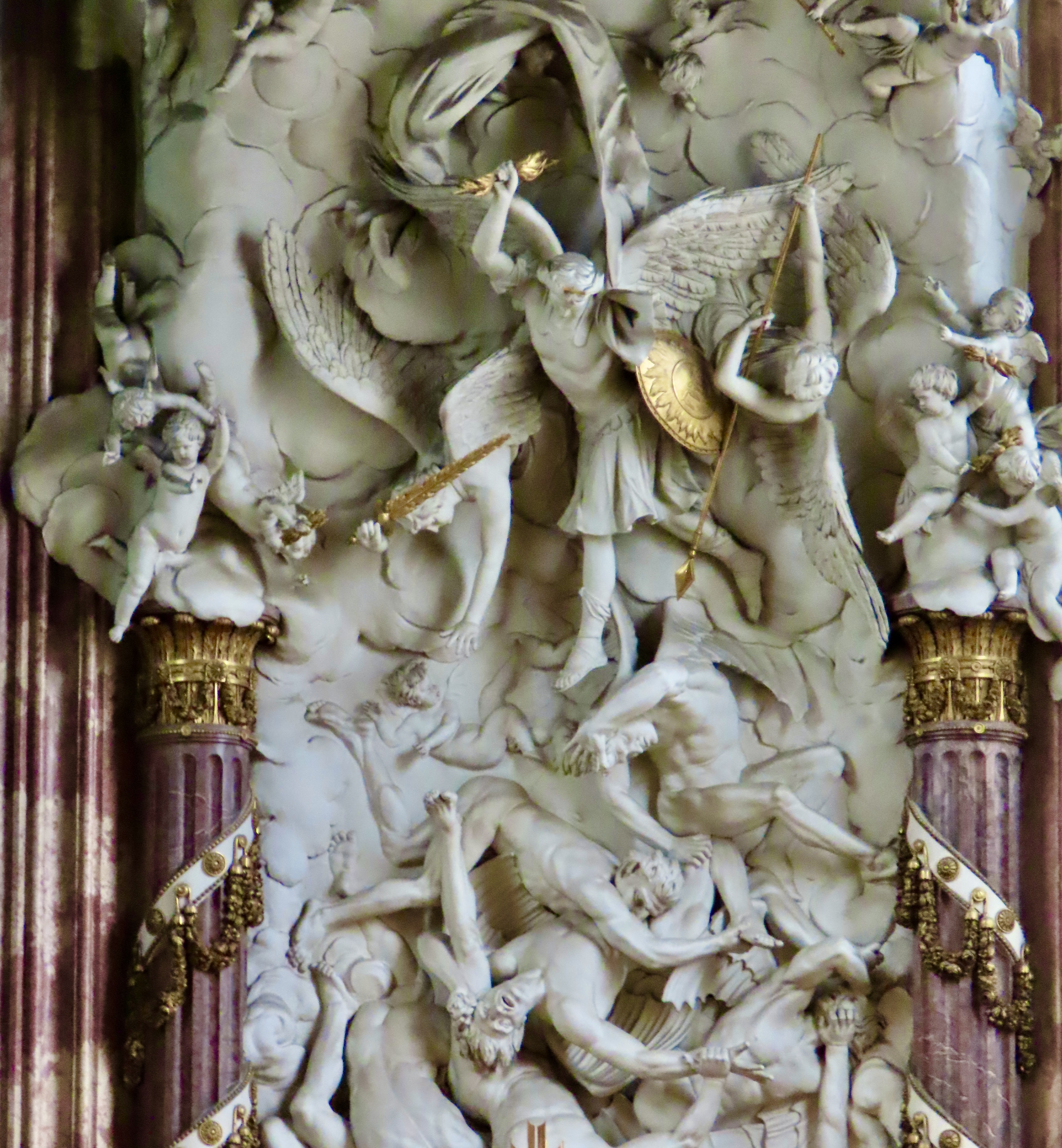
We’ll close today with a visit to St. Michael’s Church which is opposite St. Michael’s Gate at the Hofburg Palace. Remember how I thought a huge painting of St. Stephan being stoned to death on the altar of St. Stephan’s Church was a bit weird. This is even stranger. This represents the bad angels being kicked out of heaven to roam as demons among mankind forever while Lucifer was sent straight to hell.
A close up. The good guys are on top armed with various weapons while the bad guys aren’t doing very well. I have to think the huge wings of archangels would get in the way during close combat.
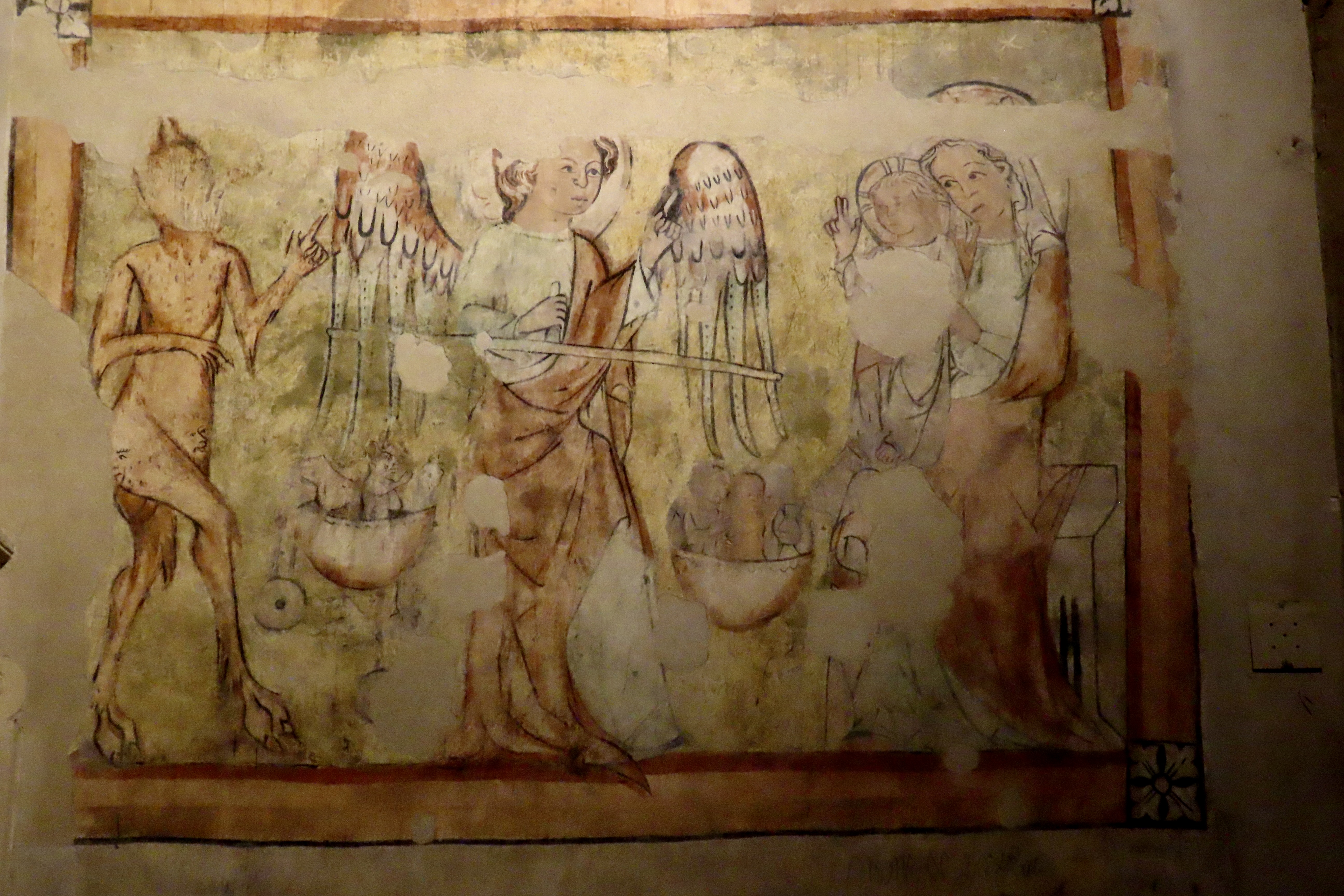
St. Michaels is old, with a history stretching back over 8 centuries. I thought that this picture we found on the wall when we were leaving, spoke to the church’s age more than anything else we saw. The fresco is from around 1350. What’s going on is psychostasy, which was a new word for me. It means the weighing of souls. Have you been good or bad? This particular scene even comes with a rooting section, with the Devil on one side and the Virgin Mary and Baby Jesus on the other. St. Michael is doing the weighing. Apparently, Jesus is winning, even though it appears the Devil has attached a weight to his basket. Tricky fellow. Note he has a face on his belly. If that’s not duplicitous, what is?
Not sure whether we will get a post up on Friday, given that it’s Thanksgiving weekend. If not, we’ll be back on Monday with more on Vienna’s historic downtown including this large green rabbit who seems to have landed himself a bottle of expensive Moet Champaign. That’s all for now. “I’m late, I’m late, for a very important date.” The rabbit hole is waiting.

The Schönbrunn: Vienna’s Ornate Palace of the Habsburgs…The Great River Series: Danube #2

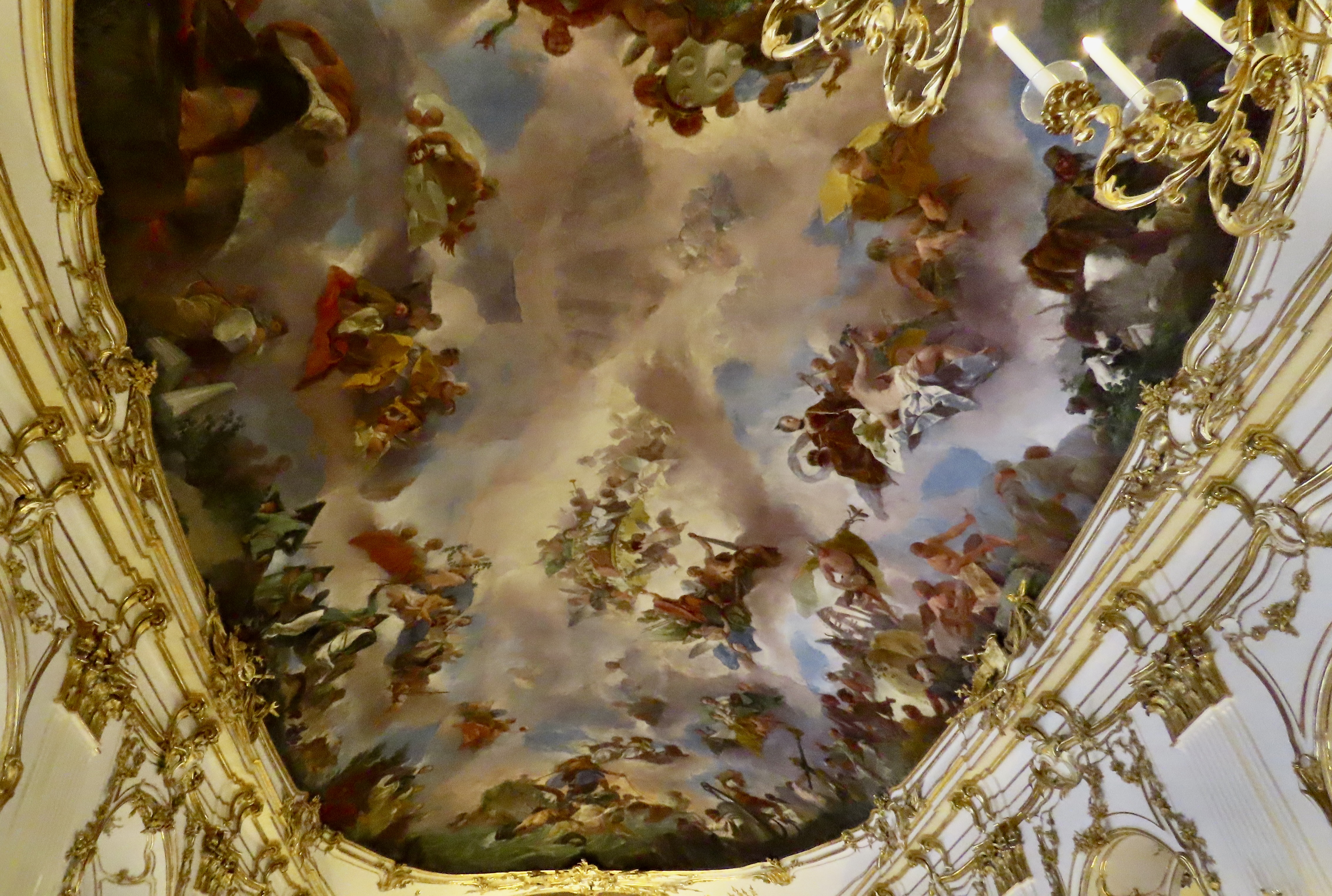
Imagine living in a place with ceilings painted like this. Baroque art doesn’t get any more baroque than it does in the Schönbrunn Palace. Angels float through the air in sky boats while humans fill in the sides with activities ranging from war to farming: It’s a world of fantasy with the barest of holds on reality.
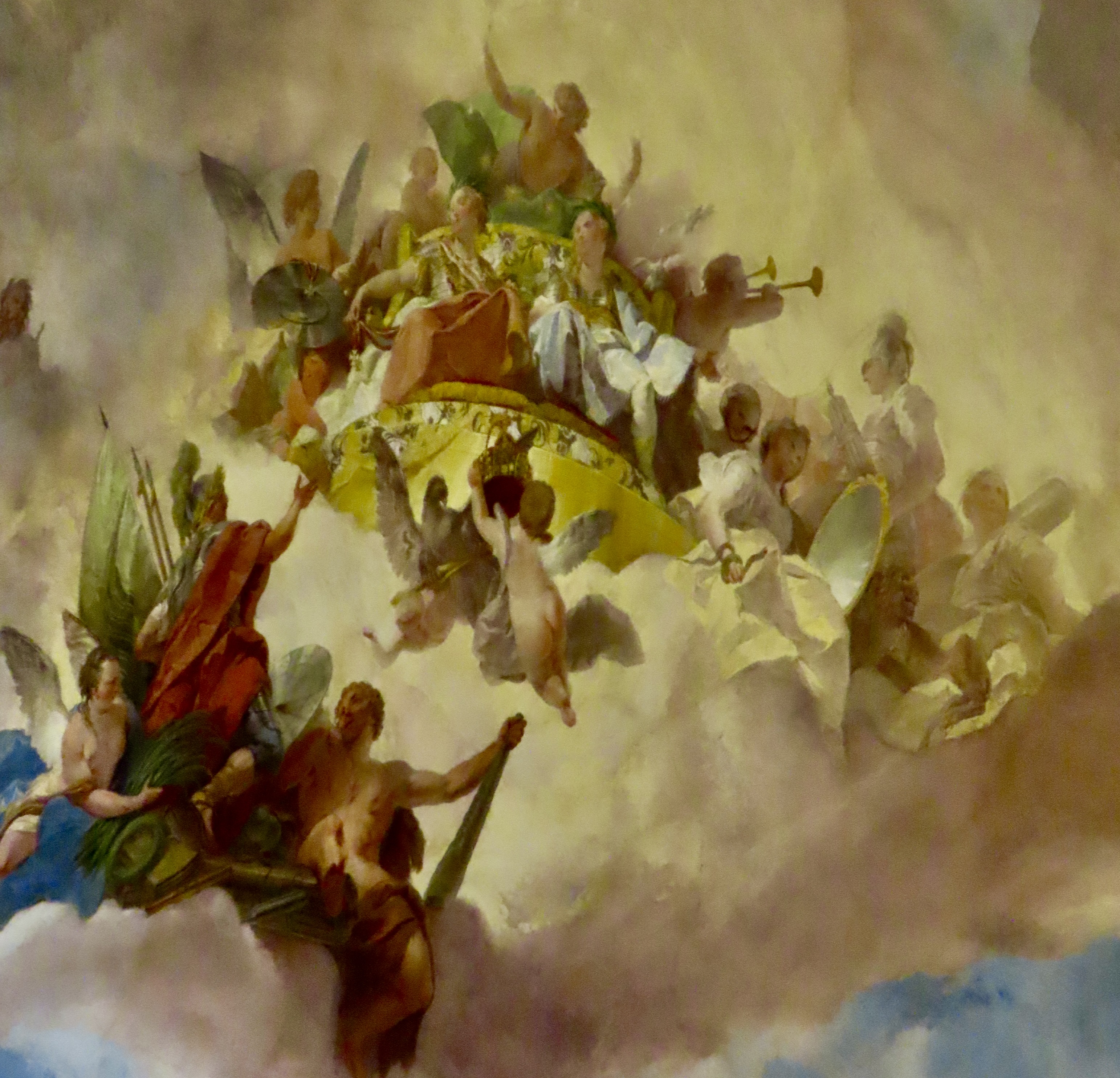
A sky boat floats through the clouds, probably carrying Habsburg royalty along with angels. Geese fly through the air. What about the trumpets? Are they announcing Royal and Divine presence or serving as horns clearing a path? Make way!
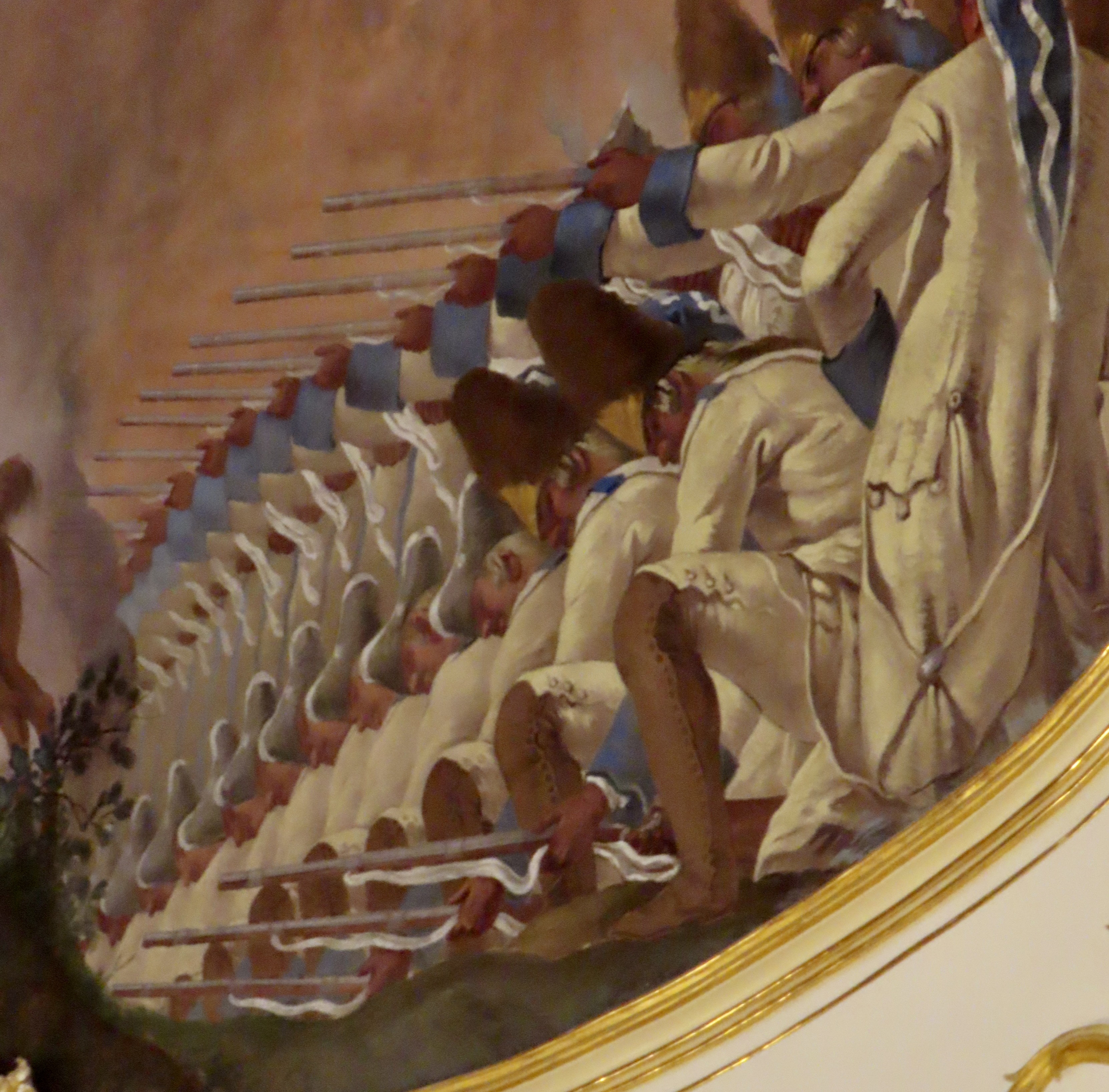
A scary, more real ceiling painting shows soldiers lined up to fight. While one group was firing, the other was kneeling in front, reloading their muskets.
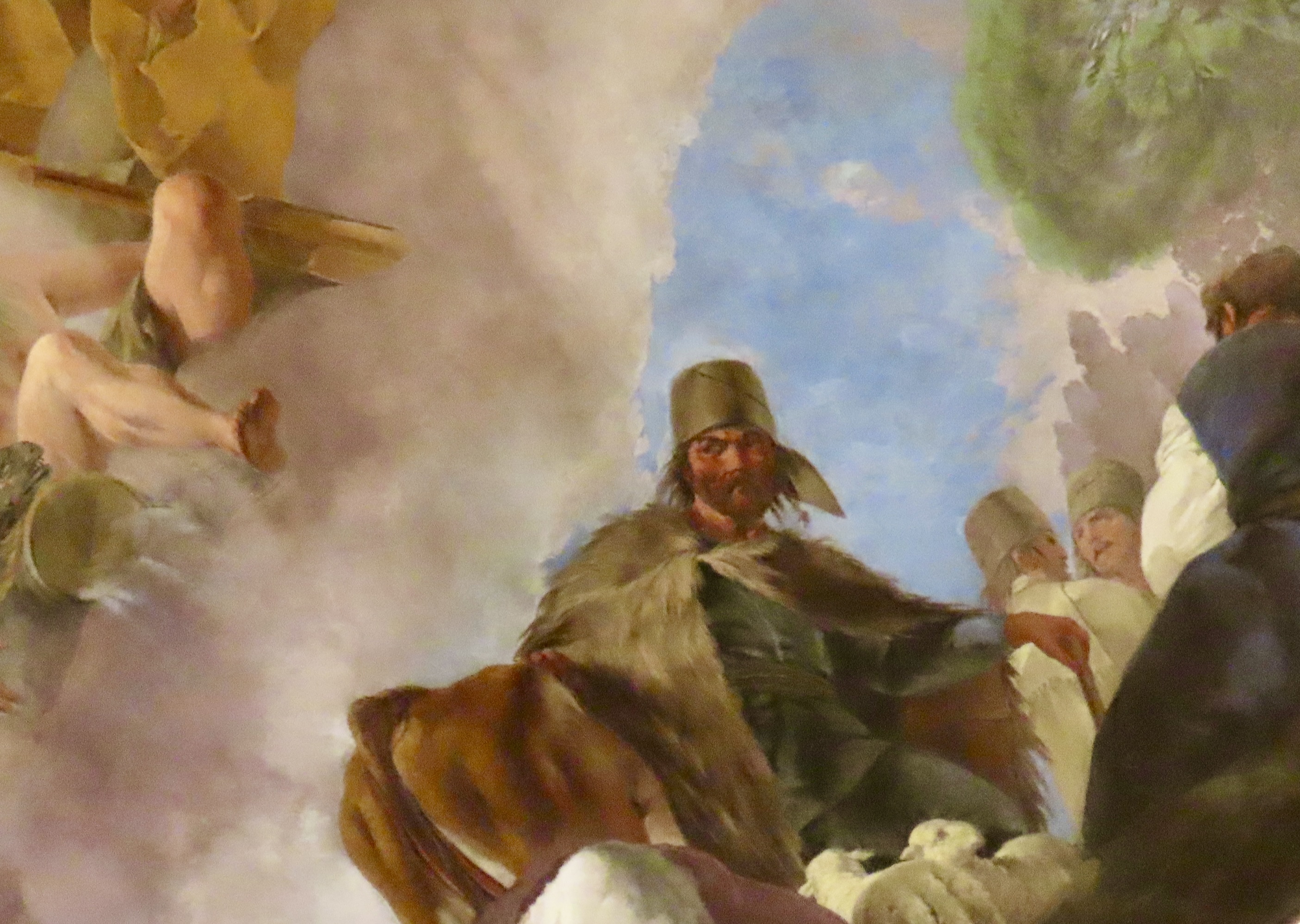
Here, a stern looking shepherd tends his flock of sheep. I’d look stern as well if a guy was about to jump out of the sky and land on top of me— or my sheep.
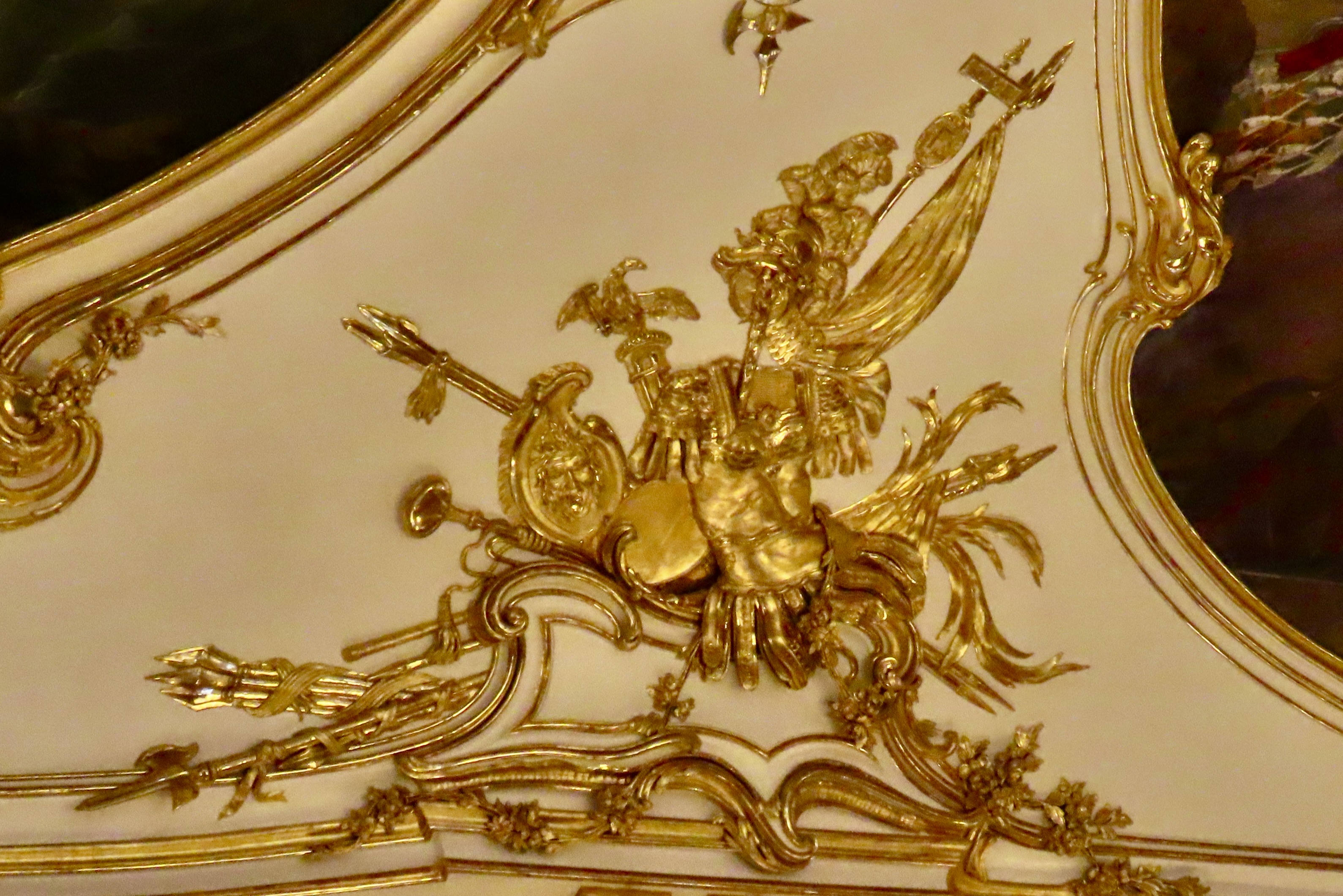
Ornate chandeliers matched the ornate ceilings. Check out the walls.
What does your imagination suggest here?
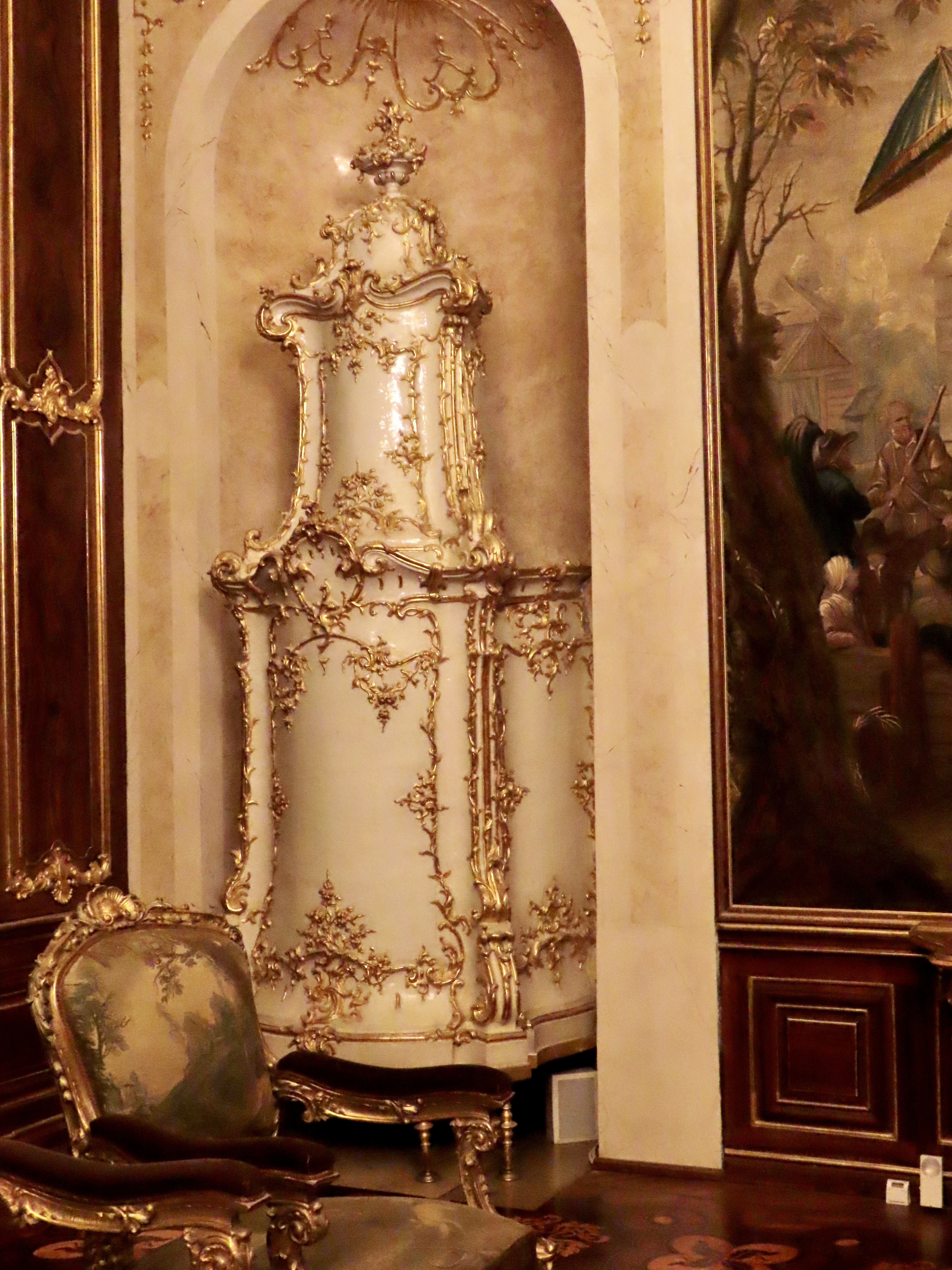
While the Schönbrunn Palace has some 1,441 rooms, we visited maybe 15. One of the things that caught our attention in the rooms were beautiful stoves like this one. Imagine keeping them all burning. It would have required an army of servants. Non obtrusive side doors entered the rooms from hidden servant corridors to allow servants to do their work. Numerous paintings like the one on the right were found in the rooms we saw. They ranged from everyday people doing everyday things to portraits of Habsburg rulers.
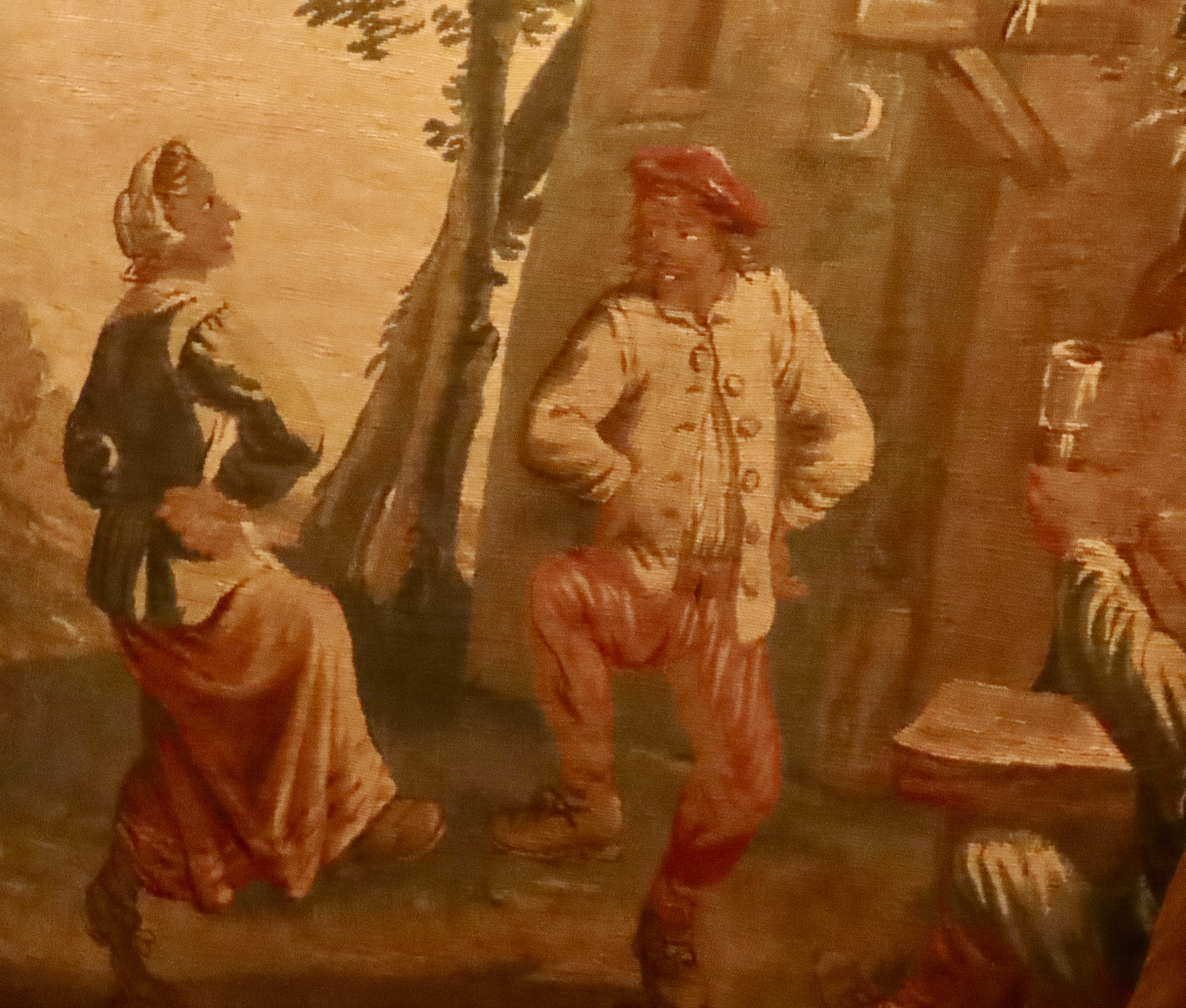
This peasant couple looks a little fuzzy, but hey, they were dancing fast and having fun. A guy on the right toasts them. And does the half moon on the building behind them show an outhouse? Probably not. More likely, it was a sign for the tavern where the revelers were getting their liquid refreshments.
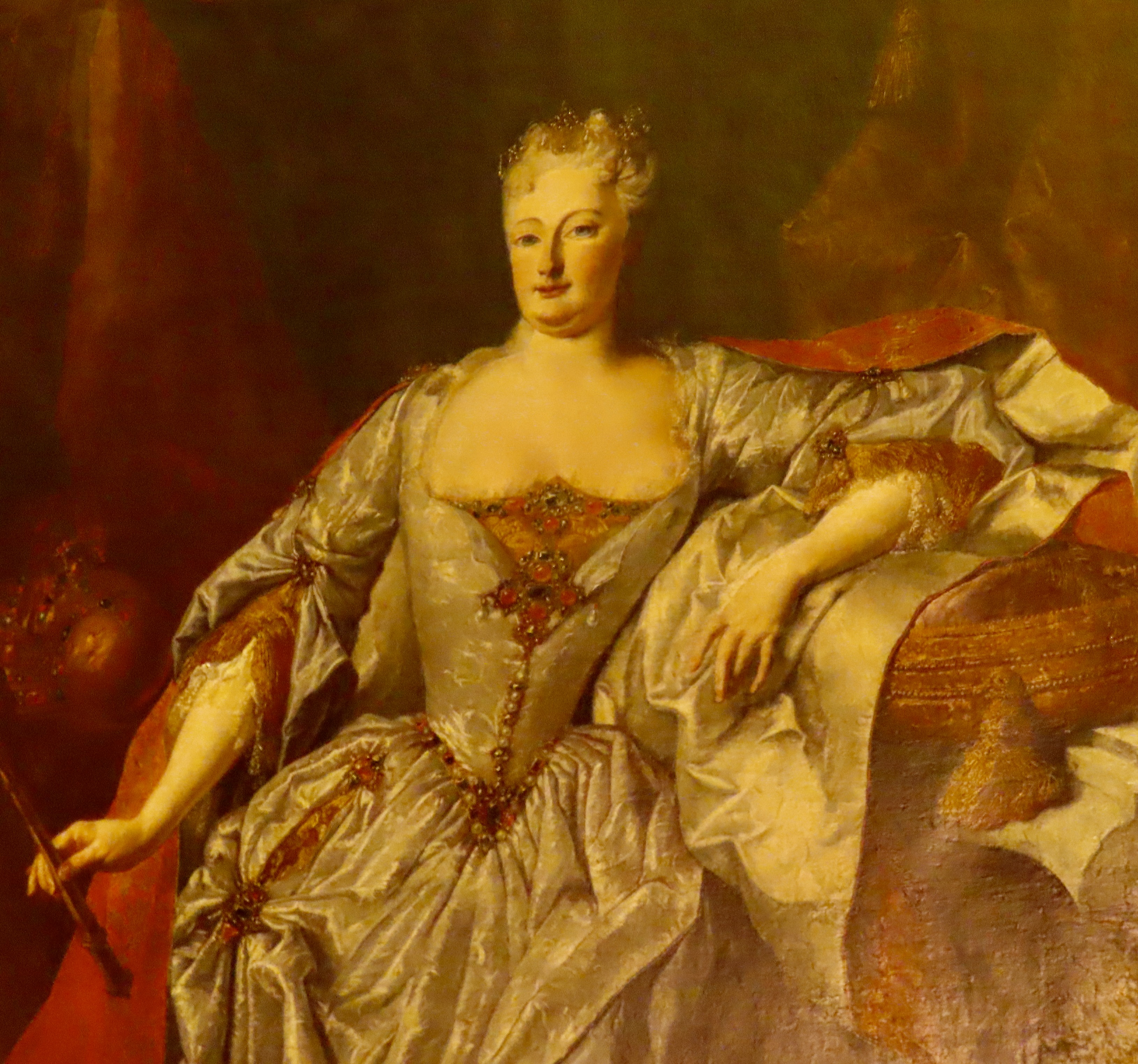
No fuzziness here. Royalty required more attention in their paintings. They wore clothes, jewels and symbols of power that needed to be shown off— along with bosoms. This is Maria Theresa, who ruled the Habsburg Empire for forty years (1740-1780), and managed to have 16 children along the way, most of whom were married off to cement political alliances throughout Europe. One was Marie Antoinette of France, known for her profligate spending and supposedly saying, “Let them eat cake,” when the poor were rioting in the streets of Paris from starvation. Not a very thoughtful statement, considering. She lost her head over it.
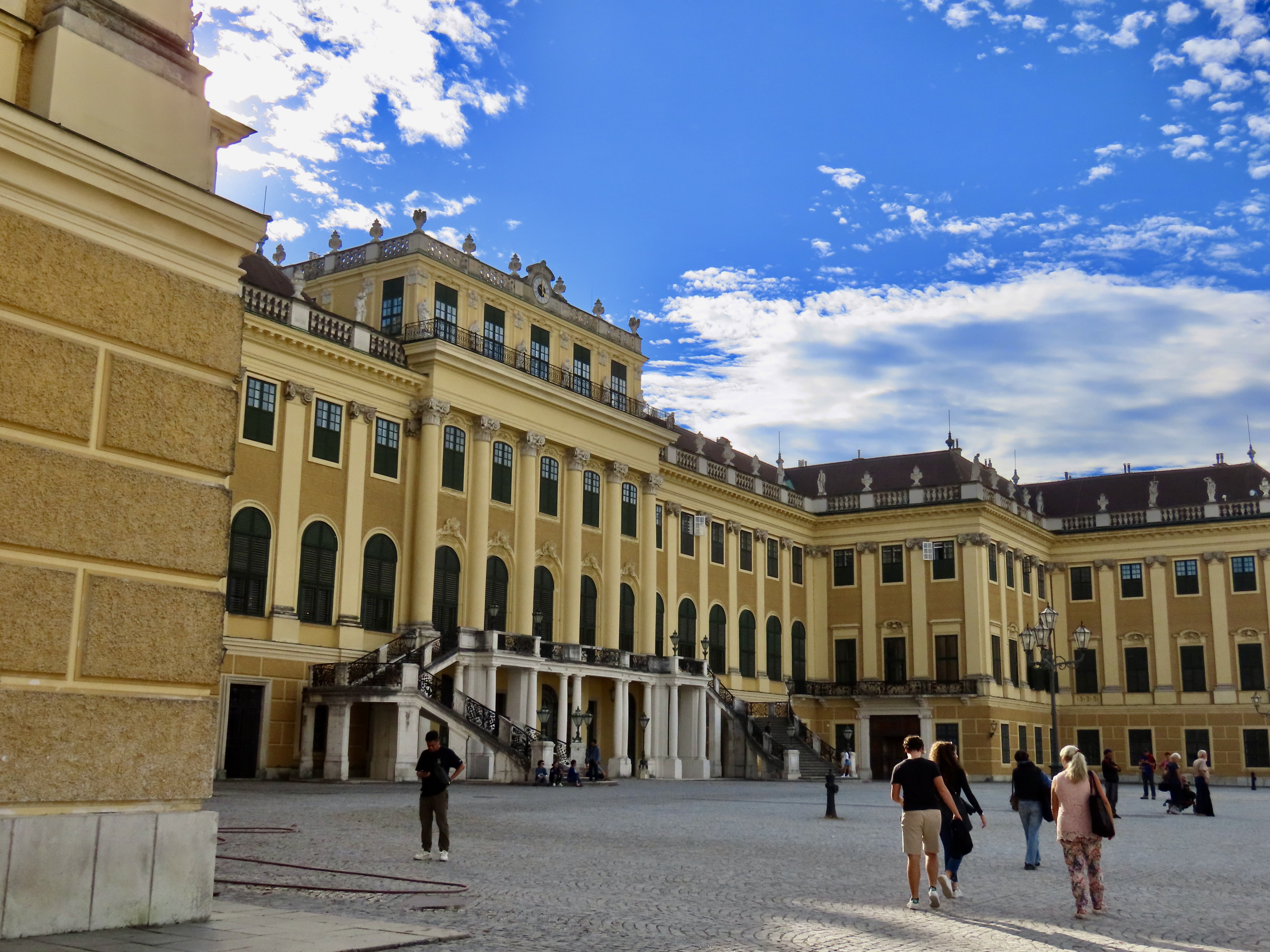
While there was much of interest inside the Palace, Peggy and I actually spent an equal amount of time wandering around outside on our own. The Schönbrunn Palace is more popularly known as the Summer Palace. The Habsburgs like to spend their summers here. This is a section of the front. I provided a complete view at the end of my last post.
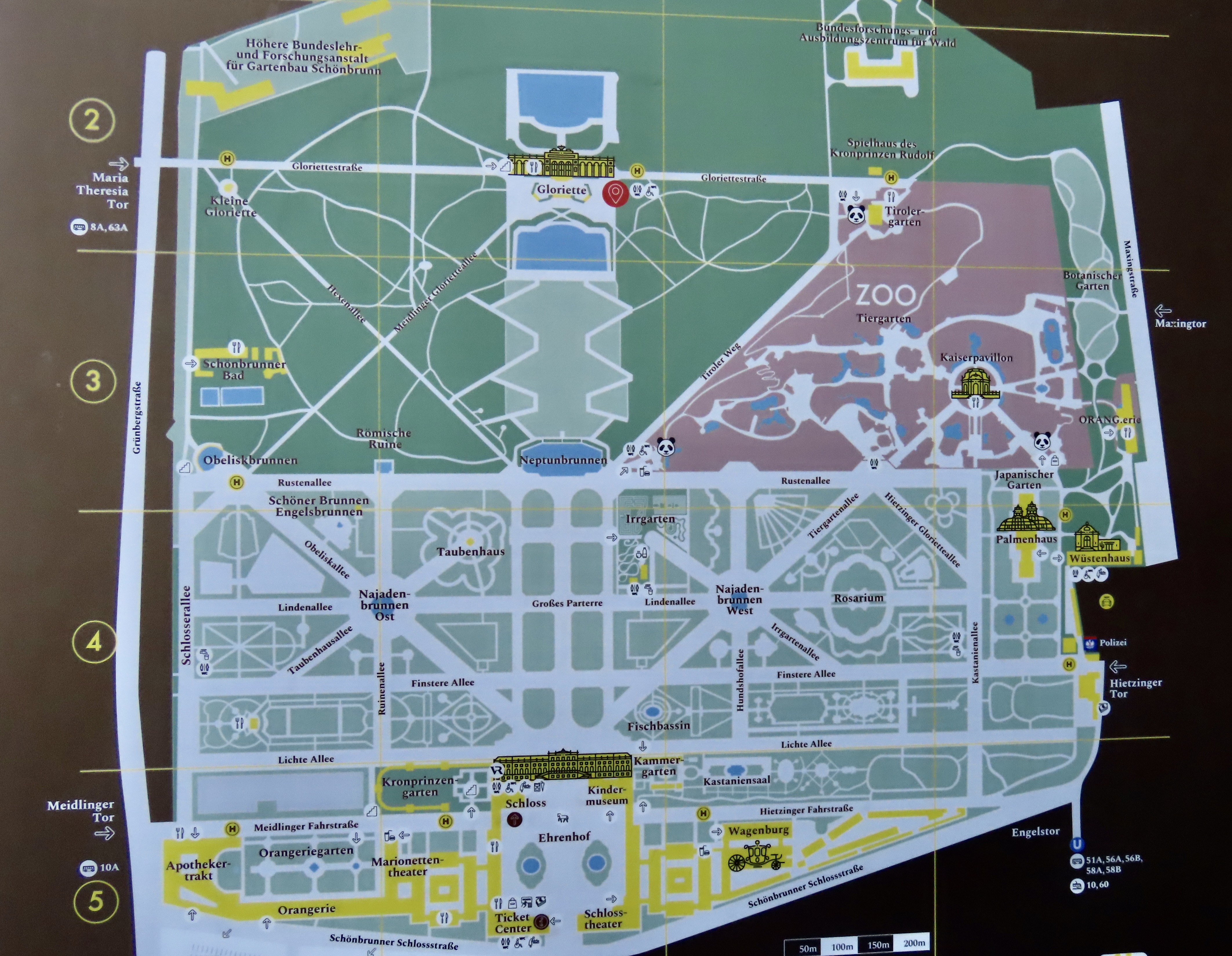
This map provides a view of the Castle and the grounds that featured beautiful gardens and interesting sculptures. We hiked from the Palace up to the ‘Gloriette’ at the top of the map on top of a steep hill. Note the large zoo on the right. Started in 1752, it is the world’s oldest zoo still in operation.
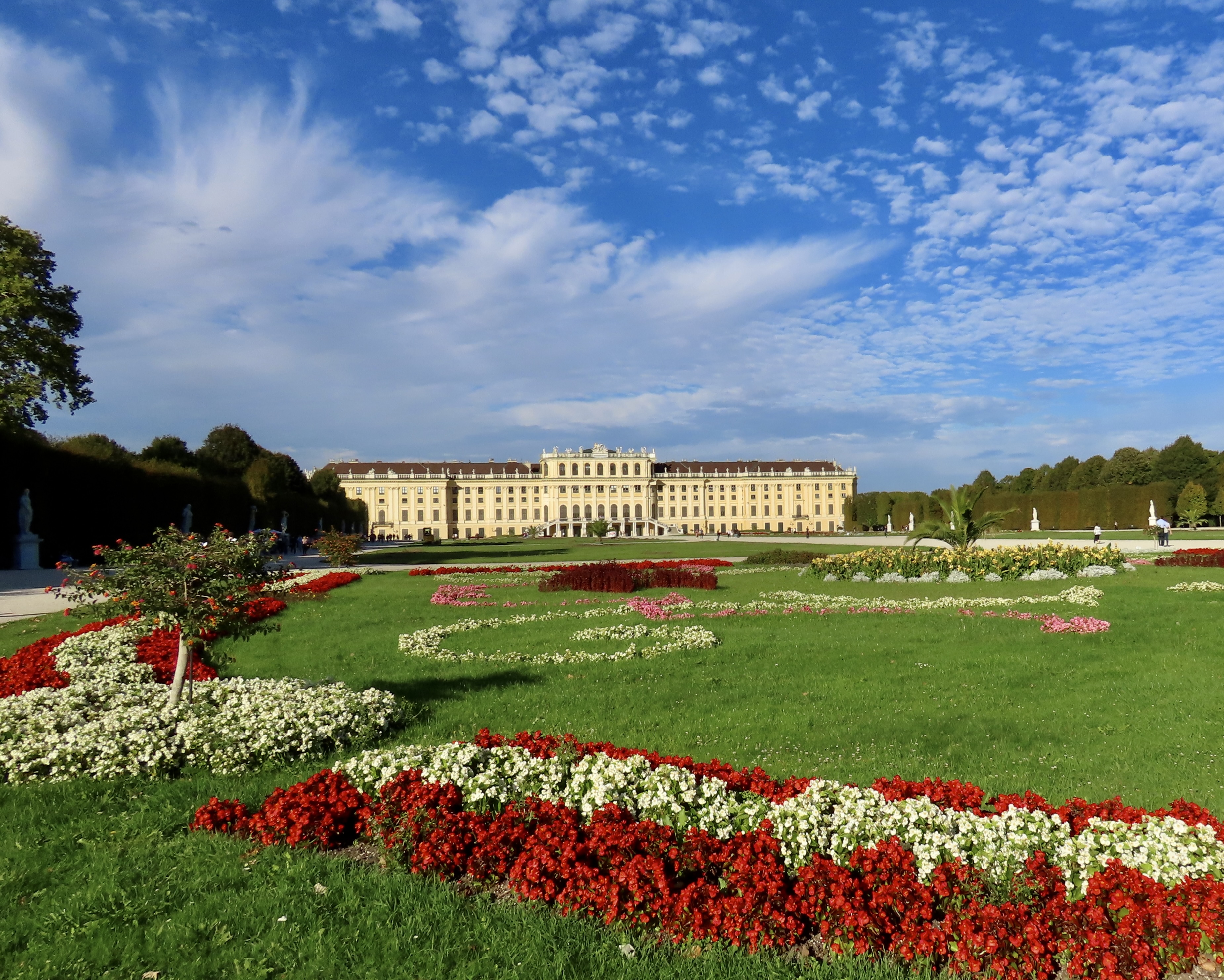
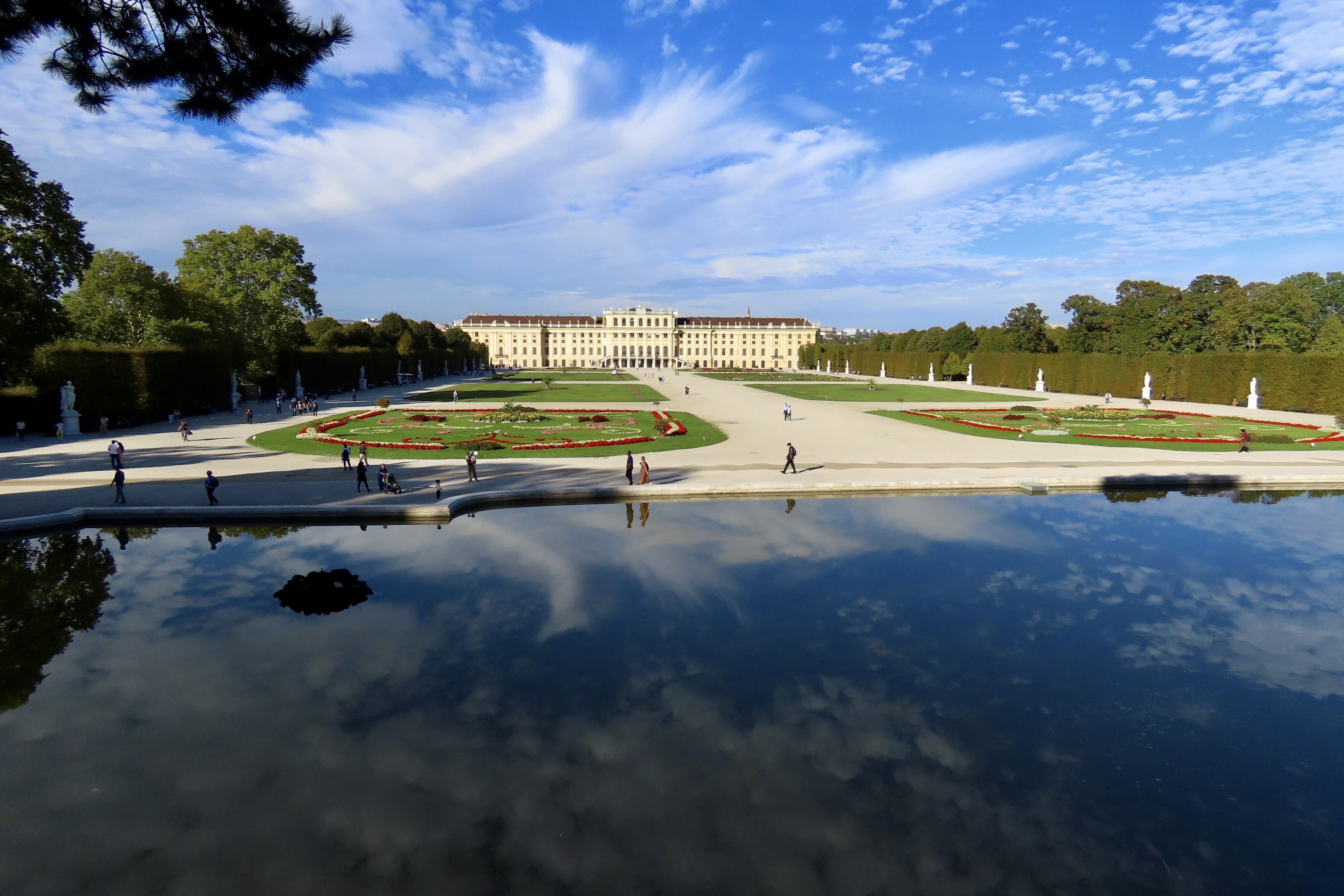
While we were at the end of flower season for Vienna, the gardens were still impressive. This provides a back view of the Summer Palace.
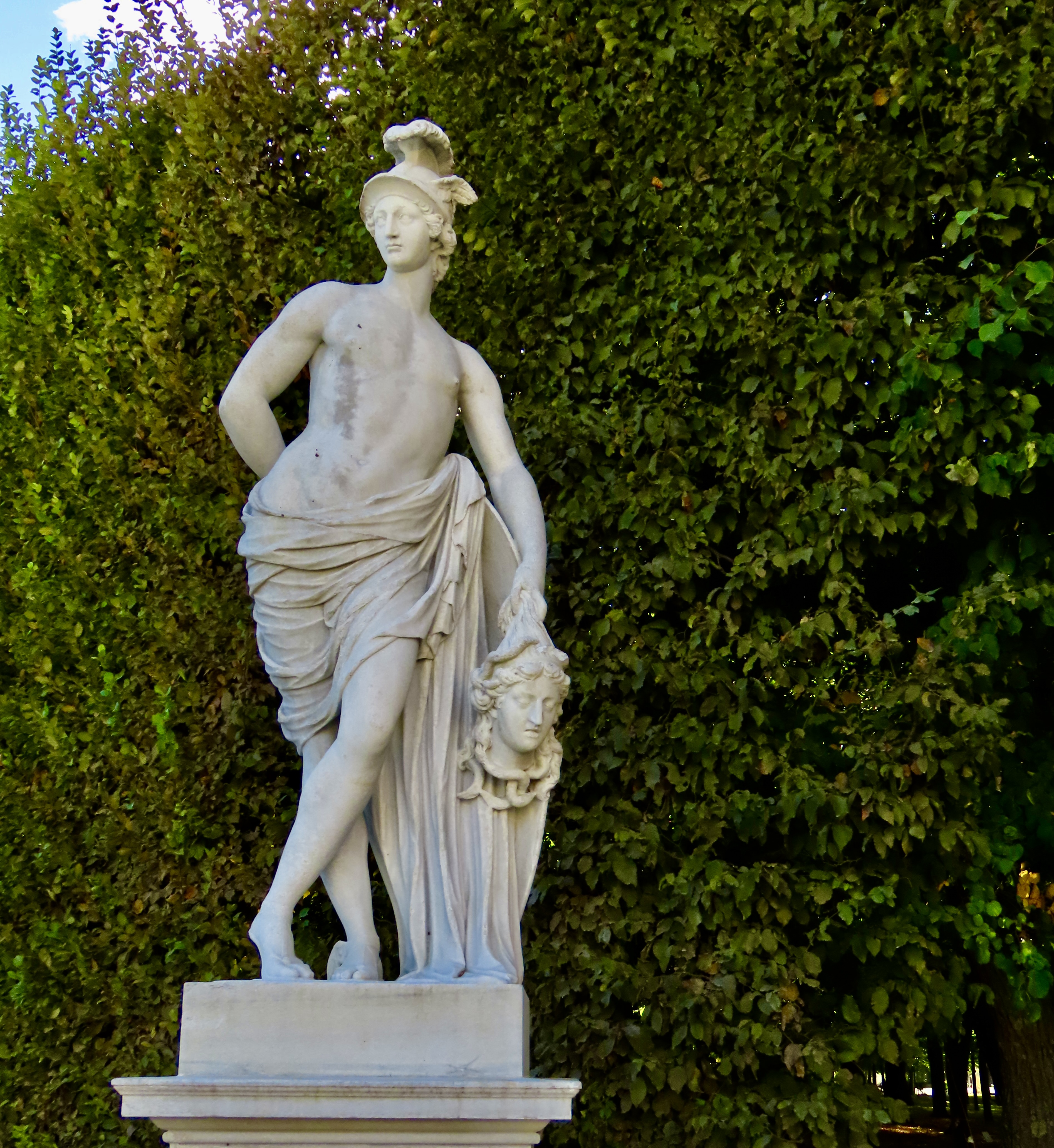
The walkways along the edge of the gardens were filled with 32 life-plus size mythical deities and historical figures. This is Perseus, who the popular Percy Jackson books and movies were based on. Here, he borrowed Hermes’ winged hat and shoes and flew off to Medusa whose look could turn you to stone. Perseus is carefully looking the other way. Judging from his present status, however, he may have been little late.
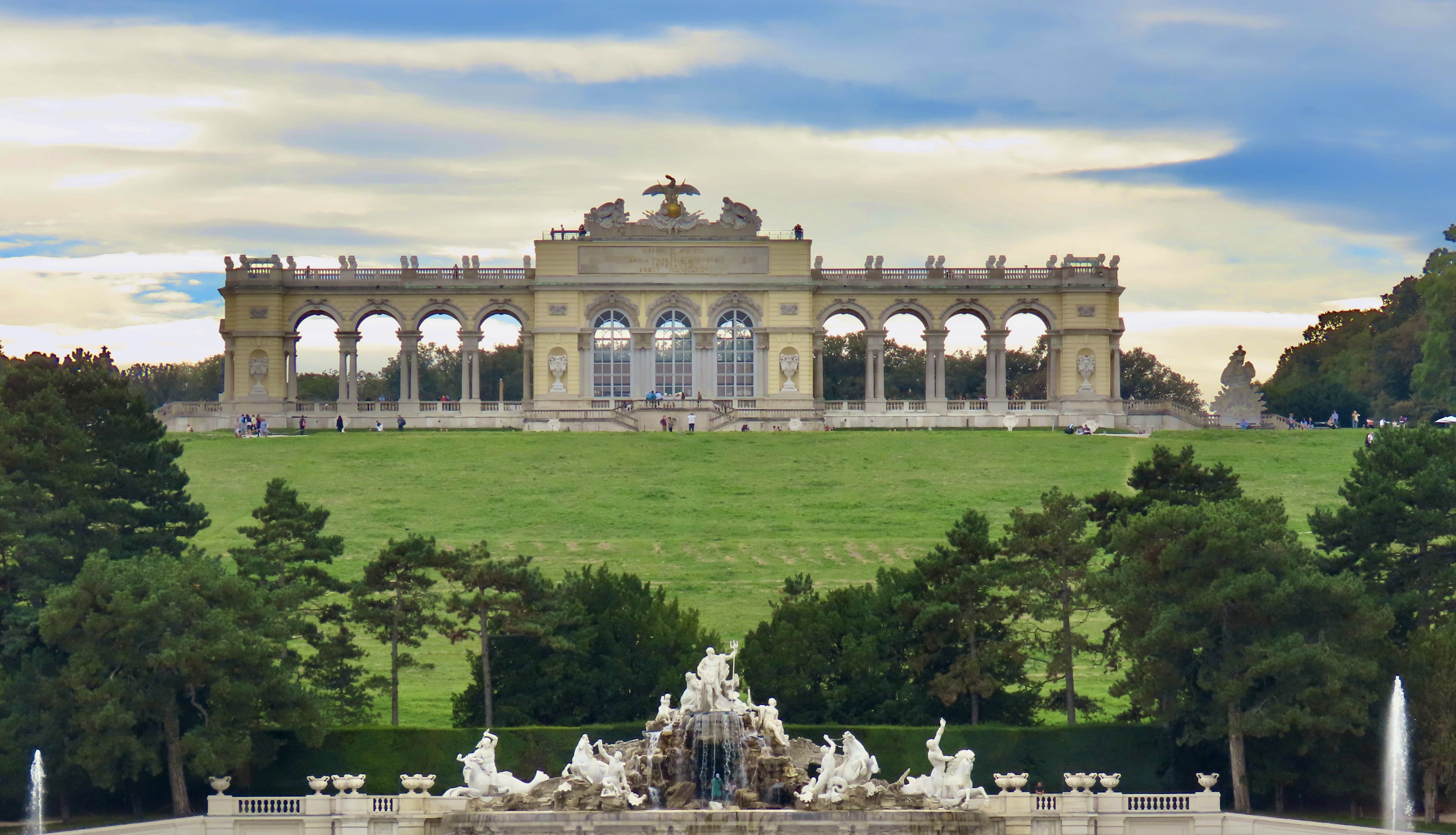
Our goal was to visit Neptune’s statue and the Gloriette above it.
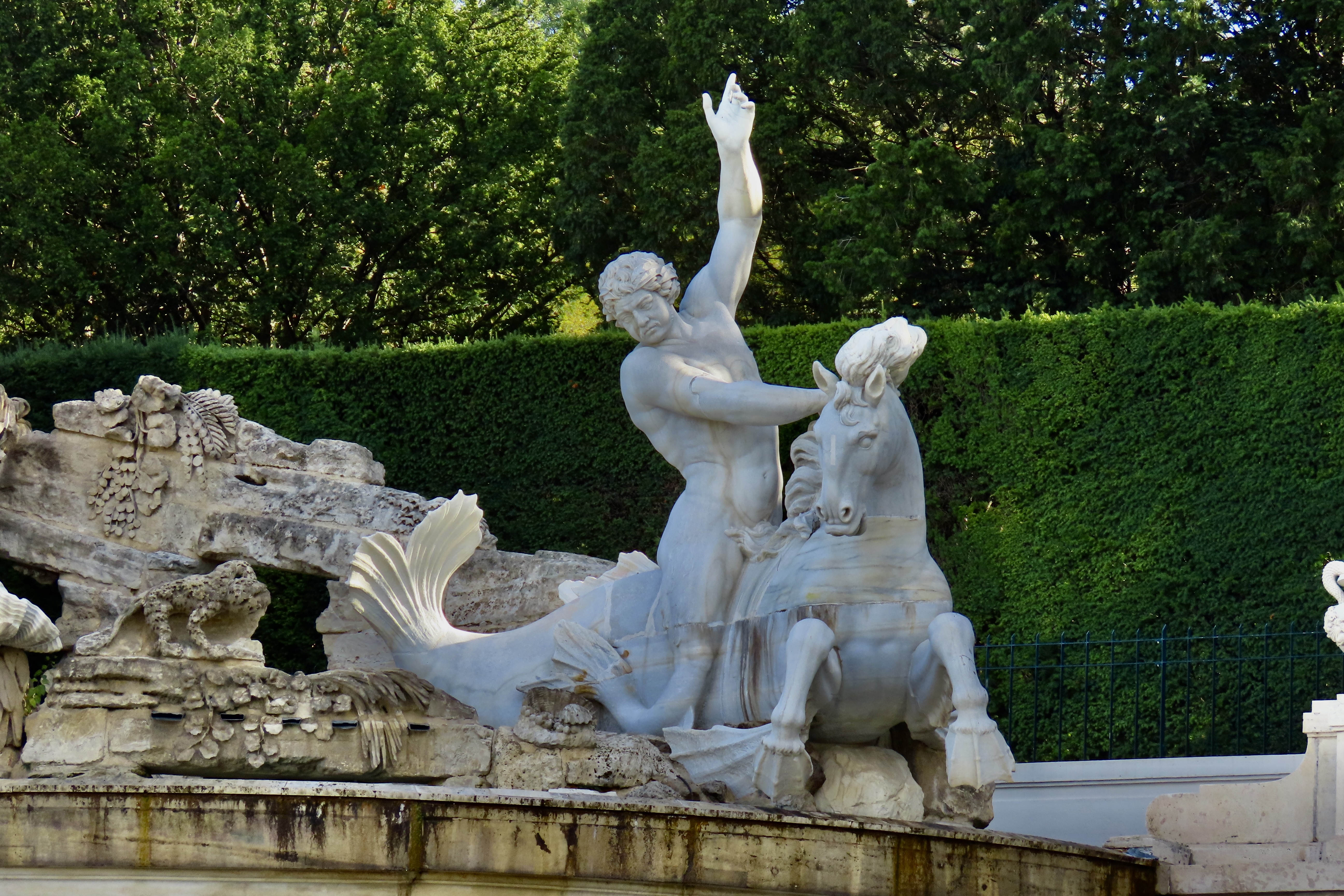
Ride ‘em Cowboy. Neptune’s home above a small lake included a number of other mythological creatures besides the trident carrying god of the ocean. What you have here is a merman (part man, part fish) going for a joy-ride on a hippocampus (part horse, part fish).
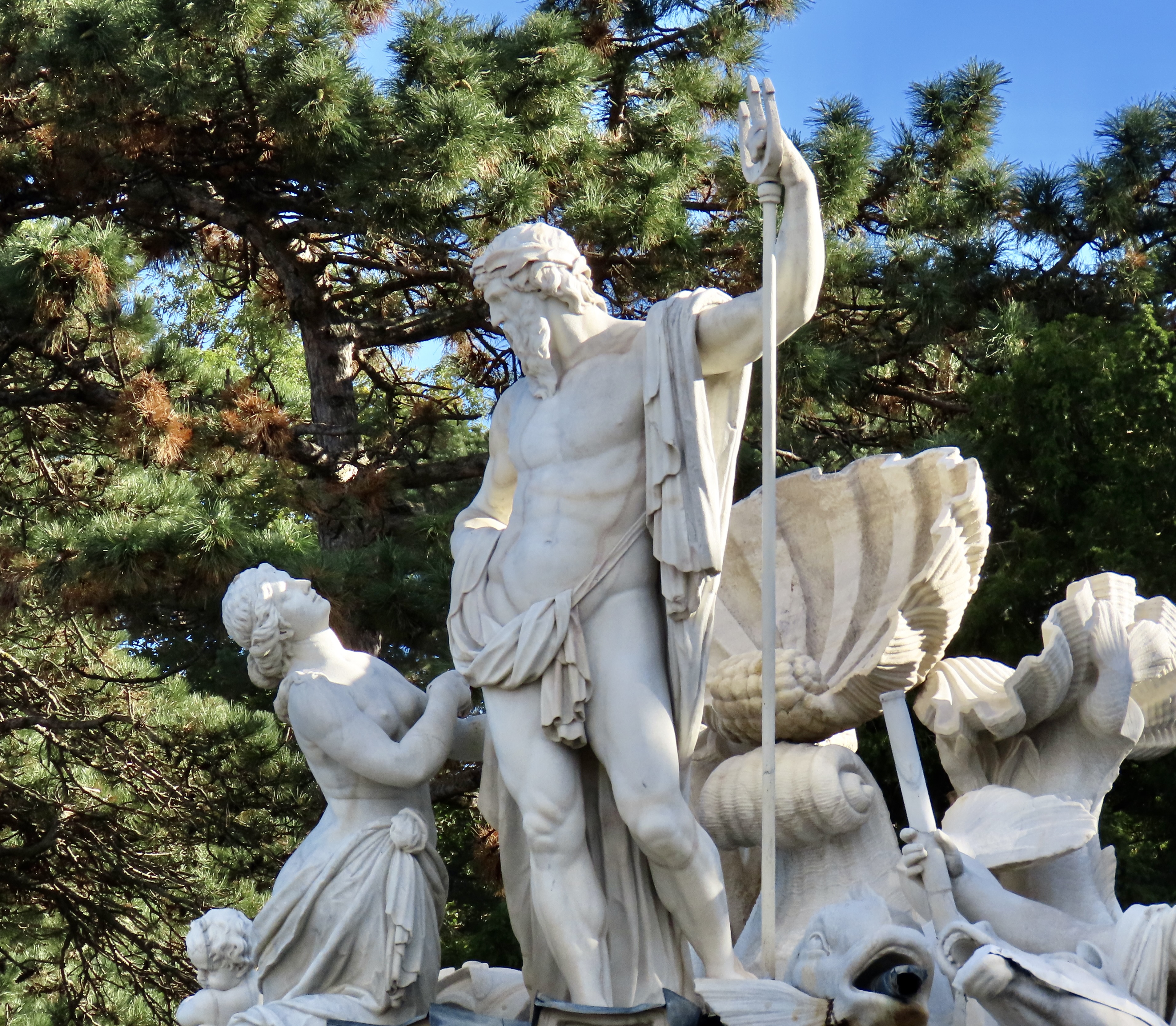
And here’s Neptune. Not sure whether the woman is a mermaid but I don’t think I have ever seen a picture of a mermaid wearing a dress. It appears she has his attention.
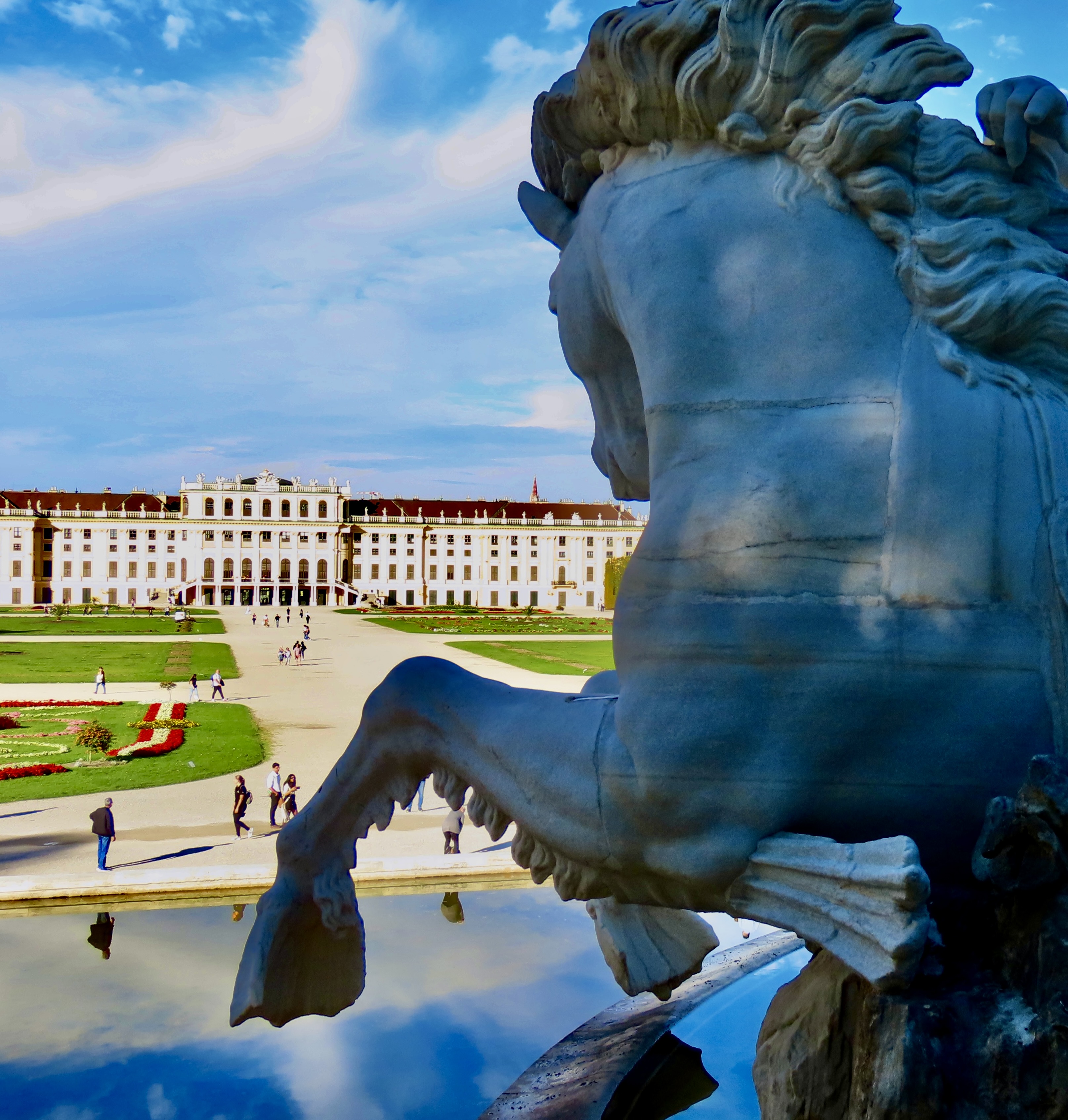
Neptune’s statue provided great views of the Summer Palace.
The Palace from the perspective of a Hippocampus.
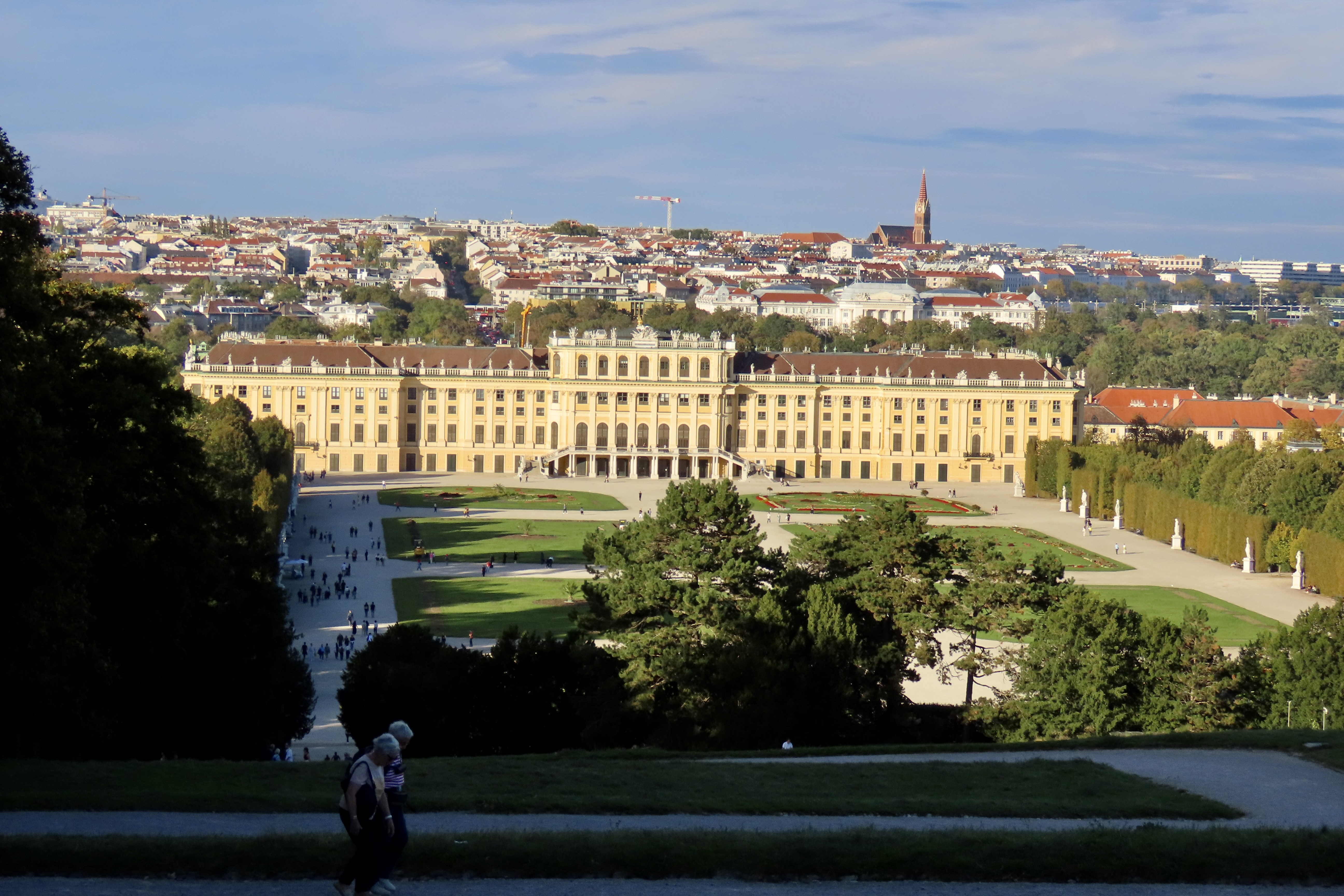
Remember how I said St. Stephan’s Cathedral dominates the skyline above Vienna. We took this photo above the Neptune statue on our way up to the Glorietta. The church is on the right. Its only competition was a crane.
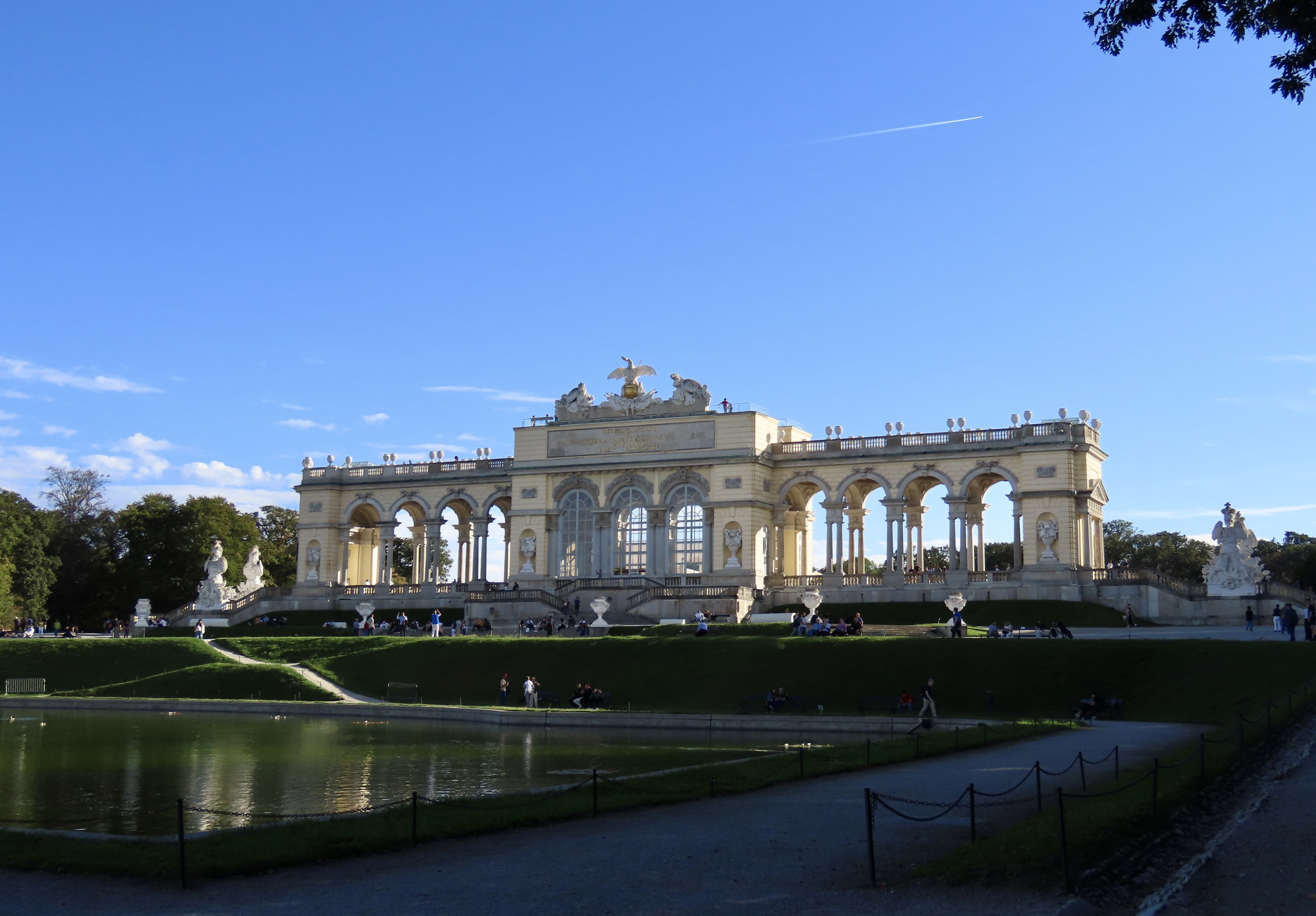
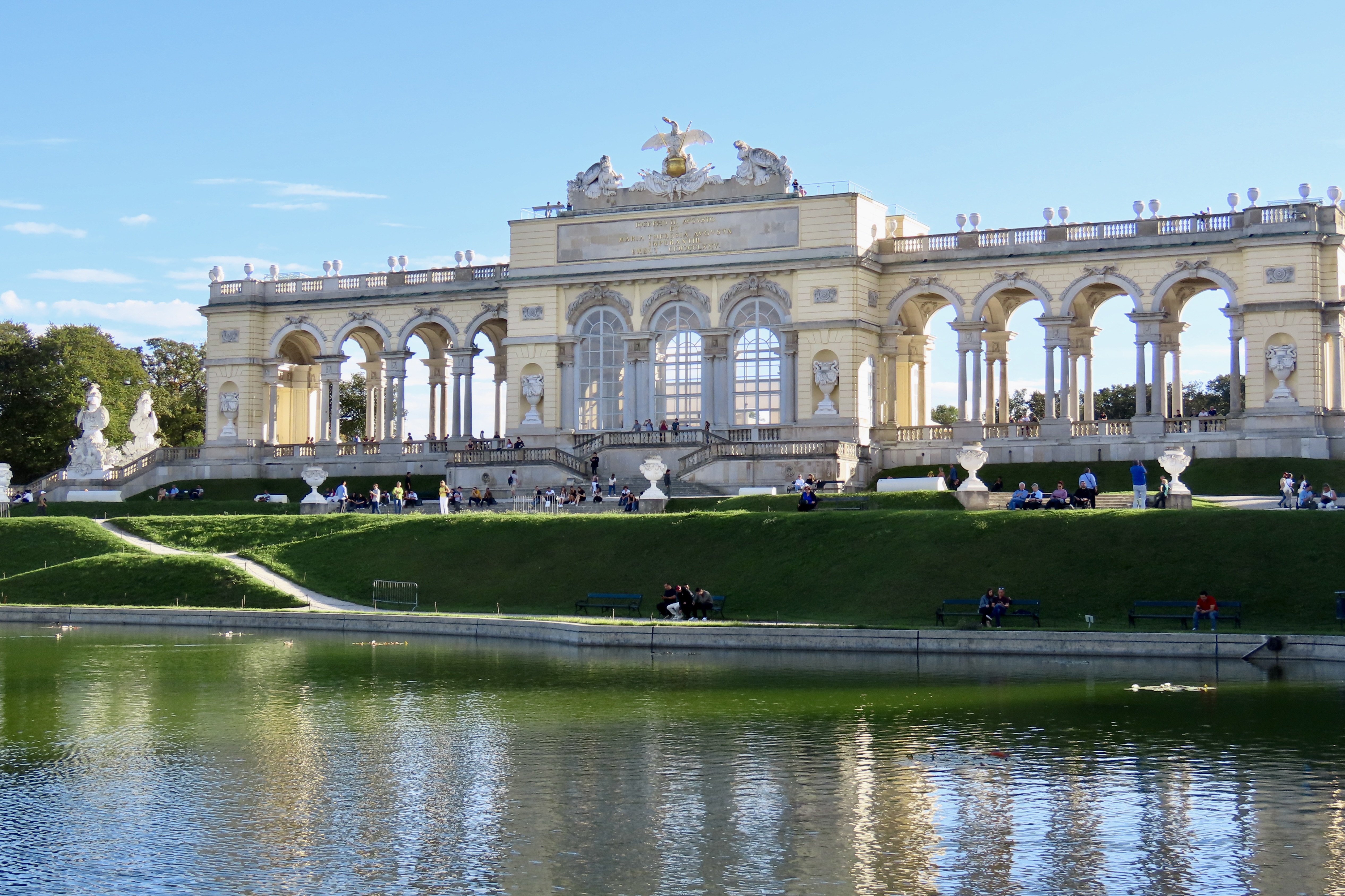
And finally, the Gloriette. A gloriette is defined as “a building in a garden erected on a site that is elevated with respect to the surroundings.” This one was built as a ‘Temple of Glory’ in 1775 and served a a great viewpoint and ballroom. It was Vienna, after all, where umpteen top Viennese composers were busy writing waltzes and other dance music.
A closer view. The glassed in middle section served as the ballroom.
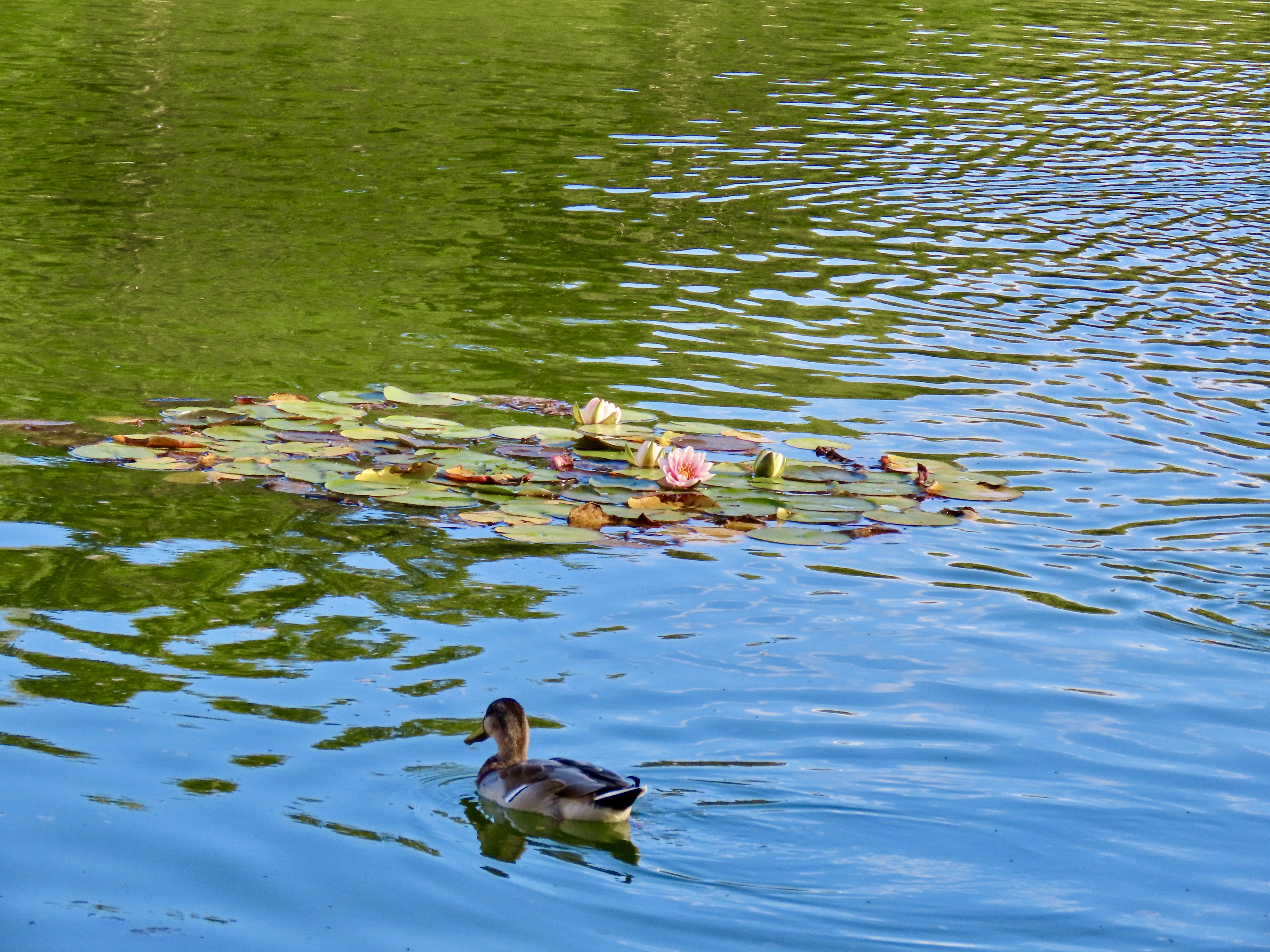
This mallard happily made use of the pond in front of the Gloriette.
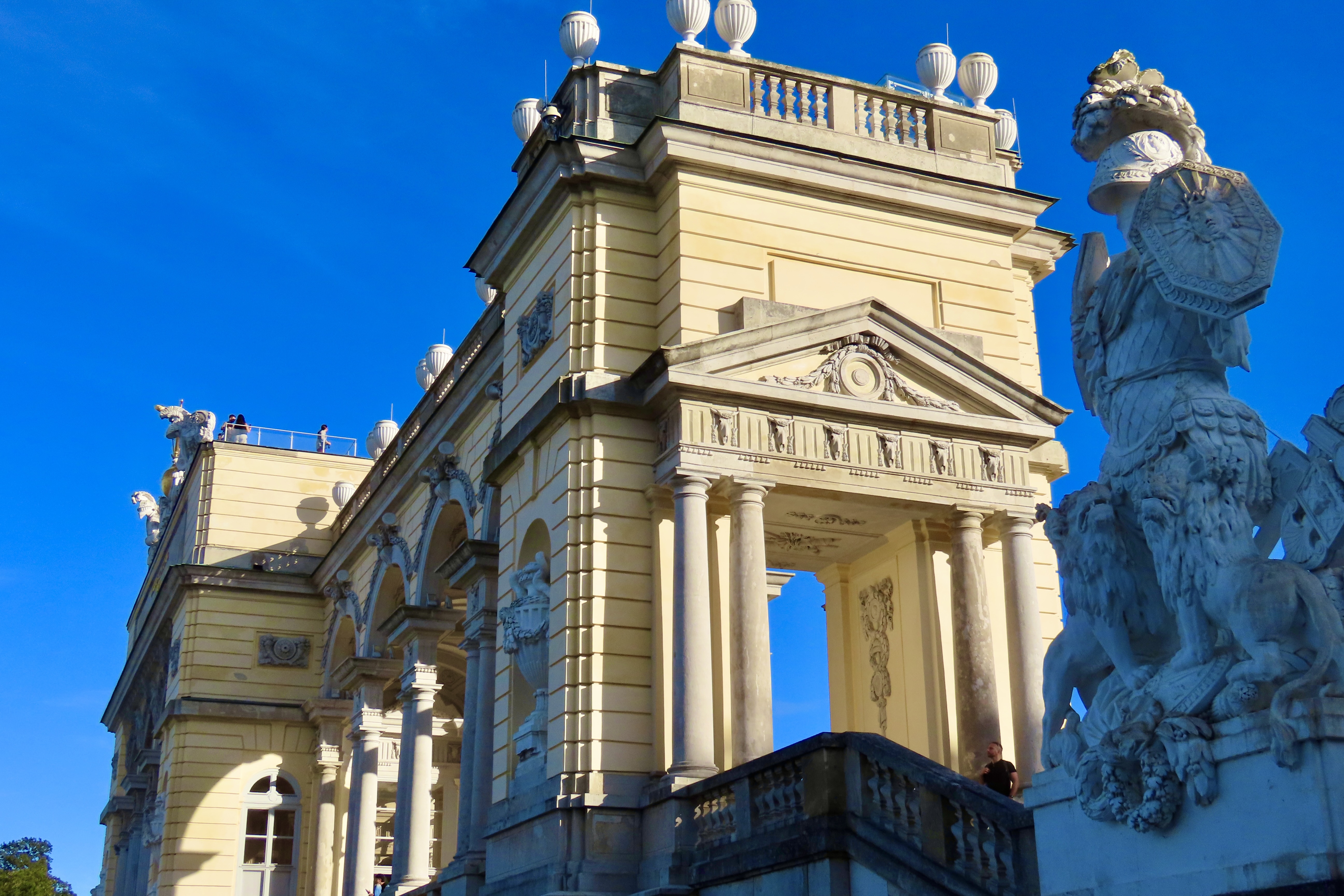
We’ll wrap up today’s visit to the Summer Palace with a side view of the Gloriette. Next we will return to the historic downtown of Vienna and visit the Winter Palace as well as other sites.
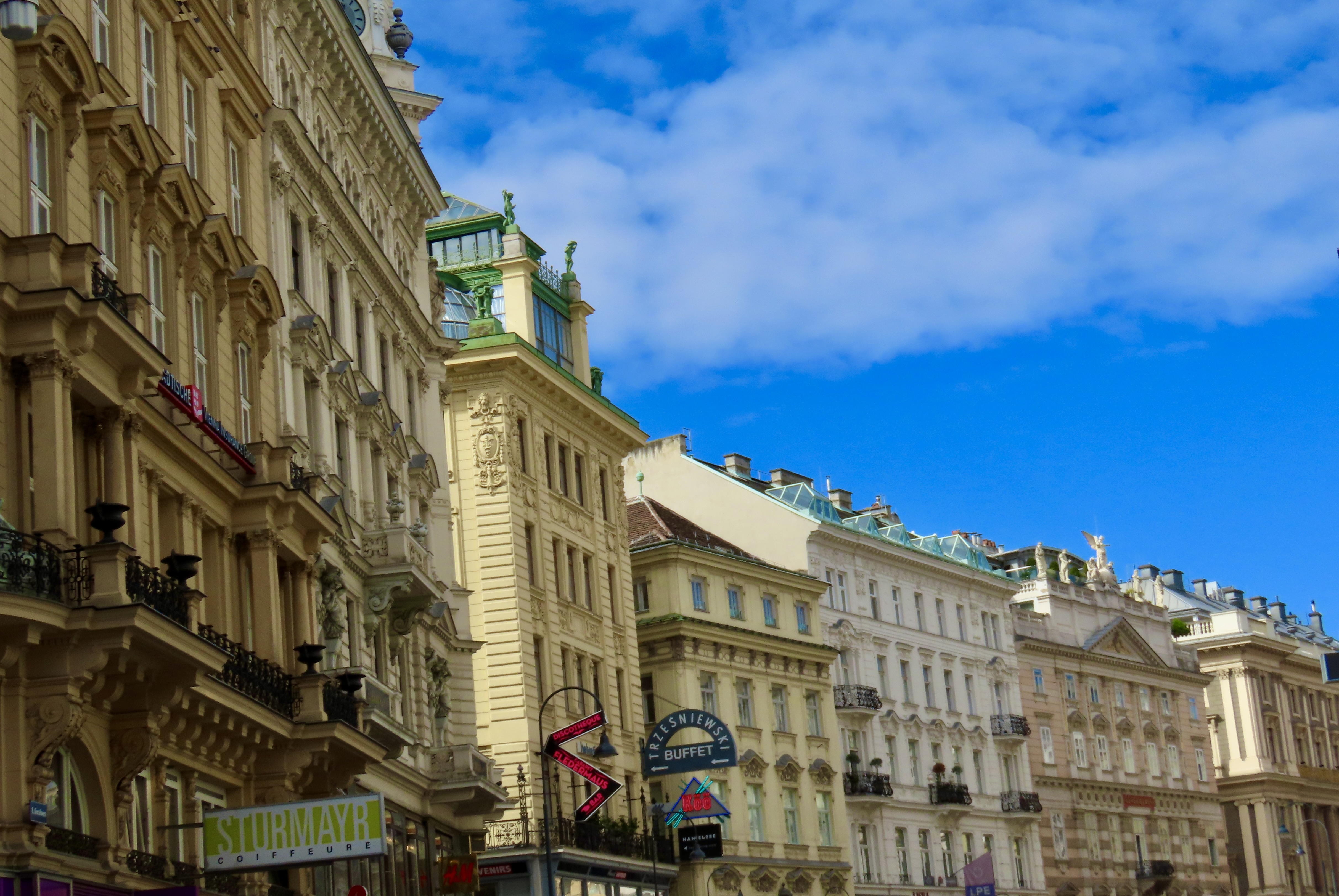
A downtown view.