Santorini’s Akrotiri: An Impressive Ancient City… but Is It Atlantis?

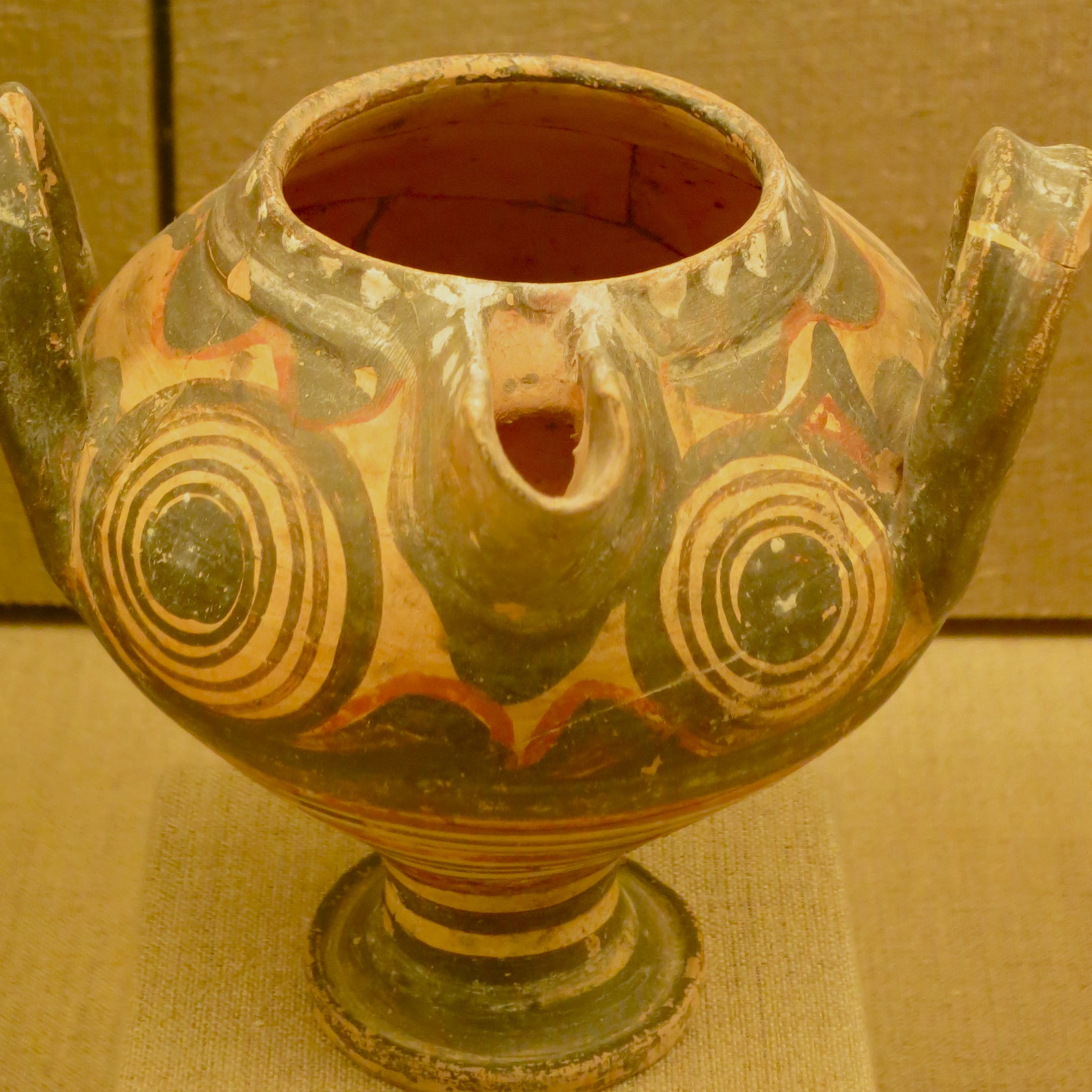
This piece of pottery is one of my favorites on display at the museum. I like to believe that the Minoans of Akrotiri had a sense of humor.

This piece of pottery is one of my favorites on display at the Museum of Historic Thira on Santorini. I like to believe that the Minoans of Akrotiri had a sense of humor. Note the red lips.

The small Museum of Historic Thira is definitely worth a visit if you are on the Greek island of Santorini. Located in the town of Fira, it’s mission is to trace the development of prehistoric Thira from 3000-1600 BC by displaying artifacts found in the ruins of ancient Akrotiri. Before Santorini blew its top in a massive volcanic explosion around 1600 BC and buried the city under a sea of volcanic ash, Akrotiri was a center of a Bronze Age Minoan Culture second only to Knossos on Crete.

Picture hot and cold water running water, indoor bathrooms, two and three-story buildings, beautiful frescos, intriguing pottery, weights and measures, and a fleet of ships that delivered cargo throughout the known world of the time. We are fortunate that many of these artifacts have been preserved under the volcanic ash, which makes Akrotiri similar to Pompeii. Unlike Pompeii, no bodies have been found in the ruins. Apparently the Minoans were given ample warning to escape.
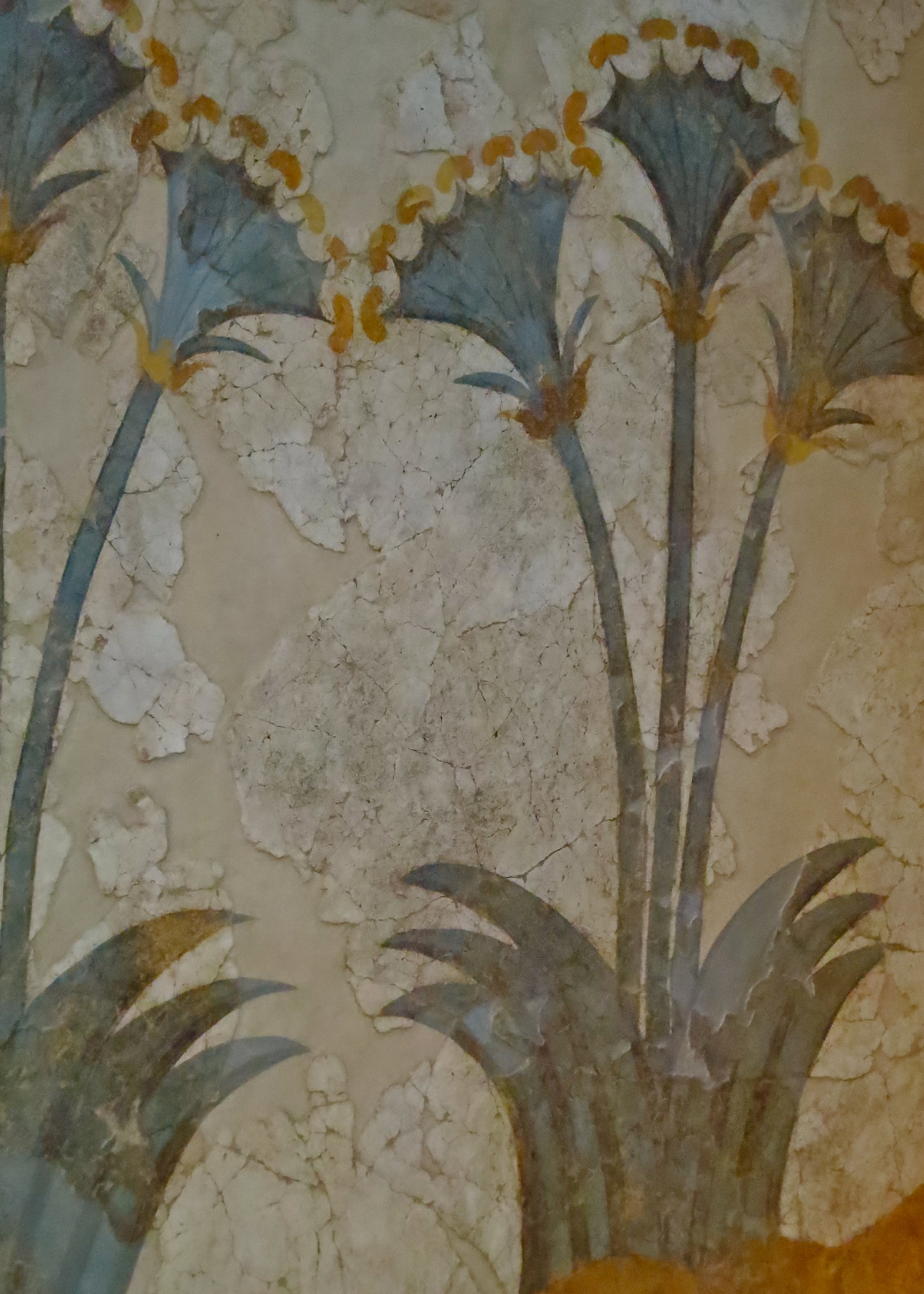
This fresco is one of many that lined the walls of buildings in Akrotiri, Santorini is close to 4000 years old.

This fresco is one of many that lined the walls of buildings in Akrotiri, Santorini is close to 4000 years old.

Excavations of the ruins, which are located on the southern part of Santorini, began in 1957 and continue today. Only a small portion of the city has been uncovered. Because of its level of civilization combined with the fact that it disappeared, there is speculation that Akrotiri may have served as the inspiration for the myth of Atlantis.

Plato mentioned the fabled city around 360 BC. He described it as an ancient civilization existing some 9000 years before his time that was buried under a flood of water. Modern archeologists suggest that the 9000 years may have been mistranslated from earlier Egyptian accounts and actually be 900 years, which would put the destruction of Atlantis right around the time Akrotiri met a similar fate. Substitute an ocean of ash for a sea of water and there is ample room for the speculation. Buried is buried. We will probably never know the truth.

The volcanic activity that brought Akrotiri to its spectacular end continues to be a fact of life on Santorini, however. “Santorini Bulges as Magma Balloons Underneath” a September 12, 2012 article in National Geographic news reported. Somewhere between 13-26 million cubic yards of molten rock were filling the magma chamber located directly under the sea where our cruise ship was anchored! The Crown Princess did not cover the bulge in its newsletter. Apparently, there is no imminent danger… at least to speak of.

Here's another favorite Akrotiri artifact of mine. It's called a nipple ewer (or pitcher) for obvious reasons. This one comes with tiny breasts, ear rings and a beak. Archeologists speculate that the ewer may have had religious significance. My wife Peggy, always practical, suggests that may have been used like baby bottles.

Here’s another favorite Akrotiri artifact of mine. It’s called a nipple ewer (or pitcher) for obvious reasons. This one comes with tiny breasts, ear rings and a beak. Archeologists speculate that the ewers may have had religious significance. My wife Peggy, always practical, suggests that may have been used like baby bottles.

Another nipple ewer. This one featured a swallow. Both wild and domestic animals were featured prominently on Akrotiri artifacts. The yellow color, BTW, is because of the lights used by the museum to protect the ancient works of art.
Another nipple ewer. This one featured a swallow. Both wild and domestic animals were featured prominently on Akrotiri artifacts. The yellow color, BTW, is because of the lights used by the museum to protect the ancient works of art.

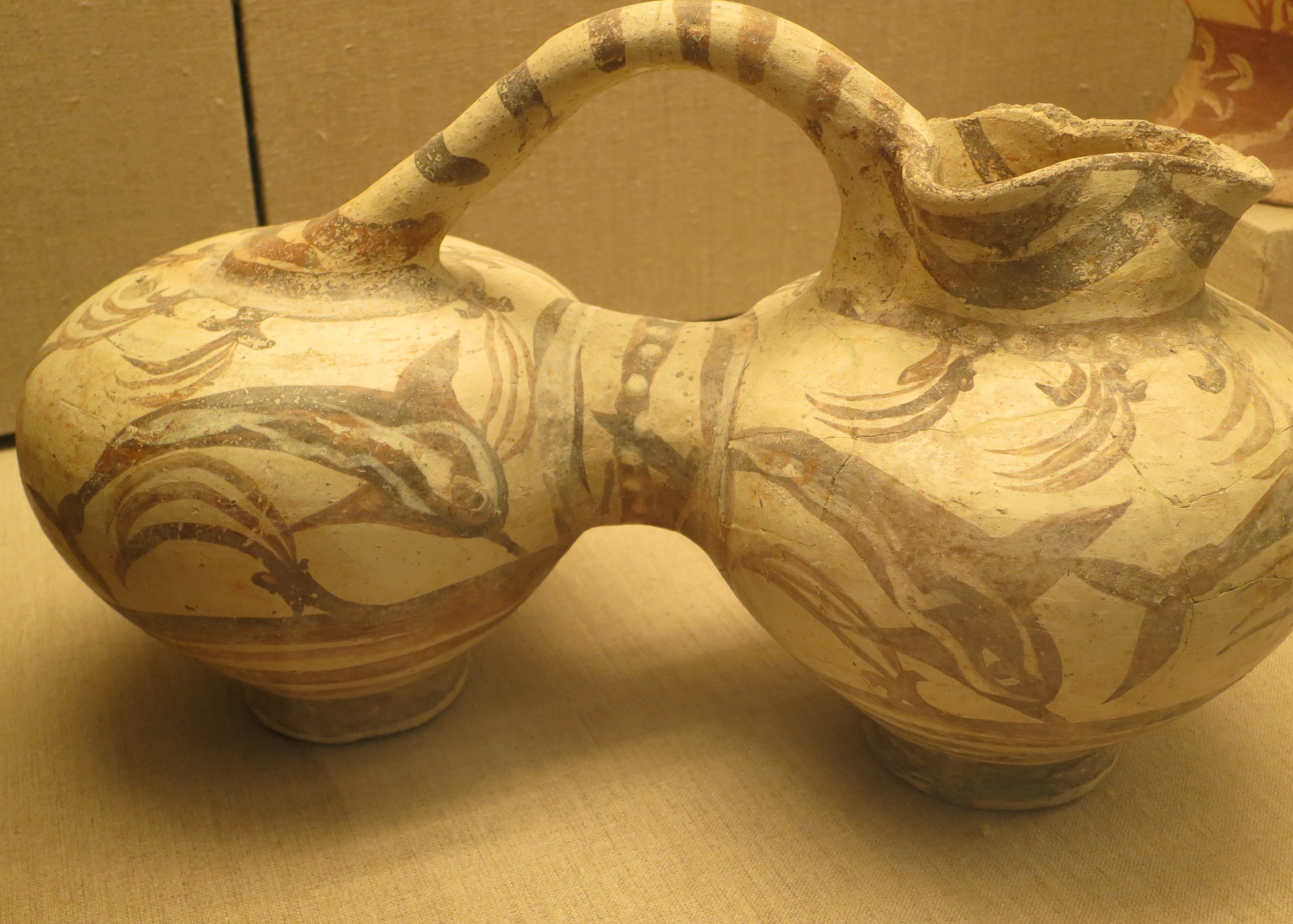
I found this elongated double pitcher with its leaping dolphins to be quite graceful.

I found this elongated double pitcher with its leaping dolphins to be quite graceful.

This reconstructed storage container features a bull that appears to be mooing quite loudly.

This reconstructed storage container features a bull that appears to be mooing quite loudly.

Much of the pottery found in Akrotiri also featured common crops grown by the Minoans. The grapes reflect the wine industry that has been in existence on Santorini for over 4000 years.

Much of the pottery found in Akrotiri also features common crops grown by the Minoans. The grapes on this jar reflect the wine industry that has been in existence on Santorini for over 4000 years.

The Museum of Historic Thira also displays a number of small figurines such as this bull.
The Museum of Historic Thira also displays a number of small figurines such as this bull.

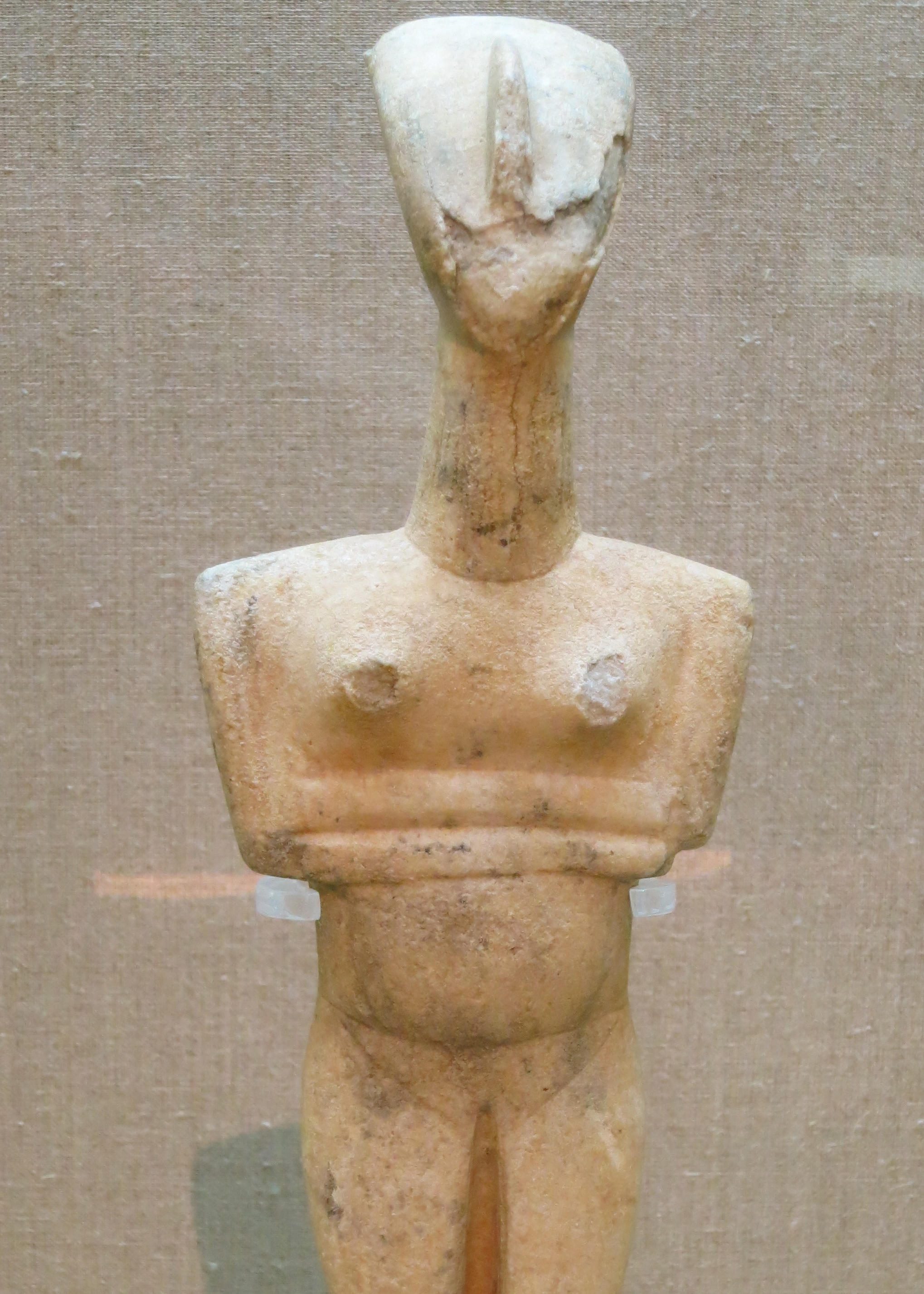
For those who like to attribute alien influence to the development of Atlantis, I will end my photos from the museum with this piece, possibly as old as 2700 BC. (grin)

For those who like to attribute alien influence to the development of Atlantis, I will end my photos of artifacts from Akrotiri with this piece (grin), possibly as old as 2700 BC.

As we returned to our ship, which was anchored above the bulging lava chamber, we had a final look at the towering cliffs of Santorini and their beautiful white villages.

As we returned to our ship, which was anchored above the bulging lava chamber, we had a final look at the towering cliffs of Santorini with their beautiful white villages perched on top.

A beautiful sunset greeted our ship as we headed out to sea and our next adventure.

A beautiful sunset greeted our ship as we headed out to sea and our next adventure.

NEXT BLOG: I continue my travel blog on the Mediterranean with a visit to the second largest city in the Roman Empire, Ephesus, which is located on the Turkish mainland.

Reading and Writing and Arithmetic Taught to the Tune of an Ebony Stick

The elementary school was made from cement blocks. Windows without glass or screens provided air conditioning. Jo Ann and her first grade class provide perspective on the size of the school.

(Peace Corps turned 50 on Tuesday and I am not discussing what I turn on Thursday. But each day this week I am honoring Peace Corp’s birthday by sharing tales on my travel blog of my own experience as a PC Volunteer in Gbarnga, Liberia, West Africa from 1965 to 1967. Yesterday I wrote about my introduction to teaching second grade and about contacting a mysterious illness. Today I return to my unruly class of second graders and try to bring them under control.)

When I returned to school from being sick, my second graders had become rambunctious from their time off. After five days I had worked my way through every classroom management skill I had picked up during Peace Corps’ training and several I made up. Nothing worked.

“They need to be whipped,” my fellow Liberian teachers suggested. “That’s what we do.”

I patiently explained that Peace Corps teachers weren’t supposed to whip their students. Somewhere it was chiseled in stone. Eternal damnation and banishment to North Dakota would result.

“Then pretend you are going to whip them. Just don’t do it,” was the next helpful suggestion.

Being desperate and up for a little corruption, I thought about it. Where did it say in the Peace Corps rules that positive threatening was out of line? After all, hadn’t Teddy Roosevelt said, “Speak softly and carry a big stick?” Wasn’t the American government accumulating enough nuclear weapons to kill everyone in the world several times over using the same philosophy?

So I went out in the jungle and cut myself a big stick. Next I introduced it to my students.

“Oh, Mr. Mekemson, what a big stick you have,” they said. I could see the respect shining in their eyes. I explained its purpose. They could behave and earn positive points or they could misbehave and earn negative points. If they earned enough negative points, THE BIG STICK WOULD BE WAITING.

I didn’t tell my students I put the point total for the stick so high it would take a combination of Al Capone and Count Dracula to reach it.

The system worked. Whenever the class bordered on chaos, I would head for the blackboard, chalk in hand. Instant silence resulted. It was ‘Reading and writing and arithmetic taught to the tune of an ebony stick.’ We started making up for lost time.

A part of John Bonal's extended family. Mary is on the left.

Of course there was an exception. Isn’t there always? It came in the form of Mary, an 11-year old going on 13. Her uncle was principal of the high school and a Big Man in town so this meant she was important. Mere mortals such as Peace Corps Volunteers didn’t count. No Liberian teacher would dare touch a stick to her ornery hide, so certainly a Peace Corps teacher wouldn’t.

She called my bluff and pushed her points right up to the rim. I urgently sought reasons to give her positive points but the opportunities were few and far between. She went over the top and smugly whispered to her girlfriends to watch what would happen.

Now I had a real problem. Obviously I couldn’t beat her. I am really not the beating kind. But neither could I ignore her. The end of the day came and I dismissed the class but asked her to stay. The students walked out the door and stopped just on the other side. They weren’t leaving. Nobody at the school was, including all of the teachers. They were all waiting to see what Mr. Mekemson would do.

Mr. Mekemson was worrying. That’s what he was doing. I got out my big stick. Little Miss Mary was no longer so nonchalant.

“Don’t beat me Teacha, I beg you, don’t beat me,” she screamed and screamed and screamed. I gently touched her with my stick. You would have thought I was pulling all of her fingernails and half of her toenails out, slowly. I knew everyone in the school was listening in on this little drama and I imagined that half of Gbarnga was as well.


Oh boy, I thought, you have royally screwed up this time, Curtis.

I mumbled something about the importance of changing her ways and sent her off. And then I waited. How long would it be before the Peace Corps jeep came by to carry Jo Ann and me away? The next day at school was quiet.  Mary stayed home and I had a class of angels. Even other classes were quiet.

At noon, one of the Liberian teachers stopped by. She had a student she wanted me to beat. I declined… less than graciously.

Two days later I received the message; John Bonal, Mary’s Uncle, wanted to see me. This was it. I prepared my case carefully. I didn’t want to leave. A lovely war was waiting for me at home and I had developed a considerable fondness for Liberia and its people.

I went to see Mr. Bonal with all of the enthusiasm of an African hippopotamus crossing the Sahara. John was smiling when I greeted him. I even managed to get a decent snap out of the handshake.

“I’ve heard about your reputation,” he started and paused. Many words went roaring through my mind; words like child beater, monster, and hater of kids to name a few. “And I would like you and your wife to come and teach at the high school. We think you would make a great addition to our faculty. We would like you to teach history and geography and Jo Ann to teach French and science.”

Talk about surprise. Here I was prepared to be booted out of the country, ready to beg as the Liberians liked to say, ready to humble myself and crawl across the floor if need be, and I was being offered the opportunity to teach two of my all time favorite subjects.

“Sir, your niece…” I managed to stumble out.

Mr. Bonal’s smile widened, “Ah yes,” he said, “that was a good job. Now she will be a much better student.” Suddenly I had the suspicion that Mr. Bonal wanted me for a reason other than my ‘great’ teaching ability. I pictured myself practicing with a bullwhip out behind the high school as students lined up for their daily punishment. “Mr. Mekemson will see you now. Do you have any final words?”

(Tomorrow I write a second grade reader but the government labels me as a radical and refuses to publish the book because I focus on tribal children and African Tales. At high school I encourage the creation of a student government. The Liberian Government accuses me of creating political parties to oppose the True Whig Party and threatens to kick me out of the country.)

How Do-Your-Part the Dog Evaded Half the Nation of Islam

(The Peace Corps turns 50 on Tuesday, March 1. In this series of travel blogs, I honor its Anniversary by relating my own experience a Peace Corps Volunteer in Gbarnga Liberia, West Africa starting in the summer of 1965.)

John Bonal, the High School Principal, lived in a cement-block house next to ours. He was a ‘Big Man’ in town by Gbarnga standards. Being successful in Liberia meant that your relatives came over and lived with you. It was the ultimate share-the-wealth-social-welfare program.

Part of John’s extended family included three dogs creatively named Puppy Doodle, Brownie Girl and Do Your Part. They came over to watch us white washing our new house and decided to stay. We fed them.

If I have my genealogy correct, Brownie Girl was Do your Part’s mom who in turn was Puppy Doodle’s mother. This three-generation family dug foxholes around the outside of our house and quickly established that they were our pets. Other dogs need not apply.

The Bonals were more than happy to have us take over feeding responsibilities and Rasputin was pleased to have someone new to terrorize. So everyone was happy.

Do Your Part took things a step further and adopted me. She was a charming little Basenji with impeccable manners. Everywhere I went, she went, including school.  Normally this amused my students. I would walk into the class with DYP a respectful three feet behind. She would immediately arrange herself under my desk and quietly remain there until I left the classroom.

This worked fine until she had puppies. They started following her as soon as they could walk the 100 yards to the school.

I would arrive in my classroom followed by DYP who in turn was followed by four puppies. It was quite the parade. Unfortunately, the puppies lacked Do Your Part’s decorum and considered the classroom a playpen. The students decided it was not an appropriate learning environment and I agreed.

DYP and company had to go. It was not a happy parting.

“Take your puppies and go,” I ordered firmly. Do Your Part looked at me in disbelief.

“Out!” I said.

Sad eyes stared back accusingly. But I held firm. She didn’t let it get her down, however. As soon as the puppies had departed she was back in class. One time her insistence on following me had more drastic consequences.

Gbarnga had a sizeable population of Mandingoes, most of whom were Muslims. They had been gradually sifting into Liberia from across the Guinea border. Originally the Americo-Liberians had blocked their entrance to the country, fearing they might pose a threat to their power.

President Tubman’s open door policy changed that and by the time we had arrived their numbers had reached the point where they decided to build a mosque in town. I’d wander over on occasion to check their progress. The mosque was an impressive edifice by Gbarnga standards, easily five times larger than any other structure on the main road.

At last the day came for the mosque’s grand opening. Having watched it being built, I decided to attend the festivities. I put on a tie, grabbed our two cameras and headed out the door.

Do Your Part was waiting, as she always was, ready to go along. This was not a Do Your Part type of celebration, however. Muslims aren’t particularly fond of dogs and consider them unclean.

I figured this meant they didn’t want any dogs, even polite dogs, attending their holy ceremony. I suggested to Do Your Part she stay home. Fat chance. I walked 100 yards and glanced back over my shoulder. There was DYP, slinking along behind. I knew there was no way I would make it to the ceremony without a little brown dog lurking in the background.

Do Your Part would have to be left in our house. The action was drastic; the only time we let her in was to eat dead insects in the evening. She would come in just before we went to bed and wander around crunching down sausage bugs. It eliminated sweeping. She had never been locked inside.

Since my ex-wife Jo Ann was reading to a blind friend and Sam was off for the day, I couldn’t even leave DYP with company. I reluctantly shoved her inside and marched off to the sounds of doggy protest

It seemed to work. I reached the mosque just as the outside ceremonies were concluding and people were preparing to move inside. Dignitaries were everywhere. It was my intention to hang out on the periphery and remain inconspicuous.

This is hard when you are the only white person in the crowd and you have two cameras hanging around your neck. It took about thirty seconds for a tall, official looking man in a white robe to arrive and express in broken English how pleased he was that the international press from Monrovia had decided to cover the event.

While I struggled to inform him that I was only a local Peace Corps Volunteer, he ushered me into the mosque to a seat of honor. I looked around nervously. The podium was about 10 feet away and I was in the front row.

A hush descended on the crowd as an obviously important dignitary approached the podium. Liberia’s top Muslim Cleric had come to town to officiate at the opening ceremony. He gave me his best media smile and I dutifully took his picture.

Unexpectedly, there was a disturbance at the back of the mosque. Several men were trying to capture a little brown dog that was deftly eluding them and was making a beeline for me.

Do Your Part had managed to escape from the house. Now she was escaping from half the Nation of Islam. In seconds that seemed like hours she was in front of me, wagging and prancing around like she hadn’t seen me in six months. Hot on her tail were three huge Mandingo men.

“Is this your dog?” their leader managed to stammer out in barely repressed fury as he gave DYP a tentative boot in the butt. Fortunately she figured out that the situation was a little tense and decided there were other parts of town she wanted to see.

I was amazed at her ability to avoid lunging people. I dearly wished I could have escaped with her. It wasn’t to be. It was my job to stay behind and be glared at. I was so embarrassed I don’t remember a single part of the ceremony.

Later when I arrived home, Do Your Part was outside the house, all wiggles and waggles, obviously no worse for her adventure. Jo Ann greeted me.

“It was the strangest thing when I got home,” she said. “Do Your Part was inside and frantic to get out. When I let her loose she took off like our house was on fire. I wonder if Sam let her in by mistake.” So much for my planning…

If Someone Steals your Dog, Spouse or Car, Who Do You Call: The Lightning Man

(This is one of a series of travel blogs I am doing on my experience as a Peace Corps Volunteer in Gbarnga, Liberia, West Africa to honor the 50th Anniversary of the Peace Corps.)

The dark side of tribal beliefs arrived at our house late one evening in the middle of a tropical downpour.

A very wet and frightened candidate for student body president, Mamadee Wattee, knocked on our door. The opposition had purchased ‘medicine’ from a Ju Ju Man (witch doctor in Tarzanese) to make him sick.

It was serious business; people were known to die in similar circumstances.

Had the opposition slandered Mamadee or stuffed the ballot box, I could have helped but countering black magic was way out of my league. I took the issue to the High School Principal and he dealt with it. Mamadee stayed well and won the election.

Later, he unintentionally introduced us to another tribal phenomenon, the Lightning Man.

I had left Mamadee with $50 to buy us a drum of kerosene while my wife and I were on vacation. When we returned home, Mamadee was sitting on our doorstep. Someone had stolen the money and he was obviously upset. Fifty dollars represented a small fortune to most tribal Liberians. (Given that we were paid $120 dollars a month for teaching, it was hardly spare change to us.)

Mamadee’s father, a chief of the Kpelle tribe, was even more upset and wanted to assure us that his son had nothing to do with the missing money. It was a matter of honor. He offered to hire a Lightning Man to prove Mamadee’s innocence.

The Lightning Man had a unique power; he could make lighting strike whoever was guilty of a crime. If someone stole your cow or your spouse, ZAP! Since we were in the tropics, there was lots of lightning. Whenever anyone was struck, people would shake their heads knowingly. One more bad guy had been cooked; justice had been served.

We didn’t believe Mamadee had taken the money and even if he had we certainly didn’t want him fried, or even singed. We passed on the offer.

Another Liberia Peace Corps Volunteer chose a different path. Here’s how the story was told to us. Tom had just purchased a $70 radio so he could listen to the BBC and keep up with the news. He enjoyed his new toy for a few days and it disappeared.

“I am going to get my radio back,” he announced and then hiked into the village where he quickly lined up some students to take him to the Lightning Man. Off they went, winding through the rainforest to the Lighting Man’s hut.

“I want you to make lighting strike whoever stole my radio,” Tom said, and then paid five dollars for the service. (Lightning Men have to eat too.)

Tom and his entourage then returned home. By this time, everyone in the village knew about the trip, including undoubtedly, the person who had stolen the radio.

That night, there was a tremendous thunder and lightning storm. Ignoring for the moment that it was in the middle of the rainy season and there were always tremendous thunder and lightning storms, put your self in the shoes of the thief who believed in the Lightning Man’s power. Each clap of thunder would have been shouting his name.

The next morning Tom got up, had breakfast and went out on his porch. There was the radio.

(In my next blog I will relate the story about how Do Your Part, my dog, invaded a mosque and barely escaped.)

The Bush Devil Ate Sam

(This travel blog is one of a continuing series where I relate my experience as a Peace Corps Volunteer in the mid 60s in Liberia, West Africa honoring the Peace Corps’ 50th Anniversary.)

Joining the Peace Corps should come with a label like they put on cigarette packs. It would read “Warning: This experience may change your concept of reality.

Our vision of the world is perceived through culturally tinted glasses. Not surprisingly, the reality of our parents and our society becomes our reality. It’s hard to imagine life from any other perspective. Close encounters with other cultures can shake this vision but not easily. We wear our culture like bulletproof vests, rarely allowing a stray thought to enter. Or we focus so hard on extolling our own culture that we fail to learn valuable lessons another culture may teach us.

One of the great values of the Peace Corps experience is the sensitivity and respect it teaches for the beliefs and values that other people hold. Often this leads to a greater appreciation of our own culture.

There are definite risks involved in running headlong into another society, however. Culture shock is one. The environment may be so different that it becomes disorienting and may lead to depression. My transition from California to Liberia was relatively smooth. At first, Gbarnga didn’t seem significantly different from my old hometown of Diamond Springs. I suffered much greater shock going from Diamond Springs to UC Berkeley.

Going native, or bush as it was called in Liberia, is another risk. A person becomes so enthralled with the new culture that he adopts it as his own. A joke circulated among West Africa Volunteers on how to determine if you were teetering on the edge.

Phase One: You arrive in country and a fly lands in your coffee. You throw the coffee away, wash your cup and pour yourself     a new cup.

Phase Two: You’ve been there a few months and a fly lands in your coffee. You carefully pick the fly out with your spoon and then drink the coffee.

Phase Three: It’s been over a year and you have become a grizzled veteran. A fly lands in your coffee. You yank it out with           your fingers, squeeze any coffee it swallowed back into the cup, and then drink the coffee.

Phase Four: You’ve been there too long. A fly lands in your coffee cup. You yank the fly out of the cup, pop it into your mouth     and throw the coffee away. It’s time to go home.

If Peace Corps Volunteers had a hard time with culture shock and going bush, the tribal Liberians had a tougher one. Traditional cultures normally find their confrontations with the western world a losing proposition. It isn’t that our culture is so great; it’s just that our technology is so glitzy. How do you keep Flumo down on the farm when he has heard the taxi horn calling or climbed on the Internet?

Gbarnga was on the frontier of cultural change in the 60s. On the surface, life appeared quite westernized. An occasional John Wayne movie even made it to town. My students would walk stiff-legged down the main street and do a great imitation of the Duke. They dreamed some day of traveling to America where they would swagger down dusty streets and knock off bad guys with their trusty six shooters.

In town, loud speakers blared out music at decibel levels the Grateful Dead would have killed for while Lebanese shops pushed everything from Argentinean canned beef to London Dry Gin. The epitome of Americana, a Coca Cola sign, dominated the road as you left town on the way to Ganta and Guinea.

We had enough US-based churches to satisfy Pat Robertson. Missionaries were everywhere. Baptists, Catholics, Episcopalians, Presbyterians and numerous other Christian groups worked the streets in unending competition to recruit African souls.

Sometimes, if I closed my eyes and pretended, I could almost believe I was home. Almost. Then Africa would whip around and bite me.

Sure, the local villagers would dutifully file in to church on Sunday morning and pray for blessings like their western counterparts did but Sunday afternoon would find them out sacrificing a chicken to make sure God got the message. And yes, the Coca Cola sign was there but next to it was a giant Cottonwood with offerings to the spirit that lived inside the tree.

Sam, the young Liberian who worked for us and spent hours listening to our record player getting Charley off the MTA, was another case in point. Scarification marks marched down his chest in two neat rows.

“How did you get those,” my ex-wife Jo Ann asked with 10 percent concern and 90 percent curiosity.

“I can’t tell you,” Sam replied with obvious nervousness as Jo’s eyebrows rose. “But I can tell Mr. Mekemson.”

“Aha,” I thought, “Sam and I belong to the same organization, the Men’s Club!” Actually Sam belonged to a very exclusive men’s organization, the Poro Society. Its function was to pass on tribal traditions and keep errant tribe members in line. The women had a similar organization called the Sande Society.

Sam had been to Bush School the previous summer and learned how to be a good Kpelle man. Graduation to adulthood consisted of an all-consuming encounter with the Poro Society’s Bush Devil.  It ate him. Sam went in as a child and was spit out as a man. The scarification marks had been left by the devil’s ‘teeth.’

It seemed like a tough way to achieve adulthood but at least it was fast and definitive. Maybe we should introduce the process to our kids and skip the teenage years. Think of all of the angst it would avoid.

Bush Devil was the missionary’s designation for a very important tribal figure who was part religious leader, part cultural cop and part political hack. Non-Kpelle types weren’t allowed to see him. When the Devil visited outlying villages, a front man came first and ran circles around the local Peace Corps Volunteer’s home while blowing a whistle. The Volunteer was expected to go inside, shut the door, close the shutters and stay there. No peeking.

We did get to see a Grebo Bush Devil once. The Grebo Tribe was a little less secretive or at least more mercenary than the Kpelle. Some Volunteers had hired the local Devil for an African style Haight-Ashbury Party. The Devil was all decked out in his regalia. Description-wise, I would say his persona was somewhere between a Voodoo nightmare and walking haystack. Grebo men scurried in front of him with brooms, clearing his path and grunting a lot.

We stayed out of the way and took pictures.

While the Bush Devil and the Sassywood Man I blogged about last week seem foreign and even threatening to the Western mind, the truth is that they played an important role in maintaining order within the tribal culture.

Next up: If somebody steals your dog, car or wife, who do you call: The Lightning Man!

Rasputin the Cat and the Cockle Doodle Rooster

(This is the fourth in a series of travel blogs I am writing about my experience as a Peace Corps Volunteer in Liberia West Africa in honor of the Peace Corps’ 50th Anniversary. In this article Rasputin the Cat and the Cockle Doodle Rooster team up to drive me crazy. In my last blog I described how Rasputin ended up being our cat. I first introduced Rasputin in the story about how Boy the Bad Dog became the entrée at an African feast.)

Rasputin did not grieve over Boy’s untimely demise, quite the opposite. Now he could resume his rightful role as Dominant Animal. Dog stalker was his primary responsibility under this job title. We knew when he was at work because the neighborhood dogs carefully avoided the tall clumps of grass where he liked to hide. He was particularly obnoxious when it was windy; the dogs couldn’t sniff him out.

A streak of yellow and a yip of surprise proclaimed Rasputin’s attack. He came at the dogs on his two hind legs, walking upright. This allowed both front legs to be used as slashing weapons. It was the wise dog that steered clear.

This wasn’t Rasputin’s only trick. He could also do flips. I had taught him how and was quite proud of my accomplishment. Each night Rasputin and I would head for the bedroom where I would flip him several times in a row on the bed. He was usually good for about ten before he would attack me, thus signaling that the game was over.

My wife thought it was cruel but I told her it was bonding time. It also turned out to be a valuable skill. One evening when the rice birds were returning to their nests, we saw a yellow flash out the window. Rasputin leapt into the air, did a flip and came down with bird a la carte. After that I figured Rasputin had graduated from flip school so we didn’t practice anymore.

Leap snake was another game we played. It was quite similar to leap-frog except the objective was to see how high Rasputin could jump. On a good night he would clear five feet. The rules of the game were simple. I would detach the spring from our screen door and roll it across the floor. Rasputin, who had a Liberian’s instincts, assumed that anything long and twisty was a snake and that all snakes were deadly poisonous.

His response was to shoot straight into the air and land several feet away. It was a situation where you leap first and ask questions afterward. In this case, Rasputin was guilty of jumping to the wrong conclusions.

One way he returned the favor of my hassling him was to wake me up at 5:30 every morning, demanding to be let in. He did this by practicing his operatic meows under our bedroom window. Since no amount of suggesting that he should learn from Boy’s experience discouraged him, I jumped out of bed one morning and chased him across the yard.

This got Jo Ann excited. Our cat was going to run away and never come back. Jo may have also been concerned about the neighbor’s reaction to my charging out of the house naked. That type of thing bothered her. I promised to repent and assured her that the cat would be back in time for dinner. He was.

Rasputin subcontracted with the rooster next door when he was out tomcatting. I didn’t make this correlation until the rooster crowed directly under our window one morning at 5:30. Even then I thought it was just a coincidence until he repeated himself the next morning.

It wasn’t just the crowing that irritated me; it was the nature of the crow. American and European roosters go cock-a-doodle-do. Even kids from New York City and London know this because that’s how it is spelled out in books. Liberian roosters go cock-a-doodle… and stop. You are constantly waiting for the other ‘do’ to drop.

“This crowing under our window,” I thought to myself, “has to be nipped in the bud.” That evening I filled a bucket with water and put it next to my bed. Sure enough at 5:30 the next morning there he was: “COCK-A-DOODLE!”  I jumped up, grabbed my bucket, and threw the water out the window on the unsuspecting fowl. “Squawk!” I heard as one very wet and irritated rooster headed home as fast as his little rooster legs could carry him.

“Chicken,” I yelled out after his departing body. “And that,” I said to Jo Ann, “should be the end of that particular problem.” I was inspired though. Cats don’t think much of getting wet either. What if I kept a bucket of water next to the bed and dumped it on Rasputin the next time he woke us up. Jo couldn’t even blame me for running outside naked. With warm thoughts of having solved two problems with one bucket, I went to bed that night loaded for cat, so to speak.

“COCK-A-DOODLE!” roared the rooster outside our window precisely at 5:30.

“Dang,” I thought, “that boy is one slow learner.”  I fell out of bed, grabbed the bucket and dashed for the window. There was no rooster there. I looked up and spotted him. He was running at full tilt across the yard away from our window. He had slipped up on us, crowed and taken off!

My opinion of the rooster took a paradigm leap. Here was one worthy opponent. The question was how to respond. It took me a couple of days of devious thinking to arrive at a solution. What would happen if I recorded the rooster on a tape recorder and then played it back?

I had a small hand tape recorder that I used for exchanging letters with my dad so I set myself the task of capturing the rooster’s fowl language. Since he had an extensive harem he liked to crow about, it wasn’t long before I had a dozen or so cock-a-doodles on tape. I rewound it, cranked up the volume and set the recorder up next to our front screen door.

The results were hilarious. Within seconds the rooster was on our porch, jumping up and down and screaming cock-a-doodle. There was a rooster inside of our house that had invaded his territory and he was going to tear him apart, feather-by-feather.

Laughing, I picked up the recorder, rewound it, carried to the back screen door, and hit the play button again.

“Cock-a-doodle, cock-a-doodle, cock-a-doodle,” I could hear the rooster as he roared around to the back of house to get at his implacable foe. Back and forth I went, front to back, back to front. And around and around the house the rooster went, flinging out his challenges.

Finally, having laughed myself to exhaustion, I took pity on my feathered friend and shut the recorder off.  This just about concludes the rooster story, but not quite. One Friday evening, Jo and I had been celebrating the end of another week into the wee hours when we decided to see how the rooster would respond to his nemesis at one o’clock in the morning.

Considering our 5:30 am wakeup calls, we felt there was a certain amount of justice in the experiment. I set it up the recorder and played a “Cock-a-doodle.”

“COCK-A-DOODLE!” was the immediate response. No challenge was to go unanswered. “Cock-a-doodle” we heard as roosters from the Superintendent’s compound checked in. “Cock-a-doodle, cock-a-doodle” we heard in the distance as town roosters rose to the challenge. Soon every rooster in Gbarnga was awake and crowing and probably every resident was awake and cursing.

Jo and I decided to keep our early morning rooster-rousing experiment to ourselves.

(In my next travel blog on Peace Corps I will discuss the special power of the Lightning Man who could make lighting strike anyone who wronged you.)

Special note from BONE:

I just learned about the Bunnock Competition in Macklin, Saskatchewan Canada from Bruce and Nancy Campbell, friends of Curt’s brother Marshall. The symbol for the competition is a 33 foot high bone sculpture that is an exact replica of me. What smart people the folks of Macklin must be! Check the sculpture out at the Macklin site http://www.macklin.ca/bunnoc.htm.

Bone


How Boy the Bad Dog Ended Up in African Soup

(Peace Corps is celebrating its 50th Anniversary this year. In honor of this significant achievement, I will devote several of my travel blogs over the next few months to my own experiences as a Peace Corps Volunteer in West Africa when Peace Corps was still in its infancy, 1965-1967.)

Boy was a very bad dog; he didn’t like black people.

In fact, he didn’t like anybody very much. Boy lived with a Peace Corps Volunteer named Holly in the upcountry town of Gbarnga, Liberia where my wife and I were also Volunteers.

Holly had another dog named Lolita. When Lolita had puppies, she decided that Boy wanted to eat her children and drove him off. He decided to take up residence at our house.

Normally I wouldn’t have cared. We already had three dogs that didn’t belong to us. One more wouldn’t hurt. It was Boy’s attitude that bothered me. Having a large dog with a nasty attitude attack African friends and students was socially inappropriate not to mention un-Peace Corps like.

And there was more. Boy had an issue with my cat, Rasputin; he regarded him as prey. I initiated several discussions with the dog about his bad habits but all he did was growl.

Consequently, I lacked sympathy when the soldiers came. They were standing outside my house waving their guns when I arrived home from teaching.

“What’s up?” I asked in my most official Peace Corps voice. Messing with Liberian soldiers was not smart. Even the government refused to issue them bullets.

“Your dog ate one of the Superintendent’s Guinea Fowls,” their sergeant mumbled ominously. The Superintendent of Bong County was the equivalent to a governor except he had more power. He lived about a quarter of a mile away and his Guinea Fowls roamed around the government compound. It appears he was quite attached to them.

“Which one?” I asked innocently.

“What does it matter which Guinea Fowl the dog ate?”  Sarge sneered.

“No, no,” I responded, “I meant which dog.”

He glared at me for a moment and then pointed at Boy. I relaxed. It didn’t seem like Do Your Part, Brownie Girl or Puppy Doodle would have done in one of the Supe’s Fowls. They preferred their food cooked.

“Why don’t you arrest him?” I offered helpfully.

“Not him,” he shouted. “You. You come with us!” Apparently the interview wasn’t going the way Sarge wanted. I decided it was time to end the conversation.

“Look,” I said, “that dog does not belong to me. I am not going anywhere with you.” With that I walked inside and closed the door. It was risky but not as risky as going off with the soldiers.

My wife and I didn’t rest easy until that evening. It was a six-beer night. Finally, around ten, we went to bed believing we had beaten the rap.

WHAM! WHAM! WHAM!

“What in the hell was that?” I yelled as I jumped out of bed. It was pitch black and five o’clock in the morning.

WHAM! WHAM! WHAM! It happened again.

“Someone is pounding on our back door,” Jo Ann said, sounding as frightened as I felt.

I grabbed our baseball bat, ran for the door and yanked it open. Soldiers were everywhere. The same friendly sergeant from the night before was standing there with the butt of his rifle poised to strike our door again.

“Your dog ate another one of the Superintendents Guinea Fowls,” he proclaimed to the world. I could tell he was ecstatic about the situation. He had probably tossed the bird over the fence.

“This time you are going with us!” he growled with emphasis on are.

In addition to being frightened, I was angry. “I am sorry you are having such a hard time guarding Guinea Fowls,” I said, trying to sound reasonable, “but I explained to you yesterday that the dog does not belong to me and I am not going anywhere with you. Ask Mr. Bonal and he will tell you the dog is not ours.” John lived next door and was the high school principal.

Sometimes the bold approach is the only way to go. Sometimes it isn’t.

I closed the door and held my breath. Sarge was not happy. We could hear him and his soldiers buzzing around outside. It sounded like a hornets’ nest. Still, yanking a Peace Corps Volunteer out of his house and dragging him off in to the middle of the night could have serious consequences. I imagined the headlines:


Soldiers Beats Peace Corps Volunteer Because of Dog’s Fowl Deed Liberian Ambassador Called to White House to Explain

I hoped the sergeant shared my perspective. At a minimum, I figured he would check with Bonal. John might not appreciate being awakened in the middle of the night but it served him right for laughing when I had told him the story the night before. I also suspected he was awake and watching the action.

We had a very nervous 30 minutes with soldiers rumbling around outside but they finally marched off. Round two for us! I could hardly wait for round three. This is the point in the US where you would be calling your attorney, mother and the local TV station. My only backups were the Upcountry Peace Corps Representative and Doctor; one to get me out of jail and the other to stitch me back together.

Happily, our part of the ordeal was over. It turns out that Peter, a young man who worked for Holly, owned Boy. The soldiers finally had someone they could bully. Peter was hauled in to court and fined for Boy’s heinous crimes. Boy, in turn, was sold to some villagers to cover the cost of the fine. As for Boy, he was guest of honor at a village feast. Being a Bad Dog in Liberia had serious consequences.

There Is No Turning Back… Running the Colorado River

And why would a guy allow his toenails to be painted? Read on…

I didn’t sleep well. I never do the night before a big event, even when I know what to expect. This time I am clueless.

I also have an early morning assignment: fill a humongous chest with ice. It’s a precious commodity, worth its weight in cold on an 18 day river trip through the desert. Since the ice store is located on the other side of Flagstaff, the chore will add an hour to our morning.  It’s time we don’t have; we’re already behind. (I never catch up.)

Peggy and I down a hurried bran muffin and gulp a cup of watery motel coffee. I am tempted to go out to the van and make the real stuff but we have chores to complete. It is time to make the leap from life on the road to life on the river. Lap tops, cell phones, good clothes and the other accoutrements of modern civilization are stuffed into bags and dumped into the van.

Plus I have to paint my toenails. It’s a virgin experience. Grand Canyon boatmen are a superstitious bunch. Many believe their boats will flip if a person is on board with naked toes. And it’s true; boats have flipped under such circumstances. It makes no difference if the opposite also happens.

Tom lectures me, “I will not let you on my boat unless your toenails are painted.” He’s serious. Peggy dutifully applies blue polish on four of my toes. Does this mean we will only half flip?

PRO, the company that is outfitting us with three of our five rafts and miscellaneous equipment, is supposed to arrive at 11 to load our gear and transport us to Lee’s Ferry. “They are coming an hour early,” Tom reports. It’s panic time. Their big truck arrives promptly at 10:55. Maybe the staff gave us the earlier time to assure we would be ready.

Whatever. We are ready to load and loading is what we do. It’s a group effort; everyone pitches in.

There is an unwritten Commandment on private river trips: Thou Shall Do Your Share. No one is paid to pamper us. Not helping will lead to bad things, like banishment from the tribe. Sweat is pouring off of me by the time the truck is loaded. It promises to be a long, hot day.

The transport van arrives and we pile on. The adventure has begun; there is no turning back.

We head out Highway 89 retracing our route down from visiting Utah’s incredible National Parks a week earlier. A quick stop at Safeway provides deli sandwiches for lunch. Mine is ham and cheddar. We will graze on the go. Our KOA, Fat Man’s trail, and the San Francisco Peaks pass by on the left. Soon we are in Navajo country. The road to the Grand Canyon, Cameron and the Little Colorado River join the list of things passed. At Bitter Springs we jog left on Alt 89 and start our descent to Lees Ferry, the beginning point of all Grand Canyon river trips.

Mad Bombers, Homeland Security and a Poopy Cat

Great adventures start with the mundane. For example, did you cancel the paper? Common sense (and probably your mother) admonish that devious burglars have nothing better to do than to cruise the streets looking for rolled newspapers in front of your home.

Effie the Cat wears reindeer horns and a red bow. She is not happy. Check out the claws digging into our Berber rug.

Of even more importance, what about the cat? Back when Peggy and I led a normal life we had a cat named Effie. Vacations meant I would carefully measure out twice as much food and water as she could possibly eat or drink and four times the kitty litter she might use. The likelihood of her pooping all over the house was much greater that the likelihood of her starving. As a reward for my thoughtfulness, she would shed enough fur in our absence to fill a dump truck.

Now we are travelling full time, these issues have faded away. Instead we have food to worry about. Lots of it. Tom Lovering, the trip leader, his wife Beth and their friend Jamie Wilson arrived in Flagstaff three days in advance of our Colorado River trip. Their car was packed to the brim with empty ammo cans and other water tight boxes waiting to be filled with food and the miscellaneous paraphernalia of river trips.

The Department of Homeland Security delayed their journey at Hoover Dam. The Agency is paranoid about mad bombers. Its normally low sense of humor dropped to zero when the agents saw all the ammo cans. The whole car had to be unpacked.

Tom is even more paranoid about food than DHS is about terrorists. He’s an old restaurateur who had spent months planning the menu.  Each dish has been tested several times and quantities have been measured down to the teaspoon. Recipes are spelled out in minute detail. We will eat gourmet on the trip… or die. The options are clear.

Beth, Peggy and I are dispatched to Sam’s Club with marching orders. We fill seven large shopping carts with food. Think of it this way. There are 16 people going on an 18 day trip and eating three meals a day. This equals 864 individual meals.

When we arrive back at the motel, Tom and Jamie have set up a staging area. Food needs to be organized by meal and day and then stuffed in the appropriate containers. We have yet to shop for perishables and more food is coming from Sacramento. Our room, we discover, is to be the recipient of all food. There is barely room to sleep. I begin to think fondly of Effie the Cat.

The next day is more relaxed. Other trip members begin to arrive and Peggy and I assume air port shuttle duty. Tom takes time for a makeover into something resembling an English Punk Rocker from the 70s with green and purple hair. Homeland Security was right to be suspicious.

Tom prepares for makeover into English Punk Rocker by bleaching his hair. Any resemblance to an elderly lady on a cruise ship is purely coincidental.

The results. DHS was right to be suspicious about this man.

Rafting the Colorado is a Rapid Learning Experience

What we have to look forward to: the boat eating Lava Rapids on the Colorado River.

Our Grand Canyon adventure started over a year ago. Tom Lovering called with an urgent message. I had to immediately stop whatever I was doing and climb on-line to sign up for the Grand Canyon Colorado River permit lottery. Apparently the permits are hard to obtain, somewhat harder than walking out of a casino with a million dollars.

I am somewhat immune to Tom’s last minute schemes but the charming Peggy who loves water, loves rivers, and loves sunshine immediately jumped on-line and did the necessary clicking. Early the next morning we received an Email from the National Park Service saying we had won. It took me a lot longer to persuade Tom than it did for the NPS people to inform us.

I am not, by nature, a white water man. I put running rapids right up there with dangling on rock cliffs, playing Kamikaze on ski slopes, and riding the latest death-defying roller coaster at Four Flags.  My approach to outdoor adventure is more in the nature of risk taking than thrill seeking. Consequently, I have only had two real white water rafting experiences.

The first was with Tom on the Mokelumne River in California in the 70s. Within five minutes he had dumped us into something known as Dead Man’s Hole. “Paddle!” he screamed. River rats love to give their favorite rapids scary names such as Satan’s Pool and Suicide Bend. They can wax eloquently for hours over the qualities of these death dealing anomalies. Our detour “was a learning experience,” Tom explained as we emptied the water out of the raft and lungs.

My second white water trip was on the Middle Fork of the American River. This time I was travelling with Mark Dubois, his wife Sharon Negri and a friend. Mark, sometimes known as the Gentle Giant, once chained himself to a rock in the bottom of the Stanislaus River to stop the Army Corps of Engineers from flooding the canyon with water. He also co-founded Friends of the River, an organization dedicated to saving the wild rivers of the west.

Our trip was rather mellow up until we came to the large rapid. Mark was having us do such things as close our eyes and lean backwards out of the raft with our hair touching the water so we could ‘listen’ to the river. He’s a spiritual type guy, one with nature. Apparently Nature had rejected me. “Now, Curt,” he directed as we approached the rapid known as Guaranteed to Drown or some other similar name, “I want you to climb out of the raft and float down it.”

“I know, I know,” I groused as I rolled out of the raft into the icy waters. “It’s a learning experience.

And that’s how I classify our trip down the Colorado, a learning experience. But I know it will be more. I’ve visited the Grand Canyon many times over the years and have always come away with a feeling of awe and reverence each time. How could a trip through the Canyon’s inner core be any different?