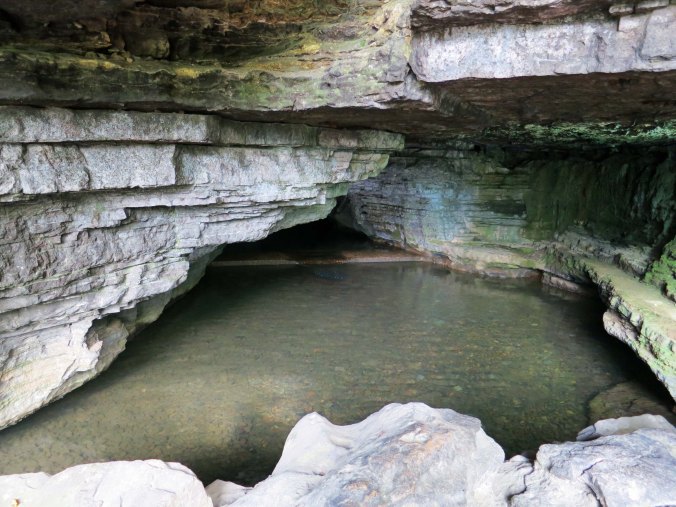
“It’s the water” is a frequent claim of those who produce alcohol. All Jack Daniel’s products start with water from Cave Spring shown here. The spring produces 800 gallons per minute. I should have it talk to our five gallon per minute well.
It’s amazing what you can learn when you are out bicycling around North America. For example, today I am going to talk about visiting the Jack Daniel’s Distillery in Lynchburg, Tennessee. It comes at the end of this post. But I thought I would start with a little whiskey math for fun.
Using American measurements, a barrel of Jack Daniel’s whiskey contains 260 bottles, or fifths, of whiskey. A fifth contains 17 shots. This translates into 4,420 shots per barrel. That’s a lot of drinking. But consider this: Our guide told us that Jack Daniel’s is the leading distributor of whiskey in the world. This means the company needs to have a lot in production at any given time. It also means they need to have a lot of whiskey in storage to allow for aging and for keeping up with demand.
The company can store 40,000 barrels on site. That used to be enough. No longer. The guide told us that Jack Daniel’s now has 11 buildings off site that store 60,000 barrels each. Doing the math, I came up with 700,000 barrels. Here’s the fun part— that comes to over three billion shots of whisky. Bottoms up!
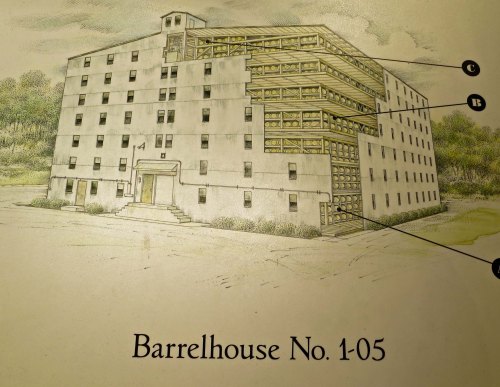
An illustration at the Jack Daniel’s Distillery showing one of its on-site barrel houses.
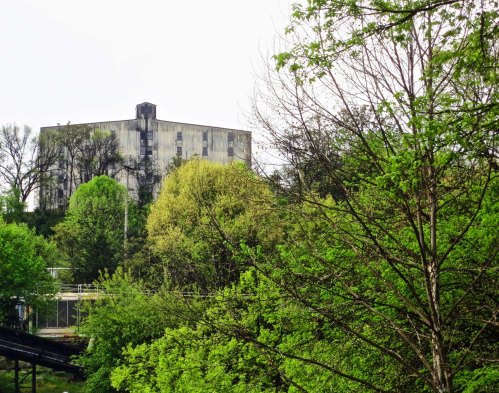
A view of the actual barrel house in Lynchburg.
I left you at Tishomingo State Park in northern Mississippi at the end of my last blog, recovering from my close encounter with the tornado. I could have used a shot or two of Jack Daniels then! But I had a ways to go to reach Lynchburg, including another 60 miles of the Natchez Trace. My Trace portion included a short 30 mile ride across the northwest corner of Alabama and another 30 mile ride into southern Tennessee where I picked up US Route 64. Along the way, I crossed over the Tennessee River, admired some blooming Dogwood, and stopped for a final view of the original Trace.

The Tennessee River as see from the Natchez Trace bridge in Alabama.

We were a little late to capture the Dogwood along the Natchez Trace at its best, but even here (on the left), it adds its etherial beauty to the scenery.

The Natchez Trace was used so much during its heyday of the early 1800s, it cut deep paths into the ground that can still be seen today.

I had travelled 359 miles on the Trace at this point, and only had another 10 miles to go. I would miss its beauty and tranquility.

My last sign on the Natchez Trace.
As I approached Route 64, a sign announced I would be following the Trail of Tears and heading toward David Crockett State Park. I had learned about Davy as a kid by watching Fess Parker’s 1955/56 television program at Allen Green’s house. I still remember the theme:
“Born on a mountain top in Tennessee— Greenest state in the land of the free— Raised in the woods so he knew ev’ry tree— Kilt him a be’ar when he was only three— Davy, Davy Crockett, King of the wild frontier!”
Being a want-to-be woodsman at the time, how could I forget such stirring words? Crockett was a genuine folk hero, however. In addition to his mythical knowledge of trees and killing bears at a young age, he served in Congress and adamantly opposed Andrew Jackson’s Indian Removal Policies. Disgusted with Washington politics, he headed off to Texas where he was killed at the Battle of the Alamo in 1836.
It was President Jackson’s Indian Removal Policy that led to the tragic Trail of Tears, another dark spot in America’s history. Of all the Native Americans in the East, the Cherokee were among the best in adapting to the coming of the Europeans. They had intermarried with settlers, become farmers, and even created their own constitution for self-government. But none of this was enough. The American settlers on the frontier wanted their land.
Jackson and Congress aided them in their efforts by insisting that the Cherokee move. To achieve this, the military gathered the Cherokee into stockades and force-marched them 800 miles to Oklahoma. The journey was particularly hard on infants, children and the elderly. An estimated 4000 died along the way, nearly a fifth of the Cherokee population. It was because of this, that the Cherokee named the route the Trail of Tears.
On a much less significant level, I shed a virtual tear or two myself on leaving the Natchez Trace. I was leaving the commercial-free tranquility of the National Parkway to return to the world of crowded roads, fast-moving traffic, and ubiquitous 18 wheelers. I would also be dodging my way through towns and cities. On my way to Lynchburg, these included Lawrenceburg, Pulaski, and Fayetteville. Although the distance bordered on 90 miles, I figured I could make the trip in a long day.
A torrential downpour outside of Pulaski persuaded me otherwise. It wasn’t enough that the rain was flooding the road 3-5 inches deep in places; I managed to get a flat. I pulled off the highway, retrieved my waterproof emergency blanket, put it over the top of me, and proceeded to fix the flat, while somehow getting 100 gallons of water down the back of my neck. (I am exaggerating, of course. It was only 98.) Although I was traveling east, my sense of humor went south. I grabbed a motel room in Pulaski and dried off while watching reruns of reruns on TV. Unfortunately, Davey Crockett wasn’t included.
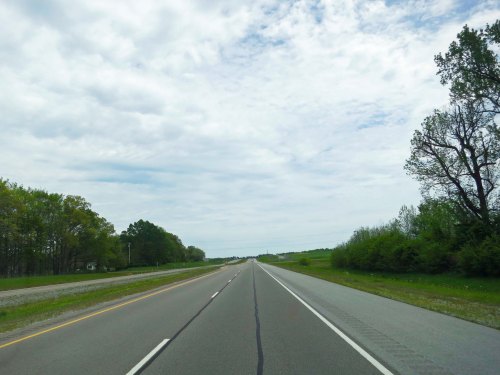
US Route 64. As I have noted earlier, many of the two lane roads I travelled on in 1989 have become four-lane highways today, often rerouted. Nice shoulder, though.

Limestone walls, such as this on US 64, are common on Tennessee Highways.

I have always found old barns interesting because of their character and photogenic quality. There were several along US 64.

Another example.

In Fayetteville, I left Route 64 and picked up Tennessee 50 toward Lynchburg. Note the old windows in the red building. Some have been bricked in.
I easily made it into Lynchburg the next day and, in fact, biked on to Manchester. I did make a quick detour into the Jack Daniel’s Distillery, however. Peggy and I made a much more thorough visit on our route review this spring and were given an excellent tour of the facility. Here are a few things we learned.
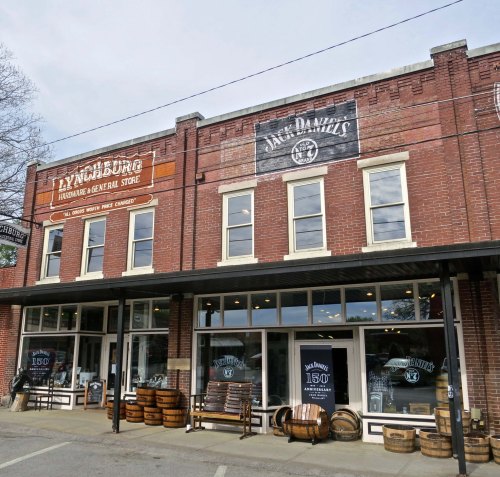
A view of the “Company Store” in Lynchburg, Tennessee where you can pick up used whisky barrels for planters.
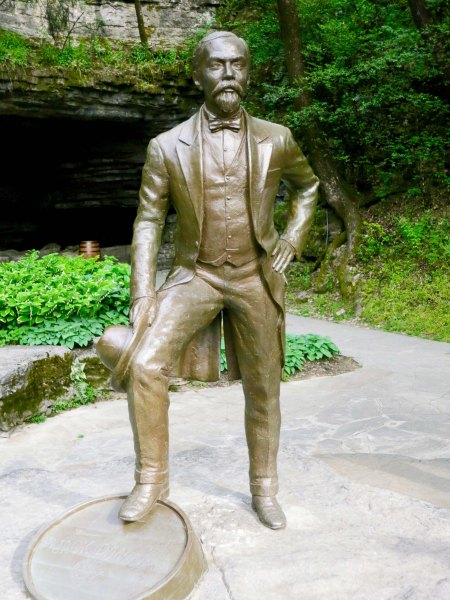
A sculpture of Jack Daniel with his foot resting on a barrel. The statue was located on a rock. It’s title was Jack Daniel on the Rocks. Cave Spring is behind him.
Jack was either born in 1846, 49 or 50. People are still sorting that out. At a relatively young age, he was taken in by a minister and taught how to make whiskey. Does this make it God’s will? (I know, I am going to be struck down. BTW, don’t expect to be served any Jack Daniel’s in local restaurants. Lynchburg is located in a dry county.) By 1866 or 1875, Jack was operating his own distillery and using water from Cave Spring shown at the top.

A view of the creek leading out from Cave Spring. Again, note the lime. It adds interesting qualities to Jack Daniel’s, and also serves to take out the iron that would give the whiskey a bad taste.

The creek as it makes its way through the distillery.

The primary ingredients for Jack Daniel’s. These are ground up, water from Cave Spring is added to make mash, and then the concoction is boiled. It is then put into a fermenting vat where yeast is added creating alcohol. The alcohol is then distilled and begins it journey through ten feet of sugar maple charcoal. We were taken on a tour where we witnessed the process but weren’t allowed to take any photographs.
The whiskey would be a bourbon except for the fact that it is filtered through 10-feet of sugar maple charcoal at a drip-drip rate, a process that takes a week for the drop to make it from the top to the bottom. Its journey removes impurities from the alcohol. The whiskey is then put into oaken barrels that have been scorched on the inside and is aged for four years. The barrels are made on site and only used once. Tasters determine when the brew is ready. Whiskey from several barrels is blended to produce the distinctive Jack Daniels taste such as that found in Jack’s most famous blend, Old No 7.
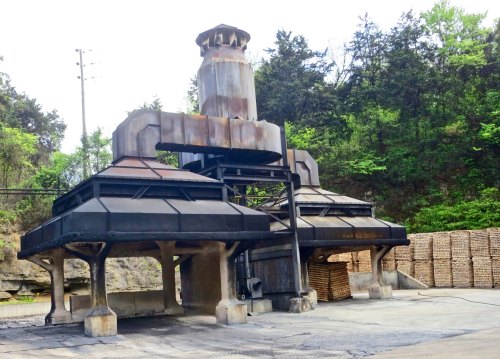
Rick oven for turning the sugar maple wood (ricks) seen here into charcoal.
The company uses the 1866 date for its beginning, thus making 2016 its 150th Anniversary. To celebrate, it has produced a special whiskey called Sinatra Select. What, you say? Turns out that Frank was a great friend of Old No. 7. He always had a bottle within easy reach, whether he was singing in concert or on a TV special, flying on an airplane, visiting with friends, or in almost any other conceivable situation. He was even buried with a bottle.
It is possible to obtain a bottle of single barrel select whiskey that hasn’t been blended. In fact, Jack Daniels wants you to buy it by the barrel for $10,000 each. The Master Taster or the Master Distiller will personally meet with you to provide a tour and help you in your selection. The company will even put your name up on its Single Barrel Wall of Fame. I walked around and checked out who was buying barrels. I found some particularly amusing.

If you choose to plop down $10,000 and buy a barrel, it will be bottled up for you. You also get to keep the barrel! Our guide uses the display as a leaning post. On the right, behind the bottles, you can see the Wall of Fame for people who have purchased a barrel— or more.

The Marines from Camp Pendleton seemed especially thirsty. Each barrel on the plaque represents a barrel they purchased. It’s amazing how much a ‘few good men’ (and women today) can consume.
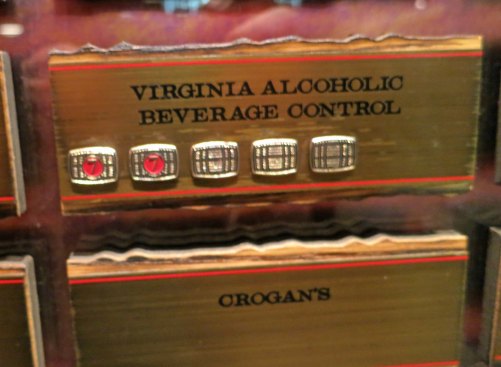
This has to be all about making sure that Jack Daniels meets state standards, right. A lot of testing has to go on…

Okay, here’s my last photo for today. I don’t get it. The majority of folks in Utah’s government, as far as I know, are Mormons— and Mormons don’t drink! Hmmm.
NEXT BLOG: I visit some beautiful waterfalls. An 18-wheeler misses me by about 6-inches while going over 60 and teaches me how to fly. I have a nose to nose confrontation with a humongous dog. We end the day in Dayton, Tennessee where man took on monkey in the infamous Scopes Trial.





 Wandering through Time and Place