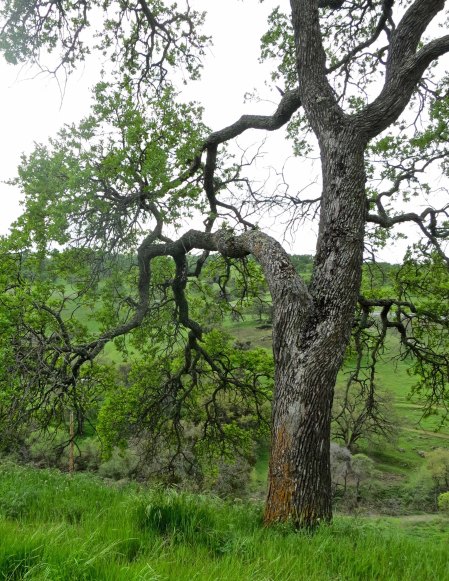
My plans were to start my trip by cycling down Highway 49 through the foothills of California, which are beautiful in the spring.
It had rained much of the night, big buckets full, with a smattering of thunder and lighting thrown in for good measure— all of which made me thankful for my lumpy but cozy bed in the Old Well Motel. I rallied at 6:30. The clouds were breaking up and the sun was peeking through. It was good day for biking. More importantly, I knew a cup of hot, steaming coffee was waiting next door at the Old Well Café.

Ten people would constitute a crowd in the Old Well Cafe, but several Hollywood stars of yore had stopped here to eat.
“Did you find the treasure?” the waitress inquired with a wink in her voice. She had told me the story the night before. According to legend, a handful of bandits had buried close to $80,000 on the property before being hunted down and killed in a shoot out. “No,” I had laughed, “but I did find a good night’s sleep.”
Tales of lost treasure are abundant in gold country. Some of them may even been true. Growing up in Diamond Springs, 13 miles from where gold was discovered at Coloma, I had often heard such stories. Millions had been taken out of the ground, initially with gold pans and sluice boxes, then with powerful water canons, and finally from deep, hard rock mines. The Kennedy Mine, located a few miles away, measures some 5912 feet in depth, making it one of the deepest mines in the world. It is hardly surprising that some of the gold would have gone astray.
There were plenty of outlaws to help. The most famous was Black Bart, the gentleman bandit. Always well-dressed, he robbed stages on foot since he was afraid of horses. Targeting Wells Fargo coaches, he would politely request that strong boxes be handed over. Since his requests were backed up by a shotgun, stage drivers were quick to comply. On occasion, Bart would even leave a poem behind. Here’s a sample:
I’ve labored long and hard for bread, For honor, and for riches,
But on my corns too long you’ve tread, You fine-haired sons of bitches.
Maybe not great poetry, but it managed to get Wells Fargo and the media excited.
I made my way through a second cup of coffee, putting off the inevitable moment when I would climb on my bike and start up the steep hill that was lurking just outside the door. Other travelers had lingered here as well. Notes of appreciation from Bob Hope and Phyllis Diller were on the wall. I procrastinated for a bit longer by reading them. Finally, out of excuses, I stepped outside and strapped on my helmet. The day had begun.
My goal was another short day. As you may recall, I had done nothing physically to prepare for my journey. I was conditioning on the road, whipping my fat cells into shape. The first day had been 18 miles, my second was supposed to be around 30, the third 40 and so forth. By the end of the first week I was hoping to be riding somewhere between 60 and 70 miles each day.
“The best laid plans of mice and men often go astray…” –Robert Burns
My problem, I quickly learned as I pedaled out of Drytown, wasn’t that I was bicycling 30 miles my second day out (what kind of a big deal is that?); it was that I was biking down historic Highway 49. The foothills of California don’t understand flat. They go up, and they go down… period. Make that steep up and down. My fat cells were screaming after 100 yards. By 200 yards they were so loud I was convinced that people driving by could hear them. I dropped down in gears until I didn’t have any more to drop into. I climbed out of the saddle. I was travelling so slowly that if I traveled any more slowly I was going to fall over.

The foothills of California may be beautiful in spring, but they also make for steep cycling— any time of the year.
This sign really wasn’t pointed this way, but it is how I imagined it.
But enough on that. I made it over the hill and coasted down to Amador City. I made it over the next hill and coasted down to Sutter Creek, one of my favorite towns along Highway 49. I had travelled all of five miles. It was time to celebrate. It was time for breakfast. “Yahoo!” the fat cells shouted in unison. You may have heard them.
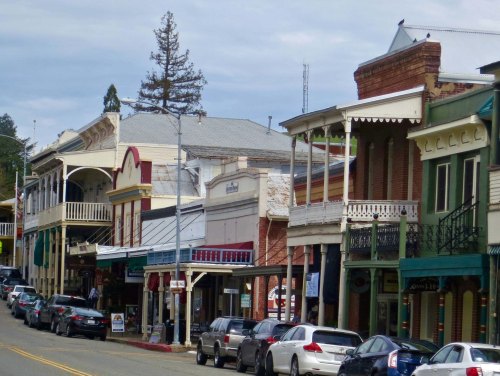
Many of the old gold rush town along Highway 49 have done a great job of maintaining their early buildings. Sutter Creek is a good example.
The cells did little more than grumble as I cycled out of Sutter Creek and up another hill. They were too busy scarfing down bacon, and eggs, and buttered toast. But then my right knee started to whine. Screaming fat cells are one thing; a whining knee another. It can be serious. By the time I reached Martel, at the top of the hill, I had a decision to make. Highway 49 promised more hills, lots of them, and I had 9,974 miles to go. I didn’t want to mess up my knees. So I turned right. At 26 miles into my trip, I changed my well-planned itinerary. I was headed for the Central Valley of California, which was as flat as the foothills were hilly.
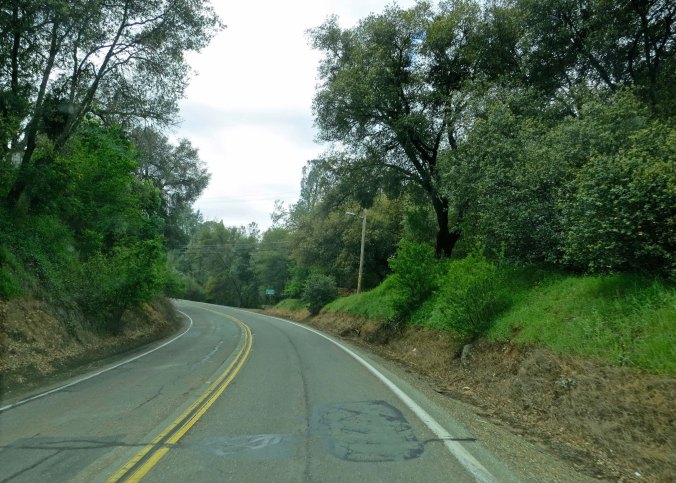
The road out of Sutter Creek. There will be lots of street shots in this series, since this was my world for the six months I bicycled. Here’s a bicyclist’s perspective: steep hill, narrow/nonexistent shoulder with no where to ride or escape, rough road, and curve coming up. There is danger if someone tries to pass you (you may want to ride out in the road to force motorists to ride behind you until you get beyond the danger).

Decision time. Do I ride on down Highway 49 to Jackson and beyond? Or do I cut right and ride toward Stockton and the Central Valley?
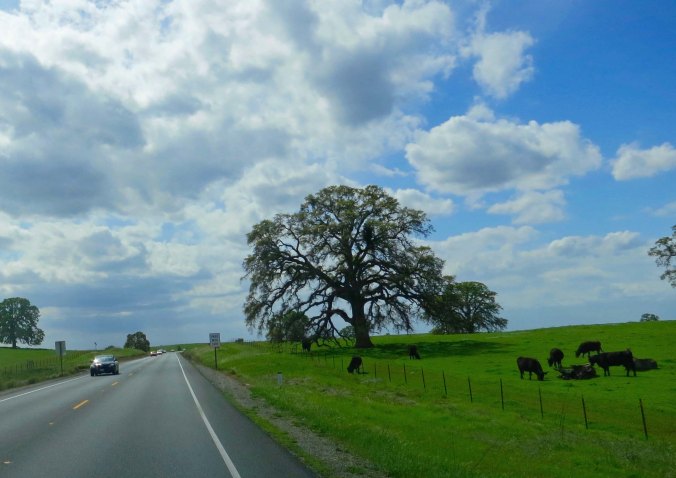
The decision, heading for the flat lands.
Getting there was 90% of the fun. It was mainly downhill. About 35 miles from Drytown, I reached the small community of Clements, a perfect distance for the day— except the grocery store where I had planned to shop was closed. Boy did that create a dilemma for the fat cells. They could go hungry or cycle on. I decided that the Calaveras River, another ten miles, would make a great camping spot— except the Calaveras turned out to be little more than a mosquito-infested ditch. Are you beginning to see a trend here? I went off route for several miles looking for a motel— except I couldn’t find one.
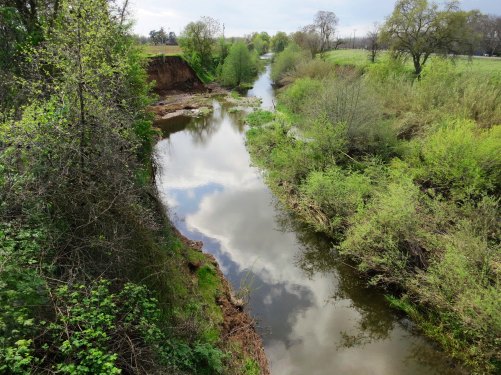
I could have stopped on the Mokelumne River near Clements, which still had water, but I cycled on to the Calaveras, which didn’t.
My fat cells and my legs were not happy. But they were having a picnic in comparison to my butt. Any bicyclist will concur: few things can match the pain of an out-of-shape abused tail at the beginning of a long bike ride. You don’t get off your bicycle seat, you peel yourself off. And you don’t sit down on your seat. You gently lower yourself and then shoot a foot up in the air from the agony. So there we were: me, my butt, my legs, and my fat cells, unhappily faced with another 20 miles of cycling into the town of Escalon, hoping beyond hope there would be a motel.
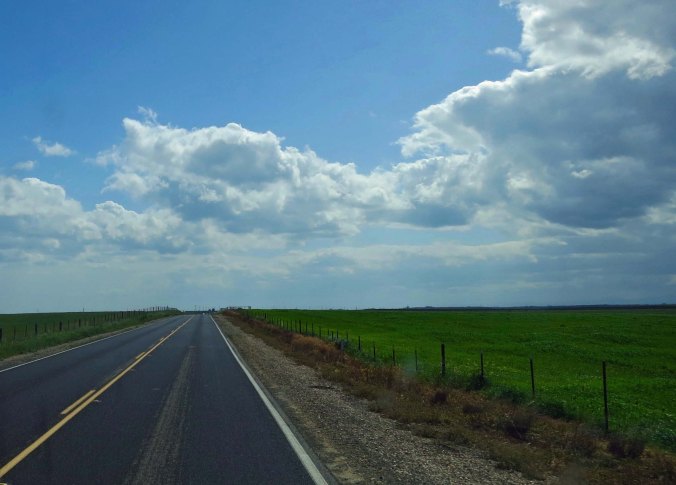
The long road to Escalon, with a headwind.
I made it. What more can I say. I turned a 30-mile day into a 67-mile day my second day out. And there was a motel, a beat up old motel, a barely standing old motel, the most beautiful motel I have ever seen. I cycled across the highway to the office… and couldn’t get off my bike. My right leg refused to function. It had gone on strike. I couldn’t get it over the bike. There was nothing left to do but laugh. I finally managed the trick by lowering the bike.
The room made my room at the Old Well Motel look like the Taj Mahal. It didn’t matter. Nothing did. I stripped and headed for the shower, hardly stopping. And made a mistake. I glanced in the mirror. Moby Dick, the great white whale, was staring back at me. Ahab would have taken one look and grabbed his harpoon. What in the world was I doing?
It was a three-beer night. I declared the next day a layover.
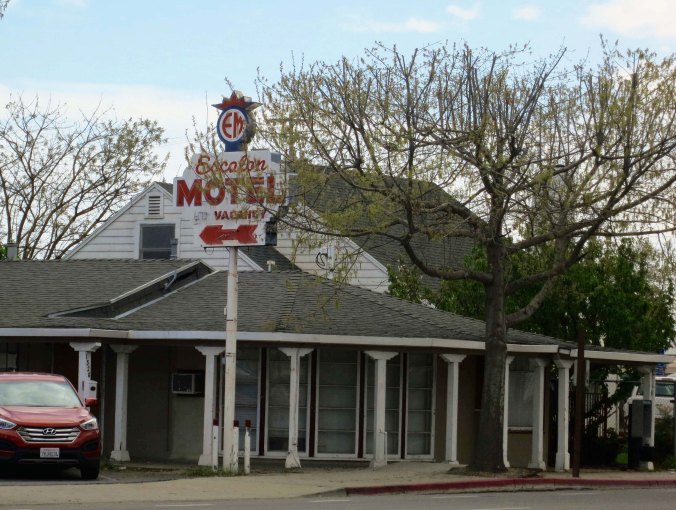
The Escalon Motel as it looks today. Peggy and I stopped for a photo. Several restaurants and a Starbucks are now located nearby and the motel looked like it had received a recent paint job. My ‘driver’ was rewarded with a Grande Caffe Latte.
NEXT BLOG: Four days of cycling through the Central Valley. I discover a great air museum, find Bone hidden in my panniers, meet far too many dogs that want to eat me, learn something about the loneliness of the long distance bicyclist, and ride by a prison that tells me I can’t pick up any hitchhikers. Since mass murderer Juan Corona and Charles Manson are housed there, I decide it is a good idea.
 Wandering through Time and Place