
Buried by a pyroclastic flow of volcanic rocks in 79 AD, Pompeii provides one of our most detailed records of what life was like in the Roman Empire.
Their lives would have been interrupted by a series of small tremors. It had to be worrisome; seventeen years earlier Pompeii had come close to being destroyed in a massive earthquake. The city was still being rebuilt. Possibly the residents woke on the morning of August 24, 79 AD and looked fearfully at the restless mountain that loomed over them… and then went on about their chores.
Everything ended at 1:00 PM.
Mt. Vesuvius exploded in a massive eruption sending tons of ash, gas and rocks spewing 20 miles into the sky and forming a dense mushroom cloud. Winds quickly carried the ash into Pompeii, turning day into night and dreams into nightmares. The majority fled, escaping by whatever means available. Those who stayed behind died… suffocating at first under the blanket of thick ash and ultimately, the next morning, being buried alive under a pyroclastic flow of molten rock and gas that flew down the mountain at speeds close to 100 miles per hour.
Viewed from an archeological perspective, history’s tragedy has become today’s blessing. The molten rock and ash that covered Pompeii, also preserved it, providing historians with their most complete view of what life was like in ancient Rome. Over the next week, I will be blogging about our recent trip to Pompeii and sharing photographs of this remarkably preserved city.
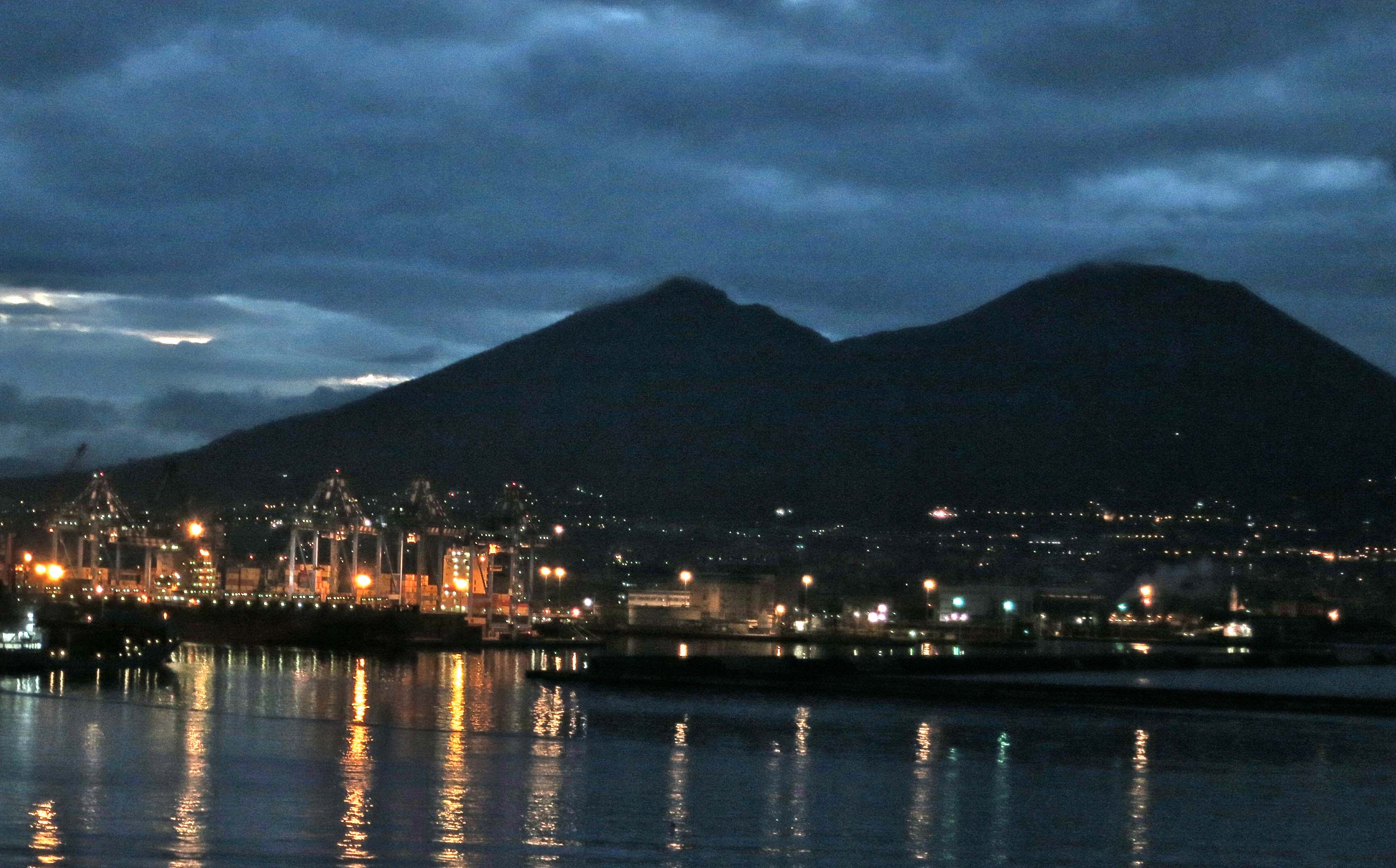
Our early morning arrival at the seaport of Naples showed Mt. Vesuvius looming over the city on a rainy day.
While the majority of people living in Pompeii escaped, the remains of over 1000 have been found. By carefully pouring plaster into impressions left by the bodies buried under the pyroclastic flow, archeologists have created casts of these bodies. Several of these casts are on view in Pompeii.

Plaster cast of body buried under pyroclastic flow of volcanic rock in Pompeii.

This plaster cast of a body found in Pompeii looks like the man merely went to sleep.

This body cast from Pompeii suggests to me that the person was gasping for breath.

Several of the body casts in Pompeii were in storage.
Today, a number of spectacular views of Mt. Vesuvius can be seen from Pompeii. The mountain is approximately four miles away.

Mt. Vesuvius rises above the Temple of Jupiter in Pompeii.
 Wandering through Time and Place