Through the Heart of the Grand Canyon by Raft: Mile 0-80… The Great River Series #2

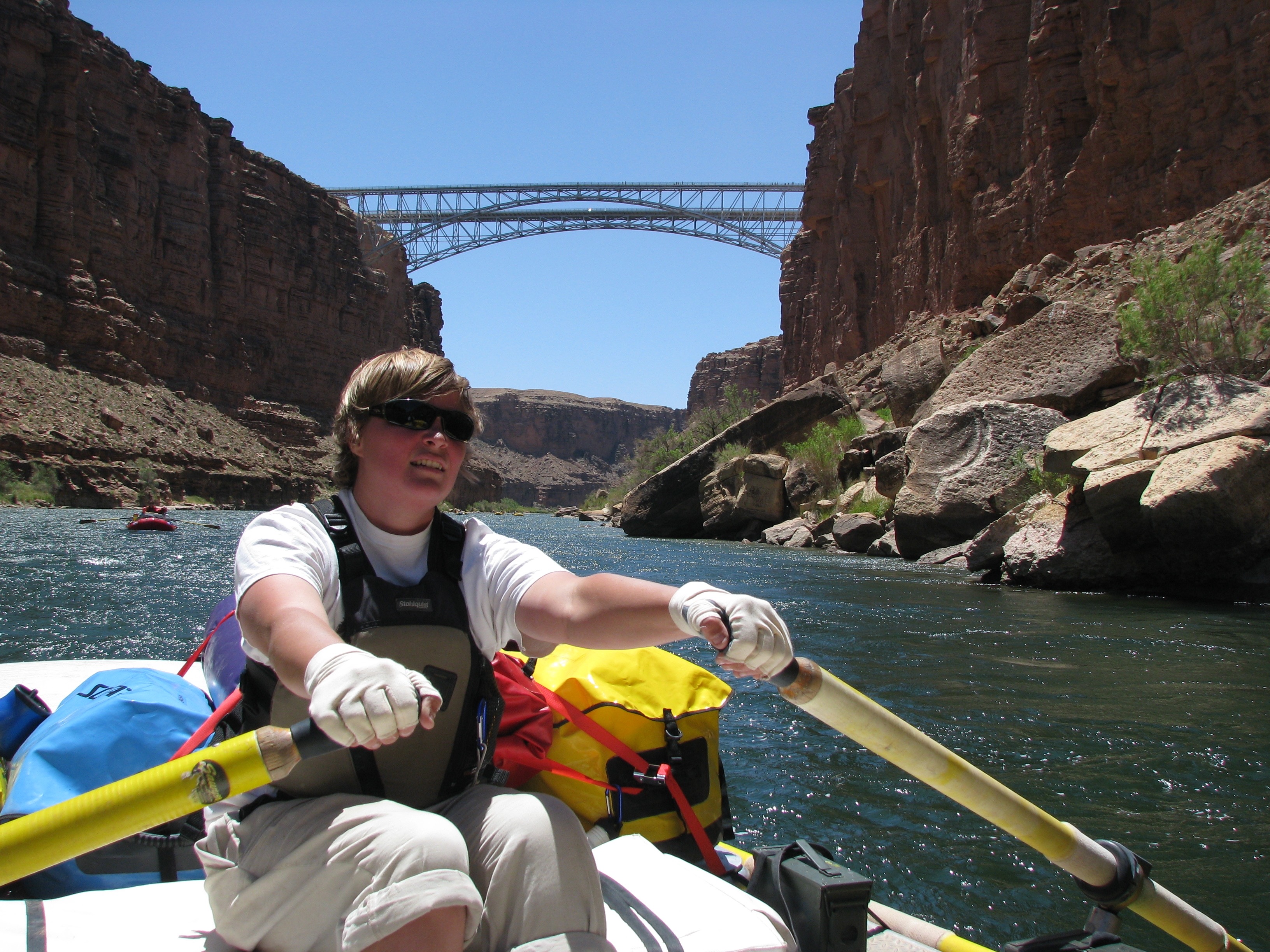
Megan rows toward Navajo Bridge at mile 4. It was our first notable landmark. Actually there are two bridges: an old one competed in 1929 to replace Lee’s Ferry and a new one finished in 1995 to accommodate modern traffic. The old one now serves as a a foot bridge. Crossing the bridge is how you get to the North Rim of the Grand Canyon from the South Rim. Or vice-versa. (Photo by Don Green.)

For those of you who like facts, here are a few about the river: The Colorado is 1,440 miles long from its headwaters in the Rocky Mountains to its mouth in the Gulf of California. I’ve backpacked through the area where it originates and kayaked in the Gulf of California. It ranks 6th in length among U.S. rivers. At its widest point it reaches 750 feet. At its deepest, 90. It flows along at 3-4 miles per hour but may reach 15 miles per hour in rapids. Given that the water comes out of the base of Glen Canyon Dam, it’s cold— an icy 46 degrees Fahrenheit during the upper part of our trip. Washing off in it usually elicited screams. Over the course of our adventure, it dropped 1700 feet in altitude, an average 8 feet per mile. That’s 25 times the average of the Mississippi River! Thus, the 250 rapids in the Grand Canyon.

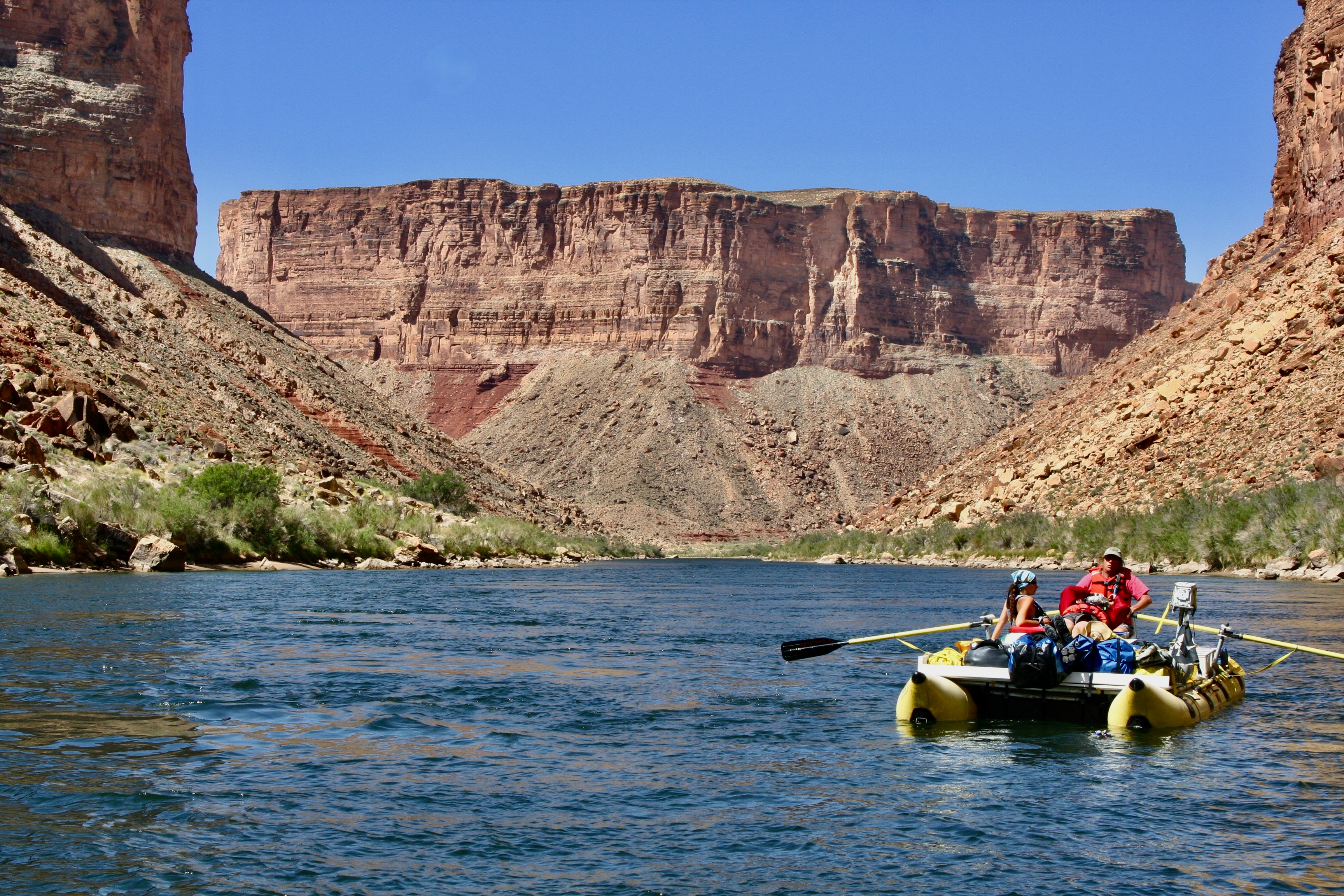
As we floated down the river, we were awed over and over by the surrounding beauty! The pontoon boat, BTW, is rowed by Steve Vandoor. Steve’s boat is rigged to carry groovers (honey buckets), which is something of a specialty of Steve’s. While it might seem strange, it guarantees that he is invited to join river trips on a regular basis. Does this mean Steve is groovy? More on groovers later.
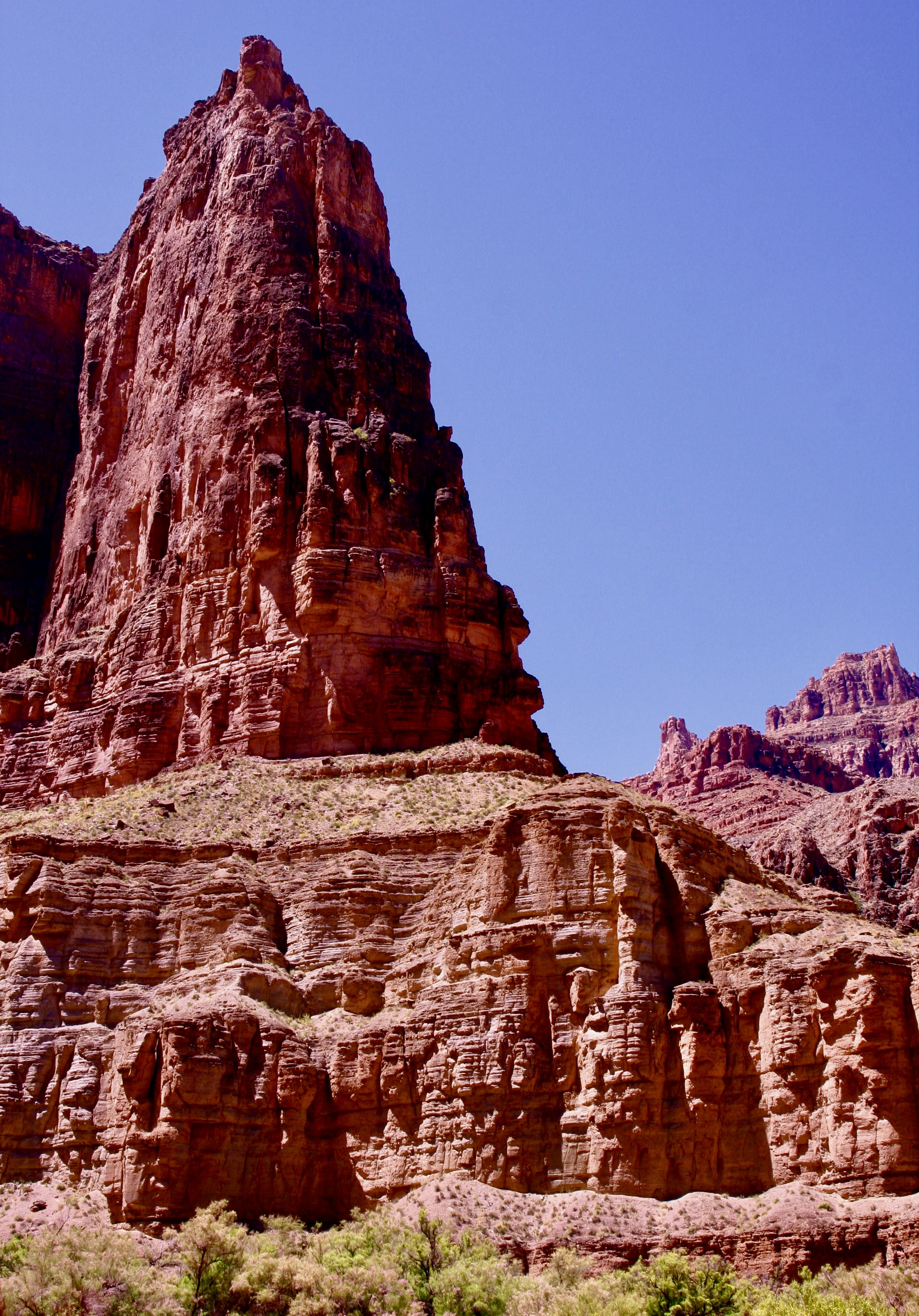
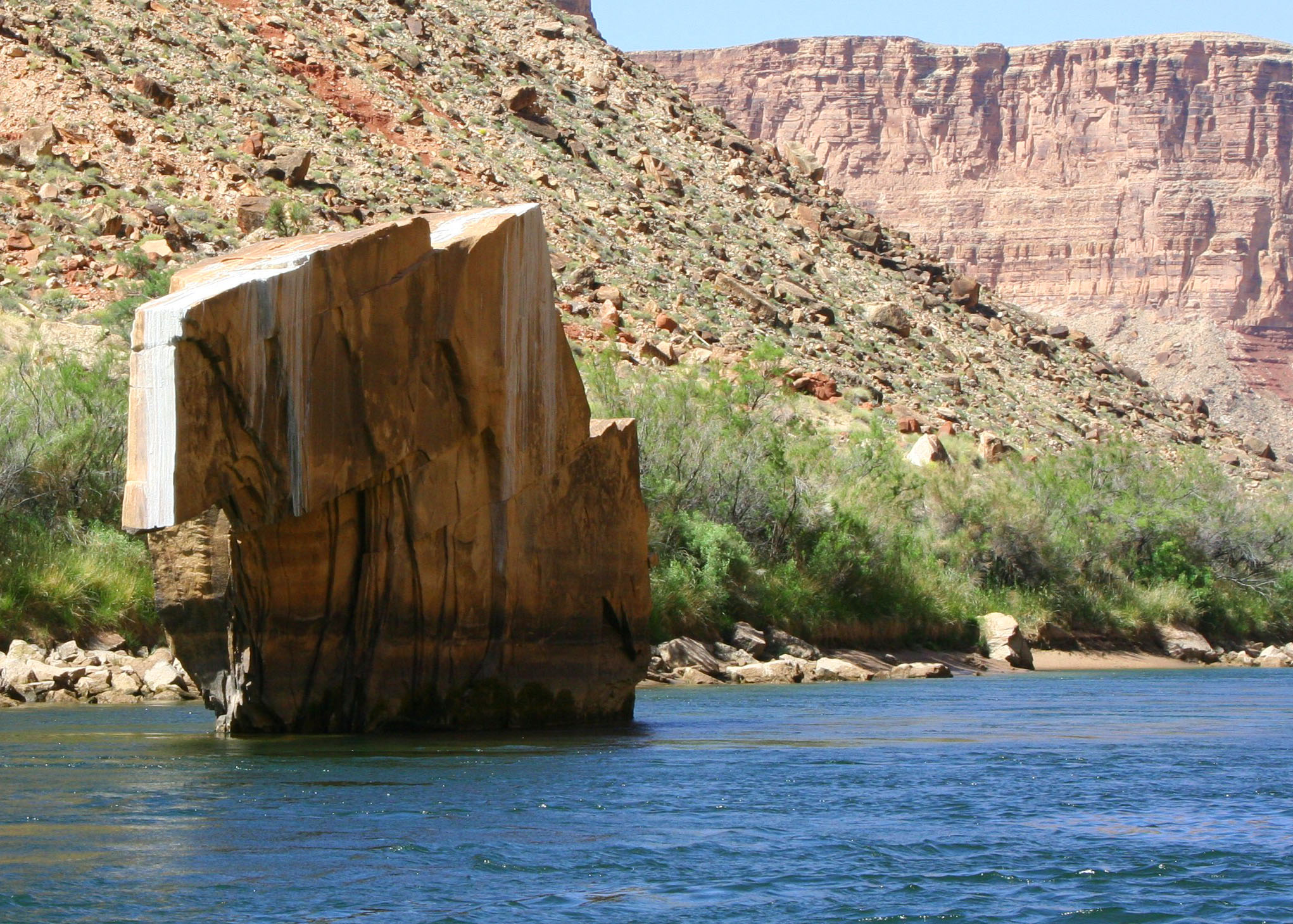
This huge slab of Coconino sandstone at mile 10 once stood hundreds of feet above the river before it came tumbling down and stuck— standing up. It’s a reminder of the constant geological forces involved in creating the canyon. As the river digs deeper, erosion brings rocks crashing down, widening the canyon. It’s also a reminder that one wouldn’t want to be anywhere near when it fell!
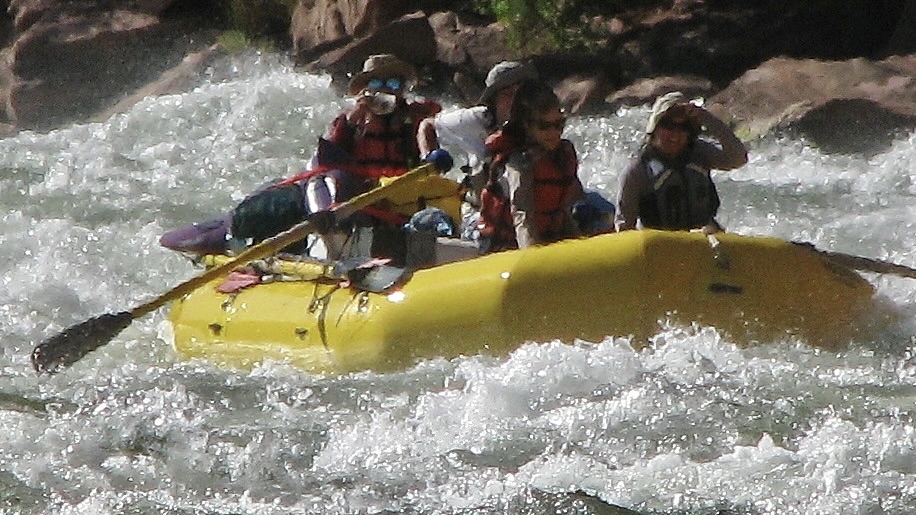
This was one of our first rapids. It’s where Tom lost an oar and ended up rowing heroically to get us out. Afterwards was one of the first times I ever heard him be totally silent. (Photo by Don Green.)
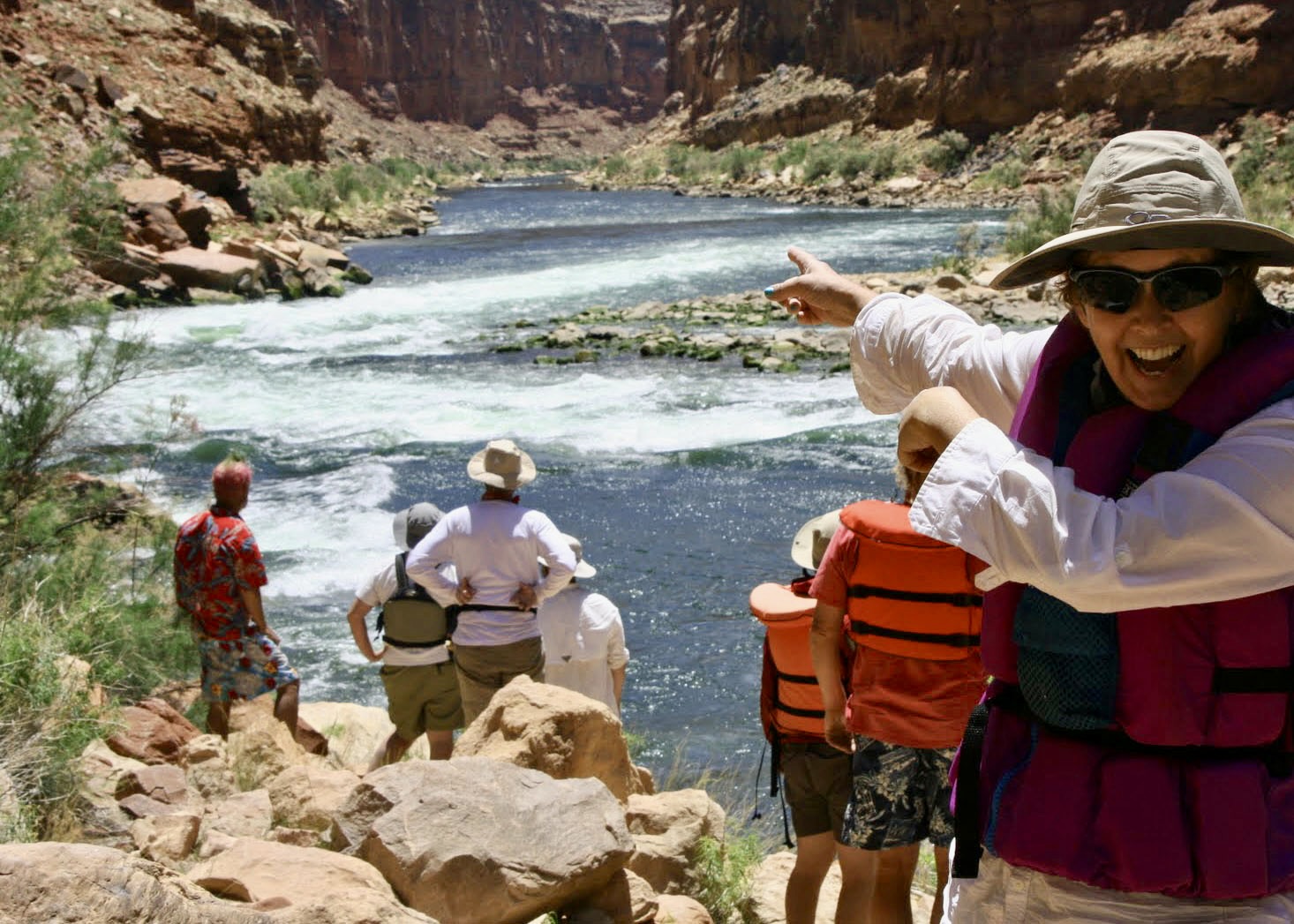
Major rapids like House Rock were always scouted by the most experienced boatmen. Peggy is obviously quite excited. “Listen to the roar, Curt!” I was thinking more about the ‘hole’ that we might be sucked into. The boatmen plot out the best way to avoid such obstacles. They were amazingly good.
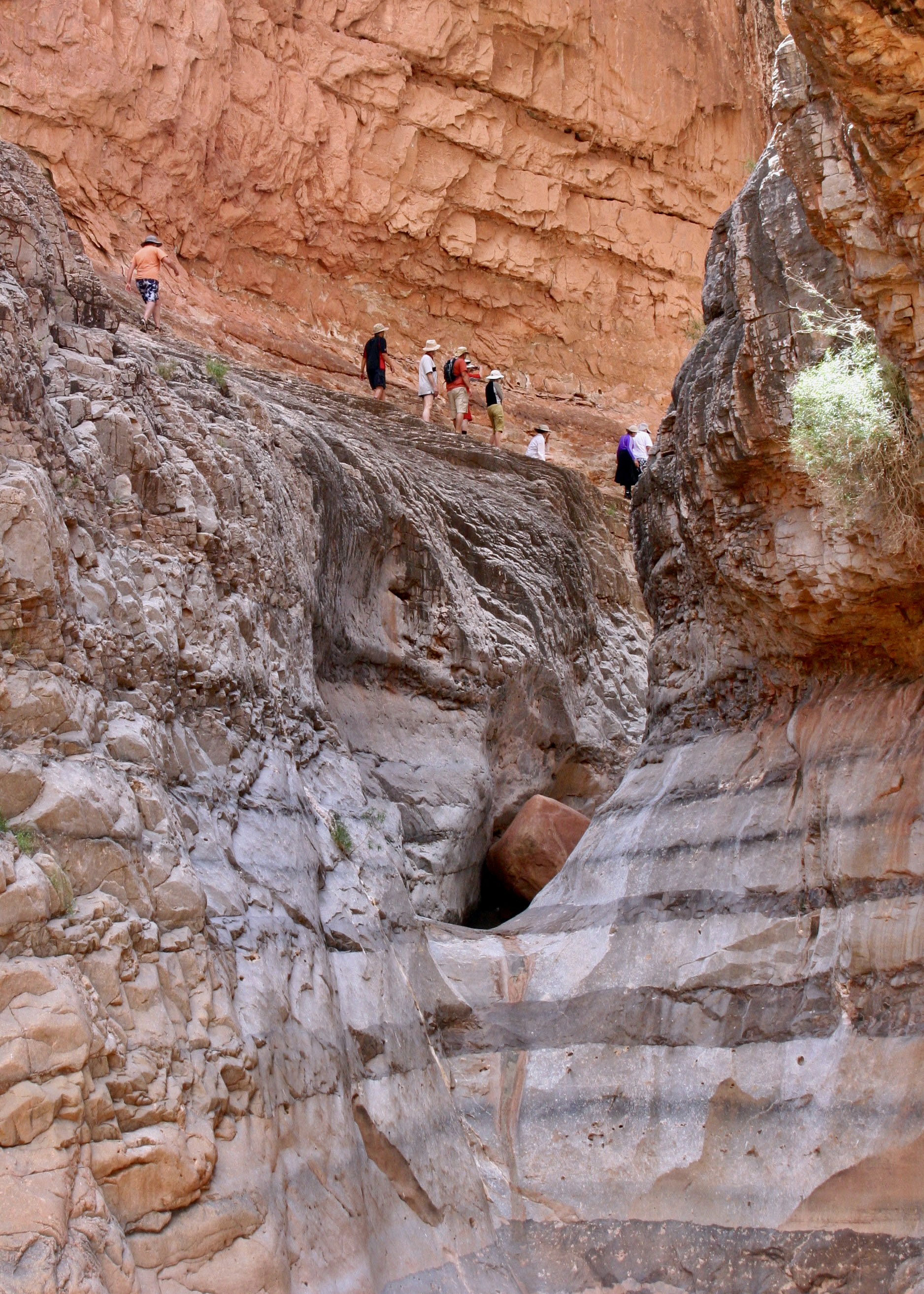
In addition to our raft trip down the river and camping, Tom had planned several excursions. This is in Silver Grotto, which was quite beautiful. I’d chosen to stay in camp for photography and a little ‘Curt Time.’ See the slot canyon. Tom had them hike to the upper rim and then slide down some 20 feet to a small pond in what was close to a straight drop. The rocks were wetted to assure a smoother slide. Everyone survived and had fun, but it did make me wonder about the ‘safety’ part of my responsibilities.
I discussed the ‘thrill ride’ with a raven that came to visit me and perched on a boatman’s seat. It told me she would share her opinion for food. I declined. I’m pretty sure she would have said, “It’s easy. Just fly.”
While the major rapids provided for a minute or two of pure adrenaline rush for both boatmen and passengers, floating on calm waters was a much more common experience for us.
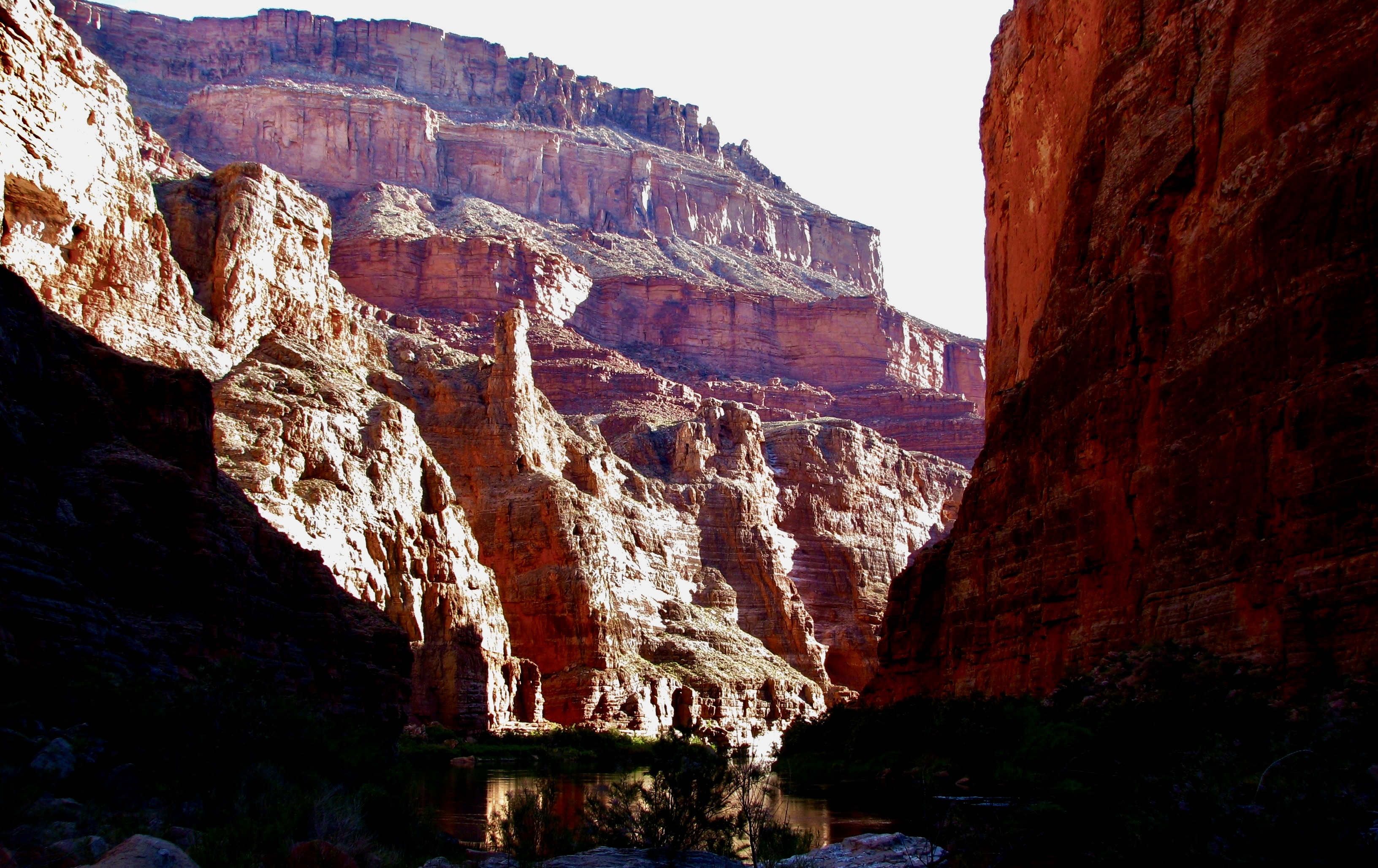
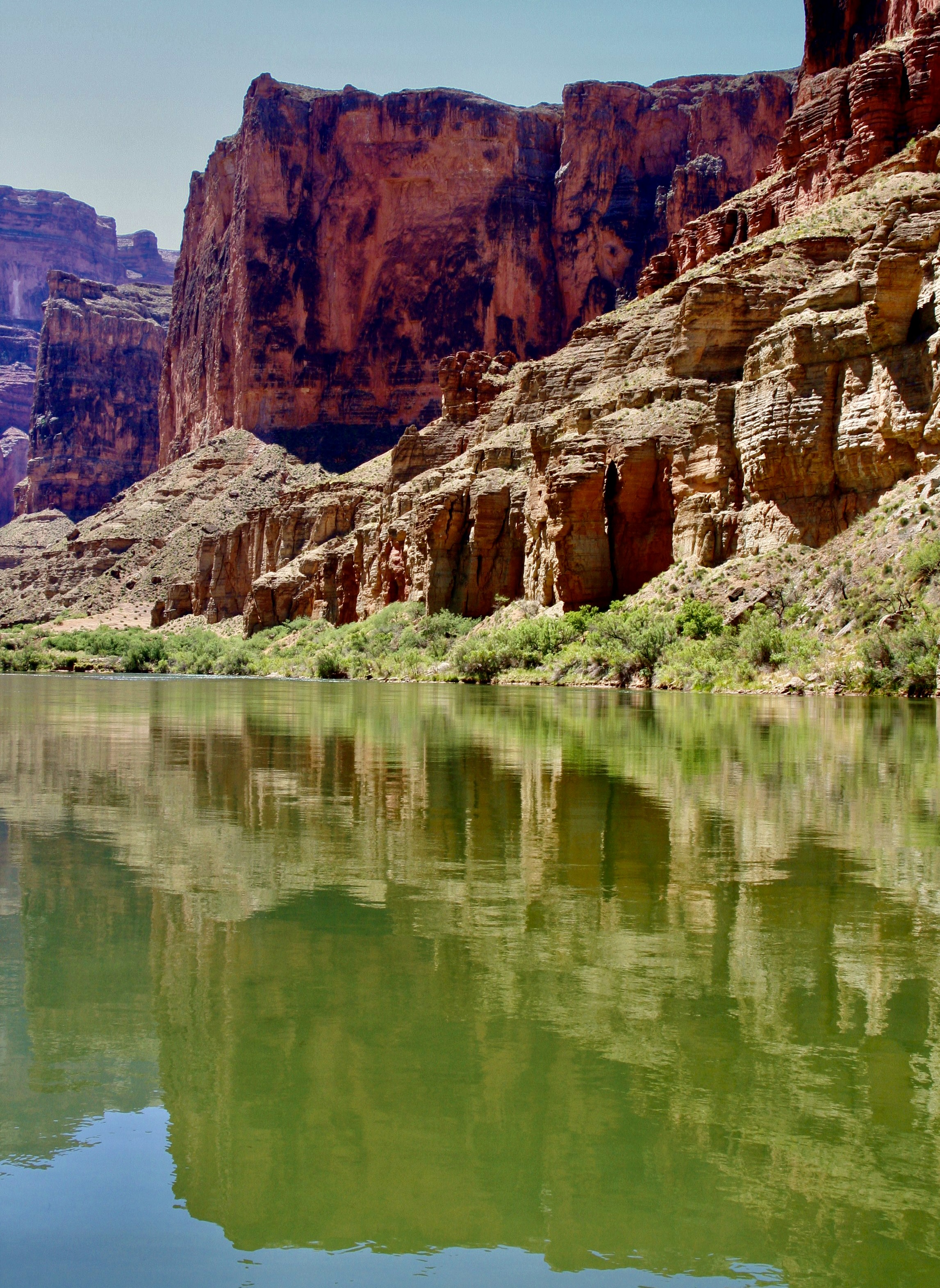
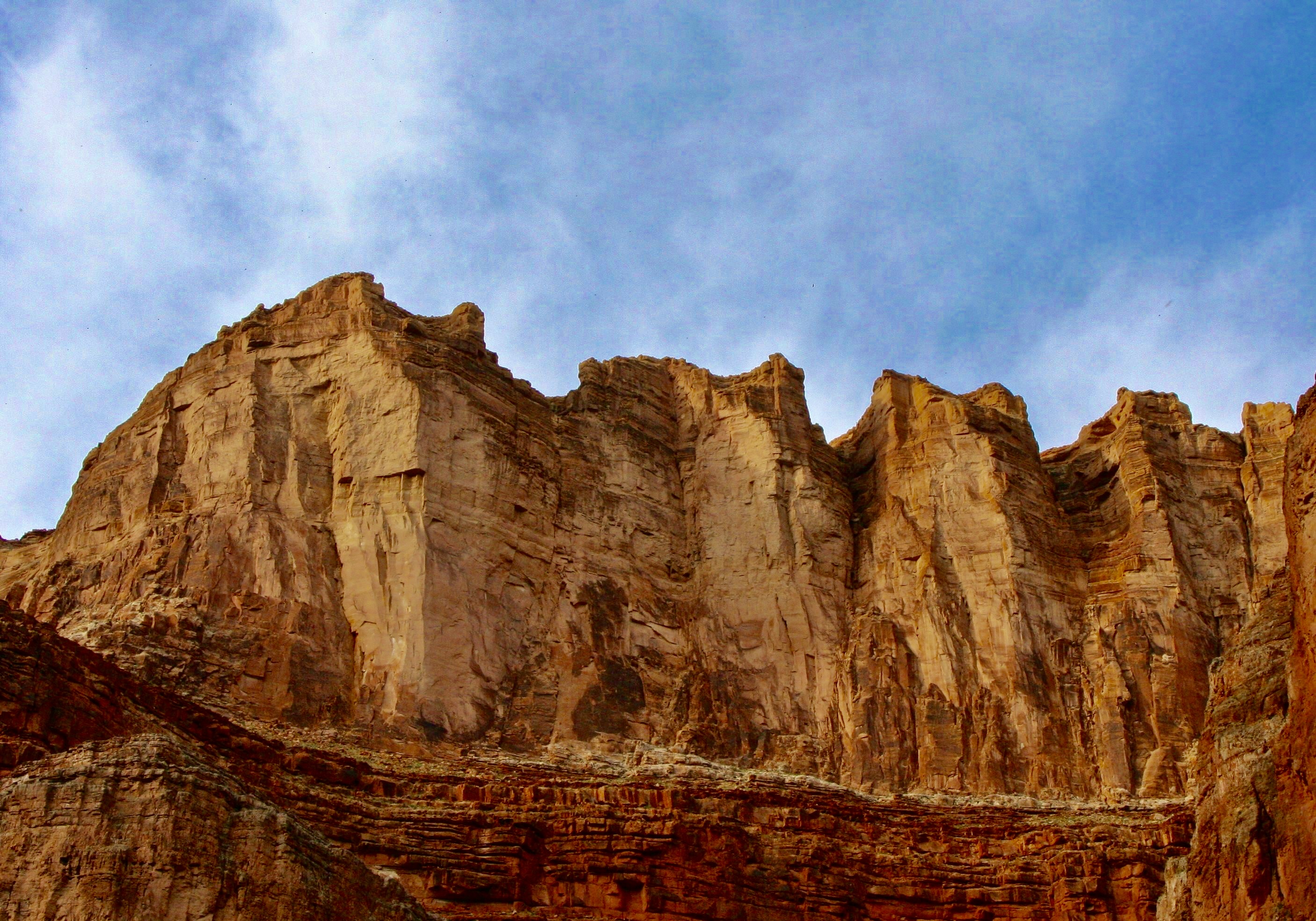
Every corner brought a new marvel such as this towering cliff. Check out our boats at the bottom for perspective.
Vasey’s Paradise at mile 32 is one of the most beautiful waterfalls we saw on our journey. It flows out of what is known as the Redwall, one of the Grand Canyon’s most prominent features.
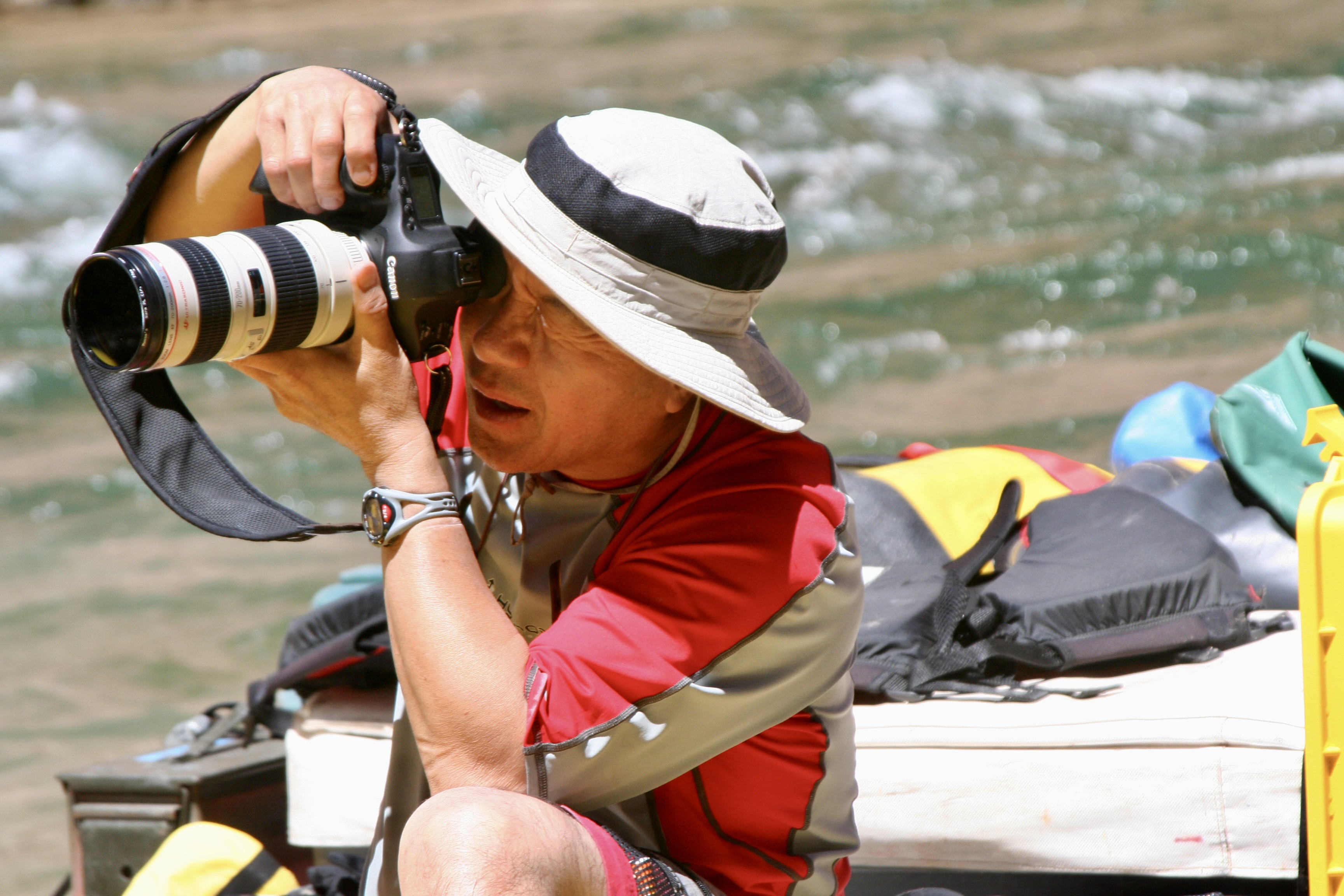
As you might imagine, we all took photos. This is Leland Lee, who, in addition to being a talented photographer, is a periodontist.
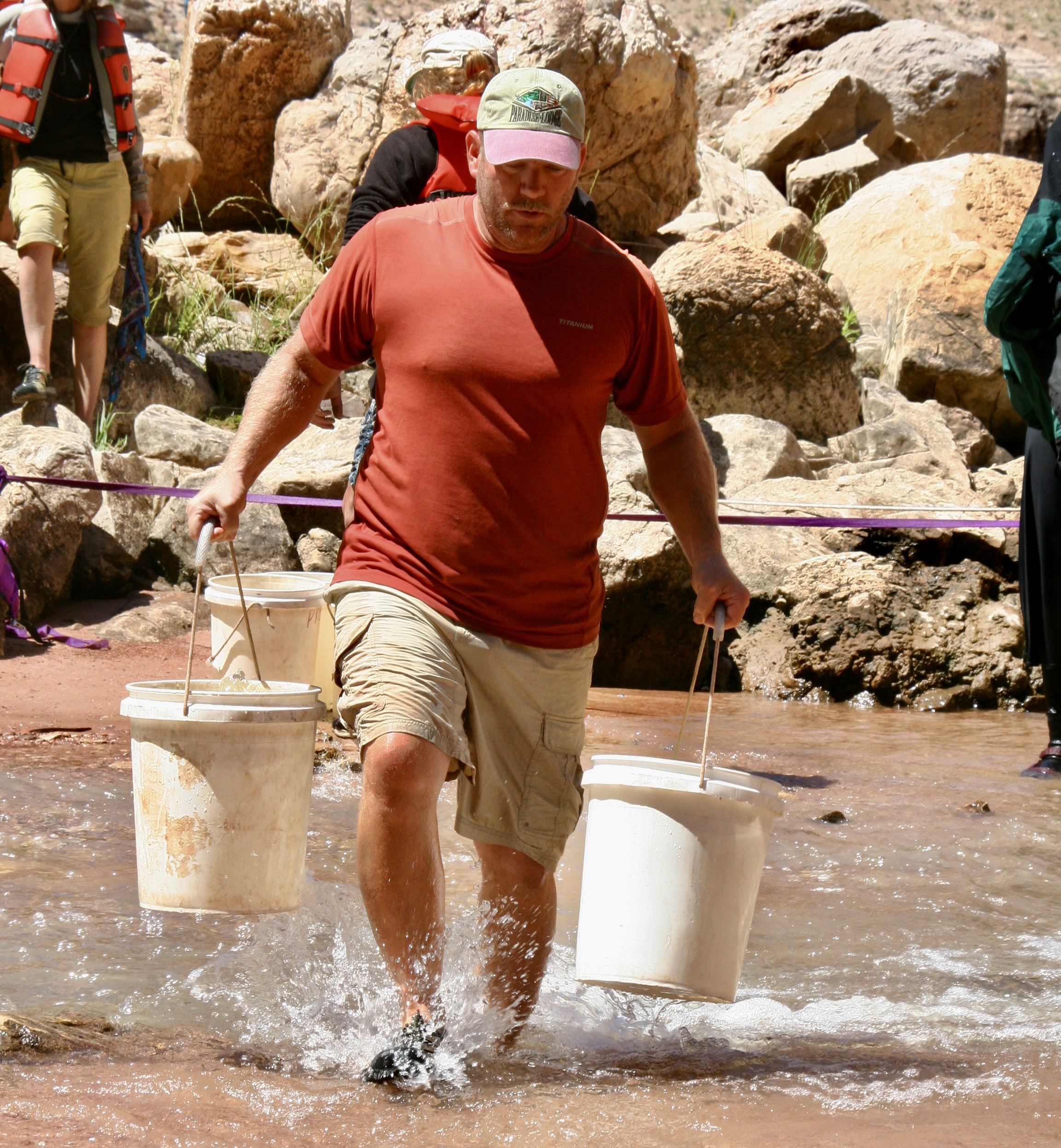
While we relaxed and enjoyed the falls, Jamie gathered the cold fresh water for our drinking and cooking needs. Gathering and pumping water through filters to purify it was one of our daily chores.
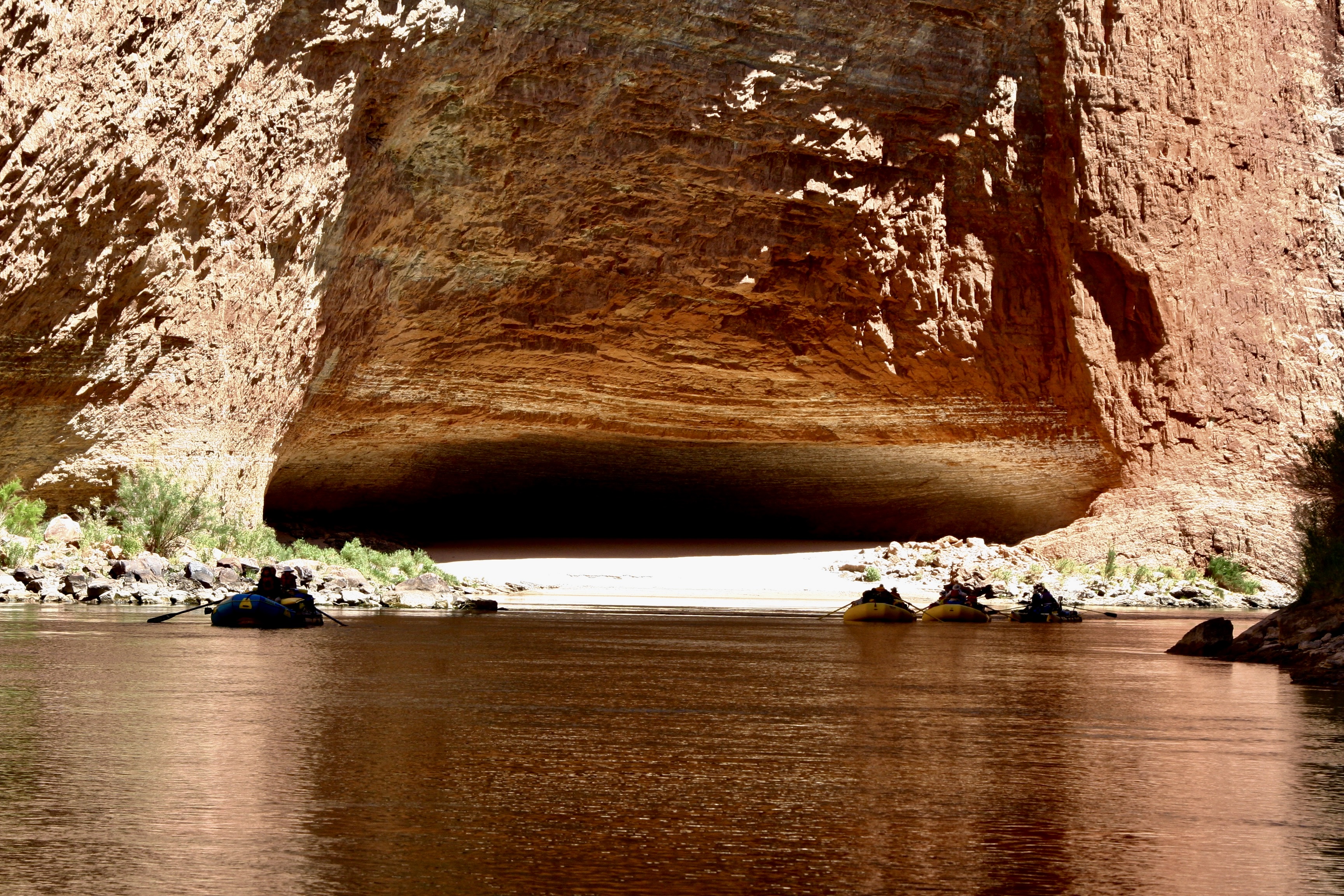
Redwall Cavern, a mile or so beyond Vasey’s Paradise, is one impressive cave! We headed in for lunch.
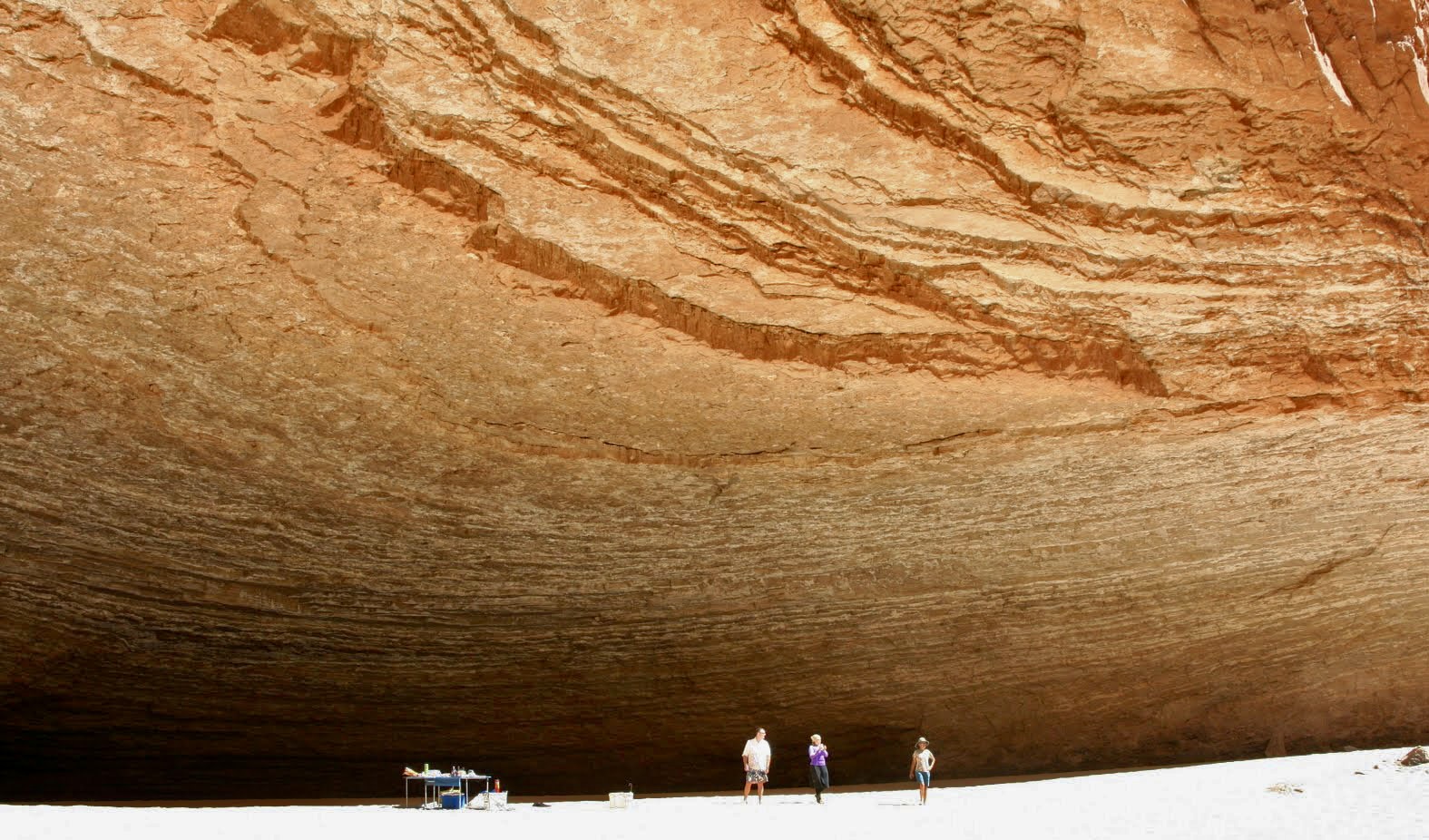
Some of our rafters and the lunch kitchen provide perspective on the cavern’s size. When John Wesley Powell, the one armed veteran of the Civil War and first dedicated explorer of the river, came on the cavern in 1869, he estimated it could hold 50,000 people. Modern estimates are closer to 5,000, but that is still a bunch!
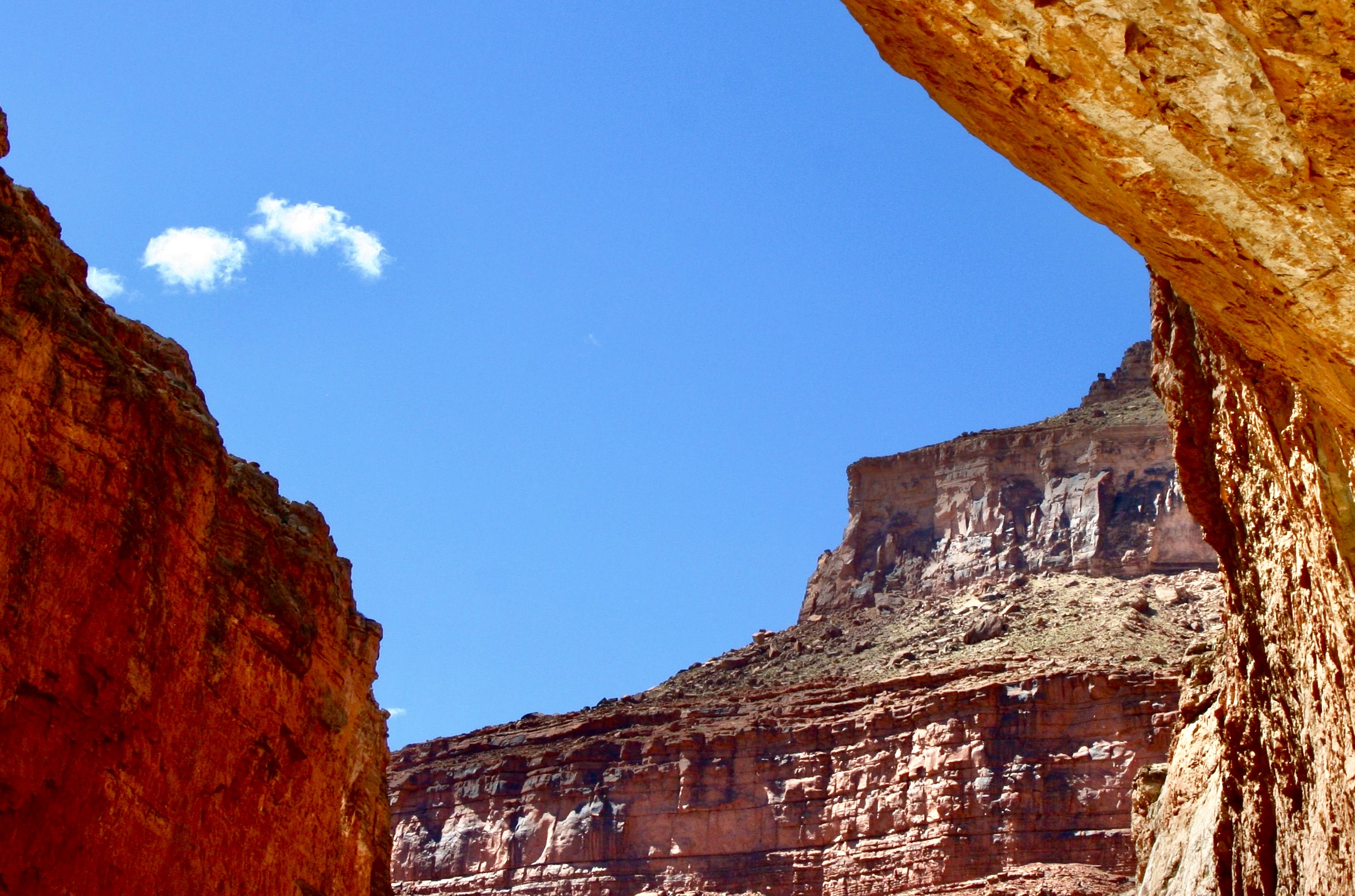
This is a view looking out from the Redwall Cavern at the surrounding canyon walls.
I thought this was a great people shot by Don…
And scenery shot. (Photo by Don Green.)
Colorado means red, which is the color of the river after rainstorms (reddish brown). Obviously it hadn’t rained recently, and, as I recall, it didn’t rain at all during our trip.
Quite the monument.
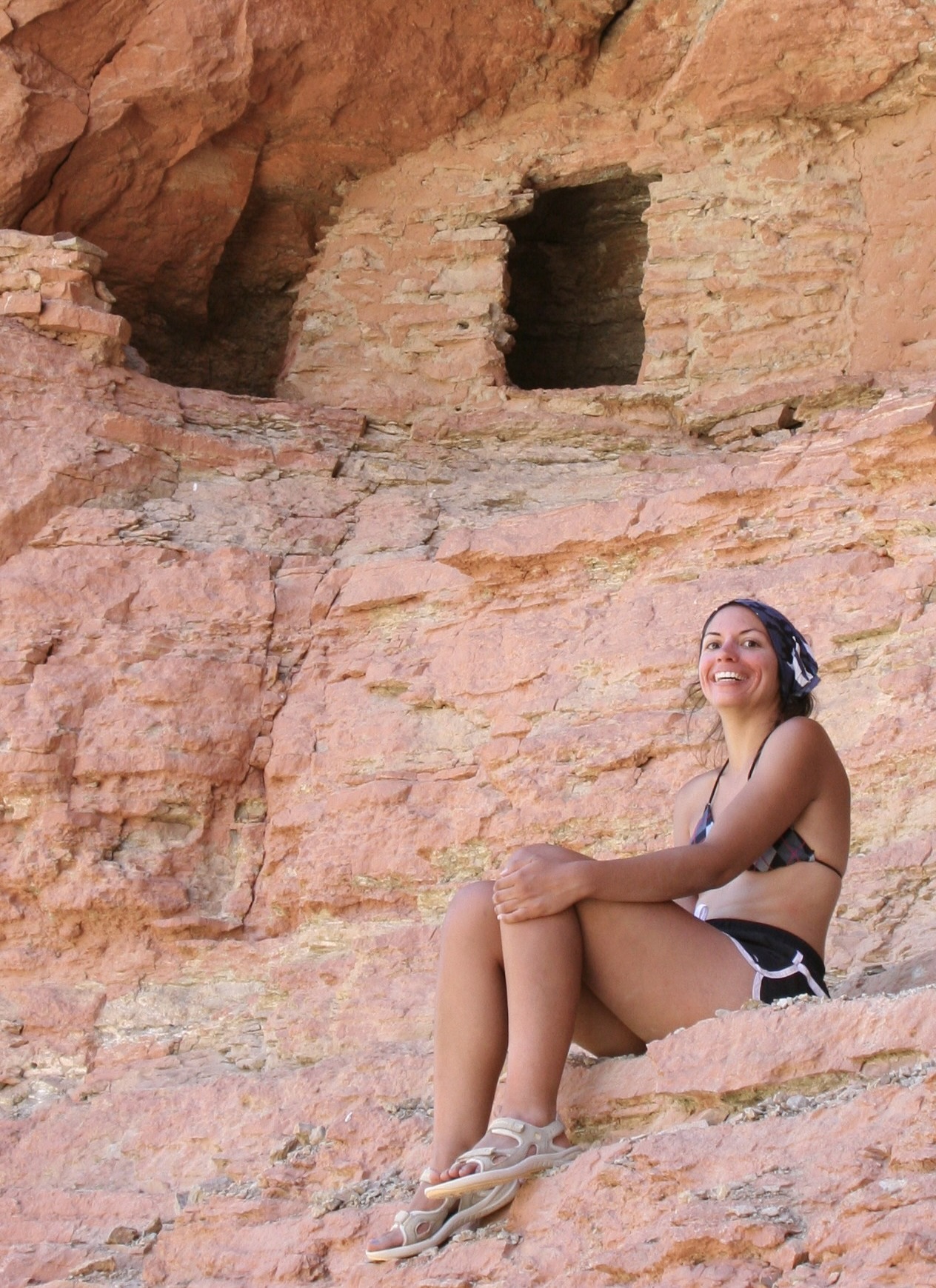
Theresa provides perspective on the ancient Anasazi Granary we hiked up to visit high above the Colorado River near mile 53. (Photo by Don Green.)
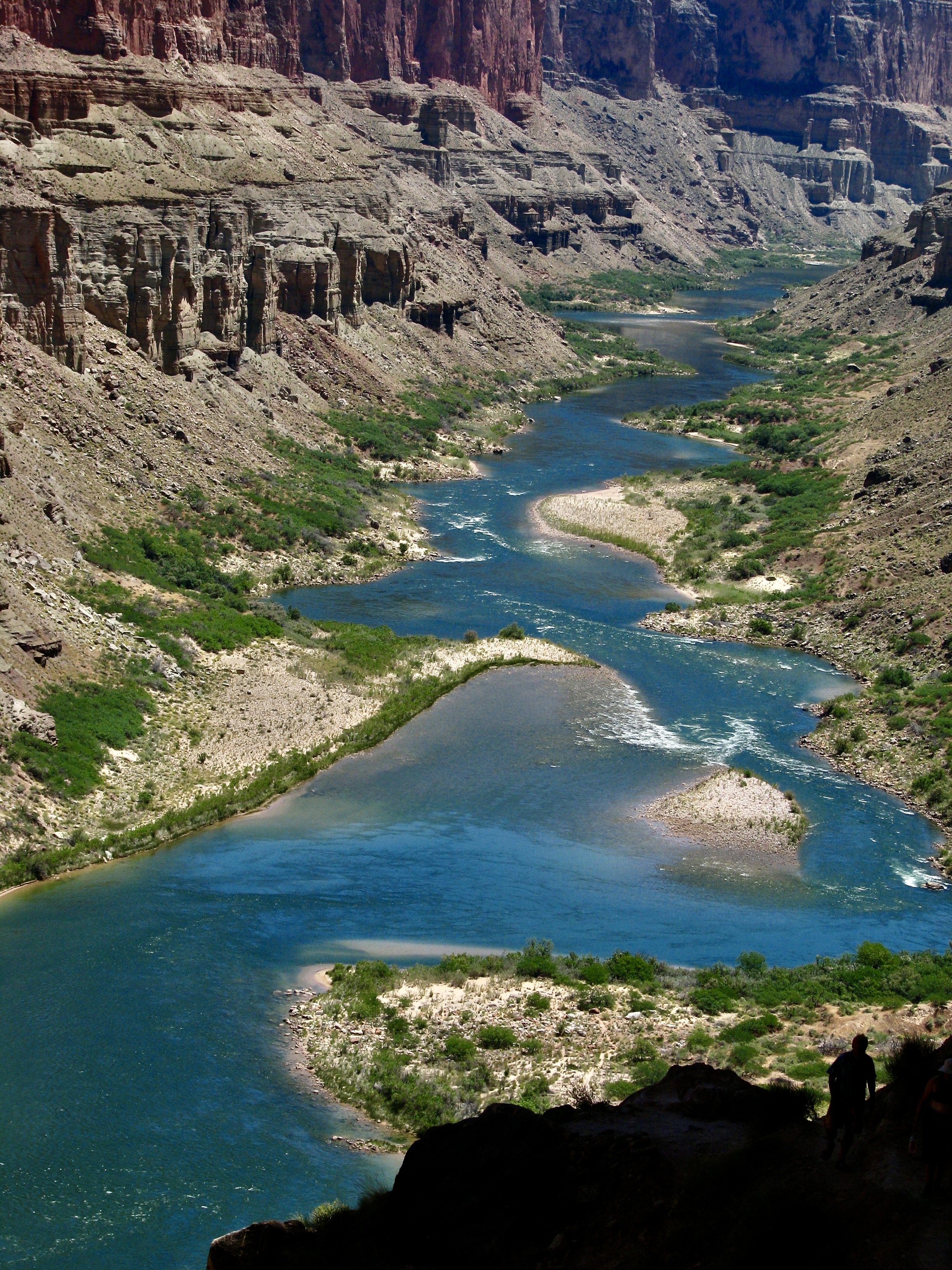
Looking down the Colorado River from the Anasazi Granary. One of us is making our way back toward the river in the shadows on the right. (Photo by Don Green.)
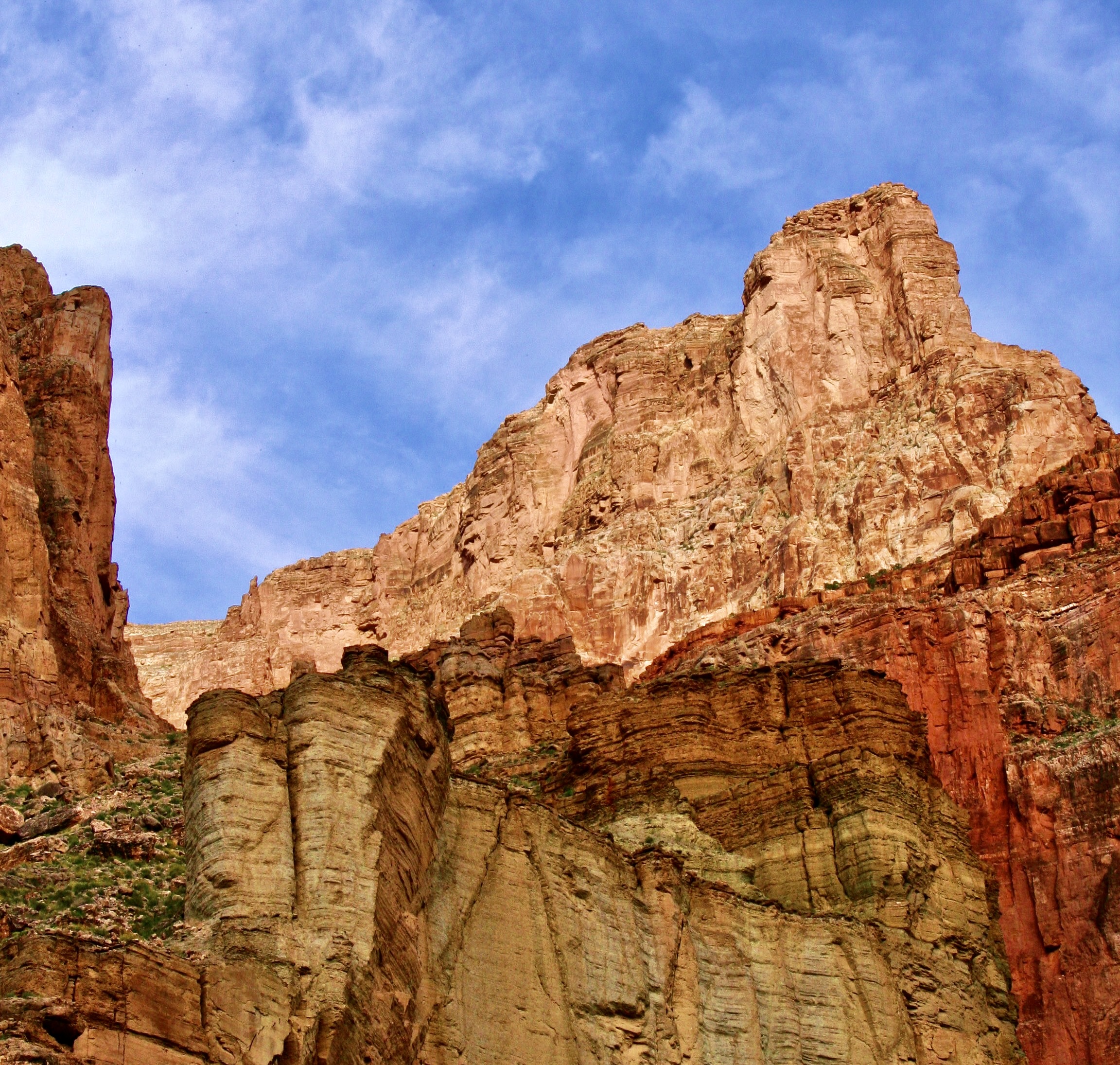
A view looking up, downriver from the granary.
And another.
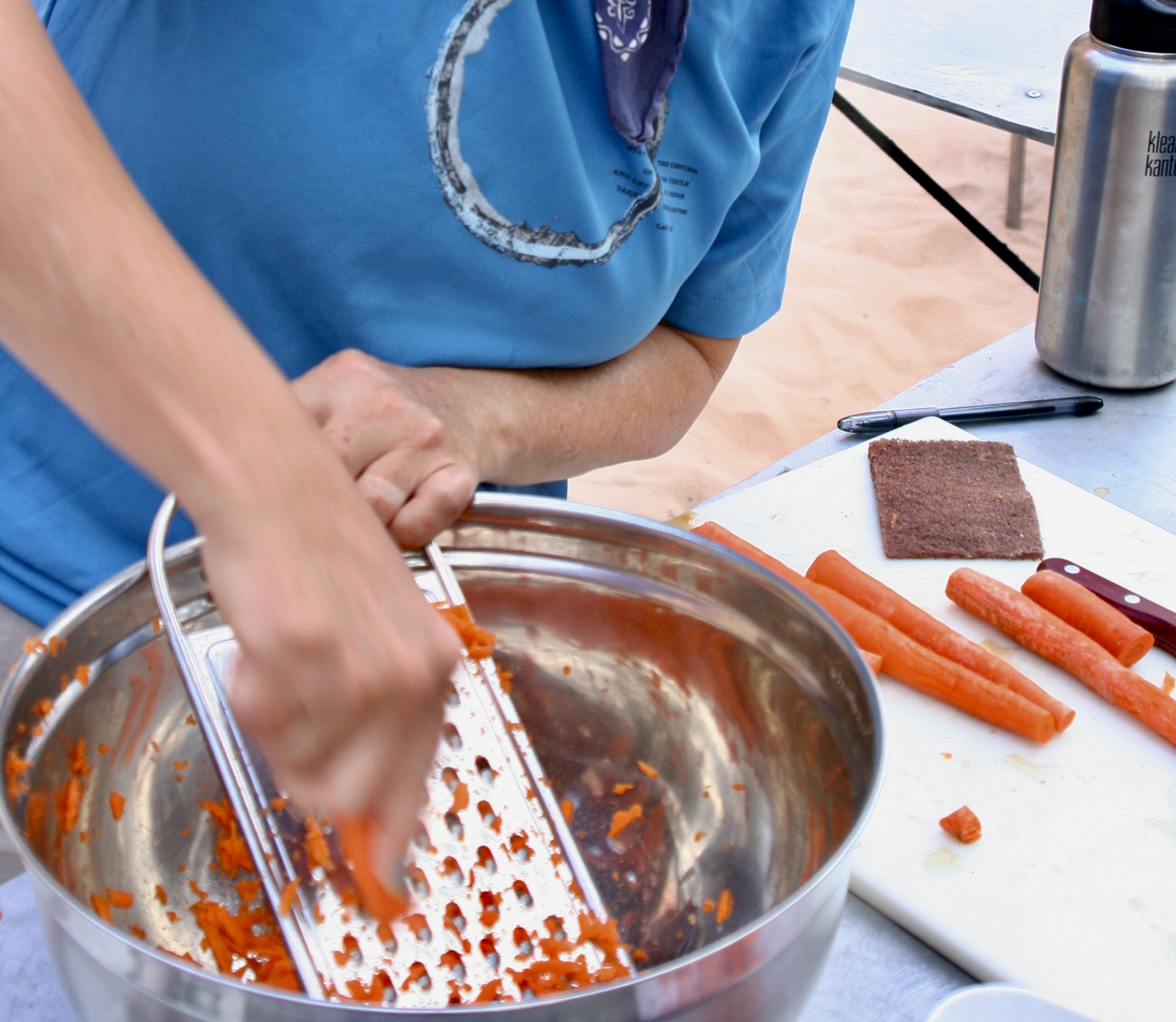
Food is quite important to river runners as I mentioned in my first post on the river. And why not, since the boats can carry massive amounts. It’s not like backpacking where every ounce matters. Here, Peggy is working on a carrot salad. Each of us was expected to do kitchen duty. Tom, who owned a popular Mexican restaurant in Davis at the time, the Cantina, was proud of what he had brought along to eat— and quite particular on how it was prepared. He hovered providing directions. Like a chef.
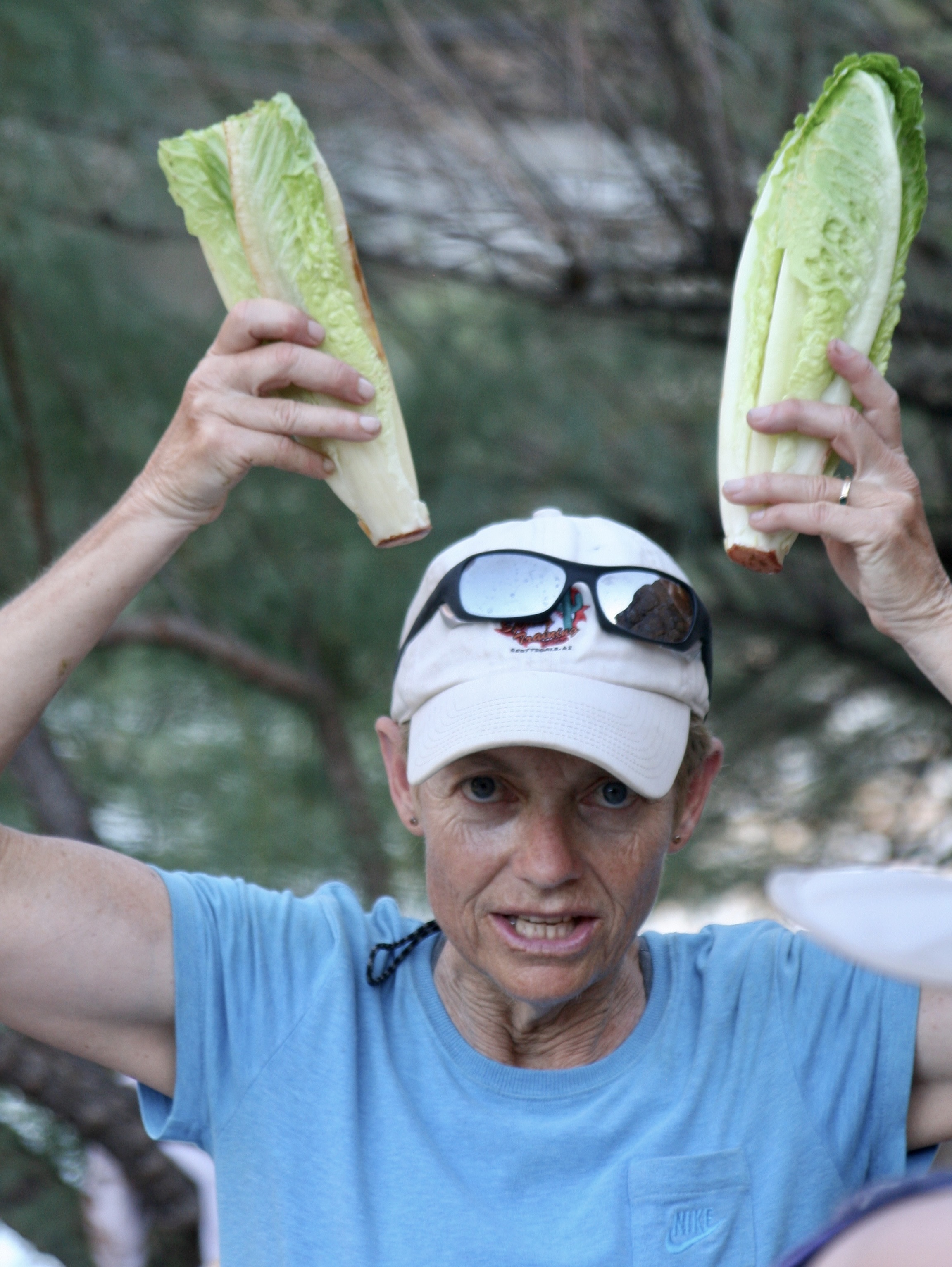
For example, the correct way to cut romaine lettuce. Susan Gishi holds up the lettuce like rabbit ears on an old fashioned TV set. She is about to demonstrate how to cut it and looking much more serious than the rabbit ears would suggest.
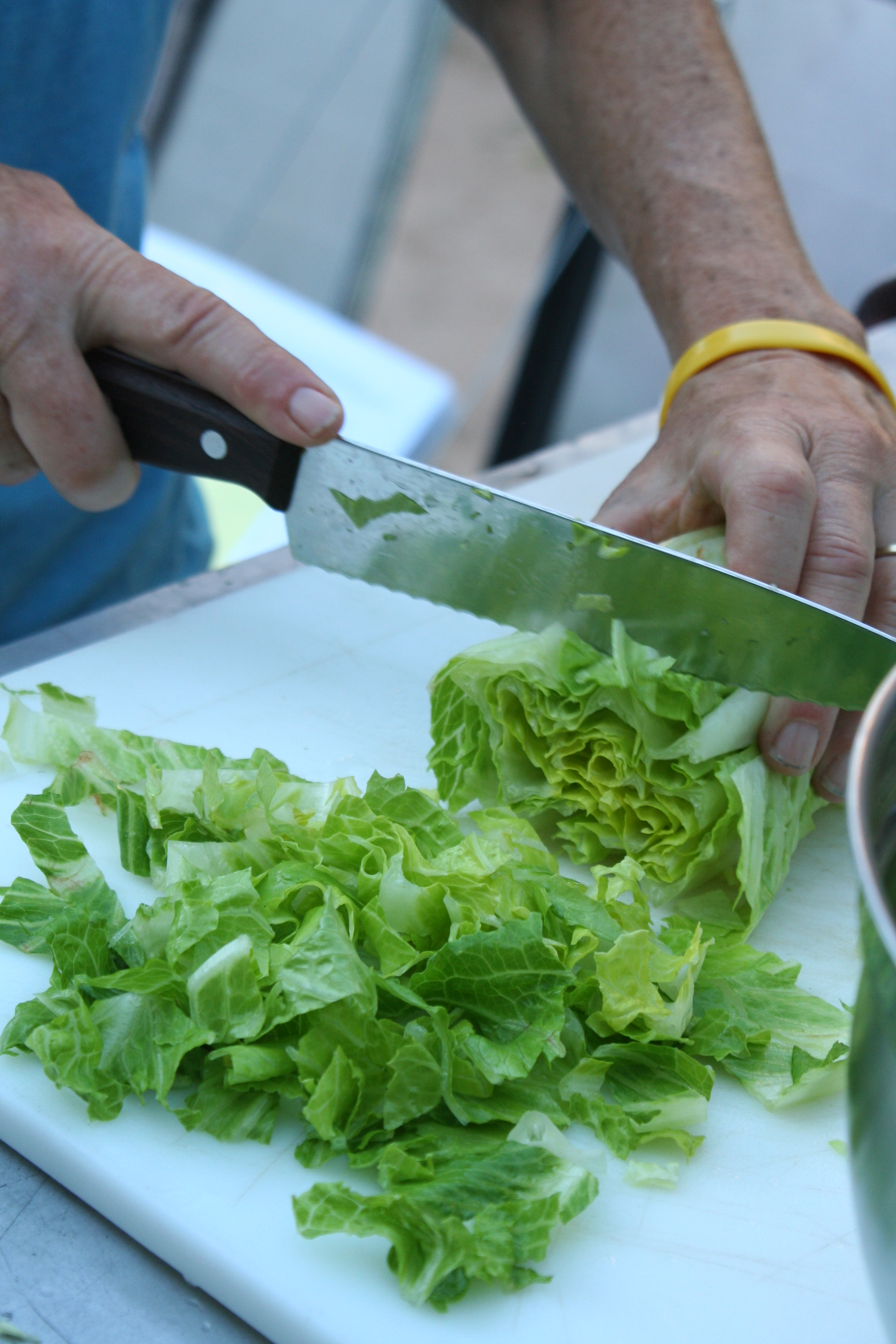
Like this.
Tom discovered me tearing it up instead of cutting it and got quite excited.
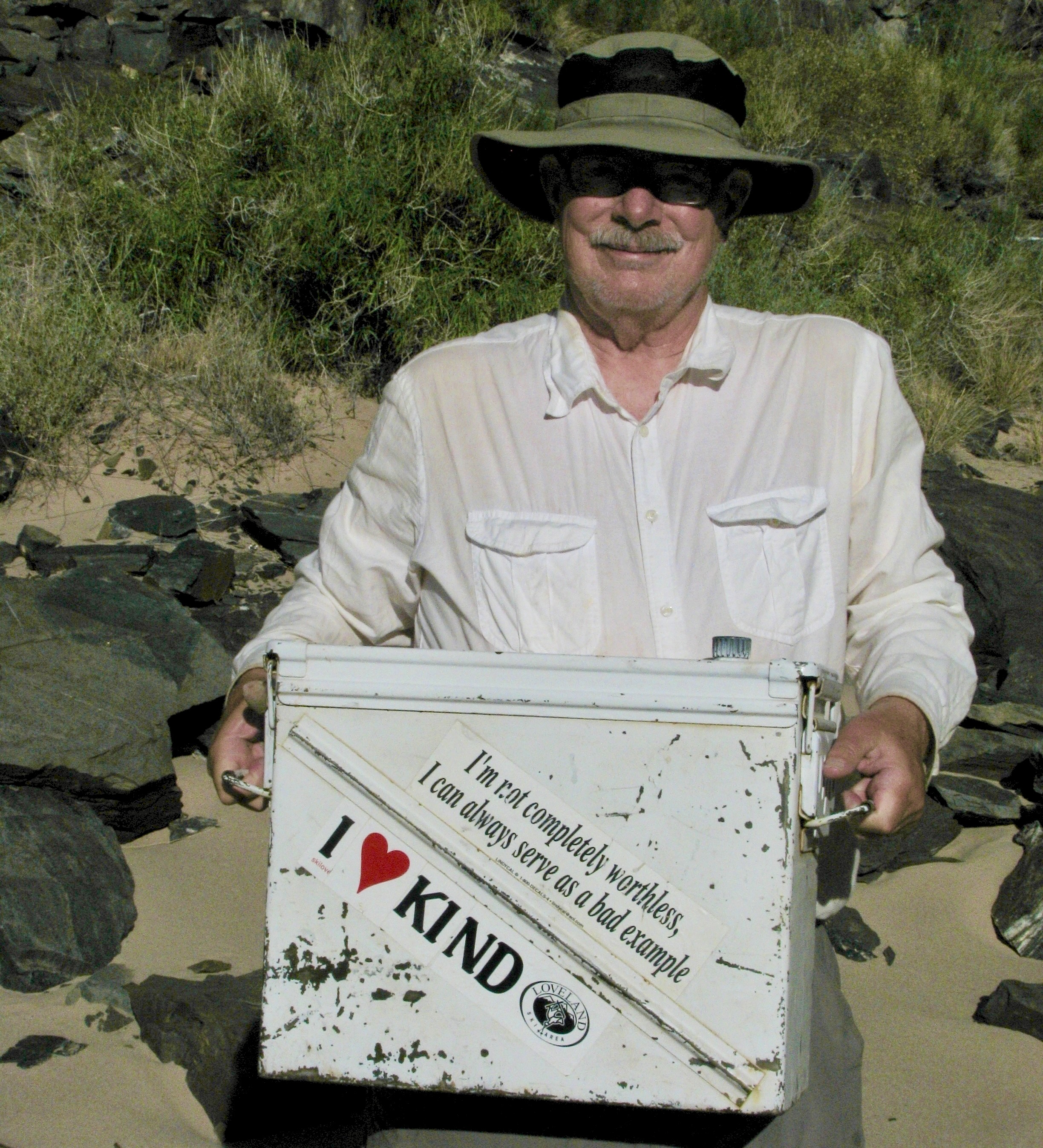
Being allergic to taking directions from Tom about cutting lettuce, I made a trade with Peggy. I would handle her groover duty if she would take my kitchen duty. Here’s the thing about groovers, you are required to carry your poop out. Peeing is done in the river. My duty was to work with Steve in finding a suitable private place for the men’s and women’s groovers when we landed in the evening and then loading them back on his boat in the morning. BTW, the reasons these large ammo cans are called groovers is because people sat on them directly until someone figured out how to attach toilet seats. Duh. They left grooves on your butt! (Photo by Don Green.)
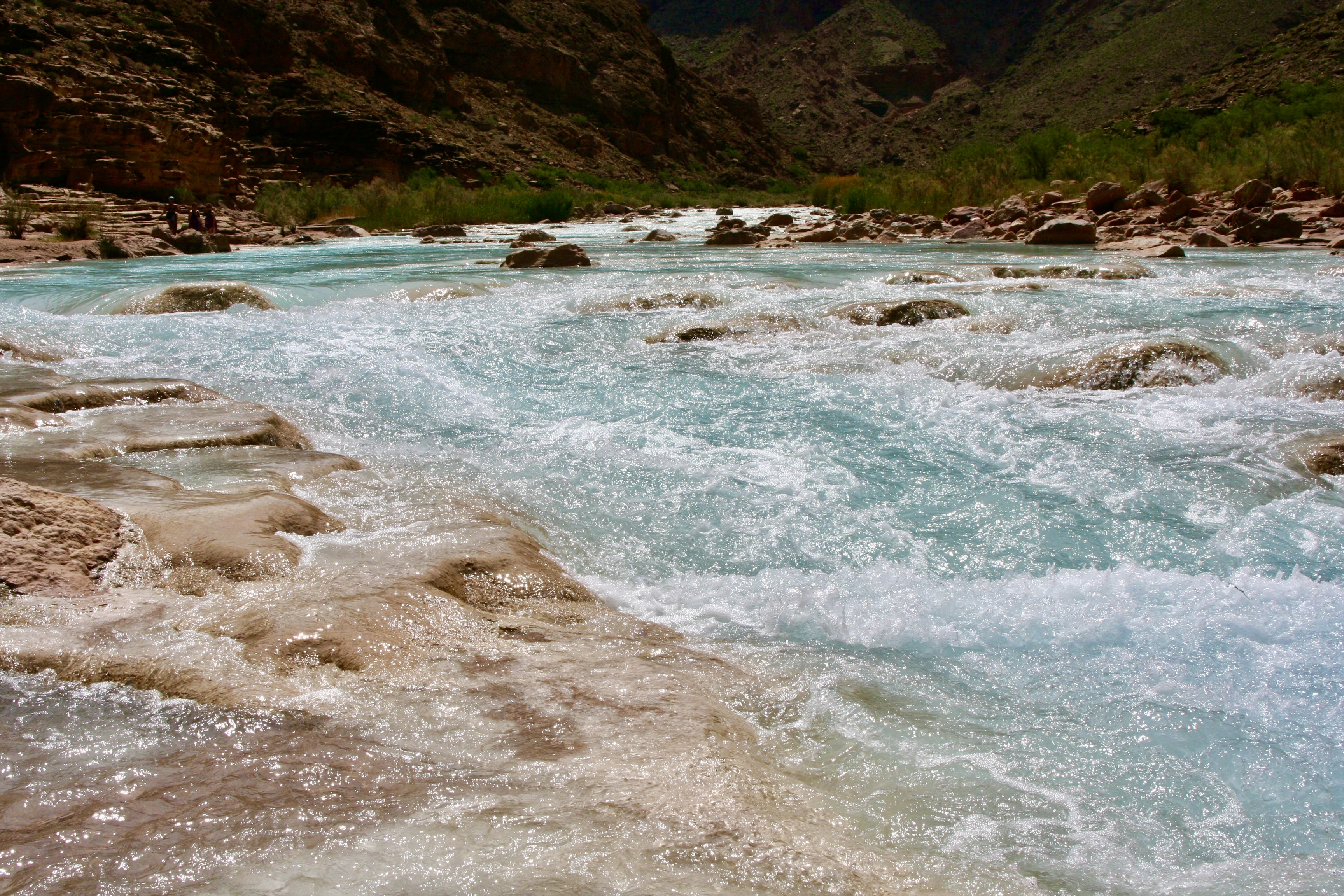
Our next great stop was at the Little Colorado River where it flows into the Colorado at mile 61. Its beautiful color is due to mineral content. The minerals settle out to form the rocks you are seeing. There is a cave a few miles up the river where Hopi mythology claims they made their entrance into this world.
As always, my camera was kept busy.
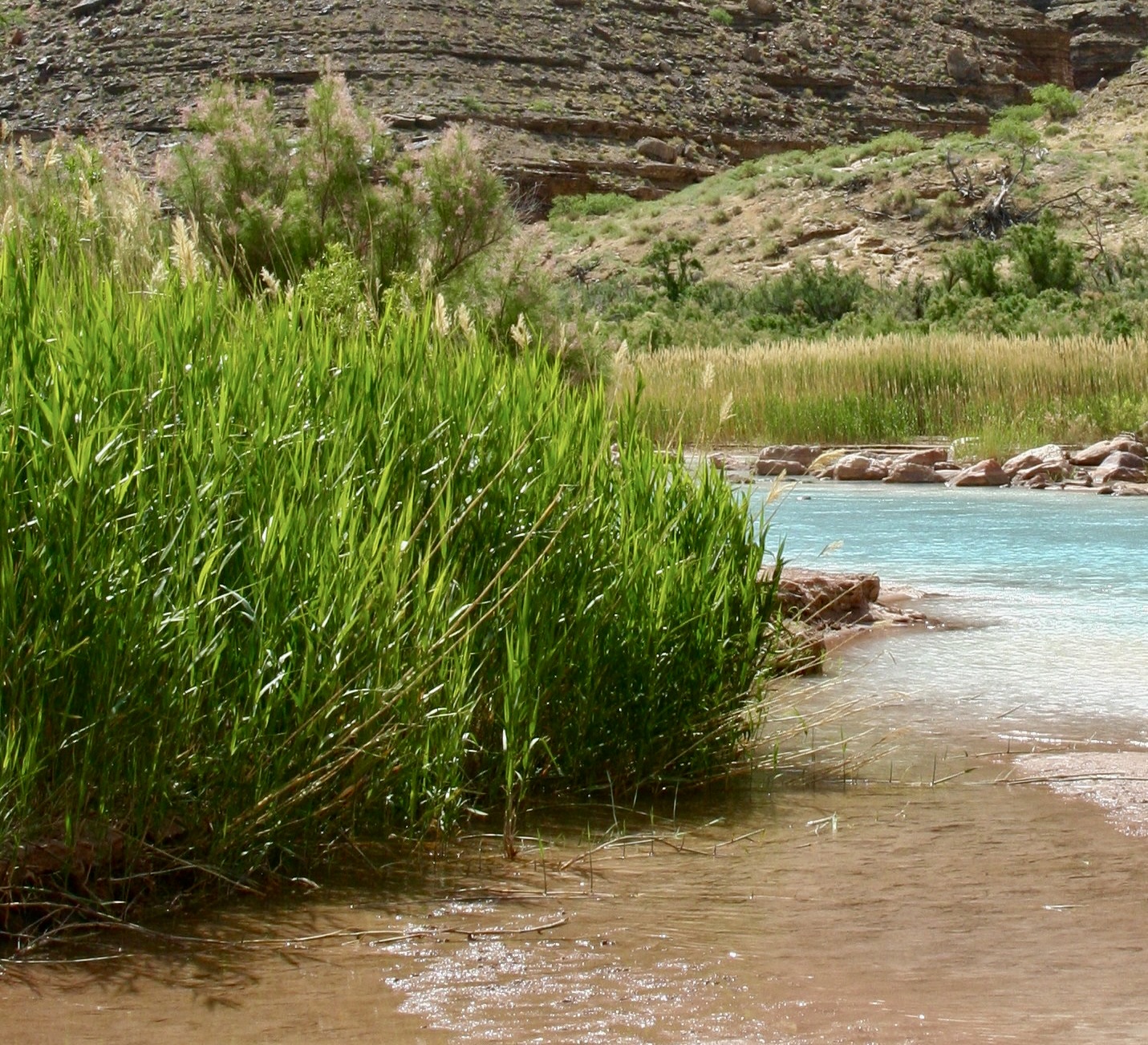
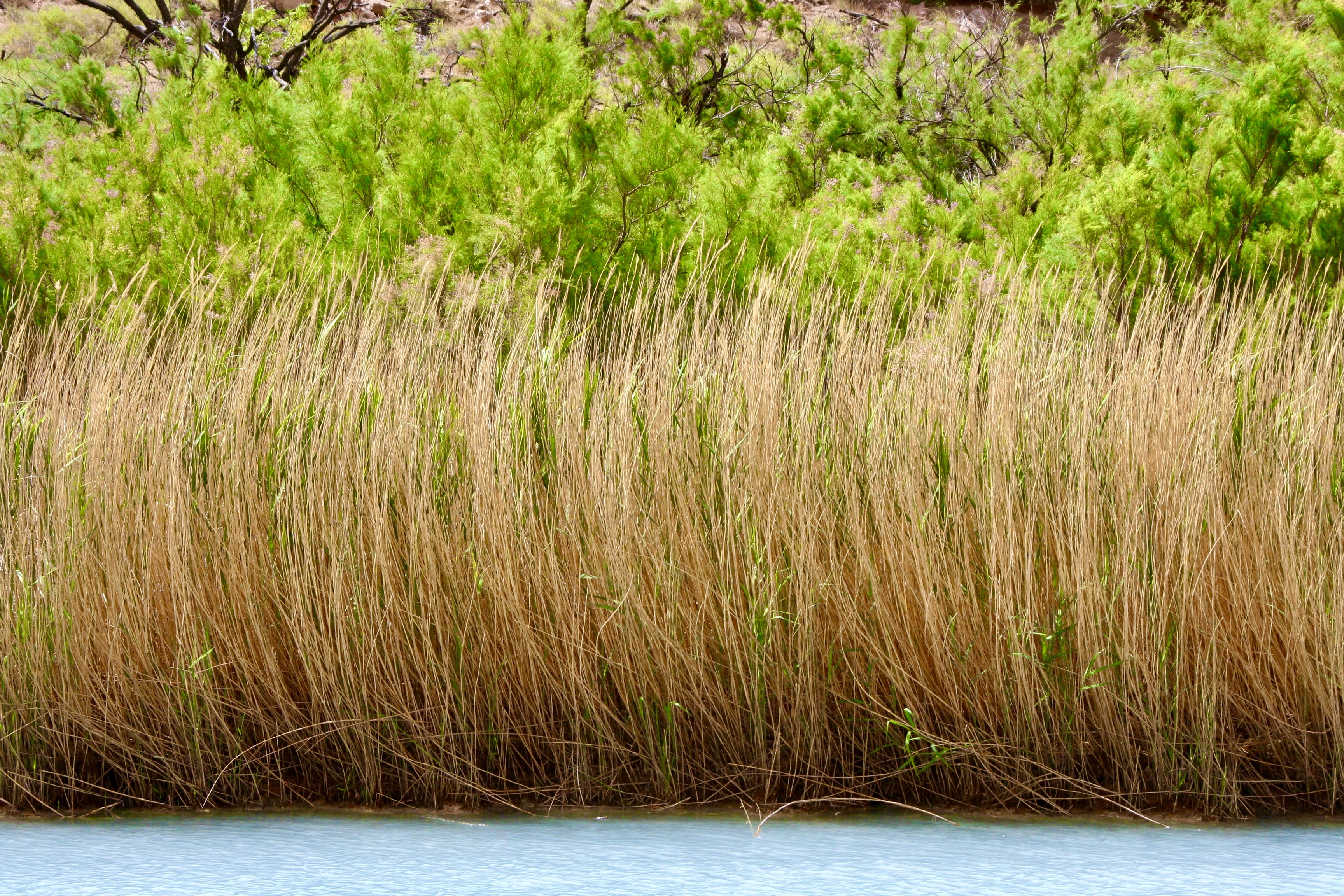
I suspect the Hopi would have seen these reeds as weaving material.
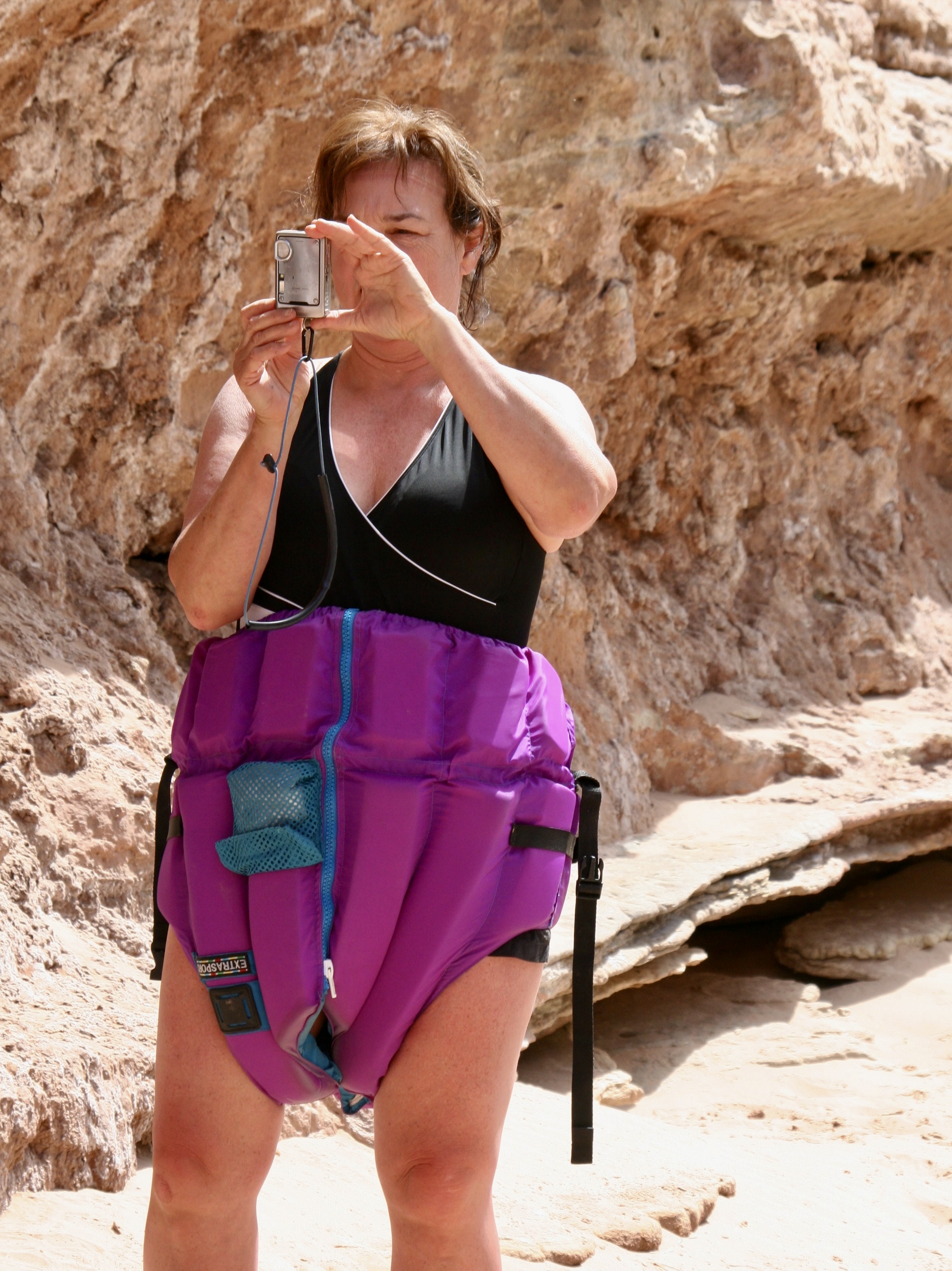
Not a thong bikini. Bobbi Allen was busy taking photos as well, but more to the point, she is wearing her PFD upside down per Tom’s direction. The purpose was to enhance our floating down the Little Colorado. They seemed strange and looked like bloated diapers. I’m not sure Bobbi meant to serve as a model but I wasn’t up for a selfie. That would have been scary.
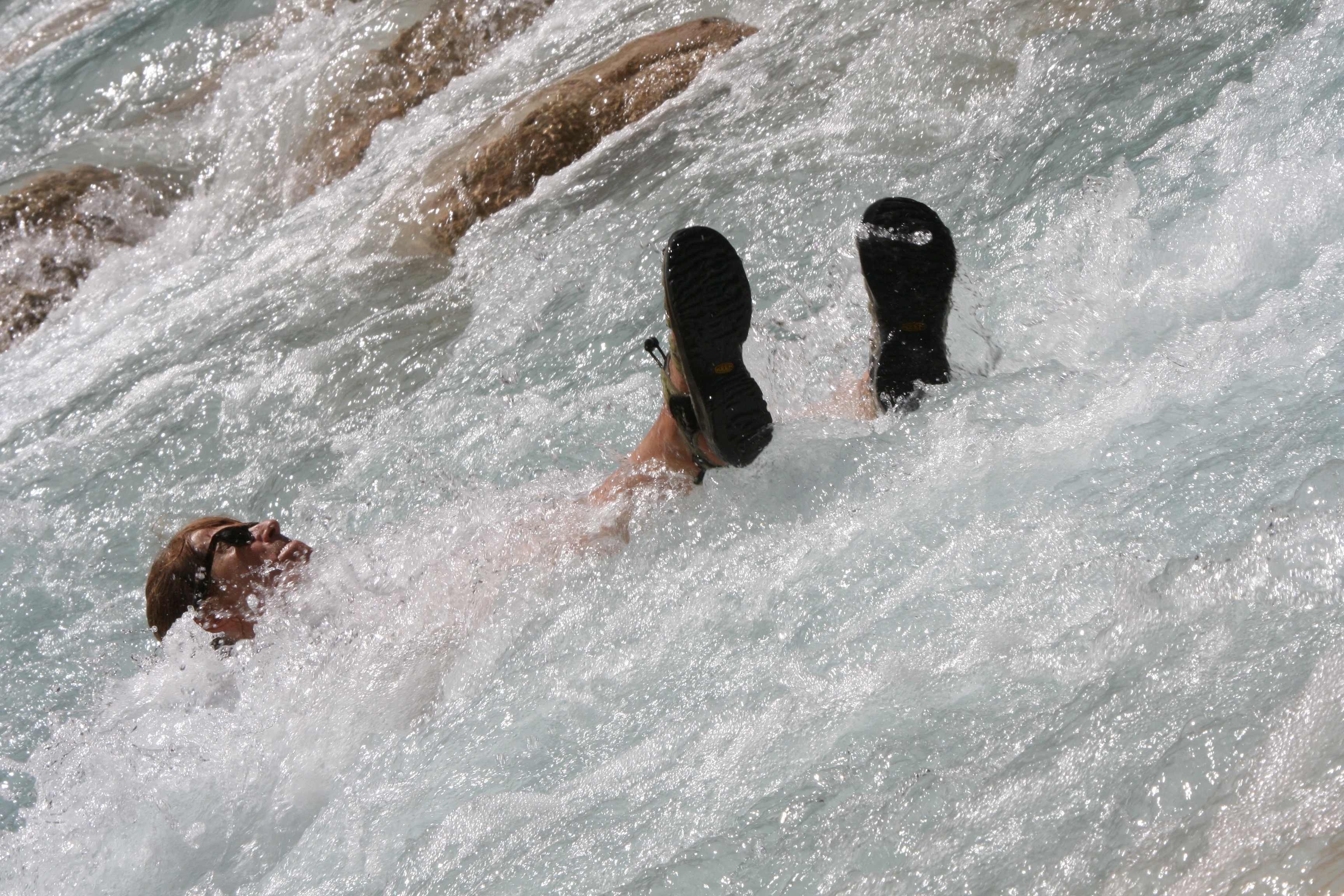
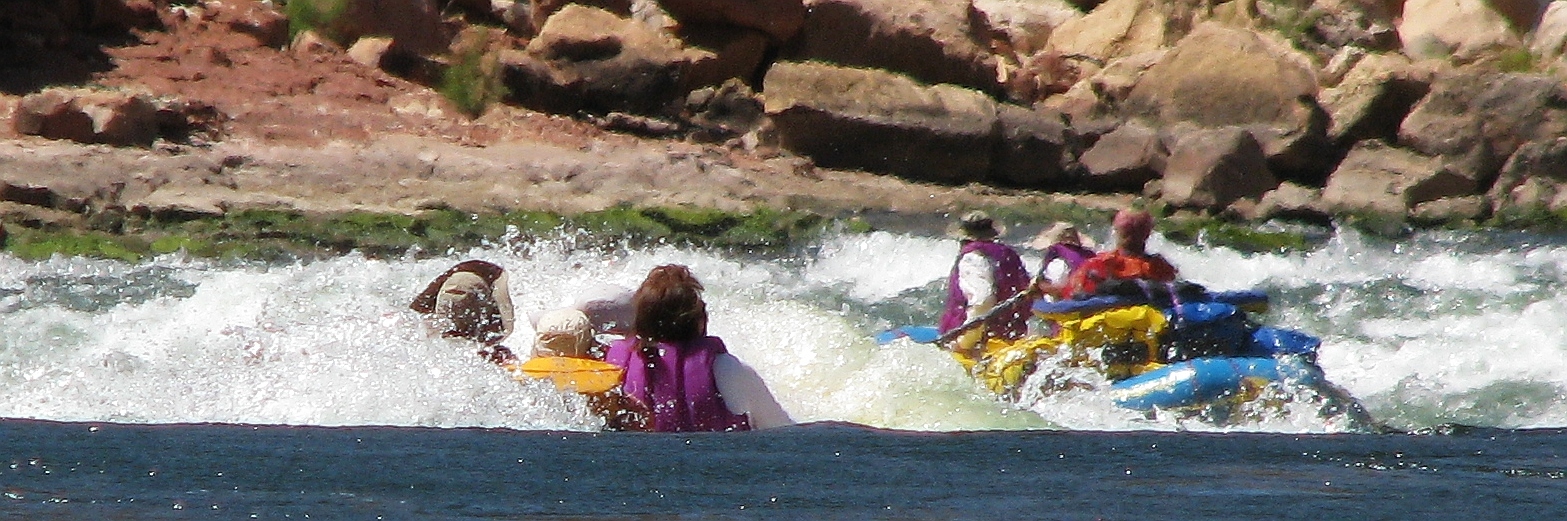
People floated down as individuals or in groups. I couldn’t tell which one this was for sure, but If she looks a little out of control, you should have seen me. My PFD slipped down around my feet and I bounced down the river with my head removing rocks along the way. I think it was Jamie who waded in and pulled me out. My guess is that others thought of it as a Kodak moment, and Tom thought it might pound some sense into my head.
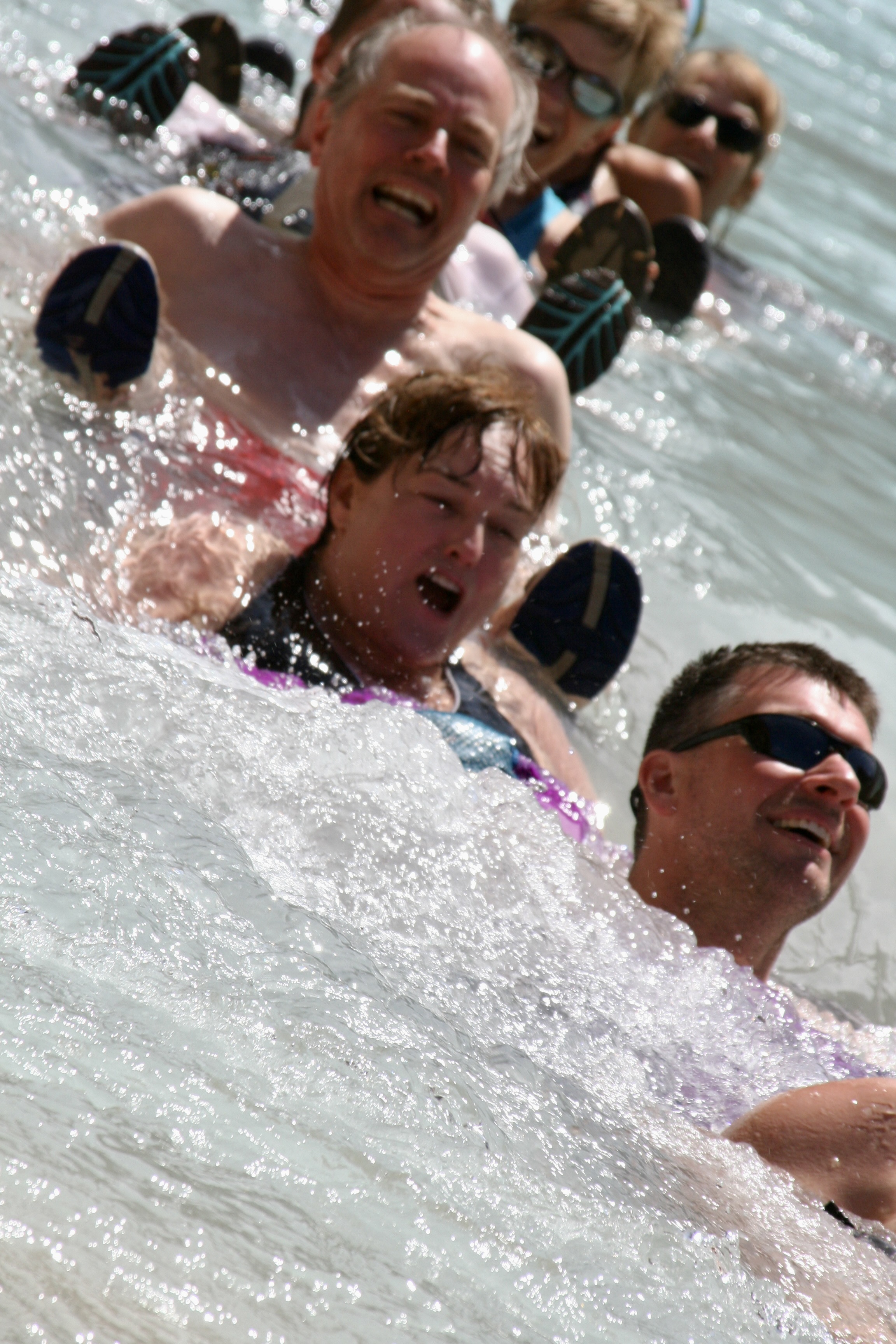
Here’s a Conga Line with Tim Spann, Bobbi, and Don plus others.
Even Bone gave it a try, but he preferred the calmer part of the river.
A sucker found him amusing…
Nancy Pape praised him for being so brave. Nancy and I go way back to the early 1980s when she joined me on one of the hundred mile backpack treks I led. And many more after that. She has also gone to Burning Man with Peggy and me, as have Tom, Don and Bone.
And Jamie decided to teach Bone how to row.
In fact Bone became so confidant in his rafting skills, he decided he could serve as a scout checking out rapids.
Fortunately, no one drowned. That does it for today. Next Friday we will continue our trip down the river with its great beauty and wild adventures. (Photo by Don Green.)

Rowing House Rock Rapid… with One Oar: Rafting through the Grand Canyon

We started with an icy cold rapid. Peggy and I are in the first boat with Tom Lovering rowing. (Photo by Don Green)

Day two starts as day one did: early.

Even the birds are sound asleep. Tom argues it’s six AM, not the five my watch is showing. “Arizona does not honor Daylight Savings Time,” he primly informs us. He’s right. Adjusting my watch adjusts my attitude… a little.

Adding injury to insult, something akin to Folgers has been sewn up in burlap, thrown in boiling water, and called coffee.  Oh well, it’s a hot, it’s brown, and we have a beautiful day of floating down the Colorado through the Grand Canyon ahead.

For those of you who like facts, here are a few about the river. At its widest point it reaches 750 feet from one bank to the other; at its deepest, it plunges down 90 feet. It flows along at a decent 3-4 mile clip but can speed up to 15 miles per hour in rapids. Since the water comes out of the base of Glen Canyon Dam, it is cold: somewhere around a frigid 46 degrees Fahrenheit during the upper part of our trip. Over the course of our adventure the river will drop 1700 feet in altitude, which is an average 8 feet per mile… 25 times that of the Mississippi River.

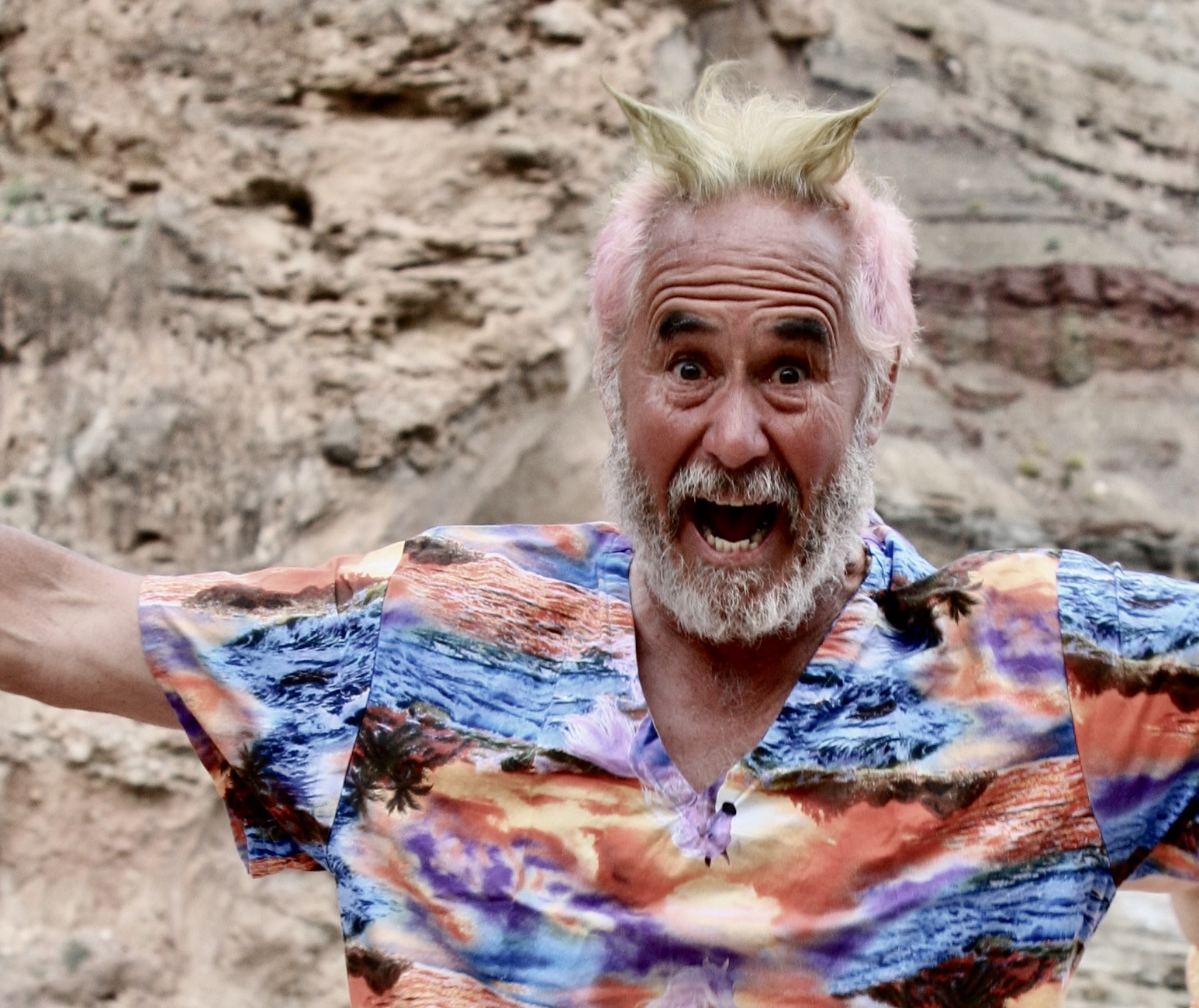
Our boatman for the day, Tom Lovering, with his wild, Canyon hairdo.

Tom is our boatman of the day. He checks to make sure our toenails are painted and then lets us board. The wind is still blowing but it has lost its ferocious bite. A mile down the river we pass Ten Mile Rock, a prominent landmark that has fallen from the cliffs above and now juts up out of the river. Made of Toroweap Sandstone, it was laid down in shallow seas that covered the area some 250 million years ago.
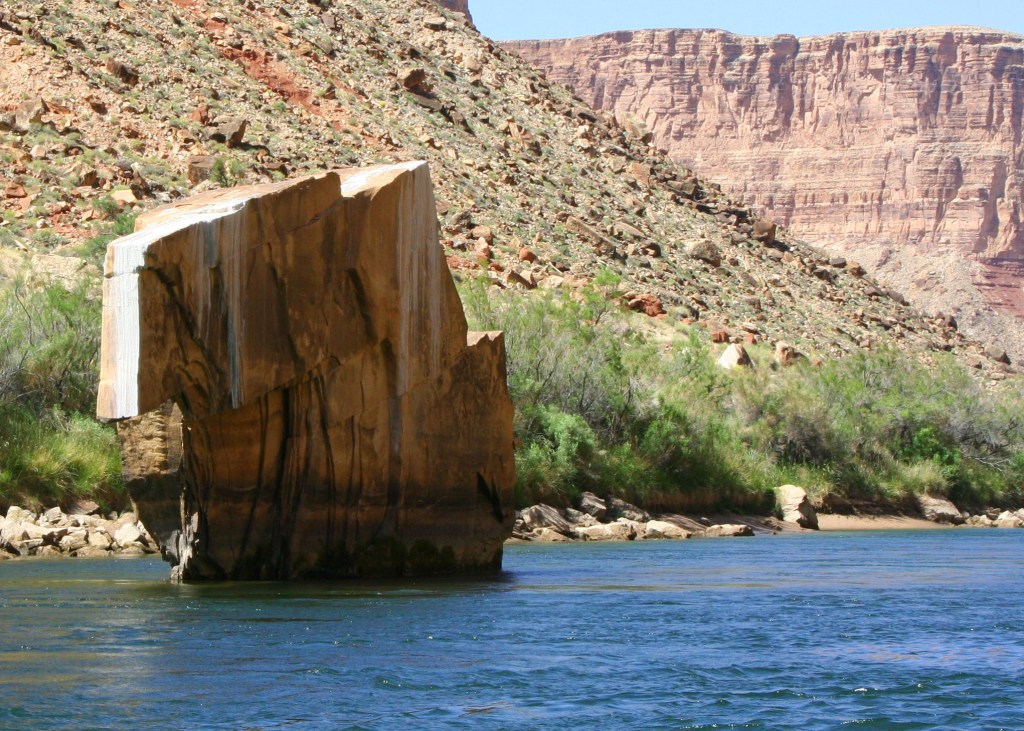
Ten Mile Rock on the Colorado River. I thought it should have a more impressive name.

Shortly afterwards we hear our first rapid of the day, Soap Creek. You always hear rapids before you see them; it builds anticipation. Soap Creek roars like a teenage lion. Tom maneuvers through it like the excellent boatman he is but makes sure we get suitably wet. It’s like taking a cold shower outside on a frosty morning with a 15 mile per hour wind blowing.

“I love rowing,” Tom tells us– and it is obvious he does. It is more than the heart-stopping, adrenaline-pumping moments of major rapids where the boatman’s knowledge and skill is matched against the tremendous power of the river with its dangerous rocks and grasping holes. And it is more than the opportunity to enjoy incredible beauty of the Grand Canyon that rowing provides. Tom enjoys the rhythm and the hard work. He even liked the backbreaking challenge of rowing against the wind.

At mile 17 we come on our first, and only, major challenge of the day, House Rock Rapid, where we learn another fact about rafting through the Canyon: water levels depend on electricity needs in the West. Peak demands require large releases of water from Glen Canyon Dam to run its huge generators. Eventually, these releases catch up with rafters. The fluctuations in water levels have significant impacts.

House Rock Rapid demonstrates one of the more serious. The river is at its low point. More rocks are exposed and a massive hole lurks downstream from the largest rock. Even the most skilled boatman will be challenged to avoid it. We all land and climb off our boats to scout the rapid. Tom is eager to move on. Steve is adamant about waiting for more water. After a long discussion between the boatmen, a decision is made to take the more cautious approach.
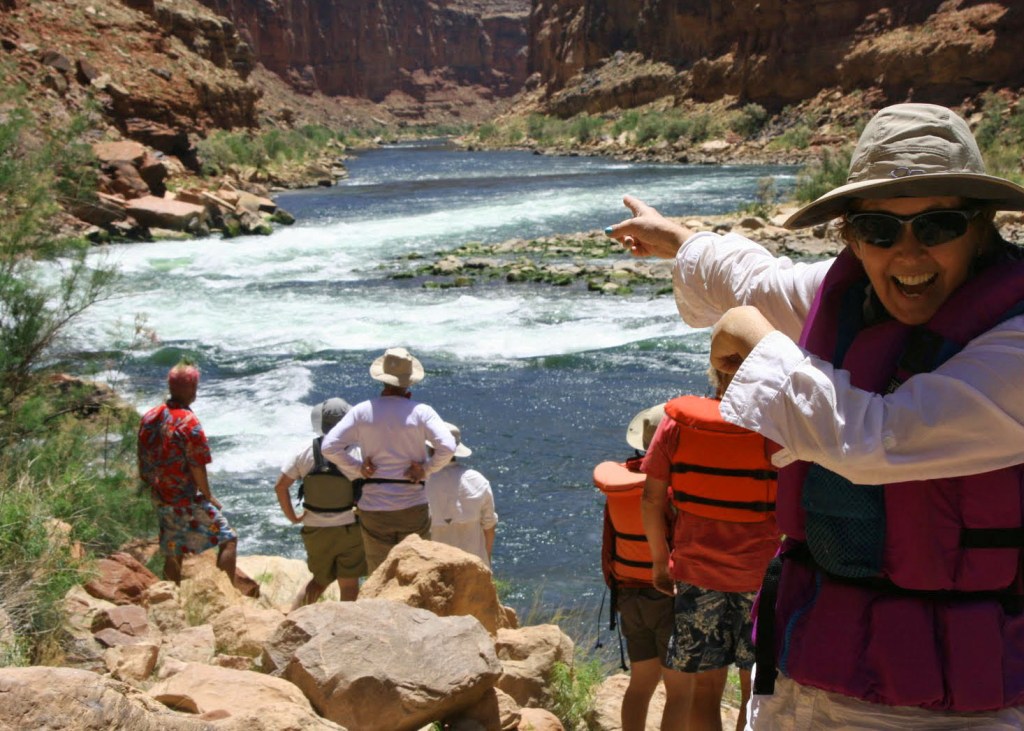
Our group worriedly scouts House Rock Rapid. Peggy shows more enthusiasm than may be called for.

We have lunch, take naps, go for walks and watch as three large boats of commercial rafters chug through the rapids with their large engines. It is mid afternoon when the boatmen finally decide that enough water is flowing to reduce the hazard to a barely acceptable risk.

Tom’s fist bonks me on the head when we are halfway through. One of his oars has popped out. I look left and all I can see is churning, raft-eating water. We are poised on the edge of the hole… about to be sucked in. Tom becomes a virtuoso of one-armed madness.  Ever so slowly, like about a thousand years, the boat decides to go where he wants. We land, and for one of the few times in his life, my ever-talkative friend is silent.
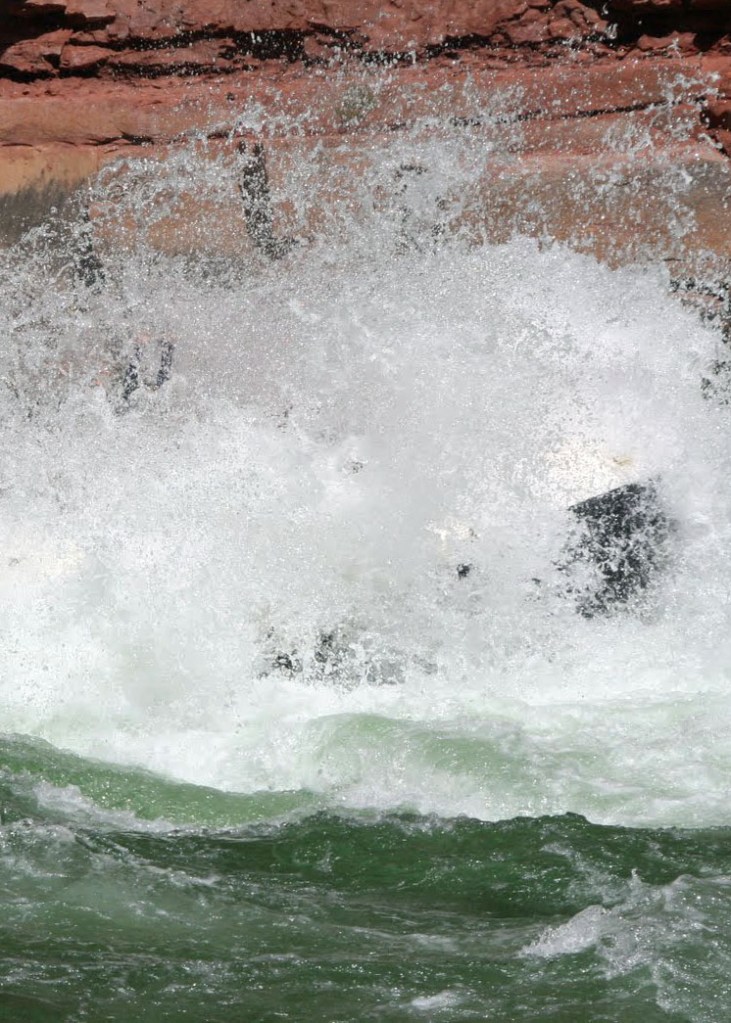
We looked to the left and saw we were poised on the edge of a massive hole.

The next day, Megan Stalheim, Dave’s niece, is our boat woman. This is Megan’s first time rowing a raft and her first time rowing through the Grand Canyon. It would seem insane except Megan is a world-class kayaker. She is an expert at reading water. The problem is that our large, fully loaded rafts do not move like feather light kayaks… picture driving an 18-wheel Mack Truck with a Ferrari 458 attitude. We have some adventures.

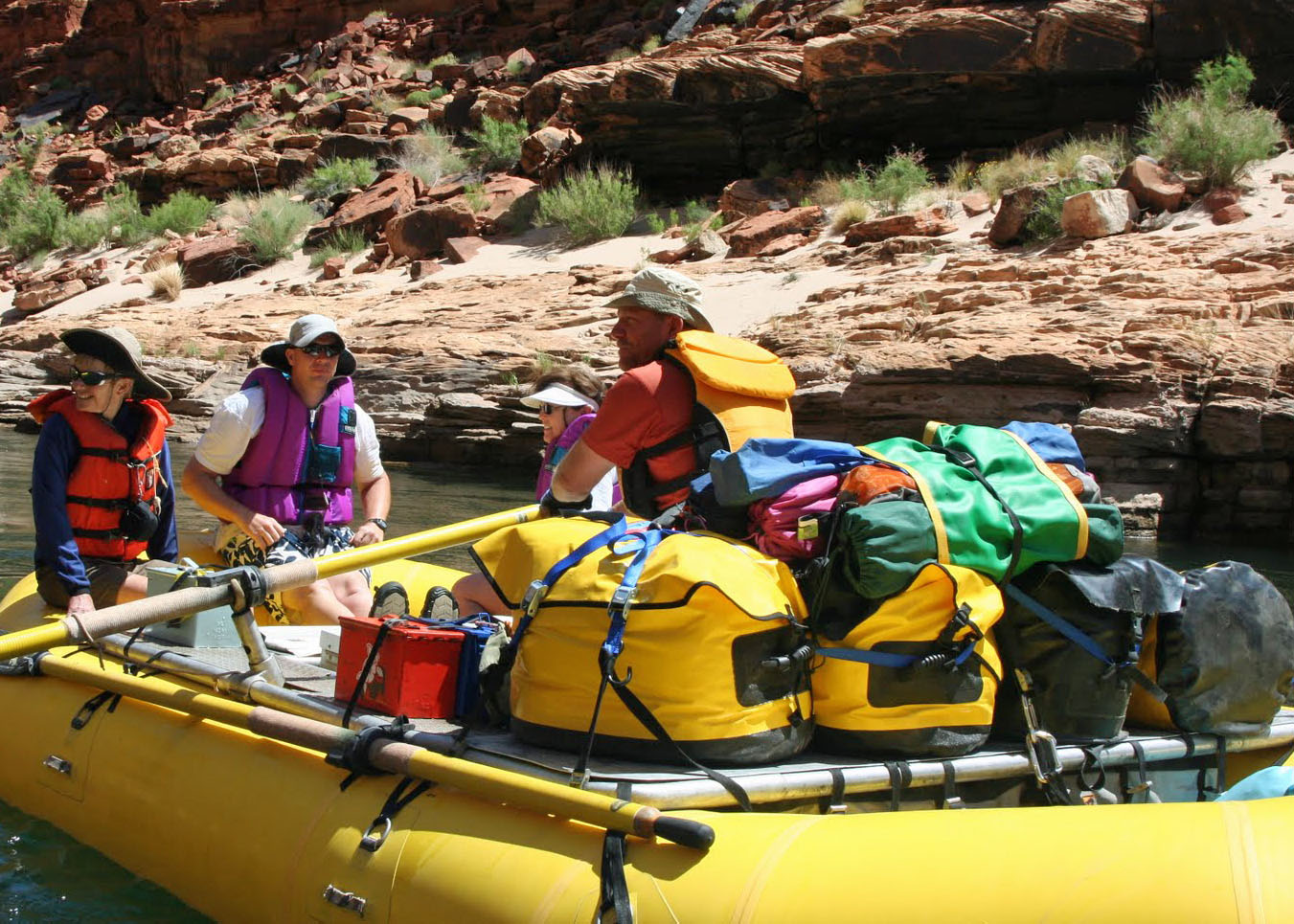
This shot of Jamie’s raft provides a perspective on what our fully loaded rafts looked like.

Megan keeps the messy side up, however, as rafters say. (The non-messy side is the smooth bottom of the raft.) So it’s all good. Megan, like me, has served as a Peace Corps Volunteer in West Africa. When she gets off the river she is heading for Tanzania where she will work with a women’s craft co-op.

Beyond our “kayaking” experience with Megan, the big news on day three is that we began our side-trips. Almost all journeys down the Canyon include stopping off to see the sights. Some are quite beautiful and others provide unique challenges, as if our daily challenges of negotiating rapids aren’t enough.

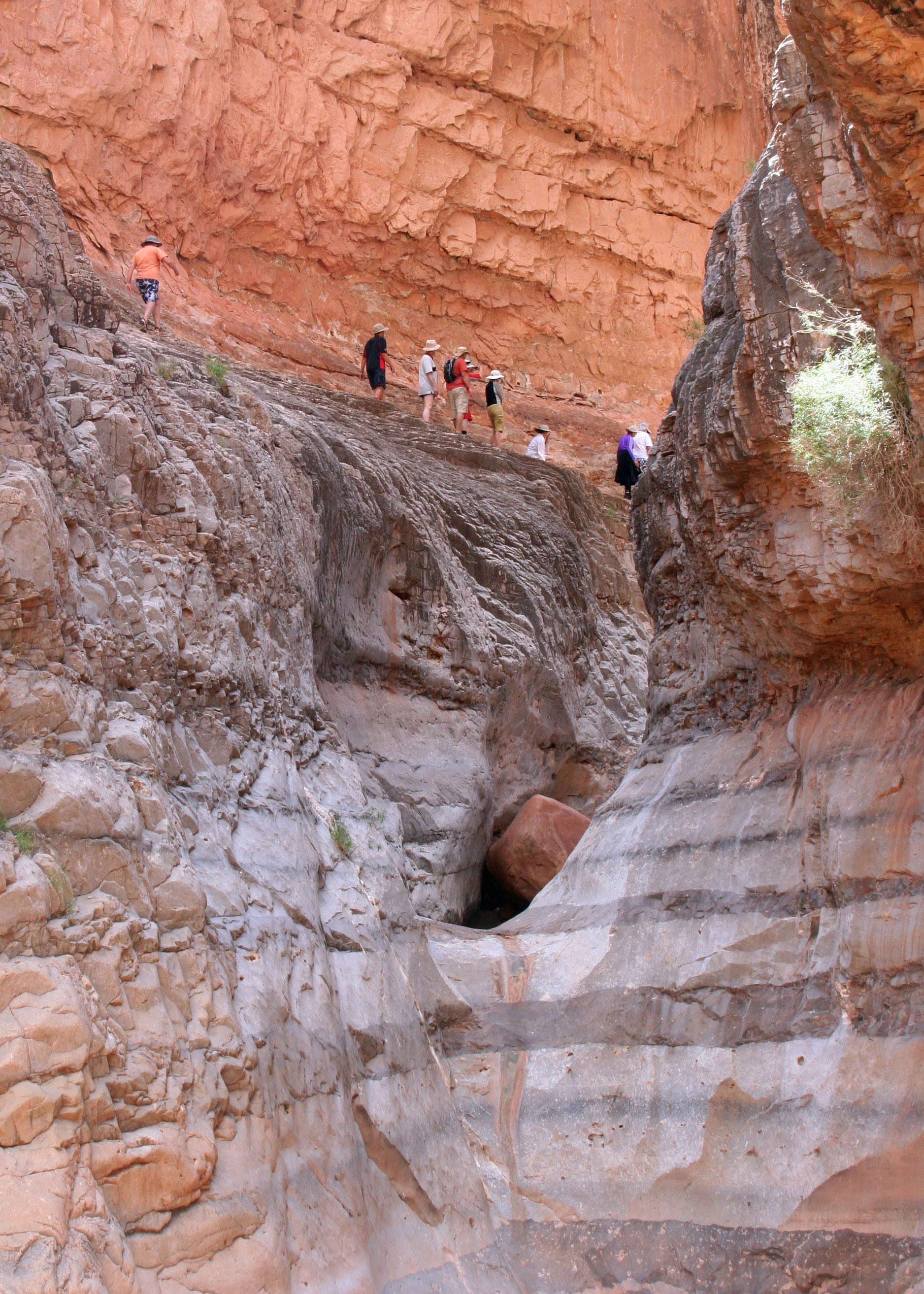
Our first stop at mile 29 is the Silver Grotto, which includes both beauty and challenge. Wanting a little downtime and solitude, I opt out and take photos. Peggy tells me, “We climbed an 8 foot wall, repelled down a rock face, slogged through a murky, cold pool and slid down a 20 foot rock slide.” The rock slide was more like free-fall.

As the group disappeared into the Silver grotto, I took some much needed Curt-time.
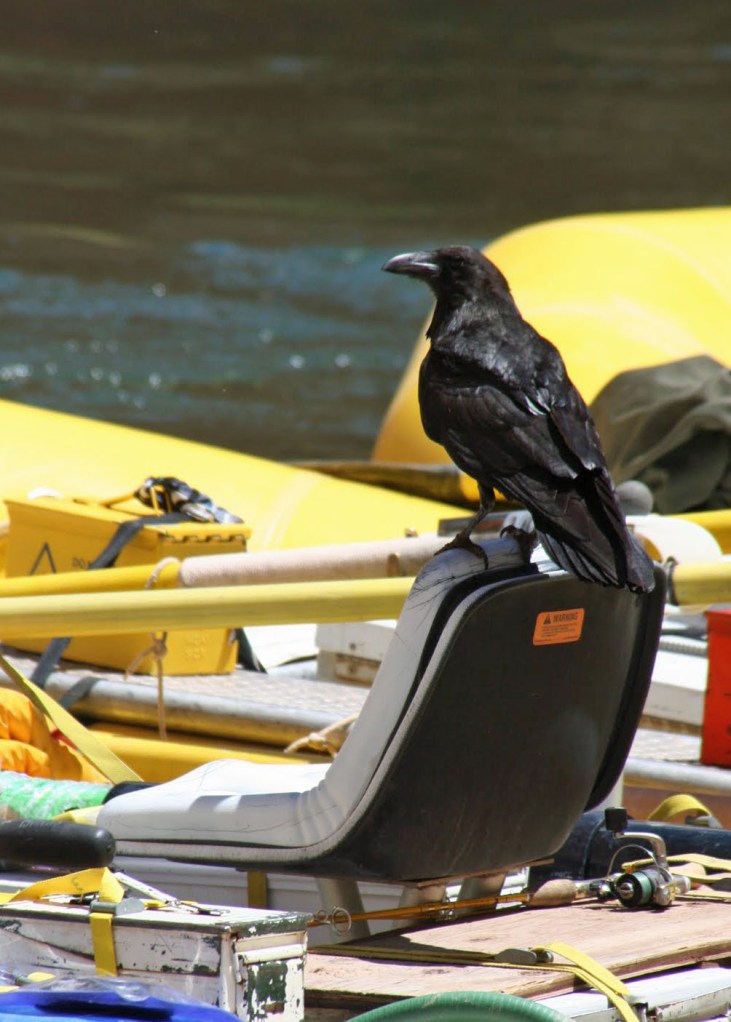
A raven stopped by to visit and checked out the “Captain’s Chair” on Steve Van Dore’s boat. These large birds are one of the primary reasons food needs to be carefully stowed.

I didn’t get a photo of our group members leaping but this is what they leapt off of into the muddy water below. Water was splashed on the rock slide from a pool behind the lip to make the slide more smooth. Or so they said.

Next we stopped off at Paradise, as in Vasey’s Paradise. A beautiful waterfall shoots out of a Redwall cliff and creates a Garden of Eden at it base. It is worthy of the name.

The waterfall shooting out of the Red Wall at Vasey’s Paradise, Mile 32.

Dave Stalheim and his niece Megan perched on a rock at Vasey’s Paradise in the Grand Canyon.

Our final stop of the day is at Red Wall Cavern. Major John Wesley Powell was the first non Native American to admire the Cavern’s unique beauty. Powell was a Civil War Veteran who had lost his right arm at Shiloh. His exploratory expedition through the Grand Canyon took place in 1869. Powell thought Redwall Cavern could accommodate up to 50,000 people. Modern estimates are closer to 5000, but it is still big…

Coming around a bend in the Colorado River, we saw our first view of Redwall Cavern.
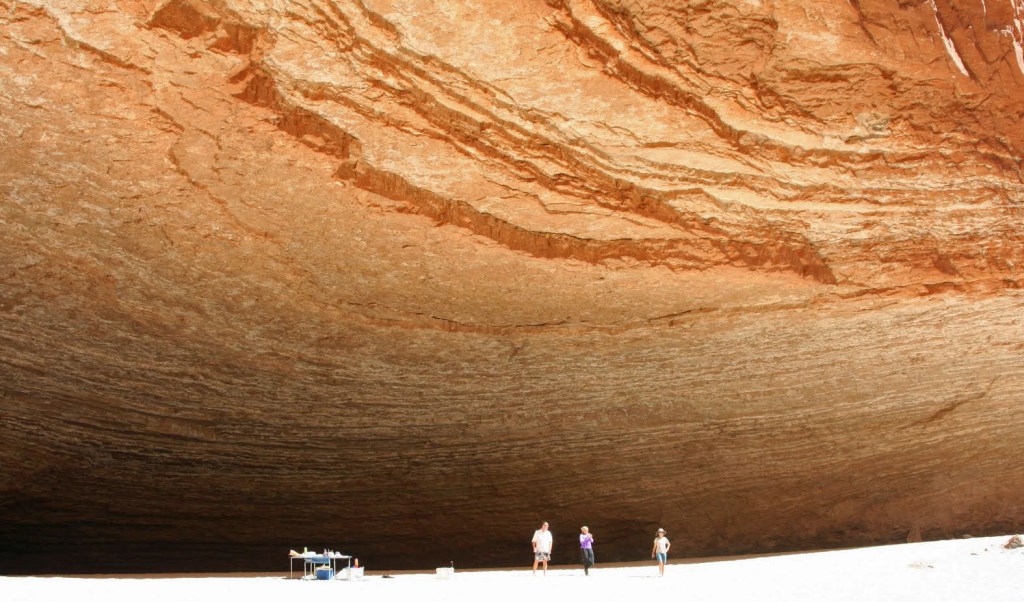
This photo provides a perspective on the sheer size and beauty of Redwall Cavern.

A view of the Grand Canyon looking upriver from the Redwall Cavern.
In my next post we visit an ancient Anasazi storage facility high on the cliffs above the river and play in the beautiful Little Colorado River.