We Visit Phantom Ranch, I jump Off a Cliff, and Tom Wears Bone… Rafting through the Grand Canyon

Sunset at Zoroaster Campsite on the Colorado River in the Grand Canyon. (Photo by Don Green.)


Having left Tanner Rapids and my encounter with Mousy at mile 69, we continued on down the Colorado River to Zoroaster Camp at Mile 84.5. The dark inner walls of the Canyon signified we had traveled back a billion years in geological time, back to the very beginnings of life on earth. A rousing game of Bocce Ball served as entertainment in camp that evening.
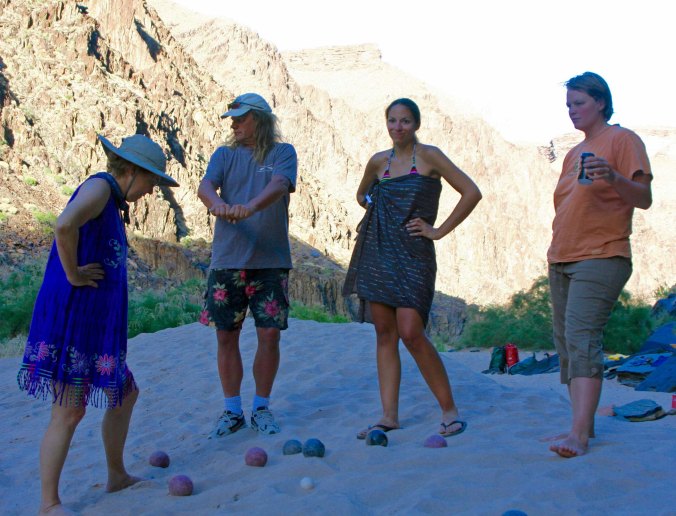
Whose ball is closest? A game of Bocce Ball entertained our rafters…
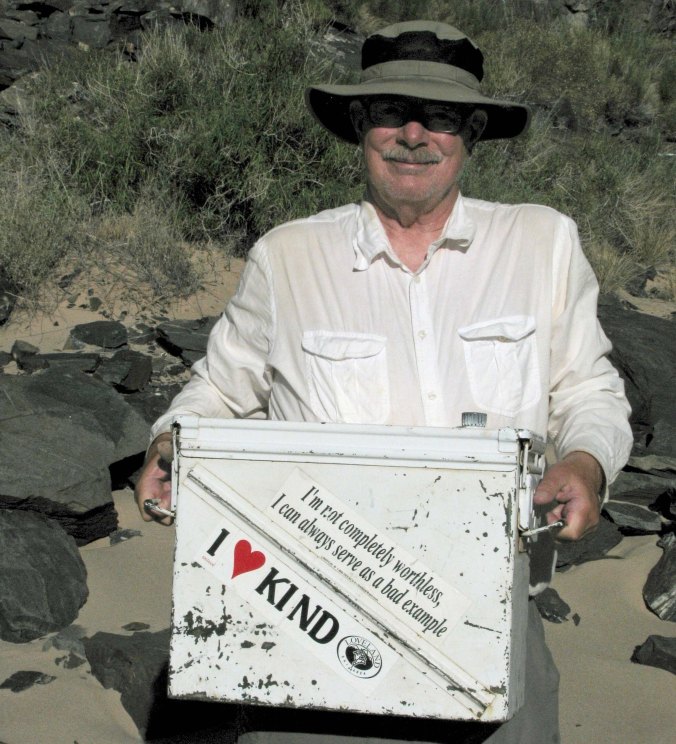
And I took care of my groover duty, which is far from being groovy and gives a whole new meaning to port-a-pot. (Photo by Don Green.)

Tom’s objective in camping at Zoroaster had been to put us close to Phantom Ranch, which was located at Mile 88 on our 18-day, 280-mile trip down the Colorado. Built in the 1920s, the facility provides the only lodging beneath the rim in the Grand Canyon. There are three ways to get there: on foot, by mule or by raft. I’d backpacked down twice, once from the North Rim of the Canyon and once from the South. Now I would visit by raft. The Ranch also provides one of the few opportunities along the river for rafters to leave and join trips. Nancy Pape would be leaving and Jonas Minton joining us. I’d known both since the 70s.

A mule welcomed us to Phantom Ranch…
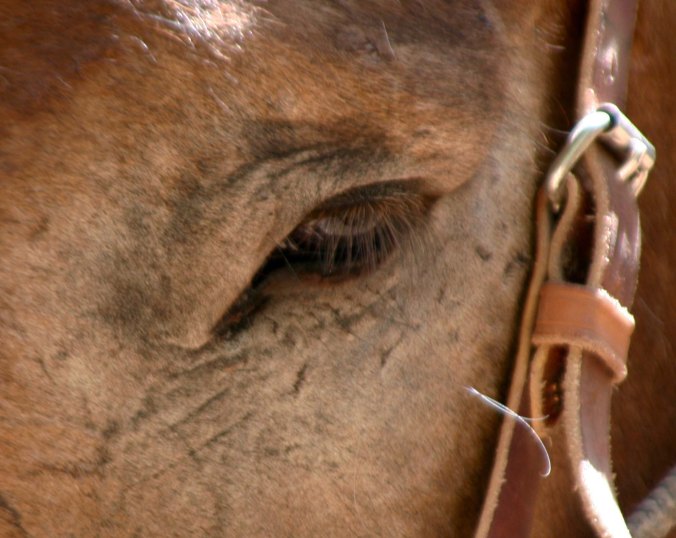
And gave me the eye. I know folks who would kill for those eyelashes.

Don welcomed us well…

As did this bright flower with its bee on a beaver tail cactus.

I took this photo looking up from the ranch.

Nancy Pape, who pretty much spends her life hopping in and out of places, hiked out to the South Rim. I’ve known Nancy since the 70s when she first went with me on one of my hundred mile backpacking trips.

Jonas was supposed to be there early, according to Tom’s plan. We had miles to go before we were to sleep, to paraphrase Robert Frost. But another poet interfered. “The best laid plans of mice and men often go astray,” Robert Burns had declared. That had certainly been the case for Mousy who had had no intention of ending up as dinner on the edge of my sleeping pad at Tanner Rapids. And so it was for us.

Jonas had hiked down from the South Rim that morning, traveling some 9 miles and dropping 4600 feet. It was early afternoon when he arrived, exhausted. Like me, he is no youngster. He needed a nap. Tom insisted we make up for lost time, however, and away we went. Peggy and I agreed to ride with Jonas. We immediately found ourselves between a large rock and the shore with no room to maneuver— a situation we barely escaped only to careen across the river and bounce up against the wall. The raft climbed up to its tipping point, like it was eager to escape the river and us. I knew we were going over and could feel the icy waters sucking me under. But we didn’t. Jonas had both experience and adrenaline to counter his exhaustion. The raft kept its messy side up and we avoided a dunking.
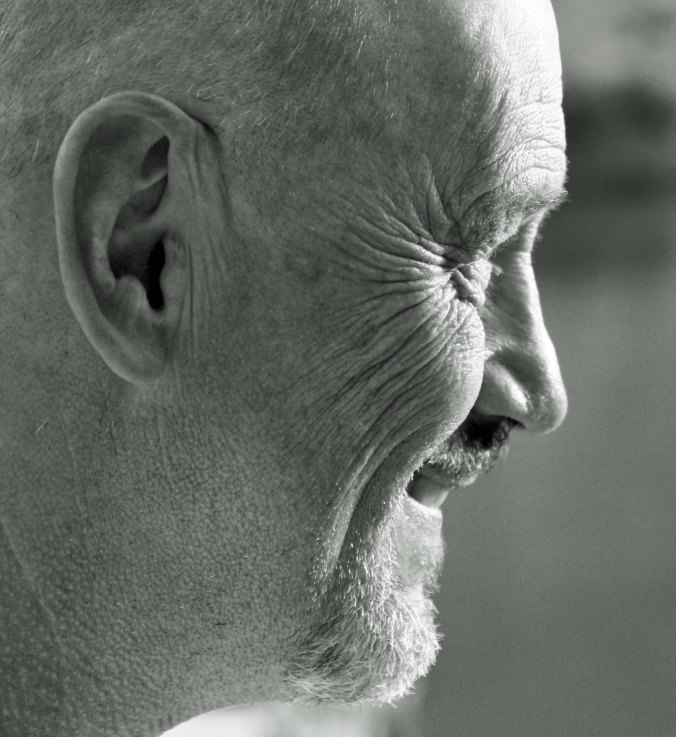
Jonas and I had worked on environmental issues in Sacramento during the 70s.

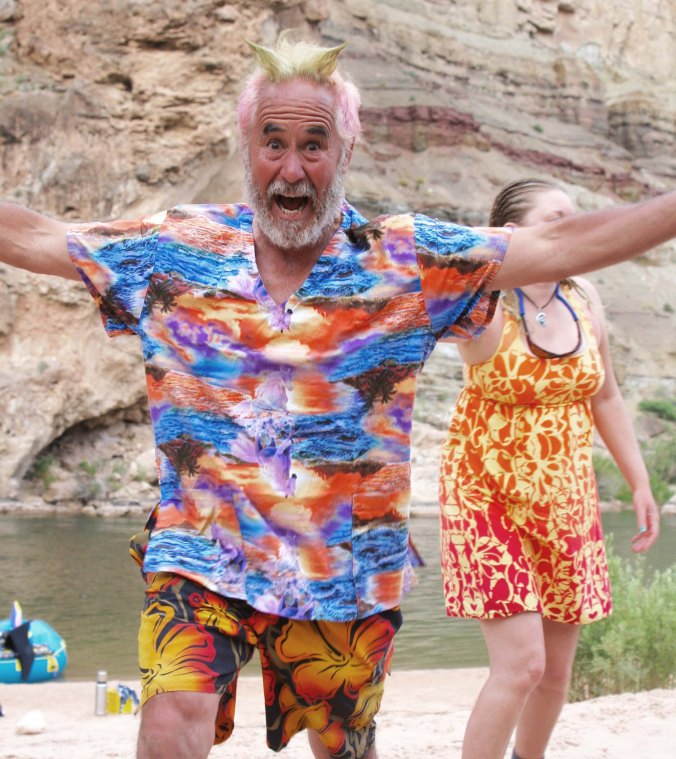
Afterwards, Jonas and the raft agreed to cooperate with each other and we made it into camp without any more challenges. That was the night that Tom decided to wear Bone in his hair. I am not sure whether he was trying to appease or irritate the Canyon gods. Bone, who is quite used to strange encounters, told me later that they don’t get any stranger!

Susan Gishi gives Tom a ‘do.’

And Bone is added as an accessory. “At least,” Bone was heard to say,” Tom didn’t try to turn me into a nose decoration!.

Dinner was good that night…

And the sunset was fabulous. Or maybe the Canyon gods were commenting on Tom’s hairdo.

The next couple of days found us hiking through fast-moving water over slick rocks, maneuvering through one of the Canyon’s most challenging water falls, and jumping off a 20-foot cliff.

Shinumo Creek often provides a lovely wade up to a beautiful falls, hiding on the left.

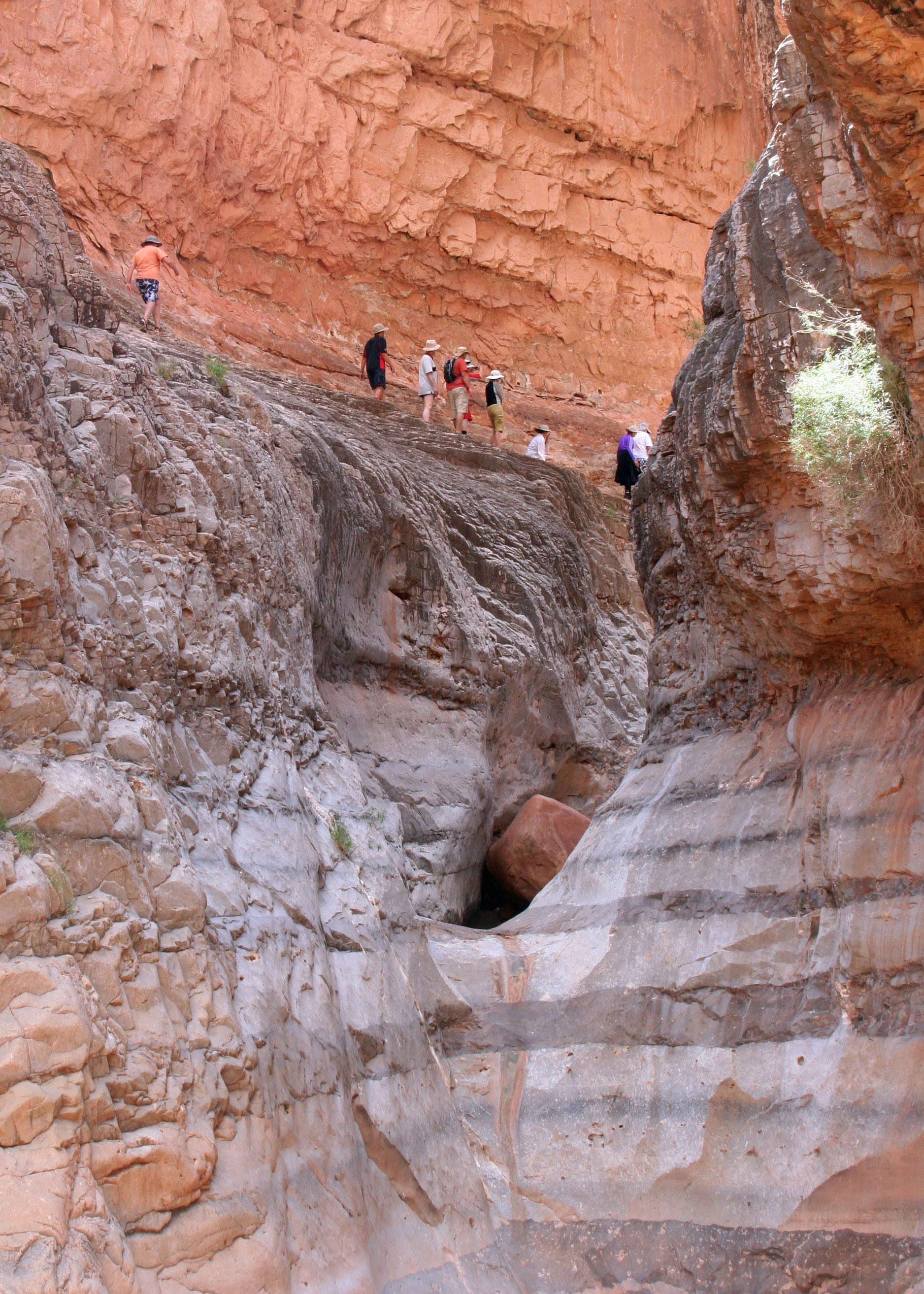
This time the creek was flowing so fast, we had to help each other to avoid being washed off our feet.
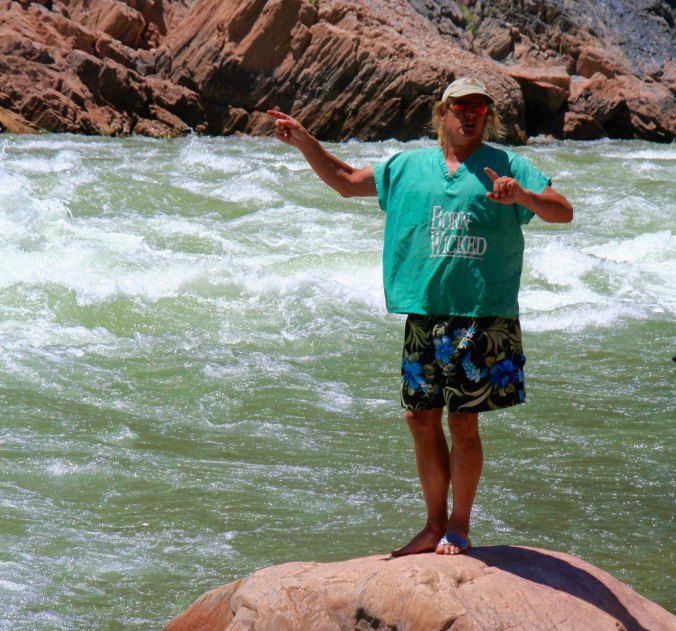
Steve is scouting what I think was Crystal Rapids. He seems to be suggesting we go back the way we came!

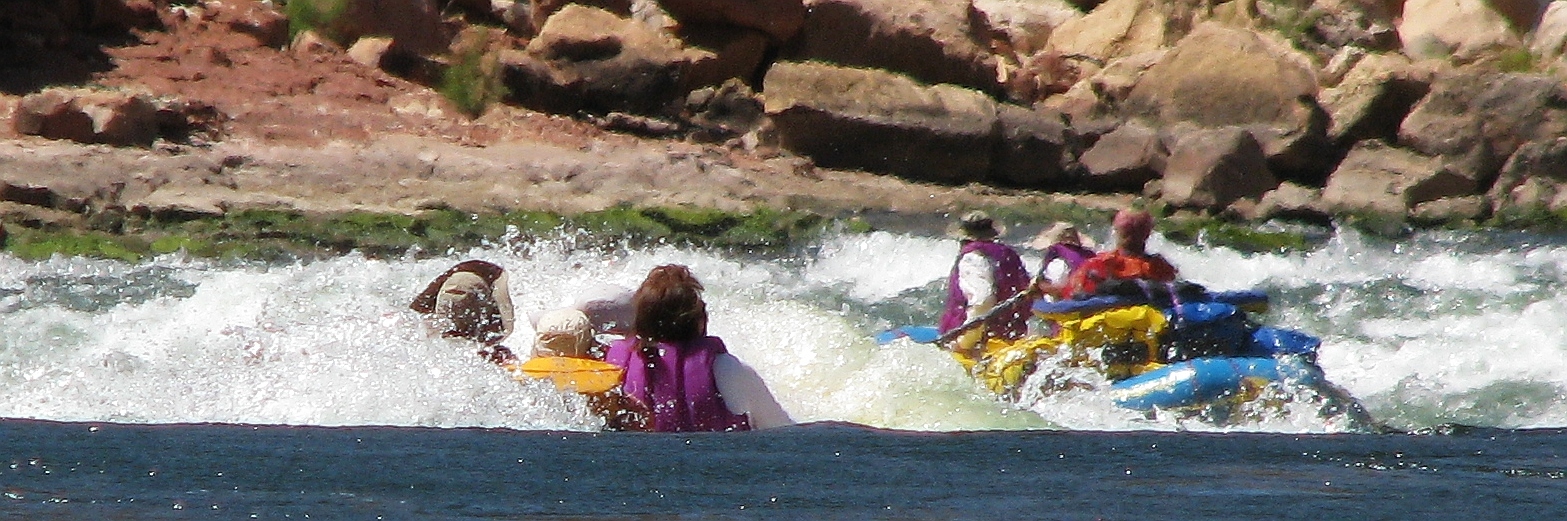
Later, we watched one of the commercial raft trips make its way through the rapids. We were on two very different types of trips.
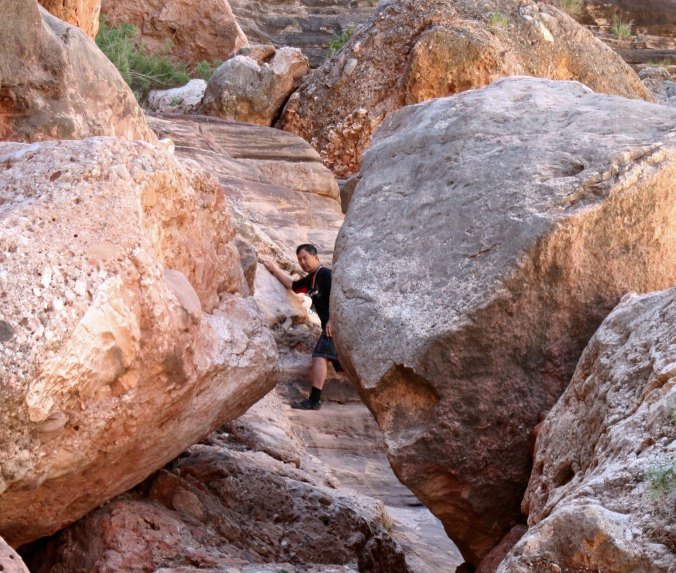
“You have to hike up to these beautiful falls,” Tom urged and off we went on another adventure through a huge boulder field. I’d say we were rock hopping but the rocks were a little big to hop.

The waterfalls were indeed worth it, but I didn’t realize we were expected to jump off!
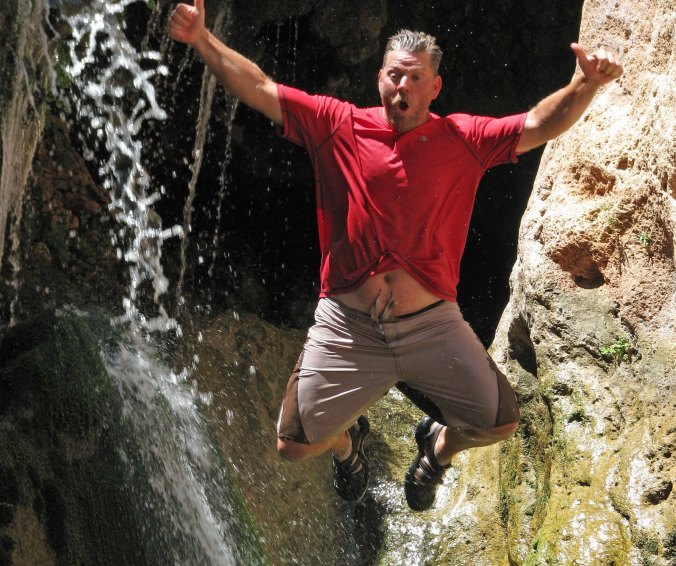
Jame Wilson provided one approach… (Photo by Don Green.)
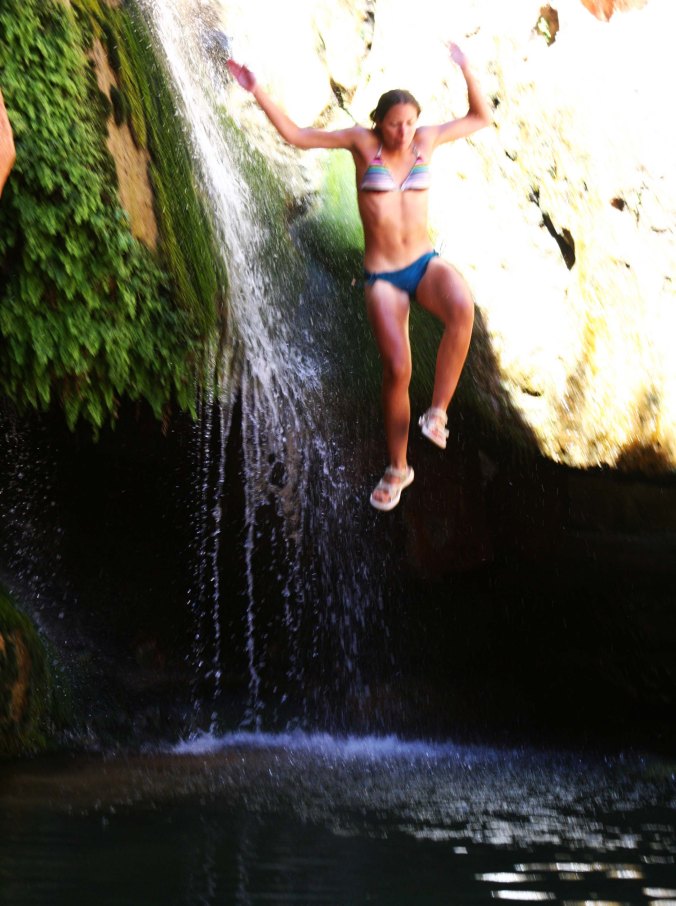
And Theresa another…

Let me report that the water was cold. That’s it for the day. I will continue our trip down the Colorado next Monday.

WEDNESDAY’S POST: Traveling through the Yukon Territory on the Alaska Highway.

FRIDAY’S POST: Another in the MisAdventure Series: Who shot Tony Pavy’s Pig?


Anasazi Ruins and the Hopi Entrance to Another World… Rafting the Colorado River through the Grand Canyon

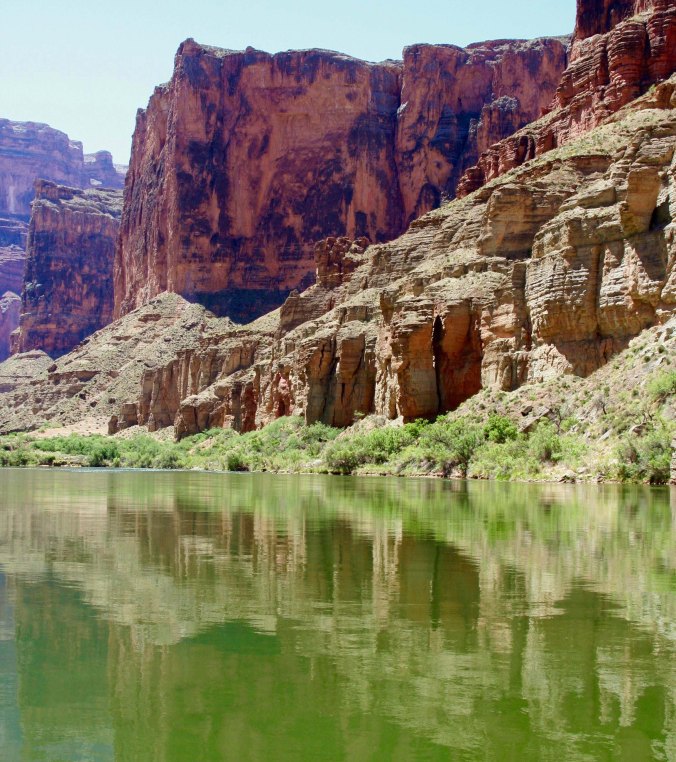
Beautiful views like this along the Colorado River would have been lost if efforts in the 50s and 60s to dam the Grand Canyon had succeeded.

In our journey down the Colorado River today, we visit an ancient Native American granary that is located high up on the cliffs above the water, and stop off to play in the Little Colorado River.

Steve Van Dore and Jamie Wilson serve as our boatmen for the two days we are on the river travelling from our camp at Redbud Alcove (mile 39) to our camp at Upper Rattlesnake (mile 74). Jamie is a delight. First of all, he is funny and positive. Second, whenever a chore needs to be done, he is first in line. Finally, he is incredibly strong, which is a valuable asset when you get in a tight spot on the river. Jamie has his own business as a contractor in the Woodland/Davis area of California.

Jamie

Jamie Wilson

Peggy and I hitch a ride on Steve’s Cat. Not too many Colorado River boatmen are outfitted with sun umbrellas!

Steve, I’ve already introduced. Like Tom, he is an experienced Colorado River boatman and loves the Canyon. He is also a specialist. His catamaran is outfitted with groovers: large ammo cans that have been modified to serve as portable potties.  Before toilet seats were added as a convenience, you sat on the rim of the can. It left grooves in your behind— hence the name.

We are all given training in setting up, taking down, and using the groovers. One of the first chores in arriving camp is to find the perfect place for the port-a-pot: a secluded location with a view. One time I found myself sitting on the pot and waving at rafters as they went by. The site received an A for the view and a C for the seclusion.

Steve is very knowledgeable about the Grand Canyon and readily shares his knowledge. Almost immediately he points out a site that was once proposed for a dam that would have covered much of the upper Canyon’s beautiful scenery, geological wonders and archeological treasures with water.

A similar effort was planned for downstream. Fortunately, the Sierra Club was able to stop the dam from being built. Otherwise, one of the world’s greatest natural wonders would have been lost.

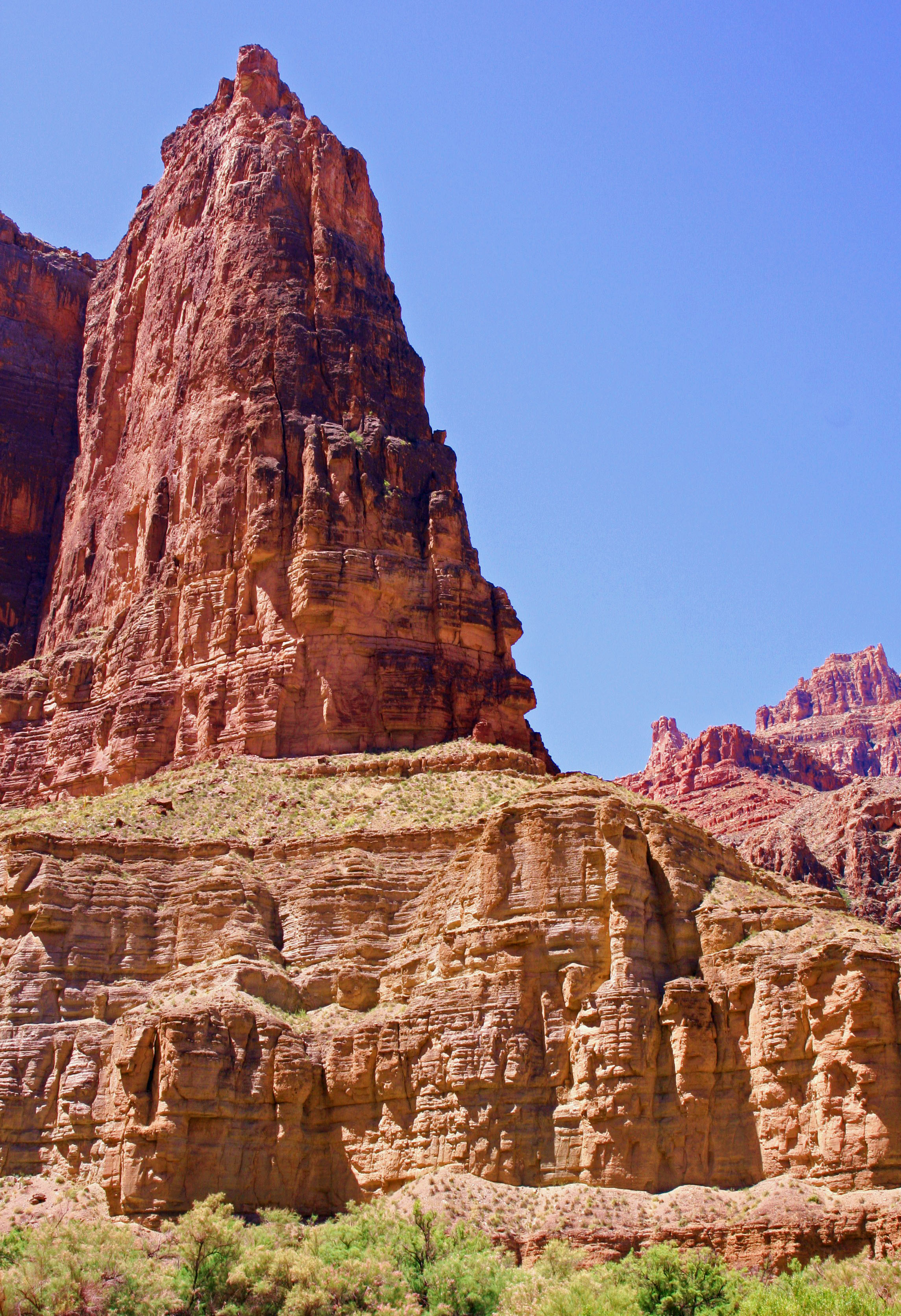
Views of the Grand Canyon along the Colorado River between Redbud Alcove and the Little Colorado.

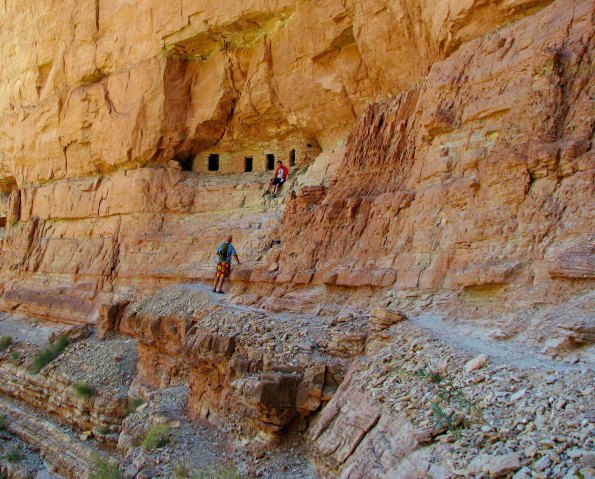
When we arrived at Nankoweap (mile 53), Steve pointed out the granaries used by the Anasazi Indians somewhere between 1000 and 1150 CE (Common Era) or AD, if you prefer. The granaries are located high up on the cliff for protection from animals and insects. Tom had scheduled a hike up and I willingly went along.  I was curious about the granaries and thought that there would be spectacular views from the cliff.

The climb was definitely worth it. Unfortunately, I sprained my knee on the way back down.

Our intrepid group hikes up the steep trail to the Granaries at Nankoweap in the Grand Canyon.

The granaries are located high up on the cliff.

They were  built by the Anasazi Indians between 1000 and 1150 CE.

Tom, Eggin and I next to the granary.

Looking down the Colorado River from the Nankoweap Granaries.

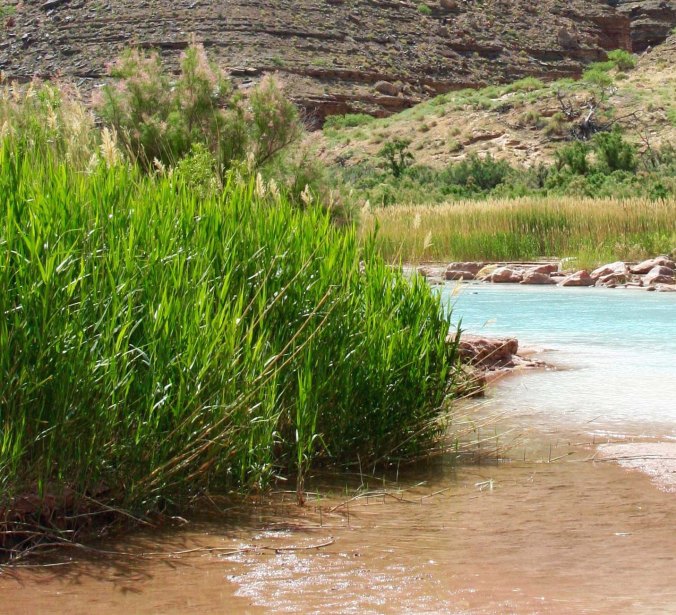
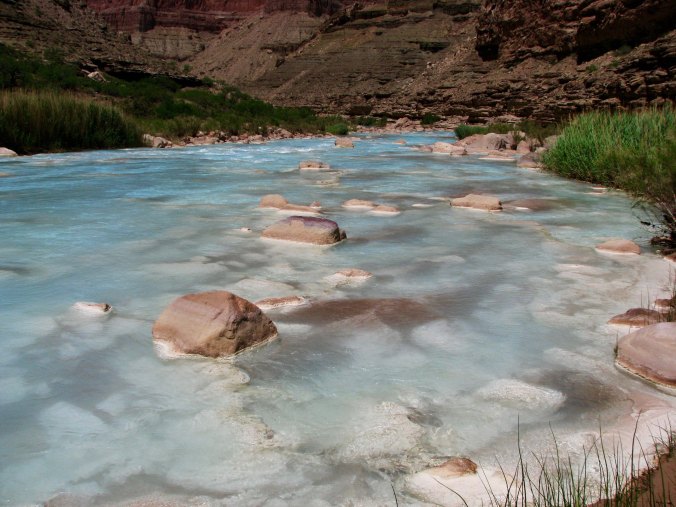
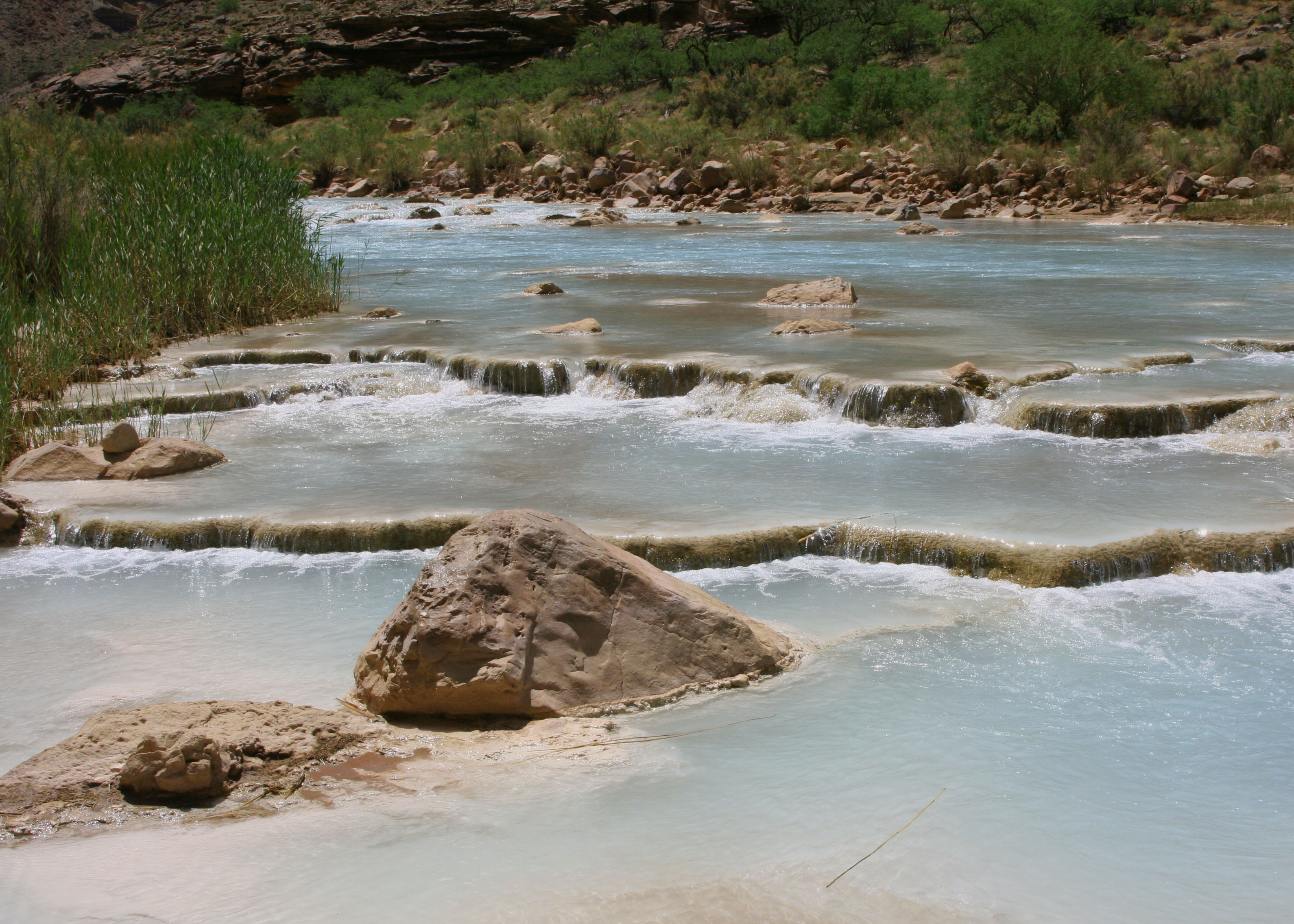
Jamie Wilson was our boatman on the fifth day. When we arrived at the Little Colorado River, it was time to play. The Little Colorado has two colors. First is a muddy reddish-brown. The River drains over 25,000 square miles. When it rains upriver, it carries tons of red topsoil.  The second color is a beautiful turquoise blue. When it doesn’t rain, much of the water comes from springs and is loaded with minerals that provide the color and very interesting deposits. We were fortunate to experience it without rain.

The entrance to the Little Colorado River.

Its almost surreal look. (Photo by Don Green.)

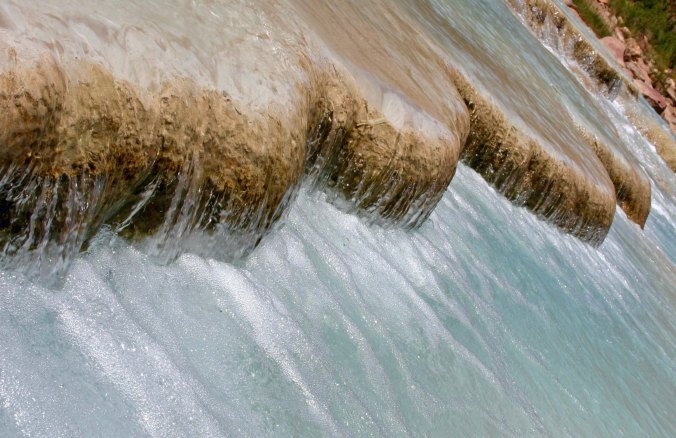
Looking up the Little Colorado River just above where if flows into the Colorado River. Note the mineral deposits.

A close up.

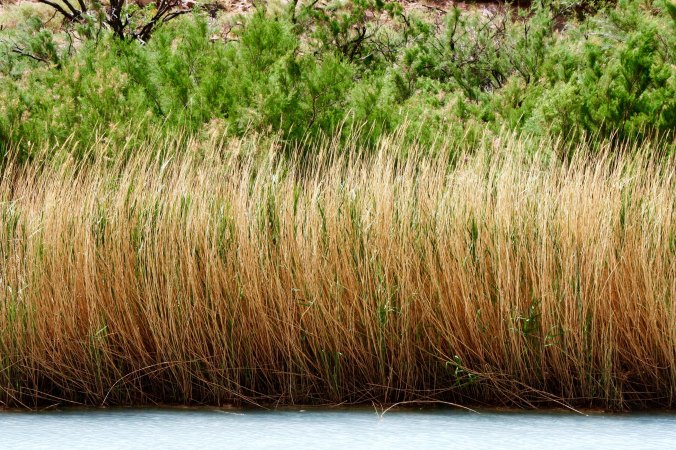
Vegetation on the Little Colorado.

A biologist was doing a study of the fish population in the Little Colorado and showed us this fellow.

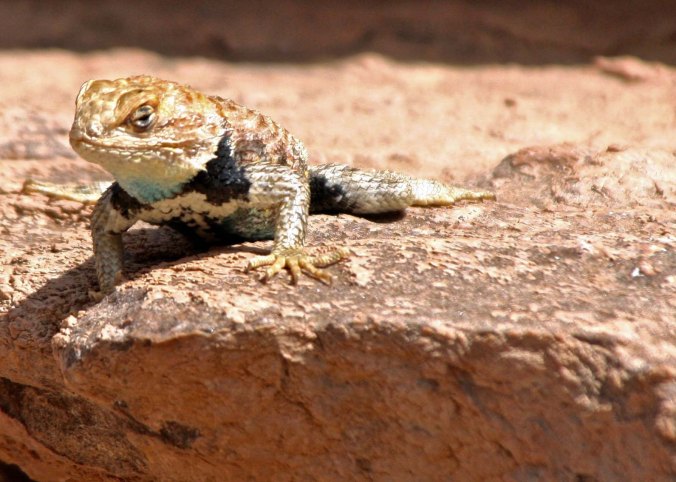
We also found a lizard as we were walking up the river. It looked smug.

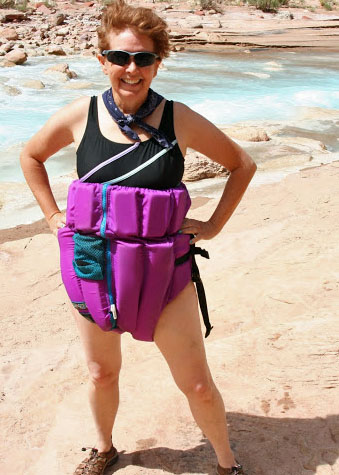
When we reached our destination, we donned our life vests upside down over our legs.  It looked like we had put on huge diapers. We were to float down the river feet first. After carrying out my photographer responsibilities, I too donned my diaper and jumped in. Just as I went over a small waterfall my life vest slipped down to my feet. My feet floated fine but my head bobbed along under the water. Breathing was not an option!

Peggy models the life vest diaper look. The latest in fashion statements.

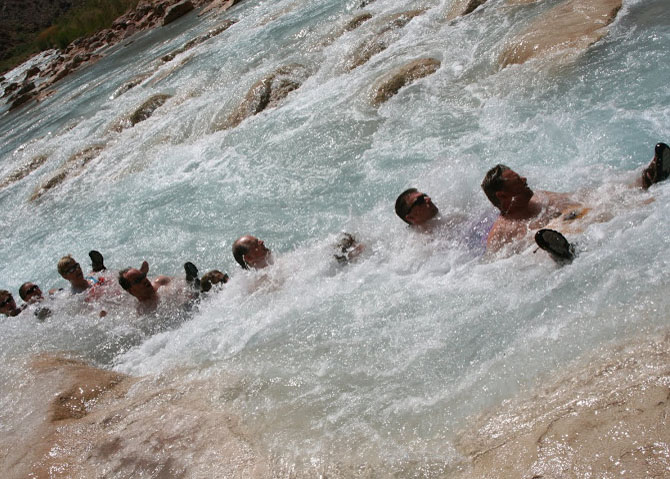
Hanging on to each other, the group formed a Conga Line—Little Colorado River style— and made its way through the rapids.

Tim Spann calmly floated over a small waterfall.

Peggy looked a little less in control…

And I looked totally out of control (actually I was), as my life vest slipped up around my feet and my head dipped under the water.

According to their mythology, the Hopi Indians came into this world through a cave, which is located just up the Little Colorado from where we were playing in the water. The legend states that this is the fourth world they have occupied. People had become bad in the previous three by doing things like being disobedient and having too much sex. The good were saved and moved up to the next world while the bad were left behind, or destroyed. Maybe their diapers slipped and they drowned.

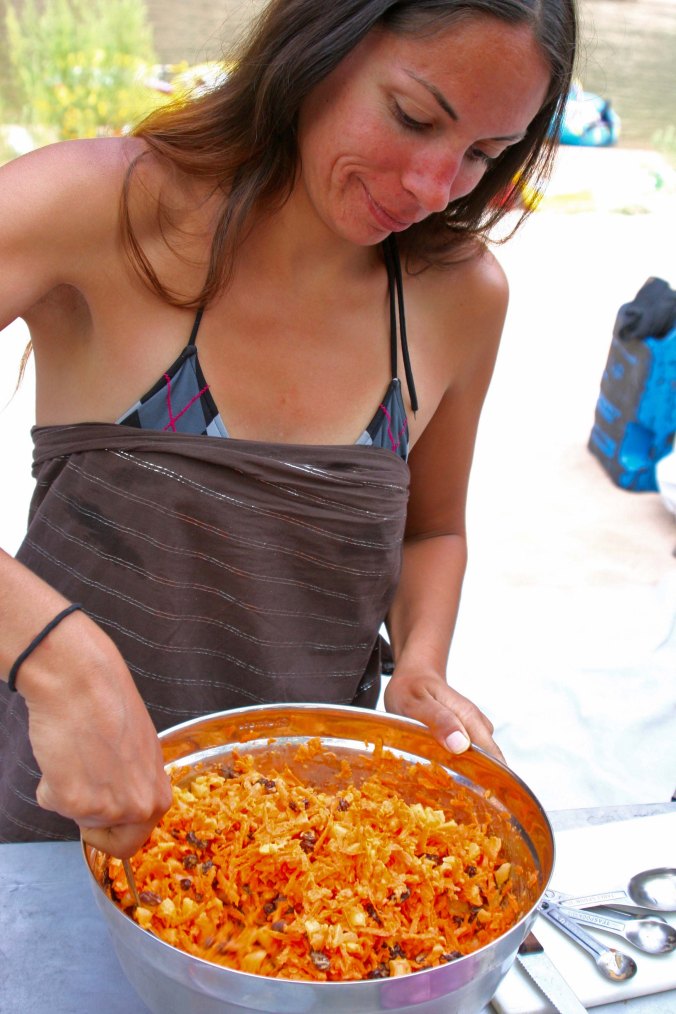
That night Theresa Mulder whipped up a delicious carrot and raisin salad. As I’ve noted, Tom had planned out an excellent menu for the trip and we ate very well. I also noted that Tom was something of a tyrant in the kitchen…

This is what you could expect if you didn’t cut the lettuce right. (grin) I decided to appoint myself to permanent groover duty and stay out of Tom’s kitchen.

I’ll close today’s post with some views of the sun setting from camp.

A different perspective…

Another view. Next Monday we will continue to make our way down the Colorado through the Grand Canyon.

Also TODAY: The photographic essay trip up the Alaska Highway continues.

FRIDAY’S POST: A chapter from book on my Peace Corps experience, The Bush Devil Ate Sam. How Rasputin the Cat beat out his sisters to become our cat.


SaveSave

SaveSave

SaveSave

SaveSave

SaveSave

SaveSave

SaveSave

SaveSave

SaveSave

SaveSave

SaveSave

SaveSave

SaveSave

They Say that Tom Operates with One Oar… Rafting through the Grand Canyon: Part 6

We started with an icy cold rapid. Peggy and I are in the first boat with Tom Lovering rowing— just before he lost his oar. (Photo by Don Green)

Day two starts as day one did: early.

Even the birds are sound asleep. Tom argues it’s six a.m., not the five my watch is showing. “Arizona does not honor Daylight Savings Time,” he primly informs us. He’s right. Adjusting my watch adjusts my attitude— a little.

Adding injury to insult, something akin to Folgers has been sewn up in burlap, thrown in boiling water, and called coffee.  Oh well, it’s hot, it’s brown, and we have a beautiful day of floating down the Colorado through the Grand Canyon ahead.

For those of you who like facts, here are a few about the river. At its widest point it reaches 750 feet from one bank to the other; at its deepest, it plunges down 90 feet. It flows along at a decent 3-4 mile clip but can speed up to 15 miles per hour in rapids. Since the water comes out of the base of Glen Canyon Dam, it is cold: somewhere around a frigid 46 degrees Fahrenheit during the upper part of our trip. Over the course of our adventure the river will drop 1700 feet in altitude, which is an average 8 feet per mile… 25 times that of the Mississippi River.

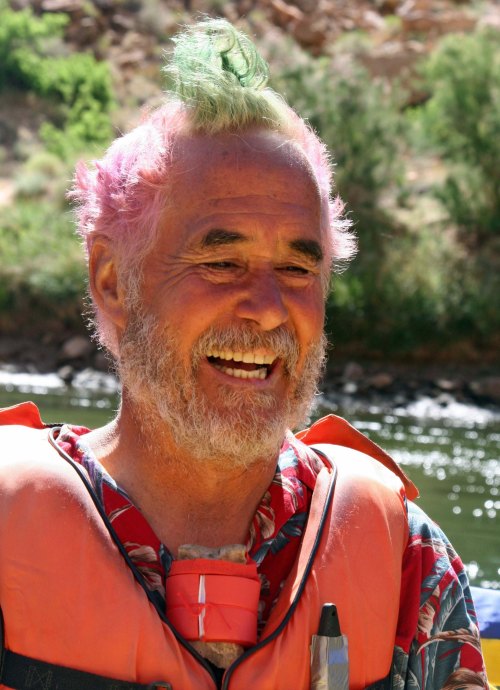
Our boatman for the day, Tom Lovering, with his wild, Canyon hairdo.

Bone on edge of Sotar Raft in Grand Canyon

Bone decides that it is time for a photo-op on the Sotar raft in the Grand Canyon. Having learned from his experience on the Amazon River, he quickly moved away from the edge…

Tom Lovering and Bone

And snuggled up with Tom.

Tom is our boatman for the day. He checks to make sure our toenails are painted and then lets us board. The wind is still blowing but it has lost its ferocious bite. A mile down the river we pass Ten Mile Rock, a prominent landmark that has fallen from the cliffs above and now juts up out of the river. Made of Toroweap Sandstone, it was laid down in shallow seas that covered the area some 250 million years ago.

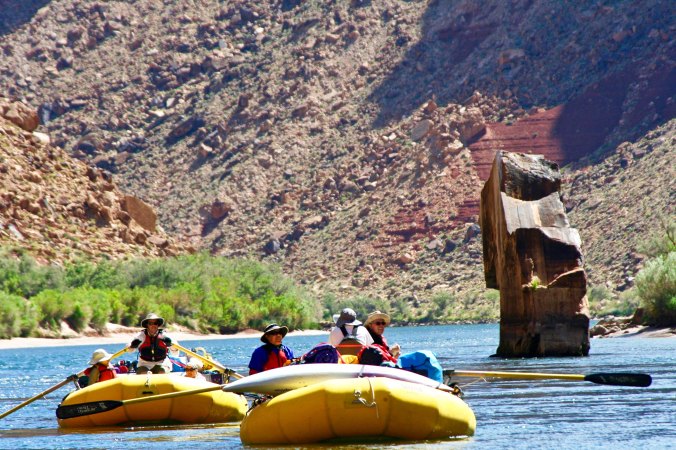
Rafters pass Ten Mile Rock on the Colorado River in the Grand Canyon

Floating by Ten Mile Rock. You wouldn’t have wanted to be near here when this massive chunk of sandstone broke off from the Grand Canyon walls high above the river.

Shortly afterwards we hear our first rapid of the day, Soap Creek. You always hear rapids before you see them; it builds anticipation. Soap Creek roars like a teenage lion. Tom maneuvers through it like the excellent boatman he is but makes sure we get suitably wet. It’s like taking a cold shower outside on a frosty morning with a 15 mile per hour wind blowing.

“I love rowing,” Tom tells us— and it is obvious he does. It is more than the heart-stopping, adrenaline-pumping moments of major rapids where the boatman’s knowledge and skill is matched against the tremendous power of the river with its dangerous rocks and grasping holes. And it is more than the opportunity to enjoy incredible beauty of the Grand Canyon that rowing provides. Tom enjoys the rhythm and the hard work. He even liked the backbreaking challenge of rowing against the wind the day before.

Don Greens ducks along the Colorado River in the Grand Canyon

Nature, like this family of ducks, also adds to the experience of rafting through the Grand Canyon. (Photo by Don Green.)

Century Plant in Grand Canyon

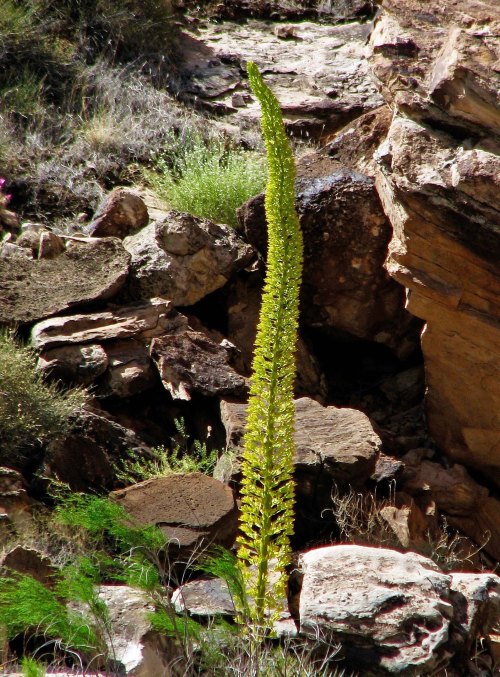
As do plants and flowers. This is a century plant. (Photo by Don Green.)

Grand Canyon canyon

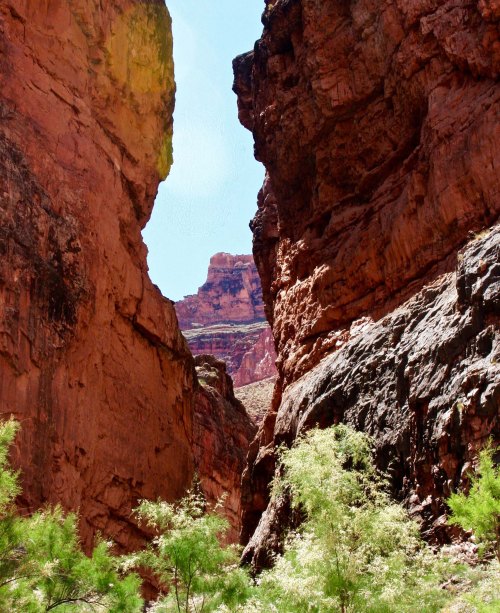
Keeping a sharp eye out will reward you with views of canyons within the Canyon. Don’t you want to go exploring?

Beauty of Grand Canyon

And almost any view up or down the river is a treat.

At mile 17 we come on our first, and only, major challenge of the day, House Rock Rapid, where we learn another fact about rafting through the Canyon: water levels depend on electricity needs in the West. Peak demands require large releases of water from Glen Canyon Dam to run its huge generators. Eventually, these releases catch up with rafters. The fluctuations in water levels have significant impacts.

House Rock Rapid demonstrates one of the more serious. The river is at its low point. More rocks are exposed and a massive hole lurks downstream from the largest rock. Even the most skilled boatman will be challenged to avoid it. We all land and climb off our boats to scout the rapid. Tom is eager to move on. Steve is adamant about waiting for more water. After a long discussion between the boatmen, a decision is made to take the more cautious approach. All of our boatmen are experienced, and Steve and Tom have been down the river many times. They respect each others opinions. As with most aspects of dealing with natural forces, it is best to error on the side of caution when you have the opportunity. There are plenty of times when you don’t.

Our group worriedly scouts House Rock Rapid. Peggy shows more enthusiasm than may be called for.

We have lunch, take naps, go for walks and watch as three large boats of commercial rafters chug through the rapids with their large engines. It is mid afternoon when the boatmen finally decide that enough water is flowing to reduce the hazard to a barely acceptable risk.

Tom’s fist knocks me on the head when we are halfway through. One of his oars has popped out. I look left and all I can see is churning, raft-eating hole. We are poised on the edge— about to be sucked in! Tom becomes a virtuoso of one-armed madness.  Ever so slowly, like about a thousand years, the boat decides to go where he wants. We land, and for one of the few times in his life, my ever-talkative friend is silent.

We looked to the left and saw that we were poised on the edge of a massive hole with a rock in the middle.

The next day, Eggin Stalheim, Dave’s niece, is our boat woman. This is Eggin’s first time rowing a raft and her first time rowing through the Grand Canyon. It would seem insane except Eggin is a world-class kayaker. She is an expert at reading water. The problem is that our large, fully loaded rafts do not move like feather-light kayaks—picture driving an 18-wheel Mack Truck with a Ferrari 458 attitude. We have some adventures.

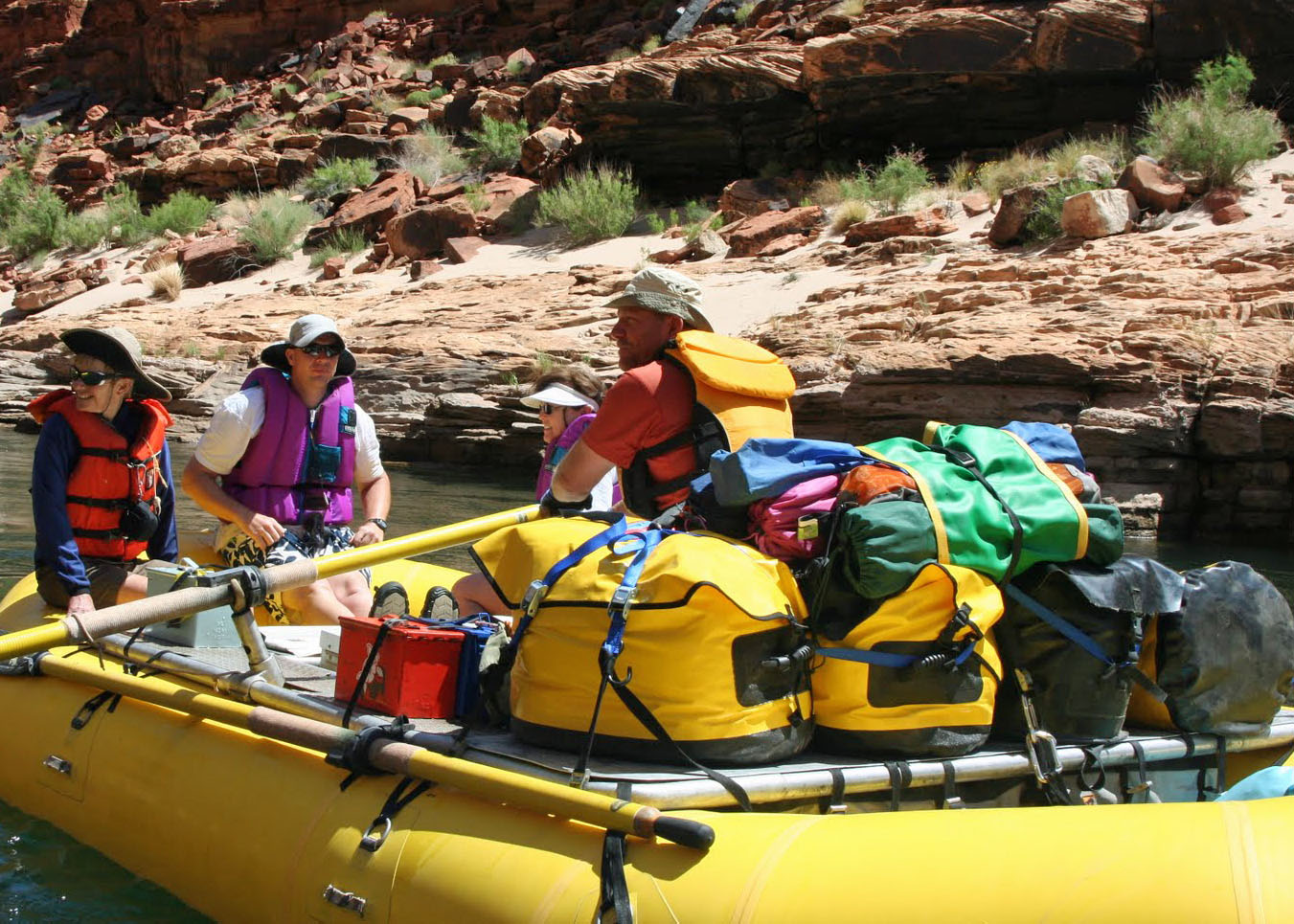
This shot of Jamie’s raft provides a perspective on what our fully loaded rafts looked like.

Eggin keeps the messy side up, however, as rafters say. (The non-messy side is the smooth bottom of the raft.) So it’s all good. Eggin, like me, has served as a Peace Corps Volunteer in West Africa. When she gets off the river she is heading for Tanzania where she will work with a women’s craft co-op.

Beyond our “kayaking” experience with Eggin, the big news on day three is that we began our side-trips. Almost all journeys down the Canyon include stopping off to see the sights. Some are quite beautiful and others provide unique challenges, as if our daily challenges of negotiating rapids aren’t enough.

Our first stop at mile 29 is the Silver Grotto, which includes both beauty and challenge. Wanting a little downtime and solitude, I opt out and take photos. Peggy tells me, “We climbed an 8 foot wall, repelled down a rock face, slogged through a murky, cold pool and slid down a 20 foot rock slide.” The rock slide was more like free-fall.

As the group disappeared into the Silver grotto, I took some much needed Curt-time.

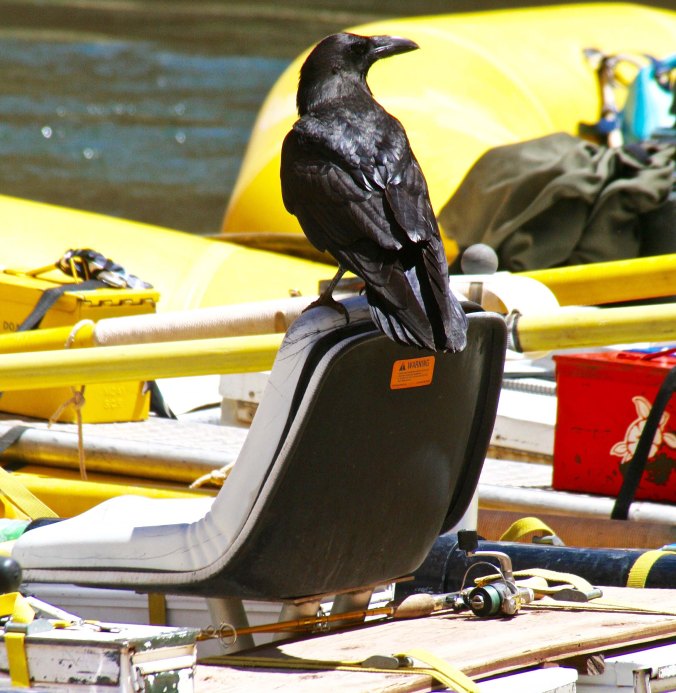
Raven arrives on raft in Colorado

One of the Grand Canyon’s large ravens stopped by for a chat. Note how the ammunition cans were arranged on the side of the boat. This is so we could have ready access to things we might need during the day: cameras, sun block, snacks, etc.

Raven visits on the Colorado in the Grand Canyon

Having determined that I was harmless, the raven settled in on the captain’s chair. I’m sure it would have preferred that I not be there and that we had left some food unprotected.

I didn’t get a photo of our group members leaping but this is what they slid off of into the muddy water below. Water was splashed on the rock slide from a pool behind the lip to make the slide more smooth. Or so they said.

Next we stopped off at Paradise, as in Vasey’s Paradise. A beautiful waterfall shot out of a redwall cliff and created a Garden of Eden at its base. It was worthy of the name.

The waterfall shooting out of the redwall at Vasey’s Paradise, Mile 32. It’s named after a botanist that was part of John Wesley Powell’s exploration of the Grand Canyon.  The water for the falls is made up of ground water that seeps down from above and shoots out of holes in the canyon’s wall.

Dave Stalheim and his niece Eggin perched on a rock at Vasey’s Paradise.

Peggy Mekemson at Vasey's Paradise in the Grand Canyon

Peggy enjoys our rest stop at the falls…

Retrieving water on the Colorado

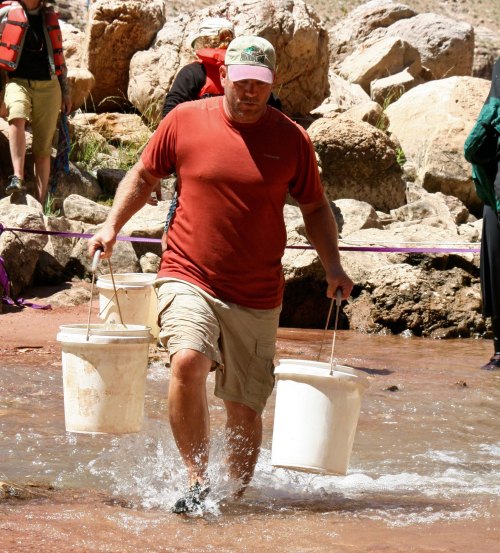
And Jamie retrieves some of the icy fresh water. Whatever work needed to be done, Jamie was always in the middle of it— a good man.

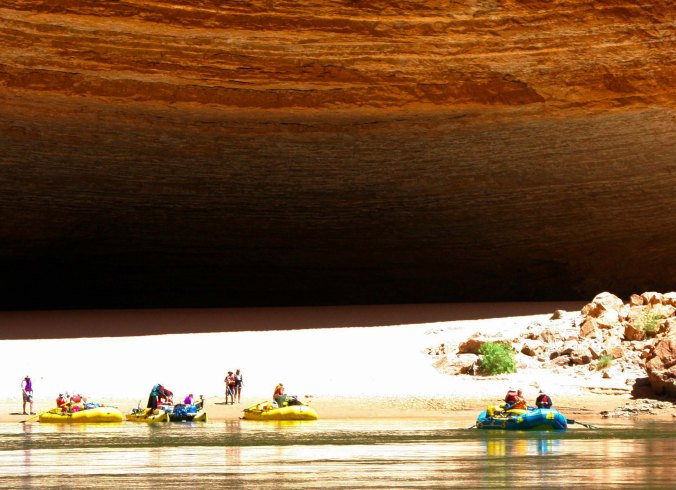
Our final stop of the day is at Redwall Cavern. Major John Wesley Powell was the first non Native American to admire the Cavern’s unique beauty. Powell was a Civil War Veteran who had lost his right arm at Shiloh. His exploratory expedition through the Grand Canyon took place in 1869. Powell thought Redwall Cavern could accommodate up to 50,000 people. Modern estimates are closer to 5000, but it is still big…

Coming around a bend in the Colorado River, we saw our first view of Redwall Cavern.

This photo provides a perspective on the sheer size and beauty of Redwall Cavern.

Redwall Cavern on Colorado River with rafters

As does this photo.

Cool dip in Colorado River

Several folks, including Eggin, took advantage of the river here for a cool dip.

A view of the Grand Canyon looking upriver from the Redwall Cavern for my last photo today. (A note on photos: all pictures are taken by either Peggy or me unless attributed to Don.)

Next Monday in my Grand Canyon series we will visit an ancient Anasazi storage facility high on the cliffs above the river and play in the beautiful Little Colorado River.

Wednesday’s Photo Essay POST: We begin our journey up the Alaska Highway with beautiful views and abundant wildlife.

FRIDAY’S Blog-A-Book POST: The Woods, a ten minute walk from my childhood home, teach me a love of the wilderness that exists up until today.

SaveSaveSaveSaveSaveSave

SaveSave

SaveSave

SaveSaveSaveSave

SaveSave

SaveSave

SaveSave

SaveSave