R-Rated Pompeii… Seaports of the Mediterranean

The Lupanare or main brothel of Pompeii. Girls would stand in the window and call to the men below.

The Lupanare or main brothel of Pompeii. Women would stand in the window and bark at the men below.

Today’s blog is R-rated with a :). It’s for mature audiences with a sense of humor. Seriously.

I’ll start by noting that the citizens of Pompeii had a slightly different take on morality than we do; um, make that a major take. Erotic art was found everywhere in the city during archeological excavations. Think ubiquitous. It was also quite explicit.

When King Frances of Naples visited a Pompeii exhibition at the National Museum with his family in 1819, he was so embarrassed by the erotic art that he locked it away in a secret cabinet. Ever since, the collection has had a history of on-again, off-again exposure.

Early bra sizing.

Early bra sizing.

Today, it’s on again. Sort of. When you visit the Archeological Museum in Naples, Pompeii’s erotic art is stored in the Gabinetto Segreto, Secret Room. You may have to make an appointment to get in… not because the subject matter is XXX, (which it is) but because the exhibit is the most visited site in the museum.

Similarly, in Pompeii, the Lupanare is included on every tour group’s must-see list.  Our guide warned us that visiting the brothel was an adult activity. She also told us we weren’t allowed to linger. Our tour was to be a quickie, so to speak. We had five minutes. Other groups were waiting.

The brothel was called the Lupanare because its working ladies were called lupe or she wolves. They were called lupe because they were not allowed to solicit in the normal way. It wasn’t “Hey, sailor, looking for a good time?” It was more like “woof, woof, woooooo.”

Once inside, guests were treated to a series of paintings that graphically portrayed the various services available… and costs. Sailors weren’t noted for being literate. Each woman  a small cubicle with a stone bed.

Each of the ten rooms in the Lupanare had a stone bed and pillow. I call this Lupe's Den.

Each of the rooms in the Lupanare had a stone bed and pillow. I call this Lupe’s Den. Hopefully, a mattress was included.

Graffiti was found on the walls. Those who could write were invited to evaluate their experience. It was basic. “Sollemnes, you S**** well!” one proclaimed. Apparently, she received a four-star rating.

In Naples we followed up with a visit to the Secret Room. I found the exhibition much more humorous than erotic. I mean, how can you take a flying penis with bells on seriously?

It's hard to take this guy with wings and bells on seriously.

Stepping out for the night?  A friend said, “OK, I get the wings, but what’s with the bells?” I told him I found them quite chiming.

Batter up? Or maybe I should label this 17, 18 and 19.

Batter up? Or maybe I should label this contestants 17, 18 and 19 doing the Macarena. And the winner is…

I'll close with a final view of the Lupanare. It had 10 rooms, altogether. Five upstairs and five down. The upstairs rooms were larger and had private entrances.

I’ll close with a final view of the Lupanare. It had 10 rooms, altogether. Five upstairs and five down. The upstairs rooms were larger and had private entrances.

NEXT BLOG: Back to a G-rated look at Pompeii.

Pompeii: A City Buried Alive… Seaports of the Mediterranean

Buried by a pyroclastic flow of volcanic rocks in 89 AD, Pompeii provides one of our most detailed accounts of what life was like in the Roman Empire.

Buried by a pyroclastic flow of volcanic rocks in 79 AD, Pompeii provides one of our most detailed records of what life was like in the Roman Empire.

Their lives would have been interrupted by a series of small tremors. It had to be worrisome; seventeen years earlier Pompeii had come close to being destroyed in a massive earthquake. The city was still being rebuilt. Possibly the residents woke on the morning of August 24, 79 AD and looked fearfully at the restless mountain that loomed over them… and then went on about their chores.

Everything ended at 1:00 PM.

Mt. Vesuvius exploded in a massive eruption sending tons of ash, gas and rocks spewing 20 miles into the sky and forming a dense mushroom cloud. Winds quickly carried the ash into Pompeii, turning day into night and dreams into nightmares. The majority fled, escaping by whatever means available. Those who stayed behind died… suffocating at first under the blanket of thick ash and ultimately, the next morning, being buried alive under a pyroclastic flow of molten rock and gas that flew down the mountain at speeds close to 100 miles per hour.

Viewed from an archeological perspective, history’s tragedy has become today’s blessing. The molten rock and ash that covered Pompeii, also preserved it, providing historians with their most complete view of what life was like in ancient Rome. Over the next week, I will be blogging about our recent trip to Pompeii and sharing photographs of this remarkably preserved city.

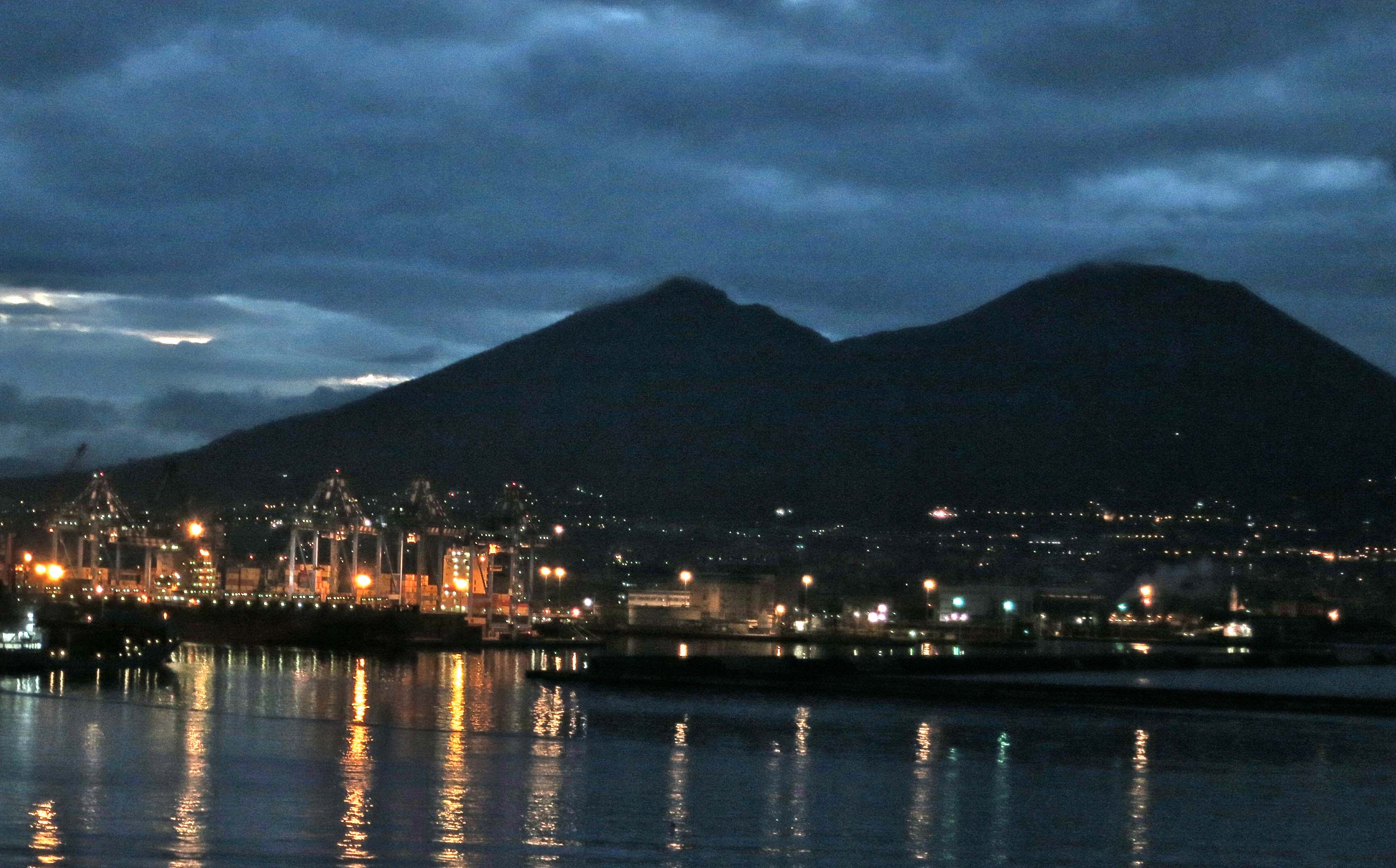
Our early morning arrival at the seaport of Naples showed Mt. Vesuvius looming over the city on a rainy day. The volcano is counted among the world's most dangerous given the 3 million people that live around its base.

Our early morning arrival at the seaport of Naples showed Mt. Vesuvius looming over the city on a rainy day.

While the majority of people living in Pompeii escaped, the remains of over 1000 have been found. By carefully pouring plaster into impressions left by the bodies buried under the pyroclastic flow, archeologists have created casts of these bodies. Several of these casts are on view in Pompeii.

Plaster cast of body buried under pyroclastic flow of volcanic rock in Pompeii.

Plaster cast of body buried under pyroclastic flow of volcanic rock in Pompeii.

This plaster cast of a body found in Pompeii looks the man merely went to sleep.

This plaster cast of a body found in Pompeii looks like the man merely went to sleep.

This body cast from Pompeii suggests to me that the person was gasping for breath.

This body cast from Pompeii suggests to me that the person was gasping for breath.

Several of the body casts in Pompeii were in storage.

Several of the body casts in Pompeii were in storage.

Today, a number of spectacular views of Mt. Vesuvius can be seen from Pompeii. The mountain is approximately four miles away.

Mt. Vesuvius rises above the Temple of Jupiter in Pompeii.

Mt. Vesuvius rises above the Temple of Jupiter in Pompeii.