Another post from my armchair travel series during Covid-19. This time I’ll take you on a window shopping tour of Venice with an emphasis on glassware, including face masks that come with a long nose…
Venice is known for the creative glass masks made there. What is particularly interesting about this one is that it is a replica of what plague doctors wore in the 1600s. At the time, doctors believed that the plague was spread by the bad smell generated by the disease. The nose of the mask was packed with herbs or flowers such as lavender that would counter the smell, and, so the doctors believed, counter the disease. If nothing else, possibly they would scare the plague away!
I promised a window-shopping trip in Venice so window-shopping we will go. Staring in store windows is fun. Like people watching, it falls under the category of vicarious pleasure. And it’s free. Of course the shop owners have other objectives in mind.
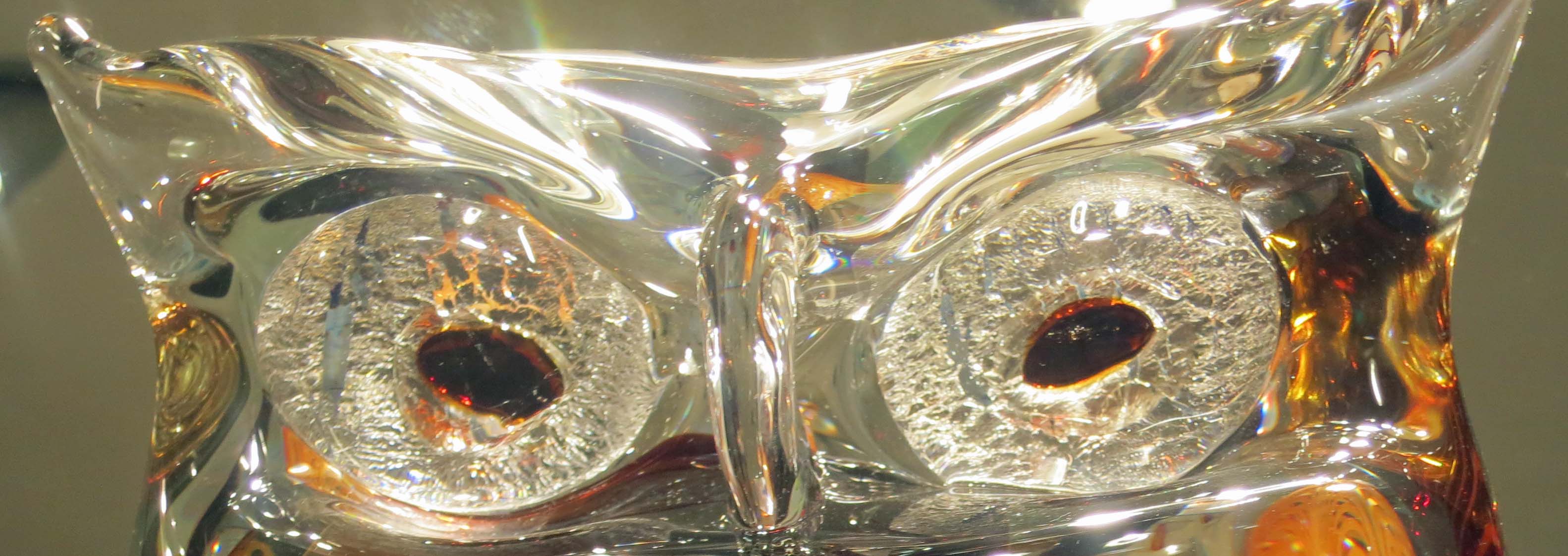
Window shopping in Venice is one treat after another. Numerous windows display masks or glass work, I thought this owl caught both.
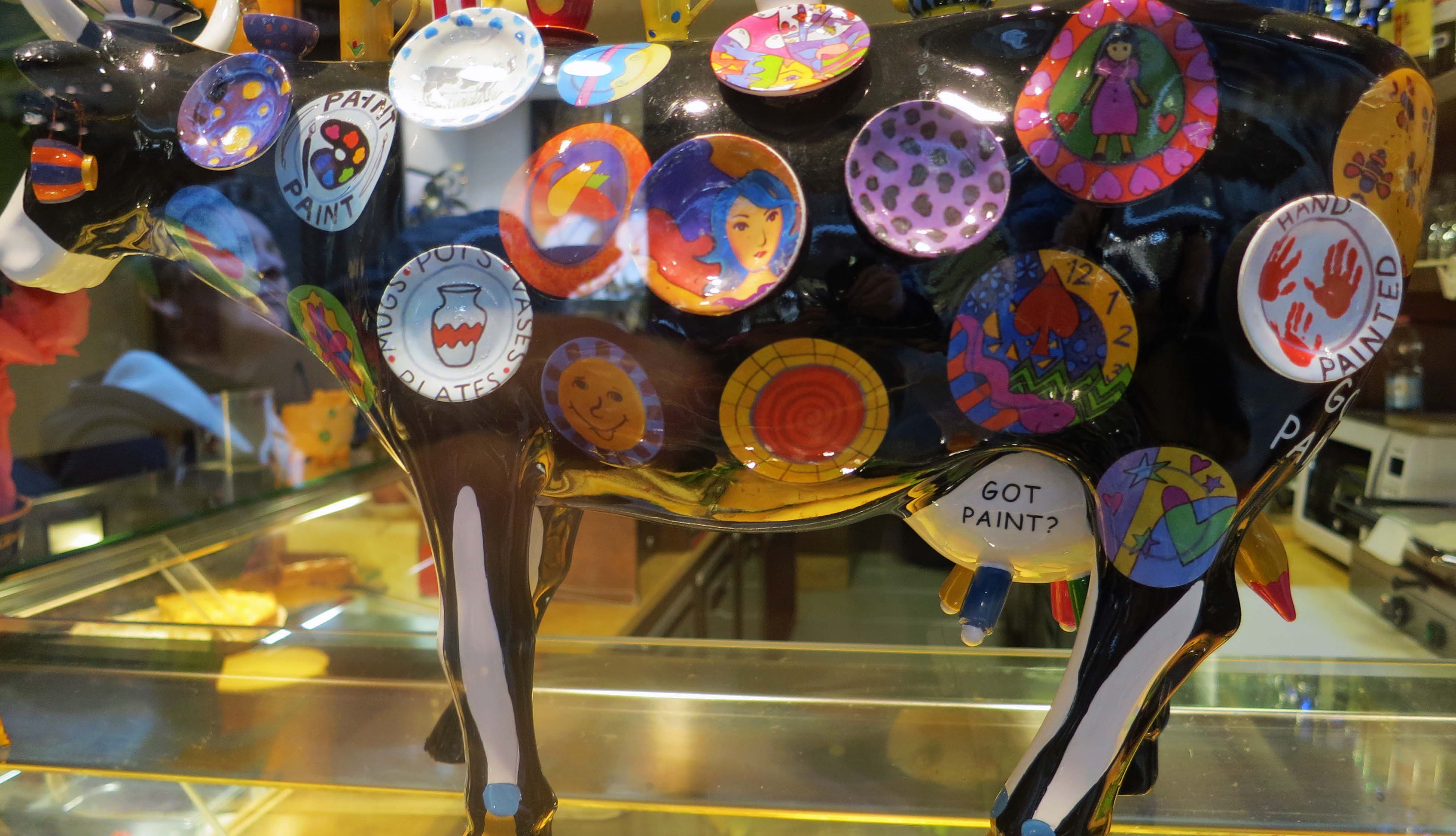
Venice does a fabulous job with window displays. We saw mouth-watering pastries, chocolate fantasies, clunky shoes, a bejeweled rear end, and an interesting ceramic cow.
I am sure these clunky shoes are stylish even though I don’t get it. I do get that I would hesitate to get in an argument with the woman wearing them.
This 440 euro sculpture of a butt challenged my imagination like the shoes above. I did find the glass beadwork fun, however.
As ads go, this ceramic cow in a Venice shop was quite creative. Got paint?
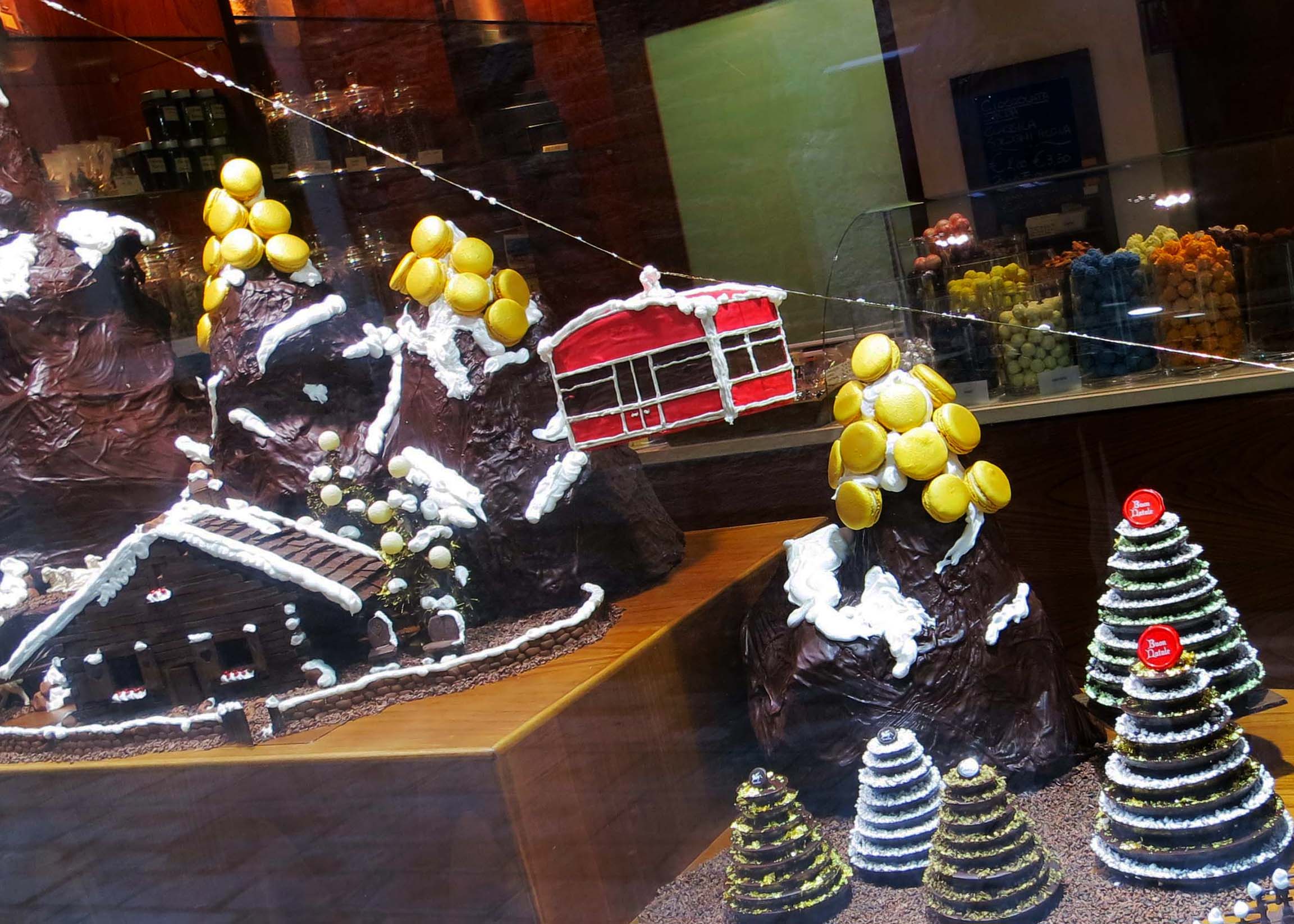
A Venetian chocolatier created a ski scene in his window. I almost lost Peggy. “Chocolate!” she exclaimed. Of course we had to go in. And left a few hundred calories later.
What impressed me the most about the window displays in Venice were those featuring glassware and masks. Both reach back into the city’s ancient history.
How many places can claim they have been “supplying quality glass products since 1291”? That’s the year that a Venice made of wood required all of its glass makers to move to the island of Murano in the Venice Lagoon. Community leaders feared that the glass making process would burn the city down. Venice quickly became the center of Europe’s trade in beautiful glass objects.
The upside for the glass makers was that they were invited into the highest ranks of Venetian society. The downside was they were threatened with having their hands chopped off or assassination if they moved and took their talents elsewhere.
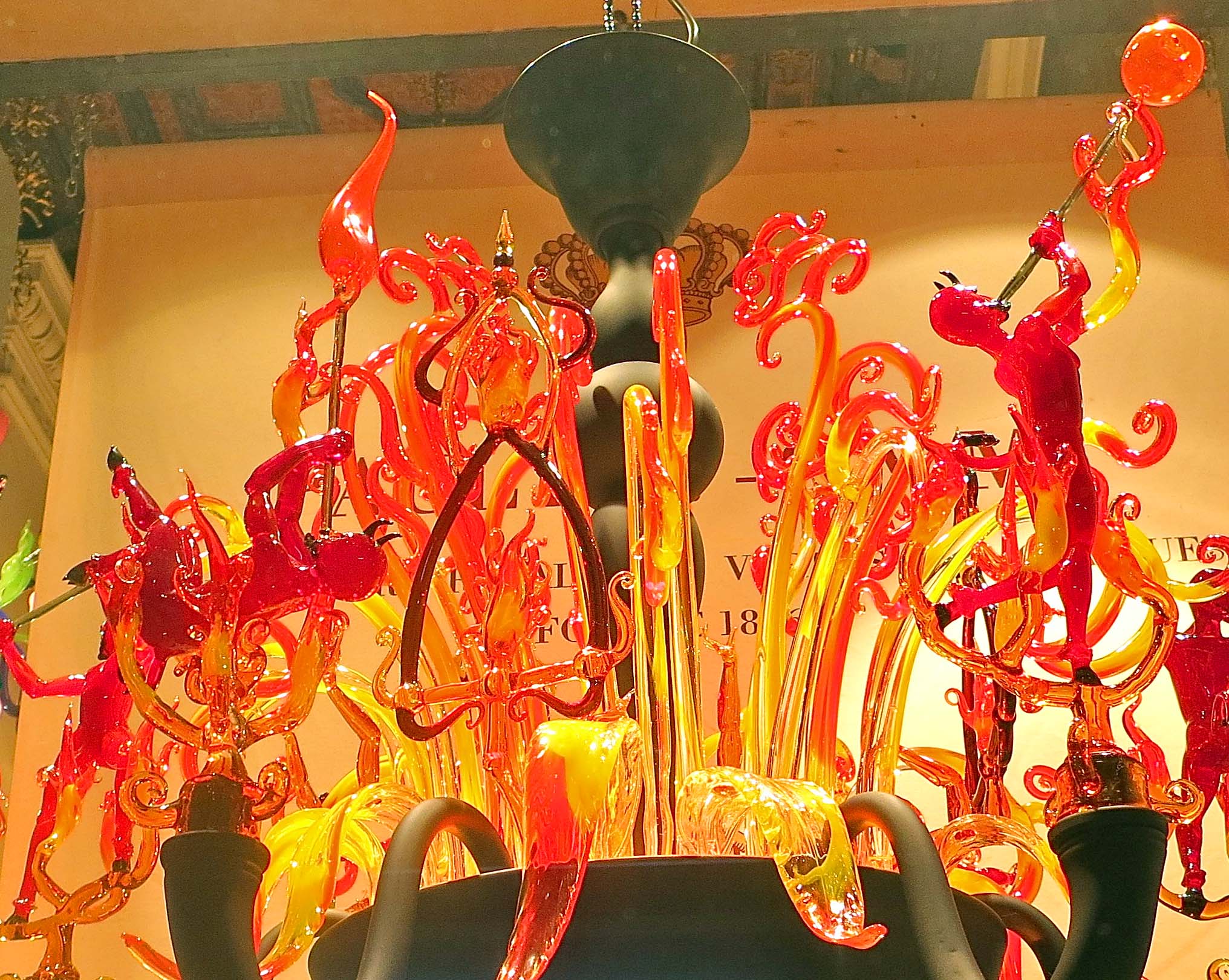
I suspect the artist who created this sculpture of glass blowers had devilish fun with his work.
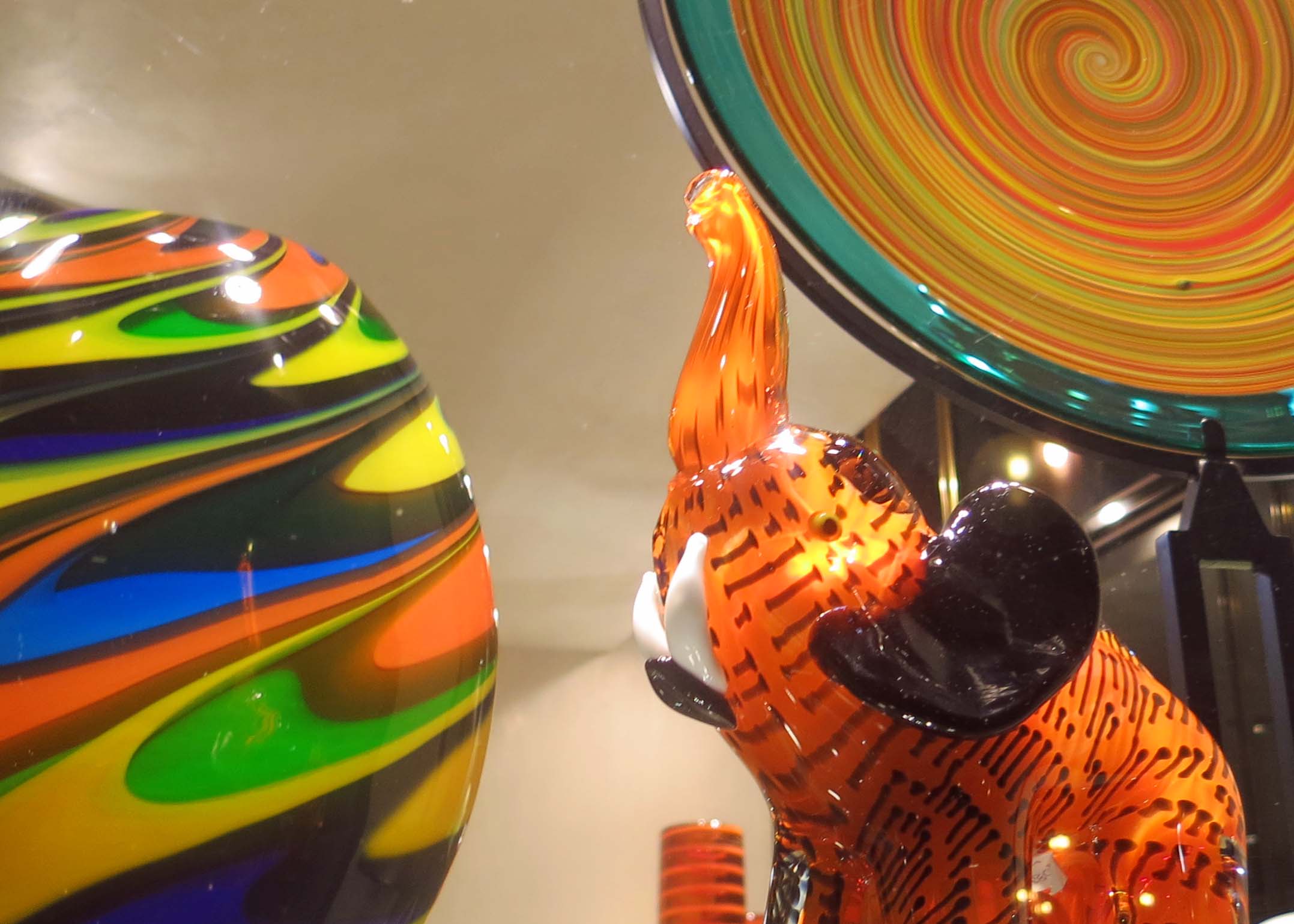
I liked this Venice window display because it captured different types of glass work including the elephant and shows off various techniques of coloring glass.
Venetians apparently carried out numerous activities they felt were best done while wearing masks. For example, in 1339 Venice passed a law that forbade inhabitants from visiting convents while wearing masks. One can only wonder. During plague times doctors wore long nose masks they believed protected them from the disease. Today masks are a central part of the Carnival of Venice that ends on Shrove Tuesday (Mardi Gras).
The Venetian masks displayed in shops can be quite beautiful and elaborate. A “plague” mask is on the left.
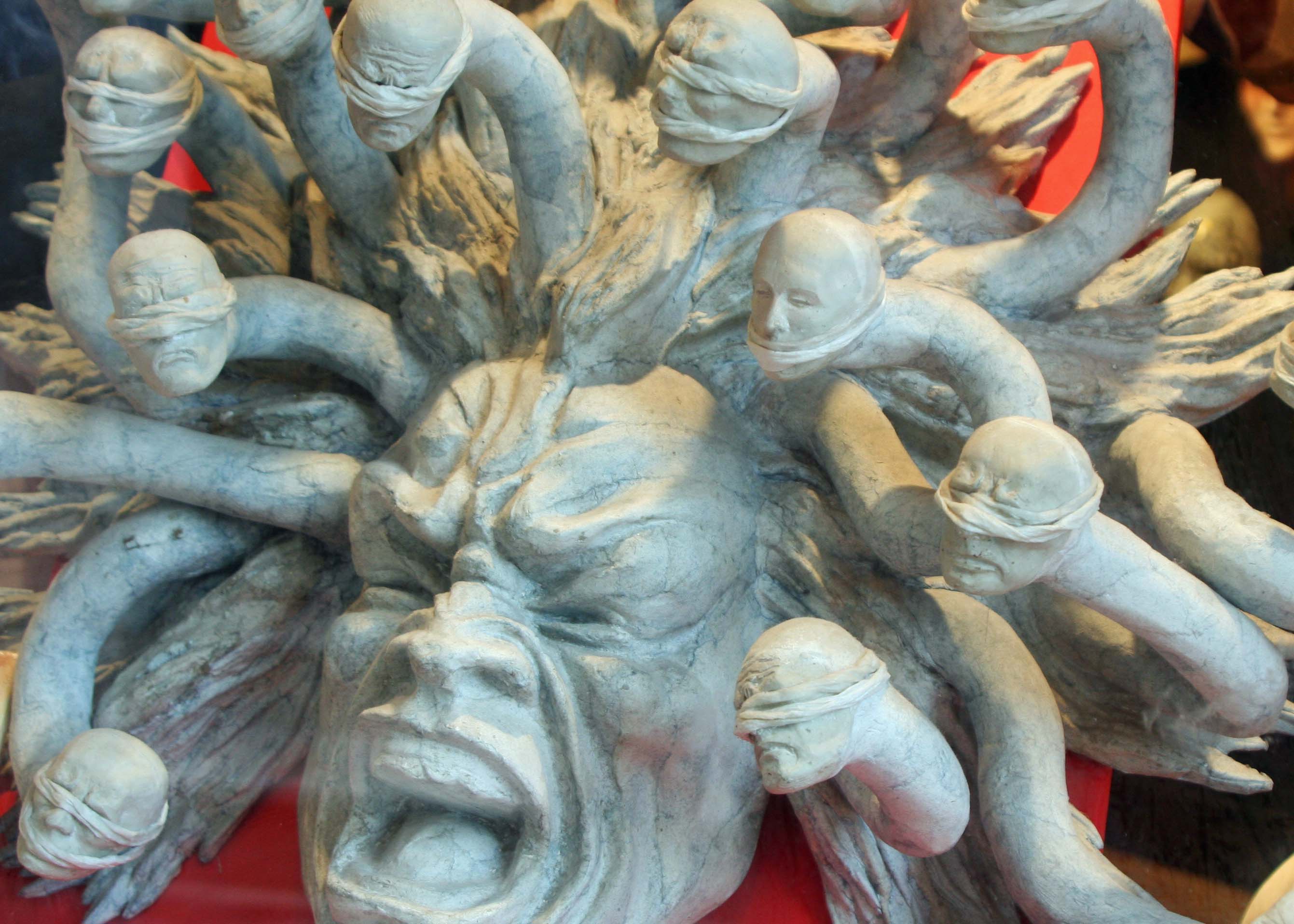
The masks of Venice can also be a bit on the scary side such as this mask of Medusa. Note the masks on the snake heads. See no evil, hear no evil, smell no evil, speak no evil? (Photo by Peggy Mekemson.)
This mask making shop had their creations lined up assembly line style. The eerie see-through look of the masks made me think of ghosts.
I’ll conclude with modern mask featuring a steam punk theme. It made me think of Burning Man.
NEXT POST: Continuing on our armchair journey during Covid-19, it’s off to Pompeii to visit with the gods.
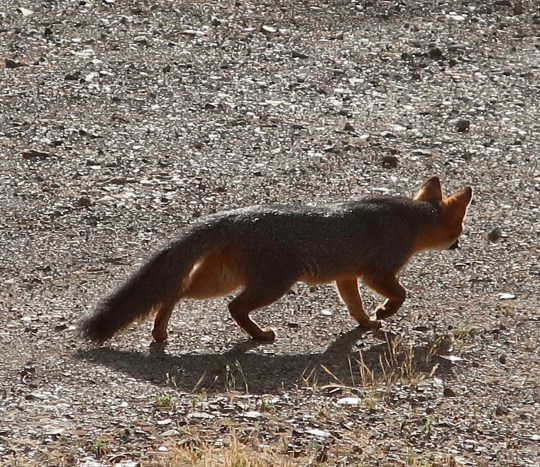
Peggy and I were sitting in our library downing an English muffin and a bowl of fruit on Friday morning when a movement outside caught my attention. A fox was climbing our eight-foot deer fence after a Stellar jay that was hassling it. Once again we found ourselves in a zoo looking out from our comfortable cage. The fox climbed down, made its way through our shrub garden, and climbed under the fence. I took this photo right after it climbed under the fence.
We weren’t fast enough with our cameras to catch the fox climbing the fence. We sat there in awe for too long. But fortunately, the fox was having a leisurely morning and hung around for a few minutes..
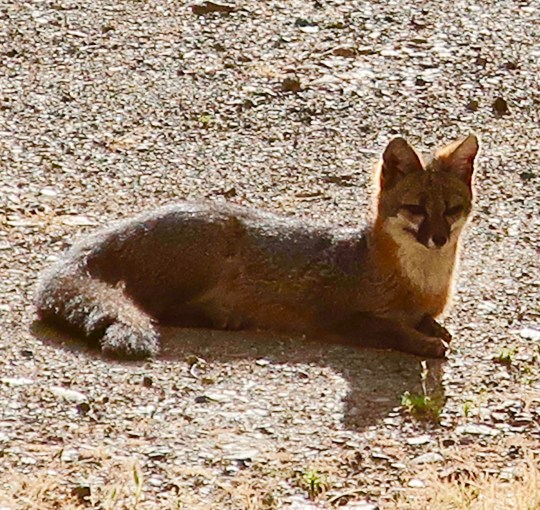
Given its reddish color, my first thought was red fox, but its black capped grey tail and climbing ability quickly identified it as a grey fox. Grey foxes are the only ones that climbs trees (and apparently deer fences). They have even been known to raise their families in tree dens high above the ground. We catch glimpses of them occasionally on our property but normally they are secretive. One time, we watched a doe stalk one, following along behind, carefully raising and placing each hoof. That was neat.
My guess is that they have a den (or dens) on our property. The male and female raise the kits together. For the first couple of weeks the mother tends to her babies while the male hunts and supplies food. Our experience is that they form a close bond. A few years ago a fox was run over on the highway below our property. Each night we would hear its partner howling down on the road. Only when I went down and buried the fox did the howling end.
The fox plopped down in our driveway for a brief rest. I suspect he was on his way home after an early morning hunt. (Photo by Peggy Mekemson.)He then looked up at us. Note the short legs. The literature says that’s what allows foxes to climb trees.And then he was off on the hunt again.
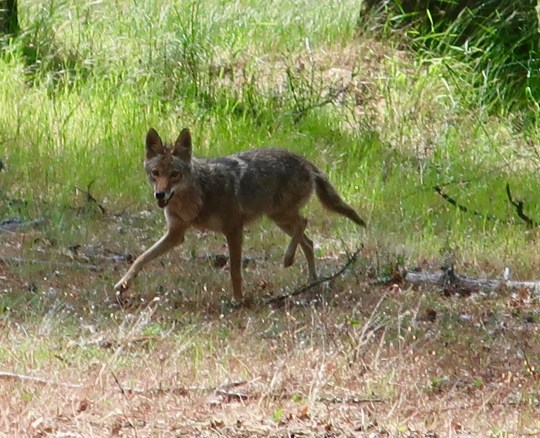
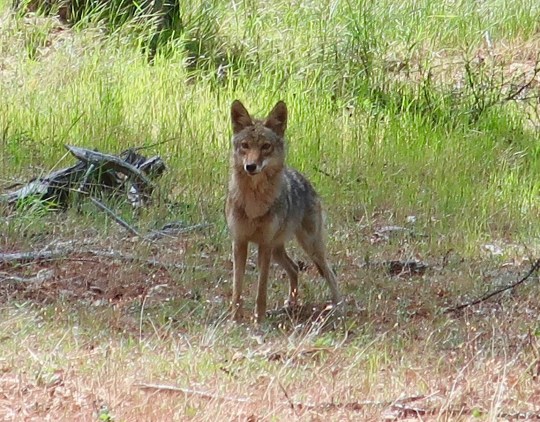
Having enjoyed the fox, it was only appropriate that we would see a coyote as well. We met up with it last week as we were hiking in the forest behind our house. It seemed as curious about us as we were about it.
It came trotting up through the forest and didn’t see us at first. Then he stopped and checked us out. I thought it looked quite regal. The coyote stared at us for a couple of minutes. I thought it might continue up toward us but it headed off in the other direction, stopping every few feet to look back at us.
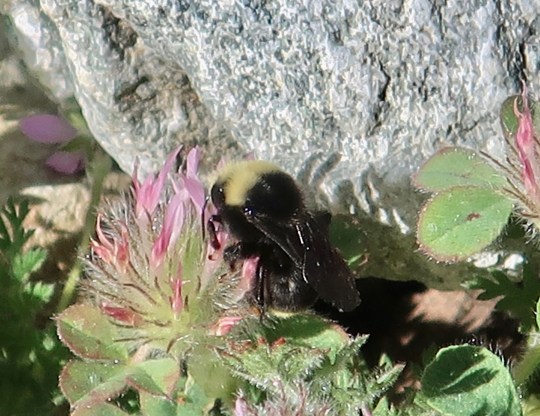
This is hot off the press, and it isn’t about Covid-19. Woohoo! I was skimming through Apple News this morning and I came across an article that bumble bees bite plants. How could I not read the article? Had the plants somehow irritated the bees. Was there a bee-plant war going on? No, there wasn’t a war. The bees depend on the pollen from the plants for their survival. But they were irritated. The plants weren’t blooming and providing the pollen. So the bees bit the plants to speed up the process. Apparently it cuts two to three weeks off the wait period. I rushed outside to see if I could spot a bumble bee biting a plant. No luck, the flowers were already blooming. I did catch a couple of photos of bumble bees harvesting pollen, however. I conclude my post with them. Bzzzzzzz.
Bumble bee harvesting pollen from the clover that grows in our back yard.
NEXT POSTS: Tomorrow I’ll take you window shopping in Venice. Thursday: Part 2 of nature tales. Among other things, you will meet a Buddhist lizard.
I am continuing to dip back into my archives for armchair travel in the time of Covid-19. This is my third post in a series of five on Venice where Peggy and I travelled in 2013.
Remember the old Frank Sinatra hit song “Love and Marriage Go Together Like a Horse and Carriage.” Venice’s canals and gondolas are like that. It is hard to imagine one without the other. Also, it is hard to imagine gondolas without tourists. I suspect that most of them are docked in this time of Covid-19. In fact, satellite photos show the canals to be surprisingly clean. Even jellyfish have returned to take advantage of the tourist free waters! While Venetians may miss the tourist dollars, they, too, are appreciating their tourist free city. The government is searching for ways to reduce the dependence on tourist dollars— and the number of tourists. Gondolas aren’t about to go away, but there may be far fewer of them in the future.
I shot this photo from the Rialto Bridge looking down on the Grand Canal.
It is impossible to think of Venice without thinking of canals and romantic gondolas with singing gondoliers. Or possibly your vision of Venice is of fast boats with roaring engines and good guys/bad guys chasing each other with guns blazing as depicted in any number of movies.
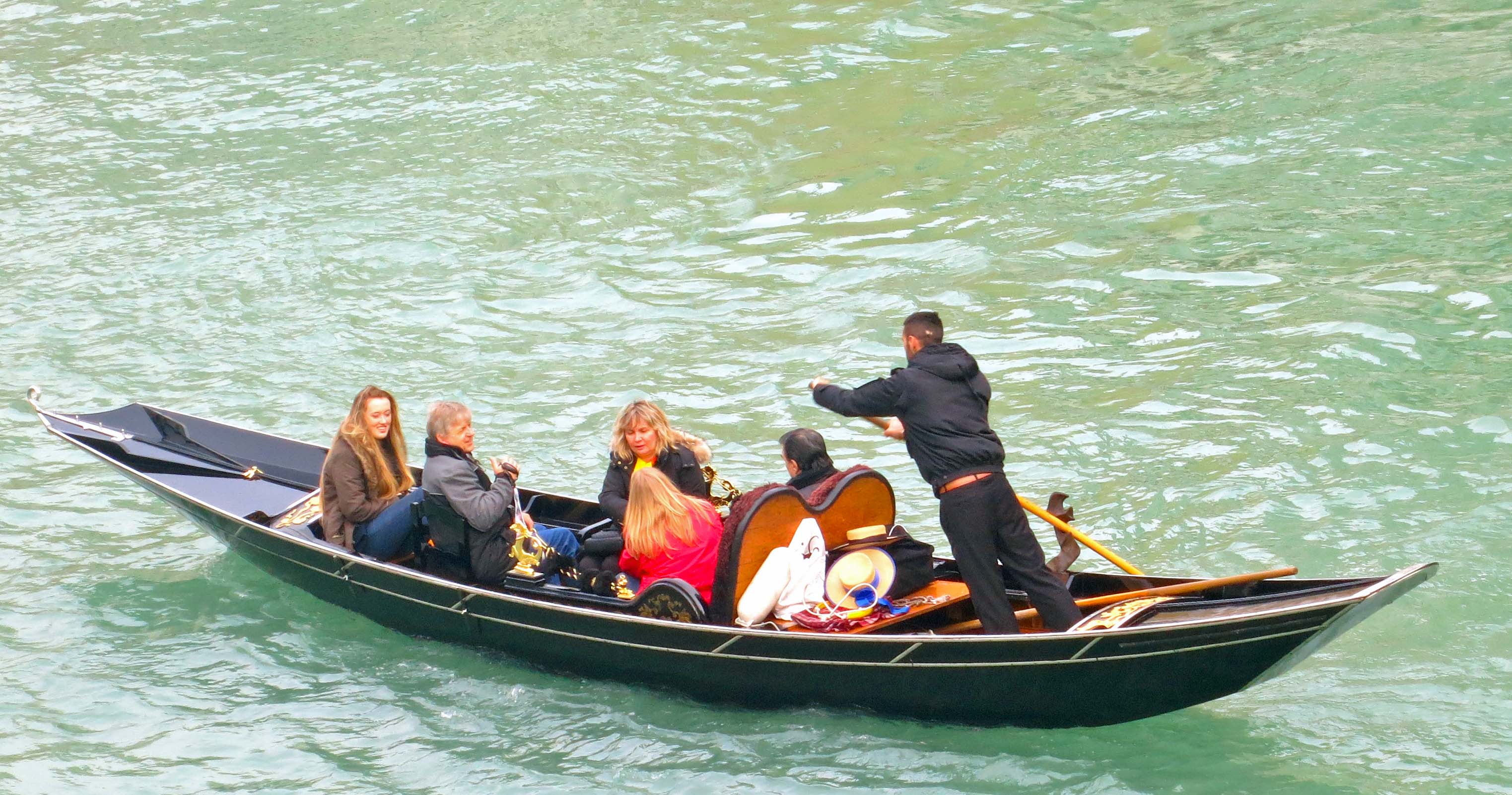
A gondolier works his boat on cold, rough waters in the Grand Canal as his passengers enjoy the ride, bundled up in warm clothes.
We were in off-season, however. Only a few hardy tourists braved the cold for gondola rides and no movies were being made. The canals had reverted to their primary role as transportation corridors, a role which they have played for a thousand years.
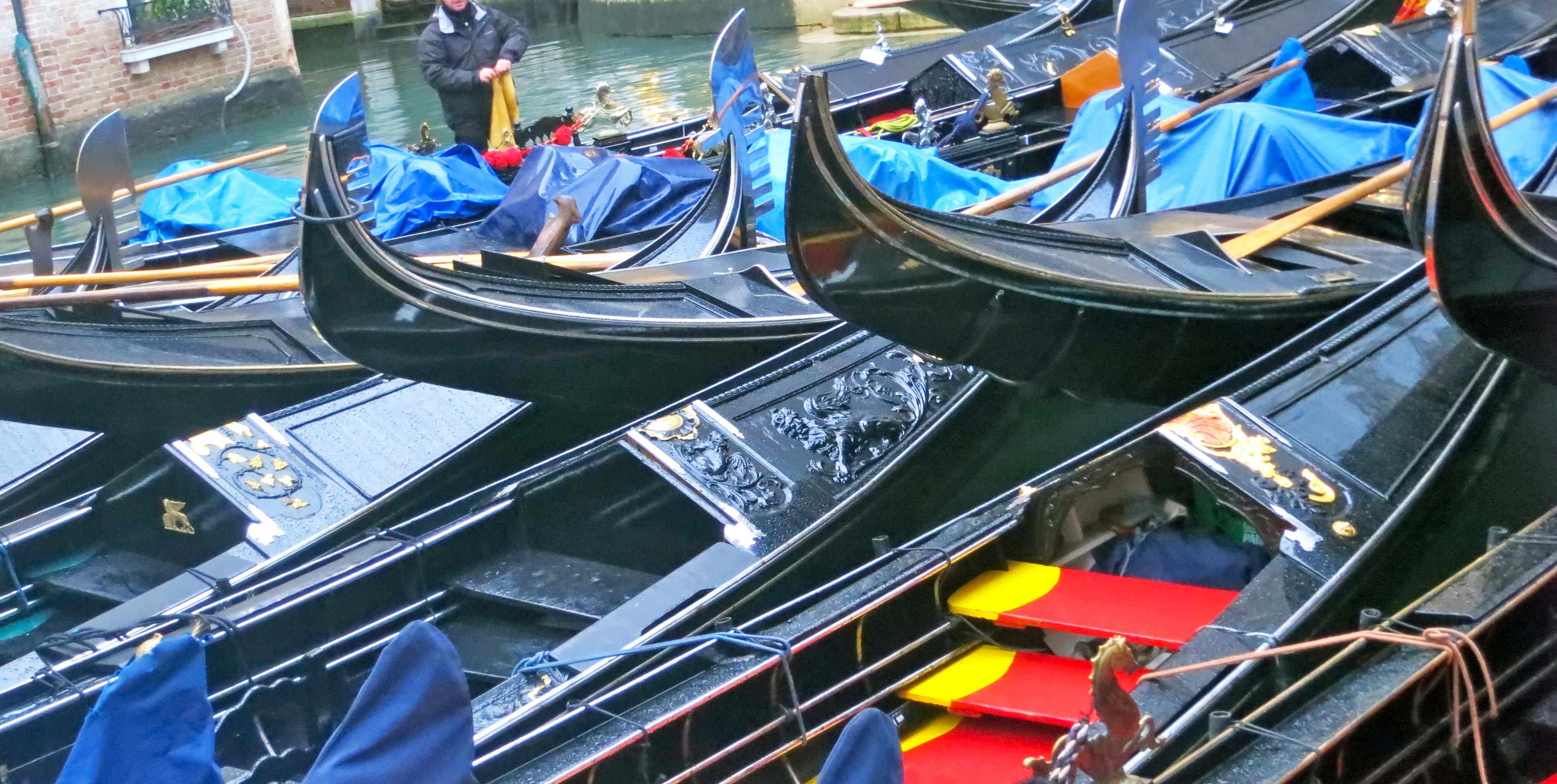
This is a sight you wouldn’t see during the summer when these gondolas would be filled with tourists. I thought of the gathered gondolas as a gondola parking lot. You may note that they are all black. You can thank a 17th Century Doge for that. He mandated that they all be painted the same color.
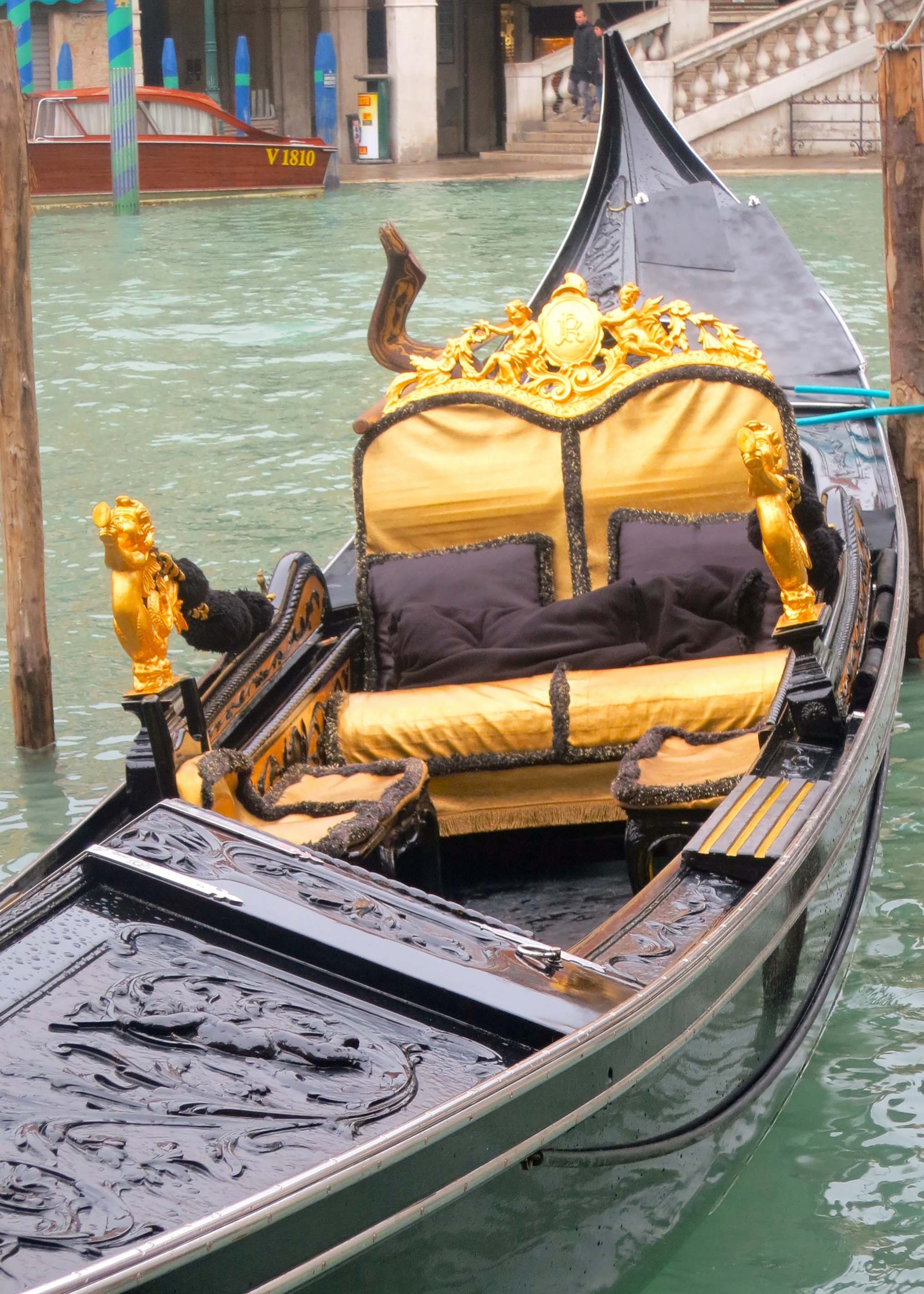
Luxury accommodations gondola style. Expect to pay big bucks/euros for a ride in this one.
Peggy took this photo of parked gondolas looking from Venice proper across at the island of La Giudecca. (Photo by Peggy Mekemson)
We chose to walk on the carless streets that parallel the canals and cross over them on bridges that have as much personality of the canals and provide intriguing glimpses of life along the canals. The highlight of our journey was the famous Rialto Bridge and the Grand Canal but the smaller canals, known as rivers, provided more intimate views.
This photo shows the famed Rialto Bridge that served for centuries as the only bridge across the Grand Canal, which snakes its way through Venice as the major transportation corridor.
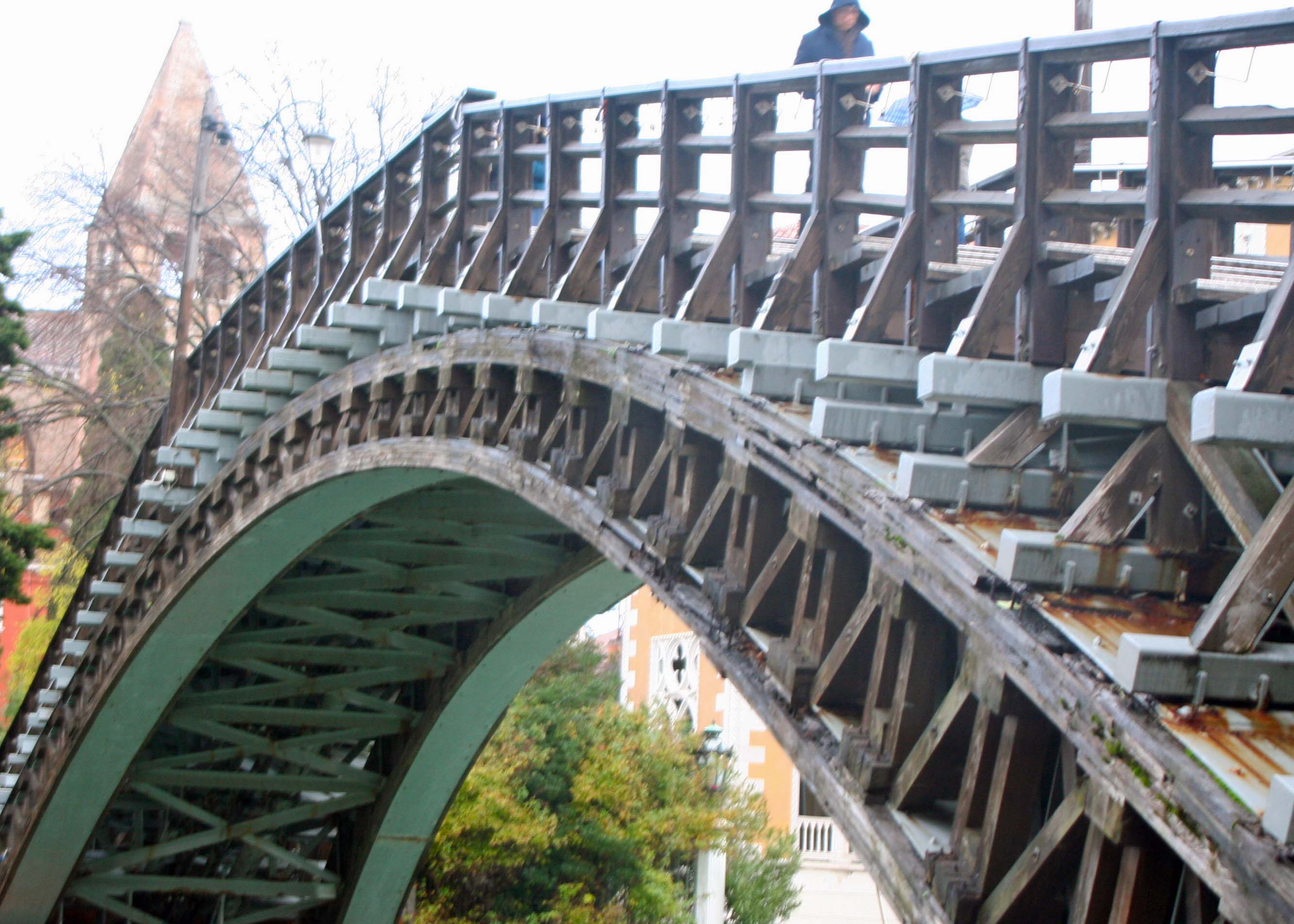
The more recent Accademia Bridge across the Grand Canal has a totally different look and construction. (Photo by Peggy Mekemson.)
I took this photo from the other side of the Accademia Bridge to capture the parked gondolas and the boat taxi that is crossing under the bridge.
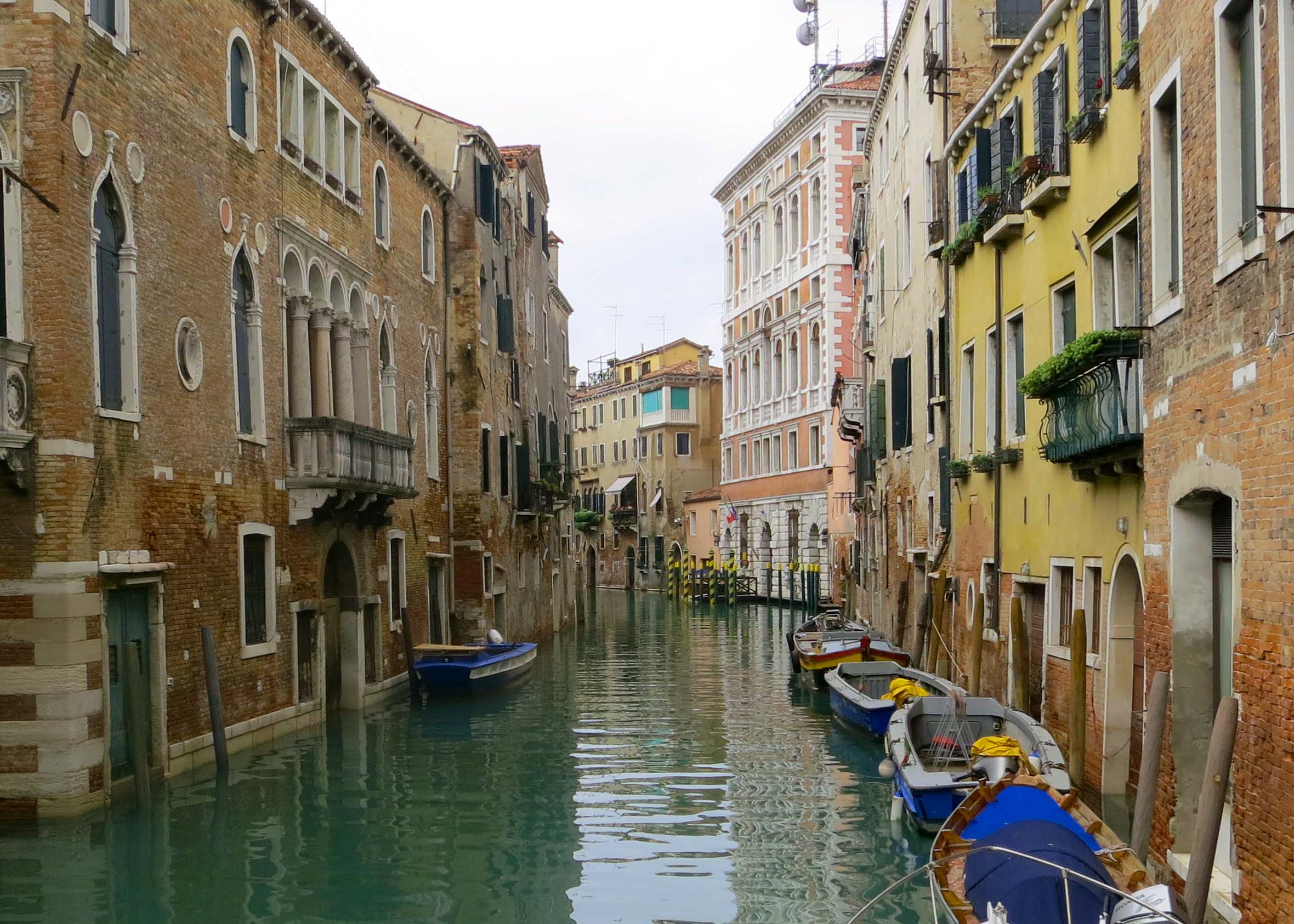
Smaller canals, known as rivers in Venice, provide a more intimate view of life in the city. The buildings here were built by wealthy Venetians when Venice was a major world power controlling trade between the East and the West. Houses then, as now, were a symbol of wealth and power.
Peggy captured this interesting entrance way. I assume it would have been taller in the early years before sinking and global warming.
Flower/plant boxes are found throughout the city. I liked how these were next to the canal.
I’ll conclude with this reflection shot. Think of this as how Venice might look with far fewer tourists. (Photo by Peggy Mekemson.)
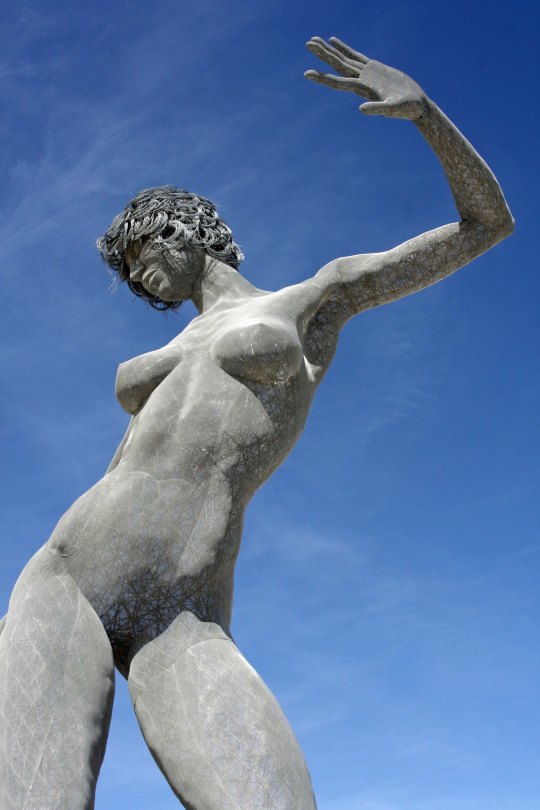
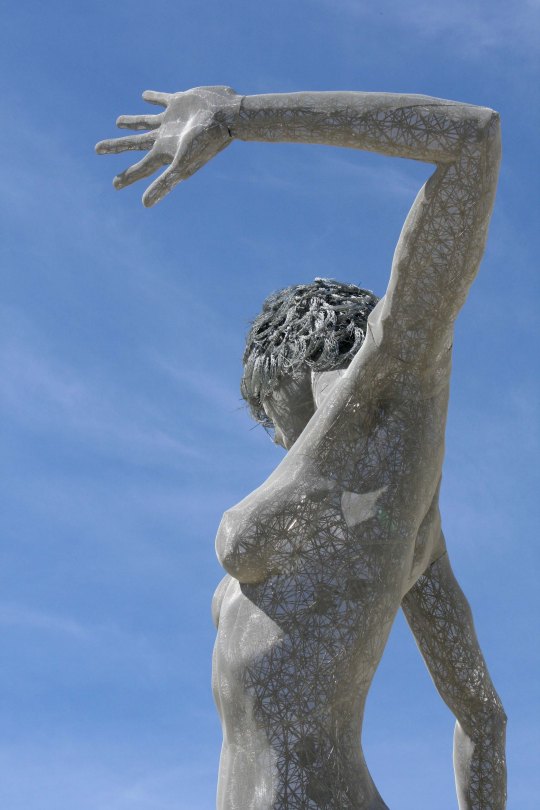
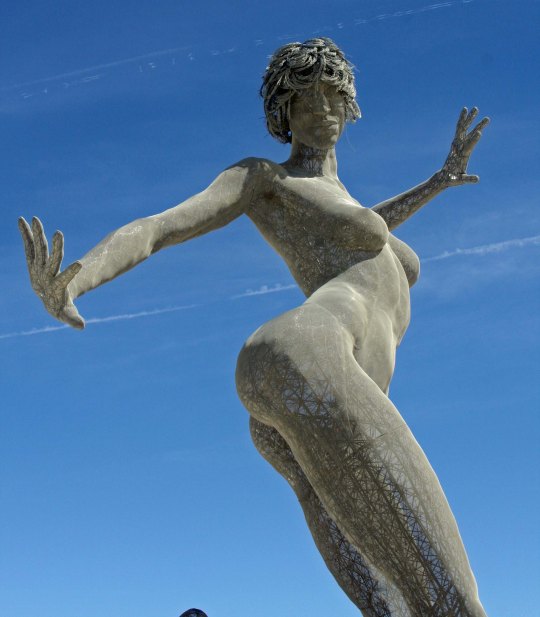
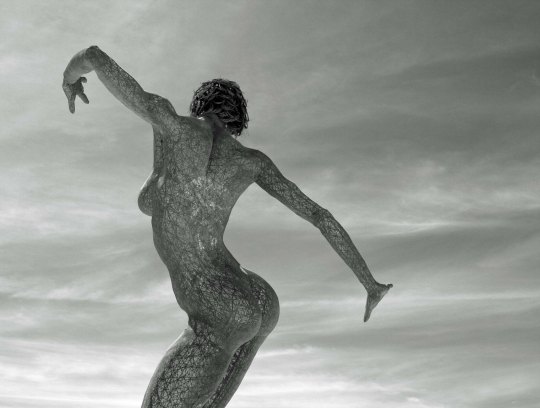
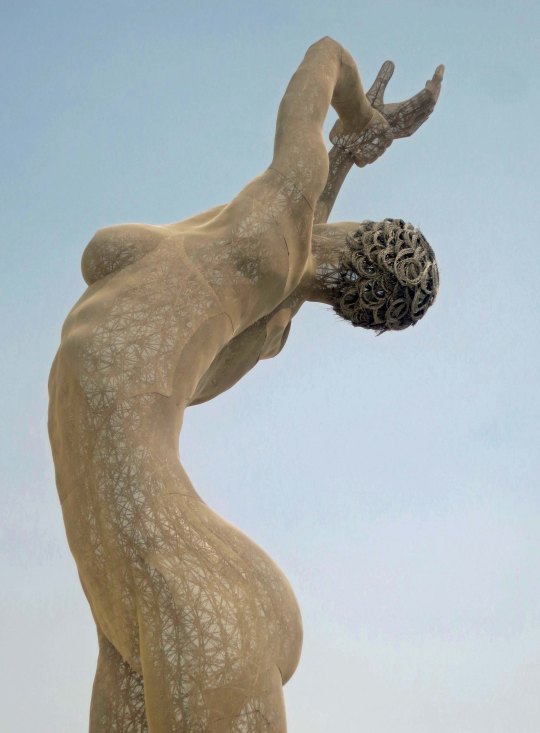
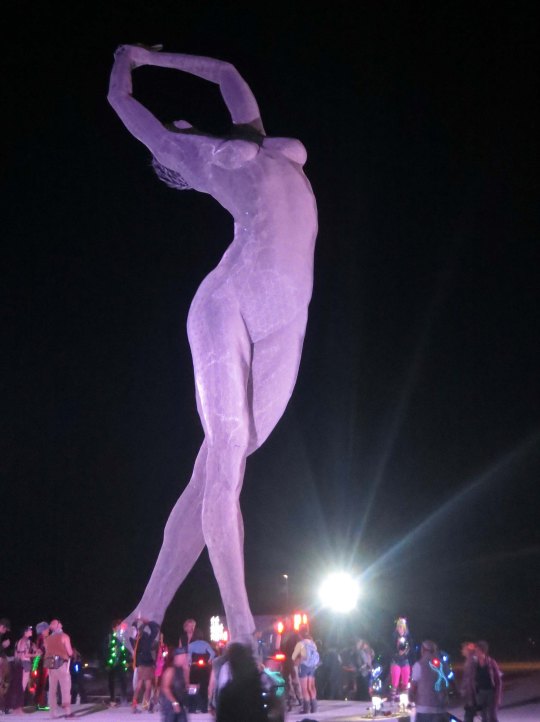
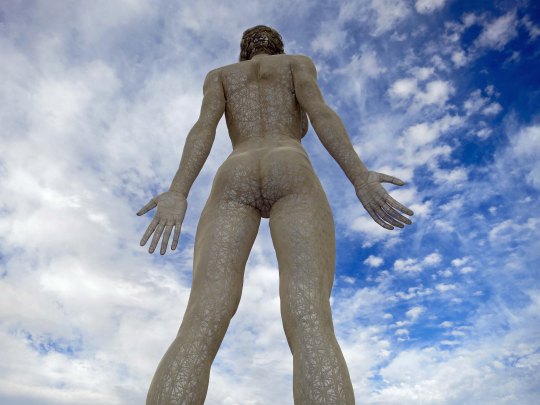
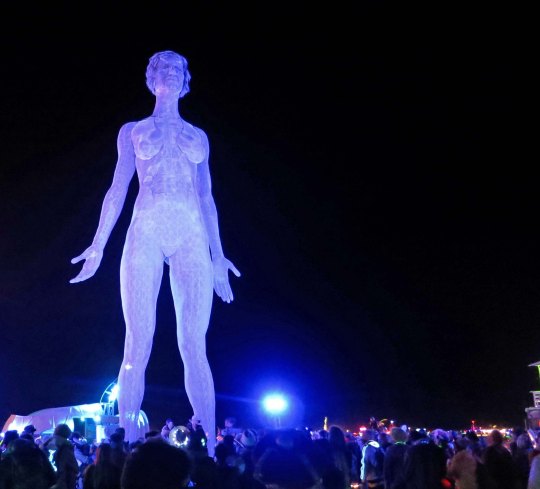
In 2010, Marco Cochrane introduced the first of his magnificent nude sculptures to Burning Man, the 40 foot tall Bliss Dance.
When I first ventured out onto the Playa on my 2010 visit to Burning Man, I was immediately drawn to a large sculpture of a nude woman that struck me as being beautiful and full of life. The sculpture, I learned was titled Bliss Dance and had been created by the Bay Area artist Marco Cochrane based on his model, the dancer Deja Solis. Bliss Dance would go from Burning Man to Treasure Island next to San Francisco and is now on permanent exhibition in Las Vegas. Here’s what Cochrane had to say during the unveiling of the sculpture in Las Vegas:
What I see missing in the world is an appreciation and respect for feminine energy and power that results when women are free and safe. It seems obvious to me that feminine energy is being suppressed and that this must change. If we are to find real, lasting solutions to the problems facing humanity, men and women must be able to work together as equals. Bliss Dance is intended to focus attention on this issue.— Marco Cochrane, Feb. 2016 press release
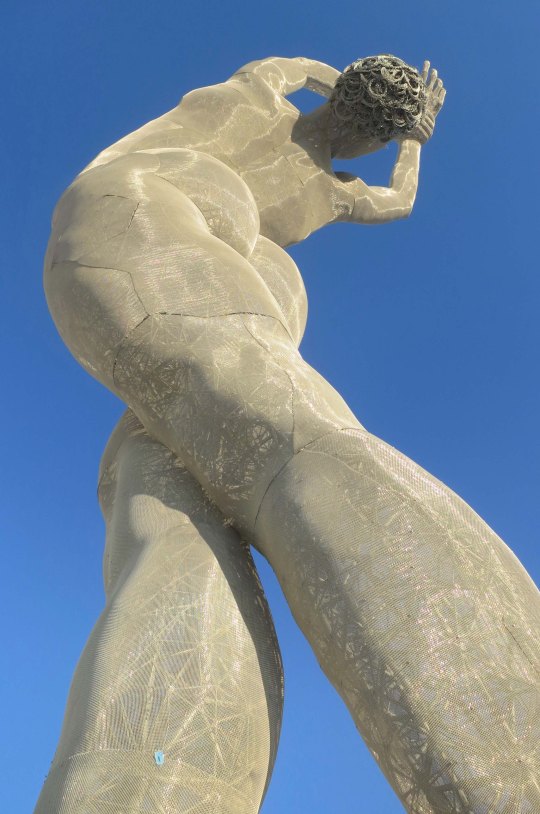
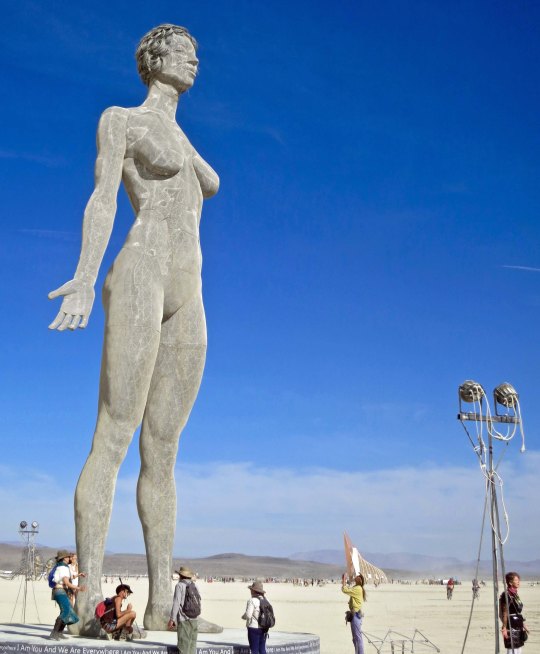
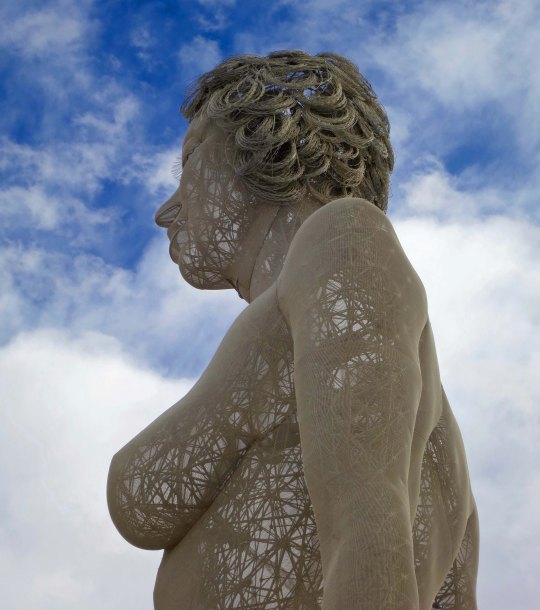
This sentiment also applies to the two other sculptures that Cochrane created for Burning Man as part of a trilogy: Truth Is Beauty in 2013 and R-Evolution in 2015. I consider myself privileged to have been at Burning Man on each of these years. Truth Is Beauty is now on permanent exhibit overlooking the BART station in San Leandro, California.
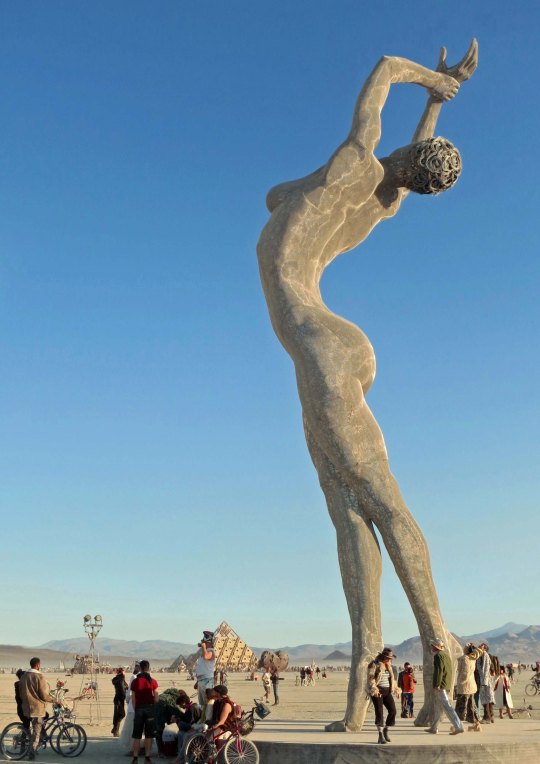
Truth Is Beauty at Burning Man in 2013.
An 18-foot rendition of Truth Is Beauty and several other art works from Burning Man were recently on display at the Smithsonian’s Renwick Gallery in Washington DC. An introduction to the exhibit stated:
Burning Man, one of the most influential events in contemporary art, is both a cultural movement and a thriving temporary city of more than 70,000 people that rises out of the dust for a single week each year in late summer in Nevada’s Black Rock Desert. During that time, enormous experimental art installations are erected, some of which are then ritually burned to the ground. The desert gathering is a uniquely American hotbed of artistic ingenuity, driving innovation through its philosophies of radical self-expression, community participation, rejection of commodification and reverence for the handmade.
Nora Atkinson, the Lloyd Herman Curator of Craft at The Renwick went on to say this about the exhibit’s title: No Spectators
“‘No Spectators’ is a long-standing saying on Playa. You are encouraged to fully participate. It’s all about being there, being fully present, and not just observing. Two of the ten principles of Burning Man are radical participation and radical inclusivity, meaning that there are no outsiders. Everyone is part of the experience.”
If both of these statements seem a bit familiar, they reflect what I have been saying about Burning Man art and Burning Man in my posts over the last several years. In ways, I believe that Burning Man has been fostering a mini-renaissance in art and is now being recognized world-wide for its contributions.
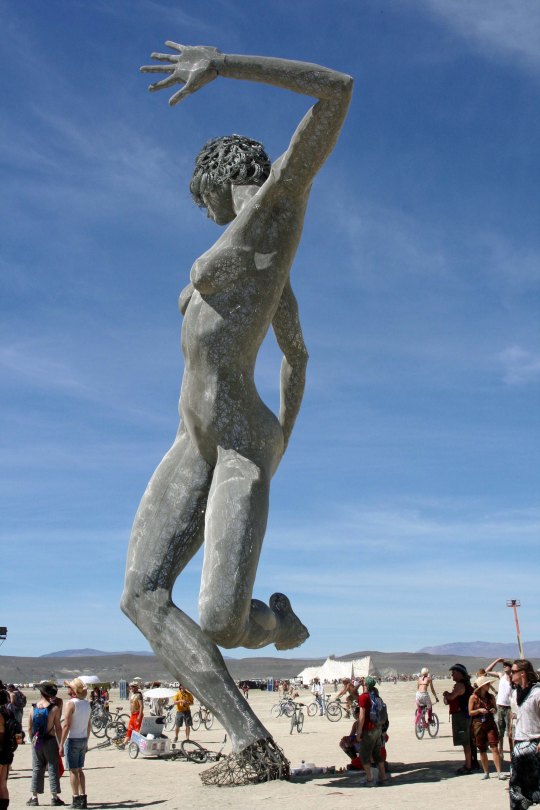
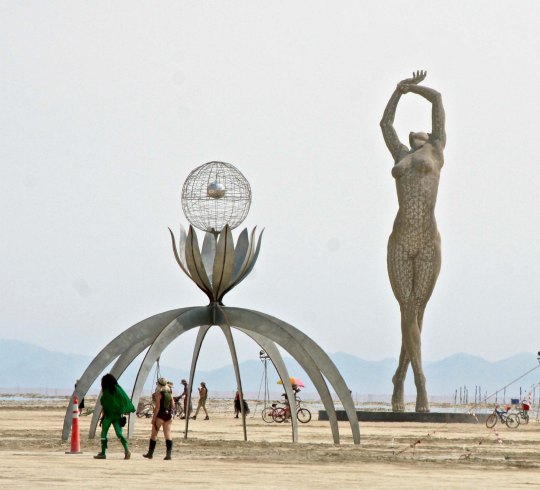
R-Evolution, the last of Cochrane’s trilogy was actually scheduled to be exhibited on the National Mall in Washington DC between the Washington Monument and the White House. The group responsible for moving and installing the sculpture had written to me and asked for permission to use photos from my blog in a documentary it was preparing for the exhibit. The exhibit was cancelled. It may have been that the idea of a giant nude on the mall was too controversial. Anyway, here is one of my favorite photos of the sculpture:
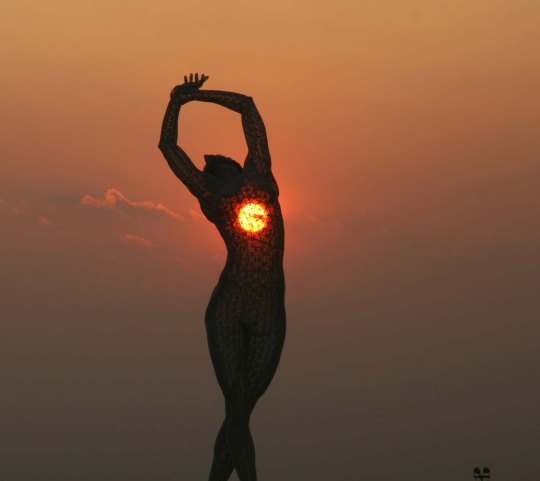
R-Evolution at Burning Man in 2015.
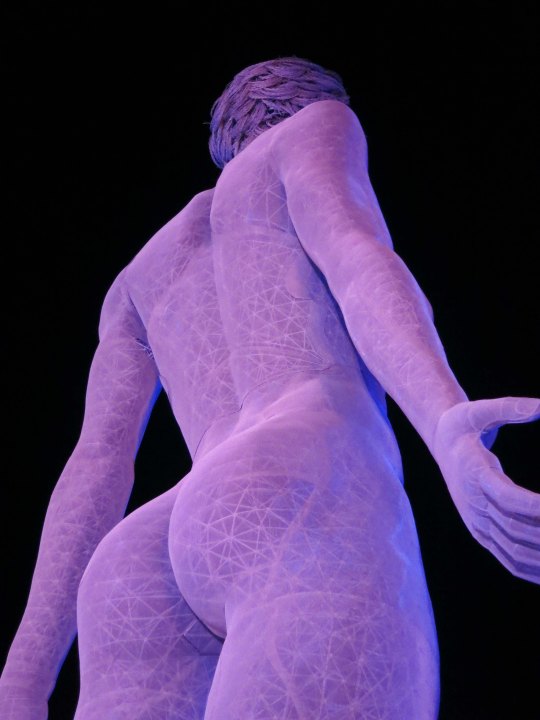
Peggy (my wife) says what she loves about sculpture is that it is three dimensional art that you can touch and feel as well as see. One of her favorite things about Burning Man is that the art has an up-close and personal aspect, a hands on policy. Most museums have a hands-off policy. The three dimensional aspect of sculpture also has great appeal to me. I believe that that you should be able to appreciate sculpture from any angle. I’ll use the concluding photos on this post to further look at the three sculptures.
BLISS DANCE AT BURNING MAN 2010
TRUTH IS BEAUTY AT BURNING MAN 2013.
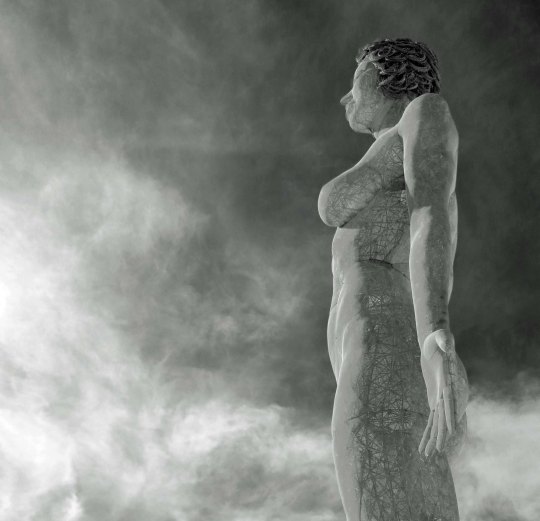
My friend Tom Lovering caught this beautiful shot.
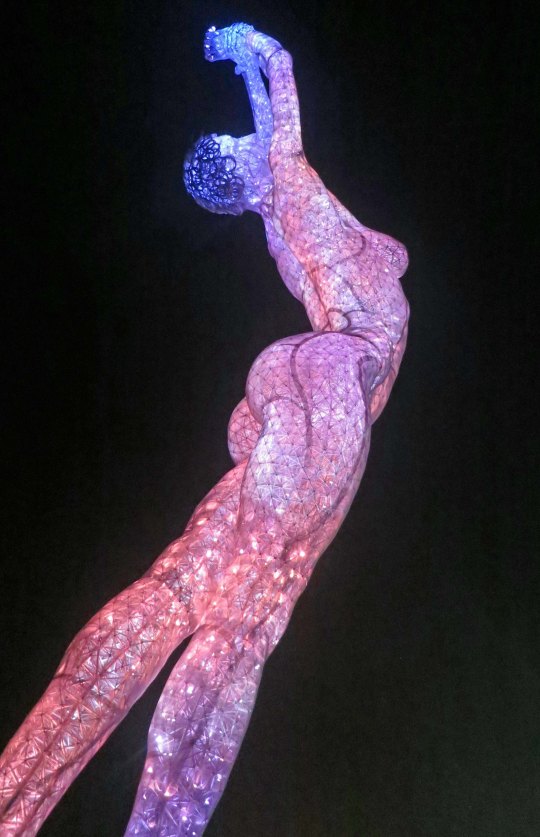
At night, LED lights inside the sculptures light them up in a number of ways, changing every few minutes.
A final view of Truth Is Beauty.
R-EVOLUTION AT BURNING MAN 2015
One of my favorite views of R-Evolution because of the Black Rock Desert background. (Photo by Don Green.)
That’s it for today. NEXT POST: UFO’s, aliens, and a giant robot at Burning Man.
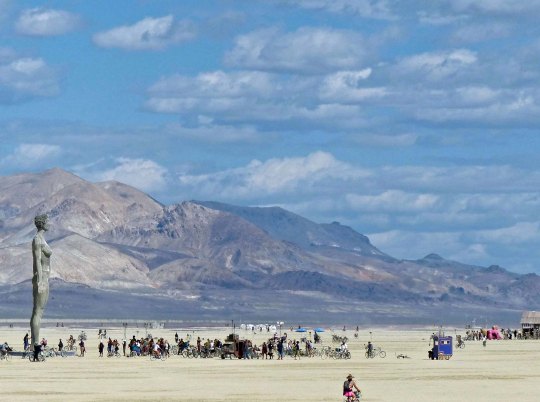
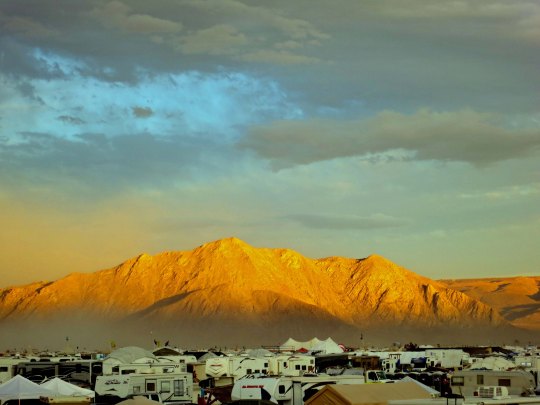
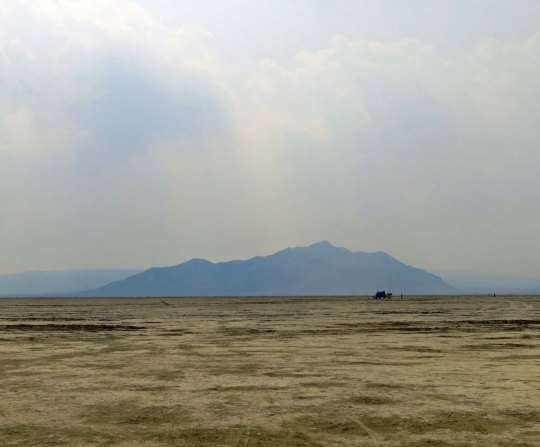
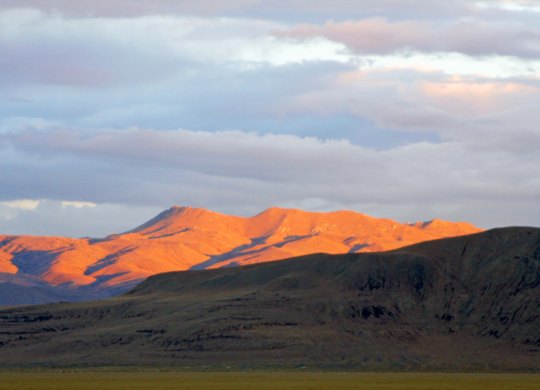
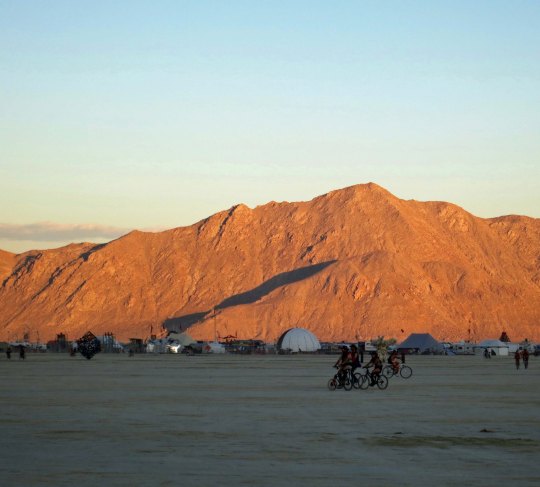
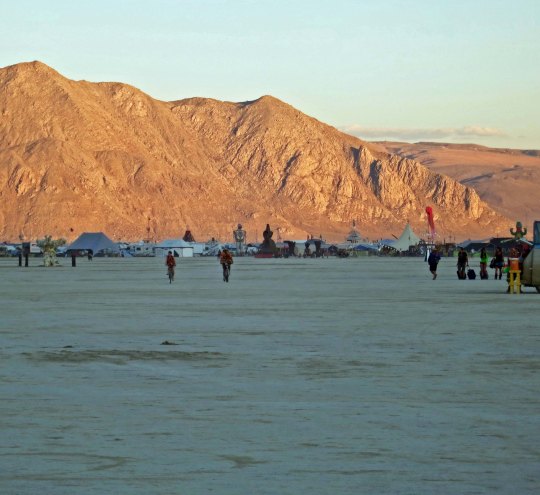
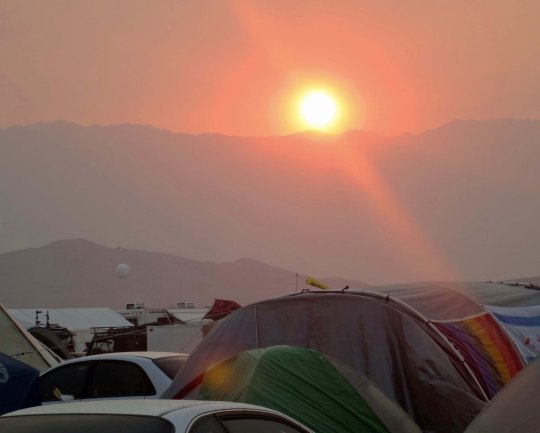
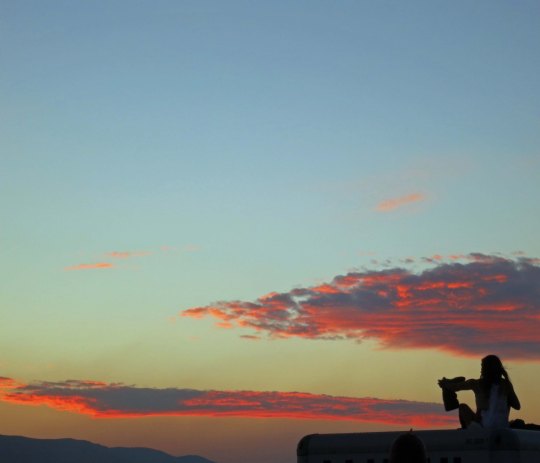
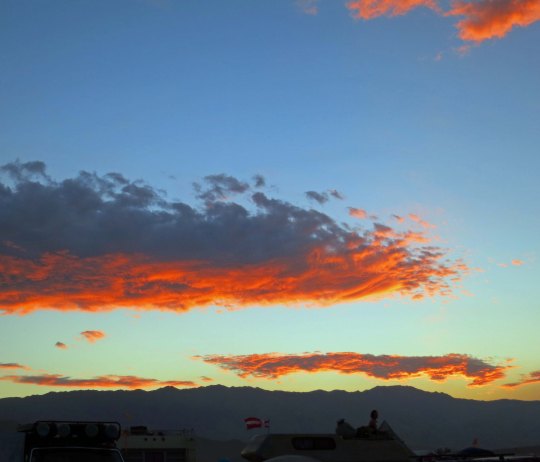
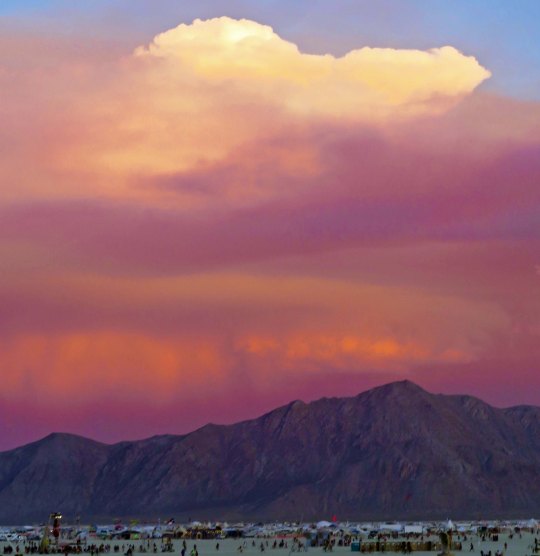
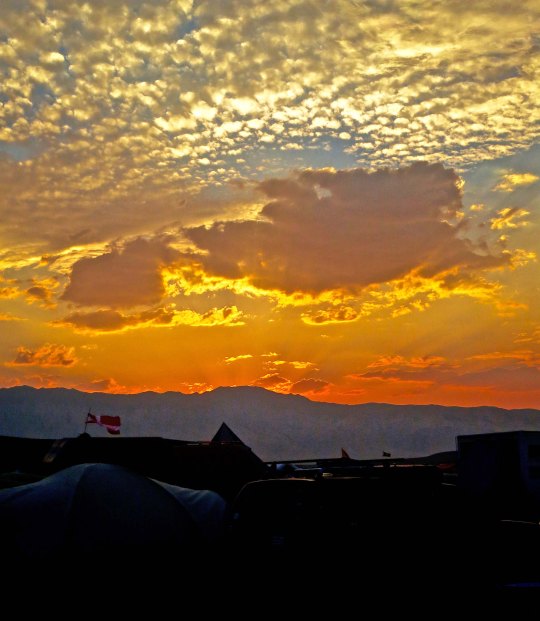
Deserts can have great beauty. The Burning Man festival is fortunate to be located in the remote Black Rock Desert of northwestern Nevada where it is surrounded by dramatic mountain scenery.
Situated on a flat playa that stretches out for over 100 miles, Burning Man is dwarfed by surrounding mountains and a vast, flat, desert floor. Once, the playa was filled with a huge, glacier fed lake that was over 500 feet deep. Wooly mammoths and Native Americans lived on its shore and called it home. Like other Great Basin Lakes, there were no outlets. Water that flowed into the lake stayed there and sediments carried in from the surrounding mountains sank to the bottom. As the climate changed, becoming hotter and drier, the lake dried up and the sediments became the base for today’s Playa.
By the 1840s and 50s pioneers and gold seekers from the young United States of America made their first forays into the desert heading for the goldfields of Northern California and Southern Oregon. The Applegate brothers created a trail through the Black Rock Desert that bears their name. I live in the Applegate Valley of Oregon beside the Applegate River, all named for the family. I also have family connections. Applegates and Mekemsons intermarried in the early 1800s.
Today, I am going to post several photos that place Burning Man in its Black Rock Desert surroundings.
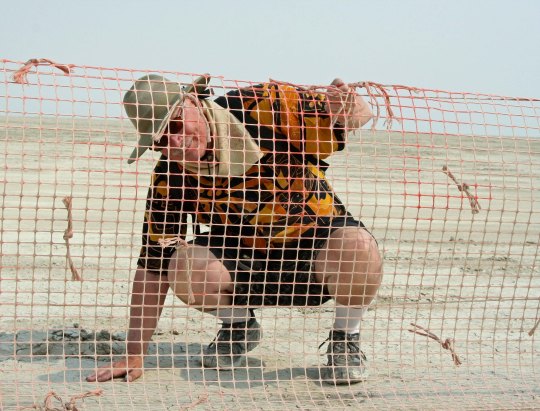
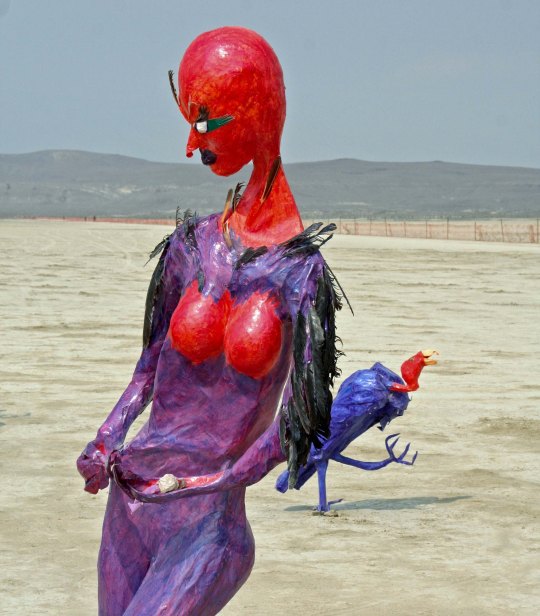
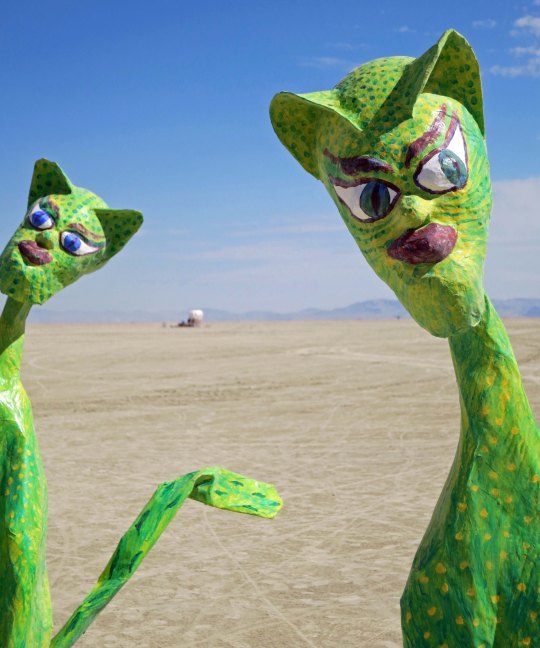
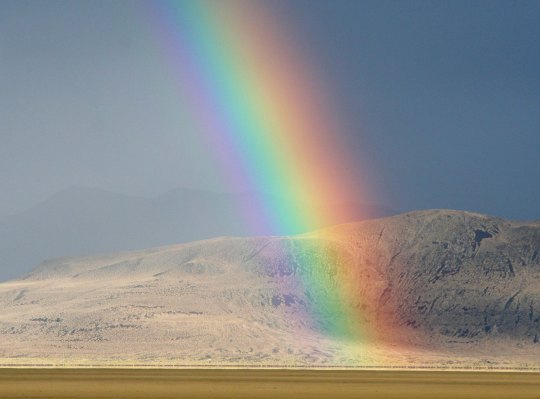
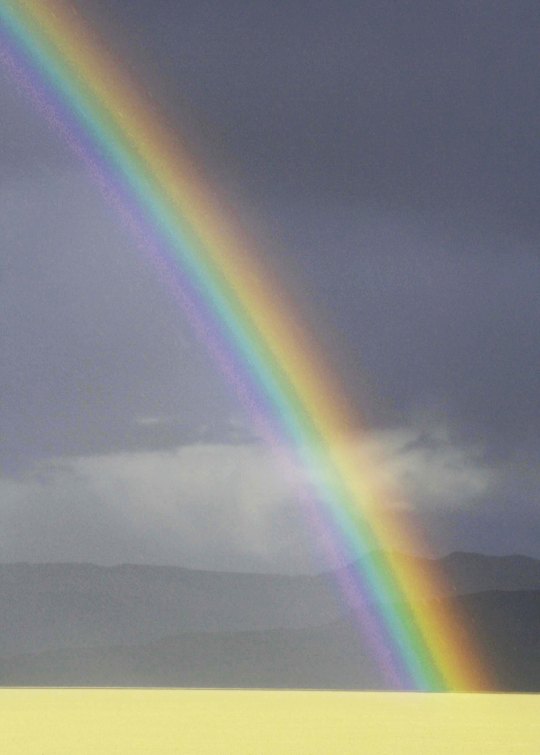
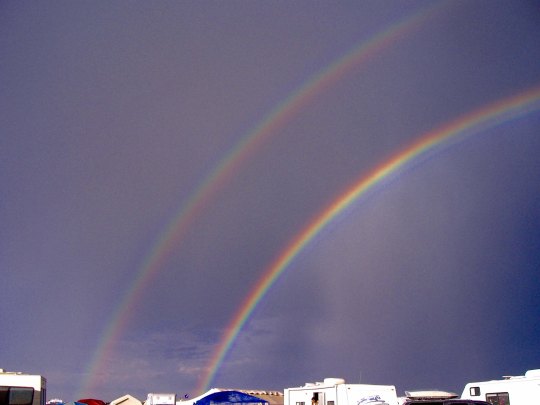
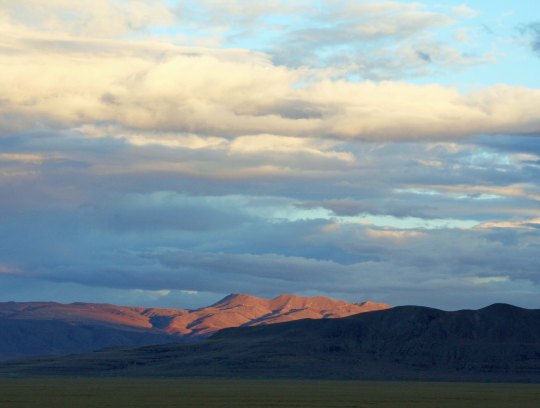
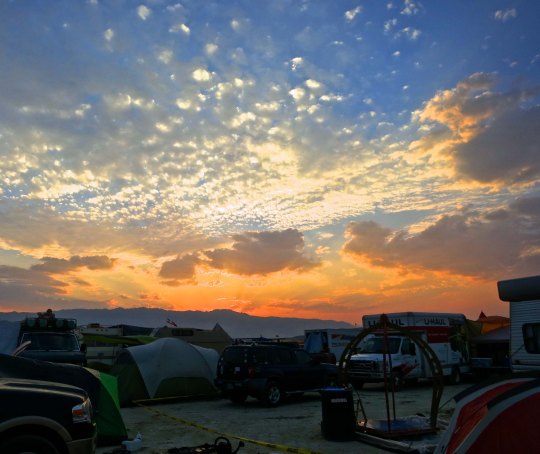
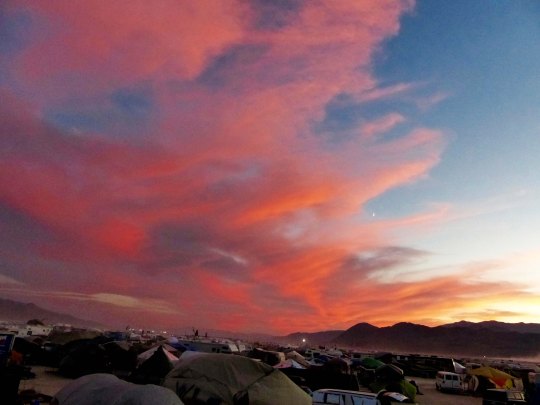
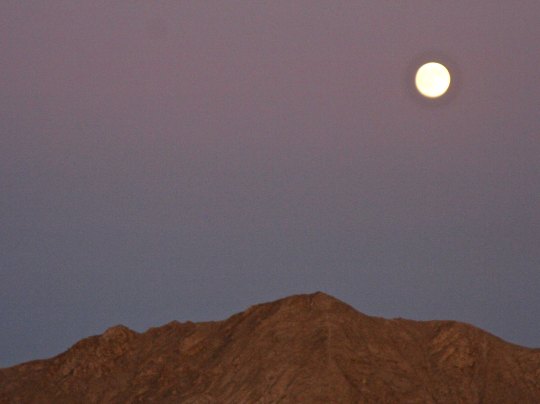
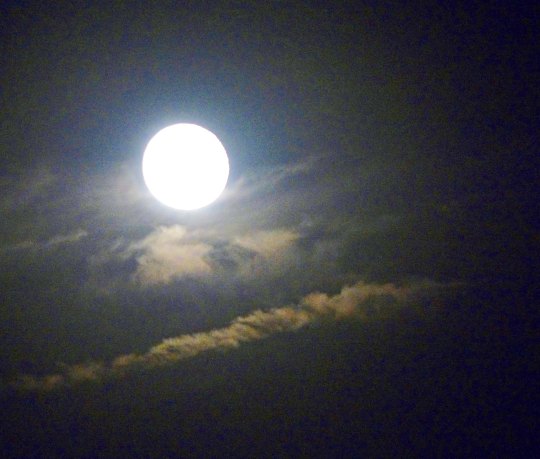
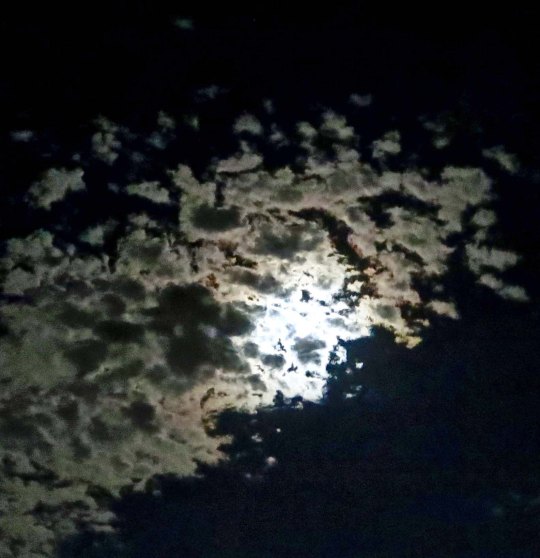
I like this photo because it emphasizes how flat the Playa is. You can barely see the fence that marks the outer boundary of Burning Man. Art can be found even in this remote section but it takes a bit of effort to get there. The flat playa has enabled some land speed records to be set here. It has also provided a good base for launching rockets.Of course, I like to spend time out there given my love of wide open spaces, desire to escape the crowds, and interest in the art. Here I am on the outside looking in. It was shortly after this that the Black Rock Rangers, the Border Patrol of BMO, came roaring over in an official truck. I hopped the fence and zoomed off on my bike. (Photograph by Peggy Mekemson.)The Border Patrol is wise to be vigilant on the outer edges of Burning Man, however. Aliens are known to hang out there.Some even resemble cats. This doesn’t surprise me. I’ve always thought that cats have a taint of alien blood. It may be more than a taint. Have you ever found your cat staring at you in a strange way and wondered what alien thoughts were passing through its mind?Another perspective. Note the rain clouds. The Black Rock Desert receives less than 10 inches a year, which is the definition of a desert. At times, it seems like the majority falls during Burning Man! All traffic is stopped. A thick, caky mud clings to vehicle tires, bike tires and shoes. A small garbage bag worn on the shoes helps feet avoid the worst of it.We’ve seen some spectacular rainbows accompany the storms.Another example.My friend, Ken Lake, caught a photo of this double rainbow hanging over Black Rock City.The first rays of the morning sun touch the mountains surrounding Burning Man. Early morning and evening are the best time to photograph the scenery.A few minutes later.This sunrise photo is an example of how the large event is dwarfed by its surroundings.Another example.The sun sinks into the west, signifying that life at Burning Man is about to be seriously ramped upward. While many Burners think party as night approaches, others pause to enjoy the beauty.And beauty there is.As the sun sets, the moon rises.With a beauty and drama of its own. (Photo by Don Green.)I’ll conclude with this photo of the moon hidden by the clouds— a contrast in light and dark.
NEXT POST: I was reading Walter Isaacson’s book on Leonardo Da Vinci this morning and Isaacson was discussing how incredibly observant Da Vinci was. This led me to look up at our house from a slightly different perspective. I was struck by some of the weird things we collect and decided it would make a fun post. The next post: A Home Full of Whimsy… What’s in your House?
I drove into the Pleasant Valley Campground near Tillamook, Oregon and there were bunnies everywhere, including this magnificent creature.
With Easter having arrived, I couldn’t resist re-blogging/modifying a post I did on some really cute bunnies a while back.
I had stopped over in Tillamook, Oregon to visit the cheese factory. It sends out tons of the stuff annually. I assume all over the world. I watched women whip around 50 pound blocks of cheese like they had been working out with Arnold Schwarzenegger. This made me hungry, so I ordered a sample plate of Tillamook ice cream. Bad idea. It’s really good. I mean really, really good. But eating all of those calories made me tired. It was time to find a campground.
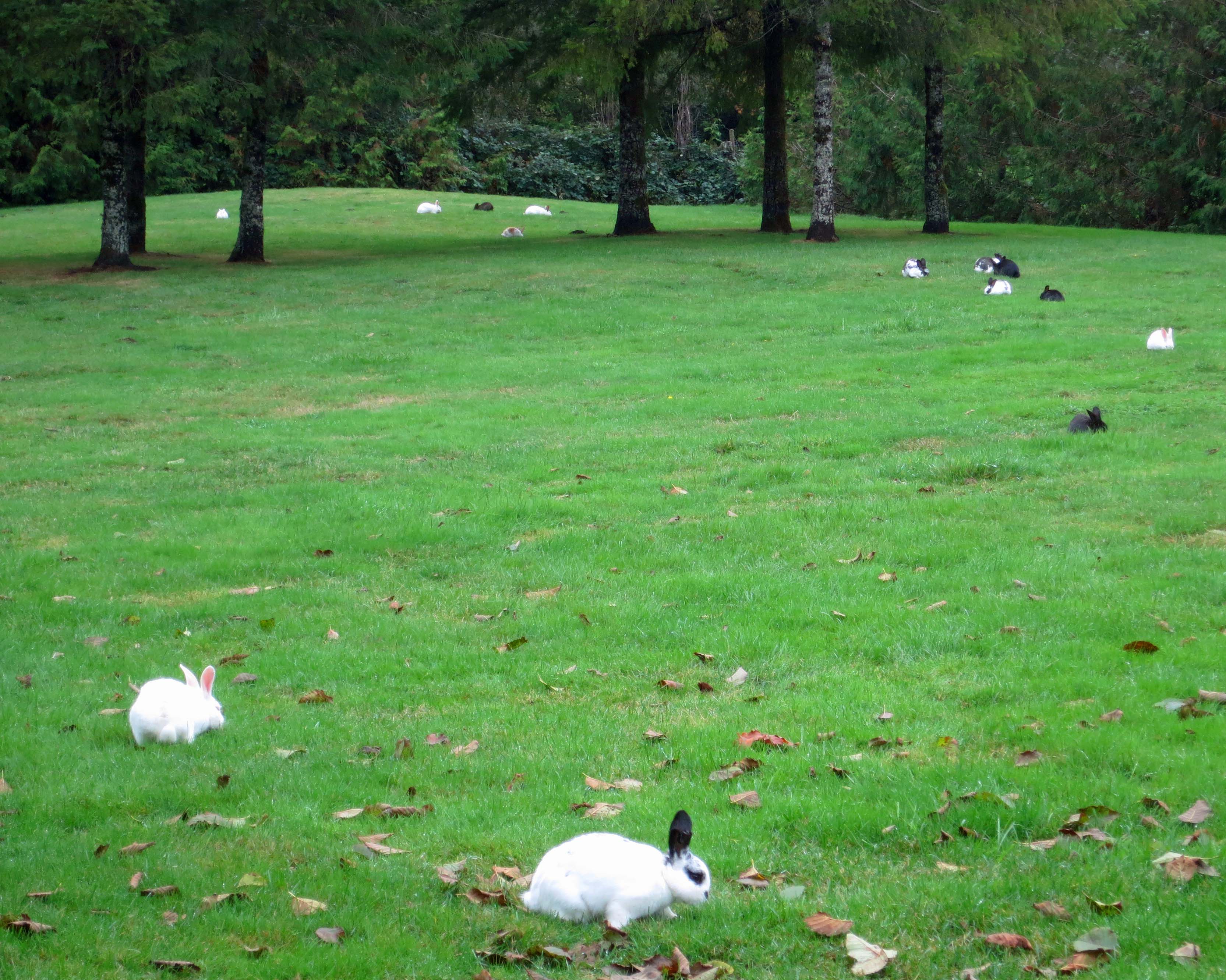
And this is where the bunnies came in. I pulled into Pleasant Valley Campground, a few miles south of Tillamook, and was greeted by (drum roll please) RABBITS, dozens of them. There were black ones, and brown ones, and white ones, all of whom seemed to be chasing each other around in a glorious romp to make more bunnies. After all, isn’t that what rabbits do beside deliver Easter eggs?
Ignoring the obvious, for the moment, I asked the owner where all the rabbits came from. “Oh they used to live across the street,” she informed me. “One day, a few moved over here. They didn’t do any harm and the campers seemed to like them. So I let them stay.” The rest is history, as they say. Anyway, here are some photos I took of the rabbits. Enjoy.
I am going for the “awww” factor with this baby bunny.
This was only a few of the rabbits, but it makes the point.
This furry gal was napping when I snuck up on her, but then, her eyes popped open…
And she was all wiggly ears and twitchy nose.
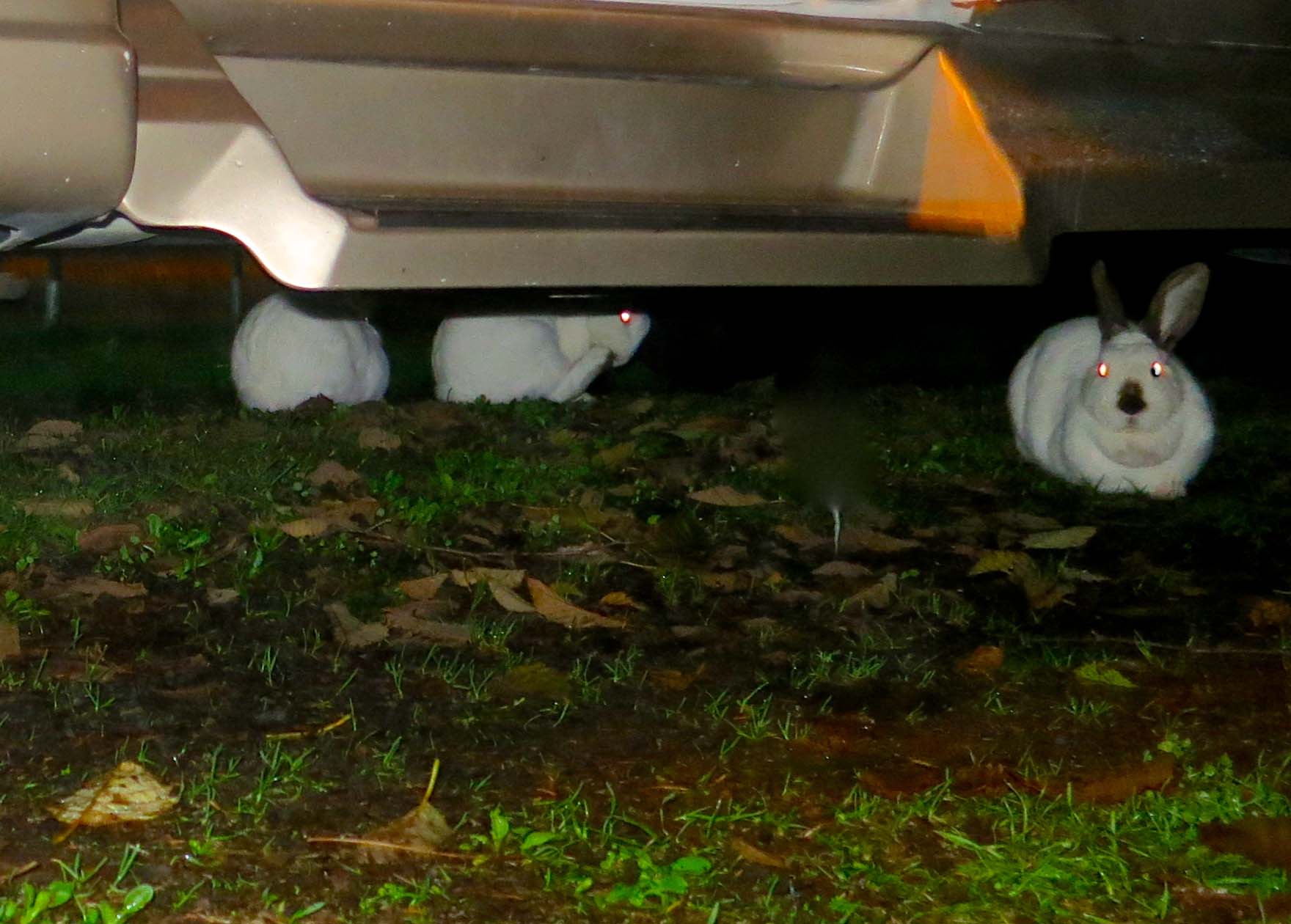
It rained hard that night. I discovered I had several rabbits using my van as shelter. The step is my doorstep. My flashlight caught their eyes. Scary. Was it a case of when good bunnies go bad?
Nah. I’ll finish off with another baby bunny. It was cold out and this tyke looks cold. I almost invited it into my van to warm up.
I don’t know how many of these bunnies participate in delivering Easter Eggs, but any of them would be welcomed here! A very Happy Easter to our friends throughout the blogging world— Curt and Peggy
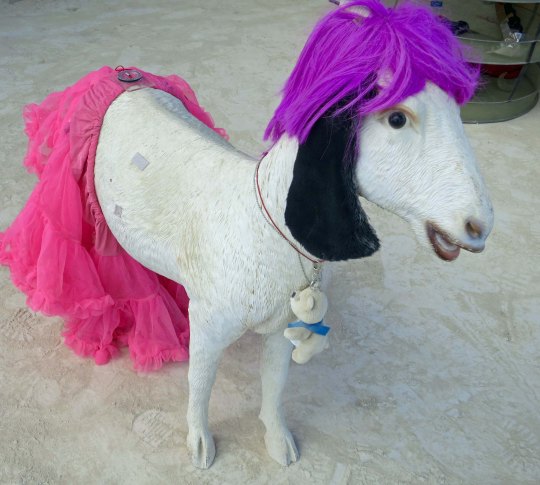
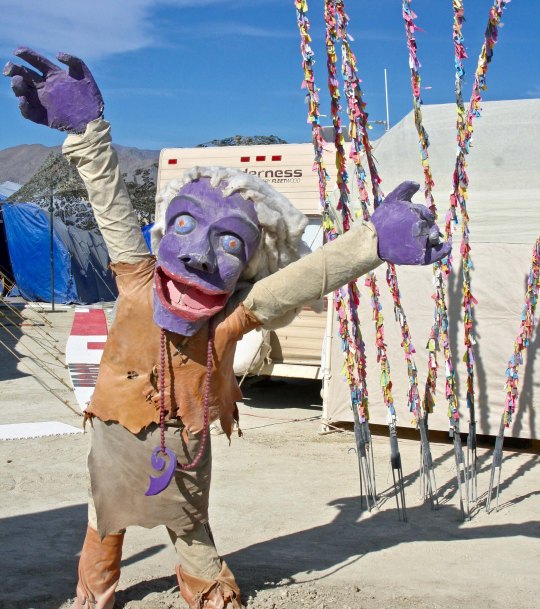
The point about wandering through Black Rock City is that you never know what you are going to find, such as a goat with purple hair wearing a sagging tutu and a bear necklace.
I spend the majority of my ‘out and about’ time at Burning Man on the Playa. That’s where the major art pieces are displayed, and seeing them is my primary reason for going to the event. Some, I return to several times to admire and photograph in different light. And there is night, where they take on a totally different personality.
Peggy and I always reserve a day for walking around Black Rock City, however. The same creativity found in the creation of art, mutant vehicles, and major camps is found in BRC as well. In fact, you never know what you will find, such as the goat above. In addition to the fun and curious, there are things to do, food to eat, more art, and camps to admire. People watching is also fun, as it is out on the Playa and at the Center Camp cafe.
I’ll let today’s photos reflect our walks over the years. Most of them were taken by Peggy and me, but some were taken by the two other photographers in our camp, Tom Lovering and Don Green.
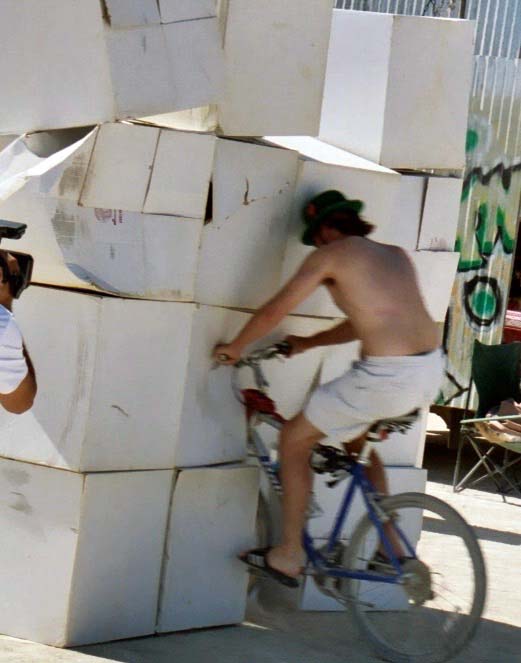
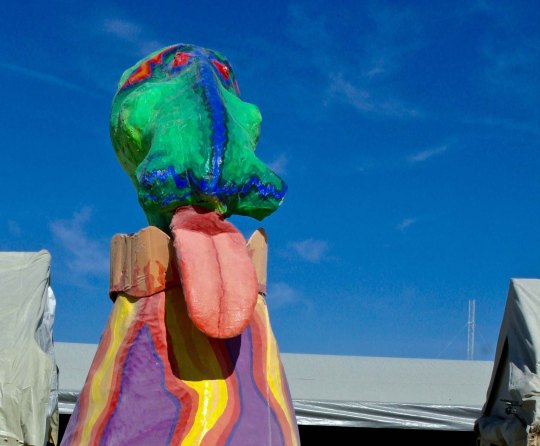
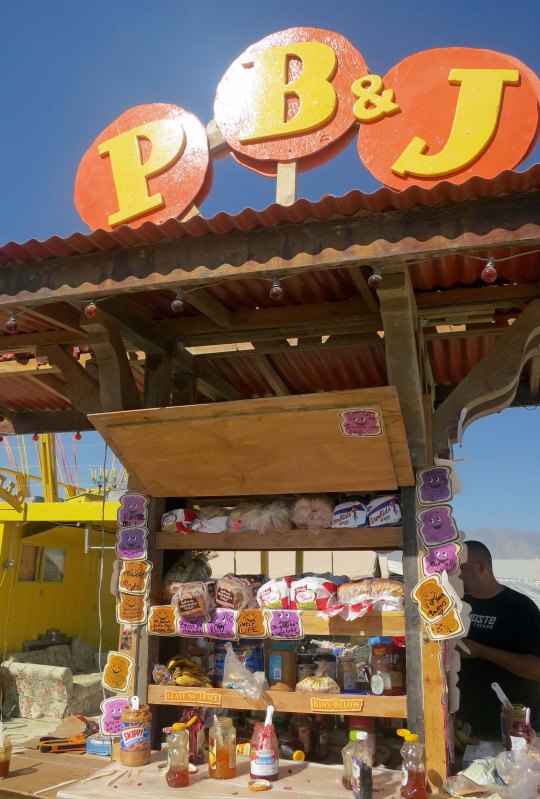
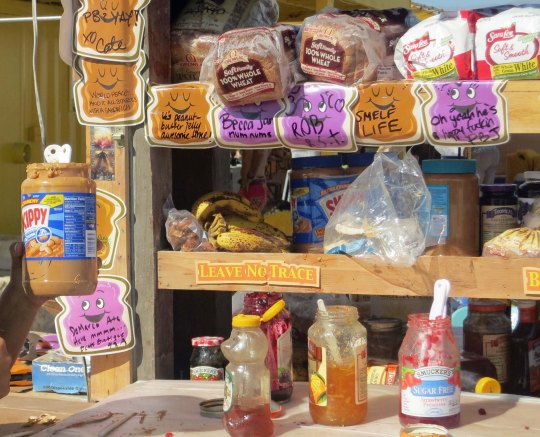
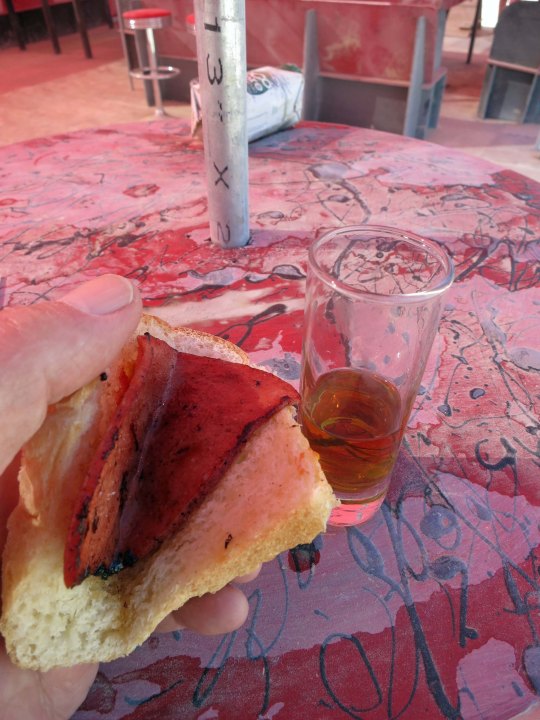
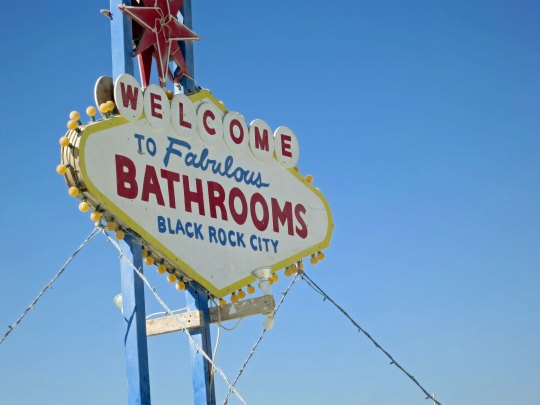
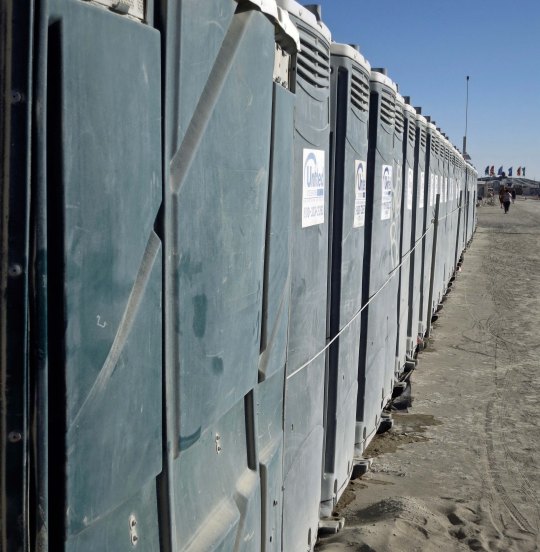
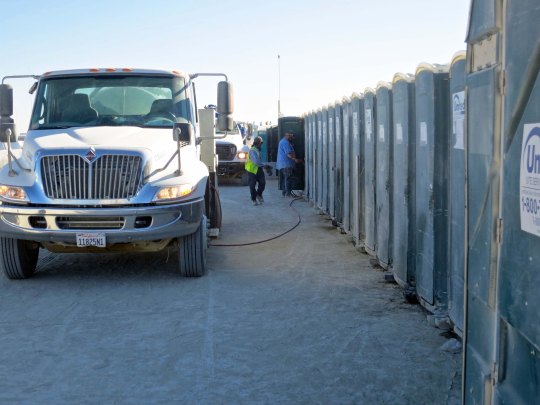
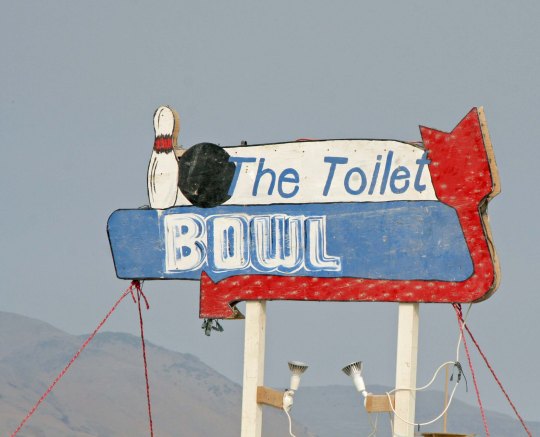
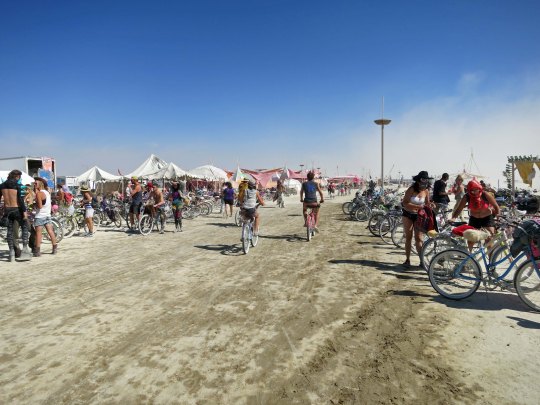
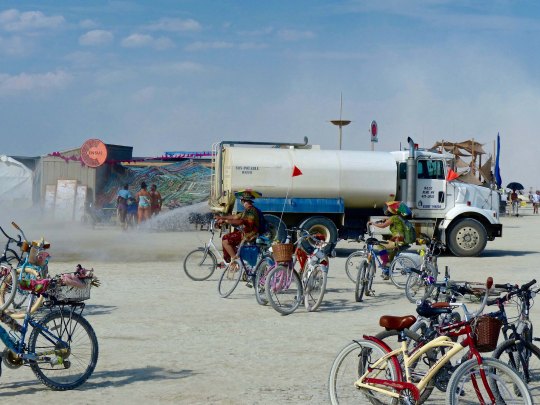
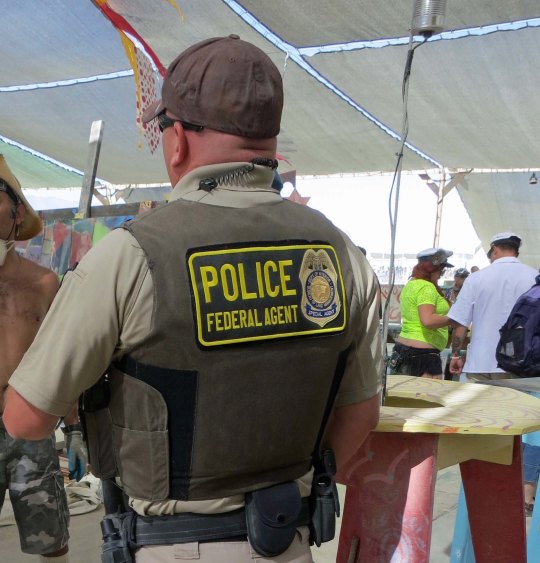
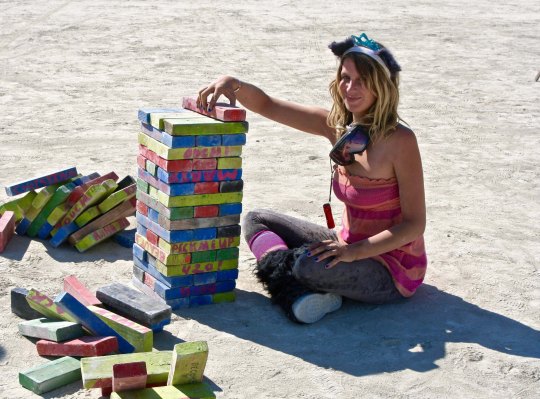
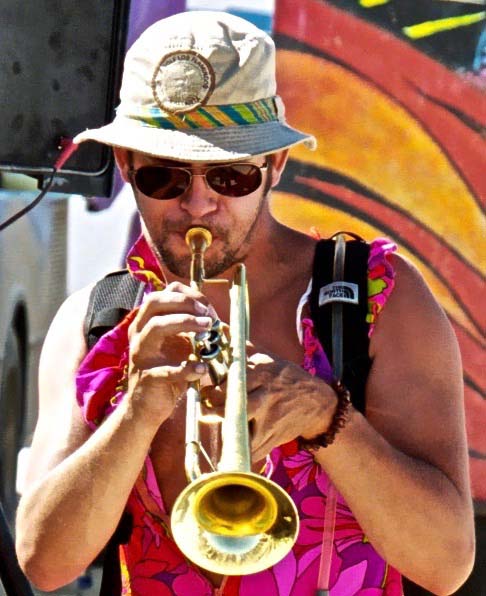
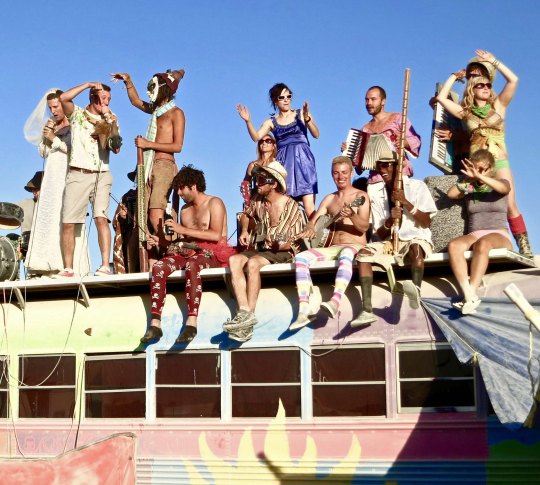
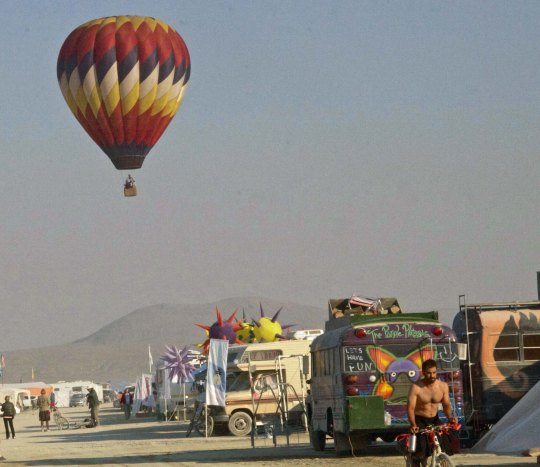
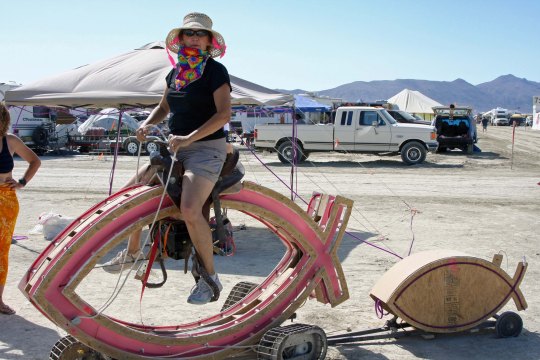
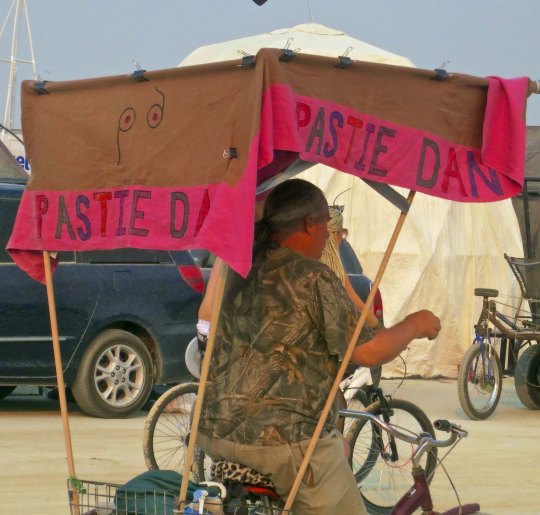
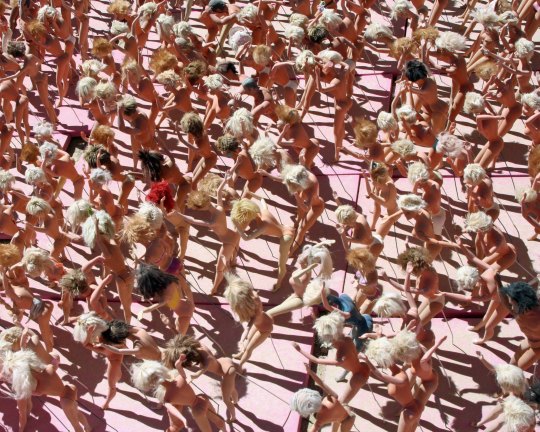
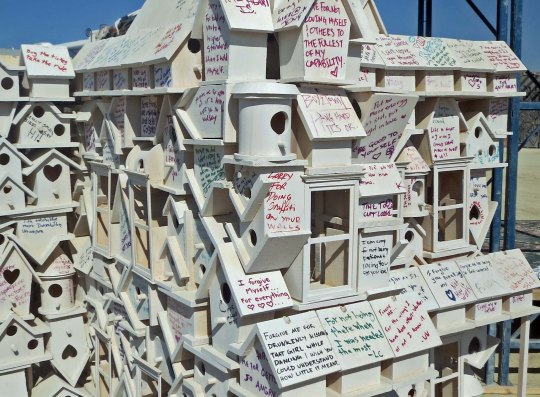
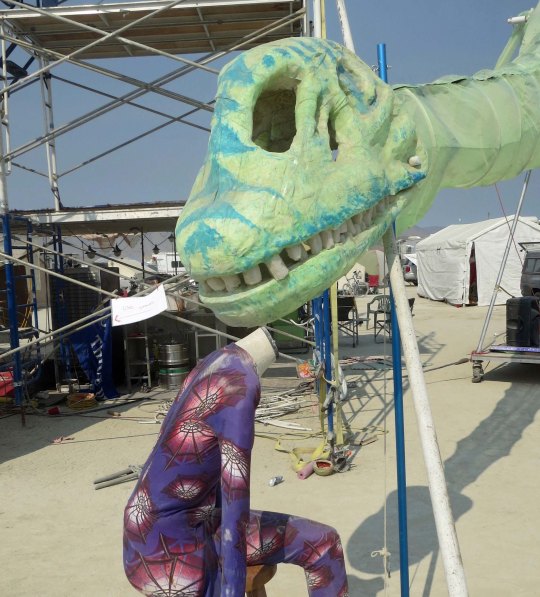
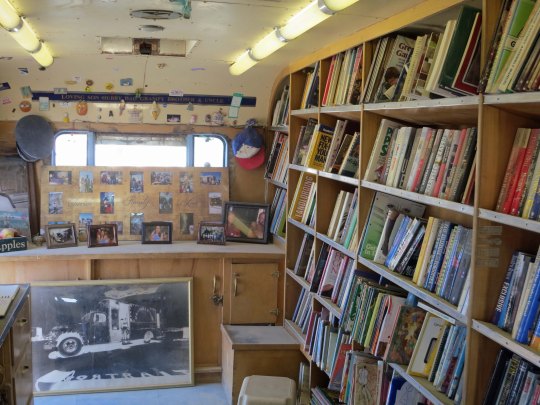
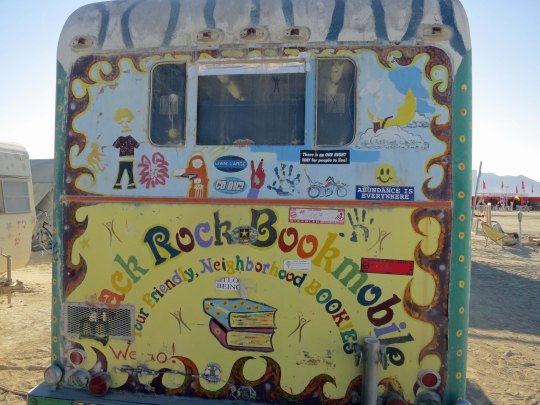
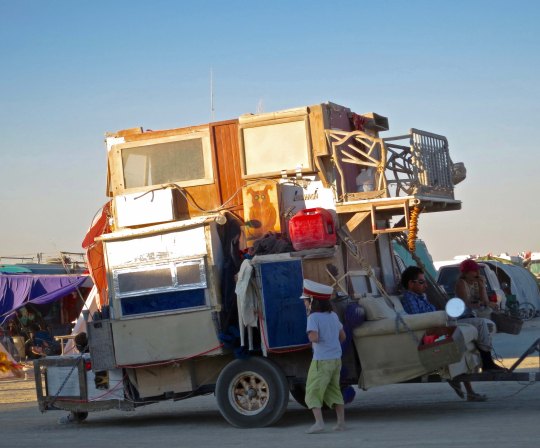
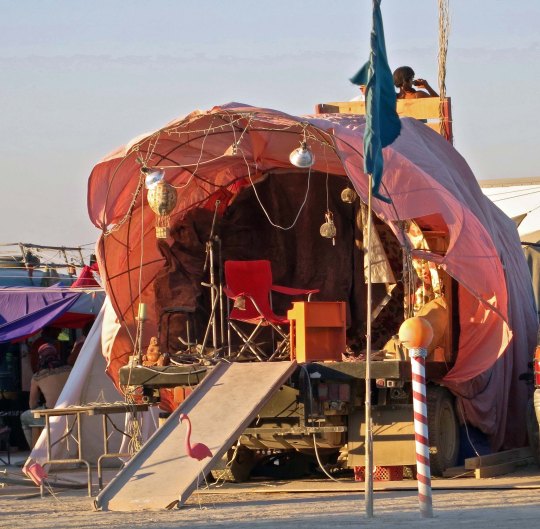
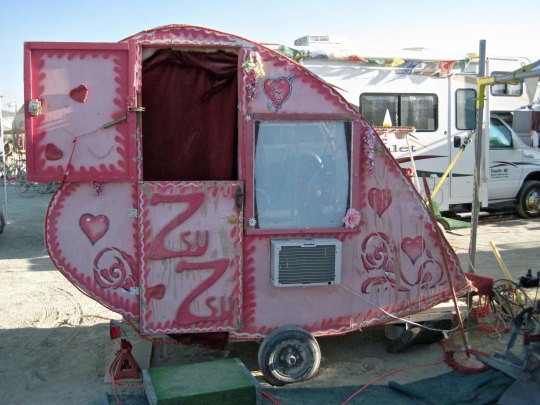
Joy riding isn’t encouraged at Burning Man. This was an exception. (Photo by Don Green.)Safety on bikes is critical with 60,000 or so running around in BRC and out on the Playa. Bike crashes do happen, however, and it’s amazing there aren’t more. One year, bikers were invited to crash into empty boxes on the Esplanade.This guy welcomed Peggy and me with open arms..This fellow, not so much.And this creature stuck its tongue out at us. Looking at it now, I’m sorry I didn’t pose Peggy sticking her tongue back out at it.Hungry? The PB&J camp had a solution. Lots of peanut butter, several different types of jam, and bread! It was all free and is an example of Burning Man’s gifting philosophy.A close up.The Kentucky camp developed a Kentucky Fried Chicken theme one year and offered fried baloney sandwiches with a shot of bourbon— for breakfast. That woke me up…Restrooms, as it turns out, are a major focus at Burning Man. The reason: the restrooms are the modern version of an outhouse, the porta-potty. If you have ever used one, you know they are not the epitome of having a pleasant bathroom experience. There are banks and banks of toilets, hundreds of them. This is a view of the back side.Veteran Burners wait until they are cleaned. A whole fleet of trucks is kept busy.Another view. You want to camp close enough to the porta potties for convenience, but not too close!Humor is the best approach when it comes to outhouses. There was actually a bowling alley set up next to the toilets! As I remember, I rolled a strike.I’ll drink to that!In addition to large trucks running around emptying the toilets, water trucks are constantly watering down the roads to reduce the dust. Nothing stops the dust storms, however. One’s coming. Burners used to run along behind the trucks getting their daily bath and washing their clothes at the same time, assuming they wore clothes. I saw more than one naked person running by, giving a new meaning to streaking. Today, Burning Man claims the water is recycled from sewer operations, effectively putting a stop to the showers.Lest you think that Burning Man is a lawless party in the desert, there are police everywhere including the feds, DEA, state police, BLM rangers, and local sheriffs’ departments. It’s best to behave yourself!I am assuming that Burning Man is not a favorite event of the present administration in Washington, although Ivanka reputedly has a Burning Man photo in her office. Let me report, however, in my 11 years at Burning Man, I have never once seen an illegal alien cross over. I did once, however. How could I not, given Burning Man’s iron clad rule that no-one is to cross the barrier. Within seconds an official BMO truck was bearing down on me. A Black Rock Ranger yelled at my departing back: Do Not Cross the Fence! Be that as it may, bear with me and I will move on to more officially acceptable Burning Man activity you can see when you walk around BRC.Such as stacking blocks.Or playing a trumpet in drag…Or getting married on top of a bus…Or checking out Burning Man in a hot air balloon…Or riding a fish…Or having a free nipple covering business. Pastie Dan is close to a legend at Burning Man.Or checking out a Barbie Doll camp.Or reading the messages on a large birdhouse. Most had to do with being forgiven for something. Burners, apparently, have lots of regrets. Or wondering why the grinning dinosaur bit the woman’s head off.It’s hard to get bored at Burning Man, but if you do, there’s always a lending library of some type or other around. Books are free and there is never a requirement that you bring them back.The book mobile.Checking out people’s homes is an honored activity just about anywhere. Apparently, it was moving day for this Burner. You don’t have to be a large camp to have an interesting residence, even if it is only for a week. This gypsy type home was right across the road from us one year.And last, but not least, is Zsu Zsu’s Home. There was a suggestion on the side that you might want to give her a kiss. (Photo by Tom Lovering.)
NEXT POST: A look at the Black Rock Desert, home to Burning Man and Black Rock City.
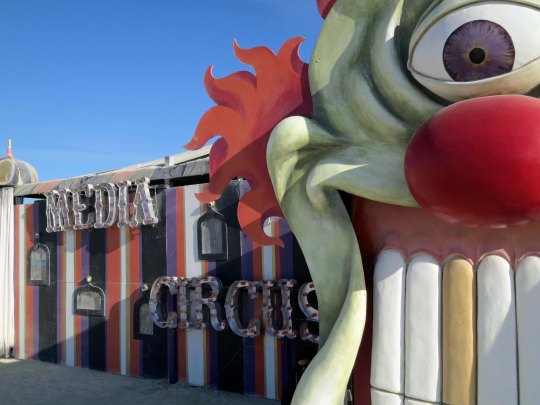
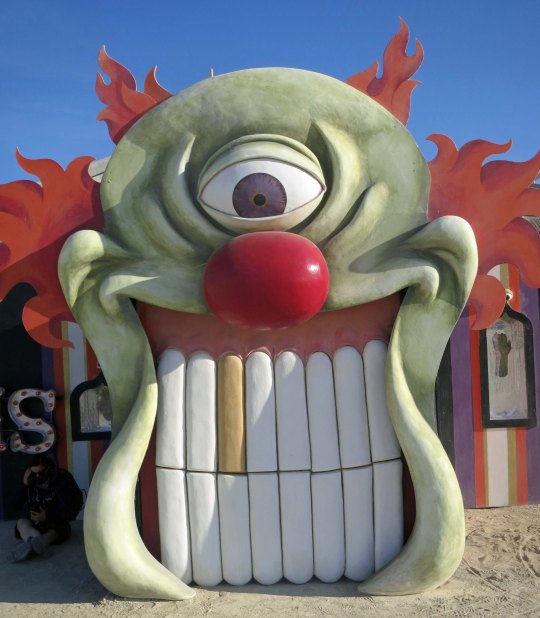
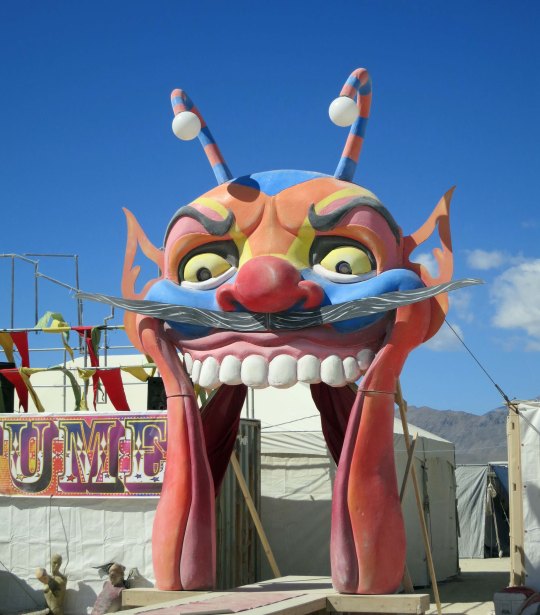
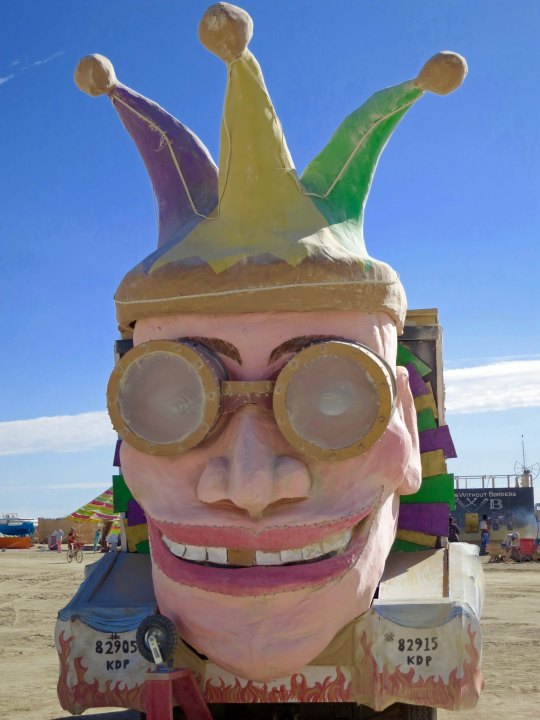
The creativity that goes into making the mutant vehicles I have featured in my last several posts about Burning Man also goes into most other elements of of the event. For example, the Burning Man Organization, BMO, requires commercial media operations to check in and obtain credentials. BMO could put up a nondescript building for this purpose. Instead, this is what they built in 2015 to reflect that year’s theme, A Carnival of Mirrors.As I recall, the mouth opened and served as the door. I wondered if a person with a fear of clowns would go through the door.
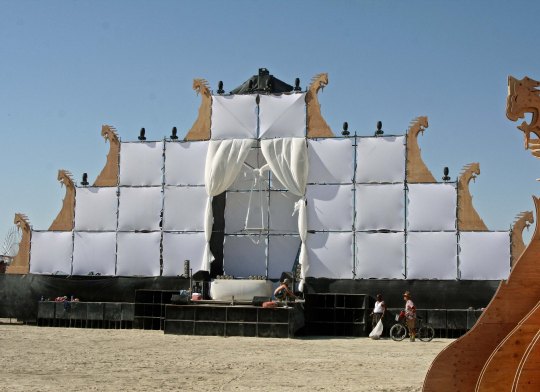
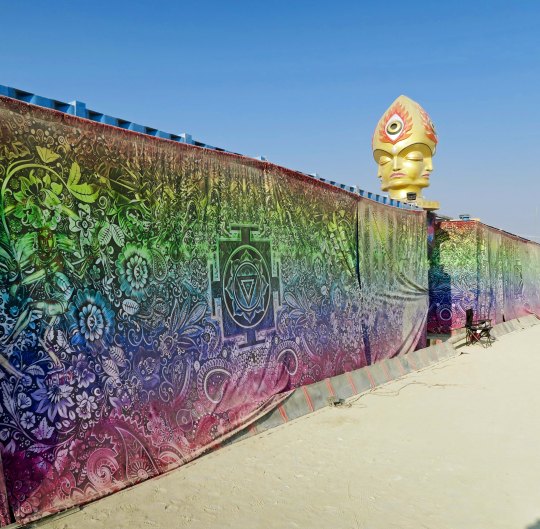
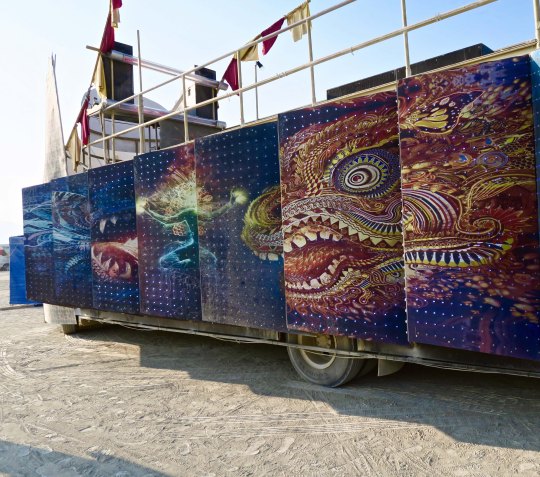
If you have been following my Burning Man posts over the past couple of months, you now have a fair idea of what mutant vehicles look like. Today, I am moving off of the Playa and into Black Rock City, starting with a look at the structures built by large camps (villages). A camp is usually made up of people who share a common interest or background. All of these photos were taken during the 11 years I have attended the event: 2004-5-6-7-9-10-12-13-14-15 and 17. It is interesting to note that these structures are built to last one week, going up at the beginning of Burning Man and coming down at the end.
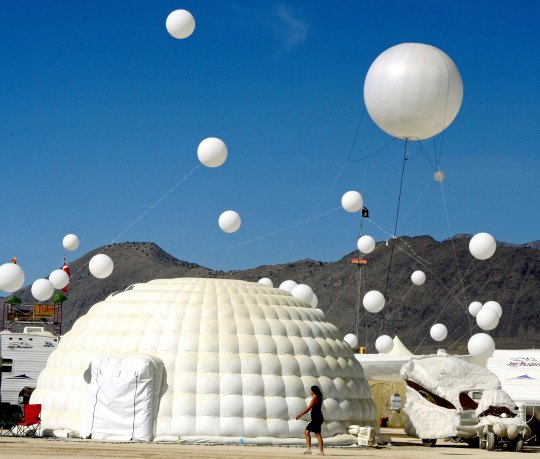
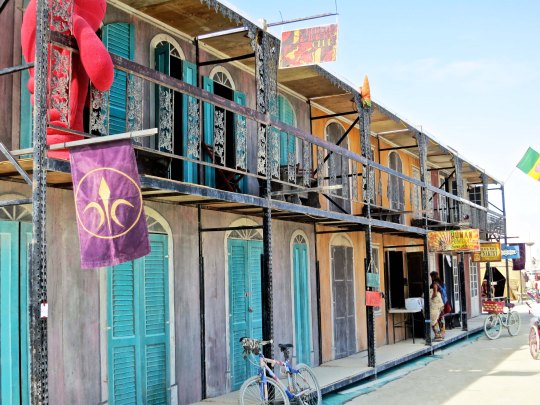
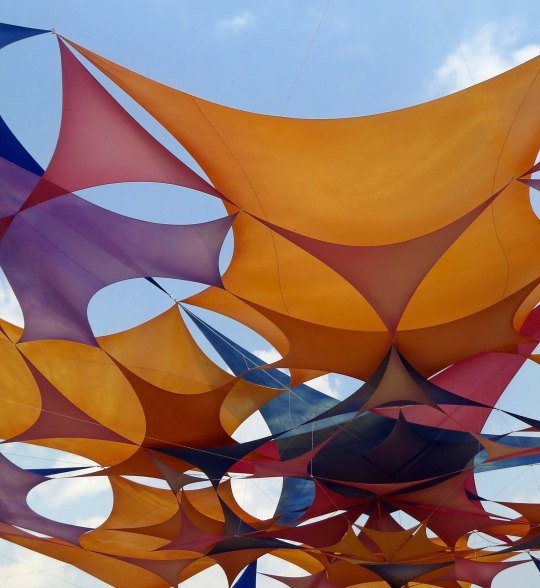
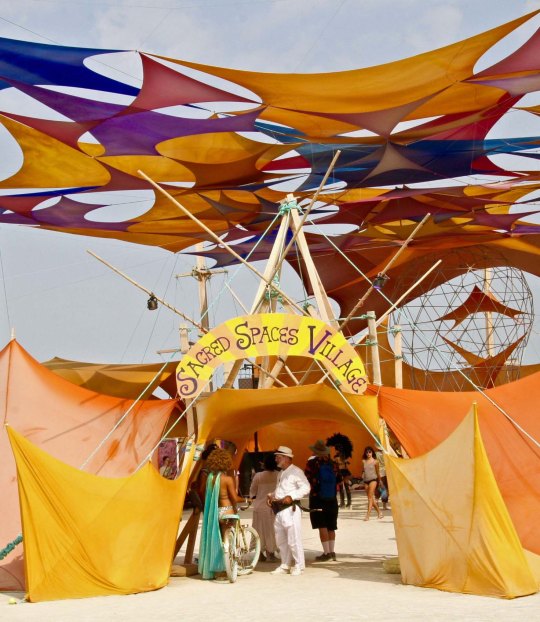
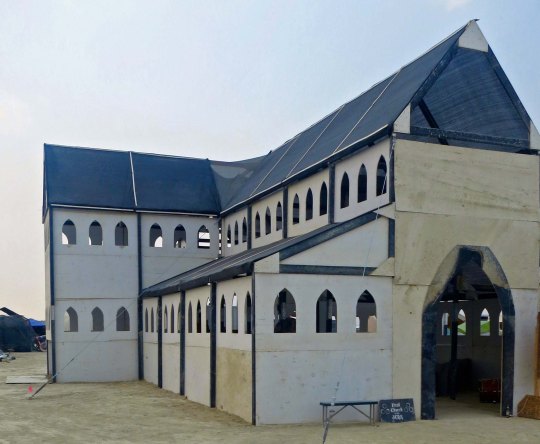
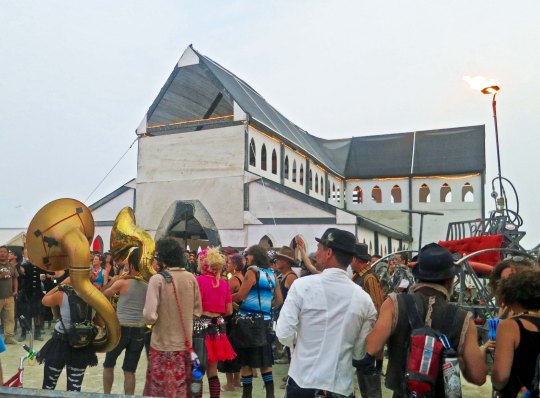
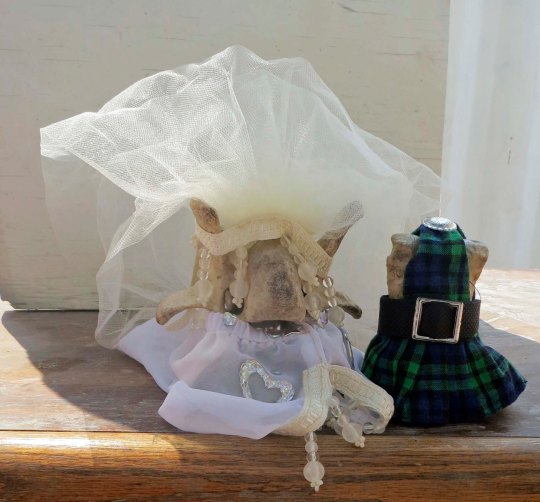
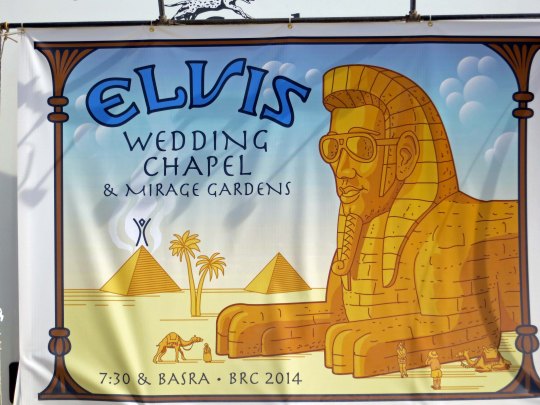
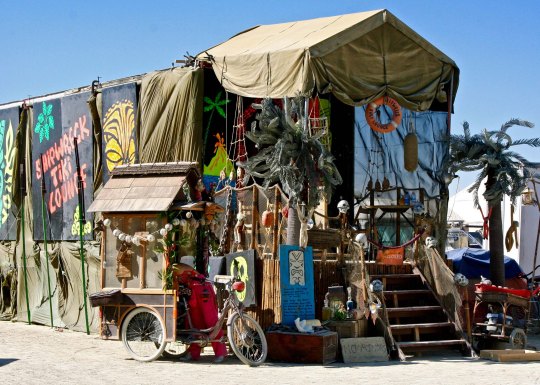
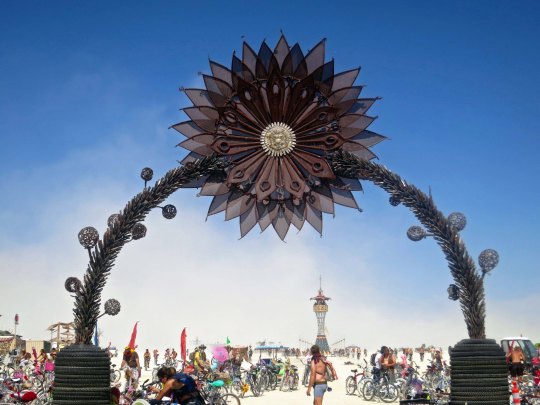
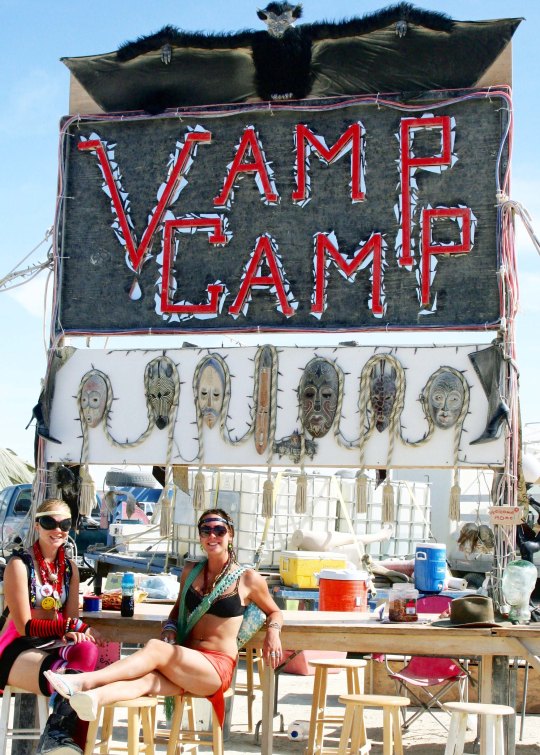
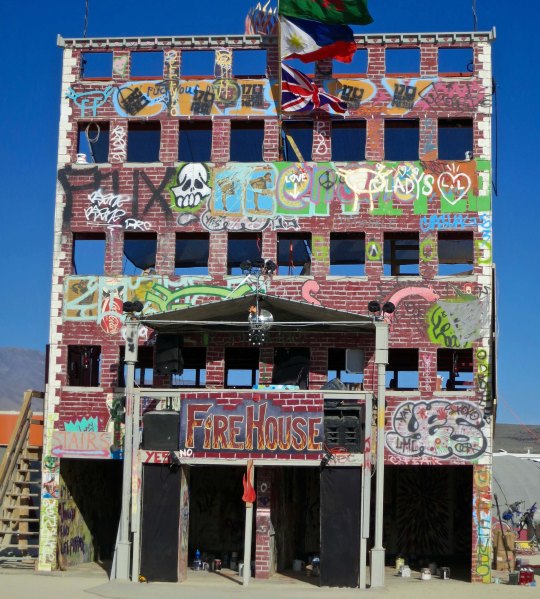
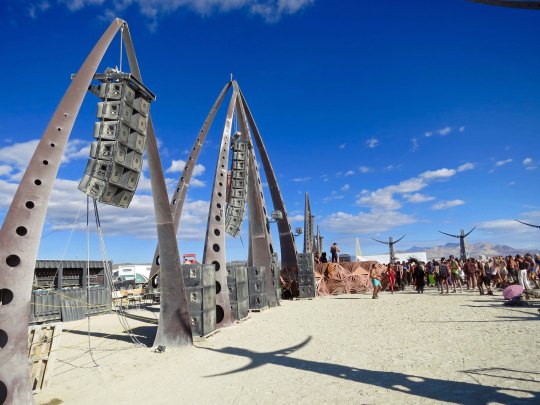
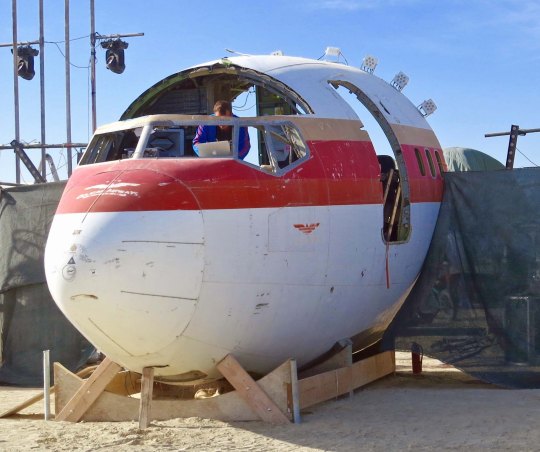
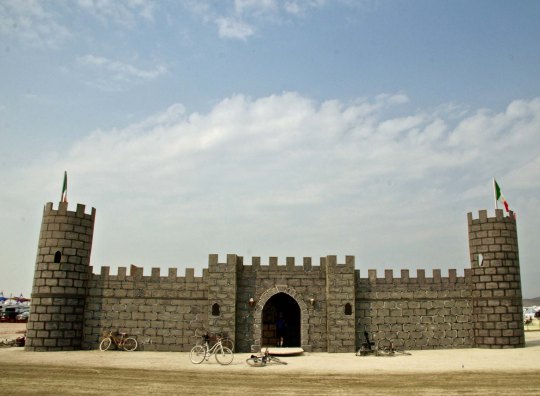
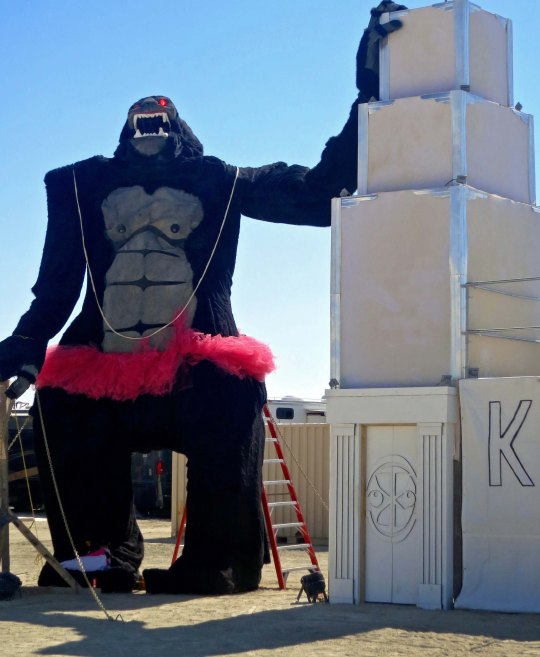
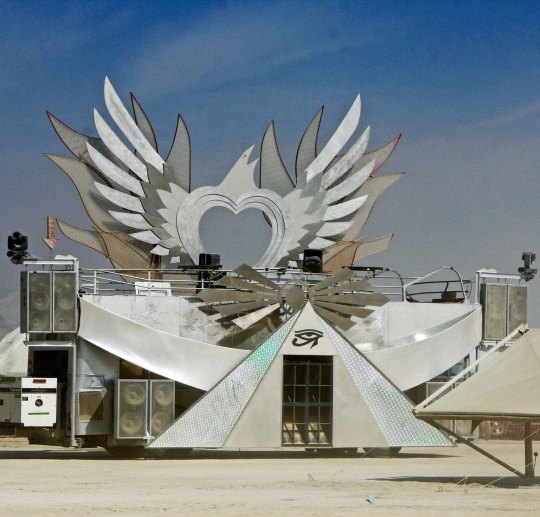
I never did find the name of this particular village, so, I called it Camp Bubbles. Note how the mutant vehicle at the right follows the camp’s white theme.The NOLA Camp recreates a bit of old New Orleans. There is even a cafe where free beignets and chicory coffee is offered to Burners.This structure provided shade for the Sacred Spaces Village at Burning Man one year.The entrance. Inside a variety of meditation options were featured.One year, a Burner who wanted to get married at Burning Man built this church for the purpose.The ceremony after the wedding. For those of you who follow the Bone story, Bone was also married in the chapel to Bonetta. Bone and the lovely Bonetta are married at Burning Man 2013.The Elvis Wedding Chapel offered an option. And no, I didn’t see Elvis wandering around Burning Man. But I wouldn’t be too surprised…Many camps build facilities that double as lounges or bars where free drinks are disbursed to Burners. This is the Shipwreck Tiki Lounge.I was particularly fond of these Teepees that were set up on the edge of the Playa along the Esplanade. The Esplanade serves as a division point between Black Rock City and the Playa. Most major camps are located along the Esplanade. Looking out from Center Camp across the Esplanade and out into the Playa.Vamp Camp was located within the city.As was the Firehouse with its burned out graffiti look.A number of camps along the Esplanade located on the outer edges of the city offer music venues, very loud music. Those are speakers. The DJ for this music venue had the nose of a 747 to spin his tunes.Celtic Chaos had a castle.Another music venue.Looking for a mystic experience? Camp Mystic is the place to be. Numerous classes were offered throughout the week.This was its mutant vehicle.This giant fellow (who may be familiar to you, except for his pink Tutu) was found lurking among the buildings. Maybe Kong was in disguise, or drag.I don’t know whose camp this was, but I liked the eagle with a large heart. Again, massive banks of speakers. I conclude with this jolly devil whose mouth provided an entry into the Kostume Kult.
NEXT POST: A view of Black Rock City outside of the large camps, out in the boonies where I lived.
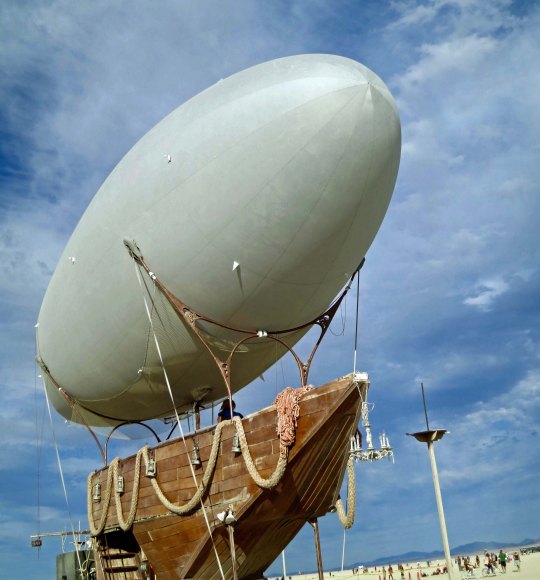
If you have watched the movie Stardust like I have 20 or so times (it’s one of Peggy’s favorites), then you will be familiar with an airship. The dreaded, ‘whoopsie’ Captain Shakespeare played delightfully by Robert DeNiro used it for gathering lighting. This rendition at Burning Man was quite impressive. .
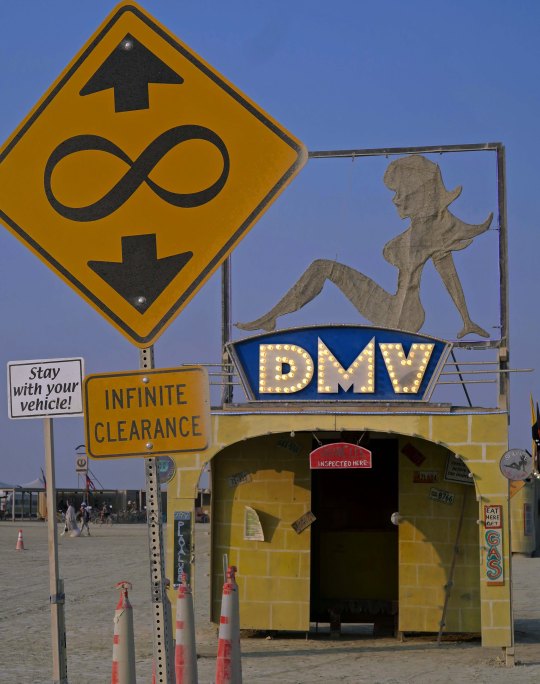
The Burning Man Organization, BMO, works hard to insure that the mutant vehicles that wander across the Playa and through Black Rock City are both creative and safe. The process starts with an application from Burners who want to bring a mutant vehicle to the annual event. A photo or detailed drawing of the vehicle must accompany the application. A committee then reviews the applications for originality and safety. Numbers are strictly limited. Burning Man is primarily a walking/bicycling event. Upon arrival the mutant vehicle must check in with the Department of Mutant Vehicles, DMV, and pass a safety inspection before receiving a license. Vehicles that shoot out fire must pass even more stringent requirements.
Here’s where the mutant vehicles have to check in upon their arrival before venturing out on to the Playa or into Black Rock City. I was amused by the infinite clearance. Some of the mutants, like the sailing ship and El Pulpo Mechanico, do reach quite high into the sky!
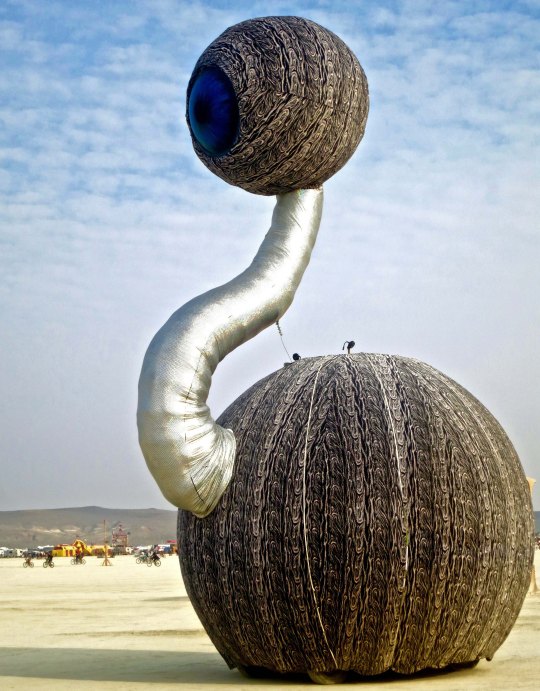
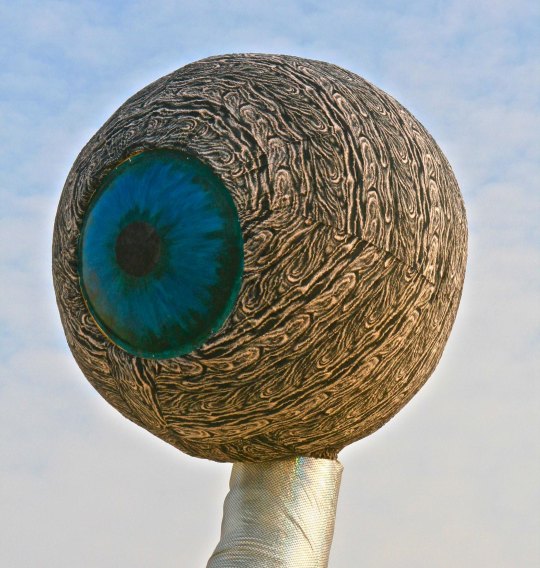
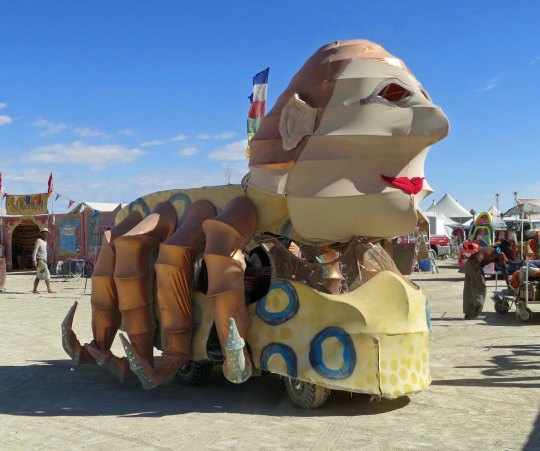
I am wrapping up my series on Burning Man’s mutant vehicles today. There are, after all, another 14 categories of photos from my 11 years of attending the far-out happening in Nevada’s remote Black Rock Desert. Being last, however, does not mean least. Most of these simply didn’t fit into the groups I created. Take this eye, for example.
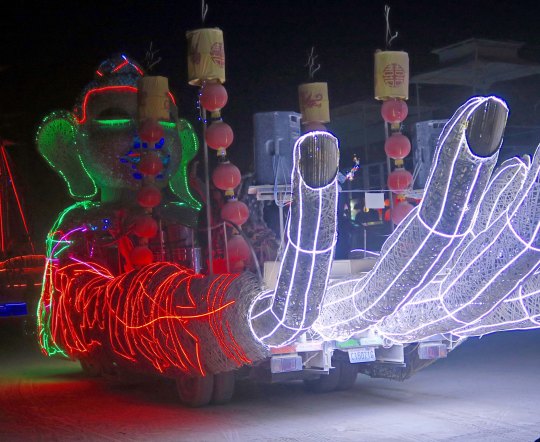
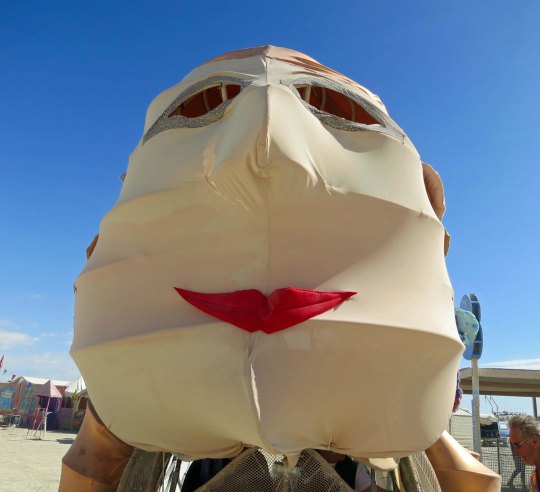
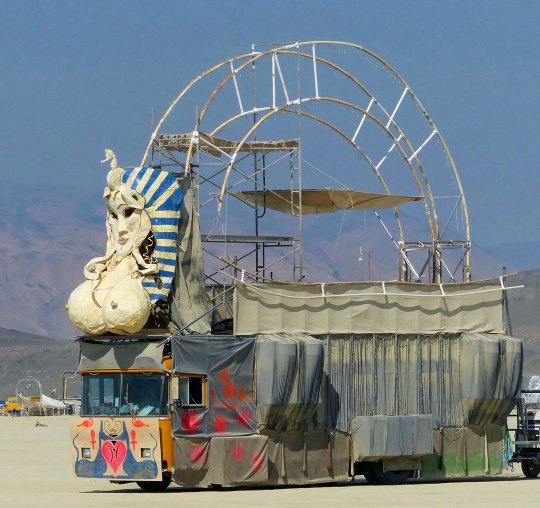
An eyeball moving across the Playa was one of the most unique mutant vehicles I have seen.Given all of the local, state and federal law enforcement agencies that show up at Burning Man, I could’t help but wonder if Big Brother wasn’t watching us. (Not seriously, but what a clever disguise it would be.)While focusing in on body parts, this fellow seemed to have a hand out. The question: was it offering help or looking for spare change? I think I recognize him from the street corner. And what about those ears. On the other hand (so to speak), and more likely, there may be a more serious Hindu or Buddhist reference here. Or maybe it’s a Hare Krishna recruiting effort.Pucker up, sweetie. There’s a chance that this cutie wanted more than a kiss, however. There’s a good chance that she wanted your blood.Bounteous would be the description I would apply here, with a slight touch of Egypt. I’d think sphinx except for the duck up on top of her head. Or maybe its a seahorse. (Photo by Don Green.)
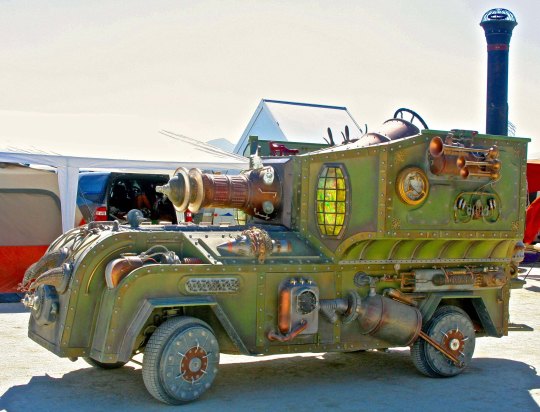
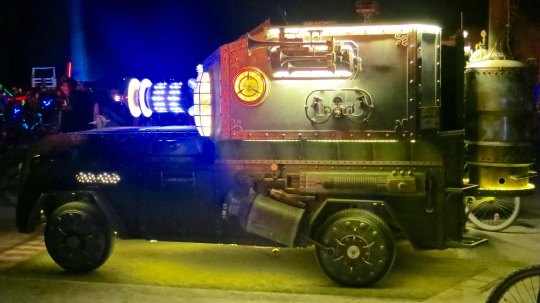
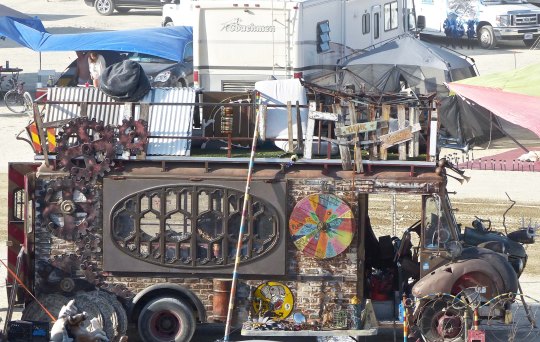
Well, enough on body parts, already. I’ve written a fair amount about steampunk at Burning Man, especially as it applies to mutant vehicles. Here’s a couple more.
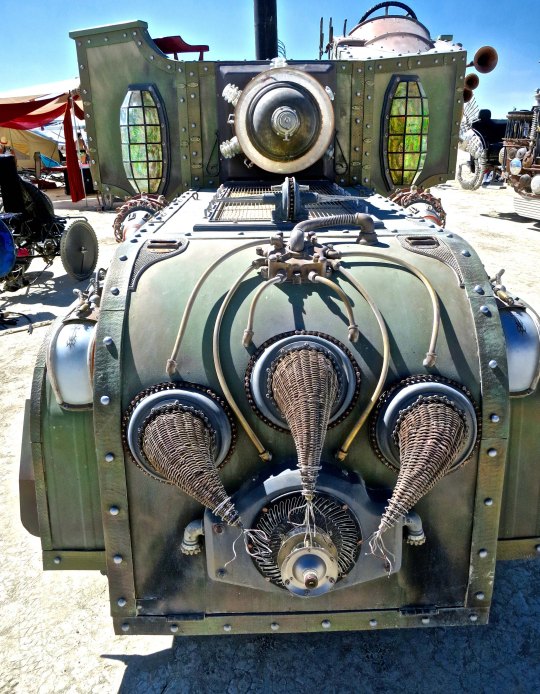
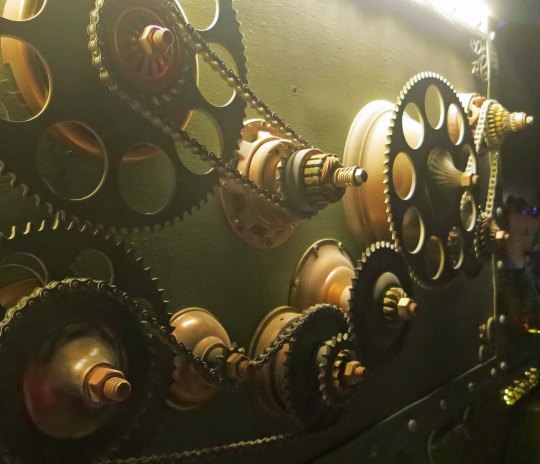
As I recall, I found this vehicle hanging out near the rhino and the octopus. It struck me as a Capatin Nemo type vehicle.A front view.At night.The requisite gears apparently required on all steampunk vehicles.My friend Don Green captured another great example of steam punk.
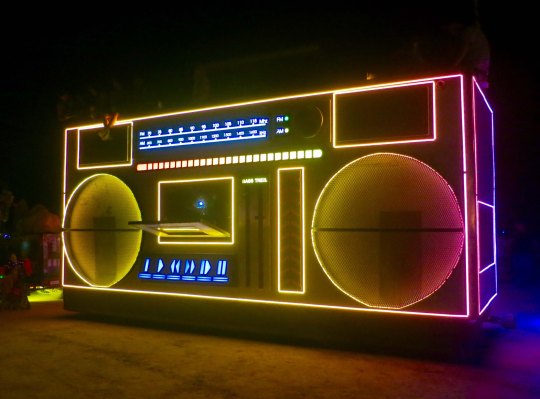
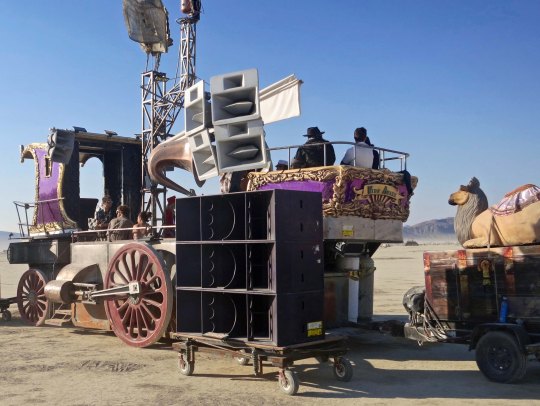
Burning Man constantly throbs with the sound of heavy metal music. I always carry sound makers to reduce its impact on my beauty rest. A number of large venues are found throughout Black Rock City. Mutant vehicles carry on the tradition out on the Playa. Whenever one stops to whip out the tunes, Burners gather around to dance. There’s no question about the intention of the boom box mutant vehicle. Large speakers are another sure guarantee that loud music is about to happen.
One year, this mutant vehicle was for sale, minus its sound equipment. Tempting, I thought. But I would have turned it into a blues mobile or a jazz jalopy.There were enough speakers on this puppy to send any city council into paroxysms of angst or at least anxiety. The police chief would be called. At Burning Man, it was only a medium sized player.
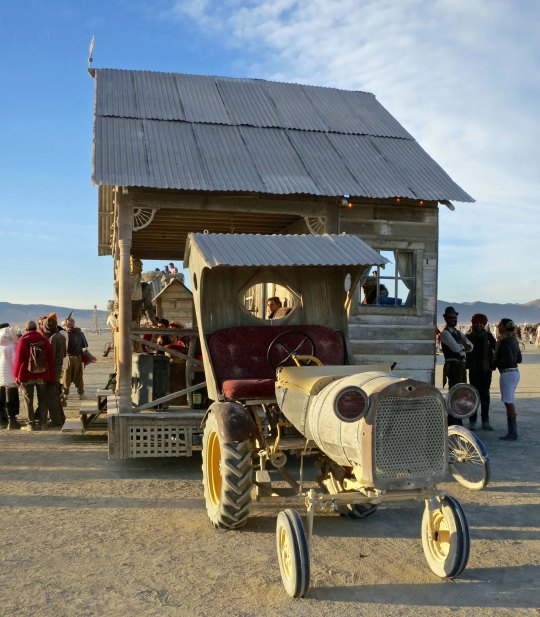
With music rolling across the Playa, it’s not surprising that there was also a bar. This one was hauled by an old tractor.
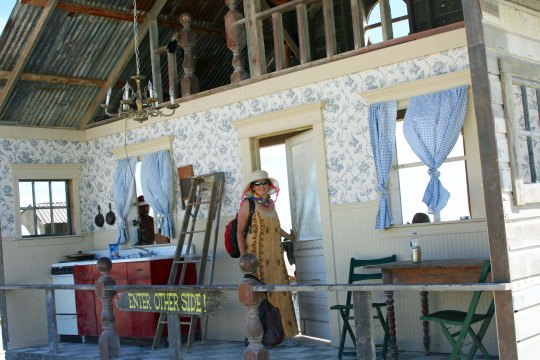
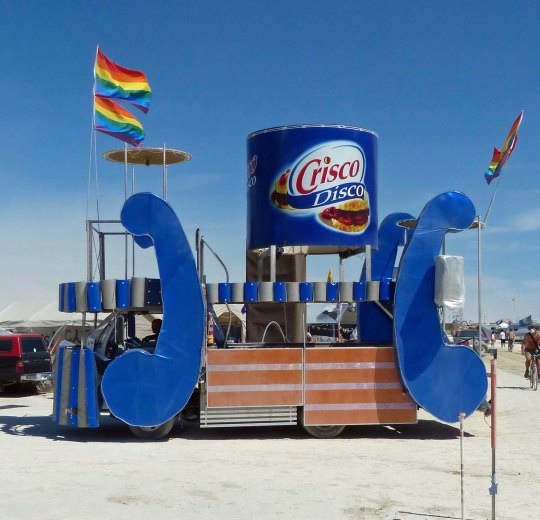
You have to admit that there is a bit of old fashioned charm here. The aluminum roof reminded me of my childhood.Tom and I had to try out the bar. Potent moonshine was being offered. I stand out like a pink something or other. The barmaids came with boots and not many clothes.The mutant was more than a bar. however. The other side was a circa 1950s type kitchen. At one point, I think I remember them cooking chocolate chip cookies. But maybe that’s a memory from my childhood. Peggy is checking out the kitchen, but she wasn’t offering to cook…Maybe she needed some Crisco. Is this an example of canned entertainment?
What if Picasso made it to Burning Man. The first mutant vehicle below might be what he would create. The second would be more likely to be found among the ‘primitive’ painters who were inspired by the South Pacific and exotic tropical islands.
Definitely shades of Picasso here and other modern art themes.And here we have a Tiki God with thoughts of Polynesia. Is that a Polynesian maiden to the right? I’m pretty sure that she would capture Paul Gauguin or Rousseau’s attention.
Big things come in small packages, as the diamond merchants like to remind us, over and over.
Would it be humanly possible to cram one more thing onto this mutant ATV?A close up showed a dog…And a strange kid.
My final three…
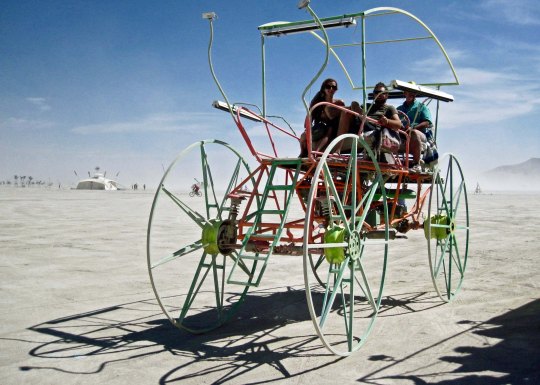
A king who reminded me a bit of Larry Harvey, the creative genius behind Burning Man who passed away last year.A big wheeled horseless carriage. (Photo by Tom Lovering.)And the mutant vehicle I would build! It could be my office. (Photo by Tom Lovering.)
Curt’s extensive experience backpacking, didn’t prepare him to deal with the smoke and fires along the PCT last summer. This photo was taken near Chester, California.
Curt knew I would be nervous without detailed planning of trails, mileage, rendezvous points, and alternatives. With 50 years of backpacking experience including planning, organizing and leading backpack treks for 30, he is something of an expert on the subject. Having a GPS/Spot Gen 3 tracker along was a new experience for him, however. He could upload his location each night via satellite and I could track his progress on my maps. He could also use Spot to signal for emergency help if needed and carried a cell phone, which he could use in the rare times he had cell service or if he had to hike out for some reason.
Then there was the unexpected— lack of water, smoke, fire, and possible injuries on the trail plus my challenges on the road of finding campgrounds and spaces near trailheads, power outages, limited cell service, and RV repair issues.
The first part of the trek introduced us to water shortages! Following mountain ridges over much of its length, the PCT is noted for its limited supply. The mild winter of 2017-18 with its lack of snow fall in the Siskiyous, Cascades and Sierras made it worse. Streams that would normally have been running through July were dry. Springs were sometimes a mere trickle. Even though we had downloaded the most recent information from the PCT site on water sources, the situation was changing rapidly. Our first day on the trail from Mt. Ashland proved the point.
We had planned a 10-mile day since it was our first day out. There had been sufficient water over the first seven miles. It wasn’t the case when we came to our planned camp site. Curt parked me in a pleasant location and took our water bottles down into the canyon where a stream was located. And came back empty. The stream was dry. “The map shows that there’s a spring in about a quarter of a mile off on a side road,” he announced. “We can camp there.” I loaded my pack and away we went. The spring was also dry. Have I mentioned that I was getting grumpy? Our options now appeared to be hiking three miles back or three miles ahead on the trail. “Let’s try farther down the canyon,” he suggested as a third alternative. I dutifully followed along. Fortunately, we hit water in a half mile. Curt’s experience with all-things-woodsy had paid off. The creek, by the way, was the headwaters of the Applegate River, which runs past our front yard.
We had just set up our tent when crashing thunder announced a deluge. I made it inside dry. Curt came in soaked. Mother Nature was having fun at our expense!
The greatest surprise and challenge was fire and smoke. The thought of making a fast exit ahead of a fire was always on our minds, but smoke was the main problem. Curt’s many years of working with the American Lung Association had educated him to the danger. “Wildfire smoke can be extremely harmful to the lungs, especially for children, older adults and those with asthma, COPD and bronchitis or a chronic heart disease or diabetes,” ALA warns. “I resemble one of those categories,” Curt said. Older people are to stay inside and avoid strenuous exercise. Ha!
Fires started to impact the plan as soon as Castle Crags and smoke changed the trail plan totally in Chester when we couldn’t see a hundred yards into the forest. As Curt has shared on his blog, he had to alter his journey to avoid the worst of smoke and fire. Was I worried? Yes! The most difficult situation encountered was at Sonora Pass. I awoke the morning I was to meet him there to learn that a new fire had started on the far side of the pass. As I waited, I watched the smoke billowing from the fire grow larger and larger. When Curt hadn’t arrived several hours after I expected him, I became quite concerned. Fortunately, a long skinny fellow with the trail name of Bone came hiking up to our RV.
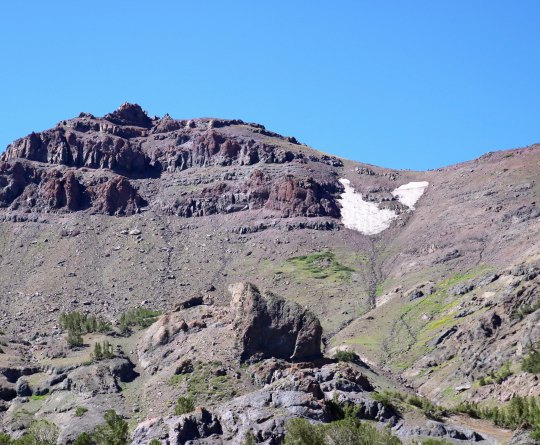
Sonora Peak as seen from Sonora Pass where I was waiting for Curt. He’d be coming around the peak to the right. I hiked up the trail for a couple of miles hoping I would meet him along the way. No luck.My worry about Curt being late increased substantially as smoke from a new fire filled the air.
“You must be Peggy,” he said. When I responded yes, he told me that he had passed my missing buddy on the trail. Curt had asked him to pass on the information that he was fine and should be along in an hour or two. Much relieved, I settled in to wait and invited Bone to charge his cell phone in our van and have a cold beer. After Curt’s safe arrival (he tells the story in his blog), we drove to an RV campground for the night and learned that the pass and the PCT trail had been closed after we left!
Bone wearing his Portland Blazer T-shirt with a small guitar attached to the back of his pack. Note how skinny Bone is, thus his trail name.
While Curt was facing challenges out on the trail, I also had my share doing back up. As I mentioned earlier, I’d had lots of experience in camping with the RV. But I was a newbie at camping alone. Fires and lightning caused outages at campgrounds and RV parks, cell phone service was often spotty, And Quivera, our RV, demanded attention. Internal lights, the awning, and the air conditioning unit all had issues.
Normally, this wouldn’t be a problem. We’d just find a shop that serviced RVs. But the local shops had a common response: “If you have a problem, call 30 days in advance for a reservation.” Does anyone else see a problem here? Repairs were up to me. Fine. The awning jammed, my solution? U-tube! I fixed it. Internal lights out? I read the manual, rewired the one I needed to read by and decided to let the other three go. AC servicing: well, other than pumping out playa dust from Burning Man— a forever problem— it was still working. Why worry?
There was a good ending to my efforts to find an RV service shop. I stopped by Camping World in Rockland near Sacramento and talked with the service staff. One of them walked out with me, confirmed that I would need to replace the awning eventually but told me bungee cords were a great temporary solution. He then replaced all the lights for me. Last but not least, he told me how to flush the AC with a hose. There was no charge for his good advice and help!
Next up: I will talk about the help that was generously offered to me along the way and a unique way of communicating with Curt: The Trekker Telegraph. Bone was a good example.



























 Wandering through Time and Place