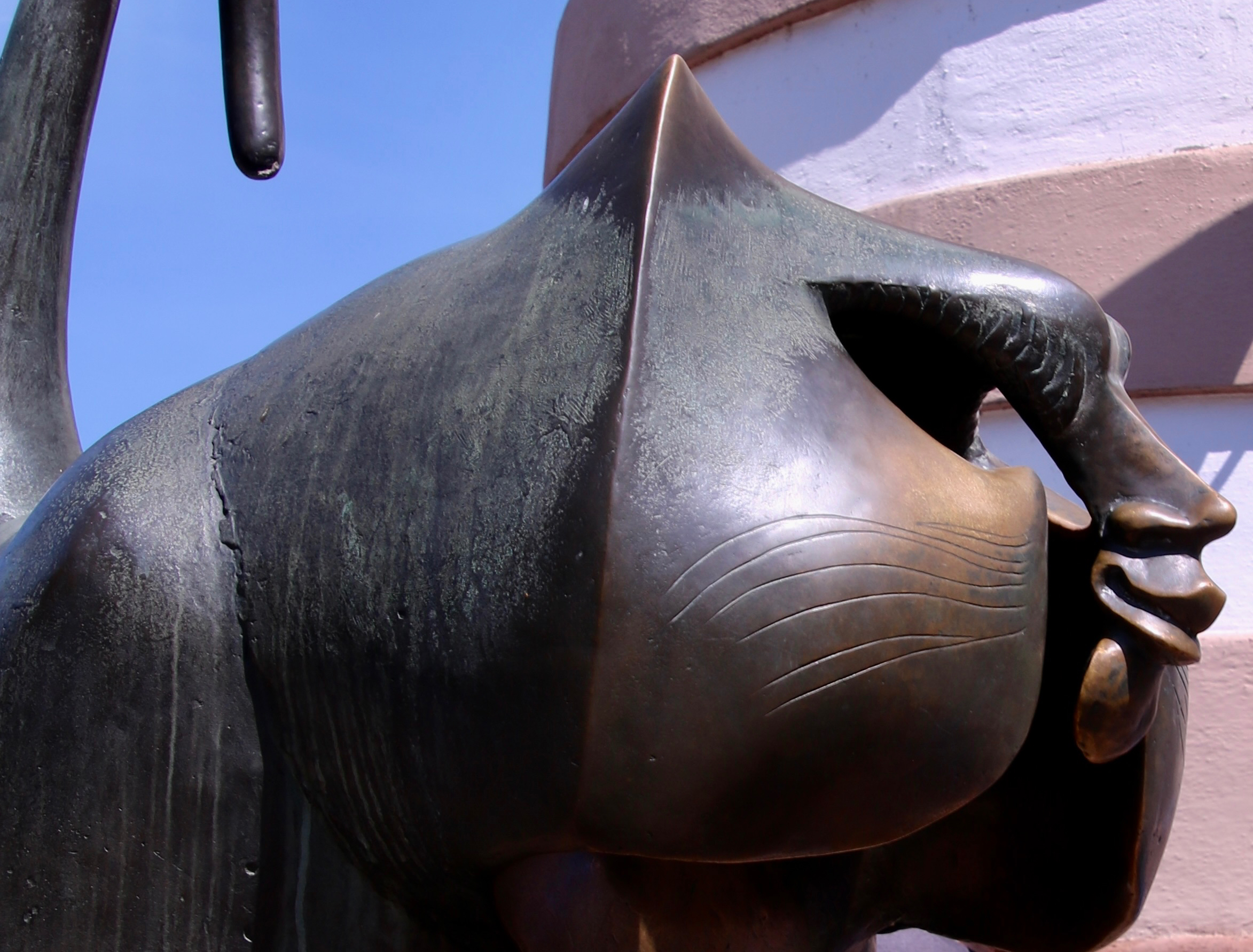
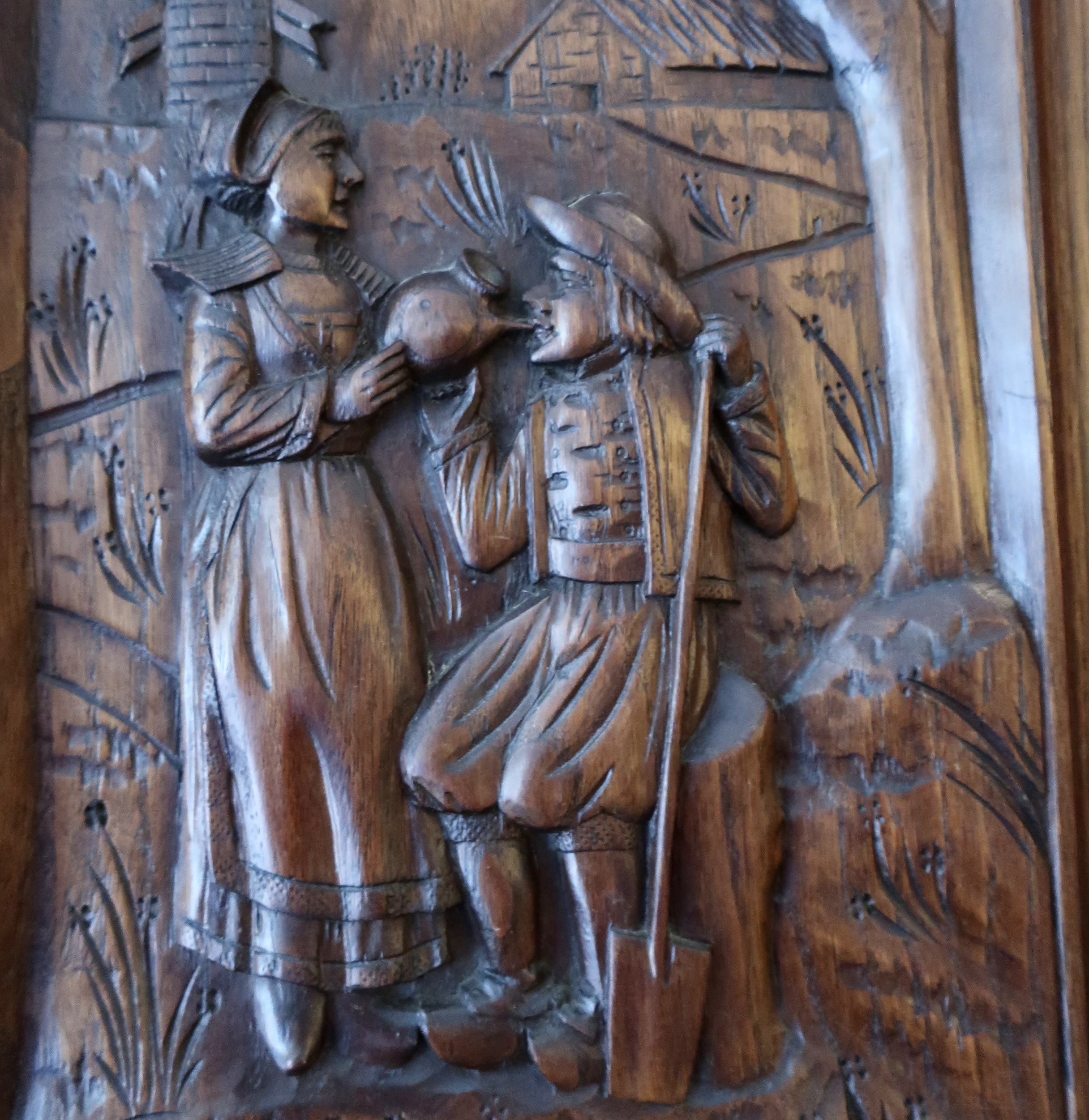
If you’ve been hanging around my blog for long, you know I like weird. This brass Heidelberg monkey fits the bill perfectly.
When Peggy and I, along with our two kids and their families, did our Rhine River trip this past summer, one of our favorite stops was Heidelberg, Germany. It seemed to have it all: An ancient castle looking down on the city, a river running beside it, one of the top universities in the world, a fun, lively, historic downtown, impressive churches, and plenty of weird, like the brass monkey who hung out next to the Old Bridge across the Neckar River. The photos are all taken by Peggy and me unless otherwise noted. Today, we will be focus on weird.
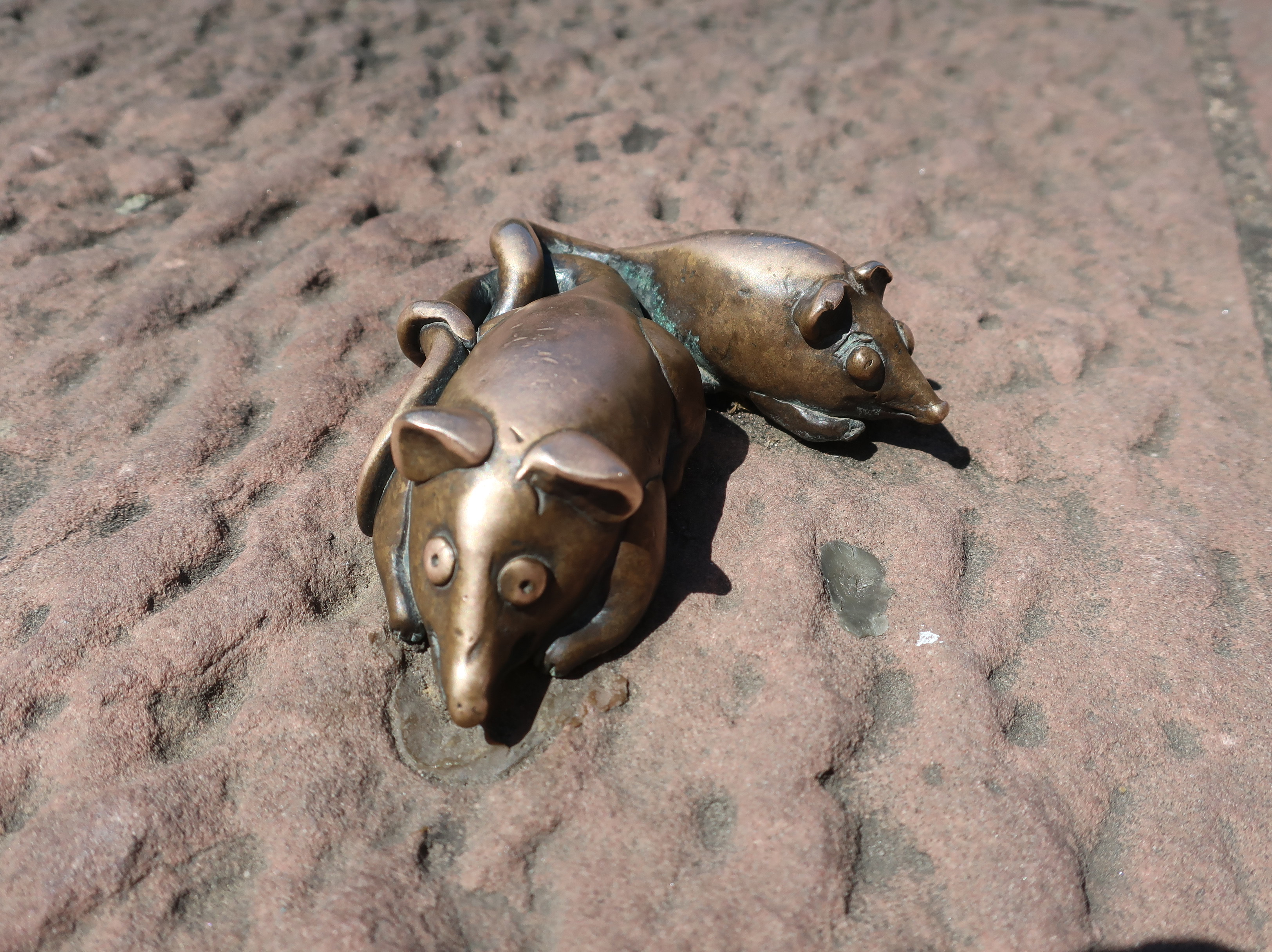
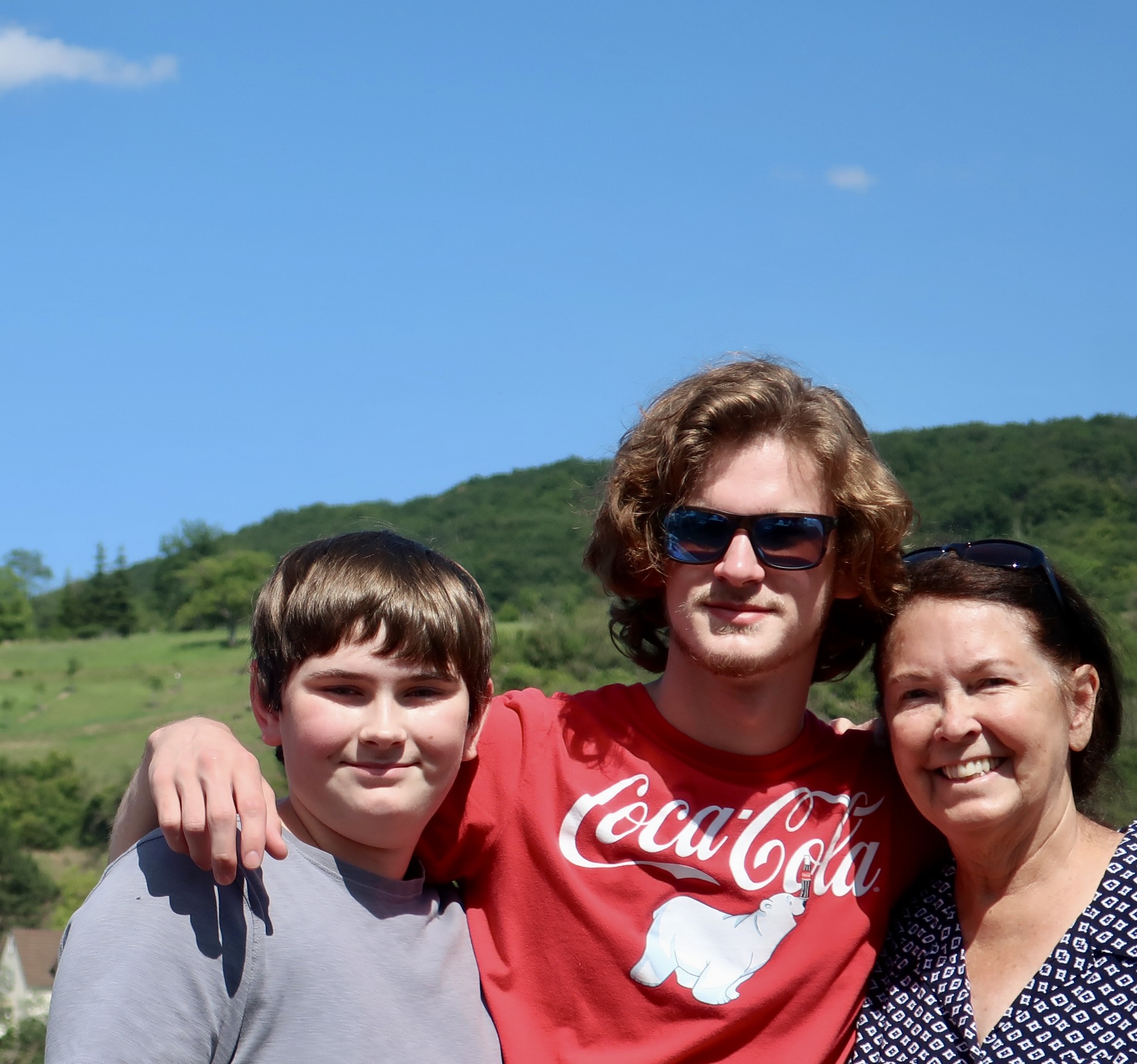
The monkey was designed to serve as a mask for those bold enough to climb into it. Our grandson Connor took on the challenge. A poem suggested the possibility of one monkey looking out at all of the other monkeys standing around, a reminder that we are alike more than we are different. The pedestrian Old Bridge across the Neckar River can be seen in the background on the right. (Family photo.)These brass mice were found next to the monkey. It is said if you rubbed them, you would increase your fertility. Rubbing the mirror the monkey is holding will bring you money, rubbing its fingers will help assure your return to Heidelberg. I stayed far away from the mice.
I found plenty of other weird stuff around Heidelberg to keep the monkey and his mice companions company.
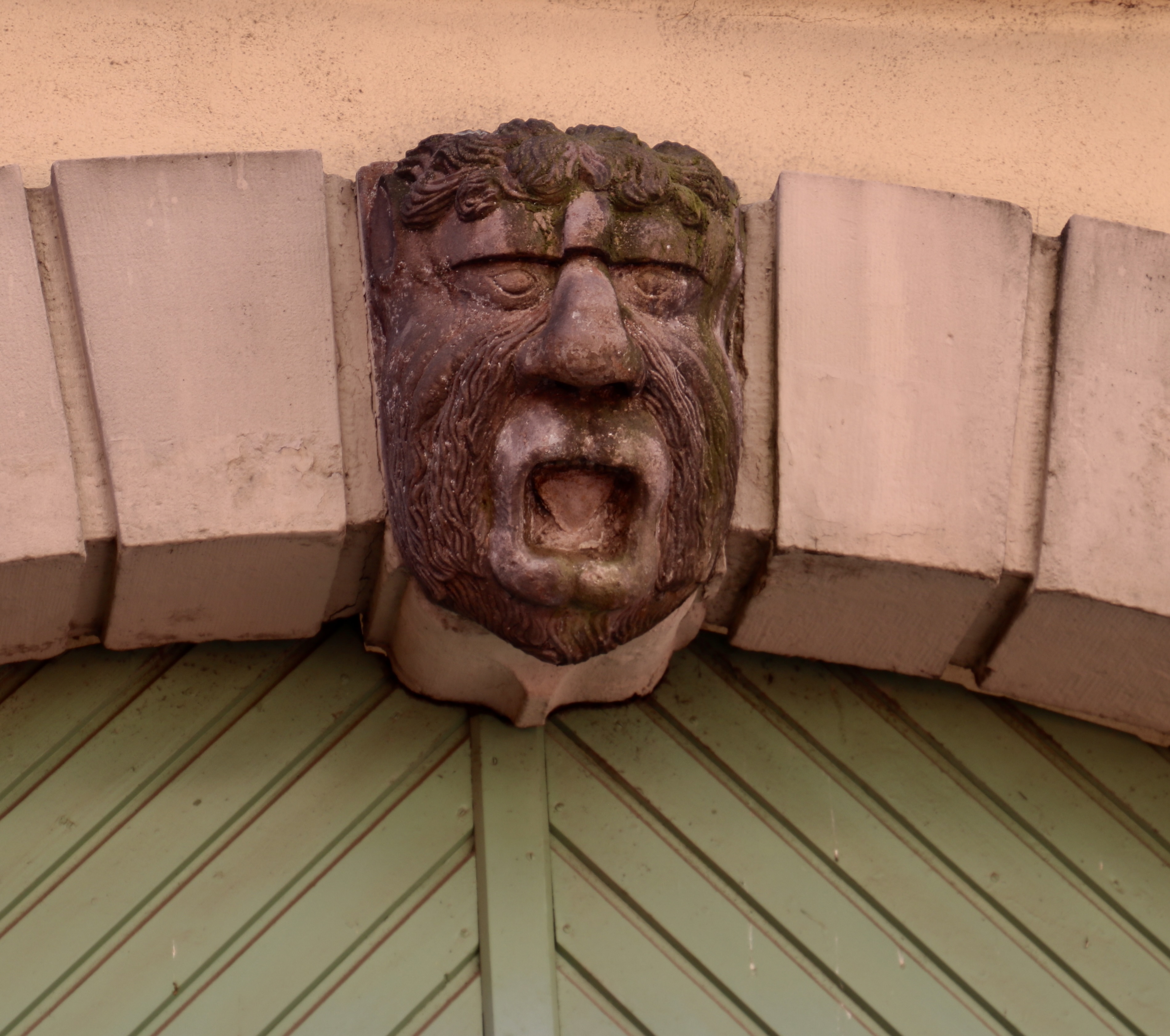
“These boots were made for walking.” Blue boots and a plethora of other blue shoes covered the town’s main square.The blue shoes, it turned out, were an art project of students from the University of Heidelberg. They seemed to be all walking in the same direction. Maybe they were escaping the weird sculpture behind them…It was amply strange. Check out the ‘guy’ standing on his head with his feet becoming the head of a serpent and his head who knows. And what the heck is on the left? I’ll leave it for your imagination.I found this walking lion with his wonderful tail up in Heidelberg Castle. A magnificent, but weird, creature, indeed, complete with a curly mane and globus cruciger, i.e. cross-bearing orb. Both were symbols of power in the Middle Ages. Think church and state.This knight with shining armor, features a codpiece. A what, you say? Cod apparently meant scrotum. Originally meant to protect the genital area, they became something of a fashion statement reaching maximum size and um, peak, in the 1540s.While I’m on cod, there seems to be something fishy about this fish. It appears to have a coin in its mouth. I looked up ‘fish with coin in mouth.’ Apparently it relates to Jesus and the miracle of the fish outlined in the Gospel of Matthew. I wondered if the strange baby romping around on top was supposed to be the baby Jesus. Christianity in the Middle Ages was all about symbolism, mainly because most people couldn’t read. Nothing weird about this if you are a Catholic. It’s the Virgin Mary with her crown of 12 stars holding the baby Jesus. She is stomping on a serpent while the baby Jesus stabs it with his cross. “Take that you snake!” He is blessing the world with his free hand. It looks to me like the serpent has an apple in its mouth. There were several of these statues spread around the historic town. On a lighter note, how do you like your wine? If you prefer quantity over quality, this wine barrel might be your thing. It’s said to be the largest in the world and hold 220,000 liters (58,124 gallons). Our grandson Ethan provides perspective on the size. That does it for today. My next Heidelberg post will be more focused on the beauty and history of the city. First up, however, Peggy and I will take you back to Yellowstone and its geysers including Old Faithful.
While we focused on castles as our riverboat took us up the Romantic section of the Rhine River this summer, there were numerous other views that found us busily snapping photos.
I hesitate to use the word “quaint” when I describe the buildings and towns along the Romantic Rhine since it implies “old fashioned.” Picturesque, colorful and historic strike me as better. But whatever word one chooses, Peggy and I were awed by the unique look and beauty of the various buildings. All of today’s photos were taken by Peggy and me unless otherwise noted.
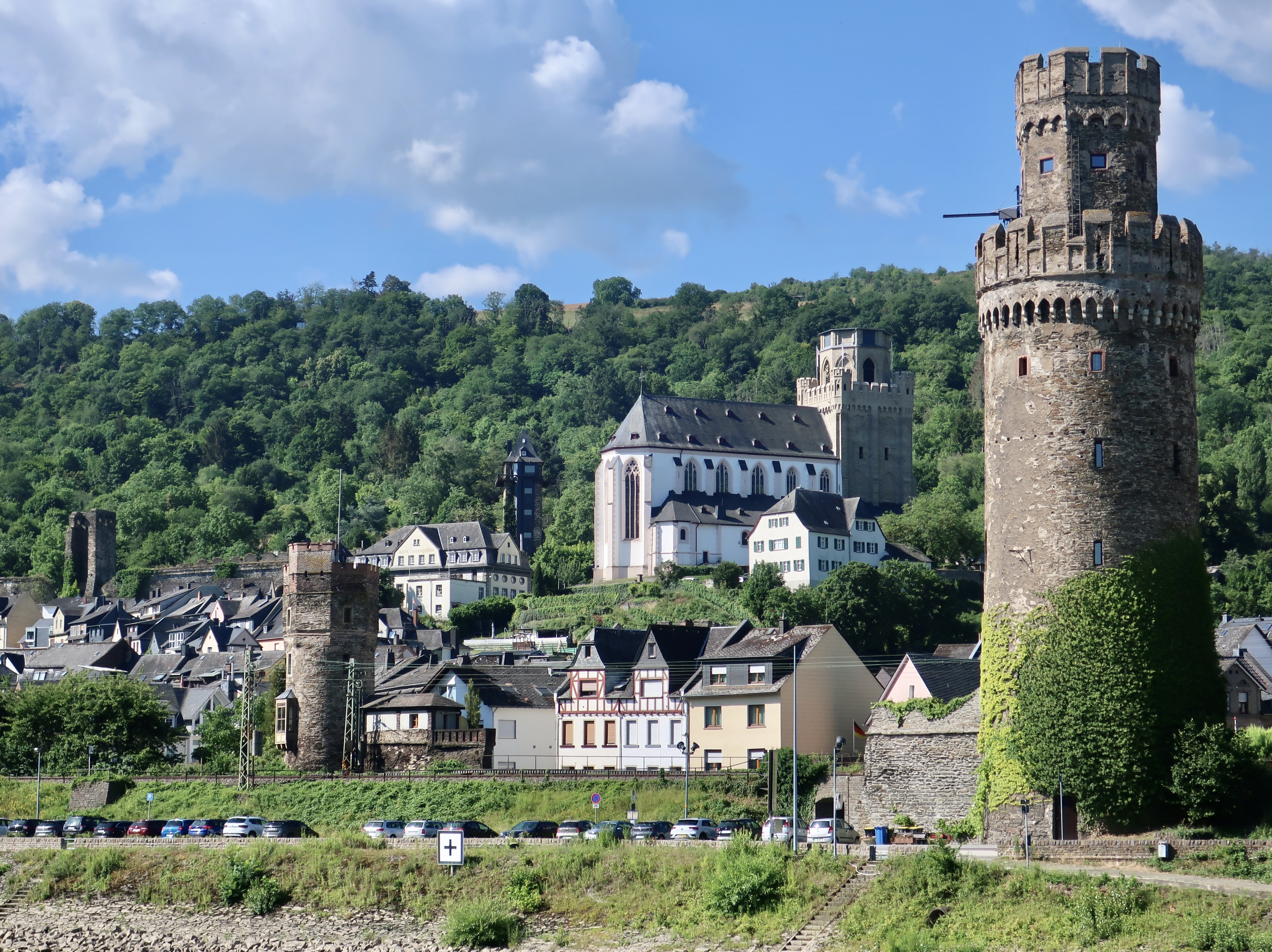
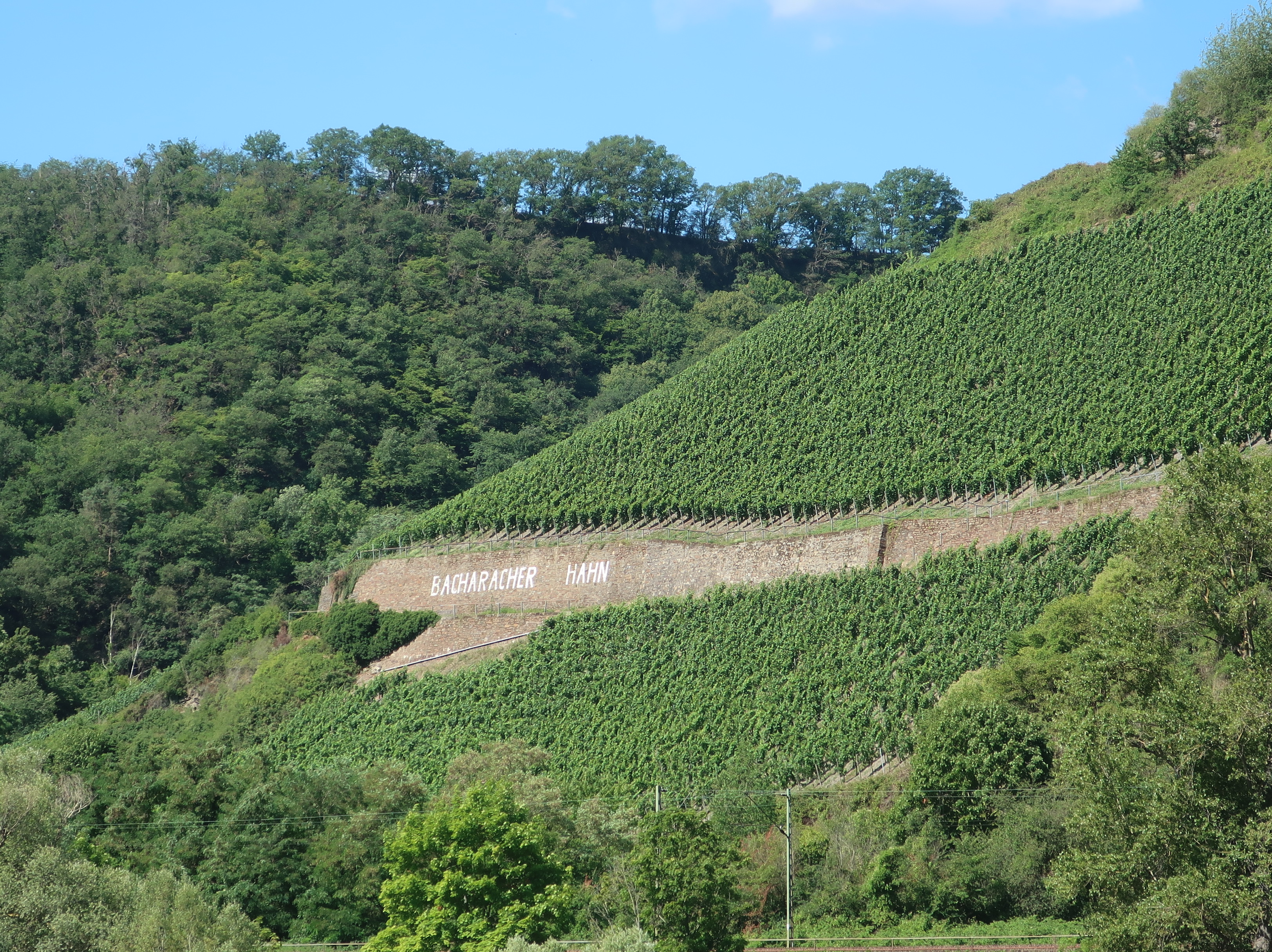
Churches, hotels, restaurants, businesses and homes were all involved in creating the look.We found the mixture of structures from different centuries intriguing.This rather impressive chunk of slate rock is known as Lorelei. It comes with a myth attached. Lorelei was a beautiful woman whose lover was unfaithful. In a fit of despair she threw herself off the rock and perished, returning as a siren that lured passing boats to crash on the rocks. In truth, this narrow, deep section of the Rhine did lead to many shipwrecks. I was eager to have this structure be a medieval castle. After all, it certainly looks like one. But I couldn’t find a photo anywhere, and I looked at bunches. So maybe one of my readers out there can enlighten me. We saw numerous churches…And each church had a unique look.This church had an Orthodox feel to it. A more traditional looking church.Rhine wines are famous throughout the world. Vineyard after vineyard decorated the steep hills. I wonder if strong legs are a requirement for harvesting. The grapes produce a medium dry white wine. Grapes, castle, church, and a picturesque town: How much more romantic can it get?More buildings that caught our attention. These had a quite scenic backdrop.Three buildings, three styles, three colors. All connected.And finally, a reminder that our trip was to help Peggy celebrate her birthday. Here she is appropriately attired on the night of the event. Our youngest grandson Cooper joined us for the photo. Our daughter Tasha can be seen in the mirror to the right taking the photo.Peggy and I are in New Orleans today and are about to head on to Safety Harbor, Florida where we will spend Christmas with our son and his family. Yesterday, we visited the French Quarter and ate our mandatory beignets while watching a man perform standing on his car. He was good, but the dog sitting on the guitar made the performance totally charming. The two of them obviously played together often and liked each other a lot. As the man strummed the guitar the dog rested his paw on the man’s hand. It looked like he was doing the strumming.
On our next post we will continue to alternate Rhine River posts with blogs on our present journey. I intend to do a post on the North Rim of the Grand Canyon that we visited this past spring on our way to Virginia before we started our riverboat tour in Europe.
Apparently, aliens find Devil’s Tower a prime landmark. In the 1977 movie, Close Encounters of the Third Kind, selected folks kept seeing the tower as a paranormal experience. One even sculpted a mashed potato image of it. Eventually those getting the message realized that they were being invited to show up at the huge rock monument and climb on a flying saucer. Paul, another movie about alien visitors, featured Paul, a colorful alien named after the dog his UFO crash-landed on. He used the location to call his mothership to pick him up after being stranded on Earth for several decades. (Photo from a display at Devil’s Tower Visitors’ Center.)
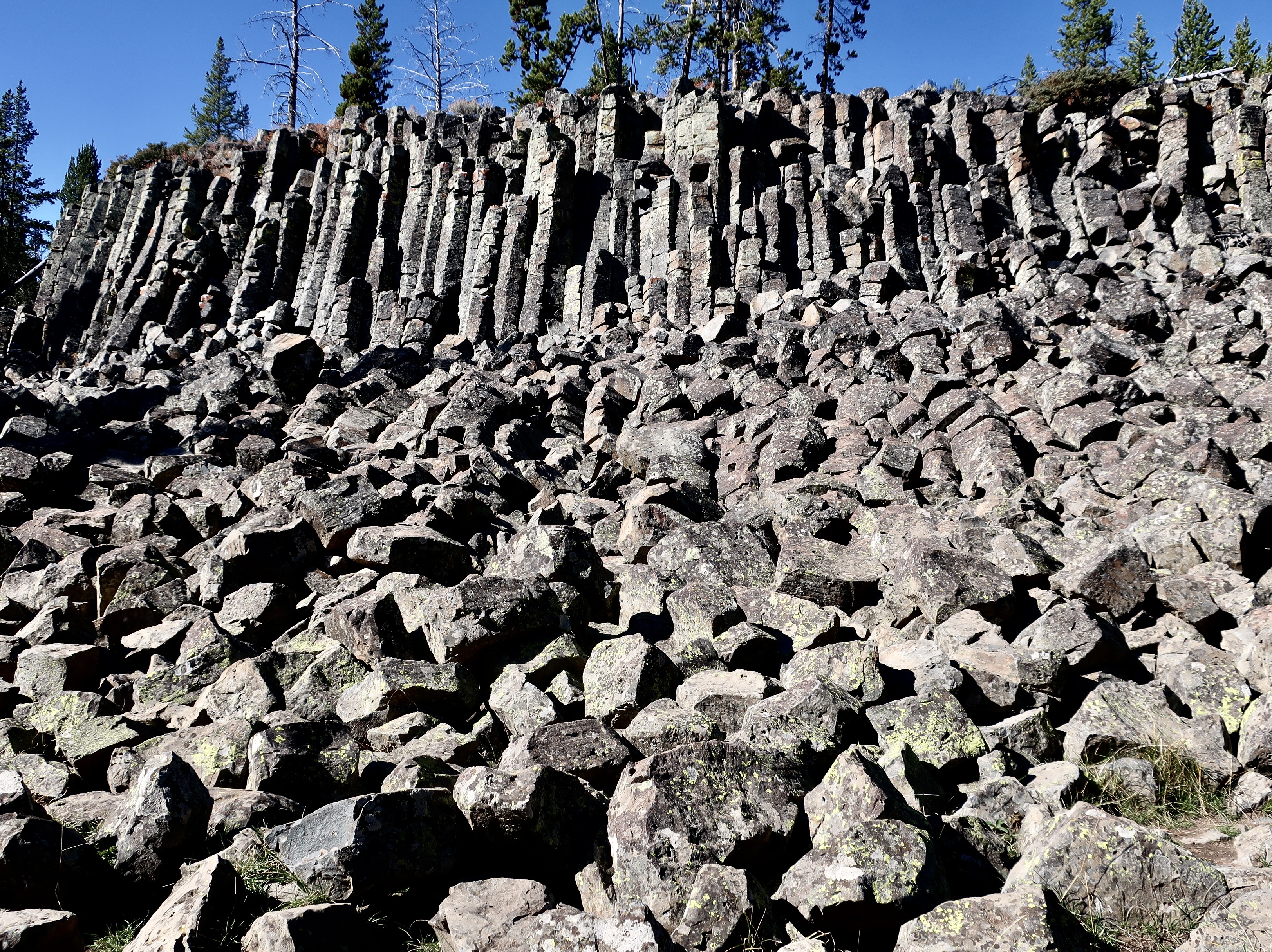
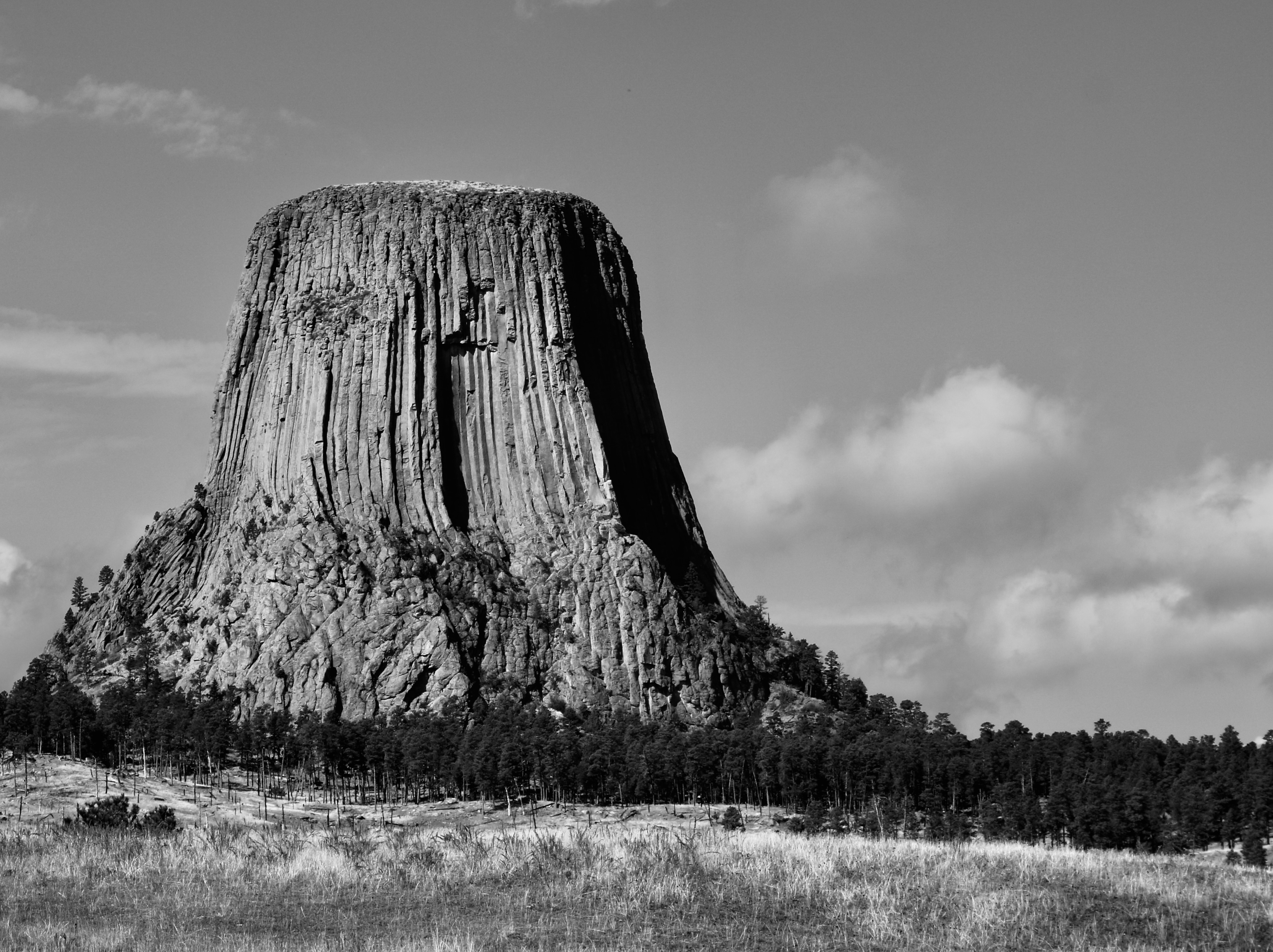
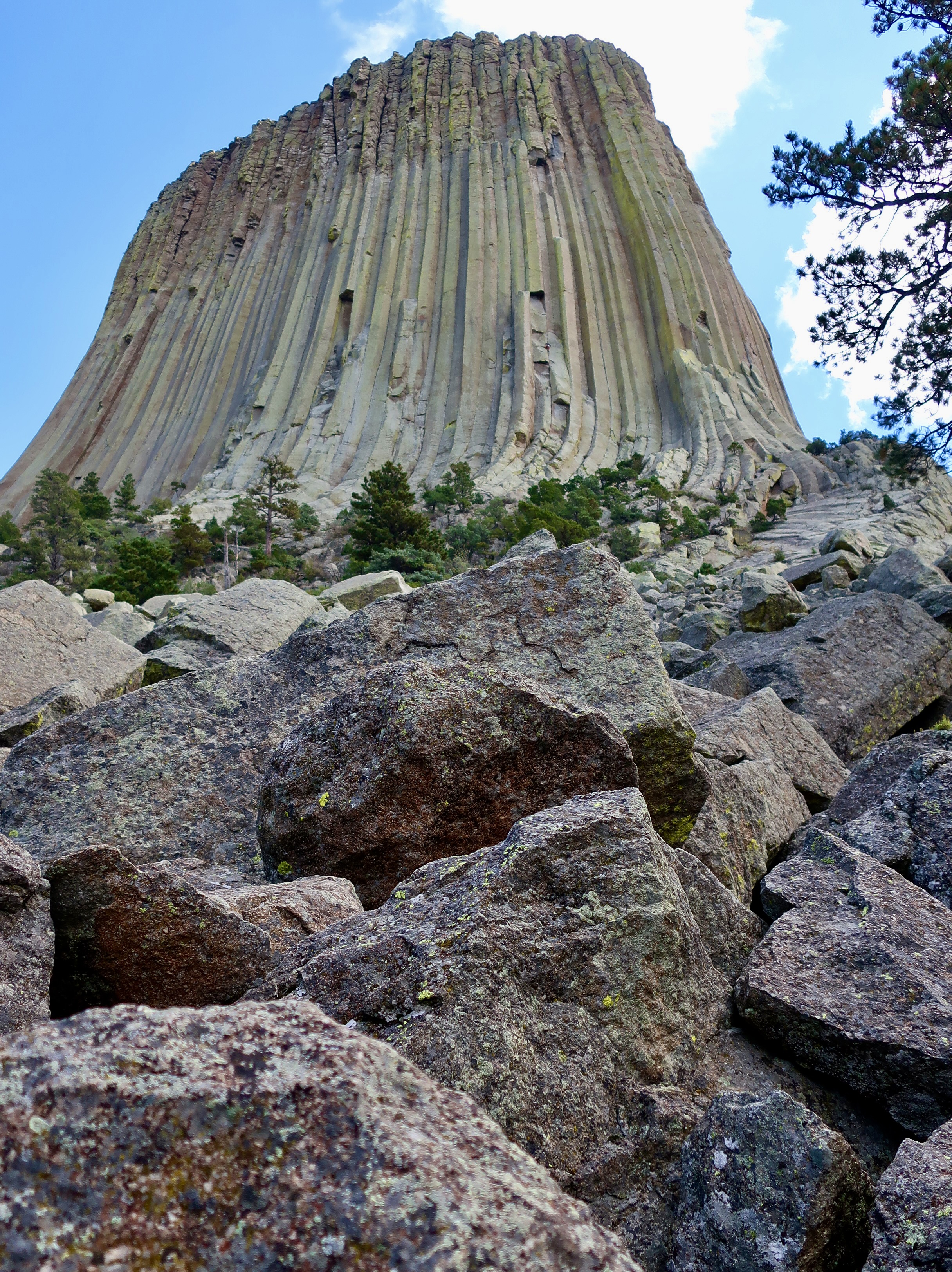
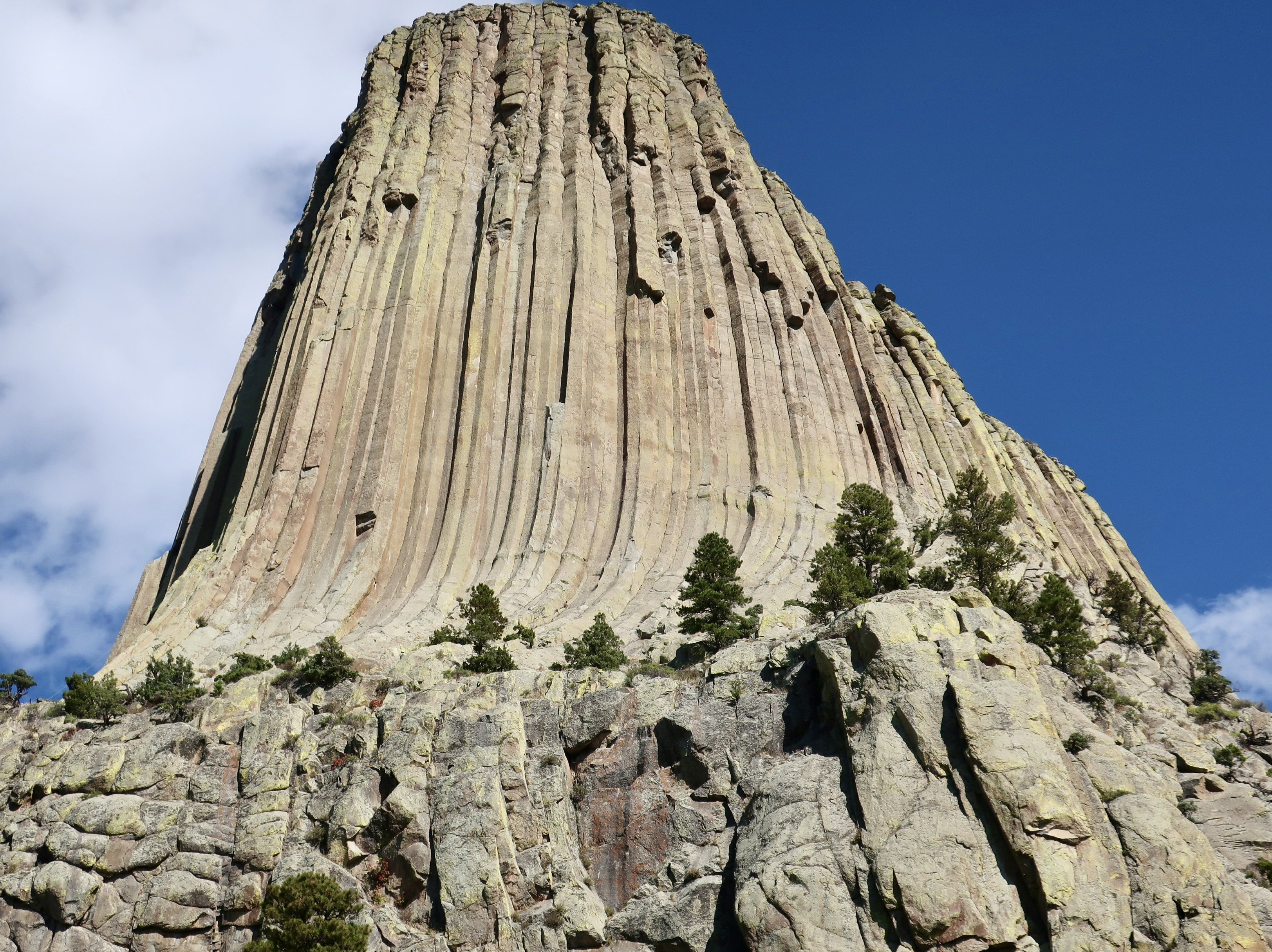
Devil’s Tower is special in a number of ways. Volcanic columns have always captured my imagination. The first I ever encountered were at Devil’s Postpile in the Eastern Sierra Nevada Mountains when I was backpacking down the John Muir Trail in the 80s. Since then, Peggy and I have seen several, including one when we recently visited Yellowstone. Most are formed when a surface flow of lava starts to cool and contract. As it contracts, it cracks into the multi-sided columns seen at both Devil’s Postpile and Devil’s Tower.
The lava flow columns at Yellowstone National Park.
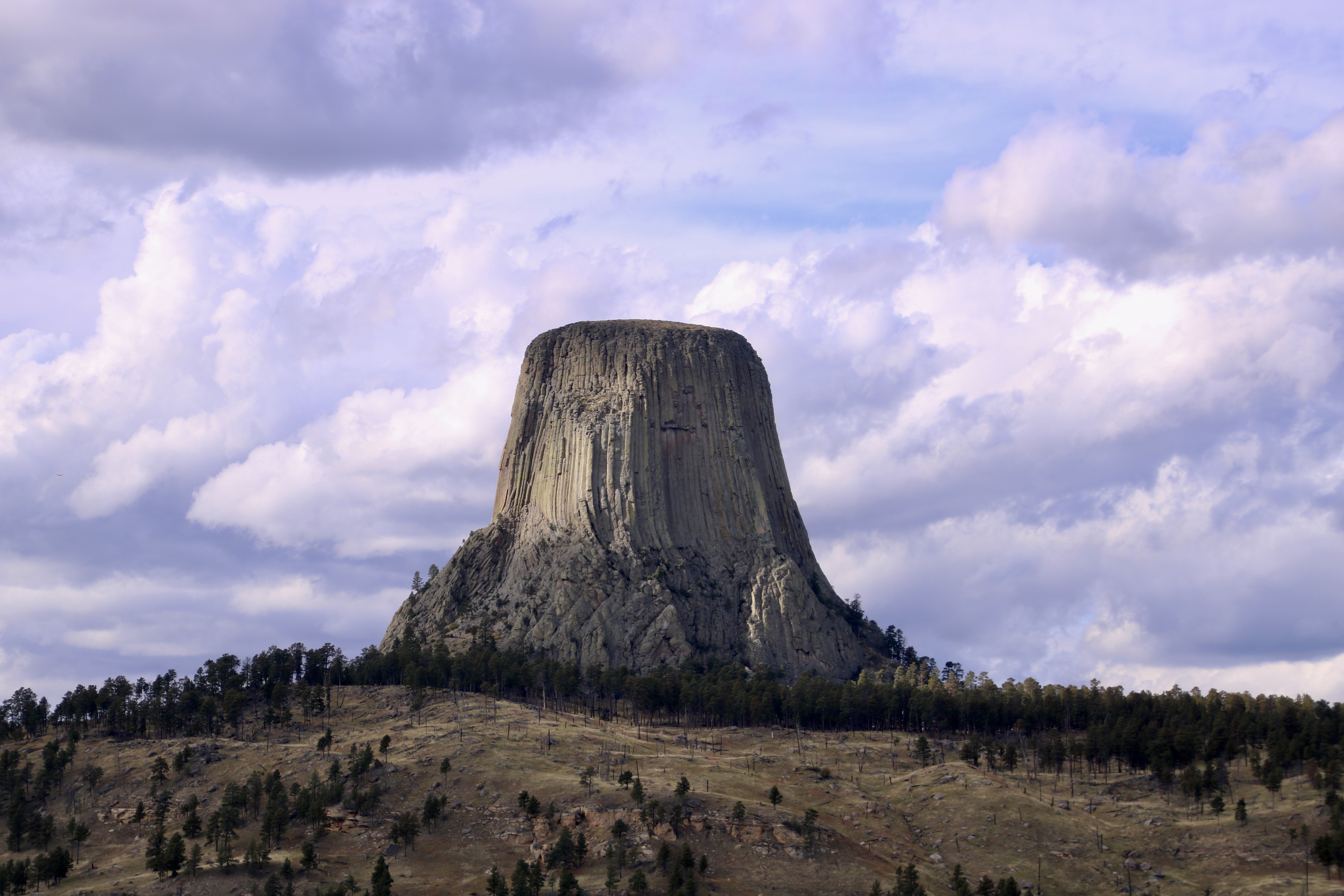
A significant difference is that Devil’s Tower was formed under the surface of the earth instead of as a volcanic flow on top. There are a couple of theories. One is that it was formed by lava forcing its way up through sedimentary rocks below the surface. The other is that it was formed as a plug in a tube that supplied lava to a volcano. In either case, the lava cooled much more slowly than it would have on the surface. The result was that the columns are both wider and longer. In fact, with widths up to 20 feet, and heights up to 600 feet, the columns are the widest and the tallest in the world. Formed approximately 50 million years ago, erosion has cut away the surrounding rock over the past several million years, exposing the edifice we see today. It’s a continuing process.
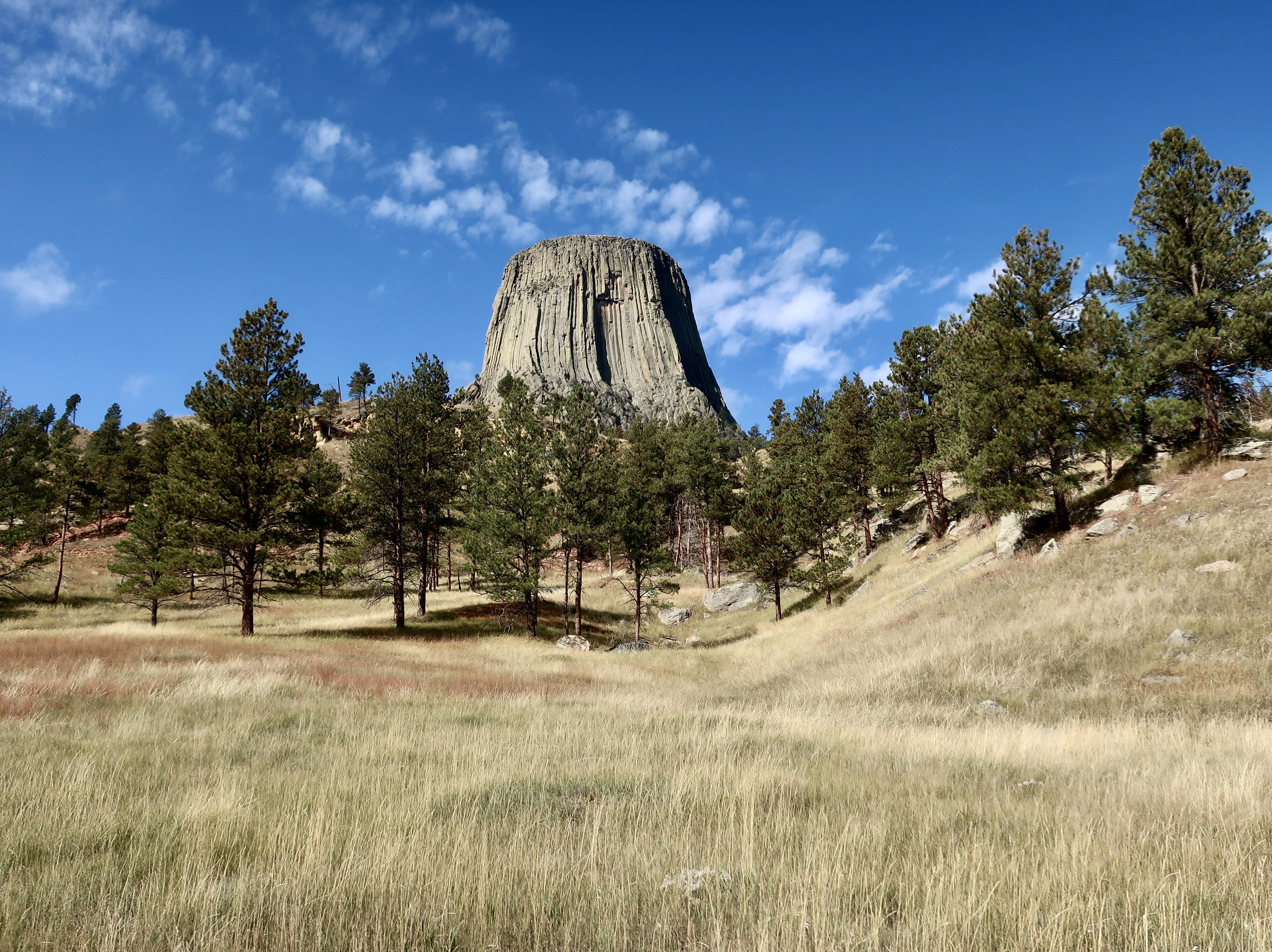
Devil’s Tower reaches 867 feet (264 meters) into the sky and is one of the most prominent landmarks in the Western US. It’s no surprise that Theodore Roosevelt declared it America’s first National Monument on September 24, 1906. Millions of visitors have since made their way to the natural wonder located in a remote section of northeastern Wyoming.
Hundreds of years before Roosevelt became one of America’s first and greatest conservationists, however, American Indian tribes in the area had already recognized how special the tower was and considered it sacred. They still do today. As Peggy and I explored the tower, we found hundreds of colorful cotton prayer flags and medicine bundles that tribal folks had tied to the limbs. Visitors are requested to honor the sacred nature of the flags and not to disturb or take photos of them.
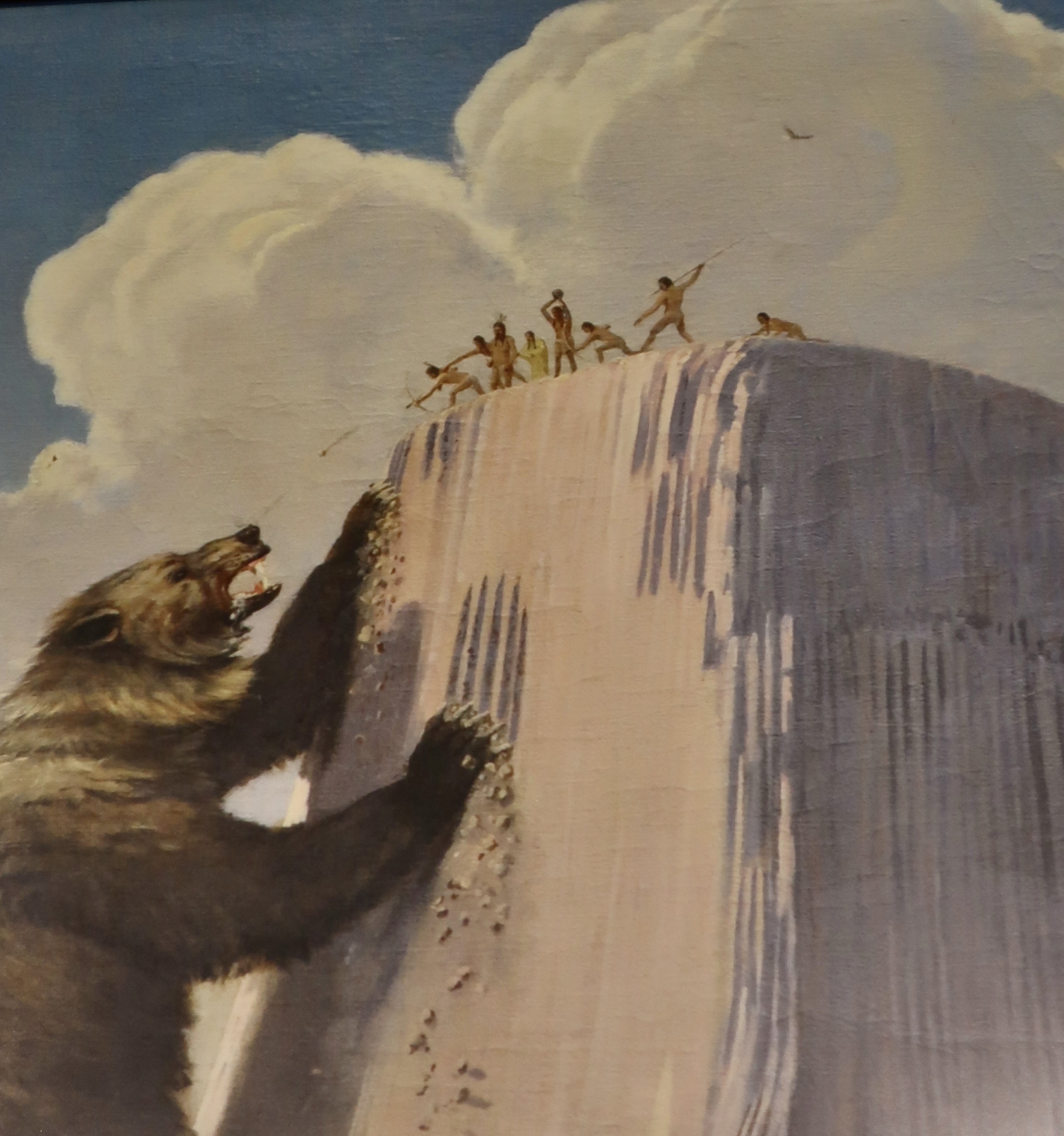
The tribes are also lobbying for a name other than Devil’s Tower, which seems entirely reasonable given their beliefs. Their consensus is Bear’s Lodge. The huge rocks that have broken off from the tower over the eons would seem to make an excellent location for bears to hang out and hibernate. Grizzlies and black bears were common in the area before being wiped out to make the world safe for cows. Local ranchers apparently had little sense of humor that bears liked an occasional beef or lamb dinner. Rare.
A painting in the Visitors’ Center depicts a huge grizzly climbing to the top of the tower reflecting a tribal legend. The natives appear focused on the bear’s nose. I once read if a bear attacks you, sock it in the nose. It’s supposed to be sensitive. I’ve never had the opportunity to test the theory even though I woke up once with a bear standing on top of me. Screaming loudly seems to work as well. The bear’s claw marks here suggest it was creating the columns. I’ve often seen such claw marks on trees during my 70 plus years of wandering in the woods. Bears use it to mark their territories. The higher up the tree, the bigger the bear. If you see claw marks on anything 867 feet up in the air, I would suggest you vacate the premises. Quickly. (Photo from painting at the Devil’s Tower Visitors’ Center.)
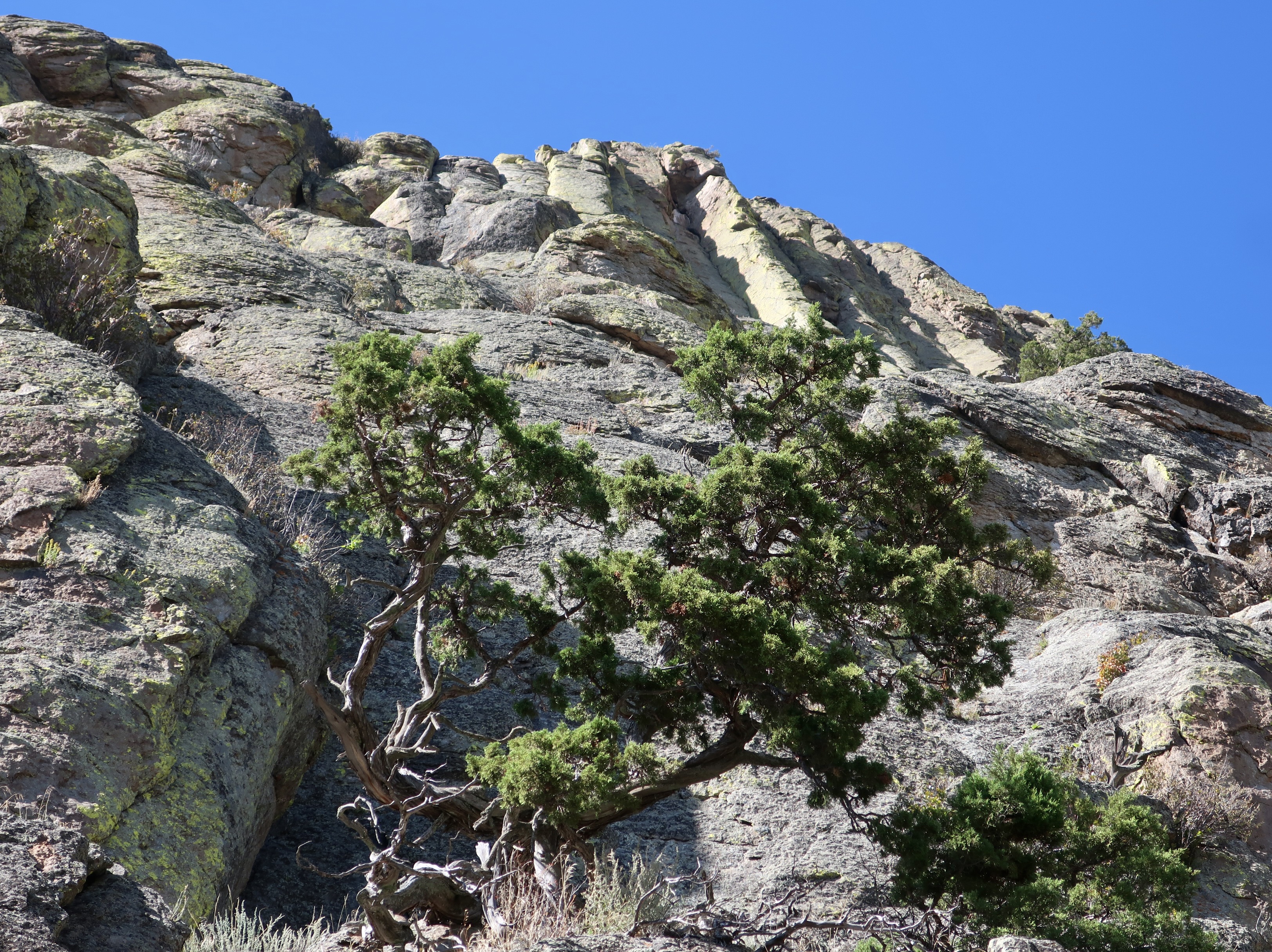
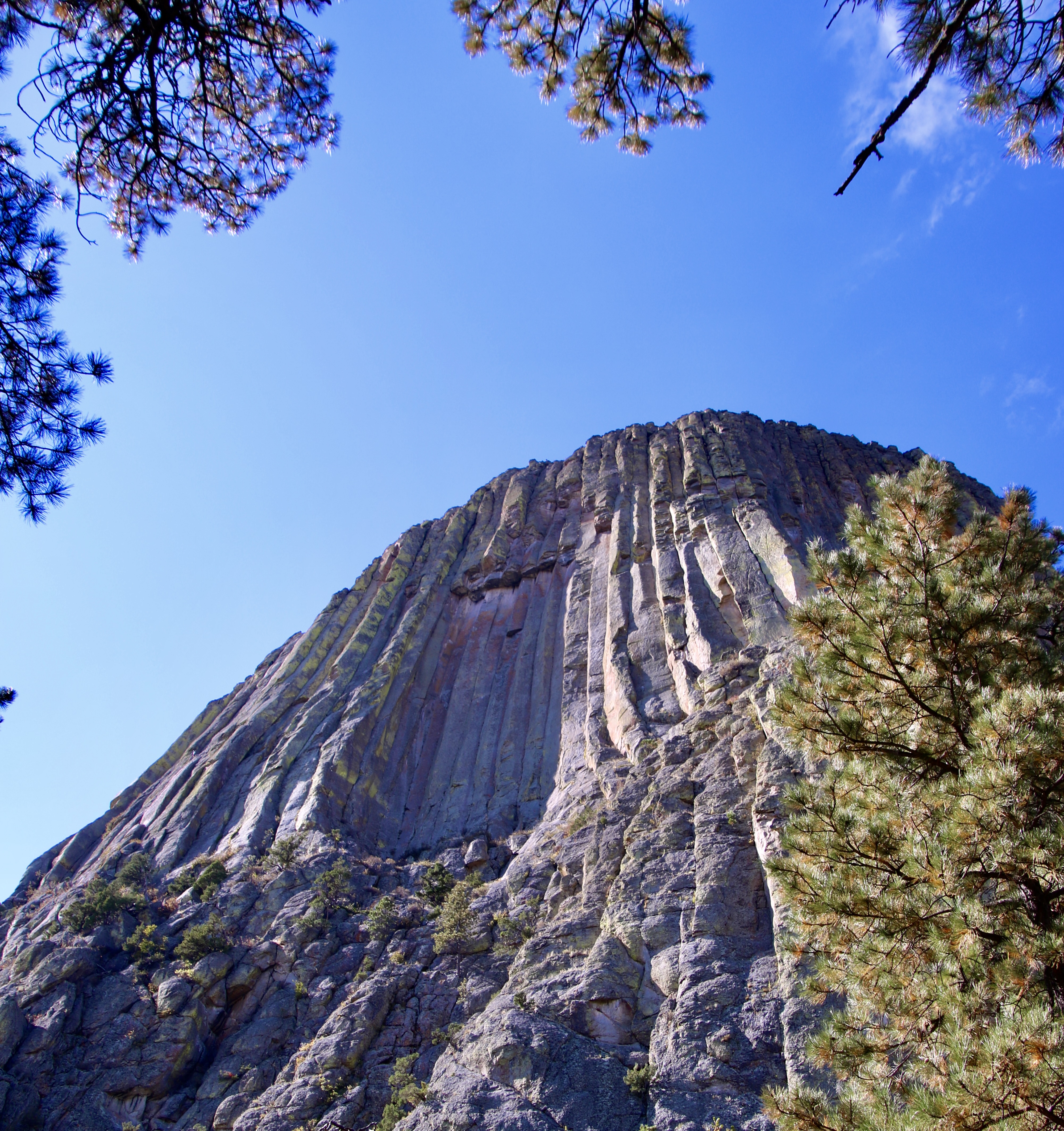
A number of impressive views of Devil’s Tower are available when driving into and out of the monument. We stopped several times to take photos. These are three of our favorites.
The real treat was when we arrived at the Visitors’ Center, however. After a quick perusal of the displays and books, we went for a mile walk around Devil’s Tower that starts and ends at the Center. The hike was easy and all of the views were spectacular. They varied significantly. Peggy and I urge you to go for the walk if you visit the National Monument. All the photos, BTW, are taken by Peggy and me unless otherwise noted.
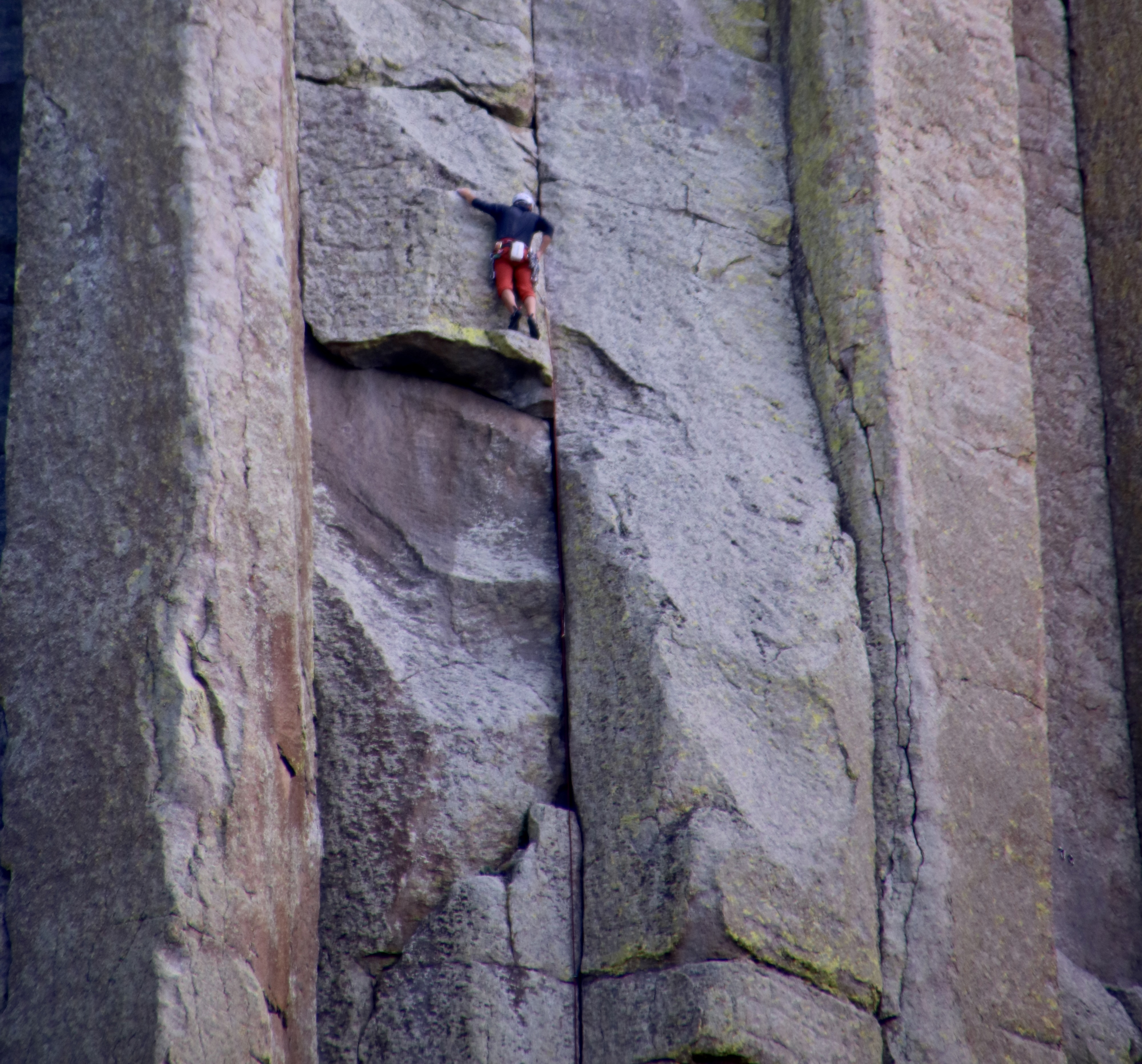
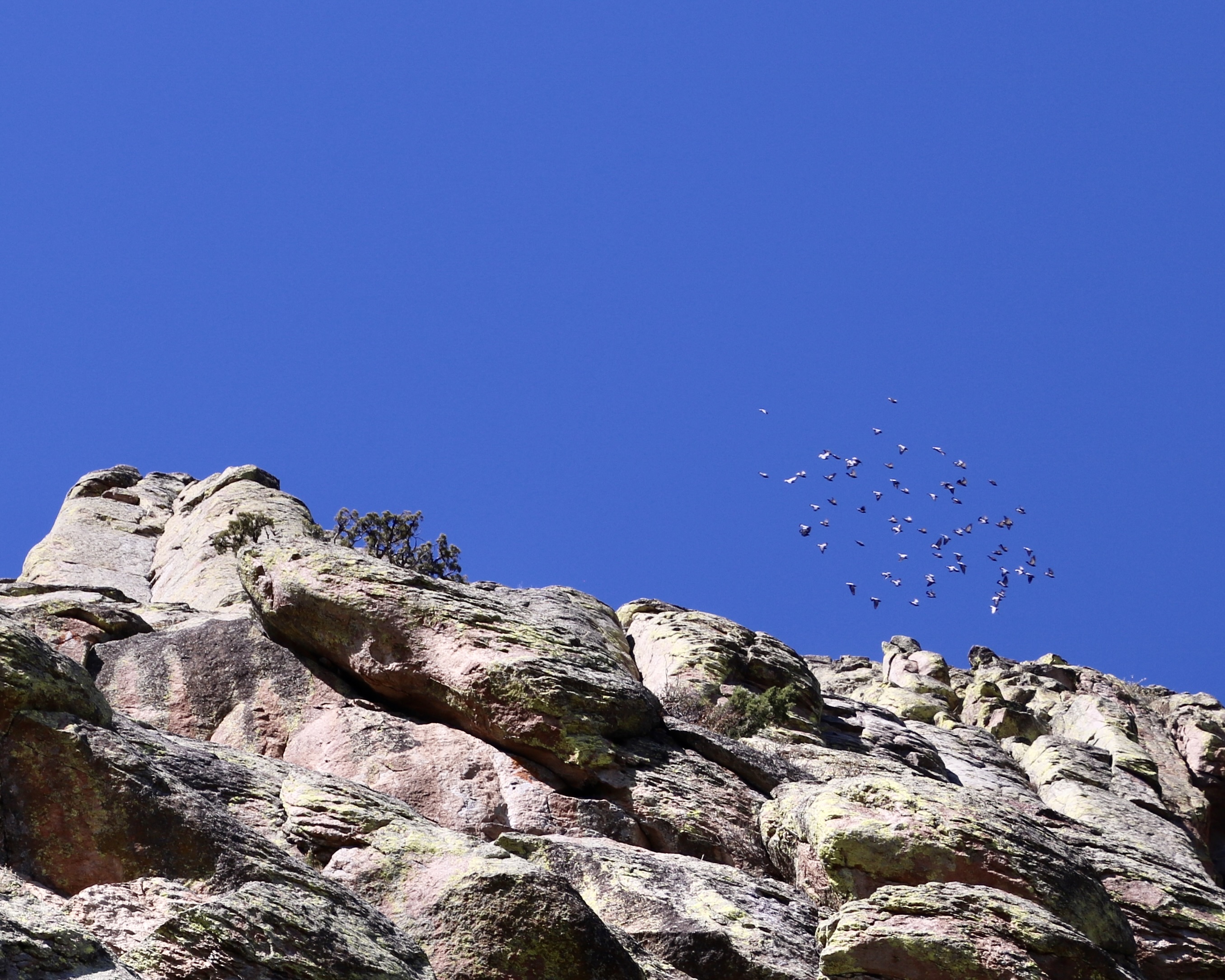
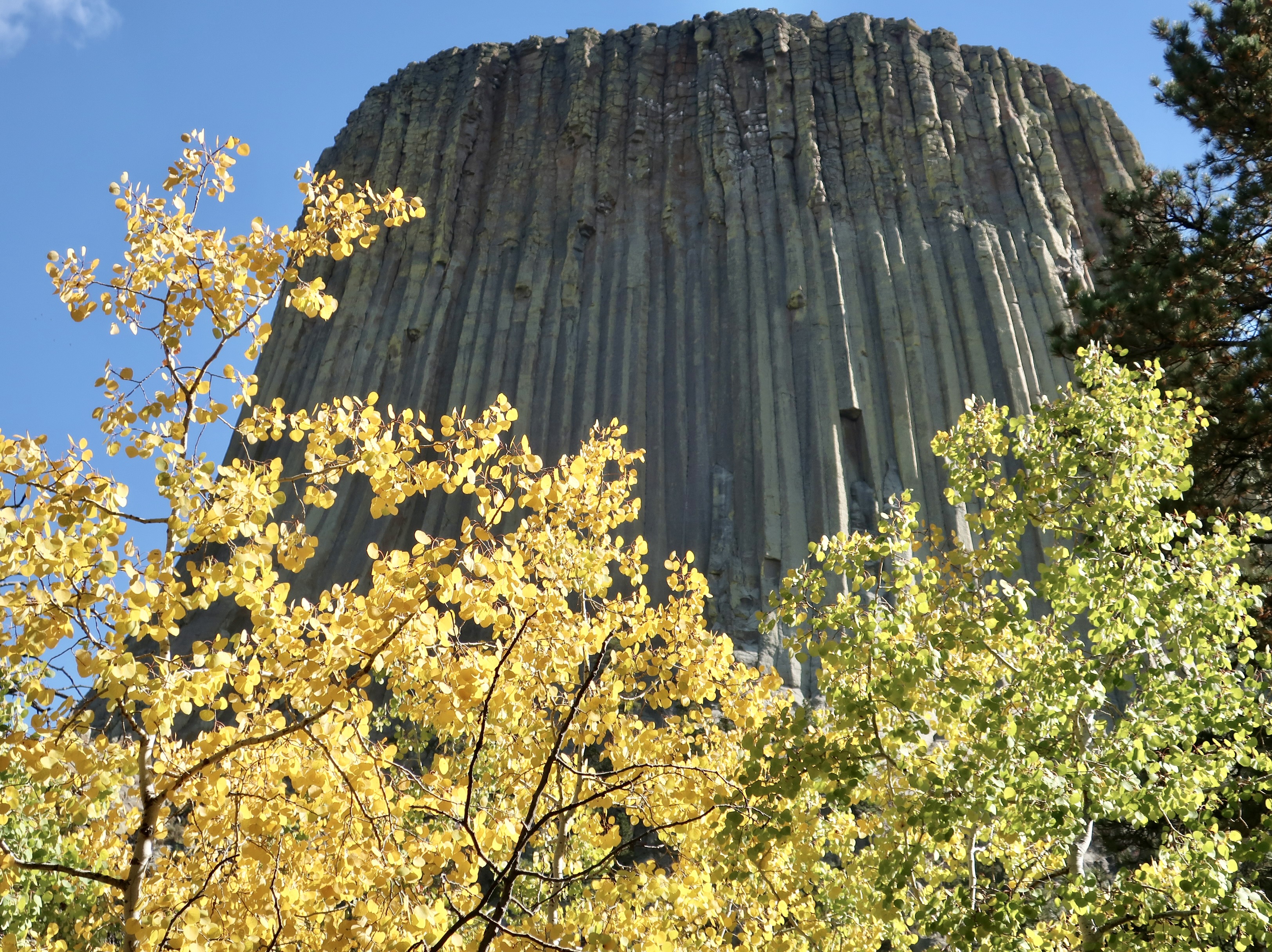
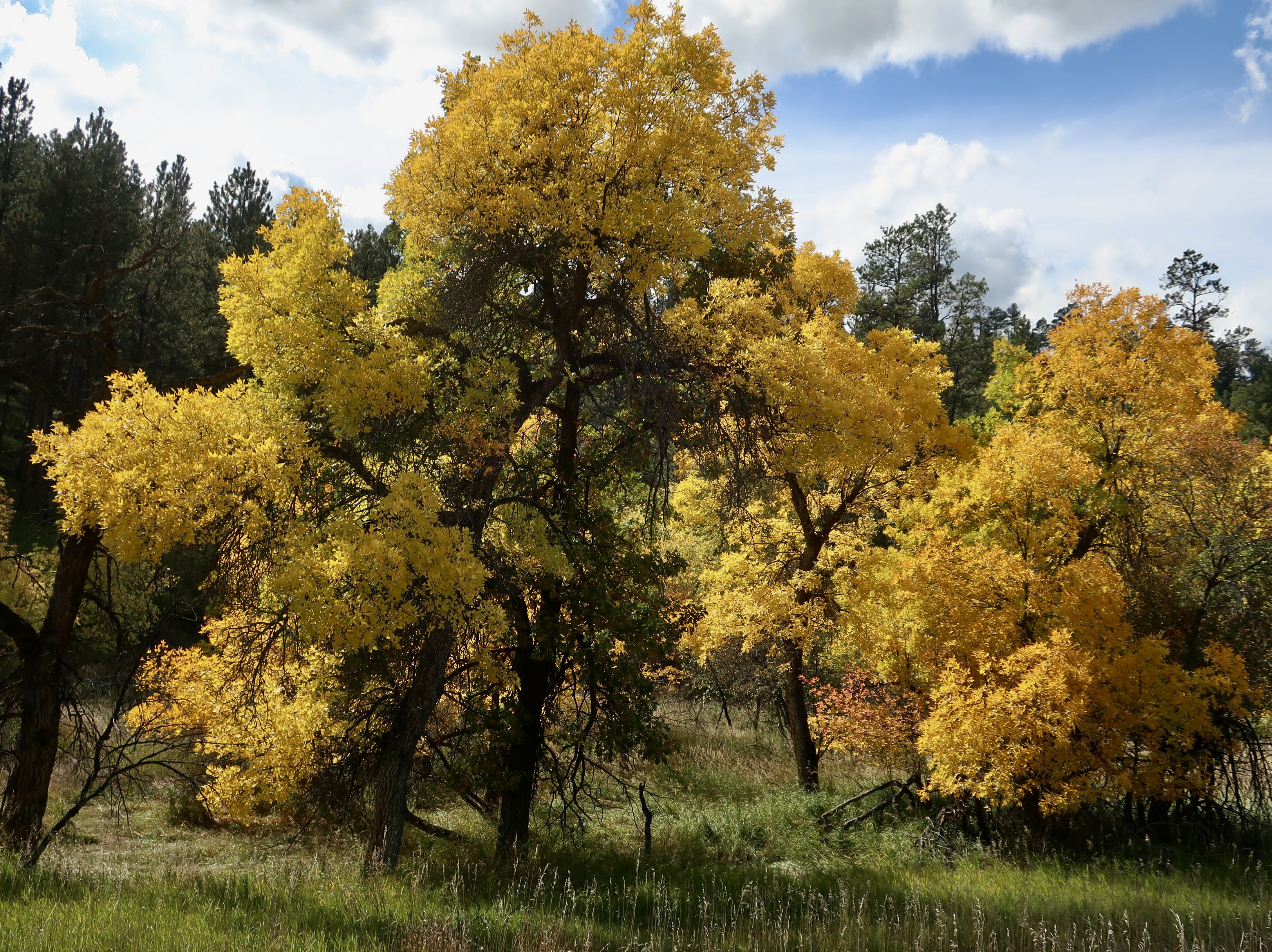
Climbers flock to Devil’s Tower for the thrill of climbing it. We saw several. Permits are required. No climbing is allowed during June when local Indian tribes gather for ceremonies. I like this photo for the perspective it gives on the size of the columns as well.A flock of birds flew over the top and landed. That would be our preferred method of getting to the top, too— as opposed to climbing.The ‘Window,’ created when a number of columns decided to collapse, is a prominent landmark. A sign told visitors not to worry about any columns falling on them since none have fallen in recorded history. Another way of looking at it is that you could become a part of history…Beautiful fall colors added a fun touch to our visit.They continued to entertain us as we left the Monument on the way to our next adventure.
Peggy and I are driving into Big Bend National Park today, which is at the very southern tip of western Texas. The last time we were here, we celebrated Christmas in 1999 as part of a year-long sabbatical we took from work to explore North America. This time we are celebrating out 30th Anniversary. Talk about an adventure! I was on the edge of turning 50 and Peggy was 42 when we were married in 1992. We’ve had an incredible life together, and, amazing to both of us, we are still out wandering the world. We will be off the grid for at least part of this trip. See you next week. And thanks for visiting.
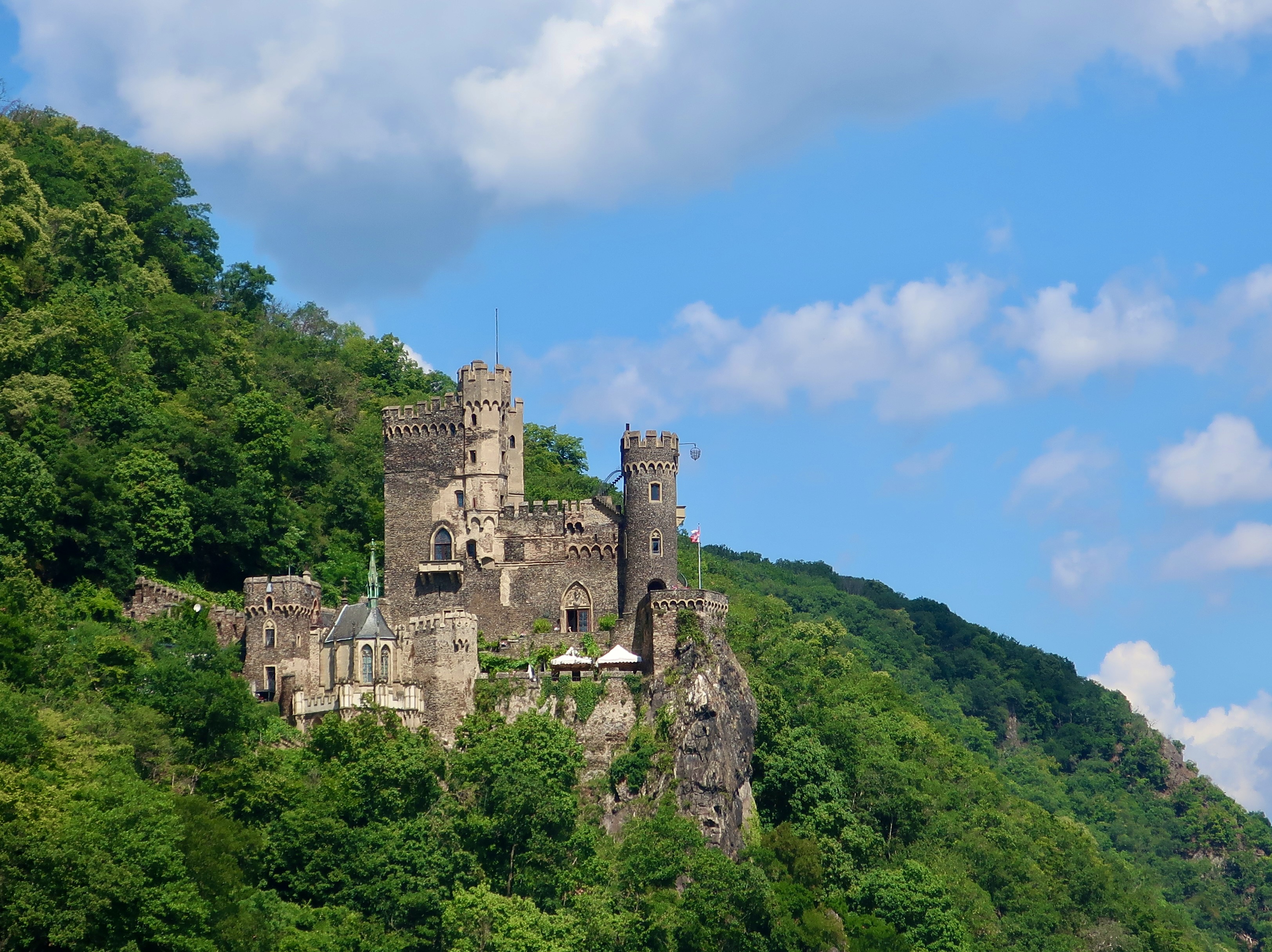
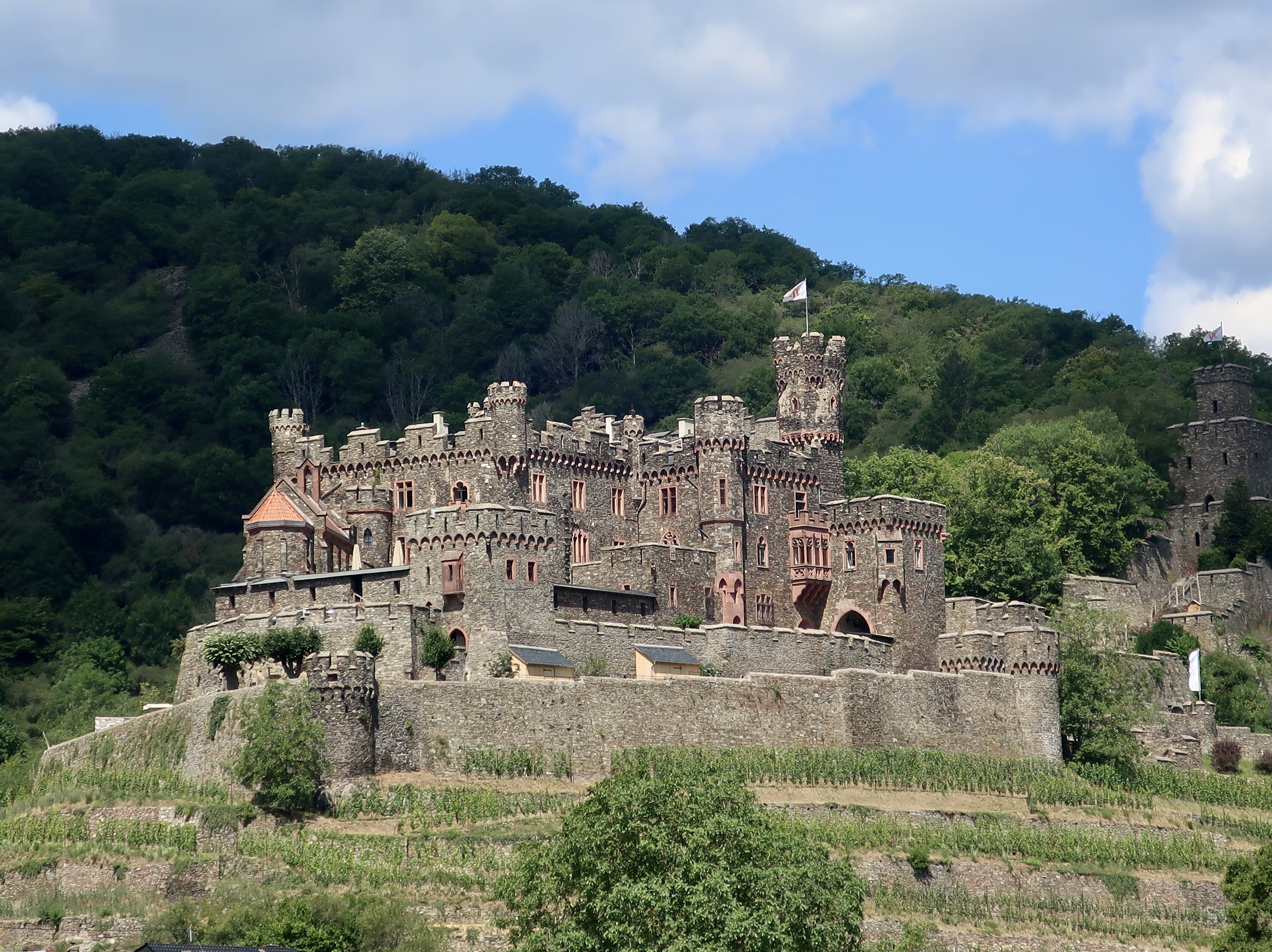
Sitting on a rocky promontory some 270 feet above the Rhine River, Rheinstein Castle is considered a symbol of the Age of Romanticism.
Rheinstein’s history dates back to the 13th century when the castle was originally built to collect tolls and whip some of the local robber barons into line, i.e. they weren’t paying a percentage of their take to the local catholic bishops and the Holy Roman Emperor. By the 17th century the castle had fallen into ruins. But it was about to be saved. The Romantic Age was flourishing. Nature was idealized, science regarded with suspicion, and the past glorified. What better way to glorify the past than to rebuild a medieval castle. Or at least, that’s what Prince Friedrich Wilhelm of Prussia thought. He went looking for a candidate and settled on Rheinstein. In 1823, he went to work.
Now, fast forward to1975. The Duchess von Mecklenburg had an important decision to make. Would she sell her 700 year old castle to the Hare Krishna religious sect or to an Austrian opera singer, Hermann Hecher. The Krishna group wanted to turn the castle into a private temple. Hecher wanted to preserve the castle’s cultural heritage. (I fantasized about the Hare Krishna devotees circling the keep and chanting, or Hecher standing on top while belting out an aria.) It would have been a quick decision for me: Preserve the castle’s cultural heritage for public enjoyment and education. It wasn’t so easy for the Duchess. The Hare Krishna folks were willing to pay 40% more. Whoever bought it, extensive renovation would be required. The castle was in serious need of saving again. Fortunately, for the thousands of people who have visited Rheinstein since 1975, including us, the duchess opted to sell the castle to Hecher. His family has been hard at work restoring the castle for three generations. It’s a labor of love. As one of the family members noted, “You don’t buy a castle to get rich.”
Uniword Boutique, our cruise boat line, offered a tour of the castle as one of our options. There was no doubt what decision the Mekemsons would make: Touring castles was a prime objective of our trip. Grandma insisted. The tour bus picked us up at the boat, took a ferry across the Rhine, and dropped us off at the castle gates. Visitors are encouraged to explore all of the nooks and crannies on their own. Off dashed the grandkids, happy to lead the parade. Except Ethan. Our daughter Tasha assigned him grandparent duty. Or rather, I should say, Grandpa duty. Tasha frets a lot. She knows my ways and worries at 79 I might wander off and just keep wandering. At 17, Ethan is the oldest and now towers over six feet. Every time I turned around, there he was. I chose to find it amusing rather than irritating. He’s a good companion. Still, I couldn’t resist ditching him on occasion. It’s my duty.
The towering Ethan is standing next to Peggy. From left to right are Tony, me, Cammie, Ethan, Peggy, and Connor. Tasha was taking the photo. The rest of the family was off exploring.
We wandered from room to room. The Hechers have done what they can to restore the castle to its historical status including searching Europe for era-appropriate furnishings. Some, such as the collection of tiny skulls with antlers, were downright weird. My blog today, will reflect our tour, working from the outside in.
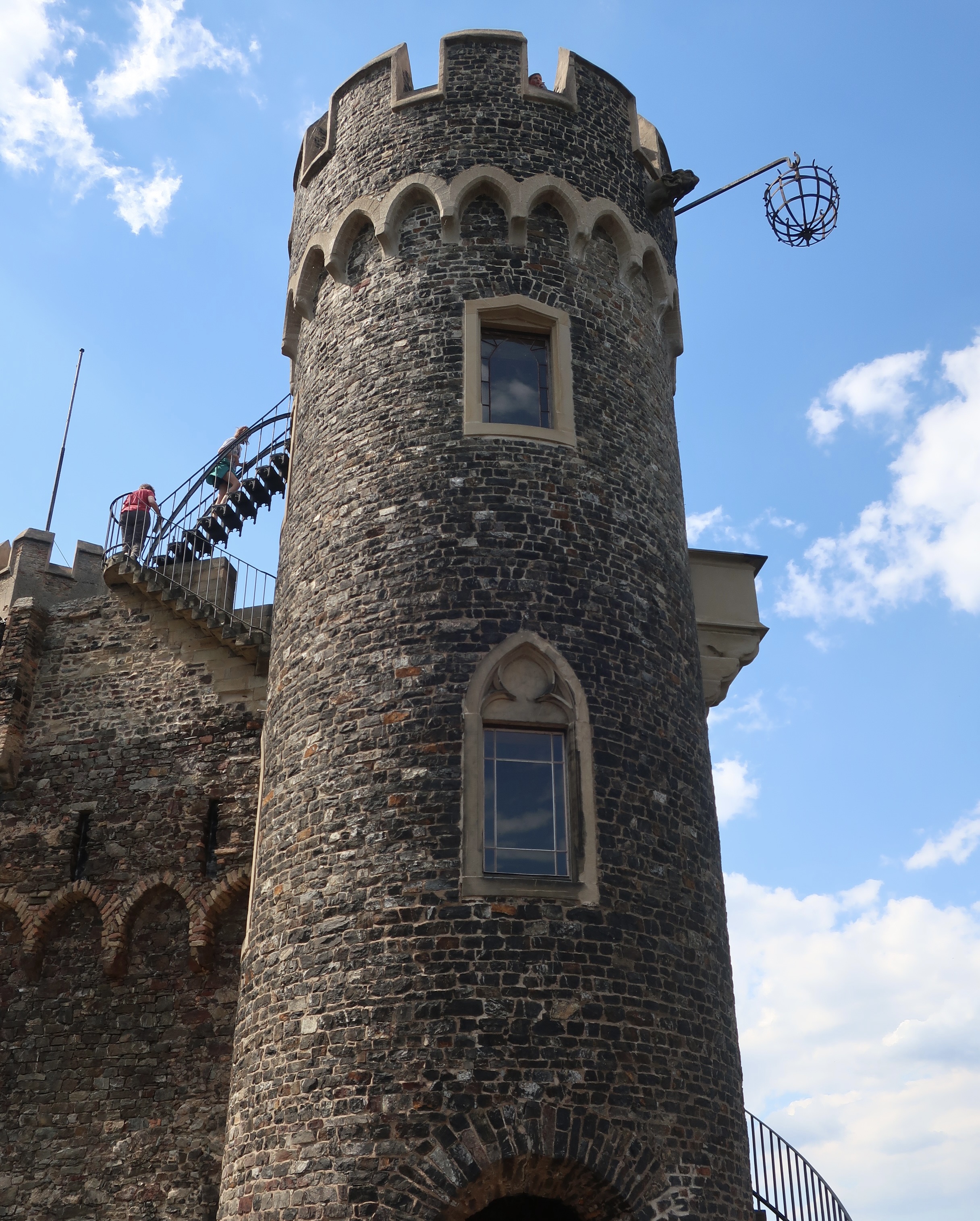
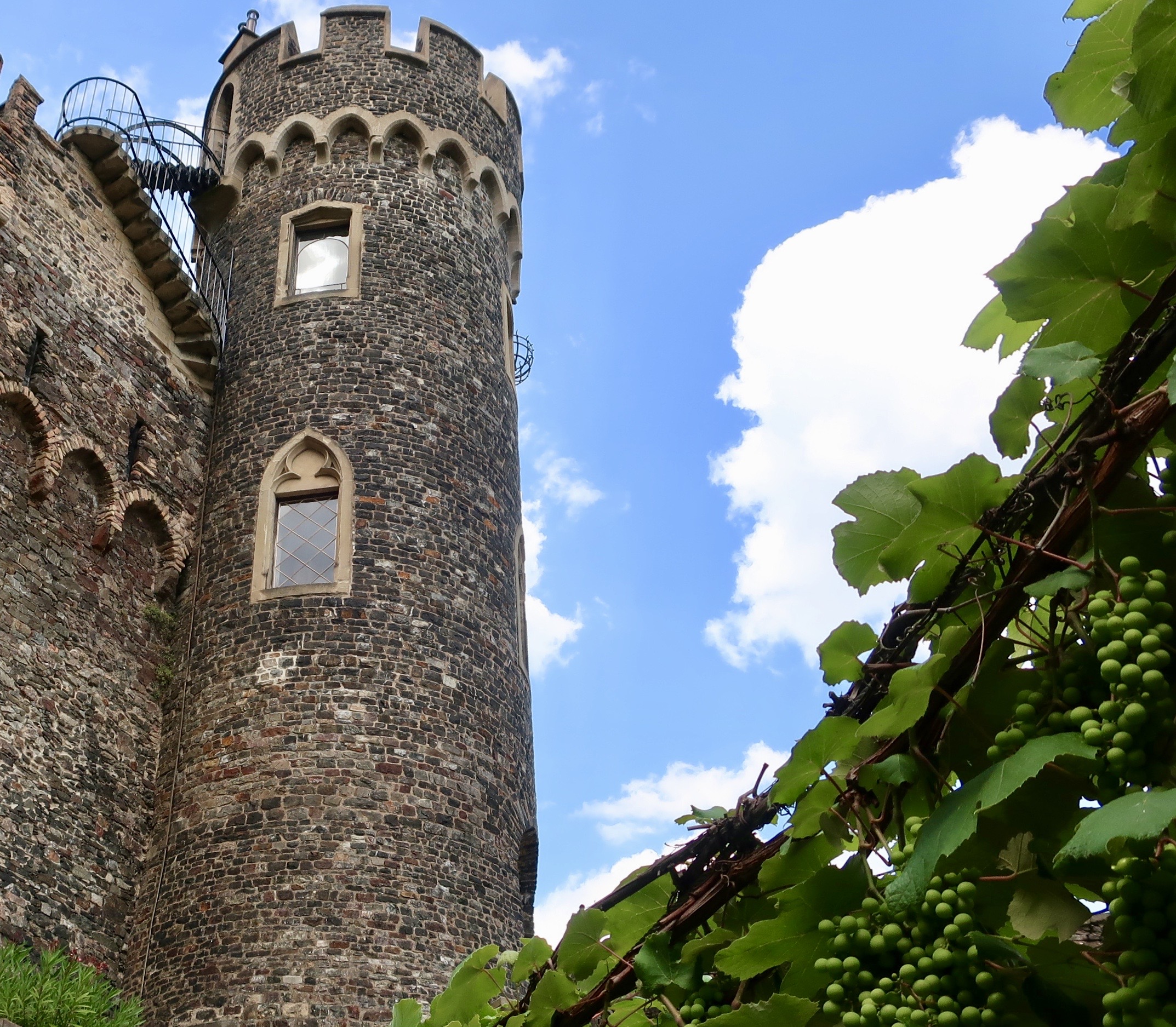
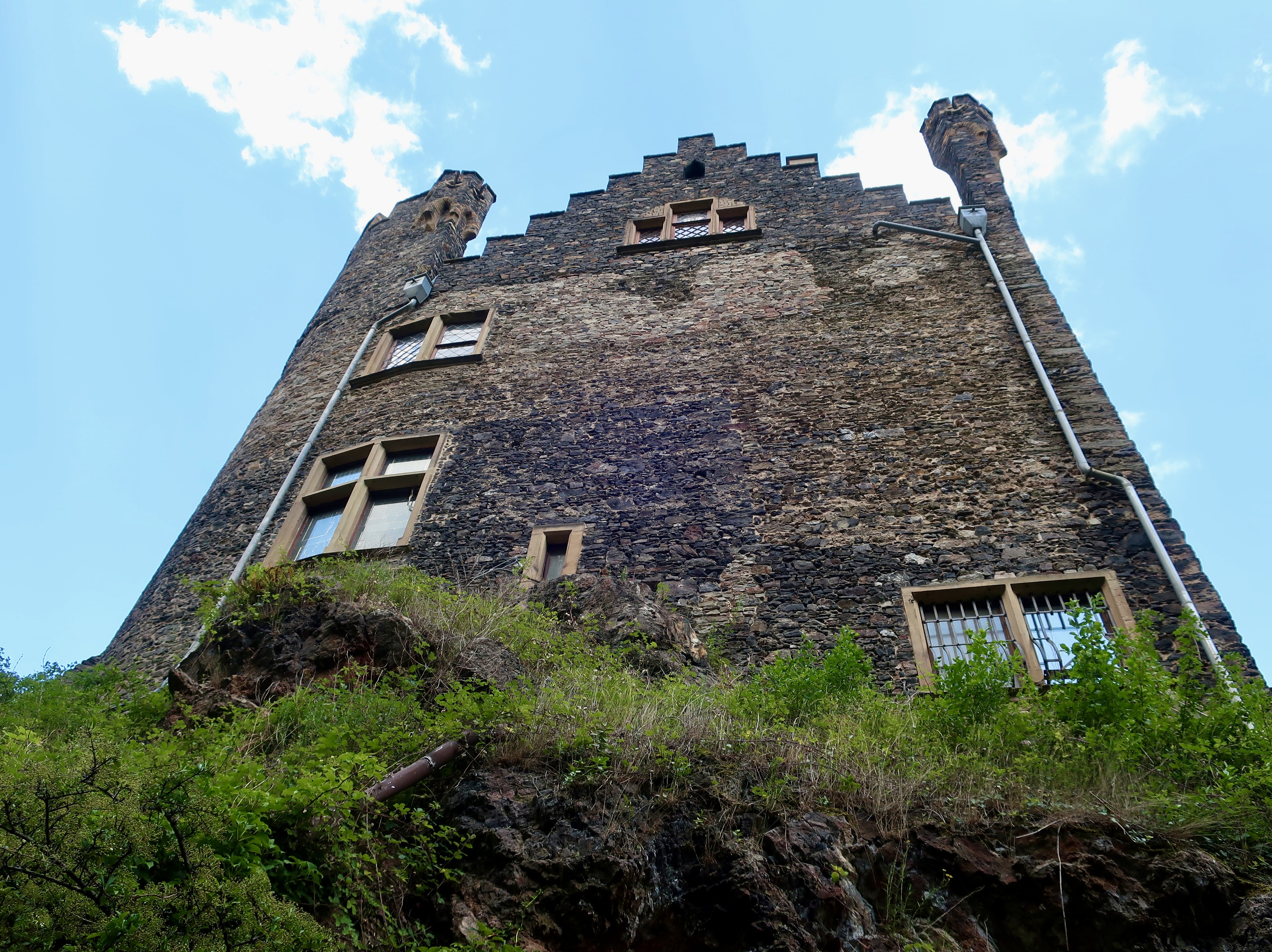
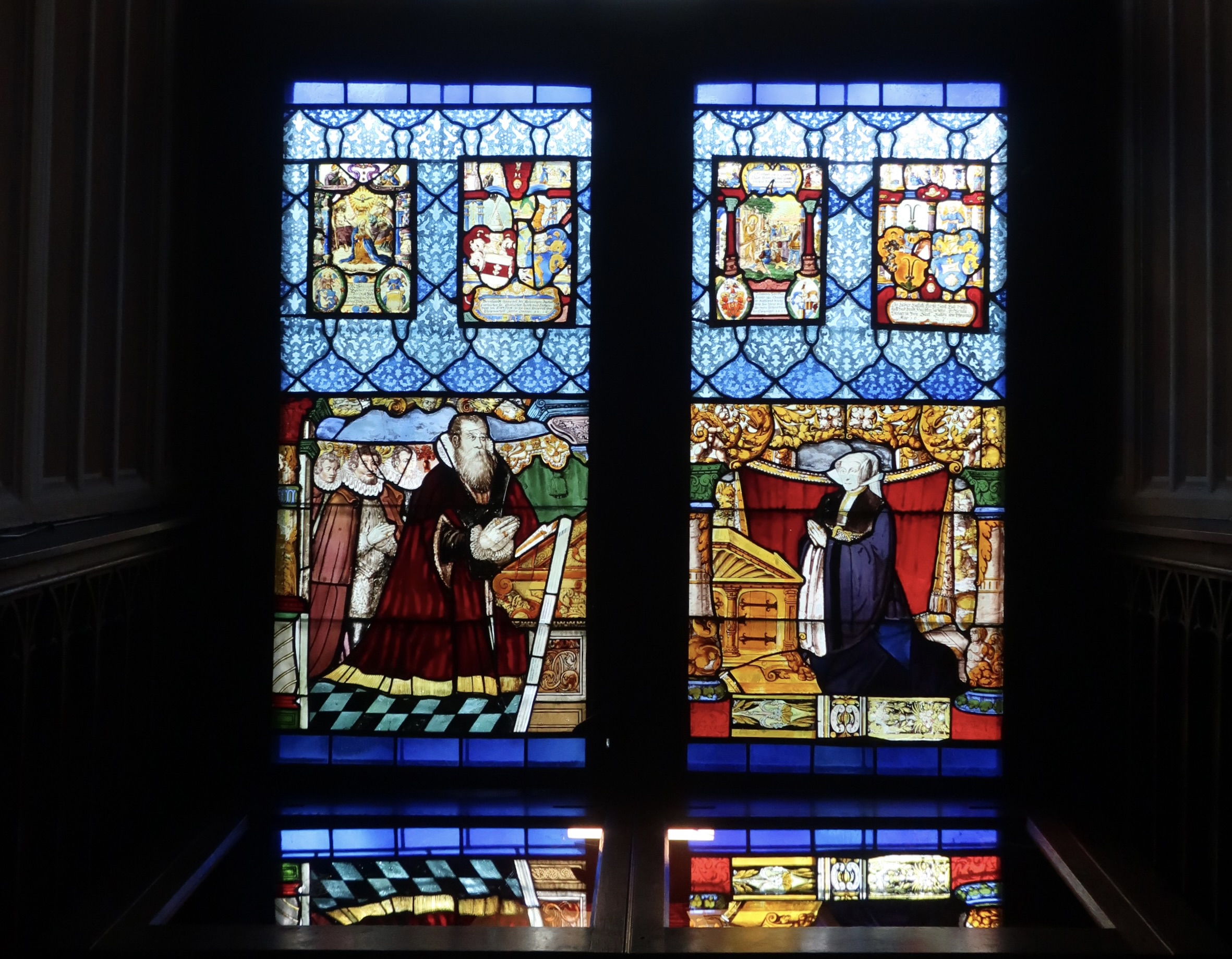
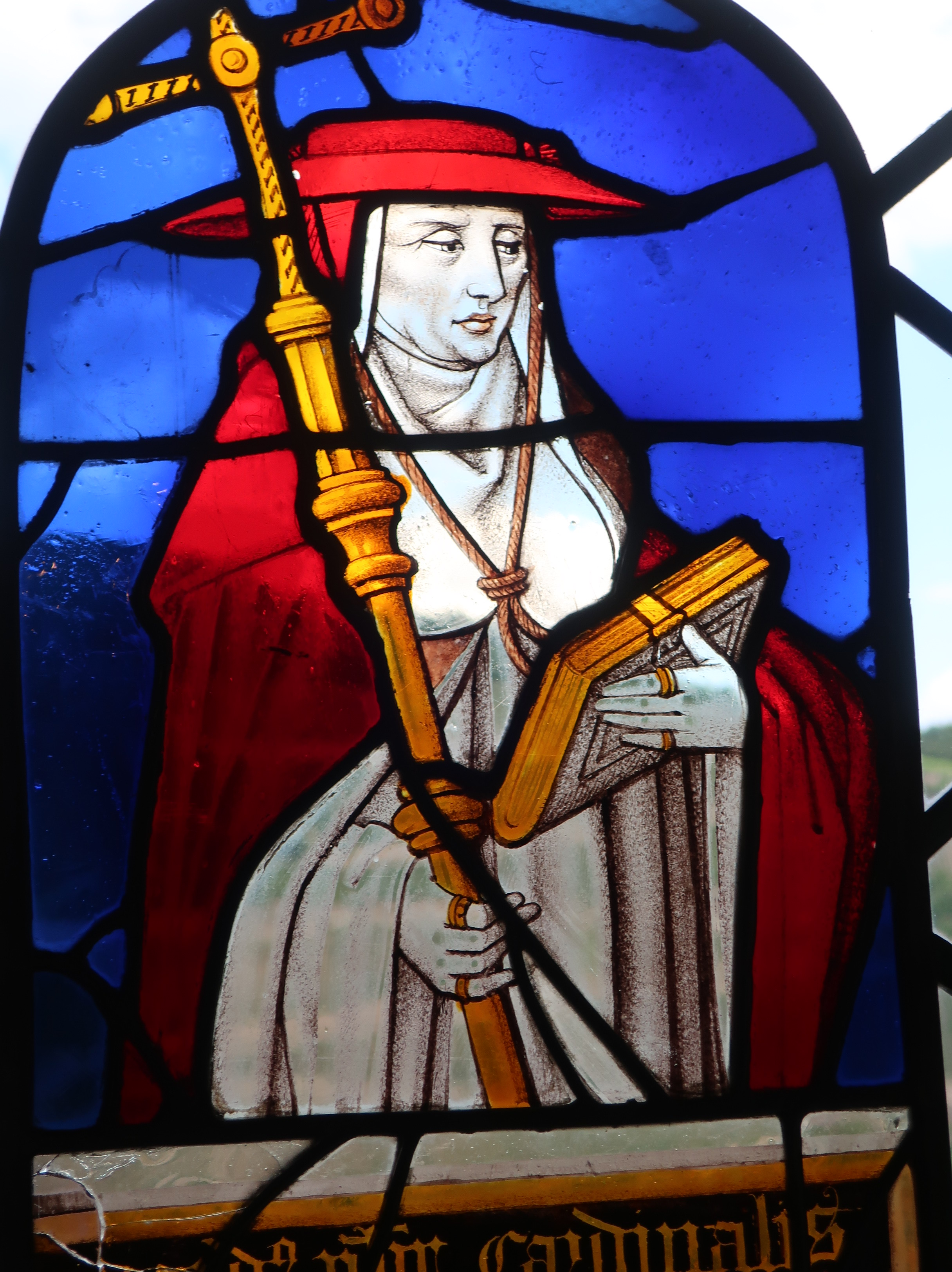
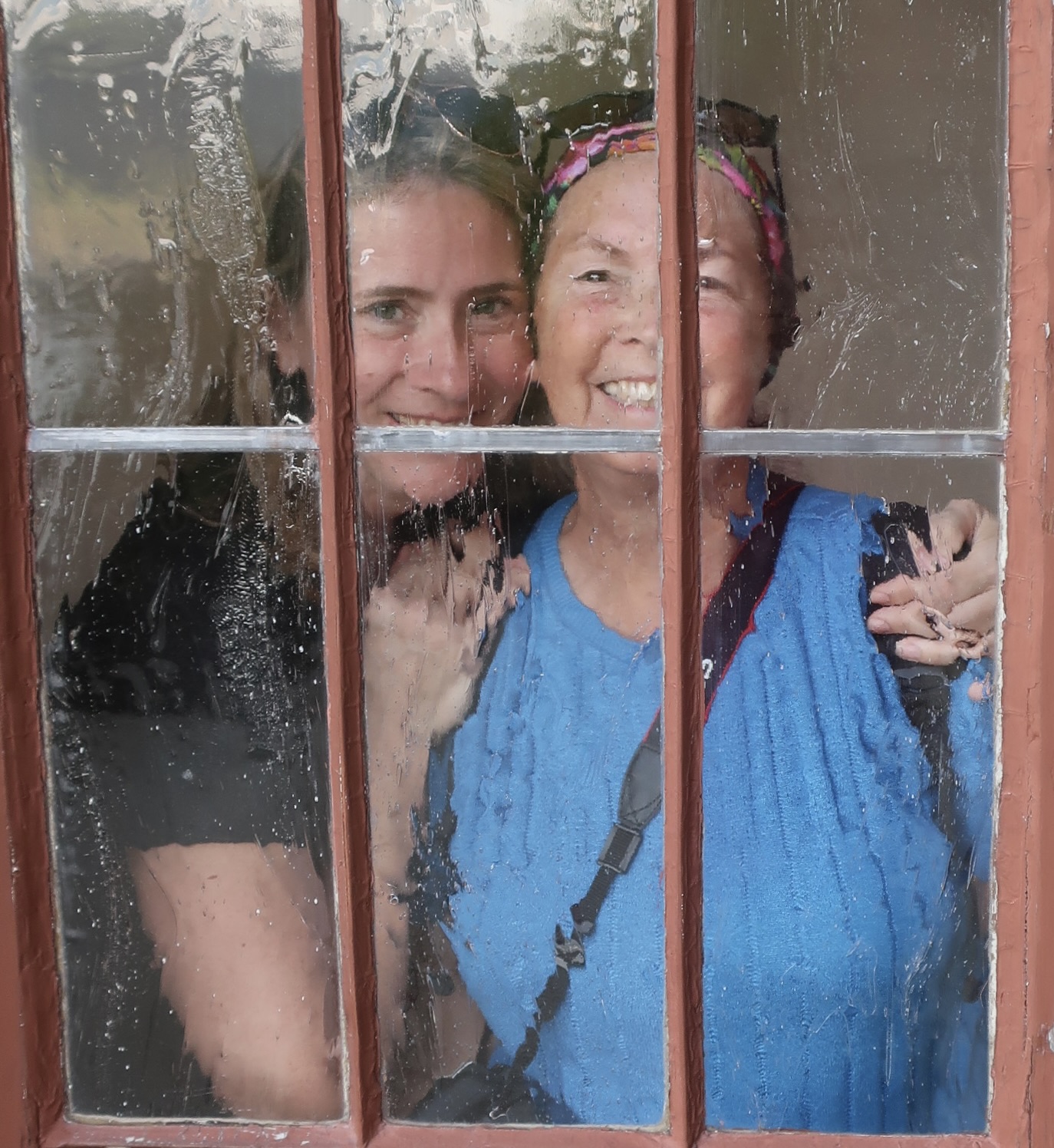
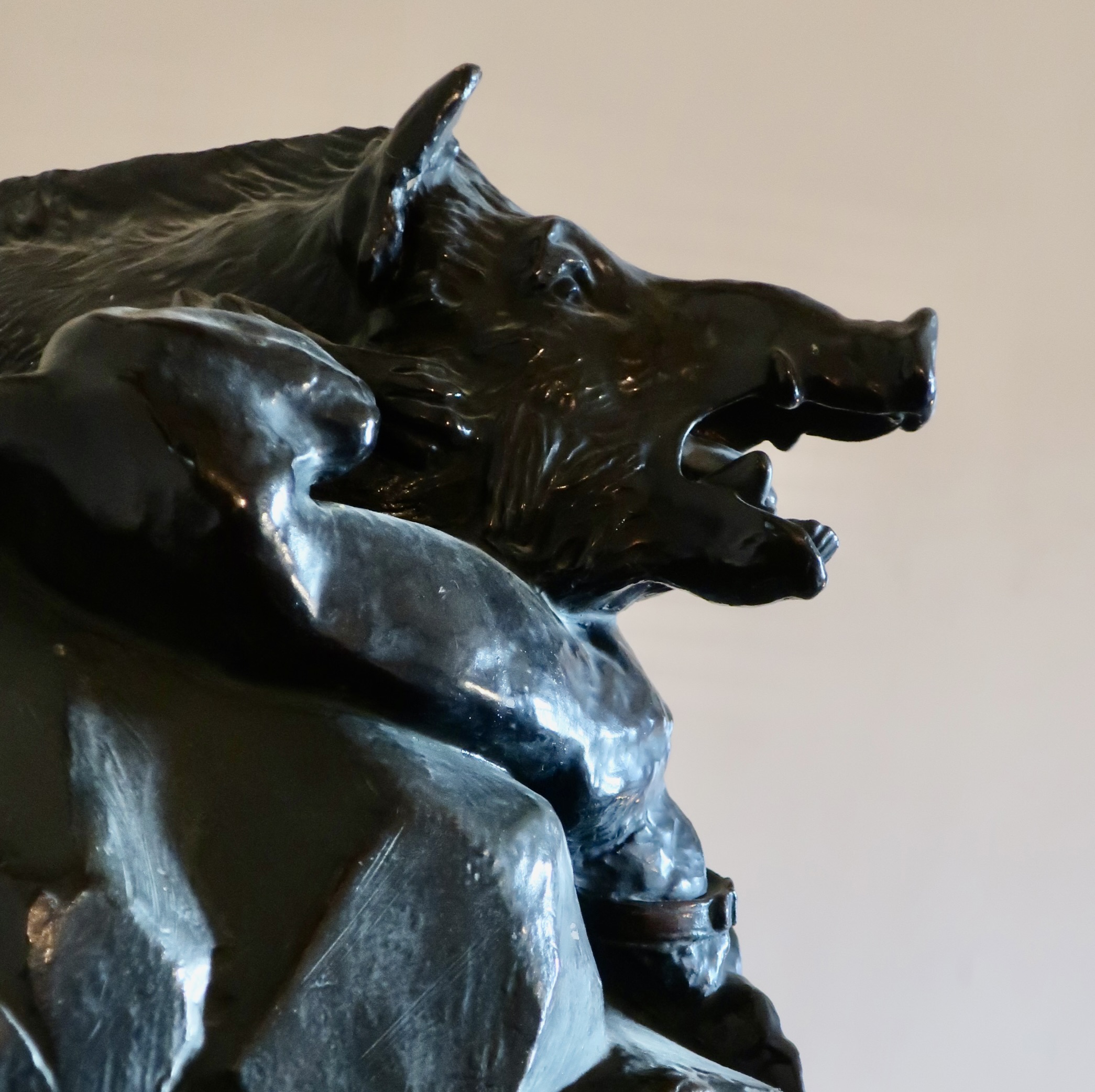
The tower on the left was where we were standing when the photo above was taken. The narrow steel stairway was the way up. Another view of the tower, the stairway, and the hanging basket.Here’s a closeup of the basket. It was used as a fire basket signal that could be seen from nearby castles and repeated. I also read that it could be used as a prime location for placing people who refused to pay their toll, so they could contemplate the folly of their action. This photo provides a perspective on the promontory that Rheinstein is built. One has the feeling that attacking from the front would be a bit daunting.The grapevine is the focus here. Information on Rheinstein claims that it is 500 years old and still producing viable grapes for burgundy! Talk about well-aged wine… Grin.A side view of the back of the castle.Working our way around to the back.The view from behind.We were also attracted to this photogenic tower.A view of the Rhine from the castle. A barge, riverboat and another barge can be seen working their way along the river. Fortunately, tolls are no longer an issue. Trade increased exponentially when they were eliminated in 1831. And now, it’s time to enter the castle.I’d like to report that the restrooms had at least been modernized. Hanging over the edge and letting go was no longer a requirement or an option. Rooms had been tastefully decorated with antique furniture and flowers from the castle’s gardens. Note the harp in the corner. More later.What castle would be complete without the dress of a princess on display? Light here was provided courtesy of stained glass windows. There are several in the castle.As might be expected, faith was a common theme.Demonstrating your faith was an important prerequisite for getting through the Pearly Gate. Maybe the rules change once you are admitted. Not to harp on the subject, but I think this may be a more modern perspective.Not a stained glass window! Tasha and Peggy as seen through glass that was obviously older than their combined age and then some.This charging knight was carved into a chest. One wonders how fast the short legged horse could charge.There was a great variety to the art. This modern version of the castle reminded me of an El Greco painting.Maintaining the property would have been hot, hard work in the 1300s. A worker receives a welcome drink of water. Or maybe it was burgundy from the grapevines. I wouldn’t want to encounter this fellow on a dark night. Or make that any time. He is not a boring boar.A possible comment on my attempts at punning.Dare I say something about spouting off…Coming from the western United States, I am familiar with hunters mounting the heads of the huge trophy animals they have shot on their walls as proof of their manly manliness. Believe me, when I say they would not mount these tiny fellows that are about fist size, unless, of course, they were extremely rare. Not sure what they are except an extremely small species of deer. Do you find them as weird as I did?I’ll finish with this photo of the flag over Rheinstein Castle. May it continue to fly for another 700 years. Next up, we move away from castles for other views along the Romantic Rhine. (Or maybe, I’ll do a post on Devil’s Tower in Wyoming for variety. I just finished processing the photos.)
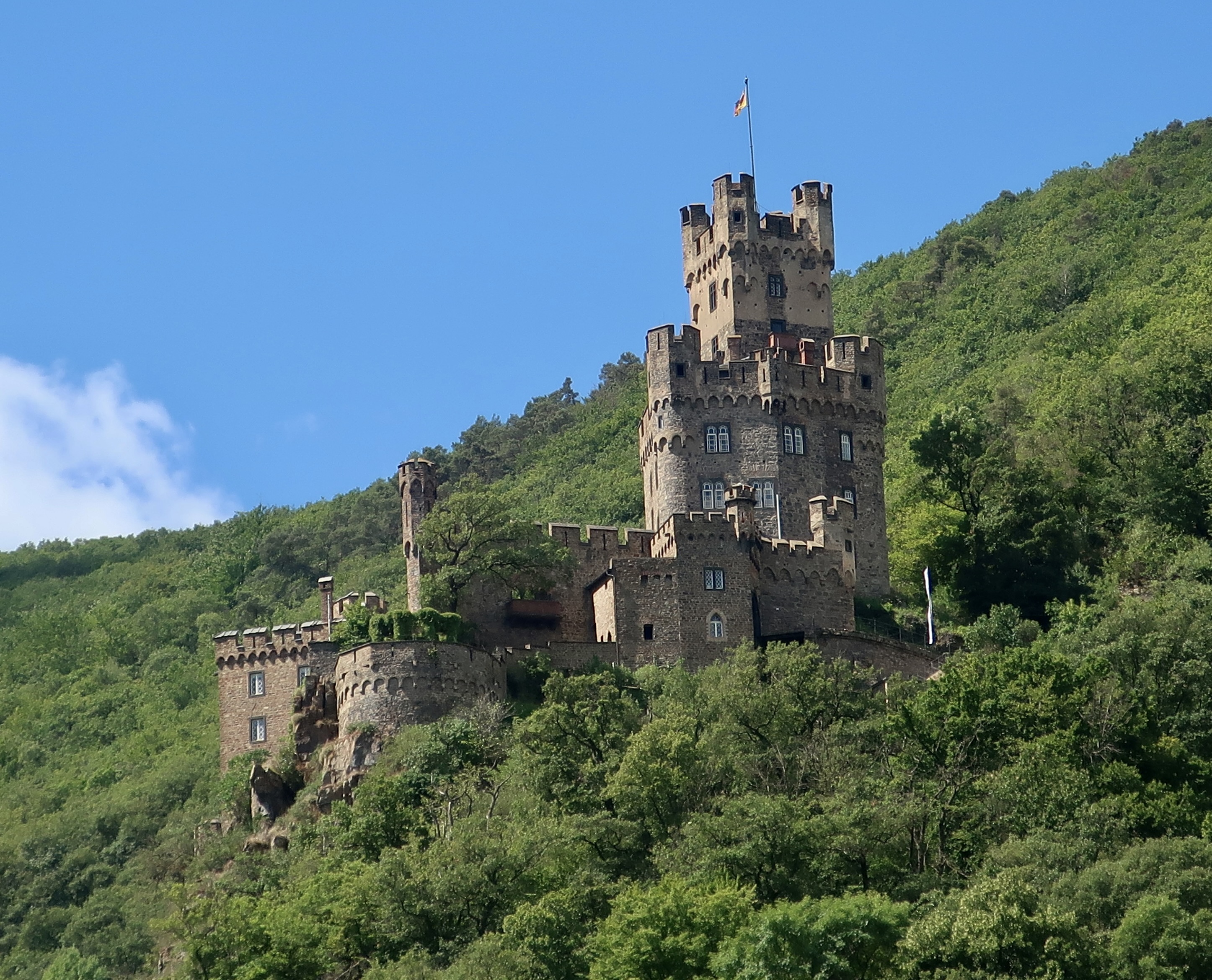
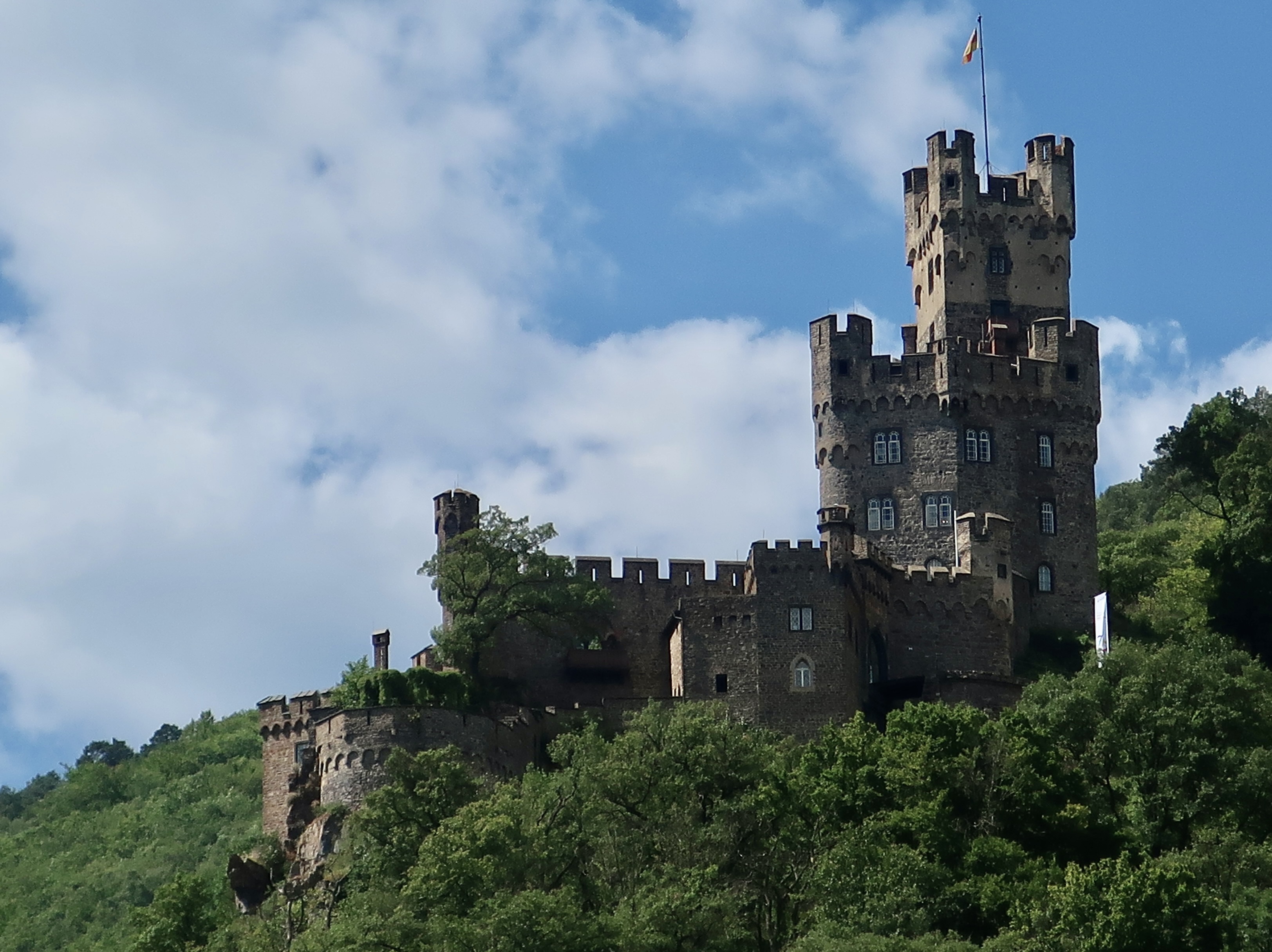
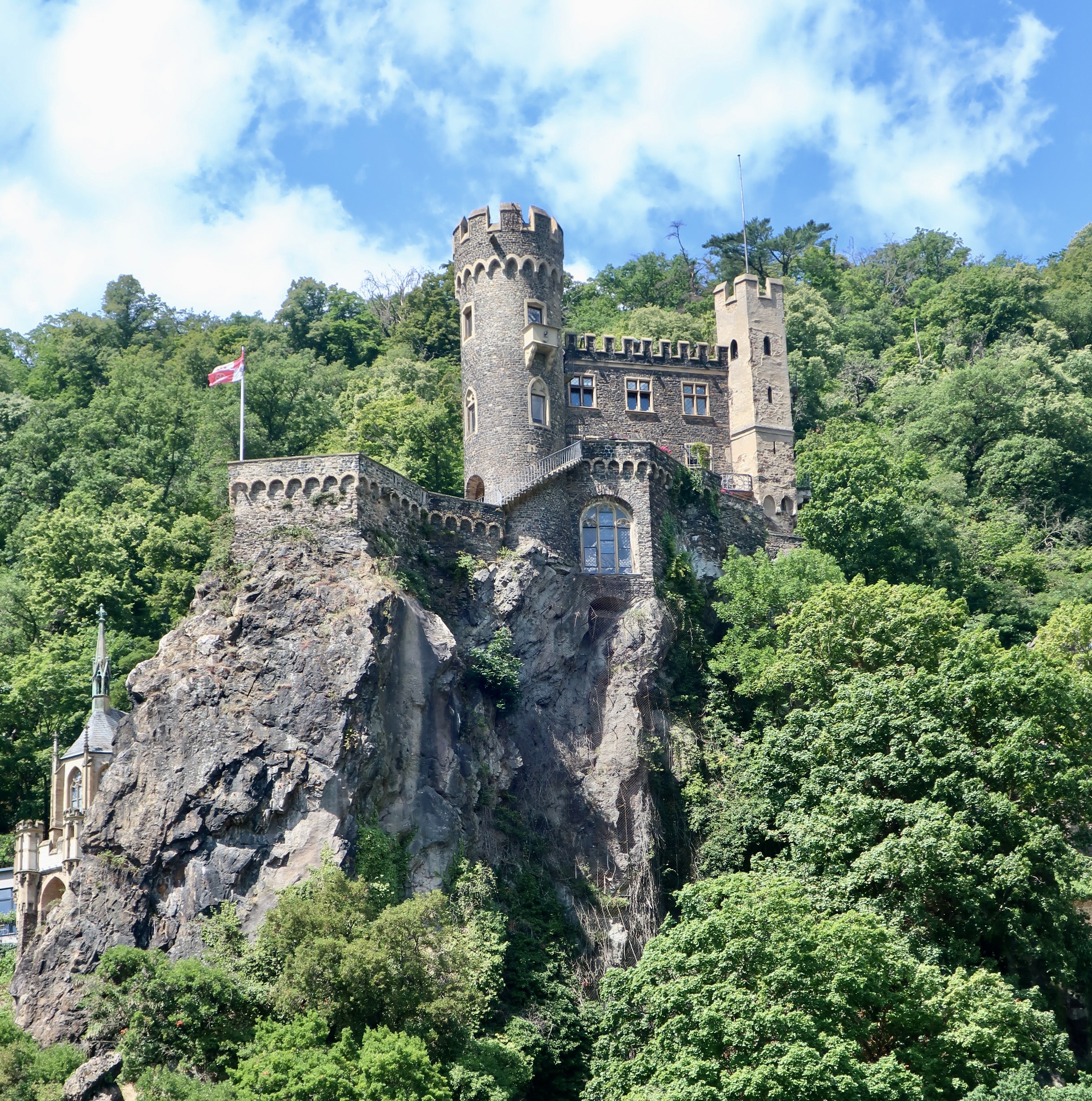
Today, Peggy and I are taking you on a trip up the Rhine River Valley between the towns of Koblenz and Bingen. The journey on the river is little more than 30 miles (48k), but wow, what an impressive 30 miles! There is a reason why this segment of the Rhine has been declared a UNESCO World Heritage Site. While there is much to see in the valley, the highlight for us was the castles. There are over 40. We’ve chosen 12 to feature. This post is a continuation of our family riverboat trip up the Rhine River from Amsterdam to Basel this past summer. All photos were taken by either Peggy or me unless otherwise noted.
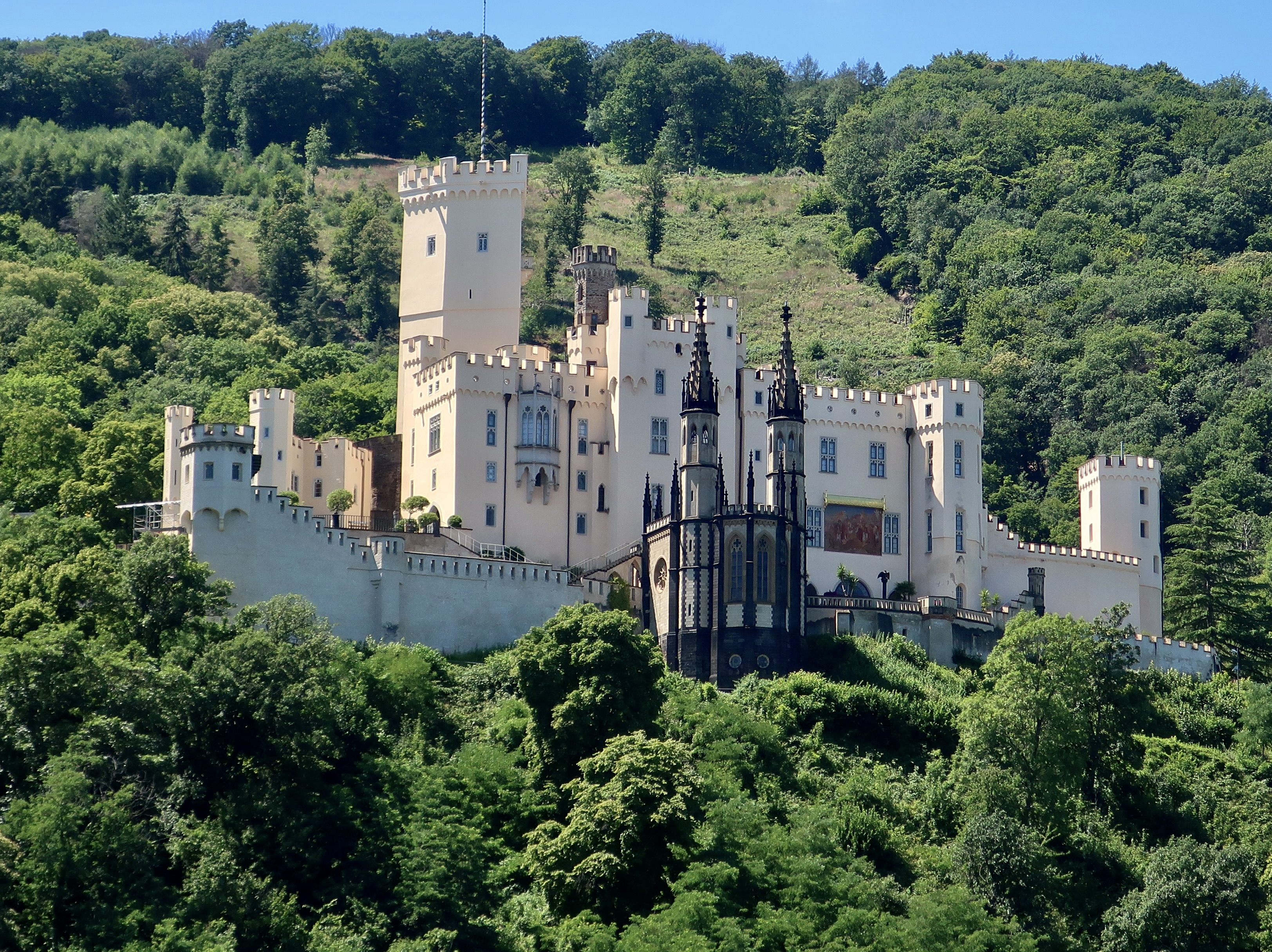
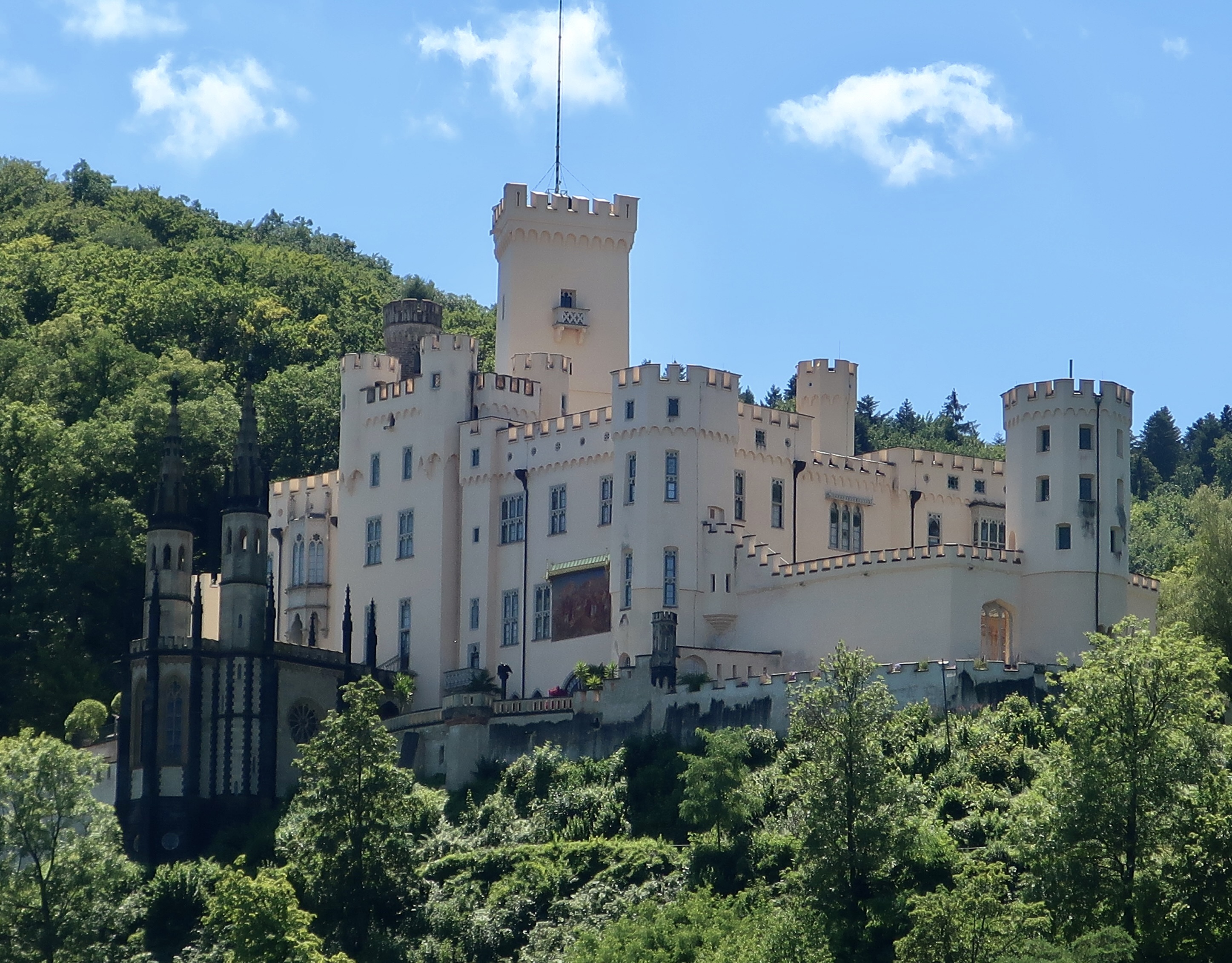
First up, on our list is Stolzenfels Palace. Originally built by the Bishop of Trier in 1259, it was destroyed by the French in 1689 during the Nine Years War, one of the seemingly endless wars that have been fought in Europe. In 1823 the ruins were given to Frederick William IV of Prussia who had the castle rebuilt by 1842 as his summer palace. The Gothic chapel in front was inaugurated in 1845 during a visit by Queen Victoria.A side view of Stolzenfels Palace. As I mentioned in my post on Marksburg Castle, one of advantages of viewing the castles by riverboat from the Rhine River is that different perspectives are provided as the boat moves up or down the river.
While each castle is unique, they share a common history. Many of their early owners could be described as robber barons. They made their money by charging ‘tolls’ to the boats traveling up and down the river. One can only wonder what it cost to cover the 30 miles through the valley when you had to stop every mile or so and pay up. A chain was often stretched across the river to force the boats to stop. It was let down when the boat paid and immediately hoisted up again to catch the next victim, er, boat. Another commonality is that most of the castles were also destroyed at one time or the other during the internecine warfare that rocked Europe over the centuries. Many were rebuilt based on their strategic location or the desire of some wealthy noble or the other to have a castle. More recently, The German Castles Association and local communities are responsible for a number of them.
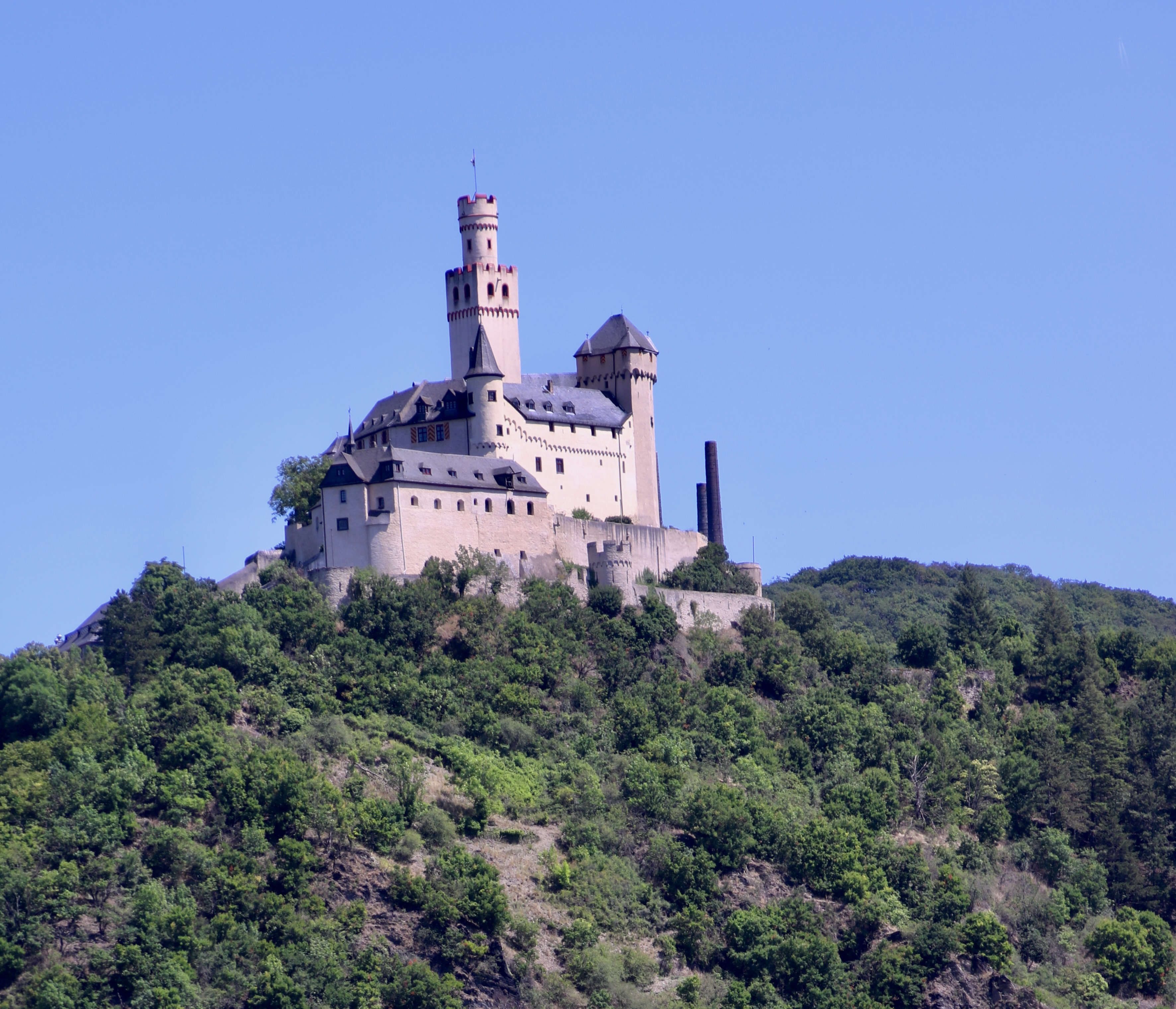
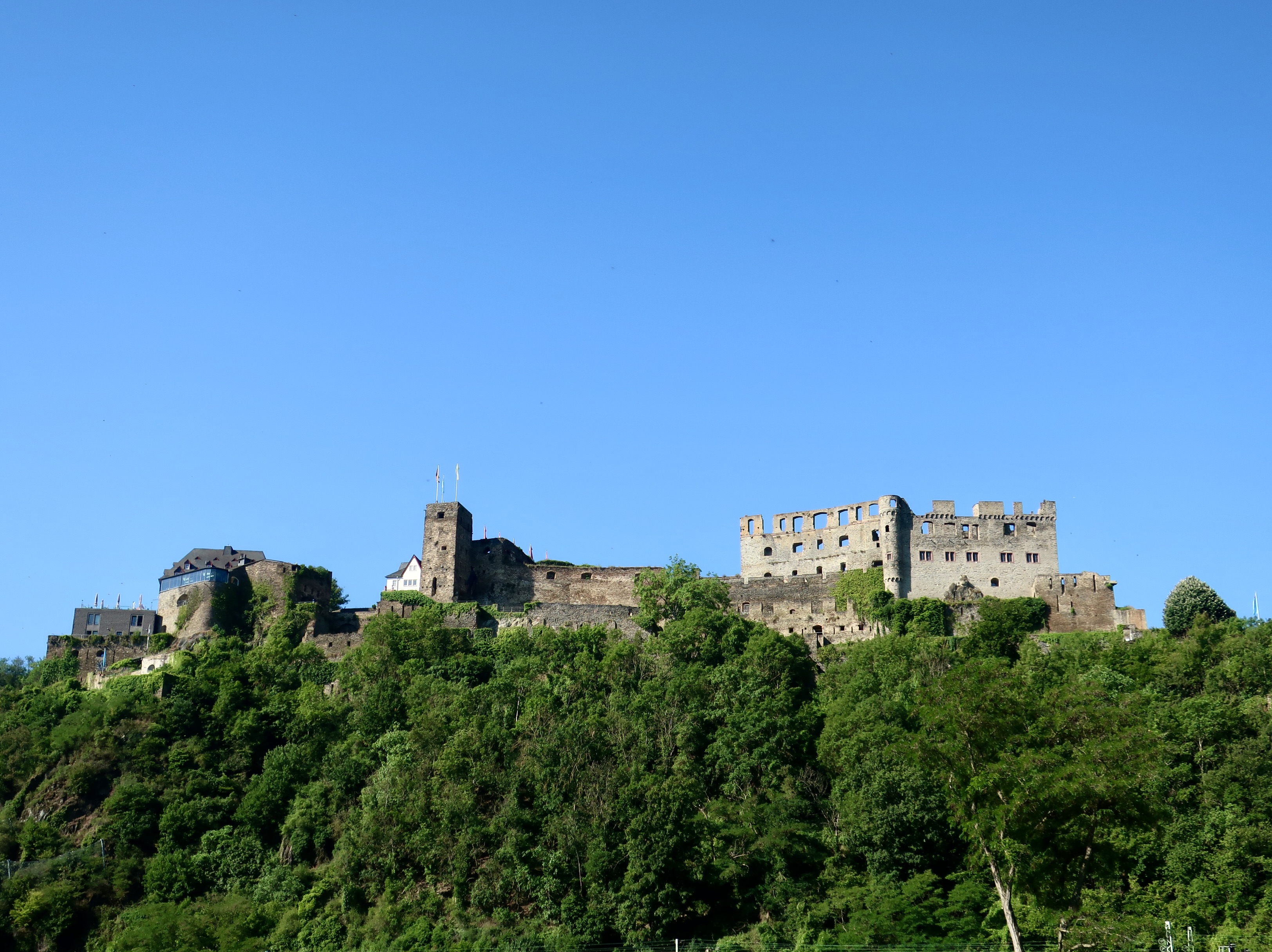
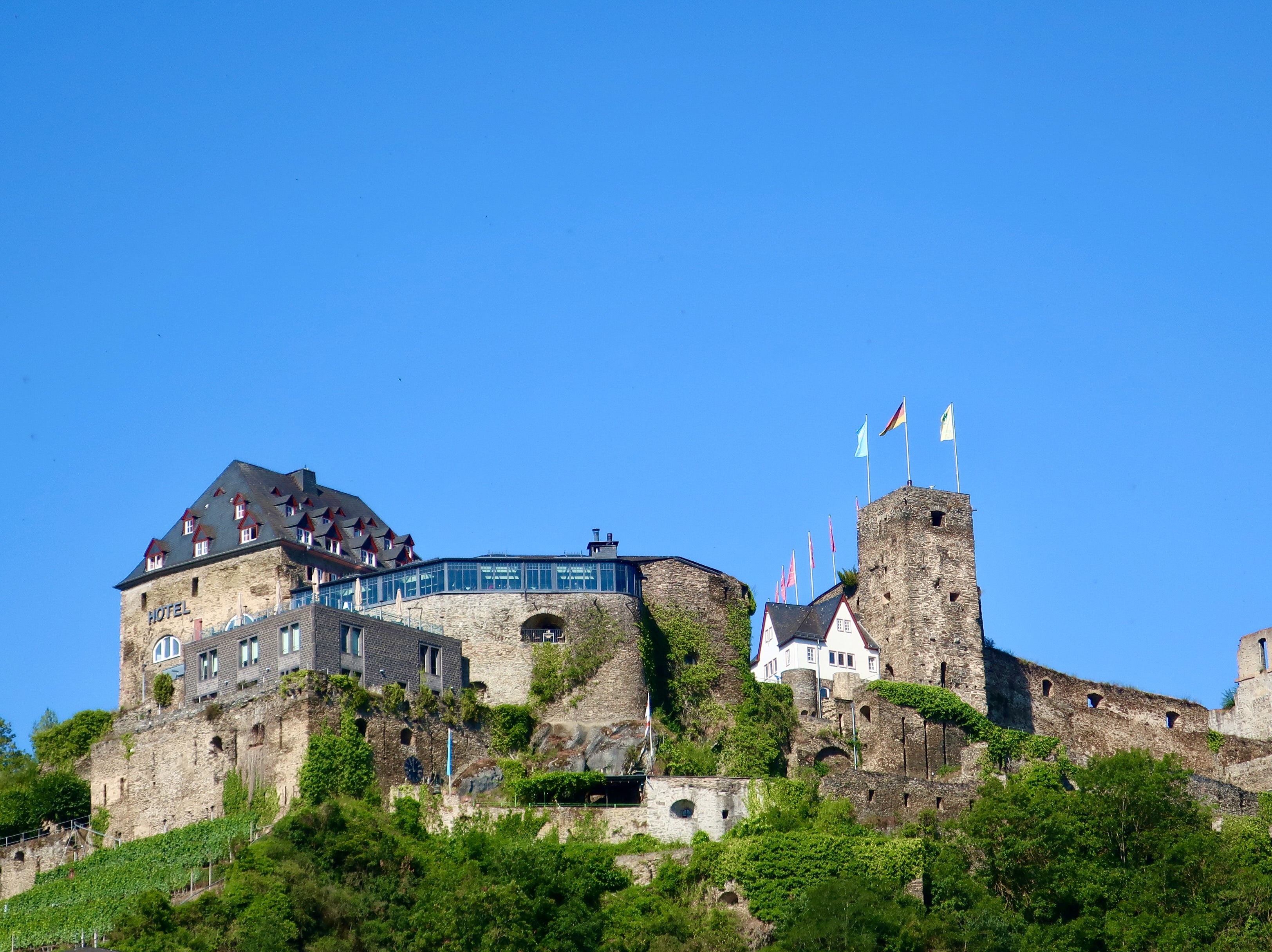
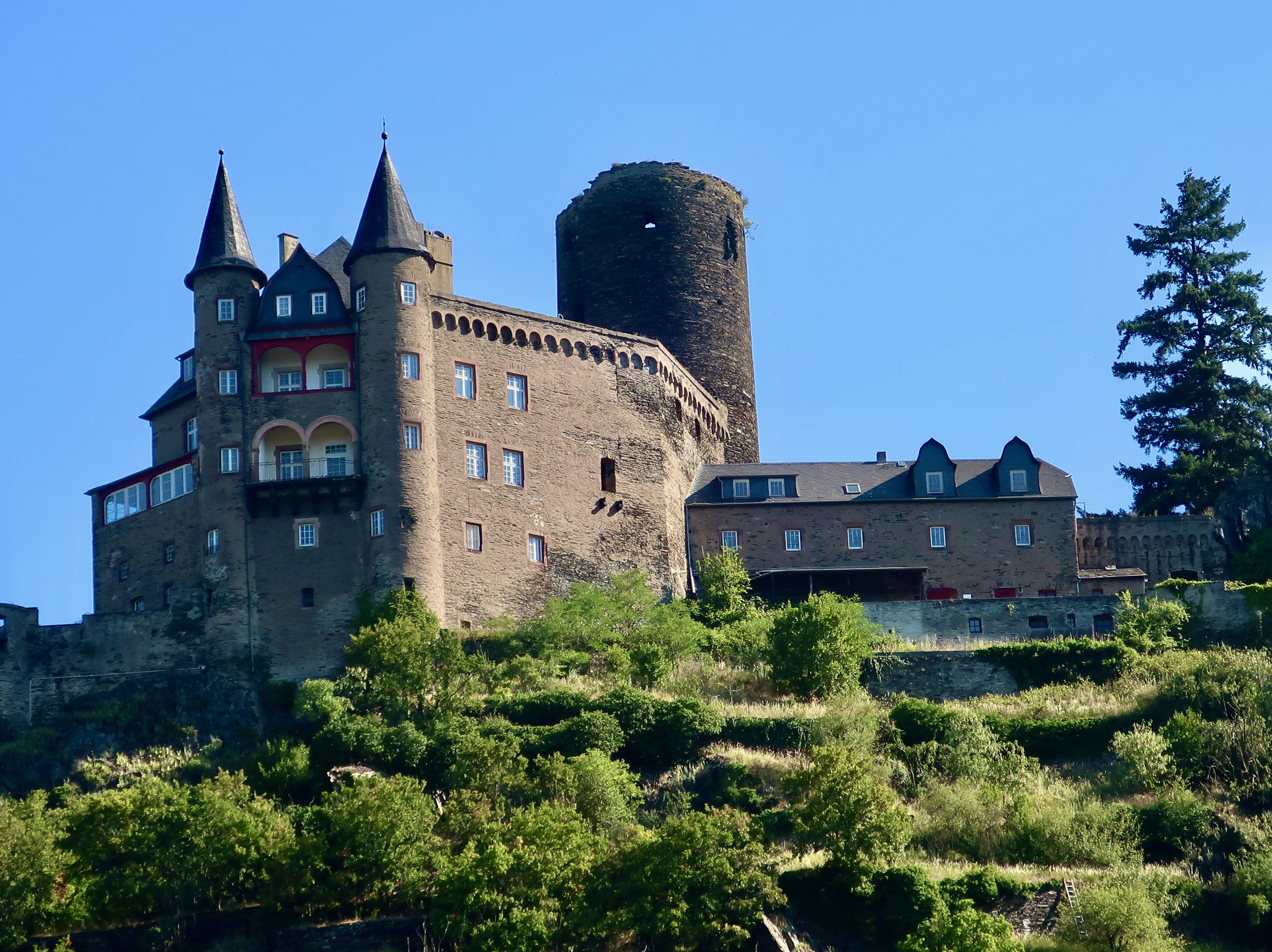
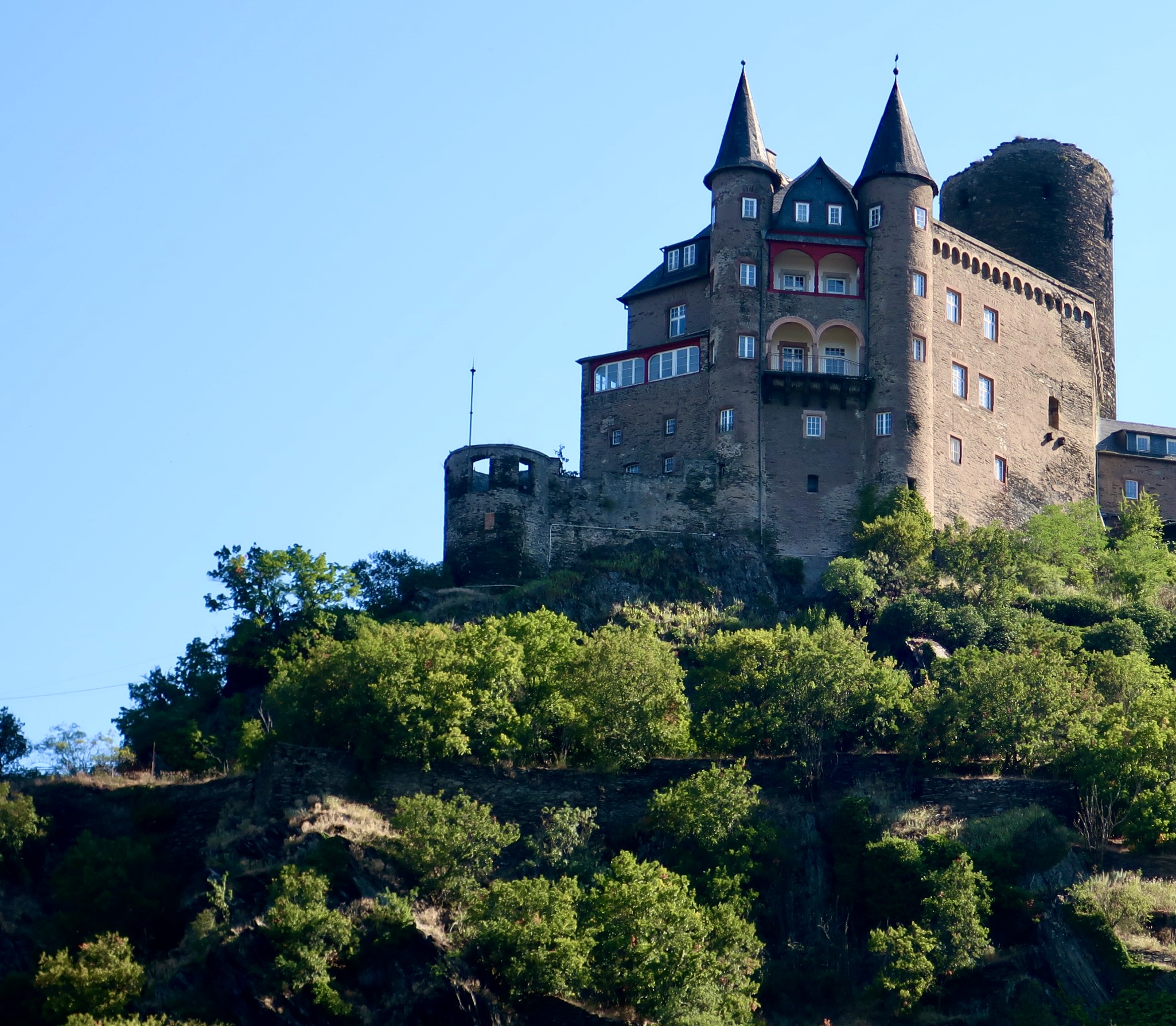
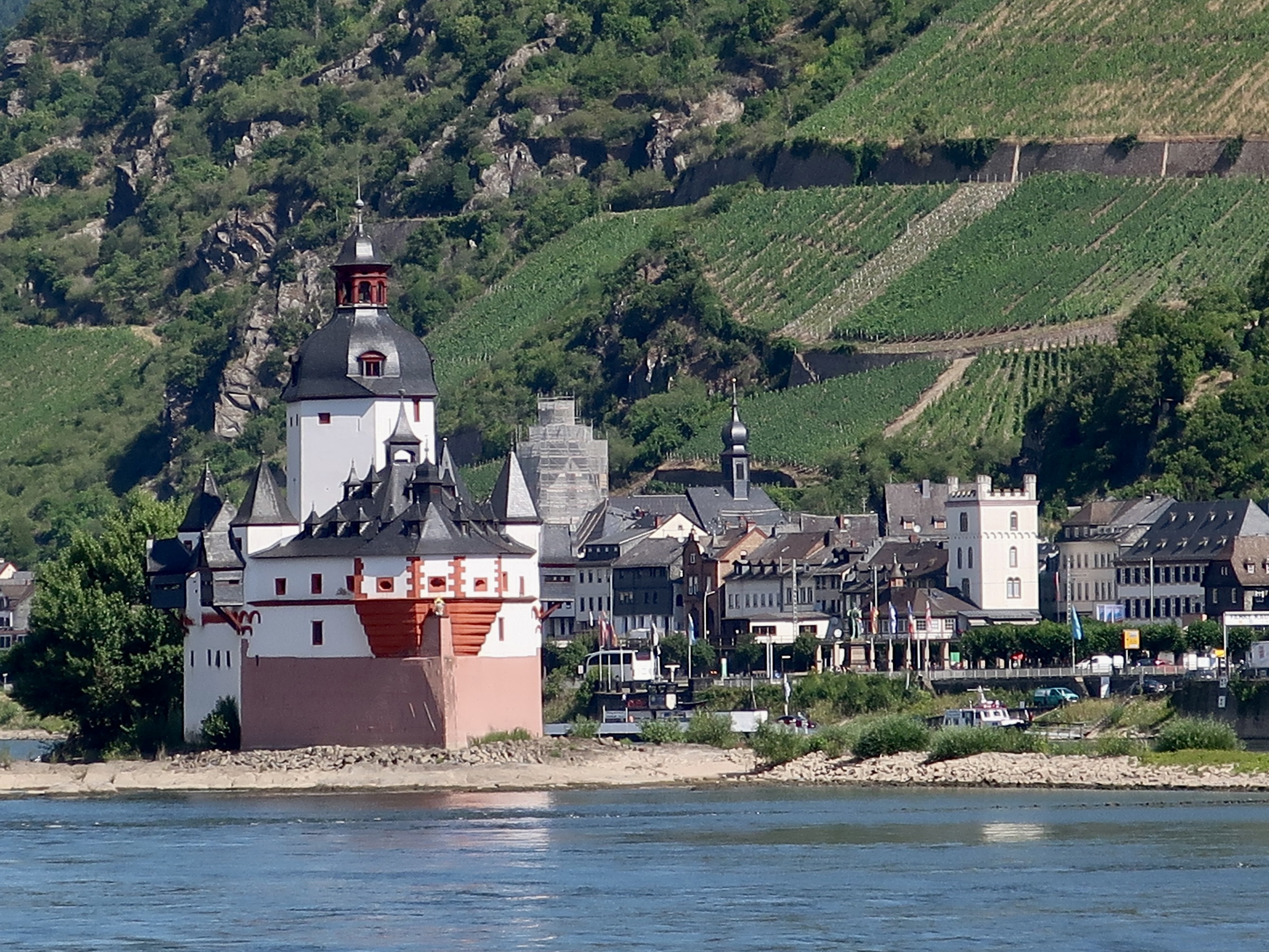
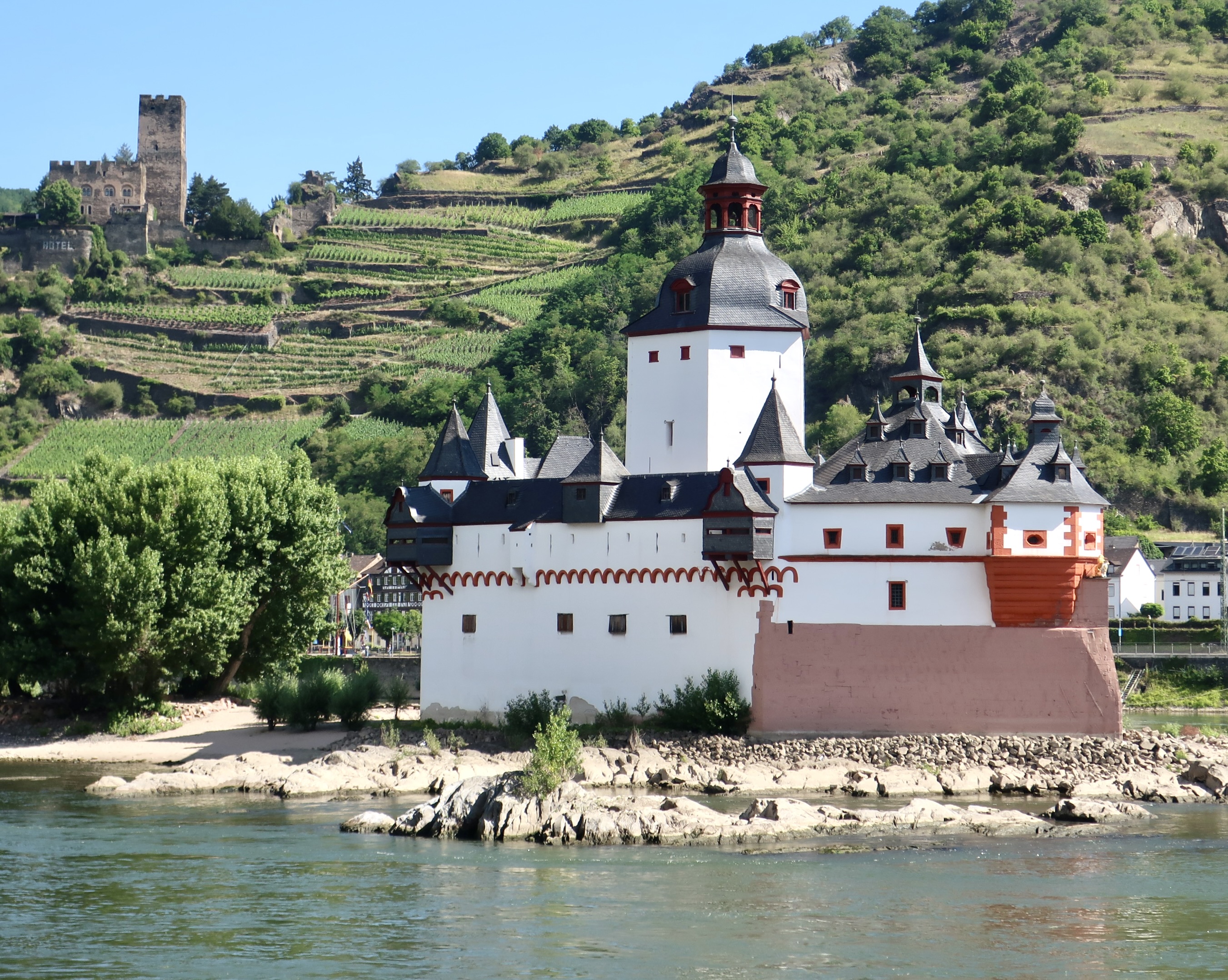
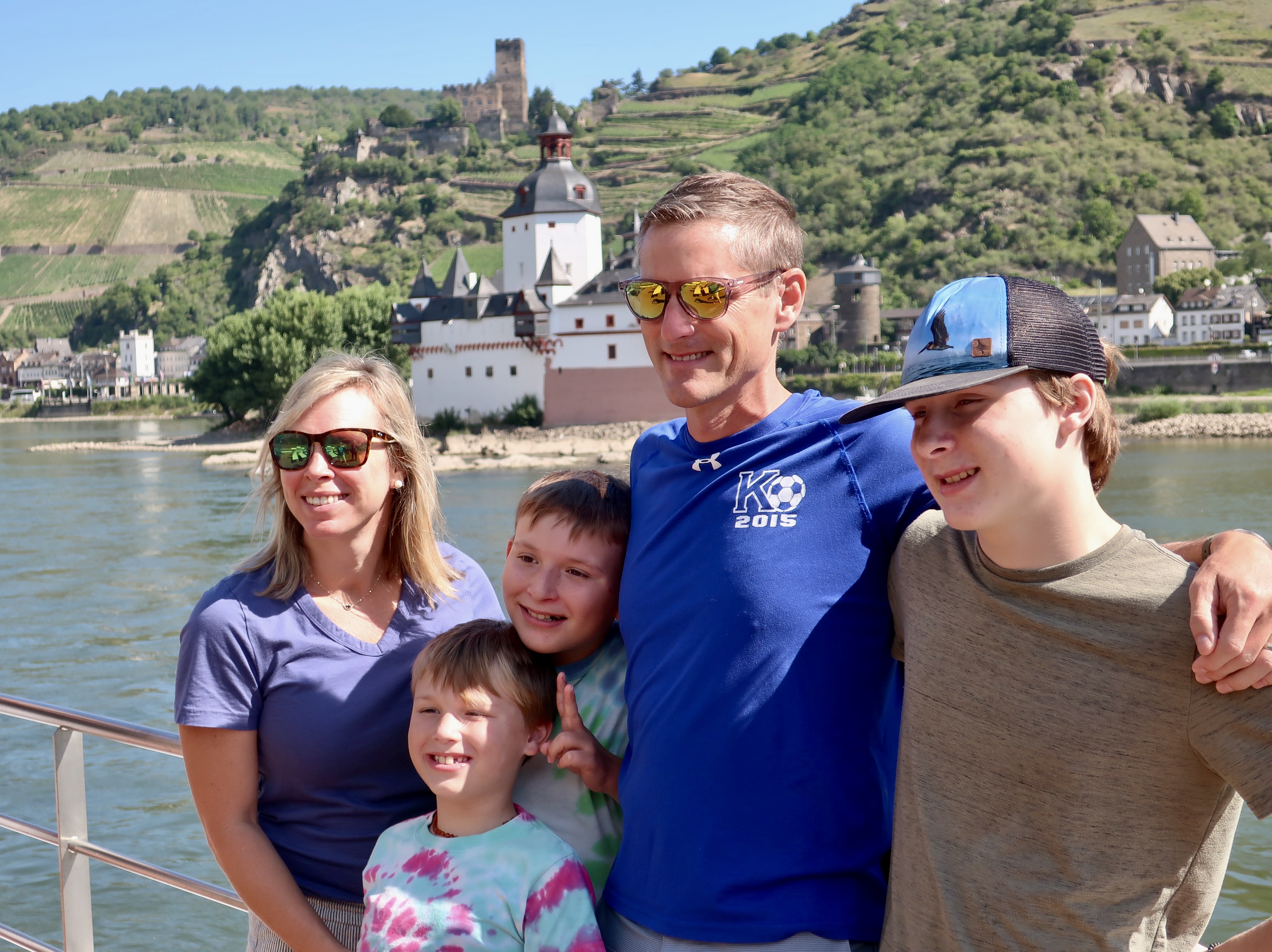
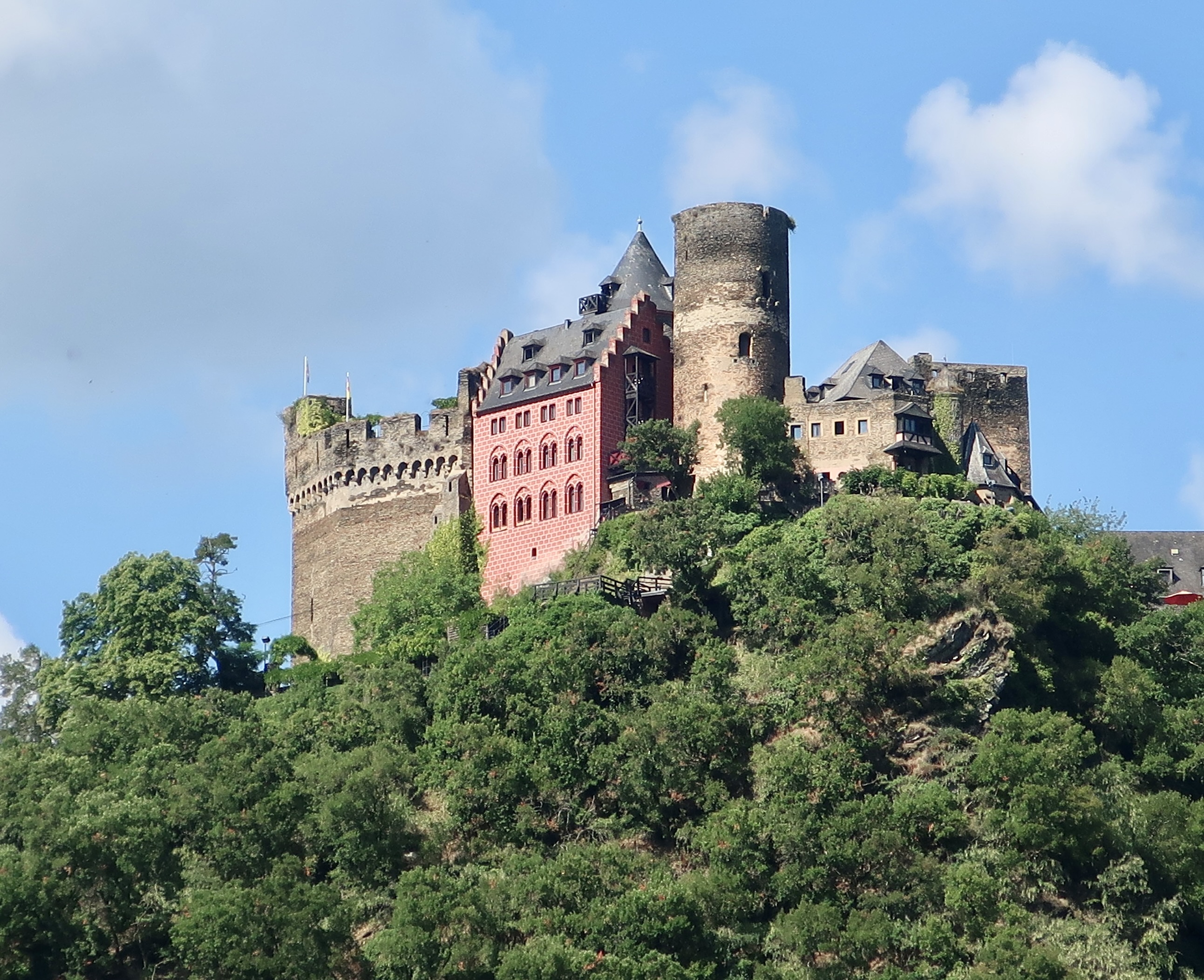
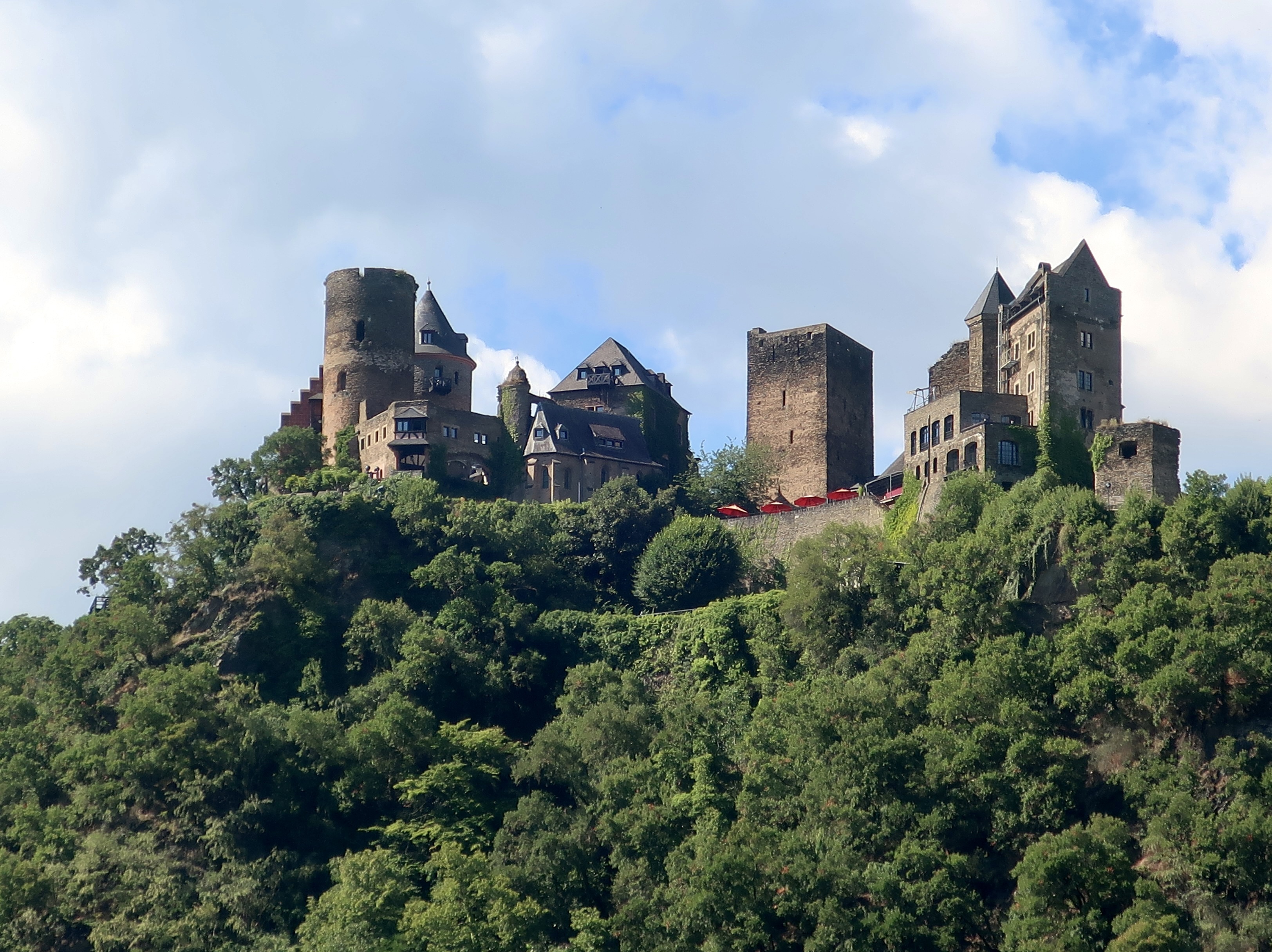
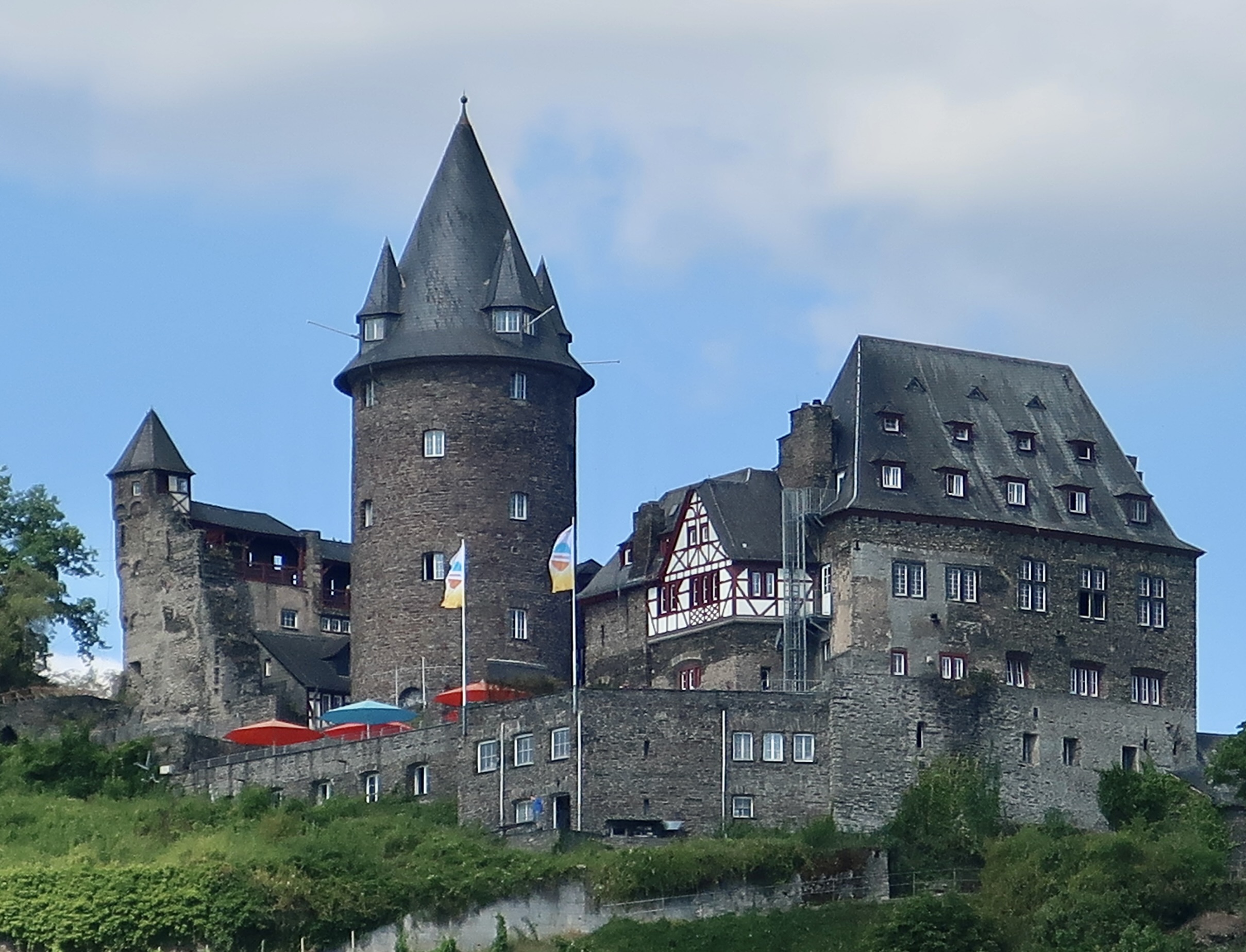
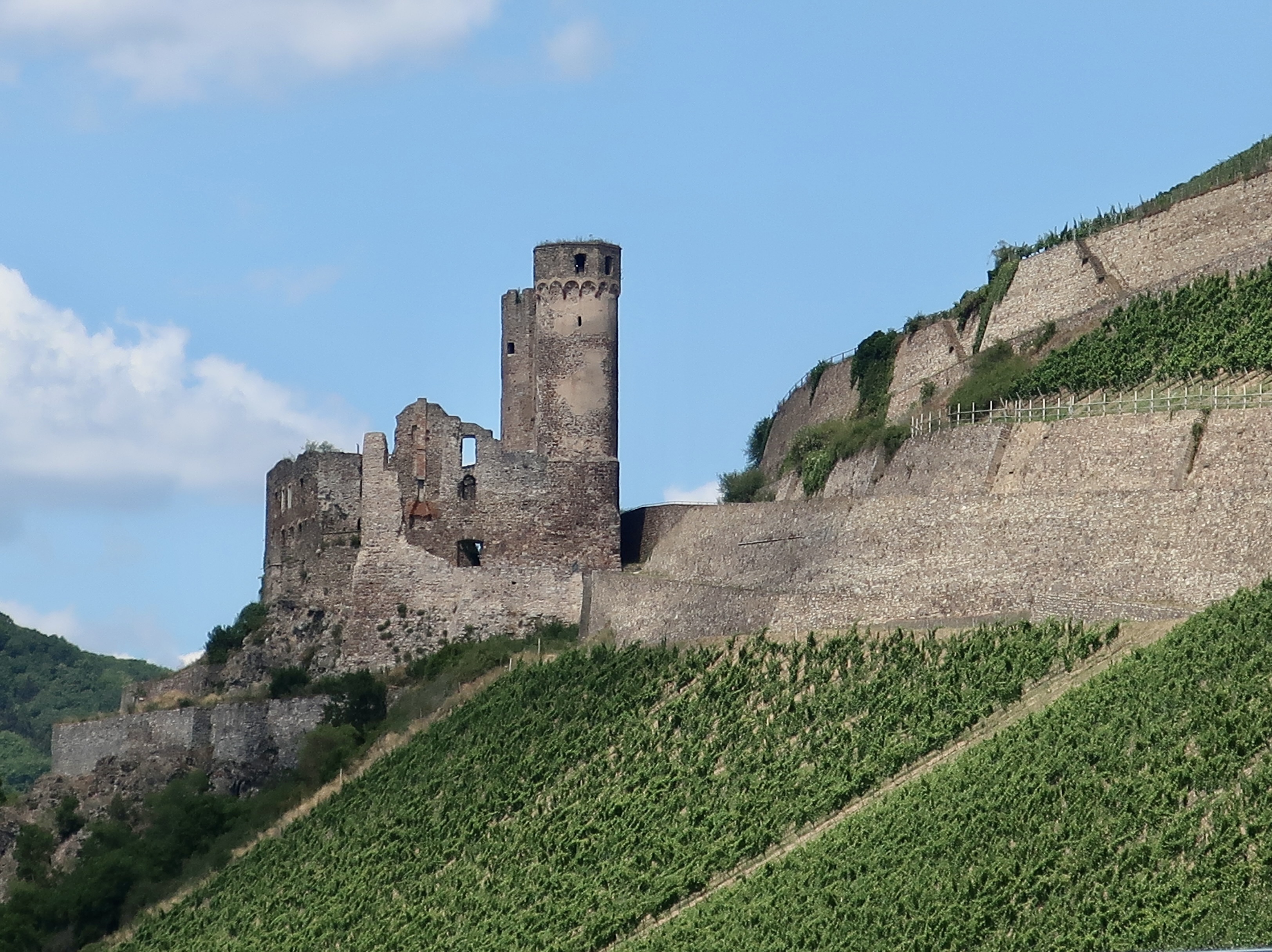
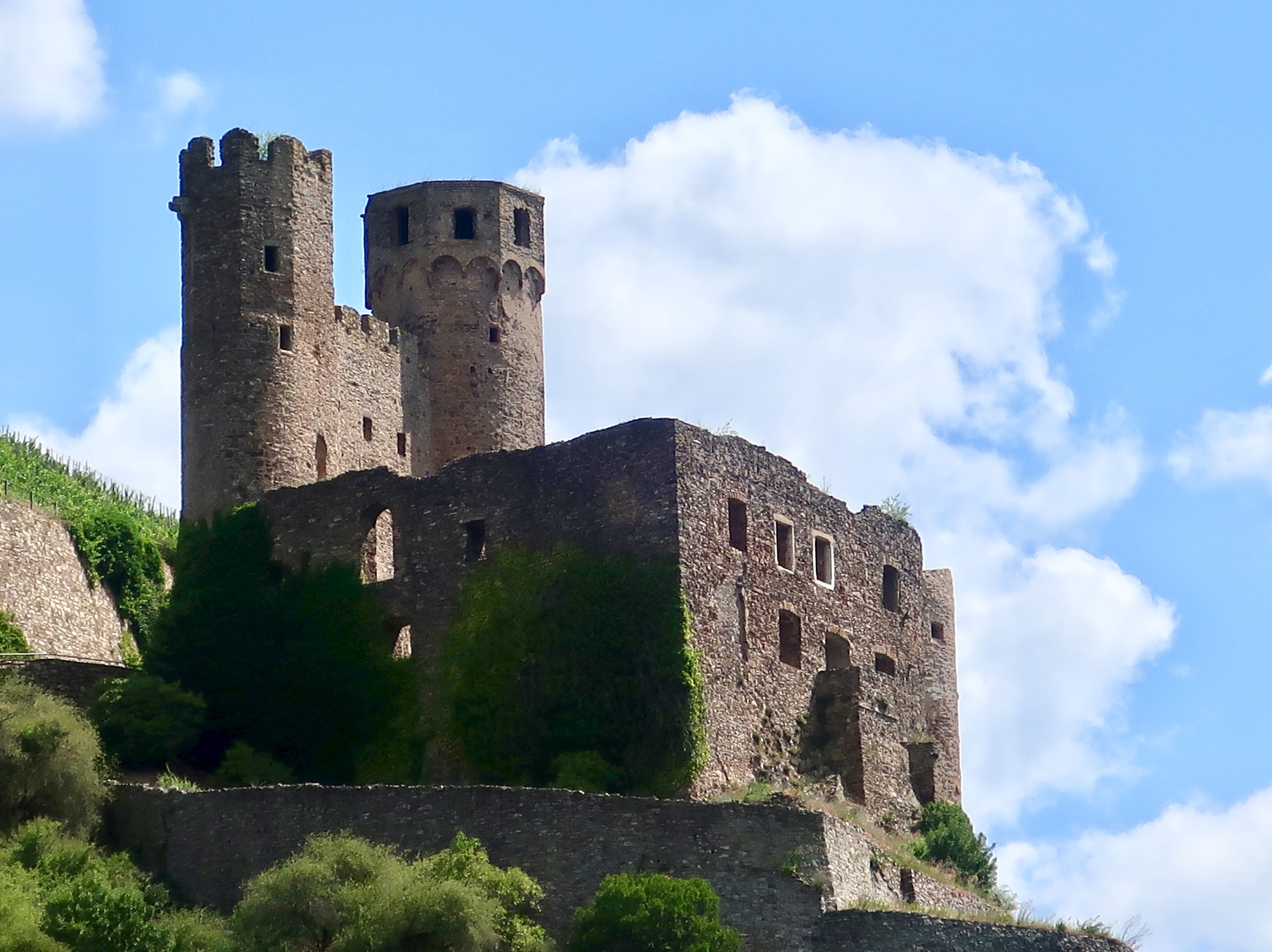
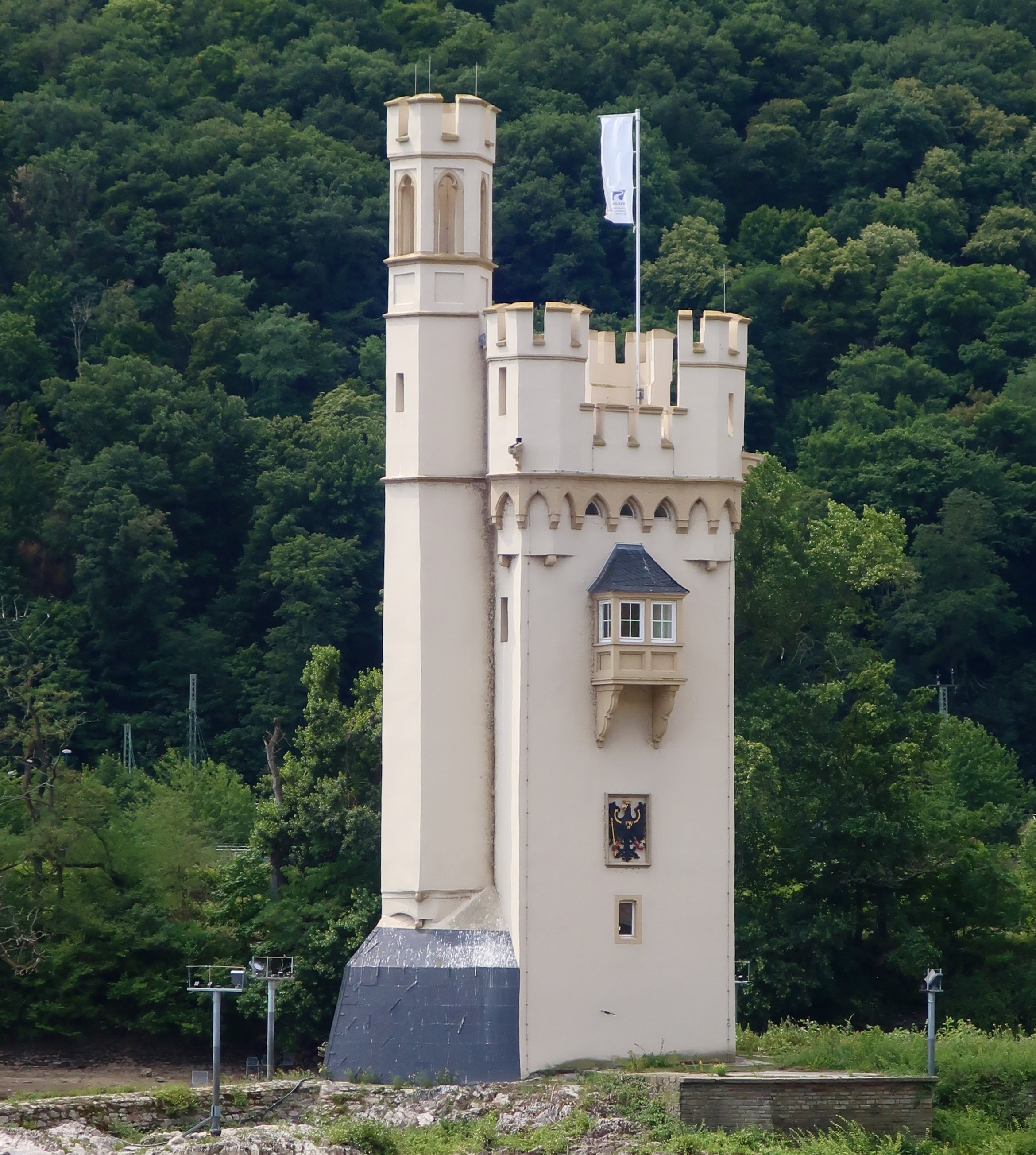
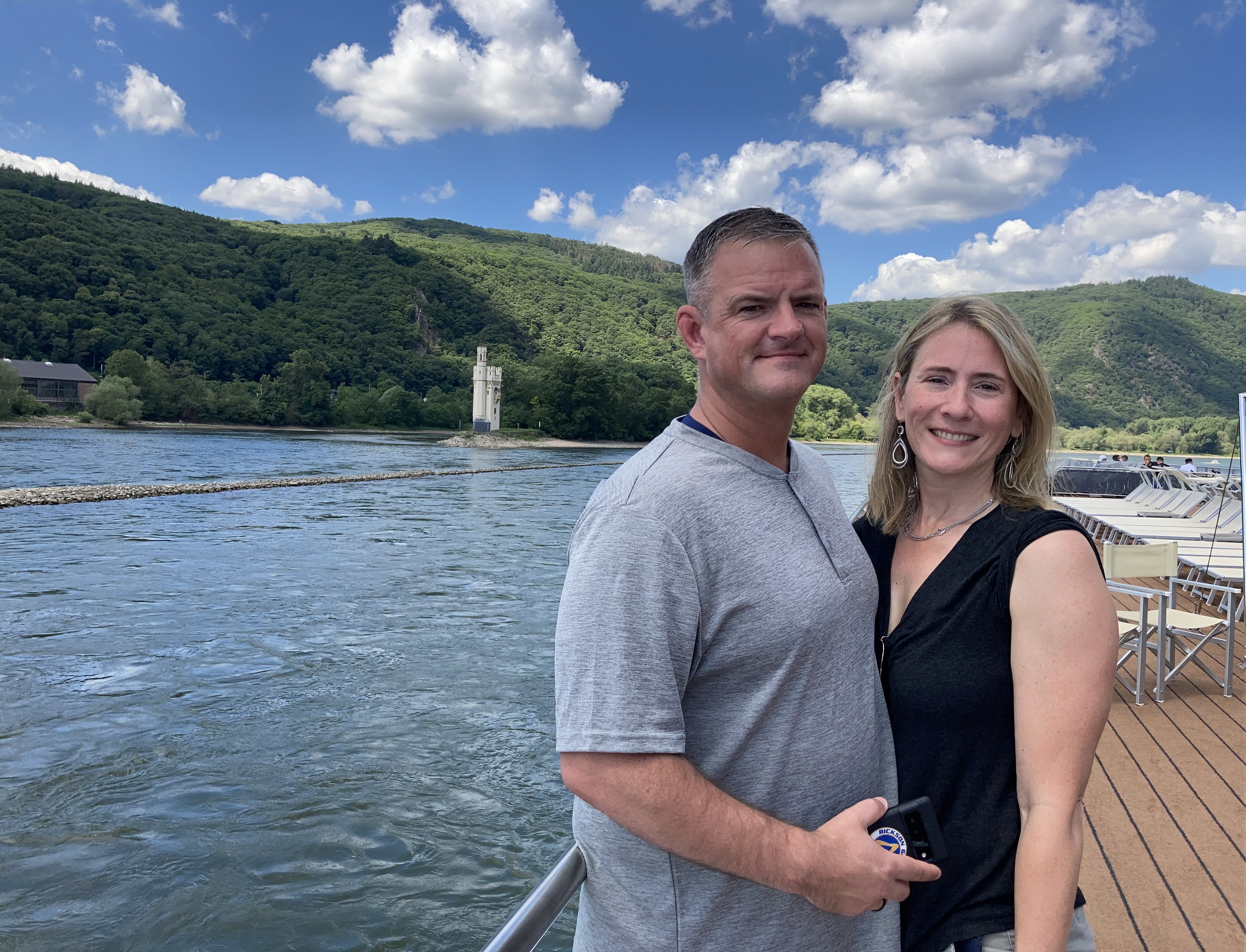
This hand-drawn map was given to us by Uniworld as we started our day of passing through the Rhine River Valley. I think they must have run out of the maps they normally gave out. But this one worked fine. Stozenfels Castle can be seen on the top left at approximately mile 587. I’ve estimated the mileage when it isn’t included on the map.I’ve already done a blog on the Marksburg Castle located at mile 580. If you haven’t read the post and want to, click on the link.Rheinfels, once a mighty fortress, was the largest castle along the Rhine. In 1692, it withstood an attack by 28,000 French troops. The French succeeded in leaving the castle in ruins a hundred years later, but it is still makes an impressive sight against the skyline today.A hotel and restaurant are now operated at Rheinfels, which is true of several of the castles. They provide an up-close-and-personal experience for visitors and help meet the expenses of maintaining the castles. Katz Castle was built just across the river from Rheinfels in the 1400s to help protect the castle and to coordinate with it in collecting tolls. It was blown up by Napoleon in 1806 and then rebuilt in the late 1800s. Today it is owned by a Japanese company that runs it as a hotel.Another view of Katz Castle.Built by King Ludwig, the Bavarian, in 1327 to collect tolls, Pfalz Castle is located on an island. The German town of Kaub ,with grape orchards climbing up the mountain behind it, provides a scenic backdrop. Rapids above the castle forced boats to pass near the castle and a chain assured they would stop. Traders unwilling to pay the toll, would be kept in the dungeon until a ransom was paid for their release. Remember my earlier comment about robber barons…A side view. Unlike the majority of castles along the Rhine, Pfalz was never conquered or destroyed. Gutenfels Castle, not included on my post today, can be seen in the upper left.Our son Tony, his wife Cammie and their three sons Cooper, Chris and Connor (left to right) with Pfalz Castle in the back ground.The Schönburg Castle, located near Pfalz Castle, dates back to somewhere around 1000 CE. It was burned down by French Soldiers in 1689 and remained in ruins until the late 1800s when it was bought from the nearby town of Oberwesel by an American family and restored. Ancestors of the appropriately named Rhinelander family had come from the region in the 1600s to the US and made a fortune in real estate. The town council of Oberwesel bought the property back from the Rhinelander family in 1950. A hotel and restaurant is now operated at Schönburg.Stahleck Castle at mile 543 was built in the 12th century as a fortified castle above the town of Bacharach. I was particularly impressed by the keep. In German, BTW, Stahleck means ‘impregnable castle on a crag.’Sooneck Castle at mile 538 looks like the embodiment of of what a castle is supposed to look like, at least to me. It was built to protect the surrounding territory. Built in the 11th Century it went through the usual history of being destroyed and rebuilt, destroyed and rebuilt.Another view of Sooneck Castle.The large Reichenstein Castle is located at mile 534. Built in the 12th Century, it was owned by a robber baron like Castle Sooneck, and, like Sooneck, it suffered the same fate of being destroyed. It was rebuilt to its present status in the 18th and 19th centuries. We will be visiting Rheinstein Castle in my next post so I will hold on any discussion until then. But isn’t it magnificent perched on its rocky prominence!Surrounded by walls and grapes, the two towers of Ehrenfels Castle caught our attention. Today it remains in pretty much the same condition it was in when destroyed in 1689.A closer look at the two towers of Ehrenfels Castle.Mouse Castle, located below Ehrenfels Castle on the Rhine River, has a story connected to how it got its name. According to the folk tale, a particularly cruel man, Hatto II, performed a dastardly deed of burning alive several of his peasants and a number of mice as well. Seeking revenge, mice attacked Hatto. Lots of them. He fled to his tower in the river thinking the mice couldn’t swim. Bad choice. While thousands died, thousands more made it to the castle. They ate through the door, crawled up the stairs and ate Hatto alive. I once watched army ants eat a mouse alive in Africa. There may be a message here: whether you are a man or a mouse, being eaten alive is not a pleasant experience.Our daughter Tasha and her husband Clay with the Mouse Castle in the background.I’ll conclude today’s post with a photo of Tasha and Clay’s two boys, Cody and Ethan, posing with G’ma Peggy. Our next post will be a visit to Rheinstein Cast where we were turned loose to explore the castle on our own.
We hung out on the upper deck of our river boat with our eyes peeled on the surrounding hills as we made our way through the Rhine River Valley, admiring the some 40 castles overlooking the river. The Marksburg, featured above, was special. Not only is it the best preserved castle along the Rhine, it is considered a jewel in the Rhine Gorge UNESO World Heritage Site and we had just visited. We were excited to see it from below.One advantage of our leisurely trip up the Rhine, was that it provided us with ample opportunity to enjoy different perspectives of the castles. (Photo by Peggy Mekemson.)
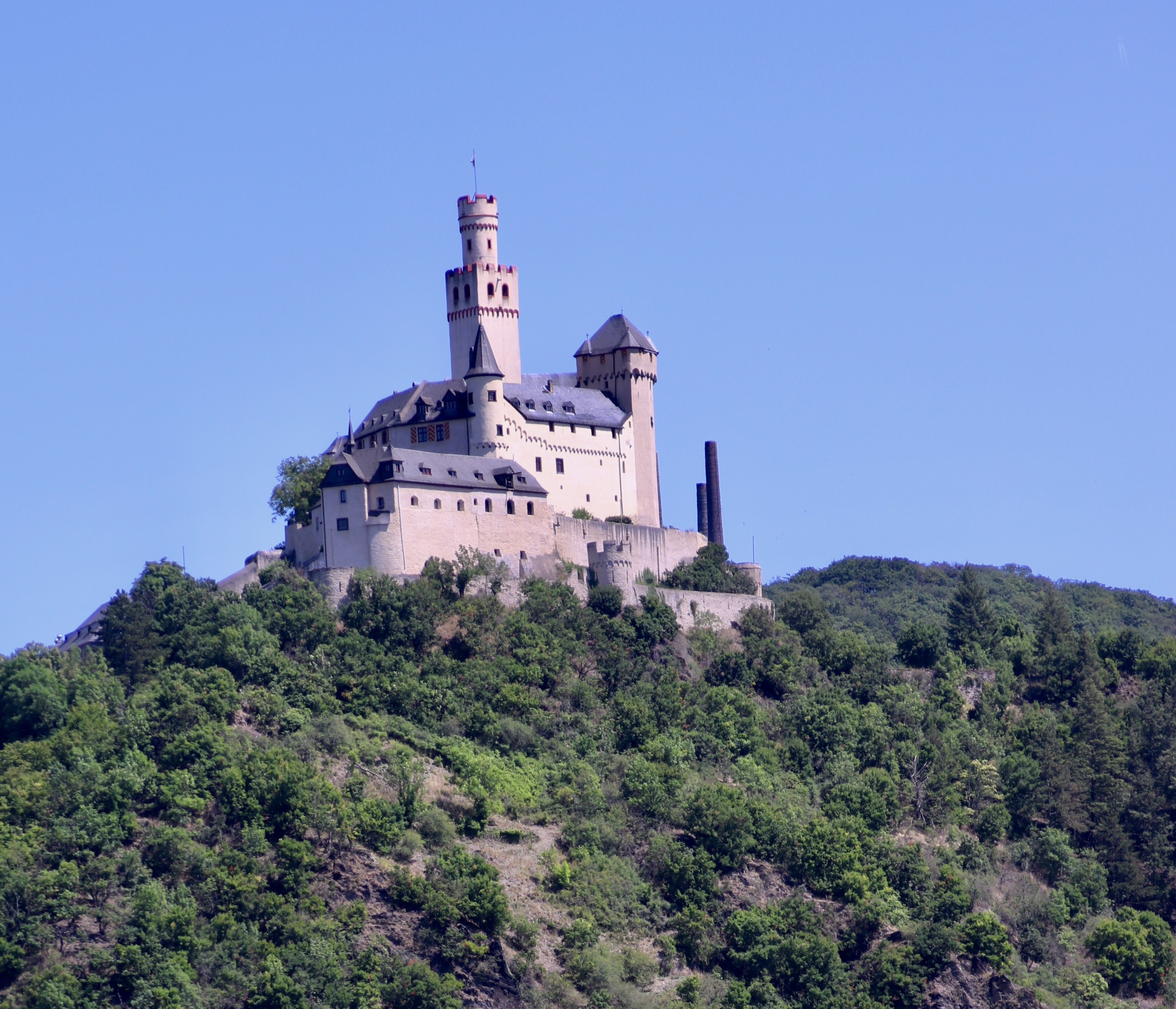
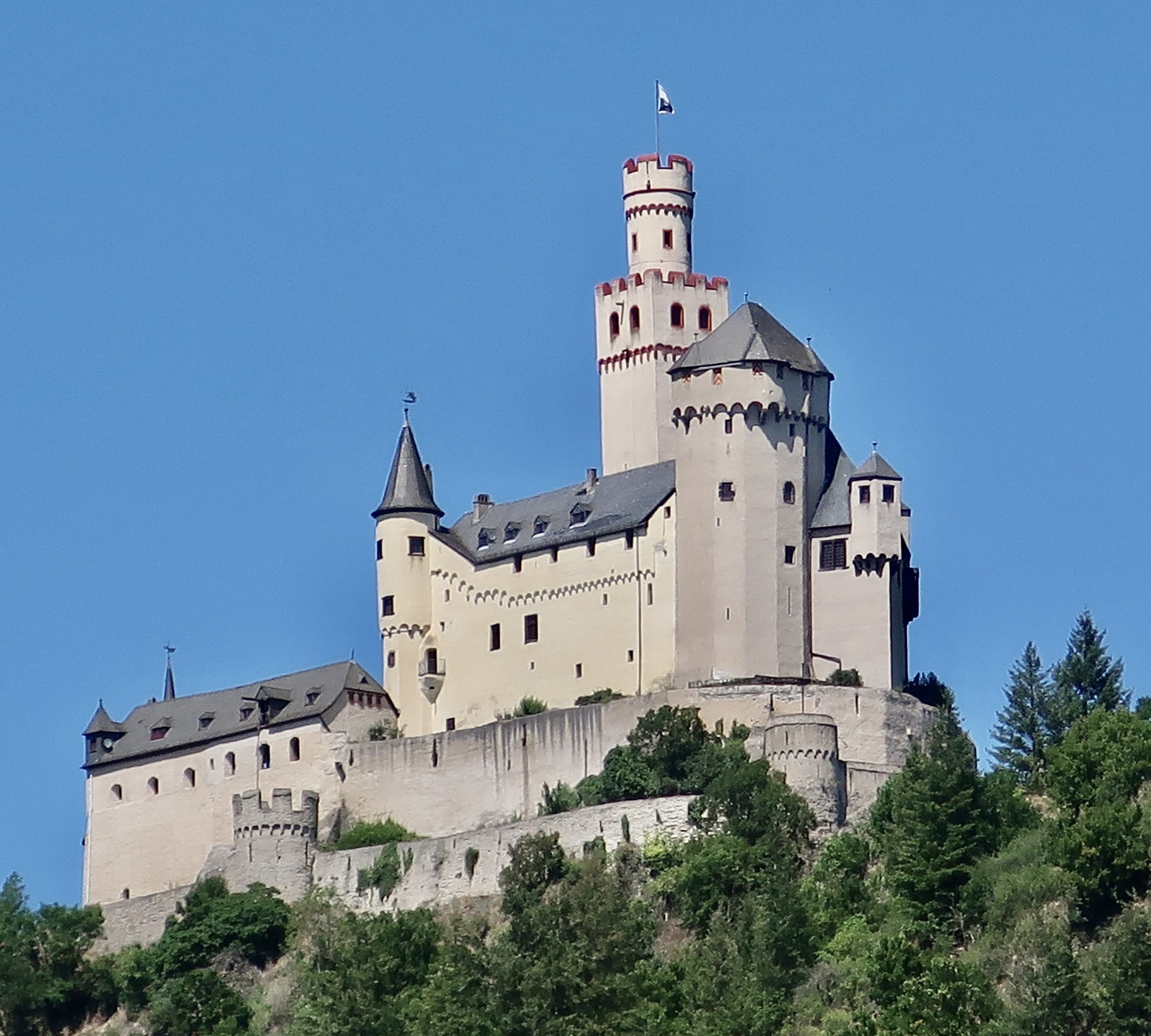
It’s hard to imagine a better way to kick off a journey through Rhine River Valley from Koblenz to Mainz than a visit to Marksburg Castle. Originally built in 1100 CE as protection for the town of Braubach, it was owned by various noble families down through the centuries until it was sold to the German Castles Association in 1900. It had been established a year earlier to preserve castles in Germany. Today, Marksburg serves as headquarters for the Association.
We made our way up to the castle via a route that challenged our bus driver to maneuver along a curvy, narrow road that had originally been built to accommodate foot and horse traffic. If you’ve spent any time driving in medieval European towns, you are familiar with the problem. We were met by our guide who ushered us into the castle and provided an excellent tour. Three things captured my attention: The structure of the castle, its collection of knights and their armor, and a bit on medieval life.
All of the photos in this post are taken by either Peggy or me unless otherwise noted.
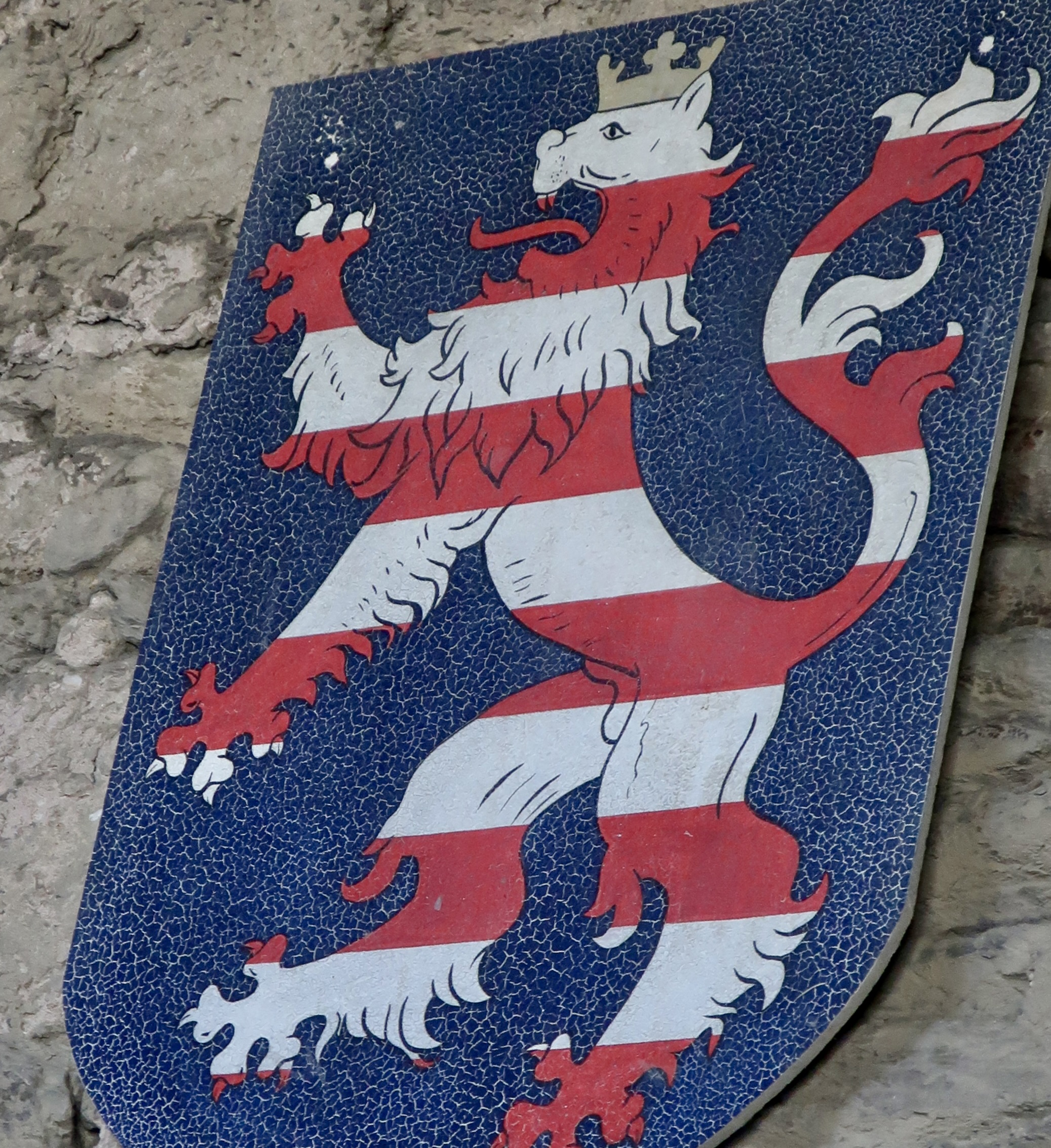
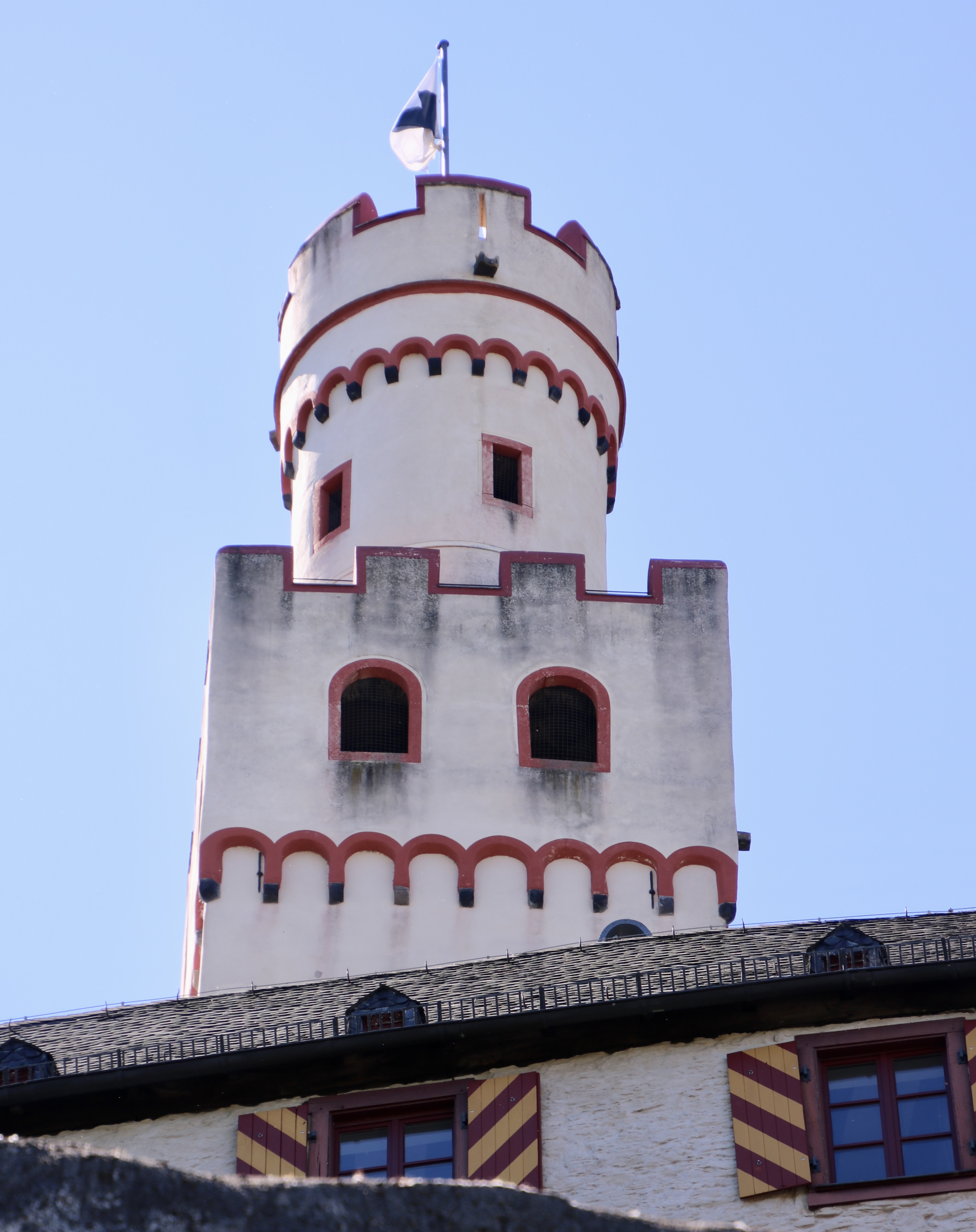
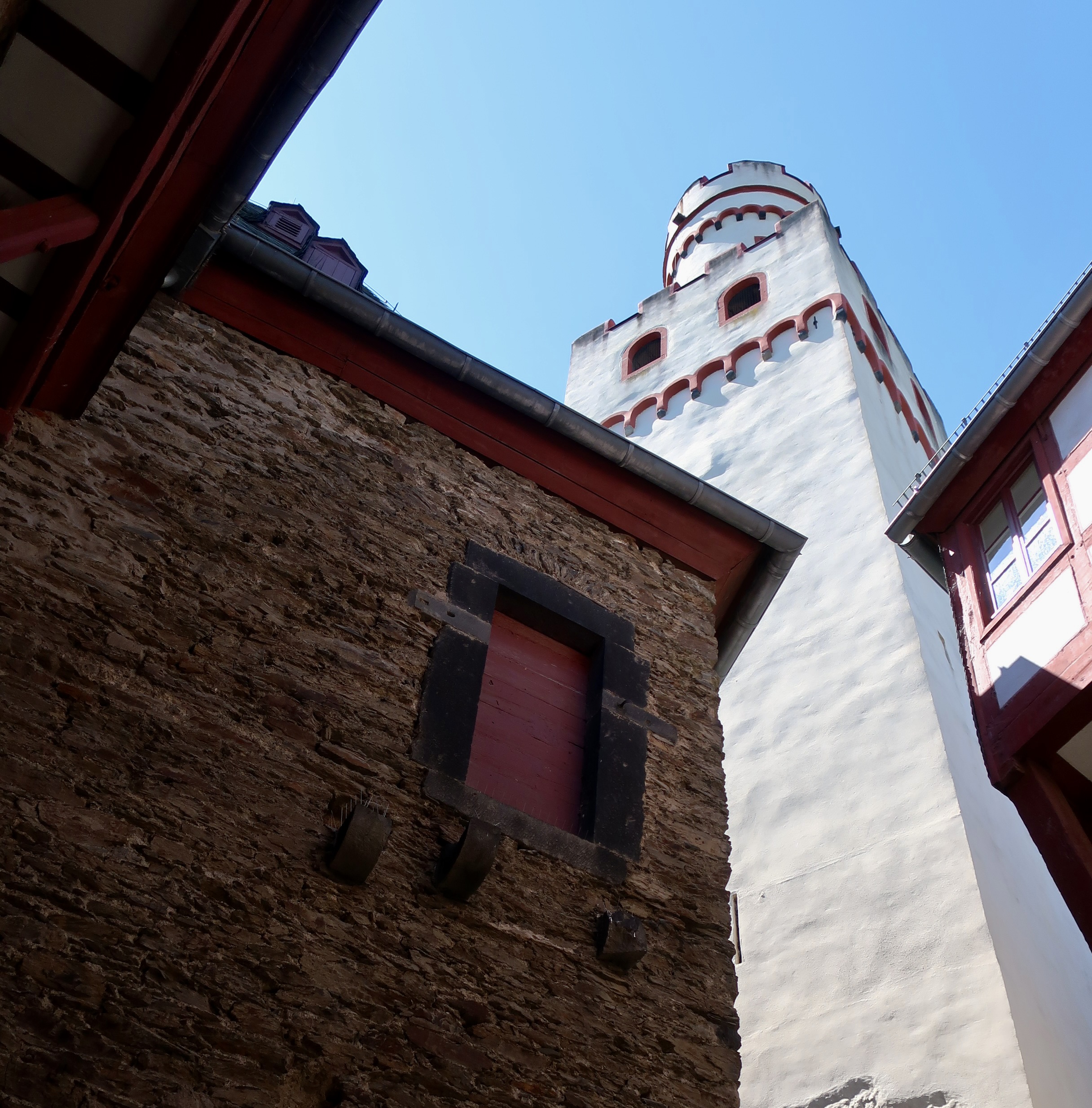
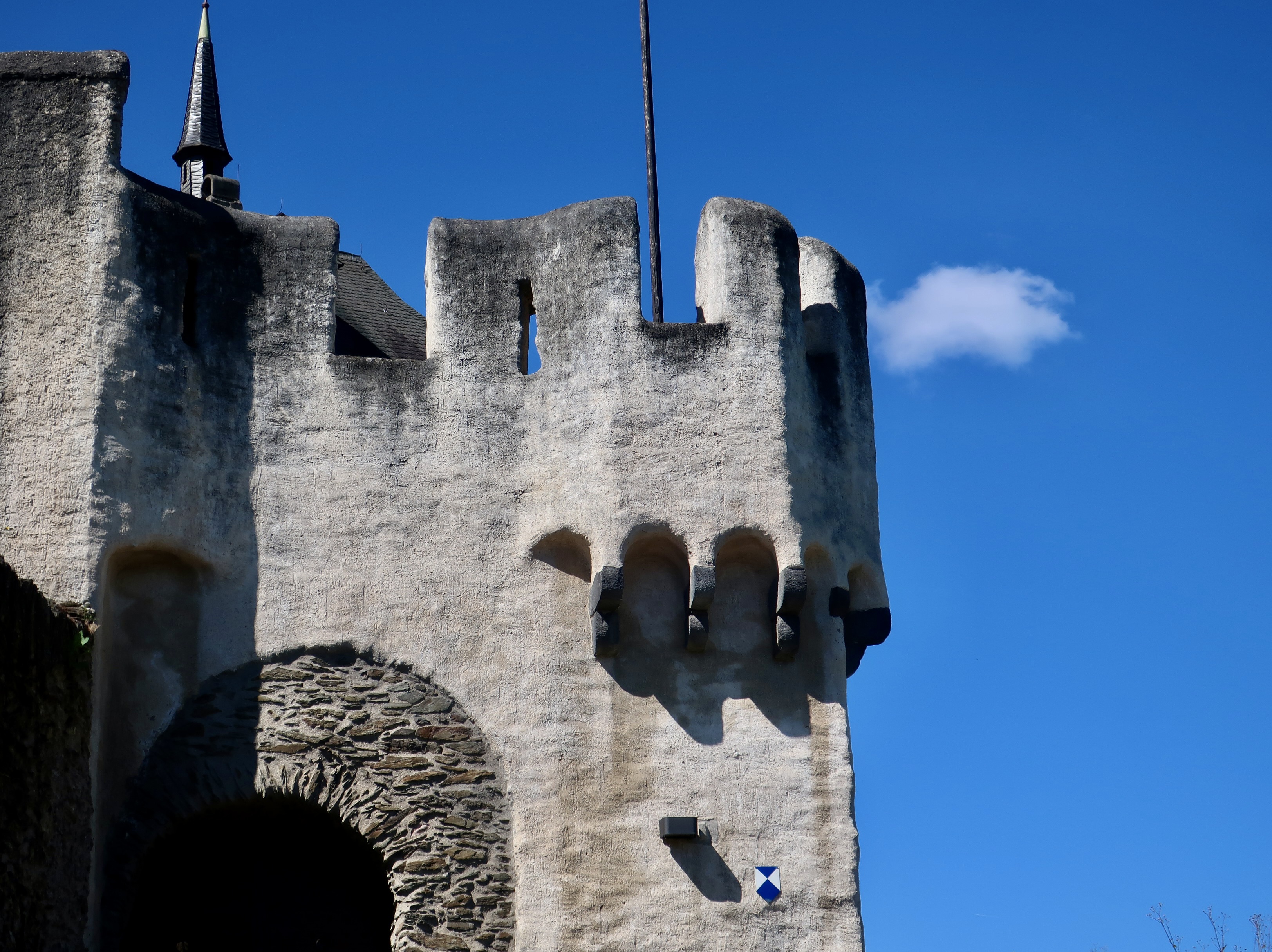
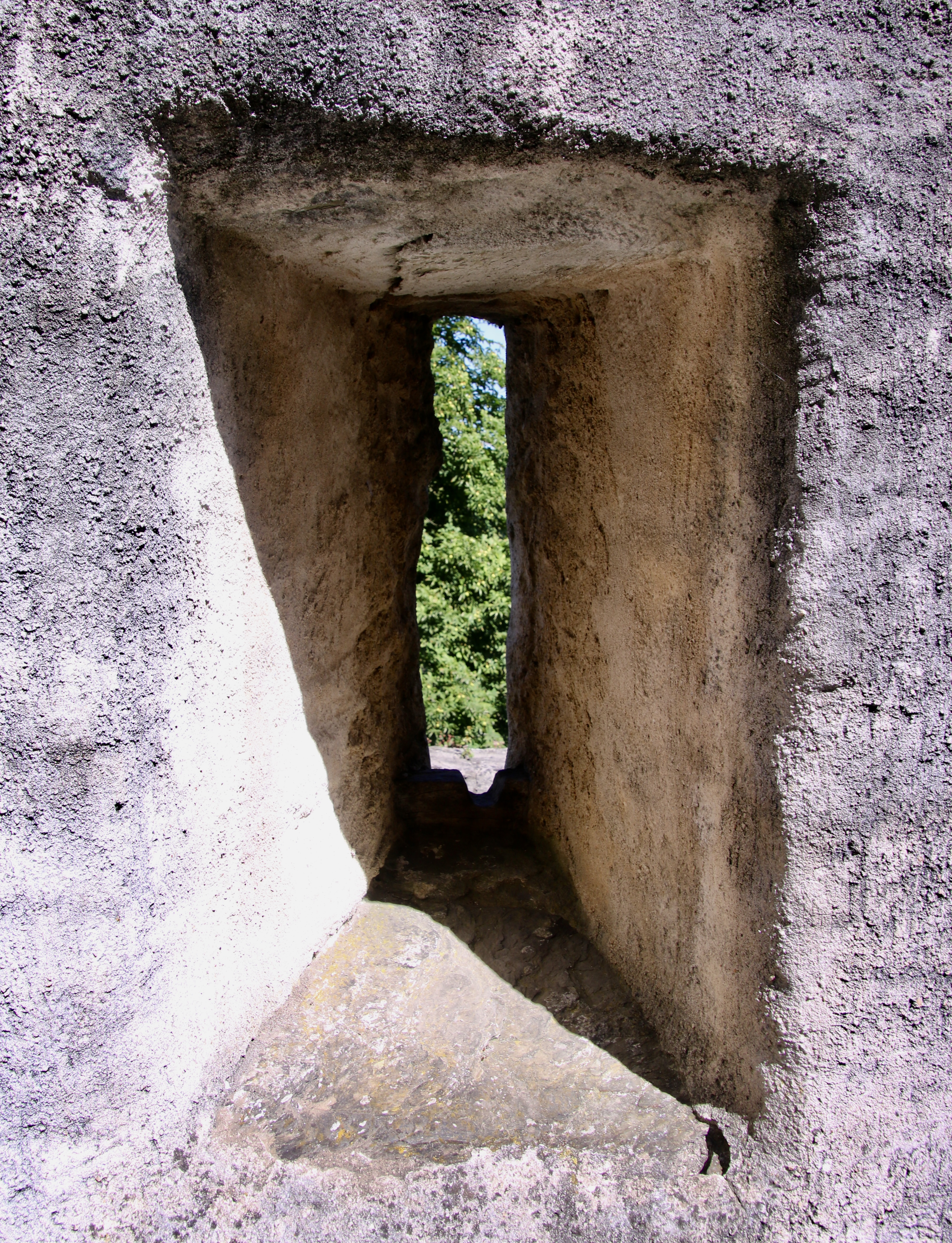
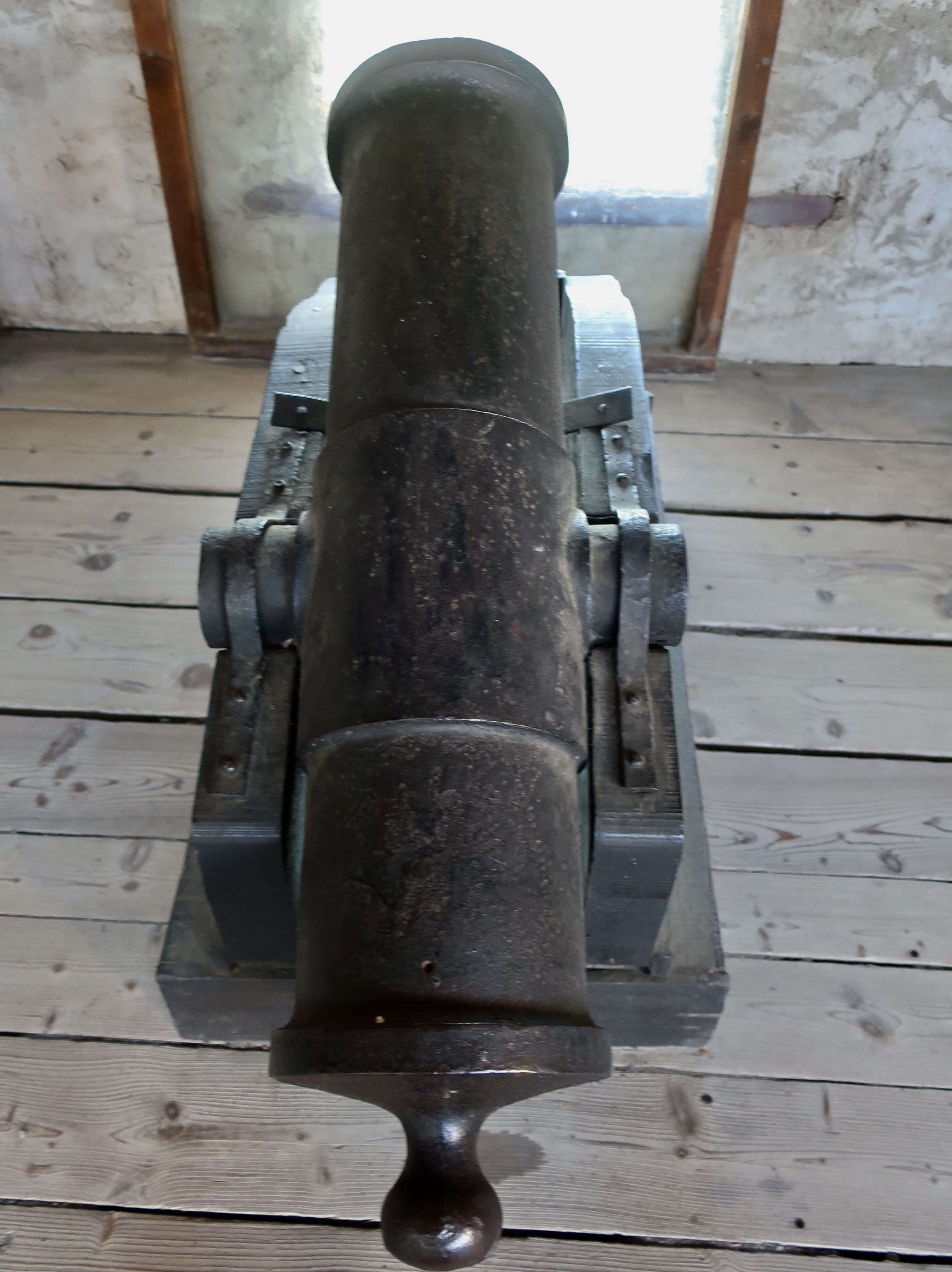
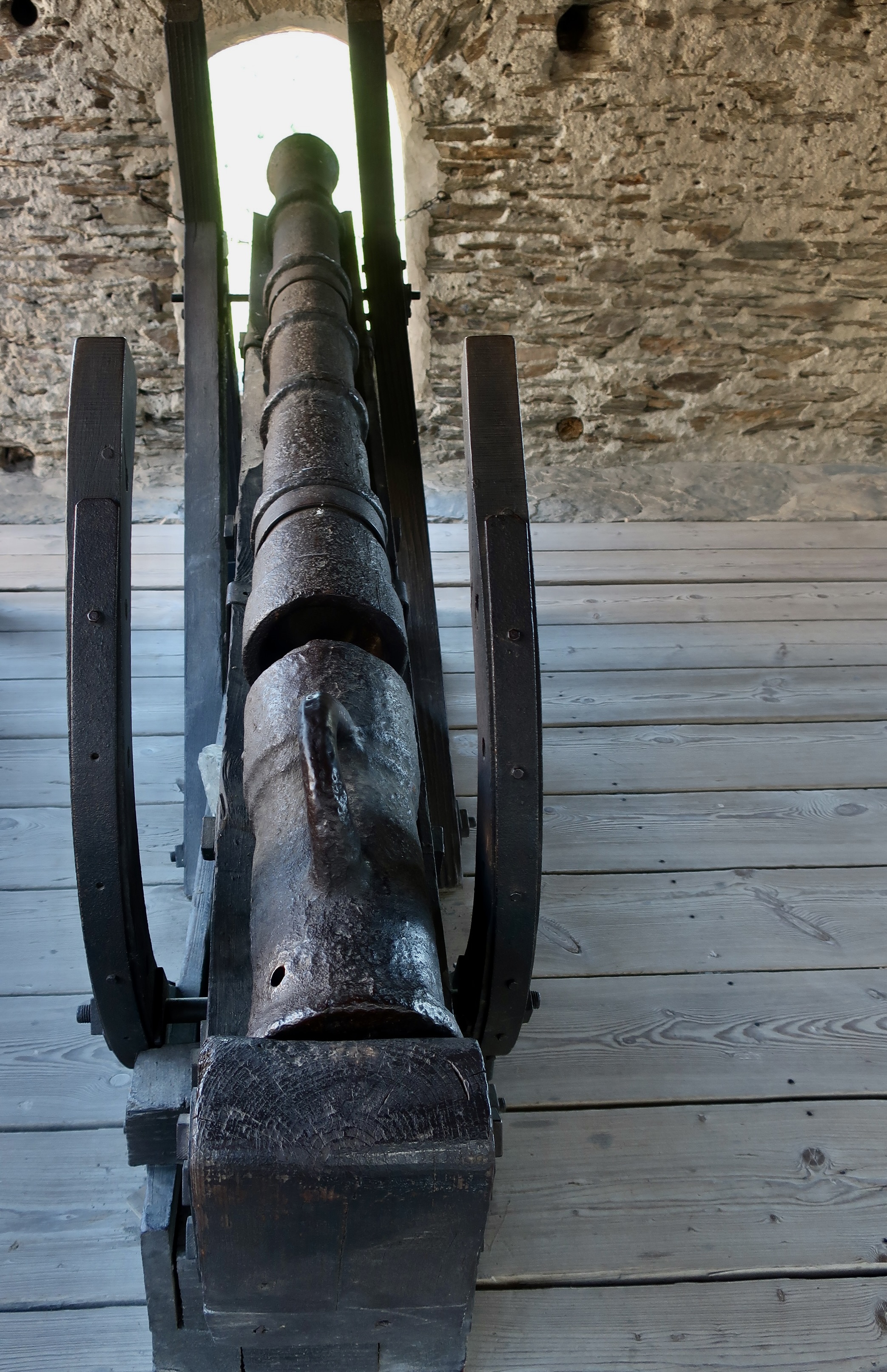
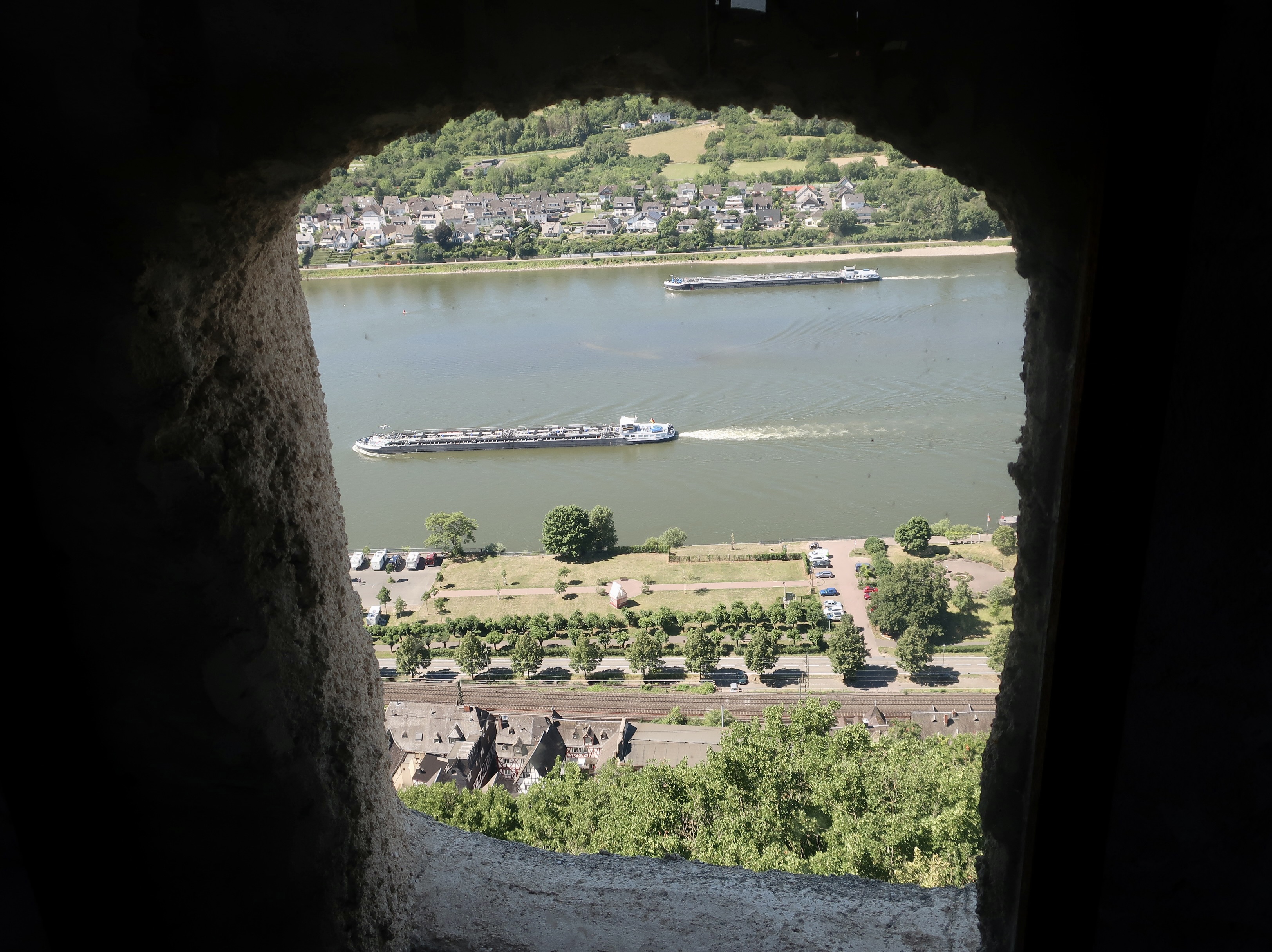
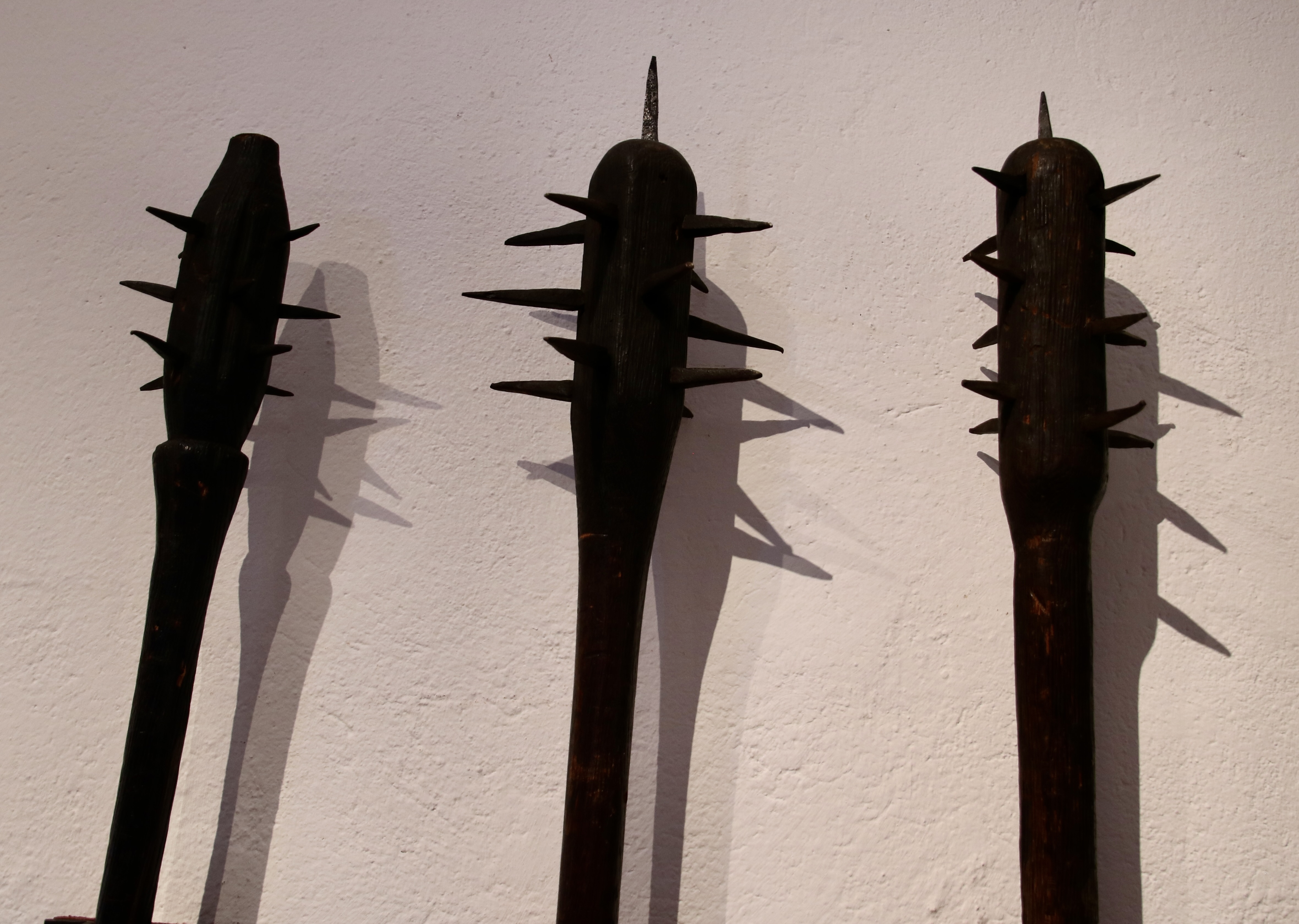
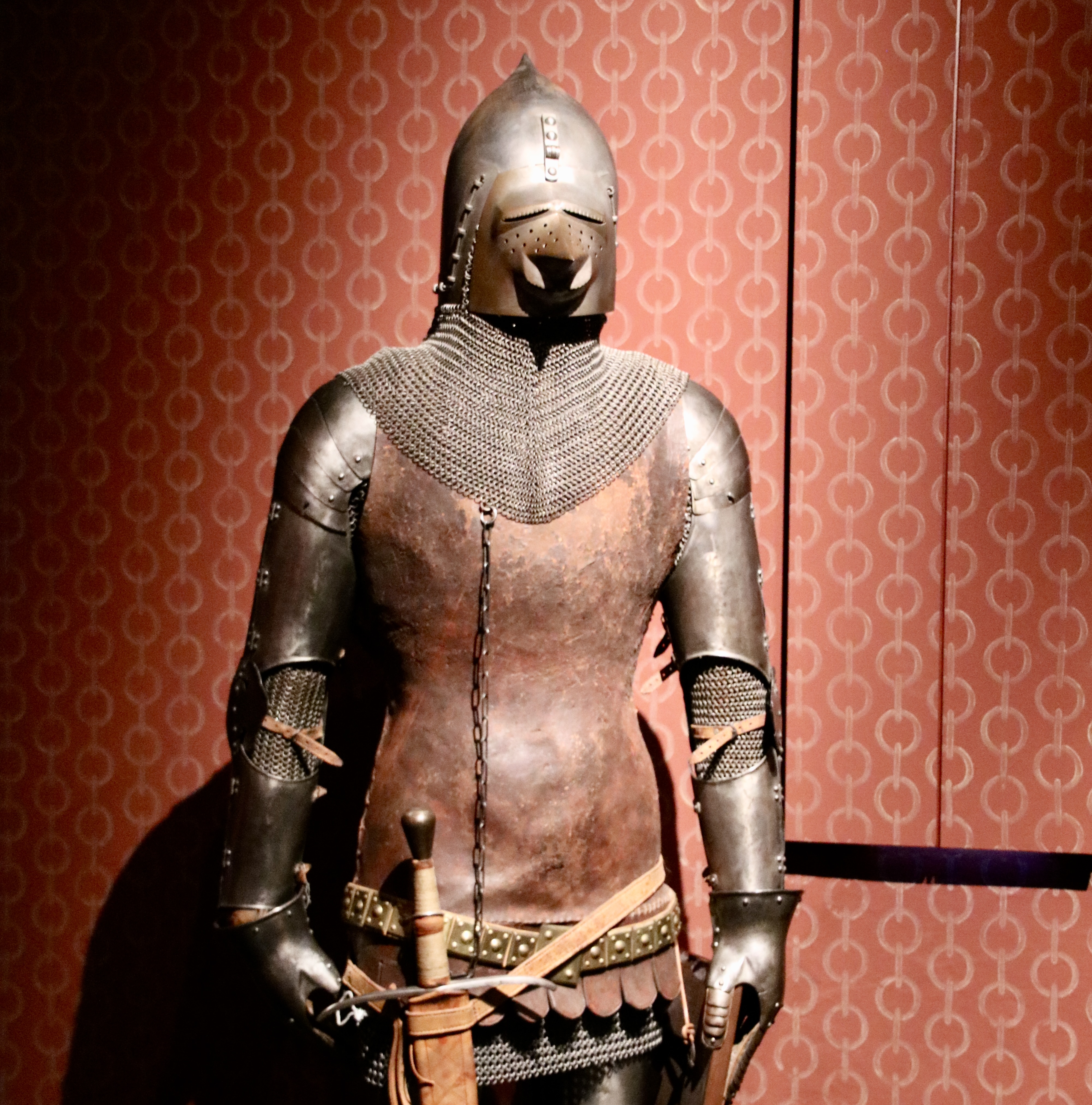
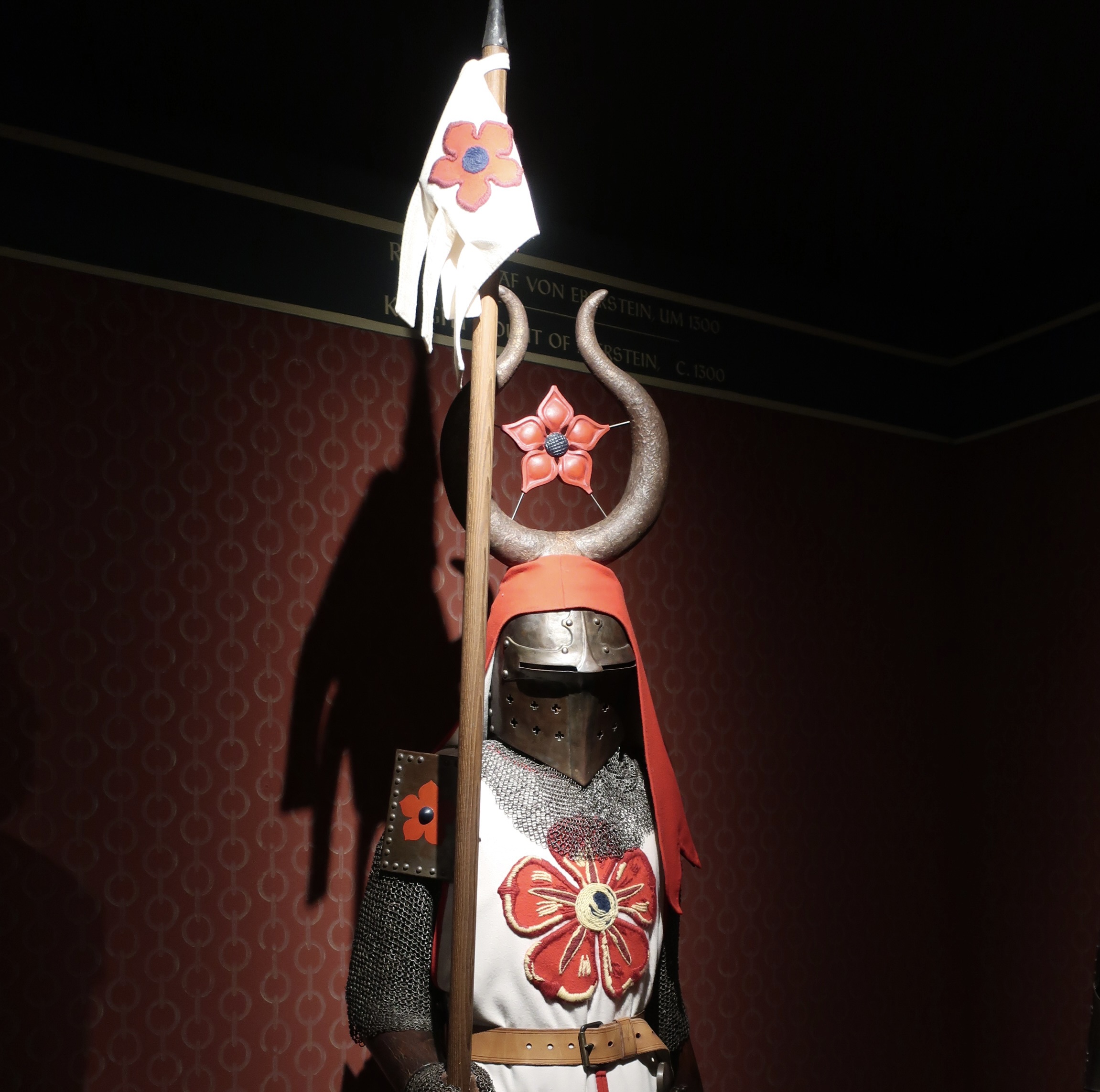
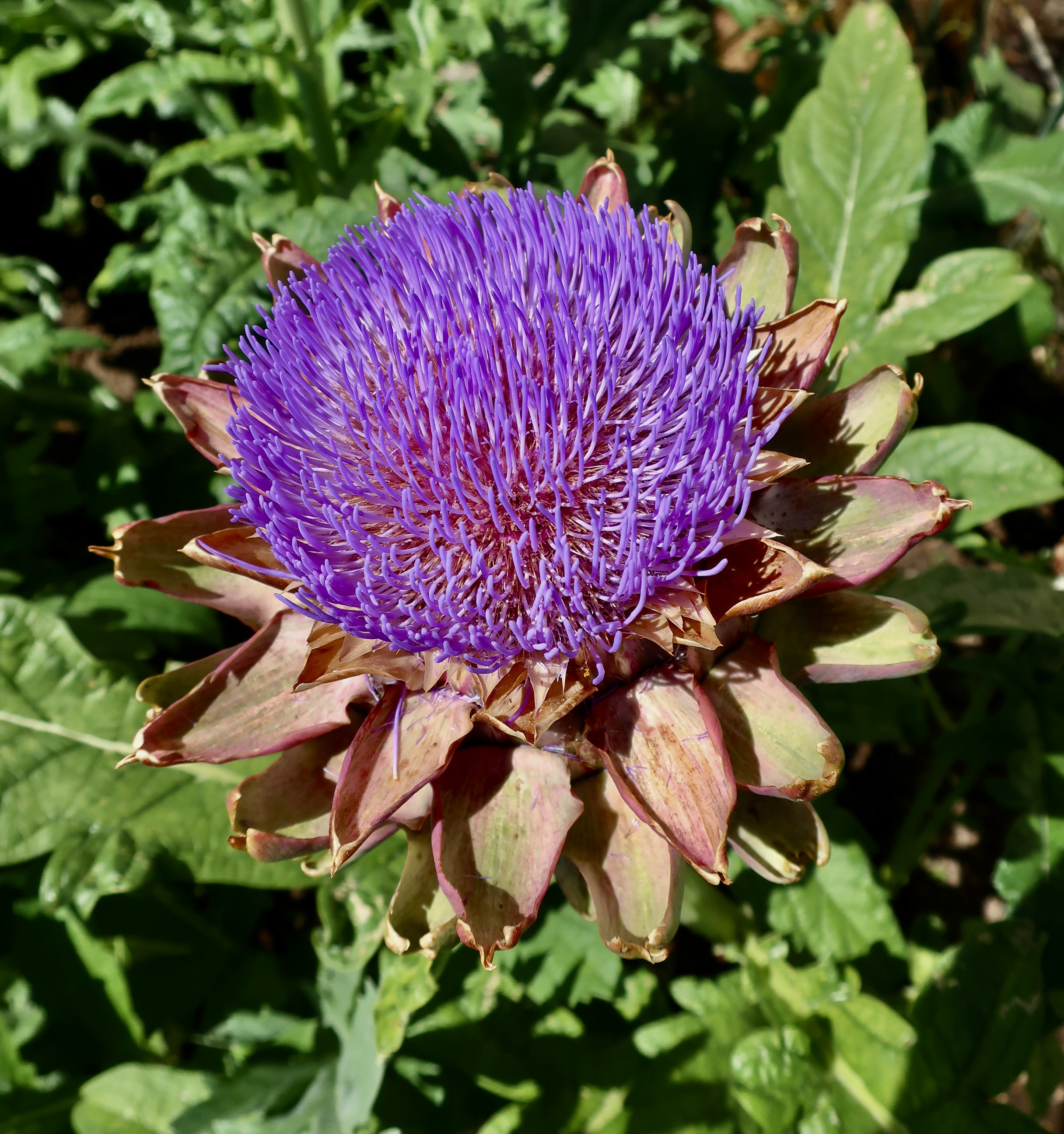
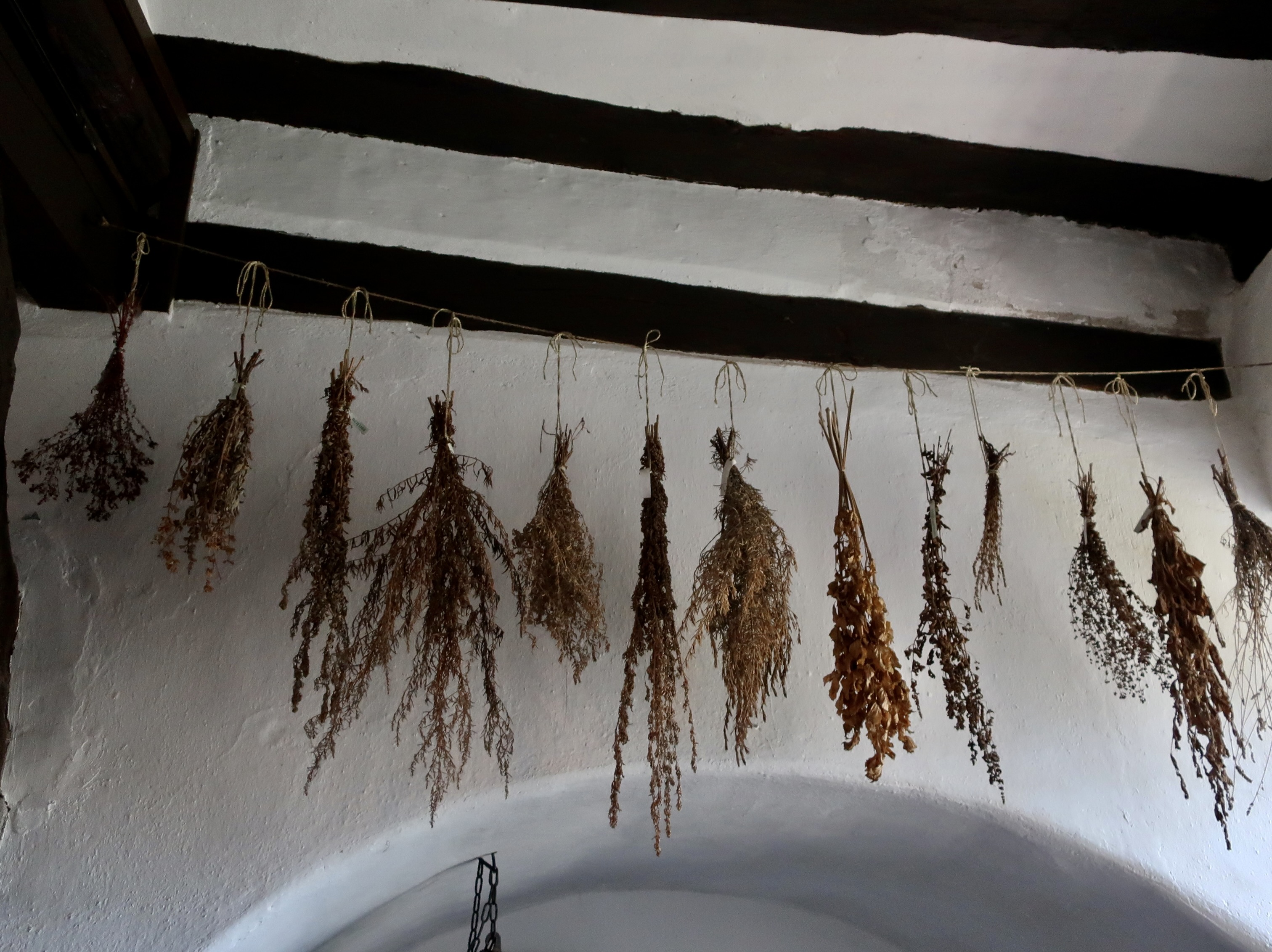
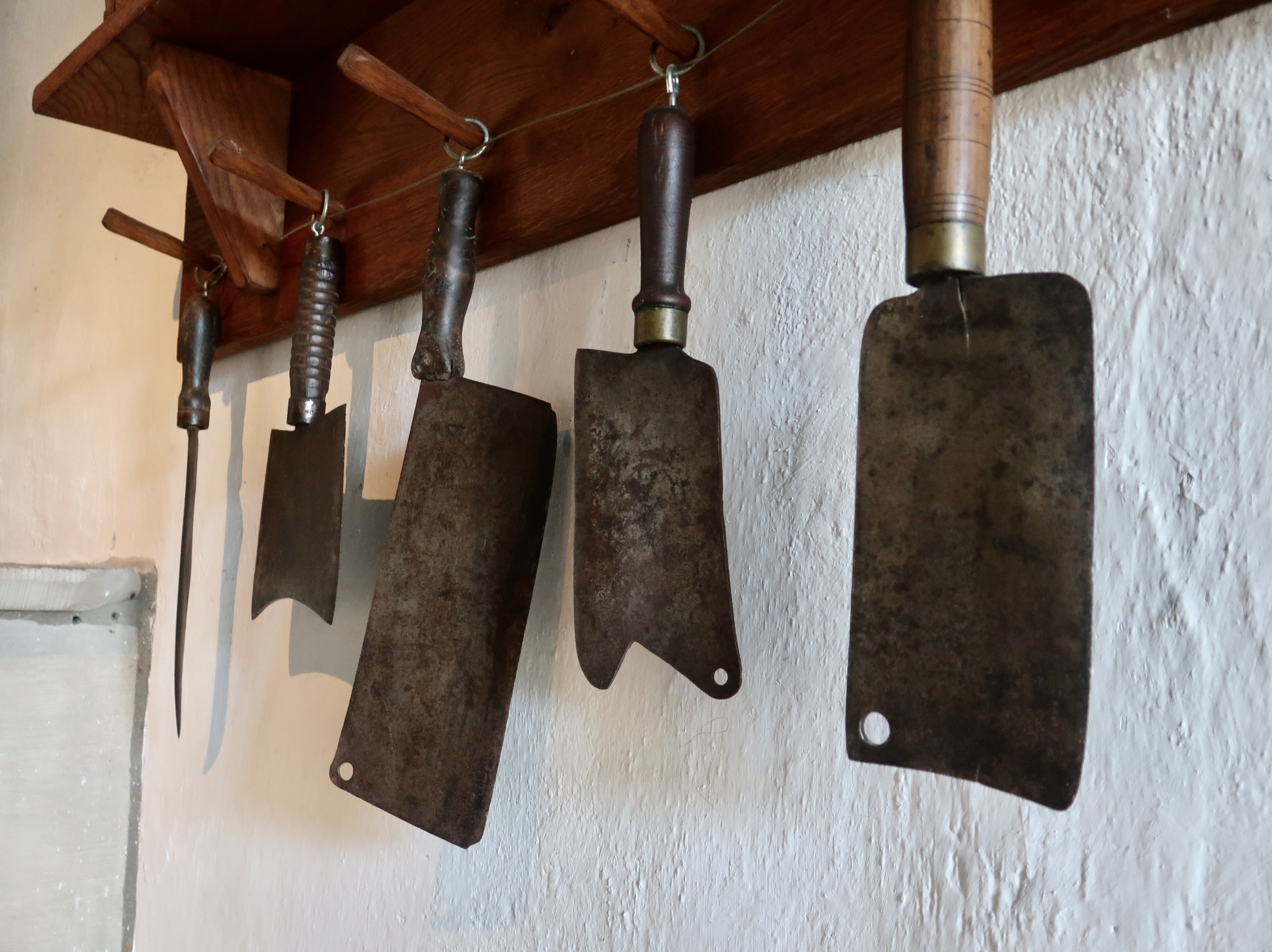
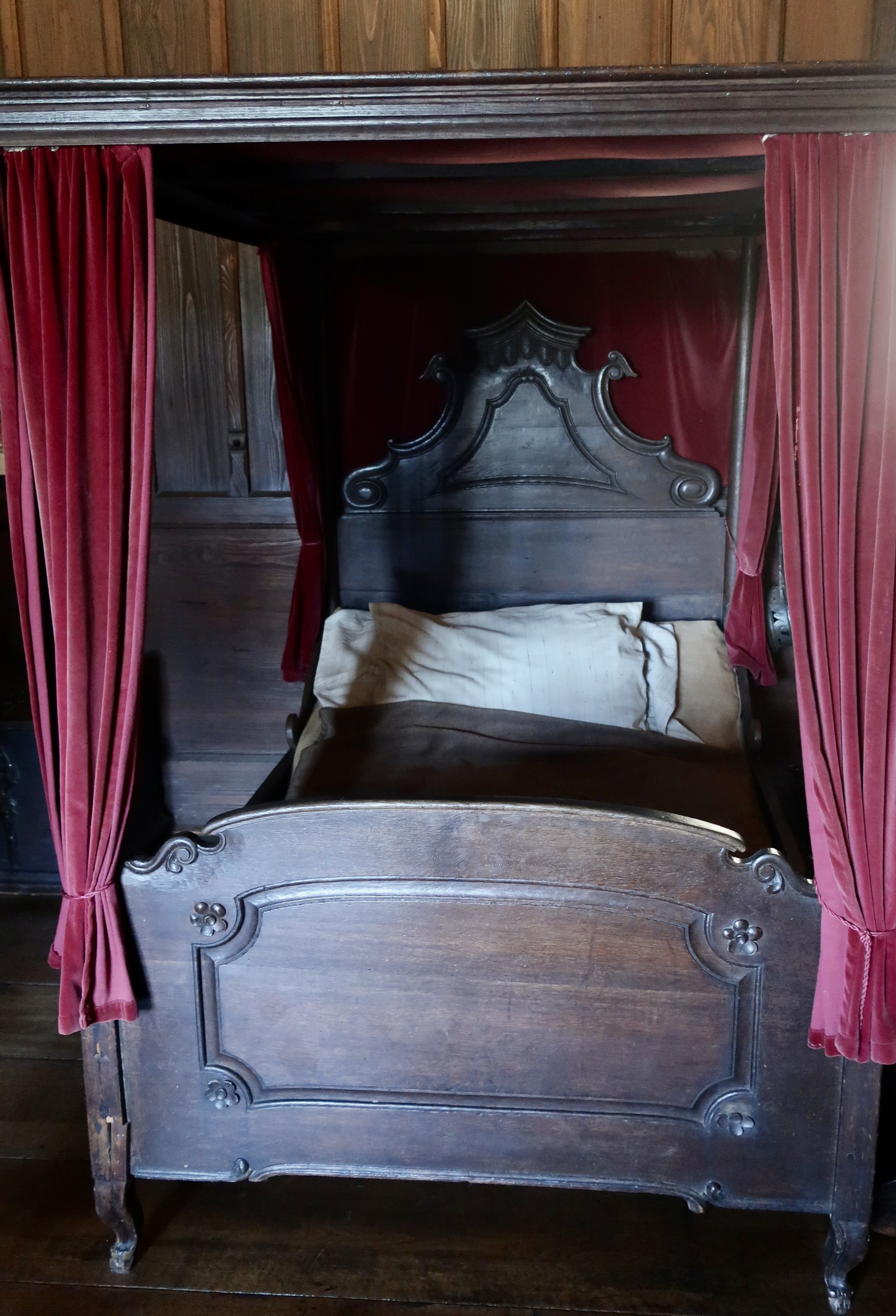
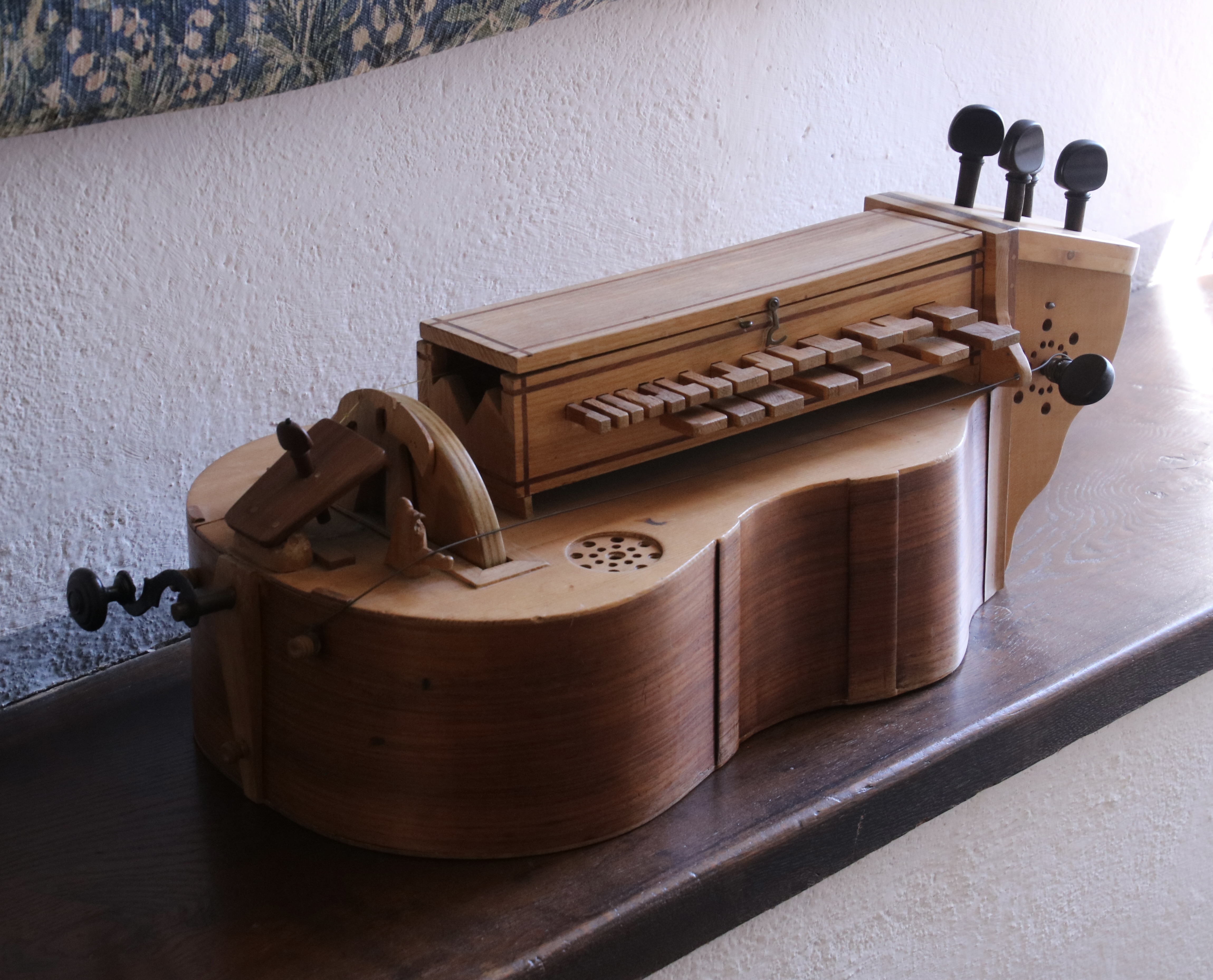
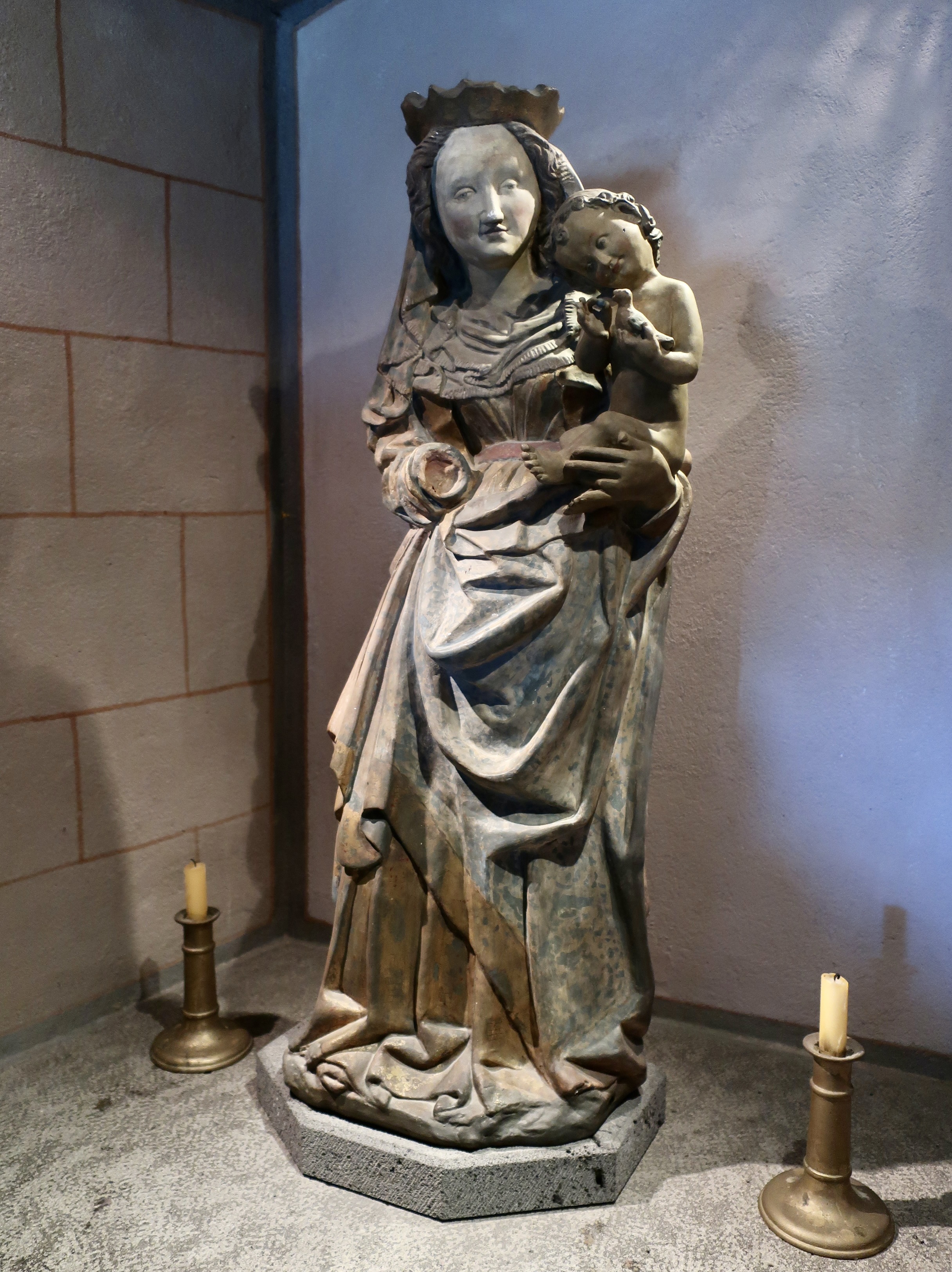
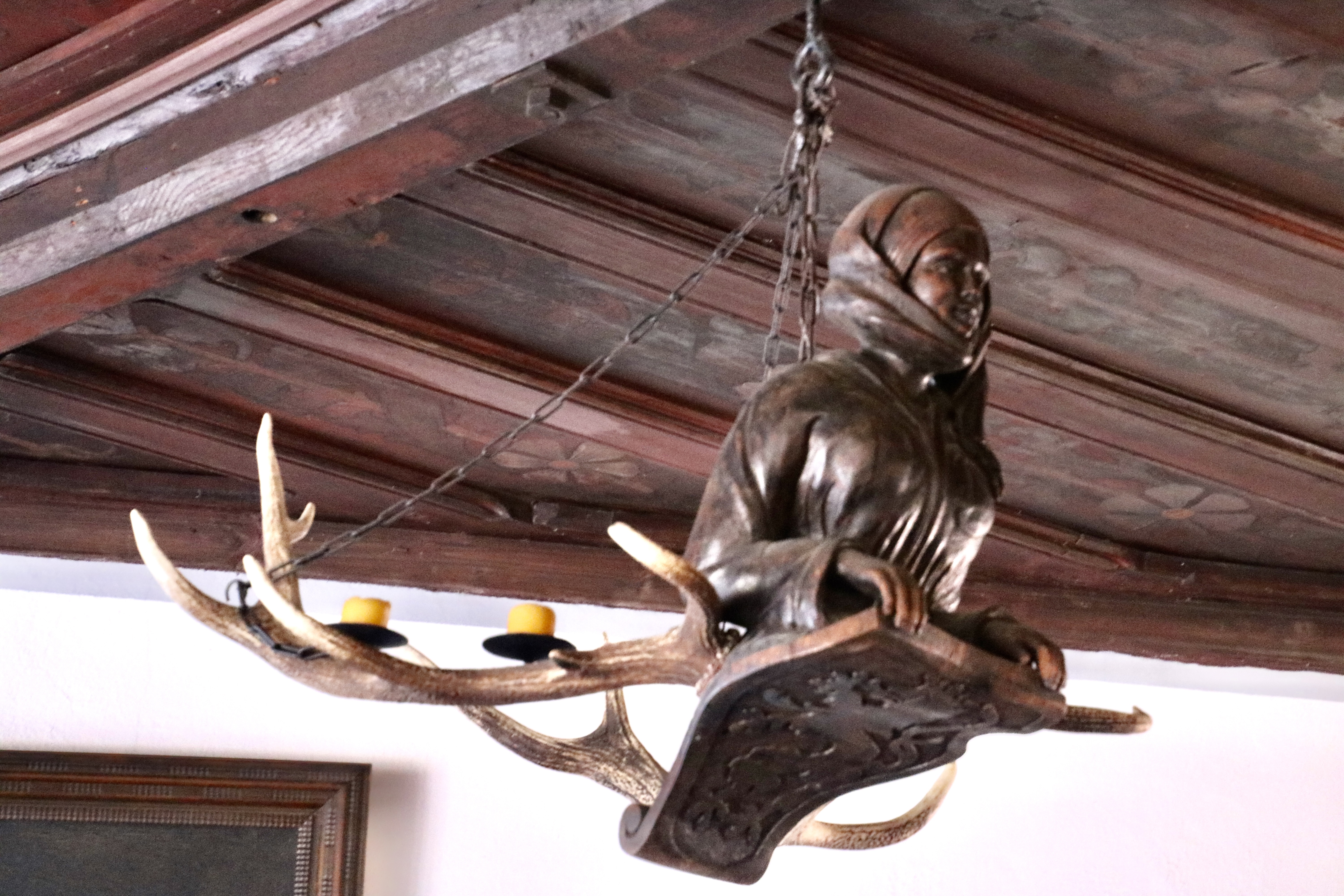
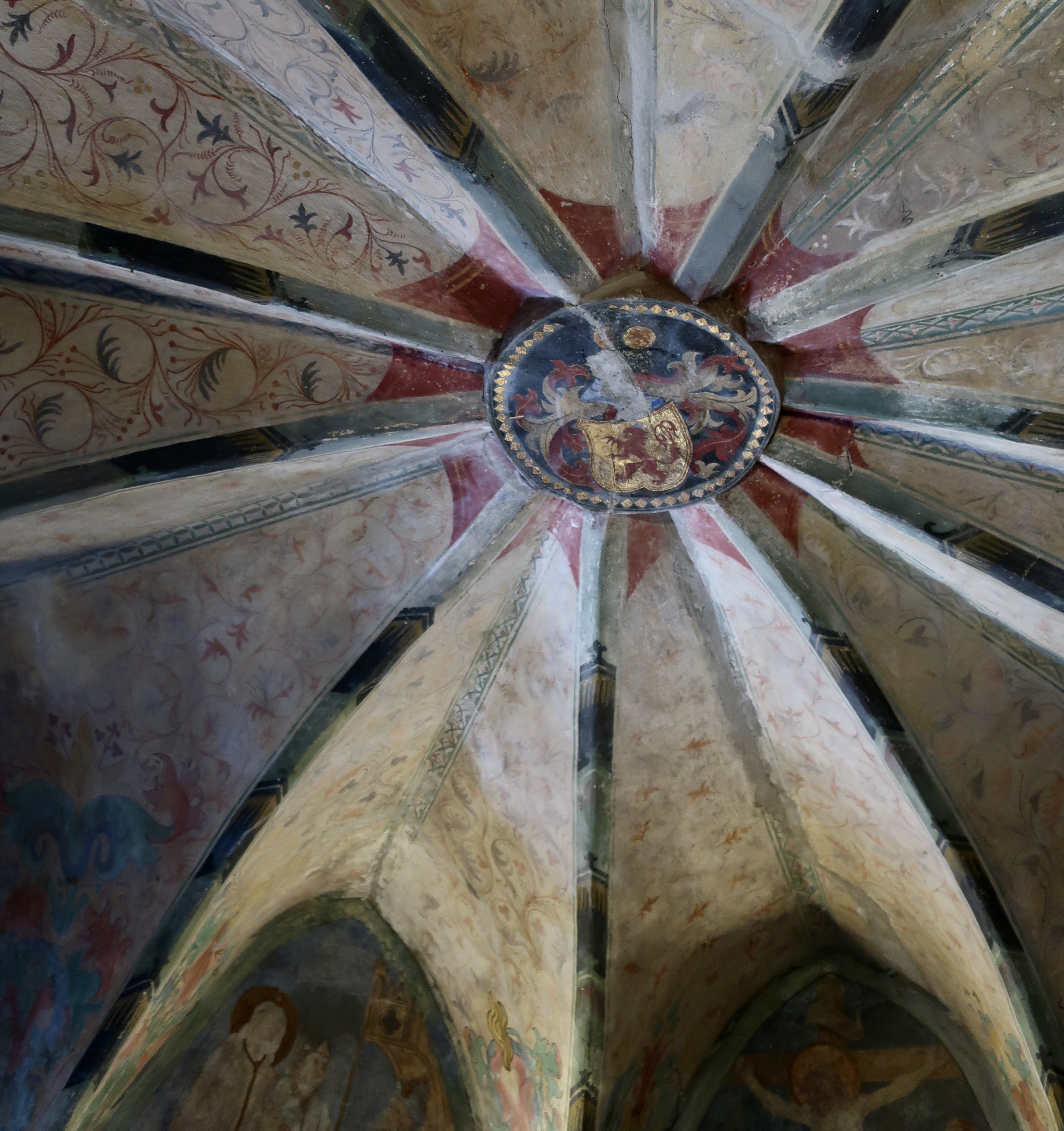
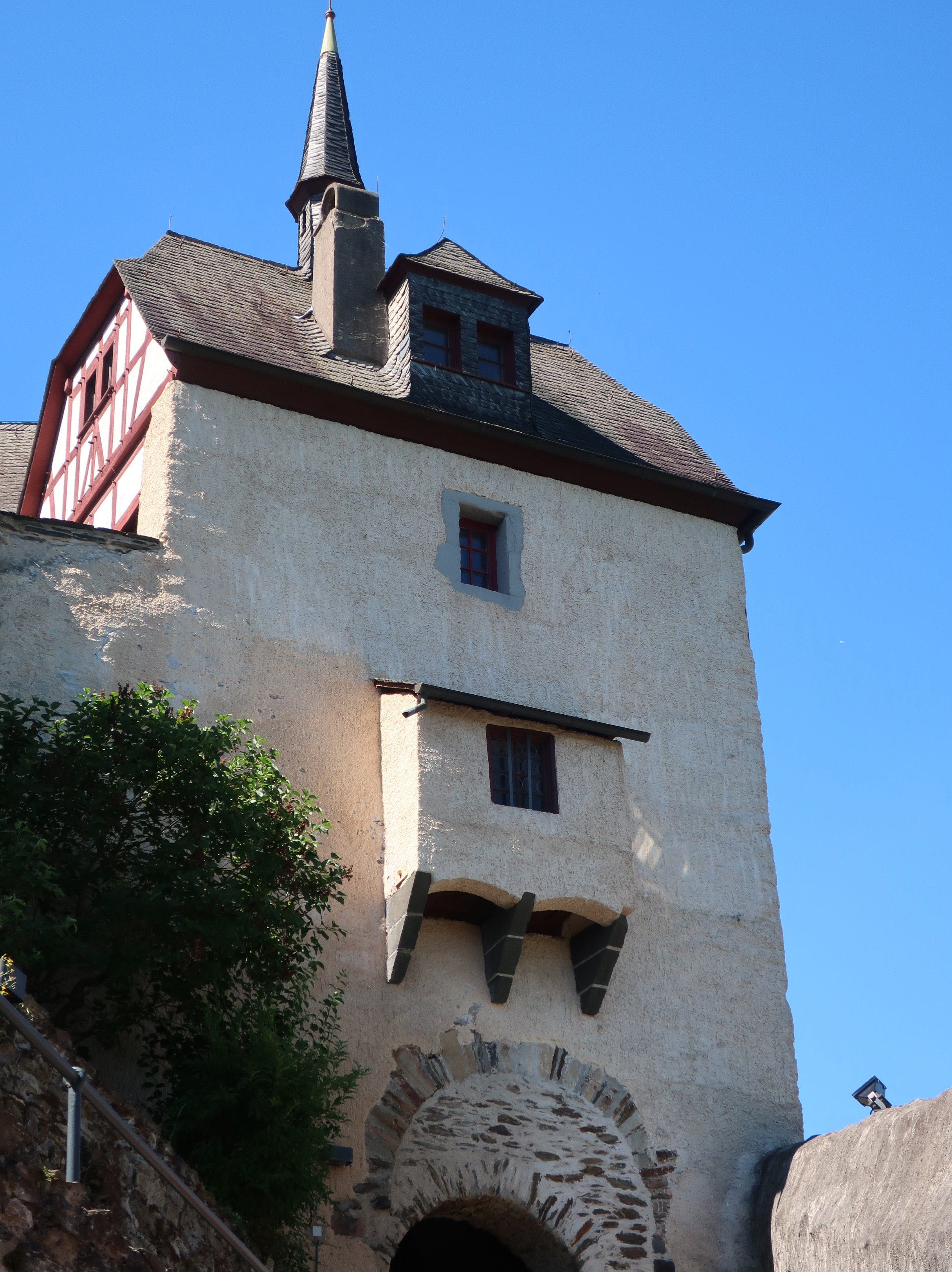
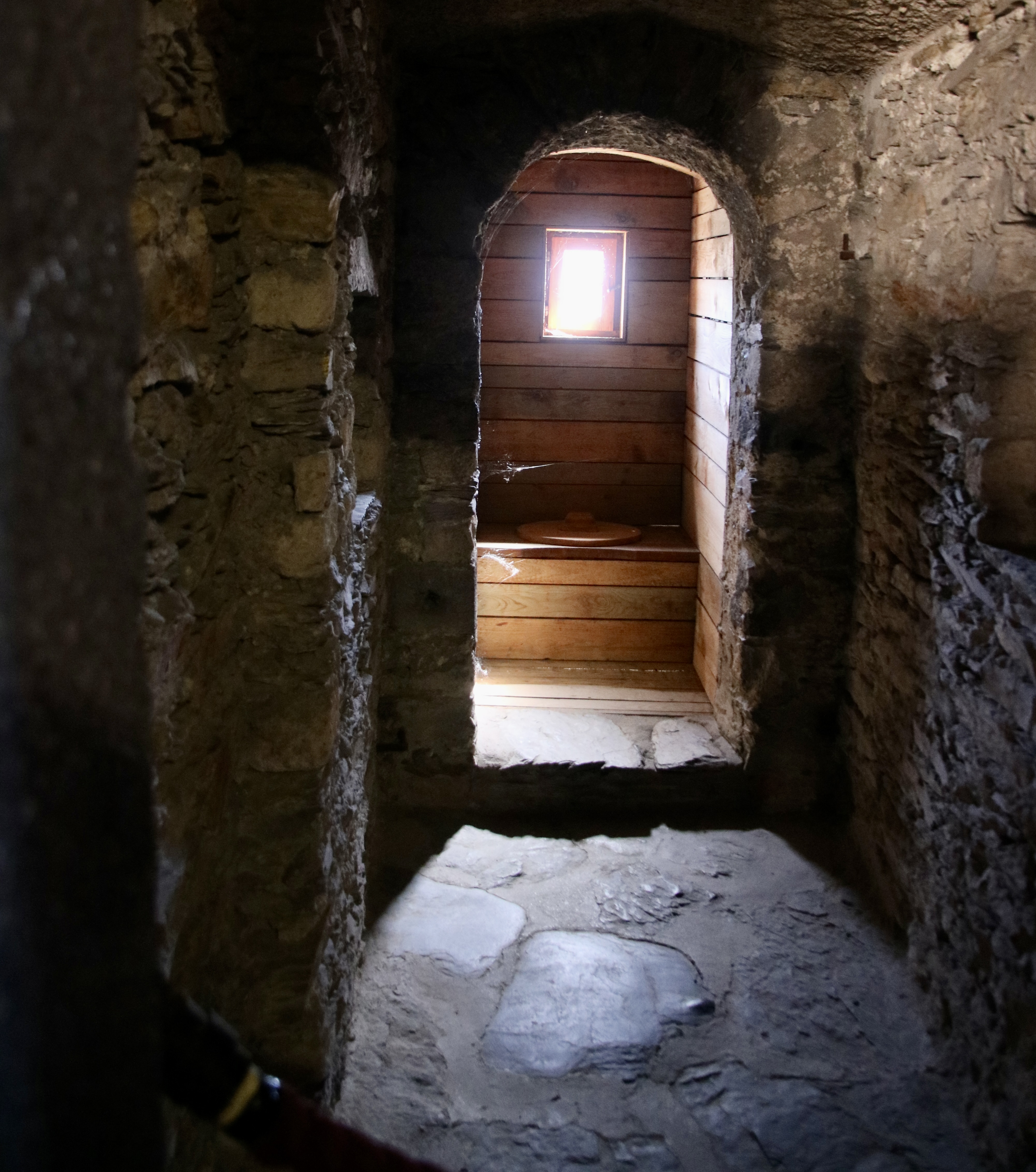
Just inside the massive entry door were four lions that represented the different noble families that had owned the castles. The lion is a common feature in heraldry representing courage, valor, strength, and other characteristics that nobles liked to claim they had, rightfully or not.While many of the castles along the Rhine were designed as homes for nobility first and defense second, Marksburg was designed first for protection. Its two towers were designed to fight off the enemy. Together, the two are commonly called a butter churn tower because of their look. (Photo by Peggy Mekemson.)A different perspective of the tower.Situated above the castle gate, these ramparts are designed to provide protection for the gate and surrounding walls.Anyone who has ever watched a movie involving castle defense understands the purpose of this structure. It’s designed to provide the defender with a clear line of fire while at the same time providing an element of protection. The long, slender hole in the right shadow is designed to shoot arrows through while providing even more protection.A close up of an arrow slit. Hard to get much more protection than this. Finding a target might be more of a problem! (Photo by Peggy Mekemson.)I found another use for the ramparts. They made a great frame for a photo.By the 1600s, cannons were in common use use as both defensive and offensive weapons in Europe. Marksburg had both short cannons and… …long cannons depending on the latest technology. (Photo by Peggy Mekemson.)The view of the Rhine through the cannon port. Rather commanding, I’d say. Before international agreements on Rhine River traffic were agreed to, a great deal of money was made by charging tolls to passing boats. Usually, a chain was stretched across the river. I have to assume that this was an added incentive to pay up.The armory included a number of wicked looking weapons including these. The shadows are even scarier. (Photo by Peggy Mekemson.)Even more interesting, there was display on the evolution of what knights wore. This one carried a huge broadsword. Interesting helmet. Eyebrows and a beak. Just ducky? (Photo by Peggy Mekemson.)Horny?Furry? Flowery. Okay, here’s the question. Assuming you needed a hero to represent you on the field of battle, which one would you choose: Ducky, Horny, Furry, or Flowery? (Photo by Peggy Mekemson.)Moving right along… how about the lives of the rich and famous in Marksburg Castle. I’m not sure they grew artichokes but we found this one blooming outside. BTW, our niece fed us artichokes for dinner when we visited her last week. We both love artichokes, but we had never made a complete dinner out of them. (Photo by Peggy Mekemson.)A variety of spices, I assume were representative of ones used during the Middle Ages, were hanging in the kitchen.As were a variety of cleavers. Chop chop!The bedroom featured this bed, which struck me as short and uncomfortable. It was designed for privacy, however.Possibly a little romantic music is called for. The instrument, BTW, is a hurdy-gurdy. I looked it up. Peggy informed me there was a musical group in the late 60s called the Hurdy Gurdy Band. (Photo by Peggy Mekemson.)Romantic love grew out of the age of Chivalry. What better way to recognize it than on a tapestry. This lovely maiden and her dandy duke seem to be sharing a moment as their beasties’ tails entwine to form a heart. Not quite sure what role the ferocious bird on the maiden’s right represents. Maybe it’s a message to the duke not to trifle with her emotions. Kind of like “If you dump me, I’ll stork you.”If marriage is in the future, the castle has a chapel, complete with Madonna who has lost her hand.And this is what I could only assume was a flying nun who has lost her bottom. If you are old enough, you may remember the TV series: The Flying Nun. (Photo by Peggy Mekemson.)We found the chapel’s ceiling quite impressive. Note the lion.No discussion of life in a medieval castle is complete without a discussion of the garderobe. “The what?” you say. It’s the small room hanging out over the wall. I call it the throne room. Peggy got a photo from inside.FYI, the garderobe was the medieval equivalent of an outdoor toilet. Aren’t you glad you asked. It could get rather cold on a wintry day. And you never, ever wanted to stand under one, which made me wonder what it was doing hanging over a gate. Maybe it was a defensive measure. Grin. (Photo by Peggy Mekemson.)
Join us next week as we take you along the Rhine River Valley and feature a whole plethora of castles and small towns along the way. Also, be sure to check in on Monday when we celebrate Halloween and blogging friends.
While the first part of our journey lacked the beauty and castles of the Rhine River Valley we were about to explore, it wasn’t lacking in charm.
Birthdays are important to Peggy. When we first met, she told me “Forget my birthday and you are toast.” She was kidding, sort of. Apparently her first husband forgot the warning. I never have. Grin. Decade birthdays are even more important. For her 70th, Peggy planned a special outing. We would take the whole family on a riverboat trip up the Rhine. The kids and grandkids loved the idea (who wouldn’t), tickets were purchased, excitement grew, and then Covid struck.
While Peggy is usually laid back and willing to ‘go with the flow,’ she assumes a more regal persona when it comes to her birthdays. I laughed when I came across this crown chair in Rheinstein Castle and asked Peggy to pose under it, which she did good naturedly. Note the shocked expressions on the faces of the two Norse gods.
Fortunately, our kids came up with an alternative for Peggy’s big 70. They rented a large house on the Outer Banks of North Carolina for the celebration. We hopped in Quivera, our small RV/van, and zipped across the country. Carefully. Covid was raging. It was a great celebration and Peggy was quite happy. But the riverboat trip was not forgotten. We still had the tickets and would use them as soon as Covid calmed down and Europe let us back in, which happened this past summer.
I’ve already done two posts on Amsterdam where we started and ended the adventure. Today, I am kicking off the series about our trip up the Rhine.
It was special, no doubt about it. The boat trip in itself was a delight— good food, nice rooms, and great service. (Admittedly, Peggy went first class. But what the heck, it’s only the kids’ inheritance.) While I am not a fan of mega-cruises with thousands of people and their impact on local communities, I will admit they are good for family outings. People have their own space. They can come together or go their own way. No one has to plan entertainment, no one has to cook, and no one has to clean up. It reduces the likelihood of the trauma that sometimes accompanies family get togethers. Our riverboat offered all of these advantages plus one more, a big one: there were only a hundred people.
Our boat, the River Empress of the Uniworld Boutique line.An example of the gourmet food we were served. I’m lucky I only gained a couple of pounds on the cruise.
Today, I am going to feature the first part of our journey. The countryside was relatively flat and industrial centers frequent. While it lacked the scenery and castles of the romantic Rhine River Valley we were about to experience, there was beauty and charm. And, we ended up in Koln/Cologne where we visited one of the world’s most beautiful cathedrals— and a chocolate museum/factory. Have I ever shared how much Peggy loves chocolate?
The photos for this post and all of the Rhine River series are all taken by Peggy and me unless otherwise noted.
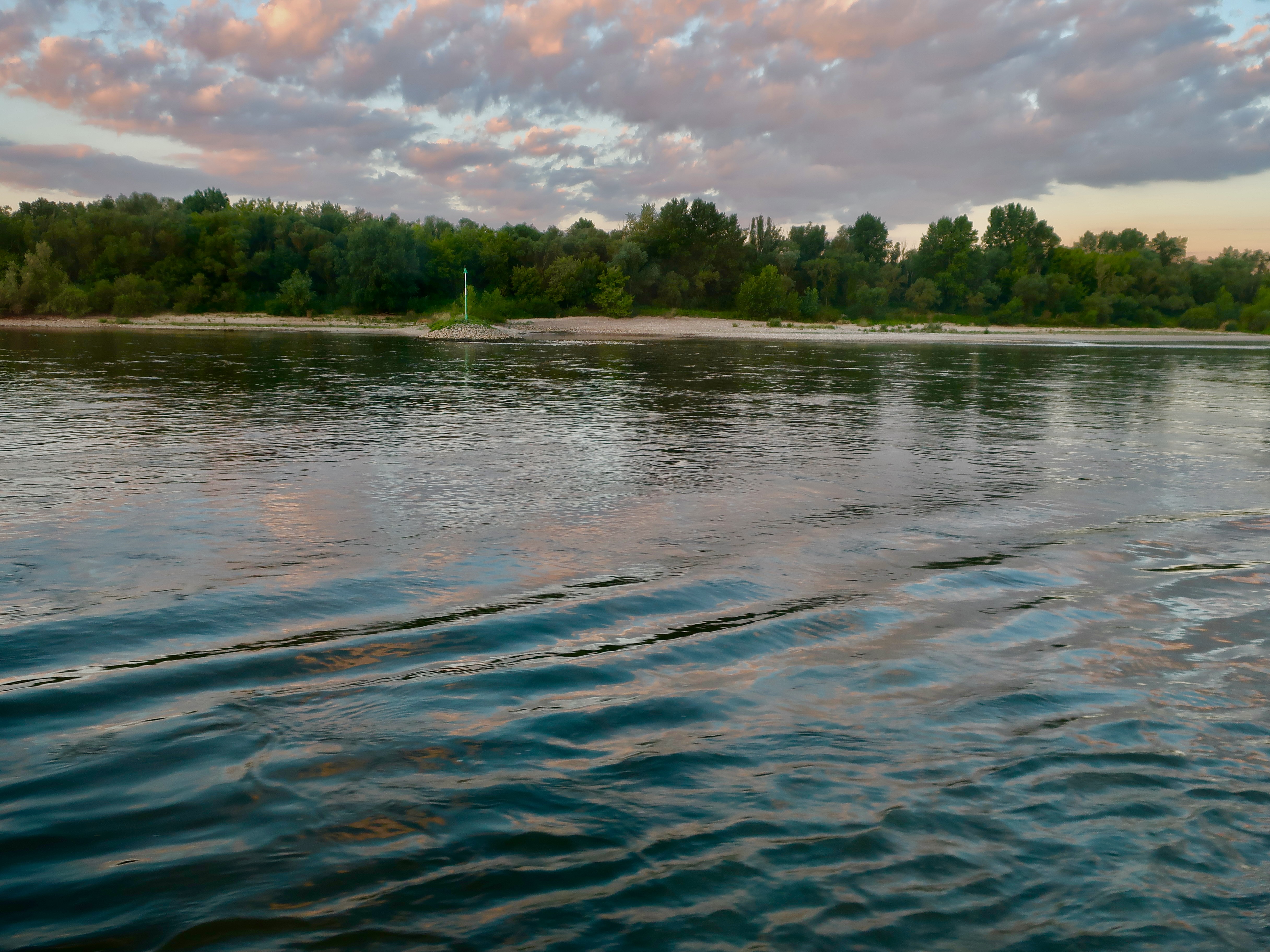
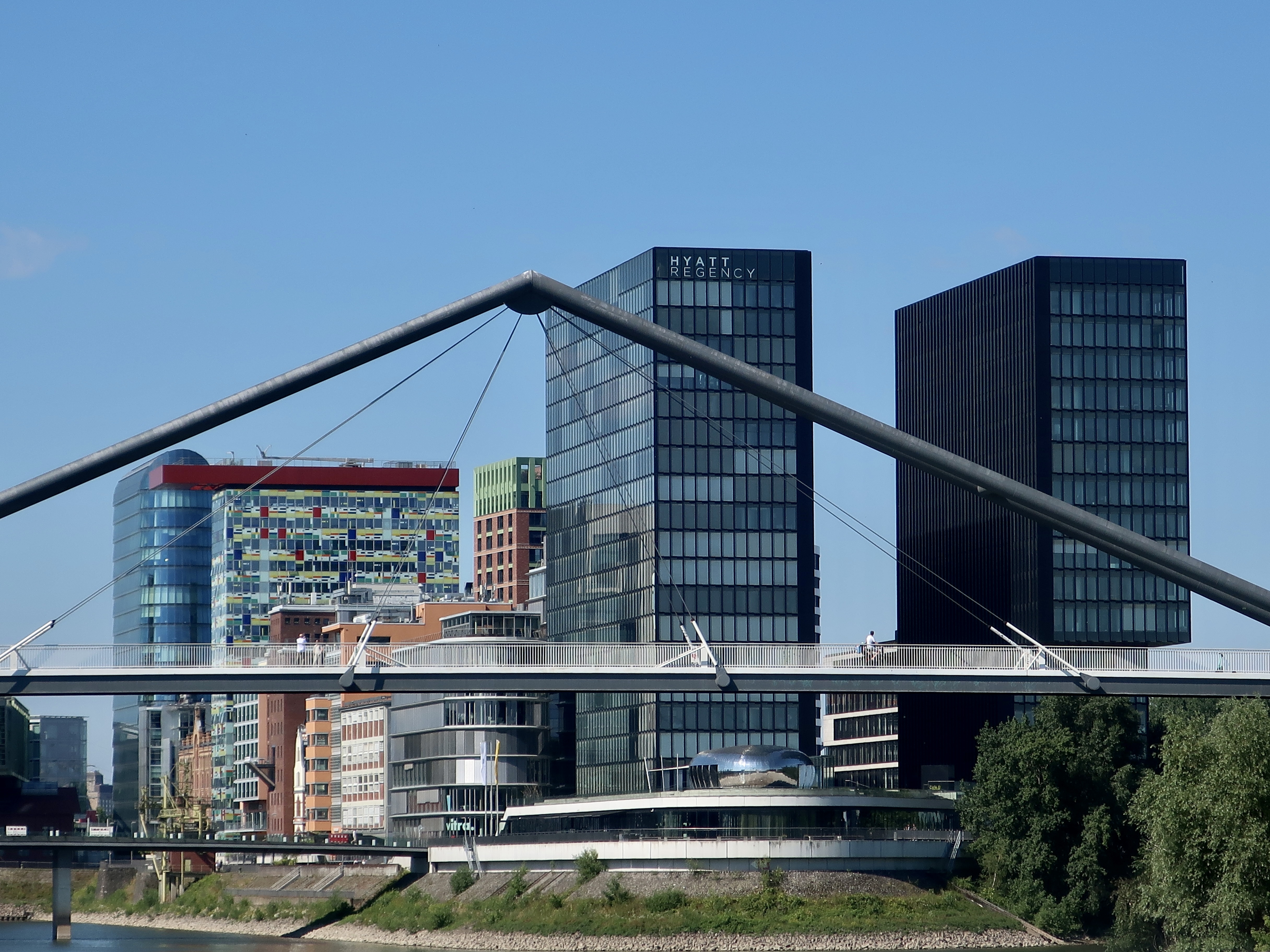
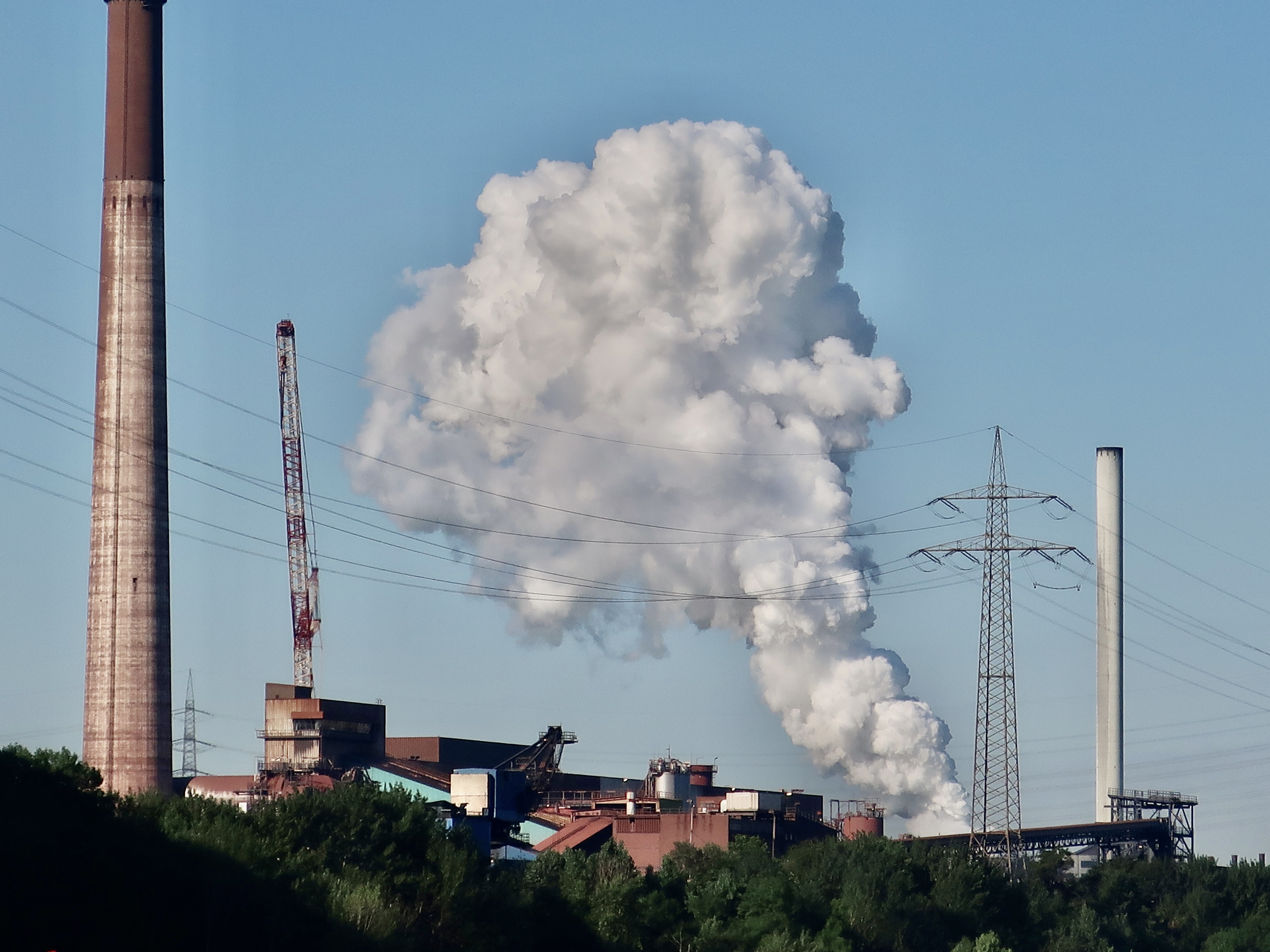
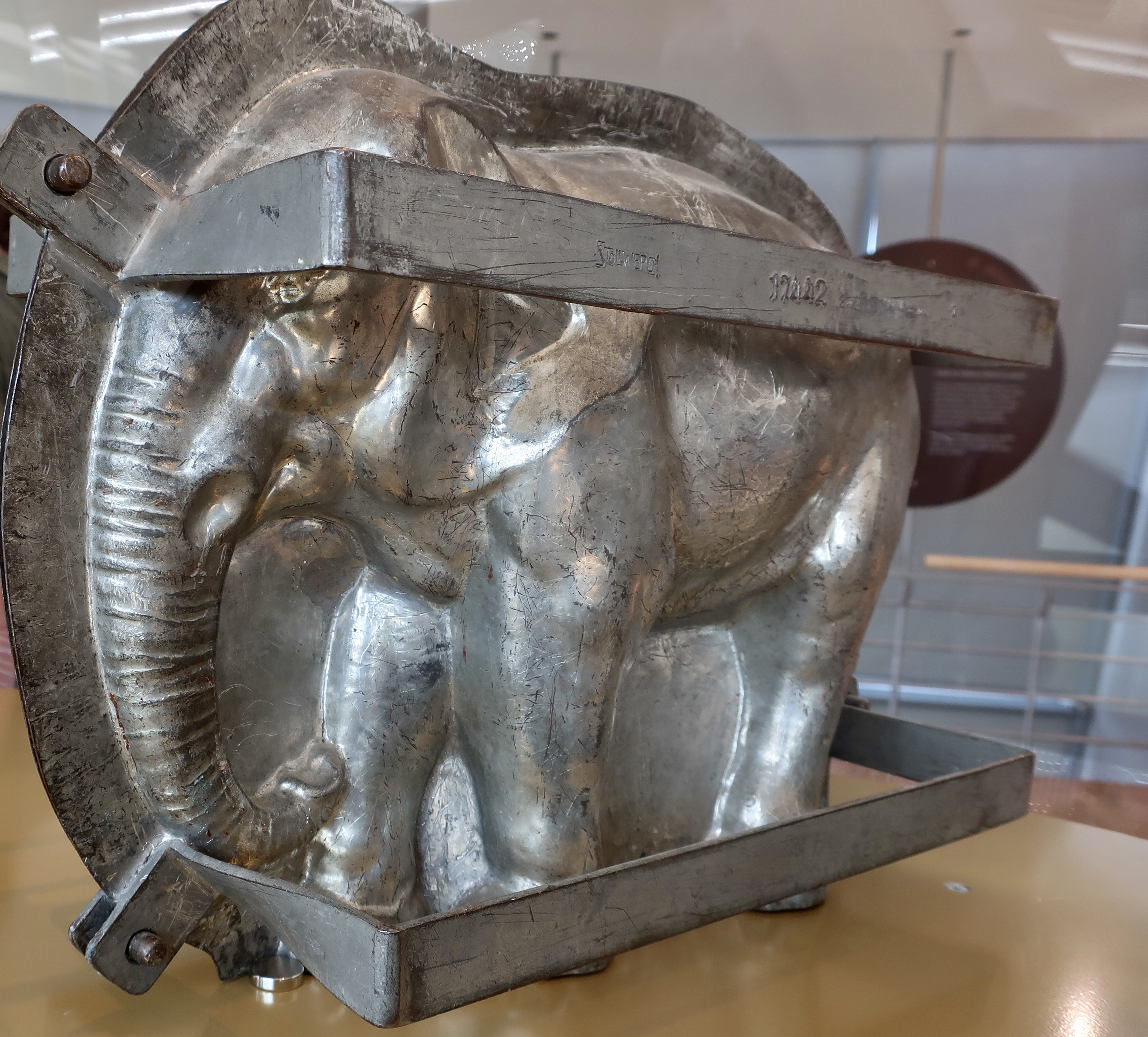
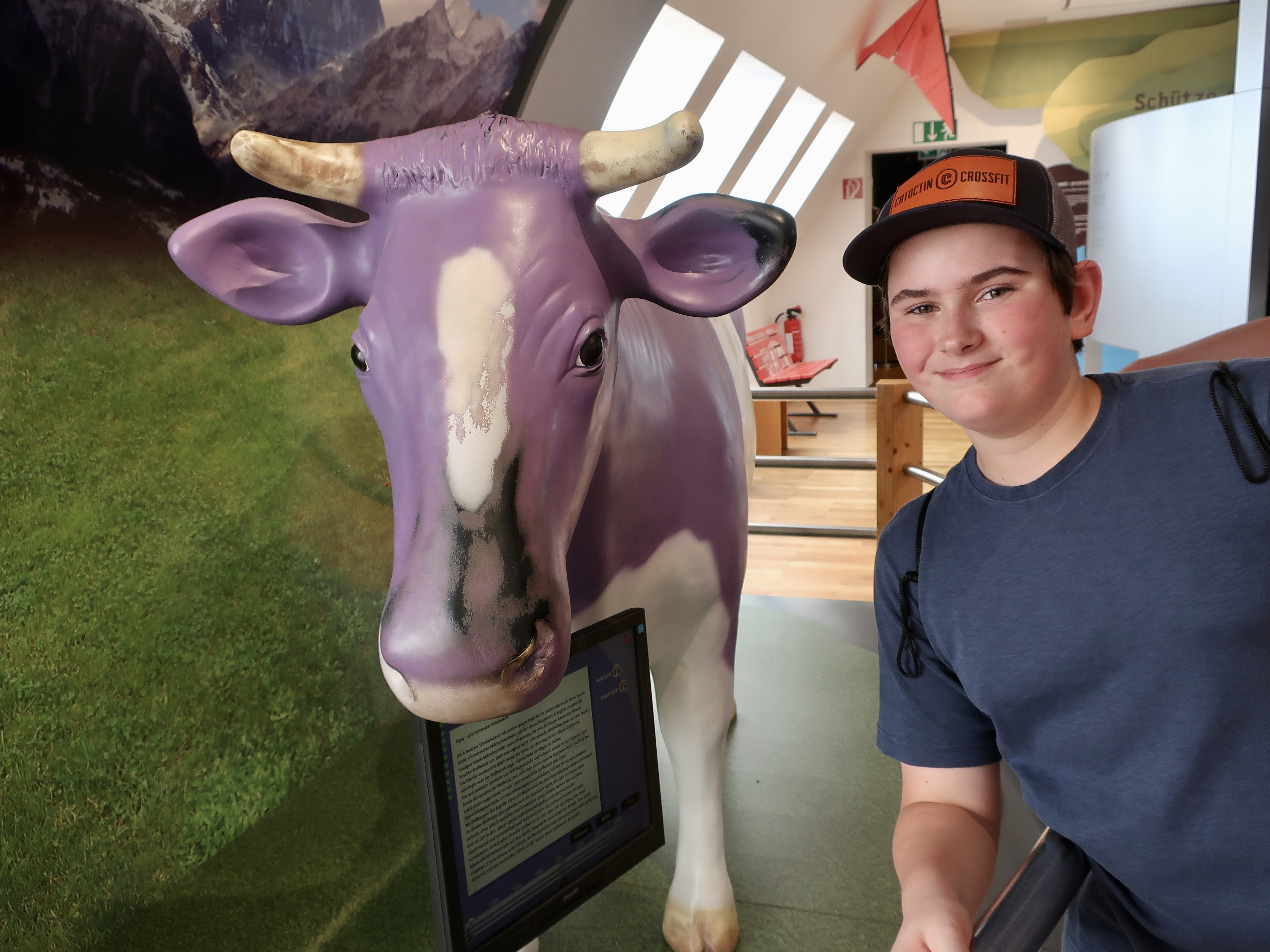
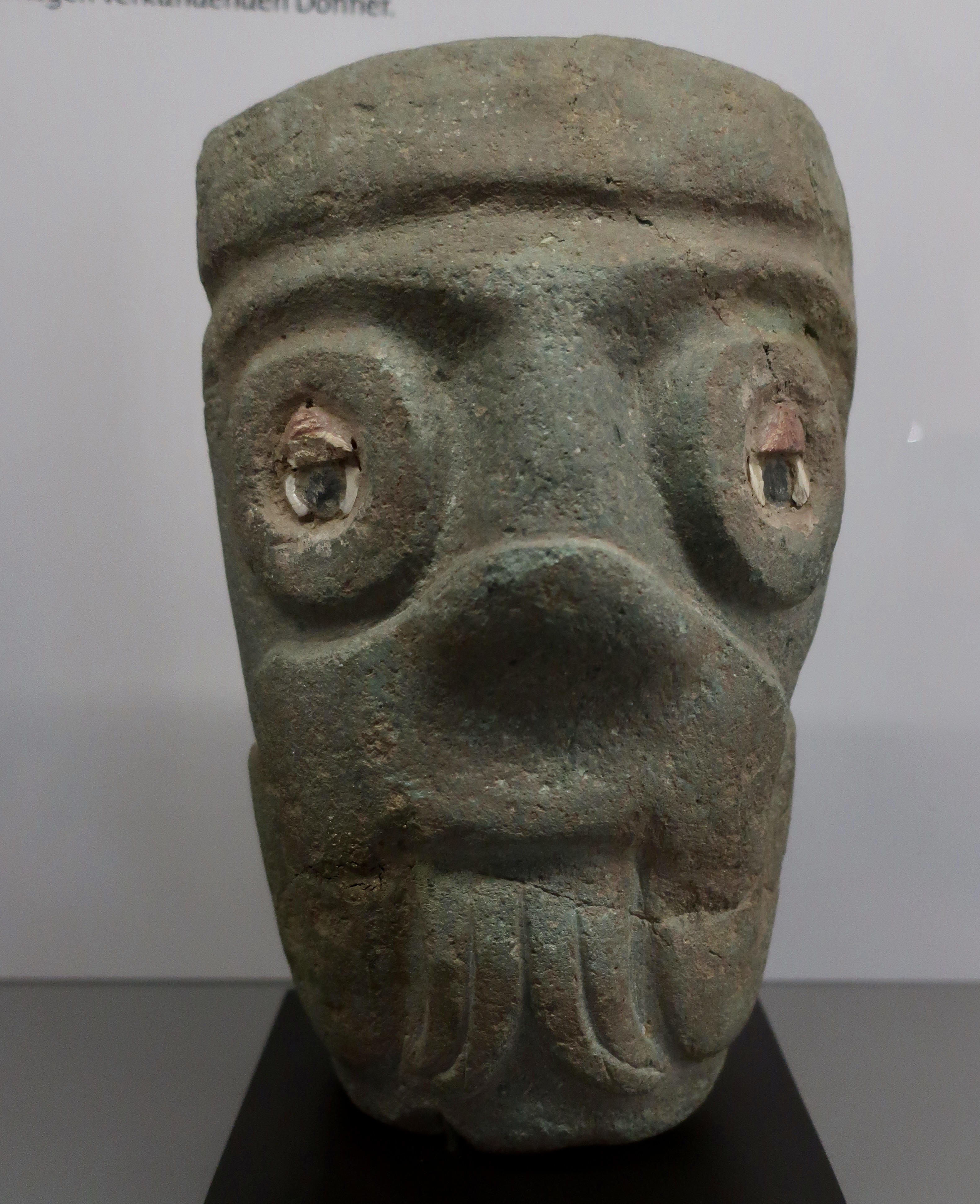
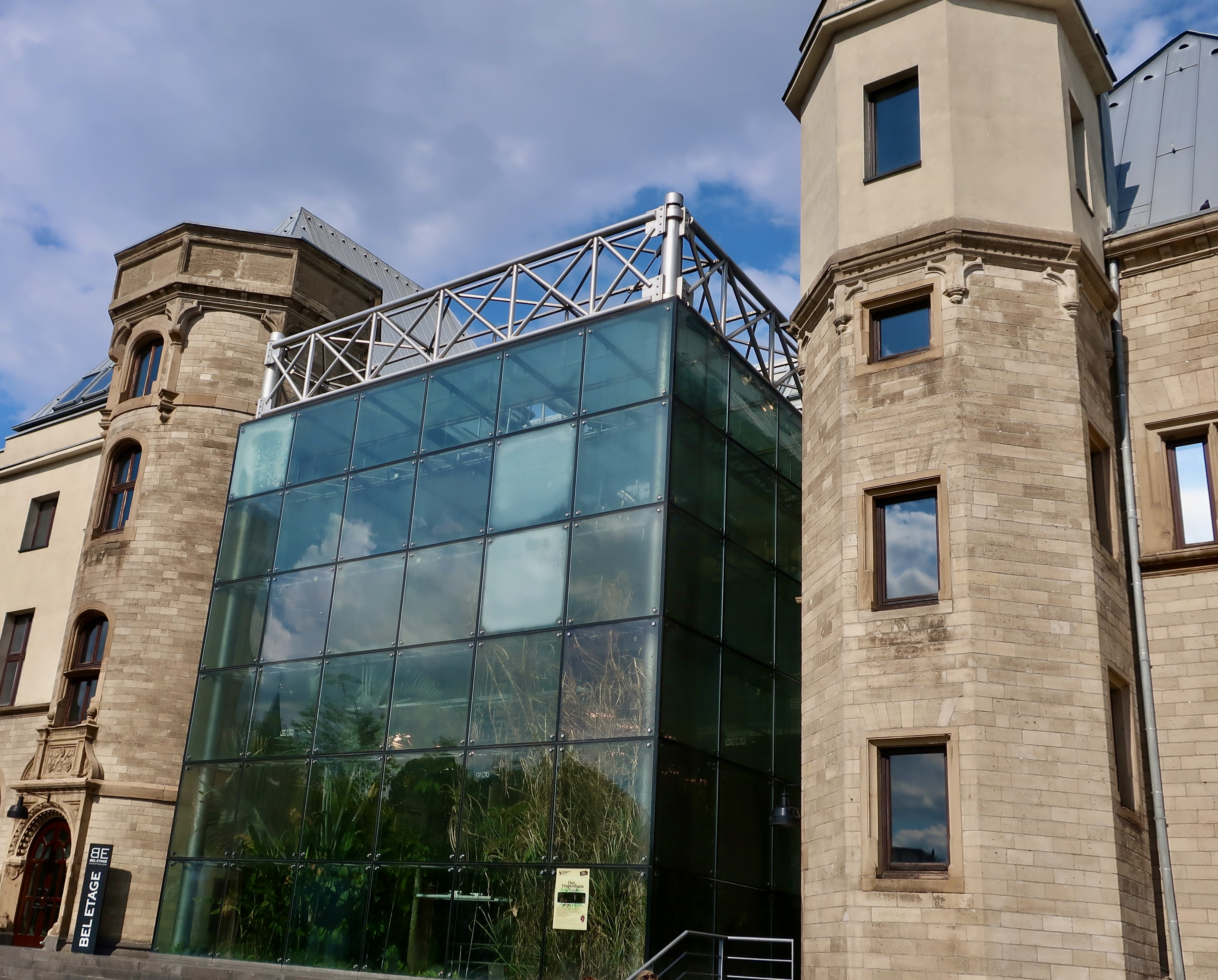
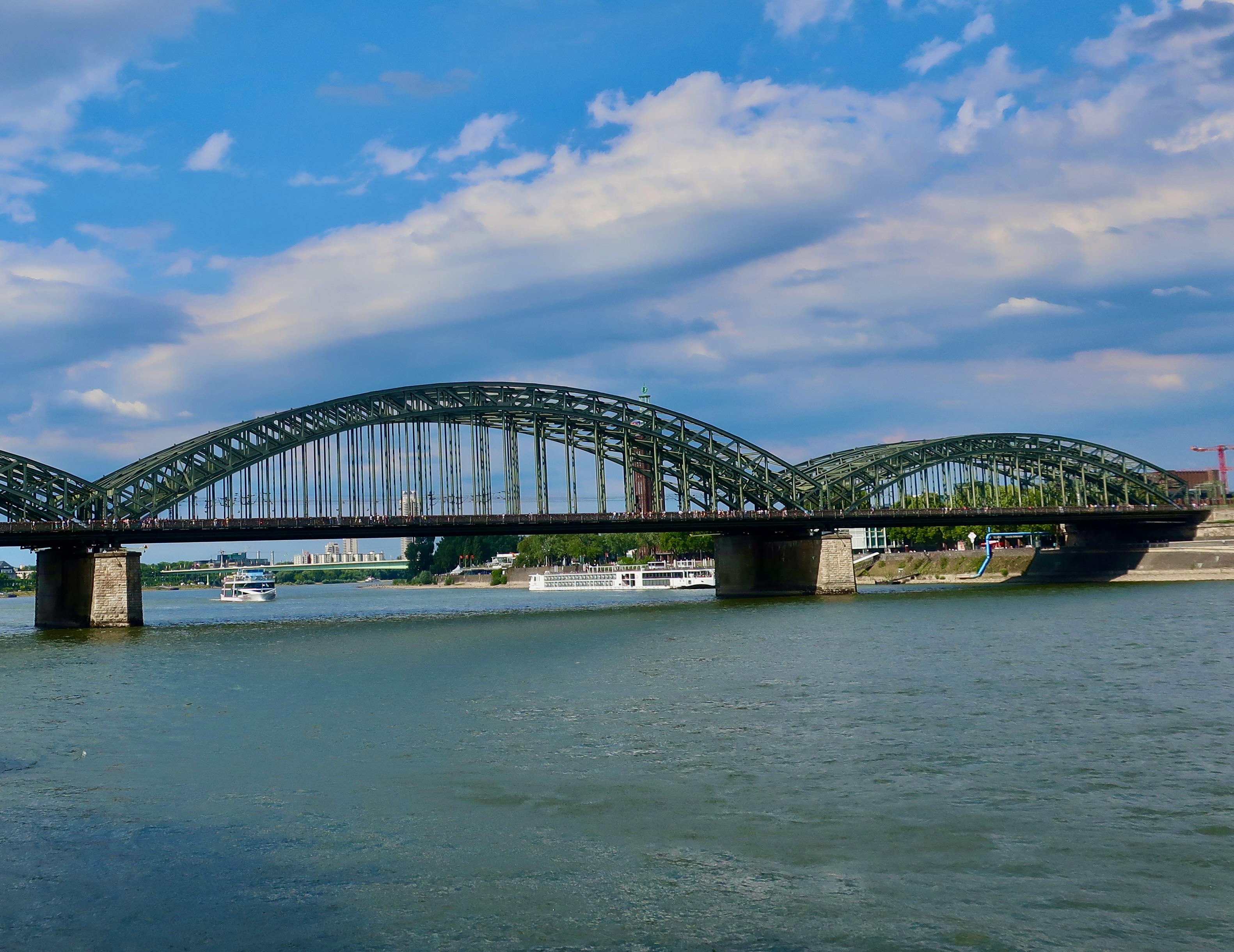
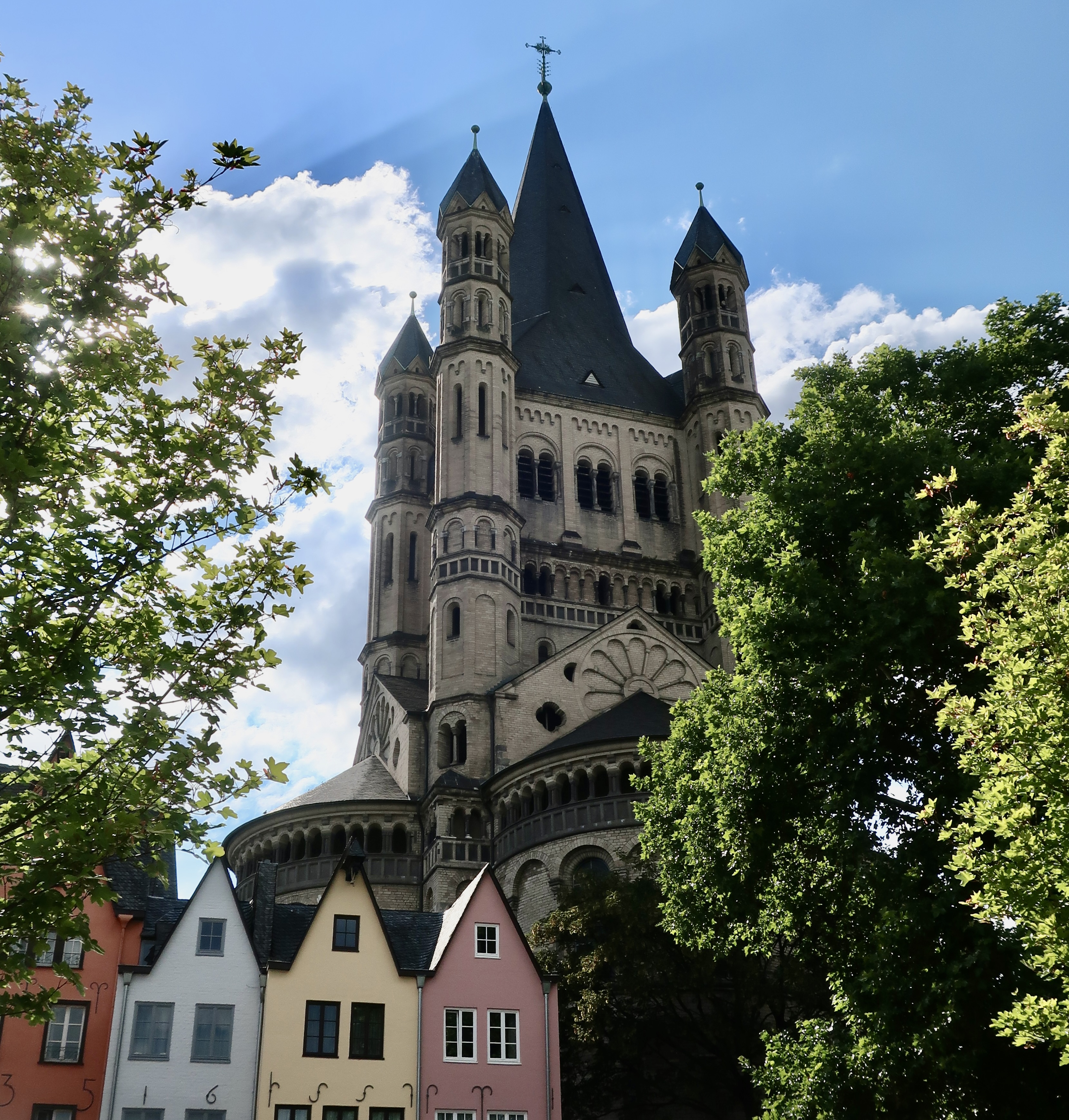
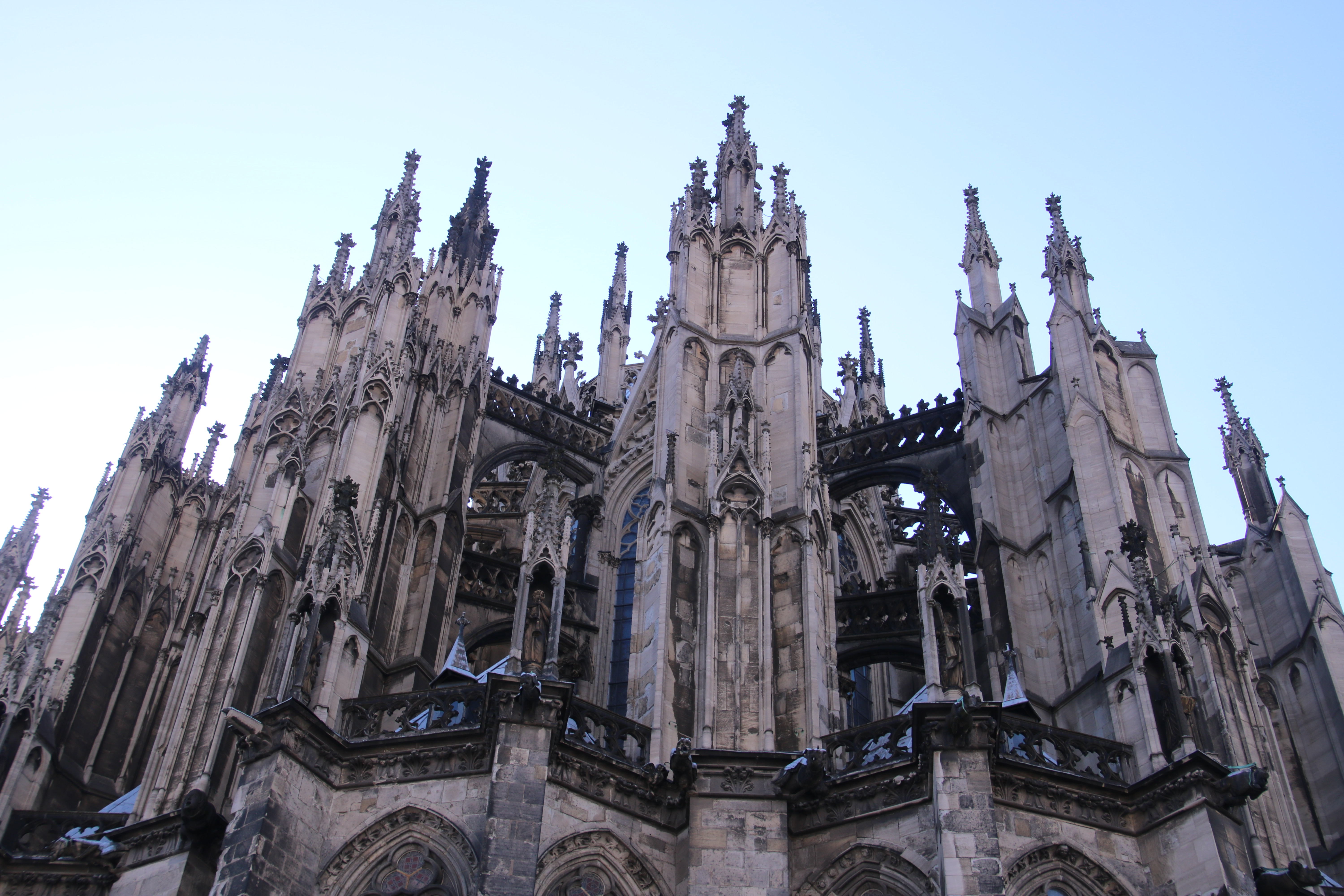
There was plenty to capture our attention along the lower Rhine including colorful towns…Historic buildings…Attractive, modern cities and, I might add, a lot of beautiful bridges.If we ran out of other things to entertain ourselves with, there were always barges, scads ands scad of them, each carrying up to 2500 tons. Annually, more than 300 million tons of goods are shipped along the Rhine serving Switzerland, France, Germany, and the Netherlands, making it the most important river in Europe for commerce.The ease and inexpensive nature of river travel has encouraged the development of industry along the Rhine. For example, one fifth of the world’s chemical industries are located along its banks.As might be expected, fighting pollution in and along the river is a major challenge. Global warming presents another problem: Drought has lowered the level of the river so much by late summer that it limits the ability of barges to navigate it. Coming into Cologne, one of our first views was of the magnificent Cologne Cathedral that we were going to visit. First up was the chocolate factory, however. Peggy does have priorities. It was like Christmas to her…She found a chocolate Santa and made a beeline for it. Who needs chocolate bunnies?Of course there were chocolate bunnies, and even chocolate elephants. This is the mold for one.But the prize, from my perspective, was the purple cow. Our grandson Cody agreed to pose with it and I recited the old poem to him: “I’ve never seen a purple cow, I never hope to see one. But I can tell you anyhow, I’d rather see than be one.” Maybe the last line should be changed to “I’d rather see than eat one.” I’m 99.9% sure the cow would agree with me. The pre-Columbian artifacts on display caught my attention even more that the purple cow. I’m not sure if the ancient artists had a sense of humor in creating their art, but these made me smile.As we left the Chocolate Factory/Museum, our five grandsons agreed to sit with Peggy for a photo. It’s something akin to herding cats. I think she bribed them by buying them chocolate goodies. Cooper, the youngest is in front. He just turned 10 this past week.As we left the museum, we took a final photo from outside.and started our hike over to the Cathedral.The Hohenzollern Bridge loomed up in the distance.As we approached the bridge, we saw that it was filled with people walking across. Most of them were involved in Cologne’s Gay Pride festivities that were taking place.We also passed by another of Cologne’s famous landmarks, the Great St. Martin Church.Finally we reached our objective, the Cologne Cathedral, which kept both of our cameras busy in an effort to capture its beauty. This is the back of the church.Every angle provided a different perspective.A view from the side.We discovered gargoyles lurking near the top.Making our way toward the front of the cathedral.
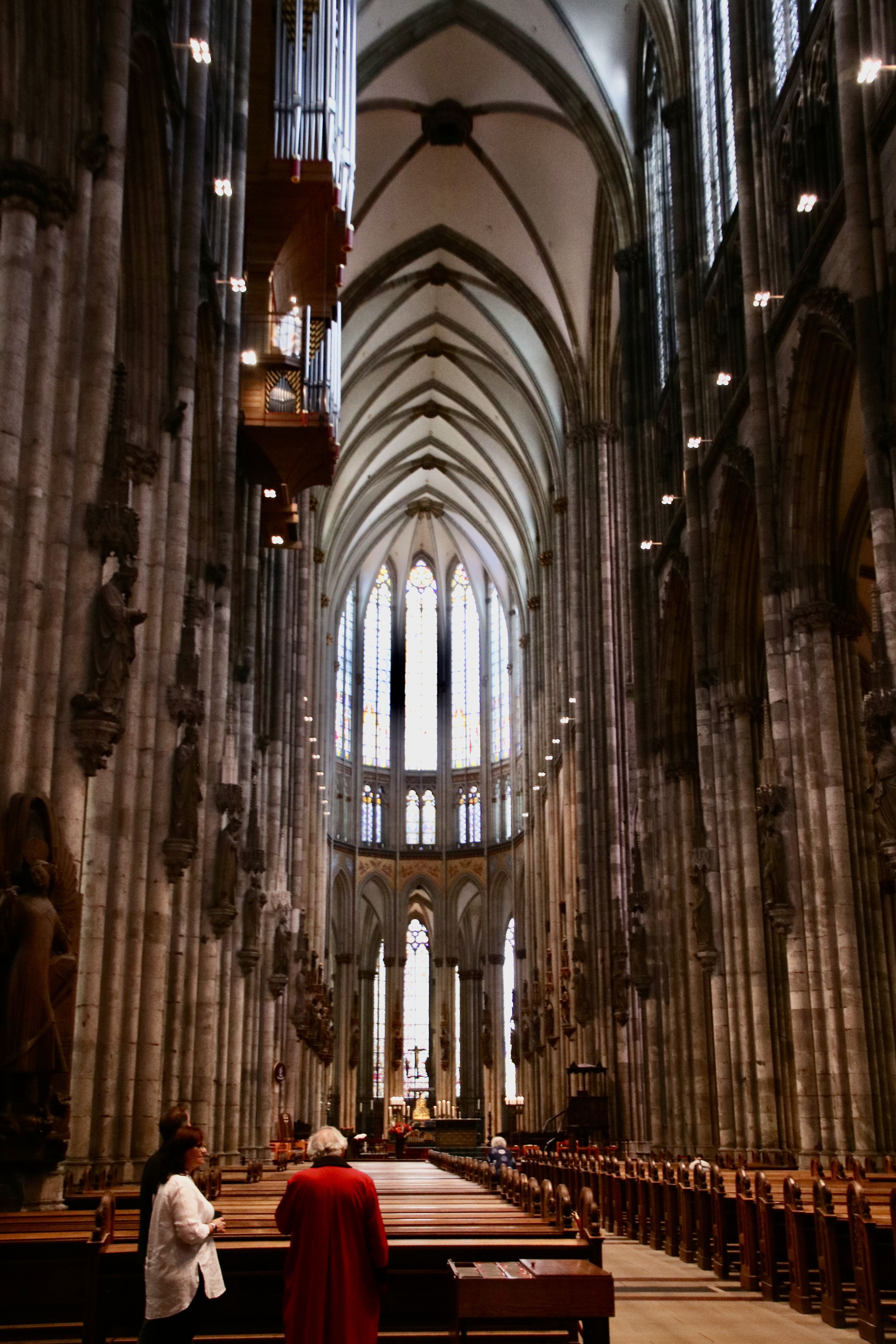
A front view.Looking up from below.Another perspective.A view from inside.Looking up.Stained glass windows.I’ll finish up today with one of the things I find strange, if not downright weird, about so many of Europe’s medieval churches is their collections of pieces of long dead saints, like a finger, or a toe. The Cologne Cathedral is known for its collection of Magi parts, the Three Kings who came to see Christ bearing gifts. I believe they are stored in this gold reliquary.
Next Friday we will visit our first castle as we begin our trip up the Romantic Rhine River Valley. And— we meet some old friends we had never met before!
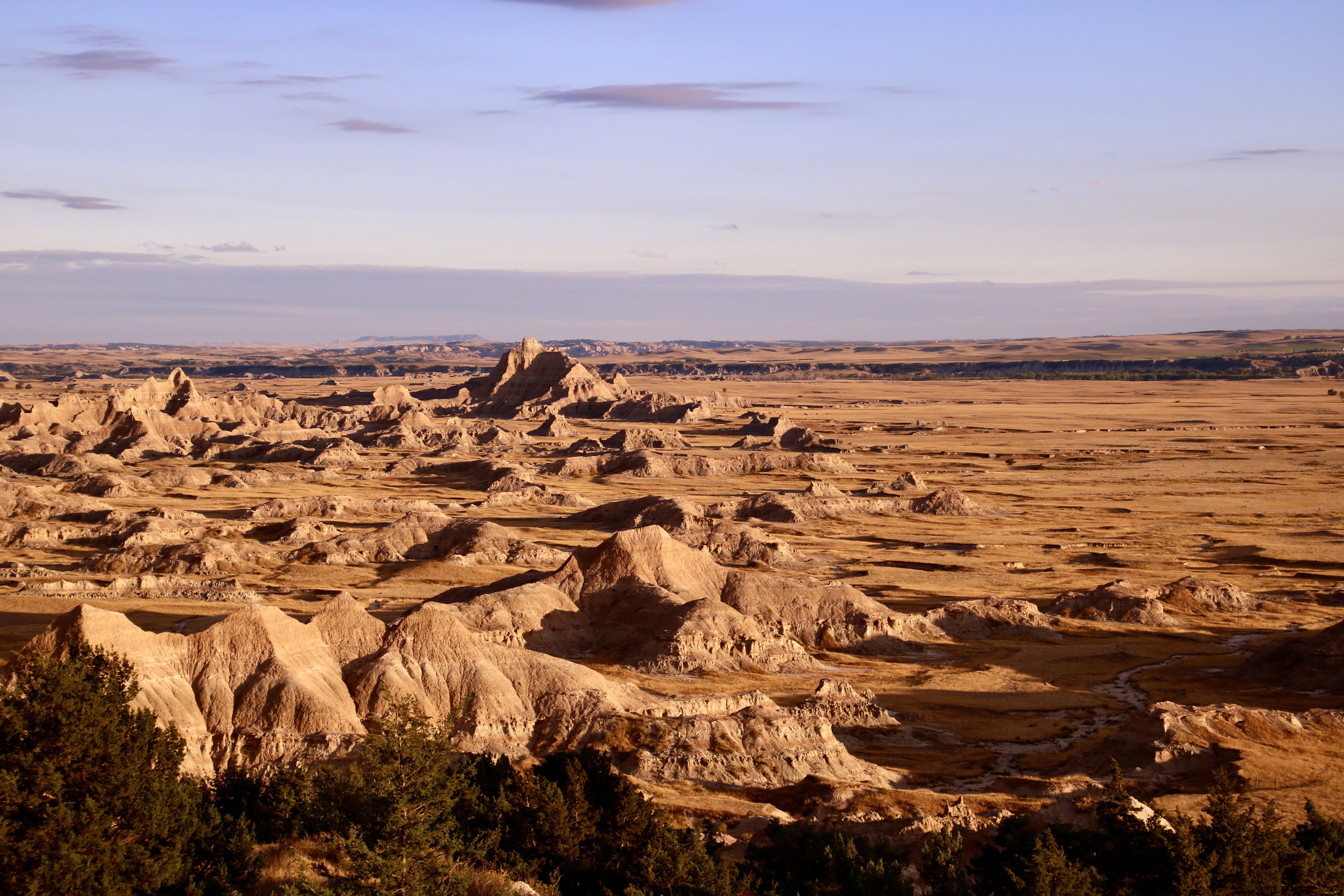
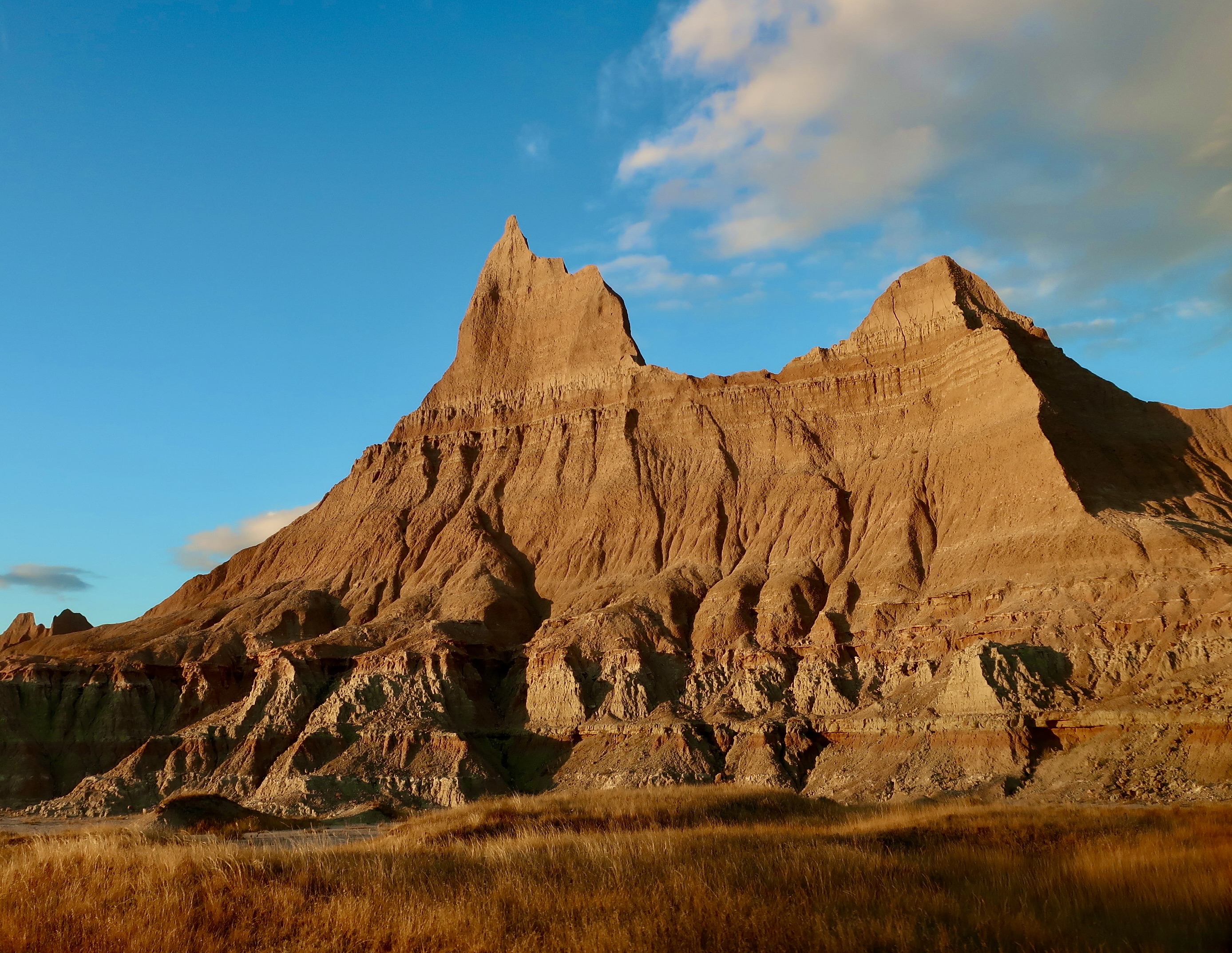
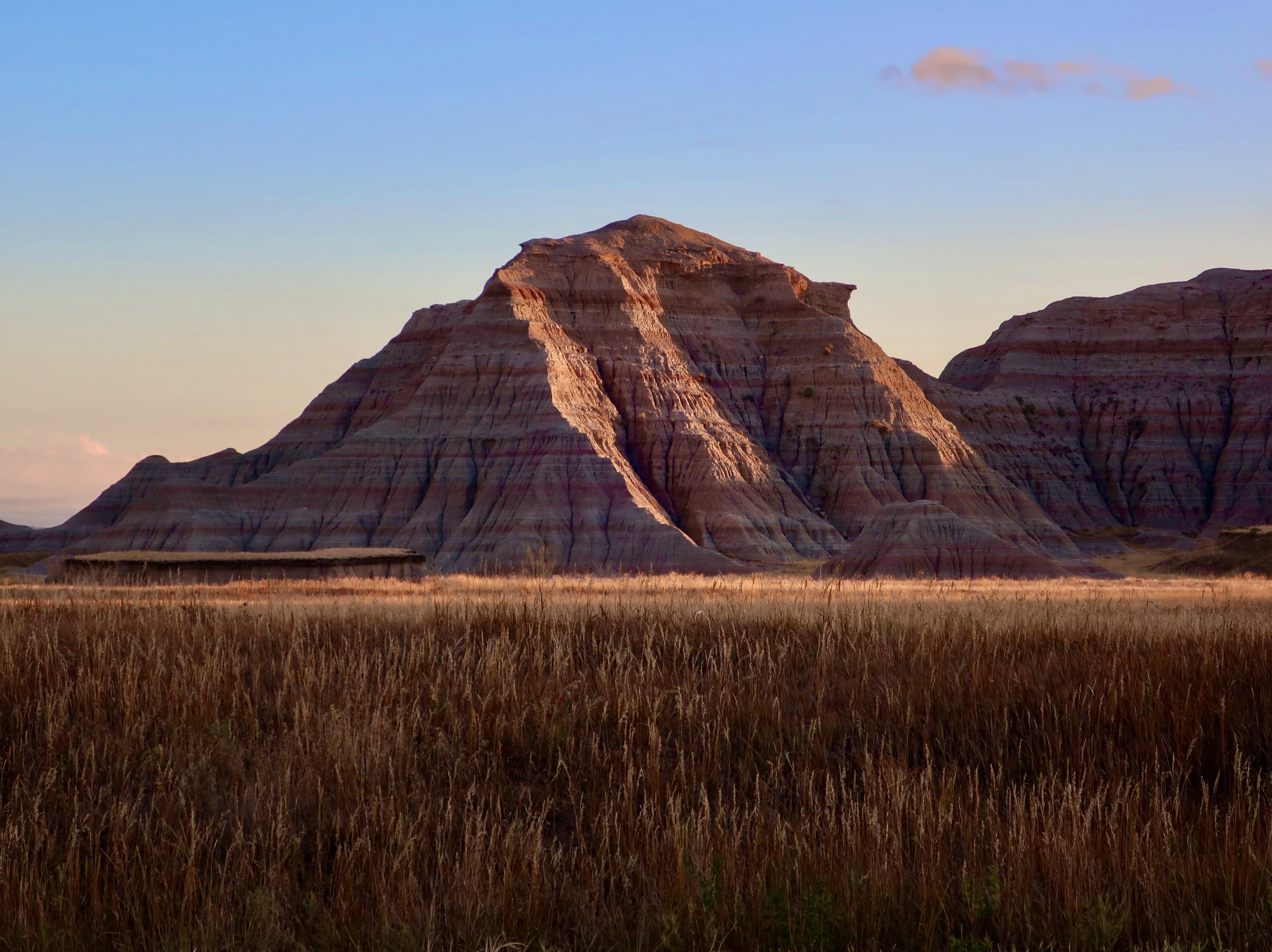
I was cooking beef pot-roast in our insta-pot and time was running out. I had miscalculate the time it would take and we were going to miss the Badlands at sunset. “Go ahead,” Peggy told me. She knew how much I wanted to catch the colors. “I’ll finish up here. We can eat when you get back.” My sweetie didn’t have to offer twice. I was out the door and into the truck. The sunset was quite impressive and the food tasted delicious when I returned. Following are some of the photos I took. Enjoy.
Next week we will be returning to our summer trip up the Rhine River. Please join Peggy and me along with our kids and grandkids as we explore the Rhine, castles, colorful towns, the Black Forest and a couple of impressive cities.
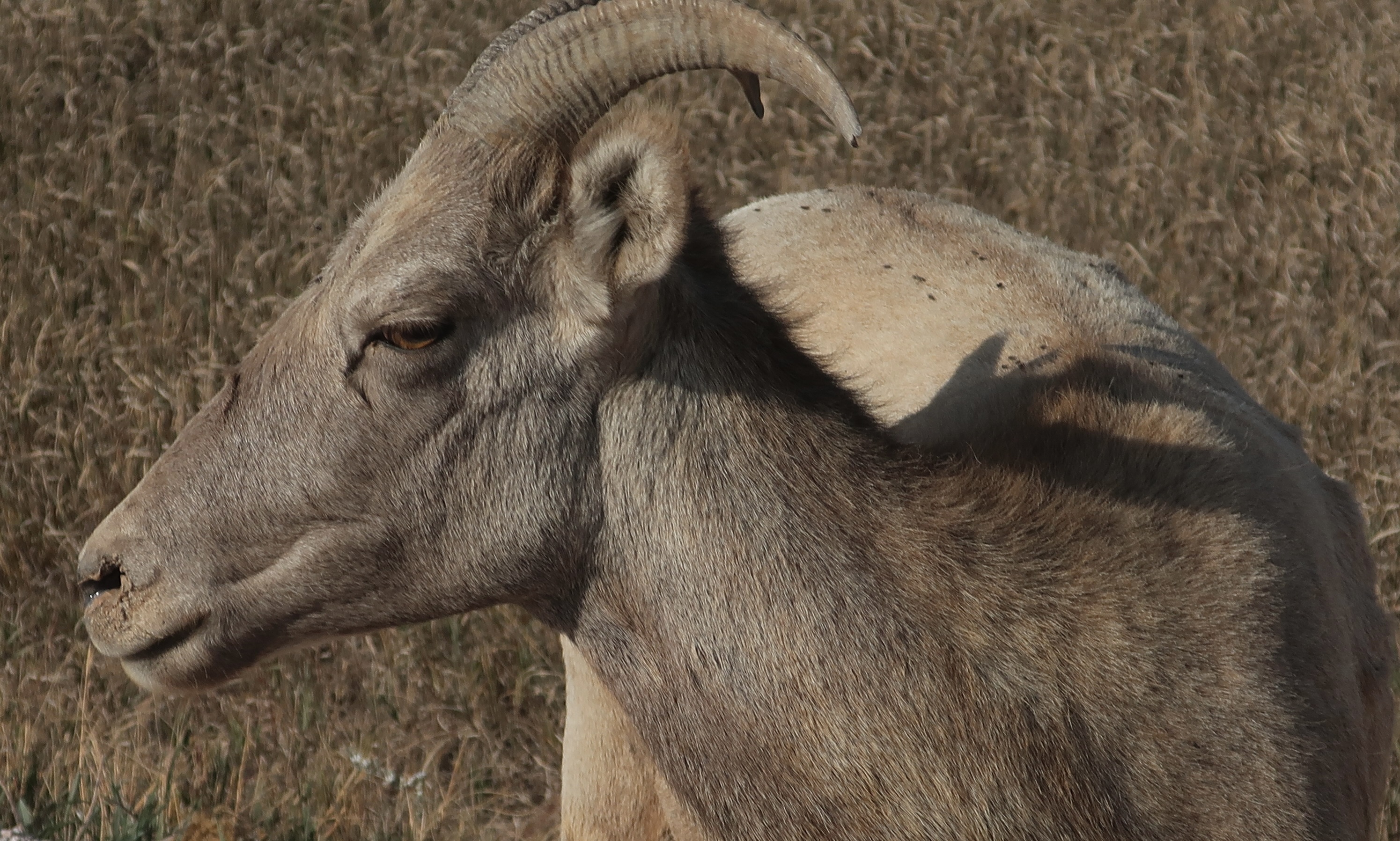
I was getting the ‘look’ when I snapped this photo of a bighorn sheep on Sage Road.
Sage Road in Badlands National Park is known for its easily accessible wildlife population. We drove out it during our recent stay near the Badlands to see what we could find. This fellow, along with a few other bighorn sheep, was hanging out along side the gravel road. Its look seemed to say, “Don’t mess with me.” Big horn sheep were first re-introduced to the Park 1922 with more being added later. The park’s herd now numbers near 250.
This youngster is busy chewing on weeds. Bighorn stuff themselves with tough-to-eat grass like this and then retreat to somewhere high and safe where they can regurgitate it and chew it more thoroughly. (Remember your mom urging you to chew your food!) What we don’t have that the sheep do, however, is four stomachs to help in the digesting process. (Photo by Peggy Mekemson.)Bighorn sheep checking us out.
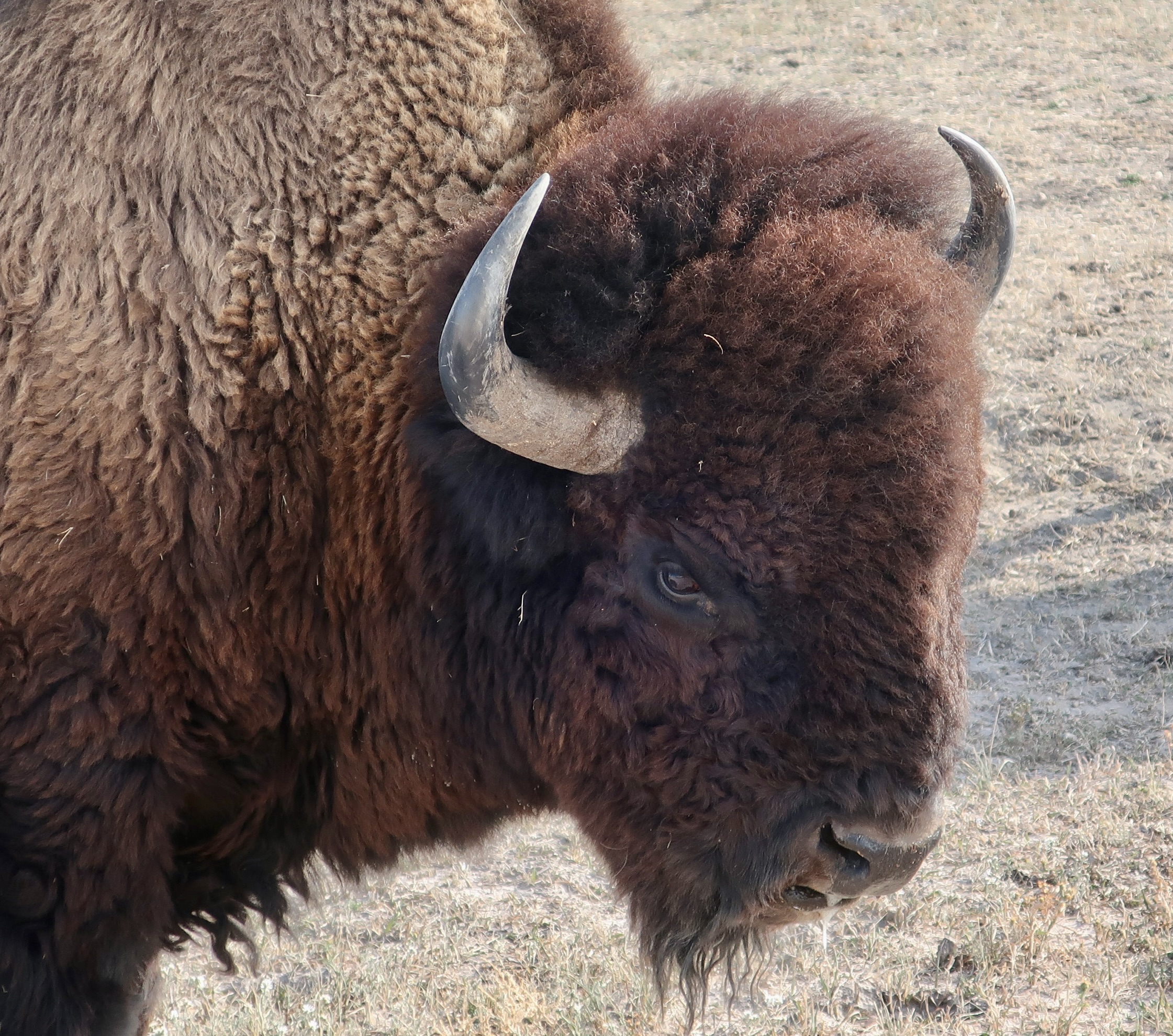
We also found a few buffalo along the way. The National Park website, which is where I found the details on the wildlife included in today’s post, gives the buffalo’s scientific name as Bison, bison, bison, i.e. they are of the genus Bison, of the species bison, and the subspecies bison. Buffalo was derived from the French “bœuf,” meaning buffalo, and given to the large creatures by early French fur trappers. The Lakota name for bison is tatanka. Bison were incredibly important to the Lakota and other Native Americans of the Great Plains who carefully used every part of the buffalo they killed. An estimated 30 million roamed the area prior to the arrival of Euro-Americans who hunted the buffalo almost to extinction for their hides and tongues. An even darker reason is given for the slaughter: The US government wanted to disrupt the Indigenous people’s way of life to make way for the Euro-Americans. One way of doing this was killing off the vast herds of buffalo that the natives depended on to live.
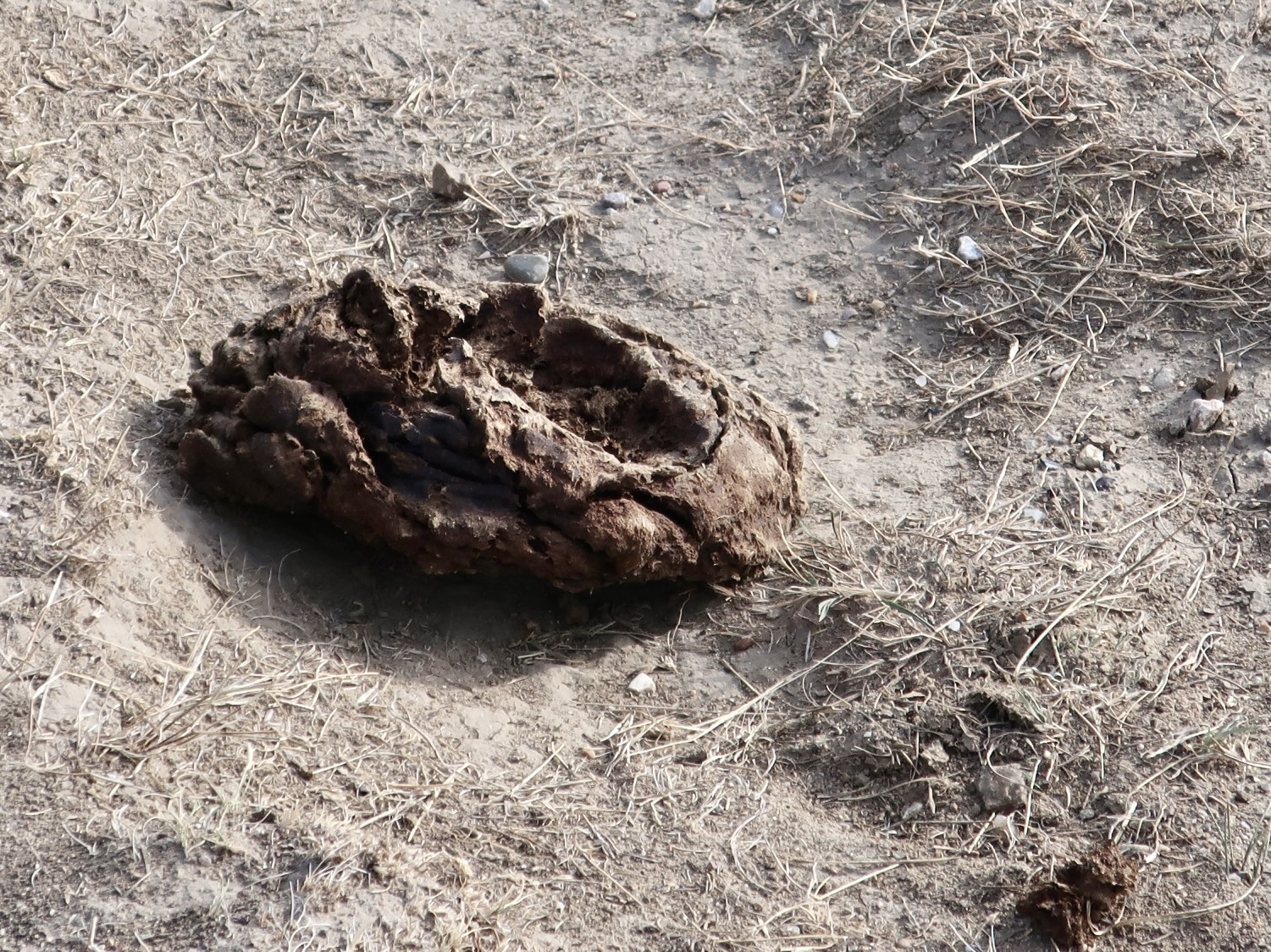
These large furry creatures paid zero attention to us as they grazed beside Sage road, which is what we wanted! They do look like something that would be fun to pet, however. (Photo by Peggy Mekemson.)Don’t. The fur says pet me; the eyes say don’t even think about it. One does not want to irritate a creature that can weigh up to 2000 pounds and run fast, really fast. Sign after sign in national and state parks where the buffalo roam, warn people to keep their distance. Despite the warnings, some people insist on a closer view, which can result in a bad ending. I watched a video of a guy standing five feet away from a buffalo waving his arms and shouting. A few seconds later, he was taking flying lessons. (Photo by Peggy Mekemson.)Peggy did not take this picture. Unlike her husband, Peggy does not take photos of poop to put in the blog. I tend to go along with the philosophy of the bison: Let the chips fall where they may.
It’s Fat Bear Week, as anybody who hangs out in social media is probably aware. The prairie dogs of the Badlands want you to know that they consider it discrimination that there is no Fat Prairie Dog Week. When their size is taken into consideration, they are willing to take on any bear when it comes to putting on the pounds/ounces!
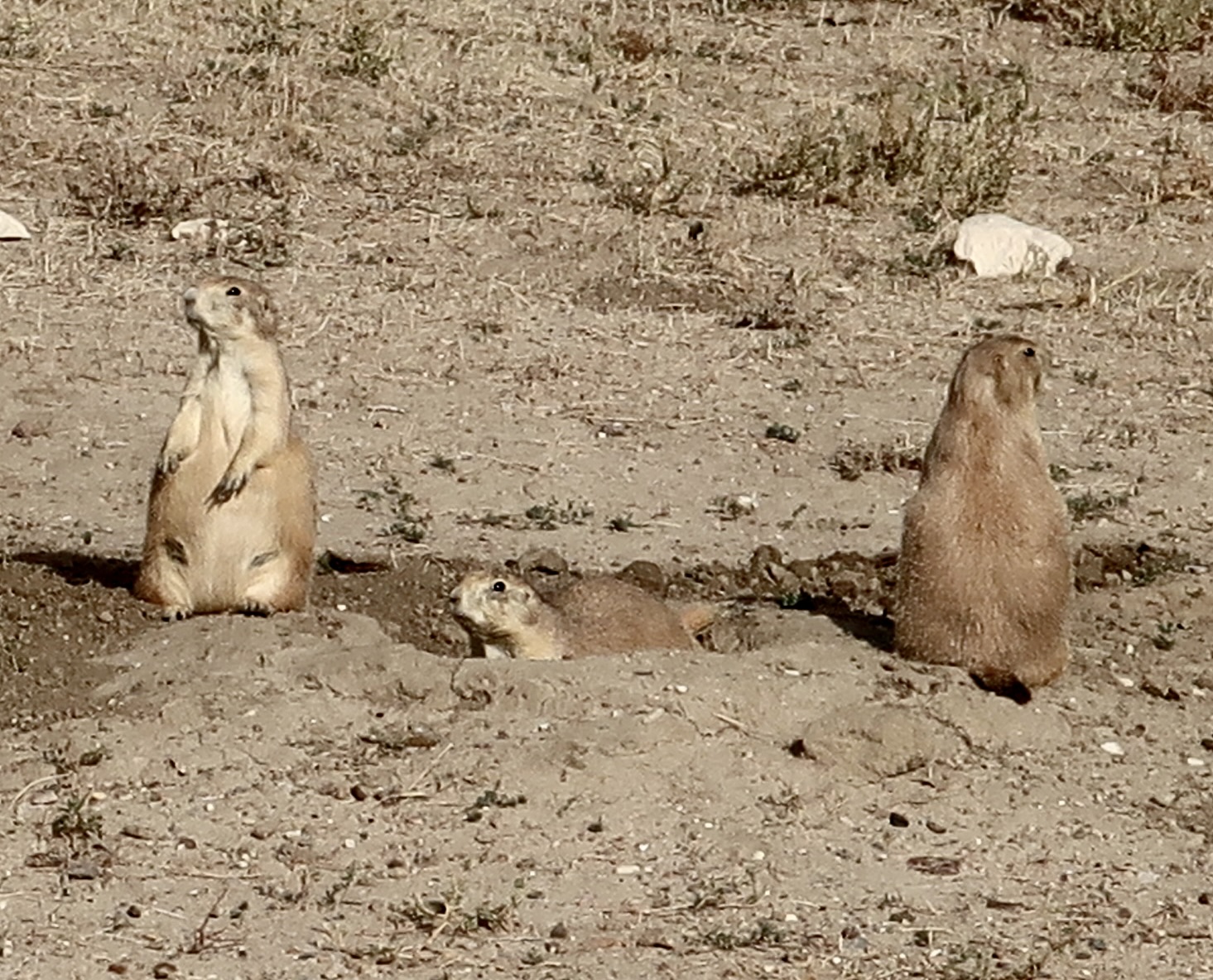
“Bring it on bears!” this fat prairie dog seems to say as he prepares to stuff more food down his gullet in preparation for winter. (Photo by Peggy Mekemson.)When it seems like just about everyone wants to eat you (the fatter the better), it is wise to look both ways. Prairie dogs have a distinctive set of whistles that warns their fellow dogs of what danger exists. Is it a hawk, or a snake, or a coyote, or a black footed ferret, etc. that considers you part of their menu? There is a whistle for each. Or is it a camera carrying human who only wants a photo?The black footed ferret, btw, was close to extinction. It is now being reintroduced to areas where their main source of food, prairie dogs, live. This suits the ferret just fine. It can eat up to a hundred a year. I doubt that anyone asked the prairie dogs if they wanted to participate in the “Save the Ferret” campaign.
There is a Prairie Dog Town located along Sage Road. Park publicity and a pull-off guarantees that tourists will arrive in significant numbers to capture photos of the fat, furry squirrels. Sharp whistles warn of the two legged visitors. Here’s a fascinating fact that I read on the Badlands NP website: An estimated 5 billion prairie dogs once lived on the Great Plains in their underground boroughs. The largest of their historic towns has been estimated to cover over 25,000 square miles (64,749 kilometers)! For perspective, that’s larger than West Virginia and 9 other smaller states in the US or Croatia and 23 other smaller countries in Europe.
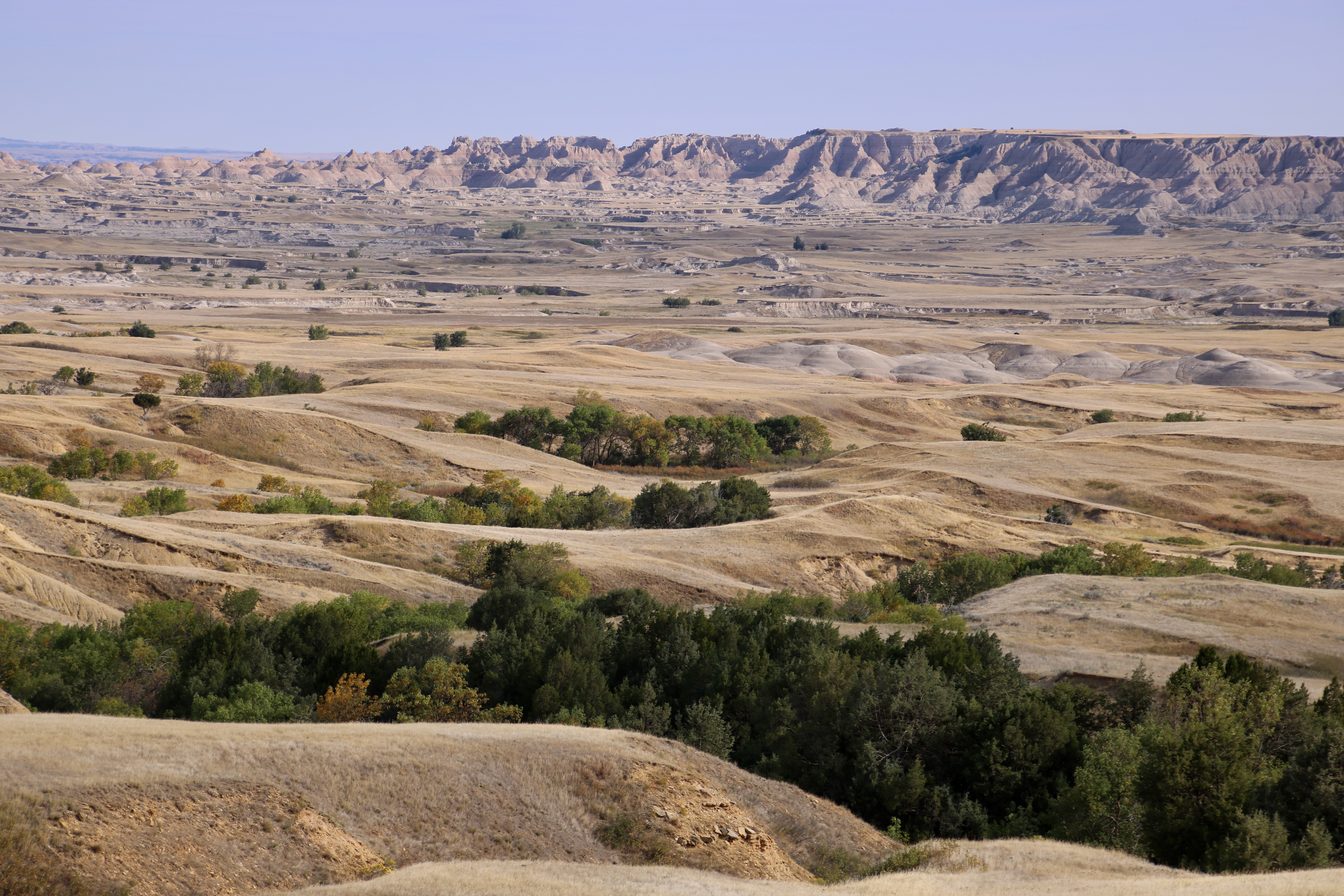
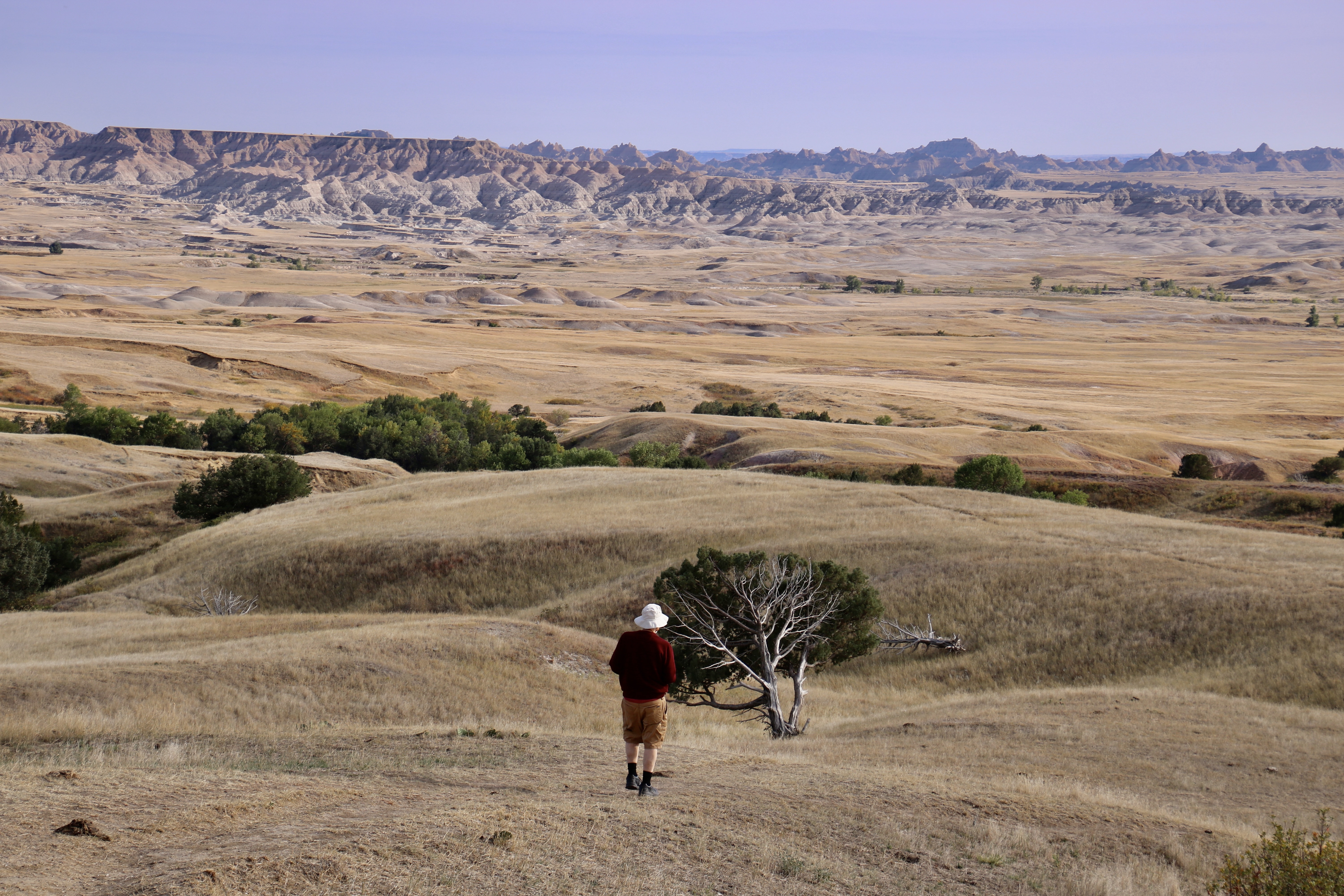
Beyond wildlife, Sage Road shows a different type of beauty than that found along the Loop Road, which runs along the Wall and through the badlands seen in the distance.
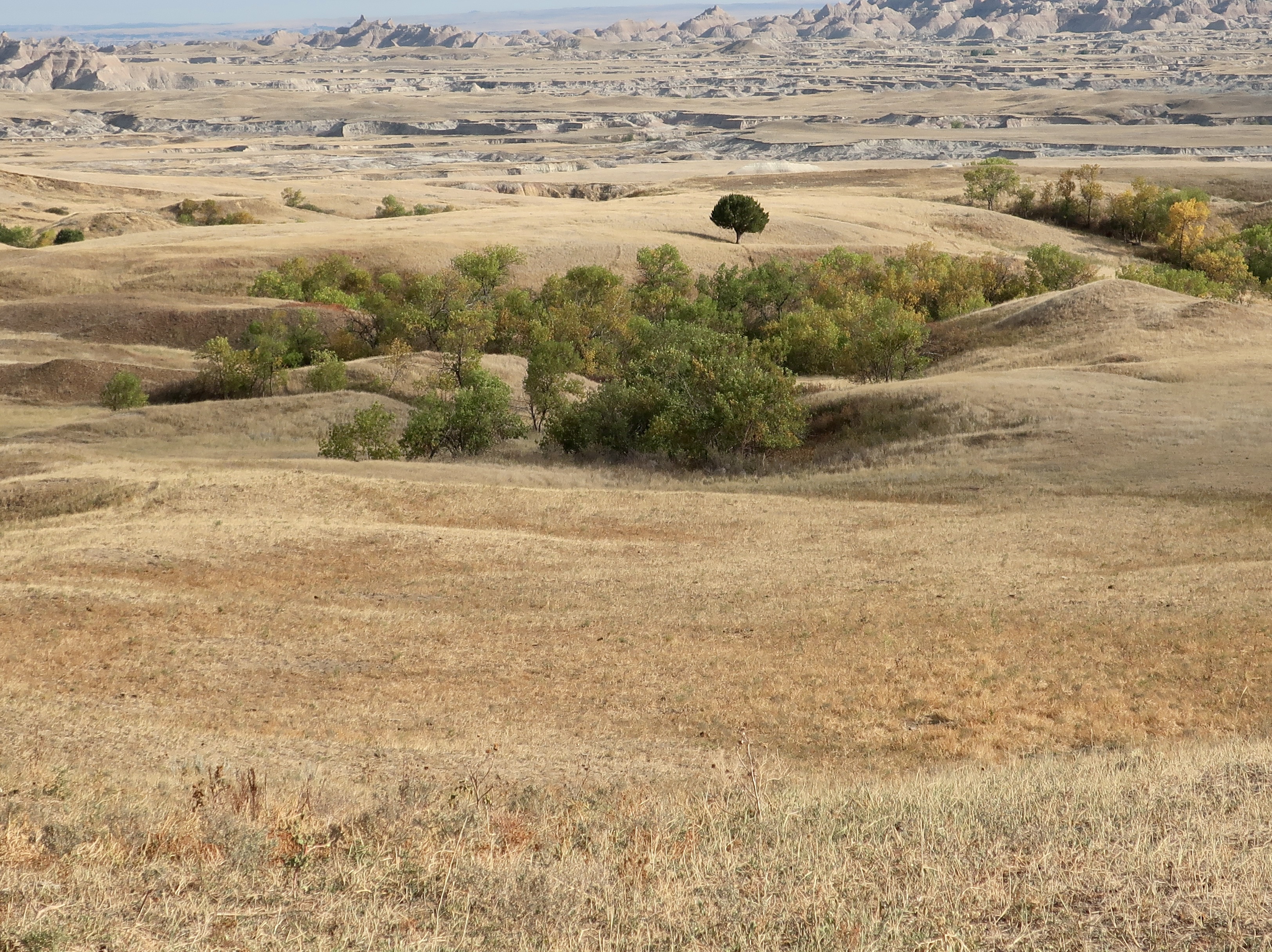
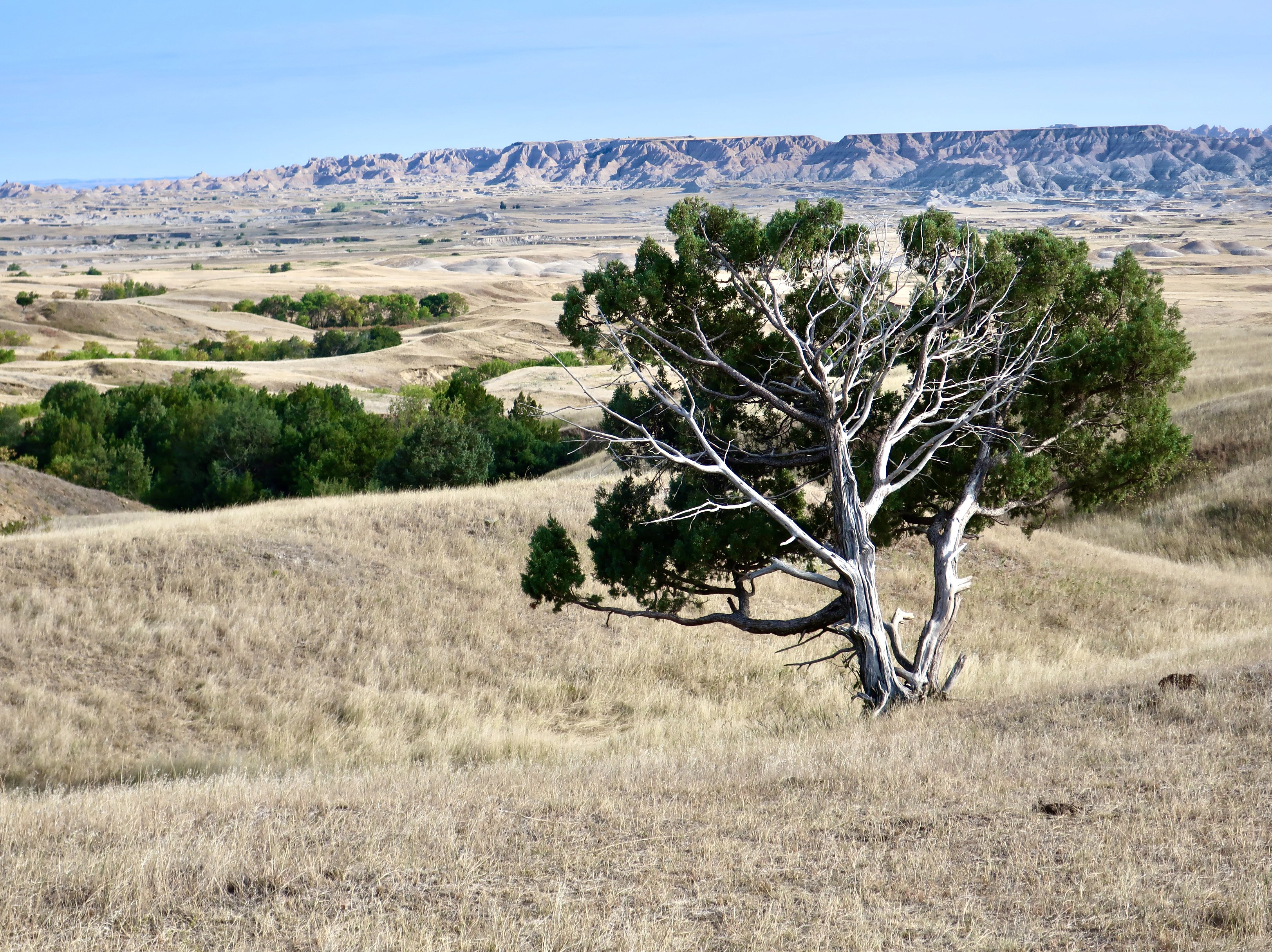
We loved the contrast between the golden grass on the gentle hills and green stands of trees found down in the gullies. (Photo by Peggy Mekemson.)The lone tree caught my attention in this photo. Peggy captured me heading for another tree I found interesting. Given my wandering ways, she wondered if I would stop there.I did stop, even though the stand of trees up ahead was calling to me. This is one of a number of photos I took of the tree.Meanwhile, Peggy had found a flock of turkeys that caught her attention. This was just a few of the flock. The others had disappeared down into the gully. (Photo by Peggy Mekemson.)As we drove back up Sage Road, returning to our camp, we stopped for a final photo that had more of a Badlands feel to it. Late afternoon colors were beginning to seep in. I’ll feature sunset photos in my next post. I was impressed. I imagine you will be as well.A preview of next week’s post.
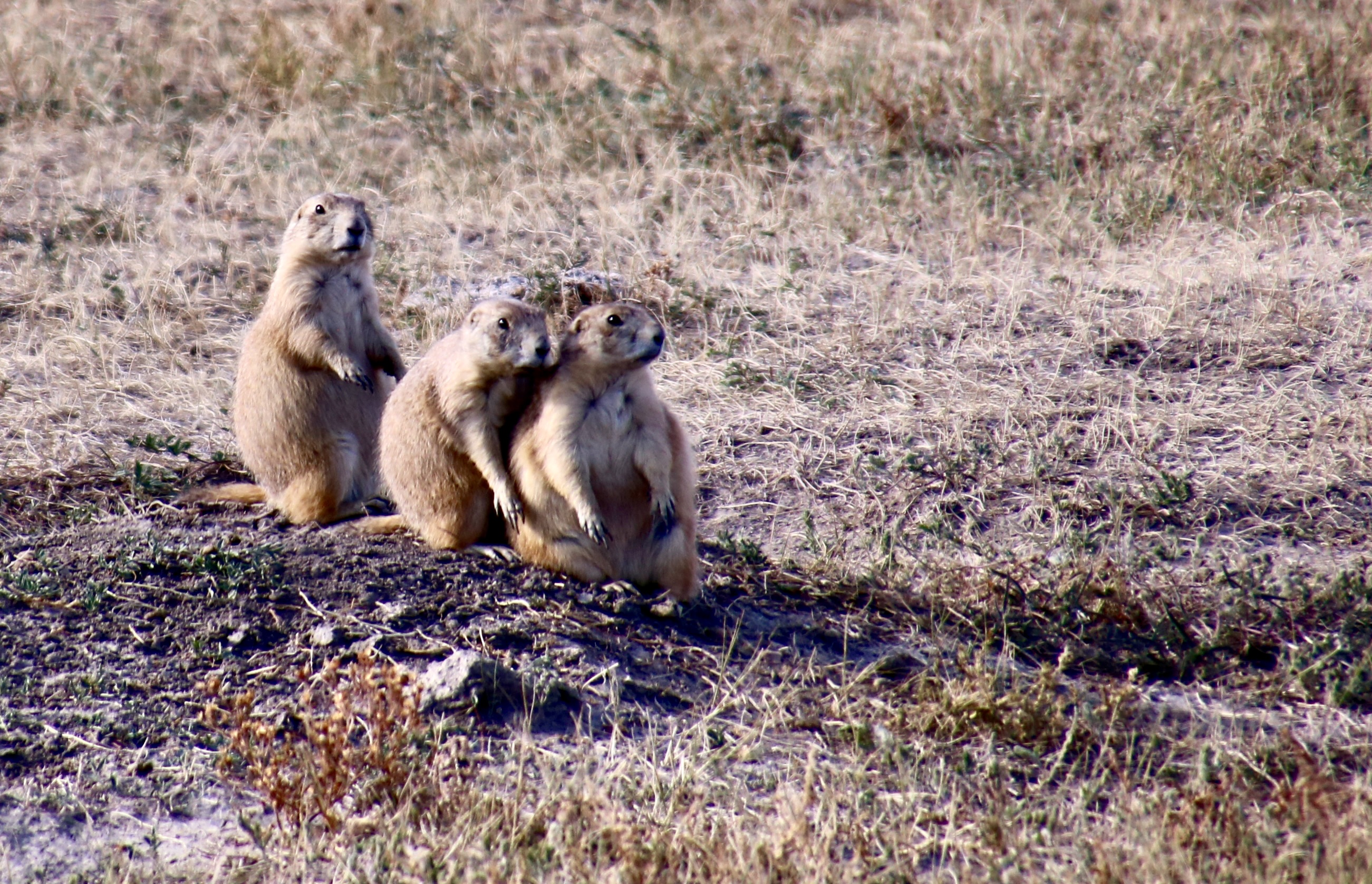
Badlands National Park has great beauty. it also has interesting— and amusing— wildlife, such as three curious prairie dogs that posed for Peggy. With winter and hibernation coming, these guys have obviously been putting on the pounds— or at least ounces! (Photo by Peggy Mekemson.)
The Lakota people, who have occupied the area for hundreds of years, called it mako sica. To early French fur trappers, it was known as les mauvaises terres. Both names mean the same thing: Badlands. If you can’t hunt it, fish it, farm it, or mine it— what good is it? Fortunately, our tastes have changed. We have come to appreciate areas for their natural beauty and Badlands National Park has an abundance. BTW, where there is a will there is a way. People have finally found a way to make money off of beautiful places. It’s called tourism.
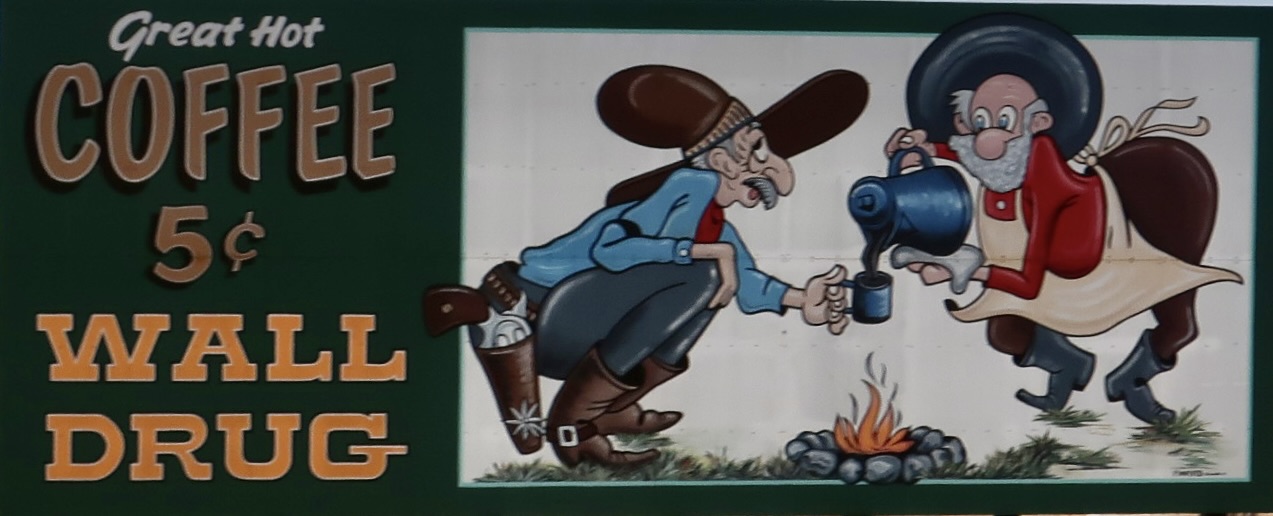
Speaking of tourism, we stayed in a small campground near Wall Drug, a tourist attraction that has mastered the art of pulling people off of the road. It started with offering them free ice water in the 60s and 70s by advertising on 3,000 small wooden road signs throughout South Dakota and neighboring states. I first came across the signs in the 60s. It was impossible not to be curious. This time, Peggy and I found the small wooden signs had been morphed into numerous billboards as we crossed South Dakota on I-90.
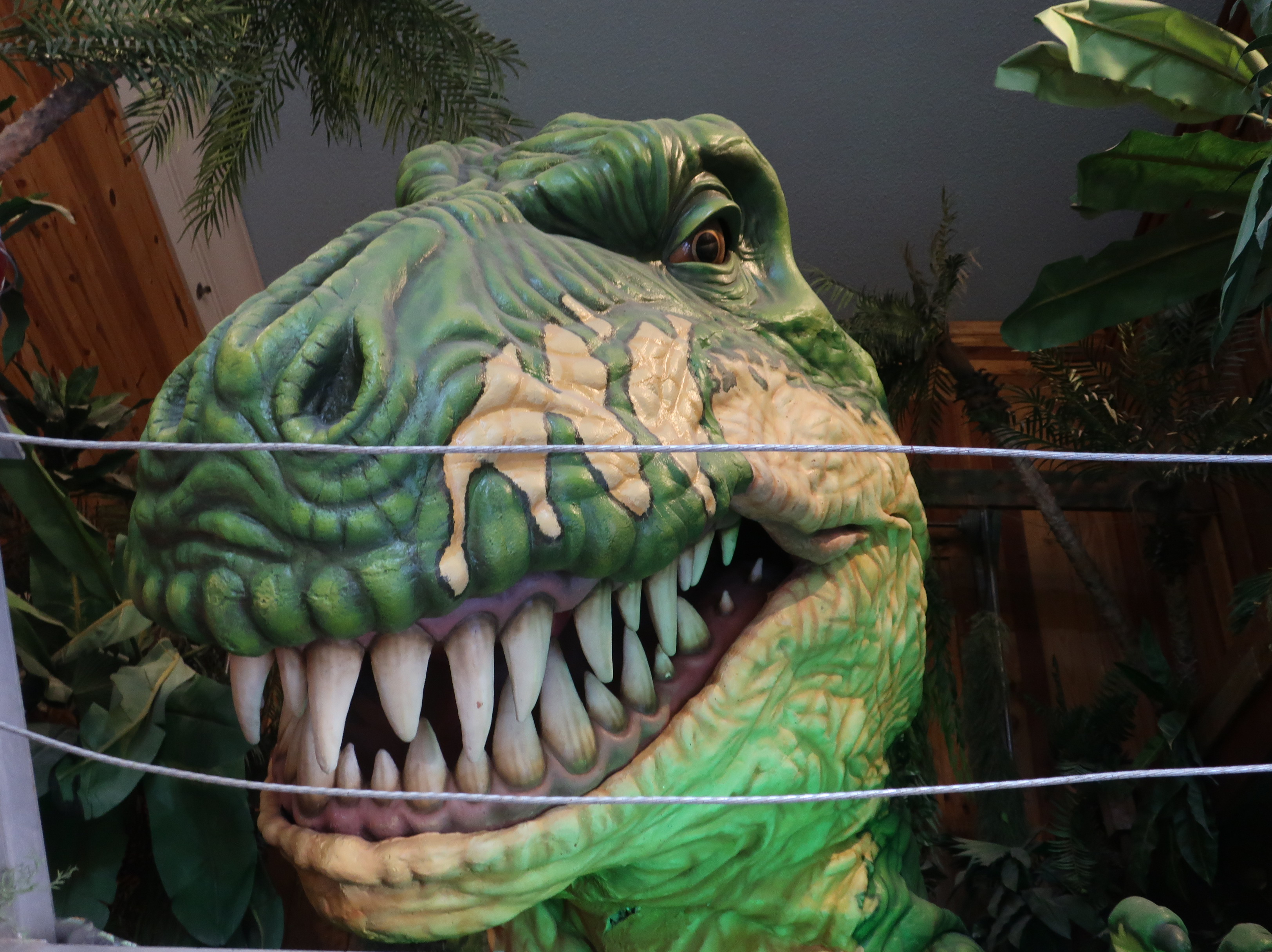
Wall Drug still uses come-ons to lure travelers off the road with large billboards along I-90. The small, original drug store has turned into a massive tourist attraction with the drug store occupying maybe 1,000 square feet out of the 76,000 square feet the attraction now claims. Wall Drug advertises that its store has something for everyone. Including Jackalopes.Peggy found one to ride.One of the billboards along I-90 advertised “Come to lunch— or be lunch at Wall Drug.” This smiling T Rex was apparently offering the latter. As an aside, numerous fossils have been found in Badlands National Park, but not dinosaurs. The area was part of an ocean at the time dinosaurs roamed the earth.
The term wall, in Wall Drug, comes from the primary feature of the Badlands, a hundred mile wall from which the Badlands have been eroding at an inch per year for the past 500,000 years or so creating mesas, ridges, and gullies with unique structures of considerable beauty. The 31 mile Loop Road the National Park features takes visitors along the wall and down into the Badlands, providing a great introduction. We will feature views from along the Loop Road today.
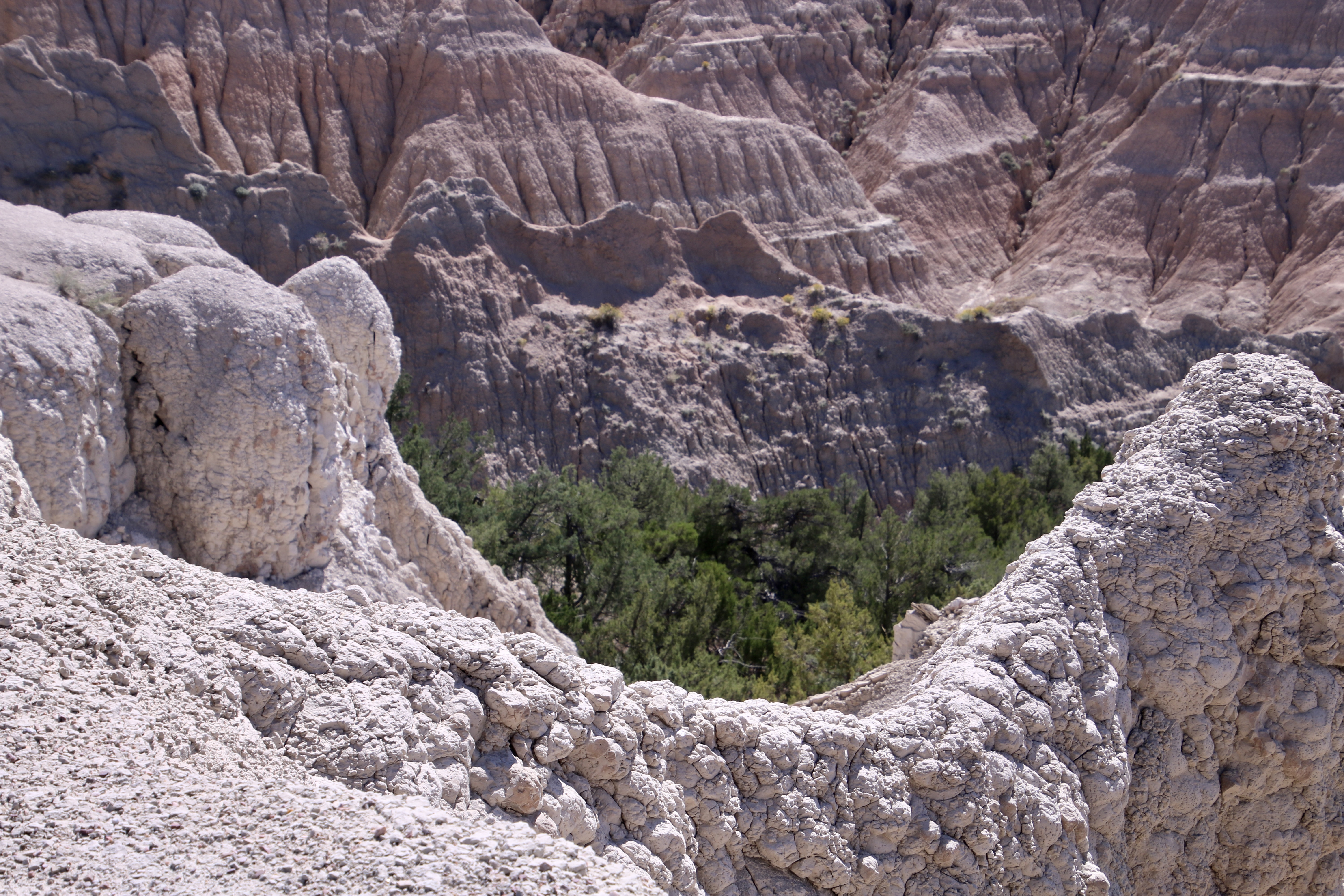
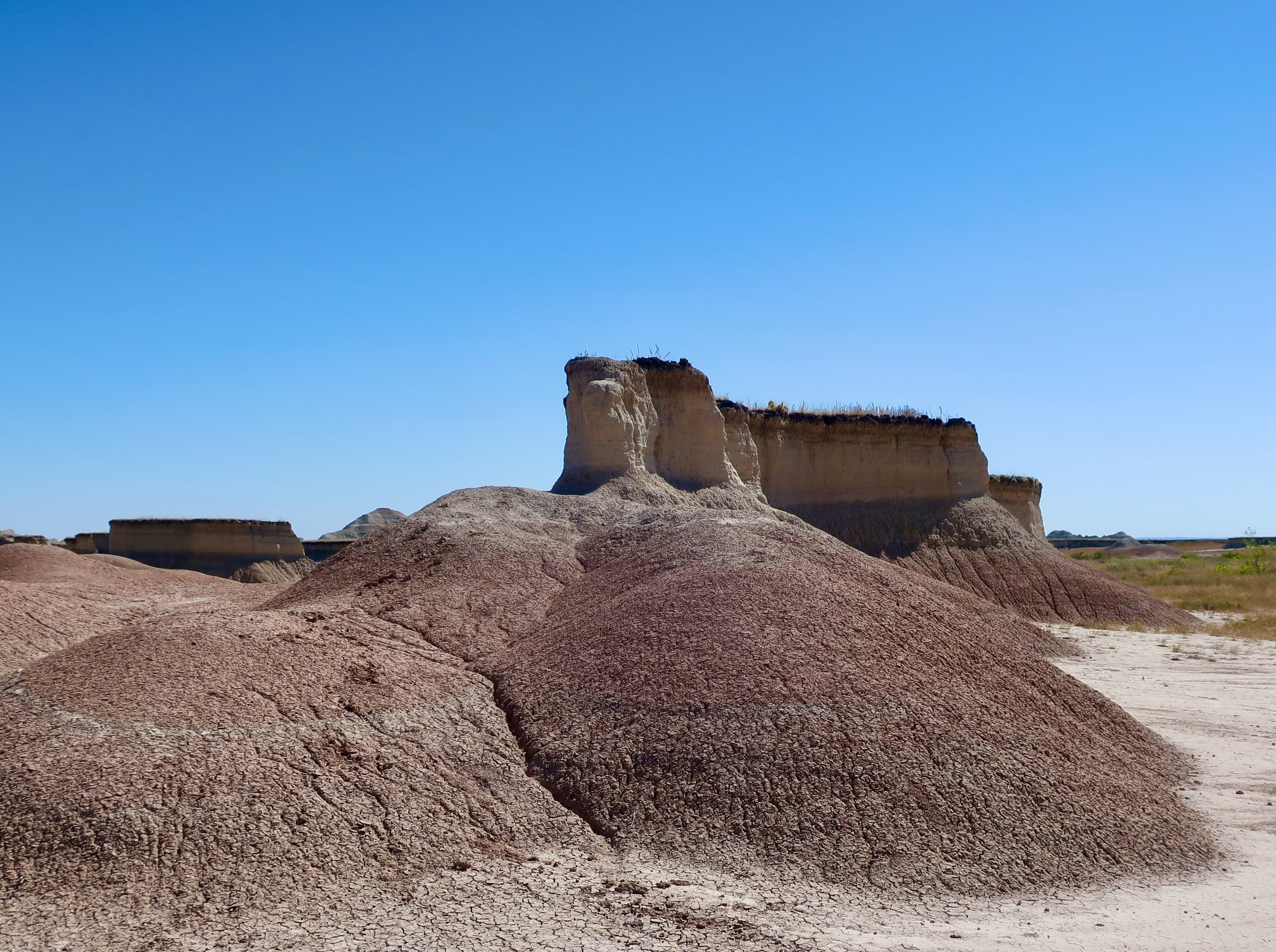
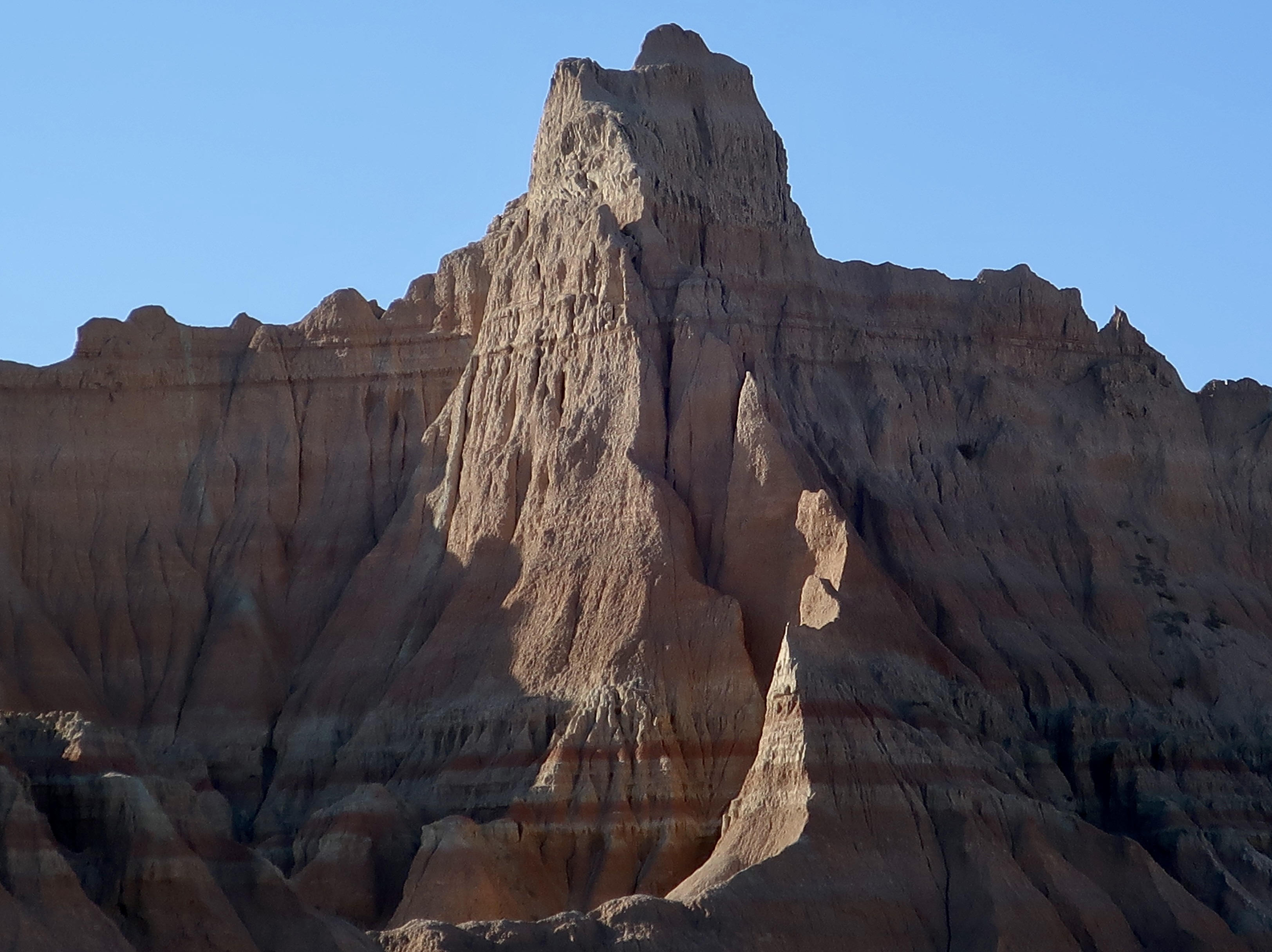
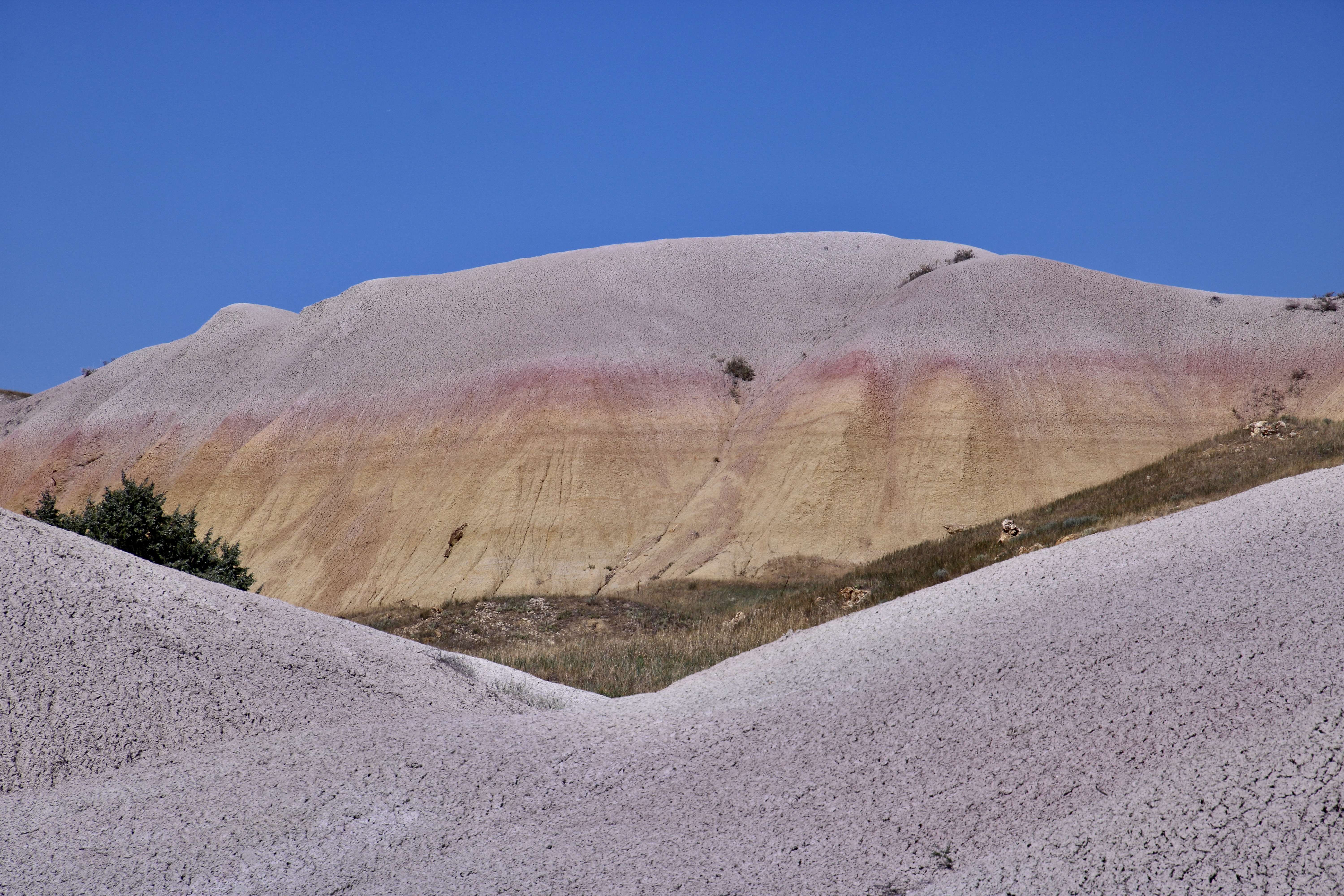
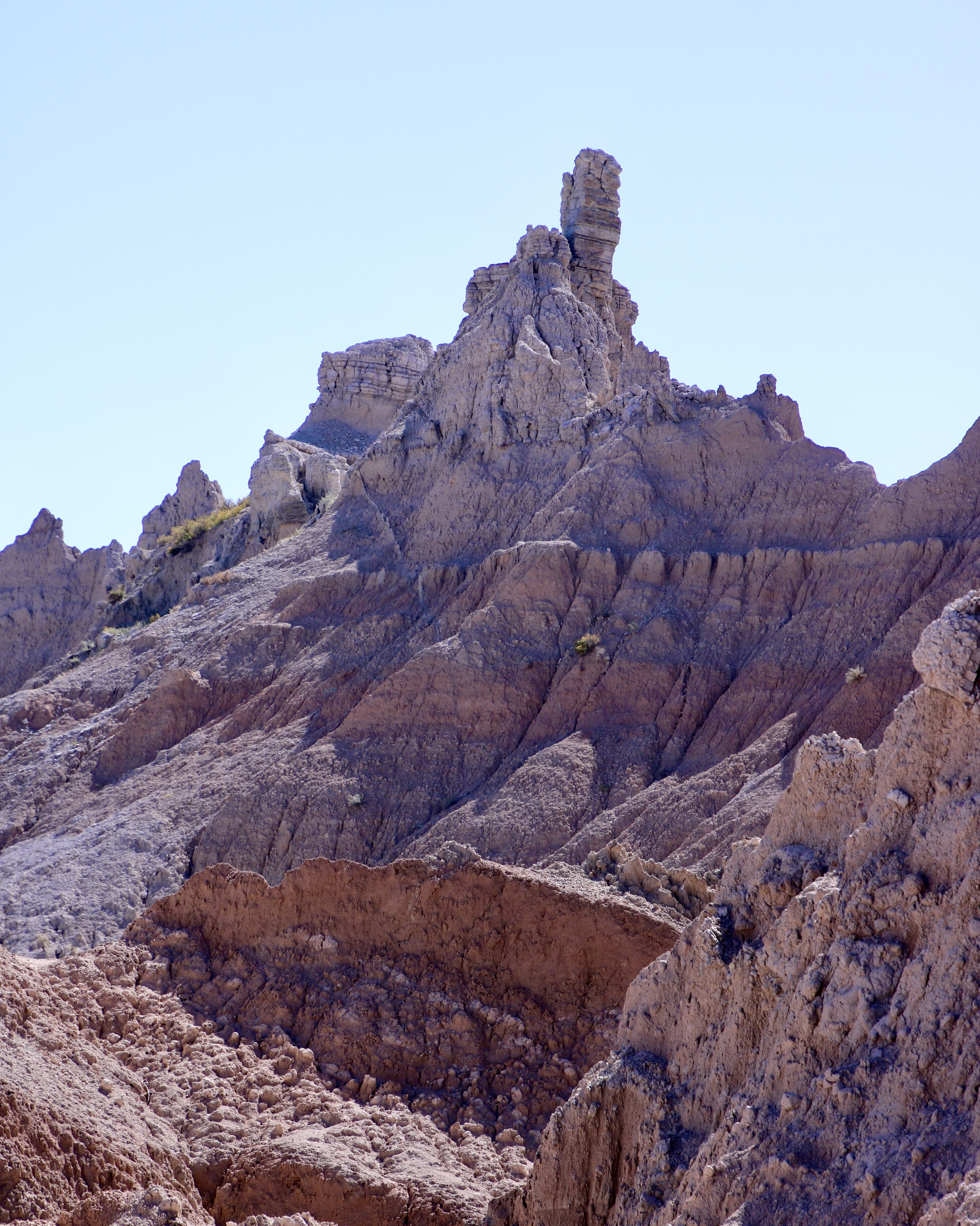
Erosion, cutting through some 45 million years of geological history between 75 and 30 million year ago, has left behind unique structures of great beauty. The upper right corner shows the wall from which the Badlands have eroded. Look carefully and you will see vehicles parked at one of the many pull-offs along the 31 mile Loop Road that winds its way through the park.One thing that is guaranteed along the Loop Road: Great variety. Compare this picture with the one above. (Photo by Peggy Mekemson.)What caught our attention here, was the contrast between the green trees and the white ridge. (Photo by Peggy Mekemson.)The erosion here had created a mesa left standing alone above the smooth mounds below.Rabbit bush added a touch of yellow here to complement golden hills above. (Photo by Peggy Mekemson.)Jagged peaks are also found along the 31 mile drive.A close up of one of the peaks along the way.Pink and mauve top off yellow hills. (Photo by Peggy Mekemson.)Another example. (Photo by Peggy Mekemson.)I liked the tiered look here and the way erosion had cut through over 40 million years of geologic history.We wondered how long it would be before the finger rock on top of this peak fell. (Photo by Peggy Mekemson.)One of the pull-offs along the road is dedicated to Chief Bigfoot of the Lakota tribe. He was ill when he reached this site on the wall. His followers helped him down. Not long after that, he and some 150 member of his tribe, including women and children, were massacred at Wounded Knee. it was one of the darker moments in US History.I conclude today with this photo of the Badlands taken near the Visitor Center. Peggy and I will take you for a drive along Sage Road in our next post. It’s noted for its wildlife. Get ready for buffalo, turkeys, big horn sheep, and a raucous town of prairie dogs!