Abbot’s Lagoon is a great place for bird watchers. Or people watchers. This great blue heron with its neck stretched out like a rubber band had a wary eye on Peggy. Wisely so. She was stalking it with her camera. (Photo by Peggy Mekemson.)
It’s a wrap on my Pt. Reyes series today. Peggy and I will take you for a hike out to Abbot’s Lagoon and a visit to Pt. Reyes Station, a favorite town of mine.
The hike is suitable for almost anyone. We even watched a mom and dad pushing their baby along in a stroller. How much easier can it get? The baby seemed quite happy as did the parents. Visitors can turn around whenever they want, hike out to the Lagoon, or go on a leisurely stroll all the way to the ocean. We chose the latter.
The Abbot’s Lagoon trailhead leading out from the parking lot. The Lagoon can be seen in the distance. The Pacific Ocean is out beyond the Lagoon. The narrow strip you can see on the left is the continuation of the trail.
The red marker shows the location of Abbot’s Lagoon on the Google map. Down to the right you can see Pt. Reyes Station next to the Highway 1 marker. Highway 1, BTW, follows the San Andreas fault through this area. The 1906 San Francisco Earthquake shot what is now the National Seashore over 20 feet northward. San Francisco is 30 miles to the south.
Another photo of Peggy’s great blue heron. This time he was back at work catching fish. I liked the slight hint of a reflection. (Photo by Peggy Mekemson.)
I was impressed with the red eye on this coot. (Photo by Peggy Mekemson.)
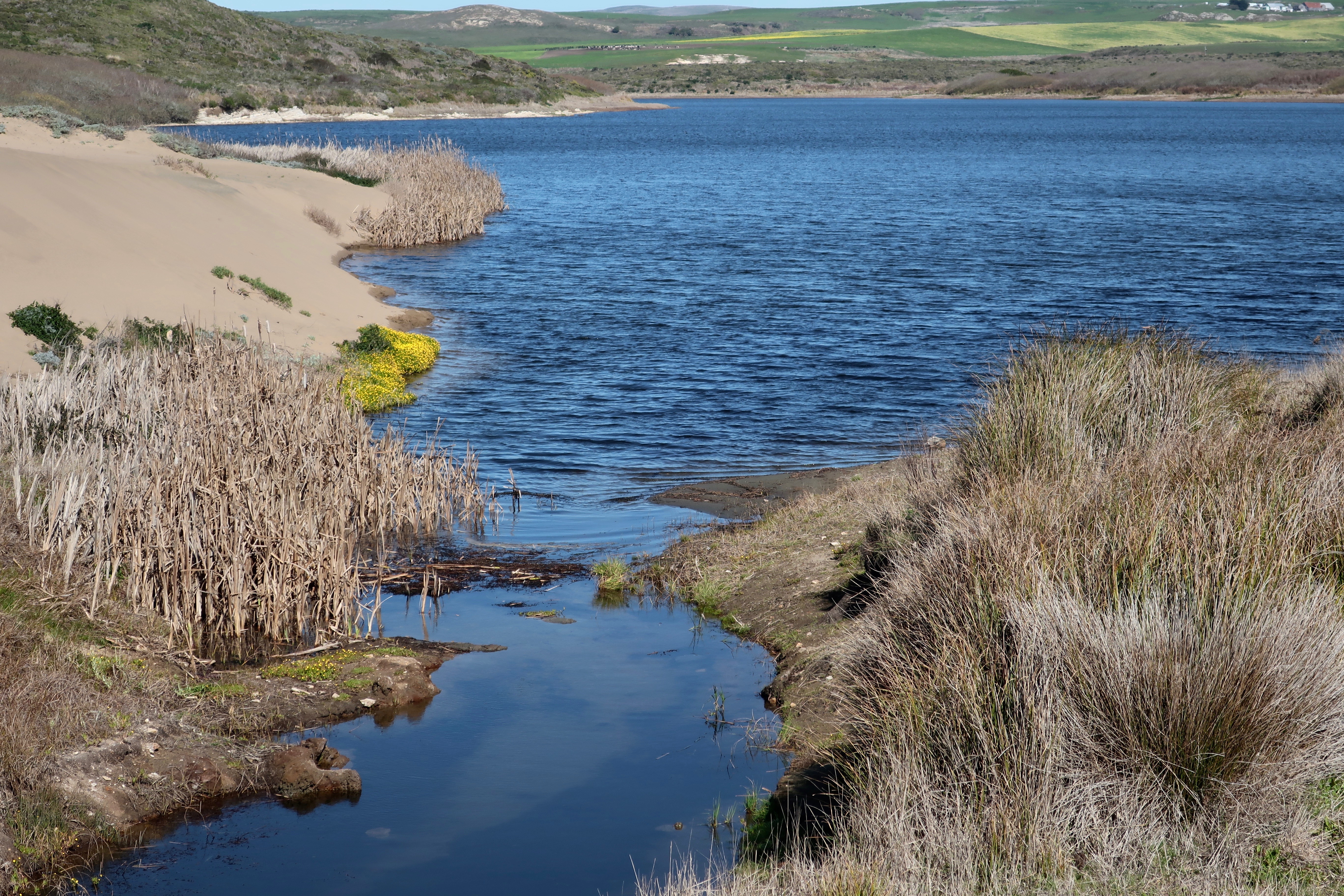
We crossed a small bridge and looked back up the Lagoon toward the parking lot.
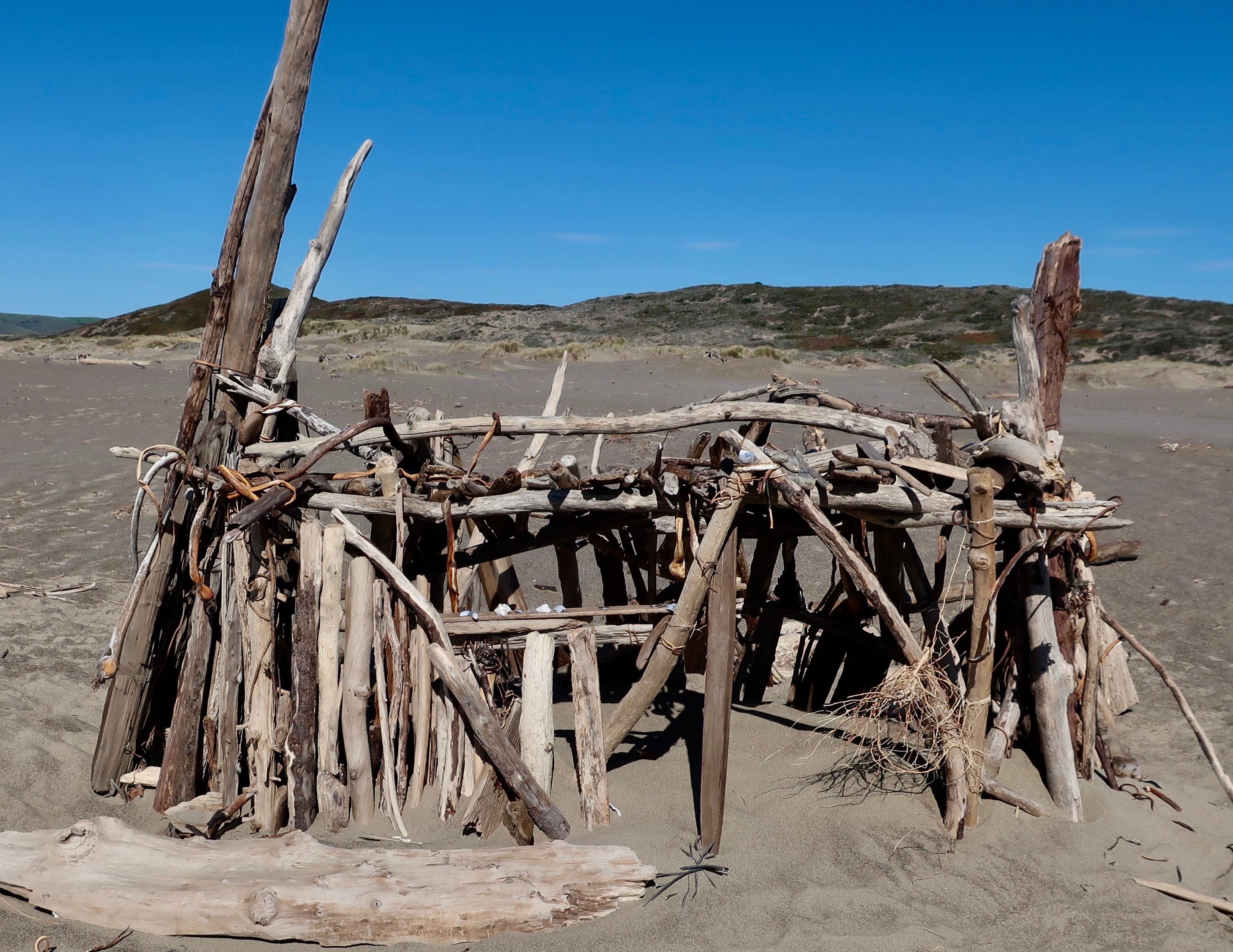
There was a drift wood structure along the trail on the beach out near the ocean. It had been cleverly woven together with kelp.
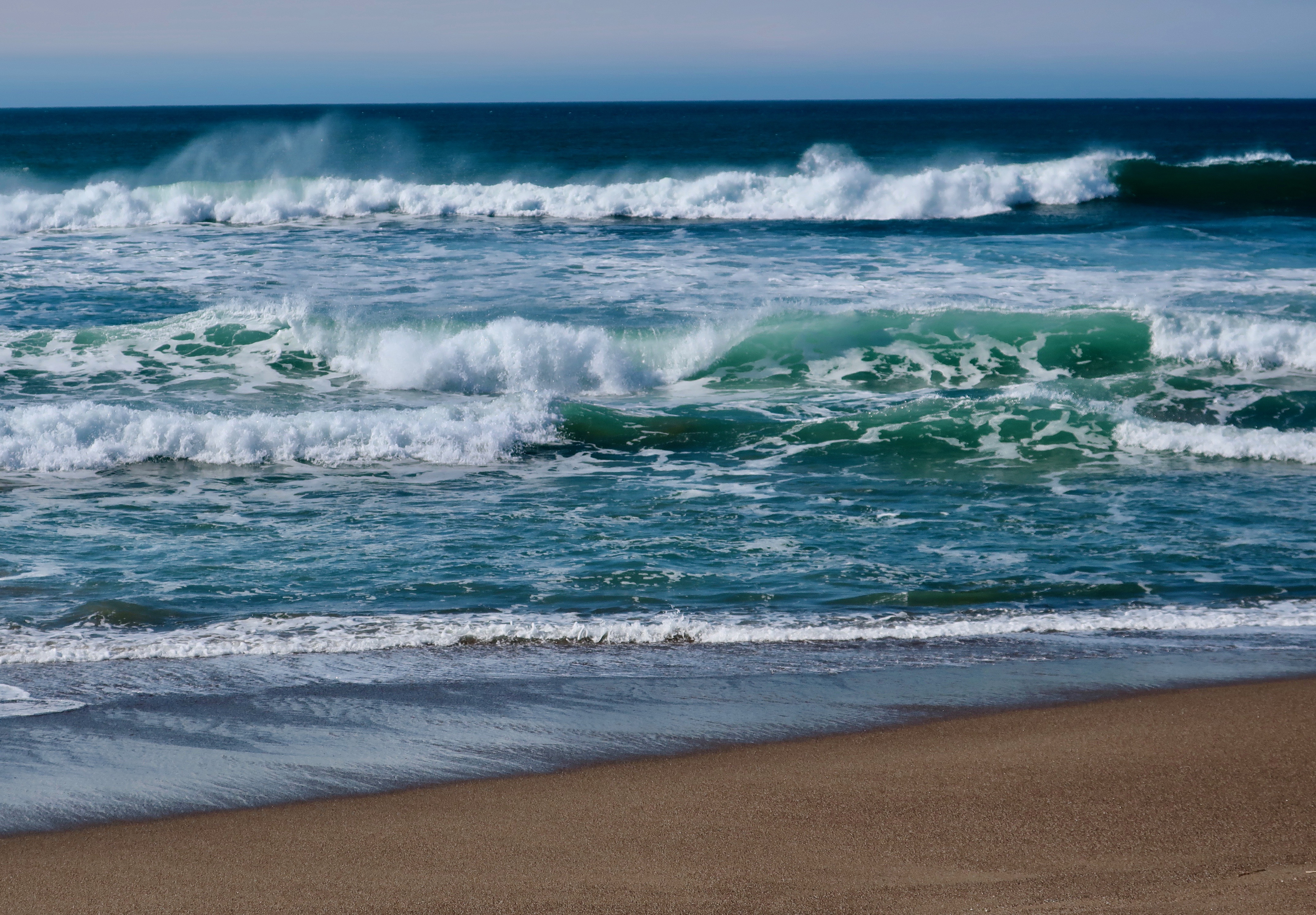
Finally we arrived at the Pacific Ocean.
The North Pacific Coast Railroad had arrived in the area 146 years earlier in 1875 and let passengers off in a cow pasture to make their way to nearby Olema and dairy ranches out on the peninsula. The cow pasture soon added a hotel and the town of Pt. Reyes station was born. It’s a story told over and over in the West. The railroad arrives and a community springs up, making land barons/developers happy and rich. This time it was a dentist in San Francisco. The railroad was making its way north to retrieve redwoods that were being cut down to build the city. Many a giant redwood gave its life to the cause.
I first arrived at Pt. Reyes Station in the late 1960s and I’ve returned again and again. The town has become somewhat yuppified and more expensive since then due to its close vicinity to San Francisco, but it still retains much of its charm. The following photos reflect some of what makes it charming.
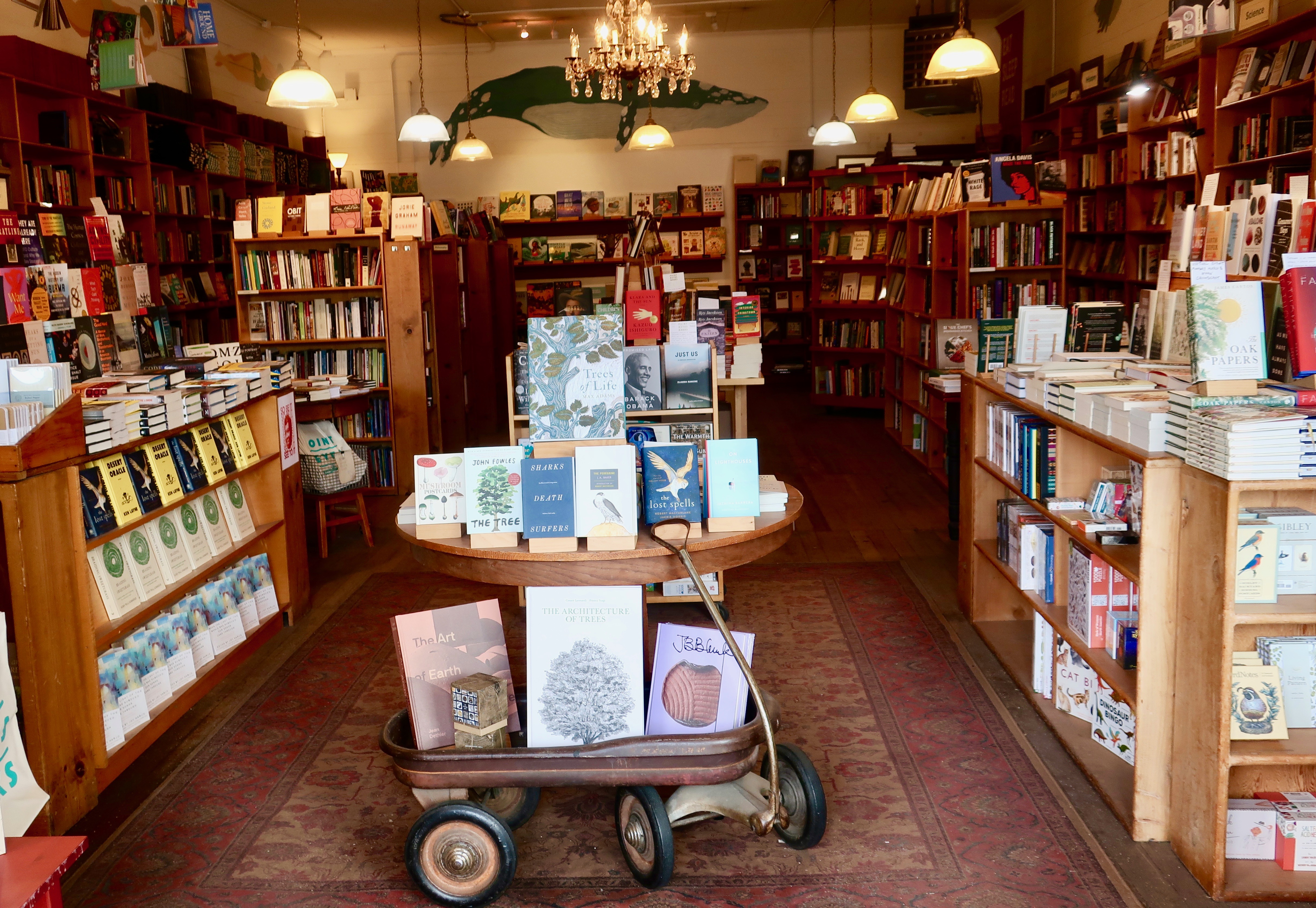
The Pt. Reyes Book Store is one of the best small, independent bookstores we have ever been in, and we’ve been in a lot. Peggy told me to go in and spend $200 for my birthday. Boy, does she know me…
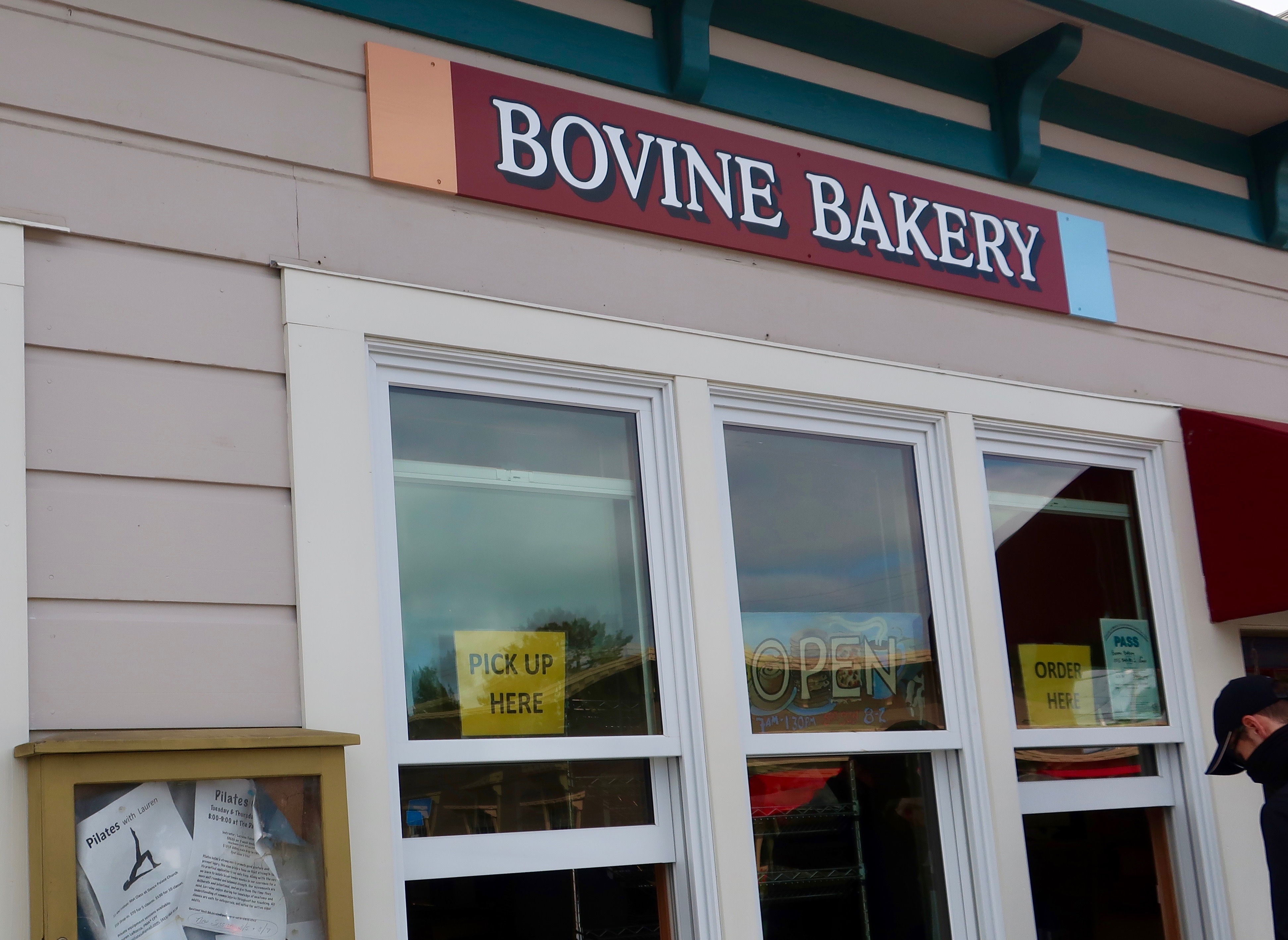
The Bovine Bakery is on one side of the book store. The buttermilk scones are to die for! I never leave town without one, or two, or three, or four.
Feeling Horsey? A saddlery is on the other side of the bookstore.
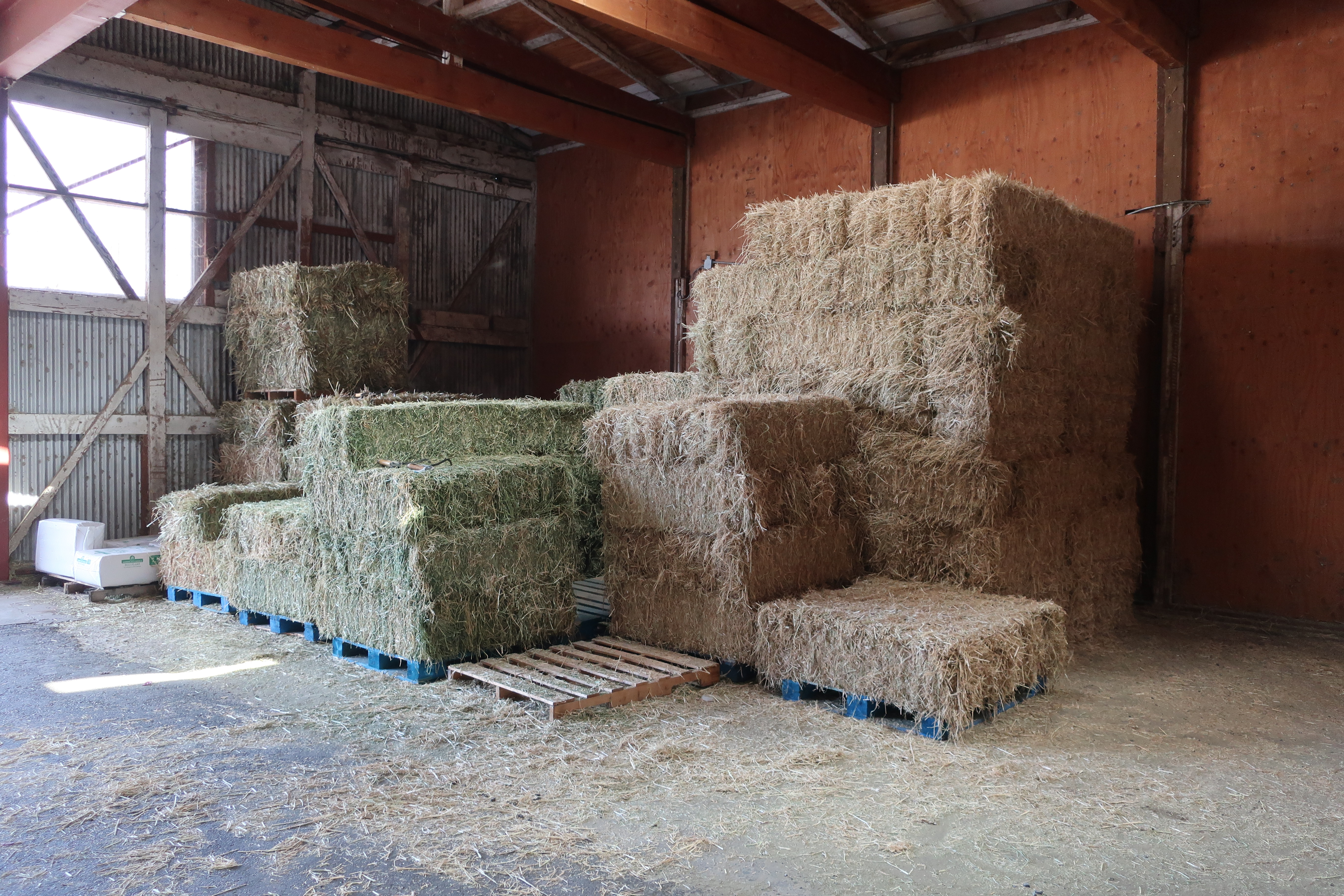
If your horse is hungry, Toby’s Feed Barn is across the street.
But what feed barn do you know that also serves gourmet coffee and freshly baked, large chocolate chip cookies. Now, that’s what I call charm!
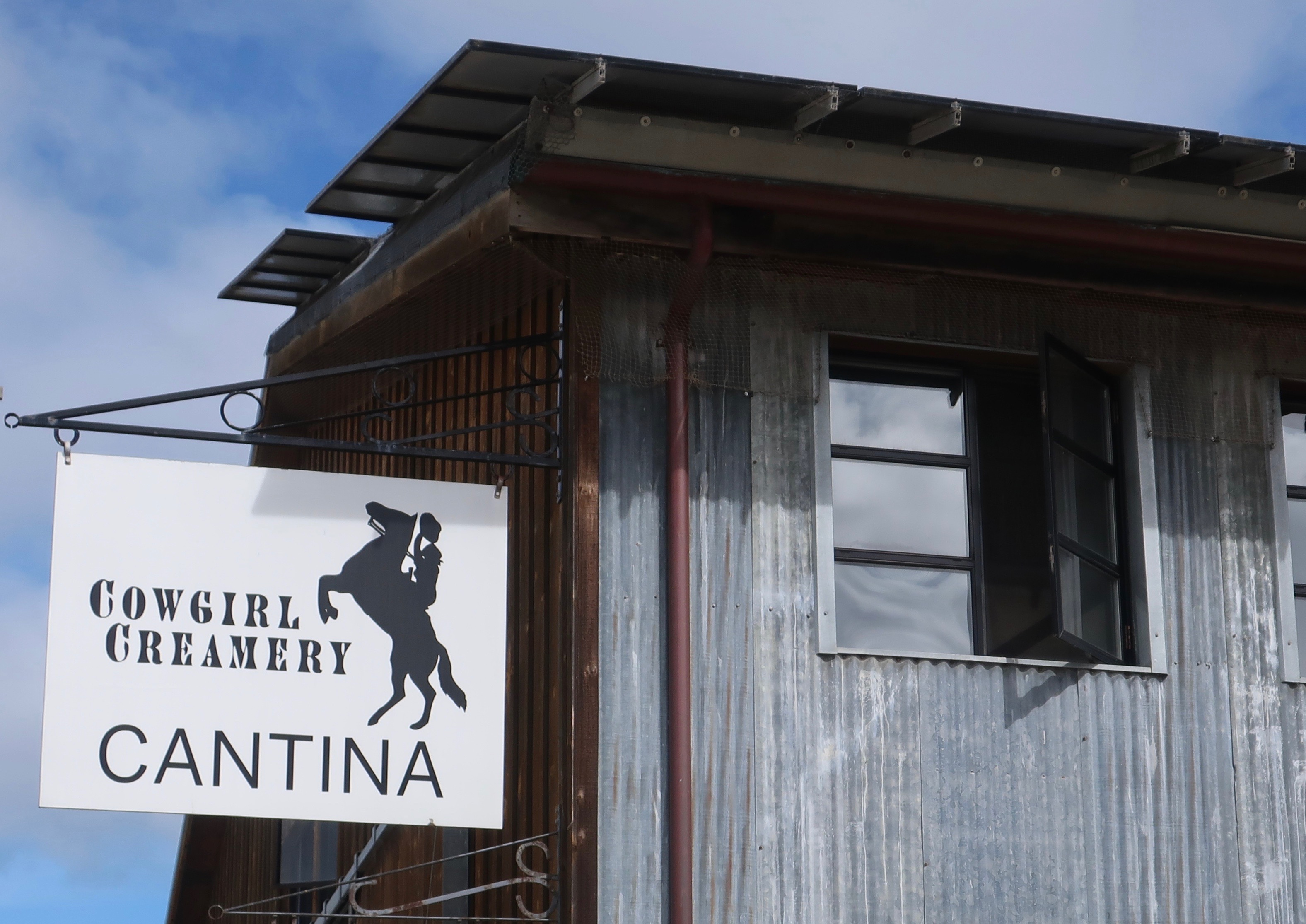
A walk behind the the bookstore building brought us to the Cowgirl Creamery, famous for its cheeses, and I might add, its grilled cheese sandwiches. I’ve never been a fan of grilled cheese, but one bite of its aged white cheddar on sourdough bread and I was hooked. Peggy and I were back for another one the next day, which we took out and ate at the Abbot’s Lagoon parking lot.
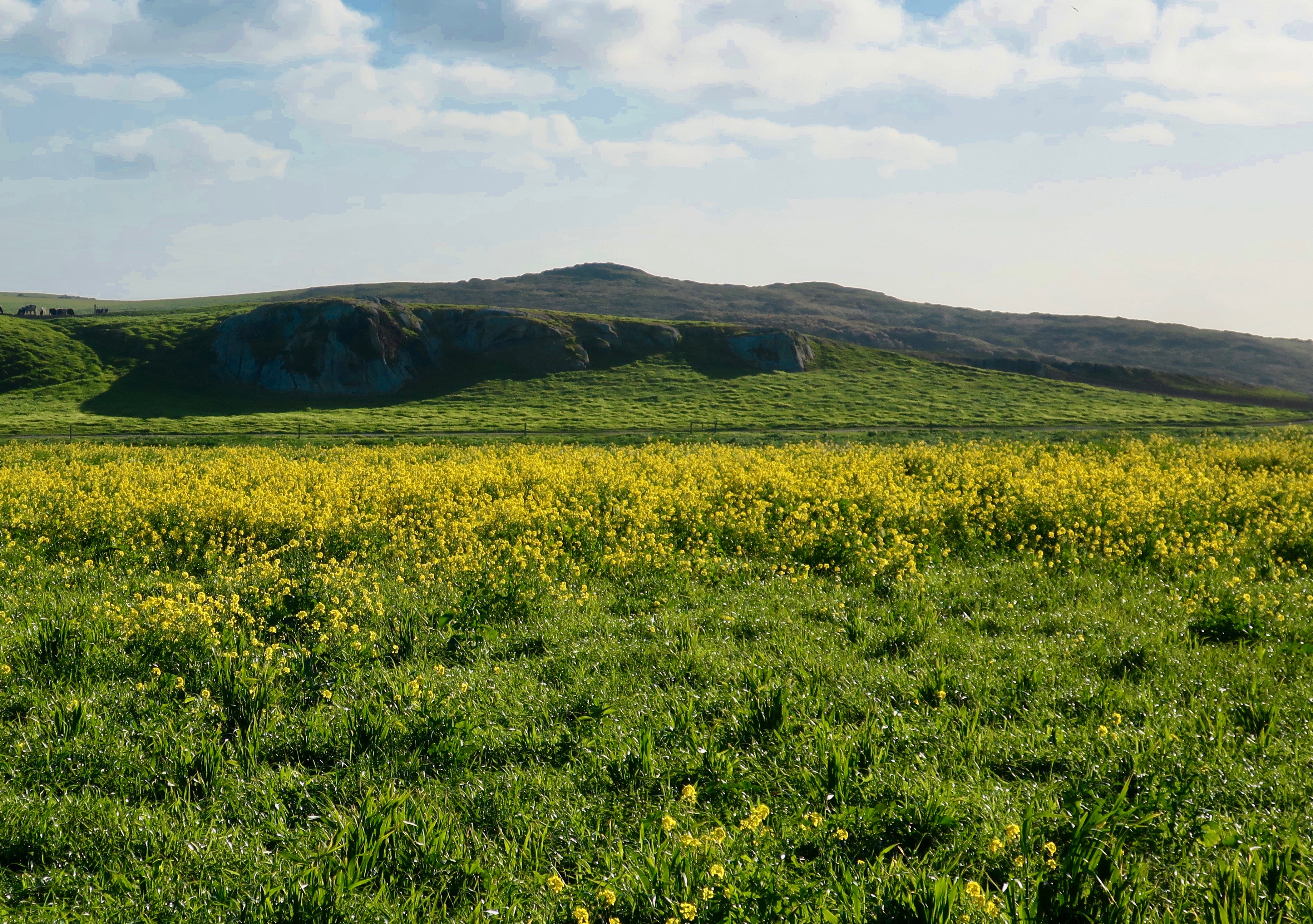
Our view from where we chowed down on our grilled cheese sandwiches in the Abbot’s Lagoon parking lot.
A bit of living history. Cheda’s Garage is the oldest contract Triple A garage in the nation.
This was the view inside Cheda’s Garage. Putting two and two together and thinking roadside pickup of wrecked cars, I couldn’t help but irreverently think “Roadkill.” Just kidding. Old Cheda must have been one heck of a hunter.
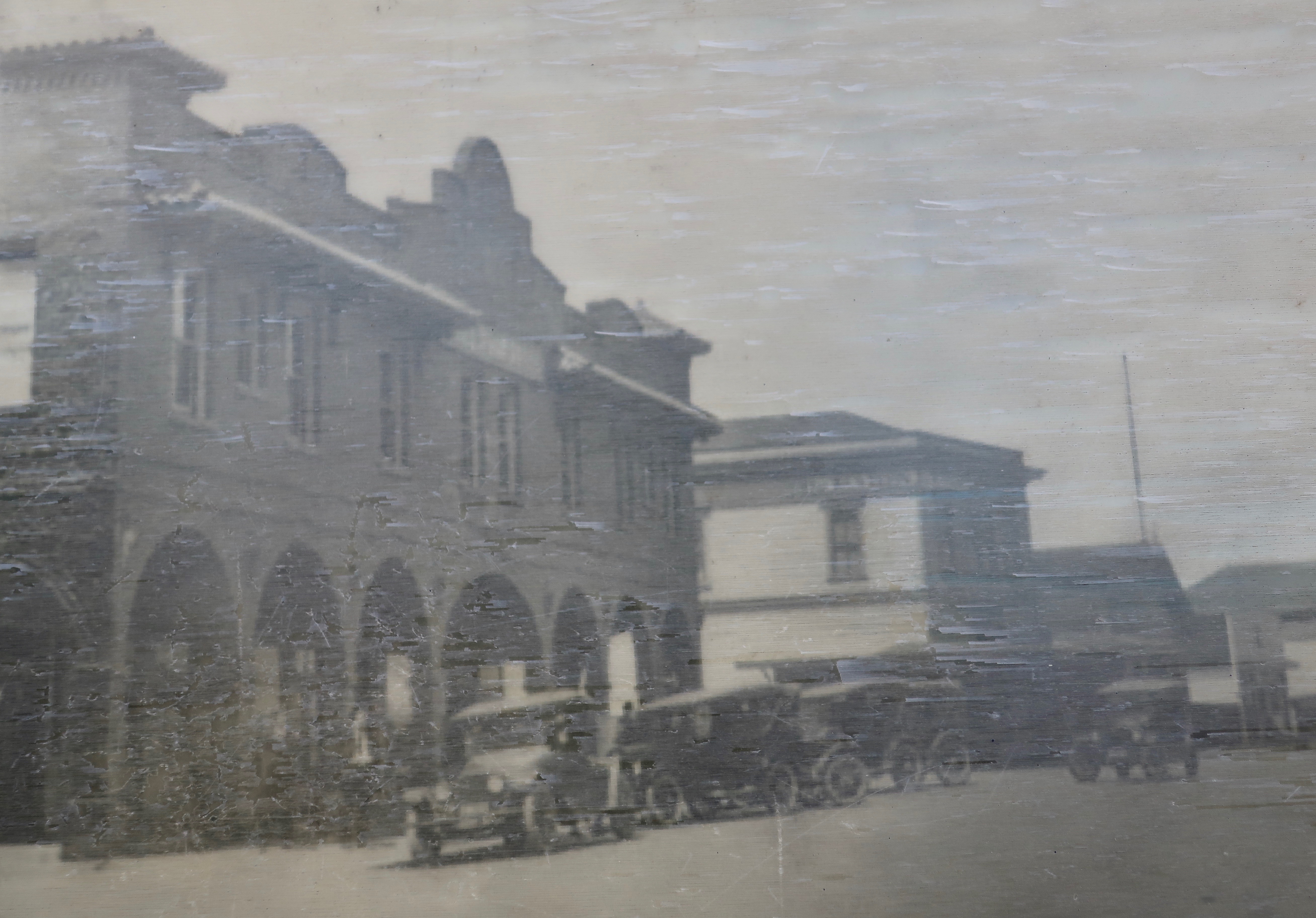
A photo of early Pt. Reyes Station…
The building today.
The mural on the front of the building capturing some of the activities and wildlife of the area.
Just around the corner we found a sign that made us smile. A No Parking Sign had been cleverly modified to become a No Barking sign. Several cars were lined up in the no parking zone. Not one had a barking dog. A law-abiding town, for sure.
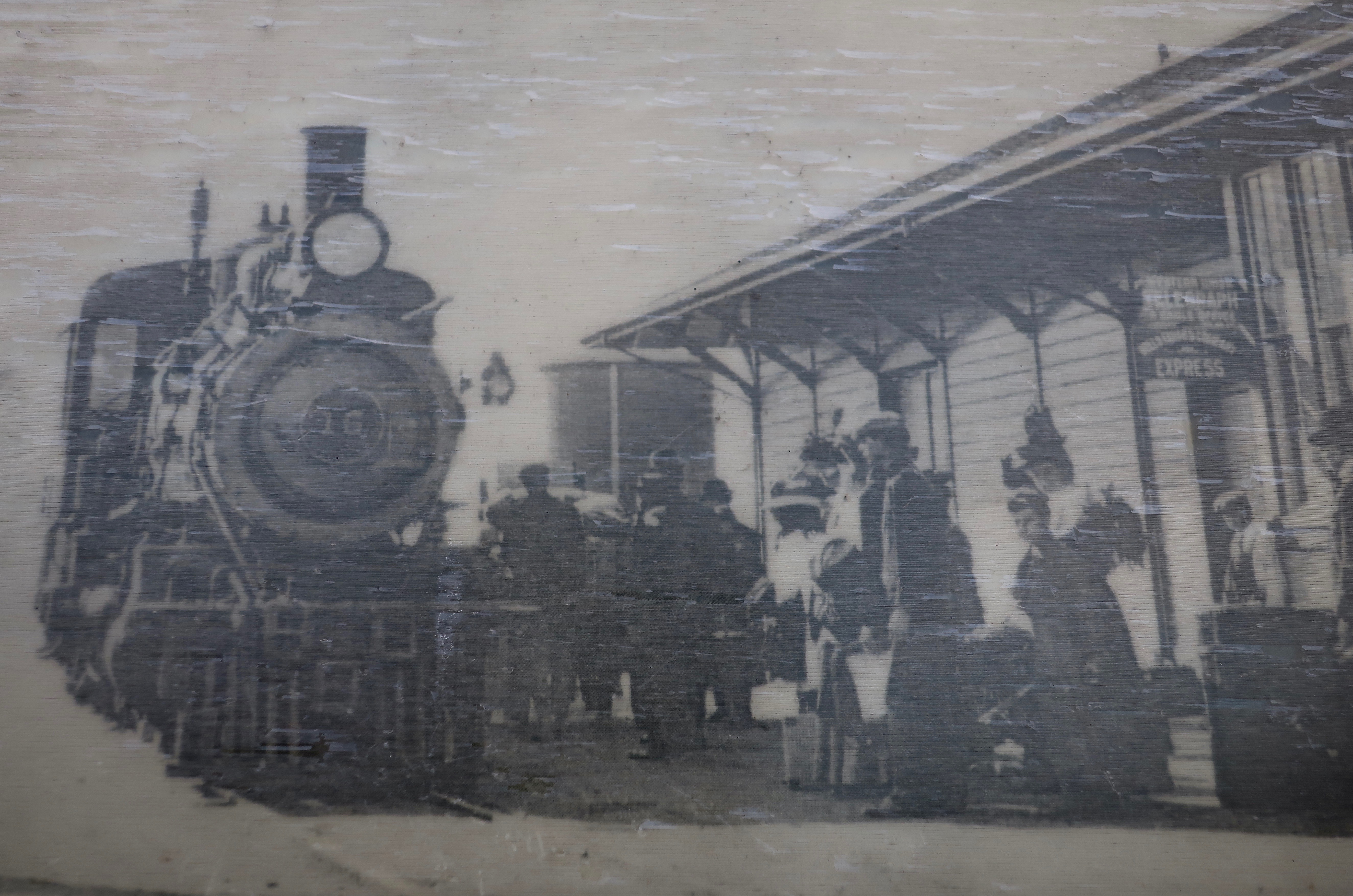
I’ll conclude my Pt. Reyes series with a historic photo of the train that gave the town its name. Join me next Friday on my travel blog as I take you on a spring walk around our property.
MONDAY’s BLOG-A-BOOK POST from Its 4 AM and a Bear Is Standing on Top of Me: I decide that doing an inventory of the local skunk population is ever so much better than being conked on the head by a Little League hardball. But have you ever faced a skunk standing on its front legs with its tail pointed toward you— ready to spray?
“Point Reyes is the windiest place on the Pacific Coast and the second foggiest place on the North American continent. Weeks of fog, especially during the summer months, frequently reduce visibility to hundreds of feet. The Point Reyes Headlands, which jut 10 miles out to sea, pose a threat to each ship entering or leaving San Francisco Bay. The historic Point Reyes Lighthouse warned mariners of danger for more than a hundred years.” From the Pt. Reyes National Seashore website.
It was hard to imagine frequent winds of 60 MPH that have been clocked as high as 133 MPH and weeks on end of pea-soup fog the day we visited the Pt. Reyes Lighthouse in March.
For as much as I enjoy Pt. Reyes National Seashore, I studiously avoid it in the summer. One reason is the fog. That’s true for much of the Pacific Coast. The other is tourists, gazillions of them. Traffic slows to a turtle’s pace along Highway 1, campgrounds are full, and popular sites such as the lighthouse are packed. I have a limited sense of humor about any of the above, especially given that I can visit during the late fall, winter, and early spring when few tourists are out and about and days are often crystal clear. Or, if I am particularly lucky, a raging storm will send huge waves crashing ashore producing spectacular views. I love both.
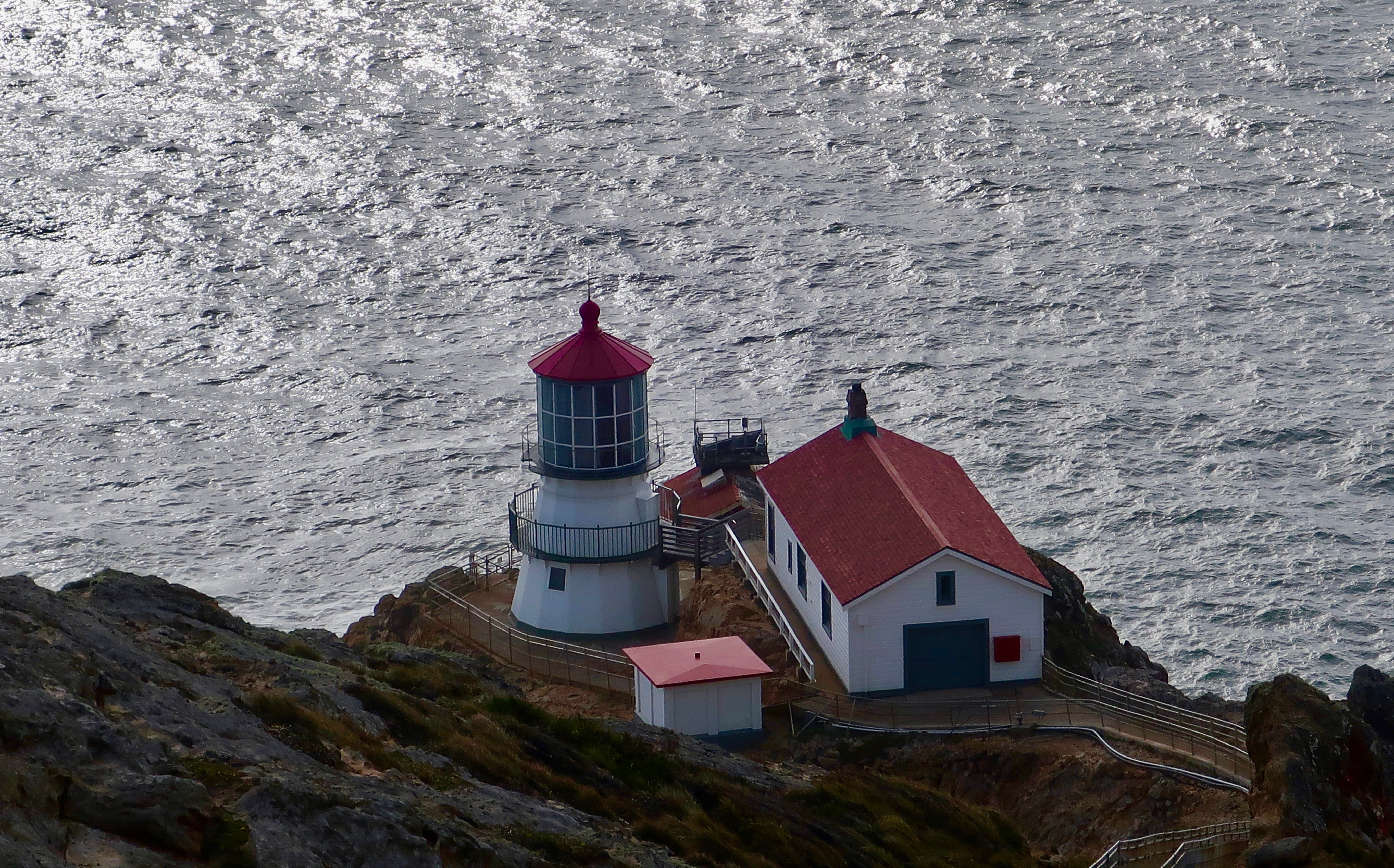
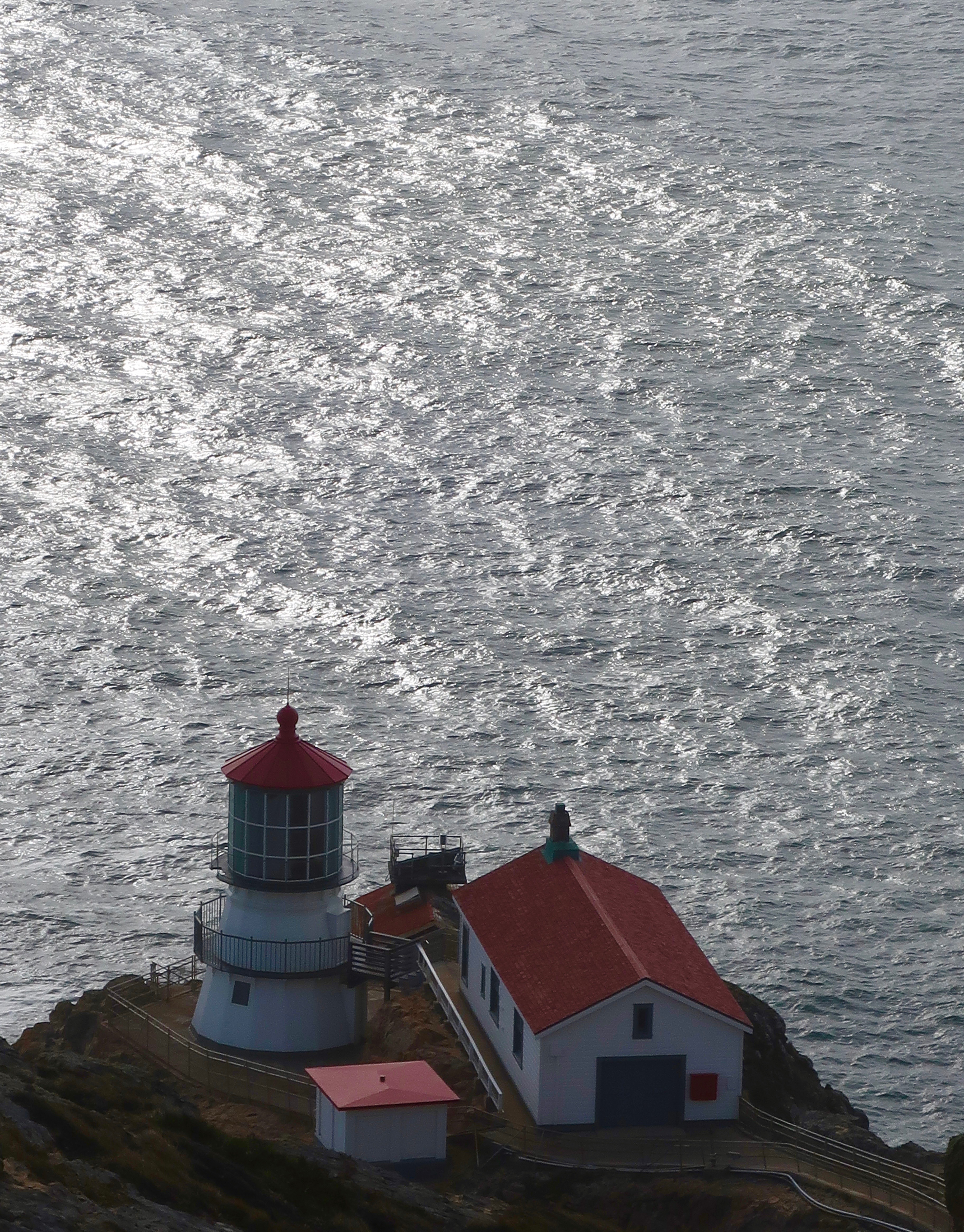
It was mainly sunshine when Peggy and I visited the National Seashore in early March to celebrate my birthday. The lighthouse was closed due to Covid, but I have visited it before. This time, we admired it from above.
The Lighthouse was built in 1870 to help counter the frequent shipwrecks that took place in the area. A steam driven fog horn was used when the fog was too thick to see the light.
The lighthouse served its purpose for over 100 years, finally shutting down in 1975 when the US Coast Guard replaced it with an automated light found just below the historic lighthouse. Up until then it was tended by a lighthouse keeper whose responsibility was to keep the light burning. In addition to warning mariners off of the treacherous rocks, the lighthouse served as a navigational aid. Each lighthouse along the coast has a different frequency of light that ship pilots recognize. At Pt. Reyes, the light flashed once every five seconds.
Looking out to sea.
A historic view of the Pt. Reyes Lighthouse from the National Archives.
Peggy and I parked Quivera and followed the trail that led out to the lighthouse. Along the way, we found trees that showed the effects of the high winds that frequent the headlands.
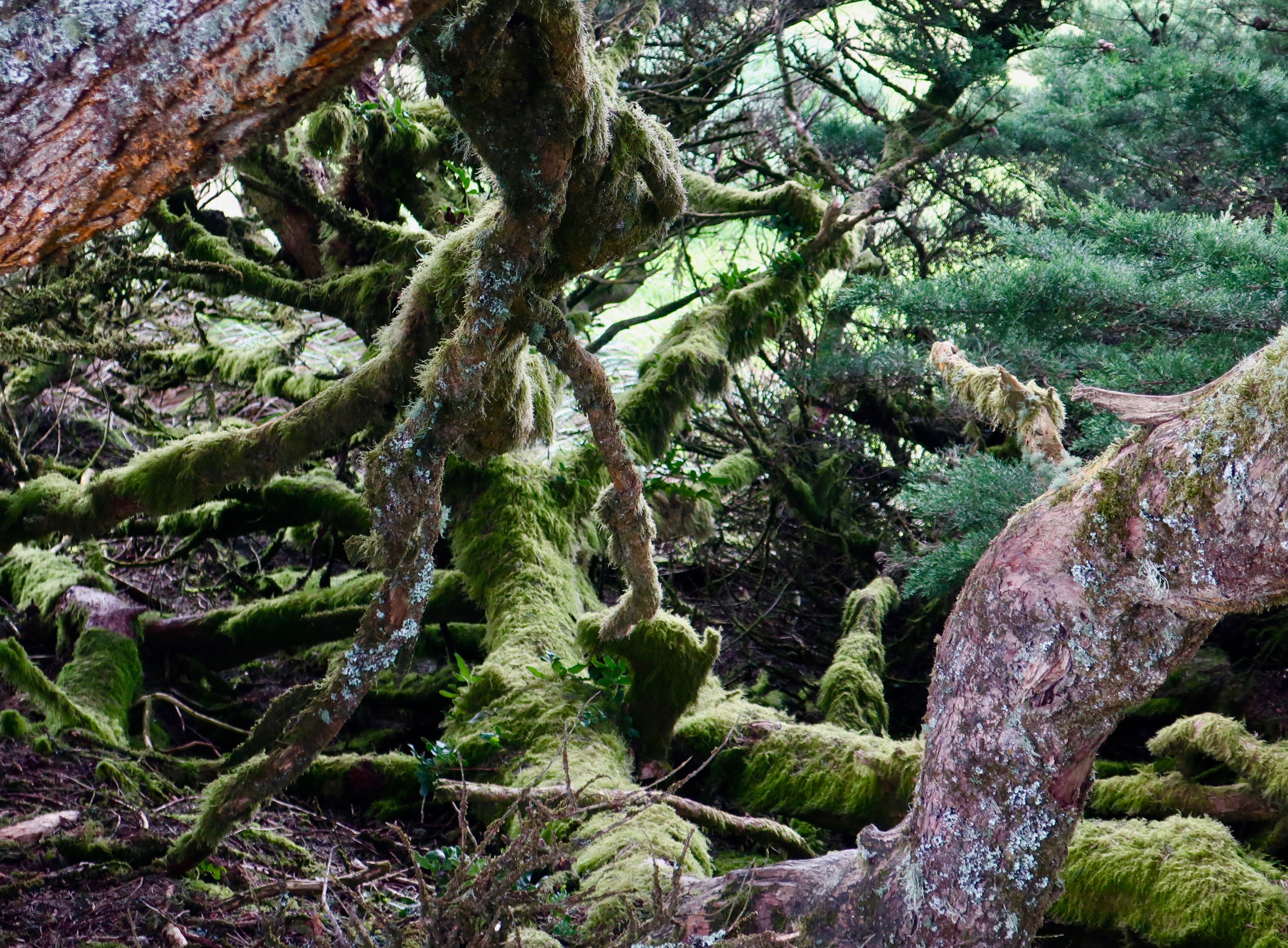
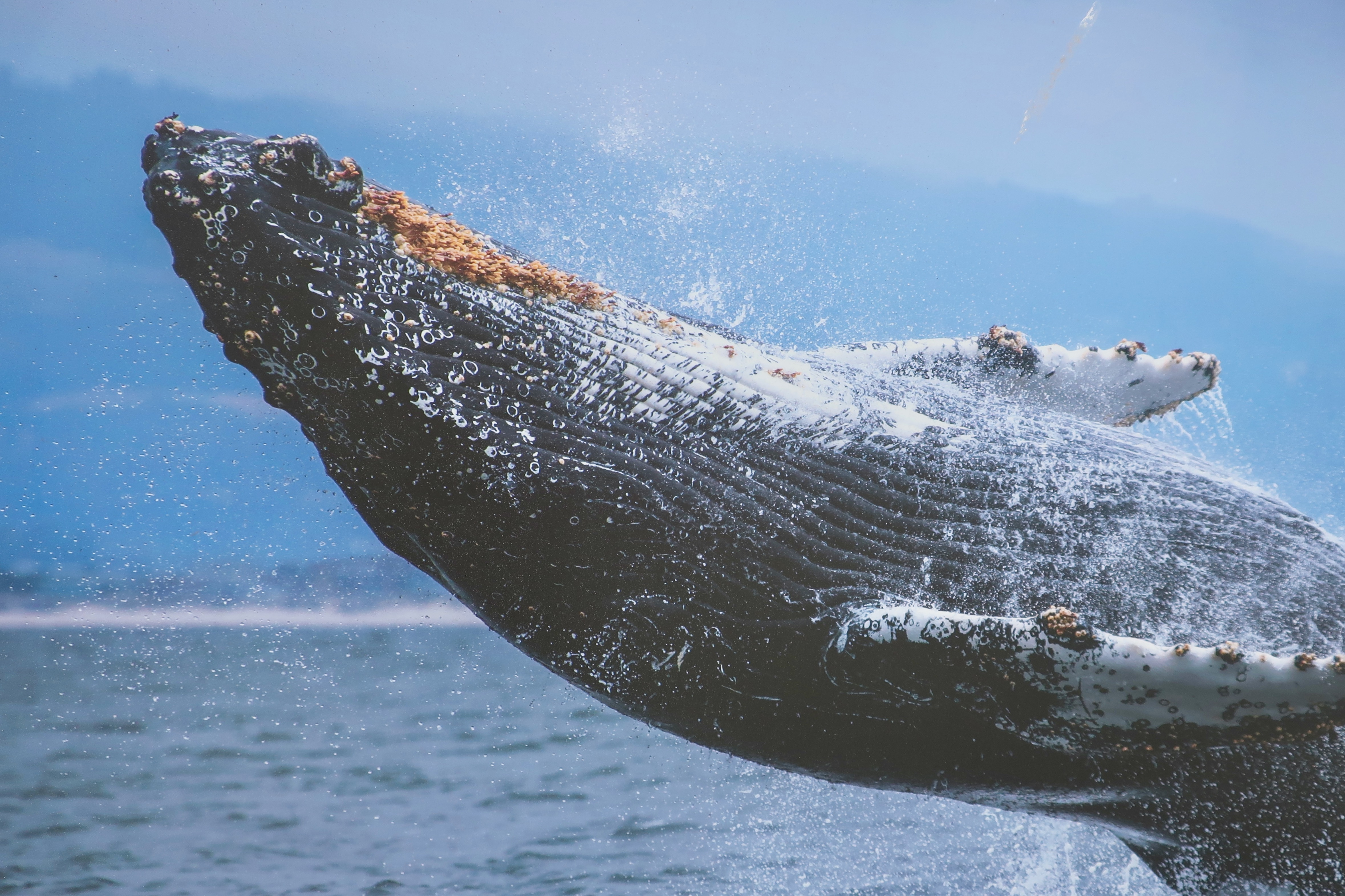
Wind sculptured treesI pictured children having a blast climbing over the gnarled limbs on the trees.The Pt. Reyes headlands are a great place for whale watching when they are migrating south toward Mexico and then north toward the Arctic. We didn’t see any, but we were greeted by this large mural as we neared the lighthouse.
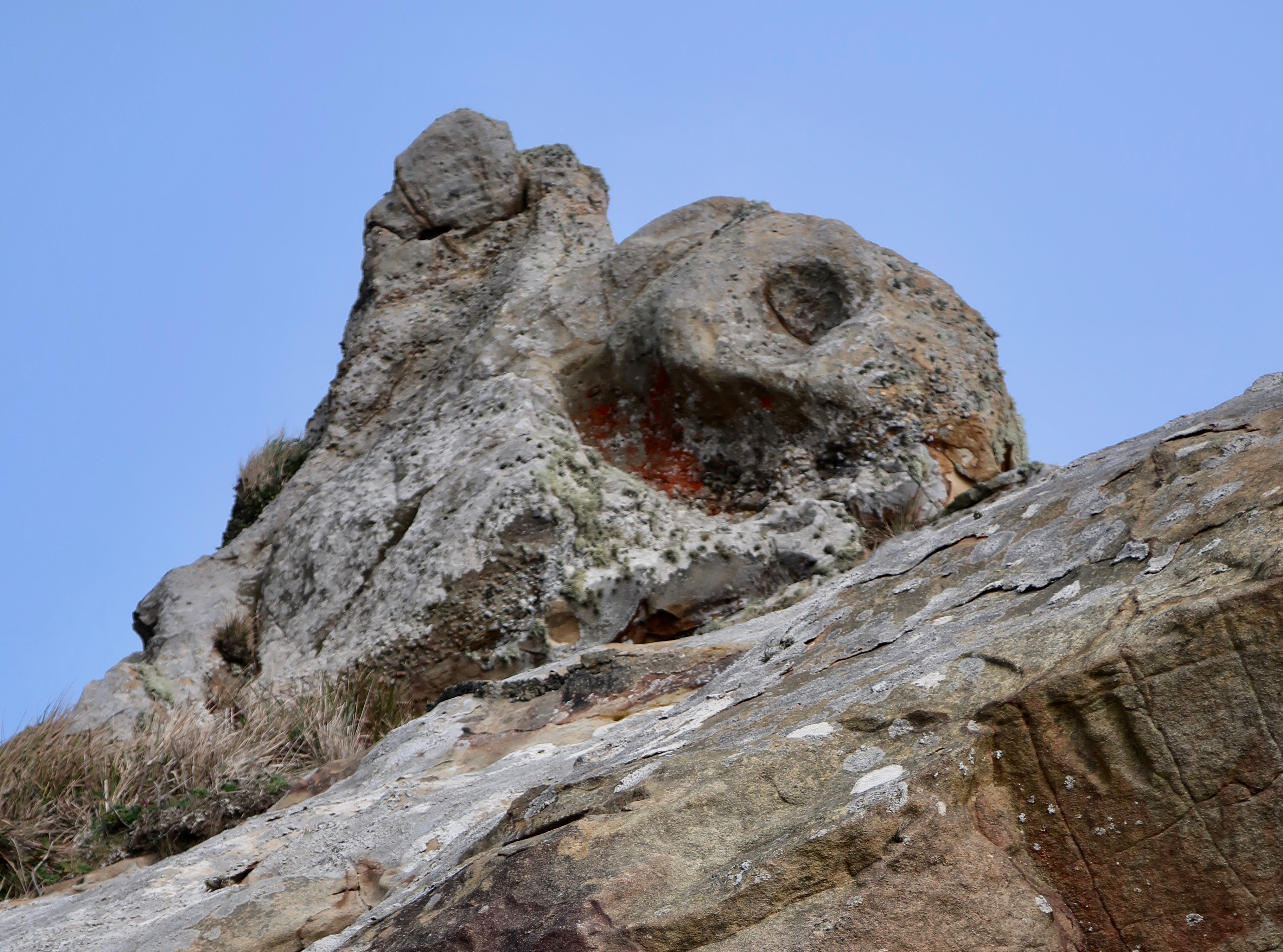
We found this interesting rock perched above the lighthouse.
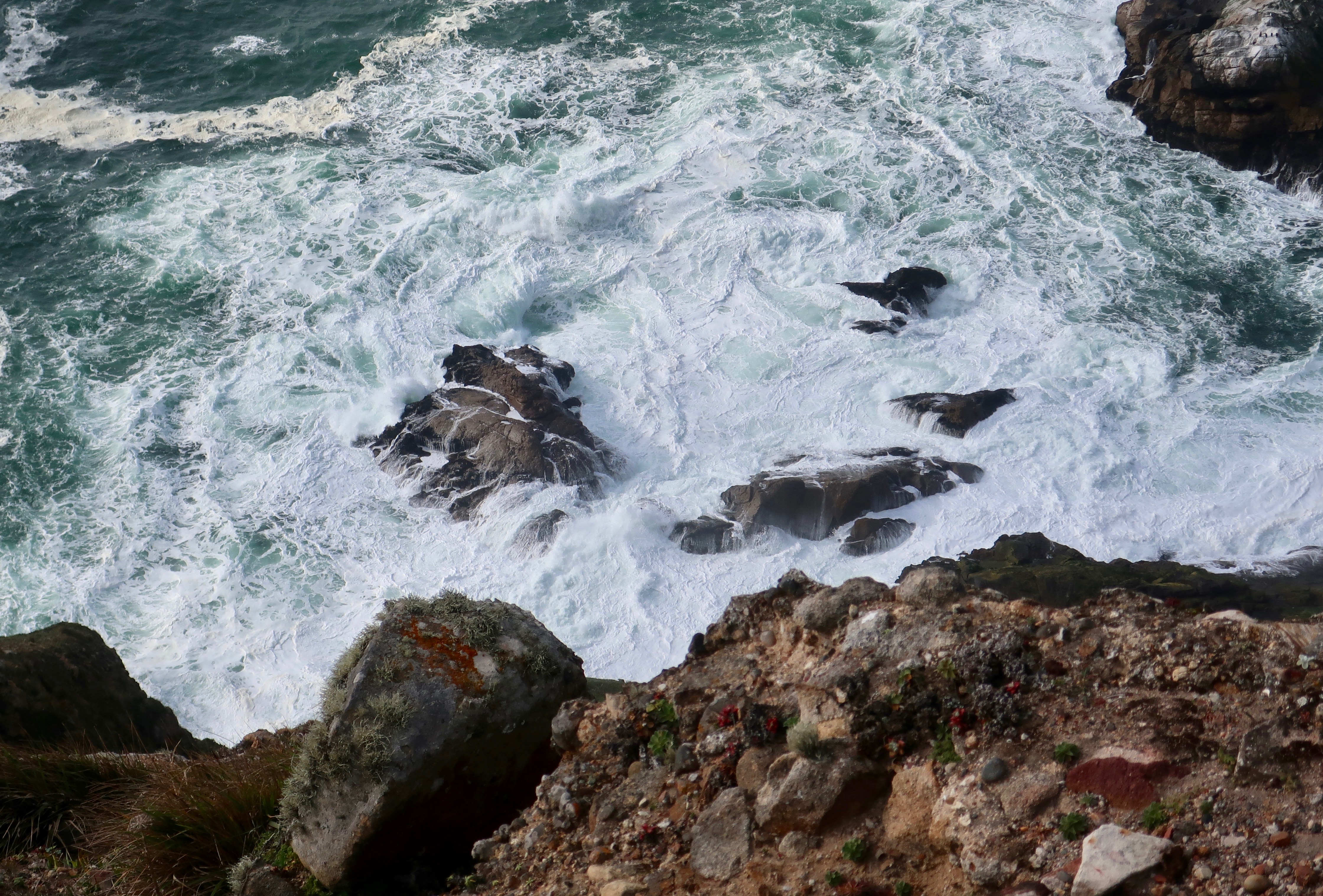
And looking down below the lighthouse, we watched these waves crashing ashore among the rocks— which is where I will conclude my post for today.
NEXT FRIDAY’S TRAVEL BLOG: I’ll wrap up my Pt. Reyes series with a pleasant walk out to Abbot’s Lagoon and a visit to the colorful town of Pt. Reyes Station.
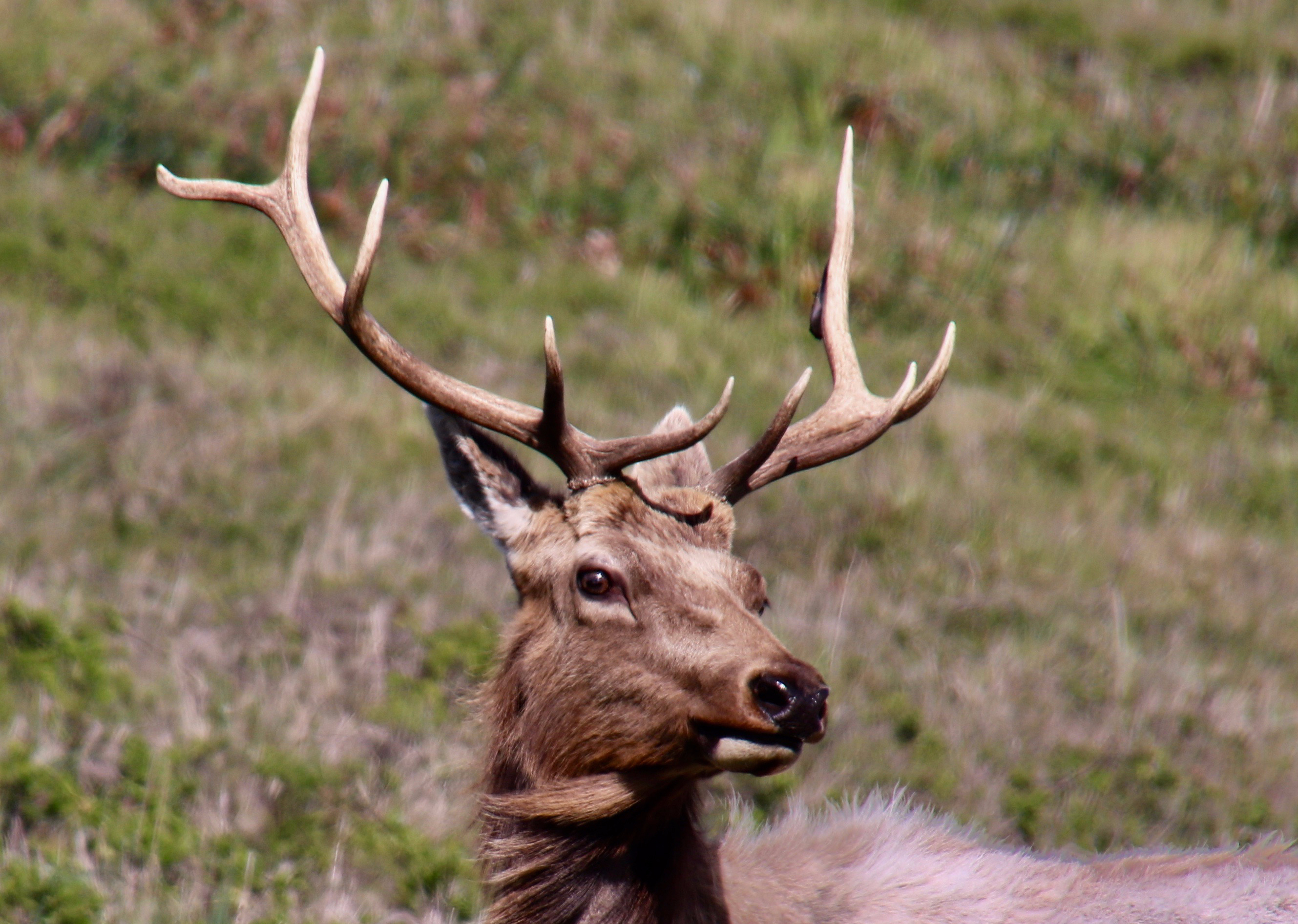
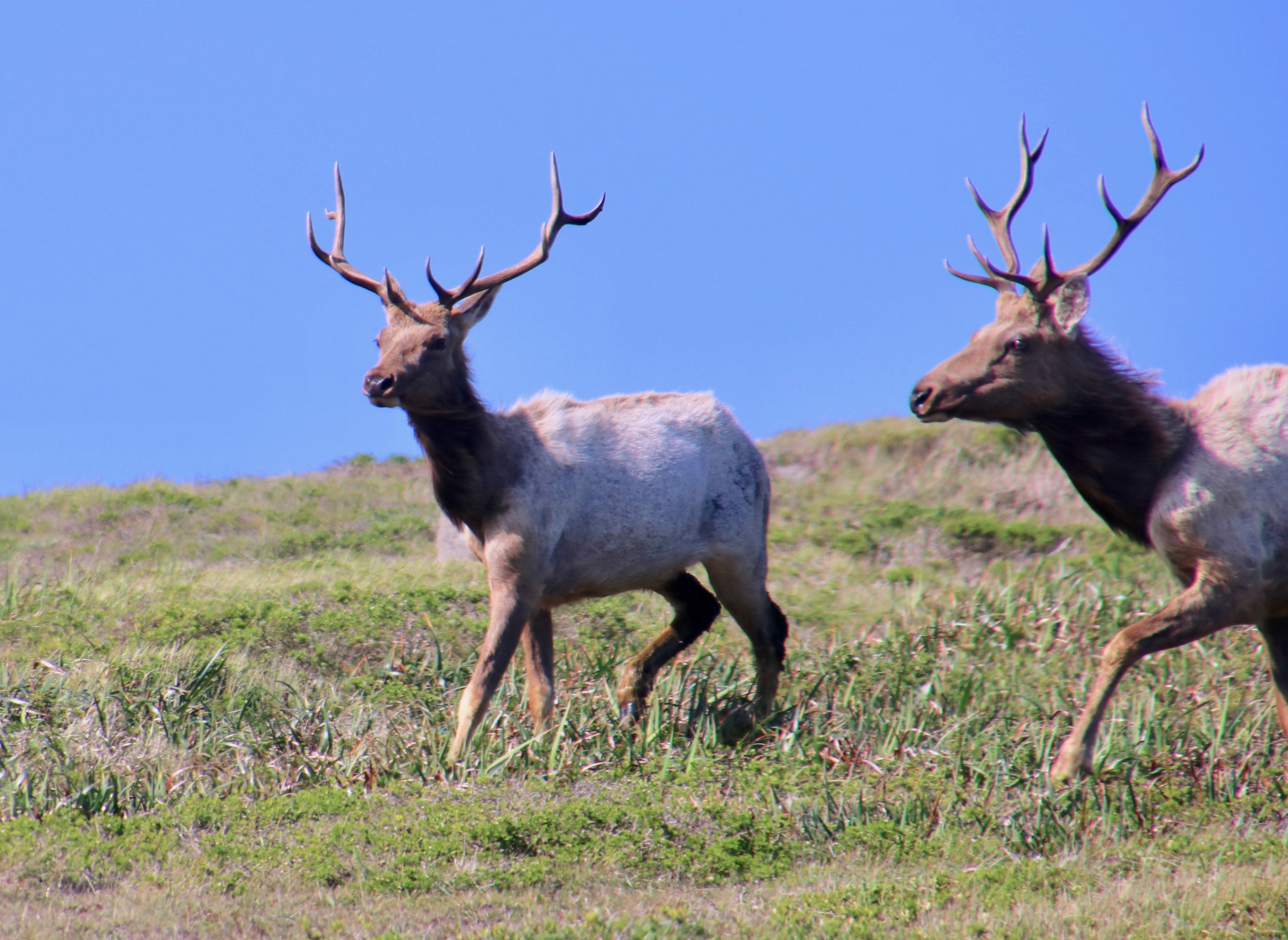
This bull elk that came down to see us as we hiked out the Tomales Pt. Trail looked quite elegant until we looked at his back. He was still shedding his winter coat and had yet to grow his summer fur. The deer herd that hangs out on our property goes through the same stage, looking frowzy for a couple of months. (Photo by Peggy Mekemson.)
Any trip to Pt. Reyes National Seashore should include a drive out to the historic Pierce Pt. Ranch and Tule Elk Reserve. The ranch will introduce you to an important piece of Pt. Reyes history. A hike out the Tomales Pt. Trail from the ranch will take you through some impressive scenery and likely give you a view of tule elk and other wildlife. Ever since the elk were reintroduced to the area in 1978, the herd has thrived. Our photos today start with our hike and end back at the ranch.
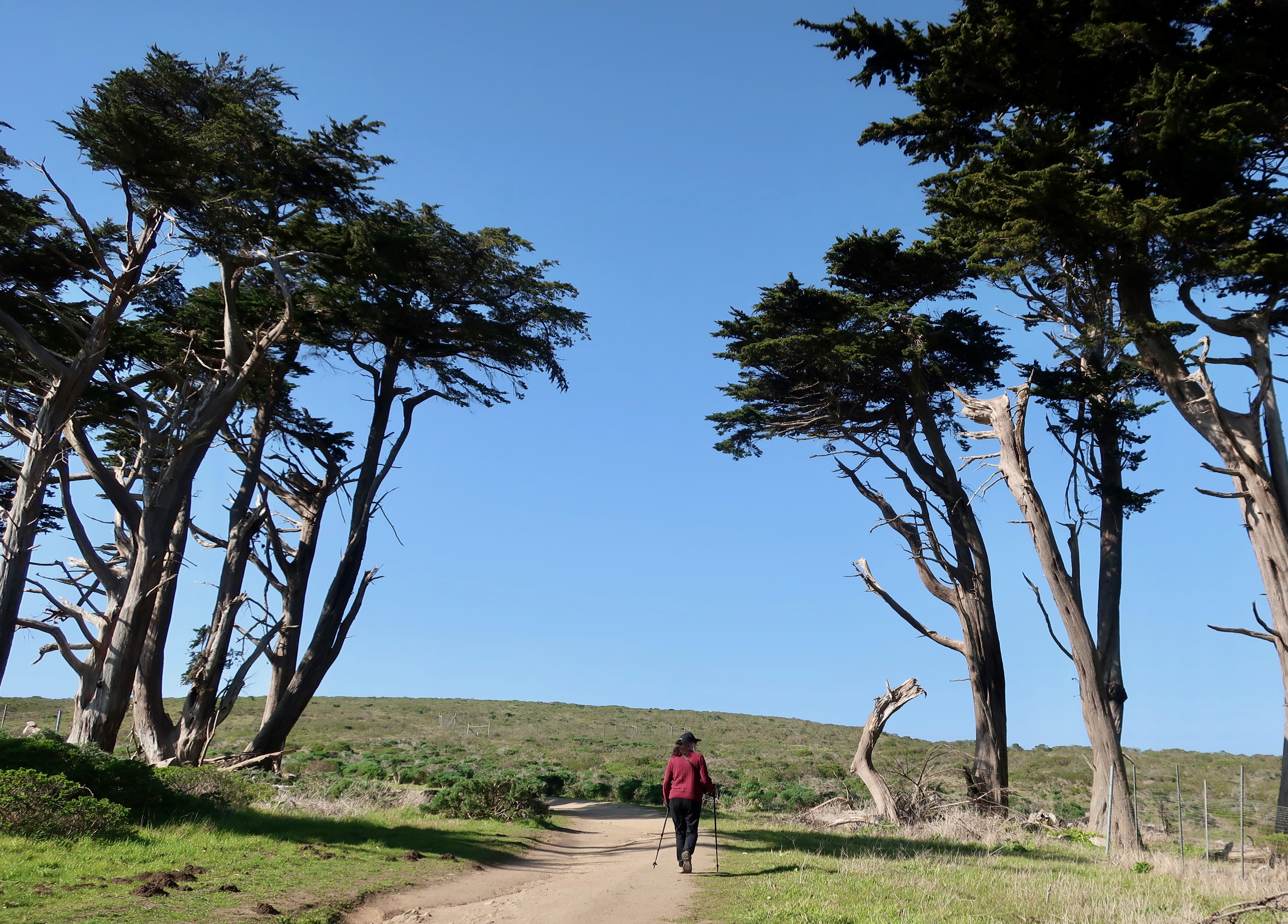
The Tomales Pt. Trail starts at the Pierce Pt. Ranch passing under tall Cypress trees planted originally by the ranchers as a wind break. Peggy provides perspective.
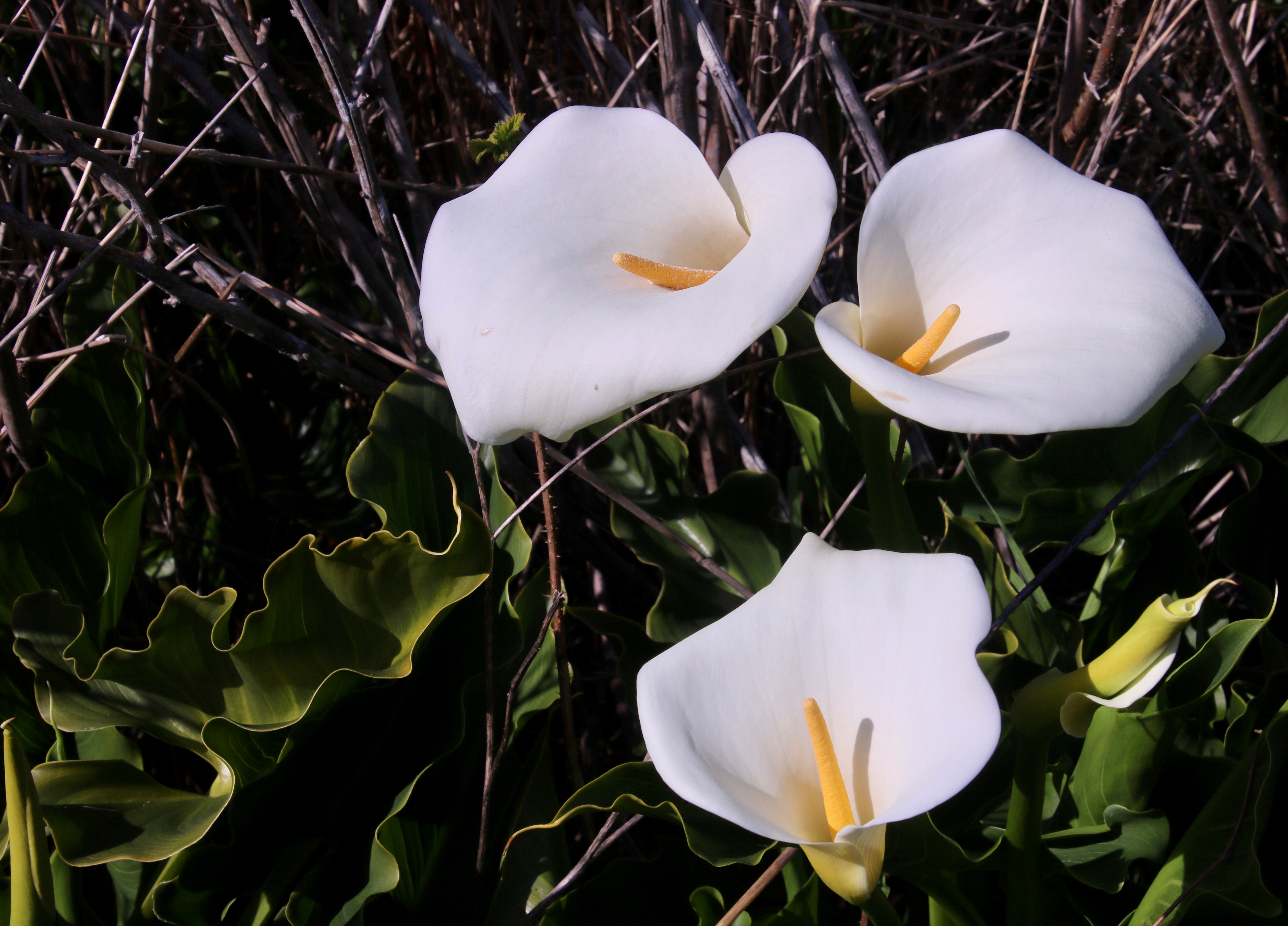
A few hundred yards brought us to a number of Calla lilies. Peggy and I wondered if a rancher’s wife had planted them to remind her of a home the family had left behind. (Photo by Peggy Mekemson.)
Of course, I had to take photos of the lilies as well.
We stopped to admire the scenery looking out toward Tomales Pt. and the Pacific Ocean.
Another view. The Bodega Headlands can be seen in the distance. If you’ve been to Bodega Bay, it’s possible you’ve driven out there. I like to go out on the headlands and look for whales passing by.
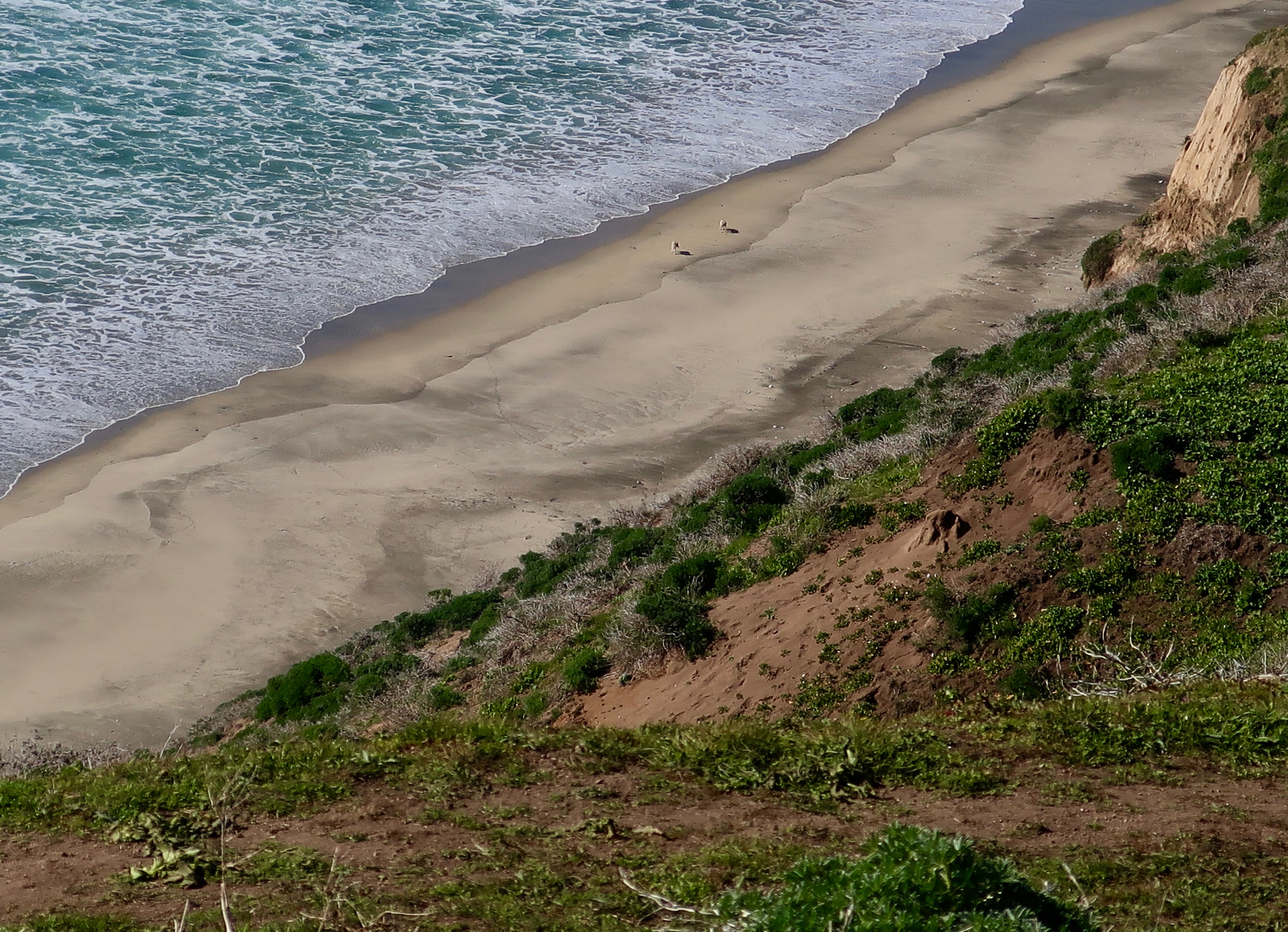
Far below us we saw a pair of coyotes working their way along the beach.
Peggy used her telephoto for a closer shot and, much to our surprise, the coyotes were digging in the sand. Whether they were after clams or crabs or some other seafood delicacy, I don’t know. But what was clear was that the coyotes had developed a tase for sushi!
Shortly afterwards we spotted elk on the ridge above us.
And they came down the hill to see us… (Photo by Peggy Mekemson.)
Bringing their cows with them. (Photo by Peggy Mekemson.)
I caught this photo of one of the bulls checking us out. You can see that he is in that ‘awkward’ stage between losing his winter coat and growing his summer one.
This cow elk was also looking a bit bedraggled. (Photo by Peggy Mekemson.)
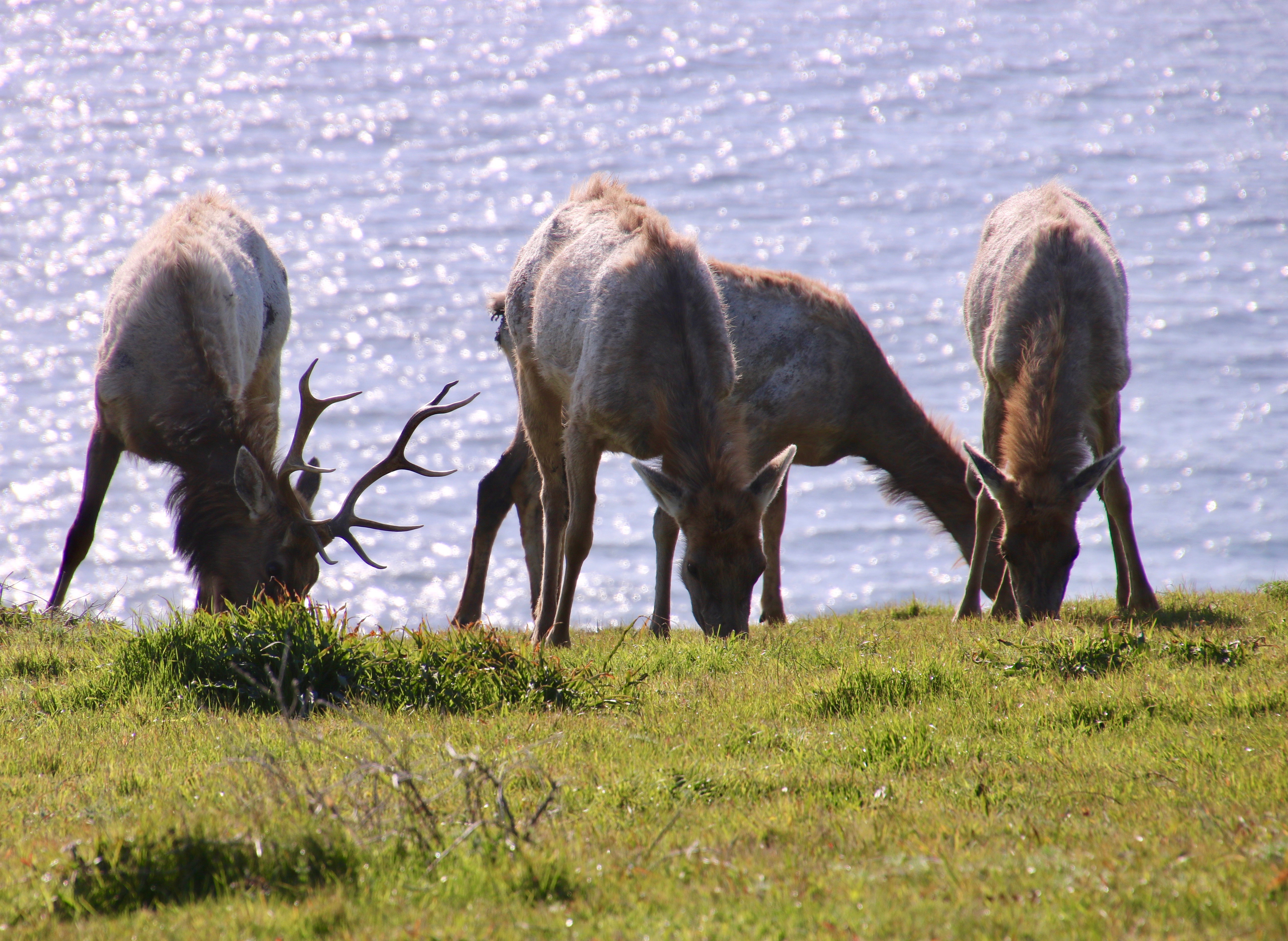
A final shot of the elk browsing. I liked the backdrop of the Pacific Ocean.
The Pierce Pt. Ranch ceased operation in 1973. Visitors are now invited to walk through the grounds and get a feel for what dairy ranching was like before modern dairy operation took over.
I liked the roofs.
I believe a park ranger lives in the ranch house now. I could live there!
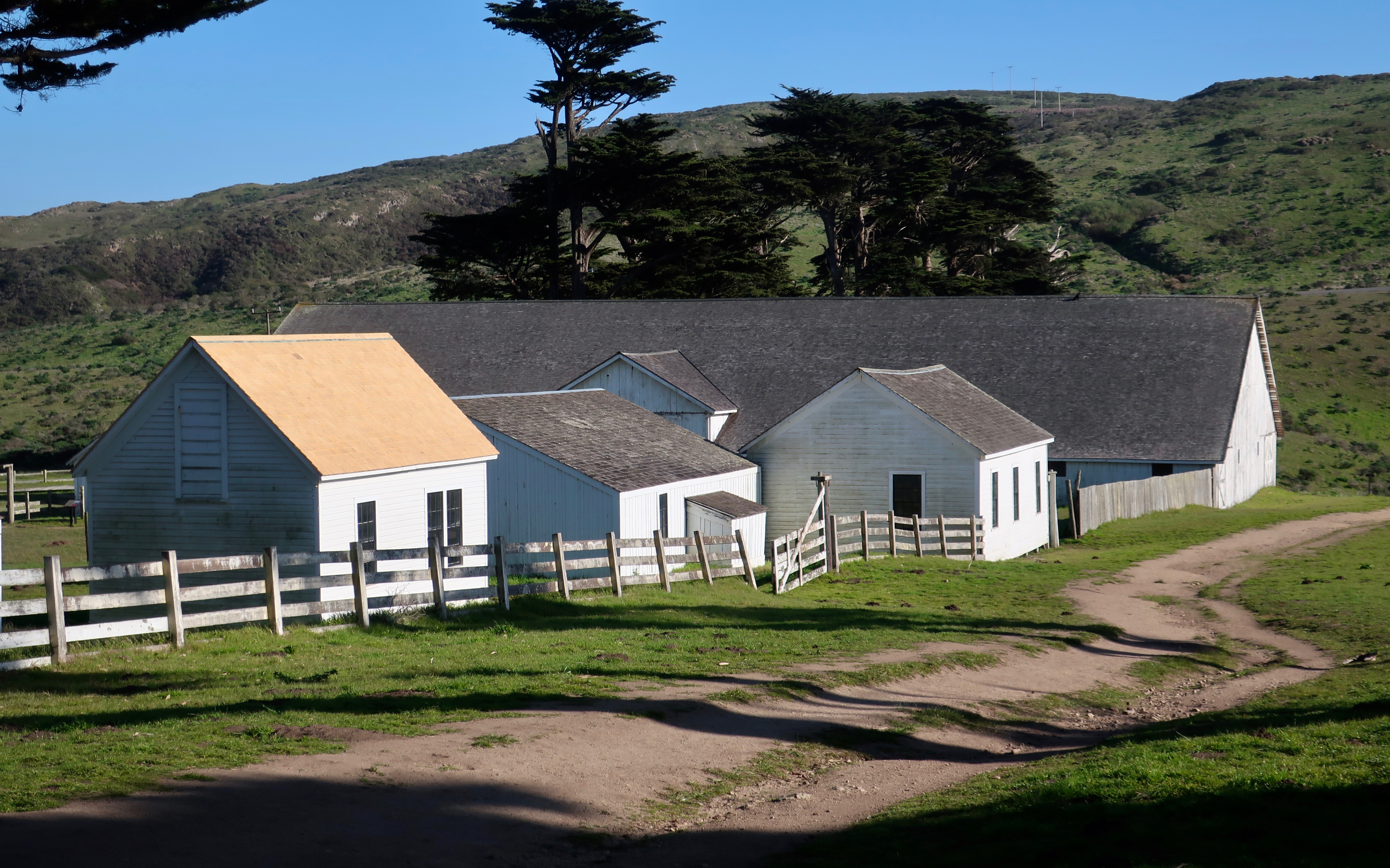
The old dairy barn is humongous.
I took a peek inside. This is only half of the barn.
While Peggy stood at the barn door.
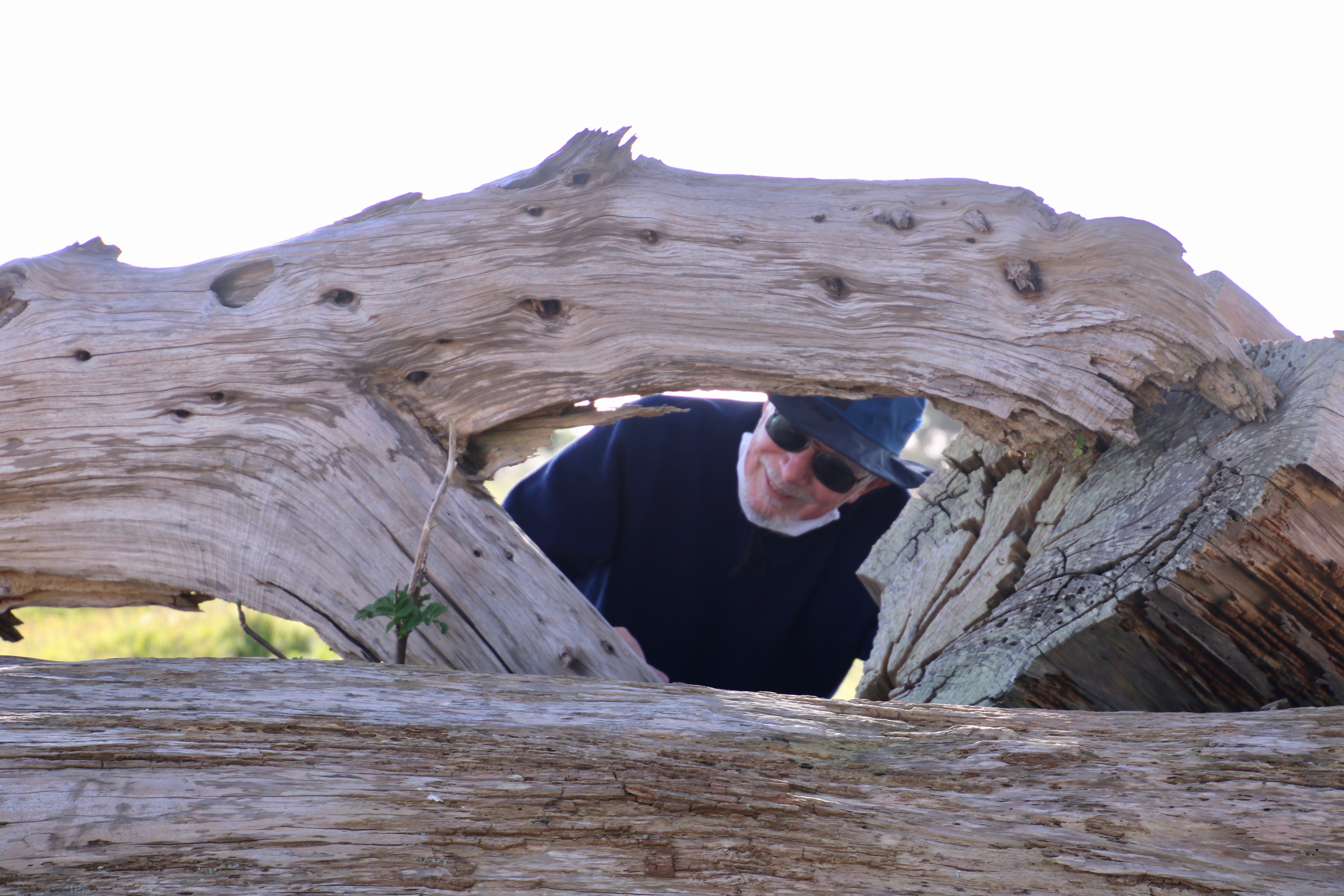
Since I took a photo of Peggy, she insisted on taking one of me. I took advantage of one of the downed Cypress trees. And that’s a wrap for today!
NEXT POST:
Monday’s Blog-A-Book from It’s 4 AM and a Bear Is Standing on Top of Me: I leave the Graveyard behind and journey off to the Pond where bullfrogs and catfish rule and pirates lurk.
Wednesday’s Blog-A-Book from my lead-up to joining the Peace Corps: I help corral a police car at Berkeley and the rallying cry of ‘Never trust anyone over the age of 30‘ is born.
I’m returning to Pt. Reyes National Seashore and the surrounding area today. As you may recall, Peggy and I drove down to this beautiful park north of San Francisco in early March to celebrate my birthday. At the time, I did a post on the big nosed elephant seals that have adopted the park as a great place to breed and have babies as their population increases.
Like whales, they had been hunted close to extinction for the oil their body produces. Fortunately, enough people had become concerned in the early 20th Century to stop the slaughter and save the species. My elephant seal post would have been perfect for yesterday: Earth Day. The message about these unique animals is that If we care enough, we can make a difference. Working together, we can help save the earth and its bio-diversity. Nature has wonderfully recuperative powers— given a chance. The planet will work with us, if we stop working against it. But enough on the that for now. Today’s post is about cows and a short walk in the Golden Gate National Recreation Area.
There is no danger of cows going extinct. They have the advantage/disadvantage of being useful to us. As of 2021 there are over a billion on earth. The Pt. Reyes area has its share. It was recognized as ideal for raising dairy cattle in the 1850s as the burgeoning population of San Francisco provided a ready market for dairy products. When the National Seashore was created in the 1970s and 80s, the ranches were grandfathered into the land that was set aside and are an integral part of today’s Pt. Reyes’ experience.
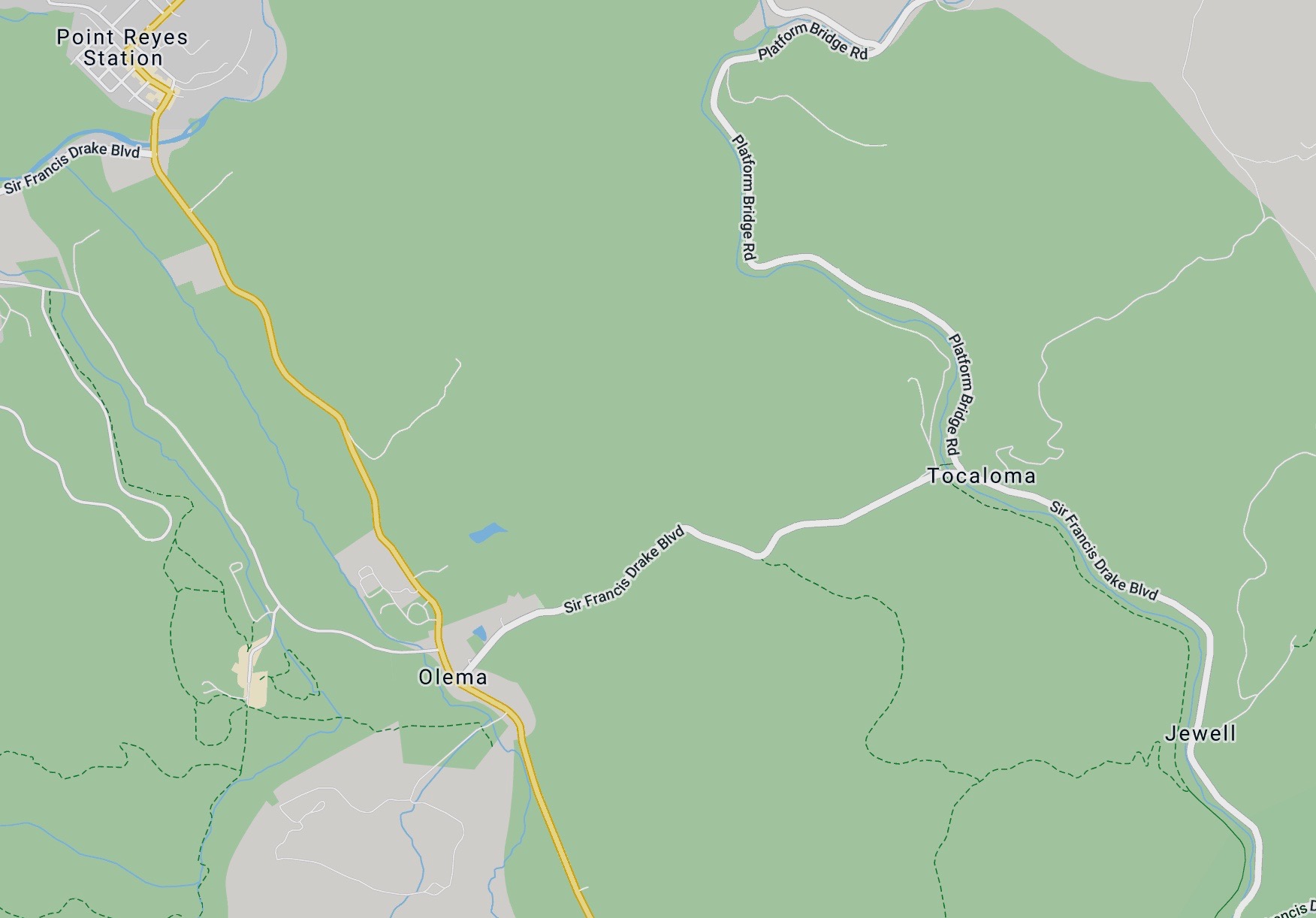
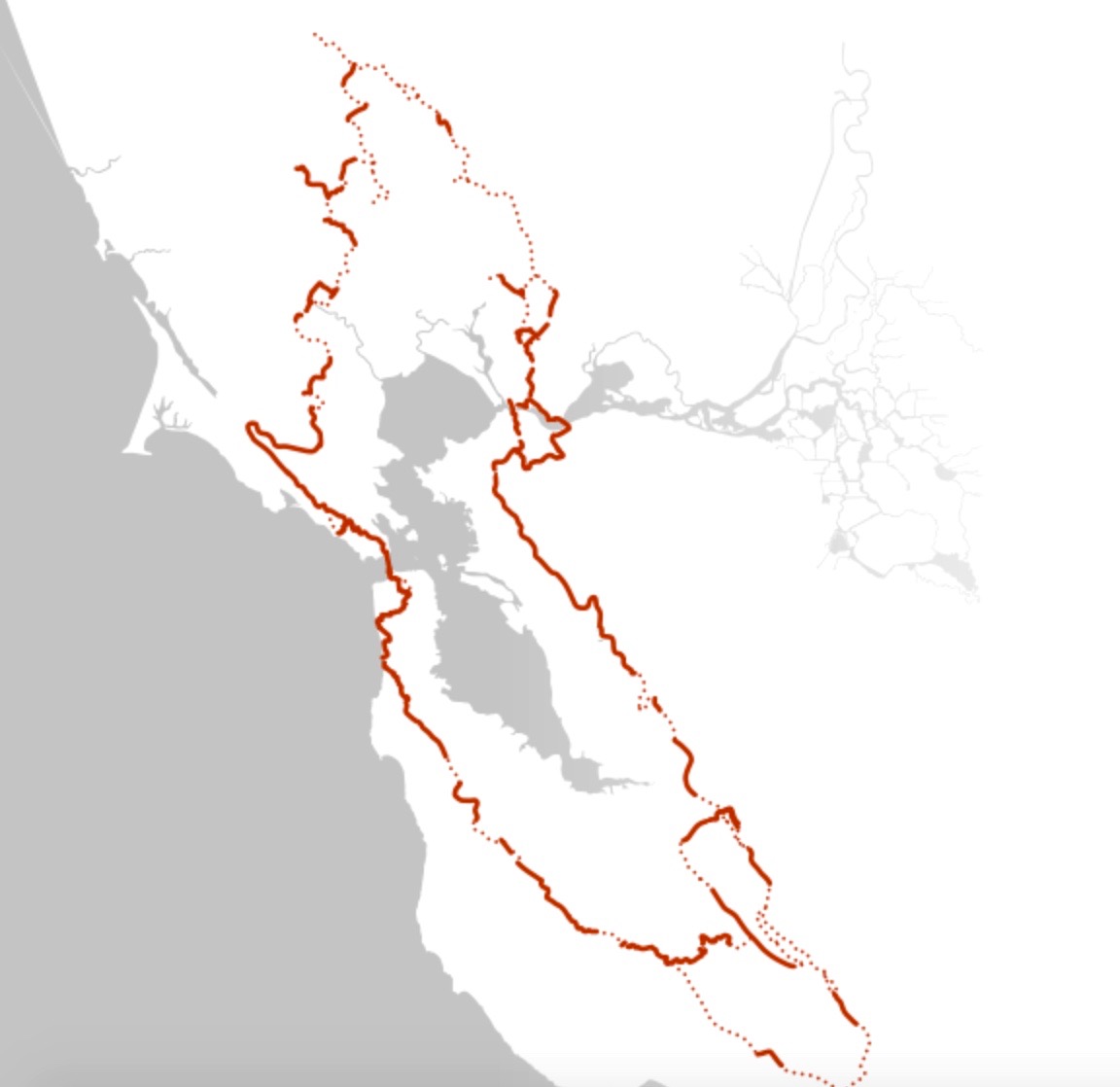
I didn’t set out to do a post on cows when Peggy and I decided to incorporate a short walk along the Bolinas Ridge Trail. It’s actually a part of the Golden Gate National Recreation Area but is administered by Pt. Reyes NS. As you can see by the maps below, it is just east of the small town of Olema which includes the campground I have been staying at forever, or at least back to the 1970s. The trail is part of a system being developed that will eventually allow hikers to do a 500 mile hike around the complete Bay Area. We did four. Two out and two back.
The Bolinas Ridge Trail starts just east of the small town of Olema on the Sir Frances Drake Blvd. It’s the dotted line. Our campground sits in the grey area just above Olema. The National Seashore Visitors’ Center and Headquarters is the light area behind the campground. Our go-to town for eating out and shopping is Pt. Reyes Station to the north.
This map provides perspective on where Bolinas and Pt. Reyes Station are located in relation to San Francisco. The green area next to the coast makes up Pt. Reyes and the Golden Gate Recreation Area stretching from the end of Tomales Bay to the Golden Gate Bridge. Highway 1 is the yellow line running along the coast, more or less separating the two parks. It also follows the infamous San Andreas Earthquake Fault. Pt. Reyes was once located near LA as part of the Sierra Nevada Mountains. It has been on its journey north for some 30 million years.
Just for fun, this map shows the Bay Area Trail system with its completed and uncompleted sections.
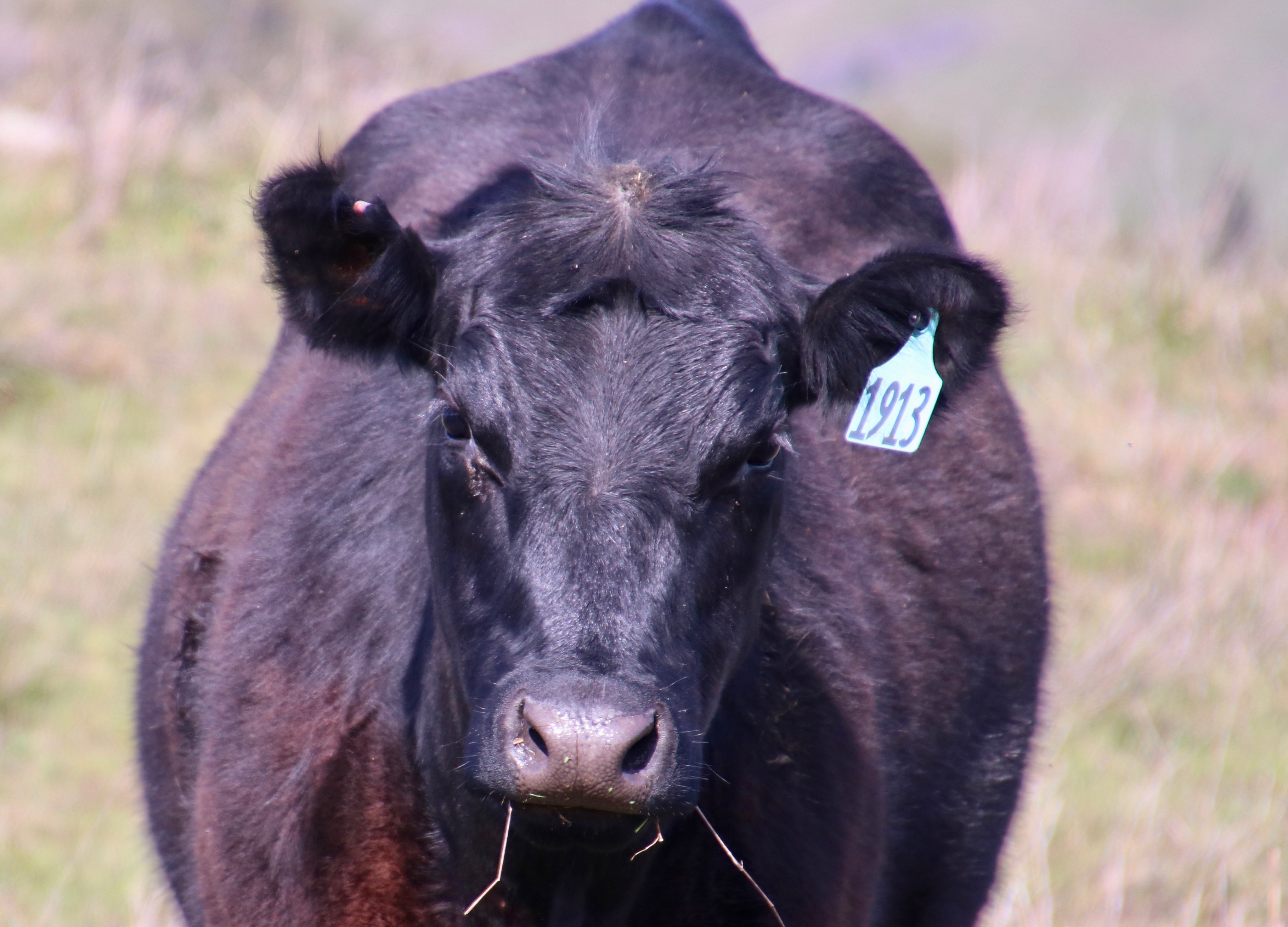
Official cow. The cows became part of our walk. This is the official cow portrait taken by Peggy. Number 1913, otherwise known to us as Bossy, didn’t want to interrupt her eating for the photo. The cows chomping grass made a distinctive, loud noise. (Photo by Peggy Mekemson.)
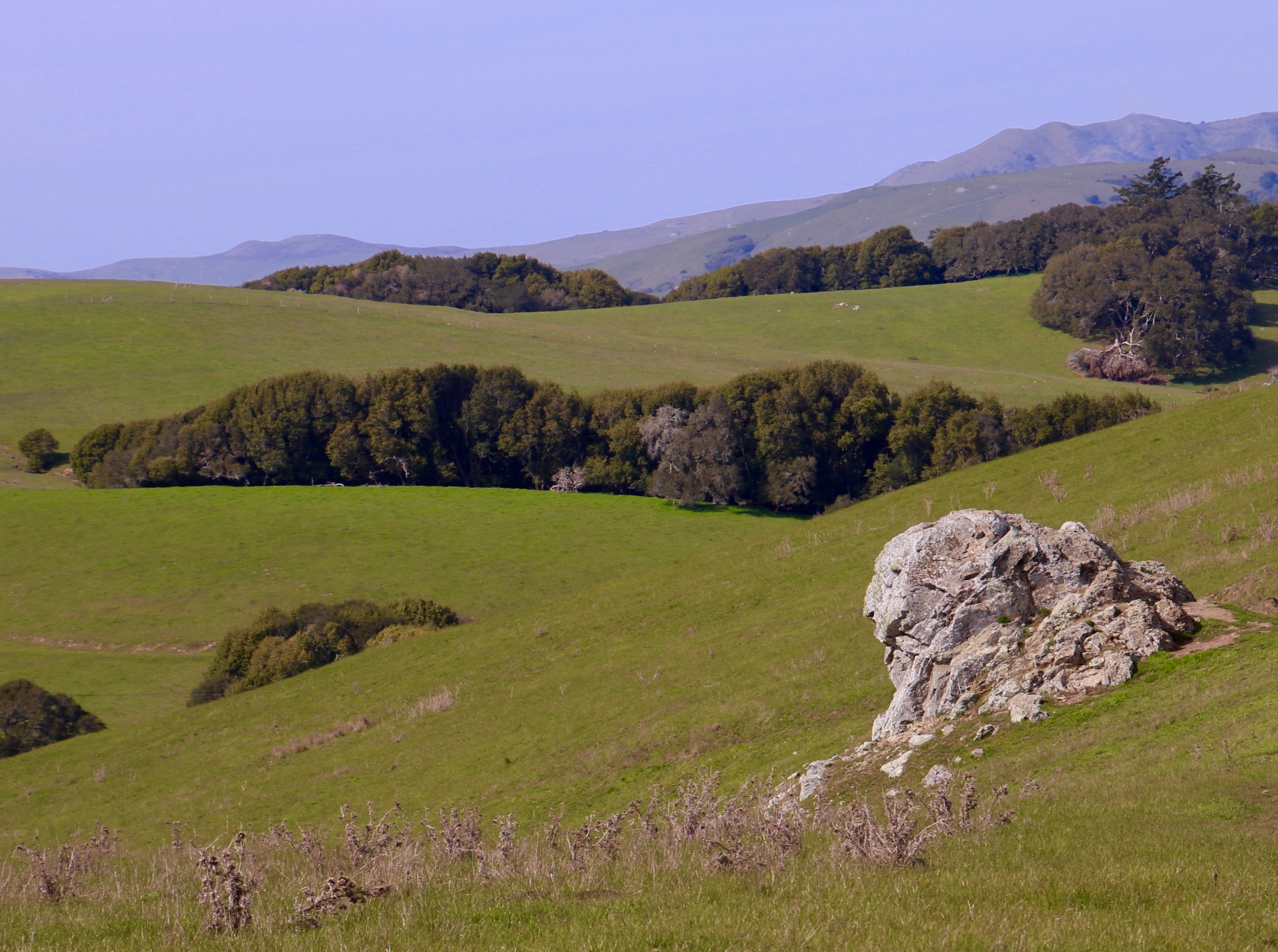
Let it be known, there was much more to the walk than cattle. The beautiful green of the Coastal Range was offset by dark forests. Spring flowers were beginning to pop up. Individual rocks with definite personalities stood proudly along the way and demanded to be photographed.
The striking green grass of the Coast Range was offset by dark groves of trees. Individual rocks added to the scene.
Peggy hoofing it along the trail, which is actually a gravel road at this point. Turn her loose on a flat stretch and away she goes. I can hardly keep up. At 70 she can still whip out four miles an hour. Fortunately, she is easily distracted.
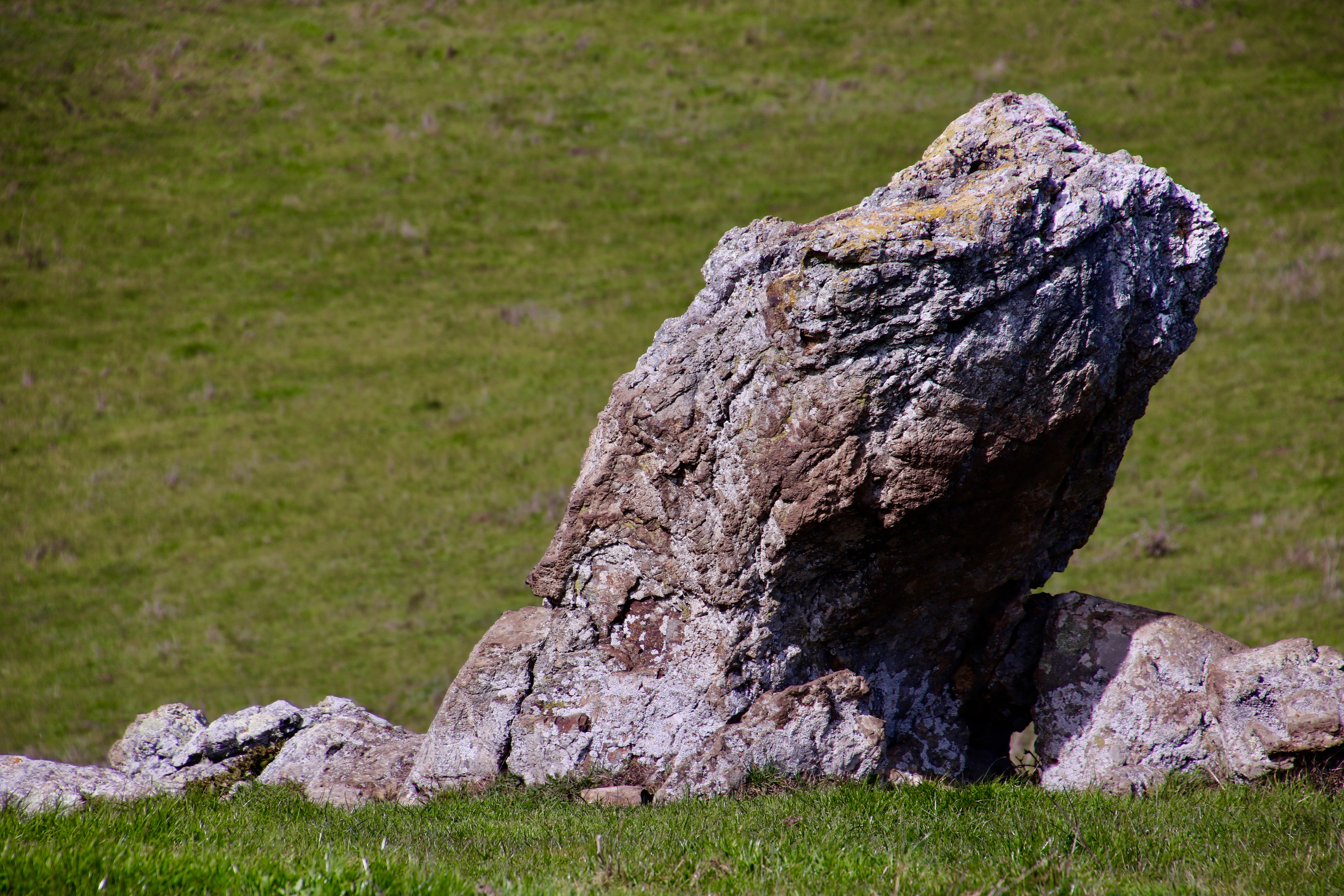
“Do you see the lizard, Curt,” she proclaimed and immediately stopped to photograph a rock that looked like a lizard head to her. You can see the squinty lizard looking eye toward the top center of the rock. (Photo by Peggy Mekemson.)
Cow itch. Cattle had a way of stealing the show.
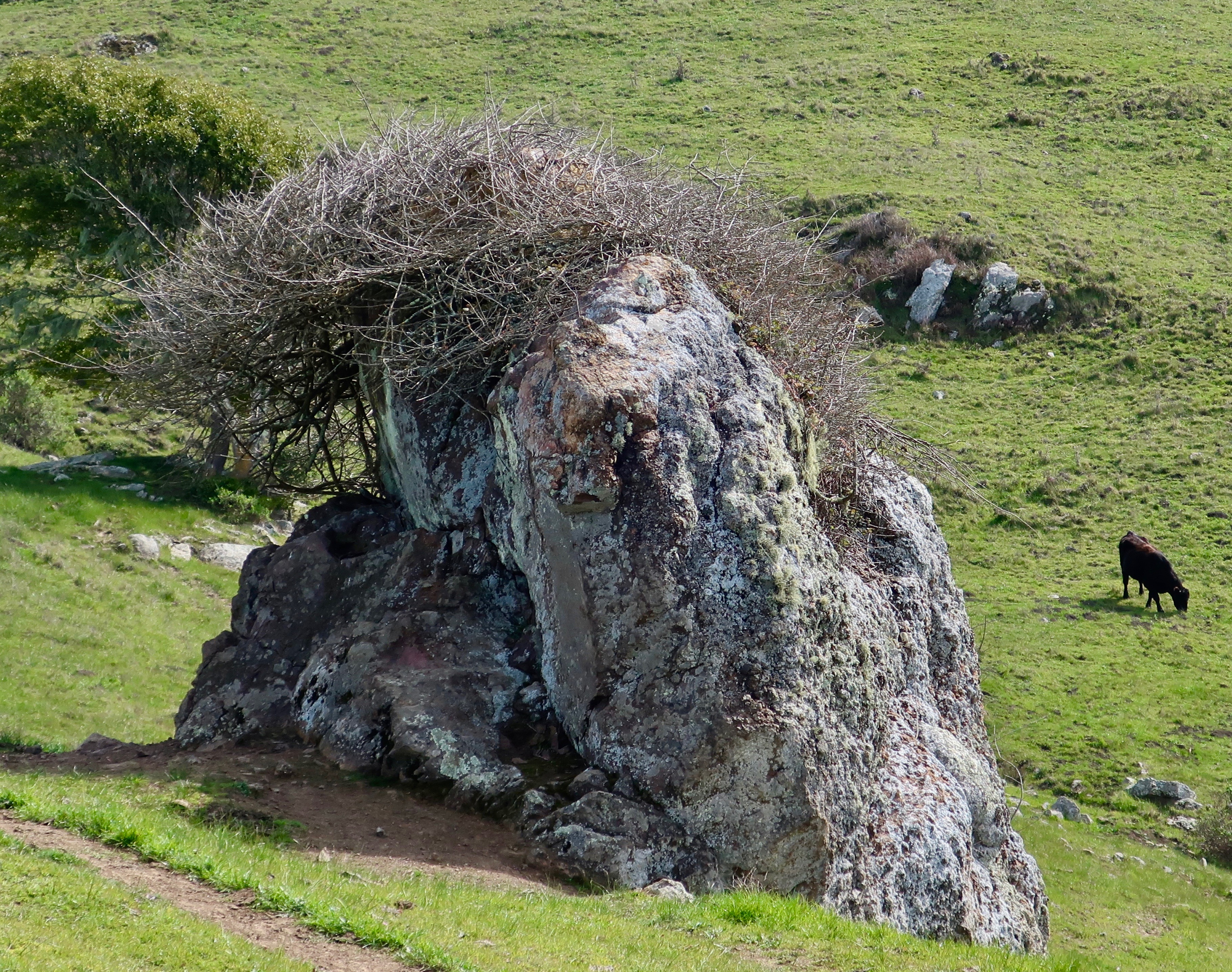
But back to rocks. This one looked like it was long overdue for a haircut. You might say it had Covid hair.
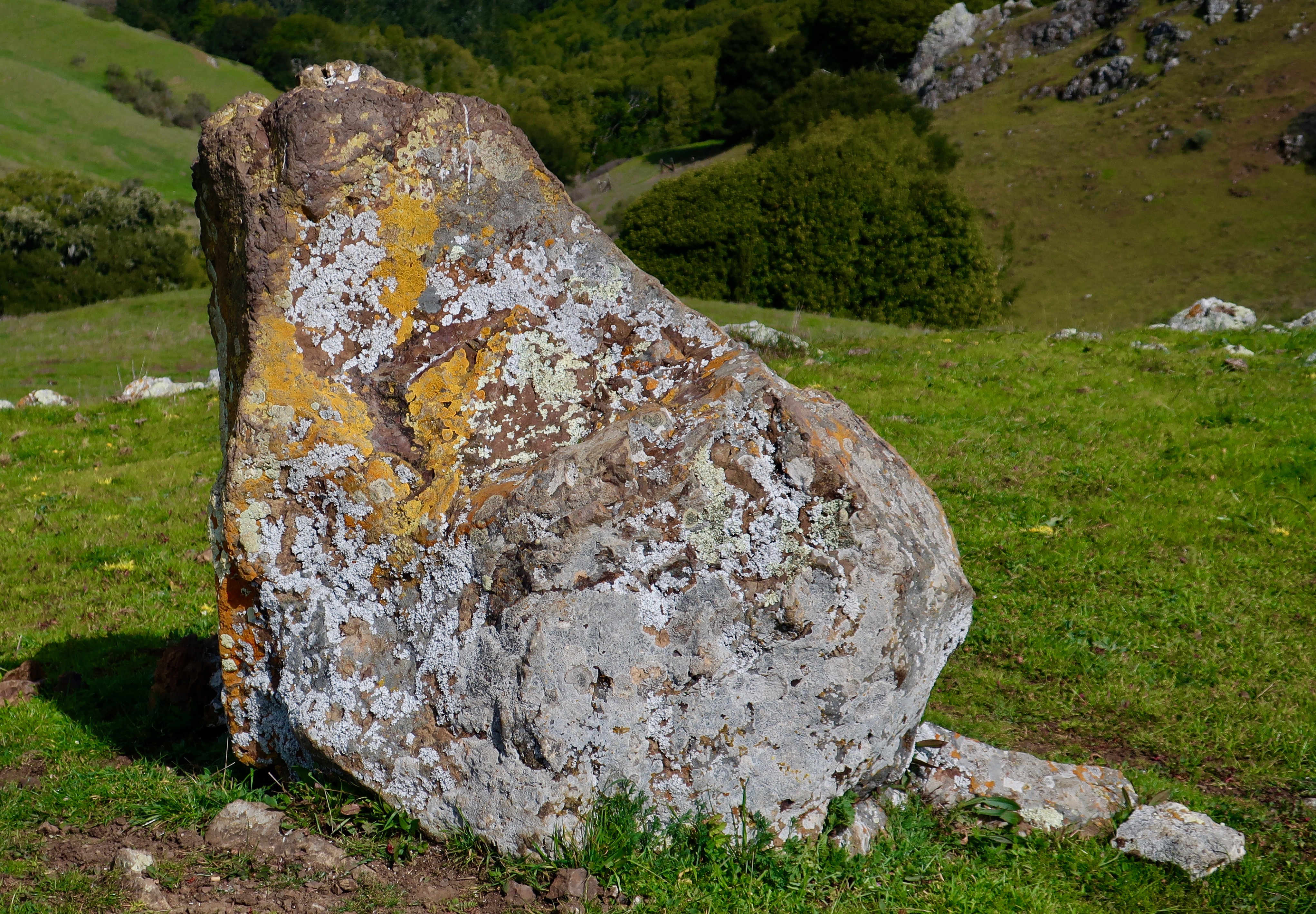
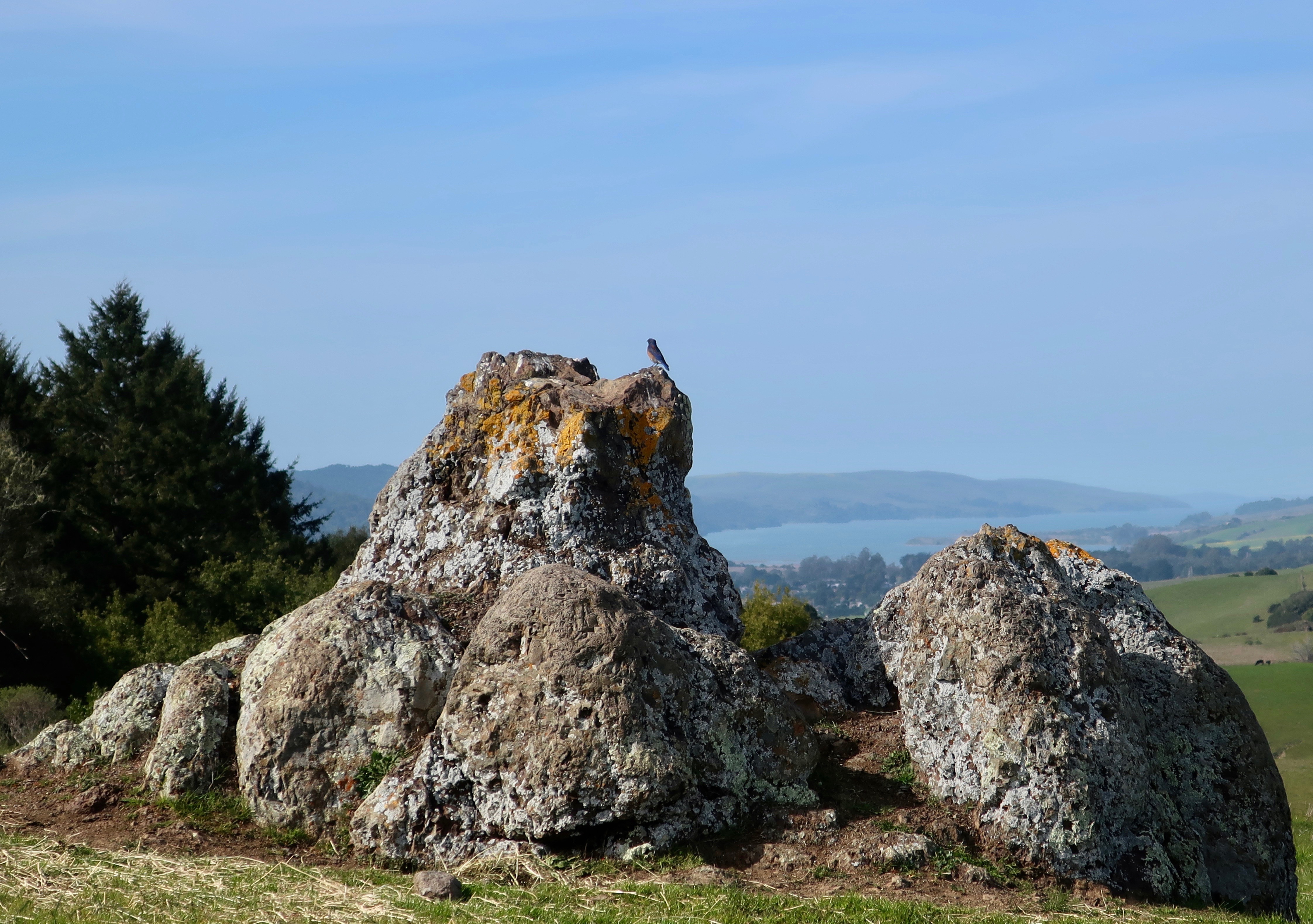
Lichens added a touch of color to this rock. I decided if Peggy could have her lizard rock, I could have a frog rock. What do they have in common other that a vivid imagination to see them? They both eat flies. That’s a good thing.
No imagination required here. This was a bird’s rock, be it ever so temporary.
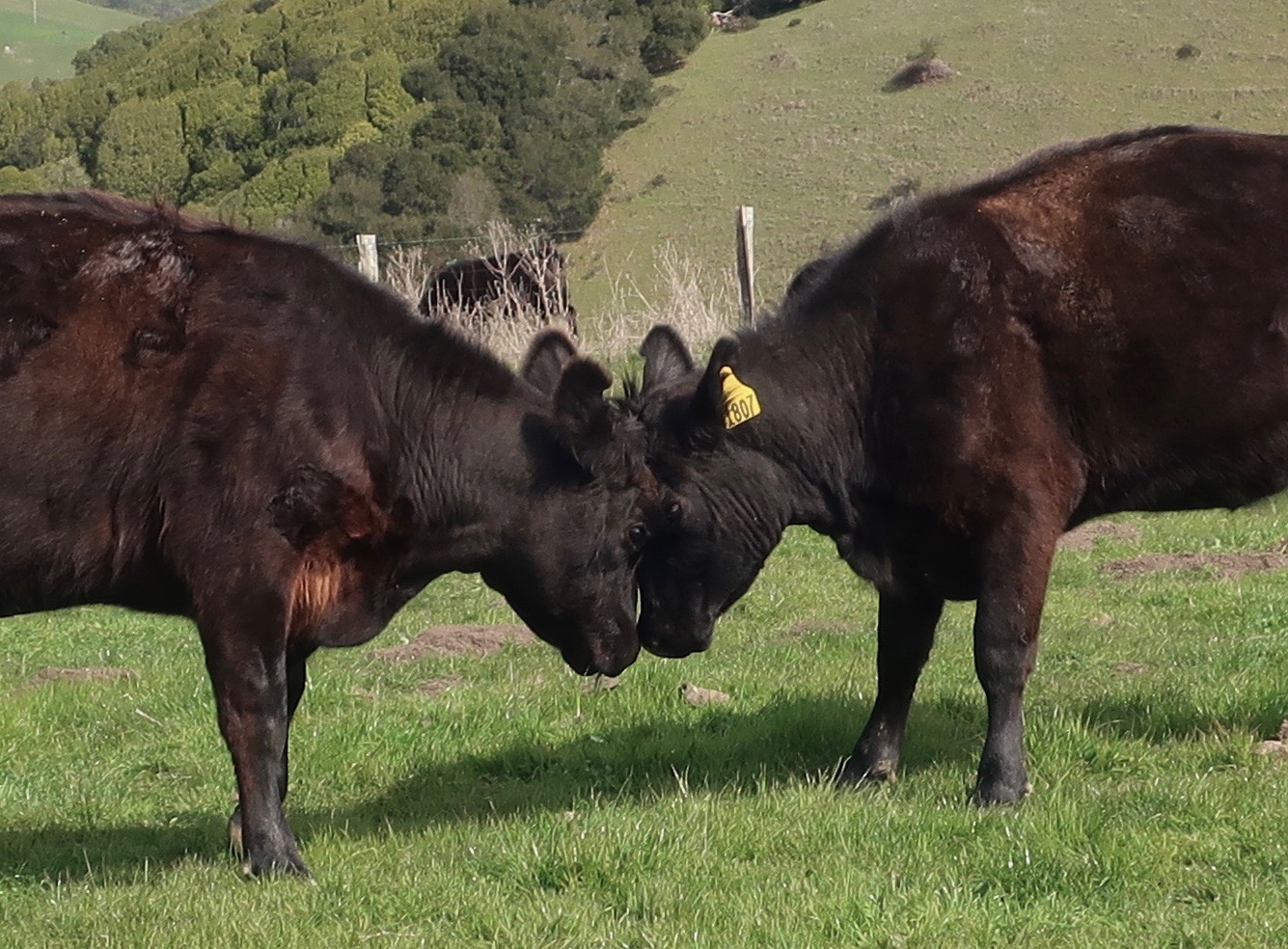
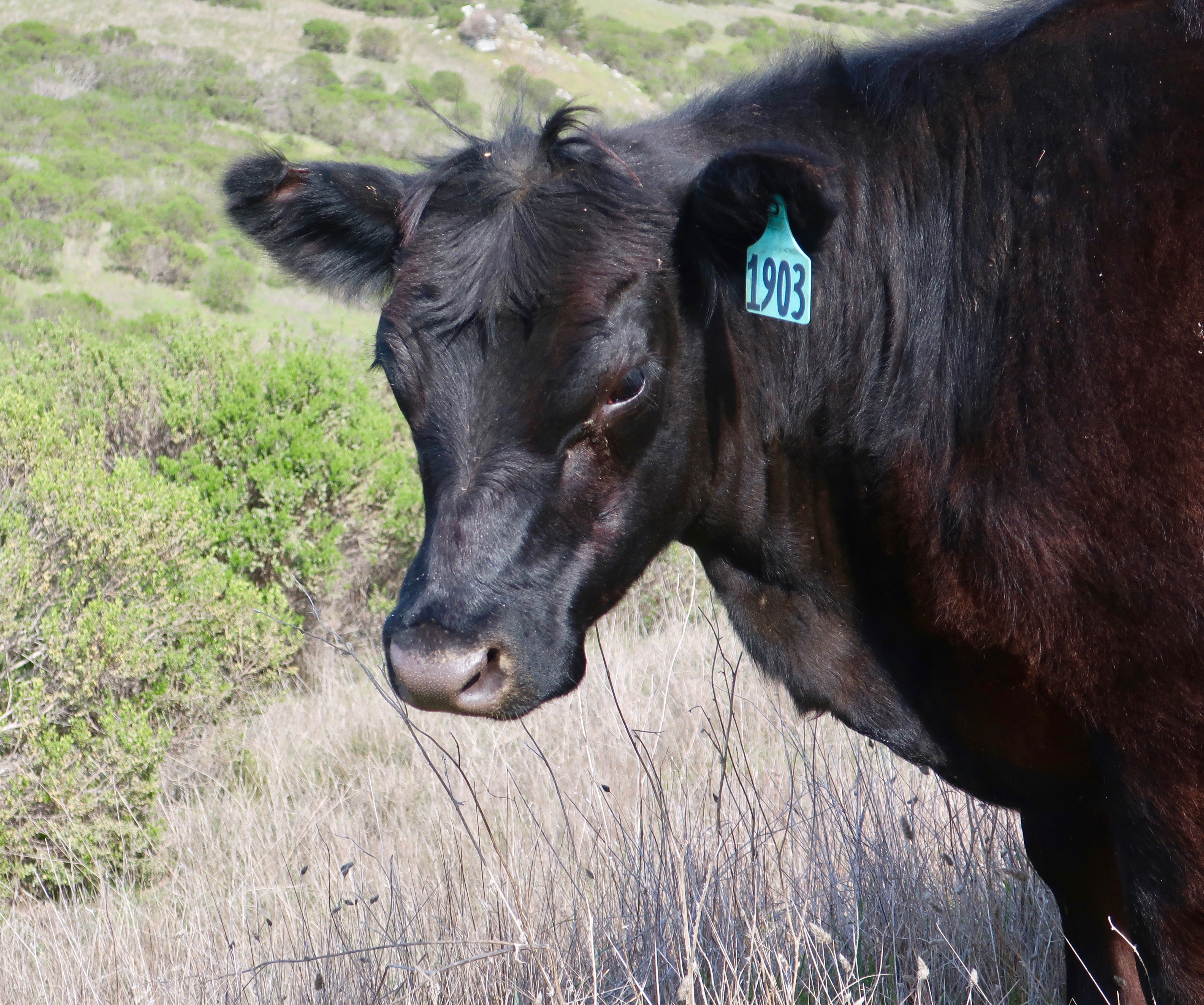
Cowlick. Peggy insisted on catching the cowlick seen on the head of Number 1903 (Ferdinand), seen earlier scratching an itch. She said it reminded her of me. Thanks. My hair can be rather untamable at times. A cowlick, BTW, is different than a cow kiss, which is the generous application of one’s tongue on someone’s face, usually followed by an “Eeww!”
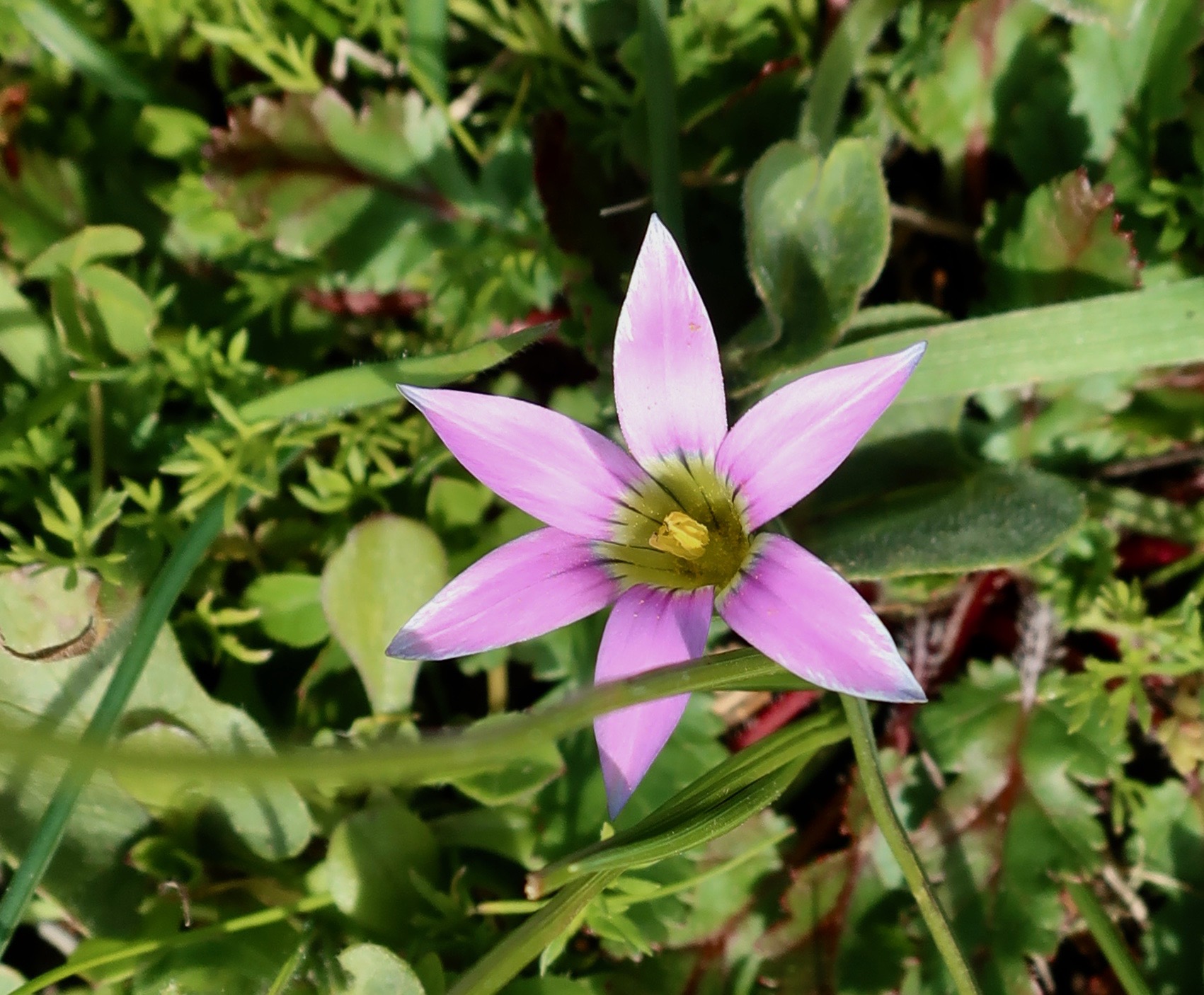
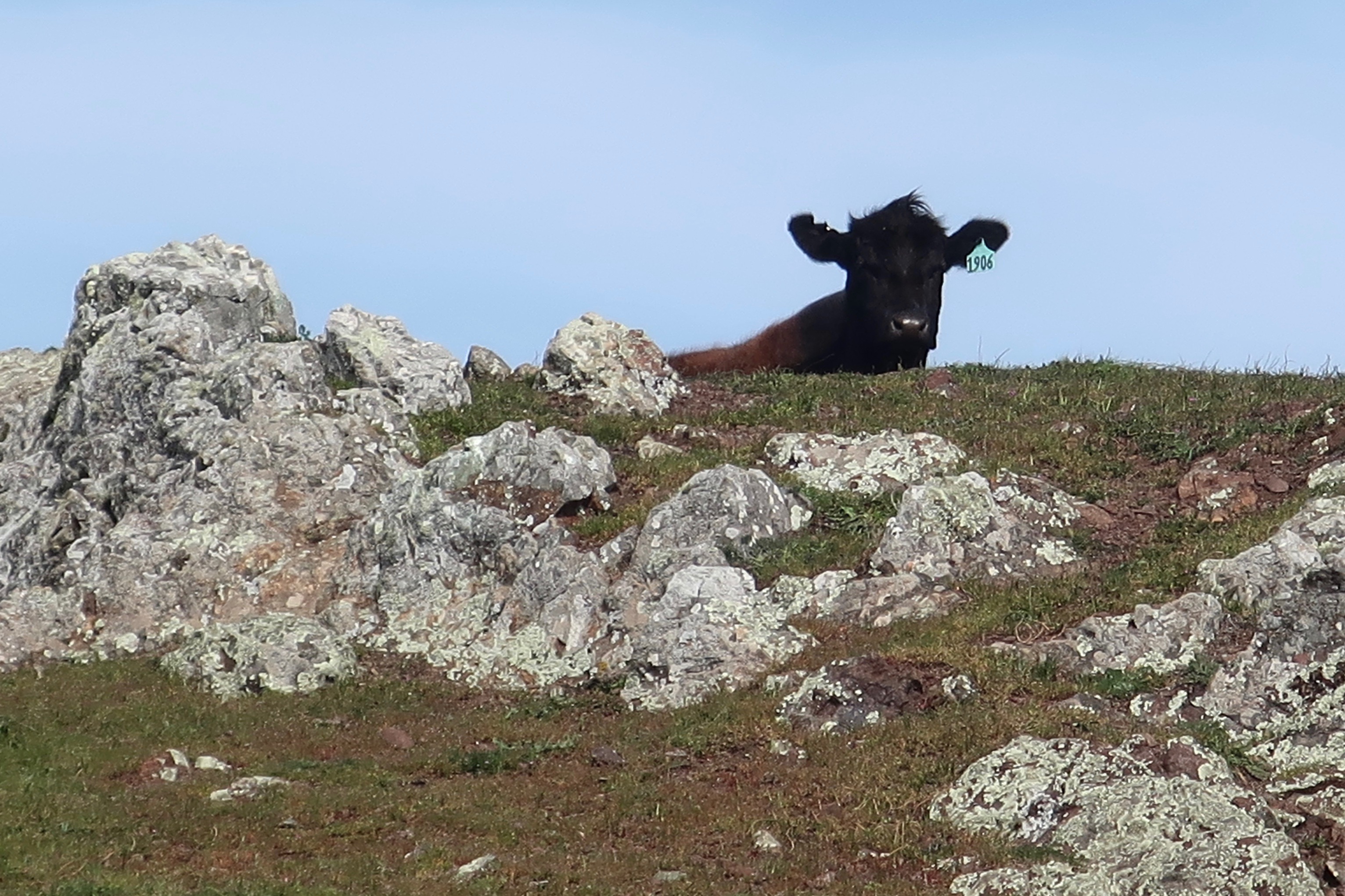
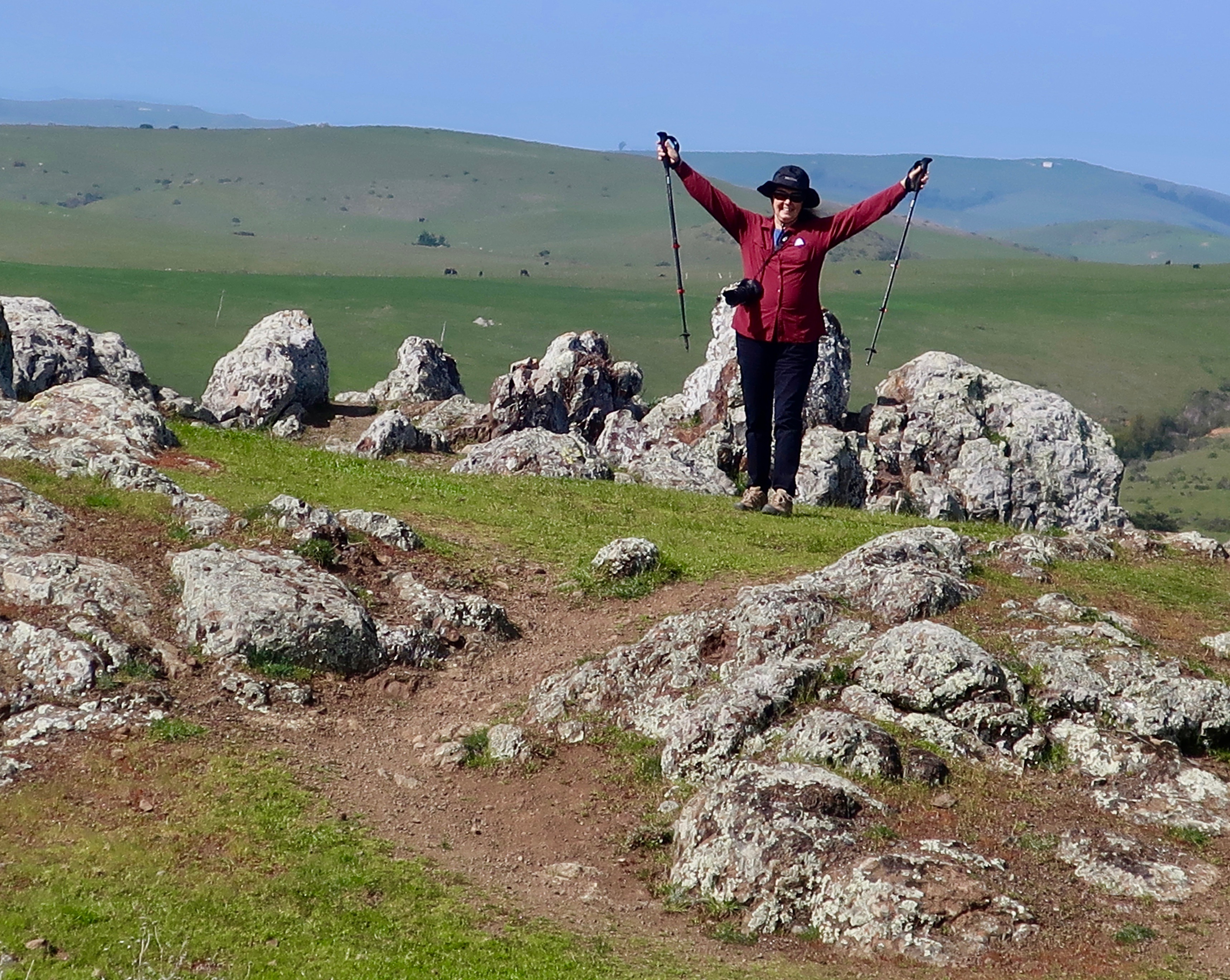
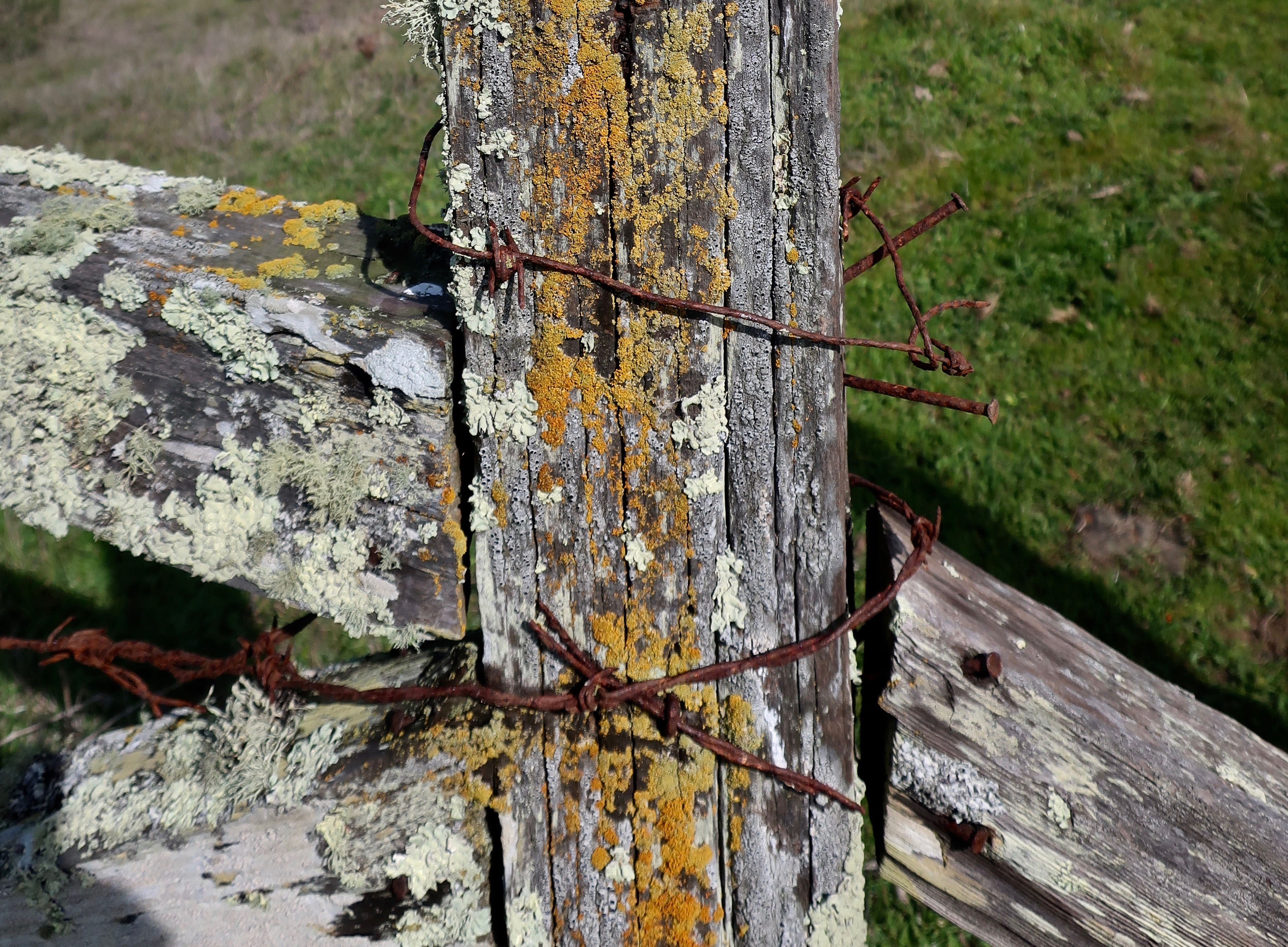
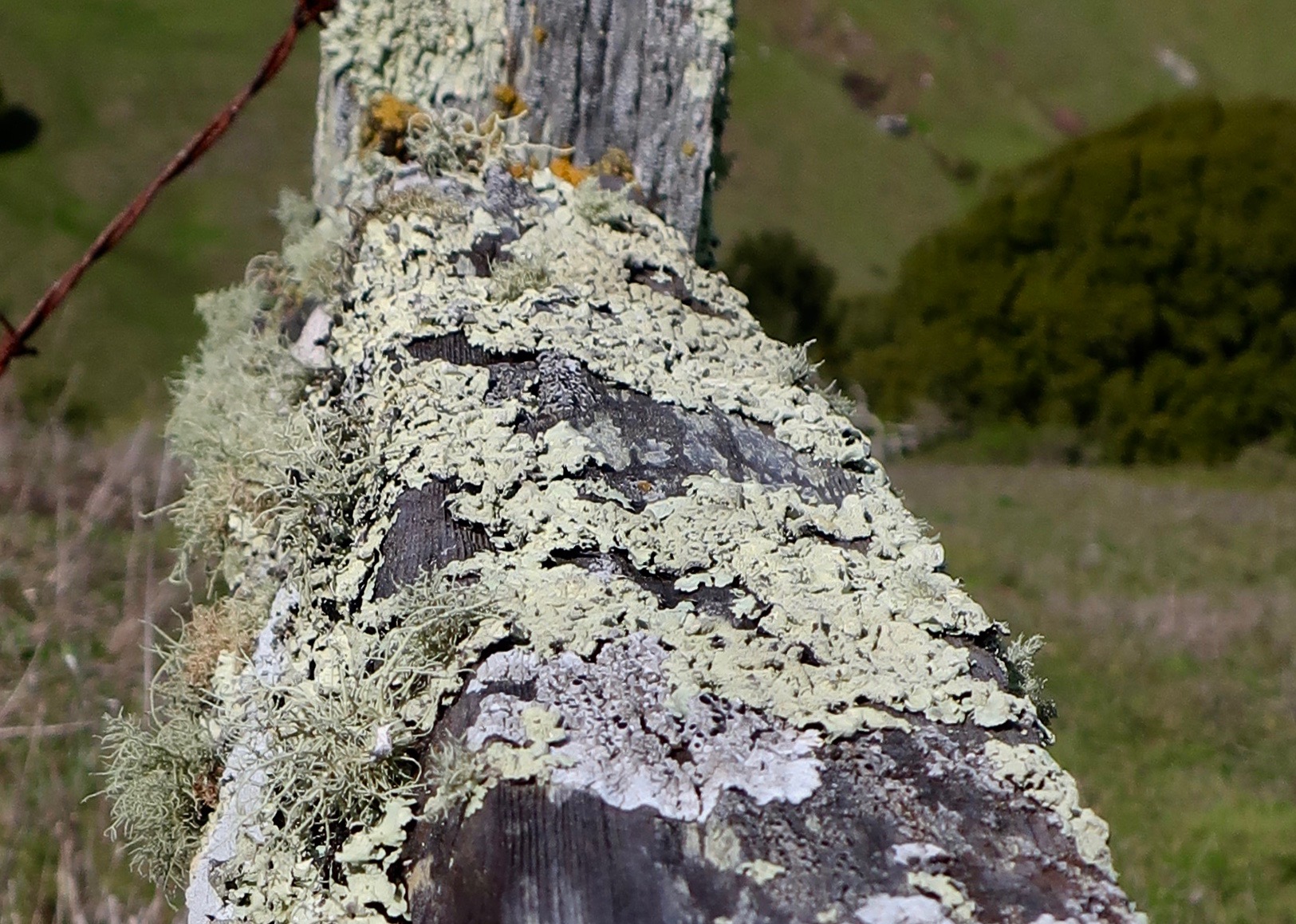
I didn’t know the name of this striking early bloomer, but fortunately Peggy and I had just loaded iNaturalist on our iPhone. I took a photo from my screen and voila! it’s Footsteps of Spring (Sanicula arctopoides). I absolutely love the new app.Another flower I had to lookup on our new app, Suncup Primrose (Taraxia ovata).This beauty was another one that our new iNaturalist app identified. Unfortunately, it’s an invasive species, Rosy Sand Crocus (Romula rose).And then we found an old friend, a solitary California poppy growing in the rocks along the trail. (Photo by Peggy Mekemson.)Cow sentry. If we didn’t have the feeling we were constantly being watched, we should have.I wanted to capture a photo of Peggy on a flat hilltop that was surrounded by rocks that struck me as a great place for a full moon Wiccan ceremony. I’m not sure how Peggy’s pose fit in, but then I hadn’t told her to look like a witch. The poppy shown above was growing in these rocks. An old fence was nearby…Tha ancient barbed wire and lichens spoke to a bygone era of ranching in the Pt. Reyes area. We were glad that the cattle were still there. Another shot of the fence.The tail-end of a cow tale. “I’m out of here” Ferdinand grumpily stated after one too many photos. Look at his face! I get the same feeling at family photo sessions. On next Friday’s Pt. Reyes travel blog, Peggy and I are off to visit an elk herd that roars down to see us. And, we watch a pair coyotes eating sushi.
NEXT POST:
Monday’s Blog-A-Book Post from It’s 4 AM and a Bear is Standing on Top of Me: Have you ever raced to the top of a 70-foot tree? In the middle of a graveyard? It was an important part of our entertainment when we were growing up. Join me on Monday as I race to the top and my brother tries to build a treehouse 60 feet up…
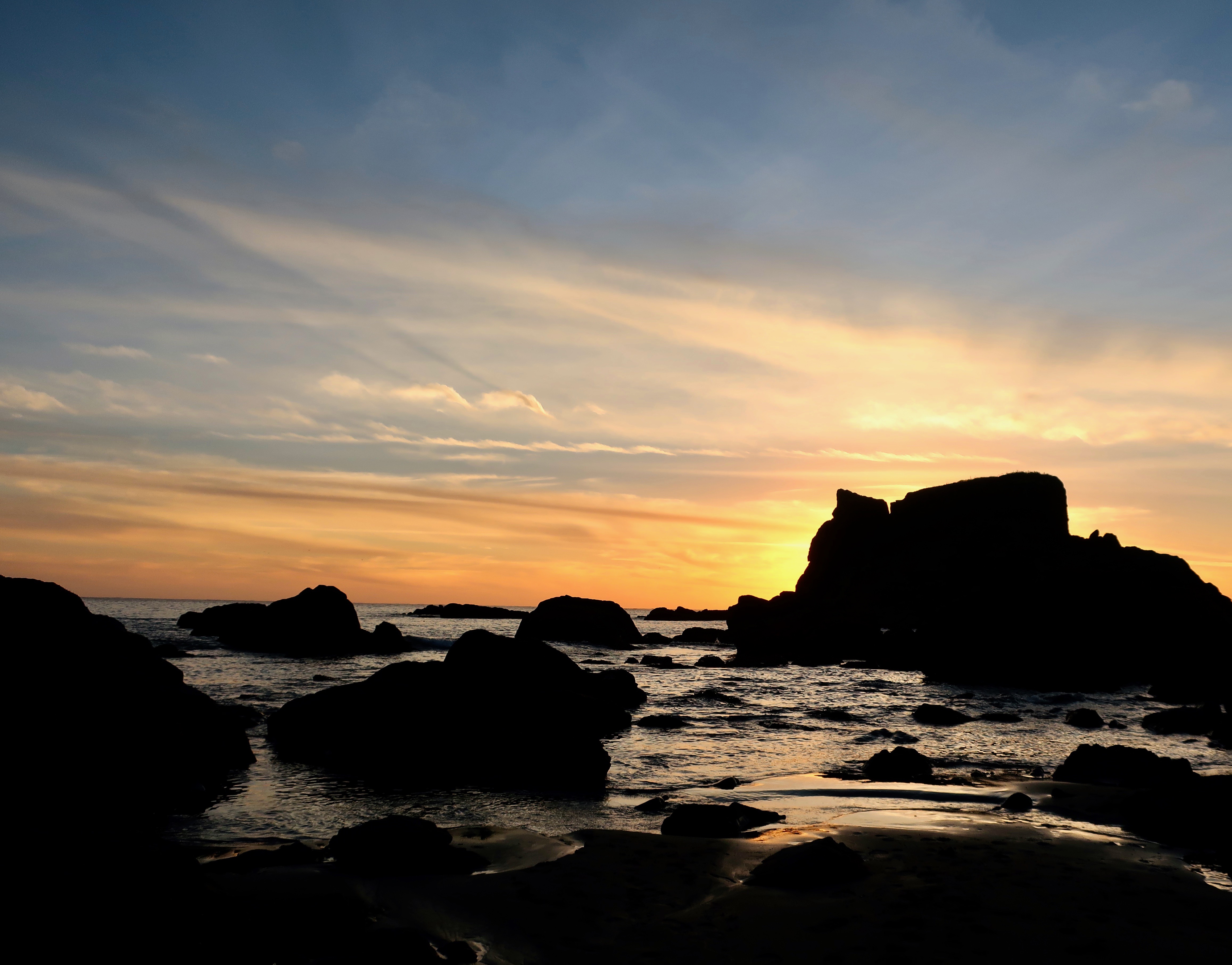
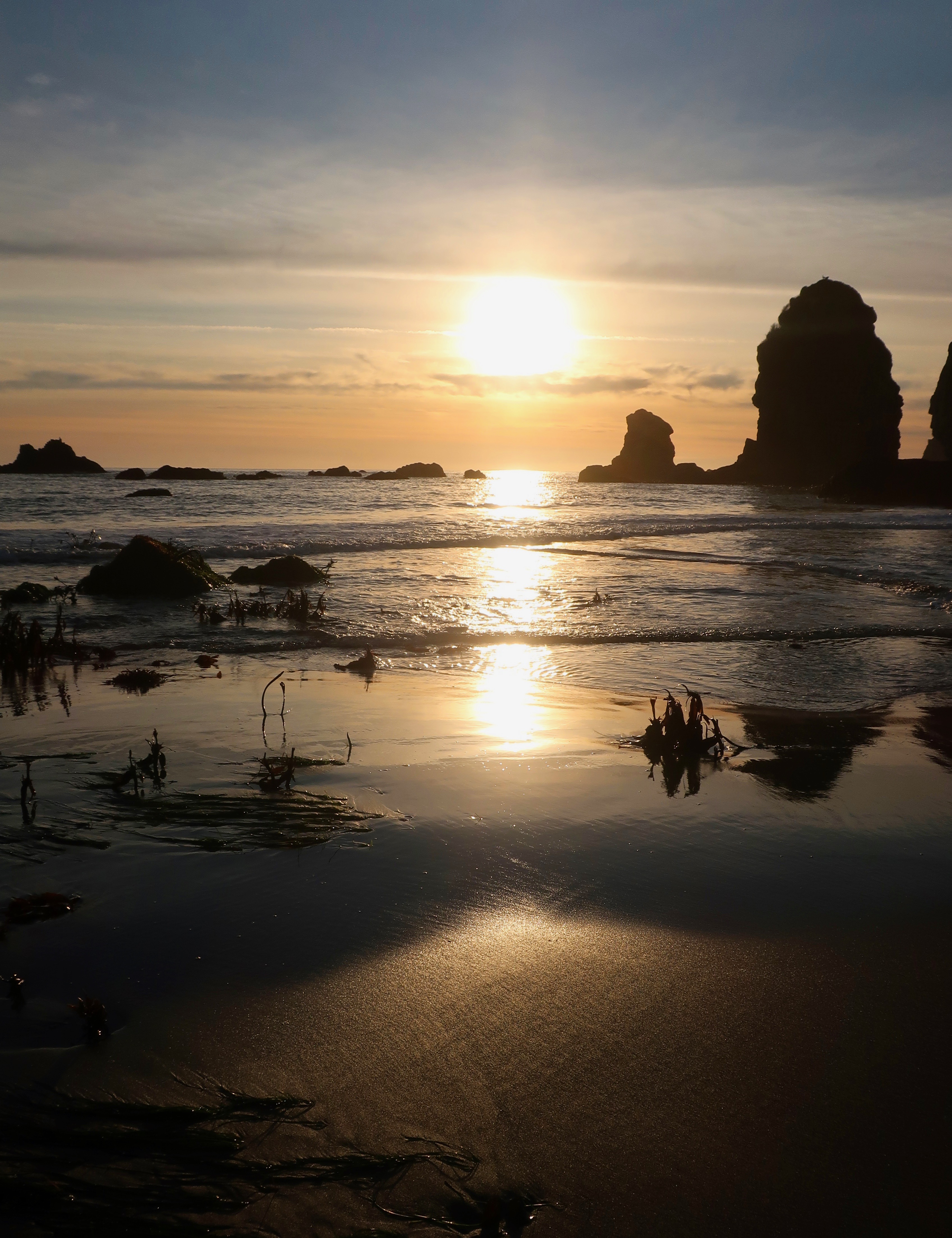
The sun appears to drop into the Pacific Ocean at Harris Beach State Park on the Oregon Coast.
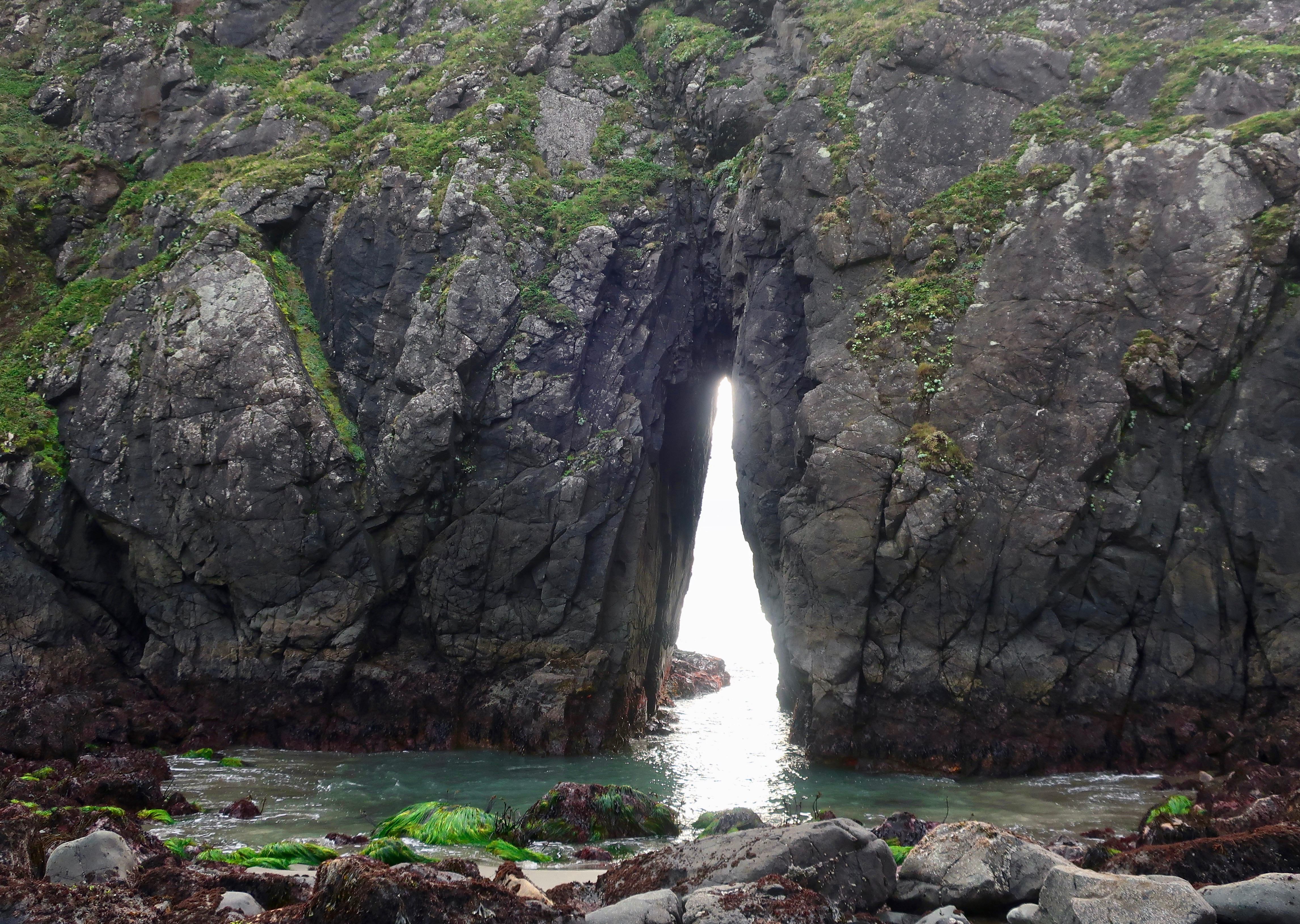
It seems appropriate to end my series on Harris Beach State Park with photos of the setting sun like the one above and those below. But first, I would like to cover a striking geological feature: Key Hole Rock.
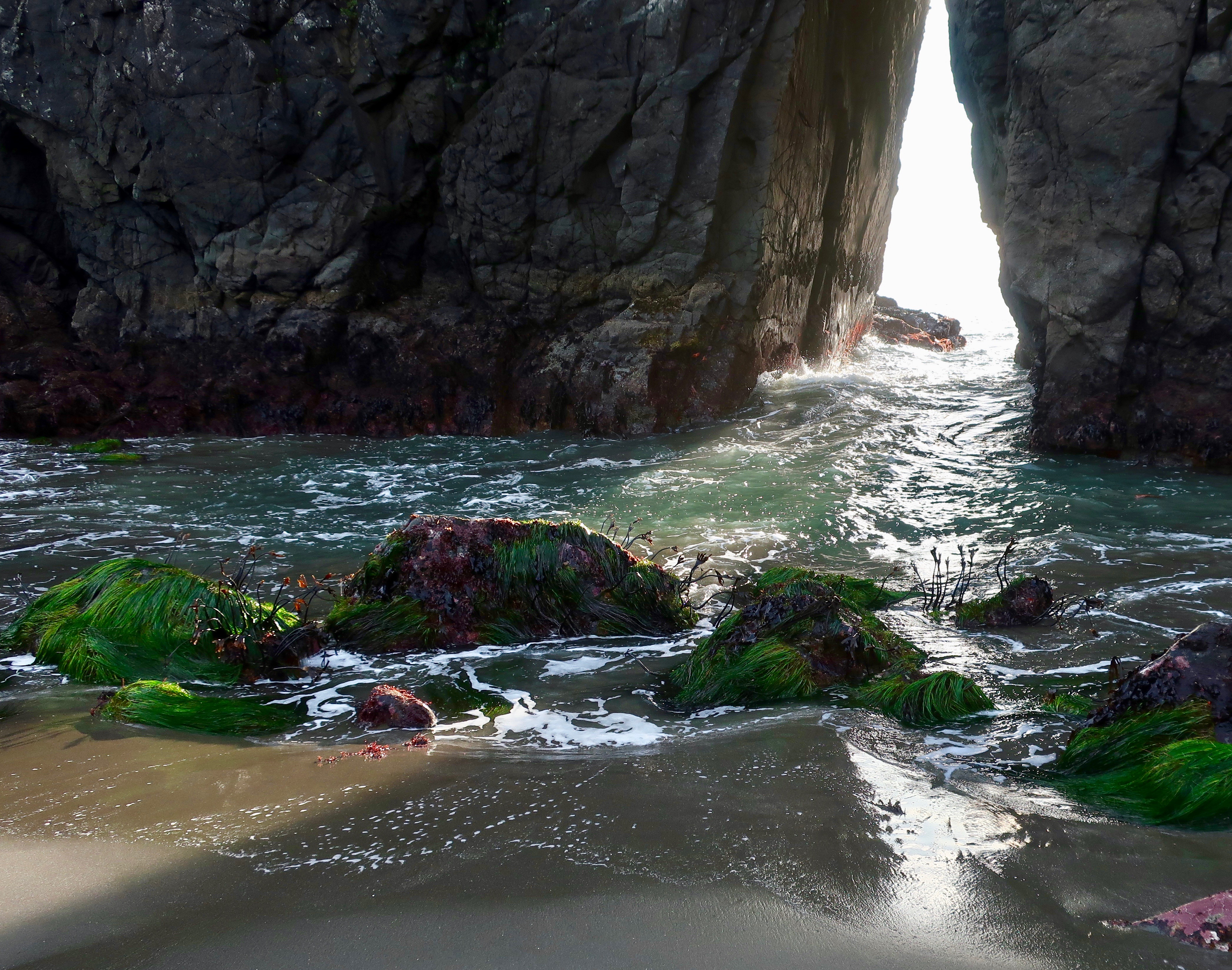
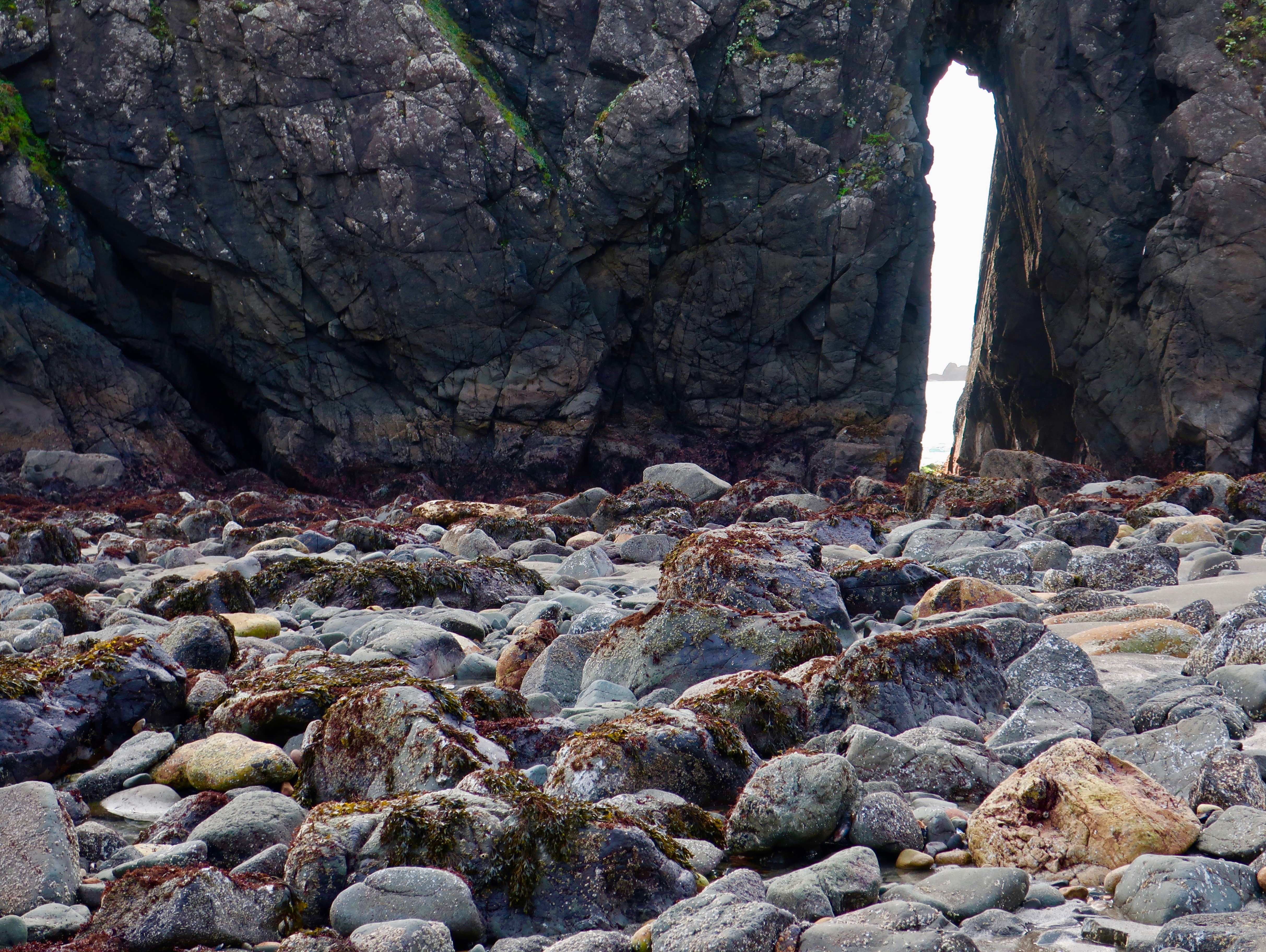
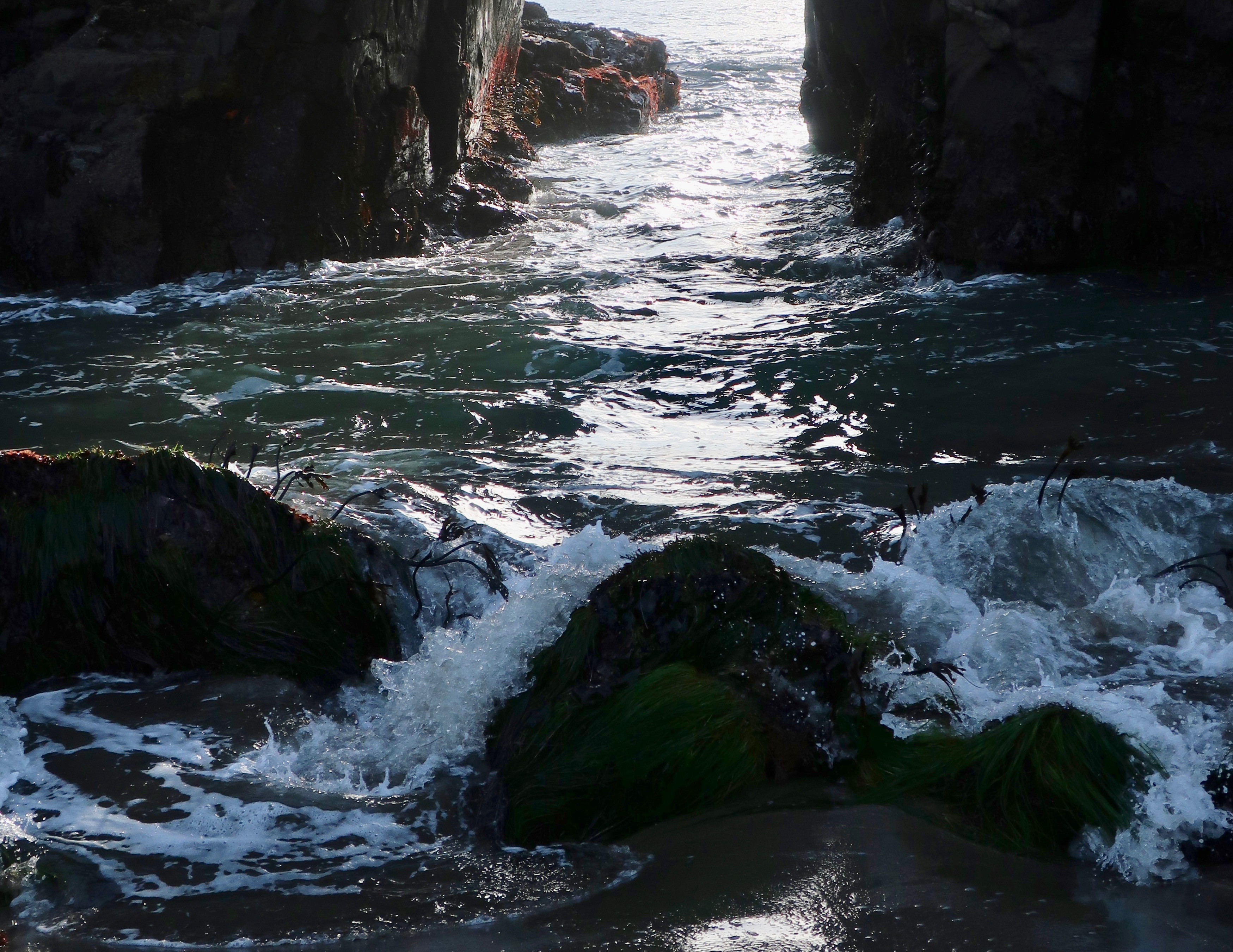
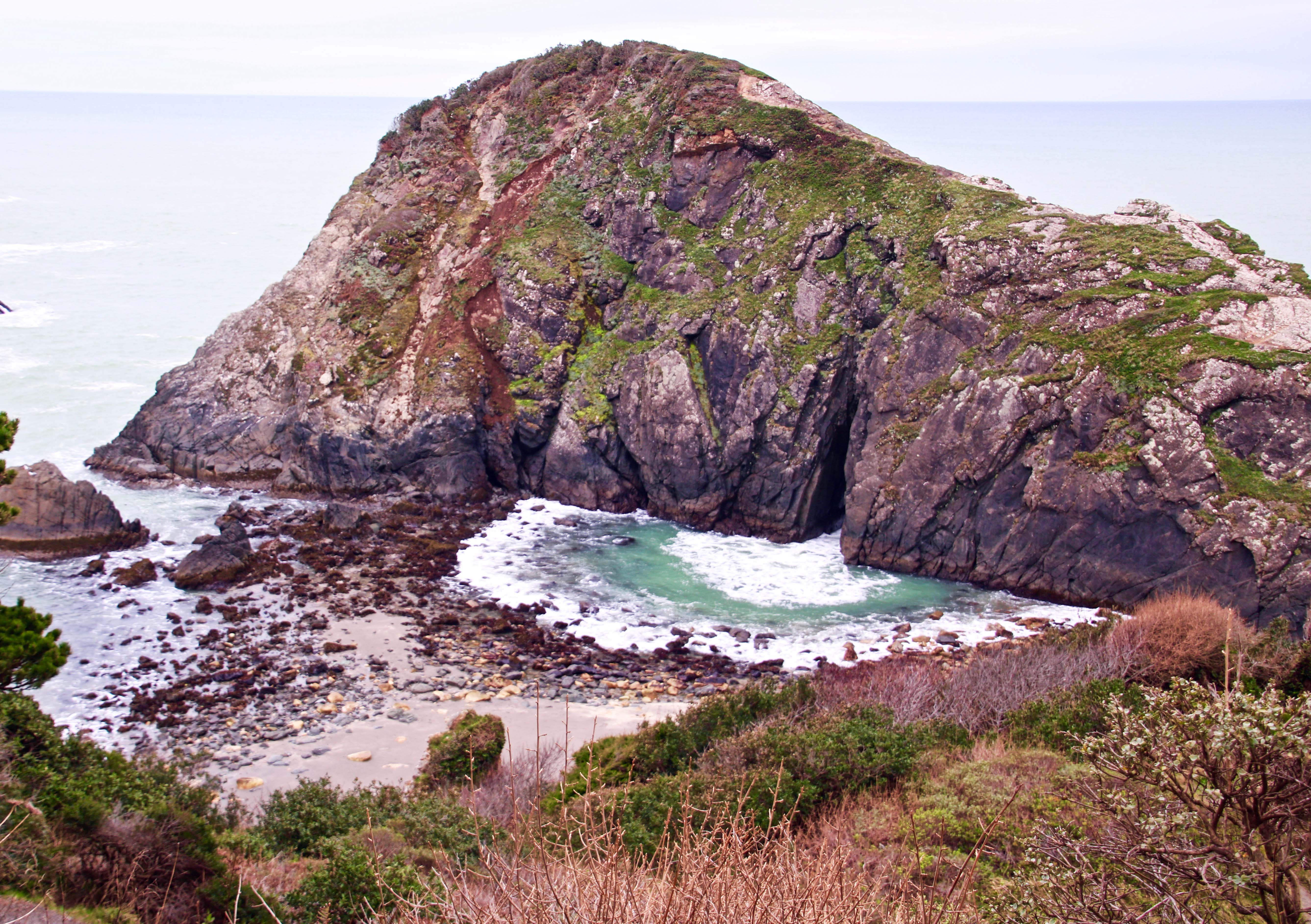
Sea stacks often have caves or holes in them caused by the action of waves and weather. Key Hole Rock at Harris Beach is a prime example. The light and waves that make their way though the hole provide endless photo ops.
A massive sea stack hovers above the hole. At some time in the probably distant future the whole edifice will come crashing down.
Different angles provide different perspectives as do tide levels. The tide is out here.
Here, the tide is coming in…
A photo from an earlier visit provides an interesting perspective of Key Hole Rock at high tide. (Photo by Peggy Mekemson.)
And now for the promised sunset photos:
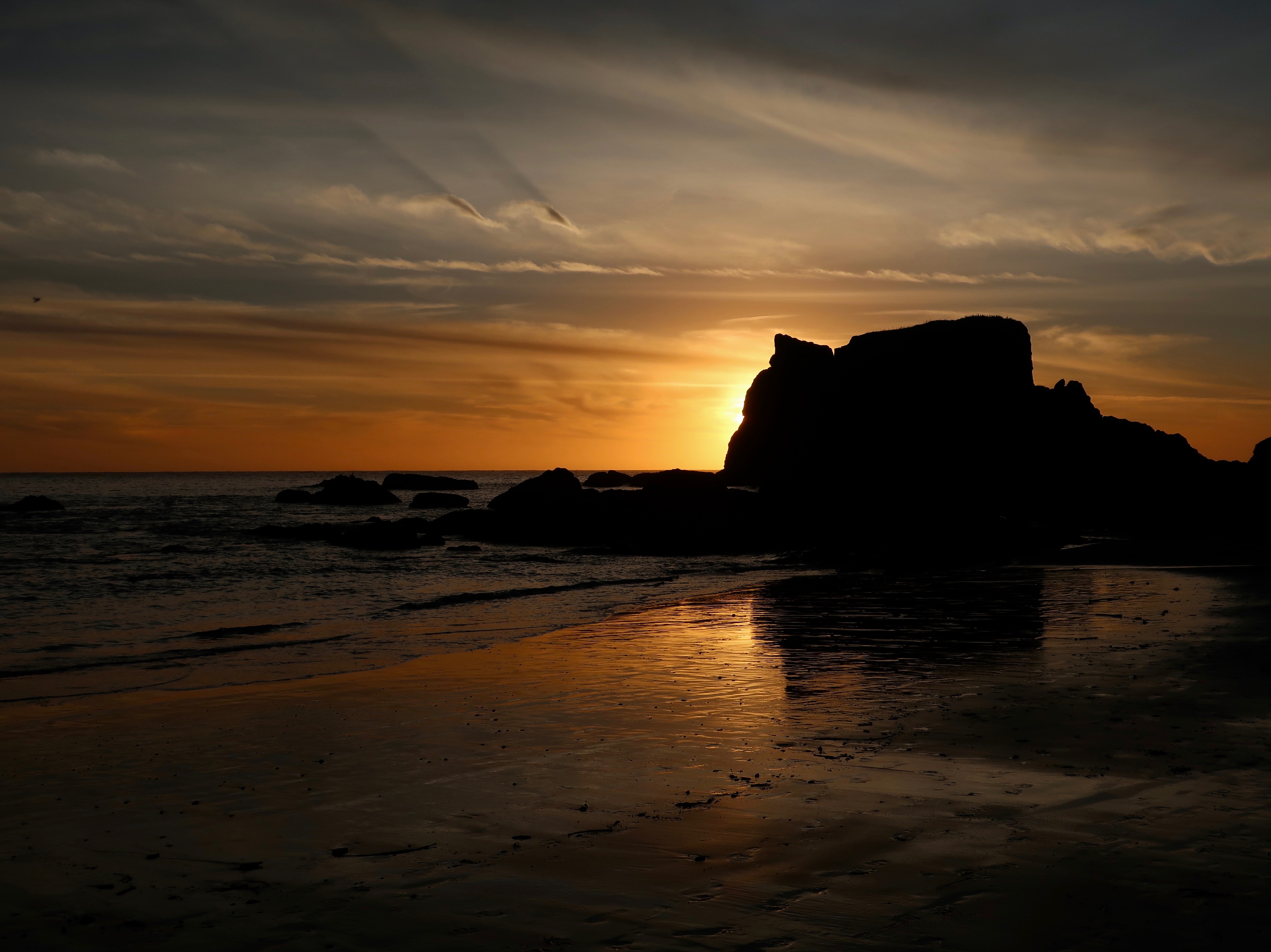
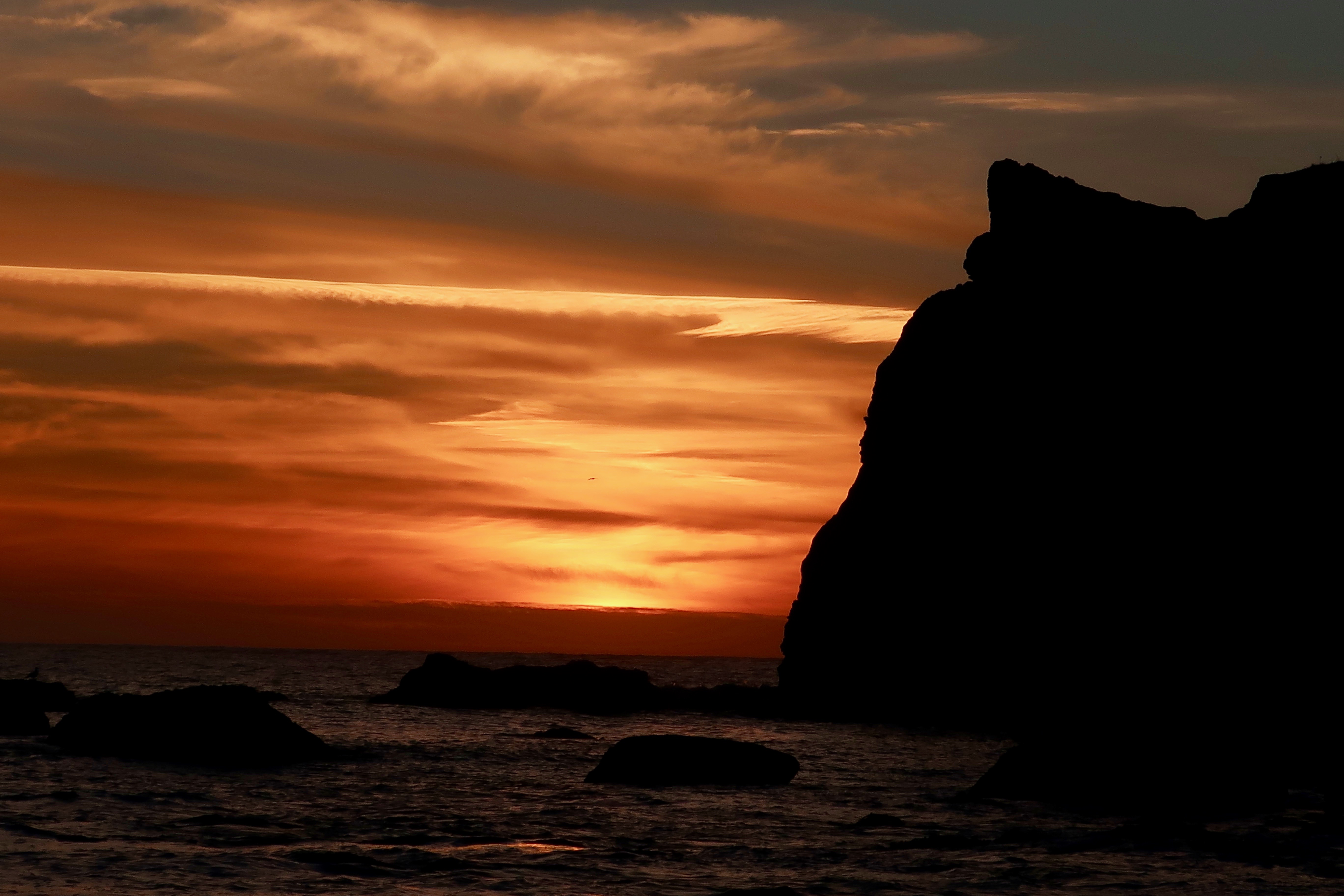
I’ll conclude with this photo as we say goodbye to Harris Beach. I took it a few minutes after the first photo was taken. On next Friday’s travel blog, Peggy and I will be taking you south to Pt. Reyes National Seashore just north of San Francisco, Ca. I’ve already done a post on the elephant seals. This time we will be taking you on a cow walk.
NEXT POST:
Monday’s Blog-A-Book Post from It’s 4 AM and a Bear Is Standing on Top of Me: On a lonely night walk home from visiting her boyfriend, my sister Nancy encounters a ghost from the Graveyard that floats down in front of her. She screams, and screams, and screams…
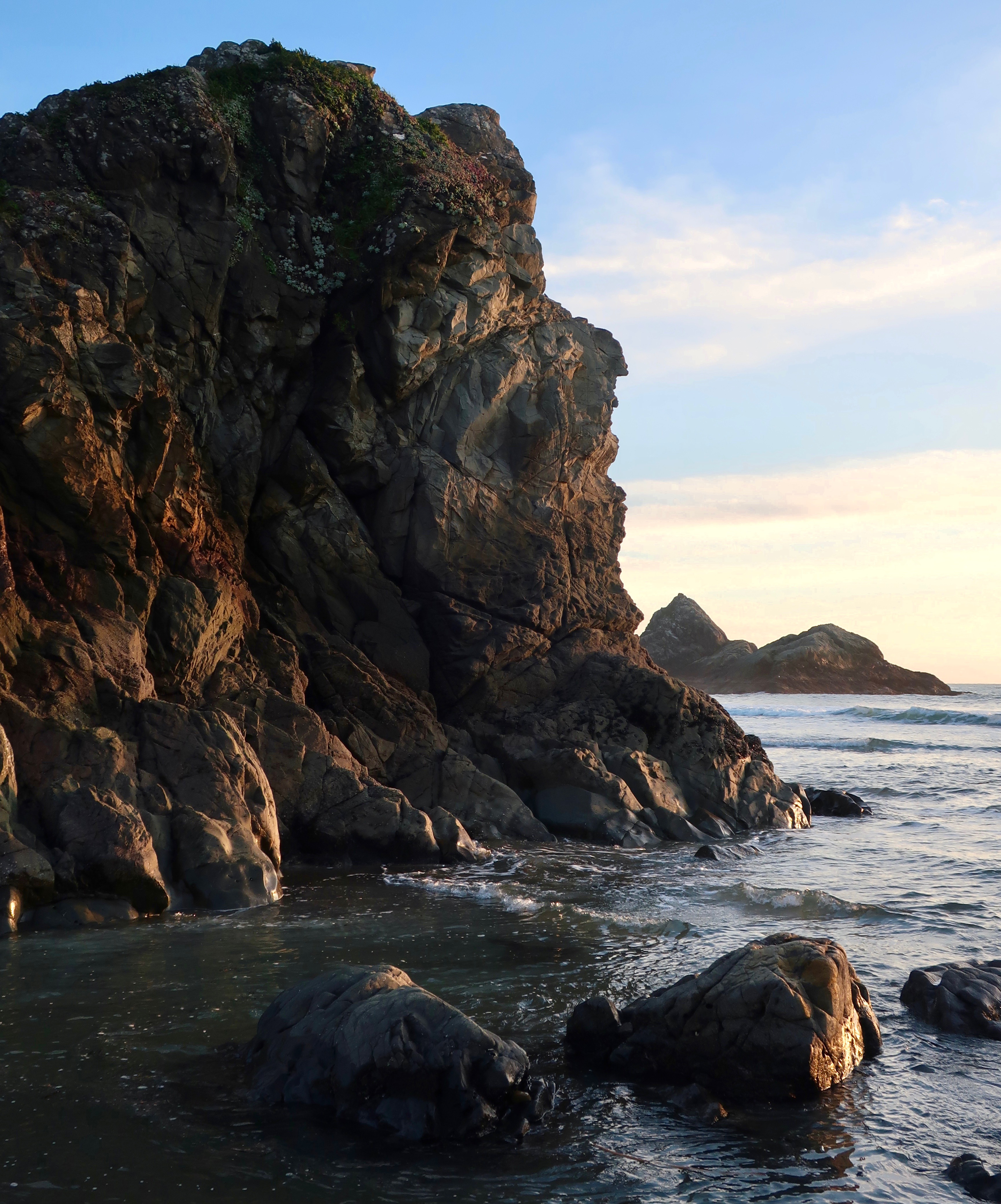
Once, these two magnificent sea stacks would have been part of the coast. Erosion made them part of the ocean. The evening sun was bathing them in a gentle glow.
I am continuing the exploration of the Oregon Coast on my Friday travel blog. This is part of the Harris Beach series. So far, Peggy and I have given you a tour of the tide pools teeming with interesting sea life. Today I will focus on the sea stacks that adorn the coast. Harris Beach State Park is located next to the town of Brookings, which is just north of the California border. The following photos are taken by both Peggy and me.
Goat (or Bird Island) at Harris Beach SP near Brookings is the largest Island on the Oregon Coast. According to the Audubon Society it is an IBA, an Important Bird Area. And it is. Over 100,000 birds nest there annually, including tufted puffins, a bird I more closely associate with my years of living in Alaska. The island is off-limits to people.
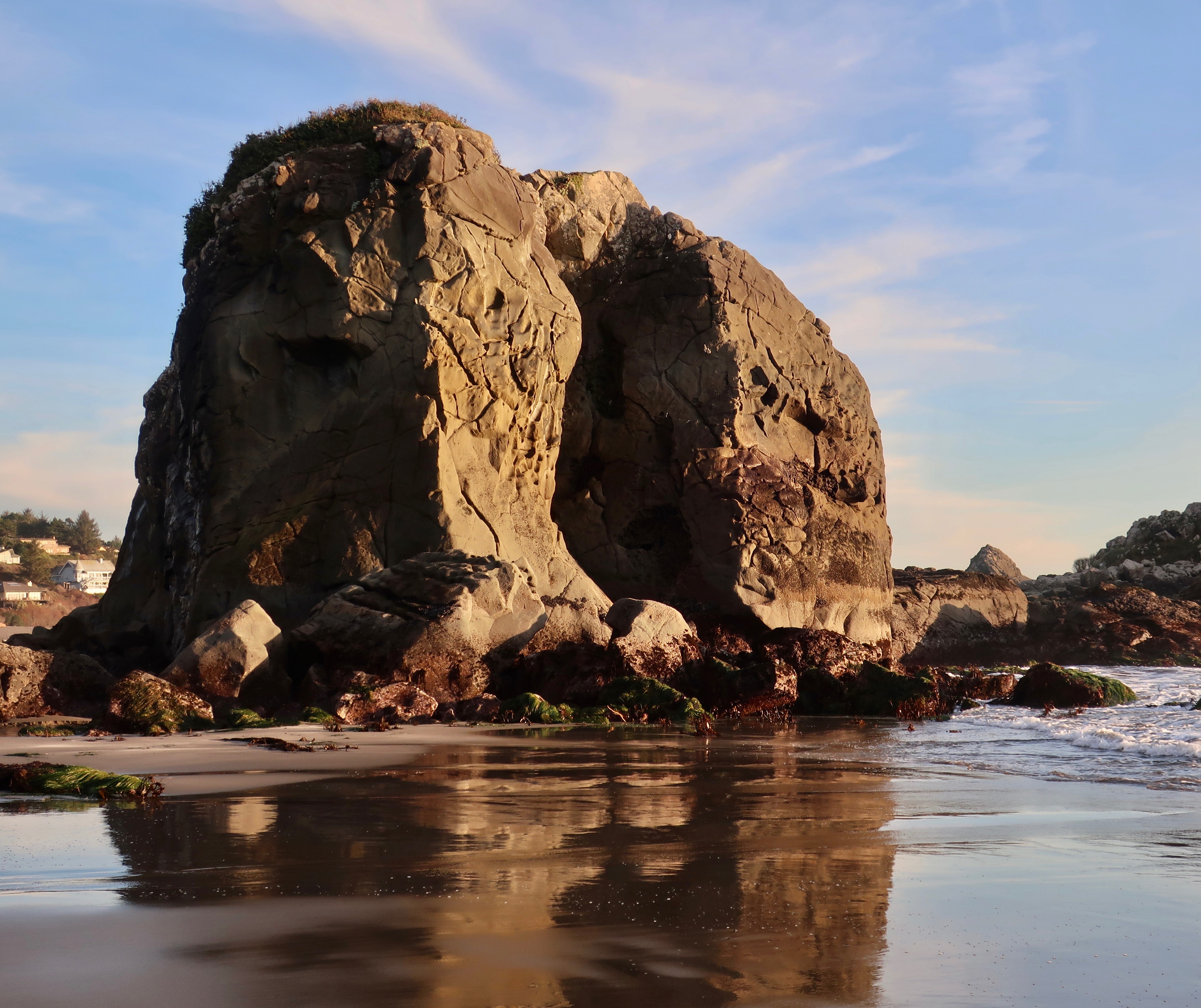
This massive sea stack appeared to have a face looking out toward sea. The rock base made me think of a many legged creature.
A closer view.
The reflection caught our attention here.
Peggy and I wandered among these rocks checking out tide pools.
Later in the day, the tide started coming in. It was time to stop playing in tide pools and start thinking about the sunset.
More color here.
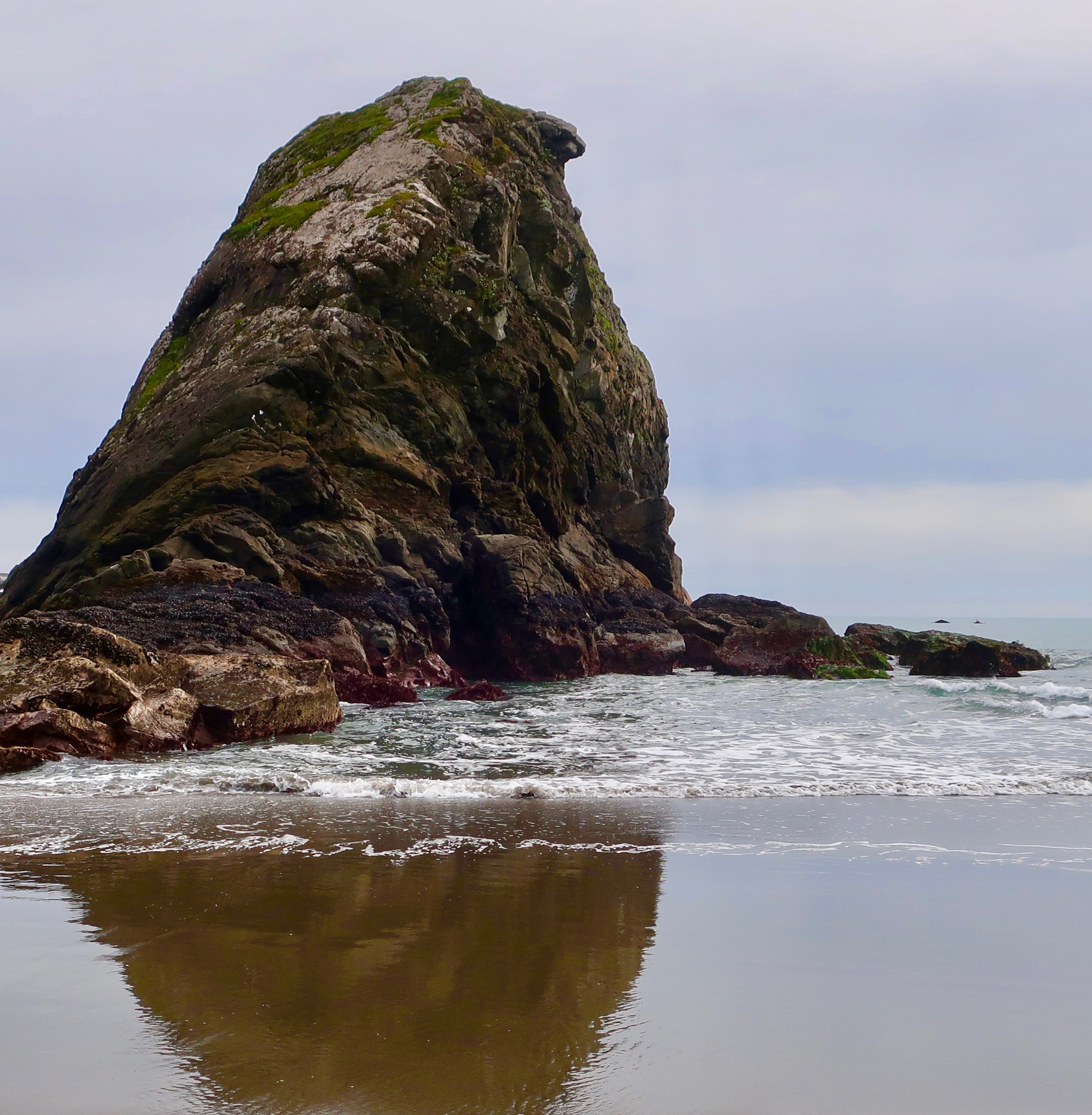
I’ll conclude with this sea stack which was smaller but also colorful. My travel blog next Friday will include human-size rocks, an impressive hole in one of the sea stacks, and drift wood.
NEXT POST:
Monday’s Blog-a-Book Post… From “It’s 4 AM and a Bear Is Standing on Top of Me” : The shameless shenanigans of Pat the Greyhound and Demon the Black Cat get them fired from ghost guard duty.
It’s more tide pool fun at Oregon’s Harris Beach State Park in my travel blog today. Both Peggy and I took the photos.
Four volcano-like barnacles plus mussels at Harris Beach State Park.
Barnacles are a bane to sailors, limpets and anyone else they can hitch a ride with. Latching onto hulls, they seriously interfere with a boat’s efficiency at moving through water and have to be scraped off. Limpets just have to live with their passengers.
Limpets move so slowly that their progress is not impacted by barnacles, but still, I can’t imagine that they are happy to have hitchhikers.
The limpet was one of several that Peggy and I found on a rock. Hermit crabs and other denizens of tide pools love to eat limpets but getting them off rocks can be a considerable challenge. They shoot out the water from under their shells and create a tight, almost unbreakable vacuum. I know. I’ve tried.
Lots of barnacles here. Now, imagine them on the bottom of a boat. There used to be a rather nasty punishment ship captains would use on miscreant sailors called keel-hauling. A rope would be attached to the sailor and he would be dragged under the boat. If barnacles were present, I doubt that much skin would be left. I think I would prefer walking the plank.
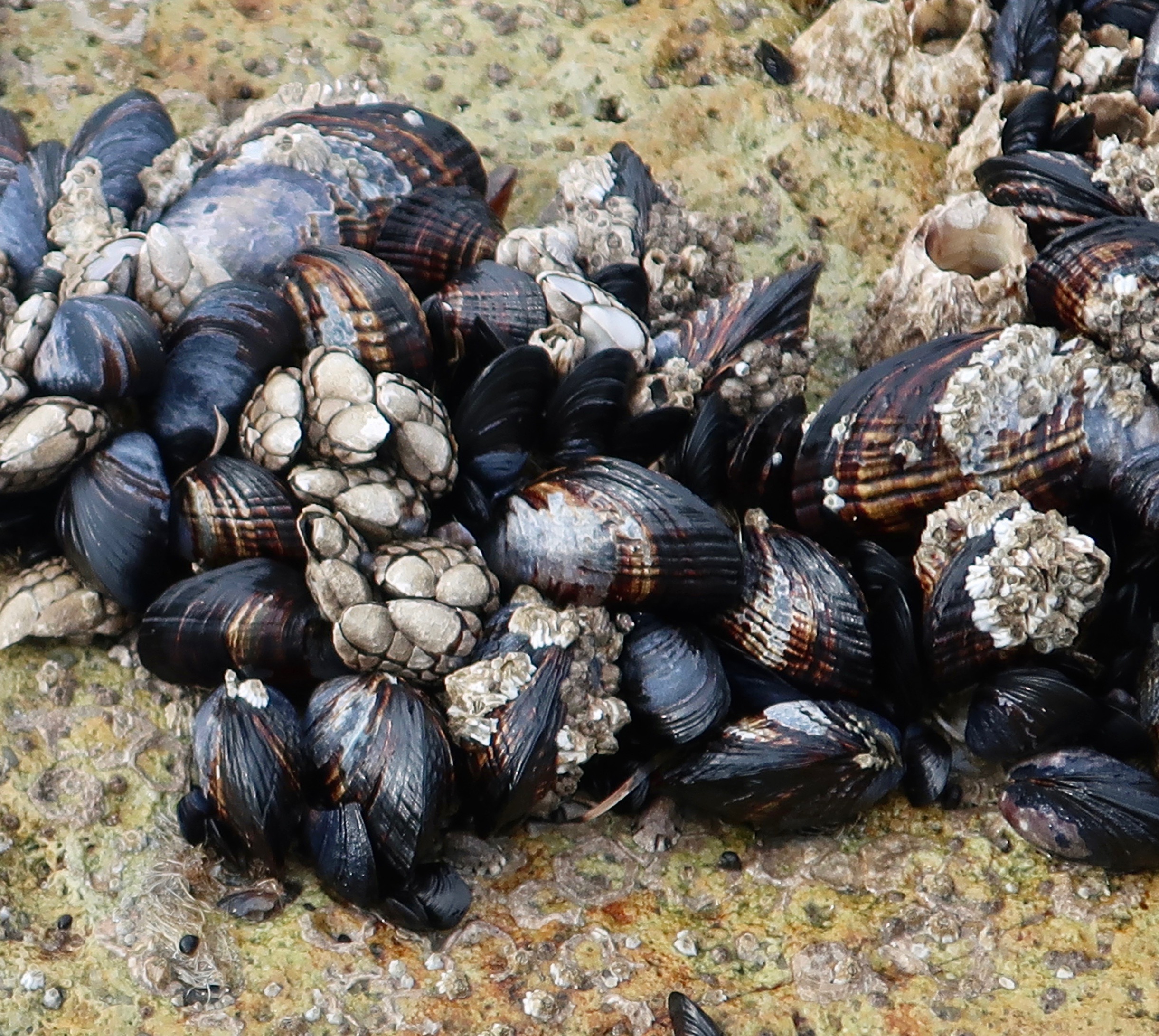
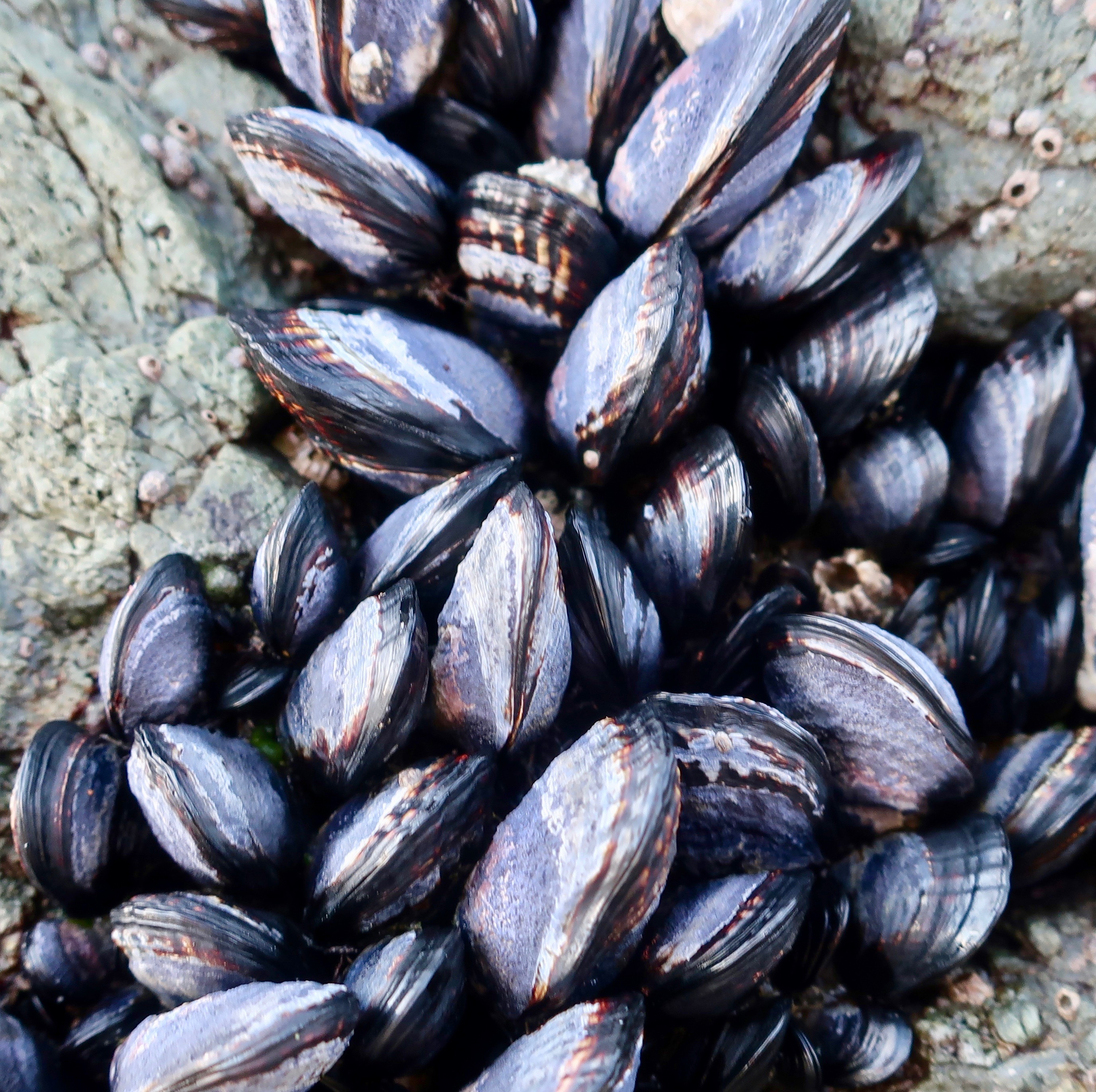
Barnacles are joined by mussels and goose neck barnacles in this photo. Goose neck barnacles, the guys with the fingernail looking shells, are considered a delicacy in Portugal and Spain. They were also eaten by the indigenous peoples of California and probably Oregon. Also, note the barnacles attached to the mussel shells.
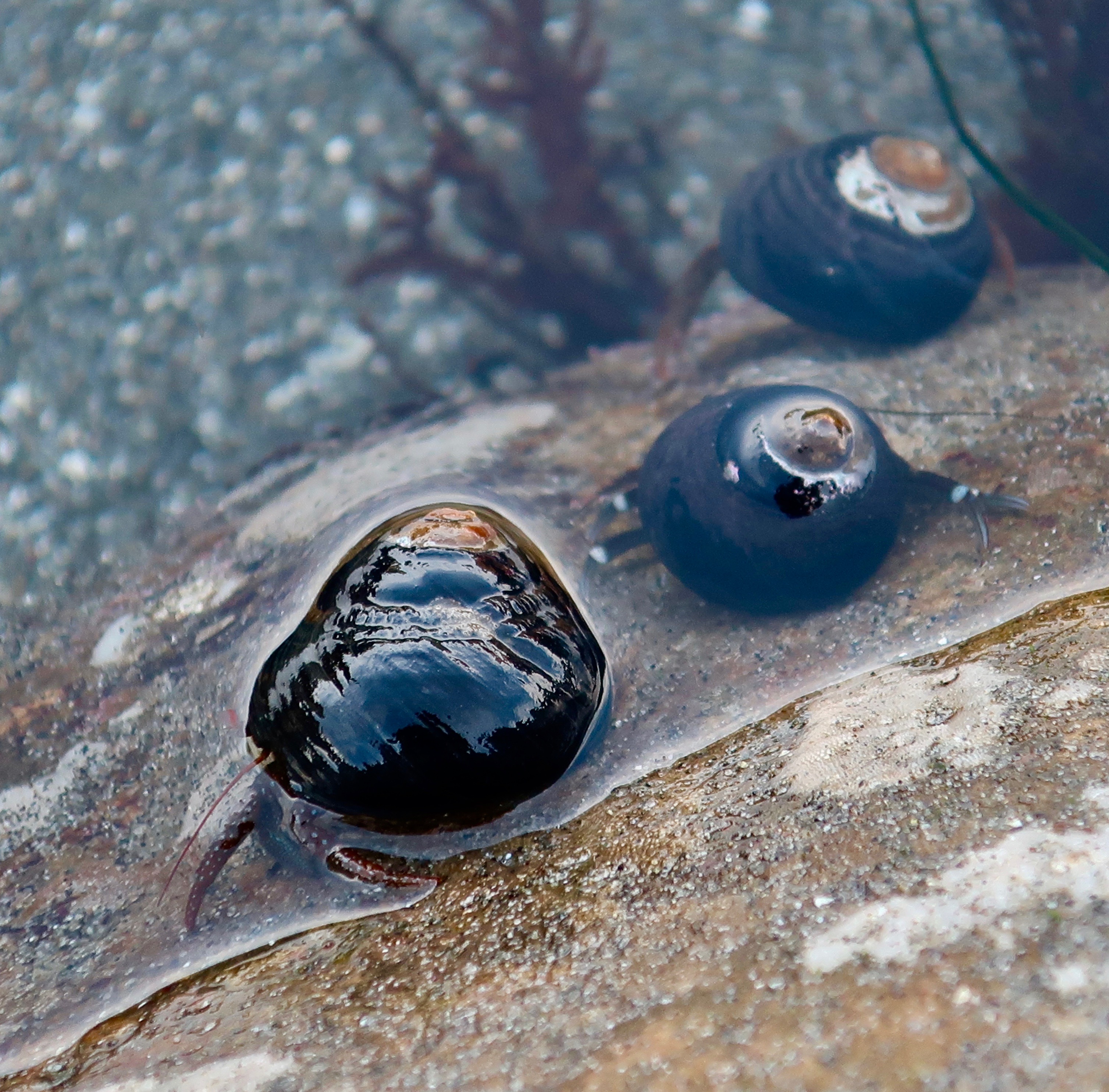
Turban snails are common along the Pacific Coast. Their empty shells are a favorite home of hermit crabs, which are what you see here, hiking along on their crab legs. As a kid, I used to pry an occasional limpet off of a rock and toss it into a tide pool. The limpets had little appreciation for my boy-enhanced curiosity, but the hermit crabs would come rushing in from far and near for the feast.
Peggy loves a batch of mussels cooked up in salt and garlic water. My dad did as well. He used to gather them fresh off the rocks near where he lived on the Oregon Coast and cook them. He tried to feed them to me. No thanks. I am not a fan of most shellfish. I think the snail seen here shares my wife’s and his taste. It has a specially adapted organ that can drill through the snail’s shell for a tasty meal. Buzz, buzz, slurp, slurp.
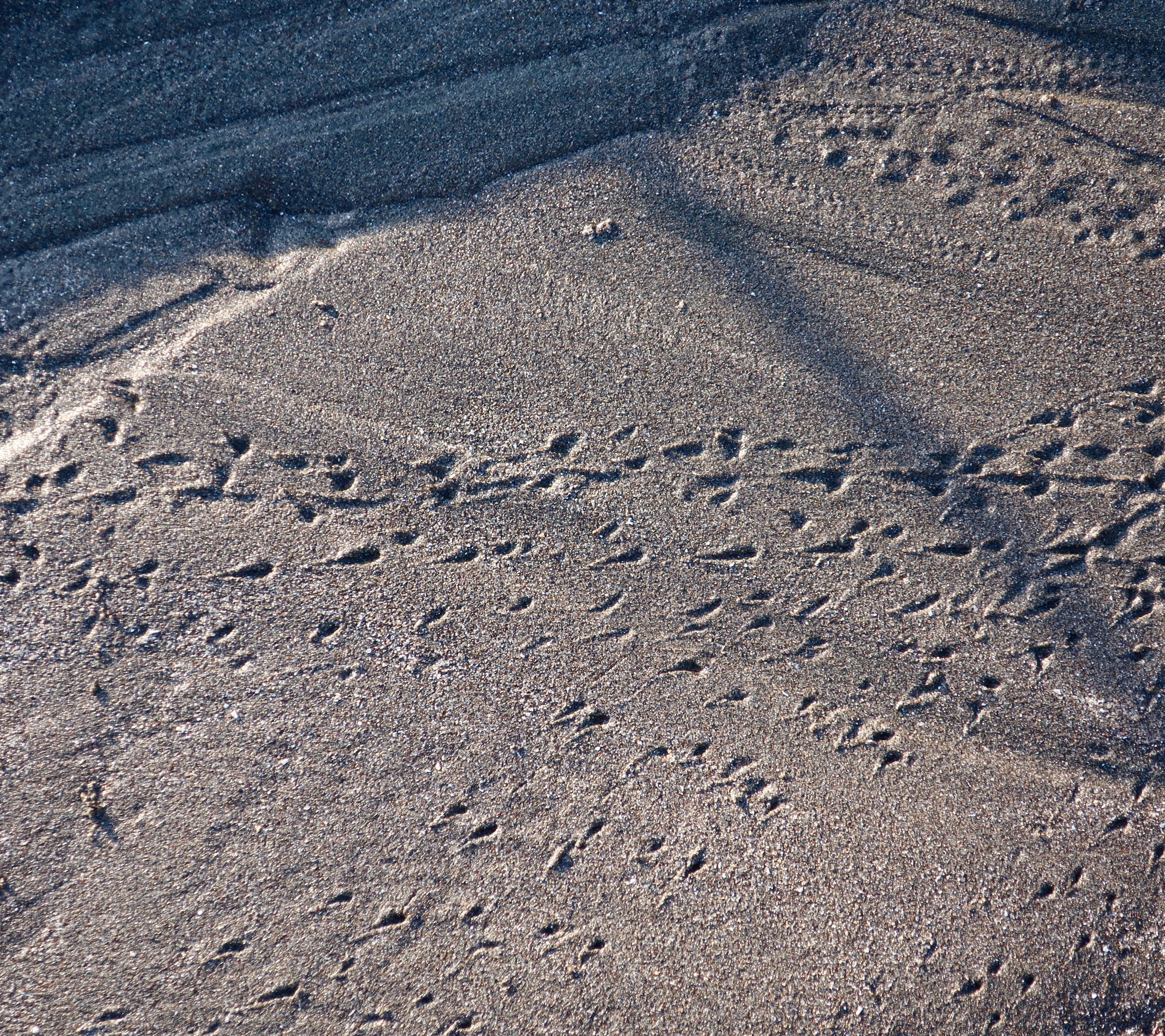
Just for fun, who do you think made these tracks across the sand? I’m going for crabs with their small claw feet.
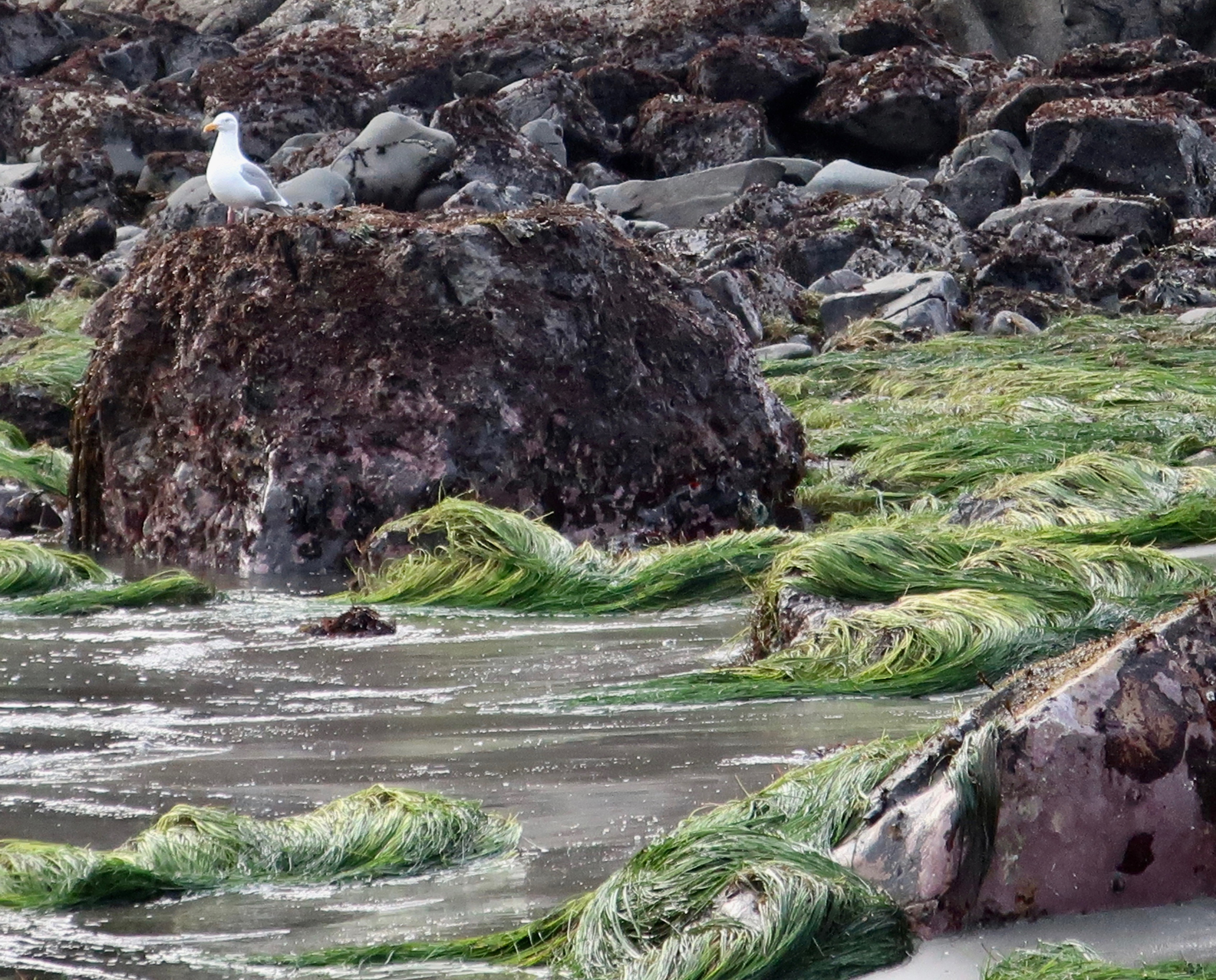
I’ll close today with the sea grass that Peggy and I found growing in abundance between the tide pools. We had expected to find seaweed, not grass. This grass has returned to the ocean from land and adapted to living in saltwater. We found it quite attractive.
Another example. Next Friday I will return to Harris Beach and feature it’s dramatic sea stacks.
NEXT POST:
Blog a Book Monday… “It’s 4 AM and a Bear Is Standing on Top of Me” : In my last post from the book, I wrote about how I had moved outside in the summer to experience nature up close and personal, a successful venture that was tainted somewhat by the ghosts that lived in the graveyard next door. I ended up hiring the family pets for protection. On Monday I will introduce my top protectors, Pat the Stray Greyhound and Demon the Black Cat.
It’s the first day of spring here in the Applegate River Valley, and behaving like it. I watched two male flickers (woodpeckers) strutting their stuff this morning for a female while she studiously ignored them by pecking at the ground. One very pregnant doe was busy chasing off her twins from last year. She’ll soon have a new fawn— or fawns— to take care of. And, the swallows have arrived back in our neighborhood. Their aerial performances are truly amazing. Before long, they will start checking out our oak trees and bird houses for possible nesting sites.
The first of our daffodils have burst into bright yellow blooms, shooting stars are covering the hillsides, and irises are popping up everywhere. Peggy and her sister Jane dug up our iris bed last year to separate the bulbs that were crowding each other out. Peggy discovered that there were more than she could possibly plant, so she started stuffing the extras into gopher holes and covering them— like you might sweep dirt under a rug. Well, that’s what I thought. The gophers will have a feast. I couldn’t have been more wrong. Each hole is now proudly sporting its own iris and Peggy is giving me an “I told you so” look.
And what else happened this morning? There was snow, rain and sunshine. Sometimes simultaneously. Spring has arrived for sure.
Meanwhile, I have a nasty cold. “We don’t likes it,” as Gollum of Hobbit fame would say. I have a box of Kleenex on one side and a paper bag on the other. I feel like I am an essential part of an assembly line for creating dirty tissues. Pull a Kleenex out of the box, sneeze into it, and stuff it in the bag. Repeat. I filled two bags yesterday. I’d be worried in this age of Covid, but my sniffer is working fine, I don’t have a fever, and Peggy and I had our second dose of Moderna in February.
I was totally out of it yesterday and the day before. Instead of writing, I read a 400-page fantasy novel about a reluctant hero, a kick-ass princess, a unicorn without a horn, and a dragon that collected butterflies instead of virgins and gold. It was just what the doctor ordered. I’m almost human today, which is why I am back to blogging. Today I am returning to the tide pools of Harris Beach for a look at sea anemones.
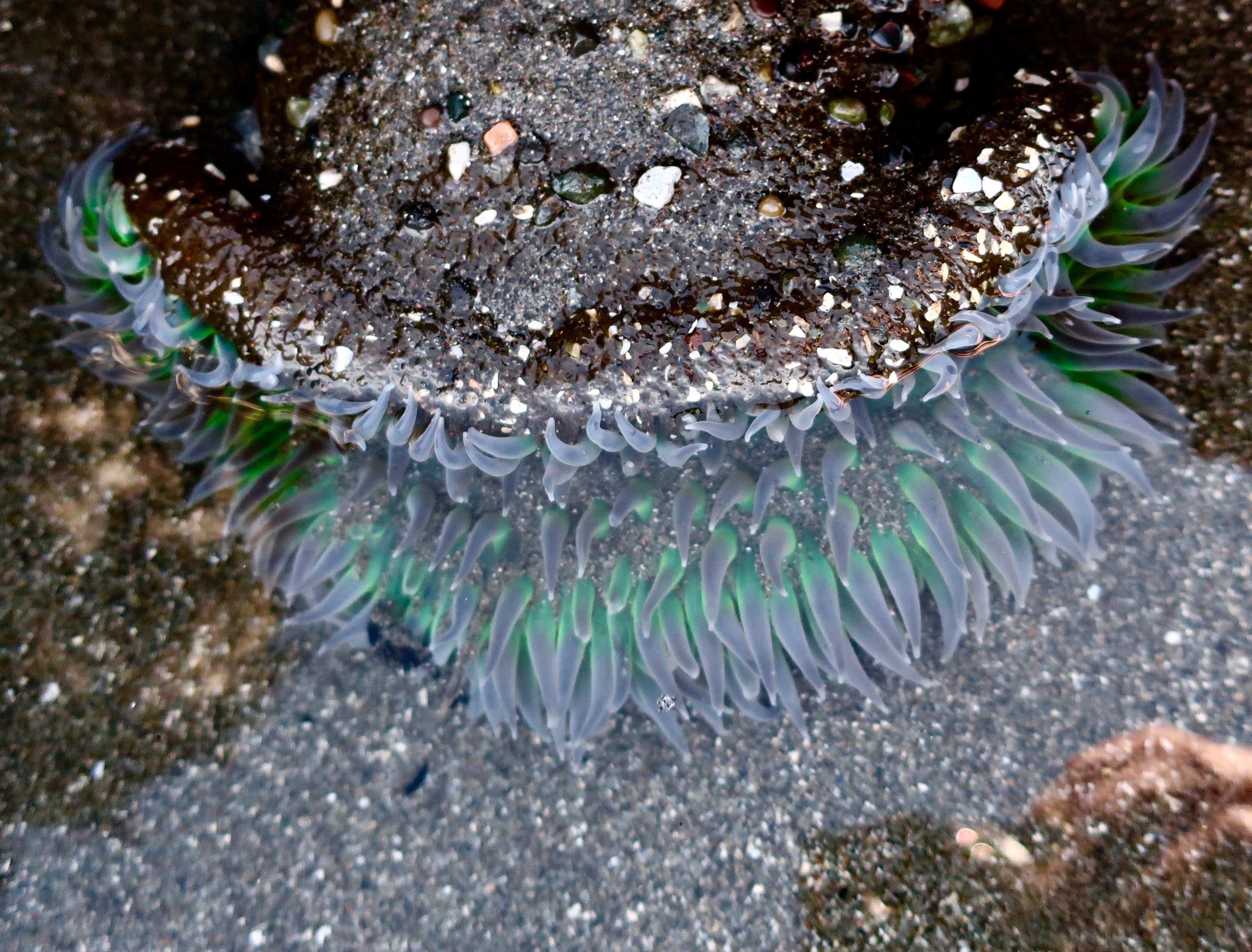
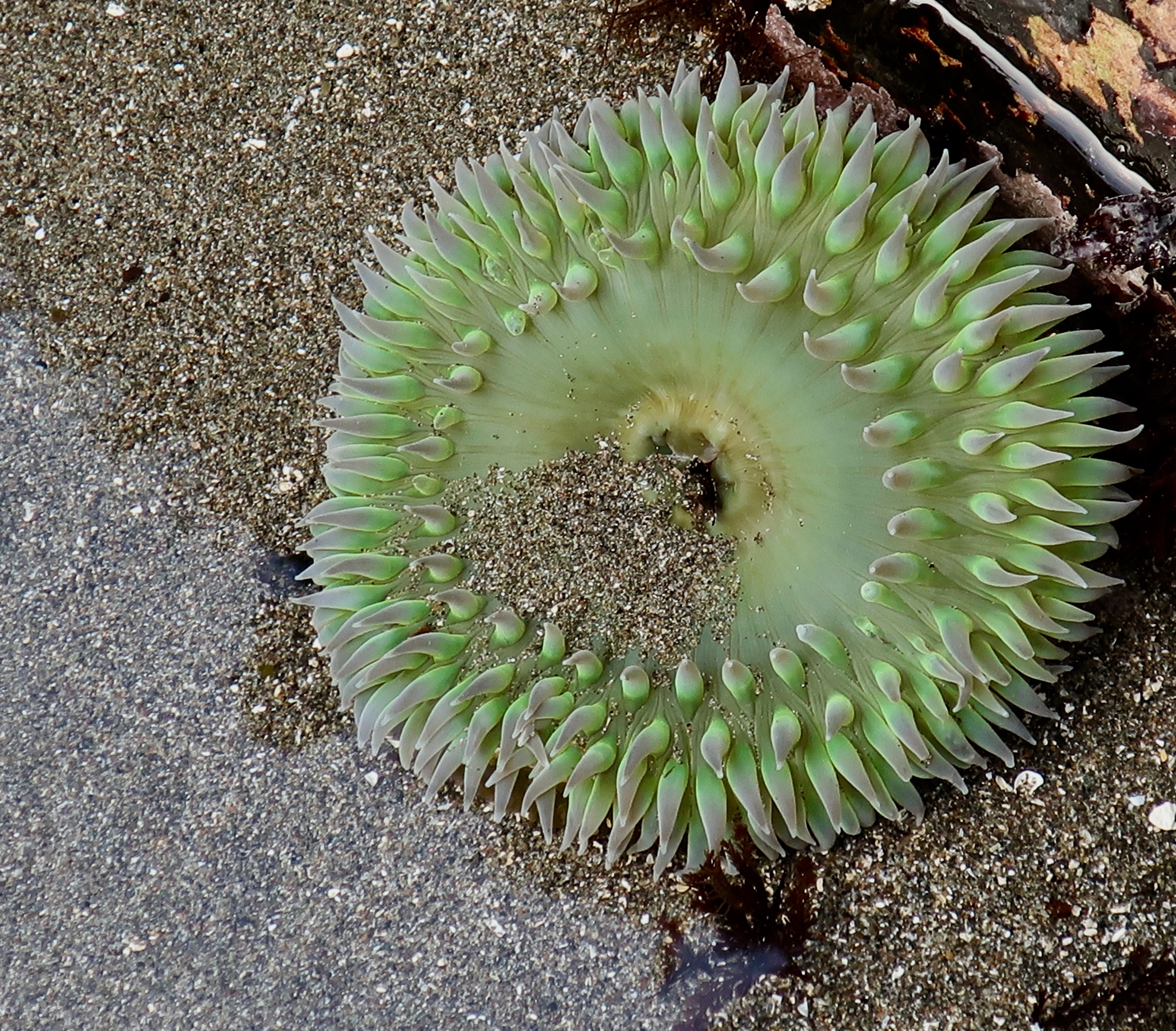
The sea anemones at Harris Beach come in a variety of shapes and sizes. This was one of the larger ones we found, a giant, green sea anemone or Anthopleura xanthogrammica, if you want to be scientifically correct.
A more typical view. The tentacles are covered in stinging cells that the anemone throws into small prey like a harpoon. Once the poison has done its job, the anemone then uses its tentacles to work its prey into the gaping mouth seen in the center. When the feast is over it jets the leftovers out its mouth that has conveniently become an anus. I wonder if the anemone then gargles with sea water. The anemones stinging cells are more or less harmless to humans. How do I know this? I petted a few in my youth. The anemones don’t seem to like it; they immediately close up shop, like the anemones below.
A few of the big guys hanging out together at low tide. Anemones close up when exposed to air as a way to protect their tentacles. A small, dark fish is lurking in the remaining water. Some small fish seem to have a symbiotic relationship with anemones and swim among the tentacles, free of worry. Predators beware.
I found this interesting. A number to the anemones were covered in brightly colored pieces of rocks and shells. Scientists speculate that this serves as a natural sunblock when the anemone is exposed to air at low tide. I was curious about how they go about gathering and affixing their collection but couldn’t find anything about it.
Some smaller sea anemones live in colonies as seen here. These are clones of each other except they differentiate into scouts, warriors and moms. When two colonies meet, they go to war. It’s the scouts job to find new territory for the colony as it expands. When they come on another colony, the warriors take over by whaling away at each other with their tentacles. The ‘moms’ stay in the middle out of harm’s way. Next Friday, I’ll cover the other sealife we found in the tide pools.
NEXT POST:
Monday’s Blog-a-Book Post… “It’s 4 AM and a Bear Is Standing on Top of Me”: I move outside to commune with nature in the summer but the ghosts continue to haunt our backyard. I hire the family pets for protection. They charge a high fee.
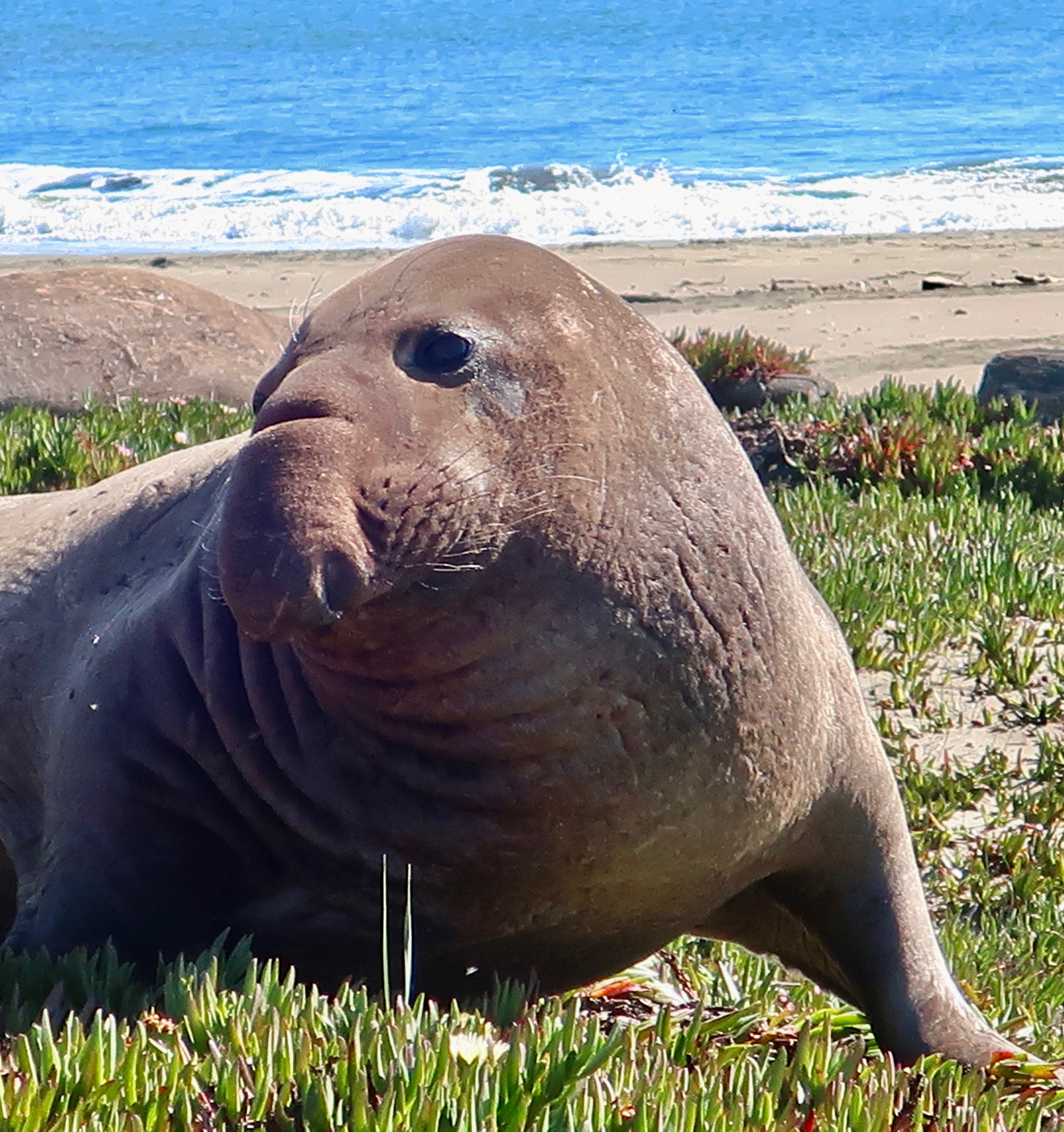
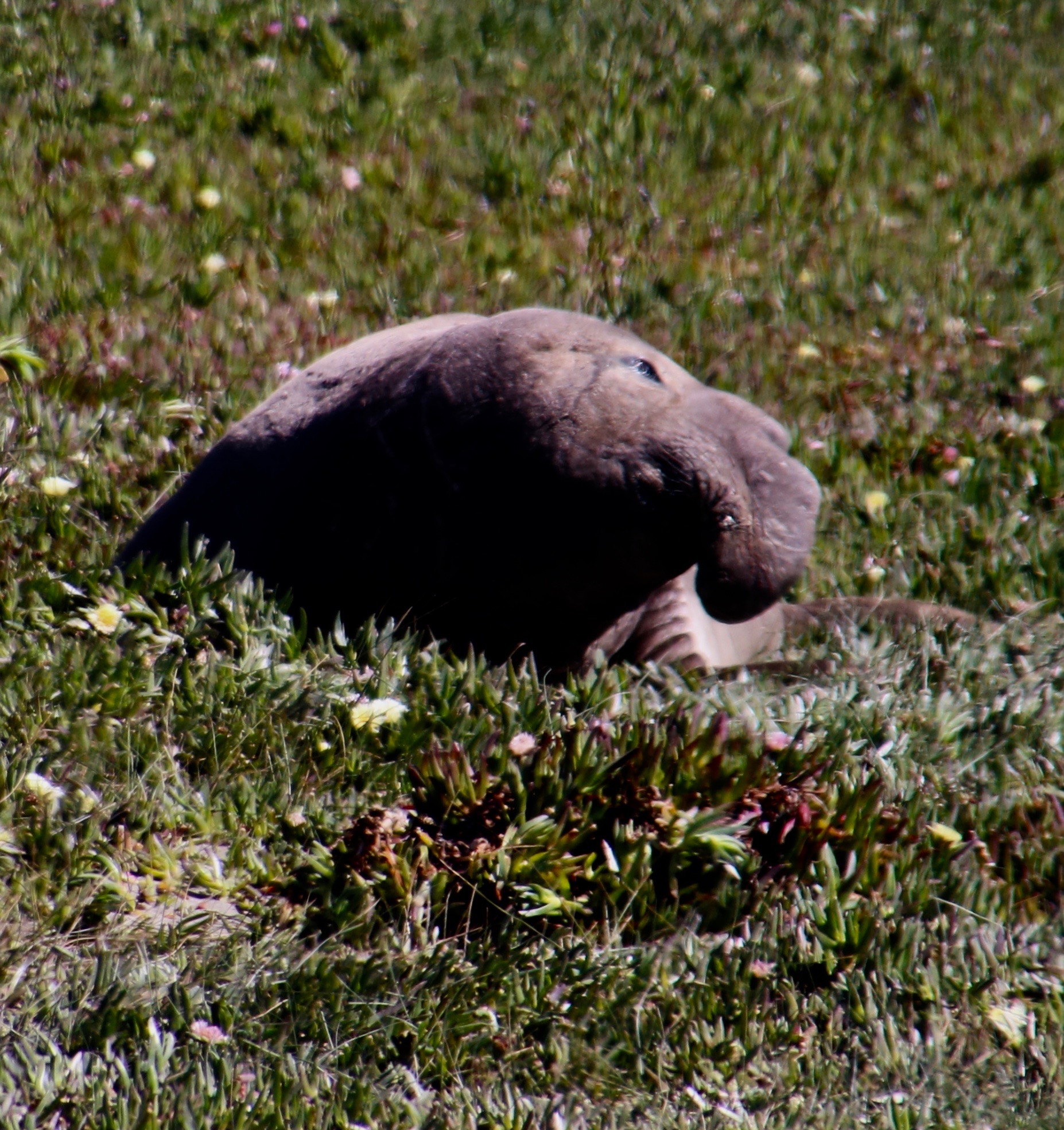
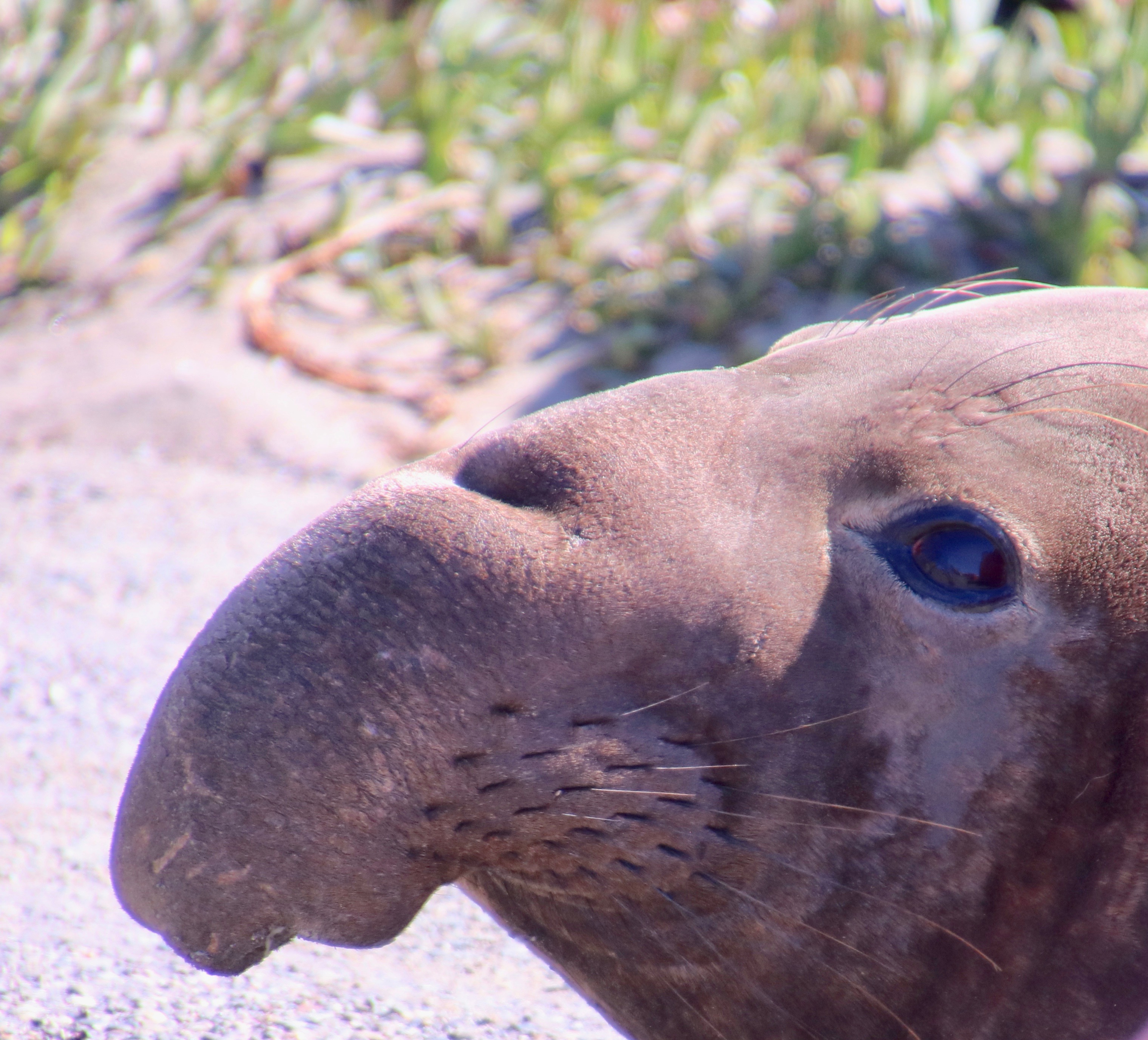
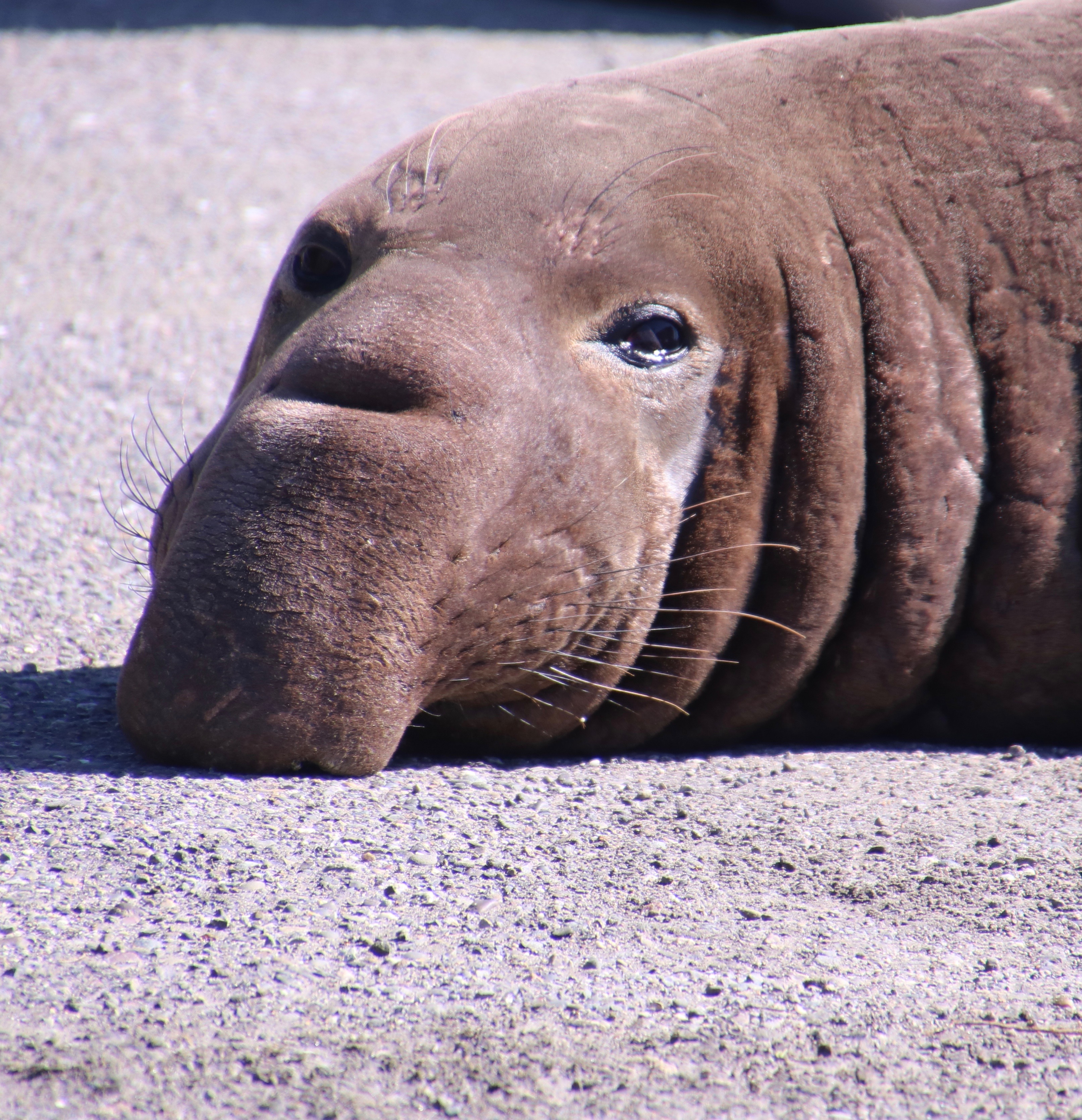
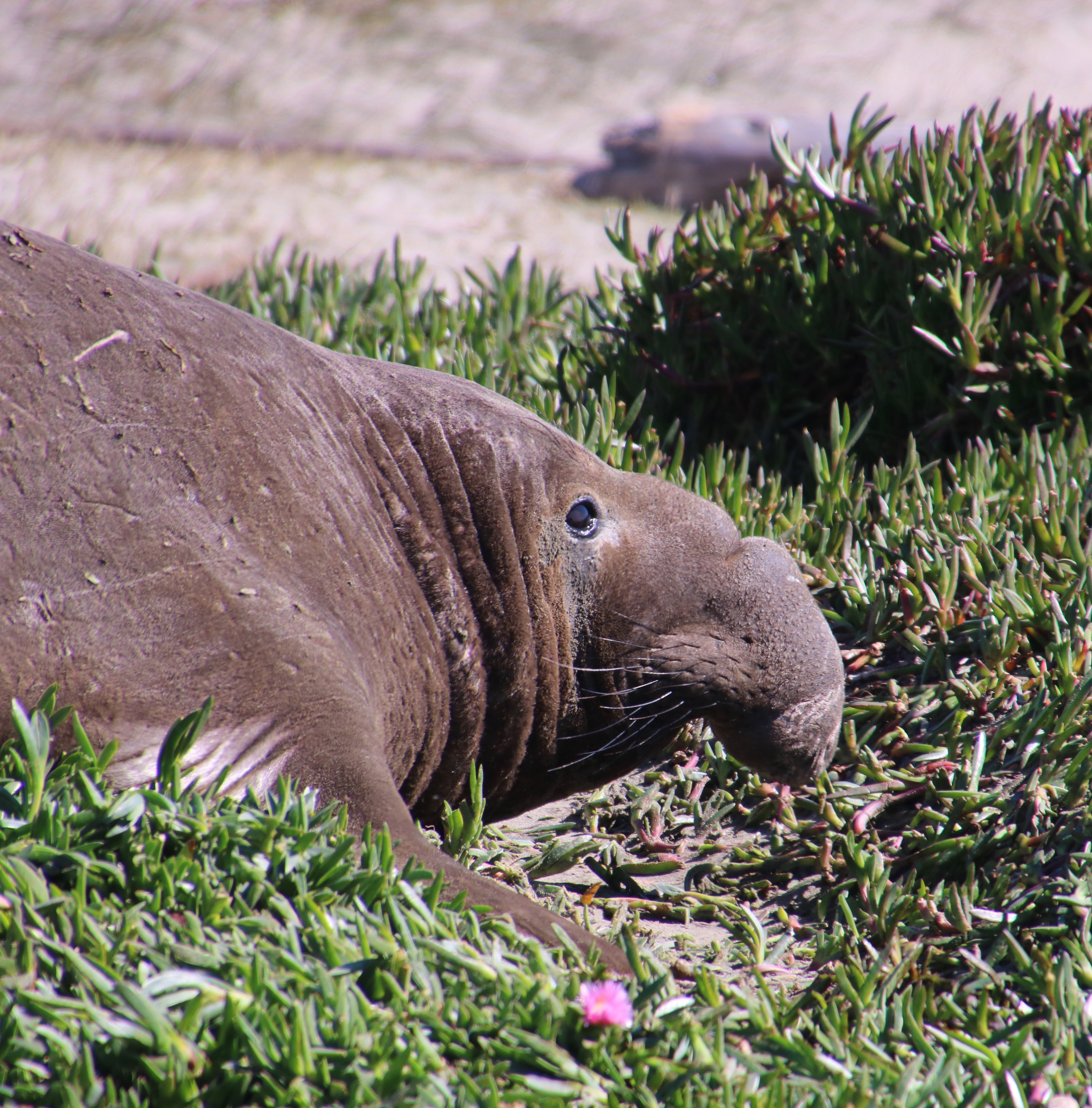
Elephant seals have the look of an animal put together by a committee. It gives them a certain charm. We found this large fellow with his pronounced proboscis at Drake’s Beach. He’d come ashore at Pt. Reyes National Seashore looking for love.
Pt. Reyes National Seashore is located some 30 miles north of San Francisco. Peggy and I went there last week to celebrate my birthday. It’s been a go-to place for me since the 60s. In addition to spectacular scenery, great hikes, yummy food, and one of the best small bookstores I’ve ever been in, we were entertained by the wildlife: tule elk, a pair of sushi eating coyotes, and elephant seals (plus some cows). Today, I want to do a teaser on our trip by featuring the elephant seals. I’ll get back to the rest after I finish my Harris Beach series.
Elephant seals are amazing creatures that spend up to 80% of their lives at sea— 90 % of it underwater! If that doesn’t seem remarkable enough, consider this: their normal dives for food range between 1000 and 2000 feet deep (305 to 610 meters). They can dive for up to an hour and a half before returning to the surface for three to five minutes of breathing. Semi-annual feeding binges take the males on a 13,000-mile roundtrip journey to the Aleutian Islands and females on a 11,000-mile roundtrip into the North Pacific.
They were absent from Pt. Reyes for 150 years. In fact, they were close to absent forever. Like whales, they came close to being hunted to extinction for their oil. Processing the blubber from one bull can produce up to 25 gallons. They were saved because the Mexico and the US banned hunting them in the 1920s. Gradually, they have returned to their old breeding grounds. When I first started visiting Pt. Reyes in the 60s, they were unheard of in the area. Today there are over 3000 that return annually to breed.
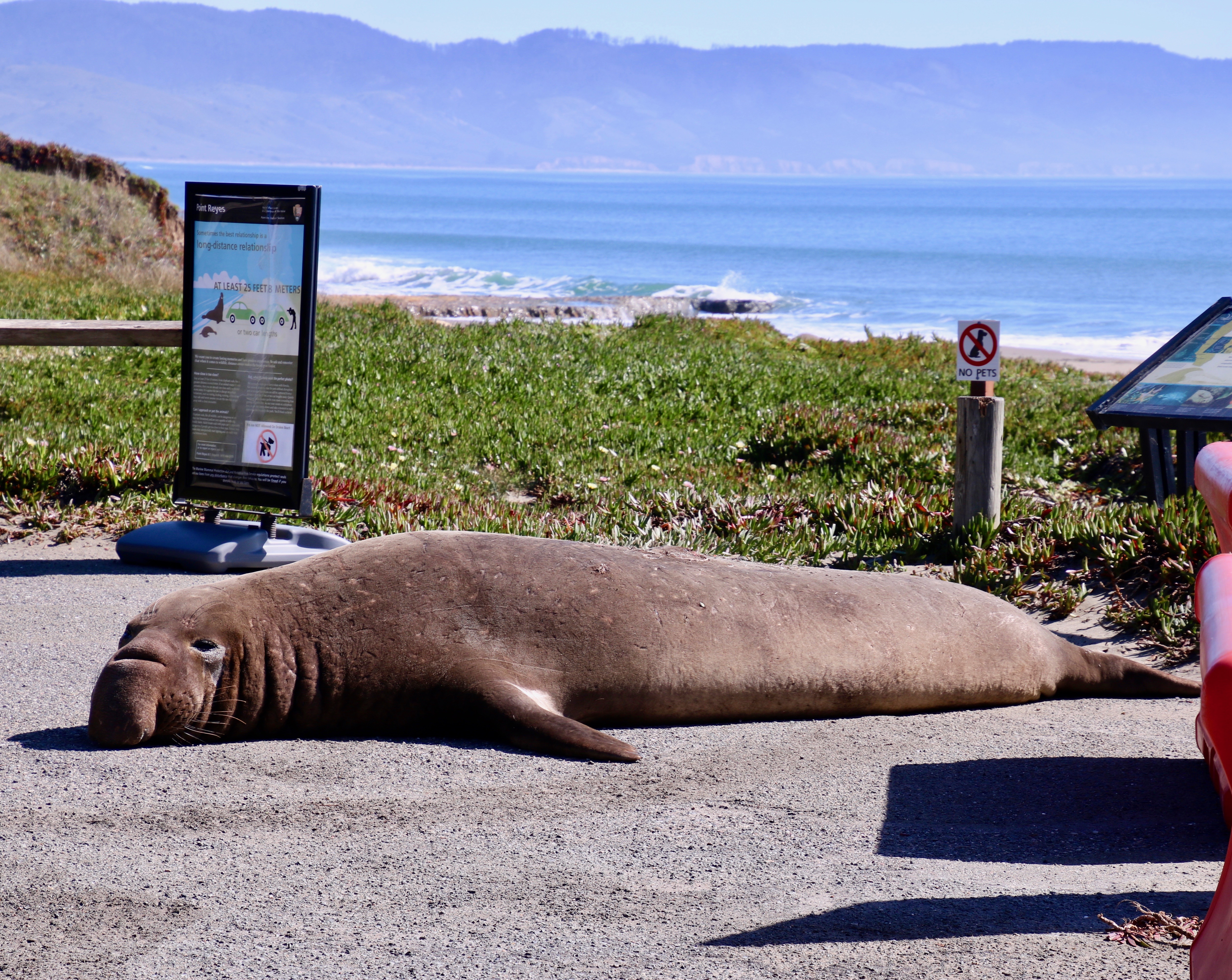
The Park Service had set up a barrier to separate the seals from the people who had come to admire them at Drake’s Beach. Those closest to the barrier were bulls. You can tell by their size and uniquely shaped noses. One had crossed the barrier and was worrying the rangers. “He’s escaping from the other bulls,” a ranger explained. Maybe.
This large bull had crossed through the barriers at Drakes Beach and was pointed toward the snack bar. (Photo by Peggy Mekemson.)
A little girl next to me exclaimed, “I think he is heading to the snack bar to get fish sticks!”
“I’d bet on ice cream,” I responded. “Look at how big he is.” The girl looked at me dubiously. “Fish sticks” she insisted.
Peggy and I spent an hour watching these wonderful creations of nature who are so competent at sea and ungainly on land. They move like an inchworm, using their dorsal flippers to pull their front half forward and then using their rear flippers to push the rest of their body along like a rolling wave. Imagine moving several tons of fat. The ones we watched would make two or three of these moves and then collapse to rest.
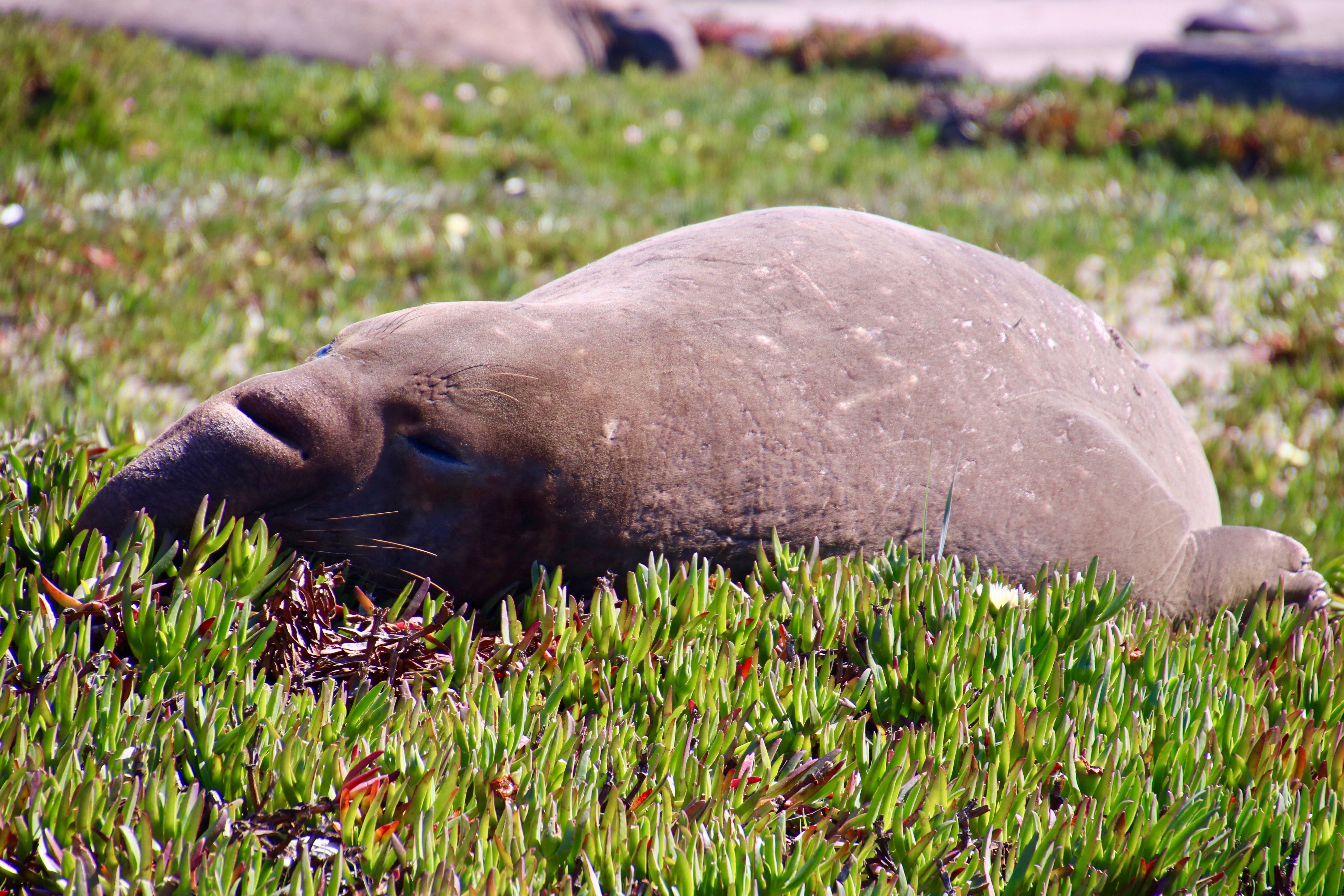
Given their trunk-like noses and appealing eyes, Peggy and I were particularly attracted to the looks on their faces.
Is this fellow being coy?
Check out the big brown eyes! The size of the eyes helps the elephant seal see in the dark depths of the ocean. The whiskers apparently help as well in the search for food. He had lifted his head to check us out. (Photo by Peggy Mekemson.)
And then returned to his resting position. (Photo by Peggy Mekemson.)
A side glance. (Photo by Peggy Mekemson.)
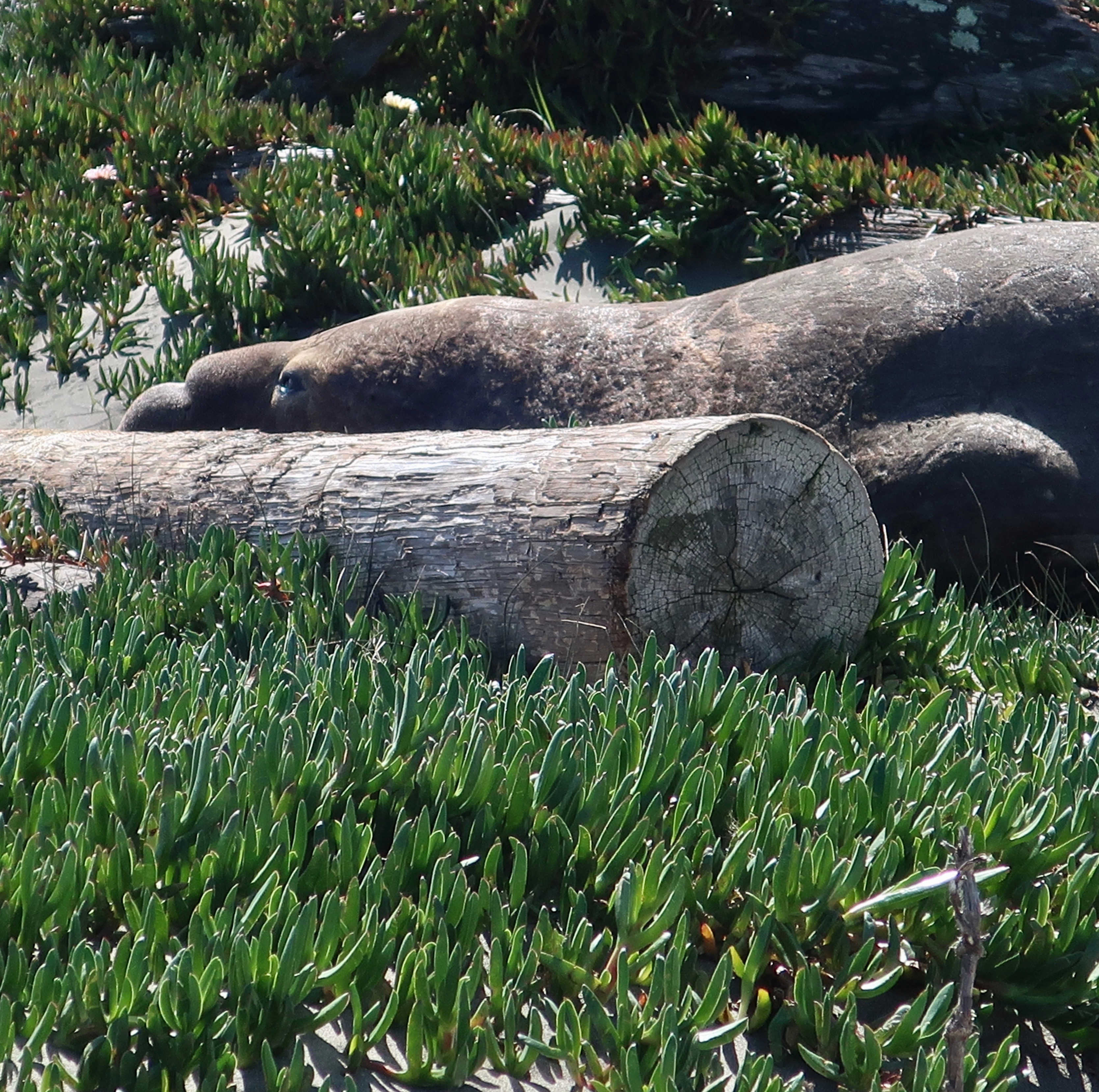
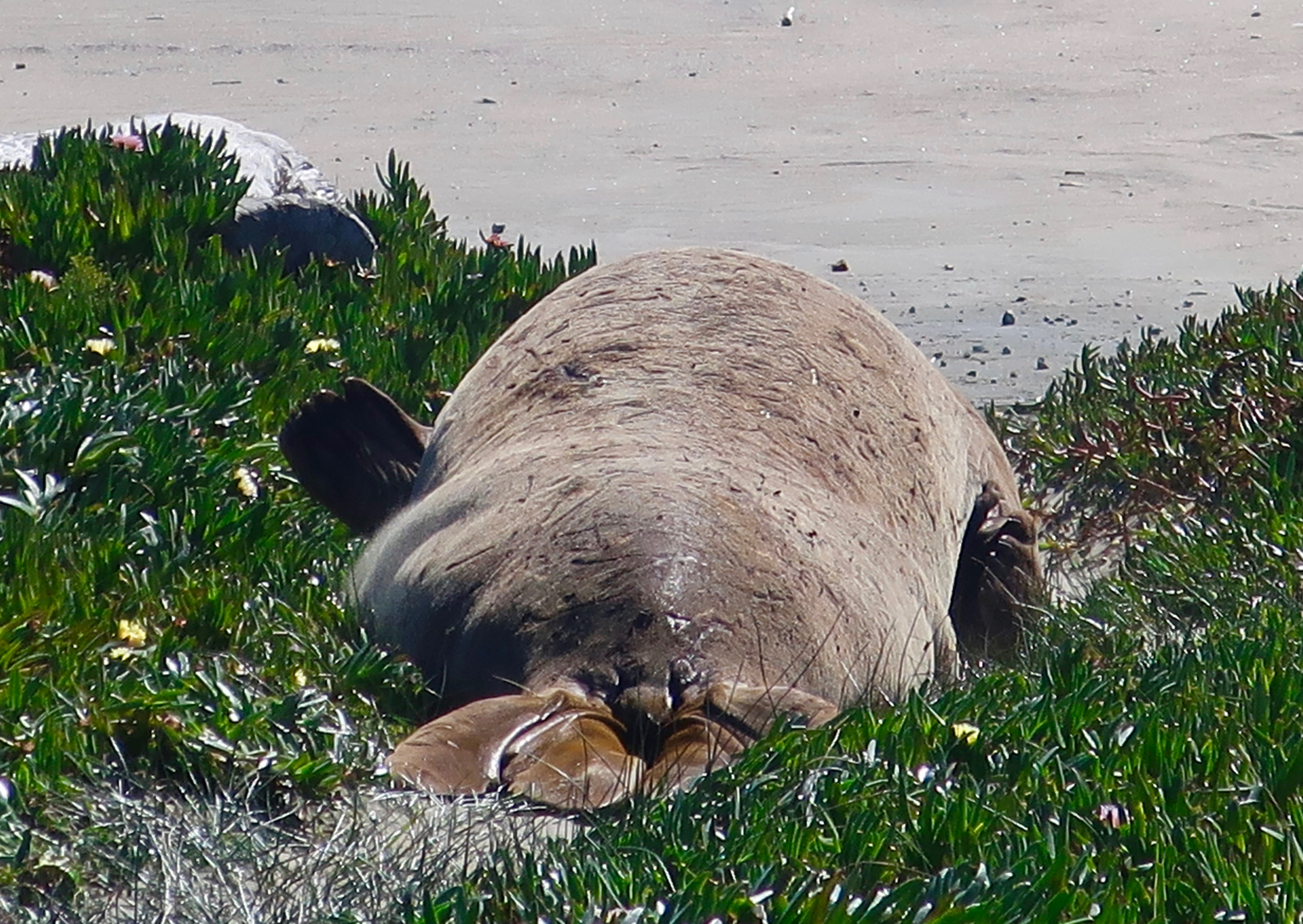
A bit shy, perhaps. Maybe he thought that the log was hiding him.
Size matters. (Photo by Peggy Mekemson.)
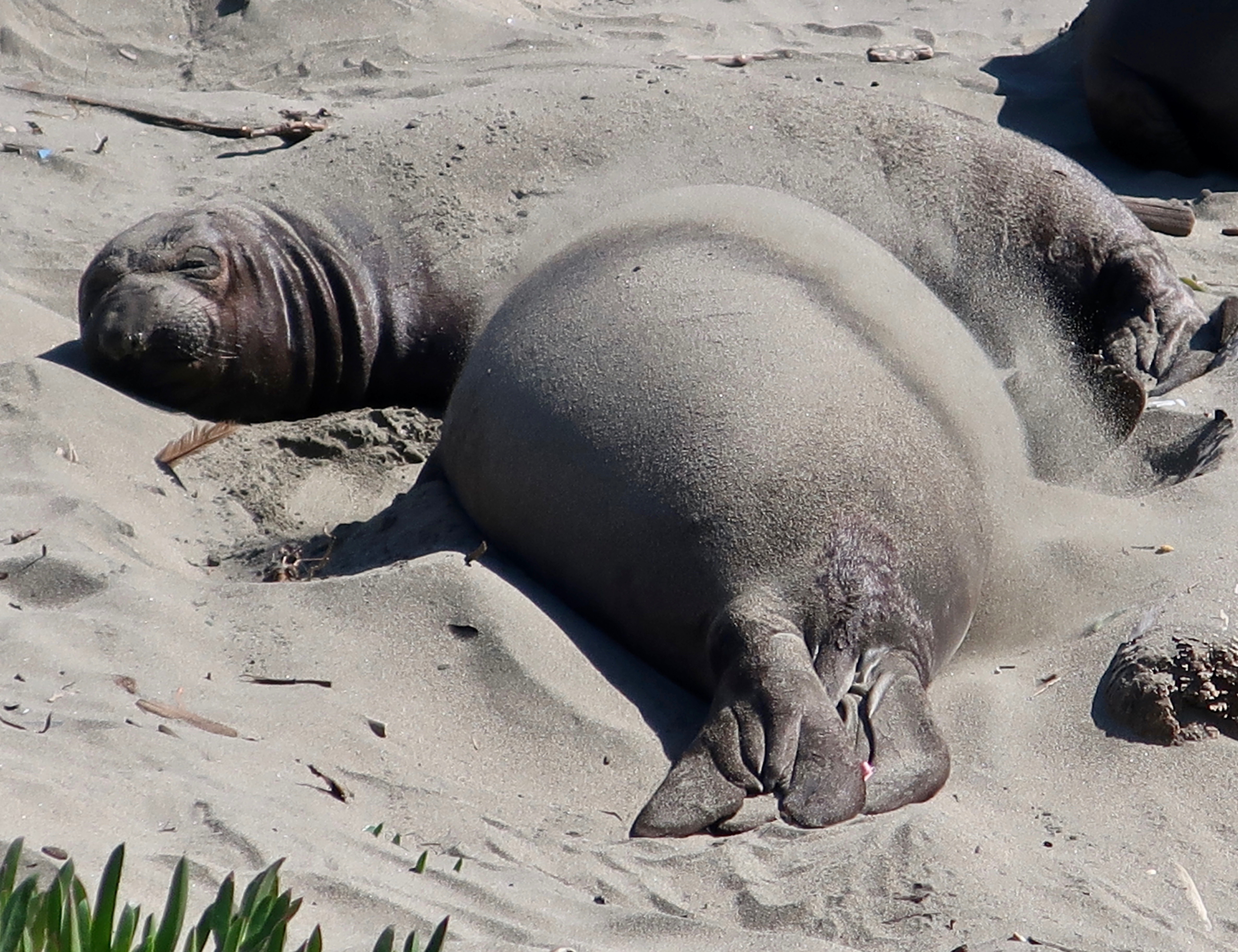
This was interesting. The skin of the elephant seals is sensitive to the sun. They cope by throwing sand over their bodies with their flippers, as seen in this photo.
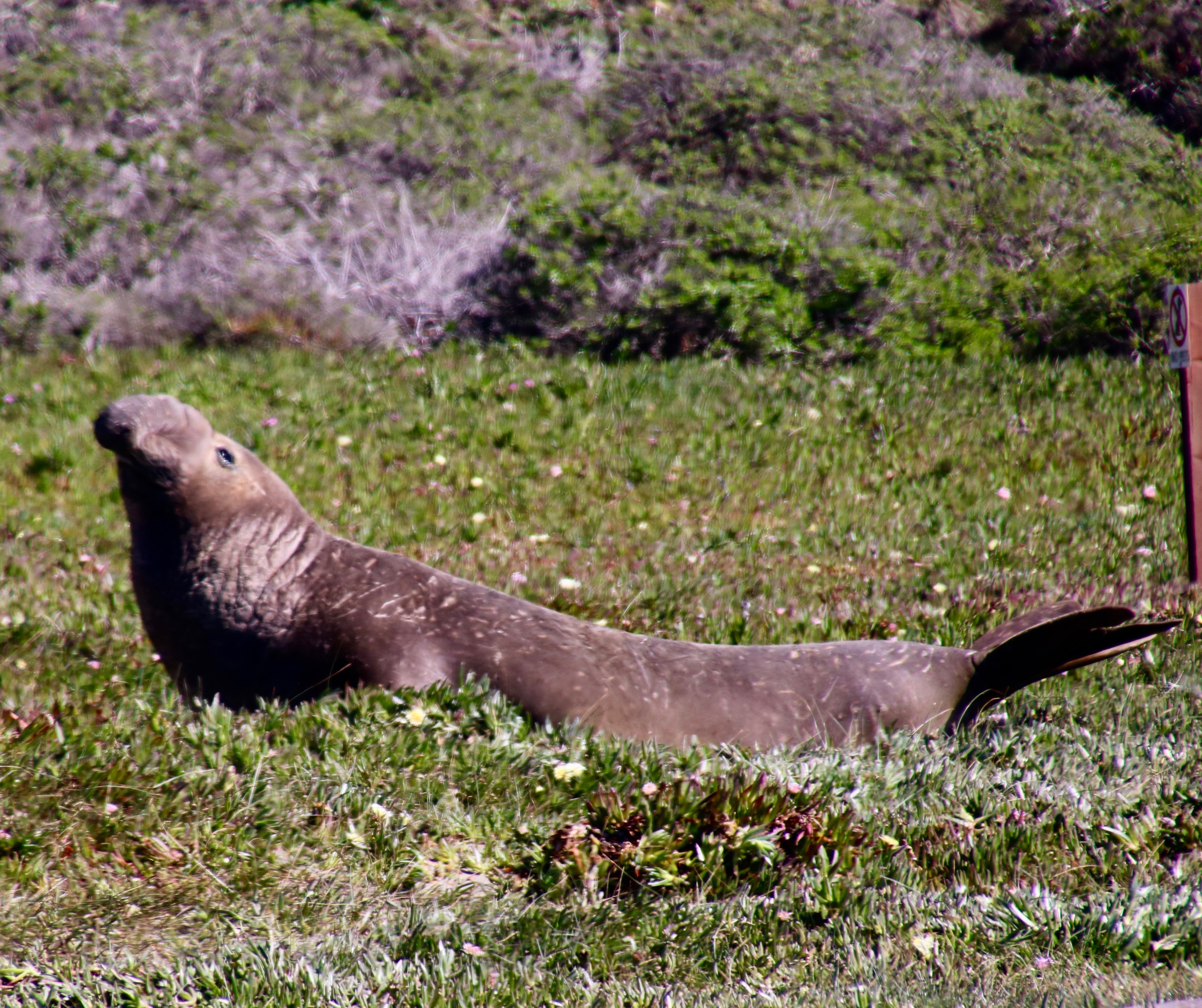
Sometimes a little stretch really feels good! (Photo by Peggy Mekemson.)
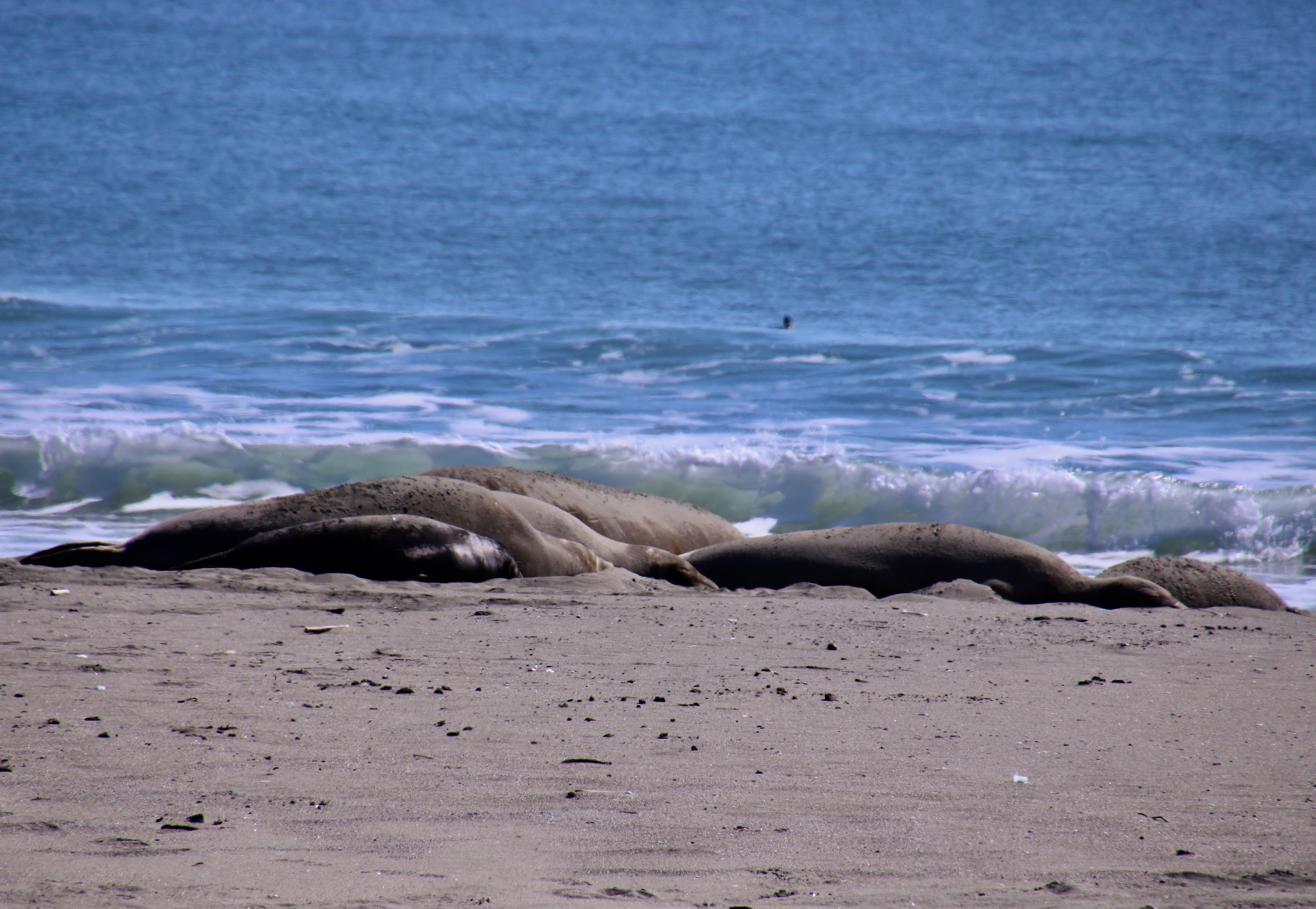
Peggy caught some of the girls sunbathing out near the ocean…
Drake’s Bay was named for Sir Francis Drake who reputedly visited the area in 1759. There’s another bull on the left— looking sluggish.
I’ll conclude today with this elephant seal that was making its way back toward the ocean. I decided he was waving goodbye with his flipper. I’ll return to the tide pools of Harris Beach in Oregon next week. Are you aware that groups of sea anemones go to war with each other?
NEXT POSTS:
Monday’s Blog-a-Book… “It’s 4 AM and a Bear Is Standing on Top of Me”: I move outside in the summer to enjoy nature but hire the family’s dogs and cats to protect me from the ghosts.
Wednesday’s Blog-a-Book… “The Bush Devil Ate Sam”: Held at gunpoint, I consider the odds of running over the gunman versus getting shot.
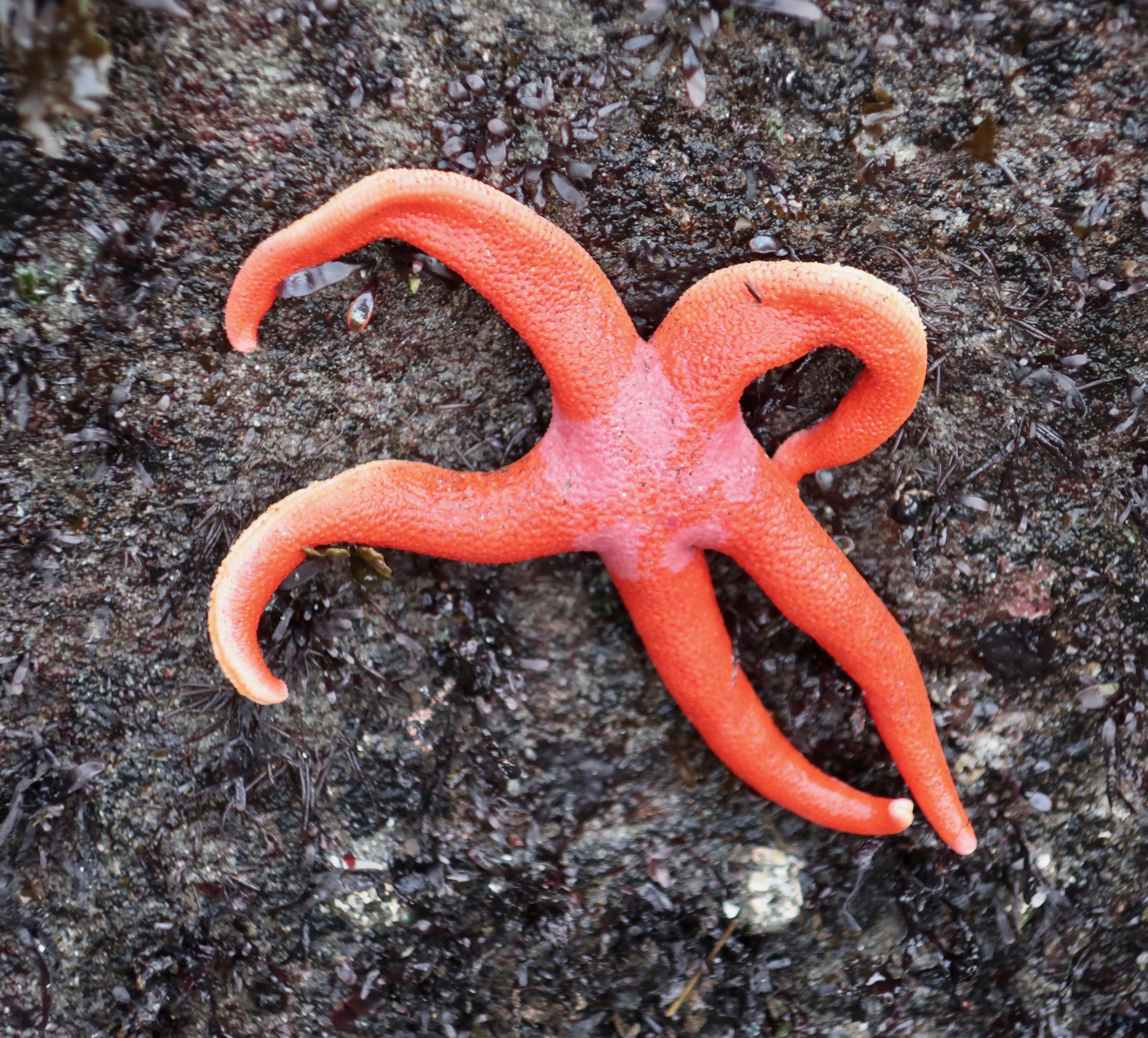
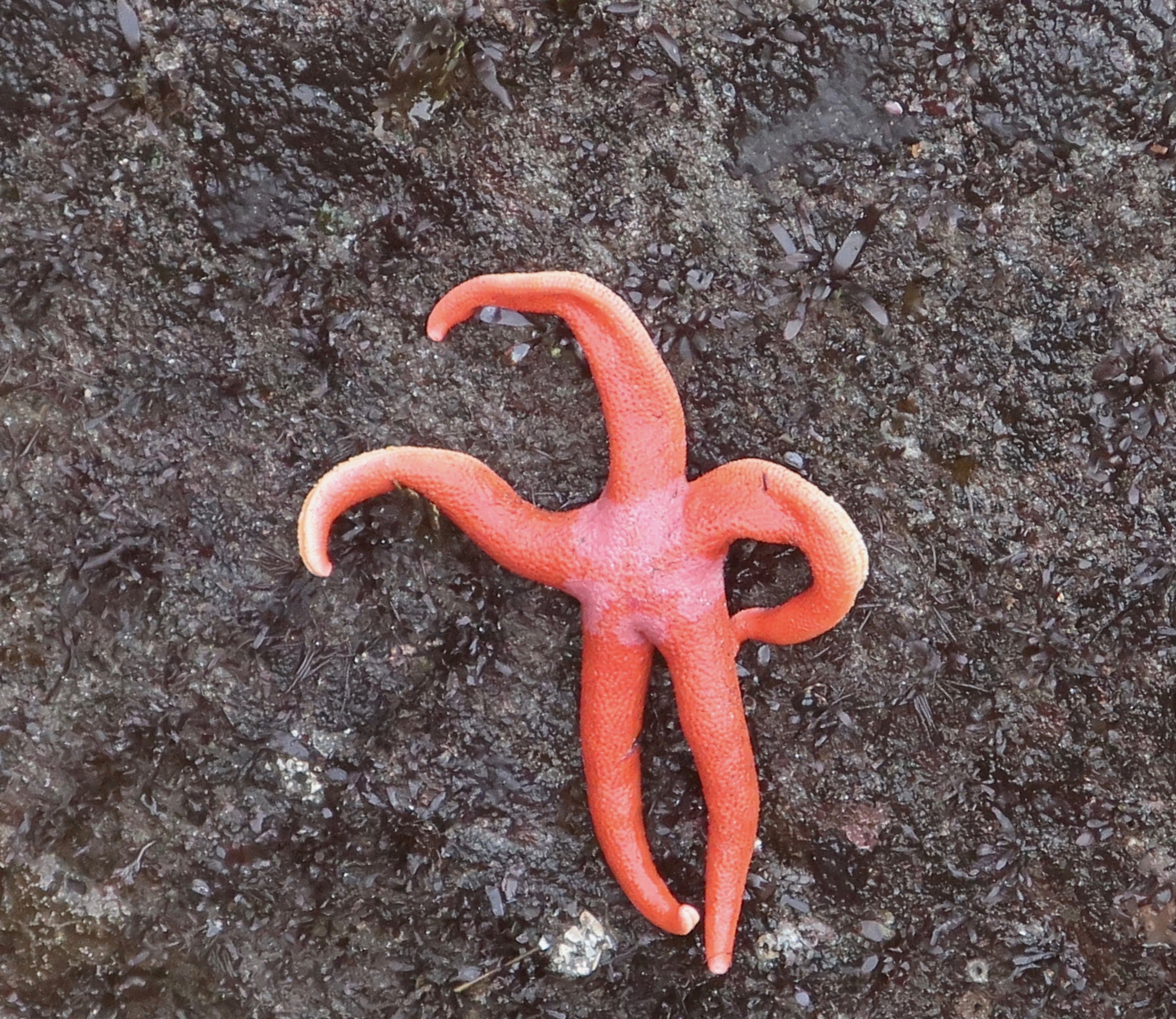
We saw this colorful starfish from a distance and came over for a closer look. It’s scientific name is Henricia leviuscula. It common name is Pacific blood star.
I decided a slight shift in perspective would create a twirling ballet dancer! Or is it a whirling dervish?
We were lucky to find any starfish at all. The population up and down the Pacific coast came close to being wiped out in 2013. A rather nasty virus that melted these attractive creatures from the inside killed millions. Legs would fall off and go crawling away. It sounded like the plot to a Grade B horror flick. Fortunately, evolution came to the rescue. A small portion of the population seemed immune to the virus. Maybe some of the legs got lucky. They came back with a vengeance. We did find a few that were obviously dead. I touched one. It was mushy. Melting.
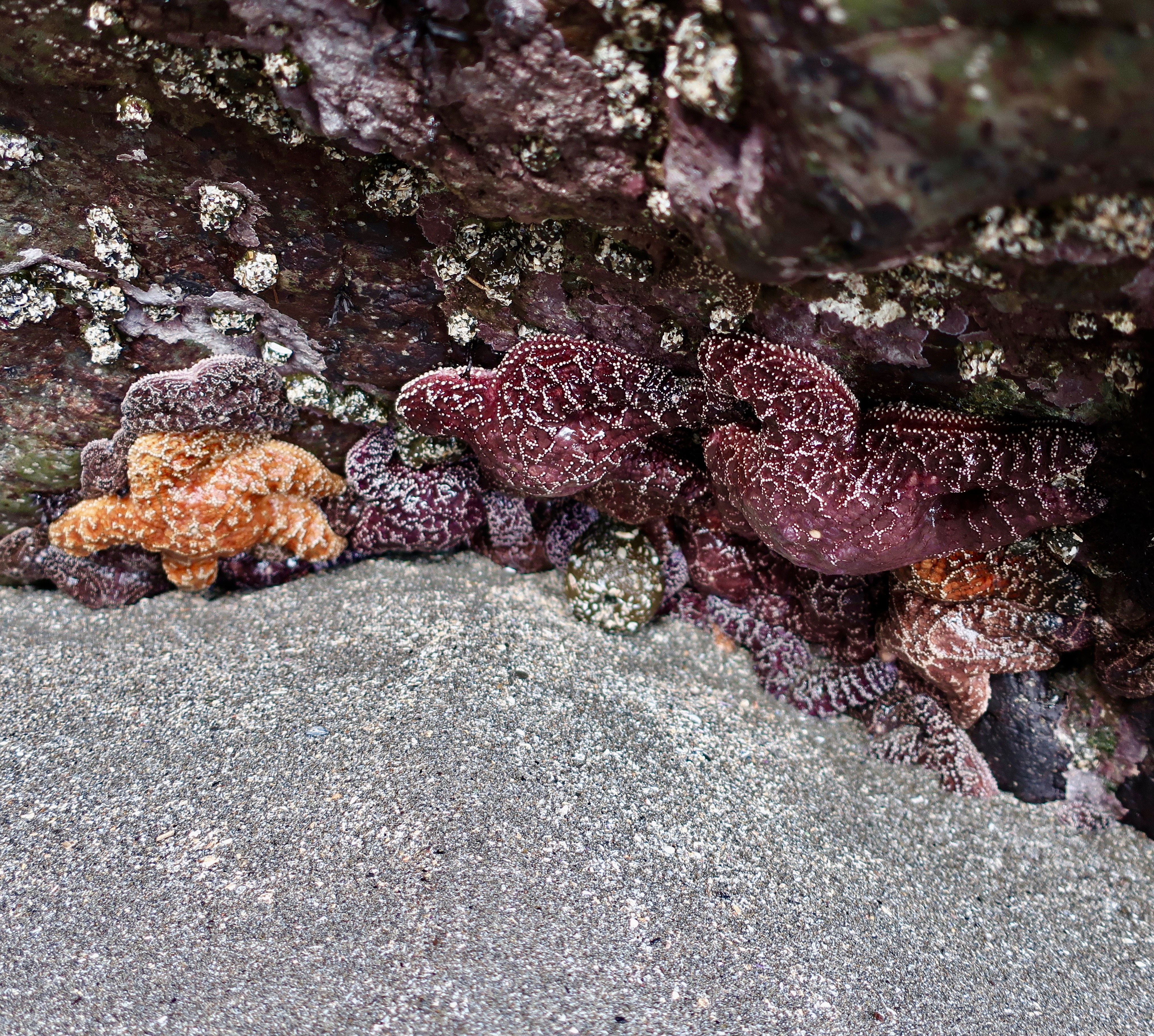
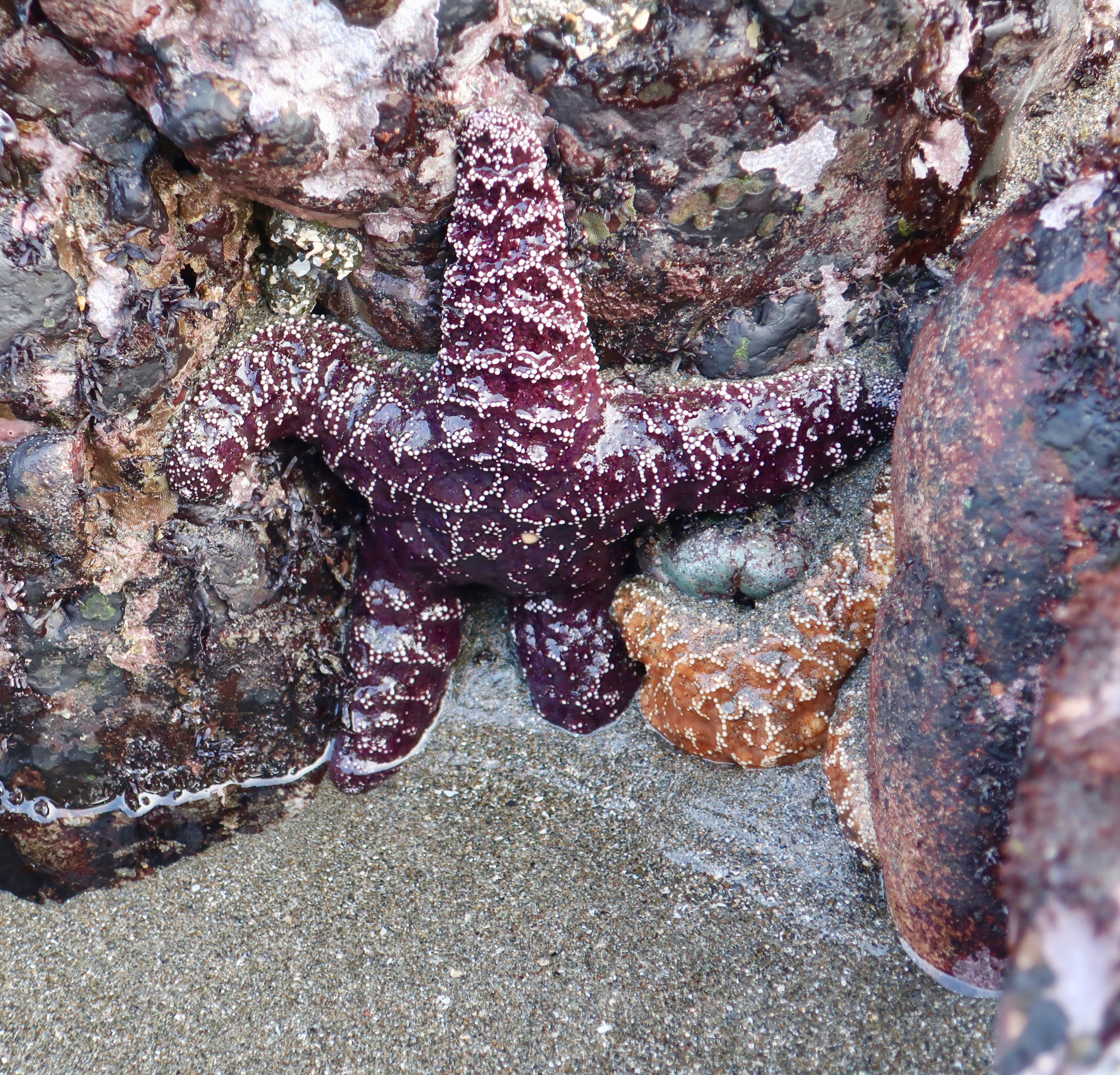
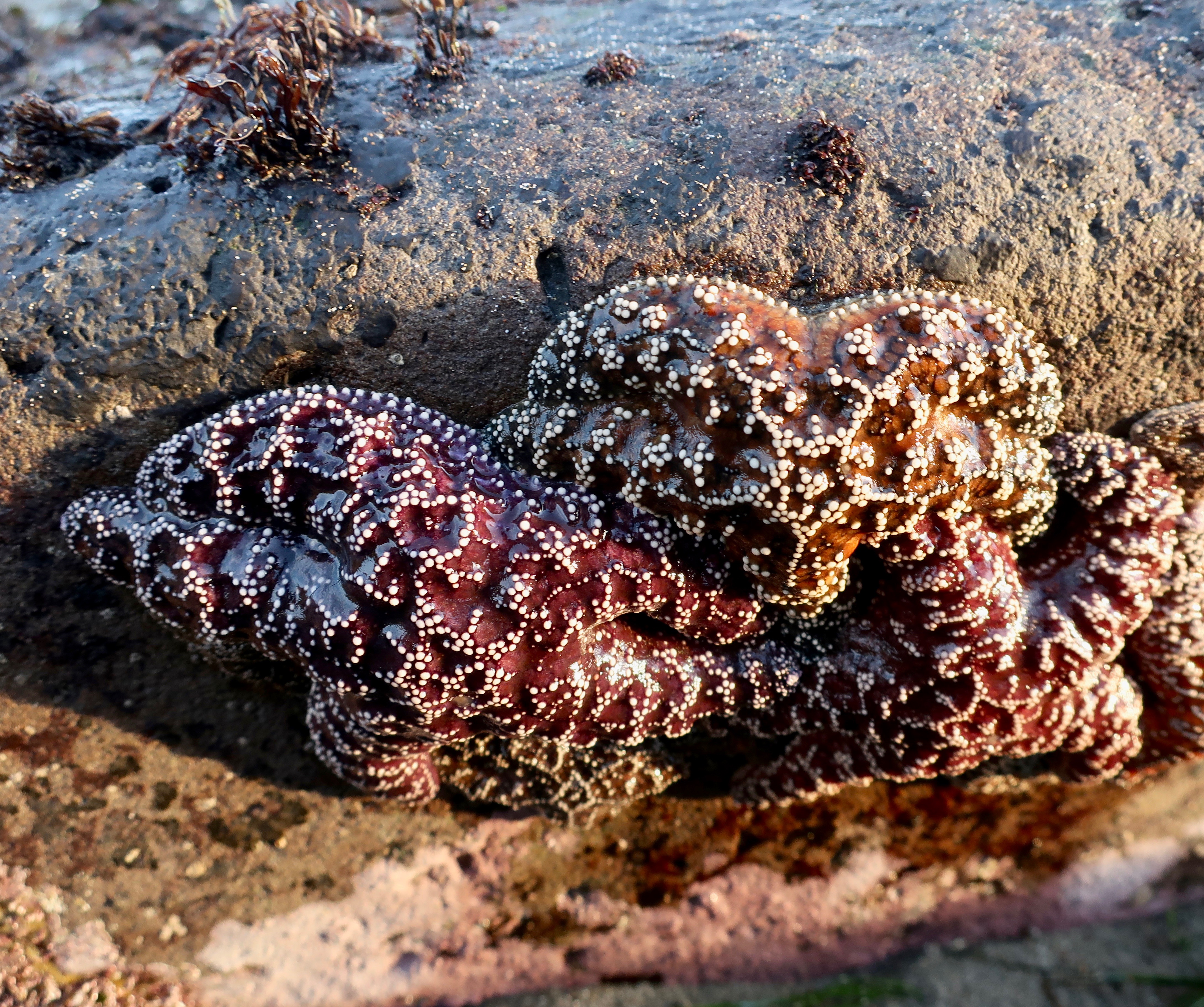
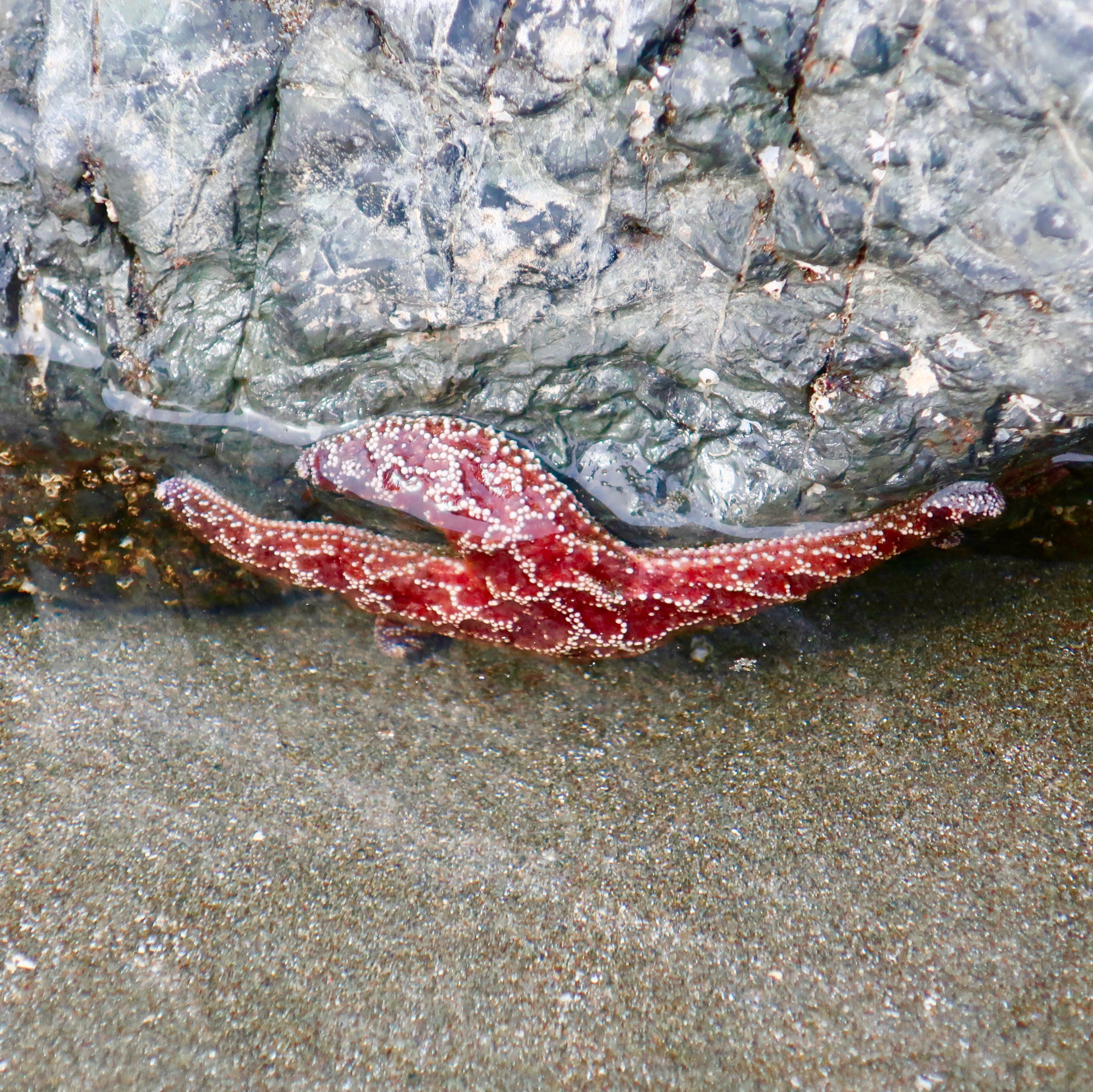
Everywhere we looked we saw starfish. Sometime in bunches. These purple and orange star fish belong to the same family, Pisaster ochraceus. Scientists don’t know why they come in two colors.
Here are some fun facts:
These rather amazing five-legged creatures have seawater for blood. It serves the same purpose, delivering nutrients to cells.
Starfish can regenerate an arm lost to a predator. But what if the arm loses its starfish? It can regenerate a new starfish, an exact replica. Pretty cool, huh.
They have very small mouths but like large, tasty morsels, like mussels. Not a problem. They have big stomachs. They send them out through their mouths and wrap them around what they want to eat. They digest their dinner and then suck the nutrients back into their mouths, along with the wandering stomachs.
They move around on tiny little feet that are found on their arms. They fill these little feet with water and mimic walking. They travel slowly, at least I have never seen one move quickly.
The feet also serve another purpose; they work as suction cups. The starfish will wrap itself around a closed mussel, attach their little feet, and pull the shells apart. Not an easy task.
One more thing about their arms, each one comes with eyes. Not eyes like you and I have but photo receptors that allow them to distinguish between light and dark and move around in search of food, or to avoid becoming food.
Following are more of our photos:
At first, I thought that the ugly guy above the starfish was seaweed. But looking at it more closely, I decided that it wasn’t something I wanted to meet up with on a dark night.
I’ll conclude with this edgy fellow.
NEXT POSTS:
As you read this post, Peggy and I are on our way to Pt. Reyes National Seashore north of San Francisco. When she asked what I wanted to do for my birthday week, it popped up. The National Sea Shore is one of my all-time favorite places and I have been escaping there for 50 years. So, beyond responding to comments, I will be taking a break from blogging and reading blogs this coming week. Translate: Vacation! I’ll be back to work on March 8. See you then. –Curt







































 Wandering through Time and Place