
Surrounded by towering mountain ranges, Burning Man is located on an ancient lakebed in the Black Rock Desert of northern Nevada.
You can’t ignore the desert when you are at Burning Man— even if you’ve only come for the art, entertainment, partying, or alternative lifestyle. The heat, dust, and massive dust storms forcefully remind you that you are not in San Francisco, or Vilnius, or Tokyo. Even the one-percenters, the folks who live in well-protected, catered camps, are forced to deal with these realities when they are out and about.
Whether you stop long enough to admire the beauty of desert or learn about its geologic and cultural history is another issue. Certainly, many Burners take the time to stop and look around, even if it is only for a brief, “Wow!” or to howl like coyotes, which I have heard them do over a particularly beautiful sunset or sunrise.

Burners are sometimes known to howl like coyotes at the sight of beautiful sunsets or sunrises. This coyote sculpture was at Burning Man 2013.
Larry Harvey’s initial choice of the Black Rock Desert as the venue for Burning Man was based more on the area’s isolation than anything else. He wanted a place where people could ‘do their own Burner thing’ and not be overly worried about what the neighbors might think, or the law. And he found it in Nevada. Once you get outside of Reno or Las Vegas, the population drops dramatically. When you leave the major highways that cross the state, the odds are that jackrabbits will outnumber the people.
The Black Rock Desert lies some 100 miles north of Reno in what is known as the Great Basin, an arid region characterized by narrow, fault-block mountain ranges and flat valleys trending mainly in a north-south direction. It was once suggested that the best way to picture the Basin and Range province is to think of it as “army of caterpillars marching toward Mexico.” Big caterpillars. As for the Great Basin part of the equation, 12,000 years ago the Black Rock Desert was part of Lake Lahontan, a huge glacier fed lake that covered some 8500 square miles. The flat playa that Burning Man sits on today is a dried up remnant of the lakebed. The dust and dust storms are its legacy.

The Playa at Burning Man is made up of a lakebed that was buried under Lake Lahontan 12,000 years ago. Black Rock City stretches across the horizon.

Looking out from Burning Man across the Black Rock Desert playa.
Crossing the Great Basin with horses, oxen and mules, or even on foot, early pioneers gained a much more intimate knowledge of the desert than today’s Burners. Radical self-reliance, one of the ten principles of Burning Man, was all that stood between the pioneers and death. One of the routes the adventurers followed, the Applegate Trail, makes its way through the Black Rock Desert. Living, as I do, in the Applegate Valley, along the Applegate River, on Upper Applegate Road, near the Applegate reservoir, I have a certain familiarity with the Applegate family.
The following sunset and rainbow photos were taken by Don Green, Tom Lovering, Ken Lake, Peggy Mekemson and me, all part of our group.

We were coming into Burning Man when we hit a rainstorm and were entertained by this multi-hued rainbow.

This double rainbow seemed to end in Black Rock City.

Sunset reflected on a mountain at Burning Man in the Black Rock Desert.
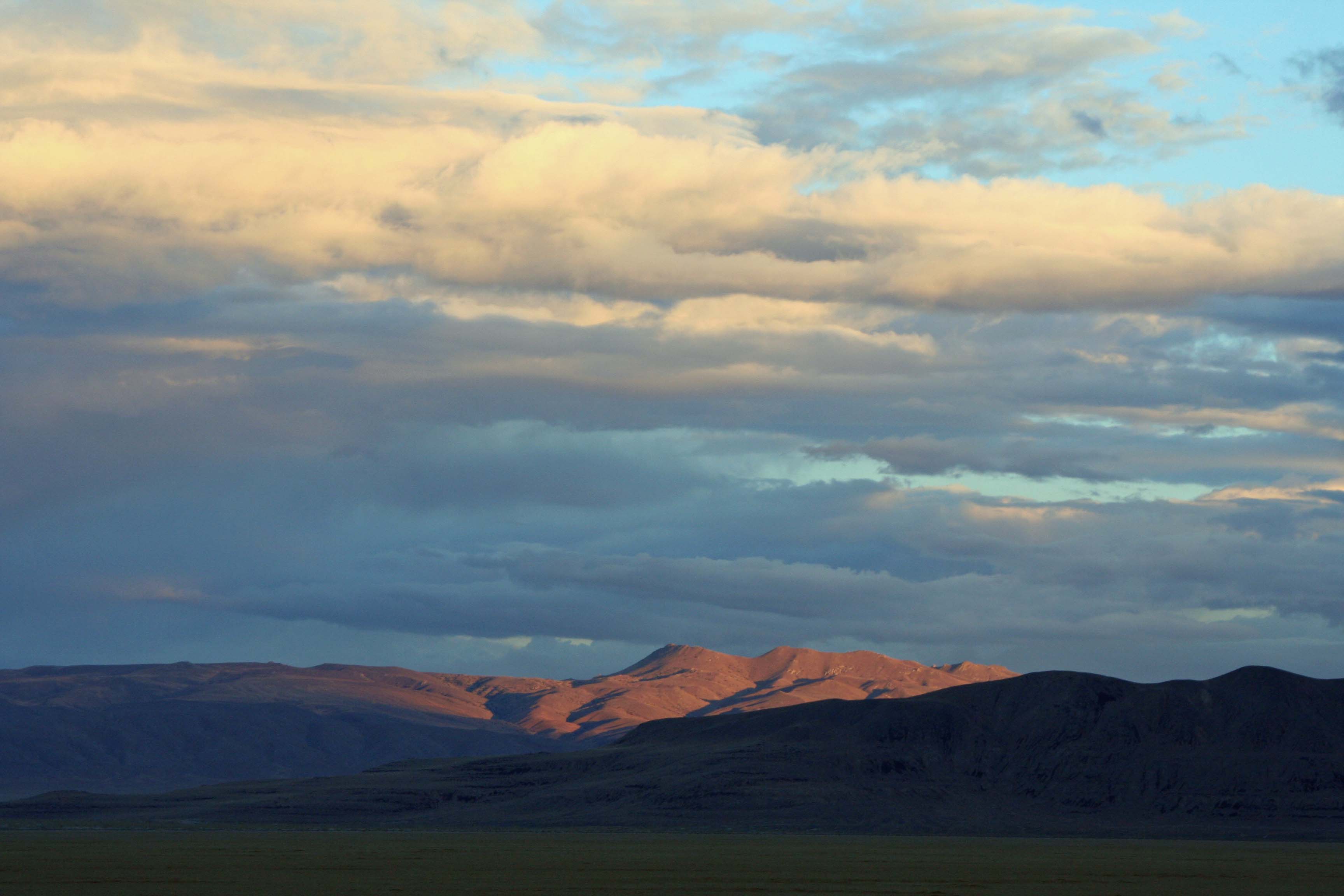
Another mountain reflecting the sun at Burning Man.
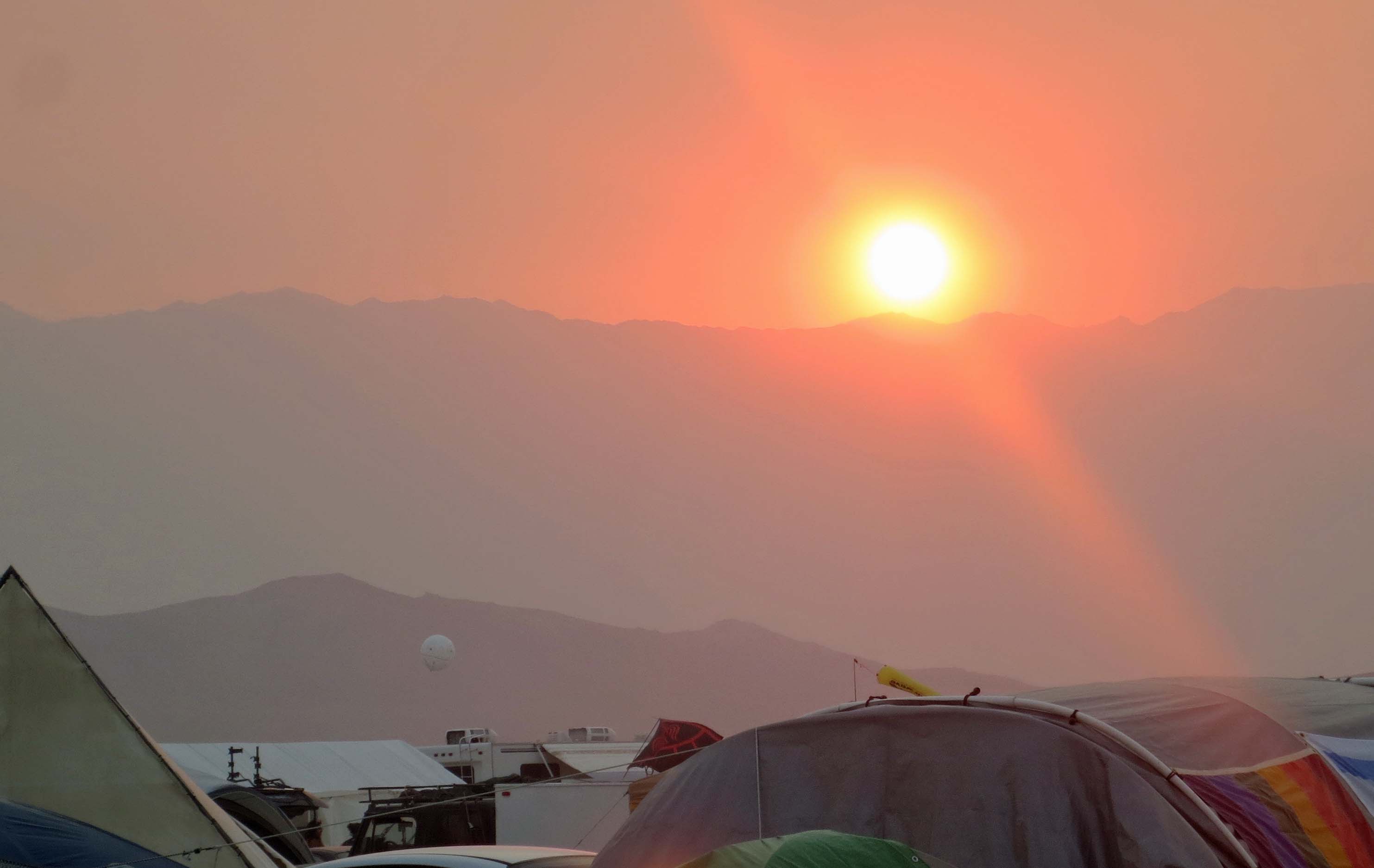
Sunset reflected through a dusty haze. Photo taken from our campsite at Black Rock City.

Evening clouds illuminated by the sun

The sun sets on Black Rock City with a slight sliver of the moon.
 Wandering through Time and Place