Timothy Leary Goes to Burning Man… but Wait, He’s Dead!

1 Burning the Totem of Confession at Burning Man 2015 c DG

As the Totem of Confession burns at Burning Man 2015, a pair of eyes seems to be staring out of the flames. Could it be Timothy Leary taking a last look around before he drifts off into space? The dust devil tornado on the right is a spin-off of the tremendous heat. (Photo by my friend Don Green.)

Susan Sarandon put on a low-cut white wedding dress. Her camp members walked beside her, stirring up the Playa dust. Timothy Leary came along behind, his ashes riding in a casket. A New Orleans style jazz band led the joyful procession of live and dead people making their way out to the Man and then on to the towering Totem of Confession. A 26 foot tall Octopus rolled along behind. Leary would have loved it. Maybe he did.

This photo of Timothy Leary was hung in the Totem of Confession.

This photo of Timothy Leary was hung in the Totem of Confession. The sign beneath declares, “Gone Fishing.”
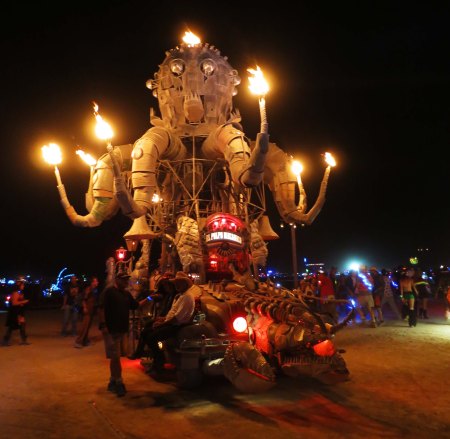
Here's a view of the giant octopus, El Pulpo Mechanico, at night, with flames coming out of his tentacles and his head. El Pulpo transported Sarandon around Burning Man when she first visited Black Rock City in 2013.

Here’s a view of the giant octopus, El Pulpo Mechanico, that accompanied Leary out to the Totem of Confession. This is at night, with flames coming out of his tentacles and his head. El Pulpo transported Sarandon around Burning Man when she first visited Black Rock City in 2013.

They had toasted Leary a few minutes before the parade began, a communal act of mixing a pinch of his ashes with water (and possibly a tiny amount of LSD?) and drinking the concoction. It was bottoms up and goodbye. It wasn’t Leary’s first send-off, however. The majority of his ashes had already been shot into space, along with those of Gene Roddenberry, the creator of Star Trek. Leary had been promoting space travel and colonization at the time he passed way. He was looking for a one-way ticket into the outer beyond. “A few of us managed to accomplish that,” Sarandon reported in an interview. He died on May 31, 1996, just two days after he heard the news that he would be joining Roddenberry and a number of others on their journey into space, the final frontier.

Leary was to be re-cremated at the Totem of Confession. Before dying, he had requested that his remaining ashes be divided among friends. Sarandon had received a packet and kept it for almost 20 years. During her first venture out to Burning Man in 2013, she had decided to “gift” Burning Man for the experience. After pondering what to give, including a giant ping-pong table, she decided on Timothy’s ashes.

It was a major Burning Man event— and I missed it, wasn’t even aware it was happening. I would have been there, excited to toast the man Richard Nixon once claimed was the most dangerous man in America. Unfortunately, I had obtained my ticket the day before Burning Man started and hadn’t had the time to do the normal research I do on Black Rock City’s seemingly endless list of activities.

For those of you a bit fuzzy on Timothy Leary’s history, he is considered the father of LSD, or at least the man who brought it to the forefront of public awareness. The CIA had decided that the powerful hallucinogen might work as a mind control agent and experimented with it extensively in the 1950s and early 60s— often on Americans who weren’t aware that they were taking part in a CIA experiment, or, for that matter, weren’t even aware that they were being given the drug. In the mid 70s, when Congress decided to investigate the abuse, the CIA destroyed their files.

Leary, a psychologist, had begun his experiments as a professor at Harvard when LSD was still a legal drug. He was interested in whatever medical benefits the drug might have, and even more interested in the drug’s ability to lead people to a higher level of consciousness, something like Tibetan monks reportedly achieve after decades of meditation.

Research into whatever medical or psychological benefits might derive from the use of LSD came to a halt when the drug was made illegal in the mid-60s. Anti-drug advocates achieved a similar ban into research on the medical benefits of marijuana. (Different, but interesting none-the-less, the NRA was able to get legislation through Congress that banned research into the health benefits derived from reducing gun violence.)

My research on Leary for this blog brought up a few interesting facts in his history that I wasn’t aware of:

  • Gordon Liddy, Nixon’s lead burglar, organized drug raids against Leary as a local assistant DA several years before he joined Nixon. Liddy would later hit the speaker circuit with Leary in the 80s.
  • Leary made a short run against Ronald Reagan for the governorship of California in 1970. John Lennon wrote “Come Together” as a campaign song for him. (Leary’s run was cut short when he was thrown into Folsom Prison for marijuana use. Jerry Brown released him in 1976.)
  • Leary’s famous turn on, tune in, drop out rallying cry was suggested to him by Marshall McLuhan, famous for coining the phrases the medium is the message and the global village.

Susan Sarandon had befriended Leary in the mid-80s. By then, she was already an A-level Hollywood actress. I was amused that one of the first movies she starred in had been the cult classic, The Rocky Horror Picture Show. Numerous other movies followed including Bull Durham, Thelma and Louise, Little Women, and Dead Man Walking, for which she received an Oscar. At some point along the way, she had an affaire with David Bowie. A strong advocate for liberal causes, she was selected to be the 1999 UNICEF Goodwill Ambassador.

Sarandon had originally planned to place Leary’s ashes in the Temple Of Promise, Burning Man’s main 2015 temple. A friend, however, had suggested that she get in contact with Michael Garlington of Petaluma, California, who at the time was putting together a 40-foot tall temple-like structure that he was calling the Totem of Confession. Michael was excited about the proposal and immediately said yes. Susan did more than simply offer ashes; the 68-year old showed up a week before Burning Man to help construct the temple and was handed a nail gun. She stayed in a tent that was constantly filling with dust and even blew down twice in high winds. I doubt many Hollywood types would participate in such an endeavor unless a movie contract and a few million dollars were added as an incentive. I admire her. Weeks later, she was still coughing up Playa dust during media interviews.

While the Totem of Confession had both a spire and a confessional, few people would consider it a church. It was too whimsical, and I might add, irreverent. Garlington used the word totem as in totem pole. It was chock full of strange photographs, plaster skulls, a goat head, Leary’s photo, hidden nooks and other miscellaneous items. I felt like an archeologist or possibly an anthropologist as I wandered through. Pictures tell the story best.
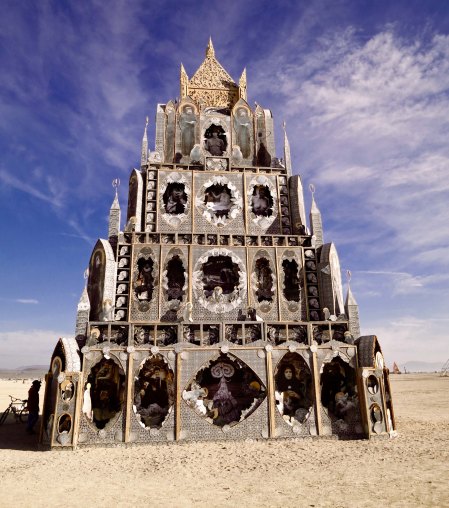
A day time view of the impressive Totem of Confession created by Michael Garlington and his partner

A day time view of the impressive Totem of Confession created by Michael Garlington and his partner

Each of the open spaces in Totem of Confession, as shown above, contains one of Michael's photos.

Each of the open spaces in Totem of Confession, as shown above, contains one of Michael’s photos.

A close up of the dress. Interesting, huh?

A close up of the dress. Imagine wearing it to a prom, or the symphony.

Another of the photos.

Another of Michael’s photos with a curious owl providing a photo-bomb.

This albino alligator, like the owl, and several other animals, decorate the temple.

This albino alligator, like the owl, and several other animals, decorated the temple.

Panel of door at Totem of Confession Burning Man 2015

The door into the Totem of Confession featured this elaborate front.

The confessional booth inside the temple included this tower of skulls. Strange, yes, but I once visited a church in Evora, Portugal whose walls and ceilings were made of skulls, real ones.

The confessional booth inside the temple included this tower of plaster skulls. Strange, yes, but Peggy and I once visited a church in Evora, Portugal whose walls and ceilings were made of skulls, real ones. More skeletons looked on from above.

The opposite side of the booth had quite the collection of "other" things.

The opposite side of the booth had quite the collection of “other” things.

The confessional booth. "Have a seat my dear, and tell me what you've been up to at Burning Man. Oh my, that will require 10,000 Hail Marys."

The confessional booth. “Have a seat my dear, and tell me what you’ve been up to at Burning Man. Oh my, that will require 10,000 Hail Marys.”

The best of horror stories my require a goat like this.

This guy would do well in the most pagan of temples.

And what is with these eyes. Is someone staring at you? Are you being recorded? Are you on Candid Camera? Do you dare look through the peep hole?

And what is with this eye? Is someone staring at you? Are you being recorded? Are you on Candid Camera? Do you dare look through the peep-hole?

Of course I had to look.

Of course I had to look. I suspect one could spend hours finding everything that had been hidden, incorporated into the nooks and crannies of the Totem of Confession.

A view of the Totem of Confession at night.
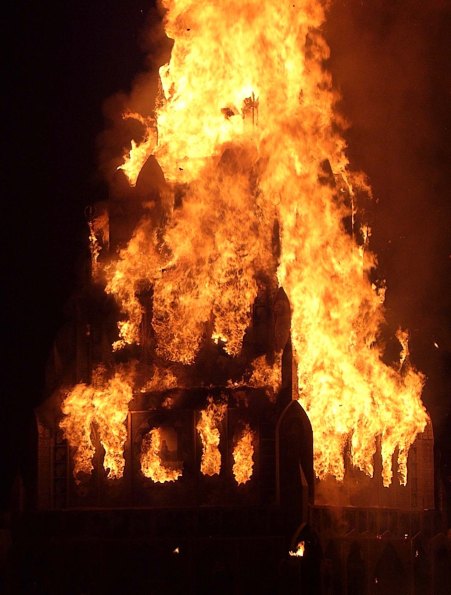
A view of the Totem of Confession at night.

The Totem of Confession was burned immediately after the Man burned Saturday night. Sarandon's wedding dress was included.

The Totem of Confession was burned immediately after the Man burned Saturday night. Sarandon’s wedding dress was included in the pyre. (Photo by Don Green.)
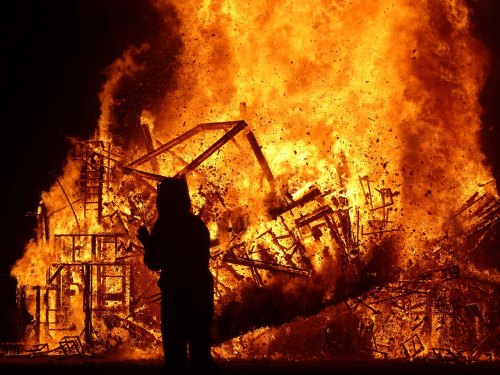
The temple burned quickly and fell to the ground. I wonder if the Burner was warming his hands or applauding. (Photo by Don Green.)
The temple burned quickly and fell to the ground. I wonder if the Burner was warming his hands or applauding. (Photo by Don Green.)

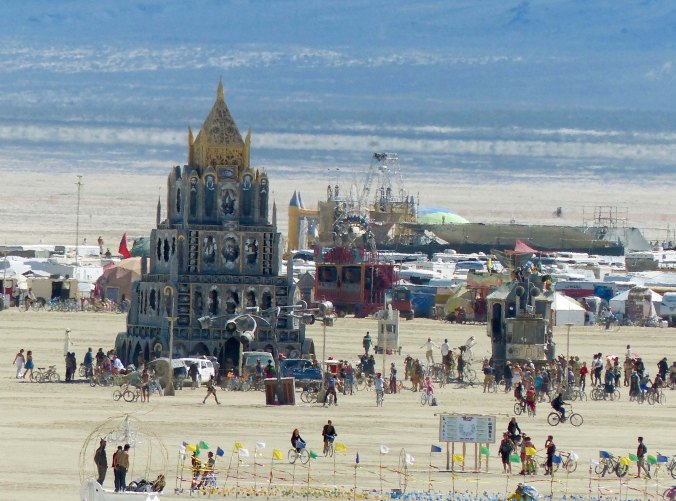
A final photo by Don. I really liked the way he captured the Totem of Confession in the broader Burning Man context.

A final photo by Don. I really liked the way he captured the Totem of Confession in the broader context of Burning Man. (Photo by Don Green.)

NEXT BLOG: Let’s take a detour and admire some Mutant Vehicles/Art Cars.

The Grateful Dead Move to Olompali… Olompali Part III

The Grateful Dead leased Olompali for the months of May and June in 1966 and returned several times over the next three years. In 1969 they returned for a photo shoot for the back cover of their album, Aoxomoxoa.

The Grateful Dead leased Olompali for the months of May and June in 1966 and visited the ranch several times over the next three years. In 1969 they returned for a photo shoot for the back cover of their album, Aoxomoxoa. Pigpen is lying in front. Jerry Garcia is on the left with the tree trunk behind him. In addition to the band, members of the Merry Pranksters and the Chosen Family Commune were also included in the photo. The blonde girl in the left front and the blonde girl sitting next to Garcia are the daughters of my brother-in-law Jim Hagedorn’s cousin, Paula McCoy.


“The (San Francisco/Haight-Asbury) Summer of Love began one afternoon at Olompali.” Ken Kesey, author of One Flew Over the Cuckoo’s Nest.


In my last post on Olompali, I mentioned that the Burdells sold Olompali in the early 40s. The purchaser, Count Harrington, had made his money dredging Pearl Harbor, an activity that was brought to a dramatic halt by the Japanese bombing in 1941. Desperate for dredging equipment, the US military paid him a small fortune for his dredges. He then used this money to purchase Olompali. Harrington, in turn sold the property to the University of San Francisco in 1948.

USF wanted to use the property as a Jesuit retreat but quickly discovered that maintaining Olompali was an expensive proposition. So they decided to sell, which turned out to be somewhat challenging. Buyers kept defaulting. At one point, USF was desperate enough to dig up the brick sidewalks and sell the bricks. For a brief time in the early 60s, the property was turned into an exclusive club with $5000 memberships. This effort failed as well, but it left a great swimming pool for the next inhabitants, The Grateful Dead.


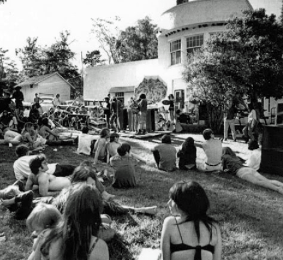
The Grateful Dead and other bands such as Quick Silver and Jefferson Airplane would set up in front of the Burwell Mansion and play free music for hours on end.

The Grateful Dead and other bands such as Quick Silver and Jefferson Airplane would set up in front of the Burwell Mansion and play free music for hours on end during their brief stay in May and June of 1966. (Archived photo.)

The mansion as it looked when I visited Olompali State Park in August. A fire gutted the building in 1969.

My photo of the mansion as it looked when I visited Olompali State Park in August. A fire gutted the building in 1969. I thought it was interesting that swallows still nested on the upper part of the mansion. (The dark dots.)

The best way to describe the Grateful Dead’s two month stay at Olompali in 1966 is to use a 60’s term: a happening. It was a continuous party that featured the early beginnings of rock music and a number of rock music legends. The Grateful Dead had formed a year earlier in 1965 from their initial band, The Warlocks, and Jerry Garcia was looking for a place where his group could hang out. A real estate friend turned him on to Olompali. The rent was reasonable and the property came with a large “Tara-like” house, a swimming pool, and gorgeous scenery. It was far enough away from everything that the band could play outdoors without disturbing any neighbors.

It was the type of place that demanded a party. An announcement sent out on May 22, 1966, invited the Dead’s friends from the Bay Area, “to an afternoon of inter-galactic travel, to a communion with the spirits of long dead Indians, to a dance celebrating mainly all of us.” It would be one of many parties. The ‘mainly all of us’ described a fascinating blend of musicians, promoters, poster artists, writers, film makers, beats, hippies and other alternative/creative types.

The original invitation to the Grateful Dead's party. The Swastica,

The original invitation to the Grateful Dead’s party. The swastika symbol, BTW, did not represent the Nazis. It was used by Native Americans to represent migration, thousands of years before it was picked up by Hitler. I’ve seen it on rock art throughout the Southwest.

Here’s how Garcia described the Dead’s stay at Olompali: “It was a great place. It had a swimming pool and barns and that sort of thing… We didn’t have that place very long, only about eight weeks. It was incredibly intense for everybody… Everything was just super-groovy. It was a model of how things could really be good… (It) was a firming up of the whole social world of rock and roll around here… The guys in Jefferson Airplane would get together with Quicksilver and different guys, 81 different players, would get together and get high and get loose and have some fun… That was when we started getting tight with Quicksilver… They came and hung out at our place in Novato when we had our parties. And a lot of people like the various filmmakers and writers and dope dealers. All the people who were into doing stuff. People who had seen each other at rock and roll shows…in that first year. Those parties were like a chance to move the whole thing closer, so to speak. It was good times – unselfconscious and totally free.”

Grace Slick dropped by, as did Janice Joplin, Santana, David Crosby, Moby Grape and even a five-year-old Courtney Love. But the gatherings went beyond musicians. Ken Kesey and the Merry Pranksters made their way to Olompali along with the LSD guru, “tune in, turn on, drop out,” Timothy Leary.

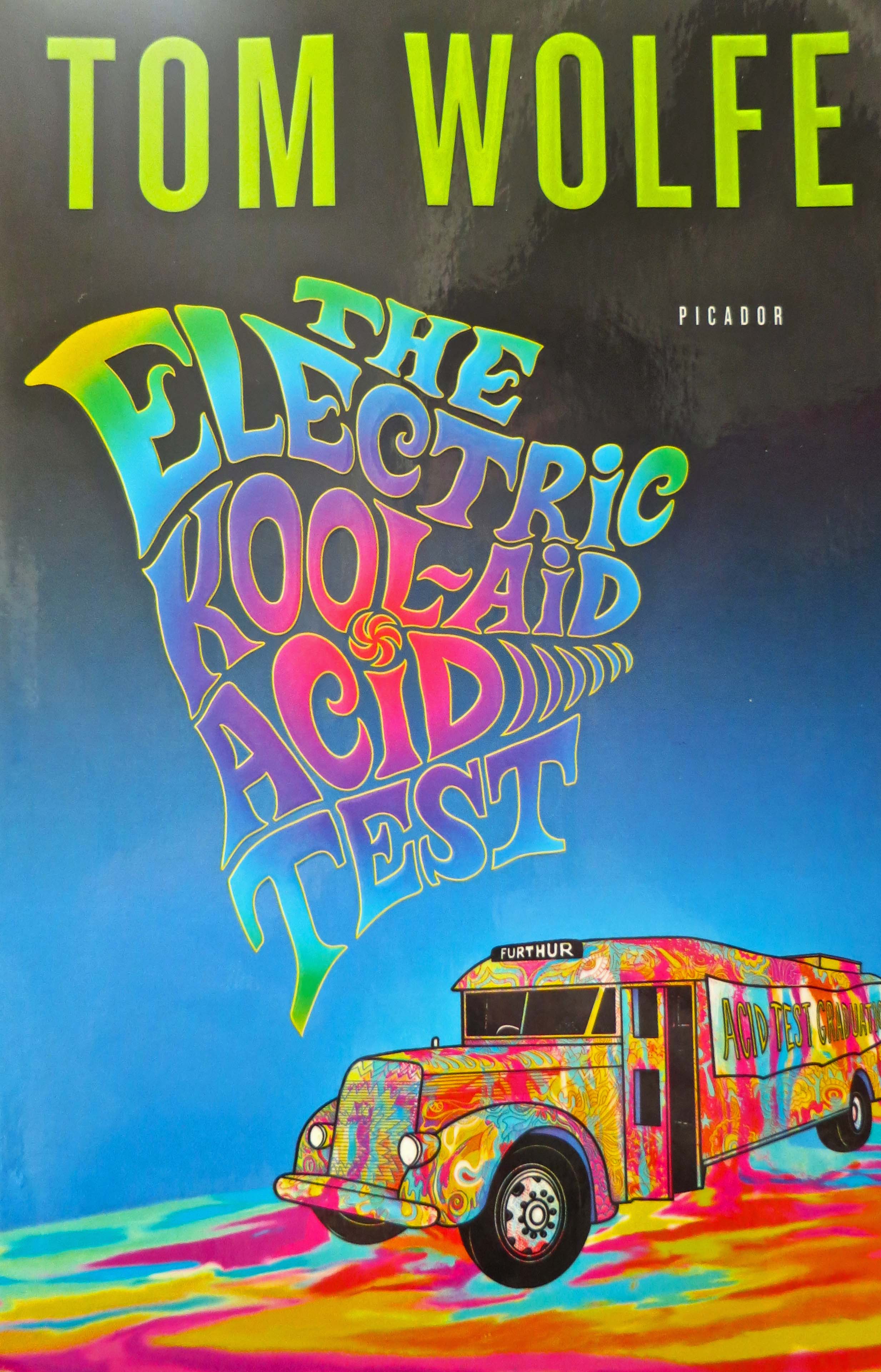
The cover of Tom Wolfe's book The Electric Kool-Aid Acid Test featuring the bus Further.

The cover of Tom Wolfe’s book The Electric Kool-Aid Acid Test featuring the bus Further.

The Merry Pranksters were known for their 1964 trip across America in their gaily decorated bus, Further— a trip made famous by Tom Wolfe’s book, The Electric Kool-Aid Acid Test. I had run into the Pranksters and Further at Berkeley in the spring of 1965 when they came tumbling off their bus to participate in one of the nation’s first anti-Vietnam War rallies. The Grateful Dead, in their earlier guise as The Warlocks, had played at several of Kesey’s “Acid Tests” in the Bay area designed to turn the world on with a concoction of LSD and Kool-Aid.

Garcia reportedly took his last acid trip at Olompali. “He developed three hundred-and-sixty-degree vision, died a few thousand times, and saw the word  “All” float into the sky before he turned into a field of wheat and heard “Bringing In the Sheaves.” Garcia would later note, “I unraveled every strand of DNA in my body. I felt both full and empty. I hardly spoke a word for two months, but it was worth it.”

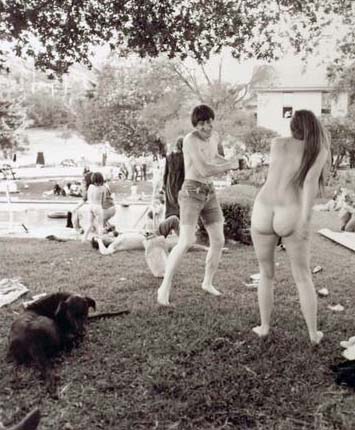
Visitors to the free concerts at Olompali would spread out on the lawn, jump into the pool, and get comfortable, which, on occasion, involved taking off their clothes. Minus the lawn and the swimming pool, I am reminded of Burning Man where Burners spread out in the dust, instead.

Band member Phil Lesh noted, “Bear and some of the Pranksters set up [speakers] in the living room and all over the grounds; there was food and drink for all, and the pool was wall to wall with mostly nude people… From the makeshift bandstand by the kitchen terrace, an ad hoc band composed of members of the Dead, Quicksilver, and the Airplane played some of the most startling music I’ve ever heard, a new kind of music no one had ever made before, a true synergy of spontaneity and structure, created on the spot.” (Bear was none other than Owsley, the LSD Cook, known for producing over one million doses of acid. He worked as a sound-man for the Dead in the early years and helped with financial support. His ashes were placed on the soundboard at the Grateful Dead’s 50th Anniversary show in Chicago this year.)

Clothing was optional at the parties held by the Grateful Dead at Olompali. The swimming pool is at the back of the photo.

Clothing was optional at the parties held by the Grateful Dead at Olompali. The swimming pool is at the back of the photo. The building on the right is now park headquarters. (Archived photo)

Neal Cassidy was another legendary visitor. Neal had hitchhiked across the country with Jack Kerouac in his epic journey described in On the Road. Later he would drive the bus Further across the country with the Merry Pranksters, thus serving as a bridge between the Beat Generation of the 50’s and the Hippie Generation of the 60s. George Hunter of the Charlatans’ band remembered, “the Dead would be playing and Neal Cassady would be doing this strange little dance— it was almost like breakdancing; very fluid. Out on the lawn there was this very far-out configuration of plumbing that was once part of a sprinkler system or something. It stuck out of the ground and stood maybe five feet high. I couldn’t figure out what the hell it was for. It was just a mess of pipes with faucets coming out of it that had been modified over the years. Very strange. So the Dead would be playing, and Neal would be dancing on the lawn with this bizarre metal partner. He’d dance around it, with it really. He had some pretty good moves, too. Neal was always in the thick of things.”

While only at Olompali for two months, Jerry Garcia would remember his time there as “idyllic.” And, he would come back several times over the next three years. His Haight-Asbury neighbor and friend, Don McCoy, was soon to lease Olompali for one of the most famous hippie communes of the 60s, The Chosen Family. The area’s wonderfully strange history would continue. It’s the subject of my NEXT BLOG.

Speaking of strange, or at least small world, Peggy’s sister Jane and her husband Jim were up this week visiting. Jane and I were talking about the 60s and Jane mentioned that Jim’s cousin Paula was mixed up in the San Francisco music scene in some way. Turns out that she was the wife of Don McCoy in his pre-commune period.

Peyote, Shamanistic Vision and Art… The Huichol Indians of Mexico

Huichol work of art representing the journey to gather Peyote. Photo by  Curtis Mekemson.

Peggy and I bought this Huichol yarn art painting several years ago. Yarn is pressed into beeswax to make the painting. This piece represents the Huichol’s annual journey to the sacred mountain of Wirikuta to gather peyote, which is central to their religion.

My fascination with indigenous art was piqued again on our recent trip to Mexico. The Huichol Indians, one of the last tribes in North America that has preserved pre-Columbian cultural traditions, are noted for their brightly colored bead and yarn art.

You can’t miss their work as you stroll down the streets and through the markets of Puerto Vallarta. What most casual visitors don’t realize, however, is that the art incorporates shamanistic visions inspired by peyote. Each piece provides an insight into the religion and mythology of the Huichol.

For example, the round buttons in the center of the painting above represent peyote. Just to the left of the peyote is the plant solandra, also with hallucinogenic qualities. The deer serve as intermediaries with the gods and the eagle serves as a messenger. Below the deer on the right is maize. To the left of the maize is what I believe is a prayer arrow with eagle feathers attached and to the left of that another arrow that has been shot into the base of a peyote plant. The wiggly lines represent communication that is taking place– between everything.

The Huichol, as they are known in Spanish, or the Wixaritari, as they call themselves, live in the Sierra Madre Occidental Range of Mexico. Each year, representatives of the tribe make a journey of several hundred miles to the sacred mountain of Wirikuta in central Mexico where they gather peyote.

Peyote is a small cactus with psychoactive alkaloids, particularly mescaline, which can create hallucinogenic reactions similar to those created by LSD. (If you’ve been around for a while, you will immediately think of Timothy Leary and the 60s.)  Effects include alterations in the thinking processes, sense of time, and self-awareness. Colors are said to appear brilliant and intense. Synesthesia, where senses interact, may also occur. An example of the latter is seeing colors when listening to music.

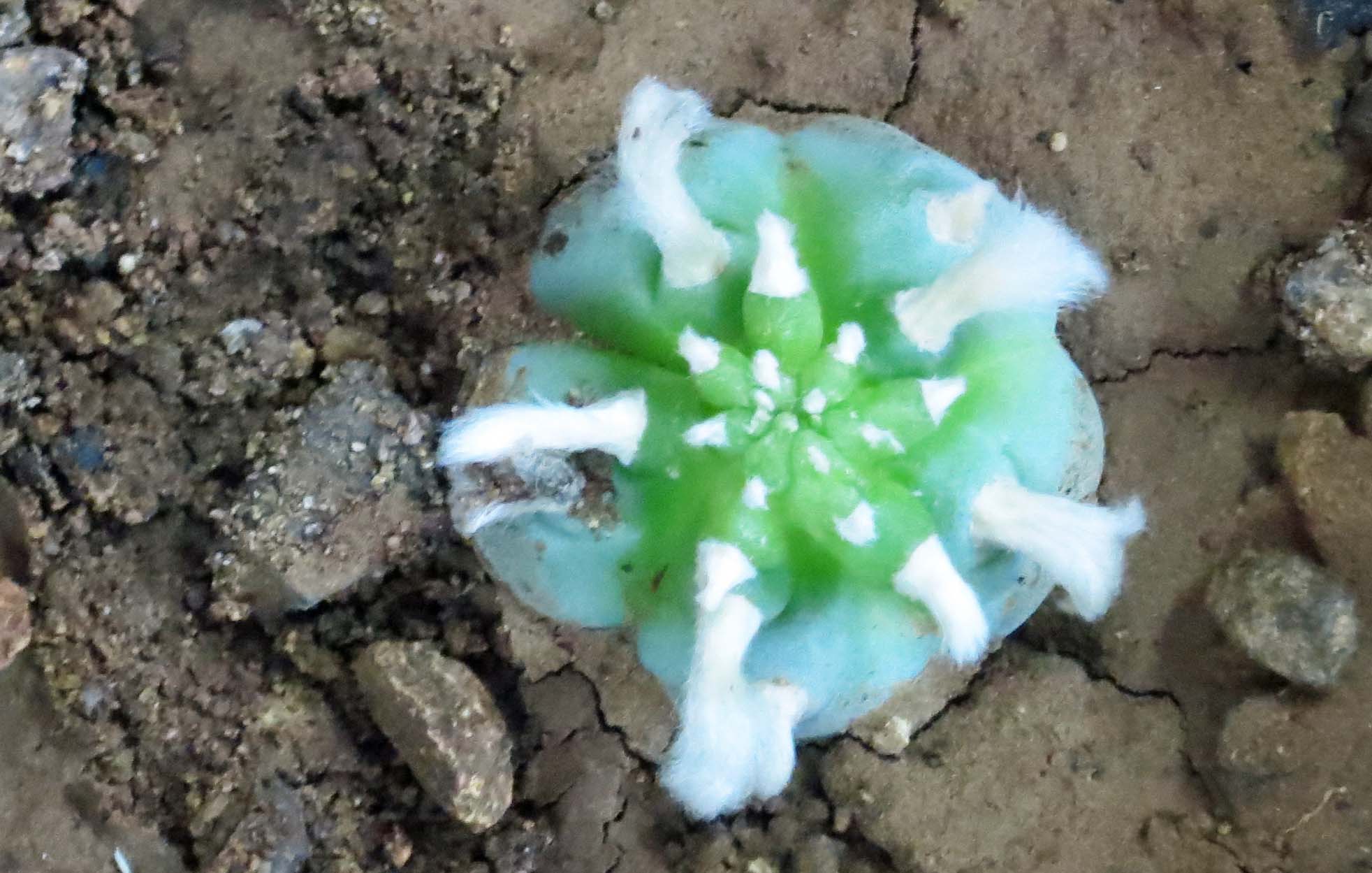
Peyote photo taken by Curtis Mekemson in Mexico.

The peyote plant is a small, spineless cactus that contains mescaline, a hallucinogenic drug. 

Huichol Shamans use the peyote to enter a trance where they communicate with the gods of the Huichol people. The shamans then make small yarn paintings known as Nierikas that represent the visions they experienced. The paintings are left as offerings to the gods in caves, temples and streams.

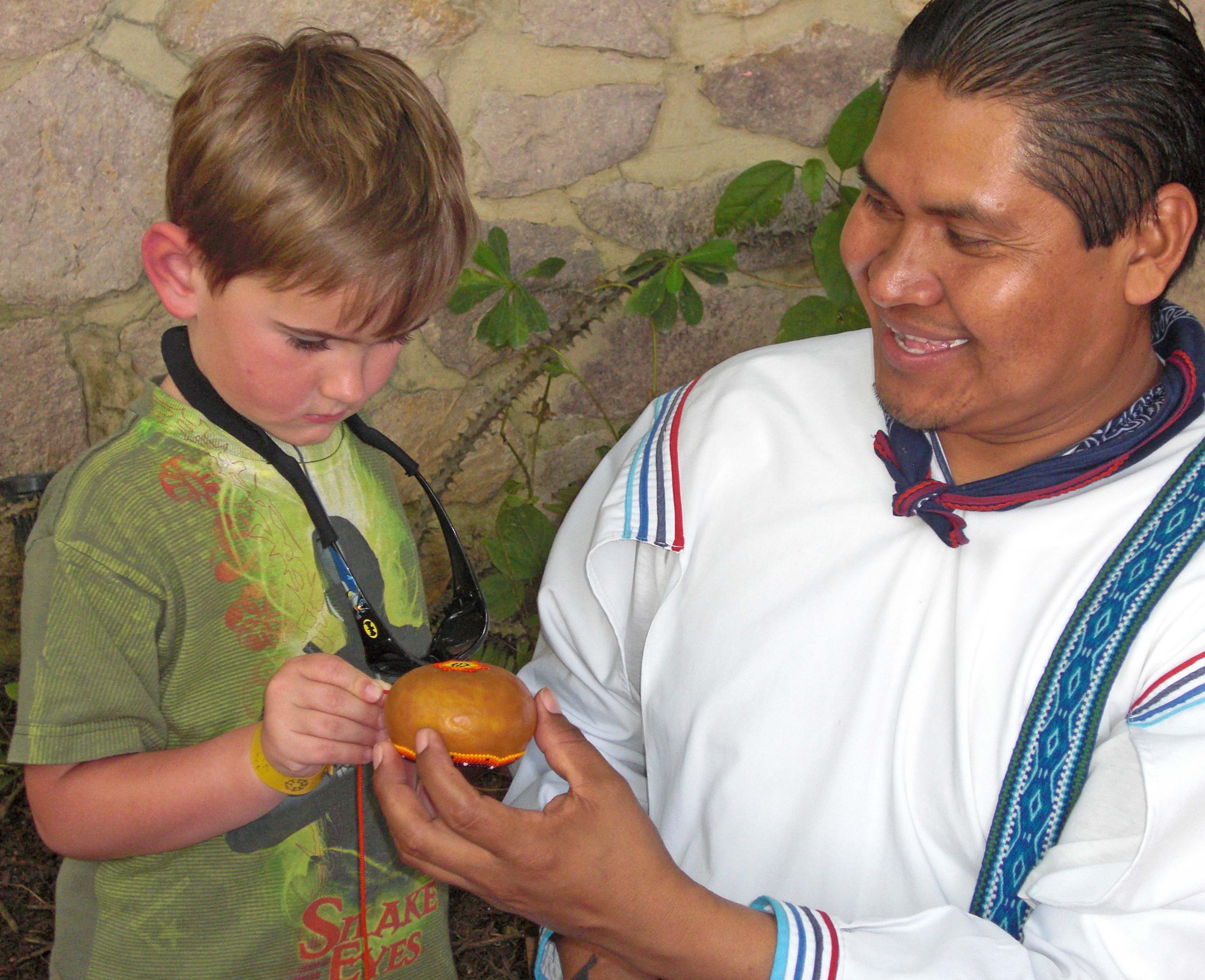
The Nierikas serve as the foundation for the Huichol art found in Puerto Vallarta, Guadalajara, and other urban locations. We have bought several pieces of the art, as has our daughter, Tasha. Our favorite Huichol artist for small bead art, Ernesto, maintains a table along the Rio Cuale. This year he took time to let our grandson, Cody, press some beads into a piece he was working on.

Ernesto shows lets our grandson Cody press beads onto a gourd covered with beeswax. (Photo by Ethan's mom, Natasha.)

Ernesto shows our grandson Cody how to press beads onto a gourd covered with beeswax. (Photo by Ethan’s mom, Natasha.) 

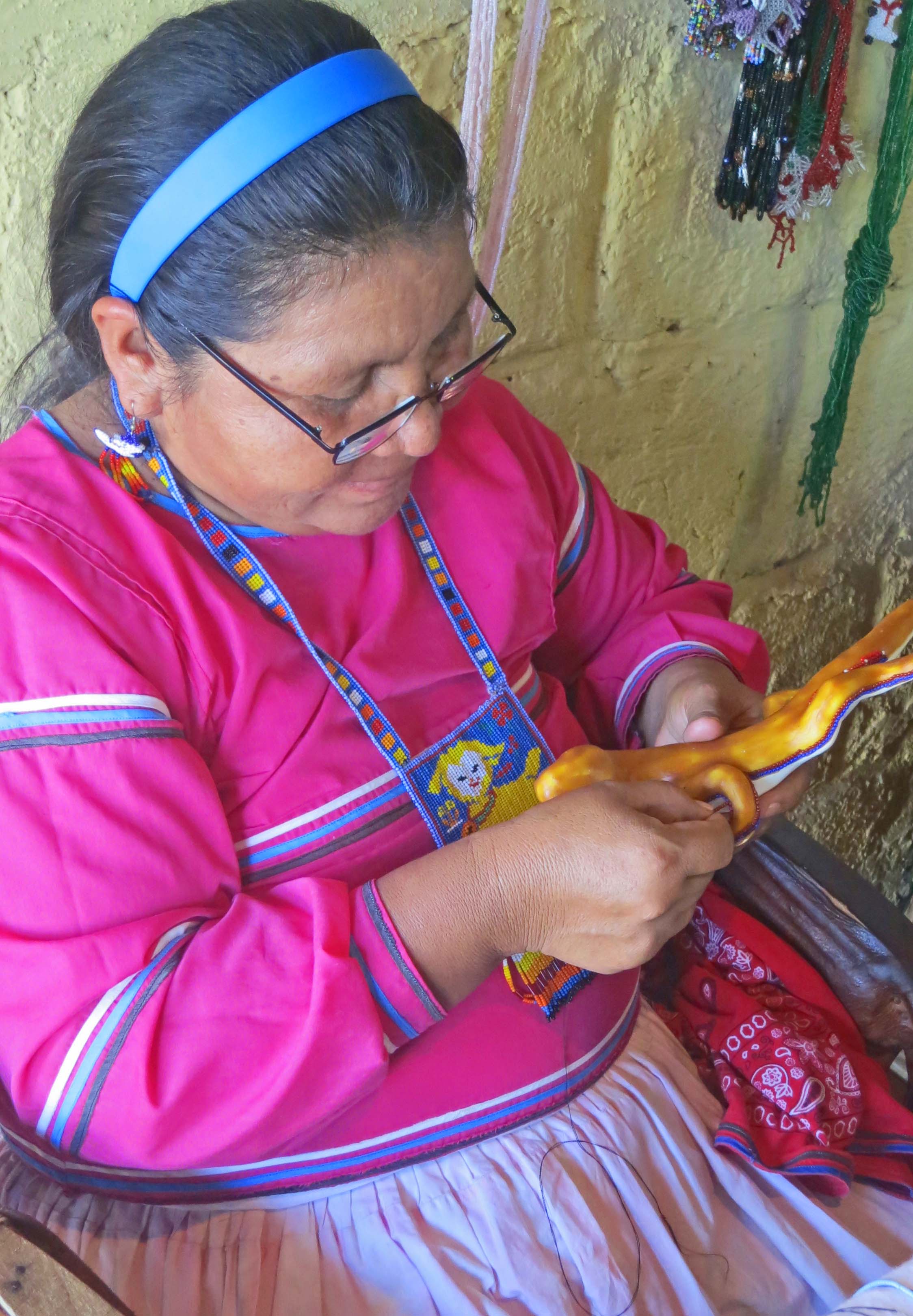
Huichol woman works on a bead art sculpture in Mexico. Photo by Curtis Mekemson.

In this photo, a Huichol woman works on another bead art sculpture.

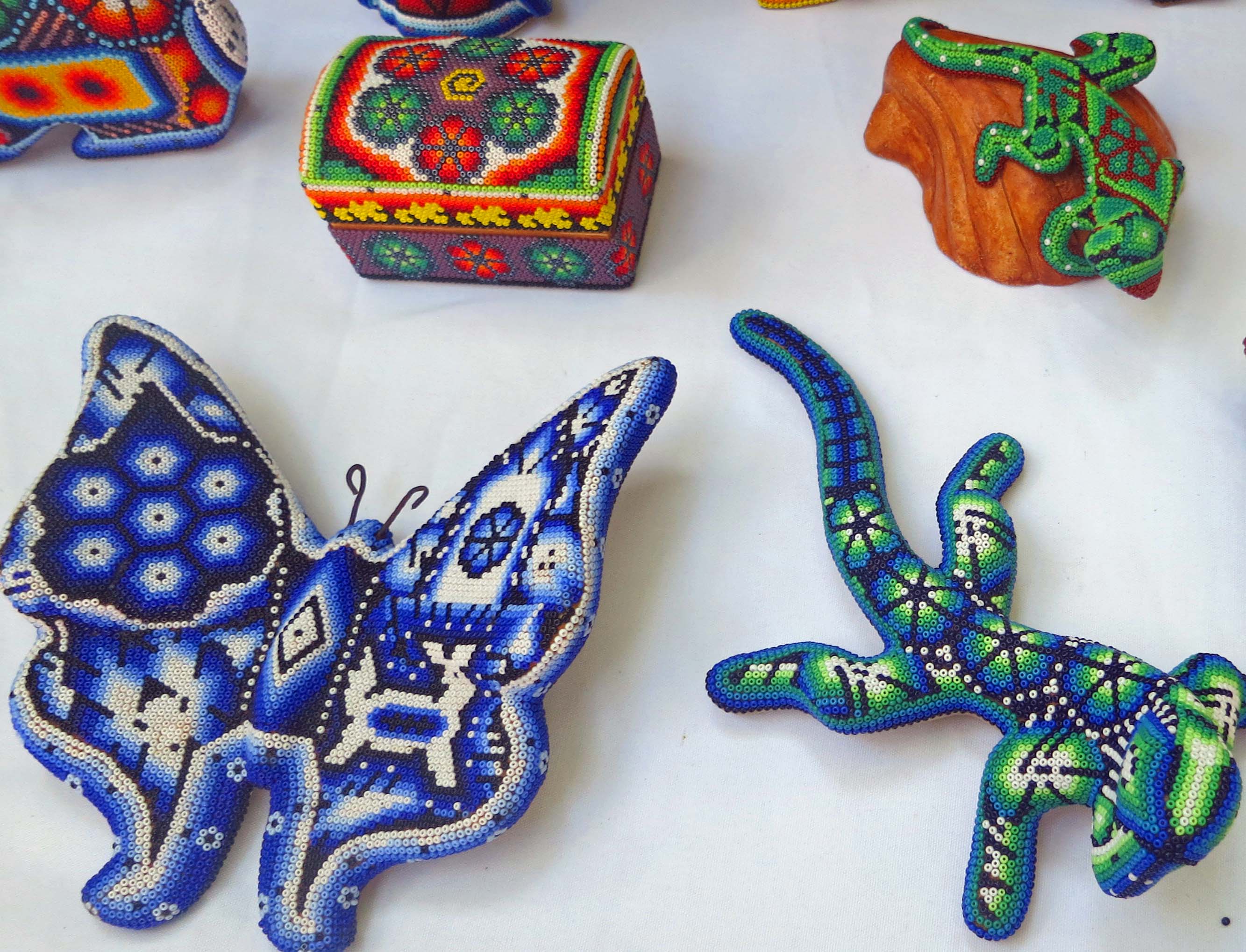
Beaded Huichol art. Photo by Curtis Mekemson.

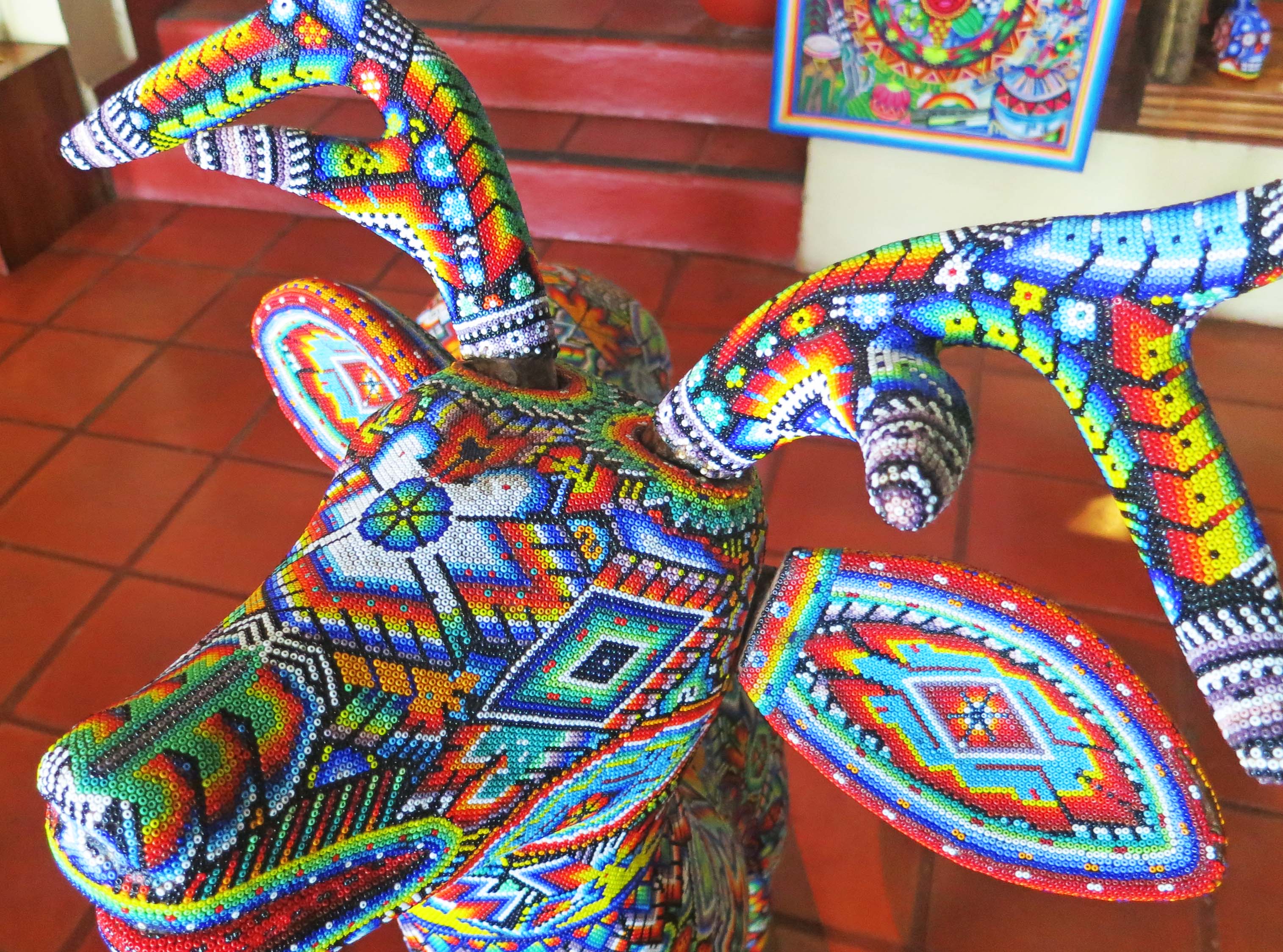
Beaded Huichol art can range in size from these small pieces created by Ernesto to much larger sculptures such as the deer shown below. Beaded art, like the yarn art, includes symbols of the Huichol Indians’ religion. The salamander, with peyote buttons marching down its back, helps bring rain.

Photograph of Huichol deer by Curtis Mekemson.

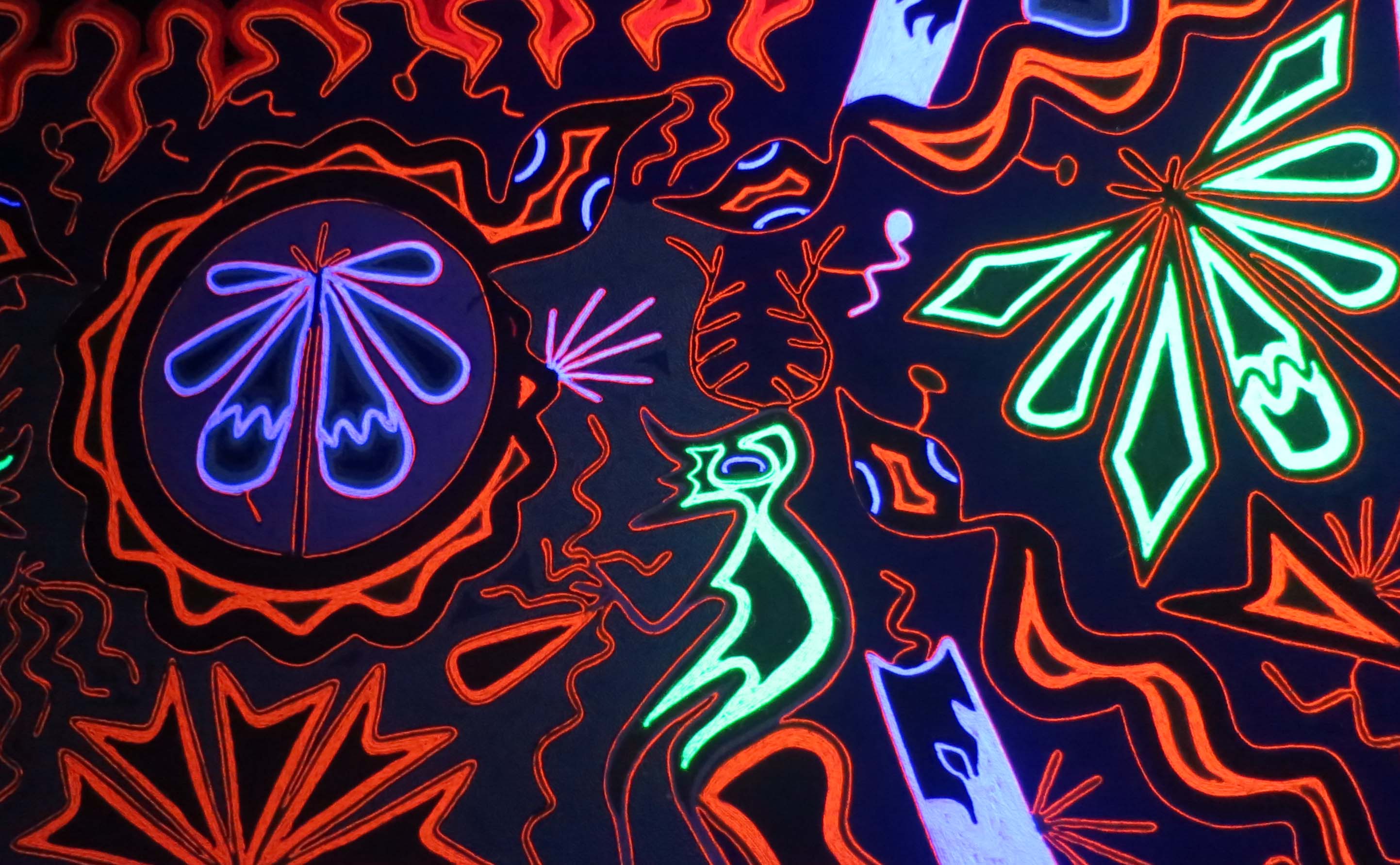
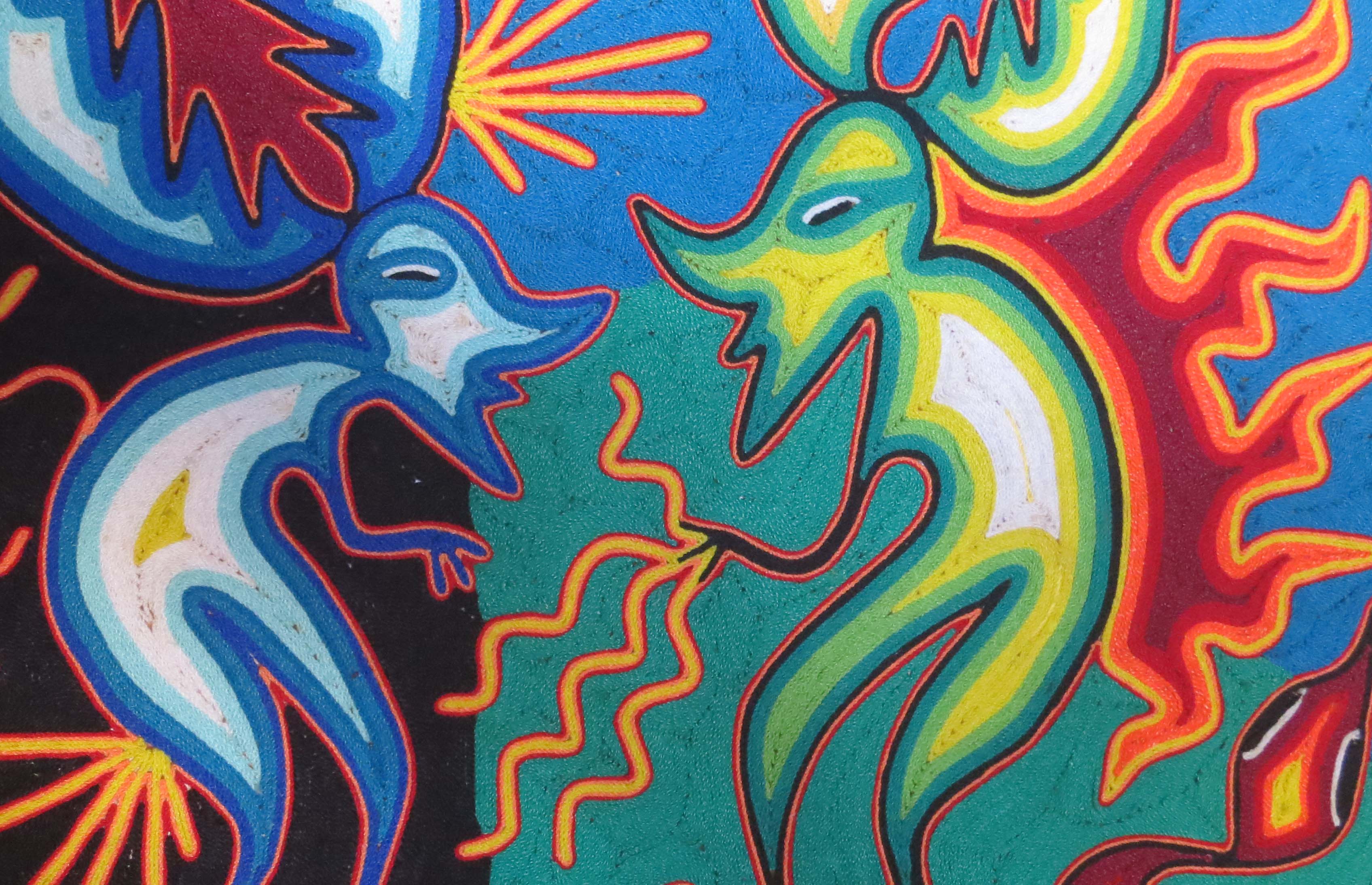
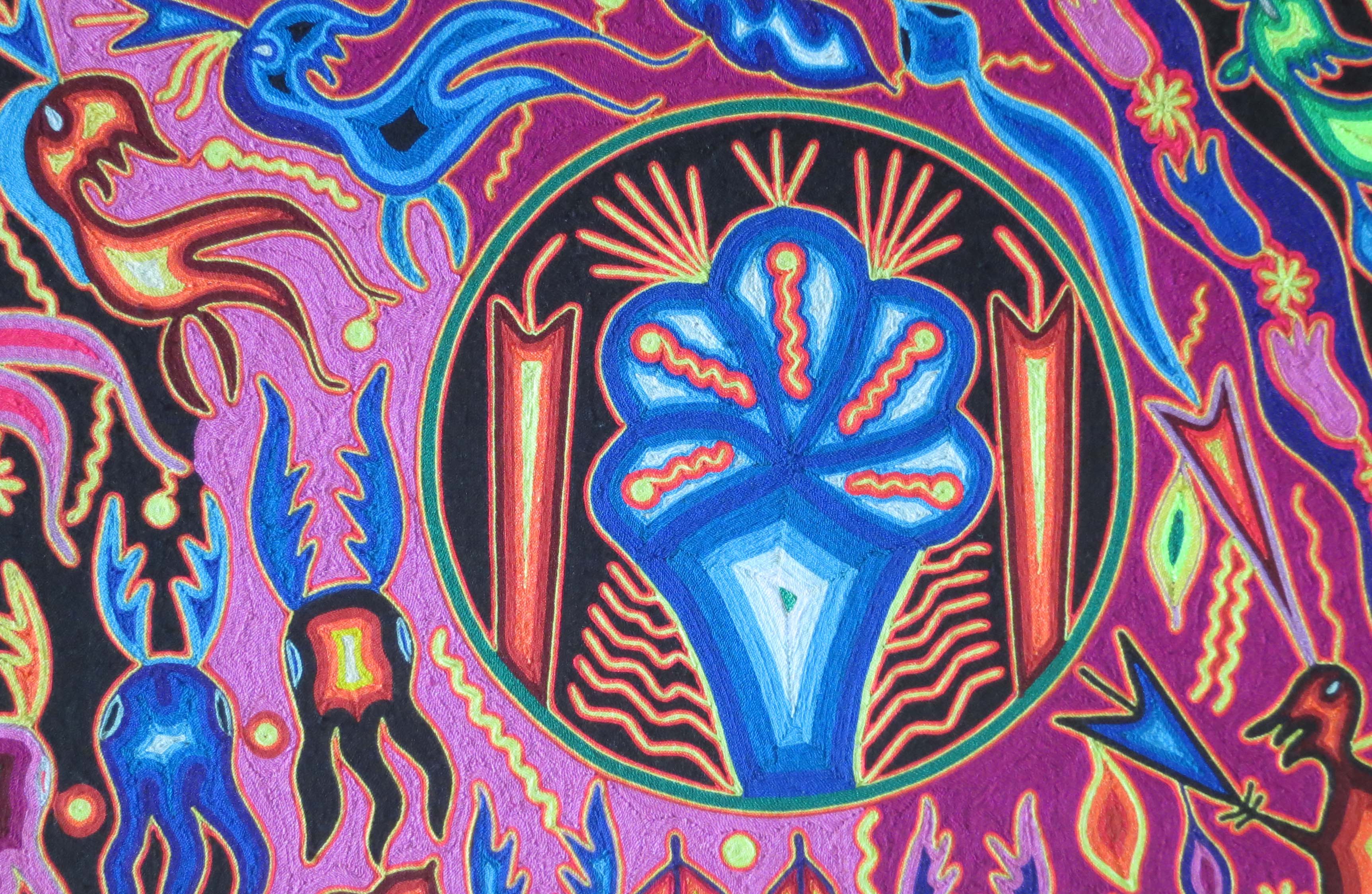
I’ll conclude today’s blog with several examples of Huichol yarn art which demonstrate the vibrant colors and spiritual figures seen by shamans while in trance.

Huichol art representing shamanistic visions. Photo by Curtis Mekemson.

Deer person in center represents a shaman.

Deer people representing shamans in Huichol art. Photo by Curtis Mekemson.

Huichol yarn art photo by Curtis Mekemson.

NEXT BLOG: I hope you are enjoying this journey into Mexico. I will be taking a break from blogging over the next couple of weeks to celebrate the season. Peggy and I would like to wish each of you Happy Holidays. –Curtis