Chapter 32: Goat Soup, Greed and Everyday Life

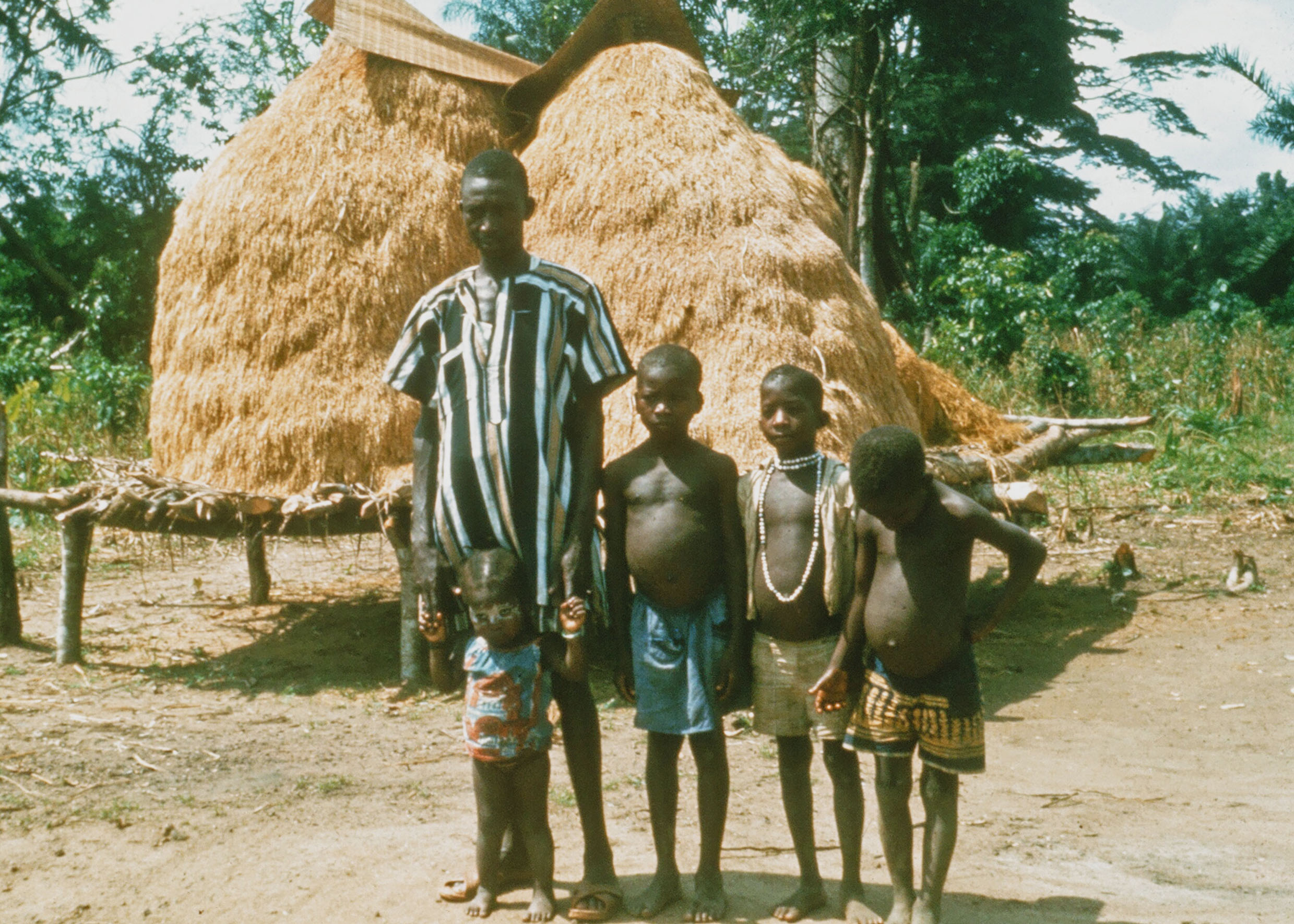
After a day of teaching at Gboveh High School, I would follow jungle trails to surrounding villages and farms. This picture features a Kpelle farmer with his three boys and young daughter. Harvested rice is piled behind the family.

After a day of teaching at Gboveh High School, I would follow jungle trails to surrounding villages and farms. This picture features a Kpelle farmer I met along with his three boys and young daughter. Harvested rice is piled behind the family.

In some ways our everyday life as high school teachers resembled our everyday life as elementary school teachers. We would crawl out of bed at 6:30, eat a quick meal and walk to school. Shortly after 1:00 we would be home downing peanut butter and jelly sandwiches with the school day finished. Our nap was next.

The new location encouraged wandering. After siesta, the dogs and I would disappear into the jungle. This continued a tradition of hiking in the woods from my earliest childhood years. I explored the surrounding village trails going farther and farther afield. Sometimes I would take my compass so I could draw primitive maps and figure out where I had been. Tribal folks were surprised to find me out in the bush but were always friendly.

I discovered where the cane fields and whiskey stills were, found a primitive but well-built wooden bridge across the river, made my first acquaintance with Driver Ants, and avoided the numerous poison snakes.

Sometimes Jo Ann would join me and on occasion I would take Sam, other Volunteers and Peace Corps staff along. The hikes provided an opportunity to explore aspects of tribal life not normally found in Gbarnga. They also served as a major part of my exercise program. I became svelte, or maybe just skinny.

A Kpelle woman and her daughter take turns pounding palm nuts in this 1966 photo taken near Gbarnga, Liberia.
A Kpelle woman and her daughter take turns pounding palm nuts in this 1966 photo taken near Gbarnga, Liberia.

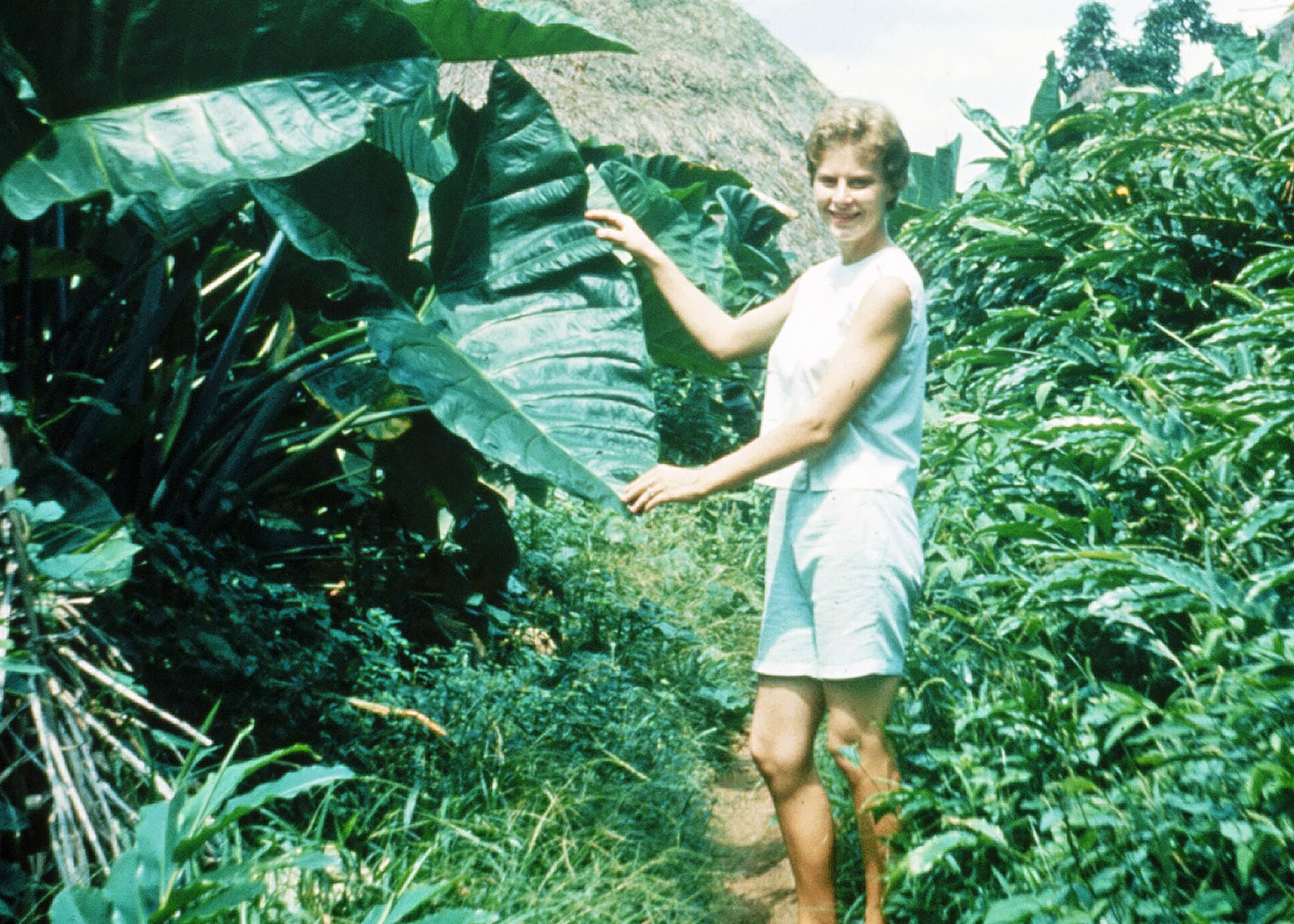
Jo Ann holds an Eddo or Taro leaf. The tubers of this plant are used as food throughout the tropics.

Jo Ann holds an Eddo or Taro leaf. The tubers of this plant are used as food throughout the tropics.

Hidden by palm fronds, I climb up a Kpelle ladder I discovered on one of my jungle hikes. Notches in a trunk serve as rungs.

Hidden by palm fronds, I climb up a Kpelle ladder I discovered on one of my jungle hikes. Notches in the trunk served as rungs for the primitive but effective climbing device.

Peace Corps staff member Dick Hyler and his wife Maureen join me on a hike through the jungle.

Peace Corps staff member Dick Hyler and his wife Maureen join me on a hike through the jungle.

Our social life was nothing to write home about. Unlike single Peace Corps Volunteers, we had each other for amusement. We did maintain our friendship with other married couples. Occasionally students or teachers would drop by. Sam was always hanging around, even when not working. I maintained an ongoing chess game with the minister of the Presbyterian mission. We would send our house boys back and forth with moves.

The largest social event we hosted was a goat feast for our fellow teachers from the high school and elementary school. Between finding a goat, having it slaughtered and making soup, it turned into a major project. Three women teachers from the elementary school came over to help with the cooking chores. They wanted to make sure the goat was properly cooked. The soup along with rice was delicious, and plenteous. No one went home hungry, or sober for that matter. I’d bought two cases of club beer and one case of Guinness Stout to accompany dinner. Drunk driving was not an issue. No one owned a car.

Even with everyone stuffed, there was ample goat chop left over to feed the dogs for a week. It lasted a night. Liberian dogs always ate like they were on the edge of starvation, even fat Liberian dogs. Somewhere in the midst of the four-legged feeding frenzy, I heard a yip and went outside to find that Brownie Girl had shoved a goat bone through her cheek. The medical emergency was minor; her real concern was being knocked out of the action. The other dogs and Rasputin were gobbling down her share. I pulled the bone out and Brownie Girl jumped back into the fray. It was pure greed. Not a scrap was left in the morning.

One of my favorite pastimes was to sit outside in the late afternoon, drink a gin and tonic, and watch the incredible tropical lightning storms. We found a jeep seat somewhere that made a comfortable couch for our porch. On occasion the sky would turn an ominous black and we could hear the storm as it ripped through the rainforest. The impending mini-hurricane would send Jo and I scurrying to yank clothes off the clothesline and batten down the hatches, i.e. make sure doors and shutters were firmly closed.
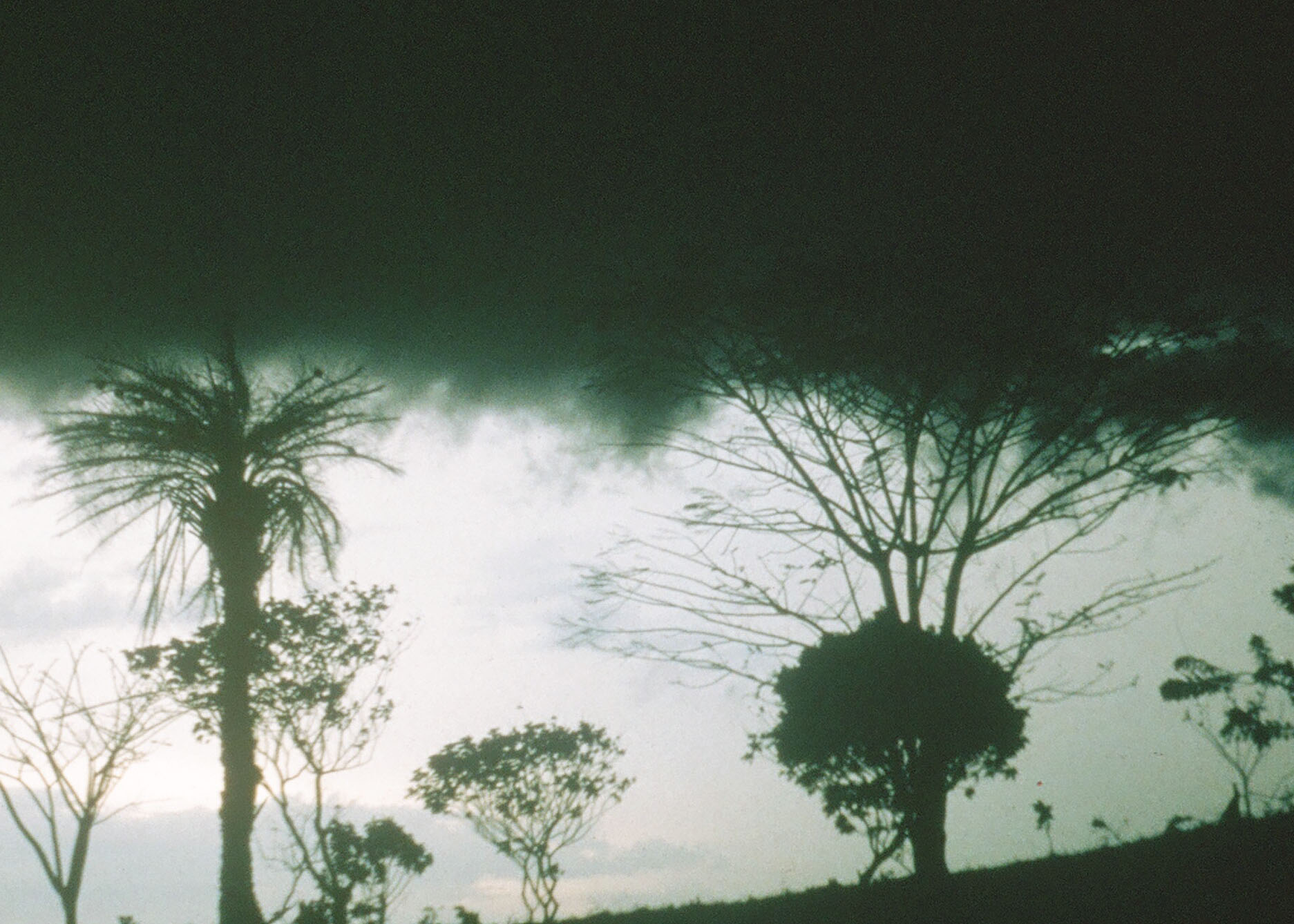
Dark storm clouds like these over Gbarnga suggested it was time for Jo Ann and I to quickly take in the laundry and shut up our house.

Dark storm clouds like these over Gbarnga suggested it was time for Jo Ann and I to quickly take in the laundry and shut up our house.

Every month or so, we would visit Monrovia for a touch of city life. Eating at the French restaurant by candlelight, spending an hour in the air-conditioned super market, hanging out in a book store or seeing the latest movie did wonders for morale. It almost made up for the three to four-hour harrowing taxi ride. We even took Sam with us once for his ‘birthday.’ He really didn’t know when it was so we declared it was during the trip. He still uses the same birth date.

Our really big break from teaching was a one-month trip to the big game parks of East Africa. In my next blog I will feature facing elephants and lions and water buffalo in a Volkswagen beetle, Oh My.

Chapter 15: A Short Lesson on Cats and Guacamole… Peace Corps Tales

Welcome to “The Dead Chicken Dance and Other Peace Corps Tales.” I am presently on a two month tour of the Mediterranean and other areas so I thought I would fill my blog space with one of the greatest adventures I have ever undertaken: a two-year tour as a Peace Corps Volunteer in Liberia, West Africa. Every two days I will post a new story.

When I have finished, I will publish the stories in digital and print book formats.

James Gibbs is one of the world’s leading experts on the Kpelle people. In this photo, a Kpelle woman and her daughter take turns mashing palm nuts into palm butter… one of my all-time favorite foods.

Now is the time for a good guacamole story.

The anthropologist James Gibbs was living in Gbarnga while he was studying the Kpelle people. Sam worked for him as an informant about Kpelle customs. It was where he had learned the ‘taboo’ word he applied to the snails he didn’t want to eat.

One evening James and his wife Jewelle invited Jo Ann and me over for dinner. It was our first invitation out as Peace Corps Volunteers.  I should also note we were still at the point of being recent college graduates and somewhat awed by academicians. We dressed up in our best clothes and headed off down the road past Massaquoi School to where they lived.

The Gibbs had an impressive house for upcountry Liberia. They were sophisticated, nice folks who quickly put us at ease. Among the hors d’oeuvres they were serving was a concoction of mashed avocado, tomatoes and peppers that Jo and I found quite tasteful. We made the mistake of asking what it was.

“Why it’s guacamole of course,” Dr. Gibbs declared in an “I can’t believe you asked that question” tone of voice. We must have looked blank because he went on, “Surely anyone from California knows what guacamole is.”

Surely we didn’t. I felt like Barbara Streisand in Funny Girl when she learned that pate was mashed chicken liver. It was 1965 and Mexican food had yet to storm Northern California. Yes, we’d been to the UC Berkeley but dining out there on a survival budget meant beer and pizza at La Val’s or a greasy hamburger at Kip’s. To change the subject I called attention to their cat.

“Nice cat,” I noted.

Mrs. Gibbs gushed. “She’s in love.”

Dr. Gibbs jumped in, obviously glad to leave the subject of guacamole. “The boys are coming by every night to visit. We hear them yowl their affection up on the roof.”

The cat looked quite proud of her accomplishments. Having been properly introduced, she strolled over and rubbed up against my legs. I reached down and scratched her head, which served as an invitation to climb into my lap. While arranging herself she provided me with a tails-eye view. Staring back at me was the anatomy of the most impressive tomcat I’ve ever seen. She had the balls of a goat!

I could hardly contain myself. “Um, she isn’t a she,” I managed to get out while struggling to maintain a straight face.

“What do you mean?” Dr. Gibbs asked in his best professorial voice. Rather than respond verbally, I turned the cat around and aimed his tail at Dr. Gibbs. Understanding flitted across his face.

“We never thought to look,” he mumbled lamely. We were even. While the kids from the hills might not know their guacamole from mashed avocados, they did know basic anatomy.

Chapter 14: A Quivering Carcass… Peace Corps Tales

Welcome to “The Dead Chicken Dance and Other Peace Corps Tales.” I am presently on a two month tour of the Mediterranean and other areas so I thought I would fill my blog space with one of the greatest adventures I have ever undertaken: a two-year tour as a Peace Corps Volunteer in Liberia, West Africa. Every two days I will post a new story.

When I have finished, I will publish the stories in digital and print book formats.

Women in Gbarnga carried produce to and from the market on their heads. It was very graceful. Banana trees are growing on the left.

Gradually, we settled into a routine. By one in the afternoon, we had finished with another day of teaching and assigned it to the done pile. PB&J washed down by orange Kool-aid rewarded our success. Sam joined us. We bought the jelly and peanut butter from the Lebanese market. The bread came from the local baker. Occasionally it included bug parts. We looked before we bit.

Nap time was next; I fell in love with siestas. Rainy season helped. Torrential afternoon showers pounded down on our zinc roof, cooled the air, and lulled us to sleep. An hour later we rolled off the bed and jumped into lesson planning.

Monday through Friday Sam cooked Liberian chop for the three of us and on Saturdays Jo cooked Kwi food (western food) for him, usually pasta of some type. He had a teenager appetite and our budget was tight. Sam was off on Sundays.

Chop consisted of a thick soup made up of meat, greens, hot peppers, bouillon, tomato paste and palm oil. It was served on top of country rice, the staple crop and food of the Kpelle. The rice was raised on the hillsides as opposed to in swamps and arrived with small stones that Sam carefully picked out. The nearest dentist was in Monrovia. If you let him near your mouth he would find 15 cavities you didn’t have. Peace Corps paid well.

The meat might be beef, chicken, fish, goat or even pork, but we usually opted for Argentine canned beef.

Fresh beef required a six am trip to the market on Saturday. We knew it was fresh because the butcher carved it off a still quivering carcass that had been a live steer an hour earlier. You pointed at the cut you wanted. Anything without bone was steak. It was not marbled in fat. Liberian cattle were rib-showing skinny and fed off of any grass they could hustle. We sacrificed the meat to an old-fashioned meat grinder and cooked it to death.

Our experience with Gbarnga’s butcher convinced us that canned beef tasted really good.

The greens for our chop came from Gbarnga’s thriving open-air market. Collards, potato greens, eggplants, pumpkins and bitter balls were our options. Bitter balls tasted exactly like their name: eating them one time was once too many. The number of peppers thrown in depended on tolerance for hot. We progressed from being one-pepper-people to three-pepper-people during our stay. Palm oil added a unique, almost nutty taste.

The market was filled with tribal women selling everything from palm oil to large snails that constantly escaped from their tubs and crawled off. ‘Small boys’ were sent to retrieve them. Sam refused to cook the fist-size Gastropods. “They are taboo for my family.” Taboo was a word he had learned from an anthropologist. I wasn’t sure about the taboo part but hung in with him. I had no more desire for dining on the slimy creatures than he did.

Produce was carried to market in large metal bowls that the women balanced on their heads with ramrod backs and ballerina grace. Given enough beer, I wandered around our house trying to master the procedure. Five seconds were my record before everything came crashing down.

The women wore brightly colored lappas with blouses and headscarves. They would squat next to their produce and call out prices. Large, juicy oranges were “one cent, one cent” in season. Grapefruits were “five cent, five cent” and giant pineapples a quarter. Avocados or butter pears as the Liberians called them could also be purchased for a few cents.

The oranges sported green skins and the pineapples ant nests but both were “sweeto,” as my students liked to say. We added orange juice to our orange Kool-aid. Plopping the pineapples into a bucket of water over night did in the ants. By morning they were little black floaters, forming a scum on top of the water.

Our appearance at the market caused inflation but bargaining was expected. We took along Sam whose rapid Kpelle assured everyone got a fair deal. Eventually Sam took over the shopping chores. We’d send him off with five dollars and he would bring home a week’s worth of food.

When dark arrived in it’s efficient tropical fashion, we would light our kerosene lantern and get cozy. Peace Corps supplied each Volunteer with a book locker filled with one hundred books. We considered it our responsibility to read them all. TV was not an option. I was curious about who made the book selections. My money was on a Harvard professor of literature. The book lockers were heavy on classics and short on mysteries and Sci-fi.

Occasionally we would add a game of scrabble or cards to our evening routine. Around 10 PM it was time for us to eliminate any cockroaches that had strayed into our bedroom and drift off to dreamland.

Chapter 12: Good Morning Teacha… Peace Corps Tales

Welcome to “The Dead Chicken Dance and Other Peace Corps Tales.” I am presently on a two month tour of the Mediterranean and other areas so I thought I would fill my blog space with one of the greatest adventures I have ever undertaken: a two-year tour as a Peace Corps Volunteer in Liberia, West Africa. Every two days I will post a new story in book format.

When I have finished, I will publish the book digitally and in print.

Palm trees peek over the roof of NV Massaquoi Elementary School in Gbarnga, Liberia while storm clouds gather. Jo and students stand out front in this 1965 photo.

I put on my coat and tie and shined my shoes. Jo donned her best dress. Kids were streaming by our house and staring through the screens, hoping for a glance at the new teachers.

Jo and I smiled at each other, took a deep breath, and walked out the door.

The air was warm and thick with humidity. Towering cumulus clouds filled the sky. Distant thunder rumbled. Rain was coming. We turned left on the red dirt road and joined the parade of students who glanced shyly at us. NV Massaquoi Elementary School waited.

It wasn’t far, maybe a half of mile, just far enough to get sweaty. Lush growth lined the road… green, dense, impenetrable, alive with buzzing, biting insects. The school sat off to the right in a clearing that been hacked out of the jungle.

Four classrooms faced the road while two more faced inward forming an elongated U. Cement blocks painted blue sat on top of cement blocks painted brown. Palm trees peeked over the zinc roof. Shuttered windows and closed doors completed the simple structure. A flagpole with Liberia’s red, white and blue flag was planted exactly in the center of the yard.

Students and teachers milled about as we approached. All eyes were on us, two white people in a sea of black. A man broke free from the crowd and approached. It was the Principal. We smiled and shook hands and he pointed out our classrooms. The orientation was over. And so was the gathering.

Students and teachers moved toward their rooms. Jo Ann wished me good luck and stalked off to her first grade with a look of determination. I walked toward my second grade with a look of bemusement.

“Good Morning Teacha” thirty bright and shiny faces shouted in unison as I entered.

It was scary, scarier than the big burly policeman who had guarded the door to the Administration building at Berkeley. I was expected to entertain and actually teach these kids something over the next couple of years.

“How?” bounced around in my skull and jumped down to my stomach.

I had a total of two months training at San Francisco State on educational theory. I didn’t have a clue about managing a classroom of second graders or teaching reading and writing and arithmetic. The last time I had been in a second grade, I was seven years old. My brief stint at student teaching a third grade in was helpful. But ‘brief’ is the critical word here.

And how did a classroom full of middle class kids in South San Francisco relate to a classroom of tribal Africans in Gbarnga, Liberia?

My students came from another world: one where spirits lived in trees, ghosts were dangerous, lightning strikes could be controlled, birds were meat-flying, homes were made of mud, live termites were considered a delicacy, and tribal justice was determined with a red-hot machete.

“Good morning students” I replied and smiled. Look confidant, I urged myself. Take control. It became my mantra.

I walked up to the blackboard and wrote Mr. Mekemson. The silence of the room was broken by the squeakiness of the chalk. I introduced myself, pronounced my name and had them pronounce it… several times. They laughed.

“I am from California,” I explained and noticed a slight recognition. Hollywood was there. “It’s a long way off.” I sketched a map of North America, Africa and the Atlantic Ocean with X’s for California and Liberia. Then I drew a great circle route with Diamond Springs on one end and Gbarnga on the other. I added a large jet plane with me looking out the window.

It was my first geography lesson. Of course it was incomprehensible. The kids had never seen a map. The only distance they understood was one they could walk. Jet airplanes were rare tiny specks in the sky.

But they liked the picture of me looking out the airplane’s window.

“OK, it’s your turn. I want you to tell me your name, your age and what tribe you belong to.” I could sense Americo-Liberians in Monrovia frowning. We were supposed to be moving away from tribalism and toward national unity. My students weren’t there yet.  They were Kpelle or Mano or Bassa or one of several other ethnic groups first and Liberian second, a distant second.

The majority of my students were Kpelle. It was the largest tribe in Liberia and Gbarnga was in the heart of Kpelle country. But there were also several other ethnic groups. English was the common language that was supposed to bind them together. Tribal dialects were not allowed in the classroom.

I quickly learned English meant Pidgin English spoken with a deep Liberian accent. At first, it seemed like a foreign language.

For example, you might say to me, “I have to go down town for about twenty minutes. I promise I won’t be gone long. Please wait for me.” My students would say, “Wait small, I go come.” “Small,” I, might add, in Liberian time could mean a few hours.

One idiom I learned quickly was, “Teacha, I have to serve nature.”  That meant, “May I have your permission to use the restroom?” Actually it was permission to use the outhouse or just as likely the ‘bush’ or even the side of the building. One day I looked up and saw one of my male students standing outside and listening to me through the window. I saw a slight shake of his shoulder and realized he was peeing on the wall. I admired his dedication but discouraged the practice.

Another challenge I faced was age difference. My youngest student was a decent second grade age of seven. The oldest was 22, my age, and a heck of a lot tougher. Several were middle school age and had middle school attitudes.

Books created a different problem; for the most part, there weren’t any. What we did have for reading were vintage 1950 California readers complete with Dick, Jane and Spot. I suspect I should have been grateful for anything but it was difficult for tribal kids to identify with big white houses, white picket fences and little white kids.

As for Spot, he bore a striking resemblance to food. Later, when I had a cat, my students would tease me by pinching him and saying, “Oh, Mr. Mekemson, what fine meat.”

The room reflected the simplicity of the building. Shutters covered windows without glass and without screens. Open shutters provided air conditioning. Bugs were free to come and go. Closed shutters kept heat in and tropical deluges out. The only audio-visual aid available was my writing on the blackboard.

Eventually we got through introductions, seat assignments and the other chores inherent in the first day of class. It was time to teach. I broke out Spot.

Somehow I managed to struggle through that first day. There was a curriculum to follow. More importantly, Jo Ann I had taken over from the two Volunteers who had lived in our house. Unlike us, they were experienced teachers. The kids had benefitted from their expertise.

Back at home after school, Jo had a story to tell.

“I was reading the Owl and the Pussy Cat out loud when one of my first graders broke in and said, ‘Oh, Mrs. Mekemson, you shouldn’t say that!’ The whole class broke out in laughter.”

“I asked them what they were talking about. They clammed up. All I could get was nervous giggles.”

“After school I related the story to one of the Liberian teachers and asked if she had any idea what the kids were talking about. She clammed up as well but I pushed her.”

“You were reading about a pussy, Mrs. Mekemson.” The woman managed to stutter. “You know a woman’s down under.”

How in the world her first graders who could barely speak English had picked up this particular meaning of pussy, we didn’t have a clue.

Chapter 9: The Levitating Squat Routine… Peace Corps Tales

Welcome to “The Dead Chicken Dance and Other Peace Corps Tales.” I am presently on a two month tour of the Mediterranean and other areas so I thought I would fill my blog space with one of the greatest adventures I have ever undertaken: a two-year tour as a Peace Corps Volunteer in Liberia, West Africa. Every two days I will post a new story in book format.

When I have finished, I will publish the book digitally and in print.

Termites, or bug-a-bugs as the Liberians called them, created large mounds such as this one throughout the rainforest.

In my last post, Jo Ann and I travelled upcountry to Gbarnga, Liberia and our Peace Corps assignment. Arriving after dark at our new home, we opened the door to find the house swarming with life.

“Lots of bug-a-bug and cockroaches,” Sam observed as we peered in at the chaos.

Sure enough, our flashlight revealed that the writhing floor was a multitude of three-inch African cockroaches scurrying every which way. The tunnels climbing the walls had been sculpted by termites, or bug-a-bug as the Liberians colorfully named them. The tomb-like odor was how a house normally smelled in the tropics when left vacant for a few weeks.

Bob’s proudly drawn bucket of water sat carefully placed in the middle of the living room. Warm thoughts of veteran Peace Corps Volunteers taking care of the new kids temporarily blocked our darker visions.

I directed the flashlight into the bucket. A thick layer of scum reflected the light as a complete ecosystem came to life. Somewhere in the house a malaria-bearing mommy mosquito was extremely proud of her progeny. Hundreds of little wigglers broke the surface, virtually guaranteeing the continuation of the family line for a thousand years.

“Can you imagine what this would have been like if the Volunteers hadn’t cleaned?” I chuckled nervously, making a weak attempt at humor. Jo Ann recognized it for what it was worth and ignored me. I had the uncharitable thought that cleaning our house out had meant removing the furniture.

“Let’s tour our new home.” Again silence, but at least Jo Ann followed me. I had the flashlight. The bedroom was first. A fist-sized crab like spider went scurrying sidewise across the wall. Splat! One problem was eliminated. I hoped that its aunts, uncles, brothers and sisters weren’t the vengeful type.

Our bed was a moldy mattress shoved into the corner. It smelled suspiciously like the house.

“Hey, our first furniture,” I noted, still trying to get a laugh. This time I was rewarded with a weak smile.

Next we came to the kitchen. There was no chance it would show up in Sunset Magazine.  A kerosene lantern, kerosene stove and kerosene refrigerator filled the space. But there was no kerosene.

My thoughts returned to the PCVs and what they might have done. I envisioned the refrigerator running and full of cold beer. Then I just envisioned the beer. It didn’t have to be cold, just plentiful. But there wasn’t any beer, there wasn’t any light, there wasn’t any drinkable water and there wasn’t any food. It promised to be a long night.

“I need to visit the outhouse,” Jo Ann announced. My bladder gave an empathetic twinge. Our last pee stop had been in Monrovia. The three of us trooped outside. Jo took the flashlight and disappeared into the rickety one holer.

“Curtis!” she yelled. I yanked open the door and prepared to be heroic. Jo Ann was standing inside with a wild look on her face. The flashlight was shining down into the hole. Thousands of little eyes stared back at us.

“Lots of cockroaches,” Sam noted. He was beginning to sound repetitious.

That was the night that Jo Ann mastered her famous levitating squat routine. Cockroaches used your butt as a runway when you sat on the toilet. Jo solved the problem by positioning herself about five inches up in the air. I am not sure how she managed this Yoga feat but her rear never touched an outhouse seat during the two years we were in Africa.

I used a different approach. A loud stomp on the floor sent the cockroaches scurrying downward. The trick was to escape before they came back up. My habit of reading in the bathroom was sacrificed to the cause.

There wasn’t much left to do but send Sam on his way and try to get some sleep. We retired to our bedroom and I scrutinized the walls to see if any new monster crab spiders had appeared. They hadn’t. Word of their truncated life span had gotten around.

I then beat the bed for several minutes with the sincere hope of persuading any other unwanted guests to hit the road.

I also leaned the rest of our furniture, three well-used Salvation Army type folding chairs, against each of the screened windows. Veteran Peace Corps Volunteers had warned us that rogues, i.e. burglars, loved to rob green Volunteers on their first few days in town. The chairs would serve as a primitive burglar alarm. My theory was that jiggling the window would knock over the chair and scare away the rogue. It was guaranteed to scare the hell out of us.

Finally it was time to crawl in. We left our clothes on. Jo Ann, by this point, had reached a high level of unhappiness. I was glad there were no handy airplanes around. There was a story about a Volunteer who had landed at Robert’s Field Airport, taken one look and climbed back on the plane. My perspective on the evening was that things had been bad enough they were bound to get better.

That’s when the drums and screaming started.

No one had told us that a Kpelle funeral was like an Irish wake.

Mourners stayed up all night pounding on drums, wailing and drinking lots of cane juice, a concoction similar in nature to moonshine. It was important that the dead be sent off properly. Otherwise the spirit of the dead person would become irritated, hang around and do all sorts of bad stuff.

Of course we knew nothing about any of this. All we knew was that people were beating on drums and screaming. It was time to circle the wagons. Eventually I went to sleep; I don’t think Jo ever did.

Next post: We wage war on the bug-a-bug and I have an encounter with Crazy Flumo.

The Woman Wore No Underpants; A Tale of African Justice

(This is the second in a series of blogs where I recognize the 50th Anniversary of the Peace Corps by writing about my own experiences as a Volunteer in Gbarnga, Liberia, West Africa, 1965-1967. Here I tell about a trial by ordeal that could have happened in a medieval court.)

The Sassywood Man, a tribal judge in rural Liberia, obtained his name through use of a poisonous drink infused from the bark the Sassywood tree. The accused person was invited to take a sip. If he died, he was guilty. No DAs, lawyers, judges or juries were required.

Since modern society frowned upon trial by survival, the Sassywood Man had come up with new ways of determining guilt.  As it turned out, the father of one of my students was the local tribal judge and my ex-wife and I were privileged to witness an actual trial.

It started with Amani coming to our house at two in the afternoon on a blistering hot Saturday in the middle of the dry season. His father was about to start a trial. Would we like to see it? Absolutely, there was no way we would miss the chance. As we trudged east across town through the dust and stifling heat, Amani provided background information.

The plaintiff’s wife had come home in the evening after a hard day of selling oranges at the market and told her husband that three men had accused her of not wearing underpants. This was serious slander. The husband had filed charges against the men through Liberia’s western-type court system.

But there was a potential glitch: what if the men knew something about his wife’s behavior he didn’t? Perhaps his wife was lying to him. If he lost the suit, he would have to pay all of the court costs plus he would be subject to countersuit.

He decided to hedge his bet by taking his wife to the Sassywood Man first. If he found she was lying, the husband would drop the charges.

We arrived at court (a round hut) and were rewarded with front row dirt seats. Jo and I asked Amani how to address his father and he told us to call him Old Man, a term of respect. So we did.

Old Man didn’t speak English and we didn’t speak Kpelle but there was much smiling and finger snapping. We were delighted to meet him and he was equally delighted to meet his son’s teachers.

After the greetings were complete, Old Man began preparing for the trial. The first thing he did was to ignite a roaring bonfire, just the thing for a hot afternoon. About this time the husband arrived sans wife.

“Where’s your wife,” Old Man asked as Amani translated.

“She is being brought by her family,” the husband replied.

‘Being brought,’ it turned out, was a conservative description of the process. She was being dragged and appeared ready to bolt at the first opportunity, which she did. The woman was half gazelle; my greyhound of childhood days couldn’t have caught her as she leapt off down the trail.

For everyone involved, it looked like a clear case of guilt. But the trial was still going to be held. I asked Amani if it was being carried on for our benefit but he explained it was legitimate for the husband to sit in for the wife.

Old Man disappeared into his hut and came out with a wicked looking machete, a can of ‘medicine’ or magical objects, a pot of mystery liquid and a pot of water. He promptly shoved the machete’s blade into the fire. Next, he dumped his can of magic objects on the ground. Included were two rolls of Sassywood leaves and several small stones of various colors and shapes.

“Uh-oh,” I whispered to Jo Ann. “Are we about to witness something here with the Sassywood leaves that we would just as soon miss?”

But Old Man had a use for them other than ingestion. He asked the husband to sit down on the ground opposite him and place one roll of the leaves under his right foot. He placed the other roll under his. Both men wore shorts and had bare feet. It appeared we were to witness a trial by osmosis.

Next Old Man arranged his magic objects and proceeded to mumble over them like a priest preparing for Communion. Once the appropriate spirits had been called, it was time for mystery liquid. A generous amount was rubbed on each Sassywood leg. We were ready for the truth.

“If the knife is cold, the woman is lying,” Old Man declared dramatically as he pulled the glowing machete from the fire.

He took the “knife” and rubbed it down his leg. It sounded like a T-bone steak cozying up to a hot grill. But Old Man grinned. The knife was cold.

The husband was next. His leg appeared much less optimistic. It was, in fact, preparing to follow his wife’s legs lickety-split down the hill. Only a firm glare from Old Man made it behave. The machete sizzled its way down the shinbone and a look of surprise filled the husband’s eyes. The knife was cold; the woman was lying.

We had to be absolutely sure, however, so Old Man shoved the machete back in the fire. This time he rubbed water up and down his and the husband’s legs instead of mystery fluid. He then rearranged his magic rocks and commenced mumbling over them again. After about fifteen minutes he was ready for the final phase of the trial. He yanked the machete from the fire a second time.

“If the knife is hot, the woman is lying,” he instructed as he reversed the directions.

“Ow!” he yelled and jumped back as the machete appeared to graze his leg! The knife was definitely, absolutely, beyond the shadow of a doubt, hot.

This time Old Man couldn’t even get near the husband’s leg since the husband had cleared about ten feet from a sitting position and was strategically located behind a tree. The jury had returned its verdict; his wife was lying and he would drop the charges. He didn’t need his leg torched to prove the point.

NOTE: Before writing this blog, I looked up Sassywood on the Internet. Only recently has Liberia ceased issuing licenses for Sassywood Men and apparently several people were killed in 2007 while undergoing trials by drinking Sassywood tea.