
A closeup of the Farnese Bull sculpture at the Archeological Museum of Naples.
Dirce, the wife of King Lycus of Thebes, had been bad. She hated her niece Antiope who had succumbed to the charms of Zeus, ran away in embarrassment, and gave birth to the twins Amphion and Zethus. (When you couldn’t explain who the father was in early Greek mythology, you always blamed a god.)
Lycus went after Antiope and brought her back to Thebes, abandoning the twin boys along the way. Lycus then gave Antiope to his wife who treated the young woman cruelly. Meanwhile the twins were raised by shepherds, grew up, discovered who their mom was, and found out about Dirce’s bad behavior. This brings us to the Farnese Bull sculpture above where Amphion and Zethus are tying Dirce to the bull’s horns for punishment.
And here you thought soap operas have twisted plot lines. Believe me when I say there is much more to the story.
Several other sculptures found in the Archeological Museum of Naples also reflect early Greek myths and Roman interpretations. Atlas holds up the sky, a brooding Hercules shows off the skin of the Nemean Lion he was required to kill as the first of his 12 Labors, and Achilles carries the body of the young Troilus, a Prince of Troy he killed.

Atlas holds up the sky as a punishment from Zeus. This early sculpture would help define our concept of Atlas. The symbols on the globe are signs of the Zodiac.

Hercules shows off the pelt of the Nemean Lion he was required to kill as the first of his 12 Labors.

Achilles shoulders the body of the dead boy Troilus he had killed in relation to the Trojan War.
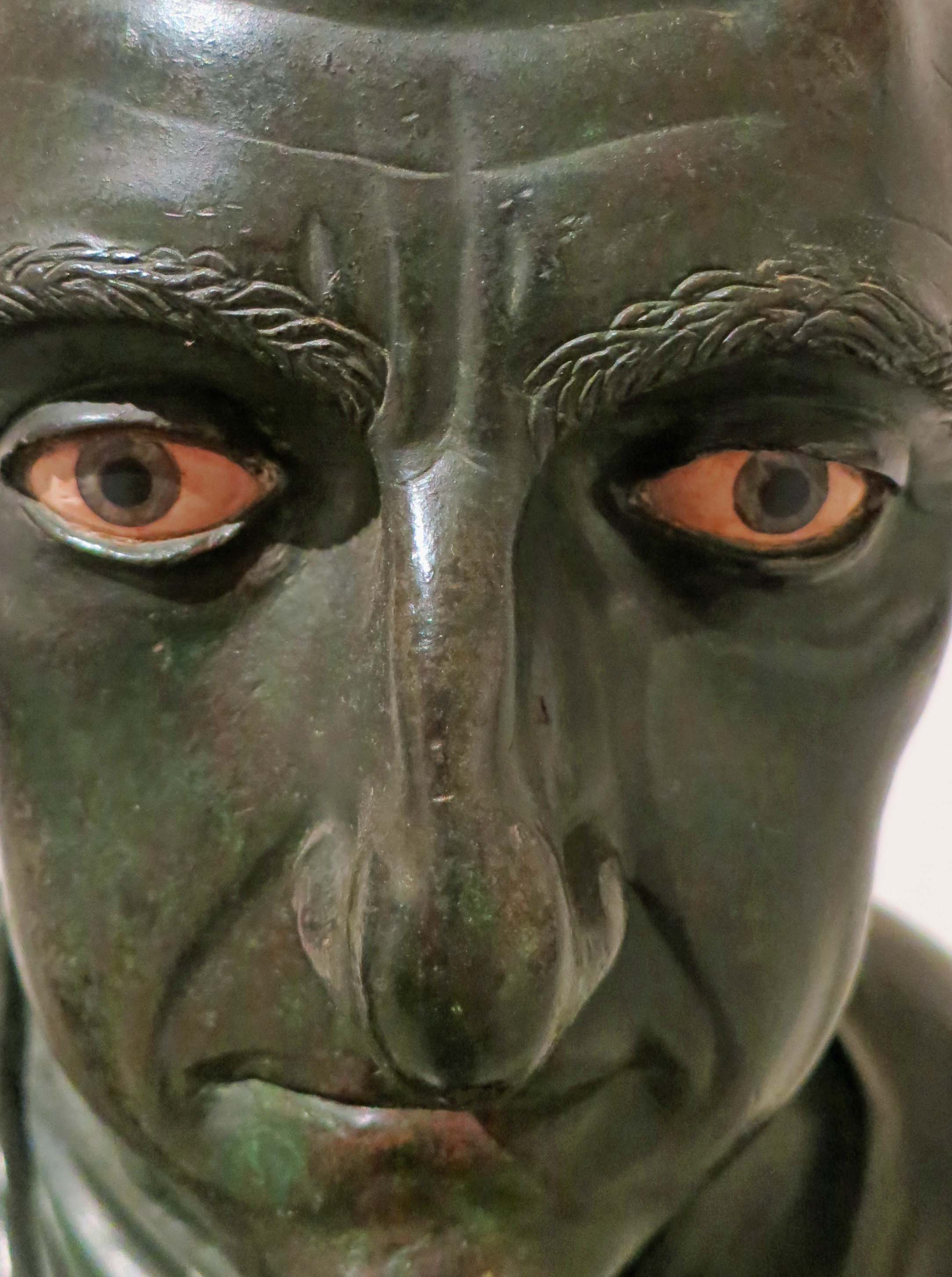
Beyond these mythological sculptures, several others caught my attention including the bronzes found in Herculaneum, a humorous dog, a rather infamous satyr and goat, a powerful bas-relief and the River God Tiberinus.

This is a bronze statue that was recovered from the house of Julius Caesar’s uncle in Herculaneum, which had been buried by the Mt. Vesuvius eruption in 79 AD.

Proof that the Romans had a sense of humor.

I found this bas-relief quite powerful but I will leave the interpretation up to you. For example, what about the spear extruding from the neck of the ghostly toga?

Satyr and goat have a tete-a-tete plus in this infamous sculpture found at the Archeological Museum of Naples. (Photo by Peggy Mekemson)

Since we will be traveling to Rome next on Traveling Through Time and Space, I thought I would conclude with the God of the Tiber River, Tiberinus. That’s quite some cornucopia. I was also amused by his arm rest.


 Wandering through Time and Place