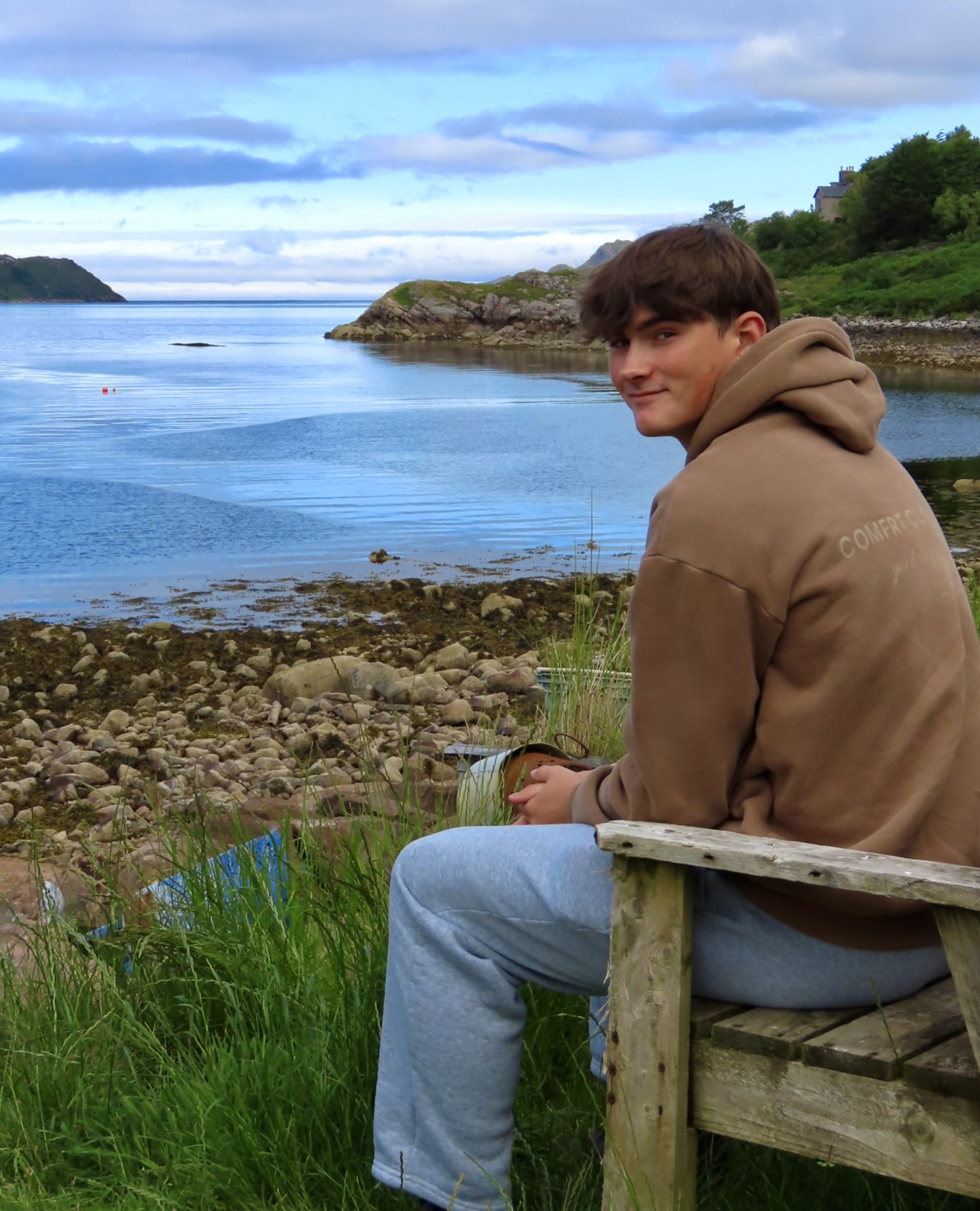
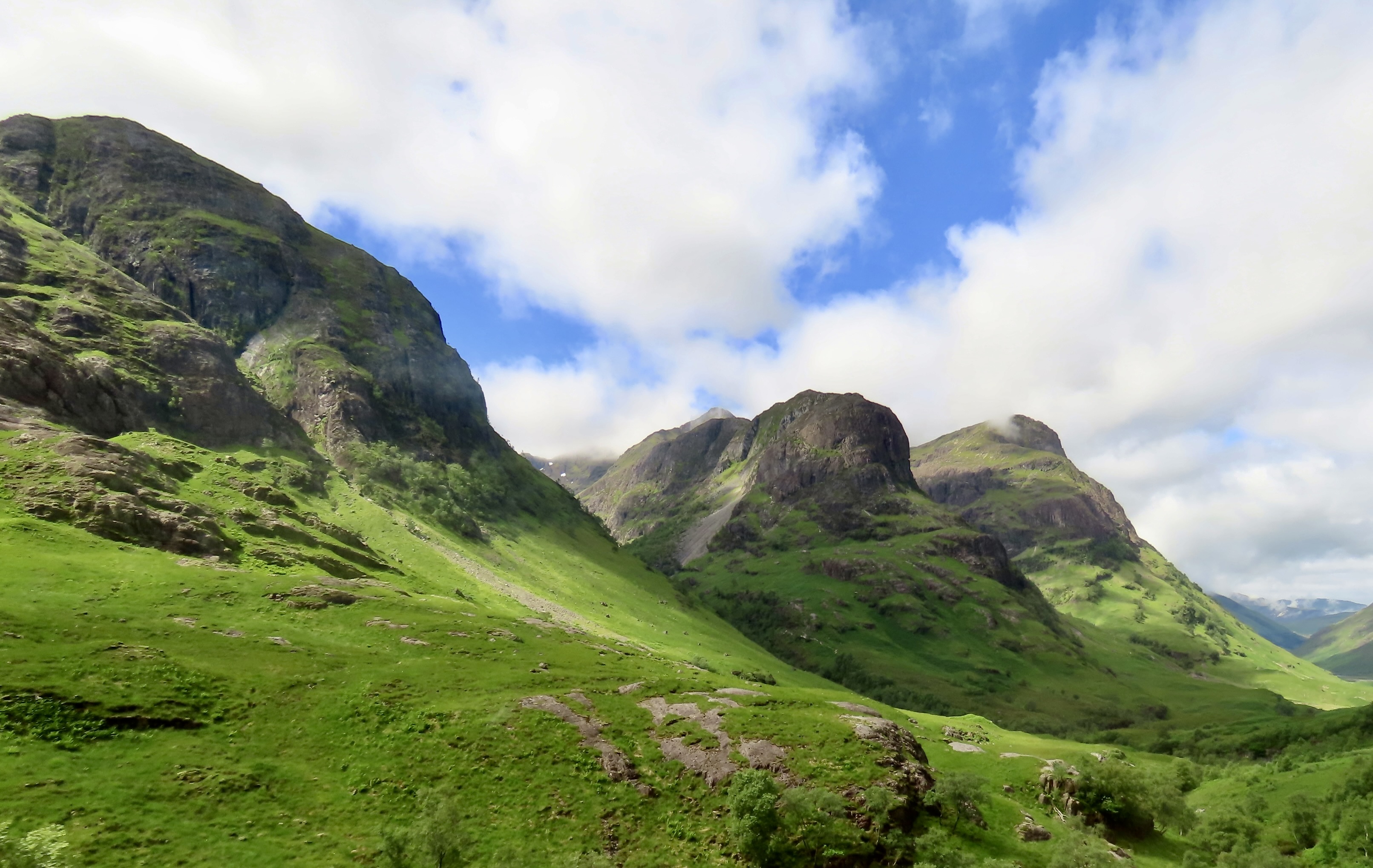
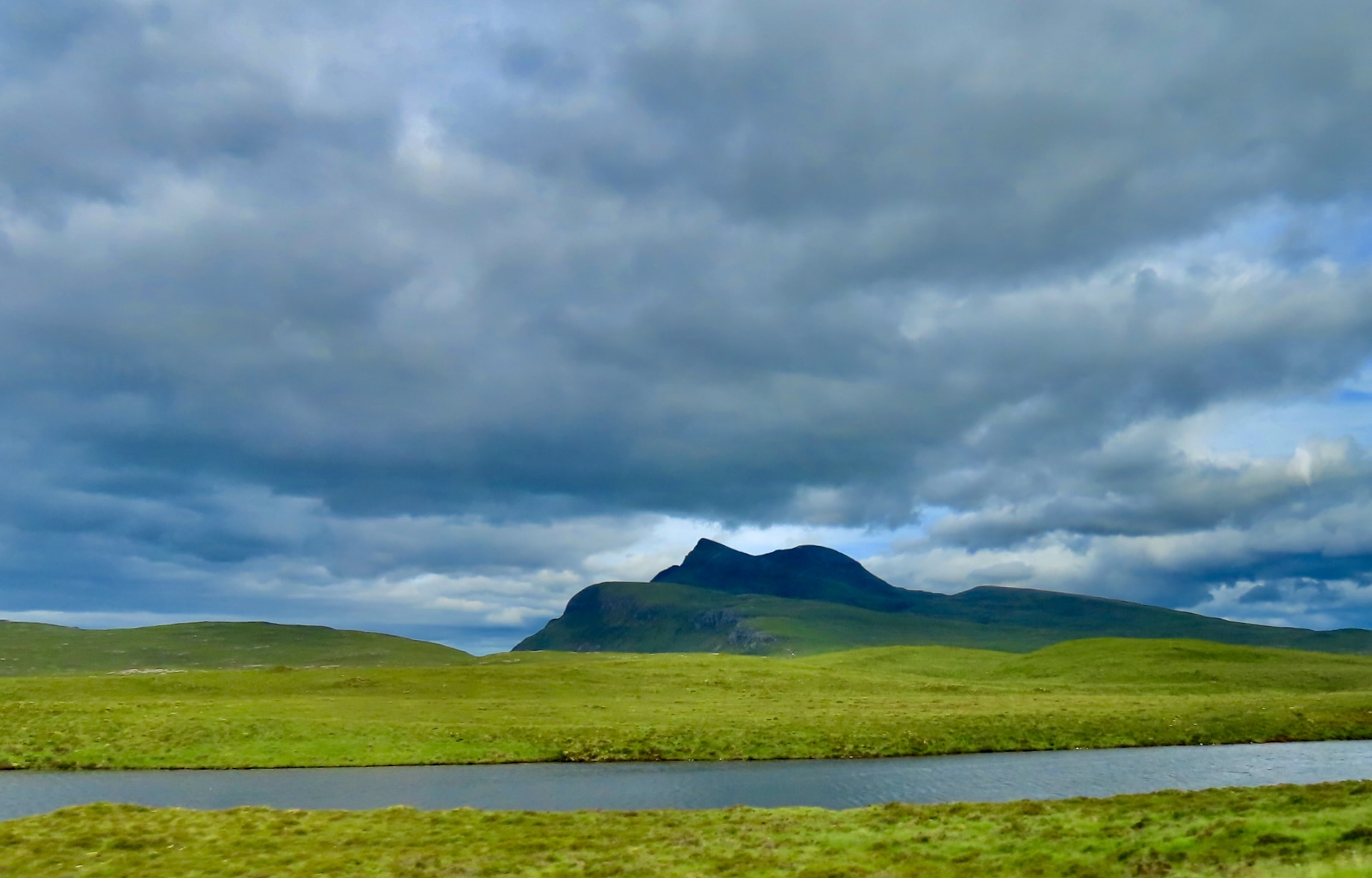
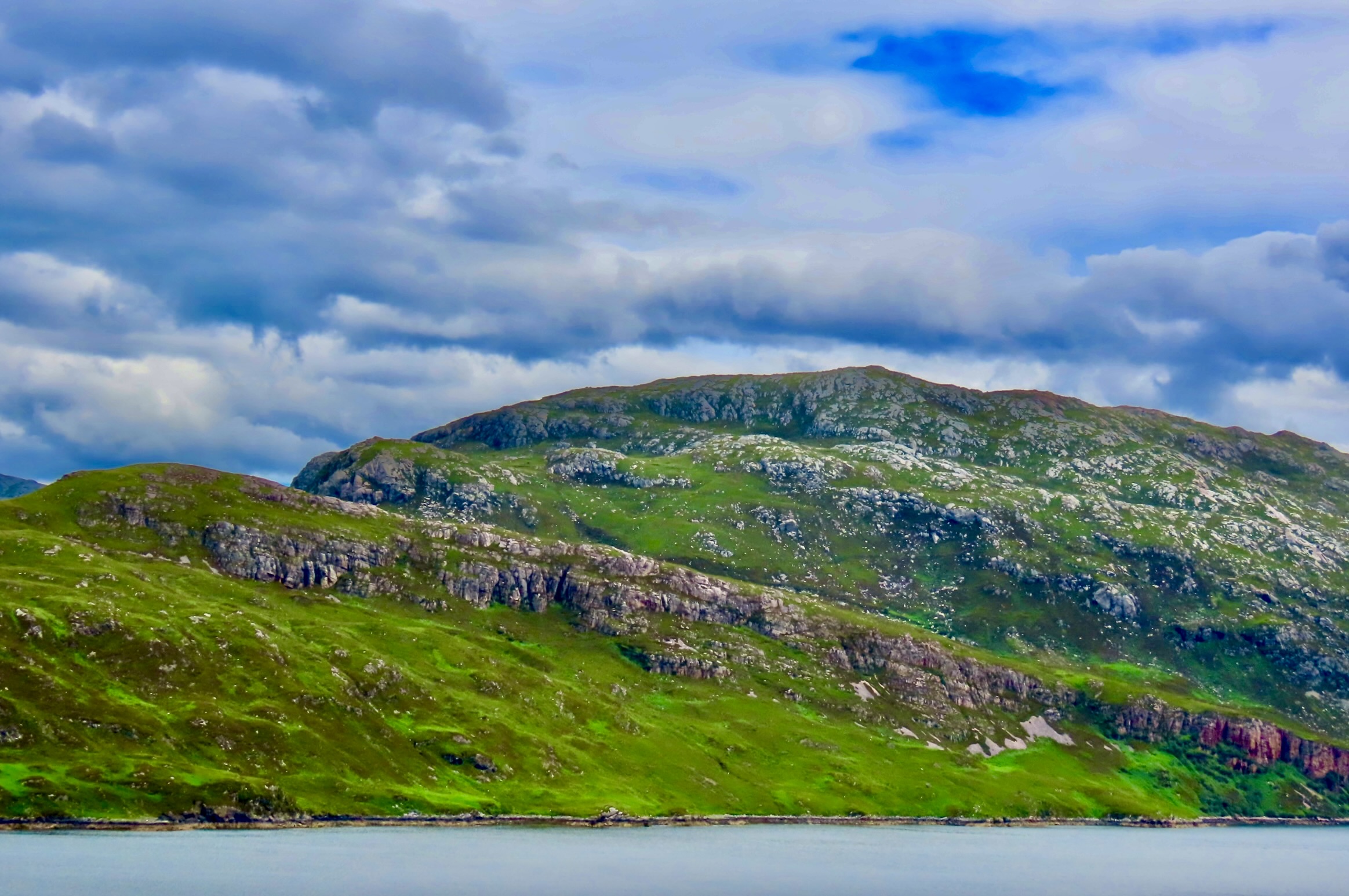
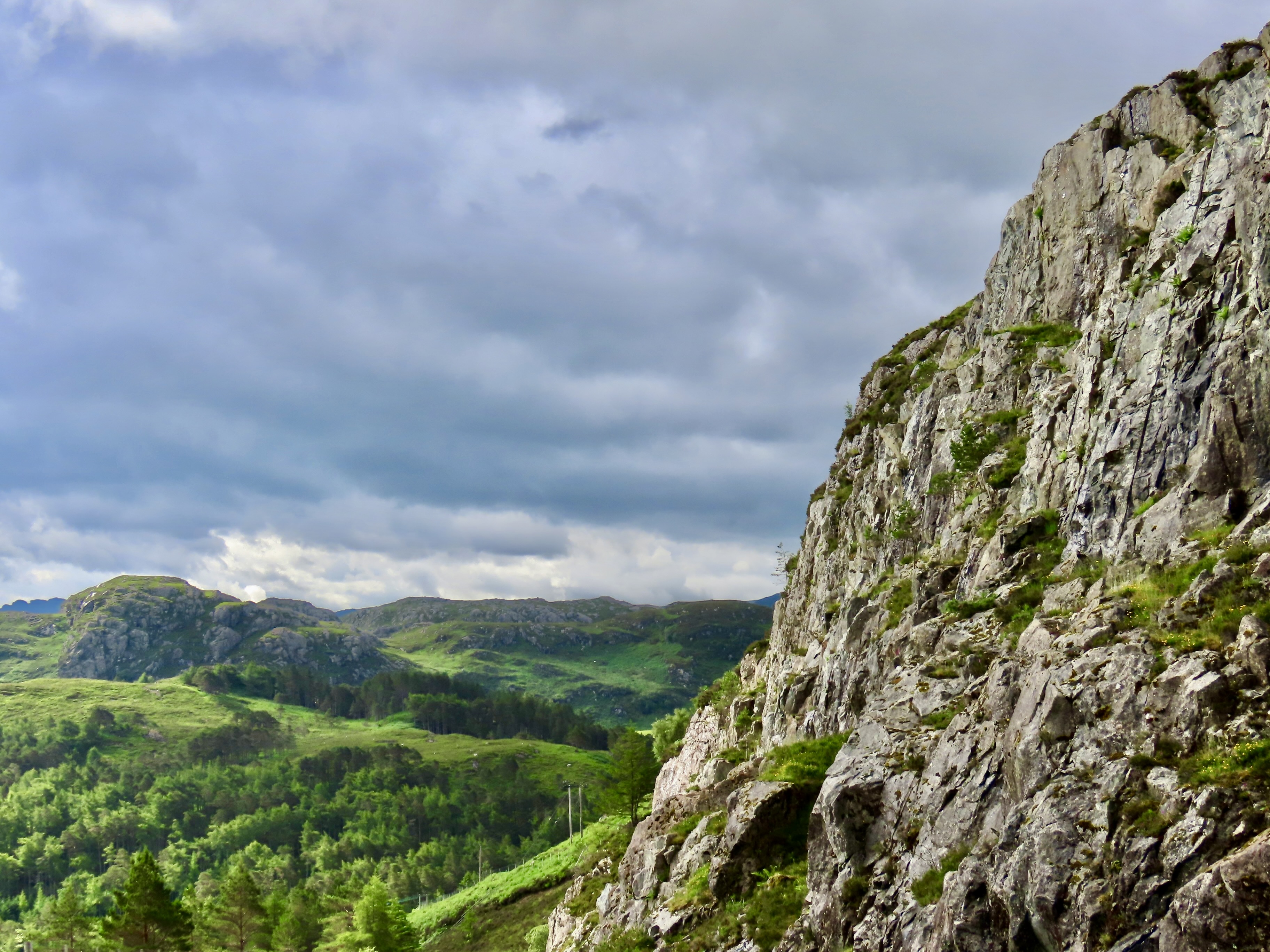
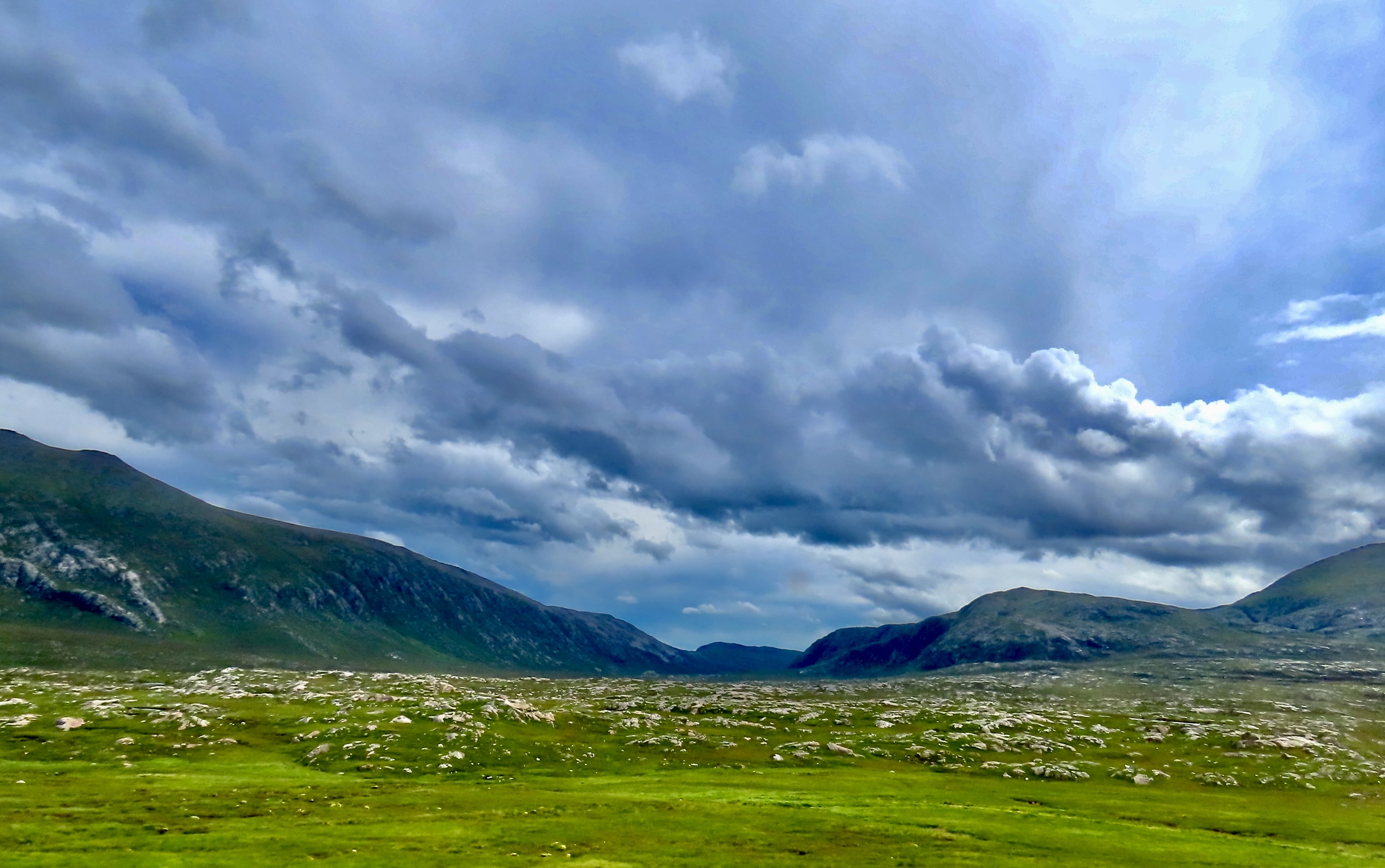
We are returning to our CIE Scotland tour that Peggy and I took along with our grandson Cody this summer. Today, I will be featuring the scenic beauty of the Scottish Highlands. All photos are taken by Peggy, Cody or me unless otherwise noted.
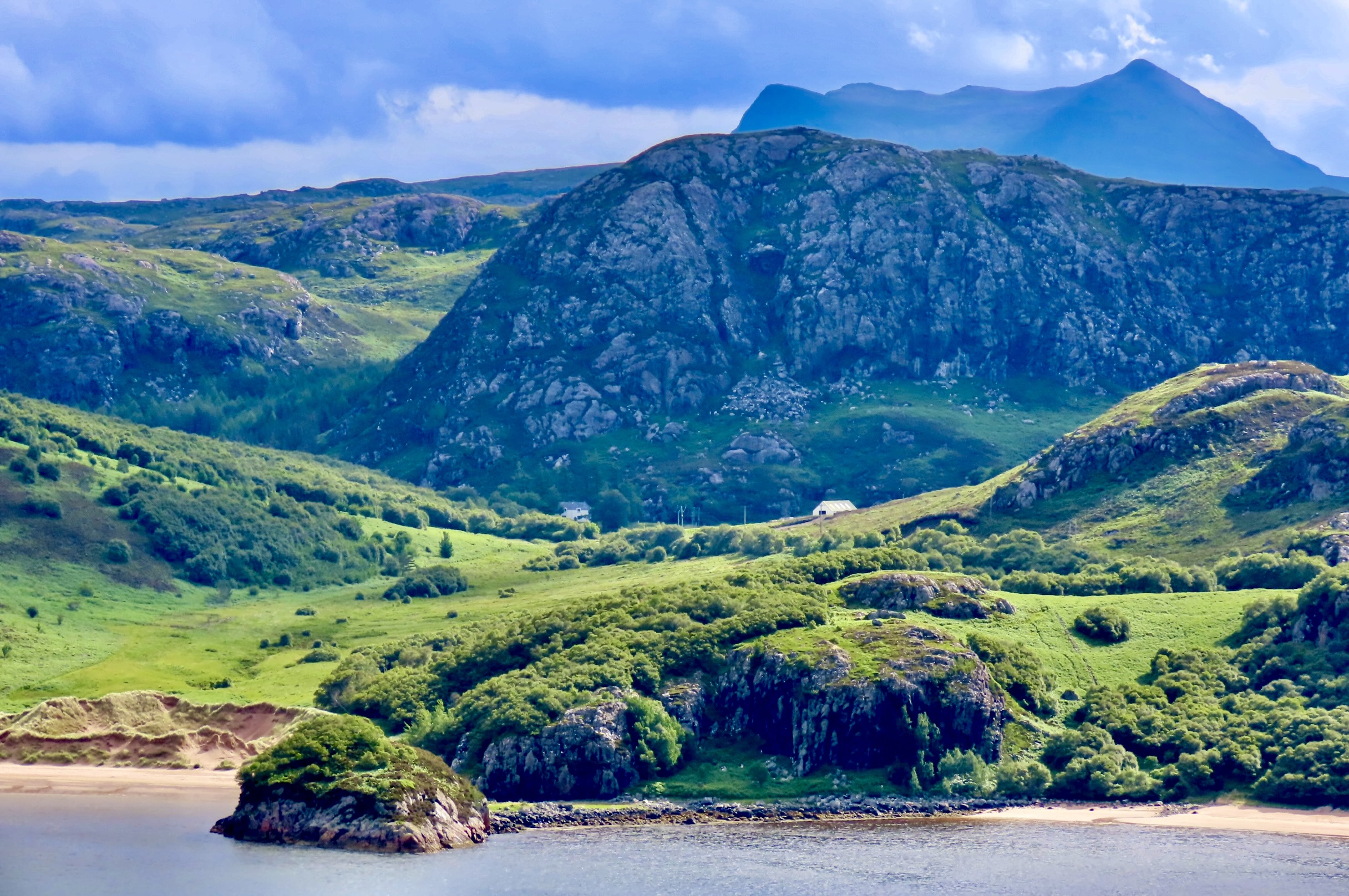
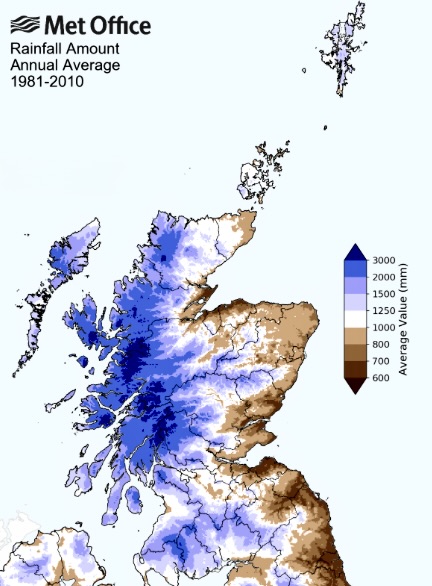
Between towering mountains, rocky, green landscapes, hanging cliffs, plunging waterfalls, lochs, and firths, the Scottish Highlands are world renown for their rugged beauty. They also feature vast open spaces with few people. Once there were more, but the wealthy landlords who owned the property forced the tenant farmers off of their ancestral communal lands because they could make more money off of large scale sheep and cattle farms in what was known as the Highland Clearances between 1750 and 1860. They were a dark blot on Scotlands History.There is a simple reason for all of the green. The highlands get a lot of rain: 118 to 177 inches (3,000 mm to 4,500 mm ) a year in the western mountains making them the wettest place in Europe. If you are visiting, expect to get wet. Bring appropriate clothing. Our tour was close to rain-free, however, even though dark clouds often hovered above us. Cody swore that it was the good luck he brought with him. We may have to travel more with the kid to test the theory.This UK Government map shows the rainfall in Scotland. It’s heaviest in the mountainous western region of the Highlands. The reason is the same as the reason for the heavy rainfall in Northern California, Oregon, and Washington where I lived and played for most of my life.
The jet stream flowing from west to east passes over the Pacific and Atlantic Oceans and soaks up evaporated moisture. When it reaches the mountainous regions of both the north coast of the US and the Scottish Highlands, it is driven up by the mountains and cooled, which reduces the amount of water the air can hold. Rain, snow, sleet, hail, etc. are the results. It’s called orographic relief if you want to impress your friends. I think of having a full bladder and dashing for a restroom. Relief! Less rain on the east side of the mountains is called the rain shadow effect. There are two reasons. One, obviously, the air has lost much of its water. Two, as the air rushes down the mountains, it heats up and can hold more. The annual rainfall on the east coast of Scotland ranges from 28-31 inches (700-800 mm).
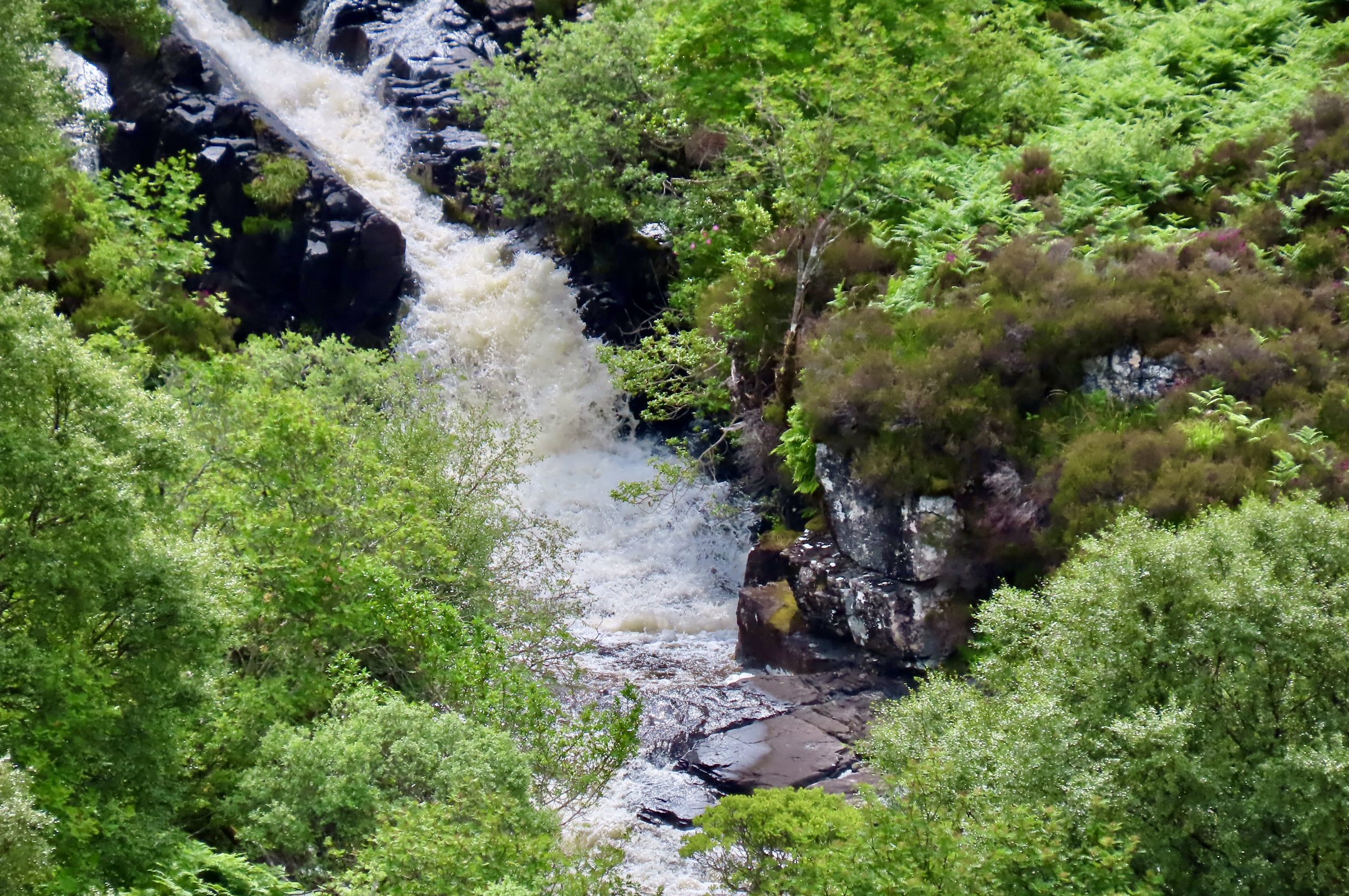
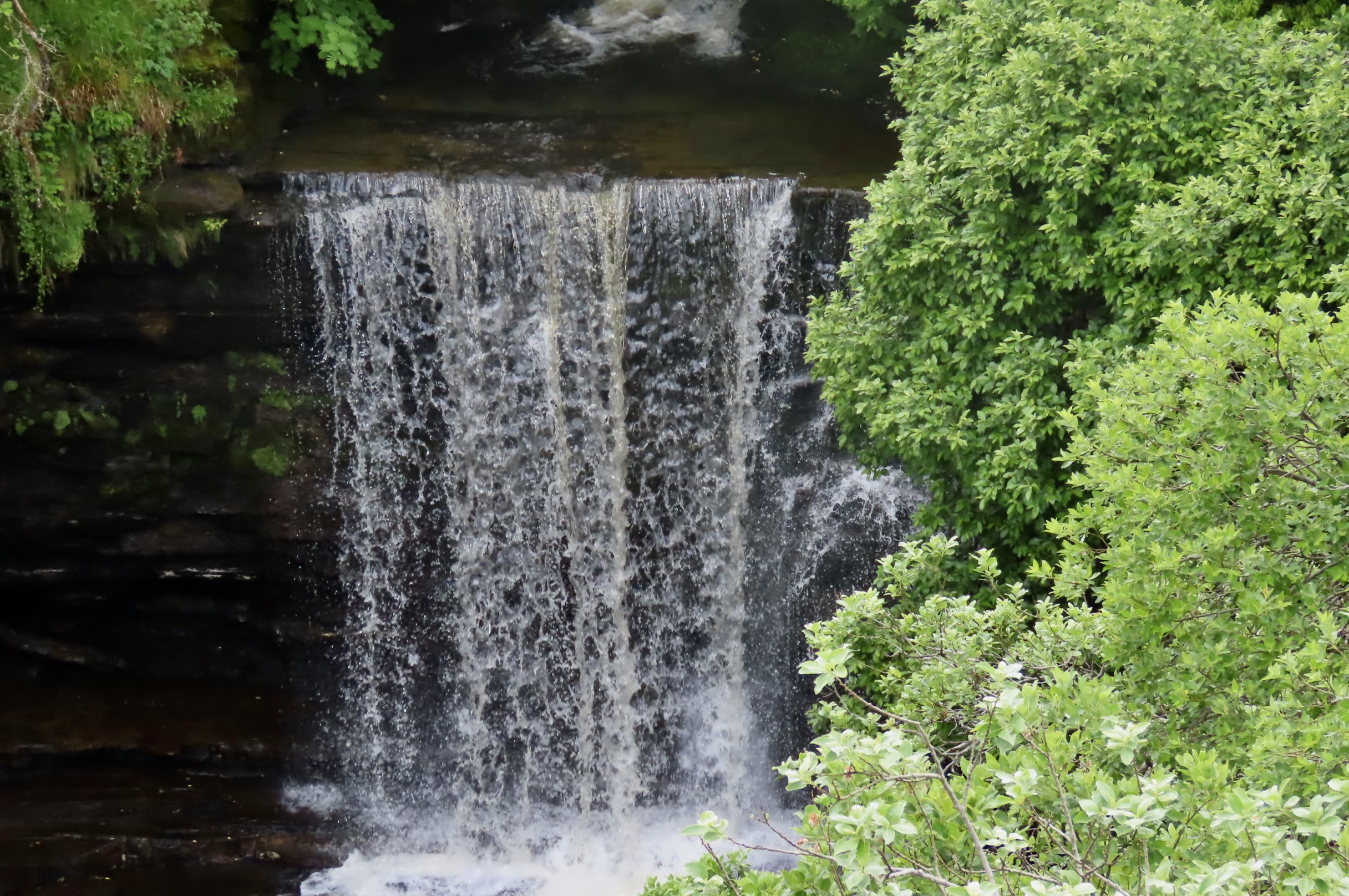
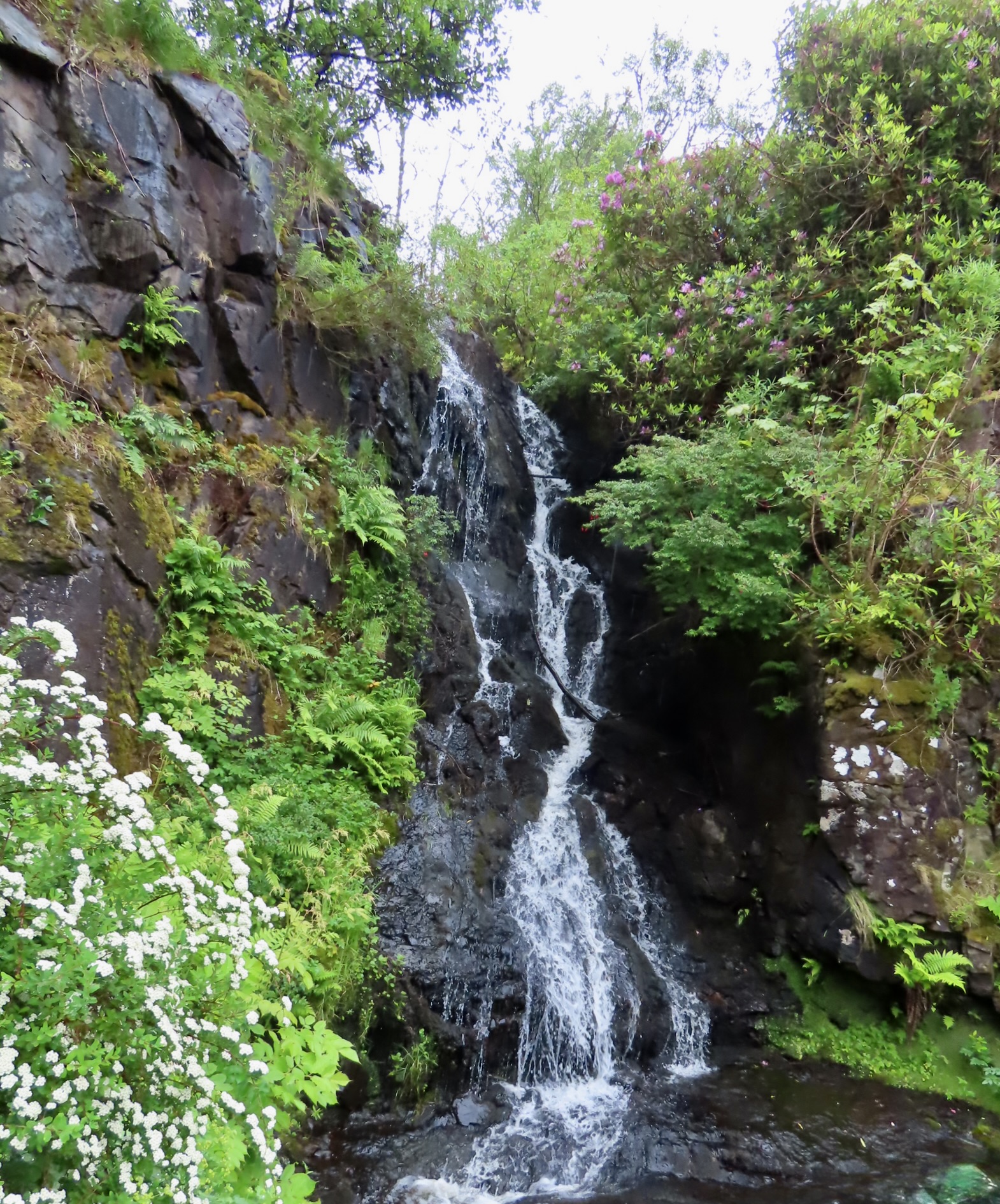
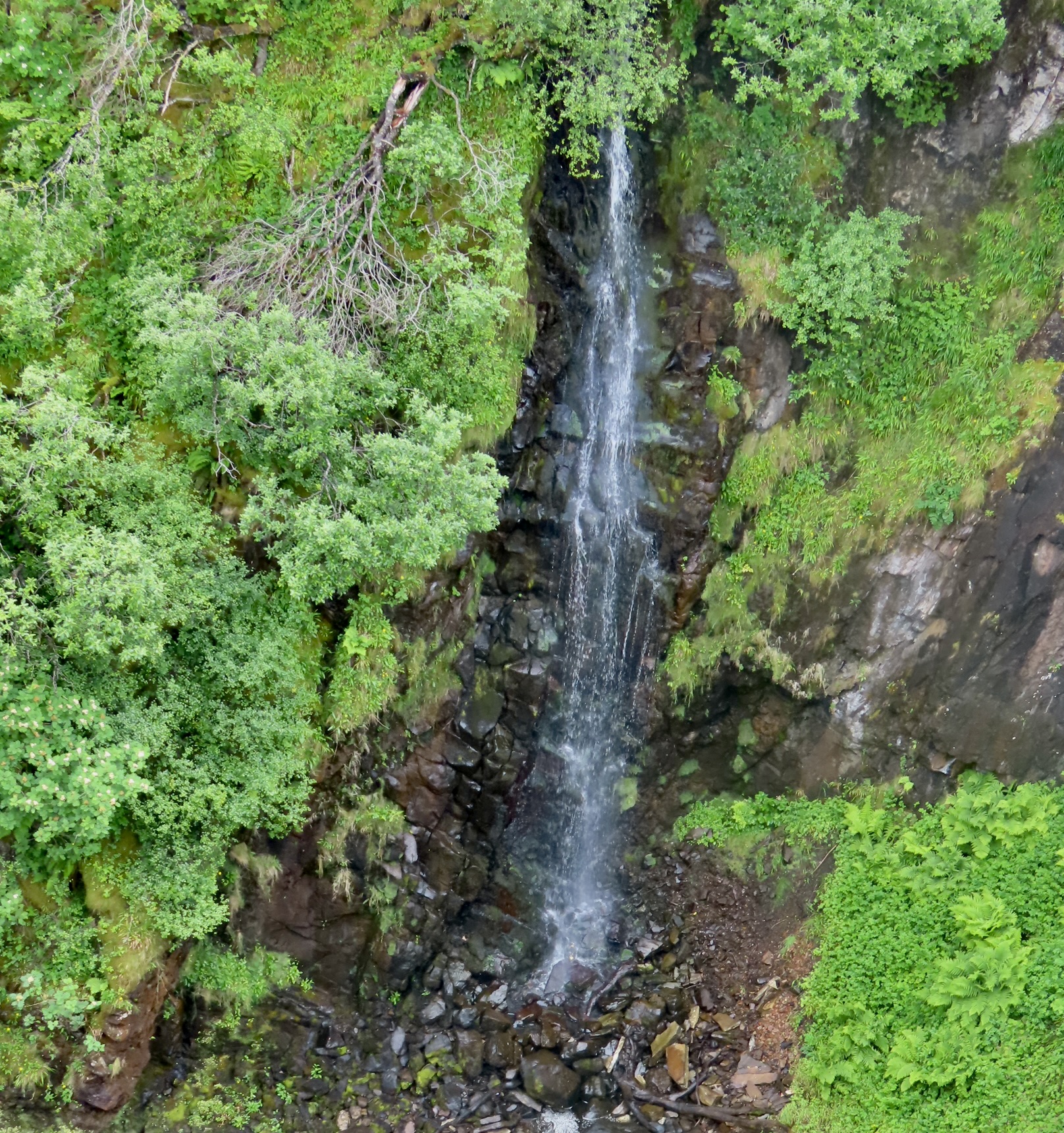
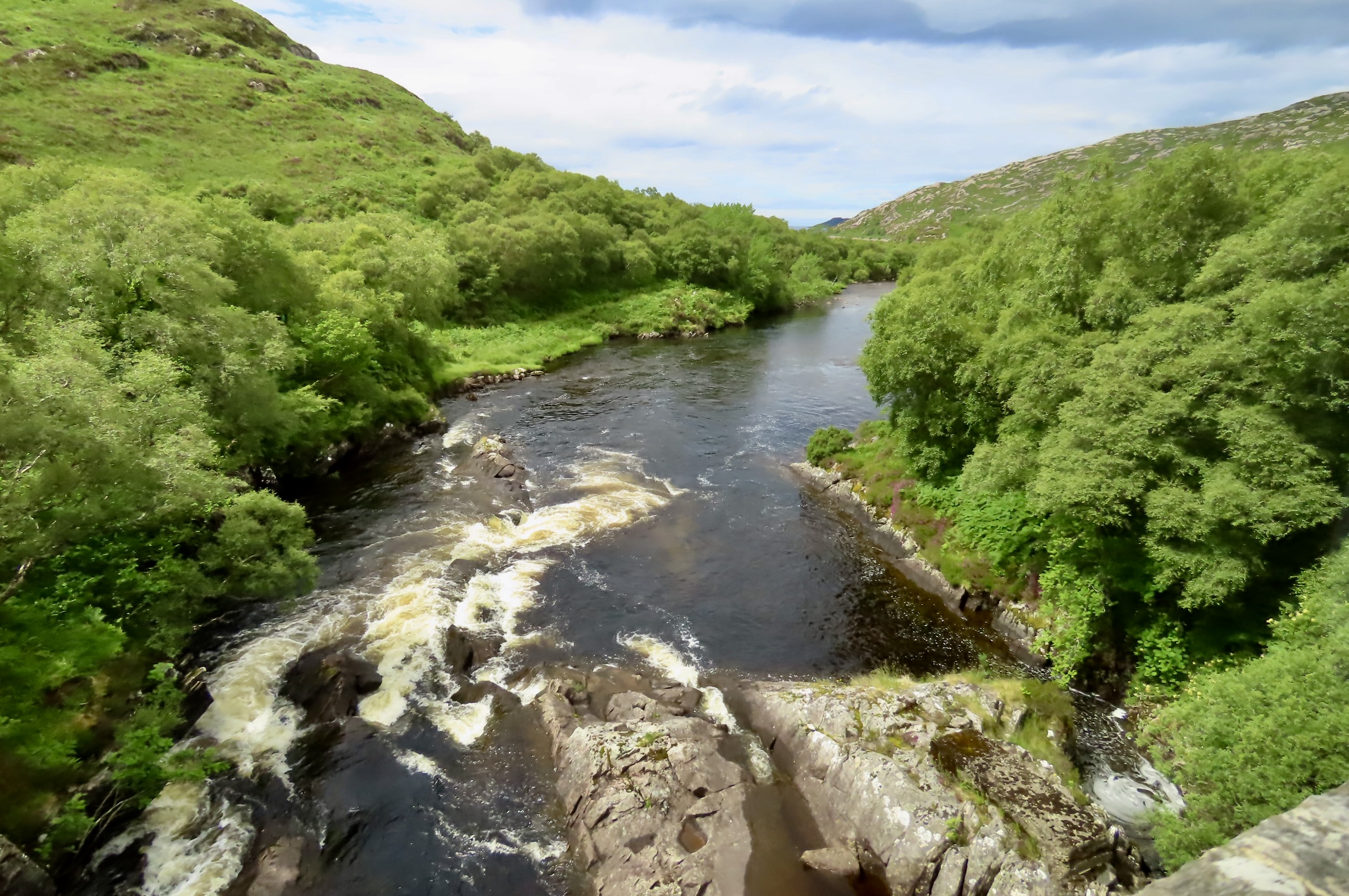
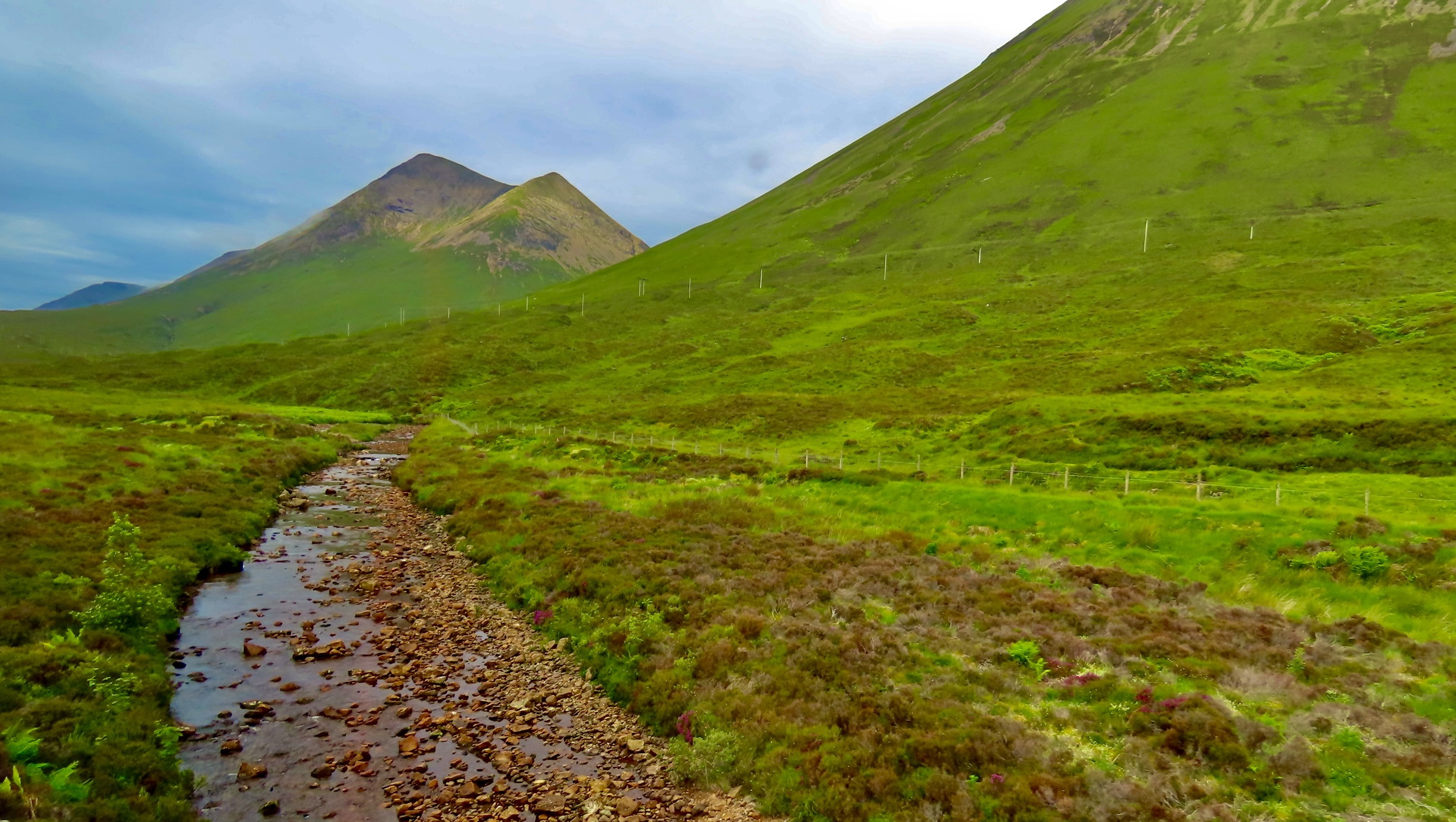
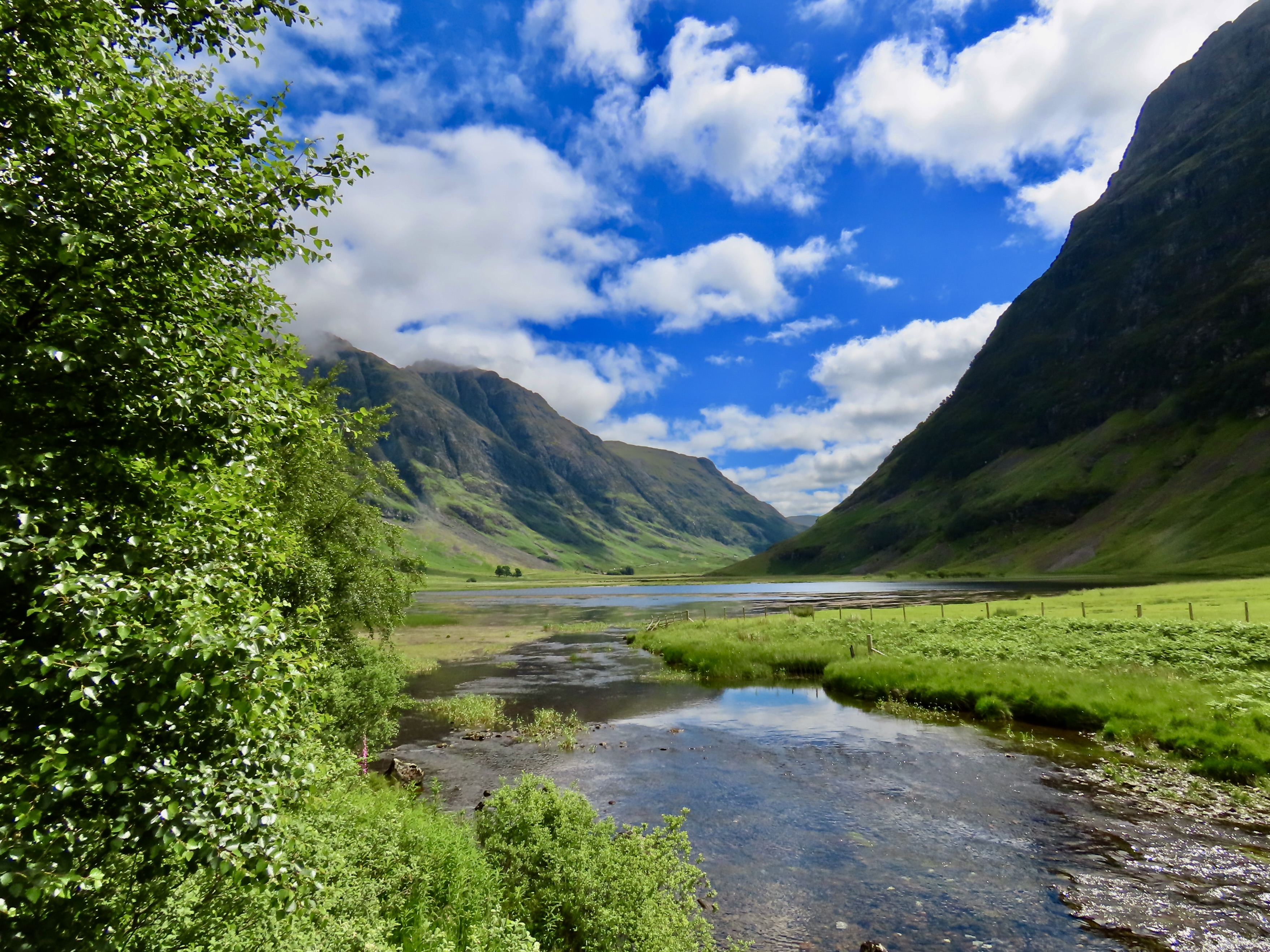
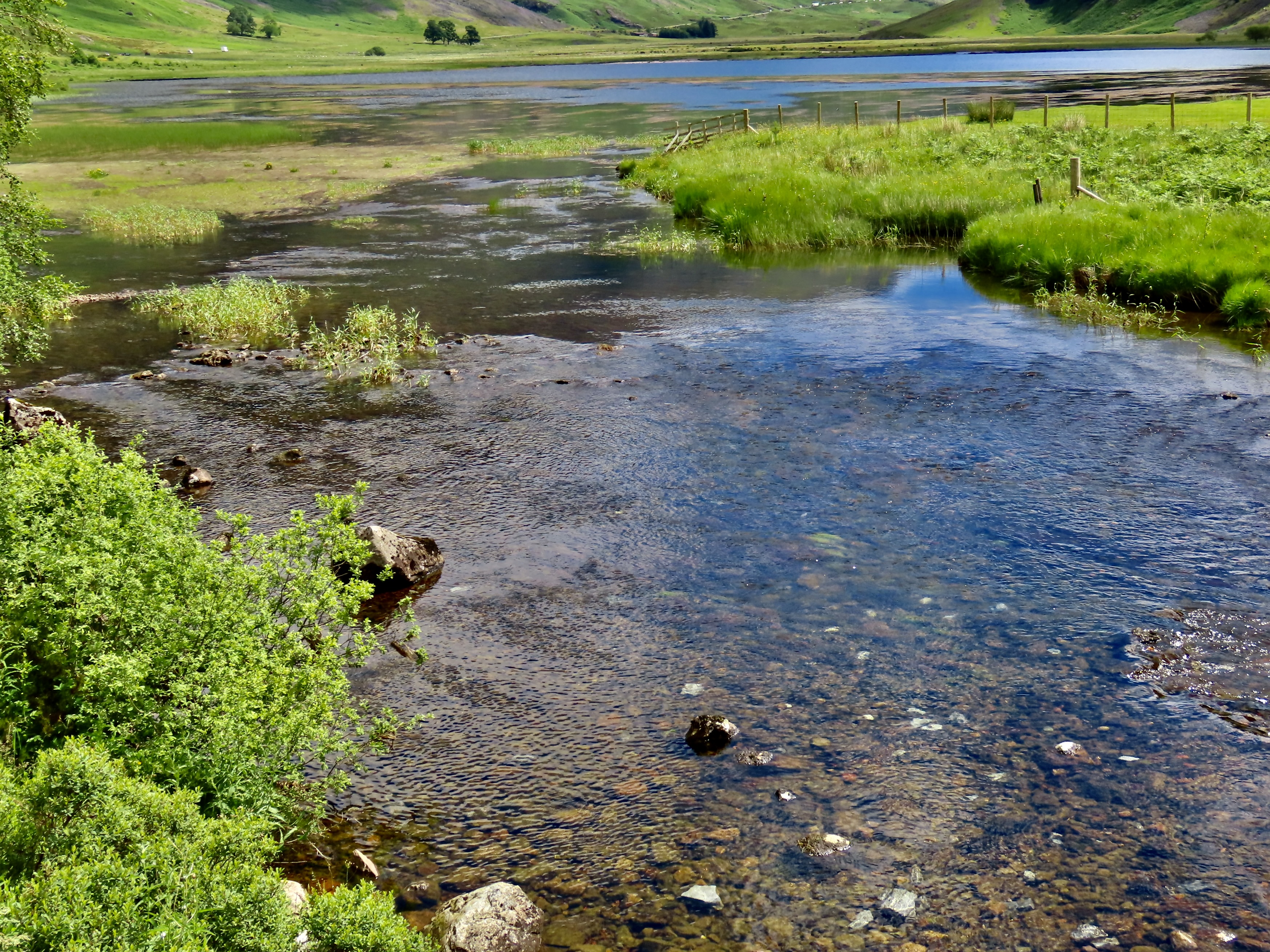
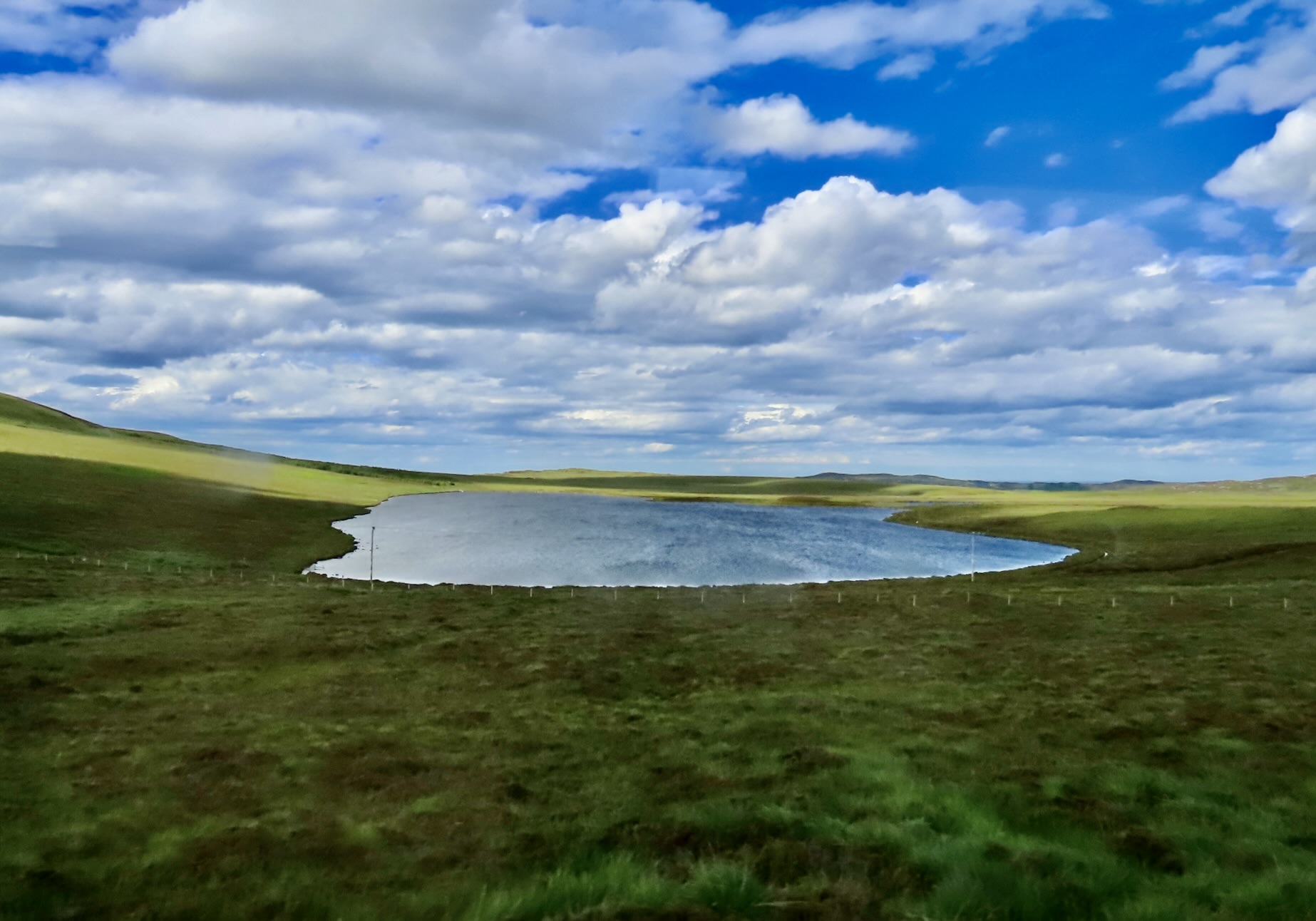
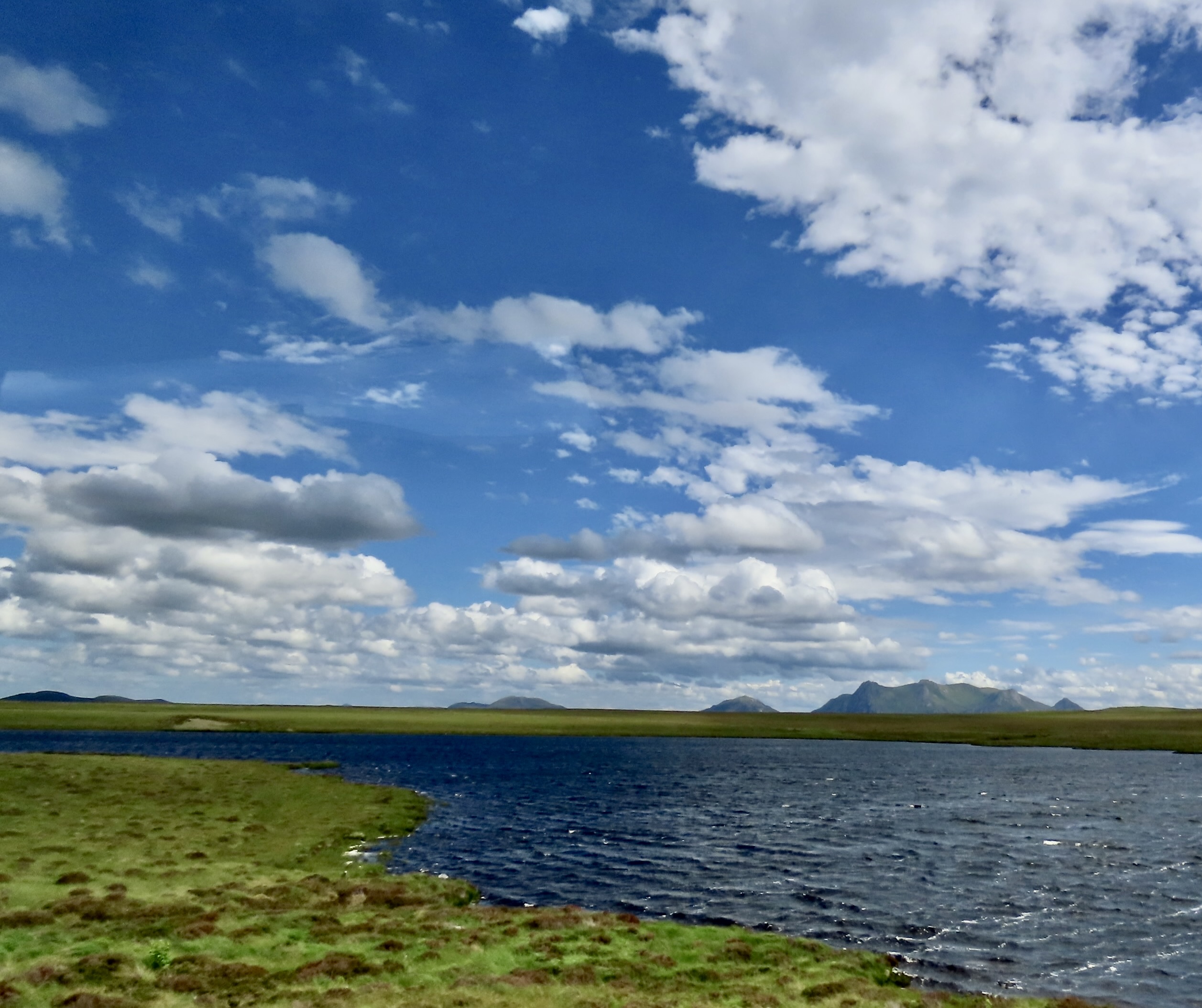
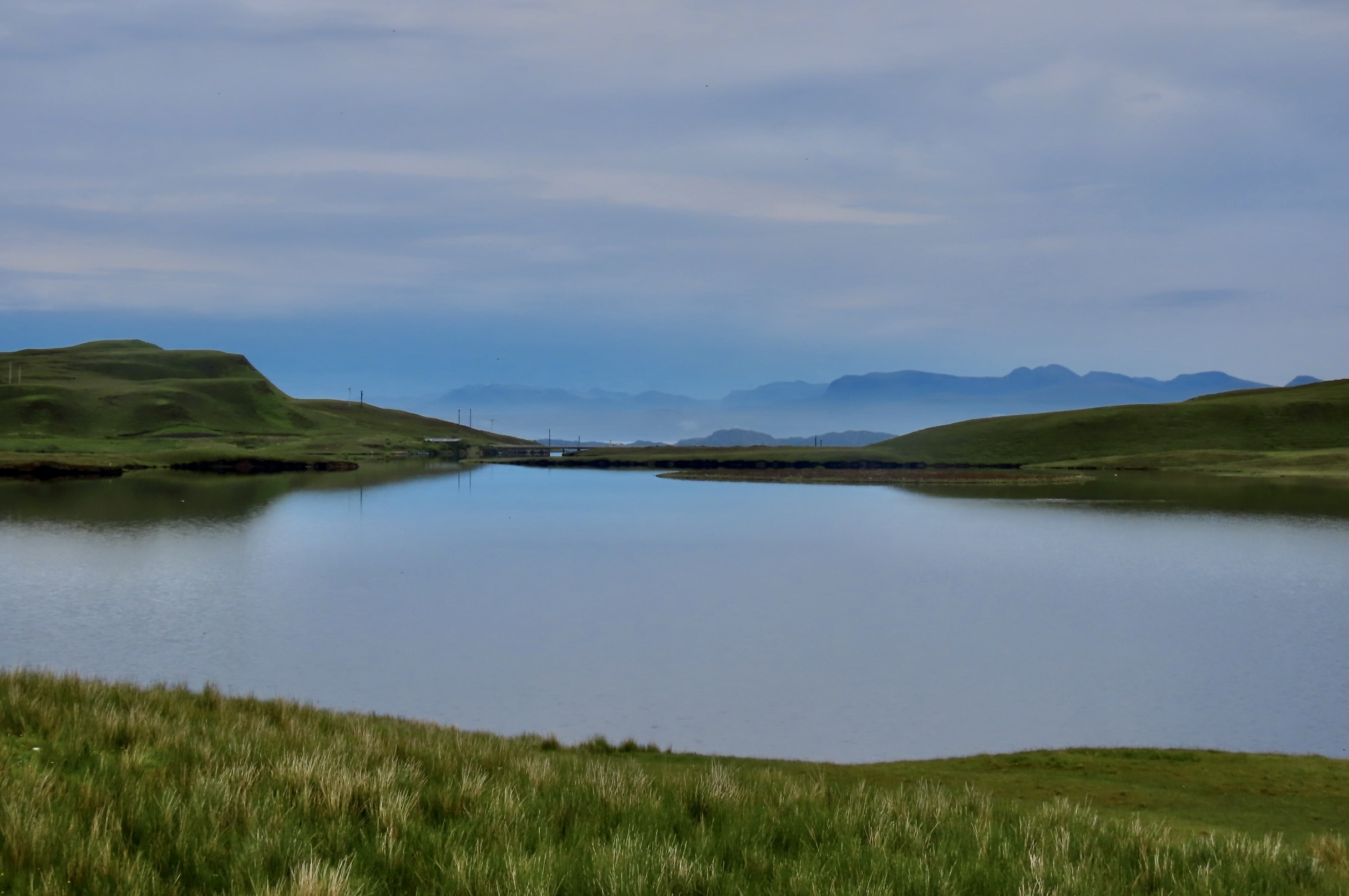
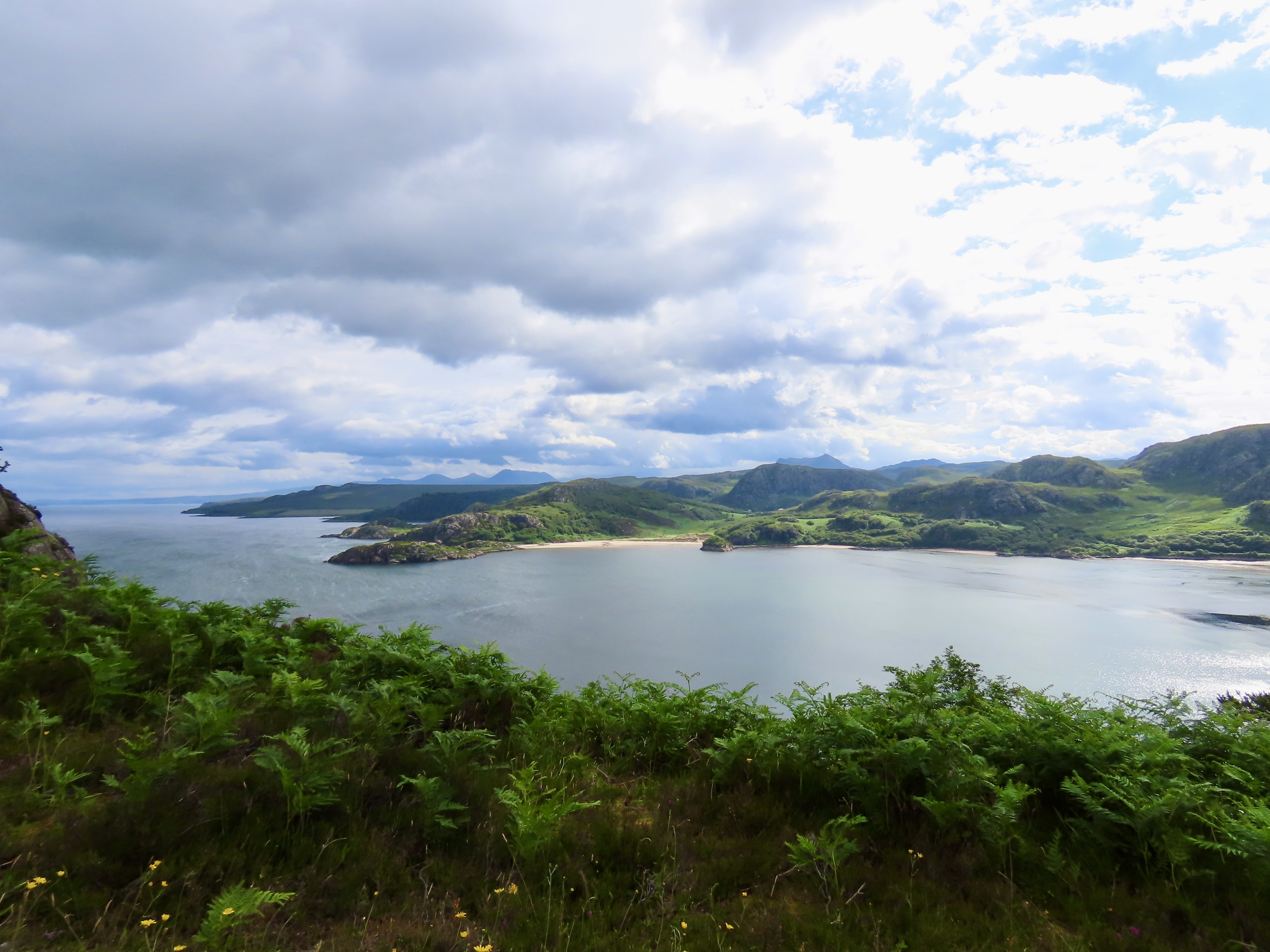
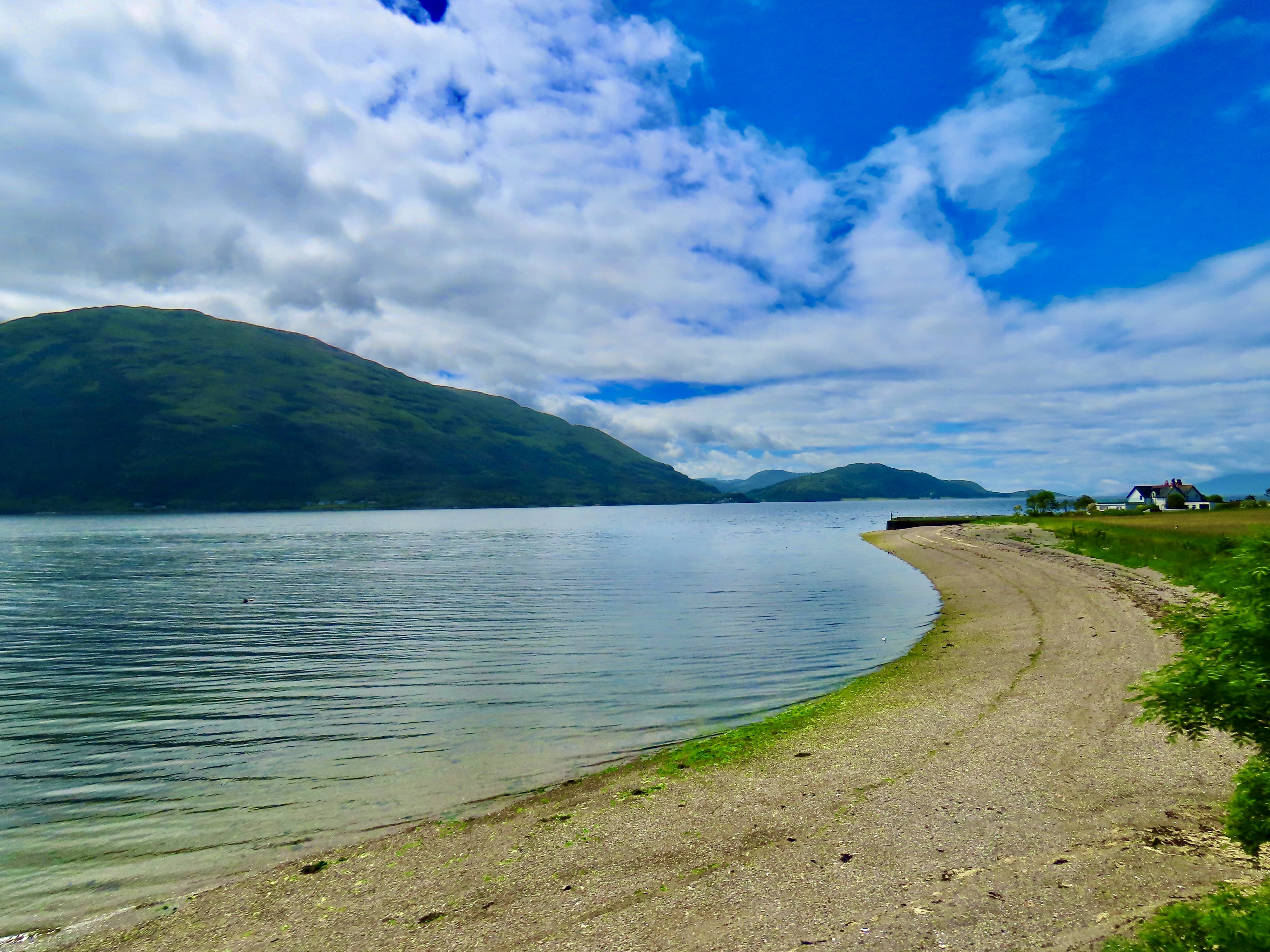
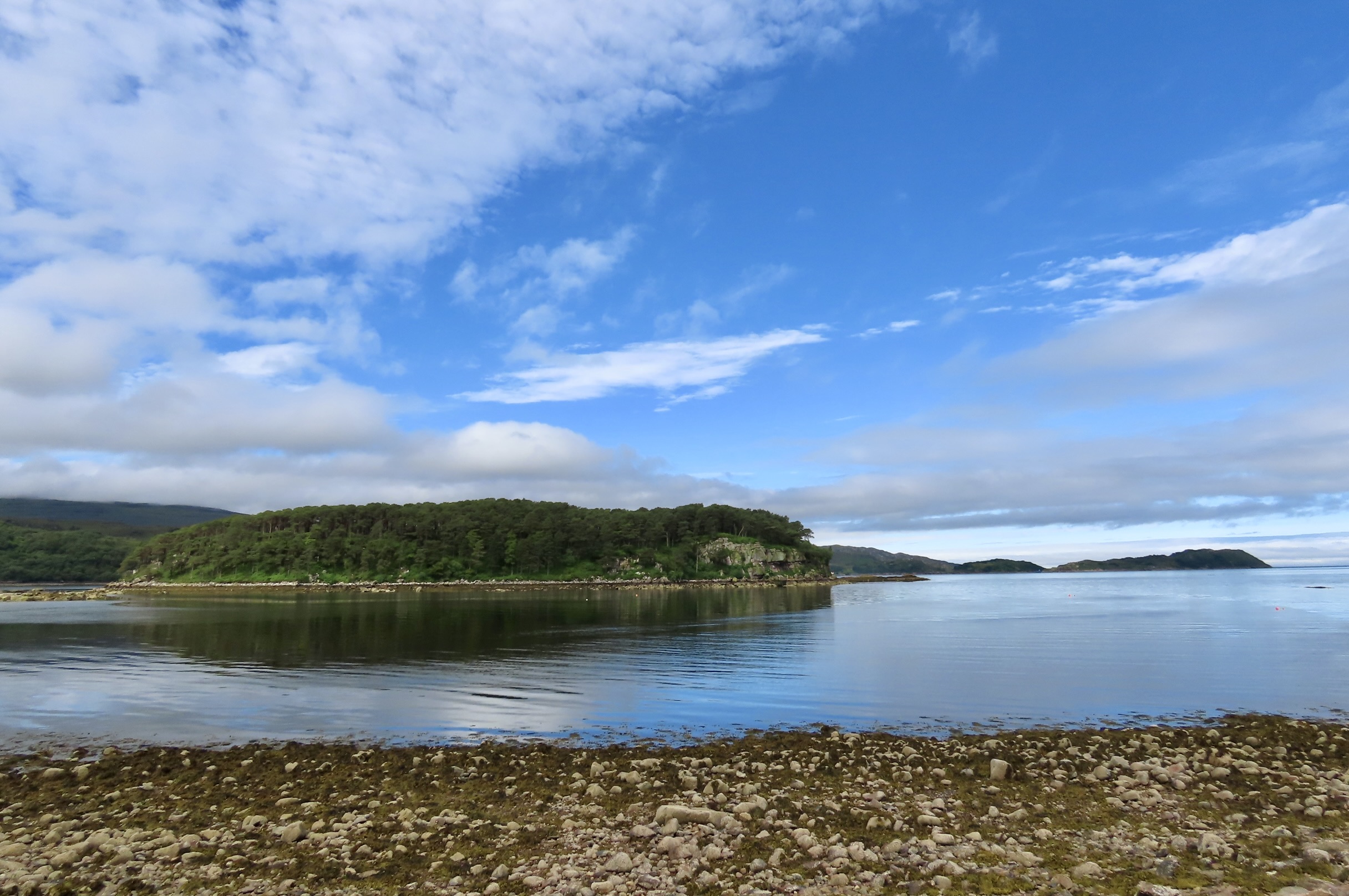
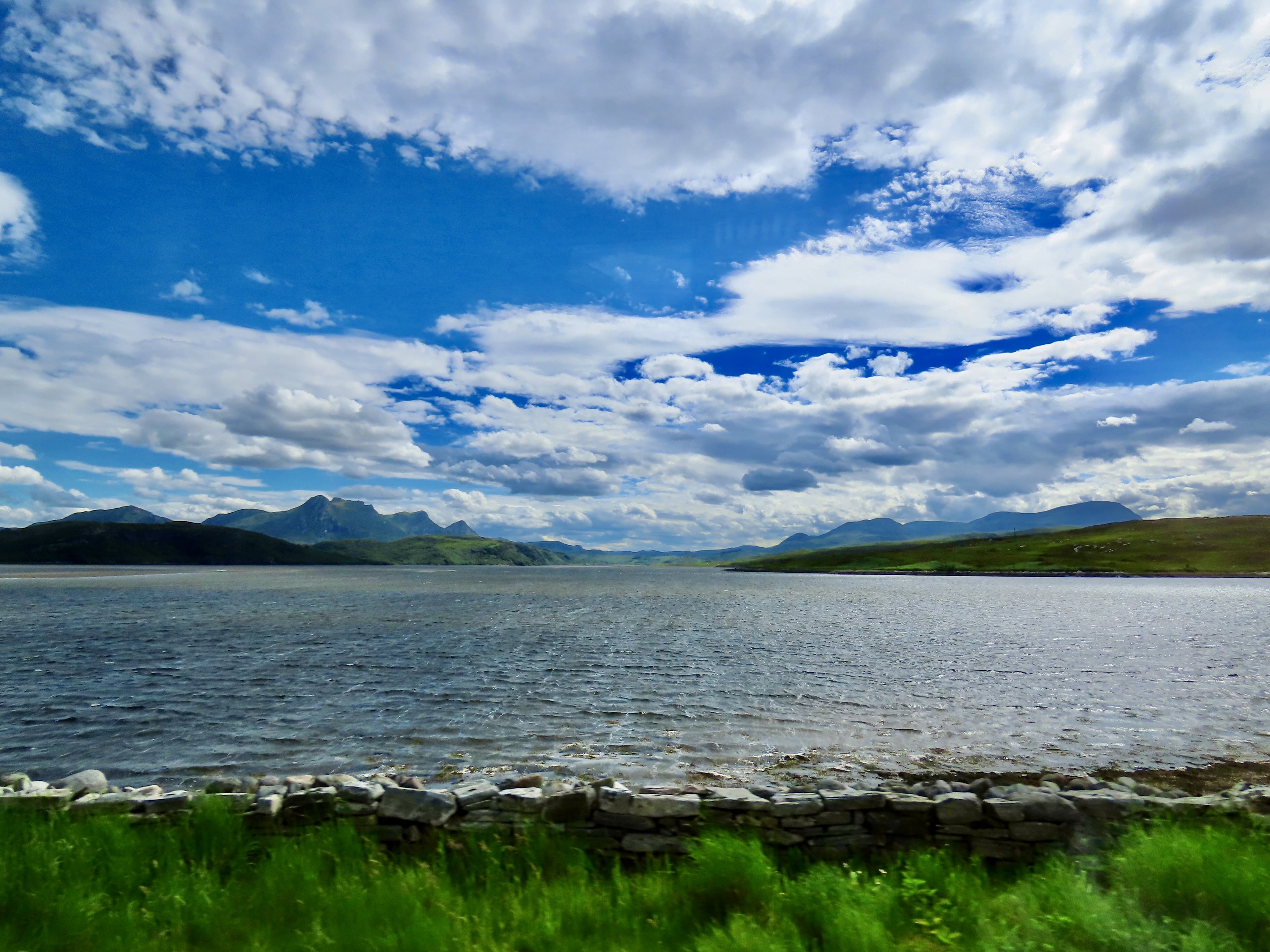
All of the water rushing down the mountains can lead to crashing waterfalls.And more quiet…But still beautiful…Waterfalls.The rainfall also leads to roaring rivers…Quiet streams, and…Lochs (lakes to the uninitiated). They are everywhere. This one combines a loch, a stream and mountains.A closer view of the stream.One of my favorite lochs.And one of Peggy’s.This was another beauty. I think it was a loch, although it might have been part of a firth. A firth is the Scotch/English word for a long, narrow inlet from the sea, like San Francisco Bay.Given that Scotland is surrounded by oceans, it isn’t surprising that there are numerous firths. Like lochs, they add to the beauty of Northern Scotland.This one came with a long, sandy beach. The lone home at the end of the beach speaks to the vast open spaces of the Scottish Highlands with few people. Once there were more, but the wealthy landlords who owned the property forced the tenant farmers off of their ancestral communal lands because they could make more money off of large scale sheep and cattle farms in what was known as the Highland Clearances between 1750 and 1860. They were a dark blot on Scotland’s History. The homes of the tenant farmers were usually burned down so the farmers wouldn’t return. Thousands ended up migrating. Others scratched by as best they could on small farms, crofts, along the coast.This firth came with Cody.It also featured an attractive island.Another favorite photo.While the green landscape, rivers, lochs and firths are an essential part of the Highlands’ beauty, we are talking Highlands— and that translates into mountains.
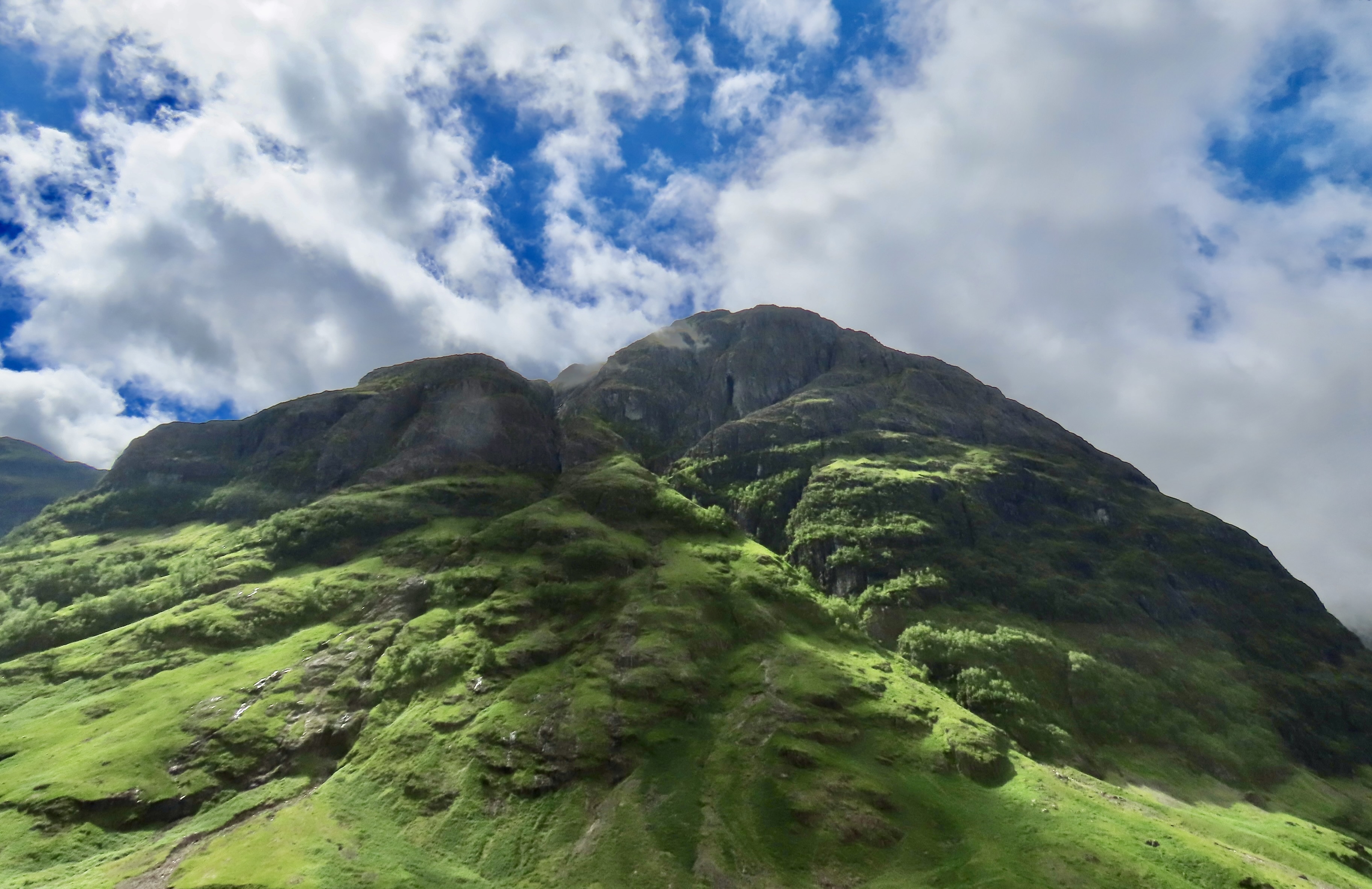
While they only reach 3000 feet (914 meters) in height, their lack in elevation does not take away from their beauty and ruggedness. Here’s something to contemplate: They were once as high as the Himalayas, around 20,000 feet (6,100 meters). Four hundred million years of erosion can wear you down a bit, however. It’s apparent in this photo that a lot of erosion is still taking place. The mountains were created when Scotland and England crashed into each other around 500 million years ago. They didn’t always hang out together. Once they were part of two different continents separated by the no longer existing ocean of Iapetus. Northern Scotland belonged to the ancient continent of Laurentia, occupying a landmass with North America. England was part of a smaller continent far to the south known as Avalonia. Plate tectonics did away with Iapetus and brought Scotland and England crashing together in the Caledonian Orogeny, the event that raised the Scottish Highlands to their Himalayan heights.
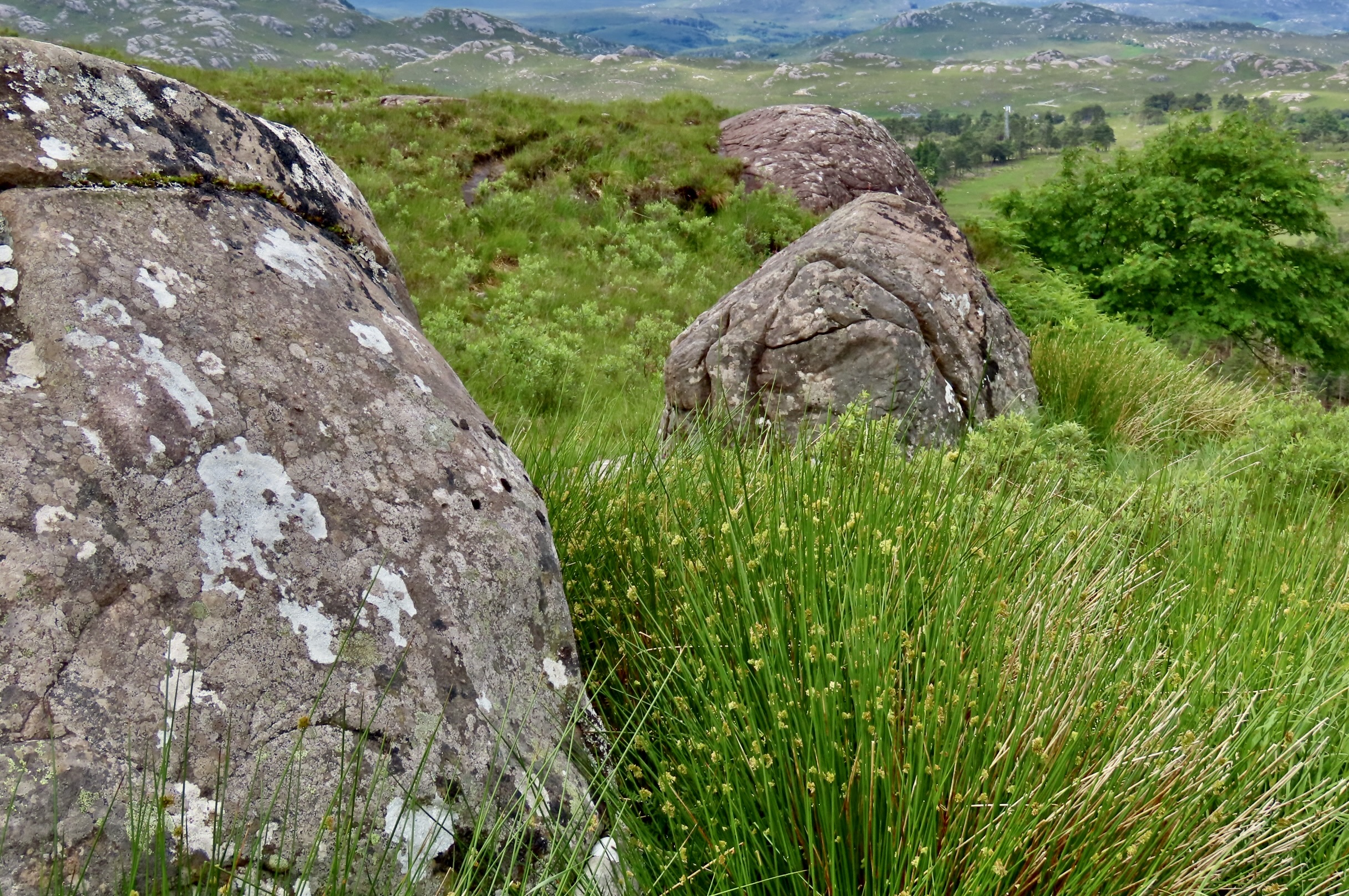
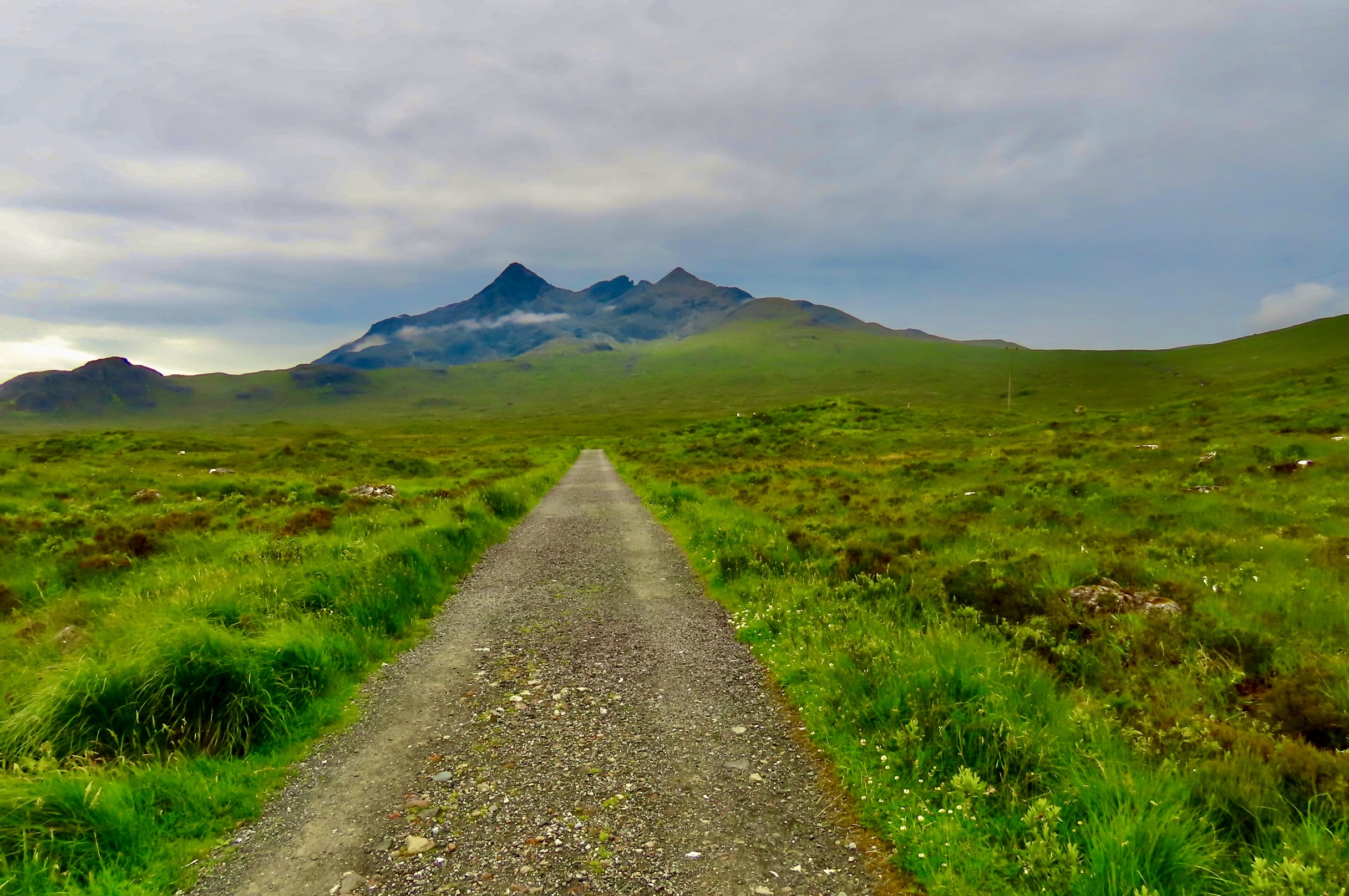
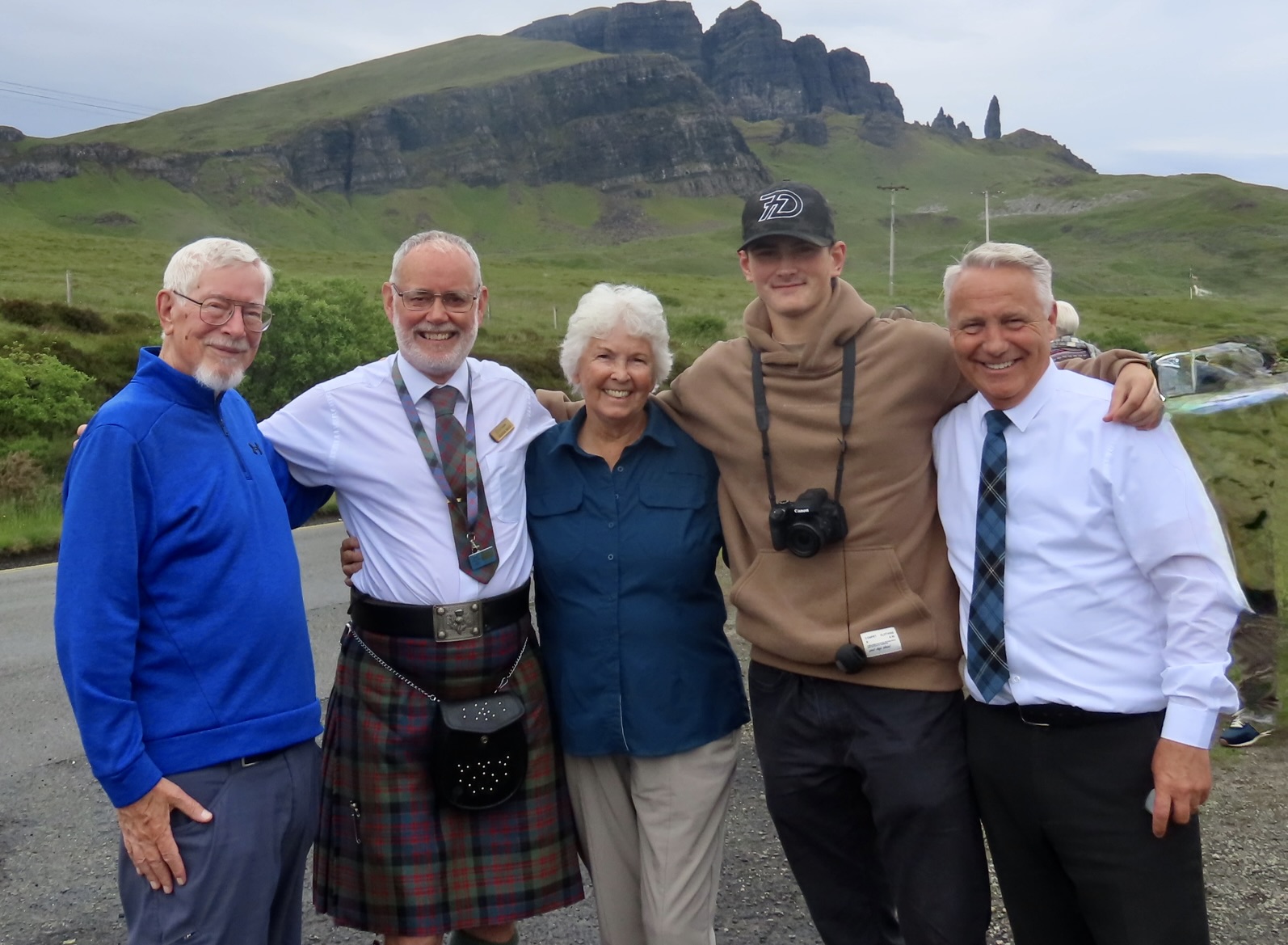
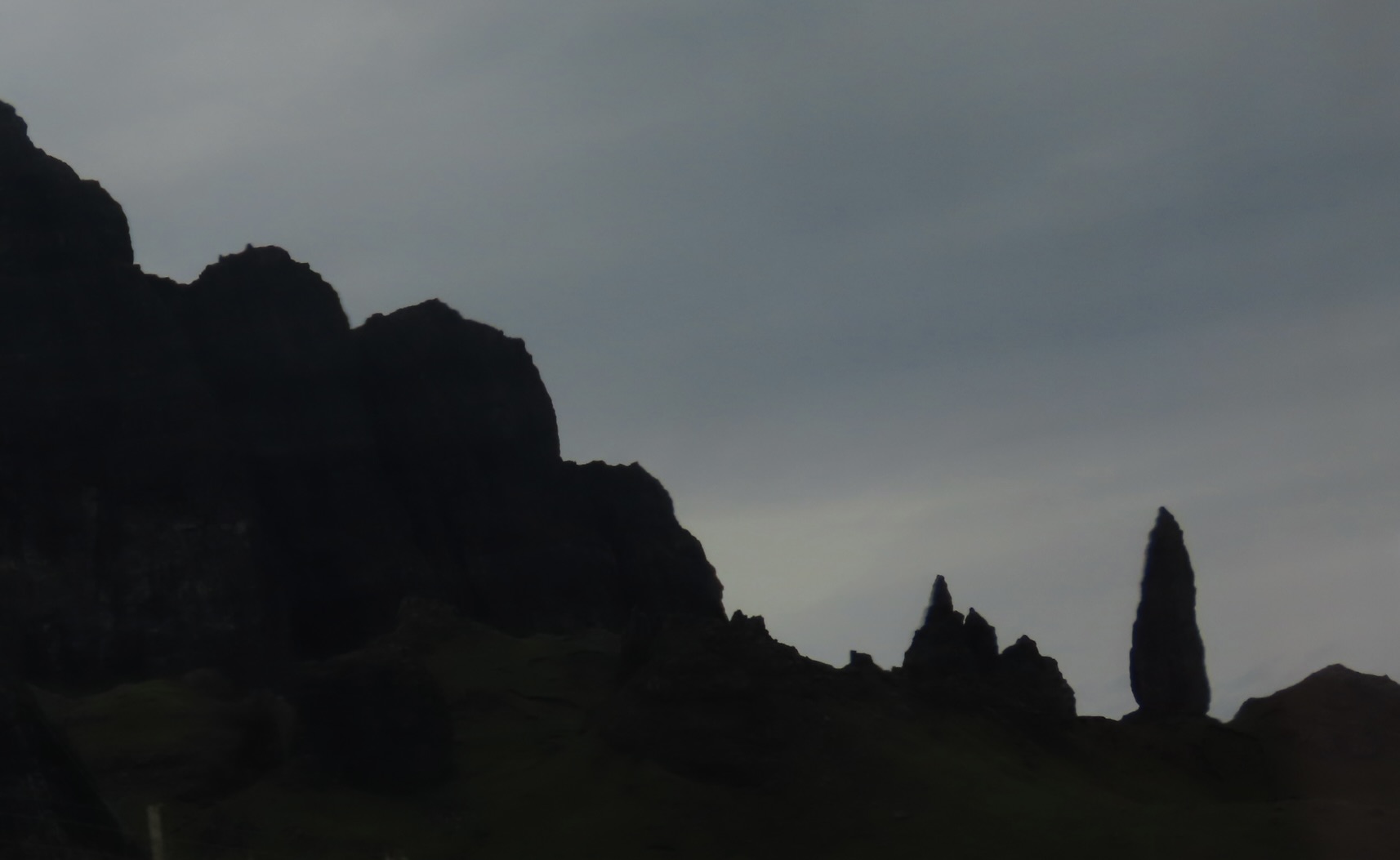
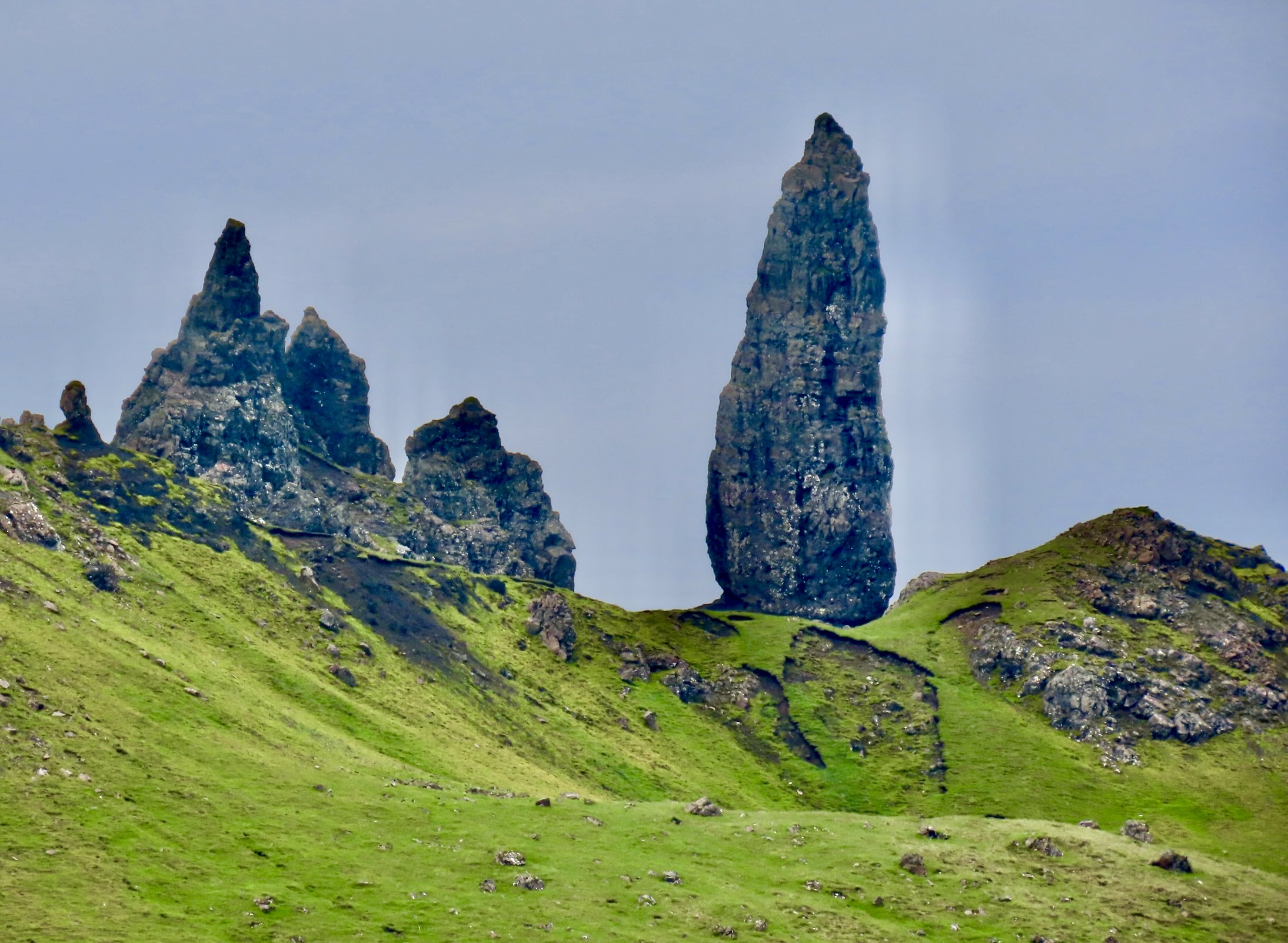
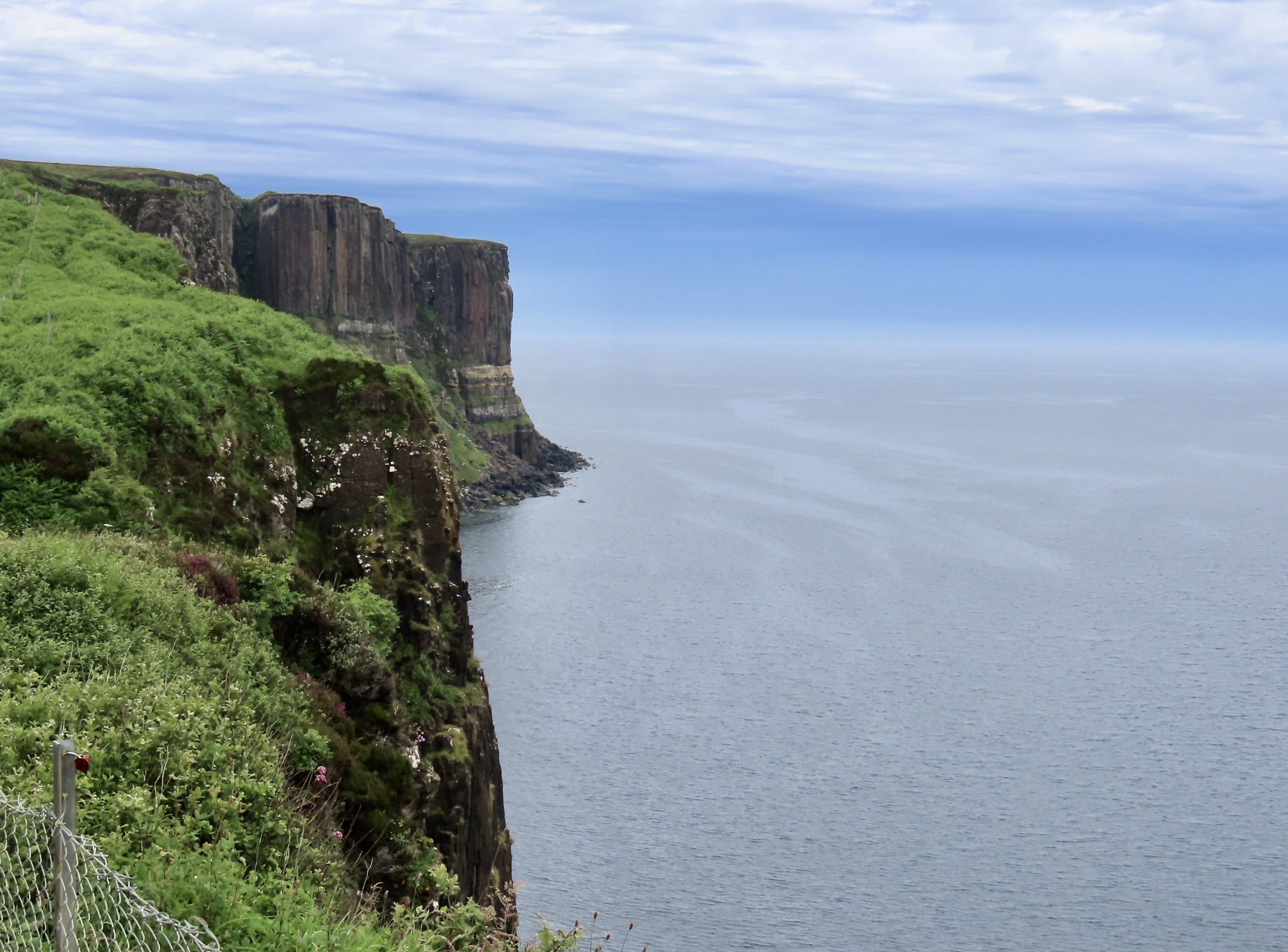
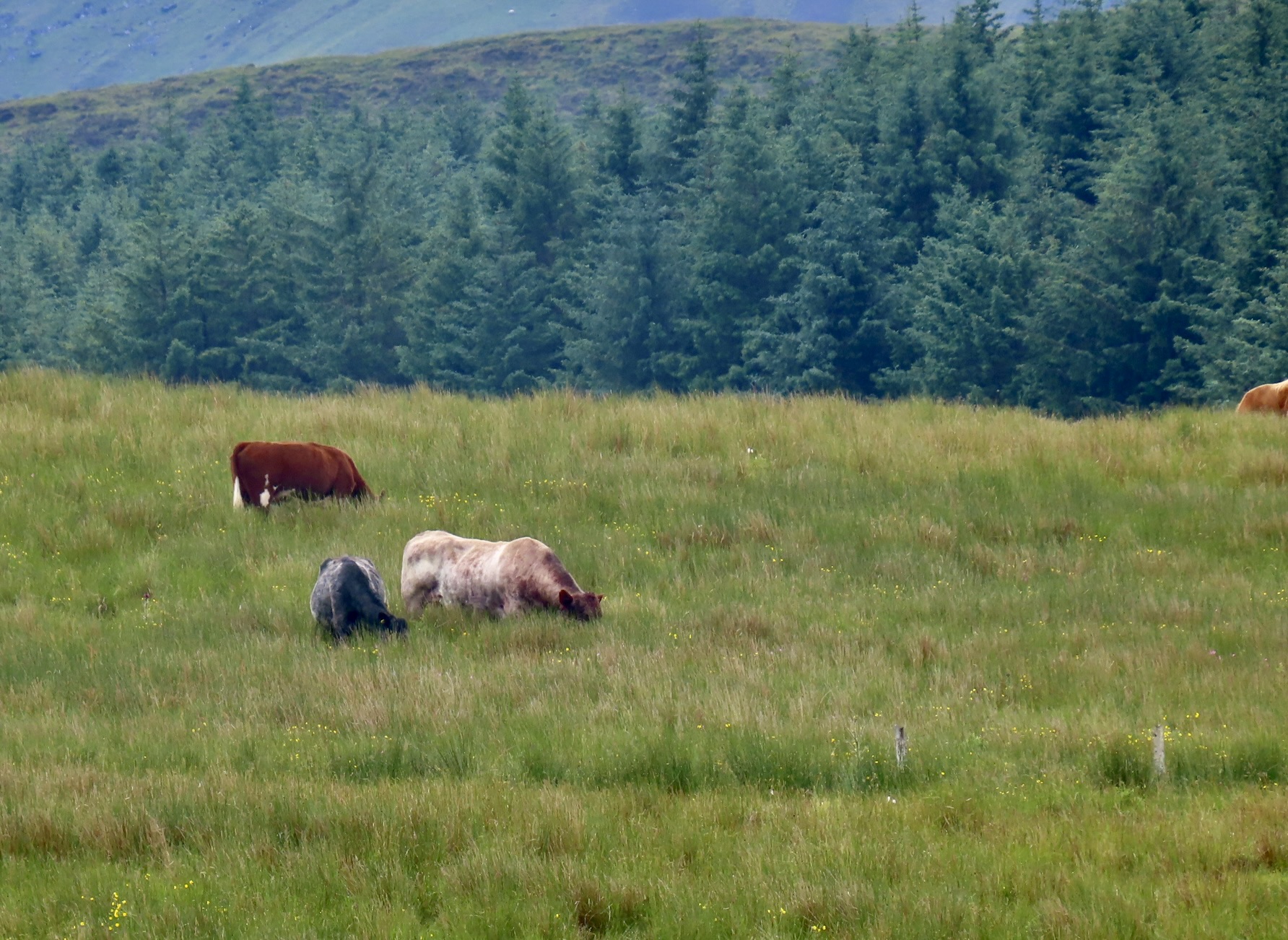
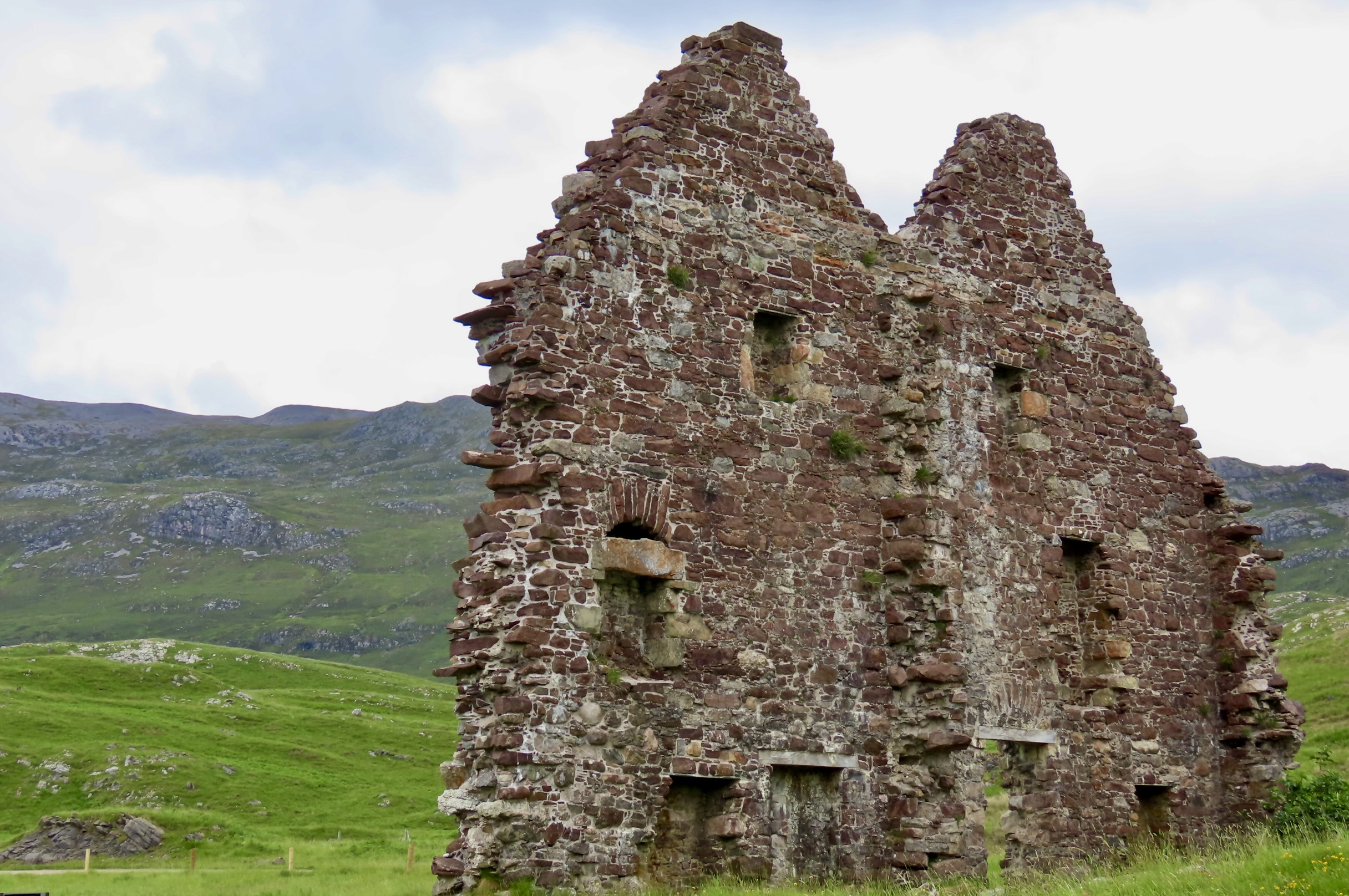
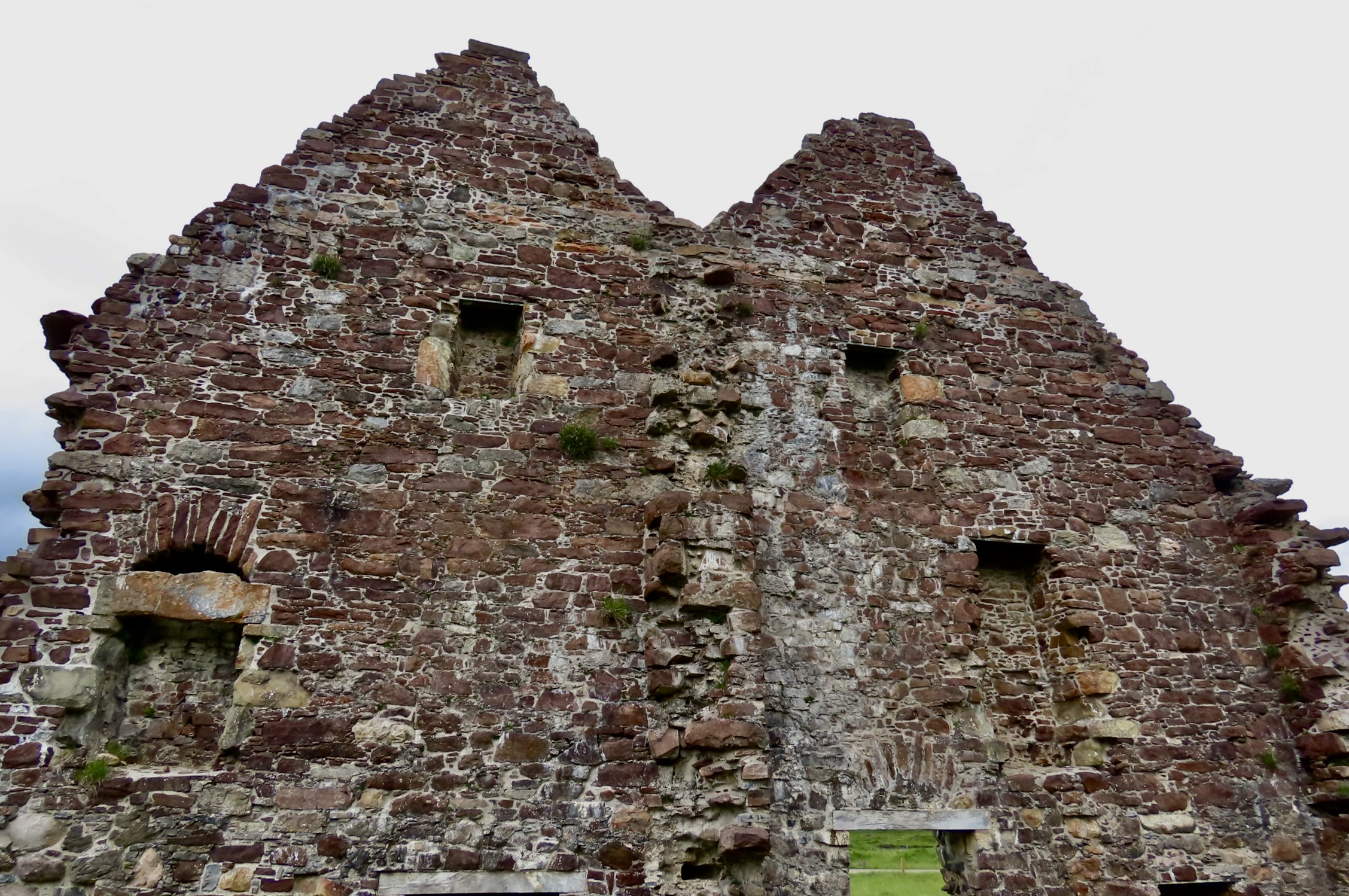
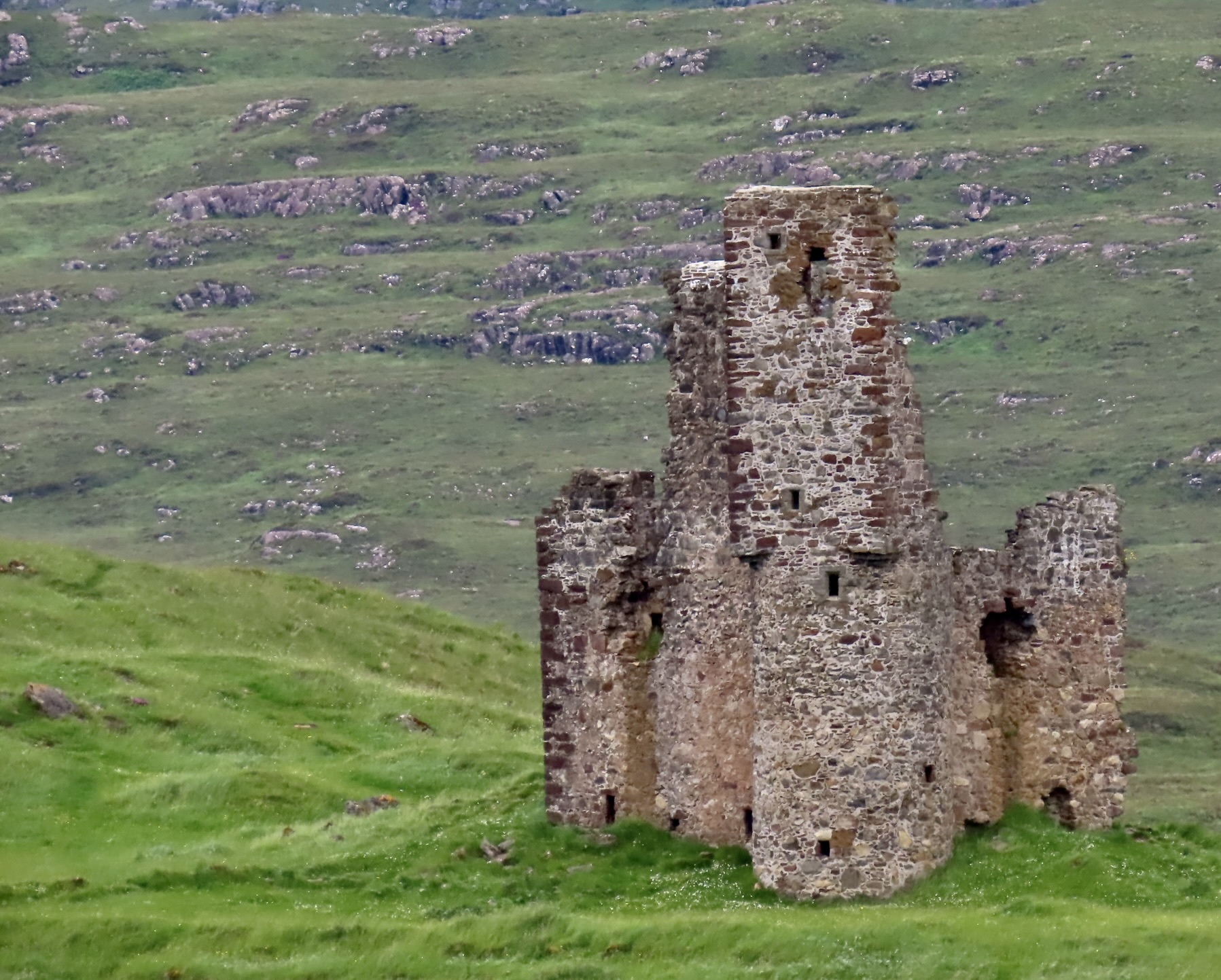
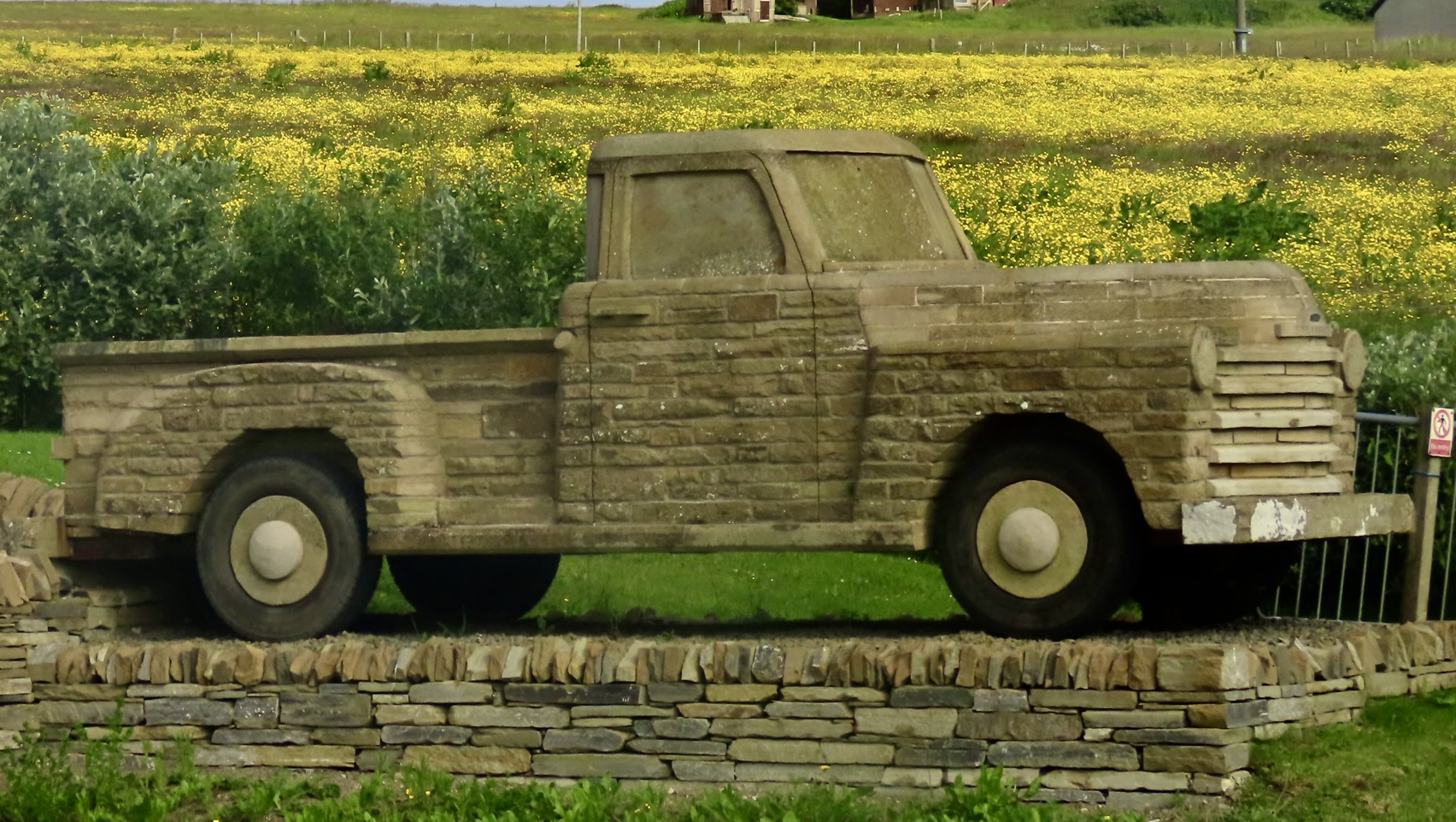
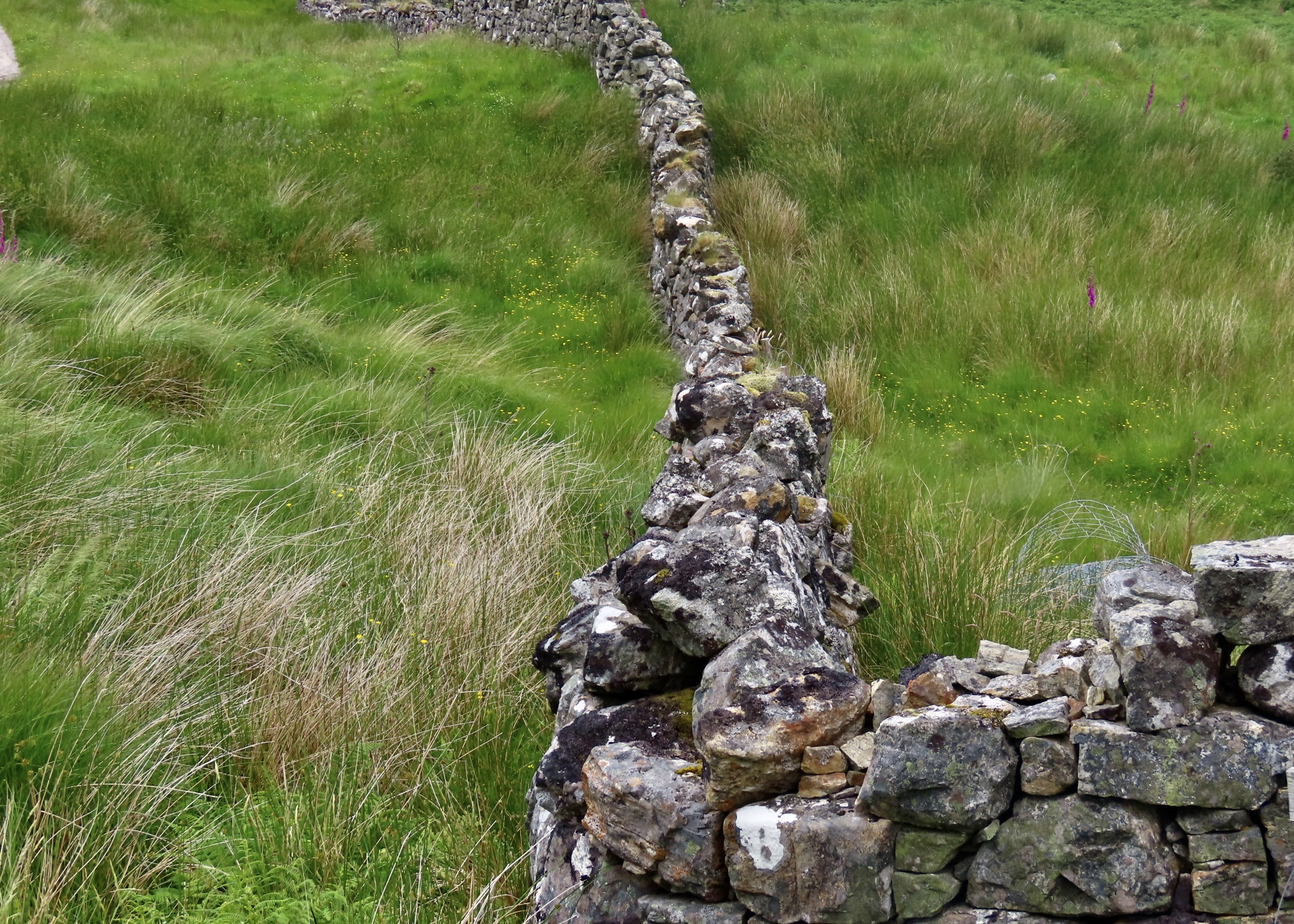
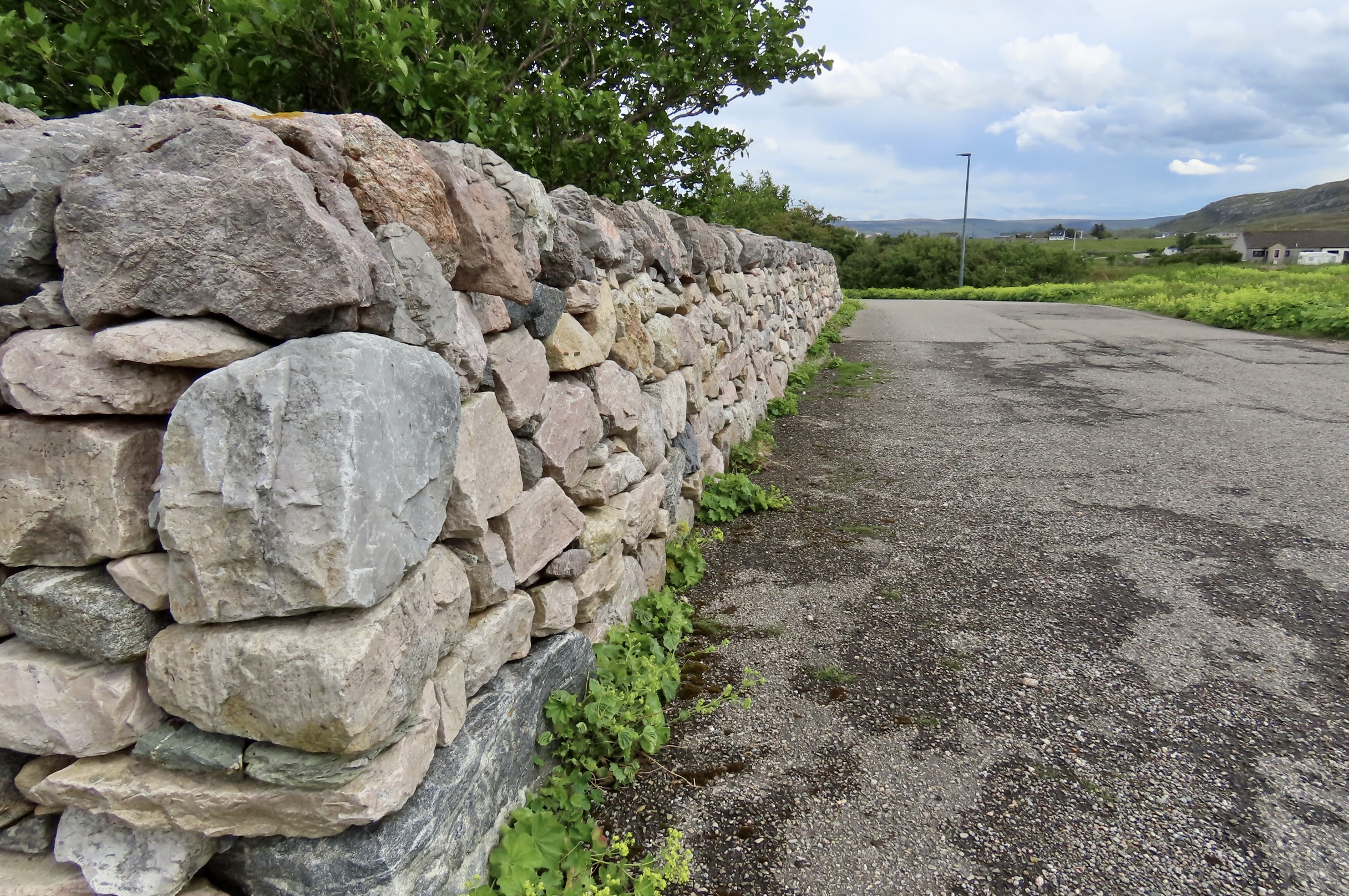
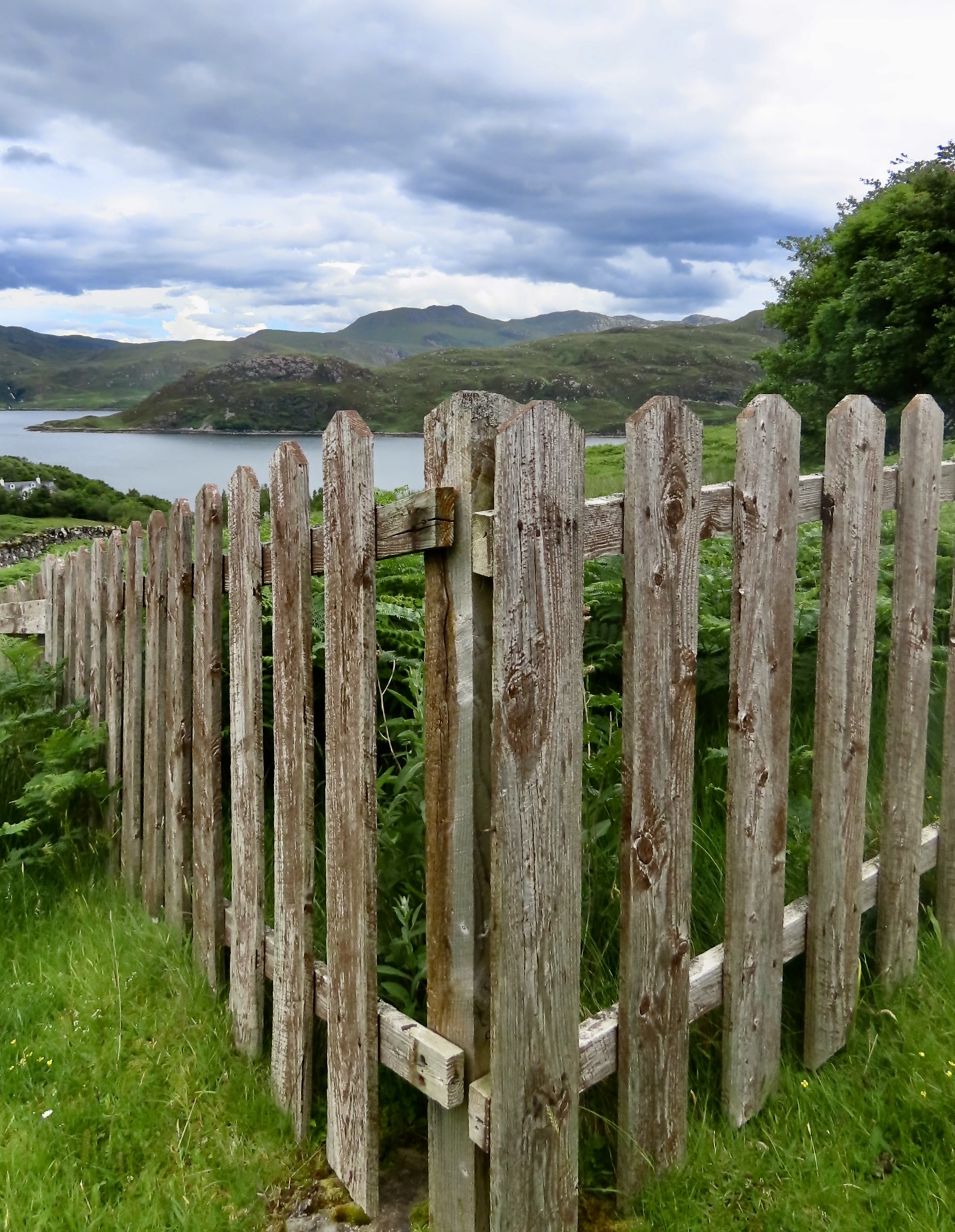
Mountains were in view almost everywhere on our CIE bus tour of the Highlands.A face in the mountains.Many of the mountains were quite rocky. Because of their different origins, the rocks of Scotland are different than the rocks of England. As are the fossils. The unique geology of Scotland led Scottish geologists to play an important role in the development of modern geology including concepts of deep time (the age of the earth), plate tectonics and structural mapping (vital in reconstructing the deformation history of the Earth’s crust).A rocky cliff face.I was impressed by the way these rocks led into this photo of mountains.These large boulders with their lichen were perched above a firth.Roads like this call my name. “Follow me, Curt,” they demand. We were on the Isle of Skye and my tour bus guide would have been unhappy if he would have had to chase me down. Sigh. I behaved. Instead….We took a photo of us along with our guide and bus driver. They were both named Graham. Our guide is between Peggy and me and our bus driver is standing next to Cody. The rock pinnacle in the background is called the Old Man of Storr. Storr, the volcanic ridge to the right, was given its name by the Vikings. It means great or large.The sunlight behind the Old Man of Storr gave it a shadowy appearance.This Old Man of Storr from the other side. They say if you have the right angle, the rock looks like an old man. I’m fairly good at seeing faces, people, animals and monsters in rocks. Nothing stood out here for me. Must have been the wrong angle. Judging from the light outline on the righthand side, maybe he ghosted me.Because of the volcanic flows of basaltic rock on the Isle of Skye, there are a number of dramatic sea cliffs like this one located near the Old Man of Storr. The flow is obvious, sitting on top of the cliff. Being harder than the rocks under it, it forms a cap. As the lower rock eroded back into the cliff, the basalt cracks and falls into the ocean, forming the steep cliff. The fence in the foreground is designed to keep visitors from wandering over to the edge to look down, or worse, take selfies on the edge. “Look at me, look at me! Whoops!”There is more to scenery than nature, however. We took lots of photos of cattle and sheep.Historic ruins always caught our attention.Another perspective.This small castle was nearby. It was designed for defense.We found this unique bit of ‘scenery’ on Orkney Island. It’s a 1950’s era Chevy pickup. Its creation dates back to Covid, when the Orkney stone mason John Hamilton found himself with a lot of spare time on his hands. Operating under the inspiration of Don McLeans 1971 “Drove my Chevy to the levee but the levee was dry” he built his pickup to the exact size of an original Chevy pickup using only stones and masonry (no standard bricks). Visitors are invited to take all the photos they want— and make a contribution to local charities. It’s a win-win.Winding things down here, given all the stones there are in the Highlands, is it any surprise there are lots of stone fences? As fences go, they are close to impossible to beat in terms of scenic value. I’d be remiss if I didn’t include this stone wall in the small northern community of Durness, Scotland. It was built by our guide, Graham Bruce, who had been headteacher in the local school there for 29 years.An old wooden fence runs a close second, however. That’s it for today. You may be saying, finally! Our next post will feature the towering mountains of Grand Teton National Park in Wyoming’s Rocky Mountains.
On a personal note, I was working on this post when Peggy exclaimed, “Curt, your blog had now received over one million views since you started !” It was worth noting. We celebrated.
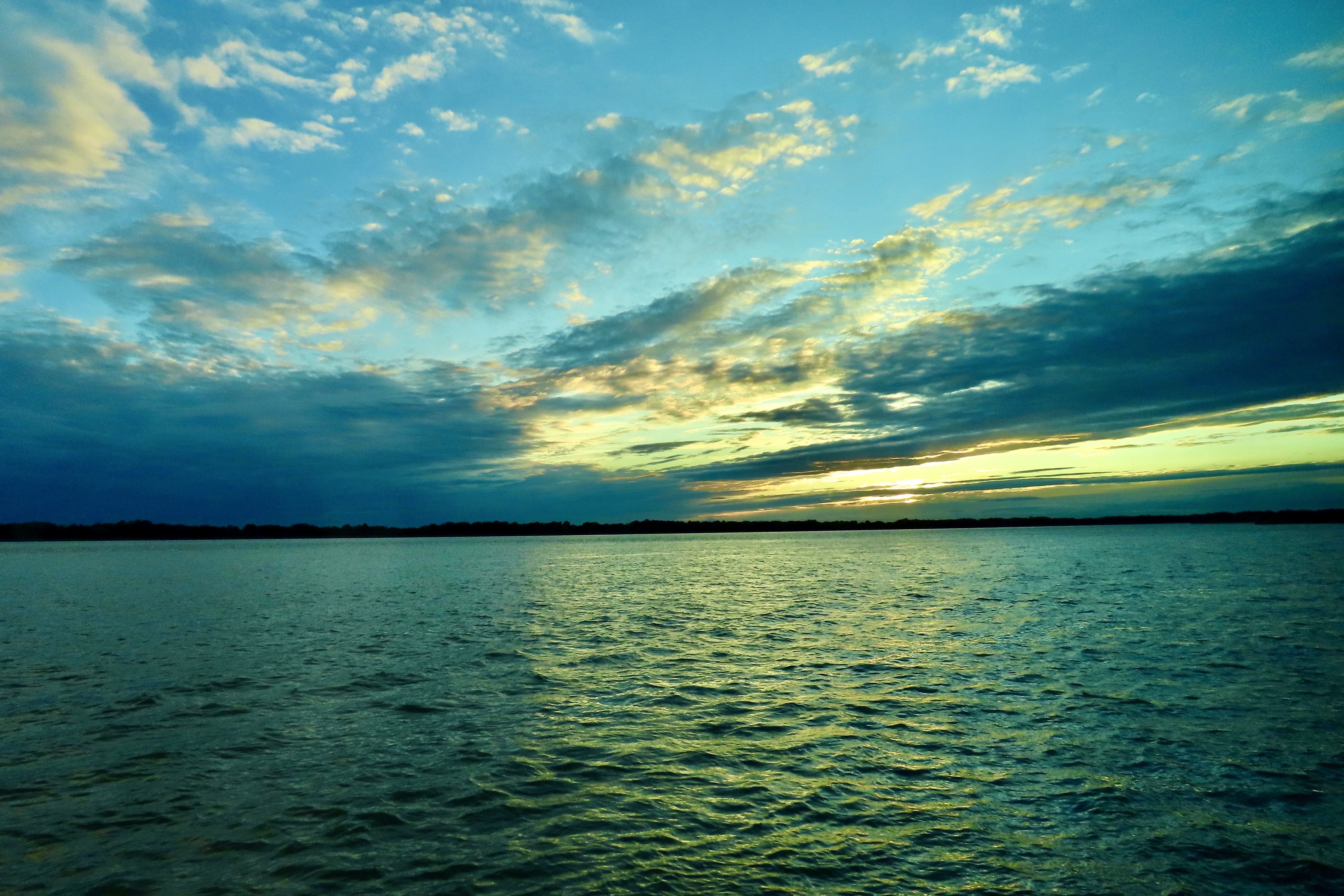
I’ve put on some mood music for today’s post: The Beautiful Blue Danube by Johann Strauss. Appropriately, it’s being played by the Vienna Philharmonic Orchestra. This is the river and its beauty. Its blue green tint is caused by the time of day and clouds. Like all rivers, it has a variety of ever changing moods.
We leave the Colorado River as it flows through the Grand Canyon today and travel 6000 miles to the second river in our Great River Series, Europe’s Danube River. Peggy and I, along with her brother John and his wife Frances, cruised down the river from Vienna to the Black Sea for nine days in late September/early October this year while adding another 7 days with a pre-tour of Vienna in the beginning and a post-tour of Transylvania at the end.
Polar opposites come to mind when comparing the two experiences. The Colorado combined the world class natural beauty of the Grand Canyon with the high adventure experience of floating through roaring rapids in small rafts. Accommodations are best described as roughing it. We slept on the ground in our two person tent, prepared our own food, and took care of bathroom chores on the groover— which was hopefully hidden from public view by bushes and rocks. Whatever bathing took place was in the ice cold river or or side streams with our clothes on— might as well wash both at once, right? Side trips normally involved climbing up the steep, possibly dangerous sides of the Grand Canyon to enjoy the beauty or leap 10 to 20 feet off cliffs into small, hopefully deep, pools of water. As for weather, think up close and personal.
The Danube has a beauty of its own but lacks the incredible scenery of the Grand Canyon. Our ‘raft’ was a brand new river boat holding around 100 people, where we ate four course meals served to us by friendly, attentive staff. (Peggy had won them over on the first day. When we entered the dining room we’d hear, “Hi Peggy,” coming from all sides.) We slept on a king-sized bed, had large windows looking out on the river, enjoyed a hot shower every night, and had a toilet that, um, actually looked and behaved like a toilet. Our side trips were usually into major Eastern European cities known for their culture and stunning architecture. It wasn’t quite ‘roughing it.’
The primary difference, however, was on focus. On the Colorado, it was the river, the surrounding natural beauty, and the adventure. On the Danube, it was on history and the cities that border the river. The Danube had once served as the boundary for Rome. In the centuries since the region, known as the Balkans, had seen continuing invasions including the Mongols out of Asia and the Ottoman Turks from Turkey.
World War I started in Bosnia when Archduke Franz Ferdinand of the Austro-Hungarian Empire was assassinated by a Serbian nationalist. World War II ended with Russian tanks and troops rolling across the area and establishing the Communist Eastern Bloc nations. Ethnic rivalry, seen most recently in the bloody Kosovo conflict, has often been intense. The word Balkanization, which refers to a country or region breaking up into smaller, frequently hostile units as the result of ethnic, religious, or political differences, is actually based on what happened in the region.
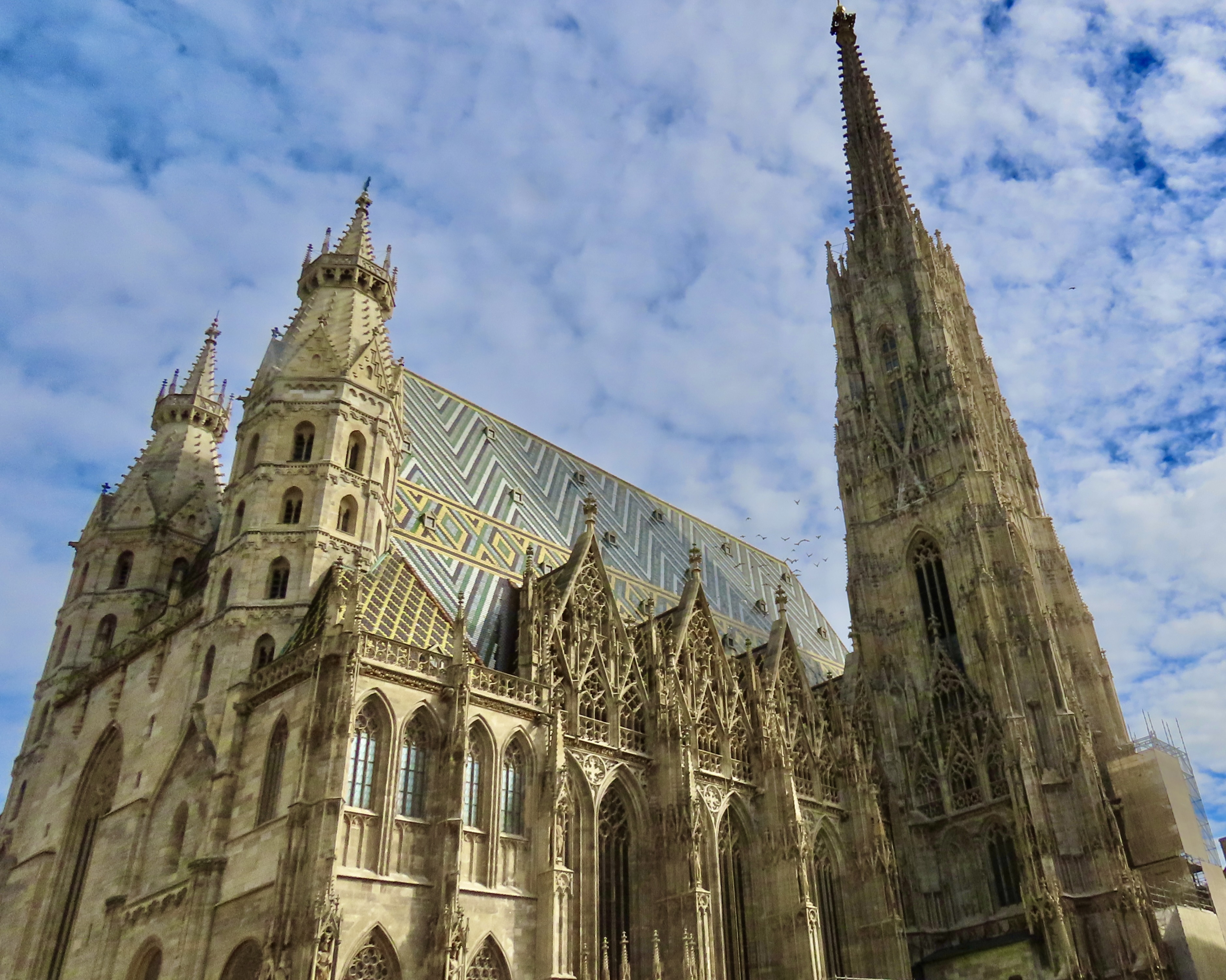
We followed the Danube River traveling for about 1200 (1930 km) of its 1700 miles (2,730 km) in a southeast direction starting in Vienna and ending at the Black Sea. I’ll start this series in the classic city of Vienna. On today’s post, I am going to feature St. Stephan’s Cathedral which dominates Vienna’s skyline and is remarkably beautiful. And strange, in a medieval sort of way.
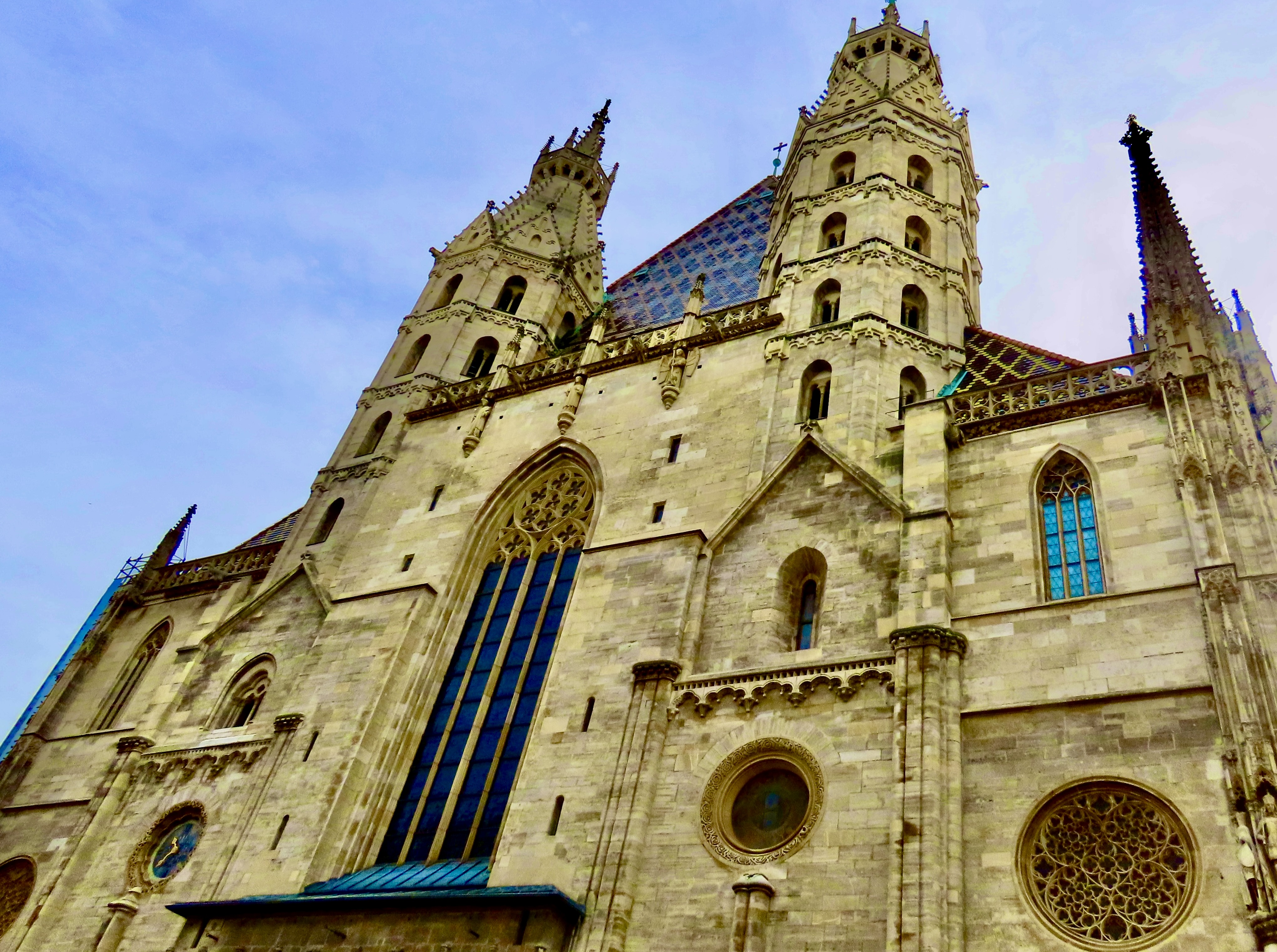
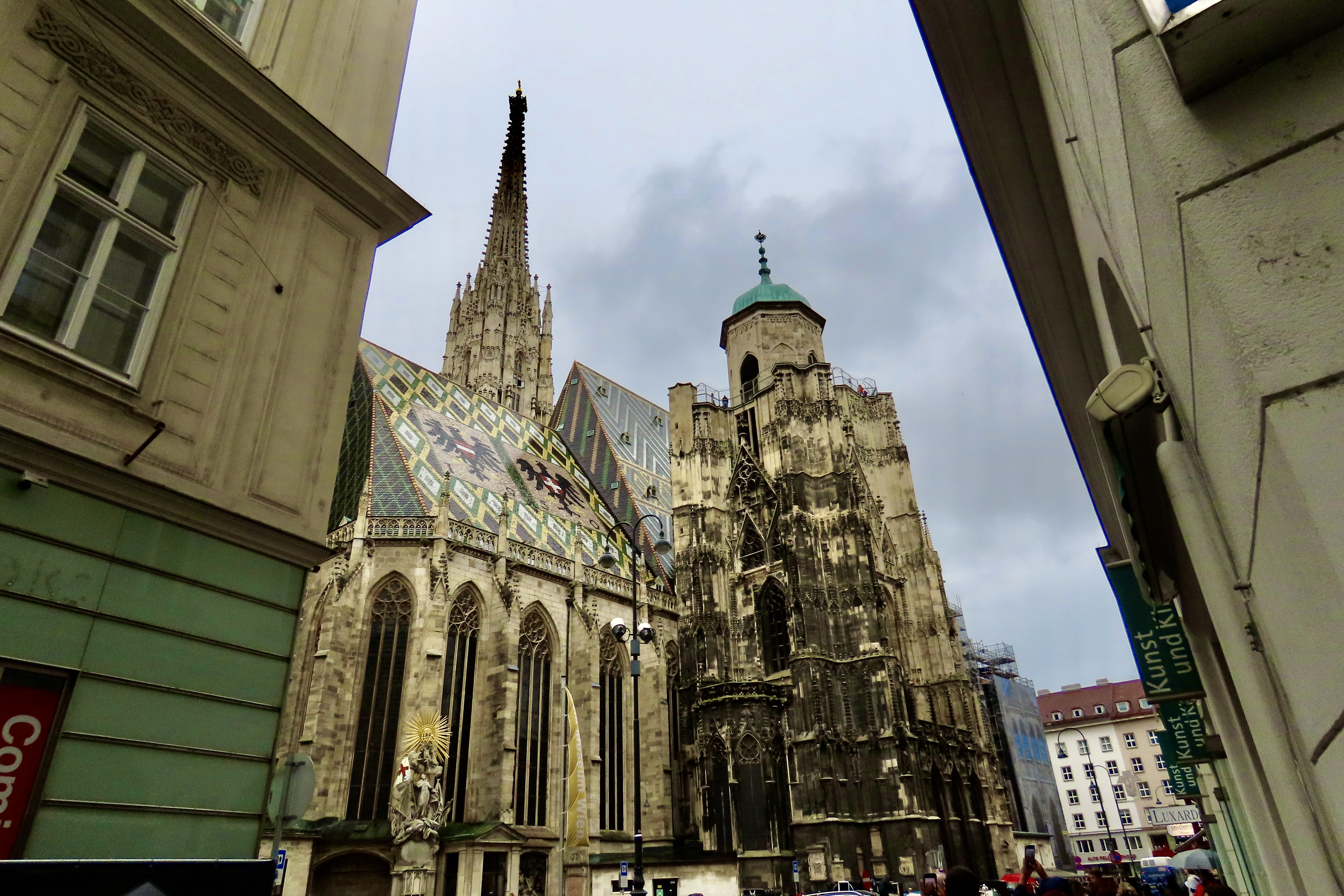
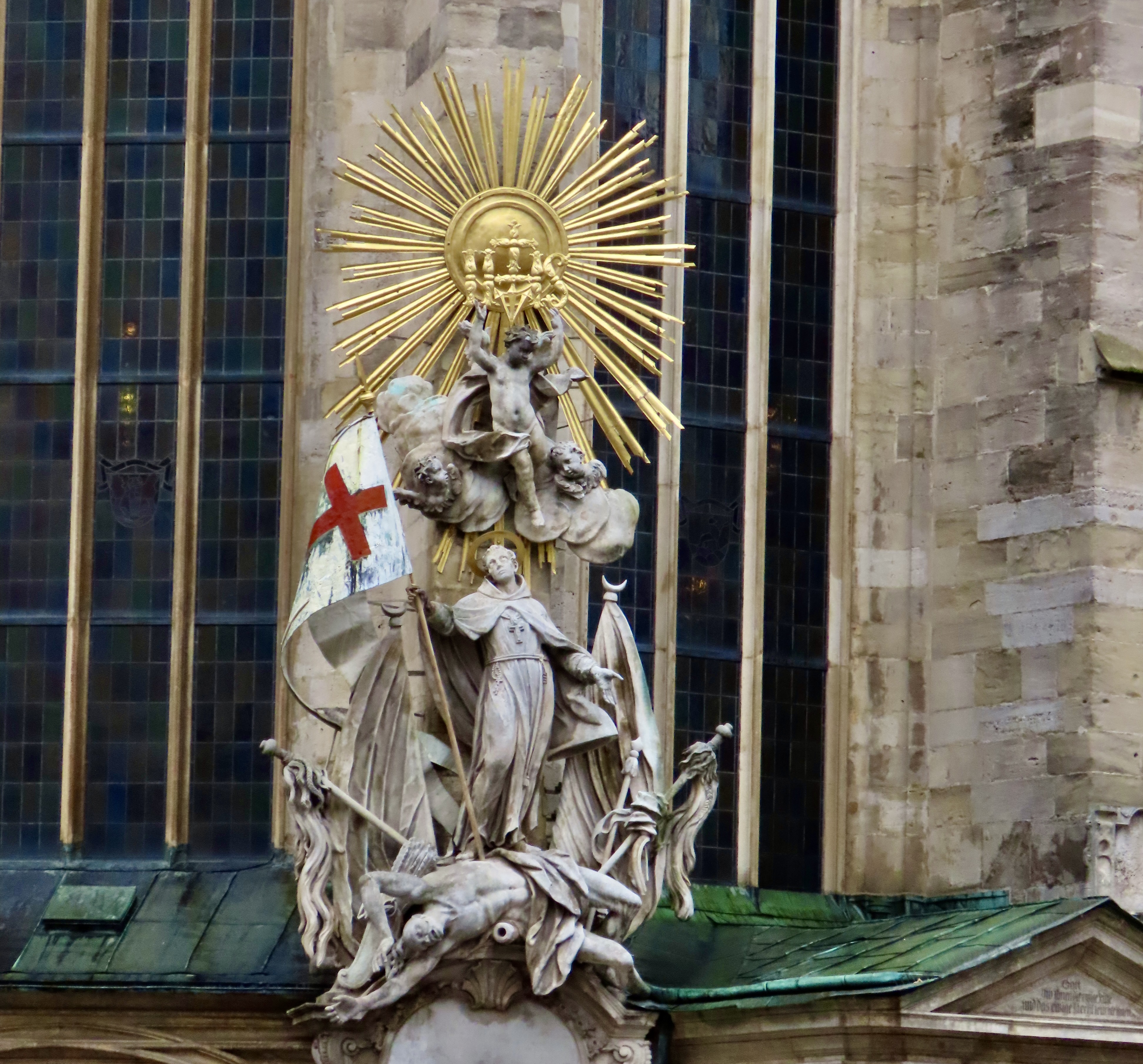
St. Stephan’s Church with its striking roof and its 446 feet (136 meters) tall south tower reaching for the sky. The roof is covered with some 230,000 glazed tiles. Note the birds flying between the tower and the roof. They had been disturbed by the ringing of the noon bell. It is said that Beethoven first realized how totally deaf he was when he saw the birds fly out of St. Stephan’s bell tower but couldn’t hear the bell ringing.A front view of St.Stephan’s. The main entrance to the church is just below the overhang. It’s know as the Giant’s Door. The story behind the name is that the thighbone of a mammoth was found in 1443 while workers were digging the foundation for the North Tower and hung it over the door, where it apparently resided for decades. Did they see it as a unique decoration? Or maybe they thought of it as a message from God…A view of the North Tower where the mastodon bone was found. Originally the tower was supposed to reach the height of the South Tower but the funding came to an end. It does, however house the Pummerin, or, as it is known locally, the Boomer, a 44,380 pound (20,130 kilogram) bell, which is the second largest swinging bell in Europe. The two eagles on the roof are the symbols of Austria and Vienna. Note the monument on the lower left…The Capistran Chancel was once the main pulpit in St. Stephan’s. It’s named after St. John of Capistrano, a Franciscan, who is said to have preached a Holy Crusade from it against the Muslim Turks in the 1450s. It shows St. Francis tramping on a defeated Turk. From what I’ve read about St. Francis, that’s fake news. St. Francis was a man of peace who risked his life to establish peace between the Christians and Turks.
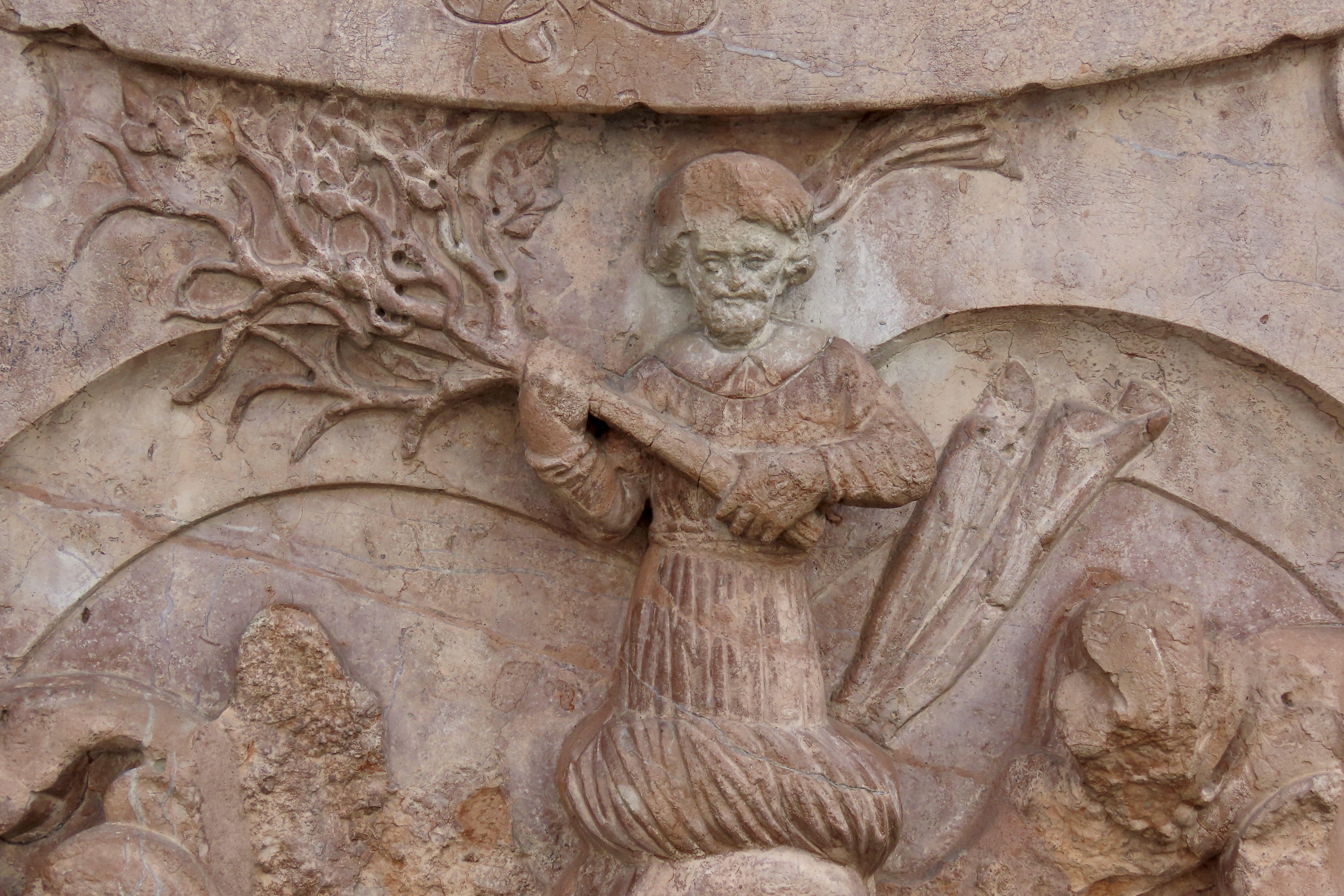
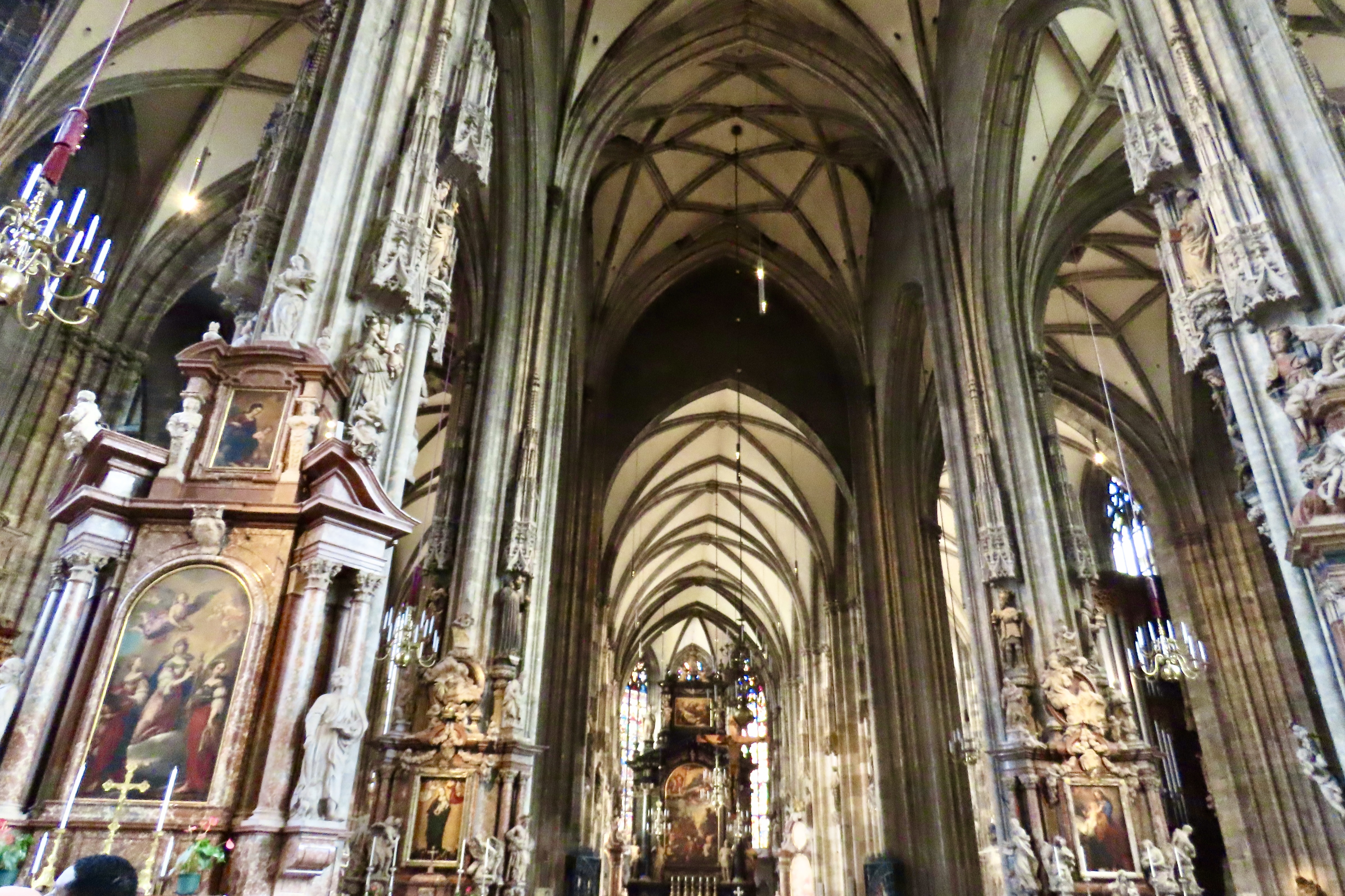
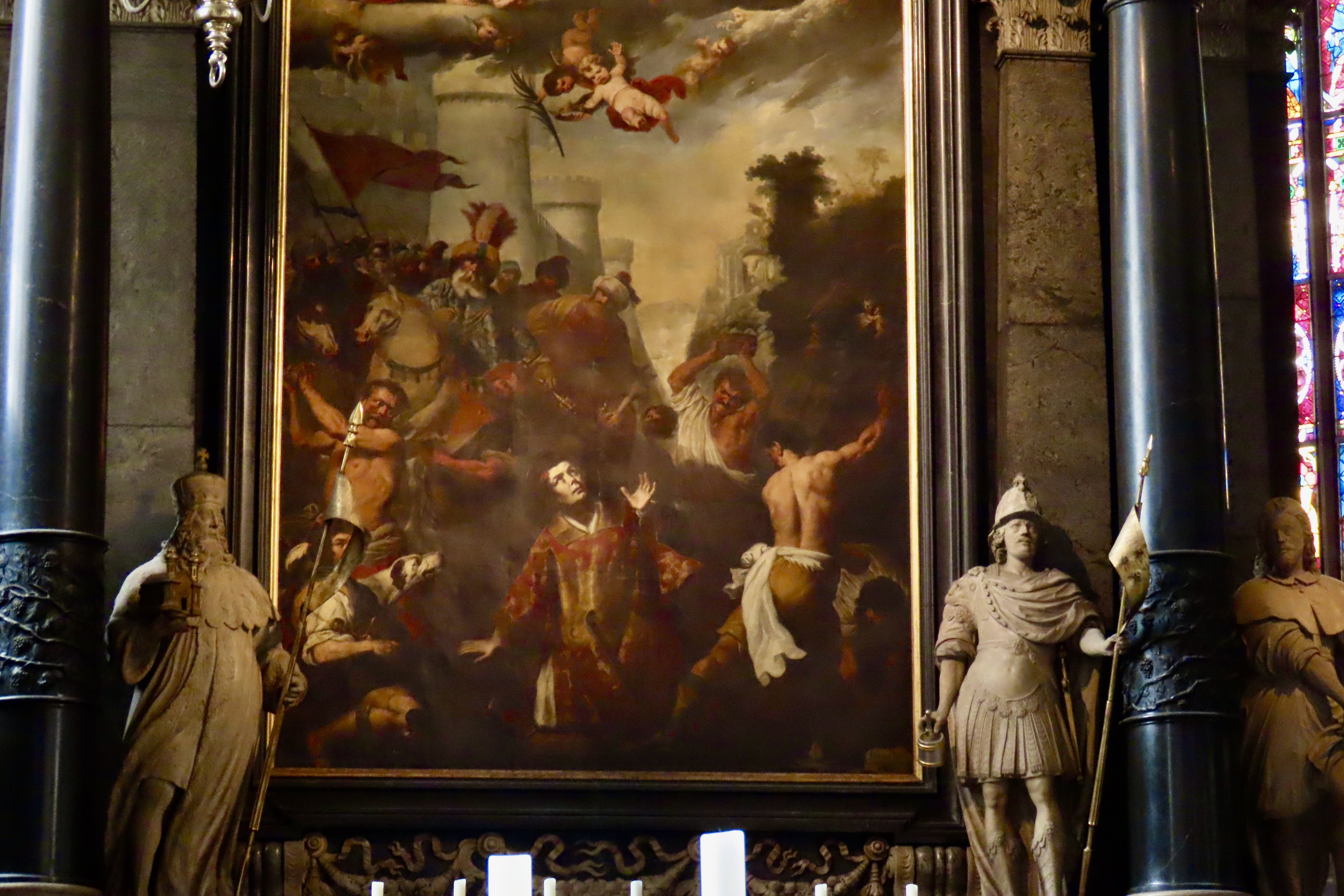
Also, I wouldn’t be surprised if you are thinking swallows when you hear Capistrano. And you’d be right. The Franciscans also named their early mission south of LA, California after the Saint, San Juan Capistrano. And that’s where the swallows return to each year. There is even a song about it. One final note: The door to the church’s catacombs is next to the monument. There are the skeletal remains of over 11,000 people in the catacombs. I wonder if the mammoth’s bone is there as well? Why not.Most people think of beauty and vast size when they visit Europe’s great cathedrals. And yes, there is that. After checking out the beauty, however, I like to focus in on the details. I found this stone carving on the side of the church. Is it a bird; is it a plane (as they said about Superman)? No! It’s St. Francis, appearing as a bird carrying a tree. It’s much more like the usual portrayal of a good saint than his image of stomping Turks. He loved trees and was said to talk to animals. If you see an image of a saint from medieval times with animals, birds or trees, you can almost bet it will be St. Francis.This is a photo of the inside of the Cathedral. It’s busy. I meant it to be. The number of statues and paintings of saints and important church personages was mind blowing. This is looking toward the high alter where a painting of St. Stephan is featured.He’s being stoned. It would be hard to find a painting of the saint when he isn’t. Even Rembrandt painted one. Here’s the thing. Most people were illiterate in the Middle Ages and the church fathers wanted their parishioners to know their saints and understand the messages they carried. Like St. Francis and nature. And St. Stephan and stoning. A bit gruesome perhaps, but most martyred Christian saints are tied to their martyrdom.
There are several at St. Stephan’s including St. Sebastian with arrows sticking out, St. Barbara holding a castle tower and St. Catherine of Alexandria holding a spiked wheel. Their stories are all similar. Deep faith brings them into conflict with non-Christian authorities. They are tortured and God miraculously intervenes to save them. Finally, they are killed. Thus you have faith, suffering because of faith, the power of God to miraculously intervene, and ultimately their willingness to die because of their faith. I assume they are all pulled into heaven where they live happily ever after. A story with a happy ending…
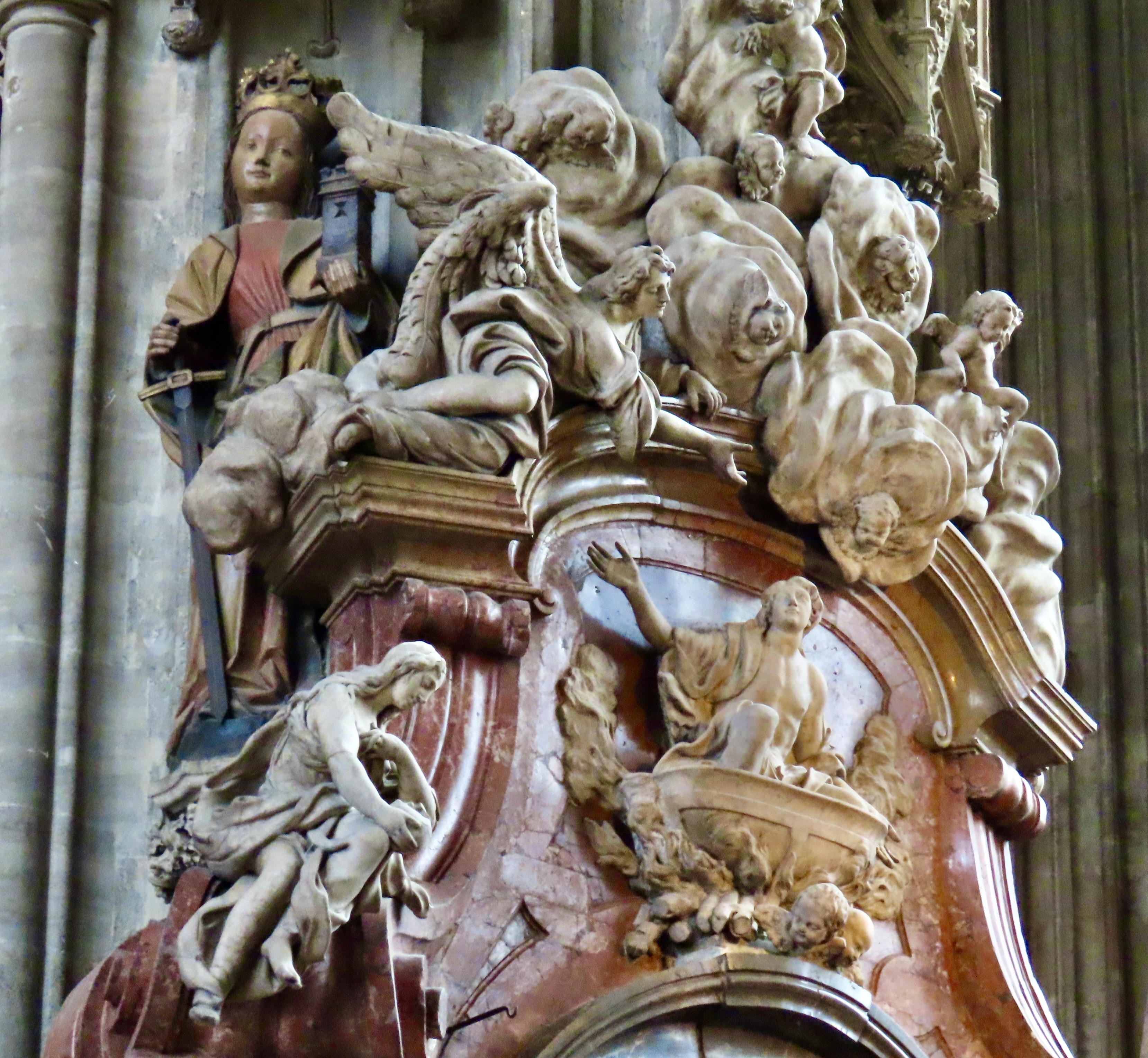
The woman standing behind at least 10 other beings, including the weird angels/people peeking out from the clouds, is St. Barbara. Her daddy kept her hidden away in a castle until he discovered she had converted to Christianity. Then he took her to the local pagan priest who submitted her to various tortures, from which she would miraculously be cured by God each night. Finally out of frustration, Daddy chopped her head off. On the way home he was struck by lightning and burned to a crisp. There’s a message here. Anyway, the castle represents where she was held, the sword with which she died and the crown her martyrdom. BTW, because of the lightning, St. Barbara became the patron saint of artillerymen and miners— things that go boom.
I, for one, if I ever have need for a saint, will stick with St. Francis of Assisi, the man of peace and nature who died of a natural disease. I like a guy who can talk to an almond tree and it suddenly breaks out in blooms.
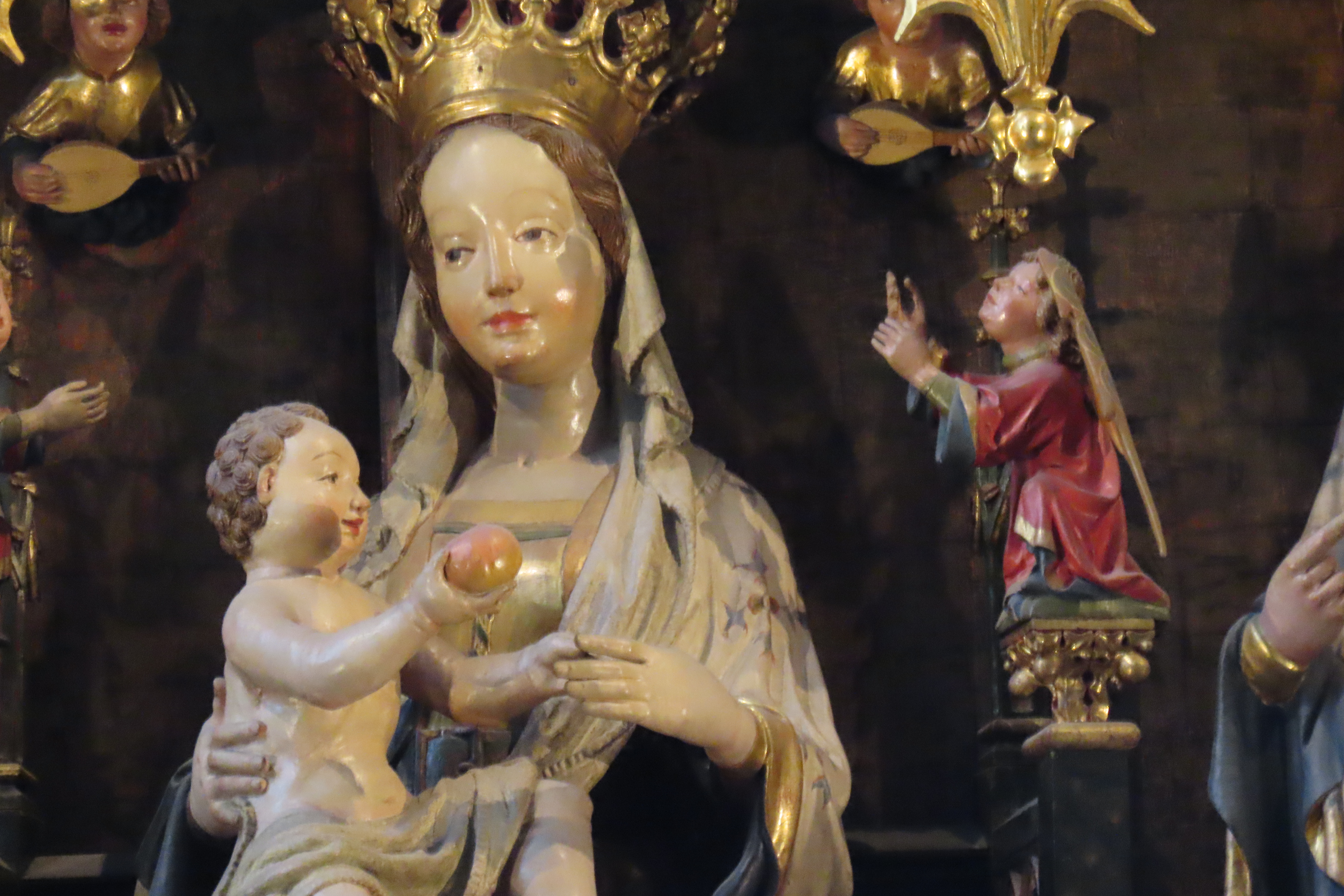
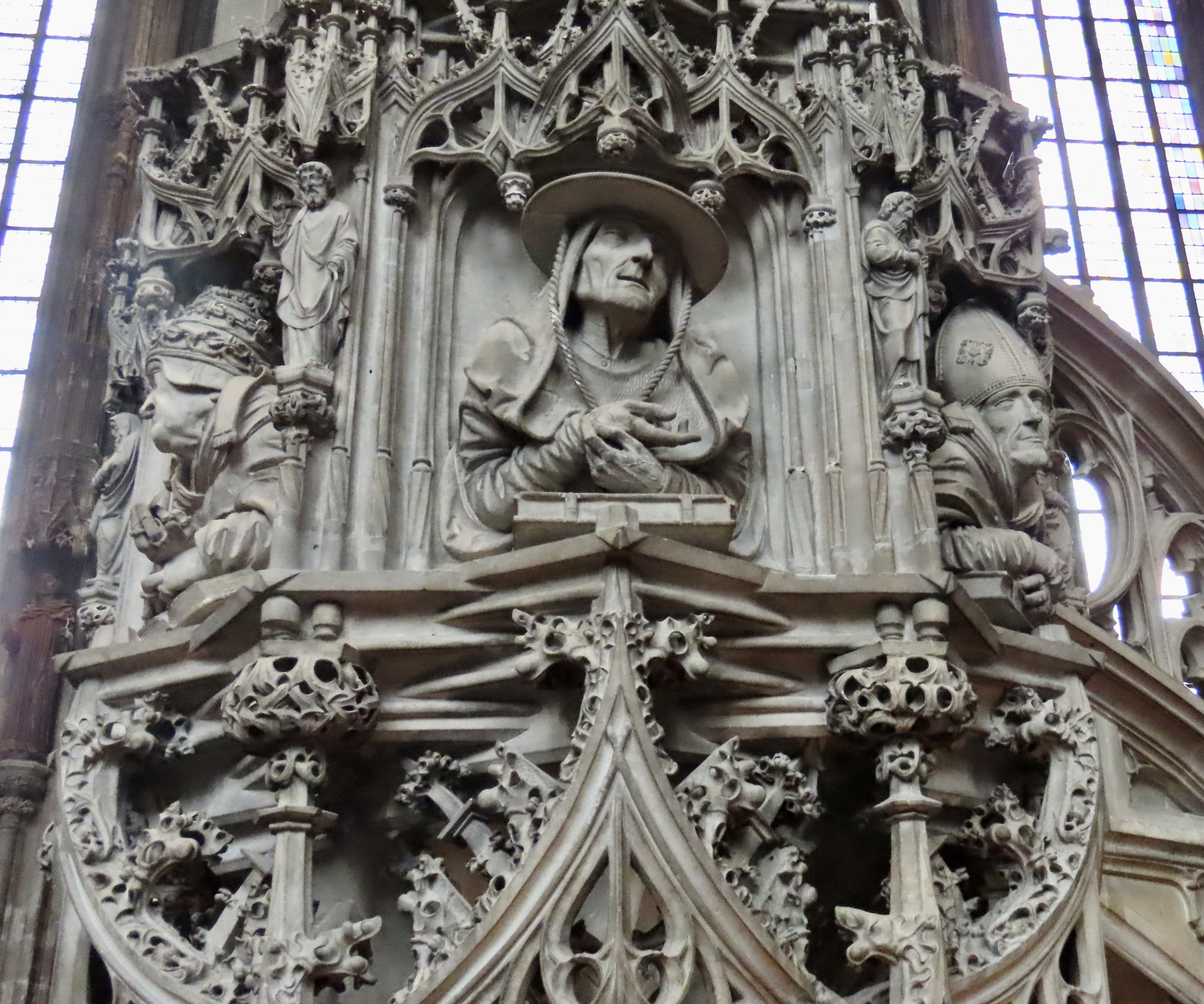
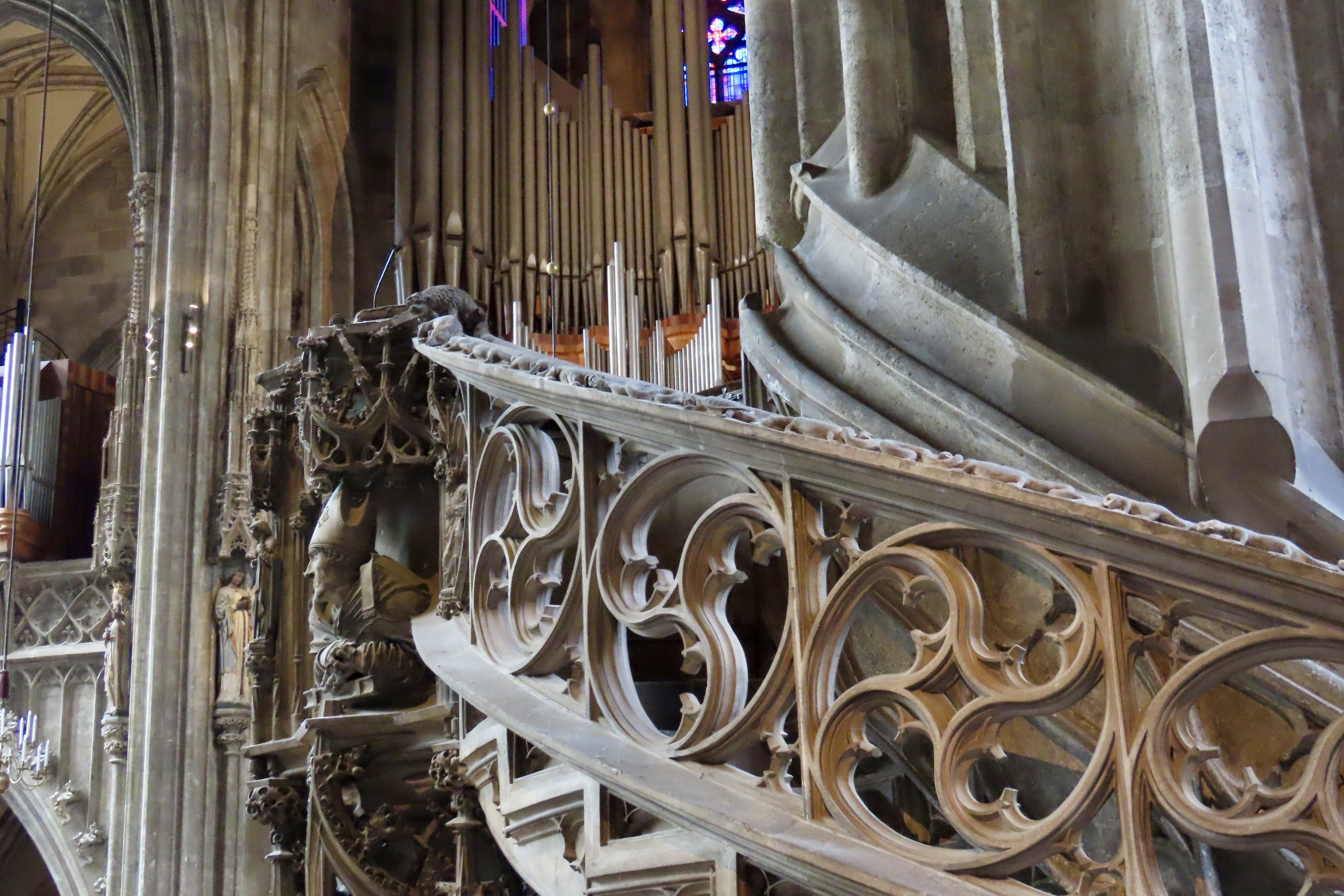
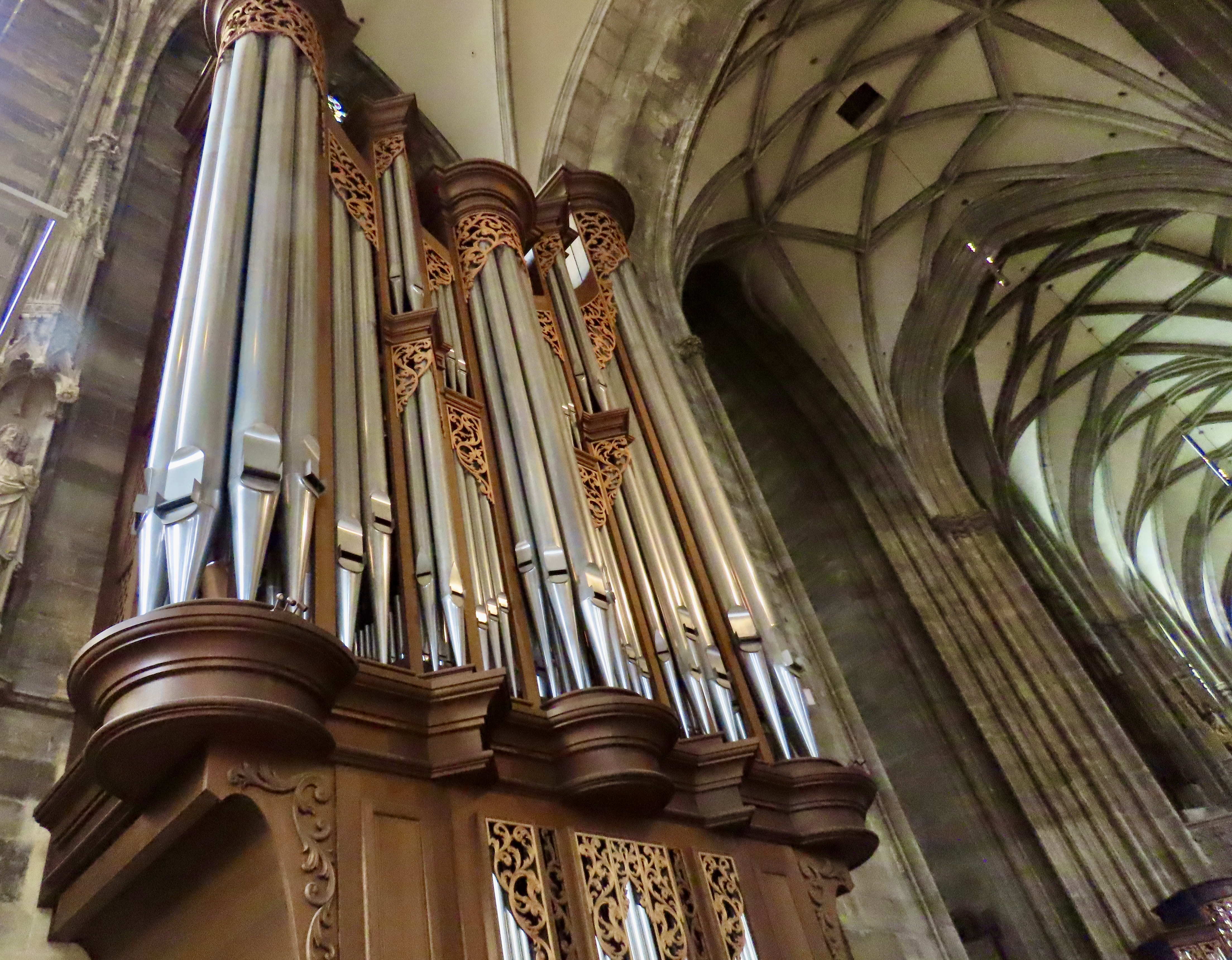
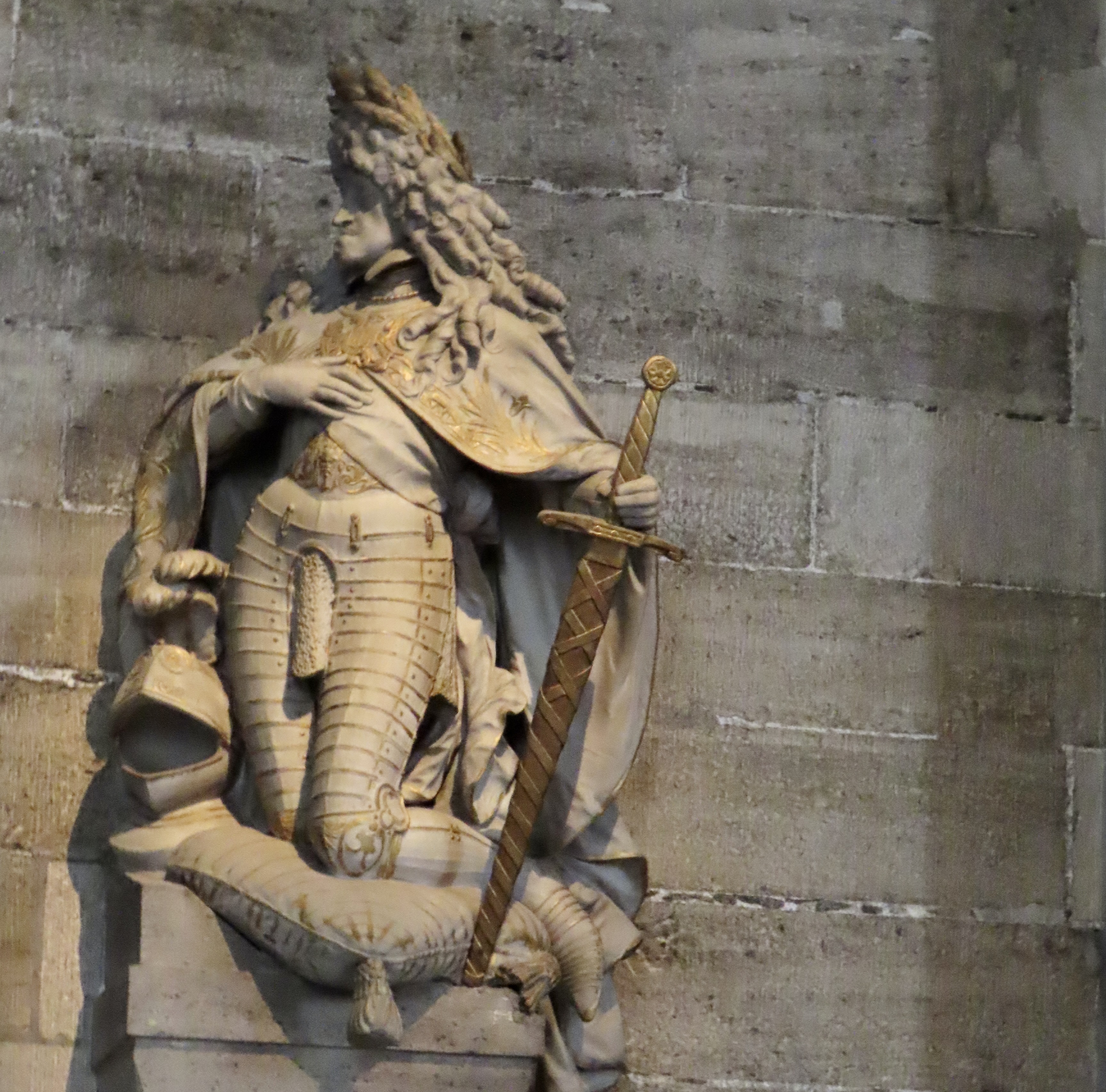
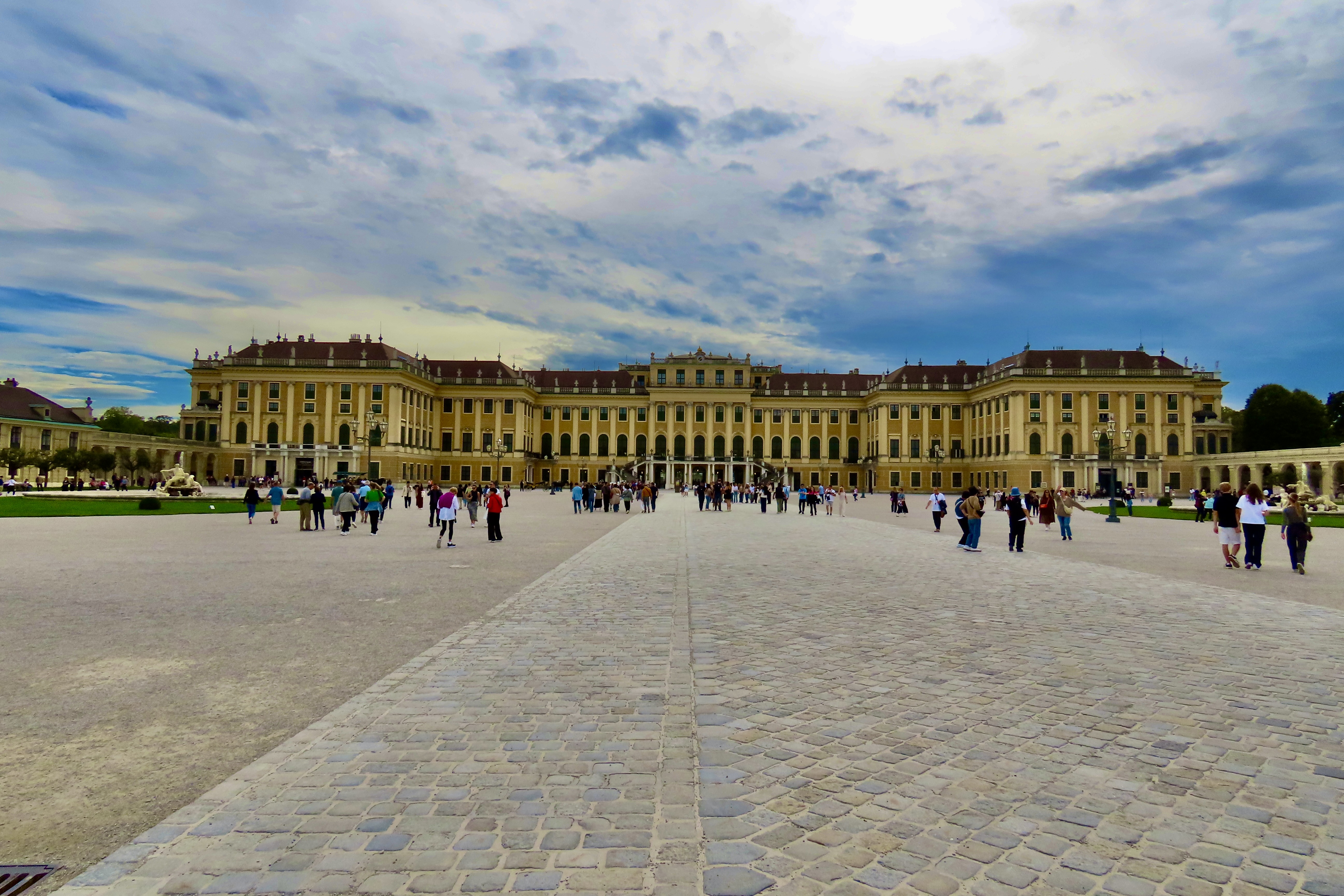
Here’s another symbol, Baby Jesus and his apple. It refers to him as the New Adam who will redeem humankind. I couldn’t help thinking, “Here Mom, your really should try this apple. Snake says it’s great.”The church’s pulpit is quite impressive. it includes realistic stone sculptures of the Four Fathers of the Catholic Church: Augustine, Jerome, Ambrose, and Gregory. The pulpit is found in the central part of the church rather than in the front. In the era before microphones, this was necessary for the priest to be heard. Note the balustrade on the right…It was covered with frogs and lizards biting each other, which, according to our guide, was to remind the priest/bishop/cardinal mounting the stairs of his many sins. A stone dog stood guard at the top of the steps to protect the speaker while he gave his sermon. Even then, it appears that dogs were considered man’s best friend. Cats, associated with women, were considered evil. Hmmm. An impressive organ can be seen beyond the stairs.Every cathedral we visited on our journey down the Danube had one. Looking at this one, I was reminded of the first massive organ I ever saw. I was on an Episcopal Church related trip in the early 60s and we stopped off at Grace Cathedral in San Francisco. At the time, Grace was one of the most progressive churches in America. It still is. My minister, Father Baskin, grinned at me and sat down at the keyboard. The sound was incredible, echoing throughout the church. He played an old ditty that I was familiar with, “The worms crawl in, the worms crawl out, the worms play pinnacle on your snout.” Father Baskin was one of the best men I have ever known. He was my kind of priest.There were many other strange sights that caught my attention as I wandered around the church, including this knight with his codpiece, meant to protect his vitals during battle. They were quite the fashion statement of the time and kept getting longer and longer. And don’t you wonder how his helmet (on the left) could ever fit over his hair.It’s time to move on, however. (Did I just hear, past time!) Next up is Vienna’s Summer Palace.