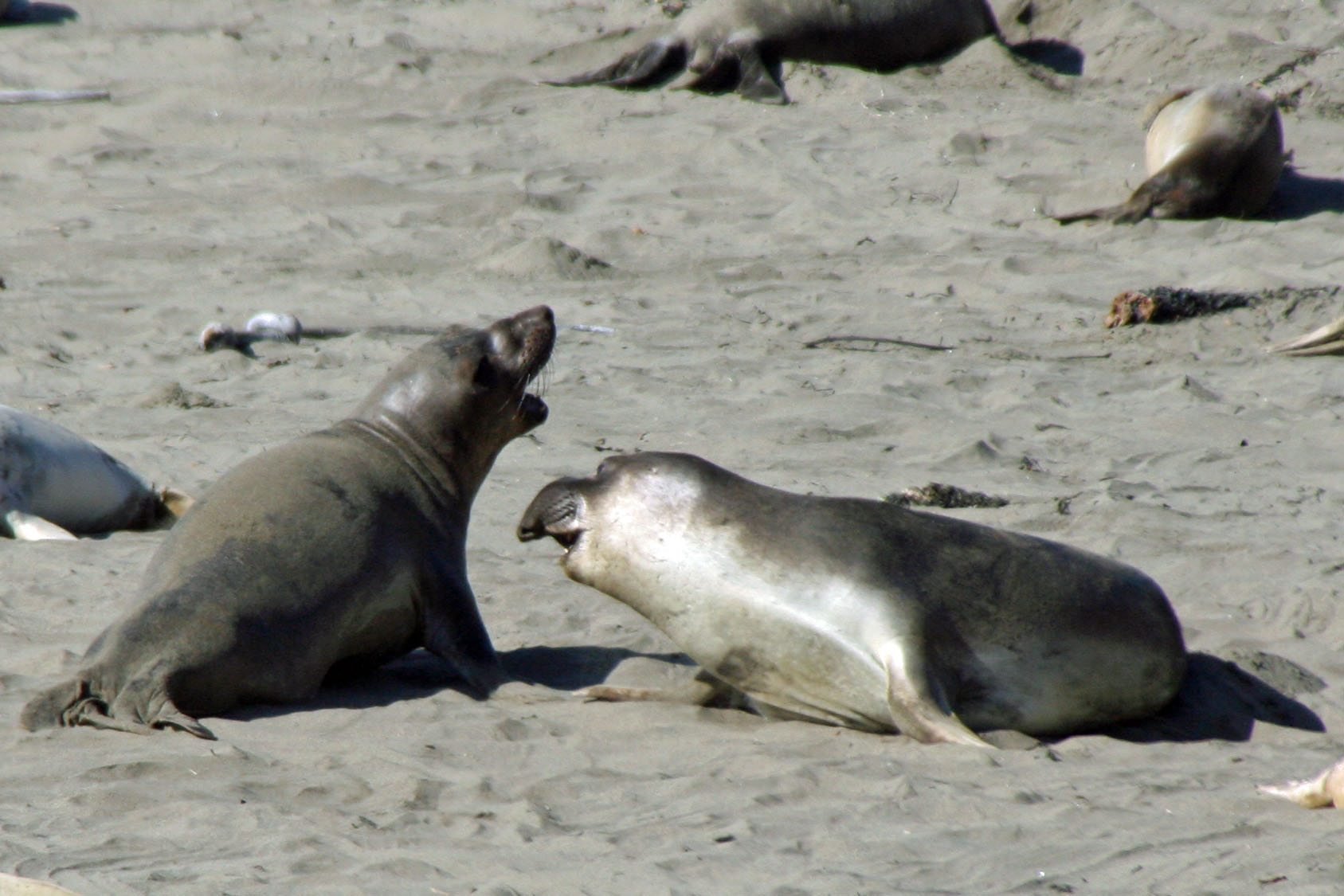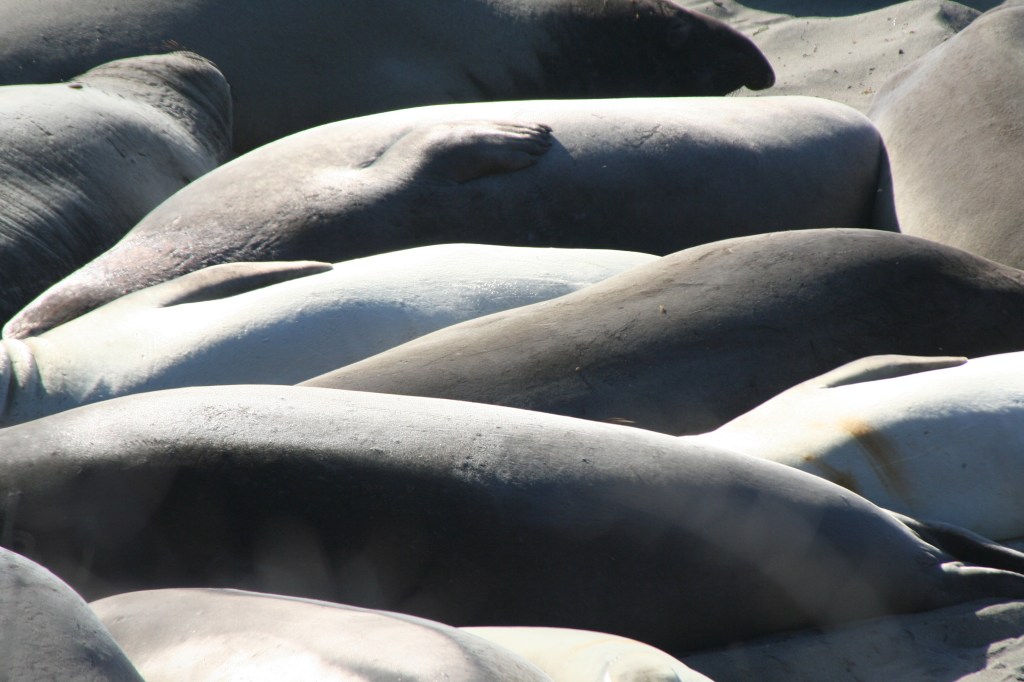
With a Proboscis Like This, a Male Elephant Seal Can Make Lots of Noise… The Focus Series

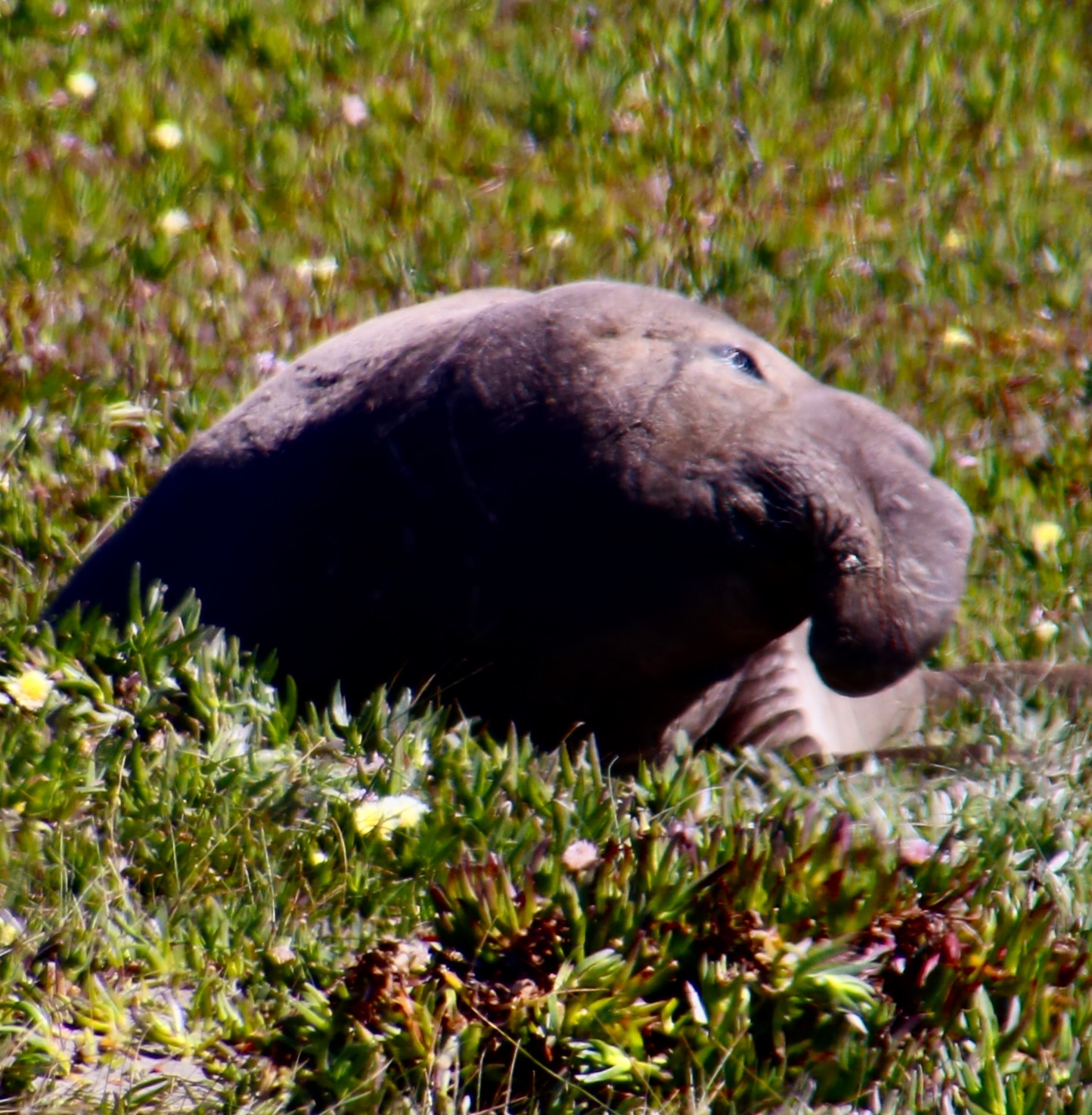
Elephant seals obtained their names because people thought their proboscises/noses resembled elephant trunks. Some imagination was required.
An elephant’s trunk. Peggy took this picture while we were on a photo safari in southern Africa last year.
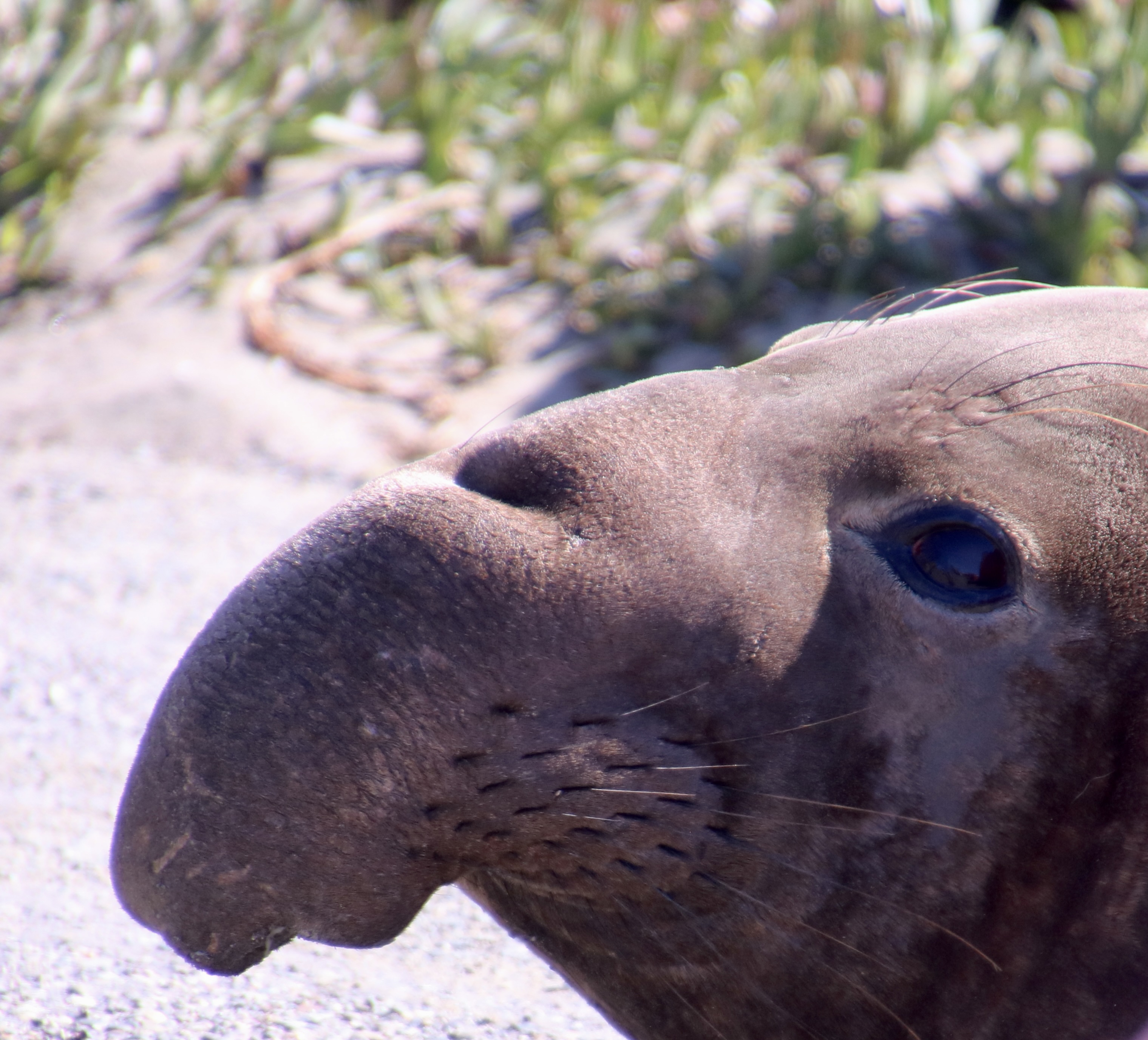
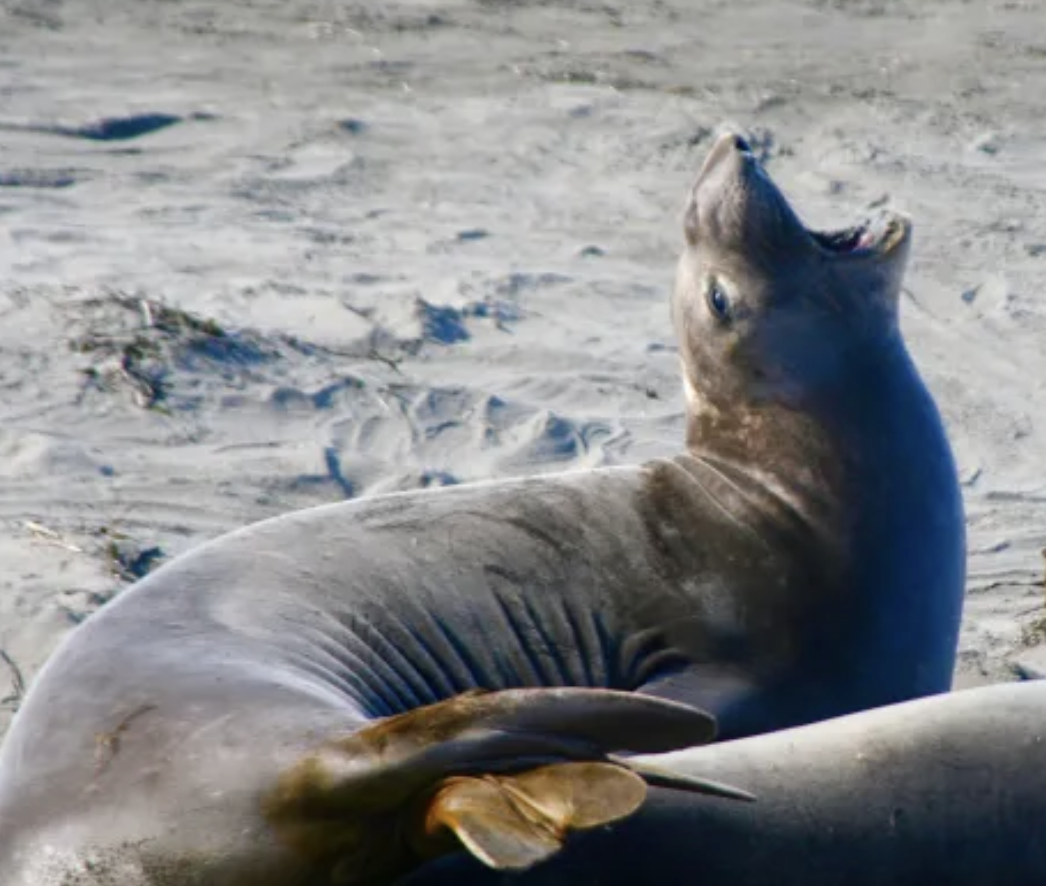
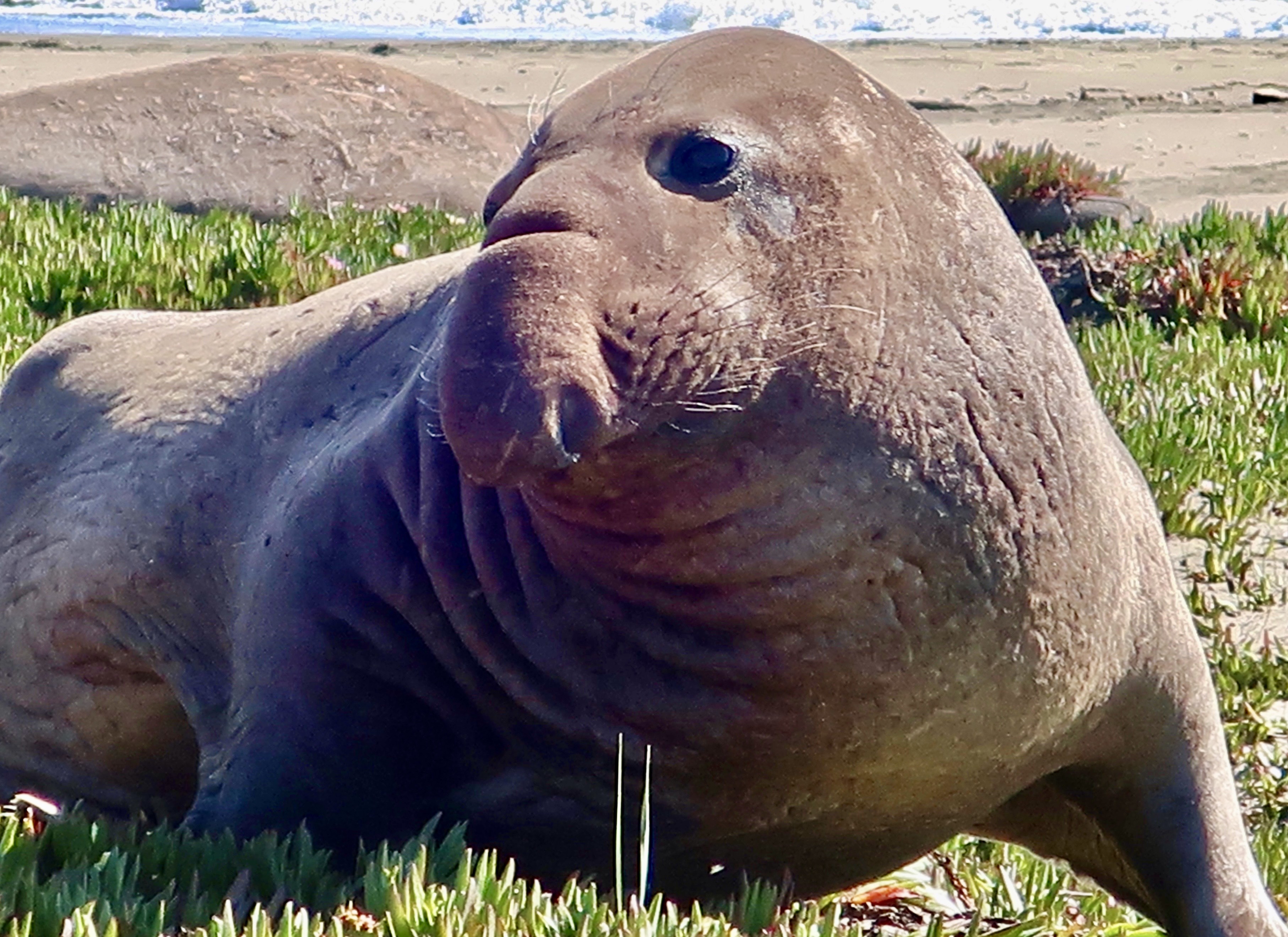
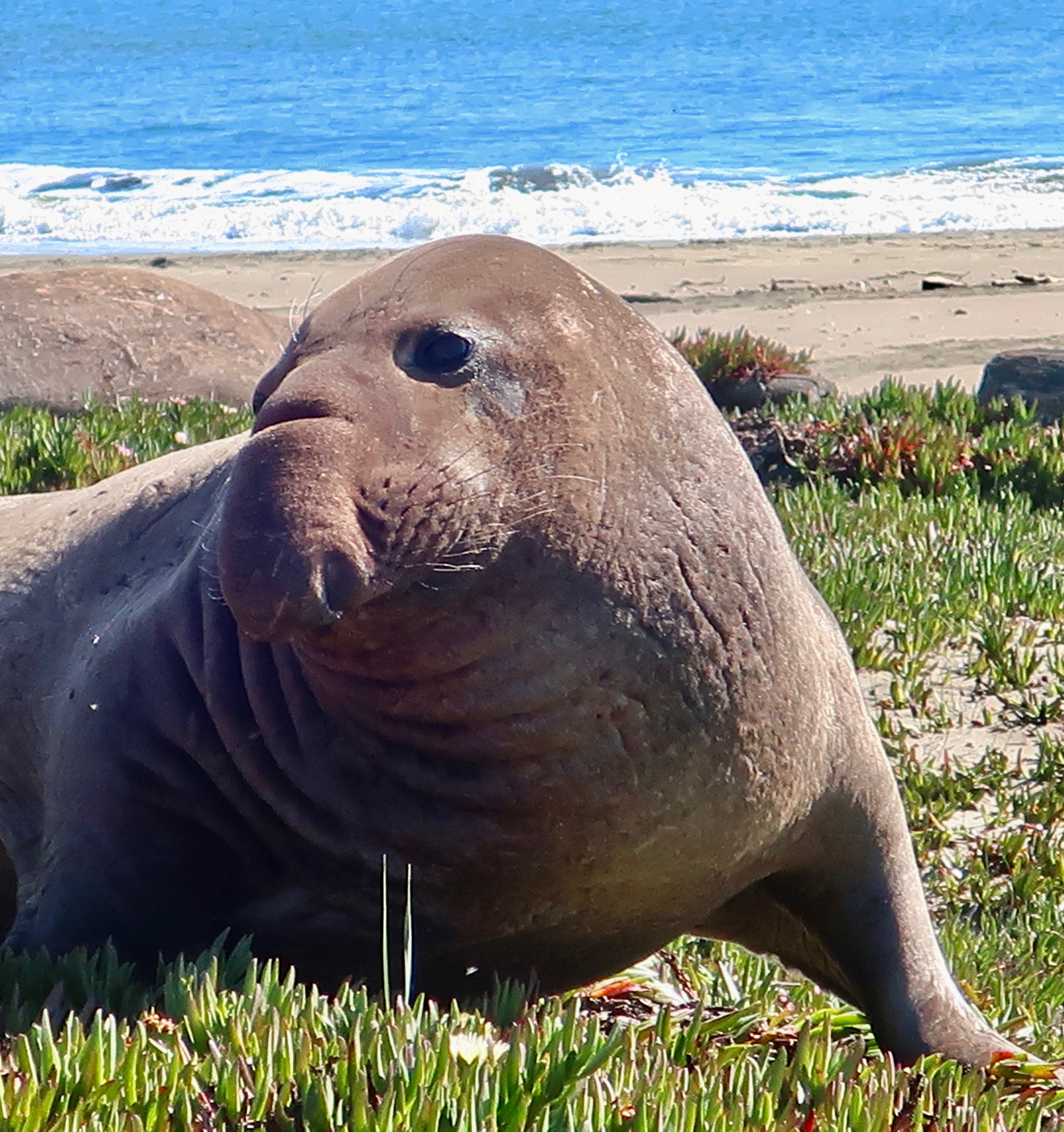
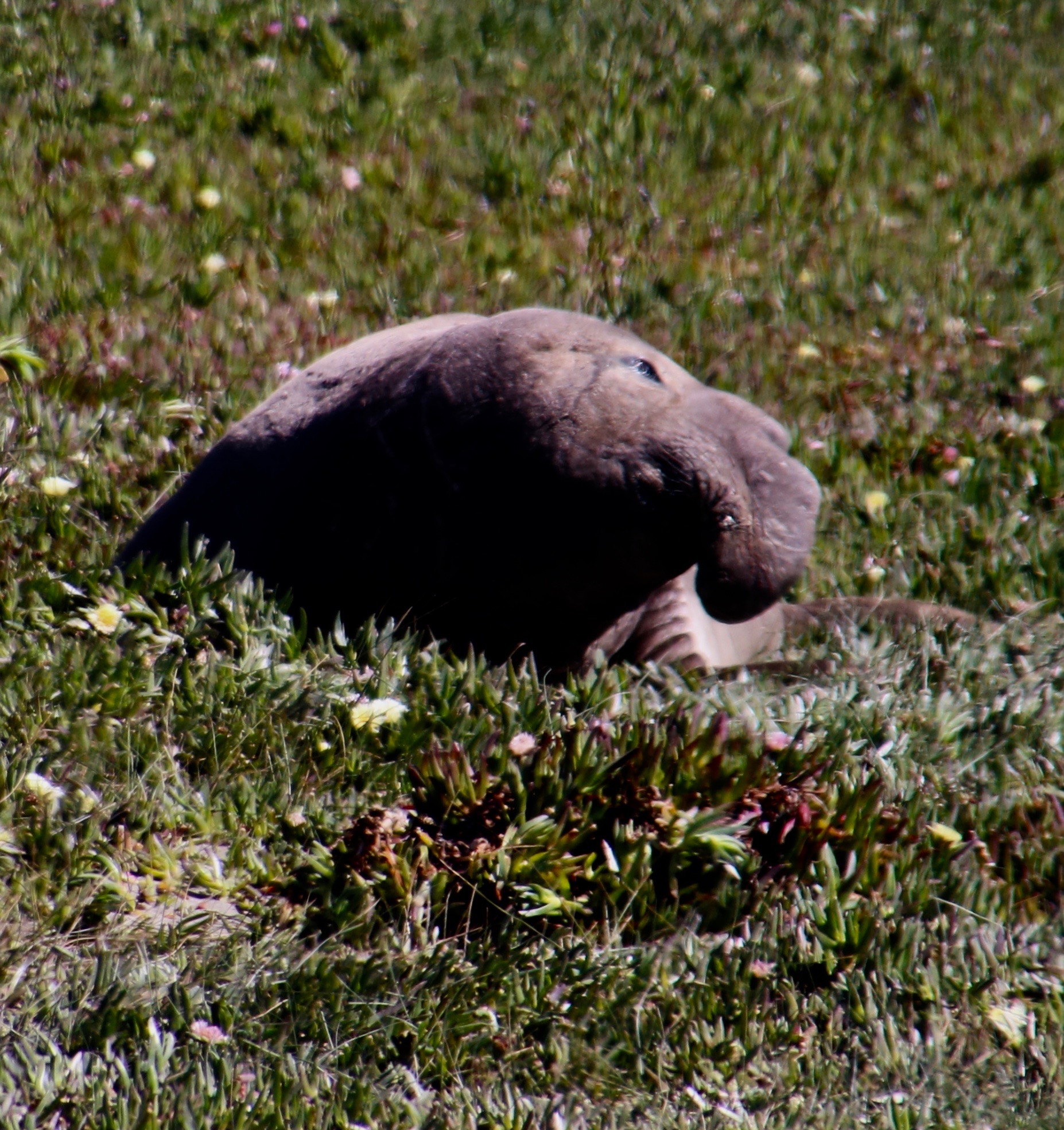
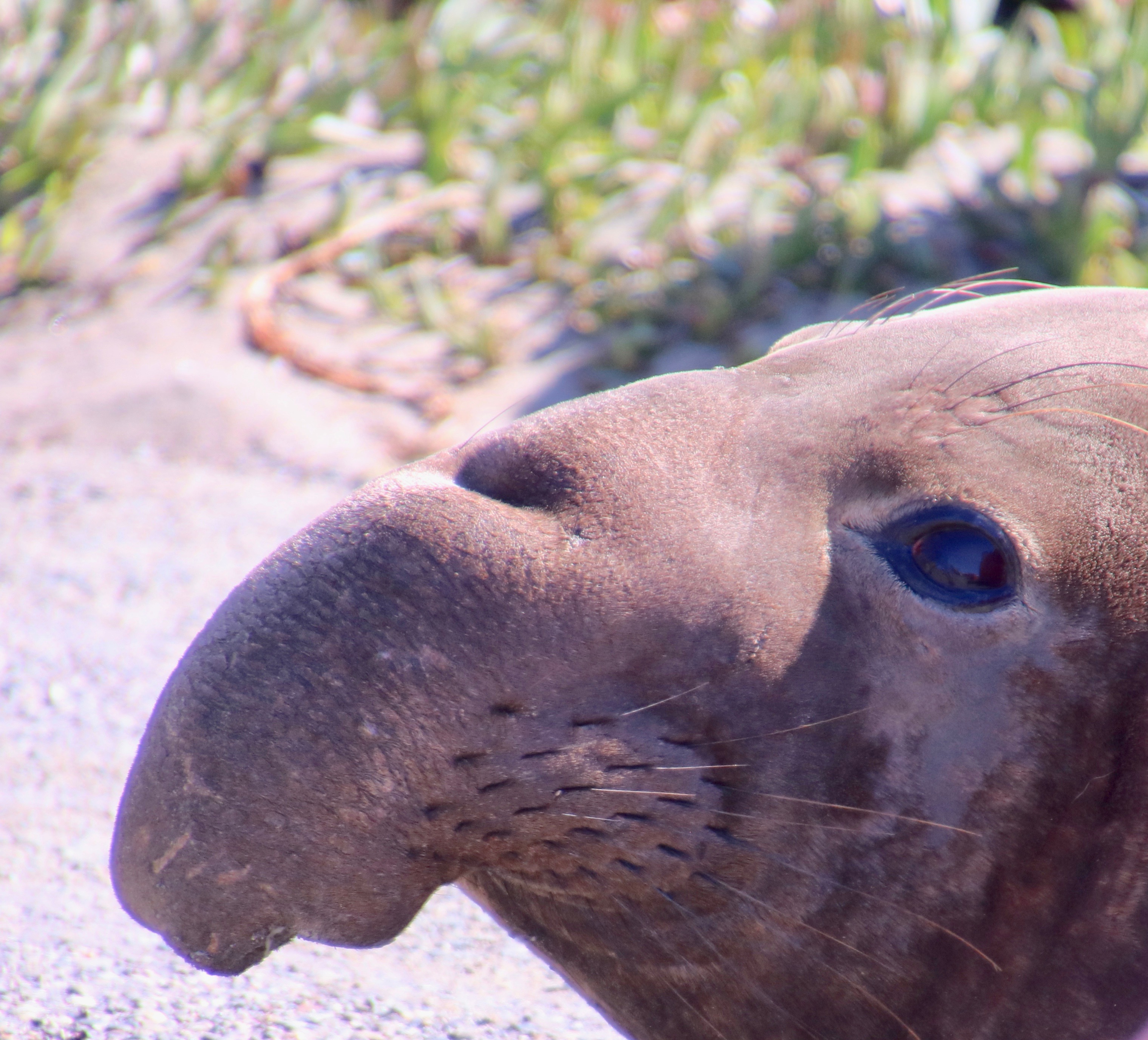
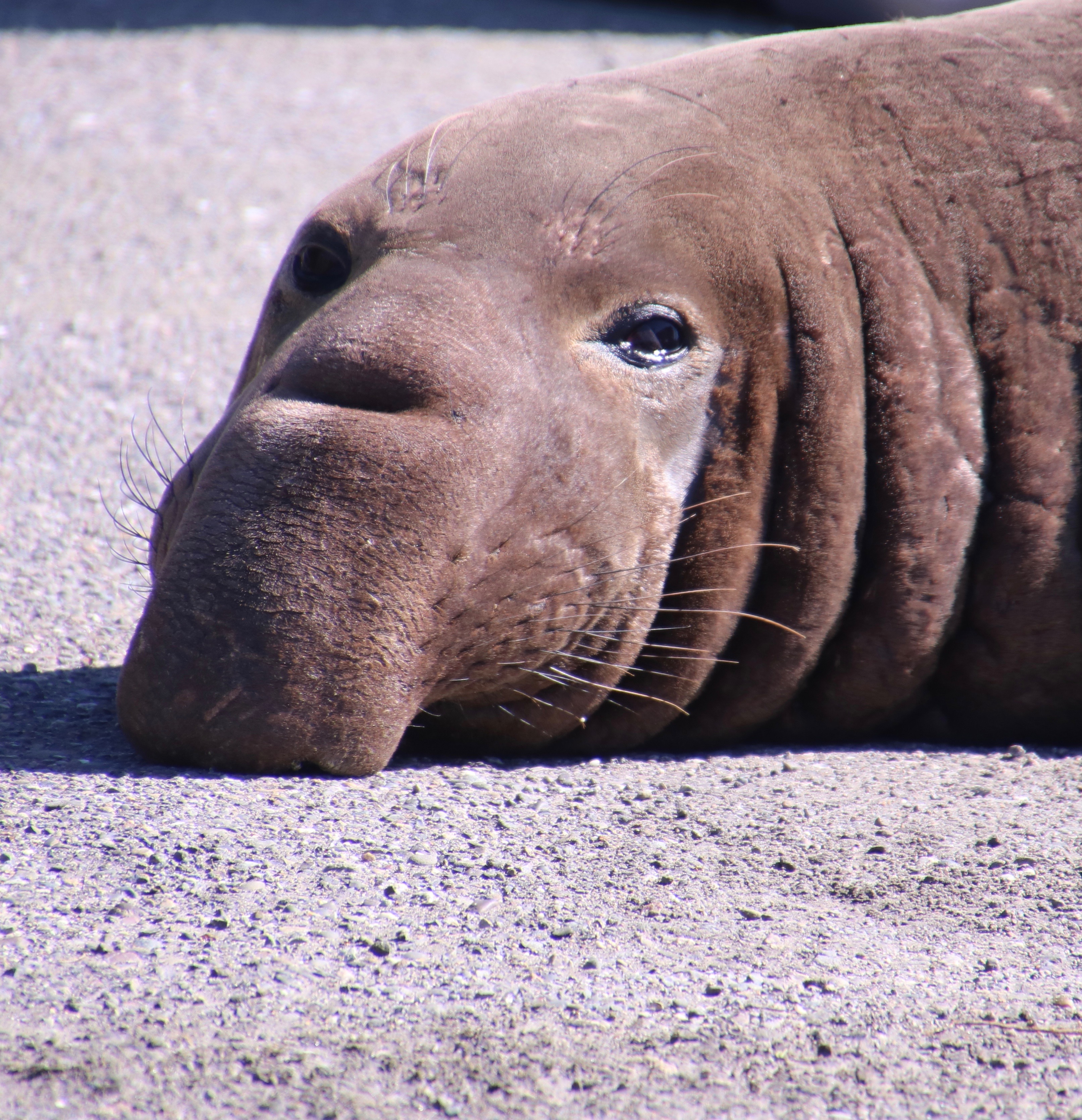
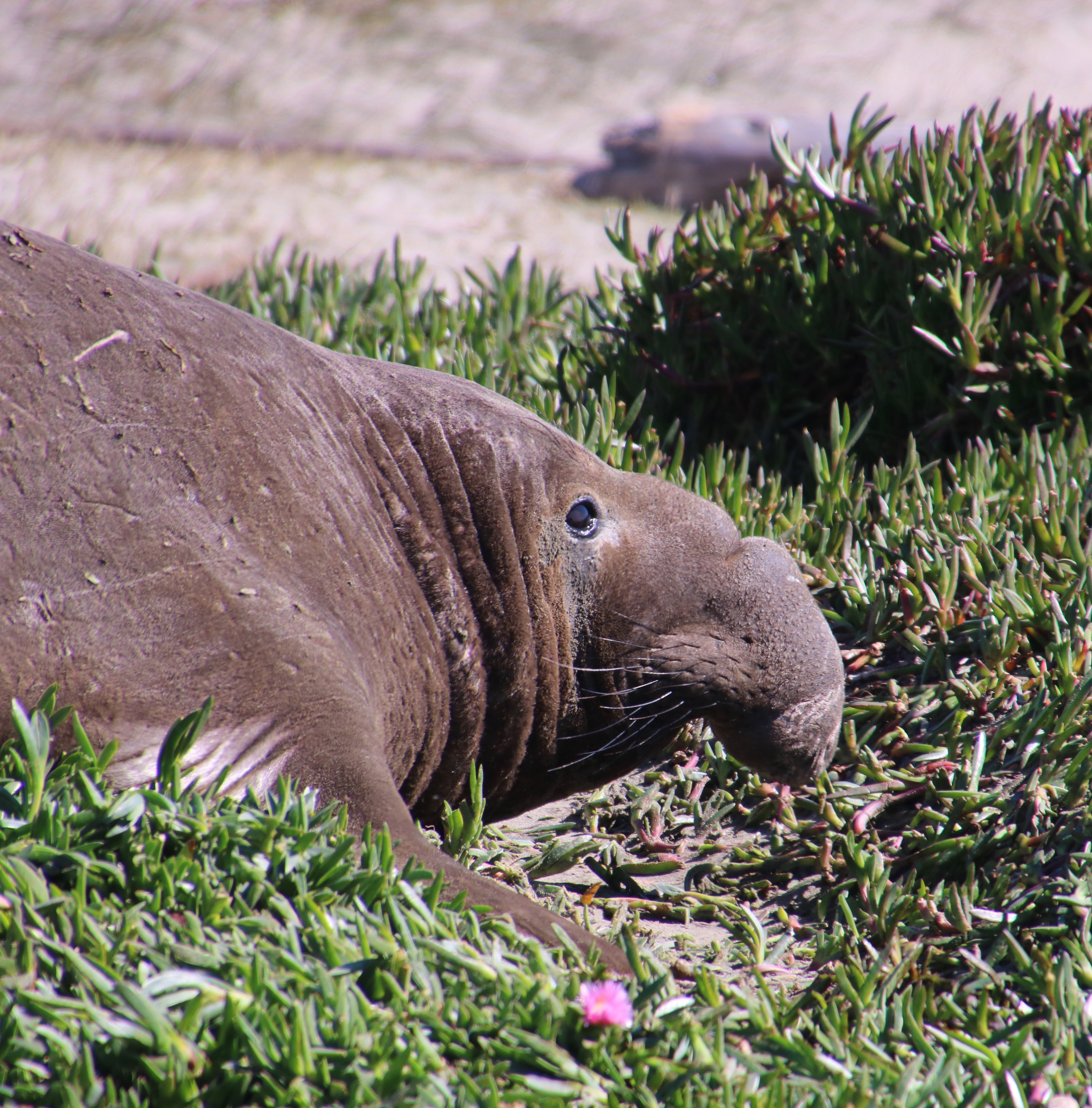
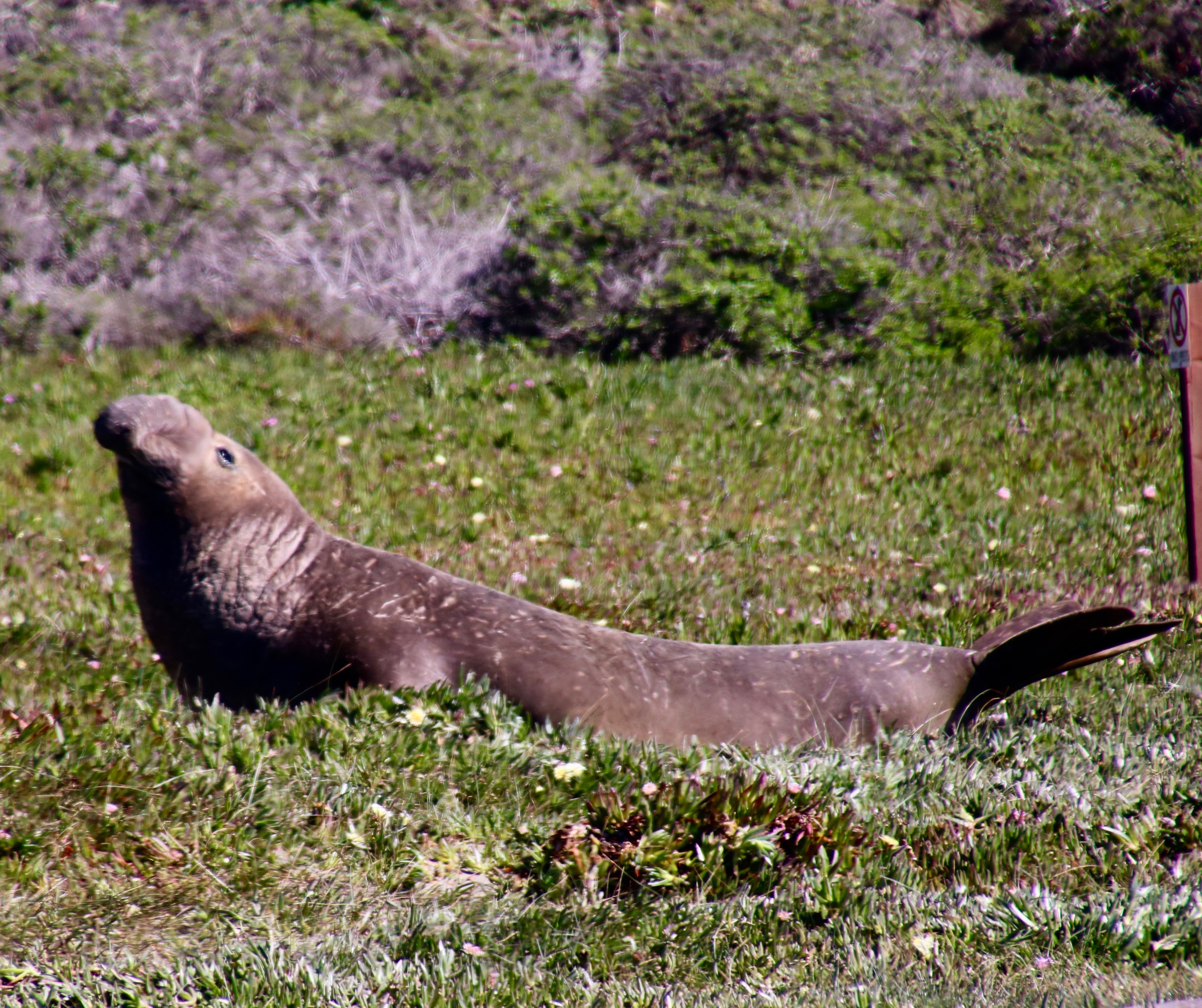
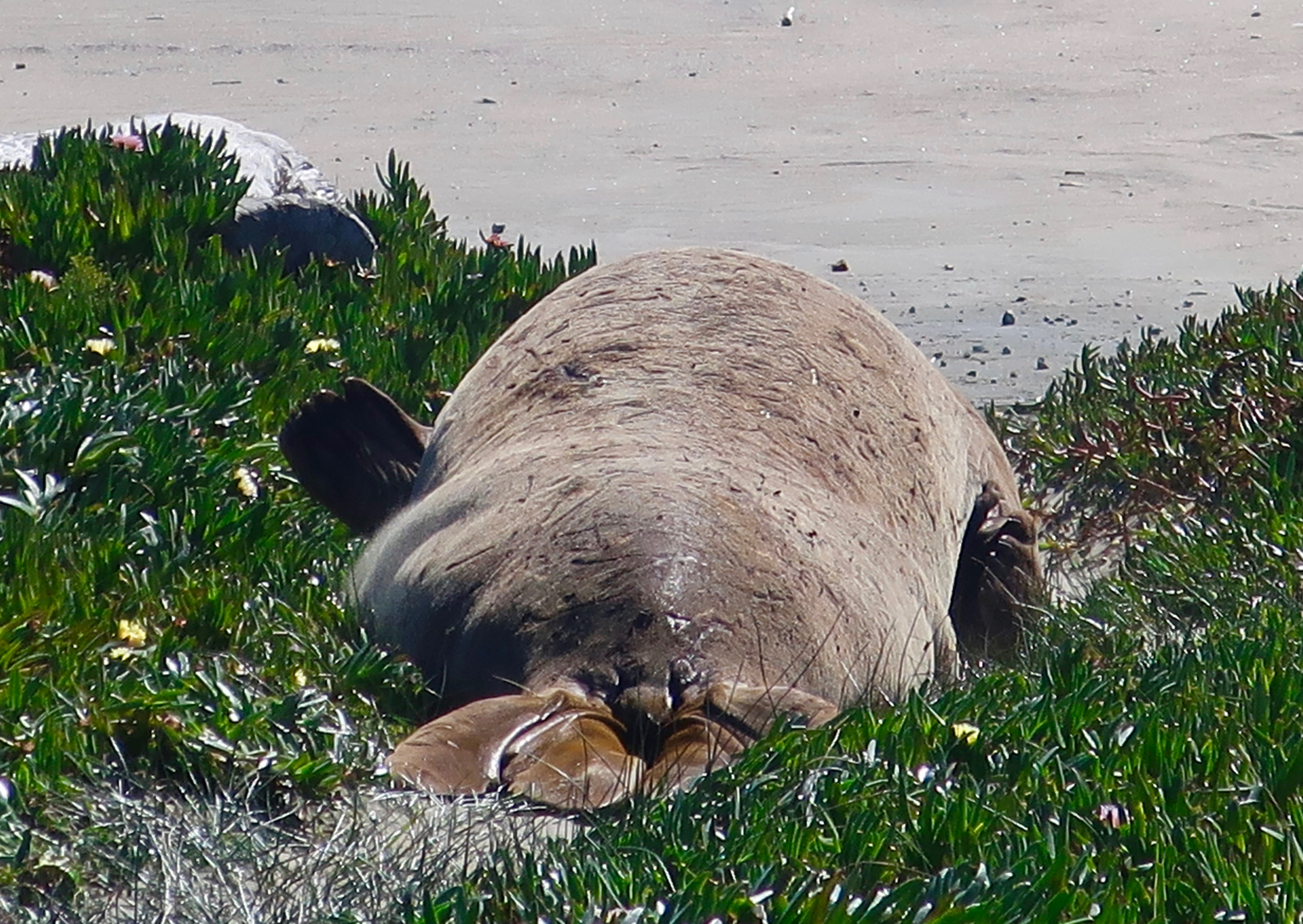
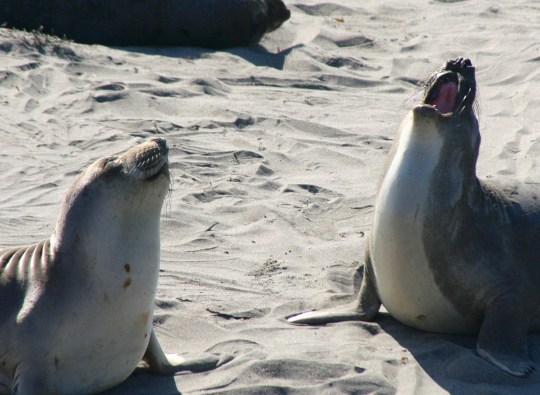
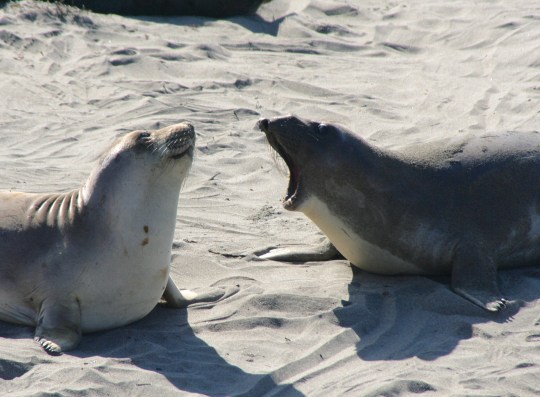
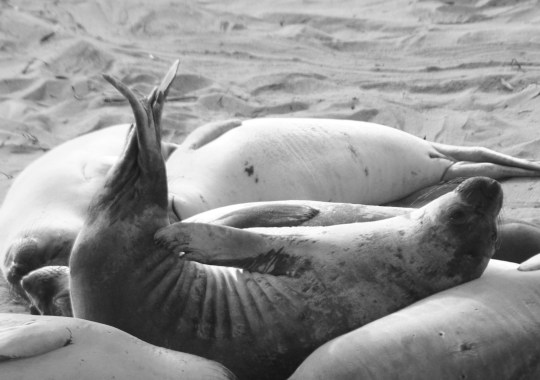
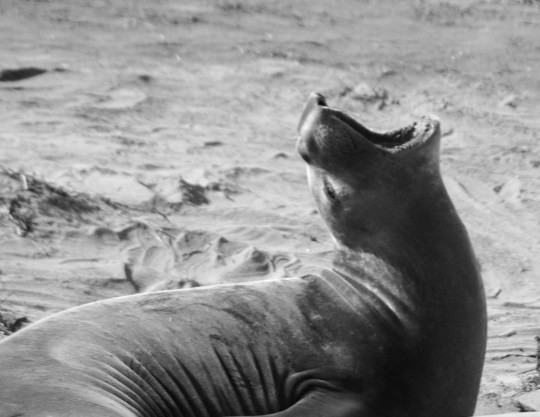
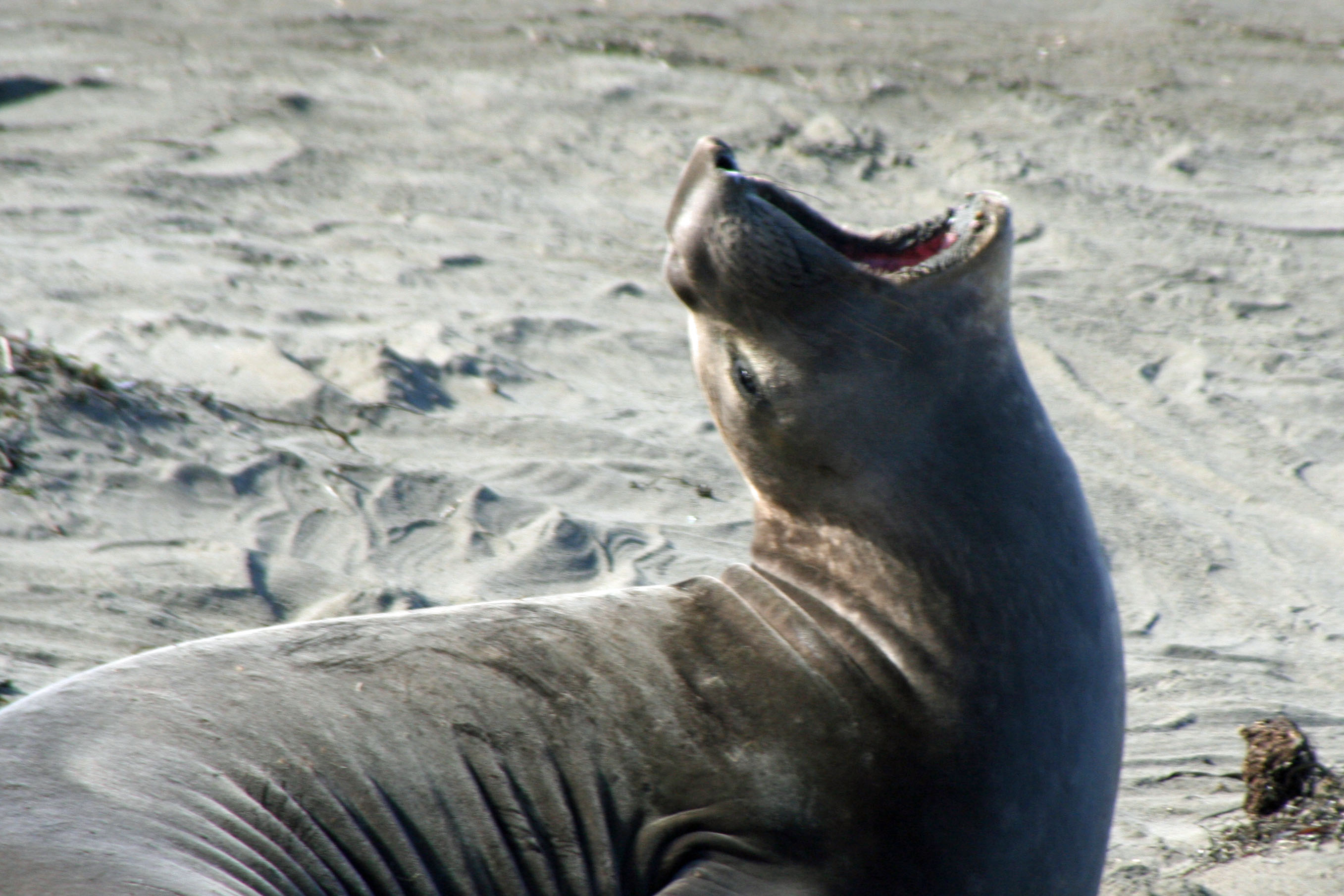
The male elephant seal can actually inflate its nose and turn it into a resonating chamber so it acts like a megaphone for blasting out challenges in a unique vocalization that other elephant seals easily recognize. (This photo was taken at the Piedras Blancas Rookery in Southern California that Peggy and I visited 15 years ago. The top photo was taken at Point Reyes National Seashore in Northern California much more recently.)

Each male’s dream is to establish a harem of females for breeding purposes. For an alpha male, this means between 20-50 females, although numbers can be as few as 10 or as many as 100. (Although how one bull could manage one hundred is hard for me to imagine. I did read that they sometimes have lieutenants…) Their size, fighting ability, and volume of vocalizations are all important in establishing the harem. The vocalizations mainly serve as a challenge, i.e. “Let’s fight and see who the biggest, baddest bull is,” or, to serve as a reminder: “You don’t want to fight with me. I kicked your butt last time.” The latter is usually enough to send past challengers scurrying. Harem status provides protection for the females, freedom from being harassed constantly by other males (a biggie), and a safe place to birth their pups.
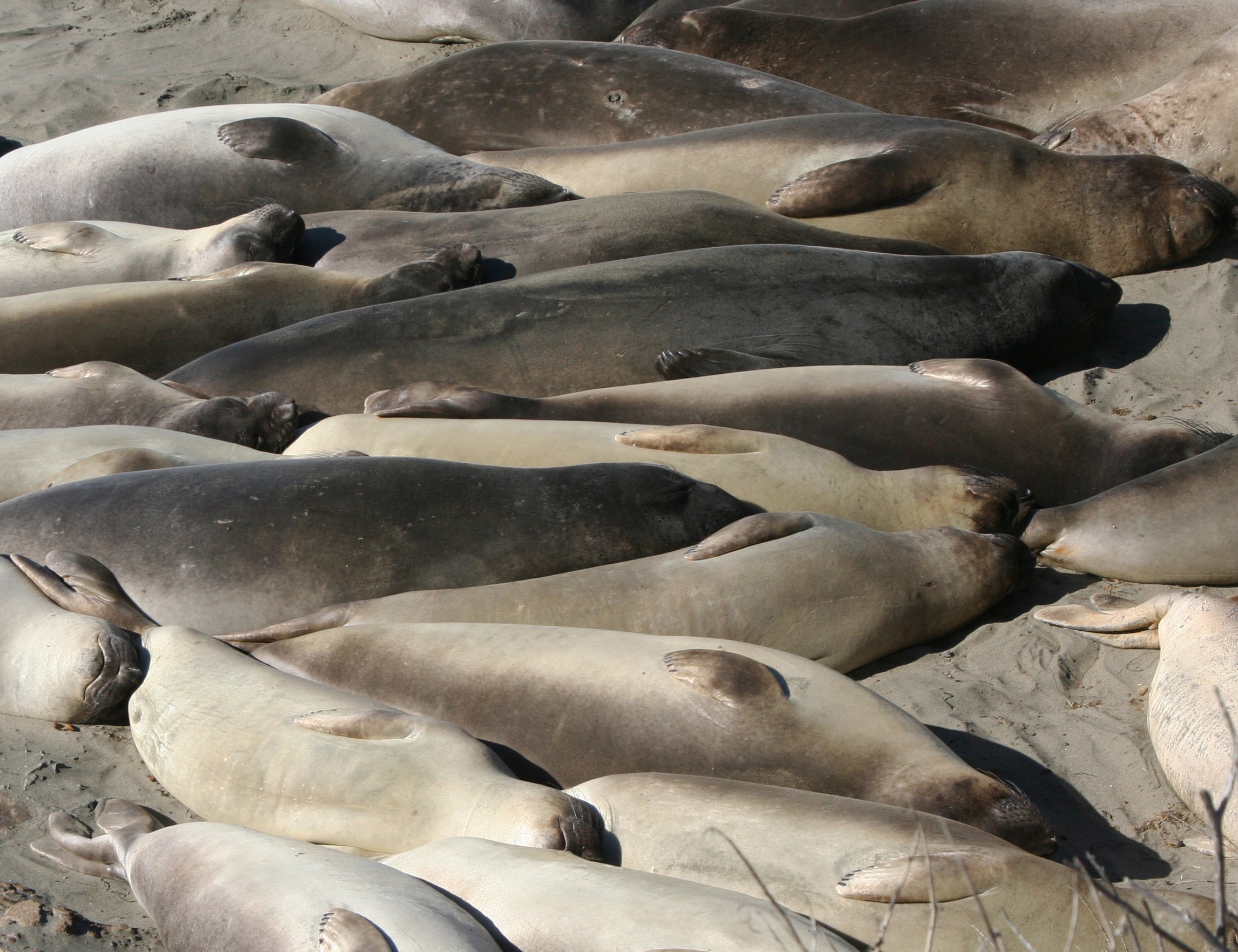
Elephant seals were once close to extinction, killed for their oil. A large male could yield over 25 gallons, which was used for lamps, lubrication, and making soap and paint. By 1900, only a few hundred remained on the coast and islands of Northern Mexico. Laws protecting their status, first by Mexico and then the US, allowed for a rapid increase in numbers. Today, Piedras Blancas alone hosts as many as 17,000 annually. As you might imagine, the beach gets a little crowded.
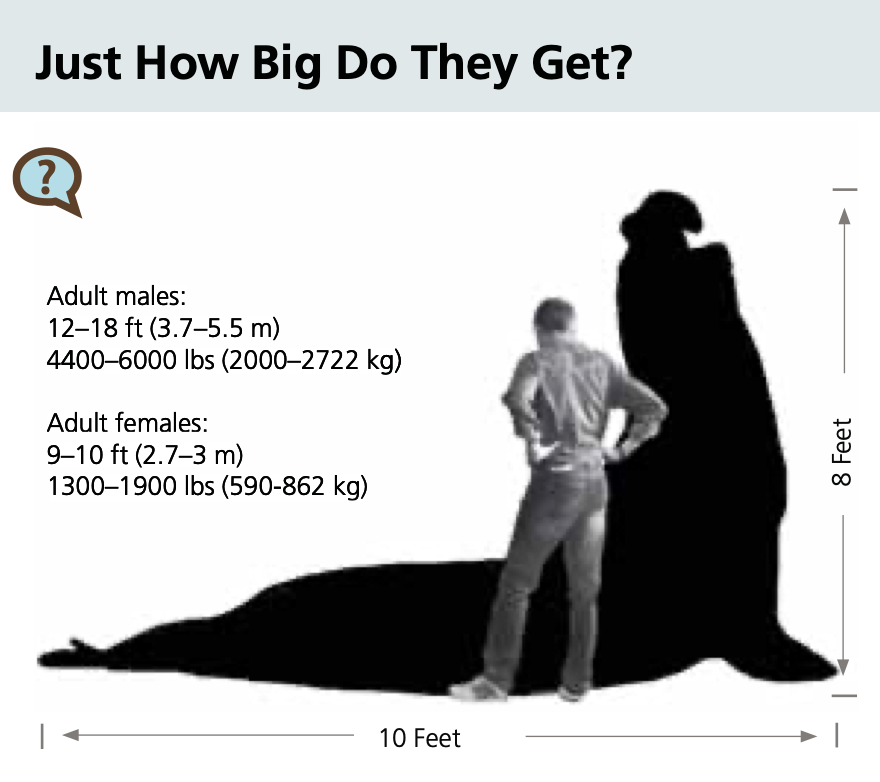
Bull elephant seals are big. The illustration below from the National Park Service shows just how big…
This is one of several reasons why the National Park Service suggests that people stay at least 100 feet away! You don’t want one deciding you are a threat to be eliminated or at least chased off.
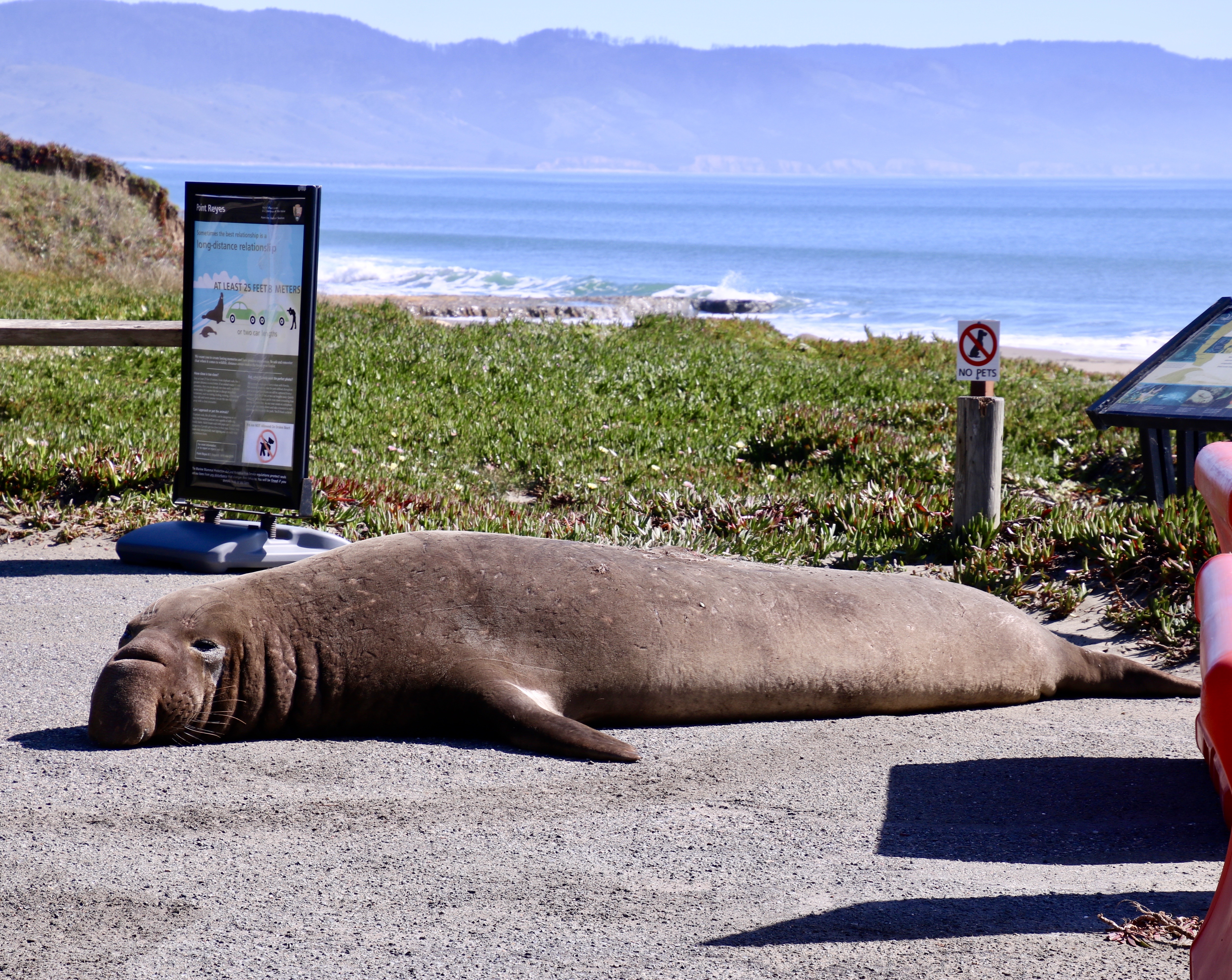
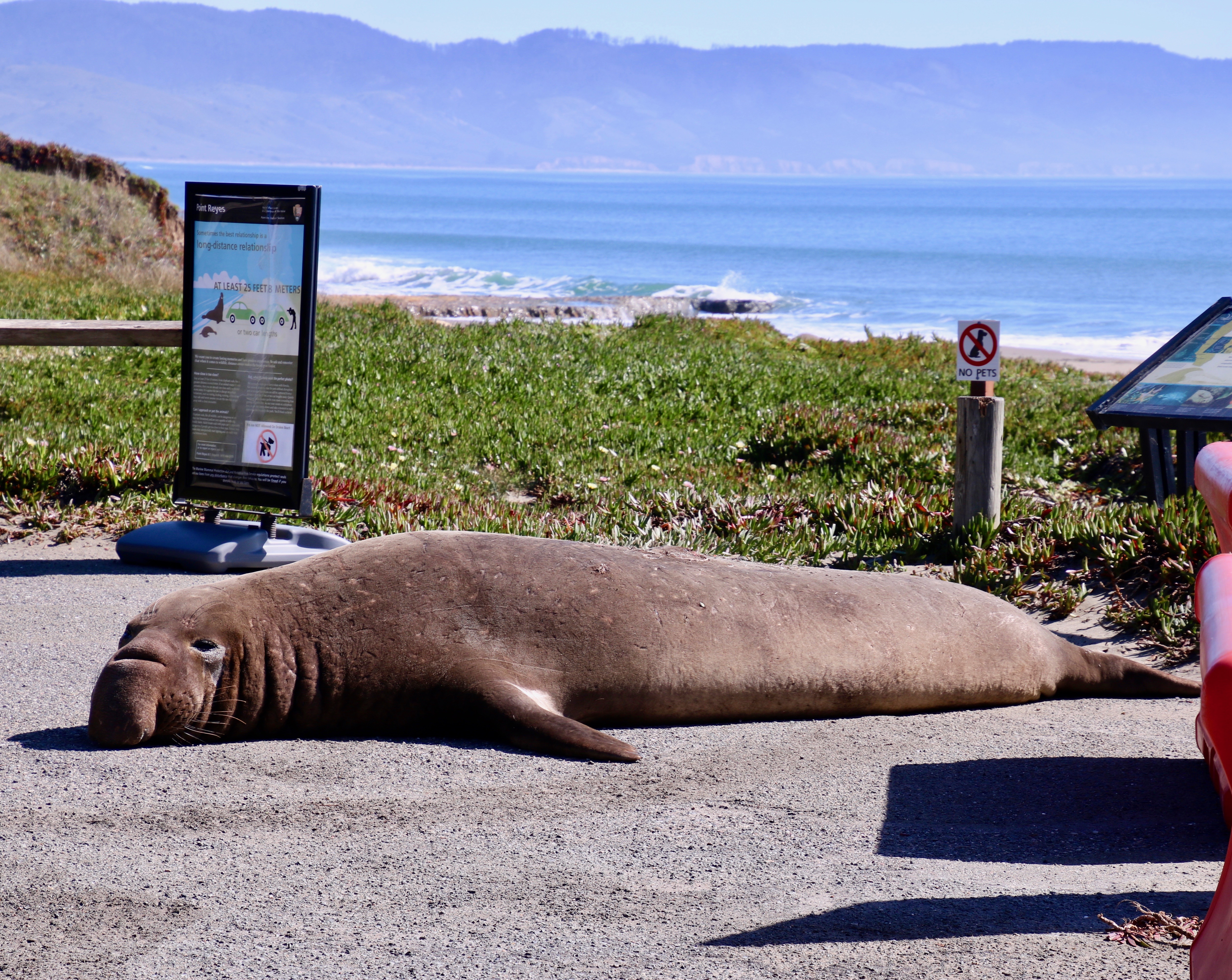
One came crawling up onto the parking lot at Drakes Beach, Point Reyes. We moved back but we were still closer than we had been. These large creatures are not built for land. Moving is more like shuffling forward like an inchworm. They can use their front flippers to help in movement and balance but not their hind flippers. Watching videos of smaller males getting away from alpha males suggests that they can move fast when sufficiently motivated! The guys at Point Reyes were relaxed: They would ‘galumph’ about 10 feet and stop to rest. Mating season was past. There was no reason for getting excited.
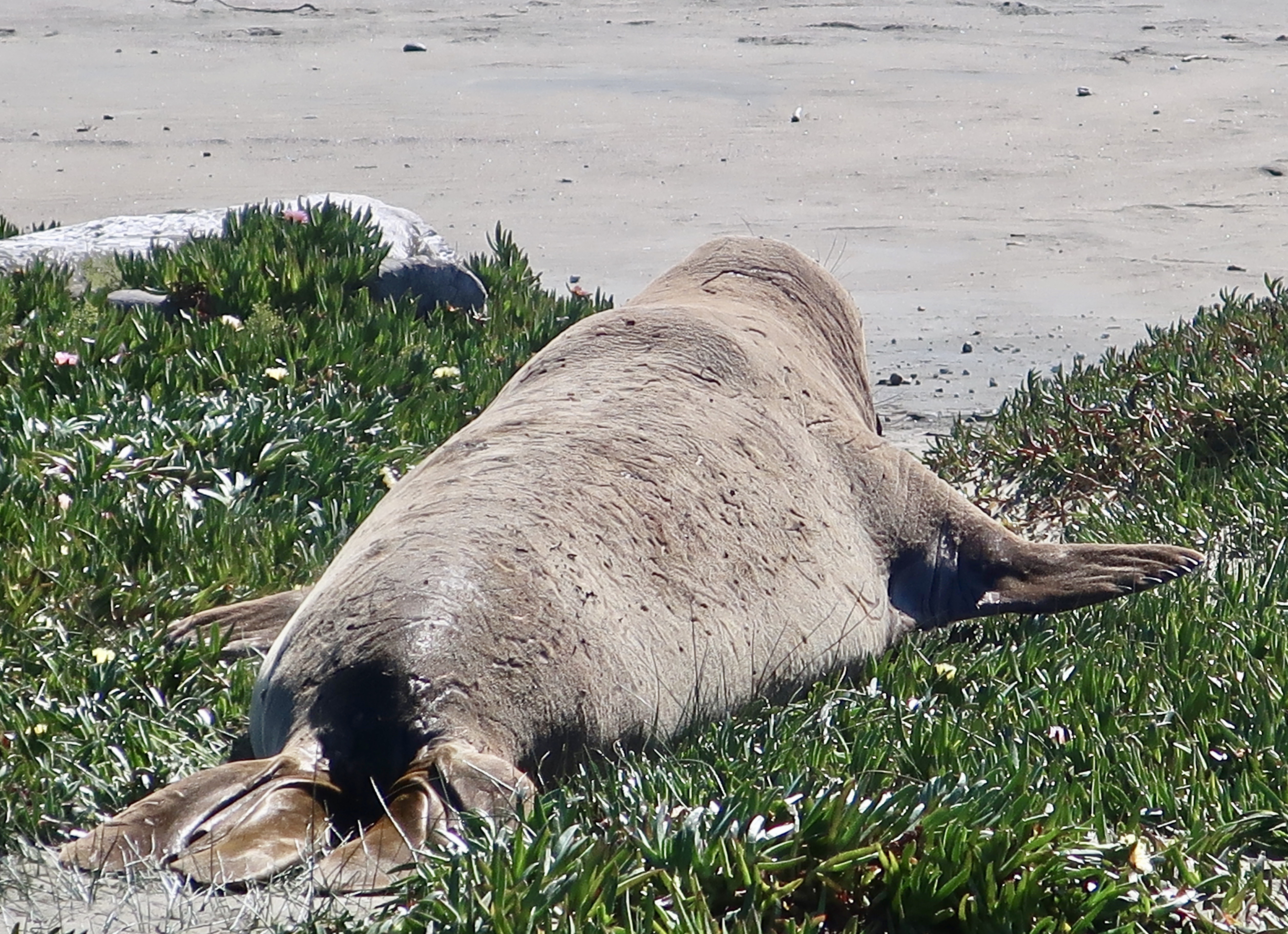
This shot provides a view of the hind flippers dragging along behind while the front flippers are used to push and balance. While worthless on land, the hind flippers turn into powerful ‘propellers’ in water.
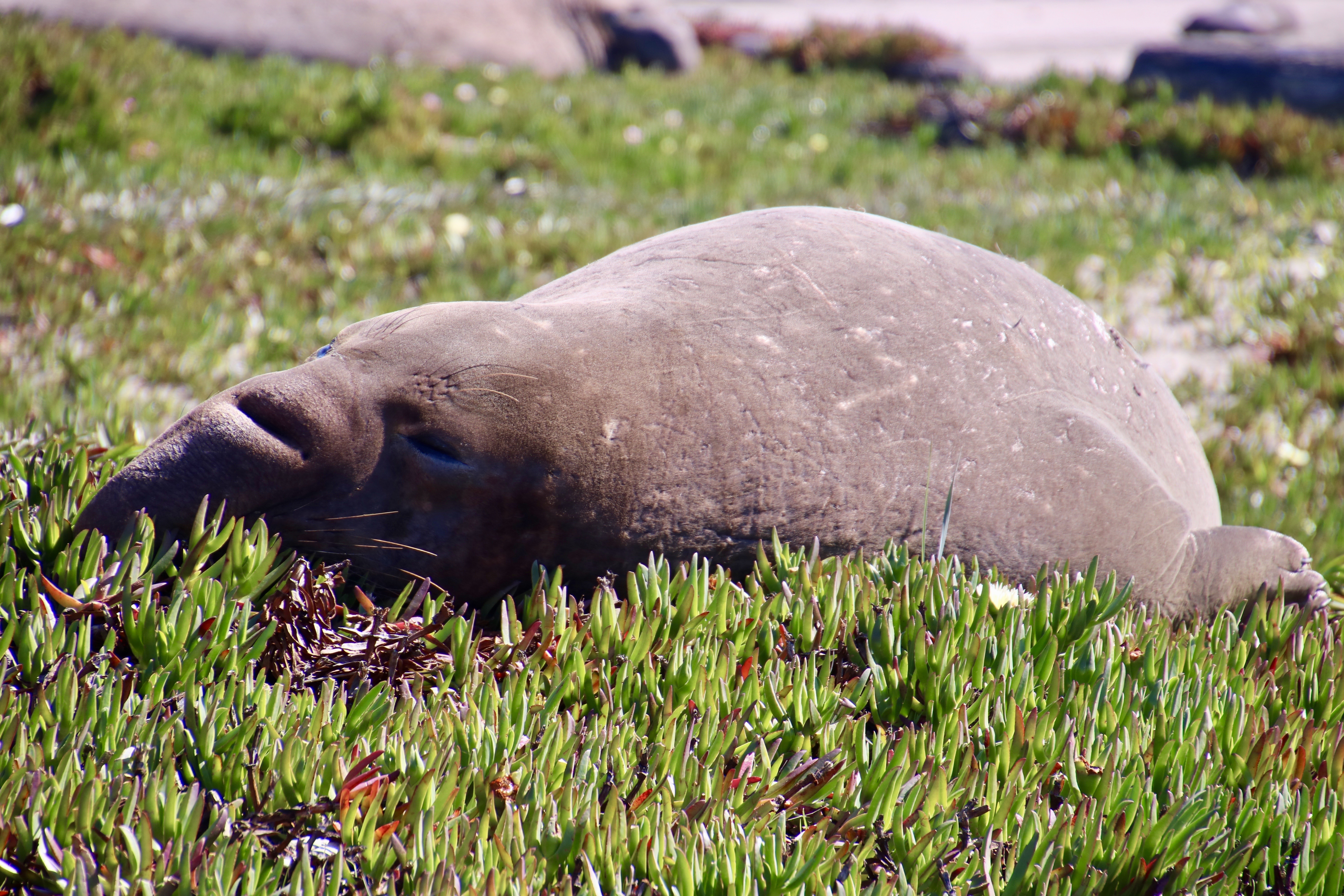
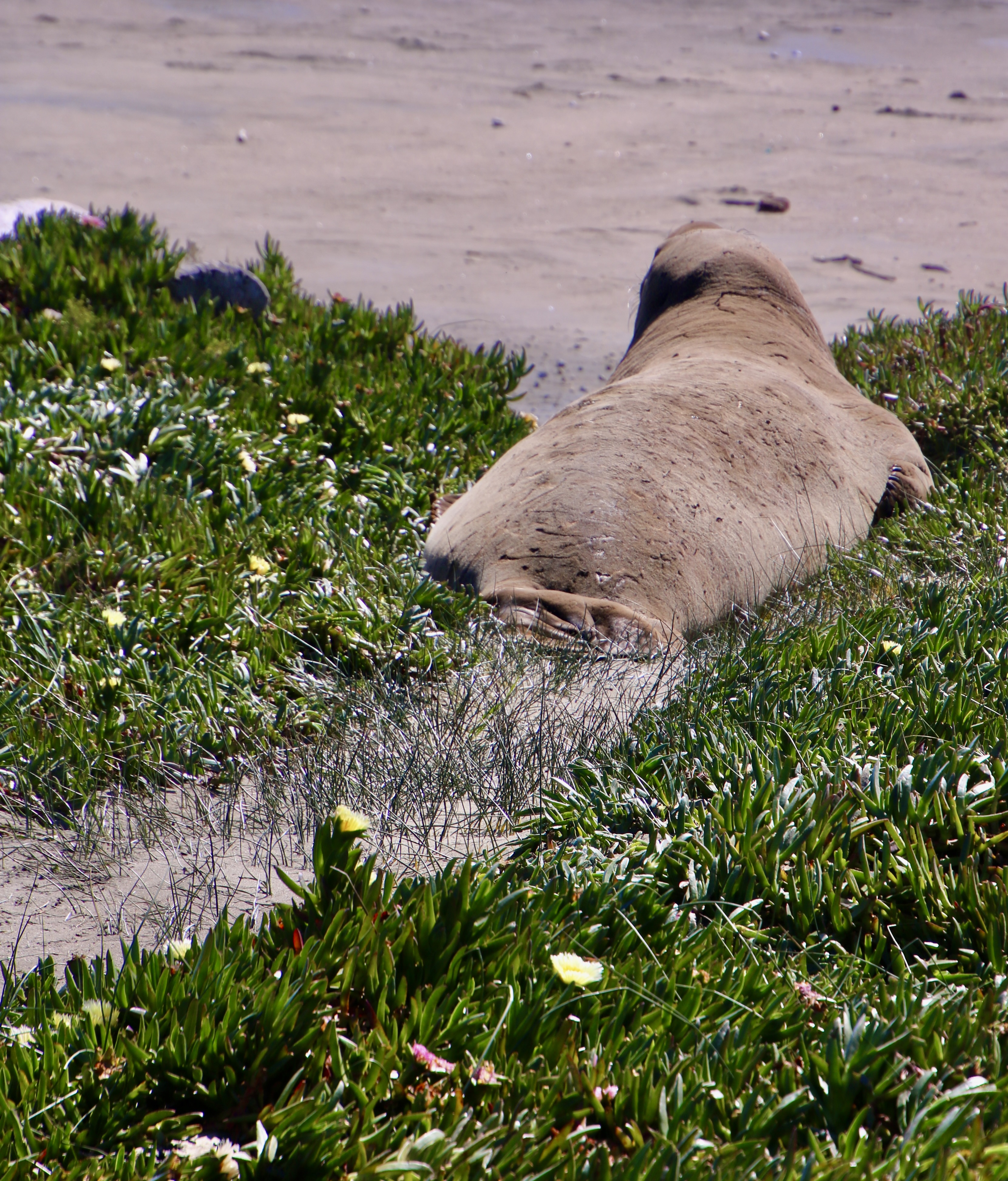
The elephant seal moving through the ice plants was like a bulldozer creating a road.
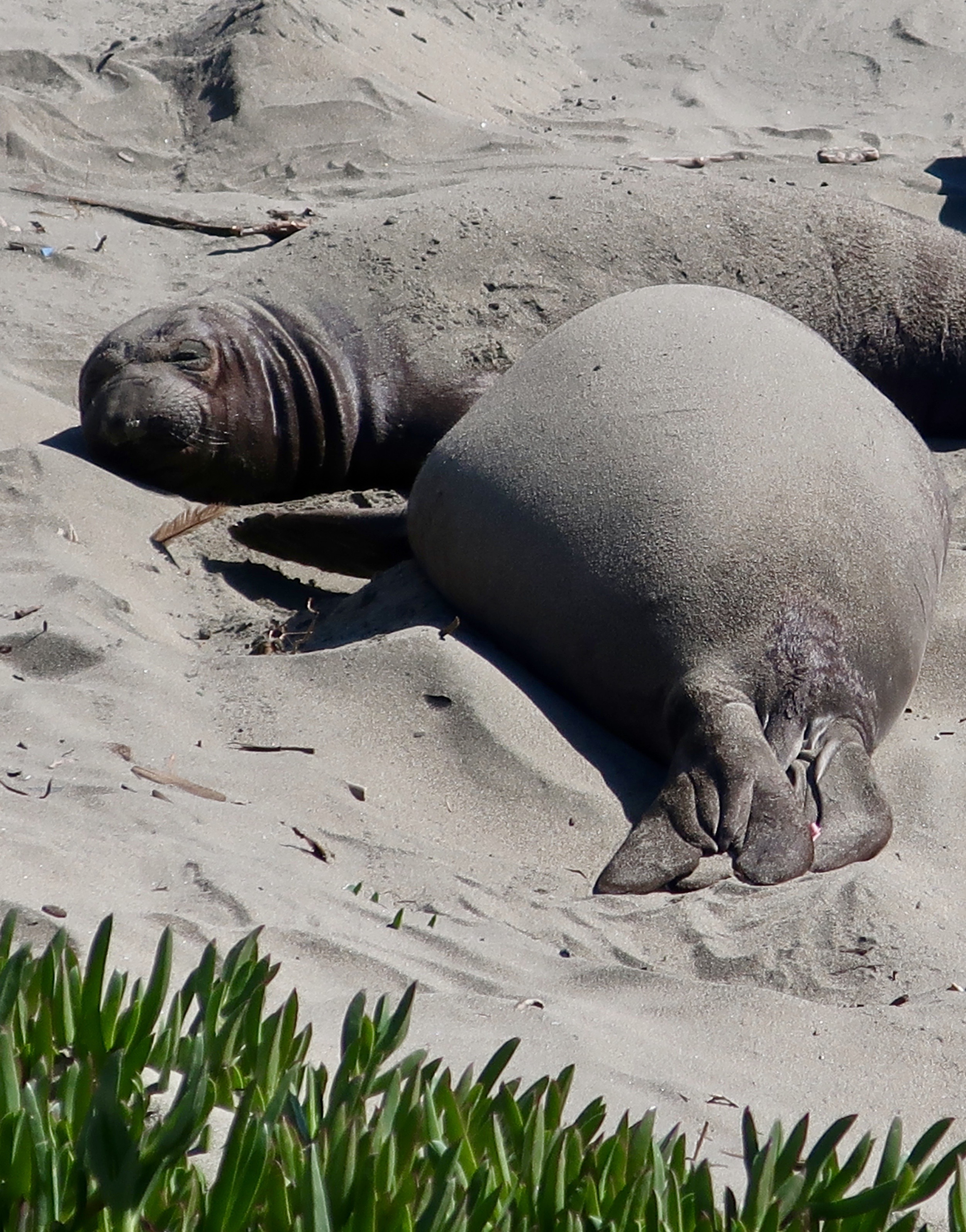
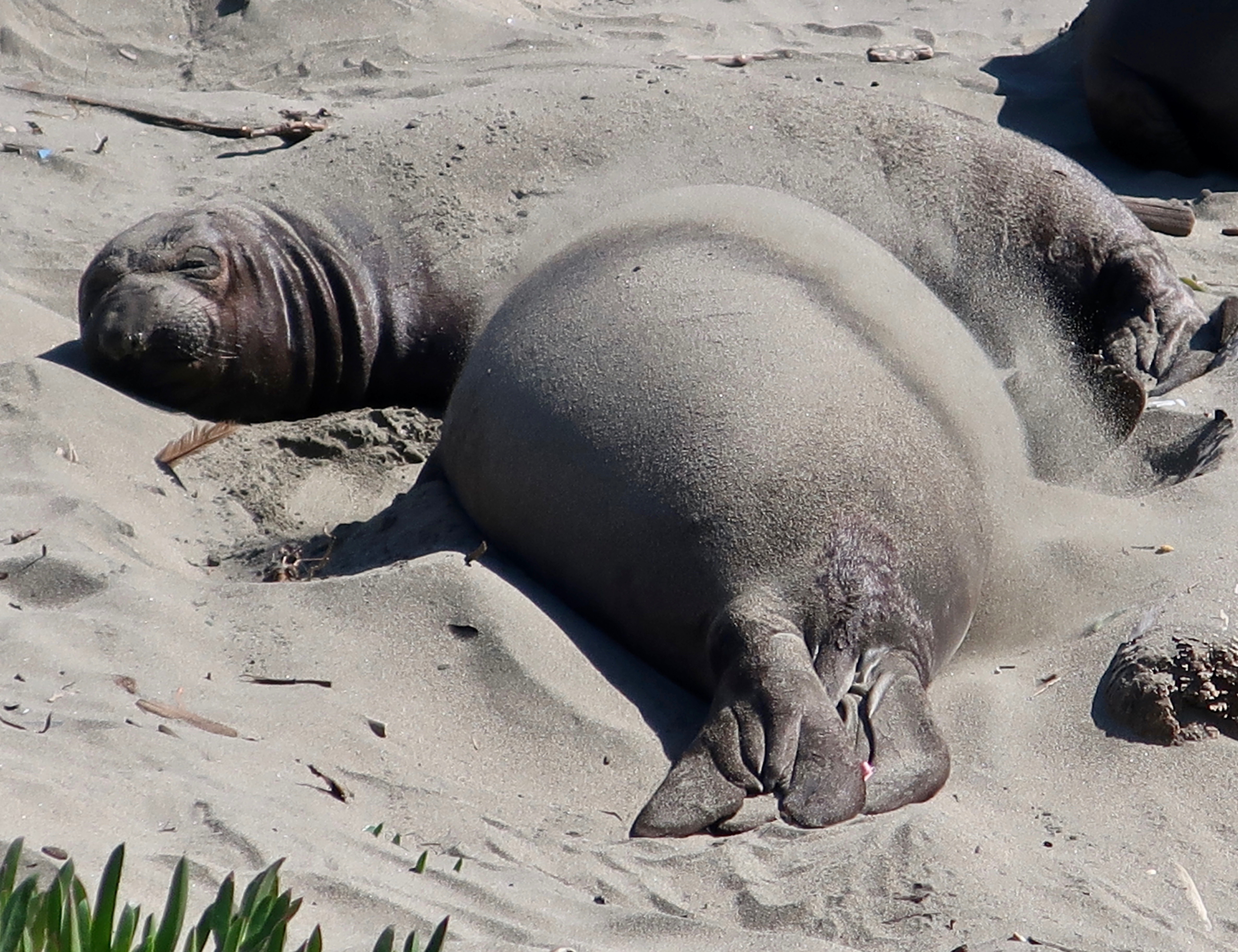
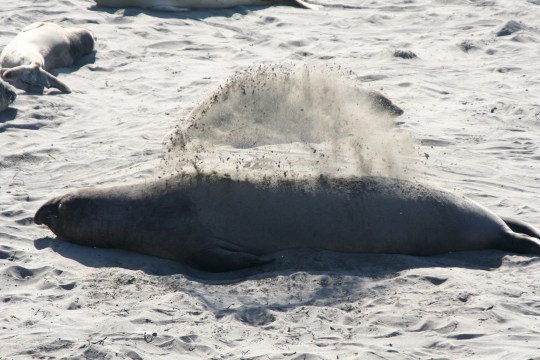
You want fat? Here it is. I think it is a youngster known as a super-weaner. Baby elephant seals normally weigh between 250-350 pounds when weaned. Super-weaners can weigh up to 600 pounds! How do they get that way? There are two approaches: One, they steal milk from nursing females and are known as ‘milk thieves,’ or two, they are adopted by an additional mother seal and are known fondly as ‘double mother-sucklers.’ It’s hard to imagine this guy even moving. Note the sand on both of the elephant seals’ backs. They use their front flippers to toss it up. It’s used like you or I use sunblock.
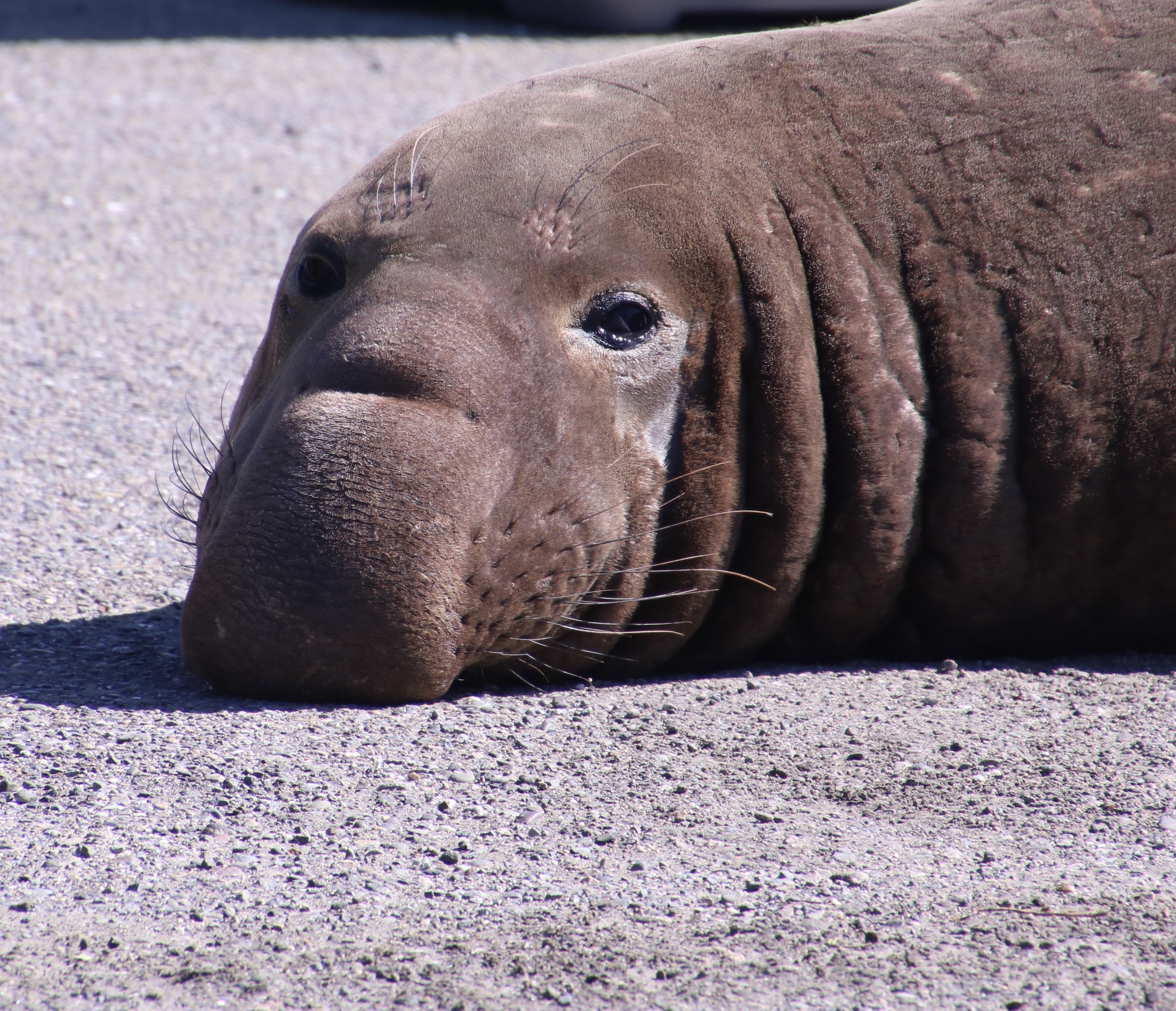
Our parking lot friend moved its head to check us out and make sure that Peggy and I were showing proper respect. Note the eyes and whiskers. Both are helpful in locating food during the deep dives that elephant seals make. The large eyes help them see in the inky depths of one to two thousand feet where they normally search for food like squid and fish. (They can go as deep as 5000 feet.)The whiskers may be used in helping to find food along the bottom.
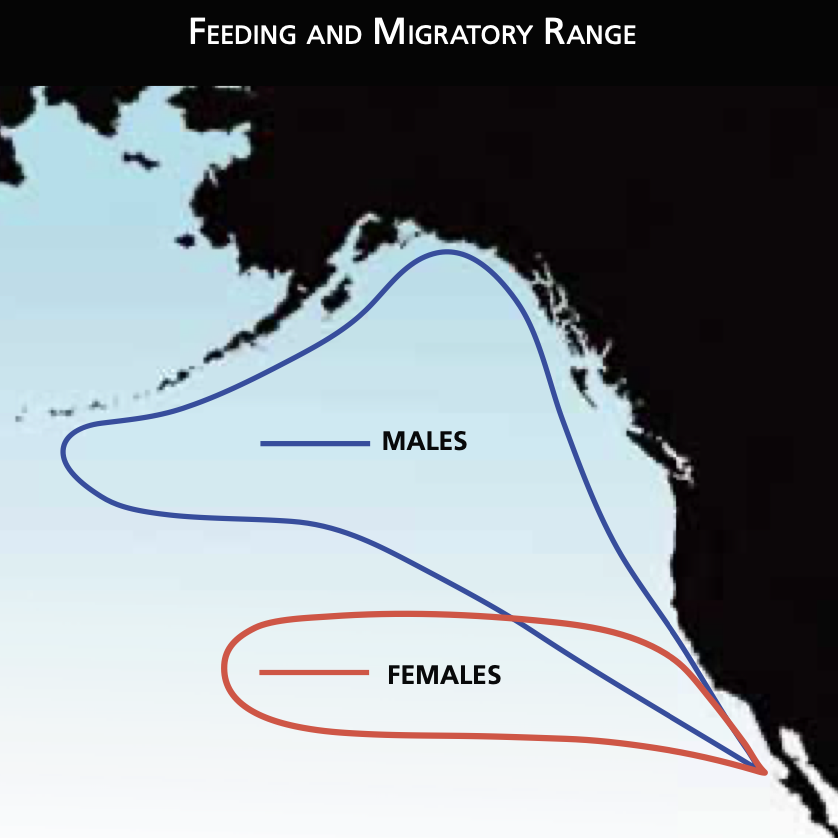
This illustration from the National Park Service shows the feeding ranges of the male and female northern elephant seals. They spend 80% of their lives on the open sea and a surprising 90% of that time under water, much of which is spent making their deep dives.

They are uniquely qualified for the dives. For example, while you or I take a deep breath before we dive, elephant seals expel theirs to avoid having their lungs crushed by the tremendous pressure that exists at 1000 plus feet under the sea. Instead, they store extra oxygen in their blood. They have three times as much blood as we do on a per pound basis, i.e. lots, and and their blood is much richer in hemoglobin. They also reduce their heart rate when they dive and focus the majority of their blood on servicing their vital internal organs. Using these evolutionary modifications they are able to dive for 30 plus minutes per time, resurfacing for a short 3 minutes. Elephant seals continue to forage constantly during the migrations between their primary feeding ranges and where they travel to breed, have pups, and molt. It’s a good thing. When they arrive, they fast for the time they are on shore, (2-3 months), living off of the fat they have stored.

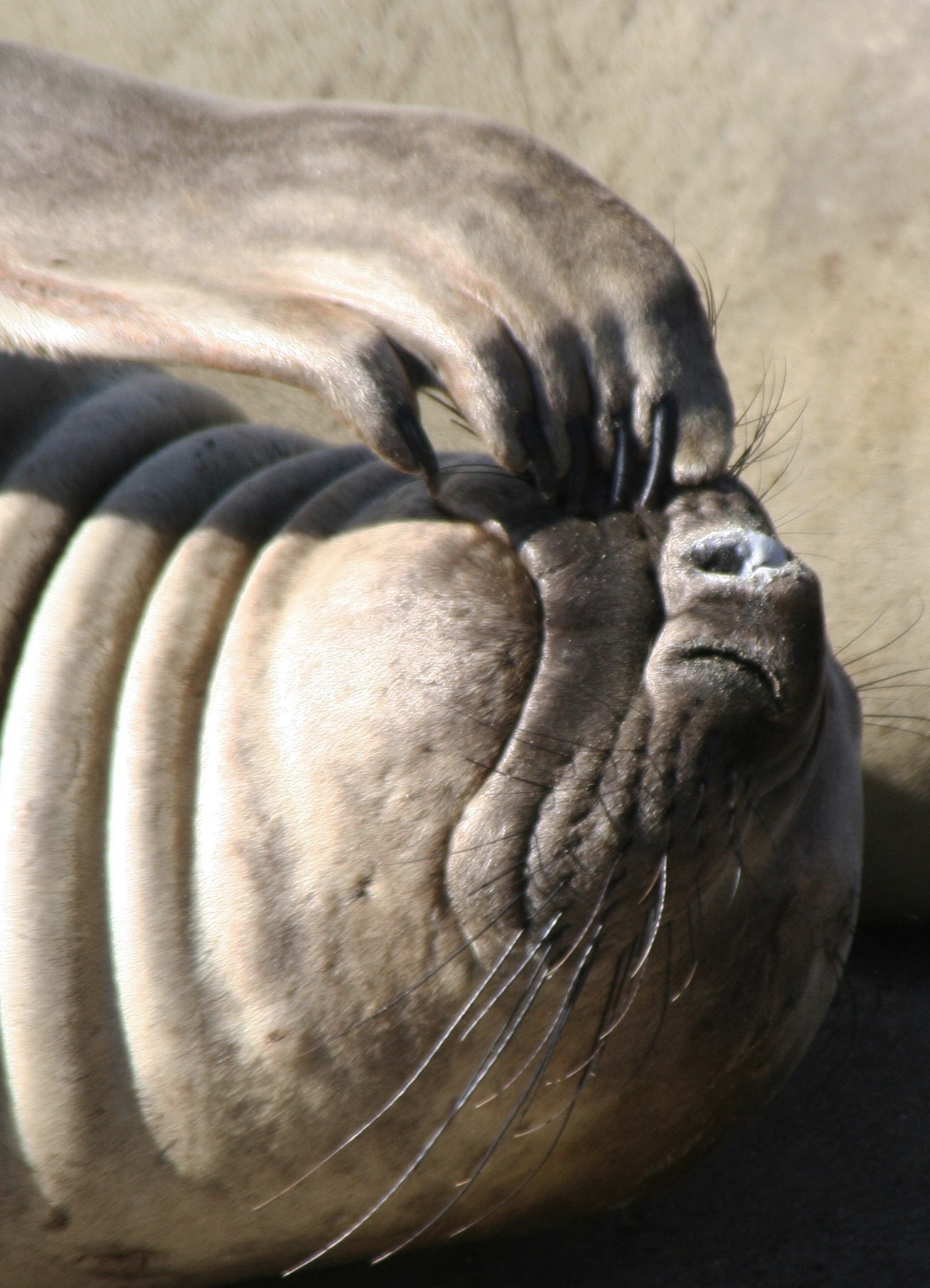
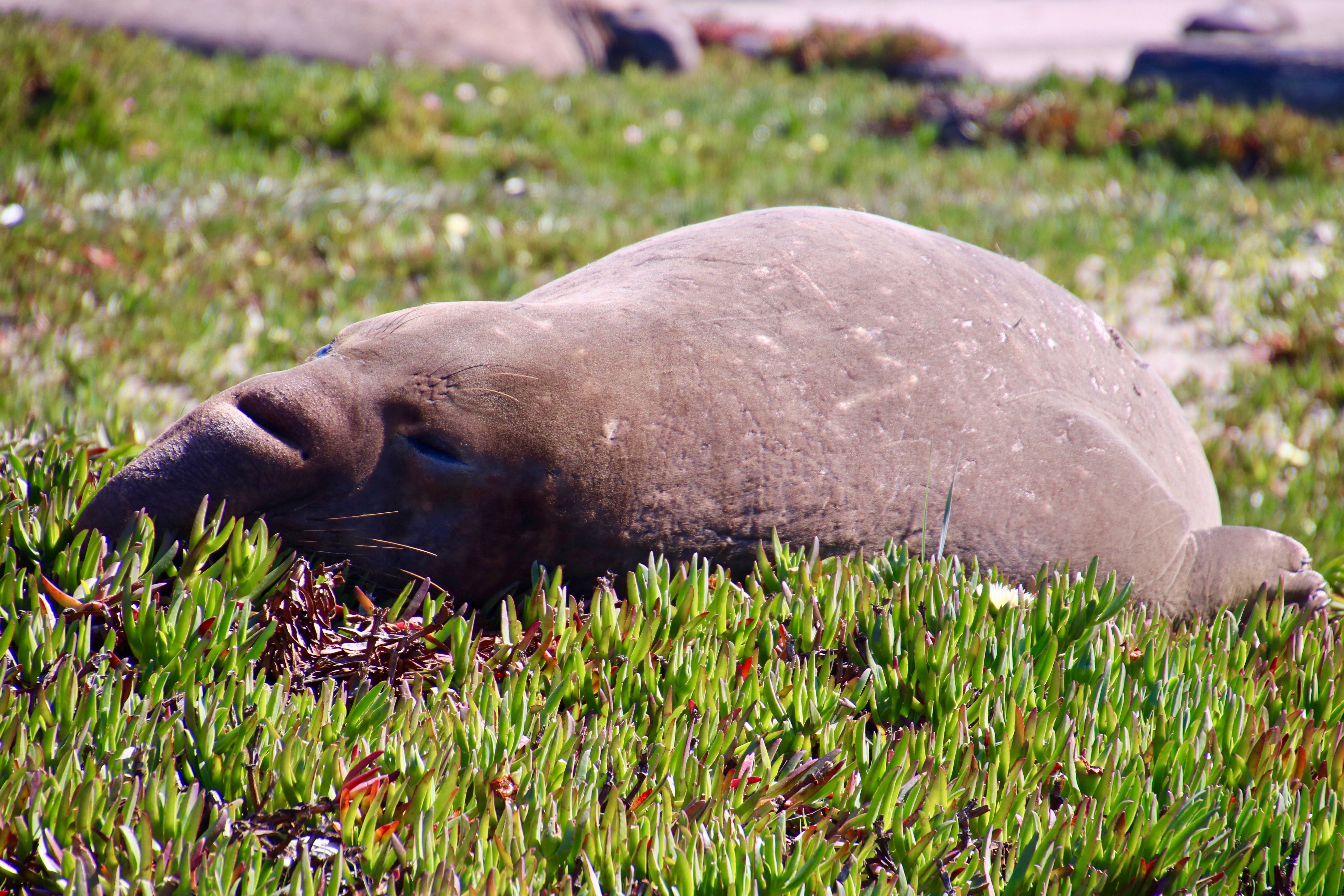
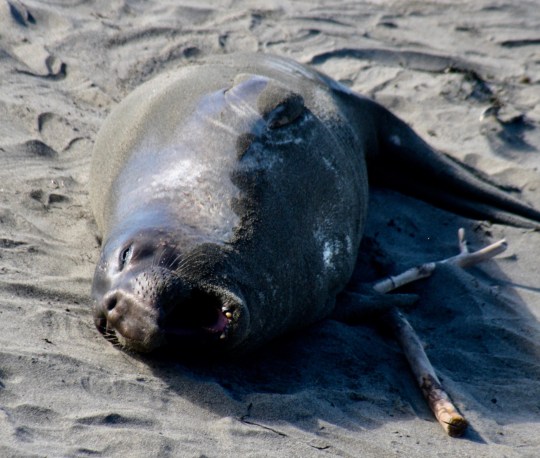
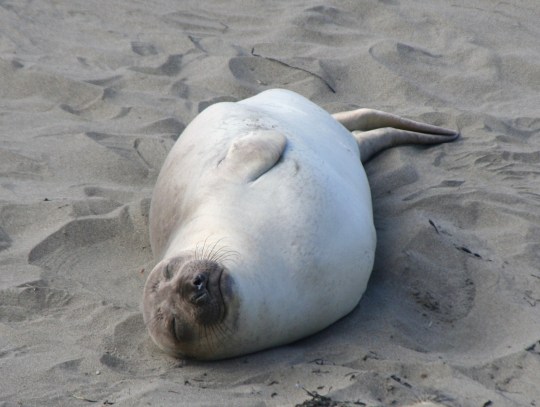
Wow, those are lots of details. It’s enough information to make you scratch your head. And— is this elephant seal winking its nose at us? (Piedras Blancas Rookery in southern California.)
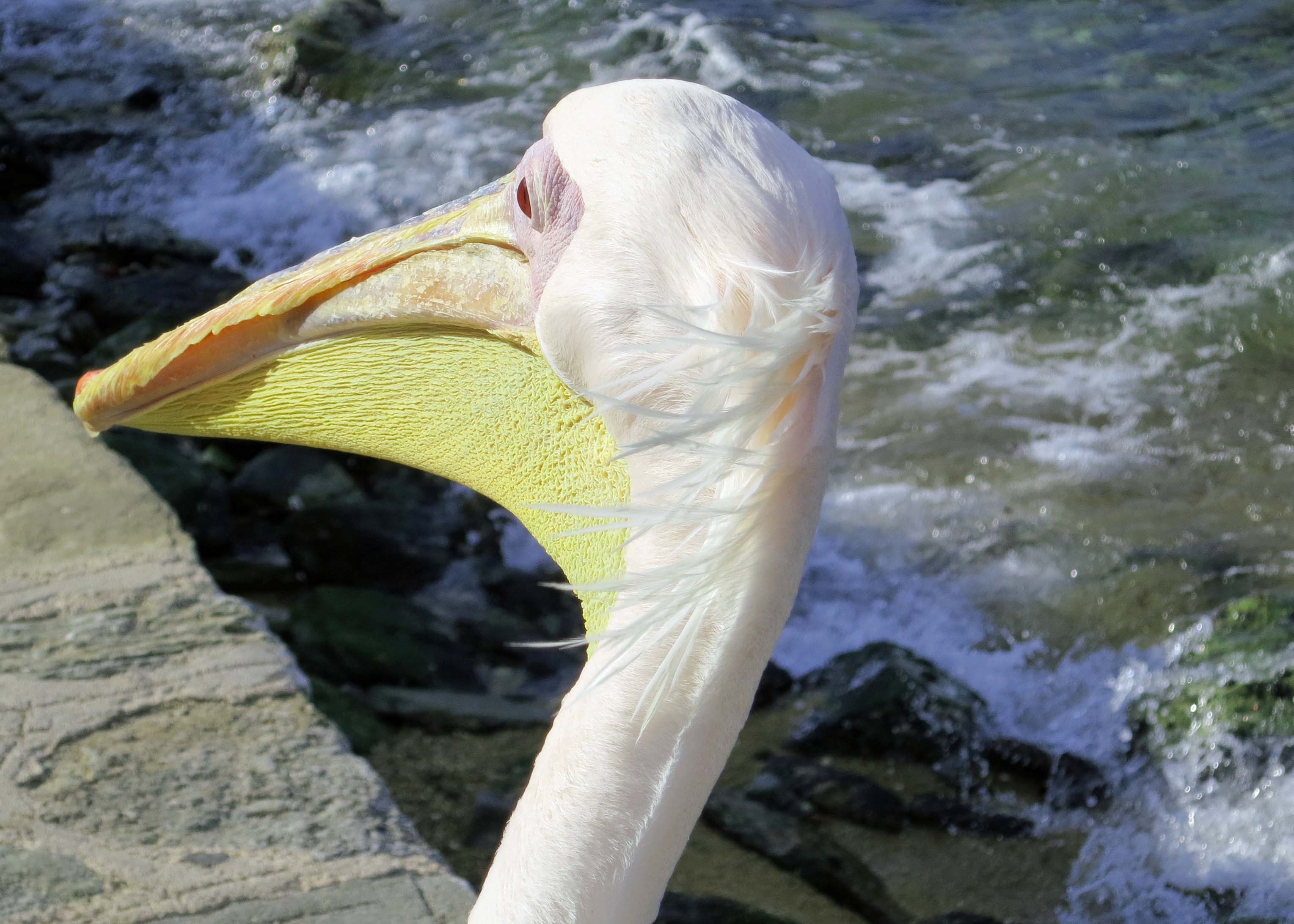
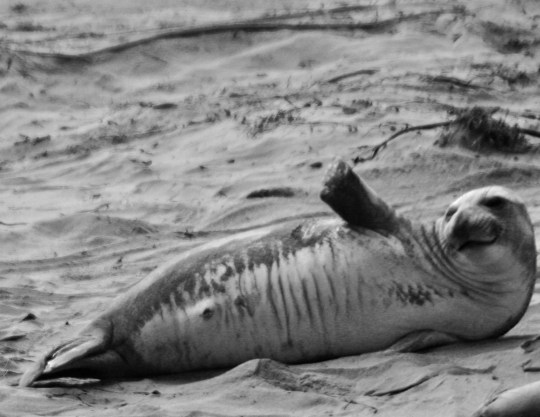
A final photo from Pt. Reyes that amused us. Next up pelicans. Can they match iguanas and elephant seals in character?
Petros.

An Iguana, an Elephant Seal, and a Pelican Walked into a Bar… Run, the Bartender Screamed!

Today marks the beginning of a new/old series for us. It’s old in the sense that we have done a similar series in the past, but not for a long time. We are going to select a specific subject for each post. Today, for example, is on iguanas. Our next post will be on elephant seals, and the time after on pelicans. We chose these three to kick off the series because we find them wonderfully weird. They also represent reptiles, mammals and birds.

Given that we have 100,000 (plus or minus) photos in our photo library that we’ve gathered over 25 years of wandering the world, there will be no lack of subjects for future posts. We will, of course, continue to do posts on our ongoing adventures as they take place. As always, photos appearing on our blogs have been taken by either Peggy or me unless otherwise noted.

I am also going to do a new series titled Ut-Oh, which is how I pronounced uh-oh as a child. But more on that in the next few weeks.

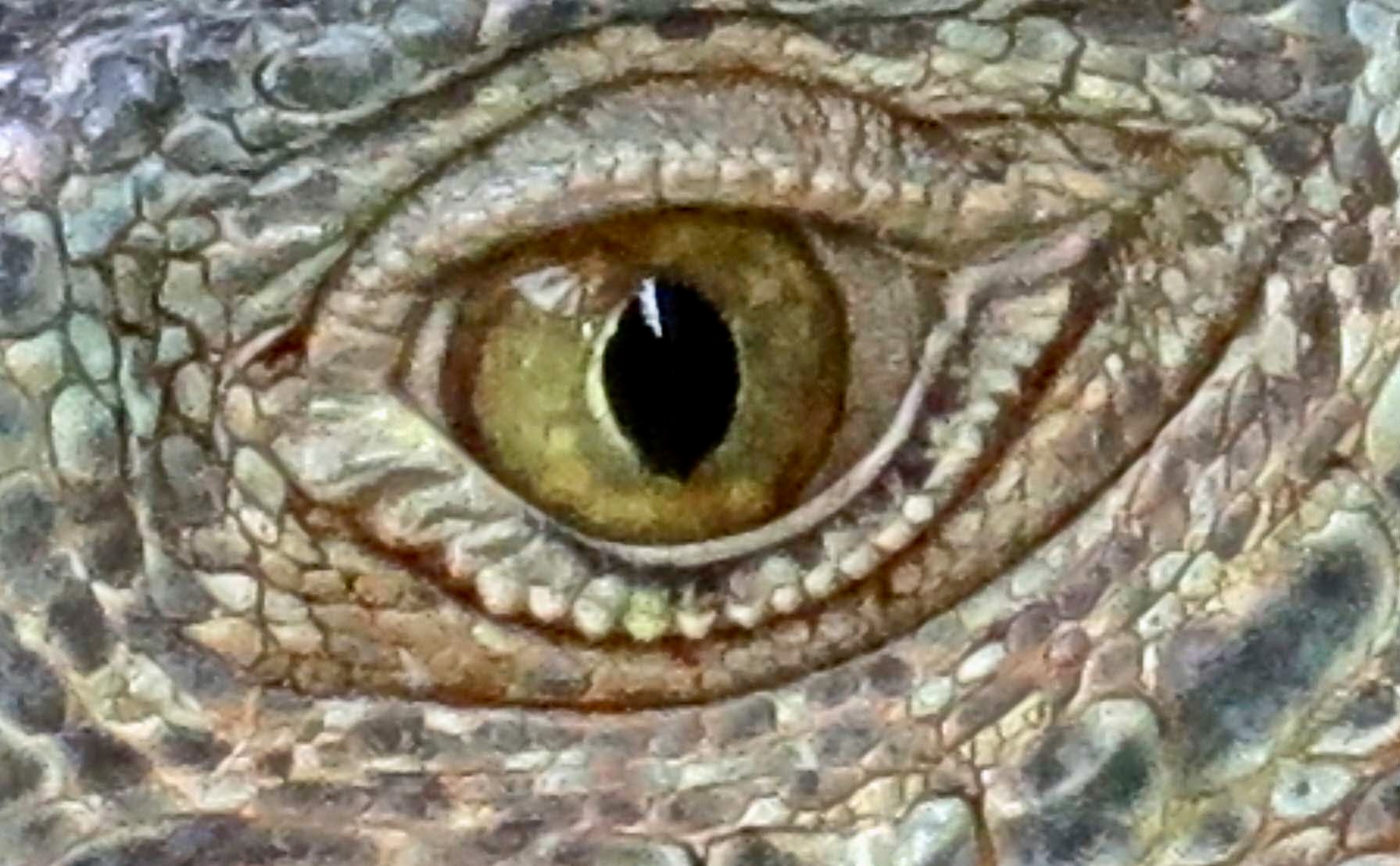
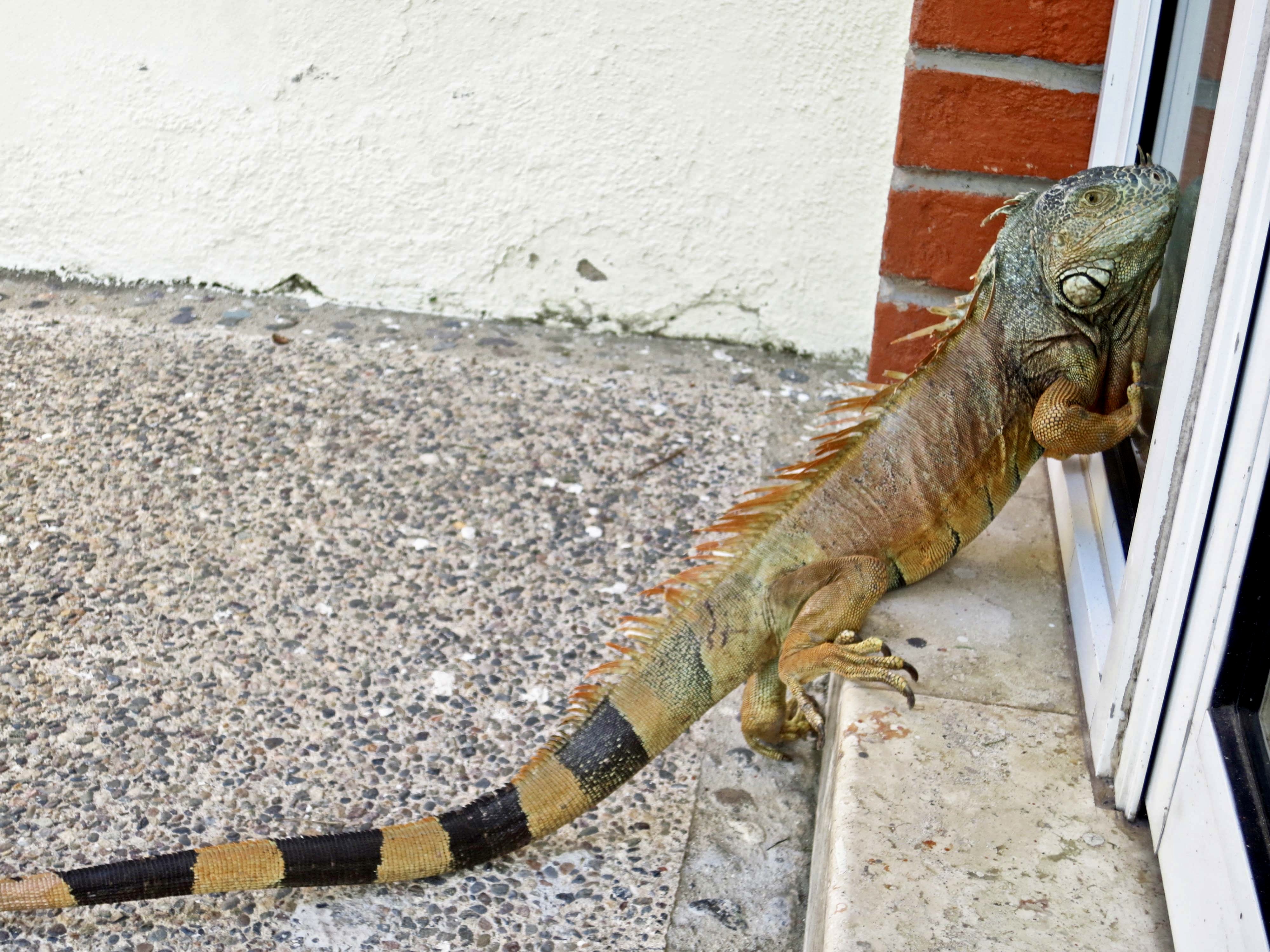
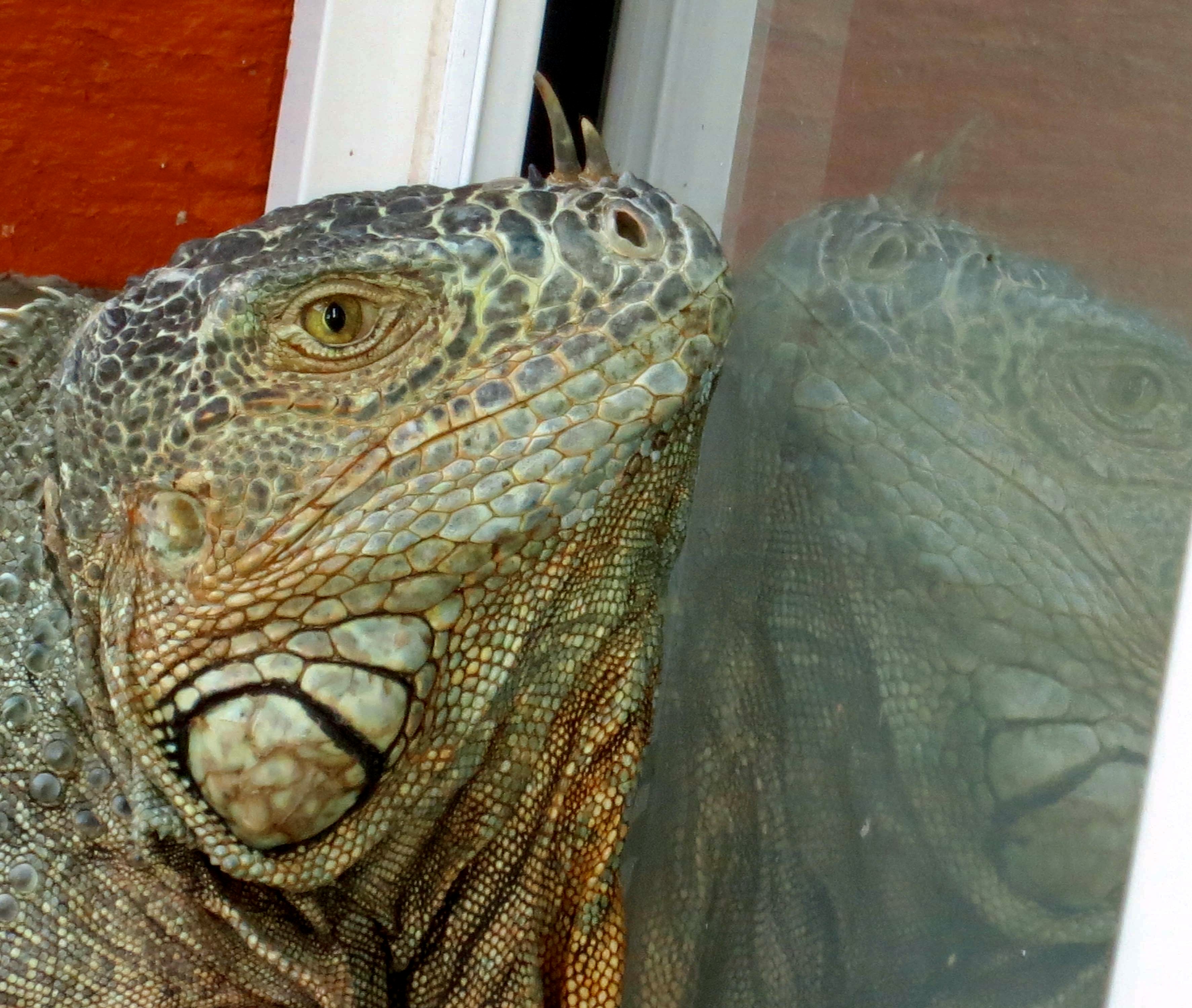
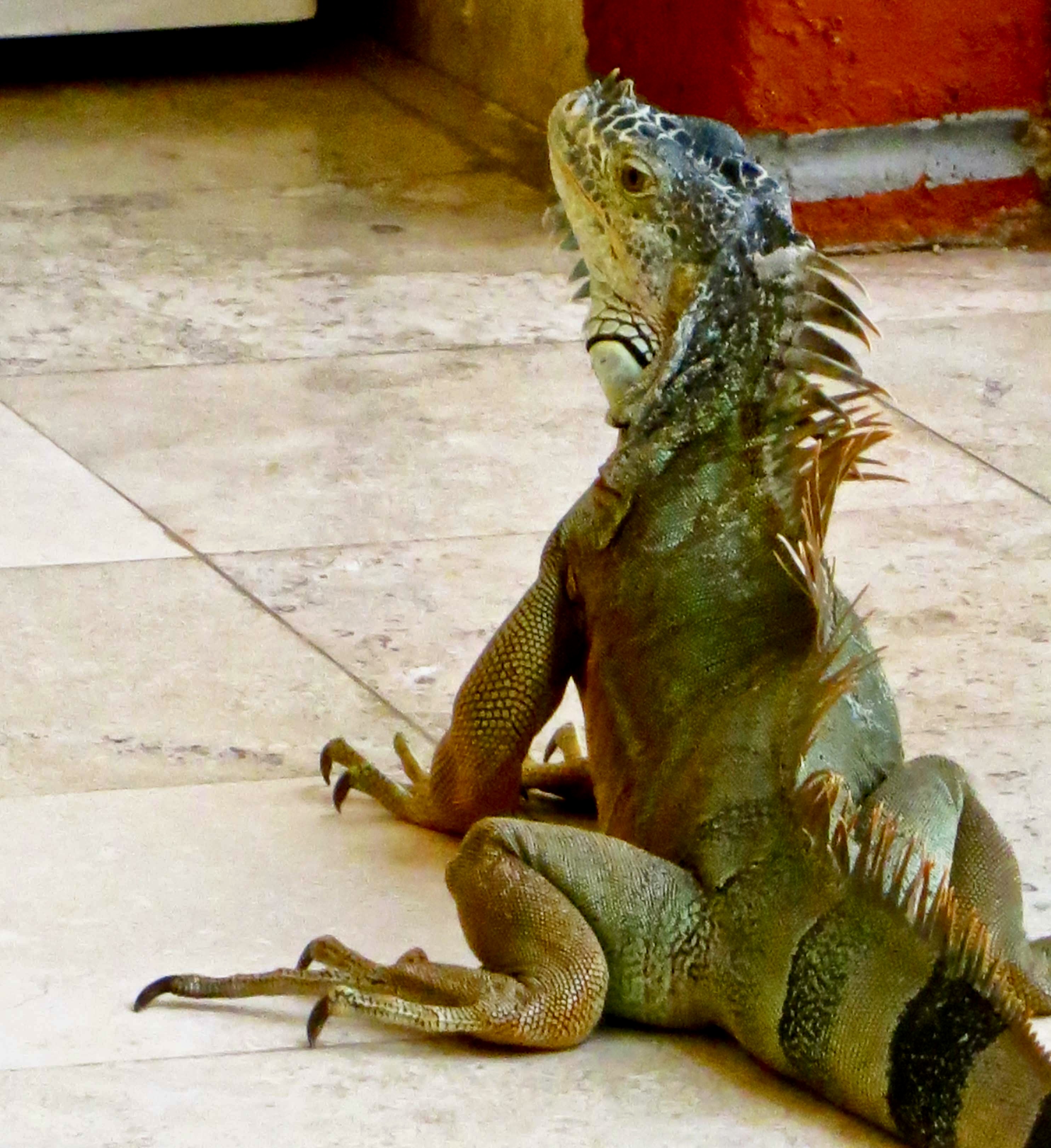
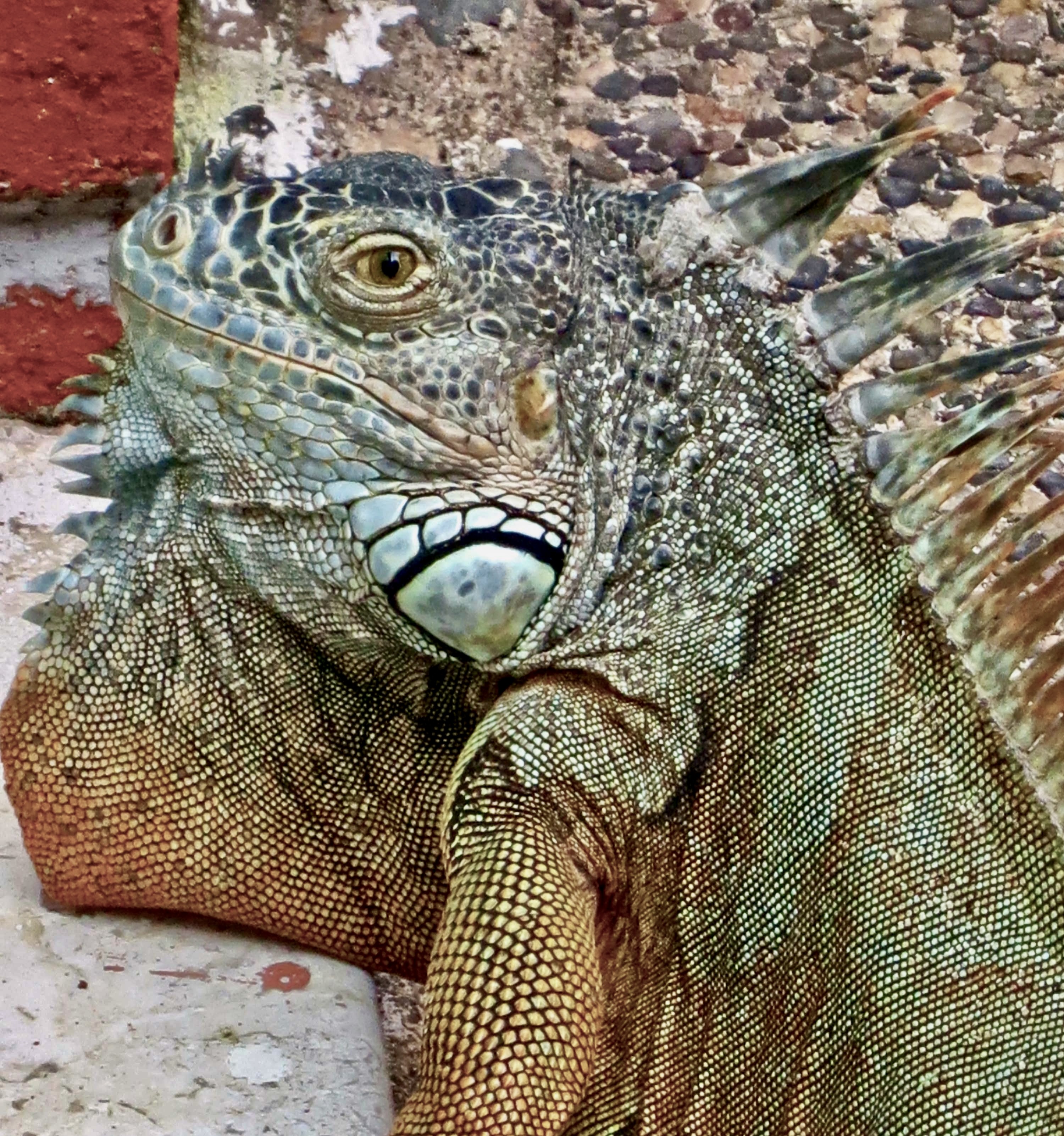
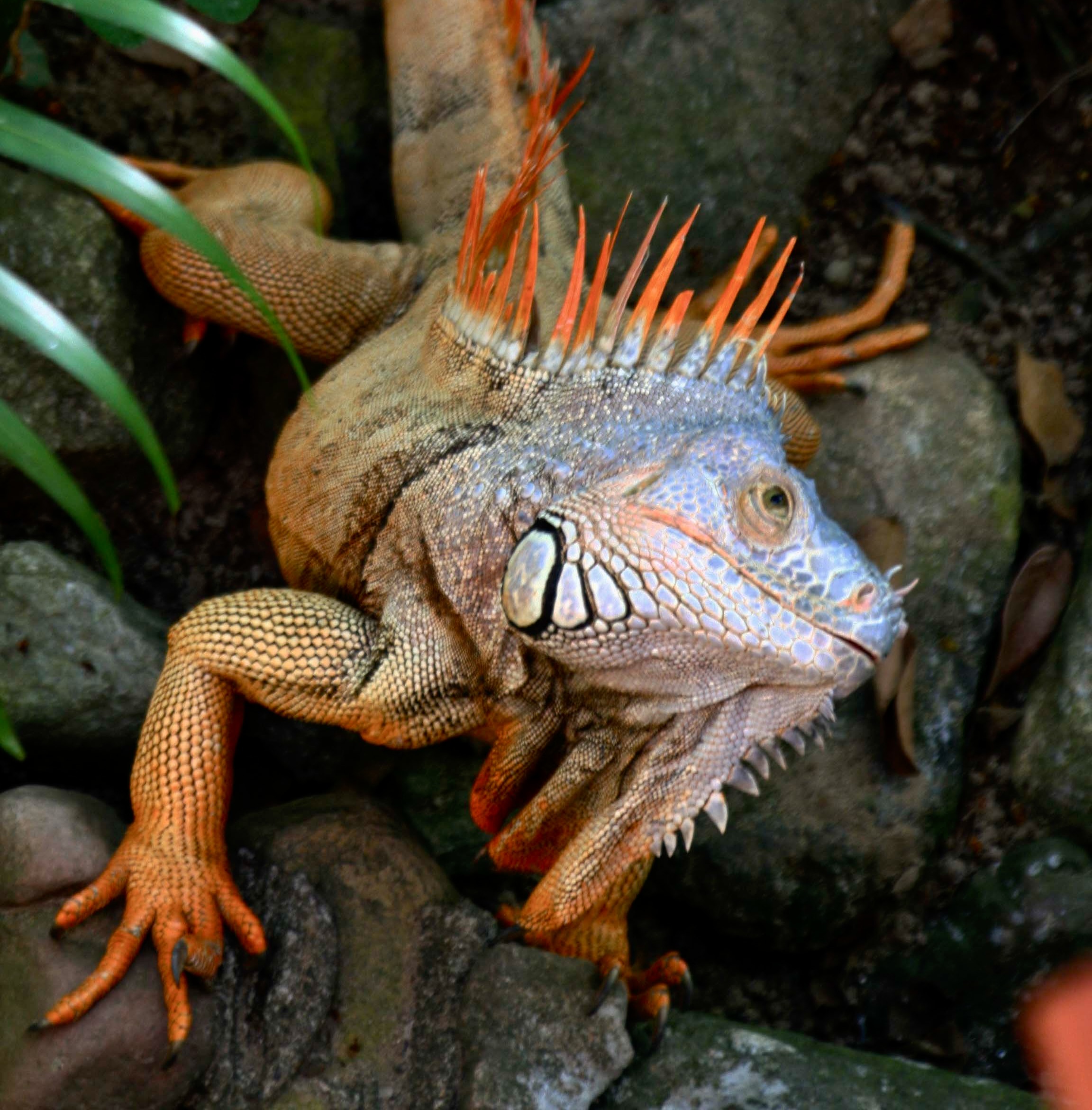
Let’s imagine for a second that you look through a peephole in your door and see this eye staring back at you. I don’t know about you, but my reaction would be to follow the bartender’s advice and “Run!” Or at least bar the door with anything available! “Oh, Peggy, could you lend a shoulder here…” I’ve named the photo The Eye of the Iguana in honor of the classic 1964 movie, The Night of the Iguana, starring Richard Burton, Ava Gardner, and Deborah Kerr. Like Burton’s iguana, ours was hanging out in Puerto Vallarta. As the peep hole scenario suggests, it wanted in. He wasn’t pounding on our door, however…
It was scratching loudly on our frosted window. Other than big and possibly scary, we didn’t have a clue what it was. I opened our door just far enough so I could see out— and close it immediately necessary. Just in case, you know.
Here’s what I saw: a huge male iguana. But what did it want? Had it come by demanding arugula? I took a photo from another angle and found the answer.
it was staring at its image. I don’t think he was thinking, “My, what an handsome guy you are.” It was more like “Who are you and what are you doing in my territory. Get out now!” He was obviously trying to get at his competition. Peggy came out and sat on our doorstep to watch him. “Hey, Curt,” she asked, “what if we leave our door open? Do you think he will come in?” That’s Peggy, for you. Okay…
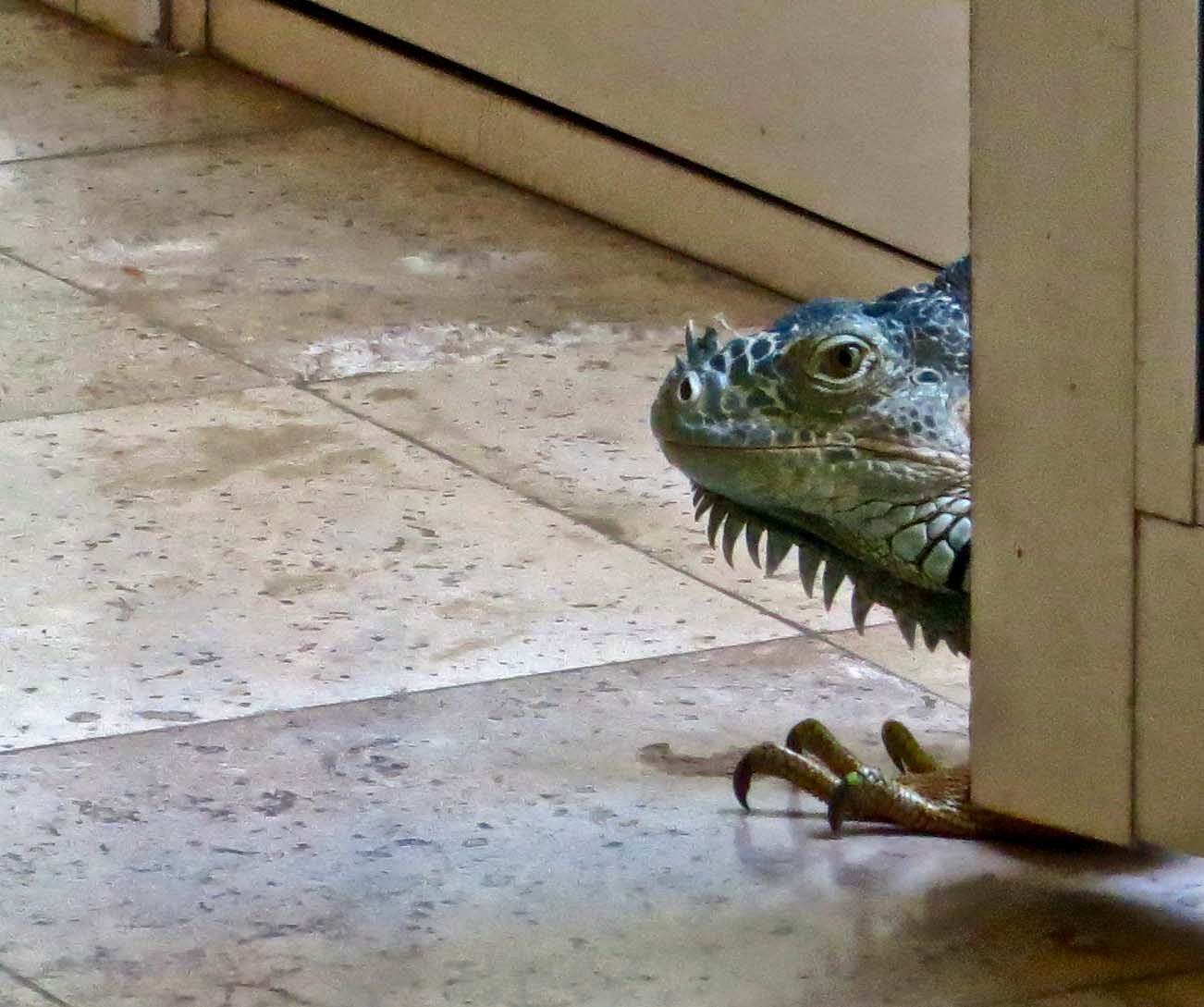
“Hola, amigo. ¿Estás abrigando a un invasor?” (Hello friend. Are you harboring an invader?) I’d say it took him about three minutes to poke his head through the door and look around…..
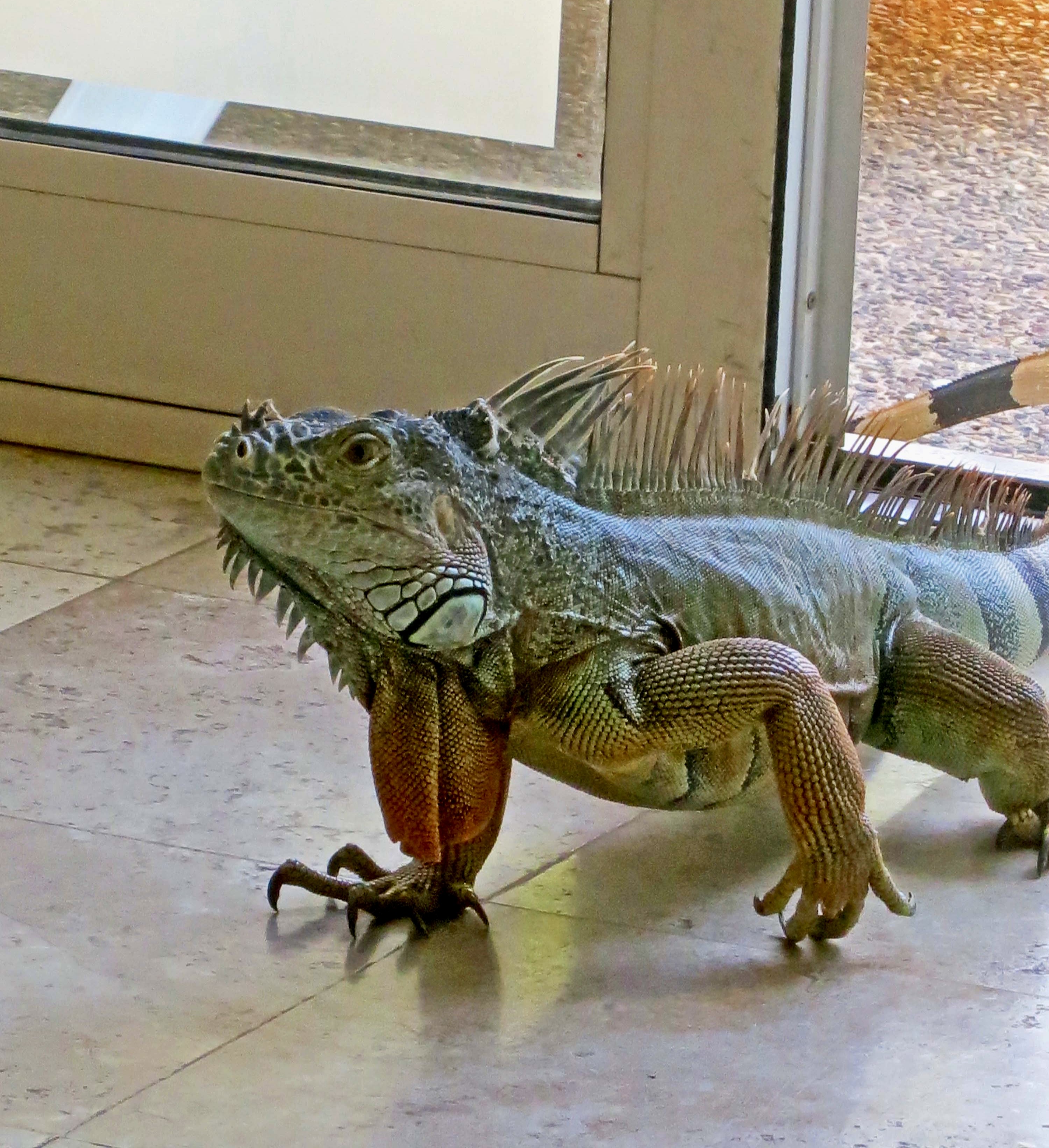
And a few seconds to invite himself in. Check out those claws! No wonder his scratching was so loud. That’s his tail coming along behind. Like his smaller cousins (normal size lizards), he can detach it if something grabs it thinking about dinner, like a very large snake or puma.
He did a thorough search, pausing to look around. We kept our feet up off the floor.
And then sat down, as if he wanted to chat with us about where the other iguana went. Like was there a reason we had closed our bedroom door? Grin. Actually, the answer was yes. Can you imagine this fellow sleeping under your bed? Talk about childhood nightmares!
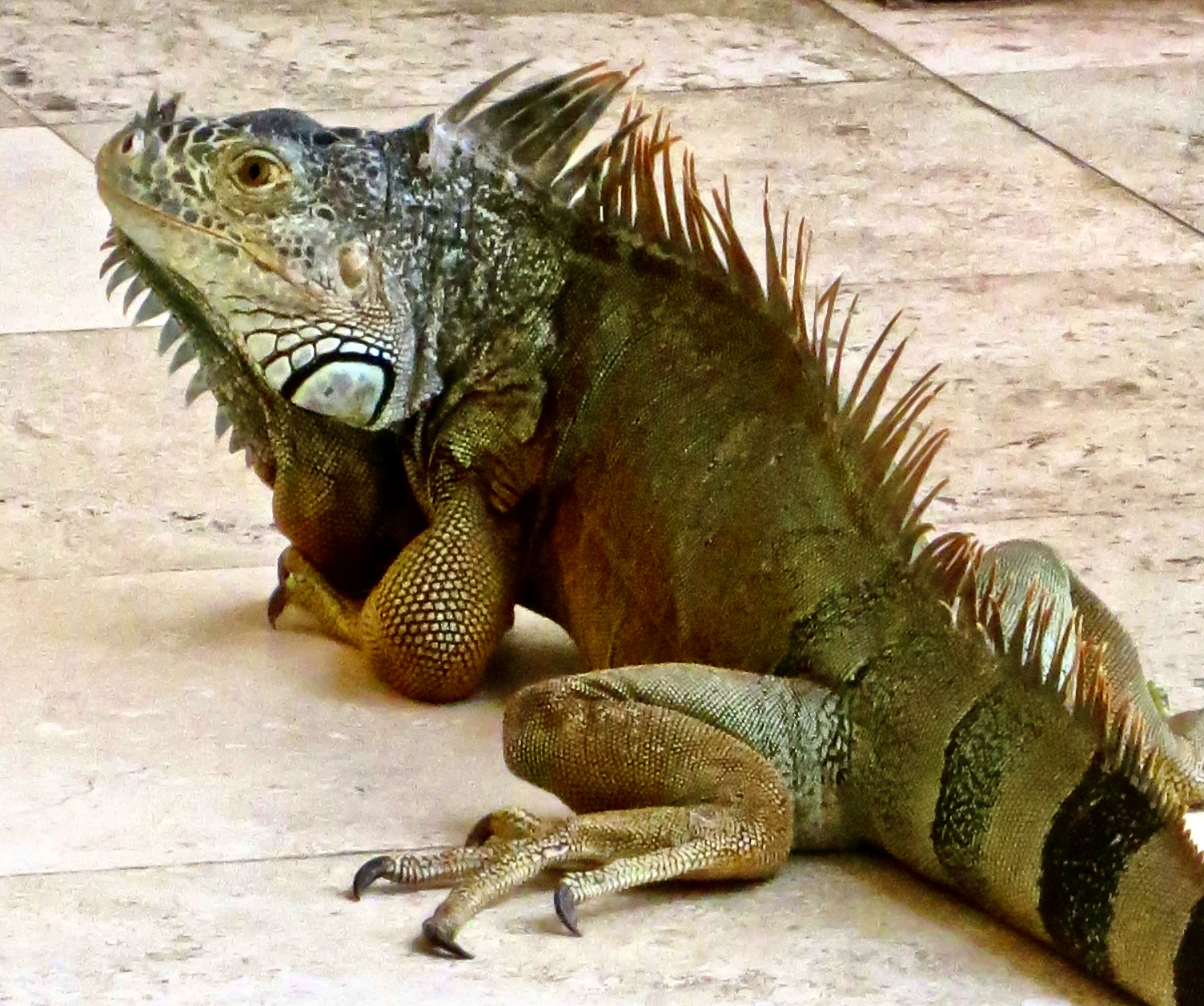
He truly was a handsome fellow. He wandered around for about 20 minutes and then, satisfied that he was still the biggest iguana in the neighborhood, went back outside.

These large representatives of the reptile class are herbivores and relatively peaceful. People even keep them as pets. It’s said that they enjoy being petted and eating arugula.

Two of their prominent characteristics are dewlaps and spines. Dewlaps are the large flap of skin hanging down from their chins. They are used for thermoregulation, communication, and courtship, i.e. gaining or losing heat, scaring off competition or predators, and attracting females— the larger the dewlap, the greater the attraction. Size matters. Females also have dewlaps, but they are smaller.

A couple of other interesting facts: One, they are great swimmers. They often jump from trees into water when a predator is after them. Two, they can jump from great heights without harm, up to 50 feet. It isn’t always a jump, however. When the temperature drops to 50° F or below, their bodies ‘freeze’ up and they come cashing down. Every once in a while when Florida suffers from a cold spell, headlines warn, “Watch out for falling iguanas.” They aren’t kidding.

A huge one fell out of a tree and landed about a foot away from our two-year-old daughter Tasha when she was sleeping outside in Panama. Needless to say, she was quickly moved.

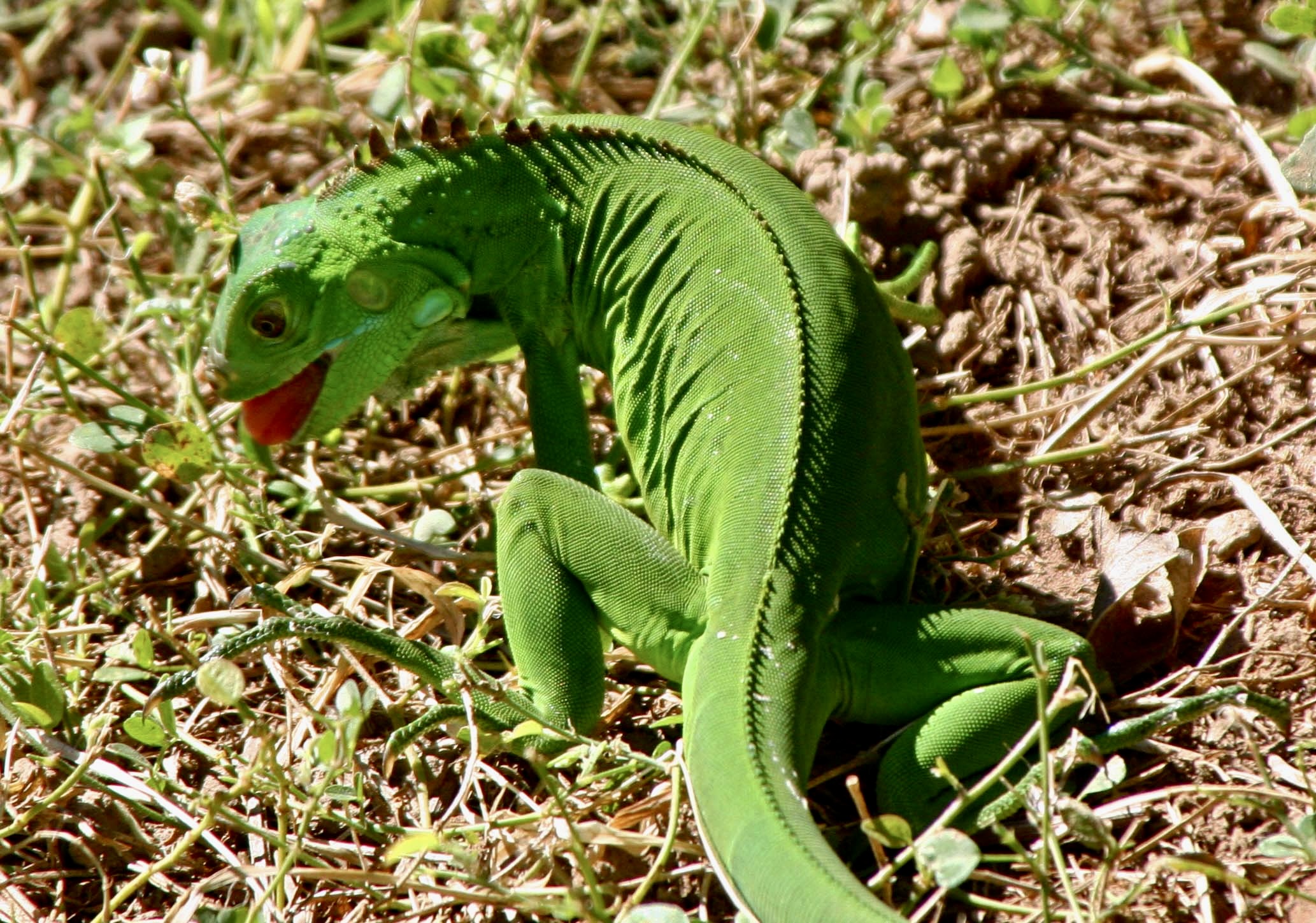
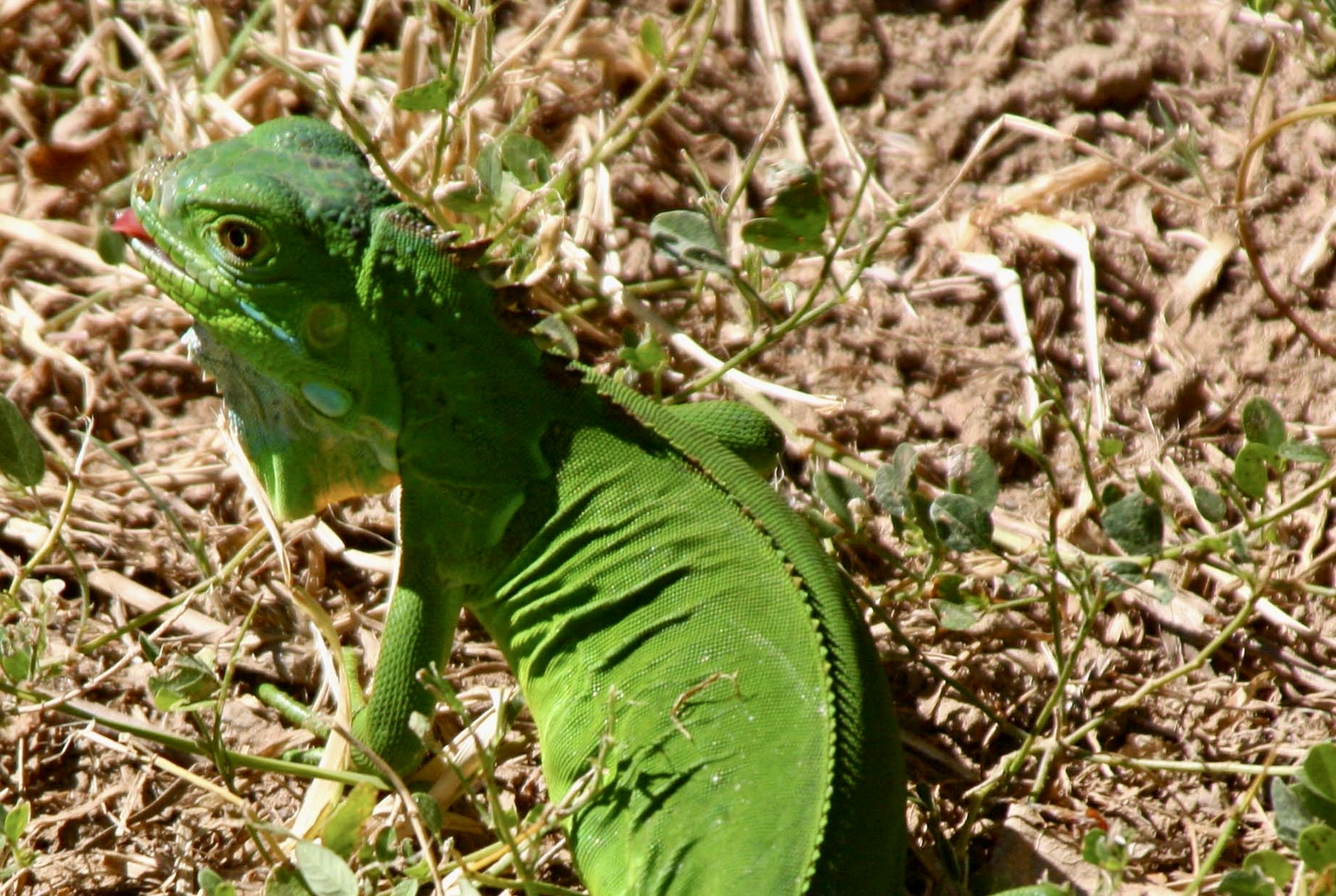
We also found this much smaller green iguana running around in our yard gobbling down plants. There are some 35 different species of iguanas. Check out the tongue.
A closer look. The now missing plant is being swallowed. Is the iguana licking its chops? Yum.

There is a small, narrow island, La Isla del Rio Cuale, on the Cuale River that runs through the heart of Puerto Vallarta where iguanas like to hang out.  Open air restaurants along the river provide a front row seat for watching them and the birds. Peggy and I always try to grab a seat right next to the river.

My grandson, Ethan, grabbed our camera and took this photo when he was 9. The iguana was on the ground checking us out.
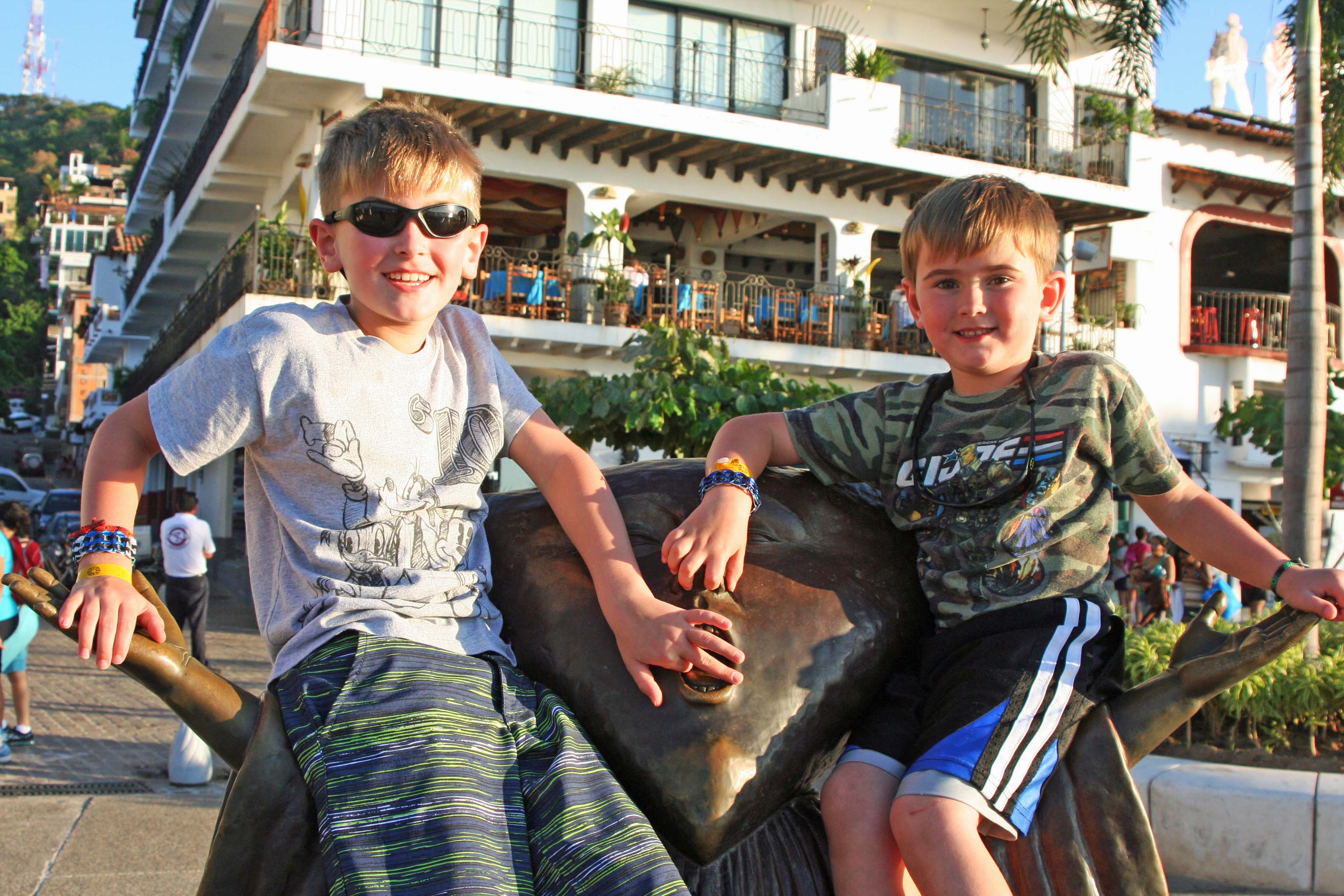
Our grandsons Ethan and Cody having fun with the art in Puerto Vallarta, 2013.
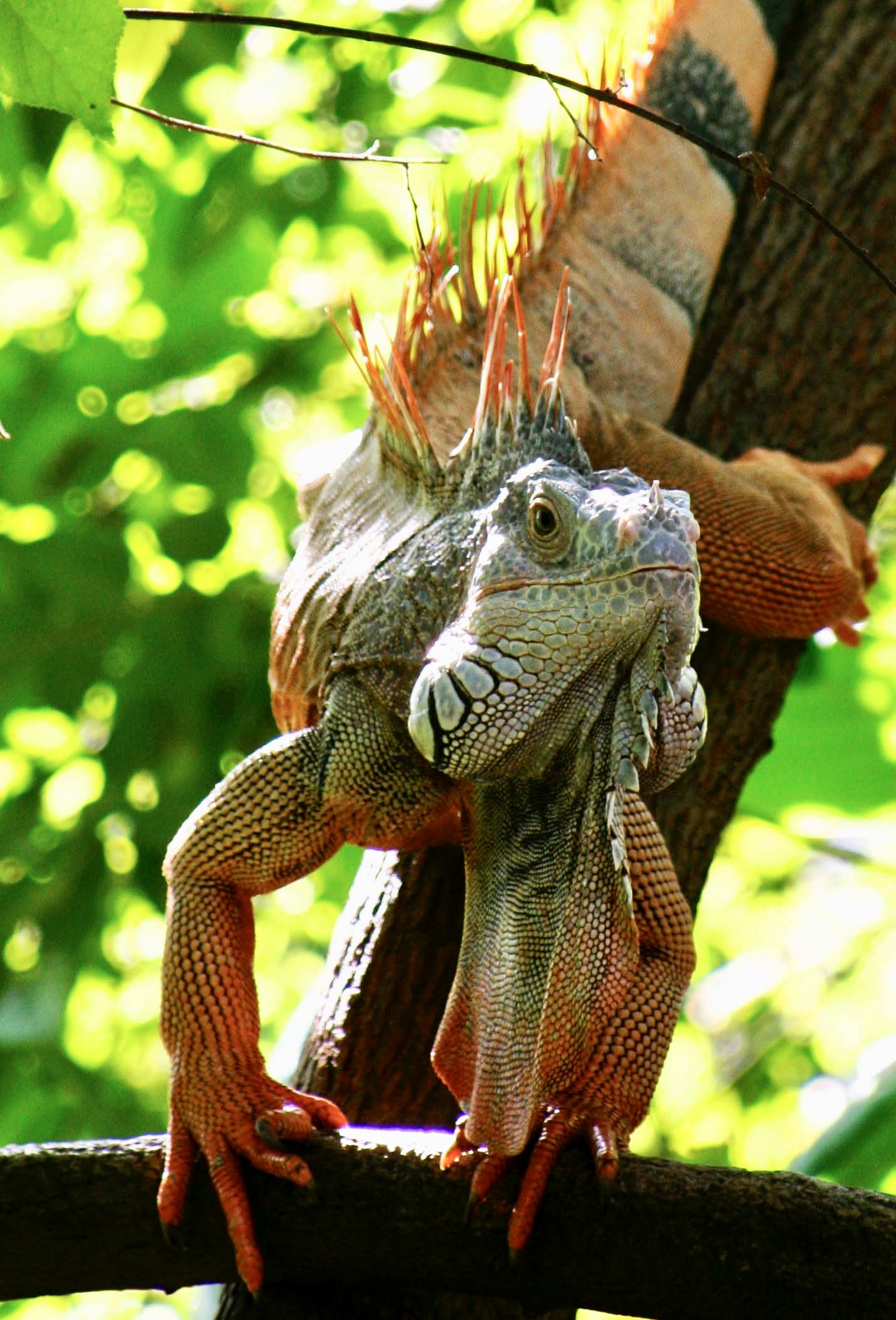
Another iguana climbing down a tree. Their long claws are what enable them to climb. The also use them to slow their falls when jumping down, which can lead to injured toes like this guy displays on his right foot.
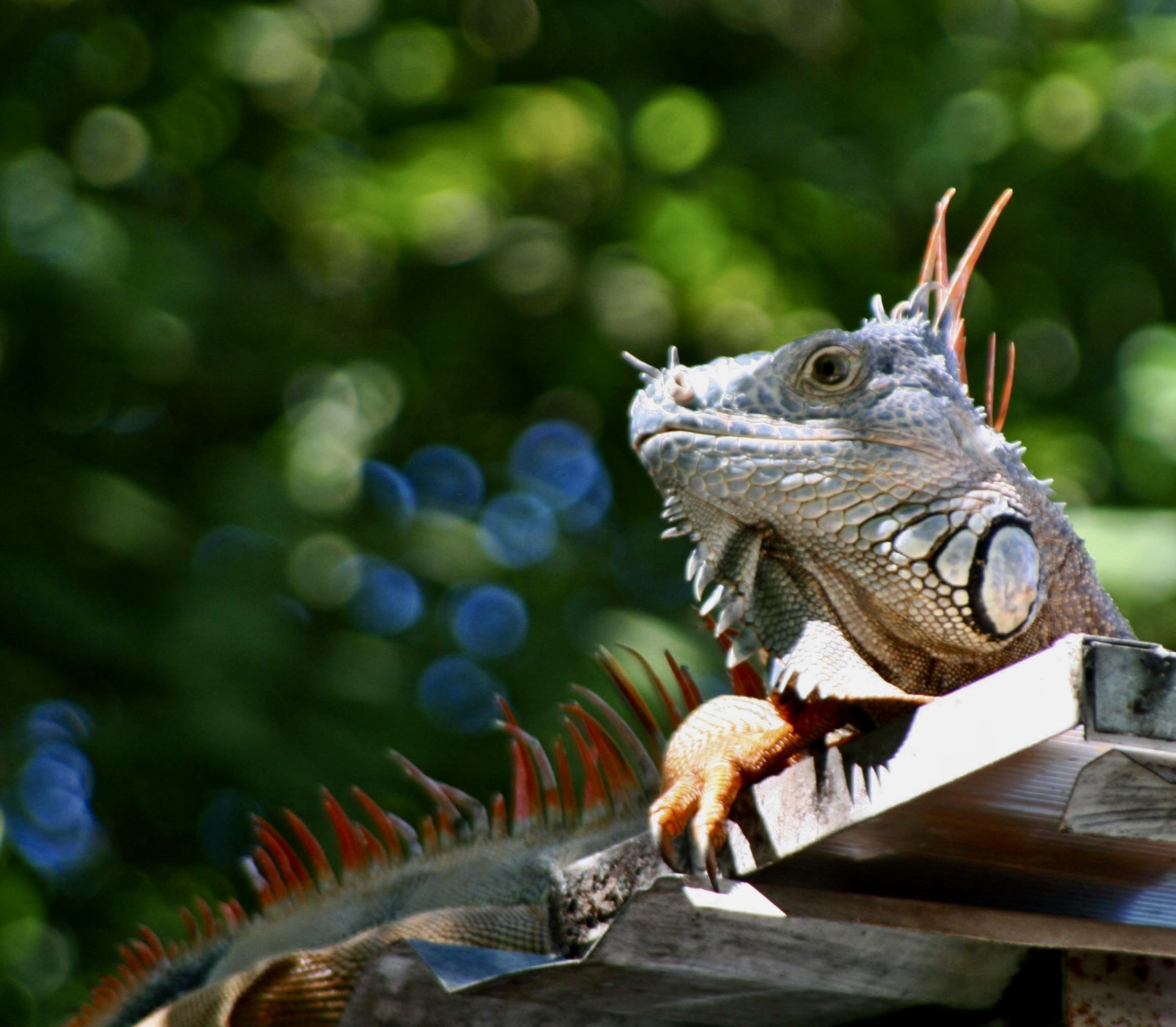
I’ll close with this youngster who was looking down at us from the roof.
Next up: Elephant seals. We found this big guy at Point Reyes National Seashore, California.

The Charming Elephant Seals of Pt. Reyes National Seashore

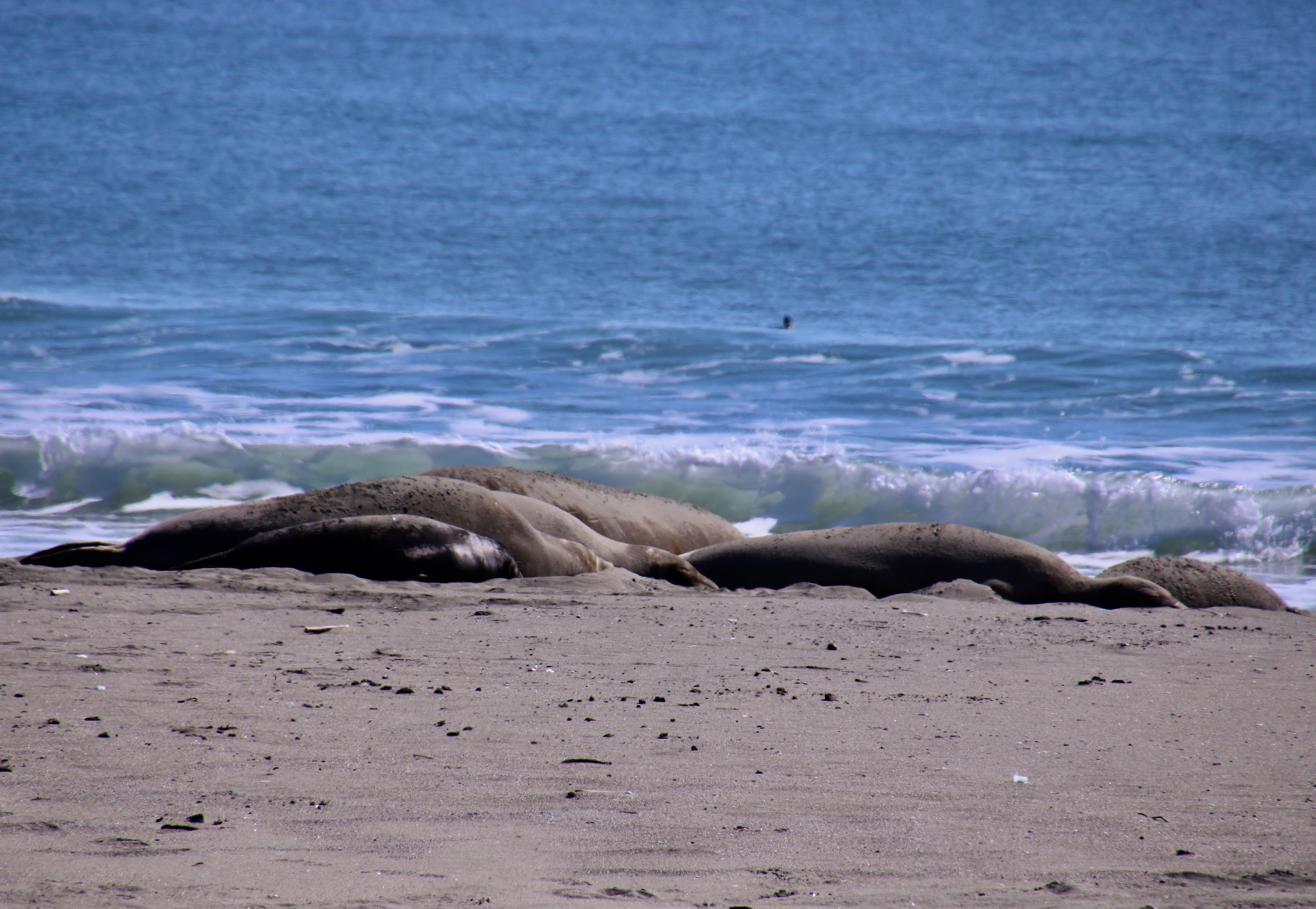
Elephant seals have the look of an animal put together by a committee. It gives them a certain charm. We found this large fellow with his pronounced proboscis at Drake’s Beach. He’d come ashore at Pt. Reyes National Seashore looking for love.

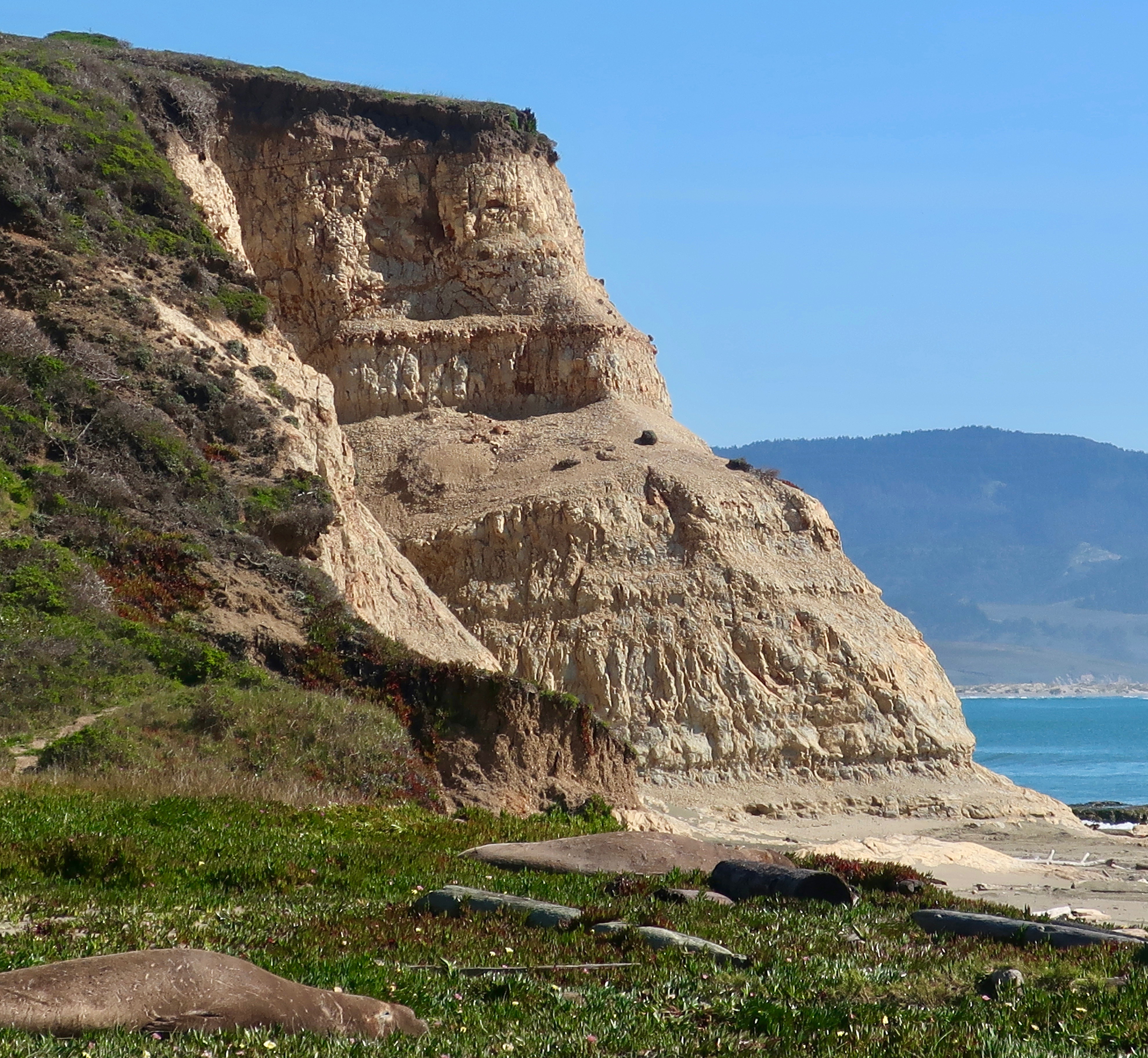
Pt. Reyes National Seashore is located some 30 miles north of San Francisco. Peggy and I went there last week to celebrate my birthday. It’s been a go-to place for me since the 60s. In addition to spectacular scenery, great hikes, yummy food, and one of the best small bookstores I’ve ever been in, we were entertained by the wildlife: tule elk, a pair of sushi eating coyotes, and elephant seals (plus some cows).  Today, I want to do a teaser on our trip by featuring the elephant seals. I’ll get back to the rest after I finish my Harris Beach series. 

Elephant seals are amazing creatures that spend up to 80% of their lives at sea— 90 % of it underwater!  If that doesn’t seem remarkable enough, consider this: their normal dives for food range between 1000 and 2000 feet deep (305 to 610 meters). They can dive for up to an hour and a half before returning to the surface for three to five minutes of breathing. Semi-annual feeding binges take the males on a 13,000-mile roundtrip journey to the Aleutian Islands and females on a 11,000-mile roundtrip into the North Pacific.

They were absent from Pt. Reyes for 150 years. In fact, they were close to absent forever. Like whales, they came close to being hunted to extinction for their oil. Processing the blubber from one bull can produce up to 25 gallons. They were saved because the Mexico and the US banned hunting them in the 1920s. Gradually, they have returned to their old breeding grounds. When I first started visiting Pt. Reyes in the 60s, they were unheard of in the area. Today there are over 3000 that return annually to breed.

The Park Service had set up a barrier to separate the seals from the people who had come to admire them at Drake’s Beach. Those closest to the barrier were bulls. You can tell by their size and uniquely shaped noses. One had crossed the barrier and was worrying the rangers. “He’s escaping from the other bulls,” a ranger explained. Maybe.

This large bull had crossed through the barriers at Drakes Beach and was pointed toward the snack bar. (Photo by Peggy Mekemson.)

A little girl next to me exclaimed, “I think he is heading to the snack bar to get fish sticks!”

“I’d bet on ice cream,” I responded. “Look at how big he is.” The girl looked at me dubiously. “Fish sticks” she insisted.

Peggy and I spent an hour watching these wonderful creations of nature who are so competent at sea and ungainly on land. They move like an inchworm, using their dorsal flippers to pull their front half forward and then using their rear flippers to push the rest of their body along like a rolling wave. Imagine moving several tons of fat. The ones we watched would make two or three of these moves and then collapse to rest.

Given their trunk-like noses and appealing eyes, Peggy and I were particularly attracted to the looks on their faces.

Is this fellow being coy?
Check out the big brown eyes! The size of the eyes helps the elephant seal see in the dark depths of the ocean. The whiskers apparently help as well in the search for food. He had lifted his head to check us out. (Photo by Peggy Mekemson.)
And then returned to his resting position. (Photo by Peggy Mekemson.)
A side glance. (Photo by Peggy Mekemson.)
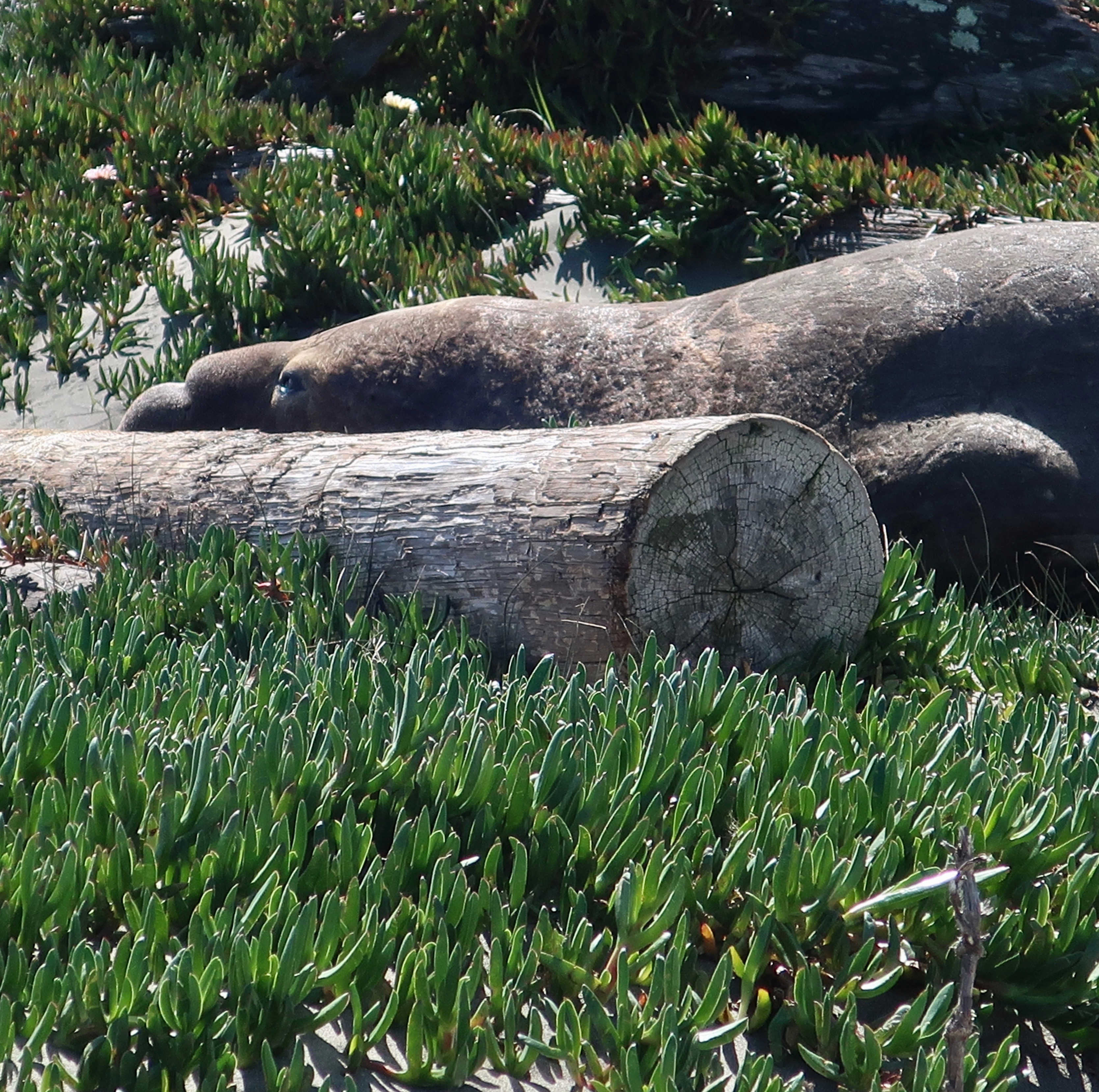
A bit shy, perhaps. Maybe he thought that the log was hiding him.
Size matters. (Photo by Peggy Mekemson.)
This was interesting. The skin of the elephant seals is sensitive to the sun. They cope by throwing sand over their bodies with their flippers, as seen in this photo.
Sometimes a little stretch really feels good! (Photo by Peggy Mekemson.)
Peggy caught some of the girls sunbathing out near the ocean…
Drake’s Bay was named for Sir Francis Drake who reputedly visited the area in 1759. There’s another bull on the left— looking sluggish.
I’ll conclude today with this elephant seal that was making its way back toward the ocean. I decided he was waving goodbye with his flipper. I’ll return to the tide pools of Harris Beach in Oregon next week. Are you aware that groups of sea anemones go to war with each other?

NEXT POSTS:

Monday’s Blog-a-Book… “It’s 4 AM and a Bear Is Standing on Top of Me”: I move outside in the summer to enjoy nature but hire the family’s dogs and cats to protect me from the ghosts.

Wednesday’s Blog-a-Book… “The Bush Devil Ate Sam”: Held at gunpoint, I consider the odds of running over the gunman versus getting shot.

When Elephant Seals Tell Jokes: The Wednesday Photo Essay

Did you hear the one about an elephant seal, a Christmas seal, and a basset hound walking into a bar.
Ha, ha, ha, ha.
HA, HA, HA, HA!

A while back Peggy and I were driving north from somewhere, maybe San Diego, when we drove past Hearst Castle and came to Piedras Blancas. It was full of sunbathers, somewhat weight challenged— and nude. Naturally we had to stop and break out our cameras.

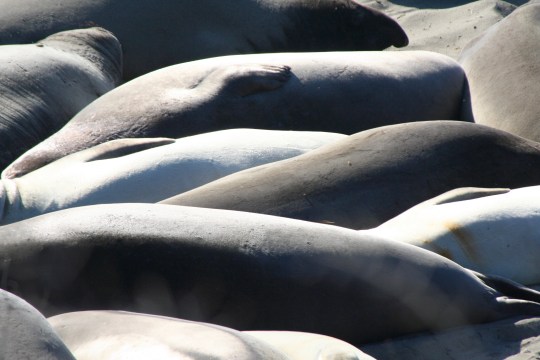
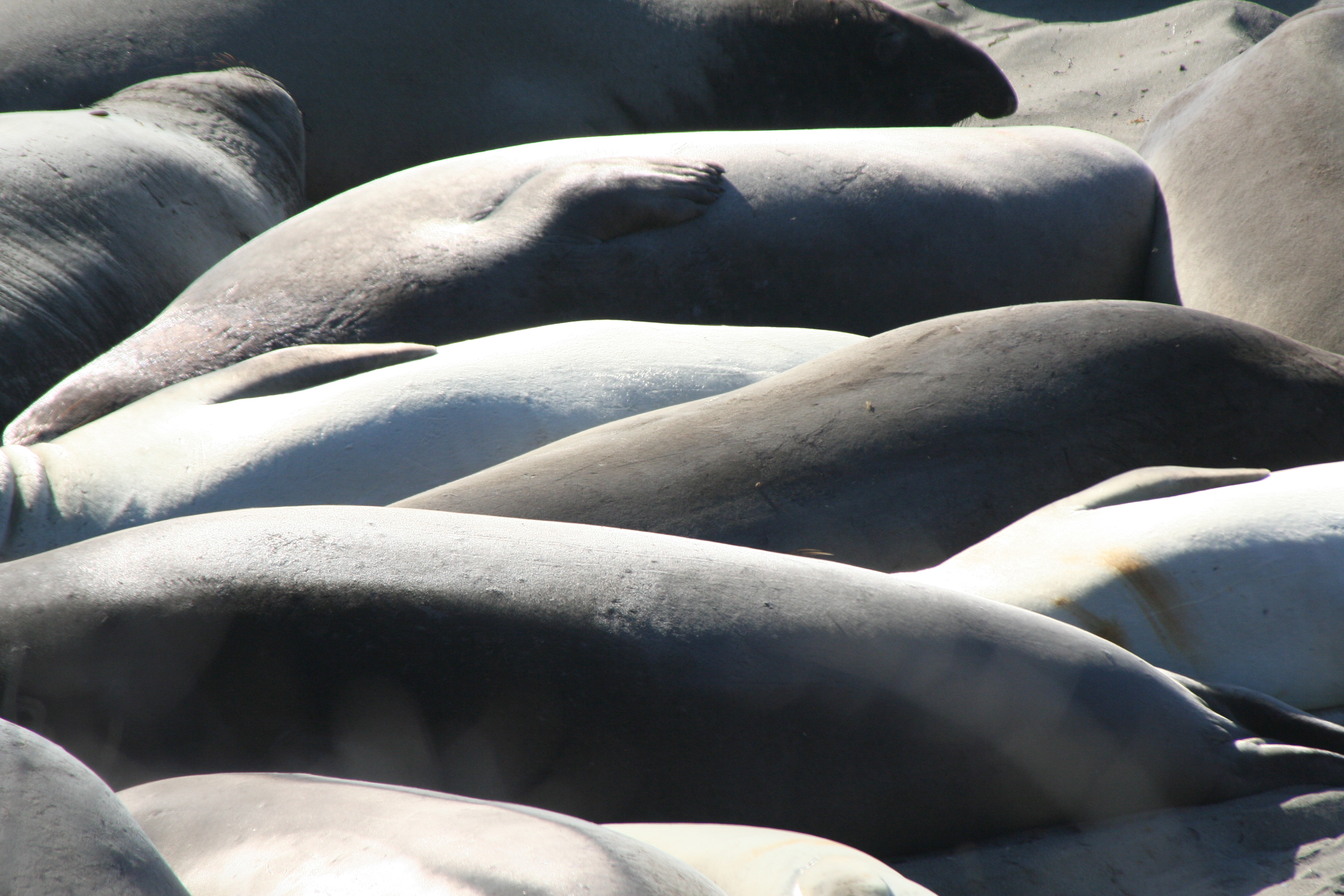
The beach was a little crowded.
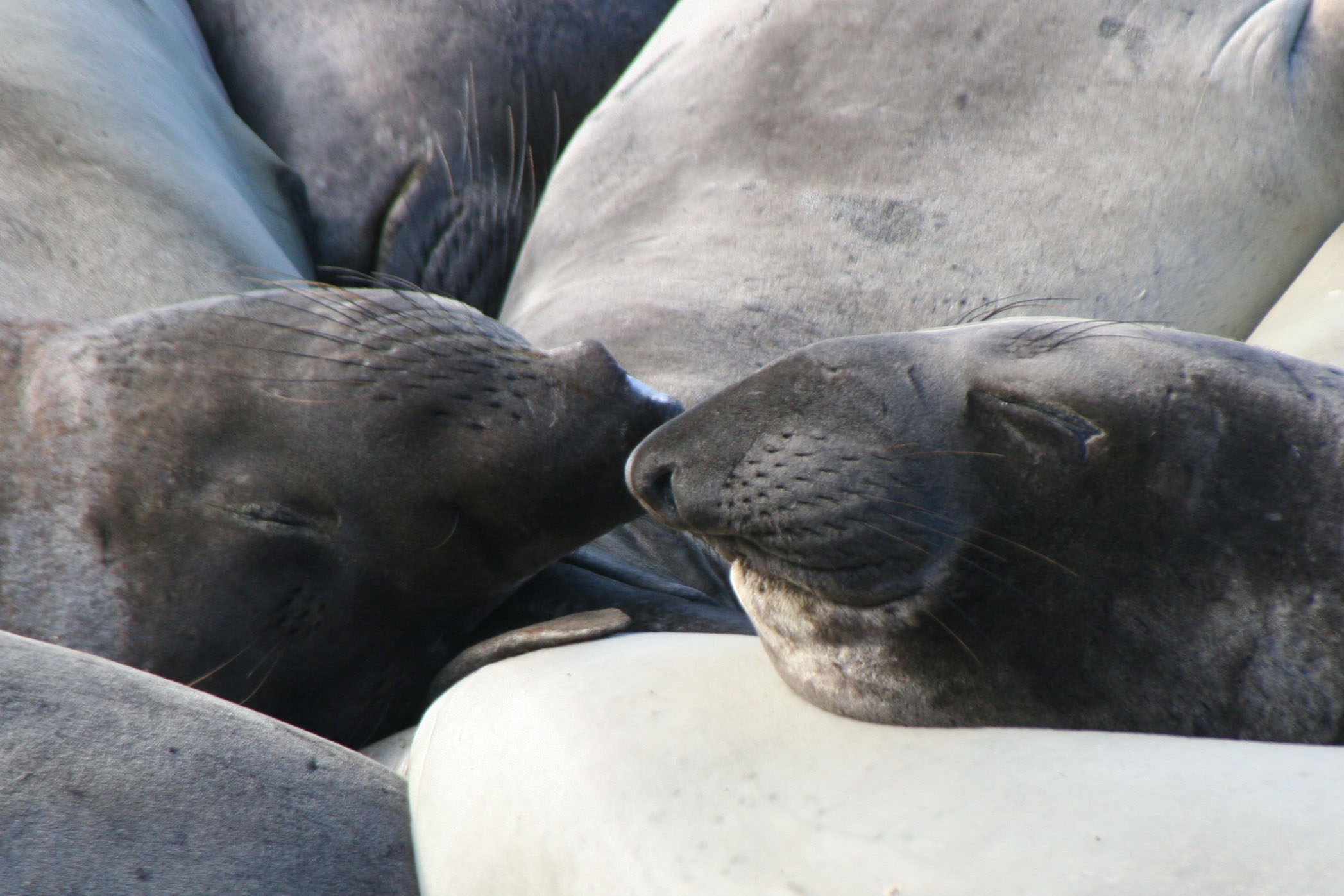
But everyone seemed happy. Some were even cuddling up.
Can it get any better.
Maybe. Few things are more pleasurable that scratching an itch.
Ah, that feels soooo good!
Of course it’s kind of hard to beat taking a dirt bath…
Especially if it is a full body bath!
Maybe a nice long nap in the sun. Yawn! Catching fish is such hard work.
You know how it is when someone else yawns. Are my tonsils pretty?
Speaking of pretty, here I am. How can anyone resist my dark brown eyes and gorgeous whiskers? Most girls would die to have whiskers like mine.
Check me out!
What do you mean this is a nude beach for elephant seals only! (Do we have trouble in Paradise?)
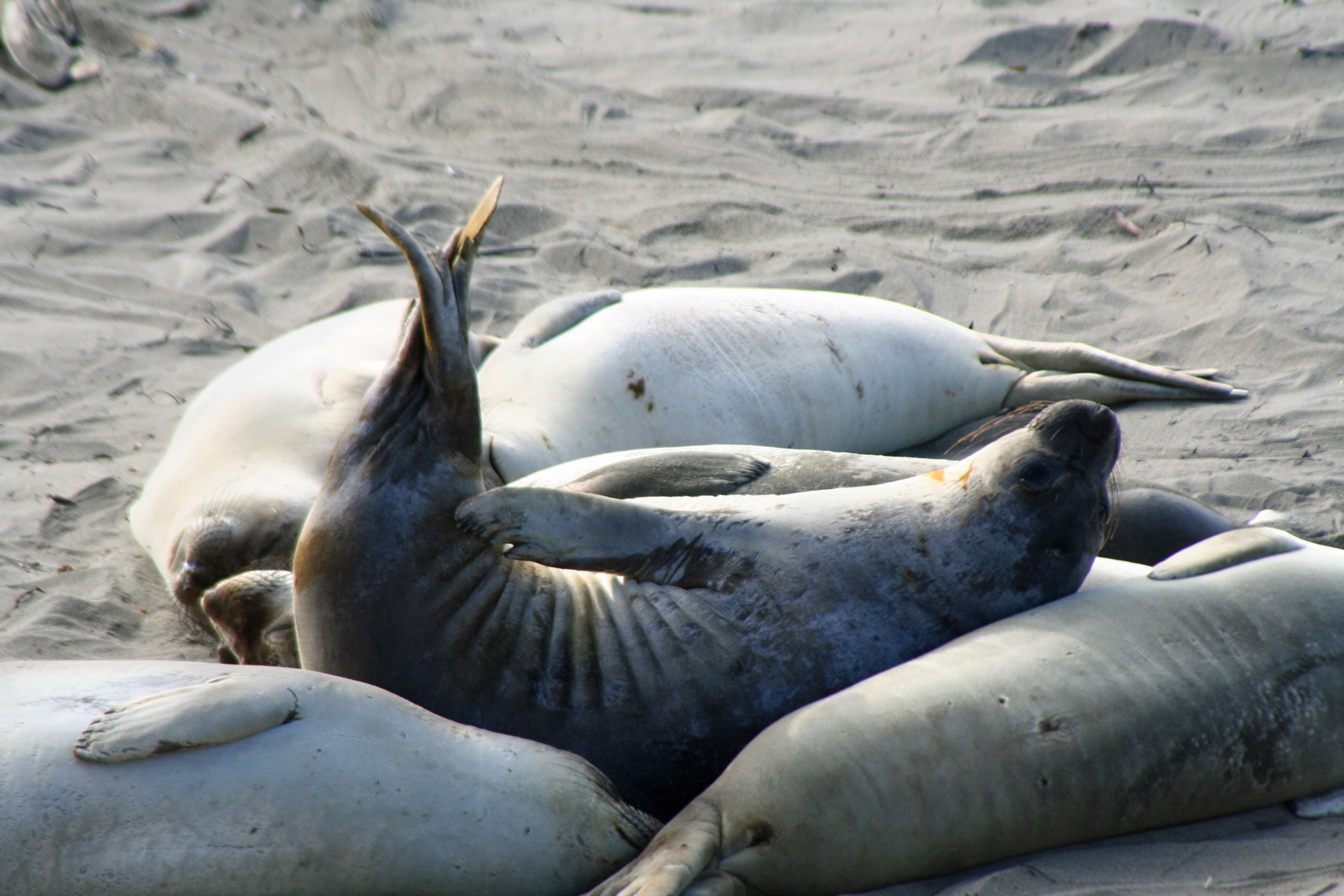
Like here we are all sleeping and someone starts stretching while challenging us to touch our toes and lecturing us on the value of exercise.
And then there is this lady who is disturbing us all by screaming, and screaming, and screaming…
Like what is her problem? Wait could it be? Is it possible? Is she having a baby? All is forgiven. (Well, possibly the elephant seal she is having a baby on might have a problem.)
We can relax again.
And go back to sleep.
But who can resist passing on a good joke. Have you heard the one about an elephant seal, a Christmas seal and a basset hound walking into a bar?
Bye, bye. Thanks for wandering through time and place with Curt and Peggy.

NEXT POSTS: On Friday, we will visit Ghost Ranch in New Mexico to wrap up the Georgia O’Keeffe series. On Monday we will start a new one as we look into the strange eyes of shamans and check out other petroglyphs.

The Marvelous Creatures of Piedras Blancas

Sleep over? Each year upwards to 60,000 Elephant Seals visit the Beaches of Piedras Blancas in Central California to mate, shed and have pups. "Are they dead?" I heard a young boy ask his mother. Let's put it this way, when your body is made up of one to five thousand pounds of blubber, you don't move around much.

Pop Quiz: What creature can weigh over two tons, have a two-foot long nose, dive up to 5000 feet, spend eight to ten months of the year on the open sea, migrate upwards to twelve thousand miles, leave a track like a two-ton caterpillar, and mate with dozens of winsome females on or around Valentines Day?

If you guessed the adult male Elephant Seal, you guessed right.

These intriguing animals were all but hunted to extinction for their valuable oil in the late 1800s. Today their numbers are estimated at 170,000.

Close to 10 percent consider the beaches of Piedras Blancas on the central coast of California their home, or rookery if wish to use the technical term. A couple of dozen showed up unexpectedly in 1990. Today their population is pushing 17,000.

Peggy and I stopped by for a visit on our way home from San Diego last week. Seeing the seals in their natural habitat is an incredible experience that we highly recommend. You can learn more about these animals and the best time to visit from Friends of the Elephant Seal at www.elephantseal.org.

Cameras are a must. We took over a hundred photos during our visit. I’ve posted some of the more amusing below. I couldn’t help adding appropriate captions.

"I don't care how much you pray for a new fur coat for Christmas, I am not listening." The Elephant Seals don't mean to entertain us but watching their antics is sure to bring a smile.


There is always pleasure in scratching a really bad itch. Check out the two Elephant Seals below. Pure ecstasy.

"Ah, that feels good."


"And this feels even better!"
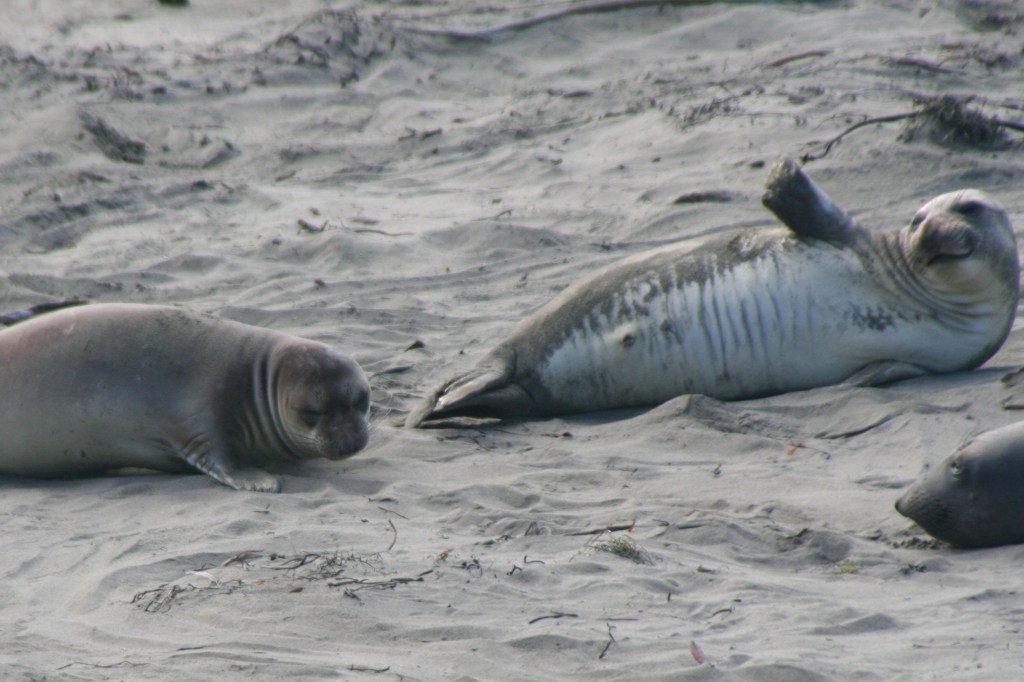
 

"Go that way." Ever suffer from a feeling of rejection? This certainly seems to be the case here. Although Elephant Seals are social animals that crowd together on the beach, they can also be quite territorial, especially during mating season.
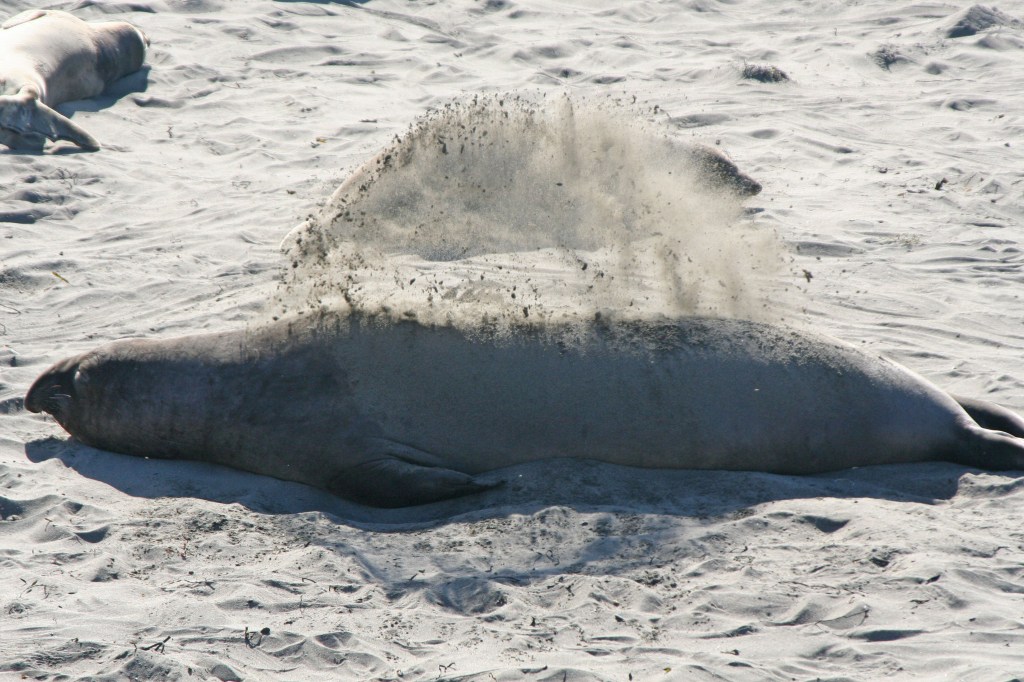
 

"Mother always said to use sunblock." Using their flippers, Elephant Seals are often seen flipping sand up over their body. Peggy took this rather artistic photo. Note the seal outlined in the back. The purpose for the dirt bath is indeed to provide protection from the sun. Elephant Seals spend 8-10 months a year migrating in the cold waters of the North Pacific traveling as far north as the Aleutian Islands of Alaska. Most of their time is spent under water diving from 20 minutes to an hour and surfacing for only three minutes. No wonder the sun feels hot!


I caught the flipper action in this photo.


"My Chiropractor suggested this new back stretching exercise."


How could anyone resist this toothy grin?


"I am the king!" The size of your nose and the loudness of your roar matters in the Elephant Seal world. Big males become quite feisty during mating season as they gather harems of up to 50 females. As one might imagine, battles between two ton creatures can turn rather nasty. If your nose is big enough, up to two feet long, and your roar loud enough, other males may choose to let you have your way with out a battle, however.


Sleeping cheek to cheek. If that isn't a look of contentment, I've never seen one.
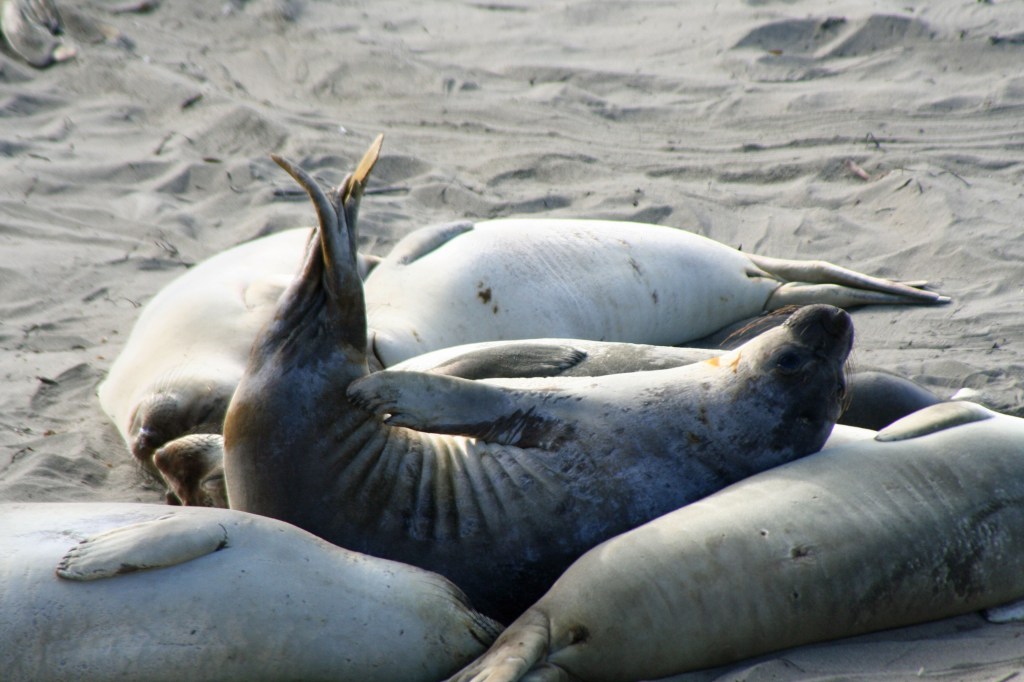
 

"After a hard day of sleeping, I like to lay back and put my feet up in the air."
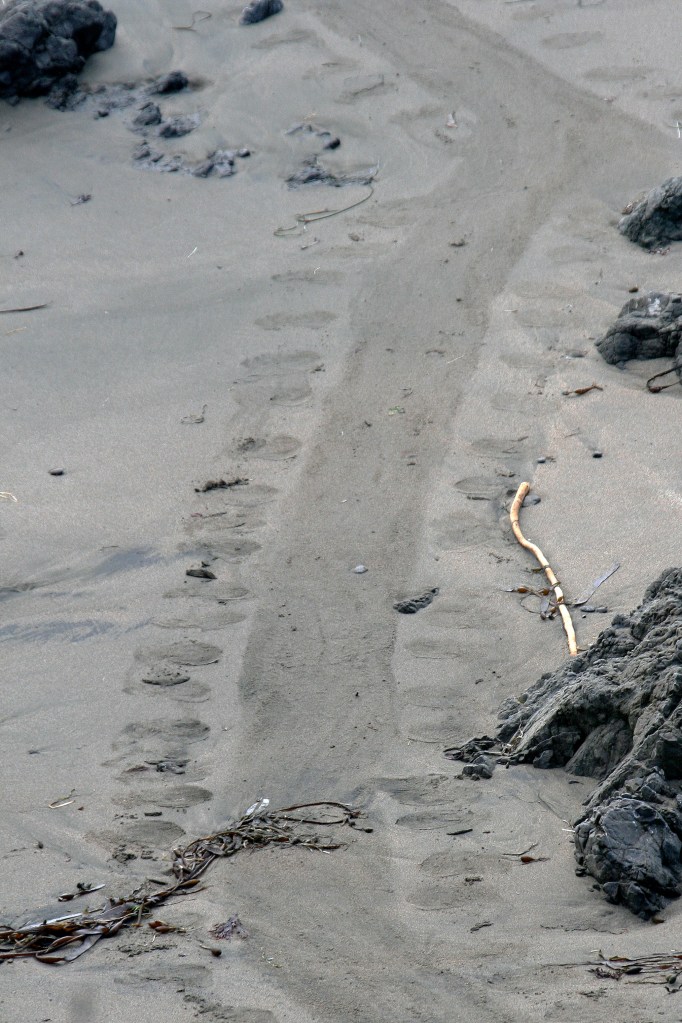
 

If you came across these tracks without knowing who made them, you would probably vacate the premises.
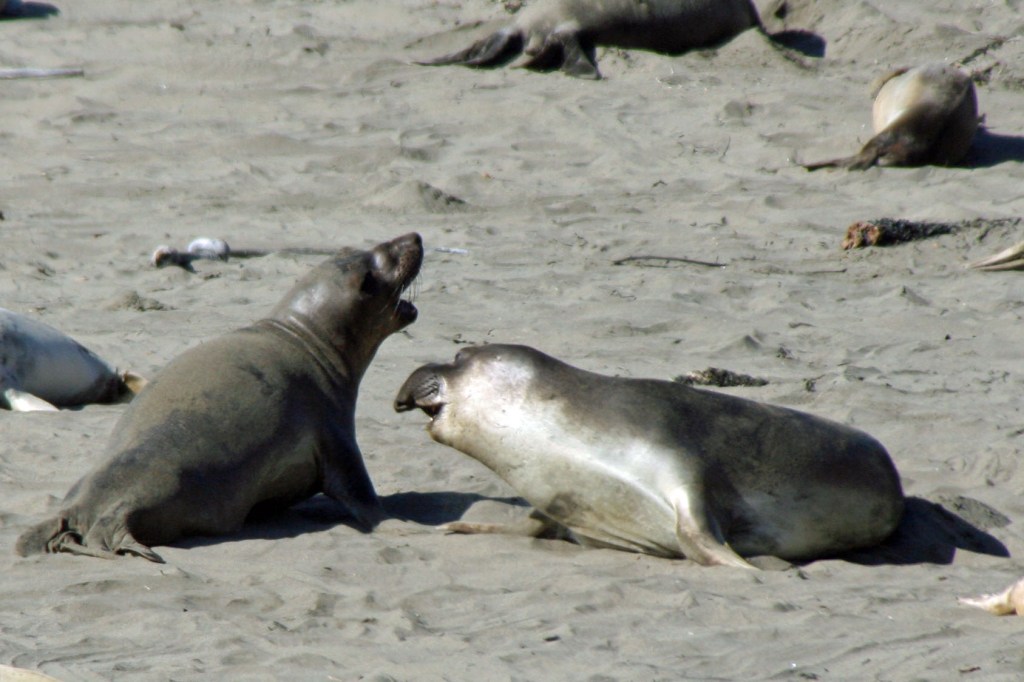
 

"Did you hear the story about the Rabbi, the Priest and the Baptist Minister?"


"I just love the smell of fish breath." Actually, these guys fast for weeks on end while on shore. There may not be much fish breath left by the time they are ready to return to the ocean.