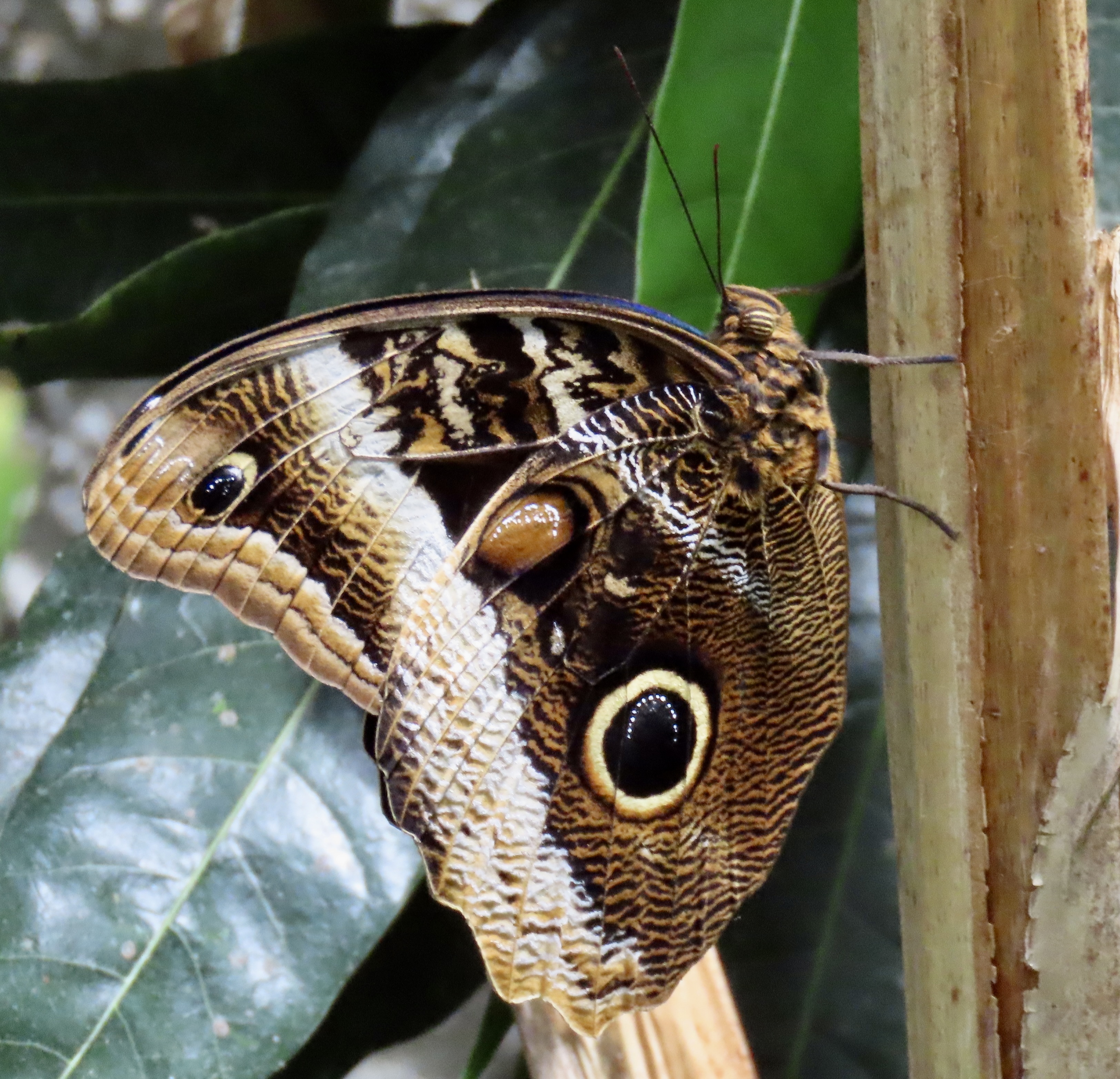
Our jungle night hike in Costa Rica introduced us to the Owl Butterfly in addition to the tarantula, pit vipers, and scorpions we featured on that post. Some fun, huh. This owl butterfly photo was taken during the day at the Monteverde Butterfly Gardens, where we visited to see it, and other butterflies of Costa Rica, up close.
The owl butterfly is so named because the large spot on the lower part of the wing. It has a matching spot on the other wing that resemble an owl’s eyes when the wings are open and seen from below. It’s called mimicry. One theory is that predators see the eyes and decide that fleeing is a better option than chomping lest they end up being the chompee. Another theory is that the predator sees the eyes and thinks that they represent the head of the butterfly, bites down, and get a mouthful of wing instead of the body. Given that the owl butterfly is one of the giants of the butterfly world with a 6-8 inch wing span, it has plenty of wing left to still fly. Either theory leaves the butterfly free to complete its goal in life, which is to breed and have babies, i.e. lay eggs.
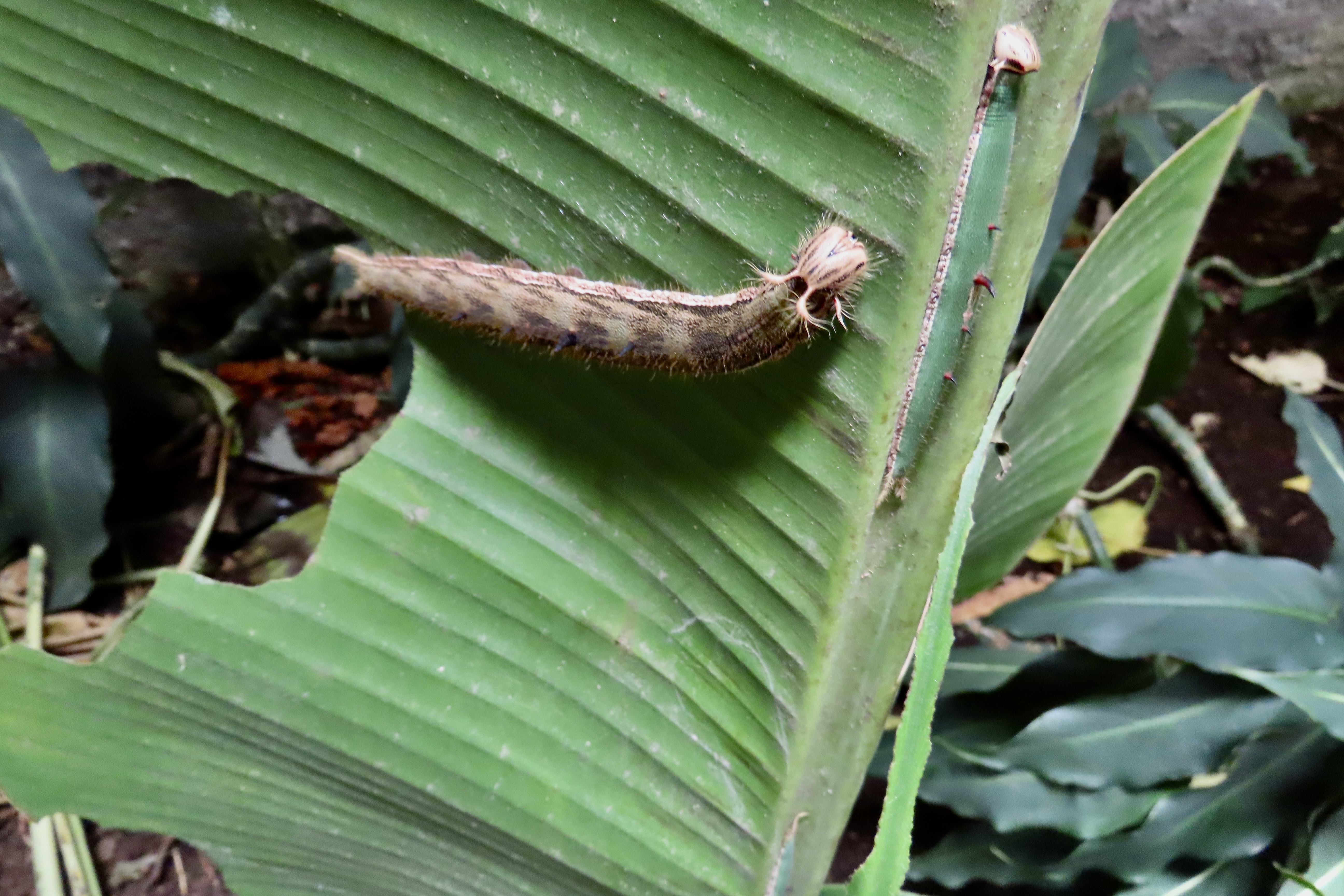
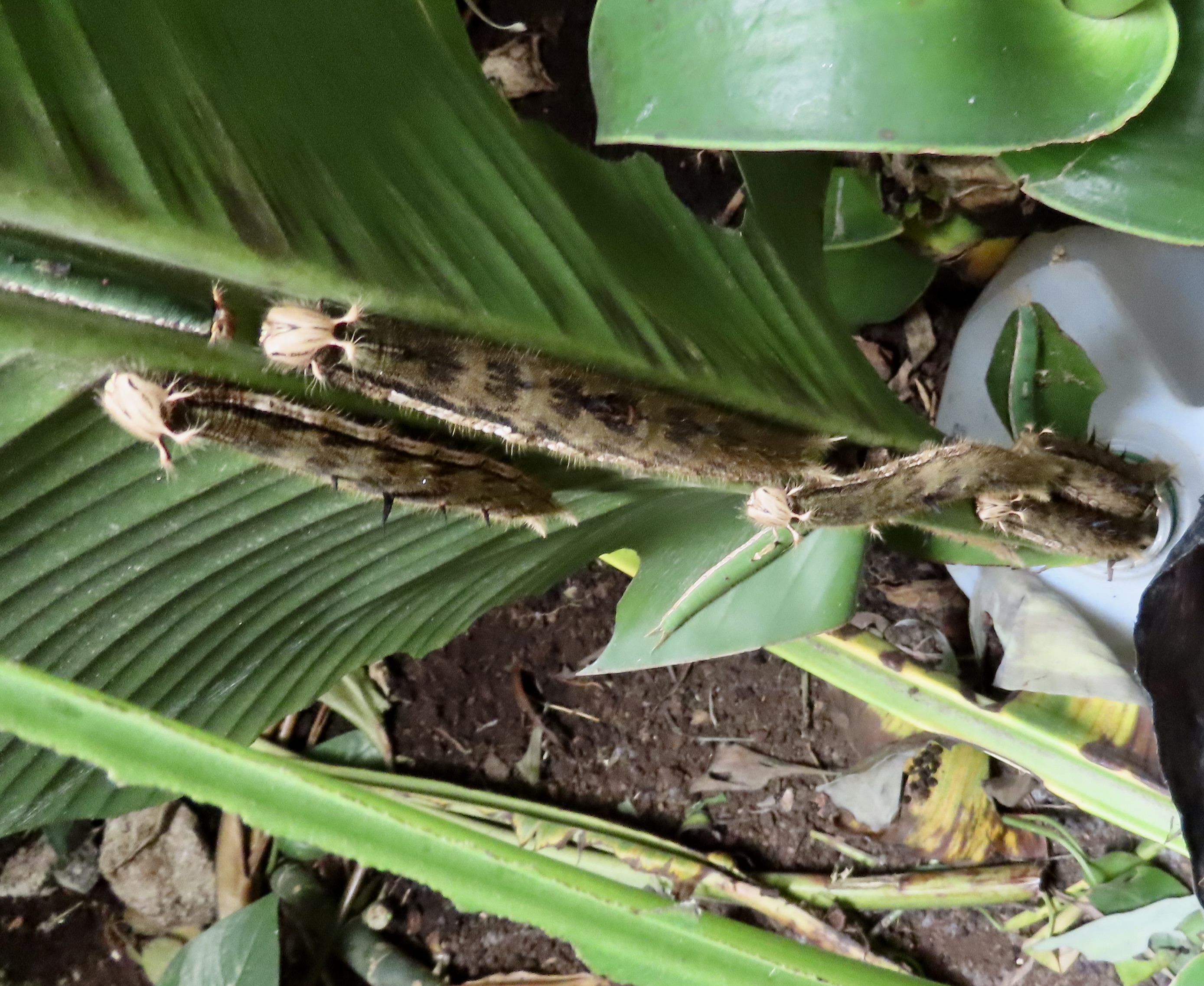
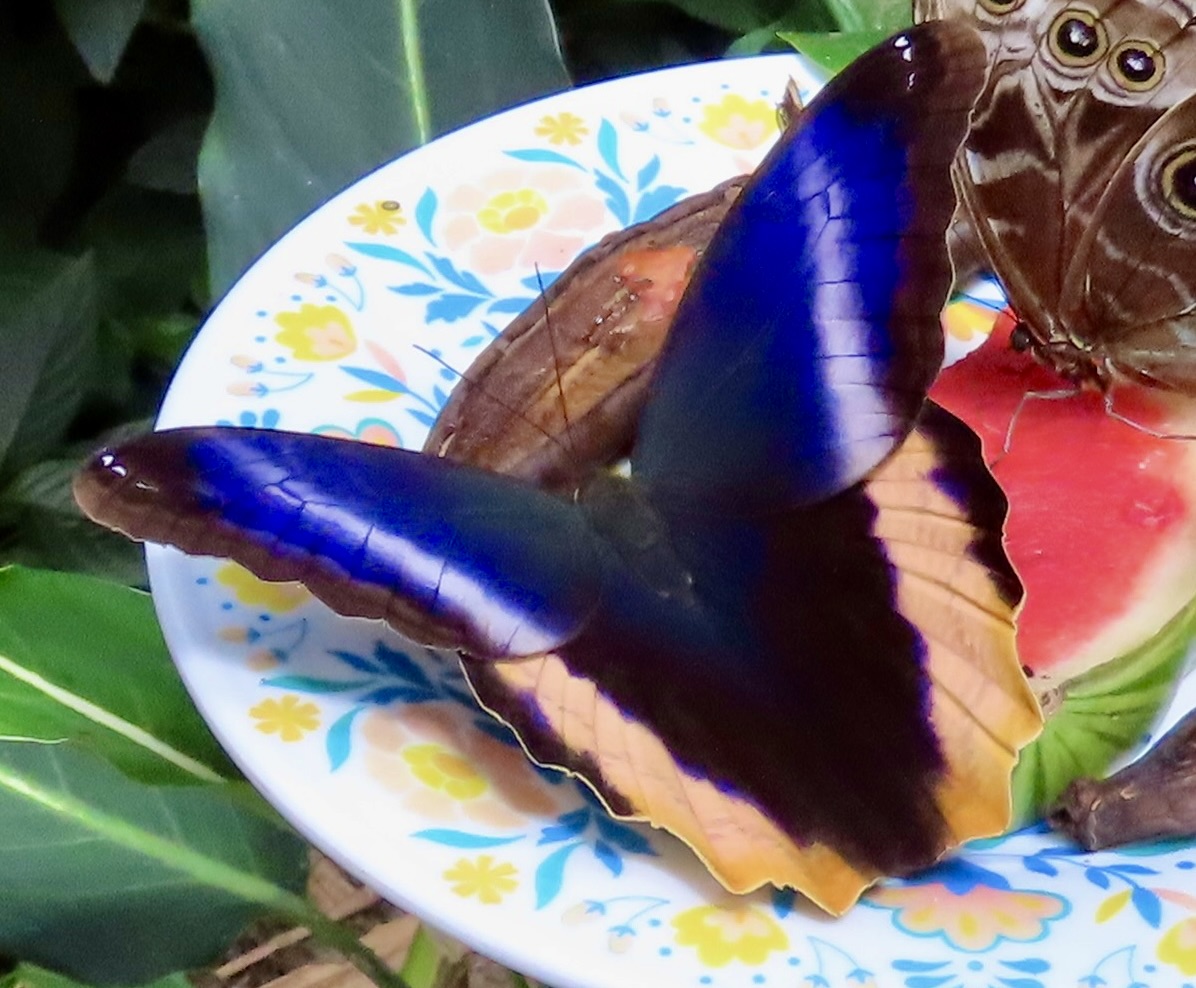
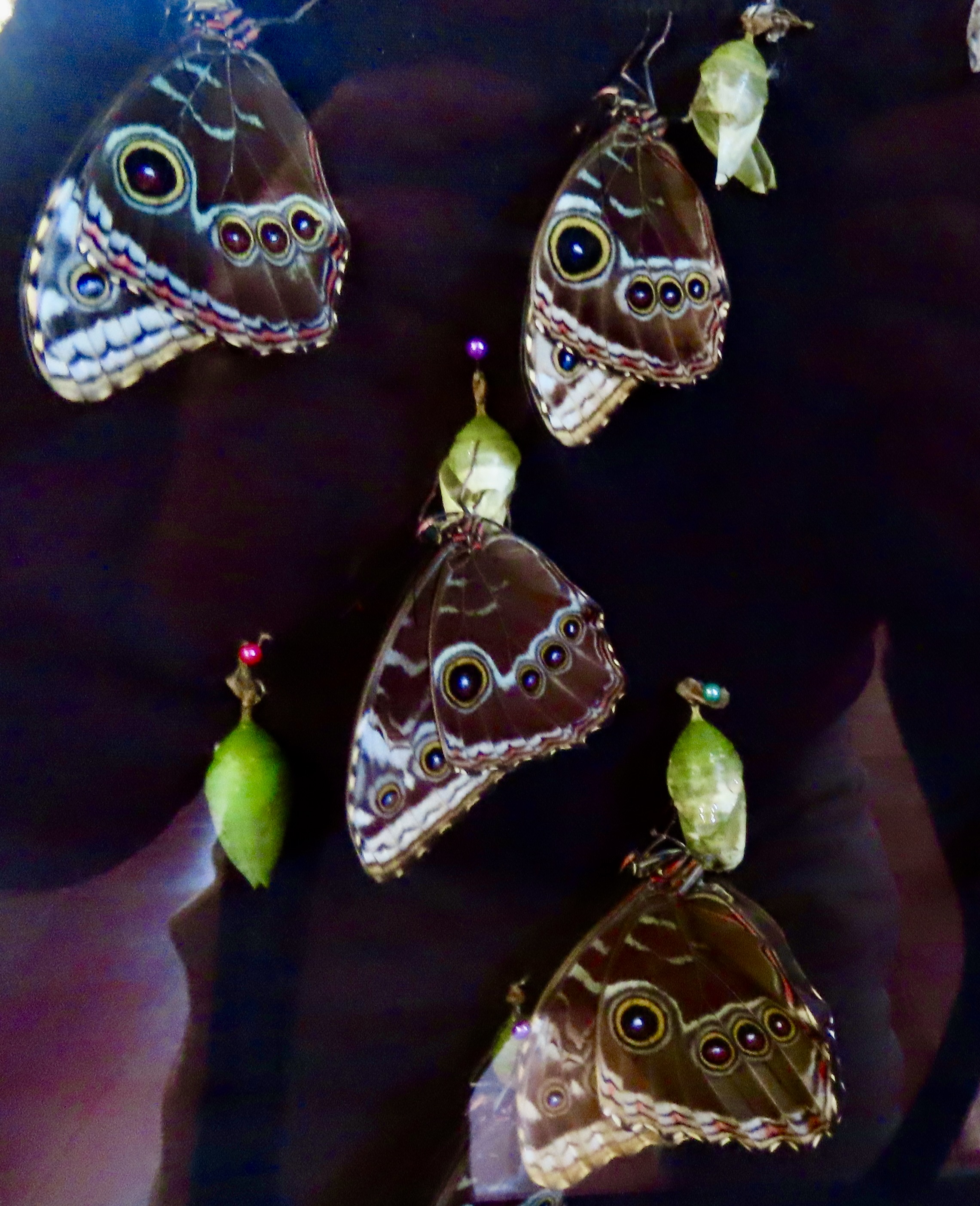
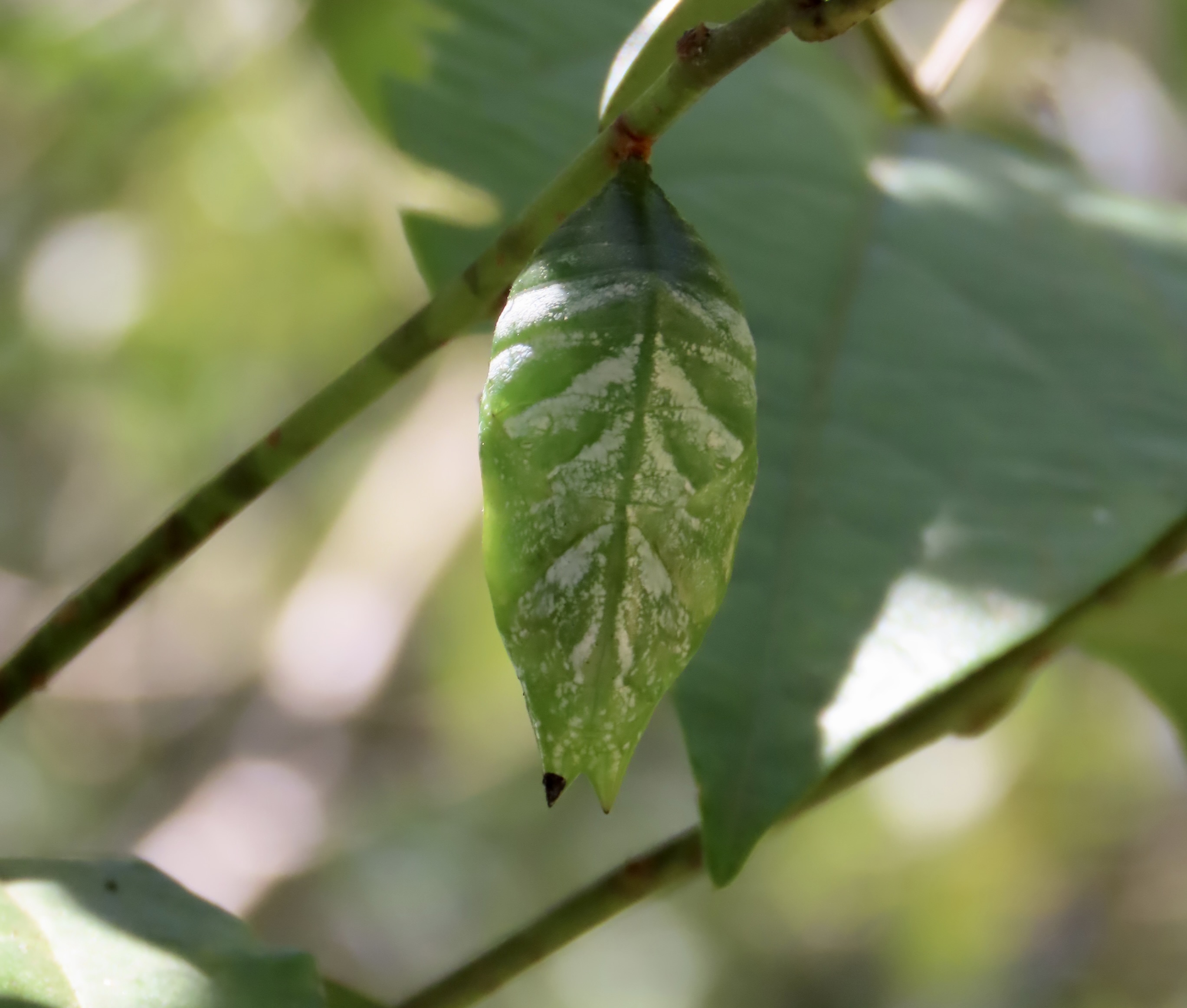
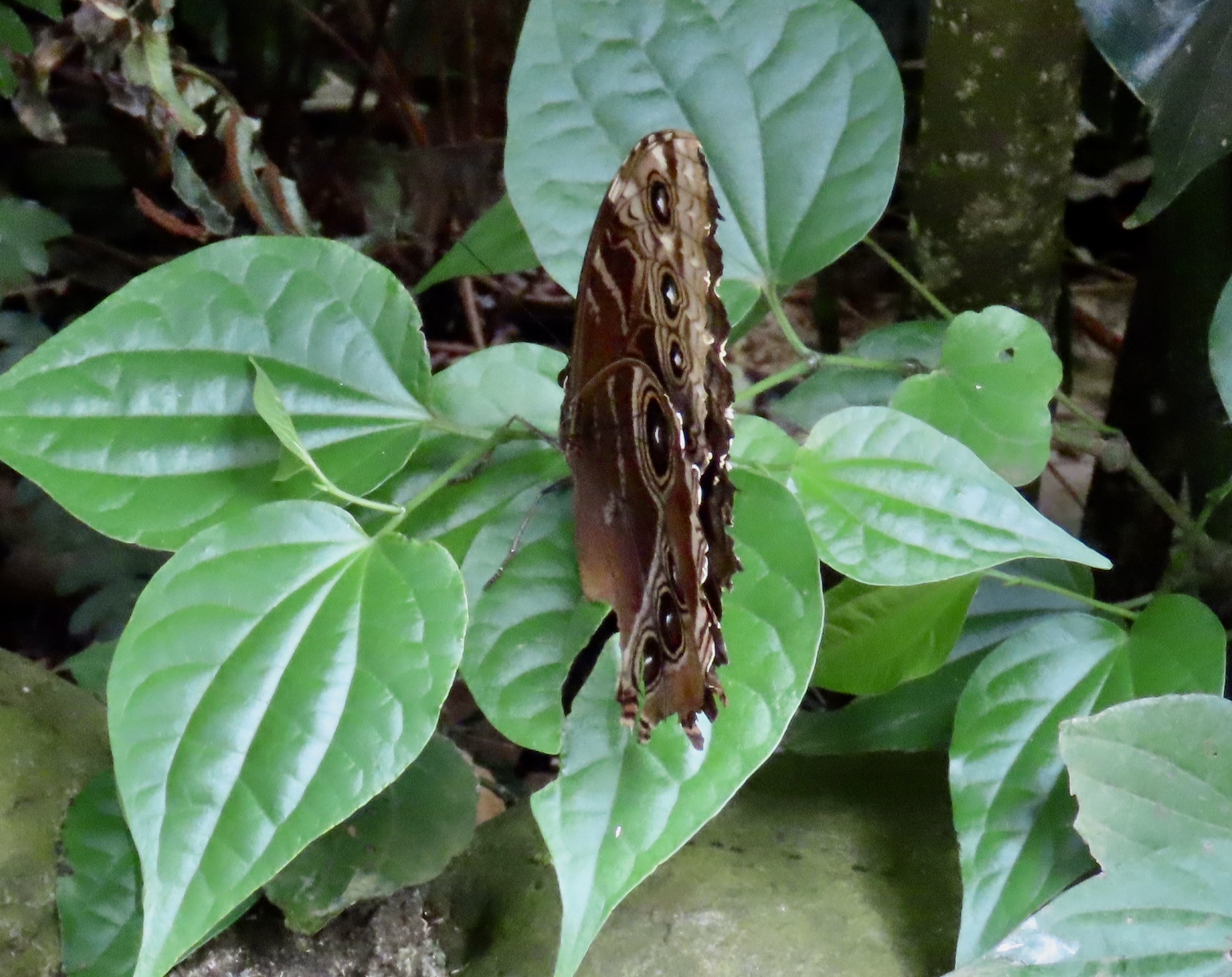
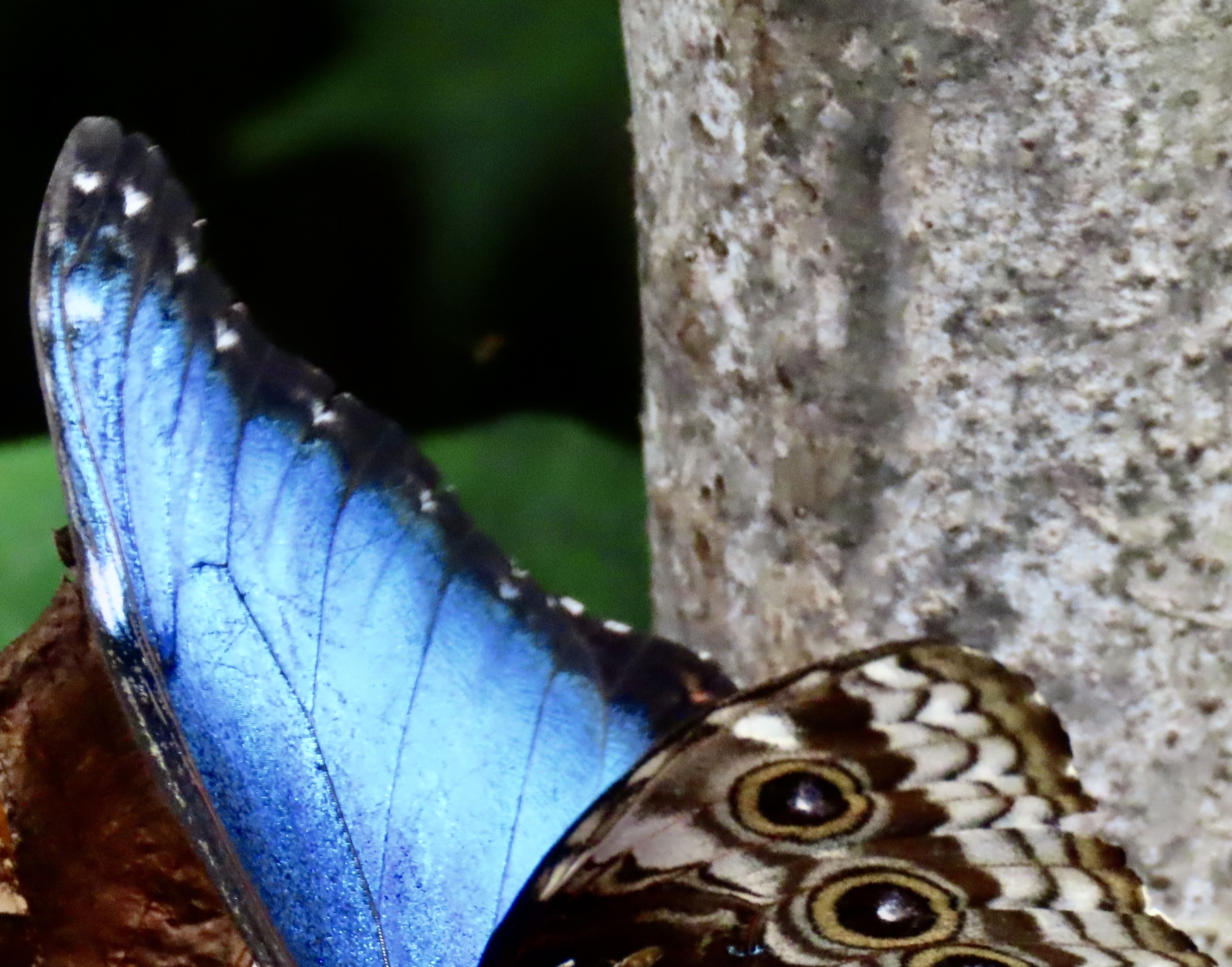
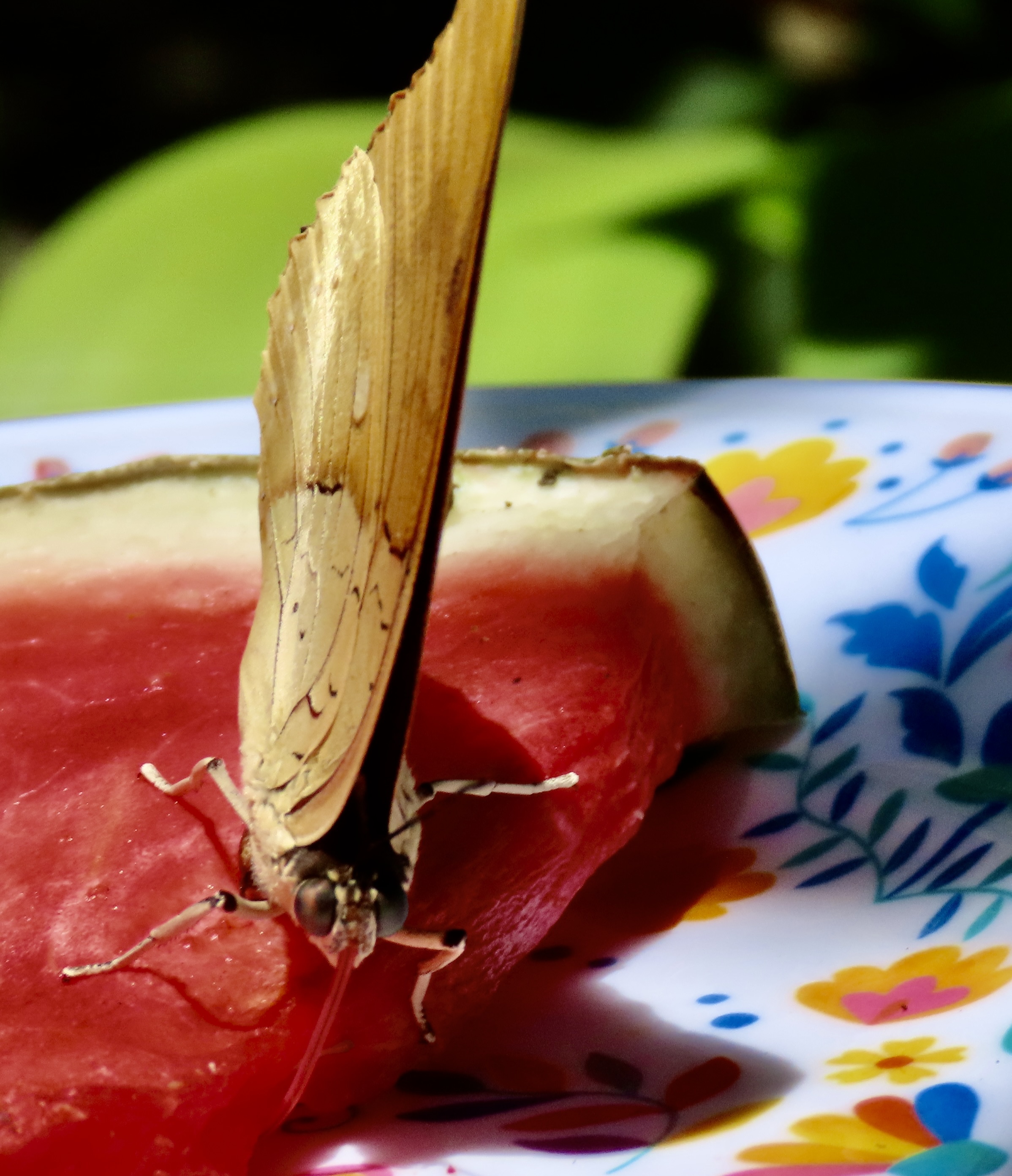
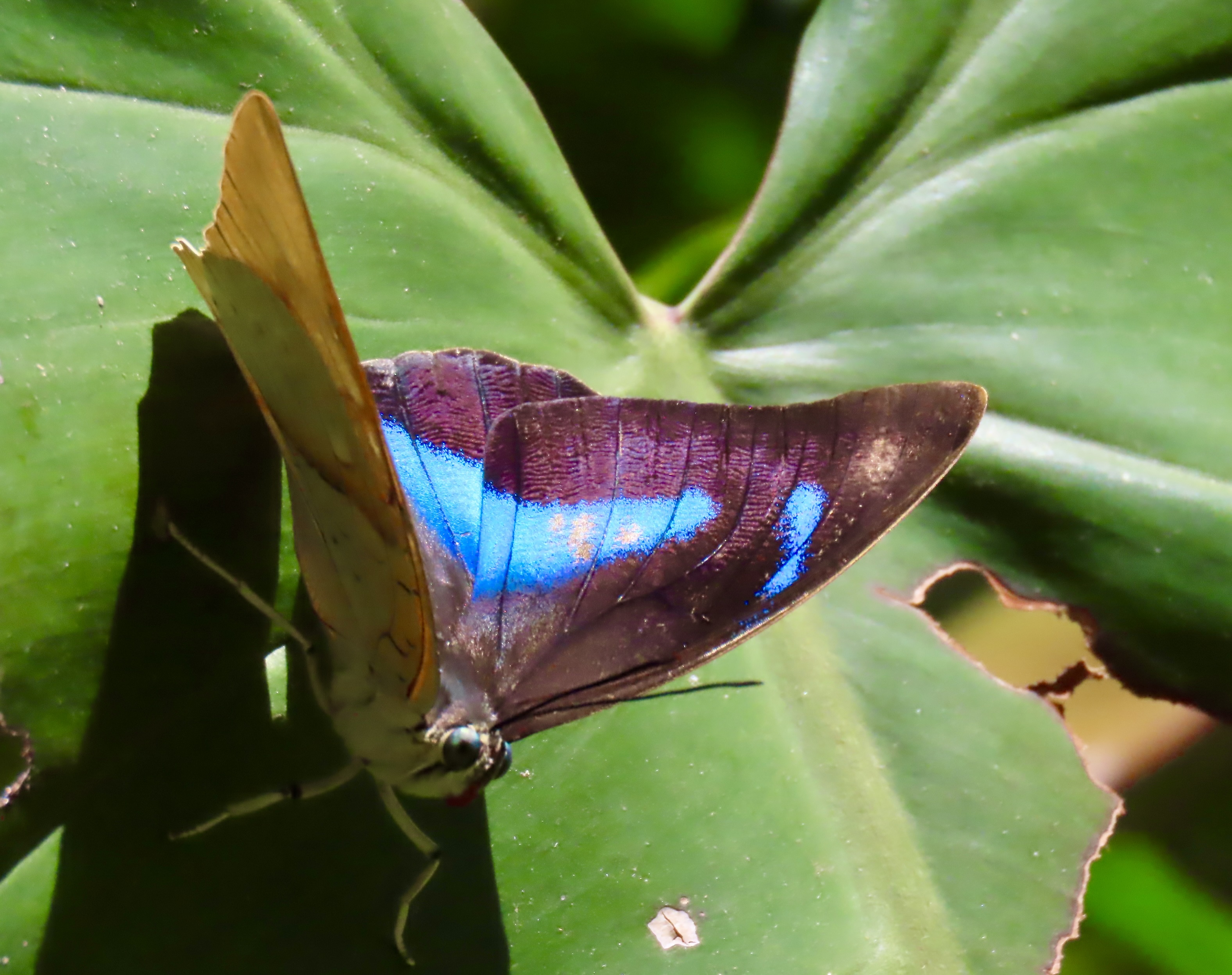
The eggs hatch into tiny caterpillars that come with a voracious appetite and quickly grow in size. Molting frequently, they change their looks each time. The caterpillar on the right is a younger version of the caterpillar on the left. The large hole in the banana leaf is why the big caterpillar is so big. It’s also the reason why banana farmers aren’t particularly fond of these insects that can grow 5 to 6 inches long off of devouring their plants before entering their chrysalis stage.From the perspective of the banana leaf, these owl caterpillars must look like one long gut approaching. The biggest one is about to enter the chrysalis stage of the metamorphous from caterpillar to butterfly. The first step is for to dissolve into a nutrient rich goop. Specialized cells that survive the melting process then utilize the nutrients to develop into the adult butterfly.The owl butterfly is quite beautiful when seen from above with its wings in open position. Here it was busy consuming watermelon that staff had left out for it. On the right is another one of Costa Rica’s best known butterflies, the blue morpho.Here a number of blue morpho are simultaneously hatching out of their chrysalis at a special hatching station that the Monteverde Butterfly Garden maintains for this purpose. Their wings have to dry and harden before they are ready to fly.Peggy found this blue morph chrysalis looking leaflike out in the Monteverde Butterfly Gardens. The chrysalis of the owl butterfly, btw, resembles the head of a viper. Both the leaf and the viper chrysalises are two more examples of evolutionary mimicry.A blue morph resting on leaves.A blue morpho gave us a brief glimpse of the vibrant blue color of its inner wing that gives the butterfly its name.
And now, for a quick look at some of the other beauties we photographed at the Monteverde Butterfly Gardens. Given that there are between 1200 and 1500 species of butterflies in Costa Rica, I’m late with this post, and my mind is on butterfly overload, I didn’t have time to pin down all the names.
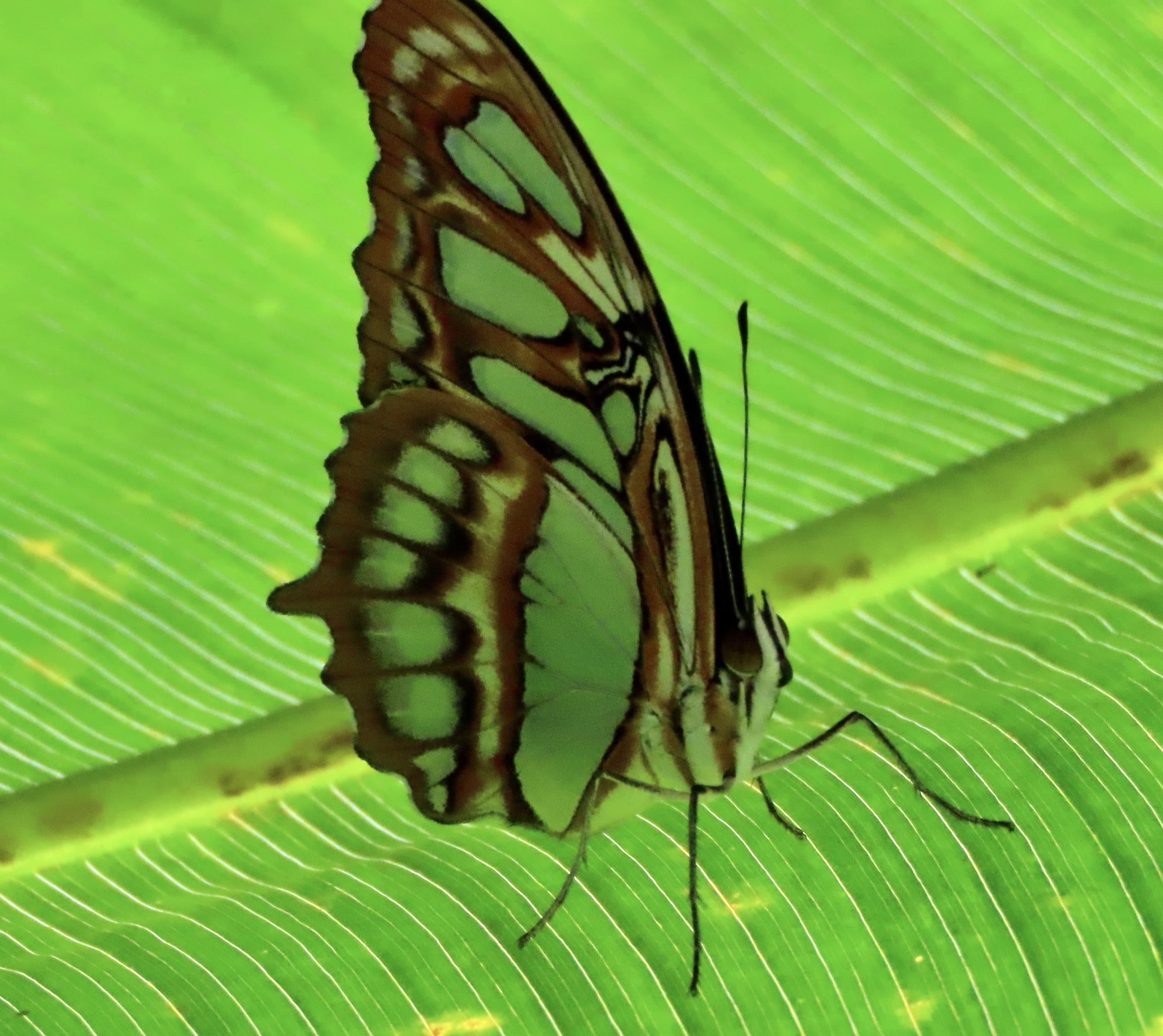
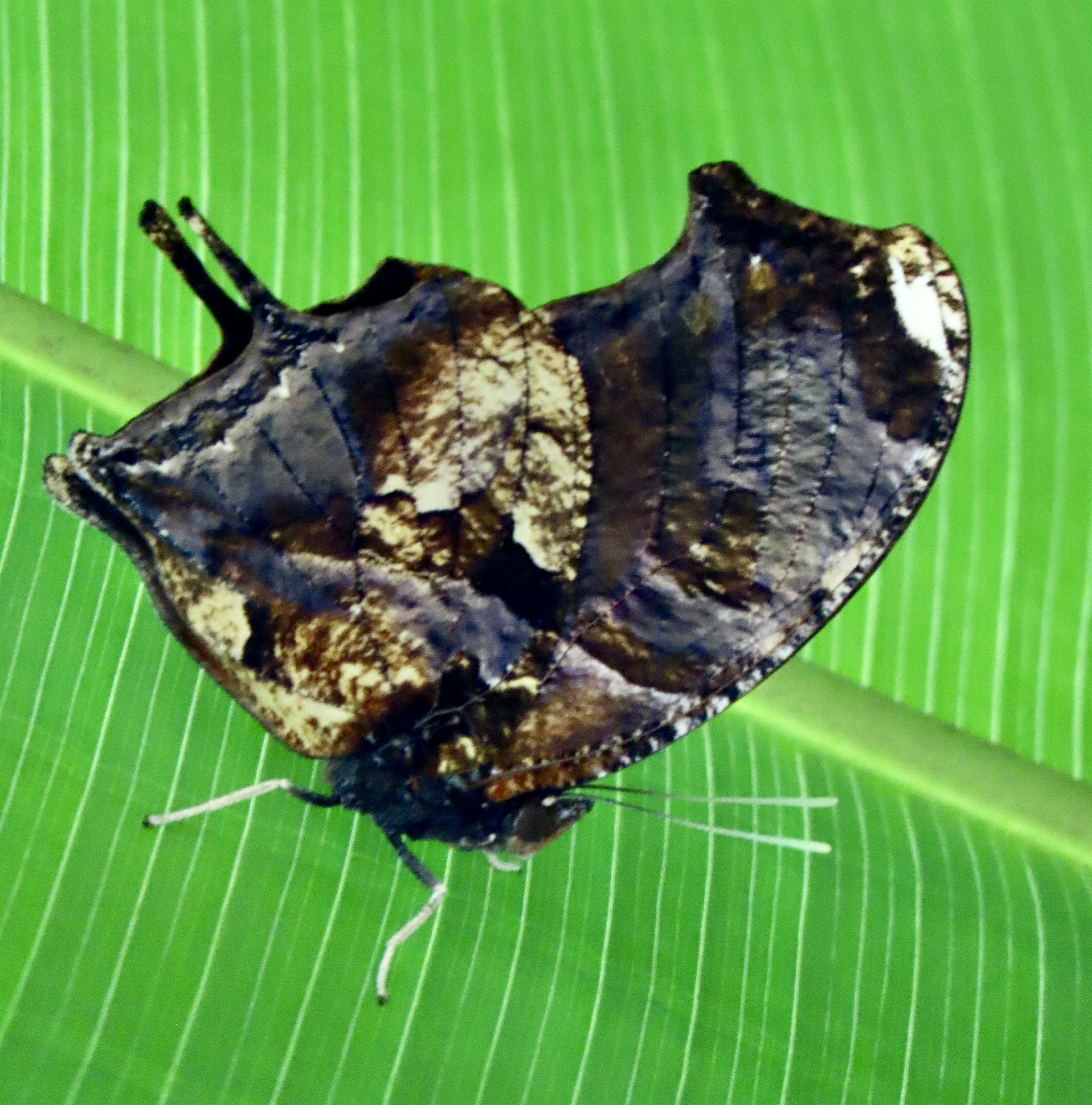
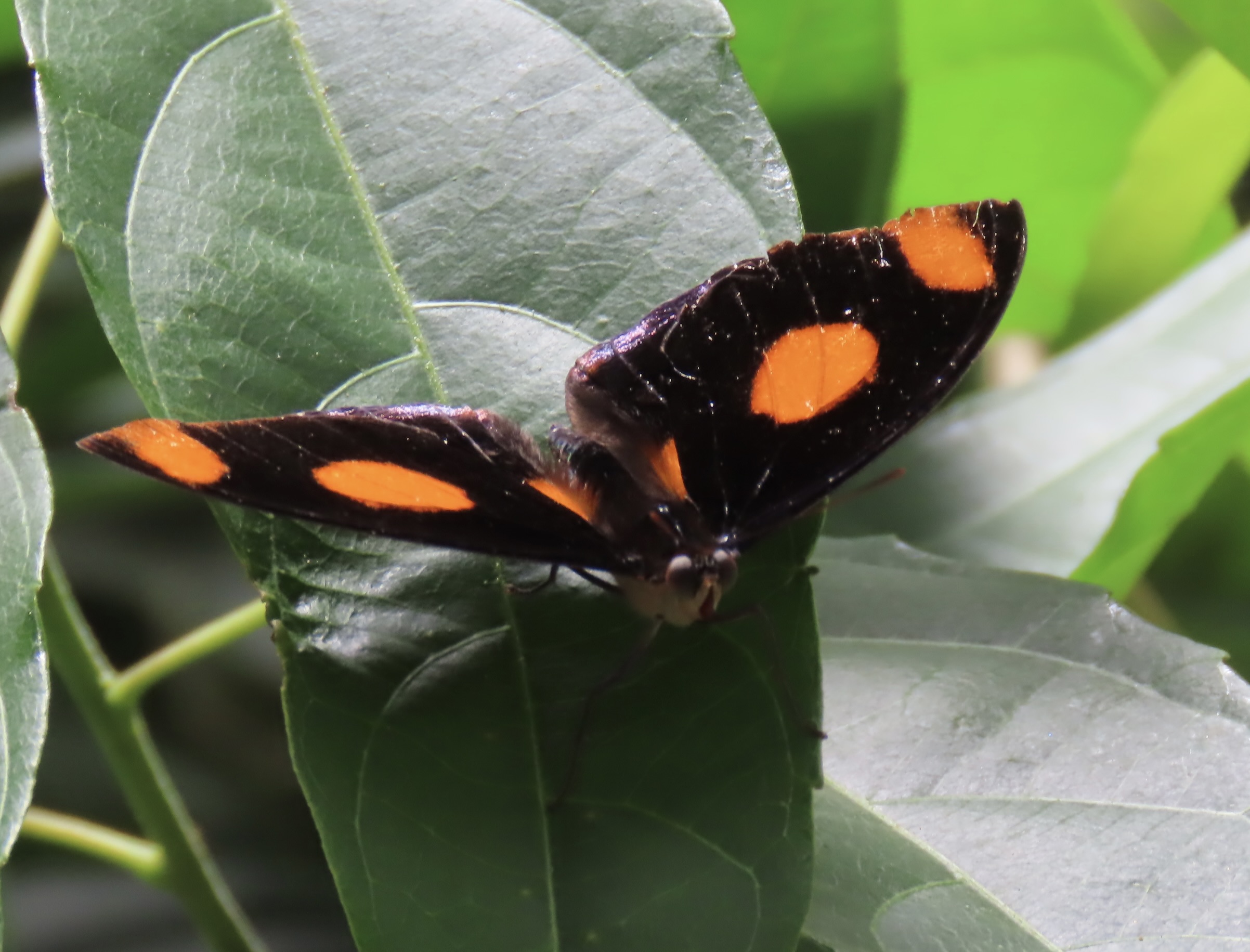
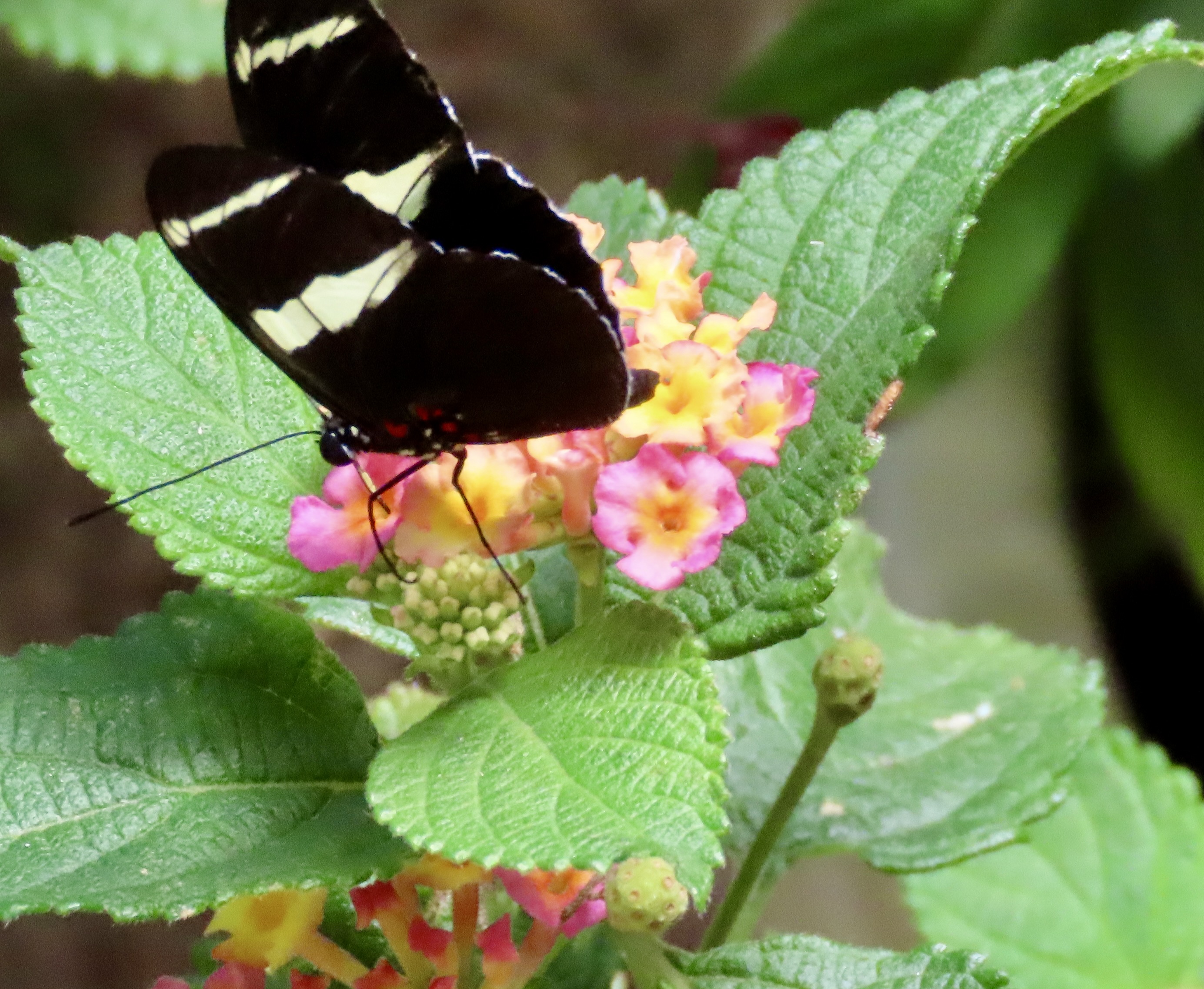
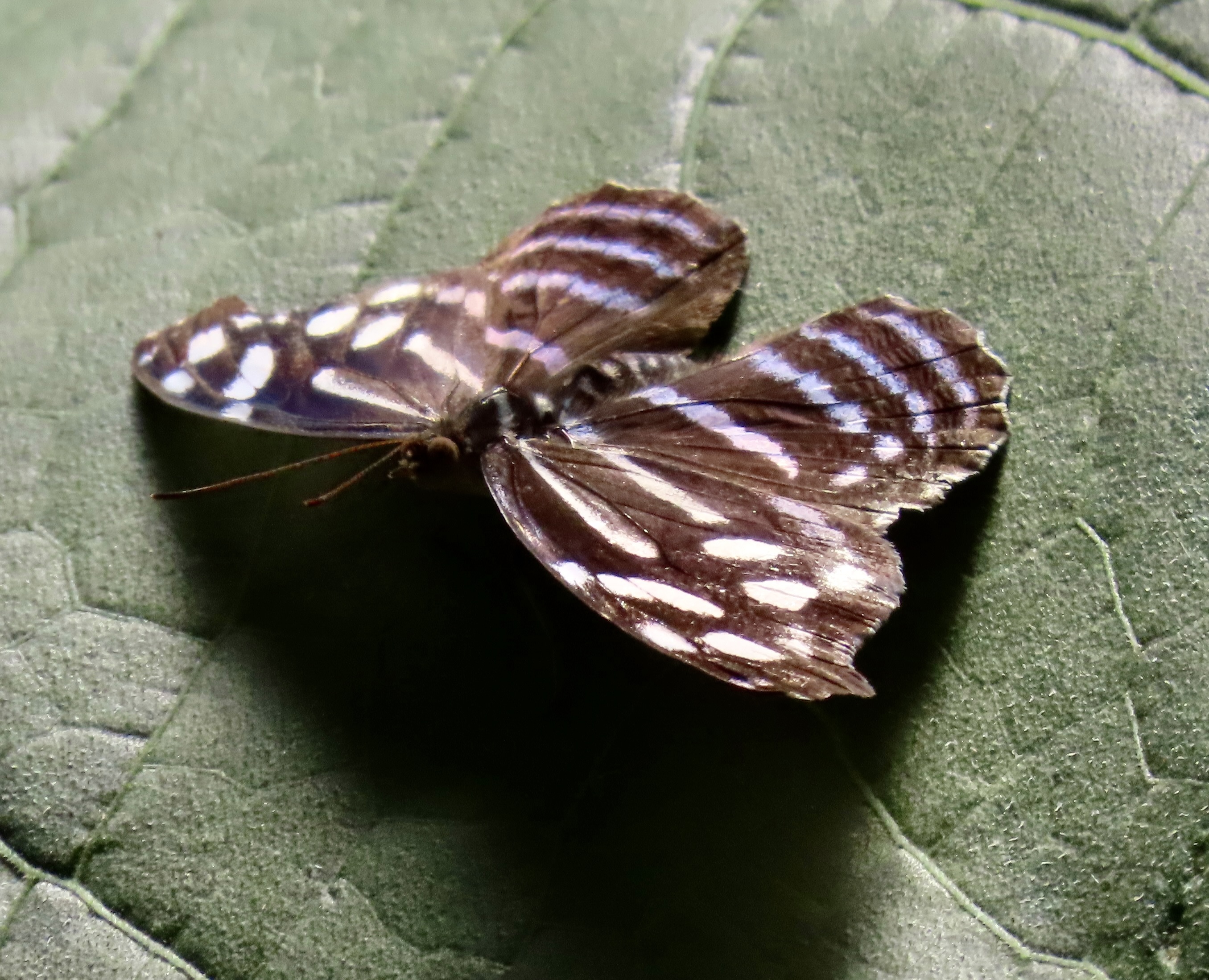
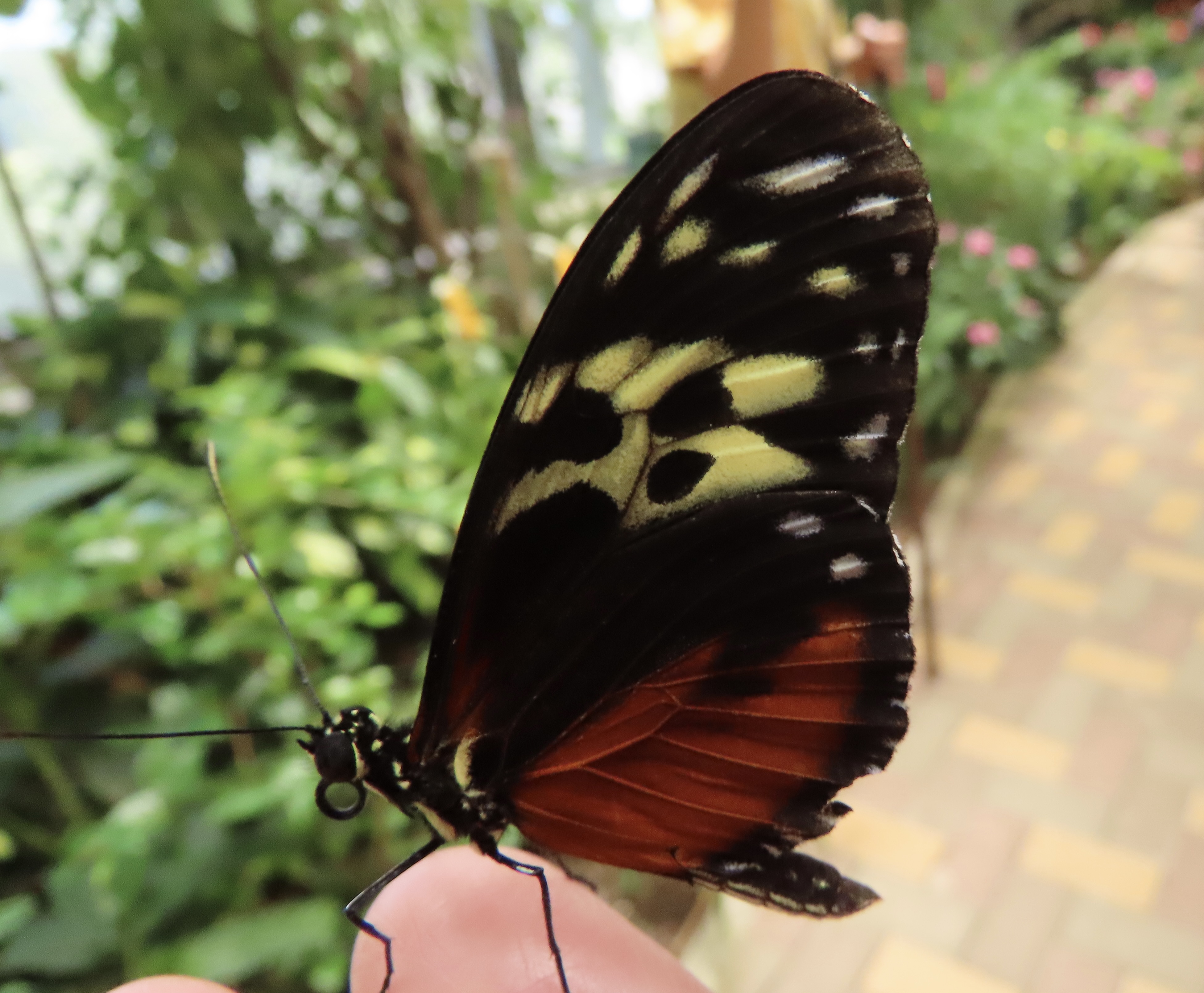
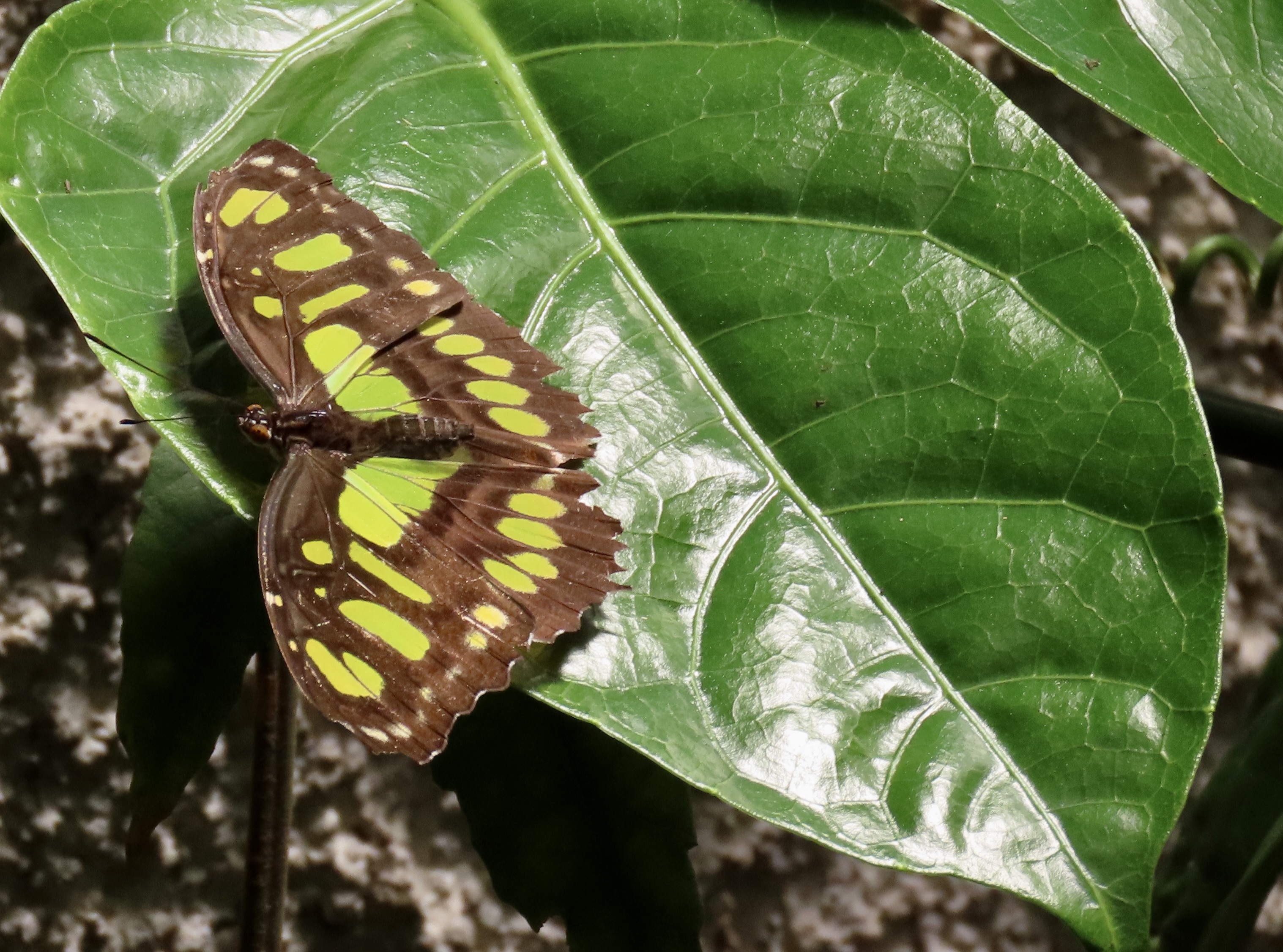
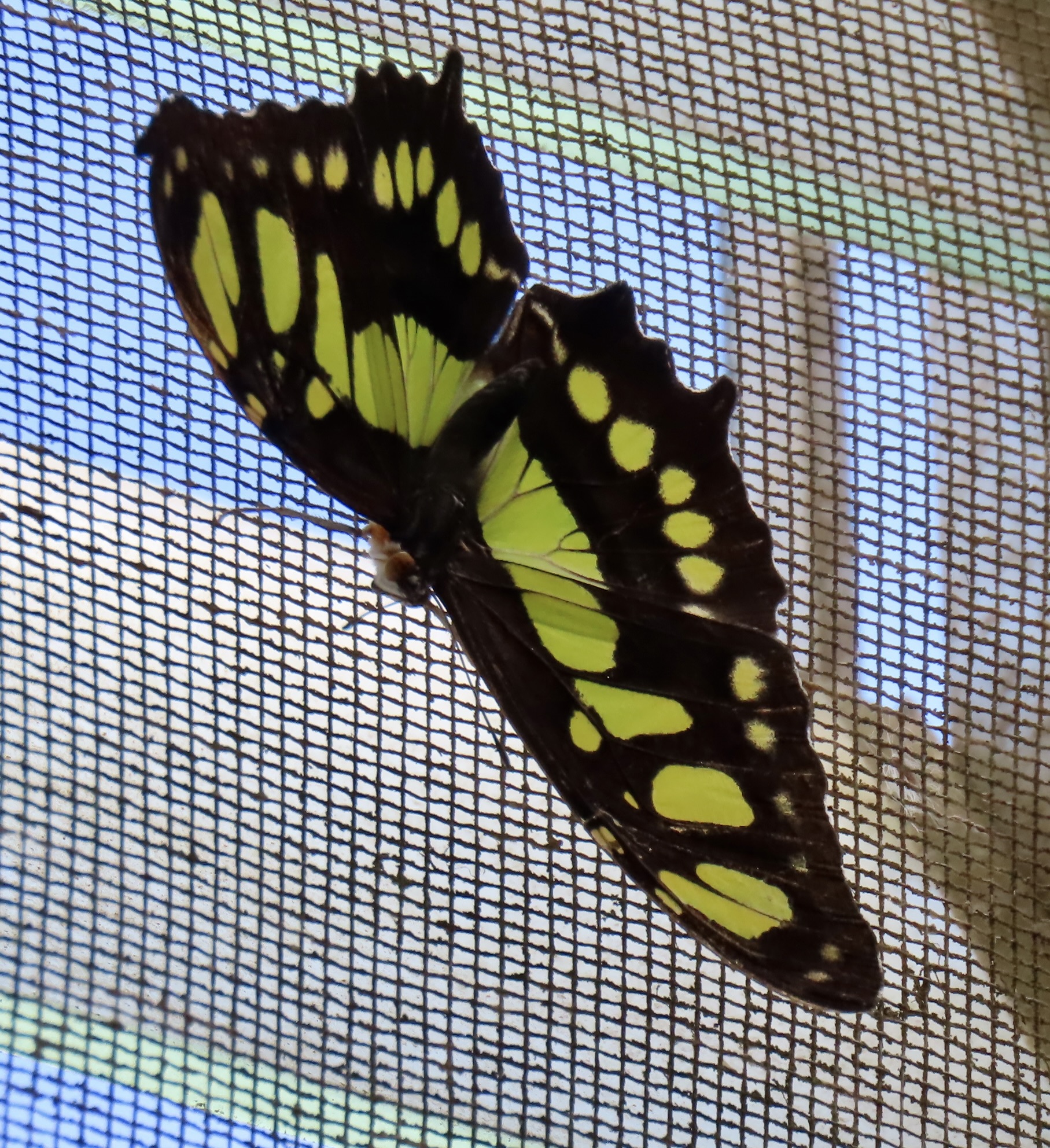
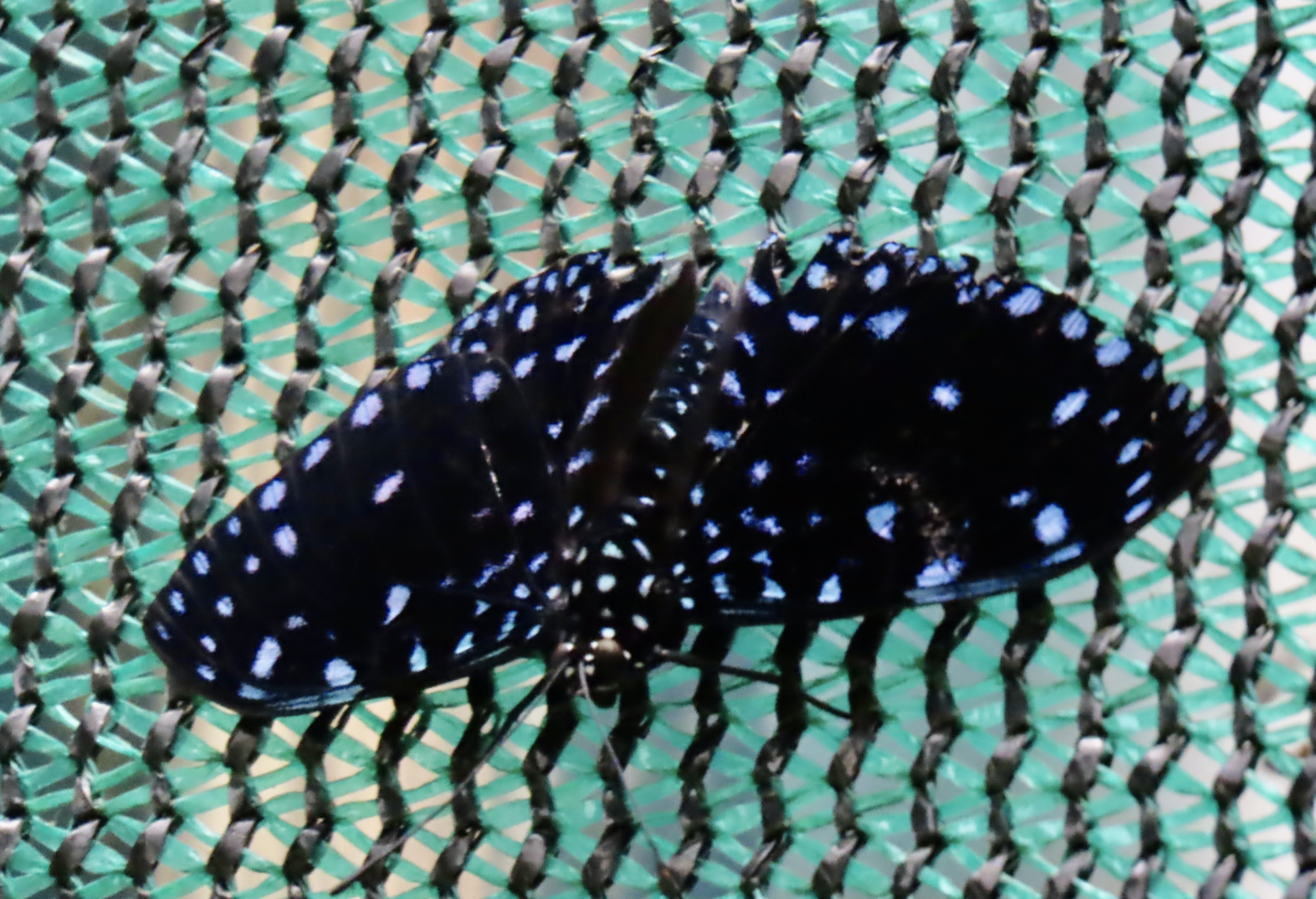
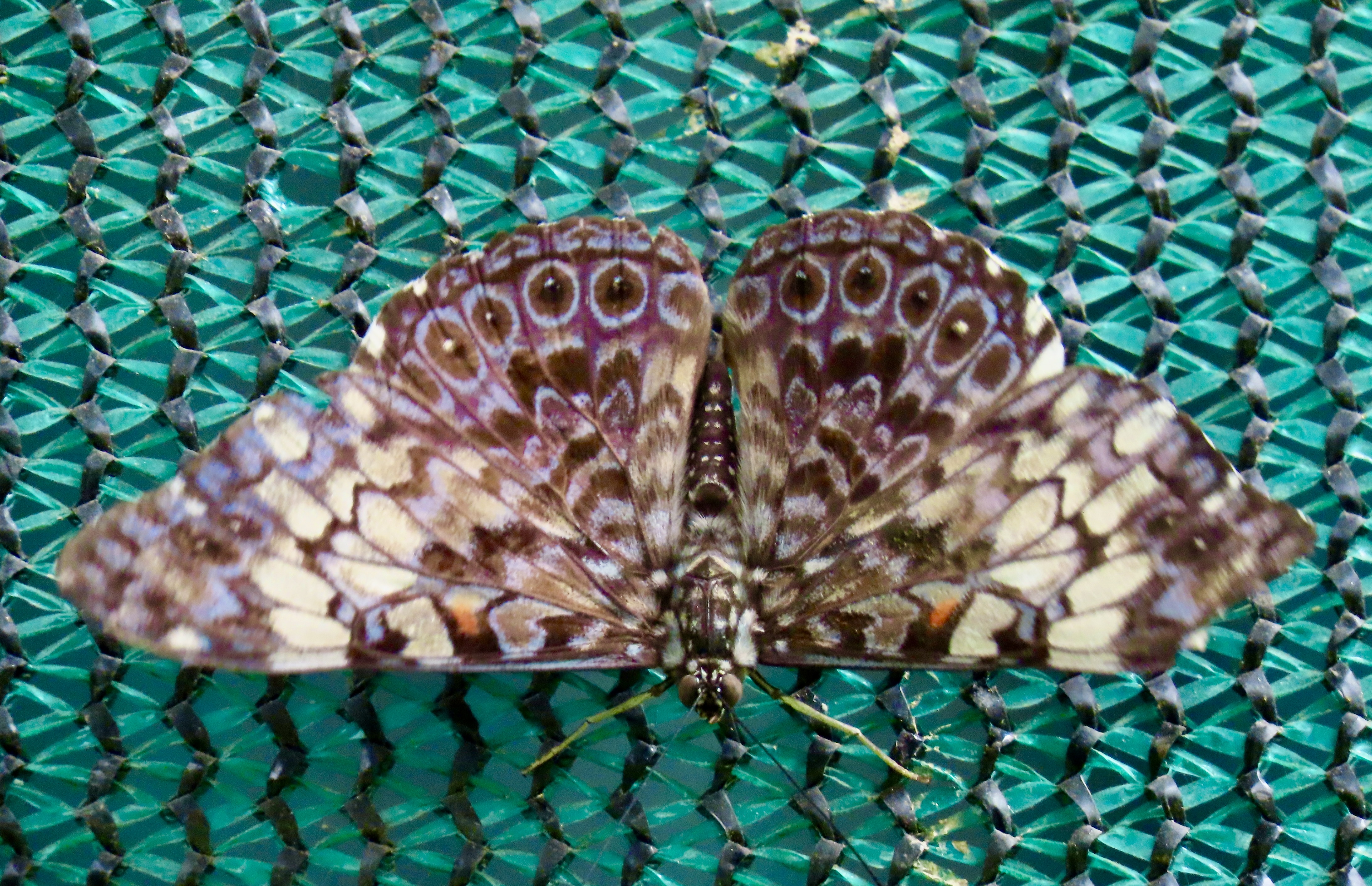
Set off by green, a Green Longwing Butterfly. Great camouflage. One of a number of butterflies that pretend to be dead leaves. This may be excellent camouflage on leaf litter covered forest floor. Not so good here.Red spots. This may be a ‘see me, see me’ look as opposed to camouflage. The caterpillars of some butterflies feast on plants that are poisonous to birds, lizards and other predators. The poison is transferred to the butterfly. Instead of hiding, the butterfly, announces its presence with bright colors that are designed to tell predators ‘You really don’t want to eat me.’ Other butterflies may adopt the same colorization in what is known as Batesian mimicry. They aren’t poisonous, but who’s to know the difference?Lunch. Butterflies, unlike caterpillars, sip nectar with their long proboscis instead of eating leaves. This is a HeliconiusSara (I think.)This sulfur colored butterfly is using its proboscis to sip watermelon juice. Note the color of the proboscis. Many Costa Rican butterflies take advantage of fallen, rotting (translate fermenting) fruit for food. They can actually become a little tipsy.This one looks like the same species as above with its wings open.Brown on green.I call this a finger butterfly since it landed on Peggy’s finger and refused to get off. It may be a Crimson Longwing.I’m going with a Malachite Butterfly on this one.And this one as well even through the colors are dramatically different. But note how close the pattern of their spots is. The butterflies often rested on the screens that kept them in the butterfly houses. Maybe they were longing to be free.Peggy’s favorite, a Starry Night Cracker Butterfly.And a final beauty. This is a Variable Cracker Butterfly. The unusual cracker name is said to come from the noise they make when they are flying.As for what noise that is, I lifted this: “The Cracker butterfly gets its name because the males are able to produce a crackling sound, reminiscent of bacon cooking in a frying pan. They make the sound when they take off, by twanging a pair of spiny rods on their abdomen against their anal claspers.” Not sure about the anal clasper but it brings a vision to mind.
Next Post: It’s back to UT-OH with two more final tales about the Mekemson Gang. There’s the issue of how I lived up to Bertha Brays expectations about my leading her son astray (although there’s an issue of who led who.) And there’s a question about why Tony Pavy wanted to shoot me. It had to do with his pig.
Night tours are big in Monteverde, Costa Rica. Every corner seems to advertise one. Take a dash of the exotic, throw in a pinch of danger, add a competent, knowledgeable guide— and how can one resist? No wonder there were at least 10 companies to choose from. There is big money to be made. We paid our $300 and off we went. We had an excellent guide, Marvin. He found us each of the big three, don’t mess with me, attractions, plus more.
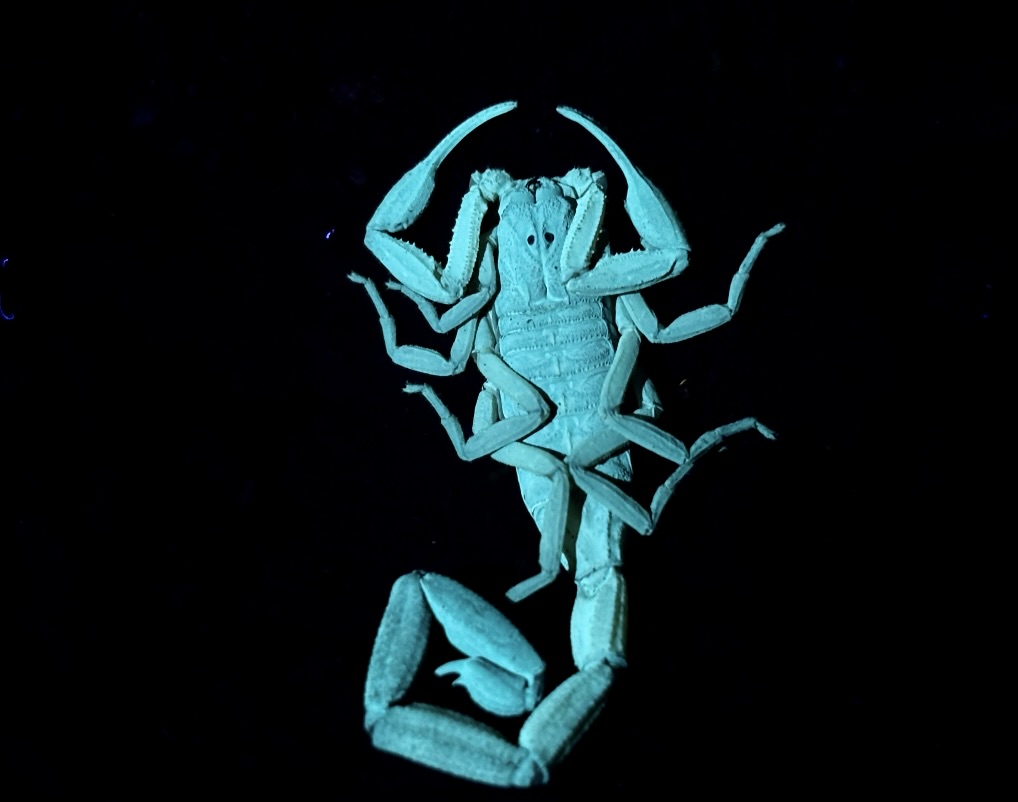
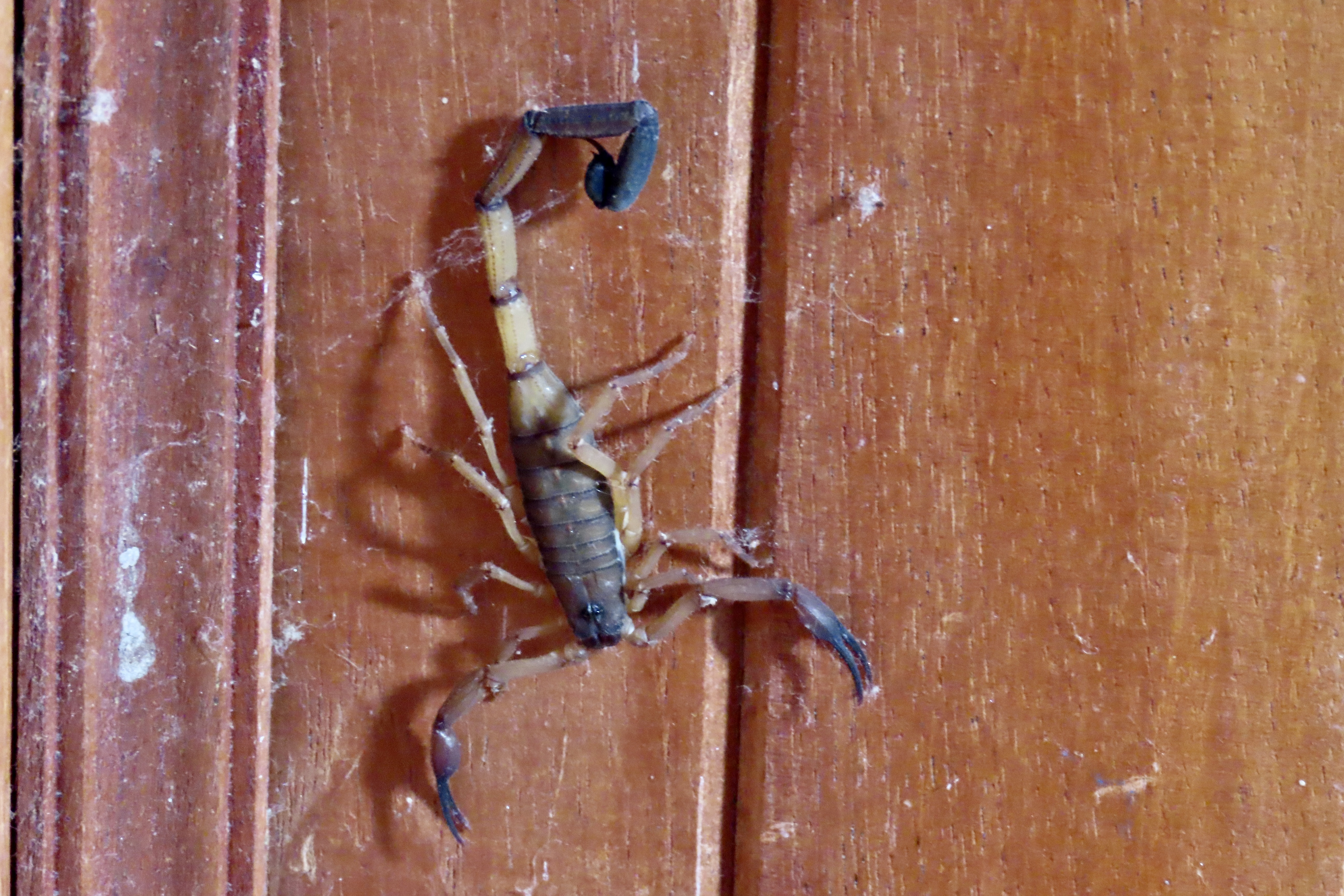
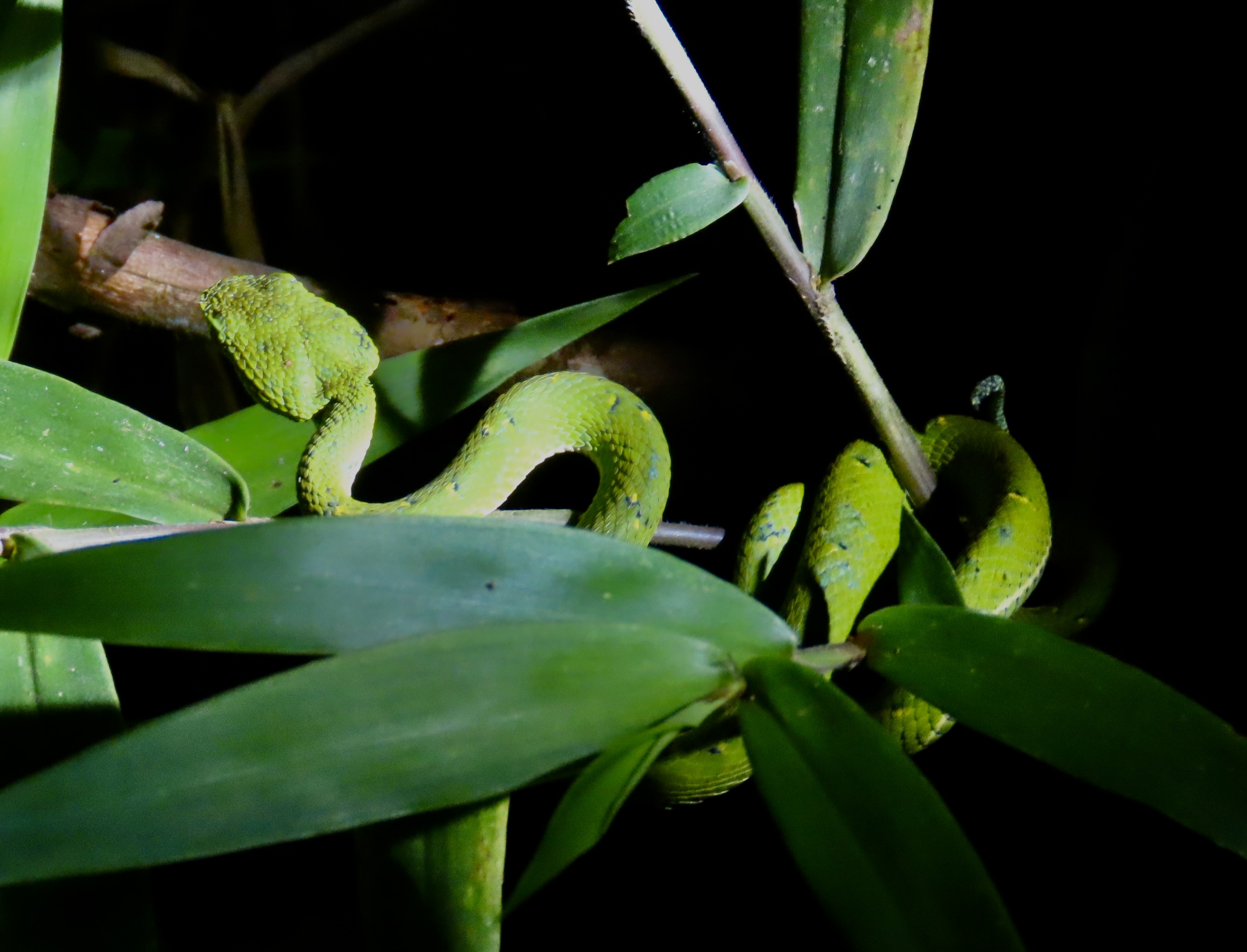
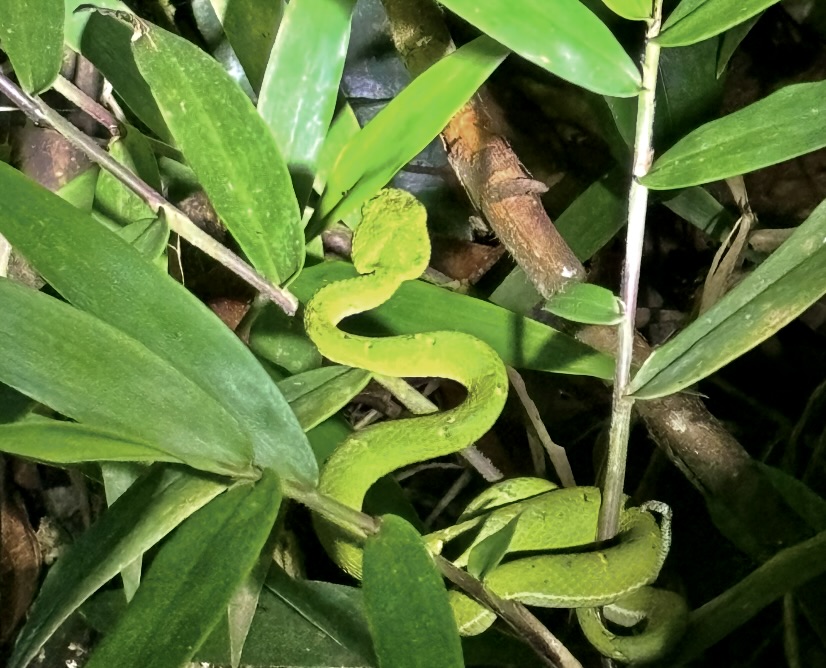
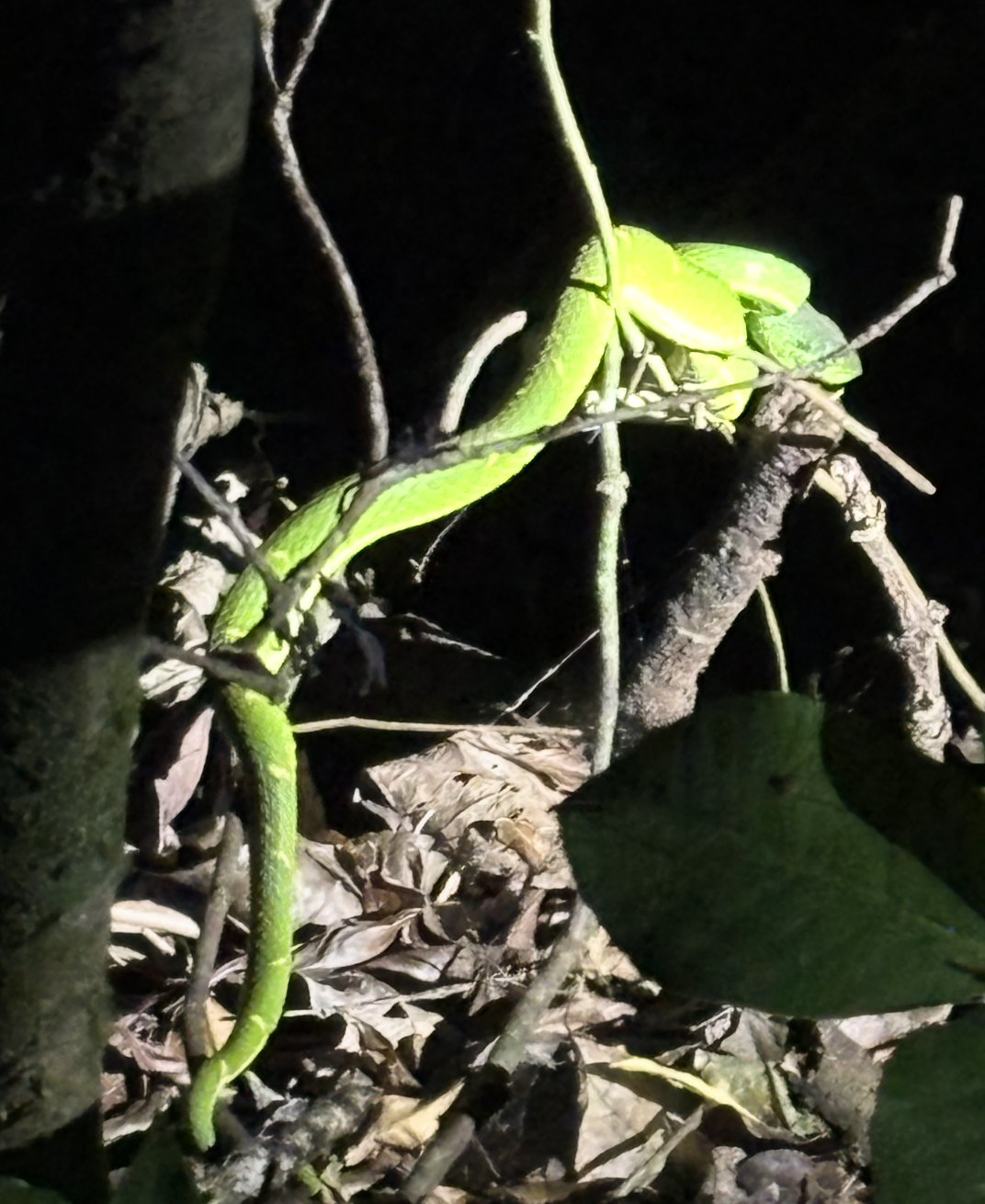
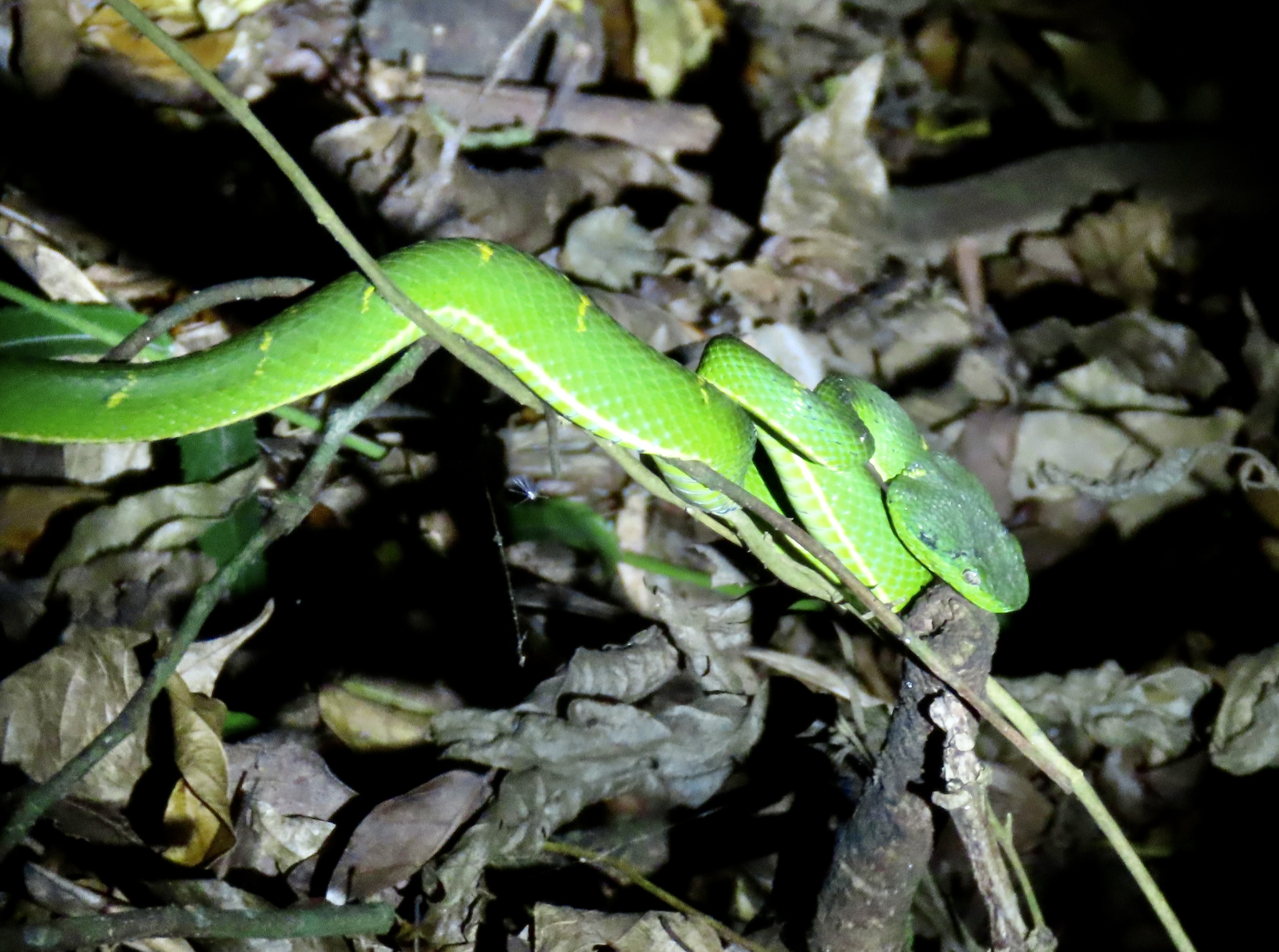
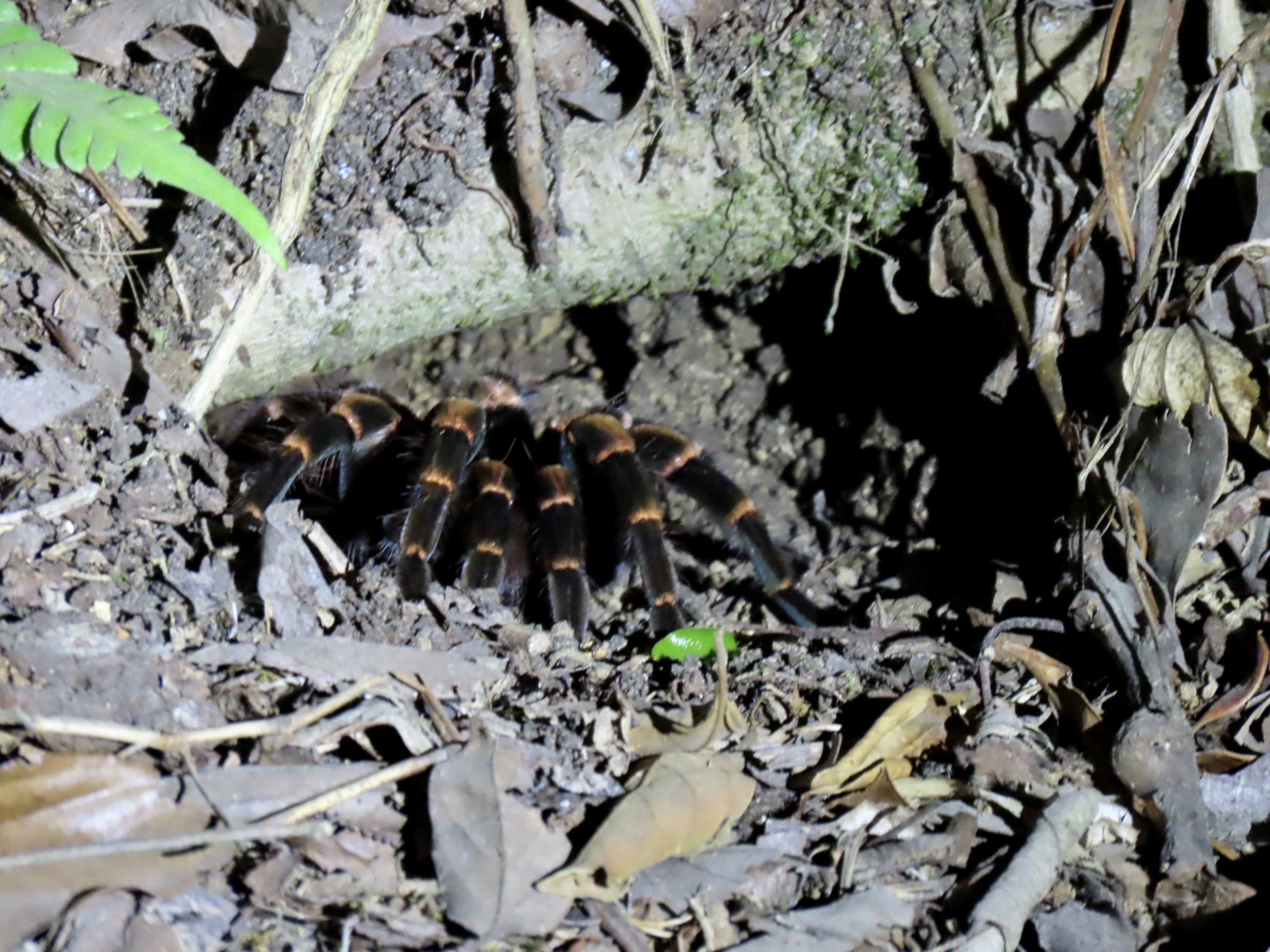
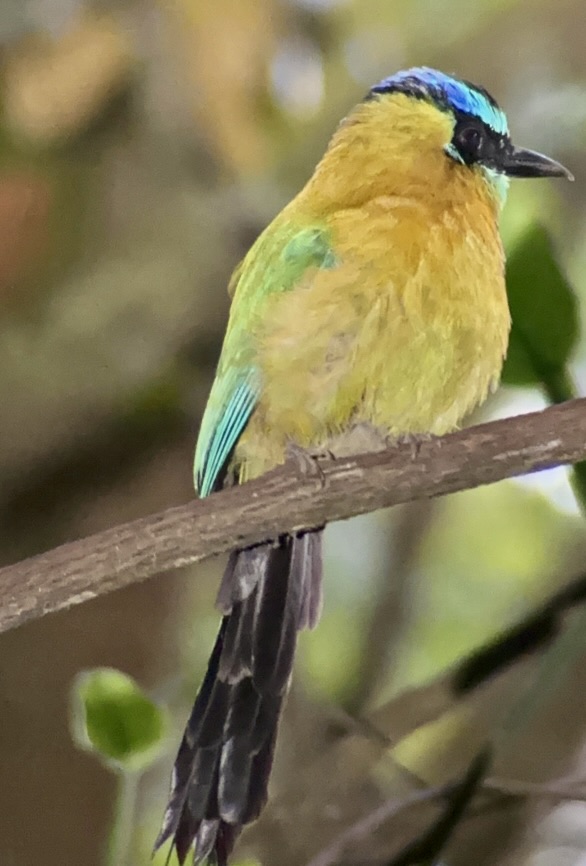
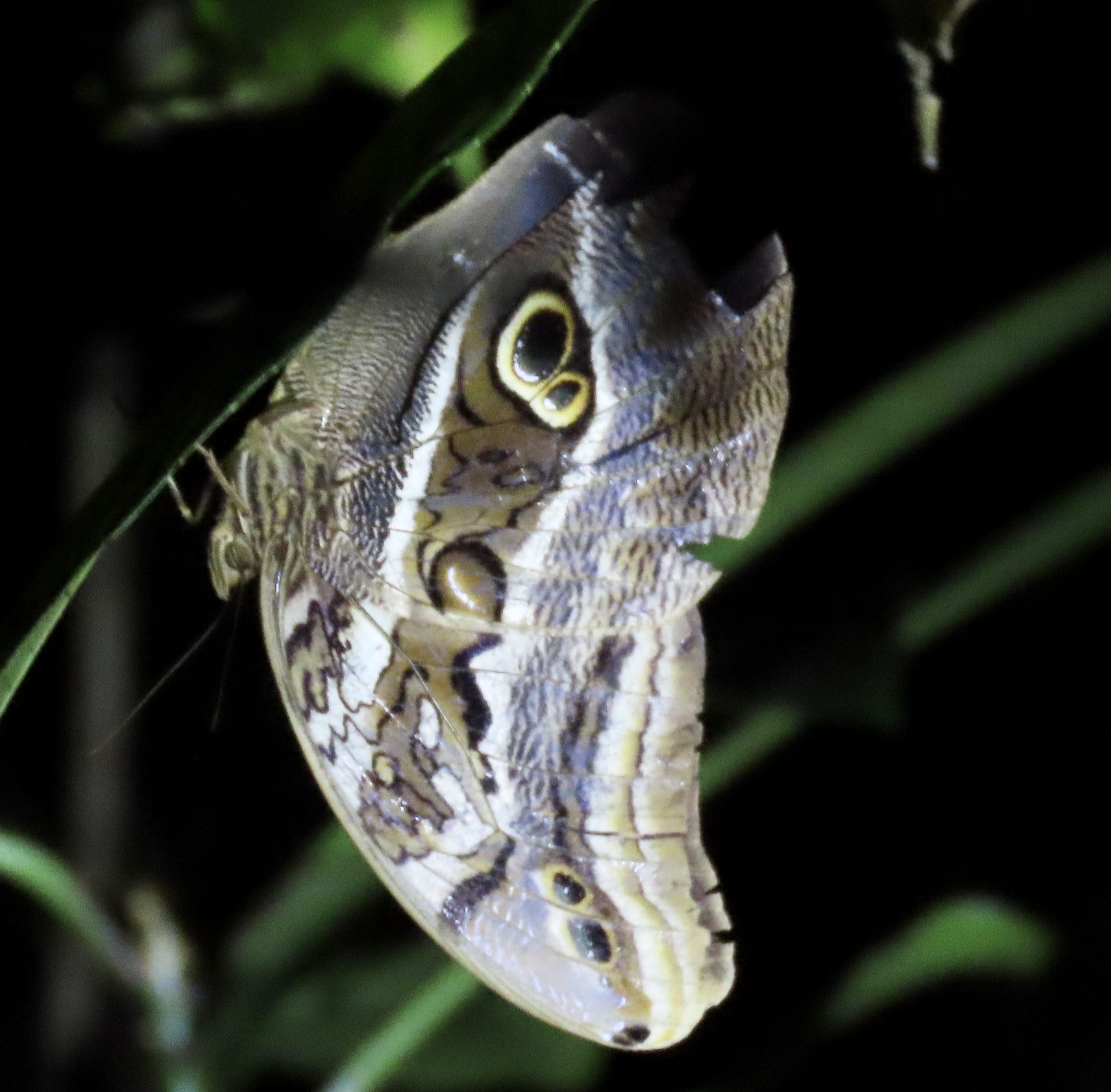
This iridescent, blue-green fellow was one of the creatures we came across. Actually, our youngest grandson, Cooper, spotted it first. Our son Tony claimed ‘That’s because Cooper is closest to the ground.” You will recognize this blue-green insect for what he is. A scorpion. I’ve seen many over the years. But never one of this striking color. They all pack a mean sting. Costa Rica claims that no one has ever died in the country from a scorpion. Well, except for that one girl…This one seemed almost tame in comparison. Our grandson, Chris, found it crawling up the wall behind him where he was watching TV at our VRBO. “Grandpa,” he yelled, “You have to see this.” “Well, hello,” I said, to the scorpion, and sent Chris scurrying for something to catch it with. He came back with a martini glass, i.e. large top, shallow bottom. Not ideal for catching something that packs a wallop in its tail, but great for a double martini if you get stung. Make it a triple. I slapped it over the top of scorpion but missed the offending appendage. It was swishing around trying to find me. I turned the glass right side up and he slid to the bottom, looking thoroughly peeved. “Just be glad it’s me,” I told him. “Anyone else and you’d be a grease spot on the wall.” It waved its tail at me in a single digit salute. I took him over to our balcony and tossed him out of the glass into the shrubs below. Chris, Peggy and I made a pact not to tell anyone else in our household. Mom might have had them packing.Next, on our pitch dark night, Marvin found a baby green pit viper known by the scientific name of Bothriechis lateralis, or if you prefer something you can pronounce, a side-striped palm pit viper. Apparently, they like to hang out in palms. Note its distinctive triangle shaped head: A sure sign you are dealing with a viper. Translate poisonous. There would be no trying to catch it! Least of all in a martini glass. I took this photo.Marvin, carried a spotting scope that gave us another view of the side-striped palm viper. He used Tony’s cell phone to take a photo through the scope. Here, you can see the stripe along its side. We each carried flashlights so we could see the trail plus light up whatever we wanted photos of. Not too far down the trail, we found an adult side-striped palm viper and Marvin took this photo through his spotting scope.I focused in on the upper part of its body. The viper, like New World monkeys, has a prehensile tail. It can use it to wrap around a limb while it dangles and relaxes. Or, he can whip it out to wrap around and retrieve dinner in the form of lizards and small rodents. While poisonous, few people die from its bite. Not so the lizards or a tasty mouse. The final member of our trio, a Costa Rican zebra tarantula, also known as the striped-knee tarantula. Peggy took this photo. These large spiders dig deep burrows into the ground which helps regulate temperatures. It’s reported that they often live together in large numbers. One was enough for us, but I must say, it was quite striking.Just so this post doesn’t give you nightmares, our night tour also produced less threatening species. This is Lesson’s Motmot seen through Marvin’s spotting scope. An owl butterfly. Marvin told us it was one of the largest butterflies in Costa Rica. It has large spots on the lower parts of its wings that resemble owl’s eyes when its wings are open.
Next up, the Mekemson Kids Did It: Something go wrong in Diamond Springs? Who do you blame? Like the gunslingers of the Old West, we developed a reputation that far exceeded our capacity for mischief.
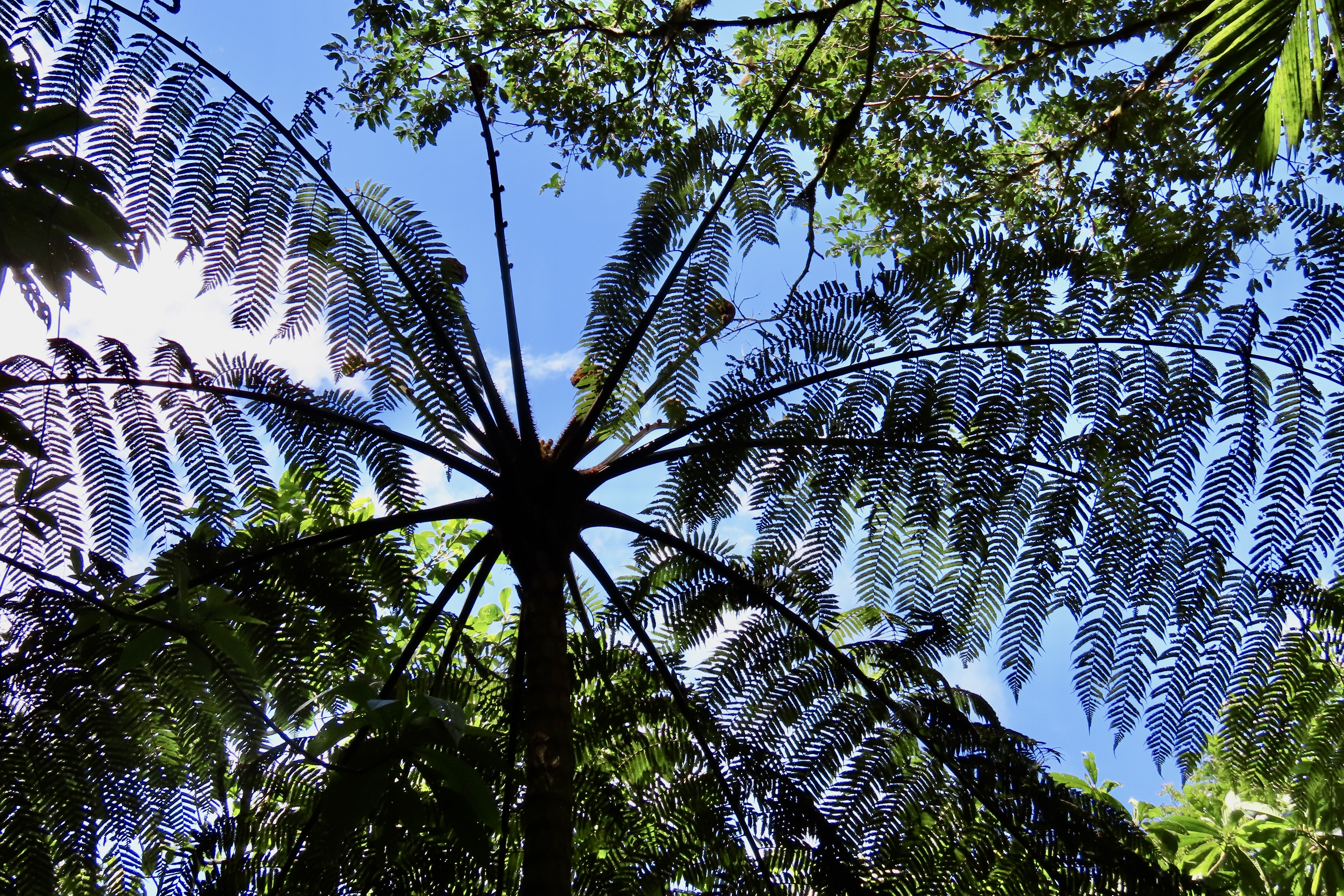
I mentioned in my last post that there were no photos of the Pond or the Woods. They were victims of the endless march of ‘civilization.’ Fortunately, and I should add, so far, there are still wild places on earth. Costa Rica has many. Some, such as Monteverde, are attracting hordes of tourists. There’s good and bad news here. Among the good is that the tourists provide Costa Rica with a welcome source of income and the opportunity for the tourists to enjoy the beauty and wildlife of Costa Rica. The bad news is the incredible commercialization that goes along with it and the impact. It’s similar to when the large cruise ships drop thousands of people onto the small Greek Island of Santorini, or our most popular National Parks in America turn into traffic jams in the summer. But enough on that. The tree above was a new one to me, a fern tree. There are more photos below after my UT-OH chapter on the Woods.
Part 2: The Woods
The Woods, like the Pond, earned a capital letter. To get there I walked out the back door, down the alley past the Graveyard, and through a pasture Jimmy Pagonni rented for his cattle. Tackling the pasture involved crawling through a rusty barbed wire fence, avoiding fresh cow pies, climbing a hill, and jumping an irrigation ditch. The journey was fraught with danger. Hungry barbed wire consumed several of my shirts and occasionally went for my back.
Torn clothing and bleeding scratches were a minor irritation in comparison to stepping in fresh cow poop, though. A thousand-pound, grass-eating machine produces acres of the stuff. Deep piles sneak up your foot and slosh over into your shoes. Toes hate this. Even more treacherous are the little piles that hide out in the grass. A well-placed patty can send you sliding faster than black ice. The real danger here is ending up with your butt in the pile. I did that, once. Happily, no one was around to witness my misfortune, or hear my language, except Tickle the Dog. I swore him to secrecy. He knew many of my secrets. It’s a damned good thing he couldn’t talk.
For all of its hazards, the total hike to the Woods took about 15 minutes. Digger pines with drunken windmill limbs guarded the borders while gnarly manzanita and spiked chaparral dared the casual visitor to venture off the trail. Poison oak proved more subtle but effective in discouraging exploration.
I could count on raucous California jays to announce my presence, especially if I was stalking a band of notorious outlaws. Ground squirrels were also quick to whistle their displeasure. Less talkative jackrabbits merely ambled off upon spotting me, put on a little speed for a hyper Cocker, and became bounding blurs in the presence of a hungry greyhound. Flickers, California quail and acorn woodpeckers held discussions in distinctive voices I soon learned to recognize.
From the beginning, I felt at home in the Woods, like I belonged. I quickly learned that its hidden recesses contained a multitude of secrets. I was eager to learn what they had to teach me, but the process seemed glacial. It required patience and I hardly knew how to spell the word. I did know how to sit quietly, however. This was a skill I had picked up from the hours I spent with my nose buried in books. The woodland creatures prefer their people noisy. A Curt stomping down the trail, snapping dead twigs, and talking to himself was easy to avoid, while a Curt being quiet might surprise them.
One gray squirrel was particularly loud in his objections. He lived in the top branches of a digger pine beside the trail and maintained an observation post on an overhanging limb. When he heard me coming, he would adopt his ‘you can’t see me gray squirrel playing statue pose.’ But I knew where to look. I would find a comfortable seat and stare at him. It drove him crazy. Soon he would start to thump the limb madly with his foot and chirr loudly. He had pine nuts to gather, a stick home to remodel, and a bright-eyed, bushy-tailed lady to woo. I was blocking progress. Eventually, if I didn’t move, his irritation would bring him scrambling down the trunk for an up-close and personal scolding.
After about 10 minutes of continuous haranguing, he’d decide I was a harmless, if obnoxious aberration and go about his business. That’s when I begin to learn valuable secrets, like where he hid his pine nuts. It was also a sign for the rest of the wildlife to come out of hiding. A western fence lizard might work its way to the top of the dead log next to me and start doing push-ups. Why, I couldn’t imagine. Or perhaps a thrush would begin to scratch up the leaves under the manzanita in search of creepy tidbits. The first time I heard one, it sounded like a very large animal interested in little boy flesh.
Occasionally there were special treats: A band of teenage gray squirrels playing tag and demonstrating their incredible acrobatics; a doe leading its shy, speckled fawn out to drink in the small stream that graced the Wood’s meadow; a coyote sneaking up on a ground squirrel hole with an intensity I could almost feel.
I also began to play at stalking animals. At some point in time between childhood and becoming a teenager, I read James Fennimore Cooper and began to think I was a reincarnation of Natty Bumppo. Looking back, I can’t say I was particularly skilled, but no one could have told me so at the time. At least I learned to avoid dry twigs, walk slowly, and stop frequently.
Occasionally, I even managed to sneak up on some unsuspecting woodland creature.
If the birds and the animals weren’t present, they left signs for me. There was always the helter-skelter pack rat nest to explore. Tickle liked to tear them apart, quickly sending twigs flying in all directions. There were also numerous tracks to figure out. Was it a dog or coyote that had stopped for a drink out of the stream the night before? Tickle knew instantly, but I had to piece it together. A sinuous trail left by a slithery serpent was guaranteed to catch my attention. This was rattlesnake country. Who’d been eating whom or what was another question? The dismantled pinecone was easy to figure out, but who considered the bark on a young white fir a delicacy? And what about the quail feathers scattered haphazardly beside the trail?
Scat, I learned, was the tracker’s word for shit. It offered a multitude of clues for what animals had been ambling down the trail and what they had been eating. There were deer droppings and rabbit droppings and mouse droppings descending in size. Coyotes left their distinctive dog-like scat but the presence of fur suggested that something other than dog food had been on the menu. Some scat was particularly fascinating, at least to me. Burped up owl pellets provided a treasure chest of bones— little feet, little legs and little skulls that grinned back with the vacant stare of slow mice.
While Tarzan hung out in the Graveyard and pirates infested the Pond, mountain men, cowboys, Indians, Robin Hood and various bad guys roamed the Woods. Each bush hid a potential enemy that I would indubitably vanquish. I had the fastest two fingers in the West and I could split a pine nut with an imaginary arrow at 50 yards. I never lost. How could I? It was my fantasy.
Daydreams were only a part of the picture. I fell in love with wandering in the Woods and playing on the Pond. There was an encyclopedia of knowledge available and a multitude of lessons about life. Learning wasn’t a conscious effort, however; it was more like absorption. The world shifted for me when I entered the Woods and time slowed down. A spider with an egg sack was worth five minutes, a gopher pushing dirt out of its hole, 20, and a deer with a fawn, a lifetime.
It isn’t surprising that I became known as Nature Boy by my classmates, given all the time I spent in the woods. I considered it a compliment.
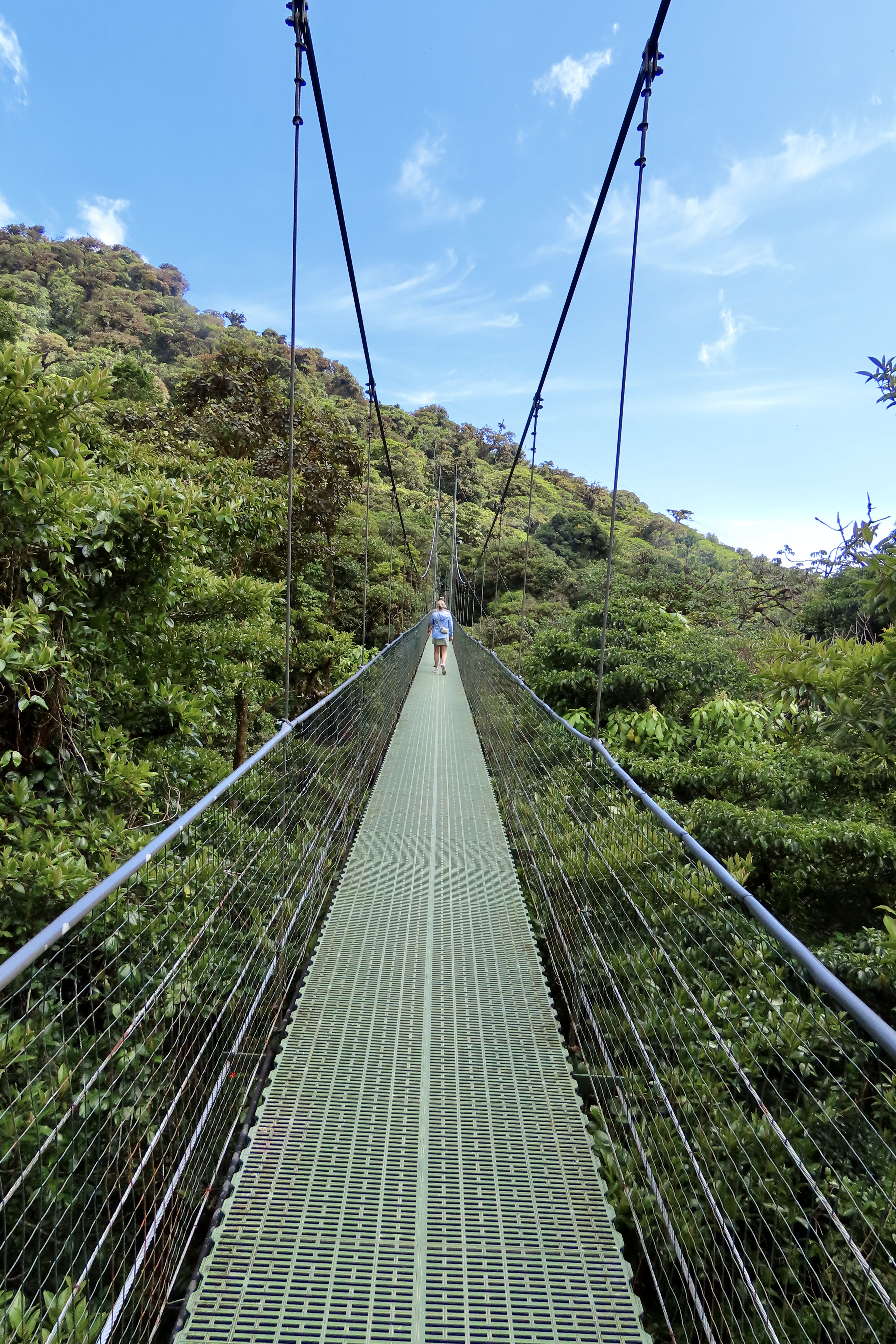
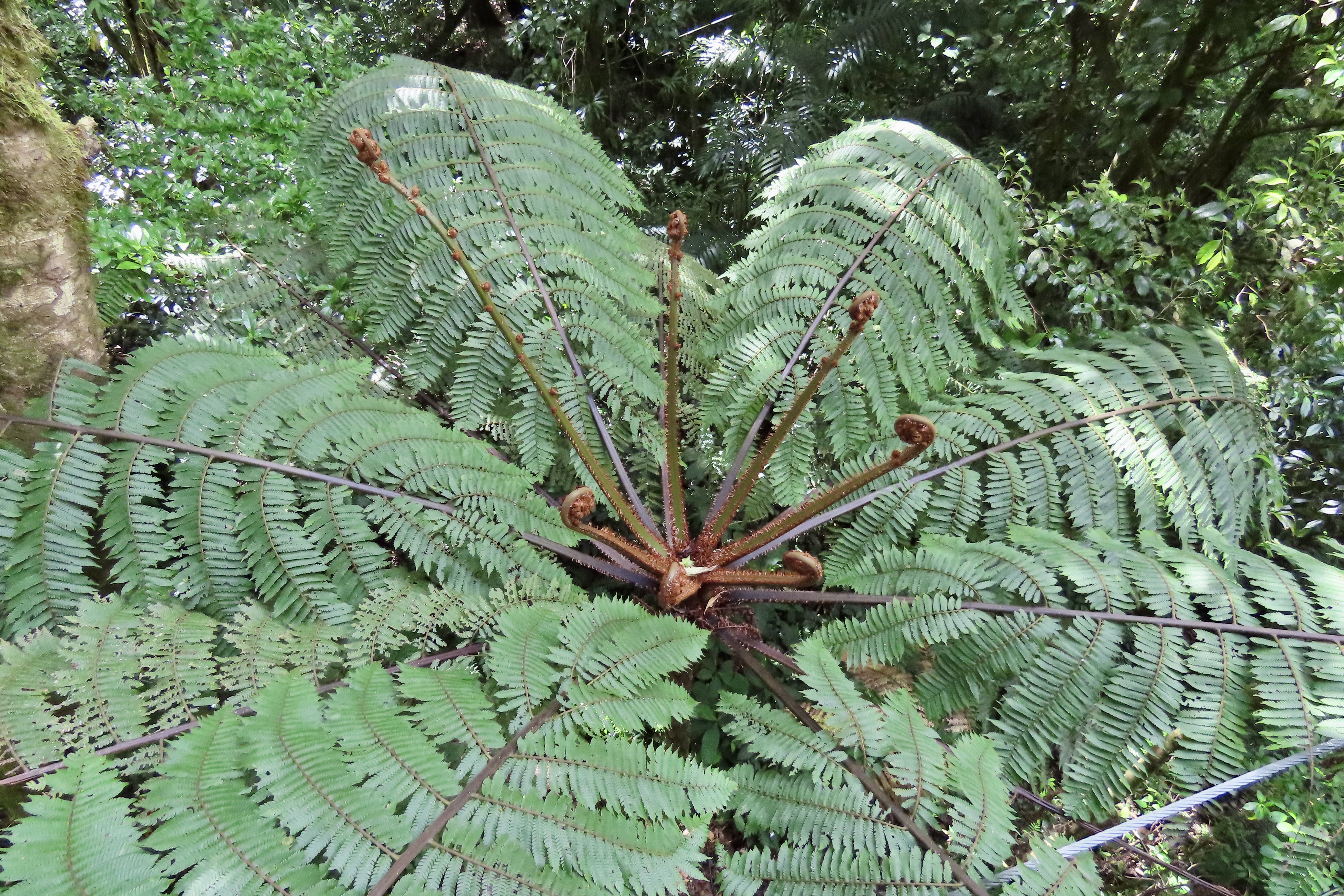
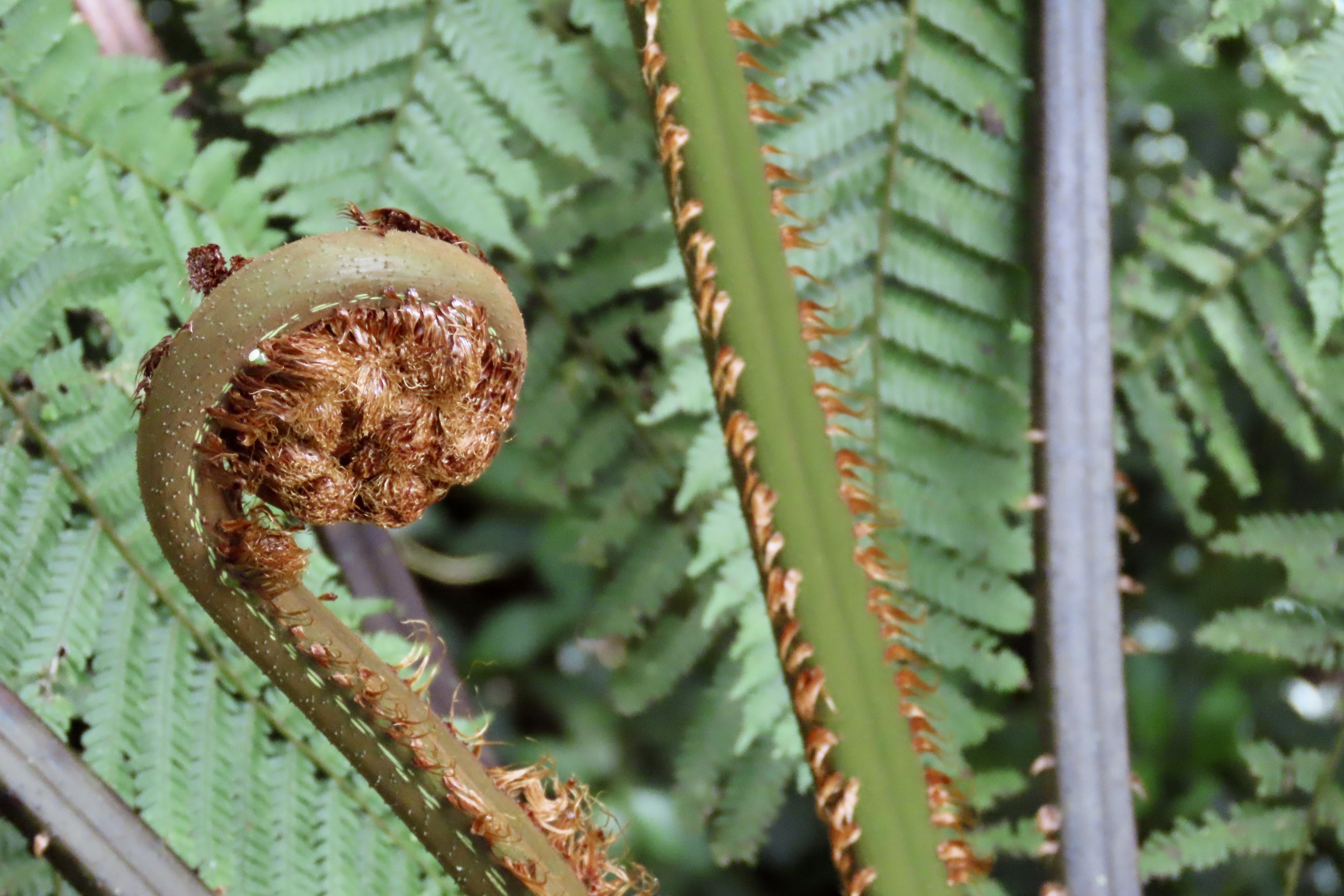
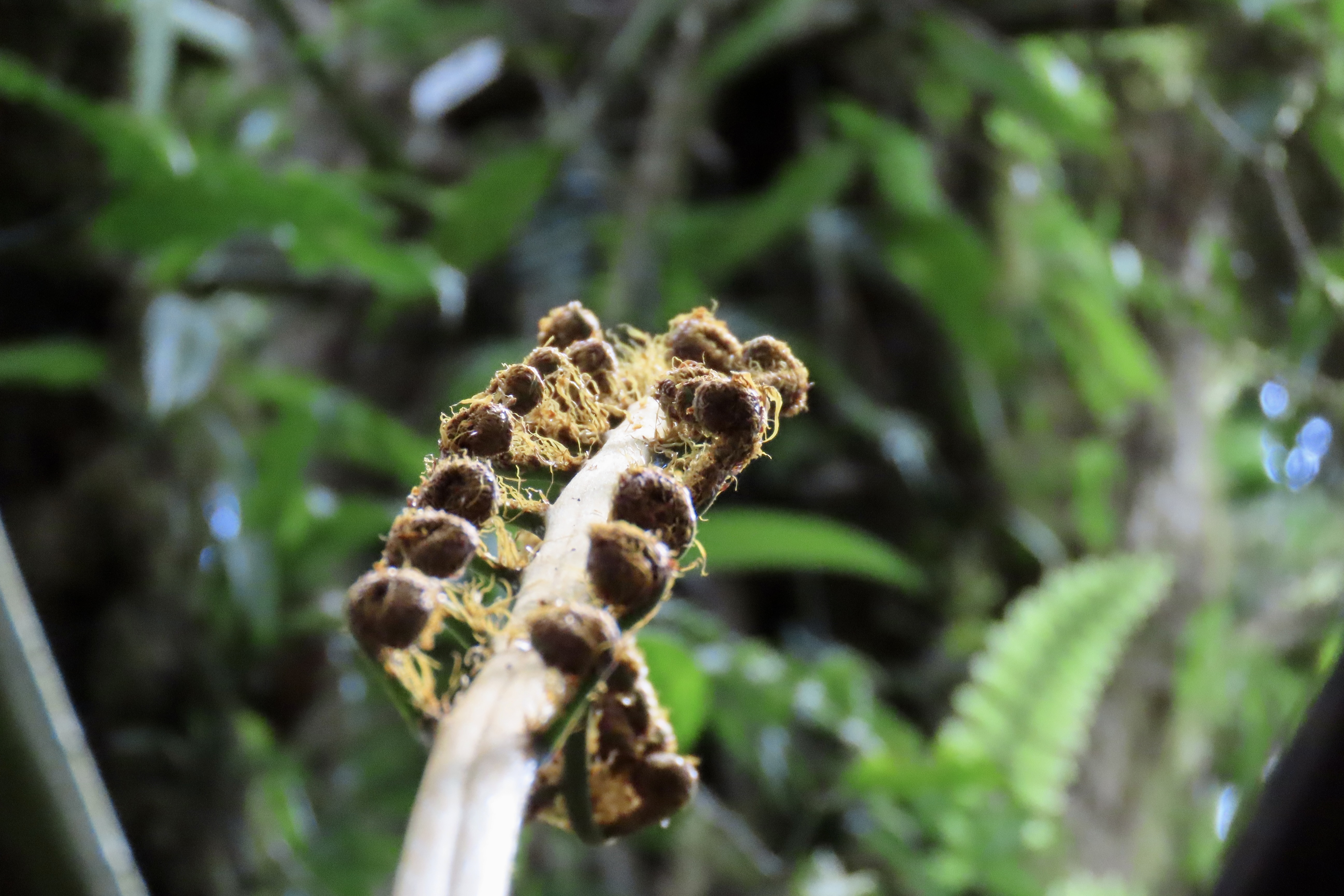
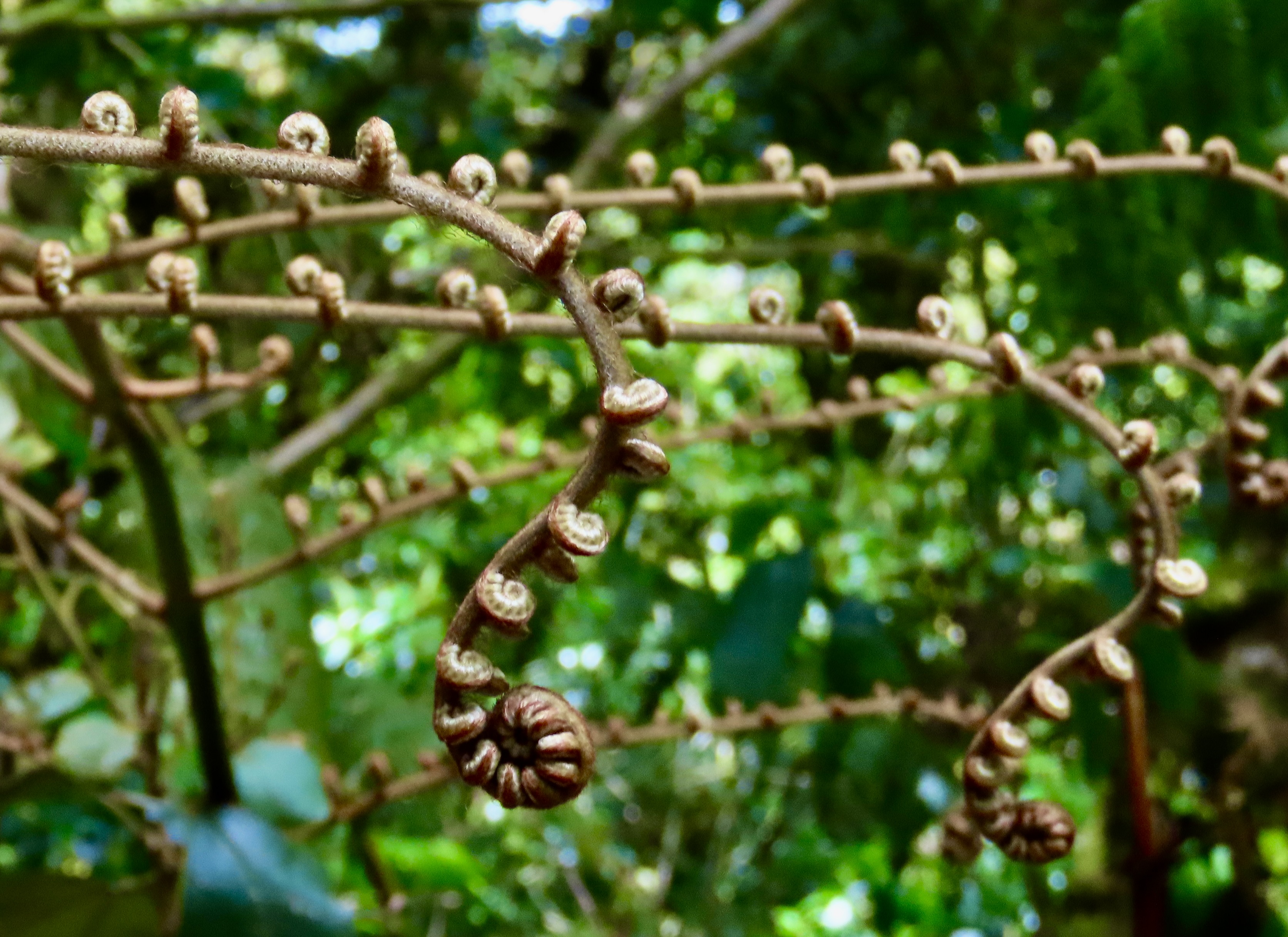
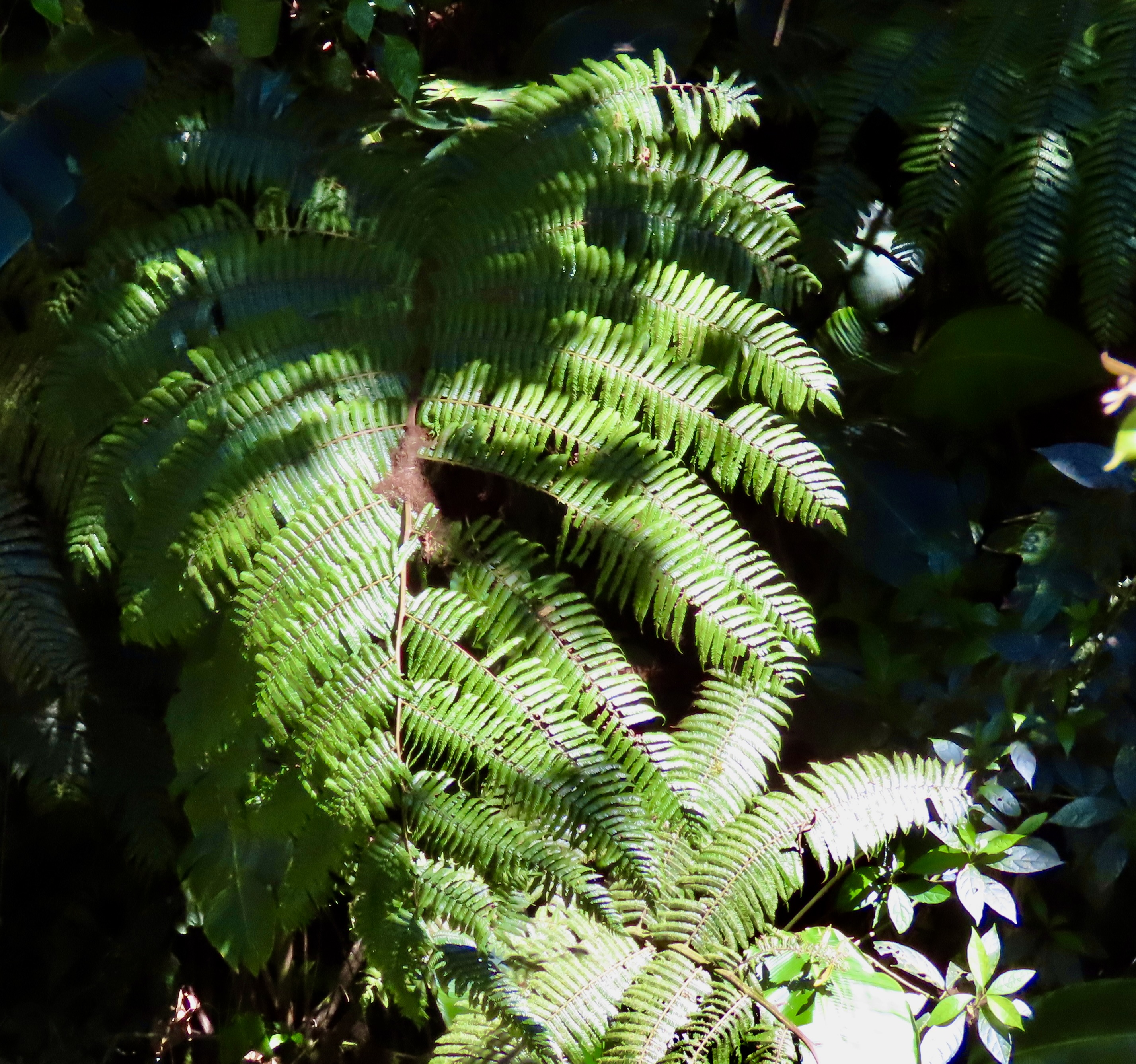
The hanging bridges of Monteverde gave us a unique opportunity to study both the canopy and the forest beneath. There were six bridges at Treetopia Park. At 774 feet, this was the longest. It was also more open. The canopy towered over most of the bridges.One bridge provided us with an opportunity look down on a fern tree. The leaves were a definite clue that we were looking at a fern.As did how the leaves unfold or unfurl known as Circinate vernation. This has always fascinated me about ferns. I have many photos of different species. But given that there are 10-12000 or more know species, I have a few to go…Here’s a different species at Treetopia.And another. Both tropical and temperate rainforests provide ideal conditions for ferns to grow. Some can be giants. We spotted these down on the ground from the hanging bridge. I wish I had a person down on the ground to provide perspective. They would have made my 5 feet 11 inches appear small.
2025 was a good year for us from a travel perspective. We stayed home, so to speak, and limited our wandering to Hawaii, the Southwest, and New England. Now we have the itch to go abroad again. We’ve chosen three areas known for their beauty, culture, wild areas— and relative safety: Costa Rica, Scotland, and Bali.
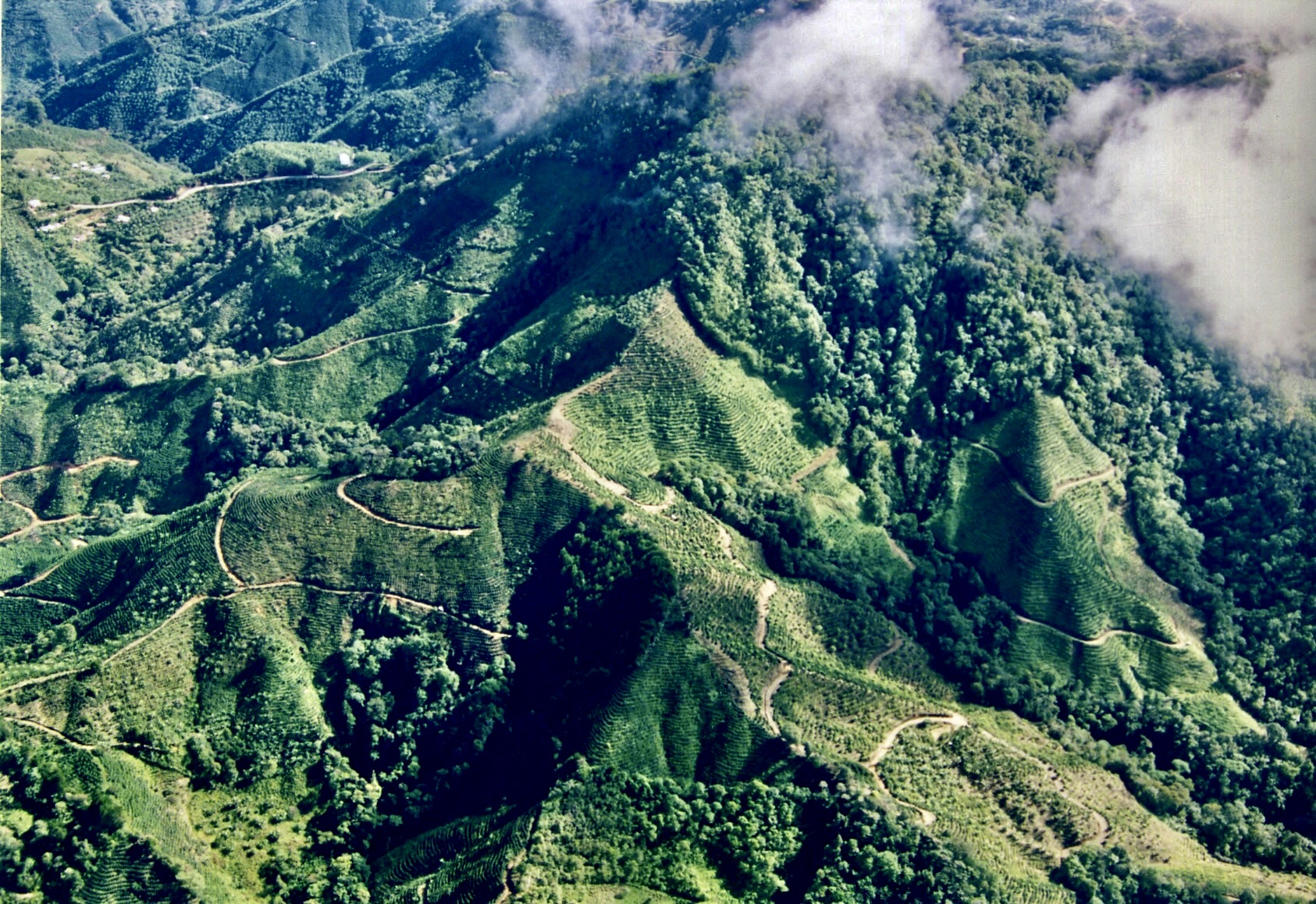
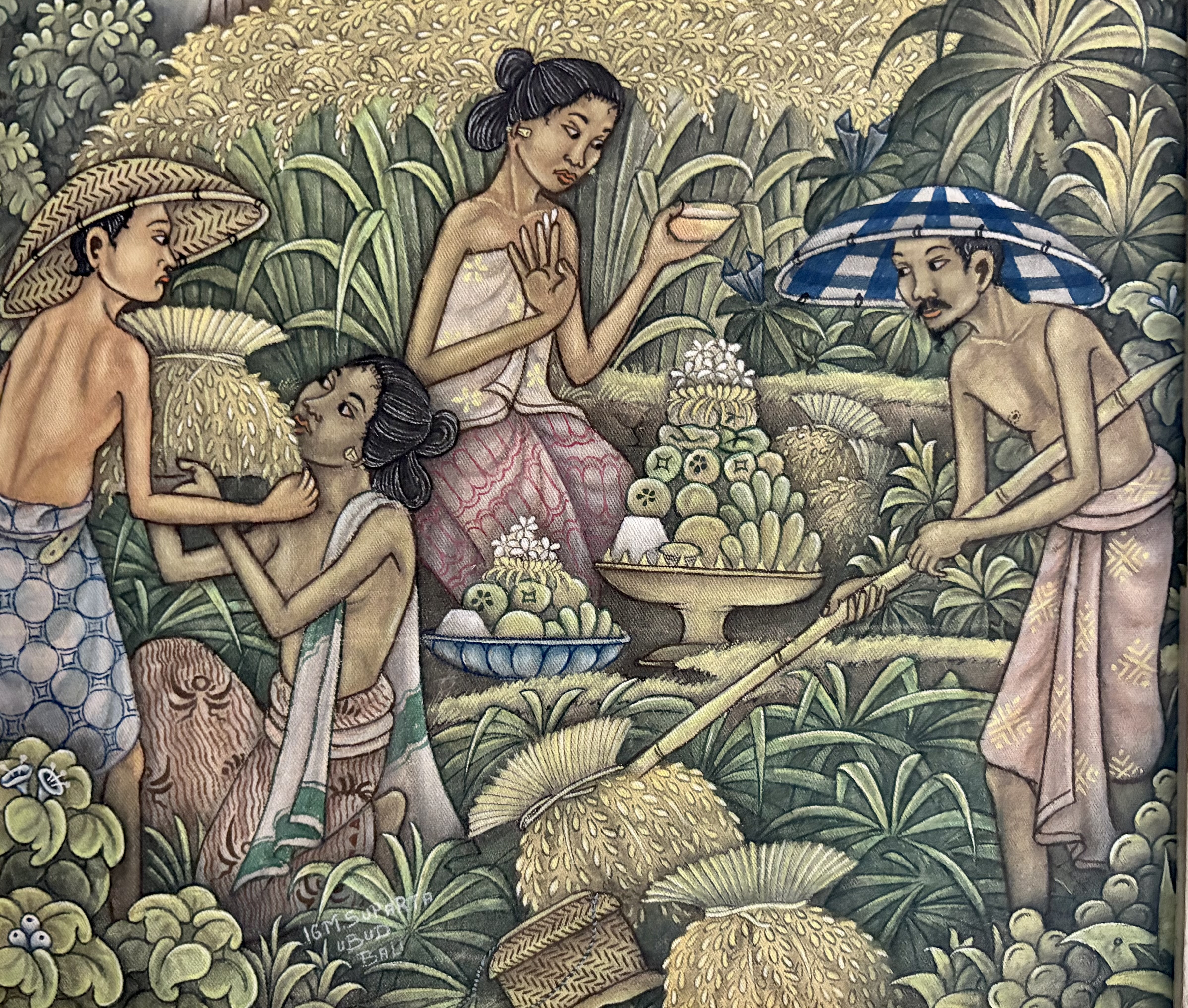
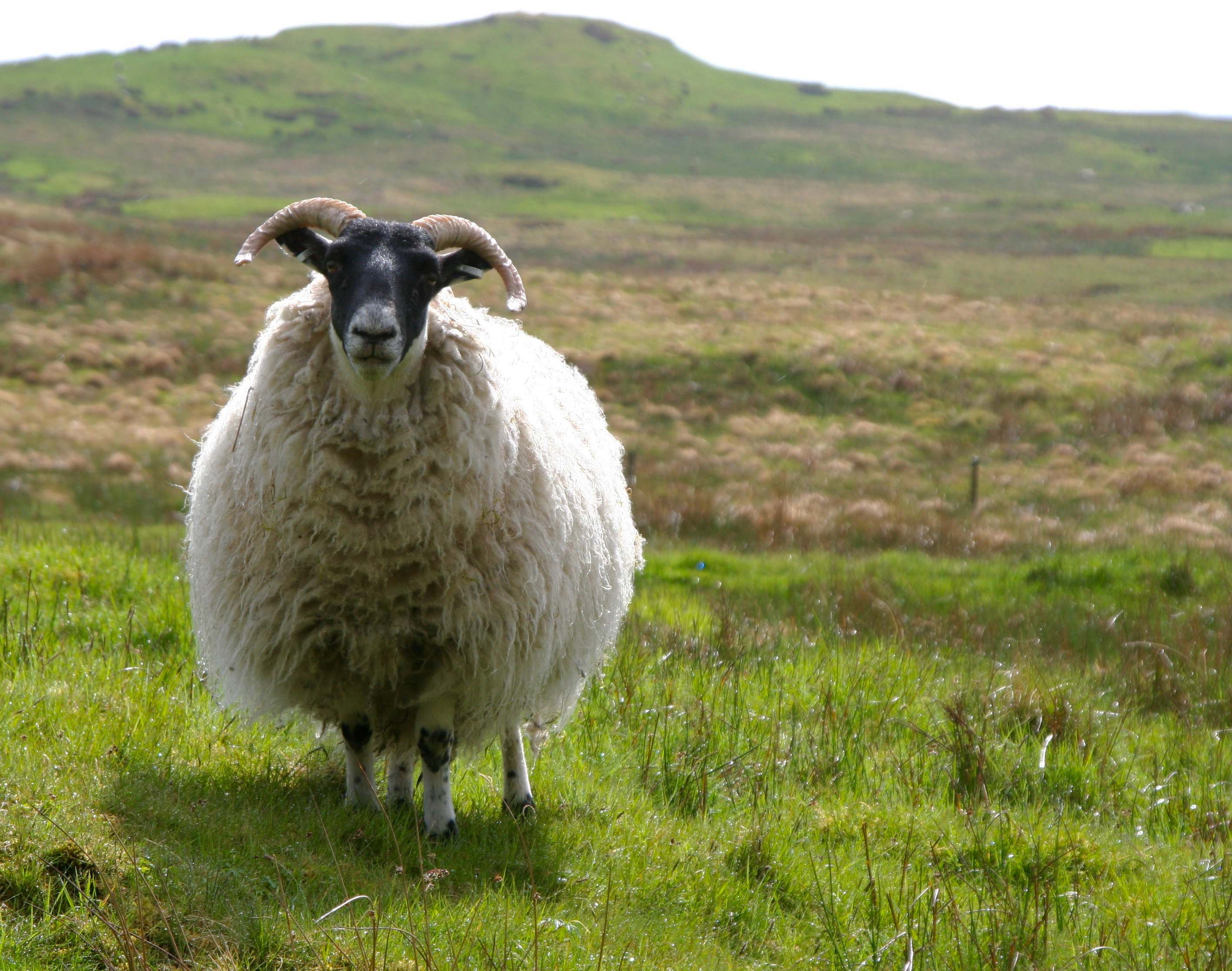
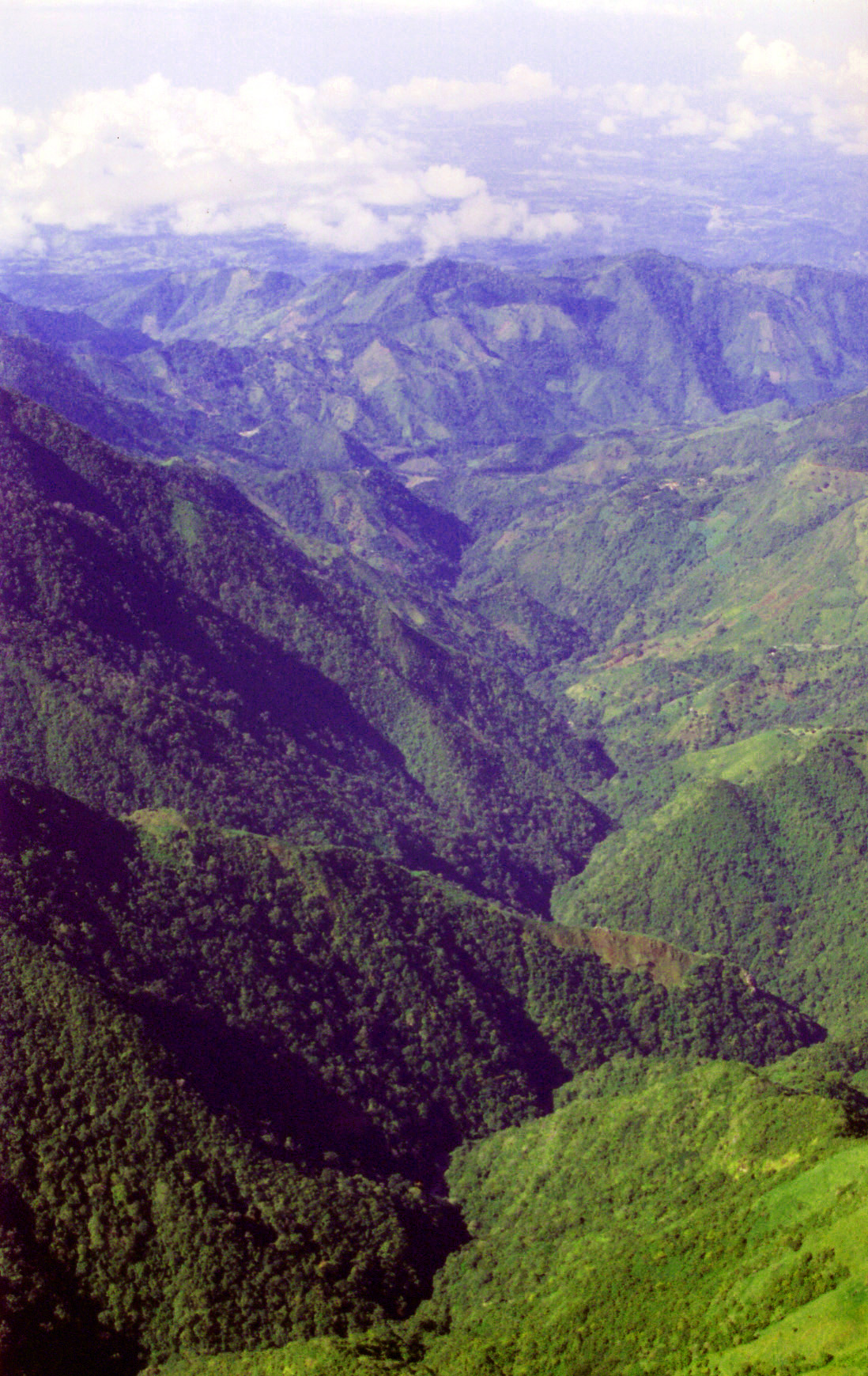
First up: Costa Rica. We took the above photo when we were in a small plane flying back and forth across the country on a tour in the 90s. This year we will be renting an SUV with high clearance and driving ourselves. The country roads can be challenging— even in the dry season! Peggy and I will be going there for the month of March. Our son Tony and his family will join us for a week in Monteverde.Next up, we will be visiting Bali. I visited in 1976 as part of a six month tour of the South Pacific. I’d lost my camera in Fiji, so I don’t have any Bali photos. I brought a painting home instead. The region is known for its colorful art. This one depicts a rice harvest. The woman on top is making an offering. It’s important to keep the gods happy. We will be there in May. Our grandson Ethan will join us for a week.We met this fellow in Scotland when we were doing family genealogical research in 2014. He had positioned himself in the middle of the narrow road we were driving on for about 10 minutes before finally moving over to the grass. Peggy and my families were Lowland Scotch so we were in the southern part of the country. This year we are visiting the highlands, coastal regions and islands of the north in late June and July. We will be checking out castles and looking for Nessie, the Loch Ness Monster. Our grandson Cody will be joining us for two weeks. We are planning to hop over to Northern Ireland after Scotland.
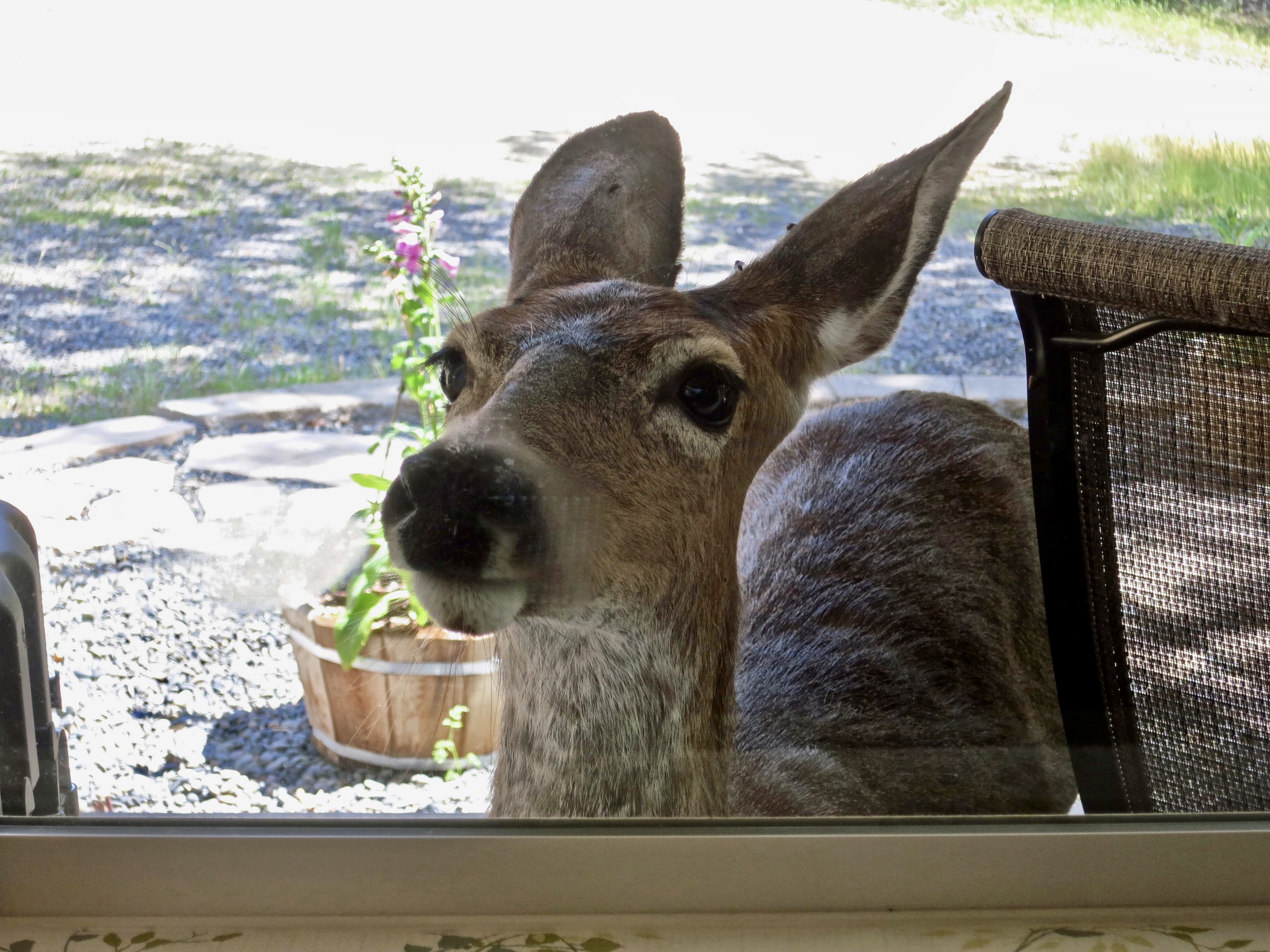
Naturally, we will be blogging about our journeys. But there is more, as they always say on late night TV ads. Or at least they used to. Peggy and I don’t stay up that late and most of our TV time is streaming without ads. I am continuing our focus series over the next two months and beyond. “Oh Deer” is my next one. I’ll be featuring the herd that lived in our backyard in Oregon and liked to stare at us through the windows.
A not unusual sight!
And finally, I’ll be offering a new series I’m calling “Ut-Oh” where I will be pulling together posts that I have included on my blog over the past 15 years plus new material featuring my more serious/humorous misadventures in my life. I’ll do an introduction to it next week.
The question here is why should such an innocent looking child be kicked out of the first grade for a year. My first post will answer the question plus relate how a caterpillar I was using to cut a road fell off a cliff— with me on it.
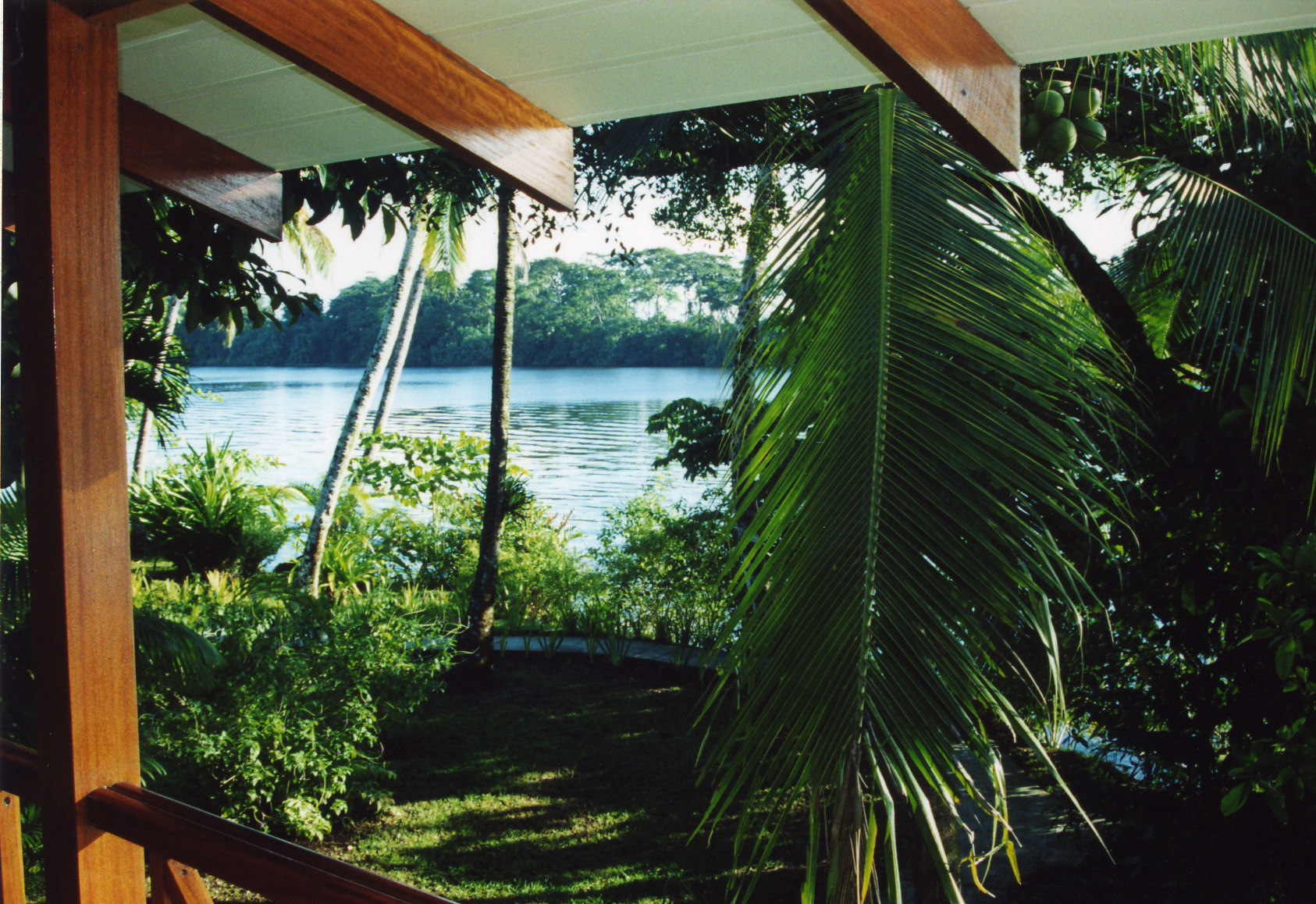
The view from our balcony at Tortuga Lodge on the edge of Tortuguero National Park on the Caribbean side of Costa Rica.
We missed seeing the giant 300 pound Green Sea Turtles and their prodigious effort of laying 80-100 eggs on our trip to Tortuga Lodge in Costa Rica. The large females go into a trance during the process. It sounds like a good idea when you are having 100 babies. Once mom has dug her hole in the sand and settled in, visitors can walk up and watch the process.
Seven weeks later the eggs hatch and the baby turtles instinctively scurry for the ocean. They’re tasty. Scurrying is good. On shore, sea gulls and crabs think feast. Jaguars also hang out in hopes of crunching down their share.
The ocean is hardly safer. Last fall I watched a flock of Brown Pelicans off of the coast of Puerto Vallarta discover a swarm of baby turtles heading out to sea. It was like Armageddon.
Of the hundred or so babies who hatch, one may be lucky enough to make it to adulthood… not good odds. If you are one of the lucky ones, however, you can expect to survive for 80 years. Your only enemies are men and sharks. Of course that’s enough. By the mid 1900s Green Sea Turtles were on the edge of extinction. Sharks were not the problem.
People found the meat tasty and behaved like the Pelicans when the turtles came ashore. Possibly even worse, they believed the eggs had an aphrodisiac quality. They killed the mamas and dug up the babies.
Tortuguero National Park on the northern Caribbean Coast of Costa Rica was established in 1970 as a sanctuary for the turtles. Tortuga Lodge sits on the edge of the park and offers a “gourmet dining opportunity” to view egg-laying mamas. I checked to make sure turtle soup wasn’t on the menu. Dinner by candlelight in the wilderness and the private viewing sounded good but I was wary of the last sentence, “You might get back to the lodge around 11 pm.”
What was with the might? It implies there is a might not. Could the jaguars somehow be involved? “Let’s see. I can eat this 2-ounce turtle or that 200-pound person. Hmmm.”
Anyhow, we arrived in late November, well past the egg-laying season. Turtles and jaguars were not on our agenda. Instead, we watched giant iguanas climb trees during the day and listened to howler monkeys howl at night. We ventured out on a tour of the regions dark, murky streams and then took out canoes on our own. Crocodiles lurked along the banks, bright butterflies went flitting by, and a Jesus Christ Lizard walked across the water.
Tortuga Lodge, like Monteverde Lodge, is owned and operated by Costa Rica Expeditions. Rooms were quite attractive, the food excellent and the guides knowledgeable. Getting there from San Jose involved travel by both van and boat. We flew back from a small airstrip located near the lodge.
Crocodiles lurk along the edges of canals located in Tortuguero National Park.
The eye of a Cayman.
We found an unusual beetle crawling across the lawn at Tortuga Lodge.
The Monteverde Cloud Forest Reserve in Costa Rica is filled with tall trees and massive vines. These Strangler Vines once surrounded a tree. As their name implies, they strangled their host. Now only the vines remain.
The drive from San Jose, the Capital of Costa Rica, to the Monteverde takes around 3½ hours. Our guide and driver from Costa Rica Expeditions picked us up at our hotel. He was funny and knowledgeable, which made the journey pass quickly. We learned and laughed a lot.
Monteverde’s claim to fame is its cloud forest where mists hang out in mythical proportions. Luxuriant plant growth and abundant animal life have turned the area into a major tourist destination as well as a center for ecological study.
The area has an interesting history dating back to the 1950s when a group of Quakers and other pacifists out of Alabama arrived. They had moved from the US to avoid being drafted into the Korean War. Eventually a portion of the land they farmed became the base for Monteverde Cloud Forest Reserve.
We climbed some 4000 feet to reach the Montverde Lodge, the hotel where we were staying. The lodge perches on the edge of the rainforest and its rooms provide a front row seat to whatever action is taking place. I kept expecting a Howler Monkey to appear on our window ledge. The Lodge also features attractive gardens.
Leaving the valley floor, we climbed over 4000 feet up into Costa Rica’s central mountains to reach Monteverde. This photo is looking back over the way we came.
The Monteverde Lodge features a flower filled garden including this beauty.
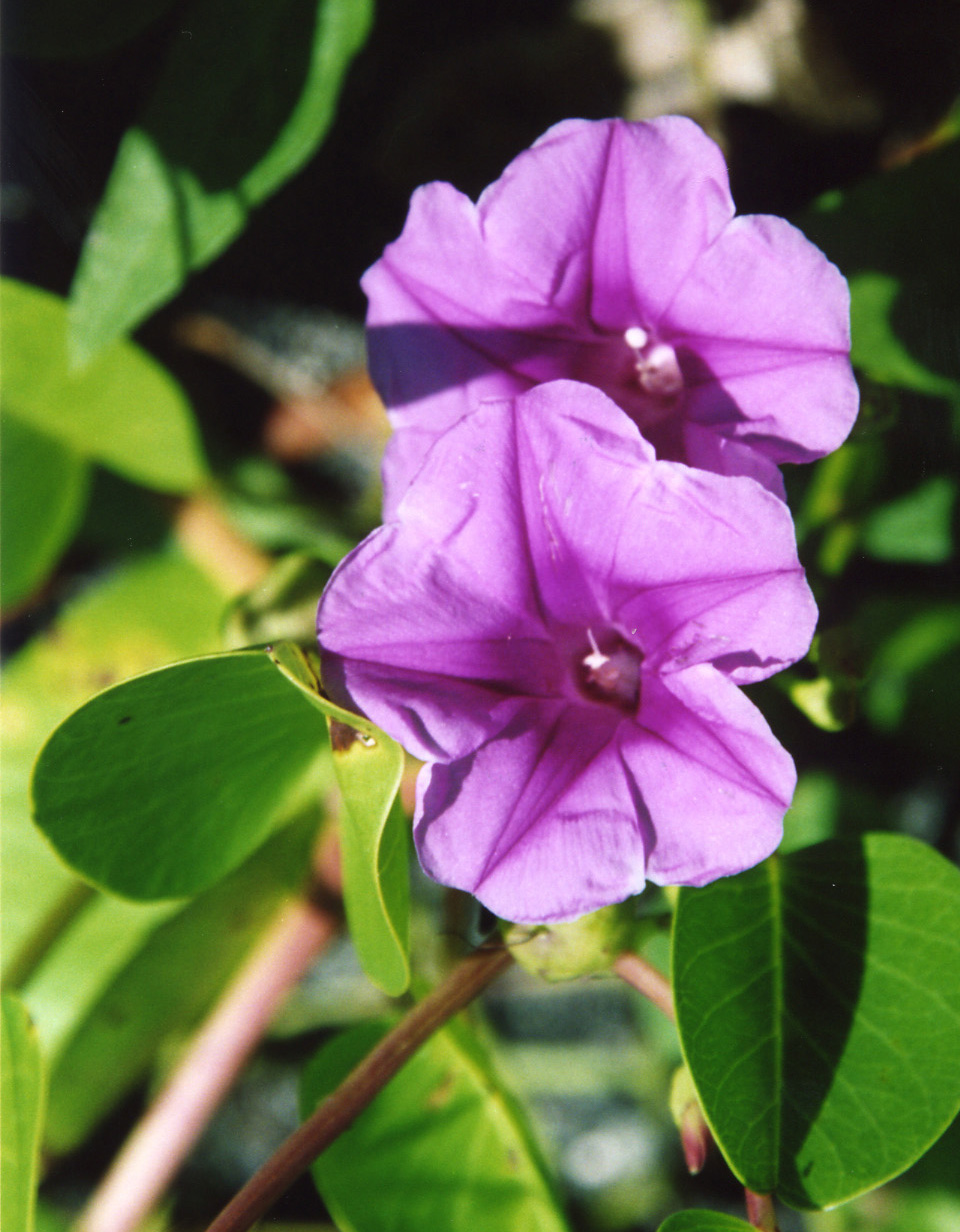
I also found this pair of flowers at the Monteverde Lodge quite attractive.
This fern at the lodge.was particularly interesting. it made me think of gears within gears.
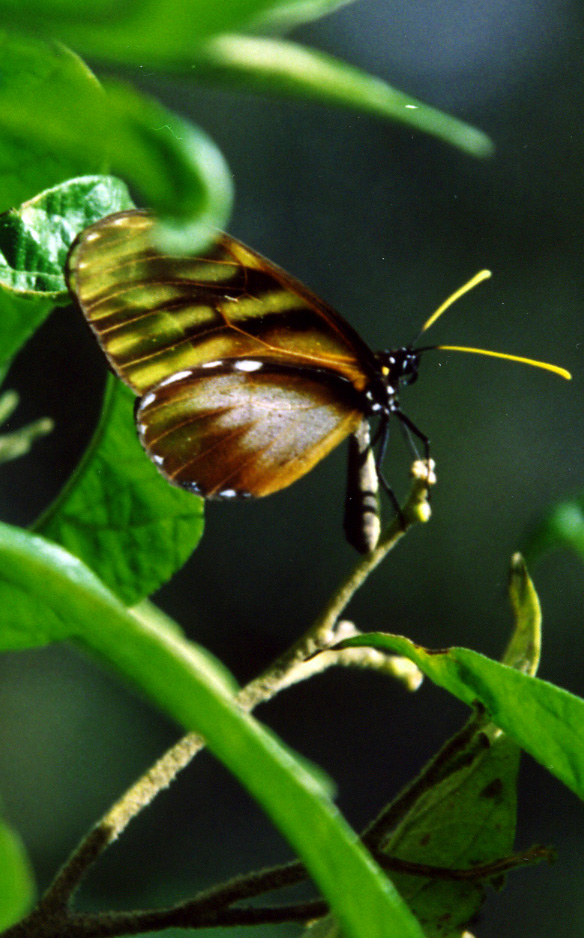
This butterfly we found at the Monteverde Lodge is a member of the Clearwing Family.
Our objective was to explore the rainforest, however. We went on several hikes including one at night and another that took us to a platform high in the forest canopy. The pitch-black night tour was quite interesting, especially when we turned our flashlights off.
On one of our hikes, we climbed to a platform high in the canopy of the Monteverde Cloud Forest. I think Peggy is smiling because we made it to the top.
This is a view of the Monteverde Cloud Forest looking down from the platform we climbed up to.
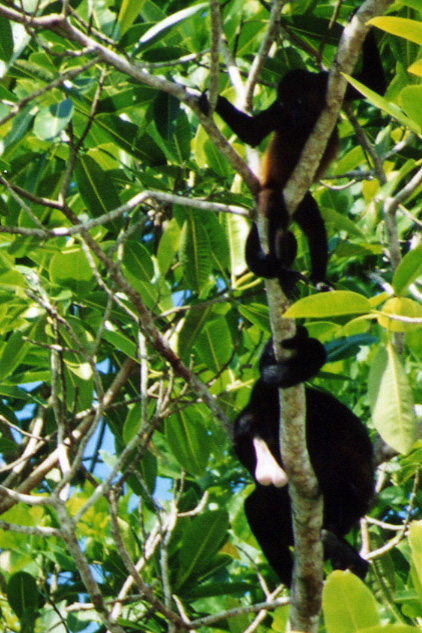
We spotted a pair of Howler Monkeys up in the trees. The one on top is all limbs and tail. The lower Howler looks like he is gnawing on a thigh bone… Hmmm.
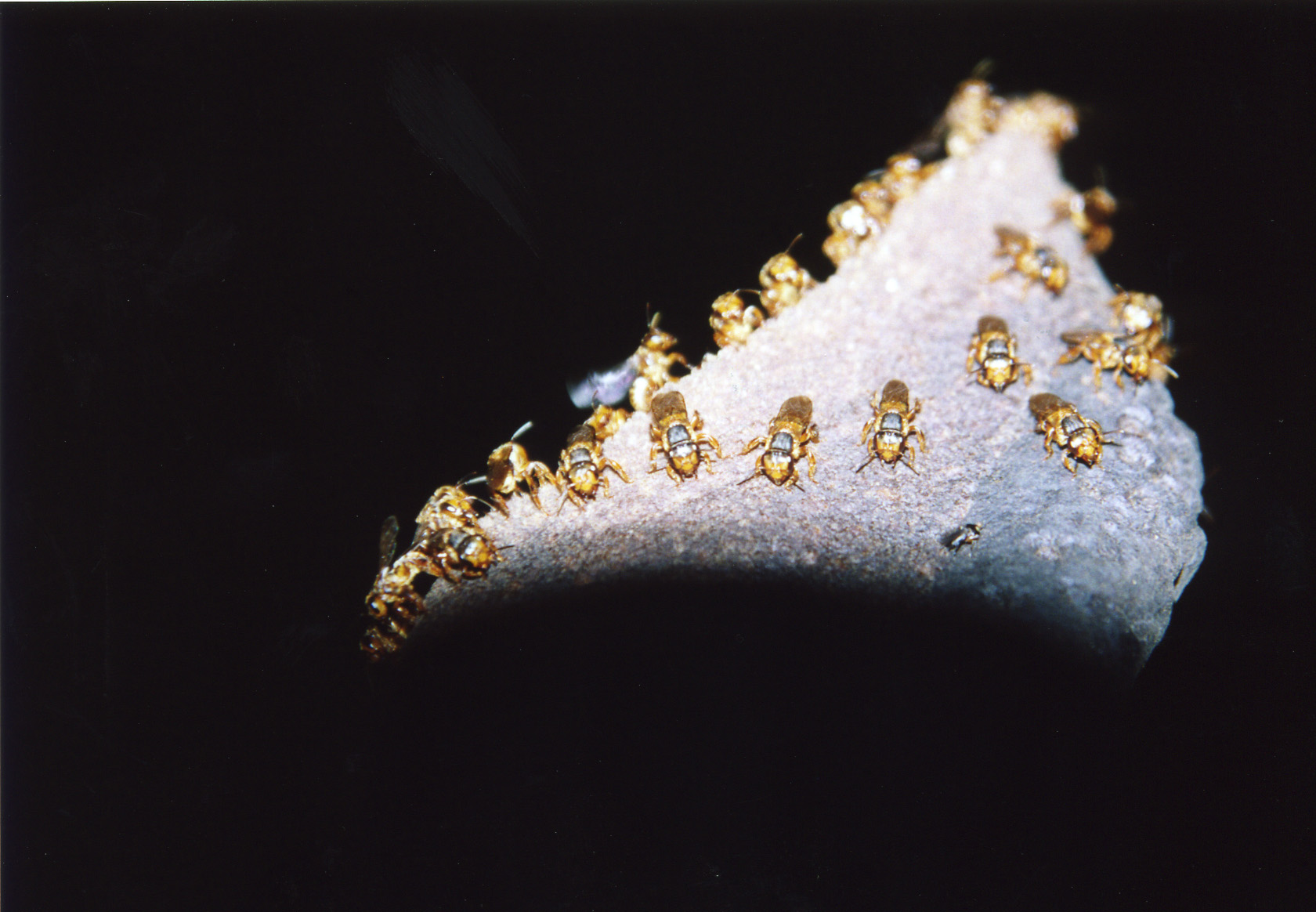
We came across this strange army of insects about to take flight on our night walk. The look ant-like but my guess is they are termites because of their thick bodies.
This colorful fungus was another denizen of the Monteverde Cloud Forest we came across on our night walk.
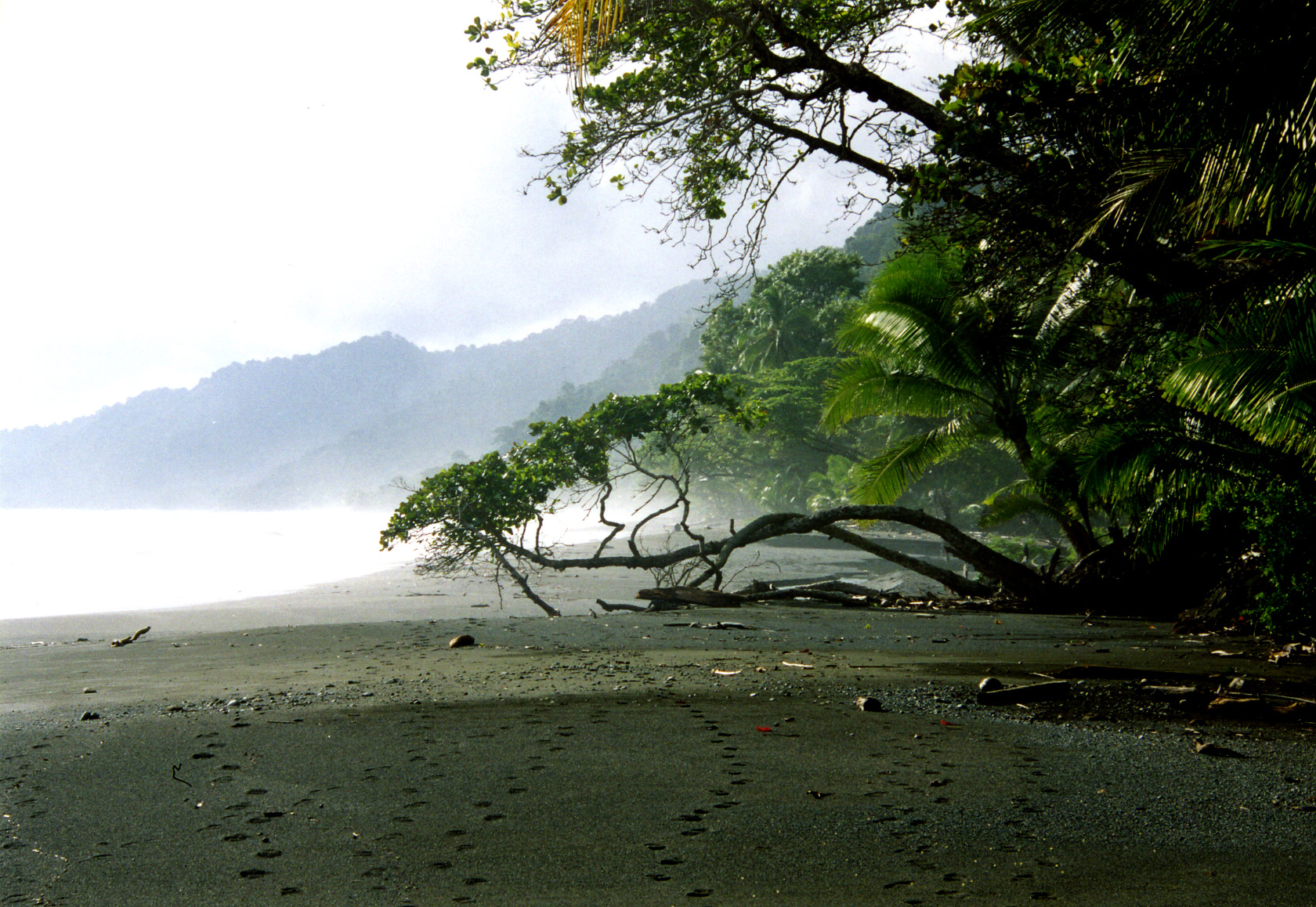
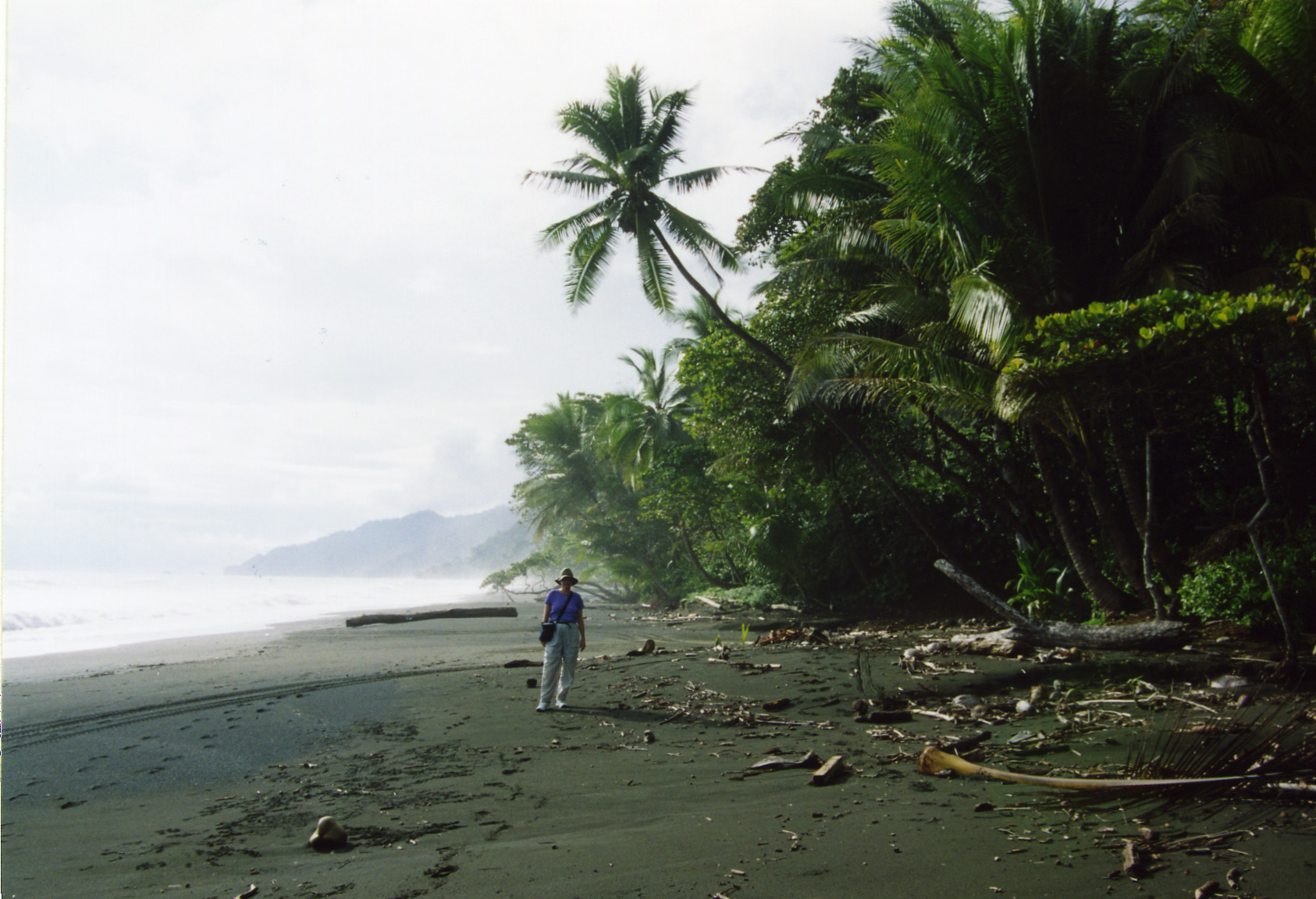
Miles and miles of scenic Pacific Ocean beach greet the visitor to Corcovado National Park in Costa Rica.
Vacation was two weeks away and I hadn’t made any plans. “Let’s go to Costa Rica,” I suggested to my wife, Peggy. “Why not,” she responded. Peggy is used to my procrastinating ways. Sometimes they even pay off.
I jumped on-line and lucked out. Costa Rica Expeditions had tours to fill at last-minute bargain basement prices. We could go to three great places for a cost we would normally pay for one. The company, by the way, did an excellent job.
Our itinerary included the Tortuga Lodge on the Atlantic Coast, Monteverde Lodge in Costa Rica’s central highlands, and La Leona Lodge on the edge of Corcovado National Park on the Pacific Coast. It was an ecotourist’s dream.
Today I am going to feature Corcovado, an area that National Geographic has described as “the most biological intense place on earth in terms of biodiversity.” The National Park is located on the Osa Peninsula in southwest Costa Rica. It teems with life including some 375 species of birds, 125 species of mammals, 500 species of trees and over 10,000 species of insects. The insects win.
We flew down from San Jose, Costa Rica’s capital, in a small 6-seater prop plane that skimmed over the country’s tropical-green mountains, jungles and rivers to a landing strip next to the small community of Carate. A one-horse cart was waiting to carry our bags to the La Leona Lodge. Guests are expected to make the 45-minute walk on their own. There are no roads. We strolled down the beach, waded in the ocean and enjoyed the scenery.
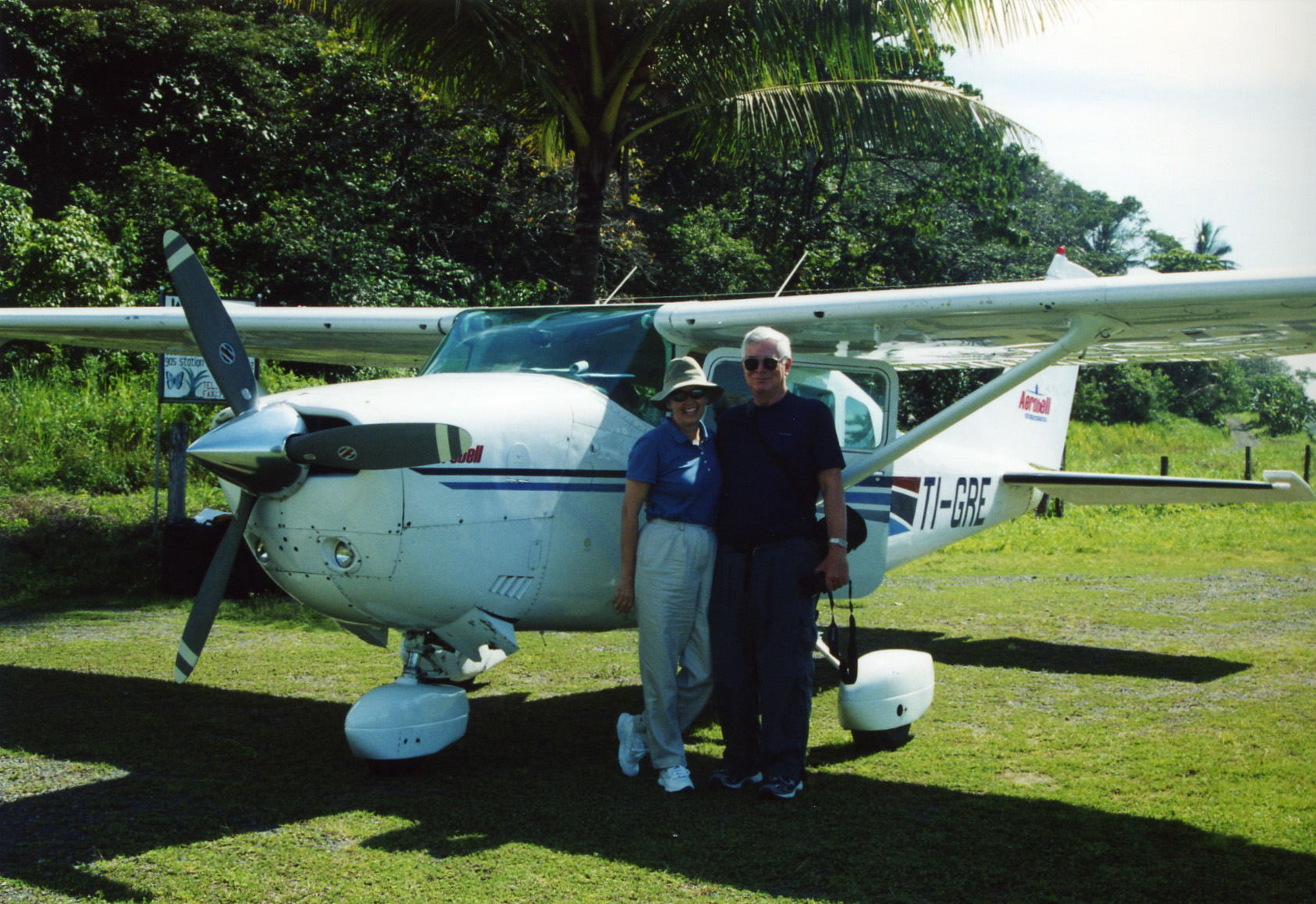
Peggy, I and the plane we flew in to Corcovado National Park.
The plane skimmed over Costa Rica’s tropical-green mountains.
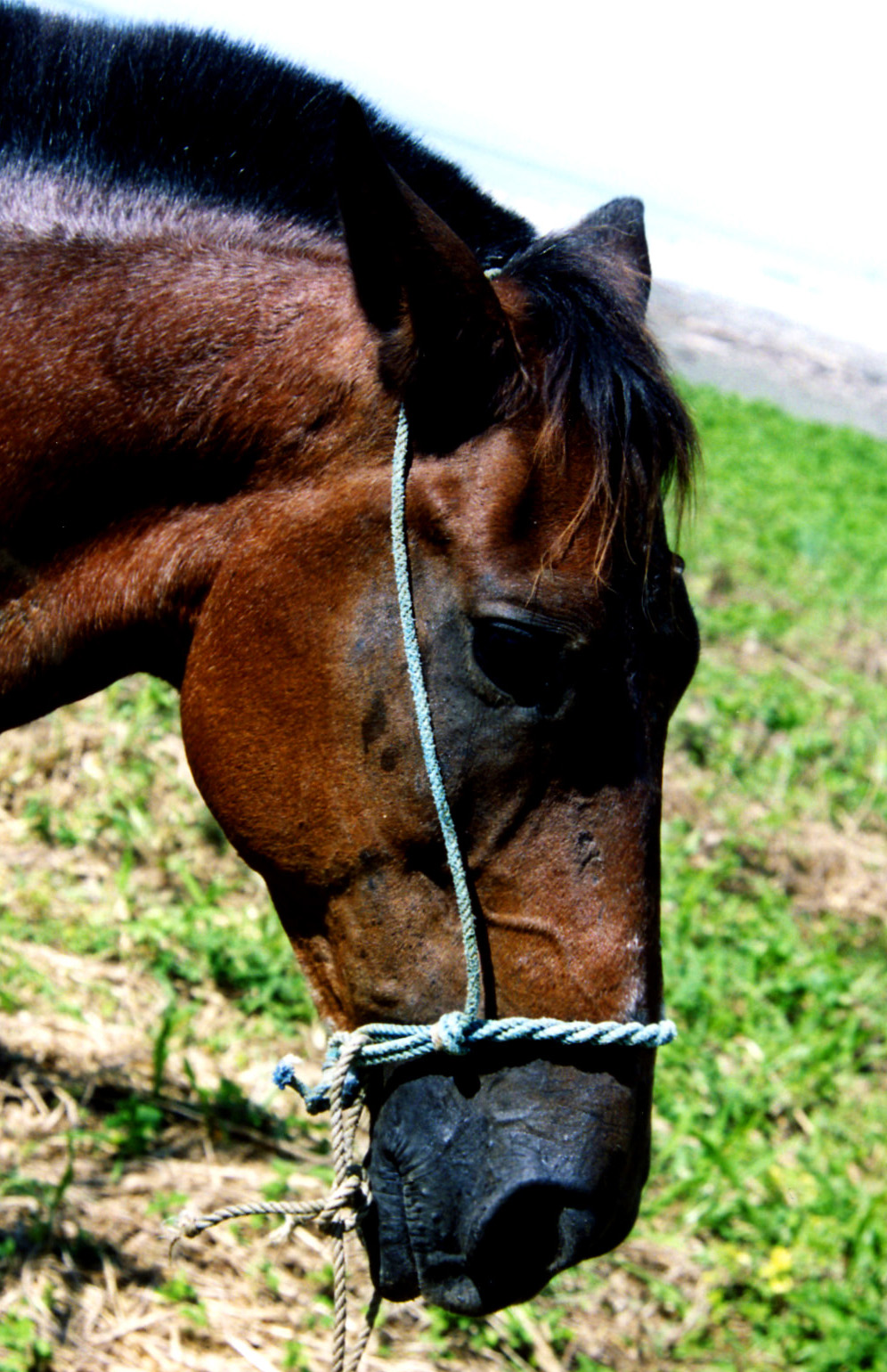
A one-horse cart waited to carry our luggage. I can’t say the horse was particularly excited about the prospect.
La Leona features comfortable tent camping, great meals, miles of beaches and a fascinating tropical rainforest. Each tent has a porch facing the Pacific Ocean. Waves lull you to sleep at night and at least a dozen of the regions 375 species of birds wake you each morning.
Our tent cabin at La Leona Lodge, Corcovado.
We spent our days hiking along the coast with detours into the rainforest. We also took advantage of the hammocks the Lodge has strung under the palm trees next to the beach. In the evening we would sit on our porch and watch the waves roll in or enjoy a cold beer at the Lodges open-air bar.
Peggy and I spent hours exploring the deserted beaches of Corcovado.
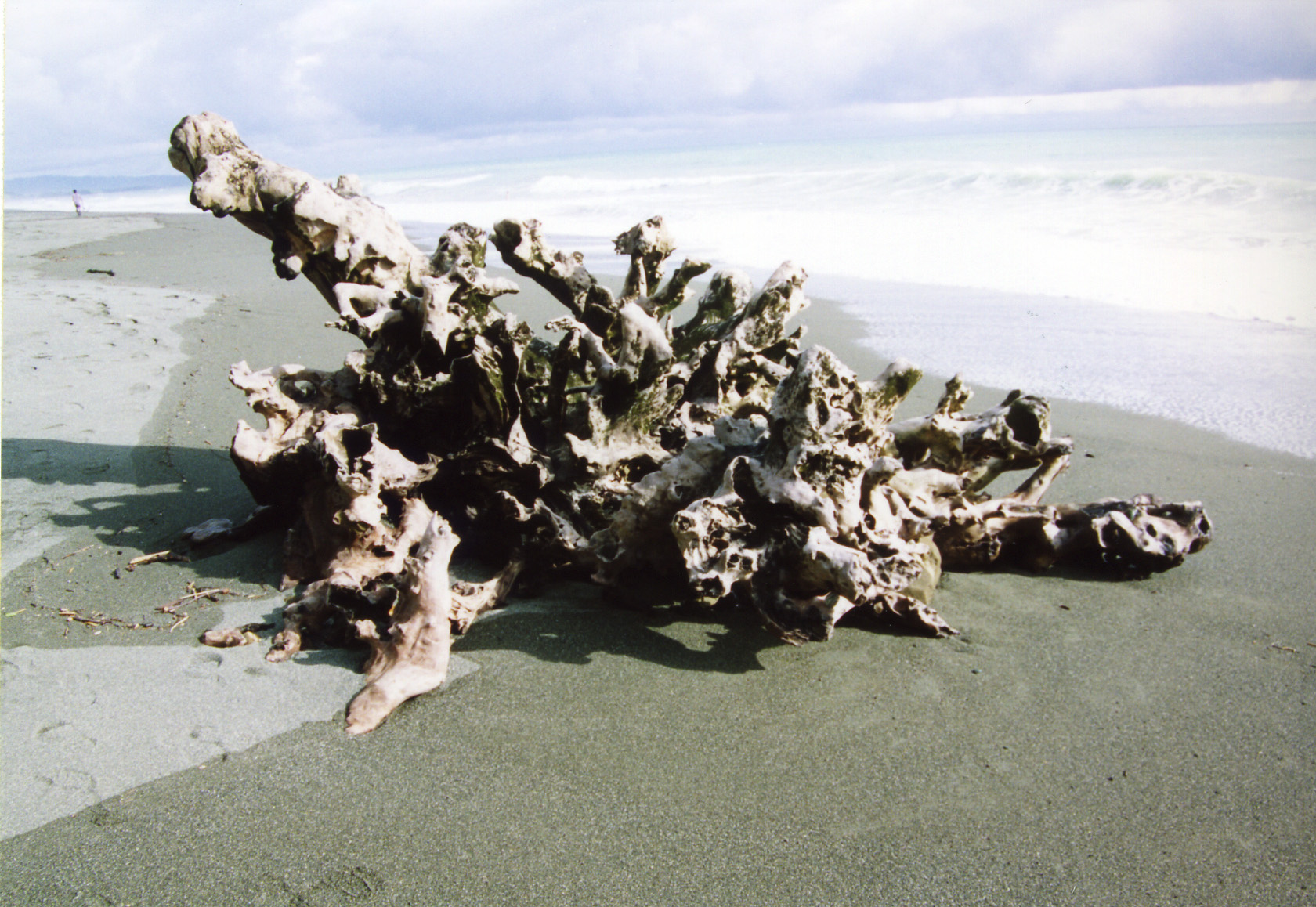
At one point we came across an impressive bit of driftwood.
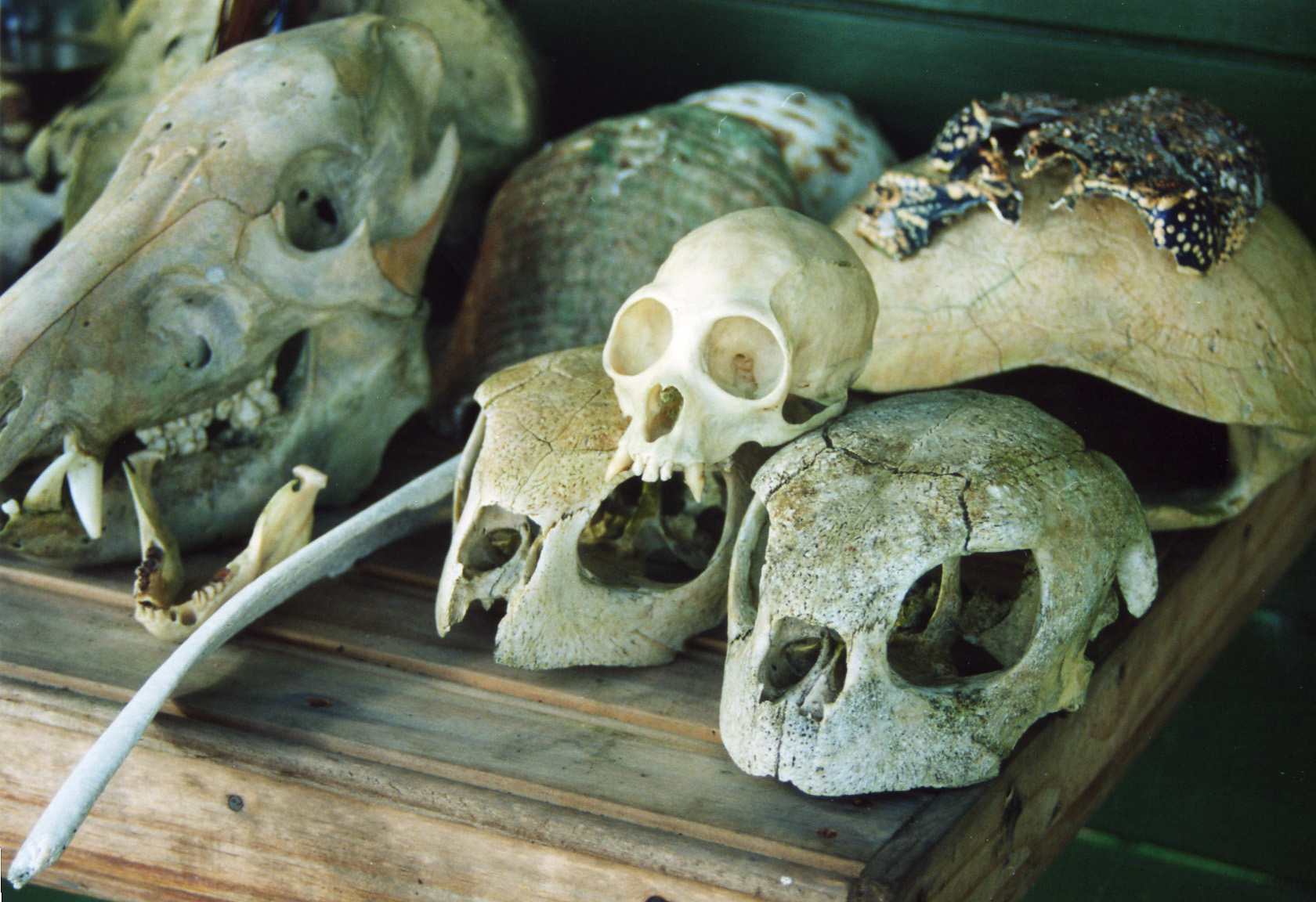
A Corcovado National Park ranger had gathered skulls of several park animals. A jaguar is on the left. The small human-like skull comes from a monkey. I believe the large smooth skulls are from dolphins… either that or aliens.
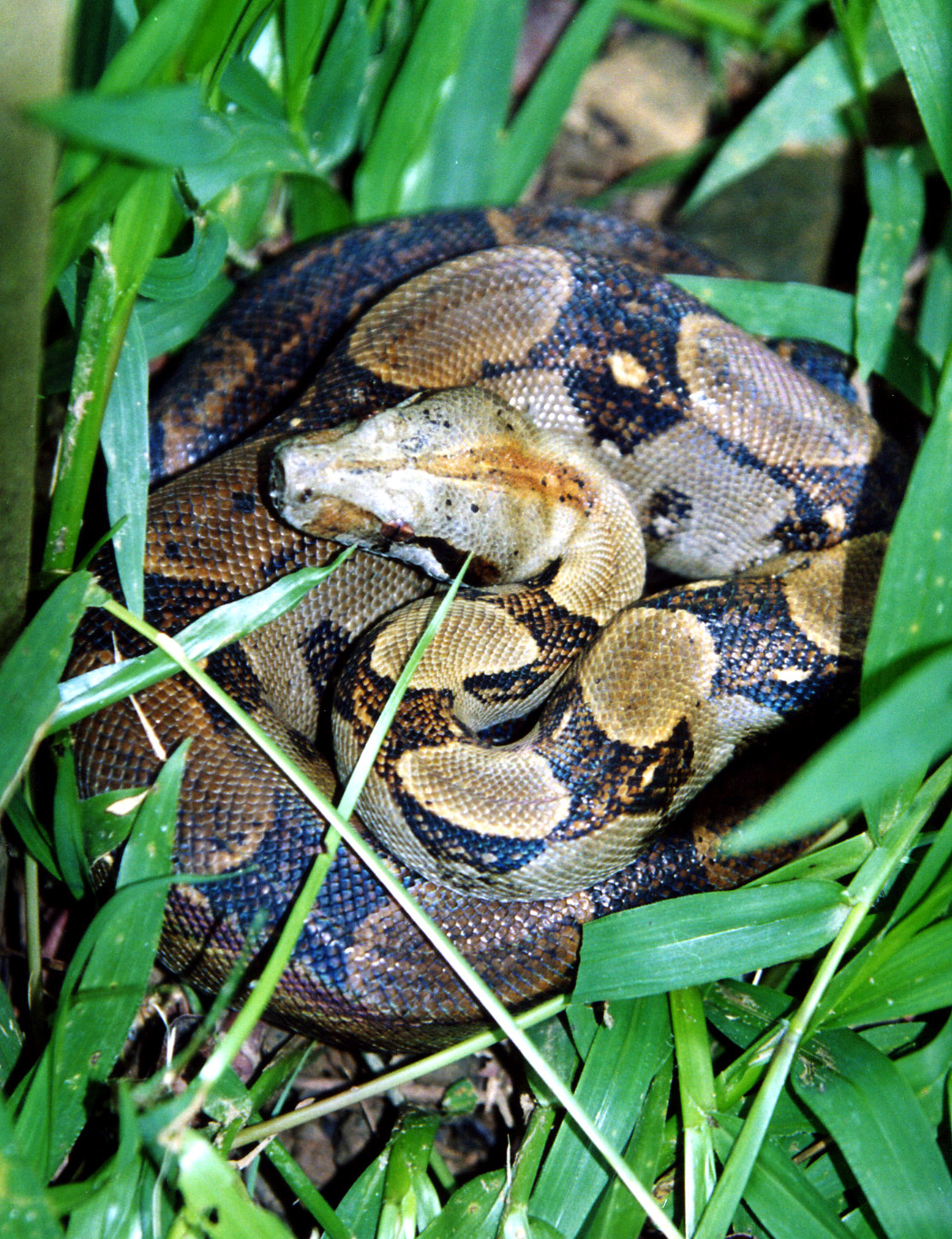
One time a troop of monkeys came swinging in through the trees and entertained us. Another time a boa constrictor went slithering by. All too soon, it was time to pack up our bags for the horse cart and walk back to the landing strip. We will return to La Leona Lodge and Corcovado National Park.
A boa came slithering through camp and then coiled up when I tried to take its photo. I kept plopping down about a foot in front of him trying to get an action shot and he became irritated.
A pair of Coatis were more amenable to having their photo taken. I love the way their tails appear to be entwined. The tail of a third Coati can also be seen.
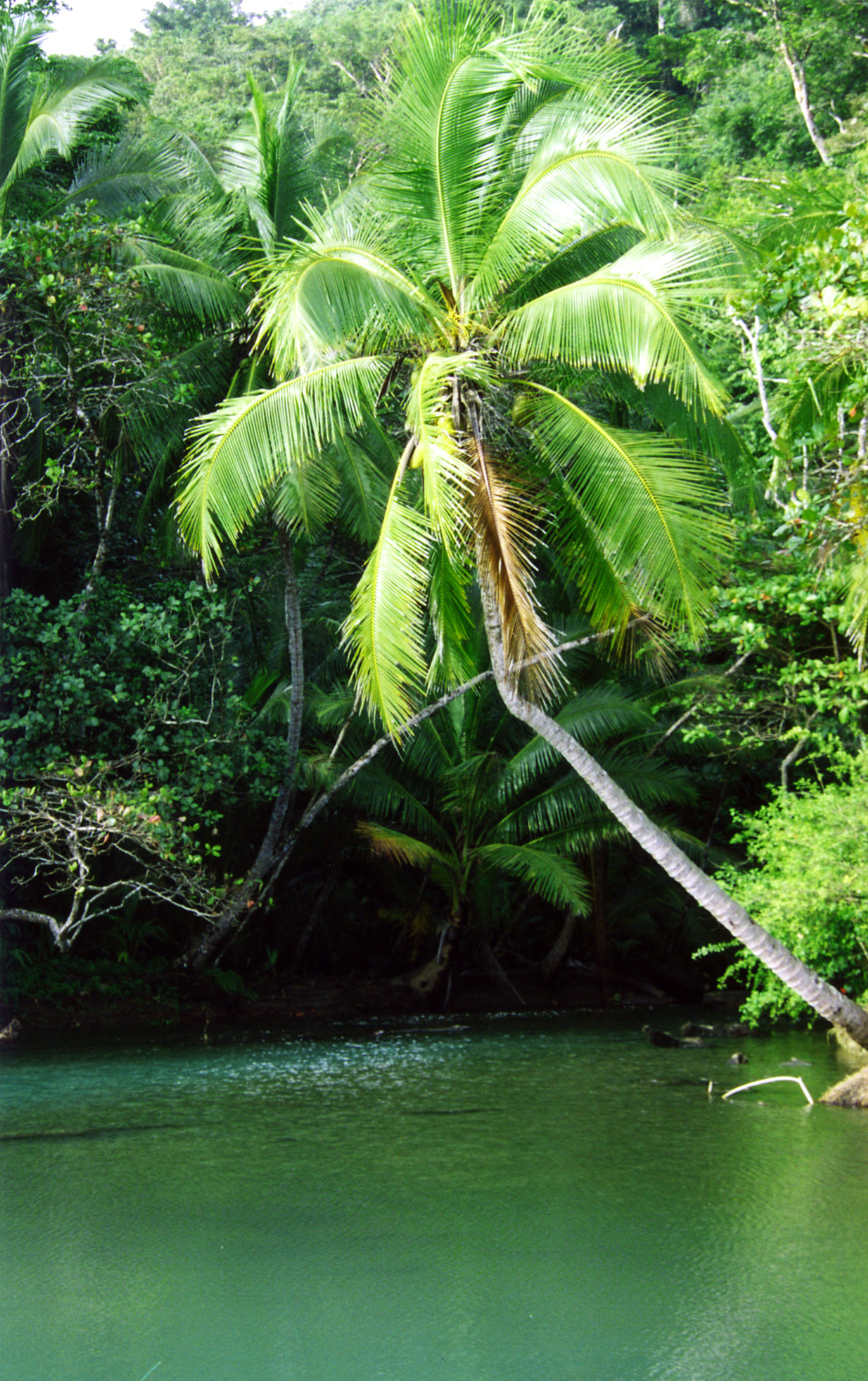
A final reason why you should add Corcovado National Park in Costa Rica to your bucket list.











 Wandering through Time and Place