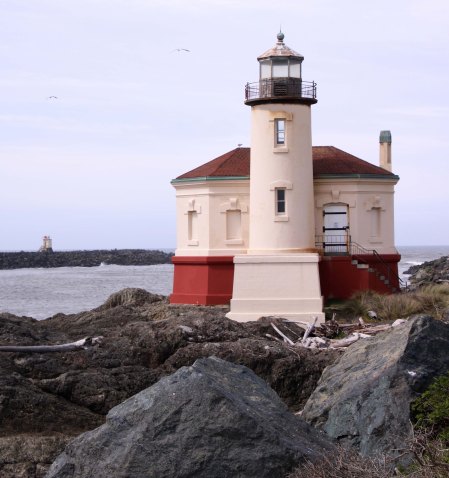
The Coquille Lighthouse sits on a point jutting out into the Coquille River opposite of Bandon, Oregon. Its replacement, an automated beacon, can be seen on the left across the river on the South Jetty. A glimpse of the Pacific Ocean appears on the right. (Photo by Peggy Mekemson.)
I am sure that there are people who drive by lighthouses never noticing their existence. I am not one. There is something romantic about them that pulls me in. Maybe it is their historic role: saving mariners from crashing into rocky shoals and other shoreline hazards. Or maybe it is their isolation and the thought of a lighthouse keeper’s lonely life. Having a bit of hermit in me, I can easily envision such a life-style, assuming, of course, that I have my good buddy and a boatload of books along. Or possibly it’s their setting along dramatic ocean and lake shorelines. Rocky shorelines offer beauty as well as hazards.
The history of the Coquille River Lighthouse was closely tied to the logging industry. Early lumber barons wanted to get at the virgin forests located along the Coquille River. Access was relatively easy, assuming ships could cross the hazardous bar located at the mouth of the river next to Bandon. A jetty was built out into the ocean, which led to the creation of a deep channel. The lighthouse was built to guide ships along this channel. The 1890 funding proposal stated:
“A light of the fourth order with a fog-signal, at this point, would enable vessels bound into the river to hold on close to the bar during the night so that they would be in a position to cross at the next high water. The light would also serve as a coast light and would be of much service to vessels bound up and down the river.”
“A light of the fourth order,” refers to the type of the Fresnel lens used in the lighthouse. Fresnel lens are made up of multiple lens arranged in concentric circles around the light source. If you’ve been in a lighthouse, you will have likely seen one. They range in size from the first to the sixth order. Fourth order Fresnel lights could normally be seen for 15 miles out to sea and were commonly used to guide mariners into harbor mouths.
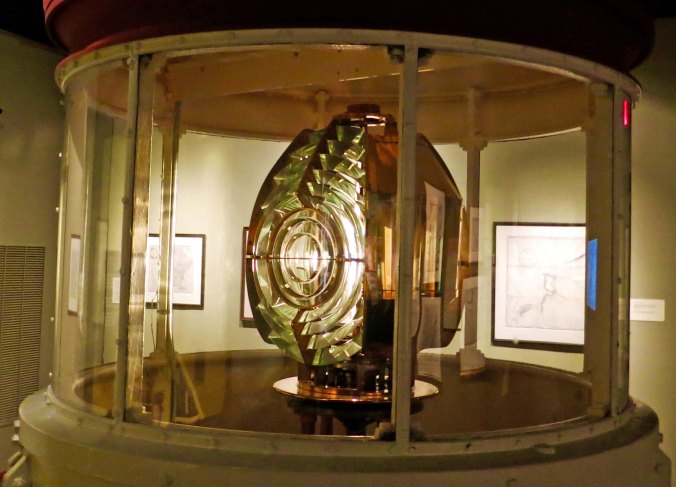
A Fresnel lens of the sixth order on display at the Columbia River Maritime Museum in Astoria, Oregon. This light could be seen for about five miles and would be used in harbors and along rivers.
Funding was approved by Congress and the lighthouse was functioning by the mid-1890s. It was operated up until 1939 when the Coast Guard took it over and determined that a less expensive, automated beacon placed on the end of the Bandon South Jetty would work as well. The abandoned lighthouse was neglected up until 1976 when it was taken over by the state of Oregon as part of Bullard’s Beach State Park. A joint effort by the state and the Army Corps of Engineers restored the lighthouse as an historic attraction. Various efforts since have maintained it, much to the enjoyment of thousands of visitors— including us.
Peggy and I stayed at the state park while we were visiting Bandon and used one of our mornings to go over and check out the Coquille Lighthouse, North Jetty and Bullard’s Beach. The following photos record our visit.

Peggy and I walked around the lighthouse to capture photos from various angles. I took this from the river’s edge. Low tide enabled me to shoot from below the tide line. The North Jetty stretches off to the left.

Peggy caught this close up.

And I took this picture looking over sea grass. Parts of Bandon can be seen across the river. We were on our way to walk out the North Jetty.
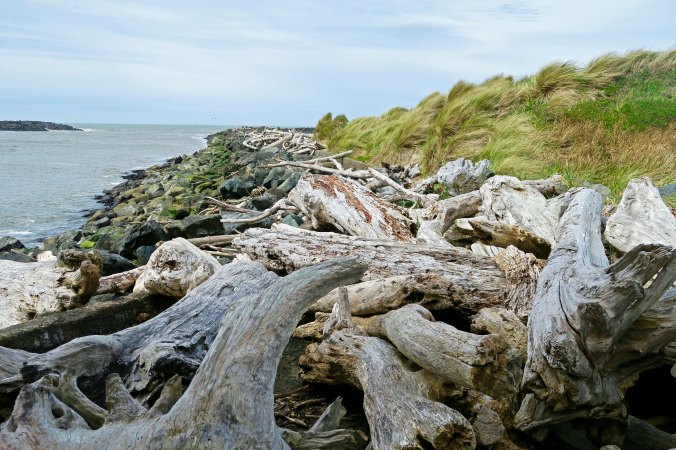
One of the first things that struck me about the jetty was the amount of driftwood piled up along it. This reflects the power of the ocean. It also warns that you wouldn’t want to be anywhere near the jetty in a storm.
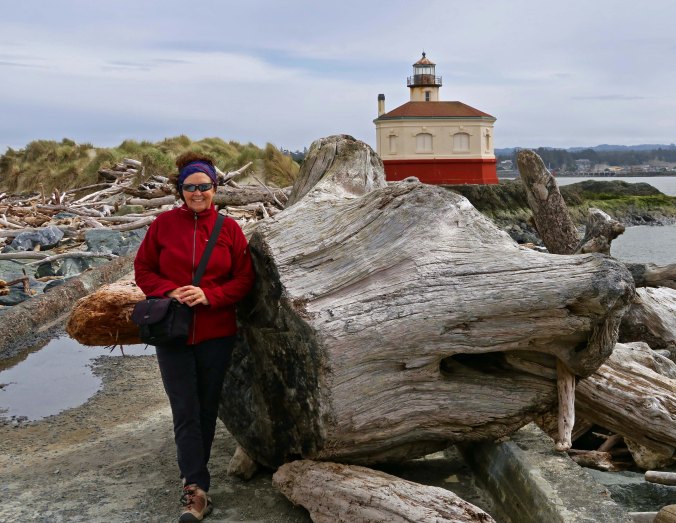
Peggy posed for me in front of this large stump on top of the jetty, a remnant of logging up the river and along the coast.
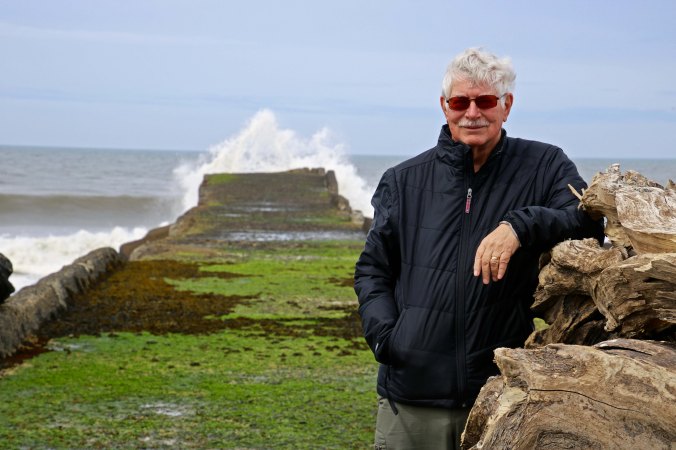
I returned the favor posing for Peggy out toward the end of the jetty. A wave can be seen breaking over the end. And this is at low tide! We stayed far back. I would bet that people have been swept off of here while trying to photograph winter waves. (Photo by Peggy Mekemson.)

I appreciated the sea gulls adding a touch of sea life to my photo. One wave hits the end of the jetty while another rolls in. Watch out for the ninth!
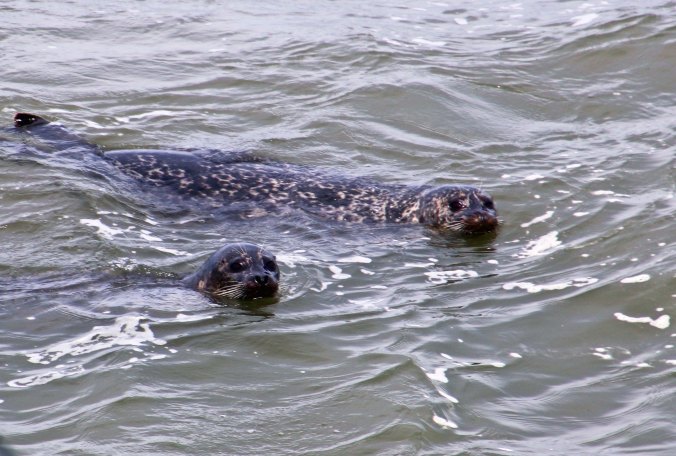
A pair of seals with their big dark eyes swam along the side of the jetty and checked us out. (Photo by Peggy Mekemson.)
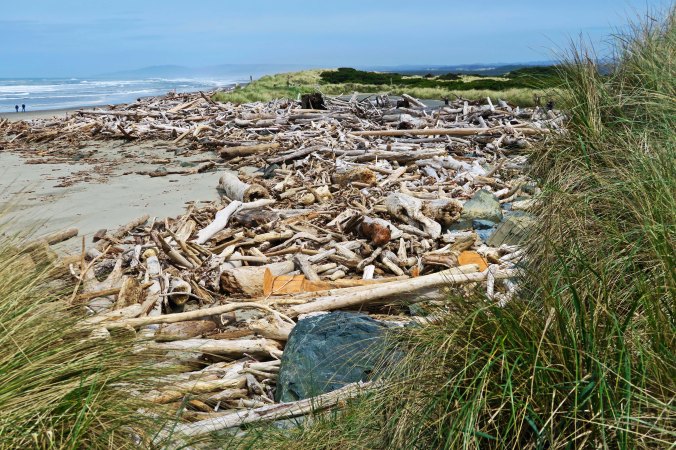
A view north from the jetty along Bullard’s Beach shows again how much driftwood (drift logs?) is brought in by winter storms.

Peggy took this shot looking up from Bullard’s Beach toward the lighthouse.
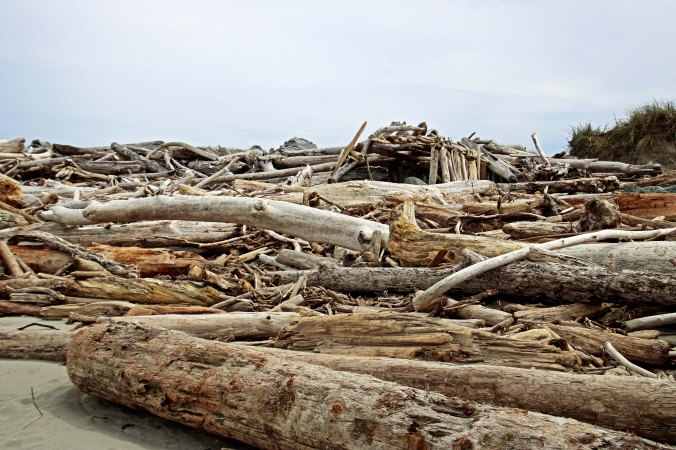
And this photo of a fort someone had built taking advantage of the driftwood. You can imagine the amount of fun kids would have building and playing in such a fort. Adults too. (Photo by Peggy Mekemson.)

I added a close up.
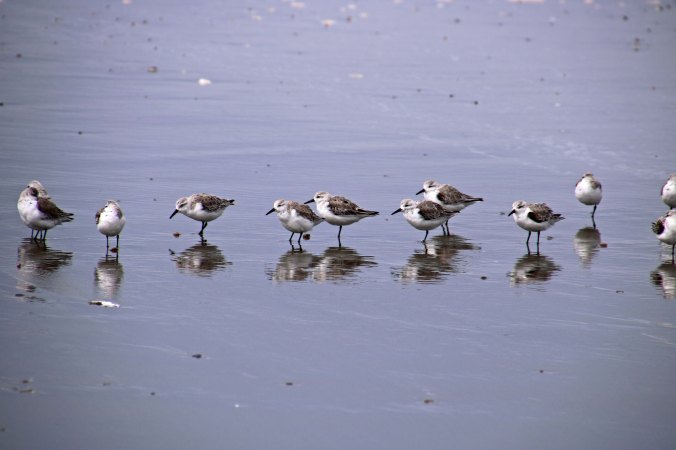
Walking along the beach we found a flock of Sanderlings. These small shorebirds are a delight to watch as they charge in unison along the beach following the tide as it rises and falls in search of delectable bugs. I liked the reflection provided by the receding water. (Photo by Peggy Mekemson.)

Get too close and off they fly, whirling in unison as they head a few yards up the beach to continue their endless search for dinner.
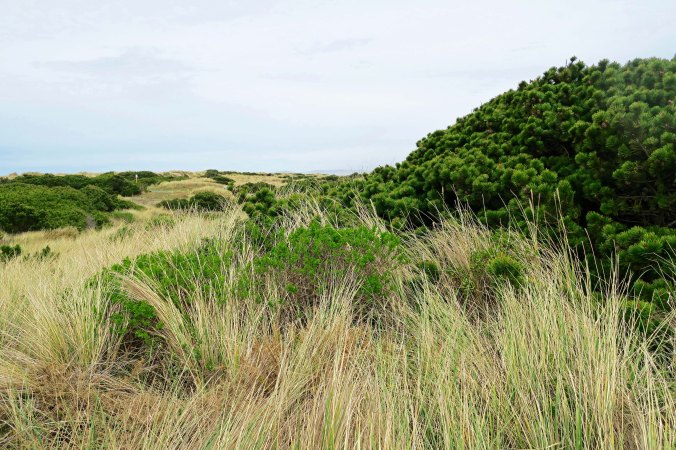
I’ll close today with this final shot of the coastal land that backs up to Bullard’s Beach.
NEXT BLOGS:
Wednesday: While Bone waits to be found, we continue our backpack trip down the Tahoe-Yosemite Trail— finding our way through deep snow, crossing a raging river, and running from kamikaze mosquitoes.
Friday: Murals and other wild/weird art of Burning Man.
Monday: I travel north up Oregon’s coast and explore a cave filled with lions, sea lions that is.
 Wandering through Time and Place