No-see-um Camp, a Sacred Grove, and Cougar Poop

No-see-um camp, which we expected to be bug infested, turned out to be nestled among trees that made me think of a sacred grove.

Part II of our hike up Cook and Green Creek to the Pacific Crest Trail through the Rogue River National Forest.

Our goal for the day was No-see-um Camp, which seems like a very poor place to set up your tent. If you have spent much time outdoors, you will recognize no-see-ums as particularly nasty little bugs. I first encountered them when backpacking on the Appalachian Trail in Maine. It had rained for a solid week and every biting bug in existence had considered us fair game. While mosquitoes had treated our bug repellant as an hors d’oeuvre, no-see-ums had come after us with knives and forks. Later, I watched a moose in Alaska dash wildly about and roll in a snow bank to escape the tiny, nefarious fiends. Fortunately, we didn’t find any no-see-ums in No-see-um camp. It was quite the opposite. I decided we had arrived in a sacred grove.

Sacred groves go almost as far back as humanity. Think of the Druids and their oaks. In West Africa, where I served in the Peace Corps, huge cottonwoods were thought to contain living spirits and I often found offerings at their bases. It’s important to keep the forest spirits happy.

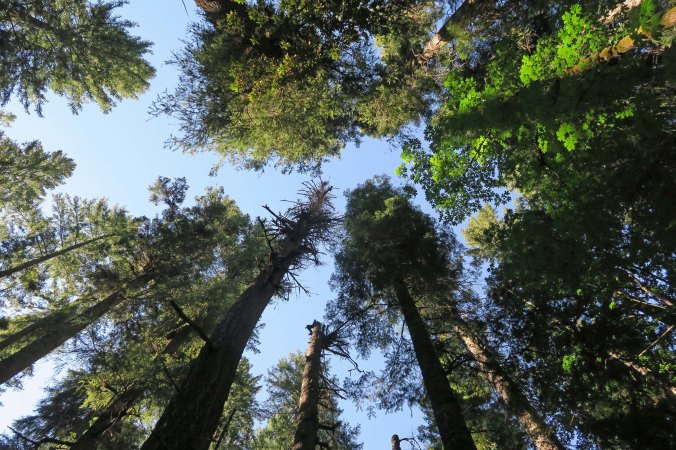
No-see-um camp had more species of trees than I have ever found in a single location, many of them were giants. From our camp, I could see Douglas fir, sugar pine, white fir, blue spruce, chinquapin, big leaf maple, and yew. Just up the trail I found a ponderosa pine. Cook and Green Creek with its cool, refreshing water bubbled and burbled and roared its way down the canyon just behind our tent. I figured it was an excellent place to commune with nature spirits and Peggy found a camp guardian up in the trees, which I thought was quite pagan of her.

Another view looking up from our campsite on Cook and Green Creek. This one features big leaf maples.
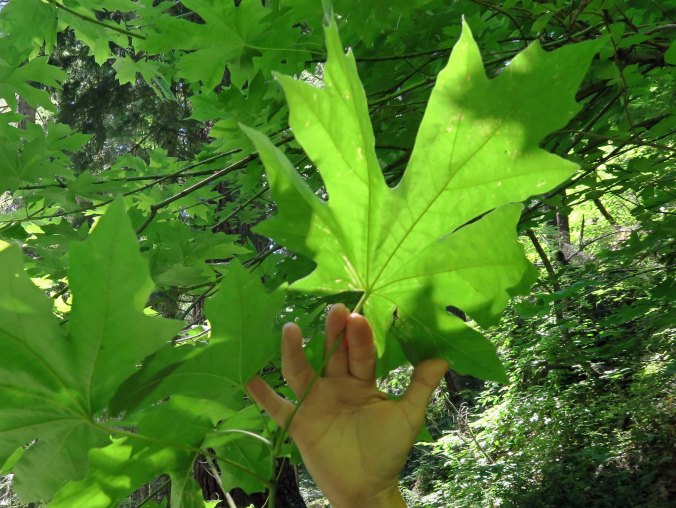
There is a reason for their name!

We also had chinquapin growing in the grove. This prickly thing covers the trees nuts, which are said to be tasty.
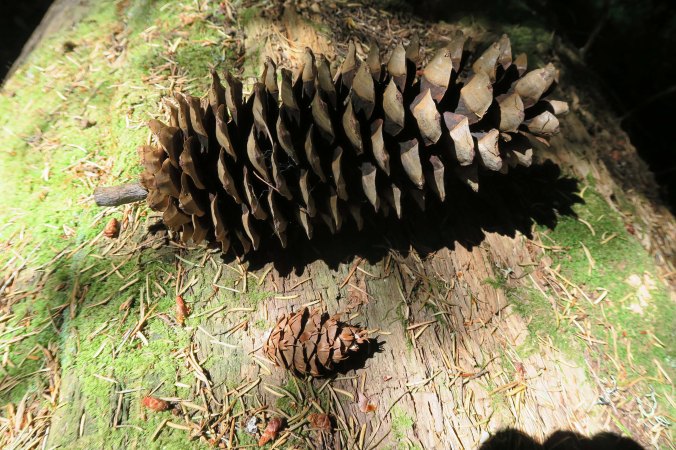
Giant sugar pines with their large cones and giant Douglas firs with their small cones surrounded us.

I found a large ponderosa pine near by. Do you know what made the line of holes? It was a sapsucker, a kind of woodpecker. It will return to eat any insects that have entered the holes.
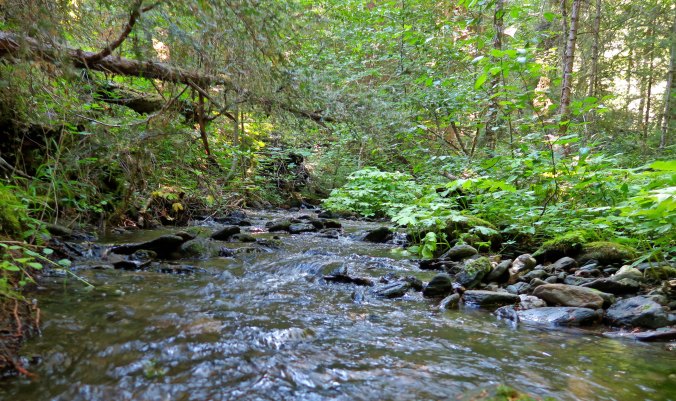
Cook and Green Creek flowed just behind our tent. It was burbling here.

Small waterfalls added a slight roar.

And I found the way the water flowed over a rock to be intriguing.
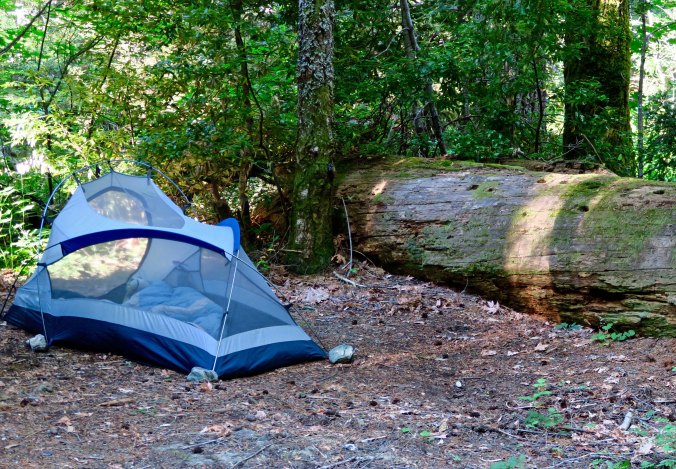
The downed tree next to our tent provided a good perspective on the size of the larger trees.
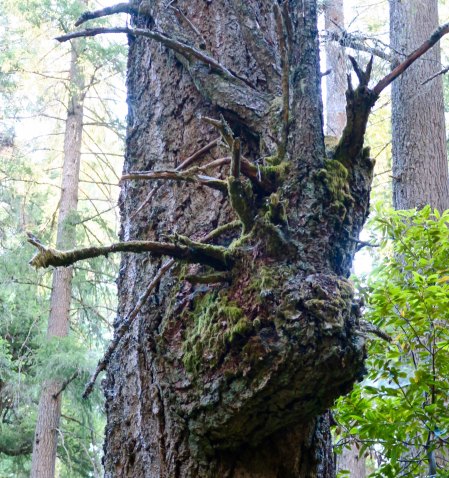
This odd tree growth just above our site served as Peggy’s camp guardian. (Photo by Peggy Mekemson.)
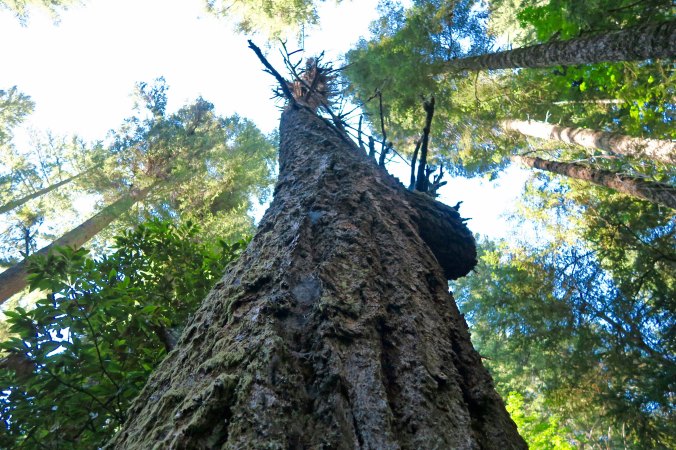
The Guardian’s tree was also impressive.

We used our layover day as an opportunity to do a nine mile hike up to the pass and back. Going up, we entertained ourselves by enjoying flowers and other plant life while looking for signs of wildlife. And yes, I have more animal poop, scat, to share with you. I’ll bet you’re excited.
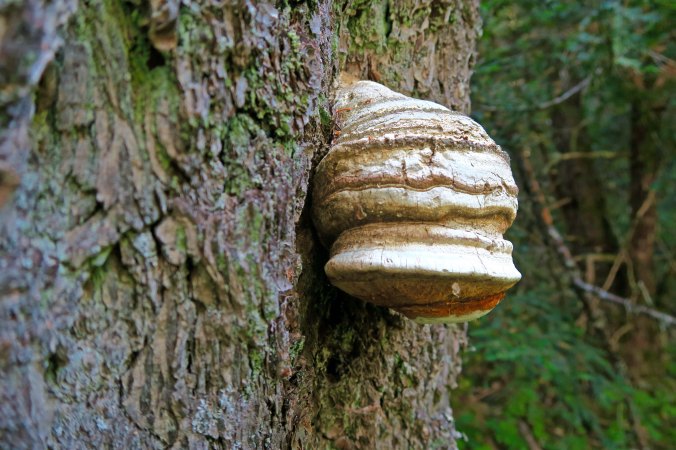
A shelf fungus.
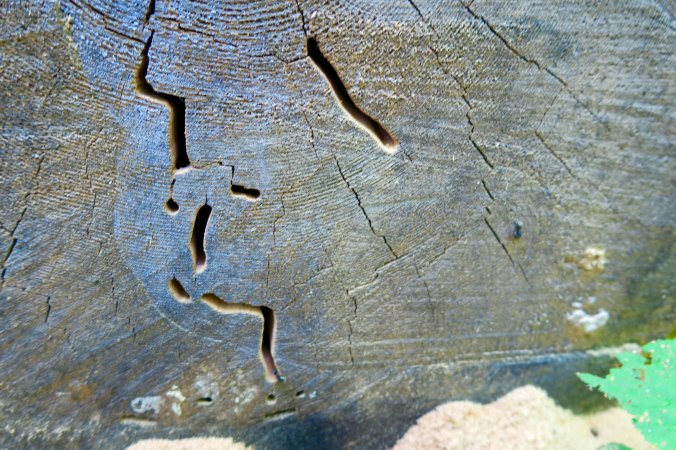
Any idea what is happening here? Carpenter ants were making their nest. They are a fairly large ant that literally cut off small, sawdust-size chunks of wood and then bring it out to the edge where they dump it on to the sawdust pile at the bottom of the photo.
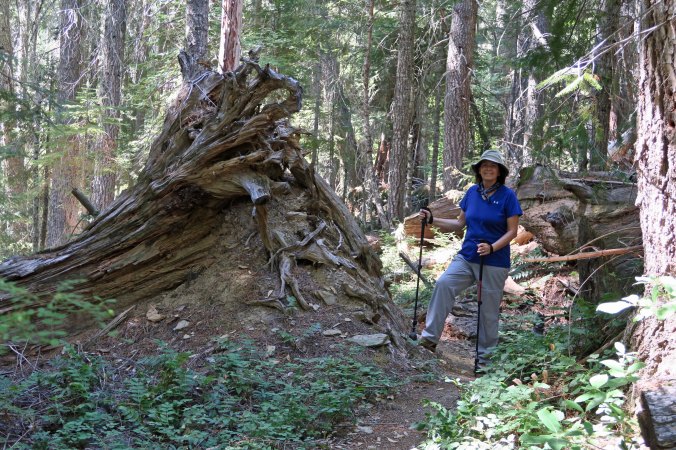
Peggy poses beside a fallen tree.
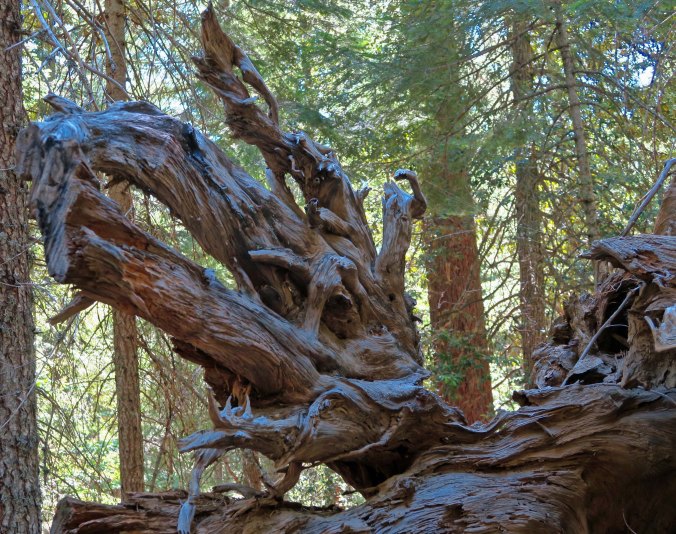
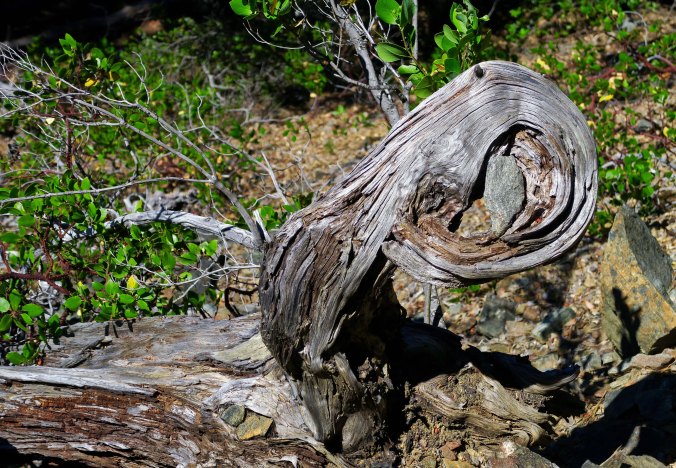
Which happened to feature another wood sculpture that Peggy determined was a dragon.
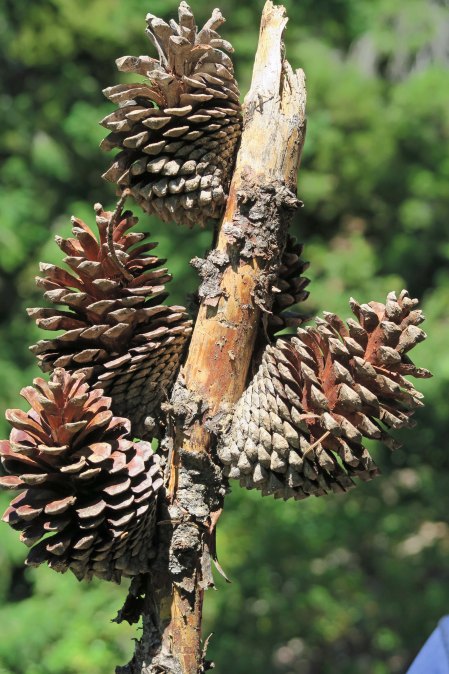
We found these unusual cones that actually grow directly on the limbs of the trunks and limbs of the knob cone pine.
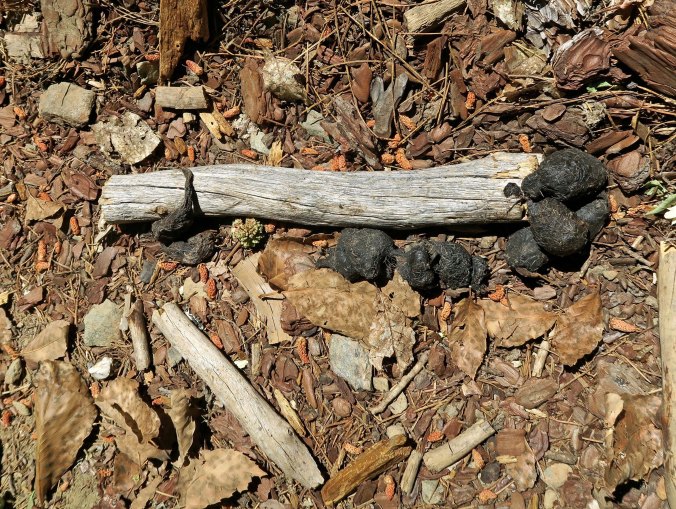
Okay, I put up pretty, or at least I hope interesting photos, and then I put up poop. Why? Half the fun of wilderness travel is knowing what you are seeing around you. Scat (poop) is one way of telling what animals are using the trail you are on. This happens to be cougar, or mountain lion scat. The twisted piece on the end is fairly definitive of the cat family. Size suggests cougar. It was dry, so we were in little danger of an immediate encounter.

Since we are on animal signs, any idea of what made this? Odds are it was a porcupine. They chew off the outer bark to get to the nutritious, inner bark.
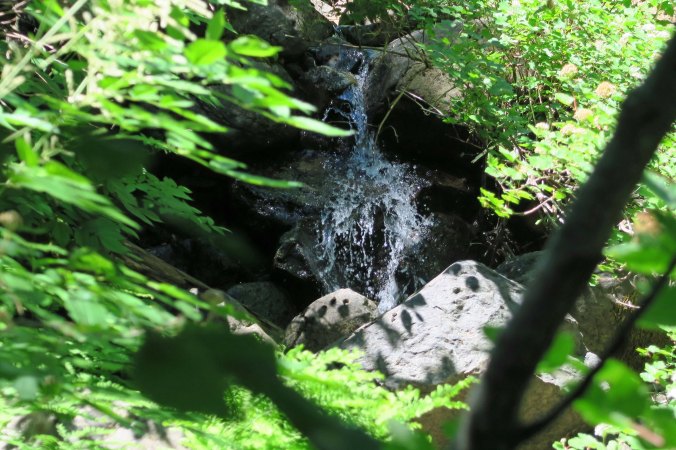
This attractive small waterfall, provided cool water to drink with our  lunch. (Photo by Peggy Mekemson.)
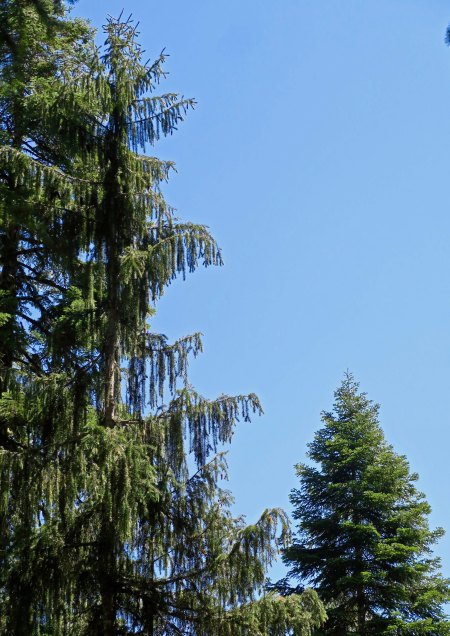
After lunch on our way up to the pass, we found this attractive Blue Spruce…
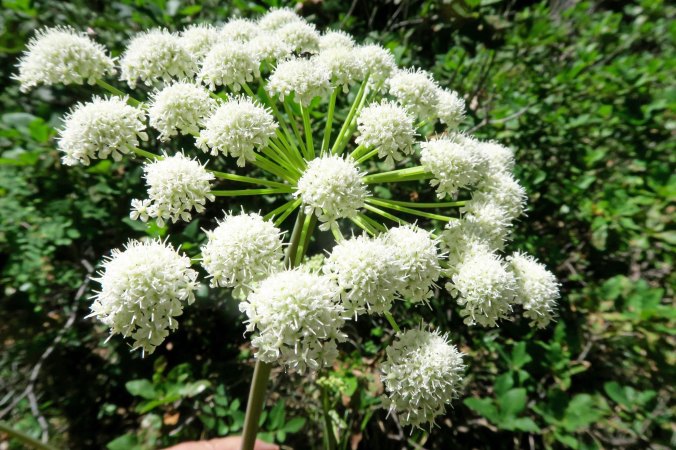
And a flower, which is known as Ranger’s buttons.

On top, we met Rambo, Dogondo, and Double D: three PCT through hikers. Their names are their trail names. They had started at the Mexican border and been backpacking since April, covering close to 1000 miles. They were skinny and ever so eager to reach Oregon, which was just up the trail. One of them told me that Sasquatch (Big Foot) had been rooting around outside his tent the night before.
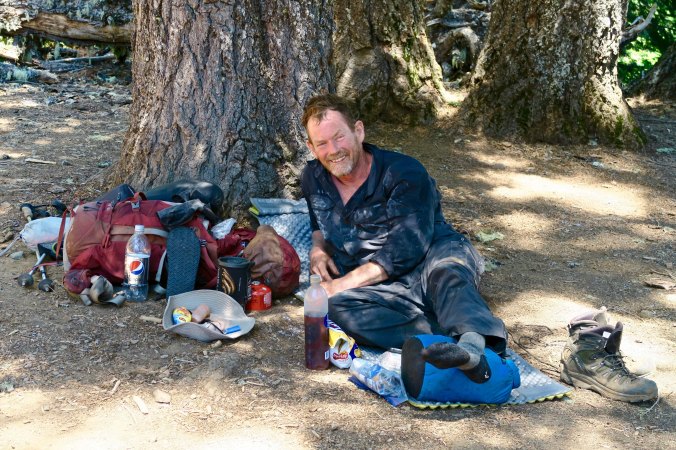
Rambo, a PCT through hiker from Riverside, California.
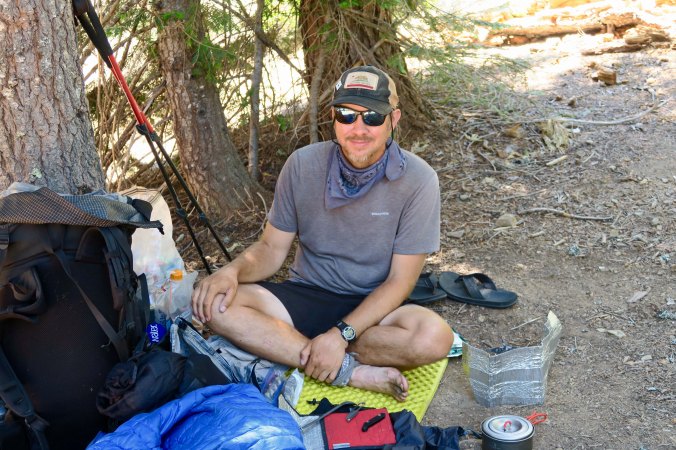
Dogondo, a PCT through hiker from Chicago.
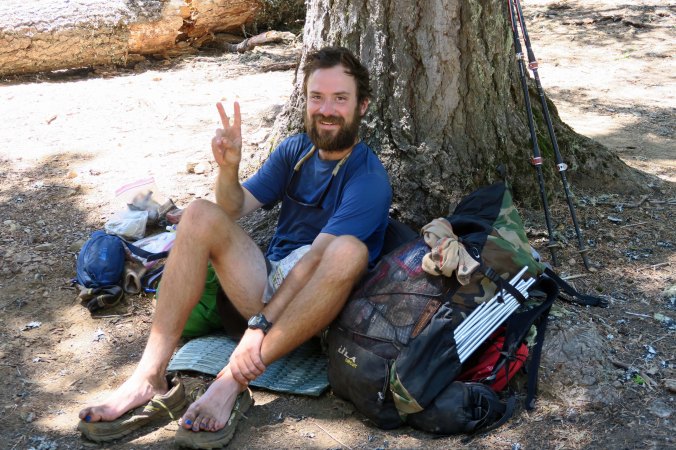
Double D, a PCT through hiker from Kansas City.

We raced on our way back down from the pass. I was careful to keep Peggy behind me. She thinks that she is a greyhound when she gets out in front going down a hill. I once sprained my ankle trying to keep up with her coming off of Muir Pass on the John Muir Trail and had to hobble another 80 miles before we finally climbed up and over Mt. Whitney and out. Taught me.

Peggy, all set to go, wearing one of her favorite T-shirts.
The Cook and Green Trail and Some Really Weird Trees… Part I

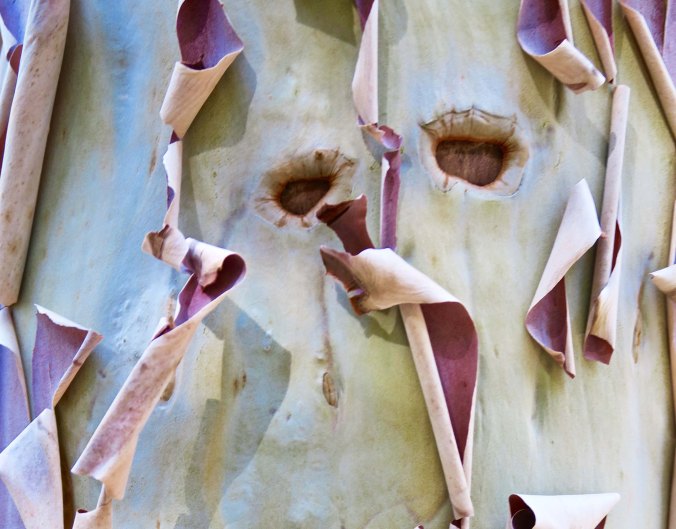
The way madrone trees shed their bark is strange enough without having a pair of eyes staring out at you. We found this specimen along the lower end of the Cook and Green Trail.


Today’s post will take you along with Peggy and me on our latest backpacking adventure. This time, the trailhead was a mere 30 minutes from our house! The Cook and Green Trail follows Cook and Green Creek up to Cook and Green Pass where it connects into the Pacific Crest Trail, the PCT. (That’s a lot of Cook and Green; they were gold miners who worked the area in the 1870s and 80s.) Starting at the pass, we could have made a right turn and hiked to Mexico or a left turn and hiked to Canada. Another time. (grin)

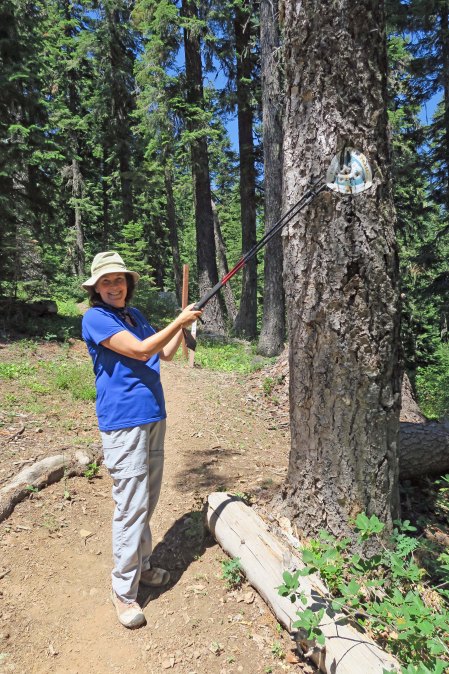
Peggy points out a PCT marker showing the trail south. Had we followed it, we could have been to Mexico in a thousand miles.

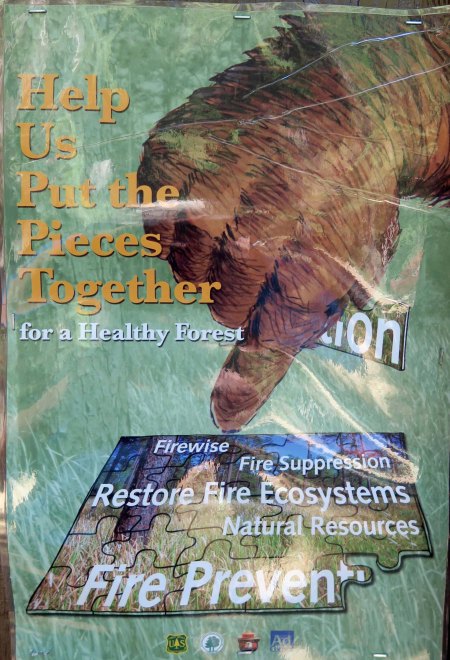
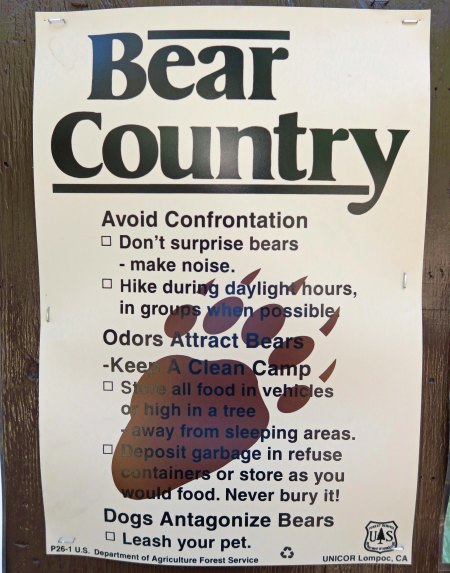
We were greeted by a pair of signs at the Cook and Green trailhead, which I found amusing. Both were products of the US Forest Service. I don’t think the hand on the first poster is that of America’s preeminent spokesperson for fire prevention, Smokey the Bear; I think it belongs to Bigfoot! The second sign warned us about bears. Serious stuff.

Did this sign use Bigfoot to emphasize fire prevention? Or is it a clawless Smokey? It’s puzzling.

It’s smart to be aware of bears when backpacking, but you should not let them keep you out of the woods.

I am a veteran of the backcountry of Yosemite, where the bears actually run a school on how to steal backpacker’s food. (Fake news, but just barely.) So I wasn’t too worried about the bears of the Rogue River and Klamath National Forests. Still, the poster is worth reviewing. Avoid confrontation: That’s always sage advice when you are dealing with a grumpy animal that can outrun you, outweighs you, and comes with long claws and sharp teeth. You don’t want to surprise them and you don’t want to get between a mother and her cubs. That having been said, bears aren’t particularly interested in eating people.  If they were, they would move into towns where there are lots of people to eat. Mainly, they prefer to avoid humans, like most sensible wild animals.

Your food? Well, that’s a horse of a different color, or at least a bear that has hung out around careless people. When I see bear poop that includes bits and pieces of the plastic used to package  freeze-dried backpackers’ food, I know to be on the lookout. BTW, a Yosemite bear would laugh at the advice to hang your food high in a tree. Guess what, bears climb trees. And if mama bear can’t climb a tree in Yosemite to retrieve your chow, she sends her babies up. The advice in Yosemite used to be that your food bag had to be at least nine feet off of the ground and nine feet away from the trunk, with no ropes hanging down! I’ve watched bears play tether ball with food that wasn’t hung high enough. Now the park rangers want you to carry plastic bear-proof barrels. I’ve never worried much about bears when away from Yosemite. Still, care is called for.

It’s good advice about dogs. Way back in history, I was out backpacking with my first father-in-law’s Springer Spaniel, Sparky, and came across a bear. Sparky jumped behind me and then stuck her head out between my legs and started barking vociferously. The bear stopped and growled before ambling on. I told Sparky that if the bear had charged I would have picked her up and tossed her out in front of me.

The Cook Green Trail begins its journey through a burned-out area. In 2012, we watched from our home as huge billows of smoke climbed above the forest and a fleet of helicopters used large buckets to dip water out of Applegate Reservoir, one mile above our home, to fight the Fort Complex fire. It was only a few miles away, and we watched nervously. Today, new growth is returning to the area as nature performs one of her miracles.

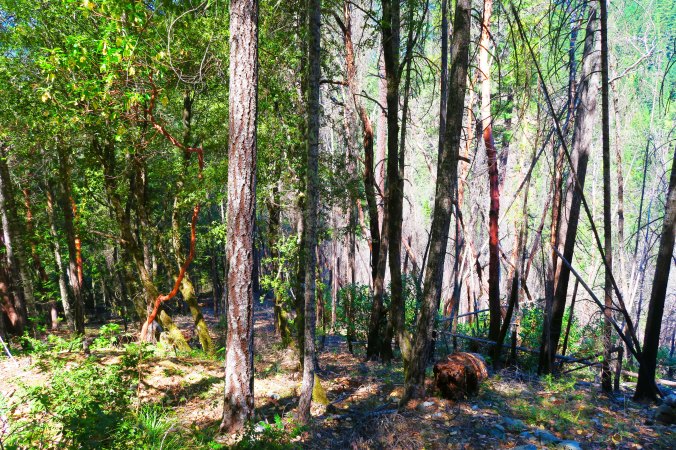
This photo captures the area where the Fort Complex Fire stopped burning along the Cook and Green Trail. It’s a good example of burned and non burned forest. On the burned side, the green near the ground shows where the forest is beginning to recover.

While the hike through the burned-out area was interesting, our fun began on the other side. Peggy came across a mile marker that she felt needed to be decorated, a madrone tree featured eyes peering out from its strange, peeling bark, several oak trees were dressed in moss, tree roots created weird sculptures, and the Mother of All Roots stood higher than me.

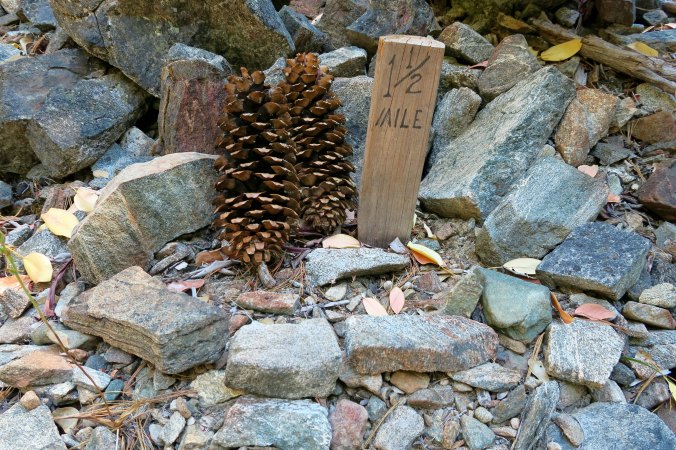
Someone, probably the forest service, had placed mile markers along the first section of the Cook and Green Trail. Peggy decided to decorate the marker by adding sugar pine cones beside the marker and rocks in front.

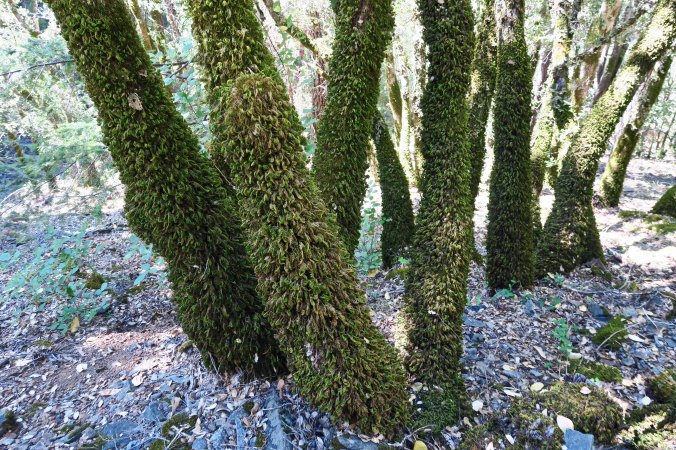
I thought these moss-covered live oaks were quite unique.

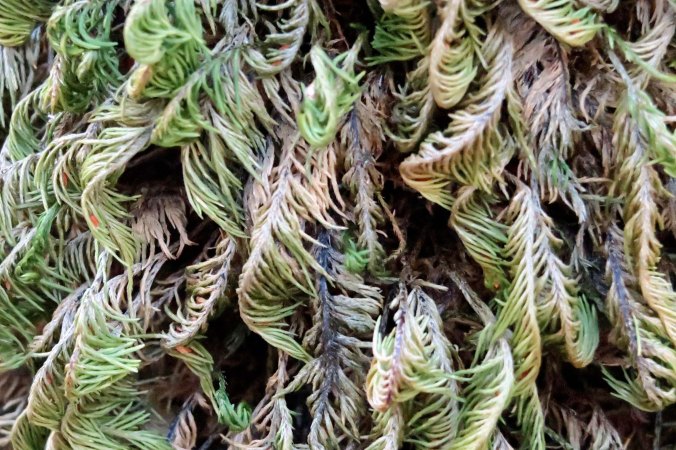
This is a close up of the tree moss.

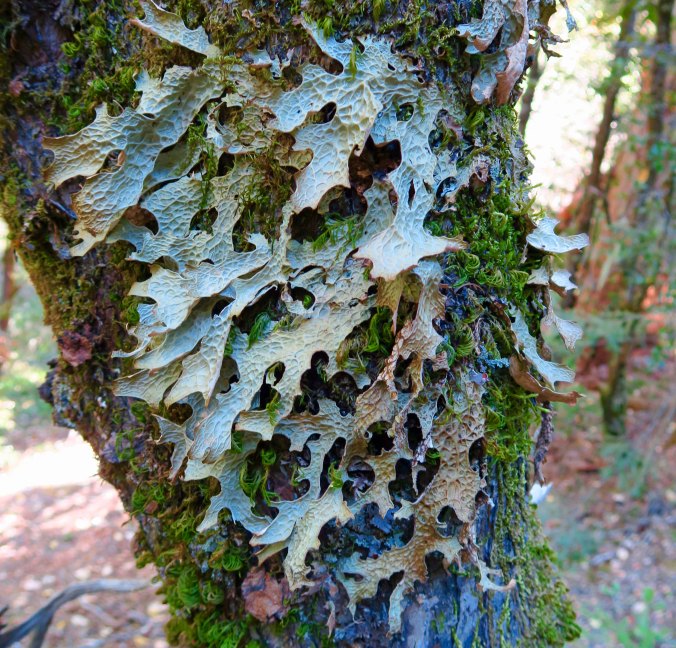
We also found this interesting growth. At first I thought it was stag horn moss but it may be a lichen.

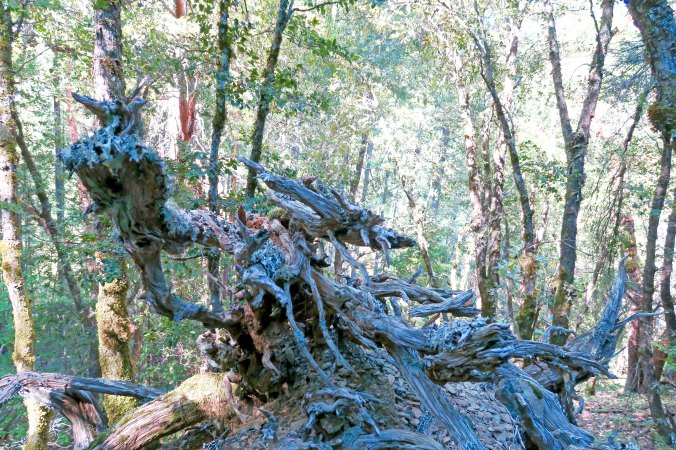
Tree roots can create fun sculptures. I’m not sure I would want to meet up with this one on a dark night!

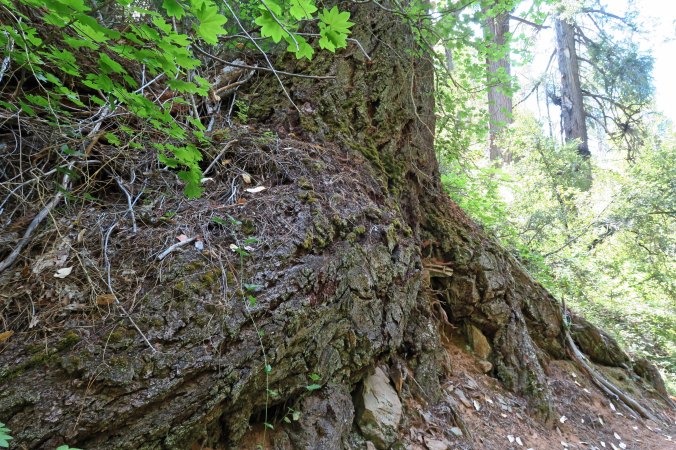
More ordinary, but still interesting, this root had taken a detour around a rock and captured it.

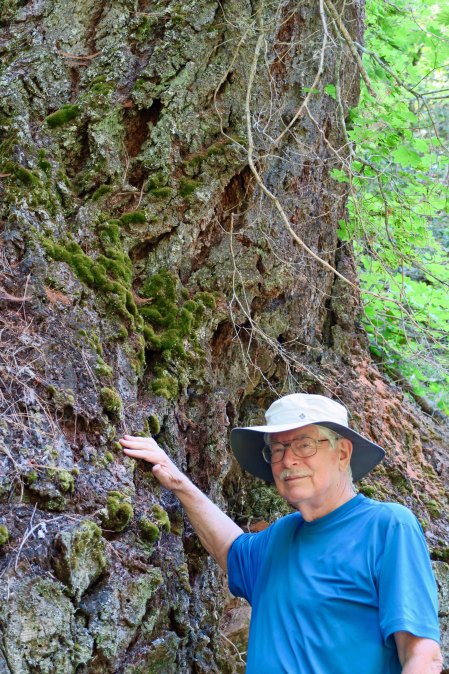
And here we have the Mother of All Roots!

I stood next to it just before the root connected to the trunk to provide perspective. (Photo by Peggy Mekemson.)

NEXT BLOG: We hike on to No-see-um camp, which turns out to be closer to a sacred grove than a bug infested swamp, and hike up to Cook Green Pass where we find PCT through hikers and mountain lion sign.