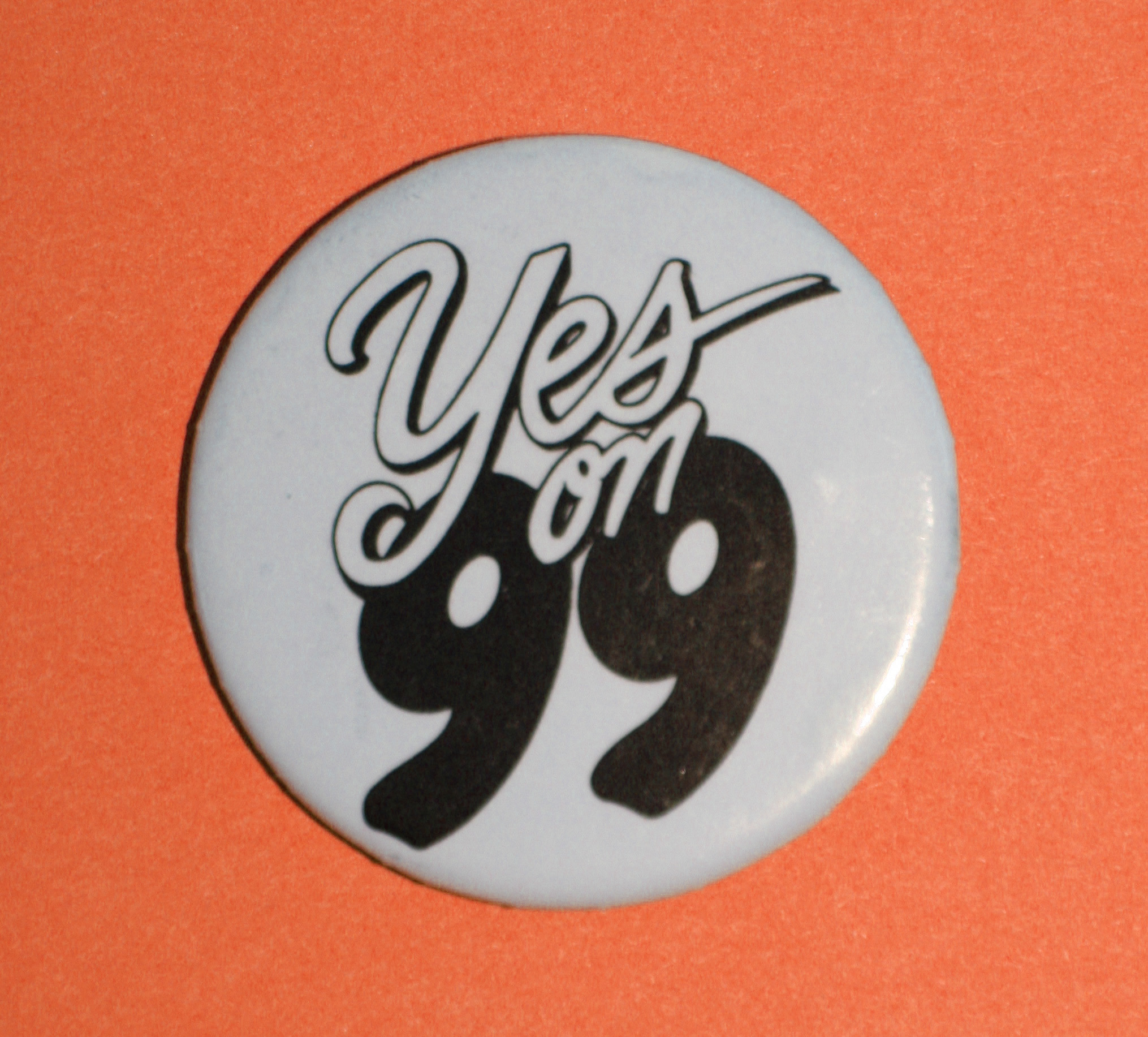
An Old Dog Learns New Tricks in Alaska: California’s Proposition 99

Alaska's strong anti-tobacco legislation in the early 80s would help inspire California's Proposition 99 in the late 80s.

The Alaska Lung Association Board recruited me to serve as its Executive Director in 1983. By then I had learned I don’t do boss well. Wisdom would have been ‘just say no,’ but I jumped at the opportunity. I wanted to go play in the woods.

I soon found I was up to my lungs in tobacco politics.

The organization was involved in a major legislative battle to pass a statewide smoke-free law. In addition to requiring restaurants to set aside smoke-free areas and public meetings to be smoke-free, it eliminated smoking in public and private workplaces.

The fight for non-smoker’s rights ‘had come a long ways, baby,’ to quote an old cigarette ad,  but it hadn’t come that far. If we succeeded, Alaska would have the strongest statewide law in the nation.

Heart, Lung and Cancer had taken on an Alaskan size challenge. The incidence of tobacco use in the state was high and Alaska was a do-your-own-thing kind of place. Individual freedom was stitched into the state’s psyche with steel thread.

Telling Alaskans when and where they could smoke might get us shot.

I knew that a majority of the Association’s resources and every skill I had picked up in community organizing and lobbying would be called upon. I also knew we couldn’t succeed by ourselves. We set out to expand our small coalition of Heart, Lung and Cancer, develop a hard-hitting case statement, initiate a media campaign, and triple our lobbying efforts.

One lobbying technique was particularly effective. Alaska’s small population meant the Doctors on our Board and in the Thoracic Society knew every doctor in the state. They committed to contacting the physicians of the individual legislators and having them make personal calls urging support.

When doctors are committed to prevention, they can be a powerful force for public health.

I found myself spending a lot of time in Juneau, the State Capitol, and on the phone talking to Legislators. One call to a rather crusty Senator from the bush was particularly amusing.

“If you had called six months ago I would have told you to go to hell Curt,” he informed me. “But I had a heart attack and my Doctor made me quit smoking. If I can’t smoke, I don’t see why anyone else should be able to either.” It reminded me of my early involvement with GASP in Sacramento.

I laughingly thanked him for his support and was about to hang up when he told me he had another story to share.

“About a month after I quit smoking I noticed my urine really smelled bad. It worried me so I decided to call my doctor. ‘Doc,’ I said, ‘since I’ve stopped smoking my urine has started to stink something terrible.’”

“Do you know what he said to me?” the Senator asked, letting the tension build. I confessed I didn’t have a clue.

“The Doc said, ‘Senator, your urine has always smelled terrible. You couldn’t smell it because you smoked.’”

Working in Alaska did have a particular flair.

After several months of intense effort the bill was ready for floor consideration. I tallied up our committed votes and knew we could win. There was one final hurdle; the Chair of the Senate Finance Committee was holding the bill hostage. She would only let it out of the committee if we agreed to remove the private workplace.

It was one of those damned if you do damned if you don’t type decisions and the clock was ticking. If I said no the bill would die for the year. We could come back but we would have to start all over. If I said yes our legislation was substantially weakened. I made a command decision and said yes.

Legislation is almost always a matter of compromise and we would still have one of the strongest statewide laws in the nation. I also believed that time was on our side. Once Alaskans became used to breathing smoke-free air they would demand more.

The bill made it out of committee that morning and through the Legislature that afternoon. We were in business, almost.

Legislation is a two-part process, passage and implementation. If the agency charged with implementation doesn’t like the law or has other priorities, your victory can be rather shallow. Fortunately, the Department of Natural Resources had been assigned the responsibility. The staff was on our side but very, very busy.

I offered to save them some work and draft the implementation guidelines for consideration by their legal counsel. Surprisingly, they agreed. It was like turning the fox loose in the henhouse.

Needless to say, the Department came up with very strong and clear guidelines. Some of the weaker sections of the law had even been strengthened.

A few months later I was out in Nome on Lung business and needed lunch. Nome is where the Iditarod sled dog race ends and is about as close to the end of the earth as one can go. I walked into a very rustic restaurant. “Smoking or nonsmoking?” the waiter asked. Several nonsmoking signs were dutifully posted.

Maybe, in the overall scheme of things, the fact that a small restaurant in remote Alaska had a nonsmoking section in 1984 was not of great significance, but it meant a lot to me… and it spoke strongly of the future of the non-smokers’ rights movement

A primary reason for our success had been the strong coalition we had put together. It seemed a shame to let it disband. I suggested we take on another challenge, doubling the tax on cigarettes from $.08 to $.16 and using a portion of the funds to support anti-tobacco and other health education efforts.

The Healthy Alaska Coalition, fresh off of its victory, eagerly agreed. So did the Lung Board. Our challenge this time was that Alaska hadn’t passed any new taxes in years. Quite the opposite, the State gave money back to its residents each year from oil revenues.

As it turned out, passing the tax was relatively easy in comparison to our smoke-free legislation. Again, the Coalition deserved much of the credit. We were even able to add strong Native American backing since their leadership felt the health promotion opportunities provided through the revenues would be valuable.

Another reason for our success on both bills was a lack of opposition from the tobacco industry. Perhaps Alaska was too far off and had too small a population to be of much concern. As far as I know, only one legal firm received a small retainer to represent tobacco industry interests.

Two years later when I was working to push similar tax legislation through the California Legislature, the tobacco lobbyists outnumbered the Legislators, or at least they seemed to. But that’s a story for another blog.

My Alaska experience had reconfirmed my belief in the power of the non-smokers’ rights movement. And, of equal importance, it had introduced the germ of a new idea: using tobacco tax dollars to fund anti-tobacco programs. I was an old dog who had learned new tricks.

I was prepared to participate in creating California’s Proposition 99… but didn’t know it.

A Phone Call Forces Me to GASP: California’s Prop 99

The roots of California's Proposition 99, the Anti-Tobacco Initiative, reached back into the 1970s when the American Lung Association of Sacramento teamed up with GASP, the Group Against Smokers' Pollution, to pass one of the nation's first non-smoking ordinances. (GASP would eventually become Americans for Nonsmokers' Rights.)

The path that led me into the tobacco wars had enough twists and turns to scare a contortionist snake out of his skin. There are lots of stories. Two are particularly relevant to the creation of California’s Proposition 99, the Anti-Tobacco Initiative.

I was recruited to become Assistant Director of the American Lung Association of Sacramento in 1971. The organization wanted my environmental expertise, not my anti-tobacco fervor. In fact I smoked a pipe. I loved my pipe. “No problem,” the Executive Director told me. He, his secretary and almost everyone else in the organization smoked. It was almost required.

One day in 1972 I was sitting in my office counting Christmas Seal Dollars and happily puffing away when I got the call that would lead me to sacrifice my pipe and eventually advocate that Prop 99 include nonsmokers’ rights.

“Mr. Mekemson” the caller began, setting off a red flag. I always get nervous when someone calls me Mr. Mekemson.

“Yes, this is Curtis,” I replied. “What can I do for you?”

“My name is Alice Fox, Mr. Mekemson. Some friends and I would like to meet you.”

Alice Fox, Alice Fox, Alice Fox… the name raced through my mind. I had heard about her recently. Then it came to me. I had read about Alice in the Sacramento Bee. She was leading a charge to shut down a nude beach on the American River. But why would Alice call me. I was a Seventies type of guy.

“Exactly what would you like to meet about,” I asked. Now was the time to be very careful.

“Some friends and I would like to talk with you about how tobacco smoke impacts our health,” she replied.

I relaxed. I was on safe ground. “There is a great deal of information that smoking causes lung disease,” I responded in a positive tone. “I would be glad to send you some pamphlets on the medical evidence. I also have a brochure that provides tips on quitting.”

“No,” a somewhat exasperated Alice Fox shouted in my ear, “we don’t smoke. It is other people’s smoke that makes us sick.”

There was a pregnant pause on my end of the phone. If Alice heard me coughing, it may have been because I had swallowed my pipe. Not knowing what to say, I stumbled into agreeing to have lunch with her the following week.

The die was cast. But first I tried to persuade my boss, Larry Kirk, that he should go. He was, after all, the Executive Director.

“No way,” Larry said with a nervous laugh as he took a deep drag. They had specifically asked for me and I was stuck with it. There was nothing to do but square my shoulders, put my pipe aside, and dutifully go forth for Mother Lung.

I expect the nonsmokers smelled the pipe smoke on me 20 feet away. We met at a small restaurant in the old Public Market at 13 and J Street. The Market would eventually morph into a Sheraton Hotel.

“We are so glad you were willing to meet with us,” Ed Randal, their leader greeted me. “We are having a difficult time persuading people that second-hand smoke makes us sick.”

He handed me his card. It read, “I don’t smoke but I chew. If you don’t blow your smoke on me, I won’t spit on you.”  I immediately understood why Ed might have difficulty selling his cause.

“Not too subtle,” I noted.

“We can’t afford to be,” was the response. Over the next hour I was educated as to why. Gradually, I became convinced that second-hand smoke did indeed make them sick. They all had compelling stories.

I also came to understand something of the frustration they felt in convincing society in general and smokers in particular that second-hand smoke was an issue. In 1972 it was a message far ahead of its time. Most smokers assumed they could smoke whenever and wherever they pleased. I know I did. The vast majority of nonsmokers went along with the idea. It took guts to challenge the norm.

I also had an ‘aha’ experience. I started out being resentful about leaving my pipe behind but over the hour my attitude began to change. These folks shouldn’t have to breathe my pipe smoke.

How many other people had my thoughtlessness harmed?

The question had a strong impact on me. Eventually it would lead me to give up smoking. This was something that neither my knowledge of health effects nor my responsibility as a health professional had been able to accomplish.

As a result, I became convinced that we had a powerful new weapon in our fight against lung disease. If I used myself as an example, “Please don’t smoke around me” was as effective in discouraging tobacco use as it was in protecting the nonsmoker.

Somewhat to my surprise, I volunteered to help Ed, Alice and Company in their effort. An organization called GASP, the Group Against Smoking Pollution, had been set up in Berkeley and the local folks wanted to establish a chapter in Sacramento. I offered the Lung Association for meetings and myself as staff backup. Before we broke up for the day, we had agreed on holding a general membership meeting the next month.

I can’t say that Larry was enthusiastic about my offer or conclusions. A surprising number of Lung Execs smoked and were no more prepared to accept nonsmokers’ rights than smokers in the general public. Mainly they saw their role with tobacco as discouraging young people from starting to smoke.

But Larry had hired me as his assistant because he respected my instincts and judgment. Reluctantly, he agreed to have Lung support GASP. But it would be my baby, not his.

So we set about organizing a meeting. Alice and Ed corralled their friends and I had a small article placed in the Bee. We came up with an agenda and refreshments. I warned our organizing committee not to expect much the first time out. Ten people and a few ideas for expanding membership would be a roaring success.

Fifteen minutes before the meeting was to start the room was packed. Apparently, I was the only one surprised. As we went around the room for introductions two things became apparent. First, this was a broad-based group of people. We had health professionals, a couple of lawyers, several business people, housewives, a househusband, an electrician, and others.

Second, everyone had stories to tell and they were ecstatic they had empathetic listeners. I felt like I was in the middle of a revival, which is often the atmosphere created by grassroots organizations.

Once we worked through the preliminaries and had a semblance of order, I facilitated a brainstorming session on what we might do to create awareness of non-smokers’ rights in Sacramento. If my pipe smoking was to be limited, I might as well have company.

The ideas came fast and furious. We should arm nonsmokers with fans to blow smoke back at smokers. We should print up and distribute thousands of the “I don’t smoke but I chew,” cards. We should picket grocery stores, clothing stores and restaurants. We should create an ordinance.

“Whoa,” I interjected, abandoning my facilitator’s role. “Let’s talk about the ordinance.”

Sacramento would be one of the first cities in the nation (or world) advocating such a law.

“Our chances of winning are slim,” I began, thinking out loud, “but that may not matter. The effort will generate great media coverage, probably more than all the other activities combined. Think of the awareness we will create.”

The idea was greeted with enthusiastic support. The newly formed Sacramento Chapter of GASP had a mission.

“I can take a stab at drafting the ordinance,” one of the attorneys volunteered.

“I know a reporter who will support us,” another offered.

“Anything you need,” another called out. We would not lack volunteers. As for myself, I agreed to set up meetings with members of the City Council. I knew most of them from my work in the environmental movement and had worked on several of their campaigns. We were off and running.

The ordinance seems rather tame now, but it was radical for its time. We targeted grocery stores, retail stores, restaurants and movie theaters. It was still the era when a newly purchased suit might smell like cigarette smoke and a harried shopper might inadvertently lose her ashes in the vegetable bin at the grocery store.

It didn’t take long for things to heat up. As we suspected, the press had a field day. Reporters didn’t necessarily agree with us, one of the smokiest atmospheres in town was the local newsroom, but controversy is the bread and butter of the media business. Imagine a smoker having to wait until he got outside of a grocery store to light up.

Each time the media ran a story, awareness increased. We were achieving our objective. Non smokers were learning it was okay to say “Yes, I do mind if you smoke,” and people who suffered adverse reactions from second-hand smoke were learning they weren’t crazy. We took every opportunity to educate the public and pound home our message to decision-makers.

And then a funny thing happened on the way to the forum. We won. A majority of City Council became convinced, as I had, that a significant number of nonsmokers were adversely affected by second-hand smoke.

Of equal importance, the local grocery store chains and clothing merchants let the decision-makers know they would prefer smoke free environments.

And finally, we had minimal opposition from the tobacco industry. It was several years before the industry fully realized the threat posed by the non-smokers right’s movement, or how dedicated the non-smokers’ rights advocates were, or how effective a small group of people can be in making change.

Sacramento had become a leader in the anti-tobacco movement and would continue to be over the next quarter of a century. While I moved on to other issues, the local Lung Association under the leadership of Jane Hagedorn and her Board of Directors became one of the strongest advocates for a smoke-free society in the United States.

Ten years later I would rejoin the Tobacco Wars, this time in Alaska.

One Million Lives and 86 Billion Dollars Saved… California’s Proposition 99

In the late 80s the tobacco industry mounted an "unprecedented campaign," to defeat California's Proposition 99, an initiative designed to increase the California tax on cigarettes by $.25 and devote a substantial portion of the funds to discouraging tobacco use. The Tobacco Institute recognized that the initiative posed one of the greatest threats to tobacco consumption it had ever encountered.

My friend Ken Lake sent me an article from the Sacramento Bee a few weeks ago. It reported on the latest results from California’s Proposition 99, a massive tobacco use prevention effort kicked off by a tobacco tax initiative passed by California voters in the late 80s.

According to the California Department of Health Services, an estimated one million lives and 86 billion dollars in health care costs have been saved because of prevention programs funded by the tax. California now has the second lowest incidence of tobacco use in the nation and the state is virtually smoke-free. It has the lowest incidence of cancer for 6 of the 9 cancers caused by tobacco use. Fewer teens smoke in California than any other state.

These figures are remarkable. How many times in history has a single act saved one million lives? How often do health care costs go down instead of up? And there is more, much more.

Tobacco use is the single most preventable cause of death and disease in America and a major factor in preventable death and disease worldwide. The revolution in disease prevention that took place in California is a revolution that has reverberated throughout the United States and around the world, a fact recognized by both the National Centers for Disease Control and Prevention and the World Health Organization.

As a result, the million lives and billions of dollars saved in California can be multiplied several times over on a national and global basis. Prevention works.

Credit for the success of Proposition 99 in the quarter of century since its inception goes to a cast of hundreds, if not thousands. Certainly the Tobacco Control Section of the California Department of Health Services and its dedicated staff have been critical but dozens of organizations, hundreds of staff people and thousands of volunteers have also played key roles.

In the beginning, however, in the very, very beginning, it was a handful of people in Sacramento who put the effort together and made the critical decisions that would allow Proposition 99 to become the revolution in prevention it has become.

I was privileged to be one of those people.

Over the next two months I will do a series of blogs that provide an inside look at what happened during Prop 99’s first critical months starting in September of 1986. It’s a story of how and why a small group of friends decided to take on one of the worlds most powerful, amoral industries in the cause of preventing the death and crippling disease caused by tobacco use.

It’s a good story, worth telling on its own merits. Greed, power politics, human emotion and sacrifice are all included. There’s even some humor. But I also want to make the point that a few dedicated and knowledgeable individuals can make a significant difference. It’s an important message for today’s world where ideology, ambition and greed triumph over working together in the common interest.

In my next blog I will tell the story  of Prop 99’s beginning and how I became involved. Believe me, I did not start out to become an anti-tobacco warrior.