UT-OH! Chapter 3: Do You Feel the Vibes, Tonto? A Train Is Coming. –The Lone Ranger

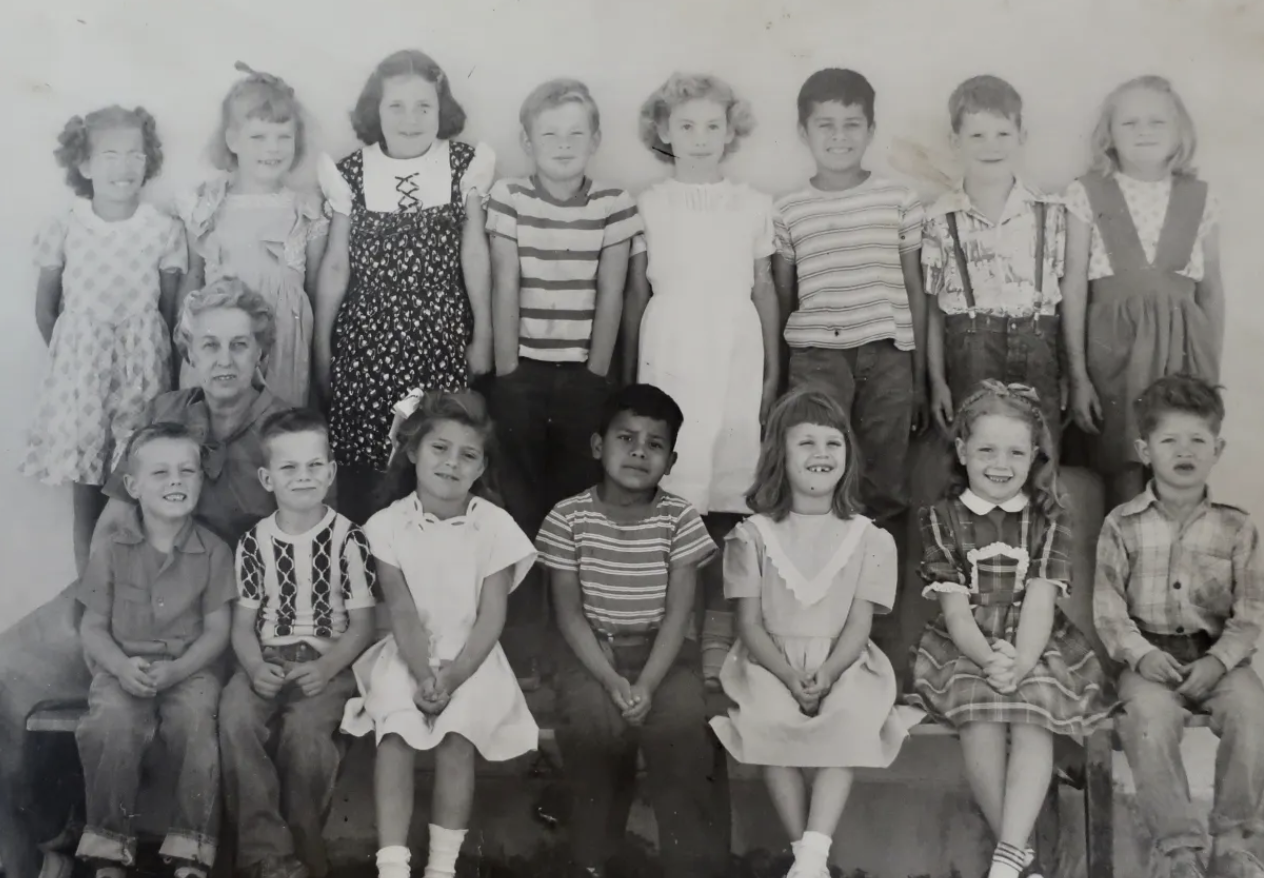
Here we are in the first grade class of Diamond Springs Elementary School in 1949. I’m in the middle of the back row with my hands in my pocket, crunched together between two girls. Rudy is one person to the right of me. Robert is in the middle of the first row. Joe is on the far right, bottom row. My life-long friend Bob Bray, who you will meet in future chapters, is sitting in the front row just right of Mrs. Young.

My endless vacation came to an end the fall of 1949. It was time for the first grade. Mother was delighted. Mrs. Young, not so much.  A number of the little boxes on my report card that reflected good behavior were marked ‘needs improvement.’ Mrs. Young had decided I needed a lot. Is neat: needs improvement. Shares: needs improvement. Is polite: needs improvement. The list went on. I was a little savage.

The ‘neat’ part was particularly sensitive. My shoes were falling apart, my pants had holes in them (this was before it became a fashion statement for young women), I smelled like a little boy who only bathed once a week, and didn’t wear any underwear. You might wonder how Mrs. Young knew about the latter. It wasn’t that she did an inspection. The zipper was to blame.

I was in the bathroom one day, had finished peeing, and was zipping up my pants when my poor little guy got stuck in the zipper. Damn that hurt! I screamed like the six year old man I was and made a beeline to Mrs. Young to solve the problem.  She must have been delighted and wondered where in her contract it stated “Must be available to liberate little boys’ penises from zippers.” Anyway, she did her job. I suspect a not-nice note was sent home to my mother. Anyway, underwear became part of my attire, forever after. 

I thought of naming this chapter, Free the Penis! But my editor/Peggy (wife) thought not. 

Once, I got spanked. “Reading and writing and ‘rithmetic taught to the tune of a hickory stick” the old song School Days proclaimed. My classmate Joe and I had disagreed over who was top dog. We fought it out on the playground. I thought I was doing Mrs. Young a favor by clarifying the issue. Joe was even more uncivilized than I. She thought otherwise. The only justice I could see was that Joe got it in the end as well, so to speak.

The high point of my year was that I made my first two friends who weren’t family or buddies of my older brother. Rudy and Robert were a pair of Hispanic brothers who lived in a small house out in east Diamond. We had hit it off immediately and on a Saturday toward the end of school, the boys and their parents invited me up to their house to spend the night. It was my first official play date and my first ever sleep-over. I was nervous. My mother took me up and dropped me off to a royal greeting by the boys, their parents and their siblings. 

“Quick,” the boys urged, “we have to go stand by the railroad tracks.” We could hear the train’s whistle as it approached Diamond. 

The tracks were part of a narrow-gauge railway Caldor Lumber Company used to bring logs from its tree-cutting operation 20 miles up in the El Dorado National Forest to its lumber mill in Diamond Springs. When the company was established in the early 1900s, it had located its sawmill in the forest near its logging operation and used mules for hauling the logs. It had then switched to oxen, and finally a giant steam tractor. The tractor made so much noise that the company was required to use outriders a quarter of a mile in front to warn people so their horses wouldn’t be spooked. 

Understandably, the company switched to the railroad when it relocated its mill to Diamond Springs, 20 miles away. The train, in turn, would lose out to logging trucks in the 50s. At the time, however, little kids still had the joy of watching the engines and their line of rail cars carrying massive logs out of the forest.

Caldor’s steam engine and its load of logs. Note the size of the logs. (Old newspaper photo)

My father had a close connection with the railway. As one of Caldor’s two electricians, he was responsible for maintaining phone service along the track between the lumber camp and the mill as well as the massive machinery the mill used for cutting up logs and producing lumber. When there was a problem with the phones, off he went to check out the 20 miles of line. A hand cranked generator was necessary for creating the electricity to make calls. We inherited one when the line was replaced. Marsh and I would invite our little friends over, crank up the machine, and have them touch the outlet. They got the message. It was shocking.

Pop’s favorite railway task was clearing snow off the tracks each summer when the logging camp opened up for the season. “We had a diesel-powered rail car with a snow plow on it,” he explained to me later. “We’d back up and take a run at snow banks, crashing into them, and hopefully breaking through. Often our car would jump the tracks. We’d all pile out and lift it back on.” Some fun; he loved it. 

While watching the train was high entertainment, the primary attraction for us was that the engineers carried an ample supply of wrapped hard candy that they would throw out to the boys and girls standing alongside the track. It was a tradition.

The train was near. We could hear it chugging along. Rudy, Robert, their brother, sisters and I sprinted the hundred or so yards over to the tracks. Being a smart ass, I laid down and put my ear on one of the rails. It was a trick I had learned from the Lone Ranger and his side-kick, Tonto. You can actually hear the vibrations and supposedly judge how far away the train was. I needn’t have bothered since the train came into view a hundred yards away while my I was focused on the ‘vibes.’ I’m sure the engineers saw me. 

“Get off the track!” Rudy and Robert screamed. We started waving vigorously. One of the engineers dutifully leaned out of the cab and tossed us candy, lots of it. We scrambled around picking it up and shoving it in our pockets. At least the ones that weren’t shoved into our mouths.

After we had collected our candy from the train, dinner was a long hour off. I suggested to Robert and Rudy that we head out to the woods behind their house and ride trees. Who needs horses? My brother and I had learned that we could climb up to the top of young, skinny pines and make them sway back and forth by leaning out. The farther we leaned, the more they swayed. It offered a free carnival-like experience 10 feet up in the air. Even more could be accomplished by throwing our feet out in the direction the tree was swaying and hanging on for dear life. If the tree was skinny enough, two of us could make it bend all of the way down to the ground, where we would drop off and allow it to snap back up. It took a while for me to persuade Rudy and Robert that the sport wasn’t going to kill them.

I suspect the trees didn’t enjoy the experience nearly as much as we did. Years later when I read Robert Frost’s poem about children bending birches, I fondly recalled our pine tree horses— or bucking broncs if you prefer. 

“It’s dinner time!” came the call so we rushed back to the house and made use of an outside water faucet to wash the pine pitch off our hands. Sort of. Pitch has a way of sticking like super glue. It’s the pine tree’s revenge. Mother had a box of Boraxo at home for the task. Hand inspections were held afterward.

“You have to try this,” Rudy enthused, dashing into the house and coming out with a red pepper. I should have been suspicious when the rest of the kids gathered around. But what does a first grader know? I gamely bit into the pepper and was introduced to habanero-hot. The kids roared as I made a mad sprint for the faucet and drank a gallon of water, becoming a major part of the evening’s entertainment. It would have served them right if I’d peed in their bed later. 

I forgave them when I had my first Mexican dinner, however. I still love Mexican food. And I’ve come to enjoy habanero-hot on foods ranging from burritos to spaghetti.

As the night progressed, it soon became time for bed. I was about to flunk sleep-over etiquette. The boys slept on the same bed. Admittedly it was bigger than my small single at home, but I had never slept in a bed with another person, much less 2 others, or maybe it was 10. That’s what it felt like. They put me in the middle. I was mortified, but I tried. I really did. Ten o’clock came and there I was, eyes wide open, staring at the ceiling, body frozen in place, and midnight, and two, and four. At five, I gently nudged Robert.

“I can’t sleep. I haven’t slept all night,” I confessed. “I have to go home.”

“Ummm,” the half-awake Robert had moaned and moved. 

I got up, dressed, and slipped out of the house by 5:30, careful not to wake anyone else. It was close to dark outside with only a dim light announcing the morning. Home wasn’t that far away, maybe a mile and a half at most. But I still remember the journey from a first grader’s perspective: It was long and spooky, my first great solo adventure. I followed the dirt road over the railroad tracks out to the Pleasant Valley Road. Not one car zipped by. Fortunately. They probably would have stopped and driven me home. Everyone knew everybody else in Diamond Springs with its population of 750. “Sorry to wake you up, Marge, but I found Curt out wandering in East Diamond.” By noon, everyone in town would have heard the story. 

I walked past the hill with the cross on it and picked up Highway 49. Halfway home, I came to Tom Murphy’s grocery store. Sodas were stacked in wood boxes in front, waiting to be moved inside. I looked around furtively; I was totally alone. So, I helped myself to a Coke; I deserved it. I continued on my journey, walking by the post office, Dub Walker’s store, the barber shop, Scheiber’s hardware store, the historic Pony Express stop, the firehouse and Gust Brother’s Garage, eventually reaching the dreaded Graveyard. I clutched my coke and crossed the road, preferring Pagoni’s mean dogs to the ghosts. 

Arriving home, I carefully hid the soda outside. It wouldn’t do to have overly inquisitive parents discover the purloined drink and ask questions. I happily enjoyed it later in the day, feeling much less guilty about stealing than I did about abandoning my friends. I suspect there was a bit of consternation when Rudy and Robert’s parents woke to find me missing. Imagine what would happen today.
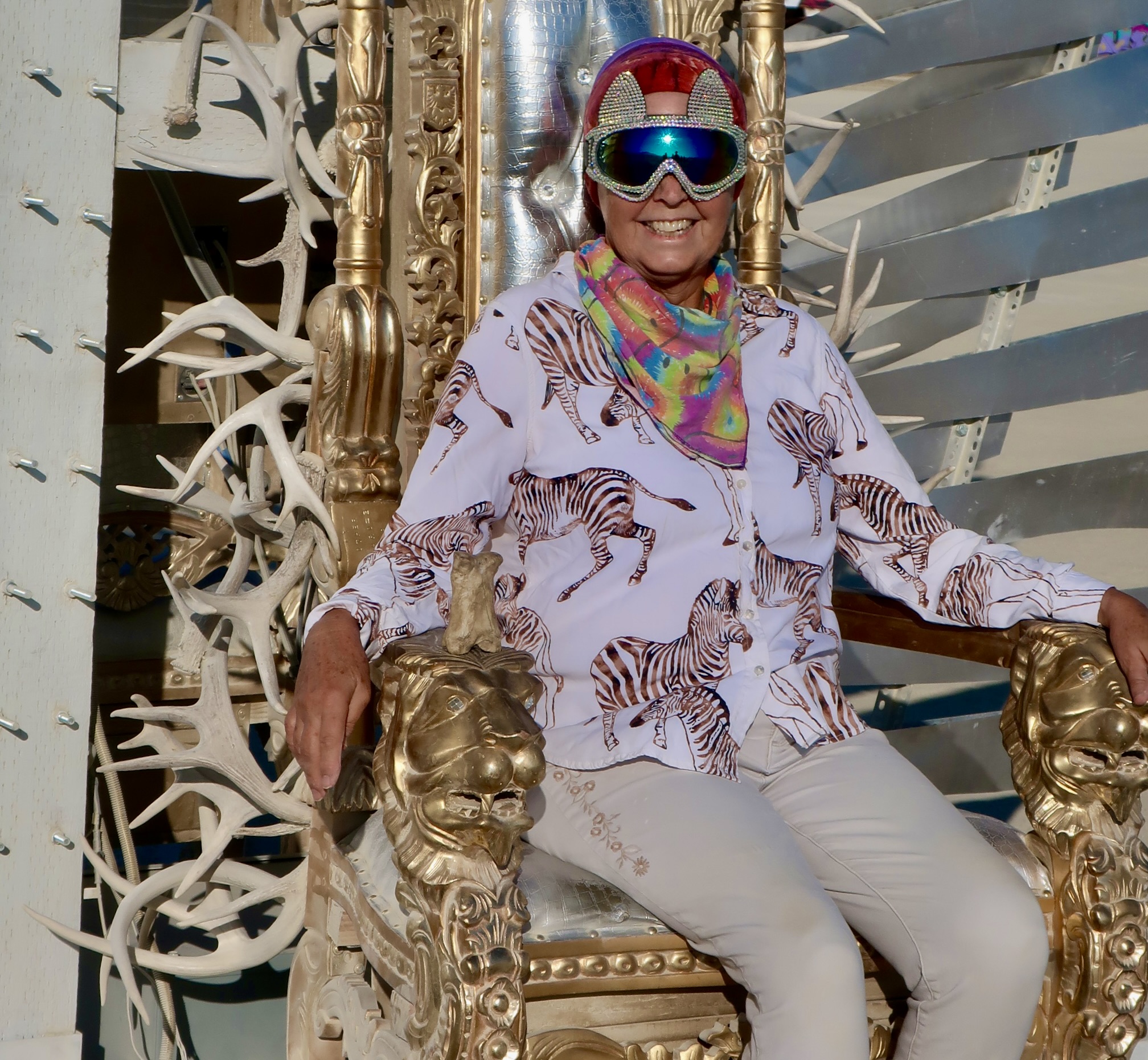
Are you ready for our next focus series? Peggy and I will be returning to the whacky, wild, weird and wonderful world of Burning Man. This is Peggy decked out for Burning Man 2023. The world traveller, Bone (over 50 countries), is resting on the right arm of the throne.

The Great Tree Race… Blogging My Book on “MisAdventures”

Incense cedar tree in Diamond Springs graveyard

A view of the tall incense cedar in the Graveyard today.


Two incense cedars dominated the Graveyard. From an under five-foot perspective, they were gigantic, stretching some 75-feet skyward. The limbs of the largest tree started 20 feet up and provided scant hope for climbing. As usual, my brother Marshall found a risky way around the problem.

Several of the lower limbs came tantalizingly close to the ground at their tips. One could be reached by standing on a convenient flat tombstone. But only Marshall could reach it; I was frustratingly short by several inches. Marsh would make a leap, grasp the limb and shimmy up it hanging butt down until it became large enough for him to work his way around to the top. Then he would crawl up to the tree trunk, five Curtis lengths off the ground. After that, he would climb to wonderfully mysterious heights I could only dream about.

Eventually I grew tall enough to make my first triumphant journey up the limb. Then, very carefully, I climbed to the heart-stopping top, limb by limb. All of Diamond Springs spread out before me. I could see our school, and Caldor (the lumber mill where my father worked), and the woods, and the hill with a Cross where I had shivered my way through an Easter Sunrise Service. I could see my whole world. Except for a slight wind that made the tree top sway and stirred my imagination about the far away ground, I figured I was as close to Heaven as I would ever get.

View of Caldor Lumber company circa 1958

The view from the top of the incense cedar tree in the Graveyard looking toward Caldor Lumber Company circa 1958. The mill had already closed down by this time.

By the time I finally made it to the top, Marshall had more grandiose plans for the tree. We would build a tree house in the upper branches. Off we went to Caldor to liberate some two by fours. Then we raided Pop’s tool shed for a hammer, nails, and rope. My job was to be the ground man while Marshall climbed up to the top. He would then lower the rope and I would tie on a board that he would hoist up and nail in. It was a good plan, or so we thought.

Along about the third board, Pop showed up. It wasn’t so much that we wanted to build a tree fort in the Graveyard that bothered him, or that we had borrowed his tools without asking. He even seemed to ignore the liberated lumber. His concern was that we were building our fort too close to the top of the tree on thin limbs that would easily break with nails that barely reached through the boards. After he graphically described the potential results, even Marshall had second thoughts. Pop had a solution though. He would build us a proper tree house on the large limbs that were only 20 feet off the ground. He would also add a ladder so we could avoid our tombstone-shimmy-up-the-limb route.

And he did. It was a magnificent open tree house of Swiss Family Robinson proportions that easily accommodated our buddies and us with room to spare. Hidden in the tree and hidden in the middle of the Graveyard, it became our special hangout where we could escape everything except the call to dinner. It became my center for daydreaming and Marshall’s center for mischief planning. He, along with our friends Allen and Lee, would plan our forays into Diamond designed to terrorize the local populace.

Cedar tree in Great Tree Race, Diamond Springs, CA

Looking up from the base of the tree today. The aging fellow is 65 years older from the days when I mastered climbing it. Pop’s tree house was built on the lower left limbs.

It also became the starting point for the Great Tree Race. We would scramble to the top and back down in one on one competition as quickly as we could. Slips were a common hazard. Unfortunately, the other boys always beat me; they were two to three years older and I was the one most susceptible to slipping. My steady diet of Tarzan comic books sustained me though and I refused to give up.  Eventually, several years later, I would triumph.

Marshall was taking a teenage time-out with Mother’s parents who had moved to Watsonville, down on the Central Coast of California. Each day I went to the Graveyard and took several practice-runs up the tree. I became half monkey. Each limb was memorized and an optimum route chosen. Tree climbing muscles bulged; my grip became iron and my nerves steel. Finally, the big day arrived and Marshall came home. He was every bit the big brother who had had been away at high school while little brother stayed at home and finished grade school. He talked of cars and girls and wild parties and of his friend Dwight who could knock people out with one punch. I casually mentioned the possibility of a race to the top of the Tree. What a set up. Two pack-a-day, sixteen-year old, cigarette smokers aren’t into tree climbing, but how can you resist a challenge from your little brother.

Off we went. Marsh didn’t stand a chance. It was payback time for years of big brother hassles. I flew up and down the tree. I hardly touched the limbs. Slip? So what, I would catch the next limb. Marsh was about half way up the tree when I passed him on my way down. I showed no mercy and greeted him with a grin when he arrived, huffing and puffing, back at the tree house. His sense of humor was minimal. He challenged me to a wrestling match and I pinned him to the ground. It was the end of the Great Tree Race, the end of big brother domination, and a fitting end to my years of associating with dead people.

Cedar tree spike in Diamond Springs Ca

This spike is all that remains of our treehouse dreams. As I recall, Marshall drove it into the tree with thoughts of several more to provide a way up the tree.

Cut down incense cedar tree in Diamond Springs graveyard

The jungle of Heavenly Trees that once covered the Graveyard has long since been tamed. Imagine my dismay during my last visit to Diamond Springs when I found that the cedar tree’s twin in the Graveyard had been cut down.  Could our tree be far behind?


MONDAY’S Travel Blog POST: A continuation of the trip through the Grand Canyon. How did we end up there? It’s an interesting tale.

WEDNESDAY’S Photo Essay POST: We’ll visit the ancient city of Pompeii in Italy that was buried by Mt. Vesuvius in 79 CE.

FRIDAY’S Blog-a-Book POST: There’s some catching up on the education front. I’m allowed back in school and try to take over the first grade.

SaveSave

SaveSave

Diamond Springs, California: From Gold Rush to Sleepy… The 50th EUHS Reunion

The message arrived by mail. My 50th High School Reunion was coming up. Once again the mighty Cougars of Placerville, California’s El Dorado Union High School would roar.

Or at least meow.

Teenage angst, hormonal overload and dreams of glory had long since been dimmed by the realities of life and aging bones. My classmates and I have reached the point where looking back is easier than looking forward.

A Memory Book was being created. What had happened to us since that warm June day in 1961? It was time to sum up our lives in 400 words or less. Should I lie?

Naah. I dutifully begin to put the words down on paper. I found, however, that my mind kept wandering back to what had happened prior to our graduation, during the formative years of our lives. Always on the lookout for blog material, I decided to post a few stories from those years. First up:

Many things influence whom we become. DNA, parents, friends, teachers… it’s a long list. Where we are raised also has to be included. It doesn’t matter where we go in life; our hometown remains our hometown. And this takes me back to Diamond Springs, a small town outside of Placerville.

Sleepy is too lively a word for describing where I lived from 1945 to 1961.

In Old West terminology, Diamond was a two-horse town. There were two grocery stores, two gas stations, two restaurants, two bars, two graveyards and two major places of employment: the Diamond Lime Company and the Caldor Lumber Company.

On the one horse side of the equation there was one church, a barbershop, a hardware store and a grammar school. High school was in far off Placerville, three miles away.

It hadn’t always been quiet. Located in the foothills of the Sierra Nevada Mountain Range, Diamond was once a major gathering spot for the Maidu Indians and later became a bustling Gold Rush town.

To the Maidu it was Mo-lok’epakan, or, Morning Star’s Spring and a very holy place.  Indians came from miles around bearing their dead on litters for cremation. Souls were sent wafting on their way to where ever deceased Maidu went.

Apparently they had been living in the area for a thousand years. It is a sad commentary on both our education system and how we treated the Indians that I grew up in Diamond never hearing the name Morning Star’s Spring much less Mo-lok’epakan. Our only connection with the Maidu’s lost heritage was finding an occasional arrowhead or Indian bead.

Then, in 1848, John Marshall found some shiny yellow baubles in the American River at Sutter’s Mill, 13 miles away. The worlds of the Maidu, California, and Morning Star’s Spring were about to be shattered. “Gold!” went out the cry to Sacramento, across the nation and around the world. Instant wealth was to be had in California and the 49ers were on their way.

They came by boat, wagon, horse and foot… whatever it took. And they came in the thousands from Maine to Georgia, Yankee and Southerner alike. They came from England and Germany and France and China, pouring in from all points of the compass. They left behind their wives, children, mothers, fathers, and half-plowed fields. The chance of ‘striking it rich’ was not to be denied.

Soon the once quiet foothills were alive with the sound of the miners’ picks and shovels punctuated by an occasional gunshot. Towns grew up overnight: Hangtown (Placerville), Sonora, Volcano, Fiddletown, Angels Camp, Grass Valley, Rough and Ready and other legendary communities of the Motherlode.

In 1850 a party of 200 Missourians stopped off at Morning Star’s Spring and decided to stay. Timber was plentiful, the grazing good and a 25-pound nugget of gold was found nearby. Soon there were 18 hotels, stables, a school, churches, doctors, a newspaper, lawyers, vineyards, a blacksmith, some 8000 miners and undoubtedly several unrecorded whorehouses.

Morning’s Star Spring took on a new name, Diamond Springs. The Wells Fargo Stage Company opened an office and the Pony Express made it a stop on its two-year ride to glory.

The town burned down in 1856, 1859 and again in the 1870s. By this time most of the gold had been found and the residents were forced to find other means of gainful employment.

The timber industry came to the rescue in the early 1900s when the California Door Company out of Oakland set up shop in Diamond to handle the timber it was pulling out of the Sierra Nevada Mountains. Starting with oxen and then moving to steam tractors, the company finally settled on a narrow gauge railway for retrieving rough-cut lumber and logs from its forest operations. By the 50s, it had moved on to logging trucks.

A couple of decades after Caldor was established, Diamond Lime set up business by opening a quarry two miles east of Diamond and a processing plant on the edge of town. The lime was so pure that a block of it was used in the Washington Monument.

This was pretty much how things were when the Mekemsons arrived at the end of World War II. Next blog… the Mekemson/Bray gang terrorizes Diamond Springs.