From Dawdling Ducks to a Bodacious Baboon… More of Boston

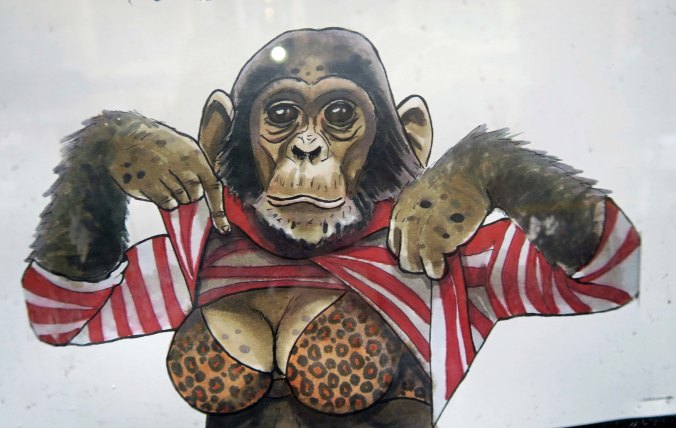
Had I not been walking in Boston, I would have missed this bodacious baboon who was advertising a play near Paul Revere's house in North Boston.

Had I not been walking in Boston, I would have missed this bodacious baboon who was advertising a play near Paul Revere’s house in North Boston.

My favorite way to see a city is to walk. Actually, it is my favorite way to see anything. You miss a great deal in a car, or on a tour bus, or by using public transit. Even a bicycle has its limits, especially in a city where you are busy dodging cars and trucks. But with walking you can lollygag, stop when you want, or put on a burst of speed if you have to be somewhere. You may laugh at the latter, but you have never been with Peggy when she decides to take off. It’s zippity-doo-dah time. Strong hikers have been known to whine about keeping up.

I’ve shown you a fair amount of historical Boston in my last three Boston blogs. Today I am going to wrap up the series and feature some of the photos Peggy and I captured that didn’t fit into the first three blogs. Enjoy.

Ma was all dressed up in her Christmas cap, as were her ducklings.

Ma Duck was all dressed up in her Christmas cap, as were her ducklings.

Quincy Market backs up to Faneuil Hall. The trees in its plaza were beautifully lit for the season.

Quincy Market backs up to Faneuil Hall. The trees in its plaza were beautifully lit for the season.

Built in the early 1800s, Quincy Market is now crammed full of market-stall type restaurants filled with tempting goodies.

Built in the early 1800s, Quincy Market is now crammed full of market-stall type restaurants filled with tempting goodies. The people were waiting for performances by a high school band and a high school chorus.

The goodies inside included these candy apples. There is something for everyone!

The goodies inside included these candy apples. There is something for everyone, including M&M covered apples. Hmmm.

Peggy and I visited the Market twice since it was close to our hotel: once at night when it was packed and then early in the morning when this photo was taken.

Peggy and I visited the Market twice since it was close to our hotel: once at night when it was packed and then early in the morning when this photo was taken.

Some kids came by to play this piano while we were sitting in the market drinking coffee.

Some kids came by to play this piano while we were sitting in the market drinking coffee. I really like the idea of having a “Play Me, I’m Yours,” piano available. The kids were really good. It turned out they were from the band playing outside.

This is what we saw looking up from our seats.

This is what we saw looking up from our seats.

The band outside warms up. Literally. Soon afterwards it started to snow.
The band outside warms up. Literally. Soon afterwards it started to snow.

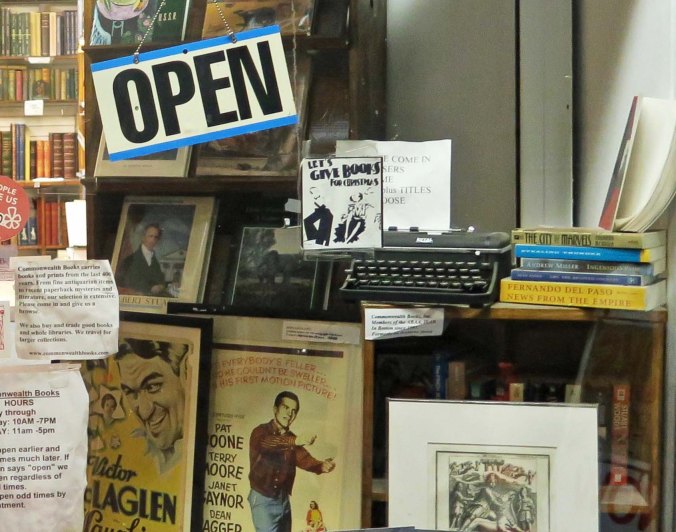
The Commonwealth Bookstore pulled us in with this display.
The nearby Commonwealth Bookstore pulled us in with this display.

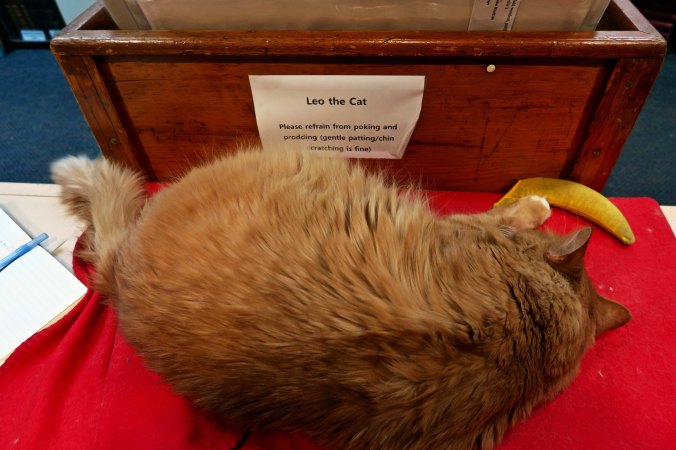
I knew it was a good bookstore when I found Leo.

I knew it was a good bookstore when I found Leo. I am convinced that any bookstore with a cat is a good bookstore. The sign requested that customers please refrain from poking or prodding Leo. “Gentle patting and chin scratching” were fine.

The Boston Public Market was just a few blocks away from the Quincy Market.

The Boston Public Market was just a few blocks away from the Quincy Market.

Winter squash and turnips were among the vegetables it featured.

Winter squash and turnips were among the vegetables featured.

The turnips...

The turnips…

We found this sculpture in front of the John F. Kennedy Federal Building and I confess it had me scratching my head.

We found this sculpture by American Sculpture Dimitri Hadzi in front of the John F. Kennedy Federal Building and I confess it had me scratching my head. Research told me that it represented the last man standing at Thermopylae where the Spartans fought the Persians until there was only one Spartan left. I am still scratching my head.
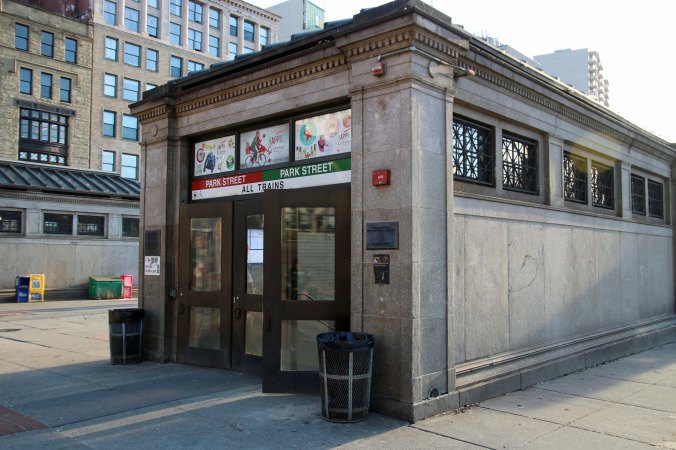
Down on the edge of the Commons we checked out the Park Street Subway System. We had been told that Boston provided excellent mass transit. I found myself wondering whether Charile was still stuck on the MTA.(Kingston Trio song).

Down on the edge of the Commons we checked out the Park Street Subway System. We had been told that Boston provides excellent mass transit. I found myself wondering whether Charlie was still stuck on the MTA.(Kingston Trio song). “But did he ever return? No he never returned. And his fate is still unlearned.” Sing it if you know it!
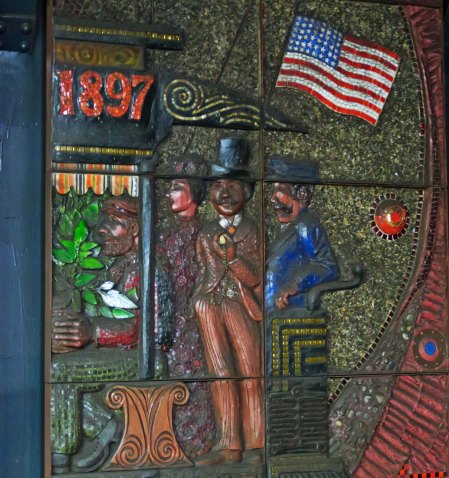
We didn't find Charlie but we did find this ceramic mosaic commemorating the opening of the line in 1897.

We didn’t find Charlie but we did find this ceramic mosaic commemorating the opening of the line. The artist, Lili Ann Rosenberg lived in the Applegate Valley of Oregon where I presently live later in her life. The Ruch Library where Peggy serves as president of the Friends of the Ruch Library features one of her ceramic works.
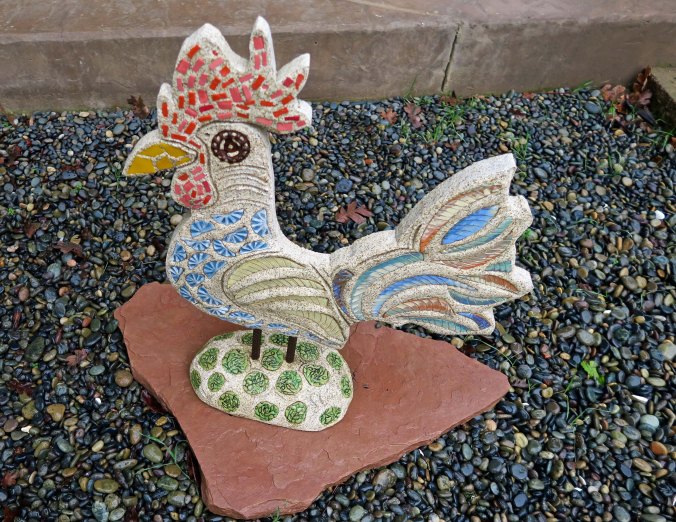
Meet Doodle (as in cock-o-doodle-do). Doodle resides in our front yard and was created by Jeremy Crisswell who worked as an apprentice under

Meet Doodle (as in cock-o-doodle-do). Doodle resides in our front yard and was created by Jeremy Crisswell, a well-known ceramic artist in our area who worked as an apprentice under Lili Ann.

The back side of Doodle.
The back side of Doodle.

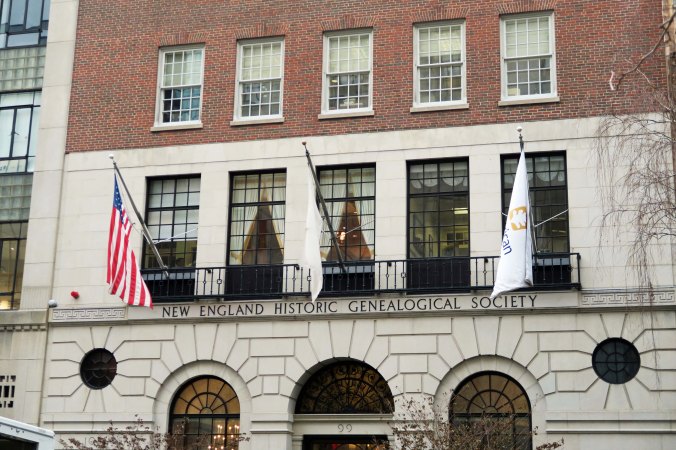
Peggy and I hiked down to the New England Genealogical Society on Newbury street to renew my membership and do a little research.

Peggy and I hiked down to the New England Genealogical Society on Newbury Street to renew my membership and do a little research.
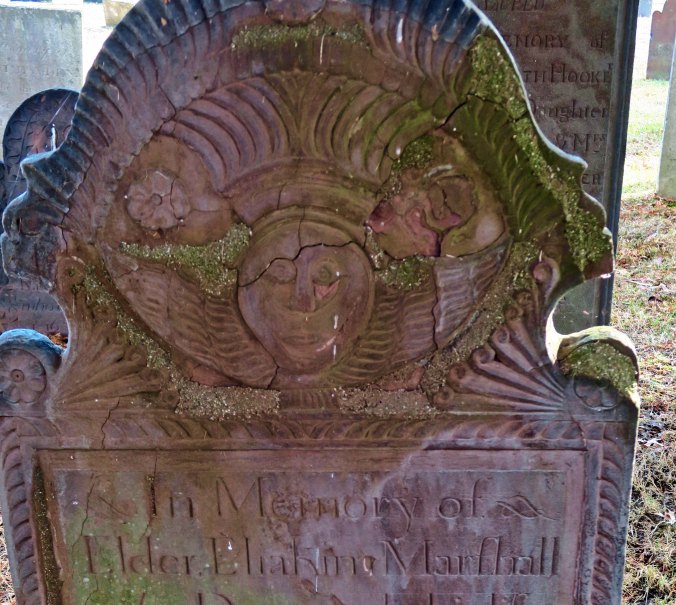
The New England Genealogical Society has been a good source of information about the Marshall's of Windsor, Connecticut. This is Eliakim who was a Deacon in the church. I am hoping that the Society may have information on the Mekemsons as well.

The Society has been a good source of information about my mother’s ancestors in Windsor, Connecticut (the Marshalls).  This is Eliakim who was born in the early 1700s and was an Elder in the Windsor church. I am hoping that the Society will have information on the Mekemsons as well. Interesting headstone, eh?

Newbury is filled with exclusive shops, including for those who have 'a pea in pod.'

Newbury is filled with exclusive shops, such as this one for women who have ‘a pea in the pod.’ Looks like more than a pea to me.

The area is known as Back Bay because it was reclaimed from the Bay. It became a center for very expensive homes competing with Beacon Hill for the wealthy of Boston.

This area was once part of the bay but was filled in by chopping off the tops of Boston’s higher hills. Once filled in, it became a location for very expensive homes competing with Beacon Hill for the wealthy of Boston. This one has been converted to shops.

There are more photos, always, but I will conclude my Boston series with this picture of the old Custom's Building. The hands on the clock are made of copper covered California redwood.

There are more photos, always, but I will conclude my Boston series with this picture of the old Custom’s Building. The hands on the clock are made of copper covered California redwood.

NEXT BLOGS:

Wednesday: It’s time for the next post in the Sierra Trek series where I am accused of running a pot-smoking-orgy in the mountains. Woohoo!

Friday: More of the fantastic mutant vehicles/art cars of Burning Man.

Monday: Remember Sully, the pilot who saved the lives of his passengers by landing on the Hudson River in New York City? We are going to check out his plane. It now resides in a museum in Charlotte, North Carolina. It’s amazing that it floated.

HAPPY VALENTINES DAY!


Did Bessie Eat Grandma’s Ear? The Boston Series

An estimated 5000 people are buried in the two acre Granary Graveyard. A few of them even have tombstones. It helps to be a Revolutionary War hero.

An estimated 5000 people are buried in the two acre Granary Graveyard. A few of them even have tombstones. It helps to be a Revolutionary War hero.

My laptop has finally returned from the doctor! So I can return to the world of blogging. It’s back to Boston and the Revolutionary War today.

Call it yellow journalism, if you will, or a post with a National Enquirer flair. Except this story isn’t filled with the ‘alternative facts’ of modern tabloids, tweets, and Facebook. Bodies did actually float to the surface in the Granary Graveyard found along Boston’s Freedom Trail. Back in the early 1700s, families occasionally discovered their loved ones surfing and needed to replant them.

It was a swampy area, overcrowded with dead bodies. An estimated 5,000 people were buried in the two acres. Digging a new grave inevitably meant running into the previously departed. Plus, there were the cow pies. Grass grew quickly in the graveyard (was it because of the wet conditions or the enriched soil) and the city fathers determined there was money to be made by renting the land out to a grave-digger as a pasture for his cattle. On a positive note, he was required to repair any damage his herd caused.

I imagine his report to Boston’s Selectmen went something like this: “Yes sir, Old Bessie did eat Grandma’s ear. She thought it was a mushroom. But I reburied Grandma along with the appropriate cow pile.” (Definitely an alternative fact.)

Today the Granary Graveyard is considered to be one of America’s most hallowed grounds. Benjamin Franklin’s parents are buried here. As are several Revolutionary War heroes including Paul Revere, John Hancock, Samuel Adams, James Otis, and Robert Treat Paine. Hancock, Adams and Paine were all signers of the Declaration of Independence. There is also a grave marker for the five men who died in the Boston Massacre— Crispus Attucks, Samuel Gray, Samuel Maverick, James Caldwell, and Patrick Carr.

Samuel Adams is one of the Revolutionary War Heroes buried in the Granary. One of America's most ardent revolutionaries, he was an early proponent of independence from England.

Samuel Adams is one of the Revolutionary War Heroes buried in the Granary. One of America’s most ardent revolutionaries, he was an early proponent of independence from England.

The graveyard backs up the stately Park Street Church, which in turn, sits on the edge of the Boston Commons. The leading Abolitionist, William Lloyd Garrison, gave his first fiery sermon against slavery in the church on July 4, 1829, and the anthem, America (“My country tis of thee, sweet land of liberty…”) was first sung from its doorstep. Liberty wasn’t so sweet for black people.

Park Street Church was built in the early 1800s and became a center of opposition to slavery.

Park Street Church was built in the early 1800s and became a center of opposition to slavery.

As for the Commons, it was a true cow pasture. Communities in early New England often set aside a common area where all of the town’s cattle and other livestock could graze and be jointly tended. In 1775 the British turned it into a campground for its Redcoats. That would be the common soldiers, of course; the officers stayed in much more amenable accommodations, held parties and danced the night away. Today the Commons is an attractive public park and has served as a rallying point for the likes of Martin Luther King, Pope John Paul II and the recent Women’s March. Massachusetts’ attractive gold-dome statehouse overlooks the area.

The Massachusetts' State House overalls the bucolic Boston Commons.

The Massachusetts’ State House overalls the bucolic Boston Commons. (Photo by Peggy Mekemson.)

One of the really attractive things about the Freedom Trail, besides its historical significance, is the fact that it can easily be walked in a few hours, or a day if you prefer to dawdle and take time at each of the sites. Or, if walking isn’t your thing, a number of popular bus tours will take you to all of the locations minus the exercise.

Peggy and I did most of the Trail but didn’t cross the Charles River to Bunker Hill. That will have to wait for another time. We did, however, reach Copp’s Hill Burying Ground, a site I found equally interesting to the Granary Graveyard, not because of the people buried there, but because of the tombstones.

The crooked tombstones on Cobb's Hill remind me of someone having a really bad tooth day.

The crooked tombstones on Cobb’s Hill remind me of someone having a really bad tooth day.

Another view of the tombstones on Cobb's Hill.

Another view of the crooked tombstones on Cobb’s Hill.

The Puritans were sensitive about elaborate headstones, wanting to keep things simple. This death's head with its crossed bones was allowed, however, and is found on many early tombstones in the New England region.

The Puritans/Congregationalists were sensitive about elaborate headstones, wanting to keep things simple. This death’s-head with its crossed bones was allowed, however, and is found on many early tombstones in the New England region, including those of my ancestors.

Later, a slightly more friendly cherub was allowed, including this one found in the Cobb's Hill Burial Ground.

Later, a slightly more friendly cherub was allowed, including this one found in the Cobb’s Hill Burial Ground. I think it may be smiling.

I’ve already introduced you to a number of sites along the Freedom Trail including Paul Revere’s home, the Old North Church, the Old State House, the Old Corner Bookstore (there are a lot of old things in Boston), Faneuil Hall, and the Latin School. I’ll finish my posts on Boston today with a few other sites and some additional photos of Faneuil Hall and the Old Statehouse.

This is a modern version of the Green Dragon Tavern that served as a secret gathering place for hatching many of the early protests against England's efforts to tax the colonies, including the Boston Tea Party.

This is a modern version of the Green Dragon Tavern that served as a secret gathering place for hatching many of the early protests against England’s efforts to tax the colonies, including the Boston Tea Party.

Faneuil Hall served as a more public venue for discussing the tax on tea. It wasn't big enough to accommodate everyone who wanted to protest however...

Faneuil Hall served as a more public venue for discussing the tax on tea. It wasn’t big enough to accommodate everyone who wanted to protest however…

So the meeting was switched to the Old South Meeting House, which was apparently big enough to accommodate the 5,000 people who wanted to participate. Samuel Adam's final words to the gathering, "This meeting can do nothing more to save the country," were apparently the secret rallying cry that sent the Sons of Liberty dressed as Mohawk Indians off to the Boston Harbor for their Tea Party.

So the meeting was switched to the Old South Meeting House, the largest building in Boston at the time. Samuel Adam’s final statement to the gathering, “This meeting can do nothing more to save the country,” was apparently the secret rallying cry that sent the Sons of Liberty dressed as Mohawk Indians off to Boston Harbor for their Tea Party. 

Boston's Old State House sits just across the road from Faneuil Hall. The Boston Massacre took place between the tow buildings. Check out the weather vane... (Photo by Peggy Mekemson.)

Boston’s Old State House sits just across the road from Faneuil Hall. The Boston Massacre took place between the two buildings. Check out the weather vane… (Photo by Peggy Mekemson.)

Grasshopper weathervane on top of the Old State House in Boston.

It’s a grasshopper. (Photo by Peggy Mekemson.)

You may have noticed the lion and the unicorn on the Statehouse as well. This symbols of British power were torn down after the Declaration of Independence and were later restored.

The lion and the unicorn on the Statehouse are symbols of British power. They were torn down after the Declaration of Independence but later restored.

NEXT BLOGS:

Wednesday: Back to the Sierra Trek. Our first night out, a conservative doctor out of Sacramento camps next to us and claims he is going back to Sacramento and tell the media that the Lung Association is running a “pot smoking orgy” in the mountains. Not true, but worrisome, none-the-less.

Friday and Saturday: The wonderfully weird world of mutant vehicles at Burning Man.