UT-OH! Chapter 15: Puberty Blues and the Dance Class from Hell

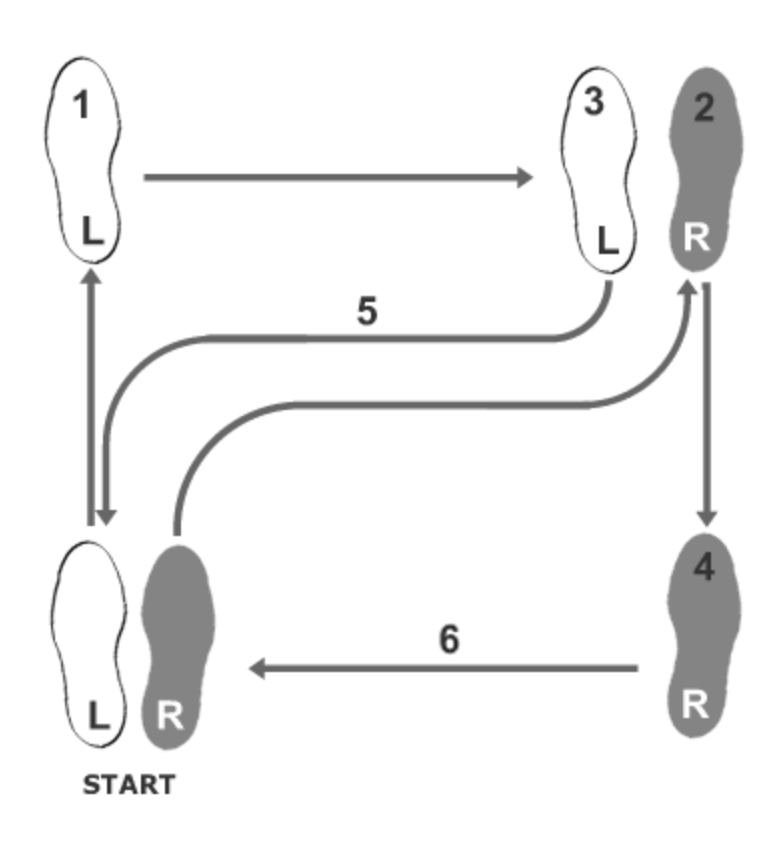
The teacher had a large diagram with a pattern that looked something like this.

Something happened between the eighth grade and high school. Here I was a happy, well-adjusted and relatively successful young man one day and a serious candidate for a strait jacket the next. Pimples popped out on my face overnight and my voice became dedicated to practicing random octave jumps. Teenage-hood, which had promised to be a mild adventure, arrived with a vengeance. I was being hormonally challenged; I had a terminal case of puberty blues.

Things started out fine. I left the eighth grade behind with great expectations. After all, I’d become a jock, had top grades, was student body president, and had a girlfriend. Damn, I was even president of the Mother Lode Twirlers, the square dance club. What could possibly go wrong? Everything…?

Take girlfriends, for instance. I expected to lose a little ground in the field of romance when I became a freshman in high school. Sophomore, junior, and even senior boys cruised the hallways in a mad scramble to check out the new crop of freshmen girls. And the older girls weren’t about to date a freshman boy, that lowest of lowly creatures. 

But I didn’t expect to bomb the way I did. I became intensely, almost painfully shy. I would walk down the hallways staring at my feet in fear that some young woman would look me in the eye. If a girl tried to talk to me, any girl, I would mutter inanities and make a run for it. The strangest statements came out of my mouth. As for asking a girl out, the odds were a little less than being struck by lightning, and the latter seemed like a less painful alternative.

It wasn’t that I didn’t notice girls. My body was one huge hormone. I just couldn’t bring myself to do anything about it. I pined for a young woman who sat in front of me in Mr. Crump’s Geography class. She was gorgeous. I was in deep lust. My knee and her butt were mere inches apart and her butt was like a magnet. I had the most intense fantasies of moving my knee forward until it made contact. In my fantasy she would, of course, turn around, smile at me and suggest we get together after school. In reality, she would have turned around and bashed me with her geography book (rightfully so), or worse, told Mr. Crump. I would have died. I kept my knee where it belonged. It is a strong testament to my love for geography that I didn’t flunk the class under the circumstances.

Desperate times call for desperate measures, however, and I was a desperate man. I signed up to master dancing in PE. I would become a combination of Arthur Murray and Elvis Presley. Step, step, slide and swivel your hips. Girls would flock to me. It wasn’t until the day of the class that I learned the magnitude of my mistake. I would have to dance with girls to learn how to dance and there they were, lined up on the opposite side of the gymnasium floor, staring at me.

“God, why did I do this to myself,” I thought as I stared across the distance at twenty females who I knew were thinking, “anybody but Curtis.” 

“Okay, boys,” the female P.E. teacher announced in a stern voice, “I want you to walk across the room now and politely ask a girl to dance with you.” Wow, that sounded like fun.

Reluctantly, I began that long walk across the gymnasium floor. I was a condemned man and the gallows were looming. I walked slower. Maybe an earthquake would strike. Maybe the Russians would shoot off an IBM missile. Maybe one of the surly seniors would throw a match in a wastebasket and the fire alarm would go off.

Maybe nothing.

I approached the line and looked for a sign. One of the girls would smile at me and crook her finger. But the girls looked exceedingly grim. A few looked desperate, like deer caught in the headlights of the proverbial 18-wheeler rushing toward them at 90 miles per hour. I picked out the one who looked most frightened on the theory that she would be the least likely to reject me.

“Uh, would you care to dance,” I managed to blurt out.

“Uh, okay,” she responded with about the same level of enthusiasm she would have if I had offered her a large plate of raw liver. It was P.E. Dance Ground Zero after all, and she wasn’t allowed to say no. We were destined to be a great couple.

“You will put your left hand in the middle of the back five inches above the waist line.” The teacher, who was now sounding more and more like a drill sergeant, carefully described what we would do with our hands. It was quite clear that there would be minimal contact and no contact with behinds. “With your right hand and arm, you will hold the girl away from you.” There would be no accidental brushing of breasts either. What fun was that? I assumed the correct position with marine-like precision. I was going to get this right. I studied the chart the teacher had put up to show us what we were supposed to do with our feet. I listened carefully to the lecture on rhythm and down beats. I watched with intensity as she demonstrated.

All too soon it was our turn. A scratchy record blasted out a long-since-dead composer’s waltz. I didn’t know who it was, but it wasn’t Elvis. With one sweaty palm in the middle of the girl’s back and the other sweaty hand holding her a proper distance away, I moved out on the floor. Step, step, slide, step, step, slide. One, two, and slide the coach barked out. My feet more or less followed the prescribed pattern. More importantly, I avoided stepping on the girl’s toes. I tried a turn and managed to avoid running into another couple. Ever so slightly I relaxed. Maybe things would be okay. Maybe I would have fun. Maybe Hell would freeze over.

“Stop, class!” the teacher yelled as she blew her whistle and yanked the needle across the record, adding another scratch. We dutifully came to a halt. What now?

“I want everyone to watch Curtis and his partner,” she announced.

“Hey, this is more like it,” I thought to myself. Not only was I surviving my first day of dance class, I was also being singled out to demonstrate. I smiled, waited for the music to start, and boldly moved out on the floor where many had trod before. Step, step, slide, step, step slide. We made it through all of three progressions when the teacher abruptly blew her whistle again.

“And that, Class,” she proclaimed triumphantly, “is not how you do it. Curtis is moving like he is late for an important date with the bathroom.”

The class roared— and I shrank. I don’t know how my partner felt, but I wanted a hole to climb in, preferably a deep hole with a steel door that I could slam shut. And I was more than embarrassed, I was mad. My normal sense of humor had galloped off into the sunset faster than a Triple Crown racehorse.

“You don’t teach someone to dance by embarrassing him,” I mumbled. An angry look crossed the teacher’s face and she started to reply. I turned my back and walked for the door.

“Where do you think you are going, Curtis? Get back here!” she demanded in a raised voice.

“I am leaving,” I replied without turning, calm now with the decision made. The class was deadly quiet. This was much more interesting than P.E. Other kids might challenge teachers, might walk out of a class, and might not even care. But not Curt. This was a guy who always did his homework, participated in class discussions, was respectful toward teachers, and aced tests.

I reached the door and put my hand on the handle.

“If you walk out that door, you may as well walk home,” the teacher barked. “I will personally see to it that you are suspended from school.”

I opened the door, walked out– and went straight to the office of the head of the P.E. Department, Steve O’Meara. Steve worked with my dad in the summer as an assistant electrician, but I knew him primarily as my science teacher.  He was a big man, gruff, and strong as a bull elephant, a jock’s jock. He demonstrated his strength by participating in the annual wheelbarrow race at the El Dorado County Fair. The race commemorated the fact that John Studebaker of automobile fame had obtained his start in Placerville manufacturing wheelbarrows for 49ers.

The County’s strongest men would line up with their wheelbarrows at the starting line and then rush to fill a gunny sack with sand at the starter’s gun. They would then push their wheelbarrows and loads at breakneck speed around an obstacle course that included mud holes, a rock-strewn path, fence barriers and other such challenges. In addition to making it across the finish line first, the winner had to have fifty plus pounds of sand in his gunny sack. Underweight and he was disqualified. Steve was always our favorite to win and rarely disappointed us. He also had a very loud voice.

“What’s up, Curt,” he roared when I entered his office. I knew Steve didn’t eat kids for lunch but you always wondered a little.

“I think you are supposed to expel me,” I replied. He started to laugh until he saw my expression. Mortification and anger on the face of a 14-year-old are never a pretty sight.

He became serious. “Sit down and tell me what’s happening,” he suggested in an almost gentle voice.

Ten minutes later I walked out of his office with a reprieve. I didn’t have to go back to the dance class and could finish out the quarter playing volleyball.  Steve would have a discussion with the dance instructor. I imagine she ended up about as unhappy as I was. At least I hoped so. I entertained a small thought that she would hesitate the next time before traumatizing some gawky kid whose only goal in attending her class was to become a little less gawky. It would be a long time before I would step onto a dance floor again.
UT-OH! Chapter 14: Surviving Baseball Bats and Dynamite Caps

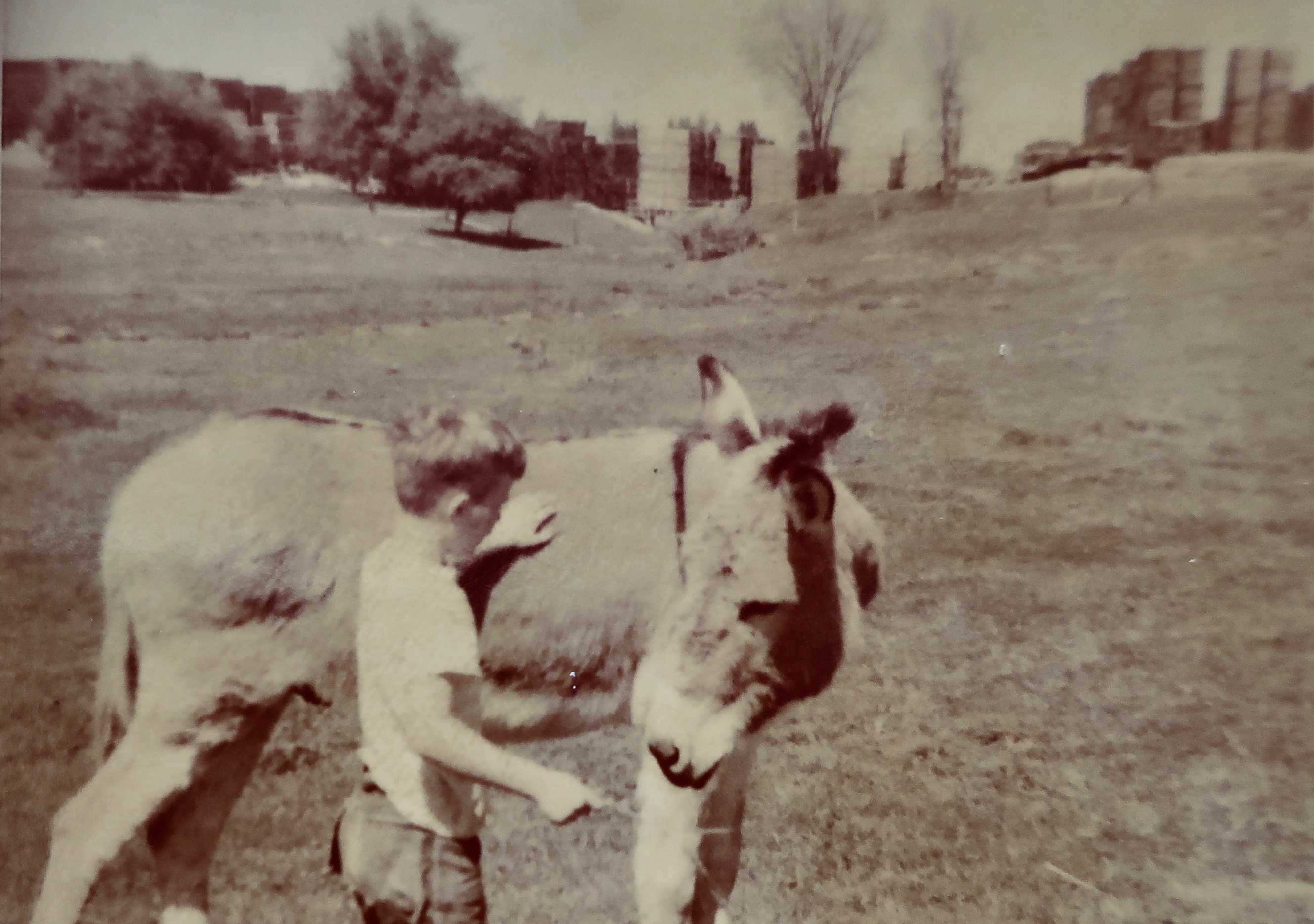
This donkey was hardly dangerous. I was offering it a carrot. The stacks of lumber in the background, at Caldor Lumber Company’s drying yard, had potential, however. One of our sports was climbing to the top of the stacks and leaping between them.

That we survived childhood wasn’t necessarily a given. Racing up and down a 75-foot-tall tree, leaping between 20 foot high lumber stacks, joyriding on railroad push carts, avoiding being shot, playing on a 50 foot high trestle and other similar activities aren’t particularly conducive to a healthy childhood. On a scale of 1-10, I would have placed Marshall’s chances of harm at 9.9 while mine were more like 4.4. I took my share of risks, but rarely without considering consequences. Marshall rarely did. Pop provided some perspective years later.

“If Marshall screamed, I ran. When you screamed, I walked.”

Except for the dog bite and stepping on a rusty nail once, my serious injuries were more in the nature of stubbed toes. Not that I am minimizing the pain of a stubbed toe, mind you. They hurt like hell. There is a reason why flaying skin was a form of torture in ancient times. I’d have certainly been willing to confess things I had done, and lots of things I hadn’t. 

I did have a baseball bat used on me once, however. My parents were semi-serious Republicans, semi in the sense that they didn’t devote their lives to the cause but they did vote the party line. The family tradition went back to Abe Lincoln and the founding of the Party. A quote in a book written by my Great Grandfather stated, “We have always been Republicans, and we always will be.”

My indoctrination started young with the 1952 campaign of Dwight Eisenhower against Adlai Stevenson. According to Mother, Franklin Roosevelt and Harry Truman were responsible for most of the bad things that existed in the Country, and Ike was going to right the wrongs of the previous two decades. I, of course, accepted this view whole-heartedly, and had all the makings of a fine Young Republican. Naturally I was eager to share my correct or ‘right’ perspective with fellow students and proudly wore an I Like Ike button to school.

They weren’t particularly interested. 

After all, what do nine year olds know or care about politics? One student, whose parents were avid Democrats, was ready to take me on, however. He wore a button that declared Adlai was Our Next President. Our debate started in the boys’ bathroom when we were lined up at the urinals, and continued on to the playground. Things began well. Even then I was a high verbal, and the points I didn’t win on logic, I was taking with volume. But the situation deteriorated rapidly. My fellow debater did what most politicians do when they appear to be losing ground— he started slinging mud.

“Eisenhower is a blankety, blank,” he declared with a smirk to underline his cleverness. It was his mistake; now we were talking my language.

“In that case,” I argued with glee, “Stevenson is a blankety-blank, blank, blank.” I had more blanks. Marshall, and Allen had taught me every swear word in the English language and a few in Spanish. I could go on for minutes without repeating myself. In fact Allen and I had challenged each other to a contest once to see who could swear the longest and the loudest. 

There was a vacant lot filled with tall grass down on the corner where Missouri Flat Road ran into Highway 49. We got down on our hands and knees and chased each other through the grass while shouting obscenities at the top of our lungs.  We were so engrossed in our efforts that we didn’t note that Marsh had time to run the block home and retrieve Pop to listen in on the exchange. He was not impressed with our command of the language or our volume. My thought about Marshall for telling was that he was a blankety-blank, blank, blank, blank, blank. A real asshole.

Anyway, I was not to be outdone in the mudslinging department; I had a bright future as a campaign manager. I demolished my opponent. Regrettably, I was about to learn an important Hobbesian lesson in power politics: Never start political arguments with a person carrying a baseball bat, which he was. When I continued to hassle him out on the playground, he wound up and swung the bat like he was going for a home run, whacking me across my right leg. Down I went onto the playground and off I went to the hospital as my leg muscle knotted up to the size of a softball. Fortunately, he didn’t break a bone— and my man Ike won the election.

Marshall’s scariest accident happened at Caldor’s logging camp. One summer, Pop arranged for the family to use a house at the camp for a week’s vacation. It was a great opportunity. We were surrounded by El Dorado National Forest, and we could wander to our heart’s content. 

The first day out, we discovered an old miner’s shack that had long since given up any pretense of being useful. It was leaning precariously. Naturally, we had to explore it. There might be a treasure. Dark and musty comes to mind as my first impression. Floors creaked in objection on our entrance. A pack rat had set up home in one corner. A treasure for Tickle the dog, perhaps, but not for us. 

A table in the opposite corner held more promise. We found an old Phillies Cigar box on top, which was a treasure in itself. Inside there was more: Dynamite caps! Think Big Bang.  Caps contain a small amount of an explosive material that when lit by a connected electric current, cause a blast that sets off the dynamite. BOOM. My immediate reaction was to get out of the shack. Marshall’s was to take the box with us. I assumed he was going to give it to Pop so he could dispose of the caps. It was never wise to make assumptions about what my brother might do.

Mother was putting dinner on the table and Marshall was still outside when we heard a loud bang followed by a louder scream. Pop ran. Marshall had held a match down to the dynamite cap to see what would happen. He found out. The whole front of his body from his groin to his head was covered in blood. The only thing that saved his eye sight was that he was wearing shatter-proof glasses. A neighbor, who had come out at the sound of the blast and scream, immediately volunteered to take Nancy and me for the night. My parents jumped in our car and rushed off to the hospital in Placerville, 20 miles away.

 Marshall spent a couple of days in the hospital as the doctor removed brass splinters from his body. We returned home. So much for our idyllic vacation. The important thing was that Marshall survived the experience— possibly a bit wiser. Occasional splinters of brass were still making their way out of his skin when he was in his 20s.

UT-OH! Chapter 10: “Mom, the Mekemson Kids Did It.”

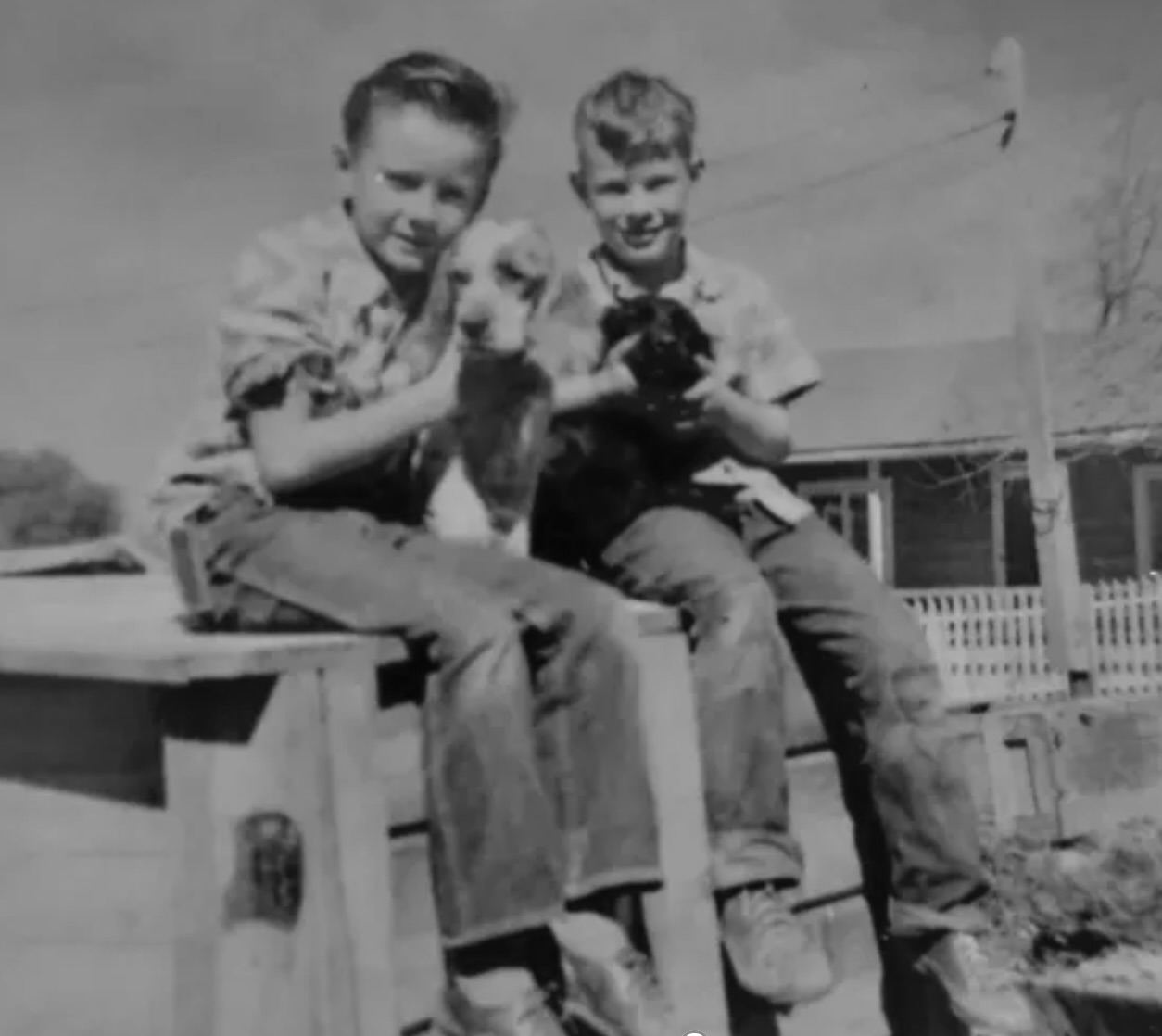
Do these kids, in any way, look like they would have a reputation as trouble makers? Marshall is on the left with Tickle. I’m on the right with one of Coaly’s offsprings. We are sitting on top of the shed our goats lived in. I was in charge of taking care of them. We also had rabbits and chickens. The Passerini’s home is behind us.

While the Pond and the Woods provided an innocent and often educational escape for me, some of my outdoor time was spent getting into mischief, especially in my younger years when I roamed around Diamond and the surrounding countryside with my brother.  The primary difference between Marshal and me was that l lacked his creativity. For example, it never would have crossed my mind to put a bullet down on a rock and then smash it with another rock to see what would happen. 

What I remember most about these great adventures was that we were skating on the thin edge of trouble. Gradually, we developed a reputation. I am convinced that a whole generation of little kids in Diamond blamed their misbehavior on us. “I didn’t do it Mama, the Mekemson kids did.” And Mama probably believed them. The mother of my life-long friend, Bob Bray, did. She refused to let him play with me. I was a bad influence, guaranteed to lead her son straight into the arms of the law.

Most of our mischief was relatively harmless. Like the gunslingers of the Old West, our reputations far exceeded the reality of our actions. 

For example, Jimmy Pagonni lived across the street and had a zero-tolerance policy for us.  We lusted after his cherries. He transformed them into wine and every drop was precious. He turned his dogs loose on us if we came anywhere near his orchard. Naturally his insistence on keeping us out only guaranteed our presence.  Raids were carefully planned.

We would invite two or three friends over and make a party out of it. The cover was sleeping out in the backyard, but sleep was secondary. Somewhere around one o’clock in the morning we would slip out of our yard, cross a very lonely Highway 49, climb over Jimmy’s rickety gate, make our way up the low hill, and disappear into the trees. It was all very hush-hush and cherries have never tasted more delicious. We would stuff our little stomachs and then fill up bags for take-out. It was pure greed.

Jimmy’s dogs never caught us before we were able to scramble over the gate, but they did catch my cocker spaniel, Tickle, once, and almost kill him. Tickle had been out on the town visiting a lady friend and taken a shortcut across Pagonni’s property. We were infuriated. Marshall retaliated by shooting Jimmy’s bull in the balls with his BB gun. (If not fair to the bull, it was at least alliteration.) Jimmy never knew Marshall committed the heinous act, but I am sure he had his suspicions.

Possibly even more serious from Jimmy’s perspective, an older Marshall (eighth grade I think) helped himself to a sample of Jimmy’s wine one night. Pagonni stored the fermented cherry juice in an old Gold Rush era building that had once served as a jail. It was located right in the middle of his cherry orchard and featured a stout locked door and one barred window. I am sure Jimmy considered it impregnable, but he failed to consider just how skinny my brother was. With help from his friend Art, Marshall managed to slip through the bars one night and fill two of Mother’s empty wine bottles from one of Pagonni’s gallon jugs. Marsh then left the partially empty jug in an obvious place for Jimmy to ponder. It must have driven him crazy.

The next afternoon, Marshall and Art headed for our treehouse in the Graveyard to do some serious imbibing, each drinking a full bottle. Considering the potency of Italian Red, Marshall’s share of the booty, almost killed him, not to mention encouraging strange behavior. He described how Mrs. Ross, my 4th 5th and 6th grade teacher, came upon Art and him madly peddling their bikes. This wouldn’t have been strange except they were lying on their backs holding the bikes above them in the air! “She just shook her head and moved on,” Marsh said.

I remember him slipping in the back door that evening and trying to get to our bedroom before Mother and Pop noticed. It didn’t work. In addition to stumbling and mumbling and heaving, he smelled like a three-week gutter drunk. He was one sick kid. Both parents hurried to the bedroom out of concern and I moved back outside to sleep in the cool, but fresh fall air. It was one of those crimes that incorporates its own punishment.

We weren’t really bad kids, just adventuresome with our adventures occasionally bordering on juvenile delinquency. Caldor Lumber Company was a favorite target of ours since it provided a myriad of opportunities for weekend and after-school exploration. Twenty-foot high stacks of drying lumber were made for climbing and the truly bold might leap from one to another. The appropriately named Big Shed was filled with these stacks but I was much more fascinated by the number of owls that lived there and provided burped up scat for my natural history collection. The millpond featured floating logs that Marshall ventured out on lumberjack style, but I avoided. Not even a triple dare, or worse, older brother scorn, could tempt me into a possible dunking in the pond’s dark, murky waters. 

All of these activities paled in comparison to joy riding on rail pushcarts. Caldor had narrow gauge rail lines snaking through its drying yards and used pushcarts for transporting heavy items. We quickly discovered that three or four of us could get a cart rolling. We would then jump on for a free ride. Small downhills added a thrill factor. Fortunately, hand brakes on the carts enabled us to stop the carts before running into the stacked railroad ties that marked the end of the line. Except once.

Our nemesis at Caldor was an old fellow who had been in some type of mill related accident and left with a limp. Caldor made him the night and weekend watchman so he could continue to make a living. We provided him with something to do in an otherwise uneventful job. Sneaking up on us seemed to be a true passion of his. We kept a wary eye out. It was inevitable that he would catch us on a pushcart ride and he caught us at the most exciting point, just as it was gaining speed going downhill.

“Hey you kids, get off of that pushcart!” he yelled as he hurried after us at a slow limp. 

What were we to do? We jumped off of the pushcart and high-tailed it for the Woods, which were right next door. The pushcart, meanwhile, continued to gather speed, slammed into the ties and did a spectacular flip before sliding off down a small hill. We were duly impressed and so, apparently, was the watchman, who let out a string of obscenities as we disappeared into the pines. Pop mentioned the next day that the watchman had reported to him that the kids involved in the incident looked like us. We carefully explained that some kids from Placerville had been in town and were undoubtedly responsible.

A more serious threat arrived on our doorstep in the form of a Southern Pacific Railroad detective who claimed Marshall had been pulling spikes out of the railroad trestle over Webber Creek and throwing them into the stream. Marshall put on his ‘I’m outraged act.’  Yes, he had been throwing spikes off of the trestle into the creek below. But he would never dream of doing anything that would cause physical harm to anyone (unless they deserved it). The spikes came from piles of them left over from when Caldor had switched to logging trucks. Had the detective bothered to check to see if any spikes were missing from the trestle? No. Had he contemplated the possibility of a skinny 90-pound 12 year old kid being able to physically pull out the spikes? No. The case was closed. 

While Marshall’s innocence was sustained for once, the experience had the unfortunate consequence of eliminating the trestle as a place to play. Walking across and staring down between the railroad ties at the 50-foot drop to Weber Creek was a sure cure for summer boredom, as was contemplating the arrival of a train when we were in the middle of the trestle. If that wasn’t exciting enough, we could always walk across on the narrow plank that ran under the tracks. There were no safety railings. I once stood on it as a train roared above me. That was interesting.

My next post: Raw Sex, the Nuclear Holocaust, and Being Bonked by a Baseball: UT-OH: Chapter 11