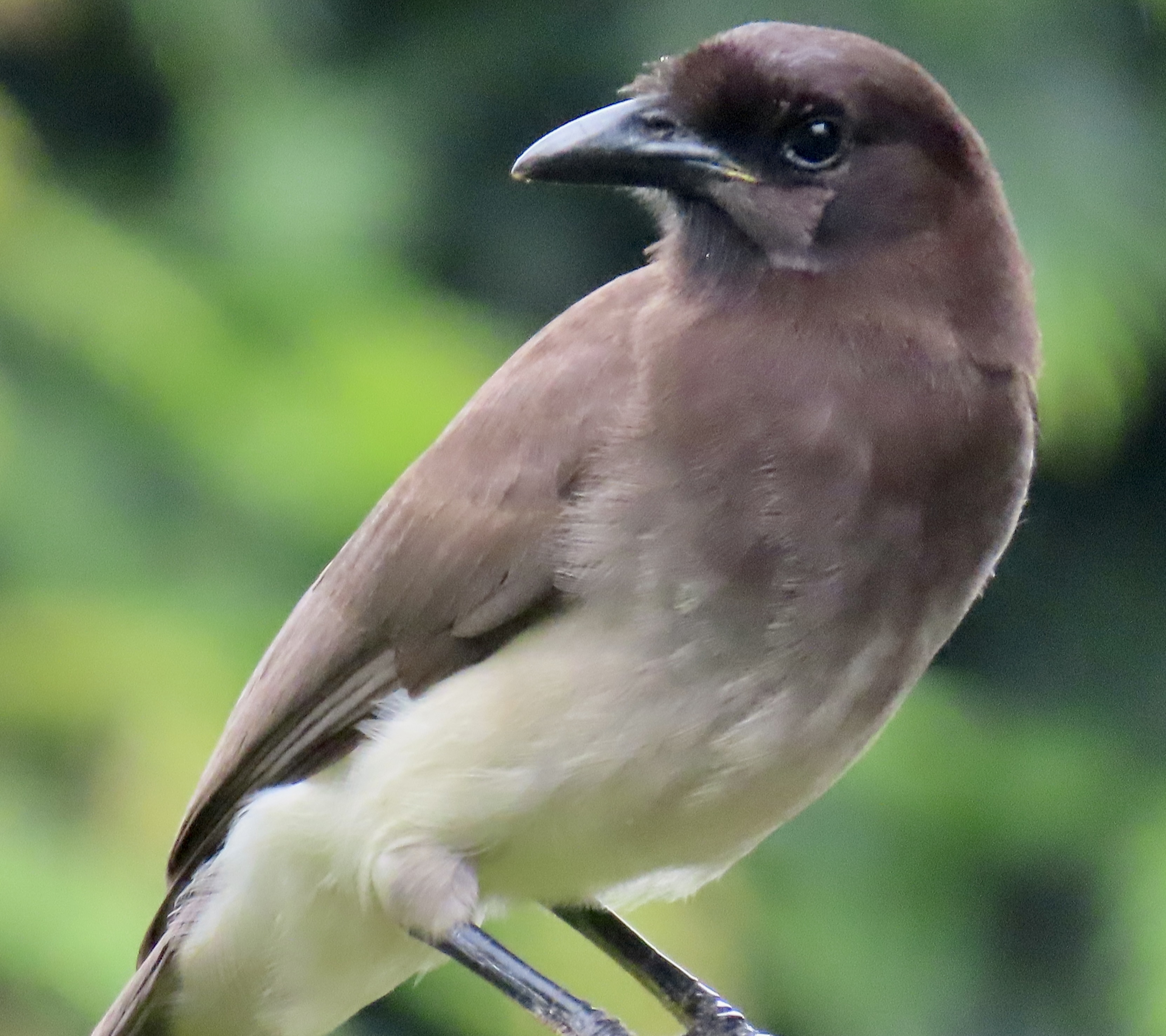
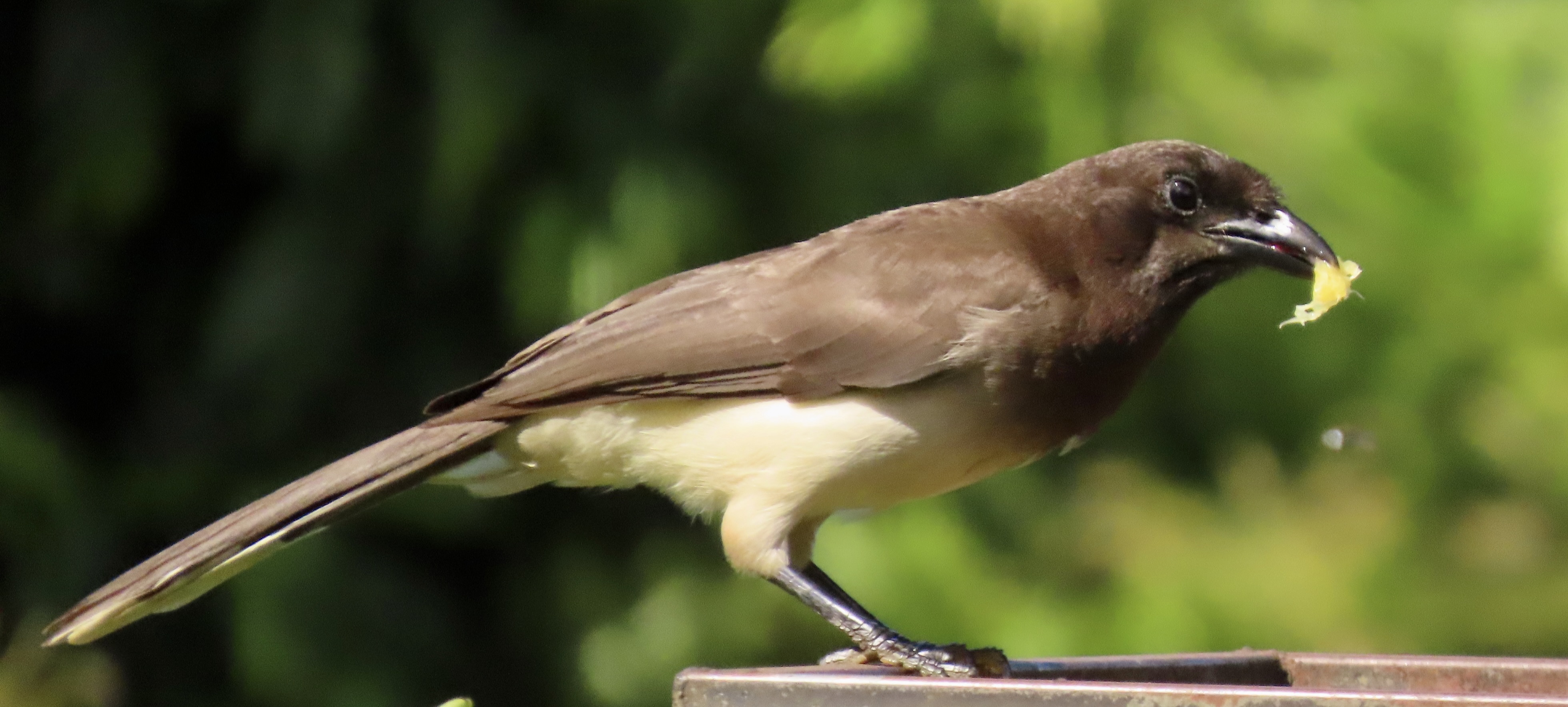
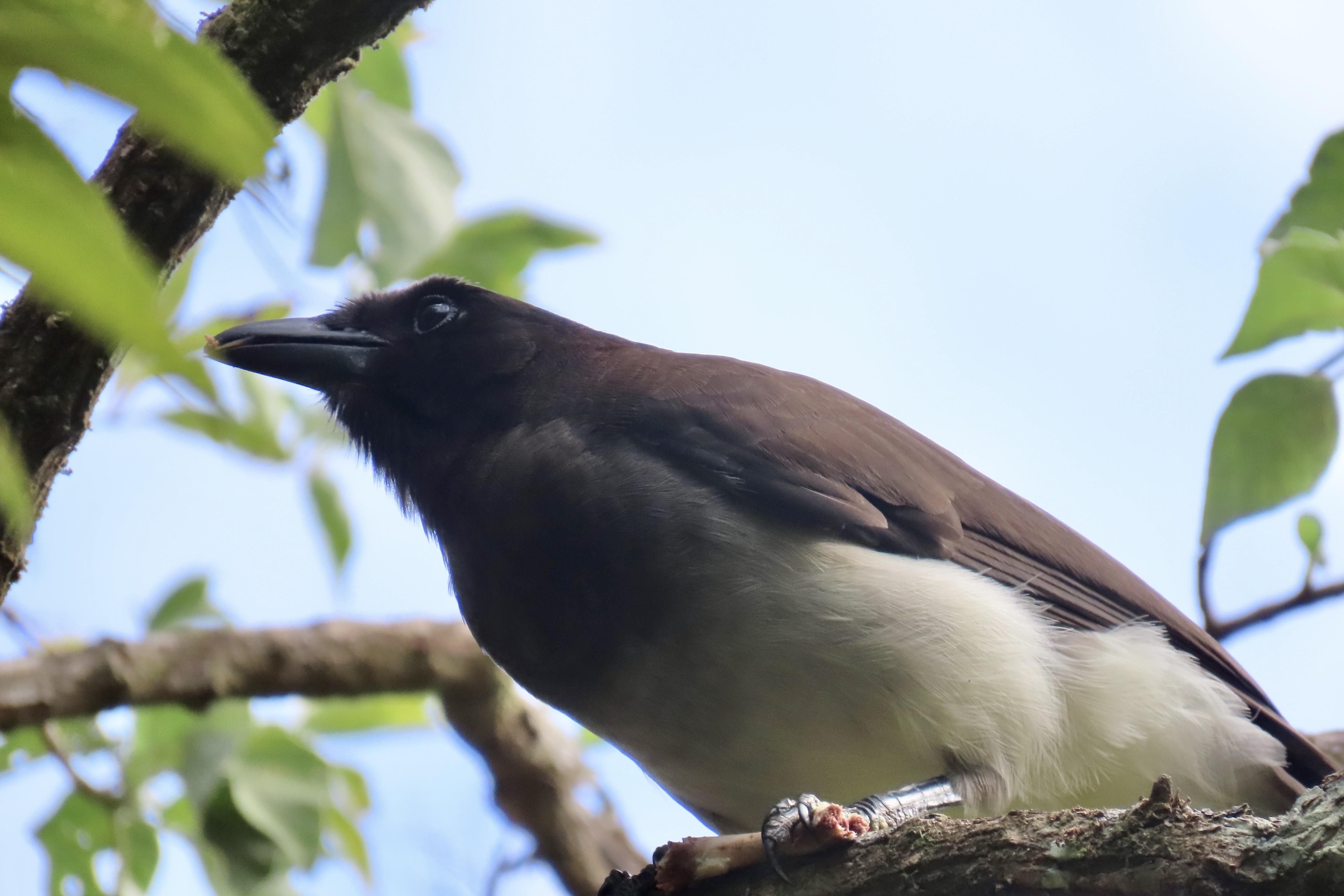
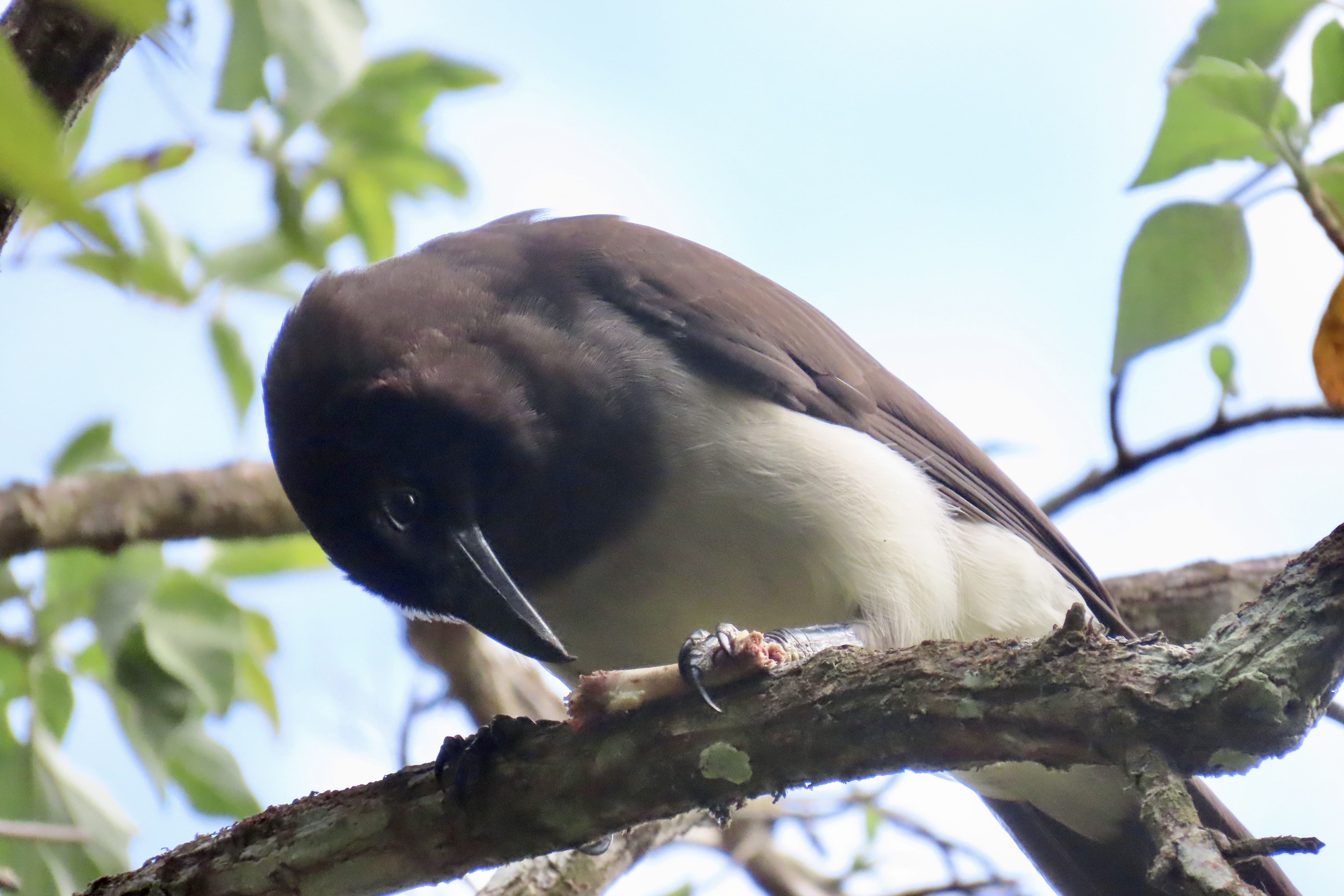
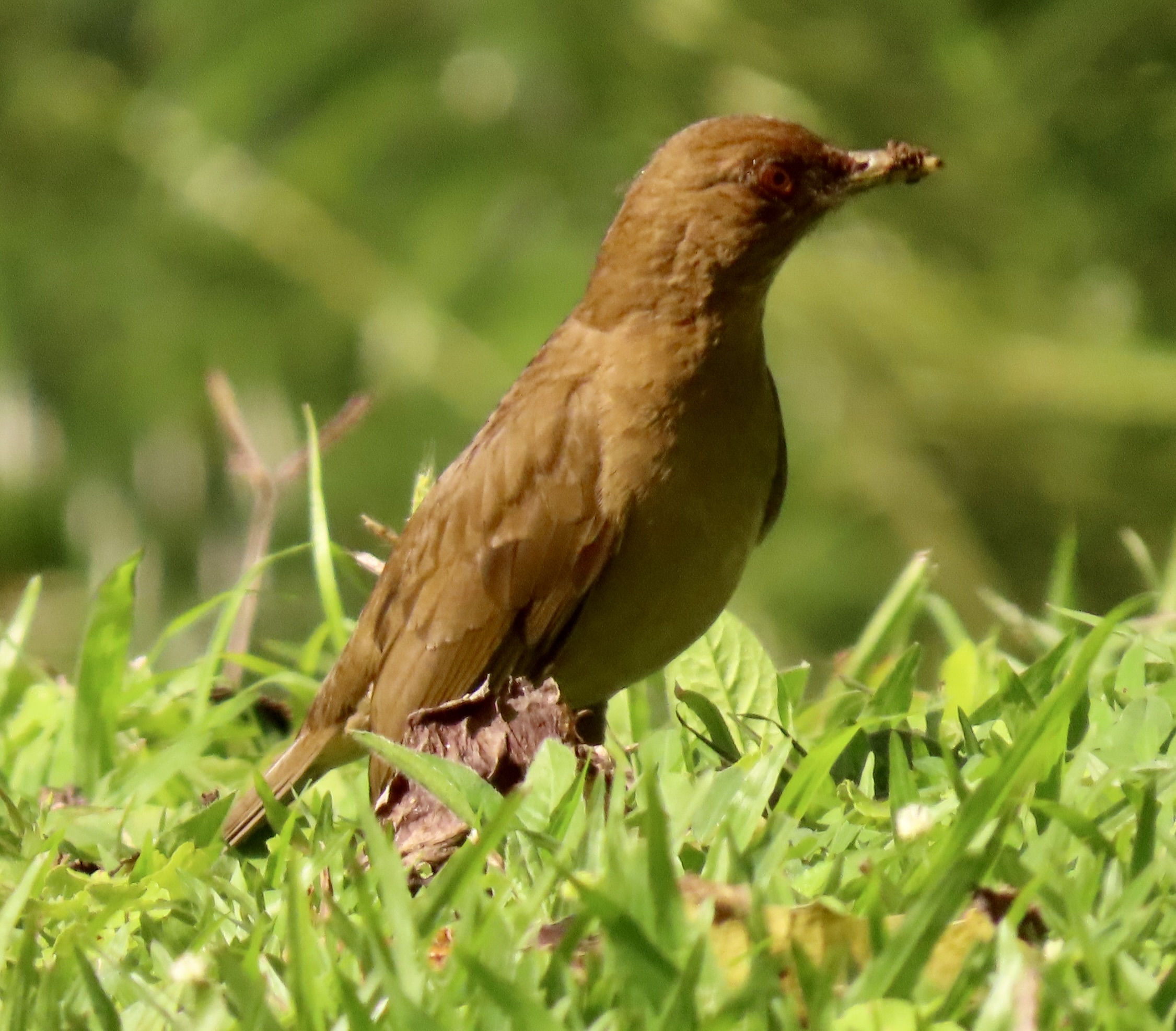
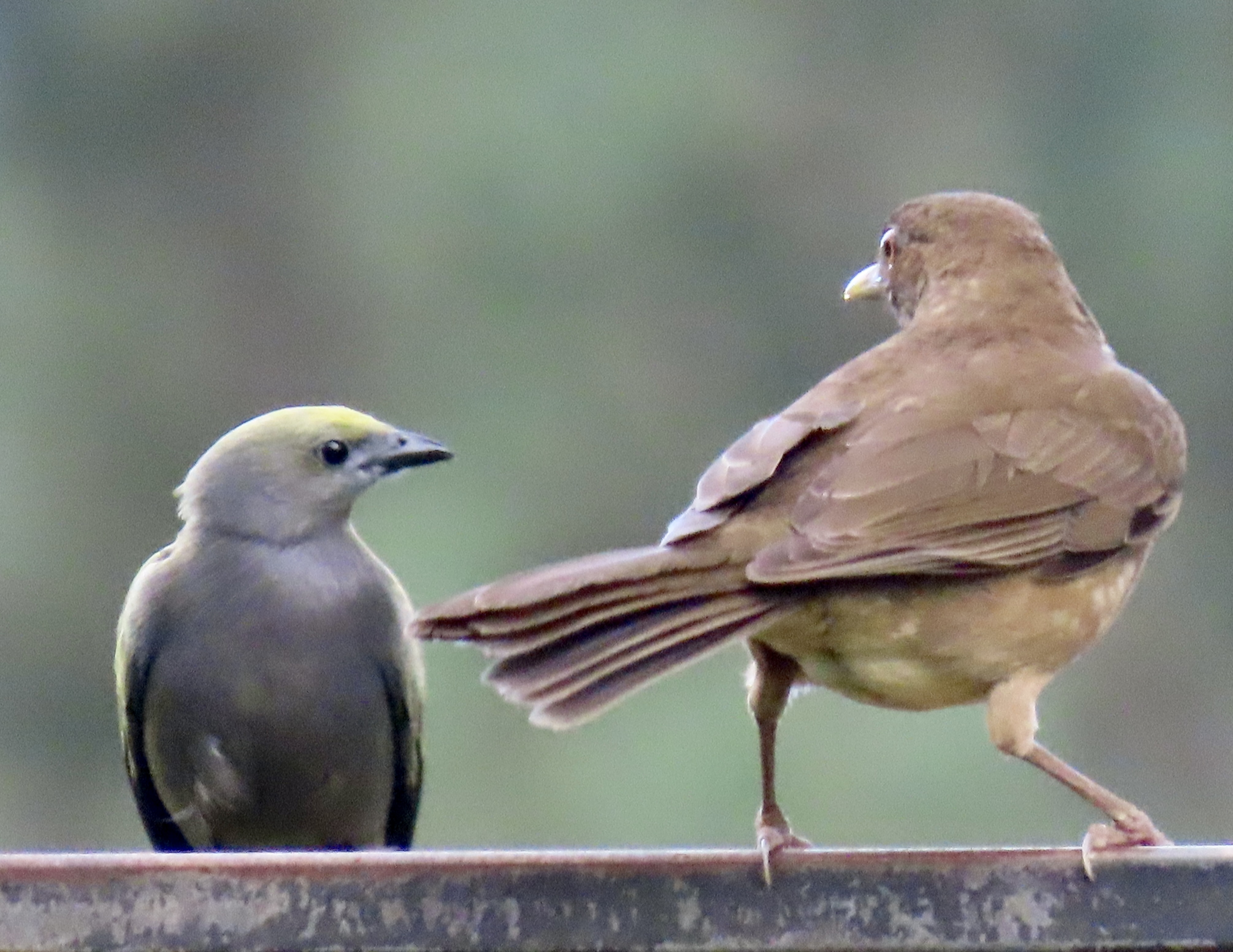
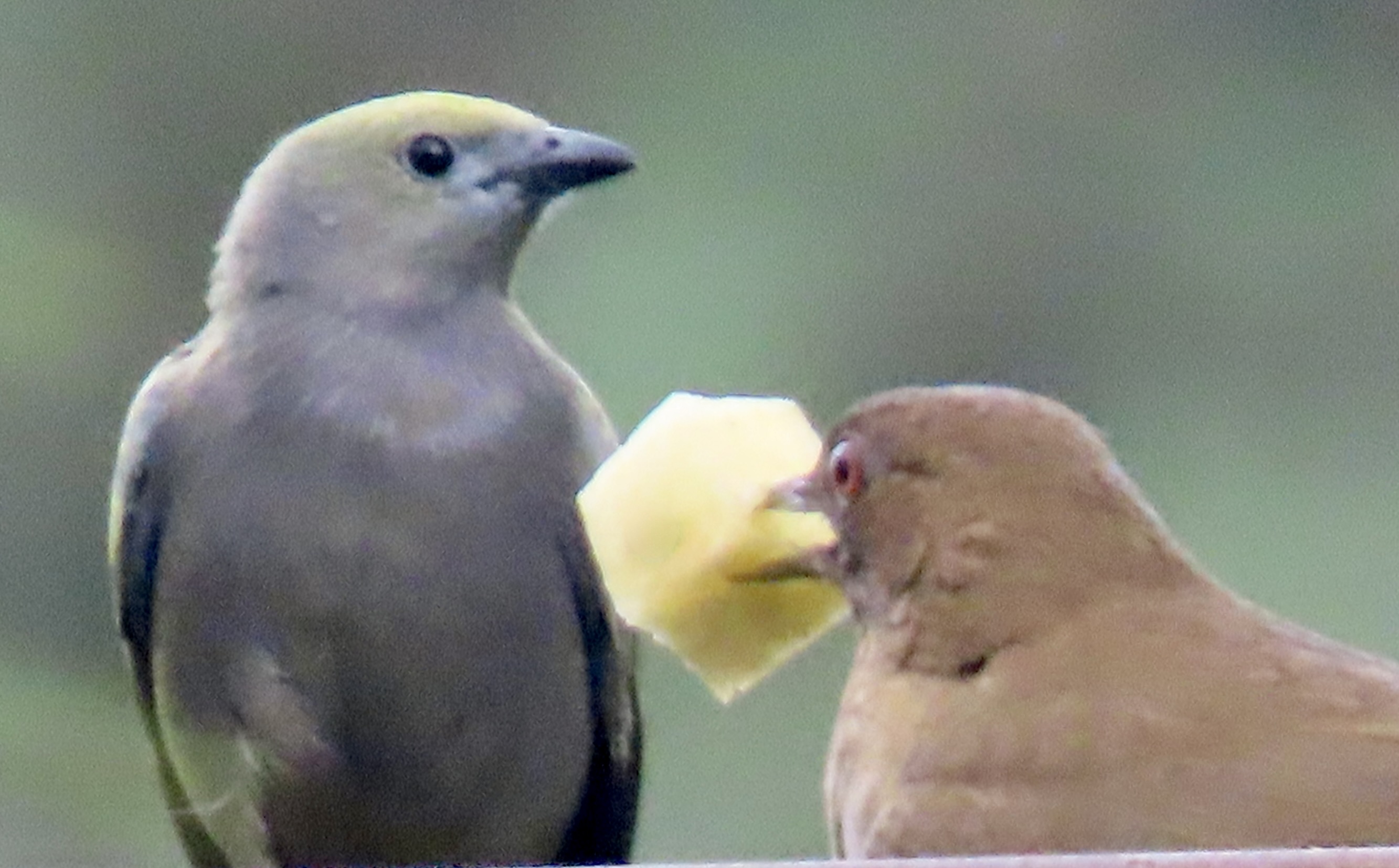
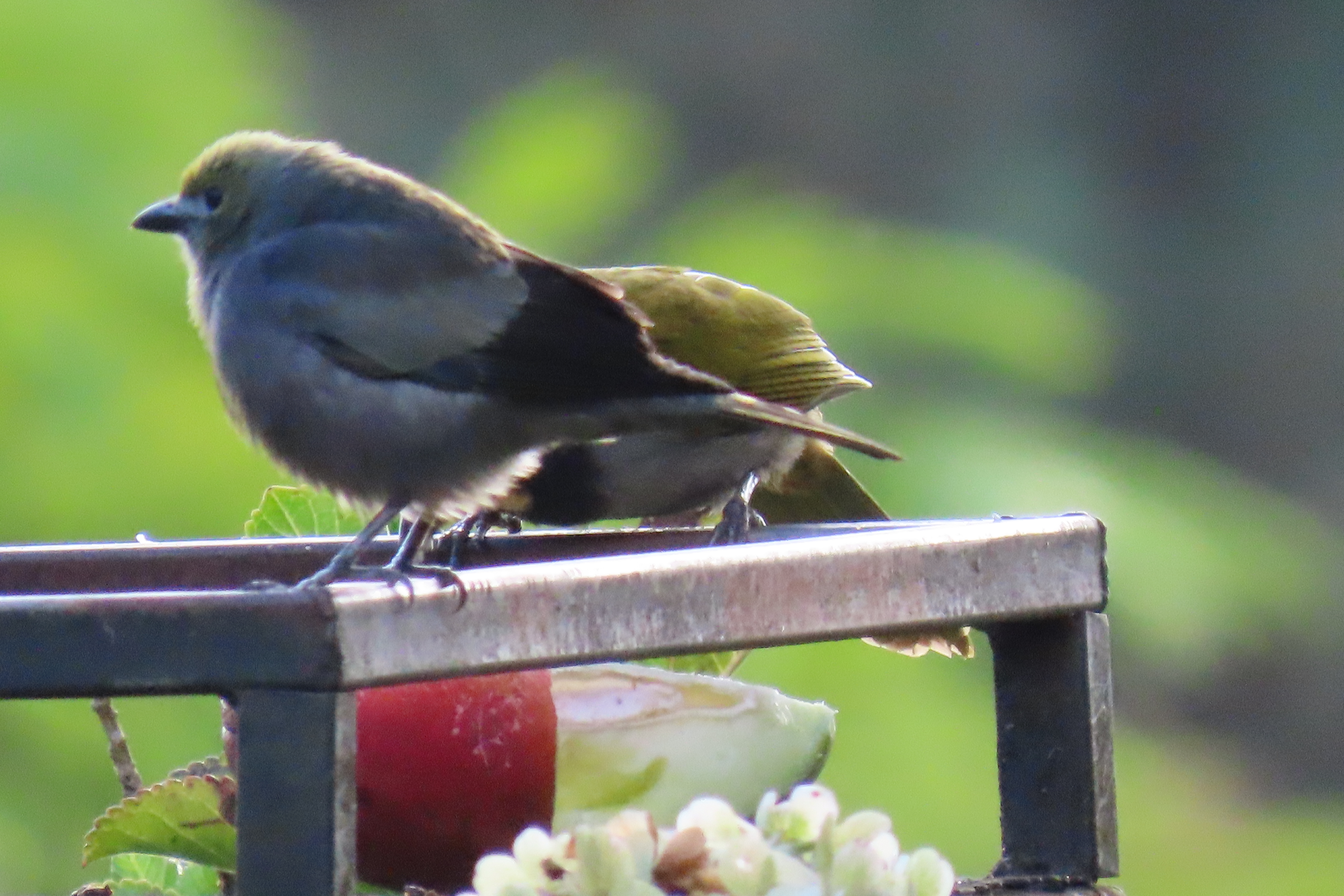
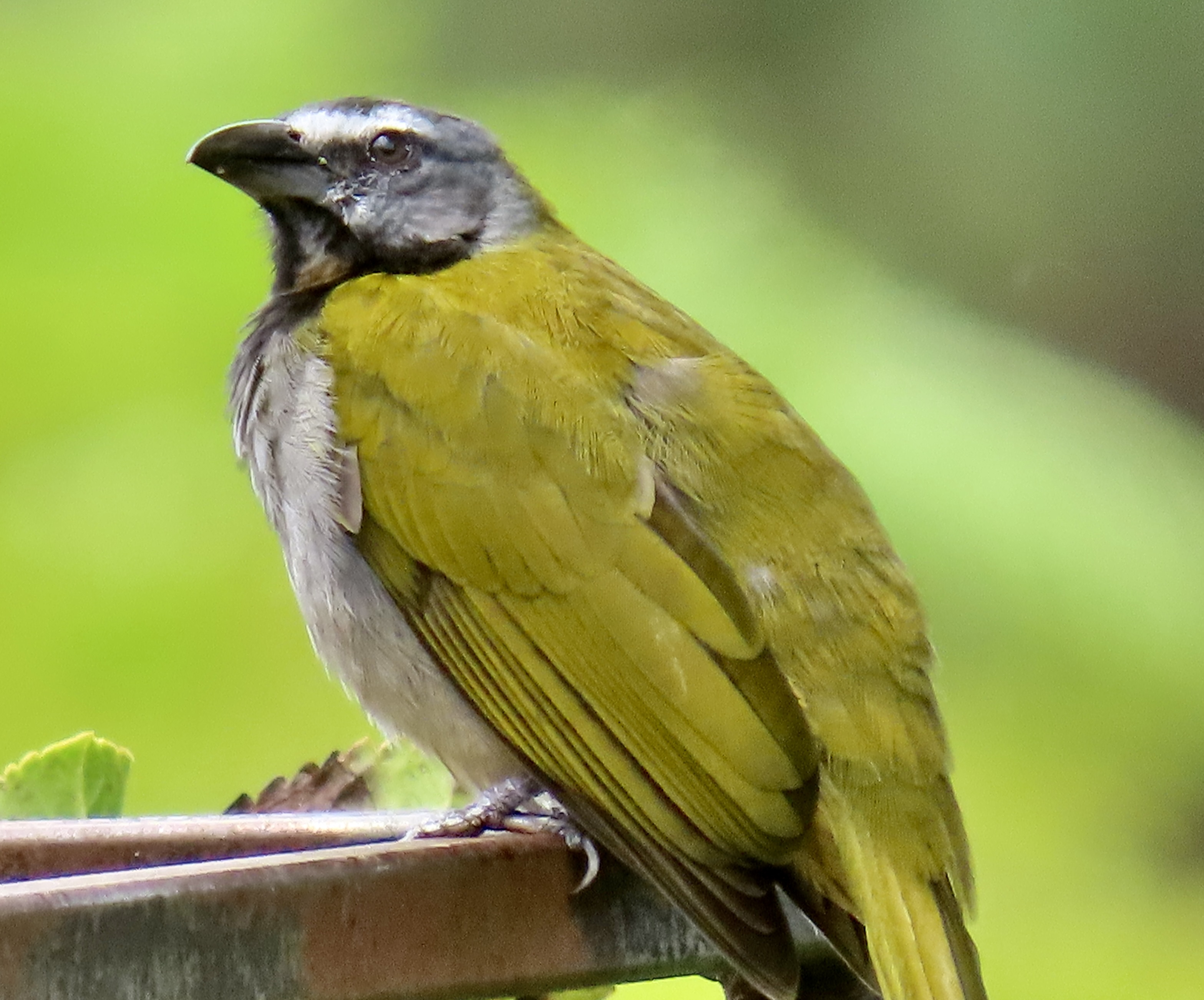
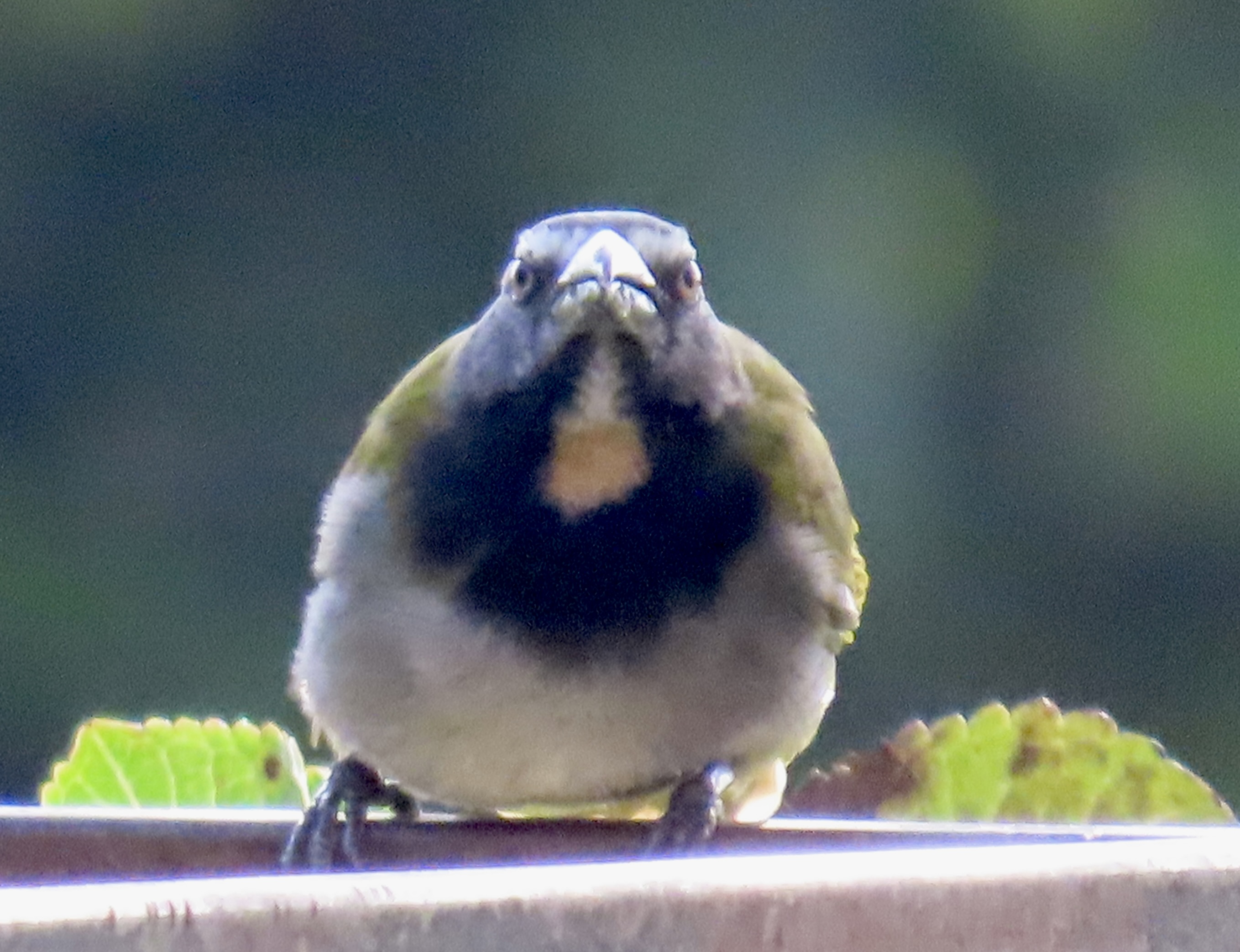
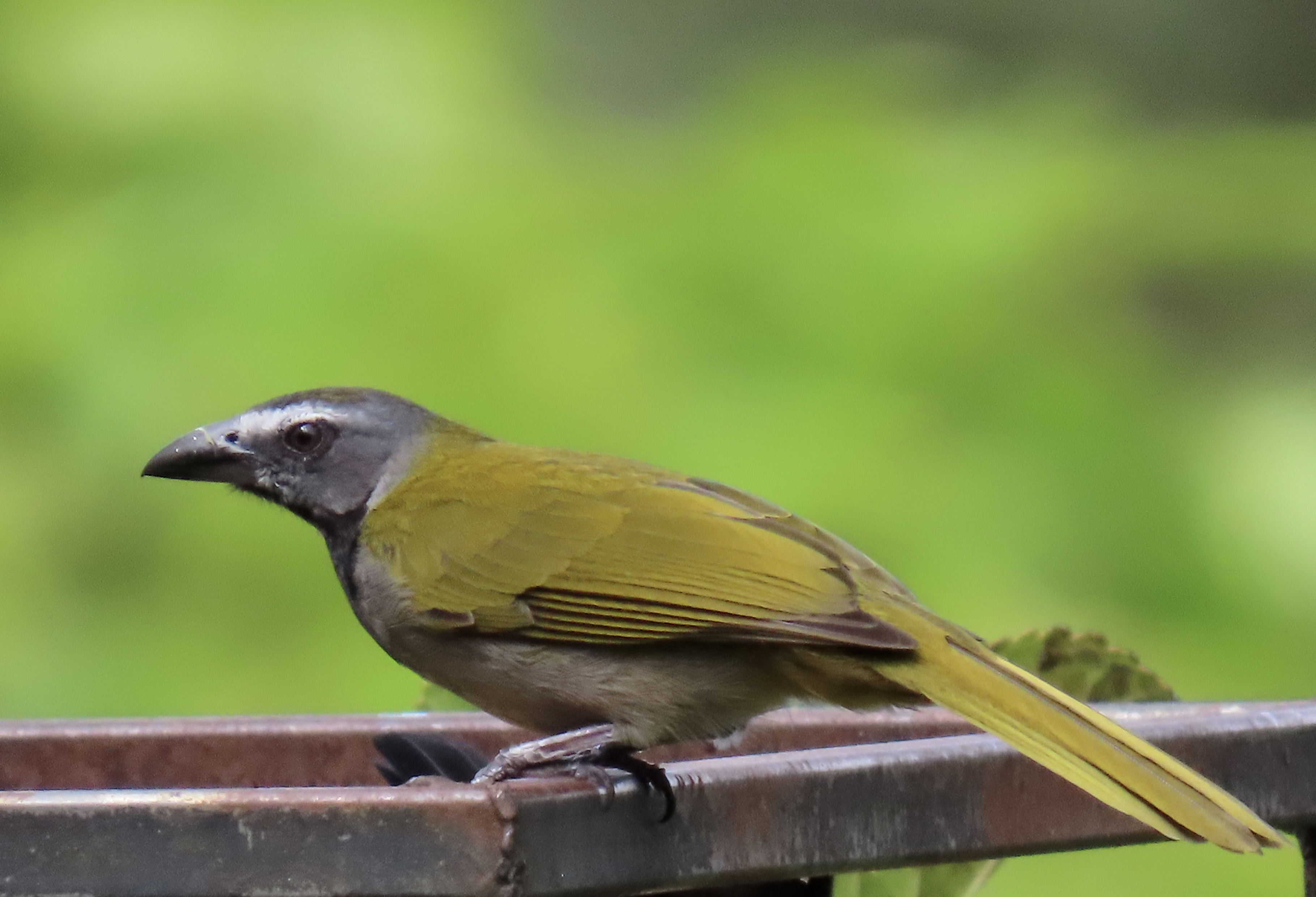
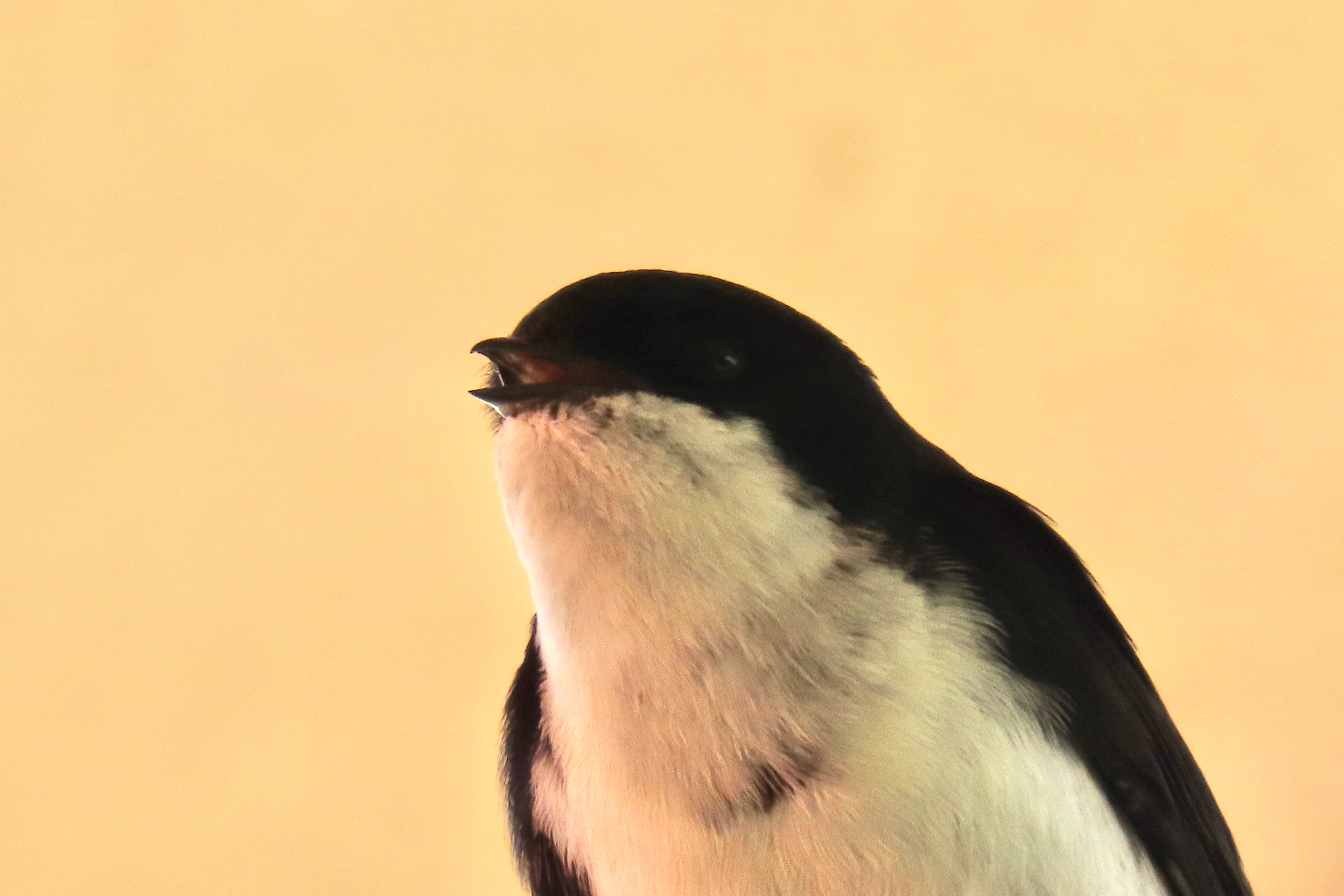
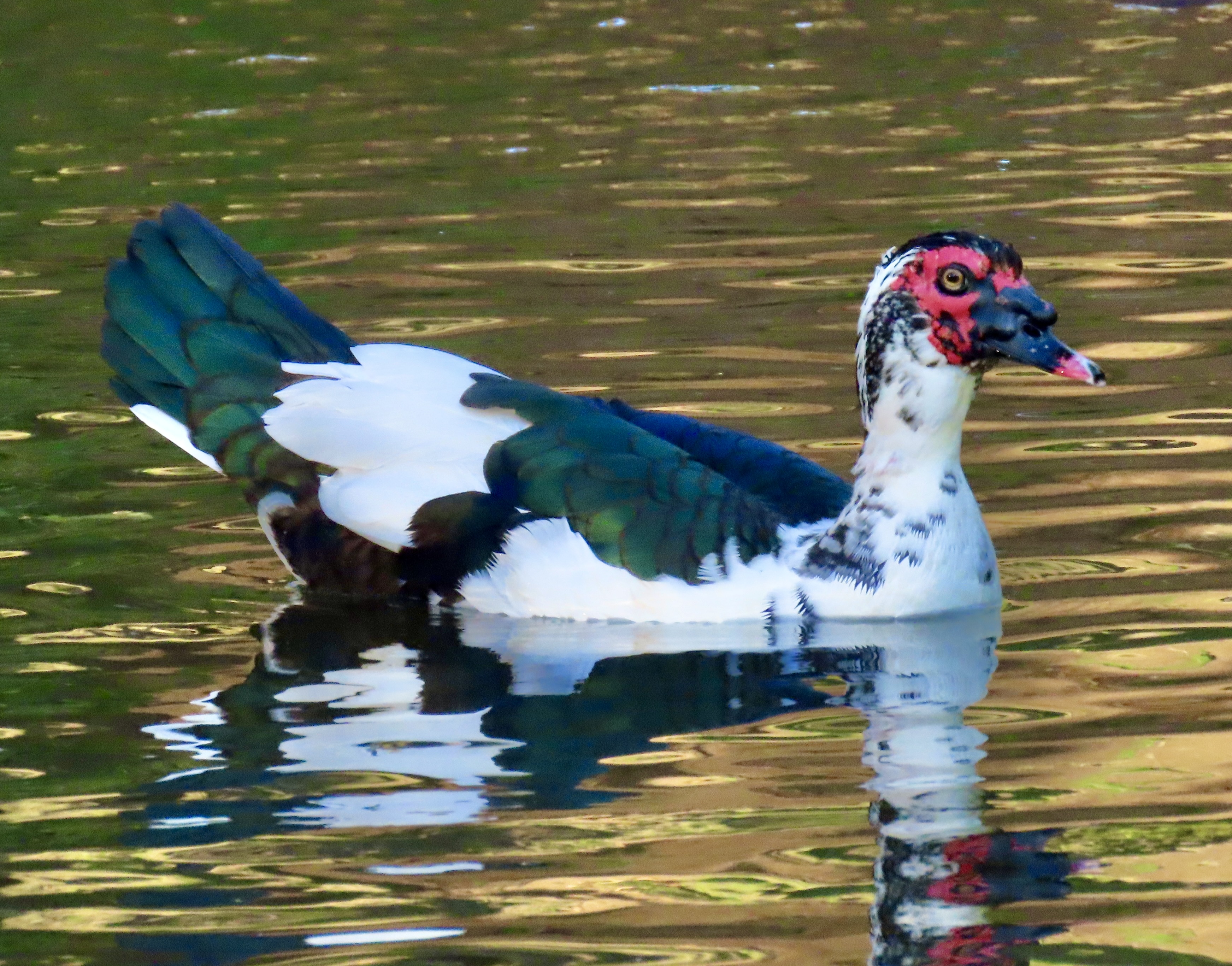
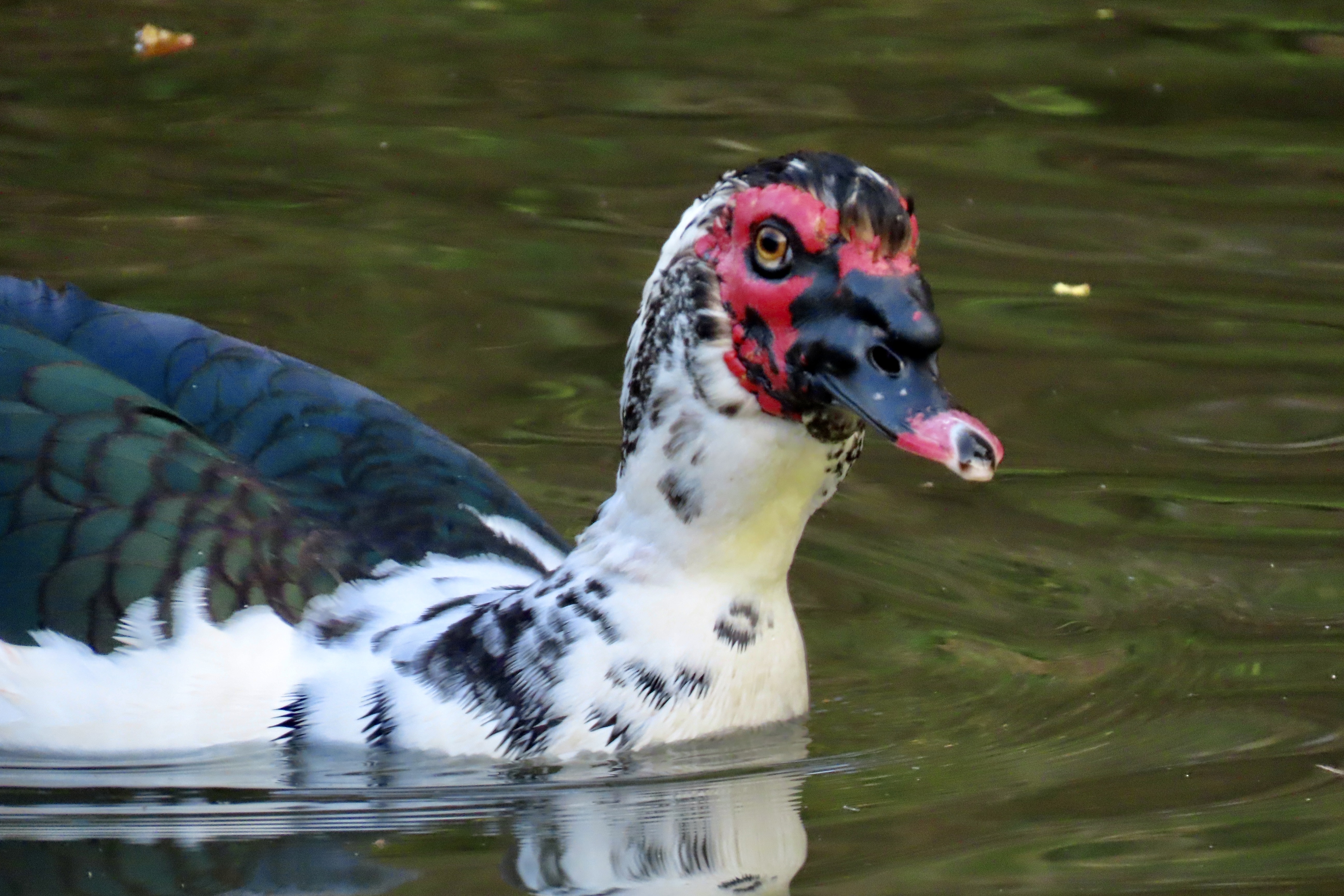
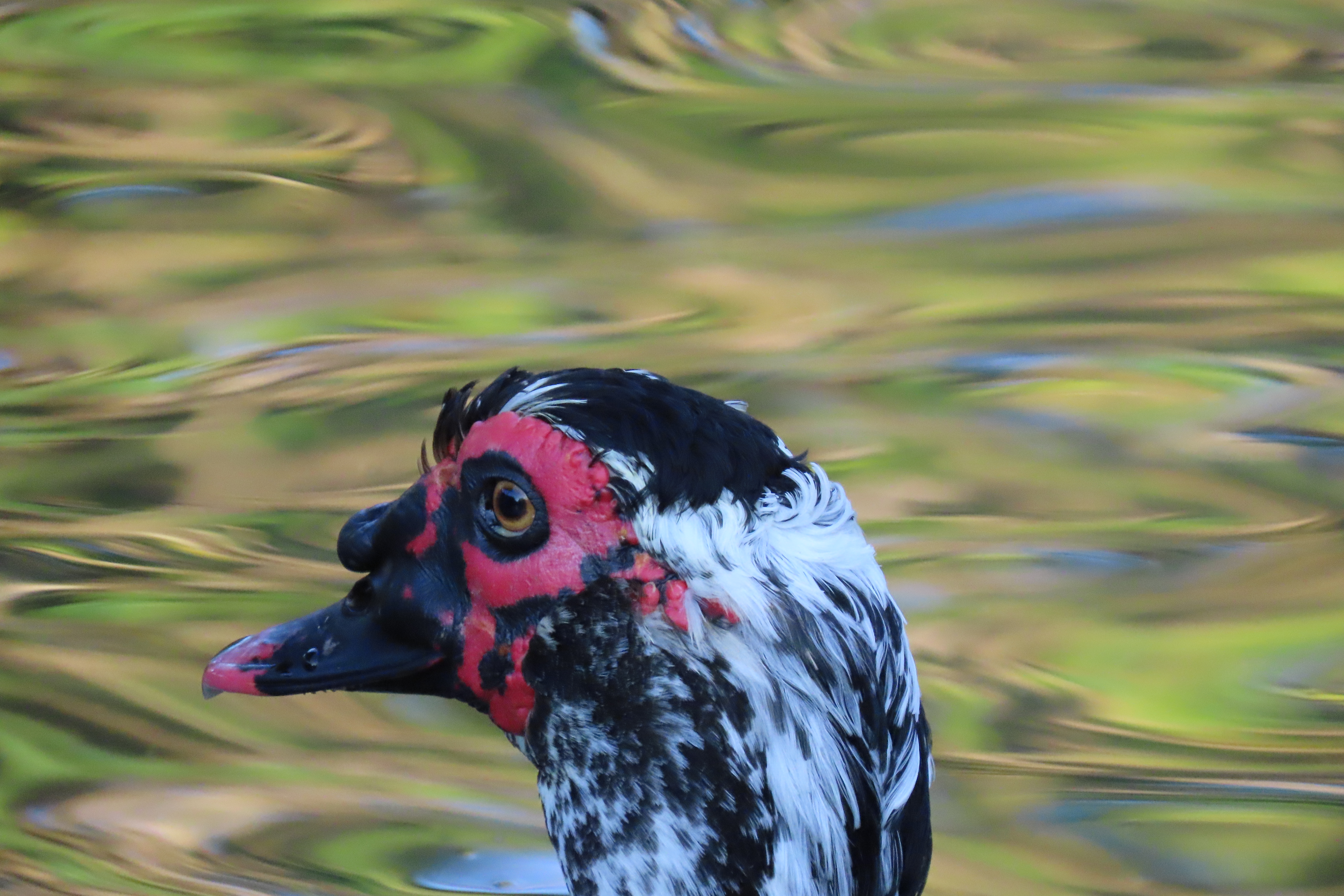
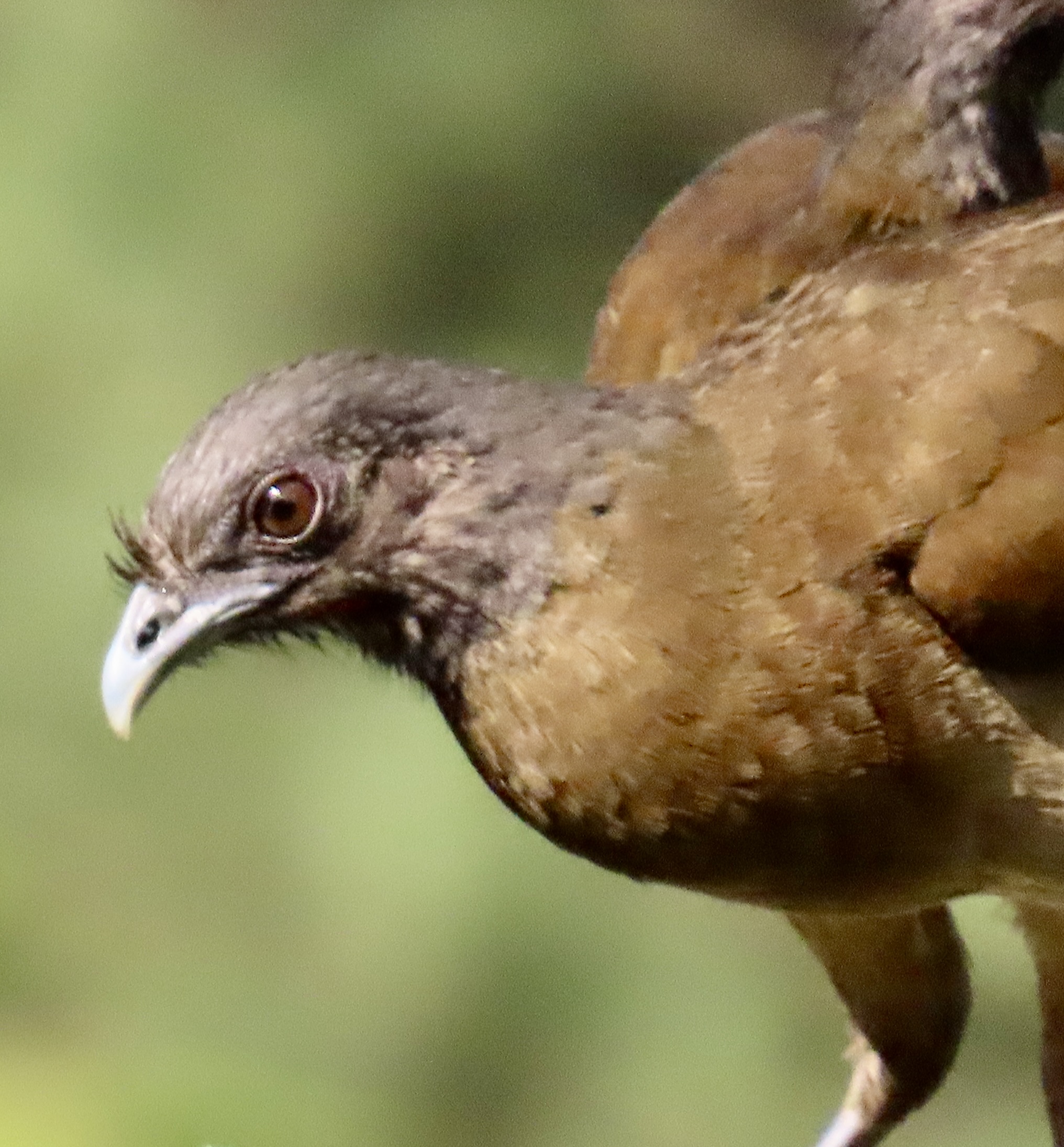
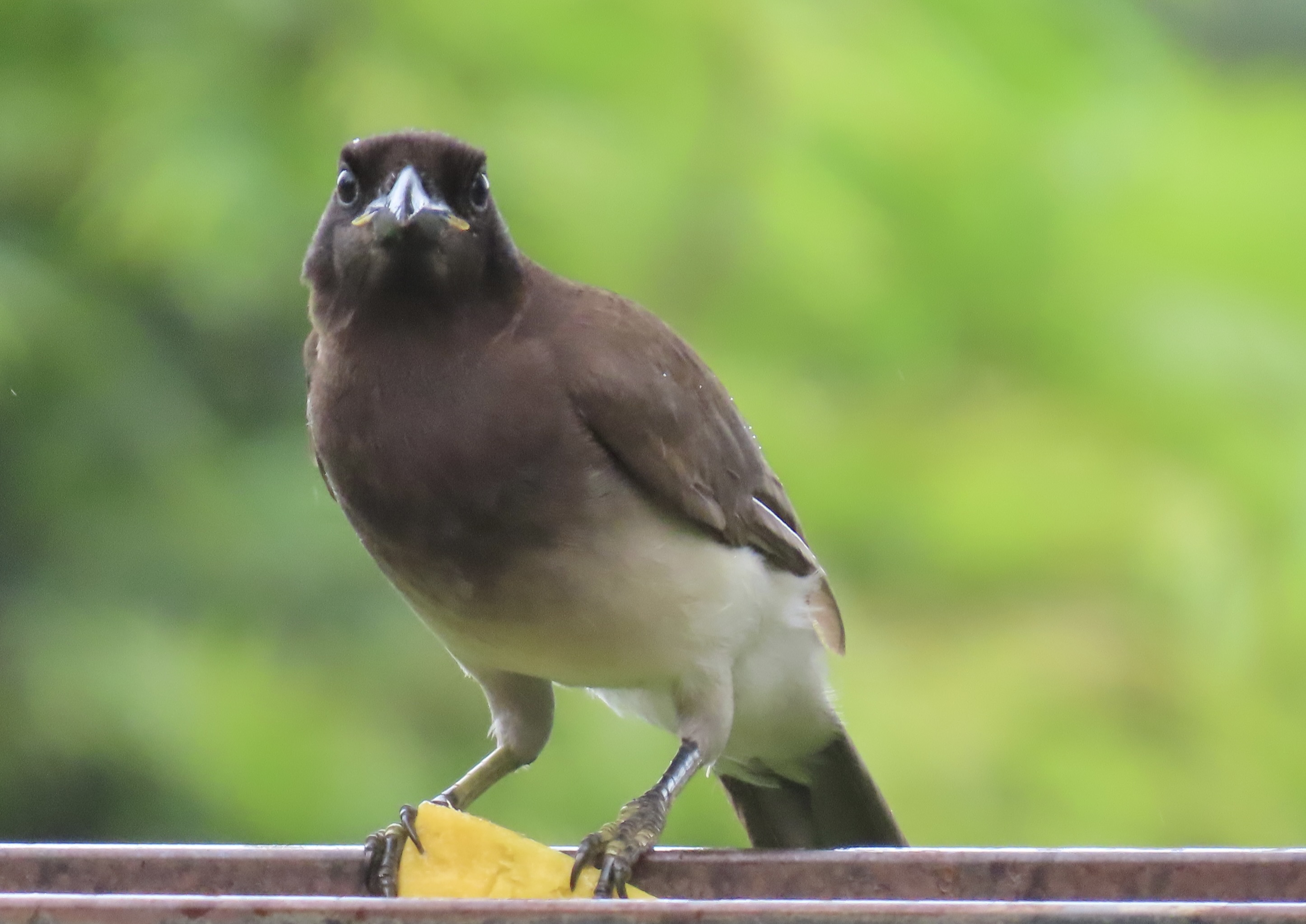
We heard its screech before we saw it. “Jay,” I announced to Peggy. Its call is unmistakeable unless it is modified because of its situation. Or mood. At our property in Oregon, I even heard them make the sound of a hawk— to amuse themselves, I’m sure. It scares the heck out of other birds and small mammals. Their personality, intelligence, and possible warped sense of humor, makes them one of my all time favorite birds. These handsome birds with their Groucho Marx eyebrows are known as a Brown Jays (Psilorhinus morio). Their range reaches from the Rio Grande Valley in southern Texas to northwestern Panama. The white under-belly on this one marks it is a member of the southern subspecies. As for their diet, they are omnivorous: Insects, lizards, fruit: It’s all good. They were regular visitors to the bird feeding table in front of our villa in Nuevo Arenal and happily downed the fruit of the day, whatever it was. But do they eat chicken? We had to travel to Monteverde, Costa Rica to answer this question.We were in Monteverde when I spotted a Brown Jay carrying nest building materials. I grabbed my camera and went hunting. This one was actually wearing an identification band. The birds work together to build a nest. The female then sits on the eggs until they are ready to hatch. The male feeds her during the process. Offspring from a previous season will sometimes help in the feeding of the chicks, but they transfer the food to mom and dad for the actual process. I couldn’t find the nest, but I noted something else about this Jay beyond its band.It had found the bone of a discarded chicken leg and was pecking the marrow out of it. As I noted, they’re omnivorous. The one-eyed look was fun.A Clay-Colored Thrush, (Turdus grayi) or Yigüirro, as they are known in Costa Rica, is the national bird of the country. The bird originally gained its popularity in the country’s folklore by singing a beautiful song just before the beginning of rainy season. The natives thought that the yigüirro brought the welcome and necessary rain. Actually, the male who sang the song, wasn’t trying to bring the rainy season. He was busily courting a female before the rainy season started. It’s when they mate, build nests and raise families. But it makes a great story and the male still has a beautiful song.
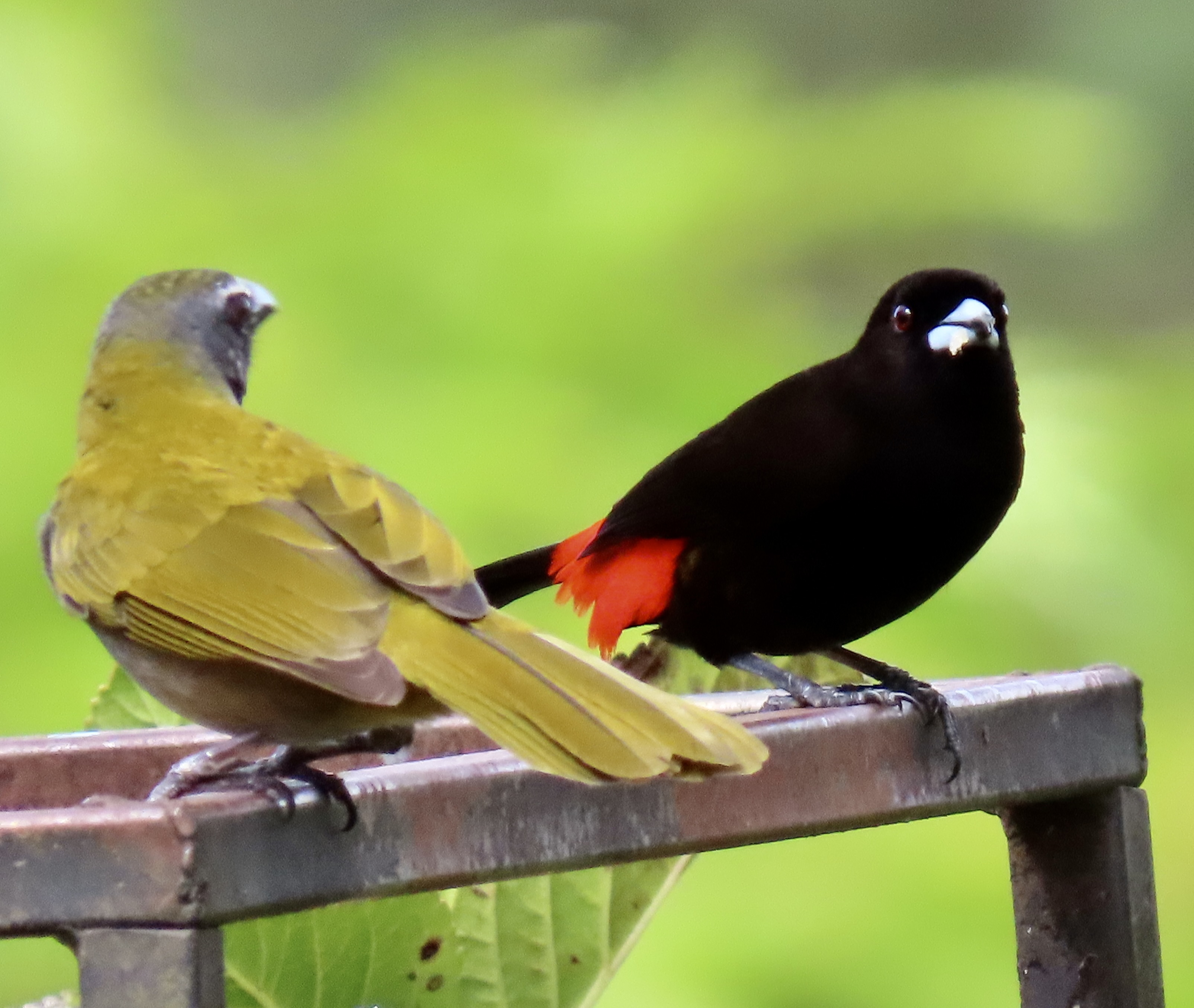
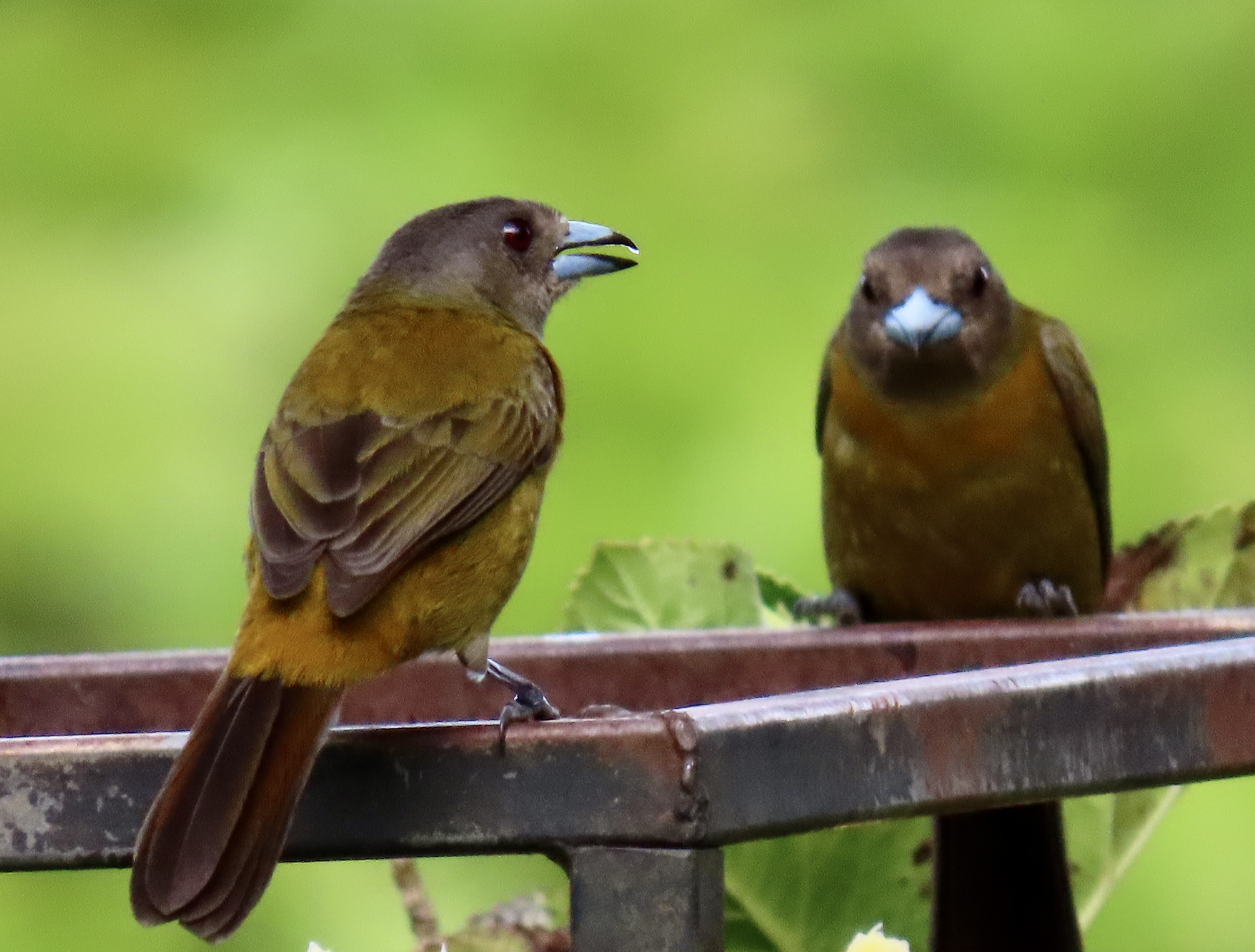
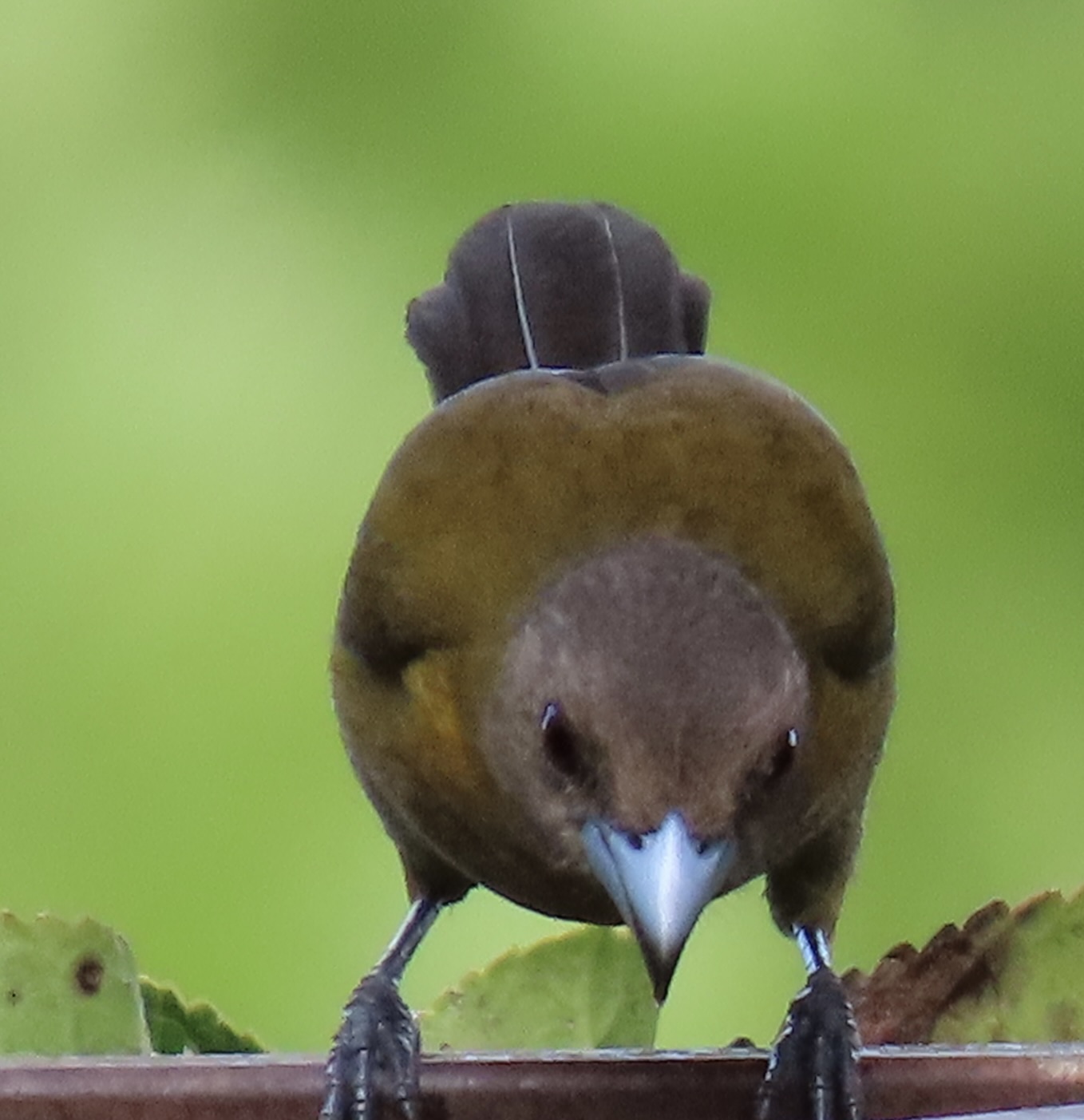
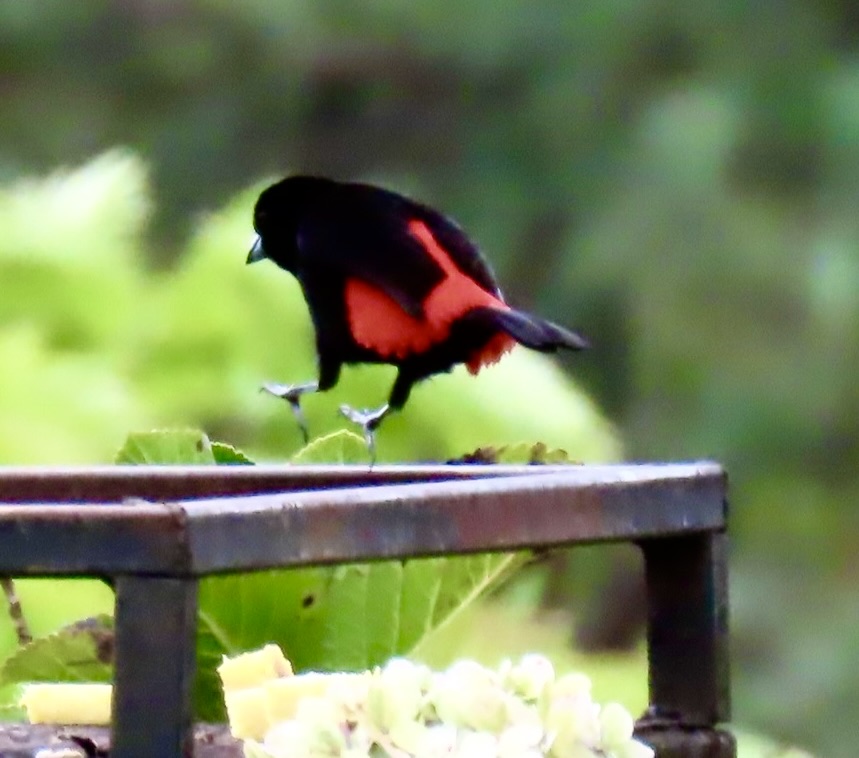
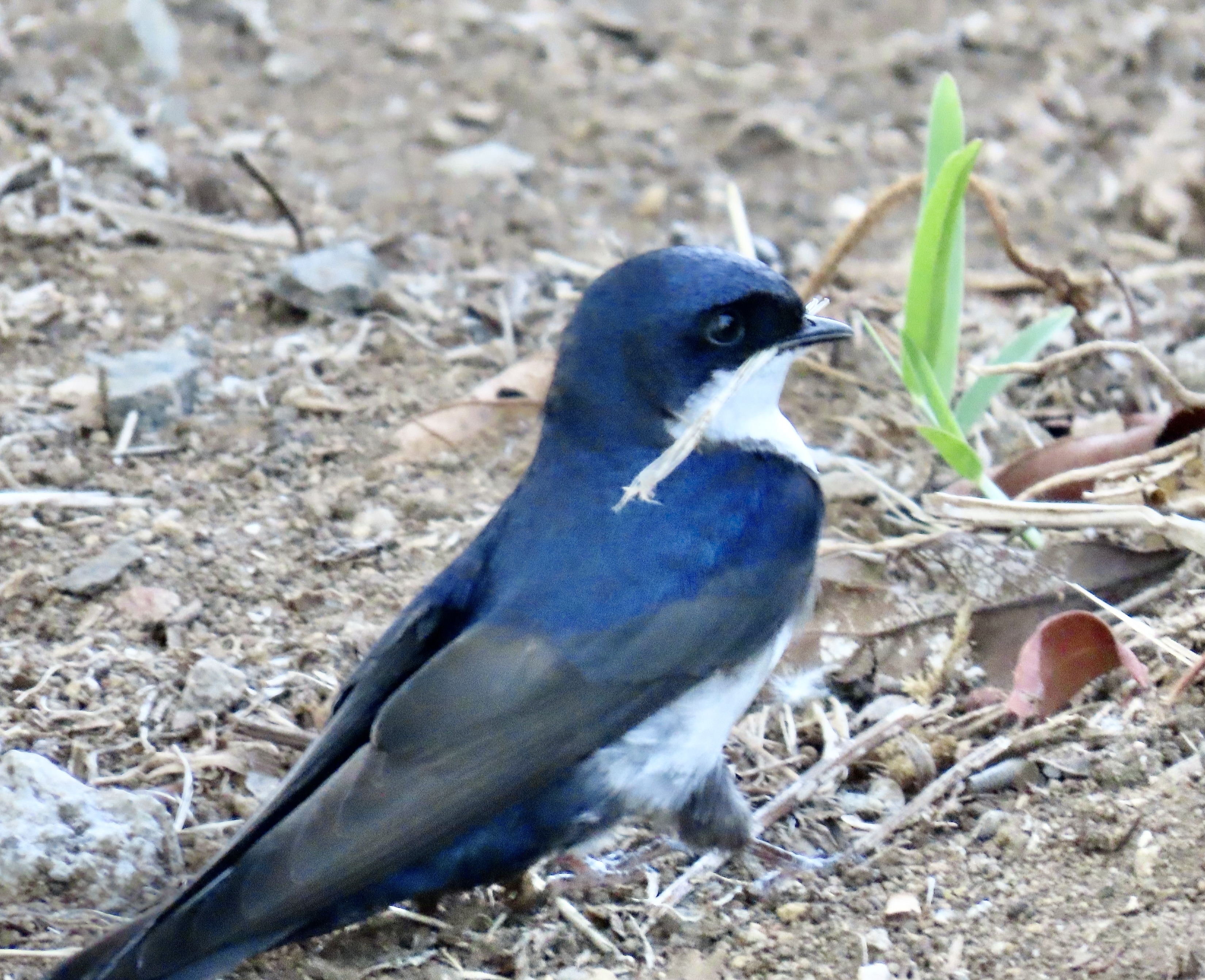
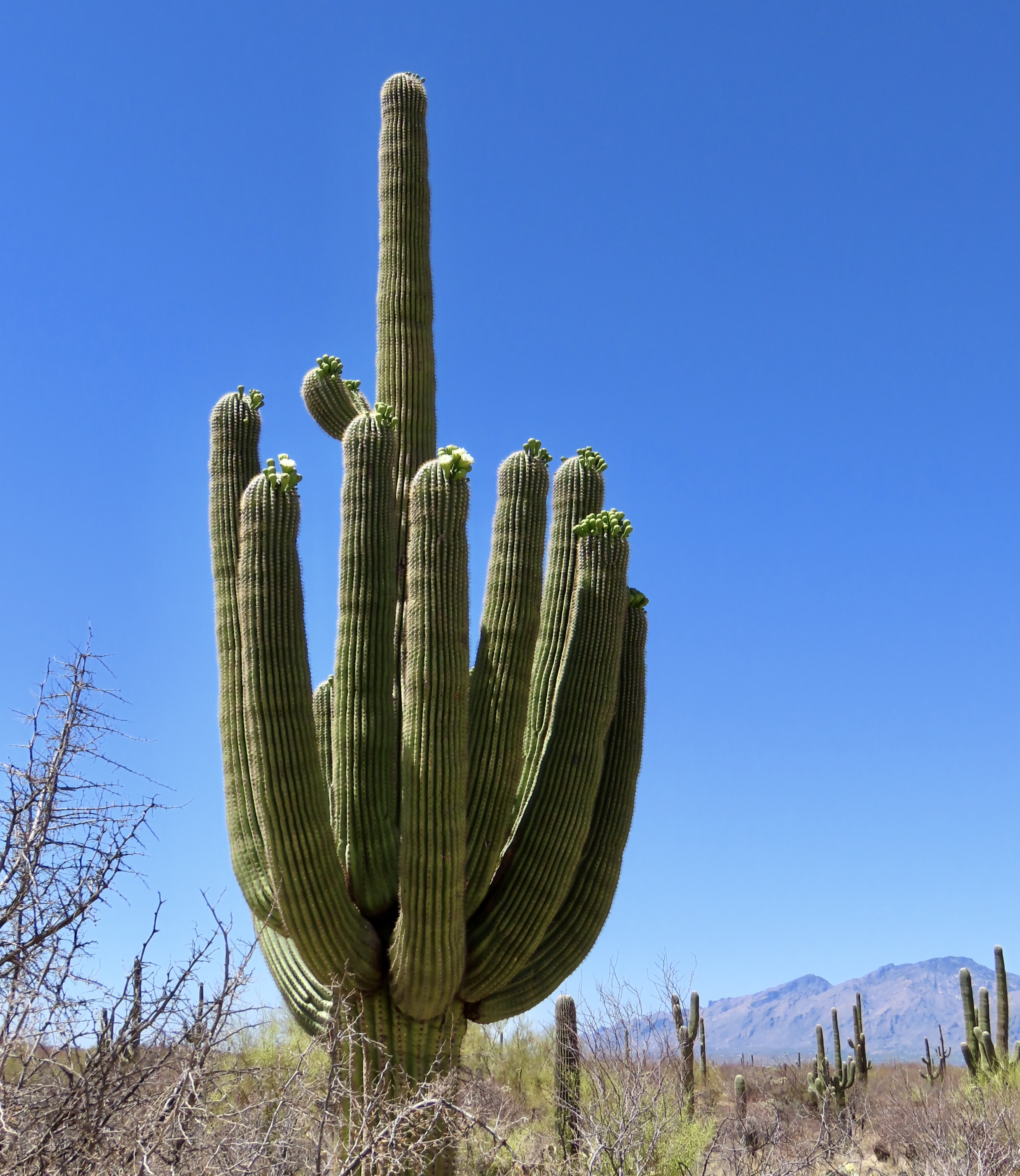
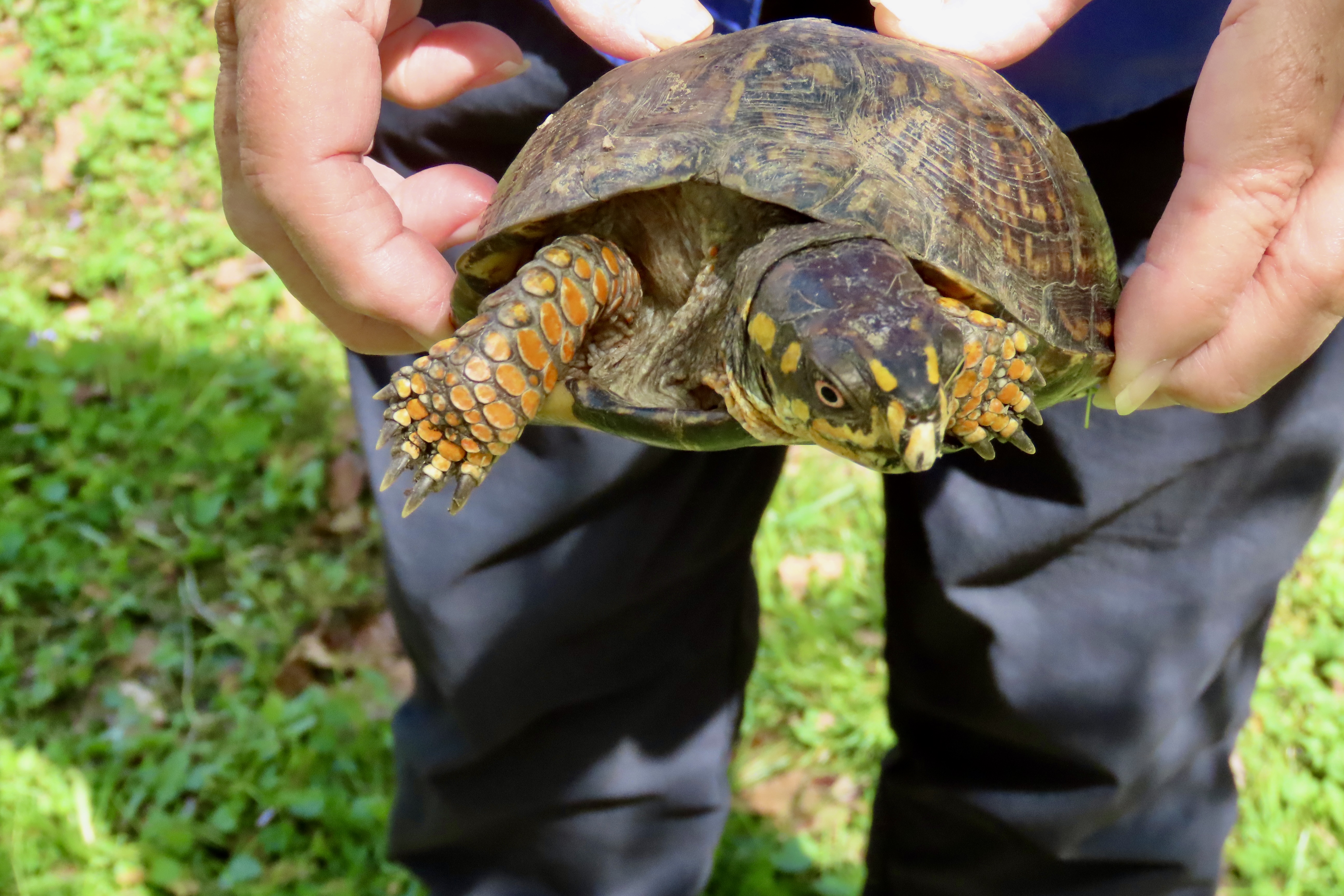
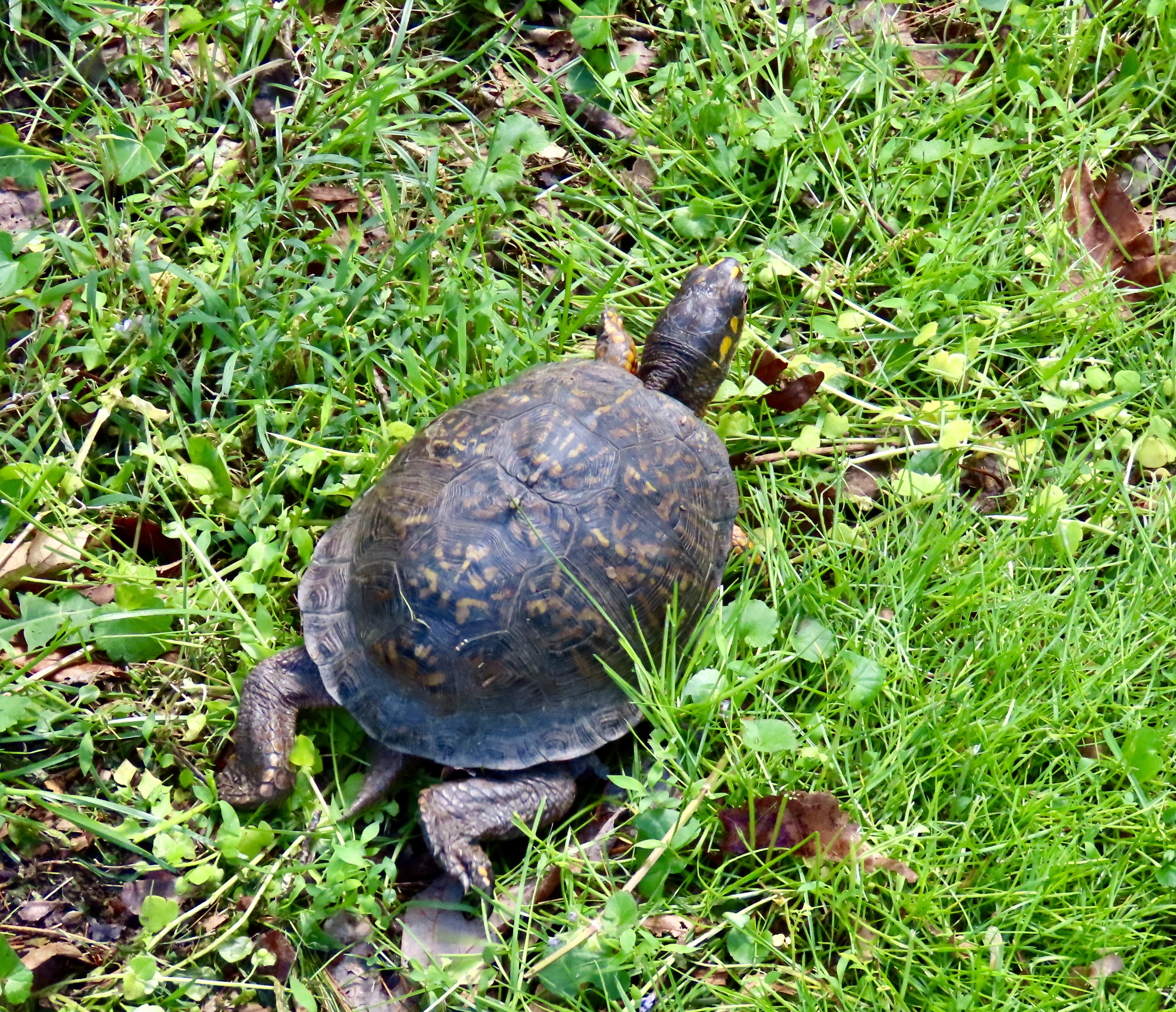
It appears that this Thrush has caught a worm that wasn’t interested in being swallowed. As we watched it hop around on the lawn searching for such delicacies, we were reminded of its cousin, the Robin. Thrushes share a lot in common. I doubt you would find a Robin following a foraging mass of army ants to feast on the insects that are fleeing to escape, however, which is what the Clay-Colored Thrushes do. I immediately thought of the army ants that invaded my house when I was living in West Africa. We discovered their attack when numerous small bugs came hopping, running, and crawling under our screen door in an effort to escape. The Thrush would have been quite happy to scarf them up. I’m sure the Robin would have as well. But it might not have had the Thrush’s sense to fly off before the ants arrive. We saw a mouse make that mistake. It was his last. Not wanting to end up like the mouse, we went to war. I’ll tell the story in UT-OH!.Here a Clay Colored Thrush and a Palm Tanager check each other out. It’s likely that they are having a discussion over who gets the fruit. Alternatively, I like to think that the thrush is saying, “Wow! You are really beautiful.”“Can I offer you a piece of Pineapple?”A fluffed up view of the palm tanager. They often nest and hang out in palm trees, which is how they get their names.Another dining table discussion? Here, a Buff-Throated Saltator is checking out an appropriately named Scarlet-Rumped Tanager. These, along with several other of the smaller birds I am featuring here, often flock together for feeding purposes. (Safety in numbers?) The Tanager is chowing down on a bite of pineapple. It’s hard to find a more easily identified bird than this Scarlet-Rumped Tanager (Ramphocelus passerinii), unless you are looking for the female of the species.I was surprised when my bird ID app, Merlin, told me that these were Scarlet Rumped Tanagers. I double and then triple checked it! The name for when the male and female birds of the same species look so dramatically different, btw, is sexual dimorphism.I like this head-on photo of the female Scarlet Rumped Tanager. Landing gears down!A Buff-throated Saltator (Saltator maximus) gives me the look. Originally classified with cardinals and grosbeaks (given its beak), recent DNA research has shown that they are instead related to Tanagers. I like the soft look of the feathers.This frontal view gives the reason for the Buff-throated Saltator’s name.The long view! The head of the Saltator looked metallic in this photo.It was nest building time for the Blue and White Swallow (Pygochelidon cyanoleuca) of Monteverde. I’d watched this one pick up and reject several small straws until it arrived at this large piece that it flew away with. I’m always impressed with their streamlined look. It serves them well when they are practicing their insect-catching aerobatics in the air. Peggy and I enjoyed watching them whiz about from our porch in the evening. They would often land, and possibly had a nest on the roof beam above the porch. The bright evening sky gave their blue a black look. We weren’t sure whether it was chirping at us or its fellow flyers.I’ll conclude my collection today with the Muscuvy duck (Cairina moschata) that has both feral and domesticated versions. The duck was first domesticated in the tropical Americas during preColumbian times. You’ve may have seen the domesticated version, like this one, swimming around in park ponds. If so, you probably haven’t forgotten it.It has a very unique look!Head shot! That’s it for today. On Wednesday I’ll be featuring Earth Day. It’s worth saving. Our survival— as well as that of numerous other plants and animals— depends up on it.One would think that the Giant Saguaro cacti of the Sonoran Desert would welcome Global Warming with open arms, but the truth is, it is one of numerous species that are threatened today. The increased drought and extreme heat of global warming prevent seedling survival, cause structural collapse of adult plants, and encourage wildfires capable of wiping out wide swaths of these majestic plants. Another species threatened by Global Warming is the Eastern Box Turtle. The increasing heat disrupts their reproductive cycles and sex ratios. Once found often, they are now rarely seen. Peggy found this one crawling down our driveway yesterday, heading toward the traffic clogged highway that runs in front of our apartment. She saved it, at least temporarily, by taking it down to the creek that flows through the property and turning it loose, far from the road. She set it down and away it zoomed (with zoom defined in turtle speed).
PLUS A Bonus: Costa Rica Is for the Birds… That’s a Good Thing
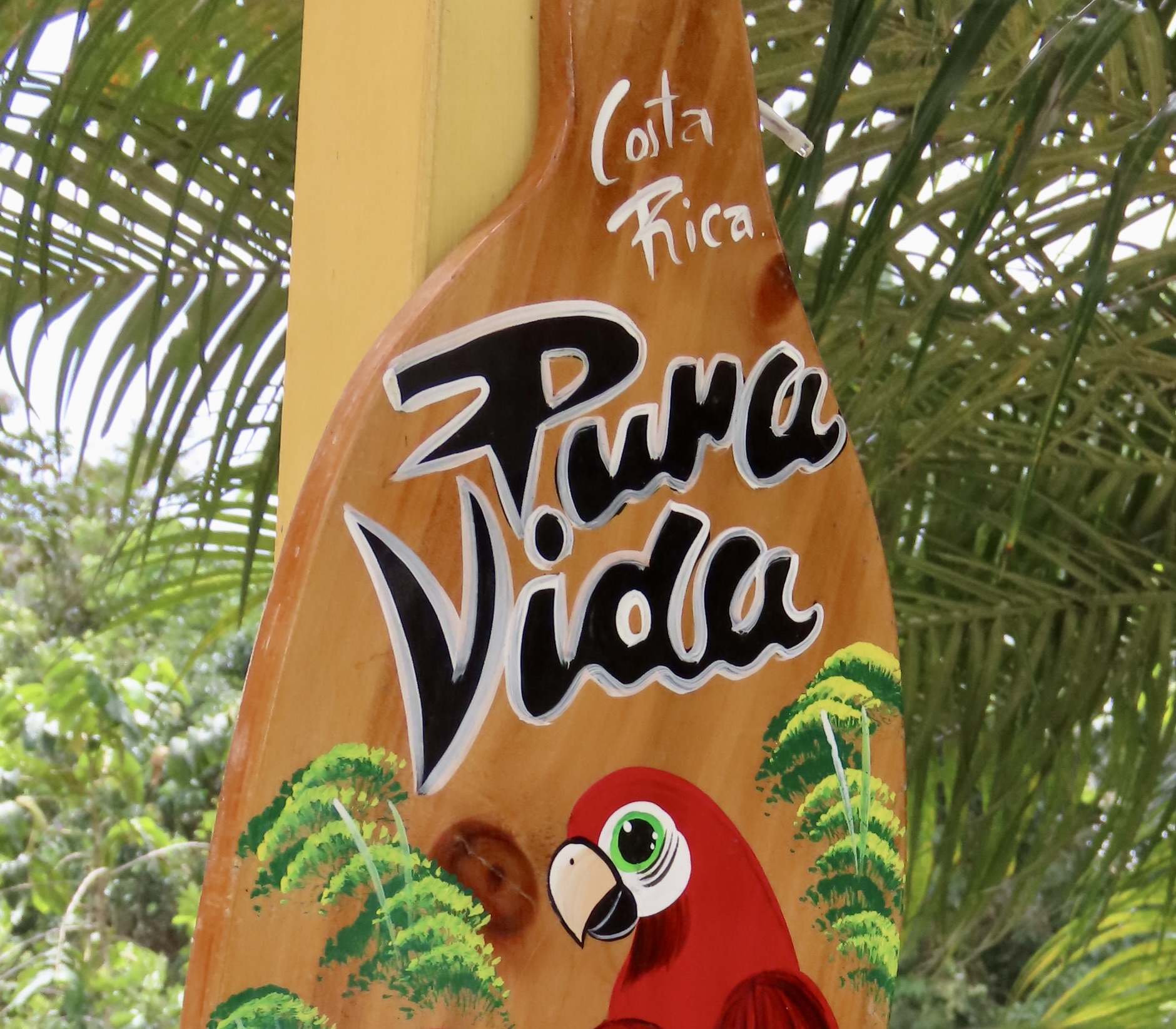
A change of plans today. I was going to do a post on unique Burning Man structures, but Peggy and I are down in Costa Rica happily settled into a villa above Lake Arenal. A warm tropical breeze is making me feel sleepy. My ‘get up and go has got up and went,’ as the song proclaimed, galloped off to the north. Pura Vida, the Costa Ricans would say. We are living the good life. Posting a tale I have already written plus throwing up some fun photos of birds that Peggy and I have taken is a lot easier than putting together a Burning Man post. Plus, over half the time I went to research a subject for the post, I found that Google had placed one of my blogs on the subject at the top or near the top of its research list and/or just opposite its AI answer. That’s great for SEO, but it also suggests how much I have already written on the subject.
So, my apologies to those who have tuned in to learn more about Burning Man, but hey, a ghost story makes a great substitute, right? So here it is as a chapter in my ongoing blog-a-book series: UT-OH. I’ll eventually get back to Burning Man. I always do.
Nancy Jo and the Graveyard Ghost
My sister was seven years older than I and lived on a different planet, the mysterious world of teenage girls. Her concern about ghosts makes this story a powerful testimony to teenage hormones. If Marshall and I had a healthy respect for the Graveyard at night, Nancy’s fear was monumental.
This story begins with Nancy falling in ‘love’ with the ‘boy’ next door, Johnny. His parents were good folks from a kids’ perspective. Marshall and I raided their apple trees with impunity, and Mama, a big Italian lady, made great spaghetti that included wild manzanita mushrooms. I was fascinated with the way she yelled “Bullll Sheeeet” in a stentorian voice when she was whipping Papa into line. He was a skinny, ‘Old Country type of guy’ who thought he should be in charge. Papa was the one who suggested the gunny sack method of castration for MC.
I use the terms love and boy somewhat loosely since Nancy at 16 was more in infatuation than love, and Johnny, a 22-year-old Korean War Veteran, was a little old for the boy designation, not to mention Nancy. Our parents were not happy, a fact that only seemed to encourage my sister.
Her teenage hormones aided by a healthy dose of rebellion overcame her good sense and she pursued the budding relationship. Johnny didn’t make it easy. His idea of a special date was to drive down the alley and honk. Otherwise, he avoided our place. If Nancy wanted to see him, she had to visit his home. It should have been easy; his house was right behind ours.
But there was a major obstacle, the dreaded Graveyard. To avoid it, Nancy had to climb over the fence that separated our houses. Her other option was walk up the alley that almost touched the tombstones. Given her feelings about dead people, the solution seemed easy— climb the fence. Marsh and I had been over it many times in search of apples. Something about teenage girl dignity I didn’t understand eliminated fence climbing, however. Nancy was left up the alley without an escort.
While she wasn’t above sneaking out her window, Nancy asked permission to see Johnny the night of the Graveyard Ghost attack. She approached Mother around seven. It was one of those warm summer evenings where the sun is reluctant to go down and boys are granted special permission to stay up. Marshall and I listened intently.
“Mother, I think I’ll go visit Johnny,” Nancy stated and asked in the same sentence. Careful maneuvering was required. An outright statement would have triggered a parental prerogative no and an outright question may have solicited a parental concern no.
Silence. This communicated disapproval, a possible no, and a tad of punishment for raising the issue.
“Mother?” We were on the edge of an impending teenage tantrum. Nancy could throw a good one.
“Okay” with weary resignation followed by, “but you have to be home by ten.”
What we heard was TEN. Translate after dark. Nancy would be coming down the alley past the Graveyard in the dark and she would be scared. Knowing Johnny’s desire to avoid my parents, we figured she would also be alone. A fiendish plot was hatched.
At 9:45, Marsh and I slipped outside and made our way up the alley to a point half way between our house and Johnny’s. Next, we took a few steps into Graveyard where weed-like Heavenly trees and deep Myrtle provided perfect cover. Hiding there at night was scary, but Marshall and I were operating under inspiration.
Marsh stripped the limbs off of one of the young trees, bent it over like a catapult, and draped his white T-shirt on the trunk. We then scrunched down and waited.
At exactly 10:00, Nancy opened the back door and stepped outside with Johnny. Our hearts skipped a beat. Would he walk her home? No. After a perfunctory goodnight, Johnny dutifully went back inside and one very alone sister began her hesitant but fateful walk down the alley.
She approached slowly, desperately looking the other direction to avoid seeing tombstones and keeping as far from the Graveyard as the alley and fence allowed.
At exactly the right moment, we struck. Marshall let go of the T-shirt and the supple Heavenly Tree whipped it into the air. It arched up over the alley and floated down in front of our already frightened sister. We started woooooing wildly like the eight and ten-year-old ghosts we were supposed to be.
Did Nancy streak down the alley to the safety of the House? No. Did she figure out her two little brothers were playing a trick and commit murder? No. Absolute hysteria ensued. She stood still and screamed. She was feet stuck to the ground petrified except for her lungs and mouth. They worked fine.
As her voice hit opera pitch, we realized that our prank was not going as planned. Nancy was not having fun. We leapt out to remedy the problem.
Bad idea.
Two bodies hurtling at you out of a graveyard in the dark of night is not a recommended solution for frayed nerves and an intense fear of dead people. The three of us, Nancy bawling and Marshall and I worrying about consequences, proceeded to the house. After a thorough scolding, we were sent to bed. I suspect our parents laughed afterwards. Many years later, even Nancy could see the humor in our prank— and laugh as well.
A fun note on The Bush Devil Ate Sam
I often get comments from people who have read my book including a number of my followers and fellow authors. They are always appreciated. I also hear from people outside our WordPress community. Here’s what I found on Gmail yesterday.
Loved The Bush Devil Ate Sam
Hi Curtis,
I just finished reading The Bush Devil Ate Sam, and I have to say, it was such a vivid, immersive experience! The way you bring Liberia to life, the chaos of students strolling in with termites for breakfast, the encounters with the army ants, and the tension of navigating the local authorities, had me laughing, gasping, and completely captivated. It’s clear how much heart and firsthand experience went into every story.
Reading it also got me thinking about my own writing journey. Each book I’ve worked on has taught me something new about patience, perspective, and letting a story evolve naturally, even when it takes unexpected turns. It’s always fascinating to reflect on the ways our experiences shape the stories we tell.
I’d love to hear about your own process with this book. Did you find it easy to translate your Peace Corps experiences into these stories, or was it more of a challenge to capture the humor, the tension, and the history all at once? Thank you for sharing such a memorable and honest perspective on life as a Peace Corps volunteer. Half the fun was getting to see Liberia through your eyes.
Warmly, Taylor Jenkins Reid
The thoughtfulness of this comment caught my attention. And how well it was written. Of course, I responded to Taylor. But there is more. Taylor is a best-selling author of the New York Times and has won a number of national awards for her writing. Among her books is The Seven Husbands of Evelyn Hugo, a book that the book club that Peggy and I belonged to for 36 years had picked to read. An Amazon Prime television series based on one of her books is now playing.
Taylor immediately responded to my comments and asked if I would share my body of work. Now I have to tell her she has it, the rest is tied up in 1500 WordPress blogs. Grin. I must say, I am now inspired to finish UT-OH! asap. You may be seeing a couple of chapters a week. I’d prefer that my body of work include two books.
Costa Rica Is for the Birds.It’s a good thing.
Our villa looks out on a large bird feeder that the staff and guests (including us) of Lake Gardens daily fill with a variety of fruits that the local population of birds love. I hate to confess this as a would-be birder, but I can sit on our couch and take photos of all the action. And action it is, constant drama of who gets to eat when, a veritable pecking order of turkey-size birds down to sparrow-size. A lot more photos will be coming of birds and hopefully other jungle life. This is a teaser.
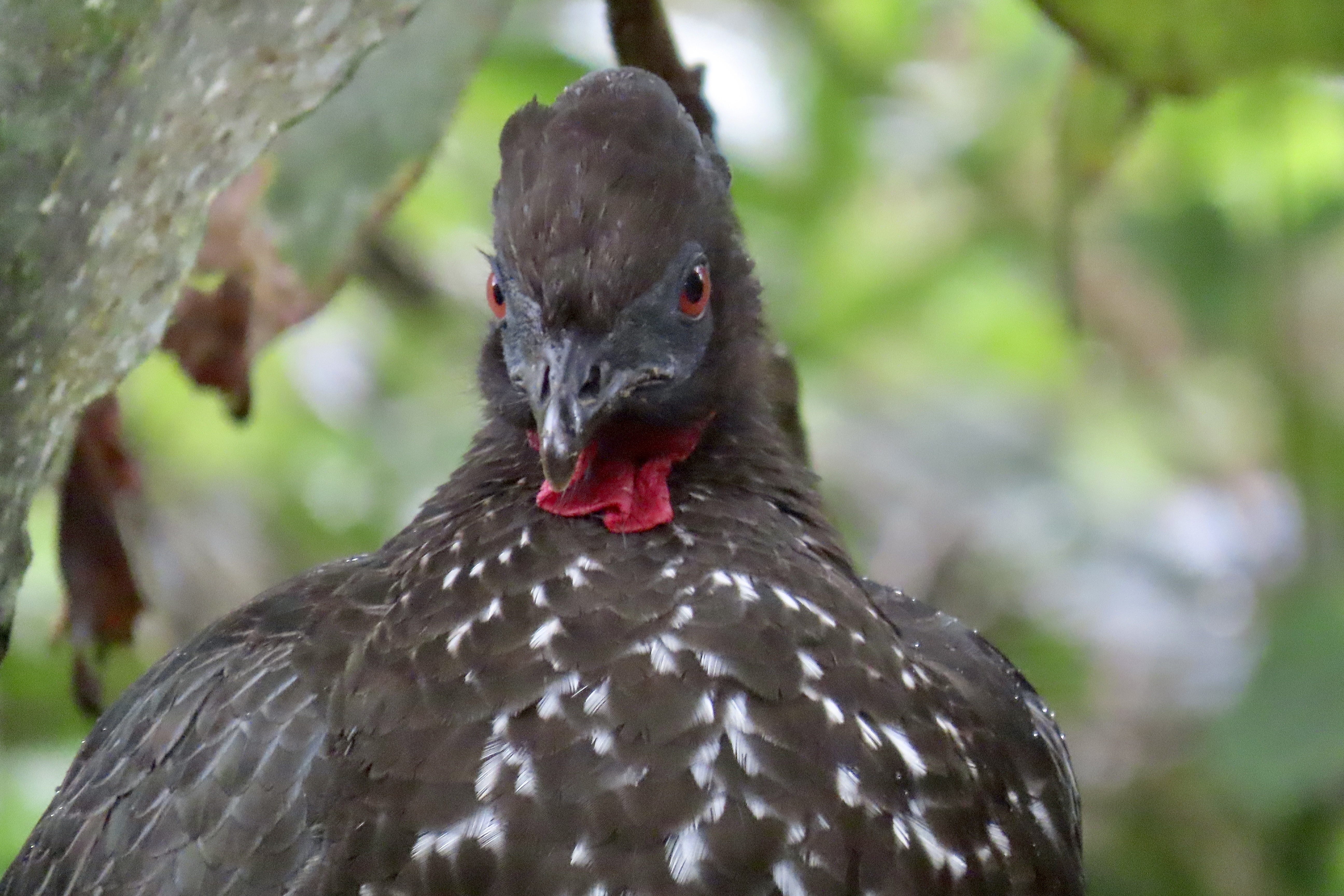
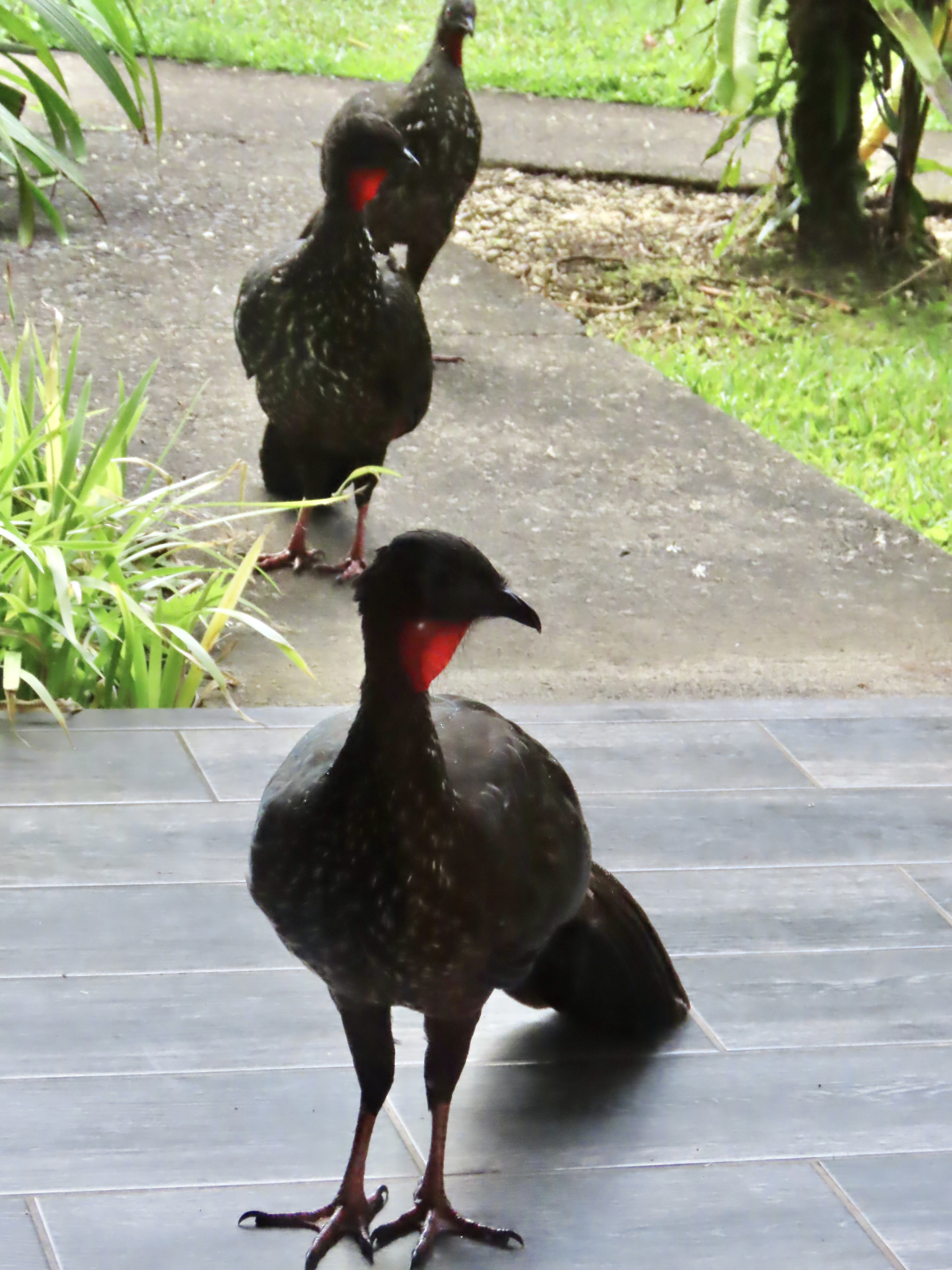
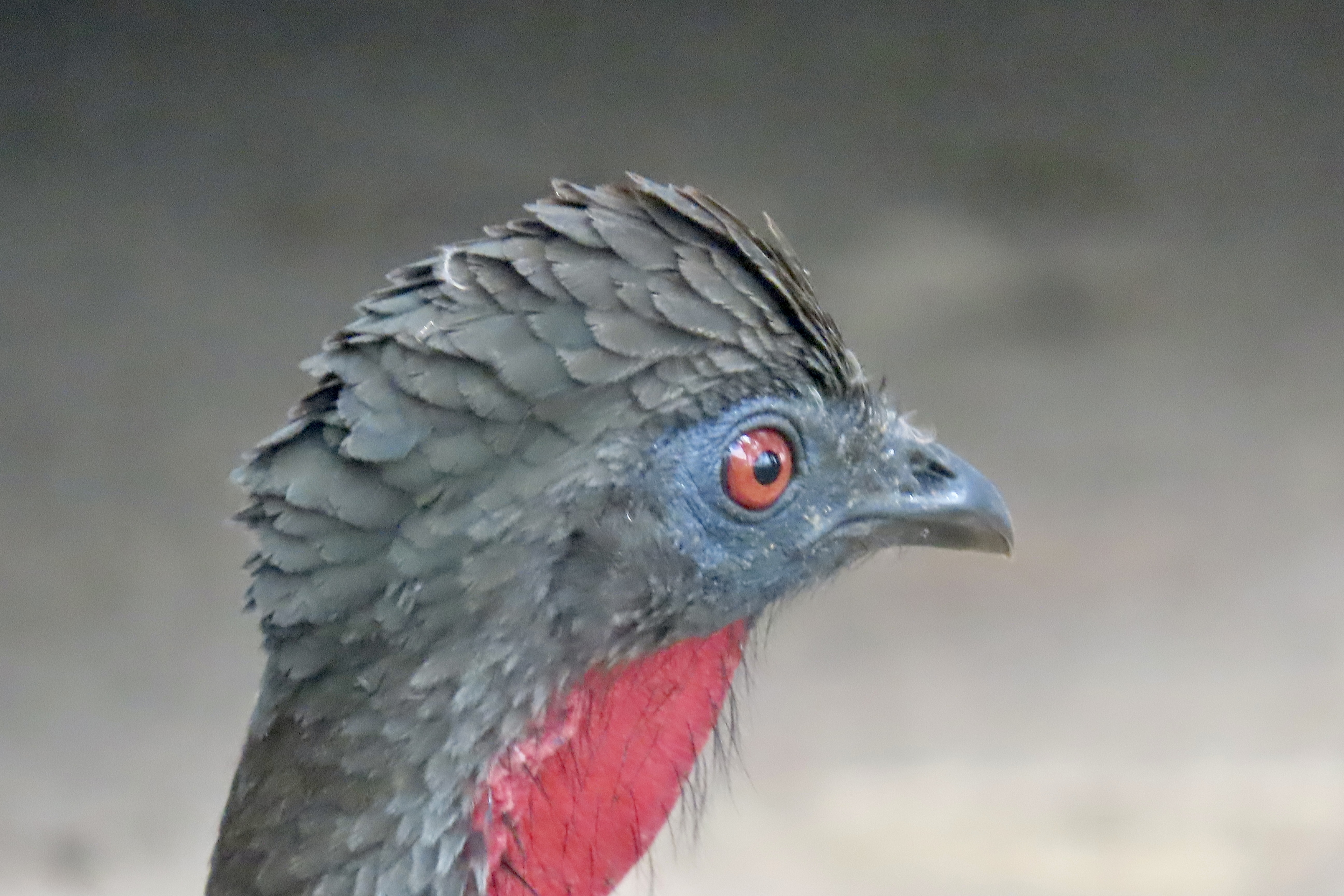
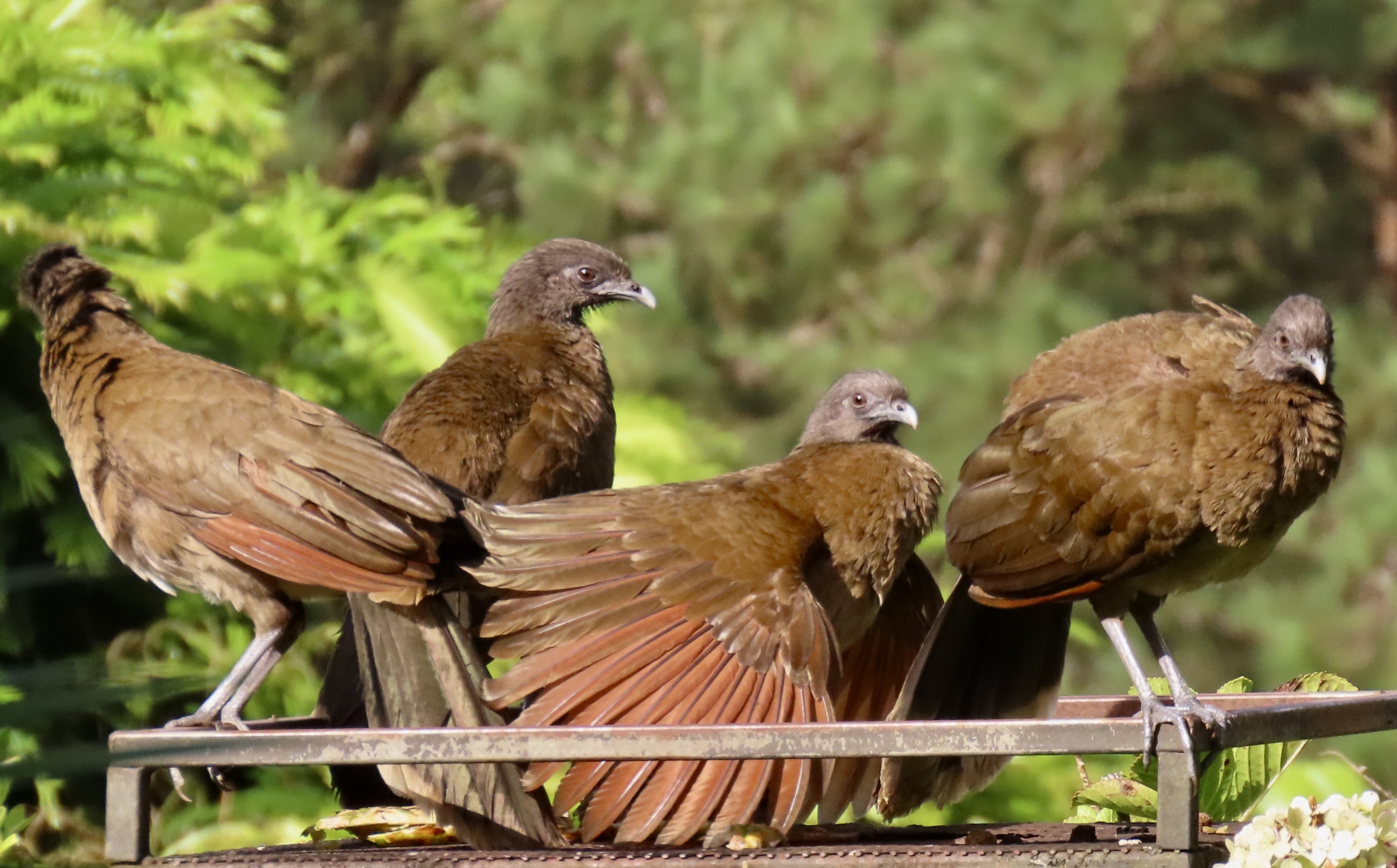
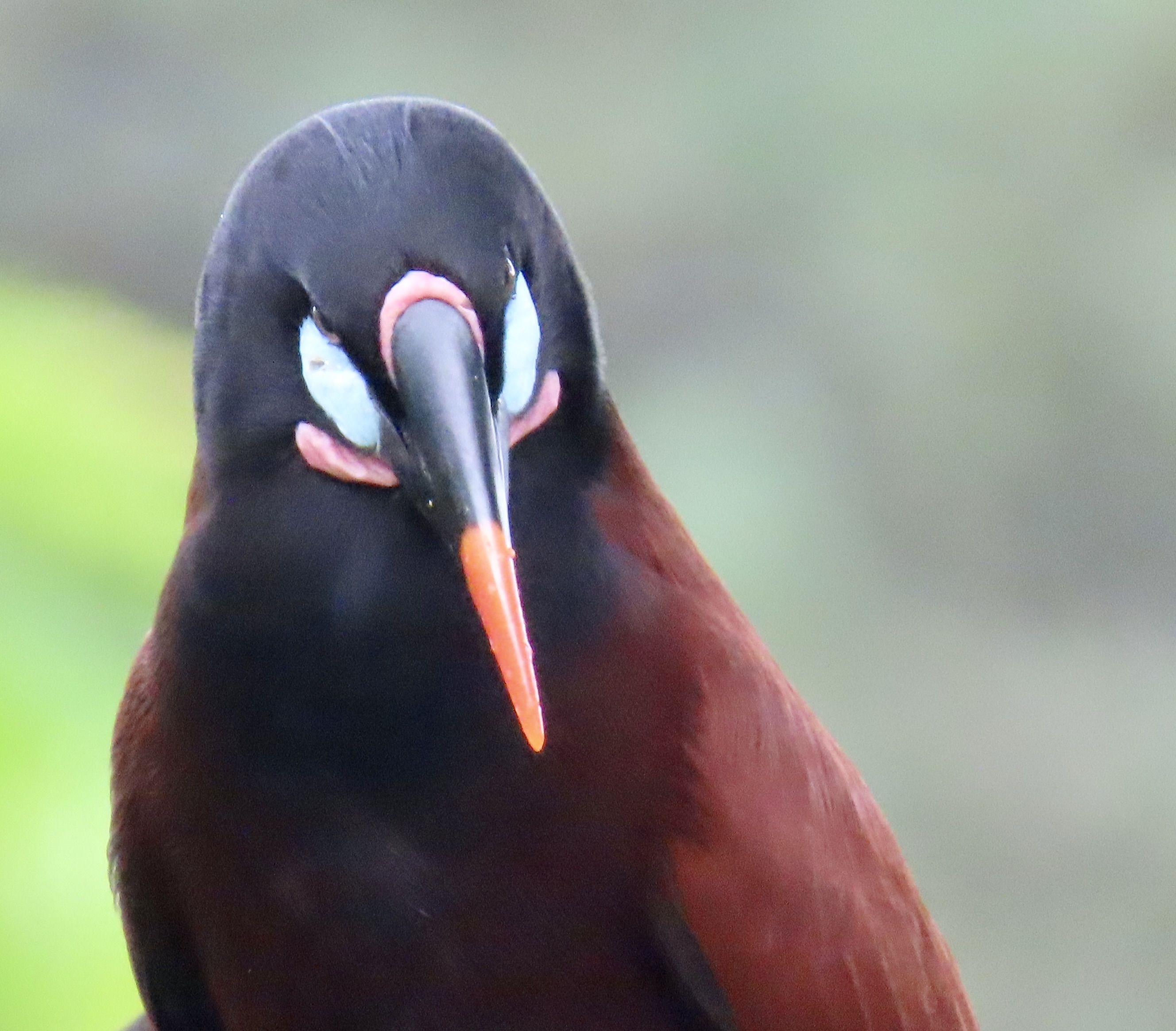
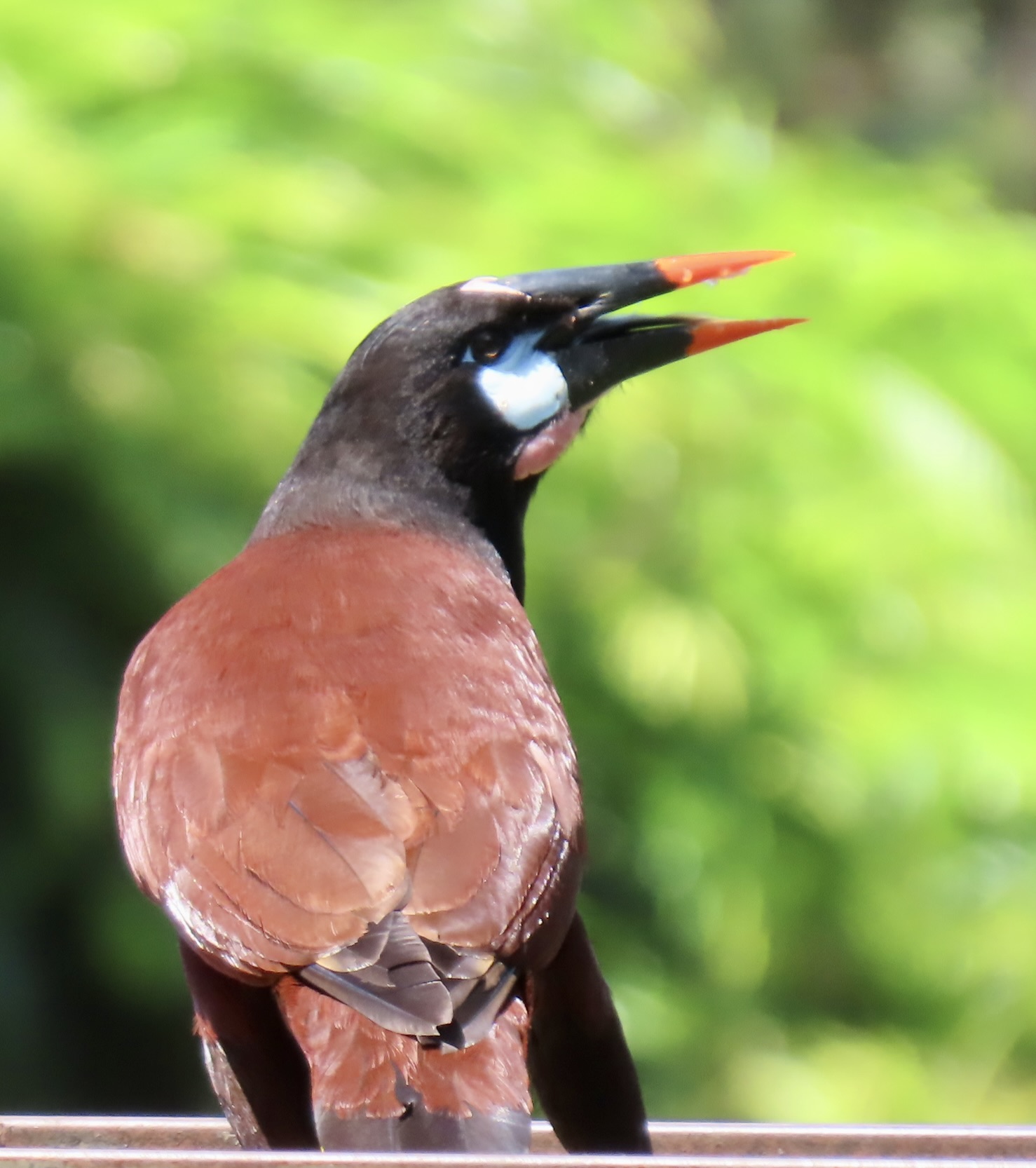
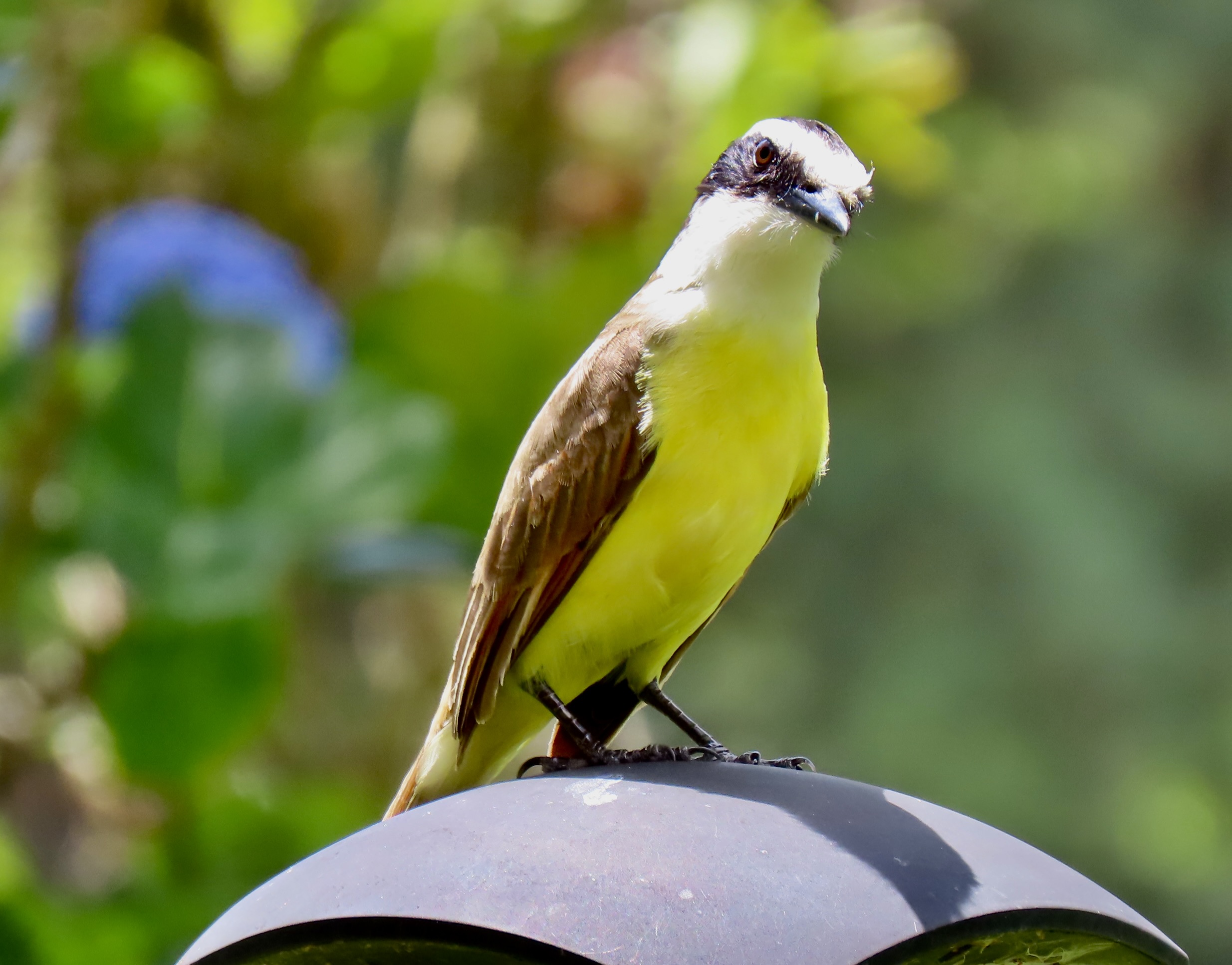
This is the king or queen of the feeder. A Crested Guan. All other birds are required to leave the platform when they are on it.When Peggy opened our curtains on our first morning, Peggy found this crew back-lit by the sun lined up for breakfast and snapped their photo.Up close and personal.Number 2 on the pecking order was this fellow. We aren’t sure what it was, but our assumption is a fledgling Guam. If so, their parents were not about to share food with them. A bush was just below the feeder that the adults would chase the kids around, and around. It was like the Keystone Cops.Here are the kids up on the bird feeder.Number three was a Montezuma oropendola.Peggy caught a photo of it looking the other direction.Number 4: A Brown Jay. We recognized this fellow immediately by its call. We’ve spent our lives with various members of the jay family, but never a brown one. I swear the pretty bird was posing for Peggy. He kept coming back to this lamp outsiide our villa and looking in the window. He didn’t eat fruit, however, He ate bugs. It’s a Social Flycatcher.
That’s it for today. On Thursday, I’ll write about a death defying tree race in UT-OH, one of our many adventures that makes me wonder how we ever lived through childhood. And, there will be more bird photos from Costa Rica.