Louisiana, and an Offer of Hooch plus… Traveling 10,000 Miles by Bicycle

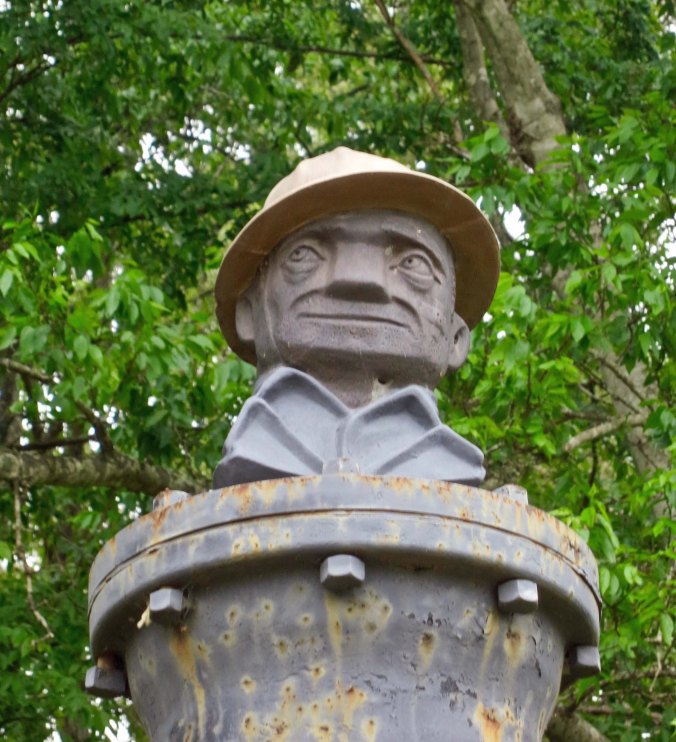
Joe Roughneck, the symbol of the oil industry. My father worked as a roughneck in the Oklahoma oil boom of the late 20s until he decided he would prefer to paint scenery for plays.

Joe Roughneck, the symbol of the oil industry. My father worked as a roughneck in the Oklahoma oil boom of the late 20s until he decided he would prefer to paint scenery for plays.


Hooch: Slang for moonshine or bootleg alcohol. —The Urban Dictionary

I biked out of Greenville, ever so glad to be on my way. One week of dealing with a wheel and weather was enough. A mile and a half later my back tire went flat. This wasn’t a normal flat that I could fix with my eyes closed. My strong new spokes were digging into the tube. Something really didn’t want me to leave Texas. I walked my bike back into Greenville and checked in with a small bike shop, resigned to deal with whatever fate the bike gods had in store for me. Not much, it turned out. The shop quickly fixed the problem with a thicker rim tape and I was on my way.

I hightailed it down Texas Highway 69, making up for lost time. Small towns flew by. Lone Oak, Emory, and Mineola provided sustenance to keep my legs pumping. My journal reports I stopped for coffee and pie, a hamburger and an ice cream cone.

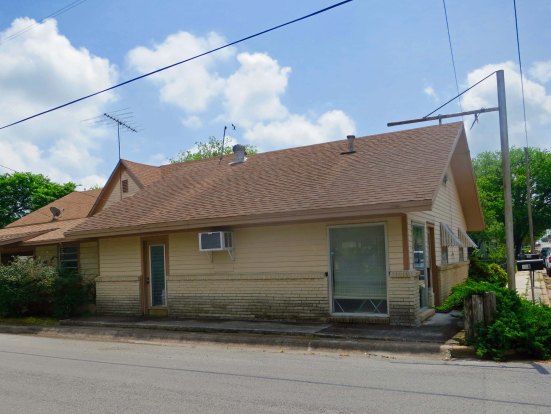
A couple of buildings as they look today in Lone Oak. I am a fan of communities that decide to renovate their historic buildings.

A couple of buildings as they look today in Lone Oak. I am a fan of communities that decide to renovate their historic buildings.

A car and RV wash in Mineola. They didn't do bikes.

A car and RV wash in Mineola. They did “bikes” but not bicycles.

Everything was green, an amazing contrast to the dry desert country I had been bicycling through since California. And, this is big news— there were pine trees! I hadn’t seen one since Lincoln County in New Mexico. It made me feel at home, almost.

Green, green grass and pine trees in the rolling hills as East Texas.

Green, green grass and pine trees in the rolling hills of East Texas.

Happy cows for me to moo at.

Happy cows for me to moo at.

One of the things about Mineola that caught my attention was that the Texas Governor, Jim Hogg, had lived in the town. His daughter was born there and he named her Ima, as in Ima Hogg. To the degree karma works, I’ve always imagined the Governor being reborn as a pig with a pork chop factory in his future. Ima never married (I would have done it for the name change alone), reportedly was close to her father, and went on to be an important figure in Texas Society. Maybe she was like Sue in the Johnny Cash song, A Boy Named Sue; the name made her tough.

Willie Brown, the flamboyant California politician, was born here as well. He was serving as Speaker of the California Assembly while I was cycling across the country. Brown was incredibly effective at passing and suppressing legislation. Voting Willie’s way brought substantial rewards. Voting against him brought swift punishment. Like him or not, he made government work. Washington could learn a thing or two.

I had run into Brown’s ability to kill bills a couple of years earlier when I was working with a group to increase tobacco taxes in California and devote a significant portion of the revenues to prevention programs. Almost every state in the country had increased tobacco taxes since California had last raised its tax in the 70s. The tobacco industry paid big bucks to California legislators to keep it that way. The bill was assigned to a committee guaranteed to kill it. We couldn’t even get a second. Fortunately, we had been prepared for this likelihood and had quietly planned to run an initiative campaign if the legislative effort failed. I called a press conference immediately after the vote and we announced our initiative.  The committee’s no-vote gave us a great kickoff. The press conference received major media attention throughout California. Thanks Willie.

I rode another 15 miles from Mineola to Interstate 20 where darkening clouds led me to call it a day. It had been a good day of bicycling, the first since my spoke had broken outside of Decatur.

The next morning, I was up early and heading into Tyler. The road had a wide shoulder, which is always appreciated by bicyclists.  I could relax a bit and not worry so much about being flattened by a car or semi. Most drivers are cautious and courteous when around bicyclists, but there are exceptions. I always rode as far to the right as was safe and kept a wary eye out for developing situations. Several times on my trip, I was forced to bail out, riding my bike off the road into the dirt and weeds, or even a ditch. Somehow, I always avoided crashing.

In Tyler, I was almost taken out, however. The city was more urban than most I traveled through on my trip and hillier than I had become used to in Texas. I was riding along, minding my own business when a woman turned right across my route, missing my front tire by inches— and then only because I had slammed on my brakes! She must have been half blind since I was wearing bright clothes.  Either that or she was high on something. She didn’t seem to hear very well either. When I suggested, loudly, that she be more careful, she ignored me and drove off. I sent a bird flying after her. Bad Curt.

There was nothing to do but stop at a DQ and quiet my nerves by downing a hamburger and a milkshake. The owner came out and sat down to chat. I told him about my encounter. He was quite empathetic. His brother owned a bike shop. Afterwards I was feeling a little punky. It may have had something to do with how fast I had sucked down the milkshake. Anyway, I made it a short day, stopping in Henderson.
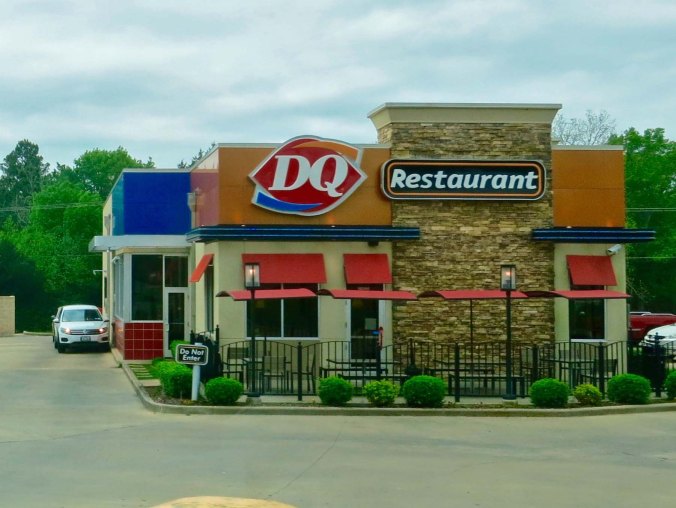
A Tyler Texas DQ.

A Tyler, Texas DQ.

The area around Henderson had been part of one of the largest oil booms in Texas history. In 1930, “Dad” Joiner, a 70-year-old oilman out of Tennessee and Oklahoma, had refused to give up on his belief that there was oil in the area, almost bankrupting himself in his search. Finally, at 8:00 pm on October 3, one of the wells he had drilled on Daisy Bradford’s farm eight miles west of Henderson gushed out oil and a ‘black gold’ rush was under way. I’m pretty sure that Daisy did a dance of joy. Henderson grew from a sleepy town of 2,000 to a booming 10,000, the roads became clogged with fortune seekers, and oil derricks sprang up in the surrounding region thicker than fleas on a hound, as the good ol’ boys down South like to say. To date, over five billion barrels of oil have been taken from the East Texas Oil Field.

A rest area near Henderson appropriately featured oil derrick decorations as covers of the picnic tables.

A rest area near Henderson appropriately featured oil derrick decorations as covers of the picnic tables. This is also where Peggy and I found the Joe Roughneck statue.

The next day found me traveling through piney woods that contained almost as many Baptist Churches as there were people. Or at least it seemed like it. I’d definitely made it to the Bible Belt. Following a round about way, I hit one road that was so remote it had me thinking Deliverance. Finally, I picked up Route 84, crossed the Sabine River, and entered Logansport, Louisiana. It was May 7th. I’d been in Texas for 18 days, or was that 1800?

Road construction, dust, and impatient drivers hurried me through Logansport. I stopped at a small bayou outside of town to catch my breath and spotted a water moccasin/cotton mouth slithering through the murky water. He was one big ugly dude, a pit viper with a serious attitude problem. I didn’t hang around. A few miles later, I started looking for a place to camp. It was approaching dark. I spotted an old, overgrown road that made its way into a pine forest where I could hide out. I set up my tent, climbed in, and zipped it up tight. That night I dreamed of gigantic snakes chasing me down the highway, mouths wide open, fangs dripping with poison. Two or three times I woke up to creatures stirring around in the forest outside my tent.
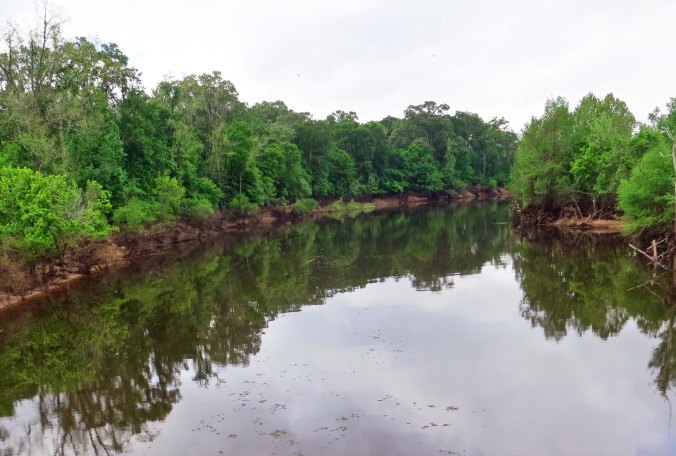
A Louisiana bayou: half river and half swamp. All jungle. Picture a large water moccasin slithering across its smooth surface.

A Louisiana bayou: half river and half swamp. All jungle. Picture a large water moccasin slithering across its smooth surface. The photo reminds Peggy and me of our boat trip up the Amazon.

I found an overgrown road leading into a pine forest for my campsite.

I found an overgrown road leading into a pine forest for my campsite. It provided cover from the road, but were there any snakes?

I was glad to be up and on my way the next morning, continuing to follow Highway 84. No monstrous serpents were hounding me but I still made good time. I stopped in Mansfield for breakfast and headed on. Large logging trucks carrying long, toothpick size logs kept me company, zipping by at speeds guaranteed to give me grey hair. Intense poverty was reflected in barely standing small houses. Dark, jungle-like growth edged the highway. I was sure it was crawling with snakes. A young man yelled at me to get off the road. His white-haired granny was too nervous to pass me on the narrow highway.

I crossed the Red River into Coushatta and worked my way south. Threatening clouds filled the sky and decided to let loose between the small towns of Campi and Clarence. And boy did they let loose. Soaked to the bone, I began thinking about a warm, dry, snake-free motel room. I found one outside of Clarence.

Coushatta, like its Texas cousins featured its his school and sports heroes.

Coushatta, like its Texas cousins, featured its high school and sports heroes dating all the way back to 1938. Since we took this photo in April it appears they haven’t had any champion teams for a long time. Either that or their sign is in desperate need of updating. Given that it still had a Seasons Greeting sign on it, I am thinking the latter.

Dark clouds over Clarence.

Dark clouds over Clarence.

After unpacking and putting on a set of dry clothes, I went outside to sit under the porch overhang, read a book, and sip on a beer. A large, black woman came over and plopped down in the chair next to mine. She had watched me bicycle in.

“What you all doing, Honey?” she asked. I explained I was in the middle of a 10,000-mile bike trip. “No way! You are one crazy man!” she exclaimed. “Say,” she went on, “I have some hooch over in my room. Why don’t you come over and try some?” I’d been propositioned before, but never with hooch. “Tempting,” I’d replied laughing, but then claimed a non-existent wife who didn’t want me “drinking hooch” on the trip. Instead I offered her a beer which she readily accepted. She was a funny woman and we had a delightful conversation. As she left she told me again, “If you change your mind about the hooch, Honey, just come over and knock on my door. Anytime tonight.”

NEXT BLOG: I bike a hundred miles out of my way to find an ATM in Alexandria, Louisiana and then head on to the mighty Mississippi River.
PING: The Sound of One Spoke Breaking… The 10,000 Mile Bike Trek

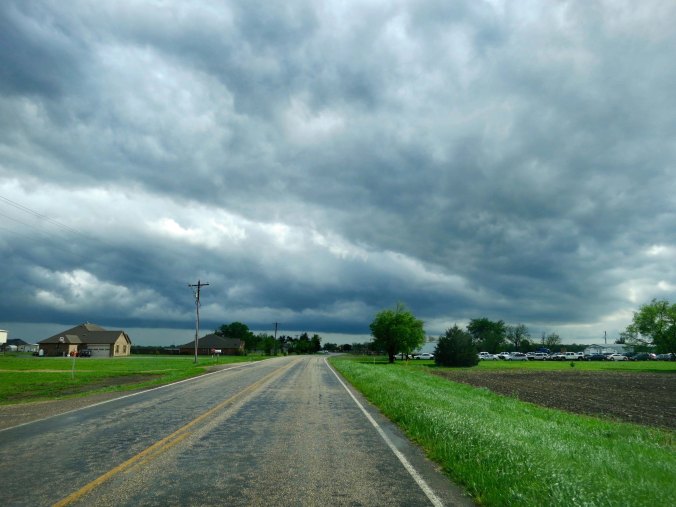
Stormy skies give credence to a tornado warning near Greenville, Texas.

The adventure part about a journey like mine is dealing with the unexpected, whether it is a broken spoke or a tornado warning. Peggy and I took this photo near Greenville, Texas. We had called ahead to reserve a campsite a few miles away and caught the manager in her storm shelter. “The clouds are circling,” she told us. It was scary enough in our van. Imagine what it is like on a bicycle.

The bike trek was going well. I was actually making progress across Texas and had rediscovered trees on my way into Jacksboro. Here’s the one-line journal entry for my day of bicycling from Throckmorton to Jacksboro:

“TREES, real TREES!”

Fort Richardson, a Texas State Park just outside of Jacksboro, was so pleasant that I declared a layover day. I’d gone for walks, read a book of poetry (Gary Snyder’s Turtle Island), and biked into town for a steak dinner. April 26th had dawned clear and slightly cool, which made it a perfect day for cycling. I was feeling so good I sang “Oh what a beautiful morning” to a cottontail that had come nibbling its way into my camp. The rabbit had looked up, startled, and scampered off into the mesquite, hippity-hop. Apparently it had no appreciation for music. Certainly it couldn’t have been my singing.

“It’s going to be a great day!” I yelled after my furry friend. I shouldn’t have done that. It jinxed the week; I am pretty sure.  Maybe if I had only quietly said, “It should be a good day…”

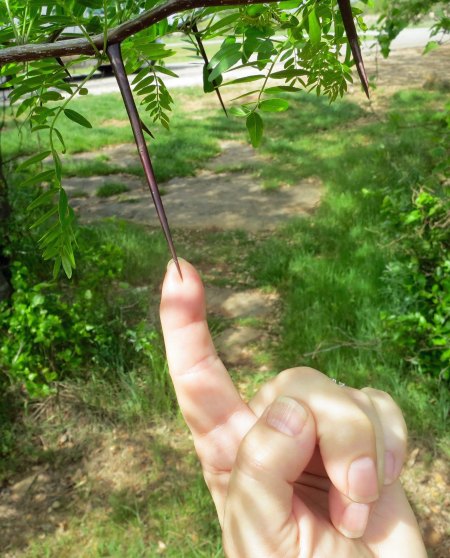
Fort Richardson had some of the best campsites I found on my journey, but the mesquite could be a little thorny...

Fort Richardson had some of the best campsites I found on my journey, but the mesquite could be a little thorny…

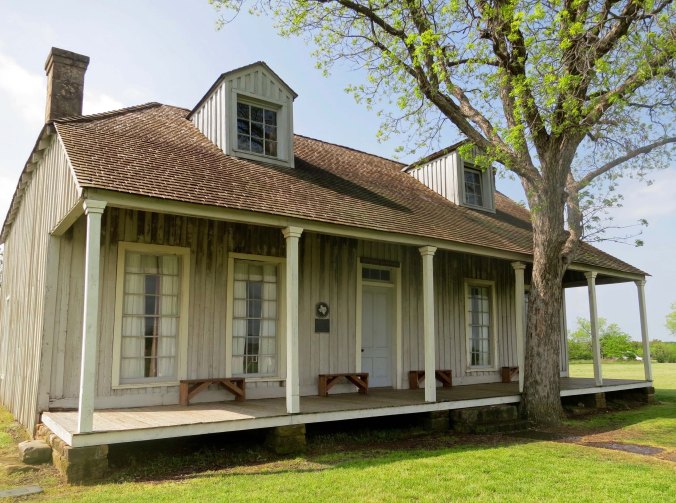
Fort Richardson was established just outside of Jacksboro, Texas in the late 1860s to counter the Native Americans who had gone on the warpath because their land was being taken away and the buffalo herds wiped out. This was the officer's quarters.

Fort Richardson was established just outside of Jacksboro, Texas in the late 1860s to counter the Native Americans who had gone on the warpath because their land was being taken away and the buffalo herds wiped out. This was the officers’ quarters.

I really liked this bridge at the fort. Originally it had crossed a stream just behind the fort. Today it rests on what would have been parade grounds.

I really liked this bridge at the fort. Originally it had crossed a stream just behind the fort. Today it rests on what would have been parade grounds, preserved for visitors to admire.

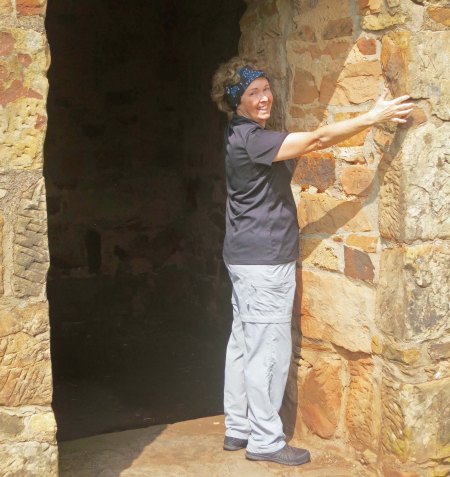
Peggy demonstrates the thickness of the ammunition magazine at the fort.

Peggy demonstrates the thickness of the ammunition magazine at the fort.

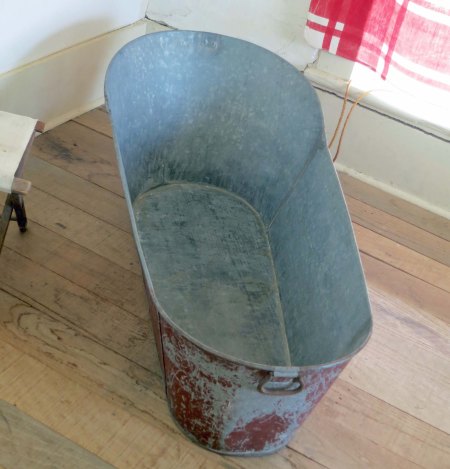
A modern hospital, for its time has also been preserved at Fort Richardson. A ranger provided a tour. Bath anyone?

A modern hospital, for its time, has also been preserved at Fort Richardson. A ranger provided a tour. Bath anyone?

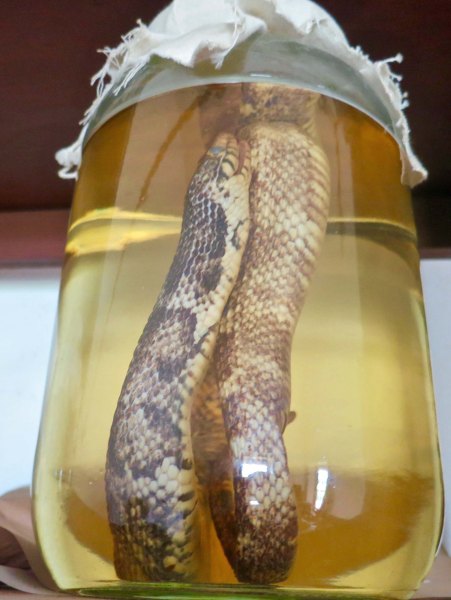
Pickled snake. The park ranger told us that the Smithsonian had requested that the fort gather up snakes and ship them back to Washing ton to study. This one was still hanging around.

Pickled snake. The park ranger told us that the Smithsonian had requested that the fort gather up snakes and ship them back to Washington to study. This one was still hanging around.

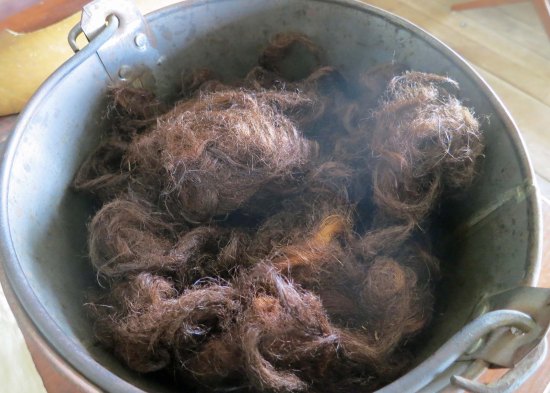
I can pretty well guarantee no one will guess what this is all about. The ranger told us these were hairs from a horse's tail. The hospital had used them as sutures,

I can pretty well guarantee no one will guess what this is all about. The ranger told us these were hairs from a horse’s tail. The hospital had used them as sutures. Apparently, they were less likely to cause infection than thread.

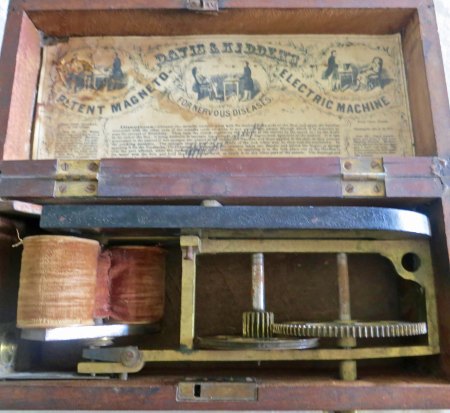
Shocking! It was believed that electrical shock was the best treatment for nervous disorders. This device provided the shock.

Shocking! It was believed that electrical shock was the best treatment for nervous disorders. This device provided the shock. My brother and I had a similar device when we were children. It was an old phone that you cranked up to generate electricity to send a phone message. We’d invite our little friends over to experience the shock.

I was about five miles outside of Decatur when I heard “Ping!” Unlike the sound of one hand clapping, which is underwhelming, the sound of one spoke breaking is quite distinctive. My response was very un-Zen like, even more so when I found the broken spoke on my back wheel. I’d need a bike shop.

A small cement plant was across the road. The receptionist offered me her phone, good luck, and the yellow pages. A Mel’s Bike shop was listed in Decatur. I called and got Mel. “Wait there,” he said. “I’ll be right out to pick you up.” And he was. Twenty minutes later, a smiling, older man showed up to collect me. He was another one of those people who reminded me of just how good folks can be. His shop, it turned out, was behind his home. He quickly fixed my spoke and started looking for other things to work on. My derailleur cable was too short; he replaced it. I was on my way to a complete tune up. When he was finally finished, I asked what I owed him.

“Nothing,” he said. And stuck to it.

“At least, Mel,” I argued, “you have to let me take you to lunch.” Two hours later we were still talking over dessert. I was chatting about snowstorms, rattlesnakes, mountains, deserts, dinosaurs and Texas. Mel was talking about his life, and how he had always dreamed of doing what I was doing. Finally, the time came when I had to bicycle on. He was still watching as I disappeared around the block. I waved one final time.

Peggy and I stopped off at Mel's home in Decatur in April. I would have loved to have seen him but the house was shuttered and empty. A woman at the local Post Office told us it had been quite some time since she had see the bike shop sign.

Peggy and I stopped off at Mel’s home in Decatur in April. I would have loved to have seen him but no one was there. A woman at the local Post Office told us it had been quite some time since she had seen the bike shop sign. Possibly Mel had moved or passed on.

Memories came flooding back as I entered Denton. In the spring of 1978, I had recruited for Peace Corps at the University of North Texas along with my first wife and an African-American woman who had also served as a Volunteer. We had gone out for breakfast one morning and you could have heard a pin drop when we entered the restaurant. The Civil Right’s act was young and the South was still adjusting. Black and white people did not eat together. We had just sat down when this young head popped up from the adjoining booth, wide-eyed, and announced to the whole room, “Momma, there’s a Nigger sitting with those people.” From the mouth of an innocent child, the insane prejudice of generations was repeated. As I write these words today, I am saddened by the fact that this prejudice continues to repeat itself in a seemingly endless and violent cycle. Such senseless waste. When will we ever learn…

The roads around Denton have become clogged with traffic and the usual fast food joints. The Dallas/Fort Worth area has become one of the fastest growing regions in the nation. Even on my bike trip, I was faced with traffic I hadn't experienced in a thousand miles.

The roads around Denton have become clogged with traffic and the usual fast food joints. The Dallas/Fort Worth area has become one of the fastest growing regions in the nation. Even on my bike trip, I was faced with traffic I hadn’t experienced in a thousand miles.

Peggy and I found suburb after suburb where there had been farms in 1989.

Peggy and I found suburb after suburb where there had been farms in 1989.

And the country roads I had ridden over, have now become multi-lane freeways providing ample room for even guys like this.

And the country roads I had ridden over have now become multi-lane roads providing ample room for even guys like this. I would not have liked to have met up with him on my bike!

But such thoughts were rare on my bike trip. And I soon had another thought to occupy my mind. A ping announced that another spoke had given up the ghost, gone to the great spoke factory in the sky. This isn’t unusual; when one spoke breaks, others may follow. Mine were simply reacting to all of the weight I was carrying. They’d had enough. I was faced with the fact that I needed a new wheel, preferably one with more spokes made out of a heavier gauged steel. I did what I could to true my wheel and limped for another 15 miles into McKinney.

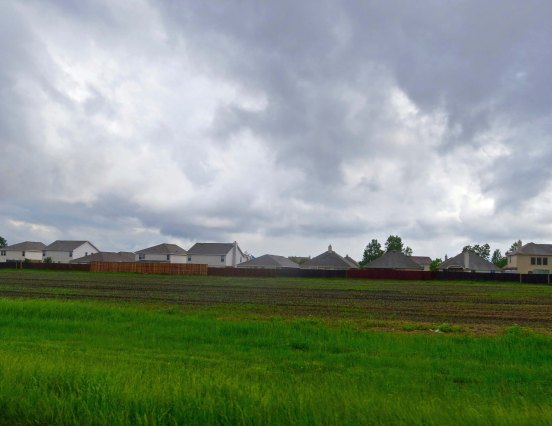
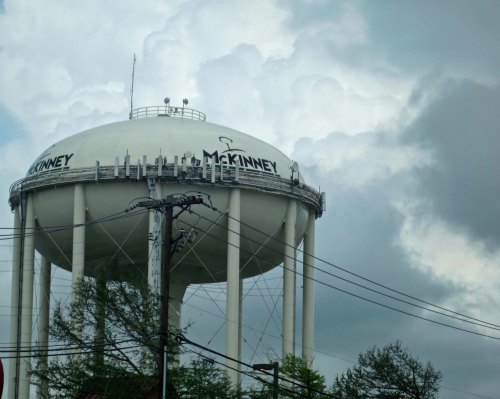
Dark skies over McKinney. My wheel challenges plus the weather added a week's time to my stay in Texas.

Dark skies over McKinney. My wheel challenges plus the weather added a week’s time to my stay in Texas.

Calling around the next morning, I quickly realized I couldn’t find what I needed in McKinney, nor, apparently, in Dallas. Finally, a mechanic at a bike shop near Southern Methodist University told me she could build what I needed but it would take a day. And, I might add, cost $100. Early the next morning I climbed on the Dog, the Greyhound bus, and zipped into Dallas on I-75. A bit of futzing and I found my way out to SMU on a municipal bus. My wheel wasn’t ready but there was a bookstore next to SMU, so what did I care. Two hours later found me on my way back to McKinney with my shiny new wheel and a book, The Quickening Universe by Eugene Mallove.

I’d like to report that the new wheel solved my problem, that my next 8000 miles were worry free. Sigh. I was half way between McKinney and Greenville the next day, having ridden all of 15 miles, when the wheel pretzeled on me.  Instead of Ping, it was more like SPRONG! I couldn’t even turn the wheel. I’m not sure whether it was my innovative language or the truing but I finally persuaded the wheel to make wobbly turns and crawled my way into Greenville. I found a motel next to I-30 with the thought that I would soon be returning to Dallas. Which is what happened.

I was greeted by silence when I called the bike shop the next morning. Make that consternation. After apologizing, the mechanic told me if I would bring the wheel back in the next day, she would have another one ready that she would guarantee would get me through the trip. Fortunately, the Dog also had a route along I-30. So the next morning, there I was, me, my pretzel wheel and The Quickening Universe, just in case my new wheel wasn’t ready.

It was. The mechanic greeted me at the door and handed me my second new wheel in three days. 26 years later, it still resides on the back of my bike.

I was up at 5:30 the next morning, eager to hit the road. My wheel problems had cost me four days. I turned the TV on for company while I packed my panniers. “Expect severe weather in the Dallas area and eastward the next few days,” a stern-faced weatherman was warning. Thunderstorms, heavy rain, hail and tornadoes were forecast. Flash floods were expected. People were advised to stay home unless they had to travel. As if I needed more bad news, the room was suddenly lit up by a flash of intense light followed instantly by a loud boom that bounced around the motel. The intense storm had already started. Curt wasn’t going anywhere.

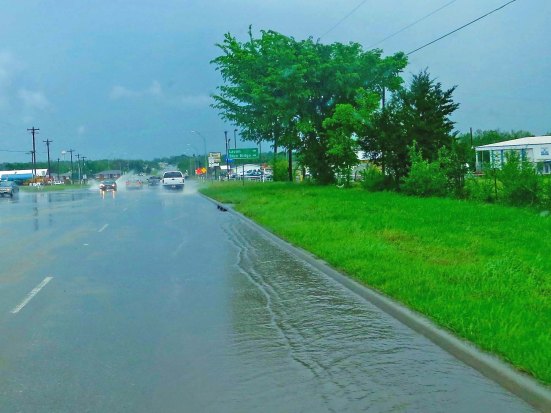
When this happened on my bike trip, I would get off the road and seek shelter. If nothing man-made was around, I had a small tarp that just covered me. This storm pictured here, became so intense that even Peggy and I were forced to pull off the road in our van.

When this happened on my bike trip, I would get off the road and seek shelter. If nothing man-made was around, I had a small tarp that just covered me. This storm near Greenville, became so intense that even Peggy and I were forced to pull off the road in our van.

But nature is going to do what nature is going to do. I had a book to read and the motel had a private club. Private clubs were how Texans got around the drinking laws. Staying at the motel gave me an instant membership, which I took advantage of the next three evenings while the storm continued to rage. And rage it did. One time I looked outside and saw hailstones the size of golf balls falling. I imagined being on my bike. The third day, the storm headed out, prepared to do its nastiness somewhere else.

I stopped by the club for a final beer that evening and was cornered by a window-washer who wanted to talk. When he learned I had lived in Alaska, he got really excited. “I am going to move there,” he told me. And then he told me why. He had been having an affaire and the woman’s husband had found out. “He’s hunting for me,” he confided. “I am carrying a 357 Magnum for protection.” Oh great, I thought to myself. The way my luck has been running this week, the husband is going to show up.

I’d carried a 357 once in Alaska. A doctor friend had insisted on it for my health. I was going backpacking in grizzly bear country. I had put the pistol in one section of my backpack and the bullets in another, convinced that there was a lot more danger of me shooting myself than being attacked by a grizzly.

“Hey,” my best new window-washer friend asked with light bulbs going off, “would you like to see my gun?”

“Um, no thanks,” had been my response. It was definitely time I was hitting the road.

NEXT BLOG: Out of Texas and into Louisiana with an offer of hooch and…

A Sizzling Sun, A Reclining Rattler, and A Hellaceous Headwind… The 10,000 Mile Bike Trek

The sun in Texas can beat down unmercifully.

The sun in Texas can beat down unmercifully. For a bicyclist on the open road in West Texas, the only escape is to cycle on to the next town.


“Only mad dogs and Englishmen (plus Curt) go out in the noonday sun.” Indian Proverb


Life becomes incredibly simple out on the road. The normal aspects of our lives— jobs, family, friends, deadlines, houses, yards, bills, etc., drop behind us. There is a freedom here: the freedom to unwind, the freedom to think about our lives, and the freedom to live in the moment.

This freedom is strengthened by the physical challenge of long distance backpacking or bicycling. The difficulty of getting through the event pulls us even farther out of our normal life while our success changes our perspective on who we are and what we can accomplish. When I led nine-day, 100-mile backpack treks and 500-mile bike treks, I could see people’s lives changing, literally before my eyes. Some profoundly.

There was ample challenge built into my day of cycling between Post and Aspermont. To start with, the temperature was pushing 80°F when I left Post around 7:00 AM. The day promised to be a scorcher. By 1:00 PM, the thermometer had climbed beyond 100 (38°C). I was down to minimum clothing and maximum sunblock, sucking on my water bottle, and worrying about sunstroke, always a danger in the hot sun. Tar began to seep up through the pavement. I climbed off my bike to take a look at the phenomena and my shoes stuck like I was walking on well-chewed gum. I noted in my journal, “I wonder if this is what the saber tooth tigers felt like when they encountered the La Brea Tar Pits in Southern California.”  I imagined my foot sinking into the pavement and me becoming a fossil for future generations to ponder over.

There were also ups and downs, a welcome change from the flat, flat of West Texas I had been cycling across. Several tributaries to the Brazos River flow through the area, cutting down through the plains. I even caught view of what Texans consider a mountain, or two to be more specific. The Double Mountains are a pair of flat-topped buttes that rise 500-800 feet above the surrounding plains and can be seen for hundreds of square miles. Pioneers traveling by horse and covered wagons used them for land marks. Native Americans probably used them to spot the pioneers.

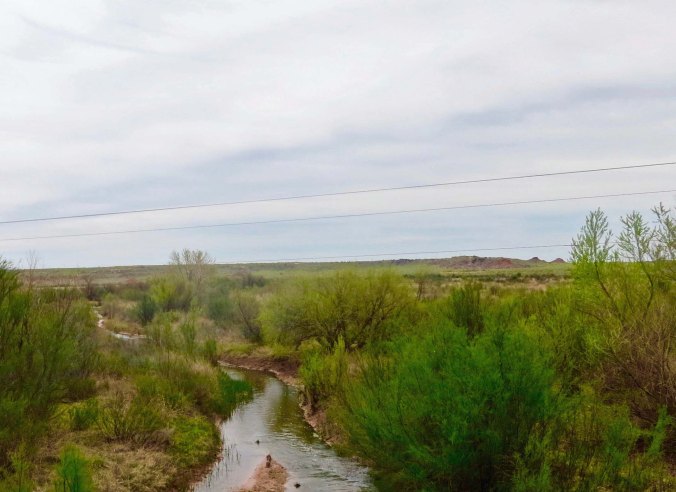
A number of tributaries feed into the Brazos River in West Texas. Eventually the river flows into the Gulf of Mexico south of Huston.

A number of tributaries feed into the Brazos River in West Texas. Eventually the river flows into the Gulf of Mexico south of Houston.

The Brazos River near Aspermont Texas.

The river cuts through the Llano Estacado providing travelers with a break from the flat terrain of West Texas.

A distant view of the Double Mountains of West Texas near Aspermont.

A distant view of the Double Mountains of West Texas near Aspermont.

The break in terrain was welcome. My over-heated body appreciated the 20-30 mile per hour breeze generated by my downhill dashes— although it whined about the climb afterward.  There was even an occasional shade tree! The challenge here is that it becomes difficult to see in the shade when you are quickly moving between shadows and sunlight. Loose gravel, broken glass, and other road hazards lurk in the dark, waiting to provide nasty surprises.

That’s the way it was with the rattlesnake. I was racing down a hill and he/she was relaxing in the shade, enjoying the warm pavement.  I was a few feet away from a fanged encounter when I spotted him, all coiled up. I prefer my rattlesnakes rattling a warning when I approach. But there wasn’t time for him to rattle or me to think, “Oh, there’s a rattlesnake.” Instincts honed by a million years of my ancestors fearing snakes and two thousand miles of me bicycling took over. I zigged, damn lucky I didn’t land on top of four feet of extremely irritated serpent.

Heart beating like a jack hammer, I executed a U-turn at the bottom of the hill and pedaled back up to the rattlesnake. It hadn’t budged. That changed when I lobbed a couple of rocks his way (from a distance). As he grouchily slithered off the road wanting to bite someone— me, I told him how lucky he was to have encountered a bicyclist and not an 18-wheeler.

Adding insult to almost injury, a strong headwind caught me about ten miles outside of Aspermont. The wind had to be blowing at least 40 miles per hour. Tired, hot, and cranky, I dropped into my lowest gear and climbed out of the saddle. Two hours later I reached the town. My journal tells me I drank a gallon of ice tea.
Aspermont was like most of the west Texas towns I rode through: small, isolated, and slightly depressed. Employment opportunities were few. Population was going down, not up. The town’s population had been 1,357 in 1980. By 1989 it had dropped by a hundred or so.  The young people were leaving, heading off to the brighter lights of Dallas, Houston and other urban areas.

High school sports were a bright spot, however. Most towns had signs announcing when their kids had won state or regional championships, even if it was 10-20 years ago. I spent a pleasant evening in Aspermont recovering from my long day and chatting with the friendly locals who laughed at my adventures and regaled me with tales of their own. Texas is a place for story telling. That night there was another impressive thunder and lightning show, reflecting the heat and wind I had experienced during the day.

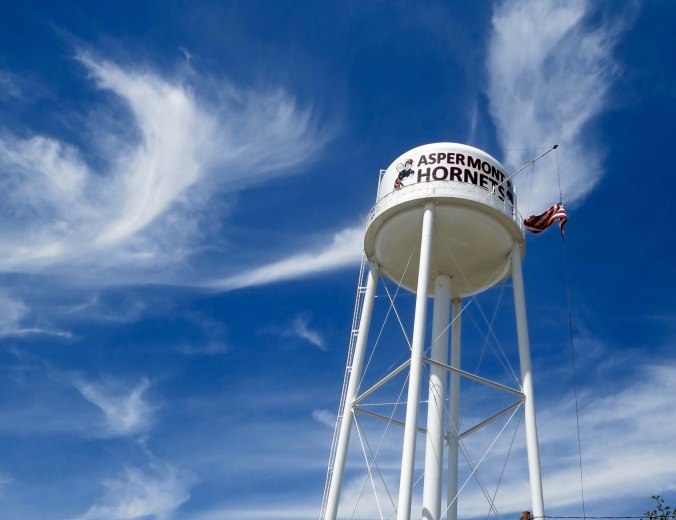
High school sports are very important in the small towns of West Texas. The local team, the Aspermont Hornets, is featured on the town's water tower.

High school sports are very important in the small towns of West Texas. The local team, the Aspermont Hornets, is featured today on the town’s water tower.

Abandoned homes reflect the dropping population of many West Texas towns. This was once somebody's dream.

Abandoned homes reflect the dropping population of many West Texas towns. This was once somebody’s dream.

The next day, I bicycled on to Throckmorton, a short 60 miles without excessive heat, wind or rattlesnakes. I was really impressed with the town’s beautiful city hall. Not so much with the local grocery store where I went to buy some fresh fruit. The oranges looked like rejects of rejects. (I admit to being spoiled by the fruits and vegetables of California.) Throckmorton is cow country so I booked myself into the Cow Country Motel and ate dinner at the Rancher’s Restaurant.

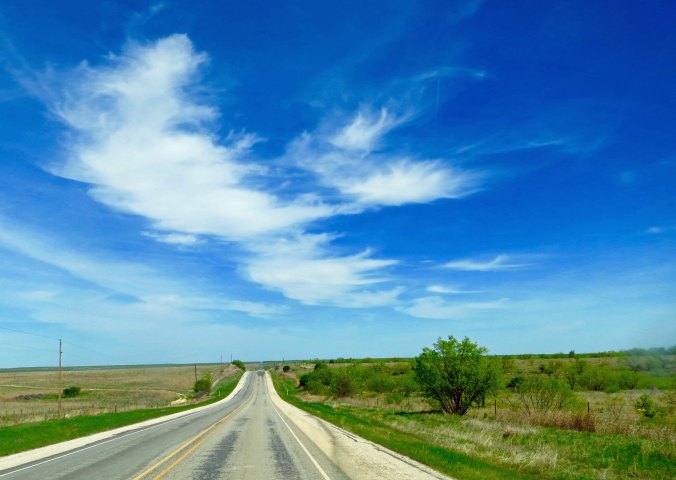
Highway 380 between Aspermont and Throckmorton.

Highway 380 between Aspermont and Throckmorton.

Some appropriate cattle on the way to Throckmorton.

Some appropriate cattle on the way to Throckmorton.

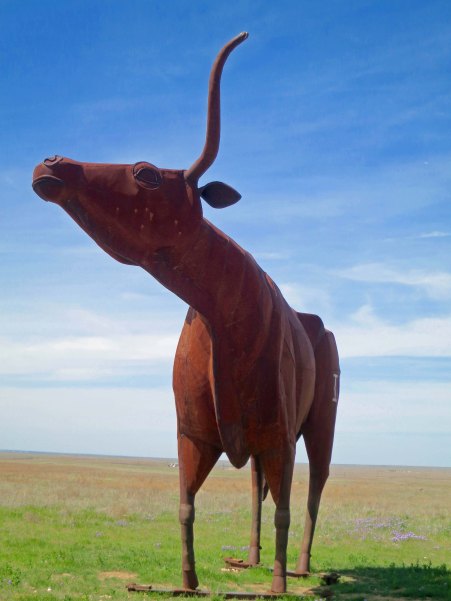
Peggy and I found this 22 foot high sculpture of a Texas Longhorn bull just a few miles west of Throckmorton.

Peggy and I found this 22 foot high sculpture of a Texas Longhorn bull a few miles west of Throckmorton. It wasn’t there when I bicycled through the area in 1989. The artist, Joe Barrington, is noted for creating  anatomically correct animals.

A side view of the sculpture, which is known as the Bridle Bit Bull. The local rancher who owns the property commissioned the art.

A side view of the sculpture, which is known as the Bridle Bit Bull. The local rancher who owns the property commissioned the art.

A side view of the City Hall in Throckmorton.

A side view of the City Hall in Throckmorton.

And a front view to conclude this post.

And a front view to conclude this post.

NEXT BLOG: A side trip to Archer, Texas, the home of Larry McMurtry and his fabulous bookstore. I also continue my bike trip on to Jacksboro and Fort Richardson, one of my favorite campgrounds on the bike trip.


And Just How Big Is Texas? The 10,000 Mile Bike Trek

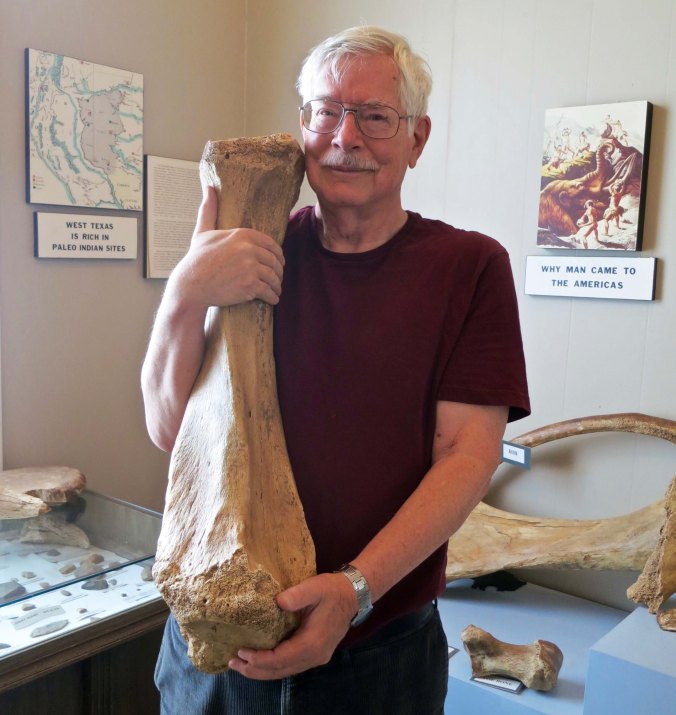
Texas is like this bone, big. I found this mastodon bone at the Garza County Museum in Post, Texas.

Texas is like this bone, BIG. I found this fossil at the Garza County Museum in Post, Texas. Peggy and I often stop in small museums as we travel. We are never disappointed and often delighted. Where else could I play with mastodon bones? There are more photos from the museum below. (Photo by Peggy Mekemson.)


“You must remember that space is large; it is even larger than Texas.” — Werner von Braun, the great rocket scientist. I don’t know if you could persuade a true Texan of this, or even me, after I rode my bicycle across the state.


Every state greets you with a welcome sign.

Every state greets you with a welcome sign.

My first major landmark the next day was a sign declaring I was about to enter Texas. I stopped, of course. I had now bicycled through four states: California, Nevada, Arizona and New Mexico. Texas with its heat, thunderstorms, hailstorms,and tornadoes was next.

I knew something about distances in the state. I had driven across it twice. I also knew a little about the weather. In search of the perfect steak on one of my trips, I barely escaped a flash flood. A day later it was hailstones the size of hardballs. In the early 80s, I taught a workshop in Houston, Texas on using long distance bicycle trips as fundraisers. None of this, however, prepared me for bicycling across the state.

Sometimes it is best not to know too much about what you are getting into. A lot of adventures would be missed.

I climbed back on my bike and spontaneously broke into the song, All My Ex’s Live in Texas. George Strait had made the country-western tune popular a couple of years earlier and I had been singing it with flair ever since. My first wife lived outside of Houston.

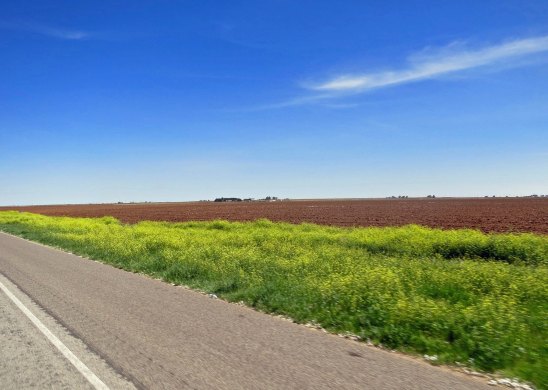
My initial view of the state surprised me. Where I had expected scrub brush and cacti, large farms stretched into the distance. Huge, insect-like, irrigations systems crawled across the land shooting long showers of water over several acres at a time. Plowed areas were so red they reminded me of the laterite soils of the West African rain forests, where I had served as a Peace Corps Volunteer.

I wasn't prepared for the extensive farms and the red soil I found in West Texas.

I wasn’t prepared for the extensive farms and the red soil I found in West Texas.

Cotton was king here. The crop had been harvested the previous fall but scroungy grey cotton balls could still be seen clinging desperately to weeds just off the highway. Bicyclists, who live on highway shoulders, tend to notice such things, along with dead animals and broken auto parts. And they have a lot of time to contemplate what they see.

I biked on through the small town of Plains and on to Brownfield. Natural landmarks are few and far between in flat country. I came to rely on two man-made additions to the skyline: water towers and grain elevators. Almost every town in the Texas dry-country had a water tower, which would proudly display its name. Many farming towns with rail connections also had grain elevators. Both of these structures reach for the sky. My challenge was to dampen my Pavlovian responses and not get too excited about food and drinks when I first spotted them. Usually, they were miles away. I’d arrive at DQ (Dairy Queen), when I arrived at DQ.

A water tower seen in the distance marking the town of Plains, Texas.

Water towers became one of my main land marks as I biked across Texas. Do you see that tiny dot in the air?

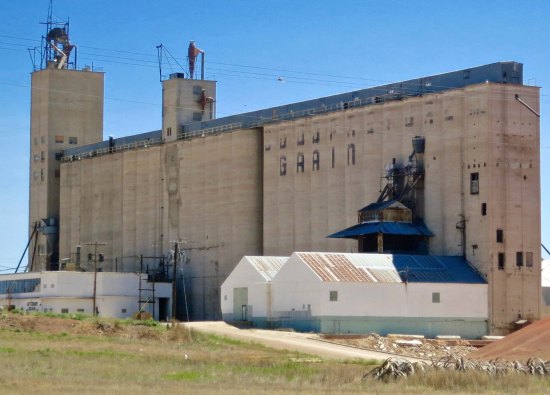
I always wonder where they find enough grain to fill these grain elevators up. This particular elevator was in Brownfield.

I always wonder where they find enough grain to fill these huge grain elevators. This particular storage facility was in Brownfield.

The local DQ in Brownfield must have taken its cue from the water towers and grain elevators. I ate in enough DQs as I bike across the country that the company should have sponsored me. Peggy and I stopped here for old times sake.

The local DQ in Brownfield must have taken its cue from the water towers and grain elevators. I ate in enough DQs as I biked across the country that the company should have sponsored me. Peggy and I stopped here for old times sake.

That night, billowing dark clouds stretched across the sky. There was a tornado watch on, the first of several I would face. To prepare myself, I went in search of a beer. Unfortunately, Brownfield was a dry town. Blue Laws were still in effect and there was no booze available, at least publicly. I’m pretty sure that 99%, or more, of the adults in town drank. Luckily, someone directed me to a liquor store drive-through a few miles outside of town. The clerk laughed when I rode my bike through. As I recall, they only sold their beer in cases or six-packs. Darn.

There was a spectacular thunder and lightning storm that night, but fortunately no tornadoes. I only had to drink three beers out of the six-pack.

I awoke to a clear, warm day and bicycled 47 miles into Post, a town that had been founded by CW Post of cereal fame in 1907 as a utopian experiment. There were to be no whores or alcohol in town. People could eat all the cereal they wanted. Post was something of a fanatic when it came to breakfast food.  He thought his Grape Nuts product could cure appendicitis. (Don’t try this at home, kids.)

CW Post founded the town of Post, Texas on 200,000 acres on property he bought from the Cattle Baron Slaughter.

CW Post founded the town of Post, Texas on 200,000 acres he bought from the cattle baron John Slaughter.

Post picked up his ideas on the curative properties of his products from another cereal magnate, John Harvey Kellogg. My favorite health food advocate of the time, however, was the Presbyterian minister, Sylvester Graham. The good reverend thought his creation, Graham Crackers, would curb people’s sexual appetites.

It’s something you might want to think about the next time you scarf down a S’more.

The Garza County Museum in Post is housed in what was once a sanitarium built for the town by CW Post. It was choked full of almost everything imaginable.

The Garza County Museum in Post is housed in what was once a sanitarium built for the town by its founder. The museum was  full of almost everything imaginable. Following are a few examples.

There is nothing particularly unusual about finding a stuffed buffalo head in a museum. But i found the sign on the side quite interesting. A quote: "In order to subdue the Plains Indians, mass extermination of the buffalo was ordered by the US Government."

There is nothing particularly unusual about finding a stuffed buffalo head in a western museum. But I found a quote on the sign quite disturbing:  “In order to subdue the Plains Indians, mass extermination of the buffalo was ordered by the US Government.” To the degree this is true, it is a dark moment in US history indeed.

There was also a bear rug. My toes, unbidden by my more rational mind which thought 'poor bear,' wanted to bury themselves in the rug.

There was also a bear rug. My toes, unbidden by my more rational mind that thought ‘poor bear,’ wanted to bury themselves in the fur.

I am not sure how Harvey the rabbit made it into the museum, but there he was, all six feet of him.

I’ll close today with Harvey, the rabbit. I am not sure how he made it into the Garza County Museum, but there he was, all six feet three and one half inches of him. Originally, Harvey was an invisible rabbit who starred in a 1950 movie with James Stewart.

NEXT BLOG: I leave Post and find sizzling heat, high winds, and a misplaced rattlesnake.

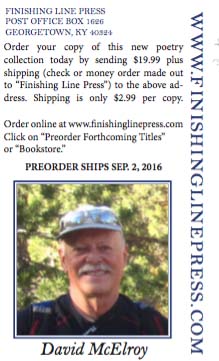
A final note: A friend of mine who lives in Alaska, David McElroy, has recently finished a book of poetry, Mark Making, that is now available for preorder. David somehow combines working as a bush pilot and extensive travel with writing poems. According to the publisher:

“He has been published in national journals and has a previous book of poems called Making It Simple.  He is an award winner of grants from the National Council on the Arts and the State of Alaska Council on the Arts and Humanities.”

I quite enjoy his work, and you may, as well. If you are interested, here is the preorder information. When you arrive at Finishing Line Press, just type in Mark Making in the search box at top.

David's poetry book