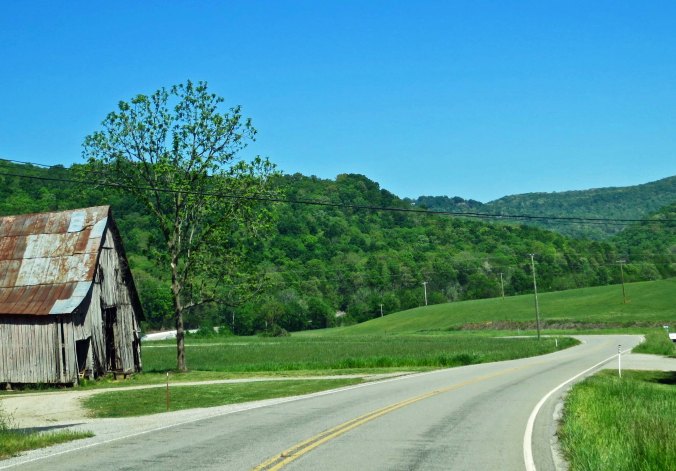
Bicycling across Great Smoky Mountains National Park… The 10,000-Mile Bike Trek

Great Smoky Mountains National Park waterfall in North Carolina.

In addition to its tree covered mountains, the Great Smoky Mountains National Park is noted for its beautiful waterfalls. Peggy and I found this little beauty next to the road on the east side of the Park.


HAPPY 100th BIRTHDAY TO AMERICA’S NATIONAL PARKS

I can’t imagine a future without wild places for our children, grandchildren and future generations to love and explore. Preserving our wilderness areas and the diversity of life on earth are two of the most important responsibilities we have as humans.

A few years ago, Peggy and I took time off to visit America’s National Parks from Alaska to Florida. It was an incredible trip. The beauty and variety of landscapes, plants and animals found in these parks are a gift of incalculable value. As are all the wild places set aside by other countries.

Given that this week is America’s 100th Anniversary of its National Park system, it seems appropriate that I am writing today about my bike ride through (make that up and over) Great Smoky National Park. (And yes, smoky is how it is spelled.) With over nine million visitors this past year, it is America’s most visited park.

First, of course, I had to get there. In the last post about my bike tour of North America, I was in Dayton, Tennessee checking out the courthouse where the Scopes’ trial took place. I left there continuing to follow Route 30 east as it made its steep, winding way up and over ridges of the Cumberland Plateau. In Athens, Tennessee, I picked up an even smaller road, Route 39, that carried me over another ridge into the small community of Englewood.
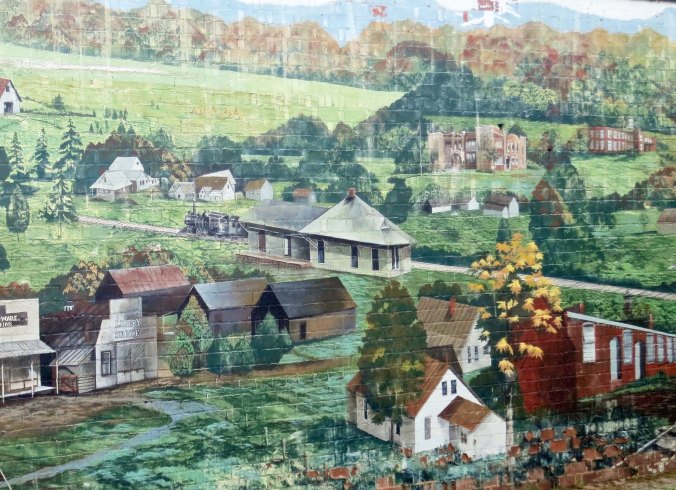
Mural depicting the historic town of Englewood in eastern Tennessee.

This mural of historic Englewood is prominently featured on the side of a building entering town.

From here, it was time to make my way north over the relatively flat Highway 411 to Maryville. Bucolic countryside, Mennonite farms, a humorous Spit and Whittle Club, and the Little Tennessee River provided pleasant distractions from the work of bicycling. As I left Maryville on Highway 321 going toward Pigeon Ford, the countryside shifted dramatically, providing scenic views of the Smokies. The road from Pigeon Ford to Gatlinburg, Highway 441, was all about separating tourists from their dollars. I’ve rarely seen such a concentration of “tourist attractions.” Today, there are eight different Ripley’s venues alone— “believe it or not!”

This Mennonite farmer was apparently out enjoying his/her farm.

This Mennonite farmer was apparently out enjoying his/her farm since I didn’t see any work going on.

Spit and Whittle Clubs, sometimes know as Liar's Clubs, can be found throughout the US. In general, their members are story tellers who focus on 'tall tales.' I expect that this is one of their most unusual club houses!

Spit and Whittle Clubs, sometimes know as Liar’s Clubs, can be found throughout the US. In general, their members are story tellers who focus on ‘tall tales.’ I expect that this is one of their most unusual club houses!
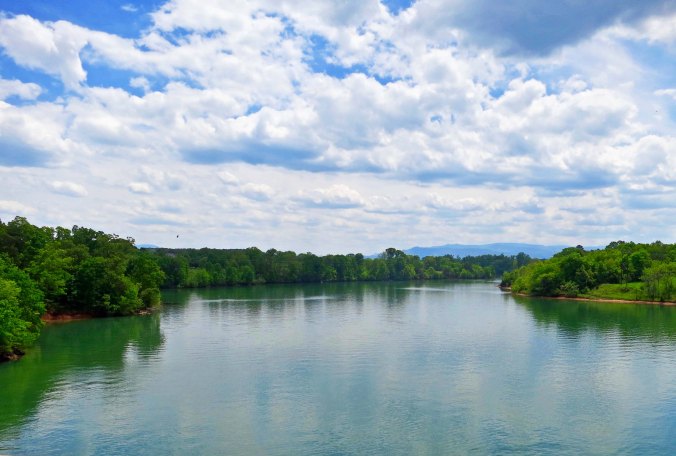
Little Tennessee River flowing through eastern Tennessee.

Highway 411 took me across the Little Tennessee River, which didn’t seem so little to me.

The Great Smoky Mountains can be seen in the distance as you leave Maryville, Tennessee on Highway 312.

The Great Smoky Mountains can be seen in the distance as you leave Maryville, Tennessee on Highway 321.

I spent the night in Gatlinburg, not because I wanted to sample the attractions, but because I wanted to develop the proper mental attitude I would need for climbing 4000 feet in the morning to Newfound Gap at 5046 feet (1538 meters). Two beers and a steak just about did it.

The Smokies, as they are often called, received their name from a blue haze early pioneers found hovering over the mountains. It wasn’t actually caused by smoke, however, it was caused by plant respiration (breathing, so to speak). The park is part of the Appalachian Mountains, an ancient range going back some 250-300 million years. (Some rocks in the area date back over a billion years.) Compare that with the Rocky Mountains at 80-85 million years and the Sierra Nevada Mountains, a mere baby at 40 million. Once, the Smokies reached for the sky like their younger western cousins; now they are old and worn down. This doesn’t make them less steep; ask any hiker or biker who wanders through them. Nor does it make them any less beautiful.

The 17-mile trip up to the Gap was, as I expected, a workout. People shouted encouragement from their cars on some of the steeper parts. I grunted in return. At one stop a little kid looked at me wide-eyed. “Are you really bicycling to the top?” “Sure,” I replied. “It’s fun. Maybe you will do it some day.” “Maybe not,” he responded. I passed the Appalachian Trail and thought of the hikers making their way north on a journey far different from mine but similar in its challenge. And I entered North Carolina, leaving Tennessee behind. After a leisurely lunch on top, it was time to zoom down the mountain, a thrill I had earned. Following are some photos that I took when Peggy and I redrove the route though the Great Smoky Mountain National Park this spring.

View of Great Smokey Mountains National Park in Tennessee.

Peggy and I drove across the Smokies a month earlier than  when I biked across them in 1989. A number of trees had yet to leaf out.
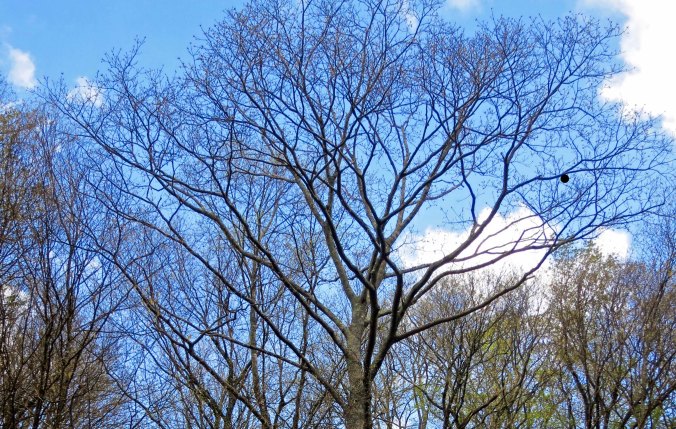
Tree in Great Smoky Mountains National Park in early spring.

By June this tree would be dressed in green. I am not sure who the round nest on the right belongs to. Or if it is even a nest.

I liked this canyon view.
I liked this canyon view.

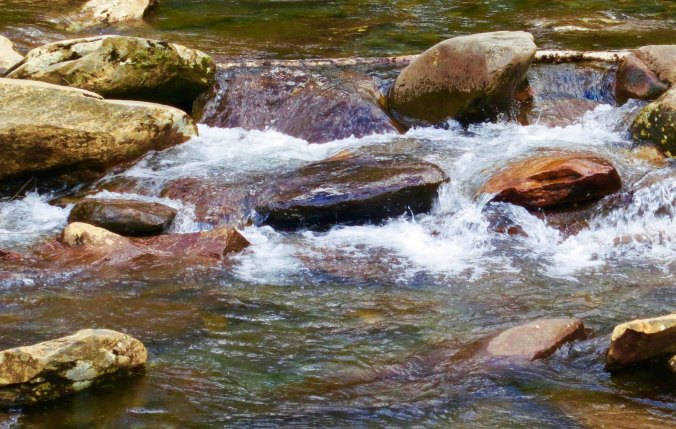
This stream kept me company as I biked up the mountain.

This stream kept me company as I biked up the mountain. At one point I had stopped and dangled my toes in its refreshing water.

Because the road over the mountain is so steep and filled with traffic, the National Park recommends that people not bicycle on it.

Because the road over the mountain is so steep and filled with traffic, the park recommends that people not bicycle on it. Naturally, I caught a section of the road that was car free and had a decent shoulder.

Waterfall in Great Smoky Mountain National Park in North Carolina.

This small waterfall was part of the same stream I placed at the top of the post.

I flew past the turn off that marks the southern beginning of the Blue Ridge Highway and into Cherokee, headquarters for the Eastern Band of the Cherokee Nation. I remember two things about my 1989 stop in Cherokee. One was that the town seemed economically depressed. The second was a bear in a cage. I felt sorry for it. The Smokies are known for having the largest concentration of black bears in the East. The caged bear would have been much happier running around in the woods with them.

The town seems much healthier now, largely thanks to the Harrah’s-Cherokee Hotel and Casino. It draws several million visitors (and their money) into Cherokee annually. As for the bear, I didn’t see it. Instead, brightly painted bear sculptures were found throughout the community representing, for the most part, Cherokee themes. A large, carved wooden sculpture of a Cherokee stands in front of the community’s administrative center. Three tears are streaming down his face— a memorial to the Trail of Tears where the Cherokee were forced off their homeland and marched to Oklahoma so white settlers could take their property.
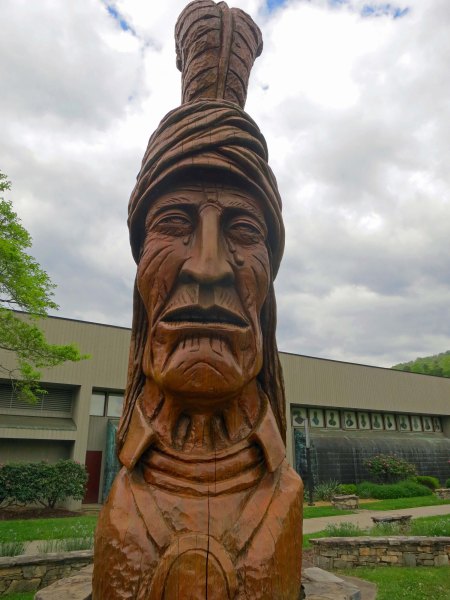
Wood sculpture of a crying Cherokee representing the Trail of Tears in Cherokee, North Carolina.

The wood sculpture of a crying Cherokee.

Bear sculpture located in Cherokee, North Carolina.

This bear featured a scenic painting with an elk and an eagle or hawk.

I found this scene on another bear, representing the region in historic times

I found this scene on another bear, representing the region in earlier times.

Bear sculpture painted to resemble eagle in Cherokee, North Carolina.

Another rendition of a bald eagle. I liked how the artist turned the nose of the bear into the beak of the eagle. An eagle shaman dances on the rear hindquarters.

Bear sculpture in Cherokee, North Carolina

This bear was decorated with symbols you might expect to find on Native American rock art.

Bear sculpture in Cherokee, North Carolina smoking pie and dressed like an artist.

And, for my final photo today, a little humor.

NEXT BLOG: I ride back up the road from Cherokee to the Blue Ridge Highway entrance and begin my journey north toward Maine and Nova Scotia.
The Scopes Trial, a BIG dog, and a Speeding Semi… The 10,000 Mile Bike Trek

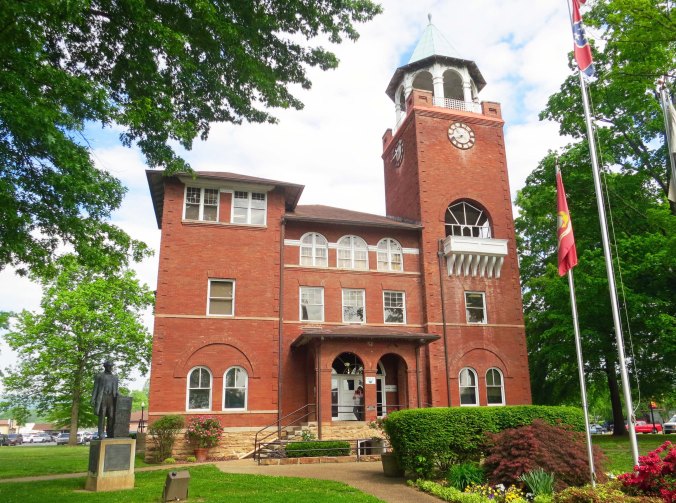
In 1925, William Jennings Bryan debated with Clarence Darrow in this courthouse over whether evolution should be taught in Tennessee schools.

The Dayton, Tennessee Courthouse where the Scopes Trial took place in 1925.

I had left Spencer and was heading for Pikeville on Highway 30 when the dog came roaring out to eat me. He was a big dog, a really BIG, ugly dog. His daddy must have been a Bullmastiff and his mommy a Rottweiler. And I am sure that he had experienced an unhappy puppyhood. I was about to drop down a steep hill; thirty feet farther and I could have cranked down on my pedals and been gone. As it was, I leapt off my bike and grabbed my air pump, careful to keep my bike between the monster and me. “No, bad dog!” I yelled. He growled. I reached down and grabbed a large rock. Usually this is a sign for the dog to exit the scene. All he did was snarl deep snarls and creep forward, salivating, ready to pounce. Oh boy, I thought, this is it.

And then fate intervened. It was almost enough to make me change my ideas about God. A bee landed on his nose and stung him. Or maybe it was a large horsefly that bit him. Whatever it was, I was on my bike and out of there faster than he could fall to the ground and start pawing at his abused snout. Had he been a cheetah, he might have caught me. But I doubt it.

The dog would have had to run very fast to catch me.

The dog would have had to run very fast to catch me.

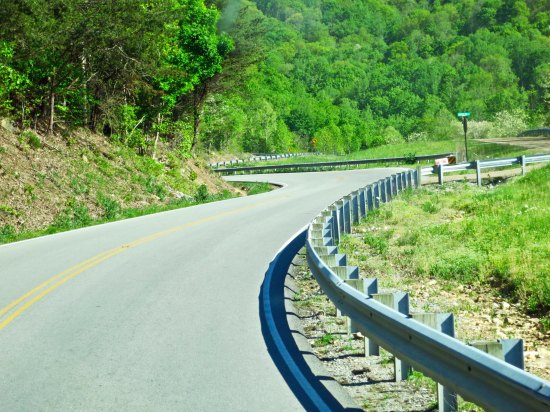
Highway 30 in eastern Tennessee runs in an east-west direction and cuts across the Cumberland Plateau.

Highway 30 at a more leisurely pace.

Another view.

Another view.

I forgave the dog. It was up to his owner to keep him leashed or in his yard. And I suspect he had been trained to behave as he did. I wasn’t so forgiving of the truck driver that gave me flying lessons.

I had been daydreaming and taken a wrong turn out of Pikeville. Discovering my mistake, I had turned around and was happily contemplating a hamburger. That’s when the 18-wheeler came up behind me going about 60.  A car was coming from the other direction. The truck driver didn’t even slow down. He flew by inches away. The turbulence from the rear of the truck literally raised my bike and me three feet off of the ground. I landed hard. How I managed to stay upright, I don’t know. The only damage was two flats. It could have been ever so worse. A kind, Tennessee driver stopped to make sure I was okay. The trucker just kept on trucking.

I made it into Dayton without any further incidents. It’s a pretty town that borders on the Tennessee River. The Scopes Trial is its claim to fame. The event started as a publicity stunt.

Dayton is next to the Tennessee River. After crossing it in Alabama on the Natchez Trace, I had returned to it.

Dayton is next to the Tennessee River. After crossing it in Alabama on the Natchez Trace, I had returned to it.

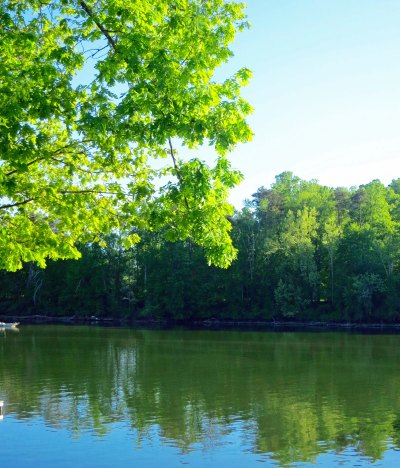
The Tennessee River flows by Dayton, TN where the 1925 Scopes Trail took place.

I liked this view of it with the sun captured in the trees.

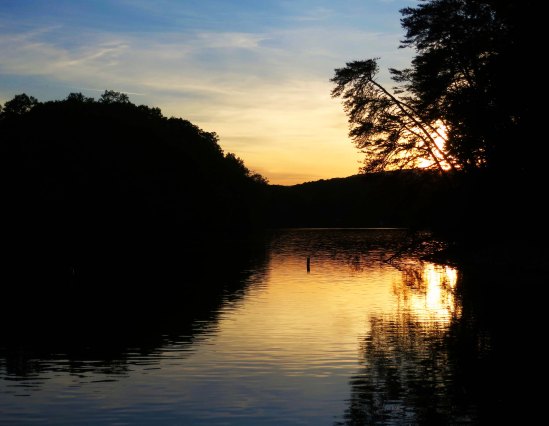
Sunset on the Tennessee River near Dayton in eastern Tennessee.

And at sunset.

In 1925, the State of Tennessee had passed a law that outlawed teaching evolution in public schools. The American Civil Liberties Union (ACLU) had responded by offering to support anyone who would challenge the law. Some business people in Dayton, meeting over coffee at the local drug store, had decided that jumping into the fray would give their community some much-needed publicity and improve its stagnant economy. They recruited a substitute science teacher, John Scopes, to claim he had taught evolution in the local high school. (Scopes actually didn’t remember whether he had or not.) He was duly arrested and the circus came to town.

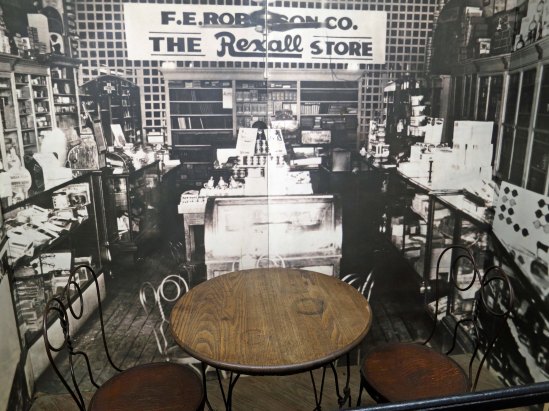
The actual table where the business leaders of Dayton plotted out the steps that would lead to the Scopes Trial. The background photograph is of Robinson's drug store where they met with John Scopes.

The actual table where the business leaders of Dayton plotted out the steps that would lead to the Scopes Trial. The background photograph is of Robinson’s drug store where they met. This display is included in an excellent small museum in the basement of the courthouse.

William Jennings Bryan arrived for the prosecution. He was a populist who had run for President (unsuccessfully) three times on the Democratic ticket and was considered the best orator in the US. He had fought against big banks and big corporations. You may be familiar with his most famous quote: “You shall not crucify mankind on a cross of gold.” He supported women getting the right to vote. He was also a devout Christian who favored prohibition and fervently believed that humans had jumped from clay and ribs to who we are— without any messy steps between. The World’s Christian Fundamentals Association sponsored him.

Another view of the Rhea County Courthouse in Dayton. A state of William Jennings Bryan is located in front. A debate is going on in the community now over whether to add a statue of Clarence Darrow.

Another view of the Rhea County Courthouse in Dayton. A statue of William Jennings Bryan is located in front. A debate is going on in the community now over whether to add a statue of Clarence Darrow, who argued on behalf of evolution.

The architect who planned the Rhea County Courthouse where the Scopes trial took place designed the windows to look like crosses.

A guard at the courthouse was quite proud to show us that the architect of the building had incorporated windows that look like crosses, reflecting the Christian influence of the time.

Clarence Darrow came to defend John Scopes and the cause of teaching evolution in schools on behalf of the ACLU. He shared many of Bryan’s beliefs. He was a populist and Democrat who devoted his life to defending those he considered underdogs. He represented labor interests and became known as one of the best criminal defense lawyers ever. He passionately opposed the death penalty. His religious views were that of an agnostic, believing that we cannot know for sure whether God exists, and, if so, what his (or her) true nature is.

Media came from around the world to witness this colossal battle between science and religion, as did every huckster for hundreds of miles around. The Baltimore Sun sent its nationally renowned reporter, H.L. Mencken, to report on the event. Mencken was noted for his sharp tongue, cynicism, and biting humor. He had coined the phrase ‘Bible Belt’ and had immediately dubbed the Scopes Trial the ‘monkey trial.’ He described the prosecution and jury as “unanimously hot for Genesis.” It was Mencken who had encouraged Darrow to participate.

For all of the hoopla, little was decided by the trial. The judge, a man with fundamentalist beliefs, suppressed any evidence on behalf of evolution. The jury was only allowed to consider whether Scopes was guilty of breaking Tennessee law, which he had according to his own testimony. He was found guilty and fined $100. (The charge and fine were later dropped on a technicality.)

The issue obviously didn’t go away. Millions of words have been written about the trial. It was recreated in the 1960 movie, Inherit the Wind, starring Spencer Tracy.  Tennessee didn’t remove the statute barring evolution from being taught until 1967.

Today, fundamentalists argue that evolution should be taught in US schools only as a theory with “intelligent design” being given equal billing. Teachers, principals, school boards and state legislatures continue to be pressured to bring the Bible back into the classroom. I’ve told the story before how a parent walked into Peggy’s office when she was principal of an elementary school and demanded that all books on dinosaurs in the school library be removed because dinosaurs weren’t in the Bible. She had told the man that he had the right to remove his son from the school, but the books were staying. If the son stayed, he was going to learn about dinosaurs.

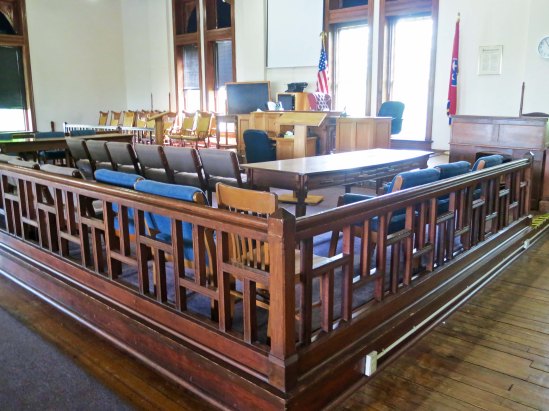
Dayton is still reaping the benefits of the trial. It has rebuilt the courtroom where the Scopes Trial took place to look exactly like it did in 1925. Once a year it has a pageant that relives the trial. Peggy and I made a point of visiting the courthouse on our route review.

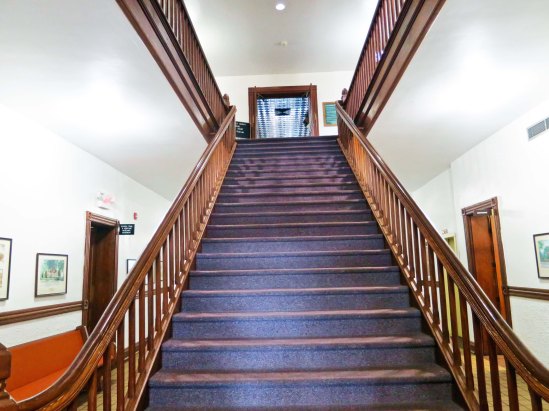
The stairway up to the courtroom where the Scopes Trial took place in Dayton, Tennessee in 1925.

Clarence Darrow, William Jennings Bryan, John Scopes and everyone else involved in the trial would have walked up these elegant steps.

An exact recreation of the courtroom in Dayton, Tennessee where the scopes trial was held.

The actual courtroom as it has been recreated.

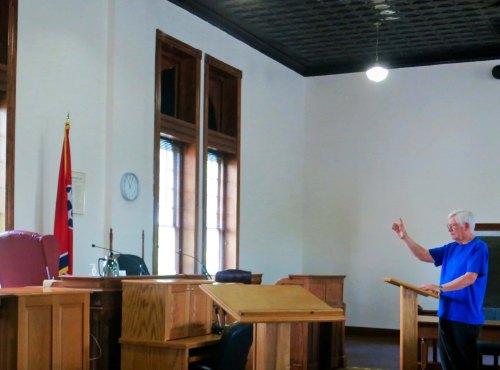
Given that I am 96% great ape, genetically speaking, I take the stand as Clarence Darrow. (grin)

Given that I am 96% great ape, genetically speaking, I take the stand as Clarence Darrow. (grin) The ghostly judge objected to my attire and opinions.

NEXT BLOG: It’s up and over the Great Smokey Mountains and into Cherokee, North Carolina where bears roam the streets! (Sort of.)


Man or Monkey? The Scopes Trial: Part I… The 10,000 Mile Bicycle Trek

Monkey photo from the Scopes' Monkey Trial museum at the courthouse in Dayton, Tennessee.

Speaking into an old-fashioned microphone, a monkey reports on the Scopes 1925 trial on teaching evolution in Dayton, Tennessee. I found this photo in the museum of the courthouse where the trial took place.

My father once told me that the world was 6,000 years old and that evolution was “a bunch of hooey.” Those were his exact words. He hadn’t always thought this way, but he was in his mid-80’s and the Pearly Gates were beckoning. His occasional reading of the Bible had turned into a full-time passion. He didn’t acquire this viewpoint from the Bible, however. He got it direct— from a radio preacher, a man he regularly sent generous donations to from his meager social security income.

I thought of this as I bicycled up the steep ridges of the Cumberland Plateau and passed by rocks that dated back 500 million years. And I thought about it even more as I biked on toward the town of Dayton, Tennessee. Dayton was the site of the famous Scopes Trial where William Jennings Bryan and Clarence Darrow had gone toe to toe in 1925 over whether evolution could be taught in the public schools of Tennessee. The trial turned out to be a media circus, a first-rate dog and pony show, or, maybe I should say, a man and monkey show. Trained chimpanzees performed on the courthouse lawn.

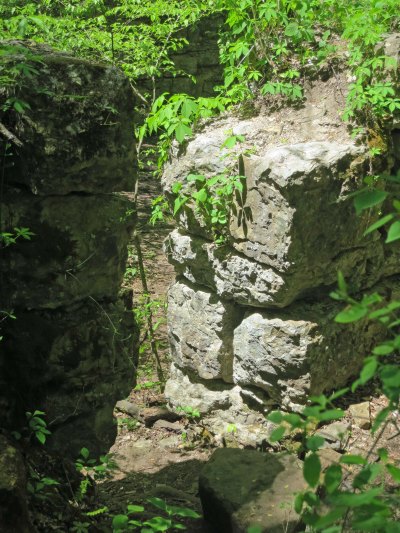
The rocks along Tennessee Highway 30 as it climbs up on to the Cumberland Plateau in Tennessee are 500 million years old, or 6000 if you accept the Bible account.

The rocks along Tennessee Highway 30 as it climbs up on to the Cumberland Plateau in Tennessee are 500 million years old, or 6,000 if you accept the Bible account.

I started this particular section of my journey through Tennessee at Old Stone Fort State Park near Manchester. It’s a delightful place perched between deep gorges carved out by the Duck and Little Duck Rivers. Indigenous people in the area took advantage of its location to build what archeologists think was a ceremonial center over 1500 years ago. In the early 1800s, Americans discovered that the quick flowing Duck River was ideal for running water-powered mills. A gun powder mill was operated at the location during the Civil War to supply Confederate armies, until Union Troops destroyed it.

Old Stone Fort Park outside of Manchester, Tennessee.

All that remains of the 1500 plus year old Native American ceremonial center at Old Stone Fort Park is this peaceful meadow.

Indigenous people built an earthen wall around their ceremonial center that came to be known as the Old Stone Fort State Park near Manchester, Tennessee.

An ancient earthen wall, seen on the left, surrounds the ceremonial center. Visitors are invited to stroll along this pleasant wooded path around Old Stone Fort.

Dugout canoe at Old Stone Fort State Park near Manchester, TN.

Peggy checks out a replica of a dugout canoe that Native Americans would have used in the region. Fire was used to hollow out these canoes.

All that remains of a water driven paper mill at Old Stone Fort. The mill supplied paper for a number of Southern Newspapers,

All that remains of a water-driven mill at Old Stone Fort. The mill supplied paper for a number of Southern newspapers.

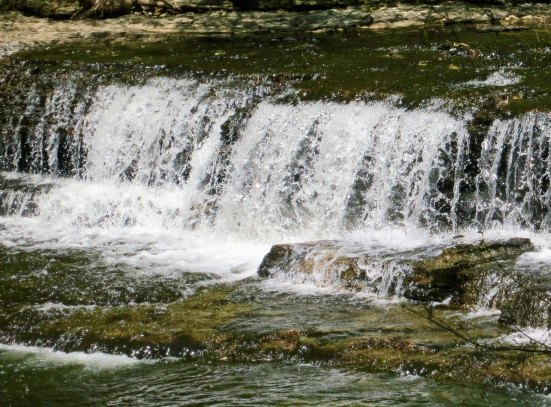
The interesting history of the park is matched by its beauty. Multiple waterfalls are created as the rapidly descending Duck and Little Duck Rivers cascade over ledges made of limestone.

Waterfall on Duck River at Old Stone Fort State Park near Manchester, Tennessee.

One of several beautiful waterfalls found on the Duck River of Tennessee as it flows through Old Stone Fort State Park.

Old Stone Fort State Park waterfall on Duck River in Tennessee.

Another.

Waterfall flowing off of a limestone ledge at Old Stone State Park in Tennessee.

And another.

I was reluctant to leave, but the open road called. I followed Tennessee State Route 55 out of Manchester and on toward McMinnville. For those of you into music, Manchester is the site of the Bonnaroo Music and Arts Festival, which attracts tens of thousands of fans annually. It is like a modern-day Woodstock or, if you will, a musical Burning Man. Attendees camp out for four days on a 700-acre farm.

The ride into McMinnville was relative easy in terms of terrain. This was about to change. In McMinnville, I picked up Highway 30. A look at a map of eastern Tennessee will show that most roads in the region follow a north-south direction. There’s a reason. Fast flowing rivers running south off of the Cumberland Plateau have cut deep valleys, leaving behind high, steep ridges. It’s a lot easier to build roads following the river valleys than it is to scramble up and over the ridges.

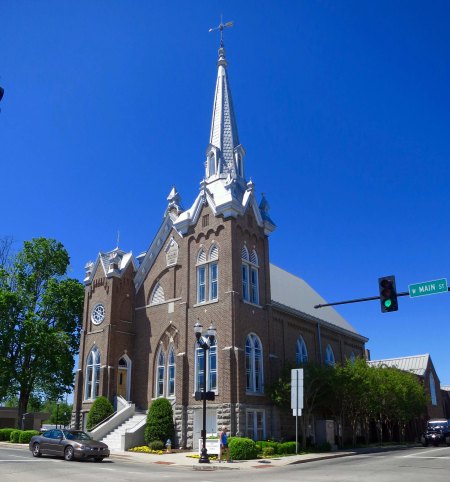
McMinnville is an attractive town which includes, among other things, this striking Methodist Church built in the 1800s.

McMinnville is an attractive town which includes, among other things, this striking Methodist Church built in the 1800s.

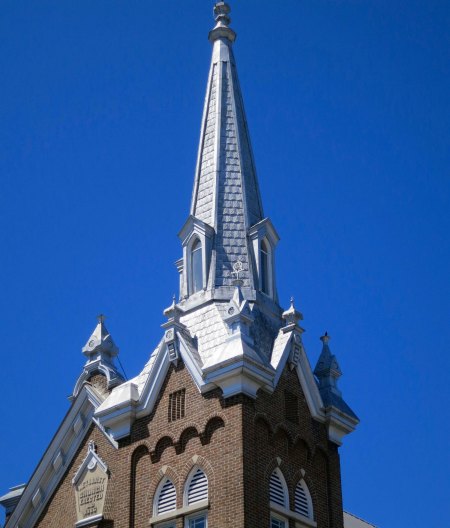
Steeple of Methodist Church found in McMinnville, Tennessee.

I was particularly impressed with the steeple. It would be fun to check out the view from the upper windows.

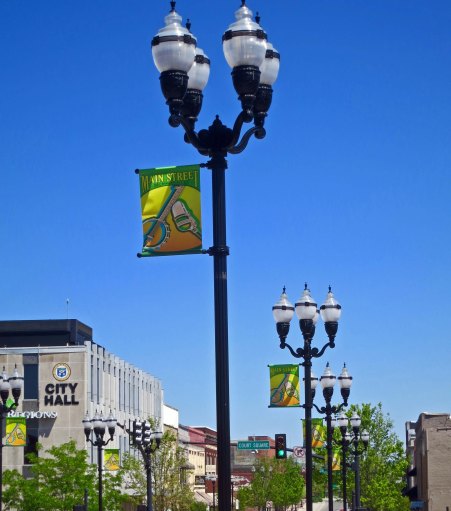
Street lamps decorate the main street of McMinnville, Tennessee.

These street lamps added a feel of authenticity to McMinnville’s Main Street running through the revitalized historic section of town.

Peggy and I found this shop in McMinnville and I had to post it: A music store that sells ice cream and guns!

Peggy and I found this shop in McMinnville and I had to post a photo: A music store that sells ice cream and guns! What can I say…

Highway 30 follows the scramble route; it runs east and west. I was about to climb on a roller coaster: 1000 feet up, 1000 feet down, 1000 feet up, 1000 feet down. And these were serious ups or downs, as I quickly discovered a few miles out of McMinnville when I started a switchback ascent to the small town of Spencer.

An old building along Highway 30 in Tennessee.

Highway 30 outside of McMinnville going east provided a hint that I was entering the hilly terrain of the Cumberland Plateau. Here I was dropping into a creek canyon. I would soon be climbing toward Spencer.

An old barn along highway 30 outside of McMinnville, Tennessee.

An old barn I found along the highway.

Although this was from a recent election, I found it interesting. Long before billboards lined the highways of America, advertising was done on old barns.

Although this was from a recent political campaign, I found it interesting. Long before billboards lined the highways of America, advertising was done on buildings.

Spencer was named for one of the longhunters of the 1700’s who made their way from Virginia into the wilds of Kentucky and Tennessee. I used to think they were given the name for the long muskets they carried, guns that they were amazingly accurate with— as the British were to learn. (They also shot at the Red Coats from behind trees and rocks, which wasn’t considered fair in the European wars of the times. You were supposed to walk at each other in long lines wearing bright uniforms and be mowed down like real men.)

I later learned that they were named longhunters because they went on long hunts. Duh. Daniel Boone was one such fellow. He’d be away for months at a time, only to return home long enough to get his wife pregnant before taking off again. Poor Rebecca was left behind to tend the crops and kids. Pioneer women were tough. But they could also get lonely. Once, when Boone was captured by Indians and was away for a couple of years, he returned home to find Rebecca with another baby. It looked a lot like his brother. Legend has it that Daniel was heard to mutter, “Well, it’s best to keep it in the family.”

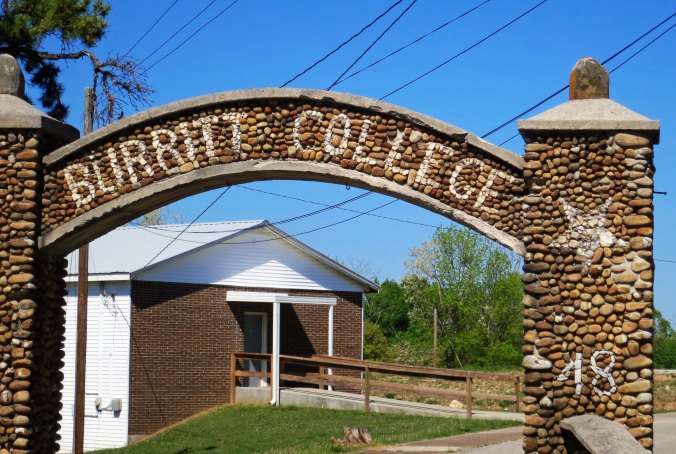
Burritt College in Spencer, Tennessee has been closed since 1939 but now has a Facebook Page.

The gateway to Burritt College in Spencer. Closed in 1939, the college now has a Facebook Page. Doesn’t everyone?

There had been a college in Spencer at one time, which surprised me. It’s a small town. The gateway still stands. I decided to do some research. Burritt College, it turns out, was founded in 1848 as one of the first co-educational colleges in the South. At the time, putting young men and women together created a bit of a firestorm. They weren’t to be trusted. Who knows what temptations the devil might send their way? To solve the problem, the college adopted a strict moral code. Members of the opposite sex could only communicate with each other during class and at supervised events.

The students weren’t supposed to cuss, gamble, smoke or drink either. The latter presented a bit of a problem. This was moonshine country. The guys couldn’t resist an occasional sip, or several. Out of frustration, the president of the college went to the sheriff and asked him to destroy all stills in the area. He learned a valuable lesson: You don’t get between a Tennessee moonshiner and his still. The President’s house was burned down.

I made it through Spencer without running into any irate moonshiners, but I was soon to have personal encounters with a big, ugly dog and a speeding 18-wheeler. Those are stories for my next blog, however. I’ll also report in greater detail on the Scopes Monkey Trial, as the renowned journalist, H.L. Mencken, dubbed it.

NOTE: I occasionally post this reminder since new people regularly check in on my blog. In 1989, I did a six month solo bicycle journey around North America. This past spring, my wife Peggy and I re-drove the route. Most photos on these blogs about the trip were taken this spring.