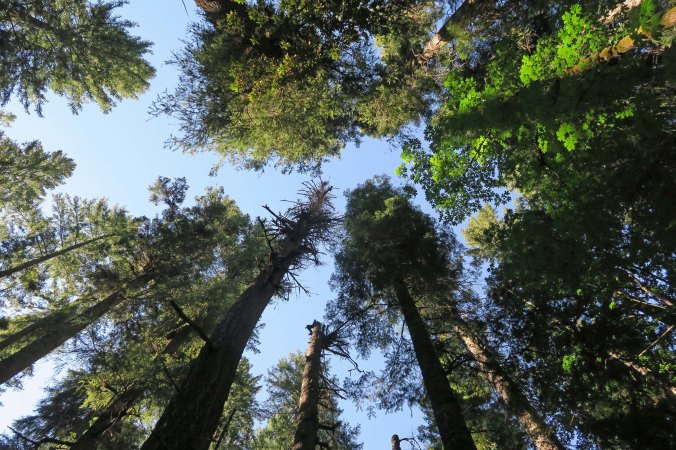
No-see-um camp, which we expected to be bug infested, turned out to be nestled among trees that made me think of a sacred grove.
Part II of our hike up Cook and Green Creek to the Pacific Crest Trail through the Rogue River National Forest.
Our goal for the day was No-see-um Camp, which seems like a very poor place to set up your tent. If you have spent much time outdoors, you will recognize no-see-ums as particularly nasty little bugs. I first encountered them when backpacking on the Appalachian Trail in Maine. It had rained for a solid week and every biting bug in existence had considered us fair game. While mosquitoes had treated our bug repellant as an hors d’oeuvre, no-see-ums had come after us with knives and forks. Later, I watched a moose in Alaska dash wildly about and roll in a snow bank to escape the tiny, nefarious fiends. Fortunately, we didn’t find any no-see-ums in No-see-um camp. It was quite the opposite. I decided we had arrived in a sacred grove.
Sacred groves go almost as far back as humanity. Think of the Druids and their oaks. In West Africa, where I served in the Peace Corps, huge cottonwoods were thought to contain living spirits and I often found offerings at their bases. It’s important to keep the forest spirits happy.
No-see-um camp had more species of trees than I have ever found in a single location, many of them were giants. From our camp, I could see Douglas fir, sugar pine, white fir, blue spruce, chinquapin, big leaf maple, and yew. Just up the trail I found a ponderosa pine. Cook and Green Creek with its cool, refreshing water bubbled and burbled and roared its way down the canyon just behind our tent. I figured it was an excellent place to commune with nature spirits and Peggy found a camp guardian up in the trees, which I thought was quite pagan of her.

Another view looking up from our campsite on Cook and Green Creek. This one features big leaf maples.
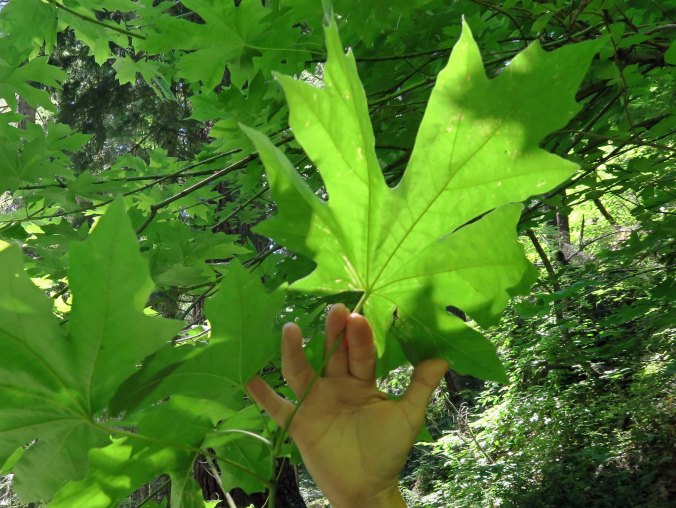
There is a reason for their name!

We also had chinquapin growing in the grove. This prickly thing covers the trees nuts, which are said to be tasty.
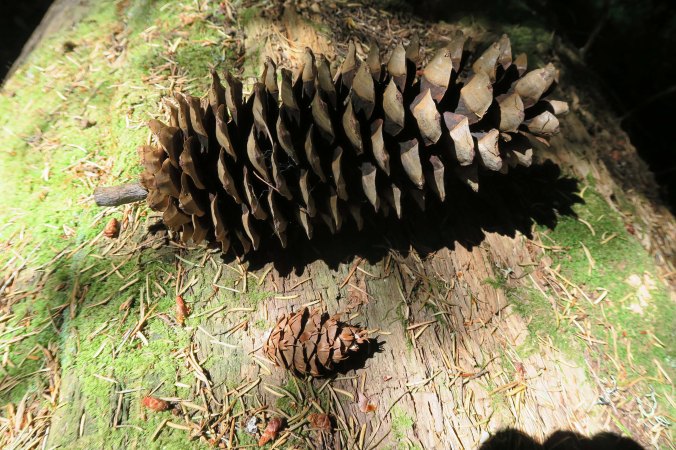
Giant sugar pines with their large cones and giant Douglas firs with their small cones surrounded us.

I found a large ponderosa pine near by. Do you know what made the line of holes? It was a sapsucker, a kind of woodpecker. It will return to eat any insects that have entered the holes.
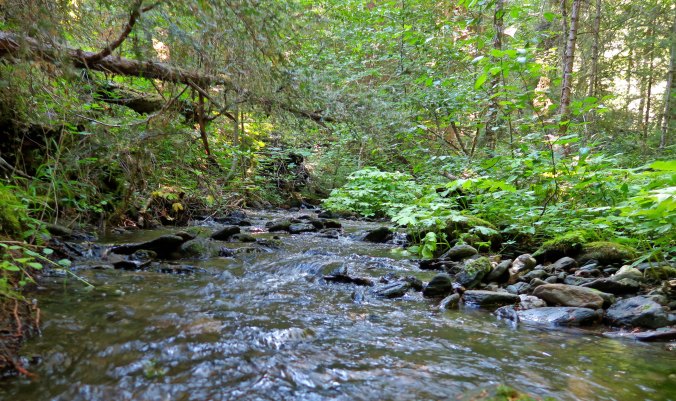
Cook and Green Creek flowed just behind our tent. It was burbling here.

Small waterfalls added a slight roar.

And I found the way the water flowed over a rock to be intriguing.
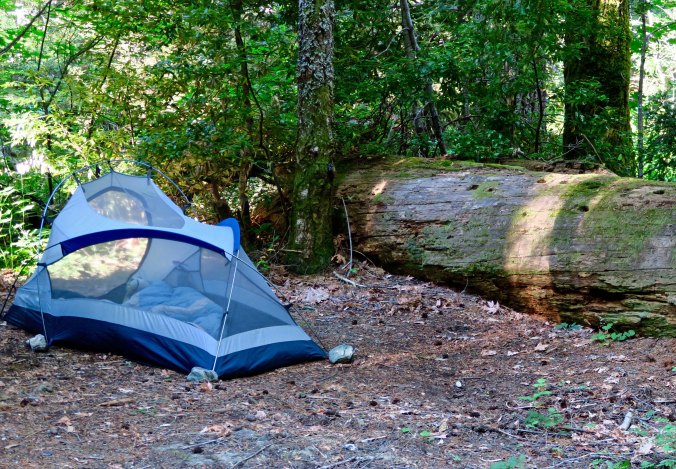
The downed tree next to our tent provided a good perspective on the size of the larger trees.
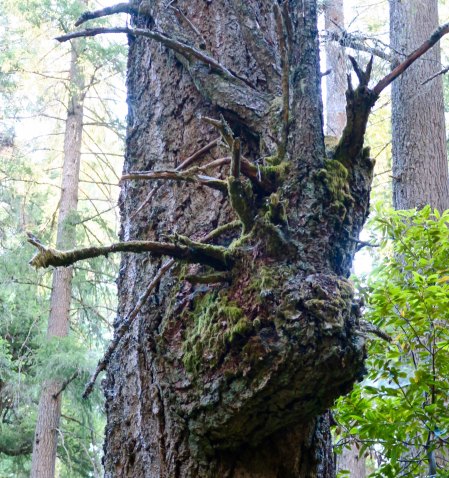
This odd tree growth just above our site served as Peggy’s camp guardian. (Photo by Peggy Mekemson.)
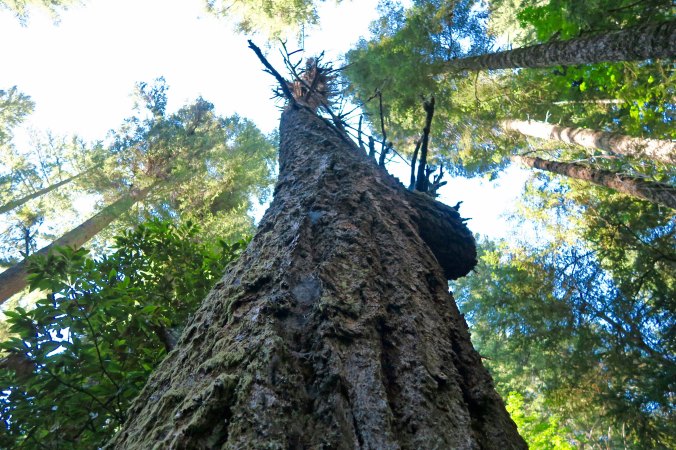
The Guardian’s tree was also impressive.
We used our layover day as an opportunity to do a nine mile hike up to the pass and back. Going up, we entertained ourselves by enjoying flowers and other plant life while looking for signs of wildlife. And yes, I have more animal poop, scat, to share with you. I’ll bet you’re excited.
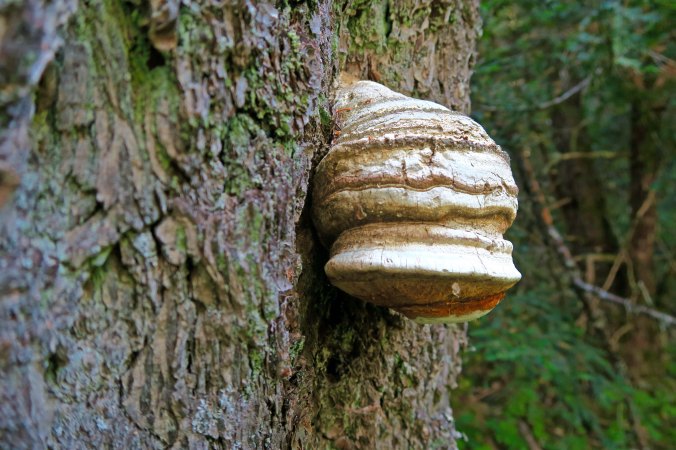
A shelf fungus.
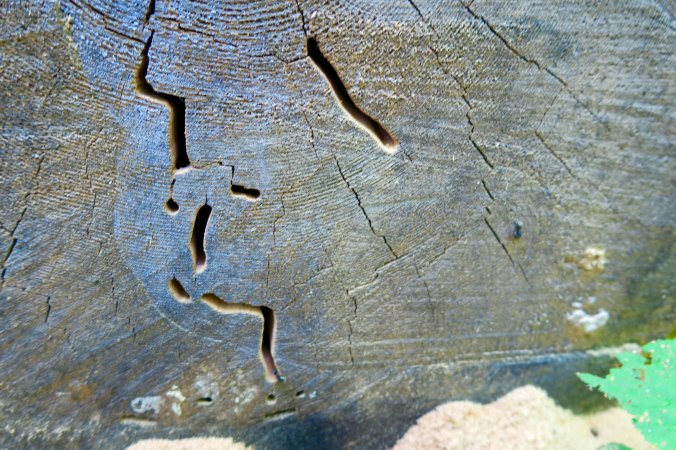
Any idea what is happening here? Carpenter ants were making their nest. They are a fairly large ant that literally cut off small, sawdust-size chunks of wood and then bring it out to the edge where they dump it on to the sawdust pile at the bottom of the photo.
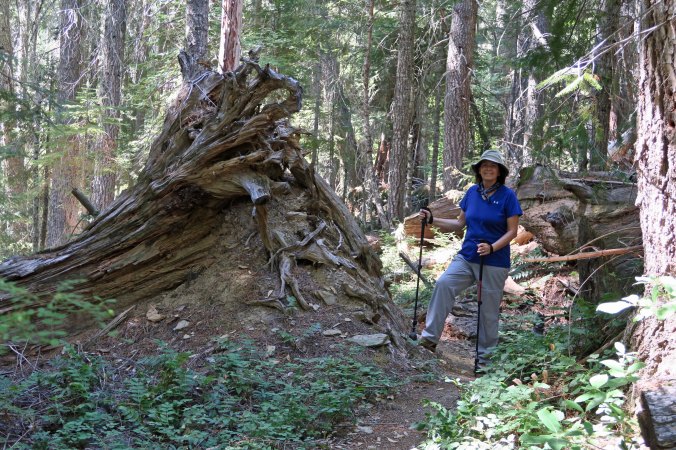
Peggy poses beside a fallen tree.
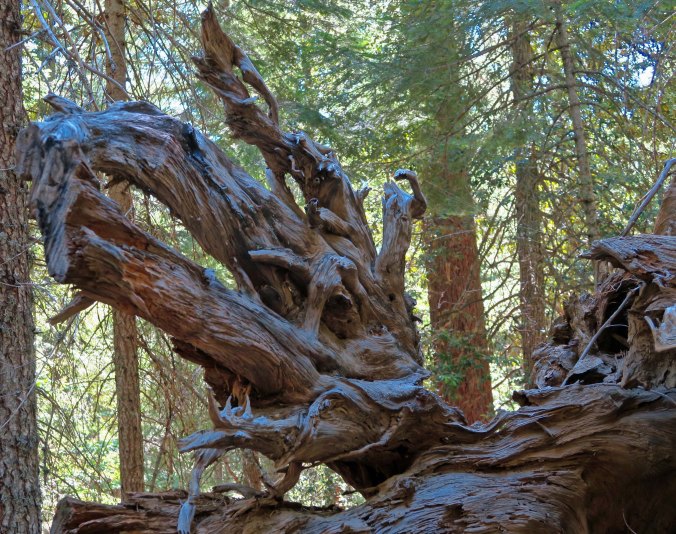
Which happened to feature another wood sculpture that Peggy determined was a dragon.
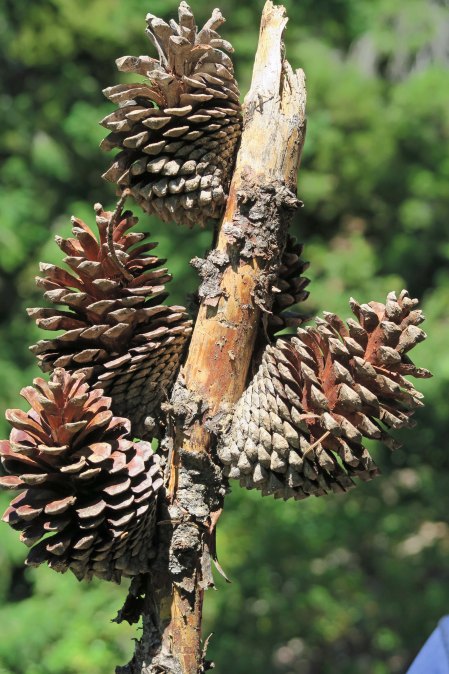
We found these unusual cones that actually grow directly on the limbs of the trunks and limbs of the knob cone pine.
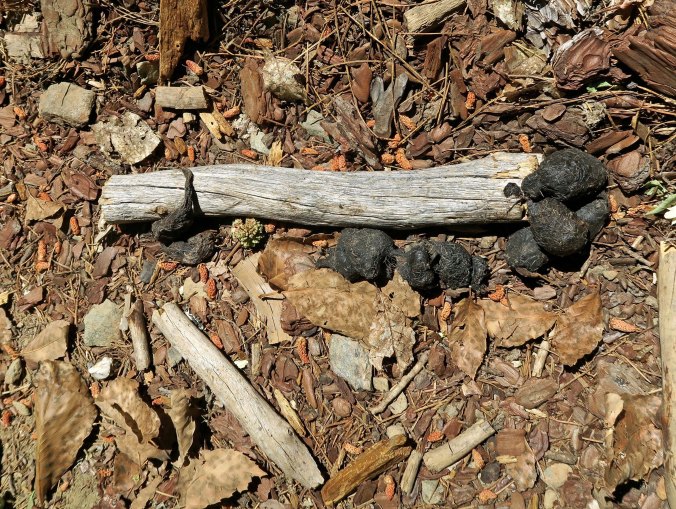
Okay, I put up pretty, or at least I hope interesting photos, and then I put up poop. Why? Half the fun of wilderness travel is knowing what you are seeing around you. Scat (poop) is one way of telling what animals are using the trail you are on. This happens to be cougar, or mountain lion scat. The twisted piece on the end is fairly definitive of the cat family. Size suggests cougar. It was dry, so we were in little danger of an immediate encounter.

Since we are on animal signs, any idea of what made this? Odds are it was a porcupine. They chew off the outer bark to get to the nutritious, inner bark.
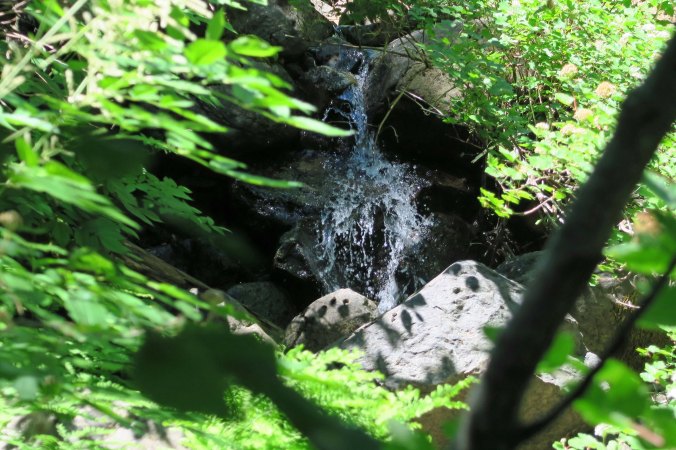
This attractive small waterfall, provided cool water to drink with our lunch. (Photo by Peggy Mekemson.)
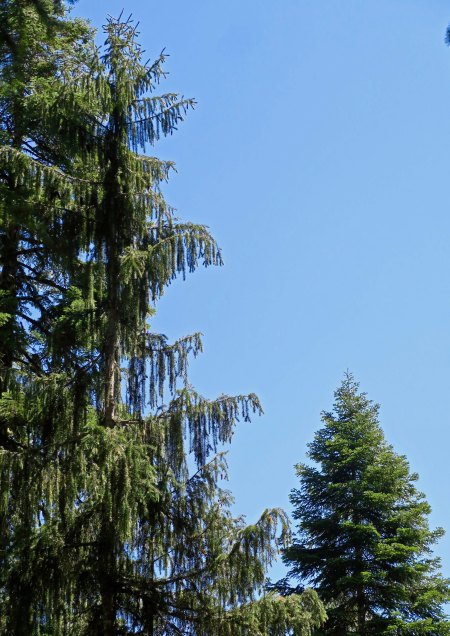
After lunch on our way up to the pass, we found this attractive Blue Spruce…
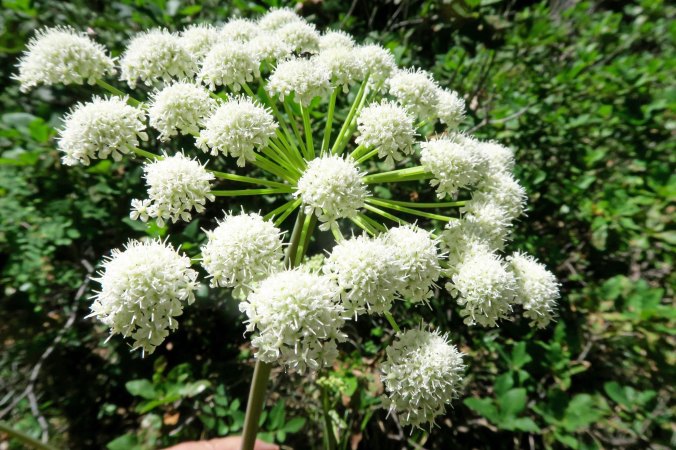
And a flower, which is known as Ranger’s buttons.
On top, we met Rambo, Dogondo, and Double D: three PCT through hikers. Their names are their trail names. They had started at the Mexican border and been backpacking since April, covering close to 1000 miles. They were skinny and ever so eager to reach Oregon, which was just up the trail. One of them told me that Sasquatch (Big Foot) had been rooting around outside his tent the night before.
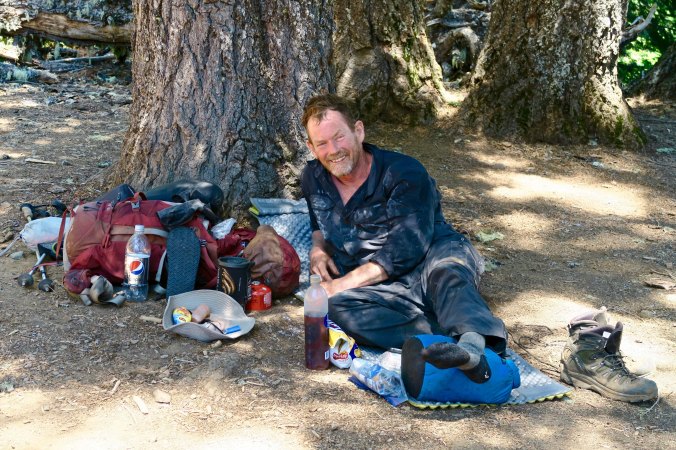
Rambo, a PCT through hiker from Riverside, California.
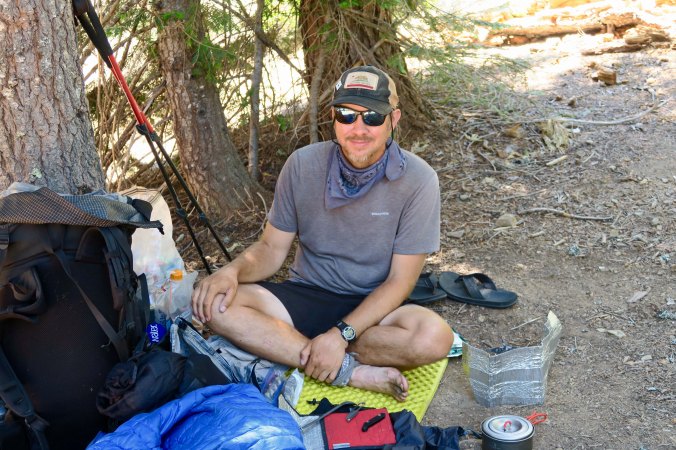
Dogondo, a PCT through hiker from Chicago.
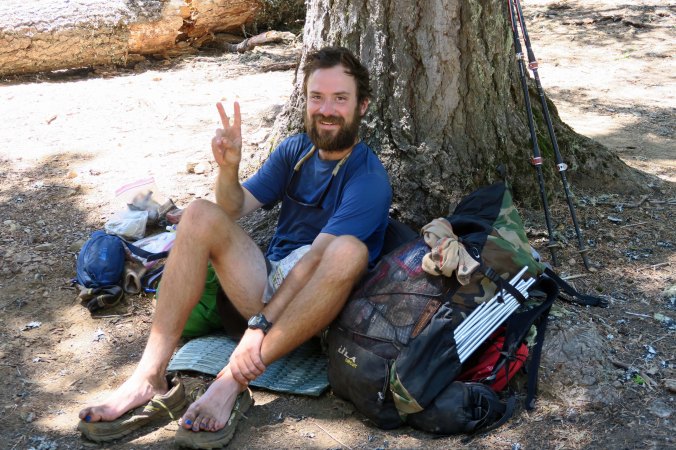
Double D, a PCT through hiker from Kansas City.
We raced on our way back down from the pass. I was careful to keep Peggy behind me. She thinks that she is a greyhound when she gets out in front going down a hill. I once sprained my ankle trying to keep up with her coming off of Muir Pass on the John Muir Trail and had to hobble another 80 miles before we finally climbed up and over Mt. Whitney and out. Taught me.

Peggy, all set to go, wearing one of her favorite T-shirts.
 Wandering through Time and Place