
I can pretty well guarantee that you will see Double Arch on any trip to Arches National Park. It’s just off the road… and impressive.
“Wilderness is not a luxury but a necessity of the human spirit, and as vital to our lives as water and good bread. A civilization which destroys what little remains of the wild, the spare, the original, is cutting itself off from its origins and betraying the principle of civilization itself.” Edward Abby from his book about Arches NP, “Desert Solitaire.”
Arches is renowned for its arches, as it should be, given its name. They come in all shapes and sizes ranging from three feet across to 306 feet. I noted in my first post that there are some 2,000 of them at the park. Forces of erosion, including water, ice and wind, break out chunks of rocks from softer sandstone beneath harder layers above and eventually work through fins. New arches are constantly being created while older ones fall.

A new arch in the process of being born at Arches National Park.
Several arches are located along the road and are easily reached by short hikes. Others require longer hikes and more work. When Peggy and I were at Arches last time, we were rushing through on our way to our Grand Canyon raft trip. We could hardly begin to do the arches justice, but we did photograph three that I will share with you today: Delicate Arch, Skyline Arch, and Double Arch.
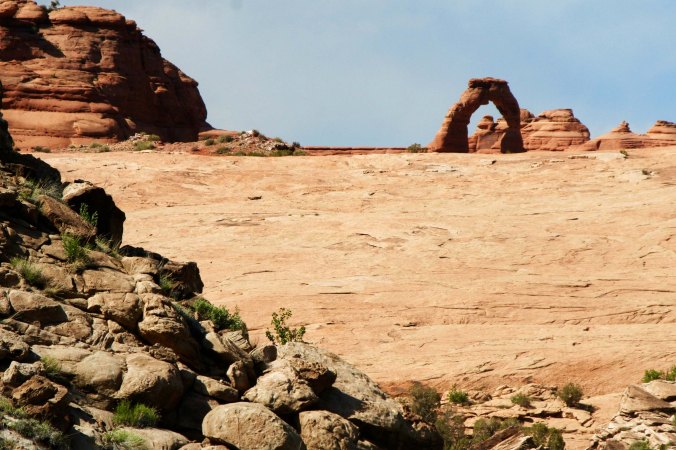
While Peggy and I didn’t have time to visit Delicate Arch, we were able to snap its photo from a distance. It is the most famous arch in the park and possibly in the world.
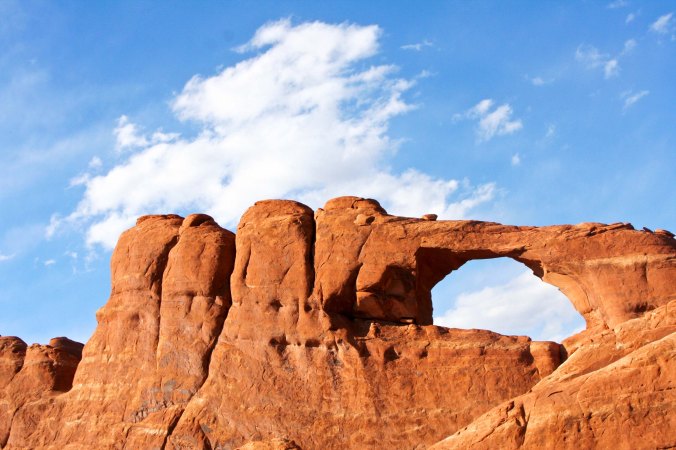
Skyline Arch is also easily seen from the road.

Here it is with a tree to help set it off.

A close up of the arch.

People in the lower right hand corner provide perspective on the size of Double Arch.

Double Arch seen from a distance.
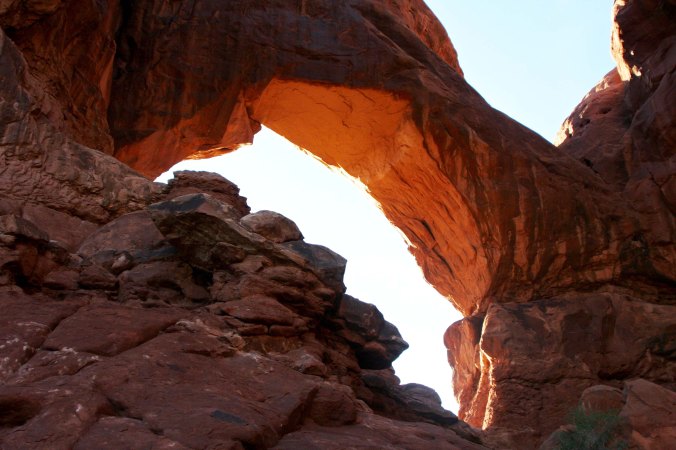
One of the arches of Double Arch up close.
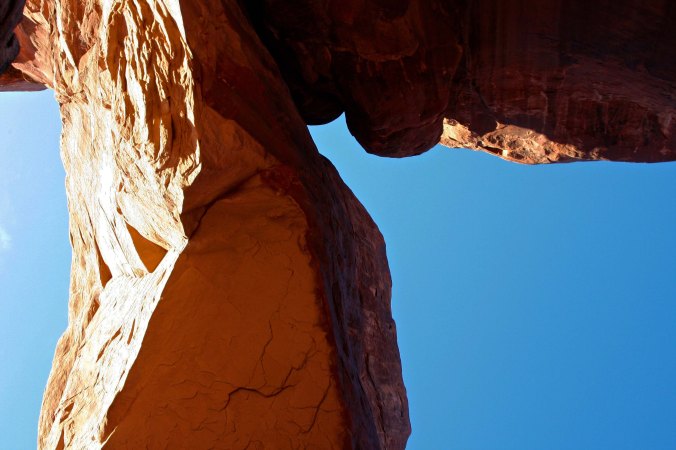
And closer.

I was up climbing around on the Double Arch to get photos when Peggy snapped my picture, which will serve as the last of this post.
NEXT POST: We will explore the surrounding country, petroglyphs and settler history.
SaveSave
SaveSave




 Wandering through Time and Place