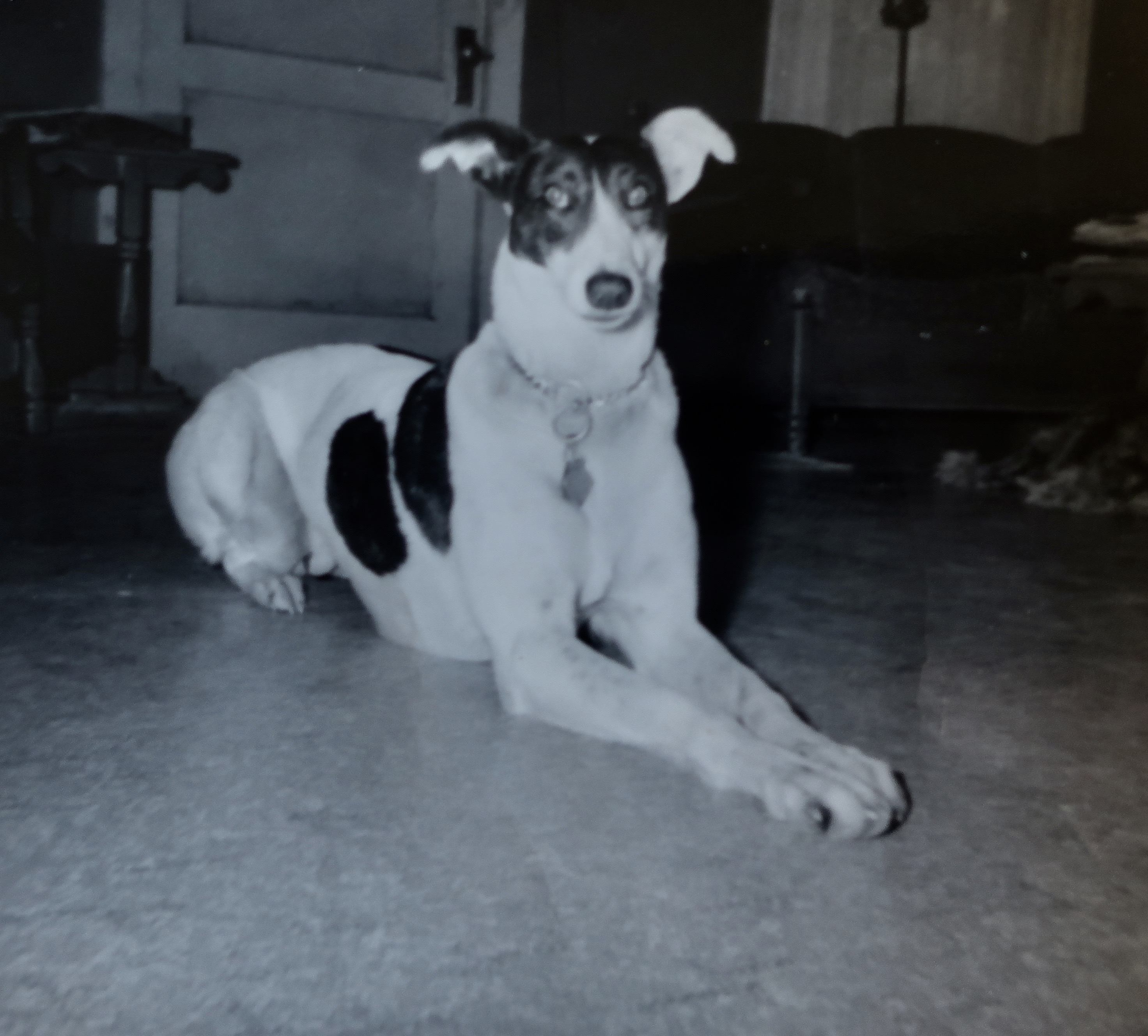
I am continuing the story about how I had hired my pets to sleep on my bed and scare away the ghosts that came out of the Graveyard next door to haunt me when I slept outside. I introduced Demon the Black Cat in my last UT-OH post. Today, it’s Pat the Greyhound’s turn. She joined our family as a stray. For weeks, Mother had watched this large, starving dog wander the countryside catching jack rabbits and ground squirrels for food. One day she stopped the car, opened the door, and invited Pat home for a meal.
“Oh, it is just until she gains a little weight,” Mother explained to one very disgruntled Pop. He already believed the size of our pet menagerie was far too large. People were known to drop off unwanted cats in front of our house knowing that they would find a home. As the dog put on the pounds, Mother modified her strategy.
“It would break Curt’s heart if we had to give her away,” she argued. Mother was a master at manipulation. Pat, who I named after the local Greyhound bus driver, became my dog.
Like all of our pets, she lived outside. It was Pop’s rule; pets were limited to daytime visitation rights only. The pregnant Demon had been an exception imposed by Mother. Since there were no leash laws, Pat was free to come and go as she pleased. Mainly she chose to hang around with her food dish in sight. It was a lot easier than catching rabbits.
The night of the skunk was an exception to Pat’s normal stay-at-home routine. As usual, I had crawled into bed with an assortment of animals. That evening, it was minus Pat. Good, she took up a lot of room. Somewhere around midnight, I half way awoke as she hopped up on the bed, completed three dog turns, and snuggled down. Consciousness made a quantum leap as my nose was assailed by an unmistakable perfume.
“Seems we have a skunk visiting,” I told Pat and reached down to scratch her head. The fur was moist. As I pulled my hand back, the skunk suddenly got much closer. Now, I was totally awake. Ms. Greyhound had been bullying the wrong pussycat. It was a night to sleep inside. In fact, Marshall had a roommate for several days. I don’t know how many times I washed that hand, but I do know that the bedding was tossed and Pat learned what a tomato juice bath was. When I finally made it back outside, the animals were put on notice: One more problem and off they went.
Then Demon made her contribution.
She was well into middle age by this time and there had been no pause in kitten production. This was a time before spaying became common. Every few months, Demon shelled out another litter. She had long since finished overpopulating Diamond and was working on surrounding communities. We were teetering on becoming known as the Cat Family of Diamond Springs. My father reverted to drastic measures. Demon was not pleased. She started hiding her kittens and became a master at subterfuge. If someone tried to follow her, she would stop and nonchalantly give herself a bath, her whole body, one lick at a time. Then she would wander off in the opposite direction.
Mother paid me in cookies to track Demon down. When the Graveyard was her destination, I had a flat tombstone I would stand on as a lookout. There was an added advantage: Demon didn’t check for people perched on tombstones. Who would? Eventually, the missing litter would be discovered. I felt like Daniel Boone.
Demon’s special home delivery took place the same summer Pat had her close encounter with the skunk. As noted earlier, my attitude about bed companions had become testy. I wasn’t above rolling over quickly to see how many I could dislodge. A really good roll would net three or four. Sleeping with me was like living on the San Andreas Fault.
I did feel guilt over routing Demon, however. Once again, she was pregnant. I watched her balloon out. By this time, I was a veteran of the birthing process and found it interesting rather than troublesome. One night I had awakened to Pat howling, found that she was delivering puppies, and sat up with her through the process. Another time I had gone out with Tom Murphy, our grocer, and assisted in the delivery of a calf that wanted to come out the wrong way. It was messy, up to the elbow work. Remember the coke I stolen from in front of his store on my early morning walk home from Rudy and Robert’s? Tom was repaid many times over. I should have been rewarded with free cokes for life.
I really didn’t expect to be around for the arrival of Demon’s kittens. That would take place in some hidden nook. One should never make assumptions, I learned. Again. It started as a normal night. Roll over, kick the animals off, and go to sleep. Wake up and repeat the process. It was not a normal morning. I woke up with wet feet.
“What the heck!” I exclaimed as I sat up quickly, dislodging Pat in the process. Demon looked innocently back at me from the foot of the bed. Okay, nothing suggested why my feet were wet. Then I noticed movement. Demon was not alone. Several little black clones were lined up for breakfast. Demon had delivered her litter on the bed and my feet were awash in afterbirth.
That did it. My bed was not a home for wayward dogs who encountered the business end of skunks and it certainly wasn’t designed as a maternity ward for unwed cats. After Demon and her brood were moved elsewhere and my bedding given a bath, I bought a water pistol and initiated a campaign of terror. Any four-legged critter on the bed became fair game. The cats learned quickly; getting shot with a water pistol was not their idea of a proper bath. The dogs were more resistant. Usually it took several squirts and then I would get the look: Big brown eyes accusing me of dark deeds. But I was tough and my canine companions eventually vacated the premises as well.
As soon as I fell asleep, however, the whole menagerie, fleas and all, would quietly slip back up on the bed.
On Thursday join me as I relate the story of how MC the Cat refused to have his danglies cut off in UT-OH! Chapter 5.














 Wandering through Time and Place