On Being Photo-Bombed by a Camel… Plus Some Egyptian History and Mythology

Today, Peggy and I are beginning our series of blogs on our journey through Egypt up the Nile River on a riverboat with the UniWorld Cruise company. We hope you will join us. As always, all photos are taken by either Peggy or me unless otherwise noted.
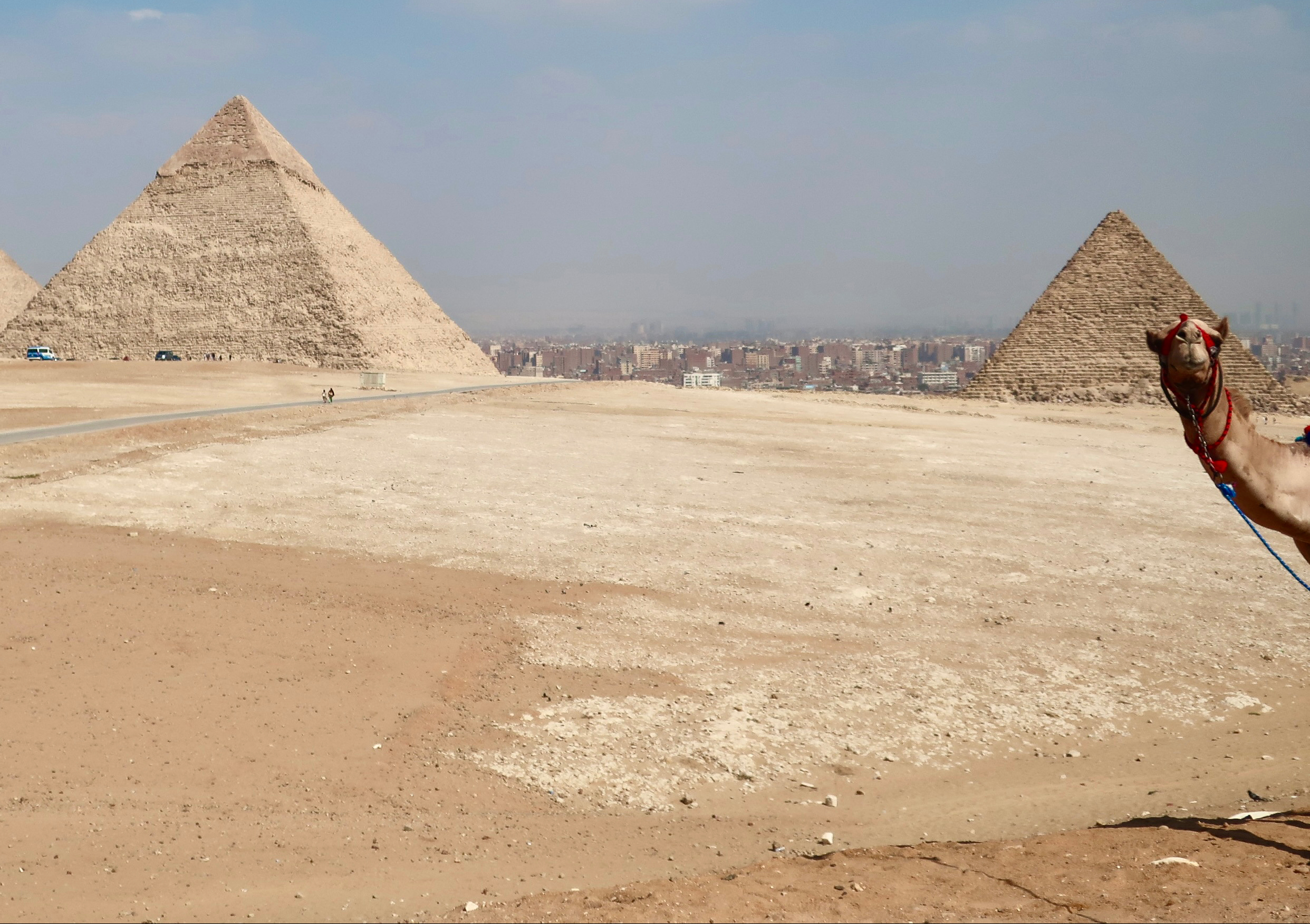
Photo of camel photobombing a picture of the pyramids by photographer Curt Mekemson.
I was setting up a photo of the pyramids of Khafre and Menkaure when a camel head suddenly appeared in my viewfinder. Was I being photo-bombed? I quickly snapped the picture. A free photo of a camel at Giza is not to be passed up. Note the emphasis on free. Camel drivers and camels are everywhere. You are welcome to the take their photos, have your photo taken with them, or even go for a ride. All for a substantial fee, of course. Not paying is frowned upon.

Visiting the pyramids of Egypt at Giza is like climbing into a time machine. The Pyramid of Khafre on the left was built around 2,570 BCE and the Pyramid of Menkaure on the right around 2510 BCE, which makes them both over 4500 years old! The beginning of Egyptian history is traced back even further, to 3100 BCE, over 5000 years ago.

The Sahara Desert and the Nile River kick-started the process. 10,000 years ago the Sahara Desert wasn’t. It was a huge savanna where wandering herders grazed their goats and cattle. It is now thought that some combination of climate change and overgrazing changed the savanna into the vast desert it is today. The herders needed somewhere to go and the Nile River was their best option. The river provided a continuous source of water for thirsty stock. Its annual floods assured that there would be rich soil for farming. Increasing population along the river led to the creation of villages and towns, eventually leading to cities, kingdoms and even empires in a time period that extended over 3,000 years.
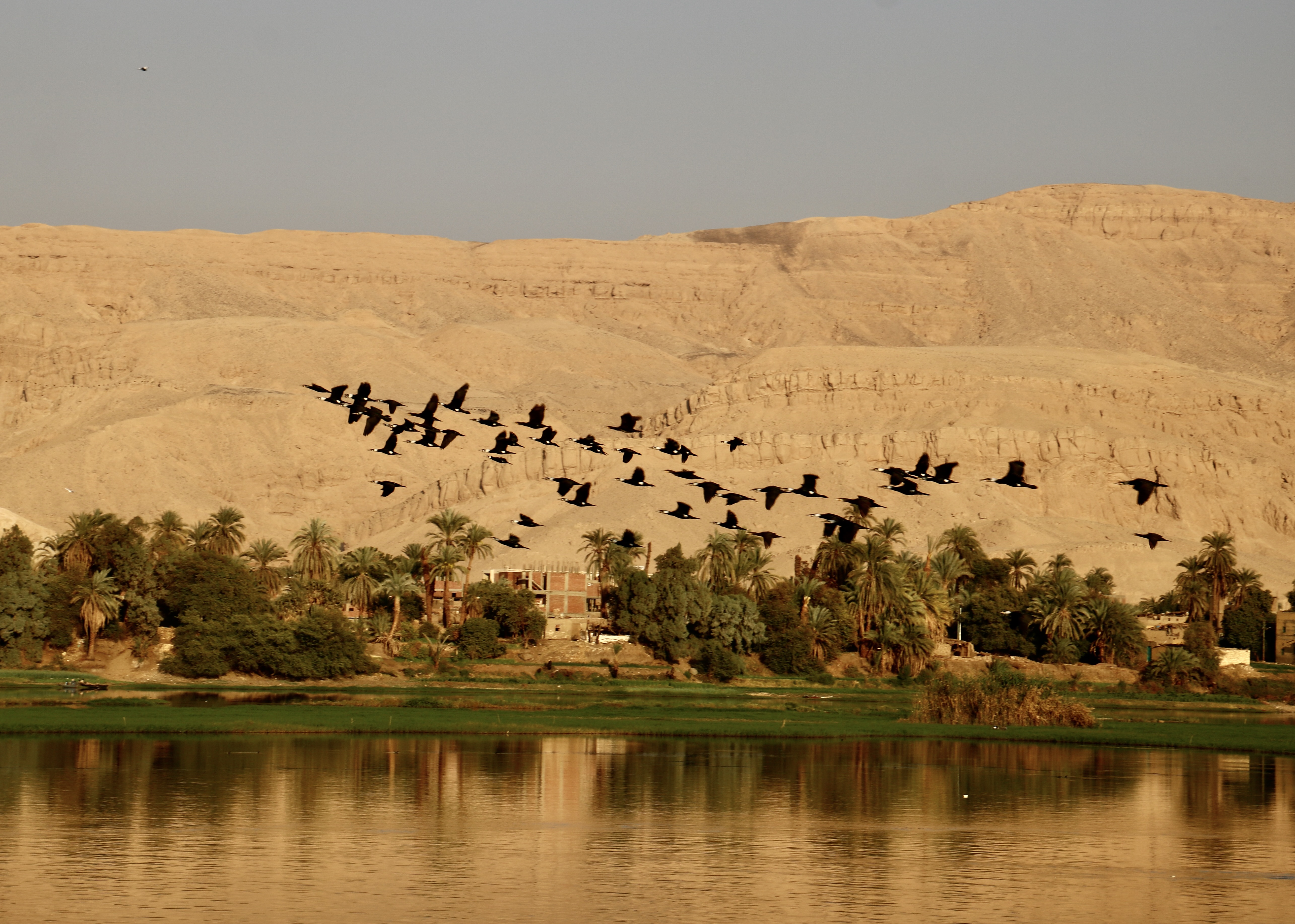
We took this photo from our boat to capture the ducks flying over the Nile River, but it also serves to illustrate the contrast between the green of the river and the reddish-brown Sahara Desert beyond that stretches all the way west to the Atlantic Ocean.

The pyramids speak to more than ancient history and the engineering marvels. They reflect the ancient Egyptians’ deep belief in the afterlife, magic, and the numerous gods who impacted their lives from birth to death— and beyond. This belief in the afterlife (plus the pharaohs’ exploits and claimed relationship to the gods) dominated the temples, tombs and monuments we visited as we explored the area around Cairo, made our way up the Nile, and visited the city of Alexandria.

There are numerous myths about the gods and I’ll be relating several as I go though my posts on Egypt. I find them both fascinating and fun. One thing to note here is that most of them have several versions. Five thousand years is a long time to keep a story straight. For example, today I am going to tell about one of the great founding myths, that of Osiris and Isis. Like most great tales, it is filled with murder, mayhem, adventure, sex, twists, magic and even a bit of humor. That Osiris was killed by his brother, chopped into pieces, put back together, and became God of the Underworld where he sat in judgement of the dead is generally agreed upon. The details on how he was killed, managed to get Isis pregnant with Horus afterwards, and was put back together vary with the teller.

The version that I am writing about was originally told by Plutarch in the second century AD. I first read it in a book by Joseph Campbell, Transformation of Myth through Time, over 30 years ago. I like this version because it has a Cinderella aspect to it, i.e. if the coffin fits, wear it.

This story starts with the goddess of heaven, Nut, and the god of earth, Geb. The god of air, Shu, separates Nut from Geb. Night and day are created by the sun god, Ra, who sails across the sky in his boat during the day, is swallowed by Nut in the evening, journeys through her at night, and is born again in the morning through a somewhat natural birth.

Photo of Egyptian Goddess Nut taken by Curt Mekemson.
Nut the Goddess of the Sky is about to swallow Ra, the Sun God, in this photo we took in one of the tombs in the Valley of the Kings. Night is about to begin. The symbols on Nut’s body represent stars. Hieroglyphs fill the space on the right, providing advice and spells to aid the pharaoh in getting through the dangerous underworld on his way to eternal life.

Nut and Geb get together and give birth to four children.  The older twins, Osiris and Isis, are born first, and, in the tradition of Egyptian gods and pharaohs, marry each other. Osiris, with the help of the clever Isis, replaces Ra as the king of Egypt and gets the throne. Seth and Nephthys are born next and and marry each other.  Now the fun begins. Osiris is the typical good son and represents order. Seth is the typical bad son and represents chaos. It’s Osiris that creates the trouble, however. One night he sleeps with Nephthys, claiming he thought it was Isis. (Joe Campbell notes that this isn’t paying attention to detail.) Whatever the reason, Seth doesn’t buy it. Would you? He vows to get even. 

He builds a beautiful (and undoubtably incredibly expensive) sarcophagus/coffin made out of gold that is exactly fit to Osiris’s size. He waits until a great party is going on and everyone has consumed large quantities of beer (the go-to drink of the time) before showing up with his golden sarcophagus. “Whoever fits can have it!” he declares. Naturally everyone is excited to try, but nobody fits. Except Osiris. He’s just beginning to enjoy his triumph when 42 of Set’s servants rush out, slam the lid closed, wrap iron bindings around it, and throw it in the Nile. 

End of story, right. A solid gold coffin can hardly be expected to float. Except it does. Osiris is a god, after all. In fact, it floats all the way to Syria where it lands and a tree grows around it. And what a sweet smelling tree it is. So sweet that the local king decides he wants to use it for a pillar in a castle he is building. Meanwhile, Isis, in deep mourning, is searching the world over for Osiris. She ends up in Syria where she stops for a drink at the community well and hears the story of the sweet smelling pillar from maids who work at the castle. “Aha, Osiris!” she thinks. She also learns that the king has a new son who needs a nursemaid. She applies for and gets the job. 

Isis really likes the baby, nurses it from her finger, and decides to make it immortal  by throwing it in the fire each night to burn away its mortality. While this is going on, she assumes the form of a swallow and flies around the pillar, twittering mournfully.  One night the queen comes in on this scene and discovers her baby has been thrown in the fire and the nursemaid has become a twittering bird. Needless to say, she gets a little excited and screams. Isis immediately morphs back into herself, saves the baby, explains what she was doing, and asks the king if she can have the pillar. “Of course,” he says. (My thought is that he wanted to get the baby-burning goddess out of his life as quickly as possible.)

Isis gets a barge, loads the sarcophagus and heads home. Feeling lonely on the way, she opens the coffin, finds a quite dead Osiris, and climbs on in what seems to be a bit of Necrofilia. I’m not sure how it works, but she becomes pregnant (god thing again). Another version, which I like better, has her turning back into a swallow, flying over the coffin and being impregnated by magic. Immaculate conception is a common theme of Egyptian mythology. One myth I came across has the sphinx being born as the son of the lion goddess Sekhmeth after she is impregnated by a moonbeam from the Moon God. Explain that one to your husband. The Ankh, Egypt’s well known symbol of life and immortality, is also problematic when it comes to immaculate conceptions as well.

Having an ankh blown or shoved up your nose by a god was a great gift of life and immortality, highly desired by the pharaohs. Down around a woman’s midsection, it might have something other than a nose on its mind and be on its way to making a baby. It was known for making some women ankh-ious. (Sorry, my bad.)

Back home in Egypt, Seth has assumed the throne and will not be glad to have Osiris back, dead or alive. So Isis heads into a papyrus swamp where she hides out and gives birth to Osiris’s second son, Horus. Nephthys has already give birth to his first son, Anubis. 

All goes well until Seth follows a boar he is hunting into the papyrus swamp and finds the dead Osiris. Infuriated, he tears Osiris into 15 pieces and scatters them throughout Egypt. Once again, poor Isis sets out to get her dead husband back. Anubis, who is a Jackal in his animal form, and Nephthys help in the search. They can only find 14 pieces. Osiris is missing his genitals. A fish has eaten them.

They stitch Osiris back together with the parts they have and Anubis embalms Osiris, turning him into a mummy. Meanwhile, Horus grows up and goes to war with Seth to avenge his father. In a horrendous battle, Horus loses one of his eyes while Seth loses a testicle. Not quite reciprocal justice (an eye for an eye and a tooth for a tooth), but close. Seth also loses the battle, however.  Horus takes the throne and order is restored to Egypt while Seth is banned to the desert. Horus’s eye is magically restored and comes to symbolize making things whole and healing.  It even brings life back to Osiris, who becomes god of the underworld.

People admire a sculpture of Annubis at the Egyptian Museum in Cairo. The sculpture was found guarding the tomb of King Tut. Egyptians considered Annubis’s animal form to be that of a jackal because of his close association with the dead. Jackals were known to hang out around cemeteries, probably hoping to dig up a free handout. Heh.
Peggy and I brought home this tapestry featuring the Eye of Horus from Egypt. Nekhbet, the goddess of vultures, is shown on the right. Wadjet, the coba goddess is shown on the left. All three were frequently depicted in ancient Egypt. Not a bad trio. Nekhbet and Wadjet protected pharaohs and the Eye of Horus could heal them.

My next post on Egypt, two weeks from now, will feature more history, mythology, and photos of ancient Egyptian sites from around Cairo. Next Monday Peggy and I will take you on a drive through Custer State Park, South Dakota that will focus on some rather unusual and magnificent stone sculptures.

A 5000 Year Journey Back in Time… Featuring Cairo, Alexandria, and the Nile River: Intro

Photo of Egyptian camel at Giza pyramids by Curt Mekemson.
What better way to begin an Egyptian journey back in time than this ‘ship of the desert’? There was no lack of camels at the pyramids, or offers for camel rides, or camel photos— all for money, of course, preferably in dollars. The Egyptian pound had tanked and was worth three cents on the dollar. I caught this handsome face for free. The camel didn’t object and the owner was busy hustling someone else.

Peggy and I have just returned from our three week exploration of Egypt and invite you to join us as we explore the 25 million people mega-city of Cairo with its ancient pyramids, journey by riverboat up the Nile from Luxor to Aswan, and conclude by visiting the ancient city created by Alexander the Great. Along the way, we will wander through ancient temples, meet powerful gods and pharaohs, explore King Tut’s tomb, visit one of the most impressive mosques of Islam, stop by a factory where they pursue the ancient art of making papyrus, and have many, many more adventures. We were wowed by the history with its incredible temples, tombs and statues, impressed by the friendly reception of the Egyptians we met, captured by present day Egypt, and amused by the humorous stories our guide Sabaa shared along the way. Today’s post is an introduction, an appetizer if you will. The series will start in mid-April when I conclude our Rhine River trip. It wouldn’t do to confuse the rivers. Right? All of the photos in this post are by either Peggy or me unless otherwise noted.
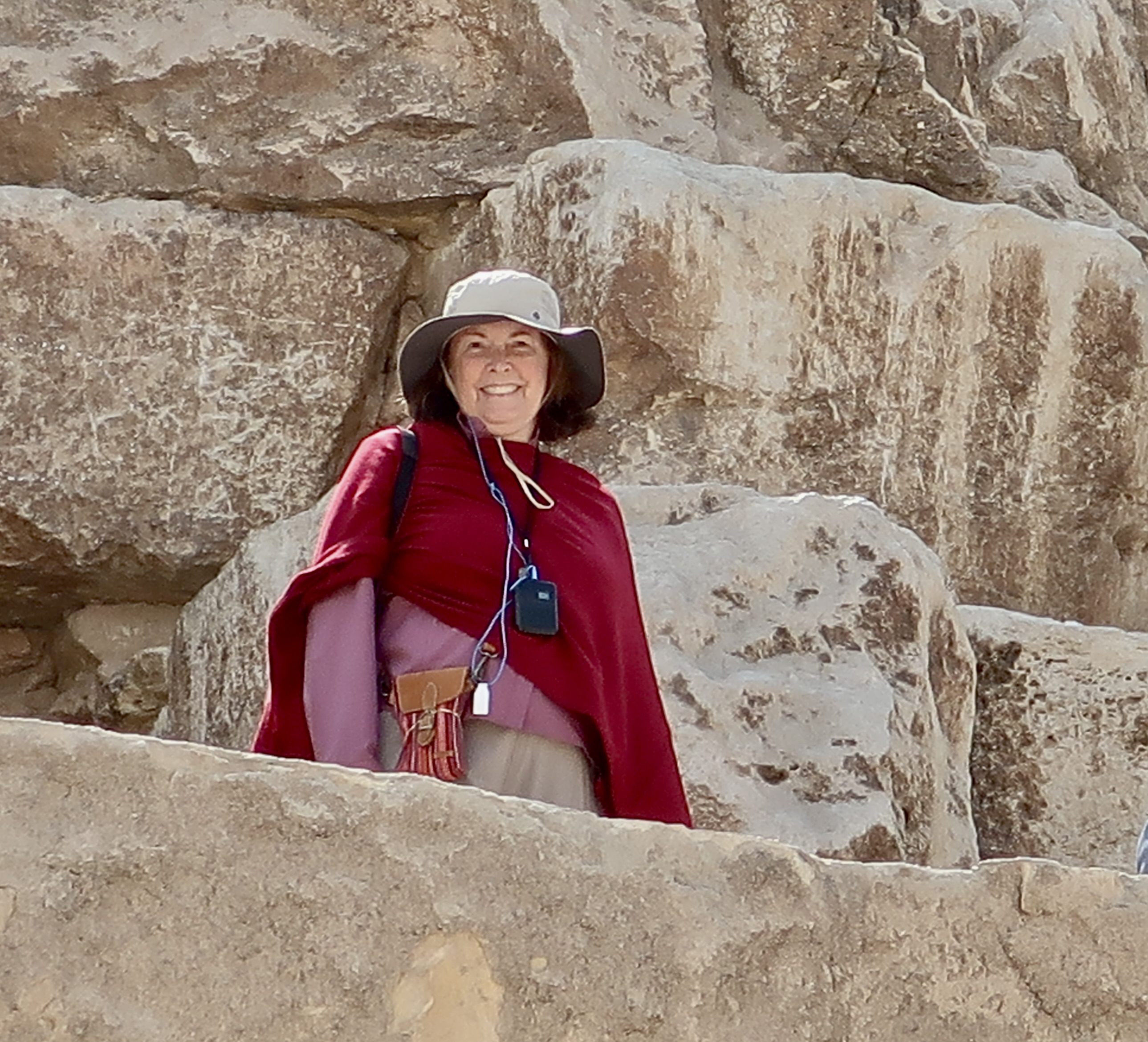
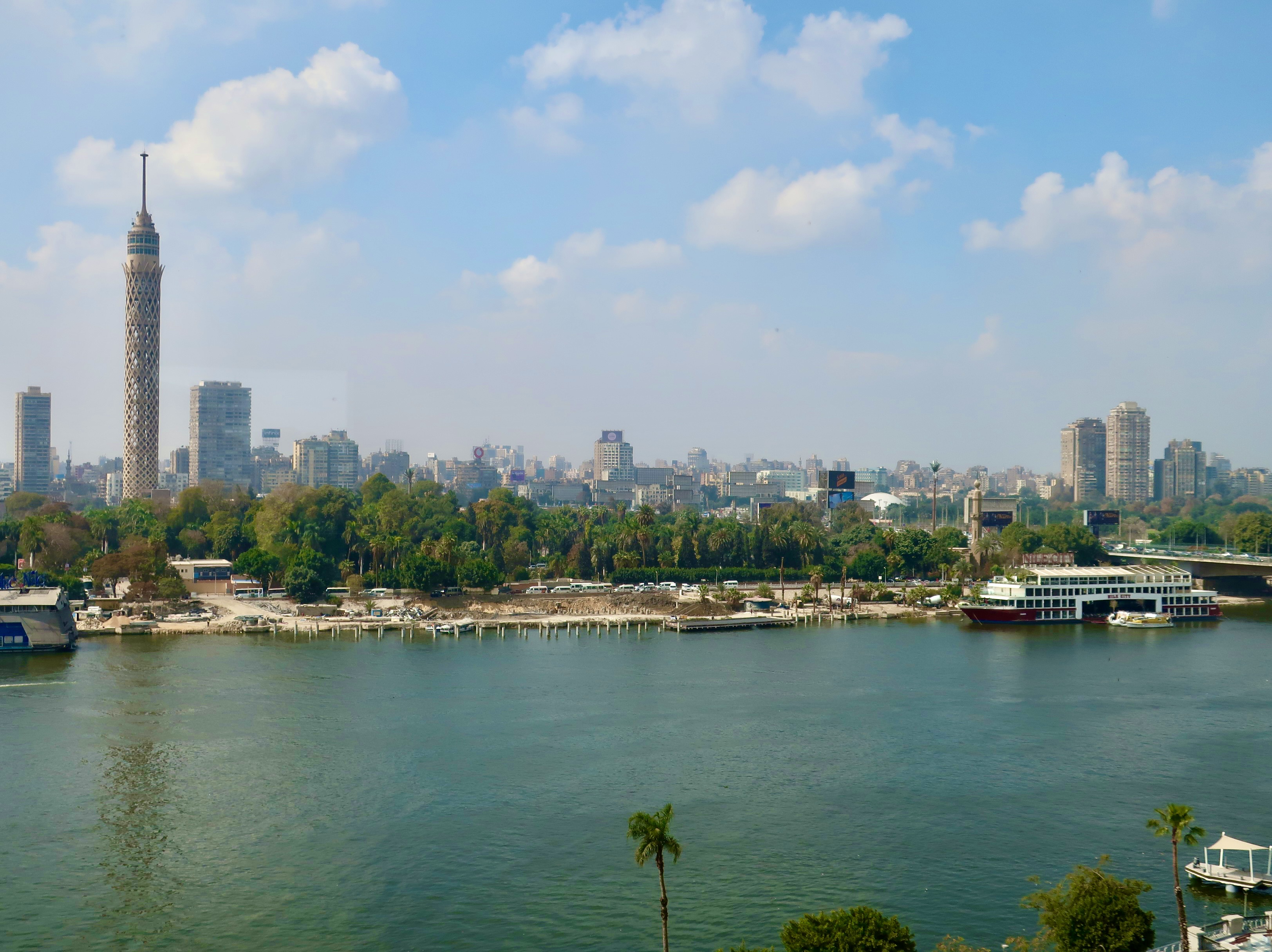
Photo of Egypt's Nile River and Cairo Tower by Peggy Mekemson.
Our tour company, Uniworld Boutique, put us up in the Ritz Carlton overlooking the Nile River while we were in Cairo. Peggy and I arrived a couple of days early and stayed a couple of days afterwords. This was the view from our window. We spent a lot of time watching the river traffic. No surprise. You are looking at the Cairo Tower on the left. It’s a major Cairo landmark with an amusing CIA story connected to it that I will relate later.
Photo of Egyptian Museum by photographer Curt Mekemson.
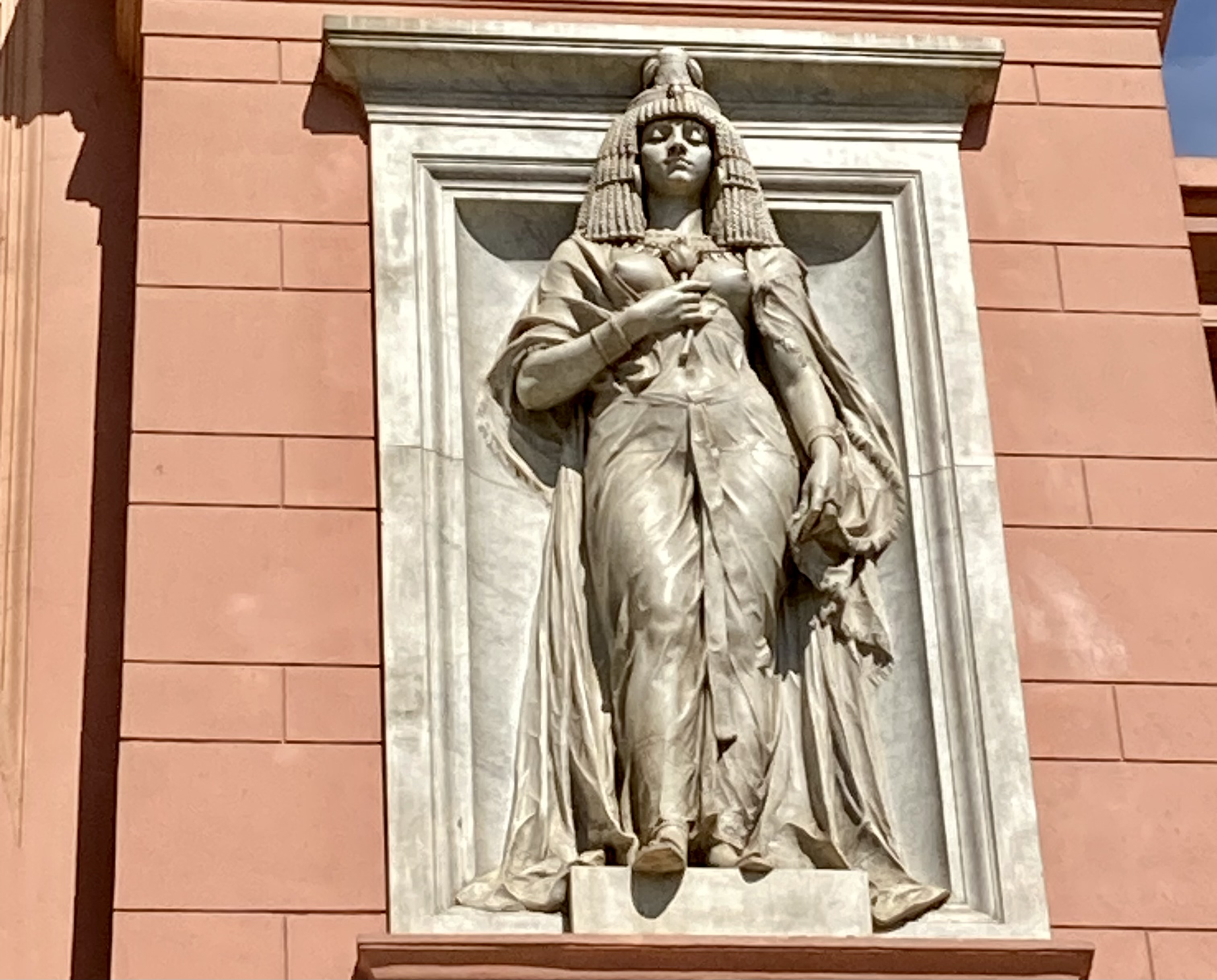
The Cairo Egyptian Museum was out the back door of the Ritz, a five minute walk away. We did our first tour there and will take you inside. BTW, see the raised figure above the two heads…
Photo of Cleopatra by photographer Curt Mekemson.
It’s of a rather voluptuous Cleopatra, the last ruler of the Ptolemaic reign in Egypt who had a child by Julius Cesar and a tragic love affair with Mark Anthony. She’s holding a lotus flower, a symbol of Upper Egypt. Focus guys.
Among the thousands of treasures inside were these canopic jars made from alabaster to contain the lungs, intestine, stomach and liver of people being mummified.They wanted them on hand to use later. Alabaster, Sabaa, told us, is great for preserving organs. I’ll keep that in mind.
Tahir Square was also located just behind the Ritz. Peggy and I walked over to check out the Obelisk. Plain-clothed police stopped us from entering the square. They were located at every entrance. It turns out that Tahir Square is the go-to place for Egyptians wanting to start a revolution. The police were there to discourage such activity. Nobody— but nobody— was going to make their way onto the square and start shouting slogans, including curious visitors.
Cairo is a city of attractive mosques and the Alabaster Mosque is a jewel among them. I’ll do a full post on the Mosque.
The inside is even more beautiful than the outside.
We discovered this ultra-skinny cat outside vociferously warning a large dog to leave its few scraps of food alone. The dog wisely decided his dinner was located elsewhere. Who wouldn’t? The cat was obviously a descendent of Bastet, the cat god of ancient Egypt. Not someone to trifle with.
From Cairo, we flew to Luxor where our riverboat, Uniword’s Tosca, was waiting for us to board.
Our Upper Egypt trip both started and ended at Luxor. A week, or a month, could easily be spent exploring the area. On arriving, we visited the Temple of Karnak…
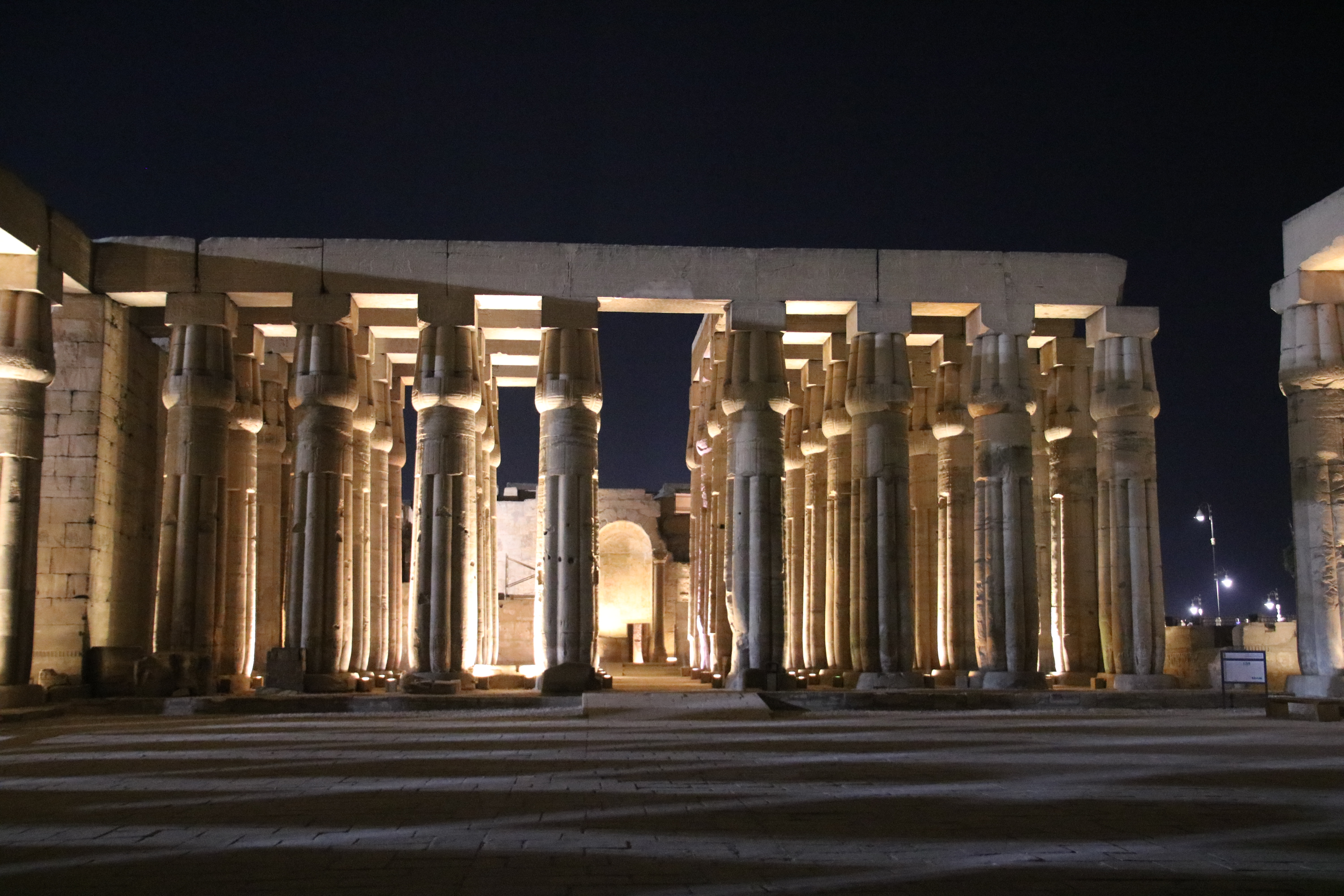
The Temple of Luxor at night. It was opened specifically for Uniworld guests. Translate: We had it all to ourselves. Usually, we had to work to take tourist-free photos.
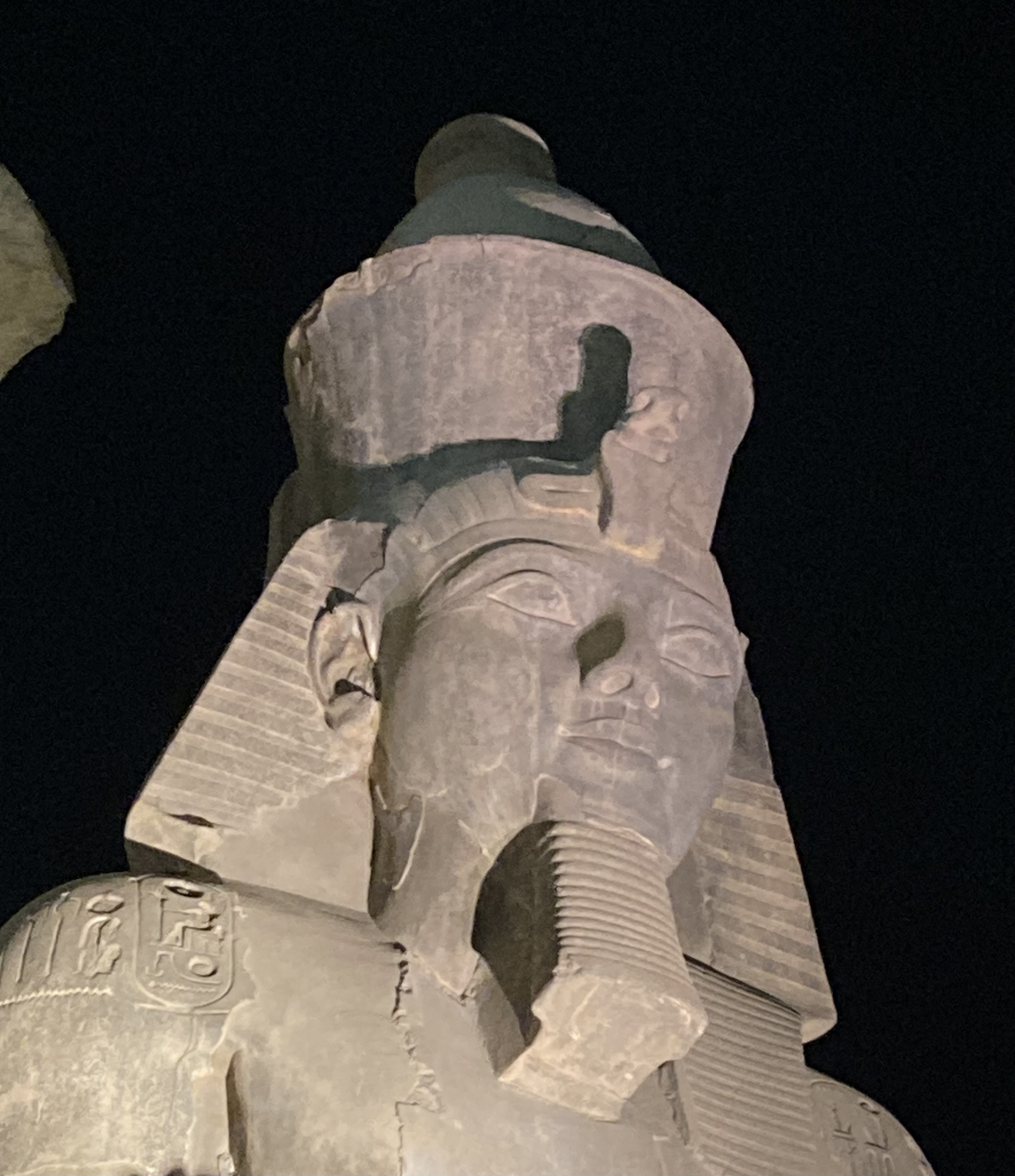
The Pharoah Ramses II.
We were greeted by a huge statue of Rameses II who was one of the most important pharaohs of ancient Egypt. That’s a cobra on his forehead.
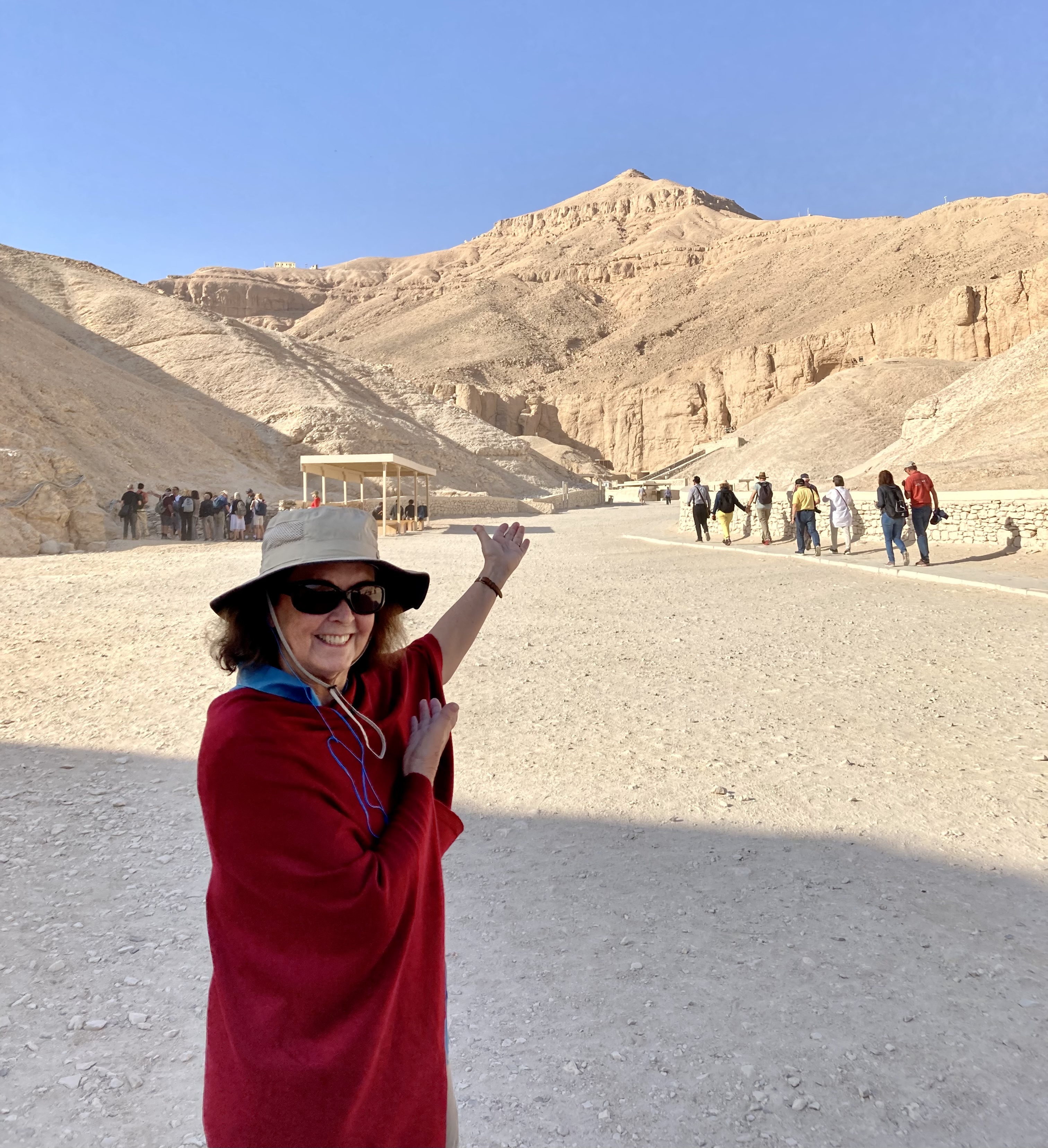
Several Pharaohs have their tombs in the Valley of the Kings outside of Luxor. Peggy is pointing toward the pyramid like mountain that was an important factor in the kings’ selection of the valley. BTW, the tomb of King Tutankhamun, where so many treasures were found, is at the base of the mountain. Peggy and I will take you into the tomb where King Tut’s mummy still resides. I’ll even show you King Tut’s toes. I’ll bet you can’t wait for that? They aren’t pretty. There’s a chance I might have to face the revenge of the mummy for displaying them.
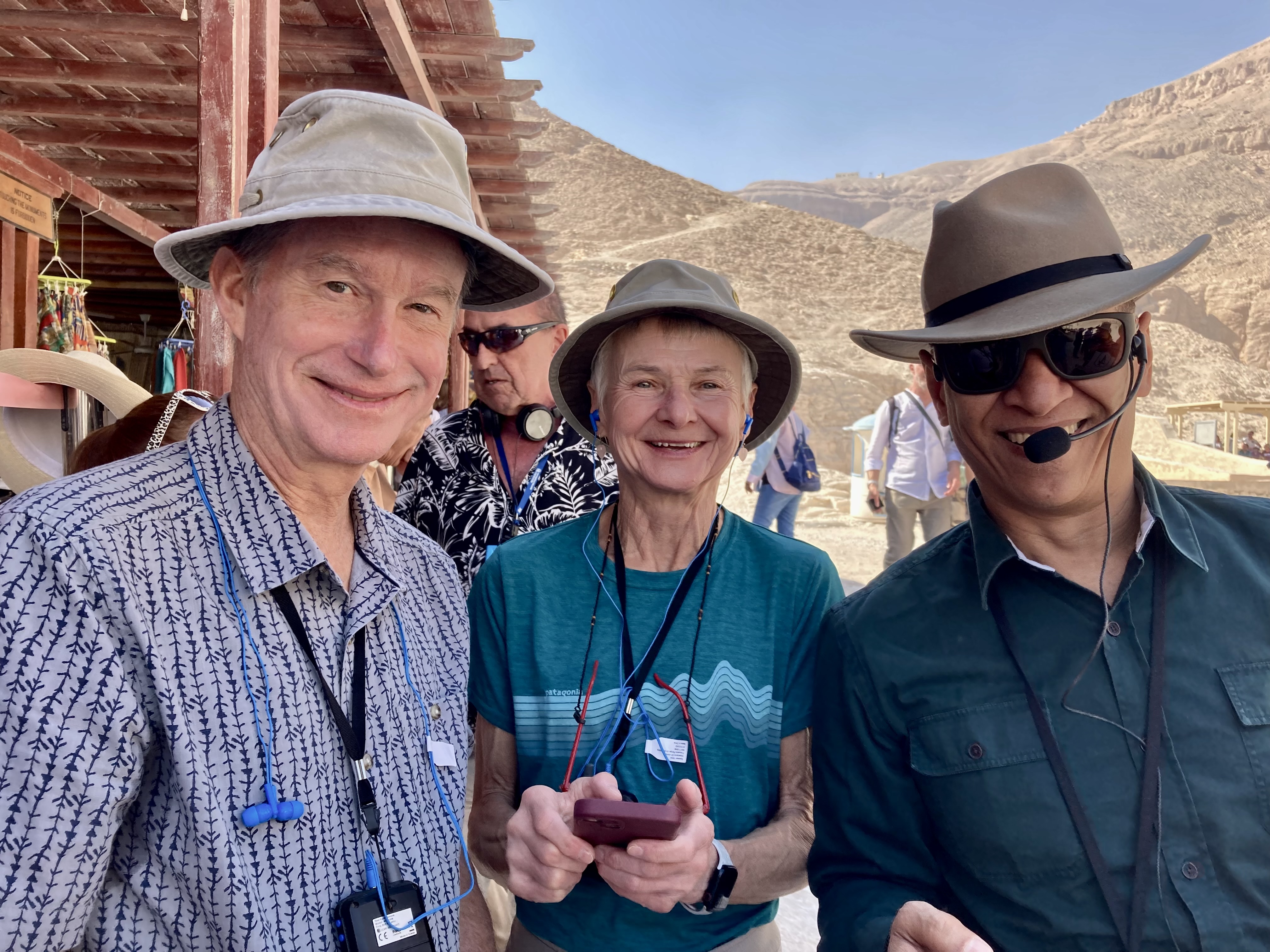
The folks on the Tosca, both our fellow travelers and the staff, were special. This is a photo of Steve and Carol Jones with our excellent guide, Sabaa at the Valley of the Kings. Steve and Carol, like so many of the followers of this blog, are world travelers. Both engineers, they quit their jobs at 45 and have been wandering the world for the past 20 years.
Photo of Valley of the Kings Tomb by Curtis Mekemson.
A photo inside of one of the tombs we visited in Valley of Kings (not King Tut’s.) It was packed with hieroglyphs designed to guide and protect the dead pharaoh on his dangerous journey.
The temple of Queen Hatshetsup, one of ancient Egypt’s most powerful Pharoahs, is located near the Valley of the Kings.
Photo of Queen Hatshepsut from the Egyptian Museum by Peggy Mekemson.
Beards were an extremely important part of a pharaoh’s look, as all the statues, paintings and reliefs show. Even Queen Hatshepsut had one, as this bust from the Egyptian Museum in Cairo shows. It was fake news, but a beard none-the-less.
Nile photo by photographer Curt Mekemson.
A significant part of our journey was our riverboat trip up the Nile from Luxor to Aswan and back.
Along the way, our journey took us past numerous villages and towns, all with their mosques and minarets, from which Muslims are called to prayer five times a day.
Photo of Nile River fisherman by photographer by Curt Mekemson.
We were able to watch fishermen and farmers plying their trade in much the same way as they have for thousands of years.
Photo of Nile River and desert by Curt Mekemson.
And enjoy the scenery. This photo serves as a reminder that just beyond the narrow strip of rich farmland beside the Nile lies the Sahara Desert that stretches for 2000 miles to the west. The ripples are being made by our riverboat, the Tosca.
Photo of mummified crocodile at Kom Ombo by photographer Curt Mekemson.
On our trip up and down the Nile we stopped at temples. One was at Kom Ombo, the temple of Sobek the crocodile god and Horus, the falcon god. A museum there, features mummified crocodiles. Sobek was responsible for fertility and the creation of the Nile, among other things. Gods had several responsibilities— and forms.
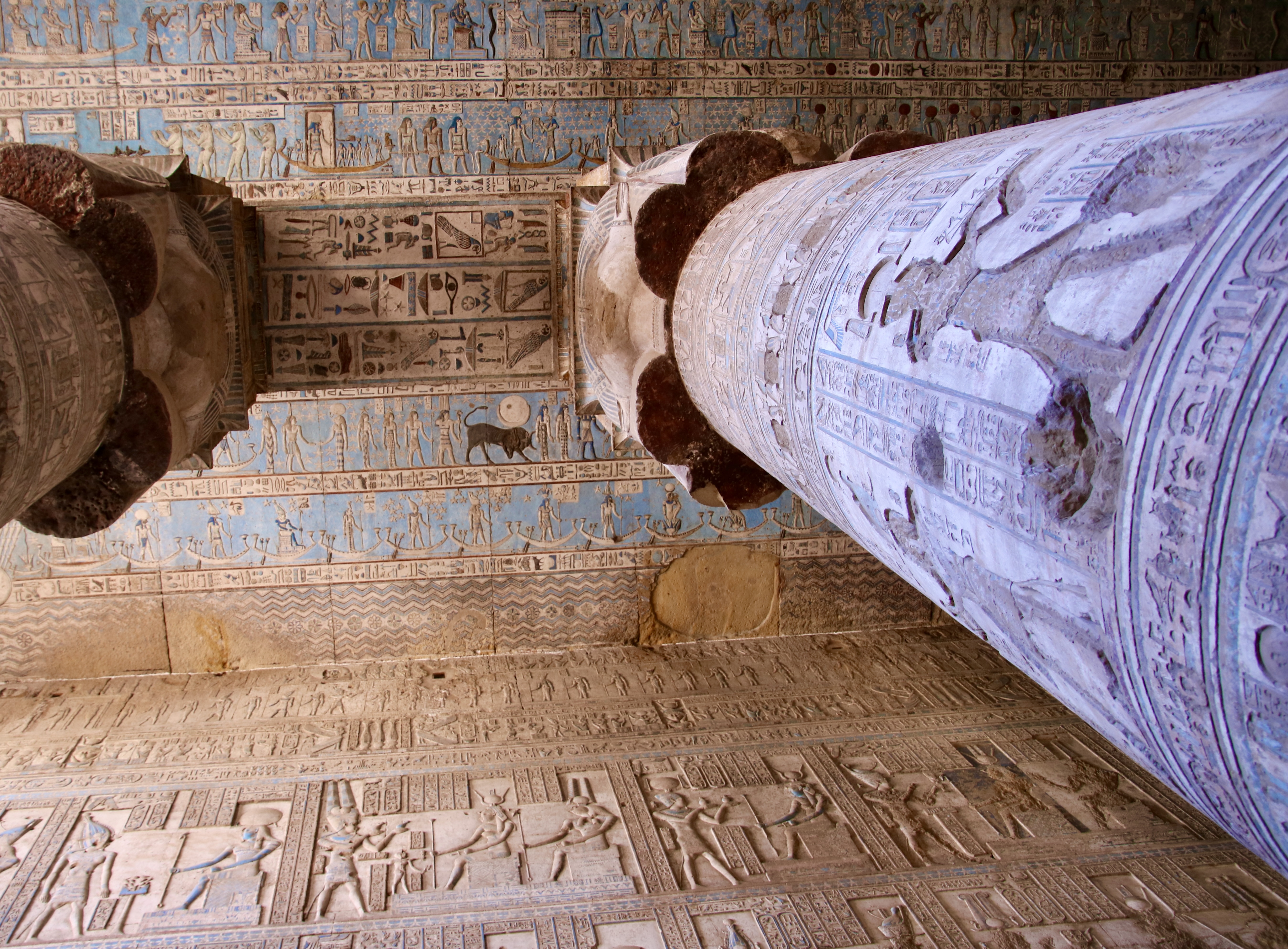
Photo of Dendera Temple by photographer Curt Mekemson.
One of the most beautiful temples we visited along the Nile was the Greco-Roman temple of Dendera. Both the Greeks and Romans played important roles in the latter days of ancient Egypt. Among other things, this temple featured signs of the Zodiac on its ceiling. I’m thinking Taurus above.
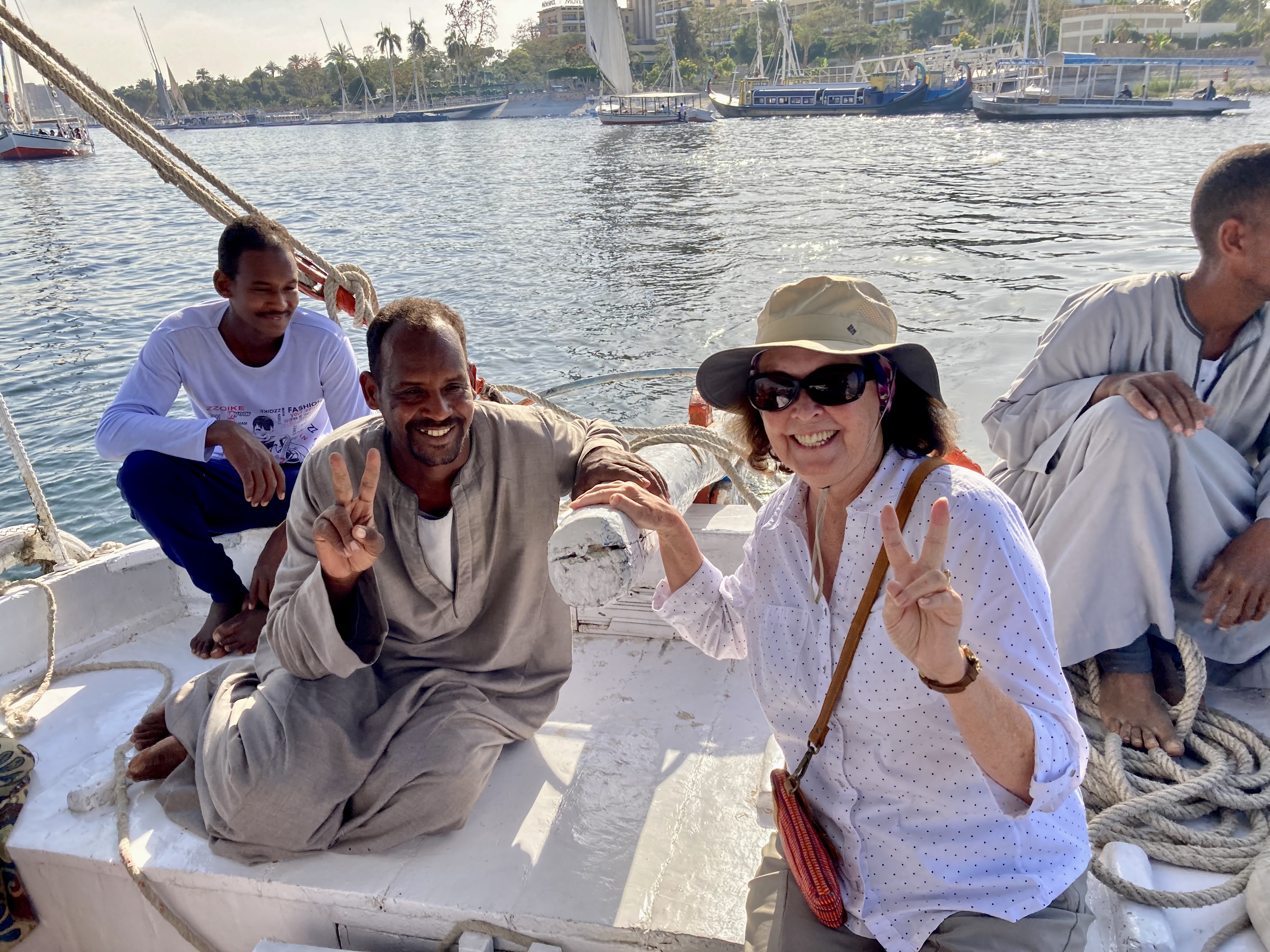
Photo of Peggy Mekemson on a felucca by Curt Mekemson.
One of the must-dos in Aswan, was to go on a Felucca ride, a sailboat dating back to ancient times on the Nile. Peggy had to get her hands on the rudder. I noticed that the boatman didn’t take his hands off of it, however. Grin.
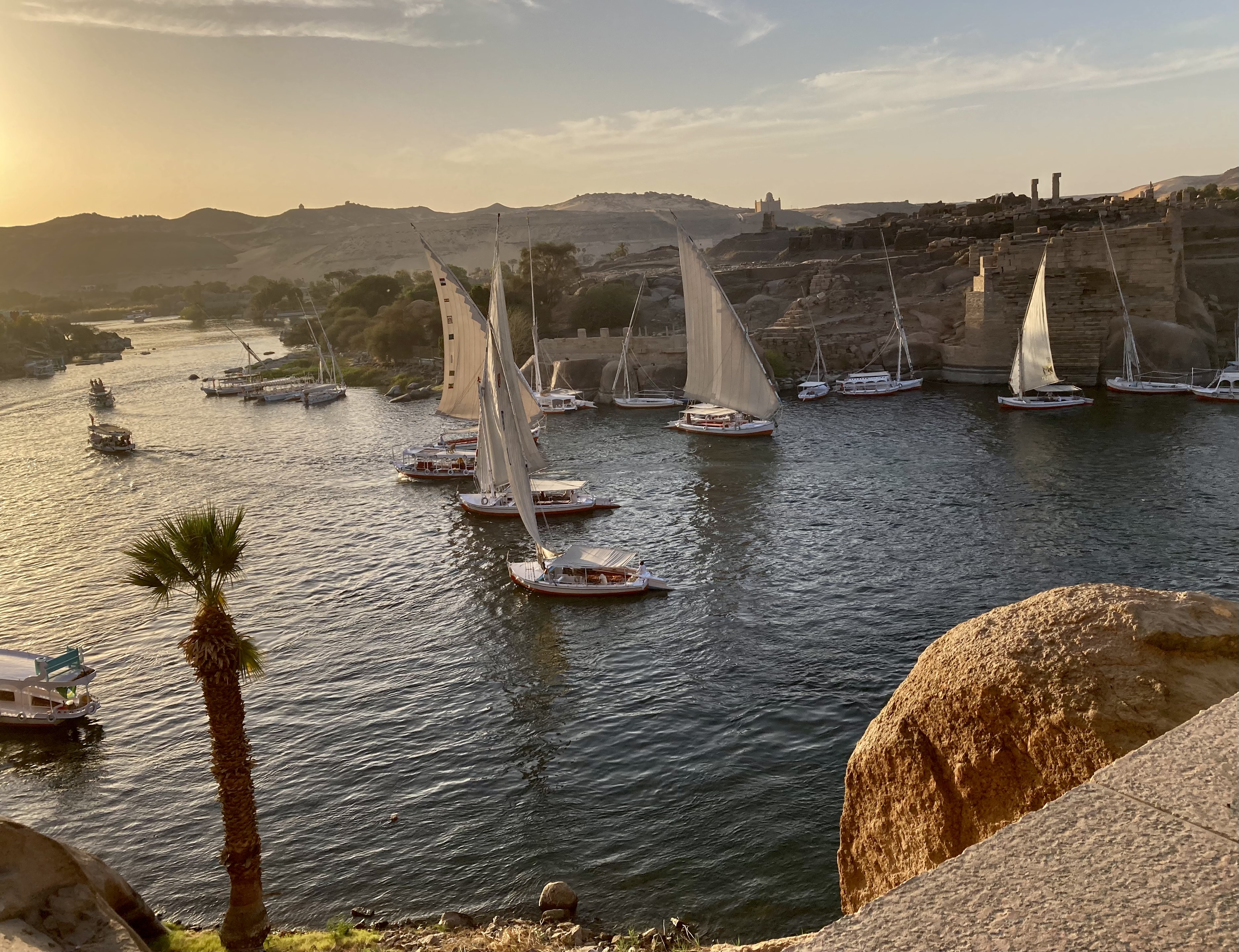
Photo of feluccas in Aswan by photographer Curt Mekemson.
Several feluccas were out enjoying the sunset in this photo which we took from an outdoor dining area of the Cataract Hotel in Aswan.
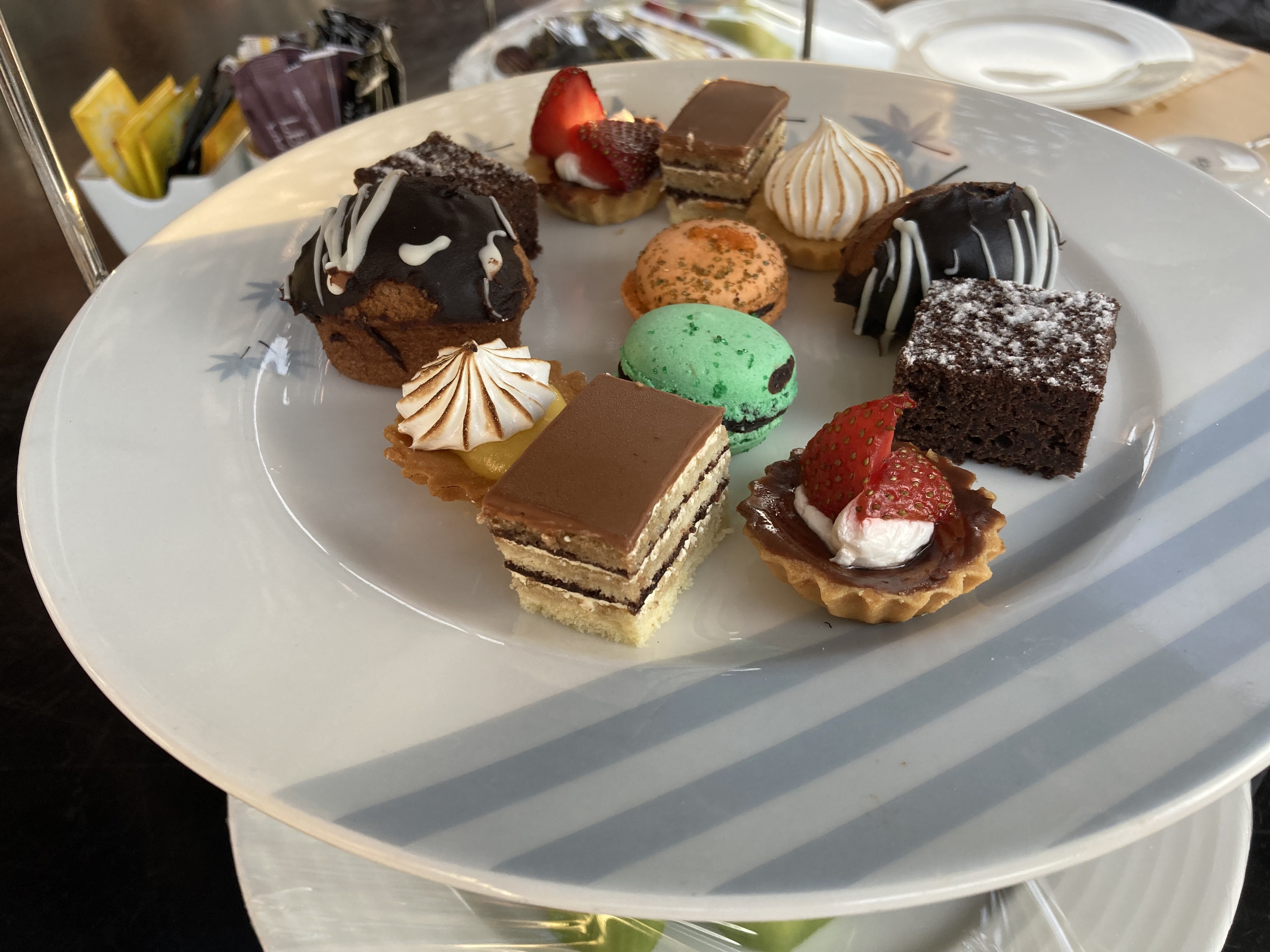
Photo of hight tea at the Cataract Hotel by photographer Curt Mekemson.
We were enjoying high tea at the hotel.
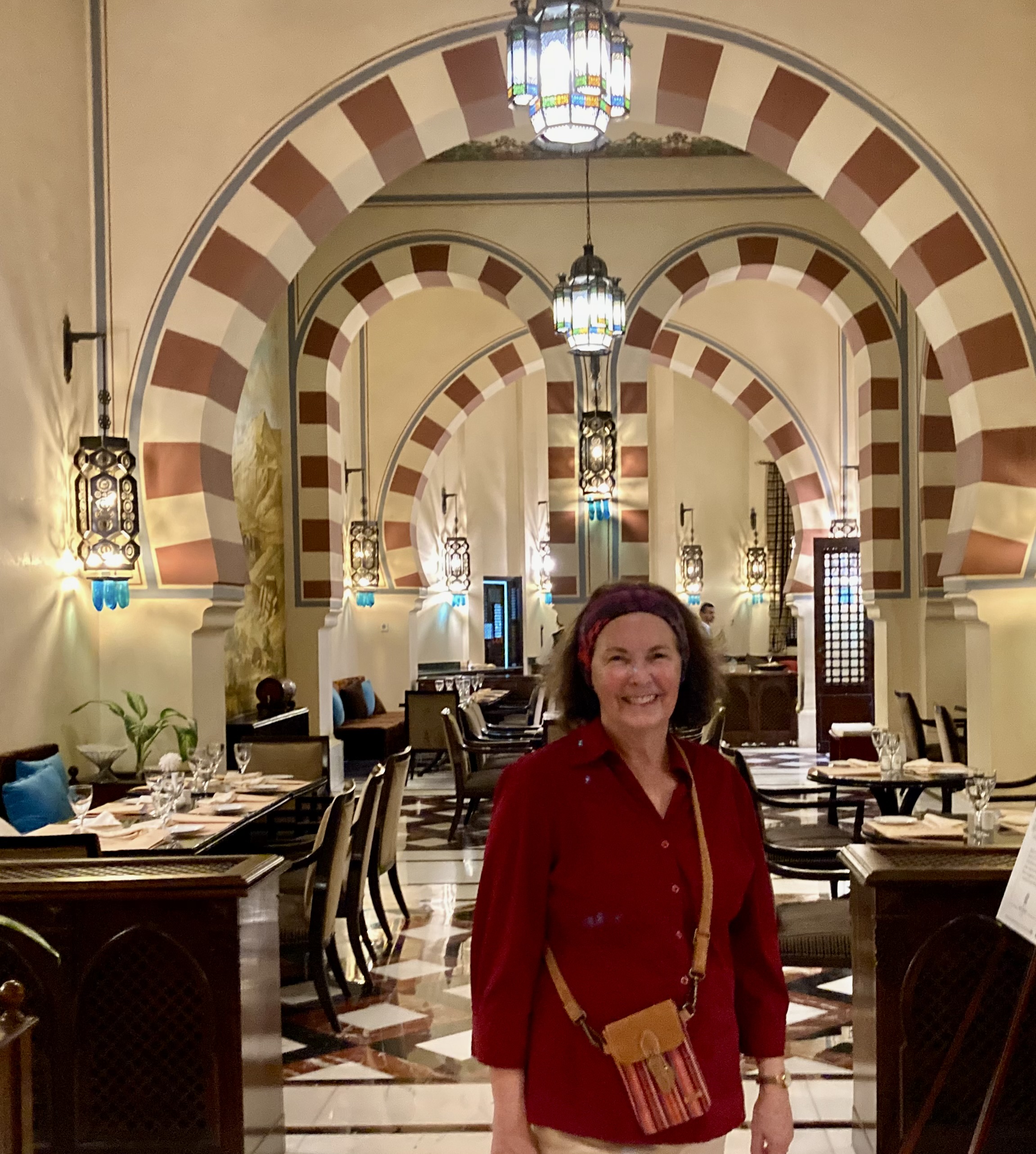
Photo of Peggy Mekemson in Old Cataract Hotel by Curt Mekemson.
Peggy, being a great fan of Agatha Christie, had to have her photo taken in the Old-Catarack hotel, which was featured in Christie’s novel, “Death on the Nile.”
Photo of Blue Heron at Aswan Egypt by Peggy Mekemson.
An evening bird watching tour on a small boat included numerous birds and a very enthusiastic bird expert.
Photo of spices in Aswan market by Curt Mekemson.
A walk through Aswan’s large local market featured, among many other things, spices. The top three baskets on the right are buds for making jasmine tea.
Photo of Philae temple by Peggy Mekemson
While at Aswan, we also visited the Philae temple…
Photo of Abu Symbel by Peggy Mekemson.
And flew up to the border between Egypt and Sudan to see the temples of Ramses II and his beautiful wife, Nefertari at Abu Simbel shown above. Abu Simbel was threatened to be buried under rising waters of the Aswan Dam and was saved by a world-wide effort by moving it rock by rock to a level above the water line.
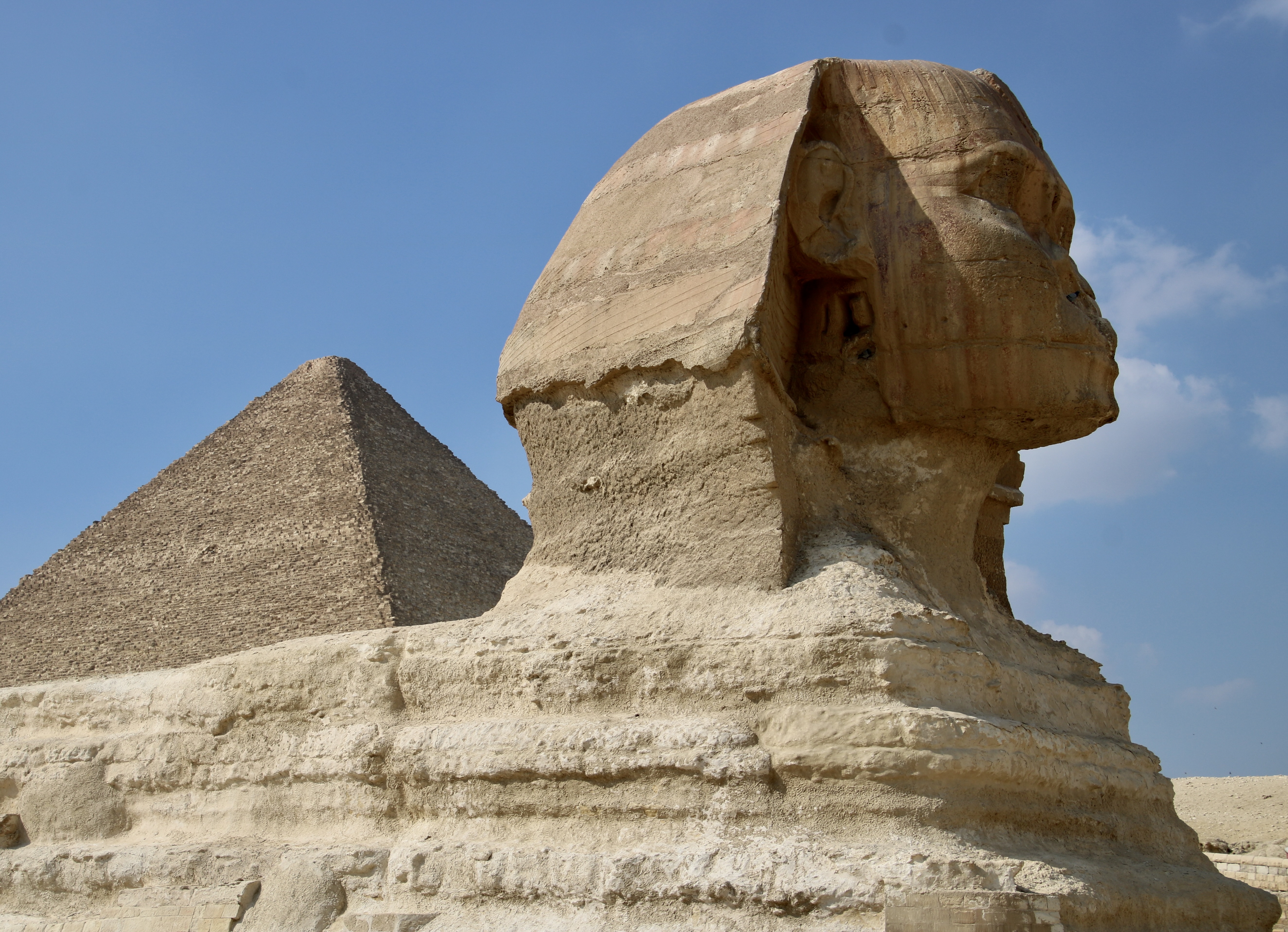
Sphinx photo by photographer Curt Mekemson.
We finished off our Egypt tour with a visit to the city of ancient Memphis and to the pyramids at Giza. This features the Sphinx and the Great pyramid of King Khufu.
Photo of Peggy Mekemson on the Great Pyramid by Curt Mekemson.
Peggy climbed a short ways up the side of the Great Pyramid to demonstrate the size of the rocks used in building the pyramid…
Photo of tunnel under pyramid of King Khafre by photographer Curt Mekemson.
And we both journeyed far under the pyramid of King Khafre, sometimes bent double because of the low ceilings.
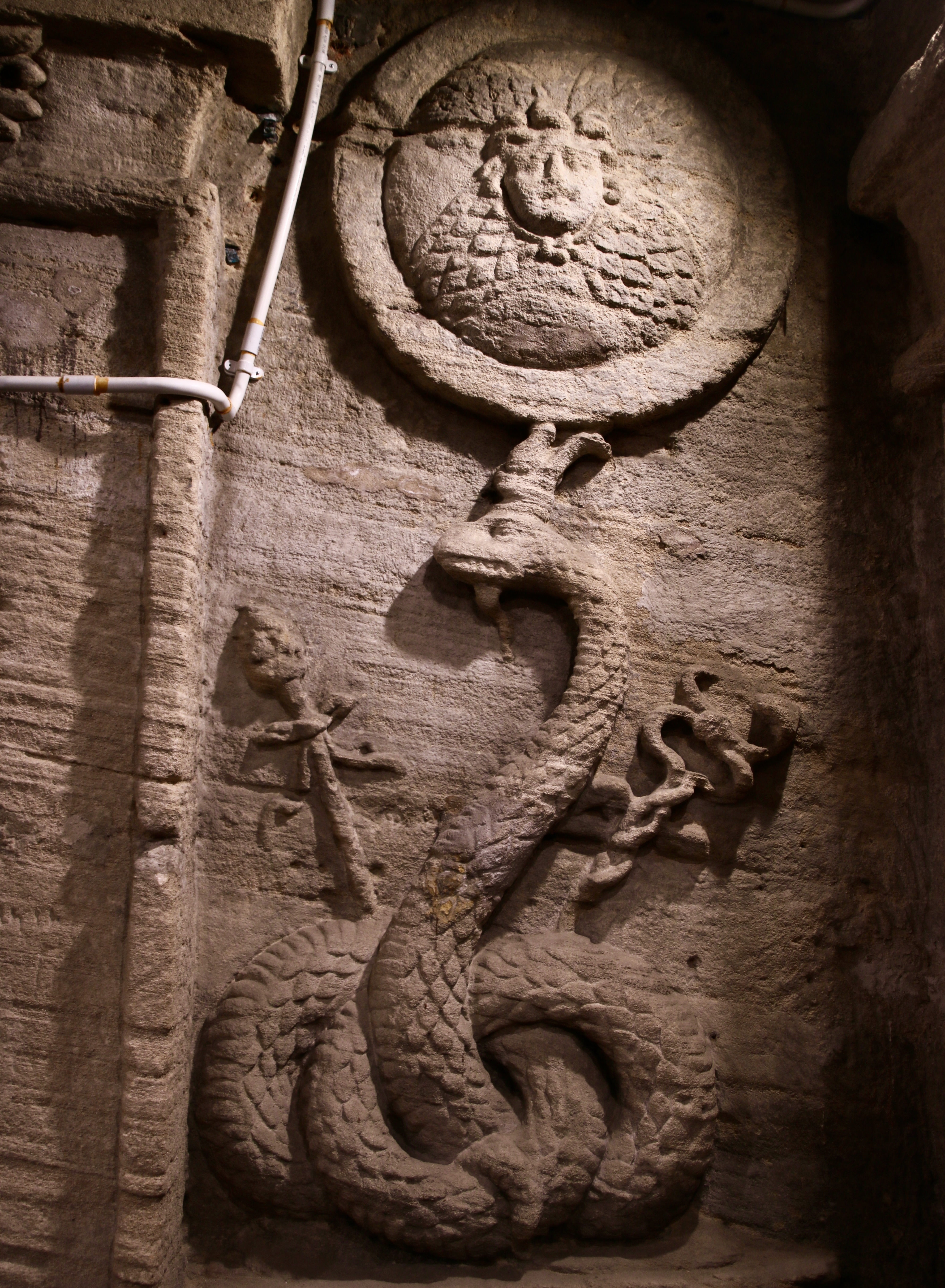
Photo of tomb guardians in Alexandria, Egypt by photographer Curt Mekemson.
One of our major stops in Alexandria was at Greco-Roman era catacombs. This gruesome twosome, a crowned snake on the bottom and Medusa on the top, were guarding the major tomb against grave robbers.

I know this has been long for an introduction, but believe me when I say it hardly touches on our experience. On Monday, Peggy and I will take you back to our fall trip around North America, this time featuring Grand Teton National Park, where the description ‘grand’ hardly covers the mountain range.