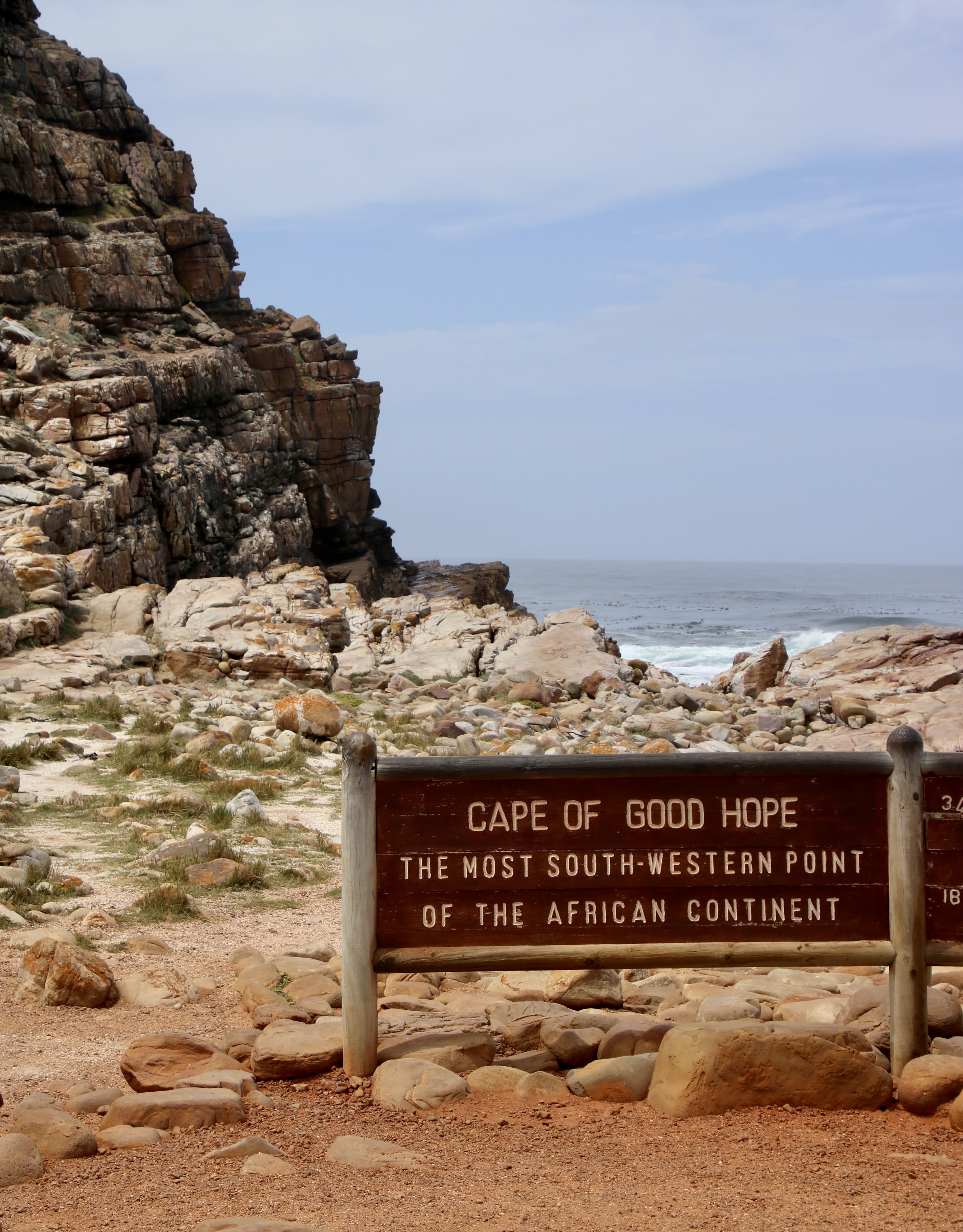
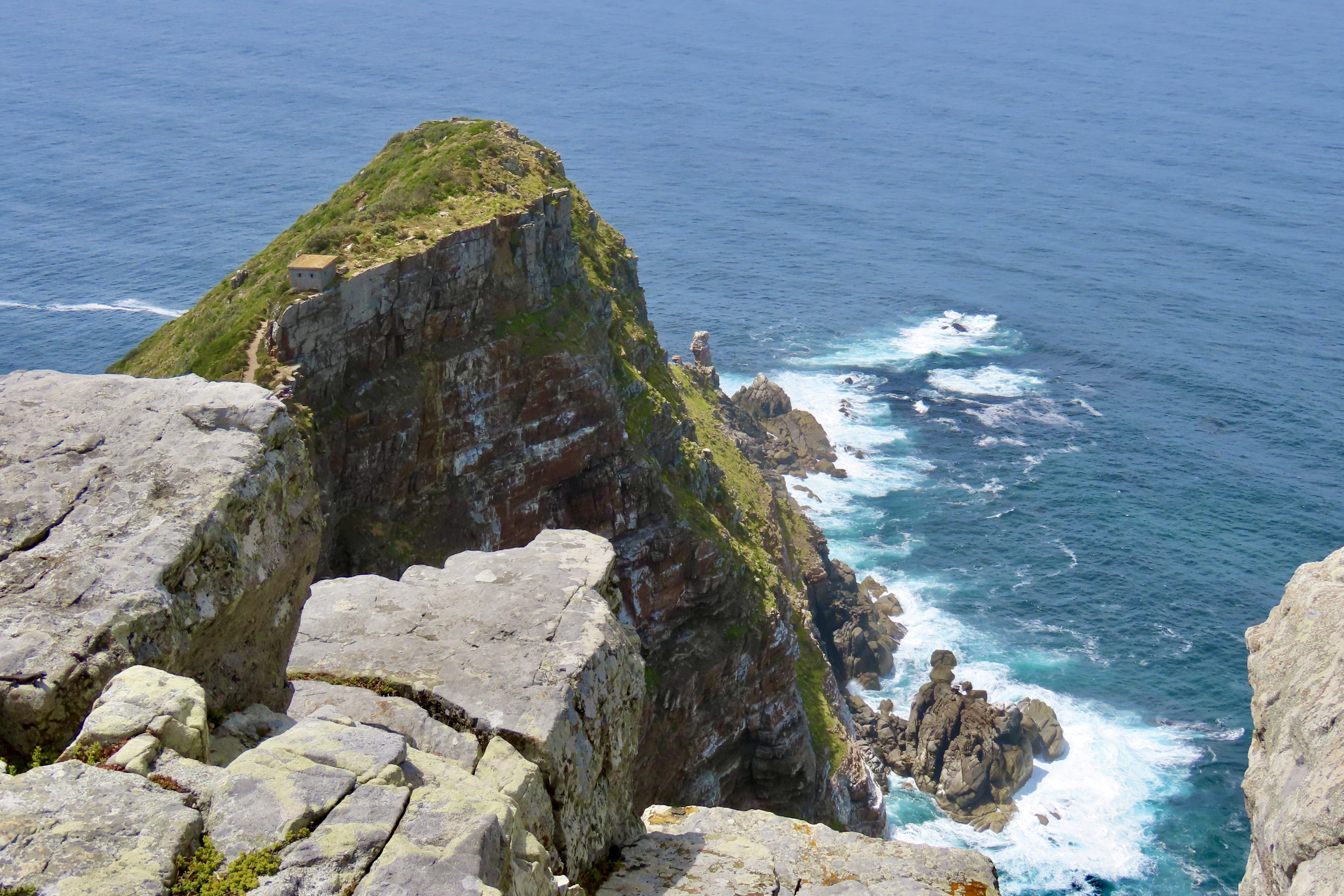
This is a view of the Cape of Good Hope as seen from on top of Cape Point. Portugal’s Bartolomeu Dias was the first to round it in 1488. He named it the “Cape of Storms,” for good reason. Ten years later, Vasco da Gama followed the same route and then sailed up the coast of Africa, prompting King John II of Portugal to rename it the “Cape of Good Hope.” It opened a sea route to fabulous wealth of the spice trade in India and the Far East.
Today marks my 25th and final post on our African Safari. As you read this, Peggy and I are driving between Carson City, Nevada and the Central Coast of California where we will spend the next two weeks exploring Big Sur, Carmel, Monterey, Pinnacles National Park and the surrounding area. The visit will kick off our next series: A three month, thousand mile journey following the Pacific Coast through Northern California, Oregon and Washington— one of the world’s most beautiful coastlines.
But first, a wrap up on South Africa where we will visit the Cape of Good Hope, Cape Town and Table Mountain.
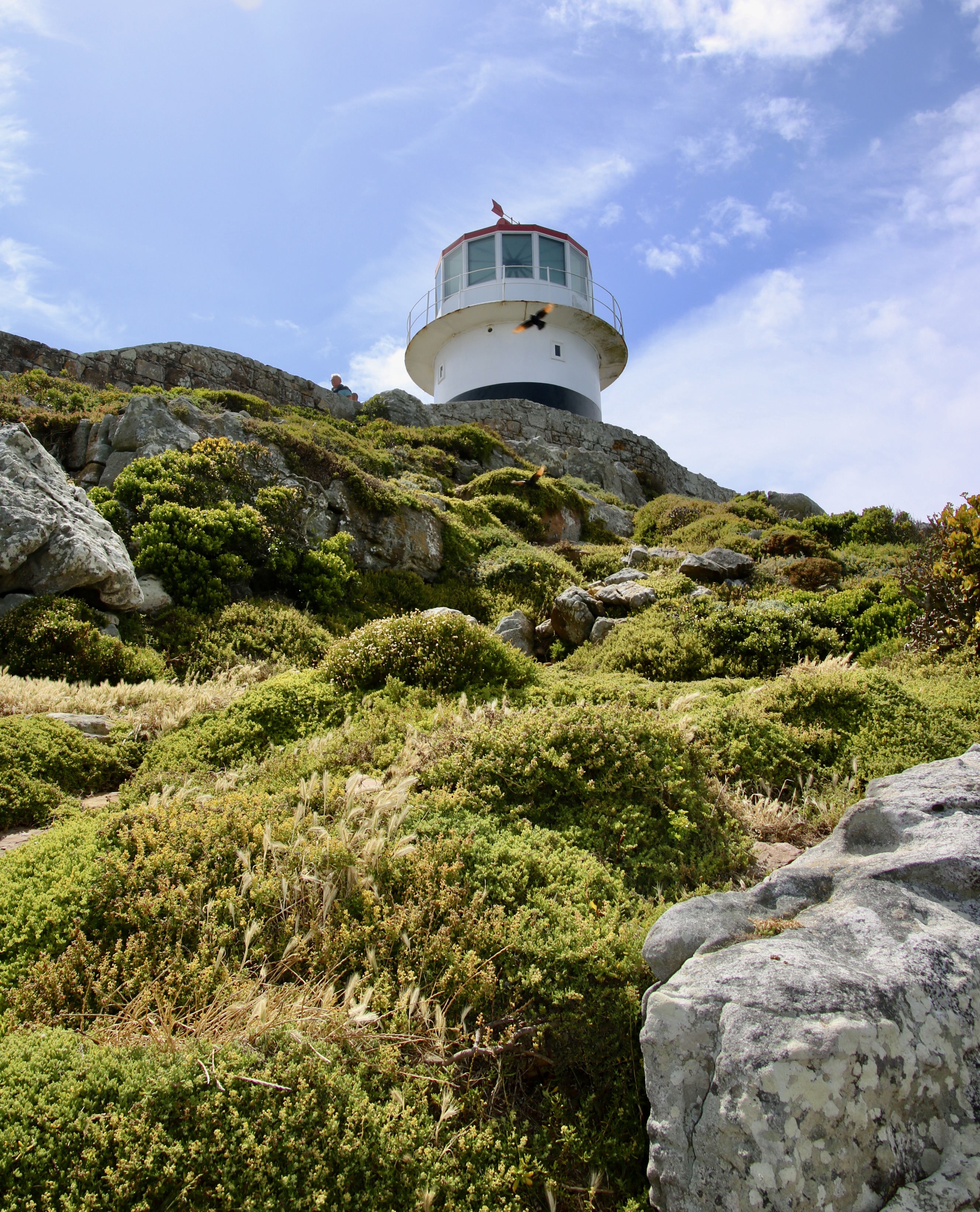
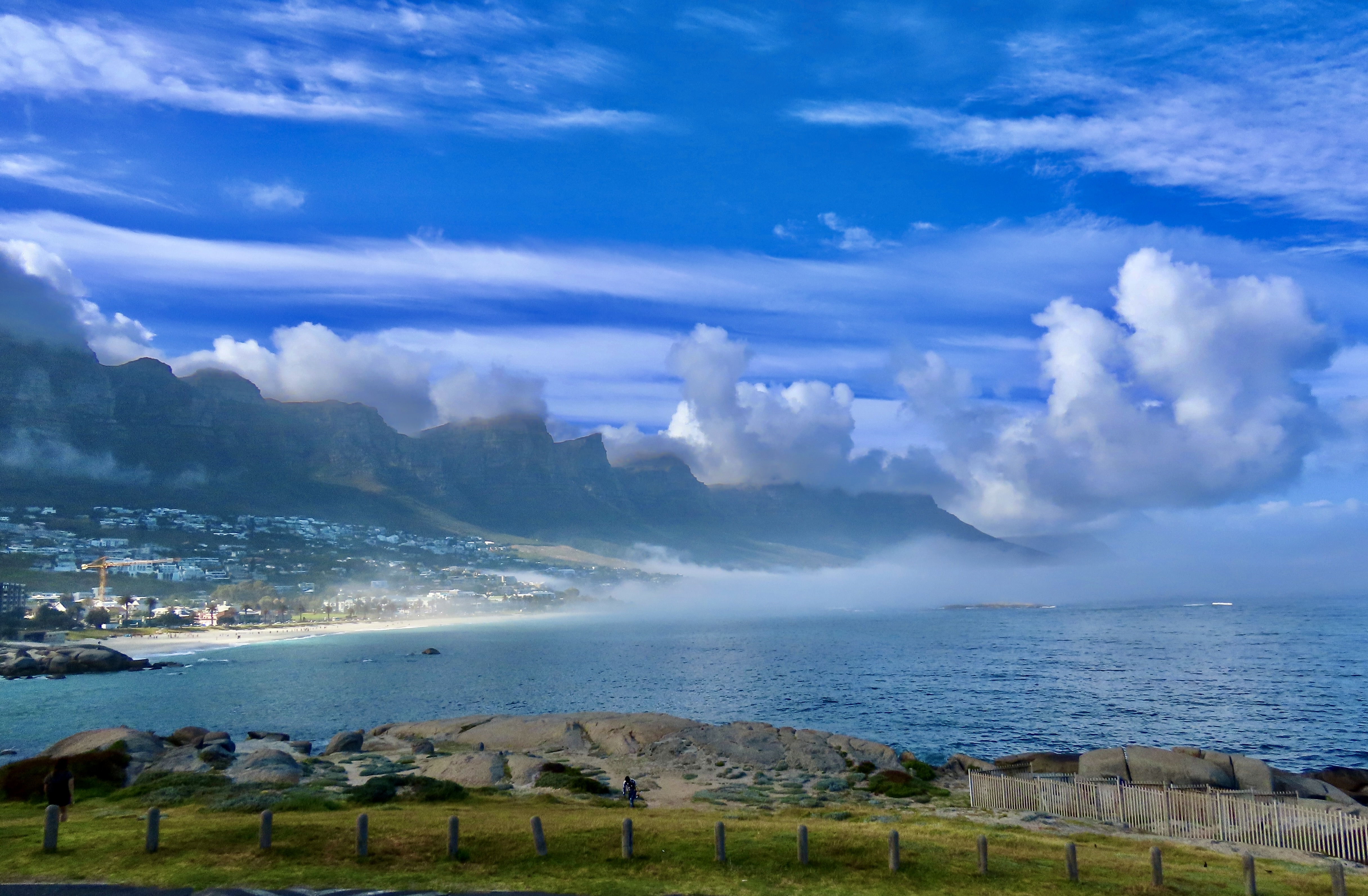
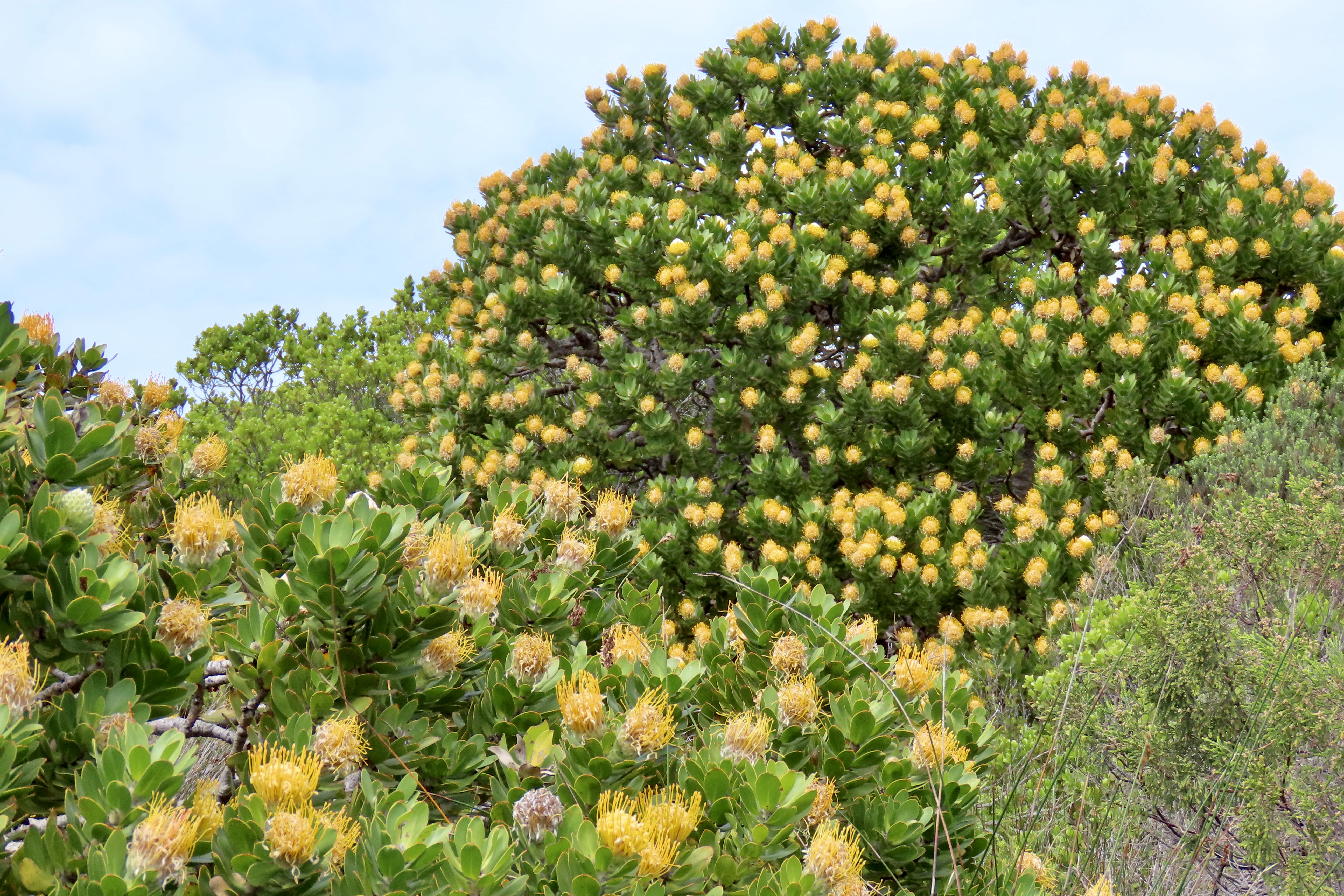
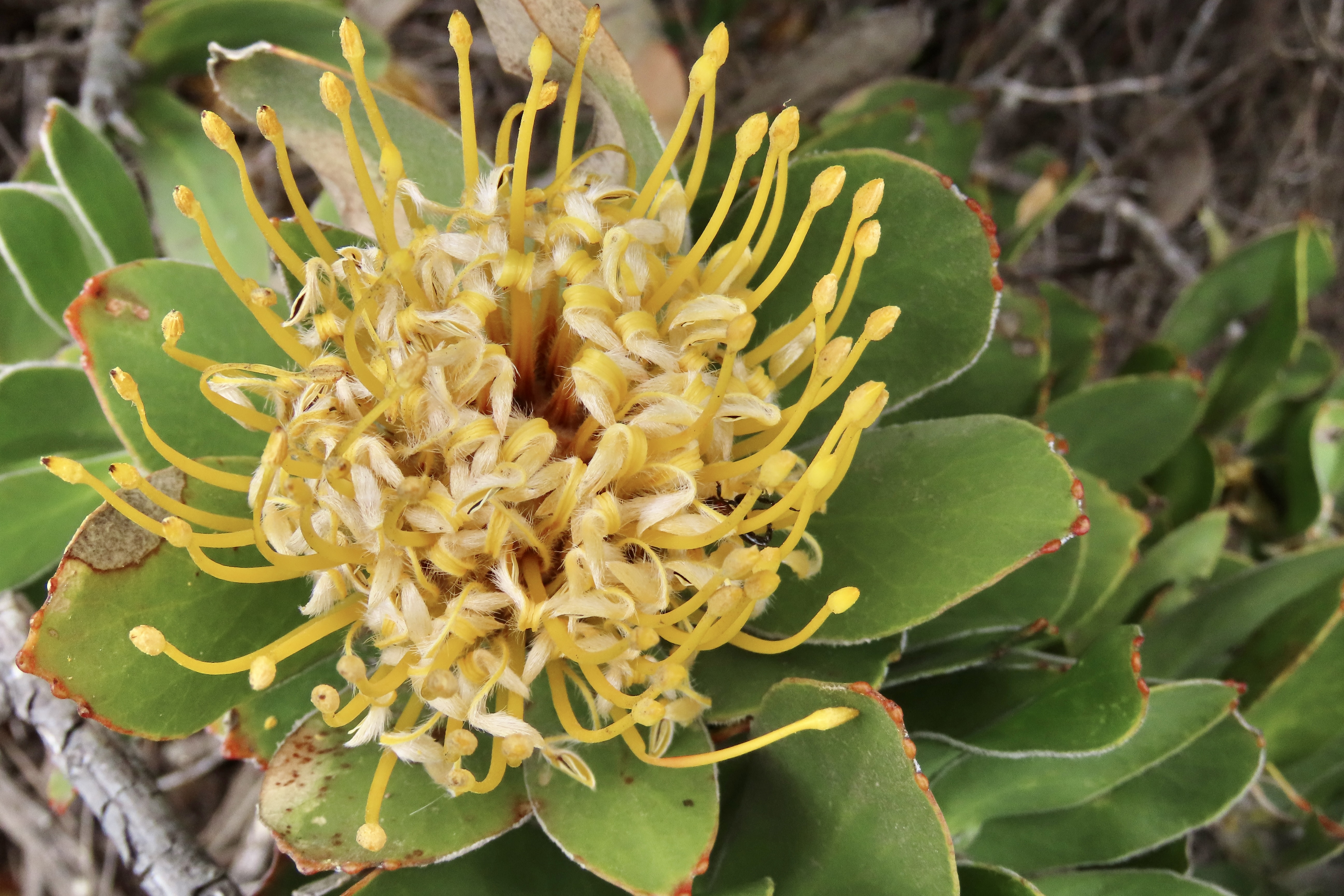
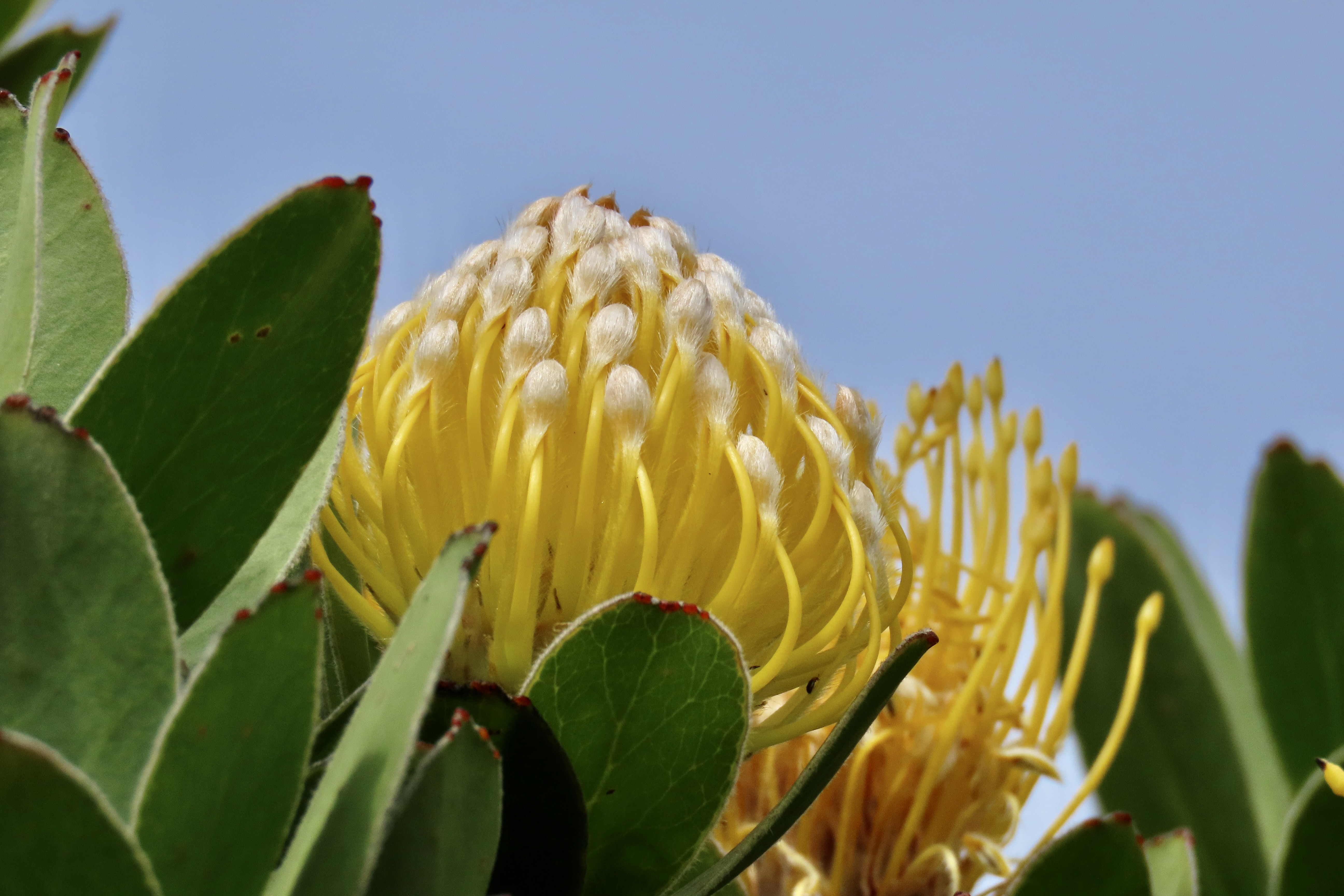
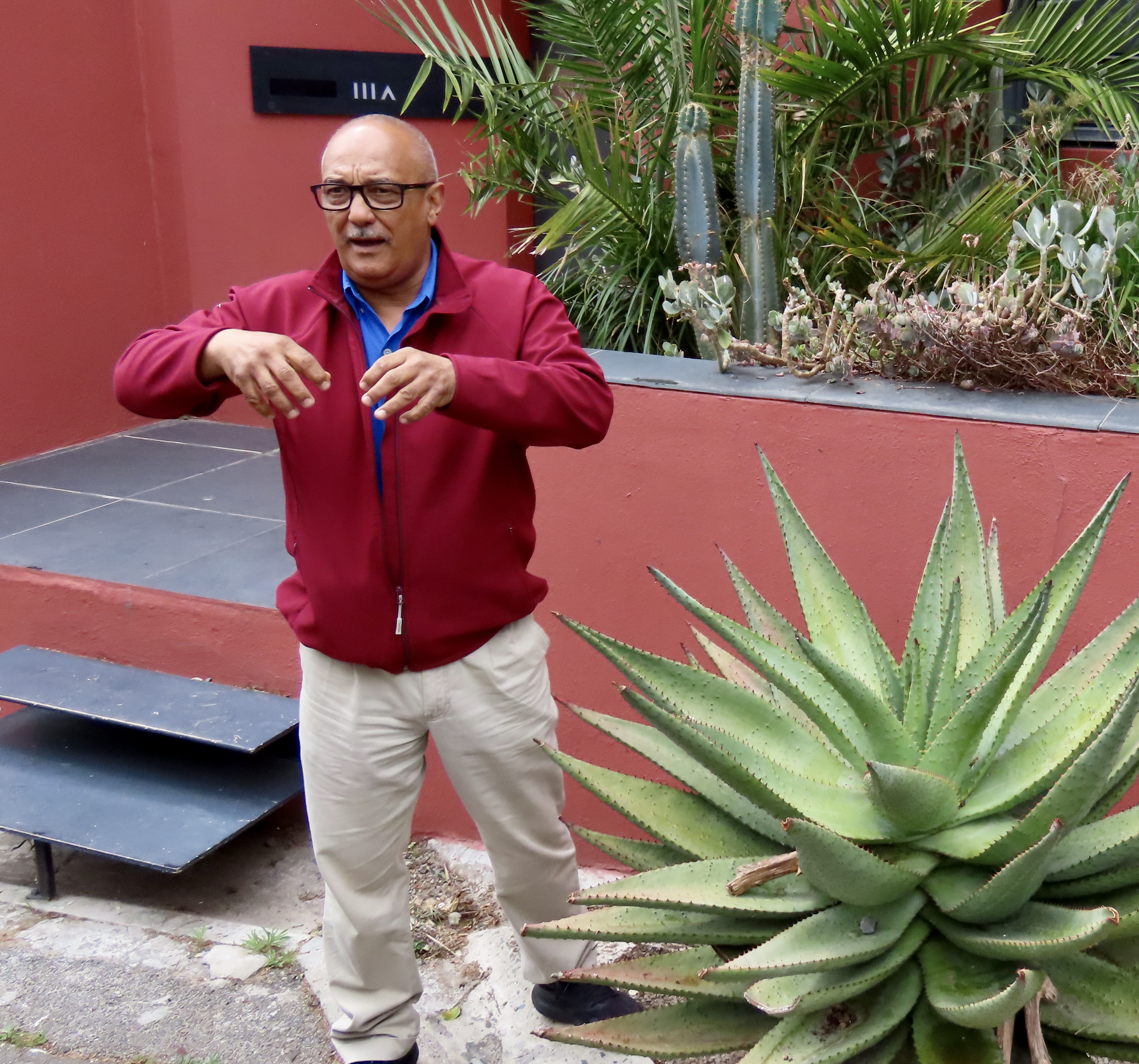
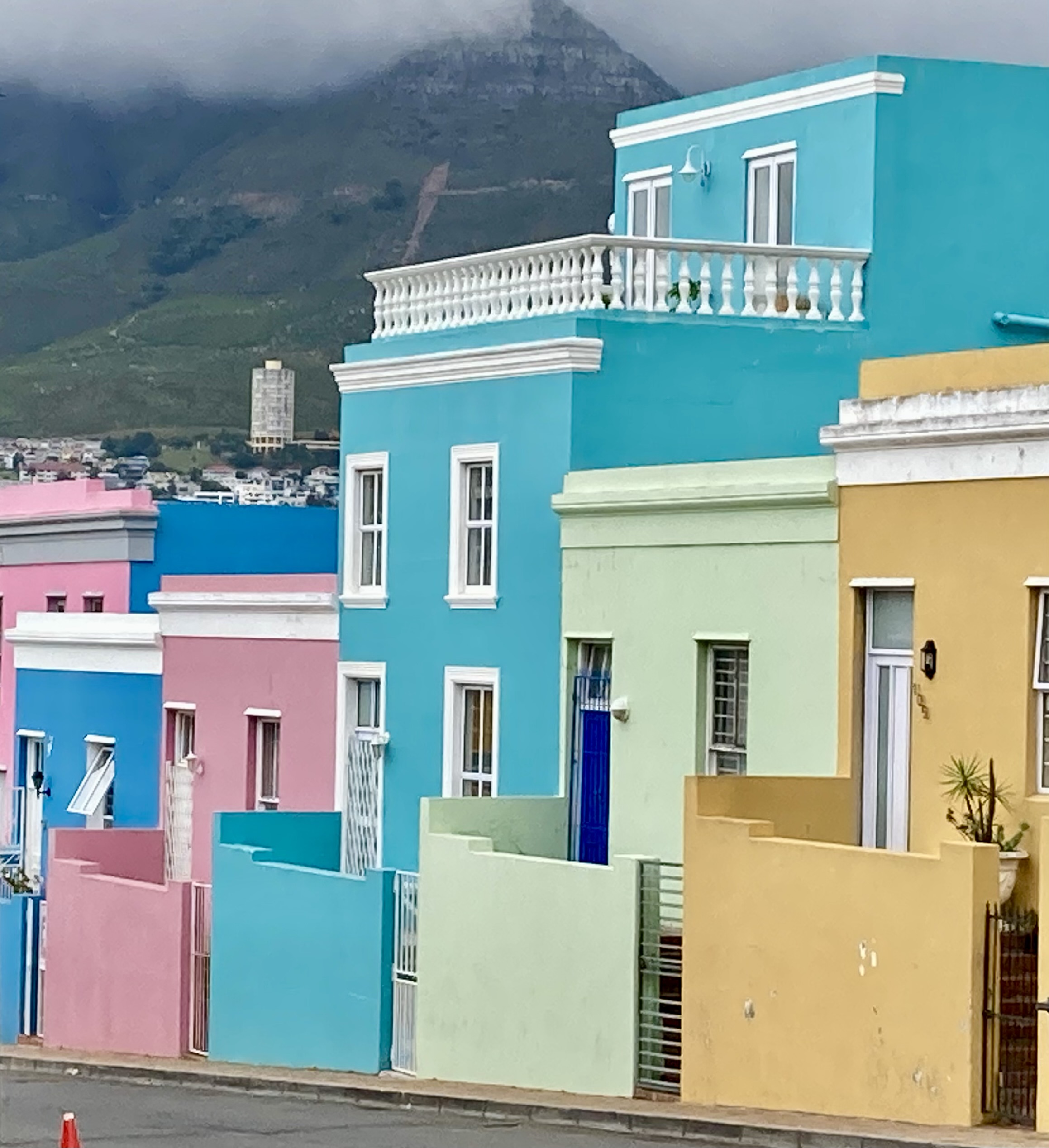
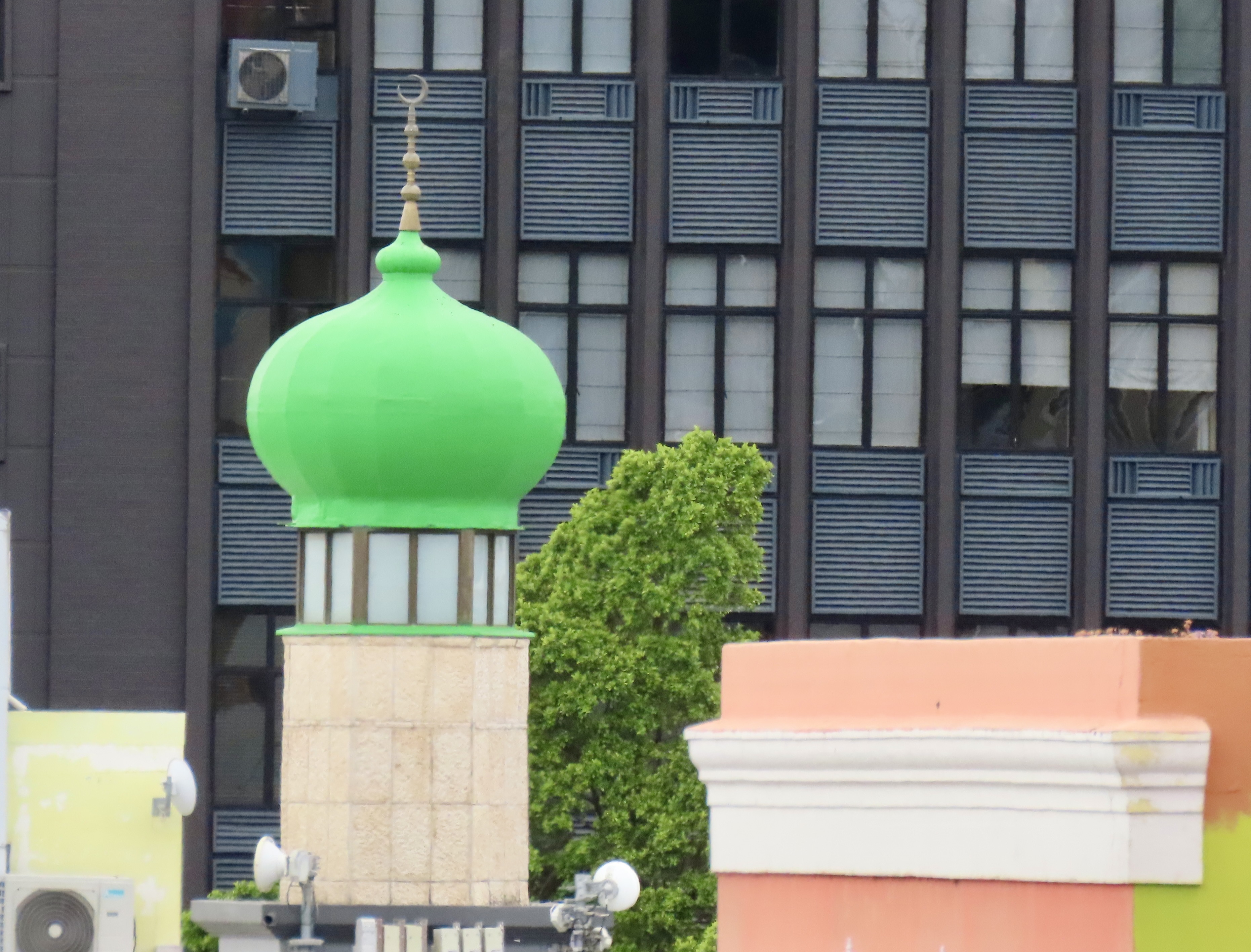
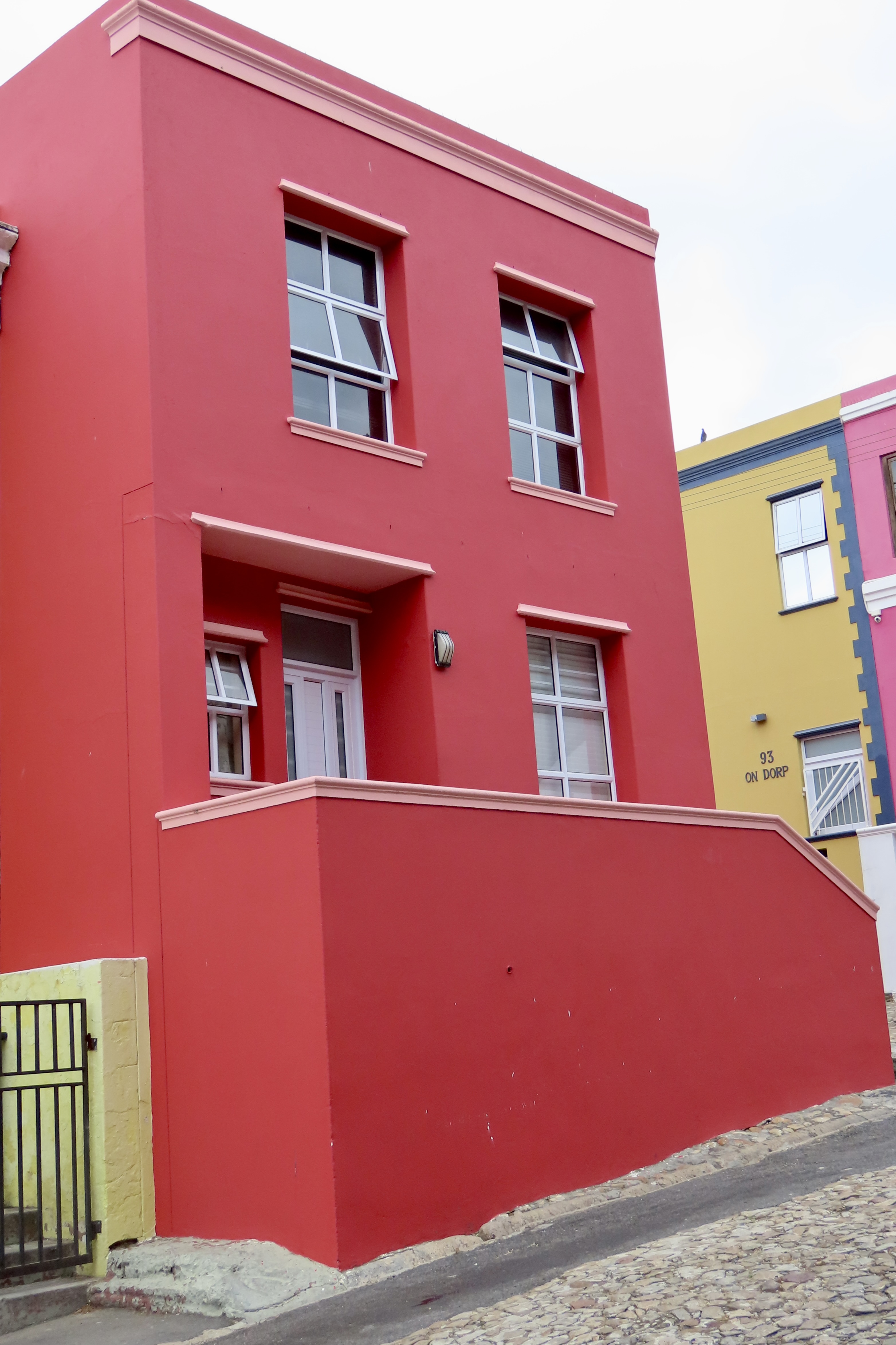
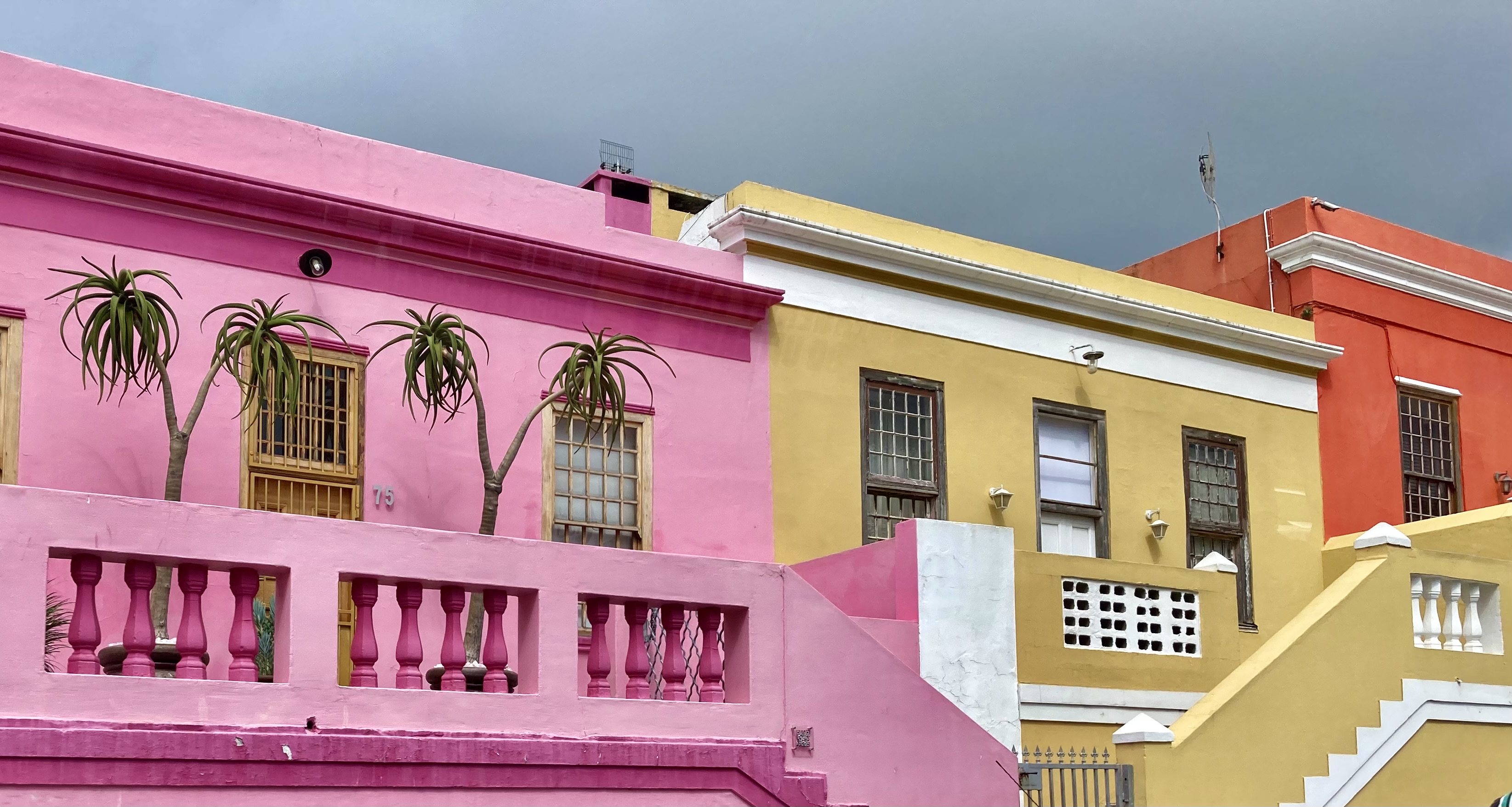
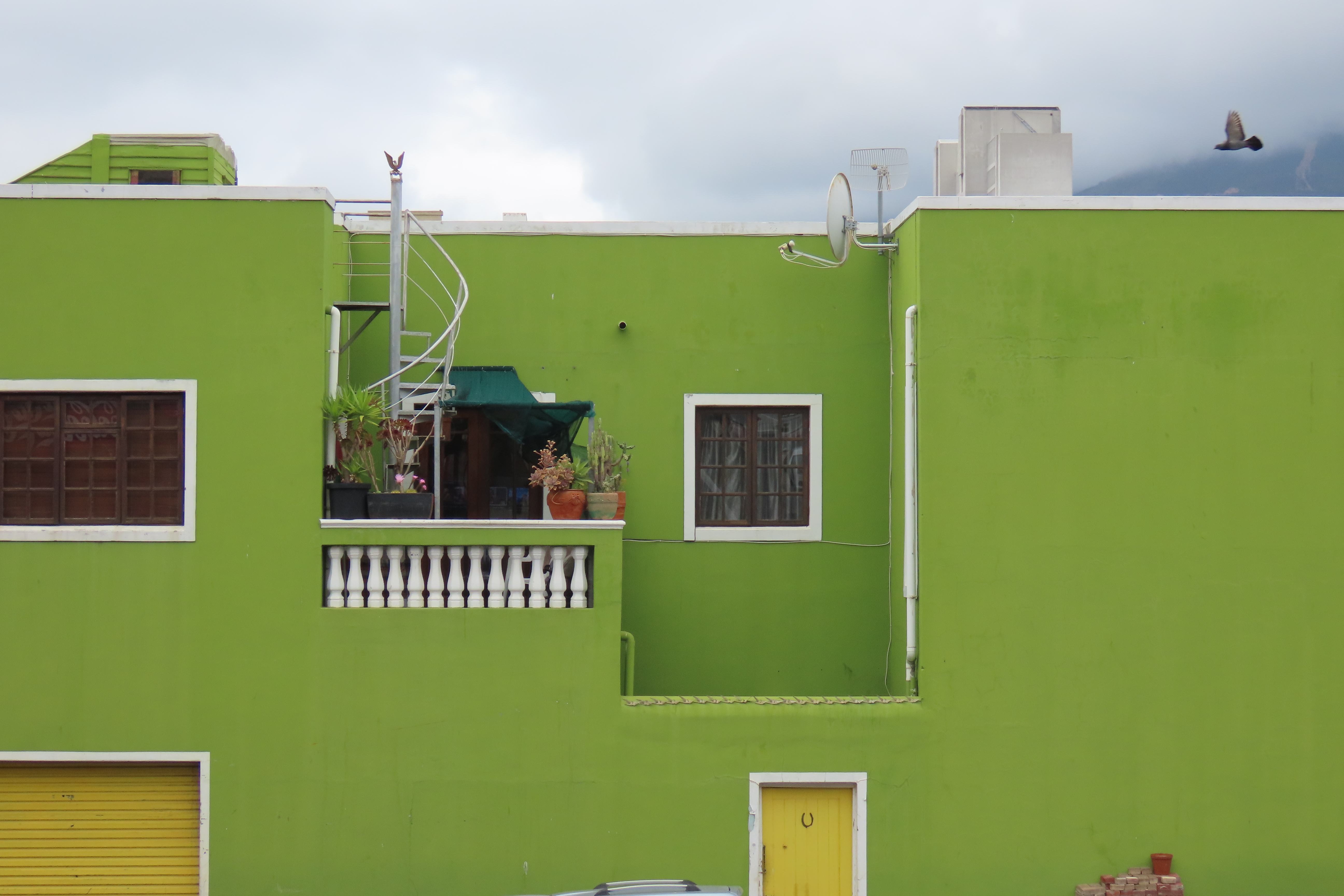
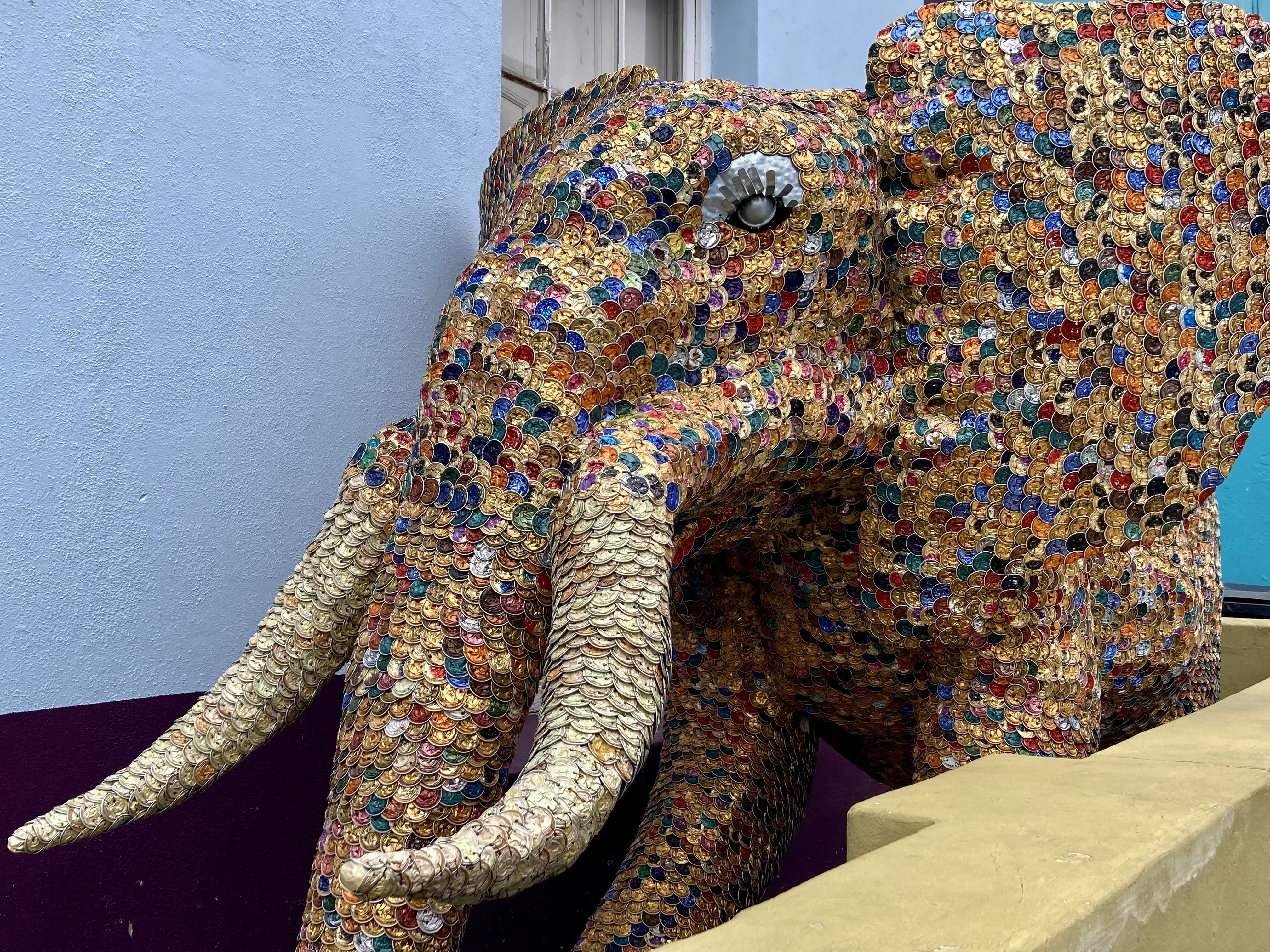
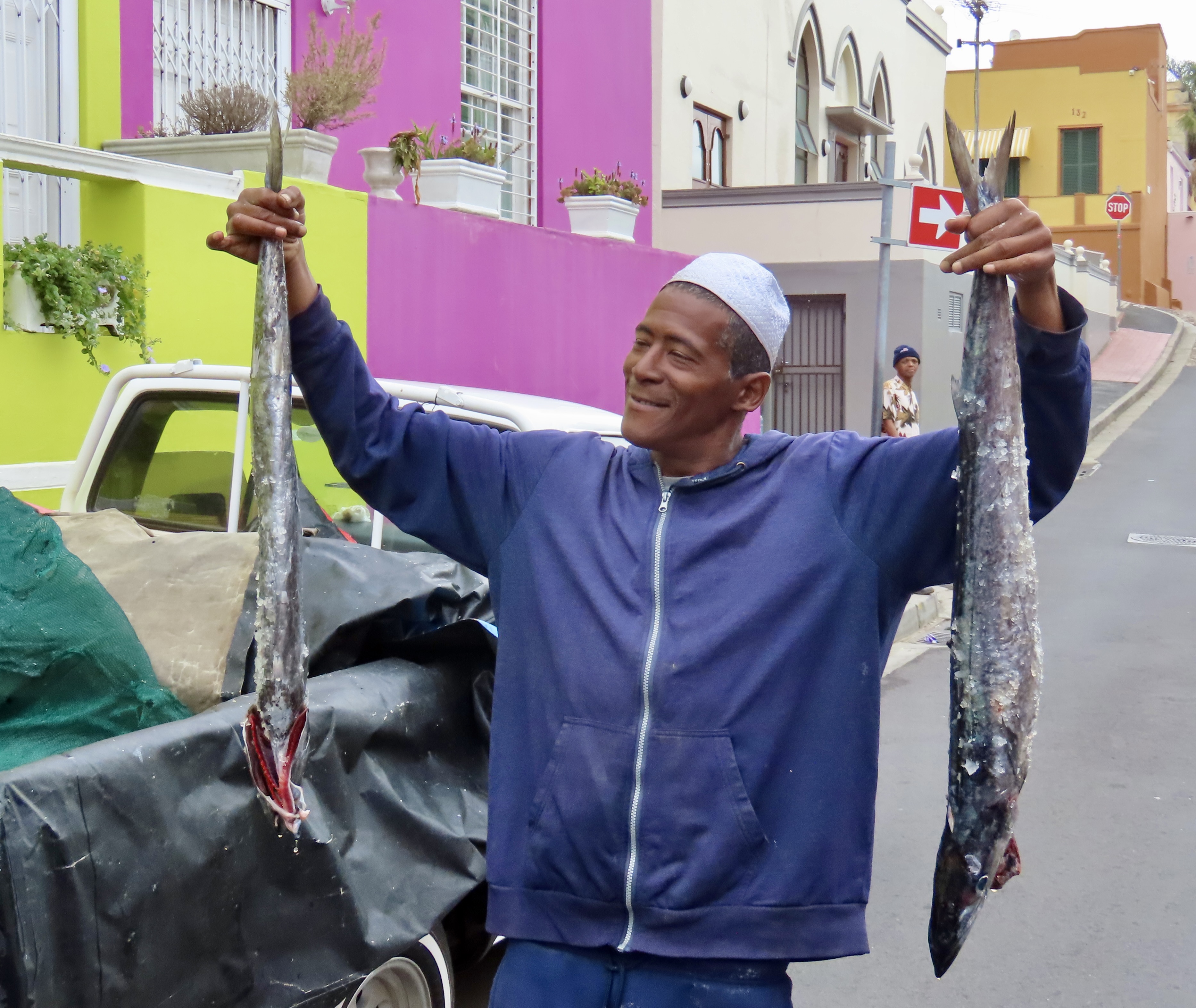
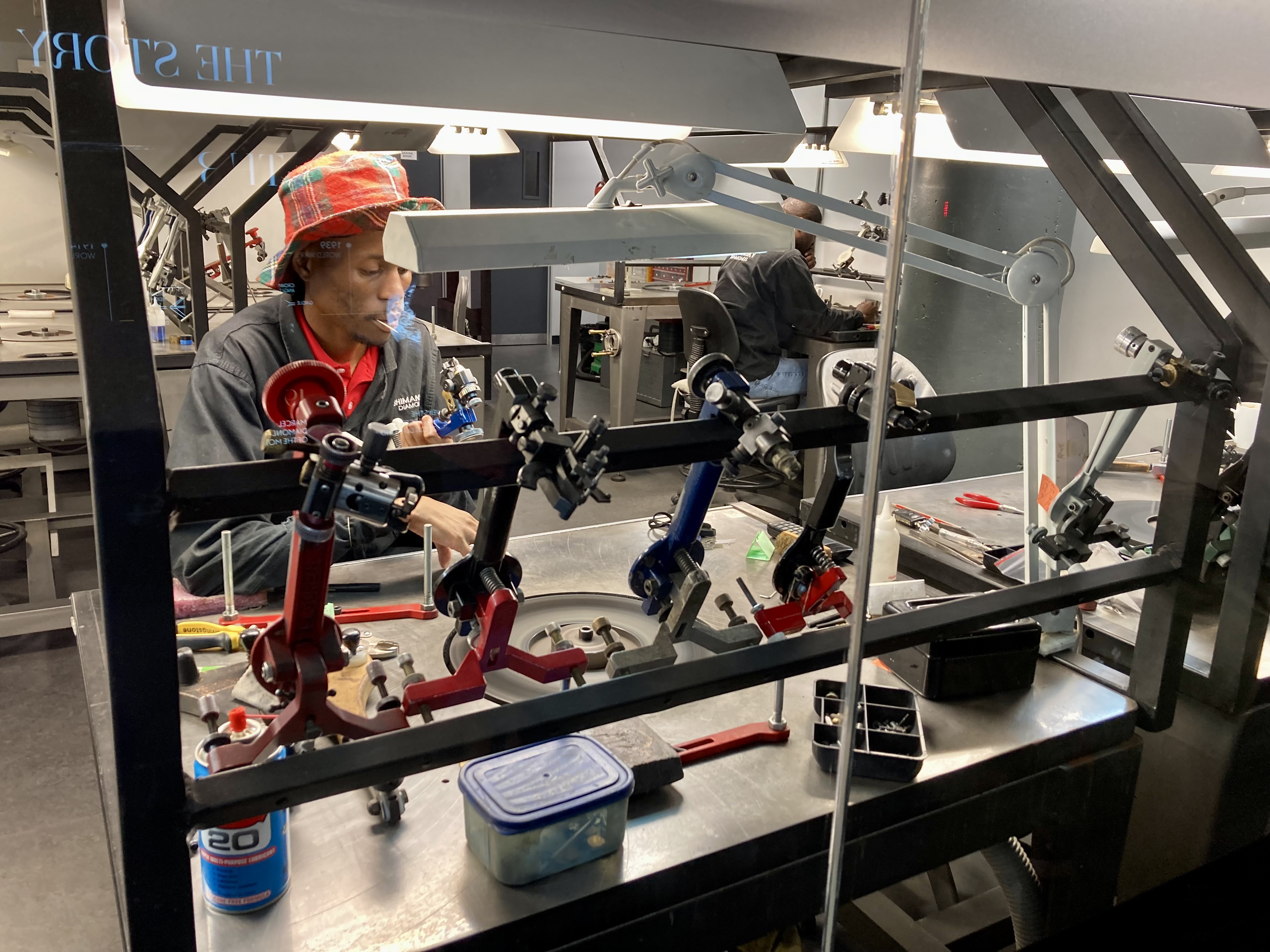
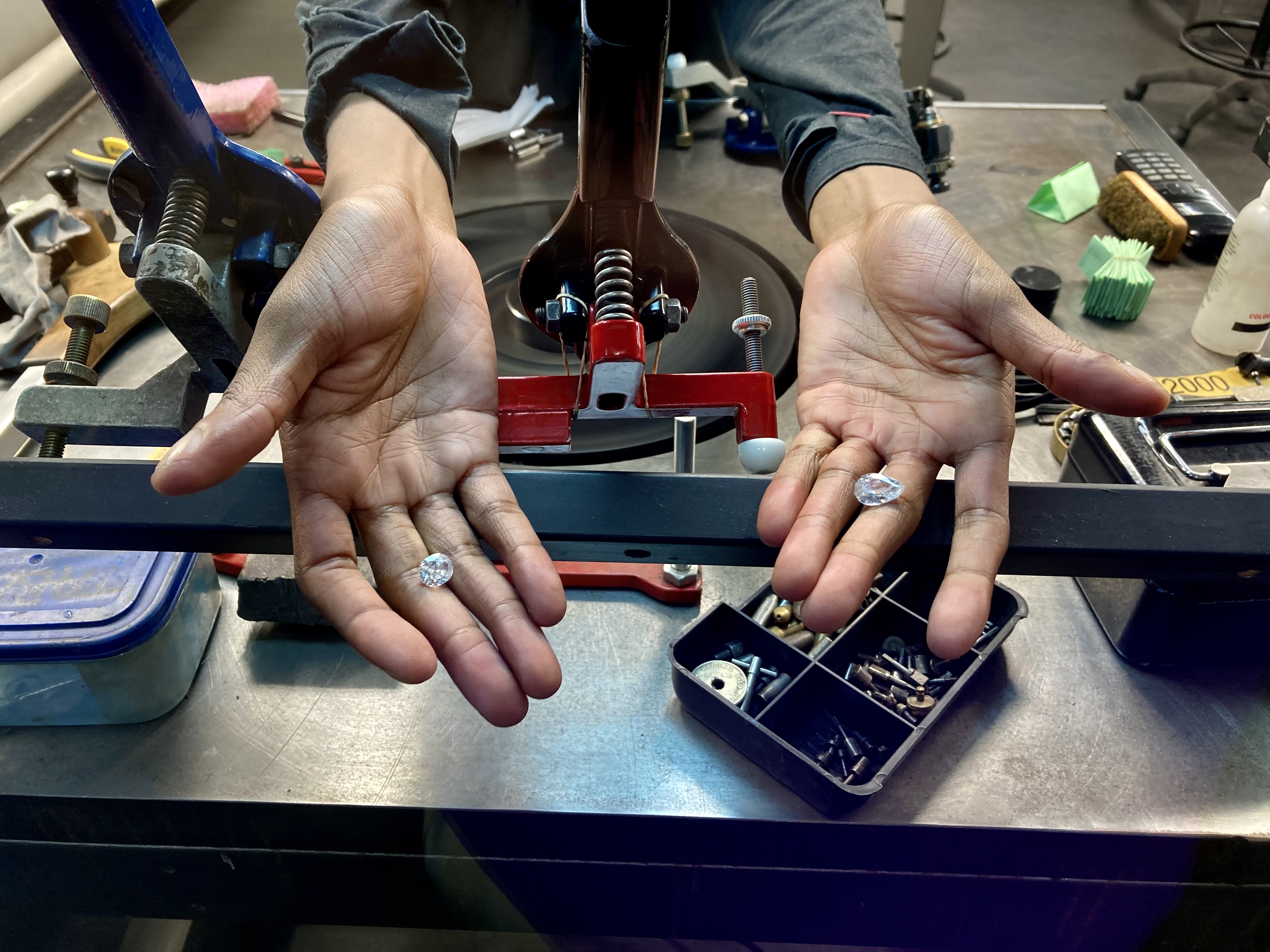
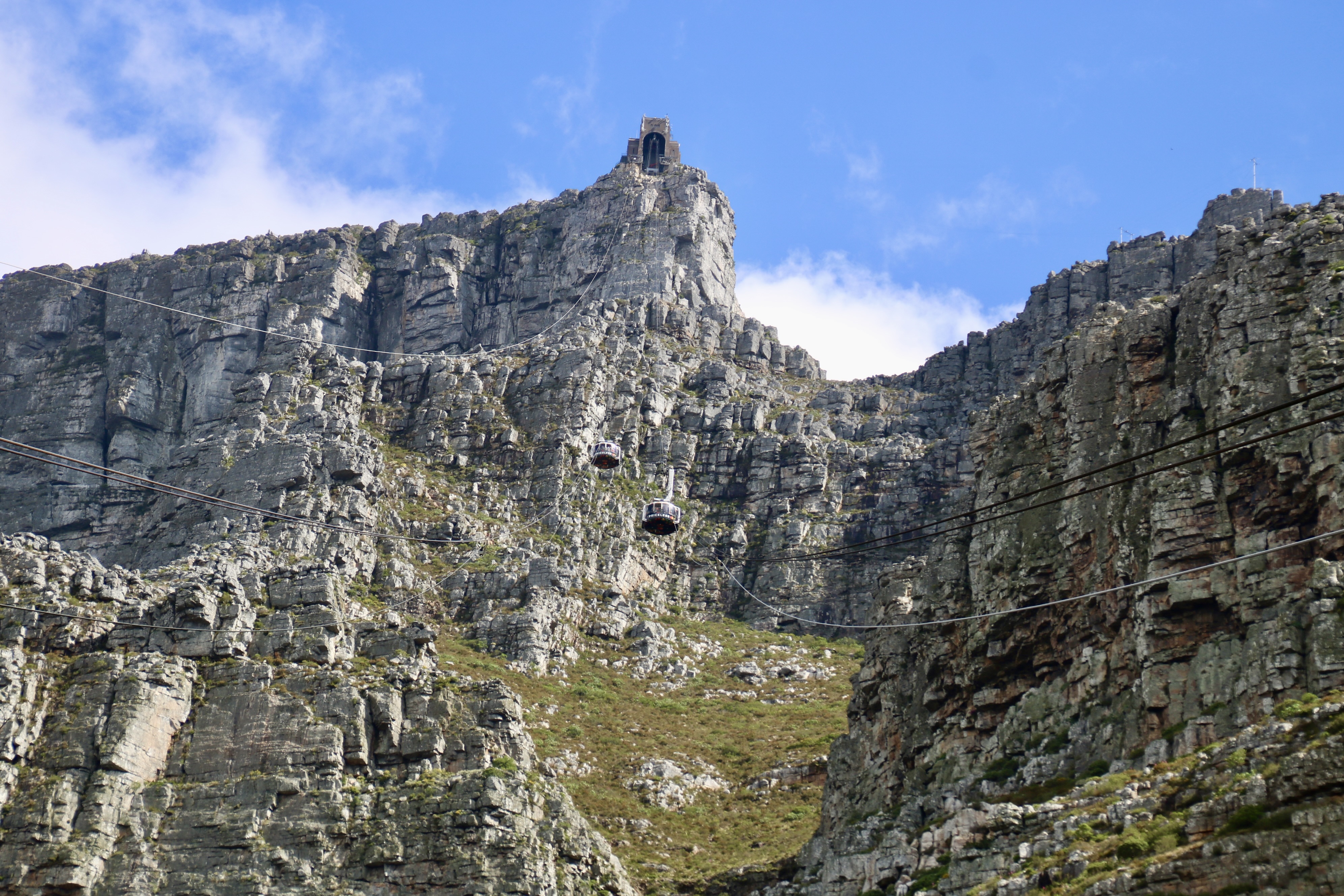
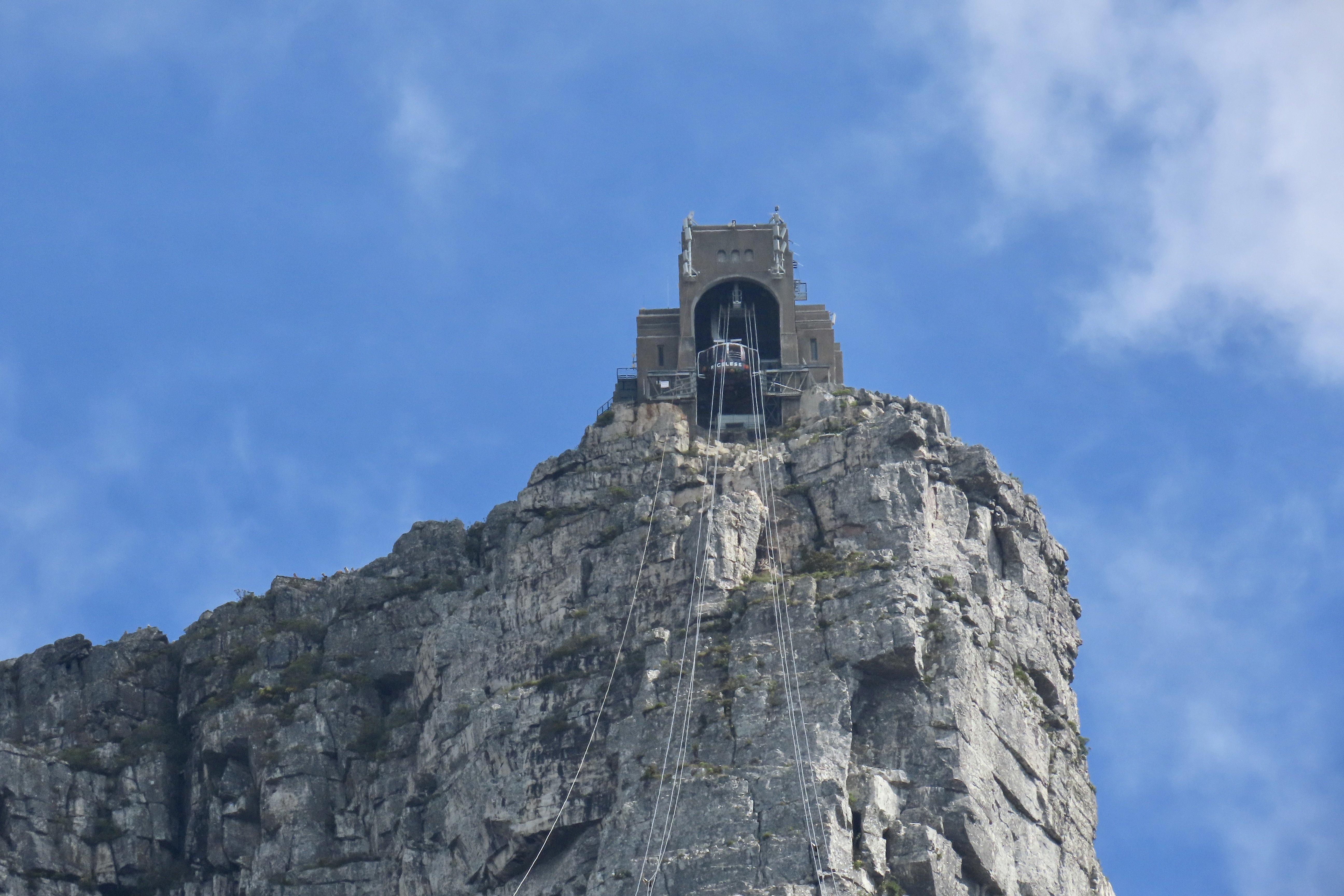
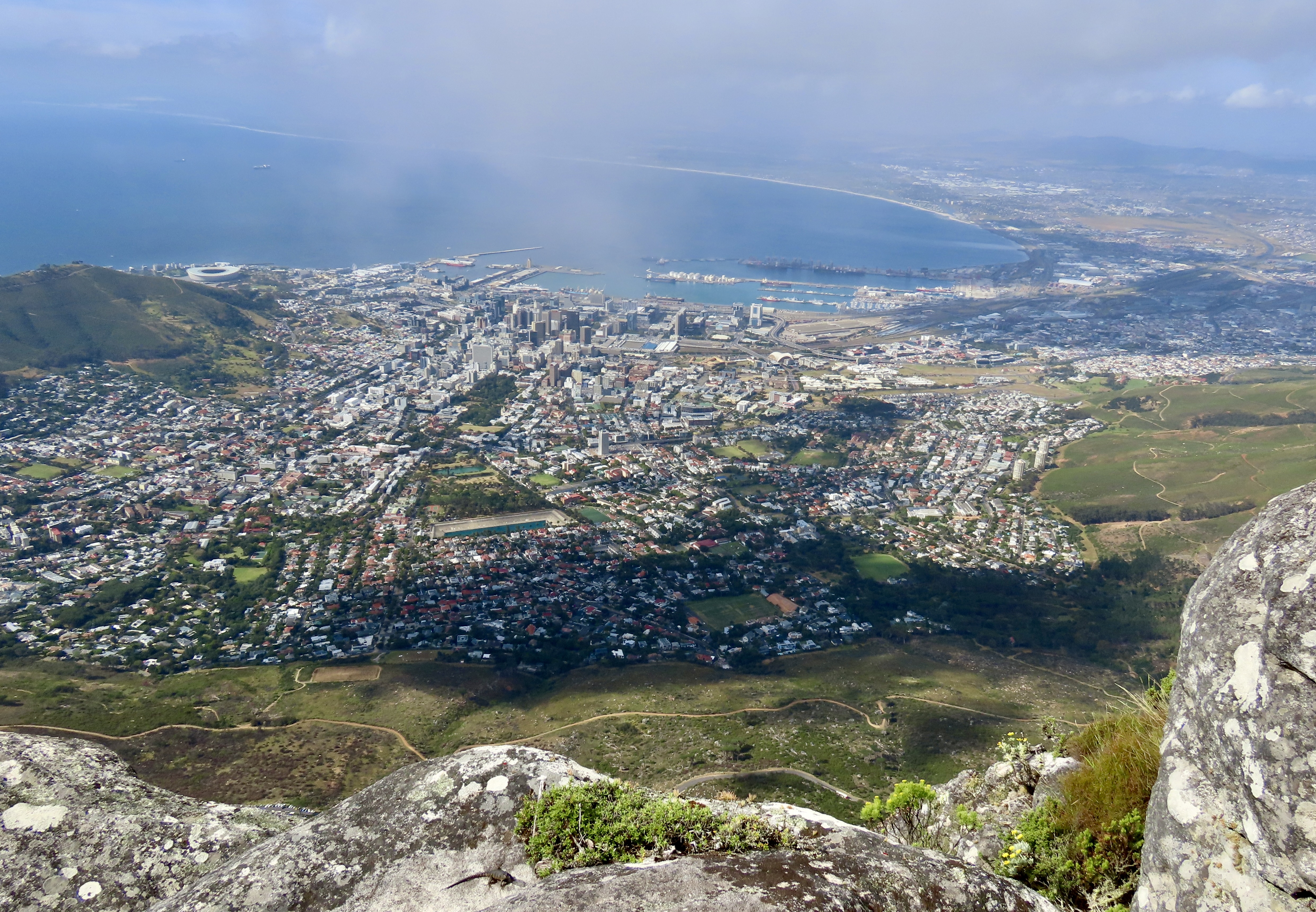
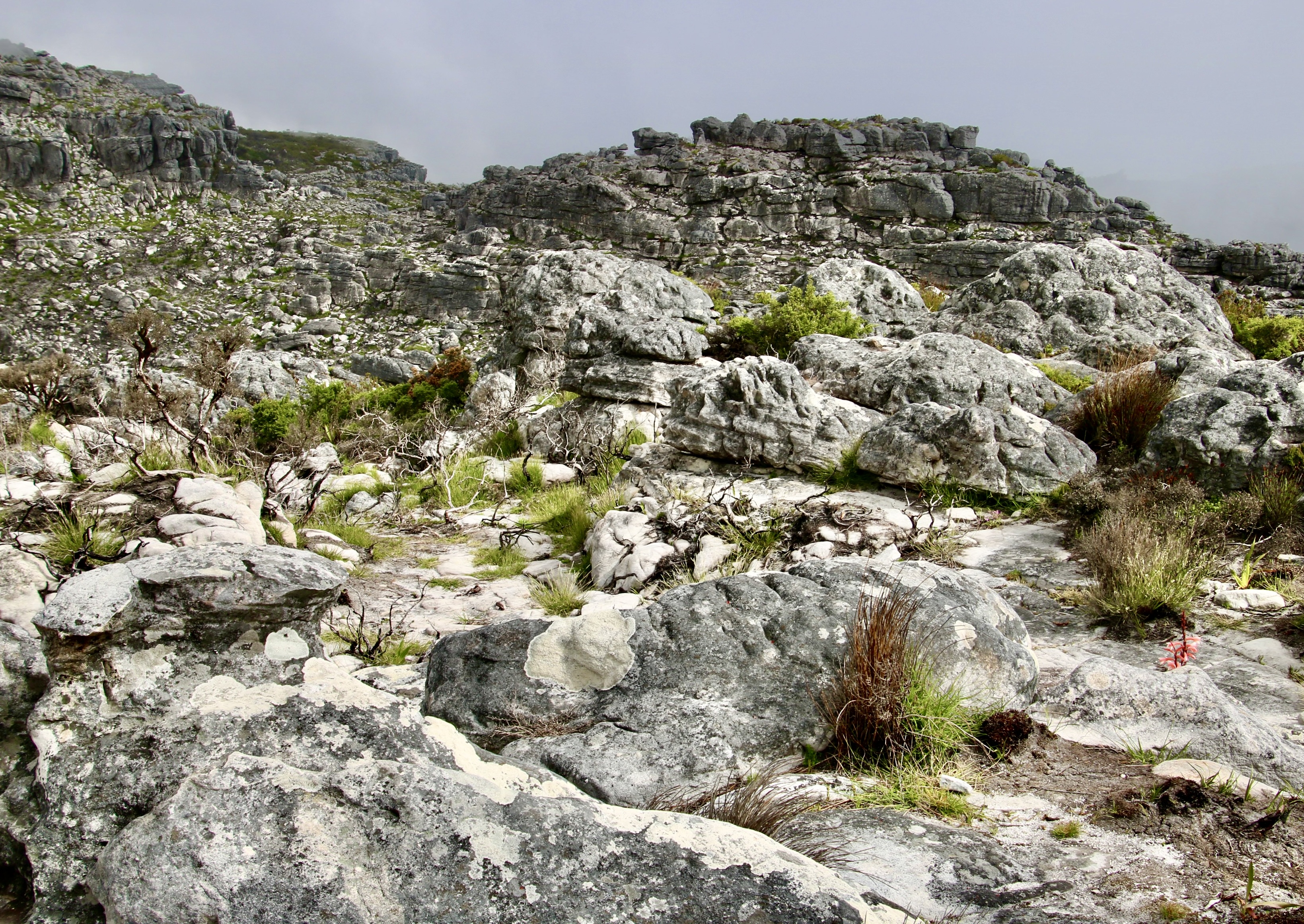
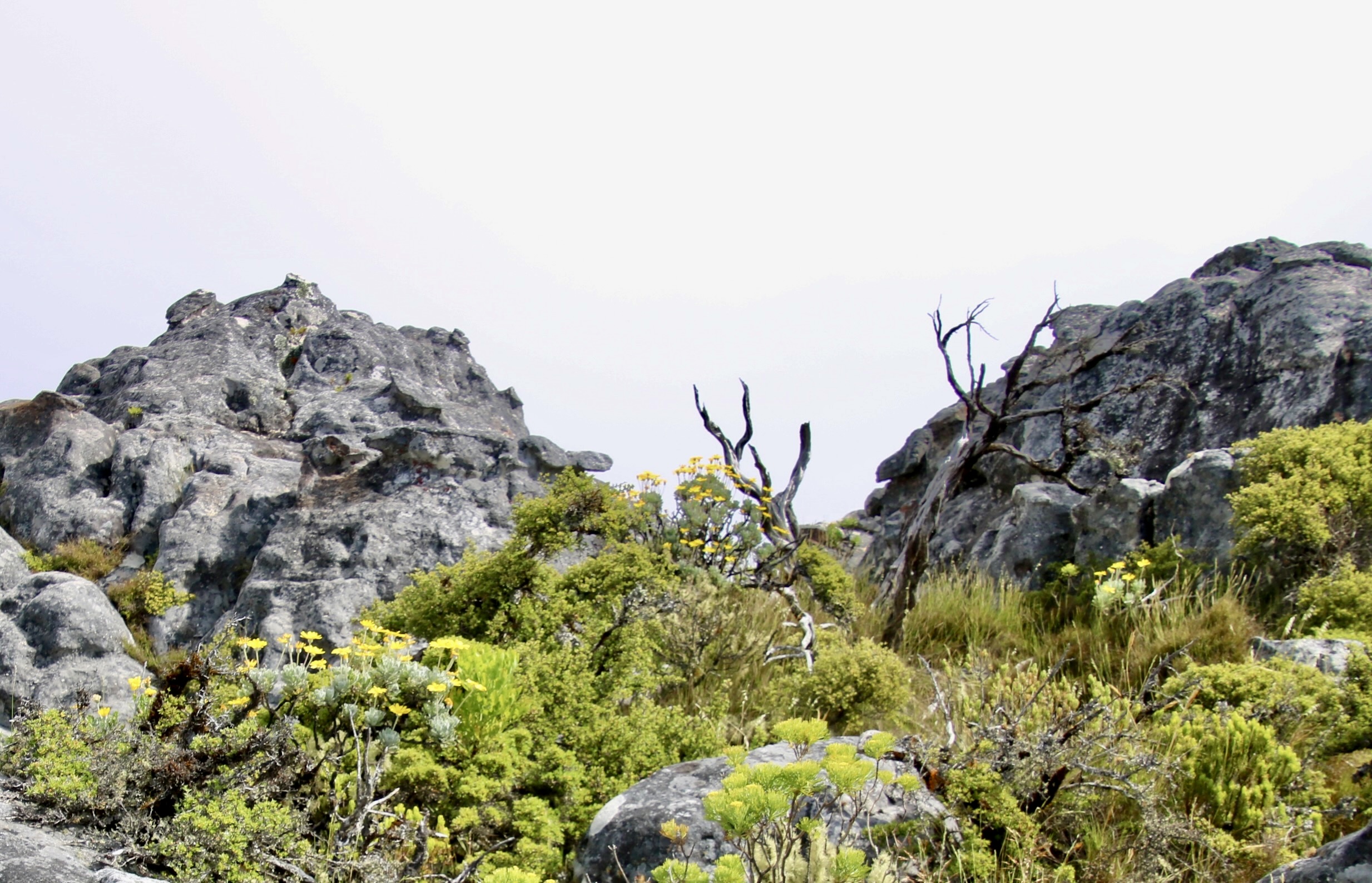
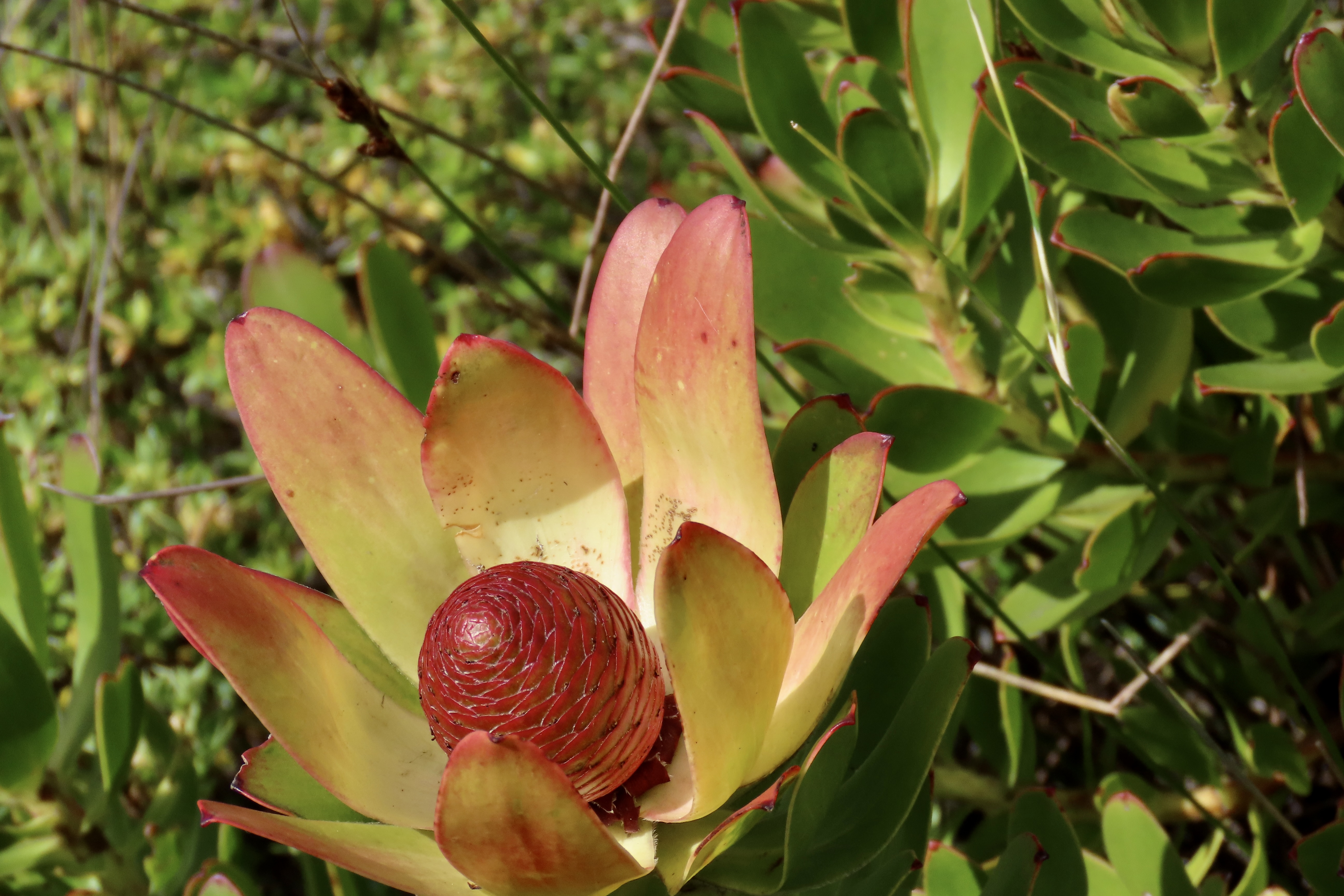
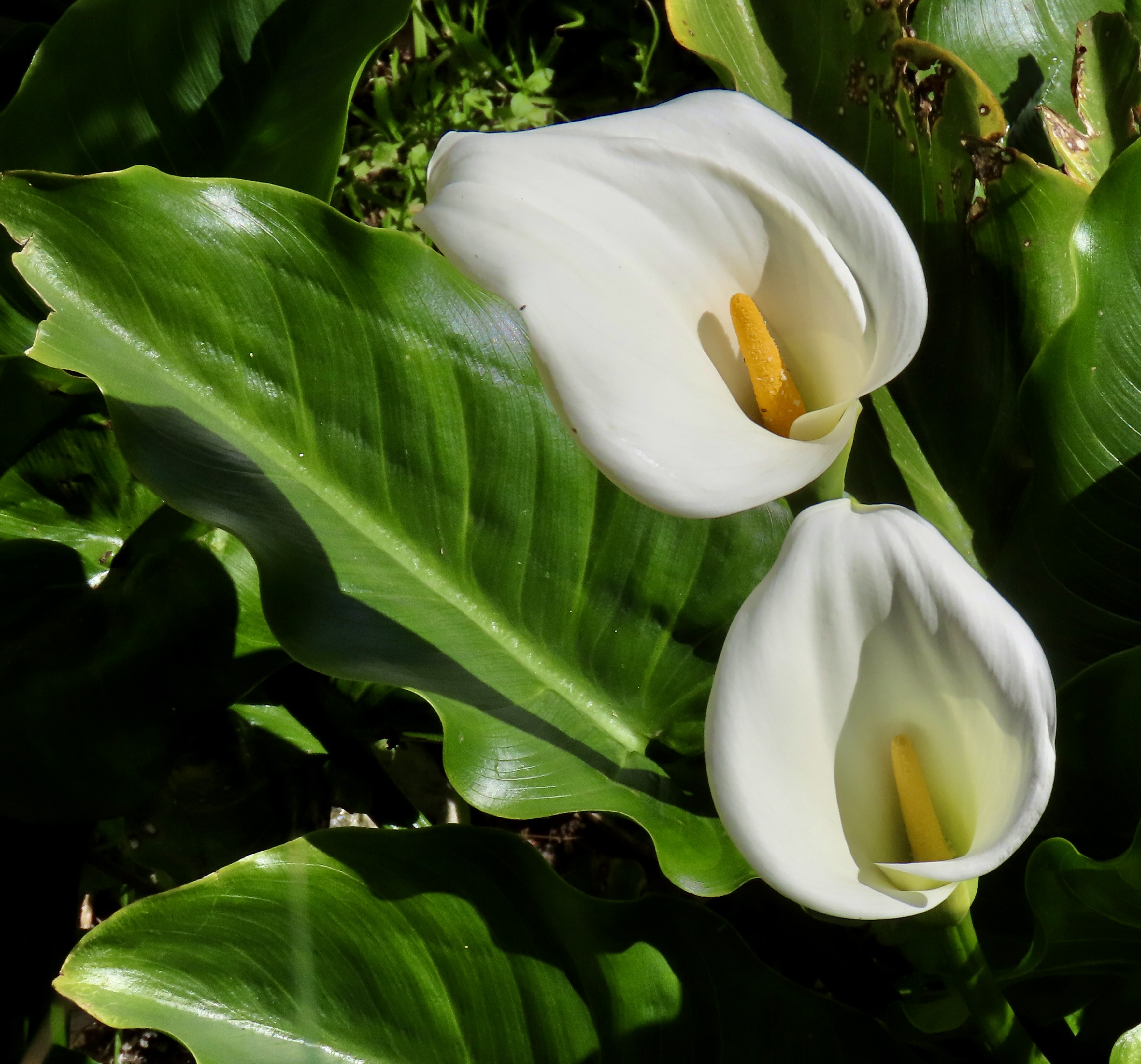
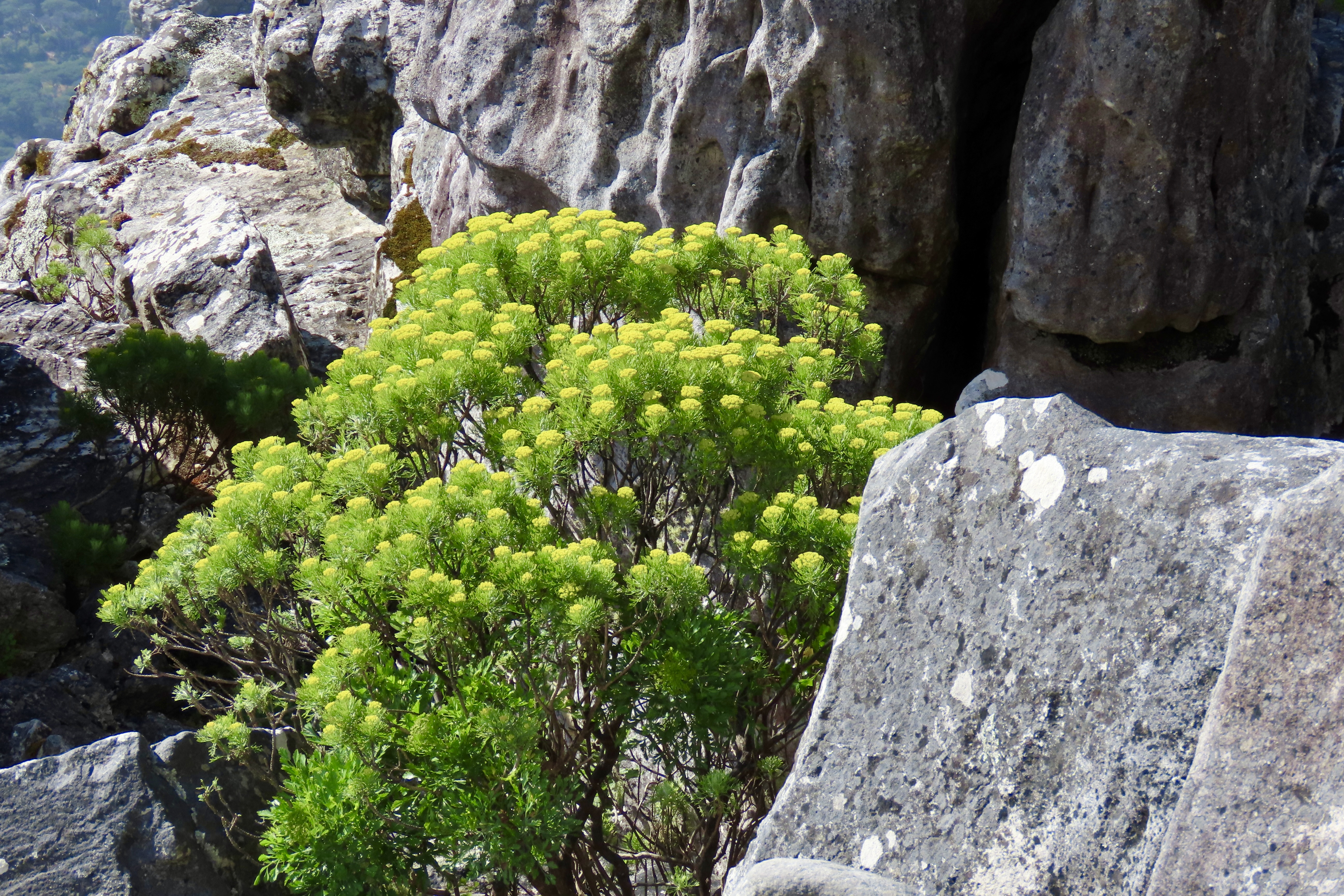
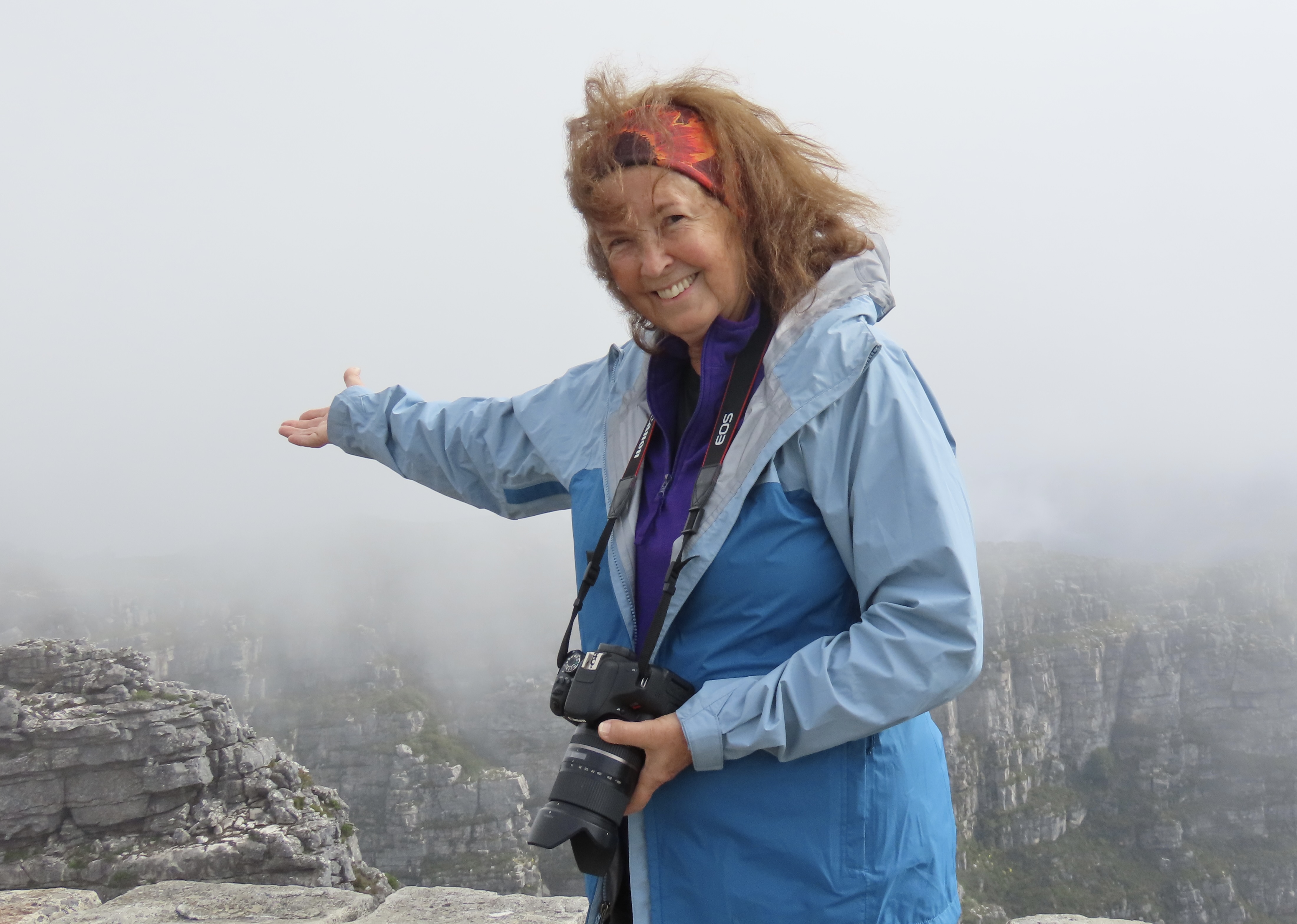
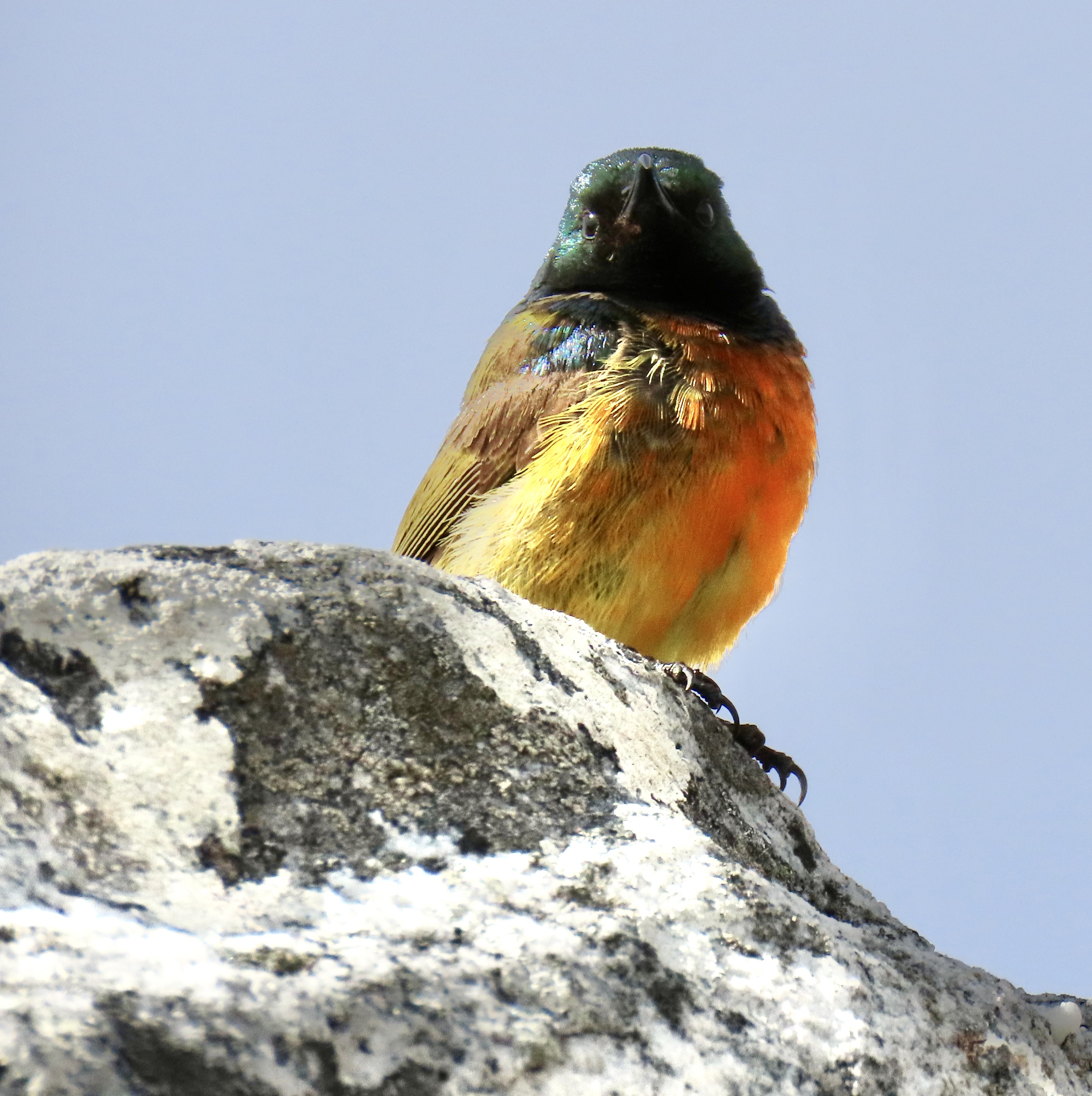
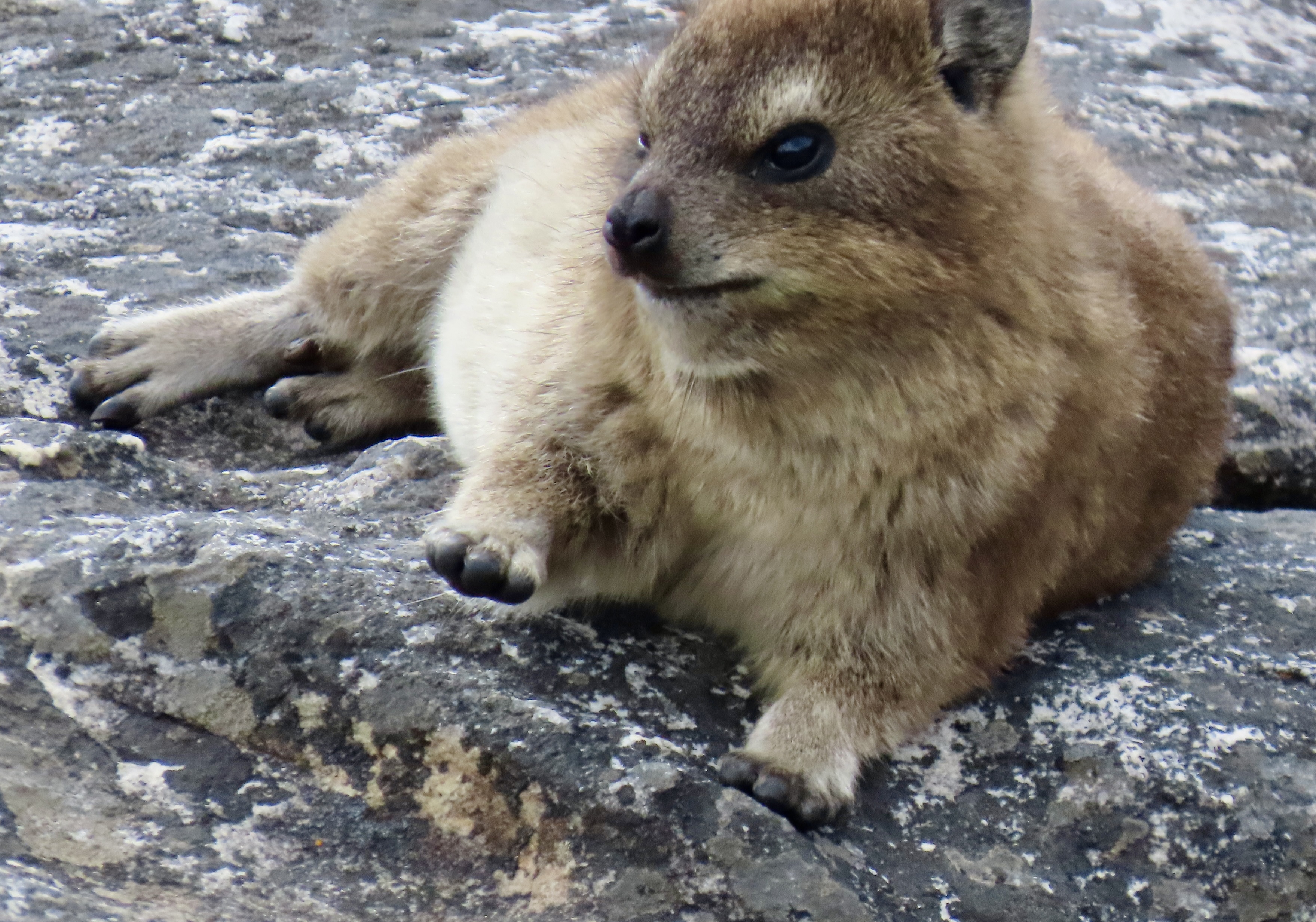
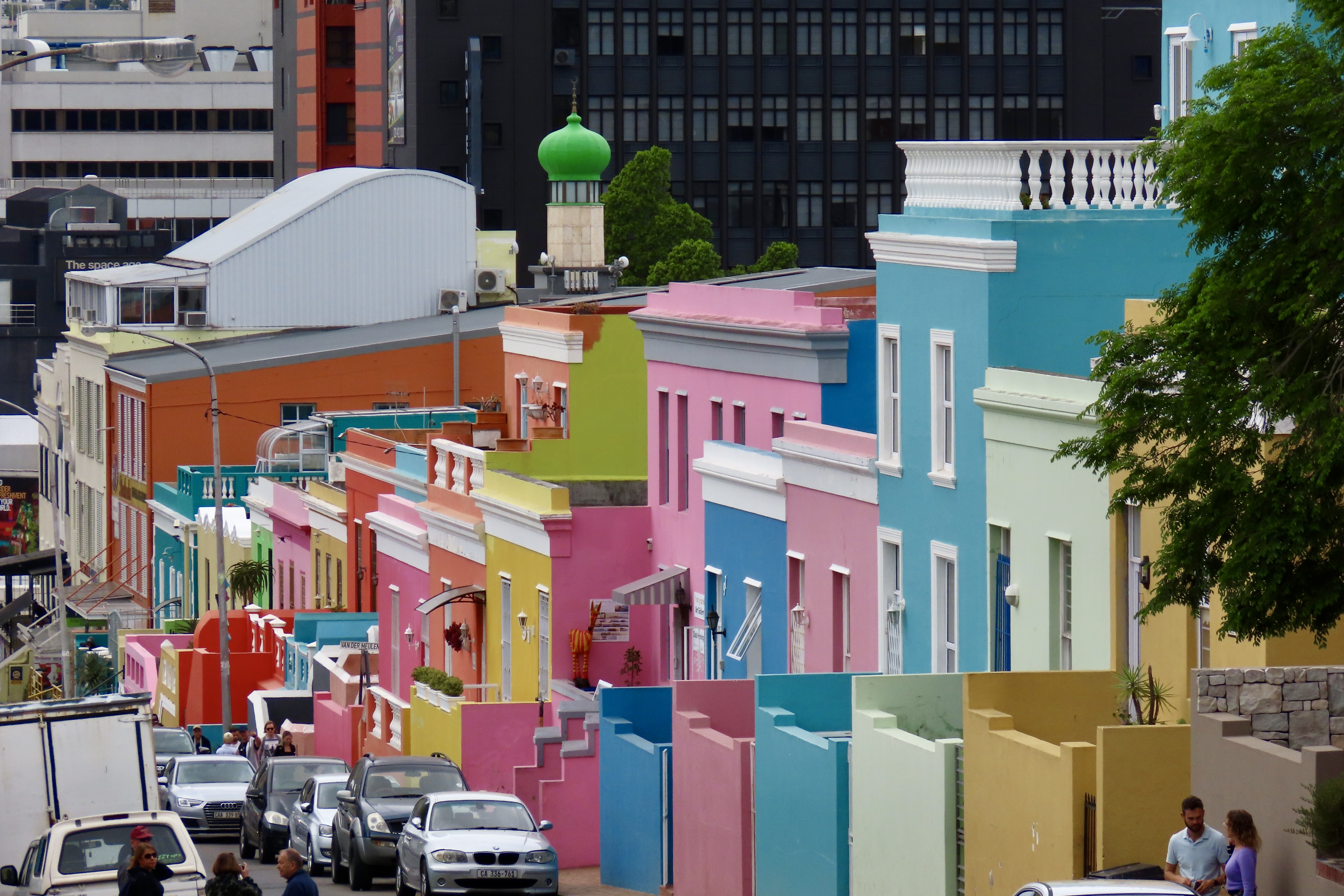
We took a full day excursion from Cape Town down to the Cape of Good Hope. Along the way, we were entertained by the ostrich, snakes, penguins and a lizard that you have already met in previous posts. This is the end of the road— as far as you can drive on the south-western coast of Africa without getting wet.This is Point Cape, just east of the Cape of Good Hope. Looking west, we had the view of the Cape that I showed in the first photo.This lighthouse was built was built in 1859 on Da Gama Peak, the summit of Cape Point, 780 feet (238m) above sea level, to protect sailors from the dangerous rocks off Cape Point and the Cape of Good Hope. It seemed like the ideal location. Unfortunately, it was often hidden by fog. A modern lighthouse is now located down Cape Point at 275 feet (78m). The hawk was a bonus.Our drive down to the Cape of Good Hope provided this view just south of Cape Town. We also saw this young caracal with its impressive long ears near the Cape. Our guide Johnathon was very excited and told us this was the first caracal he had ever seen in the wild. A member of the cat family, it hunts almost exclusively at night and is rarely seen by anyone! We were lucky. I moved quickly to get a shot before it disappeared into the brush.This rather impressive Peninsula Granite Fynbos wasn’t going anywhere, however. Peggy and I could take our time photographing it. It’s endemic to the Cape Town region and nowhere else.I managed to sneak up on one for a close up…And another. Now, back to Cape Town and the Springboks. I’m not talking about the attractive South African antelope known for its pronking, taking several 6 foot high leaps into the air in quick succession. I am talking about the South Africa’s Rugby Team that had just won the World Championship and was booked into our hotel for their Cape Town celebration.A large crowd had gathered around our hotel and was waiting their arrival. The police opened their cordon to let us through. Several people thought we were related somehow and snapped our photos. A number of teenage girls waited nervously. One actually managed to get a selfie with one of the stars. She tried to be cool when taking the photo but immediately screamed afterwards. So much for cool.Our guide, Jonathan, took us on a tour of Cape Town and Table Mountain in addition to taking us down to the Cape of Good Hope. Here, he is talking about the colorful homes in the small community known as Bo-Kaap that I featured at the end of my last post.The original residents of Bo-Kaap were descendants of slaves imported by the Dutch from Malaysia, Indonesia, India, and Sri Lanka during the 16th and 17th centuries.Because of their cultural heritage, Bo-Kaap is primarily a Muslim Community. Even the mosque was brightly painted, matching the brightly painted homes.One of the homes.It seemed that each one was painted a different color.A final exampleWe found this artistic elephant in Bo-Kaap…And this man selling freshly caught fish from the back of his pickup.Johnathon also took us to the Shimansky diamond jewelry shop where we watched diamonds being cut.The diamond cutters showed us two of the diamonds he was working on. Judging from their size, I’d say they were a bit beyond my budget. Quite a bit.Any trip to Cape Town should include a trip up to Table Mountain, the dramatic backdrop for the city. We got there by going up this tram.Almost there…Looking back at Cape Town from Table Top Mountain.Our hotel was mixed in among these tall buildings. View of the top of Table Top…And another view. A number of flowers demanded their photos be taken.Including one I had never seen: a peninsula conebush. The cone is tough and will only open and release its seeds as a result of fire. Cala Lilies were an old friend.These flowers created a pretty bouquet among the rocks.Peggy shows the mist rising up on the ocean side of Table Mountain. Her hair shows that it was accompanied by a breeze.This little beauty, an orange-breasted sunbird, was waiting for us as we neared the end of our time on Table Top Mountain.After all of the great people, incredible wildlife, and striking scenery, I think it is only appropriate that we end our African safari series with the small hyrax on Table Top Mountain, seemingly waving goodbye to us. The next morning we began our long air journey back to Virginia. I hope you enjoyed this series. We were ever so glad you decided to come along. Next up, an introduction to our thousand mile journey following the Pacific Coast.
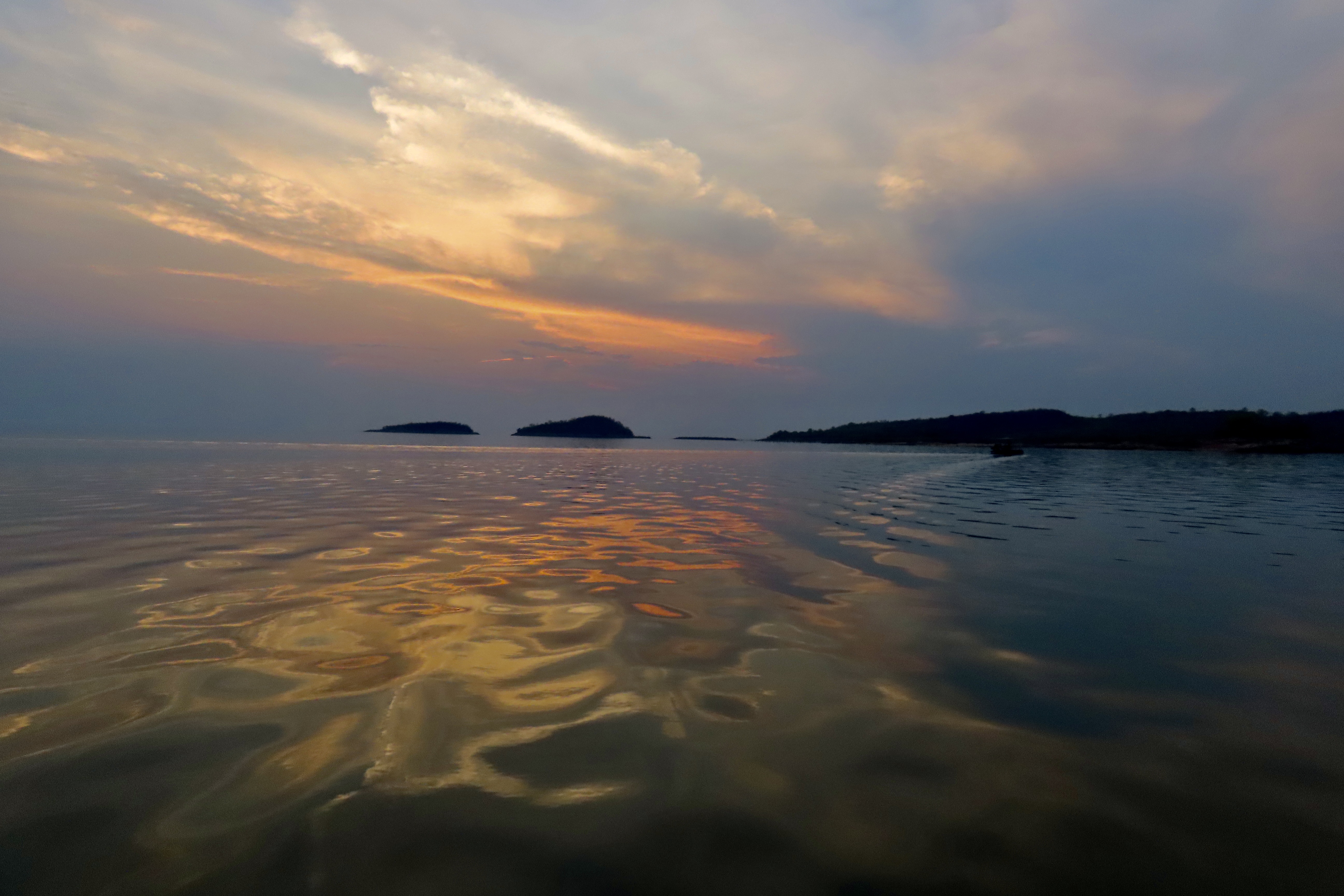
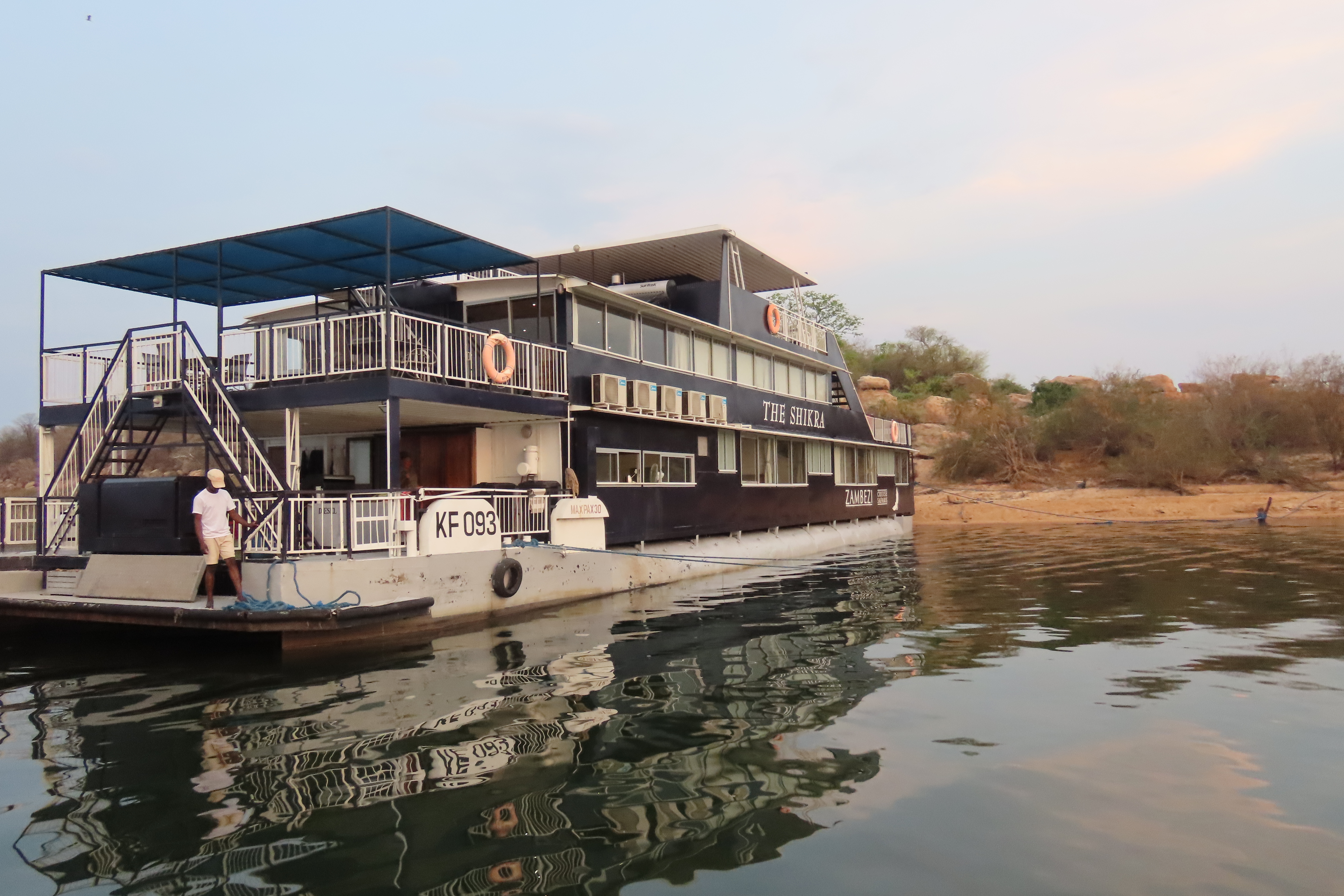
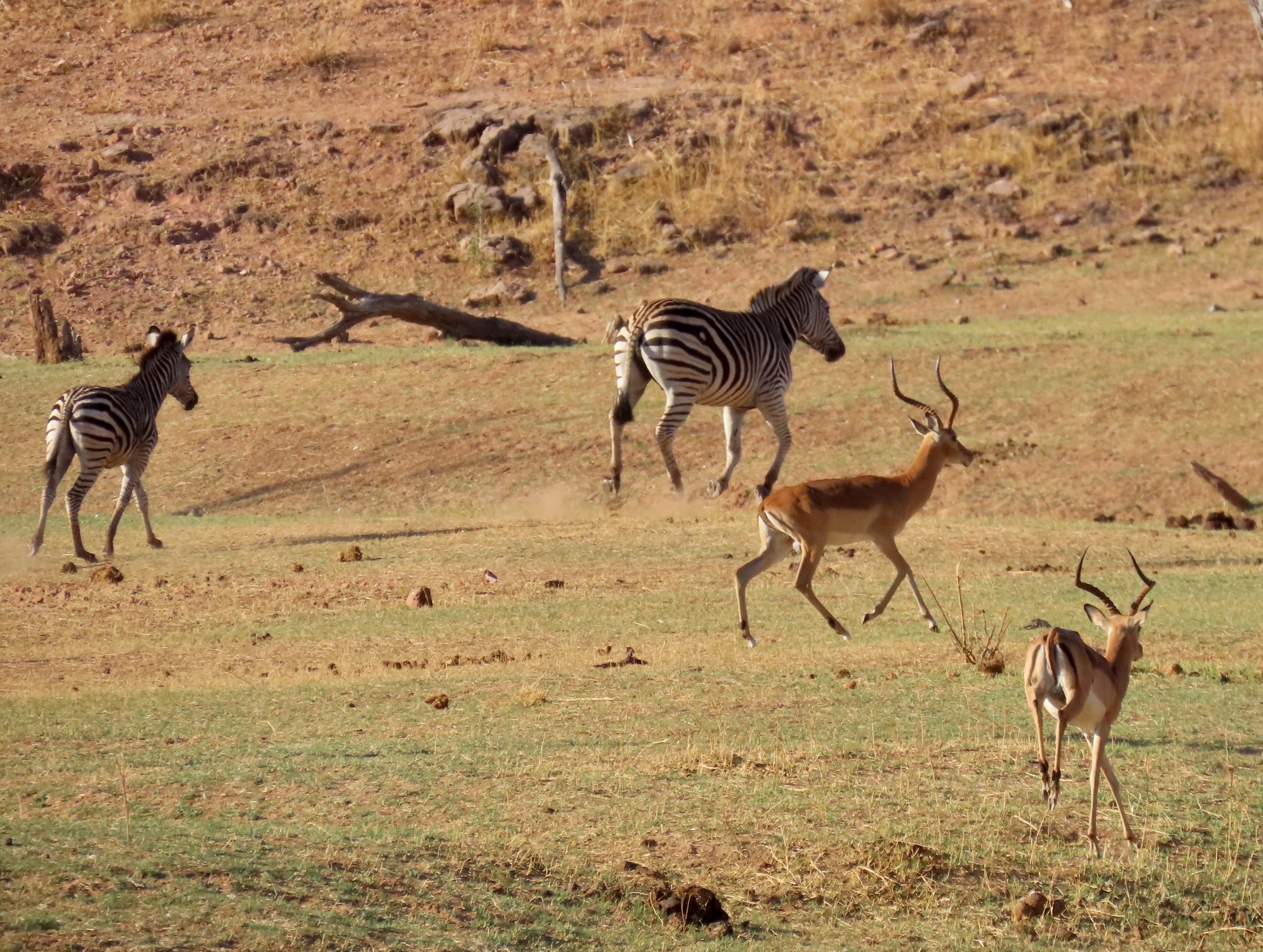
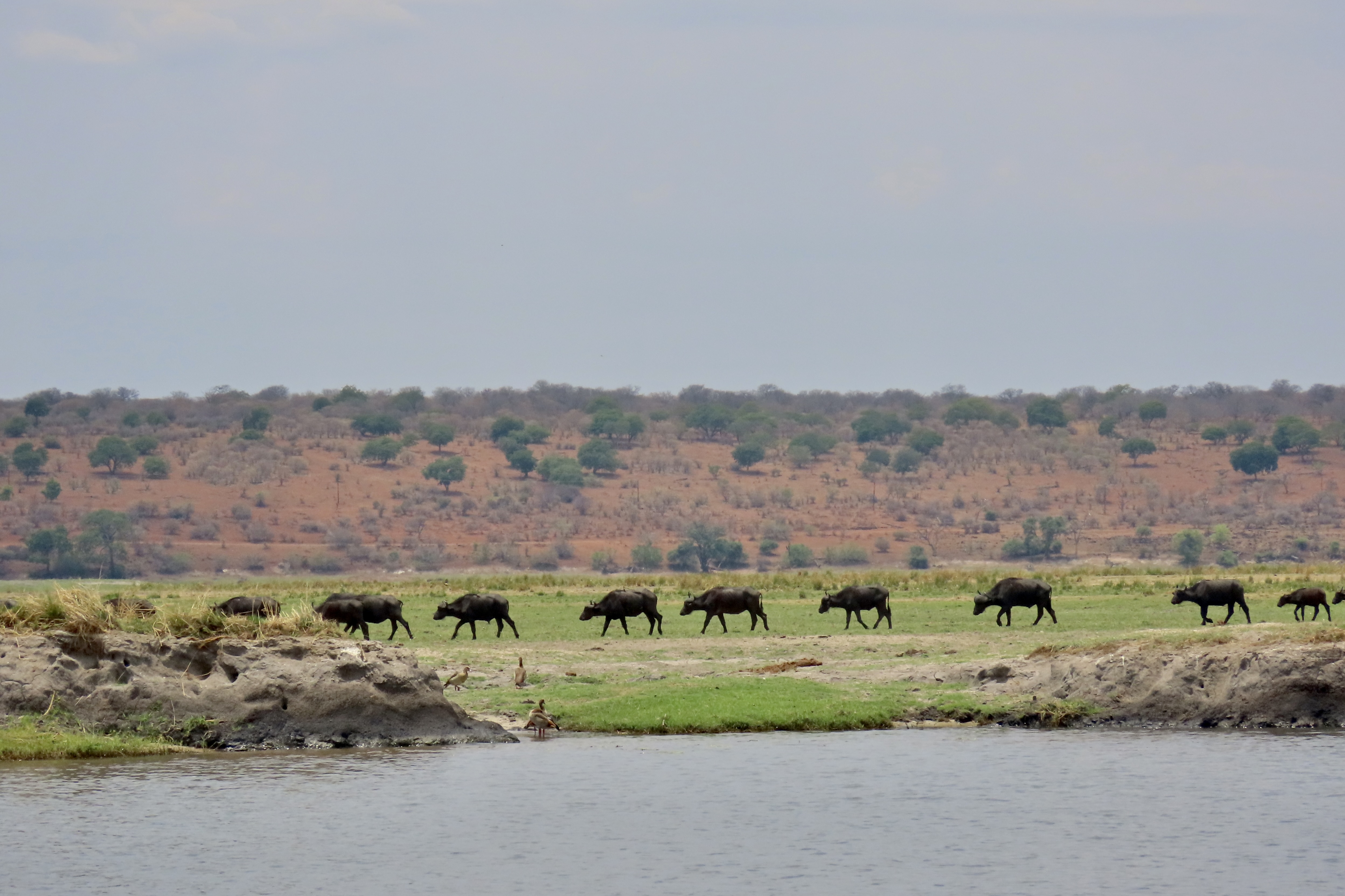
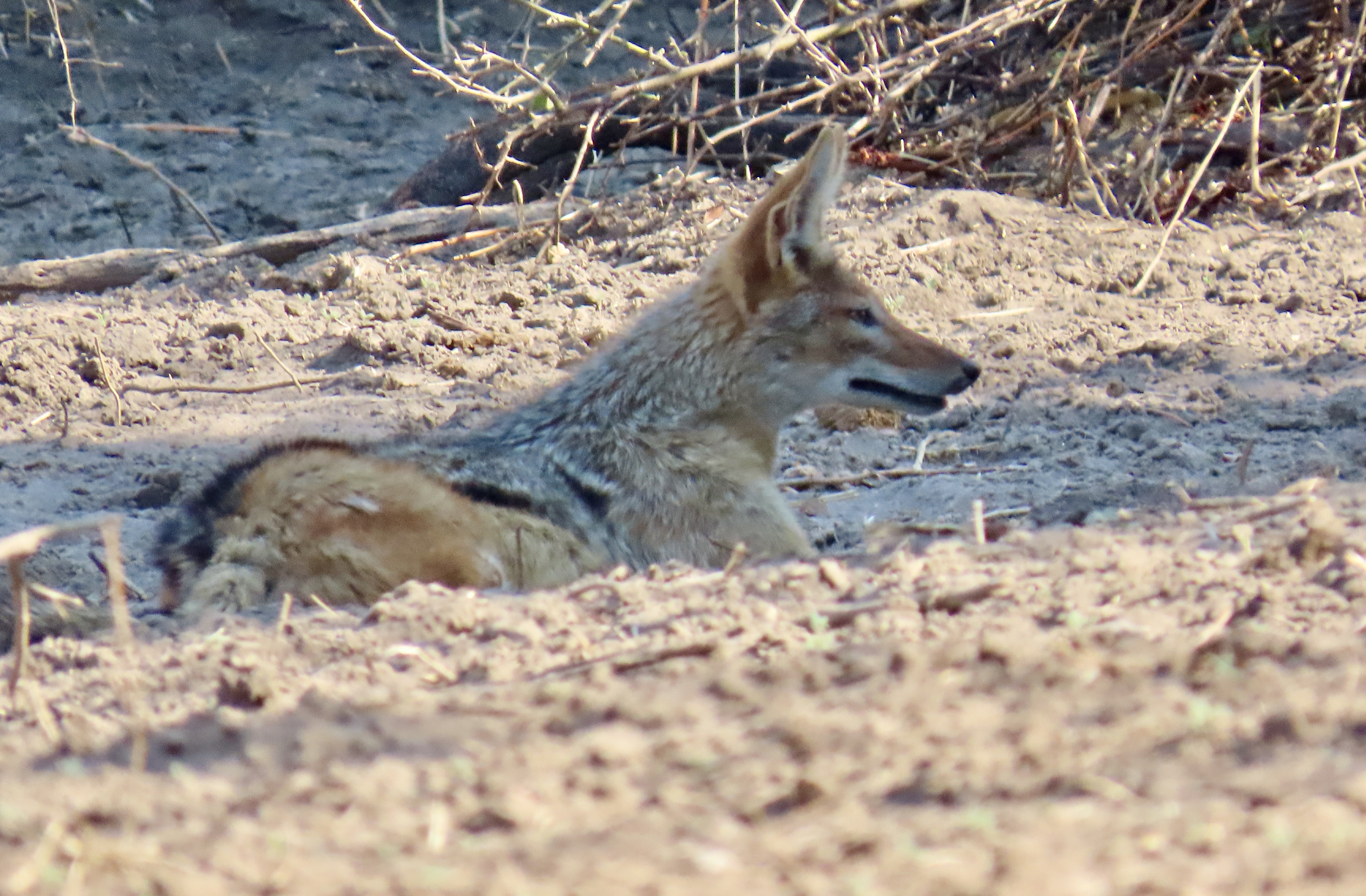
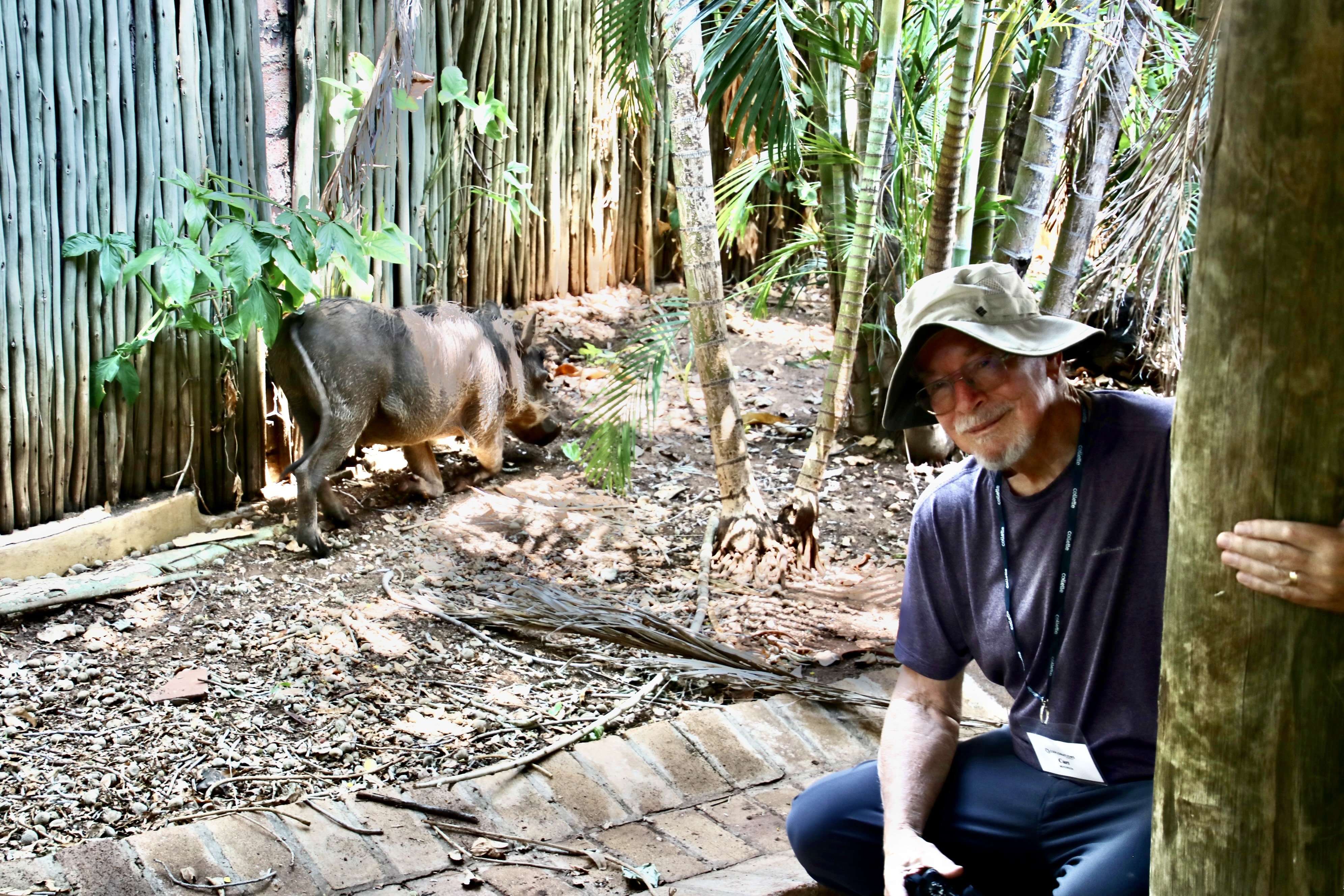
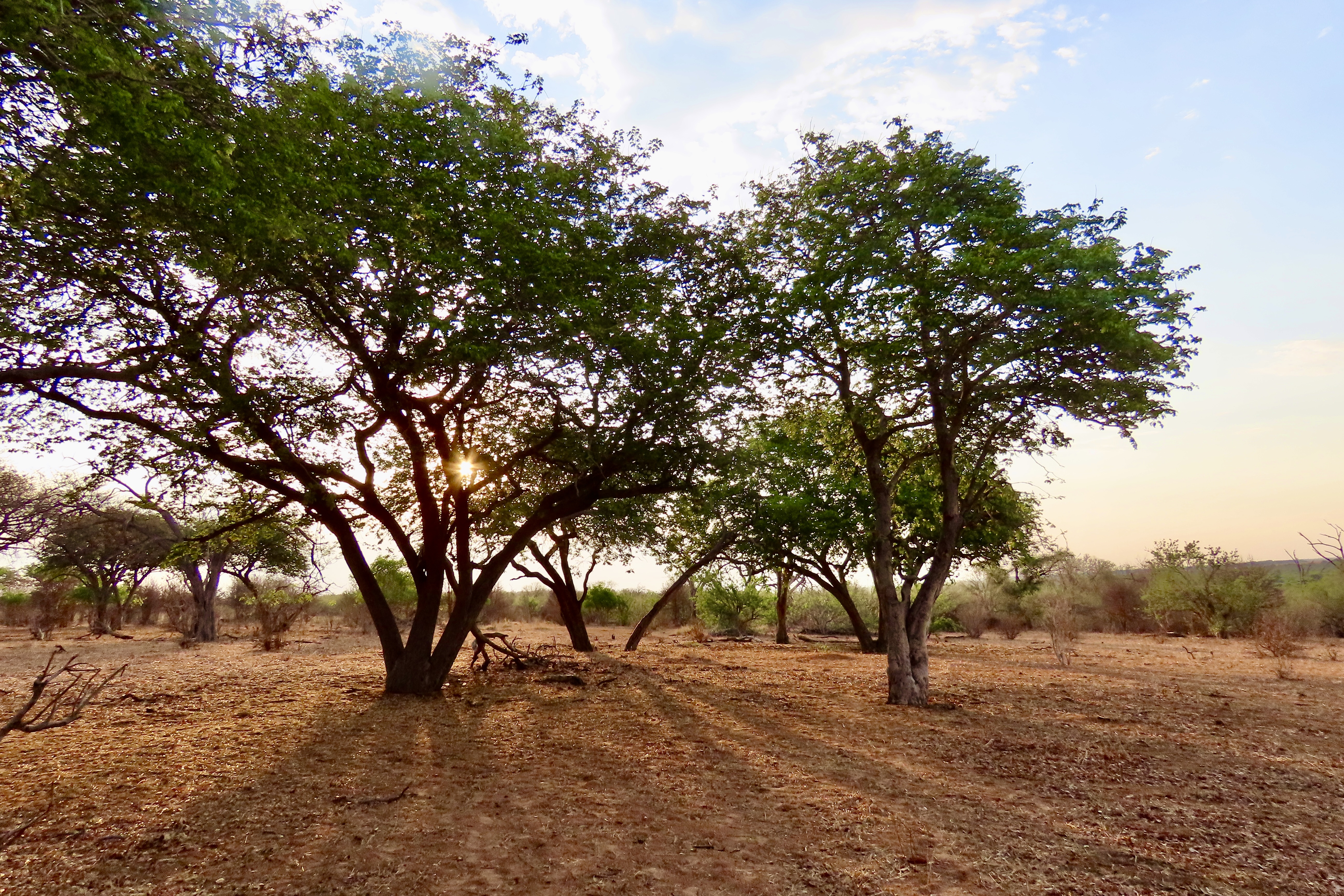
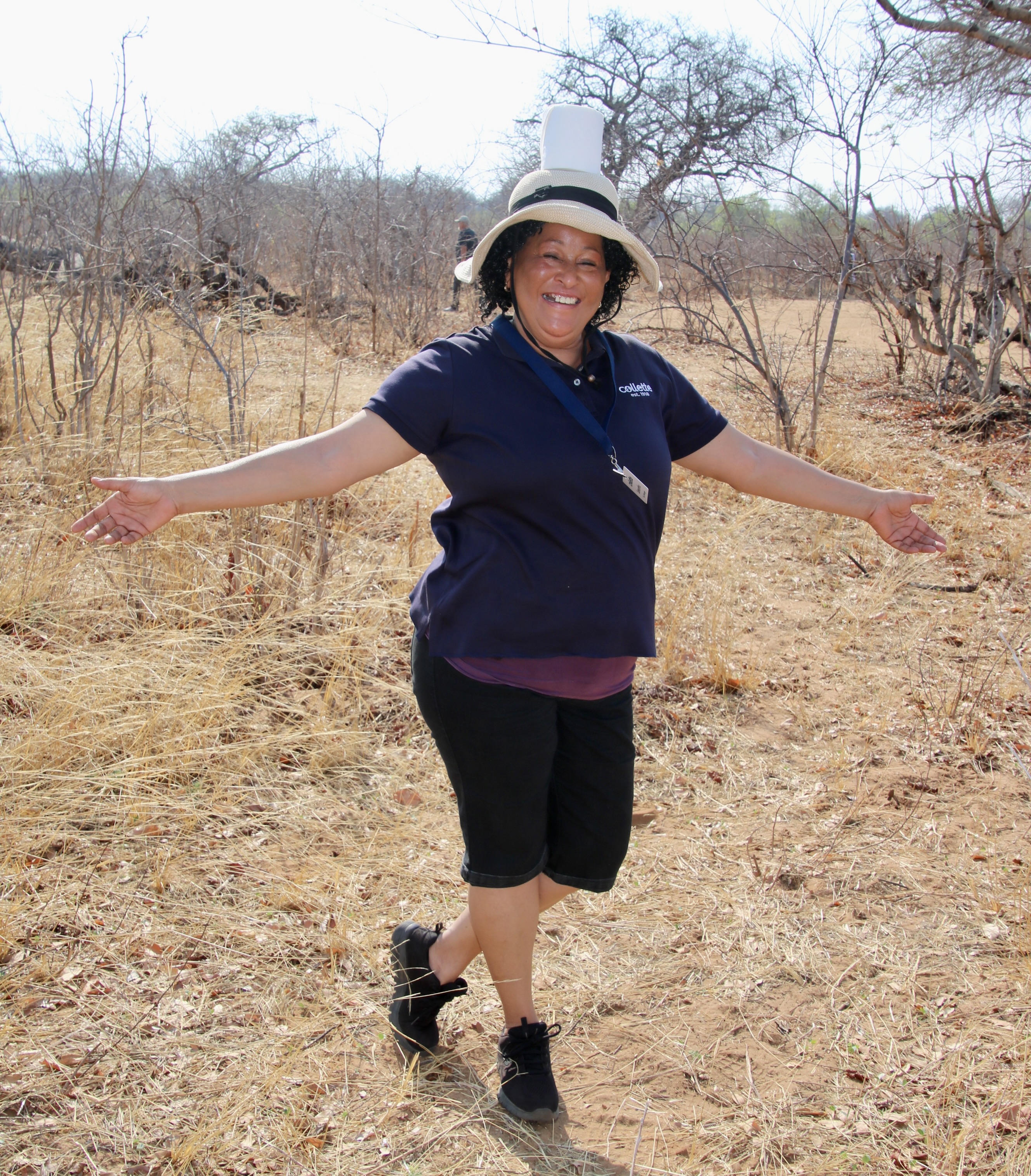
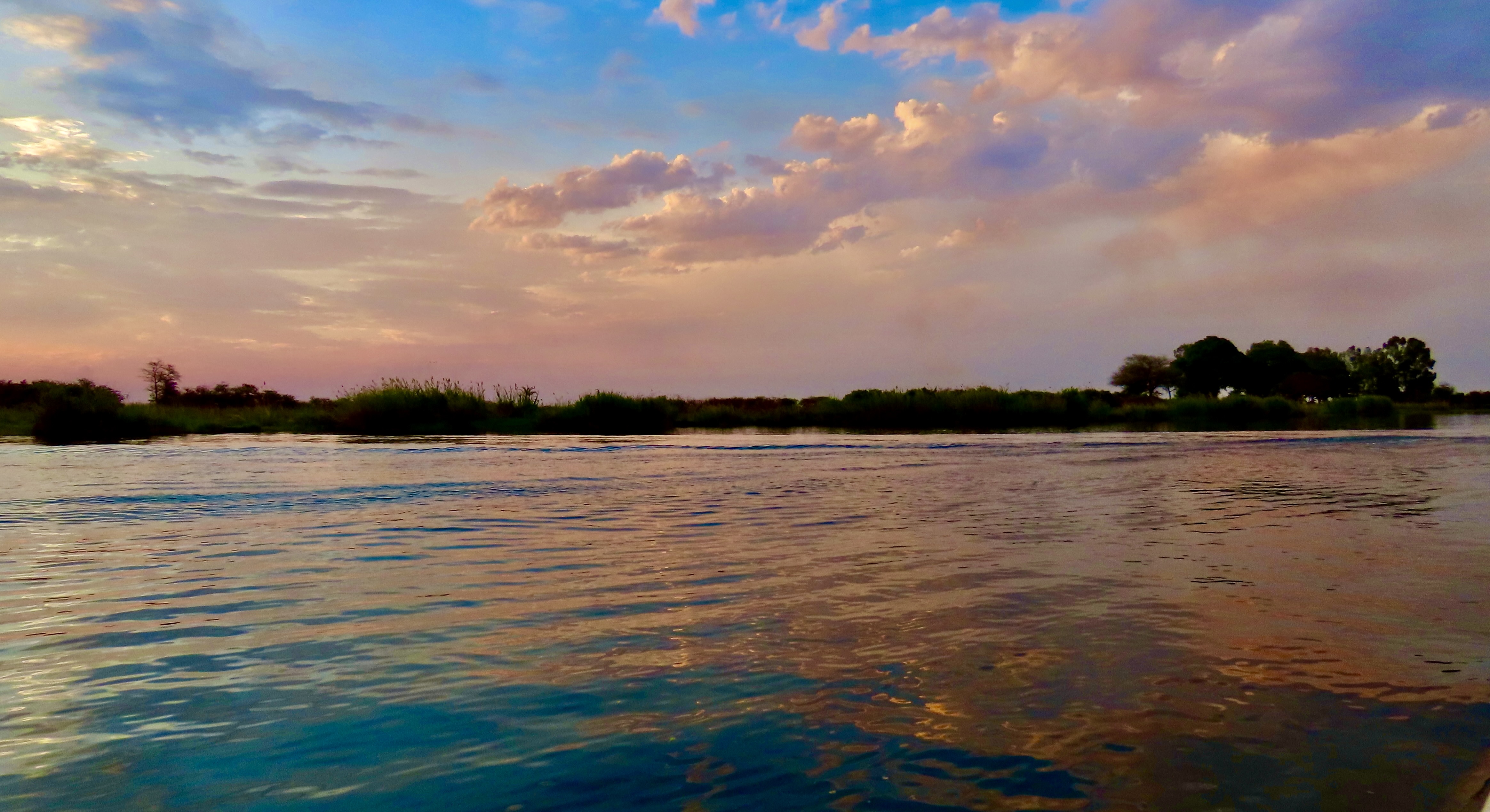
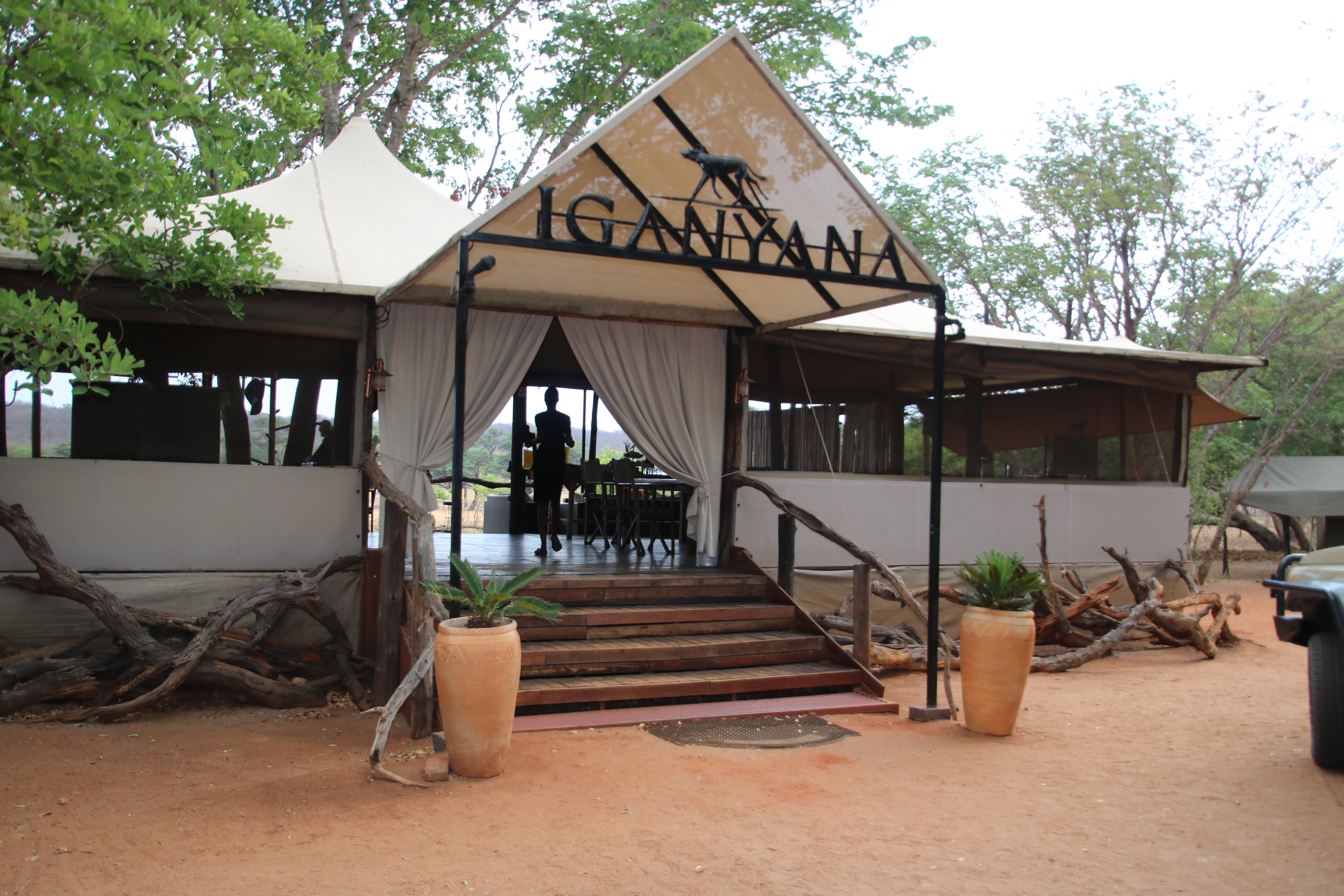
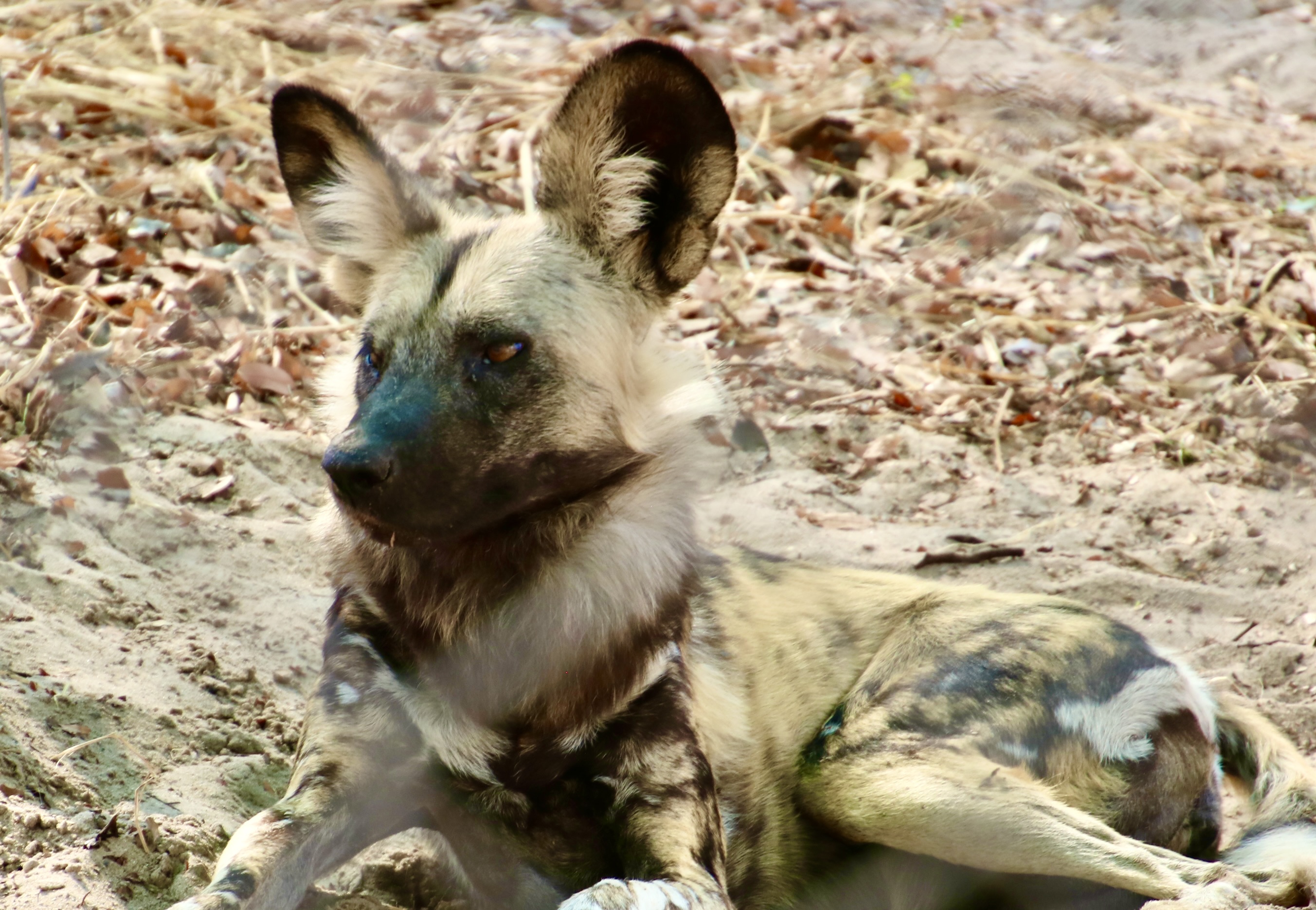
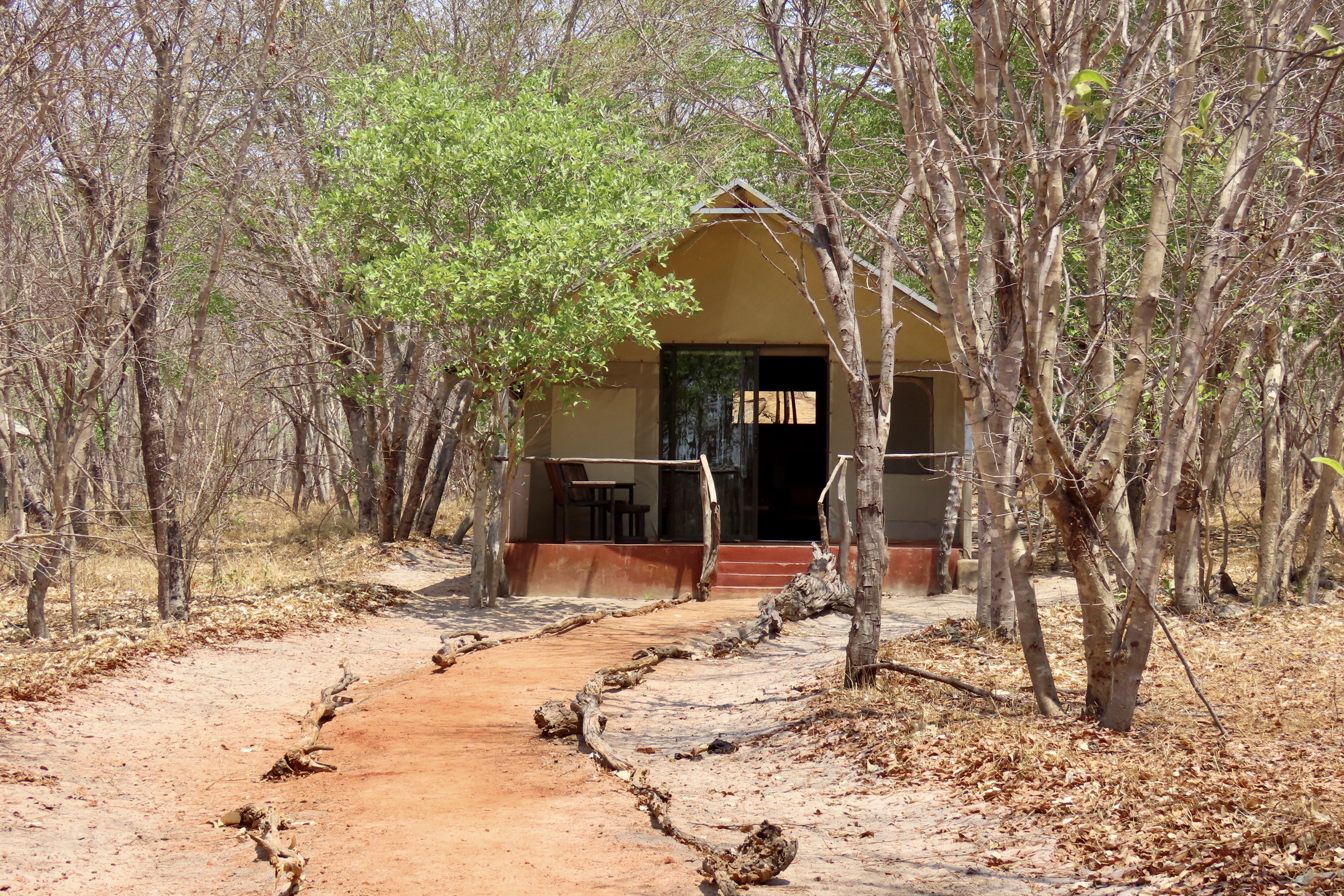
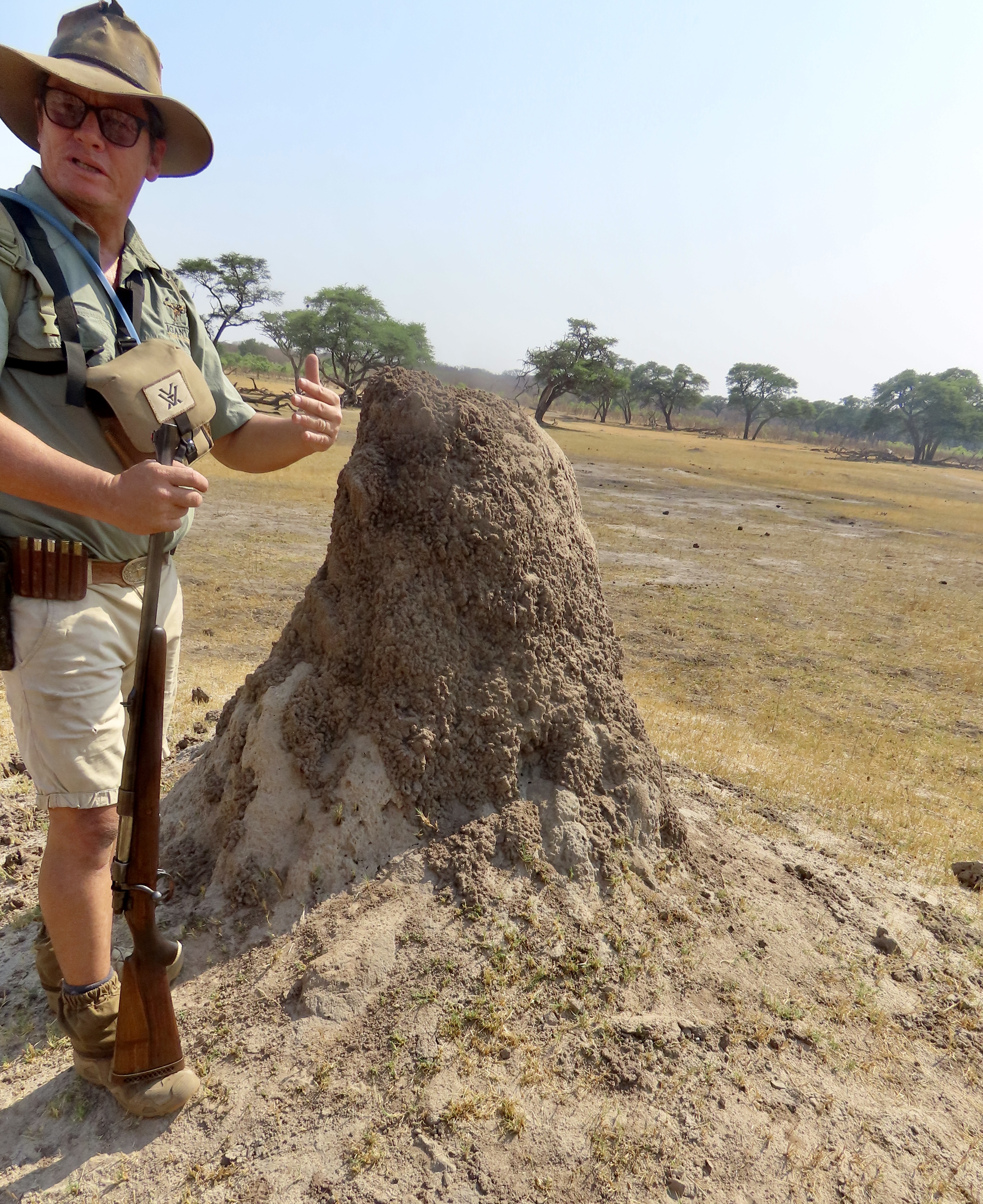
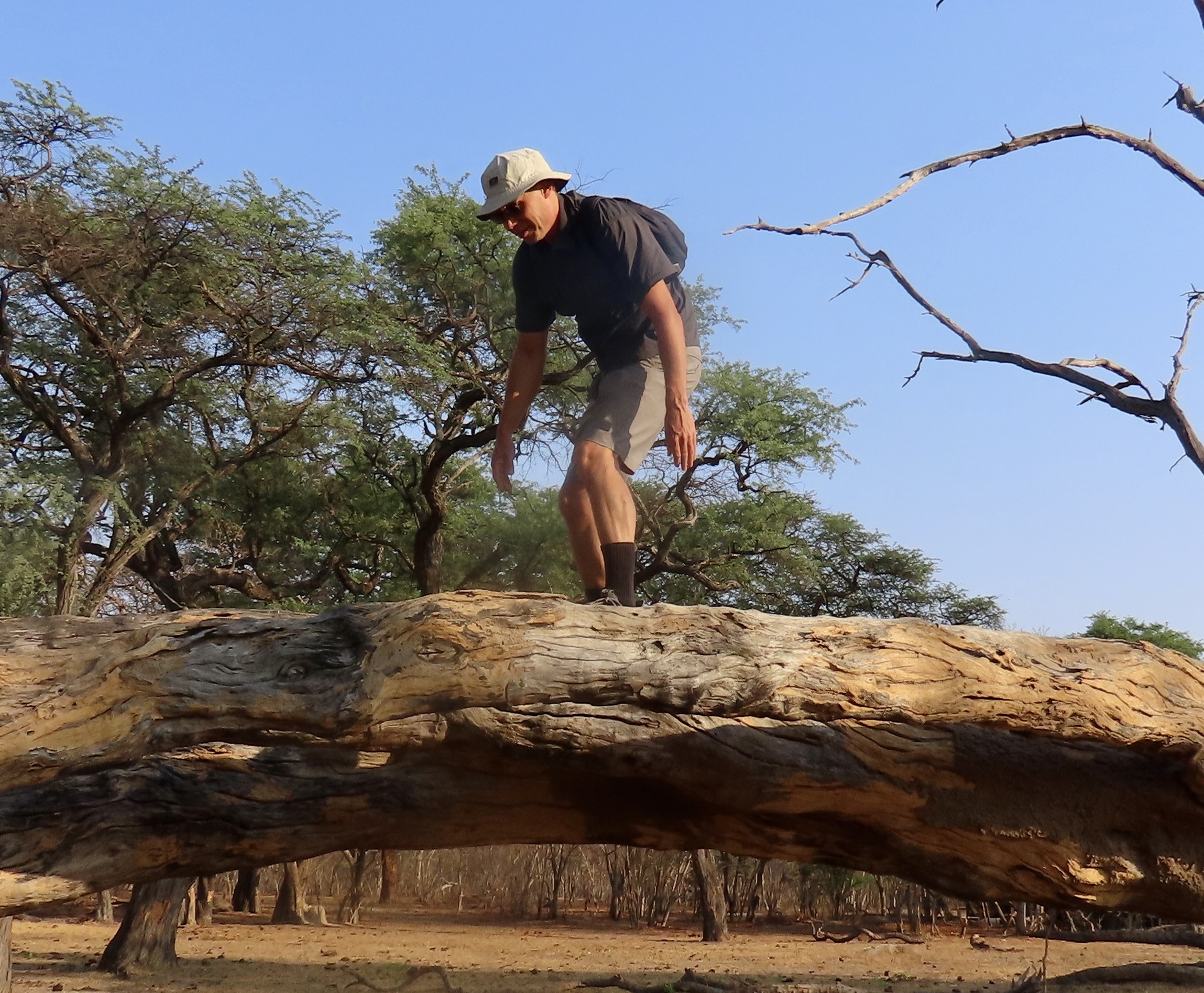
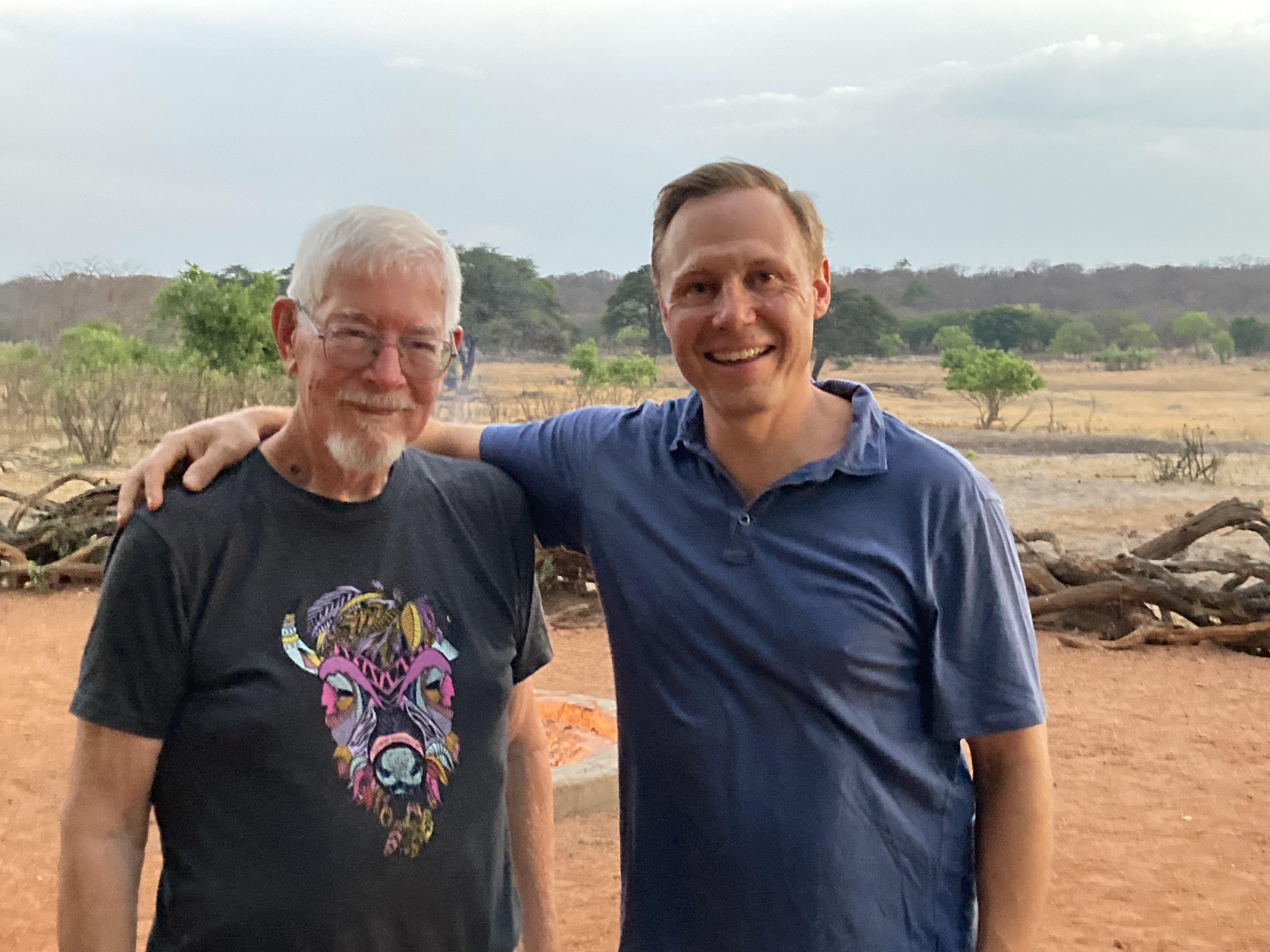
I promised more sunsets as I continue the wrap-up on our African safari. This one was on Lake Kariba in Zimbabwe. Today, I will be focusing on those photos from Lake Kariba, Chobe National Park and Hwange National Park that were blog-worthy but didn’t fit into our earlier posts.After sunset, it’s time for moonrise. Right? We were entertained by a full-moon at Lake Kariba one night, when we out exploring later than usual. That’s a weaver bird nest on the right, BTW.I was curious about how my new camera would handle a close-up.This was our houseboat on Lake Kariba.Numerous islands were on the lake.Most of the islands were covered in vegetation. This one featured acacia trees. Rangers from Matusadona National Park next to Lake Kariba took us on a trip back into the park that I covered in other posts. But I missed this photo of impala and zebras running. We found that the wildlife at Matusadona was much more skittish than it had been at other national parks. I figured it was because they saw far fewer tourists, either that or there were more poachers operating in the area. We woke up at 5:00 on the morning we were supposed to return to port because the boat was rocking and rolling. A major storm had come in overnight that none of the weather forecasts had predicted. This photo was taken from where we were anchored close to the shore. Big waves were rolling on the lake. Lake Kariba is the largest manmade lake in the world by volume. The captain took the boat out, looked at the waves, and brought the boat back in. It was too dangerous. There was talk of bringing another boat in that could handle the waves better. Eventually the waves calmed down enough that the captain was willing to make the trip. It was a rough crossing. We knew how rough when we tried to walk and when the liquor bottles came tumbling off the shelves in the bar. We survived!While we in Africa at the wrong time to see the massive migrations that take place, this herd of Cape buffalo moving along the Chobe River gave us a feel for what it might be like.A closer view of the Cape buffalo. A jackal in Chobe National Park.Here I am with the warthog at our lodge on the Chobe River. You can see how close I was and how unconcerned he was about my presence. There were several photos of this fellow when I did my post featuring warthogs. This photo provides a look at what much of the terrain looked like in Chobe National Park away from the river. We had stopped for a snack and potty break. You are looking at the restroom. It was called wander off into the bush where you couldn’t be seen and hopefully not eaten.Samantha demonstrates how to headload toilet paper. Guides make a tremendous difference in the success of any tour and Samantha is among the best that Peggy and I have ever had. She was knowledgeable, efficient, and fun. Hats off to the Collette Travel Agency for hiring her. The waterlilies along the Chobe River were magnificent. Before moving on to Hwange National Park, here’s a photo of sunset over the Chobe River.We stayed at Iganyana Tented Camp when we visited Hwange National Park. The swimming pool where the elephants came to drink while we were eating dinner is just off to the right. Iganyana is the name for the African painted dog. This one was located in a shelter designed to provide care for the painted dogs that had been injured. This was our tent, which was quite comfortable, glamping at its best! The dark spot to the right of the trail was where the Cape buffalo left its calling card.Terry Anders, who co-owns the Iganyana Tented Camp along with his wife Sheona, took us on a safari walk through the area surrounding the camp. He and one of his staff were both armed in case of a wildlife attack. Here he stopped to talk about termites. Peggy’s brother John and I were persuaded to sample what the termite mound tasted like. Dirt. Large termite mounds were found wherever we traveled in Botswana and Zimbabwe, as they were in West Africa when I served there as a Peace Corps Volunteer. We called them bug-a-bugs in Liberia.Cal Nyer, a photographer and videographer from the Collette Travel Agency joined us on our journey through Botswana and Zimbabwe and added a lot to our trip. Here he has climbed the stump near the Iganyana Tenanted Camp that the lions had climbed up to escape the rampaging Cape buffalo that I blogged about. I can pretty much guarantee that the lions got up there much more quickly than Cal. But had he been chased by an angry Cape buffalo…I’ll close today with this photo of Cal and me. Next up: South Africa and our last Safari post. Bo-Kaap is a colorful neighborhood in Cape Town South Africa.
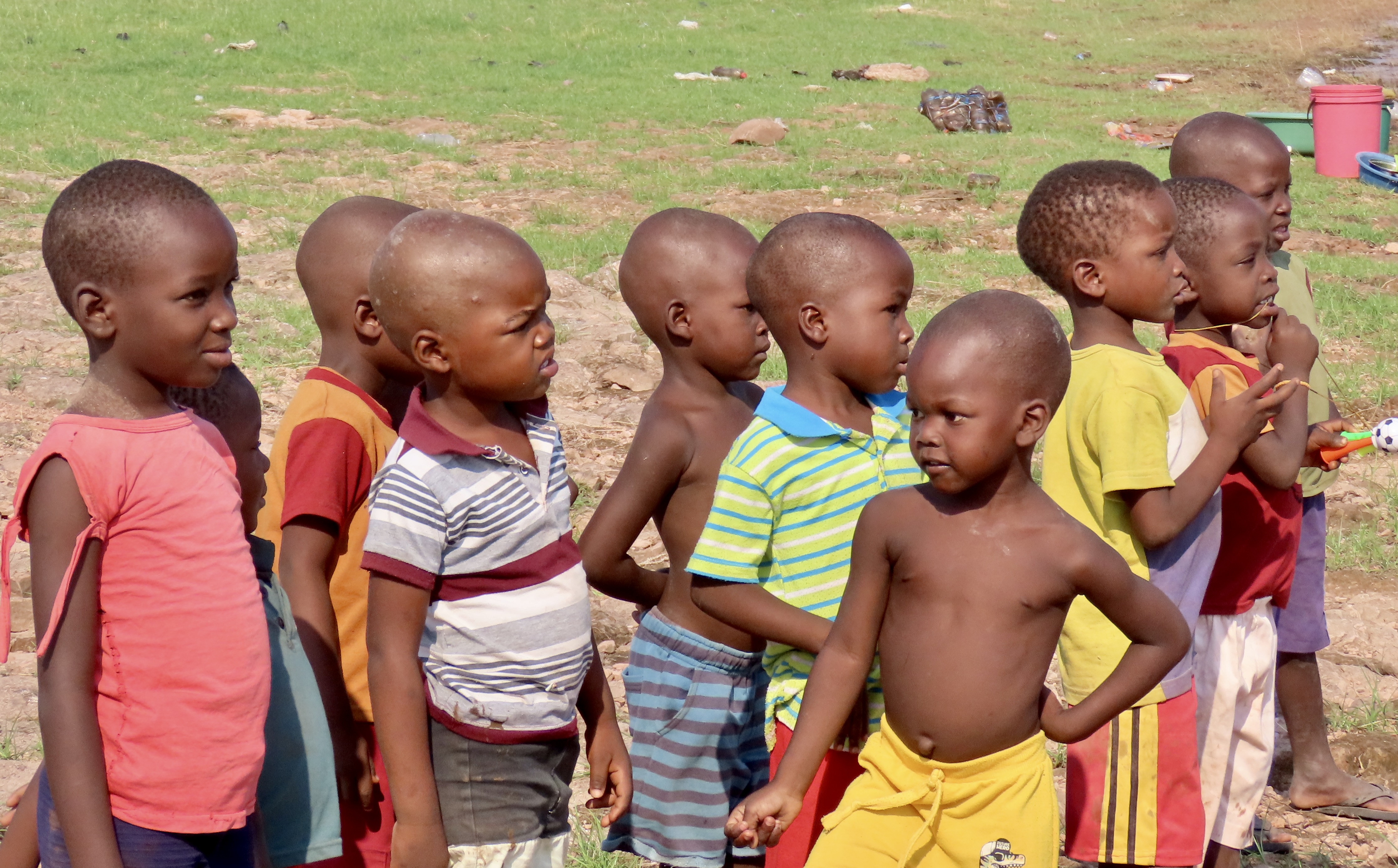
Children anxiously awaited our arrival at the tribe fishing village we visited on Lake Kariba. Which one was trouble? Grin
When the Zambezi River was flooded in the 60s to create Lake Kariba, several villages of Tonga people were flooded— without compensation. Some of them were later granted limited fishing concessions on the lake. Our guide was eager for us to meet Africans as well as wildlife and arranged a tour of one village located on an island. I found the people and village life quite similar to what I had experienced as a young Peace Corp Volunteer in West Africa 50 years earlier. Following are some of the photos that Peggy and I took.
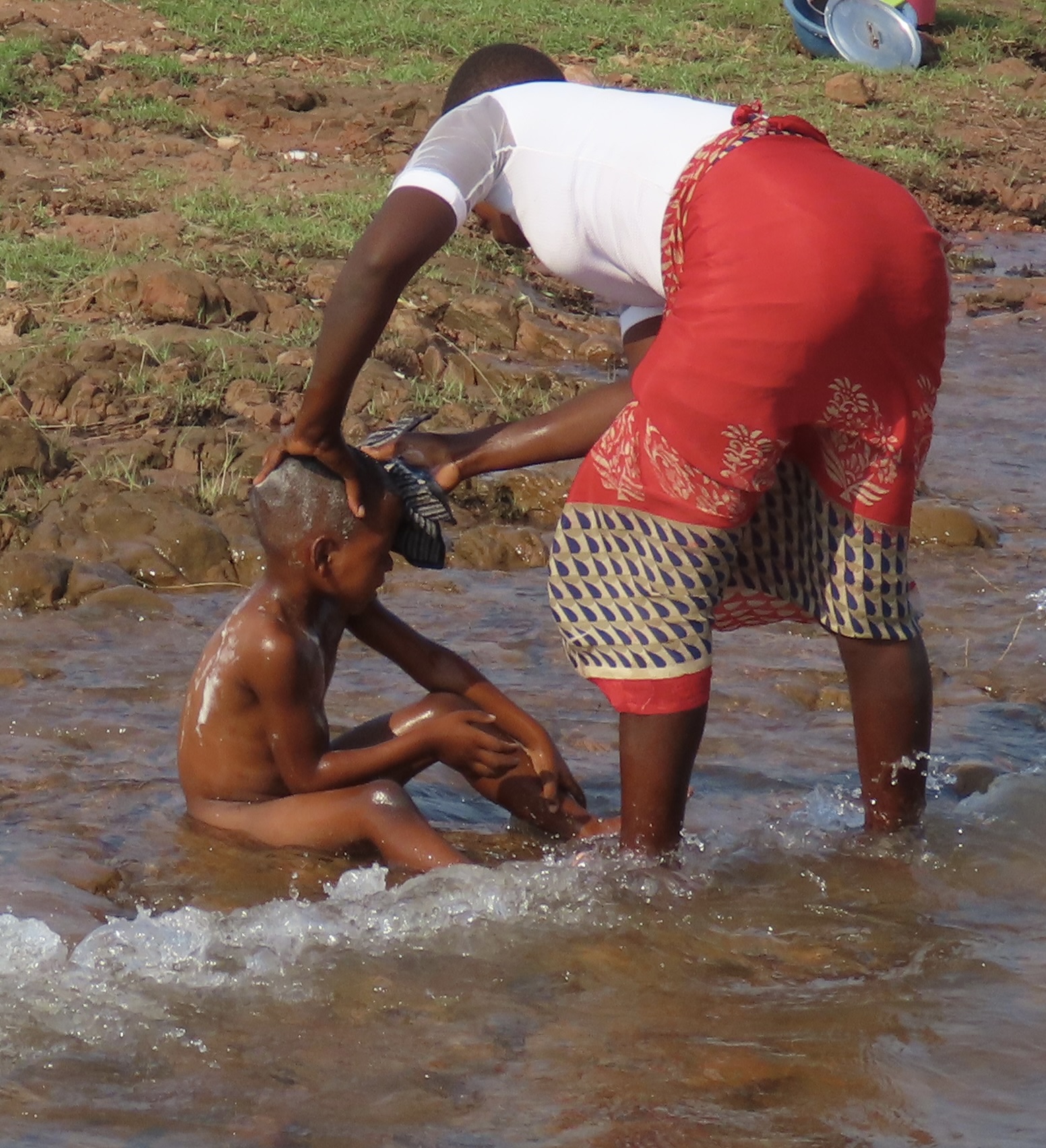
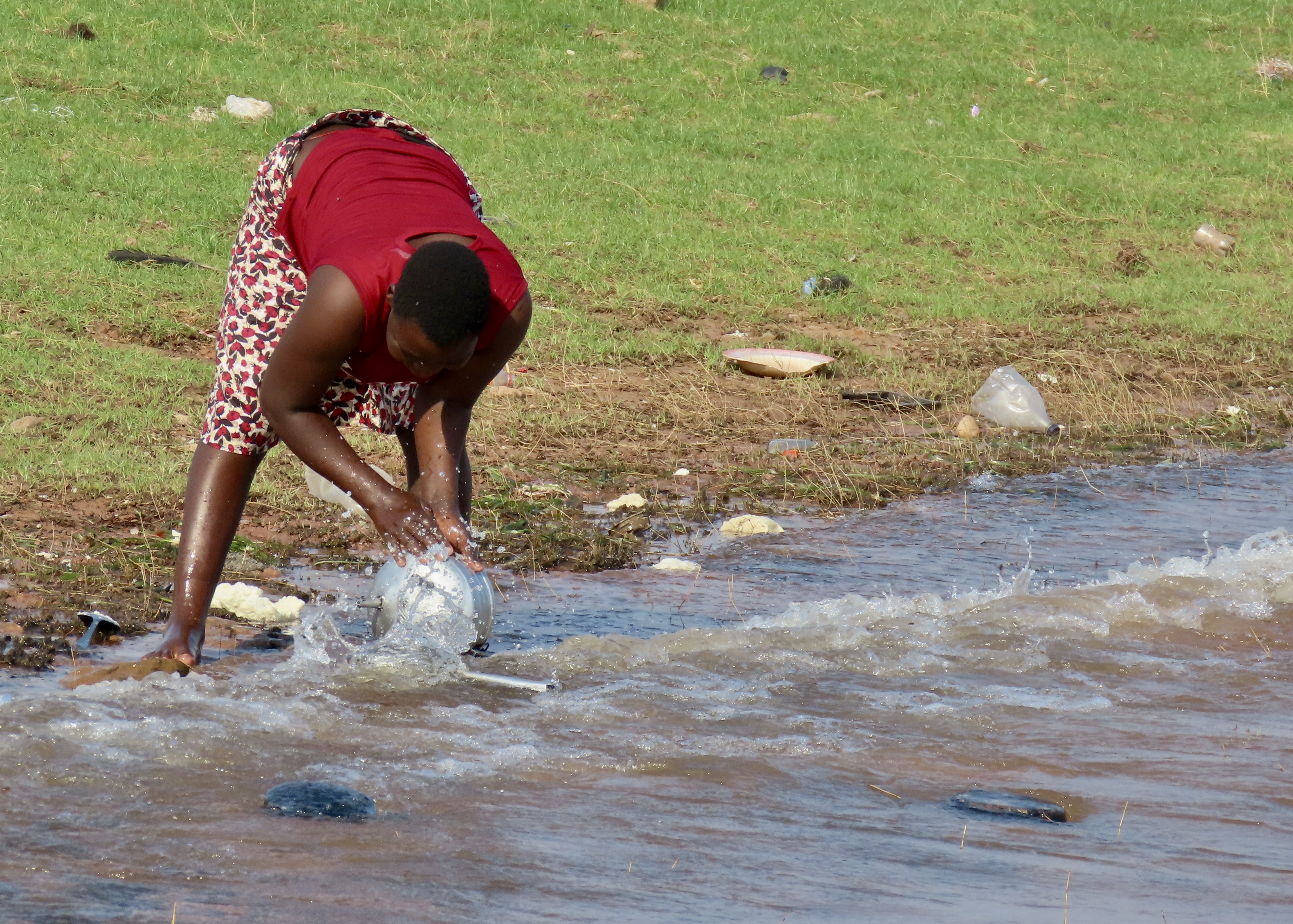
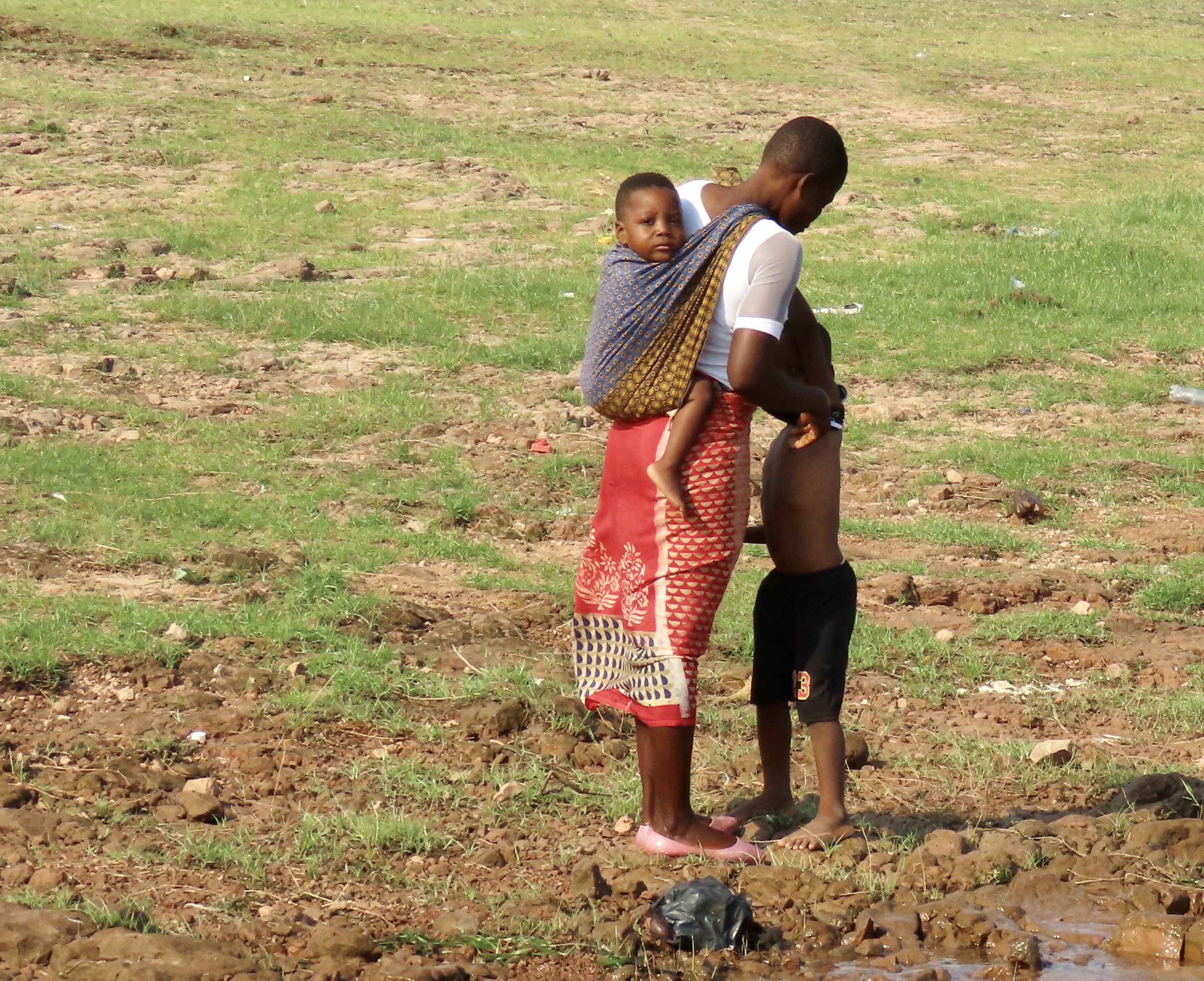
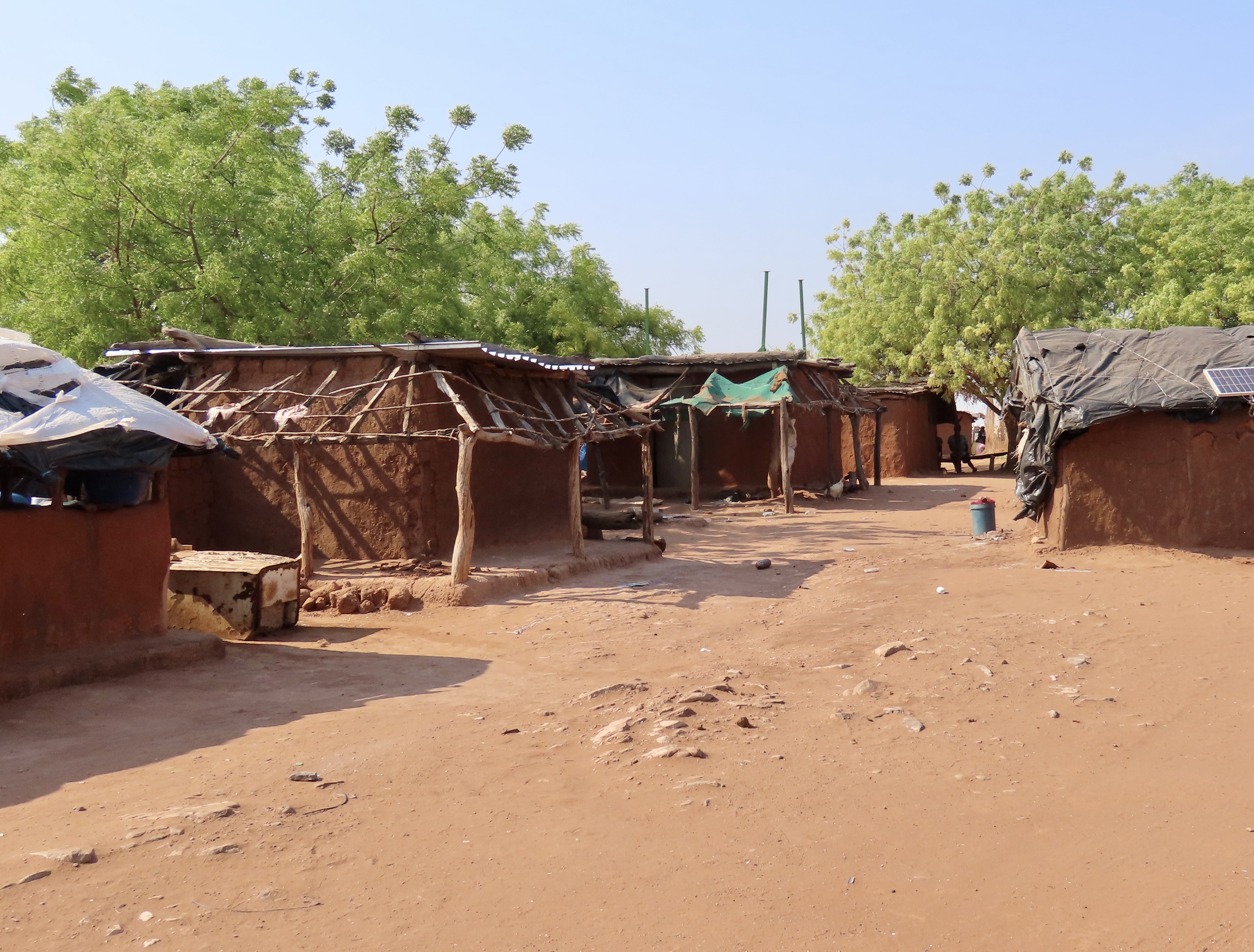
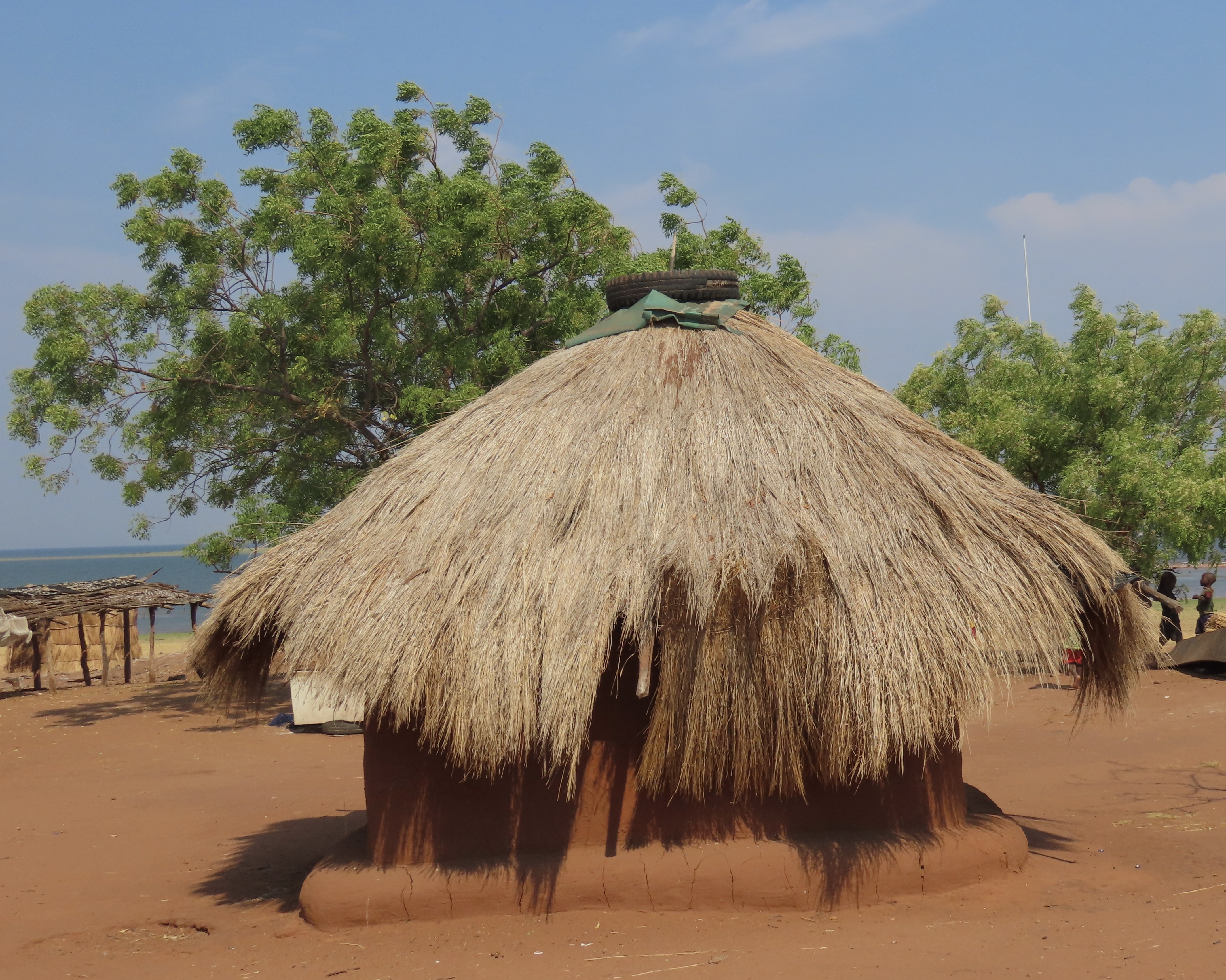
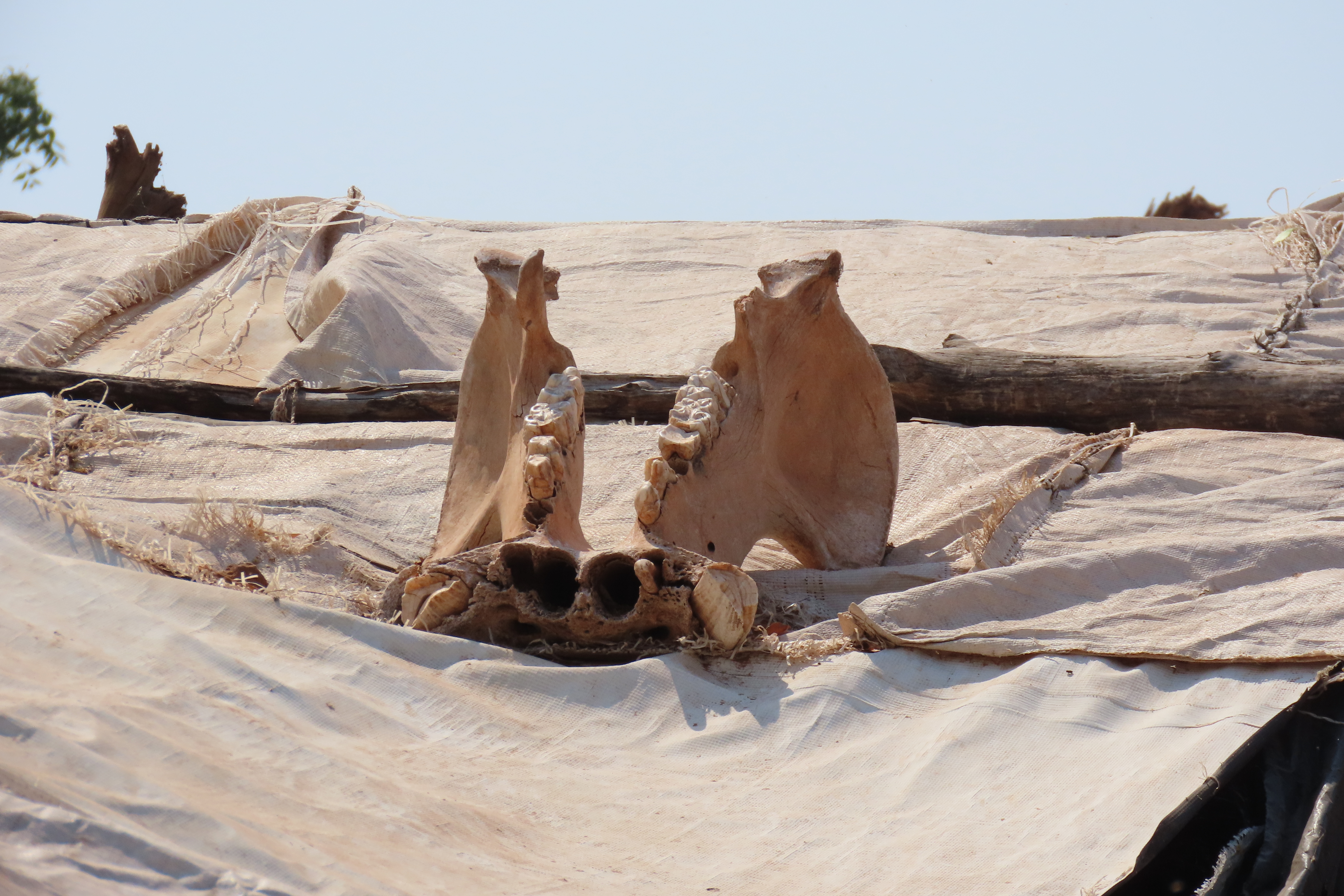
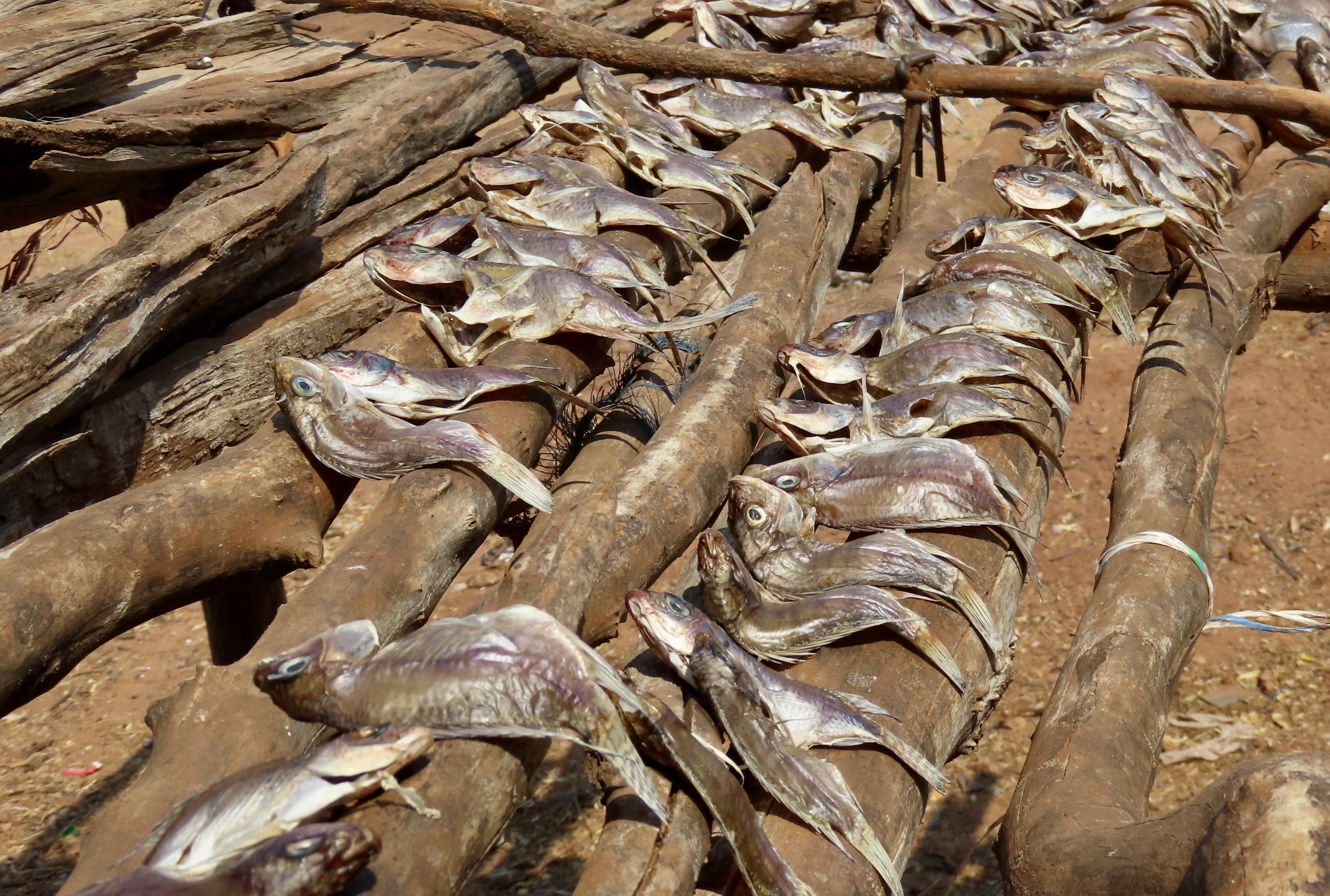
Life continued as usual in the village during our visit. The bathtub.The dish washer.And dish dryer.Child safety seat. How much safer could one be?Transportation system.Mainstreet.Housing construction varied. This one was was made of round mud bricks.The construction process. We watched as bricks were added.A different technique.Both methods would eventually be finished off with this solid clay covering, which I assume withstood rain.Roofing materials varied as well. This was a traditional covering. The reeds were purchased from a nearby town and brought in by boat.Modern tarps of various kinds were more common.This came as a surprise. You may have noticed it on our ‘Main Street’ photo. A solar panel makes lots of sense. Roof decoration? It’s possible that this hippo jaw was present to scare away evil spirits.A more modern store featuring the latest in sugar-free drinks! “Same great taste.” Even in 1965, the then small town of Gbarnga, Liberia where I served as a Peace Corps Volunteer had a Coke billboard. And one for Guinness.The chief of the village (blue shirt and leaning on post) took us on a tour where cooking, house building and fish net mending were demonstrated. The man in the cap talking is the captain of the houseboat we lived on while exploring Lake Kariba. This demonstration was how the Tonga cooked fish.Mmm, mmm, good! Since fishing was the primary source of income for the villagers, fish were also their primary source of food. The village’s fishing boat fleet.Mending fishing nets was an ongoing, daily process.Fish caught for sale were salted and dried.Close up.A different drying rack.Fish filet! Yum.After a steady fish diet, eggs might make a welcome substitute. Or chicken? How about duck?Peggy taught one of the children to make the Peace sign. The kids were an absolute delight.How did she do that?And here Peggy was teaching them the ‘A wuni kuni ki yo oonie’ song and clapping game. Everyone of our grandchildren, nieces and nephews will immediately recognize this. Peggy, a retired and well-loved elementary school principal, had a large group of the children with her wherever she went in the village. I’ll close today with a photo of two of the children who had adopted John. He skipped up to the village with them!
Peggy and I are on the road again. Tomorrow we start our journey west where we will be taking three months to travel up the West Coast from Big Sur to Olympia National Park camping out in our travel trailer as we go. I will blog about the trip as we go! Hopefully, I’ll be able to wrap up Africa and the Everglades on our two week drive across the US. I’ll continue to read blogs and respond to comments as time allows.
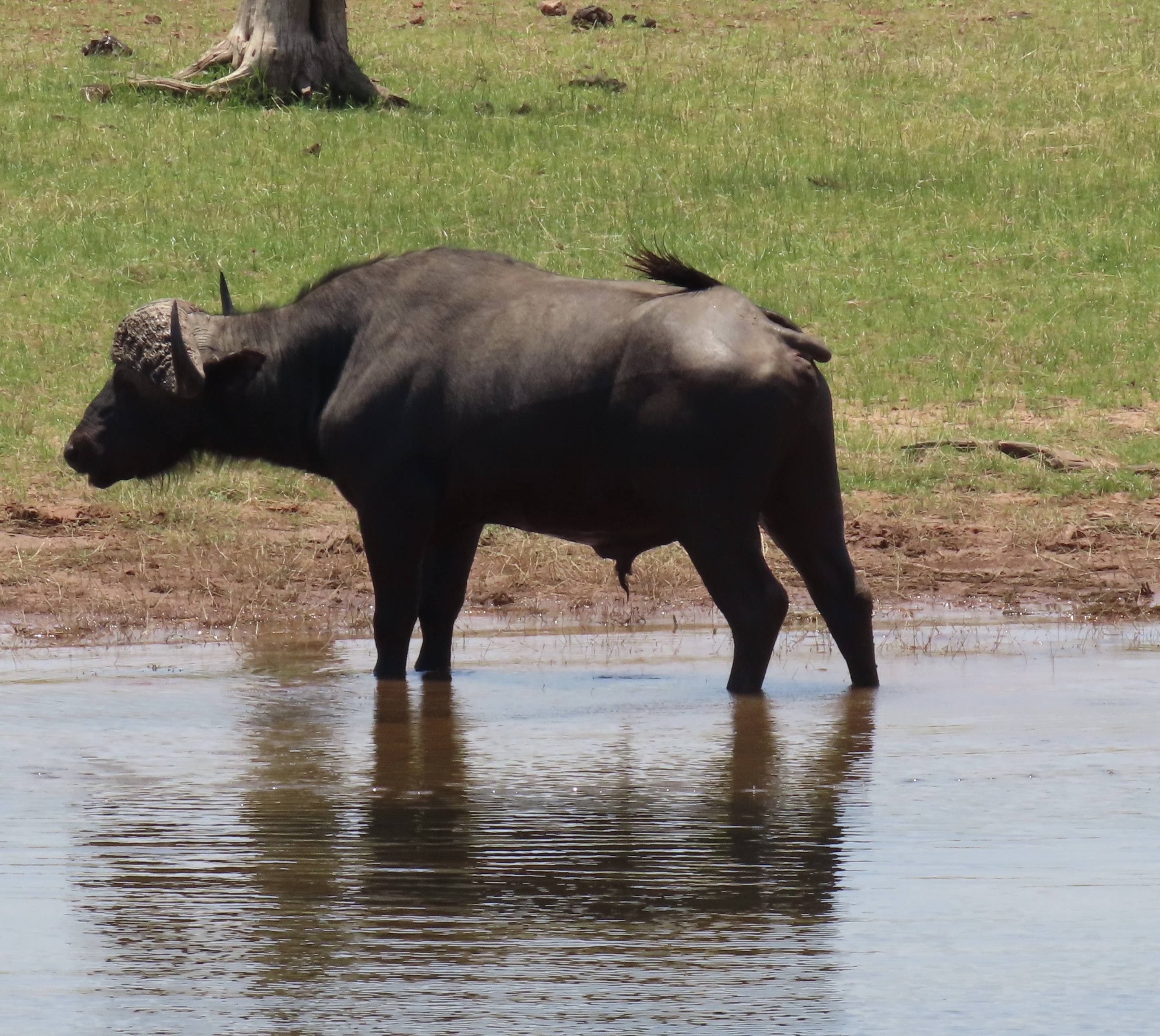
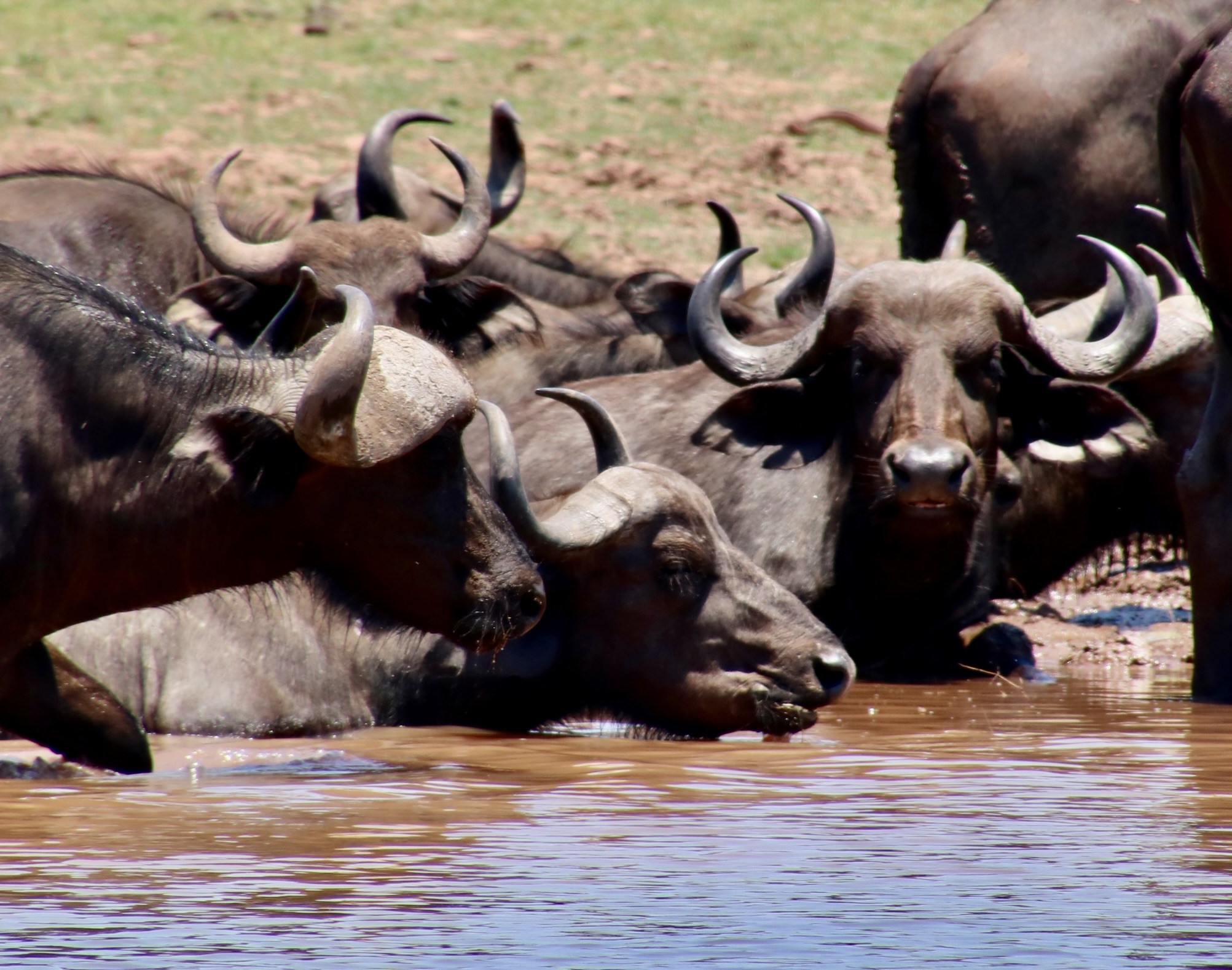
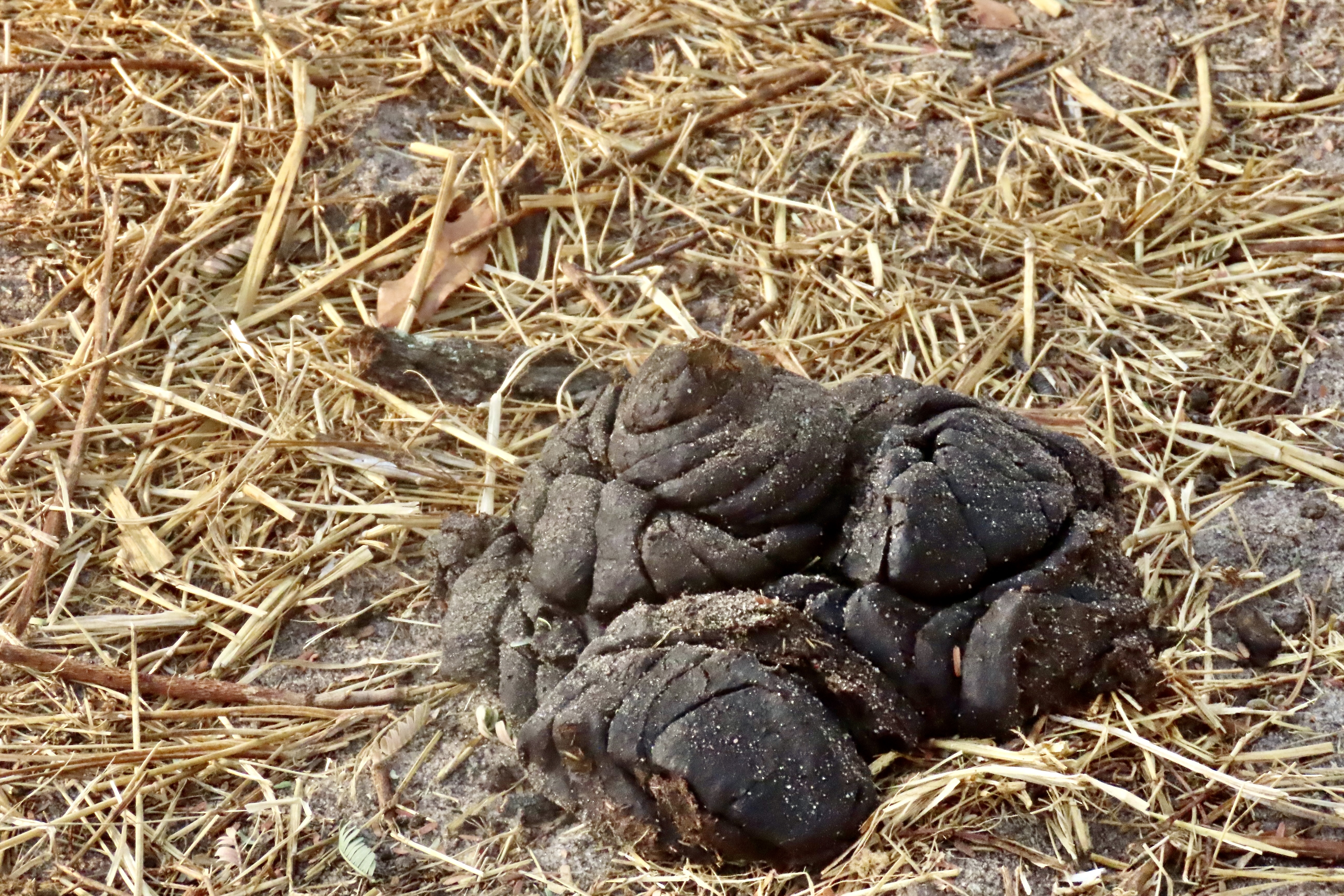
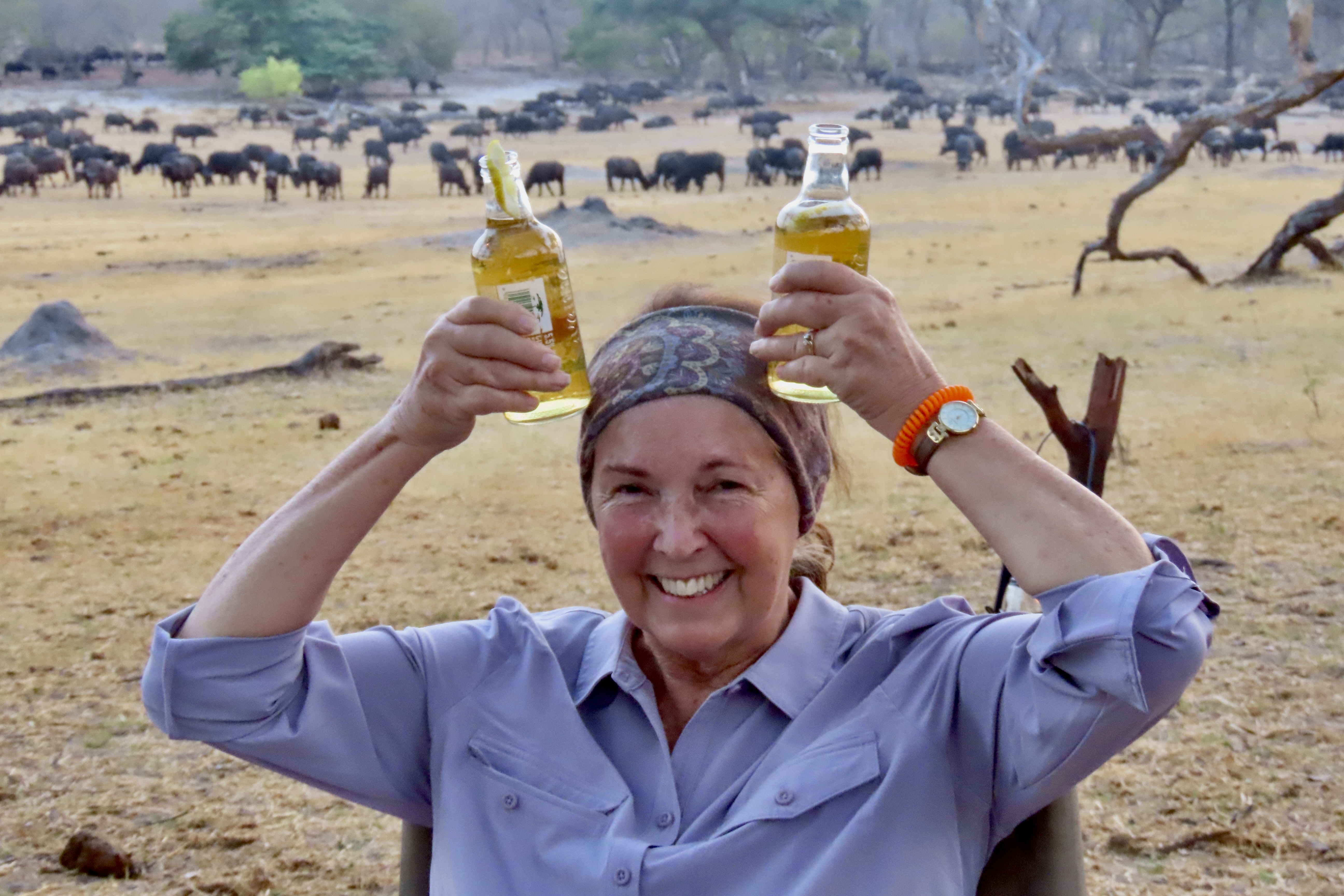
Cape buffalo are dangerous, no doubt about it. But what makes them so? The look alone says “Don’t mess with me.” The eyes, the horns, the ears and even the nose speak of danger! We were safely ensconced in our boat on the Chobe River. Did I mention that the buffalo are great swimmers…Size matters. The big bulls can weigh up to a ton. The really big ones can reach over 6 feet in height and 11 feet in length.Which, in no way, means that you would want to mess with a thousand pound female…And then there are the horns. No one, not even a lion, wants to be hooked by one.They are the boss. That is actually what the horn structure is called. The solid shield created where the horns meet is so tough that it can withstand the pressure of another large male crashing against it!They attack as a group. You won’t be dealing with one. It could be the whole herd. They protect each other, including the young, the old and the sick. The largest males form a circle around the vulnerable with their horns pointing out. When a calf cries in alarm, the bulls come charging.Terry, the co-owner of the Iganyana Tent Camp where we stayed on the edge of Hwange National Park, told us a story about this downed tree. His brother-in-law came to visit and went out for an evening walk. He called Terry and asked for a pick up because he heard lions. Terry jumped in his truck and rushed to the scene. He didn’t have to worry about the lions. They were up as high as they could get on the stump as the herd of buffalo ran in circles under it, threatening instant death if they dared to come down. That’s how scary they are. The week before we arrived, a herd of around a thousand came to visit the camp and stayed until 11 that night, Terry told us. No one could go back to their tent until the buffalo left! One of them left its calling card on the pathway up to the tent we were staying in. Peggy and I had a hard time imagining being in the tent while the herd roamed around outside.We were out for an evening drive with our guide when we came across the herd crossing the road. “Be quiet,” the guide told us. “Be very quiet.” The guide waited until there was a break and dashed through it.What our guided didn’t tell us was that the herd was coming to graze in the same field where a surprise party was being hosted for us! While Peggy made horns, I checked out the tree for a possible escape. Just in case, you know. I’m happy to report that the buffalo happily munched away on their side of the field while we drank on ours. Fortunately, there was a sufficient supply of alcohol with a great motto. Enough that Peggy changed her approach to making horns. That’s it for today. The next post will be about a fishing village we visited on an island in Lake Kariba, and a carving camp we shopped at in Victoria Falls.A few of the children from the fishing village gathered around me and demanded that I take their photo.
I’ve always admired cattle egrets as they follow cattle around waiting for them to stir up something edible. They do the same thing in Africa, but the animals they associate with tend to be bigger and more scary. This egret had teamed up with an elephant next to Lake Kariba in Zibabwe. Had we visited the same area a month later, we would have probably found the same elephant and egret together. Cattle egrets, I read, tend hang out with the same animals.
I’ve mentioned before in this series (several times probably) that Peggy and I were both surprised and impressed with the bird life we found on our safari through Botswana, Zimbabwe, and South Africa. We ended up focusing on the birds as much as the other wildlife. I’ve already introduced several. Today, I’ll do a wrap up on the others that captured our attention.
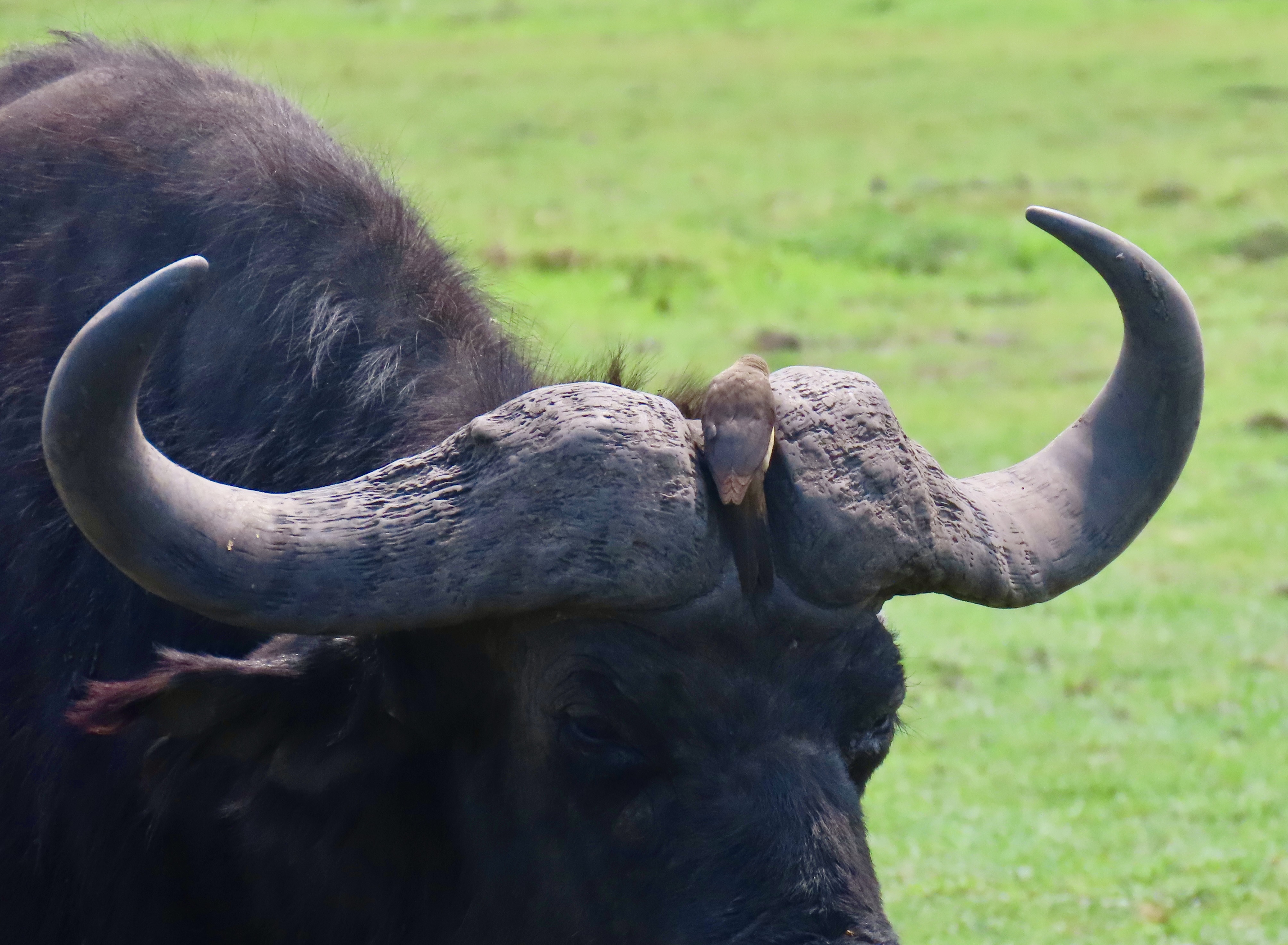
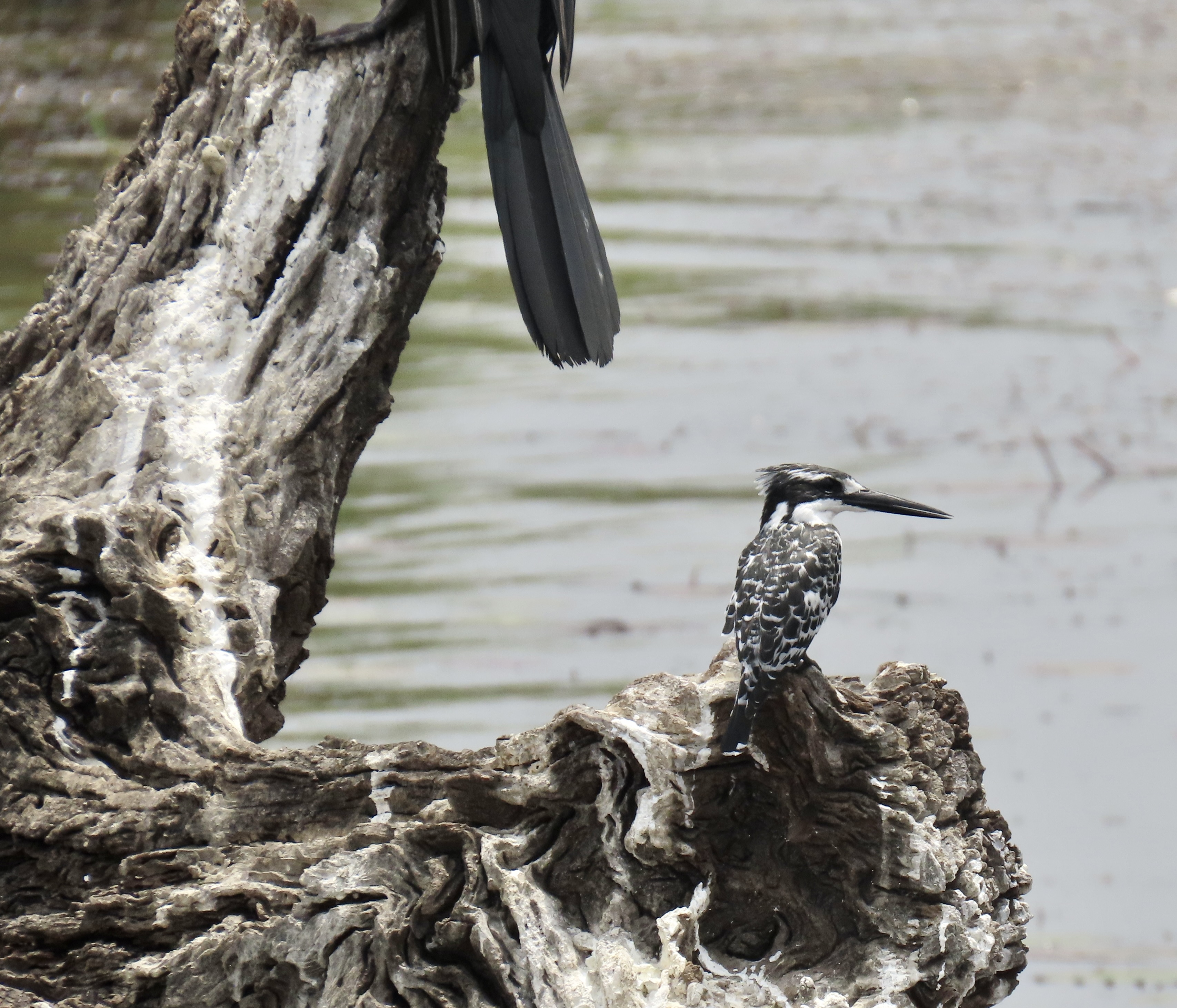
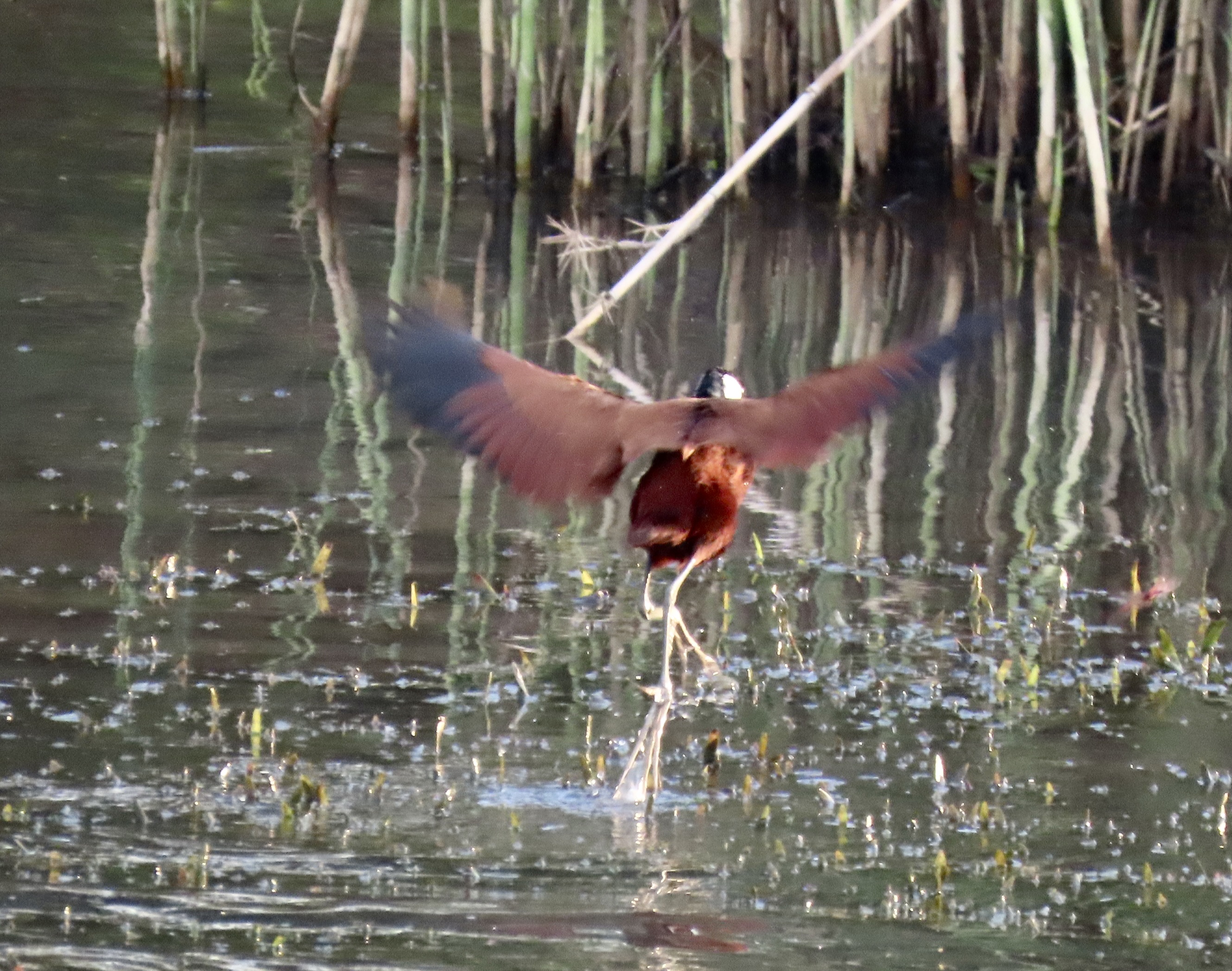
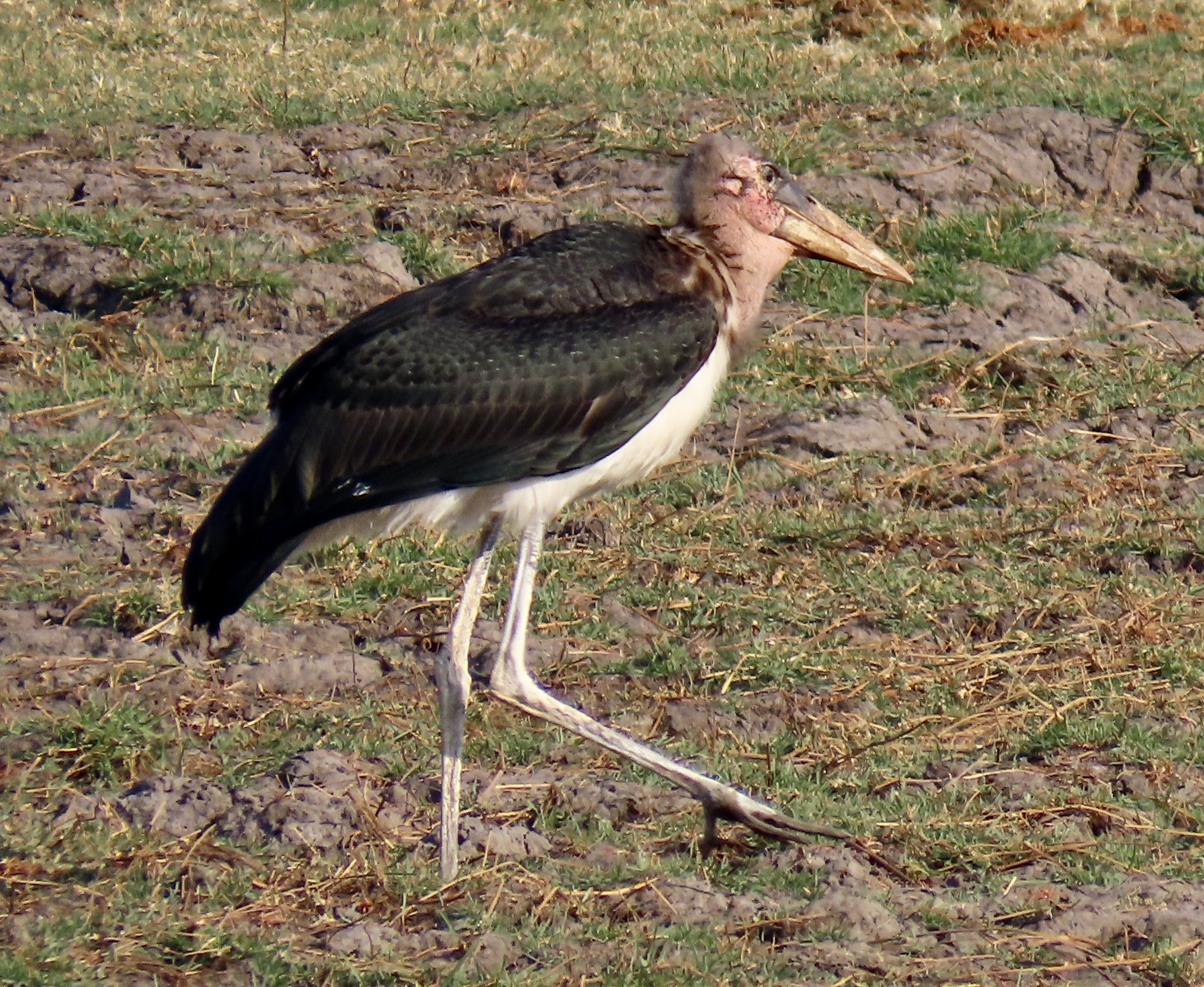
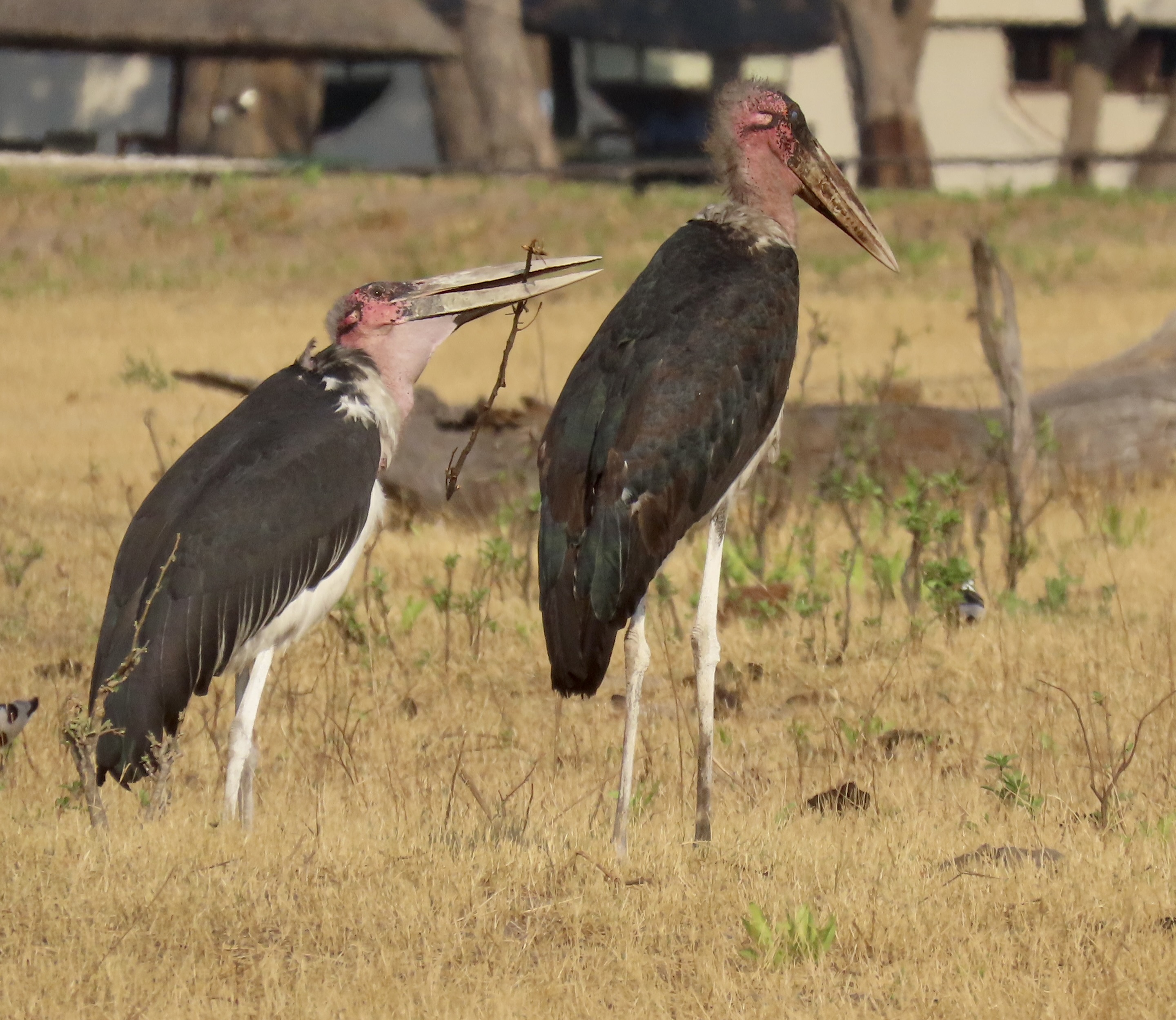
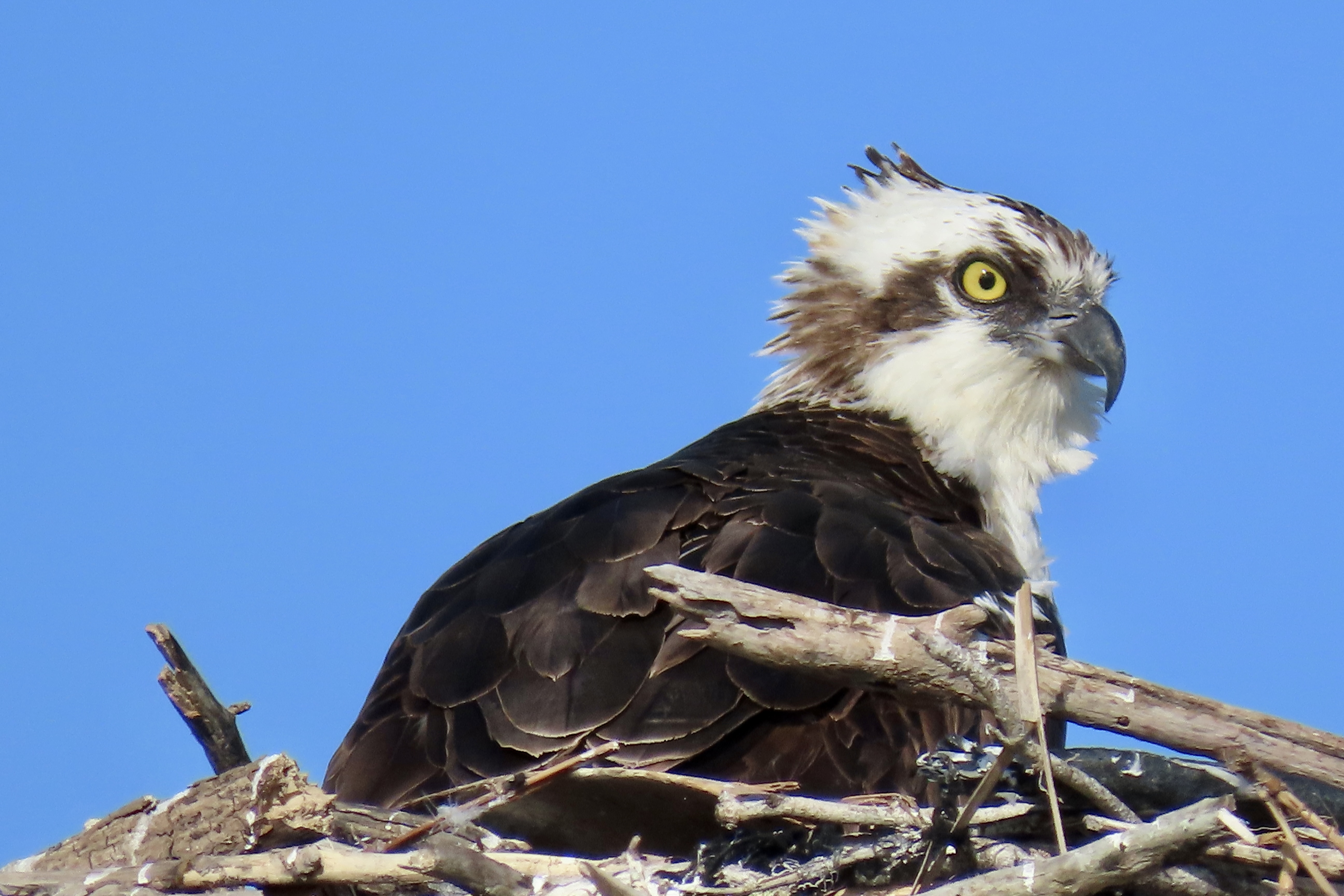
The Cape buffalo is considered the most dangerous animal in Africa, which is saying a lot considering all of the dangerous animals I’ve already featured on this blog. This egret represented the ‘height of nonchalance’ in its choice of a perch. At least it didn’t have to worry about any of the predators that might consider it food!The oxpecker is another African bird known for its close association with a number of animals, including this Cape buffalo we found next to the Chobe River in Botswana. It had already worked its way around the buffalo’s face and moved on to its horns in its endless search for insects.Two birds claimed this old snag that stuck out of the Chobe River. The tail belongs to an African Darter/anhinga. The small fellow is a pied kingfisher.A close up of this handsome representative of the family. It was facing into the wind…And then it turned around.This cutie is a juvenile African skimmer. It’s waiting for its mom to bring home her catch.Mom arrives and the two of them seem to get into a shouting match. In my imagination, it went something like this. Kid: “I’m starving to death, mom. You’re late!” Mom: “You hardly look starved. If you are, get off you lazy butt and go catch your own food.”Mom got in the last word. You probably noticed that the lower beak is longer that the upper beak. The skimmer uses it to skim along the water scooping up small fish. Thus the name.This small fellow with its black eye mask is known as a bee eater.Another one caught a bee!A bee eater of a different species. This one is known as a carmine bee eater.“That’s a go away bird,” our guide announced. “It gets its name because it always calls ‘go away, go away, go away’ when it is frightened and flies away.”This is a Jacana, also known as the Jesus bird. They earn the name by supposedly walking on water. Their large feet enable them to walk on lily pads.A Jesus bird demonstrates on the Zambezi River near Victoria Falls. I think it was cheating, but check out its long feet. I will show a similar bird on Wednesday from Florida Everglades National Park.Judging from this photo, it seemed to me that the Jesus bird could have been named fan dancer.For sheer color, this iridescent blue starling won the prize. We found a flock of open billed storks hanging out in front of a female waterbuck. The Chobe River is in the background.Here, an open billed stork searches for its favorite food, snails.A marabou stork: Not the most handsome bird we saw. Grin. There’s a reason why it is also known as the undertaker. ‘Can I offer you a stick?” Or is it, “Want to build a nest with me, Sweetie?” Marabou storks flap their neck sacks when courting. That must be exciting. We’ll wrap up our African bird photos today, but more birds will be featured on Wednesday. This time from our recent trip to Everglades National Park in Florida. Friday’s post will be on zebras.This nesting osprey in Everglades National Park will be among the birds we will feature on Wednesday.
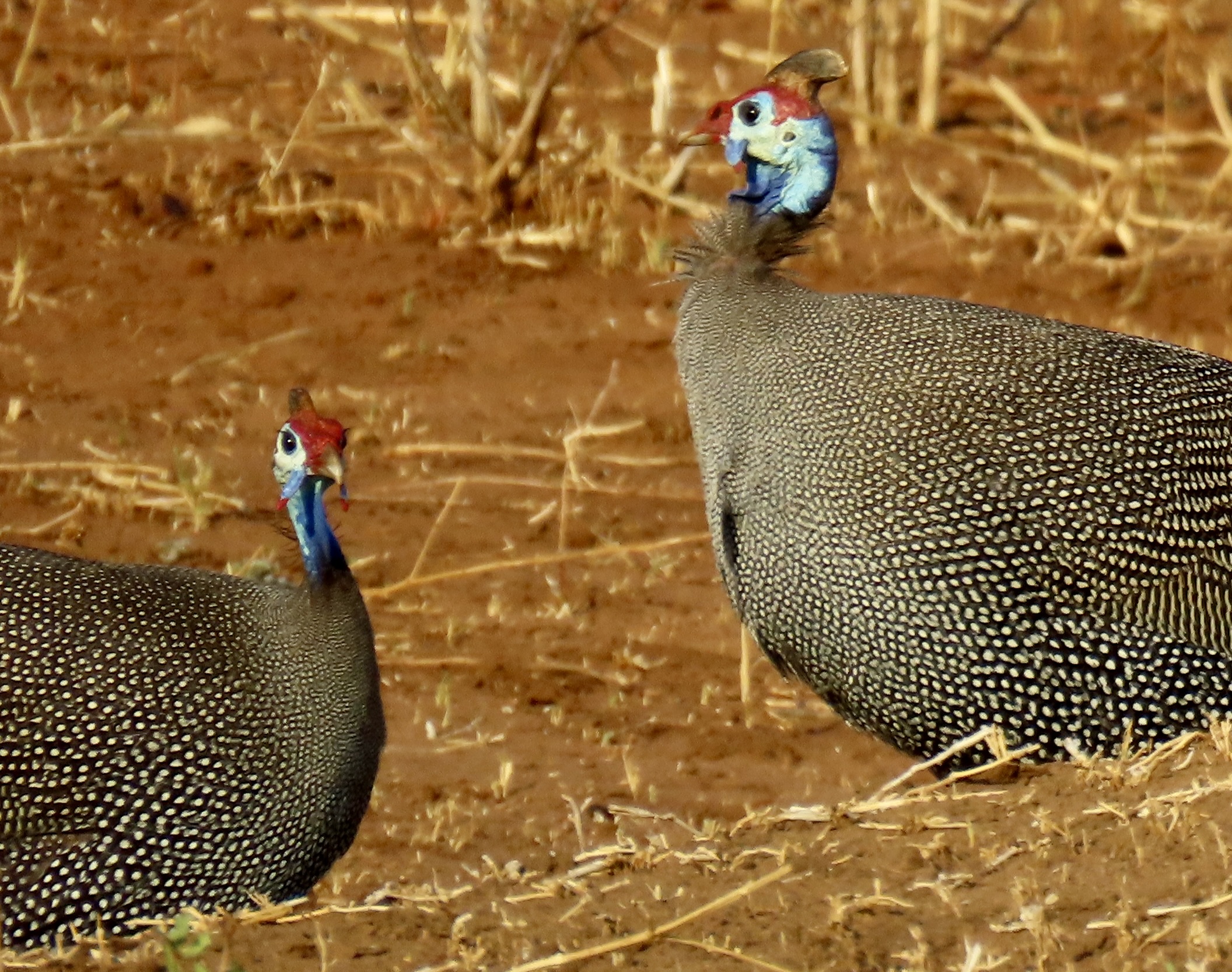
This Guinea fowl was part of a flock that scurried across the road in front of us as we traveled by safari vehicle through Chobe National Park in Botswana. Three thoughts flashed through my mind. The first was weird. Check out the head. I like weird. The second was plump. Dinner, perhaps? The third was a memory: The time Liberian soldiers tried to arrest me because of a Guinea fowl, or make that two.
First the story about the soldiers. I’ve told it before in my book about my Peace Corps experience, The Bush Devil Ate Sam, and on my blog. Because it involved Guinea fowls, it deserves being told again. It was 1967 and I had just returned from my Peace Corps job of teaching history and geography at the nearby Gboveh High School in Gbarnga, Liberia. Much to my surprise—and dismay— I found soldiers standing in our yard pointing guns every which way. It was an ‘Ut-Oh’ moment. Liberian soldiers were scary.
“What’s up?” I asked, trying not to sound nervous. You learned early on not to mess with Liberian soldiers. There was a reason why the government refused to issue them bullets.
“Your dog ate one of the Superintendent’s Guinea hens,” their sergeant mumbled ominously. The Superintendent of Bong County was the equivalent to a governor except that he had more power. He lived a quarter mile away and his Guinea fowls strutted around on the government compound squawking loudly.
“Which one?” I asked innocently.
“What does it matter which Guinea hen the dog ate?” the Sargeant sneered.
“No, no,” I responded, “I meant which dog.”
He glared at me for a moment and then pointed at Boy. I relaxed. It didn’t seem like the three Liberian dogs who had adopted Jo Ann (my first wife) and me would have done in the Supe’s Guinea fowl. They were three of the best-fed dogs in Gbarnga.
Boy was something else: A large, obnoxious, always hungry dog. He normally lived across town with Holly, another Peace Corps Volunteer. A second dog she owned, however, had puppies and drove Boy off. She was afraid he would eat her kids. Since Boy didn’t like Liberians, he had hightailed it across town to live with us. Normally I wouldn’t have cared. But given his attitude toward black people and the fact he thought of our cat Rasputin as dinner, I wasn’t fond of him.
“Why don’t you arrest him?” I offered hopefully.
“Not him,” the sargeant shouted. “You. You come with us!” Apparently, the interview wasn’t going the way Sarge wanted. A Liberian might have been beaten by then. I decided it was time to end the conversation.
“Look,” I said, “that dog does not belong to me. He belongs across town. I am not going anywhere with you.” With that I walked into our house and closed the door. It was risky but not as risky as going off with the soldiers. They grumbled around outside for a while and finally left.
Jo and I relaxed “small,” as the Liberians would say, but really didn’t feel safe until that evening. It was a six-beer night. Finally, around ten, we went to bed, believing we had beaten the rap.
WHAM! WHAM! WHAM!
“What in the hell was that?” I yelled as I jumped out of bed. It was pitch black and four o’clock in the morning.
WHAM! WHAM! WHAM!
“Someone is pounding on our back door,” Jo Ann whispered, sounding as frightened as I felt.
I grabbed our baseball bat, headed for the door, and yanked it open. Soldiers were everywhere. The same friendly sergeant from the afternoon before was standing there with the butt of his rifle poised to strike our door again.
“Your dog ate another one of the Superintendent’s guinea hens,” he proclaimed to the world. I could tell he was ecstatic about the situation. He had probably tossed the bird over the fence to Boy.
“This time you are going with us!” he growled.
In addition to being frightened, I was growing tired of the routine. “I am sorry you are having such a hard time guarding Guinea hens,” I said, trying to sound reasonable, “but I explained to you yesterday that the dog does not belong to me and I am not going anywhere with you. Ask Mr. Bonal (the high school principal who lived next door) and he will tell you the dog is not ours.”
Sometimes the ballsy approach is your best option.
I closed the door and held my breath. Sarge was not happy. He and his soldiers buzzed around outside like angry hornets. Still, yanking a Peace Corps Volunteer out of his house and dragging him off in the middle of the night over a guinea fowl could have serious consequences, much more serious than merely reporting back that I was uncooperative. I could see the headlines:
Soldiers Beats Peace Corps Volunteer Because Dog Eats Guinea Fowl. Liberian Ambassador Called to White House to Explain
I hoped the sergeant shared my perspective. At a minimum, I figured he would check with Bonal. John might not appreciate being awakened in the middle of the night, but it would serve him right for laughing when I had told him the guinea fowl story the night before. Anyway, I suspected he was up and watching the action.
We had a very nervous thirty minutes before the soldiers finally marched off. In the US, this is the point where we would have been calling an attorney, Jo’s mother, and the local TV station. Here, my only backups were the Peace Corps Representative and Doctor: one to represent me, the other to patch me back together.
Happily, our part of the ordeal was over. It turned out that Peter, a young Liberian who worked for Holly, actually owned Boy. The soldiers finally had someone they could bully.
Peter was pulled into court and fined for Boy’s heinous crimes. Boy, in turn, was sold to some villagers to cover the cost of the fine. As for Boy’s fate, he was guest of honor at a village feast. Being a Bad Dog in Liberia had rather serious consequences.
Complete with wattles, a top knot, bright colors, and fluffy neck feathers, a guinea fowl checks us out.Guinea fowl, like the ones the Superintendent of Bong County owned, have been semi-domesticated for several hundred years. They are said to make great ‘watch dogs,’ keep your property bug free (including ticks) and be quite tasty. (The French have a number of recipes for cooking them.) They are cousins of chickens, turkeys, pheasants, quail, and other edible members of the Gallinaceous species. We didn’t see any on menus on our trip.
And now for the southern red billed hornbill, another unique looking bird we first saw in Chobe National Park.
This one was roaming around on the ground searching for insects, its primary food. It’s also known to eat small lizards, eggs and baby birds, should the opportunity present itself.We caught this hornbill up in a tree talking to us: “kokok-kokok.” I liked the way its head was backlit with the sun shining through its bill.
As parents, the hornbills have a unique approach. The male finds a tree cavity where the female lays her eggs and then seals herself in, leaving a small hole for the male to provide her with food. While she is in her self-imposed exile, she molts, regrows her feathers and takes care of the young hatchlings. When the babies are around three weeks old, she breaks out to help in catering food for the hungry brood. The youngsters reseal the openings with their droppings and food remains. Hmm. Eventually, the chicks knock out the barrier when they are ready to fly.
Peggy and I will be on the road again for a month starting on Tuesday, this time traveling to Florida to spend time with our son and his family and once again visit Everglades National Park. I plan on maintaining my regular blog schedule. But, we’ll see. Grin. Friday’s post will be on one of Africa’s more amusing animals, the warthog.
I think this may be the definition of bliss, an emotion one wouldn’t normally associate with a hippo. We took this photo on Lake Kariba in Zimbabwe.
I didn’t expect hippos to be photogenic, but they kept Peggy and me busy with our cameras. Today’s post will mainly be made up of pictures. Folks who read my long elephant blogs deserve it. LOL. But still, a few facts are in order. I’ll work them into the photos.
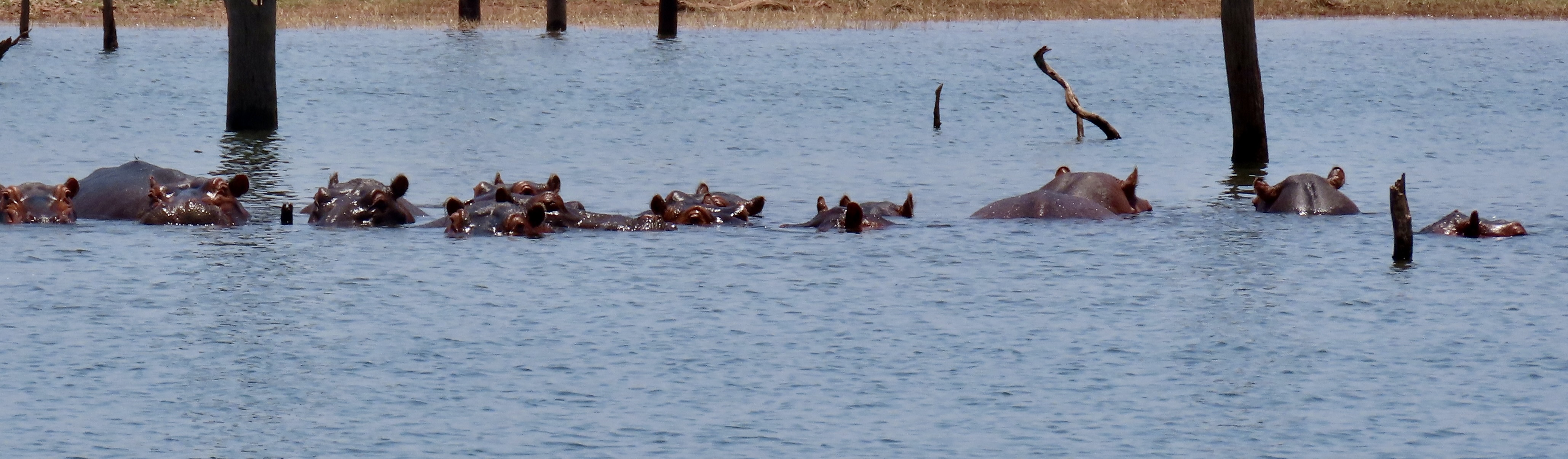
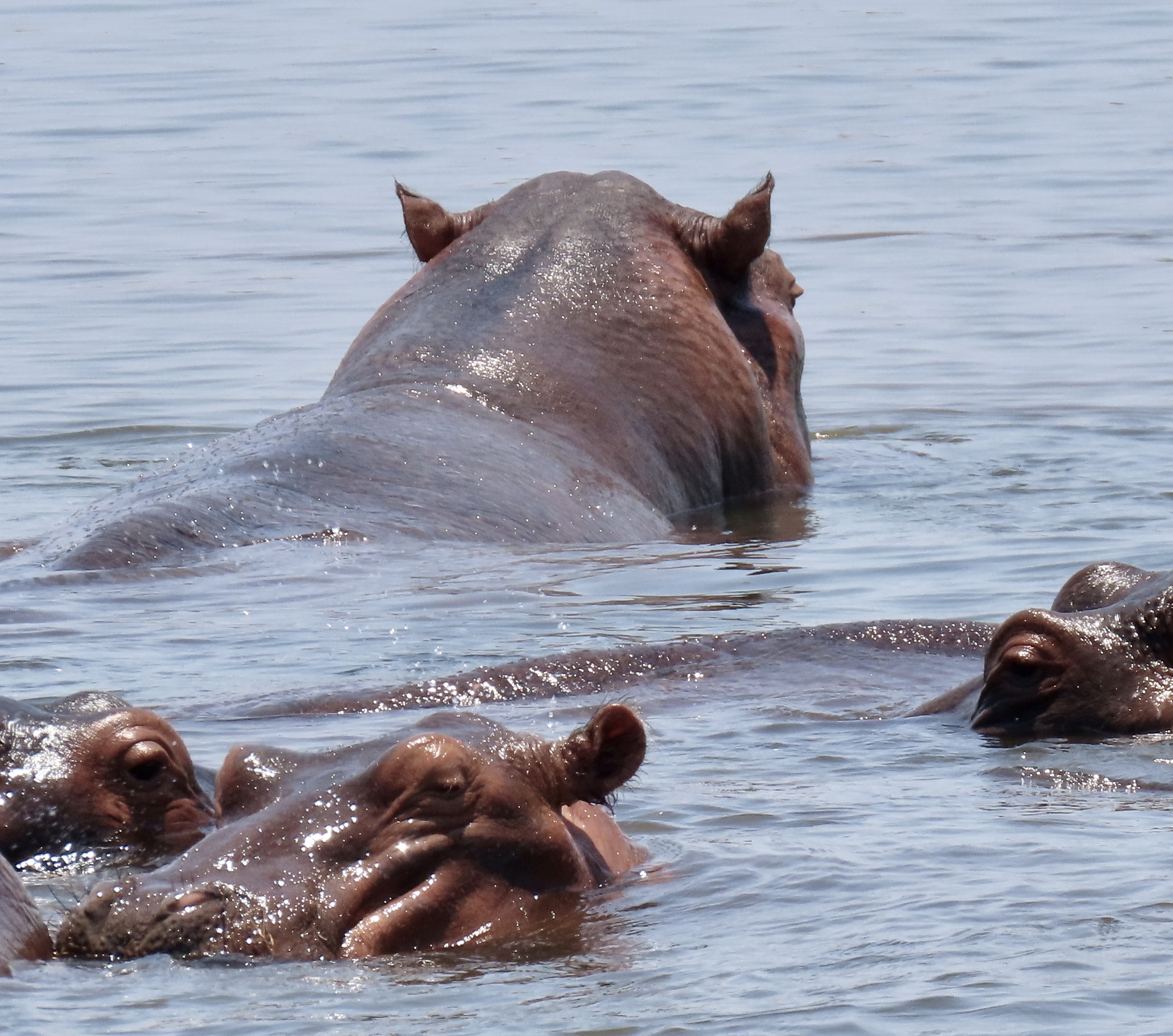
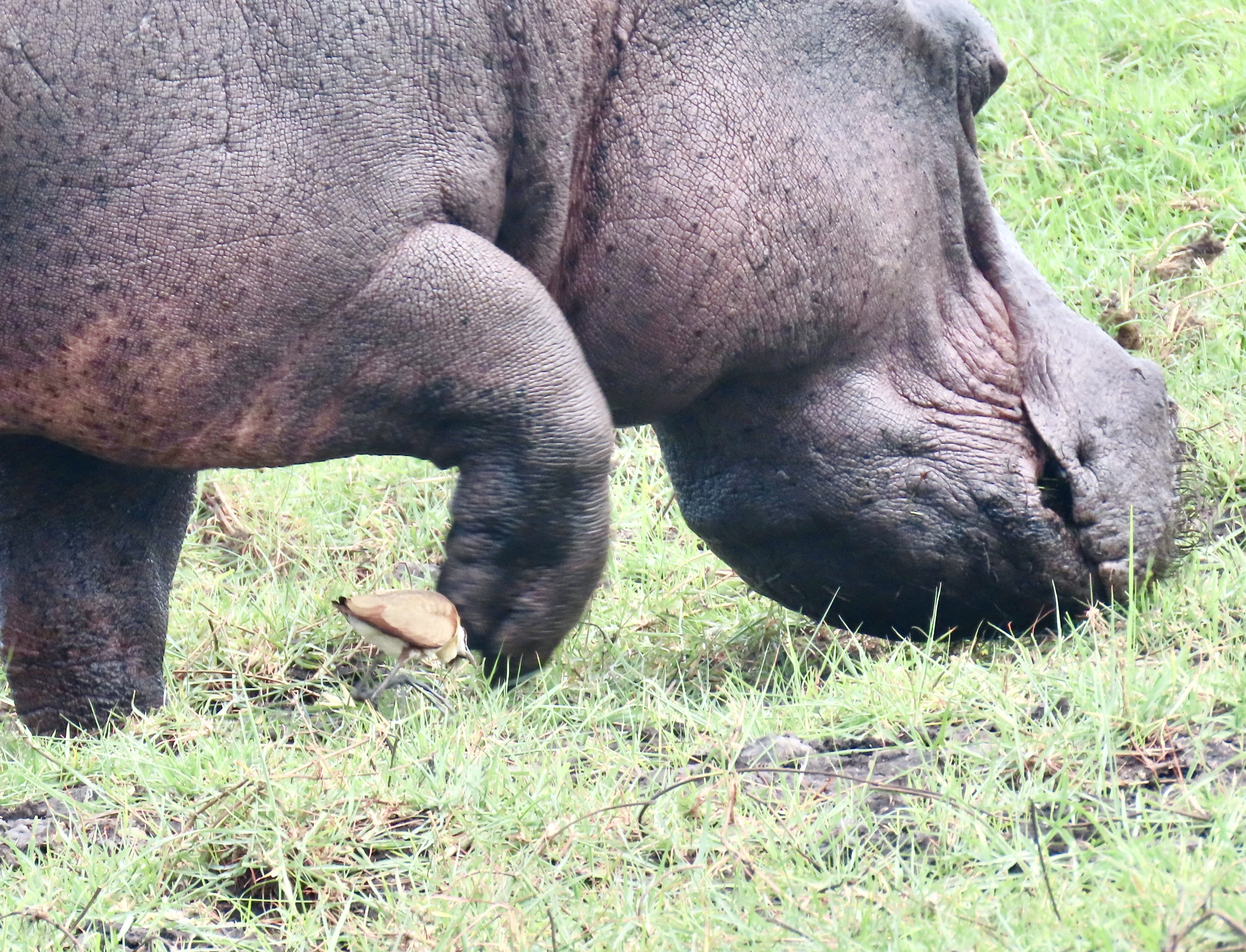
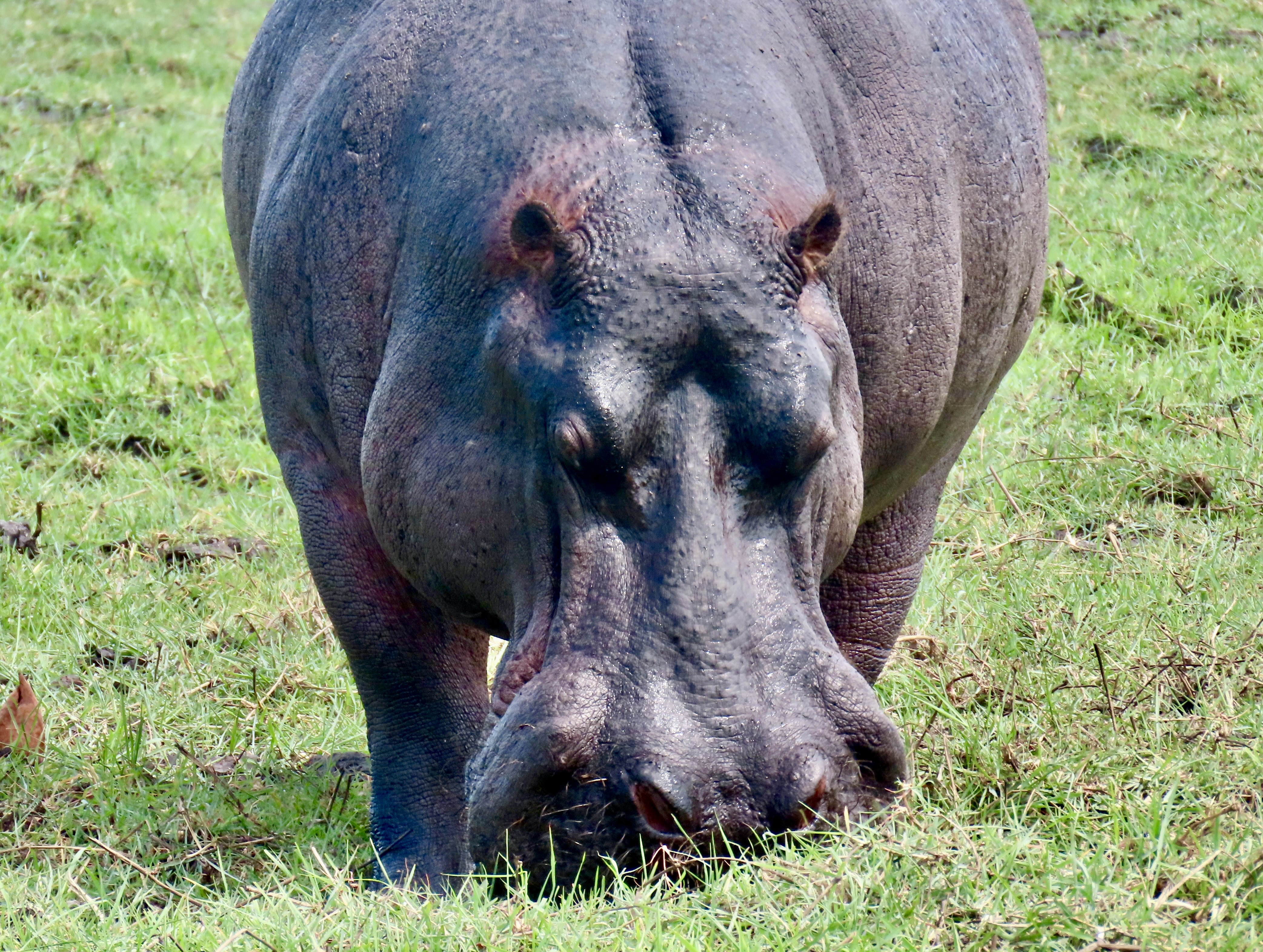
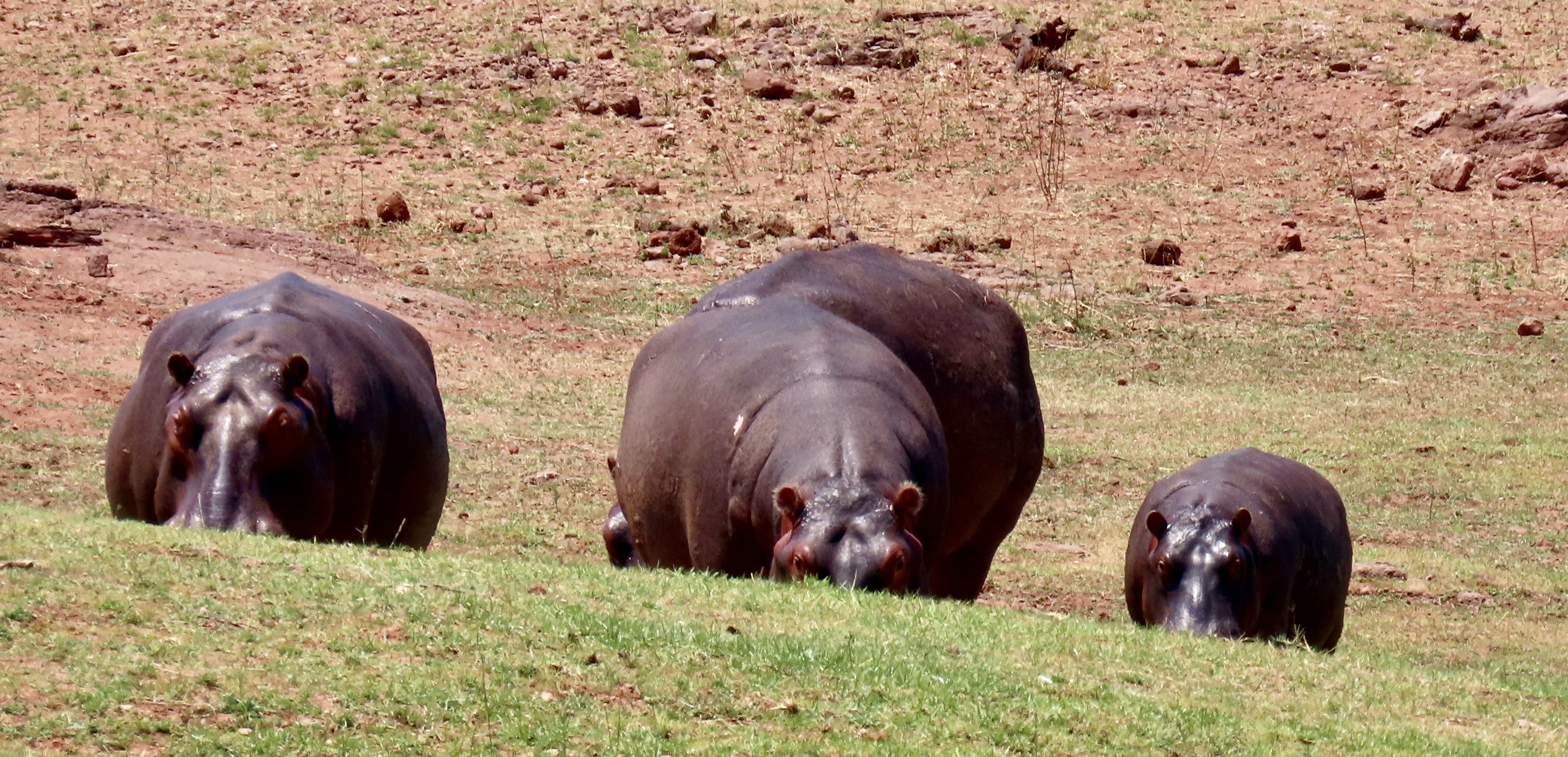
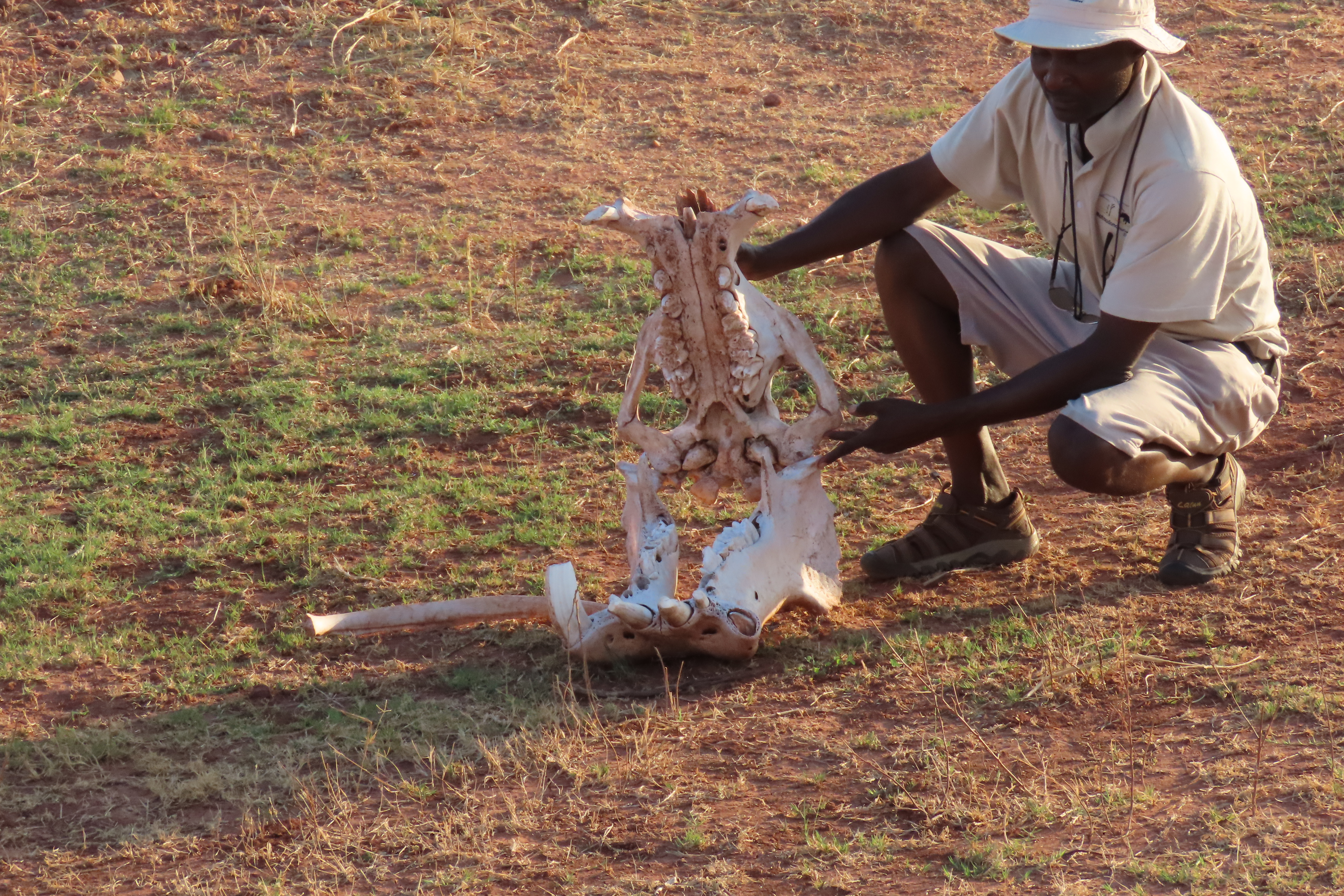
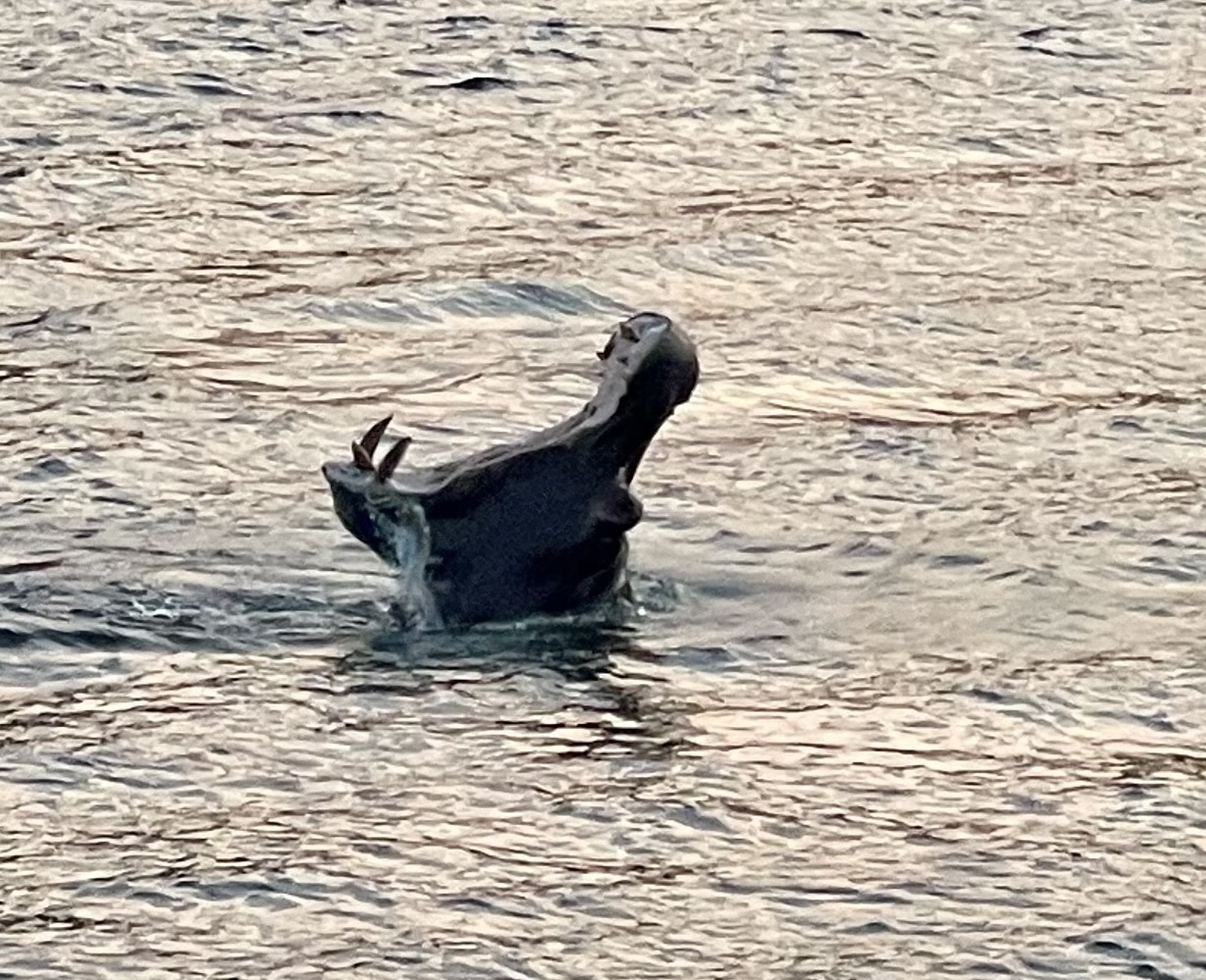
My new camera with its super long lens provided plenty of opportunity to get up close and personal with hippos. You could count the whiskers on this guy’s snout. Hippos spend around 16 hours a day in water. Their nose, eyes and ears are all on top of their heads. This allows them to be able to see, hear and breath while being close to submerged— keeping cool and protecting their skin.This is a common photo of hippos in water including males, females, and babies. They like to hang out together in groups of 10-30 known by such names as schools, pods, sieges or bloats. My favorites are the last two. If you were surround by these guys you would definitely feel like you were under siege. As our boat on Lake Kariba in Zambia approached this group of hippos, they were sinking under the water, a normal tactic.These hippos at Lake Kariba provided a photo op. “Okay, everyone, line up. And stop mooning the camera!”The sun was setting on this big fellow when we took our first boat trip on the Chobe River in Botswana. I’d say ‘bloat’ works here. An average female tips the scales at 3000 pounds while a big male can weigh up to 9000.Groups are normally dominated by a large male who is in charge of protection— and mating, which is mainly carried out in the water due to the weight factor. The gestation period is eight months. Moms give birth to one baby weighing 30-50 pounds. The babies can actually nurse under water.Hippopotamus is derived from ‘water horse’ in ancient Greek. Can you imagine trying to ride one? You would probably drown. They can’t swim. Their size and density makes them sink. But they are ideally suited for travel under water and can stay down for five minutes at a time. They actually walk or run along the bottom. Flaps over their noses and ears close automatically when they go under. A special lid covers their eyes. This fellow, BTW, is probably asleep. Hippos can sleep under the water for up to ten hours, automatically rising every five minutes or and so and sucking in air while continuing to snooze. Great whiskers.This was my favorite shot of hippos in the water. Is it a two headed four eared hippo? Grin. Huge odds are not… But I sure couldn’t imagine how they managed to arrange themselves this way. Going for a ride? Breeding? Maybe.The literature emphasizes that hippos stay in the water during the day and come out to graze at night. Fortunately, everywhere we went that included hippos, a few were out happily stuffing themselves on grass. They average around 80 pounds a night/day, traveling some 6 miles (10K) to get their fill. When out in the day, their skin exudes a protective layer that serves as sunblock. A pair of hippos grazing along with oxpeckers. (The birds peck off insects but they also peck holes in the hippos and drink blood. Hmmm, friend or foe?) I’m assuming this is a pair. Males tend to mate for life but are polygamous.Peggy and I took lots of close-ups of the hippos grazing along the river in Chobe National Park, Botswana. Check out the big tusks. They are used for fighting, not grazing.Any large African animal, be it hippo, elephant, Cape buffalo or giraffe, has a coterie of birds that follow along and catch insects the animals stir up.The little guys seem fearless. Is it grabbing an insect from under the hippo’s foot?We liked this head shot.Males are very territorial. It’s one of the things that make them so dangerous. And they have a unique way of marking their territory. They use their tails to fling poop. That’s what is happening here. The tail is moving so fast, it’s a blur. Remember the old statement, “When shit hits the fan.” You don’t want to be around. Hippos can actually fling their stuff for 10 meters, almost 33 feet. Be you man or beast, you might become toast (or possibly a pancake) if the hippo decides you are invading its territory. And they can run up to 30 miles per hour for a short distance, i.e. probably far enough.Imagine being on top of this small hill at Lake Kariba photographing a few tons of hippos as they come charging over. Fortunately, my telephoto lens allowed me to be a long way off.This hippo skull was beside a small road we were following into Matusadona National Park at Lake Kariba. Note the tusks.The park ranger who was taking us on the tour into the park, got out of our safari vehicle to demonstrate how far a hippo can open its jaw.Peggy captured the phenomena on the Chobe River. From a humorous perspective, it appears junior is getting a lecture on his behavior. “Next time you go near that crocodile, I’ll let him eat you!” And look how long the hippo is! A large male can grow up to 16 feet.This is the ultimate picture of a hippo opening its jaws and declaring a territorial challenge, or yawning. Everyone who goes on safari wants to capture one. Believe me, we tried. Our last opportunity was when we were on the Zambezi River outside of Victoria Falls. Unfortunately, we were on the wrong side of the boat. One of our tour group was glad to share.
I’m going to try something now in concluding this post that I rarely do: Share a video. We normally take several for ourselves but not for the blog. Too many oops. Handheld videography has its challenges! But this two minute video shows an excellent example of an elephant-hippo confrontation. It’s worth checking out, even with its occasional shakes. It’s almost funny as the hippo maneuvers his way through the elephants trying to show itself as harmless and submissive as possible— and only raises its head when the elephants are left far behind. You can almost hear its sigh of relief. Enjoy. Click twice on the photo to start the video. On our next post, we will feature giraffes, Peggy’s favorite animal.
A family of elephants, consisting of the matriarch, her sisters, kids and grandkids, head for a water hole in Hwange National Park, Zimbabwe.
Among elephants, family is everything— at least among the females. A herd normally consists of the matriarch, chosen for her leadership and knowledge, plus her sisters, kids, and grandkids. Females born into the herd almost always stay with it. The family can exist together for decades and beyond. The matriarch is expected to find water and food when they are scarce and provide protection when necessary. Her nurturing abilities are also quite important. The size of the group normally ranges between 6 and 20 elephants depending on available resources. New families are created when resources are limited, but they remain bonded to their original families. A celebration with much trumpeting of trunks, touching and general joy is shown whenever the groups meet up. The longer they have been apart, the bigger the party
Males leave when they are 12-15 years old to go off and live on their own, or to join a loose knit group of other males where an older bull provides leadership, protection, discipline and education. This dispersal guards against inner-breeding within the family and assures genetic diversity among herds.
The young male is normally around 30 before he is large enough and strong enough to get his first chance at breeding. His adventure is encouraged by what is known as musth, a period when his testosterone goes wild and he feels the drive to go in search of female companionship. Teenage boys will recognize this. (The hormonal imbalance of musth has an added characteristic of leading the males to be moody and dangerous. Guides recognize the condition and steer clear.) Off on his search for true love and romance, or at least sex, the young bull rumbles his rumble and— if he gets lucky— finds females with similar intentions who rumble back, often from several miles away. He makes a beeline for them, proving once again an elephant’s uncanny ability to communicate and find its way over substantial distances. Once he has done his job, he heads back to his group or solitary wandering, leaving the female to raise the kid. She’s not alone, however.
Gestation is a long, drawn out process. At 22 months, it is the longest among mammals. Baby is something of a relative term, given that the calf weighs in at somewhere between 200-300 pounds or more when born. The aunts and older female cousins stand in a circle around the newborn, trumpet in celebration, and kick dirt on it. At first I thought that maybe the dirt was an initiation ritual: “Welcome to the world, kid. It’s tough out there.” But actually the dirt helps protect the baby’s delicate skin from sunburn, a potentially serious problem. (As I write this, Peggy is sitting on a beach in the Caribbean soaking in the rays. She’s on a mother/daughter cruise with our daughter Tasha. I hope she remembered her sunblock. It beats the heck out of the dirt option.)
Raising a baby is a family effort with all of the females pitching in. Even the teenage females are given babysitting chores, a kind of on-the-job training. Education is big among elephants. It takes several years before a calf has reached the point where it can strike out on its own.
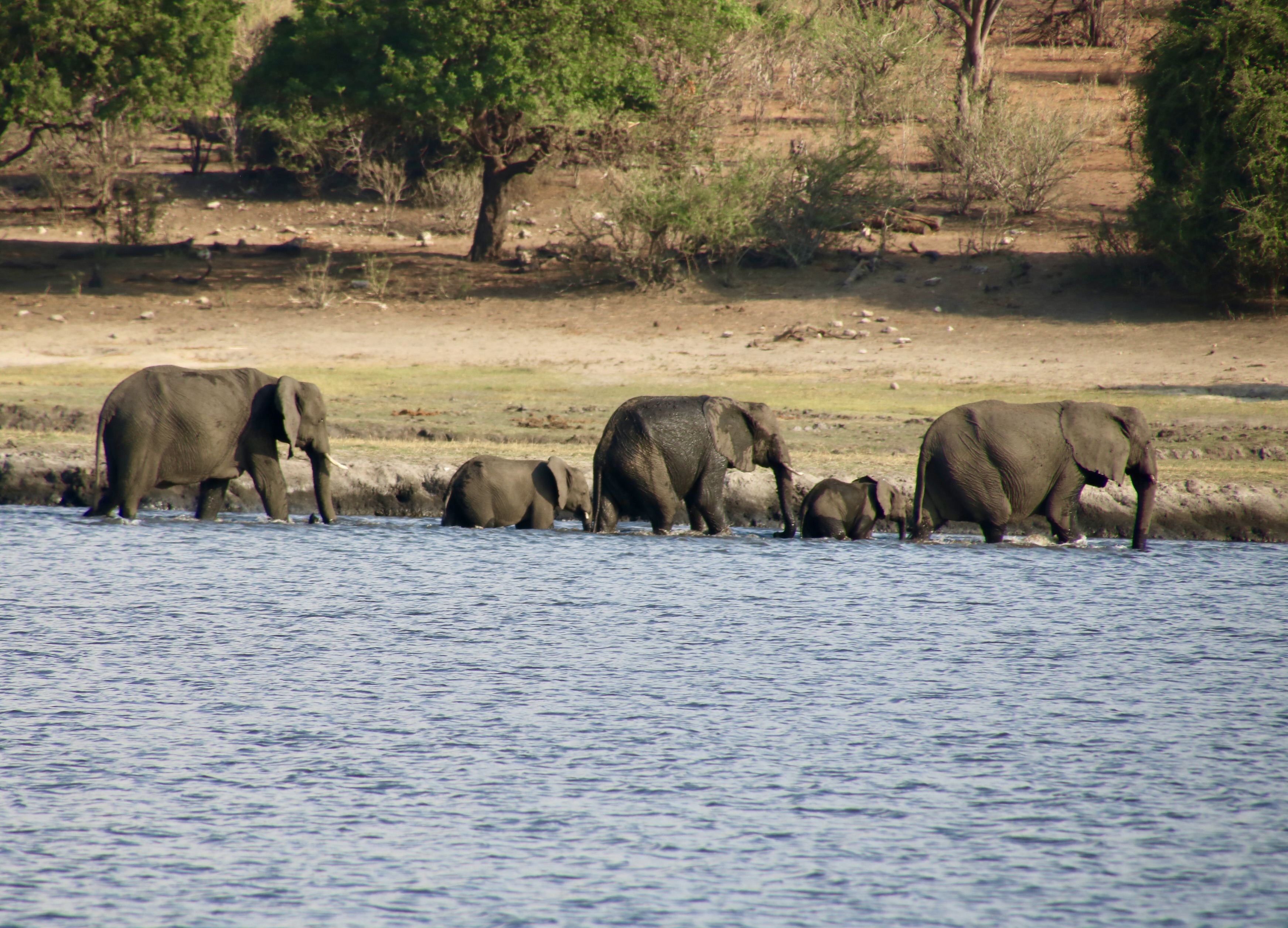
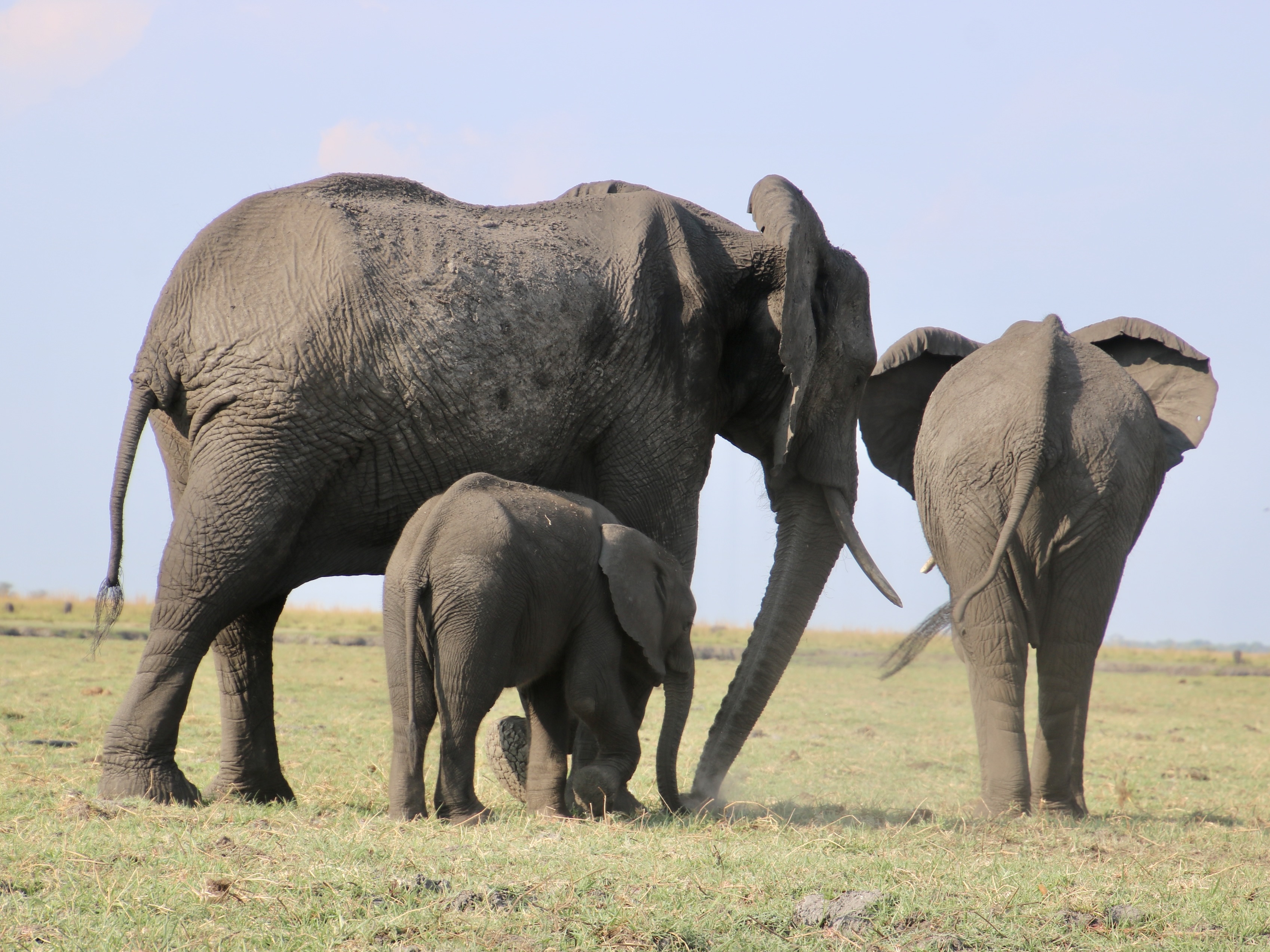
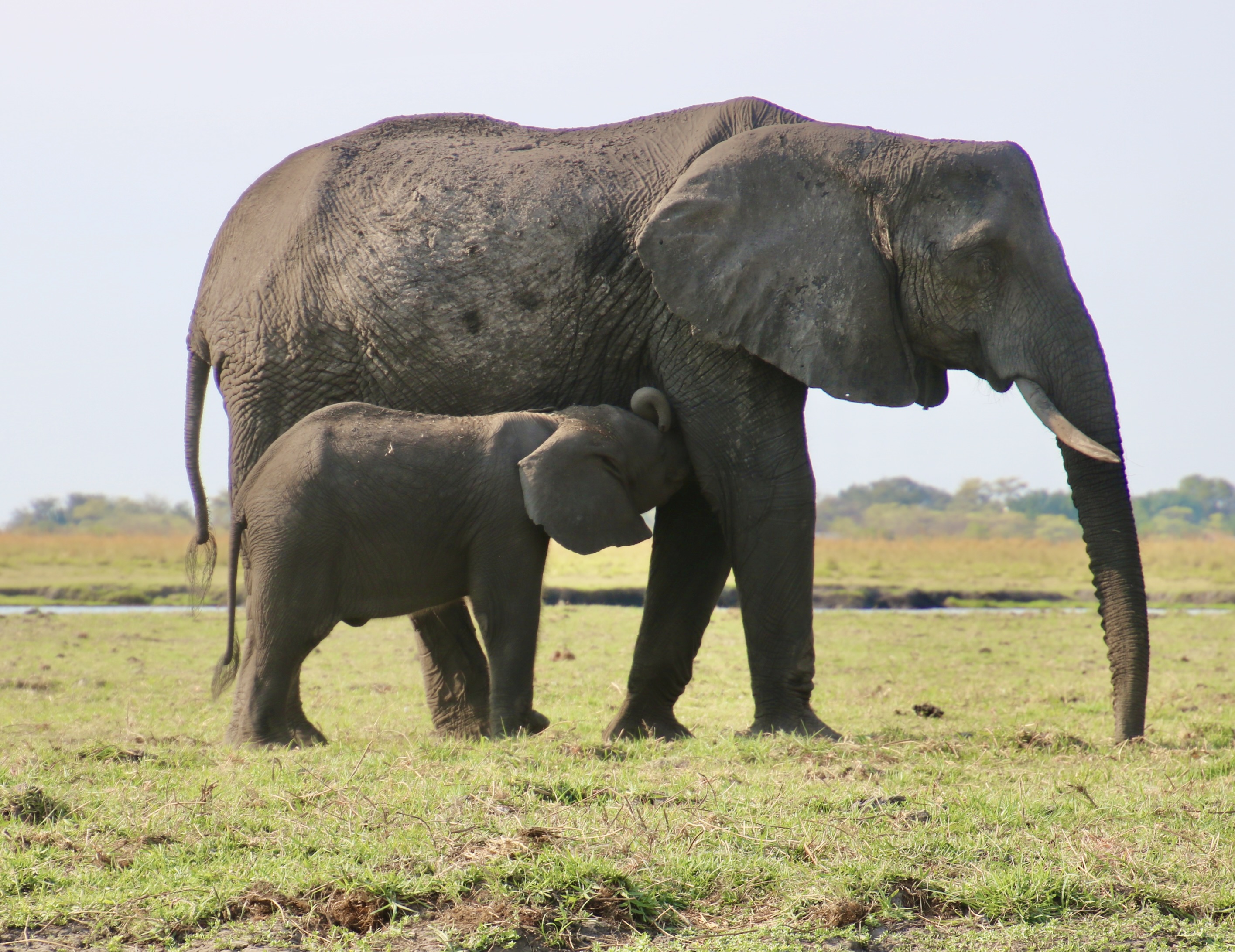
I’d say more than a baby bump. This female in Hwange National Park must be very close to giving birth. I expect it will be a stretch.Another family makes its way along the Chobe River in Botswana. Mom, a teenager and baby in Chobe National Park, Botswana. The baby is about to go for the gold: Mama’s milk.This is a case where the ever useful trunk has to be shoved out of the way.A close up. Momma is feeding herself at the same time. She is stuffing grass in her mouth with her trunk. Babies nurse exclusively for six months, and then off and on for a couple more years as they adjust to regular food. One way they learn what’s good to eat is to shove their trunk into their mother’s and aunt’s mouths to sample what’s on the menu. Some calves will continue to nurse on occasion right up to the time the mom delivers another baby! (When I was a young kid, we had a tomcat that continued to nurse long after he was bigger than his mom. I thought it was perverse and would throw cold water on him. Poor fellow.)An elephants mammary glands are located between their front legs, or ‘arms,’ like they are on humans and other primates.A final family portrait.There is one other grouping of elephants known as a clan, where many families and bond groups join together during dry season in areas where water and food are more readily available. The clan can number up to a hundred or more elephants and even includes bulls. This is along the Chobe River in Botswana. We were lucky to be there at the end of the dry season when everyone was still hanging out. After the rainy season starts, the families disperse throughout the National Park.
This post was twice as long. I had every intention of wrapping up elephants today so I could head on to hippos. They are getting impatient— and no one wants an impatient hippopotamus on their hands. Believe me. A nagging voice in my head suggested this post was too long, however. So I’ve scheduled the last half to go up on Monday where I will talk about such things as big brains, migrating teeth, 5 inch eyebrows, the fact that elephants can’t jump, and why they poop so much. Hint: It’s not rocket science. If you eat 350 pounds of food a day and have a poor digestive system, guess what…
Do you feel a little bit nervous about what’s waiting for us in 2024 as we all travel around the world and the US— like maybe we will be up to our tail-bones in crocodiles? Peggy and I photographed this fine fellow on the shore of a small pond in Chobe National Park, Botswana.
2023 was a great travel year for Peggy and me with our trip up the Nile in the spring, 10,000 mile road trip around the US in the summer, and safari visit to southern Africa in the fall. I’ve been blogging about these experiences and will continue. I never get caught up, but, on the other hand, I never run out of material. Grin.
We also have fun travel plans for 2024. The highlight will be a three month road trip up the Pacific Coast from Big Sur to Olympic National Park. It will include some of the world’s greatest ocean scenery and is an area that I have returned to time and again during my life. A trip to the Everglades next month and a trip up into the New England states and possibly Canada’s Atlantic Provinces is scheduled for this fall. We plan on finishing off the year in Costa Rica for a month (or some other warm tropical place). Maybe we will be looking for a place to live…adding to our choices for “base camps.”
I’m a little nervous about 2024. Who knows what global warming will do to our travel adventures. We plan on being flexible. That’s one advantage of doing most of out wandering this year with our pickup and small travel trailer. At the first sign of a flood, forest fire, tornado, hurricane, or snow storm, we’re out of there! We will also memorize the earthquake/tsunami escape routes when we are driving/camping along the West Coast. One never knows when the next big one will strike.
Then there’s the election: No escaping that. We’ll do our bit to support rational, humane, environmental friendly decisions but keep it to a bare minimum on “Wandering through Time and Place.” Peggy’s and my focus will continue to be on the beautiful, the quirky, and the historical. We believe our followers deserve to have somewhere they can go that maintains a sense of perspective and humor. Speaking of humor, here are a few photos from this past year that possibly relate to 2024:
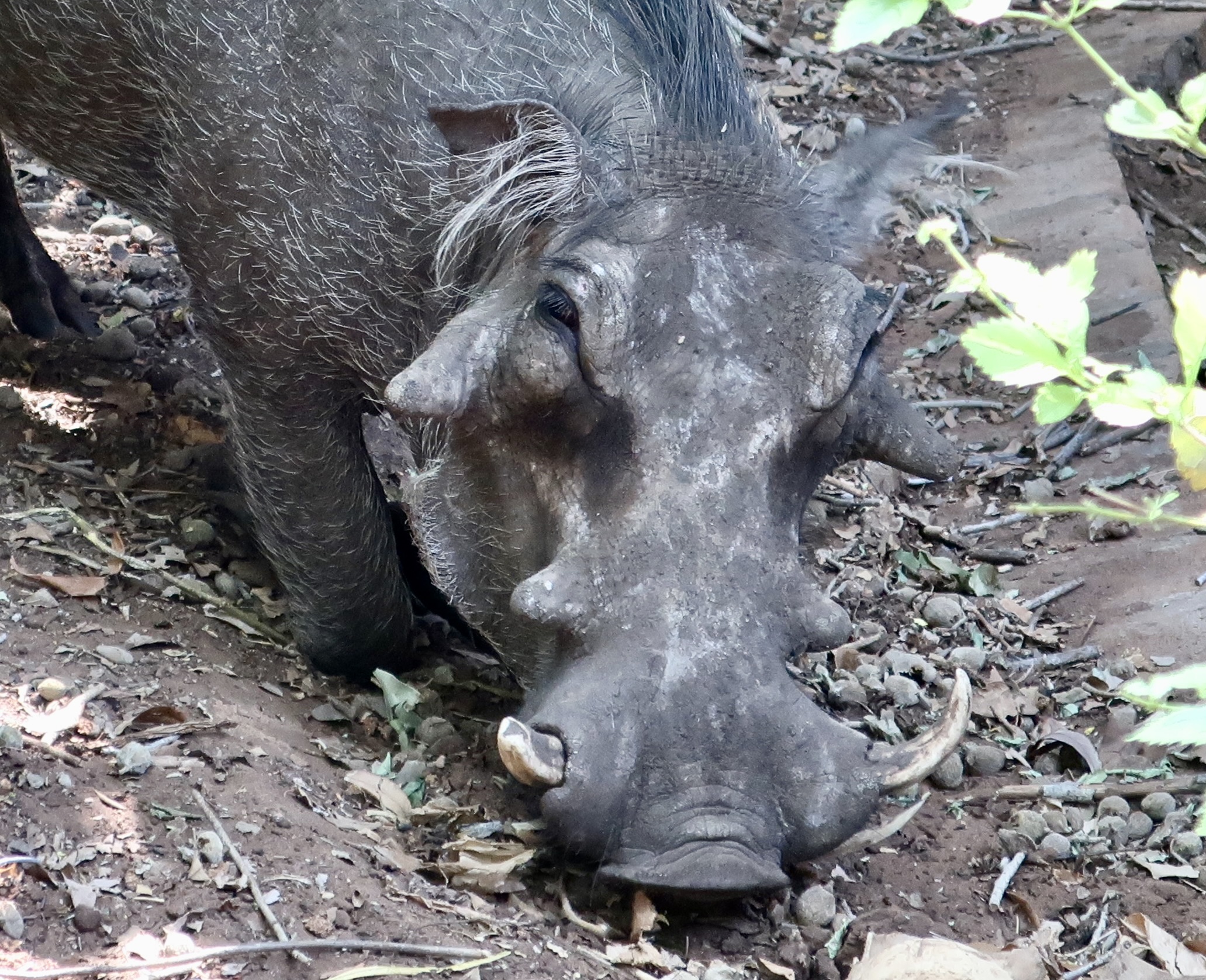
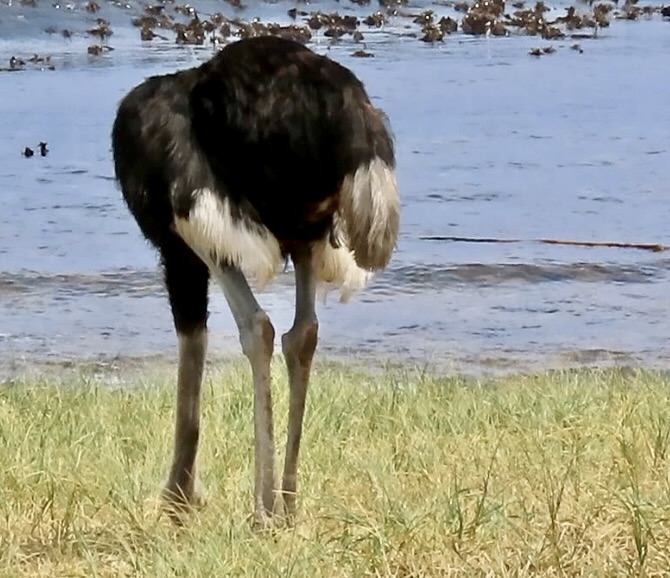
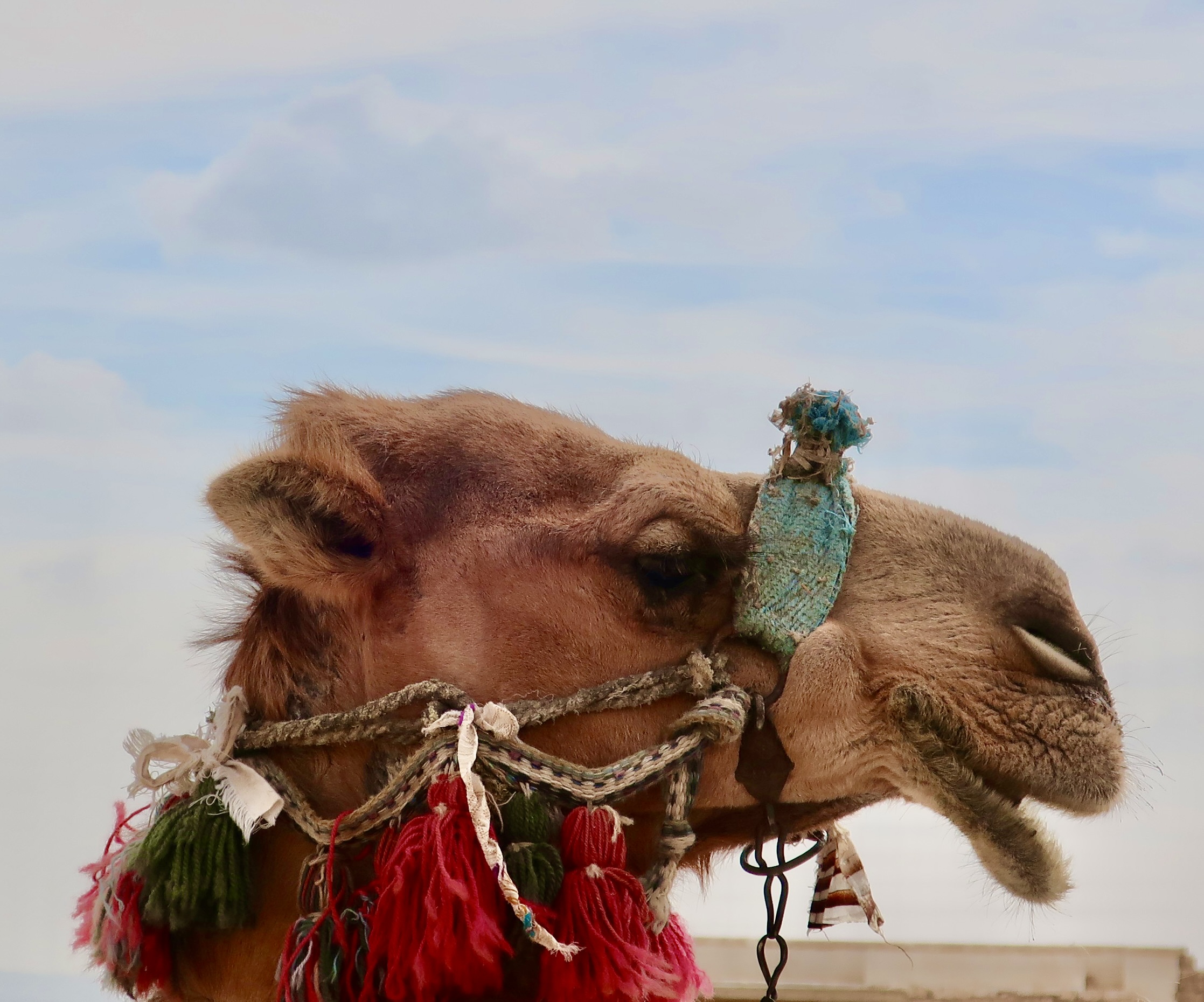
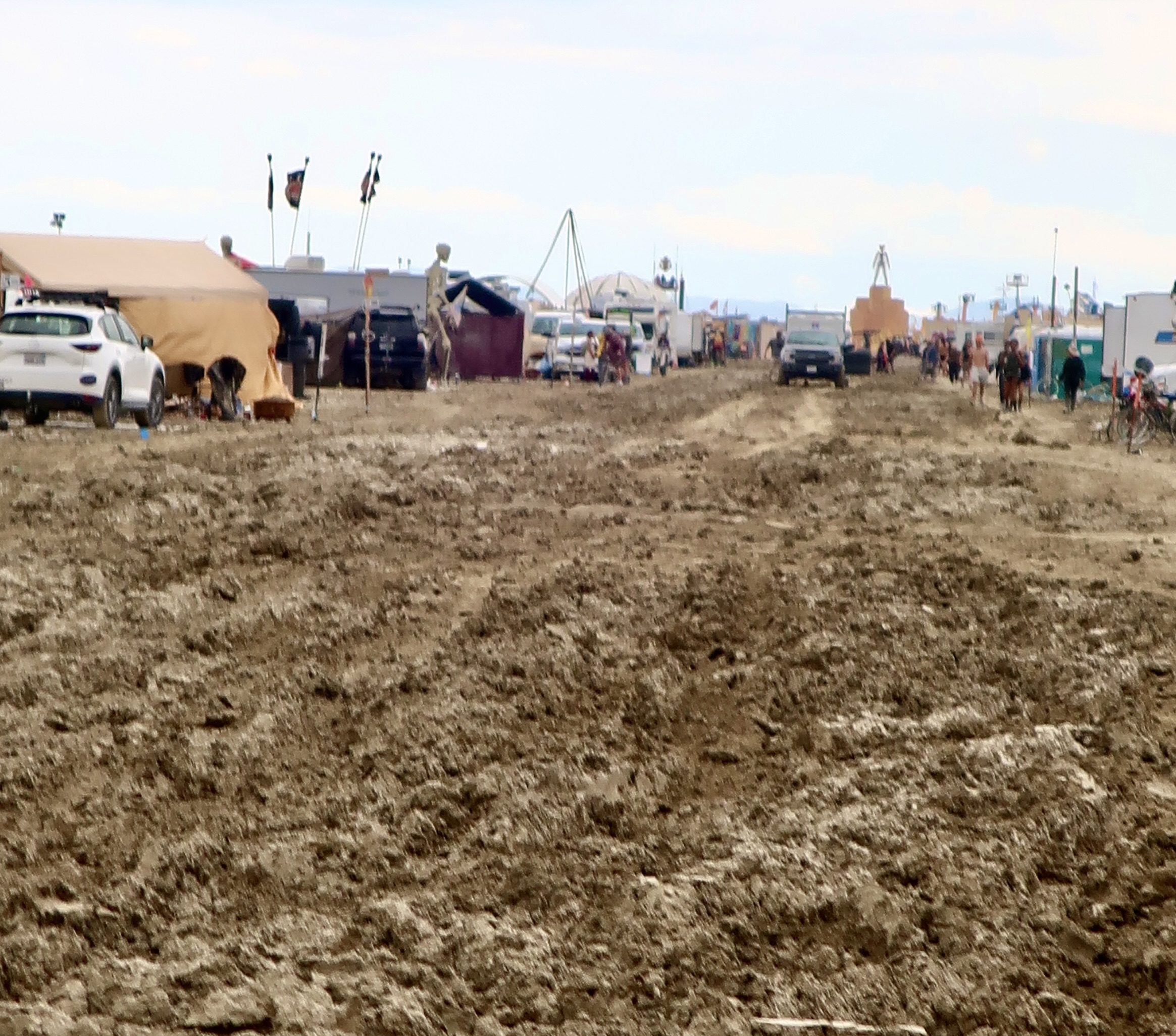
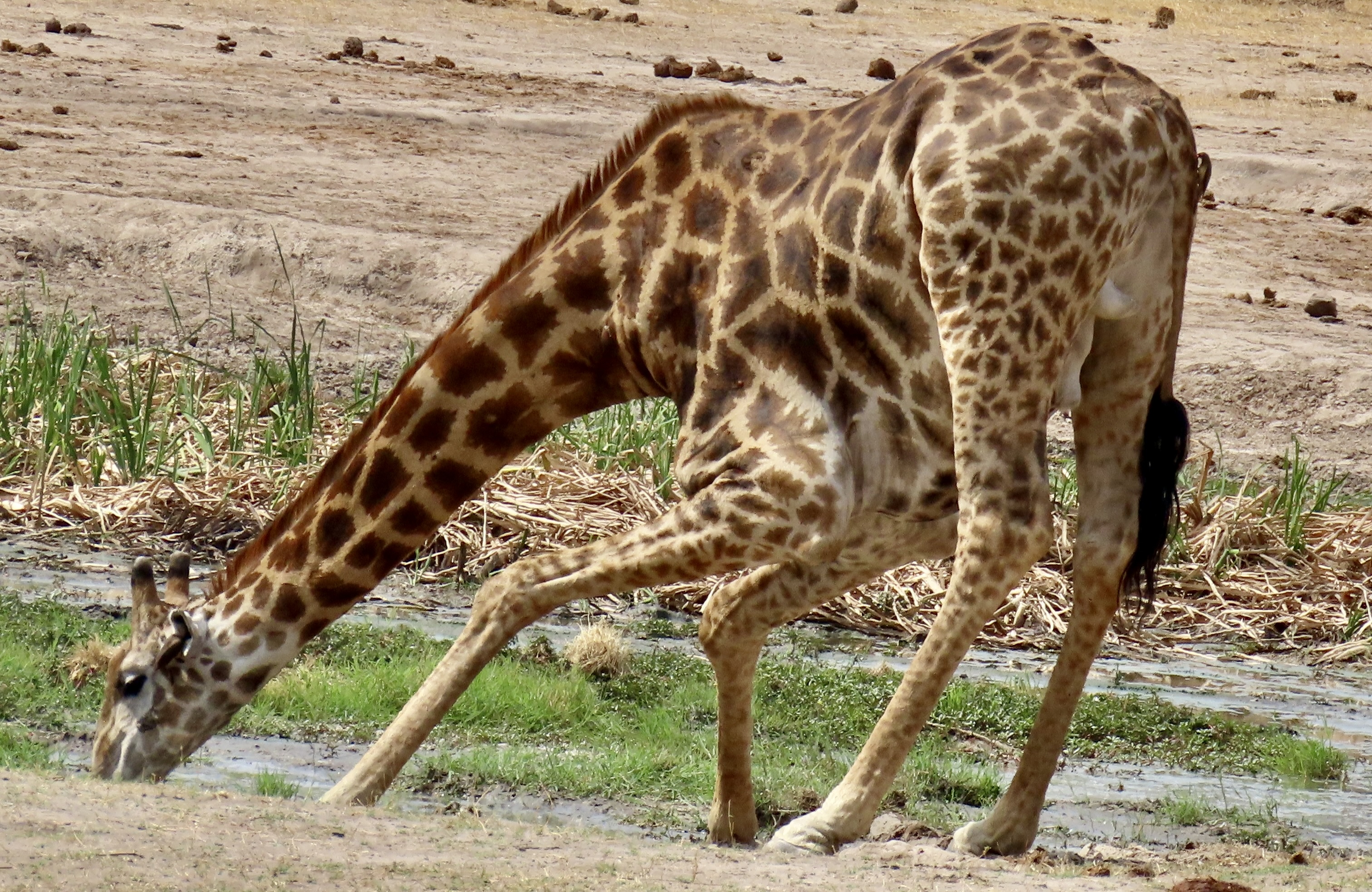
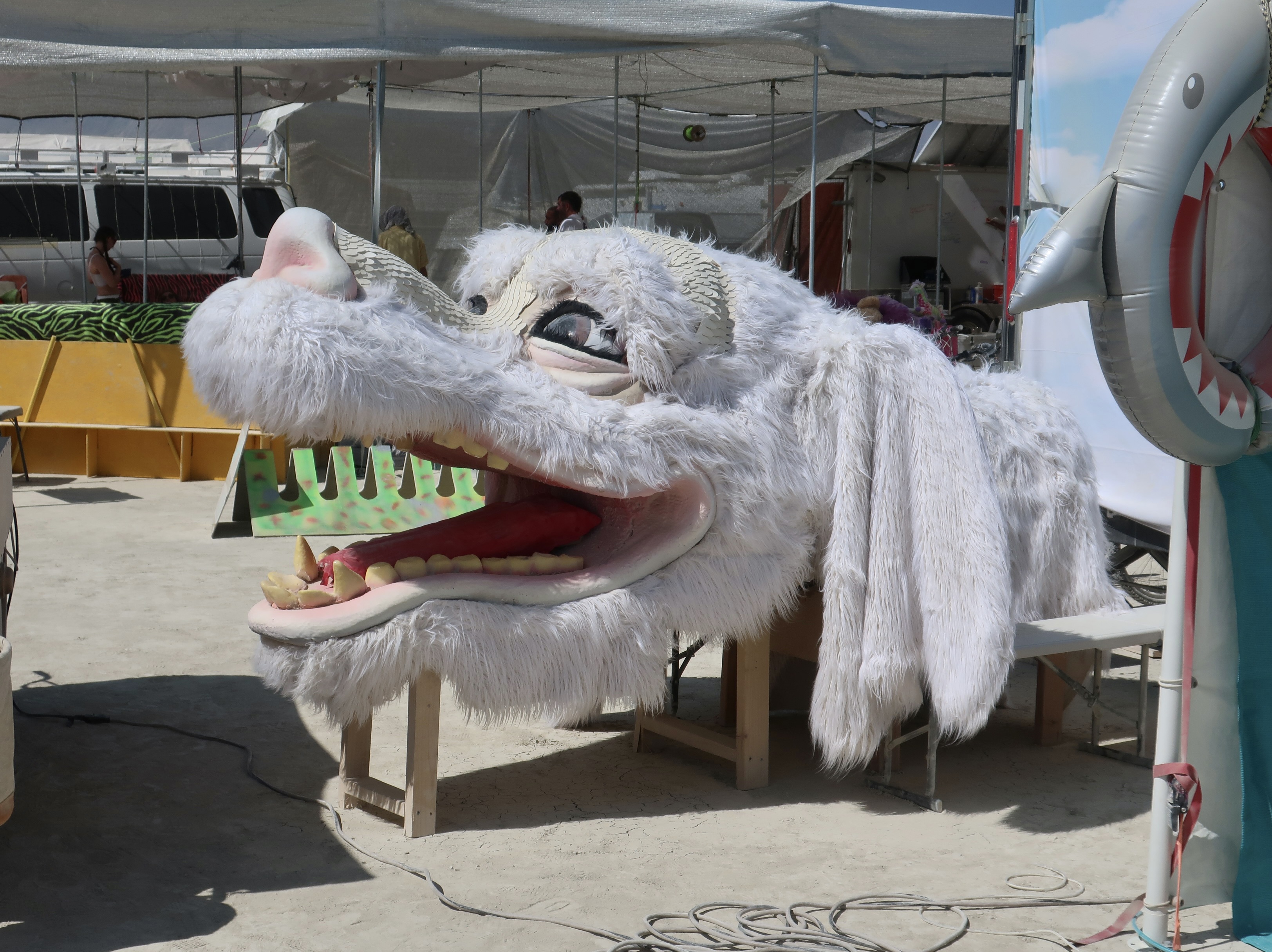
How’s this as an approach for 2024? Peggy and I photographed this ostrich in South Africa, a mile or so from the Cape of Good Hope. Was it burying its head in the sand or being hopeful? Actually, it was being practical, stuffing its mouth full of grass.If times really get bad, a nice mud bath may be the solution. It worked for the elephants and it worked for this warthog in Hwange National Park.Lacking mud, this buffalo we photographed in Theodore Roosevelt National Park in North Dakota last summer, opted for a dust bath! Whatever works. Is that an ecstatic grin on his face?This camel we photographed at the Pyramids seemed to have something to say about the situation…As did this cat hanging out in the Alabaster Mosque in Cairo.It’s more than likely that mud will be flung every which way as the campaigns get under way. This is from our trip to Burning Man last August.It’s likely to get deep!Maintaining balance may be challenging. We caught this giraffe drinking water in Hwange National Park, Zimbabwe.Maybe we will get lucky, however, and Falcor, the Good Luck Dragon from “Never Ending Story” will come to our rescue. He was hanging out at Burning Man.Possibly there will be a rainbow along with all of the rain and mud as there was at Burning Man.And we will end up the year with a smile on our face like this small hyrax we found perched on Table Mountain overlooking Cape Town, South Africa. The hyrax’s closest relatives, BTW, are the elephant and the manatee!
Whatever happens, Peggy and I want to wish you and your family a happy and healthy New Year in 2024. And safe travels! Next post: We will take a look at the closely knit elephant family and the matriarchal society that holds it all together.
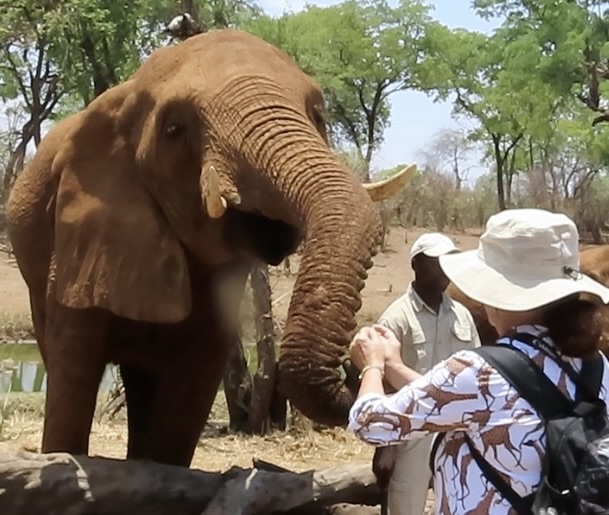
Elephants are fascinating creatures, no doubt about it, and one of the most fascinating things about an elephant is its trunk— which is the subject of today’s post. This one was waiting for Peggy to toss food into its mouth at the Wild Horizons Elephant Sanctuary and Orphanage just outside of Victoria Falls, Zambia. The elephants weren’t wild exactly, but definitely fun, interesting, and educational.
Peggy and I, along with our traveling companions, her brother John and his wife Frances, spent a lot of time watching and photographing elephants on our recent safari to Botswana, Zambia, and South Africa. Most of the time, they were doing something with their trunks. These marvelous appendages are used in breathing, smelling, eating, drinking, bathing and communication. Today’s post will focus on the trunk. My next post will consider other interesting facts about elephants, including their tails.
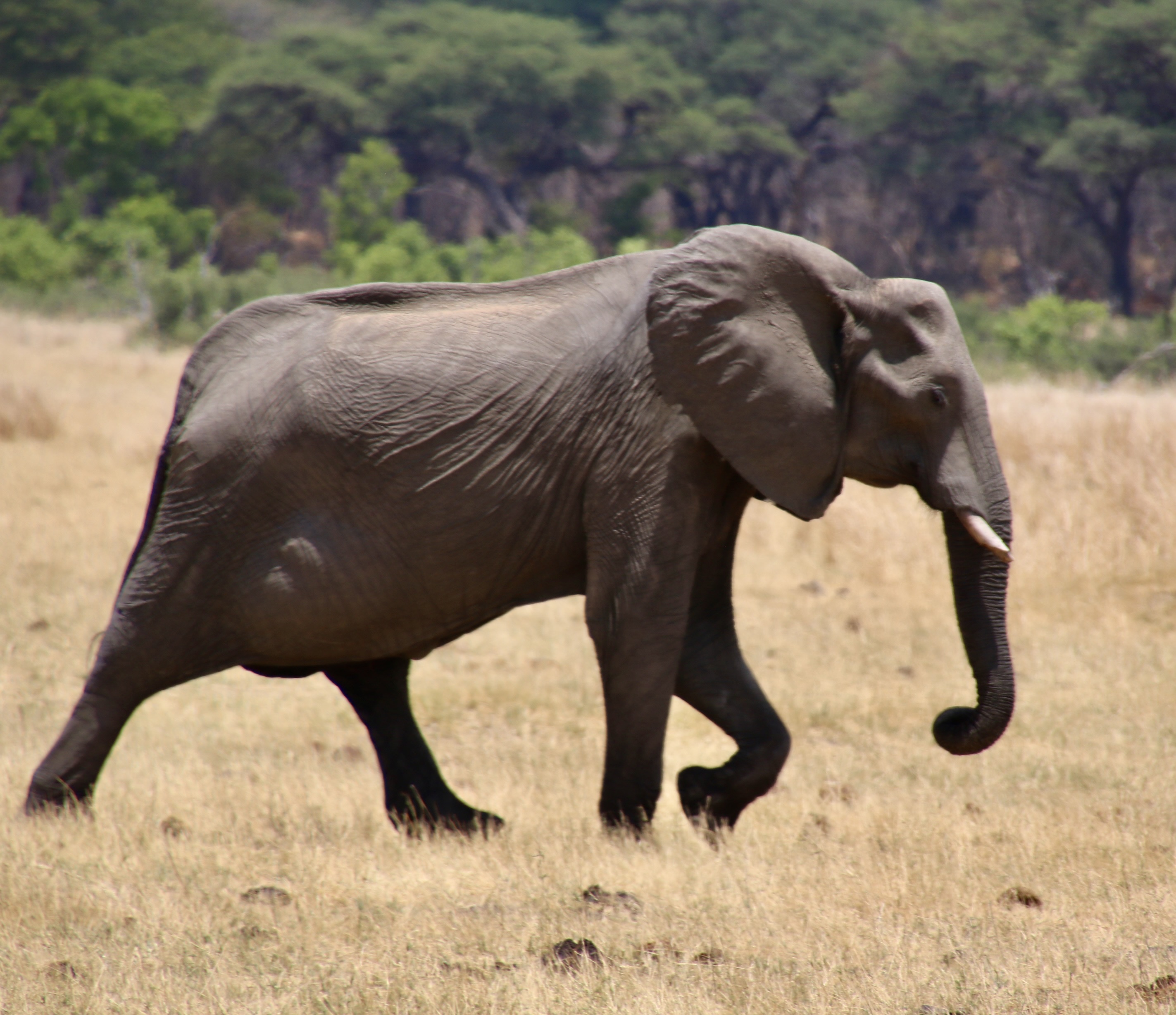
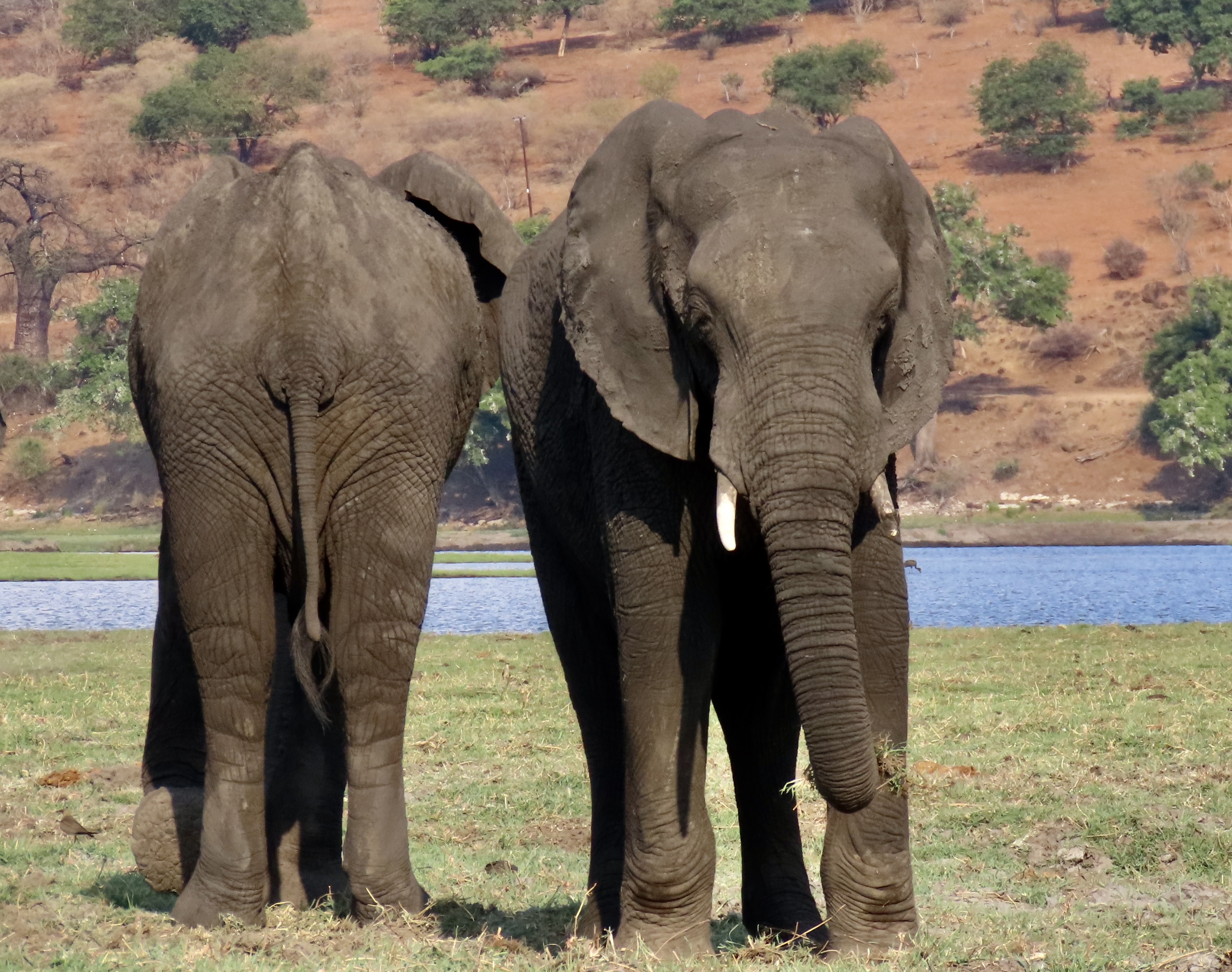
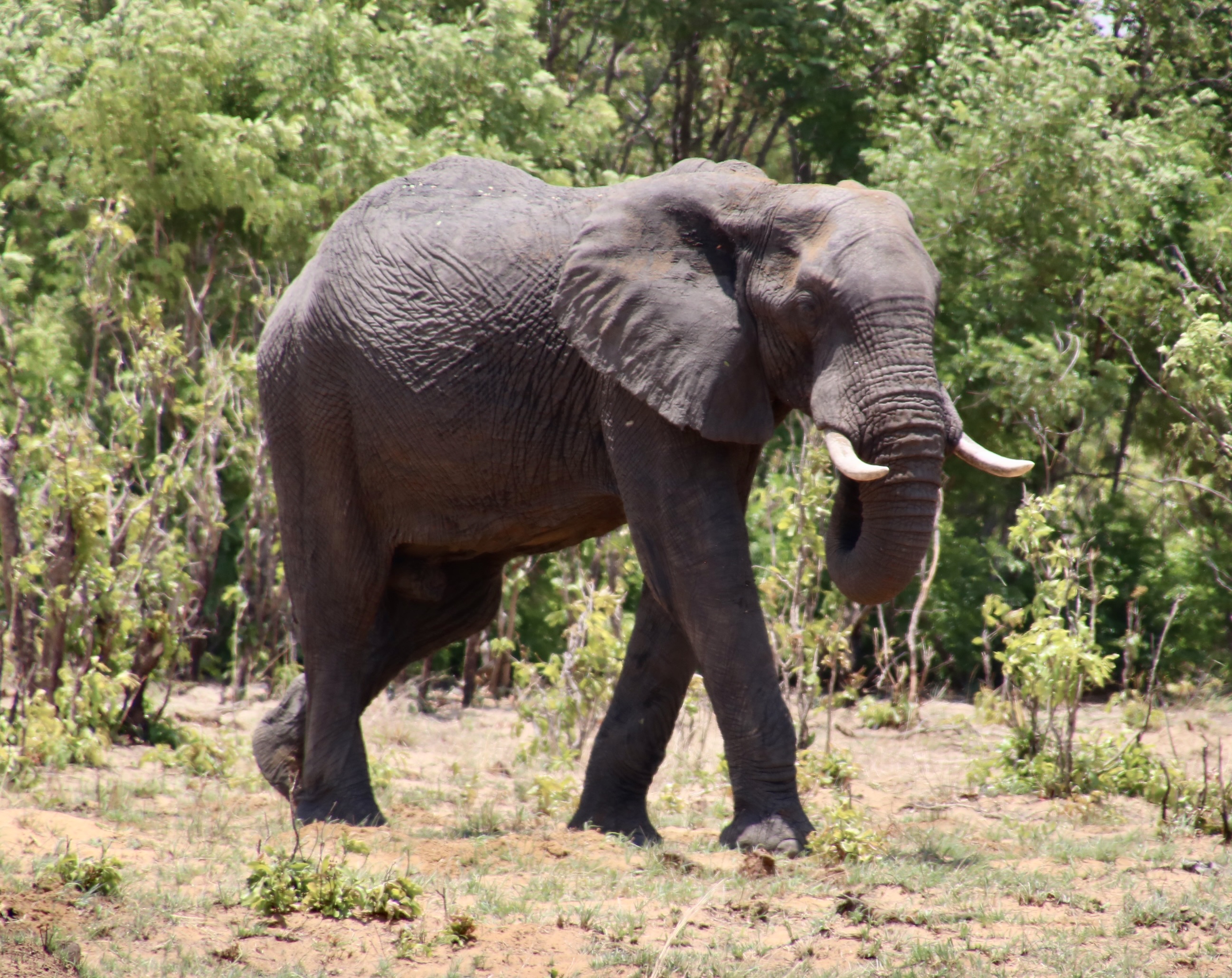
You know how hard it is to get a wild elephant to pose? Grin. We were more than satisfied to watch and photograph them wandering around doing elephant things. These two were focused on eating next to the Chobe River. But they also provided an excellent illustration for my next two posts that are going to be focused on looking at elephants from trunk to tail. It would have helped had they switched positions, but they didn’t listen to my suggestion. The elephant on the left is using her foot to kick the grass and free it from its roots. The one on the right is about to shake the dirt out of the grass she has gathered.
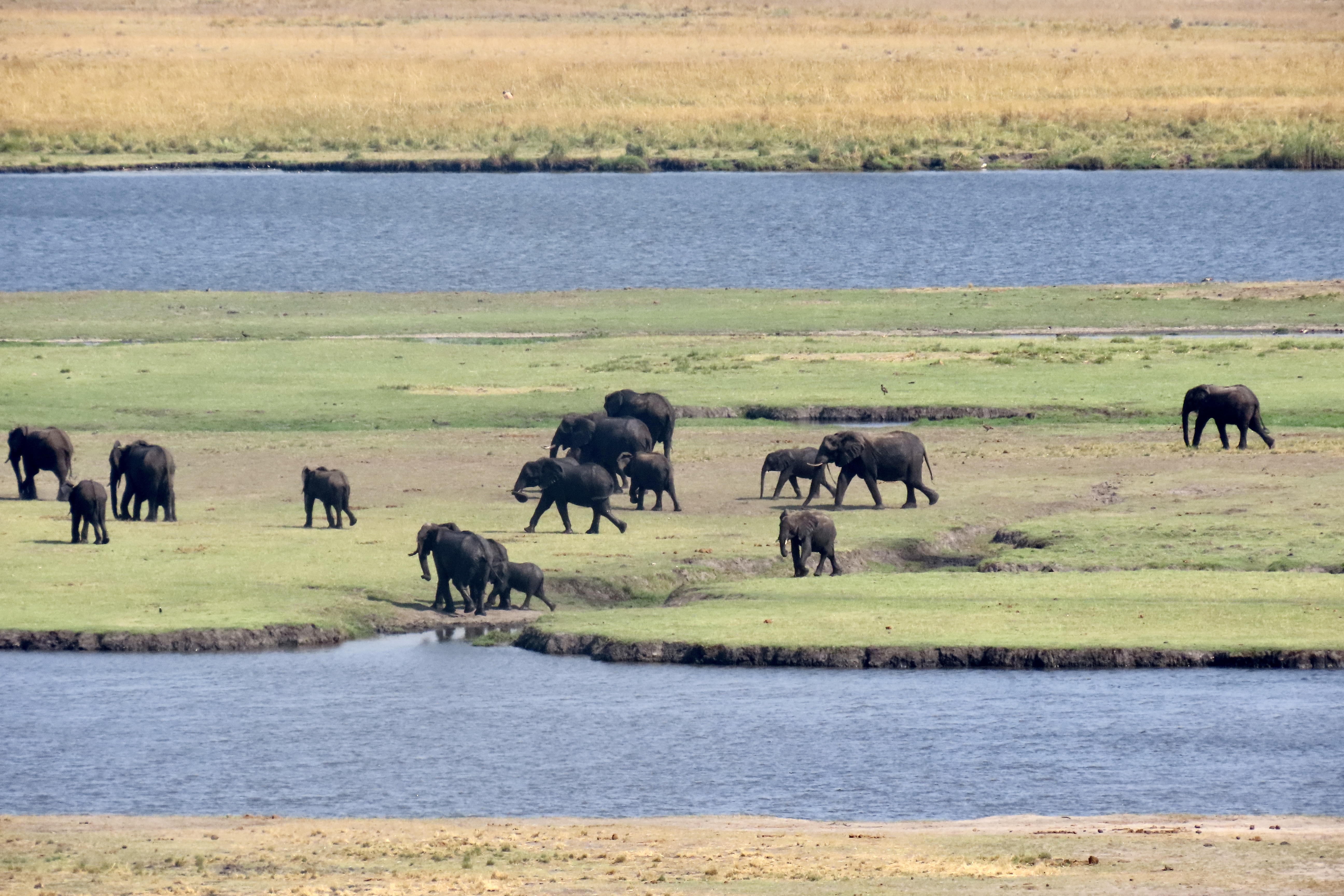
Our opportunity to watch and photograph elephants took place in four different locations. The first was Chobe National Park in Botswana. One of the Park’s claims to fame is that it supports the largest herd of free-ranging elephants in the Africa. Since we were at the end of the dry season, many of these elephants were located next to the Chobe River where they could get water and food. Viewing them was easy, particularly from boats. (Ours was docked at our safari lodge on the edge of the river.) Chobe is an excellent area to see wildlife. The only downside is that this means you will be sharing your experience with lots of other people.
There was no challenge finding elephants along the Chobe River in October at the end of dry season. With the coming rains, they will spread out across the park.
Hwange National Park and Matusadona National Park in Zimbabwe were the other two areas we watched wild elephants in their natural setting. Both parks had far fewer people on safari and were far less crowded. Slightly different, but excellent for meeting elephants up close, the Wild Horizons Sanctuary and Orphanage for Elephants just outside of Victoria Falls allowed us to interact with these giants of southern Africa’s velds. All of the elephant photos in this post and the next one were taken by Peggy and me in these four locations. I’ll start with the Sanctuary since we were able to get close ups of the trunks.
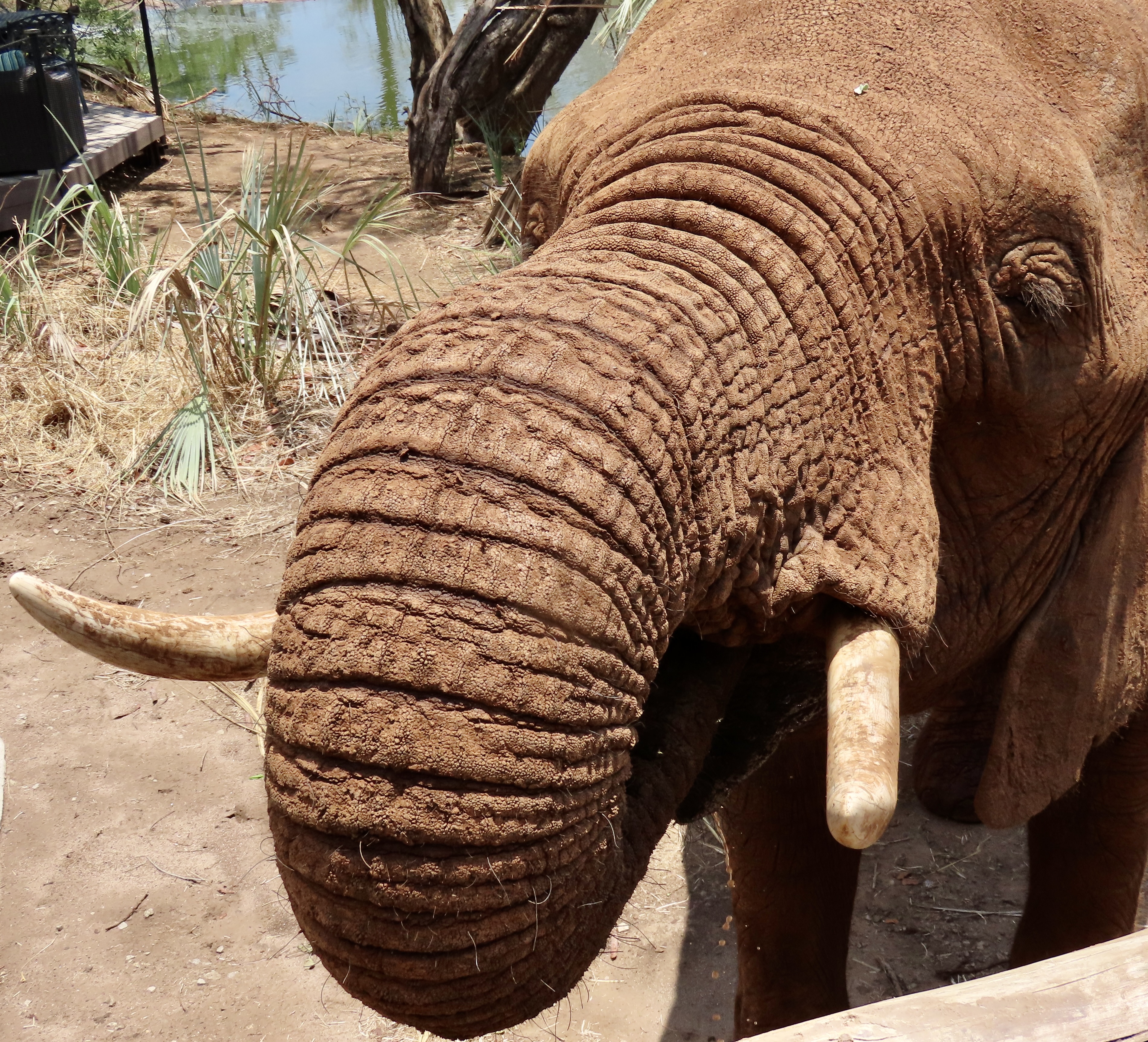
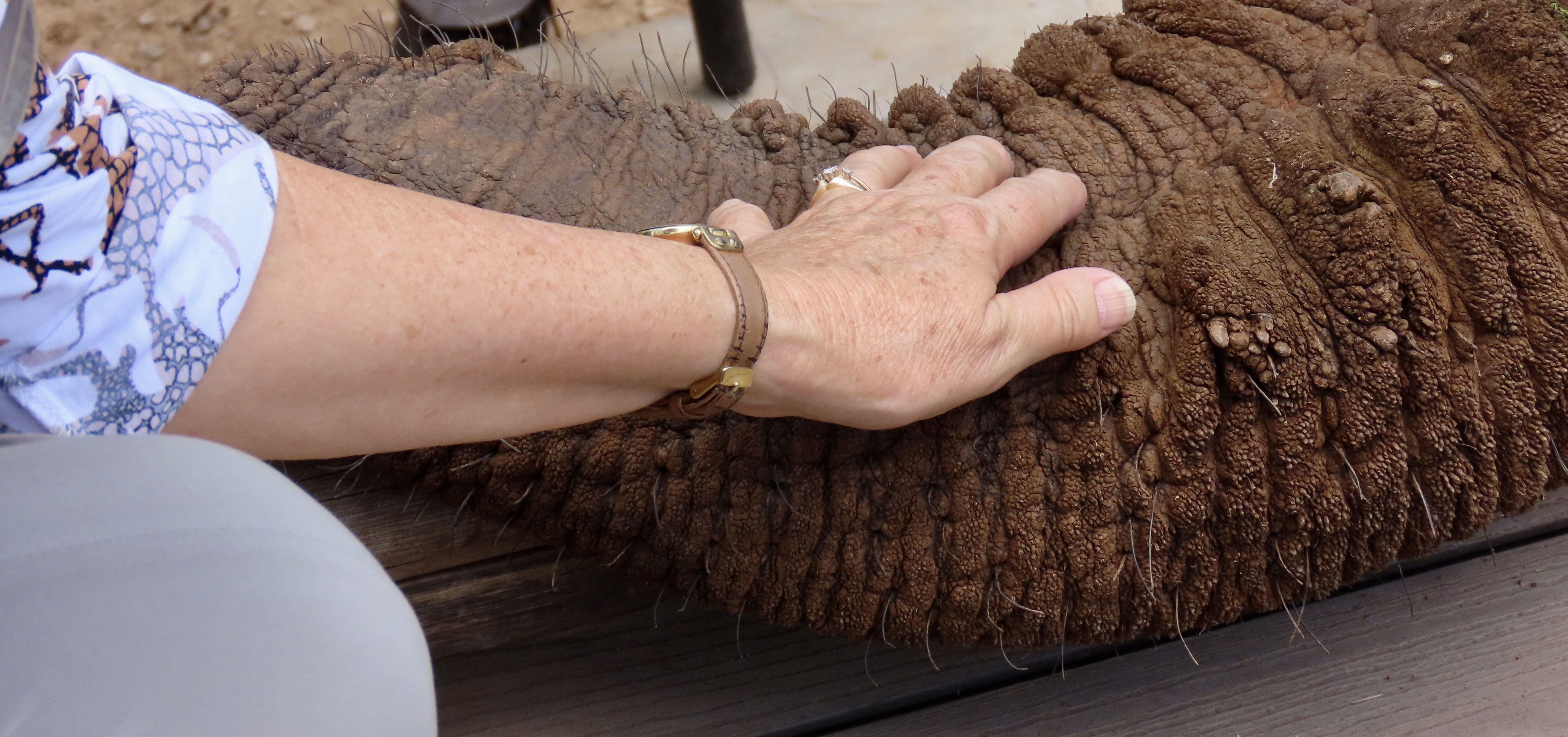
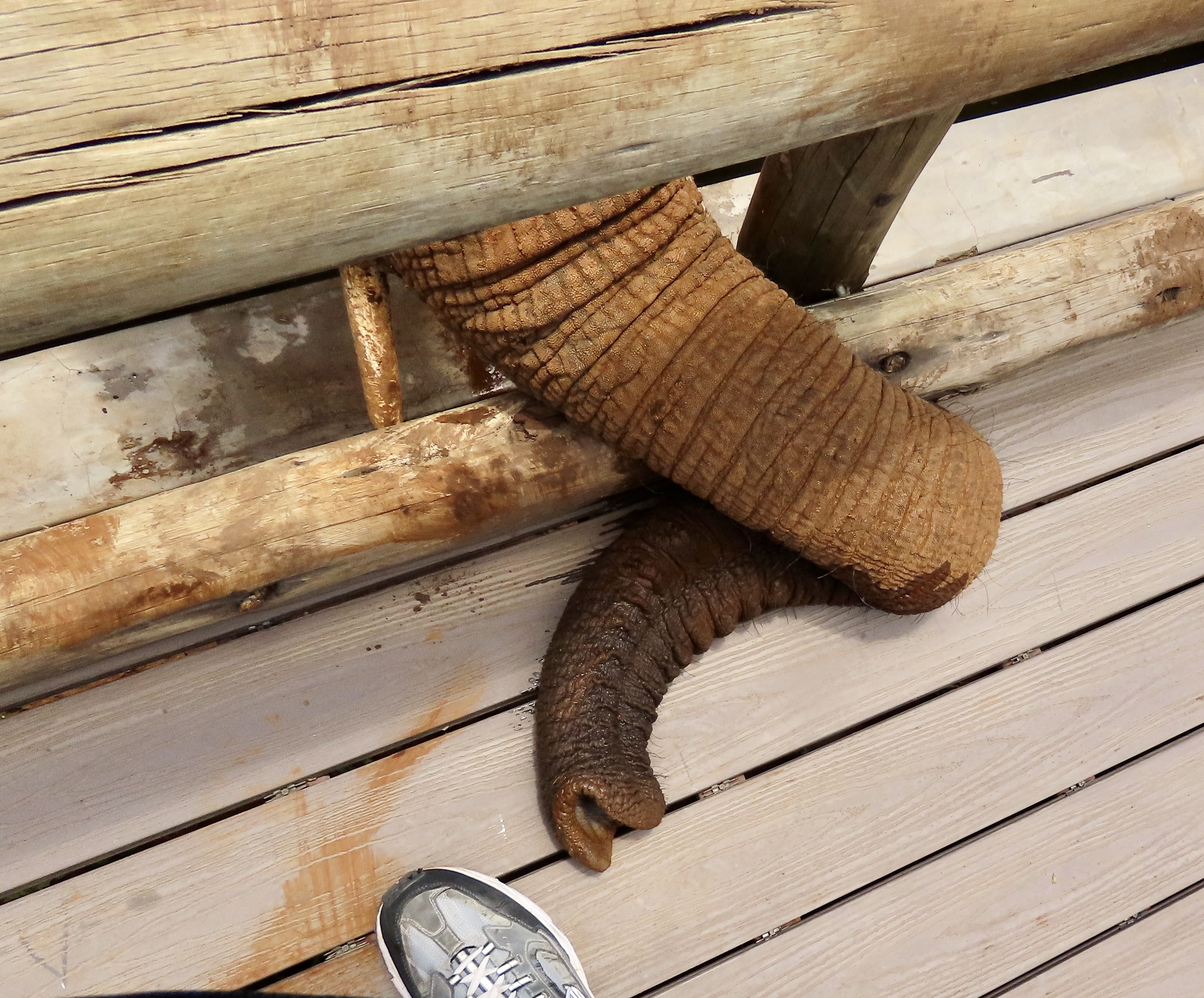
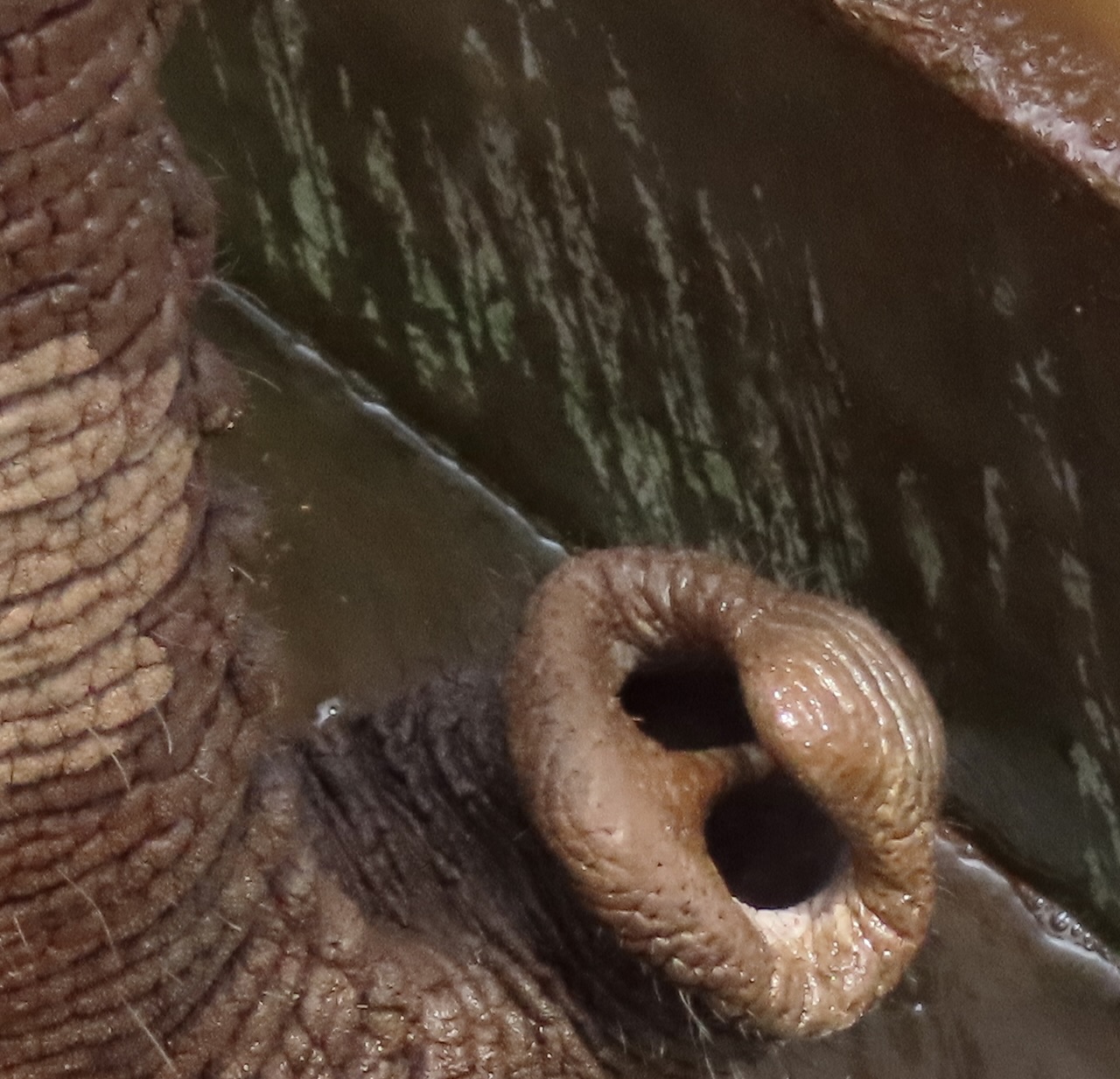
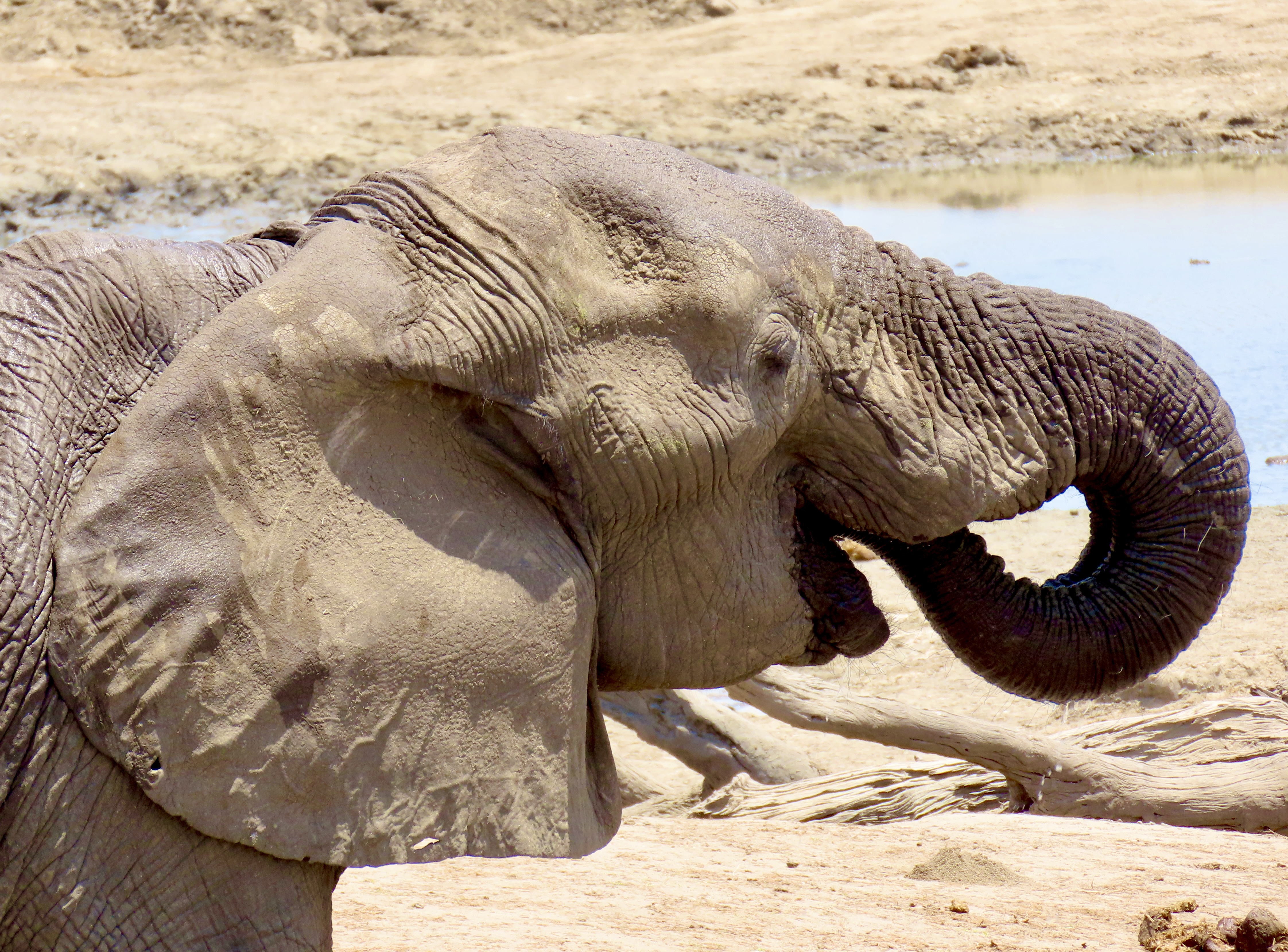
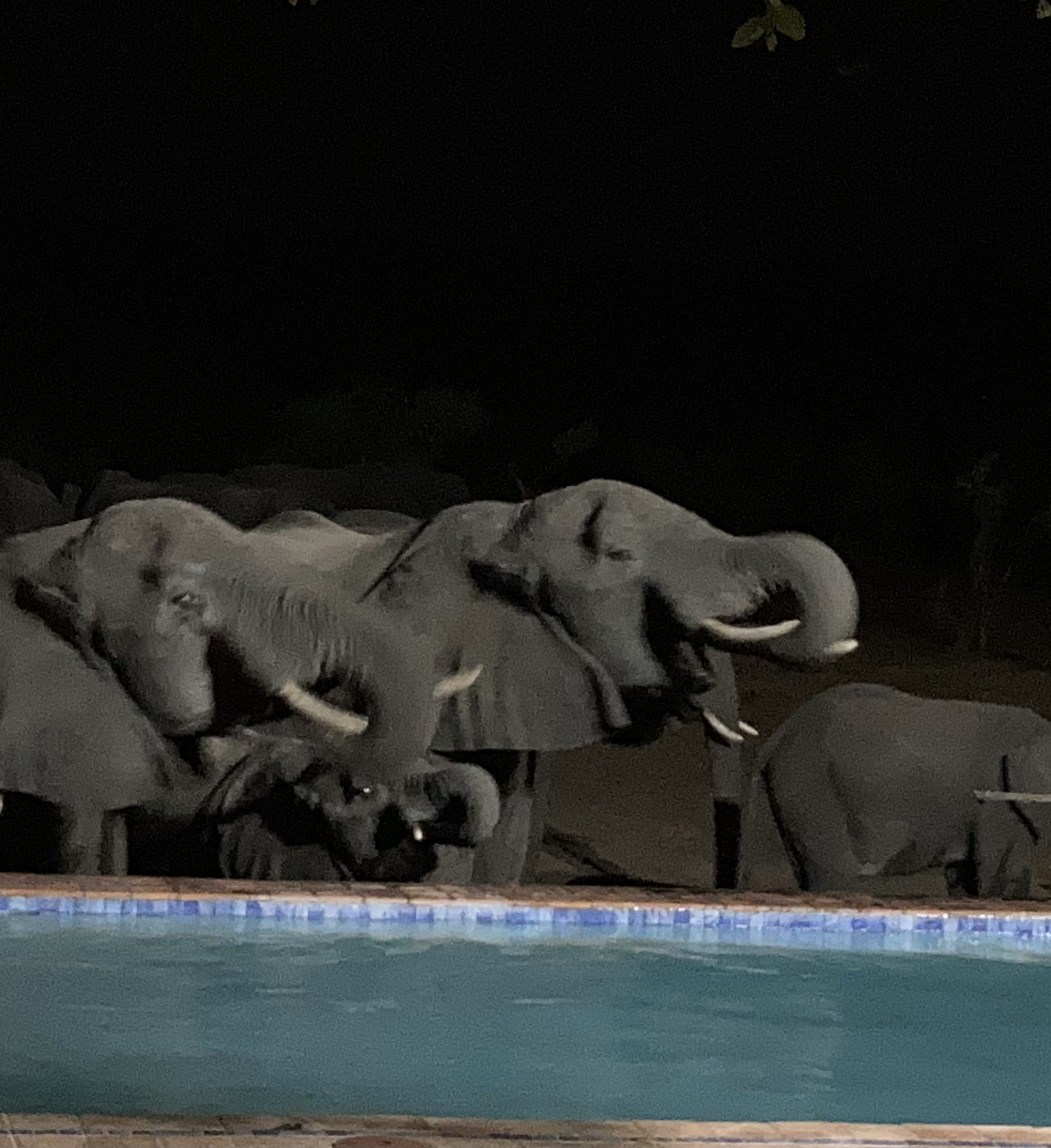
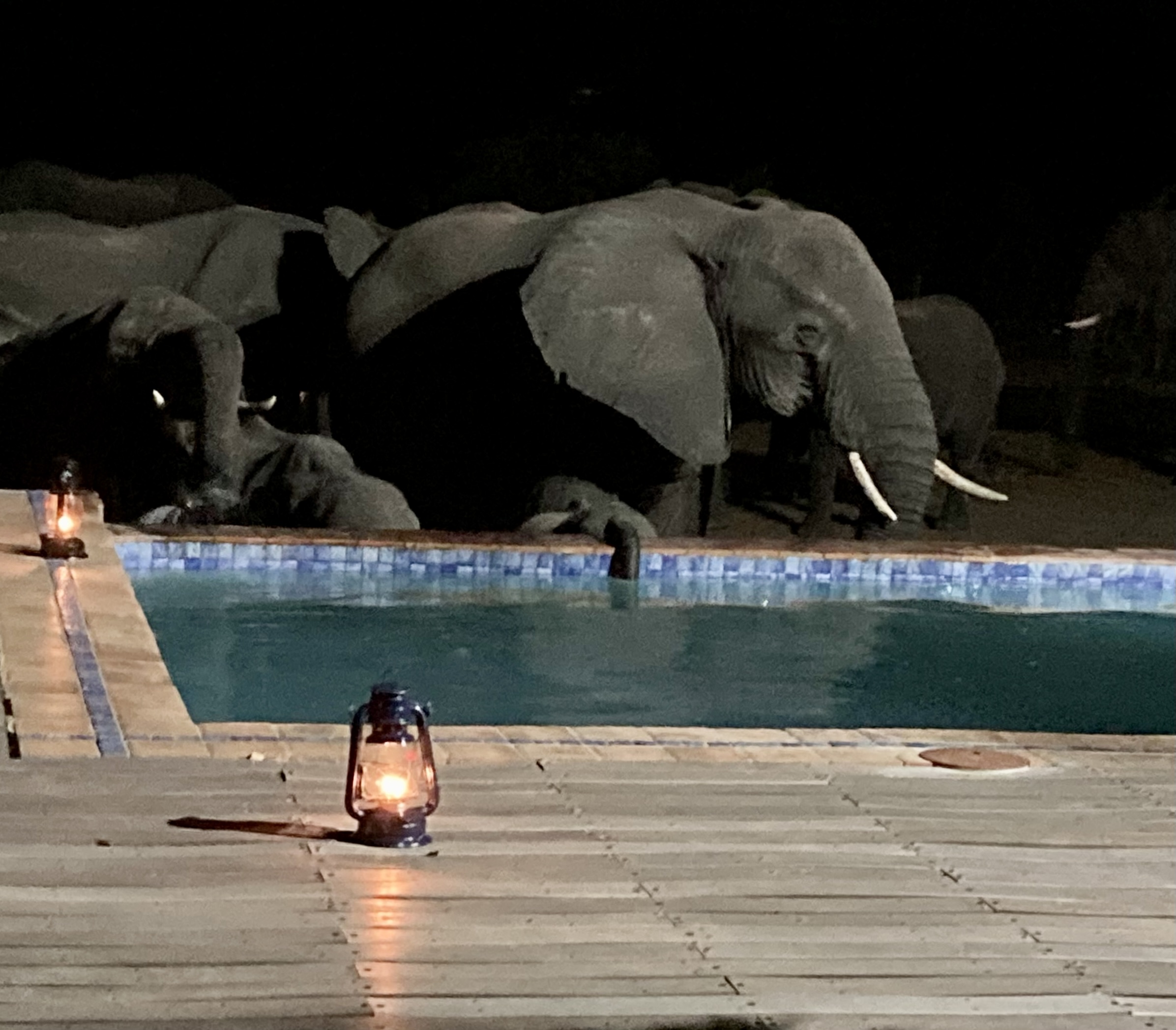
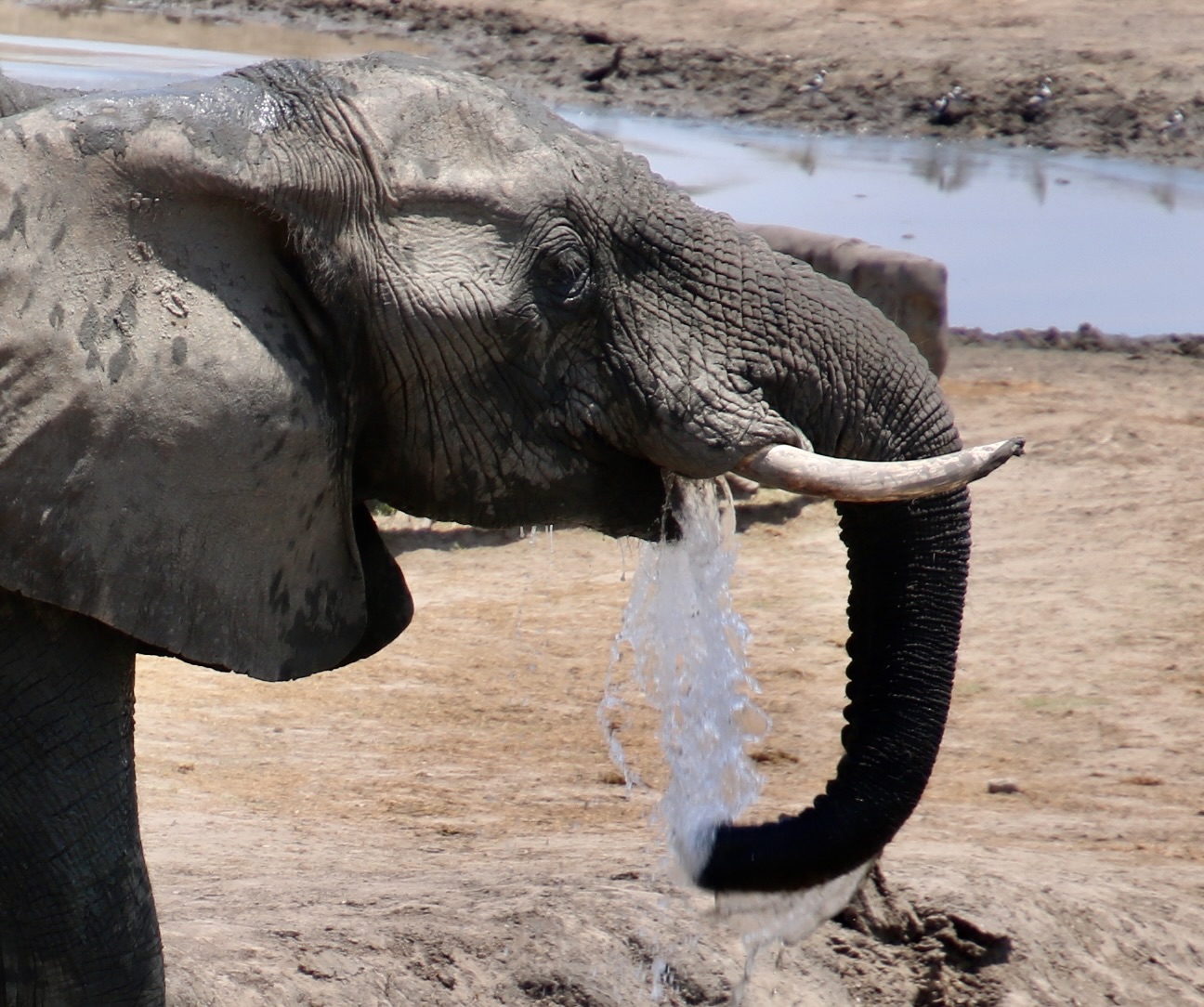
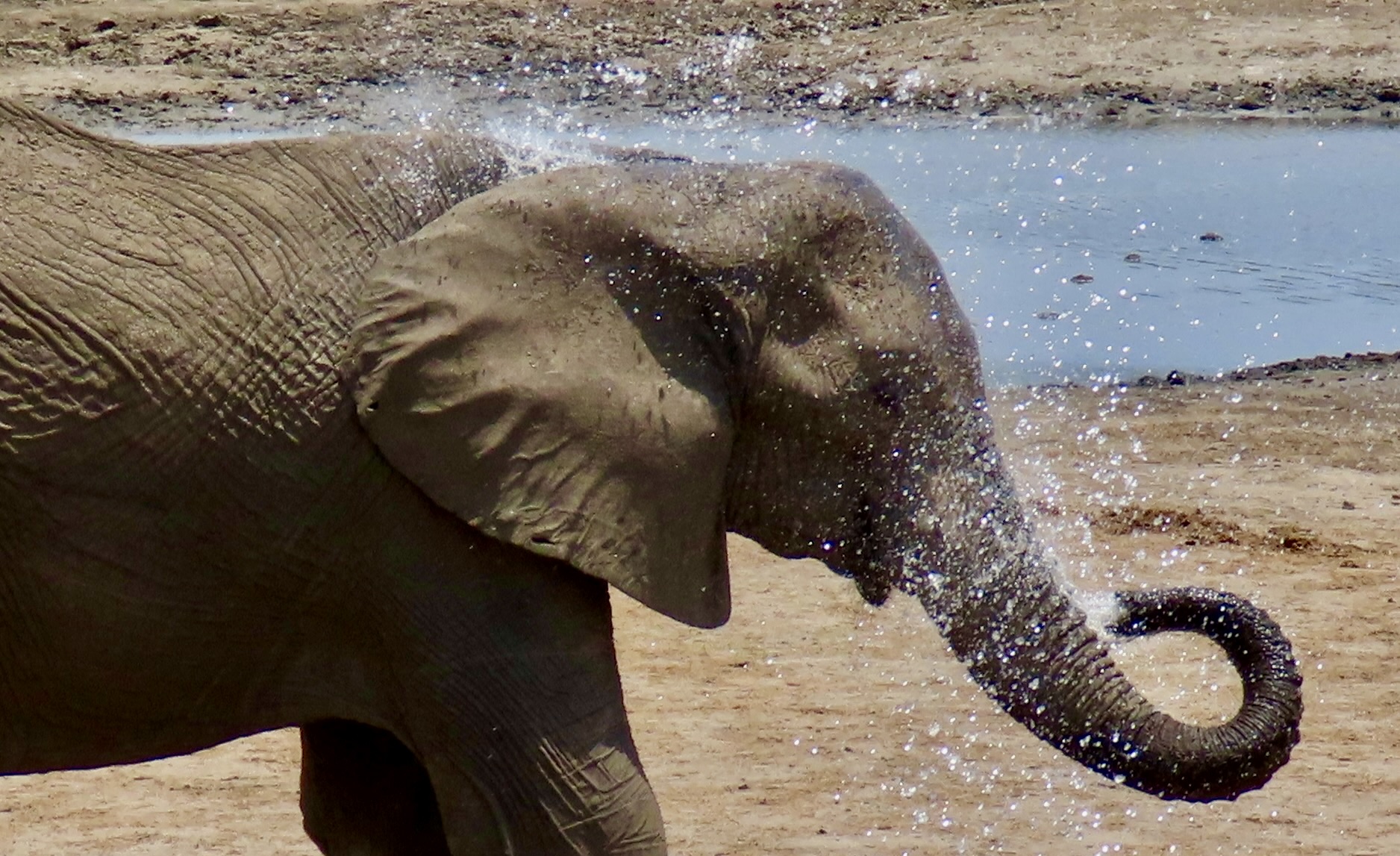
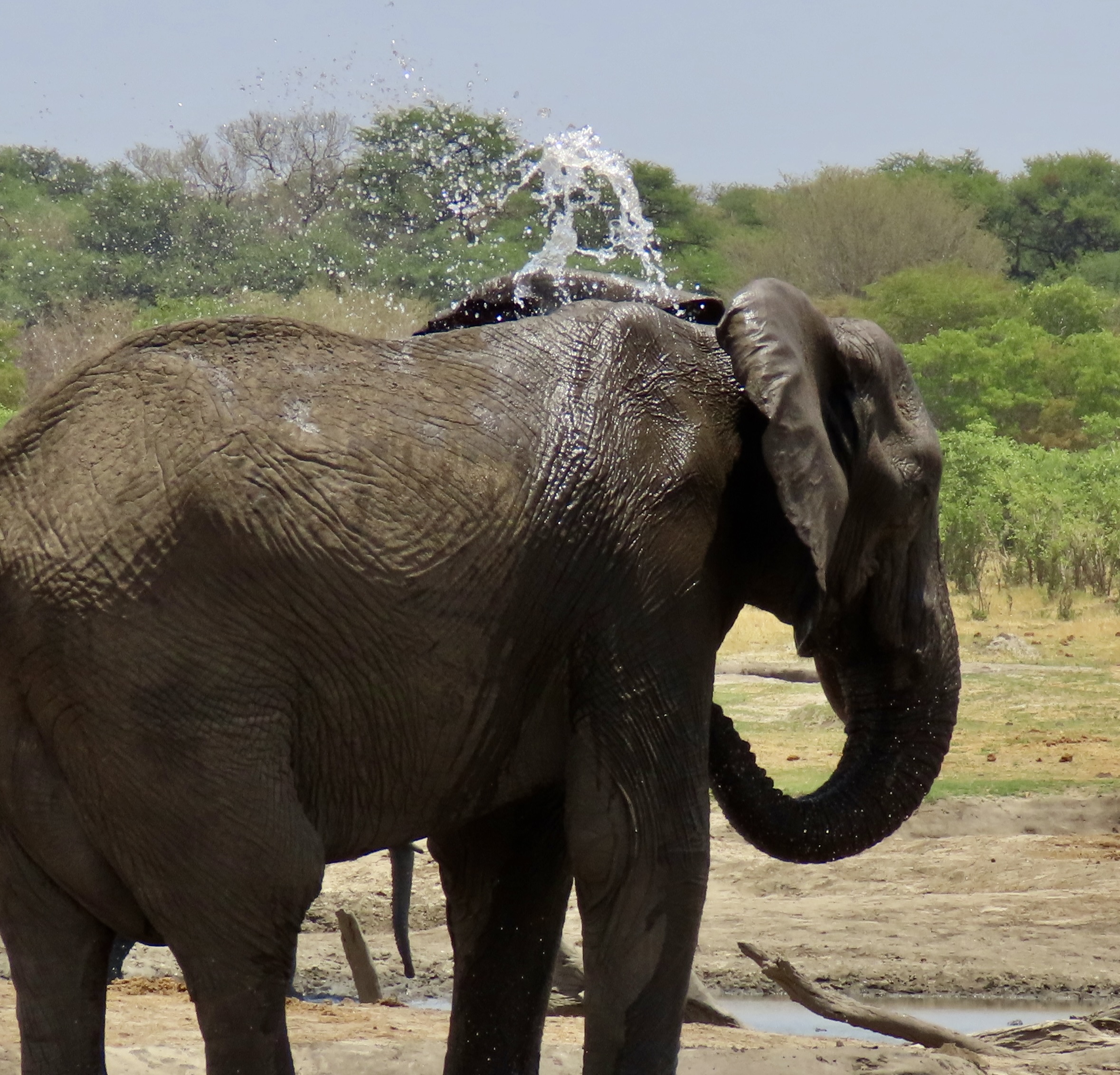
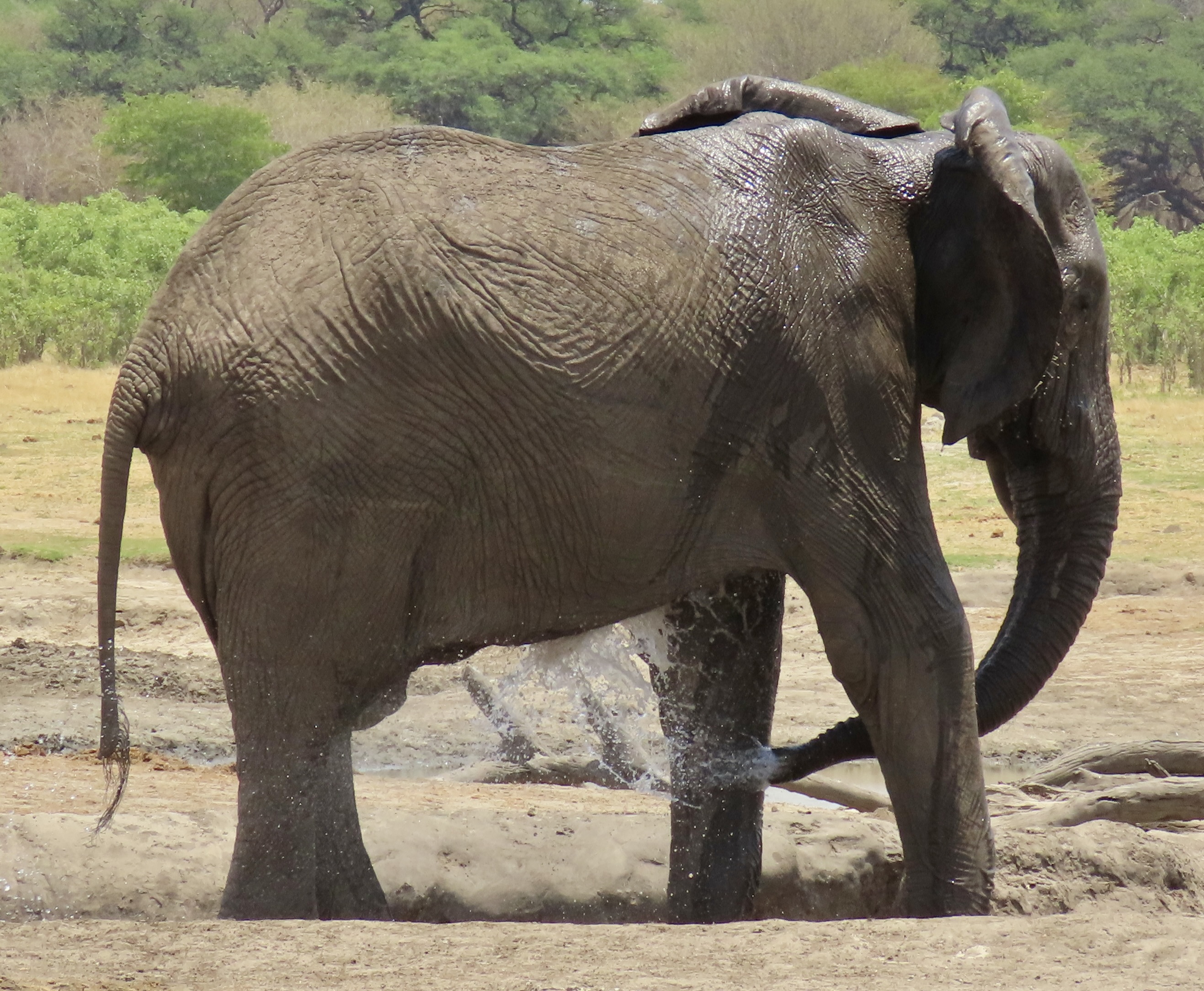
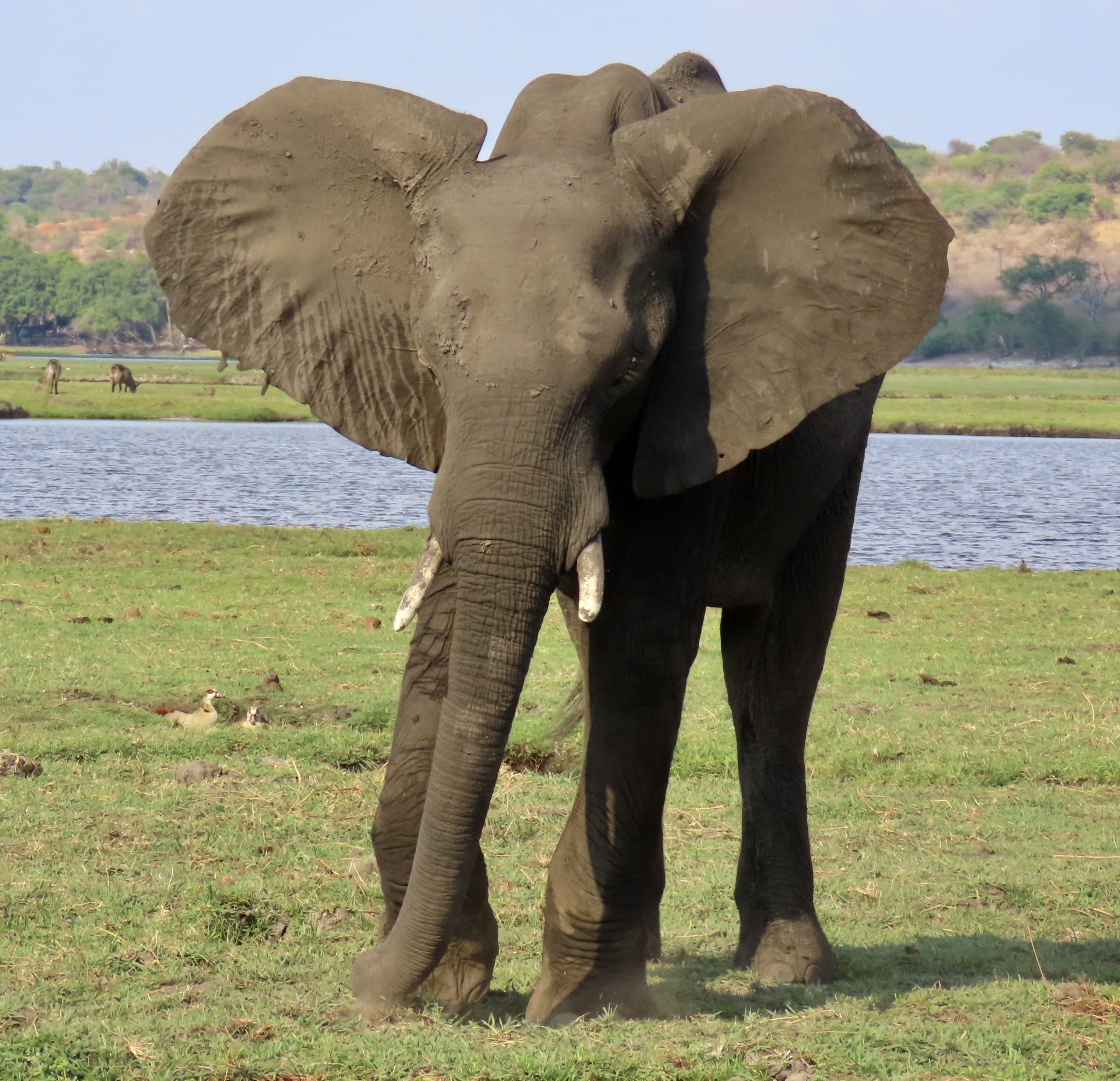
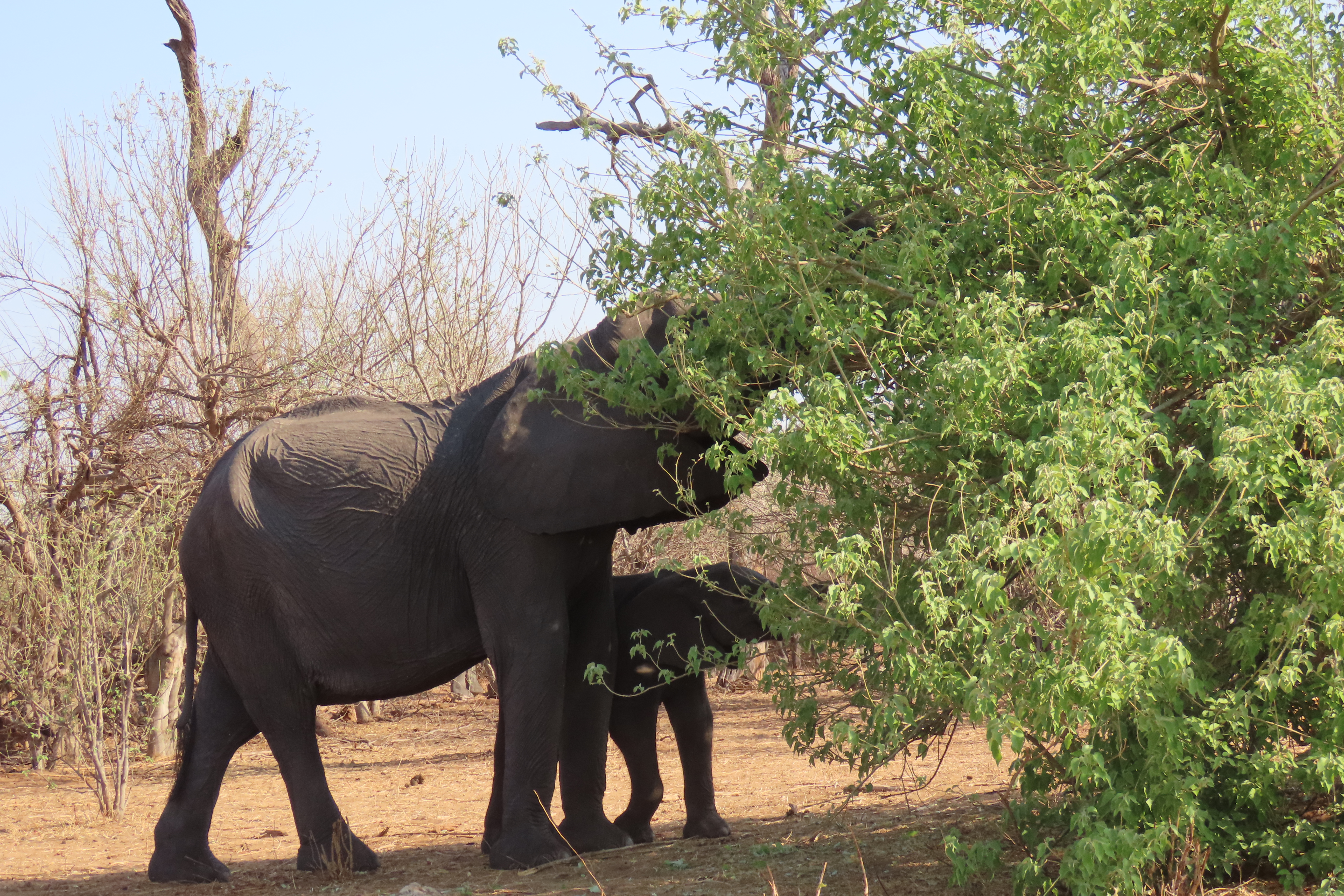
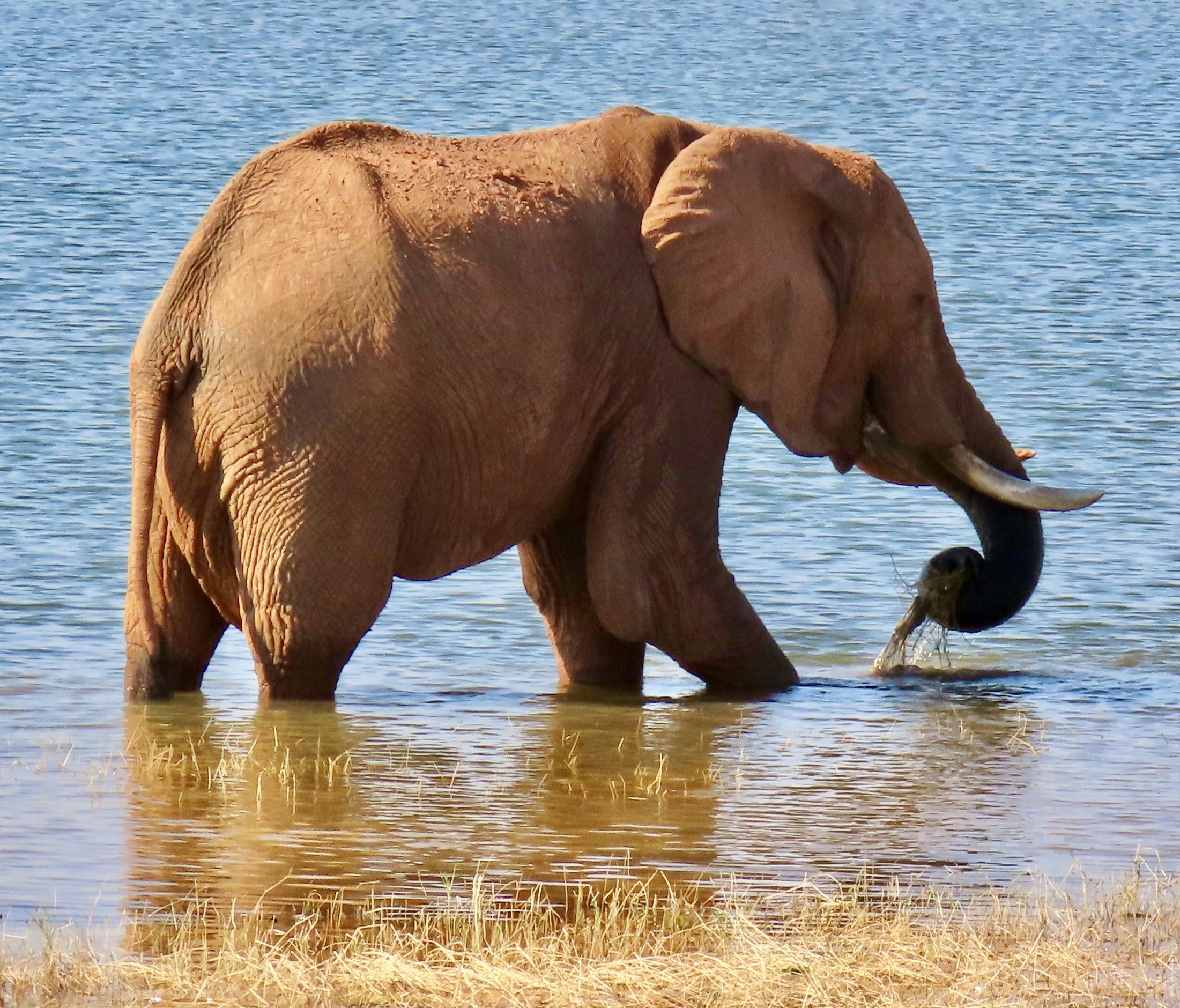
What’s impressive here is the large size of the trunk. The largest can reach up to seven feet. It’s easy to imagine why elephants need a large head and strong neck muscles to carry and use their trunks. While it may not be obvious, the trunk is an extension of the elephant’s upper lip and nose. While the elephant’s trunk is attached to head bones, there are no bones in the trunk. Instead there are lots of muscles. This arrangement is called a muscular hydrostat. Another example is our tongue. The muscles are impressive. There are 17 major muscle groups, 8 on each side and 1 up the middle. But in turn, these muscles are made up of sheathed groups of fibers known as fascicles. The latest estimate is there are around 90,000. When you see claims of an elephants trunk having 50-100,000 muscles, fascicles are what they are referring to. The major muscles and fascicles are what allow for the great flexibility and strength of an elephant’s trunk. The elephant can move it up, down, left and right, and even twist it in every direction, but it does have a dominant side. (Think left handed/right handed.)They can also lengthen, shorten and stiffen their trunks. Peggy is petting an elephant’s trunk near the tip at the Sanctuary. She described the skin as “hard and the hairs wire-like and sharp.” One would think that such an arrangement would lack in sensitivity. Quite the opposite. The trunk is packed with sensory cells and the wire-like hairs are particularly sensitive to touch and are known as sensory hairs.I looked down at the Sanctuary to see this elephant had slipped its trunk through the small fence that separated us and was checking out my shoe. I hope it got a good sniff— in addition to demonstrating the flexibility of its trunk.The tip of the trunk is particularly sensitive. The protrusions on the upper and lower lip work as fingers, enabling the elephant to pick things up. As one report noted, they can pick up a potato chip without crushing it. (Whether one should feed an elephant a potato chip is a different issue.) Now, it’s time to head back to the National Parks and watch the elephants at work using their trunks. Elephants don’t drink with their trunks. That would be like us drinking with our noses! But they do suck water into their trunk and squirt it into their mouth, like this thirsty fellow is doing. BTW: the trunk of a large elephant can hold up to two gallons of water.These guys were also drinking. This time out of a swimming pool at the Iganyana Tent Camp on the edge of Hwange National Park. They made their nocturnal visit while we were eating dinner next to the pool. (These ‘action’ photos were taken with our cell phone in the semi-dark, which accounts for the fuzzy look. I think it only enhances the drama of having 50 or so wild elephants provide dinner entertainment, however.)I thought the swimming pool watering hole deserved another photo because of the baby elephant in the middle trying to get its trunk into the water. It looked like mom ended up spraying some water into the little guy’s mouth.Speaking of shooting water into a mouth, this strange photo seems to show an elephant doing just that for itself. Or was it spitting the water out and sucking it in with its trunk? This is the same elephant I featured two photos above drinking in the normal way. Having finished its drink, the elephant gave itself a shower.Cooling down may have been the objective instead of bathing…So, are we talking hygiene or air conditioning?This is not an angry elephant about to charge. It’s rooting up grass with its foot to eat in Chobe National Park while flapping its ears to keep cool. Once the grass is loose, it will use its trunk to shake out the dirt and transfer the food to its mouth. Elephants eat a lot. Full grown elephants require up to 300 pounds of food a day.Stripping leaves from trees is another way elephants use their trunks to gather their food as mom and baby are doing here from this shrub.This elephant has learned it can pull up grass with its trunk on the edge of Lake Kariba In Matusadona National Park, Zimbabwe.One thing that we noticed in Hwange National Park was that the elephants were also using their trunks to grab grass and eat while they were walking.
In addition to eating, drinking, bathing and smelling, elephants also use their trunks to communicate in a variety of ways. One is a gentle touch to provide comfort to a fellow elephant or baby. They will even put the tip of their trunk in another elephant’s mouth. They also force air through their trunks to produce a variety of sounds. One is as a loud trumpet to express displeasure. They did that a couple of times when they were crowded together drinking out of the swimming pool. It certainly caught our attention.
I’ll conclude this post with Peggy placing food in an an elephant’s trunk at Wild Horizons Elephant Sanctuary. Next up, a look at an elephant’s family life, head, ears, tusks, feet, skin and tail. Plus a visit to an elephant graveyard.























































 Wandering through Time and Place