It Takes a Worried Man… The First Sierra Trek: Part 3

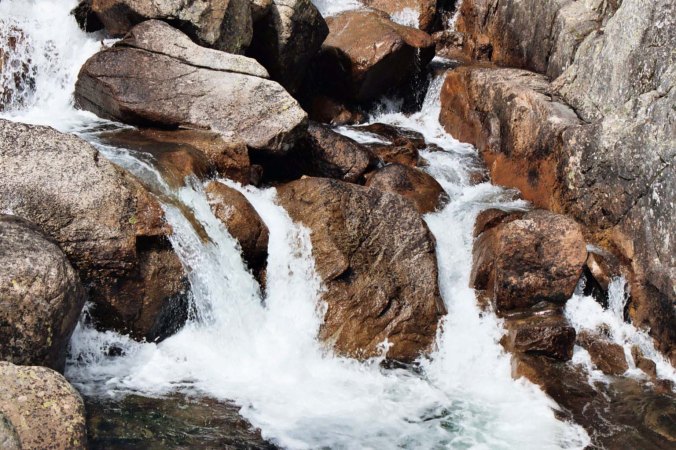
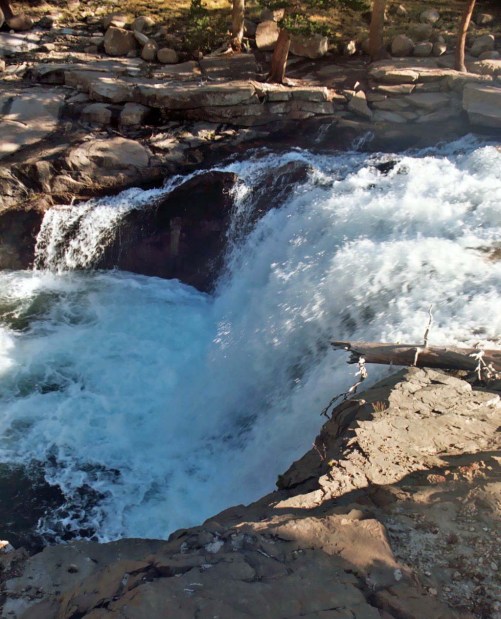
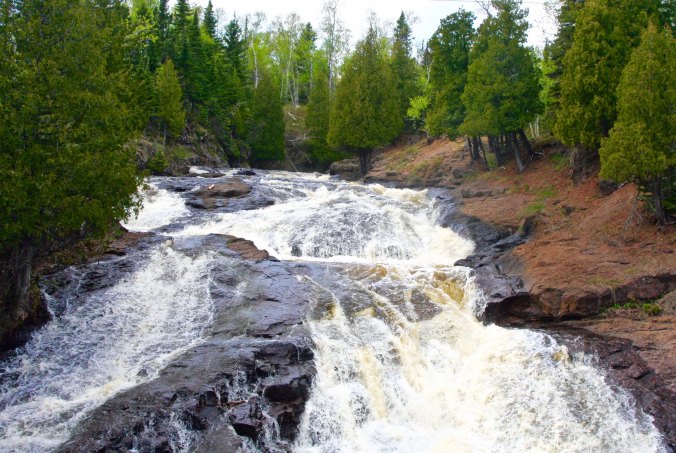
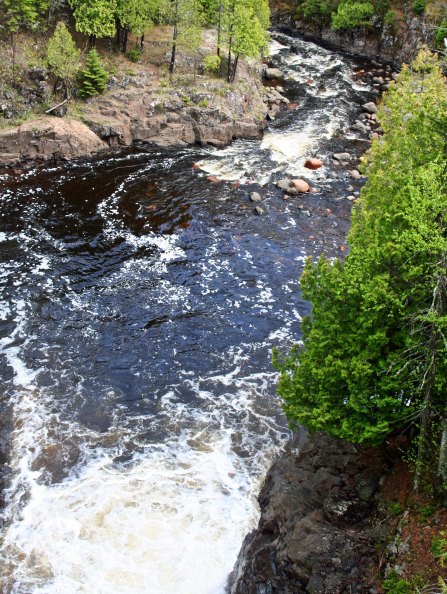
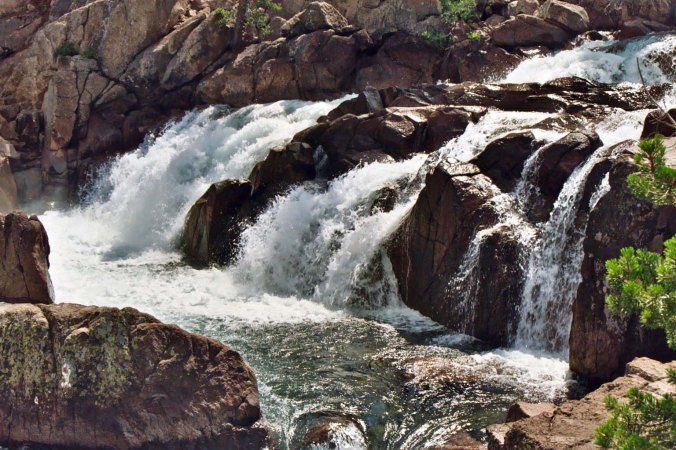
Water became a major problem on our first two days of the Sierra Trek. It was one of the reasons I decided to hike down the Sierras instead of across them on all future treks. Today I am featuring waterfalls.

Water became a major problem on our first two days of the Sierra Trek. It was one of the reasons I decided to hike down the Sierras instead of across them on all future treks. Today I am featuring a few waterfalls you find along the range. All of these are along the Pacific Crest Trail.


When I last wrote about the first Sierra Trek, the morning of the event had arrived. I was a worried man. I found myself singing Woodie Guthrie’s fateful words as I drove up into the mountains:

“It takes a worried man to sing a worried song/I’m worried now, but I won’t be worried long/I went across the river and I laid down to sleep/When I woke up, I had shackles on my feet.”

Note: As I’ve mentioned before, the photos in this blog are from other Treks. I didn’t carry a camera on the first year. 


I met my support crew at a small restaurant just outside of Squaw Valley at 7:00 AM. Steve had recruited two friends to help out. One was Steve Locke, whose family owned large sections of Delta farm land and had a town named after them. The other was Bob with no last name, strong quiet Bob who was an excellent man to have along in an emergency, who loaned us valuable equipment such as walkie-talkies and a jeep, and who, I learned years later when he was in prison, made his living flying pot out of South America. Steve Crowle was to be my assistant leader, Steve Locke was going to drive a back-up jeep, and Bob was to be there just in case— in case of what I wasn’t sure.

We drove the last three miles into Squaw Valley to meet our fate. The Trekkers were arriving in droves and milling around like lost sheep. There was fat Charlie, skinny Orvis, beautiful Lisa, and 57 other people ready to follow us across the mountains. I felt a little like Moses must have felt in leading folks off into the wilderness, except I didn’t have his guidance system. I also wondered how Moses might have fared feeding the Israelites Ham Cheddarton instead of manna. We might have a different religion today.

Steve called the Trekkers together and I gave my first ever Trek orientation. I started by pointing out the tram. The first part of their day was to be spent saving 2000 feet and two miles of climbing. Steve had finagled free rides for all of us. This put the participants in a good mood. I then made a serious mistake. I told the Trekkers they should have an easy day.

Rule number one of Trekking is never, never, never tell people they will have an easy day backpacking. Each day is grueling and people may just survive. Period.

All too soon we were on our way, crammed like so many cattle onto the Squaw Valley trams dangling high above the ground as we bounced our way to the top. One of our Trekkers with a fear of heights had wanted to walk. She hid herself in the crowd and refused to look out, frightened that we were going to go careening down the cliffs. Her instincts were good. A few years later, the world watched as a rescue operation pulled people off of one of the very same trams as it dangled 100 feet off of the ground. We made it without any problems.

They started when we got off of the tram.

Steve’s job for the first three days was leading since we were going over the route he previewed. Mine was to be trail sweep or rear guard, as we called it. Our rules were very simple: don’t get ahead of Steve, follow the yellow ribbons left behind by the horse people, and don’t get behind Curt. We also required that Trekkers hike with at least one other person and that they let someone know if they had to leave the trail to ‘serve nature,’ as my students in Africa had called potty breaks.

I was not going to march people through the woods like an army. By allowing them to travel at their own pace, they could move at a speed their bodies and minds were comfortable with. It also allowed for something of a wilderness experience even though we were hiking with a large group. Sixty people would be spread out over 2-3 miles of trail.

Rear guard duty is always the toughest job on a Trek since it’s where the problems accumulate. That first day we made it exactly 50 yards before the first one popped up. The witch had shown up with an old boy scout pack with a rope tied on for a belt. (Remember she was the one who was going to come over in the middle of the night, bite me on the ear, and turn me into something. I think she had a sex-crazed maniac in mind.)

We were still in a transition stage where a few belt-less backpacks were wandering around in the mountains with people attached. Following the dictates of my Bible, “The Complete Walker,” by Colin Fletcher, I had insisted that all of our Trekkers have the belted kind. Not surprisingly, the witch’s ‘belt’ broke immediately. I was tempted to suggest she use her occult powers to fix it but Charlie Colin, the ex-ice hockey player, cheerfully took care of the problem. I loaned her some sun tan lotion and insisted she use it. In addition to having lily-white skin, she was wearing a tiny mini-halter, no bra, and short shorts with close to total exposure.

“But Curt,” she objected, “I want to go home with a complete tan.” Right. I told her she would be one roasted chickadee at the end of the first hour and I didn’t want to be accused of burning witches.

By the time we had taken care of her problems (or at least the ones we were qualified to take care of)— and those of several other Trekkers, Steve had covered a mile plus and was about to disappear over Emigrant Pass into the Granite Chief Wilderness. All the way up the mountainside, I could see our charges struggling with thin air, a steep trail and heavy backpacks. Some, having traveled for 10 minutes and 200 yards, were taking their first 20-minute break of the day. I resigned myself to a long, slow hike.

An hour or so later, Charlie and I crested the pass. Up ahead there may have been people having the easy day I had promised, but they certainly weren’t the 20 or so Trekkers I was now herding along the trail. I looked back at the now distant floor of Squaw Valley and sent a small thank you wafting upward that the first 2000 feet and two miles had been by tram.

I also sent up thanks for the fact that we truly did have a short day. Having cut off two miles from the beginning and hiked another, we only had four to go. Steve had carefully described our first campsite and I had reviewed my topographical map. We were going to drop down into the small valley behind Squaw Valley where the American River begins its journey to the Pacific as soggy ground, and then climb up the ridge that forms the side of Granite Chief Mountain and Needle Peak. Eventually the ridge trail crossed a small, glacier-caused hanging valley perched several hundred feet above the now creek size American River. A spring was running into the valley with ‘ample’ water for our Trekkers.

Apparently, I had used up all of my credit with thanks, though. When we arrived at the proposed campsite, there was only one Trekker present, Bob. I was about to learn what the ‘just in case’ part of his job description meant. This particular just in case was my arriving in camp and finding no one there.

“Everyone has gone on, Curt,” Bob reported. “There is no water. Steve has taken the Trekkers another two miles to Hodgkin’s Cabin.”
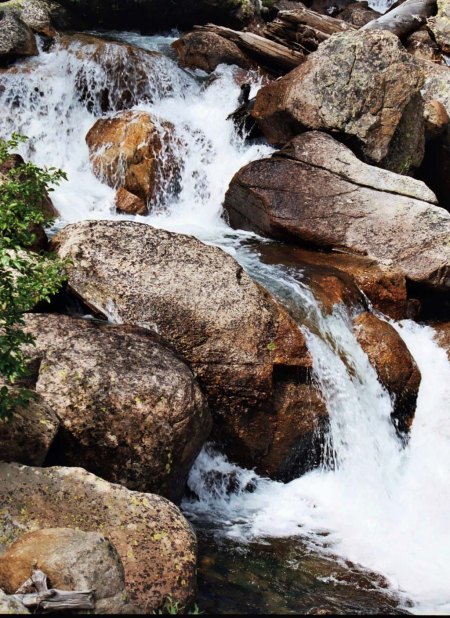
Ah that I would have come across a small stream. Even this would have provided enough water for our Trekkers.

Ah that I would have come across a small stream. Even this would have easily provided enough water for our Trekkers.
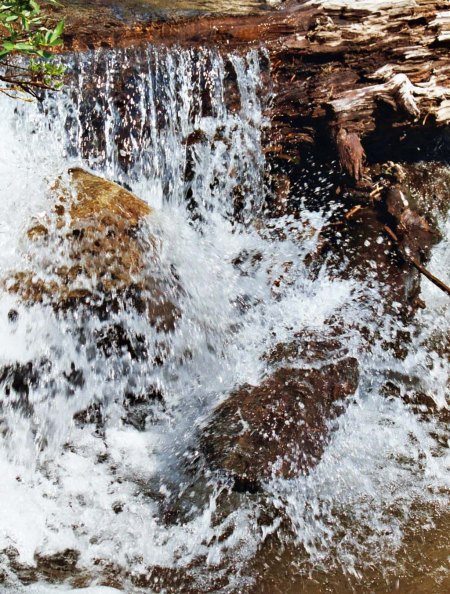
I am not sure this would have worked but many times I've made do with less when hiking alone.

I am not sure this would have worked but many times I’ve made do with less when hiking alone.

I wanted to whine. People had been whining at me all day. Certainly, it was my turn. The possibility of the small stream running dry must have been apparent two weeks before, I complained to myself, and wearily began rounding up my charges. They had scattered out and plopped down on the ground, like rocks.

There were two bright spots to my day. One was Charlie.  What a character and what a help; he told me his life story as we placed one foot in front of the other. Every once in a while, he would break out chanting: “cold beer, cold beer, cold beer.” It was pure fantasy but the thought kept us going.

The other was the fact that Lisa had joined us and was playing sheep dog with Charlie and me. We kept everyone moving forward with at least a semblance of humor. By this time, Charlie and I had set up a pole between us and were carrying two broken down packs in addition to our own. Somewhere along the trail I offered Lisa my hand to get over a rough spot and we had continued to hold hands. I felt guilty— a little. The rawness of Jo Ann’s confession was still burning a hole in my soul.

Eventually, we arrived at Hodgkin’s Cabin. We had survived day one. Tune in next Wednesday when I am accused of running a pot smoking orgy in the mountains— not true.

Here are a few more tantalizing waterfalls. BTW, I took most of these when I did a 360 mile backpack trip down the Sierras to celebrate my 60th birthday.

Tuolumne River Falls in Yosemite just outside of Tuolumne Meadows.
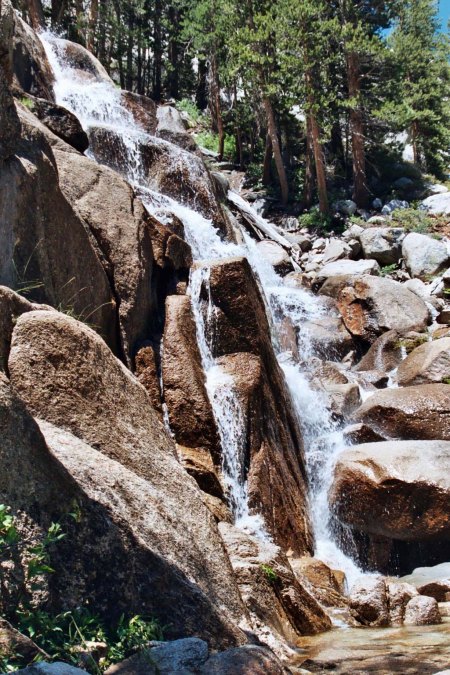
Tuolumne River Falls in Yosemite just outside of Tuolumne Meadows.

I enjoyed this cascading falls...

I enjoyed this cascading falls…

This split falls...

This split falls…

This narrow falls...

This narrow falls…

And this humdinger filled with snow melt.

And this humdinger filled with snow melt.

Friday and Saturday’s posts: I am excited. I have my ticket to Burning Man! So I spent my past week using an old, limping laptop to peruse my thousands of photos I have taken at the event since 2004, eliminate a bunch, and divide the rest up into categories. I actually got my number of pictures down to around 4,000. (grin) Don’t worry, I am not going to throw them all at you. But I will share select photos. On Friday and Saturday I will kick off my Burning Man posts with some of the wonderful— and weirdly wonderful, mutant vehicles that prowl the Playa and Black Rock City. I’ll move on from there to other categories such as sculpture, tribes, temples, the Man, etc.. This is a series you won’t want to miss!
Bears, Rattlesnakes, Heart Break, and Ham Cheddarton… The Sierra Trek: Part 3

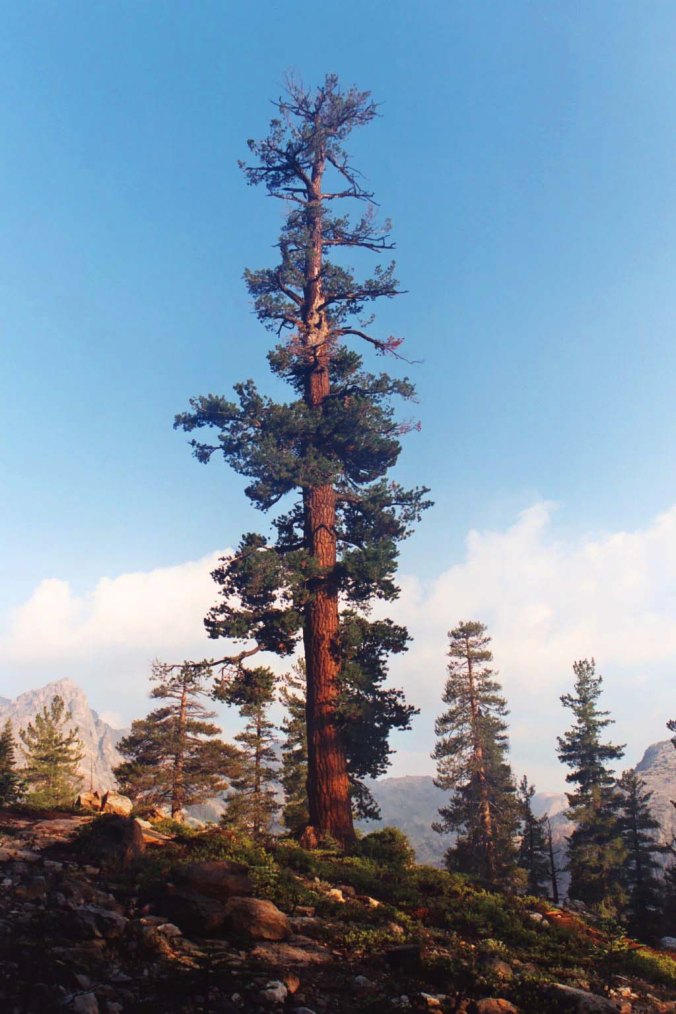
Beauty in the Sierra Nevada Mountains comes in many forms, such as this Red Fir giant I found on Seavey Pass.

Beauty in the Sierra Nevada Mountains comes in many forms, such as this Red Fir giant I found on Seavey Pass along the Pacific Crest Trail.


In my last post about the Sierra Trek, I noted that the clock was ticking. We had a route that threatened to be covered in horse poop, a sponsor who believed that backpacking 100 miles in 9 days was insane, a barely edible meal of Ham Cheddarton for a quarter of our dinners, and 60 people, aged 11-70, ready to follow us across the mountains.

 It was now time for Steve and me to go out and check the route, to get a feel for how much trouble we were actually in! We had agreed to split the preview: Steve would backpack the first third of the route from Squaw Valley to Robinson Flat while I backpacked the second third from Robinson Flat to Forest Hill. We’d cover the final third the weekend before the Trek.

A note about today’s photos: As I mentioned previously, the photos for this series on the first Sierra Trek are all taken from later treks.


Steve had never backpacked alone and I had only been out by myself three times. It promised to be an adventure. In addition to reducing the odds that we would lose 60 people in the woods, we also needed to check out potential camps, water availability, and the difficulty of the trail. I wanted to develop a feel for what we would be putting our participants through.

Nervous is the best word to describe my mood as I packed up. Jo Ann was heading off for a clothes-buying spree in San Francisco. I told her to enjoy herself, threw my backpack in the back of my Datsun truck, picked up Steve, and drove to Squaw Valley. We made a brief stop in Auburn to recruit my father-in-law’s Springer Spaniel, Sparky. I felt the trip might be a little rough on my basset hound, but wanted some doggy companionship. I left Steve weaseling a free ride up the Squaw Valley tram and headed for Robinson Flat, a camping area on the Western side of the Sierra.

Some experiences burn themselves into your soul. This was one. The beauty and the variety of the wilderness captured me. I was starting at around 7000 feet in the heart of red fir and Jeffrey pine country and dropping into the Sierra Foothills where incense cedar and ponderosa pine provided shade.

Along the way I would descend into river canyons filled with inviting pools and scramble out to follow hot, dry ridges. Besides Sparky, a coyote, two skunks, several deer, a porcupine, and numerous birds provided entertainment. I also met my first bear, a big brown fellow that came ambling out of the brush and increased my heart rate twofold. Even the ever-curious Sparky took one sniff and made a quick retreat behind me. Then she growled.

Being alone enhanced and intensified the experience. The days were exciting but the nights bordered on scary. After the bear, I imagined all types of creatures sneaking up on us as we slept. Sparky was even more nervous. I loaned her my new Pendleton shirt to sleep on. She had chewed it to rags when I woke up in the morning. I didn’t have the heart to scold her. Had I known what she was up to, I might have joined her.

This photo taken near Sonora Pass illustrates both the distances and possible solitude of hiking in the Sierras.

This photo taken near Sonora Pass illustrates both the distances and possible solitude of hiking in the Sierras. You can see the trail as it comes into the photo (bottom left), and works its way  down the slope. Look carefully and you will see it on the distant ridge.  The small dot on the ridge is one of my trekkers. Can you find the pass? (Look for the sharp switchback.)

It was the physical challenge that made the deepest impression. I was strong but out of shape. Even had I been better prepared, I wasn’t psychologically ready for the experience of hiking 10-15 mile days with a 50-pound pack on my back. Nor was the territory gentle. I was hiking in and out of 1000 foot plus deep canyons following steep, winding trails that had challenged the 49ers in their endless search for gold. Once I found myself lost on a brush choked mountain and had to fight my way free.

Participants start out squeaky clean on the trek. You can always tell backpackers who have only been out for a day.

Treks are hard. Period. Not one has ever been as hard as my first one, but that doesn’t mean they are easy. You start out squeaky clean, like Marvin, and then the days begin to take their toll.

After several days, they may resemble Marvin here, who I believe is surrendering to mosquitos.

This is Marvin after several days. I believe he is surrendering to mosquitos.

As I approached Forest Hill, temperatures climbed to a scorching 105 degrees. To top it off, I was breaking in a new pair of German-made Lowa boots. All of the backpacking literature of the day emphasized sturdy foot ware and it didn’t get much sturdier than Lowa. Considering my feet blister at the mere sight of a boot, they were not happy campers. By the third day I had blisters on top of blisters and my feet resembled a hyperactive moleskin factory.

But, I made it. I proved to myself I could do it and that the Trek was possible. With the proof came an incredible high. I hiked into Forest Hill singing.

Steve showed up about an hour later. He was beaming and jumped out of the truck to grab me while Sparky did much wagging of tail. The three of us did a little dance and Steve and I both tried to talk at once as we told our stories. Steve had seen ‘migrating’ rattlesnakes and lots of bear scat. He peed around his camping area to mark his territory and warn the bears to stay out. They did. The second day a hawk had ‘chased’ him down the trail for miles. I wondered what Steve had been smoking. But now he was on the same natural high I was. We were ready to Trek.

I couldn’t wait to share my experience with Jo Ann. I hurried home, dropping off a tired Sparky and a pooped Steve. I burst into the house full of enthusiasm. In comparison to my bubbling nosiness, Jo was funeral quiet. I made enough noise for both of us and suggested we head out to Chuck’s, our favorite steakhouse. After three days of backpacking food, I was hungering for a mouth-watering T-bone. We were in the middle of our first Scotch when Jo Ann looked at me miserably and announced she had something to tell me.

“Curt,” she confessed, “I didn’t go to San Francisco over the weekend. I went to Los Angeles and spent the weekend with a man I met at a workshop last month.”

My world stopped. My heart broke.

There was no Trek, no future, no me. The steak in my mouth turned to sawdust and my stomach became a tight, heavy knot. Jo Ann went on to tell me about the psychiatrist she had met at a conference in San Francisco and how she was scared about losing me, about how she still loved me. Maybe, but something broke that night, something that could not be mended.

I had to get out of town, to think, to recreate myself.

The next morning Jo dropped me downtown. I called Steve, Nancy and Nan into my office, closed the door and gave them enough details so they would know why I was leaving. In addition to being employees, they were all friends. It was hard for me not to break down. I promised that I would be back in time for the Trek and discussed what needed to be done in my absence. Steve’s primary job would be to review the last section of the trail. He drove me to the airport.

My choice of where to go was determined by the first airplane leaving Sacramento. It was a Western Airlines flight to Seattle and I was on it. It was Tuesday, 12 days before the Trek.

Lonely and confused I walked the dark, rainy streets of Seattle. I missed Jo desperately and had a hard time imagining the future. I hit the bars and drank. It wasn’t that I was naïve. I knew people could grow apart as well as together, and that we had grown apart. Nor was I innocent. I had been tempted more than once in the ever-present world of sexual attraction: a hand touched here, a smoldering glance there. My world was one filled with bright, attractive women. But I had really believed I was married for life.

I had started drinking at a bar early on Friday afternoon when the words of a Jimmy Buffett song caught my attention. “I spent four lonely days in a brown ugly haze and I just want you back by my side.” I returned to my motel and called Jo. She was on the next flight to Seattle. We grabbed a ferry and headed over to Victoria where we had spent happier times. Maybe it would work.

Back at Lungland on Monday things were iffy. On the down side of things, Steve hadn’t previewed the last section of the trail. Who knows why? Our last three days would be potluck. The good news was that our generous food donation from Lipton had arrived, umpteen boxes of it. It was scattered all over the floor of our volunteer room.

I opened the first box, Ham Cheddarton. Oh well, can’t win them all. I had known the trekkers would be stuck with at least two meals of the stuff. So I opened the next box, Ham Cheddarton. Luck of the draw, I hoped. I opened the third box, Ham Cheddarton. Soon boxes were opened everywhere and they were all Ham Cheddarton. A warehouseman at Lipton had figured out a clever way of moving his unsellable product and we were it. We were faced with giving the trekkers Ham Cheddarton every night. We would be killed. Steve called his Lipton contact in Chicago and pleaded our case. He agreed to switch 50% of our food; we’d only be 50% killed.

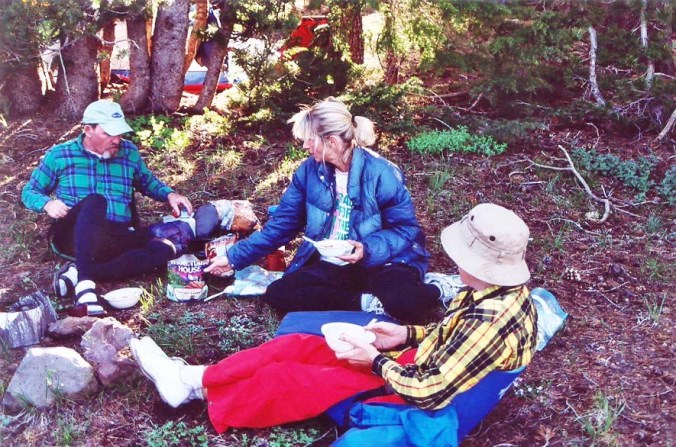
From the very beginning, I divided my participants into food groups of 3-4 people. That way, cooking equipment and responsibilities can be divided up. We've tried many foods over the years. Mountain House, shown here, has been consistently good.

From the very beginning, I divided my participants into food groups of 3-4 people. That way, cooking equipment and responsibilities could be divided up. We’ve tried many foods over the years. Mountain House, shown here, has been consistently good.

When we are lucky, trout can be added as a supplement.

When we are lucky, trout can be added as a supplement. My son-in-law Clay had sacrificed himself to mosquitos to capture this fellow. A little butter, a little spice— mmm good!

Saturday came fast, faster than a speeding bullet, faster than Superman could even dream of flying. Suddenly it was just there. There was no sleeping on Friday night. I had to pack and I had to worry. I had to worry a lot. There was no way I had enough time to worry, so I was still worrying when I met my support crew at a small restaurant just outside of Squaw Valley at 7:00 AM. The first Sierra Trek was about to get underway…

NEXT BLOGS: Friday, Burning Man in photos; Monday, a wrap up on historic Boston; Wednesday, the next episode of the Sierra Trek


From An Ex-Ice Hockey Player, to a Ballerina, to a Witch: Meet the Sierra Trek Participants

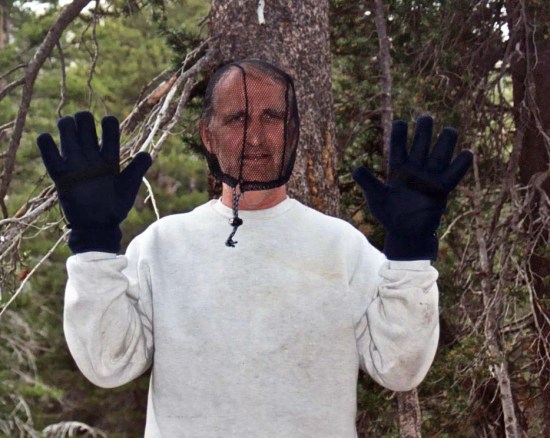
I didn't have a clue what to expect when we started recruiting for the first Sierra Trek. What I quickly found out was that people from all ages and walks of life wanted to hike across the mountains. What I learned one 30 years was that three things determined the success of the program: The people, the challenge, and the beautiful country. That participants were raising money for a good cause was a plus. This is Darth Cathy, who joined us on the 4th year, I believe. Actually Cathy is wearing a a dark mosquito net. Her career was that of an IRS agent.

I didn’t have a clue what to expect when we started recruiting for the first Sierra Trek. What I quickly found out was that people from all ages and walks of life wanted to hike across the mountains. This is “Darth” Cathy (grin), who joined us on the 4th year. Actually Cathy is wearing a dark mosquito net. Her career (now retired) was that of an IRS agent.


In my last blog about the Sierra Trek, I persuaded my Board of Directors to support the concept. I then hired Steve to help put the event together and we had located a 100-mile route across the Sierra Nevada Mountains. It was the beginning of July and the Trek was to take place in the mid-August. The clock was ticking.

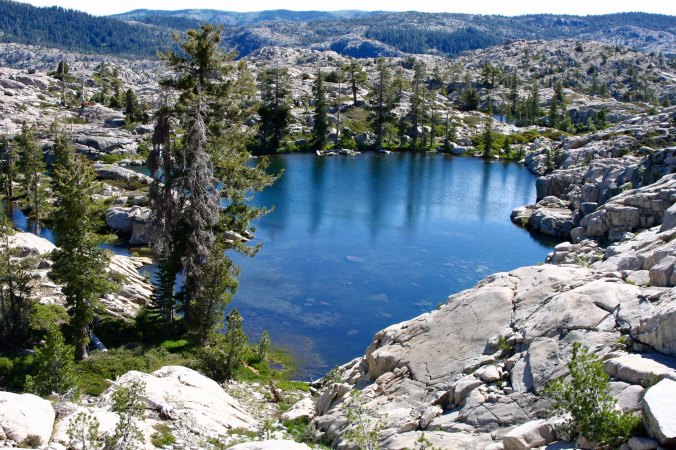
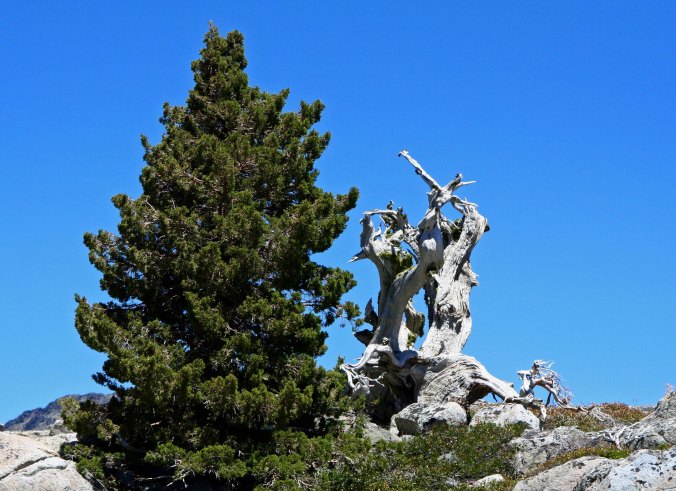
A note about today’s photos: As I mentioned previously, the photos for this series on the first Sierra Trek are all taken from later treks. Today’s photos are from the mountains west of Lake Tahoe in the Granite Chief and Desolation Wilderness areas.


Our first challenge was whether we could recruit participants. Were there people in the Sacramento area crazy enough to go on a nine-day, 100-mile backpack trip up and over mountains?

The answer was a resounding yes. Steve was able to get an article published in the Sacramento Bee. All participants had to do was raise funds for the Lung Association. Naively, we failed to suggest experience would be valuable, set an age limit, or ask for a minimum amount of pledges. People came out of the proverbial woodwork! We held an orientation session at the Sacramento Municipal Utility District auditorium with close to 100 people in attendance.

Among them were a 16-year old ballerina with legs of steel and a 250-pound, fifty-four year old ex-ice hockey player who had also had a career defusing bombs in South America. At the time, he was dodging the IRS. Four little 11-year old boys came as inseparable buddies and I wondered what kind of baby-sitting service their parents assumed we were providing. There was busty Sunshine who had a skinny partner named Bilbo. (Decades before the movie trilogy, people were already entranced with Lord of the Rings and The Hobbit. I was.) Lovely Lisa was 19 years old and a perfect 10.

Another woman, who claimed to be a witch, informed me, “I’ll be over to bite you around midnight on the Trek.” And no, she never came over to bite me; but had I encouraged it, I am pretty sure it could have been arranged. We had a 40-year-old teacher from Auburn who would never sit down during the day because she claimed she would never get up, and a 45-year-old teacher from Davis who claimed he could carry his weight in booze, and probably did. There was also a young man named Dan with flaming red hair who wore moccasins, juggled and played a harmonica as he walked down the trail.

And there was Orvis.

Three weeks before the Trek, an elderly, white-haired gent with a long flowing beard and twinkling eyes walked into my office and announced he wanted to go. His name was Orvis Agee. He was 70 years old and a carpenter. He couldn’t have weighed over 100 pounds fully dressed and soaking wet. I made a snap decision.

“Uh,” I said searching for a gentle way of telling him I thought he might be too old for the Trek, “this is going to be a very difficult trip. Do you have any backpacking experience?”

“Well,” he announced proudly, “I went on a 50 mile trip with the Boy Scouts last year.” That was 20 miles farther than I had ever backpacked. “And,” he added as he warmed to the subject, “I’ve climbed Mt. Shasta several times since I turned 60.” I had never climbed Mt. Shasta or any other mountain of note. Mainly over the past ten years I had been sitting around becoming chubby.

“Welcome to the Sierra Trek,” I eked out. What else could I say? (Seventeen years later at age 87, Orvis would do his last Trek with me. It was Peggy’s first trek. He had personally raised the Lung Association well over $100,000.)

People from all walks of life joined our treks over the years. Many would come again and again. Nancy Pape, who is an interior decorator, first joined us in 1977. 40 years later, she still calls me each year to see if I am going on a backpacking trip she can join. She's family.

People from all walks of life joined our treks over the years. Many would come again and again. Nancy Pape, who is an interior decorator, first joined us in 1977. 40 years later, she still calls me each year to see if I am going on a backpacking trip she can join. On this particular trip she took a hand full of pills and choked on them. Another long-term trekker, Ken Lake, gave her the Heimlich Maneuver and quite possibly saved her life.

Here's Ken, enjoying a quiet moment. Peggy's sister, Jane, and I hired Ken to run our first 500 mile bike trek in 1977 and help out with programs. Prior to going to college, he had been a helicopter pilot in the Vietnam War. He, along with his wife Leslie, are also part of our extended family.

Here’s Ken, enjoying a quiet moment. Peggy’s sister, Jane, and I hired Ken to run our first 500 mile bike trek in 1977 and help out with programs. Prior to going to college, he had been a helicopter pilot in the Vietnam War.

Bill Braun, shown here with Peggy, is one of my all time favorite trek characters. Bill's job was that of chief mechanic on the huge container ships. He, along with Cathy, often helped Orvis down the trail in his later years, once leading him by hand when he couldn't see because of cataracts! Bill and Cathy working together to help Orvis would eventually lead them to get married.
Bill Braun, shown here with Peggy, is one of my all time favorite trek characters. Bill’s job was that of chief mechanic on huge container ships. He, along with Cathy, often helped Orvis down the trail in his later years, once leading him by hand when he couldn’t see because of cataracts! Their work together in helping Orvis would eventually lead them to get married.

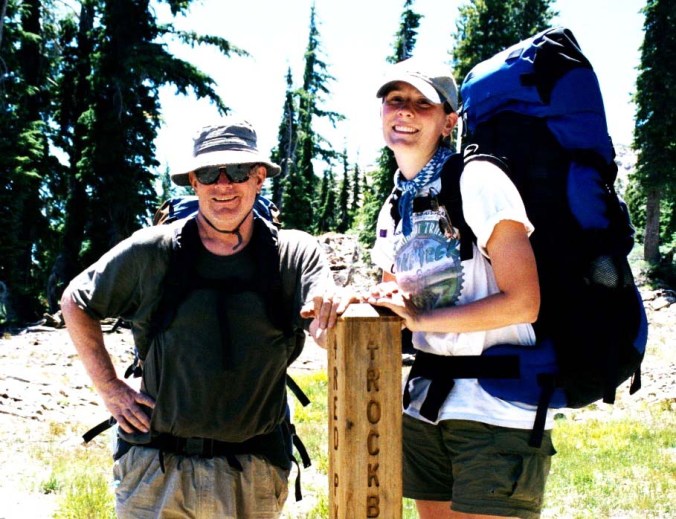
Speaking of family, this is our daughter Tasha standing with me in the Desolation Wilderness next to a trail sign. She went on several treks with us.

Speaking of family, this is our daughter Tasha standing with me in the Desolation Wilderness next to a trail sign. She went on several treks with us. And no, she isn’t seven feet tall. She was standing on a rock.

And our son, Tony. When he graduated from Annapolis, I promised to take him on a 100 mile trip including climbing Mt. Whitney. He jumped at the opportunity.

And our son, Tony. When he graduated from Annapolis, I promised to take him on a 100 mile trip including climbing Mt. Whitney. He jumped at the opportunity.

As the Trekkers rolled in, Steve and I focused our energies on the next task. What were we going to feed the mob that we would apparently be leading through the mountains? Breakfast and lunch could be pulled off the shelves in the local grocery stores. Dinner was the problem. Freeze dried food was in its early stages of development and somewhat expensive for my budget.

There was another possibility. Lipton had a lightweight, off-the-shelf dinner, which was inexpensive and sold through grocery stores. The meals came in four flavors and featured tiny amounts of turkey, chicken, beef and ham with gourmet names attached. I bought all four and Jo and I did a taste test. Except for the Ham Chadderton, they were actually decent. The Chadderton resembled something a bird might regurgitate and tasted slightly worse. “What the heck,” I thought, “three out of four isn’t bad.”

Steve suggested that he call Lipton’s headquarters back east and see if we could get the food donated. We would offer to ‘test market’ and publicize their food for the growing backpacking market. Lipton bought it. We had our dinners, and Steve had earned his $16 for the day.

We also wanted a backpacking store as a sponsor. An outdoor store would provide some much-needed credibility and be a valuable source of advice and recruits. I did a scientific search by looking in the Yellow Pages and picking out the first store I came to, Alpine West. It was only a few blocks away at 10th and R Street so I walked over. A bushy bearded, hippie-like character in his mid-twenties was behind the cash register.

“Excuse me,” I asked, “is the owner or manager in?”

“I am the owner,” was the somewhat terse reply. “What can I do for you?”

I did a quick regrouping, “Hi, my name is Curt Mekemson and I am the Executive Director of the local Lung Association,” I said as I offered my hand. He gave me a ‘what donation are you about to ask for look’ but took my hand and introduced himself as Tom Lovering. I explained what we were going to do.

“That’s insane,” Tom had replied with an assuredness that would have intimidated Attila the Hun. It certainly intimidated me. What do you say when the expert you are seeking advice from tells you flat-out that the idea you are already implementing is crazy.

“Um, it’s been nice chatting with you.” Or, “I’d really appreciate it if you didn’t tell anyone.”

I opted for the “Why do you say that?” wanting to know how far out on the limb I had crawled. I quickly learned that the event we were planning was the equivalent of the Bataan Death March. People might do it but they were going to be miserable and say nasty things about the Lung Association and me for the rest of their lives.

After having said all of that, Tom agreed to sponsor and promote the Trek through his store. I left feeling a little confused. Did he want people to say nasty things about him and Alpine West?

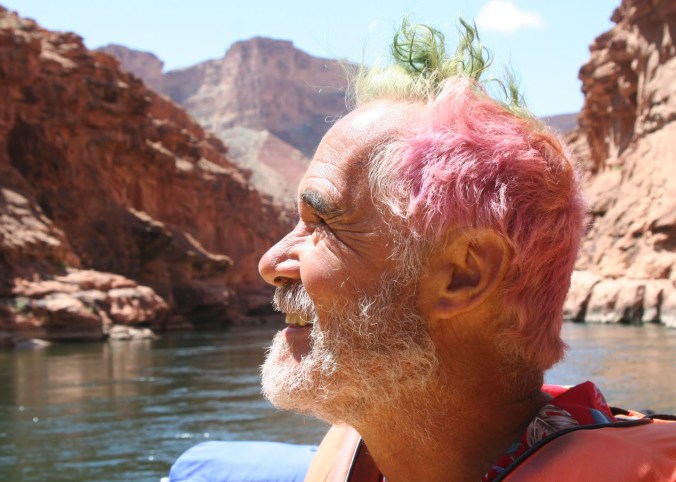
Tom and I would go on to having numerous adventures. And he remained as wild as ever. Here is on a trip down the Colorado River that Peggy and I went on with him a few years ago.

Tom and I would go on to having numerous adventures. And he has remained as wild as ever. Here he is on a trip he led down the Colorado River that Peggy and I went on with him a few years ago.

Back at Lungland, the clock was ticking. The Trek was three weeks away and then two. It was time to go out and preview the route. Given Tom’s pessimistic assessment of our adventure, Steve and I felt the preview was all the more critical. We agreed to a long weekend where each of us would hike three days of the route. The final three days were saved for the following weekend just before the Trek. Could we plan things any tighter? There was no room for error…

We took our second trek south through the Desolation Wilderness, which is just south of the Granite Chief Wilderness and both west of Lake Tahoe. Here I am checking out the terrain.

We took our second trek south through the Desolation Wilderness, which is just south of the Granite Chief Wilderness and both west of Lake Tahoe. Here I am checking out the terrain.

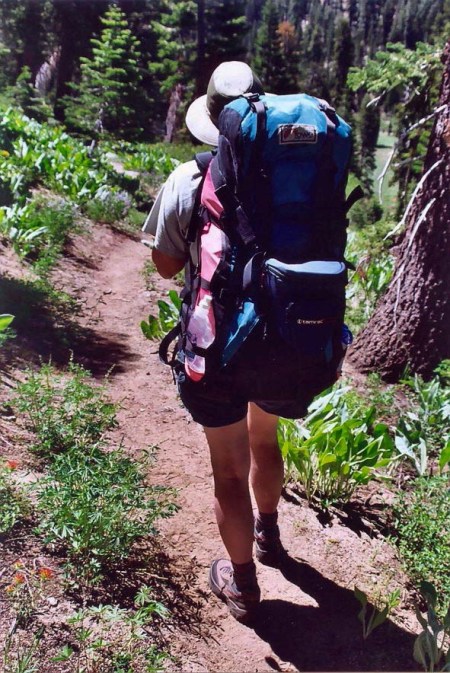
And here's Peggy hiking down one of the trails in the Granite Chief Wilderness. The pack looks almost as big as she is.

And here’s Peggy hiking down one of the trails in the Granite Chief Wilderness. The pack looks almost as big as she is.

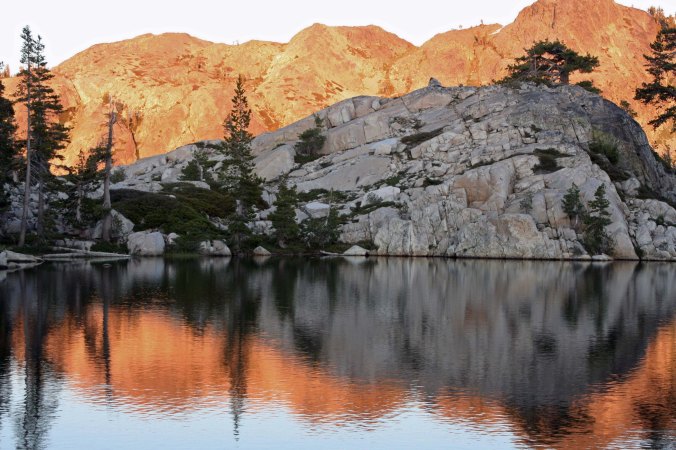
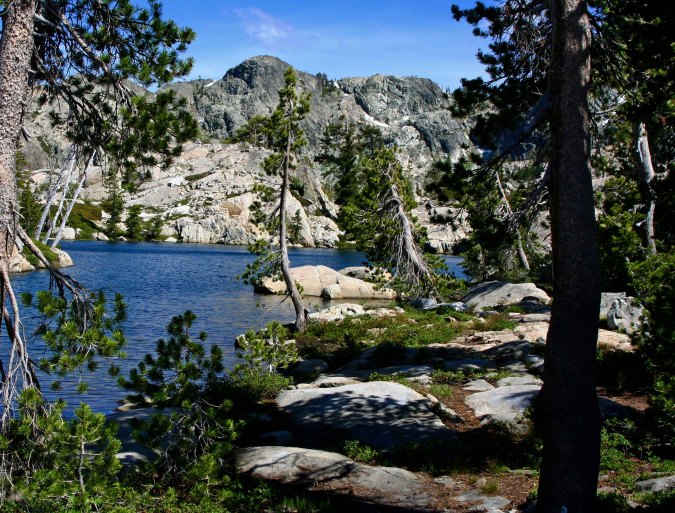
There is a series of four small lakes in the Desolation Wilderness called the 4 Q Lakes because of their shape. I took this reflection shot from my favorite camp location.

There is a series of four small lakes in the Desolation Wilderness called the 4 Q Lakes because of their shape. I took this reflection shot from my favorite camp location.

Flipped 90 degrees, it reminded me of an African mask.

Flipped 90 degrees, it reminded me of an African mask.

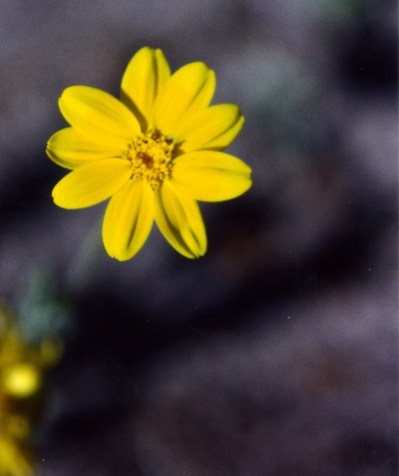
One of my favorite memories of Orvis was his expertise on flowers. Trekkers were always asking him for their names. I didn't know this one on our first trek so I asked Orvis. "Oh, that's a DYC," he told me. I dutifully told other trekkers it was a DYC. At the end of the Trek , I asked Orvis if the DYC stood for anything. He got a twinkle in his eye and said, "Dam yellow composite."

One of my favorite memories of Orvis was his expertise on flowers. Trekkers were always asking him for their names. I didn’t know this one on our first trek so I asked Orvis. “Oh, that’s a DYC,” he told me. I dutifully told other trekkers it was a DYC. At the end of the Trek , I asked Orvis if the DYC stood for anything. He got a twinkle in his eye and said, “Dam yellow composite.”

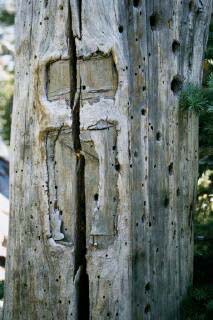
I'll conclude today with this tree blaze from the Desolation Wilderness. One of the joys of wilderness travel is finding old, long since forgotten trails and following them. Early sheepherders, ranchers, foresters, mountain men and explorers often marked their trails by cutting into the bark of trees. Many of the blazes would last for years and years, such as this one.

I’ll conclude today with this tree blaze from the Desolation Wilderness. One of the joys of wilderness travel is finding old, long since forgotten trails and following them. Early sheepherders, ranchers, foresters, mountain men and explorers often marked their trails by cutting into the bark of trees. Many of the blazes would last for years and years, such as this one.

NEXT BLOGS

Tomorrow: A review of Three Hundred Cups of Tea and The Toughest Job, a book by two Returned Peace Corps Volunteers, Asifa Kanji and David Drury, on their experience as Volunteers in Mali, West Africa.

Friday/Saturday: The first of my photographic essays on Burning Man in preparation for the 2017 event.

Monday: Back to Boston and the Freedom Trail

A Far Out Excuse for Escaping to the Woods… The Sierra Trek Series: Part 1

The Black Buttes of the Sierra Nevada Mountains are lit up by the evening sun.

Inspired by the beauty of the Five Lakes Basin found north of Interstate 80 in the Sierra Nevada Mountains of California, I started a lifetime of backpacking in 1969.


At Five Lakes Basin’s/ Biggest little lake /after all day scrambling on the peaks/ a naked bug /with a white body and brown hair/ dives in the water/ Splash! — Gary Snyder

As I think about backpacking 500 miles this summer, my mind wanders back in time to the first major backpacking trip I ever made: a nine-day, 100 mile trek across the Sierra Nevada Mountain Range. The trip in itself would have been a bit crazy considering my lack of experience. But I ended up leading 60 people aged 11 to 70, most with less experience than I had. It was a new definition of insanity. I was lucky the participants didn’t leave me hanging in a tree somewhere along the trail. It came close.

It’s a good story, one that I’ve been planning to tell for a long time. My Wednesday blog will be devoted to it over the next couple of months. So grab whatever you like to drink, sit back, and join me on the first Sierra Trek.


During the early summer of 1974 my life took a dramatic shift. My first wife Jo Ann, friend Steve Crowle, and I used a long summer weekend to go backpacking into one of my all-time favorite backcountry destinations, the Five Lakes Basin north of Interstate 80 in the Sierra Nevada Mountains. It’s a beautiful area with towering granite cliffs and jewel-like lakes that had been carved out by glaciers some 20,000 years ago. It’s also a favorite area of the Pulitzer Prize winning poet, Gary Snyder, whose haiku poem on the area is featured at the top of this post.

Gary Snyders Haiku poem "Old Pond" was based on the Five Lakes Basin.

The Black Buttes looming above the Five Lakes are where the poet Gary Snyder went ‘scrambling.’

My first backpacking trip ever had taken me into the region in 1969 and I had returned again and again, sometime with Jo, sometimes with friends, and occasionally by myself. On one of the latter trips, I had taken my Basset Hound Socrates and camped out on a small lake that is somewhat hidden from the other lakes. I’ve blogged about the Socrates trip. Here’s what I wrote:

One of the five Lakes in the Five Lakes Basin north of Interstate 80 in the Sierra Nevada Mountains.

This is the lake where Socrates and I camped and where the Sierra Trek was born. This photo also shows how granite dominates the Sierra Nevada Mountains.

Sharing the lake with Soc was close to being totally alone. His concept of a quality wilderness experience was disappearing into the woods and seeing how many holes he could dig. He never seemed to catch anything, so I am not sure of his motivation. I’d get up in the morning and cover his handiwork. I almost felt like I needed to file an environmental impact report. He always limped home on sore feet.

On this particular journey, I packed the Carlos Castaneda book that features things that go bump in the night. Don Juan takes Carlos out into the middle of the Sonoran Desert on a pitch-black night and abandons him. Not long afterwards, the monsters come hunting. It wasn’t the best book for a solo night in the woods. As I read into the evening, I found myself paying more attention than usual to wilderness sounds.

I ingested a little medicinal herb to lighten things up. It was the 70s, after all. Bad idea; instant paranoia set in. Soon I could hear the wind stalking me through the treetops. An old snag turned into a ghoul. Off in the distance something big and ugly was digging and snorting. Socrates, I hoped.

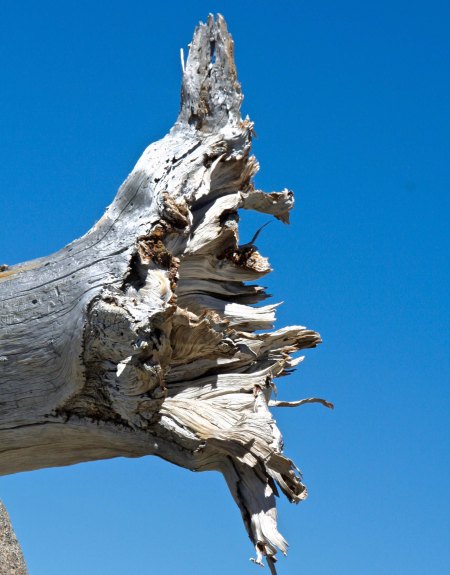
This tree turned into the ghoul as the sun set and night approached.

This Jeffrey Pine turned into the ghoul as the sun set and night approached.

Ghost tree in the Five Lakes Basin of the Sierra Nevada Mountains.

A close up of the dead ghoul tree.

“Here Soc,” I called. “Come here boy.”

The digging continued and grew more desperate.

“Come here!” I yelled. Still no response but now I could hear large claws scratching at granite.

“Does someone want a Milk Bone?” I added in a quiet, conversational voice.

The digging stopped. ‘Someone’ started coming through the brush toward me. Whatever it was, it was apparently interested in Milk Bones. Soc’s head, long body and wagging tail made their way into the firelight. He might love digging, but he loved food more. There was the reason why our low-slung pooch weighed 70 pounds.

“Good boy,” I said while digging out a Milk Bone. I knew I was buying companionship but it seemed like a good idea on this strange, dark night. Meanwhile, Socrates had started to drool in expectation. Soon he was shaking his head and shooting dog slobber off in a dozen directions. I ducked to avoid being slimed.

Unfortunately, my supply of Milk Bones was limited. I tied Soc up to assure his faithfulness. It was time for bed. I put the fire out and was greeted by a moonless, dark night. But hey, who needed the moon when I had my faithful companion and a million stars. I invited Socrates to snuggle up on my sleeping bag and laid my head down on the coat I was using for a pillow.

CRUNCH, CRUNCH, CRUNCH!

“Damn! What’s that?” I sat up straight and grabbed for my flashlight. Socrates joined in by barking at my sleeping bag.

“No, Soc, out there,” I urged and pointed the flashlight off into the woods. Soc glanced up at me with a curious ‘what are you talking about’ look and started barking at my pillow.

“Look Socrates,” I pleaded, “just pretend there is a garbage man out in the woods.”

Soc had never met a garbage man he could resist barking at and I wanted his teeth pointed in the right direction.  What Soc did with my advice was make three dog circles and plop down on my bag. I gave up and reluctantly laid my head back down on my pillow.

CRUNCH, CRUNCH, CRUNCH!

I sat straight up again. Soc growled at me for disturbing his rest and started barking at my sleeping bag again.

“Fine watch dog you are,” I growled right back at him while straining my ears for the smallest of sounds. When Soc shut up, I was rewarded with a faint ‘crunch, crunch, crunch.’ It was coming from under the sleeping bag. I had a proverbial monster under my bed! Gradually it dawned on me that what I was hearing was a gopher tunneling his way through the ground, innocently on his way to some succulent root. I put my head down on my pillow. Sure enough, the ‘crunch’ became a ‘CRUNCH.’

The ground and the mystic weed were magnifying the sound. Soc had been right all along. I was lucky that he only barked at my sleeping bag and hadn’t started digging.

Don Juan would have appreciated how I had been tricked. Reality isn’t always what it seems.

Jo Ann, Steve and I had ended up camping on the same lake. Steve had replaced me as Executive Director of Sacramento’s Ecology Information Center when I had become Assistant Director of the American Lung Association of Sacramento. In addition to his boundless energy and intelligence, he was more than a little on the wild side. He had hobbies like jumping off high bridges into shallow water and experimenting with various mind-altering drugs. But mainly he loved life and had a vast appetite for new experiences.

One such experience was backpacking. We were lazing around our campfire on the last night bemoaning the fact that we had to return to civilization and jobs the next day.

“God, wouldn’t it be great if we could make money doing this,” Steve sighed.

Suddenly my mind took one of its intuitive leaps where the lights come on, the bells go off and four and twenty blackbirds sing the Hallelujah Chorus.

“We can, Steve!” I managed to get out as my thoughts played hopscotch. “Look, as Executive Director one of my main responsibilities is fund-raising.” (That spring, I had become Executive Director of the Lung Association.)

I was painfully aware my money-raising responsibilities. TB/Lung Associations had spent 70 happy years sending out Christmas Seals and waiting for the money to roll in. While the Golden Goose wasn’t dead, it was ailing. We had conquered TB and selling lungs wasn’t nearly as easy. Easter Seals had kids, the Heart Association the most appealing organ in the body, and the Cancer Society the scariest word in the dictionary. We had emphysema, bronchitis, asthma, the remnants of TB and diseases with unpronounceable names such as coccidioidomycosis. Adding injury to insult, dozens of non-profit organizations had added seals to their fund-raising arsenals. Competition for bucks to do-good was tough and the well was running dry.

“What if,” I pondered out loud, “we ran a backpack trip through the mountains as a type of multi-day walk-a-thon with people raising money for each mile they hiked?” I liked walk-a-thons. They involved people in healthy activities as well as raising money. They gave something back to the participants.

Steve’s attention jumped from low watt to high intensity. “When? Where? For how many miles and days? How can I be involved?” The questions tumbled out.

“I don’t know, I don’t know and I don’t know,” I responded, laughing at his enthusiasm although mine was hardly less. “But,” I added, throwing out some crazy figures, “what if we made it for nine days and 100 miles?”

That quieted us down. Neither of us had ever backpacked for nine days straight, much less 100 miles. A long trip for me had been six days and 30 miles. I threw out the nine days because it included a full week with both weekends and the 100 miles because it sounded impressive.

“Why not,” Steve had finally said with more than a little awe in his voice as a new national fund-raising program was born. It was a program that would occupy much of my time over the next 30 years, involve thousands of people, and raise substantial funds for the American Lung Association. But all of that was in the future; Steve and I just wanted an excuse to go backpacking.

Here are a few photos from the Five Lakes Basin:

Beautiful flowers such as this Mariposa Lilly...

In the summer, the Basin is filled with beautiful flowers such as this Mariposa Lilly…

Penstemon...

Penstemon…

And a butter cup.

And Cinquefoil.

Snag in the Five Lakes Basin .

Both live and dead trees decorate the landscape.

It was in the Five Lakes Basin

This impressive stump was located about 50 yards from camp.

In addition to their beauty, the lakes make great swimming holes and provide opportunities to add trout to dinner.

In addition to their beauty, the lakes make great swimming holes and provide opportunities to add trout to dinner. This was a view from my campsite.

Fun lakes and interesting reflections...

They are also good for reflection shots!

And interesting reflections.

This reflection of this tree was so clear it could have been real.

This reflection of this Lodgepole Pine was so clear it could have been real.

The sunset on the Black Buttes and, finally...

Another sunset photo of the Black Buttes and, finally…

A dramatic sunset.

A dramatic sunset.

FRIDAY’S BLOG: A photographic essay on the Glass Forge in Grants Pass, Oregon and its beautiful glass creations.

MONDAY’S BLOG: We will return to the Oregon Coast and visit the scenic Sunset Bay.

WEDNESDAY’S BLOG: Part 2 of my Sierra Trek series. I have to persuade a reluctant Board of Directors (“You want to do what?”), decide on a name, hire Steve, and determine our route.

Wandering through Time and Place in 2017… And Some Thoughts on Planning

Curtis Mekemson hiking along the Pacific Crest Trail behind Squaw Valley.

It’s time to start planning and dreaming about 2017. One of my goals is a seven week, 500-mile backpack trip on the Pacific Crest Trail. Here I am in the Granite Chief Wilderness behind Squaw Valley, California. (Photo by Peggy Mekemson)

It’s the first day of the New Year. It’s the time to make resolutions and plans— a time to dream.

There was a time in my life when I was obsessive about the planning process. I would lay out goals and objectives. And then I would move into YAPs, QUAPs, MAPs, WAPs and DAPs, or, to spell it out: yearly, quarterly, monthly, weekly and daily action plans based on my goals and objectives. I set priorities, created time lines, made to-do lists, checked things off, kept records, and made plan revisions. Things that didn’t work were modified or dropped. New opportunities were taken advantage of. I did it for my personal as well as professional life. It was how I accomplished things I wanted to do, and how I kept some control over my often chaotic life.

Early on I had learned if I didn’t plan out what I wanted to do with my time, someone else was more than willing to do it for me. And I had also learned that there is power in planning, in knowing what you want to do, and in determining what is important, what has the greatest impact.

I am not as obsessive as I once was, but old habits die hard. And, even though I am “retired,” it is still important to have an idea of where I want to go, of what I want to do, and of what is important to me. Of course I don’t exist in a vacuum. Ask Peggy. (grin) Most of what we do is jointly decided.

So given all of this, what are my writing and travel plans for 2017?

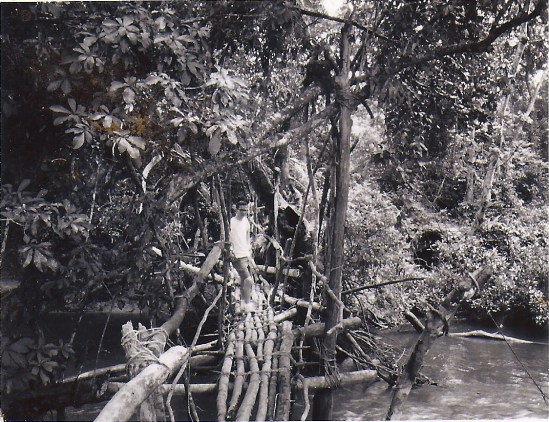
Kpelle footbridge near Gbarnga, Liberia circa 1965.

I hope to revise and republish “The Bush Devil Ate Sam,” a memoir about my Peace Corps experience in West Africa. Here, a much younger Curt makes his way across a river on a native bridge in the heart of the African jungle.

Under writing objectives, I plan to finish my next book, tentatively titled Tales of an Incorrigible Wanderer. My 10,000-mile bike trip plus other outdoor adventures will be included. (I am sure you will want to buy a copy. Grin.) I also plan to revise and republish The Bush Devil Ate Sam. I will continue to blog two to three times a week on current travels/adventures as well as past adventures. I am thinking in terms of doing one blog each week on current travels, one blog on past adventures, and one blog as a photographic essay. But we’ll see. I have to reduce the time I spend on blogging so I have more time for other goals, like play, for example.

Our travels this coming year will likely go in three directions. One, Peggy would like us to do a more thorough job of exploring the Pacific Northwest. I might add California down to Big Sur simply to expand my Pacific Coast blogging series. (And I really like Big Sur, Carmel and Monterey.) I expect we will also spend more time exploring the East Coast now that our two kids and their families are living there. Finally, I am hoping we can plan a trip to Ireland and possibly England where I would like to continue my genealogical research.

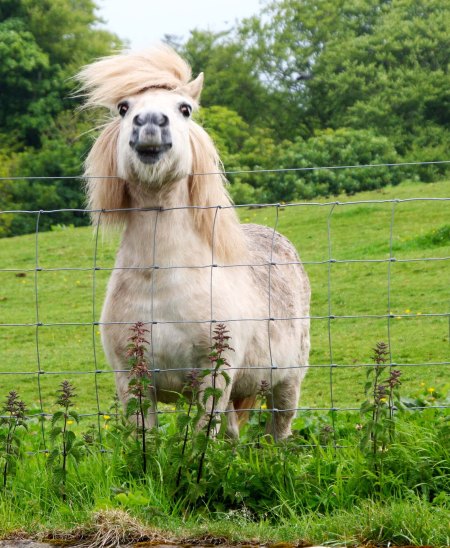
Photo of Scottish pony taken by Curtis Mekemson.

I photographed this pony in Kirkcolm, Scotland when I was doing research on my Scots-Irish ancestors a few years ago. I promised myself at the time that I would return for more research in Ireland and England.

I am also hoping we can make it back to Burning Man. It is one of my most popular blog topics and I would like to write a book in 2018 on my 14 years of experience with the event. We will know in February if we can get tickets for this year.

The Temple of Promise at Burning Man in 2015 is caught by the morning sun.

Morning sun catches the copper face of the Temple of Promise at Burning Man 2015.

Finally, it is time for another grand adventure. I celebrated my 60s by doing a six-week 360-mile backpack trip down the Sierra Nevada Mountain range from Lake Tahoe to Mt. Whitney. It seems only appropriate that I celebrate my 70s by doing a seven-week, 70-miles per week, 490-mile backpack trip on the Pacific Crest Trail. But I’ll have to see whether my 74-year old body is willing to cooperate. Maybe it will be a one-week 70-mile trip, or a one-day 7-mile hike, or a .7-mile hike to the mailbox. Laughing.

Whatever… I am sure there will be many adventures to share!

Home and a Surprise… The Ten Thousand Mile Bike Trek— End of Series

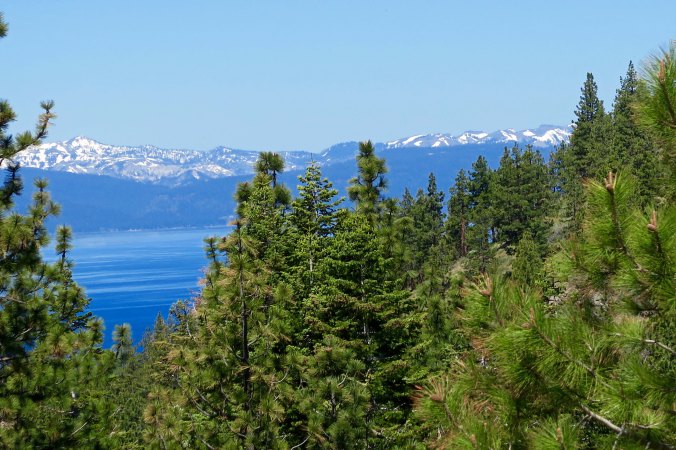
When I arrived at Lake Tahoe, I returned to what I considered my home territory. Half of the beauty of the area is found in the Lake, the other half is in the surrounding backdrop of the Sierra Nevada Mountain Range.

When I arrived at Lake Tahoe, I returned to what I considered my home territory. Half of the beauty of the area is found in the Lake, the other half is in the surrounding backdrop of the Sierra Nevada Mountain Range.

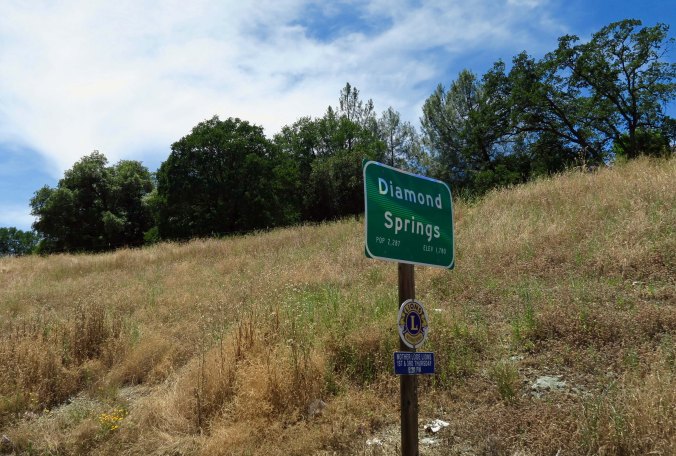
I had planned my six month, solo bike journey around North America as a great circular route, starting and ending in the small, rural town of Diamond Springs, which is nestled in the foothills of the Sierra Nevada Mountain Range east of Sacramento. I grew up there, and the connection was important to me.

I had seen my journey as twofold. My primary purpose was to explore much of the US and Canada in a way few other people had. But I also wanted to use the opportunity to undertake an inward voyage, going back in time to explore my childhood and learn more about myself. Thus the Diamond Springs tie in.

The three-month trip Peggy and I made this spring allowed me to retrace my route and relive my 1989 experience. It also allowed me to share the journey with you, which I have done with 54 posts that included approximately 50,000 words and 1,000 photos: in even more words, that’s a lot! In the end, my North America bike trek had turned out to be everything that I hoped for, and much more. I had seen great beauty, met good people, and had numerous adventures— enough even for me.

Someday, I may share the inward journey. Suffice it to say here, I learned a lot about myself along the way. I achieved a balance and inner peace that have lasted up until today. I haven’t found myself teetering on the edge since 1989. I could run off and play in the woods for reasons other than to put Curt back together again.

But for now, let’s finish up the bike journey and discover the surprise at the end.

I left Carson City, Nevada following Highway 50 up and over Spooner Pass and then dropped into Lake Tahoe, arguably one of the world’s most beautiful lakes. Memories came flooding back. I had spent three college summers driving a laundry truck between Placerville and Lake Tahoe six days a week. The work was easy, the scenery beautiful and the money… well, it was enough to pay for my UC Berkeley education. (I only had to cover my living expenses, books and student fees. Those were the days when tuition at UC was still free, back in the days when government still believed that an investment in public education was one of the best investments it could make, back before it decided that making banks wealthy–er was more important.)

In 1974, I came up with the crazy idea that the organization I was Executive Director of in Sacramento could raise funds off of 9-day hundred mile backpack trips. Actually, I just wanted to go backpacking. The first one I led was from Squaw Valley, just northwest of Tahoe, across the Sierra Nevada Mountains to Auburn. I took 63 people aged 11-70 and learned a lot. (I’ll tell you the story some time.) Fortunately the Trekkers let me live, and the event made money. Later I would add 9-day, 500 mile Bike Treks. Several included Lake Tahoe. I even organized a 7-day winter cross-country ski and camping trek through the Desolation Wilderness west of the lake. That was an experience!

I feel a deep attachment to the Sierra's on the west side of Lake Tahoe, having backpacked up and down and across them many, many times over the years. I feel more at home there than I ever have in any city.

I feel a deep attachment to the Sierra’s on the west side of Lake Tahoe, having backpacked up and down and across them many, many times over the years. I feel more at home in these mountains than I ever have in any city.

This impressive rock greeted me as I biked down to the Lake from Sooner Pass.

This impressive rock greeted me as I biked down to the Lake from Sooner Pass.

The Casinos started a quarter of a mile beyond this lovely meadow!

The Casinos started a quarter of a mile beyond this lovely meadow! Nevada has done a much better job of controlling growth than California.

My bike trip took me along the east shore of the lake to Stateline where I biked past more casinos and entered California and El Dorado County, the county of my youth. Highway 50 wound through South Lake Tahoe and then over to Myers where I climbed my second 7000-foot pass of the day. I felt like I could have done it blind-folded. I was on my laundry route. Every curve, every sight was an old friend. Passing over Echo Summit, I had a wonderfully long downhill ride to Riverton and then climbed up once more to Pollock Pines, where I left Highway 50 and detoured through Camino. I found a small barbershop there and got my first haircut since Nova Scotia. I was a bit on the bushy side. There was a chance that they wouldn’t recognize me in Sacramento, especially if you threw in the fact that I had lost 40 pounds and now had big, bulging muscles.

The Sierra's are world renown for their granite. This view is from the southern portion of the Tahoe basin just before you begin to climb out of it toward Echo Summit.

The Sierras are world renown for their granite. This view is from the southern portion of the Tahoe basin just before you begin to climb out of it toward Echo Summit.

Because of my laundry days, I knew every curve (and straight-stretch) between Lake Tahoe and Placerville!

Because of my laundry days, I knew every curve (and straight-stretch) between Lake Tahoe and Placerville! Just beyond the small hill on the left is a major drop into a deep canyon.

Horse Tail Falls is one of many scenic views I appreciated on my laundry trips and on my bike ride down the mountains. I once crossed the river when it was roaring like this on a narrow log. It was raining and I was by myself. I got down and crawled.

Horsetail Falls is one of many scenic views I appreciated on my laundry trips and on my bike ride down the mountain. I once crossed the river up near the top on a narrow log when it was roaring like this. It was raining, I was by myself, and I was wearing a 50 pound pack. I got down on my knees and crawled.

Sugarloaf Mountain located next to Kyburz Resort on Highway 50 in El Dorado County, CA.

This wonderful chunk of granite is known as Sugarloaf and is another favorite view along Highway 50. It’s quite popular among rock climbers, which is another sport (like jumping off bridges), I see no reason to pursue.

A short five miles brought me to Placerville, where I lingered, not wanting my journey to end. I had gone to high school here and spent my teenage years in the town learning about life, love, sex, and books, not necessarily in that order. Eventually, I climbed back on my bike, picked up Highway 49, and biked 3 miles into Diamond. I jumped off my bike, dropped it, and did a jig with great enthusiasm. People must have thought I was extremely odd. And I was. My 10,000-mile North America Bike Trek was over.

The town of Placerville where I went to high school was once known as Hangtown and is quite proud of it's heritage. A large oak tree in the center of the town was used for hanging bad guys (and probably a few innocents) during the Gold Rush Era.

The town of Placerville where I went to high school was once known as Hangtown and is quite proud of its heritage. A large oak tree in the center of the town was used for hanging bad guys (and probably a few innocents) during the Gold Rush Era.

Hangman's Tree location in Placerville, CA.

The tree was cut down long ago but this rather ghoulish fellow (or his look-alike) has been hanging at the site where the tree was as far back as my memory takes me.

Speaking of evil-doers, you might want to check here to find out why the Placerville Police of Chief was driving me around in his squad car behind the courthouse featured here and wanted to know whether I preferred to go to my graduation from high school that night or go to jail.

Speaking of evil-doers, you might want to check here to find out why the Placerville Police of Chief was driving me around in his squad car behind the courthouse featured above, wanting to know whether I preferred  to spend my night graduating from high school or going to jail.

And finally, after riding my bike for 10,000 miles, I returned to Diamond.

And finally, after riding my bike for 10,000 miles, I returned to Diamond.

But my trip wasn’t quite over; I still had to bike into Sacramento.

I spent the night in Diamond and then rode along Highway 49 through the town, past the cemetery, past my old house, and on to Eldorado, following the same route I had six-months earlier. It felt like decades. In El Dorado, I left my route and followed back roads into Sacramento. I had a Trek-planning meeting that night at the Lung Association. My friend Jane Hagedorn, the Executive Director, had lured me back into town with the promise of Treks. I wheeled my bike into the office at 909 12th street and was greeted royally by Raquel, Jane’s executive secretary, a woman I had hired in 1974.

“Where’s Jane?” I asked, eager to see my friend. “She’s on an important phone conference call,” Raquel answered. The door to her office was closed. I had turned around, a bit disappointed, when a woman I didn’t know came bursting out of one of the offices. Wow, I thought, she’s gorgeous. She gave me a lovely smile that warmed me from my head to my toes, and everywhere in between.

“Hi,” she greeted me, grabbing my hand. “I am Peggy, Jane’s sister. You have to be Curtis! I’ve been hearing stories about you for years.” I swear— I fell in love— then and there.

A new journey had begun.

Last week, Peggy and I celebrated 24 years of marriage and 26 years of happily wandering the world together.

A 1993 photo of Peggy one year after we had married. Always up for an adventure, she had just finished a 150 mile backpack trip down the John Muir Trail I had led. More to the point she had just finished hiking a 16 mile day with a 40 pound pack up and over Mt. Whitney that had included 9000 feet of elevation gain and loss. And she was still smiling!

A 1993 photo of Peggy at 43 one year after we had married. Always up for an adventure, she had just finished a 150 mile backpack trip down the John Muir Trail I had led to celebrate my 50th birthday. More to the point she had just finished hiking a 16 mile day with a 40 pound pack up and over Mt. Whitney that had included 9000 feet of elevation gain and loss. And she was still smiling!

Peggy celebrating the end of re-tracing my bike route at the Diamond Springs hotel. She had driven our RV the whole way so I could take photos and notes. Still smiling!

Peggy celebrating the end of re-tracing my bike route at the Diamond Springs Hotel. She had driven our RV the whole way so I could take photos and notes. Still up for an adventure, still smiling and still gorgeous at 65!

NEXT BLOG: Meet Petros, the world’s most famous pelican. A blog quickie!


On Hearing Voices in the Desert: Nevada… The 10,000-Mile Bike Trek

Early prophets headed into the desert to seek guidance and find their gods. Living in the harsh environment served as a sacrifice. Being totally alone in deep silence of the desert meant they had only themselves to listen to. It was easy to hear the whispers and voices of their inner selves, and possibly something else, ancient voice reverberation down through time.

Early prophets headed into the desert to seek guidance and find their gods. Living in the harsh environment served as a sacrifice. Being totally alone in the deep silence of the desert meant they had only themselves to listen to. It was easy to hear the whispers and voices of their inner-selves, and possibly something else, ancient voices reverberating down through time.


Have you ever heard someone talking to you when no one is around? The mental health folks call this experience an auditory hallucination. If you do it a lot, people start worrying about you. Words like mania or schizophrenia are thrown around. Professional advice is sought, straitjackets purchased. Fortunately, it has only happened to me twice: the first time when I was out backpacking, the second when I was bicycling across the Nevada desert on my 10,000-mile bike trek.

The first occasion I found rather humorous. I was backpacking with my Basset Hound, Socrates. (It should be noted that anyone who backpacks with a Basset Hound is already mildly insane.) Soc was off chasing some imaginary beast in the woods— his deep, hound-bark reverberating through the surrounding mountains. I was meditating using my favorite mantra, ‘goat.’ Don’t ask.

The session was progressing well. I had quieted my ever-noisy mind; colors were taking on intensity, the forest becoming alive, and Soc’s bark sounding like a Beethoven Sonata. That’s when it happened. A clear voice out of nowhere spoke to me.

“Talk to me, damn it!”

Now you can’t make this up. It’s too weird. Apparently, the inner me wanted words to munch on, not silence. It’s used to my constant nattering. So it broke into my conscious mind, took possession of me, and made a demand. I could only laugh. I went back to meditating but it was hopeless. (If you want to hear the rest of my story about backpacking with Socrates, go here. It’s a very 70’s type of tale.)

People who are really serious about hearing voices, however, go off to the desert and hang out for 40 days, or years. Saints and other holy people have been doing this for millennia. Big, booming voices tell them to go off and save the world, or take dictation, or whip themselves. Piddly things like “Talk to me, damn it!” are never heard.

Rocks are one thing that prophets find in abundance when they head off into the desert. They are great for caves; the ideal home for self-sacrificing god-seekers.

Rocks are one thing that prophets find in abundance when they head off into the desert. They are great for caves: an ideal home for those eager to live in misery.

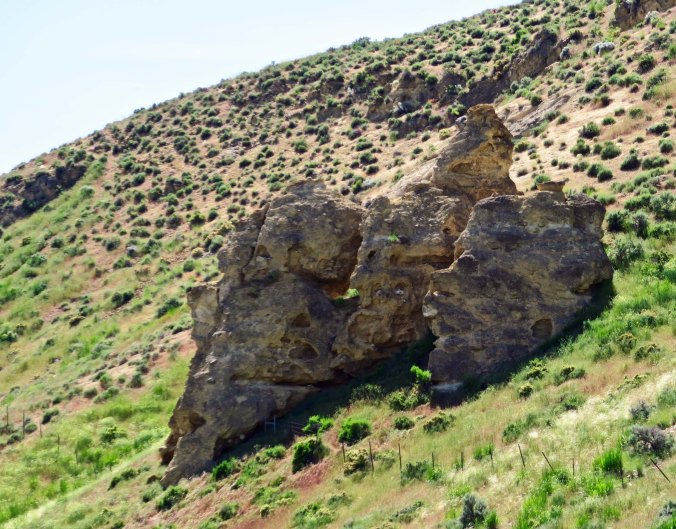
Nevada is totally filled with rocks. I am actually surprised it hasn't produced any prophets.

Nevada is totally filled with rocks. I am actually surprised it hasn’t produced any prophets (that I know of).

More Nevada rocks.

More Nevada rocks. Possibly three wise men, or three aliens?

And more rocks.

And more rocks.

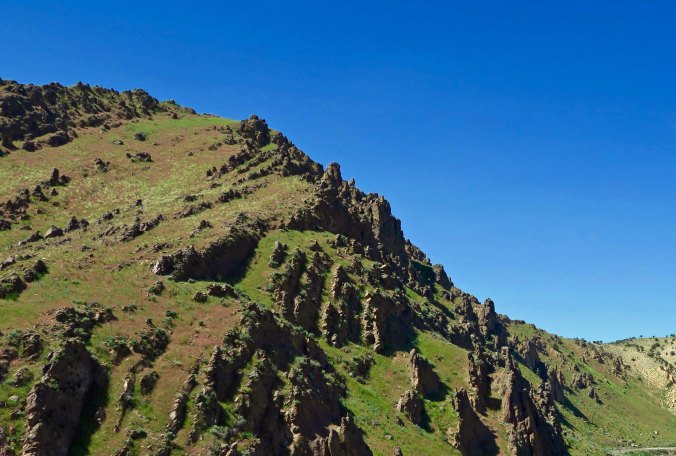
The Nevada desert fully qualifies as a place to get messages. It’s full of vast amounts of nothingness and rattlesnakes and jackrabbits and dust devils and rocks and UFOs and sagebrush and casinos. A common message people receive is, “You’re bank account is empty.” I don’t think that the state has produced any saints. Characters, on the other hand, are a dime a dozen. It’s my kind of place. I’ve crisscrossed it many times.

I've often thought about the people who choose to live their lives isolated from others. What kind of a person does it take to make such a choice? What does living out here do to a person?

I’ve often thought about the people who choose to live their lives isolated from others. What kind of a person does it take to make such a choice? What does living out here do to a person? Something about the choice resonates with me. I did, after all, choose to go on a six month bike ride by myself.

thunder-mountain-monument

Nevada is filled with wonderful characters. One was Frank Van Zant who heard voices that directed him to go off and build this structure along Interstate 80. Known as the Thunder Mountain Monument, Zant built it as a haven for spiritual seekers (hippies) of the 70s, and as a reminder of how we have mistreated Native Americans.

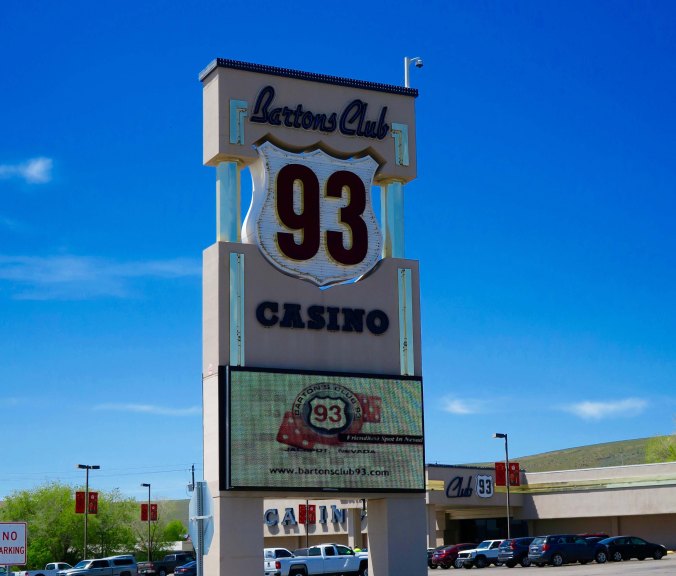
I entered the state on my bicycle following Idaho/Nevada 93. I knew that I had arrived when I spotted the casinos. (There are very few ways that you can enter the state without finding at least one, and often several.) They were a welcome sight, being the only place I could get a snack and refill my water bottles on my hundred-mile ride from Twin Falls to Wells. I even donated five dollars in quarters to improving Nevada’s economy.

It really has to be a remote road that enters Nevada without a casino present. Highway 93 isn't nearly remote enough!

It really has to be a remote road that enters Nevada without a casino present. Highway 93 isn’t nearly remote enough!

Highway 93 connecting Twin Falls, Idaho with Wells, Nevada featured this view. It reminded me of how beautiful Nevada is.

Highway 93 connecting Twin Falls, Idaho with Wells, Nevada featured this view of what I believe is the Humboldt Range or Ruby Mountains. It reminded me of how beautiful Nevada is.

Another view. Nevada is part of the Great Basin and is made up of several ranges with basins between. During the winter and into early summer, these ranges are often covered with snow.

Another view. Nevada is part of the Great Basin and is made up of several ranges with basins between. During the winter and into early summer, these ranges are often covered with snow.

In Wells, I picked up Interstate 80, one of America’s major East-West routes. I had been dreading this part of my journey. For well over 9000 miles I had been travelling on America and Canada’s back roads whenever possible and busier two lane highways when forced to. Now I would be riding on a four-lane freeway packed with a high percentage of the nation’s cross-country 18-wheelers. My only option was to detour to the south and pick up Highway 50, known as America’s “Loneliest Highway” as it crosses Nevada. It sounded great, but I was out of detour time. So I bit the proverbial bullet— and was happily surprised.

A constant line of traffic heading west on I-80.

A constant line of traffic heading west on I-80.

You can see almost anything traveling along I-80. Peggy and I were amused with this pick up load of squished porta-potties. I had my doubts about how they were fastened down.

You can see almost anything traveling along I-80. Peggy and I were amused with this pick up load of squished port-a-potties. I had my doubts about how they were fastened down. I pictured seeing them on my bike trip with the rope breaking. News Flash: Biker killed by flying port-a-potty. What an epitaph that would make!

The surprise was that I-80 has great shoulders. There were also occasional breaks in the traffic.

The surprise was that I-80 has great shoulders. There were also occasional breaks in the traffic.

The freeway has great shoulders. I could ride along and totally ignore the traffic. In time, the freeway noise even faded away. There was nothing but the desert, distant horizons and me. There weren’t even any cows to talk with, at least not many. I was free to meditate— and hear voices.

Cows to talk with were few and far between.

Cows to talk with were few and far between.

When the voice came, it was the booming type, not the silent whisper you hear in the back of your mind on occasion that suggests you really shouldn’t do something you have every intention of doing. It caught me off guard and scared me. I probably should have listened. Maybe I would have learned something, like to go home and build an ark. But I shut it down. I’m not crazy, and I had forgotten to bring my rose-colored glasses. Besides, I had no desire to become the first prophet to arise out of the Nevada desert (a scary thought), or end up in a straitjacket.

A couple of days later I did have a bit of a revelation, though. Maybe it was even related to the booming voice, or not. I’d left Sacramento with a lot of questions that could be traced all the way back to my youth and even DNA. To say I was restless is a massive understatement. While I had worked hard and had my share of success, I considered work an interlude between adventures. And my adventures were as much about running away as they were about my unending desire to explore new areas. My experience with relationships was similar. I’d had several since my divorce in 1976, and they had all been with good women, people who would have made great life-companions. But I had no desire to settle down and get married, much less have a family.

Something clicked in my mind out there in the middle of the Nevada desert, however. Maybe it was the result of sitting on the back of a bicycle by myself for six months. There was a lot of time to think, and a lot of alone time. I had a strong, clear thought that felt right to me. I could wander and explore without ‘running away.’ It was okay to go home and enter a serious relationship. It would be okay to get married again. It would be okay to have a family. I even went as far as thinking about the women I had dated over the past several years. As I said, they were good people, but I doubted that any of them had a sense of humor about my desire to wander. A week, yes, or even a month, but six months or a year? No way. I needed a companion who liked to wander as much as I did.

The rest of my trip across the desert was tame in comparison. I spent a lot of time going up and down. Nevada is basin and range country. I was constantly climbing up ranges and racing into basins. Towns were relatively close together and each one came with a number of casinos featuring inexpensive and plenteous food. My pure life of the open-road quickly deteriorated. I caught a bad casino cold as a result, after not having a touch of anything for six months. Eventually I hit Highway 95, the cutoff to Fallon where I picked up Highway 50 and cycled into Carson City. The Sierra Nevada Mountains loomed before me. The next day I would cross them, and then head home.

Leaving Interstate 80 toward Fallon, Nevada I entered what is known as the 40 mile desert, which was a nightmare for early pioneers crossing in wagon trains.

Leaving Interstate 80 toward Fallon, Nevada I entered what is known as the 40 mile desert, which was a nightmare for early pioneers crossing in wagon trains. An 1850 survey found 1061 dead mules, 5000 dead horses, 3750 dead cattle, and 953 graves along the route.

Highway 50 between Fallon and Carson provided a gentler view of the desert.

Highway 50 between Fallon and Carson City provided a gentler view of the desert.

And signs to watch out for wild horses.

And signs to watch out for wild horses crossing the road.

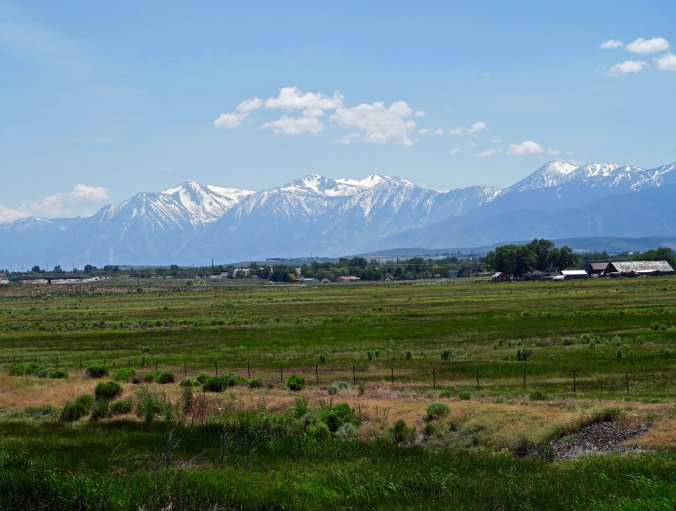
As I entered the Carson Valley, the Sierra Nevada Mountain Range loomed up before me. I was approaching the end of my journey. I was approaching home.

As I entered the Carson Valley, the Sierra Nevada Mountain Range loomed up before me. I was approaching the end of my journey. I was approaching home.

NEXT BLOG: I finish my 10,000 mile journey and return home. A surprise is waiting that will change my life.

I Know I Am in Montana; The Question Is Where? … The 10,000-Mile Bike Trek

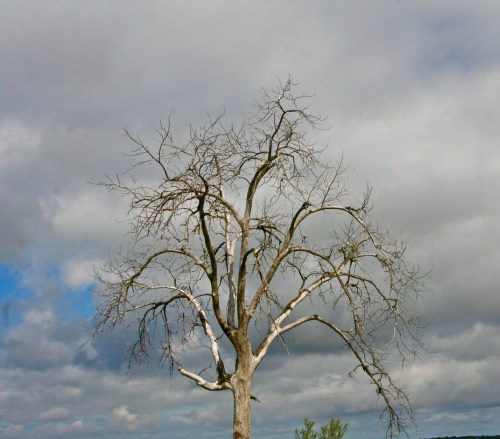
They call it Big Sky Country for a reason. The heavens seem to stretch on forever. But the enormity of the sky is matched by the state's mountains and rivers and valleys. Even this single tree has a statement to make.

They call it Big Sky Country for a reason. The heavens seem to stretch on forever. But the enormity of the sky is matched by the state’s mountains and rivers and valleys. Even this single tree has a statement to make.

I don’t really know if you can make a wrong turn in Montana. Almost everywhere you go the skies are big, the mountains high, the rivers clear, and the views forever. With that said, I am not 100% sure about my bike route through the state. For most of my 10,000-mile journey I had maps, or my journal, or letters, or even just logic to retrace my route of 27 years ago. Many of the roads I traveled down were the only roads available or at least the only roads I could use and get where I wanted to go without a major detour.

And often there were significant events that reminded me where I traveled. Many of the views I saw in Montana could have played this role— except those views were just about everywhere. The two events I do recall happened on my first day. One, I bicycled 120 miles with the elusive tailwind I had hoped for in North Dakota. Two, I found a restaurant that offered a free pancake to anyone who could eat the whole thing. It was a yard across, two inches deep and took the whole griddle to cook. I passed. But I watched a giant consume one and go on to eat a second. I thought he deserved a standing ovation, but hesitated with the thought that he might not like standing ovations. I try not to irritate mountains.

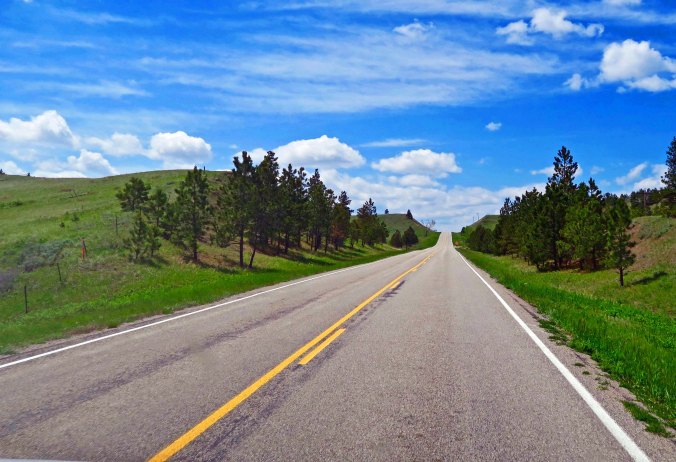
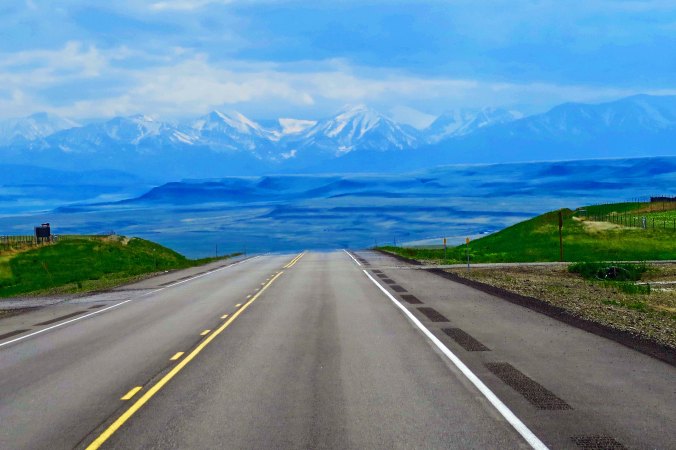
But my memory aids were unavailable for Montana. Still, I know most of my route. About 250 miles are in contention, which in Montana isn’t a big deal. Now if I were talking Rhode Island or Delaware… Anyway, if you are a map fiend, I either traveled from Malta on Highway 2 to White Sulphur Springs, or from Havre on Highway 2 to White Sulphur Springs. Both seem logical choices. Since the former route came first, Peggy and I drove it. Sections seemed quite familiar. Others not so much. One of these days, I will go back and start from Havre. Anyway, here are some views Peggy and I saw along the way.

Another perspective on Big Sky Country. This one along US Highway 2 as it makes its way through northern Montana.

Another perspective on Big Sky Country. This one along US Highway 2 as it makes its way through northern Montana.

Fence showing Montana cattle brands at Culbertson, Montana museum.

If ever there was a modern catch phrase in the writing, art, and business world, it is “branding.” Over and over we hear about how important it is that we establish our own unique voice or product. Well, there was a time when the concept of branding was a lot simpler. 🙂 We found this fence at a small museum in Culbertson, Montana. These are cattle brands from the region.

Cow weathervane found at museum in Culbertson, Montana.

We also found this fun weather vane at the Culbertson Museum. Somehow, it reminds me of the recent election. (grin)

Old beauty parlor hair curlers on display at Culbertson, Montana, Museum.

Another photo from the Culbertson museum and another bit of post-election humor: After the election, Mrs. B decided to head for the beauty parlor to have her hair done— and her brain rearranged. (Move on Curt.)

Whoa! Another roadside attraction.

Whoa! Another roadside attraction. Dinner? We came on this unlikely pair along with another  20 acres of other such creatures along Highway 2. There was no sign to tell us why they were there.

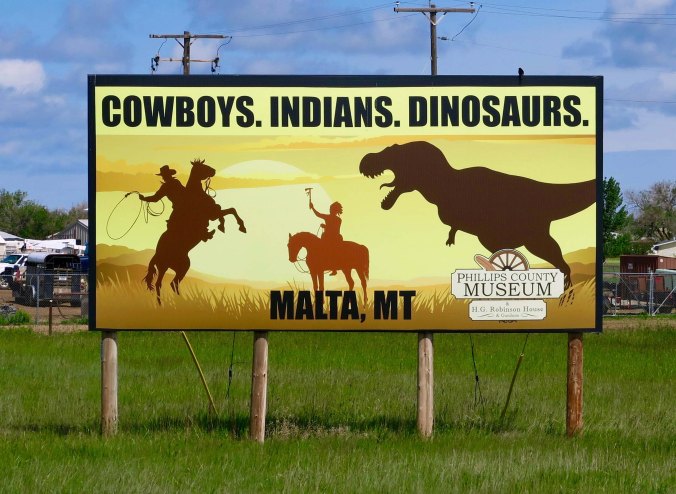
Sign for the Malta, Montana museum.

Here’s a cowboy with high hopes, “high in the sky apple pie hopes.” The Native American is saying, “Go get him guy. I’m behind you all the way.”

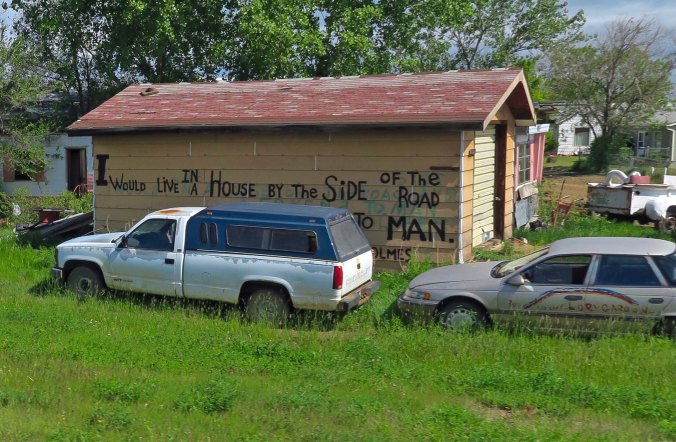
Peggy and I came across this derelict old house with its life-affirming message along Highway 2. It's a great message for these troubled times from a poem by Sam Walter Floss: "Let me live in a house beside the road/ Where the race of men go by/ The men who are good and the men who are bad/ As good and bad as I/ I would not sit in the scorner’s seat/ Nor hurl the cynic’s ban/ Let me live in a house by the side of the road/ And be a friend to man."

Peggy and I came across this old house with its life-affirming message along Highway 2. It’s a great message for these troubled times from a poem by Sam Walter Floss: “Let me live in a house beside the road/ Where the race of men go by/ The men who are good and the men who are bad/ As good and bad as I/ I would not sit in the scorner’s seat/ Nor hurl the cynic’s ban/ Let me live in a house by the side of the road/ And be a friend to man.”

Petroglyph from Sleeping Buffalo Rock along Highway 2 in Montana.

Another Highway 2 site featured the Sleeping Buffalo Rock covered with carved petroglyphs. This symbol is usually interpreted to represent a badger.

US Highway 191 in Montana

In Malta, Peggy and I picked up US Highway 191, which runs from the Canadian Border to Mexico. Unlike most of America’s historic north-south/east-west blue highways, 191 is a combination of many north-south roads that were put together in the 80s.

Another view of Montana countryside along Highway 191

Another view of Montana countryside along Highway 191.

A Montana stream found along US Highway 191.

A calm stream…

The Missouri River in Montana along US Highway 191

And the mighty Missouri River— Montana style.

Cattle roundup in Montana.

This is Montana! Cowboys and cattle. Two cowboys rode horses, and one is using an ATV.

Tempting! A trout contemplates a lure in a Lewiston, Montana mural.

Tempting! A trout contemplates a fly in a Lewiston, Montana mural.

I found this town fun. The high school looms in the background. The vote for the 2015 commencement speaker was unanimous. Dakota Jolliff asked her uncle to give the address. She was the only senior. The principal lives across the road from the school. First thing in the morning during winter storms, she looks out her window. If she can't see the school, classes are canceled. The school is also haunted. Lights are turned on at night and locked doors opened.

I found this town fun. The high school looms in the background. The vote for the 2015 commencement speaker was unanimous. Dakota Jolliff asked her uncle to give the address. She was the only senior. The principal lives across the road from the school. First thing in the morning during winter storms, she looks out her window. If she can’t see the school, classes are canceled. The school is also haunted. Lights are turned on at night and locked doors opened.

You may have noted the windmills in the Judith Gap sign. Check out the cattle at their base. There are 90 of the 40 story high monsters. They proved electricity to the 80 homes in Judith Gap plus another 360,000.

You may have noted the windmills in the Judith Gap sign. Check out the cattle at their base. (Tiny dots at the fence line right center— they may be antelope.) There are 90 of these 40-story high structures. They provided electricity to the 80 homes in Judith Gap plus another 360,000.

The Rocky Mountains viewed from Highway 191 in Montana.

When it comes to mountains, Montana is not shy. These are the Rocky Mountains.

Rocky Mountains in Montana.

Another view.

Rocky Mountains behind lake in Montana.

And another…

View of Rock Mountains in Montana.

And another.

Wood cutouts of wild animals in Sulphur Springs, Montana.

Peggy and I stayed at an RV campground in White Sulphur Springs that featured wild animal cut outs. I really liked this moose family with its reflection.

Peggy fed this one. Don't do this at home kids, Don't ever stick your hand in the mouse of an elk! :)

Peggy fed this one. Don’t do this at home kids. Don’t ever stick your hand in the mouth of an elk! 🙂

Here is my mandatory old barn photo for this blog with its dramatic backdrop of the Rocky Mountains. I didn't feel that this barn was simply falling down. It looked like it was melting!

Here is my mandatory old barn photo for this blog with its dramatic backdrop of the Rocky Mountains. I didn’t feel that this barn was simply falling down. It looked like it was melting!

Mountain men played a key role in the westward movement, first as trappers and later as guides.

Mountain men played a key role in the westward movement, first as trappers and later as guides.

Did this guy just hear the election results? (Kidding) We watched this guy and another jump into the Yellowstone River— and come out alive. They had carefully waited for a policeman to pass.

Did this guy just hear the election results? (Kidding) We watched this guy and another jump into the Yellowstone River— and come out alive. They had carefully waited for a policeman to pass. I am reminded of a statement by Joseph Campbell. “When you find yourself falling, dive.”

The Yellowstone River in Montana.

The Yellowstone River

A final view for today's post. This one is near Bozeman, Montana. In my next post I will head south from Bozeman and into Idaho, another beautiful state.

A final view for today’s post. This one is near Bozeman, Montana. In my next post I will head south from Bozeman and into Idaho, another beautiful state.


North Dakota and the Sneakiest Dog in America… The 10,000-Mile Bike Trek

Peggy and I discovered this pair of Canadian Geese in their idyllic setting near Minot, South Dakota.

Peggy and I discovered this pair of Canadian Geese in their idyllic setting near Minot, South Dakota.


I’m back in the saddle again/Out where a friend is a friend/Where the longhorn cattle feed — On the lowly gypsum weed/I’m back in the saddle again. –Old cowboy song by Gene Autry

My brother-in-law John wanted to know when it might be safe to come back to my blog. I really like John: he’s bright, is a talented writer, has a wonderful sense of humor, and is great to travel with, not to mention he has a really neat wife.  But we avoid talking politics. So this one’s for you, John. I am back in the saddle again. (grin)

I only needed one hand to count the number of people I met traveling through the US and Canada who were on long distance bike treks. So when I saw a fellow bicyclist loaded down with gear coming out of North Dakota on Highway 2, I flagged him down.

“The state is relatively flat,” he informed me, “and it should have been easy peddling. But I fought a strong head wind the whole way. It was tough.” I couldn’t help smiling. I appreciated his difficulty; I’d certainly dealt with my share of nasty headwinds. A strong headwind for him, however, would mean a strong tailwind for me. I would fly across North Dakota.

“One more thing,” the cyclist had cautioned, “there is a really nasty dog about five miles up the road. Be careful.”

I’d shared my experiences of bicycling through Minnesota and we had chatted for a while longer. We then parted company with him cycling east and me west.

Fifteen minutes later, I discovered the headwind— going in the wrong direction. That’s the thing about headwinds in North Dakota. They are close to legendary among bicyclists. You are always bicycling into the wind; it doesn’t matter which direction you are peddling. I hadn’t traveled for more than 15 minutes when I felt the first puff on my face. It hassled me all the way to the Montana border.

No large, drooling dogs came charging out to eat me, however. So I felt like I had dodged at least one bullet. I was thinking happy thoughts when I felt an irritation on my right heel with each rotation of the pedal. Curious, I glanced back. “What the…” went bouncing around my skull! A large, drooling dog that looked suspiciously like a pit bull was running silently beside me trying to grab my right foot each time it came close to his snapping teeth. I had met the sneakiest dog in America! My reaction was instinctual. I grabbed my bike pump and swung it backwards with a fair amount of force— and was rewarded with a solid thump and a surprised yip! I had caught the miscreant on his nose. Problem solved. The last I saw of him, he was low-tailing it home. Maybe he would think twice before hassling another bicyclist. Or bite harder…

Besides the large dogs and headwinds, two other things struck me about North Dakota. The first was sunflowers, millions of them, all pointing the same direction. I found them beautiful. North Dakota has more of them that anywhere else in the US. When they are young, they practice heliotropism. And no, that isn’t some weird sexual practice. Their necks are flexible and they track the sun. Early in the morning they are looking east. By late afternoon they are facing west.

When Peggy and I travelled through North Dakota in early June, it must have been too early for the sunflowers. So I recruited one from our yard that was hanging out a few months ago.

When Peggy and I travelled through North Dakota in early June, it must have been too early for the sunflowers. So I recruited one from our yard that was hanging out a few months ago.

The importance of agriculture to North Dakota could be seen everywhere, as with these distant storage elevators. I also like this photo because it provides a perspective on how flat certain portions of the state are.

The importance of agriculture to North Dakota could be seen everywhere, as with these distant grain elevators. I also like this photo because it provides a perspective on how flat the terrain in North Dakota can be.

It was obvious that people had been farming in the state for a long time!

It was obvious that people had been farming in the state for a long time!

Large farming equipment could be found everywhere.

Large farming equipment was found for sale in most towns.

And some of it I really would not like to meet on a dark night.

Including some that I wouldn’t like to meet on a dark night..

As I travelled west, ranching became more prevalent. Windmills are symbols of the West.

As I travelled west, ranching became more prevalent. Windmills are symbols of the West.

Cow now have strong competition from oil wells out in western North Dakota. Peggy and I saw oil operations everywhere. This wasn't the case when I biked through in 1989. Fracking seems to be the prime way for getting oil out of the ground. Can earthquakes be far behind?

Cows now have strong competition from oil wells out in western North Dakota. Peggy and I saw oil operations everywhere. This wasn’t the case when I biked through in 1989. Fracking seems to be the primary way for getting oil out of the ground. Can earthquakes be far behind?

The second thing I remember was a massive storm that caught up with me in the western part of the state near Williston. I’d been watching the clouds gather all afternoon and they had morphed into towering cumulus clouds that threatened one hell of a downpour and possibly a massive hailstorm. It was nothing I had wanted to be caught out in, and nothing I wanted to face in my tent. The higher the clouds had climbed the faster I had pedaled. I’d whipped into the first motel I had come to on the eastern edge of Williston and begged sanctuary.

“Sorry,” the clerk had told me, “We’re booked up.” Some type of event was going on and all of the motels in town were apparently full. Owners were calling around looking for space. “I just talked to a motel across town with three spaces left. Would you like me to call?” I had quickly answered yes. “You are in luck,” the clerk smiled, hanging up the phone. “You have the last space but you need to hurry.” People in Williston who looked out their windows must have thought that the Tour de France had made a wrong turn.

I pulled up in front of the motel office and opened the door halfway. “We are booked up,” the owner had growled. The pit bull had seemed much friendlier and probably was. “Ah, but I have a reservation,” I had responded, sounding cheerful, giving my name, and explaining about the motel across town. He had sourly looked down at a note he had made.

“You can stay,” he said. “But I don’t like bicyclists.” Whoa, I had thought, welcome to Williston. I wondered if a bicyclist had trashed one of his rooms forever condemning all bicyclists to hell. “You have to leave your bicycle outside. If you take it into your room, I am kicking you out, regardless of the weather.” I saw him staring out the window of the office, watching as I locked up my bike outside. Shortly afterwards the storm hit: drenching rain, high winds and hail. It was a nasty night in a cheap motel that had long since seen its glory days. Around 10 p.m., I went outside and retrieved my bike, carried it inside and put it down on newspapers. I was up and out by six the next morning. The sun was shining.

Some more memories of North Dakota…

This is the pond with the geese in it that I featured at the top of the blog.

This is the pond with the geese in it that I featured at the top of the blog.

A one room school house along Highway 2.

A one room school-house along Highway 2. Modern wind mills can be seen off to the right in the distance. There is a lot of wind in North Dakota.

I discovered the geographical center of North America when I road through Rugby, North Dakota. It was still there when Peggy and I drove through. (grin)

I discovered the geographical center of North America when I rode through Rugby, North Dakota. It was still there when Peggy and I drove through. (grin)

Another small lake we found along Highway 2.

Another small lake along Highway 2. I really liked the tree border.

It was skies like these that sent me scurrying for Williston. (The town has now become a city due to the oil boom, but it has been having tough times since Oil prices dropped.)

It was skies like these that sent me scurrying for Williston. (The town has now become a city due to the oil boom, but it has been having tough times since oil prices dropped.)

A North Dakota stream in the western part of the state. Note the hills!

A North Dakota stream in the western part of the state. Note the hills!

I'll conclude with this tree that lives out west.

I’ll conclude with this tree that we found out west. It was outlined by the sun, which had broken through the clouds.

NEXT BLOG: It’s off to Montana and Big Sky Country!

I Meet a Babe in Minnesota… The 10,000-Mile Bike Trek


This beautiful cove is found along Minnesota's scenic Highway 61 on the north coast of Lake Superior.

This beautiful cove is found along Minnesota’s scenic Highway 61 on the north coast of Lake Superior.

The Canadian Border guard glanced at my California driver’s license, smiled, and waved me through. How threatening could a guy on a bicycle be? It was a simpler time— a peaceful interval between America’s seemingly endless wars, before the onslaught of real and imagined terrorism, and before two good neighbors required passports to enter and leave.

The American Custom’s inspector was a bit more suspicious. They usually are. Maybe I was a pot-smoking hippie, an escapee to Canada from wars past. Middle-aged men were supposed to be busy working 40-hour weeks, knee-deep in kids and nose-deep in debt while supporting the American economy, not running away on six-month bicycle adventures. He had questions to ask. How long had I been in Canada, where had I traveled, what was my reason for being in the country, where had I stayed? I didn’t tell him about sleeping out along the highway or taking a bath in two cups of water. It might have been pushed him over the edge. Eventually he sent me on my way, grumpy that he hadn’t found a reason to declare me Un-American. I was just glad he didn’t make me empty my panniers. He would have discovered my very dangerous dirty socks.

I was sad to leave Canada. It had been an important part of my bicycle journey. I remembered the friendly people, the beauty of Nova Scotia, my first stumbling attempts at long forgotten French in New Brunswick, and the endless miles and wilderness of northern Quebec and Ontario. But further adventures waited. First up was a 114-mile ride along Minnesota Highway 61, a scenic road that parallels the north shore of Lake Superior from Canada to Duluth and is renowned for its beauty, a beauty that includes the lake, islands, quiet coves, crashing waterfalls, and one of the world’s most photographed lighthouses.

Overlook on Minnesota Highway 61 that provides a view of Islands in Lake Superior.

An overlook provided a view of islands in Lake Superior.

Old cabin on Minnesota's scenic Highway 61 along the north Shore of Lake Superior.

This old cabin was once someone’s beach front property on Lake Superior.

Lake Superior provided a storm-free days for me with small lapping waves, not the monsters that are known to roll across the lake in November.

Lake Superior provided storm-free days for me with small lapping waves, not the monsters that are known to roll across the lake in November.

A beach on the North Shore of Lake Superior.

Another example. The red rocks caught my eye.

The Cross River on the north shore of Lake Superior along Minnesota's scenic Highway 61.

Foaming falls on the Cross River just before it flows into Lake Superior.

The Cross River of Michigan just before it flows into Lake Superior.

The Cross River below the falls.

A view of Minnesota Highway 61, a great road for bicycling.

A view of Minnesota Highway 61, a great road for bicycling.

The photogenic Split Rock Light house poised on a ledge above a foggy Lake Superior.

The photogenic Split Rock Lighthouse poised on a ledge above a foggy Lake Superior.

Split Rock Lighthouse on the North Shore of Lake Superior in Minnesota.

And in the distance.

Lake Superior is indeed a superior lake. It contains 10% of the world’s fresh water, which is enough to flood all of North and South America to one foot in-depth. Surface-wise, it is the largest lake on earth. The states of Vermont, Massachusetts, Rhode Island, Connecticut, and New Hampshire could easily be plopped down on top of it. Had I ridden my bike around the lake, I would have traveled some 1300 miles, an equivalent to 13% of my whole journey.

It’s so big that 40-foot high waves have been recorded rushing across its surface, sinking ships unfortunate enough to be out on the lake during major storms. Some 6,000 ships have gone down in the Great Lakes altogether, causing upward to 30,000 deaths— and the numbers may be much higher. Gordon Lightfoot memorialized one of the shipwrecks in his 1976 ballad, The Wreck of the Edmond Fitzgerald. On November 10, 1975, the ship had encountered a massive storm with 35 foot waves on Lake Superior and been sunk, taking all 29 of her crewmen to a watery grave.

Fortunately the weather was beautiful for my bike trip. November gales were still months away. I had futzed along, taking a couple of days to enjoy the beauty and give my body a break from the 80-100 mile days I had spent peddling through Quebec and Ontario. I stopped a lot.

So did Peggy and I on our revisit in June. We admired the views and took photos. The picture taking was a bit iffy, however. My Canon Power Shot 100 had died in Ontario. “Use my camera,” Peggy had urged. But her Canon EOS Rebel was sick as well. It kept giving us an Error-99 message. We looked it up on the Internet. The problem was referred to as “the dreaded Error-99 message.” Apparently the camera gave it to any issue its software couldn’t diagnose. I babied the camera along, changing its battery, cleaning its terminals, and saying nice things to it, hoping it would last until we got it to Duluth. “We’ll get you fixed, sweetheart,” I promised, and she kept snapping pictures. (It was not to be.)

The camera made it (just barely) to Duluth. The city is actually a seaport for ocean-going ships that make the 2300-mile journey to and from the Atlantic Ocean via the Great Lakes Waterway and the St. Lawrence Seaway. It has had its ups downs, historically speaking, from boom to bust, but now it seems quite healthy. We passed some lovely old buildings including a snazzy high school in our search for a camera shop. I had found an Internet recommendation for one on the outskirts.

Central High School in Duluth, Minnesota.

I found it hard to believe that this beautiful structure was built originally as a high school in Duluth. They certainly didn’t build high schools like this in California. I’m thinking Harry Potter and Hogwarts!

The owner of the camera shop, a really nice guy who was being driven out of business by the same Internet that recommend his store, looked at our camera and said, “Uh-oh. You have the dreaded Error-99 message.” We laughed. What else was there to do? He took the camera apart, did what he could, put it back together, and snapped a shot out his window. Error-99 popped up on the screen.

I bought a new Canon G7X for the road. Peggy’s new camera is waiting for Christmas.

US Route 2 took me out of Duluth all the way to Grand Forks on the border of North Dakota. Cycling was relatively easy; the weather sunny. The highlights of my ride included throwing a rock across the Mississippi River and meeting a babe— a big blue babe about 15 feet tall with four legs and a tail. A sculpture of the legendary lumberjack, Paul Bunion, and his giant Blue Ox, Babe, is located in the town of Bemidji, Minnesota. Babe was so big, folklore tells us, that Paul used her to straighten out crooked logging roads by hooking her up to one end of the road and having her pull. When she had to scratch an itch on a tree, the tree would fall down and beg for mercy. Once she was pulling a water cart that sprang a leak. It created the Mississippi River! Statues of Paul and Babe are actually found in several locations in the US. (Peggy and I drove by one last week in the Redwoods of Northern California.)

A view of the Mississippi River as it looks in Northern Minnesota.

A view of the Mississippi River as it looks in Northern Minnesota.

A side view of the Visalia-Natchez Bridge across the Mississippi River with a barge passing under it.

The Visalia-Natchez Bridge I had used to cross the Mississippi River earlier in my trip when I had left Louisiana and entered Mississippi. Maybe Paul Bunion could throw a rock across it.

Another view of the Mississippi in Minnesota.

Another view of the Mississippi in Minnesota. Even I could throw a rock across this one.

Paul Bunion and his Blue Ox Babe in Minnesota. Peggy is standing next to Pau's leg to prove a perspective on size.

Paul Bunion and his Blue Ox Babe in Bemidji, Minnesota prove that Canada isn’t alone in creating large, humorous statues. Peggy is the tiny person standing next to Paul’s leg to provide a perspective on size.

Minnesota Highway 2 leads me into North Dakota, more stormy weather, and the sneakiest dog in 10,000 miles.

Next Blog: Minnesota Highway 2 leads me into North Dakota, more stormy weather, and the sneakiest dog in 10,000 miles.