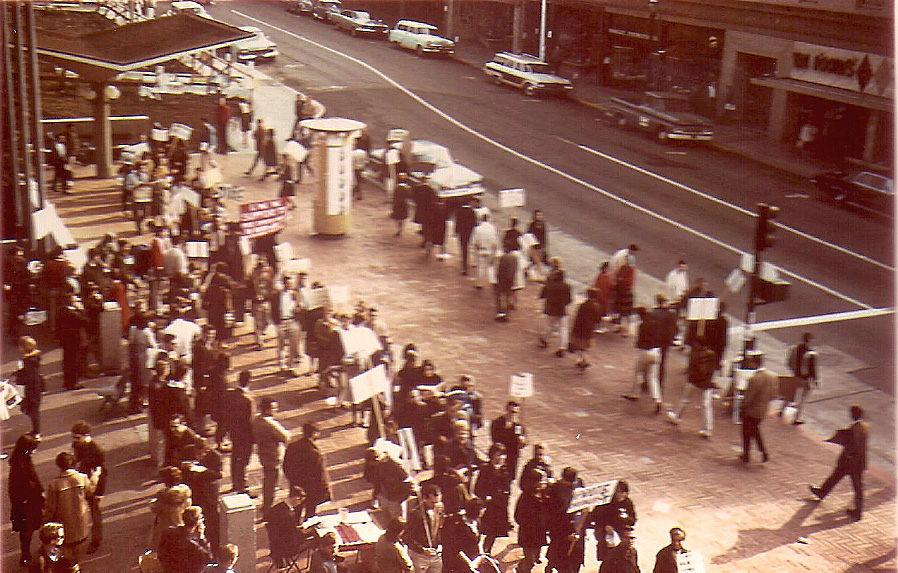
UC Berkeley on Strike… The 1964 Free Speech Movement

When police occupied the UC Berkeley Campus in early December of 1964 and arrested the protestors in Sproul Hall, the University went on strike. I joined a picket line on the edge of Telegraph Avenue next to Sproul Plaza.

My bed was indeed much softer that the marble floors of Sproul Hall.

After a quick breakfast I hurried back to campus to rejoin the sit-in. I was too late.

Armed men in uniforms formed a cordon around the Administration Building where students were being dragged down the stairs and loaded into police vans. Windows had been taped over so neither protestors or media could not see what was transpiring inside.

We had an occupied campus.

The great liberal governor of California had acted to “end the anarchy and maintain law and order in California.”

Whereas Jack Kennedy had used troops to protect civil rights in the South, Pat Brown was using them to stifle civil rights in the West. Of course Brown didn’t see it that way; he was taking a courageous stand against anarchy, the anarchy I described in my last blog.

I am sure Laurel and Hardy would have seen something to laugh about. Dragging kids down stairs on their butts while their heads bounced along behind could easily have been a scene in one of the old Keystone Cop films. The Oakland police weren’t nearly as funny as the Keystone Cops, however.

As for Clark Kerr, President of the University, he felt we were getting what we deserved and argued that the FSM leaders and their followers “are now finding in their effort to escape the gentle discipline of the University, they have thrown themselves into the arms of the less understanding discipline of the community at large.”

The campus came to a grinding halt and a great deal of fence-sitting ended. Whole departments shut down in strike. Sproul Hall plaza filled with several thousand students in protest of the police presence. When the police made a flying wedge to grab a speaker system students were using, we were electrified and protected the system with our bodies.

It was the closest I have ever come to being in a riot; thousands of thinking, caring students teetered on the edge of becoming an infuriated, unthinking mob. Violence and bloodshed, egged on by police action, would have been the result. Kerr, Brown, Knowland and company would have had the anarchy they were claiming, after the fact.

A few days later we were to come close again.

Kerr, in a series of around the clock meetings with a select committee of Department Chairs, had arrived at a compromise he felt would provide for the extended freedom being demanded on campus while also diffusing the outside pressure to crack open student heads.

Sit-in participants arrested in the Sproul Hall would be left to the tender mercies of the outside legal system and not disciplined by the University. Rights to free speech and organization on campus would be restored as long as civil disobedience was not advocated.

Kerr and Robert Scalapino, Chair of the Political Science Department, presented the compromise to a hastily called all-campus meeting of 15,000 students and faculty at the Greek Theater. There was to be no discussion and no other speakers.

When Mario Savio approached the podium following the presentation, he was grabbed by police, thrown down, and dragged off the stage. Apparently he had wanted to announce a meeting in Sproul Plaza to discuss Kerr’s proposal. Once again, Berkeley teetered on the edge of a riot. We moved from silent, shocked disbelief to shouting our objections.

Mario, released from the room where he was held captive, urged us to stay calm and leave the area. We did, but Kerr’s compromise had become compromised.

A full meeting of the Academic Senate was to be held the next day and all of us waited in anticipation to hear what stand Berkeley’s faculty would take.  We knew that most faculty members deplored the presence of police on campus and the violent way they had responded to the nonviolent demonstrators. Dragging Mario off the stage had not helped the Administration’s case.

Some departments such as math, philosophy, anthropology and English were clearly on the side of FSM while others including business and engineering were in opposition.

My own department of political science was clearly divided. Some professors believed that nonviolent civil disobedience threatened the stability of government. Others recognized how critical it was for helping the powerless gain power. To them, having large blocks of disenfranchised, alienated people in America seemed to be a greater threat to democracy than civil disobedience.

The Senate met on December 8 in Wheeler Hall, ironically in the same auditorium where Peter Odegard had lectured on the meaning of democracy to my Poly Sci 1 class during my first day at Berkeley. Some 5000 of us gathered outside to wait for the results and listen to the proceedings over a loud-speaker.

To the students who had fought so hard and risked so much, and to those of us who had joined their cause, the results were close to euphoric. On a vote of 824-115 the faculty voted that all disciplinary actions prior to December 8 should be dropped, that students should have the right to organize on campus for off-campus political activity, and that the University should not regulate the content of speech or advocacy.

Two weeks later, the Regents confirmed our hard-won freedom. We had won the battle but not necessarily the war.

Next Blog: Looking back at the long-term results of the Free Speech Movement

Occupy Sproul Hall… The 1964 Free Speech Movement at Berkeley


The release of the hostage Police Car did not bring peace to the UC Berkeley Campus. Each time a solution seemed imminent, the Administration would renege or the FSM would increase its demands.

In addition to the right to organize on campus, the disciplining leaders of the Free Speech Movement became a central issue.

Demonstrations took place almost daily and were blasted in the press. I learned a great deal about media sensationalism and biased reporting.

One day I would sit in on a democratic and spirited discussion of the pros and cons of a specific action and the next day I would read in the Oakland Tribune or San Francisco Examiner that I had participated in a major insurrection of left leaning radicals who were challenging the very basis of law and order. (It was documented later that the FBI was paying a reporter to write the Examiner stories.)

Older adults in suits taking photos looked suspiciously like plain-clothes policemen or FBI agents. It was easy to become paranoid.

If we signed a petition, demonstrated, made a speech or just stood by listening, would our pictures and names end up in some mysterious Washington file that proclaimed our disloyalty to the nation? These weren’t idle thoughts. A few years earlier people’s careers had been ended and live ruined because someone had implied they were soft on communism.

J. Edgar Hoover was known for tracking Civil Rights’ leaders and maintaining extensive files on every aspect of their lives. While we weren’t up against the KGB, caution was advisable. Hoover considered Berkeley a hotbed of Communism.

We looked warily at those who didn’t look like us. One day a small dog was making his way around the edge of the daily demonstration, sniffing people.

“See that Chihuahua,” a friend whispered in my ear. I nodded yes. “It’s a police dog in disguise. Any moment it is going to unzip its front and a German Shepherd will pop out.”

The wolf in sheep’s clothing was among us. It was a light moment to counter a serious time. And we were very serious. I sometimes wondered when the celebrated fun of being a college student would kick in.

One day I was faced with a test more serious than any I had ever faced in the classroom. On December 2, 1964, FSM leaders called for a massive sit in at Sproul Hall, Berkeley’s administration building. Once again communication had broken down and the Administration was back peddling, caught between students and faculty on one side and increasing pressure from the outside on the other.

I thought about the implications of the sit-it and decided to join. I needed to act. For three months I had listened to pros and cons and watched the press blatantly misrepresent what was happening on campus. I was angry, knowing that the public had little option but to believe that a small group of radicals was preaching anarchy.

It was not wrong to utilize an edge of campus for discussing the issues of the day, or for organizations to raise funds for supporting various causes, or even to recruit students for participating in efforts to change the community.

It didn’t disrupt my education. I was free to stop and listen, to join in, or pass on. What it did do was irritate powerful, established members of the community. And for that reason, our freedoms had been curtailed.

Maybe if enough students joined together, the Administration would listen and the press would dig deeper. I told my fiancé I was going inside and then joined the thousand or so students who had made similar decisions.

It was early in the afternoon and we were in high spirits. I believed it would be hard for the Administration to claim 1000 students were a small group of rabble-rousers bent on destroying the system. And I was right. It claimed we were a large group of rabble-rousers bent on destroying the system.

Inside I was treated to a unique experience. The sit-in was well organized. Mario Savio and other FSM leaders gave us directions on what to do if the police arrived. There were clear instructions that we were not to block doorways. The normal business of the University was not to be impeded and we were not to be destructive in any way.

Floors were organized for different purposes. The basement was set aside as the Free University where graduate students were teaching a variety of classes. These included normal topics such as physics and biology and more exotic subjects such as the nature of God. One floor was set aside as a study hall and was kept quiet. Another featured entertainment – including old Laurel and Hardy films, which seemed particularly appropriate.

After administrators left, a desk in the dean’s office became a podium for speech making. I felt compelled to add my dimes worth. Each speaker took off his or her shoes so the top of the desk would not be damaged.

The real treat though was an impromptu concert by Joan Baez. I joined a small group sitting around her in the hallway and sang protest songs. The hit of the night was “We Shall Overcome.” It provided us with a sense of identification with struggles taking place in the South. I felt like I belonged and was part of something much larger than myself.

Mainly I walked around and listened, taking extensive notes on what I saw and felt. Later I would sit in the Café Med on Telegraph Avenue and write them up. They would become the basis of talks I would give back home over the Christmas break. I also turned them over to Father Baskin, an Episcopal minister who wanted to use them for a sermon at his church in Placerville.

Along about midnight the un-radical part of my nature took over. I started thinking about my comfortable bed back in the apartment. The marble floors of Sproul Hall did not suggest a good night’s sleep and it appeared the police weren’t coming, at least in the immediate future. Yawning, I left the building and headed home.

I would come back in the morning to chaos and an occupied campus.

Next Blog: Berkeley on Strike. (See below for the story about Jack Weinberg and the police car.)