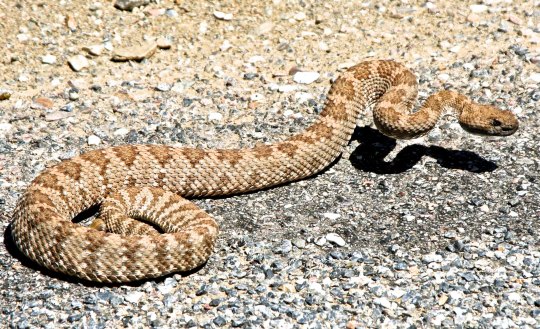
Peggy demonstrates our normal reaction to snakes hiding in the grass— or just wandering among the rocks, minding their own business.What to look out for! (Peggy and I found this fellow in Death Valley.) Note the distinctive viper head. You will see it on several of the snake petroglyphs that follow.
I’m convinced that a deep fear of snakes is programmed into our brains. It’s an instinctual reaction that suggests we vacate the premises— a trait that we share with other members of the animal kingdom. I was playing with my cat Rasputin in Africa once when I rolled a spring from our screen door at him. I thought he would view the spring as a toy and pounce on it. Instead he jumped four feet into the air and ended up six feet away. Liberians view all snakes as poisonous and Rasputin was 100% Liberian when it came to snakes. He had quickly determined that the spring was a snake and leapt into action— literally.
I’ve pulled a Rasputin myself a few times— especially when I am out in the woods and hear the distinctive buzz of a rattlesnake that I can’t see. It’s guaranteed to increase your heart rate. Once I stepped on a log and it started buzzing. I ended up 30 feet down the trail in one prodigious leap. (Slight exaggeration.) Rasputin would have been proud of me. Had a track coach seen me, I would have been entered in the Olympics.
Our Christian heritage in the West added to our instinctual dislike of our slithery brethren. Everyone knows the Biblical tale of how Eve was seduced into sneaking a snack from a snake and ended up being banned from Eden forever along with her significant other, Adam. The snake has had a bad rap ever since. Eve and Adam didn’t come out all that well either, especially Eve. I’ve always thought that God overacted when they broke his commandment that ignorance is bliss. A little knowledge and out came the fig leaf, okay, but was the flaming sword really necessary.
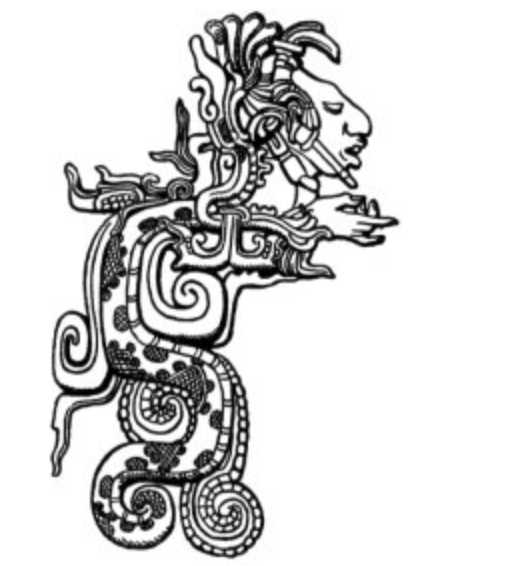
Ancient cultures have had a different perspective on snakes. The fact that they shed their skin annually suggested immortality. Your old body isn’t working quite the way it should? Fine. Get a new one. (This is particularly attractive to newly-turned 77-year olds.) As a result, snakes were considered sacred. If you’ve visited ancient sites in Mexico and Central America, the odds are you are familiar with Quetzalcóatl, the plumed serpent, the Toltec/Aztec/Mayan god of the wind and lots of other things.
Here’s an early representation of Quetzalcoatl blowing up a storm.And another.
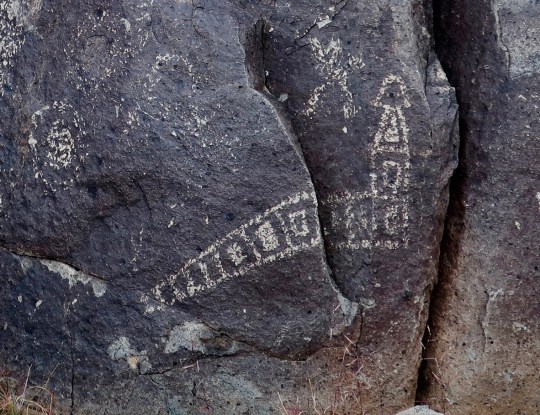
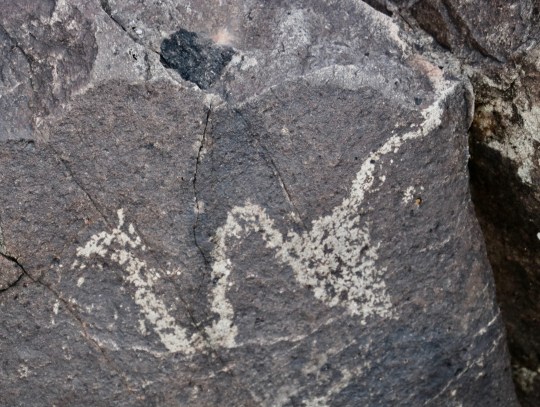
Given his importance to these cultures, it isn’t surprising that Quetzalcoatl made his way north and became part of the mythology of early people living in the Southwest. We found a number of petroglyph serpents crawling over the rocks of Three Rivers. I should point out here that the snakes weren’t just any old snakes. They were rattlesnakes! I’d also like to report that Peggy was quite pleased that we didn’t find any live representatives of the clan among the rocks.
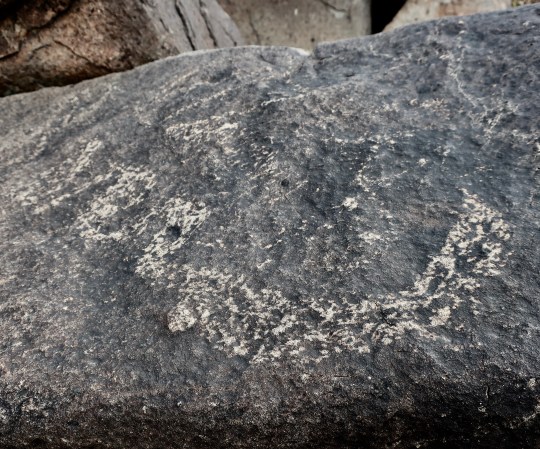
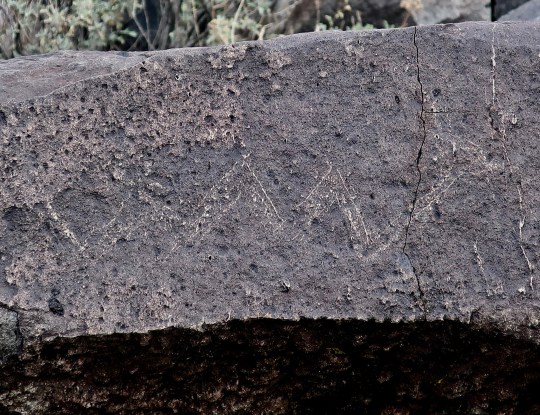
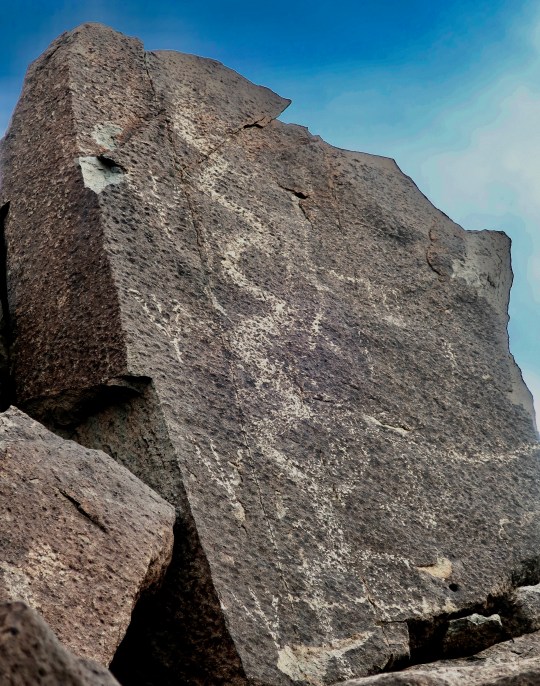
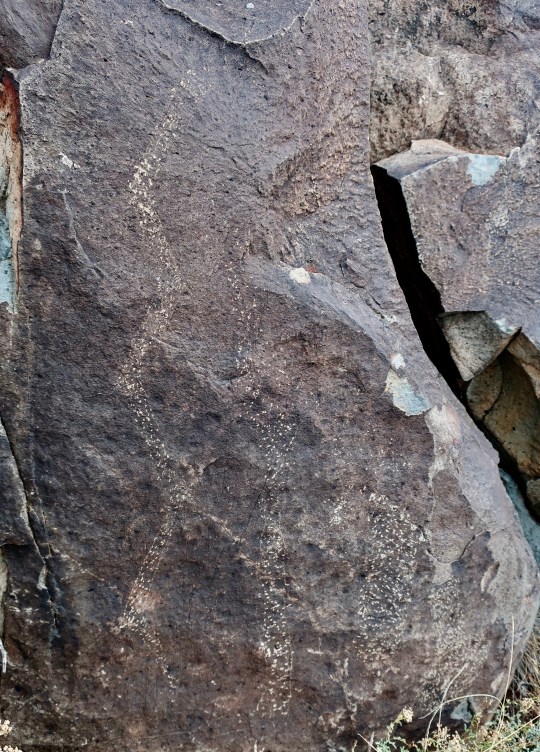
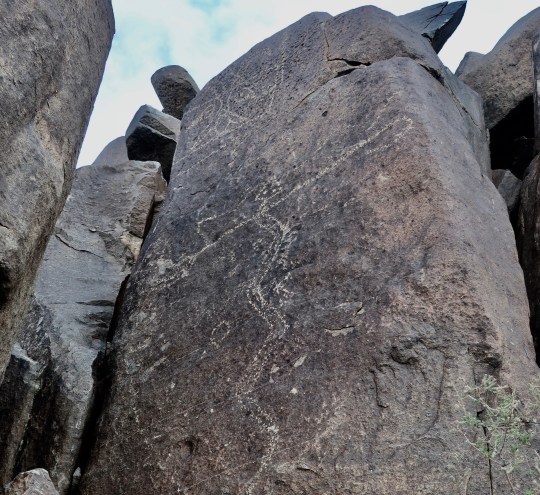
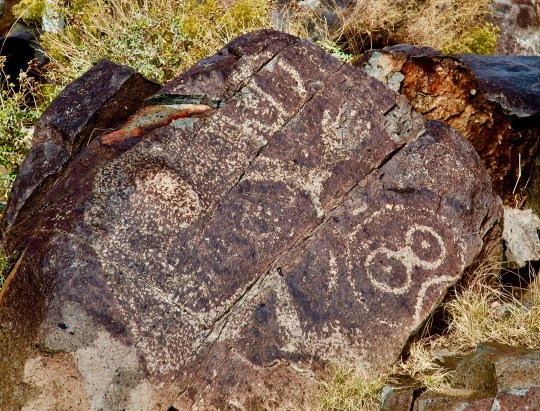
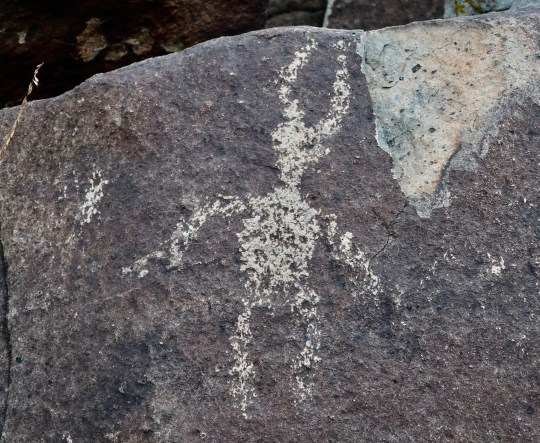
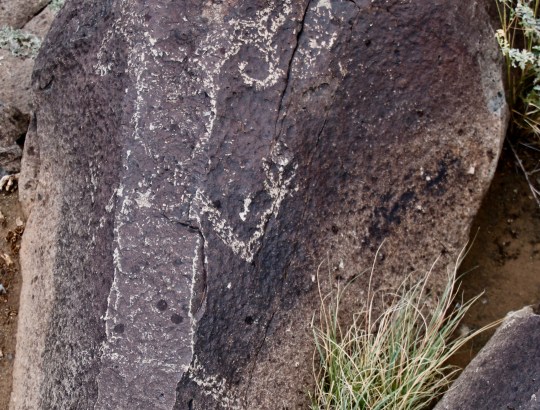
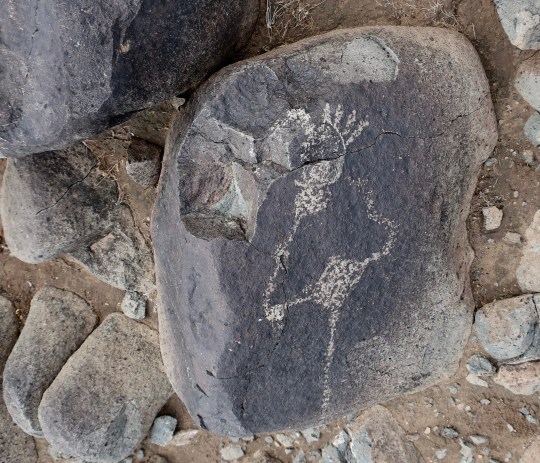
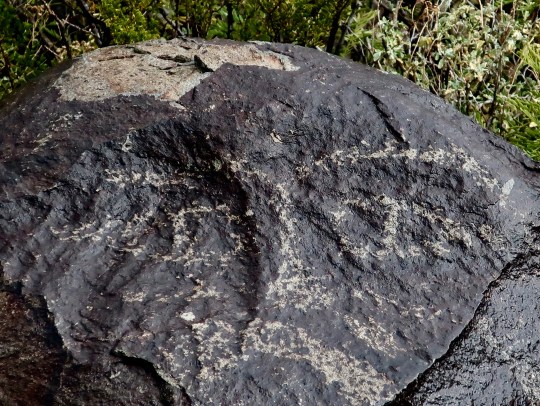
This rattlesnake didn’t let a crack in the rock slow him down. He just slithered right through it. Apparently the guy to the left of the snake’s head is quite excited. As he should be, given the relative size.We probably don’t want to know what this snake had for lunch. Snakes eat their meals whole. Once, when I was leading a backpack trip, a highway patrolman who was along shot a large timber rattler. While I was irritated that he killed the snake, we slit it open and found a whole ground squirrel inside. We then cut the snake up, cooked it in butter, and ate it. Waste not want not. Right?This was a particularly large rattler. It reminded me of the one that Peggy and I had found in Death Valley.And check out this guy! Had I met up with this fellow in real life, I wouldn’t have hung around to photograph it! (Yes, you would have, Peggy says.)I liked the way this plumed serpent had been outlined. This snake climbed right up the rock. A dog or coyote seems to be checking it out on the right while a bird, probably a turkey, follows along on the left. But maybe it is a roadrunner looking for a free lunch.And here, a very long plumed serpent makes its way down a rock and is also checked out.If one snake crawling down a rock is good, are two better?In this petroglyph a snake with bright eyes crawls up a rock under a crook, which is another sacred symbol, toward what is probably a shaman. This rock was around 15 feet tall to give you a perspective. I’ll conclude here for the day before I give you snake nightmares…
NEXT POSTS: Not exactly sure what I will focus on, but it will be petroglyphs for another week.
I am still off celebrating my birthday week. Since I am in my seventh decade, I get seven days. I started the practice way back when I was a youngster of 50. I took five days off each year during that decade and made darn sure they were work days. Being retired, I have more flexibility. (Grin) What this means now is that I am reposting another blog from my past. This one is from 2017 so several of you may have already seen it. Not to worry. These petroglyphs are alien enough they are worth visiting again. Looking at them again, I thought of the post I just did on shamans of Three Rivers. Check out the photo below. Does it get stranger than this? Enjoy.
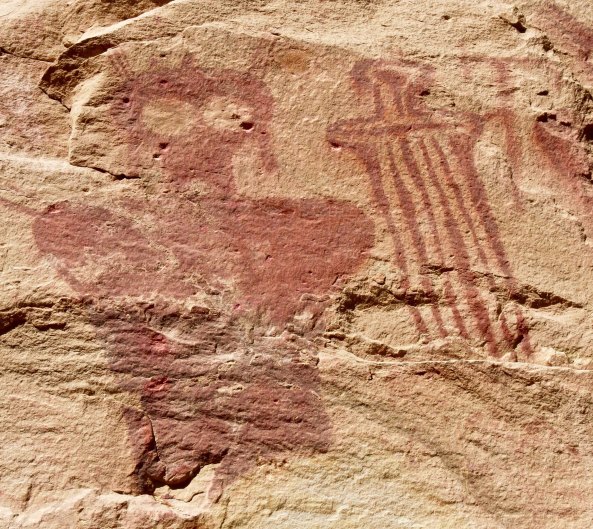
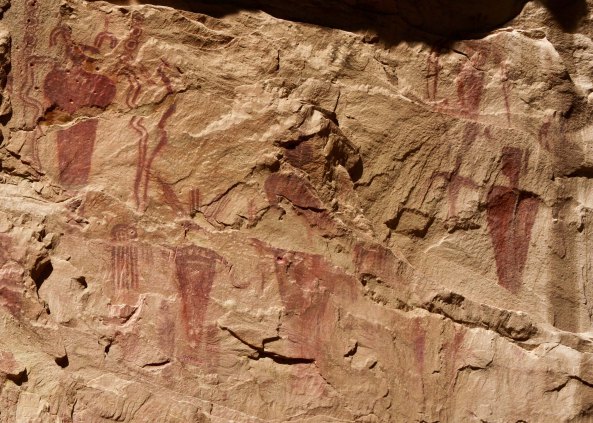
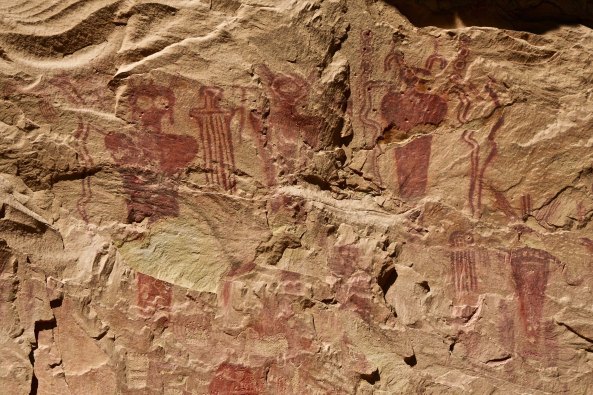
These larger-than-life pictographs at Sego Canyon in Utah are among the strangest I have ever seen. Now add in the fact that they are several thousand years old. And what’s with the pictograph on the right? Also, check out this guy’s spiky hairdo.Are they antennae?
Zipping along Interstate 70 in Utah, you might very well decide to take a detour and visit Arches and Canyonlands National Parks. It is a decision you will never regret. The odds are, however, that you will miss the small road that extends north of the Arches turnoff heading toward the town of Thompson Springs. In so doing so, you will miss the opportunity to visit one of the most magical and mysterious rock art sites in the Western United States: Sego Canyon.
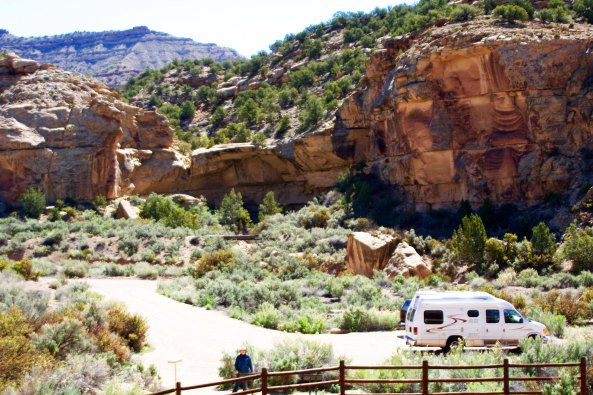
Quivera the Van waits patiently in Sego Canon as Peggy and I wander around looking for rock art. Most of it is located on the two rock faces below. Peggy watches as I work my way up closer to the petroglyphs.
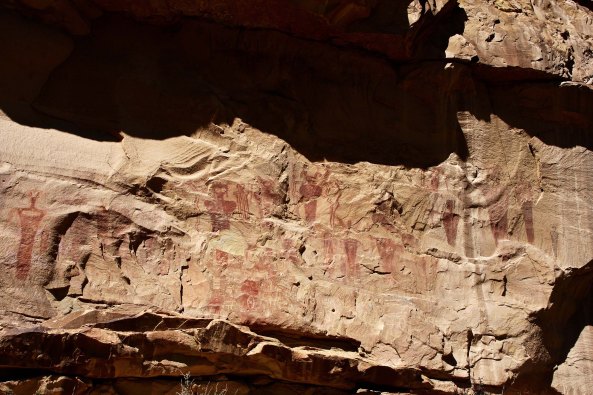
Most of the rock art at Sego Canyon is found on the two faces of this large rock. I am hidden in front of the brush.
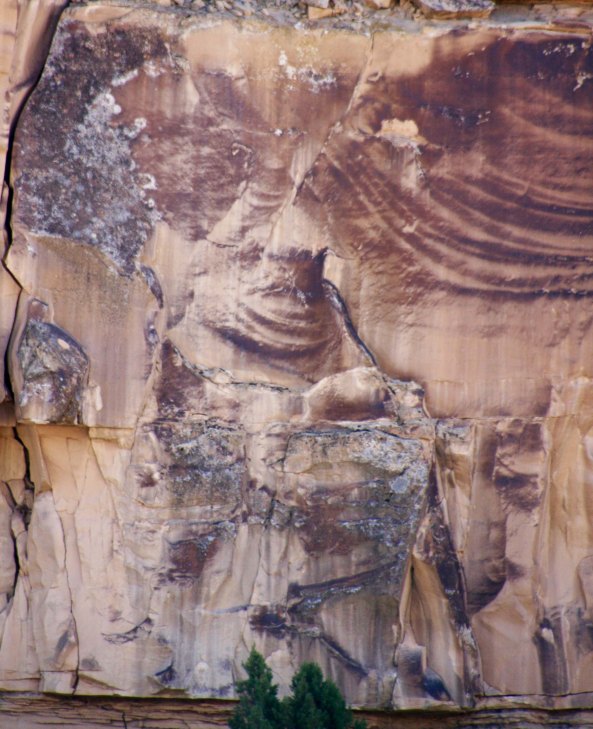
This is another rock face that Peggy and I checked for petroglyphs in Sego Canyon. We didn’t find any rock art but the rock itself was quite unusual. I could see why early Americans might have considered the area sacred. Can you find the alien Roswell skull? Or is that Indiana Jones?
Three different historical periods are represented in the rock art here dating back over a period of 6,000 years. The most fascinating to me are the pictographs left behind during the Archaic period by nomads who roamed the area from 8,000 to 2,000 years ago. The large, anthropomorphic forms that are painted on the rock normally lack eyes, arms and legs but may come with antennae, snakes and earrings. Known as the Barrier Canyon Style, it’s hard not to think of these pictographs as alien, or at least imagine a shaman encountering these creatures on a drug induced journey into an alien world.
Dave Kingsbury, one of my followers from England, and I were discussing cults where people run around with rattlesnakes in their hands. We both agreed that such sport wasn’t for us. This horned pictograph from the Archaic period seems to have a thing for snakes. Possibly he belonged to such a cult. Or possibly he was a very powerful shaman.
Or maybe something else. I see this and I want to say, “Take me to your leader.”
And this.
I find these jellyfish-like pictographs even more mysterious than the anthropomorphs. UFO fans might describe it as a space ship taking off, but hey, maybe it is a jellyfish. Or likely something else.
This shot provides a view of how some of the pictographs fit together on the right side of snake man.
And to the left..
And now, all together.
A final shot from the Archaic period. I found these pictographs a bit ghostly.
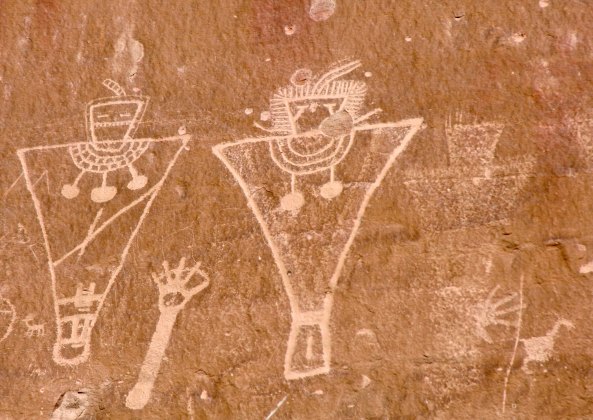
The Fremont Culture took over from the Archaic period and lasted from 600 CE to 1200 CE. Unlike the nomadic Archaic peoples, the natives of the Fremont period grew corn, lived in permanent stone buildings, and had a complex social structure. Most of the rock art they left behind is in petroglyph form, pecked into rather than painted on the rock.
The Fremont era had its own strange figures, but these were loaded down with jewelry. I found the hand interesting. I wonder if it is holding Datura seeds. It looks a bit like a foot walking in the circle. And there is a Big Horn sheep. It is rare to find petroglyph sites in the west that don’t include them.
A close up of the two figures with another ghostly one to the right. There is also another hand and another sheep, a fat fellow. The tiny figure on the left looks more like a deer to me.
And finally, we have the more modern Ute Culture that populated the area from 1300 to 1880 CE, when the Utes were forced out of their homes and onto Indian Reservations so pioneers could grab their land. One way to distinguish petroglyphs from this period is the presence of horses, which the Spaniards brought to North America in the Sixteenth Century. In fact, horses are a major tool used in dating rock art.
This Ute rock art featured what is thought to be a shield. I’d say that the horse is about to become horse meat. But wait, is that a small man on the back of the horse? Maybe he is the enemy.
Ute Indians seem to hunt buffalo in this scene, which will be my last for Sego Canyon. If you ever find yourself in the area, don’t miss the opportunity to explore this fascinating site.
NEXT POST: It’s all about snakes. I hope you like creepy crawlies. I do.
It’s my 77th birthday today, and, since this is petroglyph week, I decided to repost a couple of older blogs although I may be a tad sensitive about the ‘older’ designation. (Grin) Actually Peggy bought me a new light weight sleeping bag. She wants us to do Oregon next year following the PCT from the Oregon border to the Washington border. We are still thinking ‘younger’ around here. Anyway, enjoy the petroglyphs of Dinosaur National Monument today and Sego Canyon tomorrow. On Friday, I’ll be back on schedule, maybe, with the Snakes of Three Rivers petroglyph site! Also, I will hold on responding to comments and checking in on your blogs, but I will get there on Friday and the weekend. Now it is time to go play! We are on the Oregon Coast again, this time in Florence.
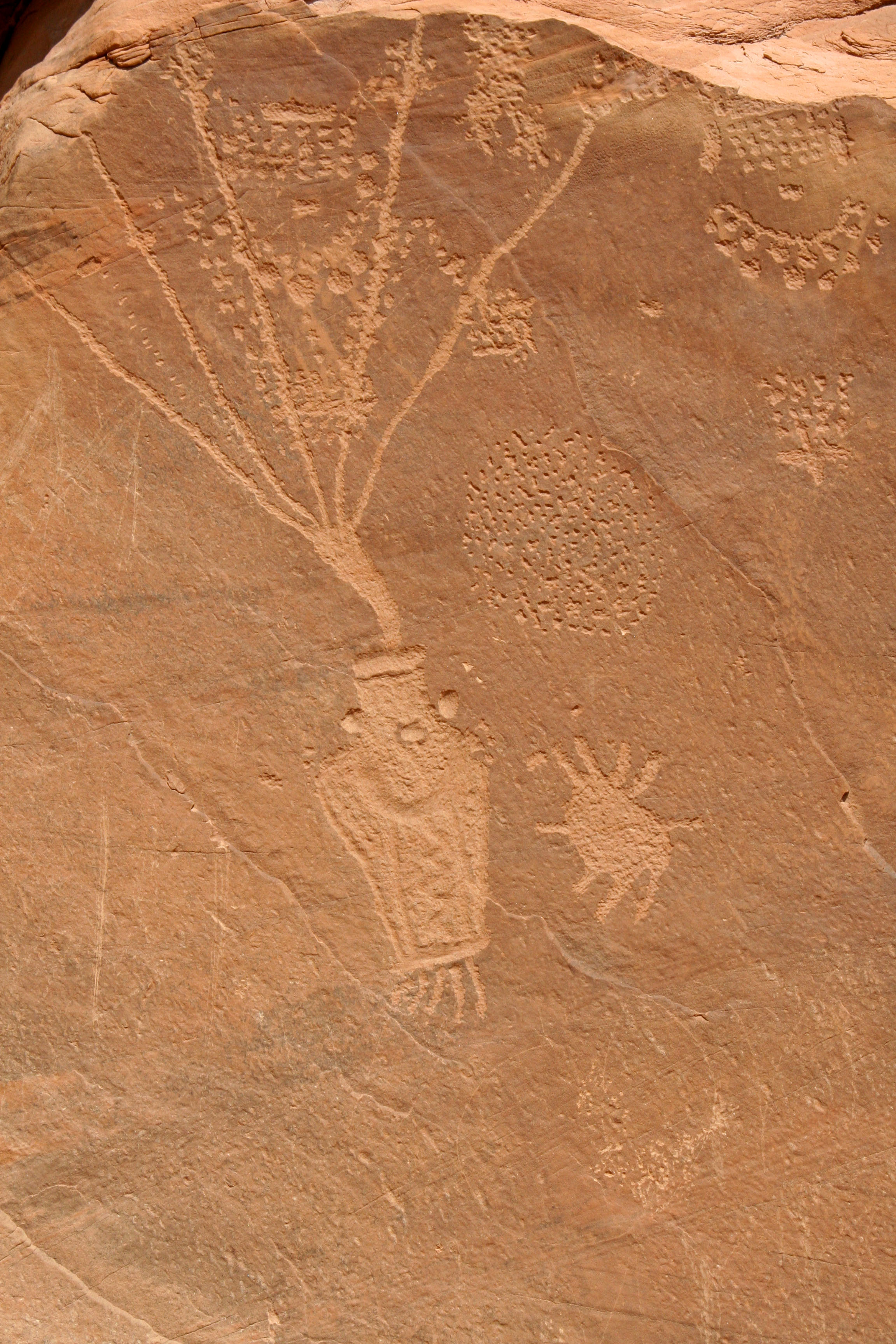
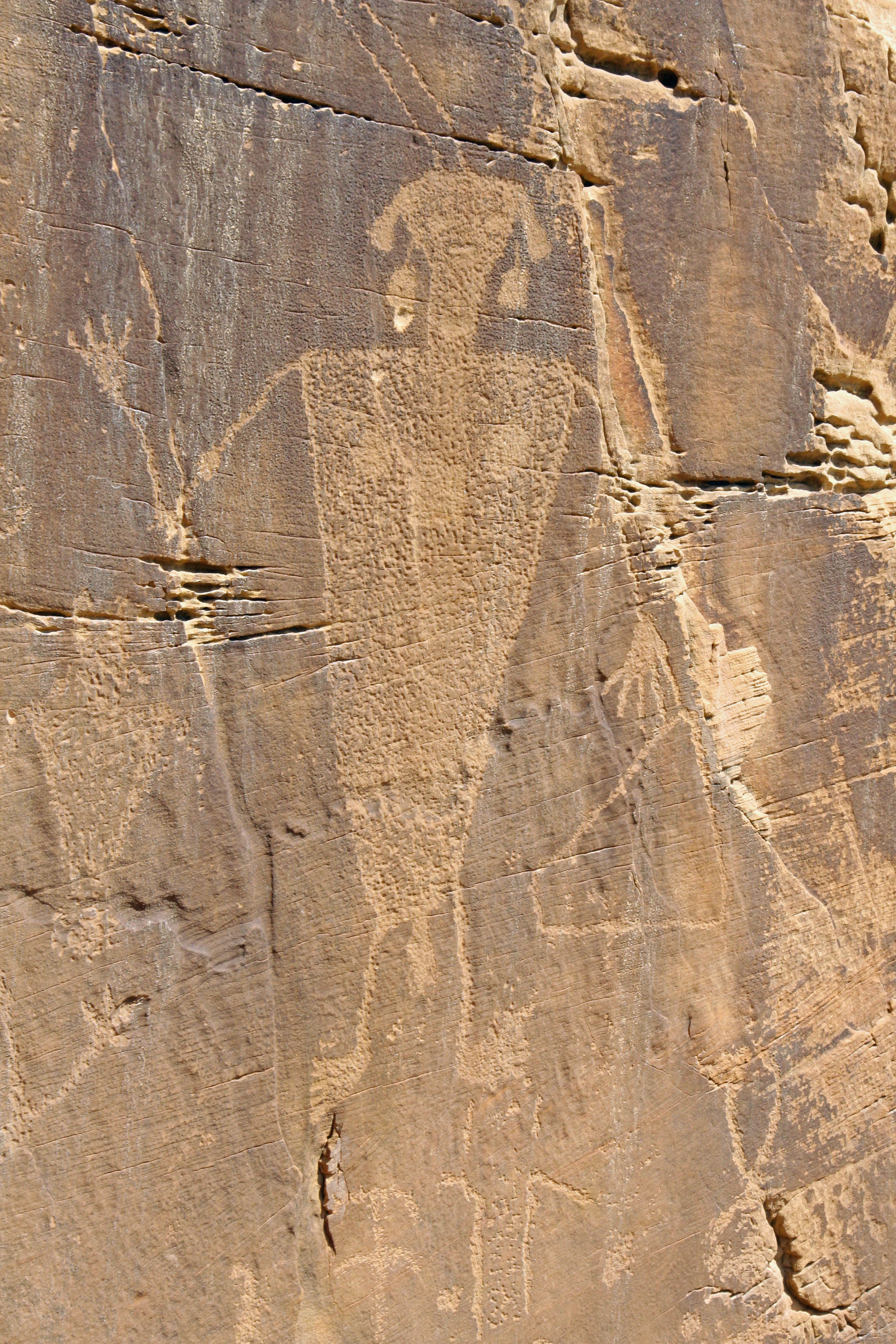
Like much Indian rock-art, Cub Creek petroglyphs in Dinosaur National Monument raise intriguing questions. It would be fascinating to know the story behind this unique anthropomorphic figure. What do the lines stretching toward the sky represent?
Peggy and I crossed over the Green River in Dinosaur National Monument and followed the road toward the cabin of Josie Basset Morris, a tough old pioneer woman who had worked her way through five husbands and finally discovered she preferred living alone.
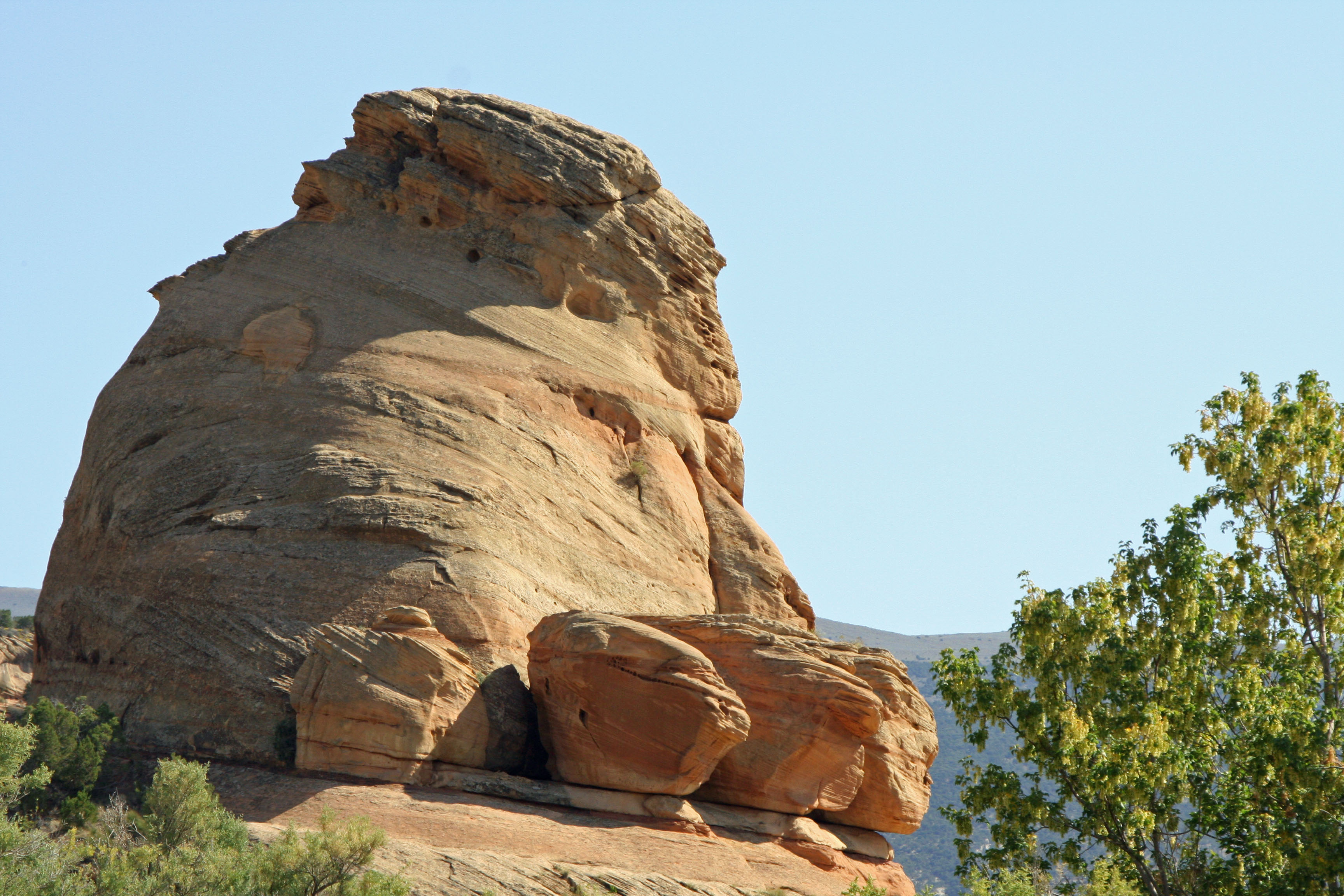
The river, mountains and distant vistas entertained us along the way. Two prominent landmarks, Elephant Toes and Turtle Rock, lived up to the names the early settlers had bestowed on them. I found the big toes particularly amusing.
Elephant Toes Rock in Dinosaur National Monument along the Cub Creek Road.
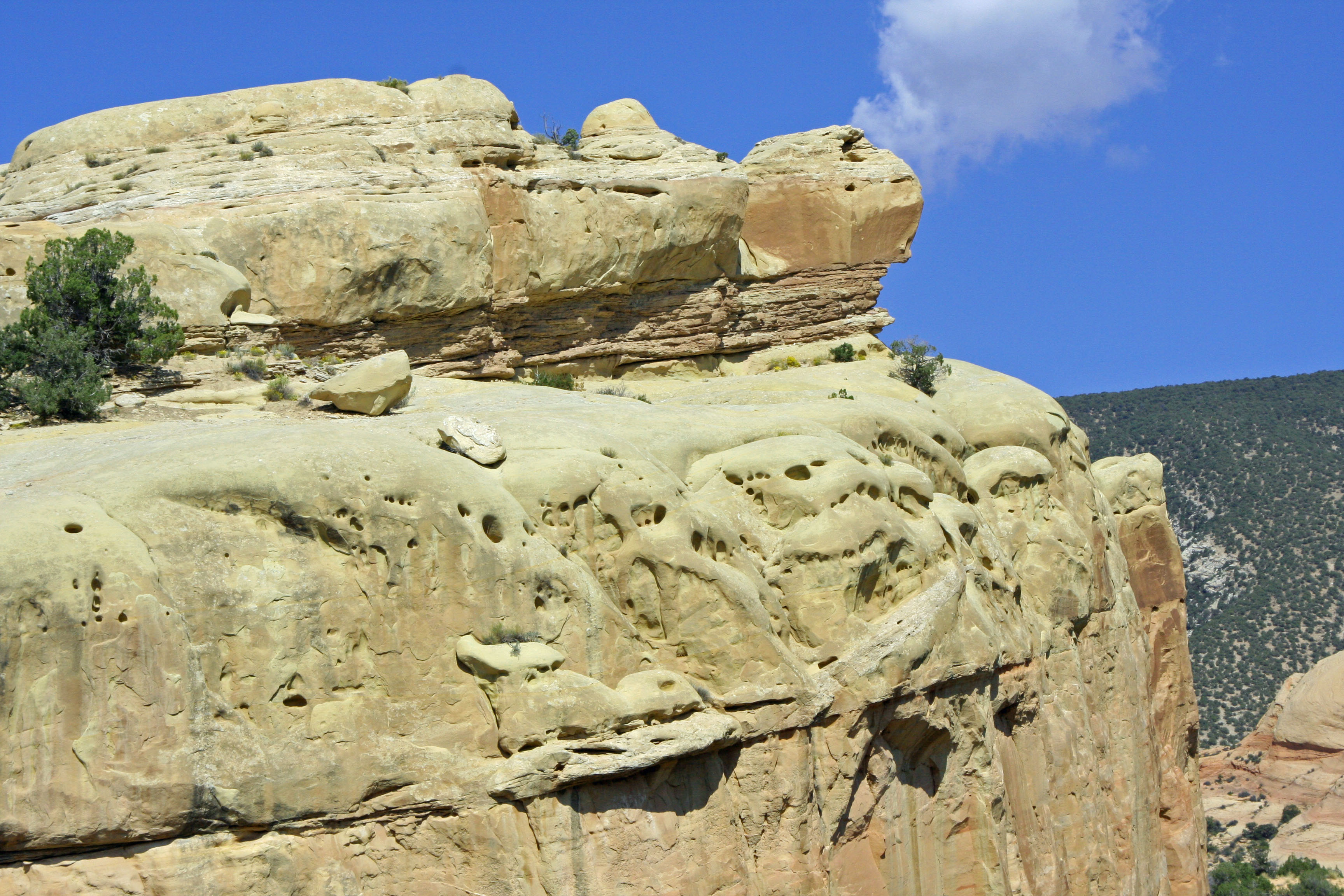
While not as humorous as Elephant Toes, the turtle of Turtle Rock is easy to see. Both Native Americans and pioneers were quick to see and name familiar figures in the landscape.
The true surprise on our way to Josie’s, however, was the Indian rock-art. Huge six-foot lizards had been pecked into the cliff faces high above the Cub Creek Valley. One can only wonder if the Native Americans of the Fremont Culture had somehow made the correlation between dinosaur bones found throughout Dinosaur National Monument and really big lizards. Or did small lizards so prominent in desert environment serve as the models?
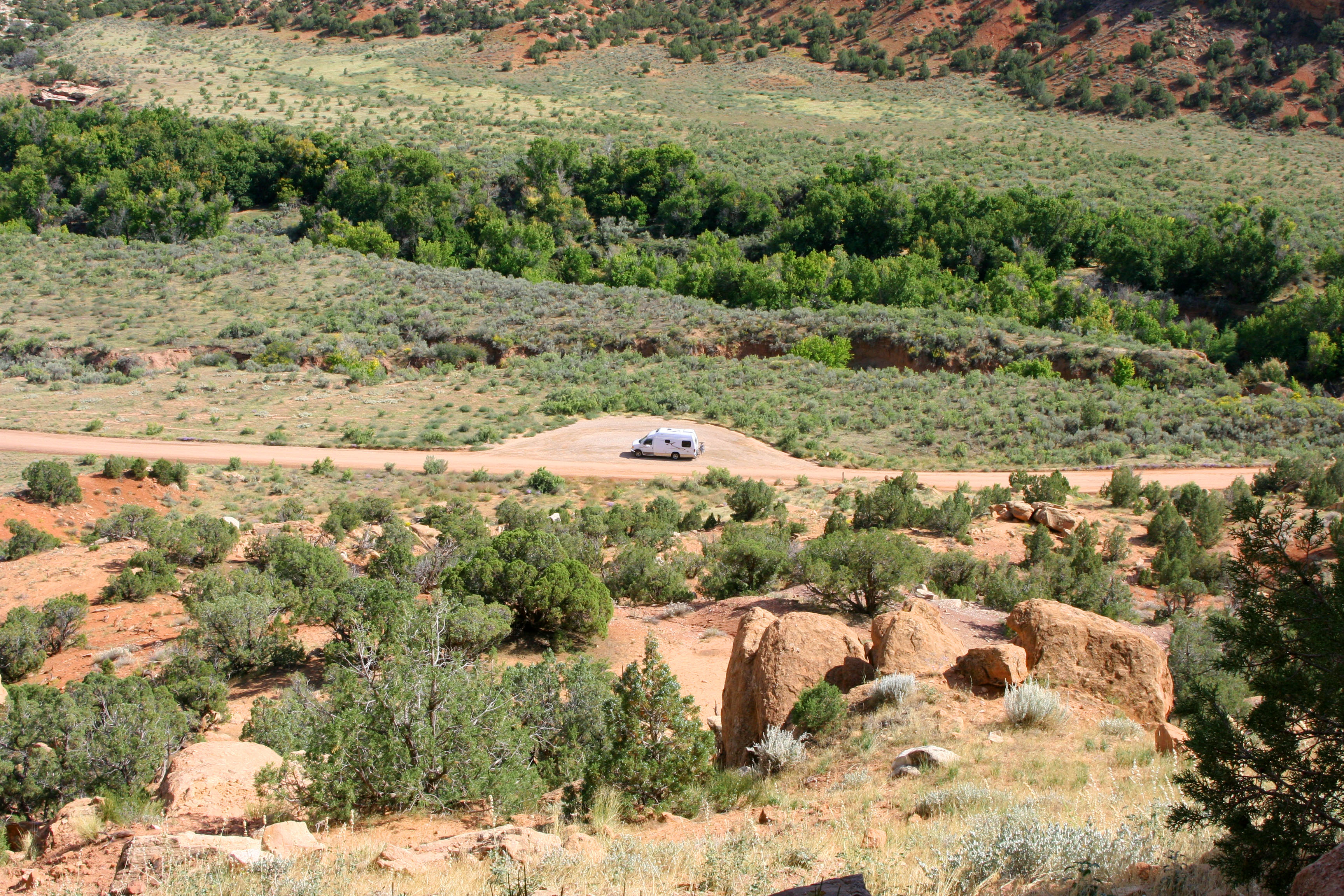
Our van, Quivera, provides perspective on how high up in the cliffs the Cub Creek petroglyphs are.
Giant, six-foot long, rock-art lizards work their way up the rock face at Cub Creek. Are they representative of the dinosaur bones Native Americans found at Dinosaur National Monument?
Or did the giant petroglyph lizards represent the small lizards so prominent in the arid regions of the West? This guy was curious about my camera.
Numerous other petroglyphs also demanded our attention. We even found a partial image of Kokopelli, the hunch backed flute player found in ancient rock-art from Mexico to Canada and whose image has been applied on everything from jewelry, to blankets, to pottery in today’s gift shops throughout the West. Kokopelli was both a musician and trickster god, but mainly he was a fertility deity known for his bad behavior. Watch out fair maidens one and all.
My wife Peggy admires a small section of the numerous petroglyphs found at the Indian rock-art site on Cub Creek in Dinosaur National Monument.
A partial petroglyph of the flute playing Kokopelli is found at the Cub Creek Indian rock-art site. Odds are he is luring young maidens with his music.
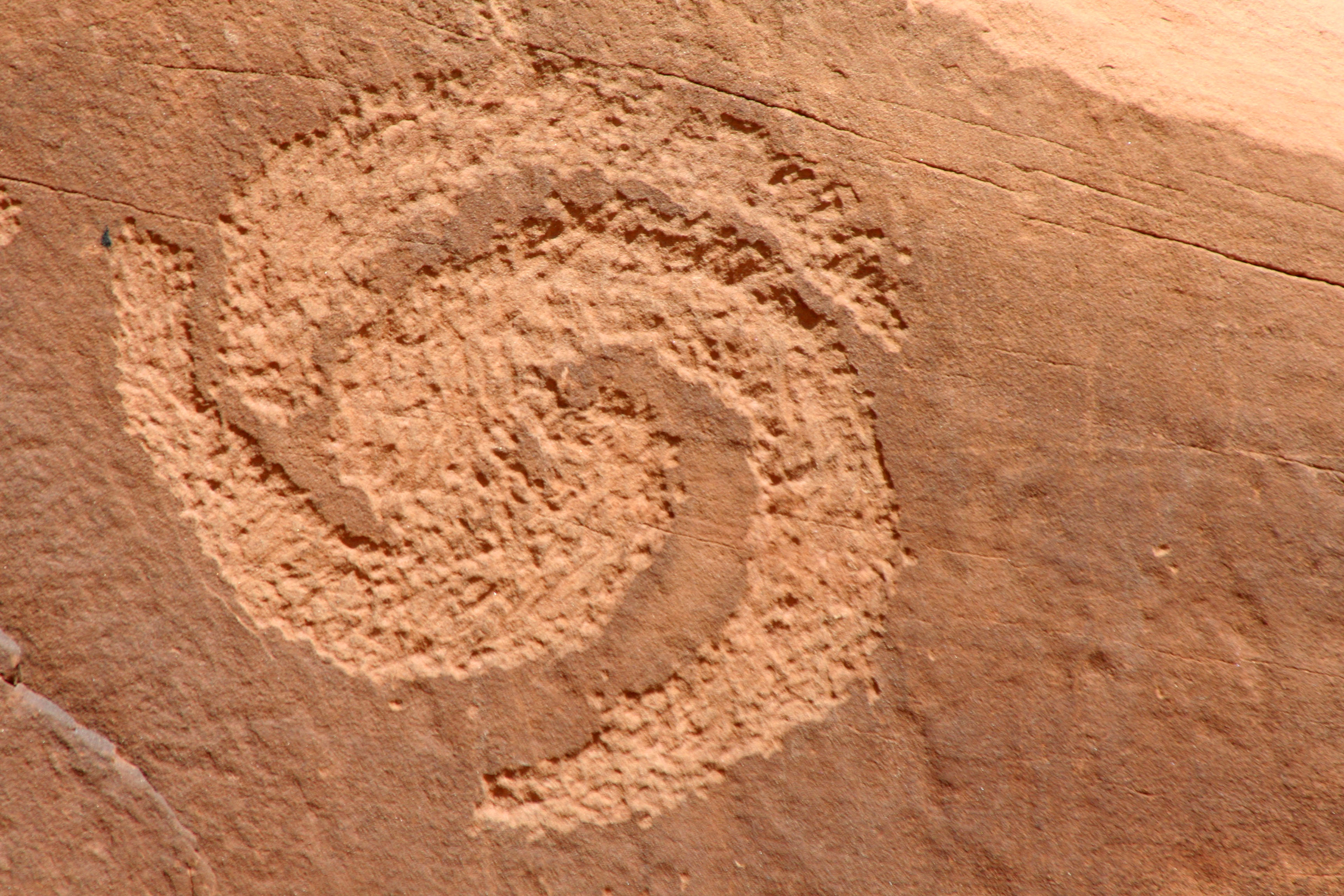
Geometric forms are common in rock art. This galaxy-like representation caught my attention.
I selected this particular photo because it demonstrates how dark rock varnish has been chipped away in the petroglyph process to reveal the lighter colored rock underneath.
An early day smiley? This guy appears to me to be all mouth but its creator likely had something else in mind.
Greetings Earthlings. Check out the dangling ear rings and necklace on this guy. Jewelry apparently was quite important to early Native Americans and may have represented an individual’s importance or clan.
You will probably note the prominent anatomy here. Genitalia was often included on rock art until the Spanish Missionaries informed the natives that such displays were sinful. I call this petroglyph Big Boy.
The world of shamans who use mind enhancing drugs to travel into other realms can be scary, as this picture of a petroglyph at the Three Rivers petroglyph site in New Mexico suggests. (Photo by Peggy Mekemson.)
Drums were beating in the pitch-black night and people were screaming. It was my first day as a Peace Corps Volunteer in the upcountry town of Gbarnga, Liberia in 1965 and I didn’t have a clue what was going on. All I knew was that the house had no electricity, my flashlight batteries were weak, and there was no kerosene to light a lantern. It was time to circle the wagons. I put the three folding metal chairs that served as my furniture up against the house’s three screen windows so they would come crashing down if anyone tried to break in. And then I laid down on the house’s only other furniture, a moldy mattress, hoping that whatever was outside would stay there.
The next morning, I learned that someone had died the day before. I was right to be frightened. The newly dead among the Kpelle people are dangerous unless they are given a proper going away party. They hang around and do really bad things. A great amount of cane-juice, rum, had been consumed during the night to assure that wouldn’t happen. I had entered a world where offerings were left under giant cottonwoods for the spirit that lived in the tree, the lightning man could make lightning strike people, justice was determined with a red-hot machete, chickens were sacrificed to carry messages to the dead, and Sam, the young man who worked for us, had scars marching up his chest from the teeth of the Bush Devil who had eaten him as a child and spit him up as an adult.
The reason I am relating this story here is because the experience was so different from anything I had ever known (you can read about it in my book, The Bush Devil Ate Sam) that it was very difficult to comprehend. When you begin to explore the petroglyphs, or rock art carvings, that are found throughout the southwestern United States, the experience is similar. You enter a realm that existed from several hundred to several thousands of years ago among the early peoples of North America when there was no written language to explain what they were thinking or doing. At best, we can guess or get hints from modern day Native Americans about the meaning of the rock art.
No one exemplifies the difficulty of comprehending the world of early Americans better than the shaman, a powerful figure who utilized trances and mind enhancing drugs to enter other realms and do battle with monsters that brought sickness, death, hunger and bad weather into our world. It’s a scary, dangerous place. Like Sam’s Bush Devil, the shaman was part doctor, priest, policeman, leader and judge. You didn’t want one as an enemy.
In the Southwest, the shaman’s drug of choice for his or her journeys into other realms was the plant Datura, which you have already met on recent posts of mine. Georgia O’Keeffe liked to paint the flower and I included one on my Valentine’s Day blog. Beside the plant’s beauty, it is a member of the nightshade family and a powerful, dangerous hallucinogen that may cause death (don’t try it at home). One of the characteristics of the drug is that it enlarges your pupils. European women once used one of its cousins to enlarge their pupils and increase their power over men (whoops, I meant appeal). Peggy has naturally large brown eyes. I get it. They named the plant belladonna, which translates beautiful woman.
Both the flowers and the seeds located beneath and to the right of the flower were used by shamans to enable their journeys into other realms.
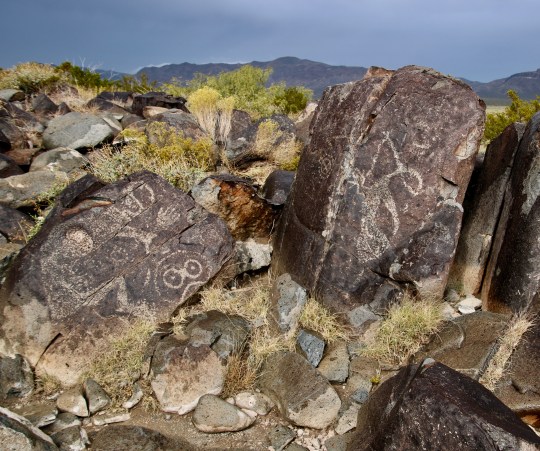
The enlarged pupils the shamans would have had experienced from consuming datura gave me an insight about the numerous large eyes we found staring at us out of the rocks at the Three Rivers National Recreation Petroglyph site in south-central New Mexico. We visited there in October as part of our Southwest tour. Could it have been that the shamans were watching us, warning us to be on our best behavior? We treaded carefully among the petroglyphs, making sure that we didn’t do any damage to the ancient rock art.
Today’s photographs by Peggy and me will reflect the large eyes and other petroglyphs we found at Three Rivers that might relate to the shamans. Future posts over the next two to three weeks will feature different rock art themes (like snakes, for example) that we found at Three Rivers and other Southwestern sites we visited in October.
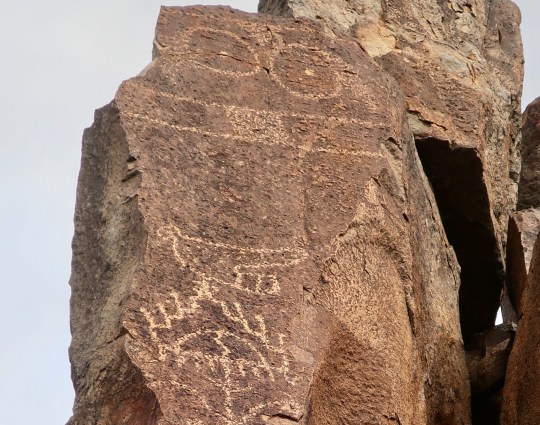
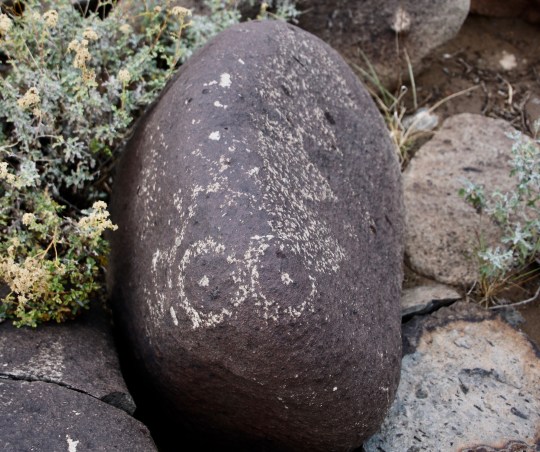
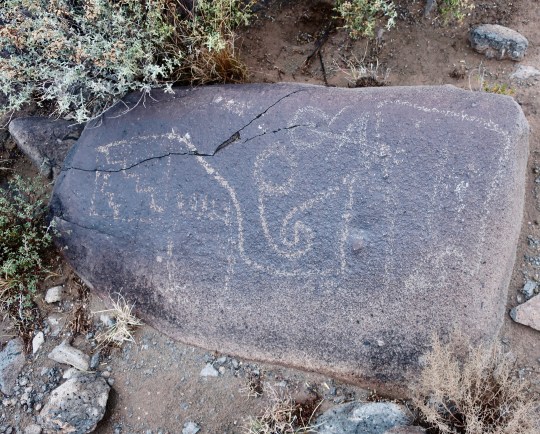
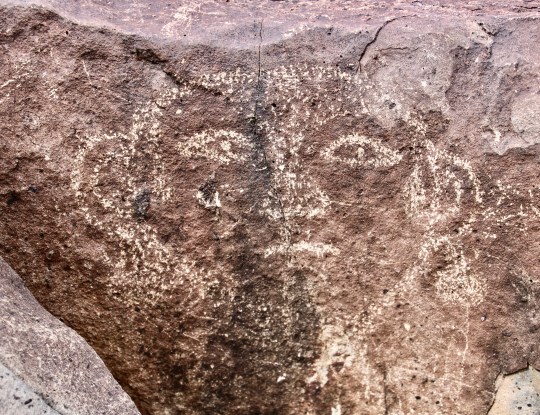
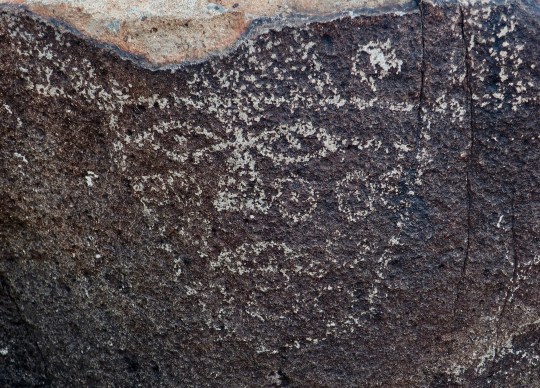
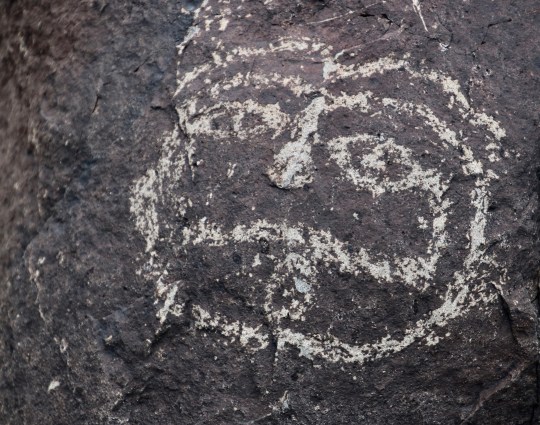
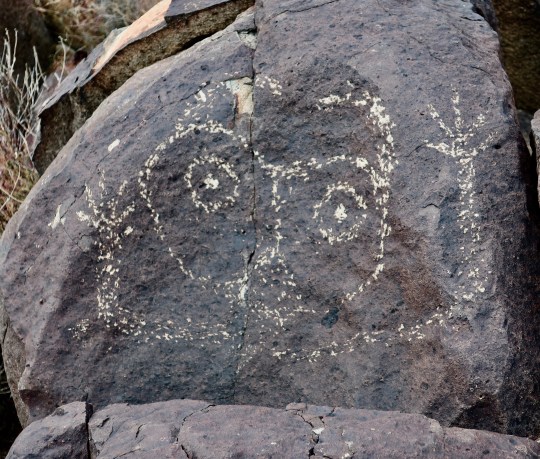
I had worked my way over steep terrain on the side of a cliff when I looked up and saw a 15 foot tall petroglyph looking out over the surrounding plains. My thought was that the eyes represented a powerful shaman and served to warn enemies away from the Three Rivers’ petroglyph site. An eagle outlines the lower part of the face and a storm rages beneath the eagle with lightning, thunder, clouds and rain. It’s possible that the lines rising above the clouds are snakes. What we assumed were shaman eyes made large by datura stared out at us from numerous rocks. (Photo by Peggy Mekemson.)The mouth used a natural part of the rock. I wondered if the lines leading out from the face represented the journey of the shaman.Note the dots around the eyes in this photo. The literature on petroglyphs suggests that the dots may represent datura.I could be way off (and probably am), but I thought this petroglyph might represent a very extensive shaman journey emerging from the underworld on the left and traveling on in the right.This photo shows a shaman bent over eyes. On the right, a road runner captures a snake. (Photo by Peggy Mekemson)A close up of the shaman that I took. Note his skeletal form and the circle with datura dots between his knee and his elbow.Shamans take many forms. This one looks a bit devilish.The horns on this shaman were from a bighorn sheep. Is he waving at you or warning you to stop. (Photo by Peggy Mekemson.)I’d say that this shaman with a huge hand and a minimal body is definitely saying to stop.A number of faces pecked into the rocks also seemed shaman-like to us. Note this guy’s snake eyes.I am not sure whether this face was related to a shaman. Maybe it was a selfie. Ear rings dangle from his ears. (Photo by Peggy Mekemson.)Flathead here appears to be a shaman to me. I wonder if the circles represented some type of tattooing.I couldn’t help but wonder if this guy was sticking his tongue out. Or is that his chin? I did note that all of the faces appeared to be frowning. (Photo by Peggy Mekemson.)I will wrap up today with my all-time favorite petroglyph from Three Rivers. I call him Boo.
NEXT POST: Wednesday’s photo essay (if I get to it since it’s my birthday week) will journey north to Sego Canyon in Utah and some very unworldly (UFO- alien-type) shamans. On Friday it is petroglyph snakes. Lots of them!
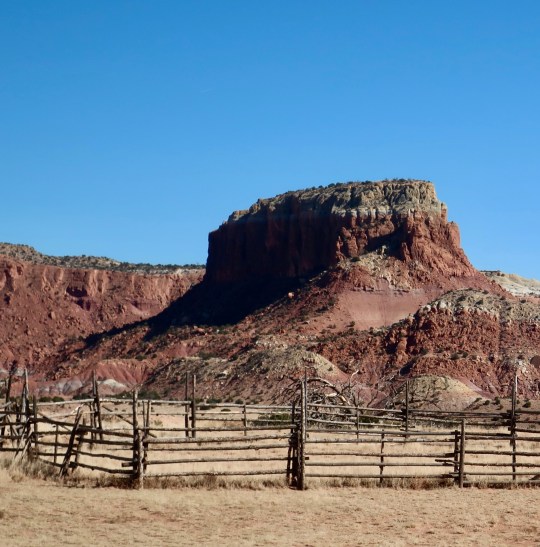
“It’s perfectly mad looking country— hills and cliffs and washes too crazy to imagine and thrown up into the air by God and let tumble where they would. It was certainly as spectacular as anything I have ever seen.” Georgia O’Keeffe on Ghost Ranch in 1937
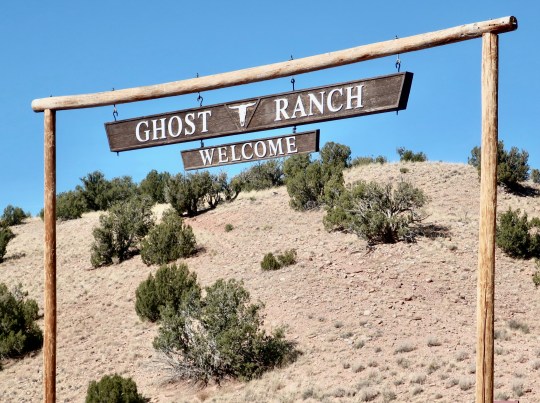
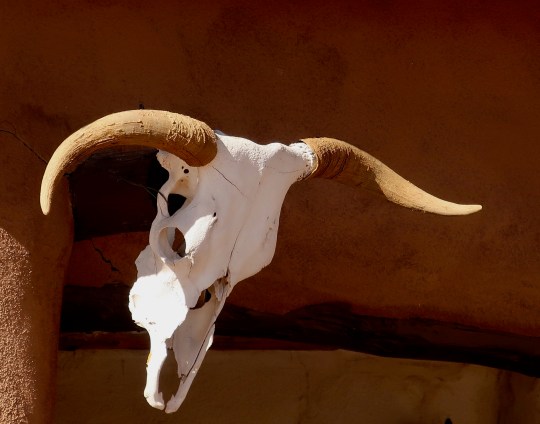
The welcome sign to Ghost Ranch, which is located about 15 miles north of Abiquiu. The cow skull in the middle is based on a painting by Georgia O’Keeffe.The cow skull is the logo for the ranch.It was appropriate that we found this skull on one of the cabins.
The connection between Ghost Ranch and Georgia O’Keeffe is a strong one. I suspect that most people who are aware of the area associate it with the artist. But Ghost Ranch has its own history before, during and after Georgia made it her summer escape from the eastern US, New York and her husband. Once upon a very long time ago during the Triassic era (think 200 million years), it was located near the equator and home to a small dinosaur, Coelophysis. Over 1000 have been found on the property. You probably wouldn’t want to encounter one. It stood approximately nine feet tall, was carnivorous, and ran very fast— probably in packs. “If the left one don’t a-get you, the right one will.” (My apologies to Tennessee Ernie Ford and 16 Tons.)
A small museum featuring Coelophysis is found on the ranch.This rendition of the small dinosaur was shown on the State fossil site. Now imagine a herd of them!
In more modern times, circa 1880, the Archuleta brothers took up residence at the ranch. They were outlaws, cattle rustlers to be more specific. They liked the ranch because it was remote, had water, and was known as “El Rancho de los Brujos,” The Ranch of the Witches. The latter was important because it kept the local folks who were superstitious, i.e. almost everyone, away from their operation. Unfortunately, or fortunately depending on how you regard such things, one of the brothers killed the other in a dispute over gold. A posse showed up and hung the remaining brother and any of the other outlaws who hadn’t skedaddled, adding to the ranch’s dark reputation.
I wondered if this was the cottonwood where the Archuleta gang met their doom.
Jumping forward to 1928, Roy Pfaffle won the ranch in a poker game and his wife, Carol Stanley, a woman who obviously thought ahead, registered the ranch in her name. She also decided to call it Ghost Ranch, given its history. Two years later, waving goodbye to her now ex, she moved to the ranch with high hopes of making a living by establishing a high-end dude ranch for wealthy people. They came, but there wasn’t quite enough income to make ends meet. She sold the property to Arthur Stack in 1935, one of the wealthy guests and an early conservationist. He maintained it as a dude ranch up until 1955 when he donated it to the Presbyterian Church as a retreat center, which it continues to serve as today.
This just about brings us to O’Keeffe, but not quite. In the early to mid-40s some mysterious strangers showed up on weekends using alias names who either wouldn’t or couldn’t talk about what they did or their past. Turns out that among these guests were the likes of Robert Oppenheimer, Enrico Fermi and Niels Bohr, who just happened to be building the world’s first atomic bomb south of the ranch at Los Alamos.
Also of note, Hollywood had discovered Ghost Ranch. Peggy and I found a list of movies that had portions filmed there in the Visitors’ Center. Among them were City Slickers, Young Guns, Wyatt Earp, All the Pretty Horses, Cowboys and Aliens, the 2013 version of the Lone Ranger and the 2016 version of The Magnificent Seven. Do you see a certain trend here? Ride’em cowboy.
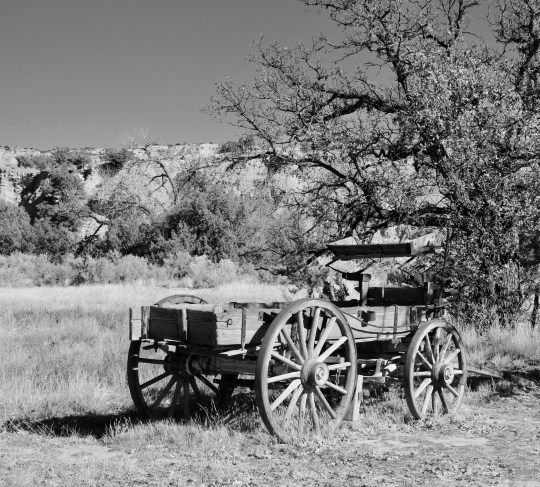
This old log cabin seemed perfect to represent the Old West side of Ghost Ranch. Actually it was built for the movie” City Slickers.”As was this corral!This wagon certainly spoke to Old West character of Ghost Ranch. (Photo by Peggy Mekemson.)
Georgia O’Keeffe made her first visit to Ghost Ranch in 1934 and immediately fell in love with its wild beauty. Not so much the fact that it was a dude ranch. She liked to work alone; her art demanded solitude. It wasn’t that she was opposed to having the occasional dude around, but lots of dudes riding horses were counterproductive. None-the-less, she rented a cabin from Stack and when a long-term rental became available due to an illness, she stayed there all summer, beginning a tradition that would last up until she moved into her house in Abiquiu in 1949.
It wasn’t long before she persuaded Arthur Stack to rent her his house, Ranchos de los Burros. It came with more isolation and scenic views. And a great piano. I found a story where O’Keeffe and several friends showed up off-season and found the house locked up tight. They proceeded to break in and spend the evening lying around listening to Ansel Adams knock out tunes on the piano. If I could do time travel, it’s an event that I would travel back to!
Once, when she showed up for her usual summer stay, she found the house occupied and went ballistic. When Stack pointed out that the house didn’t actually belong to her, she insisted on buying it. She was also irritated when Stack gave Ghost Ranch to the Presbyterians rather than selling it to her. The Presbyterians respected her privacy, however, and she eventually developed a good relationship with them.
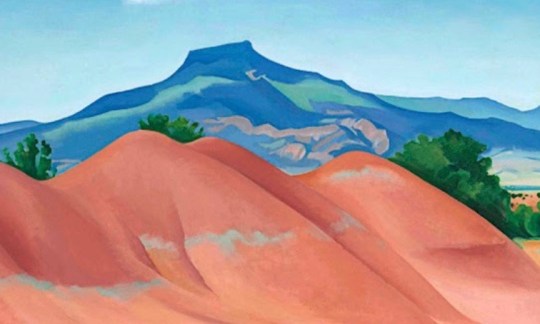
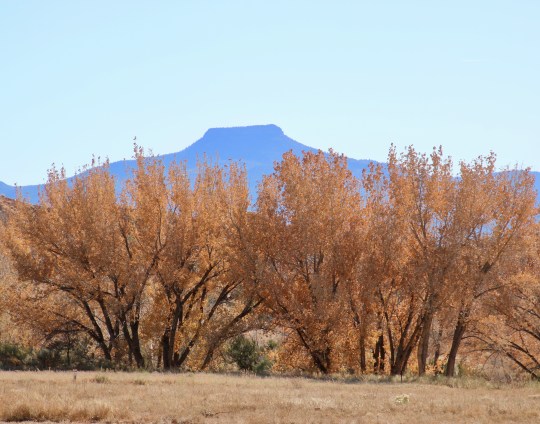
I’ll start my main photo section today with a painting by Georgia O’Keeffe of her “private mountain,” the Cerro Pedernal. As she said, “It belongs to me. God told me if I painted it enough, I could have it.” So, she painted it over 20 times and requested that her ashes be scattered on the mountain when she died. When I first read about her passion for the mountain, I thought of the post-impressionist French painter Paul Cézanne and his ‘holy mountain,’ Mount Sainte-Victoire, which he could see from his home in Aix and painted some 60 times.
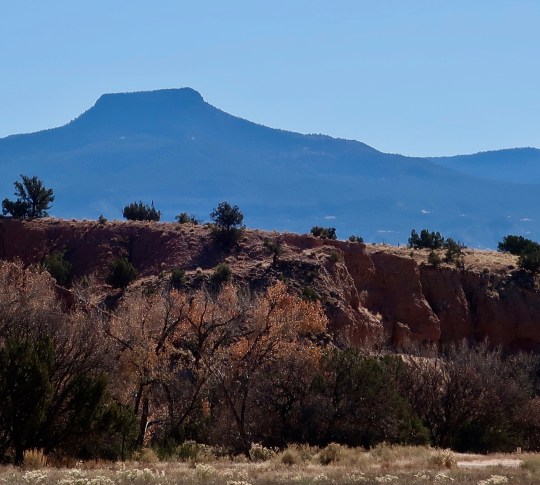
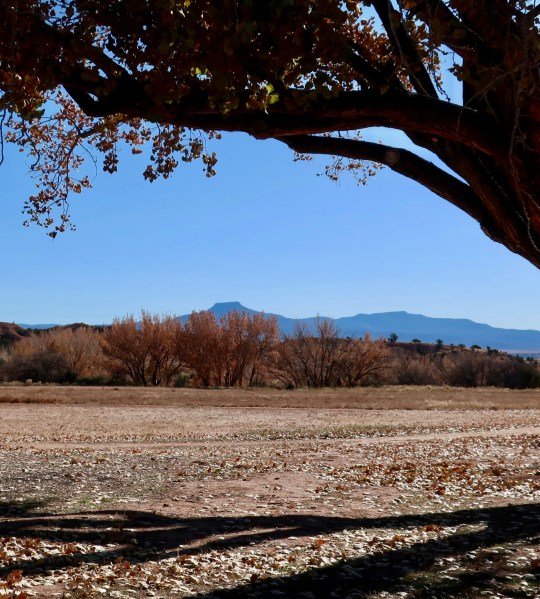
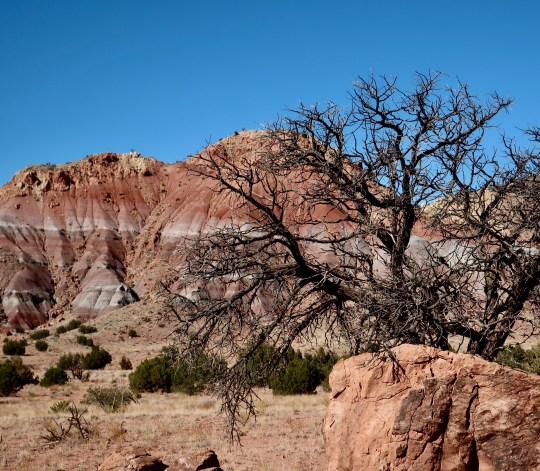
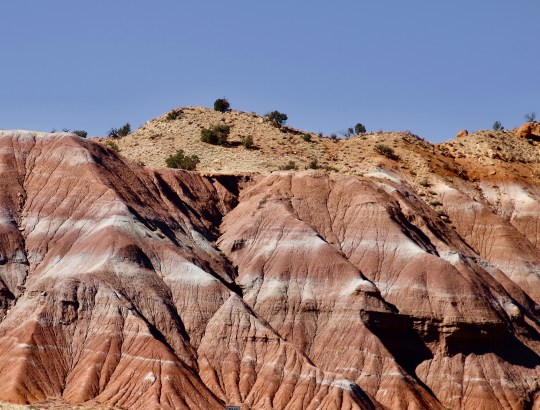
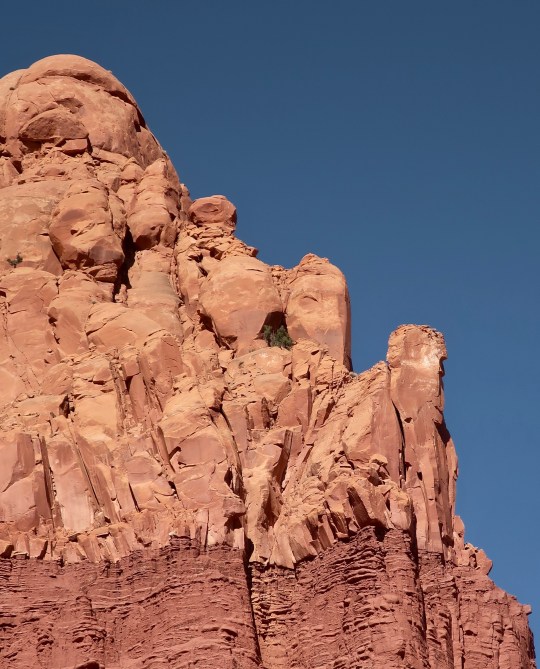
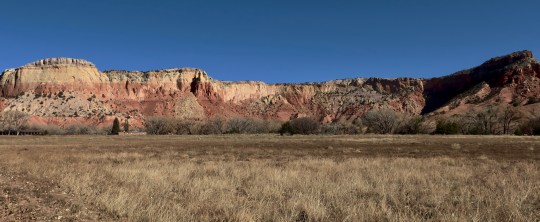
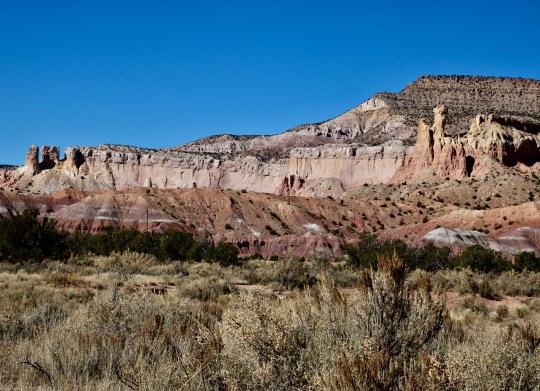
One of 20 some paintings O’Keeffe did of Cerro Pedernal.Peggy and I decided that since Georgia had painted Cerro Pedernal so many times, we should honor it by taking its photo several times. (Photo by Peggy Mekemson.)Another perspective of Cerro Pedernal.And a final shot.A small wayside just before you reach Ghost Ranch features superb views of the Chinle formation that O’Keeffe loved to paint. A close up. The Chinle Formation is what gives the Painted Desert its colors and is also located in Petrified Forest National Park. It’s also where the remains of Coelophysis are found. Georgia O’Keeffe painting of a Chinle Formation at Ghost Ranch.This is another impressive rock formation we saw on our way to Ghost Ranch.And this.And now several photos from within Ghost Ranch that fit Georgia’s observation of “perfectly mad looking country” that inspired her to paint. (Photo by Peggy Mekemson.)Photo by Peggy Mekemson.I’ll conclude my final post on Georgia O’Keeffe with one last photo of her ‘mountain’ Cerro Pedernal.
NEXT POST: A journey into the world of shamans and petroglyphs. The start of a new series.
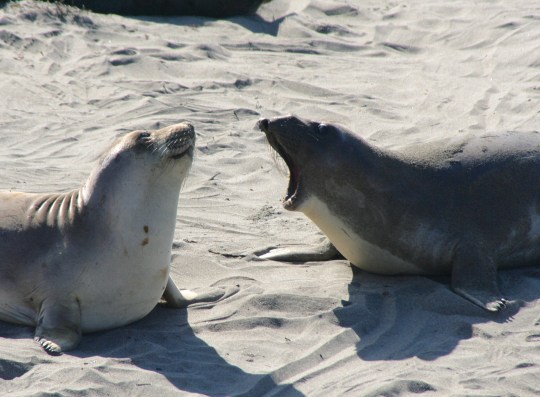
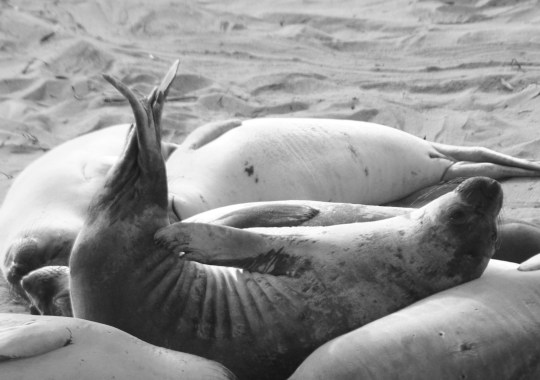
Did you hear the one about an elephant seal, a Christmas seal, and a basset hound walking into a bar.Ha, ha, ha, ha.HA, HA, HA, HA!
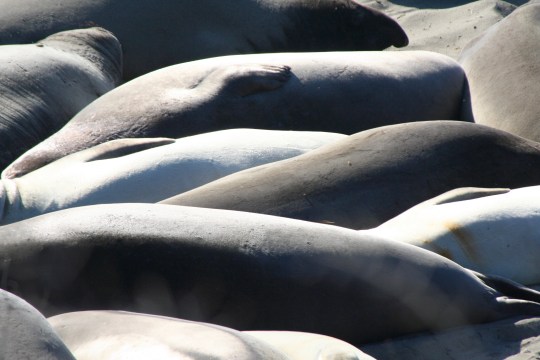
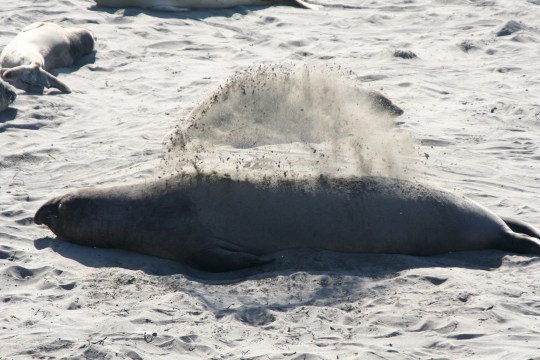
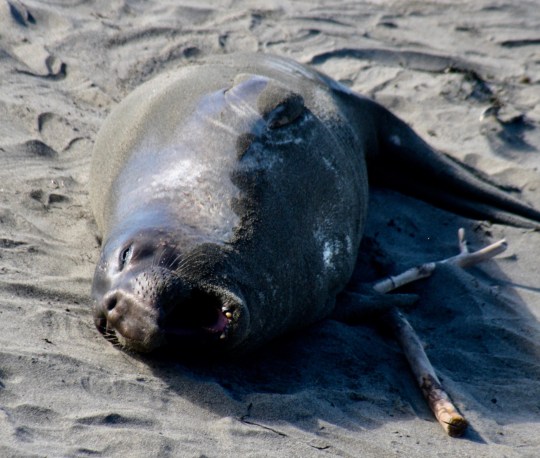
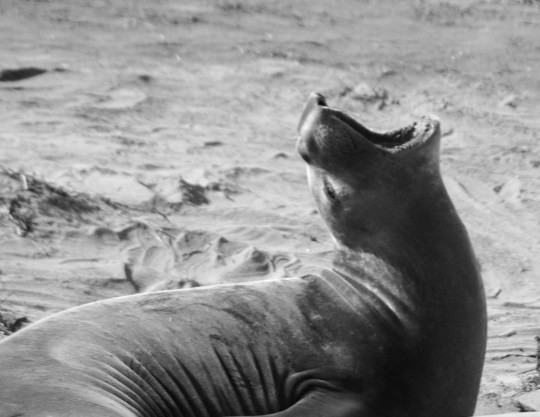
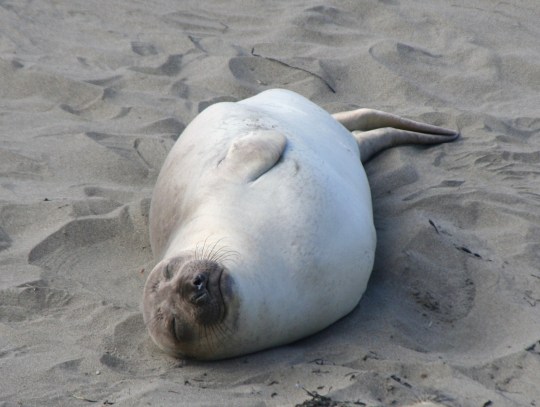
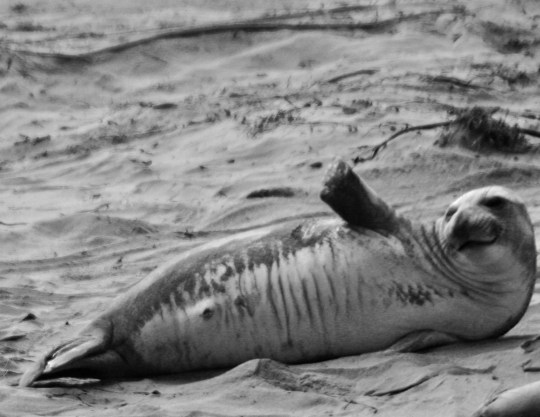
A while back Peggy and I were driving north from somewhere, maybe San Diego, when we drove past Hearst Castle and came to Piedras Blancas. It was full of sunbathers, somewhat weight challenged— and nude. Naturally we had to stop and break out our cameras.
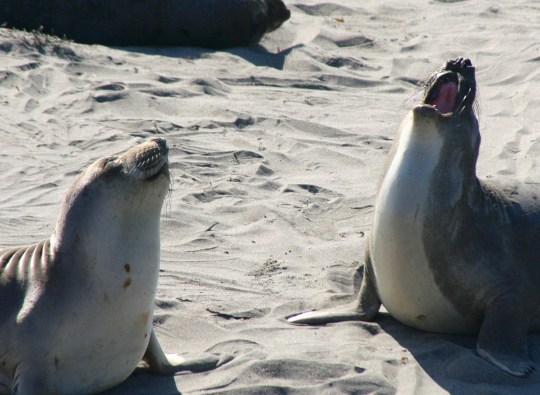
The beach was a little crowded.But everyone seemed happy. Some were even cuddling up.Can it get any better.Maybe. Few things are more pleasurable that scratching an itch.Ah, that feels soooo good!Of course it’s kind of hard to beat taking a dirt bath…Especially if it is a full body bath!Maybe a nice long nap in the sun. Yawn! Catching fish is such hard work.You know how it is when someone else yawns. Are my tonsils pretty?Speaking of pretty, here I am. How can anyone resist my dark brown eyes and gorgeous whiskers? Most girls would die to have whiskers like mine.Check me out!What do you mean this is a nude beach for elephant seals only! (Do we have trouble in Paradise?)Like here we are all sleeping and someone starts stretching while challenging us to touch our toes and lecturing us on the value of exercise.And then there is this lady who is disturbing us all by screaming, and screaming, and screaming…Like what is her problem? Wait could it be? Is it possible? Is she having a baby? All is forgiven. (Well, possibly the elephant seal she is having a baby on might have a problem.)We can relax again.And go back to sleep.But who can resist passing on a good joke. Have you heard the one about an elephant seal, a Christmas seal and a basset hound walking into a bar? Bye, bye. Thanks for wandering through time and place with Curt and Peggy.
NEXT POSTS: On Friday, we will visit Ghost Ranch in New Mexico to wrap up the Georgia O’Keeffe series. On Monday we will start a new one as we look into the strange eyes of shamans and check out other petroglyphs.
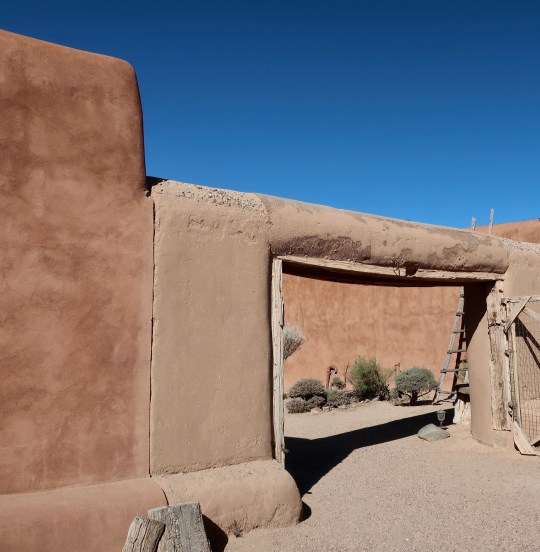
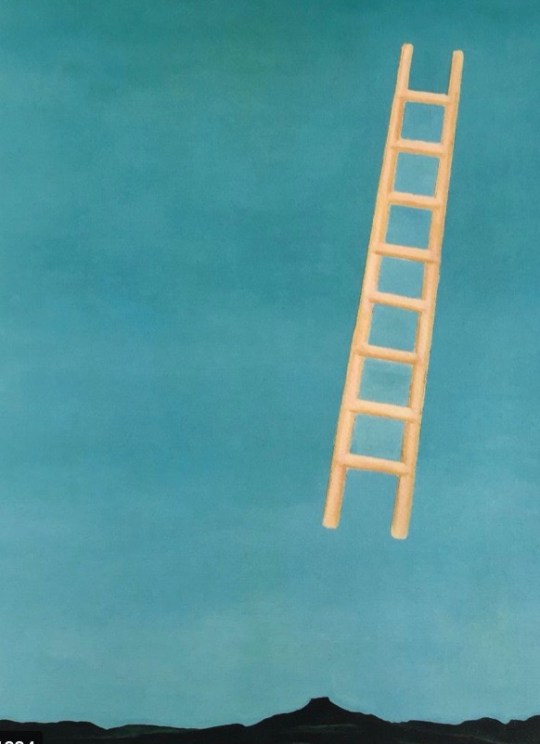
Everything about Georgia O’Keeffe’s home in Abiquiu seems to reflect the artist. A view of the surrounding scenery from the entrance to Georgia O’Keeffe’s home.Looking in. Note the ladder against the wall.Looking up. O’Keeffe would paint many things around her house…Including the ladder which she loved to climb up to the roof. Here, it is reaching farther up to the moon. The mesa top below it is where Georgia’s ashes are scattered.
Last summer when I was traveling down Highway 395 through Nevada and California, I discovered an excellent exhibit on Georgia O’Keeffe at the Nevada Museum of Art in Reno. It encouraged me to visit the places she had lived in New Mexico as one of the focuses of our Southwest trip last fall. Peggy, who likes O’Keeffe’s art as much as I do, readily agreed. In November, before Peggy and I climbed on Amtrak and made our way east to Virginia, I did two posts on Georgia and her time in Taos. In the first (go here), I featured relevant photos I had taken at the exhibit in Reno and then photos that Peggy and I had taken of the Church of St. Francisco of Asis church in Taos, a church that O’Keeffe had painted and her friend Ansel Adams had photographed. In the second (go here), I featured Mable Dodge Luhan, the famous art patron who persuaded Georgia to visit Taos, and the 1000-year-old Taos Pueblo, which O’Keeffe also painted and Adams photographed.
Today, we are going to visit O’Keeffe’s home in Abiquiu, New Mexico. When she first visited her the place in the mid 30’s, it was an old Spanish-Colonial compound that was basically in ruins. But she fell in love with it, and according to Georgia, a particular door. She had to have it. Acquiring it took ten years, which she did in 1945. It was up to her friend, Maria Chabot, working as the general contractor for four years, to turn it into a home. ”It took six months just to get the pigs out of the house,” Chabot would claim. O’Keeffe lived in the house up until 1984 when ill health forced her to move to Santa Fe where she died in 1986 at the age of 98.
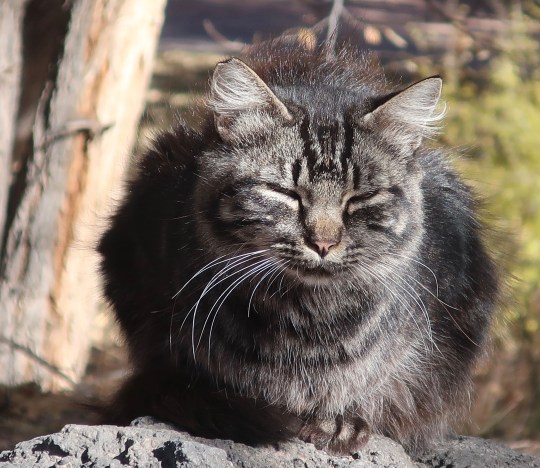
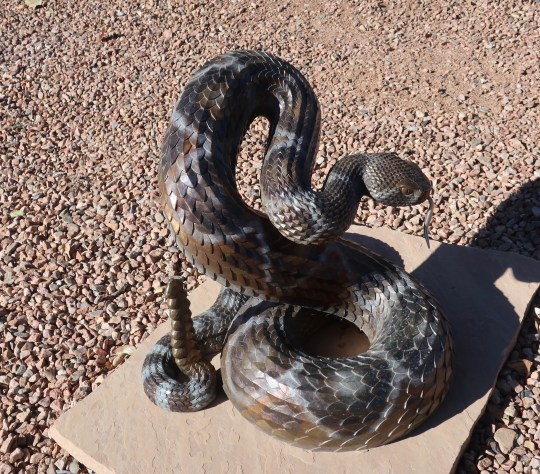
This cat welcomed us to the Georgia O’Keeffe Welcome Center in Abiquiu.Not so welcoming was this sculpture of a rattlesnake by Joe Spear on loan from the rattlesnake museum in Albuquerque. (I really wanted to go to the museum but we ran out of time.)
Peggy and I signed up for a tour of the home and studio with Georgia O’Keeffe Museum in Santa Fe. It started at the O’Keeffe Welcome Center in Abiquiu and then progressed up to the house. We were allowed to take photos outside but not inside. (I suspect that’s to encourage people to buy the tour instead of just going on-line.) One of the more interesting items inside was a piano that Georgia bought so Ansel Adams could play when he came to visit her. We learned that he had trained as a classical pianist instead of a photographer. The house and surroundings inspired a number of her paintings including the door that had originally attracted her, which she painted some 20 times. Another focus, the cottonwoods growing in the Chama River Valley that her house overlooked, she painted 24 times
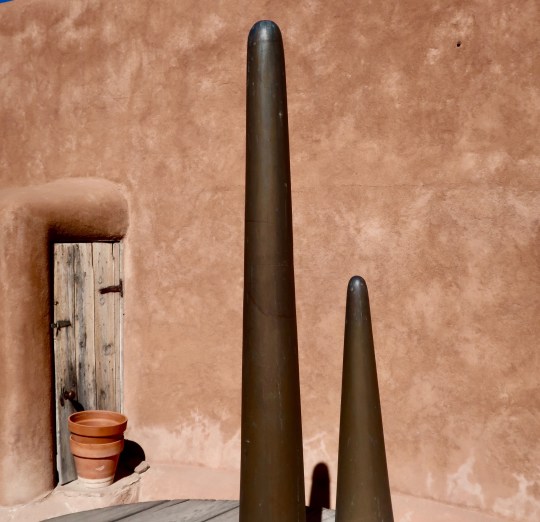
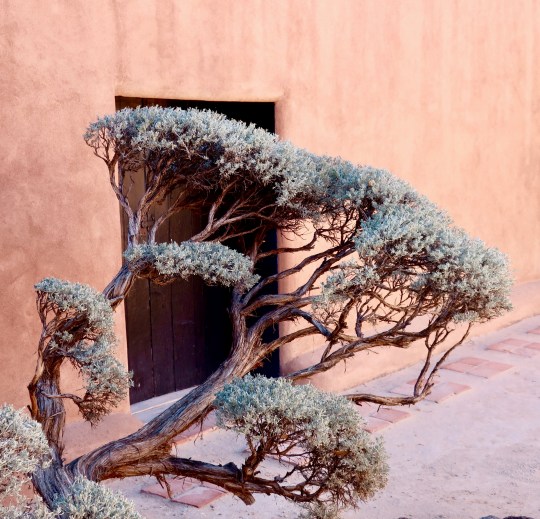
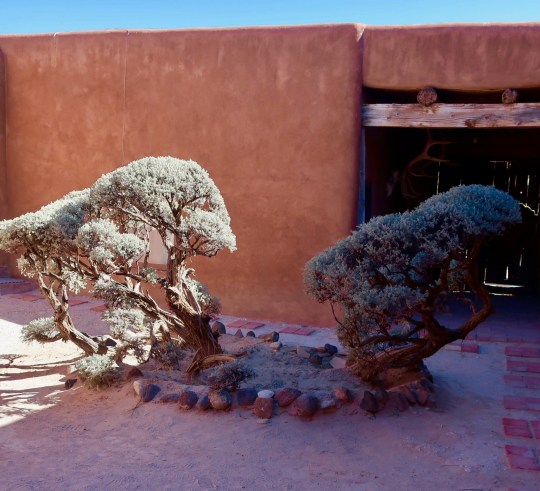
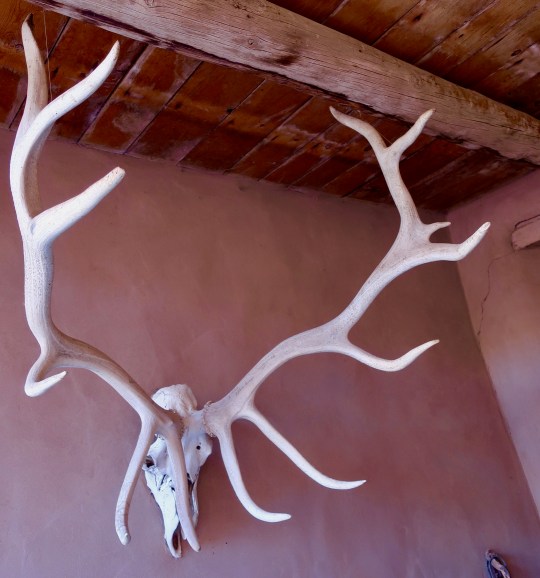
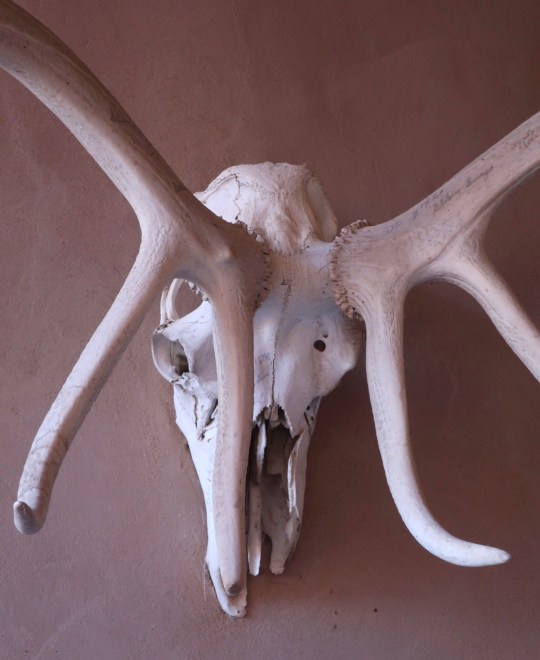
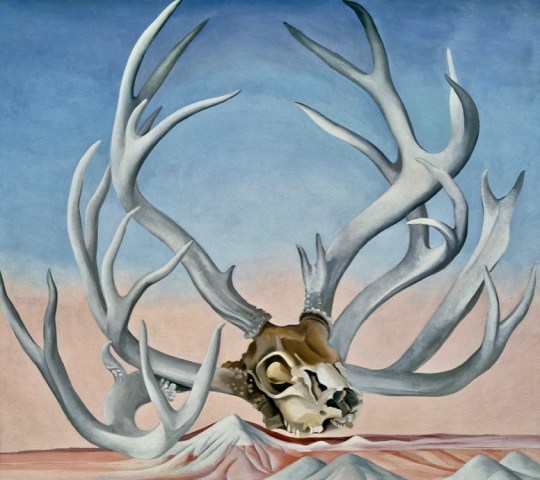
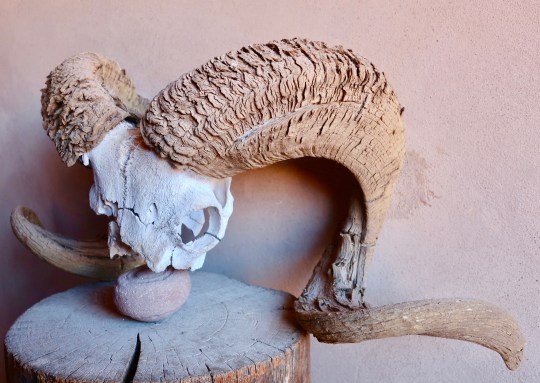
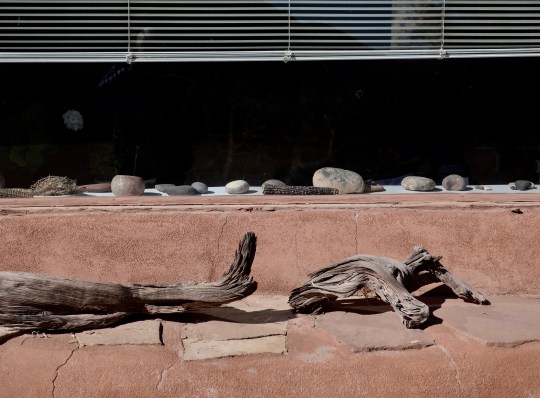
One of her 20 paintings of the doors in her patio.One of the doors she liked to paint.Looking in toward the door.I took a photo of the other door along with one of the picturesque bushes growing in the patio.Here I found one of the bushes in the sun and the other in the shadow. Peer into the dark and you will see antlers that O’Keeffe loved.It’s an impressive rack of a bull elk.Close up. O’Keeffe was known for her paintings of antlers and other bones she found out in the desert. At first her husband and agent, Alfred Stieglitz, objected to her sending bones back to New York to paint. When the paintings started to sell like crazy, he told her to send all the bones she wanted. She sent a barrel full. I also found this partial mountain sheep skull at Georgia’s.She also liked to collect rocks and sea shells. They are found throughout her house.Including on the sill of her living room window. She also found dead wood worthy of painting. I think the piece on the right may have served as a model.As Georgia O’Keeffe grew older her eye sight started to go and she took up sculpture. Her young handy man had been trained as a potter and taught Georgia how. It was quite the scandal of the time that Juan, who was 58 years younger than Georgia, was also handy in other ways. Georgia left him her two houses and $17 million, which he didn’t keep.While we could only photograph the sculpture at Georgia’s house from the outside, there was one of her sculptures at the exhibit in Reno that I was able to photograph.Another perspective.One of the things that O’Keeffe treasured about her home was its garden. Fruits and vegetables are still harvested from it today. These apples are ready to pick! I might have had one had the guide not been watching me. (Grin)I find the adobe look of southwestern homes like O’Keeffe’s very attractive. Had Peggy and I retired to New Mexico instead of Oregon, we would have had one. The contrasting trees here are a plus. The surrounding countryside provided inspiration for many of Georgia’s paintings. As I noted earlier these included over two dozen paintings of the cottonwoods that grew along the Chama River below her house. This one of them.. It is quite close to being abstract.I’ll conclude my post today with a photo a cottonwood near her home.
NEXT POSTS: On Wednesday it’s time for another photographic essay. This time I will post photos of some quite humorous elephant seals Peggy and I found on the beach near Hearst Castle in Southern California. On Friday, I will conclude my Georgia O’Keeffe series with a trip to Ghost Ranch, about 15 miles north of Abiquiu where Georgia also lived and painted.
The tools of the trade. Each competitor at the BP 2016 World Ice Carving Championships in Fairbanks, Alaska carried a wide variety of tools ranging from chisels to chainsaws.
On Wednesday, I took you for a ride on the Alaska Railroad from Anchorage to Fairbanks. We were on our way to attend the 2016 World Ice Carving Championships.
We were lucky to arrive in Fairbanks to see the carvers at work and then see their finished works of art. They were impressive, to say the least.
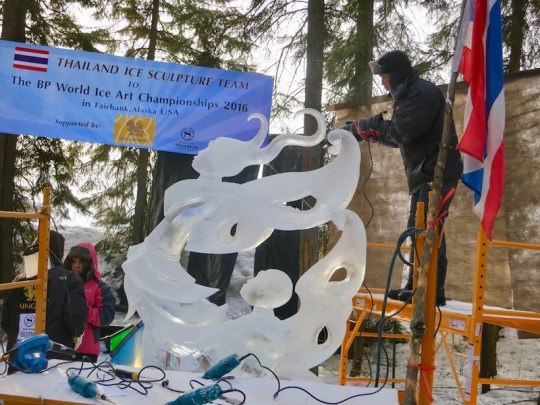
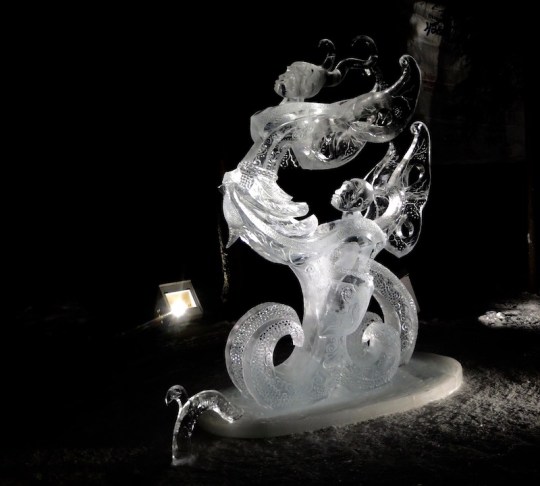
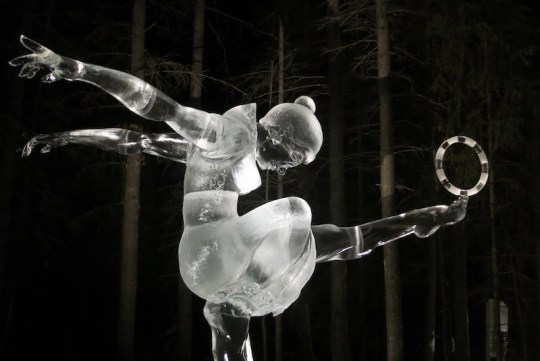
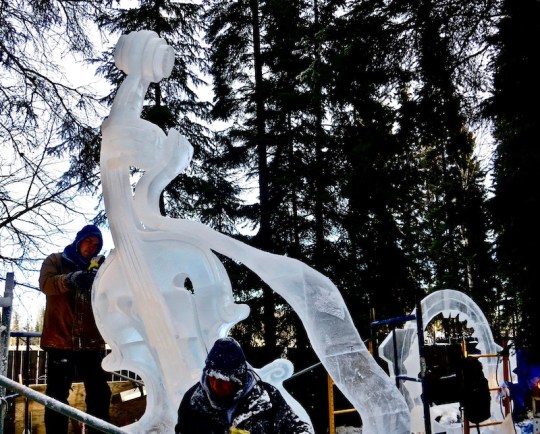
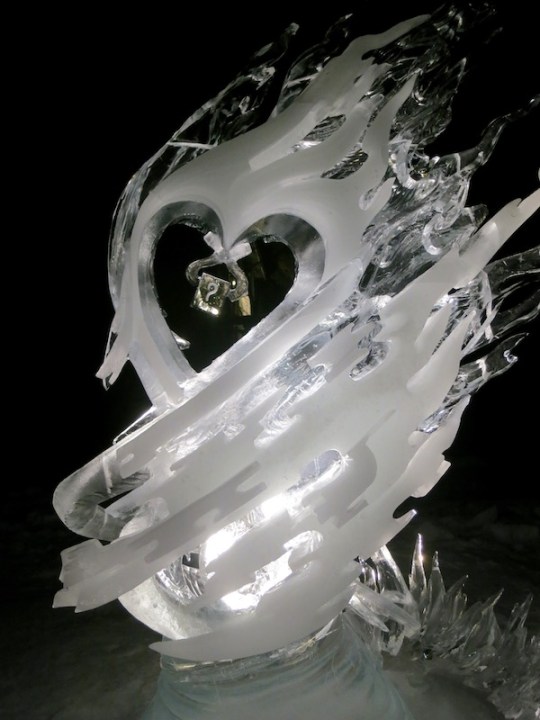
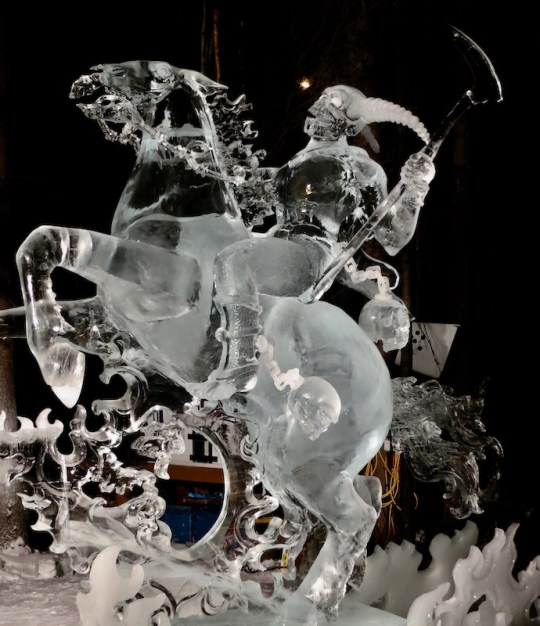
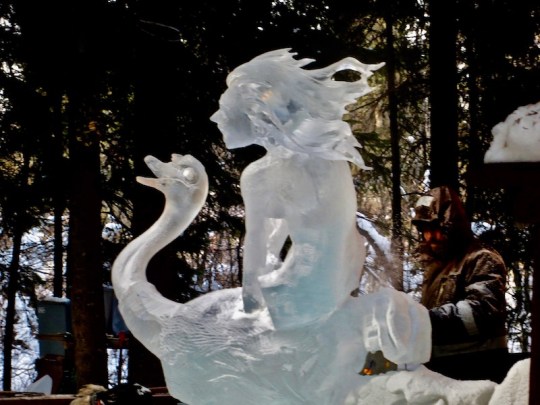
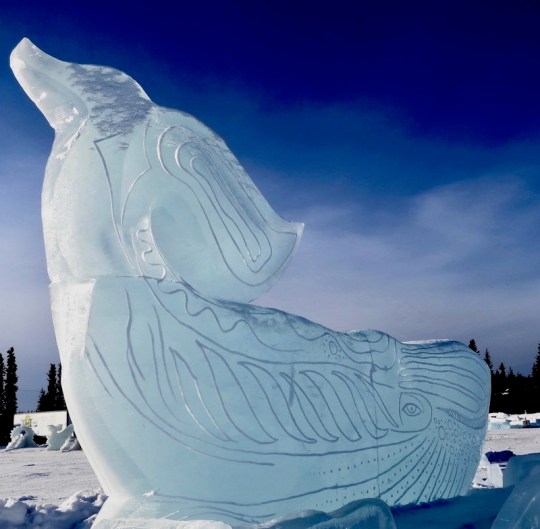
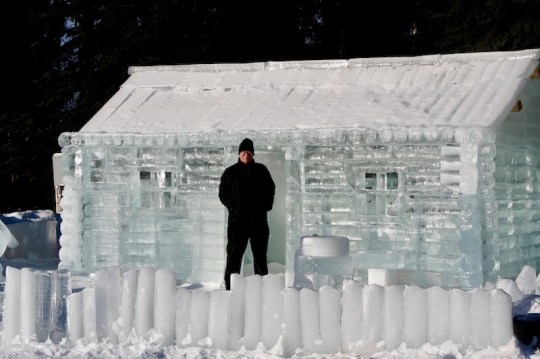
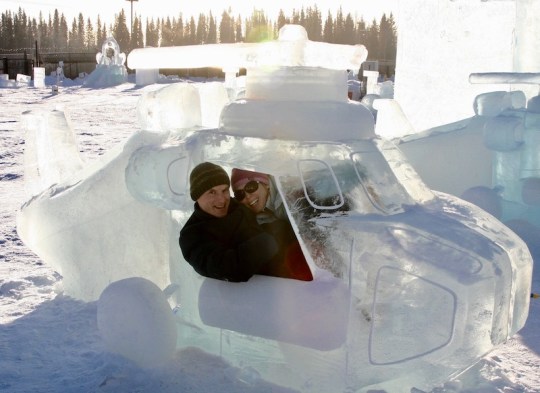
The Thailand Team puts the finishing touches on their sculpture for the night’s competition.And here is the finished sculpture.The round ball seemed almost magical to me, like I should be able to look into it and see the future. Note the thin, wire-like tool the artist on the left is using to add texture.This acrobat was lifting her leg high.As I recall, she won the competition.This piece was interesting…It turned out to be a self-playing base fiddle!I thought the young girl running with a dandelion head was fun. Did you blow on these as a kid to watch the seeds go flying off?She loves me, she loves me not. Note the question mark held by ice tongs in the center of the heart. Hold that tiger! Lots of teeth and claws.Speaking of teeth, the tiger wasn’t alone.Woof, woof.This was one of my favorites because of the detail.An unfortunate jellyfish has become dinner.Here’s a figure you don’t want to run into at night. Or during the day.Here kitty, kitty, kitty. Maybe.So, is it a cat? And what is with the chain?This woman is riding a bucking ostrich. Yeehaw!My heart goes where the wild goose goes. Indeed.In addition to the sculptures included in the ice carving contest, the park featured a number of other figures such as the helicopter I showed you on Wednesday and this giant whale.I also found this sea serpent rather impressive.I’ll close today with my new log cabin. It’s a bit cold inside. But don’t you think my all black outfit contrasts nicely with the ice? That’s me, a true paragon of fashion. (grin)
NEXT POST: On Monday I will have Georgia on my mind again as I return to O’Keeffe’s home in New Mexico and finish up the series I started before Peggy and I took off across the country on Amtrak.
Our train trip from Anchorage to Fairbanks took place on a clear day, allowing us to enjoy the beauty of the passing countryside. Even the reflection was stunning. They had an open window between two of the cars that I leaned out of to catch this photo.
There is great beauty in Alaska. I worked there from 1983 to 1986 as the Executive Director of the Alaska Lung Association. One of my jobs had been to lead 100-mile backpack trips as fundraisers to support the organization’s activities. (Not many executive director do that.) In addition to raising money, the treks provided me with an opportunity to explore some of the state’s more remote corners and vast wilderness areas.
In March of 2016, Peggy and I returned to ride the Alaska Railroad from Anchorage with our son Tony and his family to attend the world championship ice carving contest in Fairbanks. Tony was flying helicopters for the Coast Guard out of Kodiak at the time. The train trip reminded me of just how beautiful and wild Alaska is. We were fortunate to travel on a clear day that provided great views, including Mt. Denali. In Fairbanks, it was exciting to watch some of the world’s greatest ice carvers at work and see their completed sculptures. Today’s photo essay will reflect the train trip. On Friday, I will show you the ice carving contest.
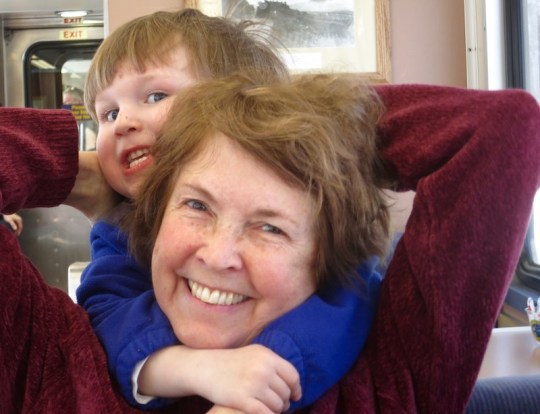
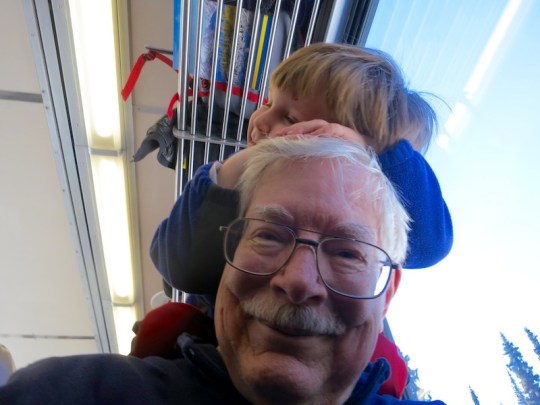
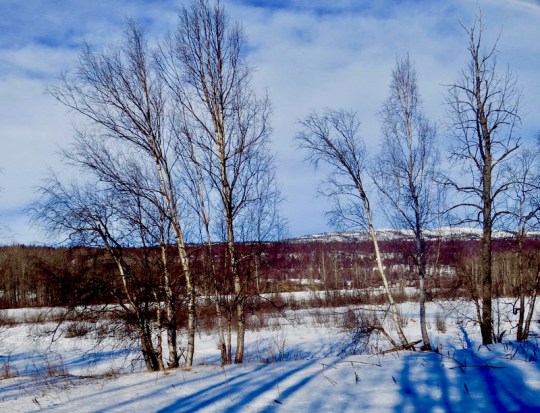
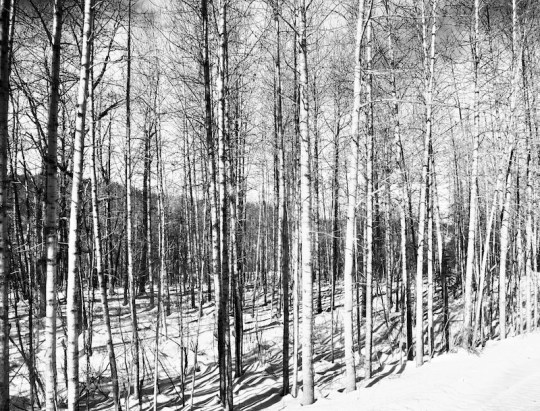
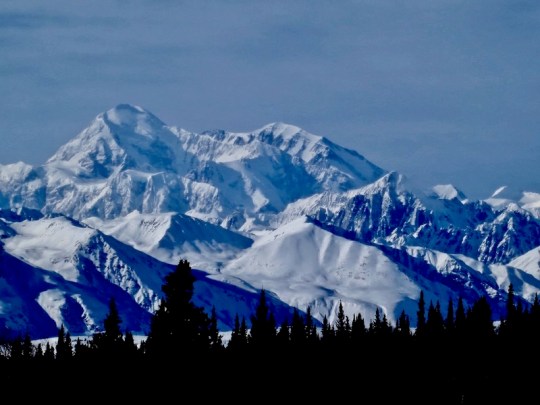
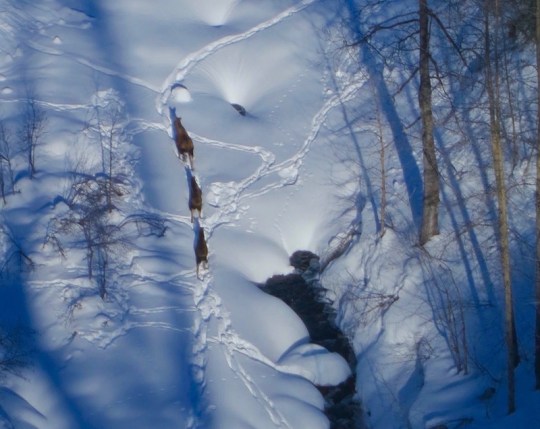
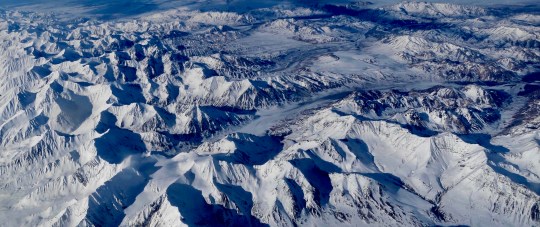
Of course not all of our time was spent looking out the window enjoying the scenery. Our grandson Cooper made sure of that as he climbed onto Peggy’s back.And decided to take a snooze on my head. That can give you a neck cramp! (Photo by Peggy Mekemson.) Folks live along the railroad and use it for transportation. They can flag the train down whenever they need to go to town. It’s Alaska!This stream made me long for my kayak. Note how crystal clear the water is.The snow enhanced the look of trees along the railroad. Or maybe it was the other way around.Another example.I rendered these skinny birch trees in black and white.Time for another family photo. This is Tony and his boys.I mentioned that Tony flies helicopters for the Coast Guard. I had to include this photo of him giving his wife, Cammie, a ride in an ice copter. They had a hard time getting off the ground. (Grin)One thing Alaska has is impressive mountains. Lots of them. And there were dozens of great views on our trip.Another example.And another!The grand-daddy of them all is Mt. Denali, the highest mountain in North America. (Photo by Peggy Mekemson.)We also saw some impressive canyons along the way. This one had a family of moose making its way through the snow. During heavy snow years, the moose use the railway as a path. Encounters with trains don’t go well, at least for the moose. One of the years I was in Alaska was a particularly bad snow year and a number of moose had been killed. I awoke one morning and discovered that the top headline in the Anchorage Daily News proclaimed “Railroad 50, Moose 1.” Apparently, the train had hit a moose and been derailed.We thought this canyon was gorgeous with its ice-covered, meandering river making its way around the trees in the top center of the photo.We flew back to Anchorage after our trip and I snapped this photo of the Alaska Range. I thought it would be an appropriate picture to end today’s blog.
NEXT POST: On Friday I will show you photos of the world championship ice carving contest in Fairbanks. The sculptures were amazing. You won’t want to miss them.
I didn’t have a clue what I would find the old boy brewing up at the Devil’s Kitchen in Bandon. But I was expecting something like the Devil’s Churn, which is found farther north up the Oregon Coast.
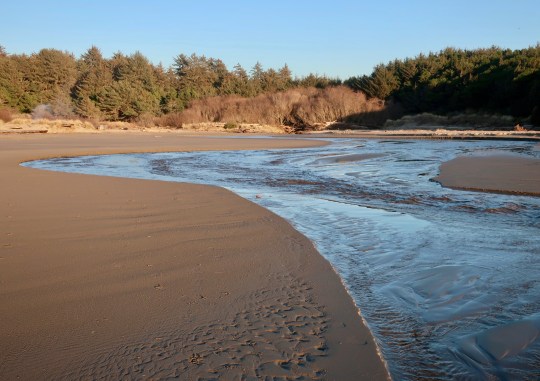
I figured the Devil had to cook with ghost peppers, and that got me excited. I like my food spicy hot and it doesn’t get much hotter. A tiny bit goes a long, long way, even for me. Lacking that, I thought I might at least find a churning, boiling sea like you find at the Devil’s Churn. Instead, I found a quiet, bucolic scene. Crooked Creek flowed peacefully out to the ocean.
Crooked Creek flowing out to the Pacific Ocean.
But wait a minute, I thought. The Devil is sneaky, right. Maybe Crooked Creek was indeed crooked. Maybe it tricked people into crossing and then sucked them under with quicksand. With this in mind, I went seeking other subtle reminders of the Devil’s presence.
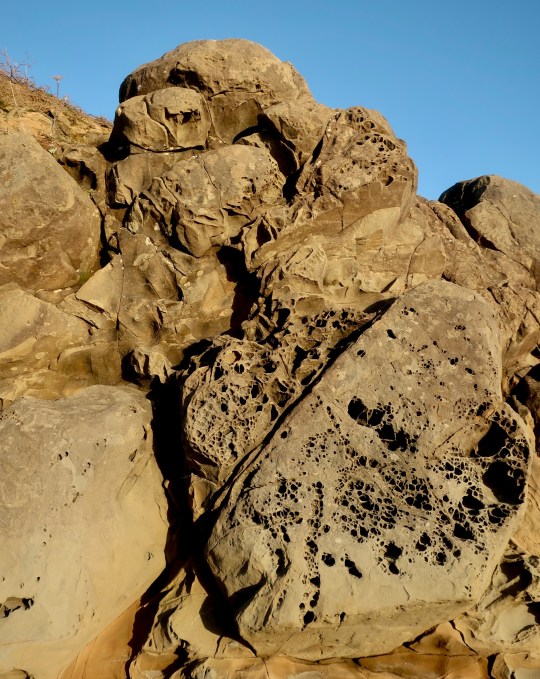
And found this. If ever there was an example of the Devil’s handiwork… Note the smiley, evil face on the left. And then, Gonzo. Next comes an inebriated Santa, followed by a busty Old Mother Hubbard. And finally there is Tex Ritter. You can tell by the cowboy hat. But just who is Tex Ritter? What? Maybe you can’t see any of the above and you’re thinking Mekemson has gone over the edge. Maybe he is possessed. Backing up, I realized the truth. I was looking at a sand castle made by a kid who obviously needed some counseling. He didn’t even know that the moat was supposed to go on the outside.And then I saw it, as clear as the day. A hell hound. Look at those flaring nostrils and bulging eyes. I looked again and saw Goofy needing a haircut. Was this yet another example of the Devil being sneaky?Something had been eating rock! I looked up and saw an evil turtle glaring at me. I was becoming a believer.Even the driftwood took on a scary countenance. Look at the snout on this fellow and his hollow, haunting eye. I didn’t want to be around when the sun went down.At first I thought I saw a face here, maybe George Washington in his dotage. Then I realized that something very big had eaten a chunk out of the rock.People sometimes fall off cliffs. That seems a devilish thing to do. Usually they are standing on the edge taking a selfie of themselves. Don’t they know that selfies are the creation of the Devil? While I feel sorry for these folks who give their all for a fleeting moment of fame, I can’t help but wonder if something Darwinian isn’t involved. Given that this particular cliff was three inches high and the water was two inches deep, there wasn’t much danger, however.And finally the ultimate proof. Most people think of this as kelp, but actually, it is the Devil’s bull whip!In the end, even though I had discovered several hints of the Devil’s presence, I decided that the area was just too pretty to be associated with Hell.Even the rock with the chunk missing looked harmless from the distance.And this sea stack caught in the afternoon sun was close to beautiful.I walked back toward my van through the trees…And found this sign. Turns out there was nothing devilish about Devil’s Kitchen at all.No longer fearing for my soul, I hung out on the beach to see a final sunset before I left Bandon heading south. I’ll be back.
NEXT POST: The Wednesday Photo Essay. Four years ago in February, Peggy and I went for a ride on the Alaska Railway from Anchorage to Fairbanks with our son Tony and his family. Join us as we check out Mt. Denali and attend a world championship ice carving contest.






































































 Wandering through Time and Place