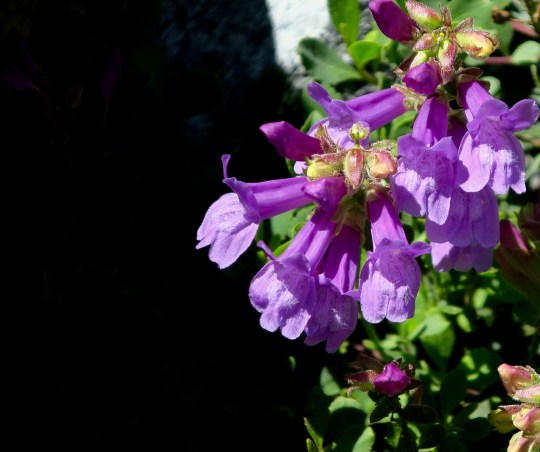
Penstemon. One of at least a hundred beautiful flowers I photographed on my 750- mile hike down the PCT two summers ago.
Hiking the Pacific Crest Trail is serious business for those who decide to backpack the 2650 miles from Mexico to Canada in one season. Think of it as hiking a 26-mile-marathon each day while carrying your food, water and camping gear on your back over mountains, across deserts, through snow, and every imaginable kind of weather. As such, it is not an exercise in wilderness appreciation; it’s an exercise in human endurance. It is one of the toughest, most grueling physical challenges in the world. People involved in can be forgiven if they don’t have time to stop and smell the flowers.
This isn’t to say they don’t have an appreciation for the incredibly beautiful country they are hiking through. It’s impossible not to. But this appreciation is limited. When Peggy and I were backpacking through the Three Sisters Wilderness of Oregon as part of my 750 mile trip, we met Big Red, a giant of a man who summarized it well. “I’ll camp on a beautiful lake,” he said, “and I’ll think, ‘Wow! I would love to spend a few days here.’ But I can’t. I have to get up the next morning in the dark and be on the trail by dawn. Otherwise I’ll never finish.”
I felt the pressure myself, even though I was moving along at around 15 miles a day. At 75, my shorter days were the equivalent of the longer days being hiked by the 20-40 year olds. I was glad I had my camera along and was committed to recording my journey with digital photos. It forced me to stop and smell the flowers— and to admire the beauty of my surroundings. Plus it was one hell of an excuse for a break even though I rarely allowed myself more than a minute or so to capture a subject and had mastered taking my camera out and putting it away while walking. (Okay, some subjects required 15-30 minutes!)
The flowers along the trail were gorgeous. I shared some of these when I blogged about the journey. I’ll be sharing more over the next few weeks as I use my photo-essay Wednesdays to feature pictures from the PCT. Enjoy.
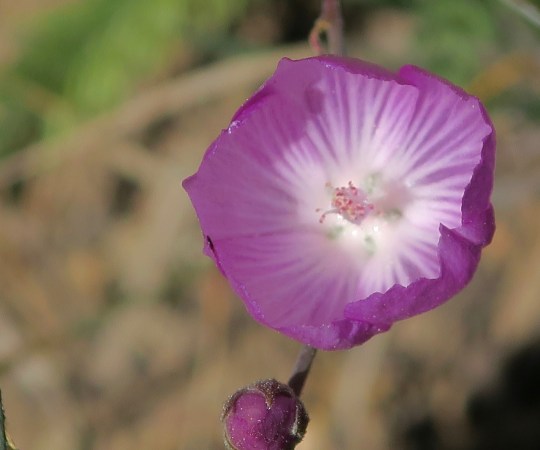
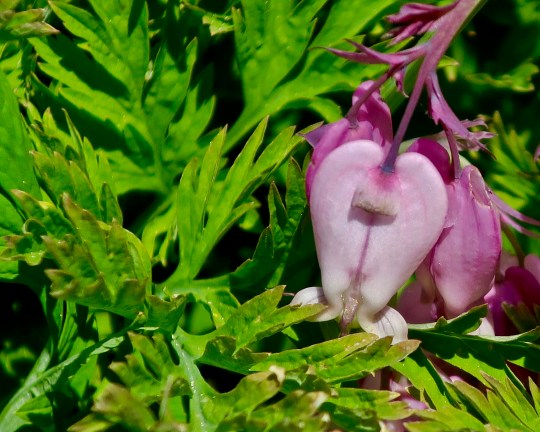
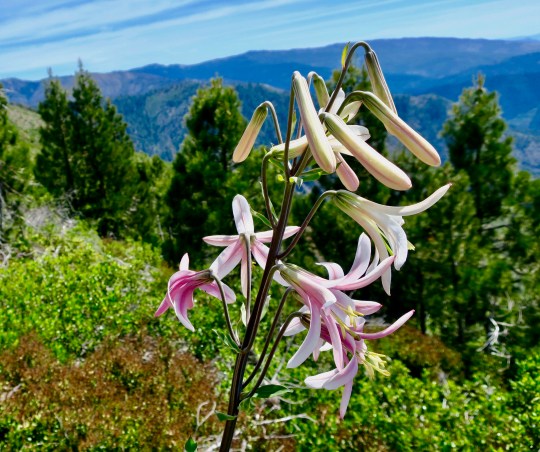
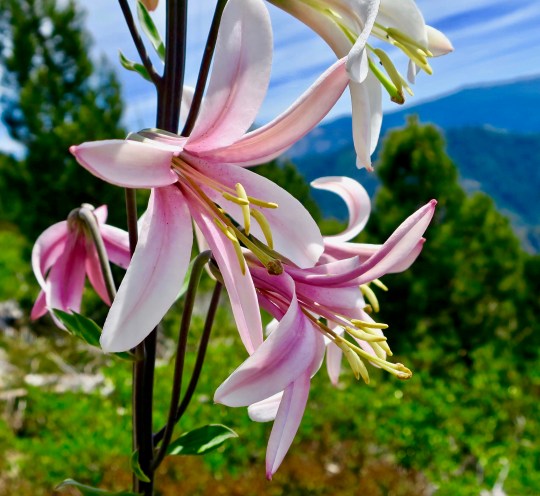
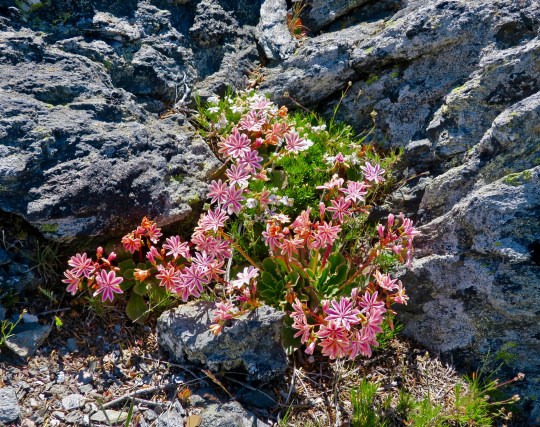
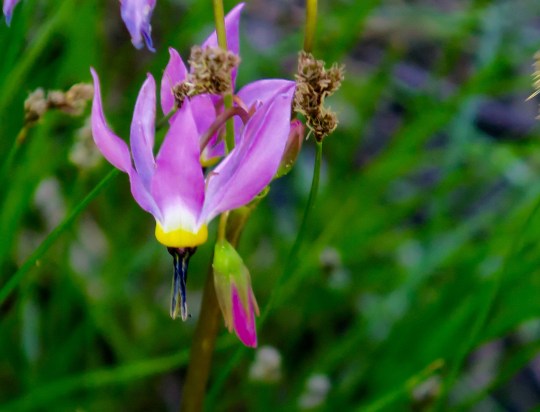
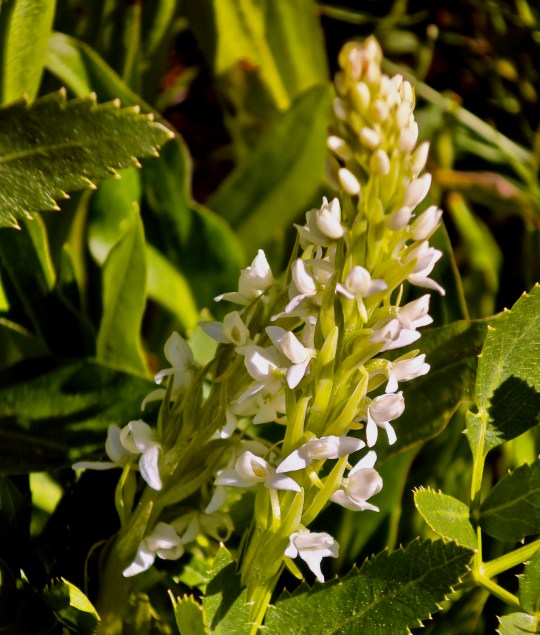
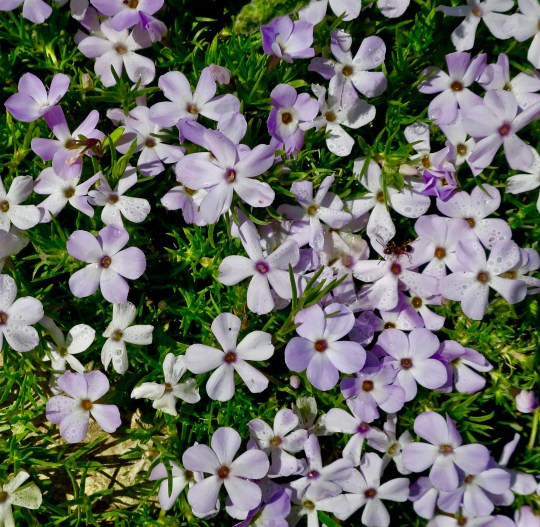
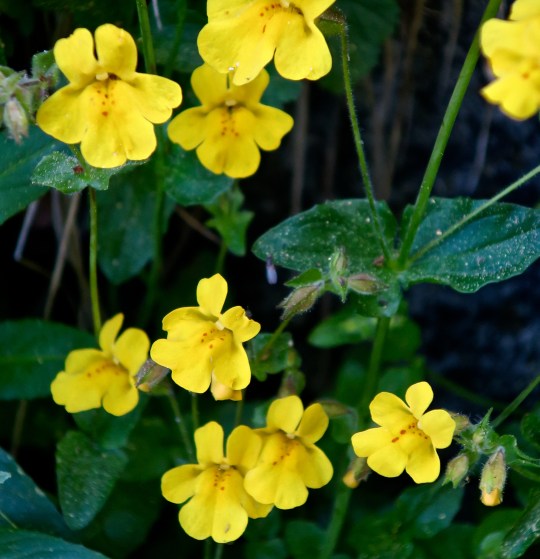
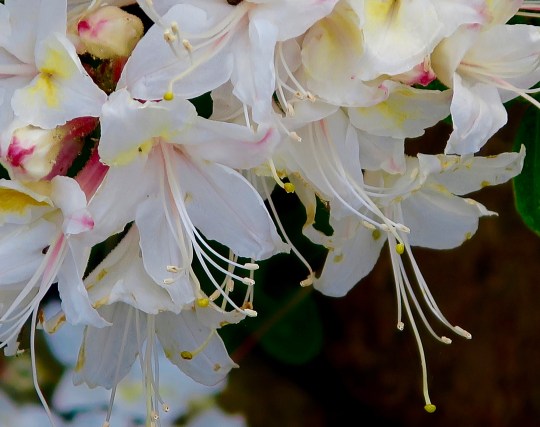
Yellow leafed irisWild hollyhockWestern bleeding heartClose up of Western bleeding heart flower.Washington lilyClose up of Washington lily.WallflowerSiskiyou lewisiaShooting star flowerRein orchidPhloxPaintbrushMonkshoodMonkey flowersAzaleas
FRIDAY’S POST: My final rock art post for now featuring petroglyphs from Monument Valley, Canyon de Chelly, Petrified Forest National Park and northern Nevada.
A note to our blogging friends: As the world reels from the Coronavirus,Peggy and I want to wish each of you the best in making it through this world-wide pandemic, the likes of which we have never experienced.Our travel plans, like yours, have been put on hold as we hunker down at our Oregon home, avoid as much social contact as possible, and wait for the worst to pass. Assuming we are able to avoid the virus, I will continue to blog, possibly relying on older materials. In the meantime, be careful and be safe. Curt and Peggy
You might not believe it from this photo, but the Petroglyph National Monument is located minutes away from Albuquerque, New Mexico. Petroglyphs are found throughout these rocks along some 17 miles of this volcanic escarpment. The blips you can see on the horizon are small volcanos. (Photo by Peggy Mekemson.)This is a photo I took at the beginning of the escarpment. Suburbs literally back up to the National Monument. Downtown Albuquerque can be seen in the distance.
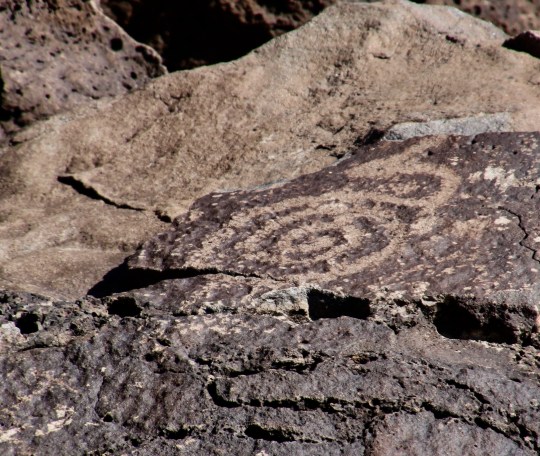
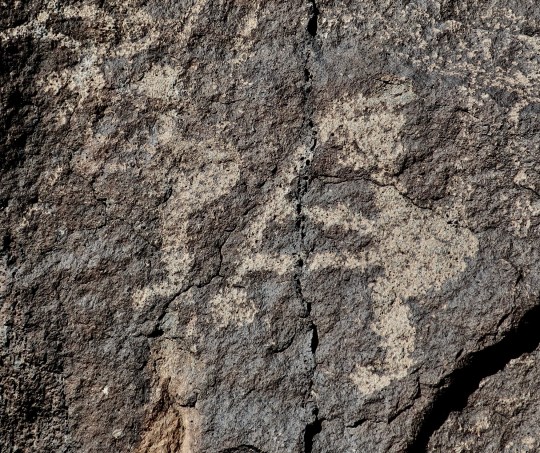
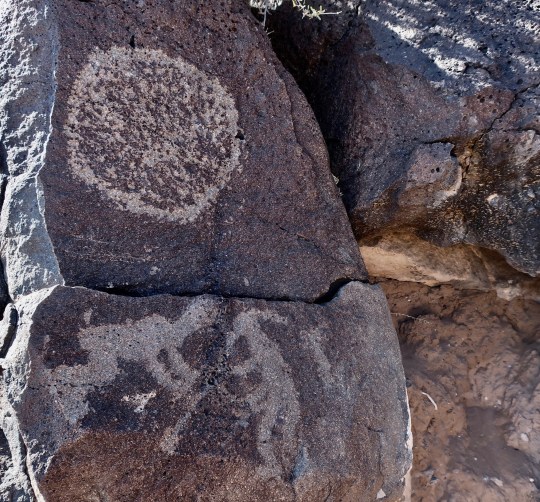
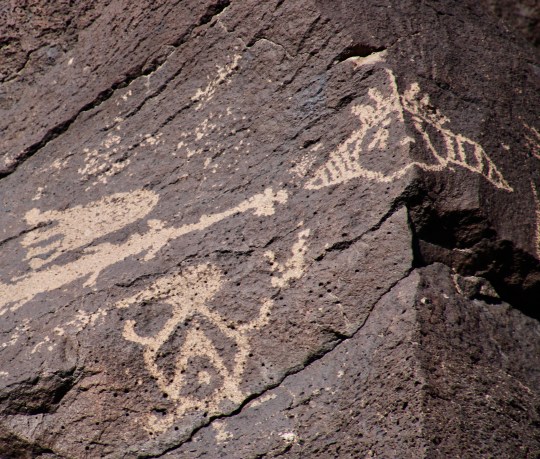
Peggy and I parked Quivera in a small parking lot for the Petroglyph National Monument that we found behind a fast food restaurant. Fifty yards up the trail we began to find petroglyphs. Archeologists believe that there are around 25,000 in the 17 miles.
The rock I am standing next to provides an idea of just how concentrated the petroglyphs can be at the Monument as well as providing a perspective on their size. The grumpy looking circular guy on the left is the god of death. He will return in Friday’s post. Scary huh. (Photo by Peggy Mekemson.)
It is estimated that the majority of the petroglyphs were carved between 1300 and 1680 CE by ancestors of present day Pueblo people, but some of the petroglyphs have been dated back to over 2000 years ago. Many of the petroglyphs we found at the Monument are similar to others we’ve found throughout the Southwest. For example, does the following rock art look familiar?
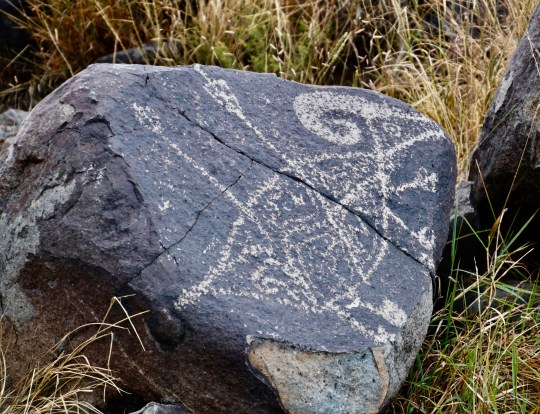
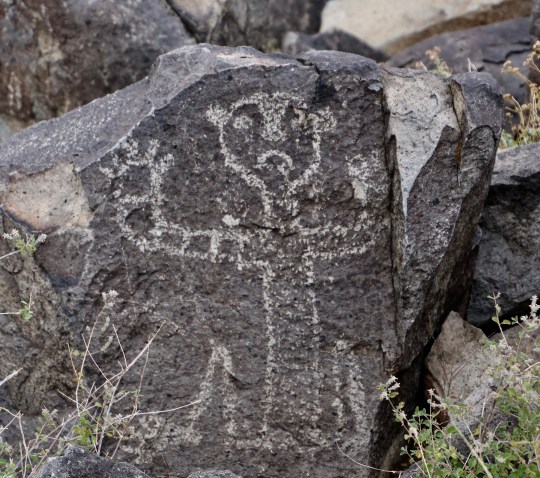
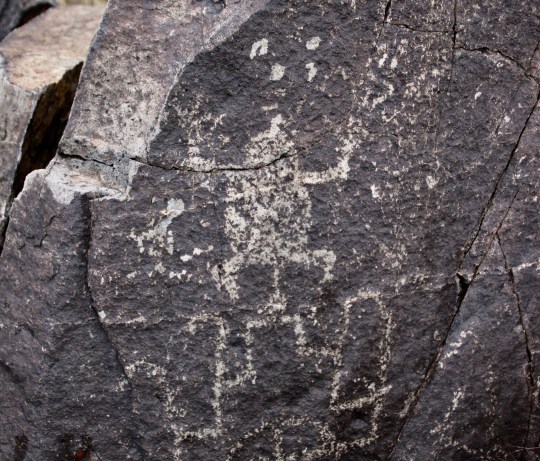
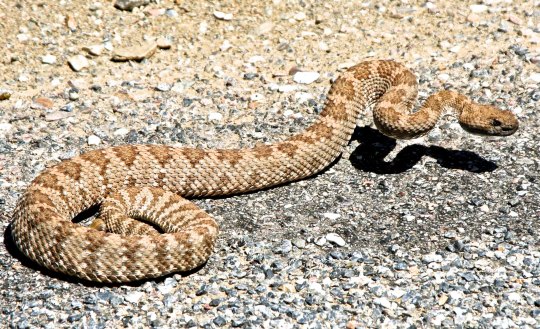
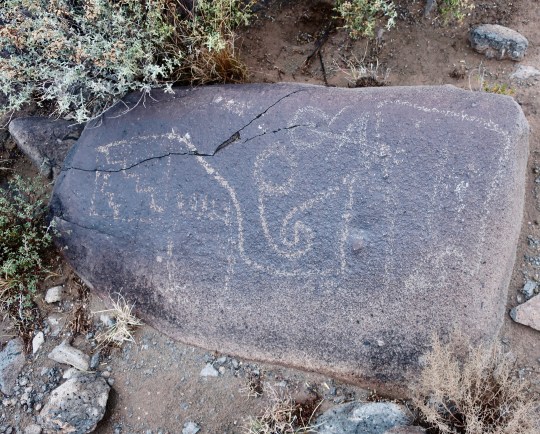
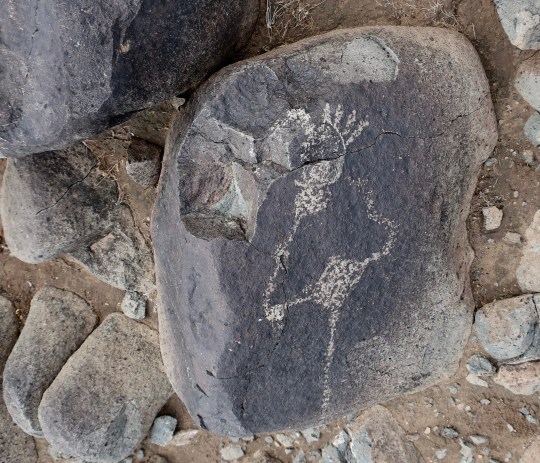
I named a similar petroglyph that we found at Three Rivers Cat Woman. I thought it was interesting on how this rock art was created on a rounded surface. (Photo by Peggy Mekemson.)Surprise! Check out the feet. My ‘cat woman’ has the paws of a badger. You also met up with the Horned Serpent on my post about snakes at Three Rivers’ petroglyph site. Here he is coiled up. I alway assume rattlesnakes mean business when I find them coiled up with their tails rattling at 50 times per second and ready to strike. Experts claim that the snake can only strike about half the length of its body. Assuming you know the length of the body, you can determine how close you can get. I always leave an extra ten feet for margin of error. (Grin)
Peggy and I visited the site at absolutely the wrong time for photography: high noon. (Being the old hands we are with our cameras, you think we would know better.) As a result, a number of the photos like cat/badger woman aren’t as clear as we like— even with photo processing.
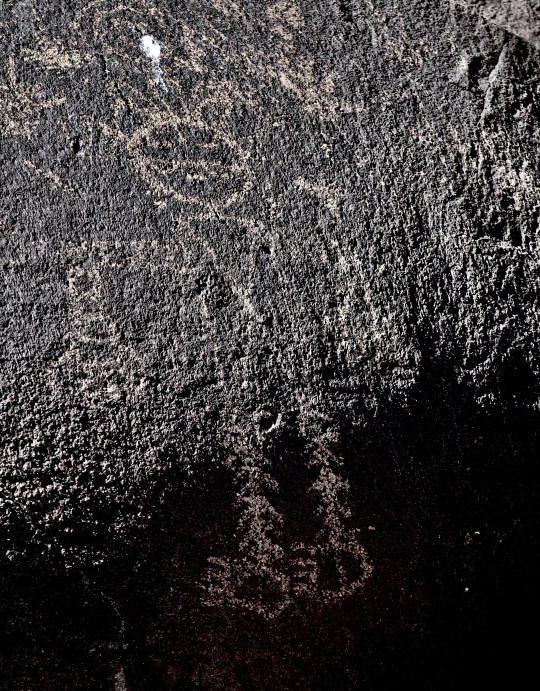
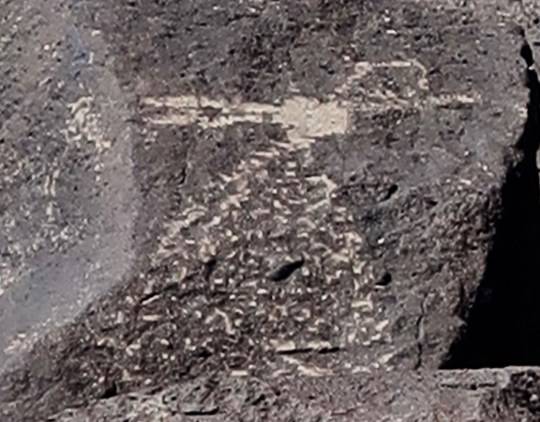
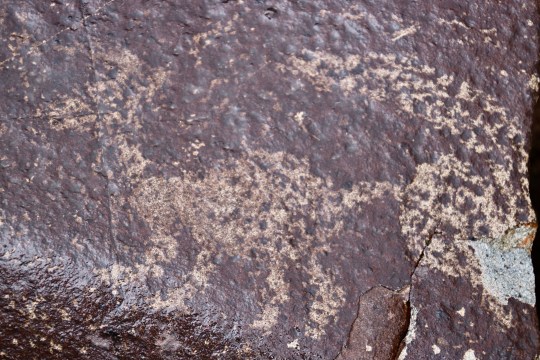
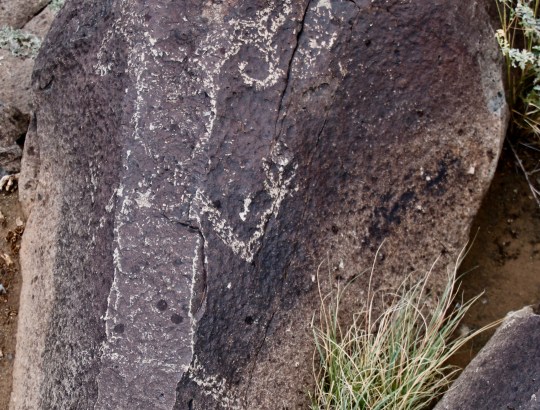
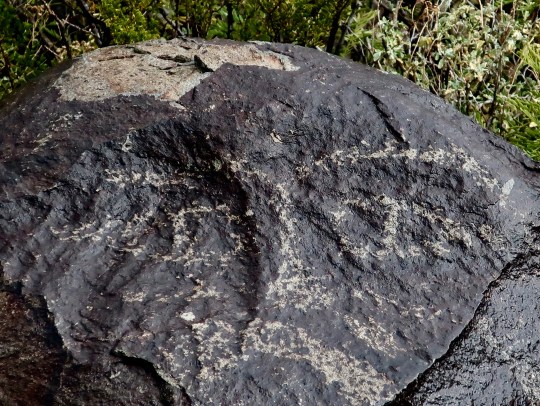
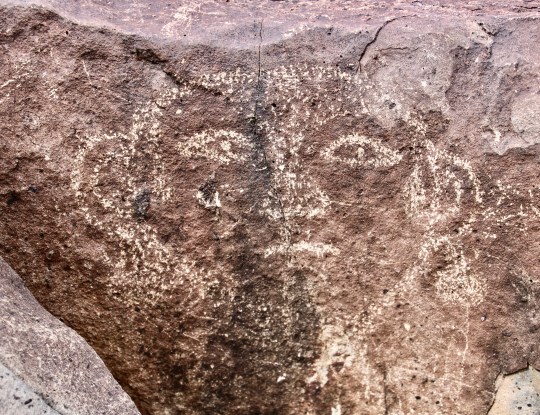
Headwear is important in petroglyphs.Speaking of headdresses, check out the one on this petroglyph. (Photo by Peggy Mekemson.)Here is probably the most recognized character in petroglyphs across the Southwest, Kokopelli and his seductive flute. A second Kokopelli plays away in front.It appears to me that Kokopelli is playing a duet here under a full moon.I was amused by this fellow with shaky legs. Reminds me of a time I hiked into the Grand Canyon when I was a bit on the pudgy side. That’s what my legs were doing by the time I reached the bottom.If people want a ring in their nose or their bellybutton, it’s their business. Why not. But it’s not for me. No thanks. But how about an arrow in your nose like this guy sports. Ouch! (Photo by Peggy Mekemson.)My first thought on seeing this was Big Bird. (Photo by Peggy Mekemson.)But a closer inspection showed Big Bird’s head was actually a face. And not a happy one. The line you see coming down from the right eye probably represents crying.Having dealt with the Big Bird that wasn’t, here are a few more animal petroglyphs that may or may not be what they seem. This rock art receives my nomination for the strangest. I’d say anteater on the bottom, if they made their way that far north. On top, a really wild guess would be a horned serpent hitching a ride.Check out the petroglyph on the left. If an anteater making its way north seems strange, you really have to wonder about an alligator in the deserts of the Southwest. Maybe it’s a fat lizard. I also liked the caterpillar dog on the right.Another large bird with a very big bill, or something. Doggie? Or does that long nose suggest another anteater?Your basic dog or coyote… Maybe.I’ll close today with this dramatic mask, including ear rings.
WEDNESDAY’S POST: Flowers of the Pacific Crest Trail.
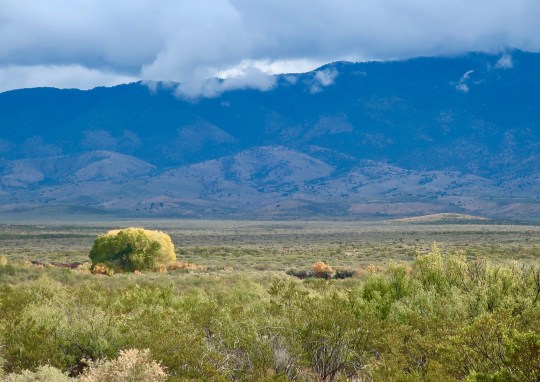
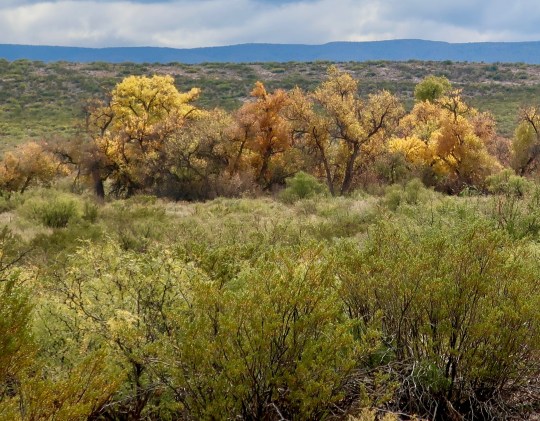
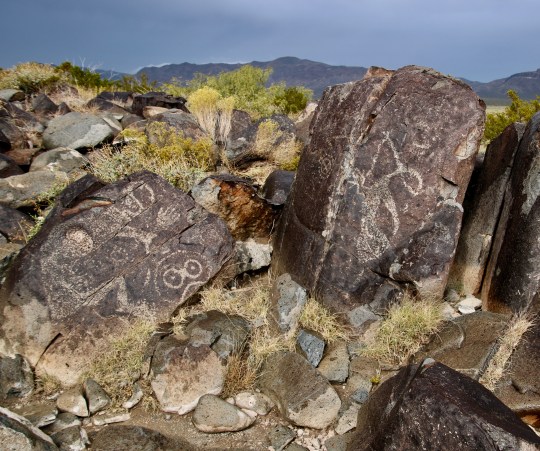
This cottonwood decked out in fall colors was one of many views we had from the ridge where Peggy and I wandered among the rocks searching for rock art at the Three Rivers’ petroglyph site in New Mexico.
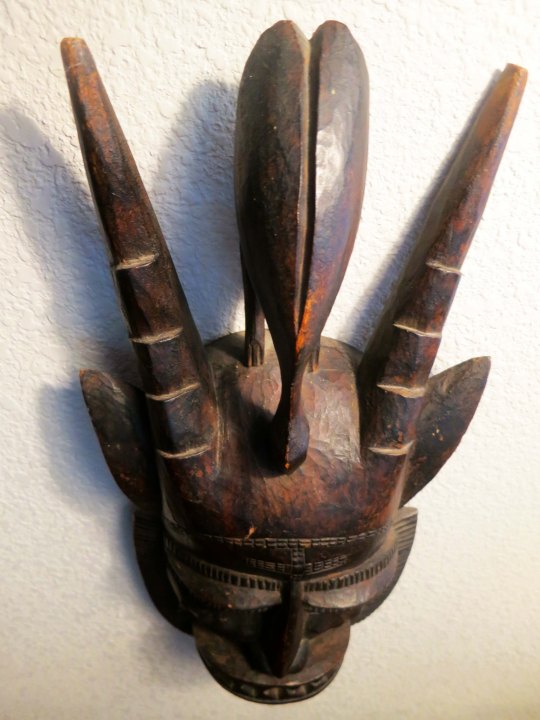
I find petroglyphs mysterious and magical. My attraction to the so-called primitive art started when I served as a Peace Corps Volunteer in West Africa way back in the 60s. I use the words ‘so-called’ because the art carries an inherent power and a simple beauty— both of which were recognized by artists such as Matisse and Picasso in the early 1900s— that defies the word primitive.
An African medicine mask I brought back from West Africa.
Petroglyphs and pictographs have the ability to transport us into another world and time— and, in so doing, enrich our lives.
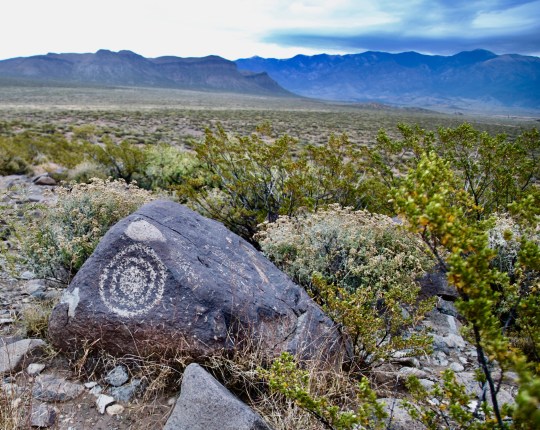
While I have two more posts on petroglyphs from other sites we visited on our Southwest tour last fall, I am wrapping up my posts on the Three Rivers Petroglyph National Recreation Site today. It is a special place that contains over 21,000 petroglyphs representing prehistoric Jornada Mogollon rock art created between 900 and 1400 CE. Peggy and I visited the area once before and will likely visit it again. Judging from our photos, we still have another 20,000 or so petroglyphs to find! (Grin) Aside from that, the beauty of the area alone would draw us back.
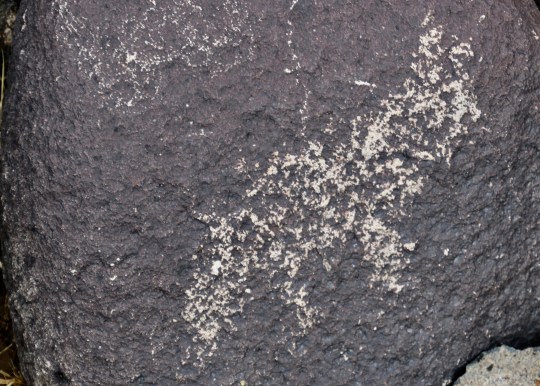
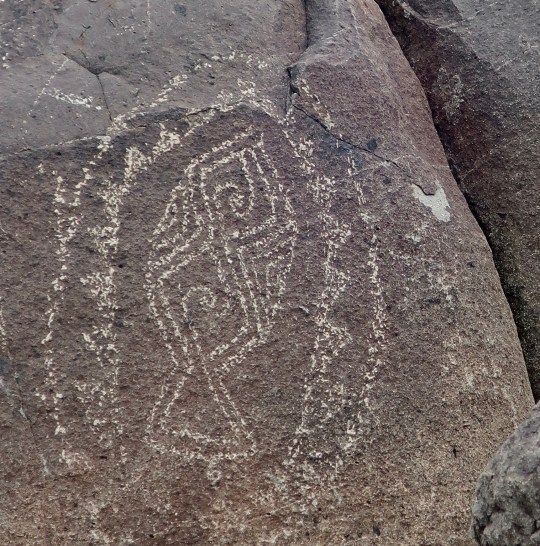
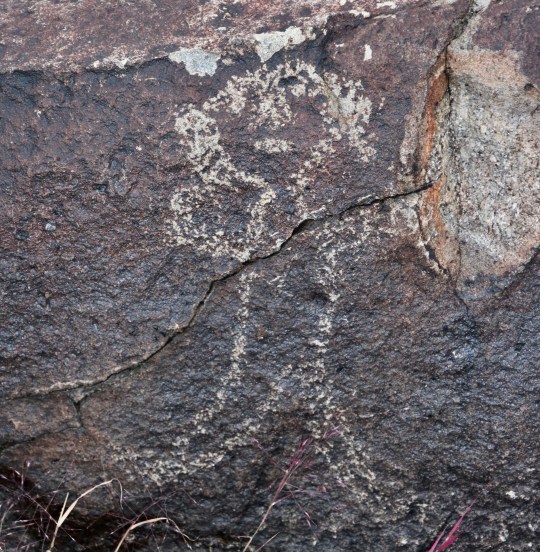
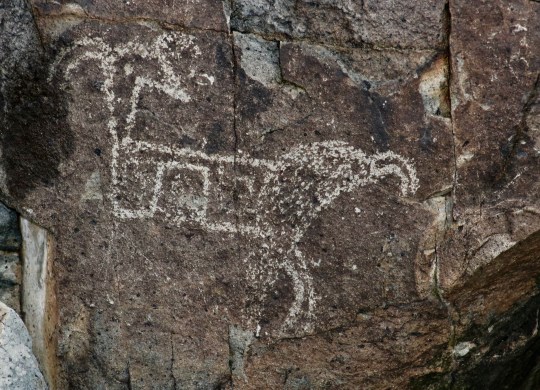
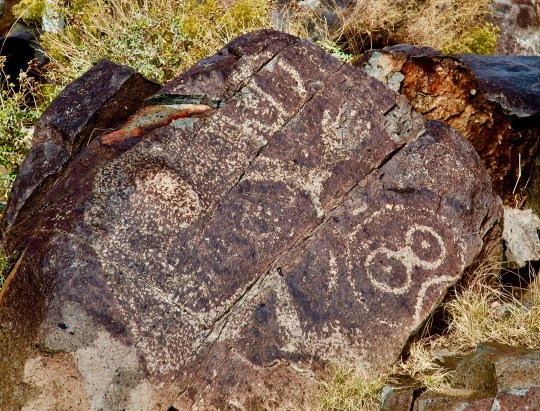
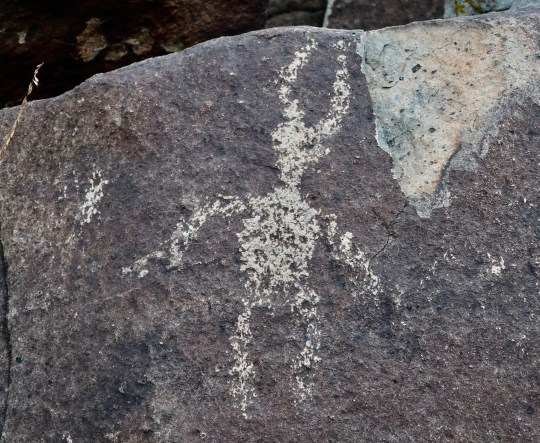
Peggy and I have often found petroglyphs located in beautiful areas and couldn’t help but wonder if that wasn’t a factor in deciding where to locate rock art. If I were going to peck out a masterpiece, I’d want this view. (Photo by Peggy Mekemson.)The stream flowing through the area shown by these colorful cottonwoods was a village site for the Jornada.While some petroglyphs are easily recognizable, like a roadrunner going after a rattle snake, others, such as this human-like figure grafted on to what appears to be an octopus, are mind boggling. I call him Octoman.At first, Peggy and I couldn’t identify this bird. Checking out the Sibley Guide to Birds afterwards, we determined it was a roadrunner with its crest down. (Photo by Peggy Mekemson.)Petroglyphs can be quite simple like this stick figure. Maybe it was the shaman’s day to take his child to work and he handed her a rock to peck with.More sophisticated but what’s the meaning? It had me starry eyed.Bighorn sheep petroglyphs are found throughout the Southwest. Some of the most sophisticated are found at Three Rivers. Note the use of the bump in the rock for the eye.And this head on view. Note how the horns are curved back in a realistic way, even with a degree of perspective..I may be wrong, but I looked at this and saw a fox. (Photo by Peggy Mekemson.)No question about this fish. Patterns are often tied into petroglyphs of animals, and in this case, fish. They may have meaning or they may just be decorations.An insect also had patterns.Just for fun, I think this is a dragonfly.I found both the shading and the the eye impressive here.Another view of the surrounding area. (Photo by Peggy Mekemson.)Part of the mystery for me is trying to figure out what I am looking at. The triangle in the box is obvious as is the circle on the right. But is that a skull above the triangle with chin, mouth and eyes? Is there an arm over to the left? Or is my imagination working overtime again?I’ll close my Three Rivers’ posts with photos of my favorite rock art from the site: this mountain lion with its tail proudly folded over his back.A look at the rock including other rock art.Looking up at the rock from below. My final photo today.
MONDAY’S POST: Think you have to go traipsing off to remote corners of the Southwest to find petroglyphs? Think again. The Petroglyph National Monument sits on the edge of Albuquerque, New Mexico. You can be there within 15 minutes from downtown.
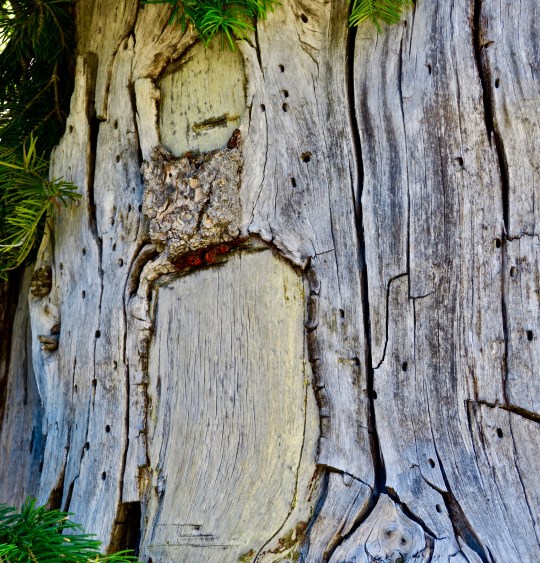
Dead men tell no tales, or so they say. But dead trees talk back to you. At least it seems that way to me. I was backpacking into the Marble Mountains when I came upon this face on a burned tree. Was it saying, “Go back!”? Or maybe it was standing in for Smokey the Bear.
I’ve been hard at work on my next book: It’s 4 AM and a Bear Is Standing on Top of Me. In it I tell stories from 50 years of wilderness adventures ending with my 750 mile backpack trip down the Pacific Crest Trail to celebrate my 75th birthday. I’ve reached the point now where I am about to embark on the last section, my hike down the PCT. In preparation I’ve been going through my photos of the trip for inspiration as well as to jog my memory.
As I reviewed photos, I was struck by the idea that they would make appropriate content for my Wednesday Photo Essays. Rather than follow my days, which I more or less did in the blogs I wrote about the adventure, I’ve decided it would be fun to do a categorical approach and look at flowers, trees (mainly dead trees that have unique personalities), rock formations including mountains, and streams and lakes. There may be other categories as well. Today, I am going to include trees and brush I found particularly interesting. (I have a lot more but will alternate with flowers, etc. to keep things interesting.)
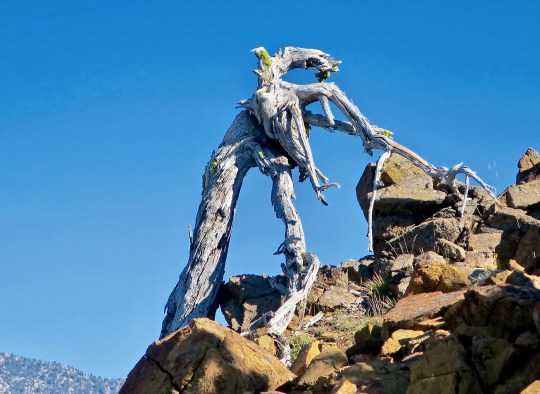
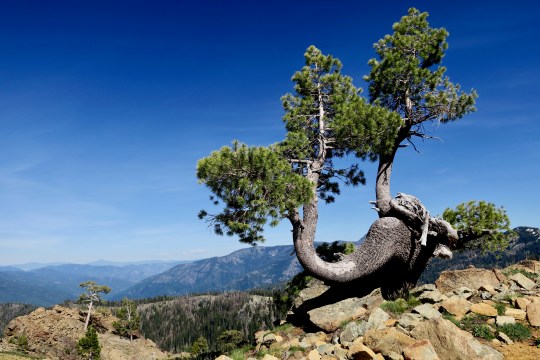
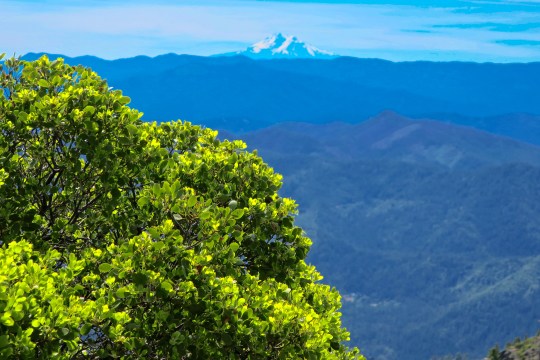
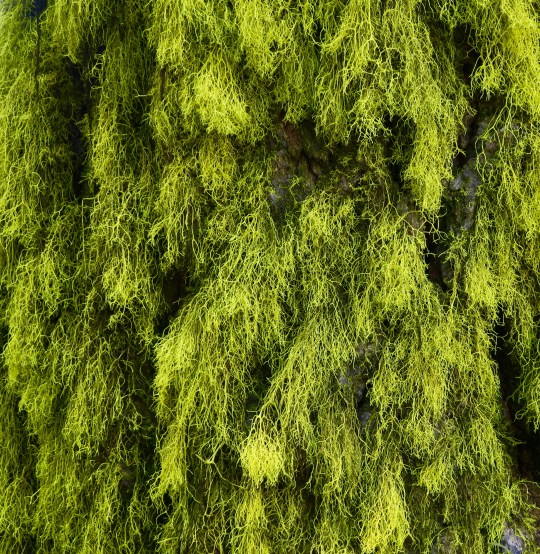
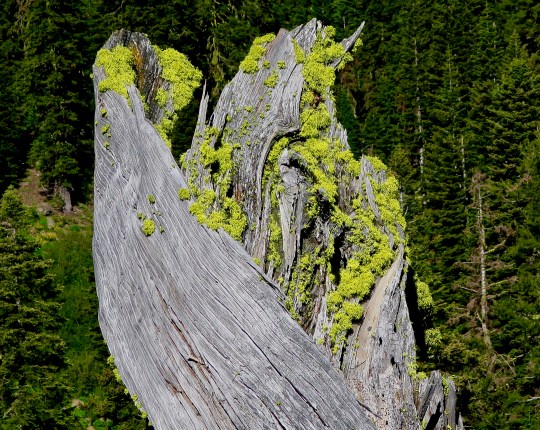
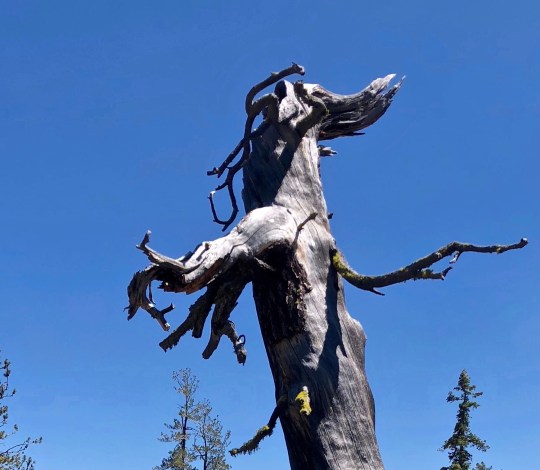
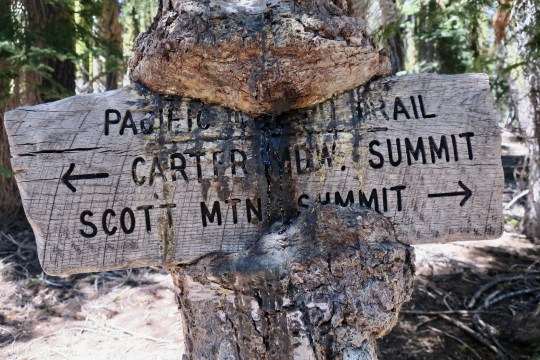
There is something almost heroic about this dead tree my nephew Jay Dallen and I found in the Trinity Alps. We both took numerous photos. I could imagine Michelangelo capturing this tree in marble.I captured this photo by using rocks as a frame. The rocks shared a similar tortured look.The tree encouraged close-ups and photos from several different angles. Jay and I must have been there for 30 minutes. Dead manzanita lends itself to dramatic photos. The rock that the manzanita had grown over creates a close to perfect backdrop.As you know, I have an active imagination when it comes to seeing faces in rocks and wood.This was one of the most interesting I have ever seen. I looked through a knot hole and this peered back at me.Just ducky.I’ve always liked this statement by Joseph Campbell. If you find yourself falling off a cliff, “Dive!” Why not.Are you a fan of “Lord of the Rings”? This sculpture that also led my nephew Jay and I to take numerous photos struck me as an Ent in search of Ent wives. Or maybe he was tearing out rocks to bring throw down at Sauron.A closer look at the sculpture in its dramatic setting.A black and white of the top of the ‘Ent’ sculpture.Of course most of the trees along the PCT are happily living. I always like crown shots like this.High altitudes with cold temperatures and high winds do their own unique job of sculpting trees. My father loved to paint trees like this.This manzanita bush had plenty of beauty on its own but it didn’t hurt to have distant mountains including Mt. Shasta as a backdrop.One should never discount the possibility of using a convenient tree as a chair! Peggy said it was quite comfortable.Moss often adds a bit of color to dead trees.Moss helped create this peep hole.And decorated this dead stump.Dance with me , honey!Show me what you’ve got!A tree eats a trail sign.Nothing tells a story like old trail blazes left behind by explorers and pioneers to mark their trails. It’s a good place to end this post. If you have ever heard the expression, “Where in the blazes are we?,” this is where it came from.
FRIDAY’S POST: I am going to do a wrap on the petroglyphs from the Three Rivers National Petroglyph Recreation Area. (I still have two more petroglyph posts covering other areas we visited on our fall Southwestern tour.)
Who would have ever thought that we would find a cow on a pedestal giving us ‘the look’ at the Three Rivers petroglyph site in New Mexico! Wait, there weren’t any cattle in North America when this petroglyph was made and the ‘cow’ isn’t standing on a pedestal, it is standing on its tail. And a big tail it is!
My blogging friend Cindy Knoke, who also likes petroglyphs, commented on my Sego Canyon post that it is “fun to try and interpret” rock art. And she’s right. Rock art can range from being a few hundred to several thousands of years old. The best we can do is make educated guesses about what the petroglyphs mean— and this, in turn, gives us a lot of room to use our imagination. Today I am going to take even more liberties in my interpretation and go looking for humor among the rocks. Hopefully the shamans won’t zap me.
I know that some of you are punctuation geeks. Obviously, I’m not. But I depend on Peggy to catch some of my more glaring errors. For example, I am constantly adding an apostrophe to “its” when none is needed. I know the difference, but apparently my fingers don’t. I ask all of you, however, do you think an apostrophe is required here?I had to look twice, and maybe even three times. These shamans have created an imaginary bus for their journey into the other world— and imaginary seats.This woman (or girl) is having a bad hair day. “I recognize that, ” Peggy says.Speaking of having a bad day, I’d say that this Bighorn sheep qualifies. And that’s definitely a ‘why me’ expression on its face.The problem for the guy with arrows is minimal comparison to this fellow who had turned around to see why his front legs are missing and discovered a badger draped across his body eating his back legs as well. The expression here is more like ‘What the…!”The only solution is to get out while the getting is good, as fast as you can.If you think your life is complicated… The rabbit is keeping its distance while the stick figures throw up their hands in dismay. Meanwhile a lizard uses its laser eyes to avoid the confusion. Don’t you just hate it when your day starts like this one.A sure sign that big foot was here.Bigfoot’s big feet.Lest there be any doubt, a really big Bigfoot. The turkey can only look on with awe. But just how big ?Cat Woman has an idea. And check out her expression.I kid you not. And I certainly wouldn’t pull your tail. Ouch!Okay, it appears that this frog has learned how to juggle. But sitting on a pointy thing while juggling? It brings the art form to a whole new level! Forget your flagpole sitters. This is the real thing.It seems like Kilroy was here. With that thought, I’ll conclude today’s post.
WEDNESDAY’S POST: I have been working on my backpacking book, “It’s Five AM and a Bear Is Standing on Me.” I’m to the point now where I am writing the section on the 750 mile backpack trip I did two summers ago down the PCT to celebrate my 75th birthday. I’ve been going through my photos of the journey for inspiration and as a reminder. I decided it would be fun to rerun some of the photos in categories: trees, flowers, rocks, streams and lakes, etc. The should keep us busy for a few Wednesdays.
FRIDAY’S POST: I’ll do a wrap on Three Rivers Petroglyph National Recreation Area.
Peggy demonstrates our normal reaction to snakes hiding in the grass— or just wandering among the rocks, minding their own business.What to look out for! (Peggy and I found this fellow in Death Valley.) Note the distinctive viper head. You will see it on several of the snake petroglyphs that follow.
I’m convinced that a deep fear of snakes is programmed into our brains. It’s an instinctual reaction that suggests we vacate the premises— a trait that we share with other members of the animal kingdom. I was playing with my cat Rasputin in Africa once when I rolled a spring from our screen door at him. I thought he would view the spring as a toy and pounce on it. Instead he jumped four feet into the air and ended up six feet away. Liberians view all snakes as poisonous and Rasputin was 100% Liberian when it came to snakes. He had quickly determined that the spring was a snake and leapt into action— literally.
I’ve pulled a Rasputin myself a few times— especially when I am out in the woods and hear the distinctive buzz of a rattlesnake that I can’t see. It’s guaranteed to increase your heart rate. Once I stepped on a log and it started buzzing. I ended up 30 feet down the trail in one prodigious leap. (Slight exaggeration.) Rasputin would have been proud of me. Had a track coach seen me, I would have been entered in the Olympics.
Our Christian heritage in the West added to our instinctual dislike of our slithery brethren. Everyone knows the Biblical tale of how Eve was seduced into sneaking a snack from a snake and ended up being banned from Eden forever along with her significant other, Adam. The snake has had a bad rap ever since. Eve and Adam didn’t come out all that well either, especially Eve. I’ve always thought that God overacted when they broke his commandment that ignorance is bliss. A little knowledge and out came the fig leaf, okay, but was the flaming sword really necessary.
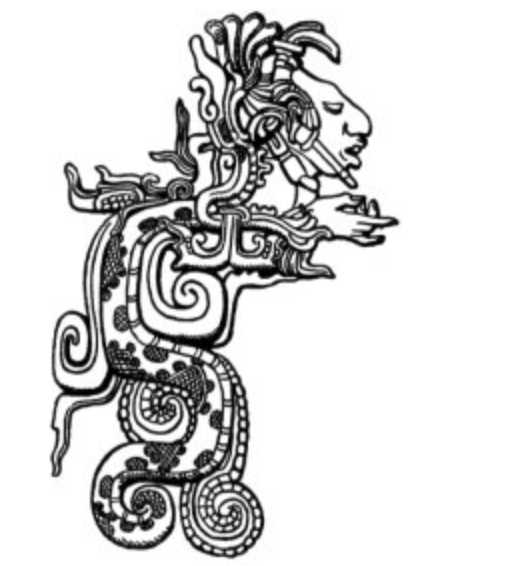
Ancient cultures have had a different perspective on snakes. The fact that they shed their skin annually suggested immortality. Your old body isn’t working quite the way it should? Fine. Get a new one. (This is particularly attractive to newly-turned 77-year olds.) As a result, snakes were considered sacred. If you’ve visited ancient sites in Mexico and Central America, the odds are you are familiar with Quetzalcóatl, the plumed serpent, the Toltec/Aztec/Mayan god of the wind and lots of other things.
Here’s an early representation of Quetzalcoatl blowing up a storm.And another.
Given his importance to these cultures, it isn’t surprising that Quetzalcoatl made his way north and became part of the mythology of early people living in the Southwest. We found a number of petroglyph serpents crawling over the rocks of Three Rivers. I should point out here that the snakes weren’t just any old snakes. They were rattlesnakes! I’d also like to report that Peggy was quite pleased that we didn’t find any live representatives of the clan among the rocks.
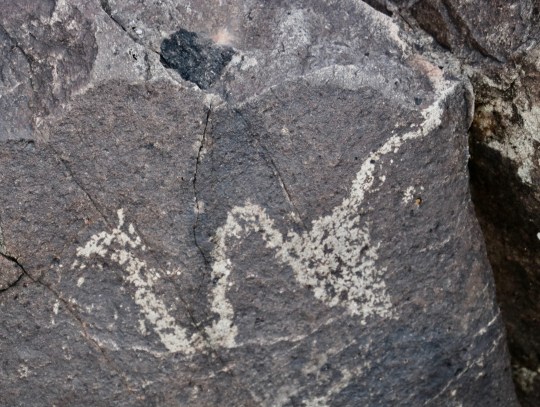
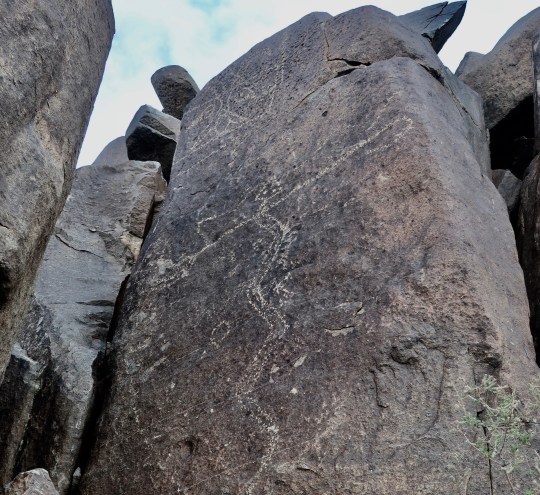
This rattlesnake didn’t let a crack in the rock slow him down. He just slithered right through it. Apparently the guy to the left of the snake’s head is quite excited. As he should be, given the relative size.We probably don’t want to know what this snake had for lunch. Snakes eat their meals whole. Once, when I was leading a backpack trip, a highway patrolman who was along shot a large timber rattler. While I was irritated that he killed the snake, we slit it open and found a whole ground squirrel inside. We then cut the snake up, cooked it in butter, and ate it. Waste not want not. Right?This was a particularly large rattler. It reminded me of the one that Peggy and I had found in Death Valley.And check out this guy! Had I met up with this fellow in real life, I wouldn’t have hung around to photograph it! (Yes, you would have, Peggy says.)I liked the way this plumed serpent had been outlined. This snake climbed right up the rock. A dog or coyote seems to be checking it out on the right while a bird, probably a turkey, follows along on the left. But maybe it is a roadrunner looking for a free lunch.And here, a very long plumed serpent makes its way down a rock and is also checked out.If one snake crawling down a rock is good, are two better?In this petroglyph a snake with bright eyes crawls up a rock under a crook, which is another sacred symbol, toward what is probably a shaman. This rock was around 15 feet tall to give you a perspective. I’ll conclude here for the day before I give you snake nightmares…
NEXT POSTS: Not exactly sure what I will focus on, but it will be petroglyphs for another week.
I am still off celebrating my birthday week. Since I am in my seventh decade, I get seven days. I started the practice way back when I was a youngster of 50. I took five days off each year during that decade and made darn sure they were work days. Being retired, I have more flexibility. (Grin) What this means now is that I am reposting another blog from my past. This one is from 2017 so several of you may have already seen it. Not to worry. These petroglyphs are alien enough they are worth visiting again. Looking at them again, I thought of the post I just did on shamans of Three Rivers. Check out the photo below. Does it get stranger than this? Enjoy.
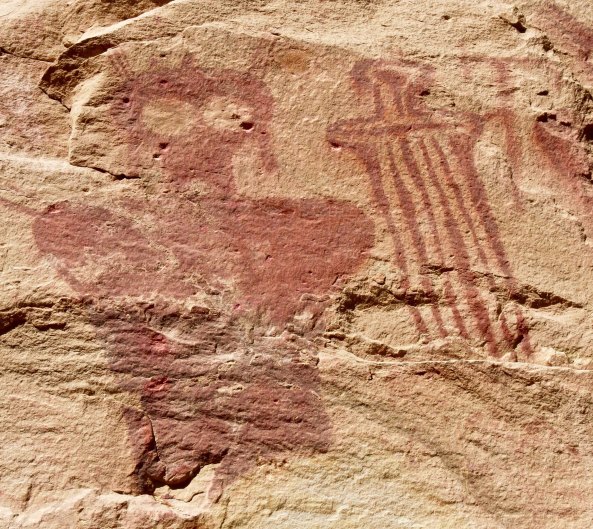
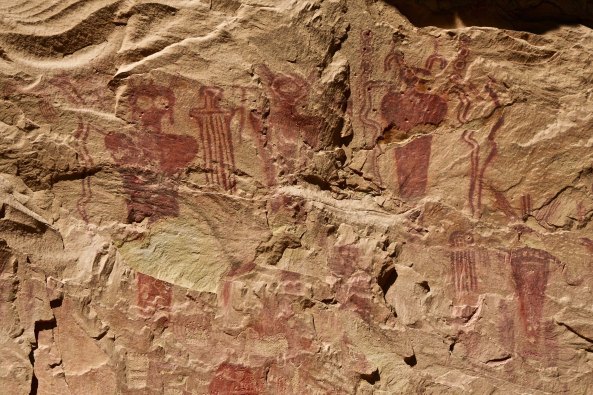
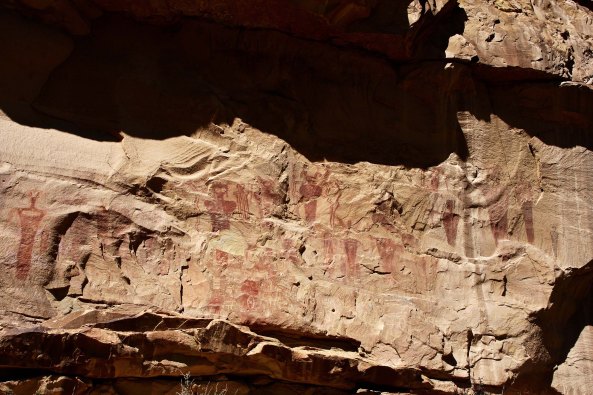
These larger-than-life pictographs at Sego Canyon in Utah are among the strangest I have ever seen. Now add in the fact that they are several thousand years old. And what’s with the pictograph on the right? Also, check out this guy’s spiky hairdo.Are they antennae?
Zipping along Interstate 70 in Utah, you might very well decide to take a detour and visit Arches and Canyonlands National Parks. It is a decision you will never regret. The odds are, however, that you will miss the small road that extends north of the Arches turnoff heading toward the town of Thompson Springs. In so doing so, you will miss the opportunity to visit one of the most magical and mysterious rock art sites in the Western United States: Sego Canyon.
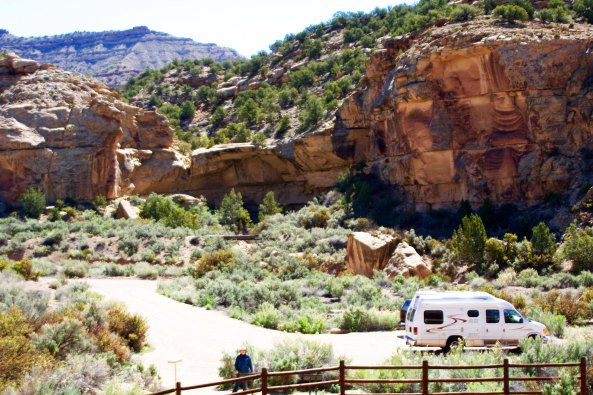
Quivera the Van waits patiently in Sego Canon as Peggy and I wander around looking for rock art. Most of it is located on the two rock faces below. Peggy watches as I work my way up closer to the petroglyphs.
Most of the rock art at Sego Canyon is found on the two faces of this large rock. I am hidden in front of the brush.
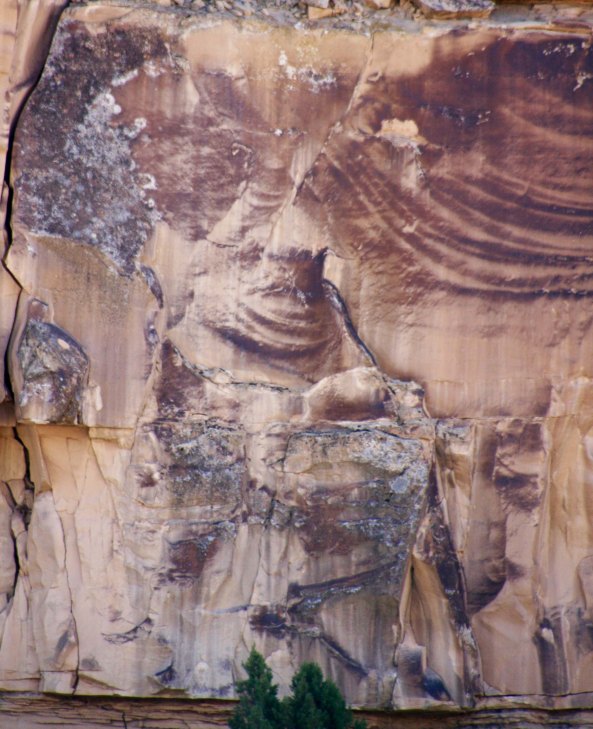
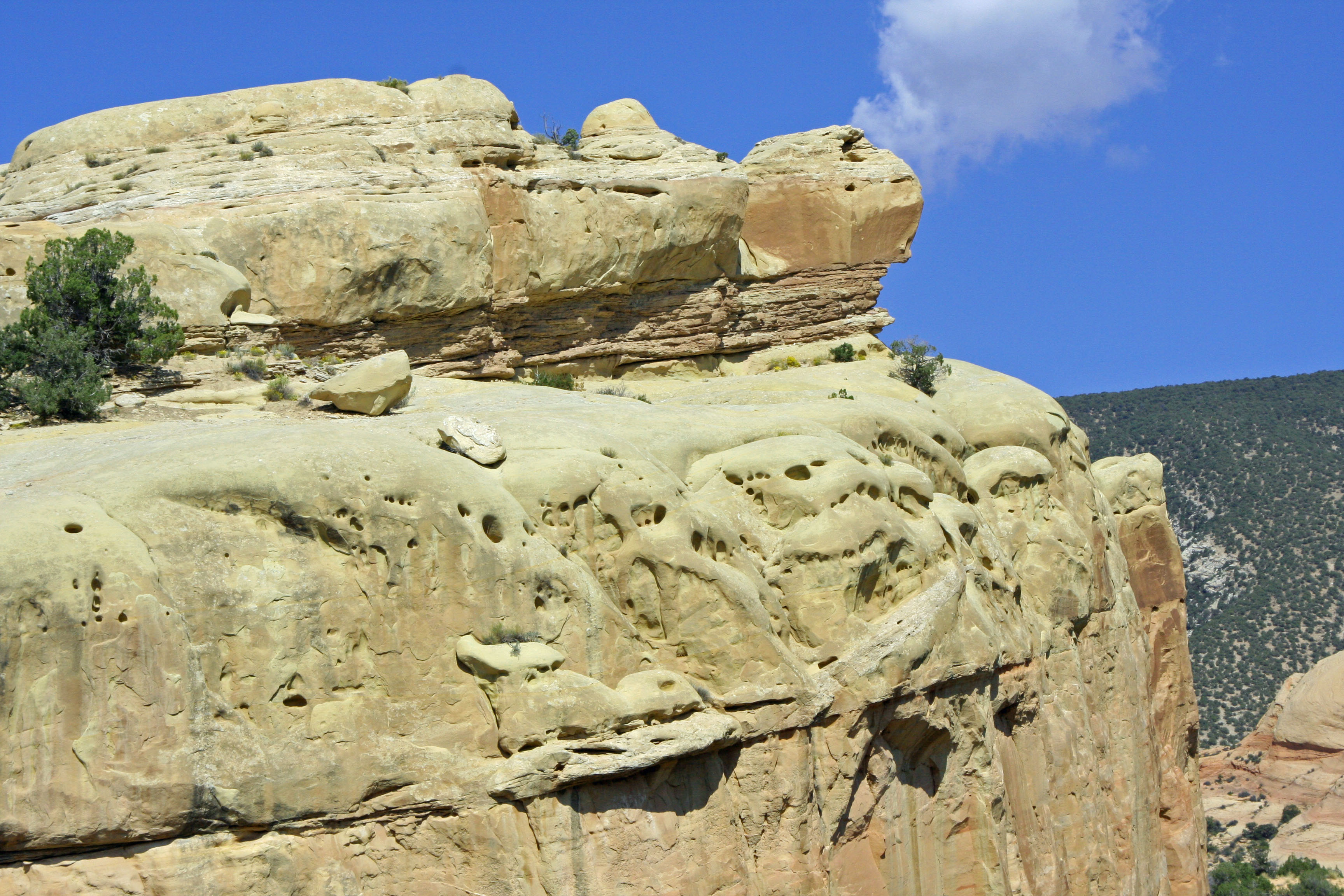
This is another rock face that Peggy and I checked for petroglyphs in Sego Canyon. We didn’t find any rock art but the rock itself was quite unusual. I could see why early Americans might have considered the area sacred. Can you find the alien Roswell skull? Or is that Indiana Jones?
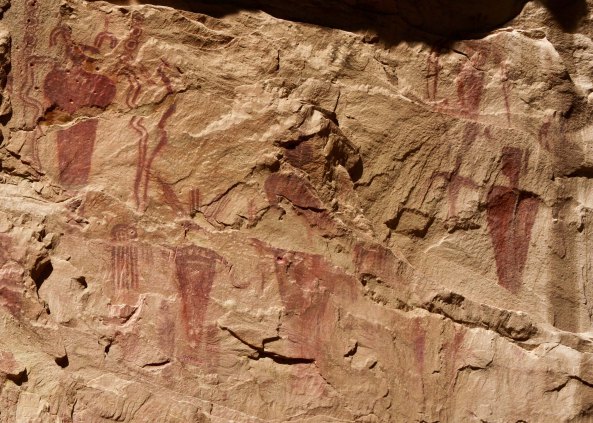
Three different historical periods are represented in the rock art here dating back over a period of 6,000 years. The most fascinating to me are the pictographs left behind during the Archaic period by nomads who roamed the area from 8,000 to 2,000 years ago. The large, anthropomorphic forms that are painted on the rock normally lack eyes, arms and legs but may come with antennae, snakes and earrings. Known as the Barrier Canyon Style, it’s hard not to think of these pictographs as alien, or at least imagine a shaman encountering these creatures on a drug induced journey into an alien world.
Dave Kingsbury, one of my followers from England, and I were discussing cults where people run around with rattlesnakes in their hands. We both agreed that such sport wasn’t for us. This horned pictograph from the Archaic period seems to have a thing for snakes. Possibly he belonged to such a cult. Or possibly he was a very powerful shaman.
Or maybe something else. I see this and I want to say, “Take me to your leader.”
And this.
I find these jellyfish-like pictographs even more mysterious than the anthropomorphs. UFO fans might describe it as a space ship taking off, but hey, maybe it is a jellyfish. Or likely something else.
This shot provides a view of how some of the pictographs fit together on the right side of snake man.
And to the left..
And now, all together.
A final shot from the Archaic period. I found these pictographs a bit ghostly.
The Fremont Culture took over from the Archaic period and lasted from 600 CE to 1200 CE. Unlike the nomadic Archaic peoples, the natives of the Fremont period grew corn, lived in permanent stone buildings, and had a complex social structure. Most of the rock art they left behind is in petroglyph form, pecked into rather than painted on the rock.
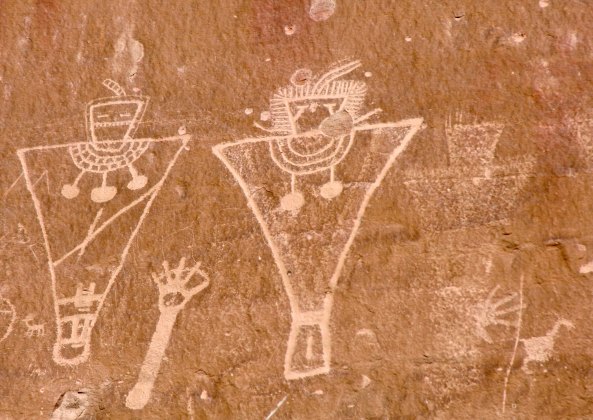
The Fremont era had its own strange figures, but these were loaded down with jewelry. I found the hand interesting. I wonder if it is holding Datura seeds. It looks a bit like a foot walking in the circle. And there is a Big Horn sheep. It is rare to find petroglyph sites in the west that don’t include them.
A close up of the two figures with another ghostly one to the right. There is also another hand and another sheep, a fat fellow. The tiny figure on the left looks more like a deer to me.
And finally, we have the more modern Ute Culture that populated the area from 1300 to 1880 CE, when the Utes were forced out of their homes and onto Indian Reservations so pioneers could grab their land. One way to distinguish petroglyphs from this period is the presence of horses, which the Spaniards brought to North America in the Sixteenth Century. In fact, horses are a major tool used in dating rock art.
This Ute rock art featured what is thought to be a shield. I’d say that the horse is about to become horse meat. But wait, is that a small man on the back of the horse? Maybe he is the enemy.
Ute Indians seem to hunt buffalo in this scene, which will be my last for Sego Canyon. If you ever find yourself in the area, don’t miss the opportunity to explore this fascinating site.
NEXT POST: It’s all about snakes. I hope you like creepy crawlies. I do.
It’s my 77th birthday today, and, since this is petroglyph week, I decided to repost a couple of older blogs although I may be a tad sensitive about the ‘older’ designation. (Grin) Actually Peggy bought me a new light weight sleeping bag. She wants us to do Oregon next year following the PCT from the Oregon border to the Washington border. We are still thinking ‘younger’ around here. Anyway, enjoy the petroglyphs of Dinosaur National Monument today and Sego Canyon tomorrow. On Friday, I’ll be back on schedule, maybe, with the Snakes of Three Rivers petroglyph site! Also, I will hold on responding to comments and checking in on your blogs, but I will get there on Friday and the weekend. Now it is time to go play! We are on the Oregon Coast again, this time in Florence.
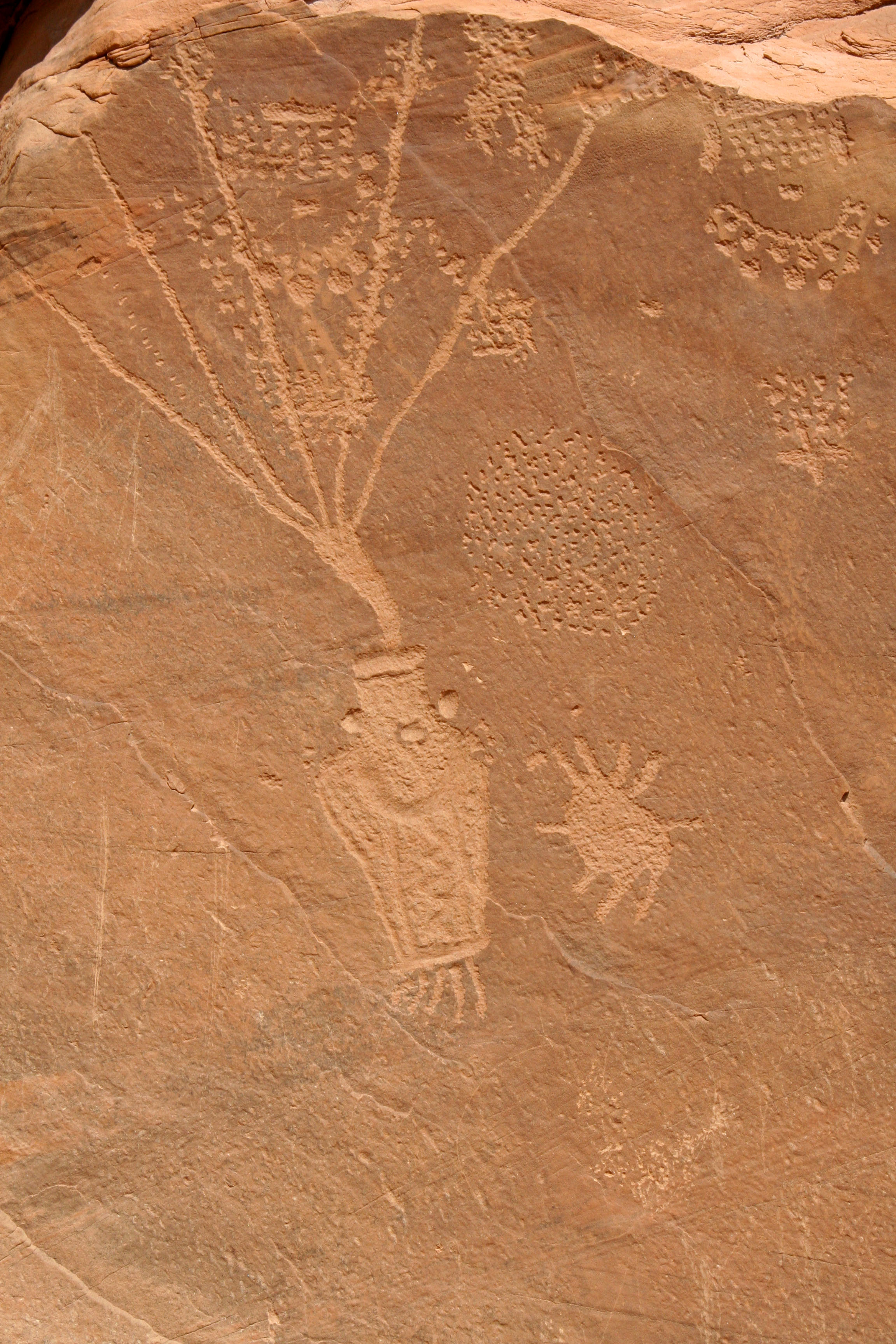
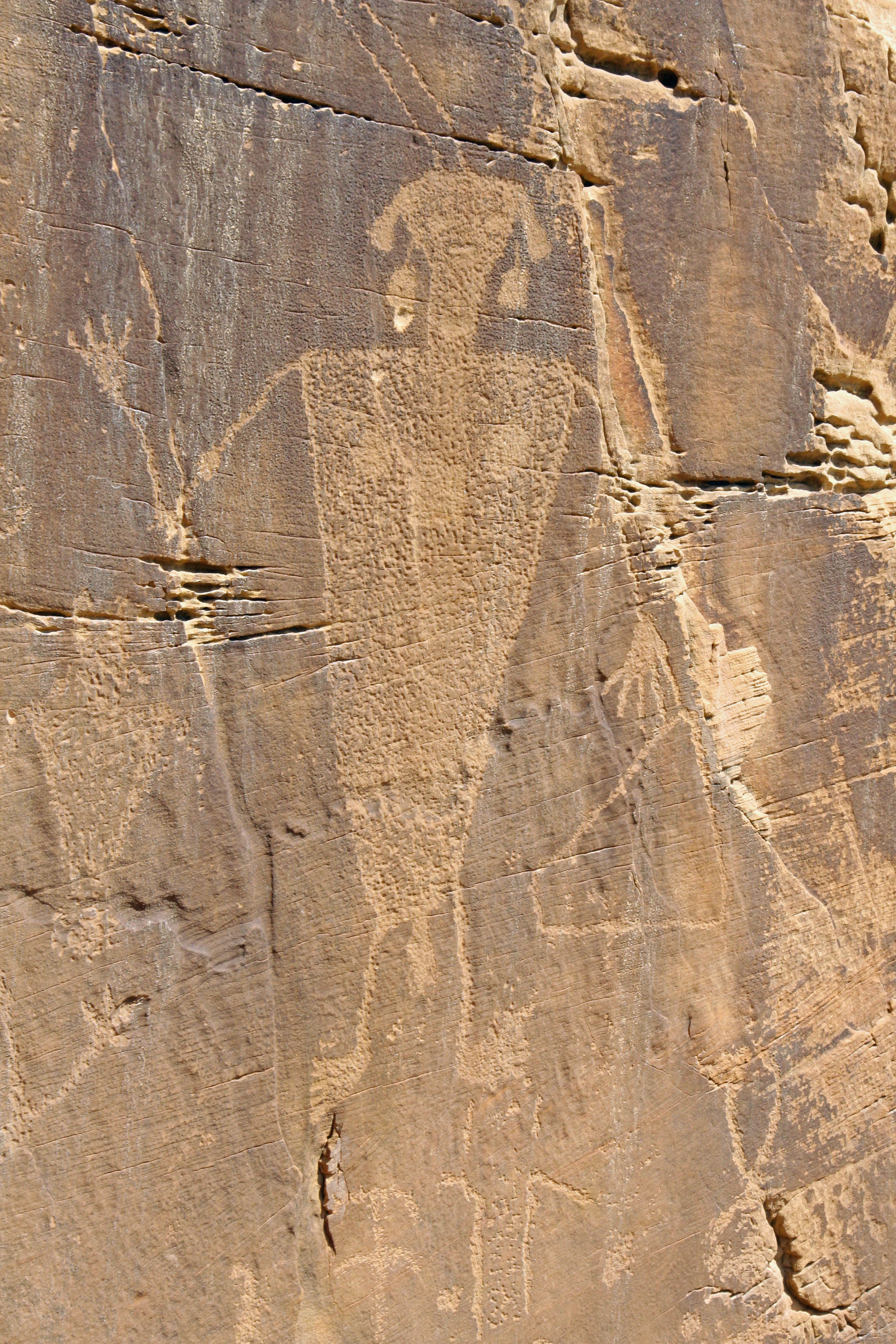
Like much Indian rock-art, Cub Creek petroglyphs in Dinosaur National Monument raise intriguing questions. It would be fascinating to know the story behind this unique anthropomorphic figure. What do the lines stretching toward the sky represent?
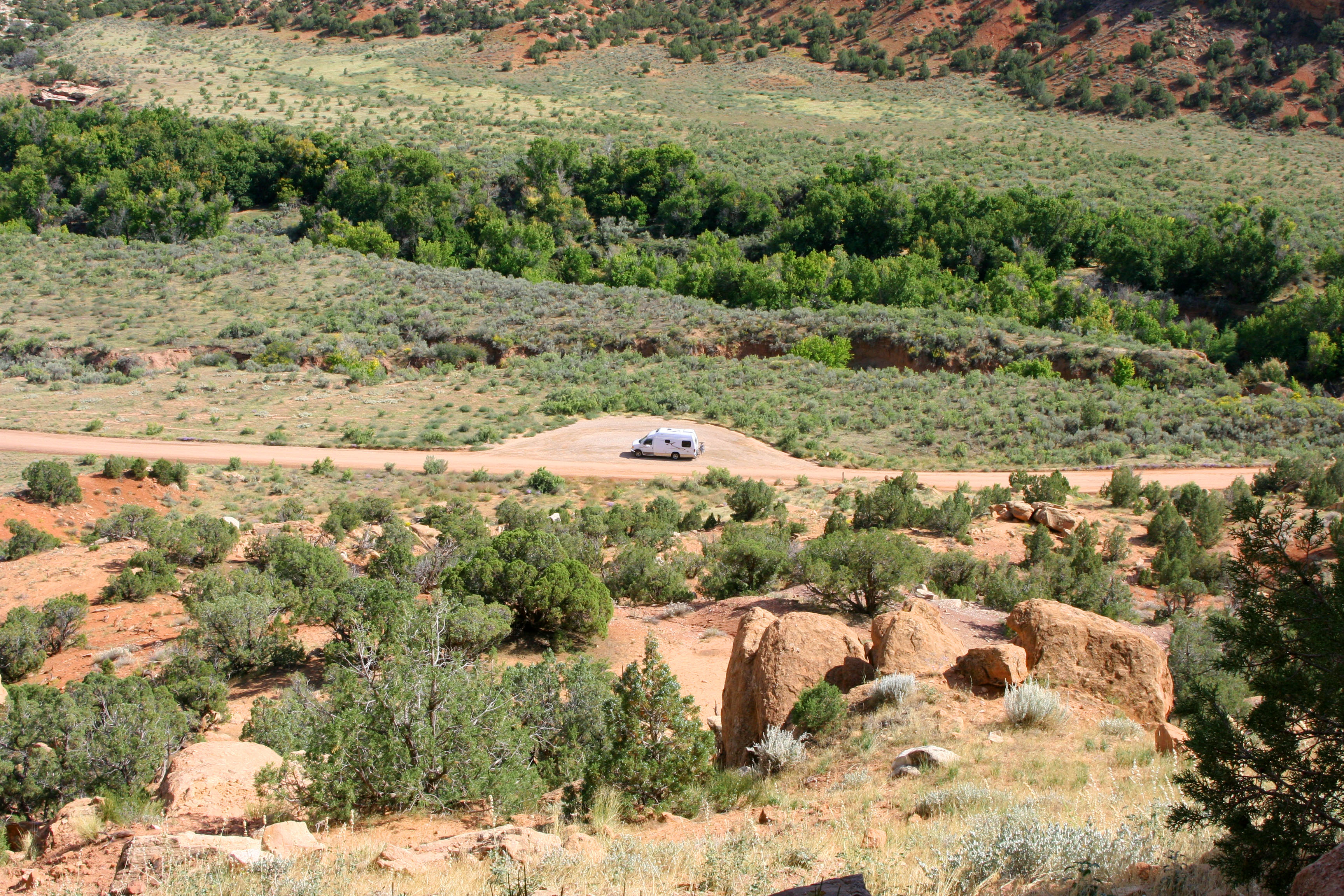
Peggy and I crossed over the Green River in Dinosaur National Monument and followed the road toward the cabin of Josie Basset Morris, a tough old pioneer woman who had worked her way through five husbands and finally discovered she preferred living alone.
The river, mountains and distant vistas entertained us along the way. Two prominent landmarks, Elephant Toes and Turtle Rock, lived up to the names the early settlers had bestowed on them. I found the big toes particularly amusing.
Elephant Toes Rock in Dinosaur National Monument along the Cub Creek Road.
While not as humorous as Elephant Toes, the turtle of Turtle Rock is easy to see. Both Native Americans and pioneers were quick to see and name familiar figures in the landscape.
The true surprise on our way to Josie’s, however, was the Indian rock-art. Huge six-foot lizards had been pecked into the cliff faces high above the Cub Creek Valley. One can only wonder if the Native Americans of the Fremont Culture had somehow made the correlation between dinosaur bones found throughout Dinosaur National Monument and really big lizards. Or did small lizards so prominent in desert environment serve as the models?
Our van, Quivera, provides perspective on how high up in the cliffs the Cub Creek petroglyphs are.
Giant, six-foot long, rock-art lizards work their way up the rock face at Cub Creek. Are they representative of the dinosaur bones Native Americans found at Dinosaur National Monument?
Or did the giant petroglyph lizards represent the small lizards so prominent in the arid regions of the West? This guy was curious about my camera.
Numerous other petroglyphs also demanded our attention. We even found a partial image of Kokopelli, the hunch backed flute player found in ancient rock-art from Mexico to Canada and whose image has been applied on everything from jewelry, to blankets, to pottery in today’s gift shops throughout the West. Kokopelli was both a musician and trickster god, but mainly he was a fertility deity known for his bad behavior. Watch out fair maidens one and all.
My wife Peggy admires a small section of the numerous petroglyphs found at the Indian rock-art site on Cub Creek in Dinosaur National Monument.
A partial petroglyph of the flute playing Kokopelli is found at the Cub Creek Indian rock-art site. Odds are he is luring young maidens with his music.
Geometric forms are common in rock art. This galaxy-like representation caught my attention.
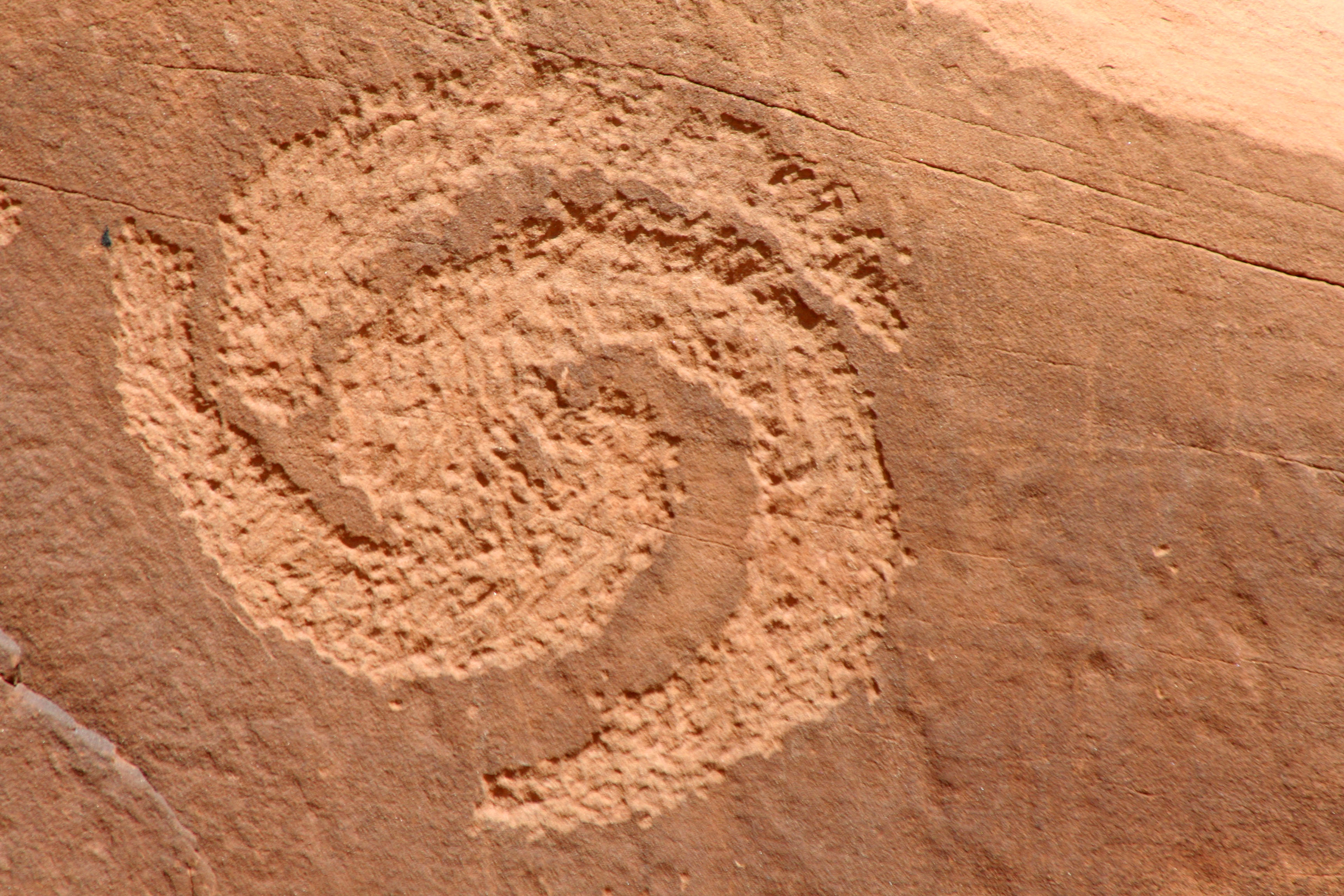
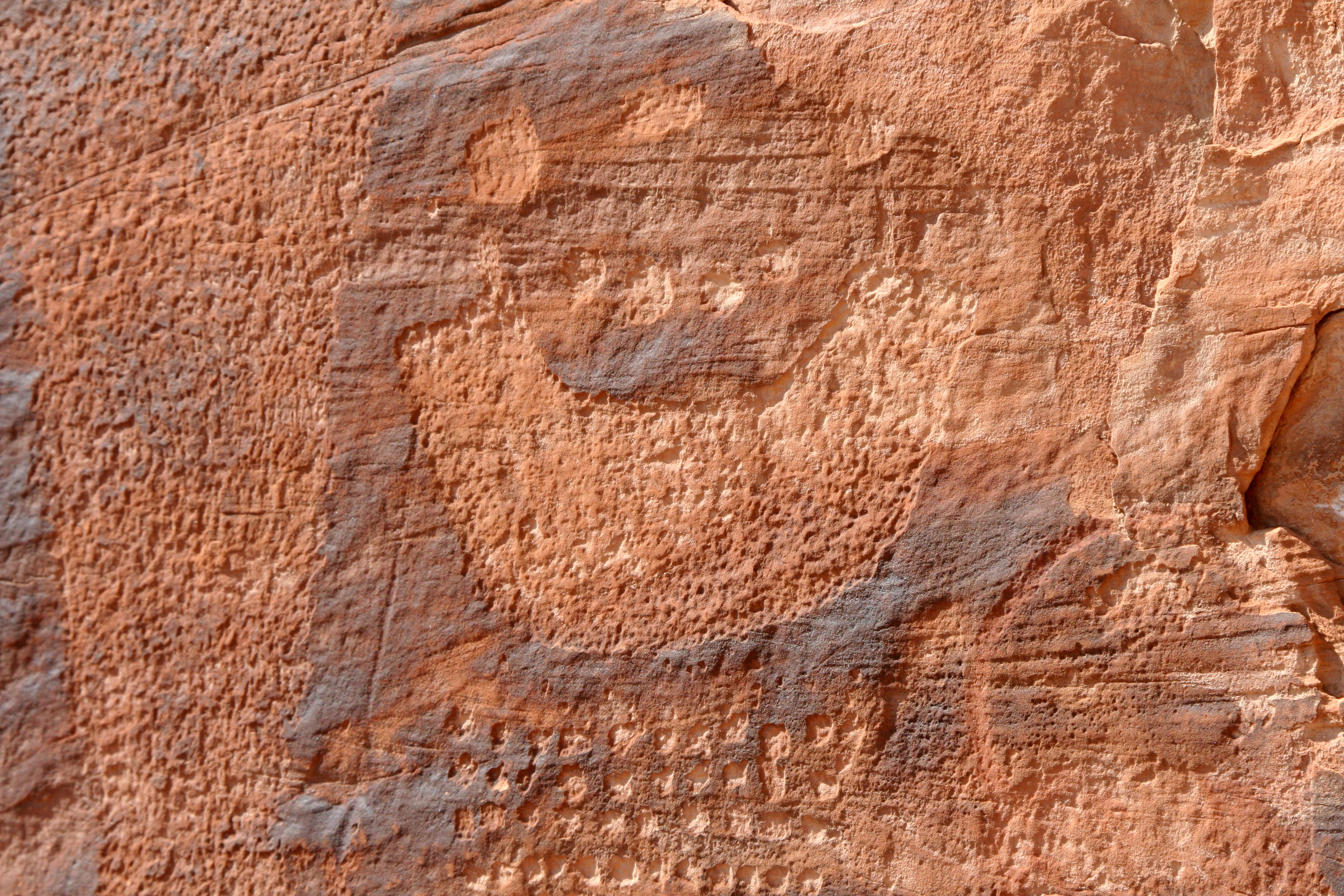
I selected this particular photo because it demonstrates how dark rock varnish has been chipped away in the petroglyph process to reveal the lighter colored rock underneath.
An early day smiley? This guy appears to me to be all mouth but its creator likely had something else in mind.
Greetings Earthlings. Check out the dangling ear rings and necklace on this guy. Jewelry apparently was quite important to early Native Americans and may have represented an individual’s importance or clan.
You will probably note the prominent anatomy here. Genitalia was often included on rock art until the Spanish Missionaries informed the natives that such displays were sinful. I call this petroglyph Big Boy.
The world of shamans who use mind enhancing drugs to travel into other realms can be scary, as this picture of a petroglyph at the Three Rivers petroglyph site in New Mexico suggests. (Photo by Peggy Mekemson.)
Drums were beating in the pitch-black night and people were screaming. It was my first day as a Peace Corps Volunteer in the upcountry town of Gbarnga, Liberia in 1965 and I didn’t have a clue what was going on. All I knew was that the house had no electricity, my flashlight batteries were weak, and there was no kerosene to light a lantern. It was time to circle the wagons. I put the three folding metal chairs that served as my furniture up against the house’s three screen windows so they would come crashing down if anyone tried to break in. And then I laid down on the house’s only other furniture, a moldy mattress, hoping that whatever was outside would stay there.
The next morning, I learned that someone had died the day before. I was right to be frightened. The newly dead among the Kpelle people are dangerous unless they are given a proper going away party. They hang around and do really bad things. A great amount of cane-juice, rum, had been consumed during the night to assure that wouldn’t happen. I had entered a world where offerings were left under giant cottonwoods for the spirit that lived in the tree, the lightning man could make lightning strike people, justice was determined with a red-hot machete, chickens were sacrificed to carry messages to the dead, and Sam, the young man who worked for us, had scars marching up his chest from the teeth of the Bush Devil who had eaten him as a child and spit him up as an adult.
The reason I am relating this story here is because the experience was so different from anything I had ever known (you can read about it in my book, The Bush Devil Ate Sam) that it was very difficult to comprehend. When you begin to explore the petroglyphs, or rock art carvings, that are found throughout the southwestern United States, the experience is similar. You enter a realm that existed from several hundred to several thousands of years ago among the early peoples of North America when there was no written language to explain what they were thinking or doing. At best, we can guess or get hints from modern day Native Americans about the meaning of the rock art.
No one exemplifies the difficulty of comprehending the world of early Americans better than the shaman, a powerful figure who utilized trances and mind enhancing drugs to enter other realms and do battle with monsters that brought sickness, death, hunger and bad weather into our world. It’s a scary, dangerous place. Like Sam’s Bush Devil, the shaman was part doctor, priest, policeman, leader and judge. You didn’t want one as an enemy.
In the Southwest, the shaman’s drug of choice for his or her journeys into other realms was the plant Datura, which you have already met on recent posts of mine. Georgia O’Keeffe liked to paint the flower and I included one on my Valentine’s Day blog. Beside the plant’s beauty, it is a member of the nightshade family and a powerful, dangerous hallucinogen that may cause death (don’t try it at home). One of the characteristics of the drug is that it enlarges your pupils. European women once used one of its cousins to enlarge their pupils and increase their power over men (whoops, I meant appeal). Peggy has naturally large brown eyes. I get it. They named the plant belladonna, which translates beautiful woman.
Both the flowers and the seeds located beneath and to the right of the flower were used by shamans to enable their journeys into other realms.
The enlarged pupils the shamans would have had experienced from consuming datura gave me an insight about the numerous large eyes we found staring at us out of the rocks at the Three Rivers National Recreation Petroglyph site in south-central New Mexico. We visited there in October as part of our Southwest tour. Could it have been that the shamans were watching us, warning us to be on our best behavior? We treaded carefully among the petroglyphs, making sure that we didn’t do any damage to the ancient rock art.
Today’s photographs by Peggy and me will reflect the large eyes and other petroglyphs we found at Three Rivers that might relate to the shamans. Future posts over the next two to three weeks will feature different rock art themes (like snakes, for example) that we found at Three Rivers and other Southwestern sites we visited in October.
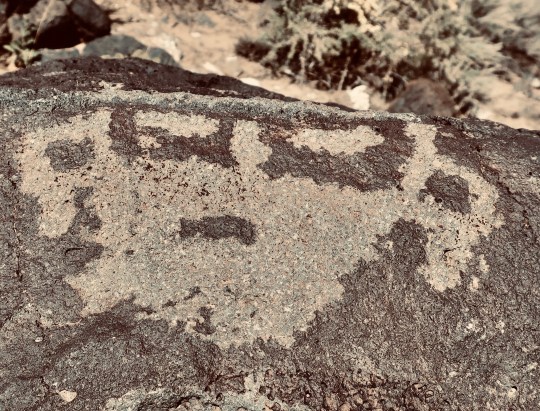
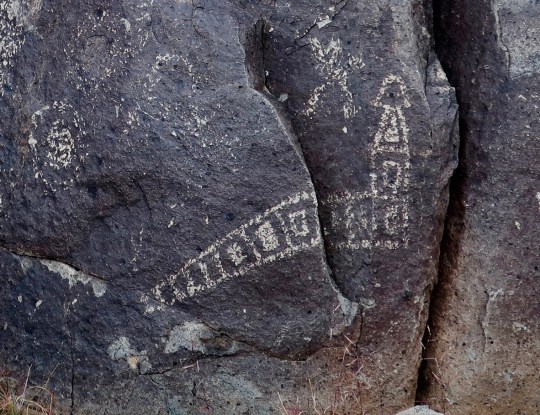
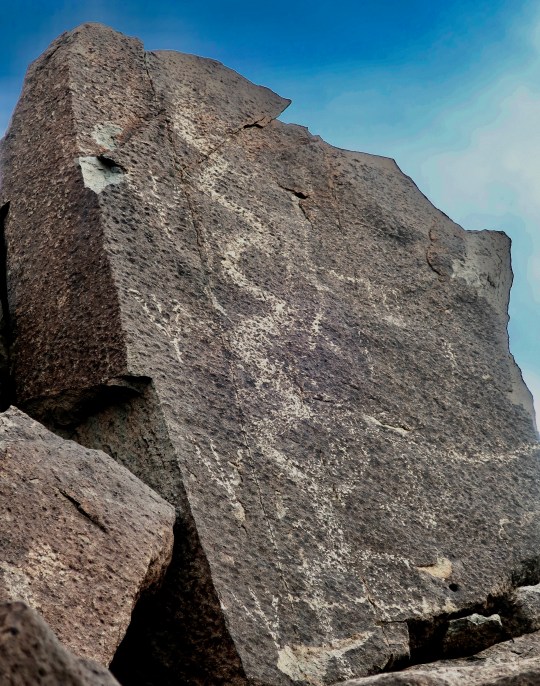
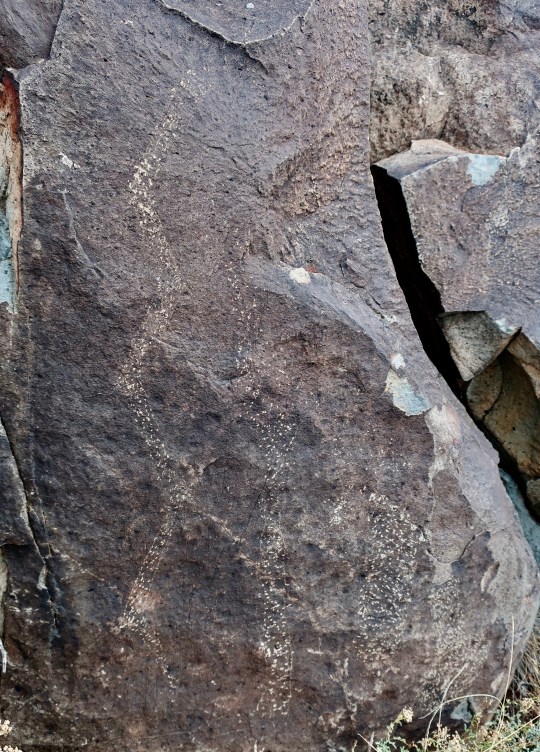
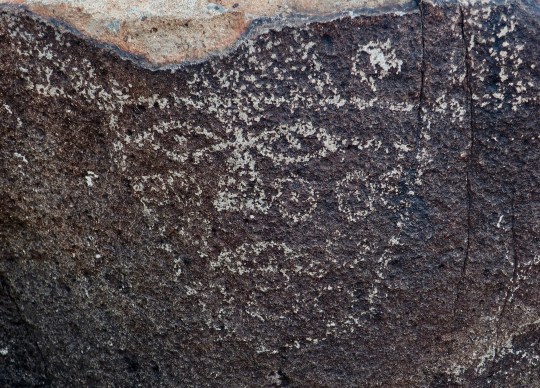
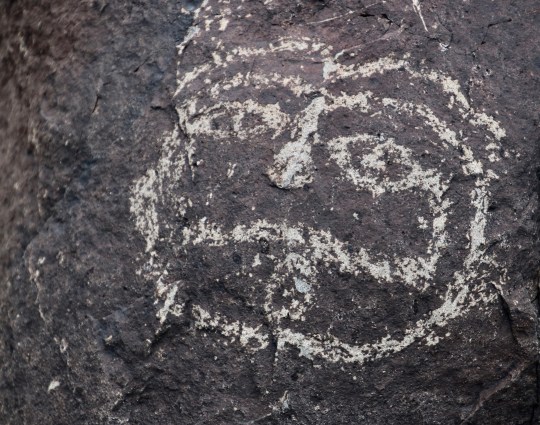
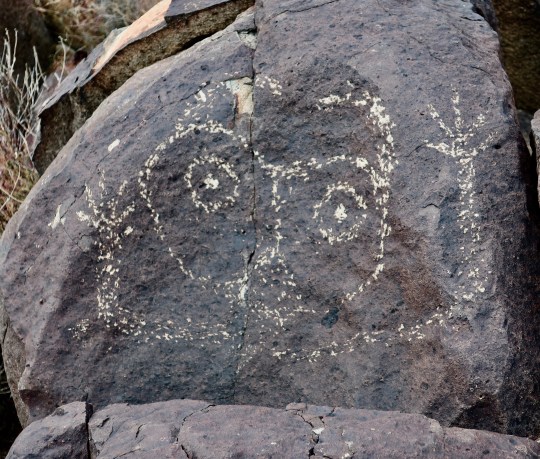
I had worked my way over steep terrain on the side of a cliff when I looked up and saw a 15 foot tall petroglyph looking out over the surrounding plains. My thought was that the eyes represented a powerful shaman and served to warn enemies away from the Three Rivers’ petroglyph site. An eagle outlines the lower part of the face and a storm rages beneath the eagle with lightning, thunder, clouds and rain. It’s possible that the lines rising above the clouds are snakes. What we assumed were shaman eyes made large by datura stared out at us from numerous rocks. (Photo by Peggy Mekemson.)The mouth used a natural part of the rock. I wondered if the lines leading out from the face represented the journey of the shaman.Note the dots around the eyes in this photo. The literature on petroglyphs suggests that the dots may represent datura.I could be way off (and probably am), but I thought this petroglyph might represent a very extensive shaman journey emerging from the underworld on the left and traveling on in the right.This photo shows a shaman bent over eyes. On the right, a road runner captures a snake. (Photo by Peggy Mekemson)A close up of the shaman that I took. Note his skeletal form and the circle with datura dots between his knee and his elbow.Shamans take many forms. This one looks a bit devilish.The horns on this shaman were from a bighorn sheep. Is he waving at you or warning you to stop. (Photo by Peggy Mekemson.)I’d say that this shaman with a huge hand and a minimal body is definitely saying to stop.A number of faces pecked into the rocks also seemed shaman-like to us. Note this guy’s snake eyes.I am not sure whether this face was related to a shaman. Maybe it was a selfie. Ear rings dangle from his ears. (Photo by Peggy Mekemson.)Flathead here appears to be a shaman to me. I wonder if the circles represented some type of tattooing.I couldn’t help but wonder if this guy was sticking his tongue out. Or is that his chin? I did note that all of the faces appeared to be frowning. (Photo by Peggy Mekemson.)I will wrap up today with my all-time favorite petroglyph from Three Rivers. I call him Boo.
NEXT POST: Wednesday’s photo essay (if I get to it since it’s my birthday week) will journey north to Sego Canyon in Utah and some very unworldly (UFO- alien-type) shamans. On Friday it is petroglyph snakes. Lots of them!
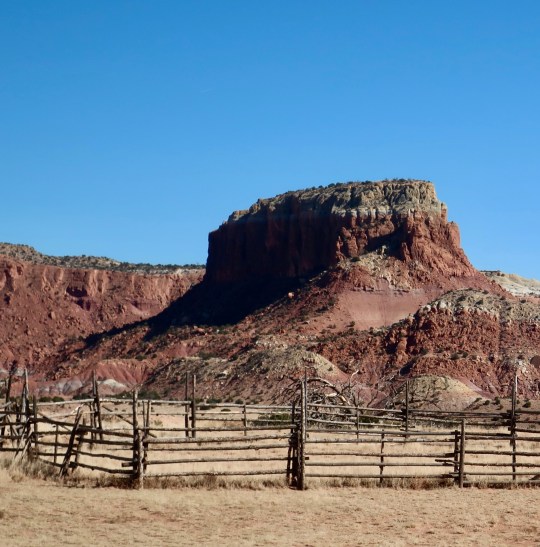
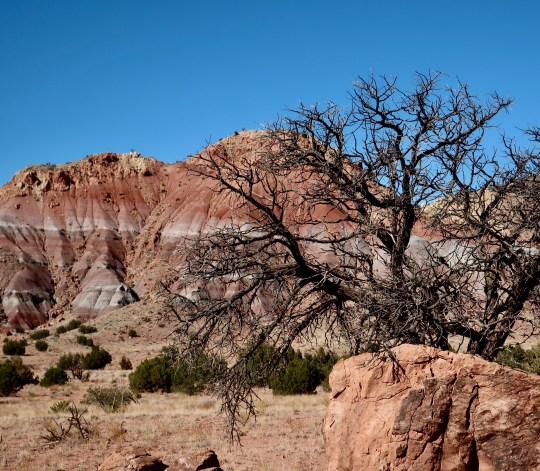
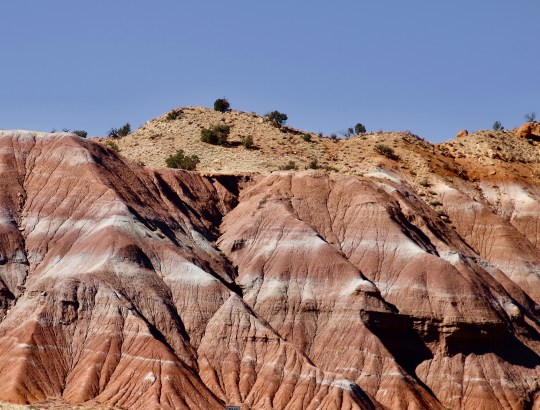
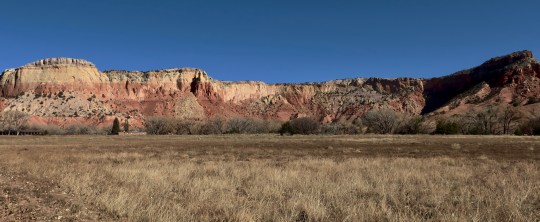
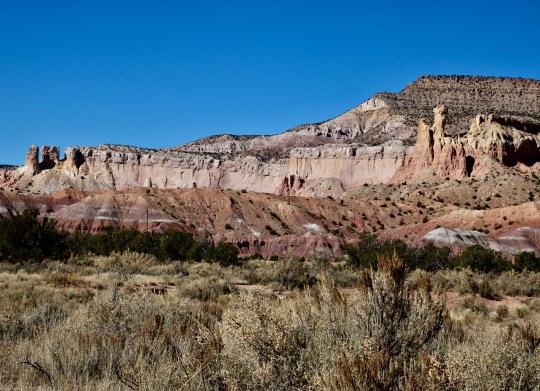
“It’s perfectly mad looking country— hills and cliffs and washes too crazy to imagine and thrown up into the air by God and let tumble where they would. It was certainly as spectacular as anything I have ever seen.” Georgia O’Keeffe on Ghost Ranch in 1937
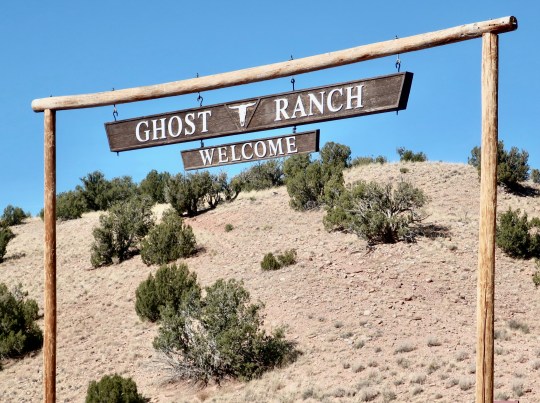
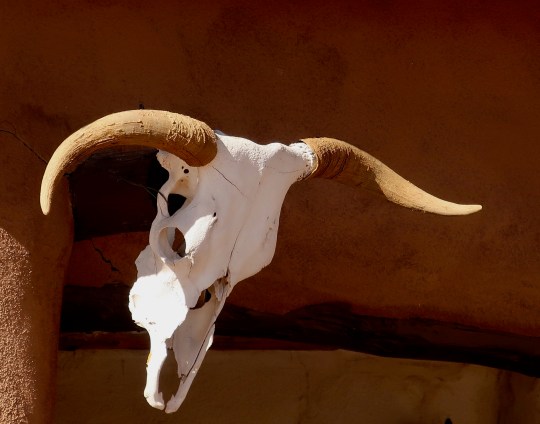
The welcome sign to Ghost Ranch, which is located about 15 miles north of Abiquiu. The cow skull in the middle is based on a painting by Georgia O’Keeffe.The cow skull is the logo for the ranch.It was appropriate that we found this skull on one of the cabins.
The connection between Ghost Ranch and Georgia O’Keeffe is a strong one. I suspect that most people who are aware of the area associate it with the artist. But Ghost Ranch has its own history before, during and after Georgia made it her summer escape from the eastern US, New York and her husband. Once upon a very long time ago during the Triassic era (think 200 million years), it was located near the equator and home to a small dinosaur, Coelophysis. Over 1000 have been found on the property. You probably wouldn’t want to encounter one. It stood approximately nine feet tall, was carnivorous, and ran very fast— probably in packs. “If the left one don’t a-get you, the right one will.” (My apologies to Tennessee Ernie Ford and 16 Tons.)
A small museum featuring Coelophysis is found on the ranch.This rendition of the small dinosaur was shown on the State fossil site. Now imagine a herd of them!
In more modern times, circa 1880, the Archuleta brothers took up residence at the ranch. They were outlaws, cattle rustlers to be more specific. They liked the ranch because it was remote, had water, and was known as “El Rancho de los Brujos,” The Ranch of the Witches. The latter was important because it kept the local folks who were superstitious, i.e. almost everyone, away from their operation. Unfortunately, or fortunately depending on how you regard such things, one of the brothers killed the other in a dispute over gold. A posse showed up and hung the remaining brother and any of the other outlaws who hadn’t skedaddled, adding to the ranch’s dark reputation.
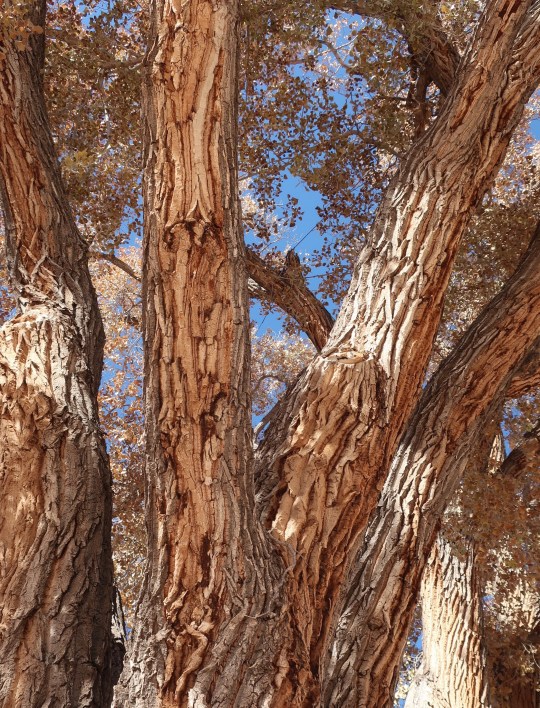
I wondered if this was the cottonwood where the Archuleta gang met their doom.
Jumping forward to 1928, Roy Pfaffle won the ranch in a poker game and his wife, Carol Stanley, a woman who obviously thought ahead, registered the ranch in her name. She also decided to call it Ghost Ranch, given its history. Two years later, waving goodbye to her now ex, she moved to the ranch with high hopes of making a living by establishing a high-end dude ranch for wealthy people. They came, but there wasn’t quite enough income to make ends meet. She sold the property to Arthur Stack in 1935, one of the wealthy guests and an early conservationist. He maintained it as a dude ranch up until 1955 when he donated it to the Presbyterian Church as a retreat center, which it continues to serve as today.
This just about brings us to O’Keeffe, but not quite. In the early to mid-40s some mysterious strangers showed up on weekends using alias names who either wouldn’t or couldn’t talk about what they did or their past. Turns out that among these guests were the likes of Robert Oppenheimer, Enrico Fermi and Niels Bohr, who just happened to be building the world’s first atomic bomb south of the ranch at Los Alamos.
Also of note, Hollywood had discovered Ghost Ranch. Peggy and I found a list of movies that had portions filmed there in the Visitors’ Center. Among them were City Slickers, Young Guns, Wyatt Earp, All the Pretty Horses, Cowboys and Aliens, the 2013 version of the Lone Ranger and the 2016 version of The Magnificent Seven. Do you see a certain trend here? Ride’em cowboy.
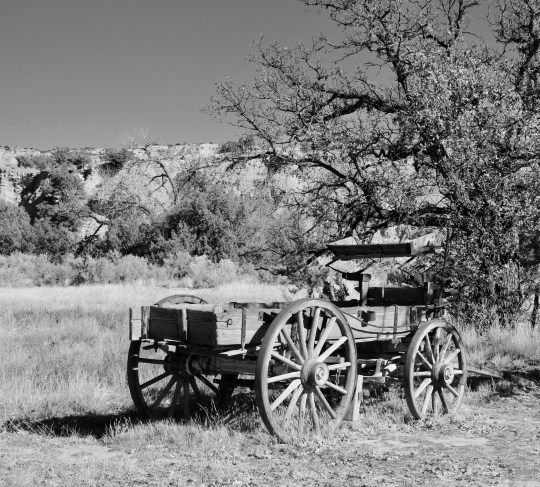
This old log cabin seemed perfect to represent the Old West side of Ghost Ranch. Actually it was built for the movie” City Slickers.”As was this corral!This wagon certainly spoke to Old West character of Ghost Ranch. (Photo by Peggy Mekemson.)
Georgia O’Keeffe made her first visit to Ghost Ranch in 1934 and immediately fell in love with its wild beauty. Not so much the fact that it was a dude ranch. She liked to work alone; her art demanded solitude. It wasn’t that she was opposed to having the occasional dude around, but lots of dudes riding horses were counterproductive. None-the-less, she rented a cabin from Stack and when a long-term rental became available due to an illness, she stayed there all summer, beginning a tradition that would last up until she moved into her house in Abiquiu in 1949.
It wasn’t long before she persuaded Arthur Stack to rent her his house, Ranchos de los Burros. It came with more isolation and scenic views. And a great piano. I found a story where O’Keeffe and several friends showed up off-season and found the house locked up tight. They proceeded to break in and spend the evening lying around listening to Ansel Adams knock out tunes on the piano. If I could do time travel, it’s an event that I would travel back to!
Once, when she showed up for her usual summer stay, she found the house occupied and went ballistic. When Stack pointed out that the house didn’t actually belong to her, she insisted on buying it. She was also irritated when Stack gave Ghost Ranch to the Presbyterians rather than selling it to her. The Presbyterians respected her privacy, however, and she eventually developed a good relationship with them.
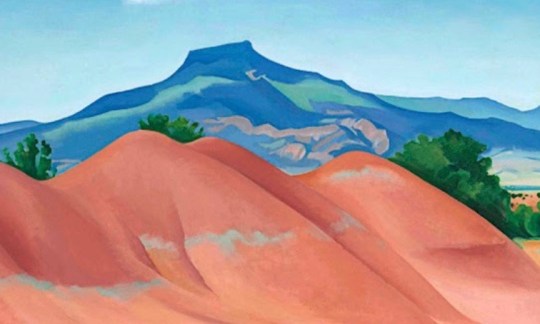
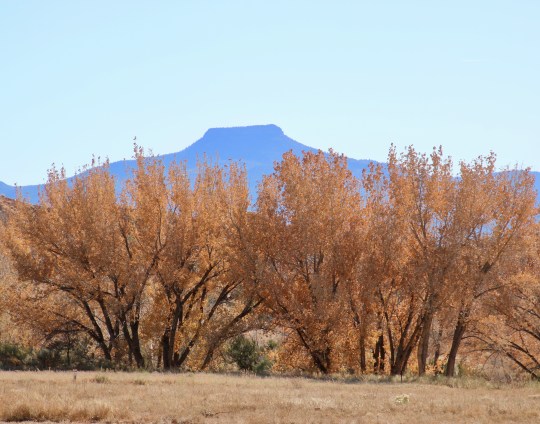
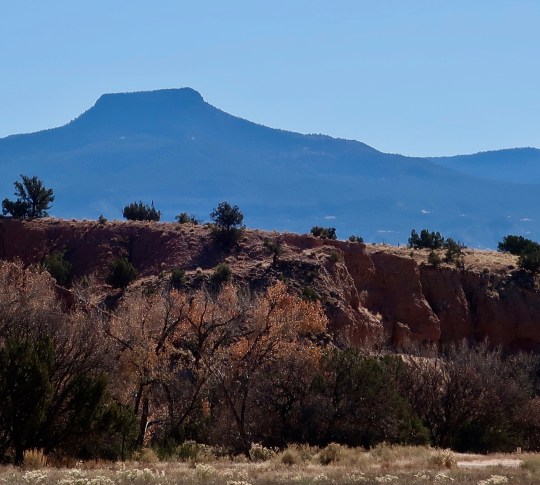
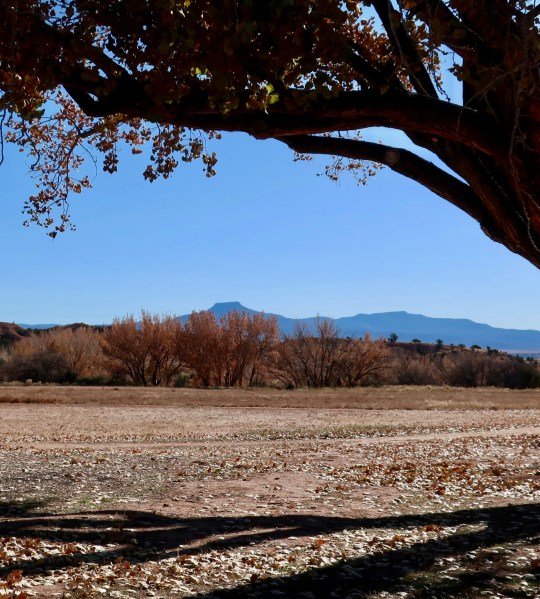
I’ll start my main photo section today with a painting by Georgia O’Keeffe of her “private mountain,” the Cerro Pedernal. As she said, “It belongs to me. God told me if I painted it enough, I could have it.” So, she painted it over 20 times and requested that her ashes be scattered on the mountain when she died. When I first read about her passion for the mountain, I thought of the post-impressionist French painter Paul Cézanne and his ‘holy mountain,’ Mount Sainte-Victoire, which he could see from his home in Aix and painted some 60 times.
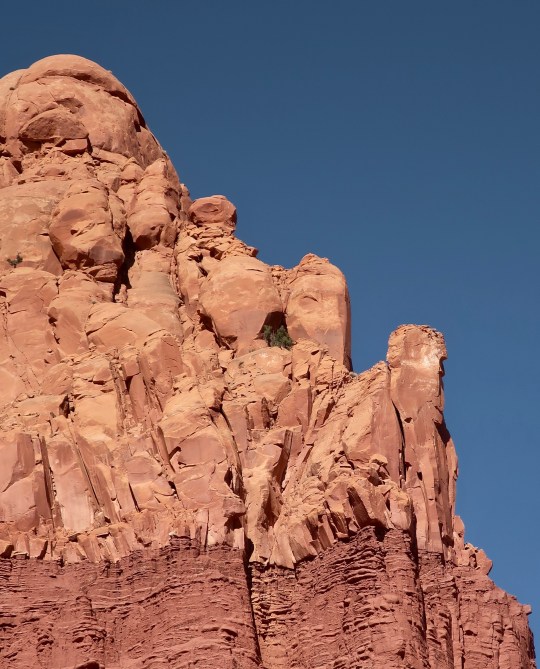
One of 20 some paintings O’Keeffe did of Cerro Pedernal.Peggy and I decided that since Georgia had painted Cerro Pedernal so many times, we should honor it by taking its photo several times. (Photo by Peggy Mekemson.)Another perspective of Cerro Pedernal.And a final shot.A small wayside just before you reach Ghost Ranch features superb views of the Chinle formation that O’Keeffe loved to paint. A close up. The Chinle Formation is what gives the Painted Desert its colors and is also located in Petrified Forest National Park. It’s also where the remains of Coelophysis are found. Georgia O’Keeffe painting of a Chinle Formation at Ghost Ranch.This is another impressive rock formation we saw on our way to Ghost Ranch.And this.And now several photos from within Ghost Ranch that fit Georgia’s observation of “perfectly mad looking country” that inspired her to paint. (Photo by Peggy Mekemson.)Photo by Peggy Mekemson.I’ll conclude my final post on Georgia O’Keeffe with one last photo of her ‘mountain’ Cerro Pedernal.
NEXT POST: A journey into the world of shamans and petroglyphs. The start of a new series.




























































 Wandering through Time and Place